Saudi Arabia compliance calendar

6 recurring VAT and Excise tax obligations — returns, payments and listings — each with its due rule and official source, plus the dates new Saudi Arabia rules take effect.

Mon
Tue
Wed
Thu
Fri
Sat
Sun
26
27
28
29
30
31
1
2
3
4
5
6
Return filing Law change takes effect

No obligation here shifts for a weekend or public holiday. Where that is Saudi Arabia's own rule the date stands as shown; where a shift exists but is not modelled, the obligation's notes say so. Confirm against the linked official source before relying on a date.

Recurring obligations, with sources

Each deadline cites the official text that states it and the date we last verified it.

VAT return — quarterly (three-month tax period)

VAT · Quarterly · return filing

last day of the month after the quarter ends Verified 2026-10-21
Who files
VAT-registered businesses whose taxable supplies did not exceed SAR 40 million in the previous 12 months — the standard three-month tax period. Filing and payment share this date.
Notes
Most VAT-registered businesses file quarterly, and the return and the tax are both due by the last day of the month after the quarter ends. ZATCA does not carry the date past a weekend: the second-quarter return for 2027 is due on Saturday 31 July 2027, not the following Sunday. A return is owed for every quarter, and if one is missed ZATCA can estimate the tax while the return itself remains outstanding.
Source
VAT Implementing Regulations (ZATCA English translation, 8th edition 2021), articles 59, 62 and 74 Zakat, Tax and Customs Authority (ZATCA)
See the source text
“The Tax Return of a Taxable Person must be filed by the Taxable Person or a person authorized to act on his behalf for each Tax Period with the Authority no later than the last day in the month following the end of the Tax Period to which the Tax Return relates.”
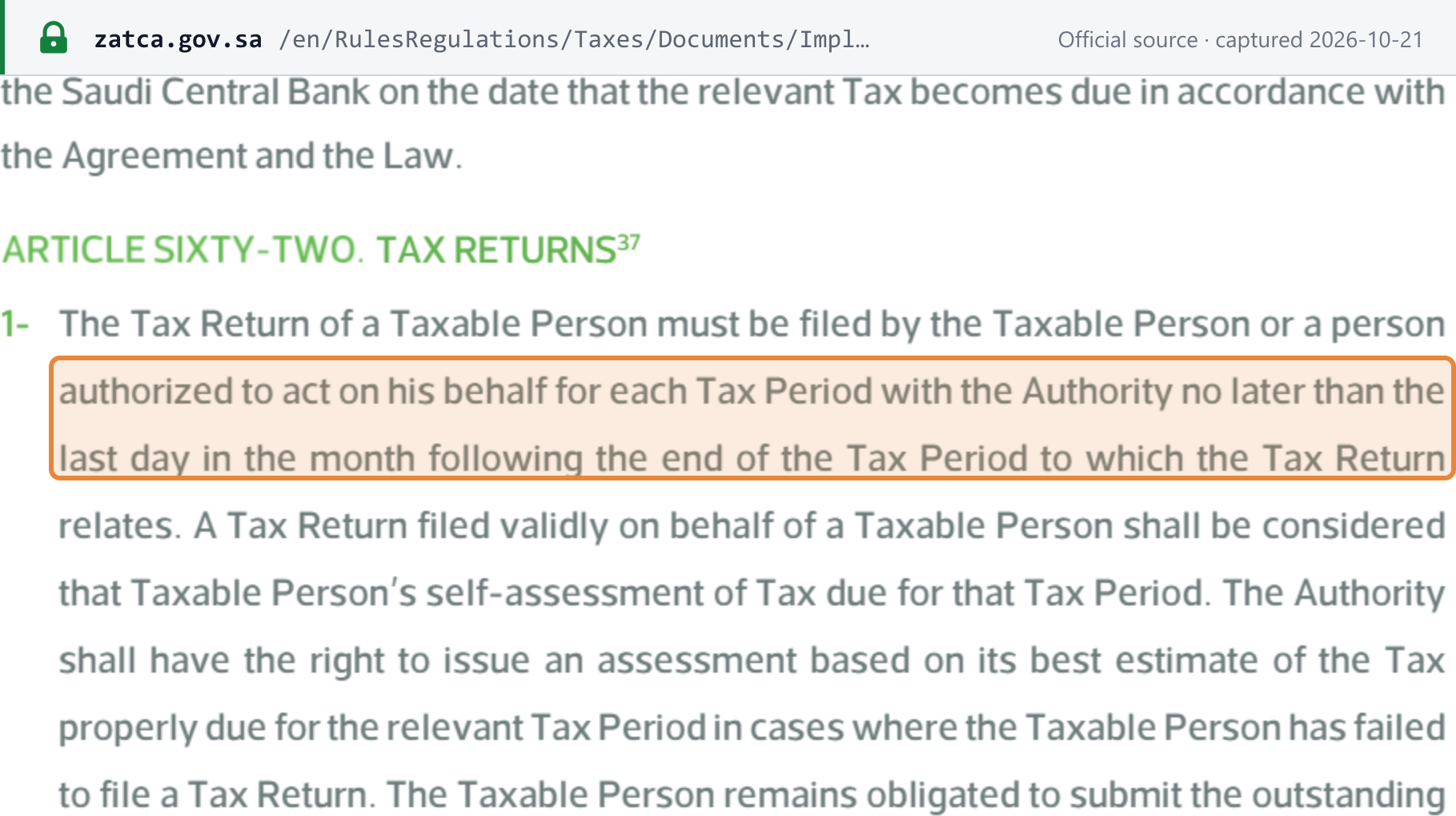
Screenshot of Zakat, Tax and Customs Authority (ZATCA) showing the VAT return — quarterly (three-month tax period) deadline Open full size Captured from Zakat, Tax and Customs Authority (ZATCA) on 2026-10-21
VAT return — monthly (supplies above SAR 40 million, or by election)

VAT · Monthly · return filing

last day of the month after the month ends Verified 2026-10-21
Who files
VAT-registered businesses whose taxable supplies exceeded SAR 40 million in the previous 12 months, and smaller businesses ZATCA has allowed to file monthly on application. Filing and payment share this date.
Notes
Each month's return and payment are due by the last day of the next month — the October 2026 return by 30 November 2026. The date stands even on a Friday or Saturday: the March 2027 return is due on Friday 30 April 2027 and does not move to the Sunday. A business below SAR 40 million can apply to file monthly, and a monthly filer can apply to return to quarterly periods after two years if its supplies have stayed under the threshold.
Source
VAT Implementing Regulations (ZATCA English translation, 8th edition 2021), articles 58, 59 and 62 Zakat, Tax and Customs Authority (ZATCA)
See the source text
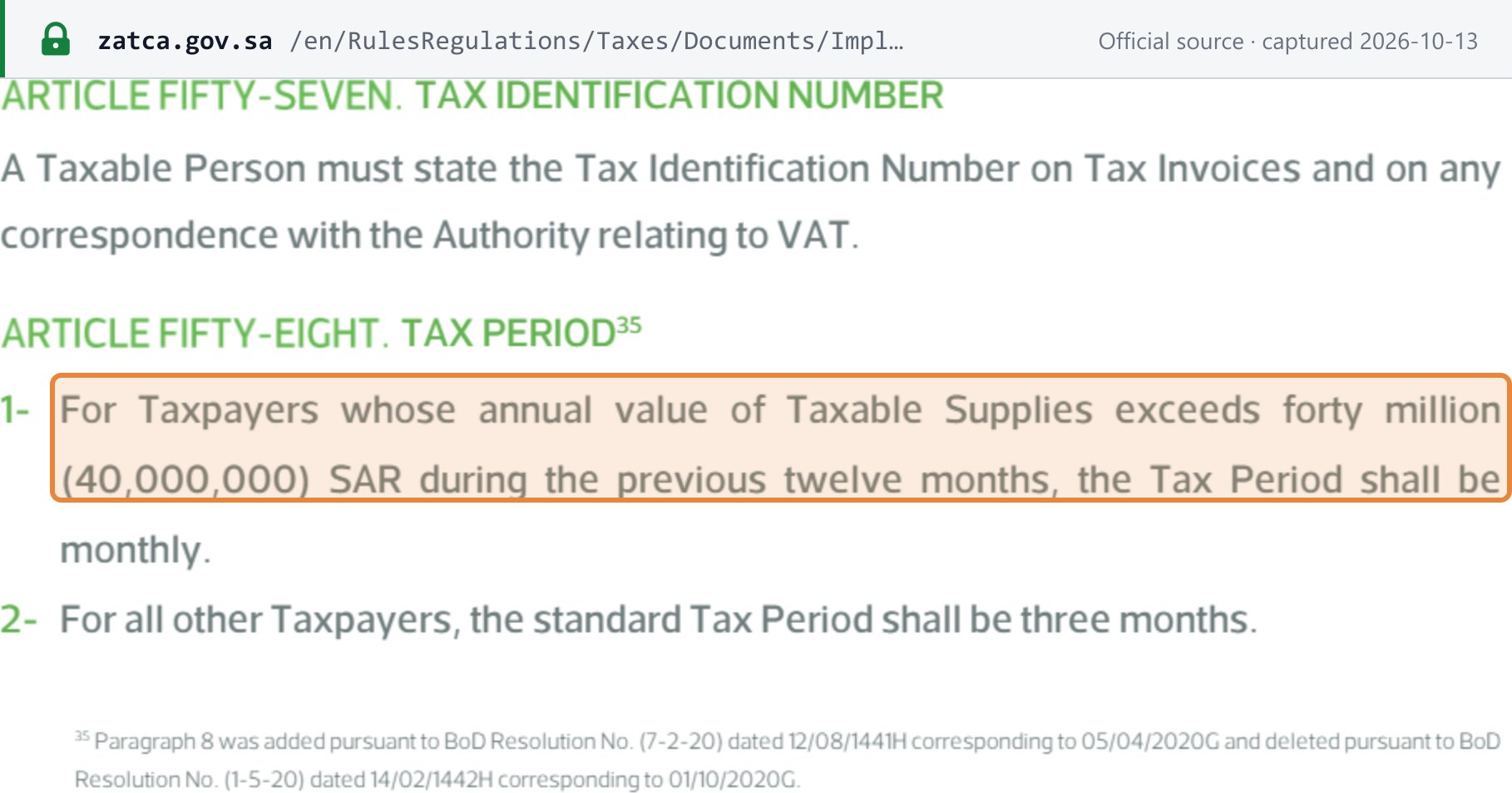
“For Taxpayers whose annual value of Taxable Supplies exceeds forty million (40,000,000) SAR during the previous twelve months, the Tax Period shall be monthly.”
Screenshot of Zakat, Tax and Customs Authority (ZATCA) showing the VAT return — monthly (supplies above SAR 40 million, or by election) deadline Open full size Captured from Zakat, Tax and Customs Authority (ZATCA) on 2026-10-13

Excise tax return — two-monthly

Excise tax · Every 2 months · return filing

last day of the month after the two-month period ends Verified 2026-10-21
Who files
Persons licensed and registered for excise tax, typically tax-warehouse keepers. The tax declared on the return is paid on the same day.
Notes
Excise is reported in two-month periods — January to February, March to April and so on — and since the December 2025 amendment the return and the tax are due by the end of the following month, so the November–December 2026 return is due by 31 January 2027. ZATCA quotes the calendar date even when it is a Friday, as it did for 31 July 2026; an official holiday can carry a deadline to the next working day. Late payment costs 5% of the unpaid tax for each month or part month. Licensees who move goods between their own warehouses without a movement document for each transfer must instead file a monthly movement declaration within 15 days of each month end.
Source
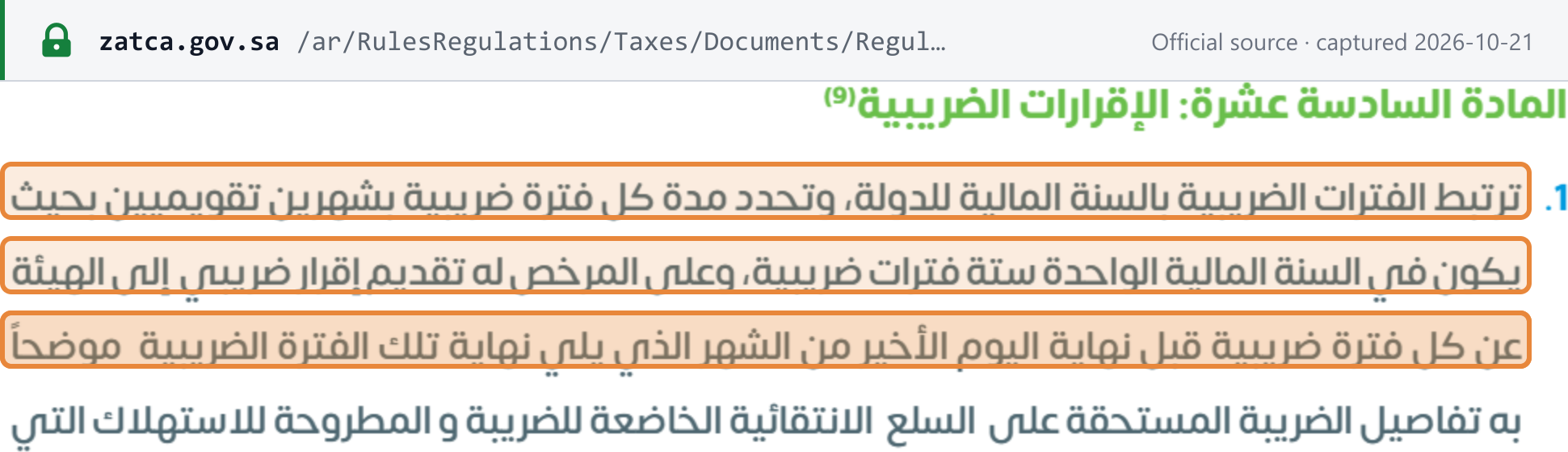
اللائحة التنفيذية لنظام الضريبة الانتقائية (Excise Tax Implementing Regulations, consolidated Arabic text to Board Resolution 25-06-06 of 28 December 2025), article 16(1) Zakat, Tax and Customs Authority (ZATCA)
See the source text
“ترتبط الفترات الضريبية بالسنة المالية للدولة، وتحدد مدة كل فترة ضريبية بشهرين تقويميين بحيث يكون في السنة المالية الواحدة ستة فترات ضريبية، وعلى المرخص له تقديم إقرار ضريبي إلى الهيئة”
Screenshot of Zakat, Tax and Customs Authority (ZATCA) showing the Excise tax return — two-monthly deadline Open full size Captured from Zakat, Tax and Customs Authority (ZATCA) on 2026-10-21
VAT registration — resident business above SAR 375,000

VAT · One-off · registration

within 30 days of the end of the month in which taxable supplies over the past 12 months exceeded, or over the next 12 months are expected to exceed, SAR 375,000 Verified 2026-10-21
Who files
Unregistered businesses resident in Saudi Arabia whose taxable supplies over the past 12 months exceeded, or over the next 12 months are expected to exceed, the mandatory threshold of SAR 375,000.
Notes
Check the 12-month totals at the end of every month. The 30 days run from the end of the month in which the threshold is passed, not from the day of the sale that passed it. If the 30th day is a Friday, Saturday or public holiday, applying on the next working day is on time. Registration takes effect from the start of the month after you apply, or, for an expected excess, from the first month the threshold was expected to be passed.
Source
VAT Implementing Regulations (ZATCA English translation, 8th edition 2021), articles 3, 4 and 74(2) Zakat, Tax and Customs Authority (ZATCA)
See the source text
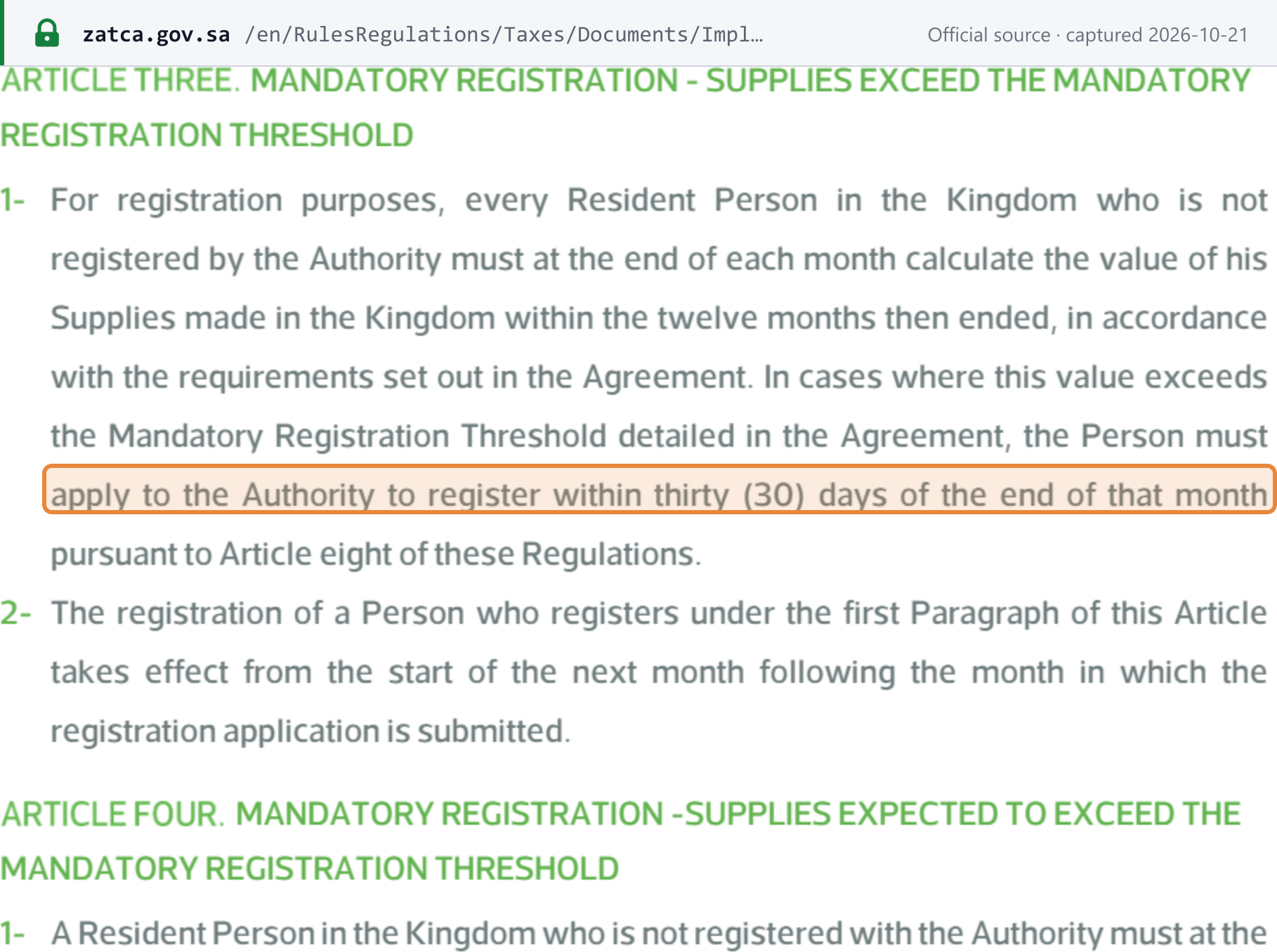
“For registration purposes, every Resident Person in the Kingdom who is not registered by the Authority must at the end of each month calculate the value of his Supplies made in the Kingdom within the twelve months then ended, in accordance with the requirements set out in the Agreement. In cases where this value exceeds the Mandatory Registration Threshold detailed in the Agreement, the Person must apply to the Authority to register within thirty (30) days of the end of that month pursuant to Article eight of these Regulations.”
Screenshot of Zakat, Tax and Customs Authority (ZATCA) showing the VAT registration — resident business above SAR 375,000 deadline Open full size Captured from Zakat, Tax and Customs Authority (ZATCA) on 2026-10-21
VAT registration — non-resident

VAT · One-off · registration

within 30 days of the first supply on which the non-resident is obliged to pay Saudi VAT Verified 2026-10-21
Who files
Non-resident businesses that are not registered but are liable to pay Saudi VAT on supplies they make or receive in the Kingdom. No turnover threshold applies.
Notes
The clock starts with the first supply on which the non-resident owes the tax, and registration is backdated to that supply, so tax is due from the start whenever the application is made.
Source
VAT Implementing Regulations (ZATCA English translation, 8th edition 2021), article 5 Zakat, Tax and Customs Authority (ZATCA)
See the source text
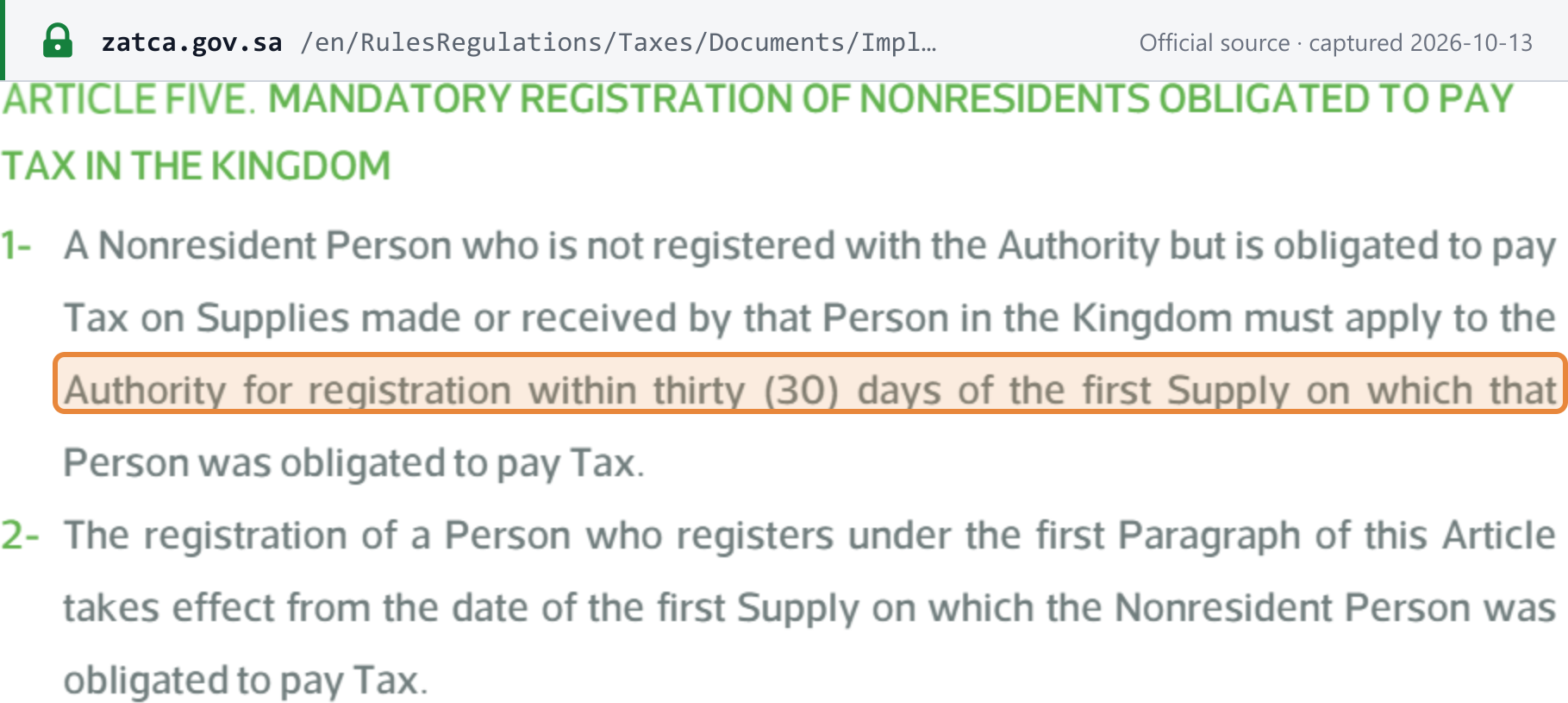
“A Nonresident Person who is not registered with the Authority but is obligated to pay Tax on Supplies made or received by that Person in the Kingdom must apply to the Authority for registration within thirty (30) days of the first Supply on which that Person was obligated to pay Tax.”
Screenshot of Zakat, Tax and Customs Authority (ZATCA) showing the VAT registration — non-resident deadline Open full size Captured from Zakat, Tax and Customs Authority (ZATCA) on 2026-10-13

VAT deregistration application

VAT · One-off · registration

within 30 days of a mandatory deregistration case under Implementing Regulations article 13(1)–(3) Verified 2026-10-21
Who files
VAT-registered businesses that stop their economic activity, non-residents that have made no taxable supplies in the last 12 months, and residents whose supplies or expenses have fallen below the deregistration tests.
Notes
Counted in calendar days; a 30th day falling on a weekend or holiday rolls to the next working day. If you do not apply, ZATCA can deregister you itself from a date it chooses. All outstanding tax obligations must be settled before ZATCA approves deregistration, and that includes a business that stops because its activity has been transferred.
Source
VAT Implementing Regulations (ZATCA English translation, 8th edition 2021), article 13 Zakat, Tax and Customs Authority (ZATCA)
See the source text
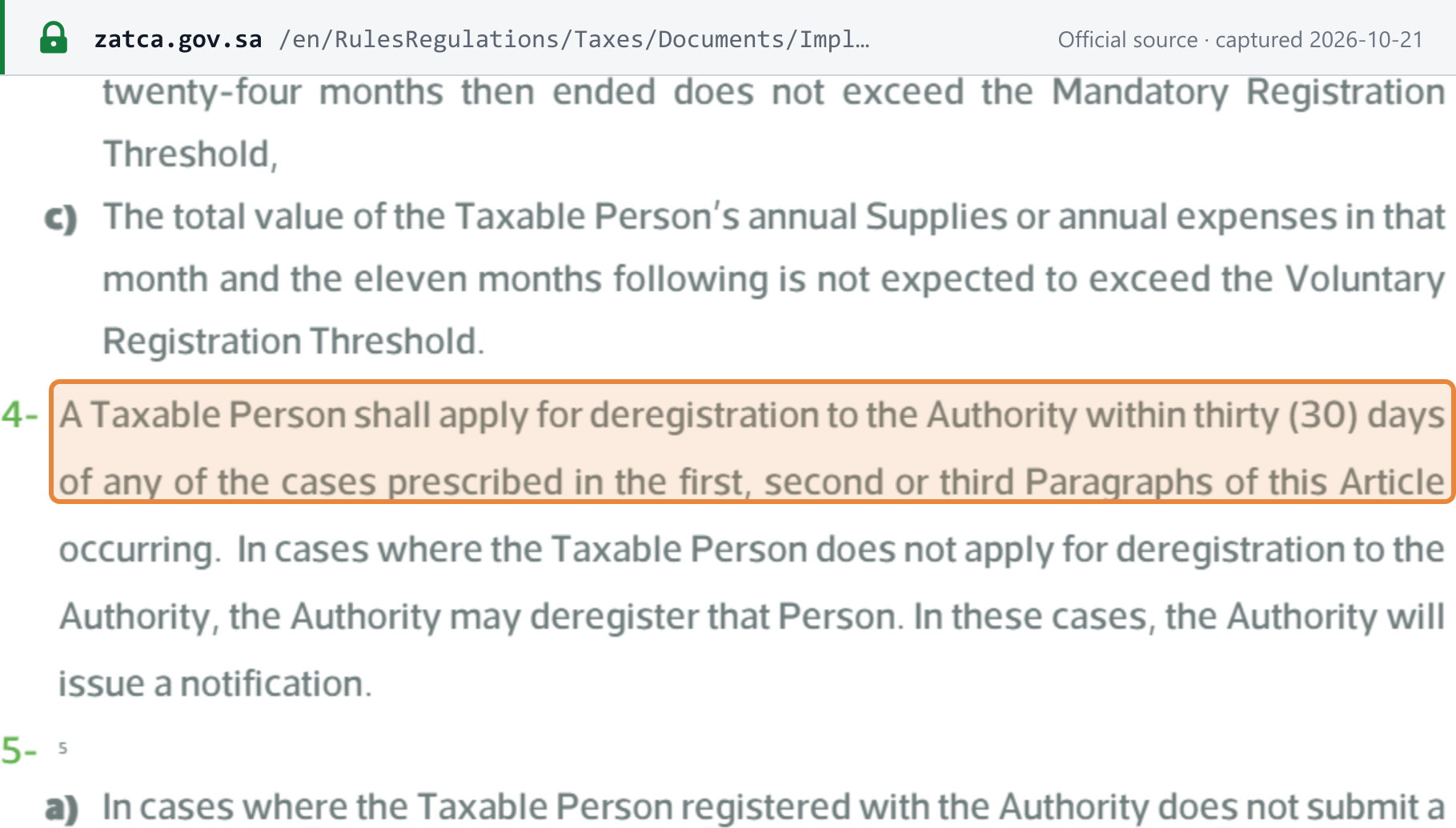
“A Taxable Person shall apply for deregistration to the Authority within thirty (30) days of any of the cases prescribed in the first, second or third Paragraphs of this Article occurring.”
Screenshot of Zakat, Tax and Customs Authority (ZATCA) showing the VAT deregistration application deadline Open full size Captured from Zakat, Tax and Customs Authority (ZATCA) on 2026-10-21
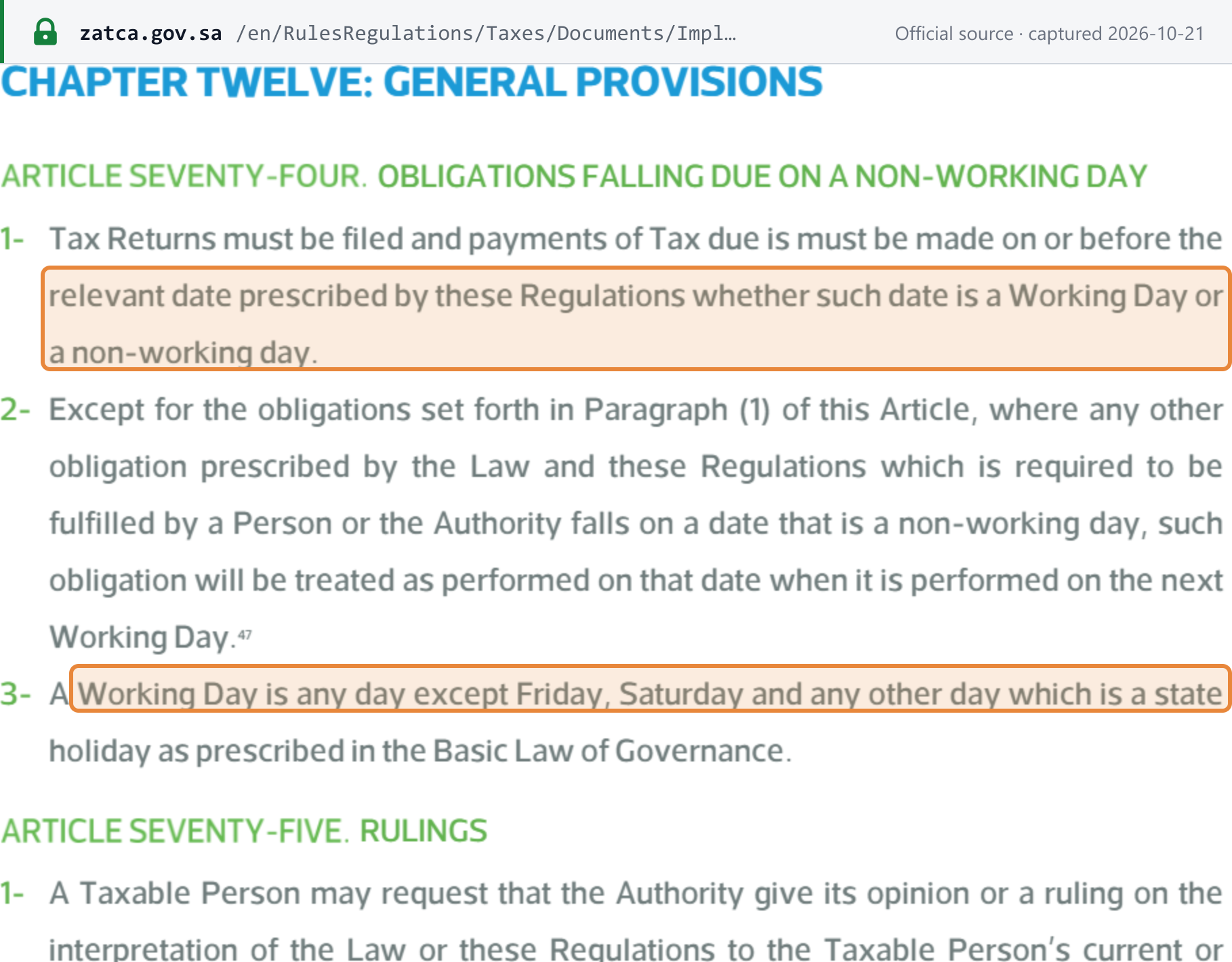
Saudi VAT returns and payments are due on the last day of the month after the tax period, and the law keeps that date even when it falls on a Friday, Saturday or public holiday: the weekend is Friday and Saturday, so a deadline that falls on a weekend stays on that day and does not move to the next working day. Other VAT duties, such as registering or deregistering, move to the next working day instead. Public holidays (Founding Day, National Day and the two Eids) are not built into the dates shown. There is no annual VAT return and no sales listing, and e-invoices are cleared or reported to ZATCA one at a time. The 5% real estate transaction tax is paid per transaction, on or before notarisation, and has no filing calendar. Zakat, income tax and withholding tax run on their own calendars and are not covered here.

“Tax Returns must be filed and payments of Tax due is must be made on or before the relevant date prescribed by these Regulations whether such date is a Working Day or a non-working day.”
Screenshot of the official source stating the rule that governs Saudi Arabia's deadlines
VAT Implementing Regulations (ZATCA English translation, 8th edition 2021), article 74 — obligations falling due on a non-working day — Zakat, Tax and Customs Authority (ZATCA), captured 2026-10-21

What this calendar does not list

  • Not applicable Separate payment deadline — There is no separate payment deadline. VAT Implementing Regulations article 59(1) makes VAT payable by the same last day of the following month as the return under article 62(1), and Excise Implementing Regulations article 18(4) does the same for excise. The return rows carry both.
  • Not applicable Annual or reconciliation return — Saudi VAT has one return per tax period under Implementing Regulations article 62 and no annual or reconciliation return; the Excise Implementing Regulations likewise provide only the two-monthly return.
  • Not applicable Recapitulative listing — Neither the VAT Implementing Regulations nor the Excise Implementing Regulations provide a recapitulative statement, sales or purchase listing or SAF-T file. Transaction data reaches ZATCA invoice by invoice through e-invoicing instead.
  • Not applicable E-invoicing / e-reporting cycle — FATOORA sets no periodic filing cycle. Tax invoices are cleared by ZATCA before they are shared and simplified invoices are reported within 24 hours of generation, so reporting runs per invoice. The Phase 2 integration waves are one-off deadlines that ZATCA notifies to each cohort at least six months ahead. The current one, Wave 25, requires taxpayers whose VAT-taxable revenue exceeded SAR 187,500 in any of 2022 to 2025 to integrate by 1 February 2027.

About this calendar

Which Saudi Arabia tax deadlines does this calendar cover?

6 recurring indirect-tax obligations — VAT and Excise tax returns, payments and related filings — each with the due-date rule, who must file, and the official source that states the deadline. Direct-tax, payroll and company-registry deadlines are out of scope.

How current are these due dates?

Every obligation carries the date it was last verified against its official source (newest: 2026-10-21). Law-change dates come from the weekly Last Week in Taxes scan and link to their full change records.

Do the dates account for weekends and public holidays?

No — the calendar shows the statutory due date. Where the authority shifts deadlines falling on non-working days, the obligation notes say so. Confirm against the linked official source before relying on a date.

Validate tax IDs in 100+ countries

Put these rules into practice — verify VAT, GST, and EIN numbers in real time with the Lookuptax API.