Belize GST guidelines
Overview
Belize levies General Sales Tax (GST) under the General Sales Tax Act, Cap. 63. Section 8 provides: "A tax, to be known as “general sales tax” or “GST”, shall be charged in accordance with this Act on– (a) taxable importations; and (b) taxable supplies." [1] The tax is administered by the Belize Tax Service (BTS). Procedure (records, penalties, interest, offences) is in the Tax Administration and Procedure Act, Cap. 51 (TAPA). [3]
Which text of the Act this guide quotes. The current consolidation is the General Sales Tax Act, Chapter 63, Revised Edition 2020, published by the Attorney General's Ministry. [1] It has since been amended by the General Sales Tax (Amendment) Act 2024 (Act No. 34 of 2024), in force on 1 January 2025, which amends "Chapter 63 of the Substantive Laws of Belize, Revised Edition 2020" and is hosted by BTS. [2] Detailed invoice, record and e-invoicing rules are in the General Sales Tax Regulations (Subsidiary Laws, Revised Edition 2020), amended by SI No. 35 of 2025 and SI No. 140 of 2025. [17] [18] [19] TAPA Schedule V repealed or rewrote several GST Act sections, including s.38 (records) and s.30(7) (late-filing fine). [3] BTS's website hosts the earlier Revised Edition 2011. [16]
Authority, currency, period and layering
- Authority. BTS, Eleanor Hall, Lake I Boulevard, Belmopan; telephone (501) 222-4776. The GST Act's "Commissioner" now means the Director General: TAPA Schedule V reads "“Commissioner” means the Director General as defined in the Tax Administration and Procedure Act;". [3]
- Currency. Belize dollars (BZD). The Act writes amounts in "dollars".
- Tax period. "“tax period” means a calendar month;" (GST Act s.2). [1]
- Layering. GST is a single national tax. There is no state or municipal sales tax layer.
- Portals. Registered taxpayers file and pay through IRIS Belize. See Important websites.
Registration
Who must register and the threshold
A person must register when, on the last day of any month, the value of its supplies in the twelve months ending on that day was BZD 75,000 or more and there are reasonable grounds to expect at least BZD 75,000 in the twelve months starting with the first day of that month, or when it expects to reach BZD 75,000 in the coming twelve months. Section 23(1)(a) reads: "(i) during the period of twelve months ending on that day, the value of supplies made by the person was seventy-five thousand dollars or more; and (ii) there are reasonable grounds for believing that the value of the person’s supplies during the period of twelve months commencing with the first day of that month will be seventy-five thousand dollars or more; or". [1] BTS's registration guide puts it this way: "You must register for GST if your annual turnover is $75,000.00 or more per annum. Turnover is the total value of taxable supplies/sales/receipts/takings made for all your taxable activities but does not include the GST charged." [4]
- Measurement. A rolling twelve months of taxable supplies, excluding GST. The Commissioner can require a person's supplies to be aggregated with those of a related person (s.23(2)(b)).
- Deadline. "A person who is required to be registered must lodge an application for registration with the Commissioner in the approved form within one month of the day on which the person first becomes required to be registered." (s.22(3)) [1]
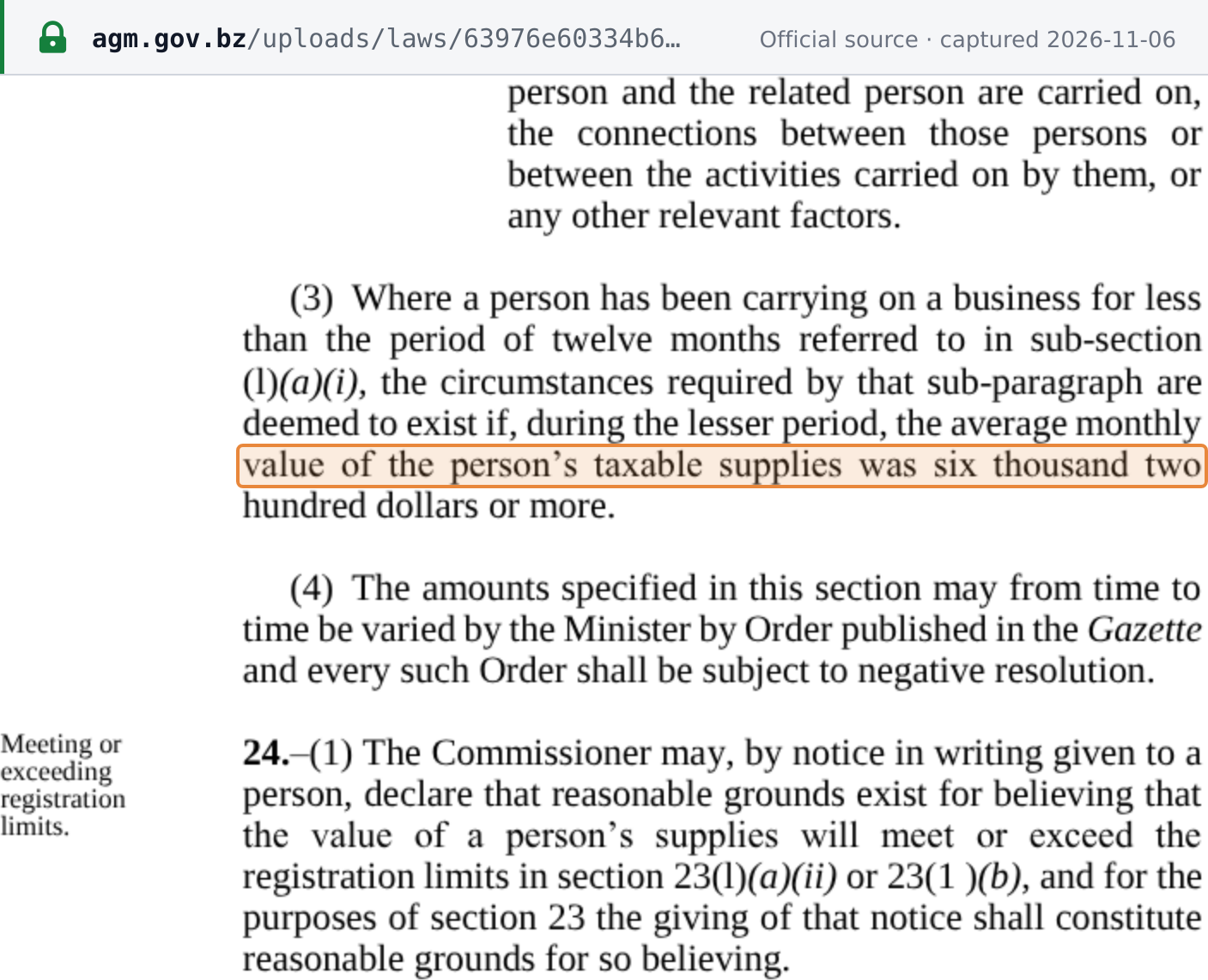
- Businesses trading for less than twelve months. Section 23(3): "Where a person has been carrying on a business for less than the period of twelve months referred to in sub-section (l)(a)(i), the circumstances required by that sub-paragraph are deemed to exist if, during the lesser period, the average monthly value of the person’s taxable supplies was six thousand two hundred dollars or more." [1] The statutory BZD 6,200 governs; the Minister can vary it by Order (s.23(4)). The Belize Tax Service's registration guide, its instructions for form BTS100 and its FAQ answer on the registration threshold use BZD 6,250, the monthly equivalent of the BZD 75,000 annual threshold, while two other answers in the same FAQ (who must register; promoters) use the statutory BZD 6,200. [4] [7] [12] A business averaging between BZD 6,200 and BZD 6,250 a month is inside the statutory test.
- Registration regardless of turnover. "It should be noted that every promoter of public entertainment and every licensee or proprietor of places of public entertainment must be registered even if their annual gross sales/receipts are less than $75,000.00." [4]
 Source snapshot captured 2026-11-06 — original
 Source snapshot captured 2026-11-06 — original
Non-resident registration
The GST Act sets no separate threshold for non-residents: s.23 applies the same BZD 75,000 test to "a person". As at 2026-11-06, BTS's registration guide, its GST resources page and its e-invoicing FAQ publish no non-resident registration scheme, no simplified registration for foreign digital sellers and no fiscal-representative rule. Whether a non-resident's supply is in Belize at all depends on the place-of-supply rule in s.17 (see Cross-border rules).
Tax registration number (TIN)
GST registration is recorded against the Taxpayer Identification Number (TIN): "A certificate of registration shall bear the Taxpayer Identification Number (TIN) and shall show the date from which the registration is effective." (s.27(2)) [1] The certificate must be displayed at each place of business (s.27). For the TIN's format and how it is issued, see the Belize TIN guide and the Belize TIN validator.
How to register
- Forms. "To register, applicants must complete form BTS100 and submit supporting documents based on business type, such as registry certificates, company documents, and identification forms. Any later changes in company details require submission of form BTS104." [4] BTS100 is a combined business tax and GST form.
- Documents (company example). "Company – Completion of form – BTS100 -Requirements needed -Copy of Company registry certificate chapter 250 -Articles of Association -Memorandum of Association -BTS101 for all shareholders, directors, and employees along with copy of social security card and/or passport". BTS lists different documents for sole traders, partnerships and other entities. [4]
- Online or in person. New businesses cannot register online. BTS's FAQ: "Can you Register a new business (company, partnership, NGO etc.) online? Currently, not in Phase 1. You will need to contact or visit the office." [12] IRIS Belize is for filing and payment after registration.
- Timeline. For a person required to register, the Commissioner "within 14 days of the date on which the application was received, shall notify the person of the registration by notice in writing, and the date of effect of the registration shall be the beginning of the following month." (s.26(1)(b)) [1] If registration is refused, the Commissioner gives reasons within one month of receiving the application (s.26(5)). [1]
Voluntary registration
A person below the threshold may apply on form BTS102 if "the person is carrying on or intends to carry on a business and makes or intends to make, supplies that would be taxable if the person were registered and the Commissioner is satisfied that 80% or more of the supplies will be made to taxable persons." (s.25) [1] BTS adds: "Also, input tax credit (tax on purchases) can only be claimed on those purchases that are directly attributable to taxable supplies." [4] Voluntary registration mainly suits small B2B suppliers whose customers want tax invoices to claim input tax, and exporters that want to recover GST on their costs.
Deregistration
"A registered person who is no longer required, or will not be required, by this Act to be registered may apply in writing to the Commissioner to have his registration cancelled." (s.29(1)) [1] BTS's form for this is BTS104 ("Application to Change Status Details or Cancel Registration"). [4] The Commissioner may refuse if the person "has, within the last two years, made supplies by reason of which he has been required to be registered" (s.29(3)). The final return is due "within fourteen days after the person ceases to be registered" (s.30(3)(b)). [1]
Group registration
The GST Act, Cap. 63 (Revised Edition 2020, as amended by Act No. 34 of 2024) has no group-registration provision. Its Division 5 covers branches and divisions (s.46), unincorporated bodies (s.47) and agents of absentee principals (s.48). For the threshold, the Commissioner can instead treat a person's supplies as including those of a related person (s.23(2)(b)). [1]
Rates
Belize has two GST rates: 12.5% and 0%. Section 9(1): "The rate of GST applicable to a taxable supply or importation is– (a) if the supply or import is zero-rated under Schedule I, Schedule II or Schedule III, 0%; or (b) in any other case, 12.5%." [1] BTS's return guide states the same two rates (as at 2026-11-06): [5]
 Source snapshot captured 2026-11-06 — original
Standard rate: 12.5%
The standard rate is 12.5% of the value of the supply, exclusive of GST. Line 140 of the BTS210 return computes it as "GST Payable on Standard Rated Supplies (LINE 100 X 12.5%)". [6] The Revised Edition 2020's margin note against s.9(1) cites Act No. 15 of 2010 as the source of the current wording. Neither the consolidation nor BTS's pages state the date the 12.5% rate took effect. The Minister can vary the rate by Order published in the Gazette, subject to negative resolution (s.9(2)).
Zero rate: 0%
Zero-rated supplies are taxable at 0%, so the supplier charges no GST but can recover the GST on its costs. The schedules cover:
- Schedule I — goods. Exported goods ("Supply of goods, if the supplier has entered the goods for export under the Customs and Excise Duties Act and the goods have been exported."), and "A supply of goods to a commercial free zone under the Free Zones Act or to an export processing zone under the Export Processing Zone Act." [1] [1]
- Schedule II — services, including services supplied to non-residents outside Belize.
- Schedule III — other supplies and imports, mainly basic foods and agricultural inputs. The Revised Edition 2020 list includes rice, flour, corn, locally produced fresh meat, eggs, beans, locally produced fresh fruit, vegetables and milk, salt, tea, bread and tortillas, cooking lard, margarine, baby formula, sugar, condensed and powdered milk, cooking oil and cereals. Water (other than bottled) and domestic sewerage services are also zero-rated (Schedule III, item III.1). [1] [1]
BTS's own summary: "Zero-Rated Goods and Services Basic food items (e.g., rice, flour, beans) Exported goods Certain medical supplies and prescription drugs". [13] The schedules have been amended since 2020; BTS's home page lists an amendment to the zero-rated goods schedule and amendments affecting agriculture and utilities. Treat the lists above as examples, not the complete current schedule.
Reduced rates
None. The GST Act sets 12.5% and 0% only (s.9(1)).
Announced future rates
As at 2026-11-06, BTS's news page and GST resources announce no change to the 12.5% rate. BTS does announce one-off GST-free days: for example, its news page announced that school supplies and laptops would be GST-free on 15 and 29 August 2026. [15]
Cross-border rules
Imports
GST on imports is collected by Customs at entry: "GST payable on taxable importations shall be charged and payable under this Act, but for the purposes of collecting and enforcing the payment of the tax, the Customs Regulation Act and any other law relating to the importation of goods shall apply in the same manner as if the GST were a duty of customs." (s.11(2)) [1]
- Value. The customs value plus "any duties, taxes (other than GST charged under this Act), and other charges that are charged, paid, or payable upon the entry of imported goods" (s.13).
- Recovery. A registered importer claims the GST paid at entry on line 240 of the BTS210 return ("GST paid to the Comptroller of Customs on Imports"). [6]
- Exempt imports are listed in Schedule V.
- De minimis. The GST Act (Revised Edition 2020, as amended by Act No. 34 of 2024) sets no low-value import relief.
Importers also need a TIN; see the Belize TIN guide.
Exports
Exported goods (Schedule I) and exported services, including services supplied to non-residents outside Belize (Schedule II), are zero-rated. They are reported on line 110 of BTS210, "Zero Rated Supplies (INCLUDING EXPORTS)". [6]
Place of supply
Section 17(1): "Except as otherwise provided, a supply of goods or services shall be regarded as taking place in Belize if– (a) the supplier is a resident; or (b) the supplier is a non-resident and– (i) in the case of a supply of goods, the goods supplied are located in Belize at the time of the supply; or (ii) in the case of a supply of services, the services are physically performed in Belize by any person who is in Belize at the time the services are performed." [1] Goods follow their location; services follow where they are physically performed. Section 17 has further rules for particular supplies, such as leases and telecommunications (s.17(5), (7)).
Foreign companies selling into Belize — B2B and B2C
- B2B. Where a non-resident supplier that is not registered makes a supply that would be in Belize to a registered person who acquires it "exclusively for the purpose of making taxable supplies", "the supply shall be deemed to take place outside Belize unless the supplier and recipient have agreed in writing that this subsection shall not apply." (s.17(3)) [1] The GST Act (Revised Edition 2020, as amended by Act No. 34 of 2024) does not make the customer account for GST on such supplies by reverse charge.
- B2C. A non-resident whose goods are in Belize, or whose services are physically performed in Belize, makes a supply in Belize and is subject to the same BZD 75,000 test as anyone else. Services performed entirely outside Belize are not supplies in Belize under s.17(1)(b)(ii).
Digital services
BTS publishes no GST regime for non-resident sellers of digital services, and the GST Act (Revised Edition 2020, as amended by Act No. 34 of 2024) has none. BTS's FAQ on internet sales covers Belize sellers only: "Where a registered, Belize-owned entity provides goods and services to people in Belize over the Internet, they will charge GST at the standard rate (12.5%). Where a Belize entity sells goods and services over the Internet to overseas customers, GST will generally be charged at a rate of 0%. However, reasonable steps should be taken to verify the location of the customer and destination of the goods and services." [12] For the wider picture, see VAT on digital services from non-resident suppliers.
Marketplace and platform deemed-supplier liability
The GST Act (Revised Edition 2020, as amended by Act No. 34 of 2024) and BTS's GST pages contain no rule making a marketplace or platform liable for GST as the deemed supplier.
Invoice requirements
Belize has four GST documents: the tax invoice (to a taxable person), the tax receipt (to an unregistered person or final consumer), the credit note and the debit note. All four can be issued on paper or electronically. Electronic versions are called electronic tax documents (ETDs) and must be authorized by BTS.
When a tax invoice or tax receipt is required
- Tax invoice. "A registered person making a taxable supply to another taxable person shall, at the time of the supply, give the recipient a tax invoice in respect of the supply in accordance with sub-section (2)." (s.36(1), unchanged by Act No. 34 of 2024) [1] Since 1 January 2025 it may be issued "either electronically or in printed form" (Act No. 34 of 2024, s.6(a)(i)). [2]
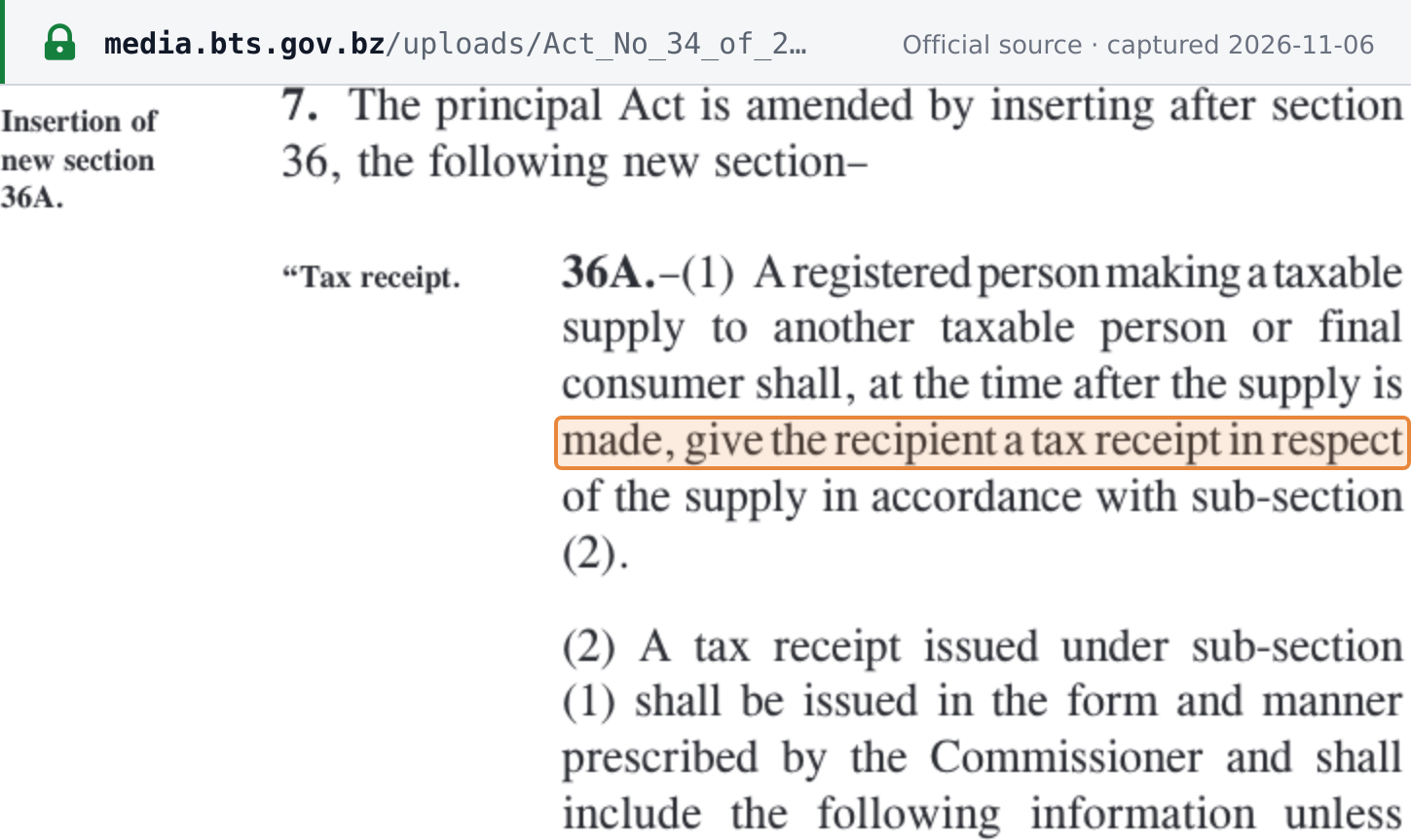
- Tax receipt. New s.36A(1), in force on 1 January 2025: "A registered person making a taxable supply to another taxable person or final consumer shall, at the time after the supply is made, give the recipient a tax receipt in respect of the supply in accordance with sub-section (2)." [2] The GST Regulations tie the tax receipt to unregistered buyers: "Where a registered person make a supply of goods or service to an unregistered person or a final consumer, a tax receipt shall be issued." (reg 14(1)) [17] In practice, registered buyers receive a tax invoice and unregistered buyers and final consumers a tax receipt.
- Small sales. "A tax invoice is not required to be issued for a taxable supply if the price of the supply is less than fifty dollars, unless requested by the recipient." (s.36(3)) [1]
- Gambling. No tax invoice may be issued for a gambling supply (s.36(5)).
 Source snapshot captured 2026-11-06 — original
Mandatory content of a tax invoice
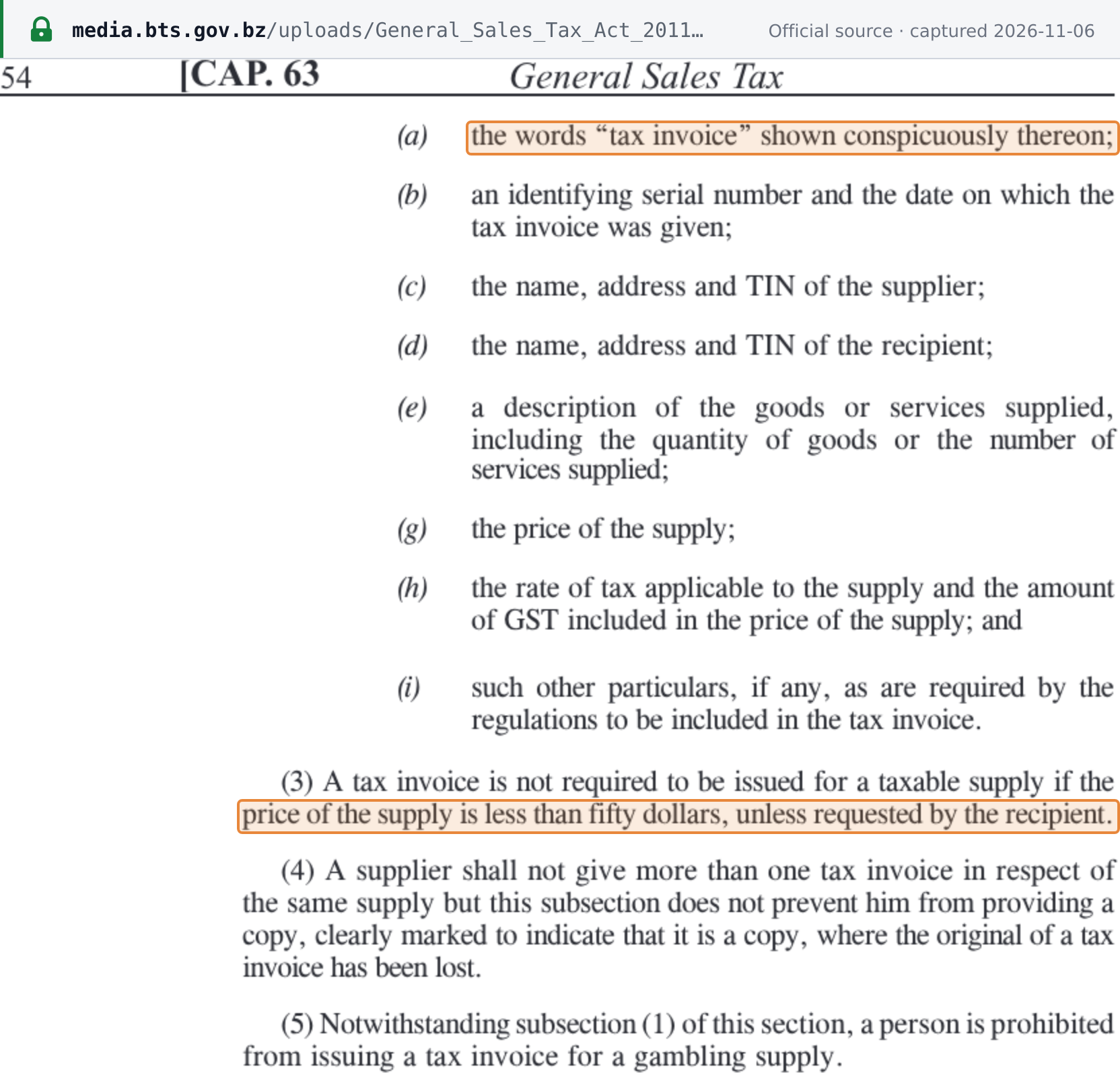
Section 36(2) (Revised Edition 2020; the same list as in the 2011 edition): "(a) the words “tax invoice” shown conspicuously thereon; (b) an identifying serial number and the date on which the tax invoice was given; (c) the name, address and TIN of the supplier; (d) the name, address and TIN of the recipient; (e) a description of the goods or services supplied, including the quantity of goods or the number of services supplied; (g) the price of the supply; (h) the rate of tax applicable to the supply and the amount of GST included in the price of the supply; and (i) such other particulars, if any, as are required by the regulations to be included in the tax invoice." The list has no paragraph (f). Paragraph (i) brings in the particulars the GST Regulations require (below). [1]
 Source snapshot captured 2026-11-06 — original
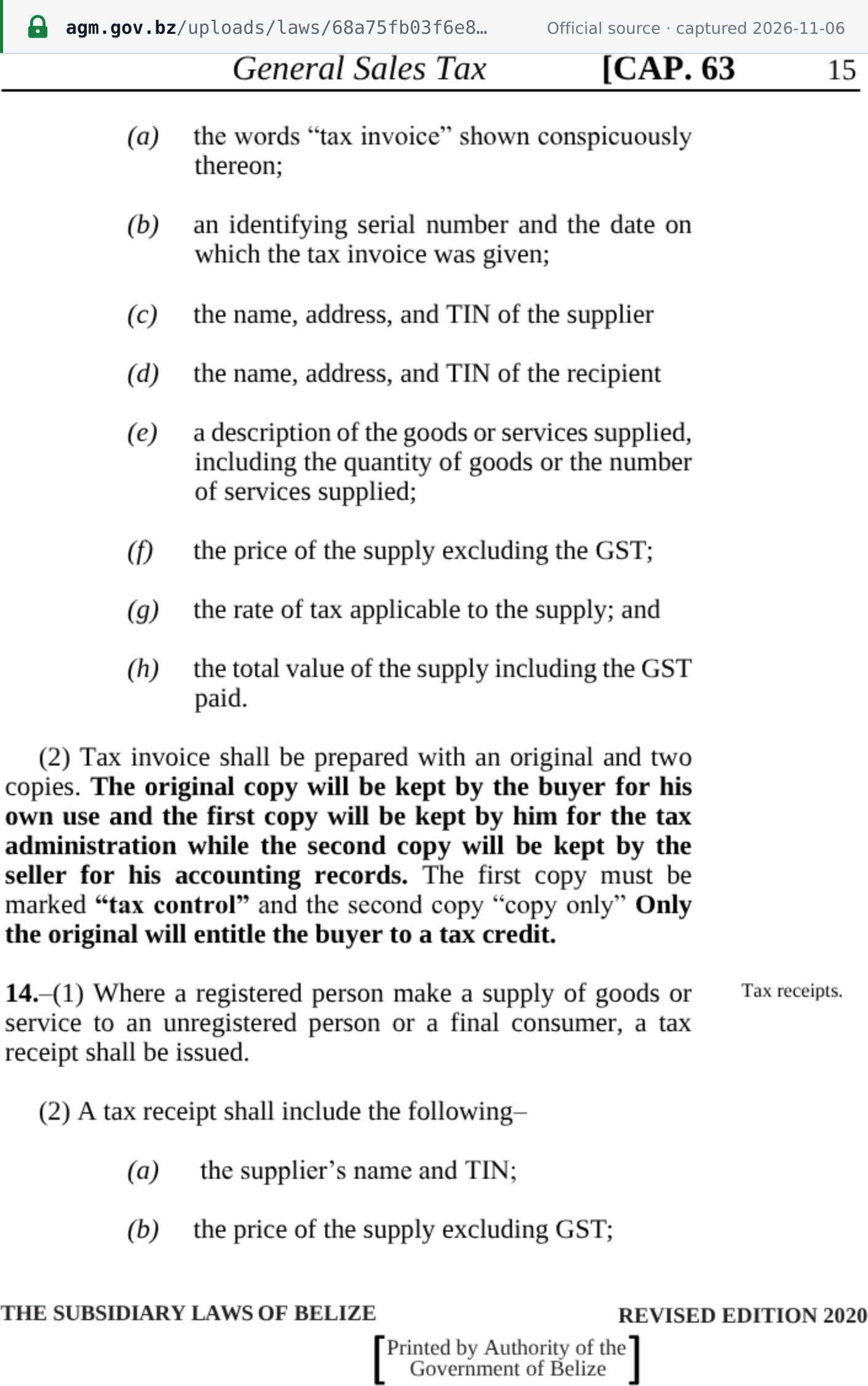
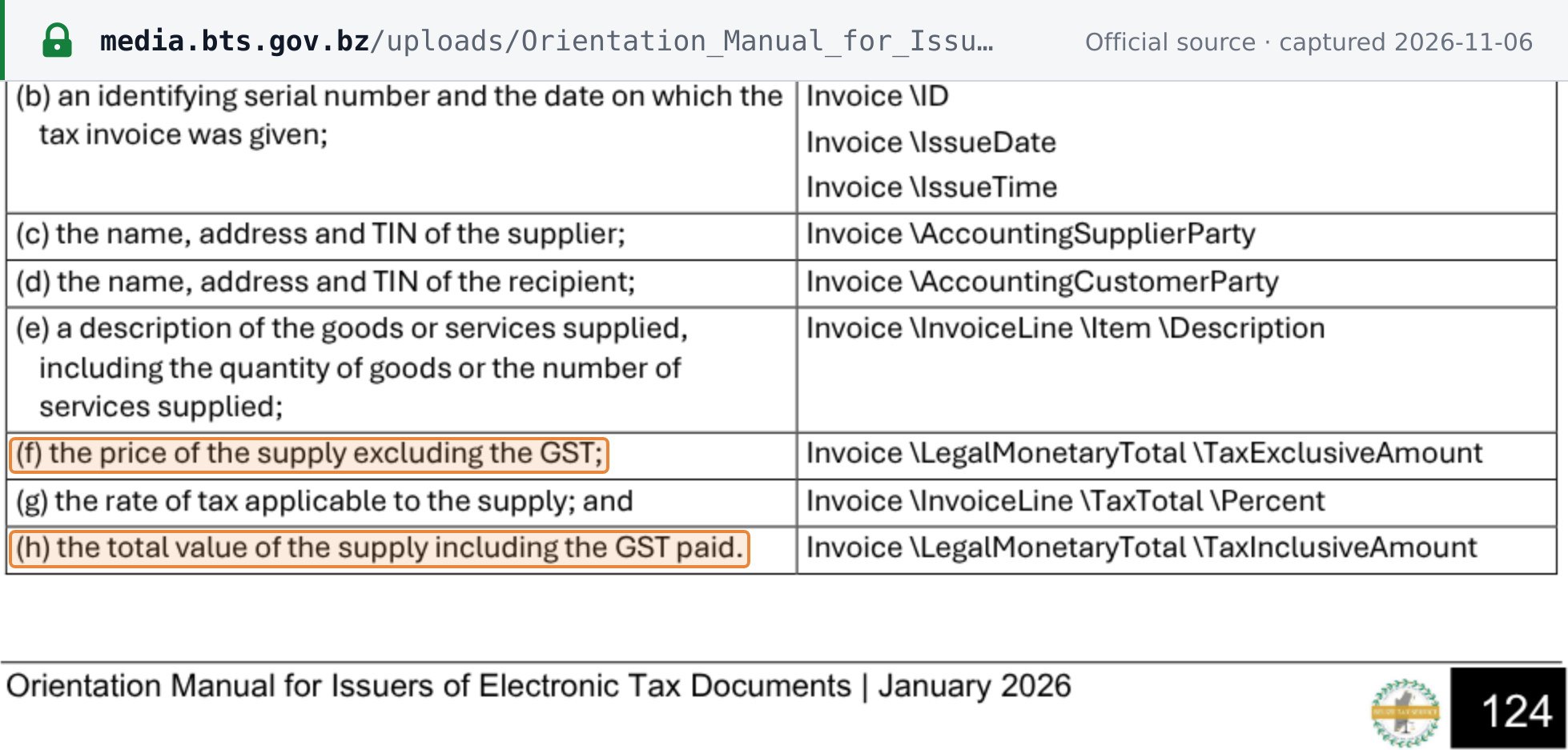
GST Regulations, reg 13. The GST Regulations (Subsidiary Laws, Revised Edition 2020) add their own list. Regulation 13(1): "Tax invoices issued to registered persons shall include the following– (a) the words “tax invoice” shown conspicuously thereon; (b) an identifying serial number and the date on which the tax invoice was given; (c) the name, address, and TIN of the supplier (d) the name, address, and TIN of the recipient (e) a description of the goods or services supplied, including the quantity of goods or the number of services supplied; (f) the price of the supply excluding the GST; (g) the rate of tax applicable to the supply; and (h) the total value of the supply including the GST paid." [17] BTS reproduces this list, mapped to UBL elements, in Table 5—1 of its Orientation Manual, where it is headed as a section of the Act. [9]
 Source snapshot captured 2026-11-06 — original
Electronic invoices. Act No. 34 of 2024 requires an electronic invoice to say so: after "thereon" in s.36(2)(a) it inserts "if the invoice is electronic, it must be identified as an electronic tax invoice". [2] SI No. 35 of 2025 (gazetted 22 March 2025) amended reg 13 to match and added reg 13(3): electronic tax invoices are issued in the format the Commissioner specifies and also include "(a) electronic signature of the issuer or their representative at the time of issuance in accordance with the electronic signature policy established by the Commissioner for this purpose; (b) unique code of authorization for electronic issuance; and (c) other specifications and requirements established by the Commissioner for technical, technological, or control purposes." [18] Regulations 14(3) and 16(3) add the same items for electronic tax receipts and credit and debit notes.
 Source snapshot captured 2026-11-06 — original
The Act and the Regulations apply together. A tax invoice therefore carries:
| # | Field | Source | UBL element (BTS Table 5—1) |
|---|---|---|---|
| 1 | The words "tax invoice", conspicuously; "electronic tax invoice" if electronic | s.36(2)(a), as amended by Act No. 34 of 2024 s.6; reg 13(1)(a) | ETDType |
| 2 | Serial number and date of issue | s.36(2)(b) | Invoice\ID, Invoice\IssueDate, Invoice\IssueTime |
| 3 | Supplier name, address and TIN | s.36(2)(c) | Invoice\AccountingSupplierParty |
| 4 | Recipient name, address and TIN | s.36(2)(d) | Invoice\AccountingCustomerParty |
| 5 | Description, with the quantity of goods or number of services | s.36(2)(e) | Invoice\InvoiceLine\Item\Description |
| 6 | Price excluding GST | reg 13(1)(f); "price" in s.36(2)(g) | Invoice\LegalMonetaryTotal\TaxExclusiveAmount |
| 7 | GST rate | reg 13(1)(g); s.36(2)(h) | Invoice\InvoiceLine\TaxTotal\Percent |
| 8 | Amount of GST | s.36(2)(h) | |
| 9 | Total including GST | reg 13(1)(h) | Invoice\LegalMonetaryTotal\TaxInclusiveAmount |
| 10 | Electronic invoices only: issuer's electronic signature and unique authorization code | s.36(2)(i); reg 13(3), inserted by SI No. 35 of 2025 |
Mandatory content of a tax receipt
A tax receipt is issued "in the form and manner prescribed by the Commissioner" and includes "(a) the supplier’s name and TIN; (b) the price of the supply excluding GST; (c) the rate of GST applicable to the supply; (d) the amount of GST paid; (e) an identifying serial number and the date on which the tax receipt was given; and (f) the description and quantity of the item bought." (s.36A(2)) [2] Unlike a tax invoice, a tax receipt does not have to identify the buyer.
A specimen of a compliant invoice
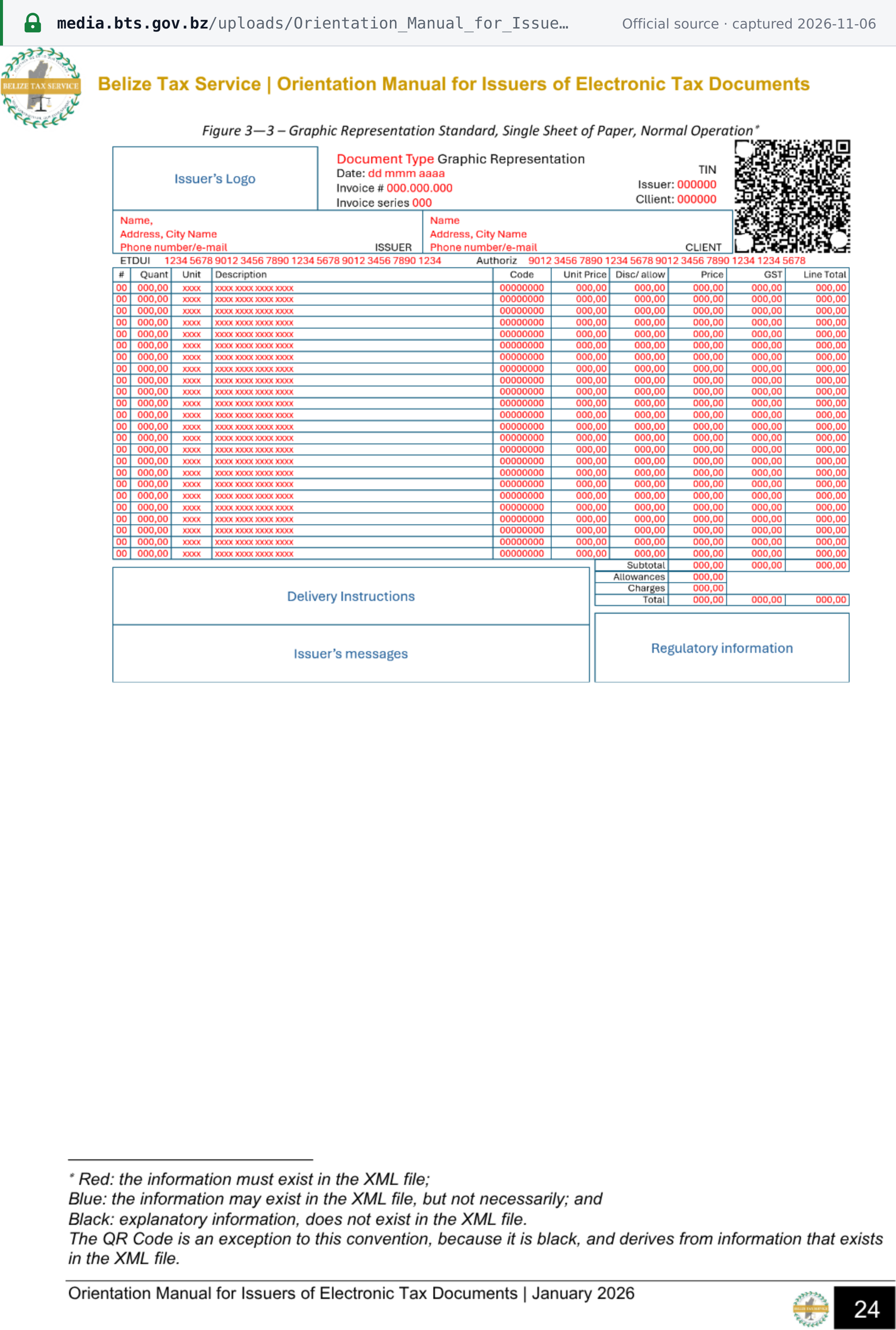
BTS publishes an official layout for the printed or PDF version ("graphic representation") of an electronic tax document: Figure 3—3 of the Orientation Manual, "Graphic Representation Standard, Single Sheet of Paper, Normal Operation". Fields in red "must exist in the XML file", blue fields "may exist in the XML file, but not necessarily", and black text is explanatory. The layout puts the document type, date, invoice number and series at the top with the issuer's and client's TINs and the QR code. Below them are the issuer and client blocks, the ETDUI (the document's unique identifier) and BTS authorization number, a line table (quantity, unit, description, code, unit price, discount or allowance, price, GST, line total), and the subtotal, allowances, charges and total. [9] BTS describes these layouts as "very similar to the existent paper versions of tax documents", with the QR code and the authorization protocol added. [9]
 Source snapshot captured 2026-11-06 — original
BTS publishes no specimen of an ordinary paper tax invoice on its GST guides, its GST forms page or in the GST Act. The illustration below shows where the s.36(2) particulars sit on one.
Tax Invoice
| Descriptions.36(2)(e) | Quantitys.36(2)(e) | Unit price excl. GST | Price excl. GST |
|---|---|---|---|
| Office chairs | 10 | BZD 120.00 | BZD 1,200.00 |
| Installation service | 1 | BZD 400.00 | BZD 400.00 |
- Price of the supply excl. GSTreg 13(1)(f)
- BZD 1,600.00
- GST rates.36(2)(h); reg 13(1)(g); s.9(1)
- 12.5%
- GST amounts.36(2)(h)
- BZD 200.00
- Total incl. GSTreg 13(1)(h)
- BZD 1,800.00
- Only one tax invoice may be given for a supply; a replacement for a lost original is marked as a copy (s.36(4)).
- Below BZD 50 a tax invoice is needed only if the recipient asks for one (s.36(3)).
- A printed tax invoice is prepared as an original and two copies: the buyer keeps the original and the first copy, marked "tax control"; the seller keeps the second copy, marked "copy only". Only the original entitles the buyer to a tax credit (reg 13(2)).
- An electronic tax invoice must be identified as one (s.36(2)(a), as amended by Act No. 34 of 2024) and also carries the issuer's electronic signature and a unique authorization code (reg 13(3)), shown on the printed version with the ETDUI and a QR code (BTS Orientation Manual, section 3.4).
Issuance deadline
A tax invoice is given "at the time of the supply" (s.36(1)); a tax receipt "at the time after the supply is made" (s.36A(1)). Electronic tax invoices, credit notes and debit notes must be authorized by BTS before they are delivered (previous authorization). Tax receipts may be authorized afterwards, and in a contingency any electronic tax document may be delivered first and transmitted as soon as possible (GST Regulations regs 16C and 16F, inserted by SI No. 140 of 2025; BTS Orientation Manual, Table 3—1). [19] [9] See E-invoicing status.
Numbering and sequencing
- Each tax invoice and tax receipt carries "an identifying serial number" (s.36(2)(b), s.36A(2)(e)).
- Lodging the invoice series. "Within one month after a person has been registered for GST, he shall lodge with the commissioner the series of GST invoice he intends to issue." A new series is lodged within seven days after the previous one is exhausted (reg 15(1)–(2)). [17] Since SI No. 35 of 2025 this does not apply to persons who issue electronic tax documents, who follow the Commissioner's electronic specifications instead (reg 15(3)). [18]
- Copies. A printed tax invoice is made out as an original and two copies, the first marked "tax control" and the second "copy only"; "Only the original will entitle the buyer to a tax credit." (reg 13(2)) [17]
- The BTS210 return asks for the "Range of Tax Invoices used in this Period" (from and to), and reg 29(1)(e) requires "the serial numbers for the range of invoices issued during the tax period". [6] [17]
- For electronic documents, the series is optional, but the tag is mandatory: "If the issuer decides not to use series, must use series “000” (zero) for all ETD, for the presence of this tag is mandatory for schema reasons, because it must be used in the ETDUI composition." [9]
Credit and debit notes
A credit or debit note is issued when a supply is cancelled, its price changes (for example, a discount), goods are returned or the nature of the supply changes fundamentally (s.37). Section 37(4), as amended by Act No. 34 of 2024, requires the words "credit note" or "debit note" (identified as electronic where it is); the supplier's and recipient's names, addresses and TINs; the date; the GST shown on the original tax invoice or tax receipt, the adjusted amount and the difference; a brief explanation; and "(h) the number of the invoice to which the credit or debit note relates." [2] An electronic credit or debit note also carries the issuer's electronic signature, a unique authorization code and the identification number of the electronic tax invoice it adjusts (reg 16(3), inserted by SI No. 35 of 2025). [18]
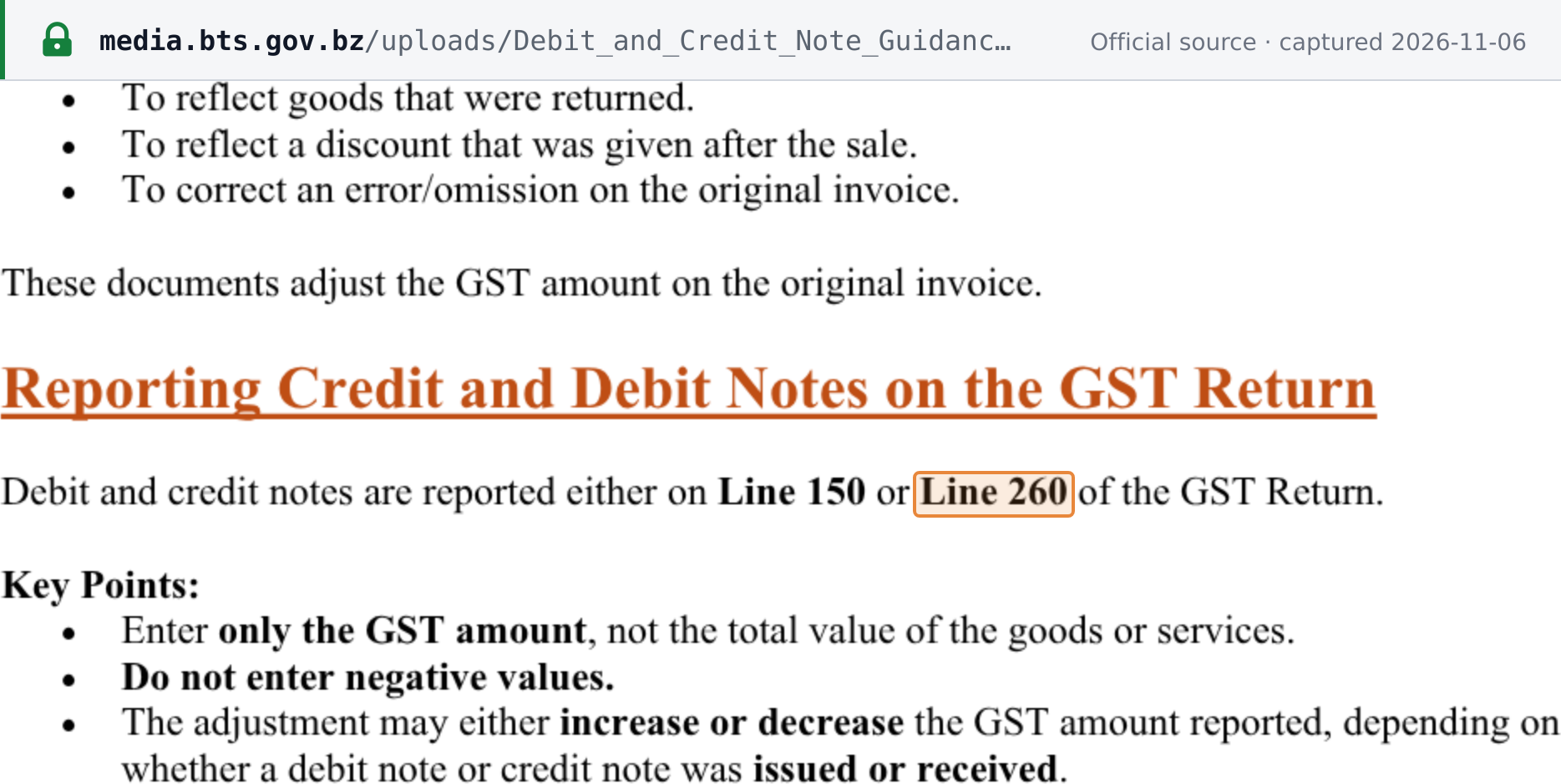
BTS's guidance of 4 September 2026 sets the return lines: "Debit and credit notes are used to adjust the value of sales after a tax invoice has been issued." The supplier reports the GST on a credit note it issues on Line 260 and on a debit note on Line 150; the customer does the reverse. "Enter only the GST amount, not the total value of the goods or services." "Do not enter negative values." [8]
 Source snapshot captured 2026-11-06 — original
Currency and language
- Language. "Financial statements, invoices, books of original entry, and all written communications between the Department and the taxpayer shall be in English." (TAPA s.20(9)) [3]
- Currency. The GST Act's former records rule (s.38 in the 2011 edition, English and Belize currency) was repealed by TAPA Schedule V ("Sections 38, 41-45, 51, 52, 53, 54, 55, 56, 59, 60-81, 83, 84 are repealed;"). [3] TAPA s.20 keeps the English rule but sets no currency rule. BTS publishes no rule on foreign-currency invoices or the exchange rate to use. The return is completed in BZD.
Self-billing
The GST Act (Revised Edition 2020, as amended by Act No. 34 of 2024), the GST Regulations and BTS's GST guidance contain no self-billing provision; s.36 puts the obligation to issue the tax invoice on the supplier.
Retention and audit trail
- Retention. "A person required to keep and maintain records of a transaction under tax legislation shall keep the documents– (a) for a period of six years from the date on which the transaction took place; or (b) until expiration of the time limit for assessment of tax for any tax period to which the records are relevant, if that period is longer than the period specified in paragraph (a)." (TAPA s.20(8)) A taxpayer "shall keep and maintain, in Belize, records or books of accounts" (s.20(1)), at the place of business unless the Director General approves another place (s.20(6)). [3]
- What to keep. BTS's FAQ lists: "a) registration certificate; b) tax invoices, till rolls and Z-tapes; c) invoice books and any documents used to record sales or services; d) tax invoices for tax paid on the purchase of goods and services; e) custom documents for tax paid on goods imported; f) debit and credit notes;". [12]
- Electronic records. For input tax, a copy "or an electronic record" of a credit note is accepted (s.33(4)(d), as amended by Act No. 34 of 2024). For an electronic tax document, the signed XML is the document: "Since the signed and authorized XML file is the actual document for all purposes, and GR is NOT that document, there are no restrictions for the number of printed GR for a given ETD." [9]
- Audit trail. Electronic tax documents are digitally signed, authorized by BTS and carry a QR code. BTS: "Automatic Security: A digital certificate is automatically applied to every ETD to confirm its authenticity and protect it from tampering." [11] For paper invoices, the controls are the serial number and the one-invoice-per-supply rule (GST Act s.36(4)); the original-plus-two-copies rule, with the copies marked "tax control" and "copy only" (reg 13(2)); lodging each invoice series with the Commissioner (reg 15); and, for retailers, recording daily cash takings on a point-of-sale system (reg 28(3)). [17] [17] SI No. 35 of 2025 deleted the words "whose annual sales exceed $100,000.00" from reg 28(3), so the point-of-sale rule now covers every GST-registered retailer. [18]
E-invoicing status
Status (as at 2026-11-06): pilot with 31 participating businesses; legal basis in force since 1 January 2025; mandatory phase announced for large-taxpayer B2B transactions, with no start date published. For how clearance models compare, see the explainer on e-invoicing models.
- Legal basis. Act No. 34 of 2024 added s.36(7): "All electronic invoices and other electronic tax documents shall be authorized by the Tax Administration for their validity and tax recognition, in accordance with the regulations and technical standards issued for this purpose." and s.36(9): "The Commissioner shall specify the dates and schedules by which all invoices and other tax documents, without exception, shall be issued electronically." [2]
- Regulations. SI No. 35 of 2025 (gazetted 22 March 2025) sets the extra particulars of electronic tax invoices, receipts and notes: the issuer's electronic signature and a unique authorization code (regs 13(3), 14(3), 16(3)). [18] SI No. 140 of 2025 (gazetted 25 October 2025) inserts Part IIA on electronic tax documents: transmission to the Commissioner in a previous or subsequent mode (reg 16C(1)), validation against "XML Schema UBL 2.4" (reg 16C(2)), an authorization code for each document (reg 16C(3)), and contingency procedures (reg 16F). [19]
- Model: clearance ("previous authorization"), with exceptions. Previous authorization is mandatory in normal operation for electronic tax invoices, credit notes and debit notes. Tax receipts may be authorized after delivery (subsequent mode), and in a contingency any electronic tax document may be delivered first and transmitted "as soon as possible thereafter" (regs 16C, 16F; Orientation Manual Table 3—1). [19] [9] BTS's FAQ: "The electronic invoicing system will operate under a previous authorization model. In this model, the taxpayer generates the invoice and submits it electronically to the Belize BTS for validation and authorization. Once the invoice is successfully authorized by BTS, it may be legally issued and recognized as a valid fiscal document." and "Each invoice will need to be sent to the BTS to be validated and authorized before it is sent to the client because it will have no legal or fiscal value without BTS’s authorization protocol." [10]
- System. "The CIAT Electronic Fiscal Documents Reception System (EFDR) is responsible for receiving all Electronic Tax Documents (ETD) sent to the Belize ETD Reception System (BETDRS)." [9]
- Format. XML in UBL 2.4, digitally signed (GST Regulations reg 16C(2)). The FAQ says "BTS requires electronic invoices to be generated and submitted in XML format using the UBL 2.4 standard." [10] The manual requires the UBLVersionID element to carry the literal "2.1", because the four UBL 2.4 schemas used are identical to those in UBL 2.1. [9]
- Document types. Electronic tax invoice, electronic tax receipt, credit note and debit note. BTS's brochure: "Electronic Tax Invoice - For a transaction involving one GST-registered business to another GST registered business" and "Electronic Tax Receipt - It is issued when there is a sale from a GST registered business to a non-GST-registered business." [11]
- Pilot. "The E-Invoicing system has been operating stably and reliably during the pilot with the 31 participating businesses." [10]
- Scope of the mandatory phase. "E-Invoicing will be mandatory only for Business to Business (B2B) transactions involving businesses that meet the Large Taxpayer criteria. Smaller businesses and Business to Consumer (B2C) transactions will not be included in the mandatory phase." The system tells B2B from other sales by the customer's TIN. [10] The brochure: "The rollout of E-Invoicing will ONLY apply to business-to-business transactions (B2B), which includes business-to-government (B2G)." [11] Two other FAQ answers say that businesses reaching the BZD 75,000 threshold "must be registered for GST and use E-Invoicing", which reads as the longer-term direction rather than the first mandatory phase.
- Timeline. As at 2026-11-06, BTS's e-invoicing FAQ, its June 2026 brochure and its news page give no start date for the mandatory phase and do not publish the Large Taxpayer criteria. BTS says a free web tool for small businesses will be published for the voluntary phase. [10]
- Returns. E-invoicing does not yet replace the sales and purchase ledgers filed with the return: BTS's FAQ says the e-invoicing system is not linked to IRIS. [10]
- Contact for software providers: etdinfo@bts.gov.bz.
 Source snapshot captured 2026-11-06 — original
Filing and payment
Filing frequency and due date
Every registered person files a monthly return on form BTS210; the Act and BTS's guidance set no quarterly or annual option. The return and the payment are due within 15 days after the end of the month: "within fifteen days after the end of the tax period to which it relates; or" (s.30(3)(a)) [1], and the tax is paid "within the time allowed by that section for furnishing the return" (s.35(1)). [1] BTS's FAQ (as at 2026-11-06):
 Source snapshot captured 2026-11-06 — original
- One return per business. A company files one return for all its branches: "No, this is not permitted. You must submit only one GST return for the entire company." [12]
- Ledgers. "You MUST submit your Sales and Purchases ledgers when submitting your GST return." BTS publishes templates for the purchase ledger (210a) and sales ledger (210b). [5]
- Weekends. BTS's tax calendar on its home page shows "11/16 BTAX/GST Day" for November 2026, when the 15th falls on a Sunday. [20]
- Final return within 14 days after registration ends (s.30(3)(b)).
Payment
Payment is due with the return. BTS's FAQ: "Payments made online must be done before 07:00 PM, any payment made after 07:00PM would be accounted for the next working day. Payments not made by 7:00pm on tax due date will attract Penalty and Interest." [12]
The BTS210 return
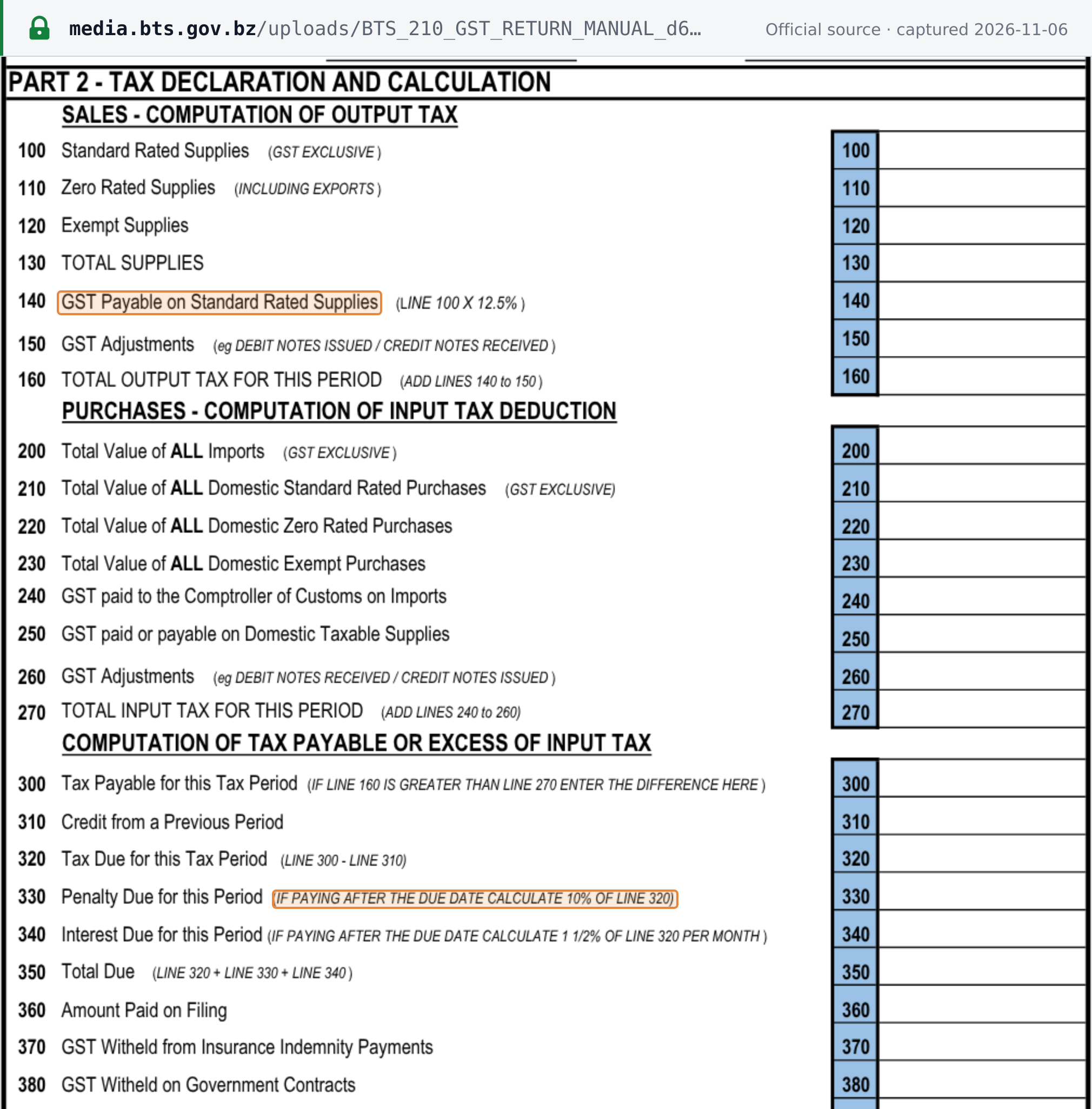
Output lines: 100 standard-rated supplies (GST-exclusive), 110 zero-rated supplies including exports, 120 exempt supplies, 140 GST at 12.5%, 150 adjustments (debit notes issued, credit notes received). Input lines: 200–230 purchases, 240 GST paid to Customs on imports, 250 GST on domestic purchases, 260 adjustments (debit notes received, credit notes issued). Lines 330 and 340 compute the late-payment penalty and interest; lines 370 and 380 record GST withheld from insurance indemnity payments and on government contracts. [6]
 Source snapshot captured 2026-11-06 — original
Correcting earlier returns. BTS's FAQ: "If such an amount is less than $50.00 then you can report the error on your next return using either lines 150 or 240. If the amount is greater than $50.00 then please inform the Department, who will take the necessary action to correct the error." [12]
Input-tax recovery and blocked items
A registered person deducts GST on purchases and imports used for taxable supplies, holding a tax invoice (or customs entry, or credit or debit note). If the document is not held when the return is filed, the credit can be claimed in the first period in which it is held, within one year (s.33(3), where Act No. 34 of 2024 replaced "6 months" with "one year"). [2] No input tax is allowed on (s.33(2)): [1]
- Passenger vehicles, their spare parts and repairs: "the acquisition or import is of a passenger vehicle, of spare parts for such vehicle, or of repairs and maintenance services for such vehicle, unless the person’s business involves dealing in or hiring out such vehicles and the vehicle was acquired for that purpose or the vehicle is of a kind for use in the agricultural sector;"
- Entertainment, unless the business provides entertainment in the ordinary course of business.
- Club and association membership and entry fees (sporting, social or recreational).
- Acquisitions for private or domestic use, or not for the business.
Refunds and bad debts
- Excess credit. Excess input tax is carried forward (BTS210 lines 400–420) or refunded (s.35(2)).
- Refund interest. "Notwithstanding sub-section (1), no interest is payable in respect of a refund that is based on a claim for refund and is paid to the taxpayer within 90 days of the filing of the claim for refund." (TAPA s.58(3)) After that, interest runs at "one percent per month or part of that rate, compounded monthly, for refunds." (TAPA s.59(1)(b)) [3]
- Bad debts. Relief is available under s.34 where the consideration has not been paid, reasonable efforts have been made to recover it and the debt has been written off. [1]
- Non-residents. BTS publishes no refund scheme for non-resident businesses.
Exemptions
Exempt supplies
Exempt supplies are listed in the Fourth Schedule, exempt imports in the Fifth. Examples from Schedule IV (Revised Edition 2020): [1]
- Financial services: "A supply of the following “financial services”, except where provided in return for an explicit fee of charge".
- Residential rents and leases. Since 1 January 2025, "“residential premises” means a building or property that is occupied for or whose use is limited to residential purposes, but not including hotel or holiday accommodation." (Fourth Schedule, as amended by Act No. 34 of 2024 s.13) [2]
- Education, certain supplies to the Government of Belize, and electricity to consumers whose monthly supply does not exceed $100.
Water (other than bottled) and domestic sewerage services are not exempt: they are zero-rated under Schedule III, item III.1 ("A supply of water (other than water supplied in bottles or similar containers) or domestic sewerage services."). [1]
The schedules have been amended since 2020, so treat these as examples.
Exempt is not zero-rated
An exempt supply carries no GST, and the supplier cannot recover the GST on costs attributable to it. A zero-rated supply is taxable at 0%, and the supplier can recover that GST. The BTS210 return reports them separately (line 110 zero-rated, line 120 exempt). See zero-rated vs exempt supplies.
Special regimes
- Free zones. Supplies of goods to a commercial free zone or an export processing zone are zero-rated (Schedule I, item 4).
- Other schemes. The GST Act's arrangement of sections (Revised Edition 2020) contains no cash-accounting, flat-rate or margin scheme.
Offences and penalties
Offences
- Failing to register. Since 1 January 2025, a person who has not applied for registration within the time required "is liable on summary conviction to– (a) a fine of not less than five thousand dollars and not exceeding ten thousand dollars; or (b) an administrative penalty pursuant to the Tax Administration and Procedure Act." (s.22(4), substituted by Act No. 34 of 2024 s.4) The earlier text also allowed imprisonment. GST for the period before registration can still be assessed (s.39). [2]
- Invoice offences. "A person who contravenes the requirements of this section commits an offence and is liable on summary conviction to a fine of not less than three thousand dollars and not exceeding five thousand dollars or to imprisonment for a term not exceeding one year, or to both such fine and imprisonment." (s.36(6), covering failure to issue a compliant tax invoice and issuing more than one) [1] Section 37(10) applies the same scale to credit and debit notes.
- Not displaying the registration certificate. BZD 3,000–5,000 plus BZD 100 a day, or up to two years' imprisonment, or both (s.27(4)). [1]
- Impeding tax administration, which includes failing to file a return, using a false TIN, issuing a false GST invoice, receipt or note, failing to provide one and failing to keep records: "A person who wilfully impedes, or attempts to impede, the Department in its administration of this Act commits an offence and is liable on summary conviction to a fine of not less than five thousand dollars and not exceeding twenty thousand dollars, or to imprisonment for a term not exceeding one year, or both." (TAPA s.101(1)) [3]
- Tax evasion. "A person who wilfully evades, or attempts to evade the assessment, payment, or collection of tax, or who wilfully claims a refund of tax to which the person is not entitled, commits an offence and is liable on summary conviction to a fine not exceeding one hundred thousand dollars, or to imprisonment for a term not exceeding two years, or both." (TAPA s.100) [3]
A person convicted of an offence is not also charged an administrative penalty for the same conduct (TAPA s.97(5)).
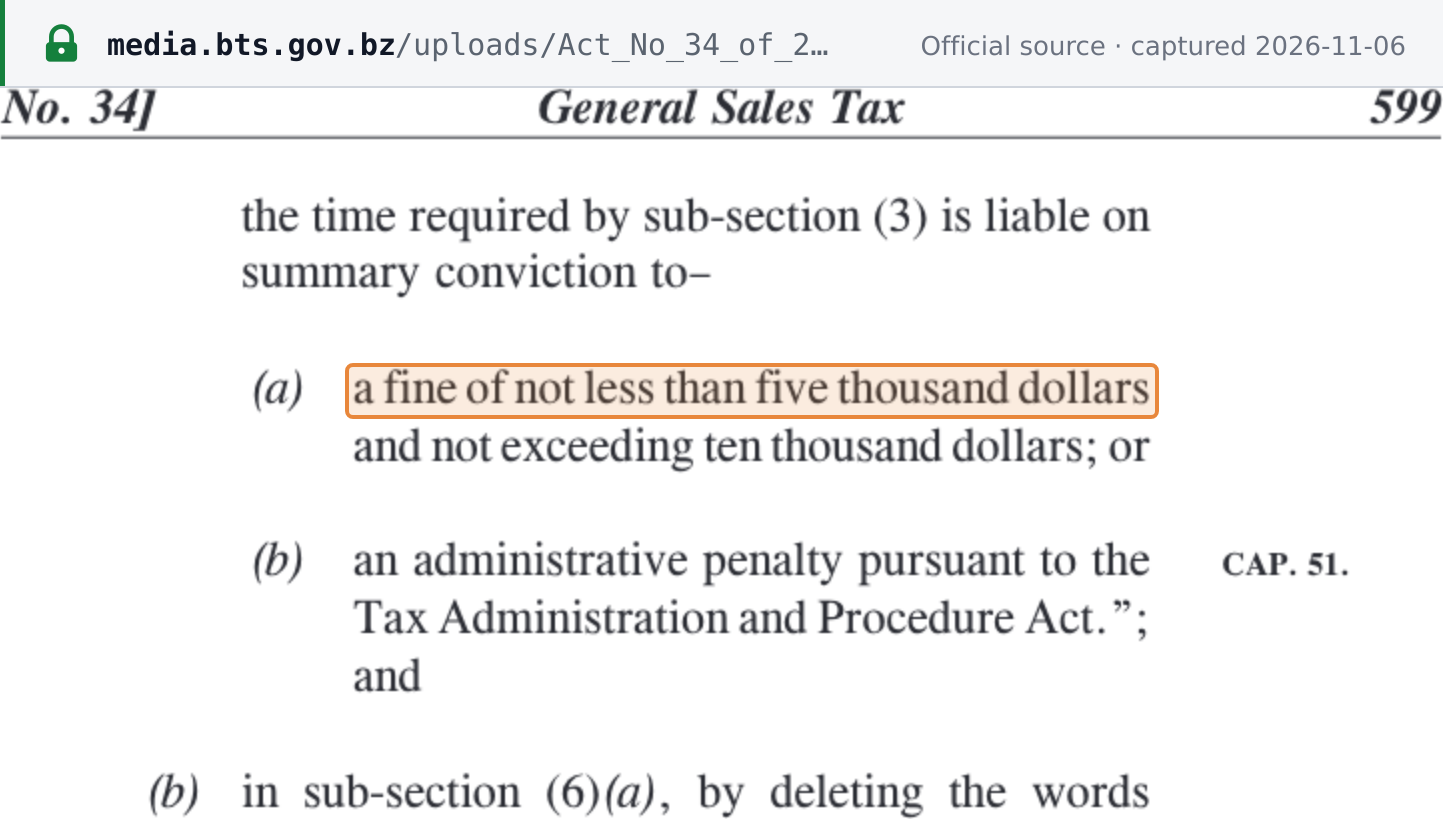 Source snapshot captured 2026-11-06 — original
Penalties
- Late payment: 10% plus interest. GST Act s.58(1): "Where any amount that a person is required to pay to the Commissioner is not paid by the due date, the amount outstanding shall bear a penalty of ten per cent and in addition there shall be levied interest at the rate specified in section 59 of the Tax Administration and Procedure Act." [1] TAPA s.59(1)(a) charges "one and one-half per cent per month or part of that rate, compounded monthly for underpayments of tax". [3] TAPA's general late-payment penalty does not apply: "Sub-section (1) does not apply to cases described in section 58 of the General Sales Tax Act or section 96(3) or section 112(5) of the Income and Business Tax Act." (TAPA s.90(3)) [3] Lines 330 and 340 of the BTS210 return compute the 10% penalty and 1½% a month interest (the form's line 340 does not show the monthly compounding).
- Late registration. BZD 5,000–10,000 on conviction, or a TAPA administrative penalty (s.22(4), above).
- Invoice failures. TAPA s.88(1) imposes an administrative penalty of up to BZD 25,000 on a person who uses a false TIN, issues a false GST invoice, receipt or note, or "provides, or fails to provide, an invoice, credit note, debit note, or sales receipt as required under the General Sales Tax Act." A person who took due care over the recipient's details has a defence (s.88(2)–(3)). [3]
- Failure to notify a change: BZD 500–25,000 (TAPA s.87).
- Late filing. The GST Act's own late-filing fine in s.30(7) was repealed by TAPA Schedule V ("Section 30(7) is repealed."). TAPA Schedule IV, headed "Penalties for Income and Business Tax and General Sales Tax", lists only income and business tax items and has no GST late-filing row. [3] Failing to file a return is an offence under TAPA s.101(2)(d) (see Offences), and GST Act s.39 allows the Commissioner to assess tax when a person fails to file a return.
Frequently asked questions
Our business has been trading for less than a year. At what level of monthly sales do we have to register for GST?
The GST Act, Cap. 63 (Revised Edition 2020), section 23(3), sets the test for a business trading for less than twelve months at an average monthly value of taxable supplies of six thousand two hundred dollars (BZD 6,200) or more, and the statute governs. The Belize Tax Service's registration guide, its instructions for form BTS100 and its FAQ answer on the registration threshold use BZD 6,250, the monthly equivalent of the BZD 75,000 annual threshold, while two other answers in the same FAQ (who must register; promoters) use the statutory BZD 6,200. A business averaging between BZD 6,200 and BZD 6,250 a month is inside the statutory test. The application is due within one month of the day you first become required to register (section 22(3)).
Which line of the GST return does a credit note or debit note go on?
BTS's GST Guidance on Debit Notes and Credit Notes (published 4 September 2026) says the supplier reports the GST on a credit note it issues on Line 260 of the BTS210 return and the GST on a debit note it issues on Line 150. The customer does the reverse: a credit note received goes on Line 150 and a debit note received on Line 260. Only the GST amount is entered, not the total value of the goods or services, and negative values are not entered. Since 1 January 2025 a credit or debit note must also show the number of the invoice it relates to (GST Act s.37(4)(h), inserted by Act No. 34 of 2024).
Is e-invoicing mandatory in Belize yet?
Not yet. Since 1 January 2025 the GST Act allows tax invoices to be issued electronically and requires electronic tax documents to be authorized by the tax administration, and section 36(9) says the Commissioner will specify the dates by which all invoices must be issued electronically. The detailed rules are in the GST Regulations as amended by SI No. 35 of 2025 and SI No. 140 of 2025. BTS's e-invoicing FAQ says the system has run in a pilot with 31 participating businesses and that the mandatory phase will cover only business-to-business transactions of businesses that meet the Large Taxpayer criteria; its June 2026 brochure says the rollout includes business-to-government. As at 6 November 2026, neither the FAQ, the brochure nor the BTS news page gives a start date for the mandatory phase, and BTS has not published the Large Taxpayer criteria on those pages.
Can we register a new business for GST online through IRIS Belize?
No. BTS's FAQ answers the question "Can you Register a new business (company, partnership, NGO etc.) online?" with "Currently, not in Phase 1. You will need to contact or visit the office." Registration is made on form BTS100 with the supporting documents BTS lists for the type of business, plus form BTS101 for each shareholder, director, partner or employee named. IRIS Belize is used once you are registered, to file returns and make payments.
Does a foreign company selling software or digital services to customers in Belize have to charge GST?
BTS publishes no GST registration route or special regime for non-resident sellers of digital services. Under section 17 of the GST Act (Revised Edition 2020, as amended by Act No. 34 of 2024), a non-resident's supply of services takes place in Belize only if the services are physically performed in Belize by a person who is in Belize at the time, so services delivered remotely from abroad fall outside that rule. BTS's FAQ on internet sales addresses only Belize-owned entities, which charge 12.5% to customers in Belize and generally 0% to overseas customers. The Act does not contain a reverse charge on imported services.
Important websites
| Site | What it is for |
|---|---|
| IRIS Belize | Taxpayer portal: file BTS210 returns and pay once registered (new businesses register at a BTS office) |
| BTS — Registration | Who must register, forms BTS100, BTS101, BTS102 and BTS104, and the documents for each type of business |
| BTS — File Your General Sales Tax Return | Rates, return lines, and the sales and purchase ledger requirement |
| BTS — GST forms and downloads | BTS100 registration form, BTS210 return, 210a and 210b ledger templates |
| BTS — GST legislation | GST Act (Revised Edition 2011) and Act No. 34 of 2024 as hosted by BTS |
| BTS — Electronic invoicing FAQs | E-invoicing model, scope and rollout |
| BTS — FAQ | Filing, payment cut-off times and records to keep |
| BTS — News | Rate orders, GST-free days, guidance and deadlines as BTS announces them |
| Attorney General's Ministry — Laws of Belize | Current consolidations: GST Act and GST Regulations (Revised Edition 2020), 2025 statutory instruments |
| Belize Customs | Import entries and GST collected at the border |
| Lookuptax Belize TIN validator | Check the format of a Belize TIN |
BTS offers no online lookup of GST registrations. Its FAQ says: "Look for the green GST certificate at the place of business or request that it be presented to you." [12]
Recent changes
- 2026-09-04 — BTS published "GST Guidance: Debit Notes and Credit Notes": the supplier reports credit-note GST on Line 260 and debit-note GST on Line 150 of the BTS210 return, the customer the reverse, GST amount only and no negative values. (Belize Tax Service) — see event
- 2026-09-03 — BTS announced the Orientation Manual for Issuers of Electronic Tax Documents (version 1.30), the technical standard for electronic tax invoices, receipts and notes. (Belize Tax Service)
- 2025-10-25 — General Sales Tax (Amendment) (No. 2) Regulations 2025 (SI No. 140 of 2025) gazetted: new Part IIA on electronic tax documents (previous and subsequent authorization modes, UBL 2.4, authorization codes, contingencies). (Attorney General's Ministry)
- 2025-03-22 — General Sales Tax (Amendment) Regulations, 2025 (SI No. 35 of 2025) gazetted: electronic signature and authorization code on electronic tax invoices, receipts and notes; invoice-series lodging lifted for electronic issuers; point-of-sale systems for all GST-registered retailers. (Attorney General's Ministry)
- 2025-01-01 — General Sales Tax (Amendment) Act 2024 (Act No. 34 of 2024) in force: electronic tax invoices and BTS authorization of electronic tax documents, the new tax receipt (s.36A), the invoice number on credit and debit notes, a one-year window to claim input tax, and late registration punishable by a fine or a TAPA administrative penalty instead of imprisonment. (Belize Tax Service)
For the full chronology, see Belize tax changes on Lookuptax.
Reference links
Legislation:
- [1] General Sales Tax Act, Chapter 63 — Revised Edition 2020 (Attorney General's Ministry)
- [2] General Sales Tax (Amendment) Act 2024 — Act No. 34 of 2024 (hosted by BTS)
- [3] Tax Administration and Procedure Act, Cap. 51 — Revised Edition 2020 (Attorney General's Ministry)
- [16] General Sales Tax Act, Cap. 63 — Revised Edition 2011 (hosted by BTS)
- [17] General Sales Tax Regulations, Cap. 63 — Subsidiary Laws, Revised Edition 2020 (Attorney General's Ministry)
- [18] General Sales Tax (Amendment) Regulations, 2025 — SI No. 35 of 2025
- [19] General Sales Tax (Amendment) (No. 2) Regulations 2025 — SI No. 140 of 2025
Belize Tax Service guidance and forms:
- [4] Registration
- [5] File Your General Sales Tax Return
- [6] BTS210 GST Return
- [7] BTS100a — Instructions for filling out BTS registration form 100
- [8] GST Guidance: Debit Notes and Credit Notes (September 2026)
- [9] Orientation Manual for Issuers of Electronic Tax Documents, v1.30
- [10] Electronic Invoicing FAQs
- [11] E-Invoicing brochure — Your Guide to Belize's Digital Tax Future (June 2026)
- [12] Frequently Asked Questions
- [13] Tax resources — General Sales Tax
- [14] New Publication: Orientation Manual for Issuers of Electronic Tax Documents
- [15] Back-to-school GST-free days for school supplies and laptops (2026)
- [20] Belize Tax Service home page — Tax Calendar
Related on Lookuptax: