Bosnia and Herzegovina VAT (PDV) guidelines
Bosnia and Herzegovina (BiH) charges one value added tax across the whole country, at a single rate of 17%, administered at state level by the Indirect Taxation Authority. Businesses register once their turnover passes KM 100,000 a year. Cash registers and the coming e-invoicing rules belong to the two entities and Brčko District instead. This guide covers the figures and rules as at 13 November 2026.
Overview
The tax is porez na dodanu vrijednost (PDV), value added tax. It is charged under the Law on Value Added Tax (Zakon o porezu na dodanu vrijednost; the Serbian-language text uses dodatu), published in Službeni glasnik BiH 9/05 and amended by 35/05, 100/08, 33/17, 46/23, 80/23 and 20/25; UIO's list of regulations shows no later amendment. [1] [3] Article 1: "Ovim zakonom uvodi se obaveza i regulira se sistem plaćanja poreza na dodatu vrijednost (u daljnjem tekstu: PDV) na teritoriji Bosne i Hercegovine." VAT has applied since 1 January 2006: the 35/05 amendment says the law "primjenjuje se od 01.01.2006". [26]
Most detailed rules, including the content of an invoice, are in UIO's Rulebook on the application of the VAT Law (Pravilnik o primjeni Zakona o porezu na dodanu vrijednost, Sl. glasnik BiH 93/05, amended 13 times, most recently by 45/26). [8] [3]
Authority, currency, period and layering
- Authority. The Indirect Taxation Authority (Uprava za indirektno oporezivanje, UIO; Banja Luka, with regional centres in Banja Luka, Mostar, Sarajevo and Tuzla) also runs customs and excise. In UIO's words: "Indirect Taxation Authority is the single institution responsible for calculation and collection of VAT", and "VAT is paid to the Single Account open at the BiH Central bank". [2]
- Currency. The convertible mark (KM, ISO code BAM). A value in foreign currency is converted at the Central Bank of BiH middle rate on the day the tax point arises (Art. 22): "primjenjuje se srednji devizni kurs Centralne banke Bosne i Hercegovine koji važi na dan nastanka poreske obaveze." [1]
- Period. One calendar month for every taxpayer (Art. 38): "Poreski period za koji se obračunava PDV je jedan kalendarski mjesec." [1]
- Layering. VAT is a single state-level tax, and BiH is one place of supply (Art. 14): "Bosna i Hercegovina smatra se jednim mjestom za vršenje prometa." [1] UIO: "The single state level VAT system replaces the entity level sale tax". [2] The two entities, the Federation of BiH (FBiH) and Republika Srpska (RS), and Brčko District levy no VAT. They do issue the 13-digit JIB used for direct taxes, and they run fiscalisation: certified cash registers and, in FBiH, the coming e-invoicing law (see E-invoicing status). A business therefore deals with UIO for VAT and with its entity tax administration for fiscal devices.
Registration
Who must register and the threshold
A business must register when its taxable supplies plus its supplies of goods exempt with credit (exports, for example) in the previous year exceed, or are likely to exceed, KM 100,000. Turnover of related companies under common control is added in. Article 57(1) of the VAT Law, in its base text: "Svako lice čiji oporezivi promet dobrima ili uslugama i promet dobrima oslobođenim uz kredit u prethodnoj godini prelazi ili je vjerovatno da će preći prag od 50.000 KM dužno je da se registrira prema ovom zakonu kao poreski obveznik. Kada se određuje da li je ili nije pređen prag od 50.000 KM, uzima se u obzir i promet povezanih firmi i ostalih subjekata koji su kroz posjedovanje dionica, ili na bilo koji drugi način, pod zajedničkom neposrednom ili posrednom kontrolom." [1]
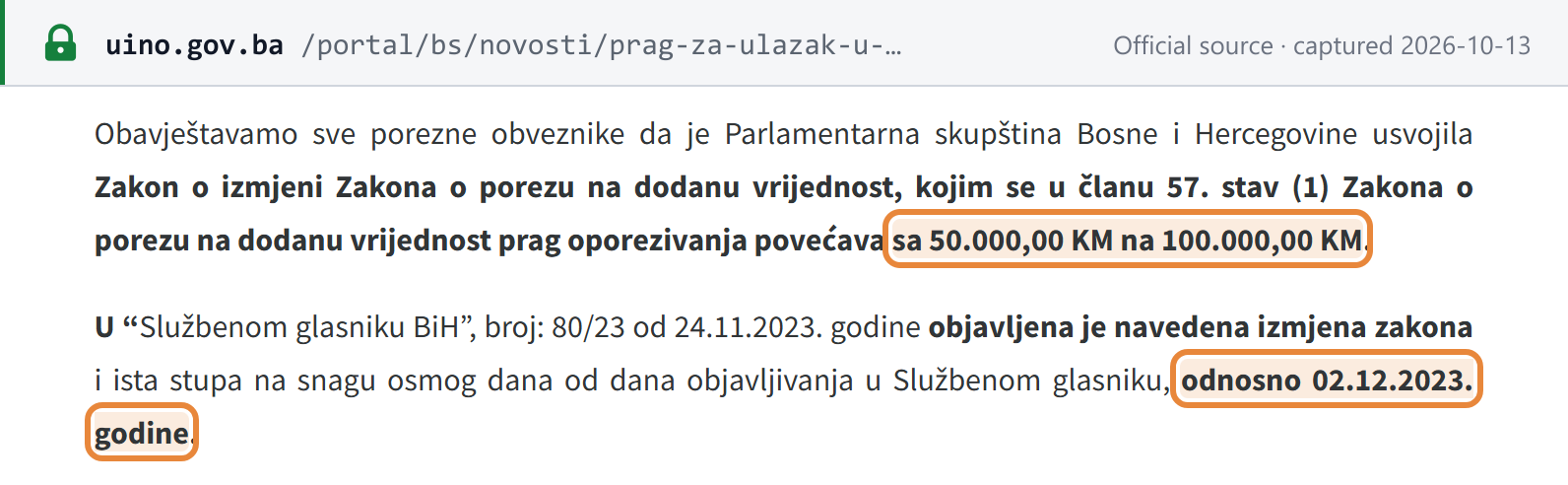
Law 80/23 replaced "50.000 KM" with "100.000 KM" in Article 57(1), in force from 2 December 2023. [5] UIO announced: "…prag oporezivanja povećava sa 50.000,00 KM na 100.000,00 KM. U “ Službenom glasniku BiH”, broj: 80/23 od 24.11.2023. godine objavljena je navedena izmjena zakona i ista stupa na snagu osmog dana od dana objavljivanja u Službenom glasniku, odnosno 02.12.2023. godine." [4]
 Source snapshot captured 2026-10-13 — original
- Measurement period. The previous calendar year, plus a forward-looking "likely to exceed" test. UIO's deregistration page states the current figure the same way: "He has gained gained taxable turnover of under 100,000.00 BAM in the previous calendar year" (sic). [7]
- Deadlines (Art. 57): a new business applies "najkasnije osam dana prije započinjanja oporezivog poslovanja" (at least eight days before it starts taxable business). A business that crosses the threshold applies by the 20th of the month after the month in which its turnover passed, or was likely to pass, the threshold. UIO decides within 15 days, and registration runs from the date set in UIO's decision. The registration certificate must be displayed at the business premises. [1]
Non-resident registration: a BiH tax proxy
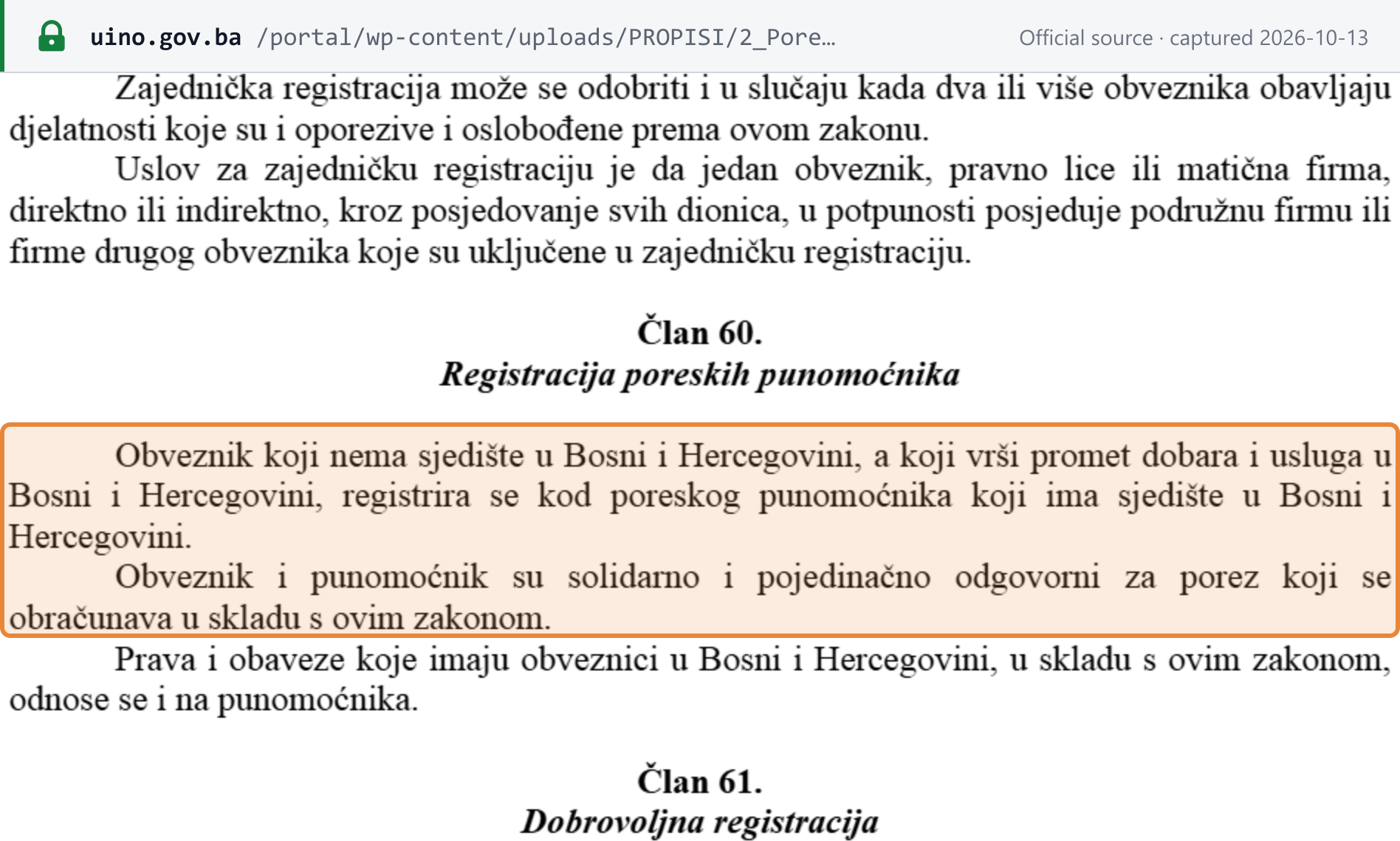
A business with no seat in BiH that makes supplies in BiH registers through a tax proxy (poreski punomoćnik) seated in BiH, and both are jointly and severally liable. Article 60: "Obveznik koji nema sjedište u Bosni i Hercegovini, a koji vrši promet dobara i usluga u Bosni i Hercegovini, registrira se kod poreskog punomoćnika koji ima sjedište u Bosni i Hercegovini. Obveznik i punomoćnik su solidarno i pojedinačno odgovorni za porez koji se obračunava u skladu s ovim zakonom." [1]
 Source snapshot captured 2026-10-13 — original
The VAT Law sets no separate threshold for non-residents: Article 57(1) applies to "svako lice" (every person), and Article 60 sets the proxy route without a figure of its own. UIO's registration page lists what the non-resident files, starting with the representation contract and power of attorney for the proxy, proof that it makes taxable supplies in BiH, and its home-country registration documents "zvanično prevedena na jedan od službenih jezika u BiH" (officially translated into one of the official languages of BiH). [6] For when a foreign business does not need to register at all, see Foreign companies selling into BiH.
Tax registration number
UIO's indirect-tax identification number has 12 digits, with no country prefix. It is formed from the entity's 13-digit JIB by removing the leading 4. Rulebook 51/12 Art. 21(1): "Identifikacioni broj se formira na način da se od postojećeg PIB/JIB od 13 cifara, programski oduzme zajednička početna cifra «4», tako da se dobije broj od 12 (dvanaest) cifara." [9] The same number is used for every indirect tax UIO registers a business for, so the number alone does not prove VAT registration: check the VAT status in UIO's taxpayer database. [23]
The digit structure, check digits and entity prefixes are on the Bosnia and Herzegovina tax identification number guide. How to confirm a number in UIO's database is on how to verify a Bosnian VAT number, and the Bosnia and Herzegovina JIB validator checks a JIB's format.
How to register
File form ZR-1 (application for registration and entry in the Single Register of Indirect Taxpayers) with the competent UIO regional centre: "Zahtjev za registraciju i upis u Jedinstveni registar obveznika indirektnih poreza podnosi se nadležnom regionalnom centru - Odsjek za poreze - Grupa za podršku". [6] Attach the court registration decision and, if the JIB is not on it, the entity's JIB certificate. The JIB therefore comes first, from the entity tax administration, and the UIO number second. The form and instructions are on UIO's regulations page. [3] UIO's statutory decision period is 15 days (Art. 57). [1]
Voluntary registration
A business below the threshold may apply "u bilo kom momentu" (at any time), and its VAT liability then lasts "najmanje 60 mjeseci" (at least 60 months) (Art. 44). [1] The reason to do it: an unregistered business may not show VAT on invoices or deduct input VAT: "Lica iz stava 1. do 3. ovog člana nemaju pravo iskazivanja PDV-a u fakturama ili odbitka ulaznog poreza". Lessors of commercial premises and farmers have a separate voluntary route under Article 61, granted "na period od najmanje dvije kalendarske godine" (for at least two calendar years). [1]
Deregistration
UIO may remove a taxpayer from the register, on request or of its own motion, when its turnover in the previous calendar year did not exceed the threshold (Art. 62); ceasing business also ends registration. Before deregistering, the taxpayer must take an inventory and account for VAT on the stock as if it had bought the goods for its own use: "Obveznik je dužan obračunati PDV na dobra koja su popisana na zalihama, kao da se radi o kupovini dobara za njegove vlastite potrebe." [1] UIO's deregistration page lists the grounds and the documents to file, including the original registration certificate, a certificate of no indirect-tax debt and the inventory lists. [7]
Group registration
Available. UIO may approve joint registration at the taxpayers' request where one taxpayer, a legal person or parent company, owns all the shares of the others in the group, directly or indirectly (Art. 59): "Uslov za zajedničku registraciju je da jedan obveznik, pravno lice ili matična firma, direktno ili indirektno, kroz posjedovanje svih dionica, u potpunosti posjeduje podružnu firmu ili firme drugog obveznika koje su uključene u zajedničku registraciju." A taxpayer with several business units in BiH registers as one (Art. 58). [1]
Rates
Standard rate: 17%
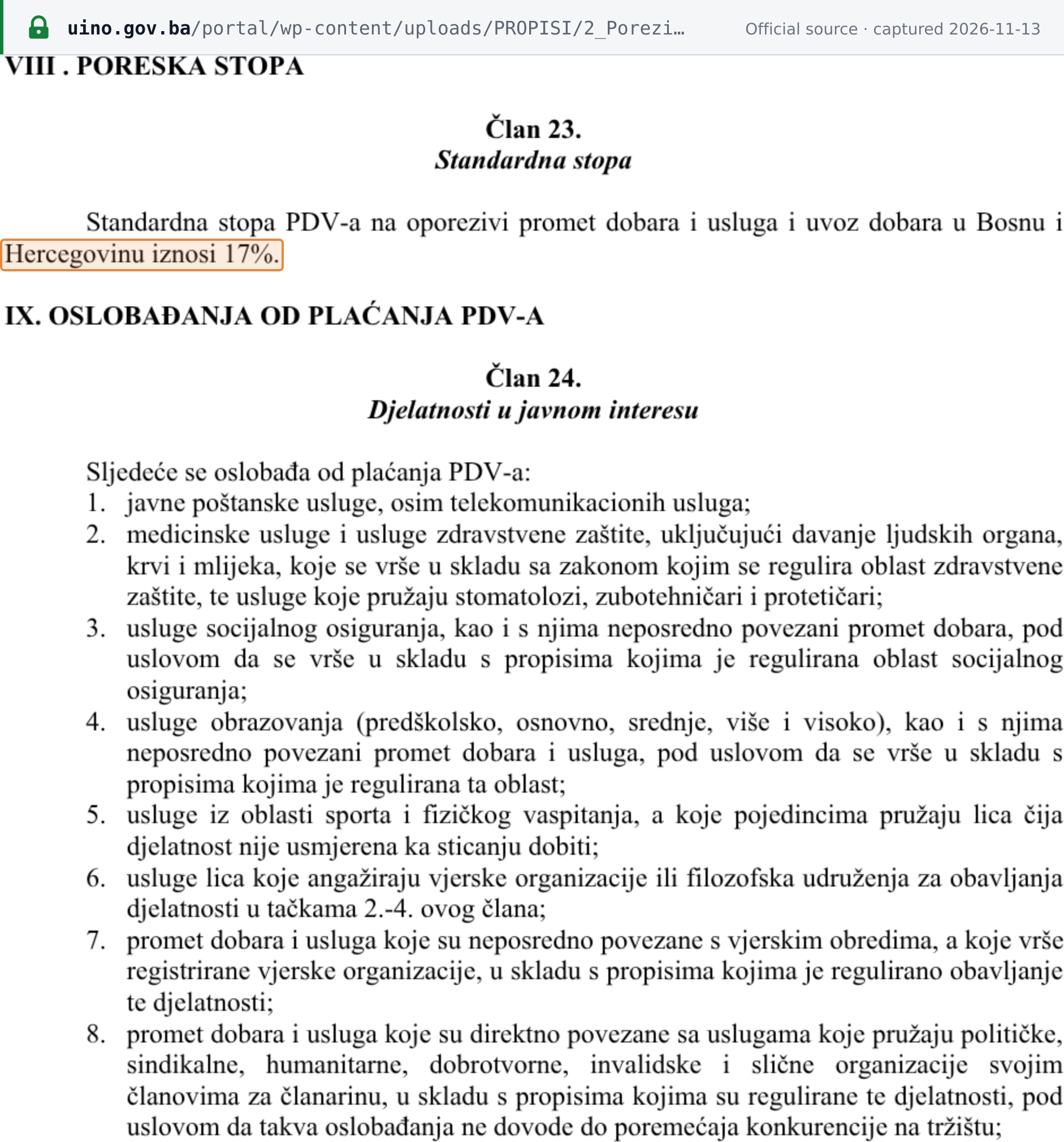
One rate applies to taxable supplies of goods and services and to imports. Article 23, "Standardna stopa": "Standardna stopa PDV-a na oporezivi promet dobara i usluga i uvoz dobara u Bosnu i Hercegovinu iznosi 17%." [1] The rate has been 17% since VAT began on 1 January 2006, and none of the amending laws listed by UIO changes Article 23. [3] UIO: "BiH VAT rate is 17%." For a VAT-inclusive price, UIO gives the tax fraction as 14.53%: "VAT amount = 117 x 14,53% = 17 BAM". [2]
 Source snapshot captured 2026-11-13 — original
Reduced and zero rates
None in force. Article 23 is the only rate article in the VAT Law, and no amendment up to Sl. glasnik BiH 20/25 adds a reduced rate (UIO's list of regulations). [3] The only "zero" treatment is exemption with credit for exports and international transport, which the law itself calls taxation "nultom stopom" (at the zero rate) (Art. 27; see Exports and Exempt is not zero-rated). [1]
| Rate | Applies to | Basis |
|---|---|---|
| 17% | All taxable supplies of goods and services, and imports | VAT Law Art. 23 |
| 0% (exempt with credit) | Exports of goods, services directly linked to exports and imports, international transport | VAT Law Arts. 27–28 |
| Exempt (no credit) | Public-interest, financial, immovable-property and other supplies | VAT Law Arts. 24–25 |
Pending bills (not law)
As at 13 November 2026, four bills to amend the VAT Law are before the Parliamentary Assembly of BiH. Its legislative tracker shows each as still "Procedura" (in procedure). None has passed both Houses or been published in Službeni glasnik BiH, so none is law:
- Zero rate on bread, milk and dairy products, medicines and medical aids, feed, seeds and teaching aids (a new Art. 23a): adopted in first reading by the House of Peoples in 2025; no second reading and nothing in the House of Representatives. [28]
- Return and payment deadline moved from the 10th to the 20th of the month: adopted by the House of Representatives on 15 April 2025; awaiting the House of Peoples. [29]
- Repeal of the gambling exemption (Art. 25(1) point 7): adopted by the House of Representatives on 22 January 2026; awaiting the House of Peoples. [30]
- VAT refund for citizens with disabilities on orthopaedic, typhlotechnical and hearing aids (a new Art. 54b): adopted by the House of Representatives on 29 April 2026; awaiting the House of Peoples. [31]
The 17% single rate and the 10th-of-the-month deadline remain the law.
Cross-border rules
Imports
Imported goods bear 17% VAT, collected by UIO with customs duties "kao da PDV predstavlja uvoznu carinsku dažbinu" (as if VAT were an import customs duty) (Art. 63). [1]
- Who pays. The recipient of the goods or the customs debtor (Art. 13(1) point 5): "u slučaju uvoza: primalac dobara, odnosno carinski dužnik utvrđen u skladu sa carinskim propisima".
- Base. The customs value (Art. 21(1)): "Poreska osnovica kod uvoza dobara u Bosnu i Hercegovinu je vrijednost tih dobara utvrđena u skladu sa carinskim propisima." Customs duties, excise and incidental costs up to the first destination in BiH are added in.
- Payment. Under the customs rules (Art. 39): "Kod uvoza dobara, PDV koji dospijeva na njih obračunava se, naplaćuje i plaća u skladu s propisima zakona koje se odnose na naplatu carinskih i drugih dažbina koje dospijevaju prilikom uvoza." Import VAT is deductible by a registered importer. [1]
- Low-value imports. Goods exempt from customs duty are generally exempt from VAT too, but the exemption "se ne primjenjuje na dobra oslobođena plaćanja carine prema članu 207. tačka a) alineje od 1) do 6) Zakona o carinskoj politici" (Art. 26 point 2, as amended by 33/17). [11] The VAT Law sets no KM de minimis of its own; whether a small consignment escapes VAT depends on which customs exemption it falls under in the Law on Customs Policy.
Exports
Exports of goods, and transport and other services directly linked to exports or imports, are exempt with the right to deduct input VAT. Article 27: "Sljedeće se oslobađa od plaćanja (oporezuje nultom stopom) PDV-a: 1. izvoz dobara iz Bosne i Hercegovine od strane ili u ime prodavca; 2. pružanje usluga, uključujući i prijevoz i druge pomoćne usluge, koje su direktno povezane sa izvozom ili uvozom dobara, …" Article 32 keeps the deduction for these supplies. [1] A taxpayer whose main activity is exporting is refunded within 30 days (see Refunds).
Place of supply
- Goods (Art. 14): in BiH if the goods are in BiH when dispatch or transport begins, if they are installed or assembled in BiH, if they are in BiH when supplied without transport, or where they enter BiH's customs area on import. [1]
- Services, general rule (Art. 15(1)): where the supplier is established. "Za promet usluga smatra se da je izvršen u BiH ako obveznik: 1. ima stalno sjedište u BiH iz kojeg se pružaju usluge, ili 2. u nedostatku takvog mjesta, ima stalnu adresu ili uobičajeno mjesto stanovanja u BiH."
- Exceptions (Art. 15(2)): services connected with immovable property are taxed where the property is; transport where it is performed; cultural, sporting, educational and similar services, and work on movable goods, where performed.
- Services taxed where the customer is (Art. 15(2)(4)): intellectual-property rights, advertising, the services of "savjetnika, inženjera, advokata, revizora, računovođa, tumača, obrade podataka i davanja podataka" (consultants, engineers, lawyers, auditors, accountants, interpreters, data processing and provision of information), banking and insurance, staff hire, telecommunications, hire of movable goods other than means of transport, and intermediation in these. [1] A BiH supplier of these services to a customer with no seat, permanent address or usual residence in BiH charges no BiH VAT where the service is used or enjoyed outside BiH (Rulebook Art. 21(7), inserted by 35/08), and must hold proof that the customer is established abroad, which UIO may check (Rulebook Art. 21(9)–(10), as replaced by 25/25): "(9) Porezni obveznik je dužan za svaku uslugu za koju je mjesto oporezivanja prema odredbama člana 15. stav (2) tačka 4) i 5) Zakona o PDV izvan BiH, osigurati dokaz da je tu uslugu pružio licu koje nema sjedište, stalnu adresu ili uobičajeno mjesto stanovanja u BiH." [32] [15]
Imported services: reverse charge
When a supplier with no seat in BiH does not appoint a tax representative, the BiH recipient of the services is liable for the VAT (Art. 13(1) point 3): "primalac usluga nabavljenih prilikom unapređivanja poslovanja, ako pružalac usluga koji nema sjedište u Bosni i Hercegovini, iz tačke 2. ovog stava, ne odredi poreskog zastupnika". [1] Under UIO Instruction 24/07, the registered recipient enters the calculated VAT in its sales ledger (KIF) in the period it receives the invoice: "Obveznik iz člana 4. ove Instrukcije je dužan nakon zaprimanja fakture izvršiti obračun PDV-a, te osnovom takve fakture evidentirati u knjizi izlaznih faktura (KIF) samo iznos obračunatog PDV-a, s pozivom na broj fakture u poreznom periodu kada je ista zaprimljena." [10] It may then deduct the VAT as input tax if Rulebook Article 70 is met: "a) fakturu mora izdati lice koje ima sjedište u inozemstvu, b) porez mora biti plaćen na propisani jedinstveni račun, c) obveznik u zemlji mora na fakturi zabilježiti iznos obračunatog i plaćenog poreza." [8]
Digital services to consumers
The VAT Law has no special regime for foreign providers of electronically supplied services to consumers: no simplified registration and no reverse charge for private customers (VAT Law 9/05 as amended up to 20/25). Telecommunications, data processing and provision of information are on the Article 15(2)(4) list, so they are supplied in BiH when the customer lives in BiH. Since 25/25, Rulebook Art. 21(6)(d) spells out that this covers "elektronski isporučene usluge" (electronically supplied services): web hosting and remote maintenance, software and updates, images, text, information and databases, music, films and games (including gambling), broadcasts and events, and distance learning over the internet. [15] The only registration route the law gives a business with no seat in BiH is through a BiH tax proxy (Art. 60). [1] UIO publishes no guidance on whether, or how, it expects foreign digital providers selling to consumers to register.
Foreign companies selling into BiH — B2B and B2C
- B2B services on the Article 15(2)(4) list (consulting, software and data services, advertising, licensing, telecoms) sold to a BiH business: taxable in BiH, and if the supplier appoints no tax representative, the BiH customer accounts for the VAT under the reverse charge (Art. 13(1) point 3). The foreign supplier does not need to register for these sales.
- B2C services, including electronically supplied services (Rulebook Art. 21(6)(d), as replaced by 25/25), sold to consumers in BiH: no reverse charge applies, and the law offers no simplified regime. A foreign supplier making taxable supplies in BiH registers through a BiH tax proxy (Art. 60), with no separate non-resident threshold.
- Goods sold into BiH: VAT is collected at import from the recipient or customs debtor (Art. 13(1) point 5). There is no distance-selling regime. A foreign seller that sells goods already in BiH registers through a tax proxy. [1]
- Foreign passenger carriers operating in BiH pay VAT through a BiH tax proxy (Rulebook Art. 78a, inserted by 47/22): "Obračun i plaćanje PDV za izvršene usluge prijevoza putnika koji vrši strani prijevoznik putnika na teritoriji BiH vrši porezni punomoćnik stranog prijevoznika koji ima sjedište na teritoriji BiH." [12]
Marketplace and platform obligations
Not applicable. The VAT Law, as amended up to Sl. glasnik BiH 20/25, contains no deemed-supplier or marketplace provision. [1] The nearest rules are supplies of goods under a commission contract (Art. 4) and the travel agents' margin scheme (Art. 46).
Invoice requirements
A VAT payer must issue an invoice, or a document serving as one, for every supply of goods and services, except supplies exempt under Articles 24 and 25. The duty also arises when payment for part of a supply falls due before the supply is complete. Article 55: "Obveznik je dužan klijentu izdati fakturu ili drugi dokument koji služi kao faktura (u daljnjem tekstu: faktura) za svaki promet dobara i usluga, izuzev za onaj promet koji je oslobođen u svrhe PDV-a u smislu člana 24. i 25. ovog zakona." The buyer must make sure its supplier is a VAT payer: "Lice koje prima fakturu ili izdaje izvod o plaćanju mora osigurati da je dobavljač robe, odnosno davalac usluga obveznik." [1]
Mandatory content
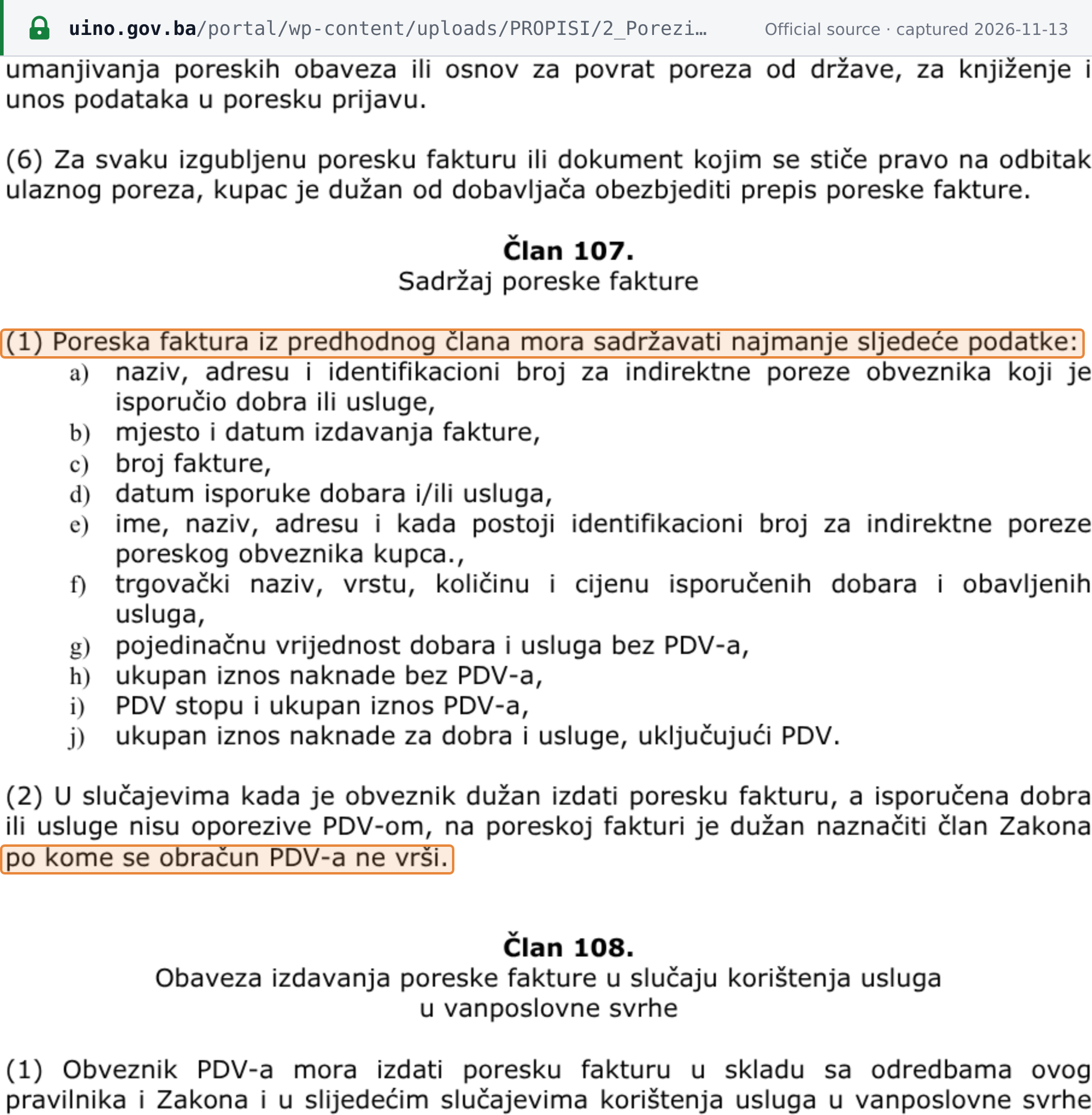
The content is set by Article 107 of UIO's VAT Rulebook (93/05), not by the Law. None of the 13 amendments to the Rulebook up to 45/26 changes it. [8] [3] Article 107: "(1) Poreska faktura iz predhodnog člana mora sadržavati najmanje sljedeće podatke: a) naziv, adresu i identifikacioni broj za indirektne poreze obveznika koji je isporučio dobra ili usluge, b) mjesto i datum izdavanja fakture, c) broj fakture, d) datum isporuke dobara i/ili usluga, e) ime, naziv, adresu i kada postoji identifikacioni broj za indirektne poreze poreskog obveznika kupca., f) trgovački naziv, vrstu, količinu i cijenu isporučenih dobara i obavljenih usluga, g) pojedinačnu vrijednost dobara i usluga bez PDV-a, h) ukupan iznos naknade bez PDV-a, i) PDV stopu i ukupan iznos PDV-a, j) ukupan iznos naknade za dobra i usluge, uključujući PDV. (2) U slučajevima kada je obveznik dužan izdati poresku fakturu, a isporučena dobra ili usluge nisu oporezive PDV-om, na poreskoj fakturi je dužan naznačiti član Zakona po kome se obračun PDV-a ne vrši." [8]
 Source snapshot captured 2026-11-13 — original
| Art. 107(1) | Particular | Maps to |
|---|---|---|
| a | Supplier's name, address and 12-digit indirect-tax identification number | supplier.name, supplier.address, supplier.vatId |
| b | Place and date of issue | issuePlace, issueDate |
| c | Invoice number | invoiceNumber |
| d | Date of supply of the goods or services | supplyDate |
| e | Buyer's name, address and, where it has one, indirect-tax identification number | buyer.name, buyer.address, buyer.vatId (optional) |
| f | Trade name, type, quantity and price of the goods and services | lines[].description, lines[].quantity, lines[].unitPrice |
| g | Value of each item excluding VAT | lines[].netAmount |
| h | Total consideration excluding VAT | totals.net |
| i | VAT rate and total VAT | totals.vatRate, totals.vat |
| j | Total consideration including VAT | totals.gross |
| 107(2) | For a supply that is not taxable, the article of the Law under which no VAT is charged | lines[].exemptionReference |
A specimen of a compliant invoice
UIO publishes no specimen VAT invoice: none appears on its VAT pages, in the Rulebook 93/05 or among the forms on its regulations page. [3] The specimen below is our illustration of where the ten Article 107 particulars sit.
PORESKA FAKTURA (tax invoice) — illustrative specimen (Bosnia and Herzegovina)
| Trade name and type of goods or servicesčl. 107(1)(f) | Qtyčl. 107(1)(f) | Unit price excl. VAT (KM)čl. 107(1)(f) | Value excl. VAT (KM)čl. 107(1)(g) |
|---|---|---|---|
| Bookkeeping services, November 2026 | 1 | 1,000.00 | 1,000.00 |
| Office desk, model D-120 | 2 | 250.00 | 500.00 |
- Total excl. VATčl. 107(1)(h)
- KM 1,500.00
- VAT rate 17%, total VATčl. 107(1)(i)
- KM 255.00
- Total including VATčl. 107(1)(j)
- KM 1,755.00
- A supply that is not taxable is shown with the article of the VAT Law under which no VAT is charged, for example "oslobođeno prema članu 27. tačka 1. Zakona o PDV-u" for an export of goods (Pravilnik 93/05 čl. 107(2)).
- An invoice for an advance payment is marked "faktura-avans" (Pravilnik 93/05 čl. 110(2)).
- Issued in at least two copies: one for the buyer, one for the supplier's books (Pravilnik 93/05 čl. 106(3)).
Issuance deadline and tax point
Neither the VAT Law nor the Rulebook sets a number of days for issuing an invoice; the invoice is due for each supply (Art. 55). Timing matters through the tax point, which is the earliest of three events (Art. 17): "Poreska obaveza nastaje u momentu kada se izvrši jedna od sljedećih radnji, koja god bude najranija: 1. isporuka dobara ili vršenje usluga; 2. izdavanje fakture u skladu s ovim zakonom; 3. plaćanje ili djelimično plaćanje izvršeno prije izdavanja fakture; …" For services invoiced periodically, the supply is treated as completed on the last day of the invoiced period (Art. 19). [1] An advance payment needs an advance invoice marked "faktura-avans", unless the advance and the supply fall in the same period, in which case only the ordinary invoice is issued (Rulebook Art. 110(2) and (5)). [8]
Numbering and copies
Each invoice carries a number (Art. 107(1)(c)) and is issued in at least two copies (Rulebook Art. 106(3)): "Poreska faktura se izdaje najmanje u dva primjerka, od kojih se jedan uručuje kupcu, a drugi služi kao isprava za knjiženje." [8] The VAT Law and the Rulebook set no rule on sequential or gap-free numbering; invoice numbers are recorded in the sales ledger (KIF).
Cash-register receipts and other document types
- Cash-register receipt (blagajnički račun, Rulebook Arts. 114–116): issued for cash sales. It must show at least the seller's name, address and identification number; the point of sale; the date and number; the quantity, price and usual trade name; and the totals excluding VAT, of VAT and including VAT (Art. 115(1)). A receipt supports an input-VAT deduction only up to KM 100, and above KM 2,000 a tax invoice must be issued as well (Art. 116): "(1) Blagajnički računi mogu se prihvatiti kao osnova za priznavanje ulaznog PDV-a ukoliko ukupni iznos uključivši PDV ne prelazi 100,00 KM. (2) Za iznos blagajničkog računa preko 2.000,00 KM pored blagajničkog računa mora se izdati poreska faktura." [8] The VAT Law lets retail sales be documented by receipt "osim ako kupac ne traži fakturu" (unless the buyer asks for an invoice) (Art. 55). [1] In practice the receipt is now the fiscal receipt printed by a certified device under entity fiscalisation law (see E-invoicing status).
- Receipt confirmation (potvrda o prijemu, Rulebook Arts. 111–113): issued by the buyer where the supplier cannot invoice, for example on purchases from farmers.
- Internal invoice (interna faktura, Rulebook Art. 109): for goods or services taken for private or non-business use.
- Exempt sellers. Kiosks selling tobacco, newspapers and lottery tickets, and market and open-air stalls, need not issue cash-register receipts (Rulebook Arts. 118–119). [8]
Credit and debit notes
A knjižno obavještenje (credit or debit note) is issued in three cases (Art. 55): "1. se roba vraća nakon ispostavljanja fakture; 2. dobavljač dobara, odnosno davalac usluga nakon ispostavljanja fakture odobri sniženje cijene ili popust; i 3. dobavljač dobara, odnosno davalac usluga primi dodatnu uplatu za isporučena dobra, odnosno izvršene usluge nakon ispostavljanja fakture." The supplier may reduce its output VAT only if the customer reduces its input deduction and tells the supplier in writing (Art. 20): "Obveznik koji je izvršio promet dobara i usluga može ispraviti iznos PDV-a samo ako obveznik kome je izvršen promet dobara i usluga izmijeni odbitak ulaznog PDV-a i pod uslovom da o tome pismeno obavijesti isporučioca dobara i usluga." [1]
VAT shown in error
An unregistered person, or a registered person making an exempt supply, may not show VAT on an invoice, and any VAT wrongly invoiced is payable to UIO unless corrected in the buyer's favour (Art. 55): "Lica koja nisu registrirana kao obveznici, kao i registrirani obveznici koji vrše promet dobara i usluga koji je oslobođen od PDV-a, ne mogu na fakturi iskazati iznos PDV-a ili na bilo koji drugi način naznačiti da je u fakturi sadržan iznos PDV-a." The buyer cannot deduct such VAT, even in good faith (Art. 32): "on ne može ostvariti pravo na odbitak PDV-a koji je iskazan kao ulazni porez, bez obzira što je taj porez platio u dobroj namjeri." [1]
Currency and language
- Currency. A foreign-currency value is converted at the Central Bank of BiH middle rate on the tax-point date (Art. 22), and VAT is accounted for in KM. [1]
- Language. The VAT Law and Rulebook Arts. 106–116 set no invoice-language requirement. Foreign documents filed with UIO for registration must be officially translated into one of the official languages of BiH (Bosnian, Croatian or Serbian). [6]
Self-billing
Permitted. The invoicing duty is met when the buyer issues a payment confirmation with the same details as the supplier's invoice (Art. 55): "Obaveza ispostavljanja poreske fakture smatra se ispunjenom kada kupac ili klijent ispostavi potvrdu o plaćanju, koja sadrži iste podatke kao što su oni na fakturi opskrbljivača." [1] The Rulebook's potvrda o prijemu (Art. 111) is the buyer-issued document for cases "kada je obveznik izdavanja fakture kupac (otkupi od poljoprivrednika, …)". [8]
Retention, electronic records and audit
- Duty to keep. "Dobavljač dobara, odnosno davalac usluga dužan je čuvati kopije svih faktura, knjižnih obavještenja i izvoda o plaćanju." (Art. 56) [1] Taxpayers keep a sales ledger (KIF) and a purchase ledger (KUF), or equivalent records (Rulebook Art. 121). [8]
- How long. The VAT Law, the VAT Rulebook and the Law on Indirect Taxation Procedure (ZPIO, Sl. glasnik BiH 89/05) state no retention period in years. The practical horizon is the limitation period: UIO's right to assess expires after five years (ZPIO Art. 36), and absolute limitation runs out after ten years (Art. 39): "Apsolutna zastarjelost nastupa u svakom slučaju po isteku deset godina od dana kada je prvi put počela teći." [16]
- Electronic records and audit. Taxpayers that submit data to UIO electronically must keep copies of the programs, files and archives holding the original data, and must let UIO copy electronically stored data, access protected computer systems and, where necessary, take away computers to check transactions (ZPIO Art. 12(2)): "Lica koja podliježu plaćanju indirektnih poreza i koja elektronski dostavljaju podatke UIO dužna su čuvati kopije programa, spise dokumenata i arhivu koja sadrži originalne podatke". [16] These rules neither permit nor forbid keeping invoices only in electronic form.
E-invoicing status
No e-invoicing mandate is in force anywhere in BiH as at 13 November 2026.
- State level. The VAT Law, UIO's VAT Rulebook (up to 45/26) and UIO's e-services set no e-invoicing, clearance or real-time reporting requirement. [3] What UIO runs electronically is the return: VAT returns are filed through the UIO ePortal (see Filing and payment), and the "e-VAT" service gives registered taxpayers online access to their records: "The registered VAT taxpayers, who become the “e-VAT” system users, will be ensured the internet access to their files and information stored in the IT system of the Indirect Taxation Authority." [22]
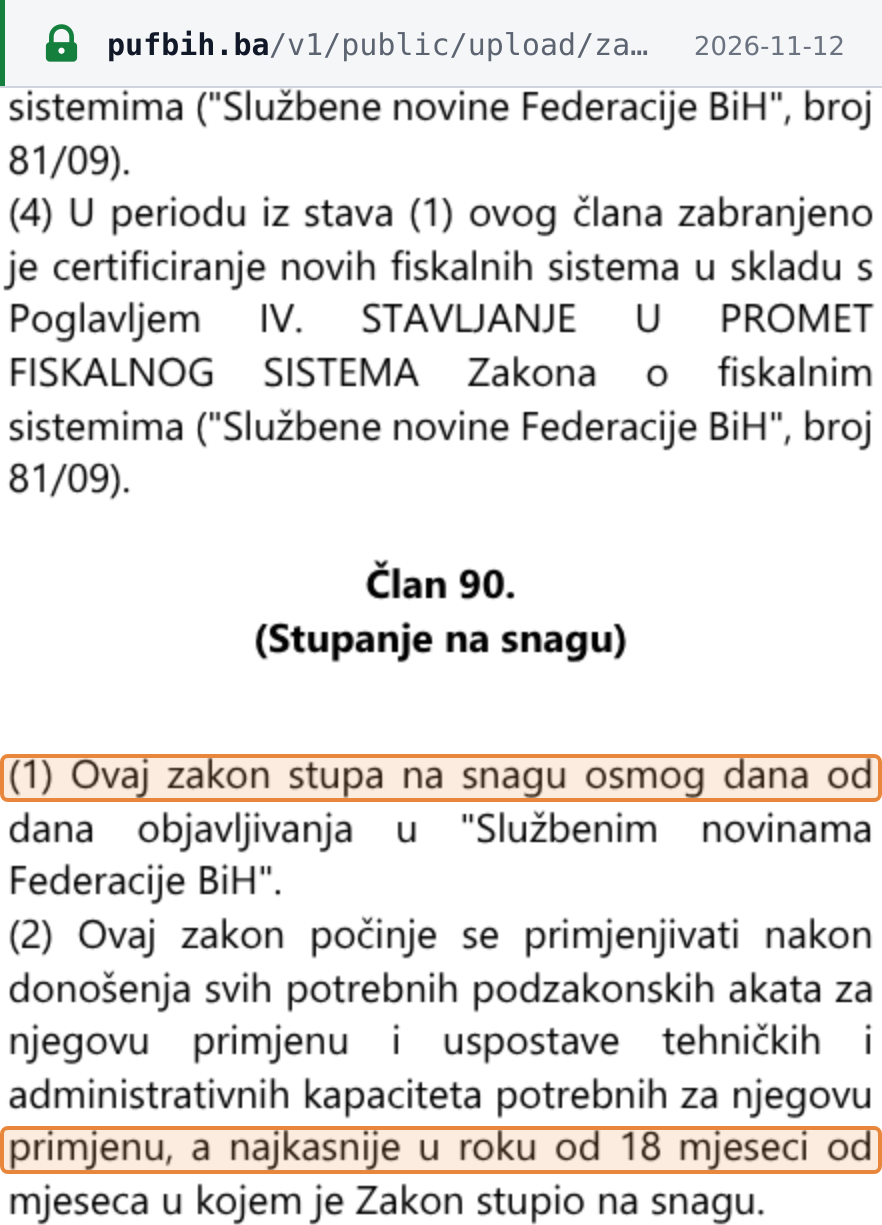
- Federation of BiH: law in force, not yet applied. The Law on Fiscalisation of Transactions (Zakon o fiskalizaciji transakcija, Sl. novine FBiH 9/26), in force since February 2026, sets up a Central Fiscalisation Platform run by the FBiH Tax Administration. [18] It applies only once its implementing rules and systems are in place, and at the latest 18 months from the month it entered into force (Art. 90(2)): "Ovaj zakon počinje se primjenjivati nakon donošenja svih potrebnih podzakonskih akata za njegovu primjenu i uspostave tehničkih i administrativnih kapaciteta potrebnih za njegovu primjenu, a najkasnije u roku od 18 mjeseci od mjeseca u kojem je Zakon stupio na snagu." Until then the 2009 Law on Fiscal Systems (Sl. novine FBiH 81/09) continues to apply (Art. 89(1)). The implementing rulebooks, including the rulebook on the phasing of fiscalisation, are issued by the FBiH Minister of Finance (Arts. 86(3) and 88): "Ministar će u roku od 180 dana od dana stupanja na snagu ovog zakona donijeti podzakonske akte propisane ovim zakonom". [18]
 Source snapshot captured 2026-11-12 — original
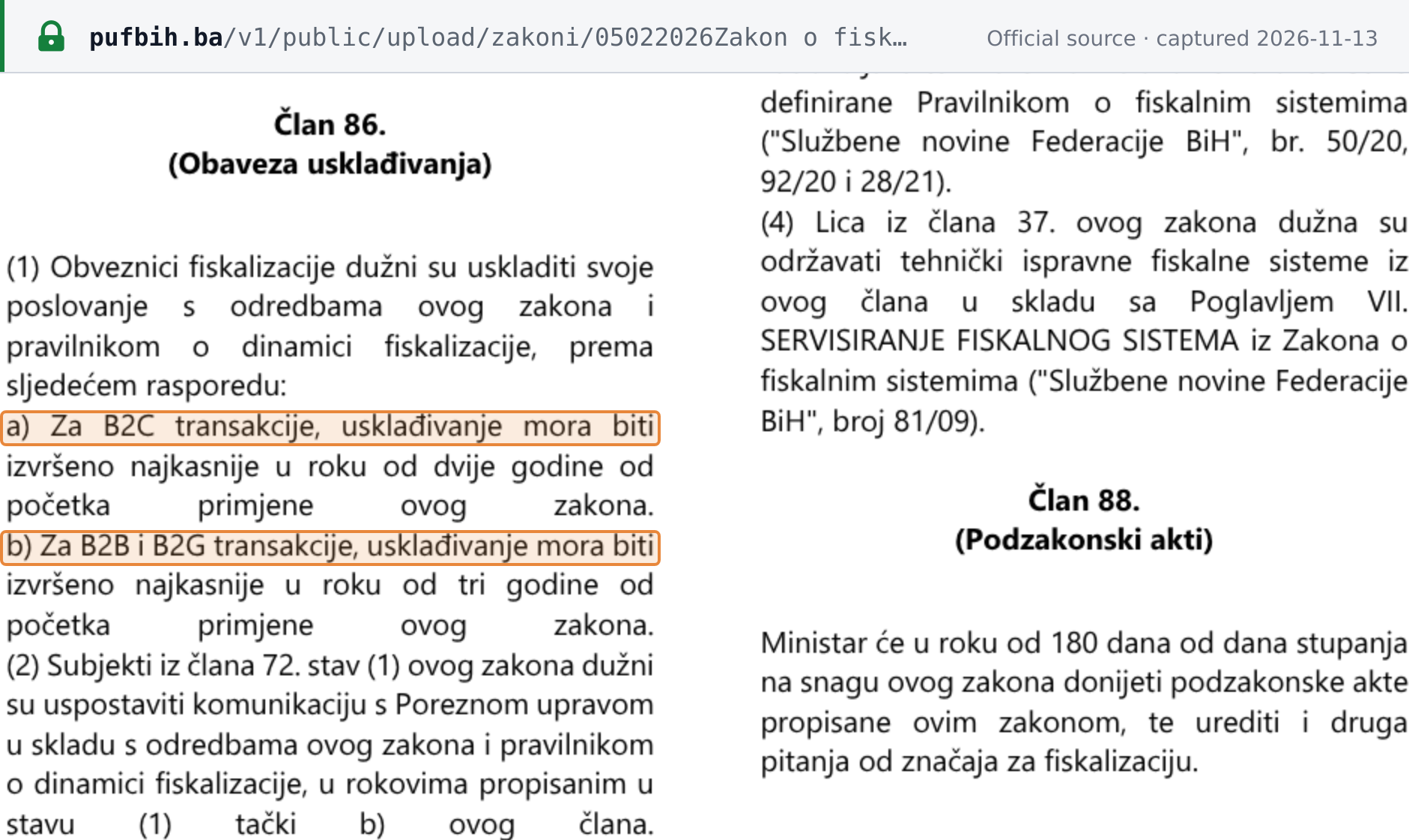
Once the FBiH law applies, it covers each channel separately:
| Channel | Requirement under FBiH Law 9/26 | Deadline after the law starts to apply (Art. 86(1)) |
|---|---|---|
| B2G | E-invoice issued, sent and accepted | 3 years |
| B2B | E-invoice issued, sent and accepted where payment is non-cash or combined (Art. 15(1)) | 3 years |
| B2C | Fiscal receipt through a certified recording system | 2 years |
Art. 15(1): "Za B2B transakcije, mora se izdati, poslati i prihvatiti e-faktura, ukoliko je plaćena ili će biti plaćena bezgotovinski, ili ukoliko se vrši kombinovano plaćanje." The format is the European standard EN 16931 (Art. 12(2)): "Strukturirani elektronski format e-fakture mora biti u skladu s evropskim standardom EN 16931, kojim se definiraju tehničke specifikacije sadržaja i formata elektronskih faktura." [18]
 Source snapshot captured 2026-11-13 — original
- Republika Srpska. RS applies its own Law on Fiscalisation (Закон о фискализацији, Sl. glasnik RS 15/22) to retail fiscal receipts, phasing businesses in by group: "Крајњи рок за фискализацију прве групе обвезника фискализације истиче 17.12.2024. године". [19] [20] The RS Tax Administration's e-fiscalisation pages set no B2B e-invoicing obligation.
- Brčko District. Its fiscal-device rules are not covered in this guide.
Filing and payment
Filing frequency and due date
Every registered taxpayer files monthly, with no turnover bands, and files even when no VAT is due. The return is due by the 10th of the month after the period (Art. 39): "Obveznici su dužni svoju PDV obavezu obračunatu za određeni poreski period navesti u mjesečnoj PDV prijavi. Prijavu iz stava 1. ovog člana obveznik podnosi do 10-og u mjesecu po isteku poreskog perioda. Obveznik podnosi prijavu za PDV bez obzira da li je obavezan platiti PDV u periodu za koji je prijava podnesena." [1] The same applies to the tax proxy of a non-resident (Rulebook Art. 78(1), as replaced by 47/22): "Porezni obveznik, odnosno porezni zastupnik lica koje nema sjedište u BiH, dužan je izvršiti mjesečni obračun PDV i isti dostaviti u PDV prijavi, do 10-og dana u narednom mjesecu po isteku poreznog perioda." [12] A bill to move the deadline to the 20th has passed only one House (see Pending bills).
The return: form P PDV, filed electronically
The return (form P PDV) is filed electronically through the UIO ePortal (Rulebook Art. 78(4), 47/22): "Porezni obveznik PDV prijavu iz stava (1) ovog člana podnosi u elektronskom obliku posredstvom ePortala UIO." [12] Filing with a qualified electronic certificate has been mandatory for large taxpayers since the June 2023 period (Art. 78(5), as amended by 87/22) [13] and for all other taxpayers since the January 2024 period (Art. 78(7)): "Ostali porezni obveznici koji nemaju status "velikih obveznika indirektnih poreza" su dužni PDV prijavu iz stava (1) ovog člana dostavljati UIO elektronskim putem upotrebom kvalifikovane potvrde od poreznog perioda januar 2024. godine." [12]
Payment
VAT is paid by the same date as the return. UIO: "VAT taxpayers are obliged to submit the return and pay VAT within the period from the 1st to the 10th of the month following the expiry of tax period", and "VAT is paid to the Single Account open at the BiH Central bank". [2] Import VAT is paid with customs duties.
Additional listings
The VAT Law and the Rulebook provide for no annual VAT return and no sales or purchase list of the EC-sales-list kind. Taxpayers keep the KIF and KUF ledgers (Rulebook Art. 121), and UIO's e-services pages carry a technical instruction for submitting electronic accounting records. [8] [22]
Input-tax recovery and blocked items
Input VAT is deductible on the strength of a compliant invoice or an import document. Article 32 blocks deduction on: "1. nabavku, proizvodnju i uvoz putničkih automobila, autobusa, motocikla, plovnih objekata i zrakoplova i rezervnih dijelova za takva prijevozna sredstva, goriva i potrošnog materijala za potrebe prijevoza, … osim ako prijevozna sredstva i druga dobra koristi isključivo za obavljanje svoje poslovne djelatnosti; 2. izdatke za poslovne zabave i smještaj; … 4. izdatke obveznika i zaposlenih lica za reprezentaciju; 5. isplate zaposlenim u naturi." In plain terms: passenger cars, buses, motorcycles, boats and aircraft and their running costs (unless used only for the business), business entertainment and accommodation, representation and payments in kind to employees. [1]
- Partial exemption. A business with taxable and exempt supplies deducts by an annual pro-rata (Art. 33).
- Capital goods. Deductions on equipment costing over KM 10,000 are adjusted over five years, and on immovable property over ten years (Art. 36). [1]
Refunds
- Resident credit (Art. 52): an excess credit is refunded on request "najkasnije u roku od 60 dana po isteku roka za predaju prijave za PDV" (within 60 days after the return deadline), or carried forward; "Svaki poreski kredit, koji se ne iskoristi nakon perioda od šest mjeseci, vraća se" (credit unused after six months is refunded).
- Exporters (Art. 52): a taxpayer whose main activity is exporting goods, and whose consecutive returns show a credit, is refunded within 30 days of filing. [1]
- Non-established businesses (Art. 53): a foreign business not registered, and not obliged to register, in BiH can reclaim BiH VAT on business purchases through a representative registered for VAT with UIO (Rulebook Art. 93, as replaced by 44/20): "e) je imenovao zastupnika, koji je registriran za plaćanje PDV kod UIO, a koji će ga zastupati pred UIO s ciljem vršenja povrata PDV". [14]
- Tourists (Art. 54): non-residents can reclaim VAT on goods taken out of BiH in personal luggage. Under the Rulebook as amended by 25/25, the goods on form PDV-SL-2 must total more than KM 200 including VAT and be taken out within three months: "c) je ukupna vrijednost dobara sa PDV iskazana na obrascu "PDV-SL-2" veća od 200 (dvjesto) KM, d) se dobra iznose prije isteka roka od tri mjeseca od dana isporuke (kupovine) u BiH". [15]
- First home. Adult BiH citizens living in BiH who buy their first newly built home (a flat or a house) can reclaim the VAT on it under Article 54a, inserted by the Law on Supplements to the VAT Law (Sl. glasnik BiH 20/25 of 4 April 2025). [24] The procedure is in Rulebook Article 105a, inserted by 45/26 (published 30 June 2026). [25] [21]
 Source snapshot captured 2026-11-13 — original
- Bad debts. The supplier may correct its VAT when the consideration cannot be collected "nakon iscrpljivanja svih zakonskih sredstava" (after all legal remedies are exhausted) (Art. 20). [1]
Exemptions
Exempt supplies
- Public-interest activities (Art. 24): public postal services (not telecoms), medical, healthcare and dental services, social security, education from pre-school to university, non-profit sport, religious activities, membership services of political, trade-union, charitable and similar organisations, non-profit culture and non-commercial public broadcasting.
- Financial and other supplies (Art. 25): insurance and reinsurance; supplies of immovable property, except the first transfer of newly built property; residential lettings for more than 60 days; lending, deposits, payments, currency, shares and securities, and fund management; postage and tax stamps; and games of chance. Article 25: "2. promet nepokretne imovine, izuzev prvog prijenosa prava svojine ili prava raspolaganja novoizgrađenom nepokretnom imovinom; 3. usluge izdavanja pod zakup i podzakup kuća za stanovanje, stanova i stambenih objekata na period duži od 60 dana, … 7. igre na sreću." [1]
- Supplies exempt under Articles 24 and 25 need no invoice (Art. 55).
Exempt is not zero-rated
Exempt supplies under Articles 24 and 25 carry no right to deduct input VAT (Art. 32): "Obveznik ne može ostvariti pravo na odbitak ulaznog poreza na: 1. promet dobara i usluga koje su oslobođene od plaćanja PDV-a, osim ako ovim zakonom nije drukčije propisano". UIO: "Taxpayers selling VAT exempt goods or providing VAT exempt services neither can charge VAT nor can deduct the VAT paid on their purchases. In such cases input VAT is considered the cost of a taxpayer." [2] Exports and international transport (Arts. 27–28) are exempt with credit: no VAT is charged, but input VAT stays deductible. [1] See zero-rated vs exempt supplies.
Special regimes
- Small businesses. Below KM 100,000 a business is outside VAT unless it registers voluntarily (Art. 44). There is no flat-rate scheme for small traders and no cash-accounting scheme: VAT is due at the earliest of supply, invoice or payment (Art. 17).
- Farmers (Arts. 44–45): farm households with cadastral income below KM 15,000 are outside VAT, and registered buyers pay unregistered farmers a flat-rate compensation that the buyer can deduct.
- Construction reverse charge (Arts. 40–43): VAT on construction works is shifted to the recipient contractor where the works' total value exceeds KM 25,000. Article 40: "Posebna shema odnosi se na građevinske radove na izgradnji novih zgrada, kao i radove na renoviranju, proširivanju i održavanju postojećih zgrada, a čija ukupna vrijednost prelazi iznos od 25.000,00 KM." See reverse charge.
- Travel agents (Art. 46): margin scheme. Second-hand goods, works of art, antiques and collectors' items (Arts. 47–49) and auctions (Arts. 50–51): optional margin schemes, with no VAT shown on the invoice.
- Free zones, customs warehouses and duty-free shops (Art. 30): exempt while the goods are not released for free circulation.
- Business gifts and samples (VAT Law Art. 5; Rulebook Art. 13, as amended by 25/25): samples in usual quantities, and occasional gifts of small value — the Law sets the ceiling at KM 20.00 a gift (Art. 5(2)); UIO's Rulebook applies it as less than KM 20 excluding VAT, not from the business's own product range, and recorded (Art. 13, as amended by 25/25) — are not supplies. Rulebook Art. 13(1), base text: "smatra se dobro pojedinačne tržišne vrijednosti manje od 20,00 KM bez PDV-a, koje obveznik daje povremeno različitim licima". [8] [15]
- Food donations to registered intermediaries are not taxable supplies (Art. 5, as amended by 46/23). [27] [1]
Offences and penalties
Offences
Article 67 of the VAT Law makes the following conduct an offence (prekršaj), punishable by a fine: "Svaki poreski obveznik koji činjenjem ili nečinjenjem napravi prekršaj podliježe novčanoj kazni za prekršaj." The listed offences include failing to register or to notify UIO of the start, change or end of business; failing to file a return or filing late; under-declaring or under-paying VAT; deducting input VAT wrongly; showing VAT on an invoice while not registered; failing to issue or keep an invoice; and failing to keep books. Since 20/25, an individual from whom UIO later recovers a first-home refund also commits an offence: "Fizička osoba iz članka 54a. ovoga zakona kojoj bude naknadno naplaćen PDV čini prekršaj koji podliježe novčanoj kazni u rasponu od 5.000 KM do 10.000 KM." [24] [1] The responsible person in a legal entity can be fined as well. Criminal liability for tax evasion lies under the Criminal Code of BiH, which this guide does not cover.
Penalties
| Failure | Fine (VAT Law Art. 67) |
|---|---|
| Return not filed or filed late (point 4) | KM 300, unless the return shows a credit |
| VAT under-declared or not paid (points 2–3) | 50% of the amount, minimum KM 100 |
| Input VAT wrongly deducted (point 5) | 50% of the unlawful gain |
| VAT shown on an invoice by a person not entitled to (point 6) | 100% of the amount, minimum KM 100 |
| Invoice not issued or copy not kept (point 11) | KM 300 |
| Books not kept (point 13) | KM 300 to KM 10,000 |
| Start, change or end of business not notified, including failure to register (point 14) | 100% of the unreported liability, minimum KM 1,000 |
| First-home refund later reclaimed by UIO, for the individual who received it (Art. 67, added by 20/25) | KM 5,000 to KM 10,000 |
| Repeat offence, obstruction of UIO or fraud | Fines above increased by 50% |
Point 4: "ne podnese prijavu za PDV ili je ne podnese u propisanom roku, u skladu sa stavovima 1. do 4. člana 39. ovog zakona, bit će novčano kažnjen u iznosu od 300 KM, osim u slučajevima kada je prijava negativna". Point 11: "ne ispostavi fakturu ili ne sačuva primjerak fakture, u skladu s članom 55. stavovima 1. i 2. ovog zakona, bit će novčano kažnjen u iznosu od 300 KM". Point 14: "ne obavijesti UIO o početku, izmjeni ili prestanku obavljanja svoje djelatnosti saglasno članu 57., 60. i 62. ovog zakona, bit će novčano kažnjen u iznosu od 100% od obaveze o kojoj se nije obavijestilo zbog propusta poreskog obveznika, a minimalno sa 1.000KM." [1]
- Late-payment interest: 0.04% a day. ZPIO Article 10(1) set 0.06% a day for each day of delay; Law 100/13 replaced it with 0.04%. [16] [17] Law 100/13: "u članu 10. stav (1) postotak „ 0,06%“ zamjenjuje se postotkom „ 0,04%“."
- Enforced collection adds 5% of the debt (ZPIO Art. 11(1), cut from 10% by 100/13). [17]
Frequently asked questions
Can I deduct input VAT shown on a cash-register receipt?
Only up to KM 100. Article 116 of UIO's VAT Rulebook (Sl. glasnik BiH 93/05) accepts a cash-register receipt as the basis for deducting input VAT only where its total, including VAT, does not exceed KM 100.00. For a receipt over KM 2,000.00 the seller must also issue a tax invoice. The VAT Law lets a buyer ask for a tax invoice instead of a receipt (Art. 55).
We are a foreign software or consulting company selling to businesses in Bosnia and Herzegovina. Do we have to register for VAT?
Usually not. Consulting, data-processing, advertising, telecommunications and intellectual-property services are taxed where the customer is established (VAT Law Art. 15(2)(4)). If you appoint no tax representative in BiH, your BiH business customer is liable for the VAT and accounts for it itself (Art. 13(1)(3)). Selling to consumers is different: the law has no simplified regime for foreign sellers, and the only registration route for a business without a seat in BiH is through a tax proxy seated in BiH (Art. 60).
Why does UIO's taxpayer search reject our 13-digit JIB?
UIO's indirect-tax identification number has 12 digits. It is formed by removing the common leading digit 4 from the 13-digit JIB issued by the entity tax administration (UIO Rulebook, Sl. glasnik BiH 51/12, Art. 21). Search UIO's taxpayer database with all 12 digits, and check that the record shows the business as registered for VAT: UIO also registers businesses for other indirect taxes under the same number.
Is e-invoicing mandatory in Bosnia and Herzegovina?
Not as at 13 November 2026. The state VAT Law and UIO's rules contain no e-invoicing requirement. The Federation of BiH's Law on Fiscalisation of Transactions (Sl. novine FBiH 9/26) is in force but not yet applied: it applies once its implementing rules and systems are in place, and at the latest 18 months from the month it entered into force. From then, B2C transactions must comply within two years and B2B and B2G transactions within three years, with e-invoices in the EN 16931 format for B2G sales and for B2B sales paid other than in cash.
We passed the KM 100,000 threshold months ago and only just noticed. What now?
Apply to UIO for registration now. The deadline was the 20th of the month after the month in which turnover passed, or was likely to pass, KM 100,000 (VAT Law Art. 57). Failing to notify UIO of the start of business is fined at 100% of the unreported liability, with a minimum of KM 1,000 (Art. 67 point 14), and VAT paid late carries interest at 0.04% a day.
Do export sales count towards the KM 100,000 threshold?
Exports of goods do. Article 57(1) of the VAT Law counts taxable supplies together with supplies of goods exempt with credit, which include exports. The text says goods; it does not say whether zero-rated services count.
Is there a reduced VAT rate, for example on food or medicines?
No. The VAT Law sets one rate, 17% (Art. 23), and no amendment up to Sl. glasnik BiH 20/25 adds a reduced rate. A bill to zero-rate bread, dairy products, medicines and some other goods passed a first reading in the House of Peoples in 2025 but, as at 13 November 2026, has not passed both Houses and is not law.
Important websites
| Site | What it is for |
|---|---|
| UIO: registration of taxpayers | Register for VAT (form ZR-1) and the documents to attach, including for non-residents |
| UIO e-VAT and ePortal | File the monthly P PDV return electronically and view your VAT records |
| UIO taxpayer database | Check a 12-digit indirect-tax number and its VAT status |
| UIO: general information on VAT | The rate, payment to the Single Account, exemptions (English) |
| UIO: regulations (taxes) | The VAT Law, rulebooks, instructions and forms, with every amendment |
| UIO: termination of registration | Deregister and the documents required (English) |
| Bosnia and Herzegovina JIB validator | Check the format of a 13-digit JIB (Lookuptax) |
| PU RS: e-fiscalisation | Republika Srpska fiscal-receipt laws and deadlines |
UIO collects VAT through the Single Account at the Central Bank of BiH, and there is no separate payment portal. No e-invoicing portal is in use yet: the FBiH Central Fiscalisation Platform belongs to a law that is not yet applied.
Recent changes
- 2026-07-08 — First-home VAT refund: the procedure for the Article 54a refund (inserted by Sl. glasnik BiH 20/25) applies under VAT Rulebook amendment 45/26, published 30 June 2026. (UIO) — see event
- 2026-02 — FBiH Law on Fiscalisation of Transactions (Sl. novine FBiH 9/26) in force; it applies at the latest 18 months from the month of entry into force, with B2B and B2G e-invoicing to follow within three years of application. (FBiH Tax Administration)
- 2025-04-29 — VAT Rulebook amendment 25/25 published: tourist refunds on form PDV-SL-2 need goods worth more than KM 200 taken out of BiH within three months. (UIO)
- 2024-01-01 — Electronic filing with a qualified certificate mandatory for all VAT taxpayers from the January 2024 tax period (Rulebook Art. 78(7), 47/22). (UIO)
- 2023-12-02 — Registration threshold raised from KM 50,000 to KM 100,000 (Law 80/23). (UIO)
For the full chronology, see Bosnia and Herzegovina tax changes on Lookuptax.
Reference links
Legislation and rulebooks (Indirect Taxation Authority of BiH):
- [1] Law on Value Added Tax, Sl. glasnik BiH 9/05 (base text)
- [26] Law amending the VAT Law, Sl. glasnik BiH 35/05
- [11] Law amending the VAT Law, Sl. glasnik BiH 33/17
- [27] Law supplementing the VAT Law, Sl. glasnik BiH 46/23
- [5] Law amending the VAT Law, Sl. glasnik BiH 80/23 (threshold)
- [24] Law supplementing the VAT Law, Sl. glasnik BiH 20/25 (Art. 54a)
- [8] Rulebook on the application of the VAT Law, Sl. glasnik BiH 93/05
- [32] Rulebook amendment 35/08 (place of supply of services)
- [14] Rulebook amendment 44/20 (refunds to non-residents)
- [12] Rulebook amendment 47/22 (returns, e-filing, foreign carriers)
- [13] Rulebook amendment 87/22 (e-filing by large taxpayers)
- [15] Rulebook amendment 25/25 (tourist refunds)
- [25] Rulebook amendment 45/26 (first-home refund)
- [9] Rulebook on registration in the Single Register of Indirect Taxpayers, Sl. glasnik BiH 51/12
- [10] Instruction 24/07 on VAT returns of persons with no seat in BiH
- [16] Law on Indirect Taxation Procedure (ZPIO), Sl. glasnik BiH 89/05
- [17] Law amending the ZPIO, Sl. glasnik BiH 100/13 (interest and surcharge)
UIO guidance and services:
- [2] General information on the VAT system in BiH
- [3] Regulations: taxes
- [4] Threshold raised to KM 100,000
- [6] Registration of taxpayers
- [7] Termination of registration
- [21] VAT refund on the purchase of a first home
- [22] e-VAT
- [23] Taxpayer database
Entity fiscalisation:
- [18] FBiH Law on Fiscalisation of Transactions, Sl. novine FBiH 9/26 (FBiH Tax Administration)
- [19] RS fiscalisation obligors and deadlines (RS Tax Administration)
- [20] RS fiscalisation laws (RS Tax Administration)
Pending bills (Parliamentary Assembly of BiH):
- [28] Bill on a zero VAT rate (lawId 110151)
- [29] Bill moving the return deadline to the 20th (lawId 134278)
- [30] Bill repealing the gambling exemption (lawId 136584)
- [31] Bill on VAT refunds for disability aids (lawId 138167)
Related on Lookuptax:
- Bosnia and Herzegovina tax identification number guide
- How to verify a Bosnian VAT number
- Bosnia and Herzegovina JIB validator
- Bosnia and Herzegovina tax changes
- Croatia VAT guide
- Serbia VAT guide
- Montenegro VAT guide
- VAT and GST registration thresholds worldwide
- Worldwide VAT and GST rates
- Reverse charge
- Zero-rated vs exempt supplies