Burkina Faso VAT (TVA) guidelines
Burkina Faso charges VAT (taxe sur la valeur ajoutée, TVA) at 18%, with a 10% rate for approved hotels and restaurants and for domestic air transport. Only businesses under the régime du réel normal, broadly those with annual turnover of FCFA 50 million or more, are liable. This guide covers the rules as at 12 November 2026.
Overview
Burkina Faso's indirect tax is the taxe sur la valeur ajoutée (TVA), in Livre II, Titre 1 of the Code général des impôts (CGI). The CGI was enacted by Loi n°058-2017/AN of 20 December 2017 and entered into force on 1 January 2018 (art. 821); it is amended every year by the finance law. [2] The figures on this page come from the DGI's official 2026 edition of the CGI, which incorporates the 2025 amending finance law and the 2026 finance law (Loi n°021-2025/ALT of 27 December 2025). [1]
CGI art. 296 sets the scope: "Sont soumises à la taxe sur la valeur ajoutée (TVA) les affaires faites au Burkina Faso par des personnes physiques ou morales assujetties qui, habituellement ou occasionnellement, accomplissent des actes relevant d'une activité autre que salariée." [1]
Authority, currency, period and layering
- Authority. The Direction générale des impôts (DGI) of the Ministry of Economy and Finance administers VAT. In the CGI's preface it describes its mission as "l'élaboration et l'application de la législation fiscale intérieure, domaniale, foncière et cadastrale". [1] Its website is dgi.bf. Import VAT is collected by customs at release for consumption (see Imports).
- Currency. The CFA franc (XOF), written "F ou FCFA" in the CGI. When a VAT calculation produces fractions of a franc, they are rounded down (art. 317). [1]
- Period. The calendar month. Every person liable to VAT files a return for the previous month by the 15th (art. 334-1). Accounts must be kept in French and follow the OHADA accounting standard (SYSCOHADA) (art. 554). [1]
- Layering. None. VAT is a single national tax. The contribution des micro-entreprises (CME), which small businesses pay instead, is a separate flat levy "perçu au profit des budgets des collectivités territoriales" (art. 532), not a local VAT. [1]
Registration
Who is liable to VAT
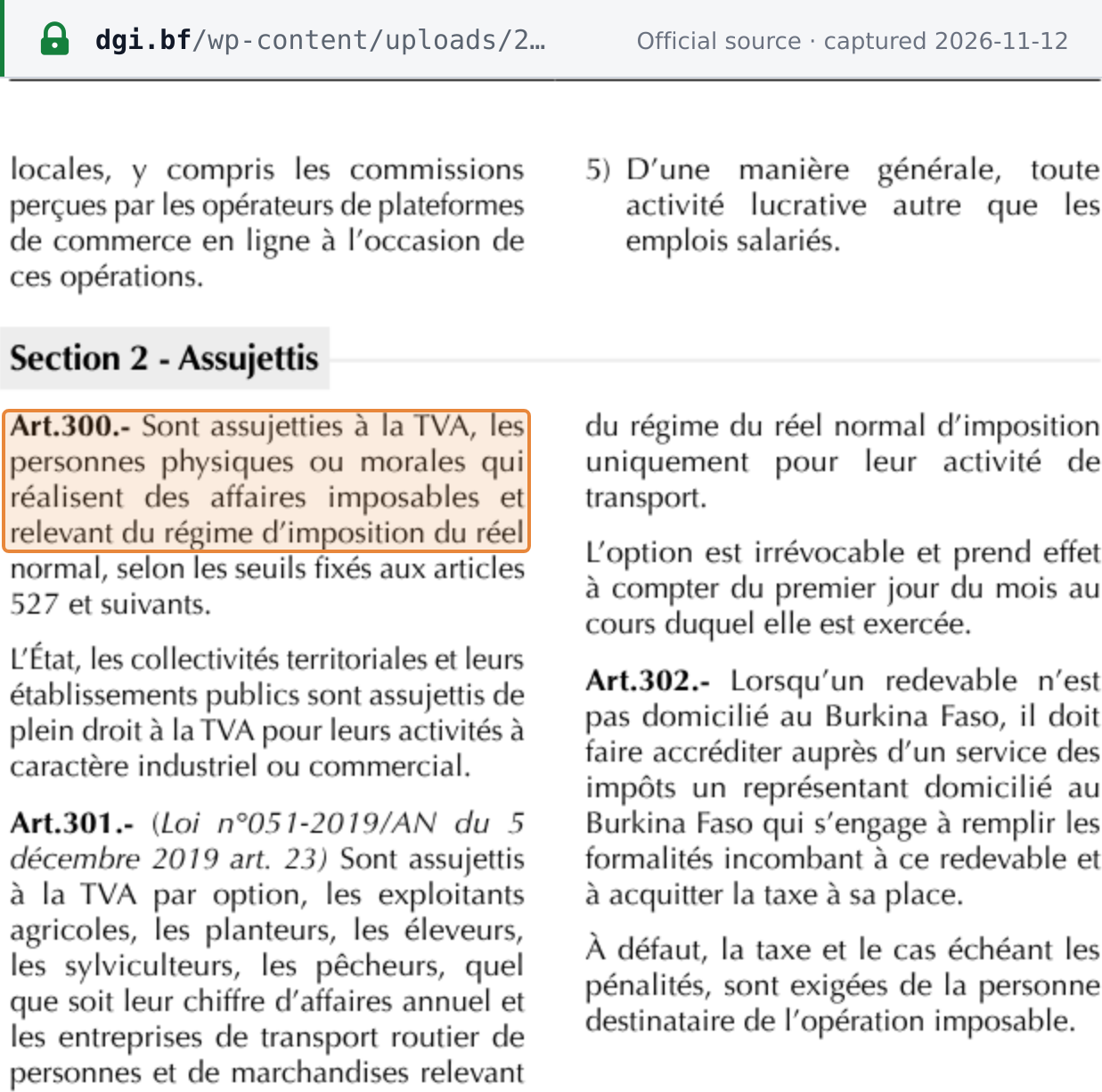
In Burkina Faso there is no separate VAT registration test. Liability follows the tax regime: only taxpayers under the régime du réel normal d'imposition (RNI) are liable. CGI art. 300: "Sont assujetties à la TVA, les personnes physiques ou morales qui réalisent des affaires imposables et relevant du régime d'imposition du réel normal, selon les seuils fixés aux articles 527 et suivants." The State, local authorities and their public establishments are liable for their industrial or commercial activities. [1]
The smaller regimes are outside VAT. Art. 307 exempts, "sous réserve de l'option prévue aux articles 301 et 530", "les ventes, les prestations de services et les travaux immobiliers effectués par les contribuables relevant du régime simplifié d'imposition ou de la contribution des micro-entreprises". [1]
 Source snapshot captured 2026-11-12 — original
Threshold: FCFA 50,000,000
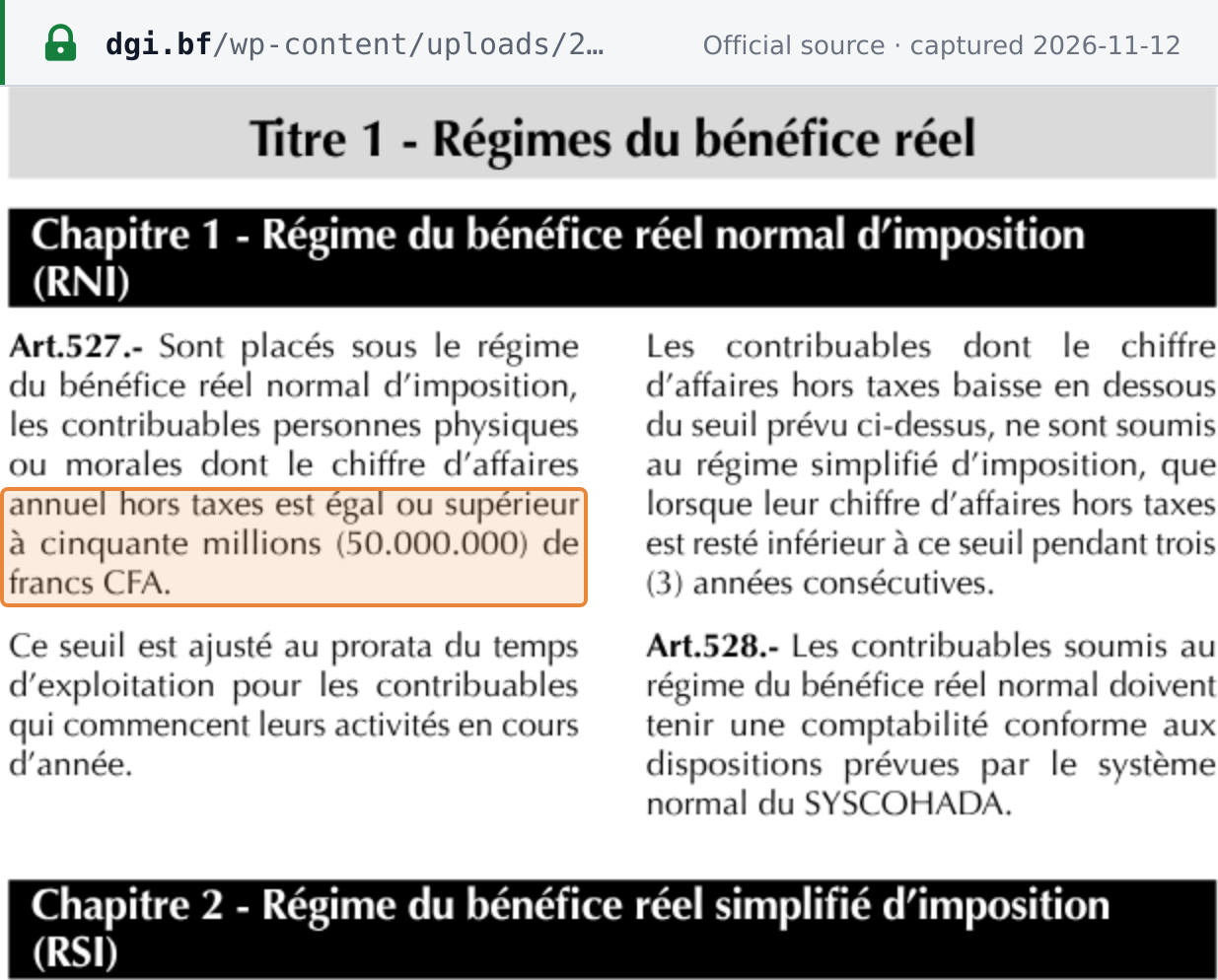
The régime du réel normal applies from FCFA 50,000,000 of annual turnover excluding tax (as at 12 November 2026). CGI art. 527: "Sont placés sous le régime du bénéfice réel normal d'imposition, les contribuables personnes physiques ou morales dont le chiffre d'affaires annuel hors taxes est égal ou supérieur à cinquante millions (50.000.000) de francs CFA." [1]
 Source snapshot captured 2026-11-12 — original
| Regime | Annual turnover excluding tax | VAT position | CGI |
|---|---|---|---|
| Régime du réel normal (RNI) | FCFA 50,000,000 or more | Liable to VAT | arts 300, 527 |
| Régime simplifié (RSI) | FCFA 15,000,000 to under 50,000,000 | Exempt, unless it opts for the RNI | arts 307, 529, 530 |
| Contribution des micro-entreprises (CME) | Under FCFA 15,000,000 | Exempt; pays a flat local levy | arts 307, 533 |
Liberal professions are excluded from the CME, so below FCFA 50 million they fall under the RSI whatever their turnover, and above it under the régime du réel normal (arts 527, 529 and 534). [1]
- Measurement. Annual turnover excluding tax. The threshold is prorated for businesses that start during the year (art. 527). [1]
- Crossing the threshold. For an RSI taxpayer, exceeding FCFA 50 million during the year "entraîne la caducité systématique du régime du bénéfice réel simplifié d'imposition", and the taxpayer must notify the administration within 30 days (art. 529, as last amended by the 2026 finance law). [1]
- Falling below it. An RNI taxpayer returns to the simplified regime only after its turnover has stayed below FCFA 50 million "pendant trois (3) années consécutives" (art. 527). [1]
- Which tax office. Large and medium taxpayers are attached to the Direction des grandes entreprises (DGE) or a Direction des moyennes entreprises (DME). The CGI does not set the turnover that moves a taxpayer to the DGE or a DME; the administration assigns taxpayers. This matters because DGE and DME taxpayers must e-file and issue certified electronic invoices.
Non-residents
There is no turnover threshold for non-residents. A non-resident person liable to VAT must accredit a representative domiciled in Burkina Faso. If it does not, the customer owes the tax. CGI art. 302: "Lorsqu'un redevable n'est pas domicilié au Burkina Faso, il doit faire accréditer auprès d'un service des impôts un représentant domicilié au Burkina Faso qui s'engage à remplir les formalités incombant à ce redevable et à acquitter la taxe à sa place. À défaut, la taxe et le cas échéant les pénalités, sont exigées de la personne destinataire de l'opération imposable." [1]
Arrêté n°2023-151 on the accreditation of non-resident entities, reproduced in the CGI's annex, makes accreditation compulsory even for one-off work: "L'accréditation est obligatoire qu'il s'agisse de prestations ou autres transactions réalisées à titre ponctuel ou temporaire par des sociétés ou autres entités non résidentes et ne disposant pas d'un établissement stable au Burkina Faso" (art. 3). Only a resident accounting firm or legal and tax advisory firm can act as the representative (CGI art. 557-2). The DGI issues the accreditation certificate "dans un délai de sept (07) jours ouvrables suivant le dépôt du dossier" (arrêté art. 8). [1] [12]
Tax identification number (IFU)
Every user of the financial administration has an Identifiant financier unique (IFU). CGI art. 635: "L'Identifiant Financier Unique (IFU) est invariable et personnel." Arrêté n°2023-110, reproduced in the CGI's annex, defines it as a "numéro alpha numérique, de huit chiffres et une lettre" (art. 4). The IFU is required for bank domiciliation, customs clearance, opening commercial accounts and utility subscriptions. [1] The CGI publishes no check-digit rule.
To check the format of an IFU, use the Burkina Faso IFU validator. The DGI also runs an online IFU lookup.
How to register
- Existence declaration. Anyone subject to a profits tax must file a "déclaration d'existence" "dans les trente (30) jours du commencement de ses opérations ou de l'ouverture de son établissement" (CGI art. 557-1). Not filing it costs a fine of FCFA 100,000 (art. 557-4). [1]
- Where. The IFU is assigned on a declaration of existence filed "aux Centres de Formalités des Entreprises (CEFORE) ou au service des impôts du ressort territorial de l'usager" (arrêté 2023-110 art. 6). [1] The CEFORE are run by the Maison de l'Entreprise, which offers online company creation. [10]
- After registration. Returns and payments go through eSINTAX, the DGI's e-filing platform. [9]
- Timeline. The DGI publishes no processing time for an IFU. For non-residents, the accreditation certificate is due within 7 working days (see above).
Voluntary registration (option)
Two options bring a business into VAT:
- RSI taxpayers can opt for the régime du réel normal (art. 530) "avant le 1er février de chaque année, par une demande adressée au Directeur Général des Impôts". The applicant must be up to date with its filings, keep SYSCOHADA accounts, invoice with the facture normalisée, and sign "un engagement sur l'honneur de déclarer et de payer la TVA à bonne date". "L'option prend effet à compter du 1er janvier de l'année au cours de laquelle elle est agréée. Elle est irrévocable durant trois (3) ans." [1]
- Farmers and road transporters (art. 301): "Sont assujettis à la TVA par option, les exploitants agricoles, les planteurs, les éleveurs, les sylviculteurs, les pêcheurs, quel que soit leur chiffre d'affaires annuel et les entreprises de transport routier de personnes et de marchandises relevant du régime du réel normal d'imposition uniquement pour leur activité de transport. L'option est irrévocable et prend effet à compter du premier jour du mois au cours duquel elle est exercée." [1]
The reason to opt in is input VAT: purchases used for exempt operations carry VAT that cannot be deducted (art. 321 c), so an exempt RSI supplier bears the VAT on its costs.
Deregistration
The CGI has no separate VAT deregistration procedure. A business leaves VAT in one of two ways:
- Falling out of the RNI, which requires three consecutive years below FCFA 50 million (art. 527).
- Ceasing business. A declaration "est également obligatoire dans les mêmes délais en cas de cession, cessation, modification de l'activité ou changement d'adresse" (art. 557-3), so within 30 days. [1]
Consequences:
- Input VAT clawback. "La TVA ayant grevé l'acquisition des biens doit être reversée en cas : • de cessation d'activités ; […] • de perte de la qualité d'assujetti à la TVA" (art. 332). [1]
- Refund of a remaining credit. A business that loses liable status may claim its credit "dans les trente (30) jours qui suivent la perte de la qualité d'assujetti" (art. 329-1 c). [1]
- Final return. The CGI prescribes no special final VAT return beyond the monthly return.
Group registration
Not available. The CGI's VAT title (arts 296 to 334) and its Livre IV on obligations contain no VAT grouping or fiscal-unity provision. [1]
Rates
Standard rate: 18%
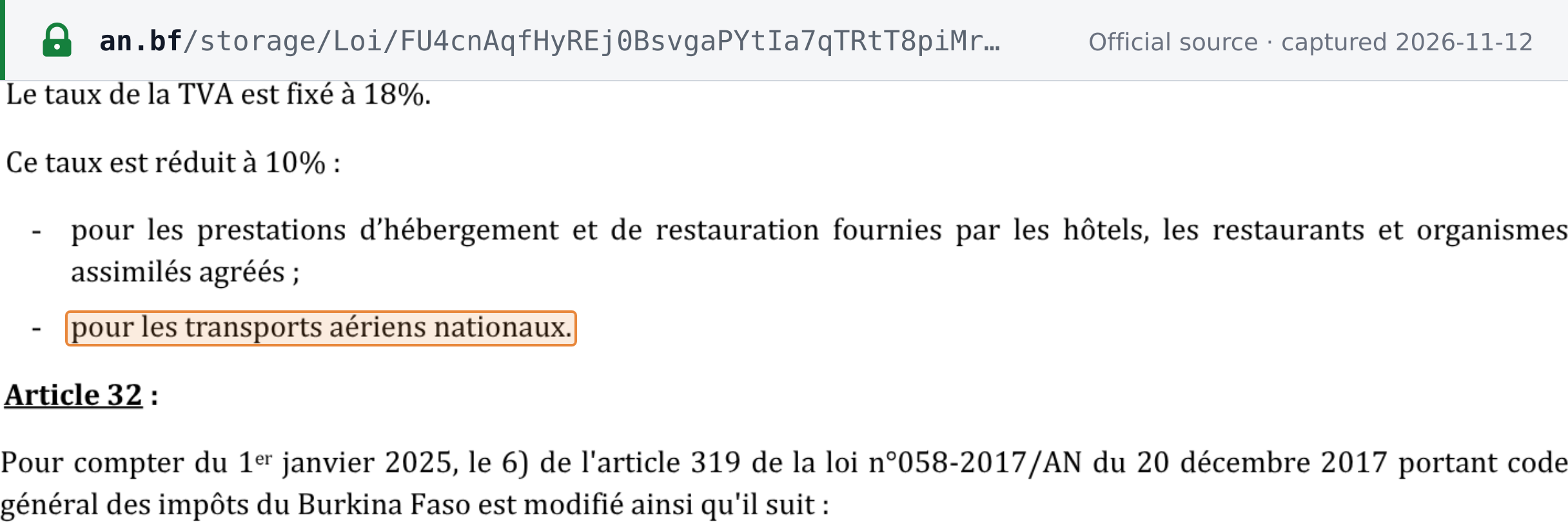
The standard rate is 18% (as at 12 November 2026). CGI art. 317 (2026 edition; the domestic air transport rate was added by the 2025 finance law, Loi n°042-2024/ALT of 23 December 2024, art. 31): "Le taux de la TVA est fixé à 18 %. Ce taux est réduit à 10% : • pour les prestations d'hébergement et de restauration fournies par les hôtels, les restaurants et organismes assimilés agréés ; • pour les transports aériens nationaux. Lorsque la liquidation fait apparaître des fractions de francs, les sommes résultant de cette liquidation sont arrondies au franc inférieur." [1] [3]
The 18% rate has been in art. 317 since the CGI entered into force on 1 January 2018 ("Le taux de la TVA est fixé à 18 %"). [2] It applies to every taxable supply and import not covered by the reduced rate or an exemption.
 Source snapshot captured 2026-11-12 — original
Reduced rate: 10%
| Rate | Applies to | Since | Source |
|---|---|---|---|
| 18% | All taxable supplies and imports not listed below | 1 January 2018 (CGI in force) | CGI art. 317 |
| 10% | Accommodation and catering supplied by approved (agréés) hotels, restaurants and similar establishments | 1 April 2020 | Loi n°031-2020/AN art. 5 [4] |
| 10% | Domestic (national) air transport | 1 January 2025 | Loi n°042-2024/ALT art. 31 [3] |
The hotel and restaurant rate depends on the establishment being approved; a non-approved restaurant charges 18%. The amending finance law of 2020 introduced it "pour compter du 1er avril 2020". [4] The separate taxe de développement touristique on hotel stays (CGI Livre II, Titre 2) is not VAT.
Zero rate. Burkina Faso has no 0% rate as such. Exports are exempt with the right to deduct input VAT, which works like a zero rate (see Exports and Exempt is not zero-rated).
Announced changes
No rate change has been announced. The 2026 edition of the CGI, which includes the 2026 finance law, carries art. 317 as rewritten in 2025. [1] Rate changes appear in the Burkina Faso tax changes chronology.
Cross-border rules
Imports
Imports of goods are taxable when they cross the customs border for release for consumption. CGI art. 299-1: "Par importation, il faut entendre le franchissement du cordon douanier au Burkina Faso pour la mise à la consommation qu'il s'agisse de marchandises provenant de l'extérieur ou placées jusqu'alors sous un régime douanier suspensif." [1]
- Base. "la valeur en douane des marchandises augmentée des droits et taxes de porte de toute nature liquidés par l'administration des douanes" (art. 310-4°). [1]
- Deduction. Import VAT is deductible only once paid: "la TVA doit avoir été acquittée et figurer sur la déclaration de mise à la consommation" (art. 326). [1]
- Exempt imports. Goods under a suspensive customs regime, and imports that qualify for customs franchise under the UEMOA customs code (art. 307-8). [1]
- De minimis. The CGI sets no low-value import relief for VAT. Customs-side reliefs are outside the CGI and not covered here.
Exports
Exports are exempt (art. 307-2): "Les exportations directes de biens matériels et immatériels, les réexportations en suite de régime douanier suspensif et les exportations de services." They keep the right to deduct: "Ouvrent droit à déduction dans les mêmes conditions que si elles étaient soumises à la TVA, les opérations d'exportation de biens et services et les opérations assimilées lorsqu'elles sont taxables en régime intérieur" (art. 318-1). Exports of goods that would be exempt at home give no right to deduct (art. 322). [1]
Exporters are among the few businesses that can get a VAT credit refunded (see Refunds).
Imported services: reverse charge (self-assessment)
Services supplied by non-residents, and intangibles bought from them, are treated as imports (art. 299-1). The Burkinabè customer self-assesses the VAT. CGI art. 334-3: "Pour les importations de biens immatériels ou les prestations de services rendues par des non-résidents, la TVA est auto liquidée sur la déclaration mensuelle." [1] Self-assessed VAT is deductible once paid: "S'agissant de la TVA pour le compte de tiers, auto-liquidée ou rappelée, elle doit avoir été acquittée. En cas de paiement partiel, le droit à déduction porte sur la portion acquittée" (art. 326). [1]
For non-resident holders of public contracts, "la TVA est retenue à la source par l'organisme payeur" (art. 334-2). [1]
Digital services and e-commerce platforms
Since 1 January 2025, sales through e-commerce platforms are within VAT, and the platform collects it. The 2025 finance law (arts 26 and 35) added art. 299-4 and art. 334-5 to the CGI. [3]
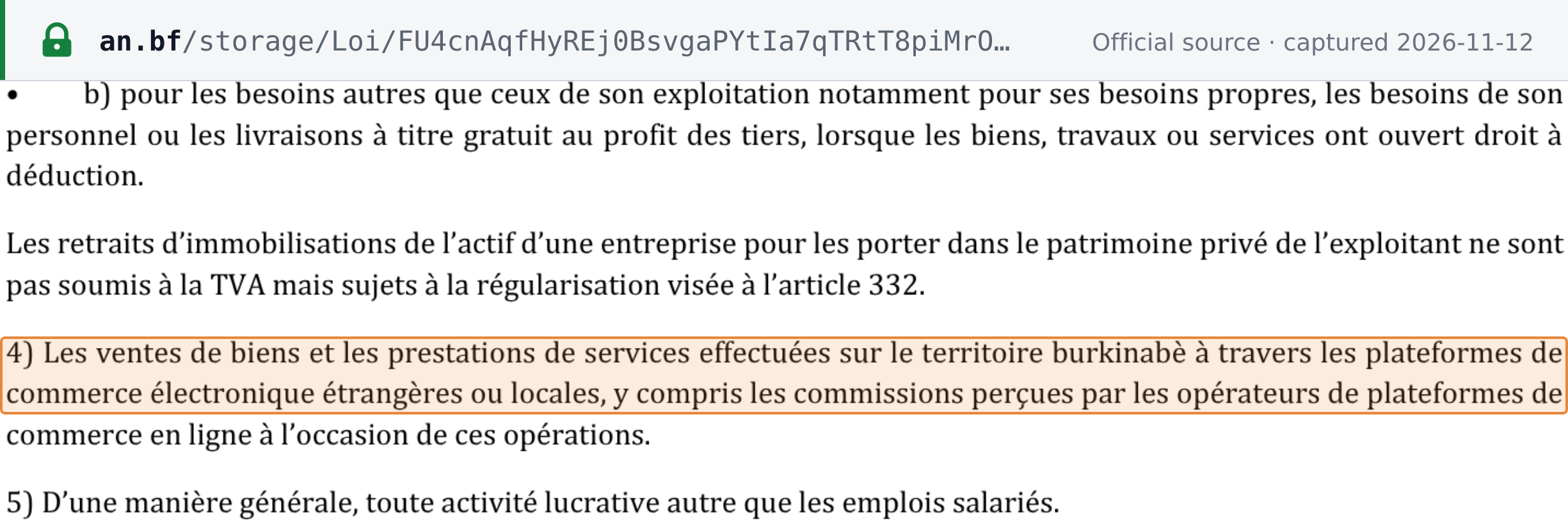
- What is caught (art. 299-4): "Les ventes de biens et les prestations de services effectuées sur le territoire burkinabè à travers les plateformes de commerce électronique étrangères ou locales, y compris les commissions perçues par les opérateurs de plateformes de commerce en ligne à l'occasion de ces opérations." [1]
- Who collects (art. 334-5 a): the VAT on those sales "est liquidée, déclarée et reversée au service des impôts de rattachement par les opérateurs desdites plateformes, pour le compte des fournisseurs". The operators also declare and pay the VAT on their own commissions. [1]
- Registration (art. 334-5 b): operators "sont tenus de souscrire une demande d'immatriculation auprès de l'administration fiscale". [1]
- Sanction (art. 334-5 c): non-compliance "donne lieu à la suspension de l'accès à la plateforme à partir du territoire burkinabè". [1]
- Threshold. None is stated. Art. 334-5 d) leaves the details to a ministerial arrêté, and none has been issued. [1]
 Source snapshot captured 2026-11-12 — original
Foreign companies selling into Burkina Faso — B2B and B2C
B2B (to a VAT-liable Burkinabè business):
- Services and intangibles. The customer self-assesses the VAT on its monthly return (art. 334-3). The foreign supplier does not register.
- Goods. VAT is collected at import (arts 299-1 and 310).
- Invoices. The foreign supplier's invoice is accepted. Invoices "de fournisseurs et prestataires étrangers ne disposant pas d'établissement stable au Burkina Faso" stand in for a certified electronic invoice (arrêté 2025-0048 art. 3), and the CGI art. 562 mentions are not required on them (art. 4). [1]
- A foreign business that is itself liable on a supply in Burkina Faso must accredit a resident representative; failing that, the customer owes the tax (art. 302).
B2C (to consumers):
- Through a platform. The platform operator collects and pays the VAT (art. 334-5).
- Direct sales outside a platform. A service "utilisée ou exploitée au Burkina Faso" is taxable there (art. 305-1), so art. 302 applies: the foreign supplier must accredit a resident representative, and otherwise the tax is "exigées de la personne destinataire de l'opération imposable". The CGI has no simplified registration scheme or threshold for foreign suppliers selling digital services directly to consumers. [1]
Marketplace and platform obligations
The platform is a collector, not the deemed supplier. Art. 334-5 makes the operator liquidate, declare and pay the VAT "pour le compte des fournisseurs"; the supplier remains the supplier. The operator is itself liable for VAT on its commissions. [1] For how other countries handle this, see marketplace deemed-supplier rules.
Place of supply
- Goods (art. 304): "Le lieu d'une livraison de bien est réputé situé au Burkina Faso dès lors que le bien s'y trouve au moment de la livraison." Transported goods are delivered in Burkina Faso when dispatch starts there; installed goods where they are installed. [1]
- Services (art. 305): "1) Les prestations de services sont imposables au Burkina Faso lorsqu'elles y sont exécutées. Toutefois, lorsque la prestation, bien qu'exécutée dans un autre pays, est utilisée ou exploitée au Burkina Faso, l'imposition est faite au Burkina Faso. 2) Les prestations de services exécutées au Burkina Faso mais utilisées dans un autre pays sont assimilées à des exportations de services et ne sont pas imposables au Burkina Faso." [1]
- Specific rules. Services on immovable property are taxed where the property is, and artistic, cultural and sporting services where they physically take place. [1]
Invoice requirements
Every industrialist, trader and service provider, and every public establishment with an industrial or commercial activity, must issue an invoice to its customer "quel que soit leur régime d'imposition" (CGI art. 562). So the duty to invoice applies to RSI and CME taxpayers too, not only to VAT-liable businesses. [1] Two invoice documents exist:
- the facture normalisée, secured with a regime-specific sticker, for taxpayers in general (art. 564-1);
- the facture électronique certifiée (FEC), compulsory for taxpayers attached to the DGE or a DME since 1 January 2025 (art. 564-2; see E-invoicing status).
Mandatory content
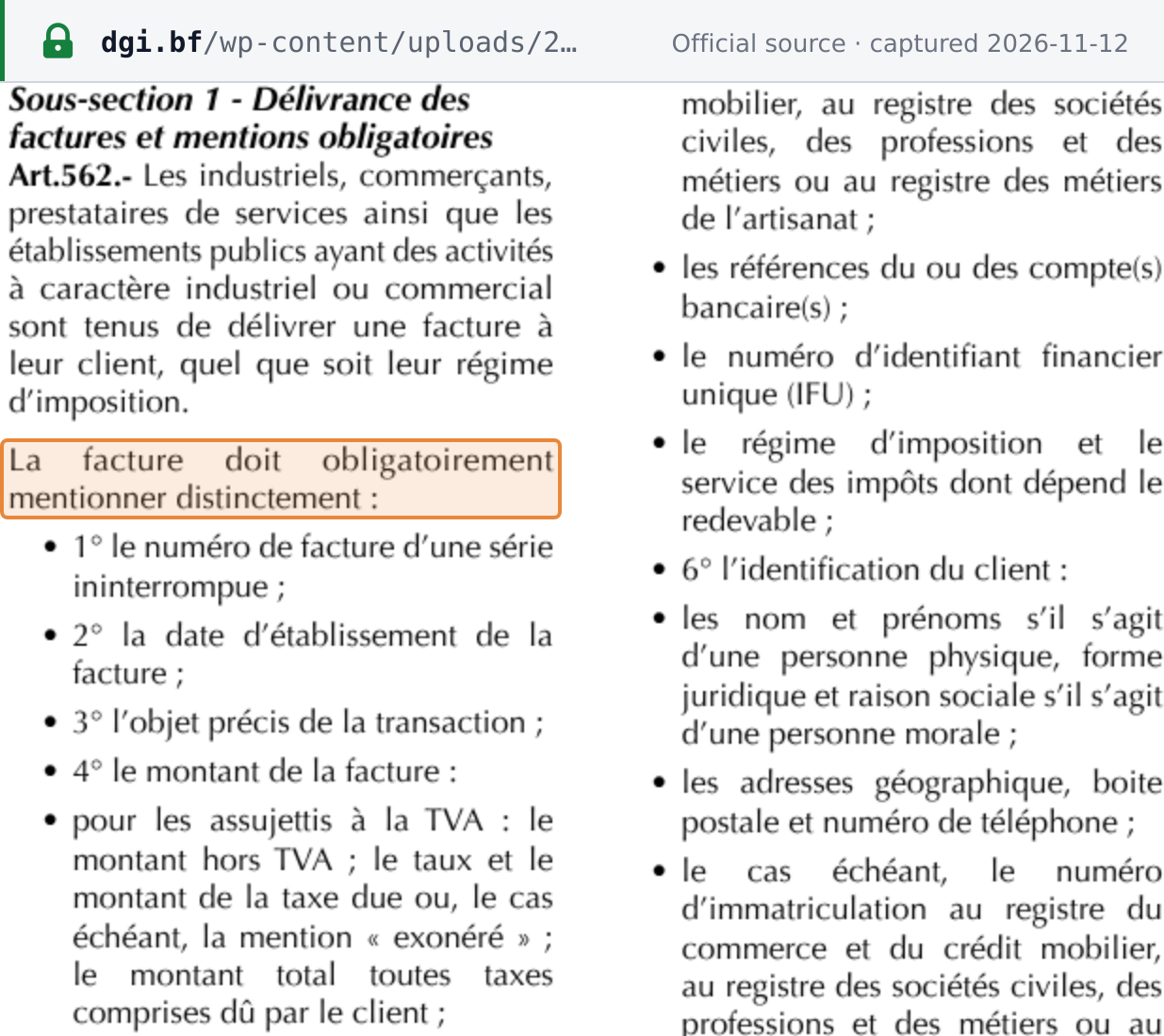
CGI art. 562: "La facture doit obligatoirement mentionner distinctement :" [1]
| # | Mention | Detail |
|---|---|---|
| 1° | Invoice number | "le numéro de facture d'une série ininterrompue" |
| 2° | Date | Date of issue of the invoice |
| 3° | Object | "l'objet précis de la transaction" |
| 4° | Amounts — VAT-liable seller | Amount excluding VAT; VAT rate and amount, or the word « exonéré »; total including all taxes due by the customer |
| 4° | Amounts — seller not liable to VAT | Total due by the customer |
| 5° | Seller | Name, or legal form and company name; geographic, cadastral and postal address and phone number; trade register (RCCM) or other register number; bank account references; IFU; tax regime and the tax office it reports to |
| 6° | Customer | Name, or legal form and company name; geographic address, PO box and phone number; RCCM number where applicable; IFU for sales to legal persons or traders |
 Source snapshot captured 2026-11-12 — original
Additional mentions by document:
- Facture normalisée (art. 564-1 and arrêté 2023-216): the printer's name and IFU, the year and month of printing, and a security sticker. "Les factures doivent être sécurisées au moyen de l'apposition d'un sticker spécifique à chaque régime d'imposition" (arrêté 2023-216 art. 3). [1]
- FEC (art. 564-2 a to j): the same parties, amounts and tax data, plus the identification number of the certified device (SECeF) used, the SECeF authentication code and a QR code. The Burkina Faso e-invoicing guide lists them in full.
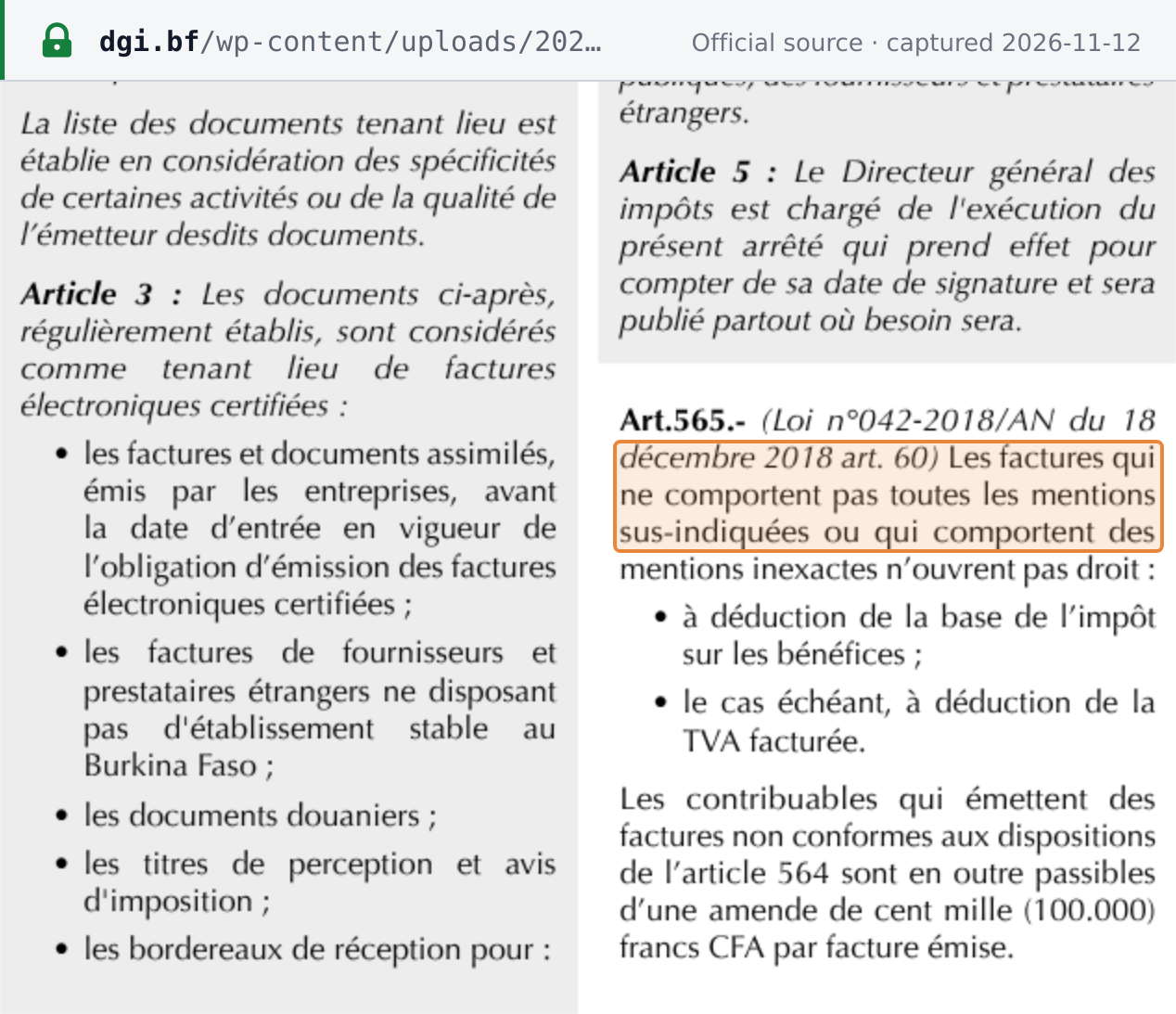
An invoice without the mentions costs the buyer its deduction. CGI art. 565: "Les factures qui ne comportent pas toutes les mentions sus-indiquées ou qui comportent des mentions inexactes n'ouvrent pas droit : • à déduction de la base de l'impôt sur les bénéfices ; • le cas échéant, à déduction de la TVA facturée." The seller is also fined FCFA 100,000 per non-conforming invoice. [1] Separately, VAT is deductible only if it is shown separately on the invoice (art. 326).
 Source snapshot captured 2026-11-12 — original
A specimen of a compliant invoice
The DGI publishes no specimen invoice. [6] [11] The illustration below lays out the art. 562 mentions on a facture normalisée issued by a VAT-liable business.
FACTURE (facture normalisée) — illustrative specimen (Burkina Faso)
| Objet de la transactionCGI art. 562 3° | Qty | Unit price excl. VAT (FCFA) | VAT rateCGI art. 562 4° | Amount excl. VAT (FCFA) |
|---|---|---|---|---|
| Office chairs | 10 | 45,000 | 18% | 450,000 |
| Installation service, November 2026 | 1 | 150,000 | 18% | 150,000 |
| Exercise books (cahiers) | 200 | 250 | exonéré | 50,000 |
- Montant hors TVACGI art. 562 4°
- FCFA 650,000
- TVA at 18% on FCFA 600,000CGI art. 562 4°
- FCFA 108,000
- Montant total TTC dû par le clientCGI art. 562 4°
- FCFA 758,000
- Exempt lines carry the word « exonéré » instead of a rate (CGI art. 562 4°); exercise books are exempt under CGI art. 308.
- Pre-printed invoice books also show the printer's name and IFU and the year and month of printing (CGI art. 564-1).
- A taxpayer attached to the DGE or a DME issues a certified electronic invoice instead, which adds the SECeF number, the SECeF authentication code and a QR code (CGI art. 564-2).
- VAT amounts are rounded down to the franc (CGI art. 317).
Issuance deadline
The CGI sets no number of days for issuing an invoice; art. 562 only requires one to be delivered. Timing matters through chargeability: VAT becomes chargeable on delivery or performance, but "En cas d'établissement de facture avant que des livraisons ne soient effectuées, la taxe devient exigible au moment de l'émission de la facture" (art. 316-1). [1]
- FEC issuers must issue an FEC at each transaction. After a device failure, regularising FECs are due "dans les 48 heures" (arrêté 2025-0049 art. 6 g). [1]
- Grouped invoices. A DGI instruction of 7 October 2020 on the facture normalisée allowed traders who regularly sell to other traders or professionals to issue one invoice per fortnight or per month, grouping the daily deliveries. [5] That instruction implemented an arrêté that arrêté 2023-216 later replaced, and the DGI has not said whether the tolerance still applies. It does not apply to FECs.
Numbering
Invoices carry "le numéro de facture d'une série ininterrompue" (art. 562 1°). [1] For FECs, the DGI's specification for business invoicing software requires a number from an unbroken ascending sequence per financial year (see the e-invoicing guide).
Simplified invoices and receipts
The CGI has no simplified invoice and no value threshold below which a lighter invoice is allowed. Instead:
- Cash sales on a till. "Les contribuables qui se livrent à des opérations de vente au comptant de marchandises doivent les enregistrer sur des caisses automatiques", and keep the till rolls for five financial years. Not using a till is fined FCFA 2,000,000, and not keeping the rolls FCFA 1,000,000 (art. 563). [1]
- Exemptions from the facture normalisée (art. 566-1) cover, among others, supermarkets selling at retail with till tickets, pharmacies, fuel stations, banks and microfinance institutions, insurers, water and electricity utilities, licensed telecoms operators, and consumer subscriptions to private television and internet providers. [1] This list exempts only from the facture normalisée, not from the FEC; the shorter FEC exemption list is in art. 566 2) (see E-invoicing status).
Credit and debit notes
- The VAT adjustment (art. 333): "La TVA perçue à l'occasion de livraisons de biens ou de prestations de services qui par la suite sont résiliées, annulées ou impayées, peut être imputée sur la taxe due au titre d'affaires réalisées ultérieurement. L'imputation est subordonnée à la justification de la rectification préalable de la facture initiale." The customer must repay the VAT it deducted. [1]
- DGI guidance on the facture normalisée: "Si la facture a été déjà remise au client et la vente est annulée, l'entreprise doit émettre une facture d'avoir sécurisée par un sticker. La facture d'avoir doit obligatoirement rappeler les références de la facture initiale." An invoice cancelled before it is handed over keeps all its copies, marked as cancelled. [7]
- FEC. The FEC system has its own credit-note invoice types (see the e-invoicing guide).
Currency and language
- Currency. The CGI's invoicing articles (arts 562 to 567) do not prescribe the invoice currency, and the CGI sets no conversion rule for foreign-currency invoices. VAT is liquidated and paid in CFA francs, rounded down to the franc (art. 317). [1]
- Language. The CGI has no express invoice-language rule. Accounts must be kept in French (art. 554). [1]
Self-billing: bordereaux de réception
General self-billing between VAT-registered businesses is not provided for in the CGI. The nearest equivalent is the bordereau de réception, which a buyer issues for purchases from individuals who cannot invoice. Arrêté 2023-216 art. 4: "Des bordereaux de réception, conformes d'un modèle établi par l'administration et tenant lieu de factures normalisées, peuvent être établis par les contribuables quel que soit leur régime d'imposition pour attester de leurs achats auprès de personnes physiques qui ne peuvent délivrer de factures appropriées." [1] They are limited to four cases: farm produce bought from farmers, building aggregates bought by construction firms, restaurants' kitchen purchases, and scrap and used plastics bought for recycling. The same slips stand in for an FEC (arrêté 2025-0048 art. 3).
Retention, electronic records and audit trail
- Retention: 10 years. "Les redevables sont tenus de conserver les doubles des factures, notes d'honoraires, bons de commande, bons de livraison et toute autre pièce justificative des éléments contenus dans les déclarations souscrites pendant 10 ans" (art. 567, as amended by the 2025 finance law). Till rolls: five financial years (art. 563). [1]
- Failure to keep or produce documents. FCFA 100,000 per missing document; deliberate destruction FCFA 5,000,000 (art. 802). [1]
- Audit trail, FEC. The certified device stores each transaction and sends it to the DGI. Users must not remove the seals, must give tax agents free access to the device, and must use thermal paper "qui garantit la lisibilité des données imprimées sur le papier pendant 10 ans au moins" (arrêté 2025-0049 art. 7). [1]
- Audit trail, facture normalisée. The sticker and the unbroken numbering are the controls; the 2020 instruction requires the sticker number to be copied onto the copies and duplicates. [5]
- Electronic-only archiving of invoices is not addressed in the CGI.
E-invoicing status
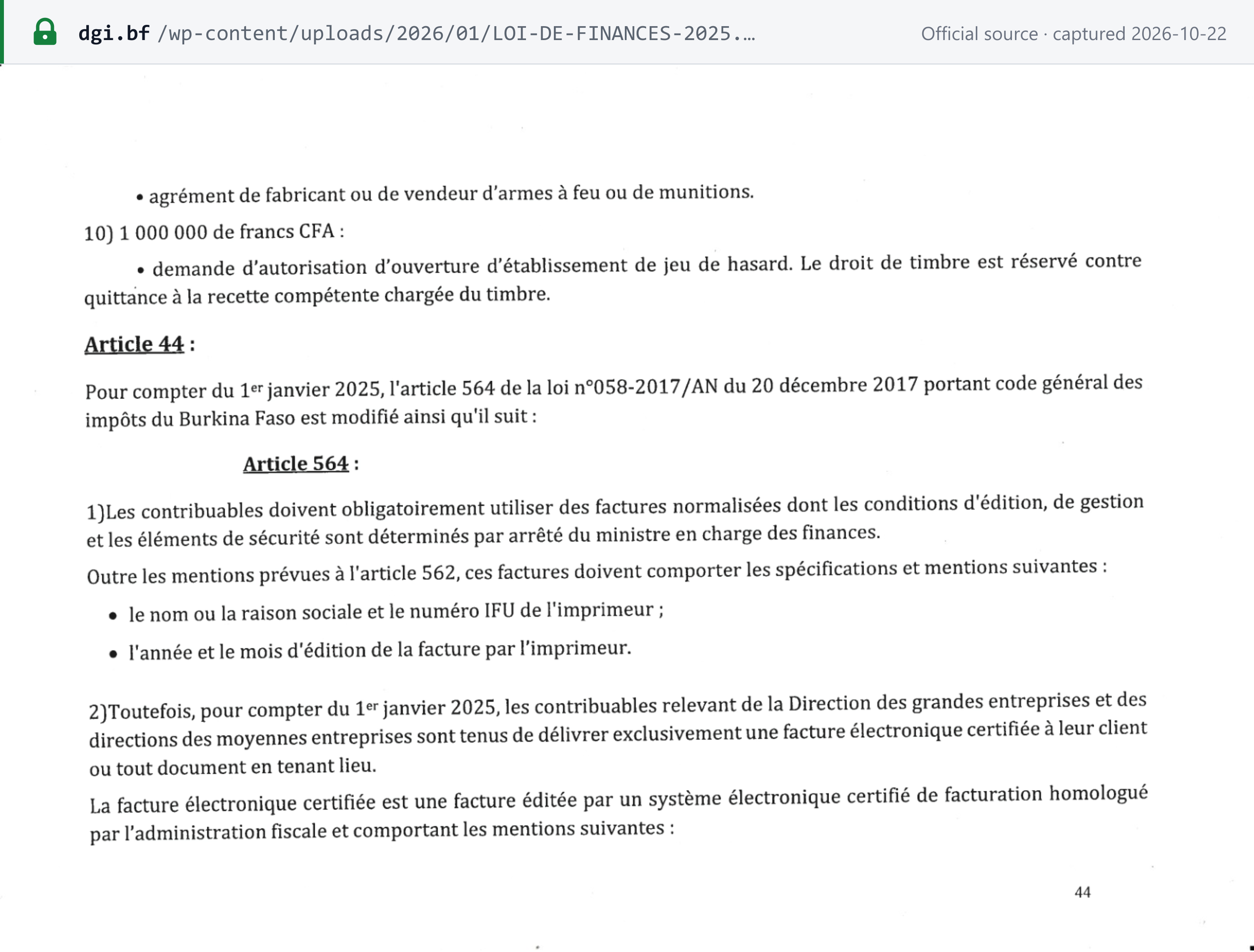
Status (as at 12 November 2026): mandatory for taxpayers attached to the DGE or a DME; everyone else uses the sticker-secured facture normalisée. CGI art. 564-2: "Toutefois, pour compter du 1er janvier 2025, les contribuables relevant de la Direction des grandes entreprises et des directions des moyennes entreprises sont tenus de délivrer exclusivement une facture électronique certifiée à leur client ou tout document en tenant lieu." [1] [3]
- System. The facture électronique certifiée (FEC), produced by a certified electronic invoicing system (SECeF): a control module (MCF) connected to homologated business invoicing software, or a standalone invoicing unit (UF). The device sends the invoice data to the DGI over the mobile network. It is not Peppol, and the DGI publishes no XML invoice schema.
- Phase timeline. The obligation has applied in law since 1 January 2025. A joint DGI and CCI-BF communiqué of 28 August 2026 put certified devices on sale from 7 September 2026 for DGE taxpayers and software publishers, 2 November 2026 for DME taxpayers under the régime du réel normal, and 1 December 2026 for DME taxpayers under the régime non déterminé, each with a 30-day conformity period. [14] No official date has been set for taxpayers outside the DGE and the DMEs.
- Who is in scope. Attachment to the DGE or a DME is decided by the administration; the CGI sets no turnover figure for it.
- FEC exemptions (art. 566 2)). DGE taxpayers in four categories are exempt from the FEC: the State, local authorities and their public establishments without industrial or commercial activity; businesses without a permanent establishment in Burkina Faso; airlines; and urban public transport companies for ticketed passenger transport. [1]
- Scope by customer. B2B, B2C and B2G alike for in-scope sellers. Public buyers, and persons under the régime non déterminé, may accept only FECs from local suppliers (arrêté 2025-0049 art. 8).
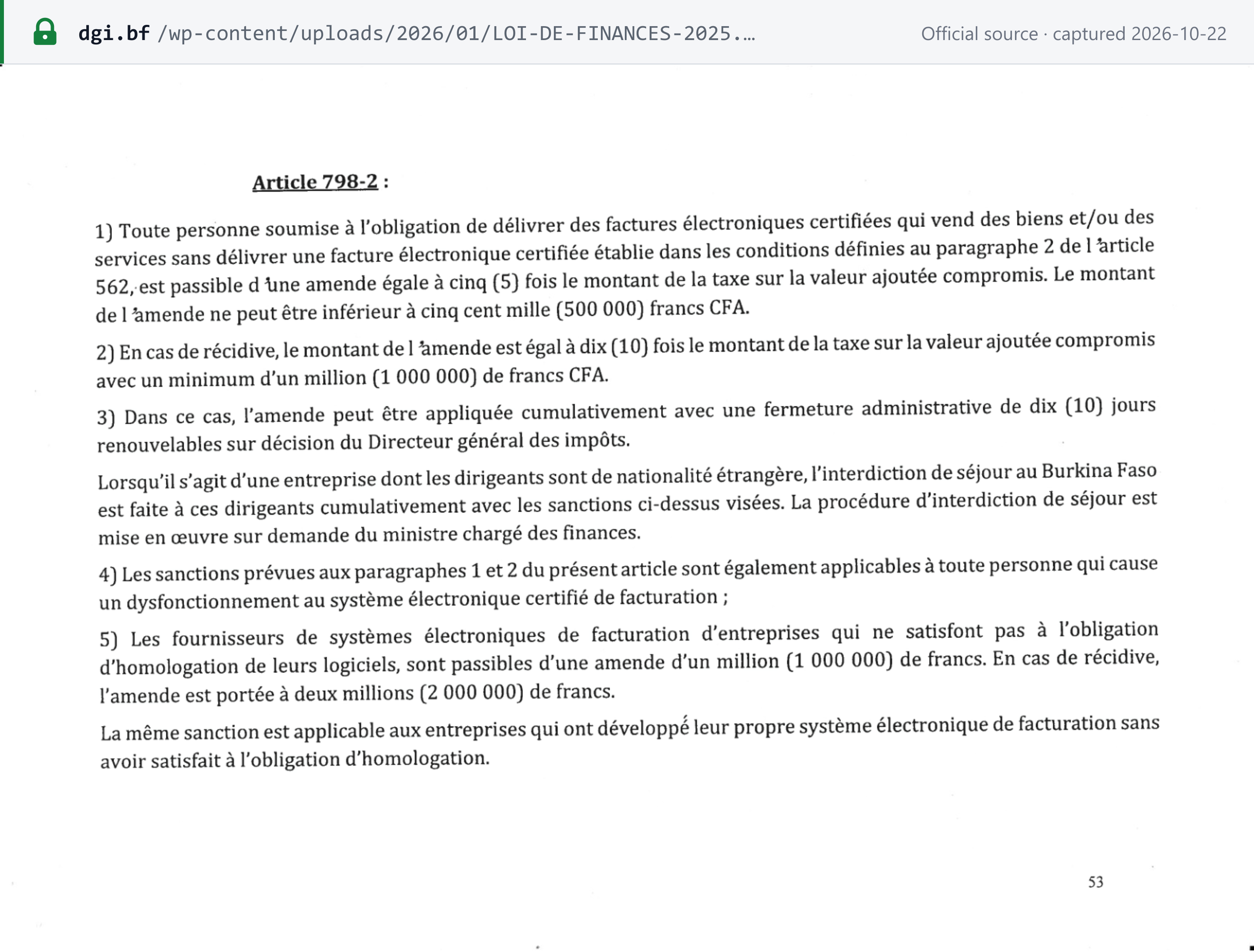
- Penalties. Selling without an FEC is fined five times the VAT compromised, with a minimum of FCFA 500,000 (art. 798-2; see Penalties).
 Source snapshot captured 2026-10-22 — original
The devices, homologation, offline rules and the full list of FEC mentions are in the Burkina Faso e-invoicing guide (FEC and SECeF). For how certified devices work elsewhere, see fiscal devices and certified cash registers.
Filing and payment
Filing frequency and due date
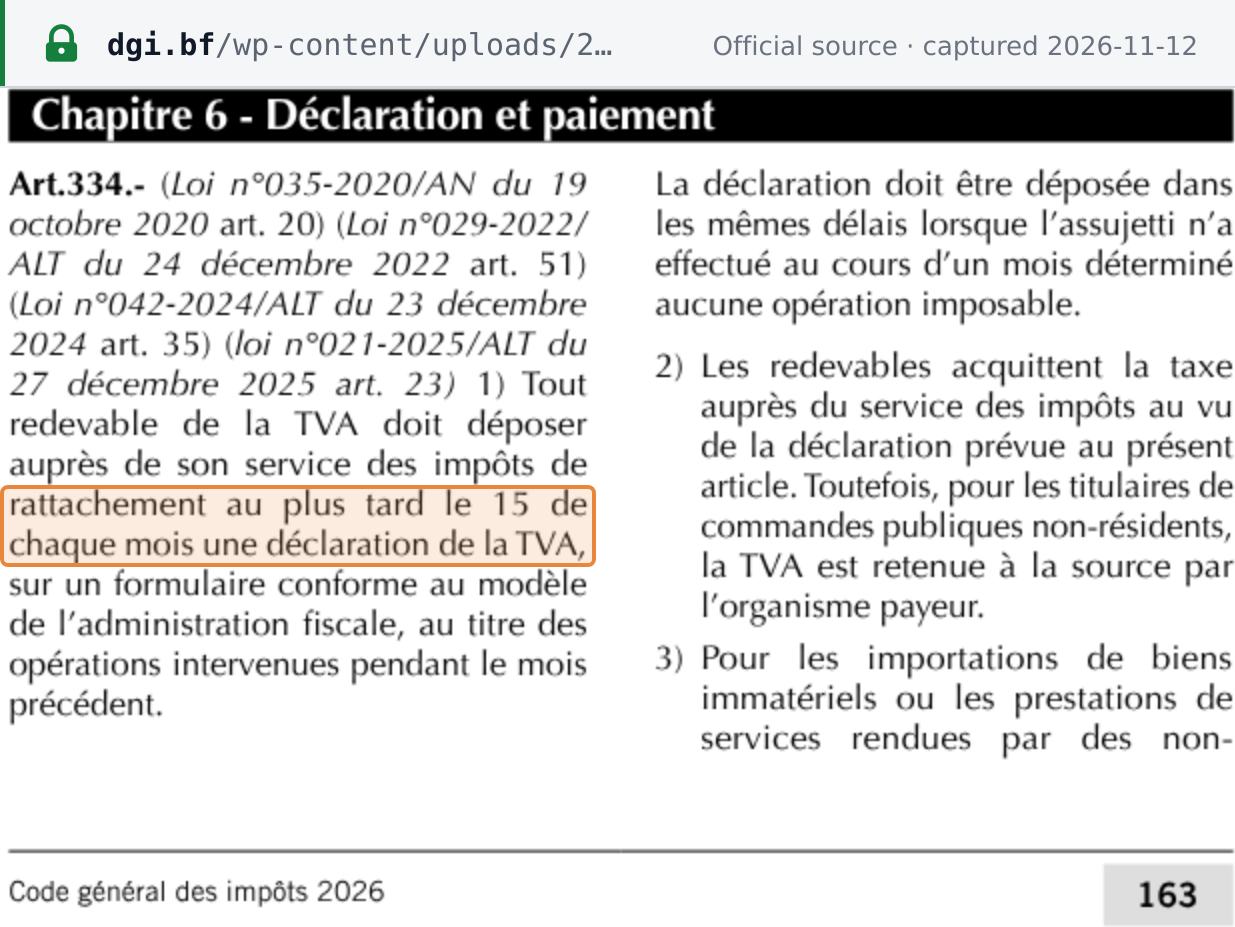
Monthly, by the 15th, for every person liable to VAT. Frequency does not vary with size. CGI art. 334-1: "Tout redevable de la TVA doit déposer auprès de son service des impôts de rattachement au plus tard le 15 de chaque mois une déclaration de la TVA, sur un formulaire conforme au modèle de l'administration fiscale, au titre des opérations intervenues pendant le mois précédent. La déclaration doit être déposée dans les mêmes délais lorsque l'assujetti n'a effectué au cours d'un mois déterminé aucune opération imposable." [1]
 Source snapshot captured 2026-11-12 — original
Payment and e-filing
- Payment is due with the return: "Les redevables acquittent la taxe auprès du service des impôts au vu de la déclaration prévue au présent article" (art. 334-2). [1]
- E-filing. Taxpayers attached to the DGE and the DMEs "sont tenus de souscrire auprès de l'administration fiscale, leurs déclarations fiscales par procédés électroniques" and must also pay electronically (art. 561-1). Others may. The platform is eSINTAX. [1] [9]
- Cut-off. On eSINTAX, "les contribuables sont autorisés à souscrire et à valider leurs déclarations jusqu'à la date limite au plus tard à 23h59 sans pénalités" (arrêté 2021-366 art. 9, reproduced in the CGI's annex). [1]
- Form. The DGI's VAT return form is on its forms page. [11]
VAT withholding (30%)
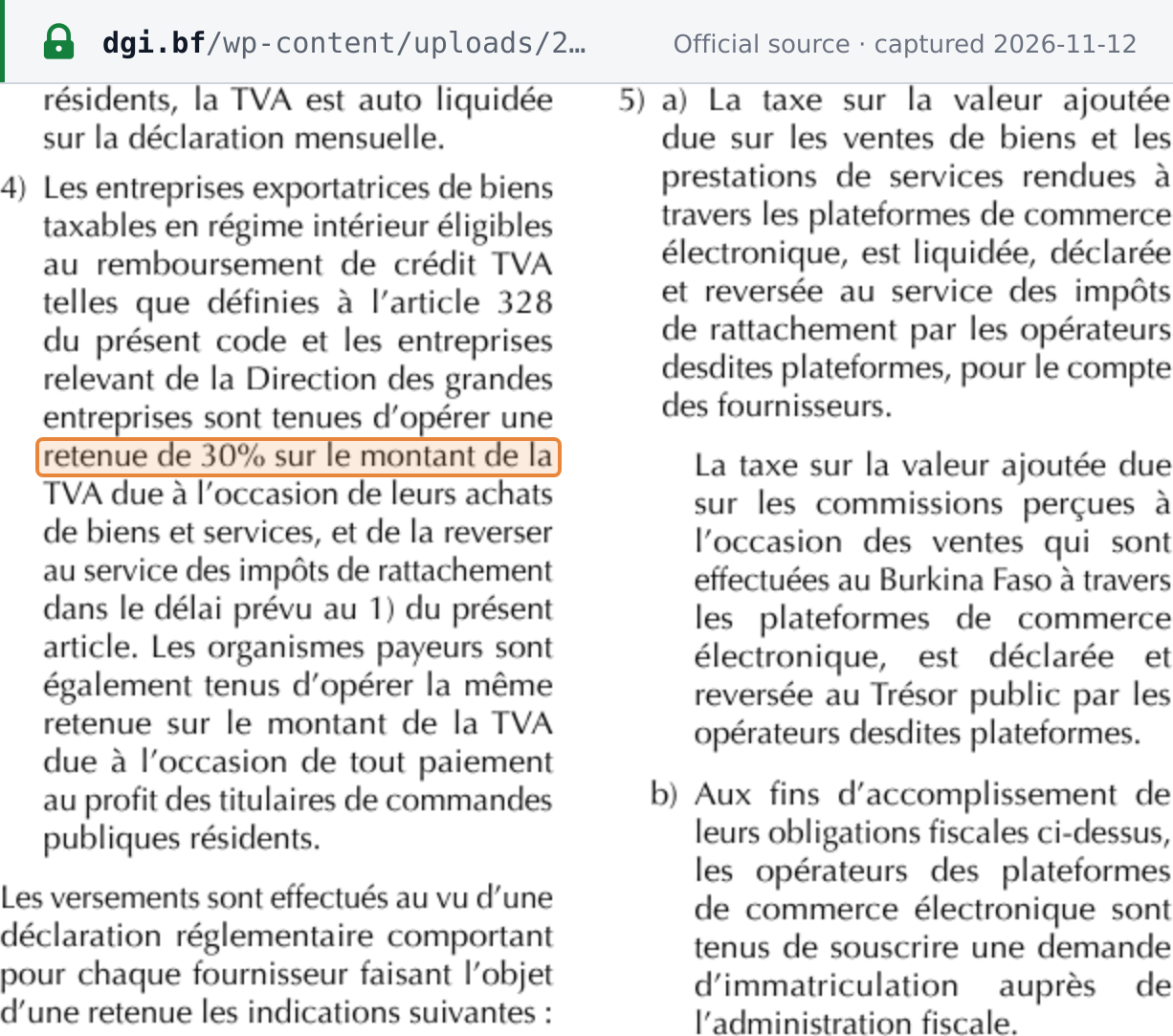
Some buyers withhold part of the VAT on their purchases and pay it to the tax office themselves. CGI art. 334-4 (as at 12 November 2026): "Les entreprises exportatrices de biens taxables en régime intérieur éligibles au remboursement de crédit TVA telles que définies à l'article 328 du présent code et les entreprises relevant de la Direction des grandes entreprises sont tenues d'opérer une retenue de 30% sur le montant de la TVA due à l'occasion de leurs achats de biens et services, et de la reverser au service des impôts de rattachement dans le délai prévu au 1) du présent article. Les organismes payeurs sont également tenus d'opérer la même retenue sur le montant de la TVA due à l'occasion de tout paiement au profit des titulaires de commandes publiques résidents." [1]
- Who withholds: refund-eligible exporters, DGE taxpayers, and public paying bodies (on payments to resident public-contract holders).
- When: by the 15th of the following month, with a statement listing each supplier's name, activity, IFU and addresses, the invoice date and amount, the payment date and amount, and the amount withheld.
- The supplier's side: the withholding agent hands each supplier an individual withholding certificate "pour leur permettre de faire valoir ultérieurement les retenues qu'ils ont subies sur leurs déclarations de TVA". [1]
- History. The DGI's consolidated CGI updated to the 2023 finance law set the withholding at 20%, for exporters only. [8] The 2026 finance law (Loi n°021-2025/ALT, art. 23) raised the rate to 30% and extended it to DGE taxpayers and to public paying bodies paying resident contract holders from 1 January 2026: "Pour compter du 1er janvier 2026, le 4) de l'article 334 … est modifié et rédigé ainsi qu'il suit". [13]
 Source snapshot captured 2026-11-12 — original
Additional listings
- The withholding statement above (art. 334-4).
- With a refund claim, a list of purchase invoices giving each supplier's name, address, IFU and tax regime and each invoice's date, amount and VAT (art. 330-1). [1]
- The CGI sets no annual VAT return and no sales or purchase listing with the monthly return.
Input-tax recovery and blocked items
- Timing. The right to deduct arises when the VAT becomes chargeable to the supplier, and the deduction is made in that month. "En cas d'omission, elle doit être opérée au plus tard le 30 avril de l'année suivante" (art. 327). [1]
- Conditions. The VAT must be shown separately on a conforming invoice (arts 326 and 565), or paid and shown on the customs declaration for imports. VAT invoiced by someone not entitled to invoice it is not deductible (art. 320).
- Partial exemption. Mixed businesses deduct by actual use where they can, and otherwise by a deduction percentage, with a provisional percentage based on the previous year and the final one fixed by 30 April (arts 321 to 325). [1]
Blocked items (art. 319, as amended by the 2025 finance law, art. 32): [1]
- Vehicles designed to carry people, or mixed-use vehicles, with three to nine seats including the driver's, and their parts and accessories. The exclusion does not apply to vehicles for resale, for rental or leasing fleets, for public passenger transport, for hotel guest transport or for driving schools.
- Housing and lodging costs, except for staff guarding or securing industrial sites and work sites.
- Reception, restaurant, entertainment and travel costs, with limited exceptions for staff transport and collective staff needs at the workplace.
- Decorative furniture.
- Goods and services given free or below cost, except advertising items worth under FCFA 10,000 excluding VAT each.
- "Le super carburant, le gas-oil et le bio carburant."
- Services relating to excluded goods.
Refunds
A VAT credit is carried forward and is not refundable by default. Art. 328 A: "Le crédit de TVA non imputé ne peut pas être remboursé, sauf pour : 1) Les entreprises exportatrices de biens taxables en régime intérieur. Par entreprises exportatrices de biens, il faut entendre celles qui réalisent plus de 50 % de leur chiffre d'affaires à l'exportation." [1] The full list:
- exporters of goods (over 50% of turnover exported; the refund is limited by the export share);
- exporters of services (exclusively exporting);
- businesses expanding under the investment code;
- businesses that lose their VAT-liable status;
- leasing companies;
- non-profit organisations with a ministerial waiver, for investments of at least FCFA 15 million;
- mining companies delivering more than 50% of their output to the State's gold institutions.
- Claim deadline. Within 30 days of a monthly return showing a refundable credit above FCFA 1,000,000 (exporters, leasing companies, expansions); within 30 days of losing liable status. "Tout crédit dont le remboursement n'aura pas été demandé dans le délai de six (06) mois sera annulé de plein droit et ne pourra donner lieu ni à imputation ni à remboursement" (art. 329-2). [1]
- Processing. "La demande reconnue fondée donne lieu à l'établissement d'un certificat de détaxe par le Directeur général des impôts dans les deux (2) mois suivant le dépôt du dossier. Le remboursement s'effectue dans un délai de trente (30) jours à compter de la date d'établissement du certificat de détaxe" (art. 331). [1]
- Non-residents. The CGI has no refund scheme for foreign businesses.
- Bad debts. VAT on unpaid supplies can be offset against later VAT once the original invoice has been rectified (art. 333; see Credit and debit notes).
Exemptions
Exempt supplies
Art. 307 lists 29 groups of exempt operations, and art. 308 adds a list of products by customs tariff code. [1] The main ones:
- Small businesses: supplies by RSI and CME taxpayers, subject to the option (art. 307-1).
- Food: imports and sales of unprocessed fresh, chilled or frozen food, including fish, and of unprocessed meat "à l'exclusion de la viande congelée importée" (art. 307-10, as amended by the 2025 finance law, art. 27). [3] Art. 308 adds, among others, milk, cereals, infant formula, everyday bread and salt.
- Health: "Les consultations médicales, soins et autres prestations présentant un caractère médical qu'ils soient au bénéfice de la santé humaine ou animale, y compris les prestations d'hospitalisation et de transport de malades et de blessés" (art. 307-15), and medicines (art. 308).
- Education: "Les recettes réalisées dans le cadre de l'enseignement préscolaire, primaire, secondaire et supérieur dispensé dans les établissements publics et dans les établissements privés reconnus par l'État" (art. 307-21). Exercise books, books and newspapers are exempt products (art. 308).
- Financial services and insurance: listed banking operations, and insurance subject to the single insurance tax (art. 307-13 and 14).
- Property: residential lettings of unfurnished property, and property transfers subject to registration duties, other than by dealers (art. 307-16 and 17).
- Transport and energy: international air transport (art. 307-3); urban public land transport (art. 307-24); the social tranche of household water and electricity (art. 307-23); aviation spirit and jet fuel, added by the 2025 finance law (art. 308). [3]
- Agriculture: fertiliser, agricultural pesticides, seeds and farm machinery (art. 308).
Exempt is not zero-rated
Exempt supplies give no right to deduct. Art. 321: the VAT on purchases is "déductible en totalité lorsque ces biens et services concourent à la réalisation d'affaires taxables ou à des exportations portant sur des opérations taxables en régime intérieur" and "exclue du droit à déduction lorsqu'ils concourent à la réalisation d'affaires non taxables". [1] So:
- Exports work like a zero rate: no VAT on the sale, and input VAT is deductible (and, for qualifying exporters, refundable).
- Domestic exemptions, including the RSI and CME exemptions, block input VAT. The VAT on the supplier's costs becomes a cost. This is why some RSI businesses opt into the régime du réel normal.
See zero-rated vs exempt supplies for the general mechanics.
Special regimes
- Second-hand goods (margin scheme). "Les ventes de biens d'occasion réalisées par les négociants peuvent sur option donner lieu au paiement de la TVA sur la différence entre le prix de vente et le prix de revient, la TVA ayant grevé le prix d'acquisition des biens revendus n'étant pas admise en déduction" (art. 313). Travel agents and tour organisers are taxed on their margin (art. 314). [1]
- Cash accounting for professionals taxed under the non-commercial profits tax: "l'exigibilité intervient à l'encaissement du prix des services" (art. 316-2). [1]
- Small businesses. RSI and CME taxpayers are outside VAT (see Registration). The CME is a flat levy set by activity class and zone (art. 536).
- Diplomatic missions and international organisations. Exempt on a reciprocity basis, with an exemption certificate or a VAT refund (art. 309-1). Other exempt purchasers need a DGI exemption certificate (art. 309-2). [1]
- Investment code. Businesses expanding under the investment code have a refund right (art. 328 A 3°). The VAT incentives of the investment code itself are not covered here.
Offences and penalties
Offences
These are criminal offences, prosecuted separately from the tax penalties below. [1]
| Conduct | Criminal penalty | CGI |
|---|---|---|
| Tax fraud: fraudulent evasion or attempted evasion of tax | FCFA 500,000 to 5,000,000 and/or 6 months to 2 years' imprisonment; on a repeat within 5 years, FCFA 1,000,000 to 10,000,000 and/or 2 to 5 years | art. 806 |
| Invoicing VAT, or withholding a tax, and not declaring it on time | FCFA 500,000 to 10,000,000 and/or 1 to 12 months' imprisonment | art. 809 |
| Using a fictitious, falsified or another person's IFU, or lending one's IFU | FCFA 1,500,000 to 5,000,000 and/or 1 to 6 months | art. 810 |
| Obstructing tax agents | FCFA 25,000 to 1,000,000; on a repeat, 6 days to 6 months' imprisonment | art. 811 |
| Repeated failure to invoice, to charge VAT or to record cash sales | Closure or a trading ban of 10 days to 6 months, a ban on importing, exclusion from public procurement | art. 813 |
Art. 809 in full: "…quiconque a procédé à la facturation de la taxe sur la valeur ajoutée ou a opéré les retenues à la source de tout impôt, droit ou taxe, […] et s'est abstenu de les déclarer dans les délais légaux, est passible d'une amende de cinq cent mille (500.000) francs CFA à dix millions (10.000.000) de francs CFA et d'un emprisonnement de un (1) mois à douze (12) mois ou de l'une de ces deux peines seulement." [1]
Penalties
Amounts as at 12 November 2026. [1]
| Failure | Penalty | CGI |
|---|---|---|
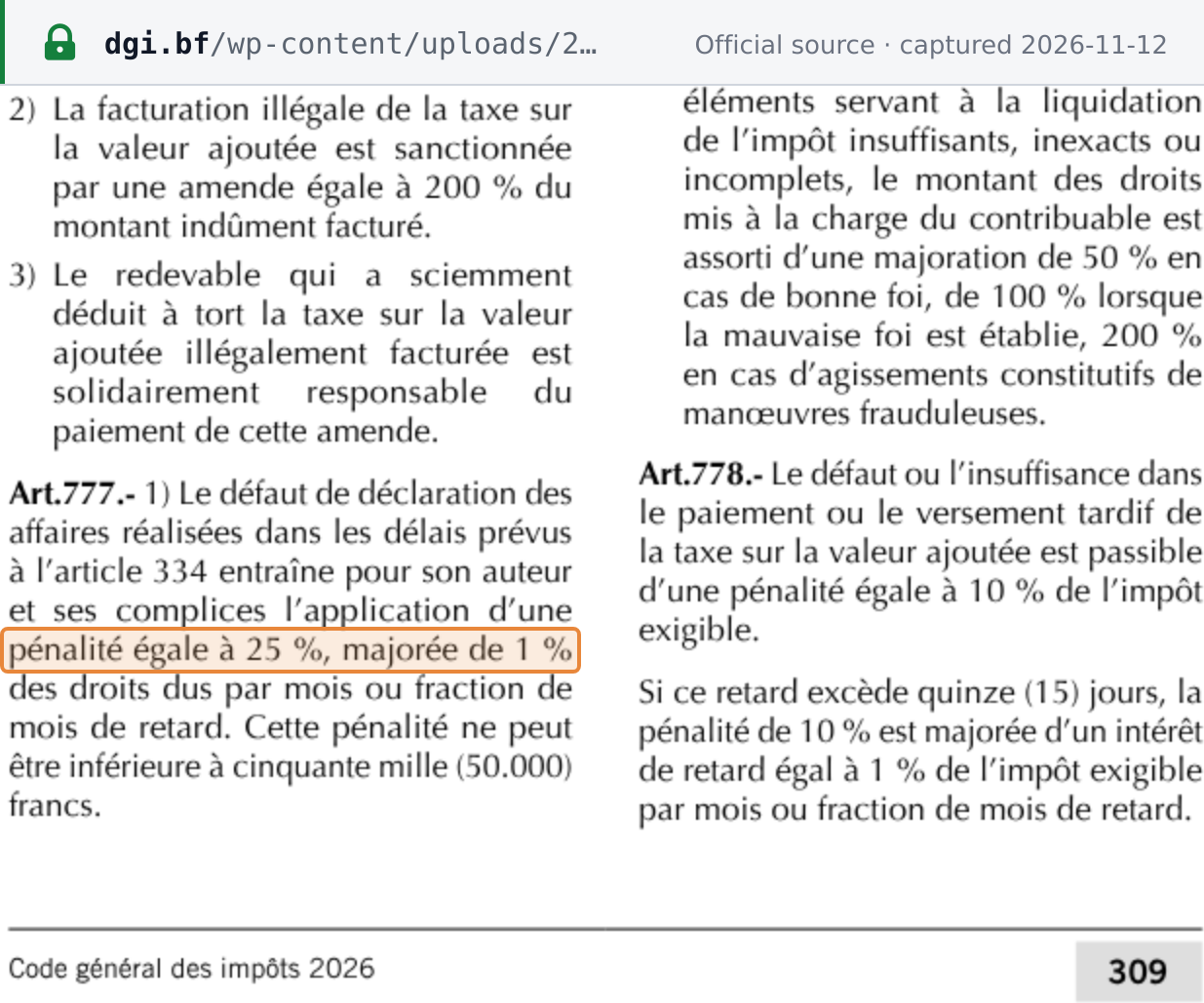
| Late or missing VAT return | 25% of the tax due, plus 1% per month or part-month of delay; minimum FCFA 50,000 | art. 777-1 |
| Assessment ex officio | 50%, plus 1% per month; minimum FCFA 500,000 | art. 777-2 |
| Understated return | 50% in good faith, 100% in bad faith, 200% for fraudulent manoeuvres | art. 777-3 |
| Late or short payment of VAT | 10% of the tax due; beyond 15 days, plus 1% of the tax per month or part-month | art. 778 |
| No invoice, VAT not shown separately, or irregular invoice wording | 100% of the tax due | art. 776-1 |
| VAT invoiced illegally | 200% of the amount invoiced; a buyer who knowingly deducted it is jointly liable | art. 776-2 and 3 |
| Non-conforming facture normalisée | FCFA 100,000 per invoice | art. 565 |
| Selling without an FEC (DGE/DME taxpayers) | 5 times the VAT compromised, minimum FCFA 500,000; on a repeat 10 times, minimum FCFA 1,000,000; possible 10-day closure | art. 798-2 |
| No cash register / till rolls not kept | FCFA 2,000,000 / FCFA 1,000,000 | art. 563 |
| No declaration of existence | FCFA 100,000 | art. 557-4 |
| Documents not kept or produced | FCFA 100,000 per document; deliberate destruction FCFA 5,000,000 | art. 802 |
Art. 777-1: "Le défaut de déclaration des affaires réalisées dans les délais prévus à l'article 334 entraîne pour son auteur et ses complices l'application d'une pénalité égale à 25 %, majorée de 1 % des droits dus par mois ou fraction de mois de retard. Cette pénalité ne peut être inférieure à cinquante mille (50.000) francs." Art. 778: "Le défaut ou l'insuffisance dans le paiement ou le versement tardif de la taxe sur la valeur ajoutée est passible d'une pénalité égale à 10 % de l'impôt exigible. Si ce retard excède quinze (15) jours, la pénalité de 10 % est majorée d'un intérêt de retard égal à 1 % de l'impôt exigible par mois ou fraction de mois de retard." [1]
The CGI has no separate penalty for registering late beyond the FCFA 100,000 fine for not filing the declaration of existence.
 Source snapshot captured 2026-11-12 — original
 Source snapshot captured 2026-10-22 — original
Frequently asked questions
Our turnover is FCFA 30 million. Do we have to charge VAT in Burkina Faso?
No, not by default. Taxpayers with annual turnover excluding tax of FCFA 15 million to under FCFA 50 million fall under the régime simplifié d'imposition (RSI), and their sales are exempt from VAT (CGI arts 300, 307 and 529). You can opt into the régime du réel normal by a request to the Director General of Taxes before 1 February; the option is irrevocable for three years and lets you deduct the VAT on your purchases (CGI art. 530).
A foreign software company invoices our Burkina Faso company. Who pays the VAT?
Your company does, if it is liable to VAT. Services supplied by non-residents are treated as imports, and the VAT is self-assessed (auto liquidée) on your monthly VAT return (CGI arts 299 and 334-3). Self-assessed VAT is deductible once it has been paid, and only for the portion paid (CGI art. 326).
Our customer withheld 30% of the VAT on our invoice. Is that allowed?
Yes, if the customer is attached to the Direction des grandes entreprises (DGE), is an exporter eligible for VAT refunds, or is a public paying body paying a resident public-contract holder. As at 12 November 2026, CGI art. 334-4 requires those payers to withhold 30% of the VAT and remit it by the 15th of the following month. They must give you an individual withholding certificate so that you can claim the amount withheld on your own VAT return.
Can we deduct the VAT on company cars and fuel?
No. CGI art. 319 excludes from deduction the VAT on vehicles designed to carry people, or mixed-use vehicles, with three to nine seats including the driver's, together with their parts and accessories, and on premium petrol, diesel and biofuel. The vehicle exclusion does not apply to vehicles bought for resale, rental or leasing fleets, public passenger transport, hotel guest shuttles or driving schools.
We have a VAT credit. Can we get it refunded?
Usually not. An unused VAT credit is carried forward and is refundable only to specific businesses, including exporters of goods with more than 50% of turnover from exports, exporters of services, leasing companies, businesses expanding under the investment code and businesses that lose their VAT-liable status (CGI art. 328). A refund not claimed within six months is cancelled (CGI art. 329).
Do we issue a facture normalisée or a certified electronic invoice (FEC)?
Taxpayers attached to the DGE or a DME must issue only certified electronic invoices (FEC) since 1 January 2025 (CGI art. 564-2). Certified devices went on sale from 7 September 2026 for DGE taxpayers and 2 November 2026 for DME taxpayers under the régime du réel normal, and go on sale from 1 December 2026 for DME taxpayers under the régime non déterminé, each with 30 days to comply. Other taxpayers issue the facture normalisée, secured with a sticker specific to their tax regime.
When is the VAT return due, and do we file if we had no sales?
By the 15th of each month, for the previous month's operations, and a return is required even for a month with no taxable operations (CGI art. 334-1). The tax is paid on the basis of the return. DGE and DME taxpayers must file and pay electronically on eSINTAX, where returns can be filed until 23:59 on the due date without penalty.
Important websites
| Site | What it is for |
|---|---|
| Maison de l'Entreprise — online company creation | Create a business and obtain an IFU through the CEFORE |
| eSINTAX | File VAT returns and pay online (compulsory for DGE and DME taxpayers) |
| eSINTAX document check | Verify a document issued through eSINTAX |
| DGI IFU lookup | Look up an IFU (Consultation IFU) |
| Burkina Faso IFU validator | Check the format of an IFU (Lookuptax) |
| Homologated invoicing software | Check that business invoicing software is approved for the FEC |
| FEC attestation check | Verify an FEC attestation of conformity |
| GDSECeF device request | Request certified e-invoicing devices (UF or MCF) |
| DGI forms | VAT return, refund claim and withholding forms |
| DGI laws page | The Code général des impôts and the finance laws |
Recent changes
- 2026-09-07 — Certified e-invoicing devices went on sale for DGE taxpayers and software publishers, followed by DME taxpayers under the régime du réel normal on 2 November 2026, and go on sale for those under the régime non déterminé from 1 December 2026, each with 30 days to comply. (DGI / CCI-BF) — see event
- 2026-01-01 — VAT withholding raised from 20% to 30% and extended to DGE taxpayers and to public paying bodies (2026 finance law, art. 23). (Journal officiel)
- 2025-01-01 — The 10% reduced rate was extended to domestic air transport (2025 finance law, art. 31). (Assemblée législative de Transition)
- 2025-01-01 — Sales through e-commerce platforms were brought into VAT, with platform operators collecting it on behalf of suppliers (2025 finance law, arts 26 and 35). (Assemblée législative de Transition)
- 2025-01-01 — DGE and DME taxpayers must issue only certified electronic invoices (2025 finance law, art. 44). (Assemblée législative de Transition)
- 2025-01-01 — The exemption for unprocessed meat was extended to frozen meat other than imported frozen meat (2025 finance law, art. 27). (Assemblée législative de Transition)
- 2025-01-01 — Aviation spirit and jet fuel were added to the exempt product list (2025 finance law, art. 28). (Assemblée législative de Transition)
- 2020-04-01 — The 10% reduced rate was introduced for accommodation and catering by approved hotels and restaurants (Loi n°031-2020/AN, art. 5). (DGI)
For the full chronology, see Burkina Faso tax changes on Lookuptax.
Reference links
- [1] Code général des impôts, official 2026 edition (DGI)
- [2] Loi n°058-2017/AN of 20 December 2017 enacting the Code général des impôts (DGI)
- [3] Loi n°042-2024/ALT of 23 December 2024, 2025 finance law (Assemblée législative de Transition)
- [4] Loi n°031-2020/AN of 9 July 2020, amending finance law 2020 (DGI)
- [5] Instruction administrative of 7 October 2020 on the facture normalisée (DGI)
- [6] "Je paye mes impôts" no. 13: the facture normalisée, part 1 (DGI)
- [7] "Je paye mes impôts" no. 14: the facture normalisée, part 2 (DGI)
- [8] Code général des impôts updated to the 2023 finance law (DGI)
- [9] eSINTAX e-filing and e-payment
- [10] Maison de l'Entreprise: online company creation
- [11] DGI forms
- [12] Arrêté on the accreditation of non-resident companies and entities (DGI)
- [13] Journal officiel spécial n°01 of 2 January 2026: 2026 finance law, Loi n°021-2025/ALT (DGI)
- [14] Joint CCI-BF and DGI communiqué of 28 August 2026 on the sale of certified e-invoicing devices
Related on Lookuptax:
- Burkina Faso e-invoicing guide (FEC and SECeF)
- Burkina Faso IFU validator
- Burkina Faso tax changes
- Côte d'Ivoire VAT guide
- Senegal VAT guide
- Togo VAT guide
- Fiscal devices and certified cash registers
- Marketplace deemed-supplier rules
- Reverse charge
- Zero-rated vs exempt supplies
- Worldwide VAT and GST rates
- VAT and GST registration thresholds worldwide