Cambodia VAT guidelines
| FACTSHEET | |
|---|---|
| Country code | KH |
| Tax name | Value Added Tax (VAT) — អាករលើតម្លៃបន្ថែម (អតប) |
| Tax Authority | General Department of Taxation (GDT), Ministry of Economy and Finance |
Overview
Cambodia levies a Value Added Tax (VAT), in Khmer អាករលើតម្លៃបន្ថែម, abbreviated អតប. The GDT's own definition: "អតប សំដៅដល់អាករលើតម្លៃបន្ថែម" ("'VAT' means value added tax"). The GDT's e-commerce FAQ notes that "The current VAT in Cambodia was in fact introduced in 1999" at 10%. [1] [11]
Legal framework. VAT now rests on the Law on Taxation promulgated by Royal Kram NS/RKM/0523/004 of 16 May 2023, which replaced the 1997 Law, and on Sub-Decree No. 49 ANKr.BK on Value Added Tax of 11 March 2024, the main implementing instrument (it replaces Sub-Decree 114 of 1999 and took effect on signature, Art 43). Invoice rules sit in Prakas No. 723 MEF.PrK of 14 August 2019, and VAT on e-commerce in Sub-Decree No. 65 (2021) and Prakas No. 542 MEF.PrK (2021). The GDT lists all of them as "Valid". [16] [2] [3]
Authority. The General Department of Taxation (GDT) of the Ministry of Economy and Finance (MEF) administers VAT. Import VAT is assessed at the border and "collected by the customs administration" in the same way as customs duty (Sub-Decree 49, Art 32). [2]
Currency. The Khmer Riel (KHR). VAT is calculated and reported in riel at the official exchange rate; Prakas 542's worked example says the supplier "shall calculate the VAT using the official exchange rate in Khmer Riel currency to file the tax return". For riel totals on sales invoices, the GDT "temporarily allows the use of any fixed exchange rate, not lower than the daily official exchange rate issued by the National Bank of Cambodia" (Prakas No. 824 MEF.PrK, 2 November 2022). The GDT publishes the daily official exchange rate. [4] [1]
Tax period. The calendar month. Every VAT-registered taxpayer files and pays monthly (see Filing and payment). The taxpayer-class turnover tests run on annual turnover and on any three consecutive months in the current calendar year.
Layering. None. VAT is a national tax with no provincial or municipal layer. Three other indirect taxes sit beside it and appear as separate lines on the official invoice specimens: the Specific Tax on Certain Merchandises and Services, the Public Lighting Tax and the Accommodation Tax. This guide covers VAT only. [3]
For neighbouring systems, see the Thailand VAT guide and the Vietnam VAT guide. For what the tax is called elsewhere, see VAT, GST and sales tax names by country.
Registration
Who should register
VAT liability follows the taxpayer's regime, not a separate VAT turnover test. Every taxpayer in the self-declaration regime (អ្នកជាប់ពន្ធតាមរបបស្វ័យប្រកាស) that makes taxable supplies is a "taxable person", and must register for VAT within 15 days. Sub-Decree 49, Art 4(1), in English rendering: "A self-declaration taxpayer that makes taxable supplies as set out in Article 59 of the Law on Taxation is a taxable person. A taxable person shall apply to the GDT to complete VAT registration within 15 days after the day that person becomes a taxable person as set out in Article 77 of the Law on Taxation." The GDT's VAT summary puts it the same way: self-declaration taxpayers making taxable supplies "ត្រូវមានកាតព្វកិច្ចចុះបញ្ជីអាករលើតម្លៃបន្ថែម" (are obliged to register for VAT) and to collect VAT from customers. [2] [11]
The self-declaration regime has three classes. Which class a business falls into decides when it enters the regime, and so when VAT registration becomes due:
- Small taxpayers: the entry point, set by the turnover tests in the next section.
- Medium taxpayers: annual turnover above KHR 1,000 million and up to KHR 4,000 million (agriculture) or KHR 6,000 million (services and trade), or above KHR 1,600 million and up to KHR 8,000 million (industry). Every enterprise registered as a legal person is medium at least, as are representative offices, national and sub-national state institutions, associations, NGOs, foreign diplomatic missions and international organisations. The GDT's list includes "ជាសហគ្រាស ដែលបានចុះបញ្ជីជានីតិបុគ្គល ការិយាល័យតំណាង ឬ" (an enterprise registered as a legal person, a representative office, or).
- Large taxpayers: above the medium ceilings, or "ជាបុត្រសម្ព័ន្ធរបស់ក្រុមហ៊ុនពហុជាតិ សាខាក្រុមហ៊ុនបរទេស ឬ ជាសហគ្រាសដែលបានចុះបញ្ជីជាគម្រោងវិនិយោគមានលក្ខណសម្បត្តិគ្រប់គ្រាន់" (a subsidiary of a multinational, a branch of a foreign company, or a Qualified Investment Project).
So in practice every company is in the self-declaration regime and must register for VAT, whatever its turnover. The turnover tests matter mainly for sole proprietors and other unincorporated businesses. [7] [8]
Registration threshold
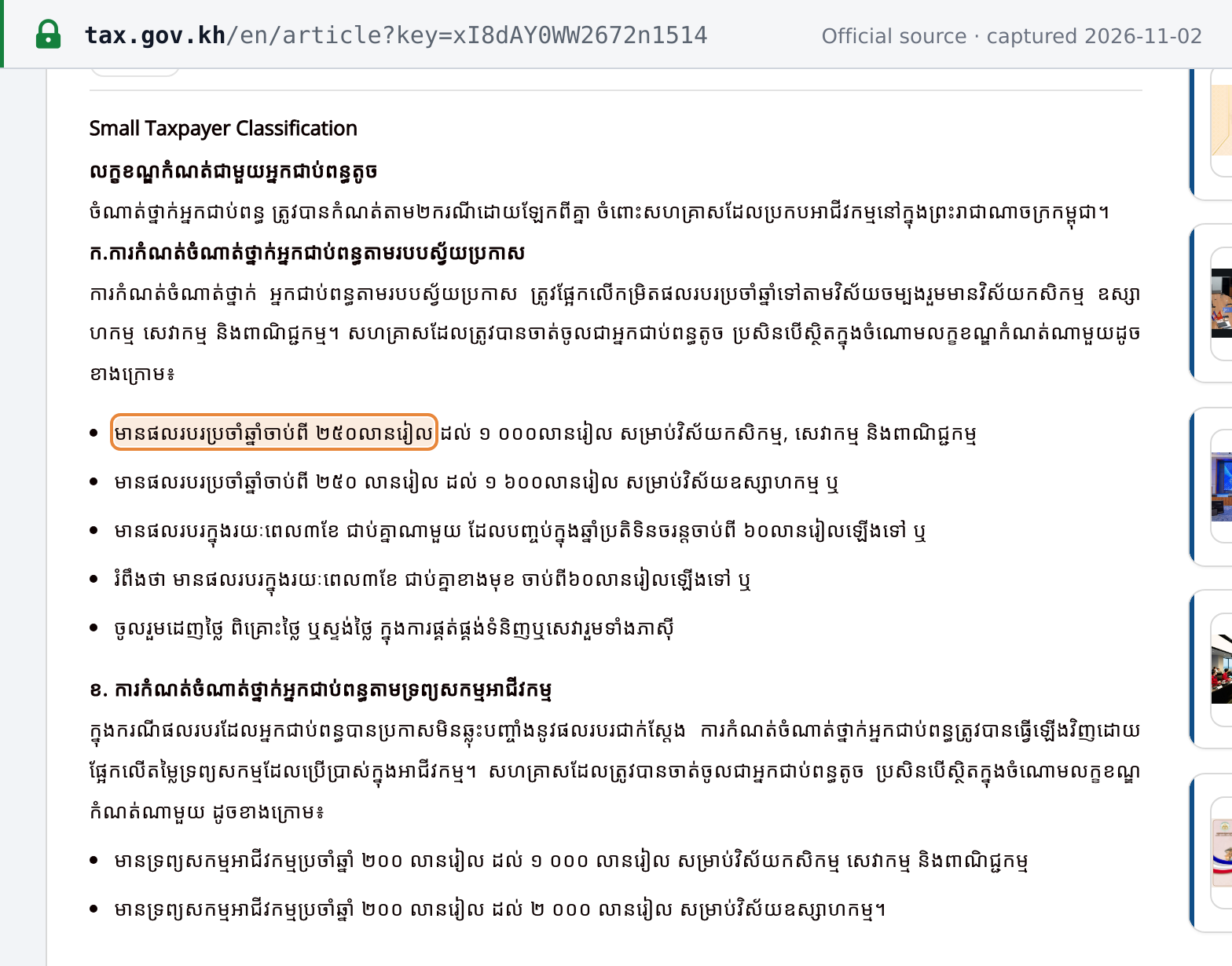
KHR 250 million of annual turnover is the entry point (as at 2026-11-02). The GDT's "Small Taxpayer Classification" places an enterprise in the self-declaration regime as a small taxpayer if it meets any of these:
- annual turnover from KHR 250 million to KHR 1,000 million in agriculture, services and trade;
- annual turnover from KHR 250 million to KHR 1,600 million in industry;
- turnover in any three consecutive months ending in the current calendar year of KHR 60 million or more;
- expected turnover of KHR 60 million or more in the next three consecutive months; or
- participation in public bidding, price consultation or price survey for supplies of goods or services.
In the GDT's words: "សហគ្រាសដែលត្រូវបានចាត់ចូលជាអ្នកជាប់ពន្ធតូច ប្រសិនបើស្ថិតក្នុងចំណោមលក្ខខណ្ឌកំណត់ណាមួយដូចខាងក្រោម៖ មានផលរបរប្រចាំឆ្នាំចាប់ពី ២៥០លានរៀល ដល់ ១ ០០០លានរៀល …". Where declared turnover does not reflect actual turnover, the GDT reclassifies on business assets instead: KHR 200 million to KHR 1,000 million (KHR 200 million to KHR 2,000 million in industry). [6]
 Source snapshot captured 2026-11-02 — original
For other countries, see VAT registration thresholds worldwide.
Non-resident registration
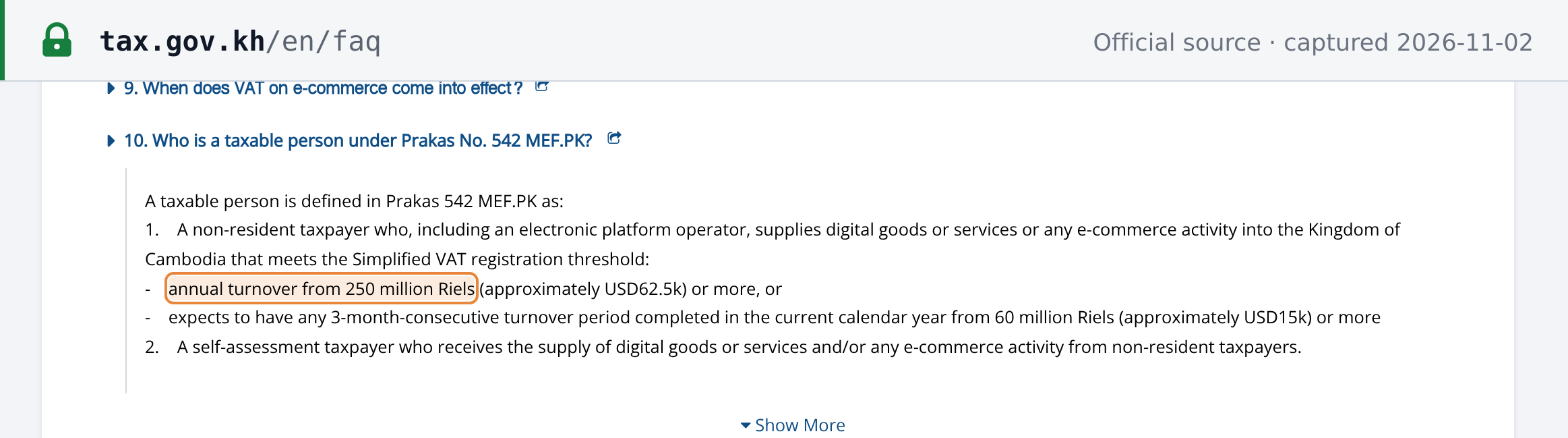
A non-resident with no permanent establishment that supplies digital goods or services or any e-commerce activity into Cambodia must register for Simplified VAT once it reaches KHR 250 million of annual turnover, or expects KHR 60 million in any three consecutive months of the current calendar year (as at 2026-11-02). It must register "within 30 days after the due turnover" (Prakas 542, Art 11(1)). Electronic platform operators are included. The GDT FAQ gives approximate dollar values: "annual turnover from 250 million Riels (approximately USD62.5k) or more". The regime applies from 1 April 2022 (GDT Notification No. 776, 17 January 2022). Registration is online at tax.gov.kh or on site, and the service fee is "400,000 Riel for the Simplified VAT Registration" (Art 11(4)); approval comes "within 7 to 10 working days" (Art 11(5)). Registrants are managed by the GDT's Department of Large Taxpayers (Art 11(3)), and the GDT may register a non-filer unilaterally (Art 11(7)). [4] [1]
 Source snapshot captured 2026-11-02 — original
The threshold matters only for sales to consumers: supplies to Cambodian self-declaration businesses are reverse-charged by the customer. See Foreign businesses selling into Cambodia. The KHR 250 million figure is the same number as the resident small-taxpayer entry point, but the two are separate rules in separate instruments.
Tax identification number
The GDT issues a tax identification number (TIN) on tax registration; on invoices it appears as the VATTIN (លេខអត្តសញ្ញាណកម្មសារពើពន្ធ). The official specimen invoices in Prakas 723 lay it out as four characters, a hyphen, then nine digits: □□□□-□□□□□□□□□. The customer's VATTIN uses the same boxes, marked "(ប្រសិនជាមាន / If any)". [3]
Format. The GDT publishes no definition of the four-character prefix and no check-digit rule. Its e-services page lists no public TIN lookup (as at 2026-11-02). For official lookups in other countries, see Check a VAT number; to check the structure of a Cambodian number, use the Cambodia VAT number validator.
How to register
- Register the company with the Ministry of Commerce through its online business registration service (the GDT home page links to it).
- Register for tax with the GDT. "Individuals must register with the tax administration within 15 working days after the person commences economic activity or after receiving a certificate of registration or permit issued by the relevant ministry or institution" (GDT FAQ, citing Prakas No. 701 MEF.PrK of 14 August 2020). Forms vary by entity type, for example 101-P2 for a private or public limited company and 101-P3 for a foreign branch or representative office.
- Pay the fee. The GDT FAQ gives "Registration fee 400,000 Riels" for medium taxpayers and "Registration fee 20,000 Riels" for small taxpayers (as at 2026-11-02). Patent tax is charged separately.
- Wait for the certificates. "It can take up to 7 to 10 business days to complete tax registration or update taxpayer's information." The GDT then issues the patent-tax certificate and the VAT registration certificate. [1]
The two clocks differ: tax registration is due within 15 working days of starting activity (Prakas 701), and VAT registration within 15 days of becoming a taxable person (Sub-Decree 49, Art 4). Non-residents register for Simplified VAT under Prakas 542 rather than through this process. For the general process elsewhere, see how to register for VAT, sales tax or GST.
Voluntary registration
The GDT's registration pages, its FAQ and Sub-Decree 49's registration chapter (Arts 4–10) set out no separate voluntary VAT-registration route for a person outside the self-declaration regime. Because every legal entity is at least a medium taxpayer, the question rarely arises for companies.
Deregistration
- Apply in writing to cancel when you stop making taxable supplies (Sub-Decree 49, Art 6).
- The GDT may cancel on its own initiative, including where a person "មិនបានប្រកាសអំពីការផ្គត់ផ្គង់ជាប់អាករក្នុងរយៈពេល៣ខែប្រតិទិនជាប់គ្នា" (has not declared taxable supplies for three consecutive calendar months) (Art 7(3)). It must notify the person within 30 days (Art 8).
- Stock and assets on hand for which input credit was claimed are deemed supplied, and output VAT is due on their market value (Art 9).
- Ceasing business: apply "ក្នុងរយៈពេល ១៥ថ្ងៃ ក្រោយការបញ្ចប់អាជីវកម្ម" (within 15 days after ceasing business) and file a final return (Art 34).
- Transfer of a going concern is not subject to VAT if notified within 15 days, and the transferee keeps the records for 10 years (Art 35). [2]
Group registration
Not available. Sub-Decree 49 on VAT (2024) makes no provision for VAT groups in its registration chapter, Arts 4–10. Each legal entity registers on its own.
Rates
| Rate | Applies to | Source |
|---|---|---|
| 10% (standard, and the only positive rate) | The taxable value of each taxable supply in Cambodia, and taxable imports | Law on Taxation 2023, Art 65(1); Sub-Decree 49, Art 27(1) |
| 0% (zero rate) | Exports of goods; services rendered outside Cambodia; international passenger and goods transport and related services. Input VAT stays creditable | Law on Taxation 2023, Art 65(2); Sub-Decree 49, Arts 27(2) and 33 |
| Non-taxable (no VAT, no input credit) | Medical and dental services, education, insurance, primary financial services and the other supplies listed under Exemptions | Law on Taxation 2023, Art 63 |
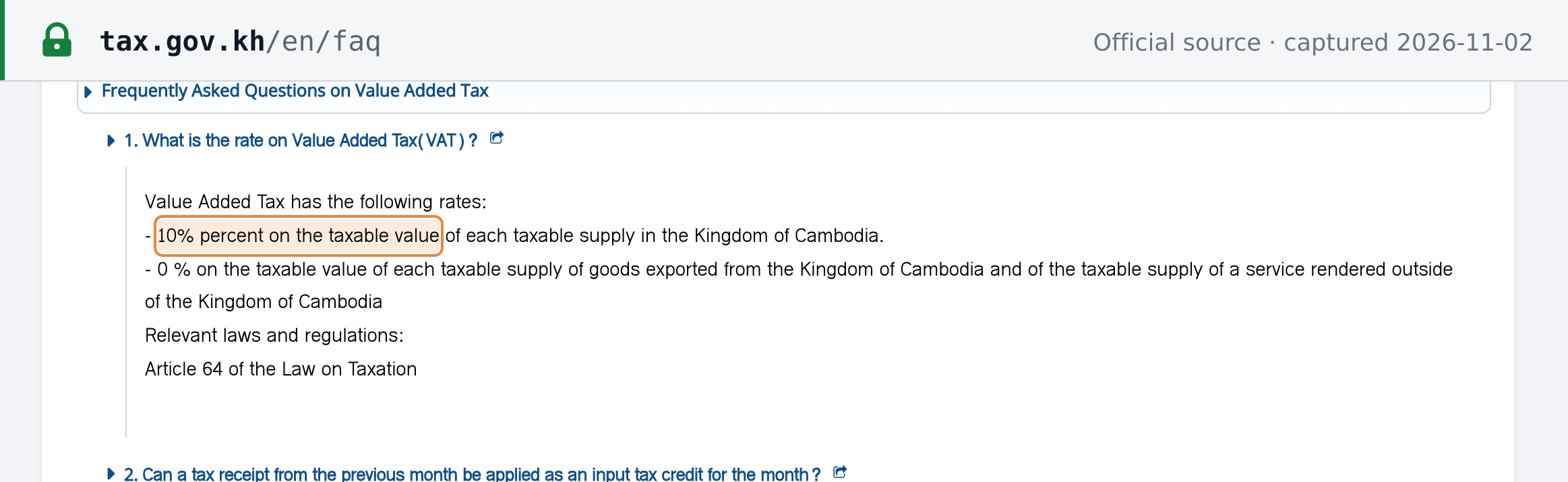
Standard rate: 10% (as at 2026-11-02). The GDT VAT FAQ: "Value Added Tax has the following rates: - 10% percent on the taxable value of each taxable supply in the Kingdom of Cambodia. - 0 % on the taxable value of each taxable supply of goods exported from the Kingdom of Cambodia and of the taxable supply of a service rendered outside of the Kingdom of Cambodia Relevant laws and regulations: Article 64 of the Law on Taxation". The 10% rate dates from the introduction of VAT in 1999 and was carried into the 2023 Law, where the rates are set in Article 65 (the FAQ's answer refers to Article 64). Sub-Decree 49, Art 27(1), restates it: "អាករលើតម្លៃបន្ថែម ត្រូវកំណត់តាមអត្រា ១០ (ដប់) ភាគរយ លើតម្លៃជាប់អាករនៃការផ្គត់ផ្គង់ជាប់អាករនីមួយៗនៅក្នុងព្រះរាជាណាចក្រកម្ពុជា។" [1] [2]
 Source snapshot captured 2026-11-02 — original
Reduced rates. None. Sub-Decree 49, Art 27, sets only the 10% and 0% rates.
Time-limited reliefs. Instead of reduced rates, Cambodia uses MEF Prakas and Instructions under which the State bears the VAT, or VAT is suspended, for a fixed period. Each has an end date:
- Domestically produced basic foods, 1 January 2026 to the end of 2028 (Prakas No. 948 MEF.Prk.GDT, 17 November 2025). VAT on domestic supplies by self-declaration taxpayers of livestock meat (fresh, dried, smoked or fermented), poultry eggs, fresh or processed fish and seafood, sugar other than granulated sugar, salt, and fish sauce or soy sauce "ត្រូវបានចាត់ជាបន្ទុករបស់រដ្ឋរហូតដល់ដំណាច់ឆ្នាំ២០២៨" (is borne by the State until the end of 2028). Food served by restaurants is excluded (Art 4). It replaces Prakas 171 of 20 March 2024. [12]
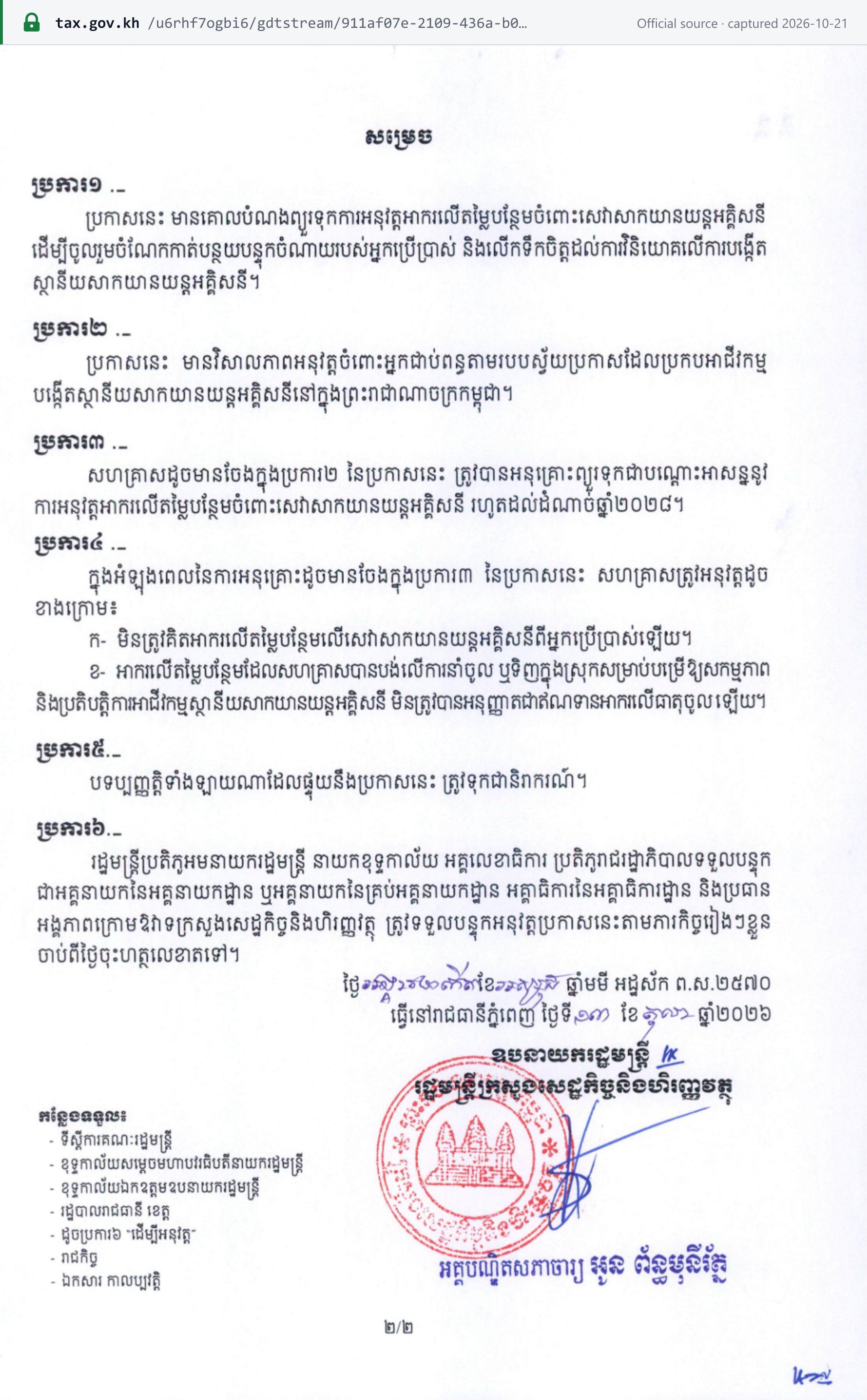
- Electric-vehicle charging services, to the end of 2028 (Prakas No. 715 MEF.Prk.GDT, signed 13 October 2026, published by the GDT on 20 October 2026). VAT on EV charging services by self-declaration taxpayers is suspended "រហូតដល់ដំណាច់ឆ្នាំ២០២៨" (until the end of 2028) (Art 3). Operators charge users no VAT, and VAT on imports or local purchases for the charging business is not creditable (Art 4). [13]
 Source snapshot captured 2026-10-21 — original
- Fuel. The GDT's Instructions list also carries Instruction 003 MEF.S.N.N.GDT of 20 March 2026, "VAT Relief Measures for the Supply of Petroleum Products (Regular Gasoline and Diesel)", and Instruction 006 MEF.S.N.N.GDT of 3 April 2026, "VAT Exemption as State Burden on the supply of Diesel and LPG Products". Check their scope and duration in the instruments themselves before relying on them. [17]
Announced future rates. None. The GDT's Law, Sub-Decree and Prakas listings announce no change to the 10% rate.
For other countries' rates, see worldwide tax rates.
Cross-border rules
Imports and exports
Imports. VAT on imported goods "ដល់កំណត់នៅពេលនាំចូល និងត្រូវប្រមូលដោយរដ្ឋបាលគយ" (falls due at import and is collected by the customs administration), handled like customs duty (Sub-Decree 49, Art 32(1)). The taxable value is the customs value plus customs duty and the other import taxes, excluding VAT (Art 32(2)). The time of supply is the lodging of the customs declaration. The customs declaration and the VAT payment receipt are the evidence for the importer's input credit (Art 19). [2]
Personal-use imports. The GDT VAT FAQ lists as non-taxable "The importation of materials for personal use that are exempt from customs duties in accordance with the customs provisions". The value limit comes from the customs rules, not from the VAT instruments. [1]
Exports. 0% applies to goods supplied to any place outside Cambodia, services for use outside Cambodia, and international passenger and goods transport and services related to it (Art 33(1)). International transport covers Cambodia to abroad, abroad to Cambodia, and abroad to abroad through Cambodia. The exporter must hold sufficient verifiable evidence (Art 33(3)), such as the export customs declaration, the invoice, transport documents, the contract and bank payment records (Art 29(1)). Exporters may claim refunds monthly (Art 20(1)). Suppliers to the export garment, textile, footwear, bag and hat industries can apply for 0% under Prakas 311 MEF of 19 March 2014. [2] [1]
Reverse charge on imported services
Where a non-resident with no permanent establishment in Cambodia supplies services in Cambodia, the Cambodian taxable-person recipient accounts for the VAT. Sub-Decree 49, Art 23(3): "ចំពោះសេវាដែលបានផ្គត់ផ្គង់នៅក្នុងព្រះរាជាណាចក្រកម្ពុជាដោយបុគ្គលអនិវាសនជន បុគ្គលជាប់អាករដែលជាអ្នកទទួលការផ្គត់ផ្គង់ត្រូវគិតអាករជំនួសអ្នកផ្គត់ផ្គង់និងបង់ប្រាក់អាករជូនរដ្ឋបាលសារពើពន្ធ ប្រសិនបើអ្នកផ្គត់ផ្គង់នោះពុំមានគ្រឹះស្ថានអចិន្ត្រៃយ៍នៅក្នុងព្រះរាជាណាចក្រកម្ពុជា។" ("For services supplied in Cambodia by a non-resident, the taxable person receiving the supply shall account for the tax on behalf of the supplier and pay it to the tax administration, if the supplier has no permanent establishment in Cambodia.") [2]
Digital products and services
Sub-Decree No. 65 ANKr.BK (8 April 2021) and Prakas No. 542 MEF.PrK (8 September 2021) bring digital goods or services and any e-commerce activity supplied into Cambodia by non-residents within VAT, from 1 April 2022. Sub-Decree 49 (2024), Arts 36–41, restates the scheme under the 2023 Law and leaves the detail to MEF Prakas, so Prakas 542 still applies. The GDT treats a supply as made in Cambodia if one or more of three indicators points there: "Payment information (e.g., credit card or bank account information)", "Residence information (e.g., home address, billing address)" or "Access information (SIM Card code, IP address)". [5] [4] [1]
See VAT on digital services by non-resident suppliers.
Foreign businesses selling into Cambodia — B2B and B2C
The answer differs by customer:
- B2C (sales to consumers). A non-resident without a PE must register for Simplified VAT from KHR 250 million of annual turnover, or KHR 60 million expected in any three consecutive months, within 30 days (see Non-resident registration). It must "file the tax return and pay the 10% VAT to the tax administration by the 20th of the following month of supply" (Prakas 542, Art 9). It cannot claim input tax: Sub-Decree 49, Art 37, has it collect VAT monthly without being allowed input tax credit.
- B2B (sales to Cambodian self-declaration taxpayers). The non-resident "shall have the obligation to file the tax return to the tax administration by the 20th of the following month of supply but not required to pay the VAT". The Cambodian customer "shall collect the VAT by Reverse Charge mechanism, file the tax return and pay 10% VAT to the tax administration by the 20th of the following month of supply" (Prakas 542, Art 10).
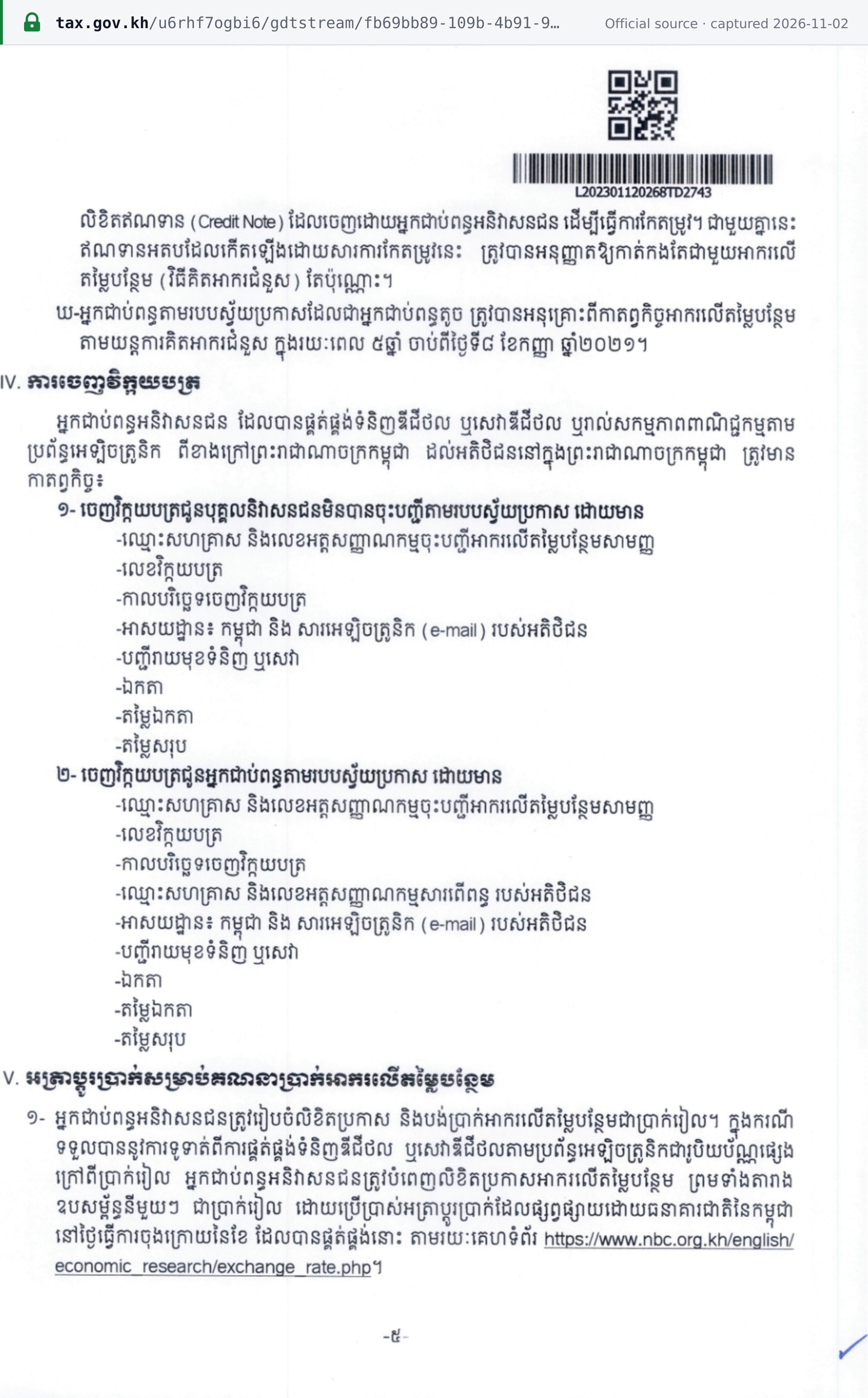
- Small-taxpayer customers. "Taxable persons … who are small taxpayers … shall be exempted from the Reverse Charge mechanism of 10% VAT obligation as stated in the Article 10 for the period of 5 years starting from the date of this Prakas comes into effect" (Prakas 542, Art 14(2)). GDT Instruction No. 2520 of 24 January 2023, section III(ឃ), dates the five years from the Prakas's signing date: "ក្នុងរយៈពេល ៥ឆ្នាំ ចាប់ពីថ្ងៃទី៨ ខែកញ្ញា ឆ្នាំ២០២១" (for 5 years from 8 September 2021). The relief therefore ended in September 2026, and small-taxpayer buyers of foreign digital services now apply the reverse charge like other self-declaration taxpayers (as at 2 November 2026). [19]
 Source snapshot captured 2026-11-02 — original
- Physical goods. A foreign seller shipping goods to Cambodian consumers has no registration route: the VAT is collected at import (see Imports and exports). [4] [2]
Marketplace / platform deemed-supplier liability
Non-resident electronic platform operators are taxable persons for e-commerce VAT, as the GDT FAQ (question 10) and GDT Instruction No. 2520 (24 January 2023, section I.1) state, and must register for Simplified VAT once they reach the threshold. The GDT FAQ: "An electronic platform operator refers to a non-resident taxpayer who supplies services, receives payments, and delivers digital goods or services to purchasers via electronic platforms on behalf of non-resident suppliers via an electronic system." Prakas 542 and Sub-Decree 49 contain no deemed-supplier rule for domestic marketplaces or for physical goods. See marketplace deemed-supplier rules. [1] [4]
Place of supply
- Imported goods are supplied in Cambodia when they enter the customs territory, at the time the customs declaration is lodged (Sub-Decree 49, Art 32).
- Services are supplied in Cambodia if performed in Cambodia, with two exceptions: services related to immovable property are supplied where the property is, and transport services where the transport takes place (Art 23(2)).
- Digital services from non-residents: the payment, residence and access indicators above. [2]
Invoice requirements
Document types
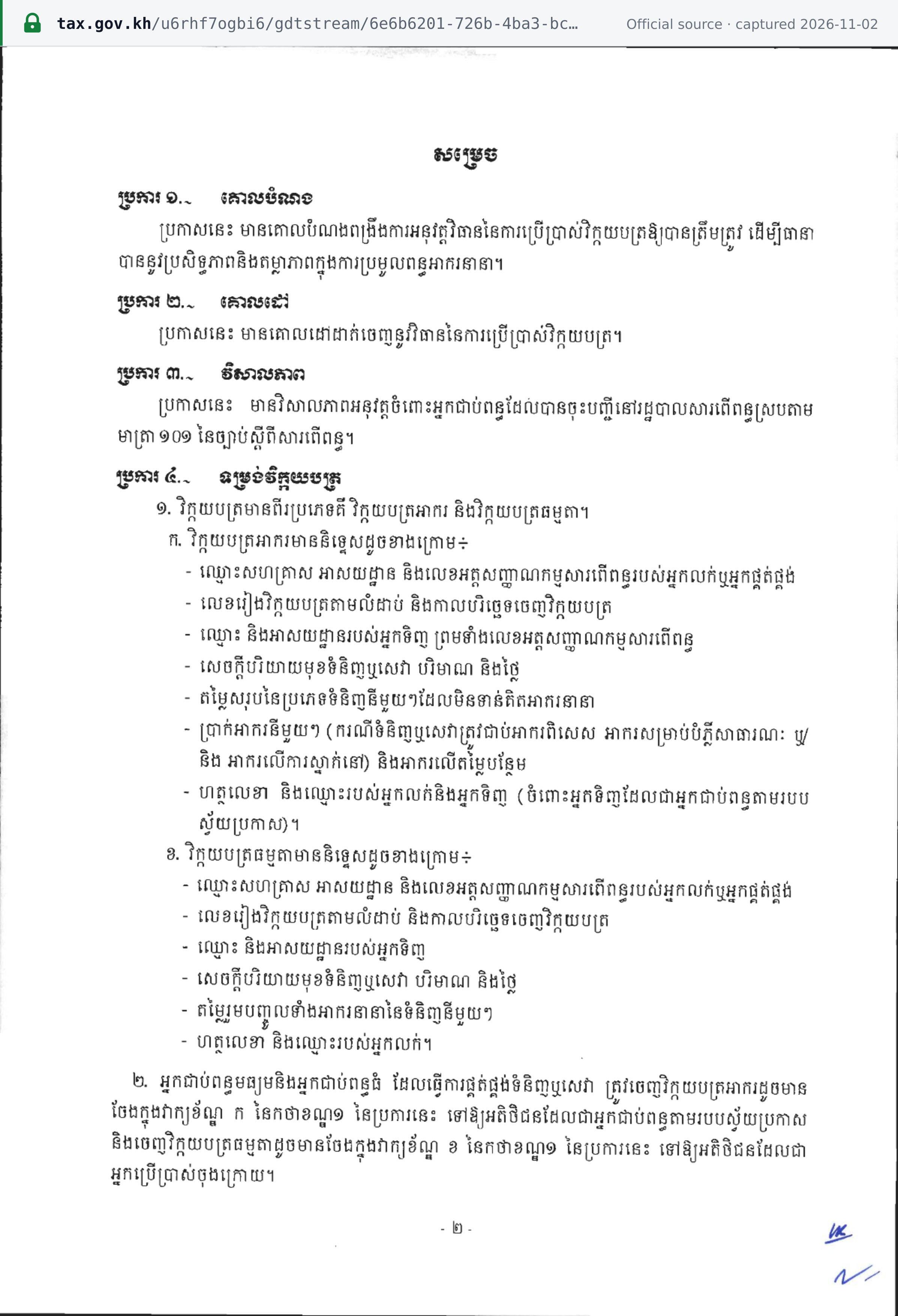
Prakas 723, Art 4(1): "វិក្កយបត្រមានពីរប្រភេទគឺ វិក្កយបត្រអាករ និងវិក្កយបត្រធម្មតា។" ("There are two types of invoice: the tax invoice and the commercial invoice.") Which one to issue depends on who sells and who buys:
| Seller | Buyer | Invoice |
|---|---|---|
| Medium or large taxpayer | Self-declaration taxpayer | Tax invoice (វិក្កយបត្រអាករ) |
| Medium or large taxpayer | Final consumer | Commercial invoice (វិក្កយបត្រធម្មតា) |
| Small taxpayer | Anyone | Commercial invoice |
Sub-Decree 49, Art 21, restates the rule under the 2023 Law and puts the duty on the recipient to demand an invoice. Prakas 723 sets no lower value limit and no simplified tax invoice. [3] [2]
Mandatory content
Tax invoice (Prakas 723, Art 4(1)(a)):
- Seller's or supplier's enterprise name, address and TIN
- Sequential invoice number and date of issue
- Buyer's name and address, and the buyer's TIN
- Description of the goods or services, quantity and price
- Total value of each item before taxes
- Each tax amount: Specific Tax, Public Lighting Tax and/or Accommodation Tax where the supply bears them, and VAT
- Signature and name of the seller and of the buyer (where the buyer is a self-declaration taxpayer)
Commercial invoice (Art 4(1)(b)):
- Seller's enterprise name, address and TIN
- Sequential invoice number and date of issue
- Buyer's name and address
- Description of the goods or services, quantity and price
- Value of each item including all taxes
- Seller's signature and name
The Khmer text of the tax-invoice list opens: "ក. វិក្កយបត្រអាករមាននិទ្ទេសដូចខាងក្រោម៖ - ឈ្មោះសហគ្រាស អាសយដ្ឋាន និងលេខអត្តសញ្ញាណកម្មសារពើពន្ធរបស់អ្នកលក់ឬអ្នកផ្គត់ផ្គង់ - លេខរៀងវិក្កយបត្រតាមលំដាប់ និងកាលបរិច្ឆេទចេញវិក្កយបត្រ …". The GDT repeats the same list on its large-taxpayer obligations page. A tax invoice that does not meet Art 4(1)(a) cannot support an input-tax credit (Art 6(1)). [3] [9]
 Source snapshot captured 2026-11-02 — original
Non-resident Simplified VAT invoices (Prakas 542, Art 12(1)) show: "A- Name, address and Tax Identification Number of the Simplified VAT Registration of the non-resident taxpayer; B- Name, address and/or VAT Registration Identification Number of the customer; C- Invoice number and date of the issued invoice; D- Description of the supplied digital goods or services; E- Taxable value and VAT or the total value of supply including VAT." [4]
Issuance deadline
Within 7 days. The time of supply is when the invoice must be issued, or when it is issued if earlier. "អ្នកផ្គត់ផ្គង់ត្រូវចេញវិក្កយបត្រយ៉ាងយឺតបំផុត ៧ថ្ងៃ ក្រោយការបញ្ជូនទំនិញឬការបំពេញសេវាឬក្រោយការទូទាត់ក្នុងករណីដែលការទូទាត់ត្រូវបានធ្វើឡើងមុនការបញ្ជូនទំនិញឬការបំពេញសេវា។" ("The supplier shall issue the invoice no later than 7 days after delivering the goods or completing the service, or after payment where payment is made before delivery or completion.") (Sub-Decree 49, Art 25(1)(a)). Special time-of-supply rules cover self-supplies, gifts, hire purchase and finance leases, and periodic or progressive supplies. [2]
Numbering and sequencing
Invoices follow the annexed models and run in sequential numbers for at least one year: "អ្នកជាប់ពន្ធត្រូវរៀបចំវិក្កយបត្រស្របតាមគំរូដូចមានក្នុងឧបសម្ព័ន្ធភ្ជាប់ជាមួយប្រកាសនេះ និងត្រូវចេញវិក្កយបត្រតាមលំដាប់លេខរៀងសម្រាប់រយៈពេលមួយឆ្នាំយ៉ាងតិច។" ("Taxpayers shall prepare invoices in line with the model in the annex to this Prakas and shall issue invoices in sequential numbering for a period of at least one year.") (Prakas 723, Art 4(5)). [3]
Credit and debit notes
VAT already invoiced or returned is adjusted when a supply is cancelled, its nature or basis changes, the agreed consideration changes (for example by a price reduction), or goods are returned or services not completed (Sub-Decree 49, Art 28(1)). Where the corrected tax is lower, the supplier gives the customer a tax credit note (លិខិតឥណទានអាករ); where it is higher, a tax debit note (លិខិតឥណពន្ធអាករ) (Art 28(4)). Both parties record the note in their books as they would a tax invoice (Art 28(5)). Sub-Decree 49 cross-refers the notes' content to Art 21, and the GDT publishes no separate template for them. [2]
Currency and language
- Khmer is mandatory. "អ្នកជាប់ពន្ធត្រូវប្រើប្រាស់ភាសាខ្មែរក្នុងការសរសេរឬបោះពុម្ពវិក្កយបត្រ។ ក្នុងករណីចាំបាច់ អ្នកជាប់ពន្ធអាចប្រើប្រាស់ភាសាខ្មែរនិងភាសាបរទេស ប៉ុន្តែត្រូវដាក់ភាសាបរទេសនៅក្រោមភាសាខ្មែរ។" ("Taxpayers shall use Khmer to write or print invoices. Where necessary they may use Khmer and a foreign language, but the foreign language must be placed below the Khmer.") (Prakas 723, Art 4(4)).
- Riel totals. VAT is reported in riel. For riel totals on sales invoices, a fixed exchange rate not lower than the National Bank of Cambodia's daily official rate is temporarily allowed; if the NBC rate rises above it, the company "must re-establish this fixed exchange rate the following month" (GDT FAQ, citing Prakas No. 824 MEF.PrK).
- Non-residents. "The invoice can be made in foreign language by showing in Khmer language or English language" (Prakas 542, Art 12(3)). [3] [1] [4]
Self-billing
Not provided for. Sub-Decree 49, Art 21(2), requires the recipient to demand an invoice from the supplier, and neither Sub-Decree 49 nor Prakas 723 contains a provision for buyer-created invoices.
Retention and audit trail
- Retention. "វិក្កយបត្រត្រូវរក្សាទុកក្នុងរយៈពេល ១០ឆ្នាំ សម្រាប់អ្នកជាប់ពន្ធមធ្យមនិងអ្នកជាប់ពន្ធធំ និងក្នុងរយៈពេល ០៣ឆ្នាំ សម្រាប់អ្នកជាប់ពន្ធតូច។" ("Invoices shall be retained for 10 years for medium and large taxpayers and 3 years for small taxpayers.") (Prakas 723, Art 4(5)).
- Electronic invoices. "The General Department of Taxation allows companies to use tax invoices and regular invoices that are automatically printed with signatures and stamps electronically to send to customers. Companies must keep auditable invoices for 10 years for tax purposes." (GDT FAQ).
- Audit trail. All records must follow GDT-approved formats, be kept in date and number order, and be ready for inspection for 10 years: "កំណត់ត្រាទាំងអស់ ត្រូវធ្វើឡើងទៅតាមទម្រង់ដែលអគ្គនាយកដ្ឋានពន្ធដារបានកំណត់ឬបានទទួលស្គាល់ ហើយត្រូវថែរក្សាតាមលំដាប់ថ្ងៃខែនិងលេខរៀង និងត្រៀមបម្រុងសម្រាប់ការត្រួតពិនិត្យក្នុងរយៈពេល ១០ឆ្នាំ។" (Sub-Decree 49, Art 29(2)). Taxpayers with computerised accounting keep electronic records (Art 29(1)). [3] [1] [2]
Waivers. The invoice rules do not apply to certain transactions of banks, microfinance institutions and financial institutions, or to other business transactions that cannot issue invoices; these keep clear, verifiable records instead (Prakas 723, Art 5).
A specimen of a compliant invoice
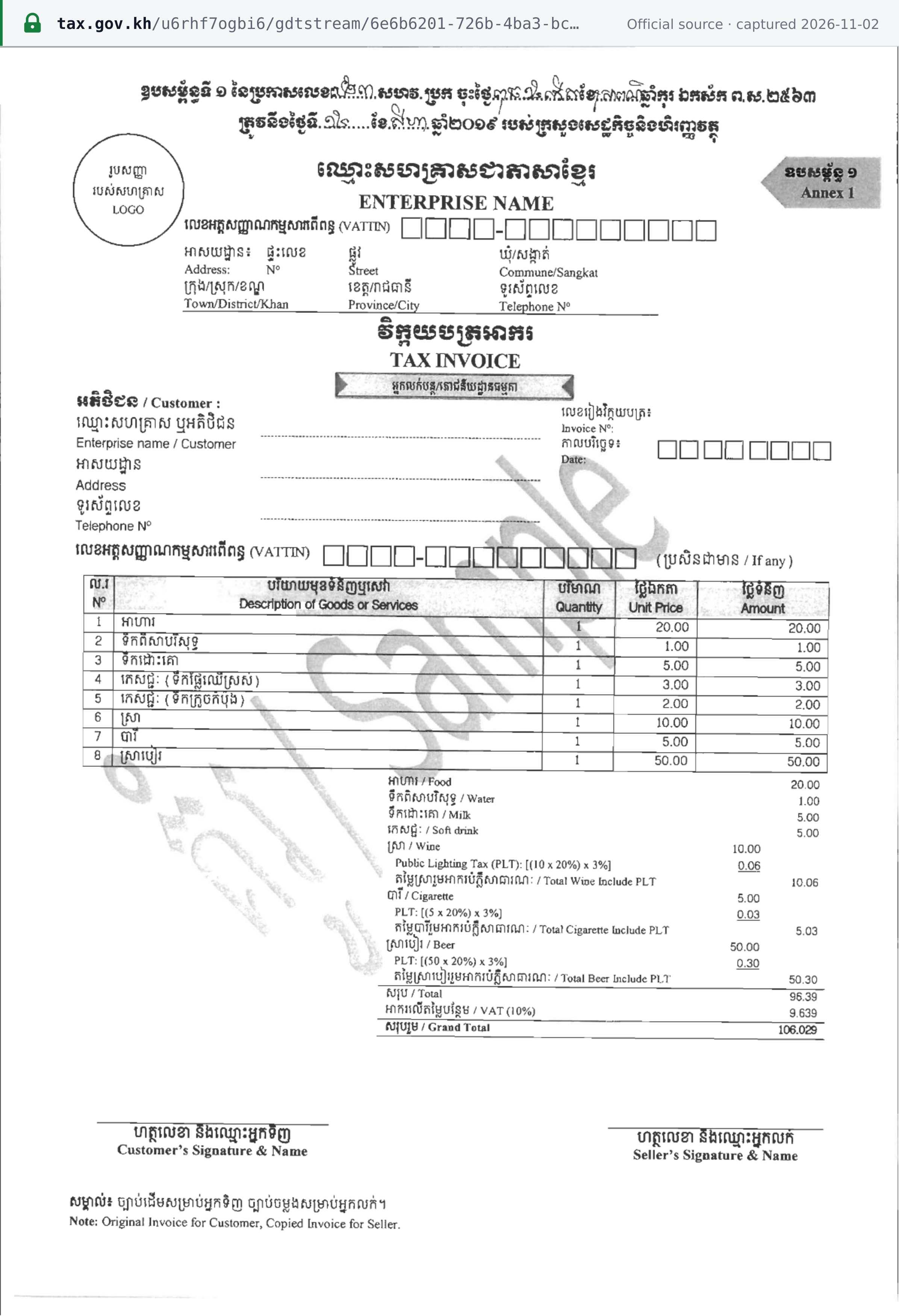
The MEF publishes its own specimens. Prakas 723 annexes six bilingual Khmer/English "TAX INVOICE" models, Annexes 1 to 6, each watermarked "Sample", and Art 4(5) requires taxpayers to prepare invoices "ស្របតាមគំរូដូចមានក្នុងឧបសម្ព័ន្ធ" (in line with the model in the annex). Annex 1 is the model for a reseller or ordinary restaurant:
 Source snapshot captured 2026-11-02 — original
How the Annex 1 layout maps to the Art 4(1)(a) particulars:
| On the specimen | Particular it carries |
|---|---|
| Logo circle, "ENTERPRISE NAME", Address (N°, Street, Commune/Sangkat, Town/District/Khan, Province/City, Telephone N°) | Seller's name and address |
| "លេខអត្តសញ្ញាណកម្មសារពើពន្ធ (VATTIN) □□□□-□□□□□□□□□" under the name | Seller's TIN |
| Title "វិក្កយបត្រអាករ / TAX INVOICE" and a sector banner | Document type |
| "Invoice N°" and "Date" | Sequential number and issue date |
| Customer block: Enterprise name / Customer, Address, Telephone N°, VATTIN "(ប្រសិនជាមាន / If any)" | Buyer's name, address and TIN |
| Table "N° / Description of Goods or Services / Quantity / Unit Price / Amount" | Description, quantity and price; value of each item before taxes |
| Lines such as "Public Lighting Tax (PLT): [(10 x 20%) x 3%]" | Other taxes, item by item |
| "សរុប / Total" 96.39, "អាករលើតម្លៃបន្ថែម / VAT (10%)" 9.639, "សរុបរួម / Grand Total" 106.029 | VAT amount and totals |
| "Customer's Signature & Name" and "Seller's Signature & Name" | Signatures and names of buyer and seller |
| "Note: Original Invoice for Customer, Copied Invoice for Seller." | Original and copy |
The amounts are the specimen's own illustrative figures. The other annexes show the same frame for other sectors: Annex 3 an airline ticket with Specific Tax, Annex 5 a hotel with Accommodation Tax, and Annex 6 a telephone service. [3]
Prakas 723 dates from 2019 and pre-dates the 2023 Law. Sub-Decree 49, Art 21(4), leaves invoice particulars to the invoice rules set by MEF Prakas, so Prakas 723 and its specimens remain the reference.
E-invoicing status
Status (as at 2 November 2026): mandatory for suppliers to the central budget units of eight ministries; voluntary otherwise.
- System. The Cambodia E-Invoicing System (CamInvoice), operated by the General Department of Digital Economy (GDDE) of the MEF. Under Circular 003, e-invoices are issued through the CamInvoice portal or through an invoicing system registered with and connected to CamInvoice.
- Phase 1, Step 1 (B2G). MEF Circular No. 003 of 22 January 2025 on the mandatory use of e-invoicing covers "អង្គភាពថវិកាថ្នាក់កណ្ដាល នៃក្រសួងចំនួន ២ គឺ ១-ក្រសួងសេដ្ឋកិច្ចនិងហិរញ្ញវត្ថុ និង ២-ក្រសួងបរិស្ថាន ព្រមទាំងក្រុមហ៊ុន ឬ អ្នកផ្គត់ផ្គង់នៃក្រសួងទាំងពីរ" (the central budget units of two ministries, the Ministry of Economy and Finance and the Ministry of Environment, and the companies or suppliers of the two ministries). It applies to invoices supporting payment claims that go through procurement, from fiscal year 2025. Suppliers must invoice those units only by e-invoice and must register as CamInvoice members. The Treasury and National Budget departments may reject attached invoices that cannot be verified against CamInvoice.
- Phase 1, Step 2 (B2G). MEF Circular No. 012 of 14 July 2025 extends the scope to "អង្គភាពថវិកាថ្នាក់កណ្ដាល នៃក្រសួងចំនួន ៦(ប្រាំមួយ)" (the central budget units of six ministries): Agriculture, Forestry and Fisheries; Commerce; Industry, Science, Technology and Innovation; Education, Youth and Sport; Post and Telecommunications; and Civil Service, together with their companies and suppliers. Their suppliers have the same duties: invoice only by e-invoice and register as CamInvoice members.
- B2B and B2C. Voluntary, with no mandatory date set by the MEF or the GDT (as at 2 November 2026).
- Formats and standards. Not stated in Circular 003.
- Paper and PDF invoices. Outside CamInvoice, Prakas 723 still governs, and the GDT accepts invoices printed automatically with electronic signatures and stamps (see Retention and audit trail).
See CTC e-invoicing models for how other countries do it, and e-invoicing status and networks worldwide.
Filing and payment
Filing frequency
Monthly, for every class of self-declaration taxpayer: small, medium and large. The GDT's obligations pages for small and large taxpayers set out no quarterly or annual VAT return option. Non-resident Simplified VAT registrants also file monthly (Prakas 542, Arts 9–10). [9] [10]
Return due date
The 20th of the following month. GDT, large-taxpayer obligations: "ពន្ធប្រចាំខែត្រូវបង់ពន្ធ និងដាក់លិខិតប្រកាសពន្ធចាប់ពីថ្ងៃទី ០១ ដល់ថ្ងៃទី២០ នៃខែបន្ទាប់ នៅអគ្គនាយកដ្ឋានពន្ធដារ ឬដាក់លិខិតប្រកាសតាមប្រព័ន្ធ E-Filing។" ("Monthly taxes are paid and returns filed from the 1st to the 20th of the following month at the GDT, or filed through the E-Filing system.") The small-taxpayer page says the same, with filing through the GDT Tax Pre-filing App. [9] [10]
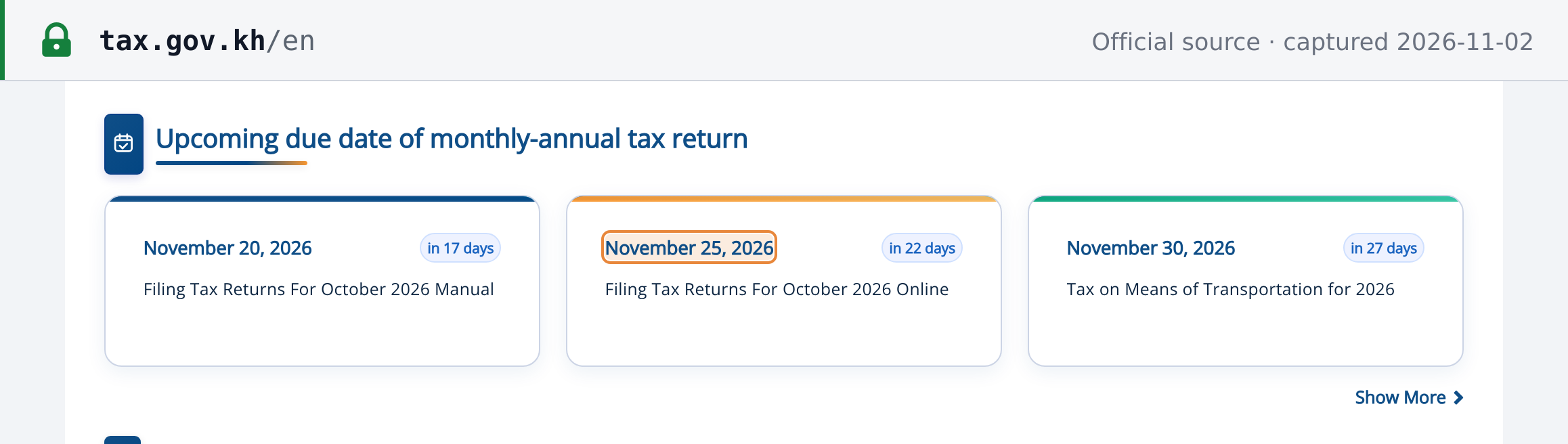
Online filing runs to the 25th on the GDT's published calendar. For the October 2026 period it shows "November 20, 2026 … Filing Tax Returns For October 2026 Manual" and "November 25, 2026 … Filing Tax Returns For October 2026 Online" (as at 2026-11-02). [15]
 Source snapshot captured 2026-11-02 — original
Payment due date and method
Payment is due with the return, by the same date. Medium and large taxpayers file through GDT e-Filing (web or the Windows desktop application) and pay through the GDT's e-payment partner banks; small taxpayers can use the GDT Tax Pre-filing App. Non-residents pay by the 20th of the following month (Prakas 542, Art 9). [9] [4]
Small taxpayers compute VAT on a deemed basis, with an 80% input credit allowed whether or not there are invoices. The GDT FAQ: "The calculation of VAT to be paid monthly for small taxpayers is to take the income received in the month without VAT (monthly income divided by 1.1) multiplied by 20% and take the result and multiply by 10%; the result is the amount of VAT paid monthly" (citing Prakas 1820 MEF.PrK on simplified accounting for small taxpayers). The result is 2% of VAT-exclusive receipts. [1] [10]
Additional listings
Taxable persons keep a monthly VAT account, purchase and sales journals, and copies of the invoices behind each entry (Sub-Decree 49, Art 29(1)). The e-Filing desktop application can upload purchase and sales lists, withholding-tax lists and salary-tax lists in Excel format (GDT FAQ on e-Filing). The GDT sets no separate annual VAT return and no EC-sales-list equivalent in the sources cited here. [2] [1]
Input-tax recovery and blocked items
- Timing. Credit is allowed for VAT on supplies received in the month, or at the latest within 60 days after receipt or import (Sub-Decree 49, Art 12(1)). An older answer on the GDT FAQ page, "A tax receipt from a previous month cannot be applied as an input tax credit for a different month", cites Sub-Decree 114 of 1999, which Sub-Decree 49 replaced.
- Before registration. Input VAT can be credited on goods, including capital assets, that are on hand at the effective date of registration and were bought or imported no more than 60 days before it, for use in taxable supplies, claimed on the GDT's form with a valid invoice (Art 11(2)).
- Evidence. The original tax invoice, or the import customs declaration with the VAT receipt (Art 19). A non-compliant tax invoice is not creditable (Prakas 723, Art 6).
- Blocked (Art 13): entertainment, amusement and recreation, unless that is the business; the purchase or import of passenger cars with no more than 10 seats, unless dealing in or renting cars is the business; and certain petroleum products (regular and super gasoline, diesel and oil), unless supplying them is the business. Art 13 does not repeat the mobile-telephone block that the GDT FAQ lists under Sub-Decree 114.
- Purchases from small taxpayers carry no creditable VAT, but are deductible as expenses (Prakas 723, Art 6(2)).
- Mixed supplies. Direct attribution first, then the formula A × B/C (Art 15). Below 0.05 no credit is given and above 0.95 full credit (Art 15(2)–(3)); the annual adjustment is made in the first month of the next calendar year (Arts 17–18). [2] [1] [3]
Refunds
- Carry-forward. Excess input credit carries forward.
- Exporters may claim a refund of excess credit every month (Sub-Decree 49, Art 20(1)).
- Others, including Qualified Investment Projects, may claim once they have had excess credit for three consecutive months or more, at the end of the third month or in any later month (Art 20(1)).
- No refund goes to a person that has not declared taxable supplies (Art 20(2)).
- Compliance rating. Under the GDT's compliance classification, Gold taxpayers get a "VAT refund of less than 500 million riels without the need for a prior verification audit", and Silver taxpayers the same below KHR 200 million (GDT FAQ, as at 2026-11-02).
- Non-residents and bad debts. Sub-Decree 49 provides no refund scheme for non-residents, and its Art 28 adjustments cover cancellations, price changes and returns but not bad debts. [2] [1]
Exemptions
Exempt supplies
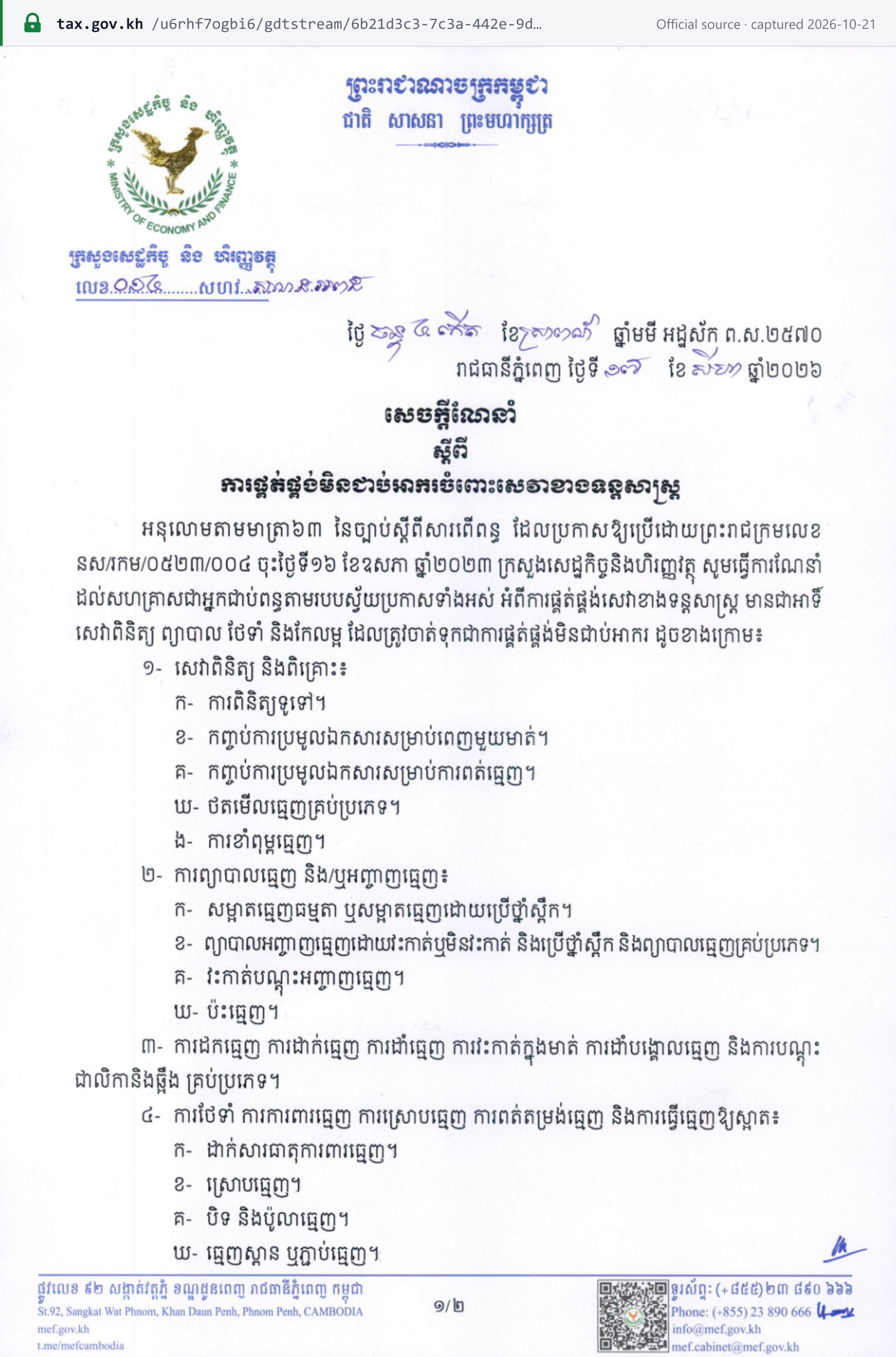
The GDT VAT FAQ lists the non-taxable supplies of Article 63 of the Law on Taxation: "Public postal service. - Hospital, clinic, medical, and dental services and the sale of medical and dental goods incidental to the performance of such services. - The service of transportation of passengers by a wholly state-owned public transportation system. - Insurance services. - Primary financial services - The importation of materials for personal use that are exempt from customs duties in accordance with the customs provisions - Non-profit activities for serving the public interest - Educational service - Electric power and clean water - Unprocessed agricultural products - Solid-liquid waste collection". Goods bought or imported by diplomatic missions and international organisations are also relieved (Sub-Decree 49, Art 22). [1] [2]
- Insurance. "paragraph 5 of Article 63 stipulates that insurance services are Non-taxable supplies" (GDT FAQ).
- Land. "Land is not considered under the term "good", so the sale of land is not subject to VAT" (GDT FAQ). Article 57(1) of the Law on Taxation defines goods and excludes land.
- Dental services. Instruction No. 014 MEF.S.N.N.GDT of 17 August 2026 confirms that dental services are non-taxable under Article 63. [14]
 Source snapshot captured 2026-10-21 — original
Exempt is not zero-rated. VAT paid on inputs used for non-taxable supplies cannot be credited (Sub-Decree 49, Art 14), whereas a zero-rated exporter keeps its credit and can claim refunds. The GDT's example: "The consultation and treatment center is under non-taxable supply, so the truck's purchase is not eligible for a tax credit, even if the purchase is from a taxable person and has a valid tax invoice." [1]
Special regimes
- Small taxpayers: deemed 80% input credit, effectively 2% of VAT-exclusive receipts (see Payment due date and method).
- Export subcontractors: 0% for supporting industries and subcontractors supplying the export garment, textile, footwear, bag and hat industries, on application (Prakas 311 MEF, 2014).
- Qualified Investment Projects: classed as large taxpayers, with the three-month refund route in Sub-Decree 49, Art 20.
- State-borne and suspended VAT: basic foods and EV charging to the end of 2028 (see Rates).
Offences and penalties
Offences
The GDT summarises the tax crimes in Chapter 18, Section 5, of the Law on Taxation 2023:
- Tax evasion: "any acts committed with willful and premeditated organized with the intention of eliminating the tax amount that required to pay".
- Obstructing the implementation of the tax provisions, including "Making or providing fraudulent records, documents, reports, or other information", "Conceals or deliberately destroys book of accounts, records, documents, reports or other information", "Issue the fraudulent invoices" and "Failure to allow the tax administration to enter the business to determine and collect taxes".
- Other offences: "Professional as Tax Agent without License", "Failure to pay the collected tax" and "Tax collection without permission" (Arts 224–226, 245–247, 249 and 250).
Tax offences are misdemeanours. "The statute of limitations for tax-related criminal offenses … is 5 years for the criminal offense itself and 10 years for reassessing taxes." [1]
Invoice offences. Under Prakas 723, Art 7, failing to issue an invoice, or issuing an incorrect or fraudulent one, is treated as obstruction of the tax provisions, and a person who issues a fraudulent invoice must pay the taxes shown on it within seven days of the invoice date. [3]
Penalties
Late filing or late payment: additional tax of 10% plus interest of 1.5% a month on the unpaid or underpaid tax (Law on Taxation, Art 233; as at 2026-11-02). GDT FAQ: "ការខកខានឬយឺតយ៉ាវមិនបានដាក់លិខិតប្រកាសនិងបង់ប្រាក់ពន្ធ ត្រូវរងទណ្ឌកម្មរដ្ឋបាលរួមមាន ពន្ធបន្ថែម ១០% និងការប្រាក់ ១,៥% នៃចំនួនប្រាក់ពន្ធដែលមិនបានបង់ ឬបង់ខ្វះសម្រាប់ខែនីមួយៗ។" ("Failure or delay in filing returns and paying tax is subject to administrative sanctions comprising additional tax of 10% and interest of 1.5% of the unpaid or underpaid tax for each month.") Interest was 2% a month up to March 2019 and has been 1.5% a month since April 2019. [1]
Article 233 of the Law on Taxation 2023 sets the full scale of additional tax. Interest of 1.5% a month runs on the unpaid amount in every case except the last:
| Situation (Law on Taxation 2023, Art 233) | Additional tax |
|---|---|
| Negligence under Art 223: tax underpaid by no more than 10%, or paid late | 10% of the underpaid or late tax |
| Serious negligence under Art 224: tax underpaid by more than 10% | 25% of the underpaid tax |
| Unilateral assessment by the tax administration | 40% of the underpaid tax |
| Unilateral assessment for failure to file a return | 40% of the tax assessed |
| Tax not paid within 15 days of receiving a collection notice | 25% of the unpaid tax |
| Late payment of the tax on means of transportation and stamp tax | 100% of the tax due |
Art 233(2): "ចំពោះបុគ្គលដែលប្រព្រឹត្តអំពើធ្វេសប្រហែសធ្ងន់ធ្ងរដូចមានចែងក្នុងមាត្រា២២៤នៃច្បាប់នេះ ប្រាក់ពន្ធបន្ថែមត្រូវស្មើនឹង២៥(ម្ភៃប្រាំ)ភាគរយនៃចំនួនប្រាក់ពន្ធដែលបង់ខ្វះ បូកបន្ថែមការប្រាក់១,៥(មួយក្បៀសប្រាំ)ភាគរយ …" Interest runs from the 1st day of the month after the tax fell due (Art 233(7)). [16]
Frequently asked questions
Our company's turnover is under KHR 250 million. Do we still need to register for VAT in Cambodia?
In practice, yes, if you are a company. The General Department of Taxation (GDT) classifies every enterprise registered as a legal person as at least a medium taxpayer, whatever its turnover, and every self-declaration taxpayer that makes taxable supplies must apply for VAT registration within 15 days of becoming a taxable person (Sub-Decree 49 on VAT, Article 4). The KHR 250 million annual turnover entry point, and the KHR 60 million test over any three consecutive months, mainly decide whether a sole proprietor or other unincorporated business enters the self-declaration regime.
We sell software subscriptions from abroad to Cambodian businesses. Who pays the VAT?
Your Cambodian business customer. Under Prakas 542 MEF.PrK, a non-resident supplying digital goods or services to a Cambodian self-declaration taxpayer files a return by the 20th of the following month but does not pay the VAT; the customer collects the 10% VAT by reverse charge and pays it by the 20th of the following month. Customers that are small taxpayers were exempt from this reverse charge for five years from 8 September 2021 (GDT Instruction No. 2520), so the relief ended in September 2026 and they now apply the reverse charge too. Sales to consumers work differently: from KHR 250 million of annual turnover, or KHR 60 million expected in any three consecutive months, you must register for Simplified VAT within 30 days and charge the 10% yourself.
Can we claim input VAT on a supplier invoice from last month?
Yes, within 60 days. Sub-Decree 49 on VAT (2024), Article 12, allows the credit in the month the supply is received or at the latest within 60 days after it is received or imported. An older answer on the GDT FAQ page says a previous month's tax receipt cannot be credited in a different month; it cites Sub-Decree 114 of 1999, which Sub-Decree 49 replaced. The invoice must be a compliant tax invoice under Prakas 723, or the credit is refused.
Can our Cambodian invoices be in English only?
No. Prakas 723 MEF.PrK, Article 4(4), requires taxpayers to write or print invoices in Khmer. Where necessary you may use Khmer and a foreign language such as English, but the foreign language must be placed below the Khmer. The specimen invoices annexed to the Prakas show this bilingual layout. Non-resident suppliers registered for Simplified VAT follow a separate rule in Prakas 542, Article 12(3).
Can we send PDF invoices with an electronic signature and stamp?
Yes. The GDT allows companies to send customers tax invoices and regular invoices that are printed automatically with electronic signatures and stamps. Companies must keep auditable invoices for 10 years for tax purposes; Prakas 723, Article 4(5), sets 10 years for medium and large taxpayers and 3 years for small taxpayers.
Does CamInvoice e-invoicing apply to our business?
Only if you invoice a government budget unit within its scope. MEF Circular No. 003 of 22 January 2025 makes e-invoicing through the Cambodia E-Invoicing System (CamInvoice) mandatory, from fiscal year 2025, for suppliers billing the central budget units of the Ministry of Economy and Finance and the Ministry of Environment for expenditure that goes through the procurement process. MEF Circular No. 012 of 14 July 2025 extends the same duty to suppliers of the central budget units of six more ministries: Agriculture, Forestry and Fisheries; Commerce; Industry, Science, Technology and Innovation; Education, Youth and Sport; Post and Telecommunications; and Civil Service. Those suppliers must invoice only by e-invoice and register as CamInvoice members. Business-to-business and business-to-consumer e-invoicing remains voluntary, with no mandatory date set (as at 2 November 2026).
Important websites
| Site | Purpose |
|---|---|
| GDT — General Department of Taxation | Tax authority home page; news and the upcoming filing due dates |
| GDT e-services | Entry point to e-Filing (monthly returns), taxpayer sign-in, the e-Commerce Tax System for non-resident Simplified VAT, and the GDT Tax Pre-filing App |
| GDT FAQ | The GDT's answers on VAT, e-commerce VAT, registration, invoices, penalties and refunds |
| GDT official exchange rate | Daily rate for converting foreign-currency amounts to riel |
| GDT Law · Sub-Decree · Prakas · Instruction listings | Current legal instruments, with their status |
| General Department of Customs and Excise | Customs declarations, where import VAT is paid |
| CamInvoice (caminvoice.gov.kh) | The MEF's e-invoicing system, for suppliers to in-scope ministries |
| GDT hotline | 1277 (shown on the GDT website) |
| Cambodia VAT number validator | Checks the structure of a Cambodian VATTIN |
The GDT's e-services page offers no public lookup of registered taxpayers, and the GDT publishes no rate-lookup tool beyond its FAQ.
Recent changes
- 2026-10-13 — Prakas No. 715 MEF.Prk.GDT suspends VAT on electric-vehicle charging services until the end of 2028; operators may not credit input VAT on the charging business (published by the GDT on 20 October 2026). (GDT) — see event
- 2026-08-17 — Instruction No. 014 MEF.S.N.N.GDT confirms dental services are non-taxable supplies under Article 63 of the Law on Taxation. (GDT) — see event
- 2026-01-01 — Prakas No. 948 MEF.Prk.GDT: VAT on domestically produced basic foods supplied by self-declaration taxpayers is borne by the State until the end of 2028, restaurant food excluded. (GDT)
- 2025-07-14 — MEF Circular No. 012 (Phase 1, Step 2) extends mandatory CamInvoice e-invoicing to suppliers of the central budget units of six more ministries: Agriculture, Forestry and Fisheries; Commerce; Industry, Science, Technology and Innovation; Education, Youth and Sport; Post and Telecommunications; and Civil Service. (MEF Circular No. 012)
- 2025-01-22 — MEF Circular No. 003 makes CamInvoice e-invoicing mandatory, from fiscal year 2025, for suppliers to the central budget units of the Ministry of Economy and Finance and the Ministry of Environment. (MEF Circular No. 003)
- 2024-03-11 — Sub-Decree No. 49 ANKr.BK on Value Added Tax replaces Sub-Decree 114 of 1999 as the main VAT implementing instrument under the 2023 Law on Taxation. (GDT)
- 2023-05-16 — The Law on Taxation (NS/RKM/0523/004) is promulgated, replacing the 1997 Law; VAT stays at 10%. (GDT)
For the full chronology, see Cambodia tax changes on Lookuptax.
Reference links
- GDT — Frequently Asked Questions (all categories)
- Sub-Decree No. 49 ANKr.BK on Value Added Tax, 11 March 2024 (Khmer)
- Prakas No. 723 MEF.PrK on the Rules for the Use of Invoices, 14 August 2019, with specimen Annexes 1–6 (Khmer/English)
- Prakas No. 542 MEF.PrK on Rules and Procedures for Implementing VAT on E-Commerce, 8 September 2021 (GDT unofficial English translation)
- Sub-Decree No. 65 ANKr.BK on Implementing VAT on E-Commerce, 8 April 2021 (GDT unofficial English translation)
- GDT — Small Taxpayer Classification
- GDT — Medium Taxpayer Classification
- GDT — Large Taxpayer Classification
- GDT — Tax obligations of large taxpayers
- GDT — Tax obligations of small taxpayers
- GDT — Value Added Tax (tax types, Khmer)
- Prakas No. 948 MEF.Prk.GDT on VAT borne by the State on basic food items, 17 November 2025 (Khmer)
- Prakas No. 715 MEF.Prk.GDT on the suspension of VAT on EV charging services, 13 October 2026 (Khmer)
- Instruction No. 014 MEF.S.N.N.GDT on dental services, 17 August 2026 (Khmer)
- GDT — home page and upcoming due dates
- Law on Taxation, Royal Kram NS/RKM/0523/004, 16 May 2023 (Khmer)
- GDT — Instructions listing
- GDT — Prakas listing
- GDT Instruction No. 2520 GDT of 24 January 2023 on simplifying the implementation of VAT on e-commerce transactions (Khmer)
Related on Lookuptax:
- VAT registration thresholds worldwide
- Worldwide tax rates
- E-invoicing status and networks worldwide
- Reverse charge explained
- VAT on digital services by non-resident suppliers
- Marketplace deemed-supplier rules
- CTC e-invoicing models
- How to register for VAT, sales tax or GST
- Thailand VAT guide
- Vietnam VAT guide
- Check a VAT number — official lookups by country
- Cambodia VAT number validator