Cabo Verde VAT (IVA) guidelines
| FACTSHEET | |
|---|---|
| Country code | CV |
| Tax name | Imposto sobre o Valor Acrescentado (IVA) |
| Tax Authority | Direção Nacional de Receitas do Estado (DNRE) |
Overview
Cabo Verde levies Imposto sobre o Valor Acrescentado (IVA), its value added tax, under the Código do IVA (CIVA), approved by Lei 21/VI/2003 of 14 July 2003. That law provides: "A presente Lei entra em vigor no dia 1 de Janeiro de 2004." (This Law enters into force on 1 January 2004.) Article 1(1) of the Code charges IVA on "a) As transmissões de bens e as prestações de serviços, realizadas, a título oneroso no território nacional, nos termos do artigo 6º, pelos sujeitos passivos agindo nessa qualidade; b) As importações de bens." (supplies of goods and services made for consideration in the national territory by taxable persons acting as such, and imports of goods.) [1]
Which text of the Code. The last official consolidated text is the republication annexed to Lei 81/VIII/2015 (Boletim Oficial I Série nº 3, 8 January 2015). Since then the Code has been amended through the annual State Budget laws, including Lei 4/X/2021 (budget 2022), Lei 16/X/2022 (budget 2023), Lei 35/X/2023 (budget 2024) and Lei 69/X/2025 (budget 2026, Boletim Oficial of 31 December 2025). The Code in force is the 2015 text as amended by those laws. [1] [2]
Authority. IVA is administered by the Direção Nacional de Receitas do Estado (DNRE) of the Ministério das Finanças. DNRE describes itself as headed by a National Director and comprising "a Direção Geral das Contribuições e Impostos (DGCI), a Direção Geral das Alfândegas (DGA)" — the DGCI handles domestic taxes and the DGA customs, including IVA on imports.
Currency. The Cabo Verde escudo (CVE). The statutes write amounts as "1 000$00"; this guide writes CVE 1,000.
Tax period. The calendar month: returns are monthly (see Filing and payment).
Layering. None. IVA is a single national tax; the Code provides for no municipal or island-level VAT.
For related Lusophone systems, see the Portugal VAT guide and the Angola VAT guide.
Registration
Who should register
Liability turns on activity, not turnover. Article 2(1)(a) of the Code makes taxable persons of "todas as empresas e demais pessoas singulares ou colectivas que: a) Sendo residentes ou tendo estabelecimento estável ou representação em território nacional, exerçam, de modo independente e com carácter de habitualidade, com ou sem fim lucrativo, actividades de produção, de comércio ou de prestação de serviços…" (all enterprises and other natural or legal persons that, being resident or having a permanent establishment or representation in the national territory, independently and habitually carry on, with or without profit, production, trading or service activities…) [1]
Registration threshold
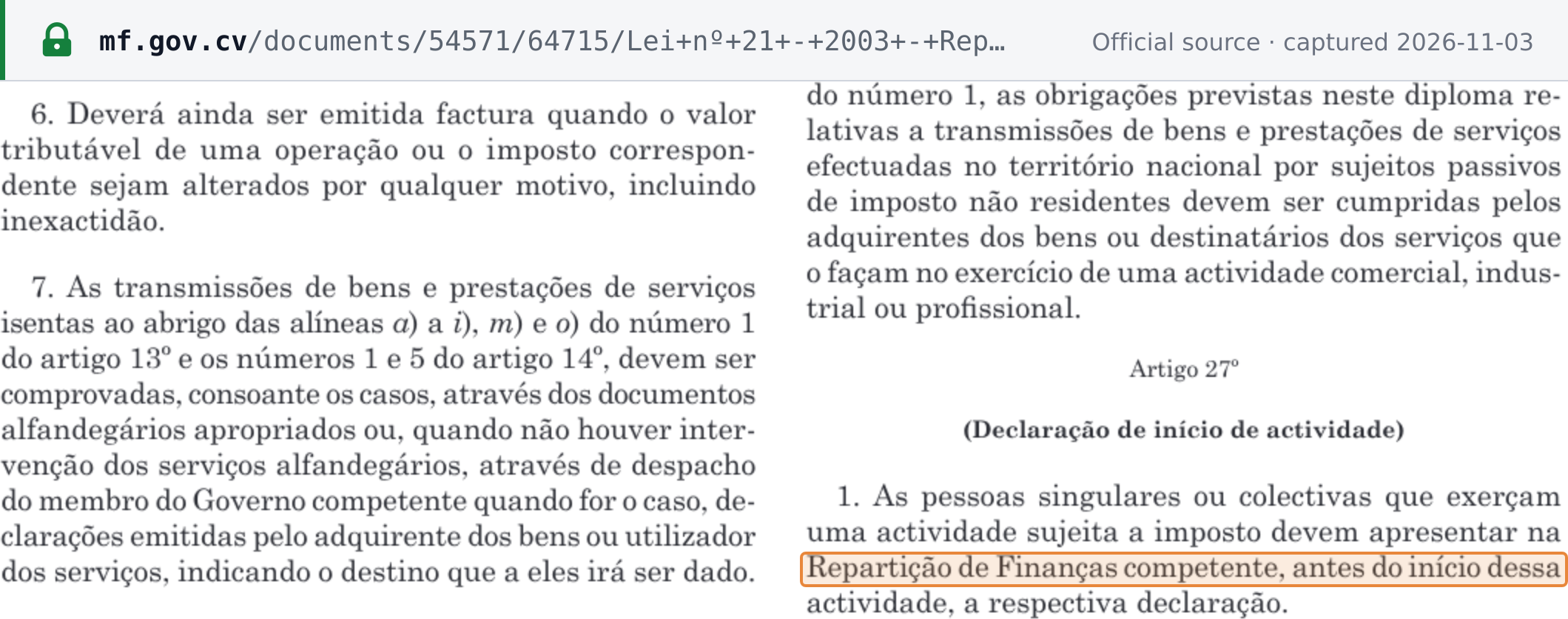
None (as at 2026-11-03). The Code sets no turnover threshold. Every person starting a taxable activity must declare it first. Article 27(1): "As pessoas singulares ou colectivas que exerçam uma actividade sujeita a imposto devem apresentar na Repartição de Finanças competente, antes do início dessa actividade, a respectiva declaração." (Natural or legal persons carrying on an activity subject to the tax must file the corresponding declaration with the competent tax office before starting that activity.)
The 2015 republication also removed the old exemption and simplified regimes. Lei 81/VIII/2015 article 3(1): "São revogados os artigos 47.º a 62.º e o n.º 4 do artigo 72.º, todos da Lei n.º 21/VI/2003…" (Articles 47 to 62 and article 72(4) of Lei 21/VI/2003 are revoked…). [1]
 Source snapshot captured 2026-11-03 — original
The nearest thing to a threshold is optional. The REMPE regime for micro and small enterprises uses turnover bands, but an enterprise enters it only on request and then pays a 4% unified tax instead of IVA (see Special regimes). REMPE is a substitute regime, not an IVA registration threshold.
Non-resident registration
No threshold for non-residents either. A non-resident without a permanent establishment that makes taxable supplies in Cabo Verde acts through a resident representative. Article 26(1): "…as obrigações derivadas da aplicação do presente diploma devem ser cumpridas por um representante residente no território nacional, munido de procuração com poderes bastantes. Neste caso, o representante responderá solidariamente com o representado pelo cumprimento de tais obrigações." (…the obligations must be met by a representative resident in the national territory, holding a sufficient power of attorney, who is jointly liable with the person represented.)
If no representative is appointed, the business customer steps in (article 26(3)): the obligations "devem ser cumpridas pelos adquirentes dos bens ou destinatários dos serviços que o façam no exercício de uma actividade comercial, industrial ou profissional." (must be met by the acquirers of the goods or recipients of the services acting in a commercial, industrial or professional activity.) Failing to appoint a representative is penalised (see Penalties). [1]
Tax identification number
The tax number is the NIF (Número de Identificação Fiscal). DNRE: "Todos os sujeitos passivos, com rendimentos sujeitos a impostos, ainda que dela sejam isentos, são obrigados a inscrever-se, na Repartição de Finanças do seu domicílio fiscal, mediante a apresentação do Mod. 110, devidamente preenchido em duplicado." (All taxable persons with income subject to tax, even if exempt from it, must register at the tax office of their fiscal domicile by filing Mod. 110, completed in duplicate.) The legal basis DNRE gives is Decreto-Lei 89/2005 of 26 December. [13]
- Format. Nine digits. The e-Fatura technical manual describes the NIF element of the document identifier as "Os 9 dígitos do NIF do emissor do DFE" (the 9 digits of the e-document issuer's NIF) and adds that "Carateres de formatação não são permitidos" (formatting characters are not allowed). The DNRE material and the manual do not publish a check-digit rule for the NIF. [9]
- Lookup. DNRE links a "CONSULTA NIF" service on the Porton di Nos Ilha portal; it opens a session-gated page rather than a public search.
How to register
DNRE describes the NIF service as "atualmente disponibilizado presencialmente, de forma gratuita, nos balcões das Repartições de Finanças e da Casa do Cidadão" (currently provided in person, free of charge, at the counters of the tax offices and the Casa do Cidadão). Residents bring an identity card; non-residents a passport; a non-resident legal entity brings proof of its legal existence in its home country, authenticated by the consulate and translated where needed. [13] The start-of-activity declaration under article 27 is then filed with the competent Repartição de Finanças before trading begins.
To issue invoices, a business must also be accredited on DNRE's e-Fatura platform (see E-invoicing status).
For the general process across countries, see how to register for VAT, sales tax or GST.
Voluntary registration
Not applicable as such, because there is no threshold: every taxable activity is registered. Two related options exist:
- A micro or small enterprise stays in the normal IVA regime simply by not requesting REMPE, which applies only "desde que requeiram" (provided they request it).
- Exempt farmers may renounce the exemption. Once they opt, "o sujeito passivo é obrigado a permanecer no regime por que optou durante um período de, pelo menos, cinco anos" (the taxable person must remain in the chosen regime for at least five years) (CIVA art. 11(3)). [1] [10]
Deregistration
- Cessation declaration within 30 days. Article 29: "No caso de cessação de actividade, deve o sujeito passivo, no prazo de 30 dias a contar da data de cessação, entregar a respectiva declaração na Repartição de Finanças competente." (On cessation, the taxable person must file the declaration with the competent tax office within 30 days of the cessation date.)
- Final return. The last periodic return is due within 30 days of cessation (art. 37(2)).
- Deemed cessation. Activity is deemed to have ceased after two consecutive years without taxable operations, and the goods remaining are then treated as supplied (art. 30(1)(a)). The tax administration may also declare cessation ex officio (art. 30(2)). [1]
Group registration
Not available. The Code (2015 republication and the budget-law amendments to 2026) contains no VAT-group provision. The only related rule is centralised bookkeeping: "Os contribuintes que distribuam a sua actividade por mais de um estabelecimento devem centralizar num deles a escrituração relativa às operações realizadas em todos." (Taxpayers operating from more than one establishment must centralise the bookkeeping for all of them in one) (art. 63(1)). [1]
Rates
| Rate | Applies to | Basis |
|---|---|---|
| 15% (standard) | All taxable supplies and imports not exempt | CIVA art. 17(1) |
| 8% | Supply of electricity and of water to final consumers; set in each annual budget law since 2022 | Lei 69/X/2025 (budget 2026) art. 84 |
| 2.5% (special) | Butane gas | Recorded in the Lei 69/X/2025 tax-expenditure report; art. 85 keeps the special regime for goods at administratively fixed prices |
| Exempt with deduction | Exports, international and inter-island passenger transport | CIVA art. 13 |
| Exempt without deduction | Health, education, finance, insurance, residential letting, listed essential goods and more | CIVA art. 9 |
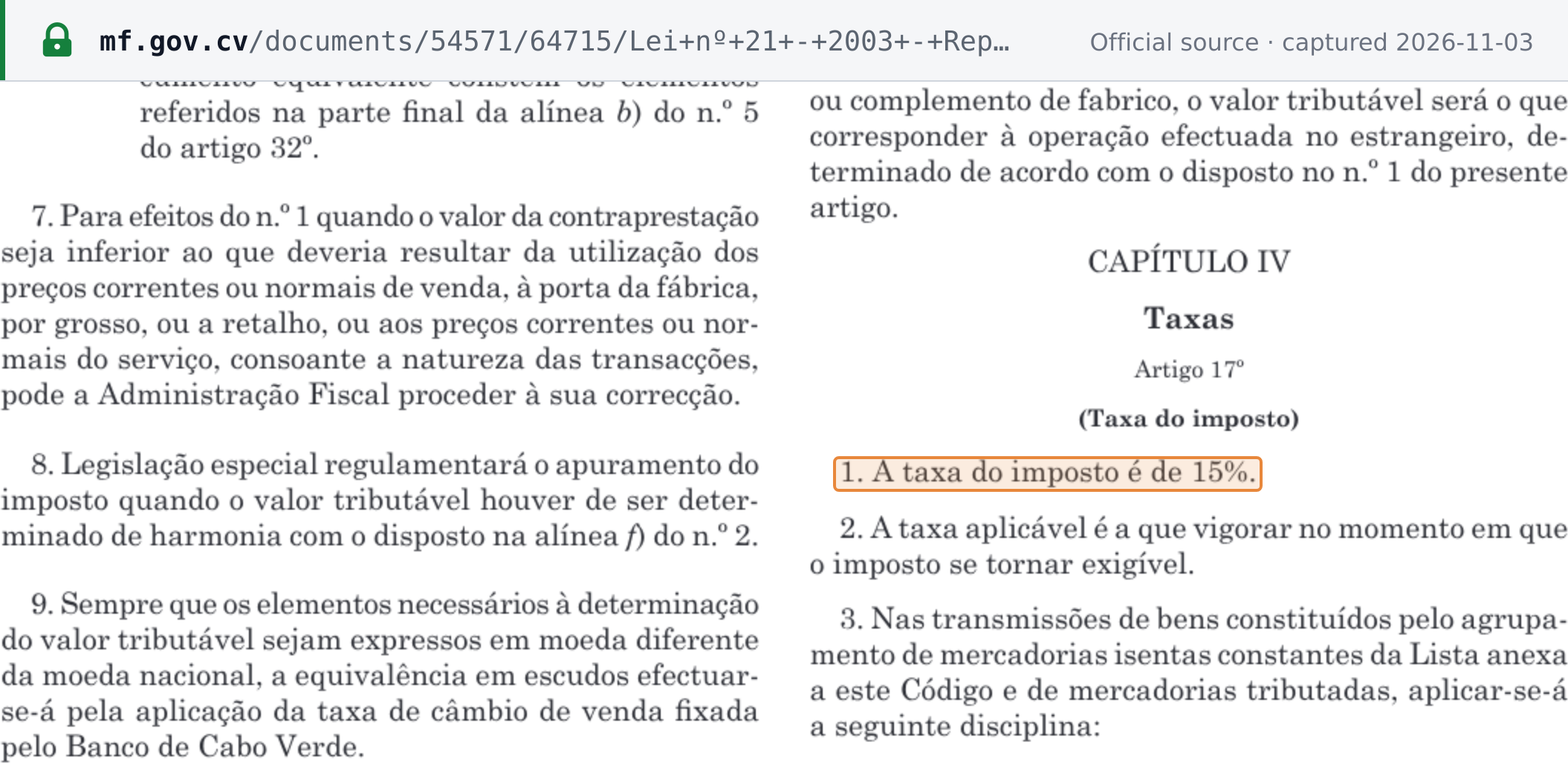
Standard rate: 15% (as at 2026-11-03), in force since 1 January 2004. Article 17: "(Taxa do imposto) 1. A taxa do imposto é de 15%. 2. A taxa aplicável é a que vigorar no momento em que o imposto se tornar exigível." (1. The tax rate is 15%. 2. The applicable rate is the one in force when the tax becomes chargeable.) Where a price includes tax, the taxable amount is found by "divisão daqueles valores por 115, multiplicando o quociente por 100" (dividing by 115 and multiplying the quotient by 100) (art. 43). The budget laws for 2022, 2023, 2024 and 2026 amend other articles of the Code and leave article 17 unchanged; the budget law for 2025 (Lei 45/X/2024) does not amend the Code. [1] [18]
 Source snapshot captured 2026-11-03 — original
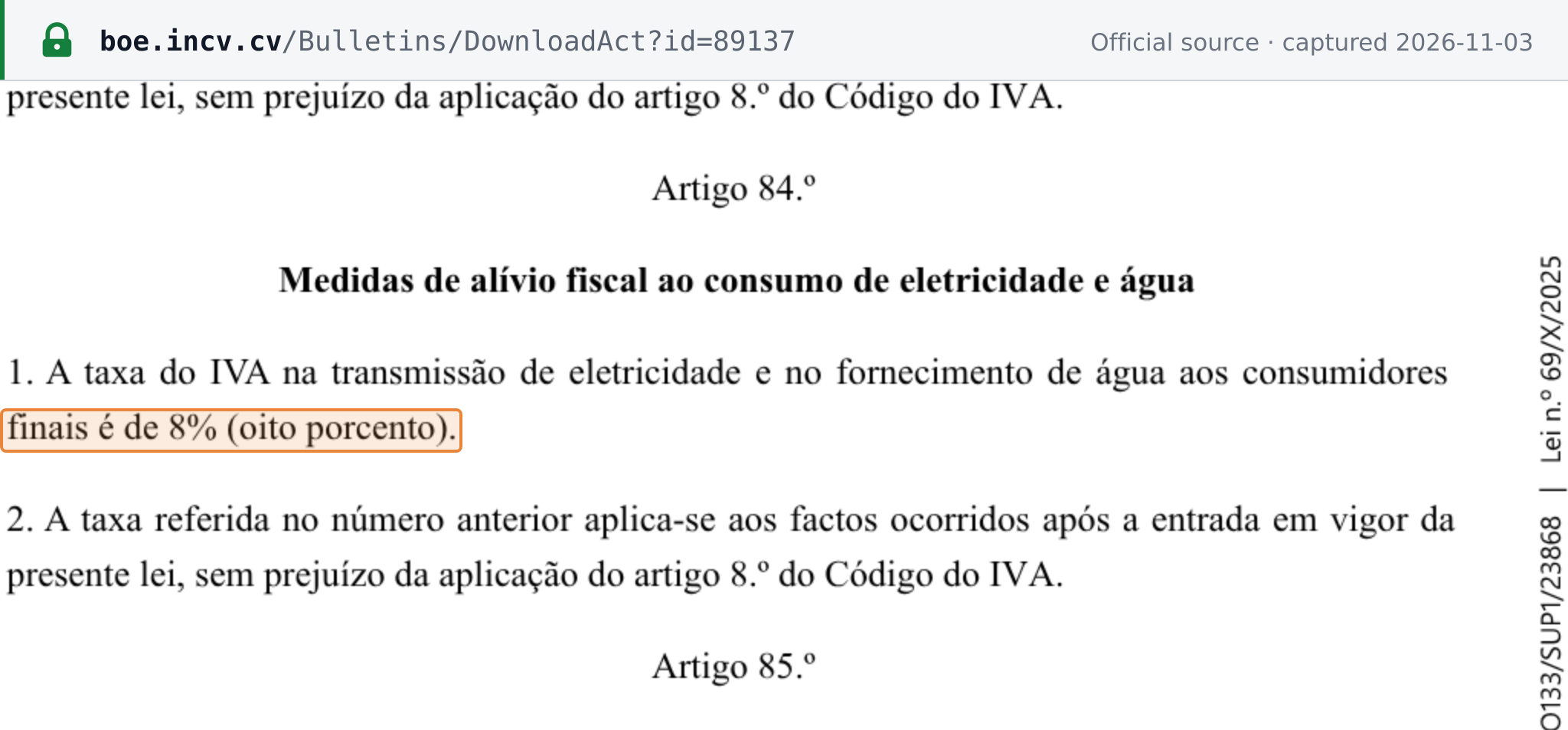
8% on electricity and water to final consumers. This is a budget-law measure, not a rate in the Code, and each annual budget law since 2022 has re-enacted it: Lei 4/X/2021 (budget 2022) art. 48, Lei 16/X/2022 (budget 2023), Lei 35/X/2023 (budget 2024) art. 75 and Lei 45/X/2024 (budget 2025) art. 73. For 2026 the rate is in Lei 69/X/2025 (State Budget 2026, Boletim Oficial I Série nº 133/1, 31 December 2025), article 84 ("Medidas de alívio fiscal ao consumo de eletricidade e água"): "1. A taxa do IVA na transmissão de eletricidade e no fornecimento de água aos consumidores finais é de 8% (oito porcento). 2. A taxa referida no número anterior aplica-se aos factos ocorridos após a entrada em vigor da presente lei, sem prejuízo da aplicação do artigo 8.º do Código do IVA." (1. The VAT rate on the supply of electricity and of water to final consumers is 8% (eight percent). 2. The rate applies to facts occurring after this law enters into force, without prejudice to article 8 of the VAT Code.) [2]
 Source snapshot captured 2026-11-03 — original
2.5% on butane gas. Article 85 of Lei 69/X/2025 keeps a special IVA regime for goods and services whose prices are fixed by an administrative authority: "Até à aprovação, pela Assembleia Nacional, do Regime Especial de Aplicação do IVA nas transmissões de bens e serviços, sujeitos a preços fixados por autoridade administrativa, mantém-se em vigor o regime especial estipulado nos artigos 50.º e 61.º do Capítulo VII, da Lei de Aprovação do Orçamento do Estado de 2008, alterado pela Lei do Orçamento do Estado de 2013." (Until the National Assembly approves a special regime for VAT on goods and services at administratively fixed prices, the special regime of articles 50 and 61 of the 2008 State Budget law, as amended by the 2013 budget law, stays in force.) The same law's tax-expenditure report (BO page 159, paragraph 148) names "as modalidades de Taxa Especial do IVA de 2,5% (aplicada ao gás-butano)" (the 2.5% special IVA rate, applied to butane gas). It also records that the 10% reduced rate formerly applied to accommodation and restaurants was "descontinuada" (discontinued). [2]
Reduced rates in the Code. Article 17 of the Code sets only the 15% rate; the 8% and 2.5% rates rest on budget laws. Other relief takes the form of exemptions (see Exemptions), including a list of essential goods (art. 9(28)) that the budget laws revise each year — Lei 69/X/2025 article 32(1), for instance, removes goods from that list ("São retirados os bens constantes da Lista Anexa…").
Announced future rates. The State Budget 2027 bill (Proposta de Lei do Orçamento do Estado para 2027, "Aprovada em Conselho de Ministros do dia 29 de setembro de 2026" — approved by the Council of Ministers on 29 September 2026) would renew the 8% rate for 2027 and extend its wording to taxable persons as well as final consumers: "A taxa do IVA na transmissão de energia elétrica e na transmissão de água é de 8% e é aplicável aos sujeitos passivos do imposto e aos consumidores finais." (The VAT rate on the supply of electricity and of water is 8% and applies to taxable persons and final consumers.) This is a bill, not law; no adoption had been published in the Boletim Oficial as at 2026-11-03. [16] See event.
See worldwide tax rates for other countries.
Cross-border rules
Imports and exports
- Imports of goods. Imports are taxable (art. 1(1)(b)). The tax becomes chargeable "Nas importações, no momento estabelecido pelas disposições aplicáveis aos direitos aduaneiros, sejam ou não devidos esses direitos" (on imports, at the time set by the rules on customs duties, whether or not those duties are due) (art. 7(1)(c)), and it is collected by the customs administration. To deduct import IVA, the importer needs the customs receipt (art. 18(2)). [1]
- Small non-commercial parcels. Lei 31/VI/2003 exempts goods in "pequenas remessas sem carácter comercial, expedidas do estrangeiro por um particular com destino a outro particular que se encontre no território nacional" (small non-commercial consignments sent from abroad by one private individual to another in the national territory). The law sets no CVE amount of its own; it refers to the customs franchise. [17]
- Exports. Exempt with the right to deduct. Article 13(1)(a) exempts "As transmissões de bens expedidos ou transportados com destino ao estrangeiro pelo vendedor ou por um terceiro por conta deste" (supplies of goods dispatched or transported abroad by the seller or a third party on its behalf), and article 19(1)(b) keeps the deduction for these operations. Proof is the customs document (art. 25(7)).
- Passenger transport. Article 13(1)(n) exempts "O transporte de pessoas provenientes ou com destino ao estrangeiro, bem como o transporte de pessoas entre as ilhas que integram o território nacional" (the transport of persons from or to abroad, and between the islands of the national territory).
Reverse charge on imported services
General rule. Services are taxed where the supplier has its seat, permanent establishment or domicile (art. 6(3)), with fixed-place exceptions for immovable property, work on movable goods, events and transport (art. 6(5)).
Listed services from abroad are taxed in Cabo Verde, and the customer pays. Article 6(6): "São ainda tributáveis as prestações de serviços a seguir enumeradas, cujo prestador não tenha no território nacional sede, estabelecimento estável ou domicílio a partir do qual o serviço seja prestado, sempre que o adquirente seja um sujeito passivo do imposto… cuja sede, estabelecimento estável ou domicílio se situe no território nacional, e ainda que pratique exclusivamente operações isentas sem direito a dedução" (The following services are also taxable where the supplier has no seat, permanent establishment or domicile in the national territory from which the service is supplied, whenever the customer is a taxable person established in the national territory, even one making only exempt supplies). The list covers intellectual property and licences, advertising, telecommunications, consultancy, engineering, legal and accounting services, data processing and supply of information, banking, financial and insurance services, staff supply, intermediaries, non-competition undertakings and the hire of movable goods.
For those services, article 2(2) makes the customer the taxable person. The customer self-assesses, deducts the same IVA where it has deduction rights (art. 18(1)(c)), and pays with its return (art. 23(2)). The supplier's invoice must carry the words "IVA – autoliquidação" (art. 32(12)). [1] See reverse charge explained.
Domestic reverse charge on construction. A business customer with full or partial deduction rights that buys "serviços de construção civil, incluindo a remodelação, reparação, manutenção, conservação e demolição de bens imóveis, em regime de empreitada ou subempreitada" (construction services, including renovation, repair, maintenance, conservation and demolition of immovable property, under contract or subcontract) is the taxable person (art. 2(1)(f)). The invoice again says "IVA – autoliquidação".
Digital products and services
B2B. Telecommunications, data processing and the supply of information are on the article 6(6) list, so a Cabo Verde business customer self-assesses them as above.
B2C: a 2022–2023 regime whose current status is unclear. The budget laws for 2022 (Lei 4/X/2021, arts 58–75) and 2023 (Lei 16/X/2022, arts 85 onwards) enacted a "Regime especial do IVA no comércio eletrónico". Under the 2022 text:
- It covered "operações de comércio eletrónico internacional, desde que realizadas através de plataforma eletrónica, portal ou outro interface similar: a) As vendas à distância de bens, com origem fora do território nacional; b) As prestações de serviços, cujo prestador não tenha sede, estabelecimento estável ou domicílio em território nacional" (art. 59(1)), excluding consignments over CVE 10,000 and excise goods (art. 59(2)).
- Supplies were located in Cabo Verde where the customer is established there "ou o pagamento tenha origem no País ou seja intermediado por instituição financeira nele estabelecida" (or the payment originates in the country or is intermediated by a financial institution established there) (art. 60(1)).
- The taxable persons were only "as entidades que integrem a lista de grandes operadores do comércio eletrónico a elaborar pelo Ministério das Finanças" (the entities on the list of large e-commerce operators to be drawn up by the Ministry of Finance) (art. 62(1)), filing a simplified quarterly return (art. 64(1)). For listed operators outside the regime, banks would collect the IVA on payments (art. 71(1)). [3] [4]
The regime sits in the budget laws, not in the Code, and the budget laws for 2024, 2025 and 2026 and the 2027 bill do not restate it. DNRE's legislation library publishes no list of large operators. No later law sets a registration duty for non-resident B2C digital sellers. See VAT on digital services by non-resident suppliers.
Foreign companies selling into Cabo Verde — B2B and B2C
- B2B services. For article 6(6) services the Cabo Verde business customer self-assesses; the foreign supplier does not register and invoices with "IVA – autoliquidação". For other taxable supplies in Cabo Verde the foreign supplier appoints a resident representative (art. 26(1)), failing which the business customer meets the obligations (art. 26(3)).
- B2C. A non-resident making taxable supplies in Cabo Verde to consumers has no customer who can account for the tax, so it must act through a resident representative (art. 26(1)). There is no threshold. For e-commerce, see the status caveat above.
- Goods. IVA on imported goods is collected at customs from the importer.
Marketplace / platform deemed-supplier liability
No deemed-supplier rule. The Code (2015 text and the amendments to 2026) contains no rule making a marketplace the supplier. The 2022–2023 e-commerce regime above made listed large operators themselves liable; it did not make platforms liable for other sellers' supplies. See marketplace deemed-supplier rules.
Place of supply
- Goods. Taxable in Cabo Verde when the goods are "situados no território nacional no momento em que se inicia o transporte ou a expedição para o adquirente" (located in the national territory when transport or dispatch to the customer begins) or, without transport, when they are made available to the customer (art. 6(1)). Imports are taxed at customs.
- Services. The supplier's location (art. 6(3)), with the fixed-place exceptions of article 6(5) and the customer-location rule for the article 6(6) list. The same listed services supplied by a Cabo Verde supplier to a customer established abroad are outside the scope (art. 6(7)). [1]
Invoice requirements
An invoice for every supply. Article 25(1)(b) obliges taxable persons to "Emitir uma factura obrigatoriamente por cada transmissão de bens ou prestação de serviços, ainda que não solicitado pelo adquirente, bem como pelo pagamento que lhes sejam efectuados antes da data da transmissão de bens ou da prestação de serviços." (issue an invoice for every supply of goods or services, even if the customer does not ask for one, and for payments received before the supply.) Since the 2026 budget law, invoices and fiscally relevant documents "devem ser emitidos obrigatoriamente por via eletrónica" (must be issued electronically) (CIVA art. 32, as amended by Lei 69/X/2025 art. 32). [1] [2]
Mandatory content
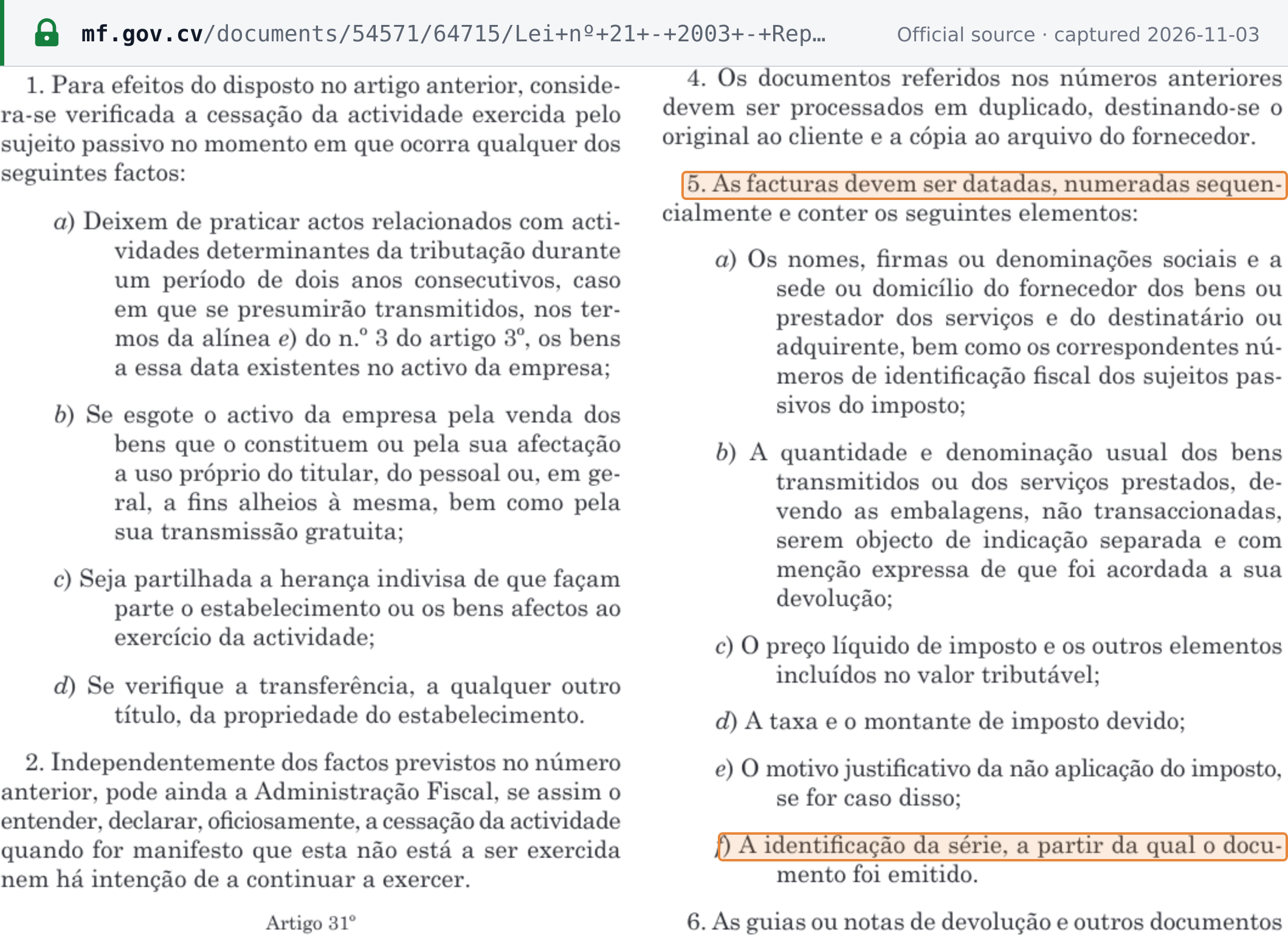
Article 32(5) of the Code, as amended in 2015, 2022 and 2026: invoices "devem ser datadas, numeradas sequencialmente e conter os seguintes elementos" (must be dated, sequentially numbered and contain the following): [1] [3] [2]
 Source snapshot captured 2026-11-03 — original. Points (g) to (j) in the table below were added by the 2022 and 2026 budget laws.
| # | Particular (art. 32(5)) | Source of the wording |
|---|---|---|
| — | Date and sequential number | 2015 text, chapeau |
| (a) | "Os nomes, firmas ou denominações sociais e a sede ou domicílio do fornecedor dos bens ou prestador dos serviços e do destinatário ou adquirente, bem como os correspondentes números de identificação fiscal dos sujeitos passivos do imposto" — names, addresses and NIFs of supplier and customer | 2015 text |
| (b) | Quantity and usual description of the goods or services | 2015 text |
| (c) | "O preço líquido de imposto e os outros elementos incluídos no valor tributável" — price net of tax and the other elements of the taxable amount | 2015 text |
| (d) | "A taxa e o montante de imposto devido" — rate and amount of IVA | 2015 text |
| (e) | "O motivo justificativo da não aplicação do imposto, se for caso disso" — the reason no tax is charged, where applicable | 2015 text |
| (f) | "A identificação da série, a partir da qual o documento foi emitido" — the invoice series | 2015 text |
| (g) | Date of supply or advance payment, if different from the issue date | Lei 4/X/2021 (budget 2022) |
| (h) | "O Local de Emissão do Documento (LED) e a Unidade de Medida (UM)" — place of issue and unit of measure | Lei 4/X/2021 (budget 2022) |
| (i) | "Código pautal aduaneiro" — customs tariff code | Lei 69/X/2025 (budget 2026) |
| (j) | "Código fiscal de operações e prestações, bem como o código de produtos" — fiscal operation code and product code, as set by Portaria | Lei 69/X/2025 (budget 2026; printed as a second "a)") |
Additional particulars:
- QR code and IUD. "As faturas e os documentos fiscalmente relevantes eletrónicos devem conter um QR Code e um Identificador Único de Documento (IUD) nos termos da legislação em vigor." (Electronic invoices and fiscally relevant documents must carry a QR Code and a Unique Document Identifier (IUD).) (art. 32(17), added by Lei 69/X/2025.)
- Non-resident supplier. The invoice shows the resident representative's NIF, name and address (art. 32(11)).
- Reverse charge. "IVA – autoliquidação" (art. 32(12)).
- REMPE enterprise. "Tributo Especial Unificado", with no IVA (REMPE art. 28(3)).
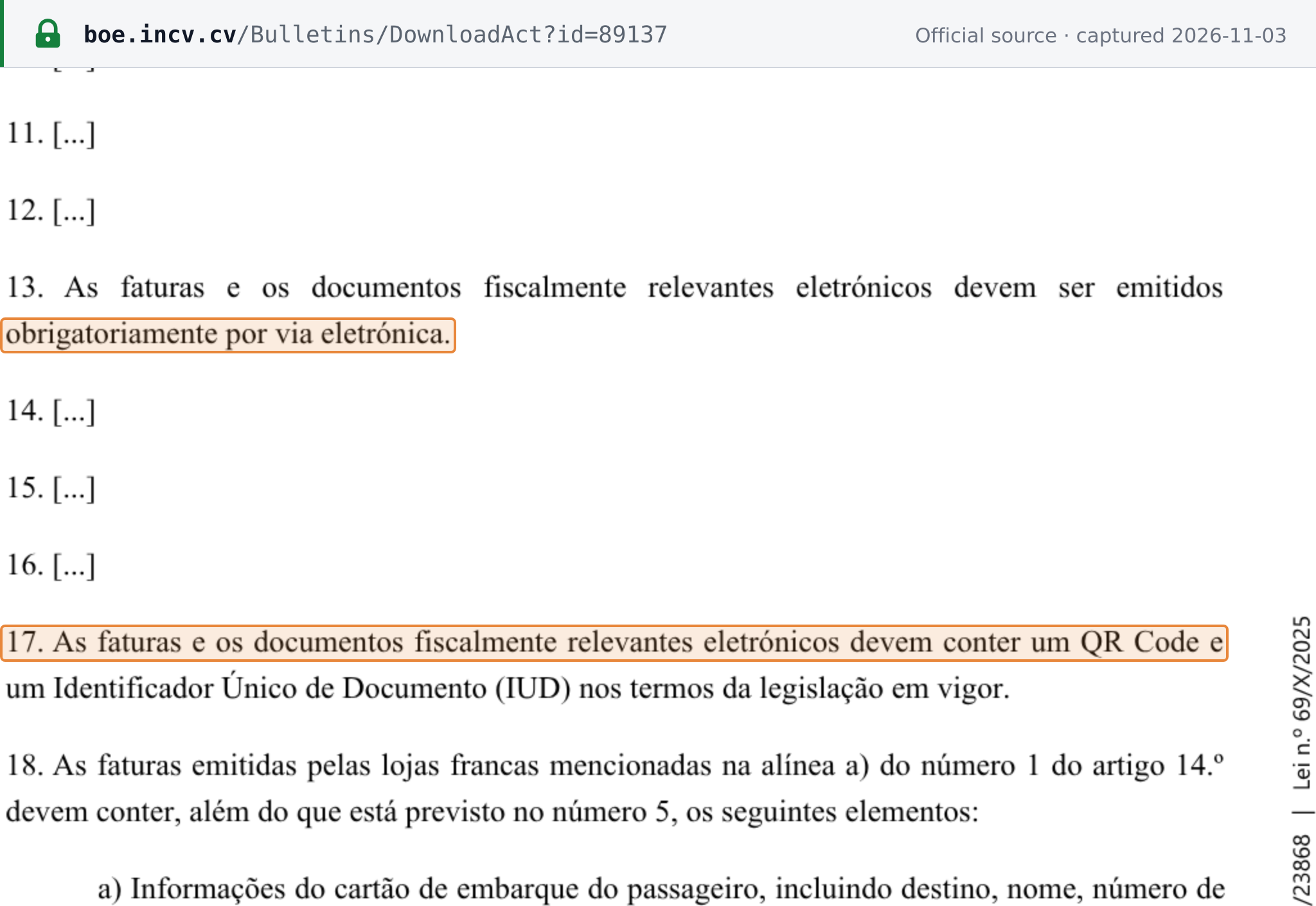 Source snapshot captured 2026-11-03 — original
Buyer's evidence for deduction. Since the 2024 budget law, "consideram-se passadas na forma legal as faturas emitidas por via eletrónica, por sujeitos passivos, enquadrados no regime normal e que contenham os elementos previstos no número 5, do artigo 32.º" (invoices count as issued in legal form when issued electronically by normal-regime taxable persons and containing the article 32(5) particulars) (CIVA art. 18(6), as amended by Lei 35/X/2023). [5]
Issuance deadline
By the fifth business day. Article 32(1): "A factura referida no artigo 25º deve ser emitida o mais tardar no quinto dia útil seguinte ao do momento em que o imposto é devido nos termos do artigo 7º. Todavia, no caso de pagamentos relativos a uma prestação de serviços ainda não efectuada, a data da emissão do documento comprovativo coincidirá sempre com a do recebimento de tal montante." (The invoice must be issued at the latest on the fifth business day after the tax becomes due under article 7; for payments for services not yet performed, the document is issued on the date the amount is received.) Periodic global invoices, allowed on prior notice with a delivery note per transaction, are due by the fifth business day after the period (art. 25(5), art. 32(2)). [1]
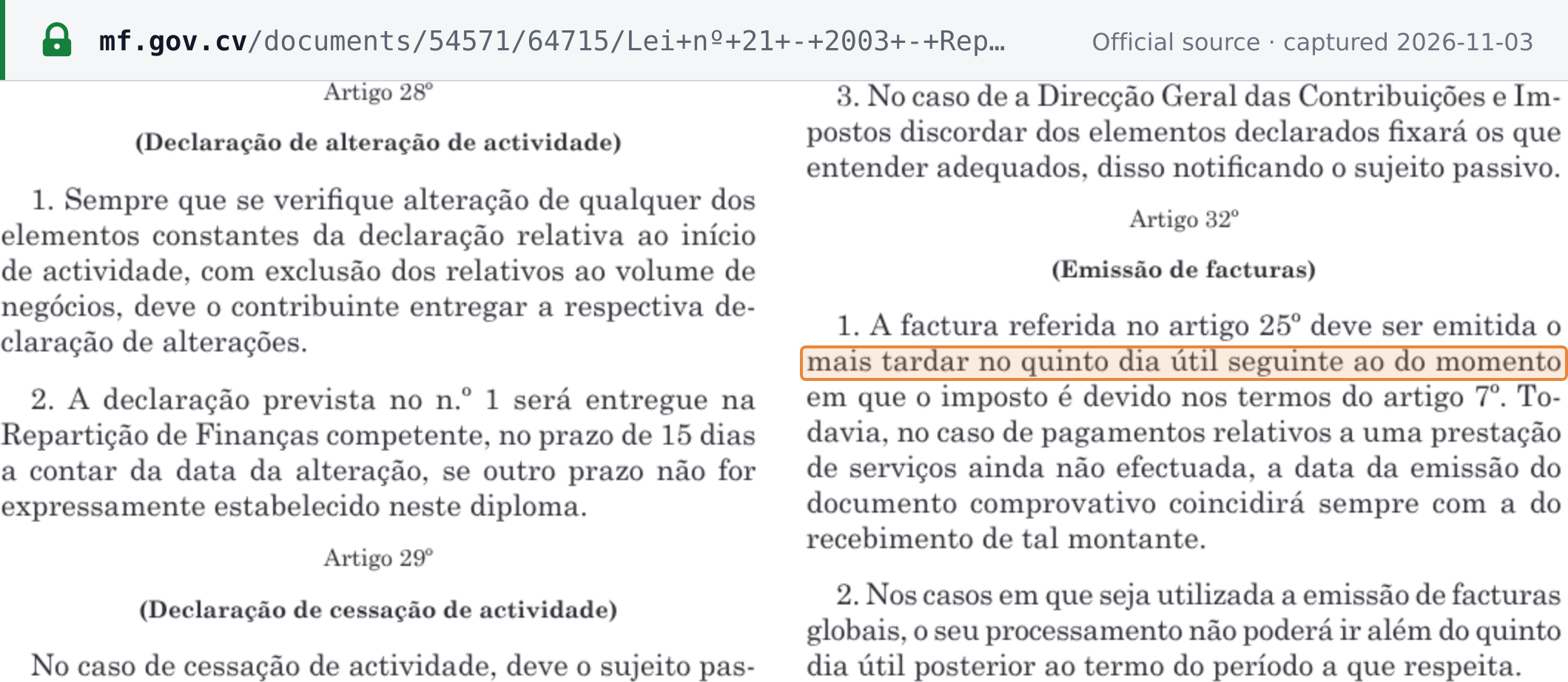 Source snapshot captured 2026-11-03 — original
IVA becomes chargeable when the invoice is issued if the deadline is met, and otherwise when the deadline expires (art. 8(1)).
Numbering and sequencing
Invoices are numbered sequentially within one or more series (art. 32(5)), each series identified on the document (art. 32(5)(f)). Under e-Fatura the document number must run without gaps: "Deve ser cronologicamente sequencial sem saltos no meio, ou seja, ao emitir um DFE com nº N dentro da combinação (NIF, Ano, LED, Tipo de Documento), deve existir no SFECV um outro DFE com nº N – 1 dentro da mesma combinação, exceto para N = 1." (It must be chronologically sequential with no gaps: when issuing document N within a given NIF, year, place of issue and document type, document N – 1 must already exist, except for N = 1.) And "A cada ano deve-se reiniciar o Nº de Documento" (the document number restarts each year). [9]
Credit and debit notes
- Content. Article 32(6): "As guias ou notas de devolução e outros documentos rectificativos de facturas devem conter, além da data e numeração sequencial, os elementos a que se refere a alínea a) do número 5, bem como a referência à factura a que respeitam e as menções desta que são objecto de alterações." (Return notes and other corrective documents must carry the date, a sequential number, the parties' particulars under paragraph 5(a), a reference to the invoice they correct and the entries changed.) Returns are documented by a nota de devolução within five business days (art. 32(3)).
- Adjustments. A supplier that reduces the taxable amount may deduct the IVA up to the end of the following period, provided it can show the customer was reimbursed (art. 65(2) and (5)). Under-charged IVA must be corrected by the end of the following period (art. 65(3)).
- Customer response. Under the e-invoice regime, the recipient's response to an e-document is optional, "salvo quando se trate de documentos retificativos, que levem à redução do valor tributável" (except for corrective documents that reduce the taxable amount) (DL 79/2020 art. 8(2)). [1] [6]
- E-document types. Credit note (NCE, type 5), debit note (NDE, type 6) and return note (DVE, type 8) — see Document types.
Currency and language
Decree-Law 79/2020 article 6(2): "As faturas e documentos fiscalmente relevantes devem ser emitidos na língua oficial do Estado de Cabo Verde, podendo os valores ser representados em qualquer moeda, desde que sejam também obrigatoriamente em escudos." (Invoices must be issued in the official language of Cabo Verde; amounts may be shown in any currency provided they are also, mandatorily, in escudos.) The e-Fatura manual adds that "A moeda dos DFEs é sempre CVE" (the currency of e-documents is always CVE), with the Banco de Cabo Verde rate recorded at issue. [6] [9]
Conversion rule. Article 15(9)–(10) of the Code: foreign-currency amounts are converted "pela aplicação da taxa de câmbio de venda fixada pelo Banco de Cabo Verde" (at the Banco de Cabo Verde selling rate), and taxable persons "podem optar entre a adopção da taxa do dia em que se verificou a exigibilidade do imposto ou a do primeiro dia útil do respectivo mês" (may choose the rate of the day the tax became chargeable or that of the first business day of the month).
Document types
The e-Fatura document types are: "1 = Fatura Eletrónica; 2 = Fatura-Recibo Eletrónica; 3 = Talão de Venda Eletrónico; 4 = Recibo Eletrónico; 5 = Nota de Crédito Eletrónica; 6 = Nota de Débito Eletrónica; 7 = Documento de Transporte Eletrónico; 8 = Nota de Devolução; 9 = Nota de Lançamento." [9]
- Retailers' invoices. "Nas facturas emitidas por retalhistas e prestadores de serviços pode indicar-se apenas o preço com inclusão de imposto e a taxa" (retailers and service providers may show only the tax-inclusive price and the rate) (art. 35).
- Receipts instead of invoices (art. 36). For a private customer paying cash, no invoice is needed for retail and street sales, vending machines, services usually evidenced by a ticket, and "Outras prestações de serviços cujo valor seja inferior a 1 000$00" (other services under CVE 1,000). A talão de venda (sales receipt) must still be issued (art. 36(2)) — in e-Fatura, the Talão de Venda Eletrónico (type 3). If the customer asks for its NIF on the receipt, "essa inserção é obrigatória" (inserting it is mandatory) (art. 36(8), added in 2022). A business buyer needs a full invoice to deduct (art. 36(4)). [1] [3]
- Consignment. Invoiced within five business days of dispatch, in "uma série especial de faturação" marked "Venda à consignação" (art. 34).
- A PDF is not an e-invoice. DNRE's e-Fatura FAQ: "Não são considerados fatura eletrónica ou documento fiscalmente relevante eletrónico, os enviados aos seus destinatários, em formato PDF, por correio eletrónico (e-mail)." (Documents sent to their recipients as PDF by e-mail are not e-invoices or electronic fiscally relevant documents.) [15]
Self-billing
Permitted, on conditions (CIVA art. 32, as amended by Lei 35/X/2023, budget 2024): "A elaboração de faturas pelo próprio adquirente dos bens ou dos serviços deve obedecer às seguintes condições: a) Existência de um acordo, previamente estabelecido, entre o sujeito passivo transmitente dos bens ou prestador dos serviços e o adquirente ou destinatário dos mesmos; b) O adquirente deve provar que o transmitente dos bens ou prestador dos serviços tomou conhecimento da emissão da fatura e aceitou o seu conteúdo; e c) Deve ser emitida numa série especial de faturação e conter a menção “autofaturação”." (Self-billing requires a prior agreement between supplier and customer; proof that the supplier knew of and accepted the invoice; and a special invoice series marked "autofaturação".) The procedures are left to a Portaria. [5]
Retention and audit trail
- Retention: five years. Article 45: "Os sujeitos passivos são obrigados a arquivar e conservar em boa ordem durante os cinco anos civis subsequentes todos os livros, registos e respectivos documentos de suporte, incluindo, quando a contabilidade é estabelecida por meios informáticos, os relativos à análise, programação e execução dos tratamentos." (Taxable persons must keep all books, records and supporting documents in good order for the five following calendar years, including, for computerised accounts, the documentation of analysis, programming and processing.)
- Electronic-only archive. DL 79/2020 article 10(1): "As faturas e demais documentos fiscalmente relevantes emitidos e recebidos por via eletrónica devem ser conservados, sem alterações, por ordem cronológica de emissão e receção, exclusivamente em formato eletrónico." (Electronically issued and received invoices must be kept unaltered, in chronological order, exclusively in electronic format.)
- Tamper-evidence. Billing systems must provide integrity controls, backups and "A impossibilidade de continuação da utilização do sistema quando se verifiquem alterações à informação gerida ou utilizada no sistema que possam colocar em causa a integridade, a exatidão e a fiabilidade da informação" (blocking further use of the system when data is altered in a way that compromises its integrity, accuracy and reliability) (DL 79/2020 art. 9(2)(c)). An authorised document cannot be altered (art. 7(3)). Where the system is hosted abroad, access must be given from Cabo Verde (art. 12(3)).
- Certified software (2026). Taxable persons must "Utilizar programas informáticos certificados pela Administração Tributária para elaborar registos contabilísticos e processar fatura eletrónica e documentos fiscalmente relevantes eletrónicos" (use software certified by the tax administration for accounting records and e-invoices) (CIVA art. 25(1)(f)), and the software must ensure that e-documents "não sejam alteradas após autorização do seu uso pela Administração Tributária" (are not altered after the tax administration authorises their use) (art. 39(5)), both as amended by Lei 69/X/2025. [1] [6] [2]
A specimen of a compliant invoice
DNRE publishes its own model printed documents in the Manual Técnico da Fatura Eletrónica, version 11.0, section 6.13: "Os seguintes modelos de DFA, devem ser impressos pelos sistemas de faturação caso o cliente solicitar um documento que facilita a identificação posterior do DFE na PE. Em modo de contingência o emissor deve obrigatoriamente fornecer um DFA ao seu cliente. Se o cliente solicitar a impressão de um DFE completo, esse deve conter também as informações indicadas nos modelos de DFA, inclusive o QRCode." (Billing systems must print the following model auxiliary documents (DFA) when the customer asks for a document that helps identify the e-document on the platform. In contingency mode the issuer must give the customer a DFA. If the customer asks for a full print of the e-document, it must also contain the information shown in the DFA models, including the QR code.) [9]
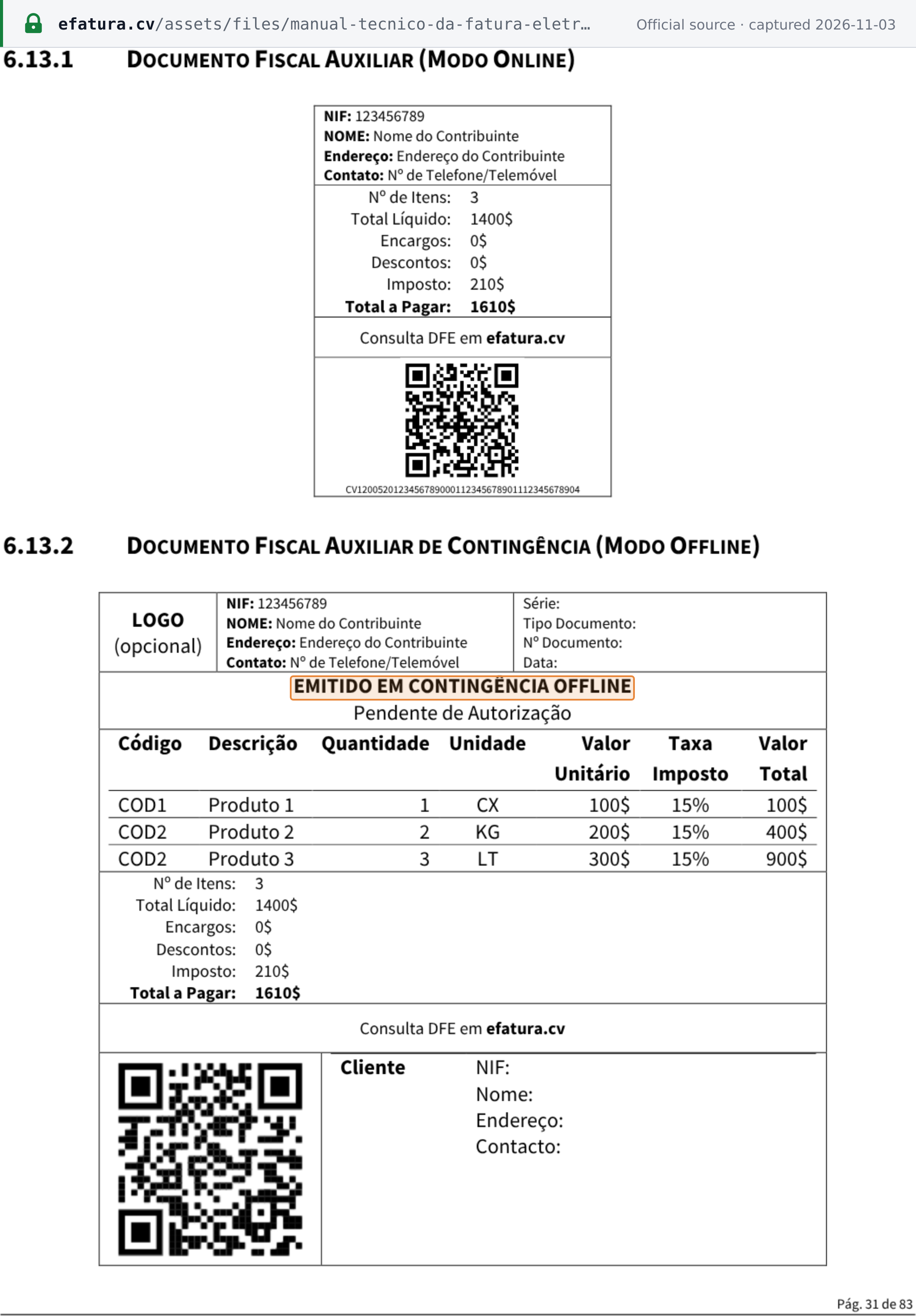 Source snapshot captured 2026-11-03 — original. DNRE's placeholders: the NIF, names, products and IUD are dummies.
How to read it:
- The arithmetic. Three lines (100$ + 400$ + 900$) give a Total Líquido of 1400$; IVA at 15% is 210$; the Total a Pagar is 1610$. IVA is added to net prices, the layout article 32(5)(c)–(d) describes.
- The IUD. The string under the online model's QR code is a 45-character Identificador Único de Documento. The manual builds it from the country code, repository, date, the issuer's 9-digit NIF, the place of issue (LED), document type and number, a random code and a check digit.
- The QR code. It must hold a URL "no formato https://pe.efatura.cv/dfe/view/IUD, onde IUD é o código de 45 carateres do DFE" (in the format https://pe.efatura.cv/dfe/view/IUD, where IUD is the e-document's 45-character code), so the buyer can look the document up.
- The contingency banner. "EMITIDO EM CONTINGÊNCIA OFFLINE / Pendente de Autorização" marks a document issued while the platform was unreachable. On the following page of the manual the model ends with the legend "Este documento não confere direito a dedução de imposto, enquanto o documento associado não for transmitido e autorizado pela Administração Fiscal." (This document gives no right to deduct tax until the associated document is transmitted to and authorised by the tax administration.)
What the DFA models leave out. They are auxiliary documents, not a full invoice. A complete invoice must still carry every article 32(5) particular listed under Mandatory content, including the customer's NIF and address, the place of issue, units, the customs tariff code and the fiscal operation and product codes.
E-invoicing status
Status (as at 2026-11-03): mandatory, with pre-authorisation clearance on DNRE's e-Fatura platform. DNRE's e-Fatura site: "São obrigados a processar faturas eletrónicas ou documento fiscalmente relevante eletrónico todos os sujeitos passivos, previamente credenciados pela Administração tributária." (All taxable persons, once accredited by the tax administration, must process electronic invoices or electronic fiscally relevant documents.) Since the 2026 budget law the Code itself requires electronic issuance (CIVA art. 32, as amended by Lei 69/X/2025). [14] [2]
- Legal base. Decreto-Lei 79/2020 of 12 November 2020 (the e-invoice regime), Portaria 74/2020 of 28 December 2020 (phased adoption) and Despacho 43/2022 of 11 April 2022 (processing requirements).
- Model: clearance. DL 79/2020 article 7(1): "A fatura e documentos fiscalmente relevantes devem ser submetidos eletronicamente à Administração Tributária, para efeitos de prévia autorização do seu uso e posterior emissão e colocação à disposição do destinatário." (Invoices must be submitted electronically to the tax administration for prior authorisation of their use, before issue and delivery to the recipient.) [6] See CTC e-invoicing models.
- System and network. DNRE's e-Fatura platform (pe.efatura.cv; documentation at efatura.cv), a single government platform, not Peppol. DNRE offers a free public issuing application (Emissor Público) besides connections from businesses' own certified software.
- Format and signature. Despacho 43/2022 article 2(1): documents "devem ser representados em formato XML (Extensible Markup Language), com estrutura própria de Cabo Verde" (must be in XML, with a Cabo Verde-specific structure). Article 3: they "devem ser assinados pelos sujeitos passivos, com assinatura digital válida, certificada por entidade credenciada pela Infraestrutura de Chaves Públicas de Cabo Verde – ICP-CV" (must carry a valid digital signature certified by an ICP-CV accredited entity). Each document has a 45-character IUD. [8]
- Printed representation. "As representações impressas dos DFEs devem conter um IUD (Identificador Único de Documento) e um QR Code para facilitar a consulta pública e a referência em outros documentos." (Printed e-documents must carry an IUD and a QR code for public lookup.) [14] See the specimen.
- Contingency. DL 79/2020 article 4(1)–(2): "Em caso de inoperacionalidade do sistema informático que impossibilite a faturação por via eletrónica, os sujeitos passivos podem emitir faturas ou documentos fiscalmente relevantes, em contingência. 2- As faturas ou documentos fiscalmente relevantes emitidos em contingência devem ser posteriormente submetidos à Administração Tributária, para efeitos de autorização." (If the system is down, documents may be issued in contingency and must be submitted later for authorisation.)
- Scope. B2B, B2C (the Talão de Venda Eletrónico) and B2G alike.
Phase timeline (Portaria 74/2020). Voluntary adoption from 4 January 2021 (art. 4: "Todos os sujeitos passivos podem, a partir de 4 janeiro de 2021, aderir…"). Mandatory under article 5(1): [7]
| From | Who | Portaria 74/2020 art. 5(1) |
|---|---|---|
| 1 July 2021 | Taxable persons that import goods | (a) |
| 1 September 2021 | Large taxpayers on the list under Portaria 55/2013 | (b) |
| 3 January 2022 | Medium taxpayers (IRPC payers that are not large taxpayers) | (c) |
| 2 June 2022 | REMPE enterprises; Category B taxpayers with organised accounts | (d) |
| 2 June 2022 | Category C (rental income) taxpayers | (e) |
The Portaria 74/2020 phases are set by taxpayer class, not by turnover. All the mandatory phases have passed; DNRE has published no later postponement.
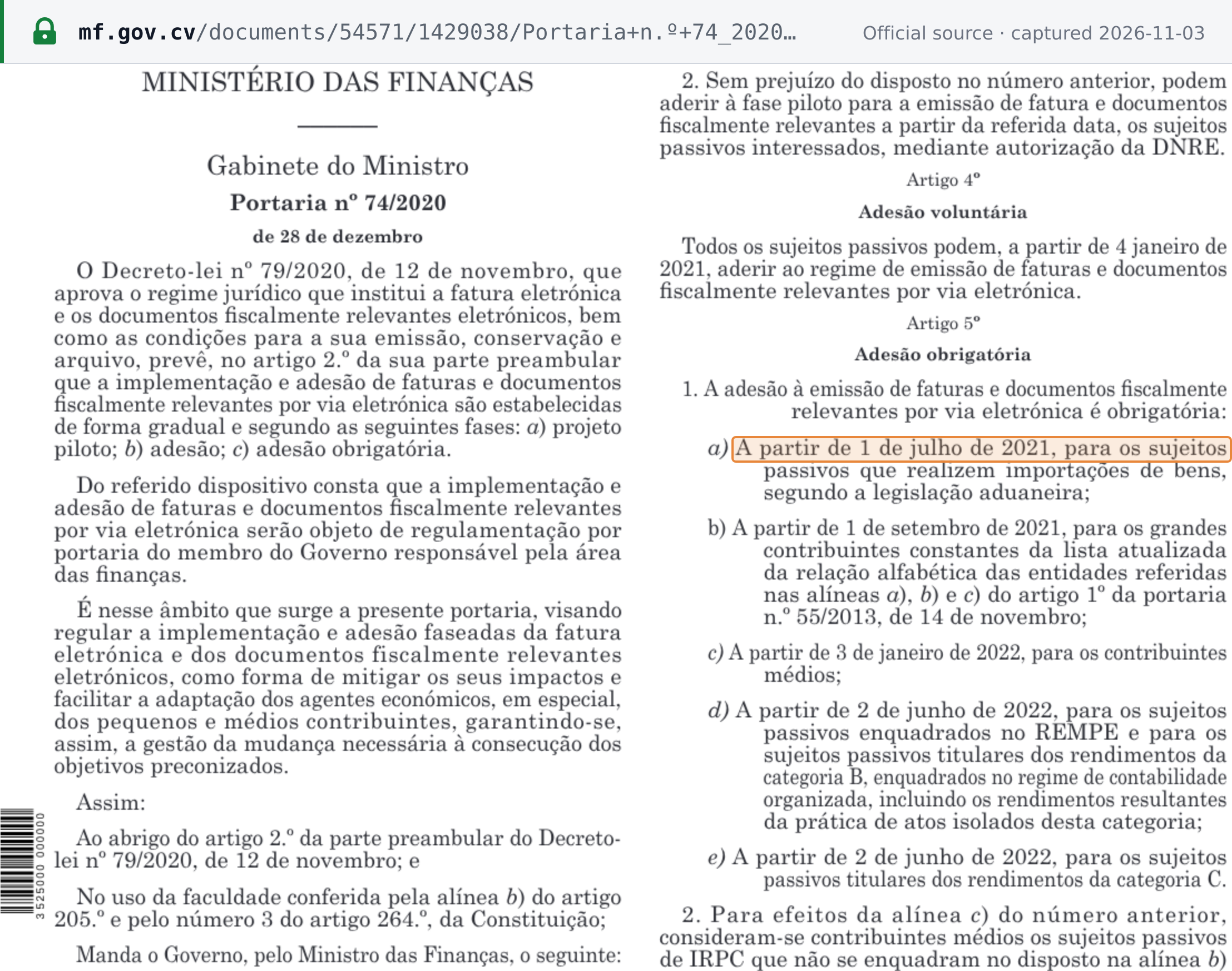 Source snapshot captured 2026-11-03 — original
Proposed for 2027 (bill). Article 41 of the State Budget 2027 bill would amend the Code so that, where contingency mode is used, IVA becomes chargeable when the contingency auxiliary document is issued; that "O documento fiscal auxiliar de fatura emitido em modo contingência não confere direito à dedução" (a contingency auxiliary document gives no right of deduction); and that "Todo e qualquer documento emitido, independentemente da sua denominação, que não seja documento fiscal eletrónico (DFE) e que dá origem a uma venda ou prestação de serviços deve automaticamente gerar um HASH, o qual deve ser incluído no DFE" (any non-DFE document that leads to a sale must automatically generate a HASH, to be included in the DFE). Not adopted as at 2026-11-03. [16]
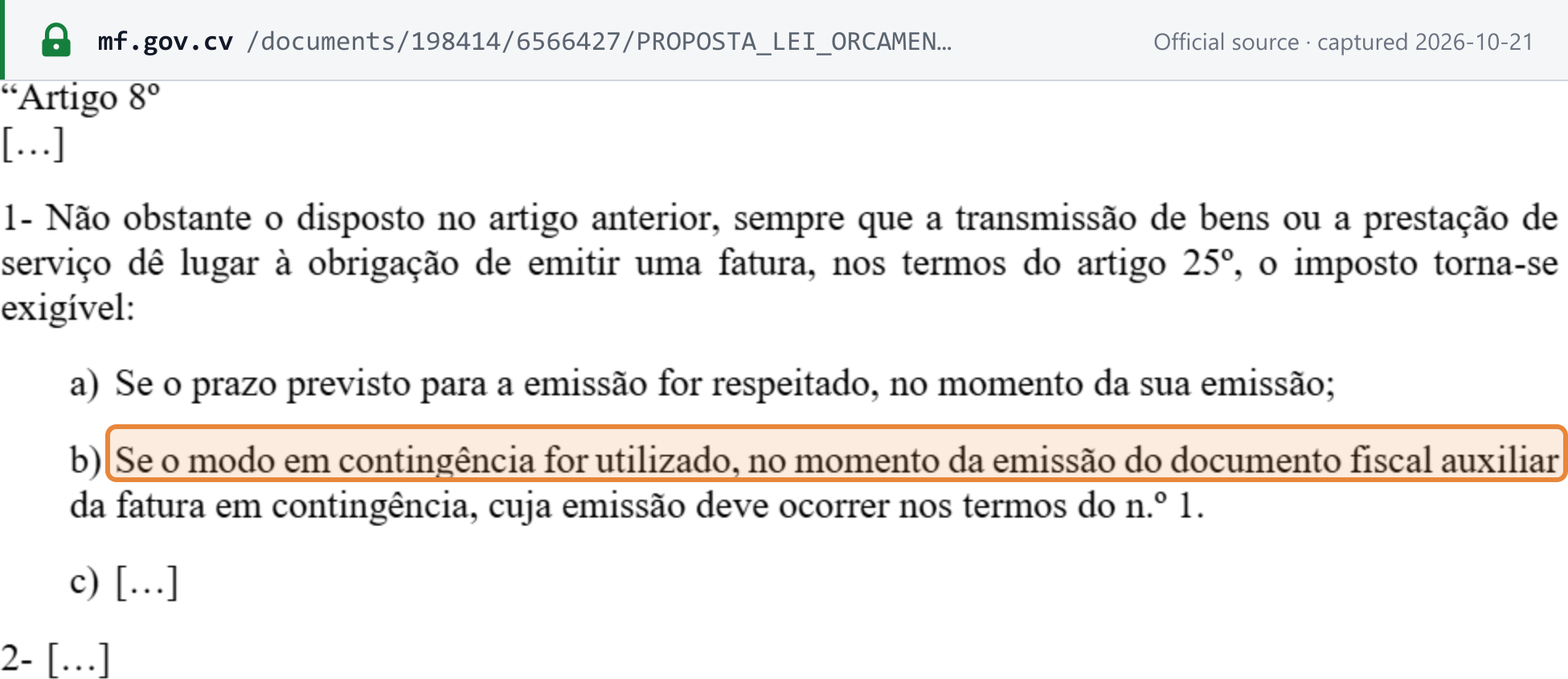 Source snapshot captured 2026-10-21 — original
See e-invoicing status and networks worldwide.
Filing and payment
Filing frequency
Monthly, for every normal-regime taxable person, whatever its size. A return is due even for a month with no operations (art. 25(1)(c) and (2)). The form is the Modelo 106 with its annexes, filed on the Porton di Nos Ilha portal. A return filed without its annexes and regularisation maps is treated as not filed (art. 25(11)). [1]
Return due date
By the end of the following month when filed electronically. Article 37(1): "Os sujeitos passivos são obrigados a entregar, mensalmente, a declaração prevista na alínea c) do artigo 25º, nos seguintes prazos: a) Até ao último dia útil do mês seguinte àquele a que respeitam as operações nela abrangidas; b) Até ao final do mês seguinte àquele a que respeitam as operações nela abrangidas, quando a declaração periódica é enviada por transmissão electrónica." (Monthly returns are due (a) by the last business day of the following month, or (b) by the end of the following month when filed electronically.) [1]
DNRE's Calendário Fiscal 2026 applies this month by month, for example: "Entrega da Declaração Modelo 106 e respetivos anexos, pelos sujeitos passivos que tenham liquidado IVA no mês de dezembro de 2025, a submeter por via eletrónica através do portal www.portondinosilha.cv, até ao dia 31 de janeiro. A obrigação de entrega mantém-se ainda que, no período em causa, não tenham sido realizadas operações tributáveis." (Modelo 106 and annexes for December 2025 are filed electronically by 31 January; the obligation applies even with no taxable operations in the period.) [12]
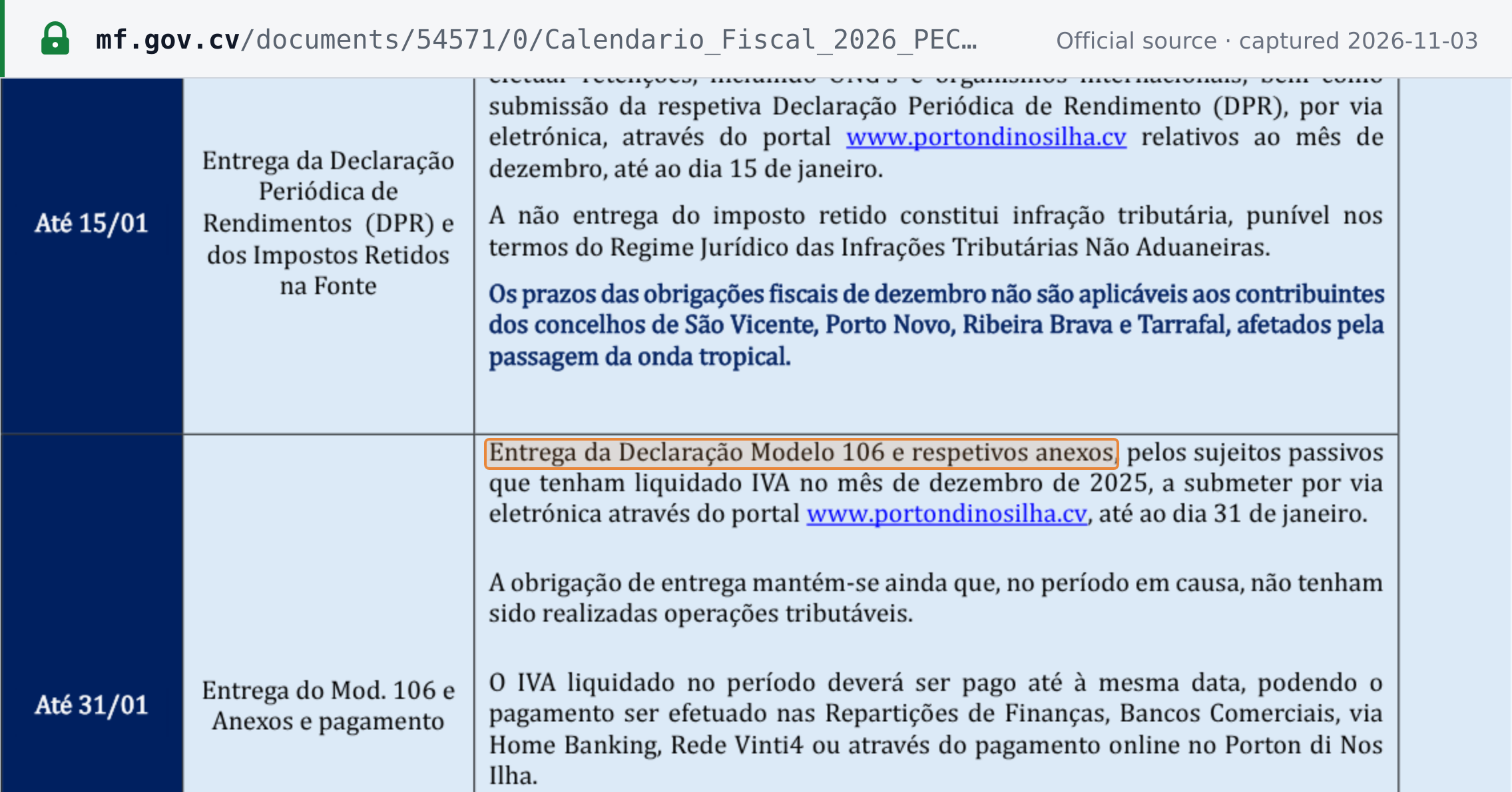 Source snapshot captured 2026-11-03 — original
Payment due date and method
With the return. IVA is paid when the return is filed (art. 23(1)). DNRE's calendar: "O IVA liquidado no período deverá ser pago até à mesma data, podendo o pagamento ser efetuado nas Repartições de Finanças, Bancos Comerciais, via Home Banking, Rede Vinti4 ou através do pagamento online no Porton di Nos Ilha." (IVA for the period is paid by the same date, at tax offices, commercial banks, home banking, the Vinti4 network or online on Porton di Nos Ilha.) If the tax is not paid with the return, "pode o pagamento ser ainda efectuado durante os trinta dias seguintes, nos termos do artigo 77º" (payment may still be made within the following 30 days, under article 77), with default interest (art. 23(3)). [12] [1]
- Reverse-charge IVA is paid with the return for the month in which it was self-assessed (art. 23(2)).
- Isolated operations: return and payment by the end of the month after the operation (art. 38).
- REMPE: the 4% unified tax is paid quarterly, by the last business day of April, July, October and January (REMPE art. 26(2)).
Additional listings
Client and supplier annexes accompany the monthly return (art. 25(10)). Persons making exempt financial, insurance or property supplies must also file a monthly list of their suppliers (art. 25(12)).
Input-tax recovery and blocked items
Deductible IVA includes IVA invoiced by suppliers, IVA paid on imports, and IVA self-assessed under the reverse charge (art. 18(1)). The invoice must be issued electronically by a normal-regime supplier with the article 32(5) particulars (art. 18(6), as amended in 2024). Deduction is taken in the period the invoice is received (art. 21(3)); businesses with mixed supplies use a pro-rata or actual-use method (art. 22).
Blocked (art. 20(1)): "Exclui-se, todavia, do direito à dedução o imposto contido nas seguintes despesas: a) Despesas relativas à aquisição, fabrico ou importação, à locação, incluindo a locação financeira, à utilização, à transformação e reparação de viaturas de turismo, barcos de recreio, helicópteros, aviões, motos e motociclos… b) Despesas respeitantes a combustíveis normalmente utilizáveis em viaturas automóveis, com excepção da aquisição de gasóleo, cujo imposto será dedutível na proporção de 50%… c) Despesas de transportes e viagens do sujeito passivo e do seu pessoal; d) Despesas respeitantes a alojamento, alimentação, bebidas e tabaco e despesas de recepção…" (Passenger cars, pleasure boats, aircraft and motorcycles; fuel, except diesel at 50%; travel of the business and its staff; and accommodation, food, drink, tobacco and entertainment.) The block does not apply where these are the business's own stock in trade (art. 20(2)). [1]
Refunds
- Carry forward first. Excess credit is carried forward (art. 21(4)).
- Refund after 12 months. Article 21(5): "Se passados doze meses relativos ao período em que se iniciou o excesso, persistir crédito a favor do sujeito passivo superior a 50 000$00 (cinquenta mil escudos), poderá este… solicitar o correspondente reembolso." (If, 12 months after the excess began, a credit over CVE 50,000 remains, the taxable person may request a refund.) Earlier refunds are possible on cessation or on moving to exempt activity (art. 21(6)).
- Guarantee and timing. The administration may require a guarantee for refunds over CVE 2,000,000 (art. 21(7)). Refunds are due "até ao fim do terceiro mês seguinte ao da apresentação do respectivo pedido" (by the end of the third month after the request) (art. 21(8)).
- Bad debts. IVA on debts found uncollectable in enforcement, bankruptcy or insolvency proceedings may be deducted (art. 65(8)).
- Non-residents. A separate law (Lei 34/VI/2003) provides for refunds of IVA borne by non-residents; its conditions are not covered here. [1]
Exemptions
Exempt supplies
Exempt without the right to deduct (CIVA art. 9), for example:
- medical and sanitary services (9(1)) and education (9(8));
- banking and financial operations (9(22)) and insurance (9(23));
- letting of immovable property, excluding "As prestações de serviços de alojamento, efectuadas no âmbito da actividade hoteleira ou de outras com funções análogas, incluindo os parques de campismo" (hotel and similar accommodation, including campsites) (9(24)(a));
- newspapers and books on the annexed list (9(15)), essential goods on the Lista Anexa (9(28)), and medicines and medical equipment on the annexed list (9(29));
- agricultural and fishing production (9(30)).
Exempt with the right to deduct (art. 13): exports, and international and inter-island passenger transport.
Exempt is not zero-rated. Cabo Verde has no zero rate. The difference sits in article 19(1): "Só poderá deduzir-se o imposto que tenha incidido sobre bens ou serviços adquiridos, importados ou utilizados pelo sujeito passivo para a realização das operações seguintes: a) Transmissões de bens e prestações de serviços sujeitas a imposto e dele não isentas; b) … i. Exportações e restantes operações isentas nos termos do artigo 13º" (Only IVA on inputs used for taxed supplies and for exports and other article 13 operations may be deducted.) A business making article 9 exempt supplies therefore cannot recover the IVA on its costs. [1]
The budget laws change the lists each year. Lei 69/X/2025 (budget 2026), for example, removes goods from the essential-goods list (art. 32(1)) and exempts ice used to preserve fish (art. 83). [2]
Special regimes
- REMPE — micro and small enterprises. Under the Regime Jurídico Especial das Micro e Pequenas Empresas (Lei 70/VIII/2014, republished by Lei 116/IX/2021 of 2 February 2021), an enterprise that requests it is classed as a "Micro empresa" if it "empregue até cinco trabalhadores e ou tenha um volume de negócios bruto anual não superior a 5.000.000$00" (employs up to five workers and/or has gross annual turnover not over CVE 5,000,000), or as a "Pequena empresa" with six to ten workers and/or turnover "superior a 5.000.000$00 (cinco milhões de escudos) e inferior a 10.000.000$00 (dez milhões de escudos)" (art. 3(1)(c)–(d)). It pays the Tributo Especial Unificado: "A taxa do Tributo Especial Unificado incide sobre o volume de negócios do período a que respeita e é de 4%" (art. 25(1)), which "substitui, para todos os efeitos, o imposto sobre o rendimento das pessoas singulares, o imposto sobre o rendimento das pessoas colectivas, o imposto sobre o valor acrescentado e o imposto de incêndio, bem como a contribuição para a segurança social devida pela entidade patronal" (replaces personal and corporate income tax, IVA, fire tax and the employer's social-security contribution) (art. 24(3)). Its invoices "não conferem ao adquirente o direito à dedução do IVA, devendo delas constar expressamente a menção «Tributo Especial Unificado»" (art. 28(3)). Bands as at the 2021 republication. [10]
- Other regimes in DNRE's IVA library (not covered in detail here): the second-hand goods margin scheme (Lei 32/VI/2003), special chargeability for State public works (DL 16/2004) and construction contracts (DL 17/2004), prices fixed by authority (DL 3/2004), the petroleum products tax base (DL 63/2005) and refunds to diplomatic missions (Lei 30/VI/2003).
- Free zones and tax-benefit regimes. Not covered in this guide.
Offences and penalties
The penalty code is the Regime Jurídico das Infrações Tributárias não aduaneiras (RJIT), Decreto Legislativo 3/2014, as republished by Lei 116/IX/2021 of 2 February 2021. [10]
Offences
- Abuso de confiança fiscal (art. 89) — failing to remit tax collected or invoiced. "Quem não entregar à administração tributária, total ou parcialmente, prestação tributária de valor igual ou superior a 3 000$00 que tenha sido retida, deduzida, apurada, recebida ou liquidada… é punido com pena de prisão de 1 a 3 anos ou pena de multa até 500 dias." (Failing to remit tax of CVE 3,000 or more that was withheld, collected or charged is punishable by 1 to 3 years' imprisonment or a fine of up to 500 days.) From CVE 3,000,000 the penalty rises to 2–8 years for individuals.
- Tax fraud (art. 88), frustration of tax claims (art. 90, 1–3 years) and qualified disobedience (art. 92) are also crimes.
Penalties
| Failure | Coima (fine) | RJIT |
|---|---|---|
| Not remitting tax due, including IVA under-charged on an invoice | From the amount of tax due to twice that amount ("entre o valor da prestação em falta e o seu dobro"); 10%–50% if negligent | art. 94 |
| Not filing, or filing late, a return | "coima de 30 000$00 a 750 000$00" (CVE 30,000–750,000) | art. 95(1) |
| Late or missing start, change or cessation declaration | CVE 50,000–1,500,000 | art. 96(3) |
| Not issuing an invoice, talão or receipt, issuing it late or non-compliant | "coima de 30.000$00 a 1.000.000$00" (CVE 30,000–1,000,000) | art. 107(1) |
| Not demanding or not keeping invoices | CVE 20,000–500,000 | art. 107(2) |
| Not using certified or electronic invoicing software where required | "coima de 100 000$00 a 1 000 000$00" (CVE 100,000–1,000,000) | art. 110(2) |
| Using billing software designed to evade tax | CVE 200,000–2,000,000 | art. 110(1) |
| Omissions or inaccuracies in returns, invoices or books | CVE 70,000–750,000 | art. 99(1) |
| Non-resident with no resident representative | CVE 15,000–750,000 | art. 112 |
The full wording of article 107(1): "A não emissão de recibos, talão de vendas, faturas, ou documentos equivalentes ou sua emissão fora dos prazos legais ou não conforme com a lei e regulamento, nos casos em que as leis tributárias o exija, é punida com coima de 30.000$00 a 1.000.000$00." [10]
Interest. Late-payment interest (juros de mora): "A taxa dos juros de mora é igual à taxa de redesconto fixada pelo Banco de Cabo Verde ao mês, até ao limite máximo de 60%" (the Banco de Cabo Verde rediscount rate per month, capped at 60%) (Código Geral Tributário art. 35(2)). Compensatory interest (juros compensatórios) runs at the rediscount rate in the first month plus 1% for each further month, also capped at 60% (CGT art. 33(3)). The Code applies both (CIVA art. 80). [11]
Frequently asked questions
Is a PDF invoice e-mailed to the customer a valid e-invoice in Cabo Verde?
No. DNRE's e-Fatura FAQ states that documents sent to their recipients in PDF format by e-mail are not considered electronic invoices or electronic fiscally relevant documents. An e-invoice is an XML document submitted to the tax administration for prior authorisation and carrying a 45-character IUD; a PDF or paper print is only its representation.
Can the buyer deduct IVA on a document issued while the e-Fatura system was down?
Not until the underlying e-document is transmitted and authorised. DNRE's model contingency auxiliary document (e-Fatura technical manual v11.0, section 6.13) carries the legend that it does not give a right to deduct tax while the associated document has not been transmitted to and authorised by the tax administration. The 2027 State Budget bill would write a similar rule into the VAT Code; it is a bill and has not been adopted.
Can we price a Cabo Verde invoice in euros?
You can show euros, but the amounts must also be shown in escudos. Decree-Law 79/2020, article 6(2), allows amounts in any currency provided they are also, mandatorily, in escudos, and the e-Fatura manual states that the currency of an e-document is always CVE, with the Banco de Cabo Verde exchange rate recorded at issue.
Does a foreign SaaS or consultancy supplier charge Cabo Verde IVA to a Cabo Verde business customer?
Not for the services listed in article 6(6) of the VAT Code, which include licences, advertising, telecommunications, consultancy, data processing and information supply. When the supplier has no establishment in Cabo Verde and the customer is a Cabo Verde taxable person, the customer is the taxable person (article 2(2)) and self-assesses the IVA, and the invoice must carry the words IVA – autoliquidação (article 32(12)).
Can a REMPE micro or small enterprise charge IVA on its invoices?
No. An enterprise in the REMPE regime pays the 4% Tributo Especial Unificado, which replaces IVA. Under article 28(3) of the REMPE regime its invoices give the buyer no right to deduct IVA and must expressly state Tributo Especial Unificado.
Important websites
| Site | Purpose |
|---|---|
| DNRE — Direção Nacional de Receitas do Estado | Tax authority home page: notices, forms and the fiscal calendar |
| Solicitar NIF | How to obtain a NIF (Mod. 110, in person at Repartições de Finanças and Casa do Cidadão) |
| Porton di Nos Ilha | Filing the Modelo 106 return and paying online; also hosts the session-gated NIF lookup ("CONSULTA NIF") |
| e-Fatura documentation | DNRE's e-invoicing site: technical manual, XSD schemas, FAQs and legislation |
| e-Fatura platform | Accreditation, issuing and document lookup by IUD or QR code |
| DNRE legislation library | The VAT Code, budget laws, portarias and e-invoice legislation |
| Boletim Oficial Eletrónico | The official gazette, where budget laws and amendments are published |
DNRE material prints the portal address as www.portondinosilha.cv; the working address is portondinosilhas.gov.cv. For other countries' registers, see check a VAT number — official lookups by country.
Recent changes
- 2026-09-29 — The Council of Ministers approves the State Budget 2027 bill. It would renew the 8% rate on electricity and water from 1 January 2027 and amend the VAT Code on contingency invoicing (no deduction on a contingency document, IVA chargeable when it is issued), self-billing deductions, a HASH for non-DFE sales documents and certified software. Bill stage; not adopted. (Ministério das Finanças) — see event and event
- 2025-12-31 — Lei 69/X/2025 (State Budget 2026) is published: mandatory electronic issuance and a QR code and IUD on e-documents written into the VAT Code, certified billing and accounting software, and customs tariff and product codes on invoices. It also re-enacts for 2026 the 8% rate on electricity and water to final consumers (art. 84), set in each budget law since 2022. (Boletim Oficial)
- 2023-12-31 — Lei 35/X/2023 (State Budget 2024) is published: only electronically issued invoices give the right to deduct, and self-billing rules are added. (Boletim Oficial)
- 2022-06-02 — The last mandatory e-invoicing phase under Portaria 74/2020 starts (REMPE, Category B organised accounts and Category C taxpayers). (Portaria 74/2020)
- 2021-12-31 — Lei 4/X/2021 (State Budget 2022) is published: new invoice particulars (supply date, place of issue, unit of measure, fiscal and customs codes), a consignment series, and an e-commerce IVA regime for listed large non-resident operators. (Boletim Oficial)
For the full chronology, see Cabo Verde tax changes on Lookuptax.
Reference links
- Código do IVA — Lei 81/VIII/2015 with the republished Lei 21/VI/2003 (BO I Série nº 3, 8 January 2015), DNRE copy
- Lei 69/X/2025 — State Budget 2026 (BO I Série nº 133/1, 31 December 2025)
- Lei 4/X/2021 — State Budget 2022 (BO I Série nº 129, 31 December 2021)
- Lei 16/X/2022 — State Budget 2023 (BO I Série nº 125, 30 December 2022)
- Lei 35/X/2023 — State Budget 2024 (BO I Série nº 134, 31 December 2023)
- Decreto-Lei 79/2020 of 12 November 2020 — regime jurídico da fatura eletrónica (BO I Série nº 128), DNRE copy
- Portaria 74/2020 of 28 December 2020 — phased adoption of the e-invoice (BO I Série nº 140), DNRE copy
- Despacho 43/2022 — processing requirements for e-invoices (extract, BO II Série nº 59, 18 April 2022)
- DNRE — Manual Técnico da Fatura Eletrónica, version 11.0
- Lei 116/IX/2021 of 2 February 2021 — amendments to the tax codes, with the republished REMPE and RJIT (BO I Série nº 10), DNRE copy
- Código Geral Tributário — Lei 47/VIII/2013, DNRE copy
- DNRE — Calendário Fiscal 2026 (version updated 11 June 2026)
- DNRE — Solicitar NIF
- DNRE e-Fatura — O que é a e-fatura?
- DNRE e-Fatura — FAQs: conceitos
- Ministério das Finanças — Proposta de Lei do Orçamento do Estado para 2027 (bill)
- Lei 31/VI/2003 — IVA exemption for small non-commercial consignments, DNRE copy
- Lei 45/X/2024 — State Budget 2025 (BO I Série nº 125, 30 December 2024)
Related on Lookuptax:
- VAT registration thresholds worldwide
- Worldwide tax rates
- E-invoicing status and networks worldwide
- CTC e-invoicing models: clearance, reporting and interchange
- VAT on digital services by non-resident suppliers
- Reverse charge explained
- Marketplace deemed-supplier rules
- How to register for VAT, sales tax or GST
- VAT, GST and sales tax names by country