Chad VAT (TVA) guidelines
Overview
Chad levies a value added tax, the taxe sur la valeur ajoutée (TVA), under the Code général des impôts (CGI). The CGI is amended every year by a loi de finances (Finance Law). The current one is Loi n° 008/AN/SENAT/2025 portant loi de finances pour l'exercice 2026 ("LF 2026"). [1] The Ministry of Finance publishes the Finance Laws on its publications portal. It does not publish a consolidated CGI there, so each CGI article below is cited to the Finance Law that last reprinted it.
Authority, currency, period and layering
- Authority. The Direction Générale des Impôts (DGI), part of the Ministry of Finance, administers VAT. On the ministry's own page, its "Direction des Impôts" link points to the DGI's online tax system at sigi.finances.gouv.td. [9] Imports clear through the Direction Générale des Douanes et Droits Indirects (douanes.td).
- Currency. The CFA franc (XAF), written "FCFA" or "F CFA" in the texts. Chad is a member of the Central African Economic and Monetary Community (CEMAC). Amounts below are in FCFA; conversions are approximate.
- Period. VAT is declared monthly by every VAT taxpayer, whatever its regime (CGI art. 229 III, see Registration).
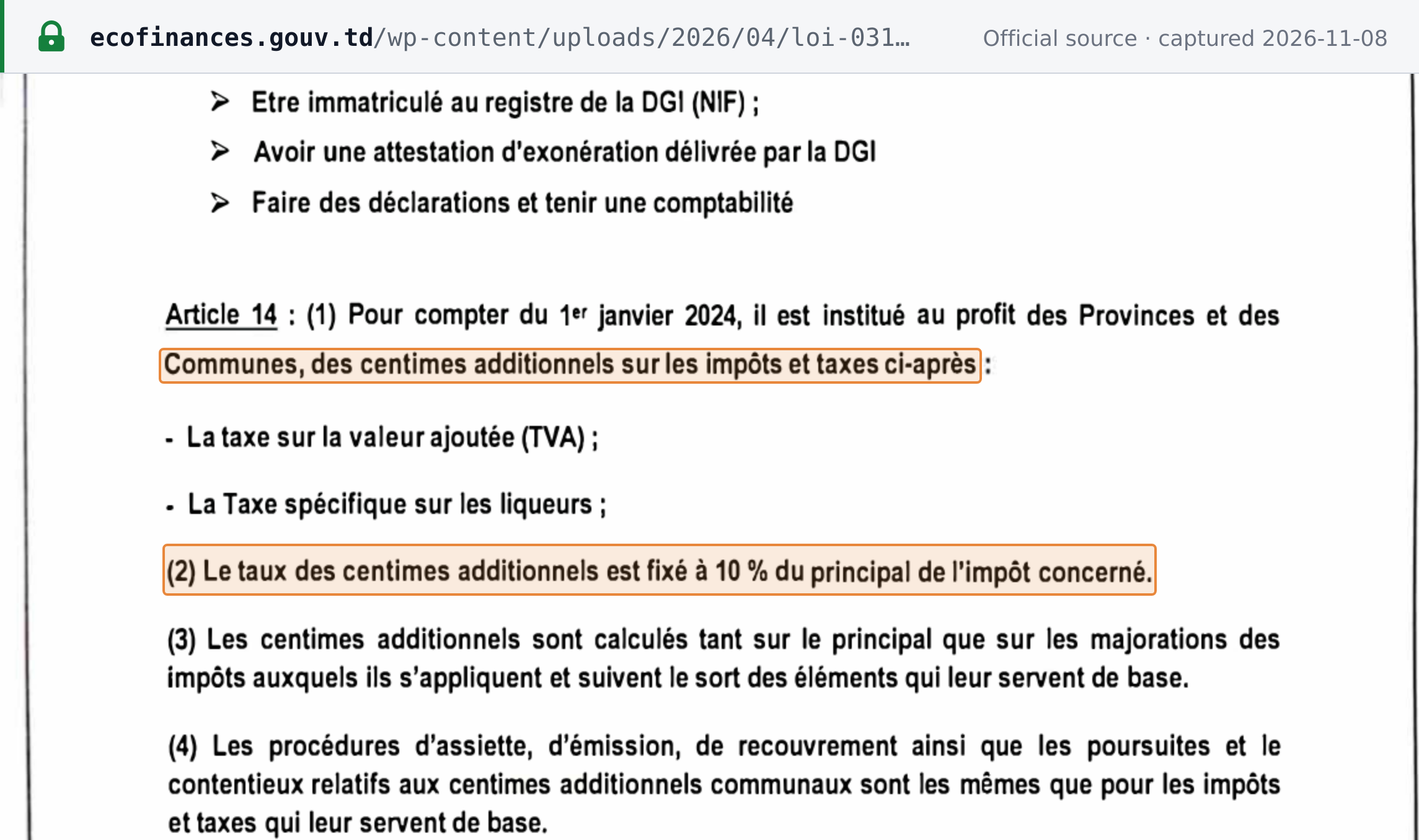
- Layering. VAT is a national tax, but since 1 January 2024 a surcharge of centimes additionnels goes to provinces and communes. It is "fixé à 10 % du principal de l'impôt concerné", and VAT is the first tax on the list (2024 Finance Law, art. 14, as amended by LF 2025 art. 34 and restated by LF 2026 art. 73). [3] [1] This is why Chadian invoices show VAT at 19.25% rather than 17.5% (see Rates).
 Source snapshot captured 2026-11-08 — original
Registration
Who may charge VAT: the turnover regimes
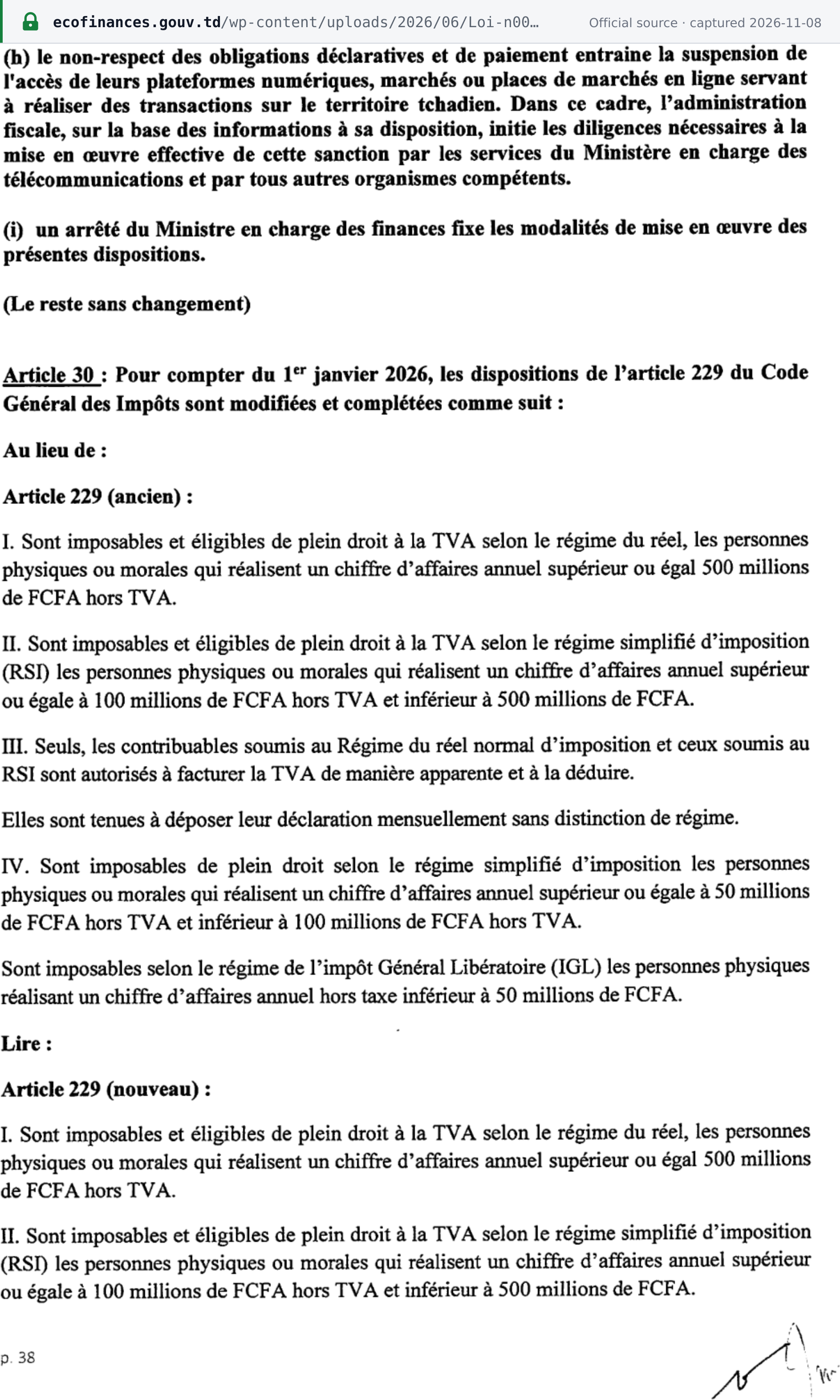
Chad does not set a single VAT registration threshold. Liability follows the tax regime a business falls under by annual turnover. CGI article 229, as rewritten by LF 2026 art. 30 with effect from 1 January 2026, reads in substance: [1]
| Para. | What the text says | Turnover (annual, excluding VAT) |
|---|---|---|
| I | "imposables et éligibles de plein droit à la TVA selon le régime du réel" | FCFA 500,000,000 or more (about USD 0.9 million) |
| II | "imposables et éligibles de plein droit à la TVA selon le régime simplifié d'imposition (RSI)" | FCFA 100,000,000 or more and under FCFA 500,000,000 |
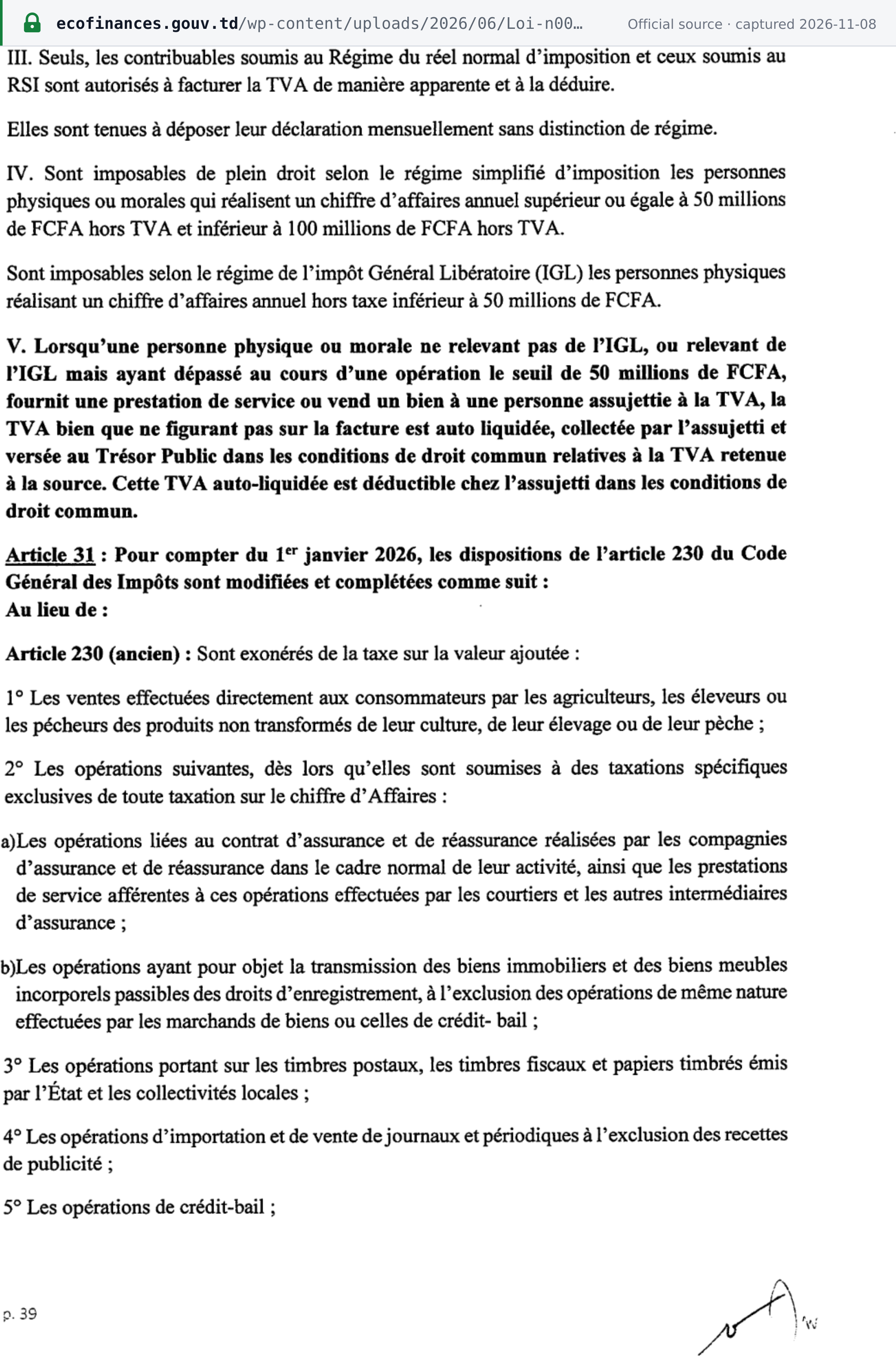
| III | "Seuls, les contribuables soumis au Régime du réel normal d'imposition et ceux soumis au RSI sont autorisés à facturer la TVA de manière apparente et à la déduire. Elles sont tenues à déposer leur déclaration mensuellement sans distinction de régime." | — |
| IV | "imposables de plein droit selon le régime simplifié d'imposition" | FCFA 50,000,000 or more and under FCFA 100,000,000 |
| IV | Individuals taxed under the impôt général libératoire (IGL) | Individuals under FCFA 50,000,000 |
What follows from the text:
- Only réel and RSI taxpayers may charge VAT on their invoices and deduct it, and all of them file monthly.
- The RSI starts at FCFA 50 million. Paragraph II names FCFA 100 million as the point from which RSI taxpayers are liable to VAT "de plein droit"; paragraph IV places FCFA 50–100 million businesses in the RSI without repeating the words "à la TVA". Paragraph III then lets RSI taxpayers charge VAT. The law does not reconcile the two paragraphs, so a business in the FCFA 50–100 million band should confirm its VAT position with the DGI.
- Small individuals are outside VAT. The IGL is a single tax that replaces, among others, "la taxe sur la valeur ajoutée" for "les personnes physiques réalisant un chiffre d'affaires annuel hors taxes inférieur à 50 millions de FCFA" (CGI art. 31, 2020 Finance Law). [4] Companies cannot use the IGL: "Sont exclues du régime de l'Impôt Général Libératoire, les sociétés (personne morale) …" (CGI art. 37). [4]
- Buyer self-assessment (new in 2026). Under paragraph V, when a person outside the IGL, or an IGL person that has crossed FCFA 50 million in the course of a transaction, supplies a VAT taxpayer, "la TVA bien que ne figurant pas sur la facture est auto liquidée, collectée par l'assujetti et versée au Trésor Public" under the rules for VAT withheld at source. The buyer then deducts it under the ordinary rules. [1]
 Source snapshot captured 2026-11-08 — original
 Source snapshot captured 2026-11-08 — original
Non-resident registration
The Finance Laws reviewed (2020 and 2023–2026) set no general VAT registration threshold or fiscal-representative rule for non-resident businesses (as at 11 November 2026). Two rules apply to foreign businesses:
- Digital services. Foreign suppliers of digital services with their own technology must collect and remit VAT, and e-commerce platforms register through e-Tax. No threshold is stated. See Digital services and platforms.
- Representative for income tax. Foreign companies with no one in charge in Chad must name, every year, "un représentant résidant au Tchad autorisé à recevoir les communications relatives à l'assiette, au recouvrement et au contentieux de l'impôt" (CGI art. 1009, restated by LF 2026 art. 39). [1] This article sits in the corporate income tax chapter (companies under art. 130). It is not a VAT fiscal-representative rule.
Tax registration number (NIF)
Chad identifies taxpayers by the NIF (Numéro d'Identification Fiscale). Under CGI article 147 as rewritten by LF 2026 art. 20: [1]
- The NIF "est unique et permanent". Any other number "est nul et non avenu".
- It must appear on invoices, contracts, letters, customs documents and returns of companies liable to any tax, schools, public bodies, associations and NGOs, and international, diplomatic and consular missions.
- Individuals resident in Chad need both the national identity number (NNI) and the NIF to carry on a business and for customs and land formalities.
- Without a valid NIF there is no VAT deduction, no payment by the Treasury and no access to public procurement.
The CGI leaves the NIF's "spécifications techniques et fonctionnelles" to the IT systems of the tax, customs and land administrations. Neither the Finance Laws nor the Ministry of Finance publish its length, structure or check digit, and no public NIF lookup is published (as at 11 November 2026).
How to register
The NIF "est attribué par les services compétents de la Direction Générale en charge des Impôts à la demande du contribuable en ligne via le portail de la DGI". It cannot be made conditional on paying any tax first (business licence, IGL or other). The file listed in CGI article 147 (2026 wording) is: [1]
- the certificate of the Agence Nationale des Investissements et des Exportations (ANIE), which runs the business-creation one-stop shop;
- the trade register (RCCM) entry, or the operating authorisation for associations, NGOs, religious organisations, foundations and diplomatic missions;
- a form in the administration's model giving the full identity of shareholders, partners, founders or directors and of their beneficial owners;
- a location plan with the full address, and the full address of the registered office;
- the lease, acte de sincérité or title deed;
- the national identification number, or a residence card for foreigners;
- for goods and passenger carriers, copies of vehicle number plates and registration documents.
The CGI also requires a déclaration d'existence (art. 1008) and a déclaration d'immatriculation (art. 995), each with its own fine (see Penalties). The Finance Laws set no processing time for issuing the NIF.
Voluntary registration
The Finance Laws reviewed publish no option to opt into VAT below the regime thresholds (as at 11 November 2026). Under article 229 III only réel and RSI taxpayers may charge VAT.
Deregistration
No VAT deregistration procedure or final-return rule appears in the Finance Laws reviewed. Failing to declare a cessation of business is fined FCFA 500,000 (CGI art. 1068 1°, see Penalties).
Group registration
Not provided for. The CGI VAT articles reprinted in the 2019–2026 Finance Laws (arts. 227–246) contain no grouping provision (as at 11 November 2026).
Rates
Standard rate: 17.5% (invoiced at 19.25%)
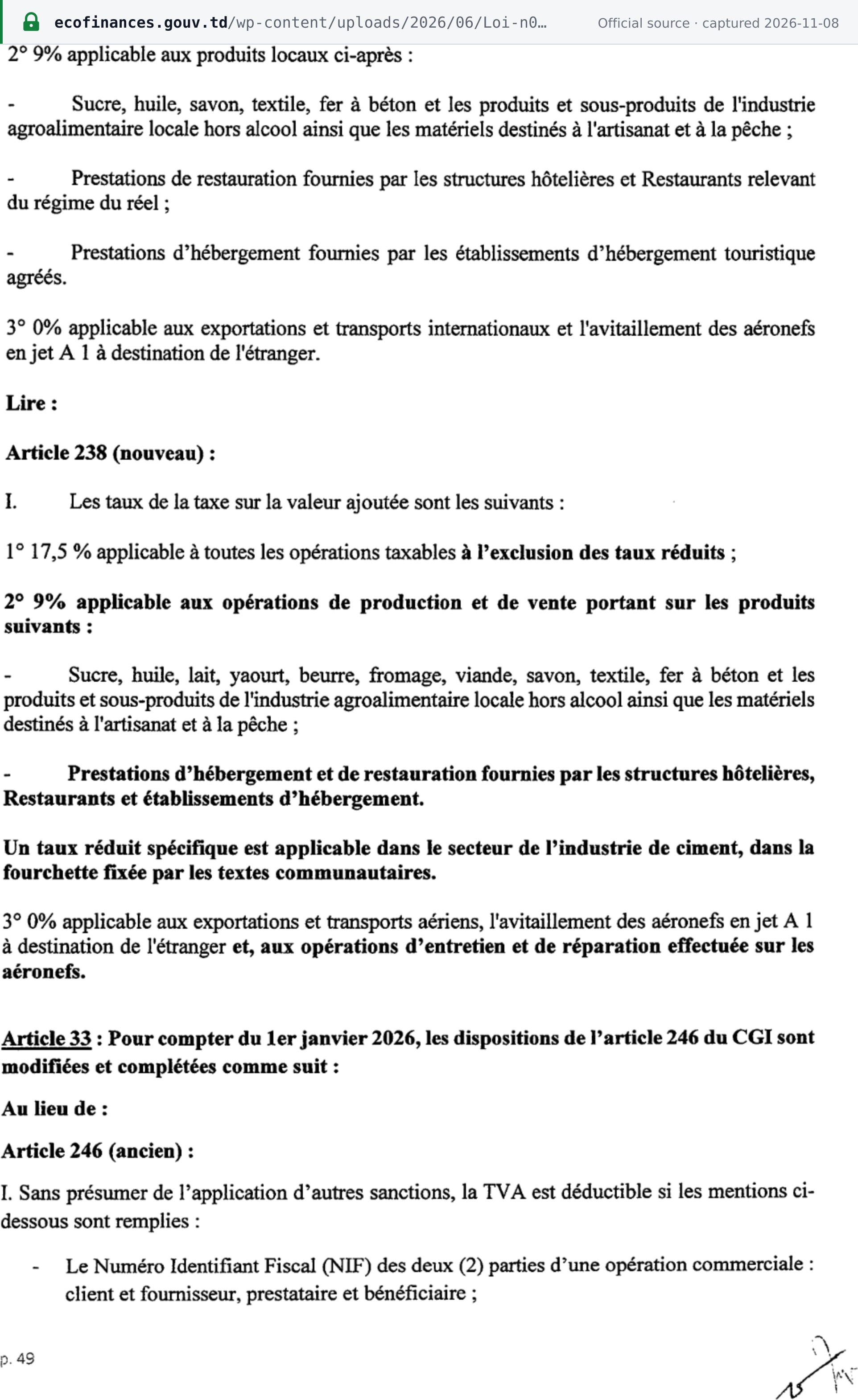
CGI article 238, as rewritten by LF 2026 art. 32 with effect from 1 January 2026, reads: [1]
"I. Les taux de la taxe sur la valeur ajoutée sont les suivants : 1° 17,5 % applicable à toutes les opérations taxables à l'exclusion des taux réduits ; 2° 9% applicable aux opérations de production et de vente portant sur les produits suivants : - Sucre, huile, lait, yaourt, beurre, fromage, viande, savon, textile, fer à béton et les produits et sous-produits de l'industrie agroalimentaire locale hors alcool ainsi que les matériels destinés à l'artisanat et à la pêche ; - Prestations d'hébergement et de restauration fournies par les structures hôtelières, Restaurants et établissements d'hébergement. Un taux réduit spécifique est applicable dans le secteur de l'industrie de ciment, dans la fourchette fixée par les textes communautaires. 3° 0% applicable aux exportations et transports aériens, l'avitaillement des aéronefs en jet A 1 à destination de l'étranger et, aux opérations d'entretien et de réparation effectuée sur les aéronefs."
The standard rate is 17.5%. It applies from 1 January 2024, when the 2024 Finance Law (art. 26) cut it from 18%; the 2025 and 2026 Finance Laws keep it. [3]
 Source snapshot captured 2026-11-08 — original
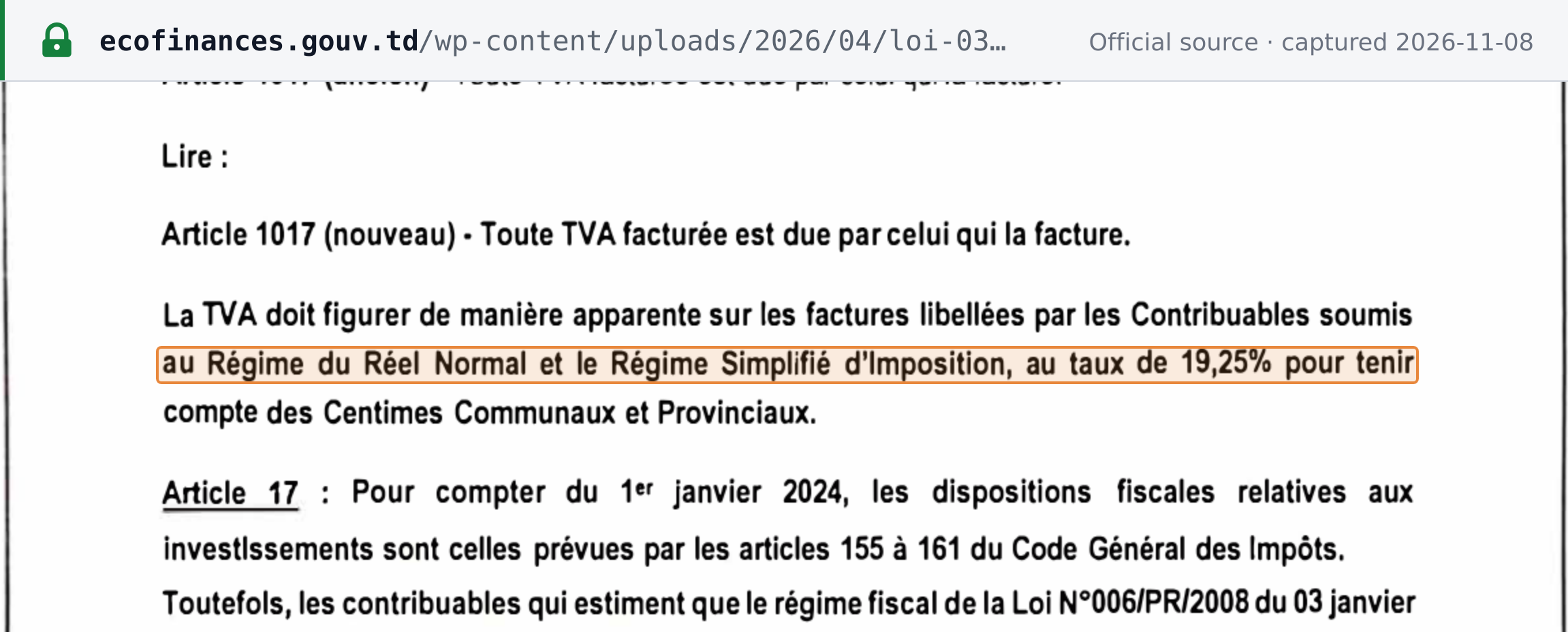
What the invoice shows: 19.25%. Because the 10% centimes additionnels are levied on the VAT principal (see Overview), CGI article 1017 as rewritten by the 2024 Finance Law (art. 16) says: [3]
"Toute TVA facturée est due par celui qui la facture. La TVA doit figurer de manière apparente sur les factures libellées par les Contribuables soumis au Régime du Réel Normal et le Régime Simplifié d'Imposition, au taux de 19,25% pour tenir compte des Centimes Communaux et Provinciaux."
So a réel or RSI business shows VAT at 19.25% on its invoices: 17.5% VAT principal plus 10% of that principal (1.75 points) in centimes additionnels. On FCFA 1,000,000 excluding tax, the invoice shows FCFA 192,500 of VAT (175,000 principal + 17,500 centimes). The 2025 and 2026 Finance Laws do not amend article 1017, and LF 2026 art. 73 keeps the 10% centimes, so 19.25% is the invoiced rate as at 11 November 2026. The law states no invoiced figure for the 9% rate.
 Source snapshot captured 2026-11-08 — original
The investment agency ANIE's business-environment page still lists VAT at 18% (as at 11 November 2026). That figure predates the 2024 Finance Law.
Reduced rate: 9%
Under article 238 I 2° (2026 wording), 9% applies to the production and sale of:
- sugar, cooking oil, milk, yoghurt, butter, cheese and meat (added in 2026), soap, textiles and reinforcing steel;
- products and by-products of the local agri-food industry, excluding alcohol;
- equipment for crafts and fishing;
- accommodation and catering supplied by hotels, restaurants and accommodation establishments.
The 2025 Finance Law had limited the hospitality item to restaurant services of hotels and restaurants under the réel regime and to approved tourist accommodation; the 2026 wording covers accommodation and catering by hotels, restaurants and accommodation establishments generally. The same Finance Law keeps meat and poultry (tariff heading 02) and milk and cream (0401, 0402) on the article 230 15° exemption list, so the law does not say which treatment prevails for these products; confirm with the DGI. [1] Before 2024 cement was on the 9% list. It now has "un taux réduit spécifique … dans la fourchette fixée par les textes communautaires" (the CEMAC range); the CGI gives no figure.
Zero rate: 0%
Article 238 I 3° applies 0% to exports, air transport, Jet A1 refuelling of aircraft bound abroad, and (since 2026) aircraft maintenance and repair. Zero-rating keeps the right to deduct (see Exempt is not zero-rated).
Announced changes
No rate change has been announced for 2027 (as at 11 November 2026). The Ministry of Finance has published a circular on preparing the 2027 Finance Bill, but no bill text. Chad's Finance Laws are usually adopted in December for the following year.
Cross-border rules
Imports and exports
- Imports. VAT applies to imports. CGI article 227 defines an import as "le franchissement du cordon douanier au Tchad pour la mise à la consommation des marchandises provenant de l'extérieur", or release for consumption at the end of a suspensive customs regime. [1] VAT shown on import documents is deductible (CGI art. 239 VI 2°). The Finance Laws reviewed set no low-value (de minimis) relief for imports (as at 11 November 2026). A finance-minister order of 9 September 2026 (Arrêté n° 135/MFBEPCI/SE/SG/DGDDI/2026) exempts wheat, maize, millet, rice, cereal flour other than wheat flour and semolina, livestock feed, drilling, pumping and water-supply equipment, and agricultural equipment and inputs for growing fodder crops from "droits et taxes à l'importation"; it does not name VAT, so confirm with customs whether import VAT is covered. [11]
- Exports. Exports of goods are zero-rated at 0% (art. 238 I 3°, quoted under Rates). From 2026, every person "réalisant des opérations d'exportation de biens, services, minerais divers ou tout produit relevant du secteur extractif minier ou pétrolier" must file through e-Tax and invoice through the FEN (CGI art. 996 4, LF 2026 art. 37). [1]
Digital services and platforms
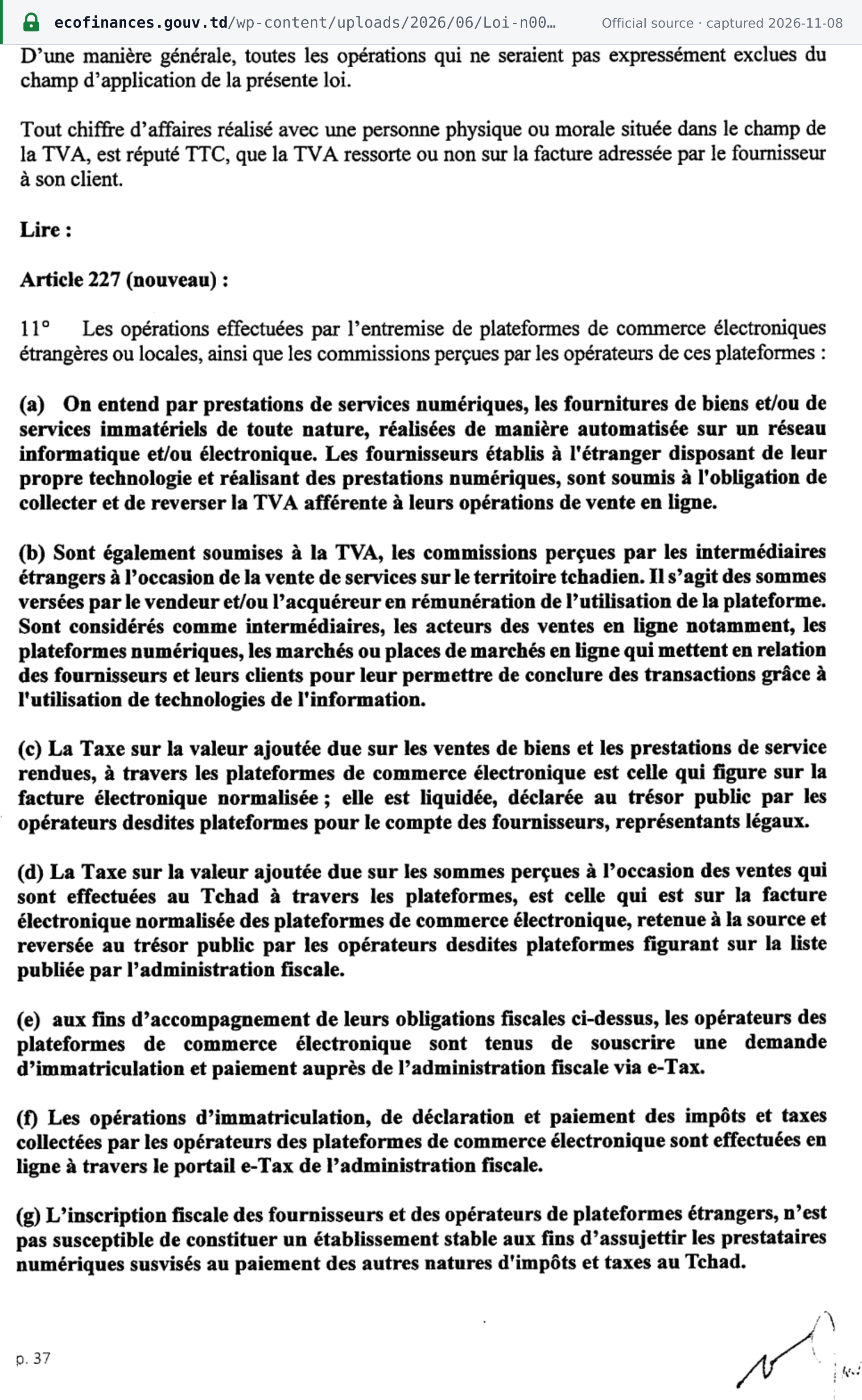
CGI article 227 11°, rewritten by LF 2026 art. 29 with effect from 1 January 2026, taxes "les opérations effectuées par l'entremise de plateformes de commerce électroniques étrangères ou locales, ainsi que les commissions perçues par les opérateurs de ces plateformes". [1] In summary:
- (a) Definition and foreign suppliers. Digital services are "les fournitures de biens et/ou de services immatériels de toute nature, réalisées de manière automatisée sur un réseau informatique et/ou électronique". "Les fournisseurs établis à l'étranger disposant de leur propre technologie et réalisant des prestations numériques, sont soumis à l'obligation de collecter et de reverser la TVA afférente à leurs opérations de vente en ligne."
- (b) Platform commissions. Commissions earned by foreign intermediaries (platforms, marketplaces) on sales of services in Chad are subject to VAT.
- (c) Sales through platforms. The VAT due is the VAT shown on the FEN; the platform operator settles and declares it to the Treasury on behalf of the suppliers.
- (d) Withholding by listed platforms. Platform operators on a list published by the tax administration withhold the VAT on amounts received for sales made in Chad and pay it to the Treasury.
- (e)–(f) e-Tax. Platform operators apply for registration and payment, and register, file and pay, online through the tax administration's e-Tax portal.
- (g) No permanent establishment. Registering "n'est pas susceptible de constituer un établissement stable" for other Chadian taxes.
- (h) Blocking. Failure to file or pay leads to "la suspension de l'accès de leurs plateformes numériques, marchés ou places de marchés en ligne" in Chad, through the telecommunications ministry. [1]
- (i) Implementing order. "un arrêté du Ministre en charge des finances fixe les modalités de mise en œuvre". As at 11 November 2026 no such order, and no list of platforms under (d), is published on the Ministry of Finance's website.
The article states no registration threshold and does not distinguish business from consumer customers. A first, platform-only version of article 227 11° applied from 1 January 2025 (2025 Finance Law, art. 5). [2] See VAT on digital services from non-resident suppliers and Marketplace deemed-supplier rules for how other countries handle this.
 Source snapshot captured 2026-11-08 — original
Foreign companies selling into Chad — B2B and B2C
- B2C digital services. The foreign supplier with its own technology collects and remits the VAT; sales through a platform are handled by the platform operator (art. 227 11°, above).
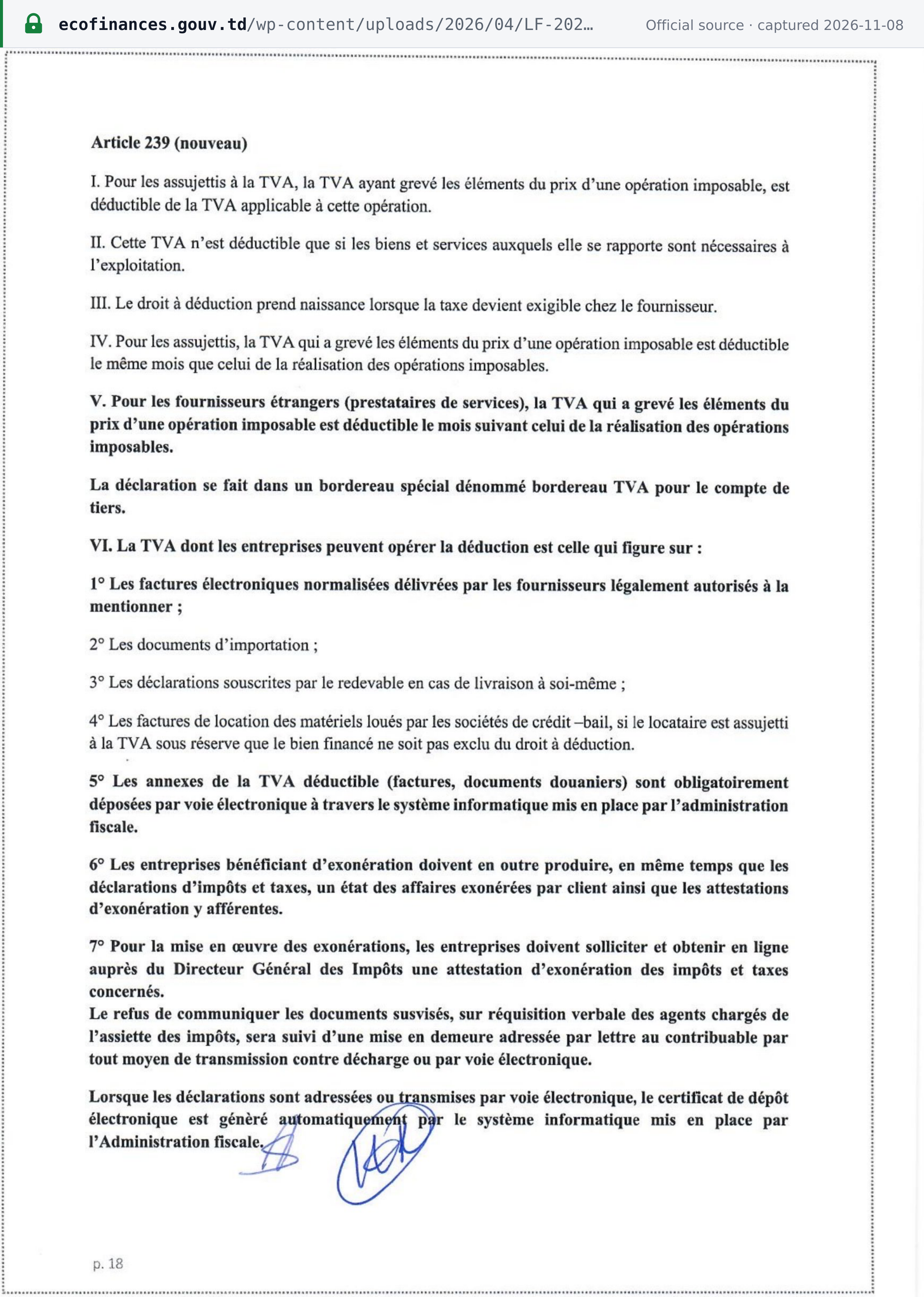
- B2B services from foreign providers. CGI article 239 V, as rewritten by the 2025 Finance Law (art. 8), provides: "Pour les fournisseurs étrangers (prestataires de services), la TVA qui a grevé les éléments du prix d'une opération imposable est déductible le mois suivant celui de la réalisation des opérations imposables. La déclaration se fait dans un bordereau spécial dénommé bordereau TVA pour le compte de tiers." [2] The Chadian customer therefore declares the VAT on services bought from a foreign provider on the bordereau TVA pour le compte de tiers and deducts it the following month. See Reverse charge for the general mechanism.
- Supplier VAT missing from the invoice. Separately, under CGI article 229 V (2026) a VAT-registered buyer self-assesses VAT that a supplier outside the IGL did not show on its invoice (see Registration).
- Invoices from foreign suppliers are the one exception to the rule that only FEN invoices give a right to deduct (CGI art. 246 II, see Invoice requirements).
- Separate from VAT. ANIE's business-environment page also lists a separate 25% « Retenue à la source (Non-résidents) » on services supplied by entities outside the CEMAC zone. It is listed apart from VAT. [7]
 Source snapshot captured 2026-11-08 — original
Place of supply
CGI article 228 (territoriality) has not been amended or reprinted by the 2019–2026 Finance Laws, so its place-of-supply rules for goods and services are not published on the Ministry of Finance's website (as at 11 November 2026). Confirm the place of supply of a cross-border service with the DGI before relying on it.
Invoice requirements
Under article 17 of the 2023 Finance Law, in force from 1 January 2024, [10] every operation by a person liable to corporate income tax, the IGL or VAT must be documented by a facture électronique normalisée (FEN) — a standardised electronic invoice — "ou d'un document en tenant lieu : décompte de travaux, feuilles d'honoraires, acomptes, etc." [3] Buyers, including private individuals, "sont tenus d'exiger et de se faire délivrer" a FEN. The FEN "est émise et transmise à travers une machine électronique de facturation, en mode production, certifiée par la Direction Générale des Impôts". [3] Only réel and RSI taxpayers show VAT on it (CGI art. 229 III), at 19.25% (CGI art. 1017).
Mandatory content of the FEN
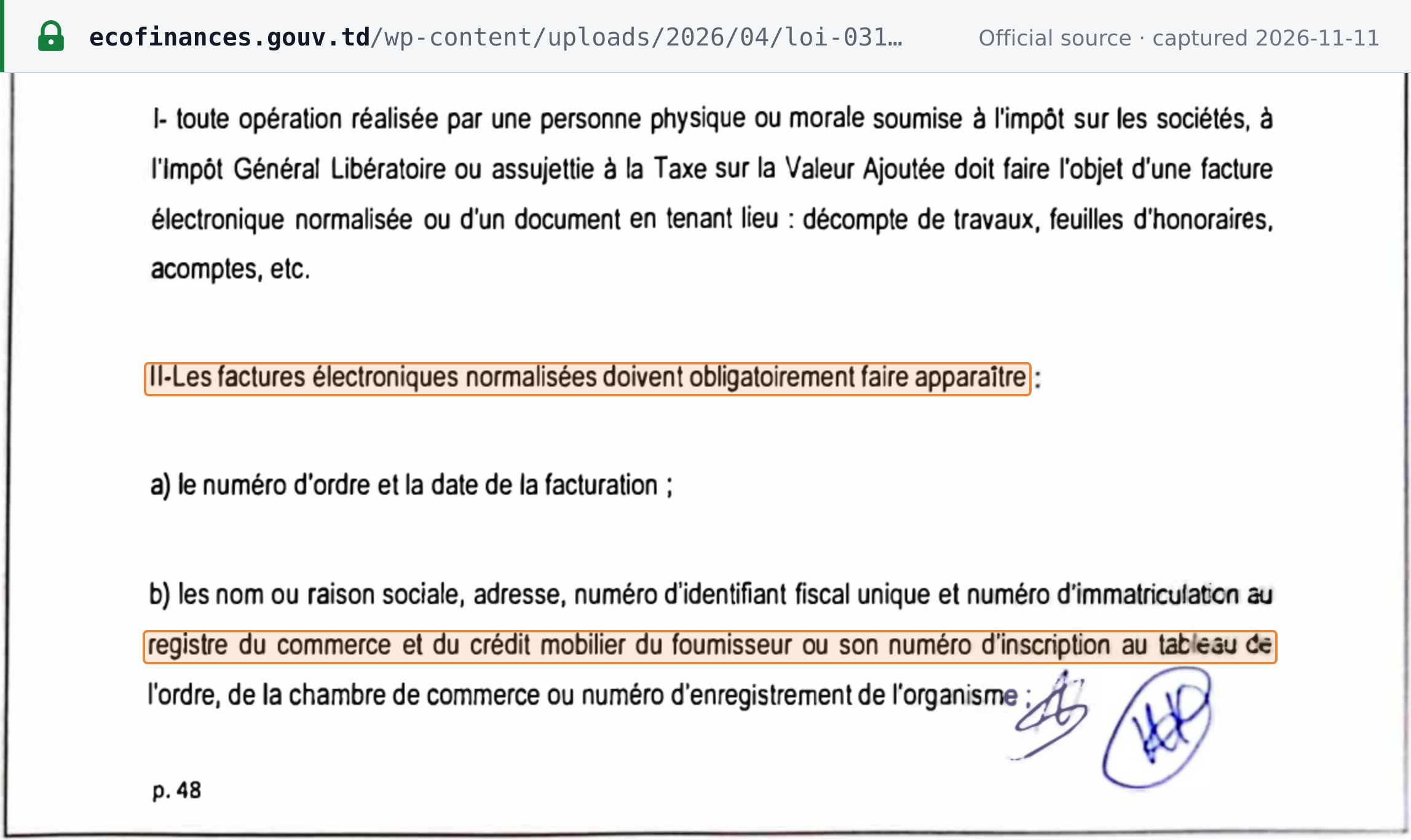
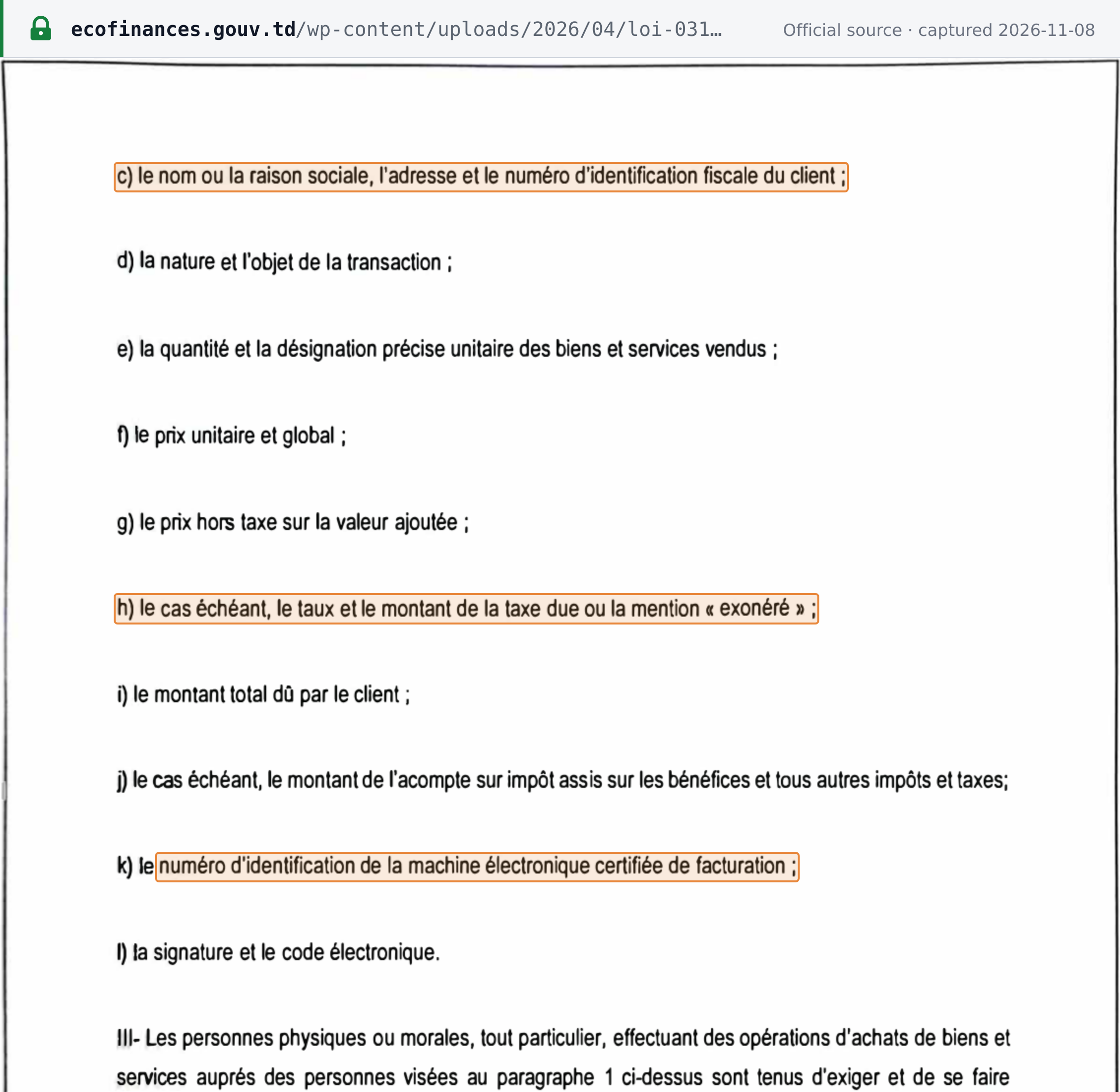
Article 17 of the 2023 Finance Law, as reproduced in the 2024 Finance Law (art. 43), says FEN invoices "doivent obligatoirement faire apparaître": [3]
| # | Mention | In English |
|---|---|---|
| a | le numéro d'ordre et la date de la facturation | Sequence number and invoice date |
| b | les nom ou raison sociale, adresse, numéro d'identifiant fiscal unique et numéro d'immatriculation au registre du commerce et du crédit mobilier du fournisseur (or its professional-body registration number) | Supplier's name, address, NIF and RCCM number |
| c | le nom ou la raison sociale, l'adresse et le numéro d'identification fiscale du client | Customer's name, address and NIF |
| d | la nature et l'objet de la transaction | Nature and purpose of the transaction |
| e | la quantité et la désignation précise unitaire des biens et services vendus | Quantity and precise description of each item |
| f | le prix unitaire et global | Unit and total price |
| g | le prix hors taxe sur la valeur ajoutée | Price excluding VAT |
| h | le cas échéant, le taux et le montant de la taxe due ou la mention « exonéré » | Where applicable, VAT rate and amount, or « exonéré » |
| i | le montant total dû par le client | Total due from the customer |
| j | le cas échéant, le montant de l'acompte sur impôt assis sur les bénéfices et tous autres impôts et taxes | Where applicable, the advance on profits tax and other taxes |
| k | le numéro d'identification de la machine électronique certifiée de facturation | ID number of the certified electronic invoicing machine |
| l | la signature et le code électronique | Signature and electronic code |
 Source snapshot captured 2026-11-11 — original
 Source snapshot captured 2026-11-08 — original
Conditions for deducting VAT
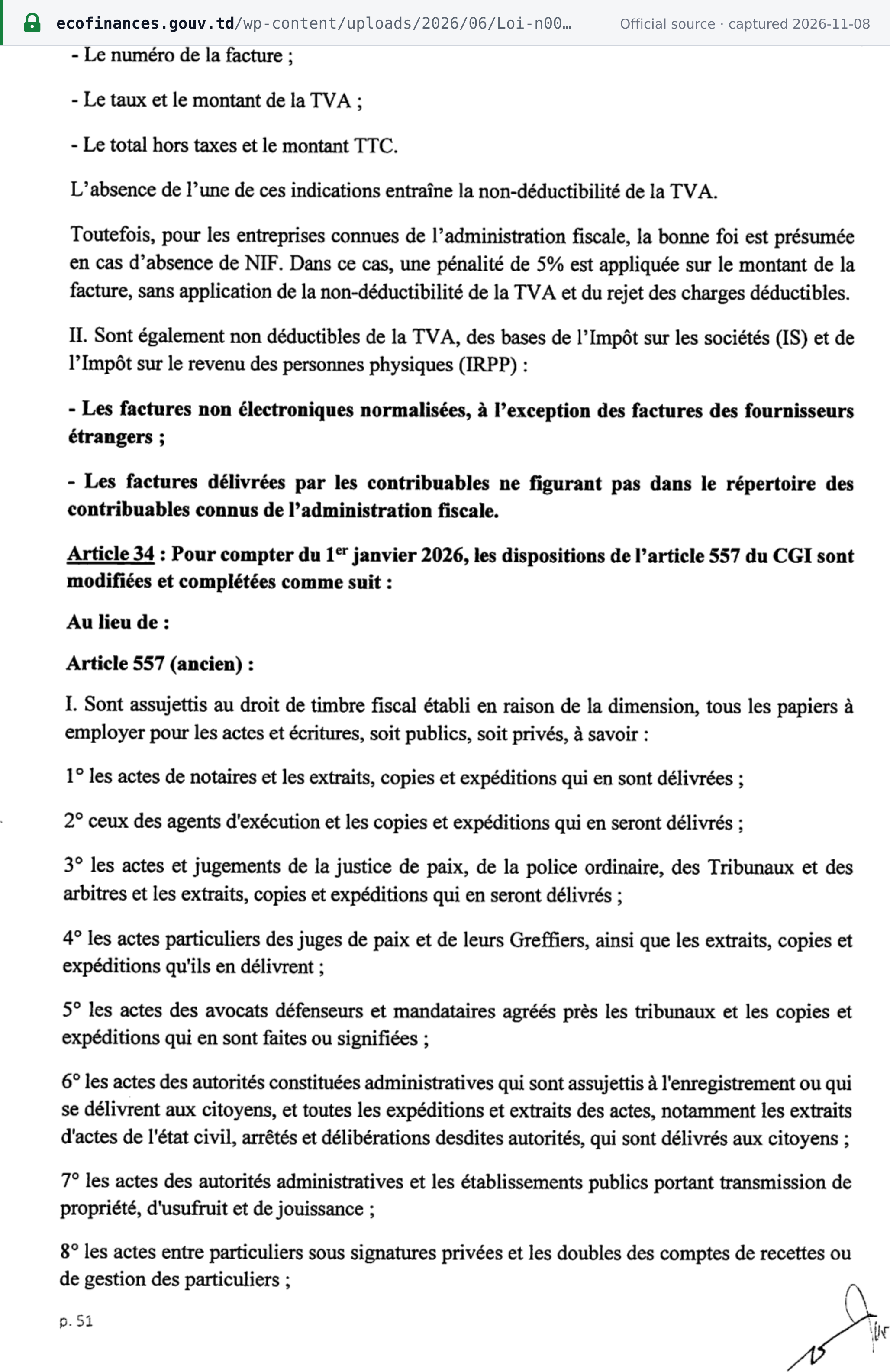
CGI article 246, as rewritten by LF 2026 art. 33 with effect from 1 January 2026, makes VAT deductible only if the invoice carries: [1]
- the NIF of both parties (customer and supplier);
- for each good or service, on the FEN, the quantity, precise description and unit price excluding VAT;
- the date of issue of the FEN;
- the invoice number;
- the VAT rate and amount;
- the total excluding tax and the total including tax.
"L'absence de l'une de ces indications entraîne la non-déductibilité de la TVA." For businesses known to the tax administration, good faith is presumed when the NIF is missing: a 5% penalty on the invoice amount applies instead, and the VAT stays deductible. [1]
Article 246 II then makes the following non-deductible for VAT and for corporate (IS) and personal (IRPP) income tax:
- "Les factures non électroniques normalisées, à l'exception des factures des fournisseurs étrangers";
- "Les factures délivrées par les contribuables ne figurant pas dans le répertoire des contribuables connus de l'administration fiscale."
 Source snapshot captured 2026-11-08 — original
A specimen of a compliant invoice
The DGI publishes no model FEN: none appears among the Finance Laws and other PDFs on the Ministry of Finance's website, and the FEN platform shows only a login page (as at 11 November 2026). A real FEN is produced by a DGI-certified invoicing machine or approved system, which adds the machine ID and the electronic signature and code. The specimen below is our illustration of where the mandatory mentions sit, and of how the 19.25% VAT appears.
FACTURE ÉLECTRONIQUE NORMALISÉE — illustrative specimen (Chad)
| Désignation (nature et objet)FEN d), e) | QtéFEN e) | Prix unitaire HT (FCFA)FEN f); CGI art. 246 | Prix global HT (FCFA)FEN f), g) |
|---|---|---|---|
| Maintenance de groupe électrogène — forfait mensuel | 1 | 300 000 | 300 000 |
| Pièces détachées (filtres) | 4 | 25 000 | 100 000 |
- Total hors taxesFEN g); CGI art. 246
- 400 000 FCFA
- TVA 19,25 % (17,5 % + centimes additionnels 10 %)FEN h); CGI arts. 238, 1017
- 77 000 FCFA
- Montant total TTC dû par le clientFEN i); CGI art. 246
- 477 000 FCFA
- The 77 000 FCFA of VAT is 70 000 FCFA of VAT principal at 17.5% plus 7 000 FCFA of centimes additionnels (10% of the principal).
- Machine électronique certifiée de facturation n° [MACHINE-ID-EXEMPLE] — added by the certified system (FEN k).
- Signature et code électronique: [CODE-EXEMPLE] — added by the certified system (FEN l).
- An exempt line carries the word « exonéré » instead of a VAT rate (FEN h). A business outside the réel and RSI regimes shows no VAT (CGI art. 229 III).
- Where applicable, the advance on profits tax and other taxes are shown (FEN j).
Credit notes and corrections
CGI article 245 (2025 wording, LF 2025 art. 10) governs corrections: [2]
- Cancelled or rescinded sales. Recovering the VAT requires "l'établissement et l'envoi au client d'une facture nouvelle et remplaçant la facture initiale".
- Unpaid sales. When the debt is definitively irrecoverable, the supplier sends a duplicate of the original invoice overprinted with « Facture demeurée impayée pour la somme de ... prix hors TVA et pour la somme de ... TVA correspondante qui peut faire l'objet d'une déduction ».
Not covered by the published texts
The Finance Laws reviewed do not set an invoice issuance deadline, a rule on the continuity of numbering (beyond the FEN "numéro d'ordre"), a currency or language rule, a foreign-exchange conversion rule, a simplified-invoice threshold, self-billing rules or a retention period for VAT invoices (as at 11 November 2026). The certification rules require FEN systems to secure, keep and archive the data for tax audits, but do not state a period. These rules may be in the base CGI or the Livre des procédures fiscales, neither of which is published on the Ministry of Finance's website.
E-invoicing status
Status as at 11 November 2026: mandatory, and since 2026 a condition of VAT deduction. Chad's system is the facture électronique normalisée (FEN), run by the DGI on the platform at fen.finances.gouv.td ("Connexion au système de FEN du Tchad"). [8]
- Model. Invoices are issued through a DGI-certified electronic invoicing machine or an approved invoicing system linked to a DGI control module, and each one carries the machine ID and an electronic signature and code (FEN items k and l). For how such models compare, see E-invoicing models: clearance, reporting and interchange.
- Format. The Finance Laws publish no file format, schema or network standard (no UBL or Peppol reference), and the FEN implementing order (arrêté) with the technical specifications is not published on the Ministry of Finance's website (as at 11 November 2026).
- Cost relief. Businesses that acquire certified invoicing machines can claim a flat refund of the cost as a credit against corporate income tax or the IGL: réel-regime businesses over two years (50% a year), IGL businesses in full after the first year of use. [3]
| Date | Step | Source |
|---|---|---|
| 1 Jan 2024 | The 2023 Finance Law (art. 17) institutes the FEN for commercial, industrial and craft operations of persons liable to IS, IGL or VAT; its provisions enter into force on 1 January 2024. The 2024 Finance Law (art. 43) amends article 17: the sectors and businesses obliged to issue FEN are to be listed by order of the finance minister | LF 2023 art. 17 [10]; LF 2024 art. 43 [3] |
| 1 Jan 2025 | Only VAT shown on a FEN (or import documents, self-supply returns, leasing invoices) is deductible; FEN penalties | LF 2025 arts. 8, 12 [2] |
| 1 Jan 2026 | Non-FEN invoices non-deductible for VAT and income tax (foreign suppliers excepted) | LF 2026 art. 33 [1] |
| 1 Jan 2026 | FEN mandatory for every invoice relating to public expenditure; extended to suppliers and clients of public bodies, NGOs, liberal professions, projects and diplomatic missions; mandatory for exporters | LF 2026 arts. 71, 46, 37 [1] |
Scope.
- B2B. Every operation by a person liable to IS, IGL or VAT is documented by a FEN, and since 2026 the buyer loses the VAT deduction on anything else. LF 2024 art. 43 leaves the list of sectors and businesses obliged to issue FEN to a finance-minister order, which is not published on the Ministry's website (as at 11 November 2026). [3]
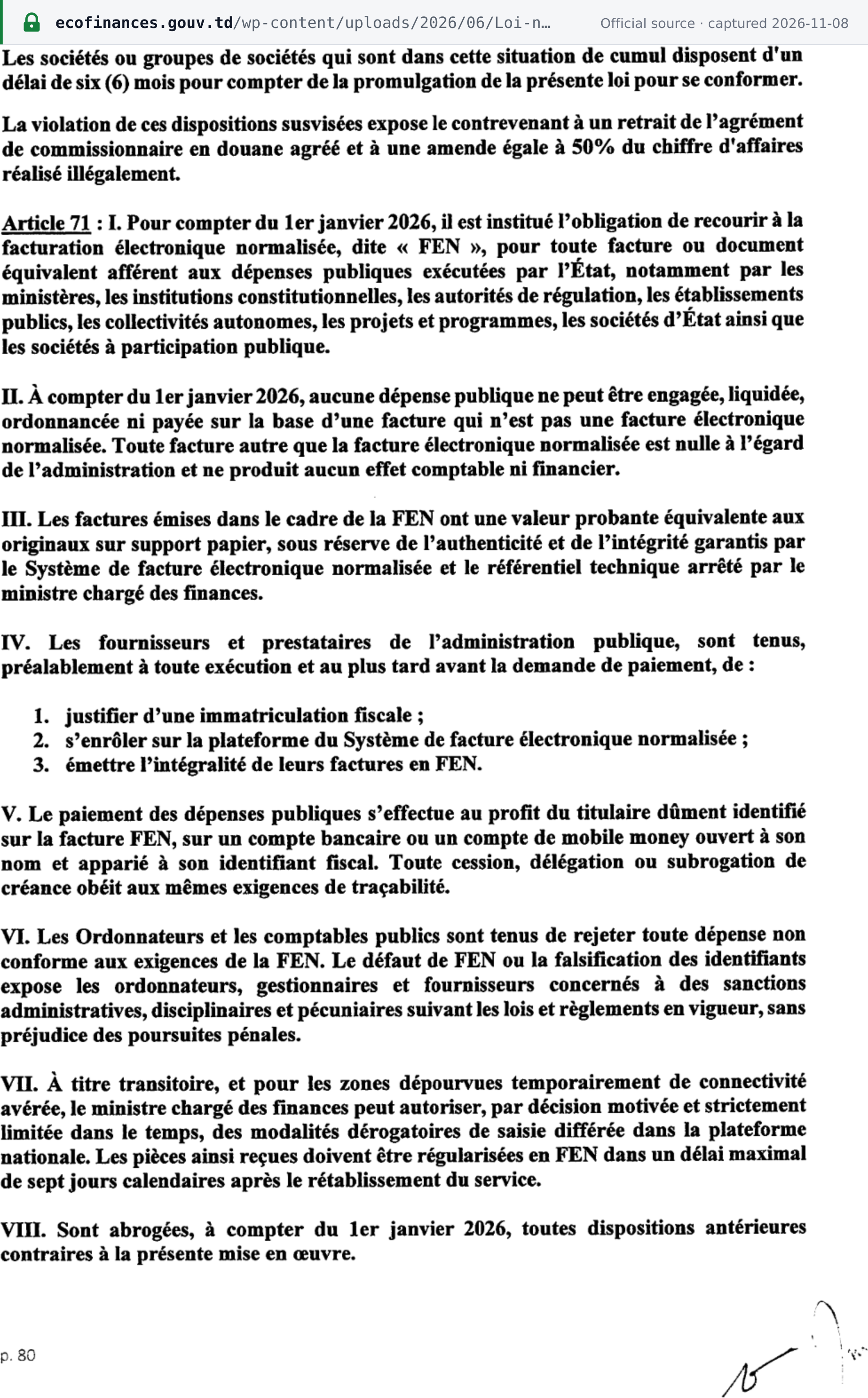
- B2G. Under LF 2026 art. 71, from 1 January 2026 "aucune dépense publique ne peut être engagée, liquidée, ordonnancée ni payée sur la base d'une facture qui n'est pas une facture électronique normalisée". Any other invoice "est nulle à l'égard de l'administration". Suppliers must prove their tax registration, enrol on the FEN platform and issue all their invoices as FEN, and are paid only into a bank or mobile-money account in their own name linked to their tax number. Where connectivity is temporarily missing, the minister may allow deferred entry, with regularisation within seven calendar days. [1]
- Clients of public and other bodies. LF 2026 art. 46 requires FEN from the suppliers, service providers and clients of public bodies, autonomous local authorities, associations and NGOs, liberal professions and ministerial offices (auctioneers, bailiffs, notaries), projects, and international, diplomatic and consular missions in Chad. [1]
- B2C. Private individuals buying from a person liable to IS, IGL or VAT must demand a FEN (LF 2023 art. 17 III, as reproduced in LF 2024).
 Source snapshot captured 2026-11-08 — original
Filing and payment
Filing frequency and due date
- Frequency. Monthly for every VAT taxpayer, réel or RSI: "Elles sont tenues à déposer leur déclaration mensuellement sans distinction de régime" (CGI art. 229 III, 2026). [1]
- Return and payment together. Under CGI article 886 (2024 wording), the return is made on the administration's form, and "La déclaration doit être accompagnée du paiement de TVA qui est ainsi reversée spontanément". A month with no taxable operations still needs a return marked « Néant ». [3]
- Due day. The Finance Laws reviewed do not restate the day of the month by which the ordinary VAT return is due (as at 11 November 2026). Check it in e-Tax or with the DGI. Do not assume that the 15th-of-the-month deadline for withheld VAT (below) applies to the ordinary return.
Where to file: e-Tax
Every person liable to a tax, or designated to withhold one, "est tenue de souscrire des déclarations via le Système de Gestion des Impôts (e-Tax), accompagnées des documents annexes obligatoires, dans les délais prévus par la loi" (CGI art. 996, 2026 wording). [1] Annexes of deductible VAT (invoices, customs documents) must be filed electronically (CGI art. 239 VI 5°). [2] The law does not give a web address for e-Tax. The Ministry of Finance's "Direction des Impôts" link leads to the DGI's online system at sigi.finances.gouv.td.
VAT withholding by public bodies and listed companies
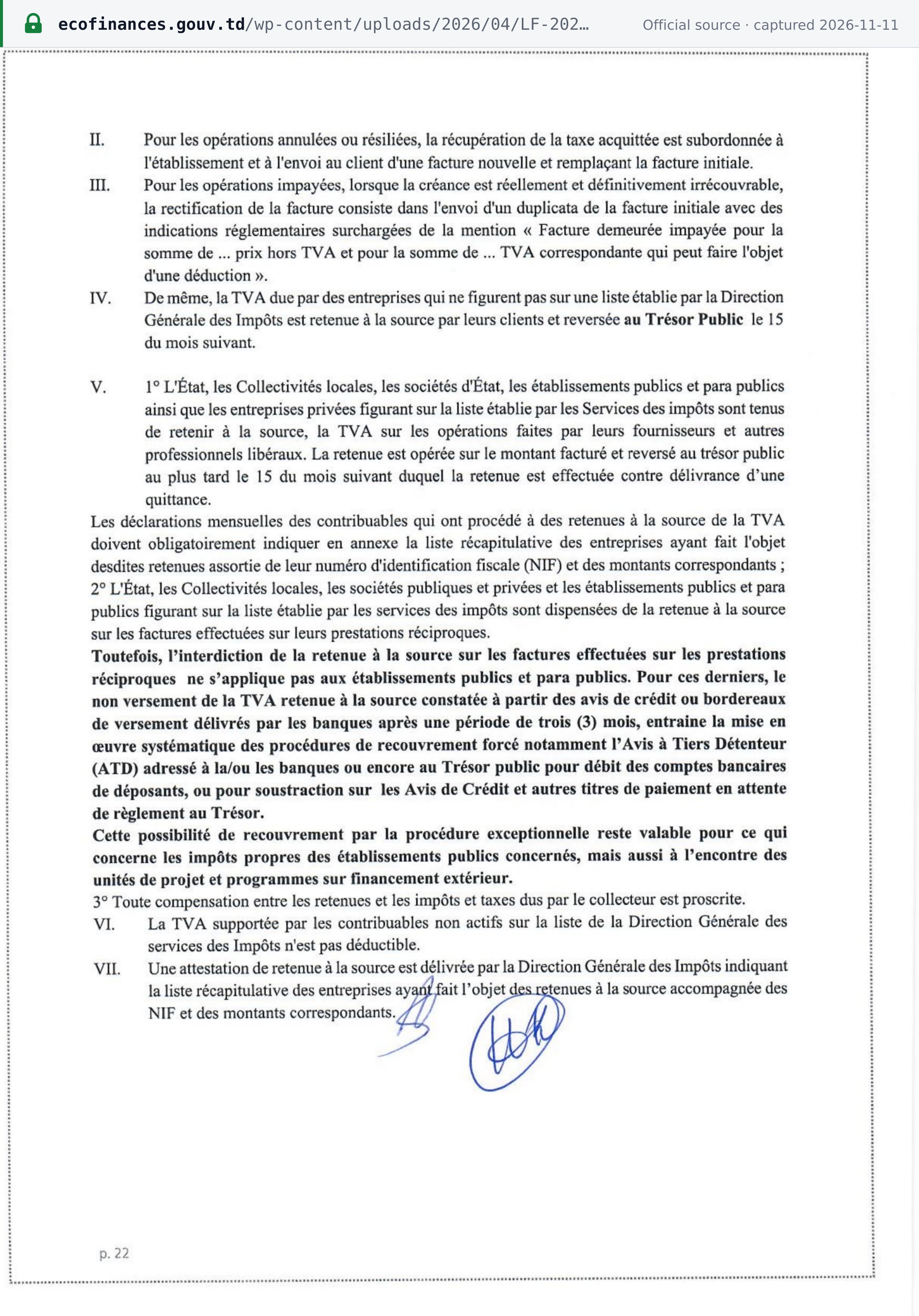
CGI article 245 V 1°, as rewritten by the 2025 Finance Law (art. 10) with effect from 1 January 2025: [2]
"L'État, les Collectivités locales, les sociétés d'État, les établissements publics et para publics ainsi que les entreprises privées figurant sur la liste établie par les Services des impôts sont tenus de retenir à la source, la TVA sur les opérations faites par leurs fournisseurs et autres professionnels libéraux. La retenue est opérée sur le montant facturé et reversé au trésor public au plus tard le 15 du mois suivant duquel la retenue est effectuée contre délivrance d'une quittance."
- Who is listed. The list of companies and public bodies that must withhold is set by Arrêté n° 114/PR/MFB/DGM/DGSI/2019. [6]
- Reporting. The withholder's monthly return lists, in an annex, the businesses withheld from with their NIF and the amounts.
- Between listed entities. Listed entities do not withhold on invoices for supplies between themselves, except that since 1 January 2025 this dispensation does not apply to public and para-public establishments (établissements publics et parapublics), which must withhold; failure by them to pay over withheld VAT for three months triggers forced recovery (garnishee notice to their bank or the Treasury). "Toutefois, l'interdiction de la retenue à la source sur les factures effectuées sur les prestations réciproques ne s'applique pas aux établissements publics et para publics." (art. 245 V 2°)
- No offset. A withholder may not offset withheld VAT against its own taxes (art. 245 V 3°).
- Attestation. The DGI issues an attestation de retenue à la source (art. 245 VII, added in 2024).
- Suppliers not on the DGI list. Article 245 IV adds that the VAT due by businesses not on a list kept by the DGI is withheld at source by their customers and paid over to the Treasury on the 15th of the following month. [2]
- Late payment by withholders. Withheld VAT not paid over by the 15th triggers forced recovery (assessment notice, garnishee notice, account freeze, closure of the business) (CGI art. 1068 9°, 2025). Failing to withhold, or to pay over, costs a 100% penalty on the tax (CGI art. 1069, 2020). [4]
 Source snapshot captured 2026-11-11 — original
See VAT withholding regimes for comparable systems.
Annual filing
Businesses with turnover of FCFA 500 million or more file their annual statistical and fiscal return (DSF) online with the large-taxpayer office, together with electronic files of deductible VAT showing each supplier's identity, address, the amounts, the invoice number and the VAT (CGI art. 999 II, 2024 wording). [3]
Input-tax recovery
CGI article 239, as rewritten by the 2025 Finance Law: [2]
- VAT is deductible only on goods and services "nécessaires à l'exploitation".
- The right arises when the tax becomes chargeable at the supplier, and the VAT is deducted in the same month as the taxable operations (the following month for VAT on services from foreign providers, see Cross-border rules).
- Deductible VAT is only VAT shown on (1) FEN invoices from suppliers allowed to charge it, (2) import documents, (3) self-supply returns, and (4) leasing invoices where the lessee is a VAT taxpayer.
- Partial exemption. Businesses with both taxable and exempt sales deduct by a prorata, which since 2025 is "déterminé mensuellement" (CGI art. 243 V). [2]
- No NIF, no deduction (CGI art. 147), and no deduction on non-FEN invoices (CGI art. 246, see Invoice requirements).
Blocked items (for example passenger vehicles or entertainment) are not reprinted in the Finance Laws reviewed (as at 11 November 2026).
Credits and refunds
CGI article 891, as rewritten by LF 2026 art. 35: [1] [1]
- An excess of deductible VAT carries forward to the next month. "Le report de crédit ne peut dépasser une période de vingt-quatre (24) mois qui court à compter de la naissance du crédit." After 24 months a refund claim is inadmissible.
- Quarterly VAT credits of traders above FCFA 5 million must be validated before they are carried forward.
- A refund is refused if, when it is claimed, the business is late with any tax, including VAT.
- Approved refunds are paid in cash "par le biais d'un compte séquestre logé à la BEAC", funded with 15% of annual VAT receipts.
- Businesses exempt from VAT under establishment agreements (conventions d'établissement) cannot claim refunds.
- The claim goes to the DGI or online through e-Tax with: the list of FEN invoices (name, NIF, amount paid to each supplier), the attestation de non-redevance (ANR), copies of the FEN or import documents, proof of electronic payment to each supplier (new in 2026), and any agreement granting a special regime.
No refund scheme for non-resident businesses is published.
Exemptions
Exempt supplies
CGI article 230 lists the exempt operations. LF 2026 art. 31 reprints the whole list and changes items 6° and 15°. [1] Examples:
- sales of unprocessed produce by farmers, livestock breeders and fishermen directly to consumers (1°);
- insurance and reinsurance operations, and transfers of real estate and intangible movables subject to registration duties (except dealers and leasing) (2°);
- postage and fiscal stamps (3°); newspapers and periodicals, excluding advertising (4°); leasing (crédit-bail) (5°);
- petrol and gasoil sold at the pump by approved distributors supplied by the N'Djamena refinery, and, since 2026, Jet A1 for domestic flights (6°); [1] [1]
- rental of bare land and premises, and of bare residential property; medical and paramedical services, medical care and hospitalisation; approved schools at approved prices;
- drinking water and electricity from the national utilities or independent producers; agricultural, livestock and fishing inputs; agricultural production and processing machinery; renewable-energy equipment; equipment for people with disabilities (36°);
- a list of goods by customs tariff heading (15°), rewritten in 2026.
Exempt is not zero-rated
Exports are taxed at 0% (art. 238 I 3°), not exempt. In the deduction prorata, exports count in the numerator ("augmentée du montant des exportations des produits taxables"), so an exporter keeps its right to deduct. [2] Exempt supplies count only in the denominator, so they reduce the VAT a business can deduct on its costs. Businesses with exemptions must also file a client-by-client statement of exempt sales with their returns and obtain an exemption certificate online from the DGI (CGI art. 239 VI 6°–7°). See Zero-rated vs exempt supplies.
Special regimes
- Impôt général libératoire (IGL). Individuals with turnover under FCFA 50 million pay the IGL instead of VAT (see Registration). They still issue FEN, without VAT.
- Special economic zones. Businesses in special economic zones must keep two separate sets of accounts, one for export activity and one for local sales (CGI art. 999 IV). [3]
- Establishment agreements. VAT exemptions granted by conventions d'établissement exclude the business from VAT refunds (CGI art. 891).
Offences and penalties
Offences
The Finance Laws reviewed define the following conduct; none of them sets a prison term for a VAT offence (as at 11 November 2026):
- Bad faith (CGI art. 1069 II–III): knowingly omitting accounting entries or making inaccurate or fictitious ones; producing false documents that led to invoicing or deduction of VAT; filing a « Néant » return and later filing returns with operations for the same period; listed bodies failing to withhold VAT. [4]
- Flagrance fiscale (2025 Finance Law, art. 16): during an audit, an undeclared activity, invoices that match no real supply, deduction of fictitious invoices, sales without invoices, fraudulent accounting or till software, or imports under false identities lead to a procès-verbal de flagrance fiscale. [2]
- Registration and e-filing breaches (CGI arts. 864, 995, 996) can lead to loss of the right to trade, exclusion from public procurement, a ban on importing and exporting, and publication of the offender's name (CGI art. 997, 2026). [1]
- Missing or falsified FEN in public spending exposes officials and suppliers to administrative, disciplinary and financial sanctions, "sans préjudice des poursuites pénales" (LF 2026 art. 71 VI).
Penalties
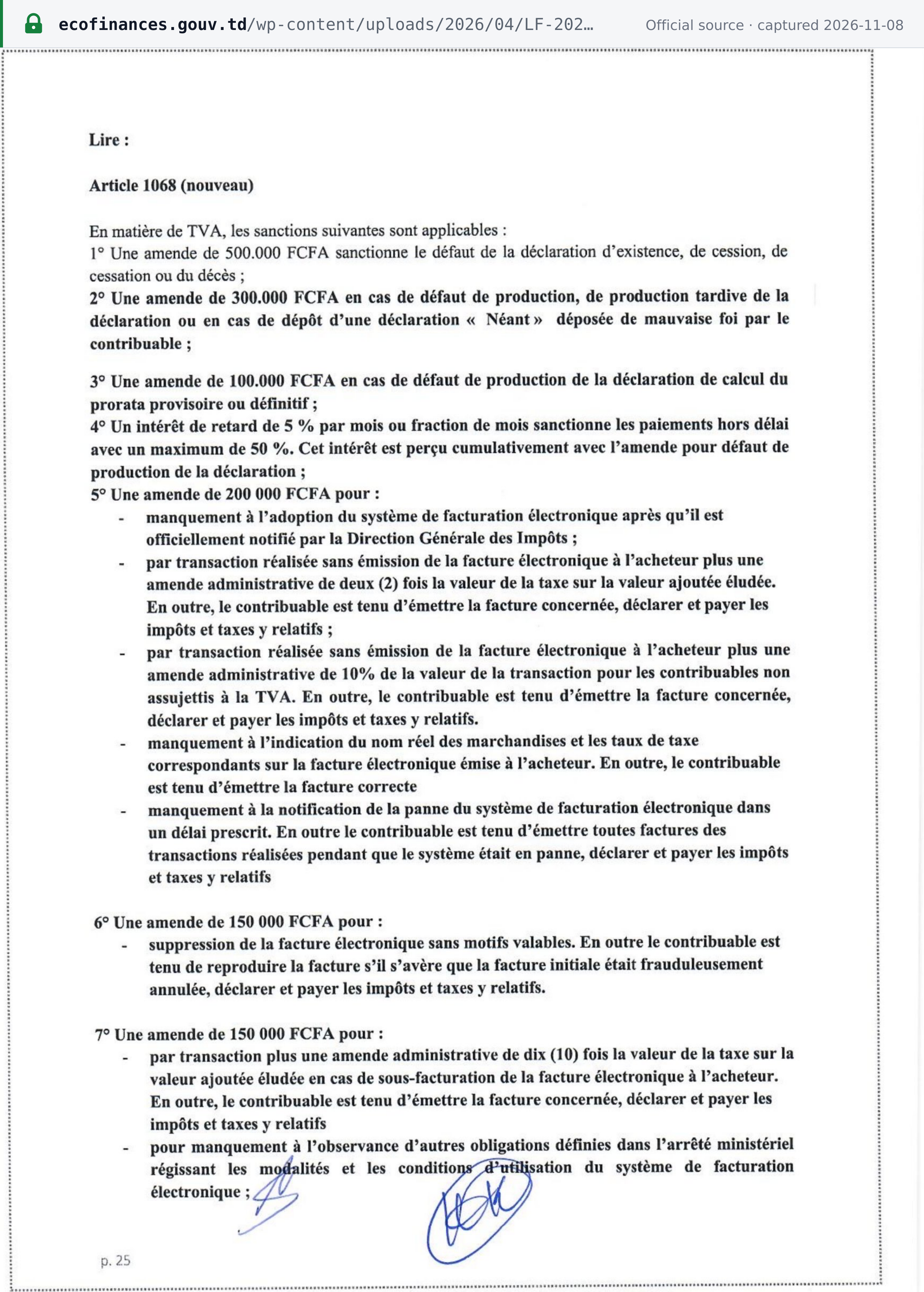
| Failure | Penalty | Source |
|---|---|---|
| No déclaration d'existence, transfer, cessation or death declaration | FCFA 500,000 | CGI art. 1068 1° (2025); art. 1059 I (2026) |
| No déclaration d'immatriculation (registration), or changes not reported | FCFA 500,000 per month of delay (FCFA 50,000 before 2026) | CGI art. 1059 II (2026) [1] |
| Return not filed or filed late, or a « Néant » return in bad faith | FCFA 300,000 | CGI art. 1068 2° (2025) |
| No prorata return | FCFA 100,000 | CGI art. 1068 3° |
| Late payment | Interest of 5% per month or part-month, capped at 50%, on top of the late-filing fine | CGI art. 1068 4° |
| Late electronic filing | 5% per month on each tax | CGI art. 996 5 (2026) |
| VAT reassessment | 5% per month, capped at 50%; up to 100% for bad faith | CGI art. 1069 I (2020) [4] |
| Failure to withhold or pay over withheld VAT | 100% of the tax | CGI art. 1069 I (2020) |
| Not adopting e-invoicing after DGI notice; wrong goods name or rate on a FEN; not reporting a system breakdown | FCFA 200,000 | CGI art. 1068 5° (2025) |
| Sale without a FEN | FCFA 200,000 per transaction plus twice the VAT evaded (VAT taxpayers) or plus 10% of the transaction value (non-VAT taxpayers) | CGI art. 1068 5° |
| Deleting a FEN without valid reason | FCFA 150,000 | CGI art. 1068 6° |
| Under-invoicing on a FEN | FCFA 150,000 per transaction plus ten times the VAT evaded | CGI art. 1068 7° |
| Missing NIF on an invoice from a business known to the DGI | 5% of the invoice amount (VAT stays deductible) | CGI art. 246 I (2026) |
| Digital platform not filing or paying | Suspension of access to the platform in Chad | CGI art. 227 11° (h) (2026) |
The penalties in CGI article 1068 come from the 2025 Finance Law (art. 12). [2]
 Source snapshot captured 2026-11-08 — original
Frequently asked questions
Is Chad's VAT rate 18%, 17.5% or 19.25%?
The standard VAT rate in the Code général des impôts is 17.5%. It replaced 18% on 1 January 2024 (2024 Finance Law, art. 26), and the 2025 and 2026 Finance Laws keep it. On top of the VAT, article 14 of the 2024 Finance Law created centimes additionnels for provinces and communes at 10% of the VAT principal. Article 1017 of the Code général des impôts therefore requires taxpayers under the réel and simplified (RSI) regimes to show VAT on their invoices at 19.25%, which is 17.5% plus 10% of 17.5%. Some summaries, including the business-environment page of the investment agency ANIE, still show 18%.
A Chadian customer paid our invoice net of VAT. Why?
The State, local authorities, state companies, public bodies and the private companies on the tax administration's list must withhold the VAT on their suppliers' invoices and pay it to the Treasury by the 15th of the following month (CGI art. 245 V, as rewritten by the 2025 Finance Law, art. 10). The list is set by Arrêté n° 114/PR/MFB/DGM/DGSI/2019. The withheld VAT is paid over against a receipt (quittance), and article 245 VII provides for an attestation de retenue à la source issued by the Direction Générale des Impôts. Listed entities do not withhold on invoices for supplies between themselves, except public and para-public establishments, which must withhold since 2025.
We are a foreign software or app company selling to consumers in Chad. Is there a registration threshold?
No threshold is stated. Since 1 January 2026, article 227 11° of the Code général des impôts (2026 Finance Law, art. 29) requires foreign suppliers that have their own technology and supply digital services to collect and remit VAT on their online sales. E-commerce platforms register, file and pay through the tax administration's e-Tax portal, and registering does not create a permanent establishment for other taxes. Failure to file or pay can lead to access to the platform being suspended in Chad. The details are left to an order of the finance minister, which the Ministry of Finance had not published as at 11 November 2026.
Can we deduct the VAT on an ordinary paper or PDF invoice from a Chadian supplier?
No. Since 1 January 2026, article 246 II of the Code général des impôts makes invoices that are not standardised electronic invoices (factures électroniques normalisées, FEN) non-deductible for VAT and for corporate and personal income tax. Invoices from foreign suppliers are the only exception. Invoices from businesses that are not in the tax administration's register of known taxpayers are also non-deductible. Even on a FEN, the VAT is deductible only if the invoice shows both parties' tax numbers (NIF), the quantity, description and unit price excluding VAT of each item, the date, the invoice number, the VAT rate and amount, and the totals before and after tax.
How long can a VAT credit be carried forward, and can it be refunded?
An excess of deductible VAT carries forward to the next month for at most 24 months from when the credit arose, and a refund claim made after 24 months is inadmissible (CGI art. 891, 2026 wording). A refund is refused if any tax is overdue when the claim is made. Approved refunds are paid in cash from an escrow account at the Banque des États de l'Afrique Centrale (BEAC), funded with 15% of annual VAT receipts. Since 2026 the claim must include the list and copies of the FEN invoices or import documents, an attestation de non-redevance and proof of electronic payment to each supplier. Businesses whose VAT exemption comes from an establishment agreement cannot claim refunds.
We supply a ministry, an NGO or an embassy in Chad. What changed in 2026?
From 1 January 2026 no public expenditure can be committed or paid on an invoice that is not a FEN, and any other invoice is void as regards the administration (2026 Finance Law, art. 71). Suppliers to the public administration must prove their tax registration, enrol on the FEN platform and issue all their invoices as FEN, and payment goes only to a bank or mobile-money account in the supplier's name linked to its tax number. Article 46 of the same law extends the FEN obligation to the suppliers, service providers and clients of public bodies, autonomous local authorities, associations and NGOs, liberal professions and ministerial offices, projects, and international, diplomatic and consular missions in Chad.
Important websites
| Site | What it is for |
|---|---|
| Direction Générale des Impôts (DGI) — online portal (login) | The DGI's portal, linked from the Ministry of Finance's page as "Direction des Impôts"; the law calls the filing system Système de Gestion des Impôts (e-Tax) |
| FEN platform (login) | Enrolment and issuing of factures électroniques normalisées |
| Ministry of Finance — publications portal | Finance Laws, which carry every CGI amendment |
| Douanes du Tchad | Customs, including VAT on imports |
| ANIE — one-stop shop | Business creation; the ANIE certificate is needed for the NIF |
No public NIF verification service is published by the DGI or the Ministry of Finance (as at 11 November 2026).
Recent changes
- 2026-01-01 — The 2026 Finance Law (Loi n° 008/AN/SENAT/2025) in force: VAT on digital services from foreign suppliers and on platforms (CGI art. 227 11°, implementing order pending); 9% rate extended to milk, yoghurt, butter, cheese, meat and to hotel and restaurant accommodation and catering; buyer self-assessment of VAT missing from an invoice (art. 229 V); non-FEN invoices non-deductible (art. 246 II); FEN mandatory for public expenditure (art. 71). (Ministry of Finance) — see event
- 2025-01-01 — The 2025 Finance Law (Loi n° 033/CNT/2024) in force: first VAT rules for e-commerce platforms; only VAT on FEN invoices deductible and the bordereau TVA pour le compte de tiers for foreign service providers (art. 239); monthly deduction prorata; e-invoicing penalties (art. 1068). (Ministry of Finance)
- 2024-01-01 — The 2024 Finance Law (Loi n° 031/PT/2023) in force: standard rate cut from 18% to 17.5%; 10% centimes additionnels on VAT; invoices show VAT at 19.25%. (Ministry of Finance)
For the full chronology, see Chad tax changes on Lookuptax.
Reference links
Legislation (Ministère des Finances):
- [1] Loi n° 008/AN/SENAT/2025 portant loi de finances pour l'exercice 2026
- [2] Loi n° 033/CNT/2024 du 6 décembre 2024 portant loi de finances pour l'exercice 2025
- [3] Loi n° 031/PT/2023 du 29 décembre 2023 portant loi de finances pour l'exercice 2024
- [4] Loi de finances pour l'exercice 2020
- [10] Loi de finances pour l'exercice 2023 (FEN instituted, art. 17)
- [11] Arrêté n° 135/MFBEPCI/SE/SG/DGDDI/2026 du 9 septembre 2026 (import duty and tax exemptions)
- [6] Arrêté n° 114/PR/MFB/DGM/DGSI/2019 (lists of entities that withhold VAT)
Government websites:
- [5] Ministry of Finance — publications portal
- [9] Ministry of Finance — le ministère
- [8] FEN platform
- [7] ANIE — business environment
Related on Lookuptax:
- Chad tax changes
- Congo (Brazzaville) VAT guide
- Worldwide VAT, GST and sales tax rates
- VAT registration thresholds
- E-invoicing status and networks
- How to register for VAT, sales tax or GST
- VAT withholding regimes
- VAT on digital services from non-resident suppliers
- Reverse charge
- Zero-rated vs exempt supplies