Côte d'Ivoire VAT guidelines
| FACTSHEET | |
|---|---|
| Country code | CI |
| Tax name | Taxe sur la valeur ajoutée (TVA) |
| Tax Authority | Direction générale des Impôts (DGI) |
| Rates | 18% standard · 9% reduced |
| Taxpayer number | Numéro de compte contribuable (NCC) |
| E-invoicing | Facture normalisée électronique (FNE), mandatory |
Overview
Côte d'Ivoire levies taxe sur la valeur ajoutée (TVA), the value added tax, under Book II (Livre deuxième), Part 1, Title 1 of the Code général des Impôts (CGI). Article 339 sets its scope: "Sont soumises à la taxe sur la valeur ajoutée, les livraisons de biens et les prestations de services, effectuées à titre onéreux par un assujetti agissant en tant que tel, à l'exclusion des activités salariées et agricoles." Supplies of goods and services made for consideration by a taxable person acting as such are taxable; salaried and agricultural activities are not. [1]
The DGI publishes the consolidated CGI and the Livre de Procédures fiscales (LPF) at cgici.com (edition updated to 3 January 2026).
Authority. TVA is administered by the Direction générale des Impôts (DGI), Ministère des Finances et du Budget. Taxpayers file and pay through the DGI's e-impots portal and issue invoices through the FNE platform. [2]
Currency. The CFA franc (FCFA, ISO code XOF), shared across the West African Economic and Monetary Union (UEMOA). Statutes write amounts in "francs".
Tax year and period. Accounting years close on 31 December: CGI article 13 bars taxpayers from closing "à une date autre que celle du 31 décembre de chaque année". [3] TVA is declared and paid monthly (see Filing and payment).
Layering. None for TVA. It is a single national tax. Communes levy their own taxes, such as the taxe communale de l'entreprenant, but these are not TVA.
Taxpayer regimes. Which regime a business falls under decides whether it charges TVA at all. The CGI sets four bands by annual turnover, all taxes included (TTC):
| Regime | Annual turnover TTC | Charges TVA? | CGI article |
|---|---|---|---|
| Réel normal d'imposition (RNI) | above FCFA 500,000,000 | Yes | art. 34 |
| Réel simplifié d'imposition (RSI) | FCFA 200,000,001 to 500,000,000 | Yes | art. 45 |
| Régime des microentreprises (RME) | FCFA 50,000,001 to 200,000,000 | No | art. 71 bis |
| Taxe d'Etat de l'entreprenant (TEE) | FCFA 5,000,001 to 50,000,000 | No | art. 73 |
Sources: CGI arts. 34, 45, 71 bis and 73. [4] [5] [6] [7]
For neighbouring CFA-franc systems, see the Republic of the Congo VAT guide and Burkina Faso's FEC e-invoicing guide.
Registration
Who should register
Every business, whatever its turnover. LPF article 146 requires anyone starting a professional activity to declare it to the DGI first: "Toute personne qui entreprend l'exercice d'une activité lucrative ou non à titre professionnel doit avant le commencement de ses activités en faire la déclaration auprès de la Direction générale des Impôts quel que soit le niveau de son chiffre d'affaires attendu." The DGI then registers the person in the taxpayer file by allotting a numéro de compte contribuable (NCC) and attaches it to the local tax office. [8]
Registering does not by itself make a business a TVA payer. That depends on its regime and turnover (next section).
Registration threshold
TVA applies only above FCFA 200 million of annual turnover, all taxes included. CGI article 347: "Les personnes physiques ou morales ne sont autorisées à facturer la taxe sur la valeur ajoutée que lorsque leur chiffre d'affaires annuel toutes taxes comprises est supérieur à 200 000 001 francs, quelle que soit la nature de l'activité exercée." [9]
 Source snapshot captured 2026-11-03 — original
In practice, the TVA population is the two real regimes, RSI and RNI. The DGI's communiqué of 14 September 2026 requires FNE integrations to restrict "la facturation de la TVA aux seuls contribuables relevant d'un régime du réel (réel normal d'imposition [RNI] et réel simplifié d'imposition [RSI])". [10] RME and TEE businesses do not charge TVA; the TEE replaces the business licence tax (patente), profit tax and TVA for its band.
- Measurement: annual turnover TTC, pro-rated for businesses that start or stop during the year.
- Moving down: a business that falls below a band's limit changes regime only after three consecutive years below it (one year for a new business).
Non-resident registration
The CGI sets no separate TVA threshold for non-residents. Two rules in CGI article 71 apply: [11]
- Foreign enterprises without premises or staff in Côte d'Ivoire must appoint a legal representative there. "Les entreprises étrangères qui exercent leurs activités sans disposer de local ou de personnel sur le territoire ivoirien, sont tenues de désigner un représentant légal en Côte d'Ivoire, chargé de la réception et de la transmission de tous les documents les concernant. Ce représentant légal est tenu solidaire du paiement des impôts et taxes à la charge de ces entreprises."
- Non-resident online sales platforms and digital-service operators register online and remotely: "la déclaration est faite en ligne et à distance, selon une procédure simplifiée mise en place par l'Administration fiscale." A platform that has not registered within three months of starting can have access to it from Côte d'Ivoire suspended, and unregistered platforms are listed publicly by 31 March each year.
 Source snapshot captured 2026-11-03 — original
Tax identification number (NCC)
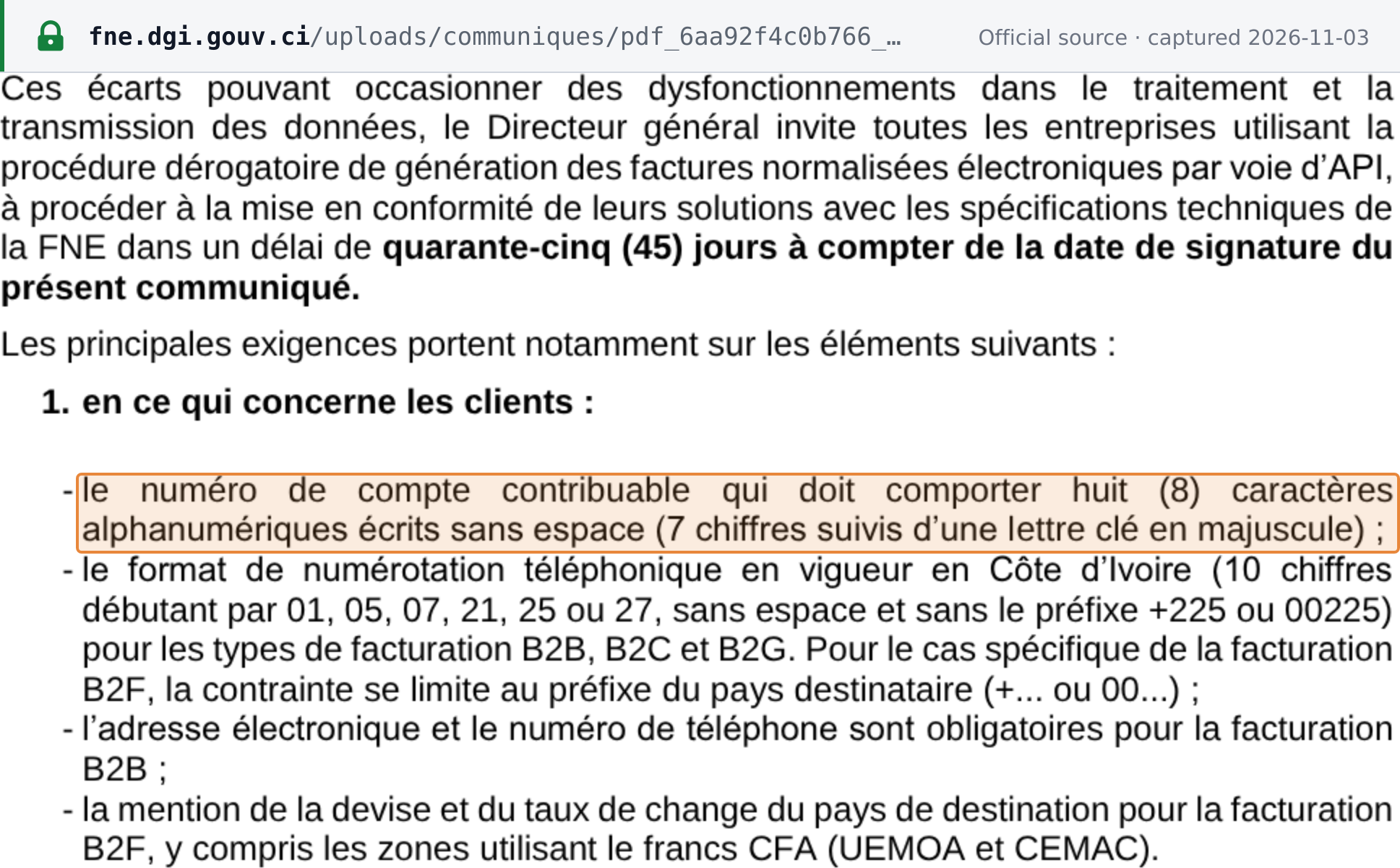
The numéro de compte contribuable (NCC) is the taxpayer number on every FNE, for both supplier and business customer. The DGI's communiqué of 14 September 2026 fixes its format: "le numéro de compte contribuable qui doit comporter huit (8) caractères alphanumériques écrits sans espace (7 chiffres suivis d'une lettre clé en majuscule)". [10]
- Format: 8 characters, no spaces: 7 digits, then an upper-case check letter. An illustrative (not real) value has the shape
1234567X. - Checksum: the DGI does not publish the check-letter algorithm.
- Lookup: no public NCC search was found on the DGI or FNE sites. The FNE platform checks a customer's NCC when an invoice is issued, behind login.
Check an NCC's format with the Côte d'Ivoire NCC validator.
 Source snapshot captured 2026-11-03 — original
How to register
- Create the business. Company formation goes through the investment promotion centre's one-stop shop (CEPICI).
- File the declaration of existence with the DGI before trading (LPF art. 146). The DGI allots the NCC and attaches the business to its tax office. Not filing carries a fine of FCFA 1,000,000. [8]
- Enrol on the FNE platform (services.fne.dgi.gouv.ci). Enrolment is a precondition for the tax compliance certificate: "l'inscription des contribuables sur la plateforme de la FNE constitue une condition sine qua non pour la délivrance de l'Attestation de Régularité de situation fiscale (ARF)." The DGI closed enrolment for existing taxpayers on 31 January 2026. [2] Only businesses attached to a DGI tax office (holding an NCC) can enrol; the FNE FAQ says taxe communale de l'entreprenant payers "ne sont pas encore pris en charge". [12]
For the general process across countries, see how to register for VAT, sales tax or GST.
Voluntary registration
CGI article 348 lets three groups opt into TVA: [9]
- producers of plants and flowers whose annual turnover TTC exceeds FCFA 50,000,000
- operators of agricultural products that are within the scope of TVA
- owners of bare buildings let for commercial or industrial use
Article 349: "L'option prévue à l'article précédent est irrévocable. Elle prend effet à compter du premier jour du mois suivant celui au cours duquel elle est exercée." Separately, an RME business may opt for the RSI before 1 February each year (CGI art. 46), which brings it into TVA. A business would opt in to recover TVA on its purchases and to invoice TVA to business customers that can deduct it.
Deregistration
On transfer or cessation, CGI article 71 requires the taxpayer to notify the tax office within ten days: "Les redevables doivent, dans un délai de dix jours déterminé comme il est indiqué ci-après, aviser le service des Impôts de la cession ou de la cessation et lui faire connaître la date à laquelle elle a été ou sera effective". [11] The profit return is due within the same period. Any change in operating conditions needs an amending declaration within 10 days (LPF art. 146; fine FCFA 100,000).
Group registration
Not available. The CGI's TVA chapter (articles 339 to 387) contains no grouping provision.
Rates
| Rate | Applies to | FNE tax code |
|---|---|---|
| 18% | Standard rate: all taxable supplies not listed elsewhere | TVA |
| 9% | Milk (not yoghurt or other dairy products); infant milk and homogenised infant food preparations; petroleum products; "viande de luxe"; "riz de luxe"; jute and sisal fibre operations; livestock and poultry feed; inputs for feed manufacture and their packaging; inputs for fertiliser manufacture and their packaging | TVAB |
| 0% | Conventional exemptions (for example investment-code approvals) | TVAC |
| 0% | Statutory exemption, used by TEE and RME businesses that do not charge TVA | TVAD |
Rates as at 2026-11-03.
Standard rate
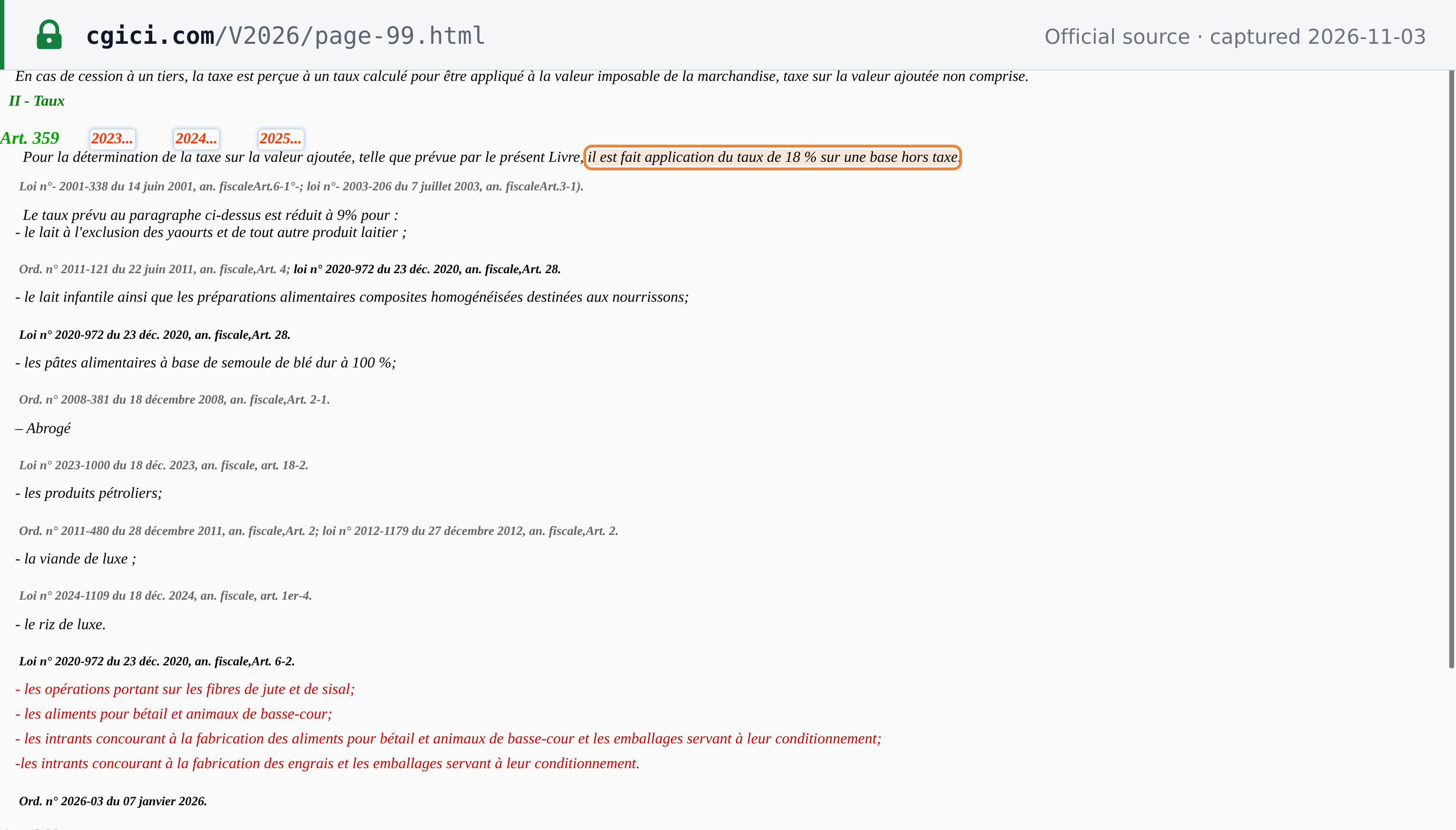
18% on a tax-exclusive base. CGI article 359: "Pour la détermination de la taxe sur la valeur ajoutée, telle que prévue par le présent Livre, il est fait application du taux de 18 % sur une base hors taxe." The consolidated code cites the 2001 finance law (Loi n° 2001-338, annexe fiscale art. 6-1°), as amended in 2003 (Loi n° 2003-206, art. 3-1), as the source of the rate. [13]
Reduced rate
9%. Article 359 continues: "Le taux prévu au paragraphe ci-dessus est réduit à 9% pour : - le lait à l'exclusion des yaourts et de tout autre produit laitier ; … - le lait infantile ainsi que les préparations alimentaires composites homogénéisées destinées aux nourrissons; … - les produits pétroliers; … - la viande de luxe ; … - le riz de luxe. … - les opérations portant sur les fibres de jute et de sisal; - les aliments pour bétail et animaux de basse-cour; - les intrants concourant à la fabrication des aliments pour bétail et animaux de basse-cour et les emballages servant à leur conditionnement; -les intrants concourant à la fabrication des engrais et les emballages servant à leur conditionnement." The last four items were added by Ordonnance n° 2026-03 of 7 January 2026. The former 9% line for 100% durum-wheat pasta is repealed ("Abrogé", Loi n° 2023-1000). [13]
The luxury products excluded from the staple-food exemption, including luxury meat and rice, are listed by joint ministerial arrêté (CGI art. 355-9). [15]
The DGI's FNE API guide lists the four tax codes an invoicing system must use: "TVA : TVA normal de 18%, TVAB : TVA réduit de 9%, TVAC : TVA exec conv de 0%, TVAD : TVA exec leg de 0% pour TEE et RME". [14]
 Source snapshot captured 2026-11-03 — original
Zero rate and exemptions
Exports and services treated as exports are relieved under CGI article 356: "Sont exemptés de la taxe sur la valeur ajoutée, les exportations de biens et les services assimilés à des exportations." Article 357 lists the operations treated as exports, such as building, repair and supplies for sea-going and professional fishing vessels. [15] Exempt supplies are covered under Exemptions.
Announced changes
No TVA rate change has been announced on the DGI site. The 2027 finance bill was adopted by the Council of Ministers on 14 October 2026; its tax annex has not been published.
Cross-border rules
Imports and exports
- Imports. The importer's supply is deemed to take place in Côte d'Ivoire (CGI art. 350). [16]
- Exports. Exempt under CGI article 356, with the export-like operations of article 357 (see Rates). Exporters in a TVA credit position apply for refunds; customs Circulaire n° 2423 of 15 September 2026 governs the customs attestation that supports a refund file (see Refunds).
Place of supply
Goods are supplied in Côte d'Ivoire when they are there at delivery or when transport to the customer starts (CGI art. 350).
Services are taxed where used. CGI article 351: "Les prestations de services sont imposables en Côte d'Ivoire lorsqu'elles y sont exécutées. Cependant, lorsque la prestation, bien qu'exécutée dans un autre pays, est utilisée en Côte d'Ivoire, l'imposition est faite en Côte d'Ivoire. Les prestations de services exécutées en Côte d'Ivoire mais utilisées dans un autre pays ne sont pas imposables en Côte d'Ivoire." [16]
Article 352 sets specific rules:
- immovable property: where the property is
- transport: the destination
- cultural and sporting services: where performed
- hire of movable goods: where used
- online service platforms: the recipient's residence ("au lieu de résidence du bénéficiaire du service")
- platform commissions: taxable if the platform, seller, buyer, provider or user is in Côte d'Ivoire
Digital products and services
Services from online platforms are supplied where the customer resides (CGI art. 352-6). Non-resident platforms and digital-service operators register online under the simplified procedure of CGI article 71 (see Non-resident registration). The CGI sets no separate turnover threshold for them.
Foreign companies selling into Côte d'Ivoire — B2B and B2C
- B2C digital services: taxable where the consumer resides; the non-resident operator registers remotely under CGI article 71.
- B2B services from abroad: taxable in Côte d'Ivoire when used there (CGI art. 351).
- Foreign enterprises operating locally without premises or staff must appoint a jointly liable legal representative (CGI art. 71).
- Invoices: businesses with no professional installation in Côte d'Ivoire are relieved of standardised invoices (LPF art. 145; see Exemptions from the FNE).
Marketplace / platform deemed-supplier liability
The CGI makes platform commissions taxable where any party is in Côte d'Ivoire (art. 352) and requires non-resident platforms to register (art. 71). No provision making a marketplace the deemed supplier of its sellers' goods is in the CGI's TVA chapter.
Invoice requirements
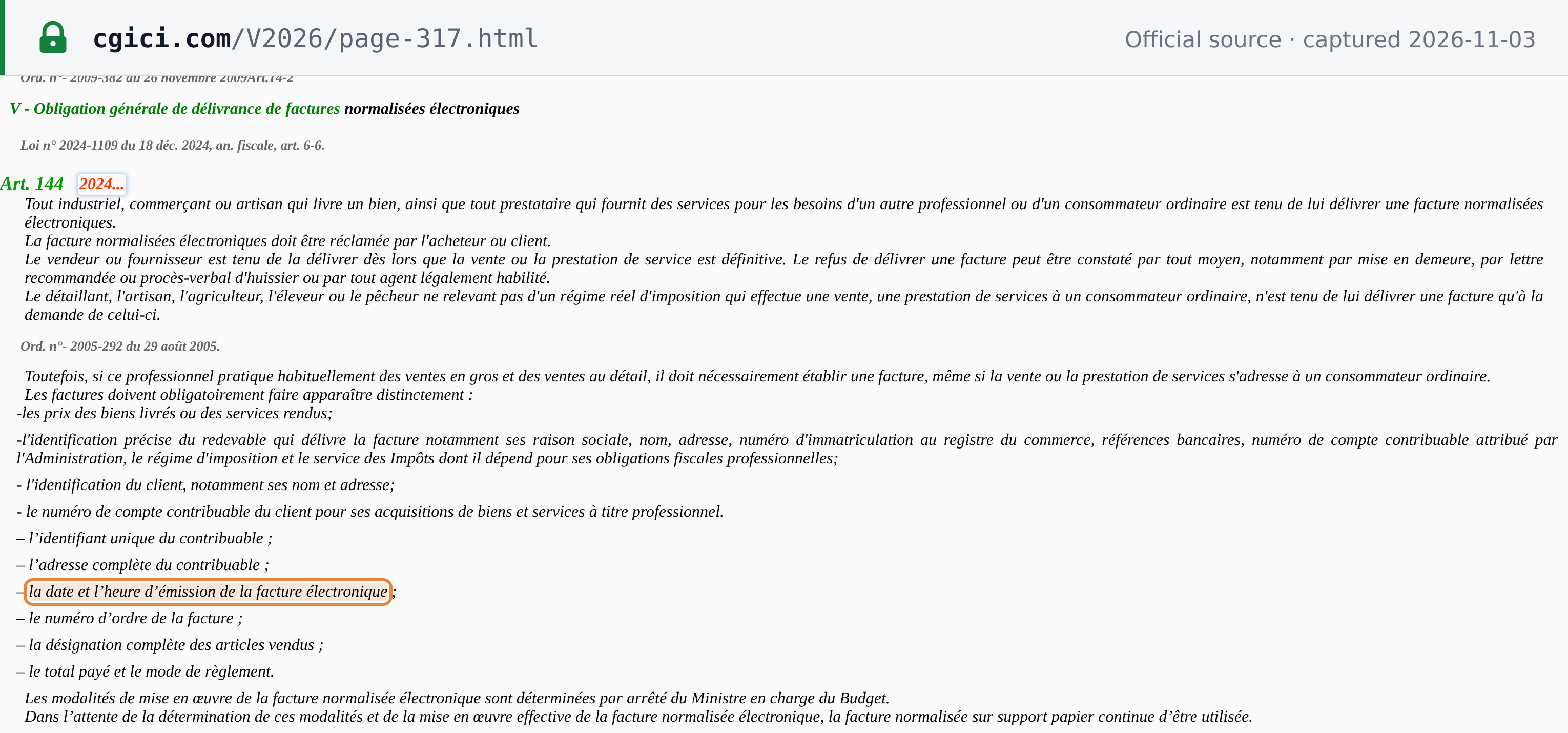
Every invoice must be a facture normalisée électronique (FNE), generated and certified on the DGI's platform. LPF article 144: "Tout industriel, commerçant ou artisan qui livre un bien, ainsi que tout prestataire qui fournit des services pour les besoins d'un autre professionnel ou d'un consommateur ordinaire est tenu de lui délivrer une facture normalisées électroniques. La facture normalisées électroniques doit être réclamée par l'acheteur ou client." [8]
Arrêté n° 0337/MFB/DGI/DLCD/SDL of 9 May 2025, which sets the FNE's modalities, applies it to every business: "La facture normalisée électronique s'applique à toutes les entreprises, personnes physiques ou morales quel que soit leur régime d'imposition, sauf dans les cas limitativement prévus par les dispositions légales en vigueur." [17]
Retailers, craftsmen, farmers, livestock farmers and fishermen not on a real regime need issue an invoice to a consumer only on request, unless they habitually sell both wholesale and retail (LPF art. 144).
Mandatory content
LPF article 144, Arrêté 0337 article 6 and CGI article 384 together require: [8] [17] [18]
| # | Field | Notes |
|---|---|---|
| 1 | Supplier identification | Corporate name, name, address, trade-register (RCCM) number, bank references, NCC, unique identifier, tax regime, and the tax office the supplier depends on |
| 2 | Customer identification | Name, corporate name and address |
| 3 | Customer NCC | For purchases made in a professional capacity; mandatory on B2B invoices |
| 4 | FNE sequence number | See Numbering and sequencing |
| 5 | Date and time of issue | |
| 6 | Detailed description of goods or services | |
| 7 | Prices; price excluding tax | CGI art. 384 requires the tax-exclusive price |
| 8 | TVA rate and TVA amount, shown distinctly | CGI art. 384 |
| 9 | Total paid and method of payment | Cash, card, cheque, mobile money, transfer or on account |
| 10 | Secure electronic sticker | FNE visual + QR code + numbering (CGI art. 384; Arrêté art. 4) |
The communiqué of 14 September 2026 adds, for API integrations, that the customer's email address and phone number are mandatory on B2B invoices; phone numbers use the national 10-digit format starting 01, 05, 07, 21, 25 or 27, without +225. [10]
Consequence of a defective invoice. CGI article 385: "Les factures qui ne comportent pas les mentions visées à l'article ci-dessus n'ouvrent pas droit à déduction de la taxe sur la valeur ajoutée se rapportant aux biens et services facturés." [18]
 Source snapshot captured 2026-11-03 — original
Issuance deadline
The supplier must issue the FNE "dès lors que la vente ou la prestation de service est définitive" (LPF art. 144), that is, once the sale or service is final. No separate number of days is set. [8]
Numbering and sequencing
Arrêté 0337 article 4 certifies every FNE and RNE with an electronic signature, the sticker électronique, made of three elements shown together: the FNE visual, a QR code, and the numbering format. Article 5 sets the numbering, in an uninterrupted annual series: [17]
| Document | Number |
|---|---|
| Sales invoice | NCC + year of issue + sequence |
| Credit note (facture d'avoir) | A + NCC + year of issue + sequence |
| Pro-forma invoice | P + NCC + year of issue + sequence |
| Agricultural purchase slip (bordereau) | B + NCC + year of issue + sequence |
The platform allocates the number, so a business cannot choose or skip numbers. The sticker costs FCFA 20 TTC per FNE and FCFA 15 TTC per RNE (FCFA 25 for an RNE on a cash purchase above FCFA 100,000). It is free for transactions of FCFA 1 to 5,000, and "Le sticker électronique ne dispense pas du timbre de quittance": the receipt stamp duty still applies. [12]
Credit and debit notes
Credit notes are generated on the FNE platform. The FAQ: "Oui, la plateforme FNE autorise la création de factures d'avoir, que ce soit pour l'intégralité ou une partie de la facture initiale. Il est aussi possible d'effectuer des avoirs hors facture." [12]
- A credit note against an invoice references the original FNE and carries the prefix A.
- Rebates, discounts and refunds not tied to one invoice use the Facture 3R type.
- Negative values are prohibited on FNE flows (except kerosene sales), so corrections go through a credit note. [10]
- The DGI documents no separate debit-note type; an additional charge is invoiced on a new FNE.
Currency, language and exchange rate
- Currency: FNE amounts are in FCFA (XOF).
- Foreign customers (B2F): the destination country's currency and the exchange rate are mandatory, "y compris les zones utilisant le francs CFA (UEMOA et CEMAC)". [10] The API accepts XOF, USD, EUR, JPY, CAD, GBP, AUD, CNH, CHF, HKD and NZD. A foreign customer's tax identifier is not required: "L'identifiant fiscal du client n'est pas requis." [12]
- Language: the DGI publishes no language rule; all DGI invoice templates and specimens are in French.
Document types
The FNE FAQ lists the document types the platform issues: "La facture de vente - La facture proforma - La facture d'avoir - Le reçu normalisé électronique de vente - Le reçu normalisé électronique d'avoir - Le bordereau électronique de réception de produits agricoles (valeur de facture d'achat) - Le reçu électronique de réception de produits agricoles (valeur de facture d'achat)". [12]
- FNE (facture normalisée électronique): the full invoice, for B2B, B2G, B2C and B2F.
- RNE (reçu normalisé électronique): a receipt, issued through a TERNE terminal (supplied by the DGI through approved partners) or the RNE mobile app. It is used by flat-rate businesses (RME and TEE), real-regime businesses with cash registers, and multi-department stores, which attach it to the till ticket.
- Threshold for flat-rate businesses: Arrêté 0337 article 7: "Pour les entreprises soumises à un régime forfaitaire d'imposition, l'obligation de délivrance de la facture normalisée électronique ou du reçu normalisé électronique ne s'applique que pour les achats d'une valeur égale ou supérieure à 5 000 francs CFA. Ce seuil minimum ne s'applique pas aux opérations entre professionnels." [17] The FNE FAQ separately says the RNE is mandatory for RME and TEE taxpayers "quel que soit le montant"; the arrêté is the binding text.
Exemptions from the FNE
LPF article 145 relieves these businesses of standardised invoices: [8]
- water, electricity and telephone concessionaires (concession activities only)
- multi-department stores whose till tickets come with receipts secured by the FNE platform
- pharmacies
- the identity-document concessionaire
- airlines
- oil companies under production-sharing contracts
- fuel stations, for fuel sales only
- La Poste de Côte d'Ivoire
- banks and insurance companies
- transport concessionaires (concession operations) and non-concession transport companies
- businesses with no professional installation in Côte d'Ivoire
- gaming concessionaires, for sales to end customers
- licensed telecom operators
- road-toll concessionaires, for tolls (not subscriptions)
Self-billing
The agricultural bordereau and reçu de réception de produits agricoles are issued by the buyer and serve as purchase invoices. The CGI and LPF contain no general self-billing provision.
Retention and audit trail
FNEs are certified and stored centrally on the DGI platform; the DGI's FNE presentation lists "L'archivage et l'accès facilité aux factures (stockées de manière centralisée)" among its benefits. [19] The platform-allocated number, QR code and certification give each invoice its audit trail. Disconnecting FNE installations is a criminal offence (see Offences).
A specimen of a compliant invoice
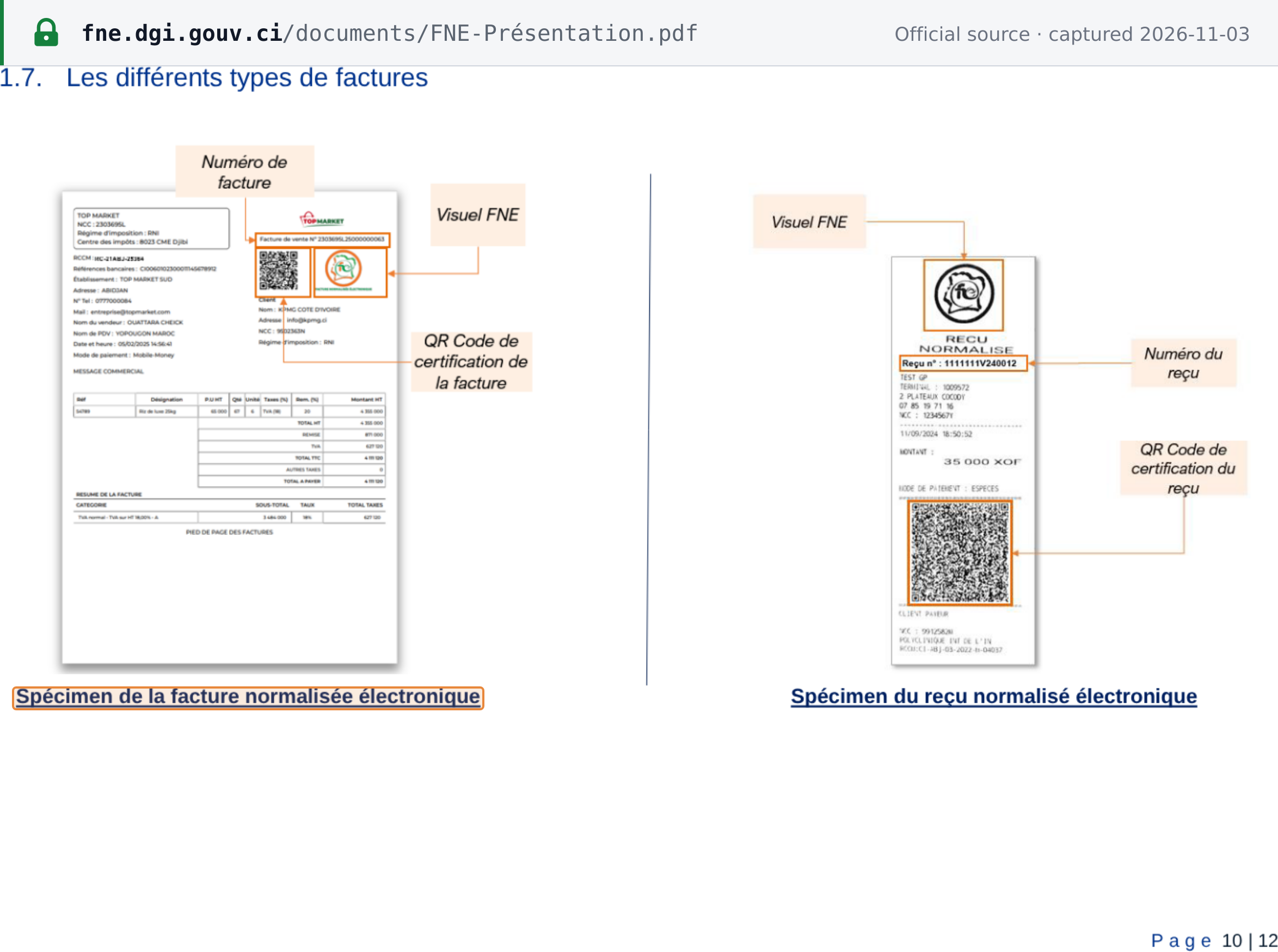
The DGI publishes its own annotated "Spécimen de la facture normalisée électronique" in its Présentation de la FNE (March 2025, p.10). It labels the three elements of the sticker: the invoice number ("Numéro de facture"), the FNE visual ("Visuel FNE") and the certification QR code ("QR Code de certification de la facture"). [19]
The specimen also shows where the other mandatory fields sit:
- Supplier block (top left): name, NCC, tax regime, tax office, RCCM, bank references, establishment, address, phone, email, seller, point of sale, date and time, and payment method
- Client block (top right, below the sticker): name, email, client NCC and client regime
- Lines: reference, description, unit price excluding tax, quantity, unit, tax code, discount and amount excluding tax
- Totals: total excluding tax, discount, TVA, total including tax, other taxes and total to pay
- Tax summary: by tax category (for example "TVA normal - TVA sur HT 18,00% - A"), with subtotal, rate and total tax
The right half of the same page shows the specimen RNE receipt, with its number, FNE visual and QR code.
 Source snapshot captured 2026-11-03 — original · DGI specimen, Présentation de la FNE (Mars 2025), p.10
E-invoicing status
Status: mandatory for all businesses, every tax regime. Every invoice and receipt is a facture normalisée électronique (FNE) or reçu normalisé électronique (RNE) generated and certified in real time on the DGI's FNE platform. Paper standardised invoices are no longer accepted.
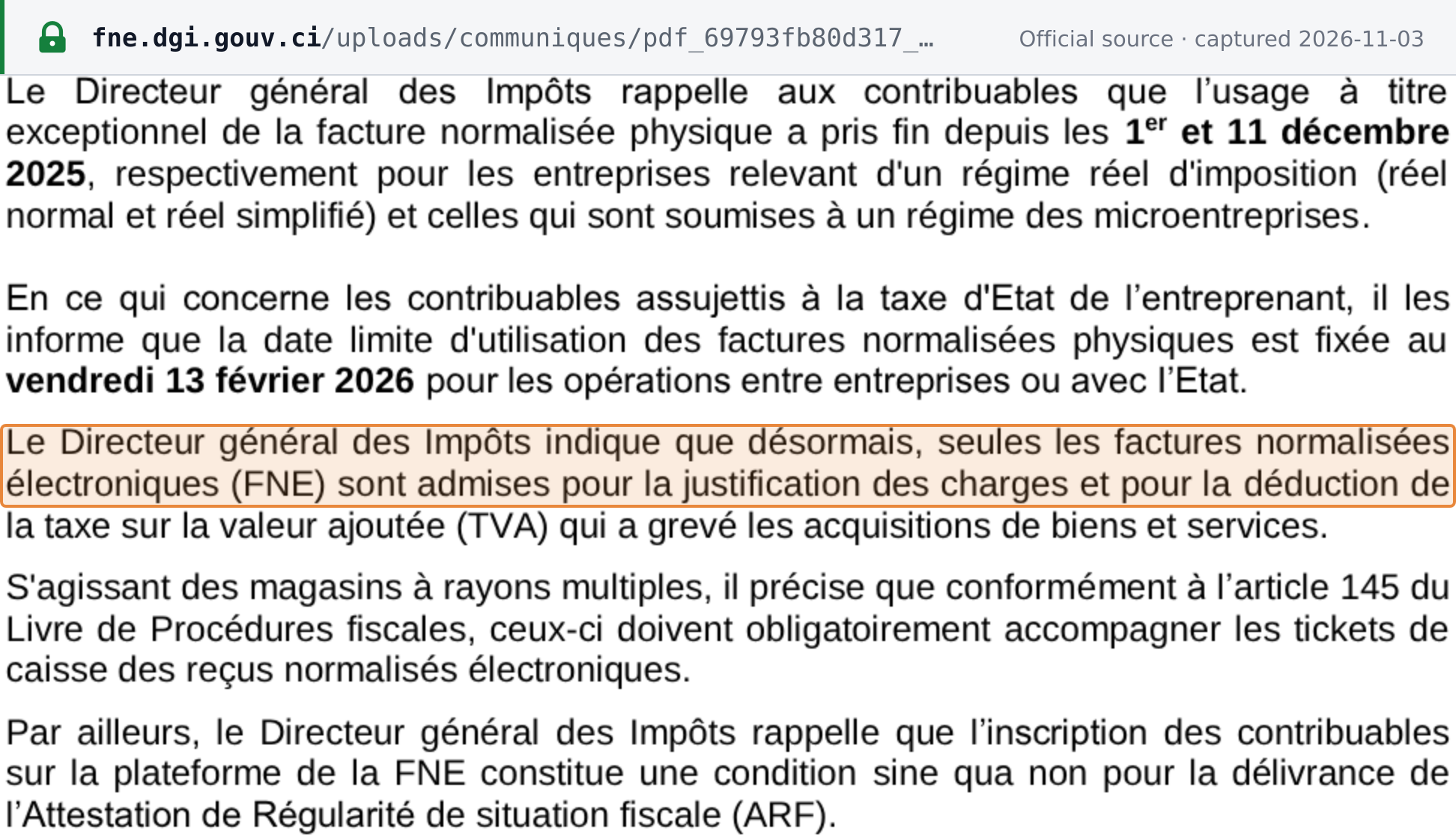
The DGI's communiqué of 27 January 2026: "l'usage à titre exceptionnel de la facture normalisée physique a pris fin depuis les 1er et 11 décembre 2025, respectivement pour les entreprises relevant d'un régime réel d'imposition (réel normal et réel simplifié) et celles qui sont soumises à un régime des microentreprises. En ce qui concerne les contribuables assujettis à la taxe d'Etat de l'entreprenant, il les informe que la date limite d'utilisation des factures normalisées physiques est fixée au vendredi 13 février 2026 pour les opérations entre entreprises ou avec l'Etat." It adds: "désormais, seules les factures normalisées électroniques (FNE) sont admises pour la justification des charges et pour la déduction de la taxe sur la valeur ajoutée (TVA)". [2]
 Source snapshot captured 2026-11-03 — original
System
- Name: Facture Normalisée Électronique (FNE), run by the DGI at fne.dgi.gouv.ci.
- Model: real-time certification. The platform signs each document with the electronic sticker (FNE visual, QR code, number) before it is issued.
- Three routes (Arrêté 0337 art. 3): [17]
- Direct use of the DGI platform (web or mobile app): the standard route.
- API integration between the business's invoicing system and the platform: an exception route, "sur option de l'entreprise et après accord préalable du Directeur général des Impôts".
- Electronic terminals (TERNE) for RNE receipts.
- Format: the API is REST with JSON payloads; the FNE itself is delivered as a PDF ("Les FNE sont générées au format PDF"). [12] [14]
Scope
The DGI's presentation: "La FNE se génère dans les transactions suivantes : - Transaction d'entreprise à entreprise nationale ou internationale (B to B) ; - Transaction d'entreprise à gouvernement (B to G) ; - Transaction d'entreprise à consommateur (B to C) ; - Transaction d'entreprise à entreprise à l'international (B to F)." [19] B2B, B2G, B2C and B2F all started together for each regime. RNE receipts cover sales to consumers and sales by flat-rate businesses.
Timeline
| Date | Step |
|---|---|
| 1 June 2025 | FNE in force for RNI businesses (Arrêté 0337 art. 8: "au plus tard") |
| 1 July 2025 | RSI businesses |
| 1 August 2025 | RME businesses |
| 1 September 2025 | Entreprenant regimes (TEE and taxe communale de l'entreprenant) |
| 1 December 2025 | Paper standardised invoices end for RNI and RSI |
| 11 December 2025 | Paper invoices end for RME |
| 31 January 2026 | FNE enrolment closes |
| 13 February 2026 | Paper invoices end for TEE taxpayers' B2B and B2G operations |
| 1 September 2026 | Nationwide FNE compliance-control operation starts |
| 29 October 2026 | Deadline for API integrators to meet the FNE technical specifications |
Sources: Arrêté 0337 art. 8; DGI communiqués of 5 September 2025, 18 December 2025, 27 January 2026, 21 August 2026 and 14 September 2026. [17] [20] [21] [2] [22] [10]
For developers: API conformity
The communiqué of 14 September 2026 gave API integrators 45 days, to 29 October 2026, to bring their solutions into line with the FNE specifications. Its main points: [10]
- the 8-character NCC format
- the 10-digit national phone format
- email and phone mandatory on B2B invoices
- currency and exchange rate on B2F invoices
- TVA only for RNI and RSI taxpayers
- positive quantities and no negative values, except kerosene sales
Non-conforming flows risk temporary suspension of the API key.
For how clearance and certification models compare, see CTC e-invoicing models.
Filing and payment
Filing frequency
Monthly. TVA is declared and paid each month at the tax office the business is attached to.
Return and payment due date
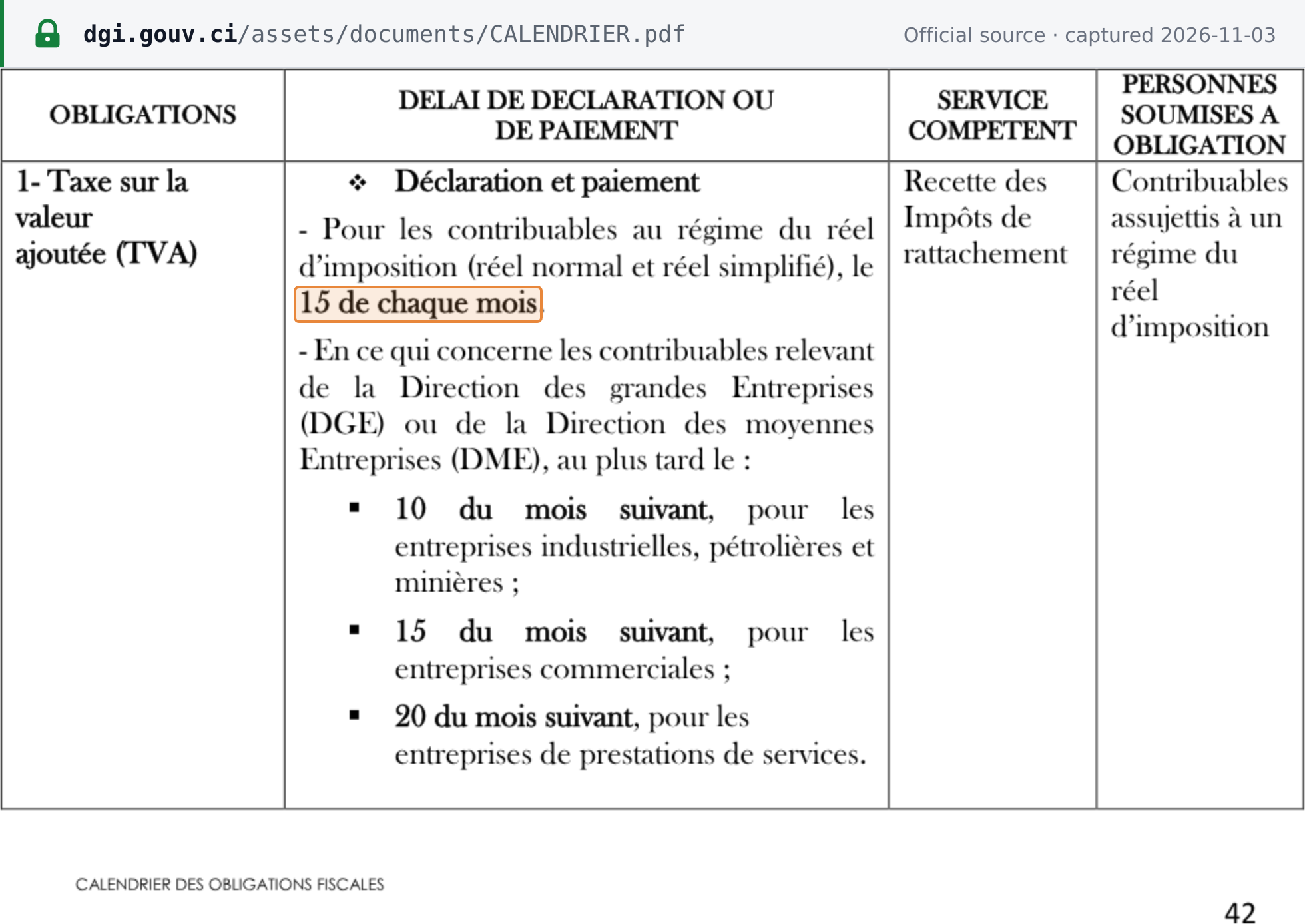
The DGI's Calendrier des obligations fiscales: "Déclaration et paiement - Pour les contribuables au régime du réel d'imposition (réel normal et réel simplifié), le 15 de chaque mois. - En ce qui concerne les contribuables relevant de la Direction des grandes Entreprises (DGE) ou de la Direction des moyennes Entreprises (DME), au plus tard le : 10 du mois suivant, pour les entreprises industrielles, pétrolières et minières ; 15 du mois suivant, pour les entreprises commerciales ; 20 du mois suivant, pour les entreprises de prestations de services." [23]
| Taxpayer | Due date (declaration and payment) |
|---|---|
| Real-regime taxpayers (RNI and RSI) | 15th of each month |
| DGE/DME: industrial, petroleum and mining companies | 10th of the following month |
| DGE/DME: commercial companies | 15th of the following month |
| DGE/DME: service companies | 20th of the following month |
Returns and payments are made through the DGI's e-impots portal.
 Source snapshot captured 2026-11-03 — original
Additional listings
Statement of deductible TVA. Each TVA return must be accompanied by a statement of deductions (état des taxes déductibles). CGI article 386: "Un état présentant le détail des déductions effectuées sera joint à la déclaration prévue à l'article 437 du présent Code." For each local purchase it shows the supplier's name and NCC, the invoice reference and amount, and the TVA deducted; for imports, it adds the customs declaration number, the customs receipt reference and the TVA on that receipt. Not filing the statement, or filing an incorrect or incomplete one, leads to the deductions being reversed. [18]
Exempt-customer list. Suppliers making sales exempt under the Investment Code or government conventions file, with their TVA return, "un imprimé réglementaire comportant la liste nominative des clients ayant bénéficié de l'exonération", showing the goods or services and the amounts invoiced (CGI art. 383 bis). [24]
Input-tax recovery
- Right to deduct: TVA on purchases and imports used for taxable or exported supplies (CGI art. 362-1). [24]
- Invoice condition: only invoices carrying the mandatory particulars give a right to deduct (CGI art. 385), and since December 2025 only FNEs are accepted (DGI communiqué of 27 January 2026).
- Cash payments: CGI article 373 blocks deduction on purchases above FCFA 250,000 paid in cash: "N'ouvre également pas droit à déduction, la taxe ayant grevé les achats, travaux ou services dont le montant est supérieur à 250 000 francs et dont le règlement est effectué en espèces." Since the 2026 finance law, mobile-money payments are outside that limit: "Ne sont pas visées par le présent article, les transactions dont le règlement est effectué par mobile money." [24]
Refunds
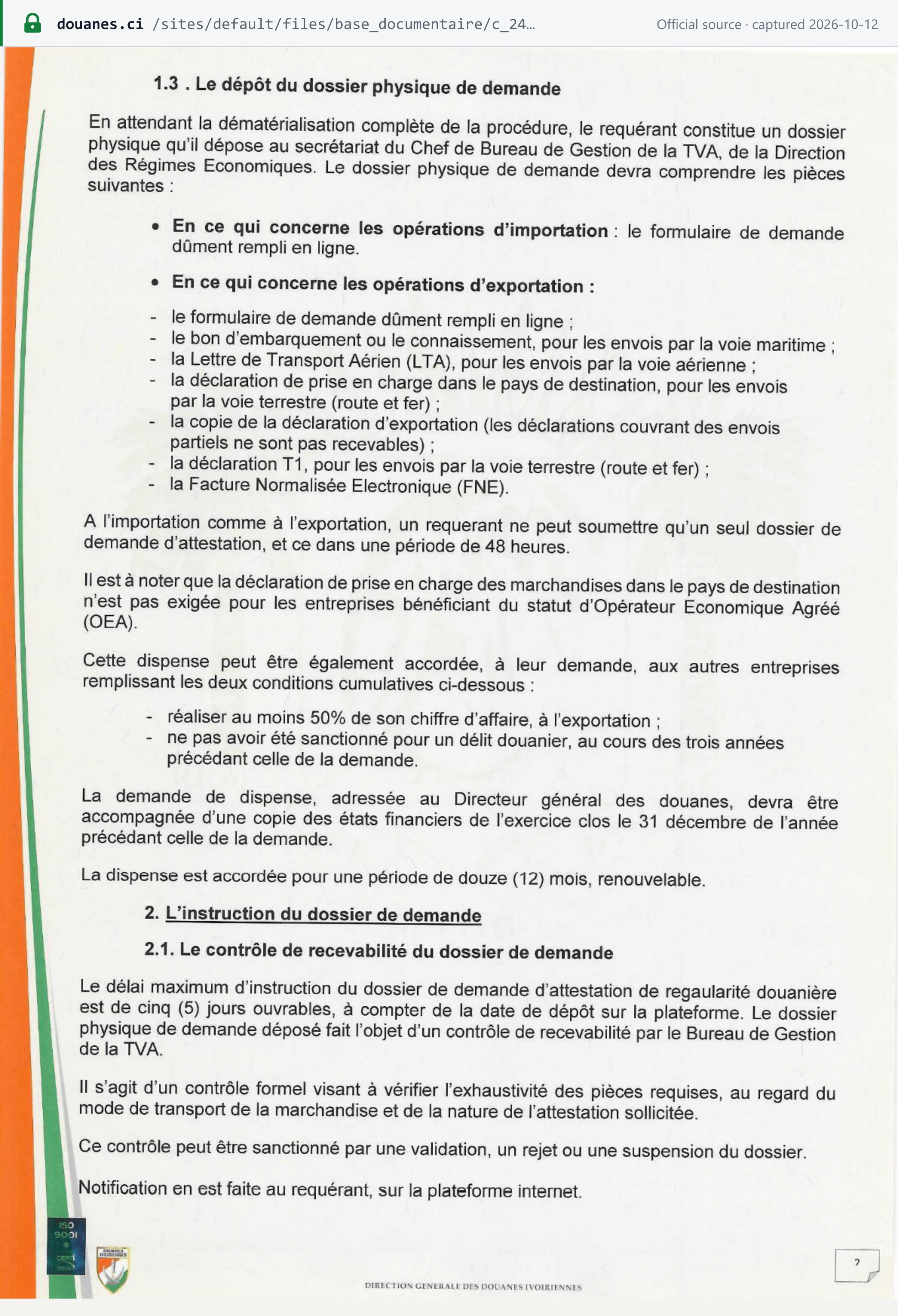
Exporters in a TVA credit position can claim refunds. Customs Circulaire n° 2423 of 15 September 2026 sets out the customs attestation that supports a refund application. The export file includes the FNE, the request is made online plus a physical file, customs have five working days to process it, and authorised economic operators (AEO) are spared the declaration of receipt at destination. [29]
 Source snapshot captured 2026-10-12 — original
Exemptions
Exempt supplies
CGI article 355 lists over forty exempt operations. Examples: [15]
- insurance operations subject to the insurance tax, and insurance intermediaries' commissions
- transfers of immovable property, businesses (fonds de commerce) or clientele covered by the registration duties
- newspapers and periodicals (except advertising income), and books
- unprocessed staple foods, including maize, millet, sorghum, wheat, rice ("à l'exception du riz de luxe"), tubers, legumes, vegetables, eggs, unprocessed meat ("à l'exception de la viande de luxe"), unprocessed fish and milk, and food salt
- flour, bread and the yeast used to make it
- medical fees and medical care, and hospitalisation by approved facilities
- education (excluding ancillary sales, lodging and boarding)
Exempt is not zero-rated
The difference is the right to deduct. Exports (CGI art. 356) are relieved with deduction: article 362-1 allows TVA on inputs used for "produits soumis à la même taxe ou exportés". Exempt supplies (art. 355) are relieved without it. Article 362-2: "Ces assujettis ne peuvent bénéficier d'aucune déduction du chef d'acquisition de biens et services affectés à la fabrication et à la vente de produits exonérés ou placés hors du champ d'application de la taxe sur la valeur ajoutée, même si ces produits sont exportés." [24]
2026 changes
The tax annex to the 2026 finance law (Loi n° 2025-987 of 19 December 2025) took effect on 5 January 2026. DGI Note de service n° 06499: "les dispositions contenues dans l'annexe fiscale à la loi de Finances portant Budget de l'Etat pour la gestion 2026, prennent effet à compter du lundi 05 janvier 2026." [25] Its article 6 removed the TVA exemptions on jute and sisal fibre, livestock and poultry feed, and inputs (and packaging) for feed and fertiliser manufacture. [26] Ordonnance n° 2026-03 of 7 January 2026 then placed these items at the 9% reduced rate (CGI art. 359). [13] Article 5 brought factoring expressly into TVA (CGI art. 344).
Special regimes
- Small businesses: RME and TEE businesses are outside TVA (see Overview).
- Investment-code approvals and other conventional exemptions: invoiced with FNE tax code
TVAC(0%). - Fuel: gas-oil, oils and greases used to run the machinery of construction (BTP) firms and of farmers who opted into TVA are deductible up to 95% of the TVA paid: "cette déduction est limitée à 95 % de la TVA supportée figurant sur la facture d'achat" (CGI art. 365-1, extended to farmers by the 2026 finance law). [24]
Offences and penalties
Offences
- Failure to issue an FNE, or issuing an irregular invoice (LPF arts. 144, 145 and 168; CGI art. 385).
- Disconnecting FNE installations. LPF article 171 bis: "Toute manœuvre frauduleuse tendant à organiser la déconnexion ou à déconnecter volontairement les installations relatives à la facture normalisée électronique, est assimilée à une résistance à l'impôt et engage la responsabilité pénale des personnes reconnues coupables, conformément aux dispositions de l'article 171 du Livre de Procédures fiscales." [28]
- Charging TVA that is not paid over. The seller who shows TVA it does not pay "en est réputé personnellement débiteur" and is subject to the LPF's sanctions (CGI art. 385). [18]
- Failure to file the declaration of existence (LPF art. 146).
- Non-resident platforms that do not register within three months risk suspension of access from Côte d'Ivoire (CGI art. 71).
Penalties
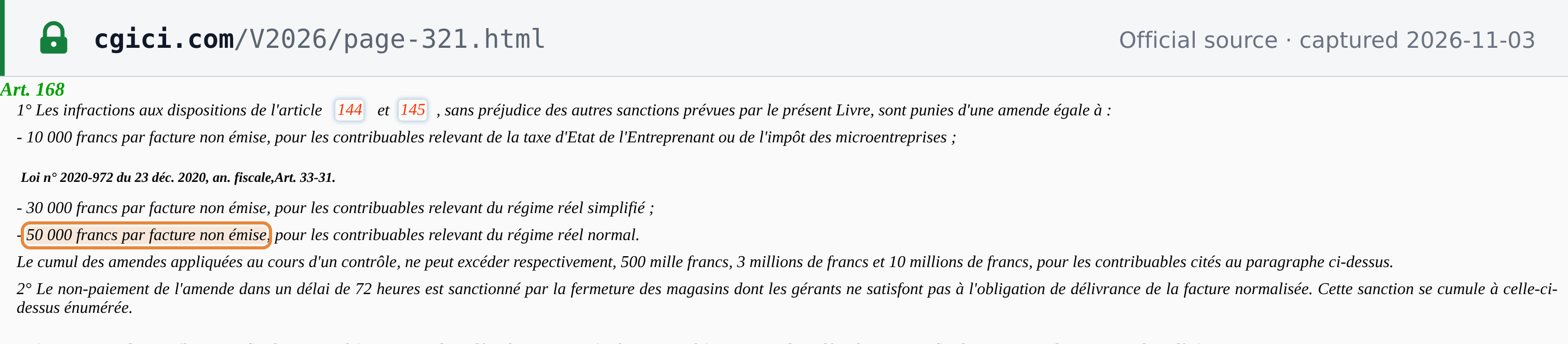
LPF article 168 fines each invoice not issued: "- 10 000 francs par facture non émise, pour les contribuables relevant de la taxe d'Etat de l'Entreprenant ou de l'impôt des microentreprises ; … - 30 000 francs par facture non émise, pour les contribuables relevant du régime réel simplifié ; - 50 000 francs par facture non émise, pour les contribuables relevant du régime réel normal." [27]
| Breach | Penalty |
|---|---|
| Invoice not issued: TEE or RME | FCFA 10,000 per invoice, capped at FCFA 500,000 per audit |
| Invoice not issued: RSI | FCFA 30,000 per invoice, capped at FCFA 3,000,000 per audit |
| Invoice not issued: RNI | FCFA 50,000 per invoice, capped at FCFA 10,000,000 per audit |
| Fine unpaid within 72 hours | Closure of the shop, on top of the fine (LPF art. 168-2°) |
| Irregularly worded invoices | Fine within the LPF art. 168 limits (CGI art. 385) |
| No declaration of existence | FCFA 1,000,000 (LPF art. 146) |
| Change in operating conditions not declared | FCFA 100,000 (LPF art. 146) |
| Non-conforming API flows | Temporary suspension of the API key (communiqué of 14 September 2026) |
 Source snapshot captured 2026-11-03 — original
Frequently asked questions
Our supplier still hands us paper standardised invoices. Can we deduct the TVA on them?
No. In its communiqué of 27 January 2026 the DGI states that paper standardised invoices ended on 1 December 2025 for real-regime businesses and on 11 December 2025 for microenterprises, and that only electronic standardised invoices (FNE) are now accepted to justify expenses and to deduct TVA. For TEE taxpayers, paper invoices for business-to-business and business-to-government operations ended on 13 February 2026. Ask the supplier for an FNE.
We are under the microenterprise regime (RME). Can we show TVA on our FNE?
No. CGI article 347 allows TVA to be invoiced only when annual turnover, all taxes included, exceeds FCFA 200 million, and the DGI's communiqué of 14 September 2026 restricts TVA invoicing to taxpayers under a real regime (RNI and RSI). RME and TEE taxpayers use the FNE tax code TVAD, a 0% statutory exemption. An RME business can opt for the RSI before 1 February to come into TVA.
Our customer is in Senegal, which also uses the CFA franc. Do we still need a currency and exchange rate on the FNE?
Yes. The DGI's communiqué of 14 September 2026 requires the currency and exchange rate of the destination country on B2F invoices, including for countries using the CFA franc (UEMOA and CEMAC). The DGI FAQ adds that the foreign customer's tax identifier is not required.
We invoiced the wrong quantity. Can we issue an FNE with a negative line to correct it?
No. The DGI's communiqué of 14 September 2026 requires positive quantities and prohibits negative values on FNE flows, except for kerosene sales. Correct the invoice with a credit note (facture d'avoir) generated on the FNE platform for all or part of the original invoice; its number carries the prefix A. Rebates, discounts and refunds not tied to one invoice go through the Facture 3R type.
We are a foreign company with no office in Côte d'Ivoire. Do we have to issue FNEs?
LPF article 145 relieves businesses with no professional installation in Côte d'Ivoire from using standardised invoices. That does not remove the registration rules: a foreign enterprise operating without premises or staff in Côte d'Ivoire must appoint a legal representative there, who is jointly liable for its taxes (CGI article 71), and non-resident online sales platforms and digital-service operators register online under a simplified procedure.
Important websites
| Site | Purpose |
|---|---|
| Direction générale des Impôts | Tax authority home page; tax calendar, finance-law annexes and doctrine |
| e-impots | Online TVA returns and payment (login) |
| FNE portal | E-invoicing information, communiqués and guides |
| FNE enrolment and FNE login | Enrol on the FNE platform; issue FNEs and RNEs |
| FNE regulatory texts | Arrêté 0337, finance-law extracts, API guide |
| FNE FAQ | Sticker prices, document types, exemptions |
| Code général des Impôts (consolidated) | CGI and LPF text, linked from the DGI home page |
| CEPICI | Company formation one-stop shop |
| Douanes ivoiriennes | Customs; import TVA and refund attestations |
| Côte d'Ivoire NCC validator | Check an NCC's format |
| NCC lookup | The DGI and FNE sites offer no public NCC search |
For other countries' registers, see check a VAT number — official lookups by country.
Recent changes
- 2026-10-29 — Deadline for FNE API integrators to meet the technical specifications (DGI communiqué of 14 September 2026). (DGI) — see event
- 2026-09-15 — Customs Circulaire n° 2423 on the attestation supporting TVA credit refunds. (Douanes) — see event
- 2026-09-01 — Nationwide FNE compliance-control operation begins. (DGI)
- 2026-02-13 — Paper standardised invoices end for TEE taxpayers' B2B and B2G operations. (DGI)
- 2026-01-31 — FNE enrolment closes. (DGI)
- 2026-01-07 — Ordonnance n° 2026-03 places jute and sisal fibre, livestock and poultry feed, and feed- and fertiliser-manufacturing inputs at the 9% reduced rate, after the 2026 finance-law tax annex (in force 5 January 2026) removed their exemptions; the annex also took mobile-money payments out of the cash-deduction limit. (CGI art. 359 · DGI)
- 2025-12-11 — Paper invoices end for RME businesses; FNE only. (DGI)
- 2025-12-01 — Paper invoices end for RNI and RSI businesses; FNE only. (DGI)
For the full chronology, see Côte d'Ivoire tax changes on Lookuptax.
Reference links
- Code général des Impôts, art. 339 (consolidated)
- DGI — Communiqué of 27 January 2026: end of paper standardised invoices
- Code général des Impôts, art. 13
- Code général des Impôts, art. 34 (RNI)
- Code général des Impôts, art. 45 (RSI)
- Code général des Impôts, art. 71 bis (RME)
- Code général des Impôts, art. 73 (TEE)
- Livre de Procédures fiscales, arts. 144–146
- Code général des Impôts, arts. 347–349
- DGI — Communiqué of 14 September 2026: FNE conformity of API integrations
- Code général des Impôts, art. 71
- DGI — FNE frequently asked questions
- Code général des Impôts, art. 359 (rates)
- DGI — FNE API procedure guide
- Code général des Impôts, arts. 355–357
- Code général des Impôts, arts. 350–352
- Arrêté n° 0337/MFB/DGI/DLCD/SDL of 9 May 2025 on the FNE
- Code général des Impôts, arts. 384–385
- DGI — Présentation de la FNE (March 2025)
- DGI — Communiqué of 5 September 2025 on FNE implementation
- DGI — Communiqué of 18 December 2025: end of paper standardised invoices
- DGI — Communiqué of 21 August 2026: FNE compliance-control operation
- DGI — Calendrier des obligations fiscales
- Code général des Impôts, arts. 362–373 (deductions)
- DGI — Annexe fiscale 2026, Note de service n° 06499 (entry into force)
- DGI — Annexe fiscale 2026, art. 6
- Livre de Procédures fiscales, art. 168
- DGI — Annexe fiscale 2025 extract (FNE provisions)
- Direction générale des Douanes — Circulaire n° 2423 of 15 September 2026
Related on Lookuptax: