El Salvador VAT (IVA) guidelines: rates, registration, DTE invoices
Overview
El Salvador levies a value added tax officially called the Impuesto a la Transferencia de Bienes Muebles y a la Prestación de Servicios, known as IVA. It is set by the IVA law, Decreto Legislativo No. 296 of 24 July 1992 (Diario Oficial No. 143, Tomo 316, 31 July 1992), and its procedures, invoicing rules and penalties are in the Código Tributario (Decreto Legislativo No. 230 of 14 December 2000). Article 1 of the IVA law sets the scope: [1]
"Por la presente ley se establece un impuesto que se aplicará a la transferencia, importación, internación, exportación y al consumo de los bienes muebles corporales; prestación, importación, internación, exportación y el autoconsumo de servicios, de acuerdo con las normas que se establecen en la misma."
Statutory references below are to the official consolidated texts published by the Supreme Court's Centro de Documentación Judicial. [1] [2]
Authority, currency, period and layering
- Authority. The Ministerio de Hacienda administers IVA through the Dirección General de Impuestos Internos (DGII) (mh.gob.sv). The DGII runs electronic invoicing from factura.gob.sv. IVA on imported goods is assessed by Customs together with the customs duties (IVA law art. 94).
- Currency. The US dollar. The IVA law still states some amounts in colones (₡). Since 1 January 2001 the colón has been fixed at ₡8.75 per US dollar, as the financial-system regulator records: "a partir del uno de enero del año dos mil uno, el tipo de cambio de los colones respecto del dólar se ha fijado en ocho colones con setenta y cinco centavos." [10] Dollar equivalents of colón amounts on this page are our conversion at that rate and are approximate.
- Period. The tax period is the calendar month: "el período tributario será de un mes calendario" (IVA law art. 93). [1]
- Layering. IVA is a single national tax. Article 2 allows other taxes on the same acts — "Este impuesto se aplicará sin perjuicio de la imposición de otros impuestos que graven los mismos actos o hechos" — and the Ministerio de Hacienda publishes separate laws for excises such as those on fuel, tobacco and beverages. The IVA law and the Código Tributario provide for no regional or municipal IVA; municipal taxes exist but are not IVA.
Registration
Who must register: the Article 28 rule
There is no registration threshold in the usual sense. Every person who habitually transfers goods or provides services is an IVA contribuyente (IVA law arts. 22 to 24), and article 28 then excludes small suppliers that meet both of two tests: [1]
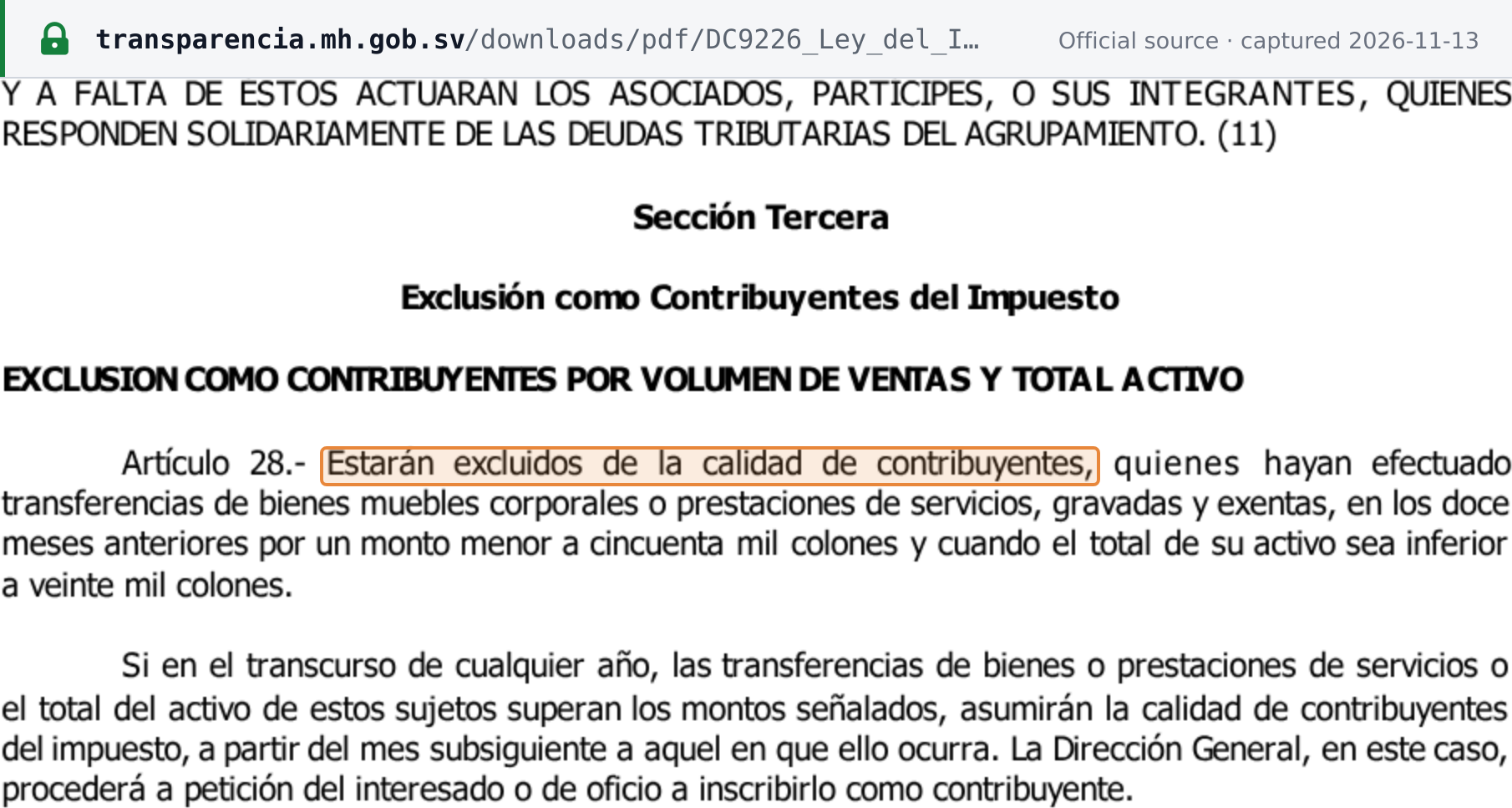
"Estarán excluidos de la calidad de contribuyentes, quienes hayan efectuado transferencias de bienes muebles corporales o prestaciones de servicios, gravadas y exentas, en los doce meses anteriores por un monto menor a cincuenta mil colones y cuando el total de su activo sea inferior a veinte mil colones."
| Test (IVA law art. 28) | Statutory amount | Approximate USD |
|---|---|---|
| Taxable plus exempt supplies in the previous 12 months | below ₡50,000 | below USD 5,714.29 |
| and total assets | below ₡20,000 | below USD 2,285.71 |
- Crossing either amount. "Si en el transcurso de cualquier año, las transferencias de bienes o prestaciones de servicios o el total del activo de estos sujetos superan los montos señalados, asumirán la calidad de contribuyentes del impuesto, a partir del mes subsiguiente a aquel en que ello ocurra" — liability starts in the month after next.
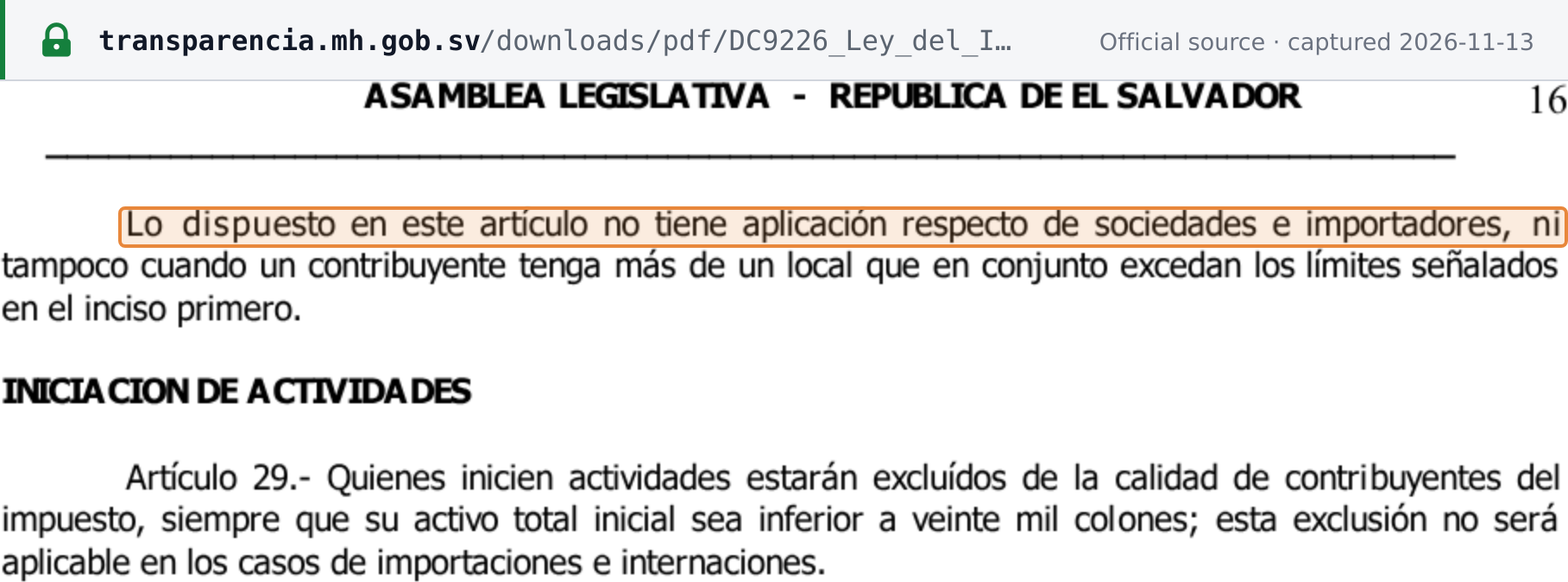
- Companies and importers are never excluded. "Lo dispuesto en este artículo no tiene aplicación respecto de sociedades e importadores, ni tampoco cuando un contribuyente tenga más de un local que en conjunto excedan los límites señalados en el inciso primero." [1] In practice the article 28 exclusion is relevant only to individuals.
- Start-ups. A person starting activities is excluded only if its initial total assets are below ₡20,000, and never for imports (IVA law art. 29).
 Source snapshot captured 2026-11-13 — original
 Source snapshot captured 2026-11-13 — original
Non-resident registration
The IVA law and the Código Tributario contain no registration regime aimed at foreign suppliers without a presence in El Salvador. When a supplier has no domicile or residence in the country, the Salvadoran acquirer pays the IVA instead (Código Tributario art. 161, see Cross-border rules). A foreign company that sets up business in El Salvador is a sociedad or importer and registers under the general rules. The Ministerio de Hacienda publishes a DGII user manual for issuing the Digital NIT to nationals and foreigners (700-DGII-MN-2026-004, published in January 2026). [12]
Tax registration numbers (NIT and NRC)
- NIT (Número de Identificación Tributaria). Every taxpayer has one. For Salvadoran adults the DUI identity number serves as the NIT, and nationals can generate a Digital NIT at portaldgii.mh.gob.sv/sscenit.
- NRC (Número de Registro de Contribuyente). IVA registrants also carry an NRC. Both numbers must appear on every Comprobante de Crédito Fiscal: "Número de Identificación Tributaria y Número de Registro de Contribuyente" (Código Tributario art. 114(a)(3)). [2]
Formats, the DUI–NIT unification and worked examples are on the El Salvador NIT, NRC and DUI guide.
How to register
- Deadline. Código Tributario art. 86: "El plazo para inscribirse será dentro de los quince días siguientes a la fecha de iniciación de las actividades." Habitual exporters and importers are expressly included. [2]
- Excluded small suppliers need not register: "No estarán obligados a inscribirse en el Registro los sujetos excluidos como contribuyentes de acuerdo a lo dispuesto en el artículo 28 … a menos que hagan uso de la opción para asumir la calidad de contribuyentes" (art. 86).
- Changes to registered data are notified "dentro de los cinco días hábiles siguientes de realizado el cambio" (art. 86).
- Where. Registration and the NIT are handled by the DGII through the Ministerio de Hacienda's online services (mh.gob.sv).
- Fines. Not registering when obliged: three monthly minimum wages; registering late: two (Código Tributario art. 235, see Offences and penalties).
Voluntary registration
Available. IVA law art. 30: "Los sujetos comprendidos en las disposiciones precedentes, podrán optar por asumir la calidad de contribuyentes del impuesto, previo cumplimiento de los requisitos que se establezcan por la Dirección General. El ingreso voluntario como contribuyente del impuesto operará a partir del primero de enero del año calendario siguiente; la Dirección General podrá autorizar el ingreso en cualquier tiempo." [1]
Opting in is usually worth it for a small supplier that sells to businesses: only a contribuyente issues the Comprobante de Crédito Fiscal that lets its customers deduct input IVA (Código Tributario art. 107), and an excluded person cannot recover the IVA on its own purchases (IVA law art. 31).
Deregistration
The IVA law sets no deregistration threshold. A business that ceases definitively — by sale, liquidation, exchange, dissolution or another cause — must "informar por escrito de tal circunstancia a la Administración Tributaria dentro de los quince días siguientes a su ocurrencia debiendo presentar los comprobantes de pago del impuesto respectivo" (Código Tributario art. 144). [2] Failing to report cessation in time is fined four monthly minimum wages (art. 244(h)). Falling back below the article 28 amounts is not stated in the law as a ground for leaving the register.
Group registration
Not available: the IVA law provides no VAT grouping regime. Article 26 concentrates liability in the local head office for its own branches and agencies, and article 27 makes an unincorporated grouping organised for a specific business a single taxpayer represented by its manager — a joint-venture rule, not VAT grouping. [1]
Rates
| Rate | Applies to | Legal basis |
|---|---|---|
| 13% | All taxable transfers of goods, services, imports and self-supply | IVA law art. 54 |
| 0% | Exports of goods, and services provided in El Salvador to users with no domicile or residence there, used exclusively abroad | IVA law arts. 74 and 75 |
Standard rate: 13%
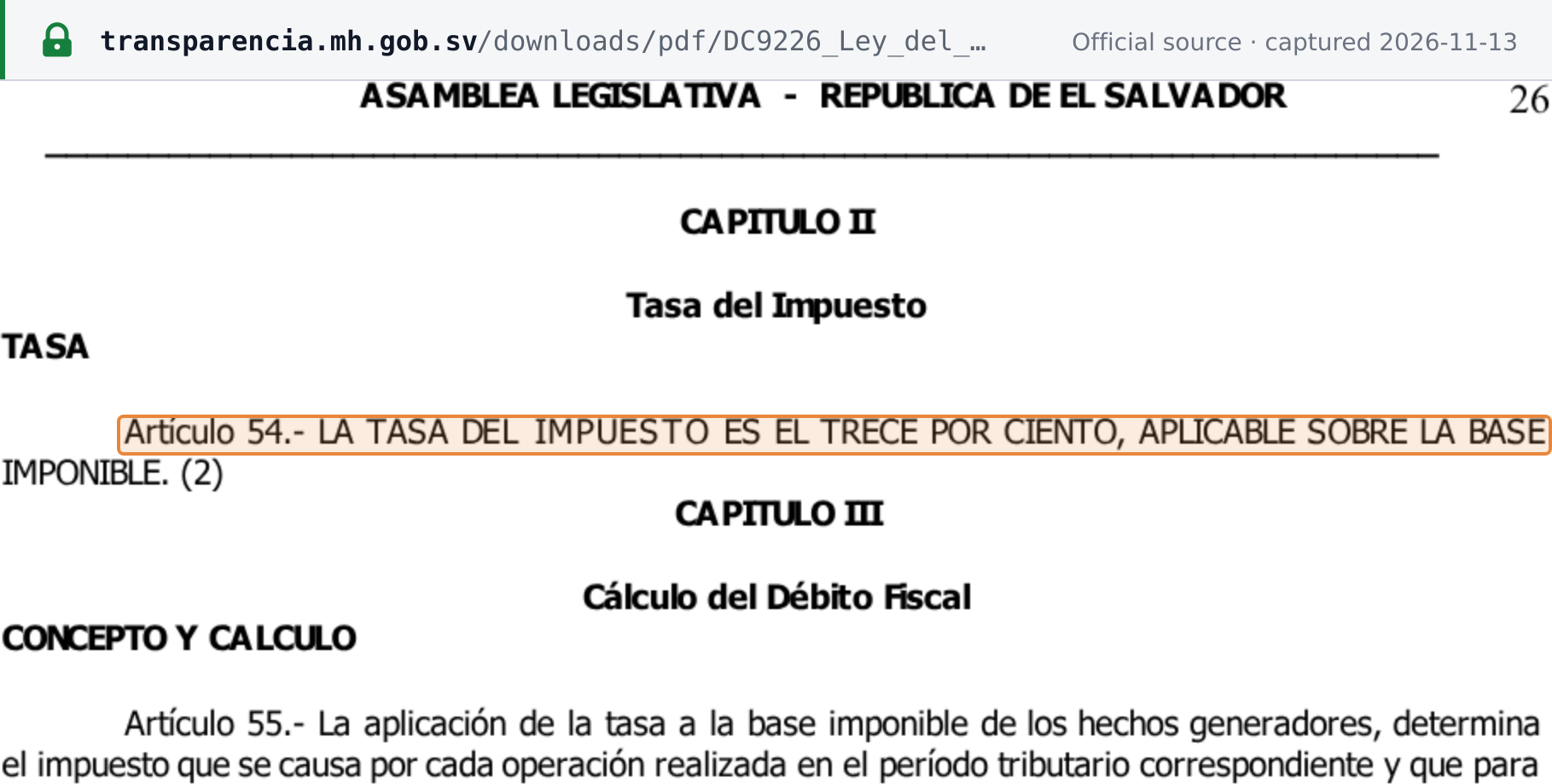
IVA law art. 54: "La tasa del impuesto es el trece por ciento aplicable sobre la base imponible." The 13% rate was set by D.L. No. 370 of 8 June 1995 (Diario Oficial No. 114, Tomo 327, 21 June 1995). [1] [1] The IVA law has no reduced or super-reduced rate.
 Source snapshot captured 2026-11-13 — original
Zero rate: exports
"Las exportaciones estarán afectas a una tasa del cero por ciento" (IVA law art. 75). Exports include "las prestaciones de servicios realizadas en el país, a usuarios que no tienen domicilio ni residencia en él y los servicios estén destinadas a ser utilizados exclusivamente en el extranjero" (art. 74). Connecting, continuing or terminating in El Salvador a service that originates abroad is not an export and is taxed at 13%. [1] IVA on inputs used for exports remains deductible and can be refunded (see Credits and refunds).
Announced changes
No change to the IVA rates appears in the laws and decrees listed on the Ministerio de Hacienda's transparency portal or in the DGII's 2026 guidance. For dated changes, see the El Salvador tax-change chronology.
Cross-border rules
Imports and exports
- Imported goods. IVA is assessed by Customs at the same time as the customs duties, and the proof of payment is the importer's input-tax document: "El impuesto sobre las importaciones e internaciones de bienes será liquidado ante la Dirección General de la Renta de Aduanas, en el mismo acto en que se liquiden los impuestos aduaneros. La constancia del pago de este impuesto constituirá el comprobante de crédito fiscal" (IVA law art. 94). [1] Customs low-value rules are outside this page.
- Exports. 0% (art. 75), documented with an export Factura, never a ticket (Código Tributario art. 107). Exporters can reclaim excess input IVA (art. 77).
- Imported services. Taxable when "la actividad que generan los servicios se desarrolla en el exterior y son prestados a un usuario domiciliado en el país que los utiliza en él, tales como: asesorías o asistencias técnicas, marcas, patentes, modelos, informaciones, programas de computación y arrendamiento de bienes muebles corporales" (IVA law art. 14). [1] IVA on imported services is assessed by the DGII and paid to the Dirección General de Tesorería (art. 94).
Reverse charge on supplies by non-residents
Código Tributario art. 161 makes the Salvadoran buyer liable: [2]
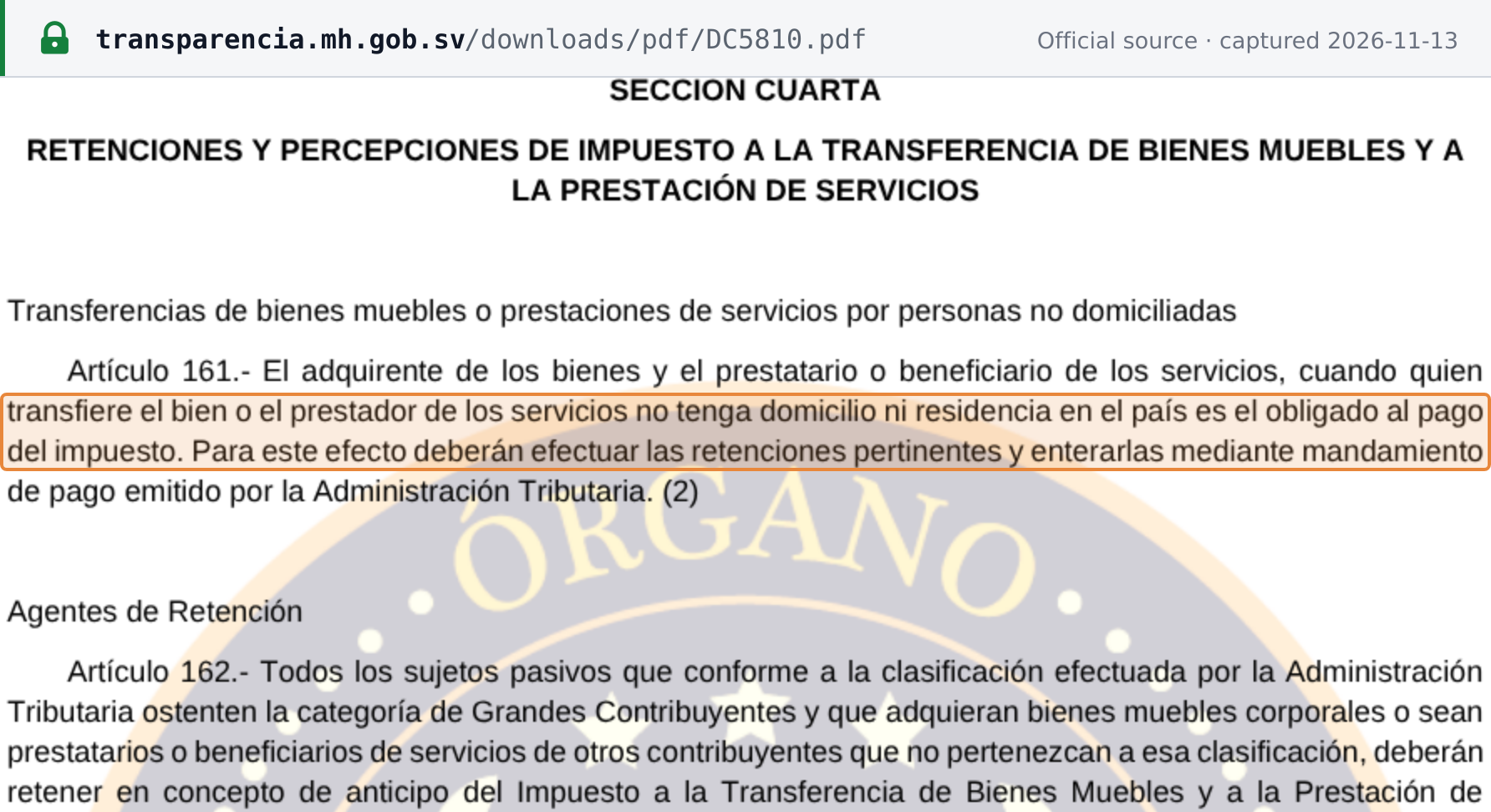
"El adquirente de los bienes y el prestatario o beneficiario de los servicios, cuando quien transfiere el bien o el prestador de los servicios no tenga domicilio ni residencia en el país es el obligado al pago del impuesto. Para este efecto deberán efectuar las retenciones pertinentes y enterarlas mediante mandamiento de pago emitido por la Administración Tributaria."
Article 161 states no percentage of its own; the buyer pays "el impuesto", that is, IVA at the 13% rate of article 54. The amount withheld is creditable input tax for the buyer: "las cantidades retenidas de conformidad al artículo 161 del Código Tributario, constituirán crédito fiscal para los agentes de retención" (IVA law art. 65). [1] For the general mechanism, see Reverse charge.
 Source snapshot captured 2026-11-13 — original
Foreign companies selling into El Salvador — B2B and B2C
- B2B. The Salvadoran business customer withholds and pays the IVA under article 161 and deducts it under article 65. The foreign supplier does not register.
- B2C, including digital services. Neither the IVA law nor the Código Tributario contains a registration duty, simplified regime or collection rule aimed at foreign suppliers of digital or other services to consumers. Article 14 nominally covers imported services used in El Salvador, but the article 161 mechanism depends on the acquirer withholding, which a private consumer does not do in practice. Do not read this as an exemption. For how other countries handle this, see VAT on digital services by non-resident suppliers.
Marketplaces and agents
The IVA law and the Código Tributario contain no marketplace or deemed-supplier rule. The closest rule is for commission agents: "Los comisionistas, consignatarios, subastadores y todos aquellos que vendan, transfieran o subasten bienes o presten servicios por cuenta de terceros, deberán emitir y entregar a su propio nombre, Comprobante de Crédito Fiscal o Factura, según sea el caso, por cada transferencia de bienes o prestación de servicios, indicando que actúan por cuenta de sus mandantes" (Código Tributario art. 108). [2] The principal remains the taxpayer.
Place of supply
Services are taxed where they are performed: "Las prestaciones de servicios constituirán hechos generadores del impuesto cuando ellos se presten directamente en el país, no obstante que los respectivos actos, convenciones o contratos se hayan perfeccionado fuera de él, y cualquiera que sea el lugar en que se pague o se perciba la remuneración. Se entenderá que el servicio es prestado en el territorio nacional, cuando la actividad que genera el servicio es desarrollada en el país" (IVA law art. 19). [1] Services performed abroad and used in El Salvador by a domiciled user are caught as imported services (art. 14, above).
Invoice requirements
Document types
Código Tributario art. 107 sets out who gets which document: [2]
| Document | When it is used |
|---|---|
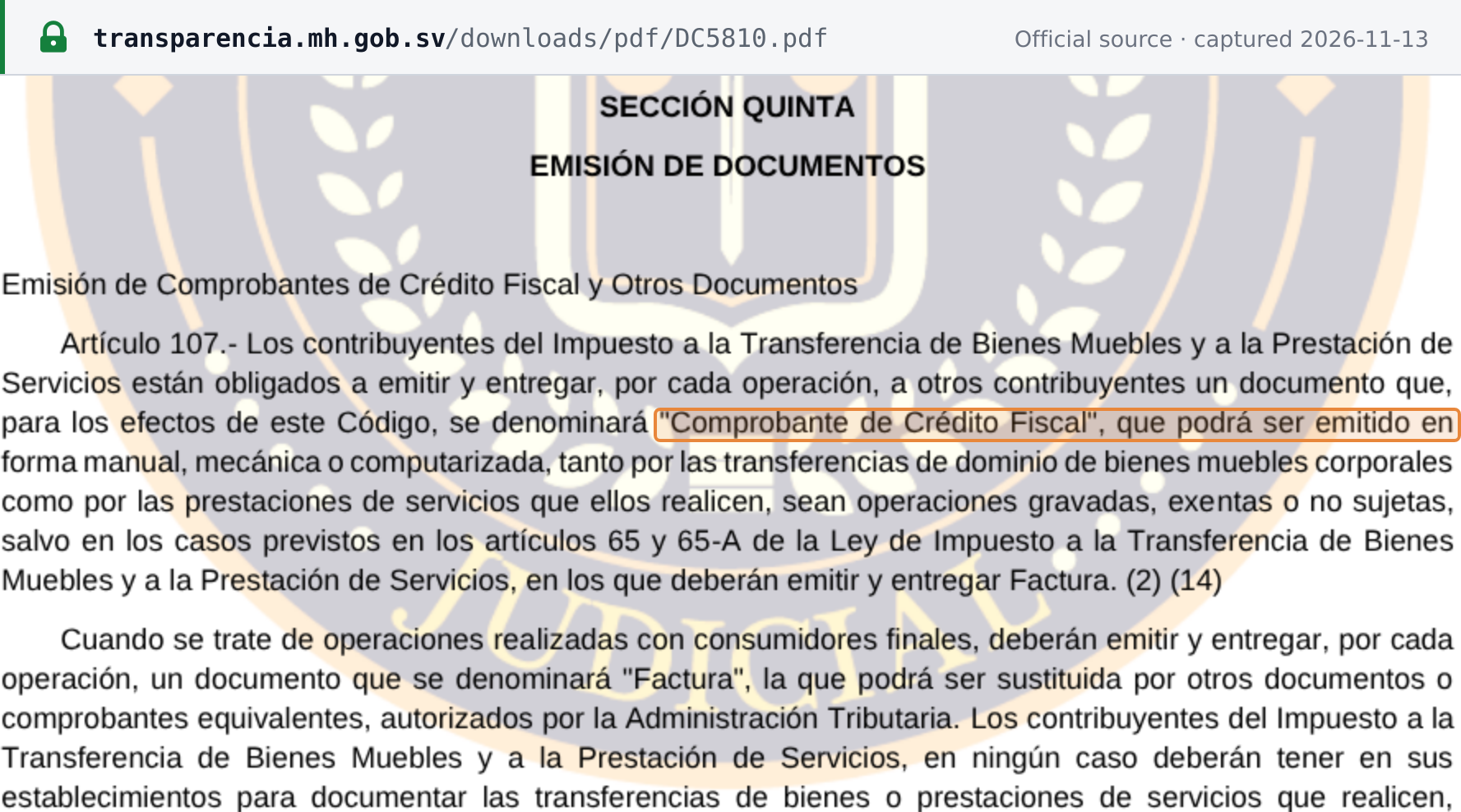
| Comprobante de Crédito Fiscal (CCF) | To another IVA contribuyente, for every operation, whether taxed, exempt or not subject to tax, "salvo en los casos previstos en los artículos 65 y 65-A de la Ley de Impuesto a la Transferencia de Bienes Muebles y a la Prestación de Servicios, en los que deberán emitir y entregar Factura": a purchase whose IVA the buyer cannot deduct is documented with a Factura. Only a CCF (or the customs or art. 161 payment proof) supports an input-tax deduction (IVA law art. 65). |
| Factura | To final consumers. "…la que podrá ser sustituida por otros documentos o comprobantes equivalentes, autorizados por la Administración Tributaria" — the authorised equivalents are tickets. |
| Factura (export) | Exports: "deberán emitir y entregar Factura, la cual en ningún caso podrá ser sustituida por los documentos equivalentes". |
| Factura de venta simplificada | Natural-person contribuyentes whose transfers and services in the previous year were at most USD 50,000, on sales to final consumers of at most USD 12 per operation (art. 107). |
| Nota de Crédito / Nota de Débito | Adjustments to a CCF (art. 110, see Credit notes and corrections). |
| Nota de Remisión | Delivery note where goods move before the CCF is issued (art. 109). |
| Factura de Sujeto Excluido | Issued by the buyer for purchases from persons excluded from IVA under art. 28 (Código Tributario art. 119). |
In the law's words: "Los contribuyentes del Impuesto a la Transferencia de Bienes Muebles y a la Prestación de Servicios están obligados a emitir y entregar, por cada operación, a otros contribuyentes un documento que, para los efectos de este Código, se denominará "Comprobante de Crédito Fiscal"…" and "Cuando se trate de operaciones realizadas con consumidores finales, deberán emitir y entregar, por cada operación, un documento que se denominará "Factura"…"
Taxpayers who issue electronic documents (DTE) have not been allowed to use tickets since 1 January 2025 and must issue an electronic Factura to final consumers (DTE Normativa v2.0 §15). [3]
 Source snapshot captured 2026-11-13 — original
Issuance deadline
Documents are issued when the tax arises: "Los contribuyentes deberán emitir y entregar los documentos señalados en el presente artículo en todo caso, cuando se cause el impuesto de conformidad a lo estipulado en los artículos 8, 12 y 18 de la Ley de Impuesto a la Transferencia de Bienes Muebles y a la Prestación de Servicios" (Código Tributario art. 107).
- Services. The tax arises at the earliest of: issuing a document, completing the service, delivering the goods or work, or full or partial payment or crediting to account, including prepayment: "según cuál circunstancia de las señaladas a continuación ocurra primero" (IVA law art. 18). For periodic services, at each document or at the end of each billing period, whichever comes first. [1]
- After a delivery note. "El Comprobante de Crédito Fiscal deberá emitirse en el mismo período tributario en que se emita la Nota de Remisión respectiva, a más tardar, dentro de los tres días siguientes a dicho período" (Código Tributario art. 109). [2]
- Electronic documents must also be transmitted to the DGII before delivery, with limited deferral (see E-invoicing status).
Mandatory content: Comprobante de Crédito Fiscal (paper)
Código Tributario art. 114(a), mapped for a schema: [2]
| # | Particular |
|---|---|
| 1 | Pre-printed correlative numbering (series per establishment allowed) |
| 2 | Issued in triplicate; for operations of USD 25,000 or more, names, signatures and DUI numbers of the persons delivering and receiving |
| 3 | Issuer's name or business name, activity (giro), address of the establishment and branches, NIT and NRC |
| 4 | Separation of taxed, exempt and non-taxable operations |
| 5 | Date of issue |
| 6 | The same data as no. 3 for the buyer |
| 7 | Description of goods and services, unit price, quantity and total |
| 8 | IVA charged separately: "Cantidad recargada separadamente por concepto del presente impuesto" |
| 9 | Number and date of any prior Nota de Remisión |
| 10 | Terms of the operation: "al contado, al crédito, puesto en bodega y otras" |
| 11 | Printer's imprint (pie de imprenta) |
The Factura for consumers (art. 114(b)) shows the price including IVA, with the separation of taxed, exempt and non-taxable sales and the total.
Mandatory content: electronic CCF and electronic Factura
Código Tributario art. 119-G sets the content of electronic documents. [2] For the Comprobante de crédito fiscal electrónico (CCFE):
- "Los mismos requisitos establecidos en los numerales 3), 4), 6), 7), 8), 9) y 10) del literal a) inciso primero del artículo 114 de este Código, a excepción del detalle de las sucursales" — issuer and buyer data with NIT and NRC, separation of operations, description, prices, IVA charged separately, related delivery note and terms;
- the unique código de generación of the electronic document;
- a consecutive número de control;
- date and time of generation;
- the total value of the operation;
- the forma de pago: "efectivo, tarjeta de crédito, tarjeta de débito, transferencia electrónica, indicando si es de contado o a crédito, total o parcialmente, y el plazo correspondiente".
The Factura electrónica (FE) carries the art. 114(b) content (description, separation of operations, price including IVA, total) plus the código de generación, número de control, the issuer's name, activity, address, NIT and NRC, date and time, forma de pago and the buyer-identity rule below. The export Factura (FEXE) adds the buyer's passport or foreign tax number, the rate applicable to exports shown separately, and the data required by international trade and customs rules.
No numbering authorisation. "Los Documentos Tributarios Electrónicos se identifican e individualizan mediante su código de generación, por lo tanto, no necesitan la autorización de numeración correlativa a que se refiere el artículo 115-A de este Código" (art. 119-G).
Buyer identity on consumer invoices: no name or ID below USD 25,000
Código Tributario art. 114(b)(7), for paper facturas, reads (art. 119-G says the same for electronic facturas): [2] [2]
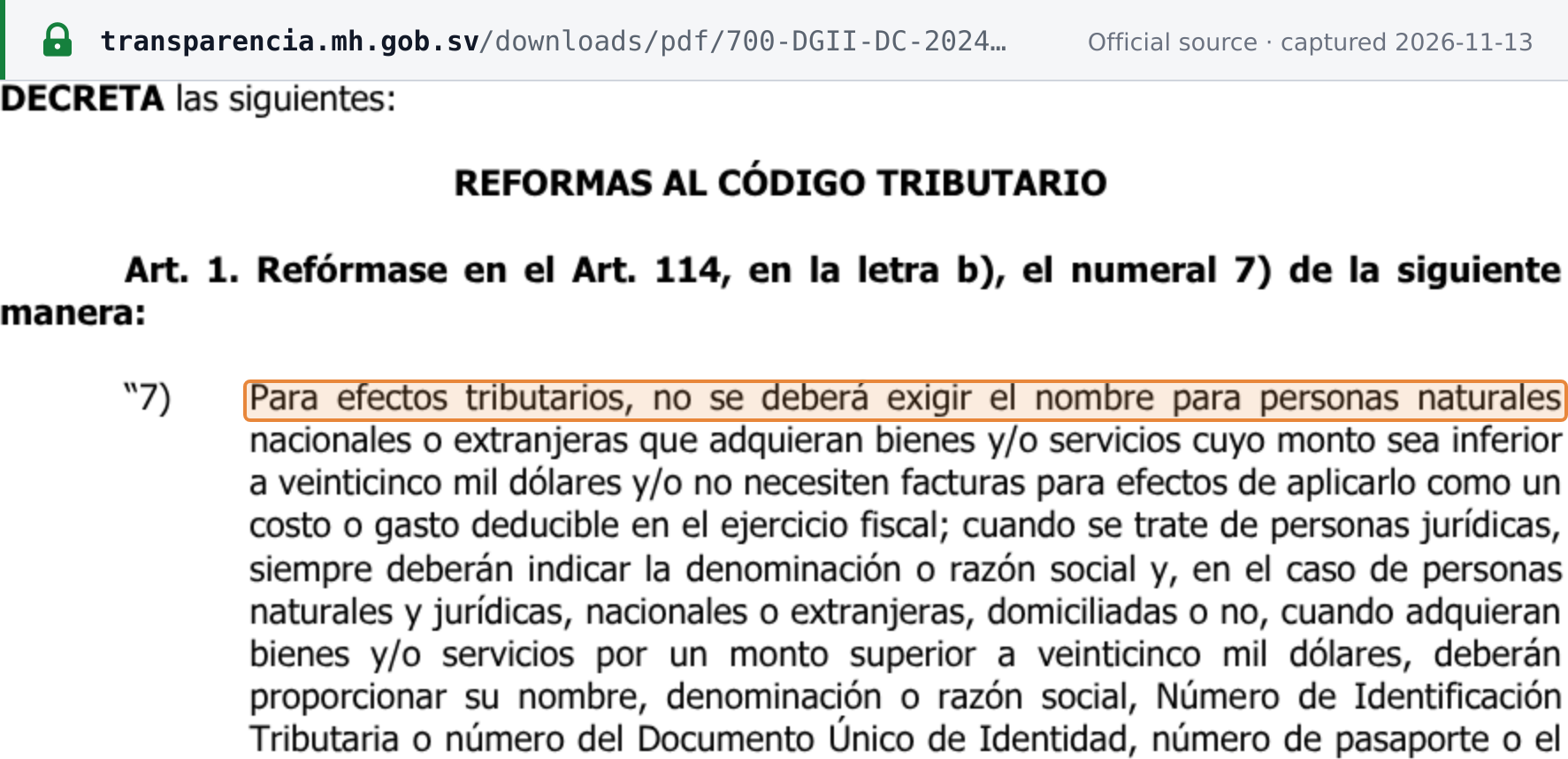
"Para efectos tributarios, no se deberá exigir el nombre para personas naturales nacionales o extranjeras que adquieran bienes y/o servicios cuyo monto sea inferior a veinticinco mil dólares y/o no necesiten facturas para efectos de aplicarlo como un costo o gasto deducible en el ejercicio fiscal…"
- History. The amendment notes on article 114(b)(7) cite Decreto Legislativo No. 960 of 28 February 2024 and Decreto Legislativo No. 94 of 17 September 2024 (Diario Oficial No. 178, Tomo 444, 19 September 2024). Decreto 94 reworded the rule in articles 114(b)(7) and 119-G and added the fines below. [2]
- Legal entities always give their name. Above USD 25,000, or when the invoice is needed for a deduction, the buyer gives its name and NIT, DUI, passport, residence card or foreign tax number.
- The DGII's notice of 5 September 2024 states that "LOS EMISORES DE FACTURA ELECTRÓNICA, FÍSICA O TIQUETE NO DEBEN SOLICITAR A LOS CLIENTES EL DOCUMENTO DE IDENTIFICACIÓN, en las ventas que realicen a consumidores finales en operaciones menores a $25,000.00, lo cual, es de CARÁCTER PROHIBITIVO". [7]
- Demanding it is fined: "Multa equivalente al treinta por ciento del monto de la operación por cada documento, la que no podrá ser inferior a dos salarios mínimos mensuales del sector comercio" (Código Tributario arts. 239(j) and 239-A(k), added by Decreto 94). [2] [2]
 Source snapshot captured 2026-11-13 — original
A specimen of a compliant invoice
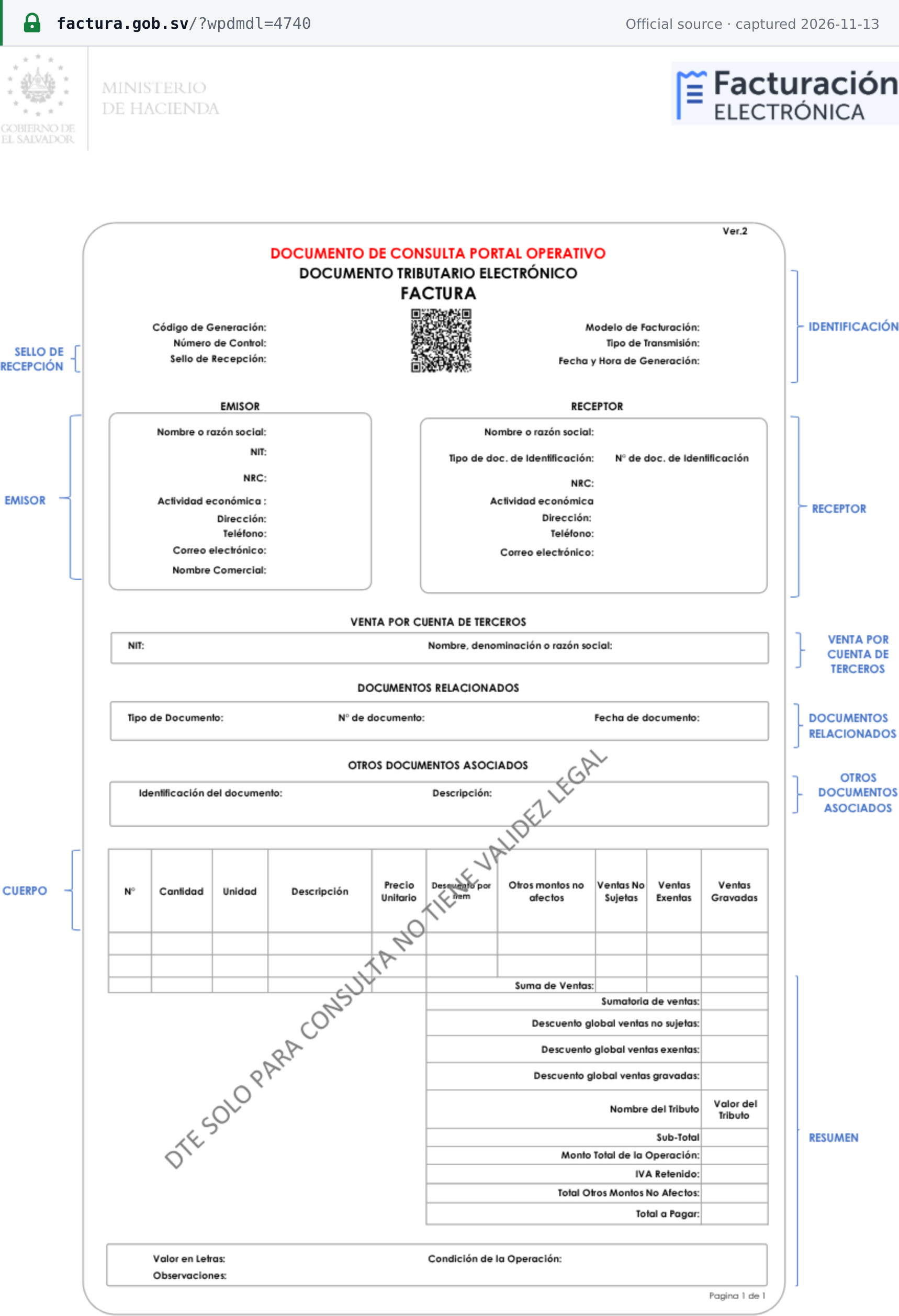
The DGII publishes its own annotated specimen of the printable electronic Factura (the representación gráfica of a DTE) at the end of its quick guide for issuing a Factura on the free Sistema de Facturación. [5] It is blank, carries the diagonal watermark "DTE SOLO PARA CONSULTA NO TIENE VALIDEZ LEGAL", and labels each block in the right margin:
- Identificación — Código de Generación, Número de Control, Modelo de Facturación, Tipo de Transmisión, Fecha y Hora de Generación, and a QR code;
- Sello de recepción — the DGII's stamp, which "brinda la validez fiscal del documento";
- Emisor — name or business name, NIT, NRC, economic activity, address, telephone, e-mail, trade name;
- Receptor — name, type and number of identity document, NRC, economic activity, address, telephone, e-mail;
- Venta por cuenta de terceros, Documentos relacionados and Otros documentos asociados;
- Cuerpo — line number, quantity, unit, description, unit price, discount per item, other non-taxable amounts, and sales split into No Sujetas, Exentas and Gravadas;
- Resumen — sum of sales, discounts, sub-total, total amount of the operation, IVA withheld, total other non-taxable amounts, total to pay, amount in words, terms of the operation and observations.
The DGII's equivalent specimen for the electronic CCF, in its CCF quick guide, adds IVA Percibido to the totals. [6] The DGII's own example of a número de control is "DTE-01-M001P025-000000000000001 para Factura Electrónica" (type code 01 = Factura, 03 = CCF). [4]
 Source snapshot captured 2026-11-13 — original
Numbering and sequencing
- Paper documents are pre-numbered correlatively, with series per establishment allowed (art. 114(a)), under numbering authorised by the DGII (art. 115-A).
- Electronic documents are identified by their código de generación and need no numbering authorisation (art. 119-G). The número de control has 31 characters: "DTE-", a two-digit document type, an eight-character establishment and point-of-sale code, and a fifteen-digit sequence. "Este número de control no debe de repetirse en un año calendario." [4]
Credit notes and corrections
- CCF. For price changes, discounts, returns, cancellations or wrongly computed IVA, the issuer "deberán expedir nuevos Comprobantes de Crédito Fiscal o Notas de Débito o de Crédito, según corresponda, que modifiquen los documentos emitidos anteriormente", and "Las Notas de Débito y de Crédito deberán hacer referencia al número de Comprobante de Crédito Fiscal que es sujeto a modificación" (Código Tributario art. 110). [2]
- Factura. When later adjustments reduce, annul or rescind operations documented with Facturas, the seller must "anular dichos documentos y emitir nuevas facturas que modifiquen los documentos expedidos inicialmente" (art. 111).
- Time limit. "En cualquier caso los ajustes a las ventas que rebajen el débito fiscal deben hacerse dentro del plazo de tres meses contados a partir de la fecha de la entrega de los bienes o a partir de la fecha en la que se preste el servicio" (art. 111).
- Electronic documents. An electronic Factura (FE, FEXE, FSEE) is corrected by an invalidation event within its window. A CCFE or CRE that has received its sello is changed by an electronic credit or debit note: "si no se trata de la corrección de errores que no afectan la operación, los Comprobantes de Crédito Fiscal y Comprobantes de Retención que hayan obtenido el Sello de Recepción, deberán ser modificados mediante Notas de Crédito o Débito" (Normativa v2.0 Cuadro 6 and §13.1.1.2; Código Tributario art. 119-E). Even inside the invalidation window, a CCFE or CRE can be invalidated only to correct data errors that do not affect the operation or where the operation is rescinded in full; changes to price, quantity or discounts go through credit or debit notes. [3] See E-invoicing status.
Self-billing
The IVA law and the Código Tributario contain no general self-billing provision. The one case where the buyer issues the document is the Factura de Sujeto Excluido, which a business issues to document purchases from persons excluded from IVA (Código Tributario art. 119; electronically, the FSEE).
Currency and language
Neither the IVA law nor the Código Tributario sets an express currency, language or exchange-rate rule for invoices. The legal currency is the US dollar, and the DTE data structures published by the DGII are in Spanish.
Retention and audit trail
- Retention: 10 years. Taxpayers "deberán conservar en buen orden y estado, por un período de diez años contados a partir de su emisión o recibo" their books, records and documents, and "También deberán conservarse por el mismo lapso de tiempo los programas utilizados para facturar mediante sistemas computarizados" (Código Tributario art. 147). [2]
- Electronic archiving of paper. After four years, originals may be kept on microfilm, optical discs or other electronic media "siempre que se garanticen la integridad de la información" and the conversion has been certified by an external auditor (art. 147).
- Audit trail. Every DTE carries the DGII's sello de recepción, which is what makes it issued (art. 119-C), and anyone can check its status on the DGII's public lookup by código de generación. The número de control may not repeat within a calendar year.
E-invoicing status
Status as at 13 November 2026: mandatory for taxpayers the DGII has notified, under a clearance model. The system is the DGII's Documentos Tributarios Electrónicos (DTE), run from factura.gob.sv.
Legal basis: clearance with a sello de recepción
Decreto Legislativo No. 487 of 30 August 2022 (Diario Oficial No. 175, Tomo 436, 20 September 2022) inserted articles 119-A to 119-H into the Código Tributario. [2] [9]
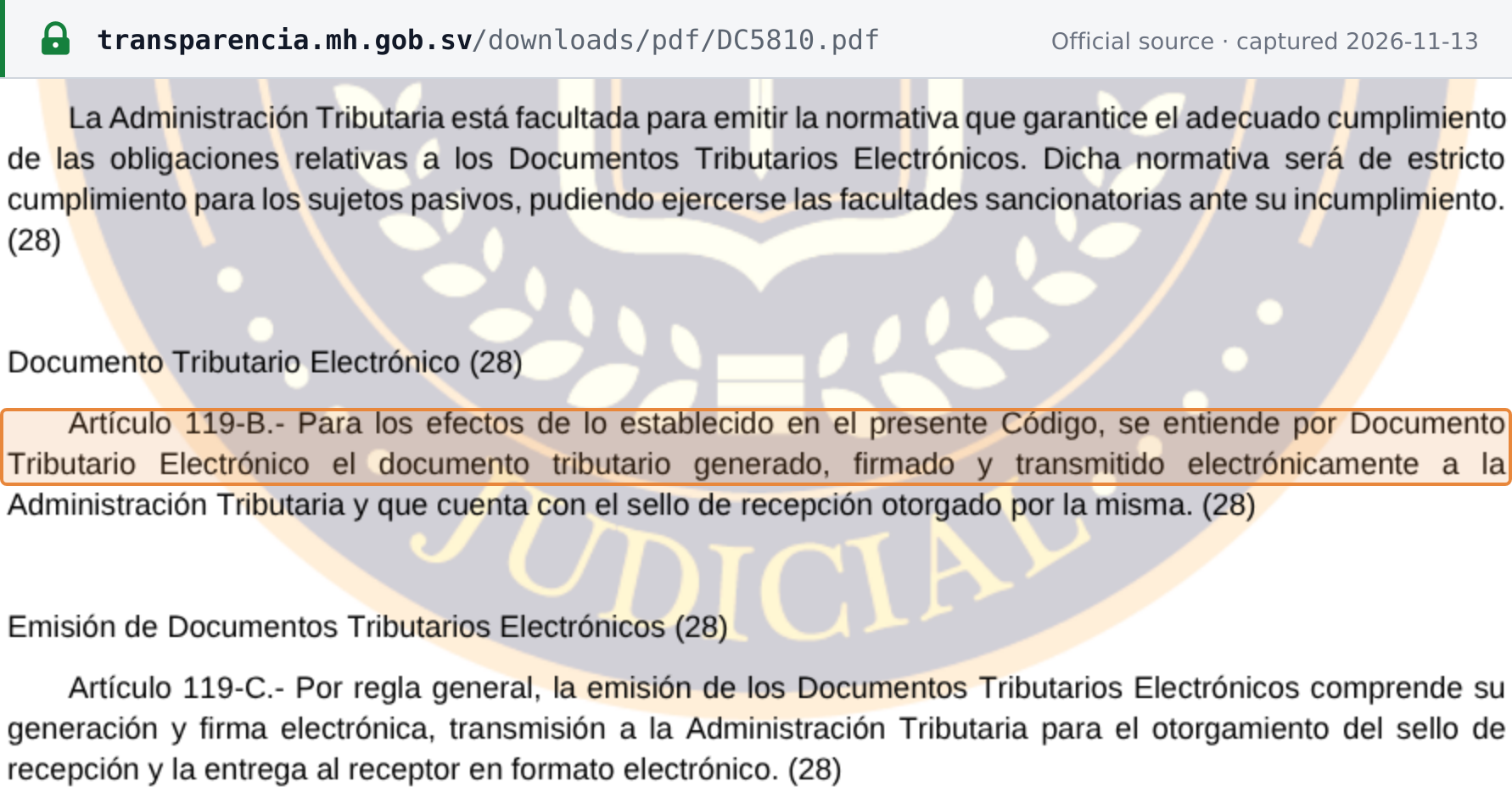
- Definition. "…se entiende por Documento Tributario Electrónico el documento tributario generado, firmado y transmitido electrónicamente a la Administración Tributaria y que cuenta con el sello de recepción otorgado por la misma" (art. 119-B).
- When it is issued. "Se entenderá que los Documentos Tributarios Electrónicos han sido emitidos cuando la Administración Tributaria otorgue sello de recepción de los mismos" (art. 119-C).
- Dates set by the DGII. The DGII determines "Las fechas a partir de las cuales, los contribuyentes se encontrarán obligados a emitir Documentos Tributarios Electrónicos" (art. 119-A(h)), and may provide a free issuing solution (art. 119-H), which it does through the Sistema de Facturación (Normativa v2.0 §16).
For how clearance compares with other models, see E-invoicing models: clearance, reporting and interchange.
 Source snapshot captured 2026-11-13 — original
Who must issue DTE, and from when
The obligation is assigned taxpayer by taxpayer, by DGII notification, not by a published turnover band. The Normativa de Cumplimiento de los Documentos Tributarios Electrónicos, Versión 2.0 (signed "San Salvador, 25 de mayo de 2026") states: [3]
- §2.1.1: "Los sujetos pasivos obligados para emitir DTE y Eventos son aquellos notificados para tal efecto por la Administración Tributaria a través de los medios pertinentes, conforme a la regla 2.2 "Programa de Implementación" de esta Normativa."
- §2.2: "La Administración Tributaria establecerá los grupos de sujetos pasivos y las fechas de inicio de la obligación para emitir los Documentos Tributarios Electrónicos y Eventos."
- §2.1.1.1: a taxpayer that starts issuing DTE voluntarily, without notification, becomes an obliged issuer.
To check whether and from when a business is obliged, enter its NIT or DUI on the DGII's lookup, "CONSULTE SI ESTÁ OBLIGADO A SER EMISOR DE DTE Y LA FECHA QUE LE CORRESPONDE". [8] The DGII's portal and the Normativa publish no calendar of start dates by taxpayer group.
Version 2.0
The Normativa v2.0 "estará vigente a partir del día de su publicación" (§20). For users of the DGII's free Sistema de Facturación, the DGII applies the changes itself. Users of their own software (Sistema de Transmisión) "deberán concluir las adaptaciones correspondientes dentro del plazo que les establezca la Administración Tributaria" (§18); the Normativa itself states no date. [3]
Document types and events
Version 2.0 lists eleven DTE types (§4): Comprobante de Crédito Fiscal Electrónico (CCFE), Factura Electrónica (FE), Factura de Exportación Electrónica (FEXE), Nota de Remisión Electrónica (NRE), Nota de Crédito Electrónica (NCE), Nota de Débito Electrónica (NDE), Comprobante de Liquidación Electrónico (CLE), Comprobante de Retención IVA Electrónico (CRE), Documento Contable de Liquidación Electrónico (DCLE), Factura de Sujeto Excluido Electrónica (FSEE) and Comprobante de Donación Electrónico (CDE). It defines four events: "a) Evento de Invalidación. b) Evento de Contingencia. c) Evento de Retorno. d) Evento de Operaciones Especiales." The Factura de Venta Simplificada is reported through the Operaciones Especiales event. [3] [4]
Format, signature and transmission deadlines
- Format. JSON: "Generación: Proceso mediante el cual la Estructura de Datos se incorpora en el Formato Electrónico JSON" (Normativa v2.0, definitions). Documents are electronically signed by the issuer; the DGII publishes the JSON schemas and a free signing tool on factura.gob.sv.
- Platforms. The Sistema de Transmisión (the taxpayer's own software, connected by web services) and the Sistema de Facturación (the DGII's free web and mobile application).
- QR code. "Las Representaciones Gráficas del DTE o Evento, deberán integrar un parámetro dentro de un Código QR (Quick Response) o en su defecto la dirección web que enlace al sitio de consulta de la Administración Tributaria" (§14).
Transmission deadlines (Normativa v2.0, Cuadro 4): [3]
| Model | Transmission | Deadline | Documents |
|---|---|---|---|
| Normal | Prior | "Antes de su entrega al receptor." | All DTE types |
| Normal | Deferred (exception) | "Hasta un día posterior contado a partir de la generación y entrega al receptor." | CCFE, NCE, NDE, NRE, CRE, FE, FEXE, FSEE |
| Contingency | Deferred | "Hasta 72 horas contadas a partir del otorgamiento del Sello de Recepción del Evento de Contingencia." | Same as the row above |
Contingency
Contingency applies only to force majeure that prevents transmission, such as an outage of the internet provider or of the DGII platform. The issuer "deberá reiniciar los reintentos de transmisión a los servicios de la Administración Tributaria como mínimo cada quince minutos" (Normativa v2.0 §13.2.1). Documents are delivered to the buyer signed but without a sello. Then, per the DGII's Manual Funcional del Sistema de Transmisión v2.0: [4]
- the Evento de Contingencia is sent within a "plazo máximo de 24 horas para transmitir el evento, contadas a partir del cese de la situación de fuerza mayor que provocó la contingencia";
- one event "podrá describir desde 1 hasta un máximo de 1000 documentos electrónicos generados en contingencia";
- the documents follow within "un plazo máximo de 72 horas contadas a partir del otorgamiento del Sello de Recepción del Evento de Contingencia".
Invalidation windows
Per the Manual Funcional v2.0: [4]
| Documents | Invalidation event must reach the DGII |
|---|---|
| FE, FEXE, FSEE | "dentro del plazo de tres meses contados a partir del otorgamiento del Sello de Recepción del documento" |
| CCFE, NCE, NDE, CRE, CLE, DCLE, NRE, CDE | "dentro de un plazo máximo 10 días hábiles del mes siguiente al período tributario en que el documento a invalidar obtuvo el sello de Recepción" |
| FE and FEXE for returns of perishable medicines | "Dentro de dos años contados a partir del otorgamiento del Sello de Recepción del documento a invalidar" (Normativa v2.0, Cuadro 6) |
Inside these windows, a CCFE or CRE may be invalidated only for data errors that do not affect the operation or for total rescission; other changes are made with an electronic credit or debit note (Normativa v2.0 Cuadro 6 and §13.1.1.2). An invalidated document no longer supports a deduction (Código Tributario art. 119-E).
Scope
- B2B (CCFE), B2C (FE), exports (FEXE), purchases from non-registered persons (FSEE) and IVA withholding (CRE) are all within the DTE system once a taxpayer is notified.
- B2G. The Normativa defines no separate public-sector track; public bodies receive the same CCFE or FE.
- Verification. "…cualquier usuario podrá consultar el estado de su DTE, por medio del Código de Generación" (Manual Funcional v2.0) at the DGII public DTE lookup.
For the dated record of version 2.0, see the El Salvador DTE Normativa 2026 event. For a neighbouring Central American system, see the Guatemala VAT guide.
Filing and payment
Filing frequency and due date
- Frequency. Monthly, for every contribuyente whatever its size: "los contribuyentes y, en su caso, los responsables del impuesto, deberán presentar mensualmente una declaración jurada sobre las operaciones gravadas, exentas y no sujetas" (IVA law art. 93).
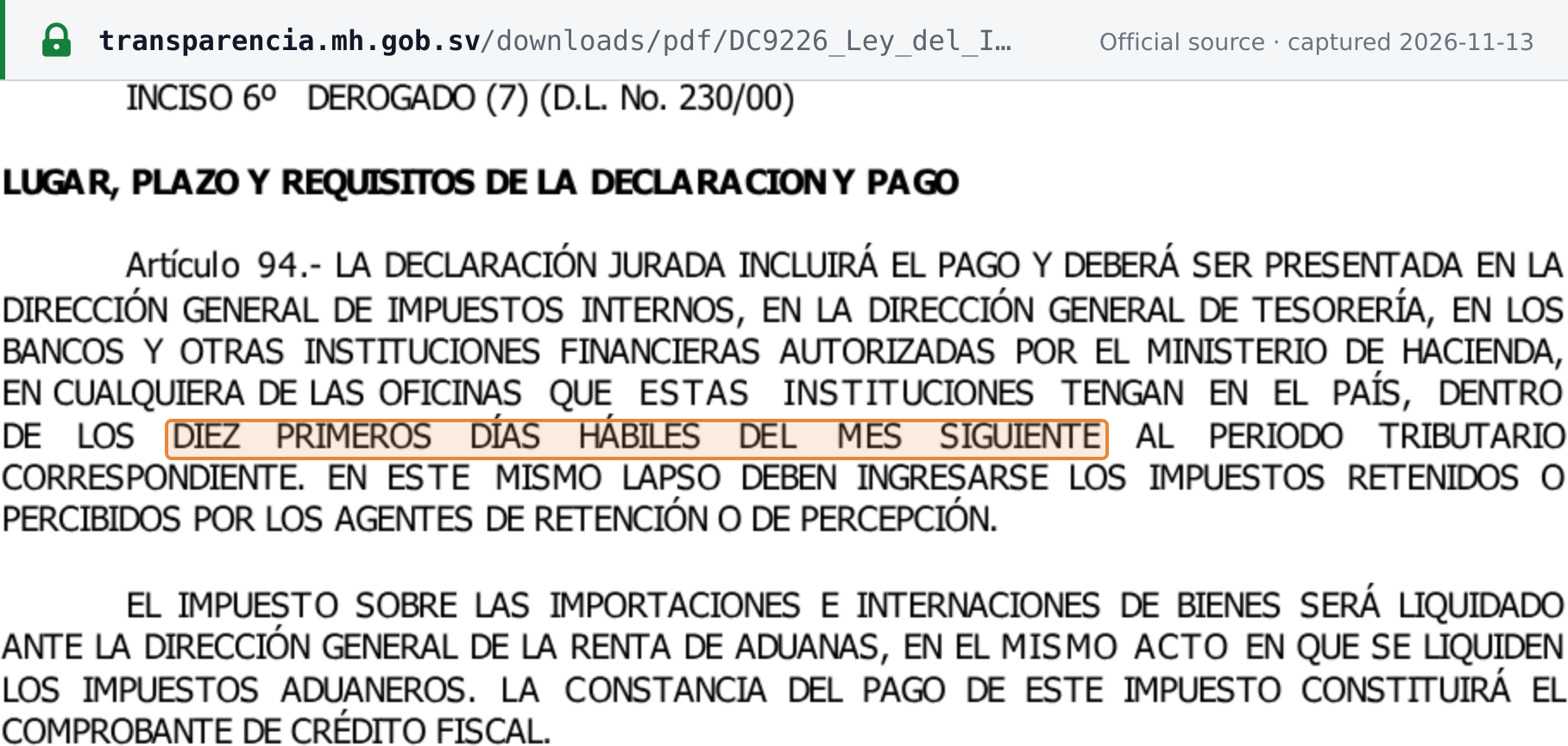
- Due date and payment. The return includes payment and is due within the first 10 business days of the following month: "La declaración jurada incluirá el pago … dentro de los diez primeros días hábiles del mes siguiente al período tributario correspondiente. En este mismo lapso deben ingresarse los impuestos retenidos o percibidos por los agentes de retención o de percepción" (IVA law art. 94). [1]
- Form. The F-07, the IVA return, filed online through the Ministerio de Hacienda's online services and paid at the DGII, the Treasury or authorised banks (art. 94). Its annexes carry document-level detail, and the DGII publishes a user manual for completing them with electronic invoices. [9]
 Source snapshot captured 2026-11-13 — original
IVA withholding and perception by large taxpayers
These advances change the cash a supplier receives, so they matter for B2B pricing. Código Tributario arts. 162 to 163: [2]
| Mechanism | Who applies it | Rate and base | Floor |
|---|---|---|---|
| Retención (art. 162) | Grandes Contribuyentes buying goods or services from contribuyentes not in that category; other agents the DGII designates | 1% of the price excluding IVA: "el uno por ciento sobre el precio de venta de los bienes transferidos o de la remuneración de los servicios prestados" | Operations of USD 100 or more |
| Retención 13% (art. 162) | Large and medium taxpayers buying sugar cane, coffee, raw milk or cattle, or financial, leasing, freight or directors' services, from individuals not registered for IVA | 13%: "deberán retener el trece por ciento en concepto del citado impuesto" | — |
| Percepción (art. 163) | Grandes Contribuyentes selling goods for resale to contribuyentes not in that category; other agents the DGII designates | 1% of the net sale price | Operations of USD 100 or more |
| Anticipo (art. 162-A) | Card issuers and acquirers, on card-paid sales of affiliated merchants | 2% of the value excluding IVA | — |
Withheld and perceived amounts are paid over by the article 94 deadline and credited by the supplier or buyer on its own return. The withholding is documented by a Comprobante de Retención (Código Tributario art. 112; electronically, the CRE). This IVA withholding is separate from income-tax withholding, which the El Salvador NIT, NRC and DUI guide covers.
Other listings
Withholding, perception and anticipo agents file the monthly F930 report, and the annual F987 reports suppliers and clients; the DGII publishes filing instructions for both on its transparency portal. [12] Article 119-A(i) of the Código Tributario lets the DGII release DTE issuers from reports whose data the DTEs already carry; Normativa v2.0 §17 says the DGII "establecerá oportunamente las fechas", and no release date has been published.
Input-tax recovery
- Document. "Únicamente será deducible el crédito fiscal trasladado en los comprobantes de crédito fiscal" (IVA law art. 65), or in the customs or article 161 payment proof, with IVA shown separately and recorded in the purchases ledger (Libro de Compras). The purchase must be indispensable to the business and to its taxed or zero-rated supplies. [1]
- Late documents. A CCF or debit note received late "podrá utilizarse para aumentar el crédito fiscal, hasta los tres períodos tributarios que siguen al de la emisión de dichos documentos" (art. 63). [1]
- Blocked items (art. 65-A). IVA is not deductible on: food and drink unless the business sells them; vehicles, aircraft, boats and similar that are not strictly indispensable, with their fuel, parts, maintenance and insurance; lodging not shown to be for the business; air tickets other than staff business travel; clothing, jewellery and footwear outside that trade; personal or family consumption; alcohol and cigarettes outside that trade; IVA charged above the legal rate; anything not indispensable; and goods and services used to build real estate. [1]
Credits and refunds
- Domestic traders. An excess of input over output IVA is carried forward to the following periods; the IVA law gives no cash refund for purely domestic activity.
- Exporters. An exporter can offset its excess credit against other taxes or ask for a refund (reintegro). "La Dirección General deberá ordenar mediante resolución el reintegro en un plazo no mayor de treinta días", without prior audit, in proportion to exports and capped per period: "el cual no podrá exceder del trece por ciento (13%) del valor de exportación que conste en los documentos aduaneros" (IVA law art. 77). [1]
- Card anticipo. A merchant whose 2% card advances exceed its IVA for 12 consecutive months can claim the excess in cash (Código Tributario art. 162-A).
- Non-residents and bad debts. The IVA law and the Código Tributario contain no refund scheme for foreign businesses and no bad-debt relief provision.
Exemptions
Exempt services
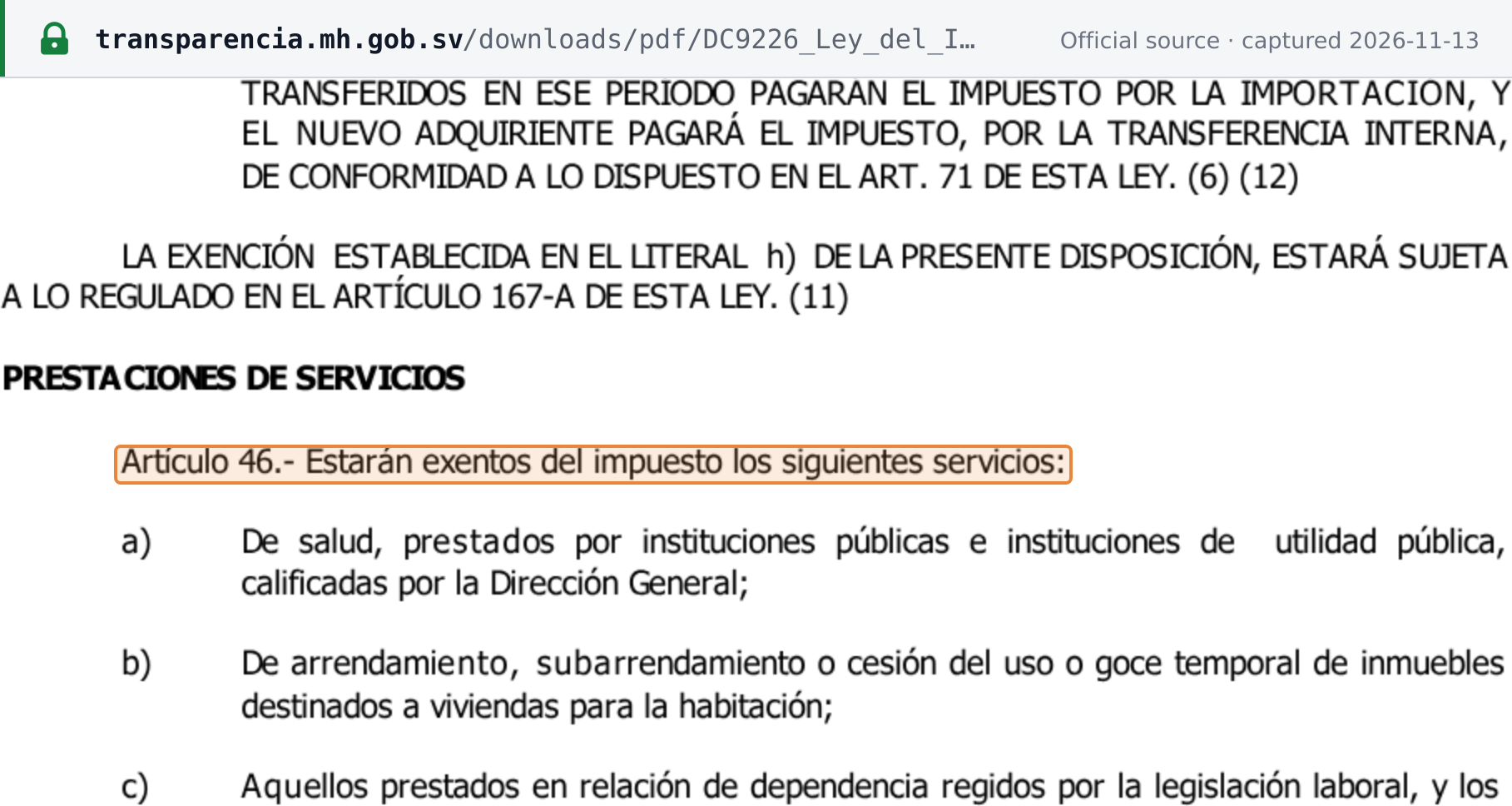
IVA law art. 46: "Estarán exentos del impuesto los siguientes servicios:" [1]
- health services by public institutions and public-utility institutions qualified by the DGII;
- rental and other temporary use of residential property;
- services under an employment relationship;
- qualified cultural shows;
- education by institutions authorised by the Ministry of Education;
- interest on deposits and loans by institutions supervised by the Superintendencia del Sistema Financiero, cooperatives and qualified foreign lenders, and on publicly offered securities;
- water supply and sewerage provided by public institutions, and drinking water for domestic, non-profit use in rural areas supplied by community water boards and similar bodies declared of social interest (art. 46(m));
- public land passenger transport;
- life and personal insurance premiums, and reinsurance;
- pension-fund (AFP) fees, and the national lottery.
 Source snapshot captured 2026-11-13 — original
No exempt domestic goods
Article 44, which listed exempt domestic transfers of goods, reads "DEROGADO" in the official consolidated text. [1] The IVA law therefore contains no exemption for food, medicines or other goods sold domestically. Article 45 exempts certain imports, such as those by diplomatic missions and international organisations and travellers' baggage.
Exempt is not zero-rated
An exempt supply carries no right to deduct the IVA on the purchases used to make it. Only taxed supplies and zero-rated exports support a deduction (IVA law art. 65), and only exporters can obtain a cash refund (art. 77).
Special regimes
- Small suppliers. The article 28 exclusion (see Registration) is the only small-business regime; the IVA law has no flat-rate scheme. Businesses that buy from excluded persons document the purchase with a Factura de Sujeto Excluido.
- Incentive laws. Separate laws grant their own IVA exemptions, among them the Ley de Zonas Francas Industriales y de Comercialización, the Ley de Servicios Internacionales, the Ley de Turismo and the special regime of the Puerto de La Unión. They are listed on the Ministerio de Hacienda's legal framework page. [12]
Offences and penalties
Most fines are expressed in monthly minimum wages (salarios mínimos mensuales, SM). Código Tributario art. 228 defines that unit, for every penalty article and whatever the taxpayer's activity, as "el equivalente a treinta días del salario mínimo por jornada ordinaria de trabajo diario diurno fijado mediante decreto emitido por el Órgano Ejecutivo para los trabajadores del comercio". [2] From 1 June 2025 the commerce and services minimum wage is USD 13.44 a day (USD 408.80 a month) under Decreto Ejecutivo No. 11 of 2025, as amended by Decreto Ejecutivo No. 12 of 24 May 2025: "Comercio y servicios $408.80 $13.440". [11] One SM is therefore USD 403.20 (30 × USD 13.44), 2 SM is USD 806.40 and 9 SM is USD 3,628.80.
Offences
- Defraudación (Código Tributario arts. 250 to 252): simulation, concealment or other manoeuvres to avoid tax. "La defraudación tributaria será sancionada con una multa del cien por ciento del impuesto defraudado, sin perjuicio de las sanciones penales que correspondan" (art. 252). [2]
- Unintentional evasion (art. 253): not filing or filing incorrectly, where the tax is then assessed; fine of 25% of the tax.
- Intentional evasion (art. 254), including by a third party who facilitates it: "una multa del cincuenta por ciento del tributo a pagar, sin que en ningún caso dicha multa pueda ser menor de nueve salarios mínimos mensuales".
- Temporary closure (art. 257): for repeat invoicing offences under article 239, closure of the establishment "por un plazo mínimo de cinco a diez días continuos", ordered by a judge.
- Criminal liability. Tax evasion is also a criminal offence under the Código Penal, and improper refund claims expose the claimant to "las acciones penales correspondientes" (IVA law art. 77).
Penalties
| Breach | Penalty | Código Tributario |
|---|---|---|
| Not registering when obliged | 3 SM | art. 235(a) |
| Registering late | 2 SM | art. 235(b) |
| Not reporting cessation of business in time | 4 SM | art. 244(h) |
| Not filing a return | 40% of the tax, minimum 1 SM | art. 238 |
| Filing late | 5% of the tax (up to 1 month late), 10% (up to 2), 15% (up to 3), 20% (more than 3 months); minimum 2 SM; 1 SM where no tax is due | art. 238(b) |
| Incorrect return | 20% of the unpaid tax, minimum 1 SM | art. 238 |
| Not issuing or delivering an invoice | 50% of the operation per document, minimum 2 SM | art. 239(a) |
| Invoice without the formal requirements | 30%, minimum 2 SM | art. 239 |
| Demanding a consumer's name or ID below USD 25,000 | 30% of the operation per document, minimum 2 SM of the commerce sector | arts. 239(j), 239-A(k) |
| Not issuing a DTE | 50%, minimum 2 SM | art. 239-A |
| DTE content or transmission not compliant | 30%, minimum 2 SM | art. 239-A |
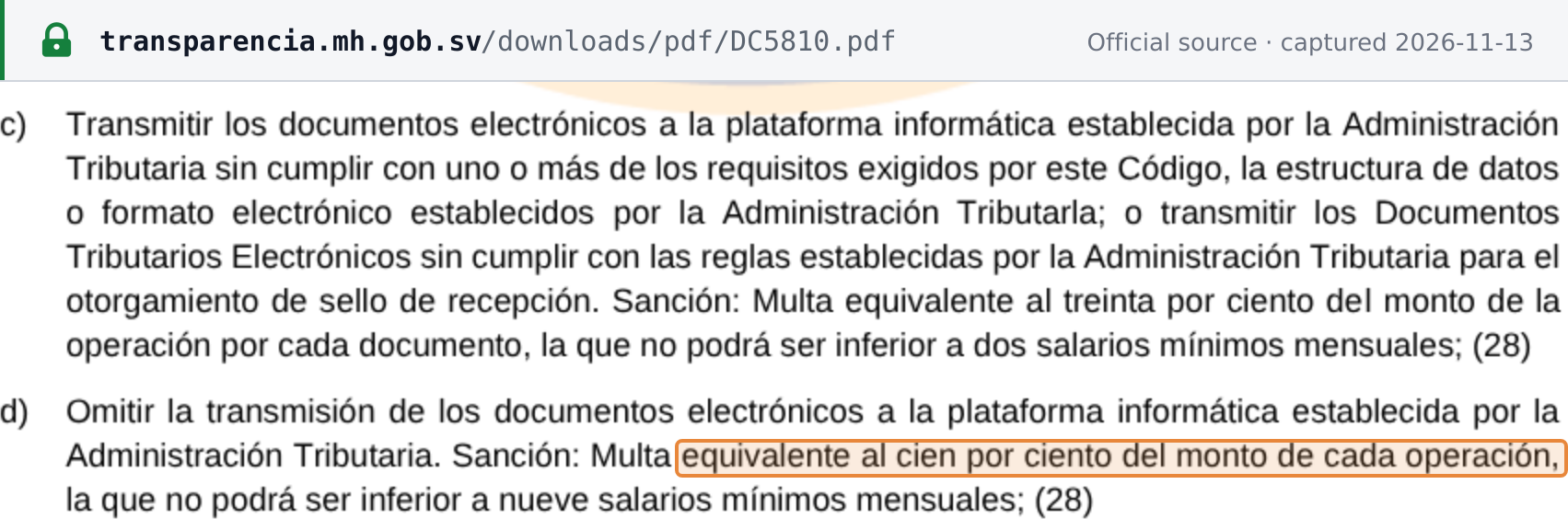
| Not transmitting DTEs to the DGII | 100% of each operation, minimum 9 SM | art. 239-A(d) |
| Missing or non-compliant printable version (representación gráfica) | 30%, minimum 2 SM | art. 239-A |
| Contingency or invalidation event omitted, late or malformed | 9 SM | art. 239-A(g)–(i) |
| Breaching the DGII's DTE Normativa | 9 SM | art. 239-A |
Sources: Código Tributario arts. 235 to 239-A and 244. [2] Article 239-A(d) reads: "Omitir la transmisión de los documentos electrónicos a la plataforma informática establecida por la Administración Tributaria. Sanción: Multa equivalente al cien por ciento del monto de cada operación, la que no podrá ser inferior a nueve salarios mínimos mensuales".
 Source snapshot captured 2026-11-13 — original
Late payment. Unpaid tax puts the taxpayer in default automatically and "Hace surgir la obligación de pagar intereses", at the rate set under Decreto Legislativo No. 720 of 24 November 1993 (Código Tributario art. 75). [2] The Código Tributario does not state the rate itself.
Frequently asked questions
Should a shop in El Salvador ask a consumer for a DUI or NIT before issuing a factura?
Not below USD 25,000. The Código Tributario says the name must not be required from individuals, national or foreign, who buy goods or services worth less than USD 25,000 and do not need the invoice as a deductible cost or expense. The DGII's notice of 5 September 2024 calls the ban prohibitive for physical facturas, electronic facturas and tickets. Asking anyway is fined 30% of the operation, with a minimum of two monthly minimum wages of the commerce sector (Código Tributario articles 239(j) and 239-A(k), added by Decreto Legislativo No. 94 of 2024). Companies always give their name, and above USD 25,000, or when the buyer needs the invoice for a deduction, the buyer's name and identity document are recorded.
Our Salvadoran client paid our invoice less 1%. Why?
If you are an IVA contribuyente in El Salvador and your client is classified as a Gran Contribuyente, article 162 of the Código Tributario makes it withhold 1% of the price, excluding IVA, as an advance of your IVA, on operations of USD 100 or more. The withholding is backed by a Comprobante de Retención, electronic or paper, and you credit it on your monthly return. If you are a foreign supplier with no domicile or residence in El Salvador, the rule is different: under article 161 the Salvadoran client is itself liable for the whole IVA on your supply, withholds it and pays it to the Treasury.
Is 1 December 2026 the deadline to move our own invoicing software to DTE version 2.0?
The Normativa de Cumplimiento de los Documentos Tributarios Electrónicos version 2.0, signed on 25 May 2026, does not state that date. Its rule 18 says that taxpayers who transmit from their own software (Sistema de Transmisión) must finish the adaptations within the period the DGII sets for them, and that the DGII applies the changes itself for users of its free Sistema de Facturación. As at 13 November 2026, the Normativa and the DGII's factura.gob.sv portal publish no fixed date, so watch the portal's notices for the DGII's instruction.
How long do we have to invalidate an electronic invoice issued by mistake?
It depends on the document type. Under version 2.0, an electronic Factura, an export Factura or a Factura de Sujeto Excluido can be invalidated within three months of the DGII's sello de recepción. An electronic Comprobante de Crédito Fiscal, credit note, debit note, delivery note, withholding receipt and the other listed types must be invalidated by the tenth business day of the month after the tax period in which the document received its sello. Even inside that window, an electronic Comprobante de Crédito Fiscal or withholding receipt can be invalidated only to correct data errors that do not affect the operation, or where the operation is rescinded in full. Changes to price, quantity or discounts are always made with an electronic credit or debit note.
What do we do if we cannot reach the DGII to transmit a DTE?
Keep retrying, at least every fifteen minutes. Contingency applies only to force majeure such as an outage of your internet provider or of the DGII platform. In contingency you deliver the signed document to the buyer without the sello, send the Evento de Contingencia within 24 hours after the outage ends, listing between 1 and 1,000 documents, and transmit those documents within 72 hours after the event receives its sello. Omitting or filing the event late is fined nine monthly minimum wages (Código Tributario article 239-A).
Our new company has almost no sales yet. Does it still need to register for IVA?
Yes. The small-supplier exclusion in article 28 of the IVA law, for those with taxable and exempt supplies below 50,000 colones (about USD 5,714.29) in the previous 12 months and total assets below 20,000 colones (about USD 2,285.71), does not apply to companies (sociedades) or to importers. A company registers within 15 days of starting activities (Código Tributario article 86).
Are basic foods or medicines sold in El Salvador exempt from IVA?
Not under the IVA law. Article 44, which listed exempt domestic transfers of goods, is marked repealed in the official consolidated text of the law, and the remaining exemptions in article 46 cover services such as health services by qualified public institutions, residential rentals, authorised education, bank interest and public transport. Food and medicines sold domestically are therefore taxed at 13% unless a special incentive law exempts the seller.
Important websites
| Site | What it is for |
|---|---|
| Ministerio de Hacienda | Tax authority (DGII); online services for registration, the F-07 return and payment |
| factura.gob.sv | DTE e-invoicing portal: Normativa, technical manuals, JSON schemas, signing tool, notices |
| DTE issuer login and free Sistema de Facturación | Issuing DTEs with the DGII's free application, and issuer administration |
| Public DTE lookup | Checking the status of any DTE by its código de generación |
| Am I obliged to issue DTE? | Entering a NIT or DUI to see whether, and from when, a business must issue DTE |
| Digital NIT for nationals | Generating a Digital NIT (Salvadoran adults) |
| Tax laws and DGII guides | The Ministerio de Hacienda's compilations of the IVA law, Código Tributario and incentive laws, and DGII instructions |
| Dirección General de Aduanas | Customs, including IVA on imports |
DTE support, per factura.gob.sv: soporte.dtes@mh.gob.sv, call centre 2244-3444 option 4.
Recent changes
- 2026-05-25 — DGII signs the Normativa de Cumplimiento de los Documentos Tributarios Electrónicos version 2.0, in force from publication: new Evento de Retorno and Evento de Operaciones Especiales, and three months to invalidate an FE, FEXE or FSEE; adaptation deadline for own-software issuers left to a later DGII notice. (DGII, factura.gob.sv) — see event
- 2025-06-01 — Commerce and services minimum wage rises to USD 13.44 a day (USD 408.80 a month), which puts the penalty unit of Código Tributario art. 228 (30 days of that daily wage) at USD 403.20. (Decreto Ejecutivo No. 11 of 2025, Centro de Documentación Judicial)
- 2025-01-01 — DTE issuers may no longer issue tickets to consumers and must issue an electronic Factura (Normativa v2.0 §15). (DGII, factura.gob.sv)
- 2024-09-19 — Decreto Legislativo No. 94 published: rewords the rule that no name or ID may be required from individual consumers below USD 25,000 (Código Tributario arts. 114(b)(7) and 119-G) and adds a fine of 30% of the operation, minimum two commerce-sector minimum wages, for demanding it (arts. 239(j) and 239-A(k)). (Código Tributario, official consolidated text)
- 2022-09-20 — Decreto Legislativo No. 487 published: DTE articles 119-A to 119-H and penalty article 239-A inserted in the Código Tributario. (Código Tributario, official consolidated text)
For the full chronology, see El Salvador tax changes on Lookuptax.
Reference links
Legislation (official consolidated texts, Corte Suprema de Justicia — Centro de Documentación Judicial):
- [1] Ley de Impuesto a la Transferencia de Bienes Muebles y a la Prestación de Servicios (D.L. No. 296 of 1992), consolidated text
- [2] Código Tributario (D.L. No. 230 of 2000), consolidated text
DGII e-invoicing (factura.gob.sv):
- [3] Normativa de Cumplimiento de los Documentos Tributarios Electrónicos, Versión 2.0 (25 May 2026)
- [4] Manual Funcional del Sistema de Transmisión, Versión 2.0
- [5] Guía rápida para emitir una Factura en la plataforma Sistema de Facturación
- [6] Guía rápida para emitir un CCF en la plataforma Sistema de Facturación
- [7] DGII notice of 5 September 2024: no identity document on consumer sales below USD 25,000
- [8] Conozca fecha para ser emisor de DTE
- [9] factura.gob.sv — Normativa
Other official sources:
- [10] Superintendencia del Sistema Financiero — norm NPB4-27 (fixed rate of ₡8.75 per US dollar)
- [11] Decreto Ejecutivo No. 11 of 2025 — minimum wages (Corte Suprema de Justicia, Centro de Documentación Judicial) and Decreto Ejecutivo No. 12 of 24 May 2025
- [12] Ministerio de Hacienda — legal framework of the tax administration (laws, incentive regimes and DGII manuals, including the Digital NIT manual)
Related on Lookuptax: