Eswatini VAT guidelines
Overview
Eswatini (formerly Swaziland) levies Value Added Tax (VAT) under the Value Added Tax Act, 2011 (Act No. 12 of 2011), supplemented by the VAT Regulations. [1] The Eswatini Revenue Service describes it this way: "VAT is an indirect tax that is levied on the consumption of goods and services in Eswatini, and is also levied on the importation of goods and services into Eswatini. It was introduced on 1 April 2012 to replace Sales Tax." [9] ERS publishes its guidance in English, and no official siSwati name for the tax appears on its VAT pages.
VAT is charged on every taxable supply in Eswatini by a taxable person, on every import of goods other than an exempt import, and on imported services (s.3). The supplier collects and pays the tax on a taxable supply, the importer on imported goods, and the recipient on imported services (s.4). [1]
Authority, currency, period and layering
- Authority. The Eswatini Revenue Service (ERS) administers VAT and customs (ers.org.sz). It is "a semi-autonomous revenue administration agency, established through the Revenue Authority Act No. 1 of 2008". The Act's text still refers to the "Swaziland Revenue Authority", the former name.
- Currency. The lilangeni, plural Emalangeni (SZL, written "E"). "For the purposes of this Act, all amounts of money are to be expressed in Emalangeni", and foreign-currency amounts convert "at the average daily selling exchange rates of the previous month" (s.80). [1]
- Tax period. One calendar month by default (s.31(1)), with quarterly periods for smaller businesses under the Regulations; see Filing and payment.
- Layering. VAT is a single national tax with no regional or municipal layer. Eswatini is a member of the Southern African Customs Union (SACU), and VAT on goods brought in from South Africa is collected by ERS at import; see Cross-border rules.
- Prices. "Any price advertised or quoted for a taxable supply shall include tax and the advertisement or quotation shall state that the price includes the tax" (s.81). [1]
Registration
Who must register: the liability rule
The Act tests turnover quarter by quarter against one quarter of the annual threshold. A person not already registered must apply (s.6(1)):
- within twenty days of the end of any period of three calendar months in which its taxable supplies, excluding VAT, exceeded one quarter of the annual registration threshold; or
- at the beginning of any three-month period in which it reasonably expects its taxable supplies to exceed one quarter of the threshold.
The threshold itself is set by the Minister: "The Minister shall by notice published in the Gazette determine the annual registration threshold" (s.6(2)). [1] National, regional and local public authorities that carry on business activities must apply when those activities start, whatever their turnover (s.6(5)).
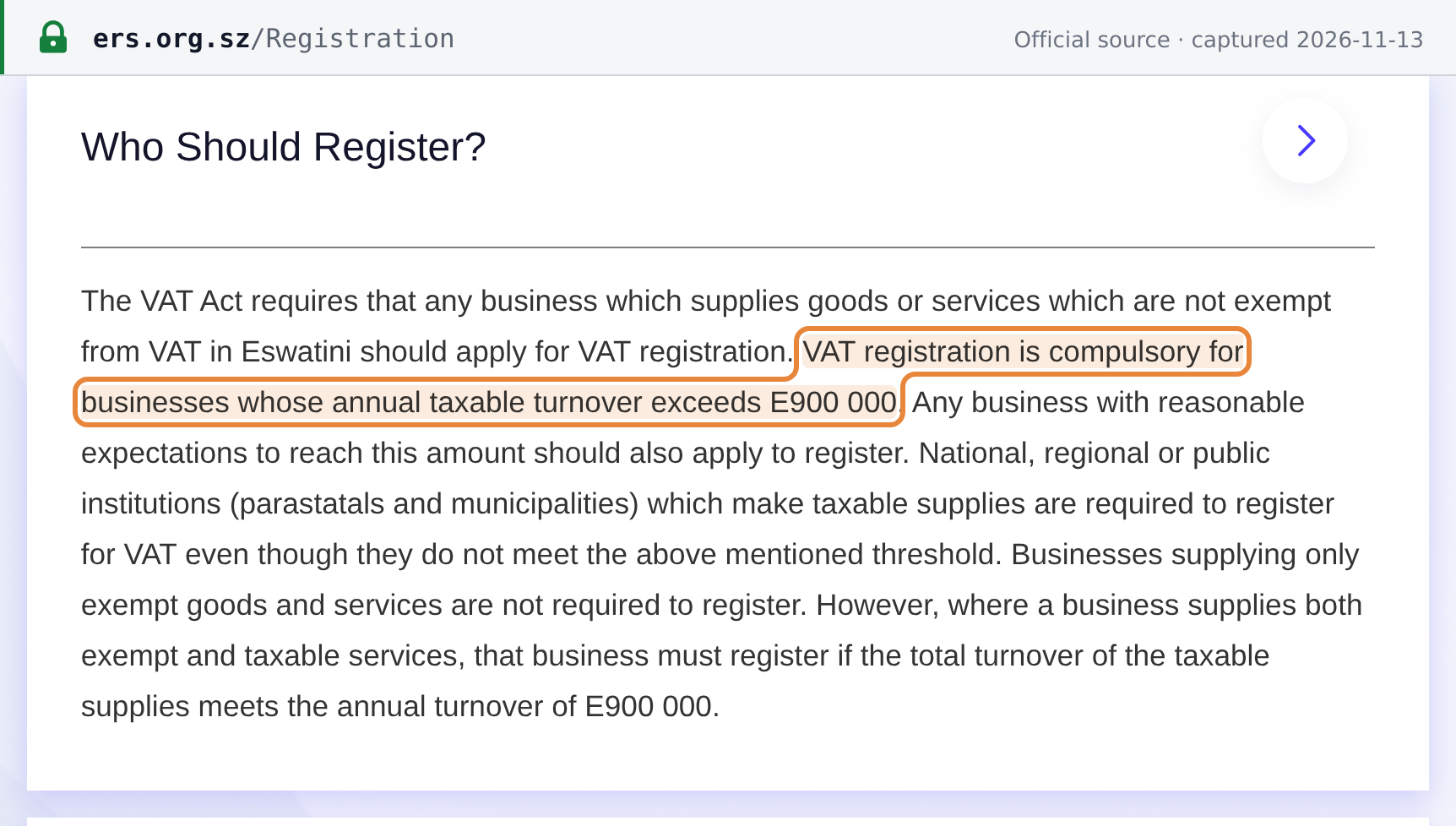
Registration threshold: E900,000 per ERS
As at 14 November 2026, the ERS Registration page states the threshold as an annual figure:
"VAT registration is compulsory for businesses whose annual taxable turnover exceeds E900 000. Any business with reasonable expectations to reach this amount should also apply to register. National, regional or public institutions (parastatals and municipalities) which make taxable supplies are required to register for VAT even though they do not meet the above mentioned threshold. Businesses supplying only exempt goods and services are not required to register." [10]
| Business | Threshold stated by ERS (as at 14 November 2026) |
|---|---|
| General | Annual taxable turnover above E900,000 (one quarter: E225,000 per three-month period under s.6(1)) |
| Parastatals and municipalities making taxable supplies | Must register regardless of turnover |
| Business making only exempt supplies | Not required to register |
| Business making both exempt and taxable supplies | Registers if its taxable turnover meets E900,000 |
Two points to note on the figure:
- The Gazette notice. The Minister's notice under s.6(2) that sets E900,000, and its effective date, are not among the instruments in ERS's tax legislation and VAT regulations lists. [24] The figure above is the one ERS publishes and applies.
- Older figure. ERS's own Step-By-Step Guide for New Businesses (January 2023) still shows the earlier threshold: "Persons with taxable turnover of E500,000 (threshold) in any consecutive 12-month period". [17]
 Source snapshot captured 2026-11-13 — original
Non-resident businesses
The Act sets no separate threshold for non-residents and has no simplified registration for them. Instead, every taxable person, "being a partnership, trust, company, non-resident individual or resident individual shall have a nominated person for tax purposes who is a resident individual", whose name is notified to the Commissioner General on first registration (s.77(1)–(2)). [1] Since the VAT (Amendment) Act, 2022, a taxable person without a nominated person, or the person acting as its nominee, is liable to a penalty of E250 per month while the failure continues (s.77(6)). [4]
ERS's registration requirements are "A fixed place of doing business in Eswatini. Capacity to keep proper accounting records. Capability to submit regular and reliable returns." [10] ERS's VAT pages carry no separate guide for foreign businesses, so in practice a non-resident registers through a local place of business and a resident nominated person. Foreign suppliers of services to Eswatini customers are usually covered by the reverse charge instead; see Cross-border rules.
Tax registration number (TIN)
Eswatini has no separate VAT number: the Third Schedule mentions a recipient's "VAT registration number", but in practice ERS uses the TIN as the VAT identifier. The Commissioner General issues a Taxpayer Identification Number (TIN) to every taxpayer, and "A taxpayer shall be required to show his Taxpayer Identification Number in any return, notice or other document used for the purposes of this Act" (s.9). [1] The registration certificate carries the TIN.
- Format. ERS's VAT Registration Check accepts a 9-digit number in the range 100000000 to 199999999, so a valid TIN starts with "1". ERS publishes no check-digit rule.
- Example. ERS's own payment-reference example uses the TIN 100123456. [17]
- Checking a supplier. The ERS VAT Registration Check takes a TIN and answers whether it is VAT-registered; it does not return the name. ERS warns: "Please note that you will not be able to deduct VAT paid to your suppliers if they are not registered for VAT." [14]
To check the format of an Eswatini TIN before you call ERS, use the Eswatini TIN validator.
How to register
ERS describes the process on its Registration page: "Taxpayers can collect the TIN registration form from the nearest ERS office or download it from here. Complete and submit the form with all attachments to any ERS office. The ERS will review the application and inform the taxpayer of the outcome within 30 days. In some cases, this may include inspection." [10]
- Attachments listed by ERS: a certified Certificate of Incorporation and Form J (companies), a power of attorney, the Public Officer's identity document, the partnership or trust deed, a deed of sale (on a takeover), the constitution (non-governmental organisations) and the trading licence.
- Where. In person at an ERS office. ERS's VAT Forms page publishes no online VAT registration route (as at 14 November 2026).
- Effective date. Registration takes effect from the start of the tax period after the obligation arose (s.7(3)).
- Certificate. "A registered taxpayer shall display the registration certificate issued in terms of this Act at a prominent place in the principal place of business of that registered taxpayer" (s.7(11), inserted in 2022). [4]
Voluntary registration
"Other businesses whose turnover is below the threshold of E900 000 may apply for registration if they meet the registration requirements and the Commissioner General is satisfied that they are fit and proper to be registered." [10] Voluntary registration starts at the beginning of the tax period after the application (s.7(3)(b)), and a voluntary registrant may not apply to deregister until two years after registration (s.8(3)). [1] The usual reason to register is to recover input tax; business customers also have a reason to prefer registered suppliers, because VAT charged by an unregistered supplier cannot be deducted.
Deregistration
- Mandatory. A person who stops making taxable supplies must apply to cancel its registration (s.8(1)).
- Optional. A person may apply if, for the most recent three calendar months, its supplies did not exceed one quarter of the annual threshold and its taxable supplies for the previous 12 months did not exceed 75% of the threshold (s.8(2)).
- By the Commissioner General. The Act lets ERS cancel the registration of a person who was not required to register (a voluntary registrant), for example where it has no fixed place of business, keeps inadequate records or files unreliable returns (s.8(5)). ERS's Registration page states these grounds without that limit. [10]
- Effect. Cancellation takes effect at the end of the tax period in which it is made (s.8(7)). Goods on hand, including capital goods, are treated as supplied, and input tax previously deducted on them is adjusted (s.8(9)). Returns for earlier periods remain due (s.8(10)). [1]
Group registration
Not available. The VAT Act 2011 and the VAT Regulations contain no VAT-group provision (as at 14 November 2026). Partnerships and unincorporated associations are treated as single persons (s.78), which is a different rule. For how grouping works elsewhere, see the VAT grouping explainer.
Rates
Eswatini has a standard rate and a zero rate. No reduced positive rate appears in the VAT legislation and regulations ERS publishes (as at 14 November 2026). [24]
| Rate | Applies to |
|---|---|
| 15% standard | All taxable supplies and imports not zero-rated or exempt, since 1 August 2018 |
| 0% | Exports, international transport, fuel, basic foodstuffs, agricultural inputs, medicines and the other supplies in the Second Schedule (below) |
| Exempt | Financial services, residential property, education, medical services and the other supplies in the First Schedule; see Exemptions |
Standard rate: 15%
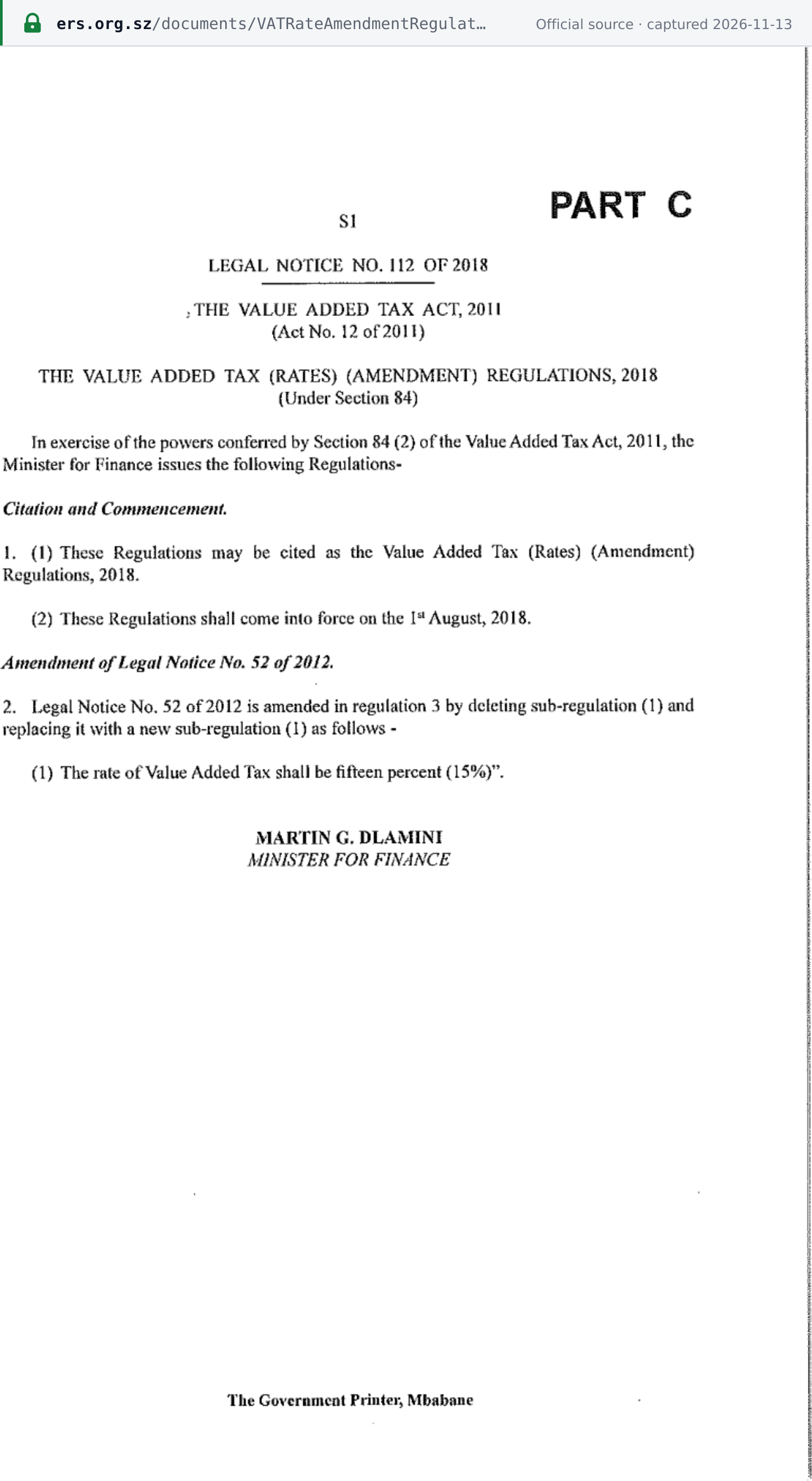
The VAT (Rates) (Amendment) Regulations, 2018 (Legal Notice No. 112 of 2018), published in the Swaziland Government Gazette Extraordinary of 9 July 2018, replaced the rate regulation in Legal Notice No. 52 of 2012 with: "(1) The rate of Value Added Tax shall be fifteen percent (15%)". The regulations state: "These Regulations shall come into force on the 1st August, 2018." [3] The Act itself provides that "the rate of tax shall be as specified in the VAT Regulations" (s.24(3)).
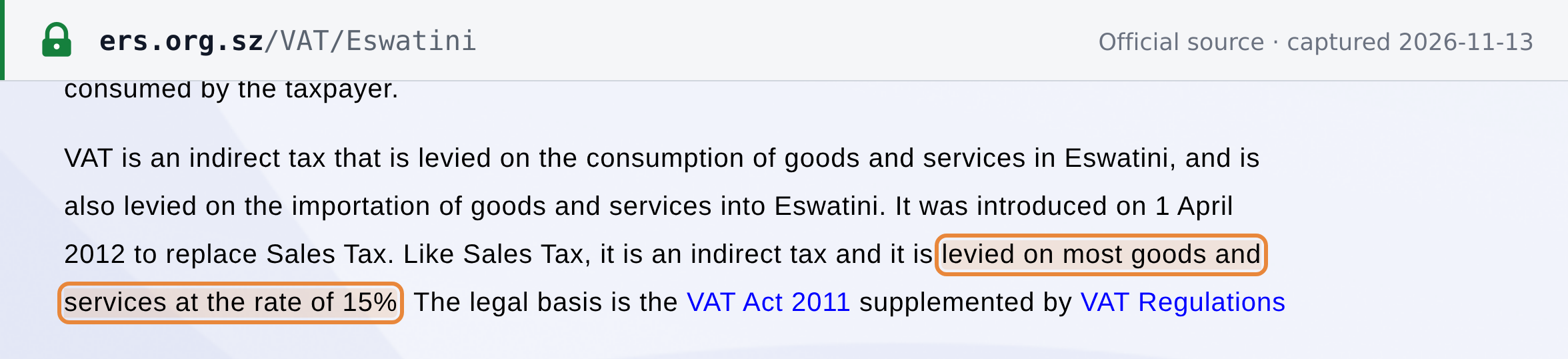
ERS's VAT page confirms the current rate: VAT "is levied on most goods and services at the rate of 15%". [9]
 Source snapshot captured 2026-11-13 — original
 Source snapshot captured 2026-11-13 — original
Zero rate: 0%
The Second Schedule of the Act lists zero-rated supplies. ERS's Zero Rated page sets out the schedule as replaced in 2022; [11] Legal Notice No. 130 of 2025 (Gazette Extraordinary No. 109, 17 December 2025) then amended it, and the ERS page does not yet show those amendments (as at 14 November 2026). [5] The lists below combine both.
- Agricultural inputs (Part A): animal feeds, animal remedies, fertiliser, pesticides, plants, seeds and seedlings.
- Basic foodstuffs (Part B): brown bread; maize, maize meal and samp; dried beans; rice; dairy products (milk, emasi, buttermilk, cream, baby milk formula, butter, margarine and whey); fresh vegetables and fruit; vegetable cooking oil other than olive oil; fresh eggs. LN 130 of 2025 removed condensed milk and added "fresh mealies (lifutfo) fit for human consumption, not further prepared or processed". Food supplied as meals or ready to eat is not zero-rated.
- Other goods and services (Part C):
- exports of goods and services, with documentary proof (see Cross-border rules);
- international transport of goods or passengers;
- petrol, diesel and liquid petroleum gas, and paraffin for cooking, lighting and heating;
- approved school exercise books and textbooks;
- medicines and drugs supplied for use in a qualified medical facility, to the Government Central Medical Stores, or to an individual on a prescription issued within 30 days before the supply. LN 130 of 2025 extended this to wadding, gauze, bandages, surgical gloves, dressings, syringes, sutures and similar medical accessories;
- added by LN 130 of 2025: "The supply of reusable nappies and reusable nappy inserts for use by babies and for medical purposes" and "The supply of sanitary pads, sanitary towels or tampons".
The zero rate on agricultural inputs applies only where a proper tax invoice is issued (Second Schedule, Part A).
Announced changes
ERS's news and notice board carry no announced change to the 15% rate (as at 14 November 2026). For dated changes, see the Eswatini tax-change chronology.
Cross-border rules
Imports of goods
Import VAT is charged at import and paid by the importer (s.3(b), s.4(b)). The taxable value is the customs value plus customs duty, excise and other fiscal charges other than VAT, plus certain incidental services not already in the customs value (s.23). [1]
- Goods from South Africa (SACU). VAT is due when goods bought in South Africa enter Eswatini. "The Sekulula VAT Easy system enables importers to settle the VAT liability for goods imported into Eswatini by using qualifying invoices where such goods were purchased from South African VAT registered vendors"; ERS recovers the South African VAT from SARS. The scheme runs only through the border posts ERS lists. "The goods must be brought into Eswatini no later than 90 days from the date of invoicing" and "The claim documents must be submitted no later than 75 days from the date of invoicing". [15]
- Traveller allowance. LN 130 of 2025 exempts goods brought in as a traveller's accompanied baggage and "purchased from a non-registered vendor in South Africa or outside South Africa" up to "ten thousand Emalangeni (E10,000) per traveller", and up to E1,000 for a hawker, and cuts how often it can be used from three times to once. ERS applied the E10,000 allowance from 28 November 2025 and states: "The allowance applies only once over a period of 30 days." [25] [5] ERS's General Import & Export Rules page still gives the earlier E1 000 per person (as at 14 November 2026). [16]
- Selling into South Africa. On the South African side, a 2026 amendment deletes the R500 and R100 import relief for goods from Botswana, Eswatini, Lesotho and Namibia, with commencement still pending; see South Africa: imports from Botswana, Eswatini, Lesotho and Namibia.
Exports
Goods "delivered to, or made available at, an address outside Eswatini" and services "supplied for use or consumption outside Eswatini" are zero-rated, "as evidenced by documentary proof acceptable to the Commissioner General". [11] The Regulations require, for every export, "(a) a copy of the bill of entry or export certified by the customs authorities; (b) a copy of the invoice issued to the foreign purchasers with tax shown at zero Rate", plus evidence that the goods left Eswatini. [2] Since 2022 a buyer that removes goods to an export country may claim a refund of the VAT (s.47bis). [4]
Imported services: the reverse charge
The recipient pays VAT on imported services (s.4(c)). For the services listed in s.16(2), which are taxed where they are used, the recipient must "within 30 days of the date an invoice is issued or payment is made, whichever time is the earliest, submit a declaration to the Commissioner-General ... and calculate the tax payable on the value of the imported services and pay the tax" (s.16(3)). [1]
- Businesses with full deduction are out. "The obligation under subsection 3 does not apply to taxable persons (importers) of the mentioned services who have the right to full deduction of input tax on the rendered services" (s.16(4)). [1] ERS puts it the same way: "The VAT reverse charge system does not apply to registered businesses with a full right to input tax deduction." [13] In practice the reverse charge falls on exempt and partly exempt businesses, unregistered businesses and individuals.
- Individuals. "Private individuals are subject to the Reverse charge mechanism if the value of their imported services excludes a monthly threshold of E5000, 00 (Five thousand Emalangeni)" (VAT Regulations); "excludes" here evidently means "exceeds". [2]
For the mechanism in general, see the reverse charge explainer.
Digital services and foreign sellers: B2B and B2C
"Electronically supplied services" are on the s.16(2) list: website supply and hosting, remote maintenance, software and updates, images, text, information and databases, music, films and games (including gambling), broadcasts and events, and distance teaching (s.16(2)(k)). [1]
- B2B. The Eswatini business customer self-assesses under s.16(3), unless it has a full right to deduct input tax. The foreign supplier has no Eswatini registration duty for these sales.
- B2C. The Act has no registration regime for non-resident suppliers selling to consumers. The private individual is within the reverse charge above E5,000 of imported services a month; ERS's pages do not describe how this is enforced.
- Foreign sellers of goods. Goods sold to Eswatini customers bear import VAT at the border, paid by the importer.
See VAT on digital services from non-resident suppliers for how other countries handle the B2C side.
Place of supply
- Goods: "a supply of goods takes place where the goods are delivered or made available by the supplier" (s.15(1)). [1]
- Services, general rule: "a supply of services takes place where the services are rendered" (s.16(1)).
- Services taxed where used (s.16(2)): intellectual property rights, advertising, consultancy, legal, accounting and data processing, banking and insurance, supply of staff, hire of movable goods other than means of transport, access to energy networks, telecommunications and broadcasting, and electronically supplied services. [1]
- Immovable property: where the property is located (s.16(5)).
- Transport: "where the transport commences" (s.16(6)). [1]
Marketplaces and platforms
The VAT Act 2011 and the VAT Regulations contain no deemed-supplier rule for marketplaces or platforms (as at 14 November 2026). See the marketplace deemed-supplier explainer for the model used elsewhere.
Invoice requirements
When a tax invoice is required
"A taxable person making a taxable supply to another taxable person shall provide that other person with an original tax invoice for the supply within 30 days after the date of the supply" (s.29(1)). The supplier keeps one copy (s.29(2)); a replacement for a lost original must be "clearly marked "COPY"" (s.29(3)); and "A tax invoice is an invoice containing the particulars specified in section 1 of the Third Schedule" (s.29(4)). [1] ERS's list of obligations is wider than s.29: registered businesses must "Issue tax invoices for all their supplies". [10]
The time of supply is generally the earliest of delivery or completion, payment, and the issue of the tax invoice (s.14(1)).
Mandatory content of a tax invoice
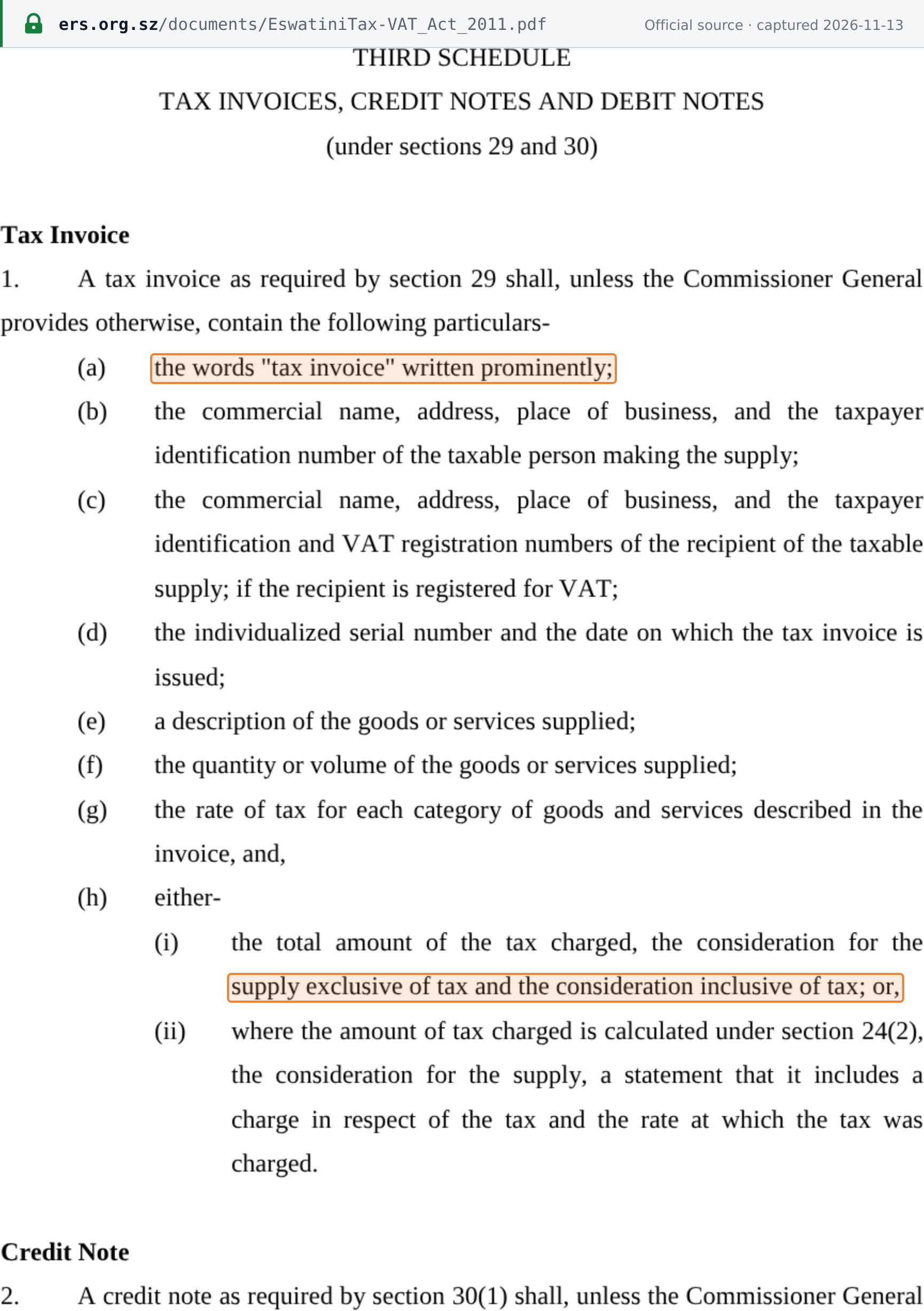
The Third Schedule, paragraph 1, lists the particulars, which apply "unless the Commissioner General provides otherwise": [1]
| # | Particular (Third Schedule, para. 1) |
|---|---|
| (a) | The words "tax invoice" written prominently |
| (b) | Supplier's commercial name, address, place of business and TIN |
| (c) | Recipient's commercial name, address, place of business, TIN and VAT registration number, if the recipient is registered for VAT |
| (d) | An individualised serial number and the date of issue |
| (e) | Description of the goods or services |
| (f) | Quantity or volume |
| (g) | Rate of tax for each category of goods or services on the invoice |
| (h) | Either the total tax charged, the consideration exclusive of tax and the consideration inclusive of tax; or, where tax is calculated on a tax-inclusive price under s.24(2), the consideration, a statement that it includes tax, and the rate |
Electronic tax invoices issued through an electronic fiscal device carry further particulars set by the Commissioner General, including the buyer's TIN on every tax invoice; see E-invoicing status.
 Source snapshot captured 2026-11-13 — original
A specimen of a compliant invoice
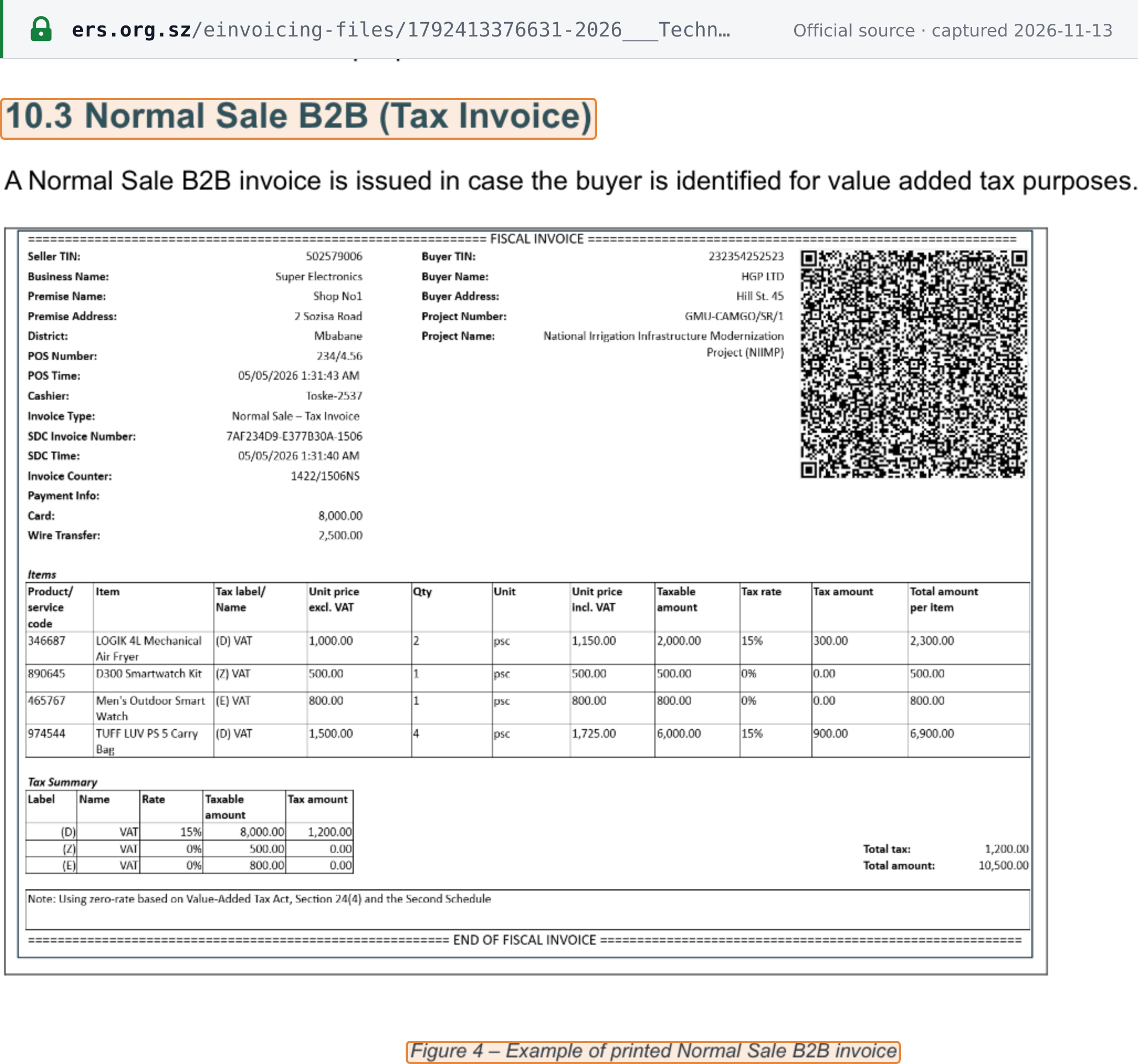
ERS publishes an official specimen. Its EIS Technical Guidelines for the Accreditation of EFD Solutions (version of 29 July 2026), section 10.3 "Normal Sale B2B (Tax Invoice)", shows "Figure 4 – Example of printed Normal Sale B2B invoice". "A Normal Sale B2B invoice is issued in case the buyer is identified for value added tax purposes." [8]
The specimen is a fiscal invoice issued through an electronic fiscal device, and it shows where each element sits:
- the "FISCAL INVOICE" title, seller TIN, business name, premises name and address, and district;
- point-of-sale number and time, cashier, and the invoice type "Normal Sale – Tax Invoice";
- the SDC invoice number and invoice counter assigned by the Sales Data Controller, with its time stamp;
- payment information;
- buyer TIN, buyer name and buyer address;
- an items table with code, description, tax label, unit price excluding and including VAT, quantity, unit, taxable amount, tax rate, tax amount and total;
- a tax summary by label: (D) VAT 15%, (Z) VAT 0% and (E) VAT 0%, with total tax and total amount;
- a note citing the legal basis for the zero rate, a QR code for verification, and "END OF FISCAL INVOICE".
The parties, TIN and amounts in the specimen are illustrative: its seller TIN (502579006) falls outside the range ERS accepts for real TINs. ERS adds that "The visual layout of sample invoices is illustrative. A POS may use a different visual design provided that all mandatory fiscal, security and verification elements required under the amended Third Schedule, the Commissioner General Notice and these Technical Guidelines are present and readable." [8] A business not yet designated to use an electronic fiscal device still issues a tax invoice with the Third Schedule particulars above, in any layout.
 Source snapshot captured 2026-11-13 — original
Simplified invoices for retailers
The VAT Regulations allow retailers an abridged ("simplified") tax invoice showing the supplier's commercial name, address and TIN; the date; a description and quantity of the goods; and the value of the supply and VAT charged. Above a limit, a full invoice is required: "if the value of the goods exceeds E3000,00 (Three Thousand Emalangeni), the retailer is obliged to issue an ordinary tax invoice with his name and details, and the buyers name and address". [2]
Under the e-invoicing framework, a fiscal receipt is the fiscal document where the buyer is not identified for VAT, and a tax invoice is the one where it is.
Numbering, currency and language
- Numbering. The Third Schedule requires an "individualized serial number"; neither the Act nor the Regulations sets a further sequencing rule. Under e-invoicing, the device adds a unique transaction identifier and an invoice counter.
- Currency. Amounts for VAT are in Emalangeni; foreign-currency amounts convert at the average daily selling rate of the previous month (s.80). The Act states no separate rule on the currency of the invoice itself.
- Language. Invoices and records are kept "in the English or SiSwati language" (s.51(1)). [1]
- Self-billing. The Act and the Regulations contain no self-billing provision (as at 14 November 2026).
Credit and debit notes
A credit note is required where the tax shown on a tax invoice exceeds the tax properly chargeable after an adjustment event (s.30(1)), and a debit note where the tax properly chargeable exceeds the tax shown (s.30). [1] Under the Third Schedule (paragraphs 2 and 3), a note shows the words "credit note" or "debit note"; the supplier's name, address and TIN; the recipient's name, address and TIN if registered; the date of issue; the original and corrected taxable value, the difference and the tax on it; "a brief explanation of the circumstances giving rise to the issuing of the credit note"; and "information sufficient to identify the taxable supply to which the credit note relates, including the invoice number to which the credit note relates". [1]
Retention and audit trail
- Period. "Records required to be maintained under subsection (1) shall be retained for at least five years after the end of the tax period to which they relate" (s.51(2)).
- Location. Records are kept in Eswatini (s.51(1)). [1]
- What to keep. Original and copy tax invoices, credit and debit notes, customs documents, and the accounts and records the Regulations list, including cash records and till rolls, computer records and stock records. Businesses with taxable turnover of E500,000 or more also keep orders, delivery notes, correspondence, annual accounts and bank statements (VAT Regulations).
- Audit access. ERS may enter business premises, copy records and seize computers (s.52).
- Under e-invoicing. A person using an electronic fiscal device must "protect the EFD and fiscal data from tampering, manipulation, unauthorised access or interference" and "maintain records and logs generated by the EFD". "Fiscal data and return-supporting records generated under this Notice shall be treated as records maintained for the purposes of the Act", and must be retained "for the period required under the Act" (Commissioner General's fiscal data notice, paras. 10 and 14). [7] Each fiscal invoice is digitally signed by the device's Secure Element. [8]
E-invoicing status
Status as at 14 November 2026: legal framework in force, phased rollout, no general compliance date.
- Legal Notice No. 111 of 2026 (Minister for Finance, gazetted July 2026) inserts paragraph 1bis into the Third Schedule: "For the purposes of sections 29, 30 and 32 of the Act, a tax invoice, credit note or debit note may be issued in electronic form through an electronic fiscal device or any other electronic system authorised by the Commissioner General." Such documents "shall be valid for the purposes of the Act". [6]
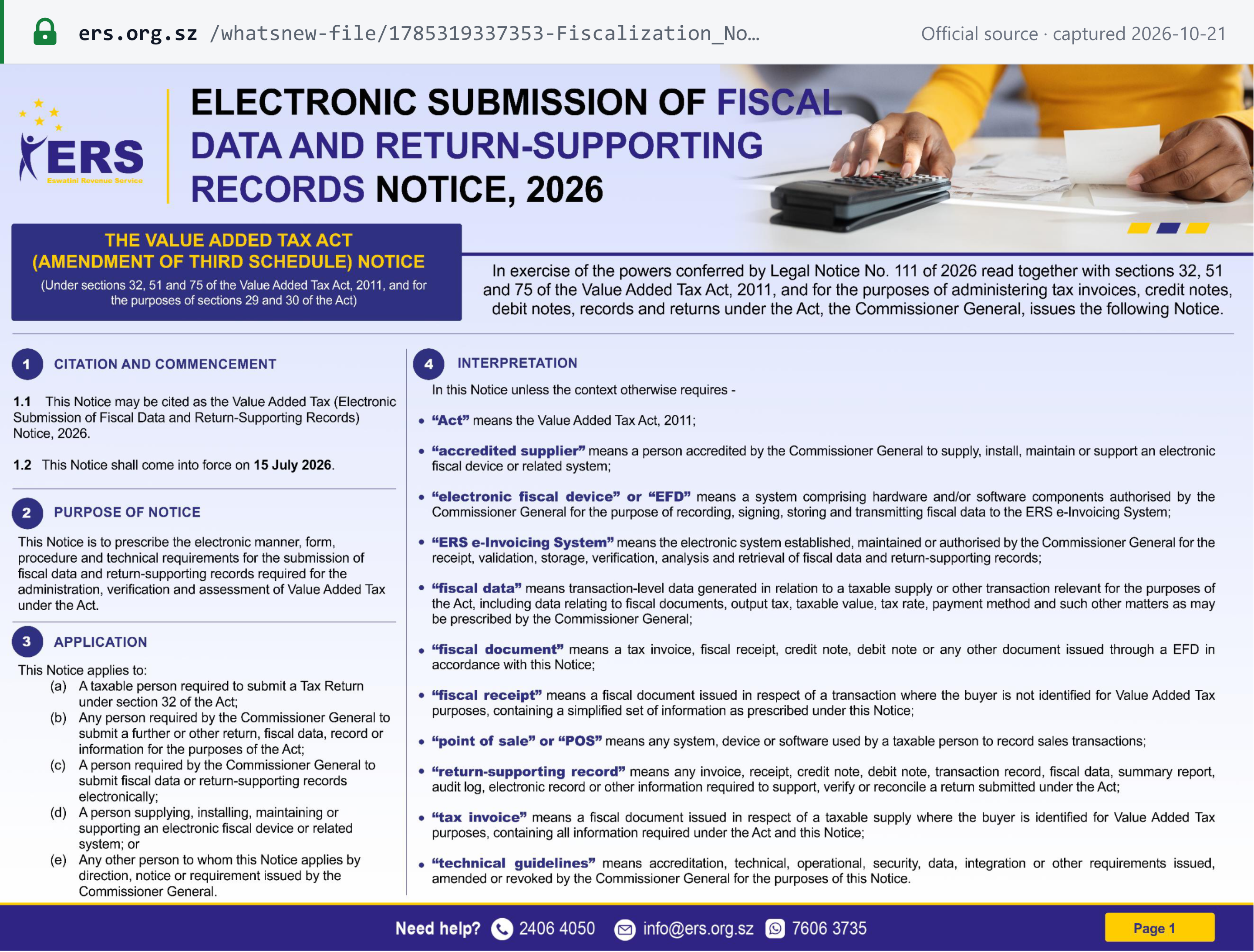
- The Commissioner General's VAT (Electronic Submission of Fiscal Data and Return-Supporting Records) Notice, 2026 "shall come into force on 15 July 2026". A person required to use an electronic fiscal device (EFD) records each transaction through a point of sale, processes it through the EFD and issues a fiscal document: a fiscal receipt, a tax invoice, or a credit or debit note. "Where the fiscal document is a tax invoice, the buyer's TIN shall be included." Fiscal data must reach the ERS e-Invoicing System in real time or "within fifteen days from the date on which the relevant fiscal document is created". [7]
- Phasing. "The Commissioner General may implement this Notice progressively by prescribing categories or classes of persons, sectors, business activities, transaction types or other criteria", and "may specify the date from which a person, category or class of persons shall comply". ERS has named the first sectors: "The wholesale and retail sectors have been identified as the first industries for implementation". [20] ERS's notice board, news and e-invoicing pages carry no notice setting a compliance date for any group (as at 14 November 2026), and ERS publishes no turnover thresholds for the phases.
- System. TaxCore, launched by ERS on 11 May 2026 with Data Tech International. [19] A point of sale connects to a Sales Data Controller: either an E-SDC at the taxpayer's premises, which works offline, or the V-SDC, "A free web-based service operated by ERS". [20] A Secure Element issued by ERS signs each invoice, and each carries a QR code for verification. [8]
- Format and network. Invoices are sent as JSON requests to the TaxCore SDC interface; the ERS technical guidelines specify no Peppol or UBL format. [8]
- Scope. B2B (tax invoice with the buyer's TIN) and B2C (fiscal receipt) are both covered. B2G is not addressed separately.
- Accredited vendors. ERS's register of approved vendors lists Avalith I.T. (approved 1 October 2026) and MetricMaster LLC (approved 14 October 2026); ERS announced MetricMaster's accreditation on 6 November 2026. [26] [23] ERS also says businesses may deduct qualifying costs of acquiring or upgrading fiscal devices for income tax. [20]
 Source snapshot captured 2026-10-21 — original
For the dated records, see Legal Notice No. 111 of 2026 and the TaxCore launch. For how fiscal devices and clearance models work, see fiscal devices and certified cash registers and CTC e-invoicing models. The ERS hub is at ers.org.sz/e-invoicing. [21]
Filing and payment
Filing frequency
The Act's default tax period is one month (s.31(1)). The VAT Regulations let the Commissioner General designate two categories: [2]
| Category | Who | Tax period |
|---|---|---|
| A | Turnover that "shall not be less than E20 Million (Twenty Million) per annum" | Monthly |
| B | Registered persons that do not qualify for Category A | Three months |
Due date: the 27th per ERS
ERS's guidance puts the return and the payment on the same date, the 27th of the month after the tax period:
"Monthly filers: VAT Schedules and payments must be submitted by the 27th of every month. Quarterly filers: VAT Schedules and payments must be submitted by the 27th of the month following the quarter." [18]
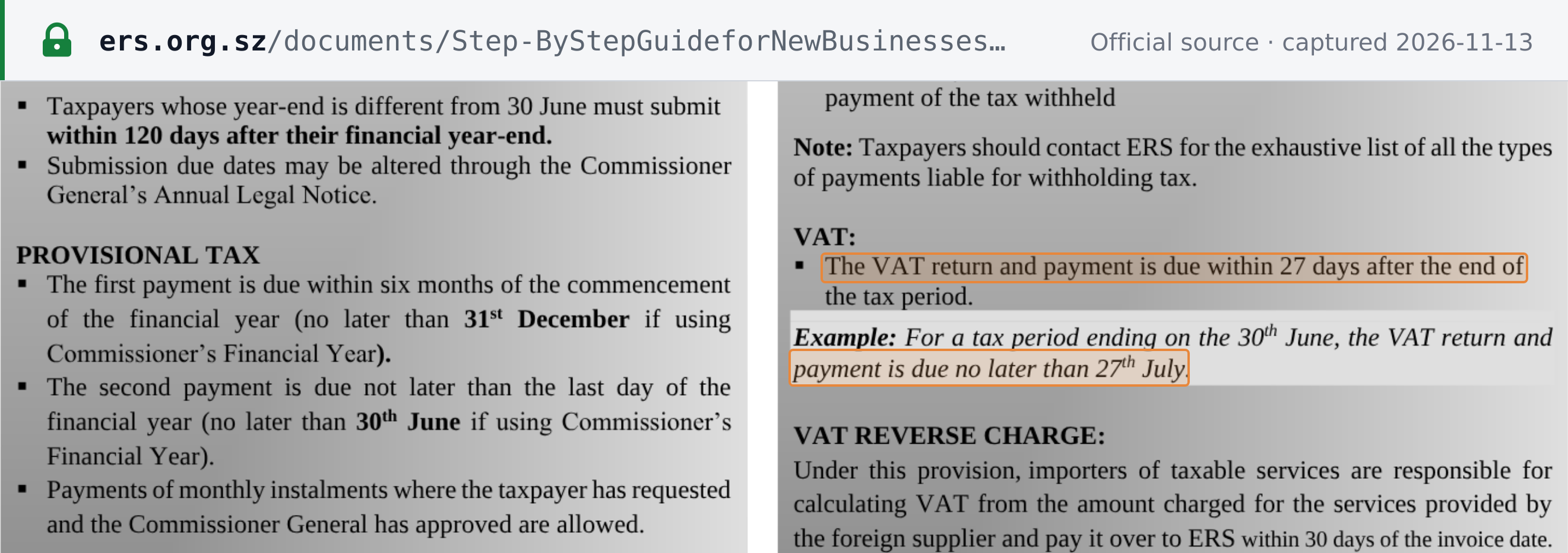
ERS's New Business guide gives a worked example: "The VAT return and payment is due within 27 days after the end of the tax period. Example: For a tax period ending on the 30th June, the VAT return and payment is due no later than 27th July." [17]
The statute ERS publishes reads differently. Its copy of the VAT Act 2011 is the original, unconsolidated text, and s.32(1) says: "A taxable person shall submit a tax return with the Commissioner-General for each tax period within 20 days after the end of the tax period." [1] ERS's guidance does not name the amendment behind the 27th, and the VAT (Amendment) Act, 2022 does not change s.32. In practice, plan to ERS's published 27th; a business that wants no exposure to the statutory text can file by the 20th.
 Source snapshot captured 2026-11-13 — original
Where and how to file and pay
- TaxEase. Returns and VAT Schedules are submitted on TaxEase, ERS's online filing portal (login required).
- VAT Schedules. Since 1 February 2025 ERS has strictly enforced the line-by-line VAT Schedules, which list, for each transaction, the "Customer/supplier name and Taxpayer Identification Number (TIN)", the "Invoice numbers and dates" and the "Transaction amounts". [18]
- Payment. Tax is payable by the return due date (s.39(1)(a)). "Payments must be made at least 48 hours before such payment is due." The payment reference is the TIN, tax code, year and month: "A payment for a taxpayer whose TIN is 100123456 paying VAT in respect of December 2021 would be referenced as follows: 100123456VT2021DEC". [17]
Input-tax recovery
Input tax on purchases and imports for the business is credited against output tax (s.28(1)), including a notional credit on second-hand goods. Tax on goods bought up to 4 months before registration, and capital goods up to 6 months before, can be claimed (s.28(3)). Where only some supplies are taxable, credit is apportioned; below 5% taxable there is no credit, and above 95% the credit is full (s.28(7)–(9)). [1]
Blocked items:
- passenger automobiles, with their spare parts, repairs and maintenance, unless the business deals in or hires them (s.28(5)(a));
- entertainment, unless the business provides entertainment (s.28(5)(b)) [1];
- mobile telephone services beyond 50%: "only 50% credit of the tax on mobile telephone services are allowed" (VAT Regulations);
- under the Regulations, staff refreshments and meals, canteens, Christmas parties, client hospitality, gifts, employee subsistence while travelling, and certain vehicles under 3,500 kg presented as commercial vehicles; [2]
- VAT wrongly charged by a supplier that was not obliged to charge it: "Input tax claim shall not be paid to a taxable person who has been incorrectly charged tax by reason of failure of that taxable person to satisfy himself that the supplier is under obligation to charge tax" (s.47(13), inserted 2022). [4]
Refunds
- Excess credit. ERS "shall refund the excess within two months of the due date for the return" (s.47(1)), or sets it off with the taxpayer's consent; refunds are first applied against other tax debts (s.47(10)). [1]
- Late refunds. Where ERS fails to refund within two months, it pays interest "at a rate of two percent per month" (s.49(2)).
- Overpayments. Claims must be made within five years (s.47(4)).
- Bad debts. Relief is available under s.48.
- Non-residents. ERS's VAT pages describe no refund scheme for foreign businesses. Its refund portal handles the SARS cross-border refunds under Sekulula and diplomatic refunds.
Exemptions
Exempt supplies
The First Schedule lists exempt supplies. ERS's Exempt Supplies page sets out the schedule as replaced in 2022; [12] Legal Notice No. 130 of 2025 then amended it, as noted below. [5]
Services (Part A):
- financial services and insurance services;
- land and buildings, except land and buildings used for commercial and industrial purposes;
- leasing of immovable property, except commercial premises, hotel and holiday accommodation, residential lets of 45 days or less, and parking;
- education services;
- medical, dental and nursing services;
- social welfare services;
- betting, lotteries and casinos;
- burial and cremation;
- passenger transport, "other than services provided by registered tour operators";
- sewage services, amateur sport, non-profit cultural activities and charity arrangements.
LN 130 of 2025 deleted one item of Part A (clause 1(k)); the ERS page does not number its list, so check the current text with ERS before relying on a Part A exemption.
Goods (Part B):
- books and press imported by post up to E100 per parcel;
- precious metals supplied to the Central Bank;
- unsolicited donated goods, trans-shipment goods, stamps, banknotes and traveller's cheques;
- goods for fairs and exhibitions up to E400;
- "Goods supplied as part of the transfer of business as a going concern on condition the goods are supplied by one taxable person to another taxable person";
- certain medical devices;
- "The supply of electricity for domestic consumption only";
- water: LN 130 of 2025 replaced the tap-water item with "the supply of tap water and waste water services for domestic consumption";
- added by LN 130 of 2025: investment-grade gold (purity at least 99.5%) and silver (at least 99.9%) in bar, ingot or bullion form, supplied to a financial institution licensed under the Financial Institutions Act, 2005 with Central Bank of Eswatini approval.
Exempt is not zero-rated
- Exempt supplies carry no VAT and give no right to deduct input tax on the costs of making them. A business making only exempt supplies is not required to register. A business making both apportions its input tax (s.28(7)–(9)). [1]
- Zero-rated supplies are taxable at 0%, so the supplier recovers input tax in full.
- Charging VAT on an exempt supply is an offence since the 2022 amendment (s.64(5)); see Offences.
See zero-rated vs exempt for the general difference.
Special regimes
- Cash accounting. "This section applies to a taxable person, the annual value of whose taxable supplies does not exceed E 3 million" (s.26(1)): such a person may elect in writing to account for VAT on payments made and received. [1]
- Second-hand goods. A notional input credit (s.28(1)).
- Construction. The Regulations fix the time of supply for construction services by reference to certified claims.
- Donor-funded projects. The Regulations provide a regime for donor-funded aid projects.
- Not found. ERS's VAT pages, the Act and the Regulations contain no free-zone VAT rule, flat-rate VAT scheme or margin scheme (as at 14 November 2026). Small businesses are directed to ERS's Presumptive Tax, an income-tax regime, not a VAT scheme.
Offences and penalties
Offences
Offences are criminal: a court imposes a fine, imprisonment or both. [1]
| Conduct | Fine and/or imprisonment |
|---|---|
| Failure to apply for registration, notify changes or deregister, deliberate or reckless (s.55) | E6,000 to E15,000 and/or up to 6 years |
| The same, in any other case (s.55) | E2,000 to E6,000 and/or up to 3 years |
| Failure to provide a tax invoice, credit note or debit note (s.56(1)) | E2,000 to E10,000 and/or up to 3 years |
| Issuing a non-compliant invoice or note, deliberate or reckless (s.56(2)) | E6,000 to E15,000 and/or up to 6 years |
| The same, in any other case (s.56(2)) | E2,000 to E10,000 and/or up to 3 years |
| Failure to submit a return (s.57) | Up to E10,000 and/or up to 3 years; a continuing failure after conviction carries E1,000 a day and 3 months' imprisonment without the option of a fine (s.57(2)) |
| Failure to pay tax (s.58) | E2,000 to E6,000 and/or up to 3 years |
| Charging tax on exempt supplies, or charging tax while not registered (s.64(5), inserted 2022) | E10,000 to E40,000 and/or up to 10 years |
The invoice offence in s.56(1) reads: "A taxable person who fails to provide a tax invoice as required by subsection (1) or (4) of section 29, or a credit or debit note as required by section 30 commits an offence and is liable on conviction to a fine not less than E 2,000 but not exceeding E 10,000 or to imprisonment for a term not exceeding 3 years, or to both." [1] The Act also makes offences of record-keeping failures (s.60), improper use of a TIN (s.63), refund and input-credit fraud and false documents (s.64), and obstruction of ERS officers (s.65). [4]
ERS's March 2026 VAT Compliance Review notice to the wholesale and retail sectors lists the sanctions it applies: "Cancellation of your VAT registration under section 8. Imposition of double tax penalty under section 72. Prosecution under section 64." [22]
Penalties
Administrative penalties take the form of additional tax under s.72. [1] The VAT (Amendment) Act, 2022 inserted a new s.72(4) and renumbered the later subsections, and added subsections (9) and (10); the numbering below follows the amended Act. [4]
| Failure | Additional tax |
|---|---|
| Late registration (s.72(1)) | Double the tax payable from the end of the application period until application or registration |
| Late return (s.72(2)) | 2% per month or part of the tax payable, while the return is outstanding |
| Late payment (s.72(3)) | 2% per month or part of the unpaid tax, while it is outstanding |
| Late nil return (s.72(4), inserted 2022) | E250 per month after the due date until ERS receives the return |
| Failure to keep records (s.72(6), as renumbered in 2022) | Double the tax for the period |
| False or misleading statements (s.72(7), as renumbered in 2022) | Double the tax understated |
| False statements or documents to obtain a refund or input-tax credit (s.72(9), inserted 2022) | Double the amount claimed |
| Charging VAT while not registered (s.72(10), inserted 2022) | Double the tax charged |
| No resident nominated person (s.77(6), inserted 2022) | E250 per month |
The late-return and late-payment charges are separate subsections of the Act, s.72(2) and s.72(3), so a return that is both late and unpaid attracts both. The 2022 amendment's nil-return rule reads: "where there is no tax payable a person who fails to submit a return on the date as required under this Act shall be liable to penalty of two hundred and fifty Emalangeni (E250) per month after the due date and such liability ceases at the time the Commissioner General receives the return". [4] The Act sets no administrative penalty specific to invoicing failures; those are the criminal offences in s.56.
Frequently asked questions
Is the Eswatini VAT registration threshold E500,000 or E900,000?
The Eswatini Revenue Service's Registration page states E900,000: “VAT registration is compulsory for businesses whose annual taxable turnover exceeds E900 000”. Older guides, including ERS's own Step-By-Step Guide for New Businesses of January 2023, still show E500,000. The VAT Act 2011 leaves the figure to a notice by the Minister in the Gazette (section 6(2)), and that notice is not among the instruments ERS publishes. The statutory test runs quarter by quarter: a person must apply within 20 days after any three-month period in which its taxable supplies exceeded one quarter of the annual threshold (section 6(1)).
Is VAT in Eswatini 14% or 15%?
15%. The VAT (Rates) (Amendment) Regulations, 2018 (Legal Notice No. 112 of 2018) set the rate at fifteen percent from 1 August 2018, and the ERS VAT page says VAT “is levied on most goods and services at the rate of 15%”. Guides and price lists that still quote 14% are out of date.
Is the Eswatini VAT return due on the 20th or the 27th?
ERS tells taxpayers the 27th. Its release of 25 February 2025 says monthly filers must submit VAT Schedules and payments “by the 27th of every month” and quarterly filers “by the 27th of the month following the quarter”, and its New Business guide says the return and payment are due “within 27 days after the end of the tax period”. The VAT Act 2011 text that ERS publishes is the original, unconsolidated version, and its section 32(1) reads “within 20 days after the end of the tax period”. ERS's guidance does not name the amendment behind the 27th. ERS also asks for payments to be made at least 48 hours before they are due.
Can we offset South African VAT on goods we bring into Eswatini?
Yes, through Sekulula VAT Easy. ERS lets importers settle the Eswatini import VAT using qualifying invoices from South African VAT-registered vendors, and ERS claims the South African VAT back from SARS. The scheme works only through the border posts ERS lists for it. The goods must enter Eswatini no later than 90 days from the invoice date, and the claim documents must be submitted no later than 75 days from the invoice date.
Do we need an electronic fiscal device for TaxCore now?
Not as a general rule yet. Legal Notice No. 111 of 2026 allows tax invoices, credit notes, debit notes and fiscal receipts to be issued electronically, and the Commissioner General's fiscal data notice, in force since 15 July 2026, applies to the persons, sectors or categories the Commissioner General designates and from the dates the Commissioner General sets. ERS has named wholesale and retail as the first sectors. As at 14 November 2026, ERS's notice board, news and e-invoicing pages carry no notice setting a compliance date for any group.
Does a foreign software or digital-services seller have to register for VAT in Eswatini?
Not under the VAT Act 2011 as it stands. Electronically supplied services are taxed where the customer uses them (section 16(2)(k)), and the Eswatini customer accounts for the VAT. A business customer declares and pays within 30 days of the invoice or payment, whichever is earlier, unless it has a full right to deduct input tax (section 16(3) and (4)). A private individual falls within the reverse charge once imported services exceed E5,000 a month (VAT Regulations). The Act contains no registration regime for non-resident suppliers.
Important websites
| Site | What it is for |
|---|---|
| Eswatini Revenue Service (ERS) | Tax authority: guidance, notices and news |
| ERS — Registration | Who must register, requirements and the TIN registration form (submitted at an ERS office) |
| TaxEase (login) | Filing VAT returns and VAT Schedules |
| ERS — VAT Registration Check | Checking whether a supplier's TIN is VAT-registered |
| ERS — Tax legislation | The VAT Act, amendment acts and legal notices |
| ERS — e-Invoicing | TaxCore: legislation, technical guidelines, accredited vendors and approved devices |
| ERS — Instant Tax Compliance Certificate (login) | Tax compliance certificates |
| ERS — VAT refunds (login) | Sekulula (SARS) and diplomatic VAT refunds |
ERS Contact Centre: +268 2406 4050, info@ers.org.sz. To check the format of a TIN, use the Eswatini TIN validator.
Recent changes
- 2026-11-06 — ERS announces the accreditation of MetricMaster as an e-invoicing solutions provider (approved 14 October 2026), after Avalith IT (approved 1 October 2026). (ERS; ERS approved vendors)
- 2026-08-26 — ERS names wholesale and retail as the first sectors for e-invoicing, with a phased rollout and a free virtual Sales Data Controller (V-SDC). (ERS)
- 2026-07-15 — The Commissioner General's VAT (Electronic Submission of Fiscal Data and Return-Supporting Records) Notice, 2026 comes into force, with Legal Notice No. 111 of 2026 allowing electronic tax invoices, credit and debit notes and fiscal receipts: designated persons issue fiscal documents through an electronic fiscal device, with the buyer's TIN on tax invoices. (ERS) — see event
- 2026-05-11 — ERS launches TaxCore, its electronic invoicing system, with Data Tech International. (ERS) — see event
- 2025-12-17 — Legal Notice No. 130 of 2025 amends the First and Second Schedules: sanitary products, reusable nappies and fresh mealies zero-rated; condensed milk removed from zero-rating; zero-rated medical consumables widened; investment gold and silver exempted; traveller allowance raised to E10,000 (E1,000 for hawkers), once in any 30-day period, which ERS applied from 28 November 2025 (ERS notice). (ERS)
- 2025-02-01 — ERS strictly enforces line-by-line VAT Schedules on TaxEase, listing counterparties' TINs and invoice numbers. (ERS)
For the full chronology, see Eswatini tax changes on Lookuptax.
Reference links
Legislation (published by ERS):
- [1] Value Added Tax Act, 2011 (Act No. 12 of 2011)
- [2] Value Added Tax Regulations, 2012
- [3] VAT (Rates) (Amendment) Regulations, 2018 — Legal Notice No. 112 of 2018
- [4] Value Added Tax (Amendment) Act, 2022 (Act No. 10 of 2022)
- [5] VAT Act (Amendment of Schedules) Notice, 2025 — Legal Notice No. 130 of 2025
- [6] VAT Act (Amendment of Third Schedule) Notice, 2026 — Legal Notice No. 111 of 2026
- [7] Commissioner General's VAT (Electronic Submission of Fiscal Data and Return-Supporting Records) Notice, 2026
- [8] ERS — EIS Technical Guidelines for the Accreditation of EFD Solutions (29 July 2026)
Tax authority (ERS):
- [9] ERS — Eswatini VAT
- [10] ERS — Registration
- [11] ERS — Zero Rated supplies
- [12] ERS — Exempt Supplies
- [13] ERS — Reverse Charge
- [14] ERS — VAT Registration Check
- [15] ERS — Sekulula VAT Easy
- [16] ERS — General Import & Export Rules
- [17] ERS — Step-By-Step Guide for New Businesses
- [18] ERS — VAT Schedules compliance release, 25 February 2025
- [19] ERS — TaxCore launch release, 13 May 2026
- [20] ERS — e-Invoicing rollout release, 26 August 2026
- [21] ERS — e-Invoicing
- [22] ERS — Public Notice: VAT Compliance Review, March 2026
- [23] ERS — e-invoicing vendor accreditation (press page, 6 November 2026)
- [24] ERS — Tax legislation
- [25] ERS — Public Notice: Sekulula VAT Easy changes and traveller allowance (November 2025)
- [26] ERS — e-Invoicing approved vendors
Related on Lookuptax: