Ethiopia VAT guidelines
| FACTSHEET | |
|---|---|
| Country code | ET |
| Tax name | Value Added Tax (VAT) — ተጨማሪ እሴት ታክስ |
| Tax Authority | Ministry of Revenues (MoR) |
Overview
Ethiopia levies Value Added Tax (VAT) — in Amharic ተጨማሪ እሴት ታክስ (temari eset tax) — under the Value Added Tax Proclamation No. 1341/2024, published in the Federal Negarit Gazette, 30th Year No. 61, on 21 August 2024. It repeals the Value Added Tax Proclamation No. 285/2002 (Art. 73(3)). [1] The Proclamation "shall enter into force up on the date of its approval by the House of Peoples’ Representatives" (Art. 75); it prints no calendar date. [1]
The detailed rules sit in the Council of Ministers Value Added Tax Regulation No. 570/2025, which MoR's Electronic Invoicing Directive No. 1142/2026 cites (as "No. 570/2024" in Art. 4(1)(a)). MoR's legislation pages do not publish Regulation 570/2025 and still list the old VAT Regulations No. 79/2002 as in force.
Two calendars. Ethiopian instruments carry an Ethiopian-calendar year and a Gregorian one: Proclamation 1341/2016 E.C. is 1341/2024 G.C., and Directive 1142/2018 E.C. is 1142/2026 G.C. This page uses the Gregorian year.
Authority. VAT is administered by the Ministry of Revenues (MoR), the "Tax Authority" of the Proclamation; Tax Administration (Amendment) Proclamation No. 1434/2026 names the "Ministry of Revenue" as the Authority. [5] The Ministry of Finance issues directives under the VAT Proclamation, including the registration directive (see below). The Customs Commission collects VAT on imports (Art. 60(1)(a)). [1] Administration, assessment and penalties follow the Federal Tax Administration Proclamation No. 983/2016, as amended by Proclamation 1434/2026.
Currency. The Ethiopian Birr (ETB; the statutes write "Birr"). "An amount taken into account under this Proclamation shall be expressed in Birr"; foreign-currency amounts translate at the National Bank of Ethiopia exchange rate on the date the amount is taken into account (customs rate for imports) (Art. 71). [1]
Tax period. One month. "“Accounting Period” means each calendar month. The months of August and Pagumen shall be aggregated and treated as One calendar month" (Art. 2(1)). The months are those of the Ethiopian calendar: Nehase (rendered "August") and the five- or six-day thirteenth month, Pagume, form one period. [1]
Layering. None. VAT is federal, at one national rate. Regional tax authorities keep the powers MoR delegated to them under the repealed law "until a procedure and a system of delegation is developed in accordance with this Proclamation" (Art. 74(5)); there is no regional VAT rate. Excise tax is a separate federal tax. Turnover tax no longer exists: Income Tax (Amendment) Proclamation No. 1395/2025 (Federal Negarit Gazette, 31st Year No. 64, 1 September 2025) adds the Turnover Tax Proclamation No. 308/2002 and its amendments to its list of repealed laws. [6]
Registration
Who should register
Two instruments set the rule, and the second is wider than the first.
1. The statutory test (Proclamation 1341/2024 Art. 12). A person is liable to register "a) at the beginning of any period of 12 calendar months, if there are reasonable grounds to believe that the total value of taxable supplies to be made by the person in that period will exceed the registration threshold … or b) at the end of any period of 12 calendar months or a lesser period, if, during the period, the total value of taxable supplies made by the person exceeds the registration threshold" (Art. 12(1)). The application is due "within 7 days of becoming liable to be registered" (Art. 12(6)). [1]
2. Directive No. 1104/2025. Article 12(2) lets the Ministry of Finance change the threshold by directive. Its Registration for Value Added Tax Directive No. 1104/2025 (signed 2 September 2025 by the Minister of Finance) provides: "According to Article 12 of the Value Added Tax Proclamation No. 1341/2024, the following are required to register for Value Added Tax: 1) As provided under the Income Tax Proclamation No. 979/2016 (as amended): a) Category “A” Taxpayers; b) Taxpayers who have the obligation to maintain books of account; and c) Taxpayers which voluntarily maintain books of account. 2) Taxpayers whose aggregate turnover from taxable and exempt transactions exceeds Birr 2,000,000 (two million Birr)". Existing taxpayers caught by it "have to register within 30 (thirty) days from the effective date of this Directive", and charge VAT from the date of registration (Art. 3). [2]
Every company is caught. Income Tax (Amendment) Proclamation No. 1395/2025 defines Category "A" taxpayers as "1/ A body; or 2/ Any other person whose annual turnover Birr 2,000,000 (two million birr) or exceeds", and Category "B" as taxpayers "excluding bodies" with turnover below Birr 2,000,000. [6] A company is a body, so under Directive 1104/2025 it must register for VAT whatever its turnover. In practice the ETB 2,000,000 figure is the test for individuals who neither are Category "A" nor keep books.
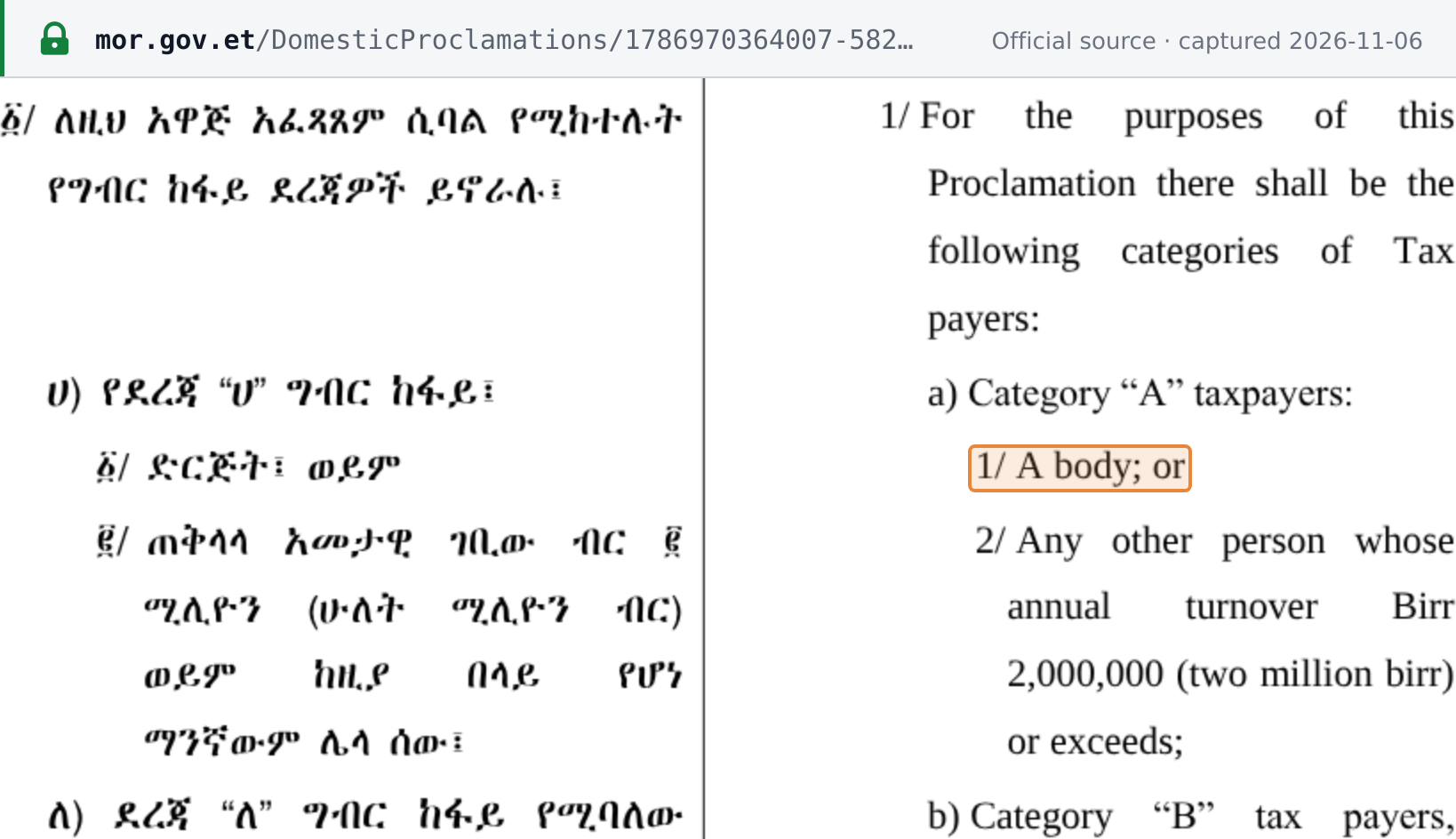 Source snapshot captured 2026-11-06 — original
The Directive's preamble states its purpose as registering "any person providing professional services whose annual turnover is less than 2 million birr and who is not classified as a Category “B” taxpayer"; the operative Article 2 does not list professionals separately.
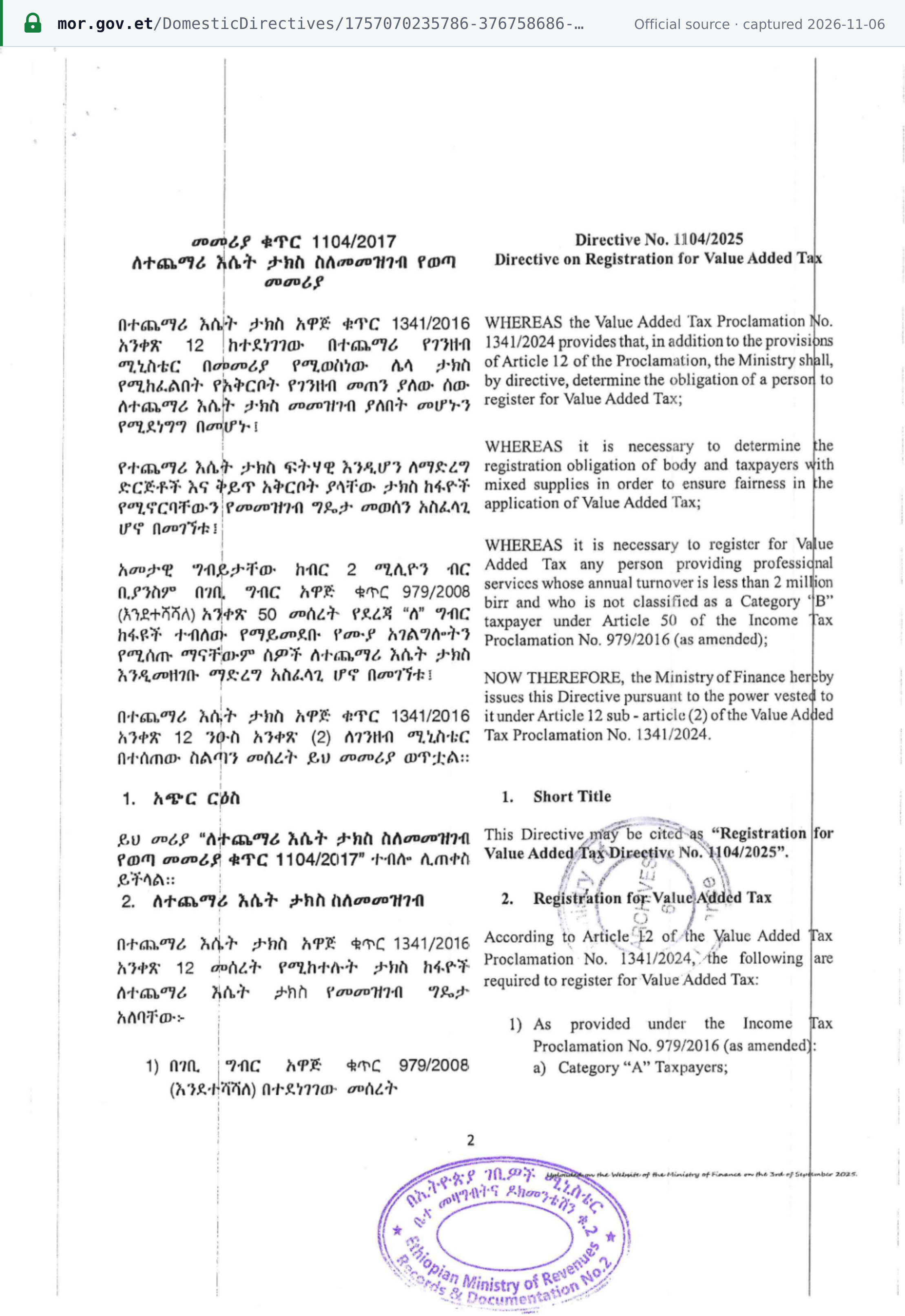 Source snapshot captured 2026-11-06 — original
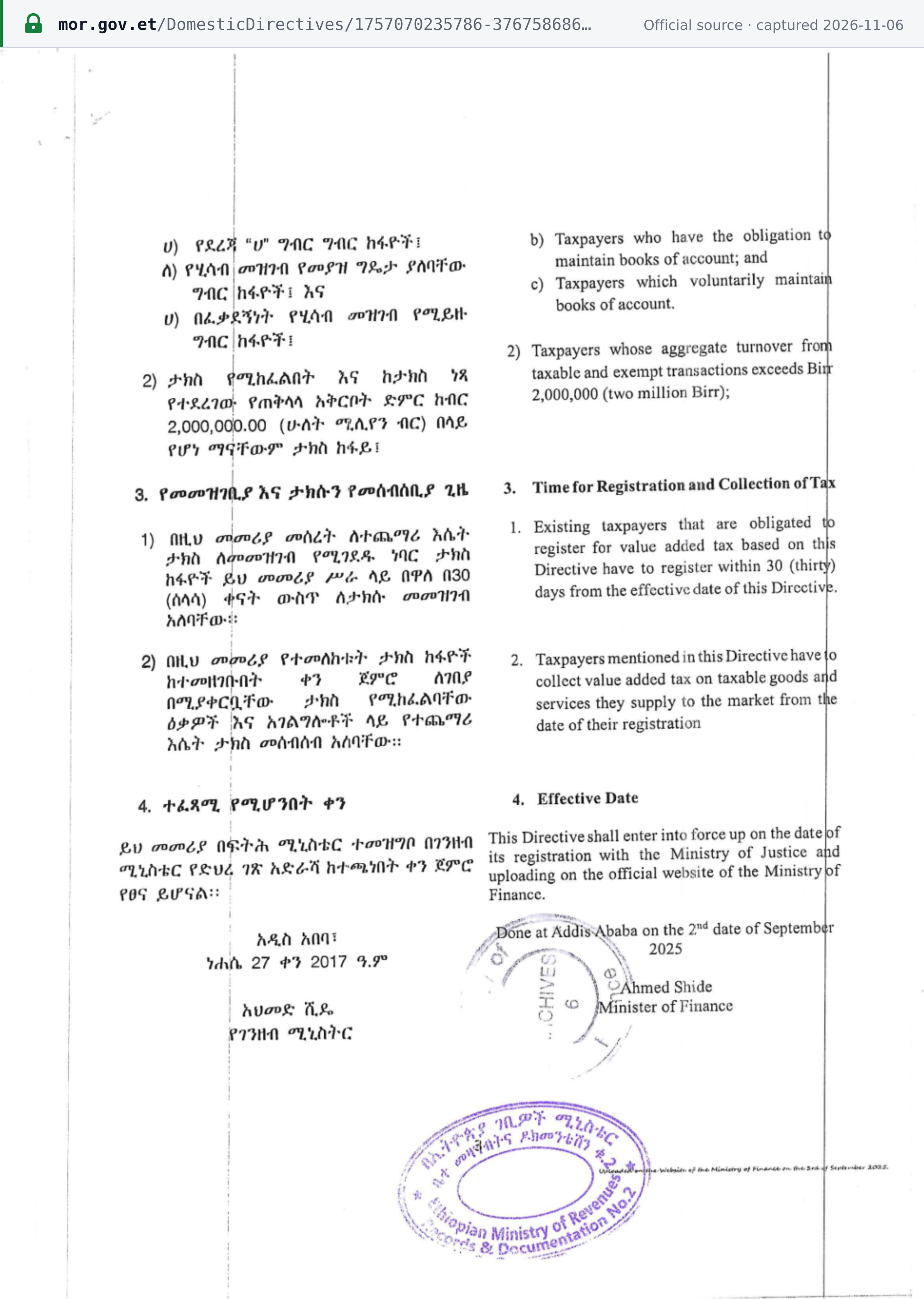 Source snapshot captured 2026-11-06 — original
Registration threshold
ETB 2,000,000 of taxable supplies in a 12-month period (as at 2026-11-06). "2/ The registration threshold is 2,000,000 Birr or such other amount as specified in the Directive to be issued by the Ministry." (Art. 12(2)). [1]
- Measurement. Any period of 12 calendar months, looking forward (expected supplies) or back (actual supplies, including a period shorter than 12 months). Sales of capital goods and supplies made on selling or closing down the business are ignored (Art. 12(4)).
- What counts under Directive 1104/2025. The Directive's own turnover limb measures "aggregate turnover from taxable and exempt transactions", which is wider than the Proclamation's taxable-supplies test.
- Who it actually tests. Companies and other bodies, and anyone who keeps books, register regardless (see above).
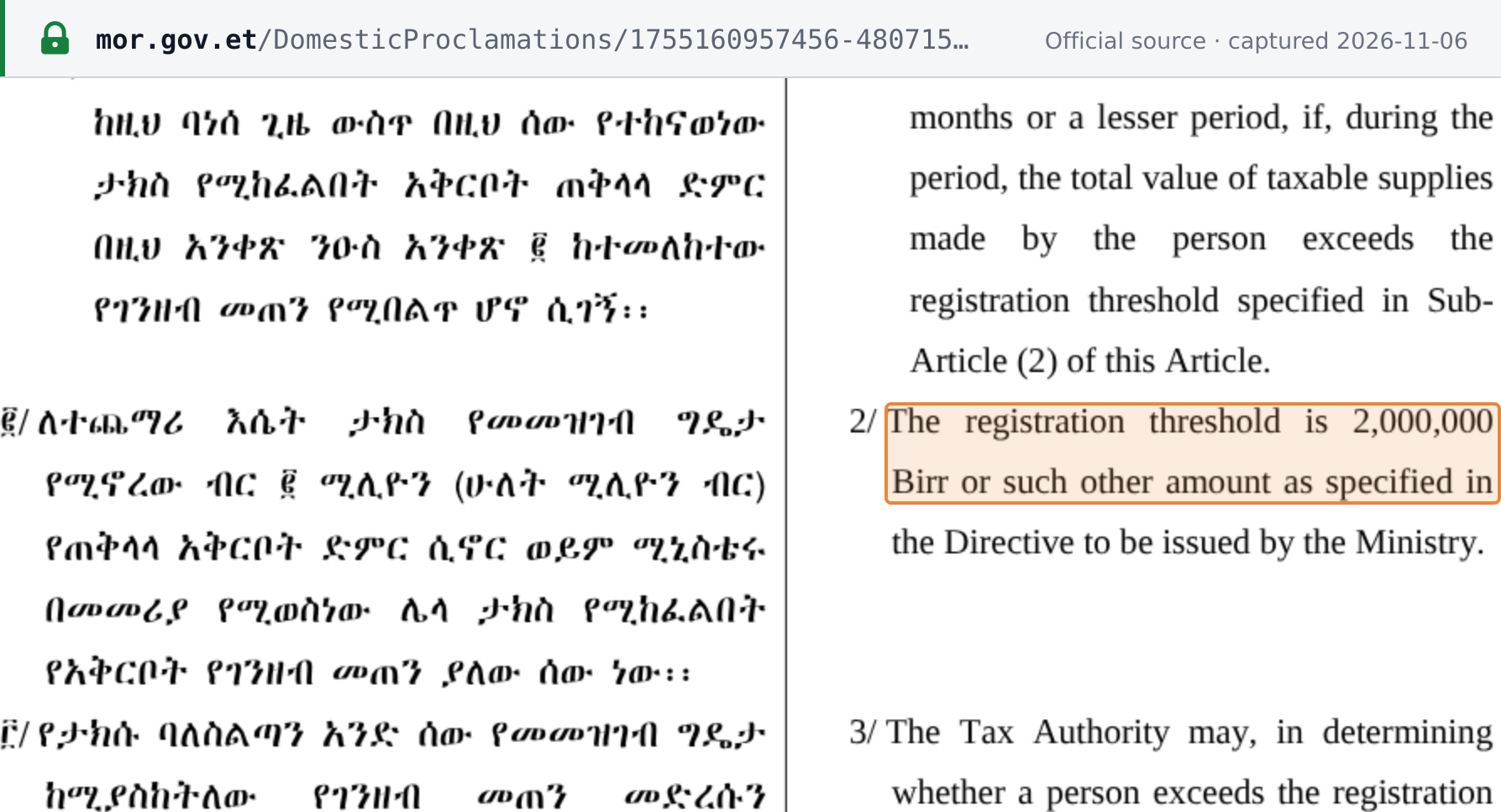 Source snapshot captured 2026-11-06 — original
Non-resident registration
Foreign suppliers of remote services, electronically ordered goods and platform operators are liable to register under the general test in Proclamation Art. 12, whose threshold is ETB 2,000,000.
There is no general fiscal-representative requirement. The Tax Authority may require a non-compliant foreign supplier to lodge security and, failing that, appoint a VAT representative who is personally liable (Proclamation 1341/2024 Art. 64). [1]
Tax identification number
MoR issues one Taxpayer Identification Number (TIN) per taxpayer for all taxes: "1/ The Authority shall issue a TIN to a taxpayer registered for the purposes of the tax laws under Article 9 of this Proclamation. 2/ A TIN shall be issued for the purposes of all tax laws and a tax payer shall have only one TIN at any time." (Tax Administration Proclamation 983/2016 Art. 13). A licensing authority may not issue a business licence "unless the taxpayer has supplied their TIN" (Art. 14(4)). [4]
MoR publishes no format, length or check-digit rule for the TIN or the VAT registration number in the Proclamations, directives or FAQ it hosts. Showing no TIN on a tax invoice, credit note, debit note or declaration costs ETB 3,000 per failure (TAP 983/2016 Art. 103(1), pre-2026 numbering).
To check the format of a number, use the Ethiopia TIN validator.
How to register
- Get a TIN. MoR's FAQ (in Amharic) tells applicants to go to their local revenue branch office with the lease agreement if the premises are rented, complete the Authority's form, and provide identity evidence: a current residence ID, passport or driving licence. [8]
- Apply for VAT registration "to the Tax Authority, in the approved form" within 7 days of becoming liable (Art. 12(6)).
- Decision. "The Tax Authority shall, within 21 days after receipt of an application under Article 12 or 13 of this Proclamation, serve the applicant with a notice in writing of the Tax Authority’s decision on the application." (Art. 14(4)). [1]
- Display and disclose. Display the original VAT registration certificate at the main place of business and official copies at every other place of business (Art. 14(6), 15). "A registered person must specify their VAT registration details on any website, social media account, and any other electronic platform through which the person carries on their taxable activity" (Art. 15(2)). Notify changes within 30 days (Art. 15(3)). Each failure costs ETB 100,000 (Art. 66(1)). [1]
For the general process across countries, see how to register for VAT, sales tax and GST.
Voluntary registration
Available above a lower floor: "A person may make an application under Sub-Article (1) of this Article only if the annual value of taxable supplies made, or to be made, by the person exceeds 1,000,000 Birr or more than the amount of money determined by directive issued by Minister." (Art. 13(2)). The applicant also needs a place of business or an internet address, social-media account or electronic platform, proper records, and a clean record under the other tax laws. [1] The usual reason to register is to recover input tax.
Deregistration
- Ceasing business. Notify MoR within 7 days of ceasing to make taxable supplies (Art. 16(2)(d)); MoR cancels the registration or may suspend it for up to 12 months.
- Falling below the threshold. "An application for cancellation of registration under Sub-Article (1) of this Article may be made only after the expiration of 2 years from the date of registration." (Art. 17(2)). A mistaken registration can be cancelled earlier, before the first return is due.
- Final return. On cancellation the person must stop holding out as registered (online too), "file a final VAT return in the approved form and pay all VAT due … within one month after the date of cancellation" (Art. 18(1)(b)), and return the certificate. Goods and assets on hand are deemed supplied (Art. 19). [1]
Directive 1104/2025 does not say whether a company or bookkeeping taxpayer registered under it may use the below-threshold cancellation in Art. 17.
Group registration
Not available. Proclamation 1341/2024 contains no provision for grouping separate persons. The opposite rule applies: "a taxable activity carried on by a person in branches or divisions is treated as a single taxable activity" (Art. 67(1)(a)). MoR may, on written application, register branches or divisions as separate registered persons where each keeps an independent accounting system (Art. 67(2)). [1]
Rates
| Rate | Applies to | Basis |
|---|---|---|
| 15% | Every taxable supply and taxable import that is not zero-rated | Proclamation 1341/2024 Art. 8(2)(b) |
| 0% | Zero-rated supplies listed in Schedule 1 to the Proclamation | Art. 8(2)(a), 9(1) |
| Exempt | Supplies listed in Schedule 2 and imports listed in Schedule 3 | Arts. 10–11 |
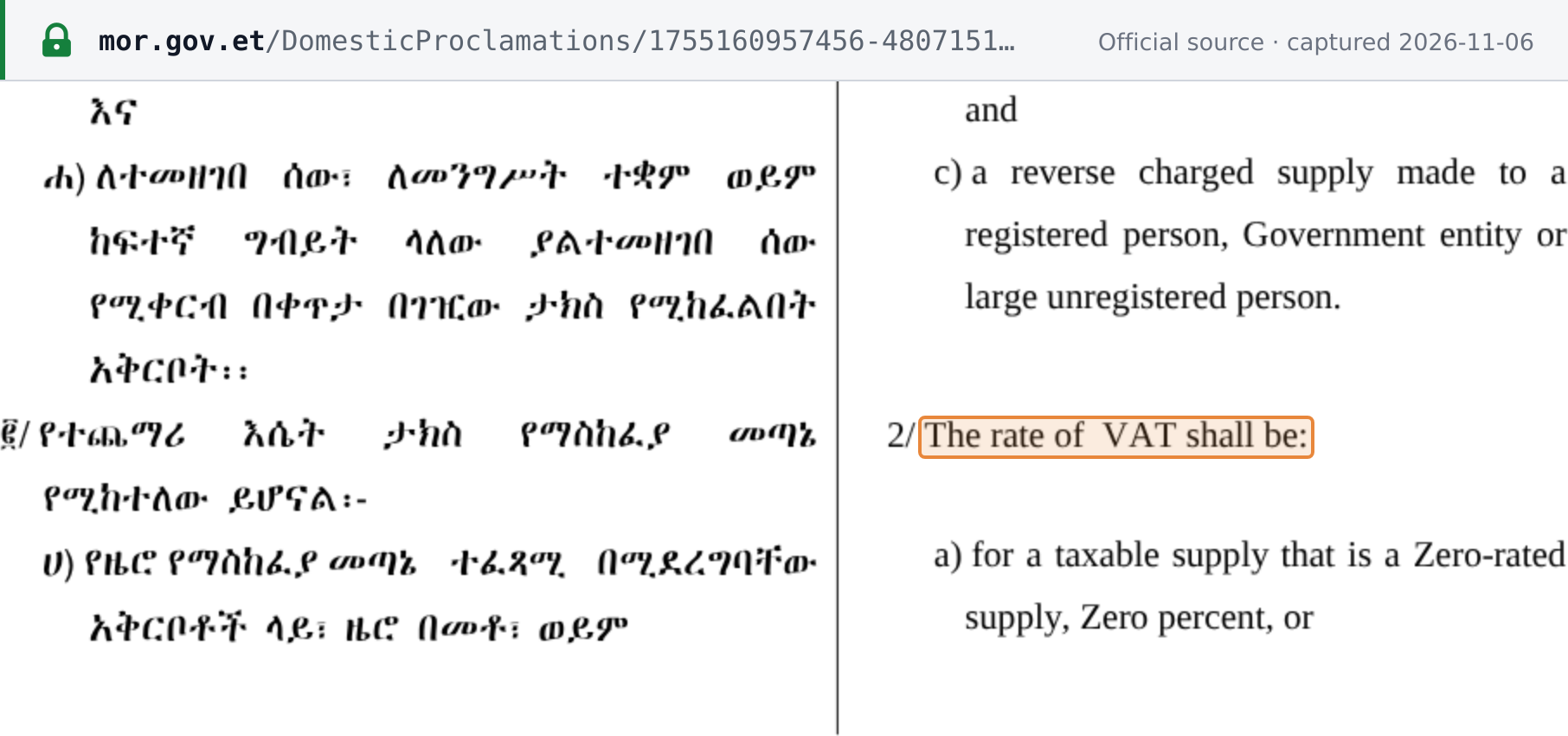
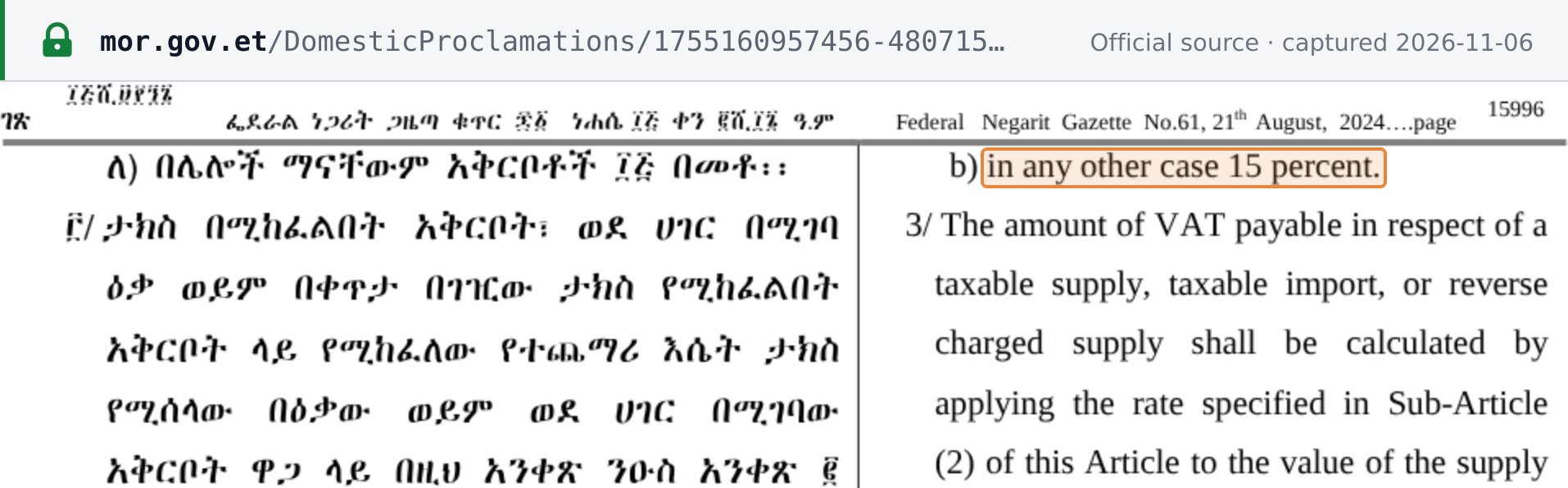
"2/ The rate of VAT shall be: a) for a taxable supply that is a Zero-rated supply, Zero percent, or b) in any other case 15 percent." (Art. 8(2), as at 2026-11-06). [1] The 15% rate carries over unchanged from Proclamation 285/2002, and applies from the 2024 Proclamation's entry into force.
 Source snapshot captured 2026-11-06 — original
 Source snapshot captured 2026-11-06 — original
No reduced rate. The Proclamation provides none, and it voids reliefs granted anywhere else: "A provision in any other law, whether enacted before or after this Proclamation, specifying that a supply or class of supply, or an import or class of import, is an exempt or Zero-rated supply, exempt import, or subject to a reduced rate of VAT shall have no legal effect unless also provided for in this Proclamation." (Art. 73(1)). [1]
What is zero-rated or exempt. The lists are in Schedules 1–3. The copy of Proclamation 1341/2024 that MoR publishes ends at Article 75 and the signature, without the Schedules. A supply that is both zero-rated and exempt "shall be treated only as a Zero-rated supply" (Art. 10(2)).
Announced changes. None found as at 2026-11-06.
Cross-border rules
Imports and exports
- Imports. "The liability for VAT on a taxable import arise at the time of the import and shall be payable by the importer" (Art. 8(7)). The Customs Commission collects it, and arranges collection by the Ethiopian Postal Service Enterprise for imports by post (Art. 60(1)). Payment may be deferred for imported capital goods (Art. 28). Vehicles and other registrable goods cannot be registered without proof that VAT was paid (Art. 63). Any import relief is listed in Schedule 3 to the Proclamation, which MoR's published copy omits. [1]
- Exports. Zero-rated supplies keep their input tax, and a registered person whose zero-rated supplies exceed 50% of its taxable supplies gets a refund within one month (Art. 49(1); see Refunds).
Reverse charge on imported services
"1/ A reverse charged supply is a supply of services where: a) the supply is made by a person outside Ethiopia, whether or not a registered person, who does not carry on a taxable activity through a fixed place of business in Ethiopia, b) the supply is made to a registered person, Government institution or a large unregistered person, and c) the supply would have been a taxable supply if the supply had been made from a place of business in Ethiopia." (Art. 6(1)). [1]
- A large unregistered person is a non-registrant whose annual supplies exceed ETB 2,000,000.
- A registered recipient prepares a recipient-created tax invoice at the time of the supply (Art. 52(4)) and accounts for the VAT in its return. Large unregistered persons and unregistered Government entities file a monthly declaration by the end of the following month (Art. 58(3)).
- Services from a head office abroad to an Ethiopian branch are also reverse charged (Art. 6(2)).
- Where the foreign supplier is itself registered for Ethiopian VAT, the recipient must tell it, "at or before the time of supply", that the recipient is liable for the VAT (Art. 65). Failure costs ETB 50,000 (Art. 66(3)).
See reverse charge explained for how other countries handle this.
Digital products and services
Services from a non-resident with no fixed place of business in Ethiopia are supplied in Ethiopia where, among other cases, "the services are remote services supplied to a resident of Ethiopia" (Art. 24(2)(c)). A recipient is resident "if at least Two of the following apply": billing address in Ethiopia; bank account in Ethiopia; landline in Ethiopia; the mobile country code of the SIM is Ethiopia's; the IP address or other geolocation is in Ethiopia; or another indicator (Art. 24(3)). Telecommunications services and inbound tourism services are also caught. [1]
The foreign supplier registers once its taxable supplies exceed ETB 2,000,000 (Art. 12; see Non-resident registration). "A registered person who does not carry on a taxable activity through a fixed place of business in Ethiopia shall not be allowed any input tax credits" (Proclamation Art. 30(3)). [1]
See VAT on digital services by non-resident suppliers for the wider picture.
Foreign companies selling into Ethiopia — B2B and B2C
- B2B services to a registered person, Government institution or large unregistered person: the customer accounts for the VAT under the reverse charge (Art. 6). The foreign supplier does not register for those supplies.
- B2C remote services and electronically ordered goods: the foreign supplier (or the platform, below) charges Ethiopian VAT and registers once above ETB 2,000,000 (Arts. 12, 24).
- Goods: import VAT is collected by the Customs Commission from the importer at the border.
Marketplace / platform deemed-supplier liability
Yes. An electronic platform without a fixed place of business in Ethiopia that controls the charge, delivery or terms is treated as the supplier of remote services made through it to non-registered recipients (Art. 25), and of electronically ordered goods it facilitates, other than excisable or dutiable goods (Art. 23(2)–(3)). [1] See marketplace deemed-supplier rules.
Place of supply
- Goods. "1/ A supply of goods shall occur in Ethiopia if: a) for a supply of goods that involves transportation, the transportation of the goods commences in Ethiopia, or b) for any other supply of goods, the goods are made available in Ethiopia by the supplier." (Art. 23(1)).
- Services. "A supply of services shall occur in Ethiopia if the place of business of the supplier from which the services are supplied is in Ethiopia" (Art. 24(1)), plus the non-resident cases in Art. 24(2): services physically performed in Ethiopia, services on immovable property in Ethiopia, remote services to residents, inbound tourism and telecommunications. [1]
VAT withholding on supplies to government
Designated government entities "a) withhold 50% of the VAT payable in respect of the supply, b) pay the withheld VAT to the Tax Authority … and c) pay the remaining 50% of the VAT payable in respect of the supply to the registered person making the supply" (Art. 62(1)). The supplier credits the withheld amount. [1] See VAT withholding regimes.
Invoice requirements
When a tax invoice is required
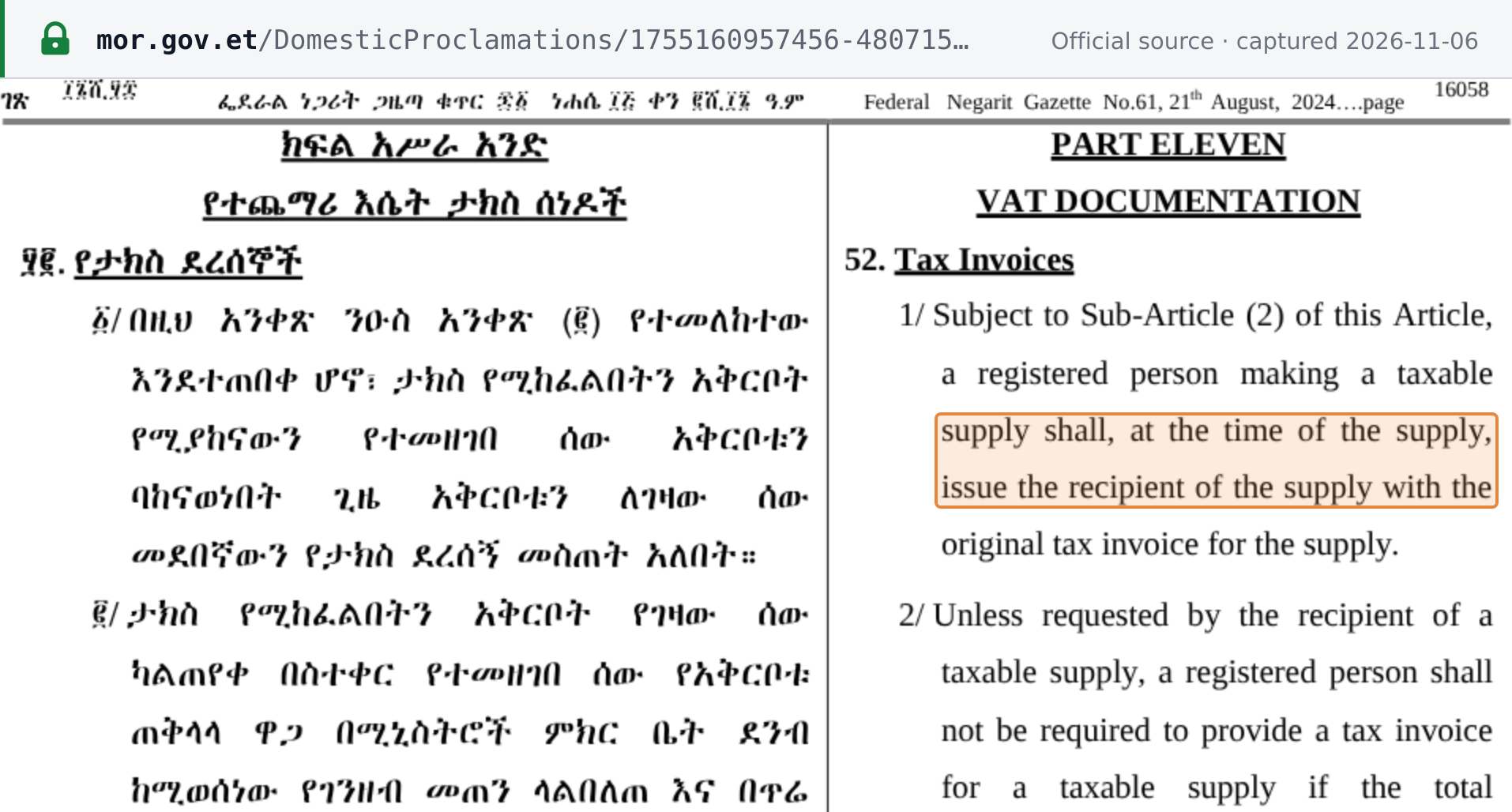
Proclamation 1341/2024 Art. 52 (as at 2026-11-06): [1]
- "1/ Subject to Sub-Article (2) of this Article, a registered person making a taxable supply shall, at the time of the supply, issue the recipient of the supply with the original tax invoice for the supply."
- "2/ Unless requested by the recipient of a taxable supply, a registered person shall not be required to provide a tax invoice for a taxable supply if the total consideration for the supply is paid in cash and does not exceed the amount specified in the Regulations."
- "3/ A registered person may provide a simplified tax invoice for a taxable supply where: a) the total consideration for the supply is paid in cash and does not exceed the amount specified in the Regulations, and b) the supply is made by a registered person who is a retailer."
- "4/ A registered person liable for VAT … in respect of a reverse charged supply made to the person shall, at the time of the supply, prepare a recipient-created tax invoice for the supply."
- "5/ A tax invoice, simplified tax invoice, and a recipient-created tax invoice shall include the particulars specified in the Regulations."
 Source snapshot captured 2026-11-06 — original
The time of supply is the earliest of the invoice, payment, or delivery or performance (Art. 21(1)).
Mandatory content
The particulars a tax invoice must carry are prescribed by Article 20 of Council of Ministers VAT Regulation No. 570/2025, which MoR's Electronic Invoicing Directive No. 1142/2026 adopts as the minimum receipt contents: sales-registration software must print "at a minimum, the receipt contents listed under Article 20 of the Value Added Tax Regulation" (Directive 1142/2026 Art. 4(1)(a)). MoR does not publish the Regulation. [3]
The texts MoR does publish add:
- TIN. A taxpayer who fails to state their TIN "on a tax invoice, tax debit or credit note, tax declaration, or any other document as required under a tax law" is liable to ETB 3,000 per failure (Tax Administration Proclamation 983/2016 Art. 103(1)).
- Printed invoices — a unique MoR QR code on the right header, at least 2 cm × 2 cm (Directive 1099/2025; see Numbering and sequencing).
- Invoices from a sales-registration system — under Directive 1142/2026, an Invoice Reference Number (IRN), Receipt Reference Number (RRN) and QR code issued by MoR's system, printed or displayed legibly (Art. 4(1)(c)–(d); see E-invoicing status).
- Rate and currency — VAT at 15% of the value of the supply (Proclamation Art. 8(2)–(3)), expressed in Birr (Art. 71(1)).
Issuance deadline
At the time of the supply (Art. 52(1)); for a recipient-created tax invoice, also at the time of the supply (Art. 52(4)).
Numbering and sequencing
- One original. "A registered person shall issue only One original tax invoice for a taxable supply", and issued documents "shall be maintained in chronological order" (Proclamation Art. 55(1), (4)). [1]
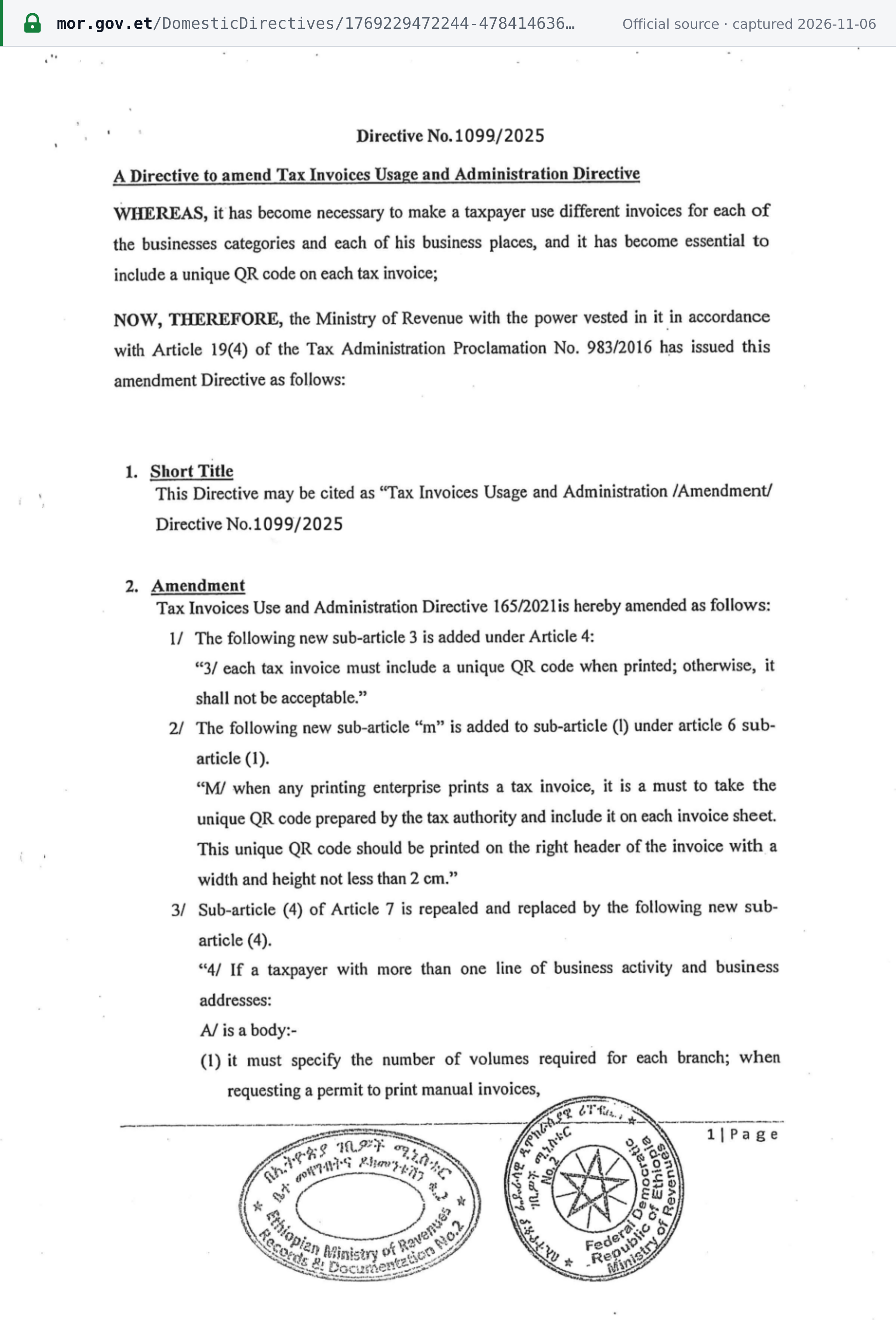
- Printed invoices need MoR approval and a QR code. The type and quantity of printed invoices must be registered with MoR before they are printed (Tax Administration Proclamation 983/2016 Art. 19). Since the Tax Invoices Usage and Administration (Amendment) Directive No. 1099/2025 (Minister of Revenues, July 2025): "each tax invoice must include a unique QR code when printed; otherwise, it shall not be acceptable", and printing enterprises must "take the unique QR code prepared by the tax authority and include it on each invoice sheet. This unique QR code should be printed on the right header of the invoice with a width and height not less than 2 cm." (Art. 2(1)–(2)). [7]
 Source snapshot captured 2026-11-06 — original
Credit and debit notes
"2/ A registered person shall issue a credit or debit note to the recipient of a supply by the end of the accounting period in which the adjustment event to which the note relates occurred." (Art. 53(2)). Adjustment events are cancellation, a fundamental change in the nature of the supply, a change in price, and returned goods; bad debts are adjusted under Arts. 45–46. [1]
A credit note and a debit note must include the particulars specified in the Regulations (Proclamation Art. 53(3)).
A registered person who was not issued an invoice or note may request it in writing within 60 days; the supplier must comply within 14 days. A replacement for a lost original is marked "copy" (Proclamation Art. 54).
Currency and language
- Currency. Amounts are expressed in Birr; foreign-currency amounts translate at the National Bank of Ethiopia rate on the date they are taken into account (Art. 71).
- Language. Records, including electronic ones, are kept "in Amharic or English" (TAP 983/2016 Art. 17(1)(a)). [4]
Document types
| Document | When | Basis |
|---|---|---|
| Tax invoice | Every taxable supply by a registered person | Proclamation Art. 52(1) |
| Simplified tax invoice | Retailers, cash supplies not exceeding the amount specified in the Regulations | Art. 52(3) |
| No invoice unless requested | Cash supplies not exceeding "the amount specified in the Regulations" | Art. 52(2) |
| Recipient-created tax invoice | Reverse-charged services received | Art. 52(4) |
| Credit / debit note | Adjustment events | Art. 53 |
The amounts for the cash-supply limbs of Art. 52(2) and (3) are set in the implementing Regulations.
Self-billing
No general self-billing regime: Part Eleven of Proclamation 1341/2024 (Arts. 52–56) provides for a recipient-issued document only for reverse-charged services (the recipient-created tax invoice). Agents may issue and receive invoices in their own name or the principal's (Art. 56).
Retention and audit trail
- Retention. "1/ A taxpayer shall, for the purposes of a tax law, maintain such documents (including in electronic format) as may be required under the tax law and the documents shall be maintained: a) in Amharic or English; b) in Ethiopia; and c) in a manner so as to enable the taxpayer’s tax liability under the tax law to be readily ascertained." They are kept "for the longer of: a) the record-keeping period specified in the Commercial Code; or b) 5 (Five) years from the date that the tax declaration for the tax period to which they relate was filed with the Authority" (TAP 983/2016 Art. 17(1)–(2)). [4]
- Reassessment window. Proclamation 1434/2026 extends amended assessments to 10 years where tax fraud is proven (5 years otherwise), so keeping records beyond five years is prudent.
- Audit trail. Directive 1142/2026 Art. 4 requires sales-registration systems to keep an operation audit log, give MoR read access to audit data at any time, and pass a security clearance from the Information Network Security Administration (INSA). [3]
A specimen of a compliant invoice
MoR publishes no specimen. Directive 1142/2026 Art. 4(1)(a) refers to "the sample invoice (receipt) attached to this Directive", but Annex 1 in the MoR-published PDF is headed "Receipt sample" (የደረሰኝ ናሙና) and holds only dotted placeholder lines. Below, Lookuptax lays out an illustrative sample of a printed tax invoice for a B2B sale at 15%. The texts MoR publishes require the invoice to be the single original issued at the time of supply (Proclamation Arts. 52(1), 55(1)) and to show the supplier's TIN (Tax Administration Proclamation Arts. 14(1), 103(1)), a MoR QR code if printed (Directive 1099/2025) or the IRN, RRN and QR code if system-issued (Directive 1142/2026); the amounts follow the Proclamation's rules on the 15% rate, value and Birr (Arts. 8, 71). The full list of particulars is in Reg. 570/2025 Art. 20, which MoR does not publish, so the sample is not a complete field list. Every name, number and amount is fictional:
Tax invoice — illustrative sample
| Description (illustrative) | Value of supply excl. VATArt. 8(3) |
|---|---|
| Laser printers (2) | ETB 25,000.00 |
| Printer toner cartridges (10) | ETB 10,000.00 |
| Installation and set-up | ETB 5,000.00 |
- Value of supply excl. VATArt. 71(1) (Birr)
- ETB 40,000.00
- VAT at 15%Art. 8(2)(b), 8(3)
- ETB 6,000.00
- Total payable
- ETB 46,000.00
- Issue the original at the time of the supply; only one original per supply — Proclamation 1341/2024 Arts. 52(1), 55(1).
- Printed invoice stock must be registered with MoR before printing — Tax Administration Proclamation 983/2016 Art. 19.
- A system-issued invoice is issued only after MoR returns the IRN, RRN and QR code — Directive 1142/2026 Art. 4(1)(c).
- Remaining particulars: as prescribed by the Regulations — Proclamation Art. 52(5); Reg. 570/2025 Art. 20 (not published by MoR).
E-invoicing status
Legal framework in force; mandate phased by an MoR schedule that had not been published as at 2026-11-06.
- Instrument. The Ministry of Revenues' Electronic Invoicing System Administration Directive No. 1142/2026 (1142/2018 E.C.). It applies to "taxpayers that issue invoice as per the tax law, Sales Registration System Suppliers, a Taxpayer that use Sales Registration System Exclusively, Service Providers (Software as a Service), and e-Commerce and Digital Marketplace Operators" (Art. 3(1)). [3] Tax Administration Proclamation Art. 93(6), as inserted by Proclamation 1434/2026, obliges MoR to issue a directive on the electronic tax system, QR-coded invoices, e-commerce and electronically invoiced transactions. [5]
- System. MoR's Electronic Invoice Registration System (also called the Electronic Receipt Registration System). Taxpayers connect through licensed sales registration systems: in-house software, software-as-a-service providers, or e-commerce and digital marketplace operators.
- Model: real-time clearance. A system qualifies "Where the system is capable of transmitting accurate transaction data to the Authority in realtime as the transaction occurs, and correctly displaying the response to the user" and "Where it is verified that the system issues an invoice or receipt only upon transmitting data to the Electronic Receipt Registration System, confirming its validity, and obtaining an Invoice Reference Number (IRN), a Receipt Reference Number (RRN), and a Quick Response (QR) Code" (Art. 4(1)(b)–(c)). [3]
- Who and when. "The use of a compliant sales register system within the electronic invoice registration framework is mandatory for all taxpayers who are obligated to maintain books of accounts. Implementation shall be carried out in accordance with the schedule issued by the Authority." (Art. 29(1)). MoR's directives list and news pages carry no such schedule as at 2026-11-06. [3]
- Offline operation. Annex 2 lists 26 business sectors (among them retail food, fuel and pharmacies, passenger transport, hotels, restaurants, hospitals and hairdressing) whose systems must keep working offline.
- Format. The Directive names no file format, syntax or exchange network; it requires data exchange with MoR's system and an INSA security clearance.
- Scope. Taxable transactions to which VAT applies under Proclamation 1341/2024 (Art. 3(2)), B2B and B2C alike; the Directive draws no B2G distinction.
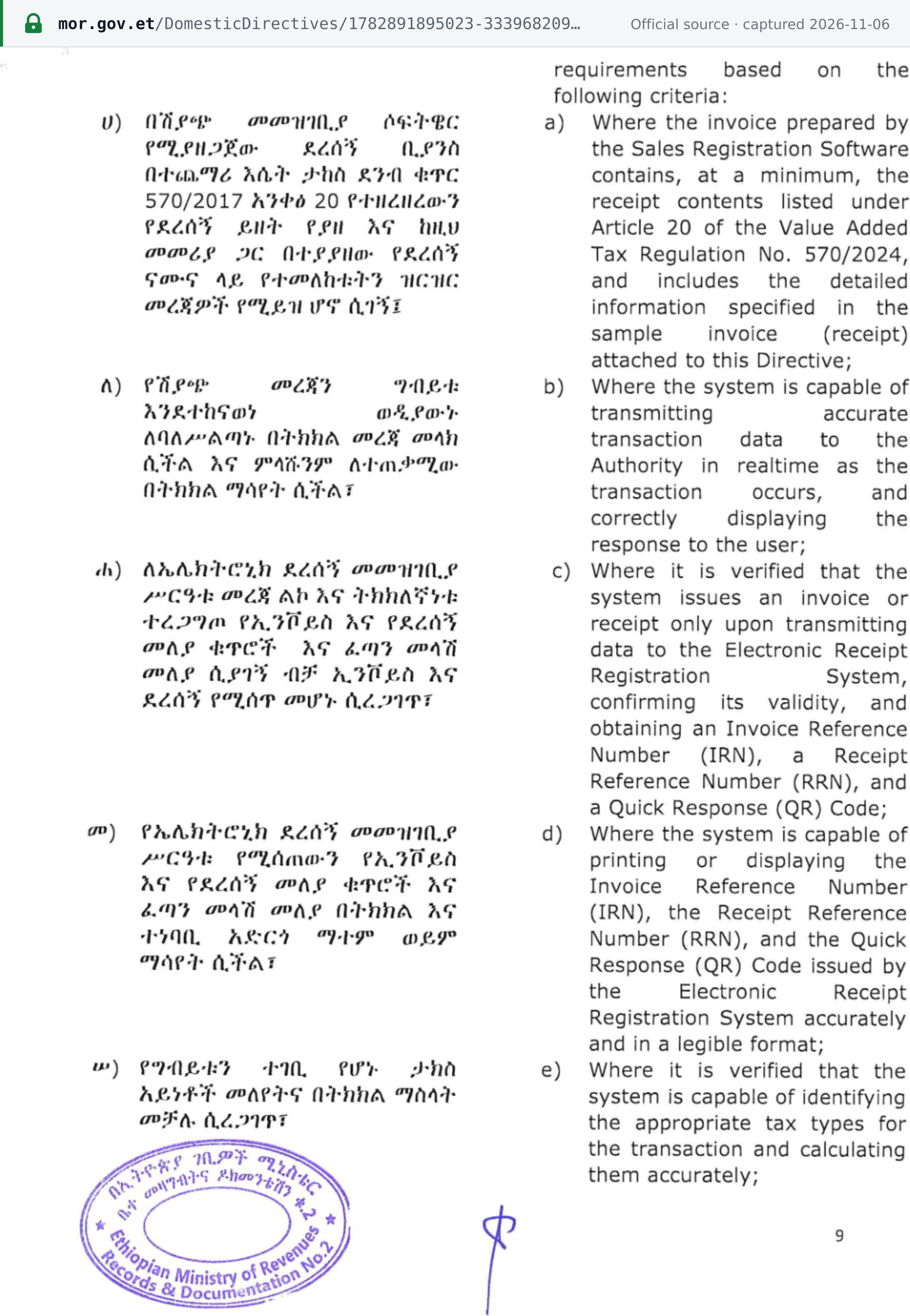 Source snapshot captured 2026-11-06 — original
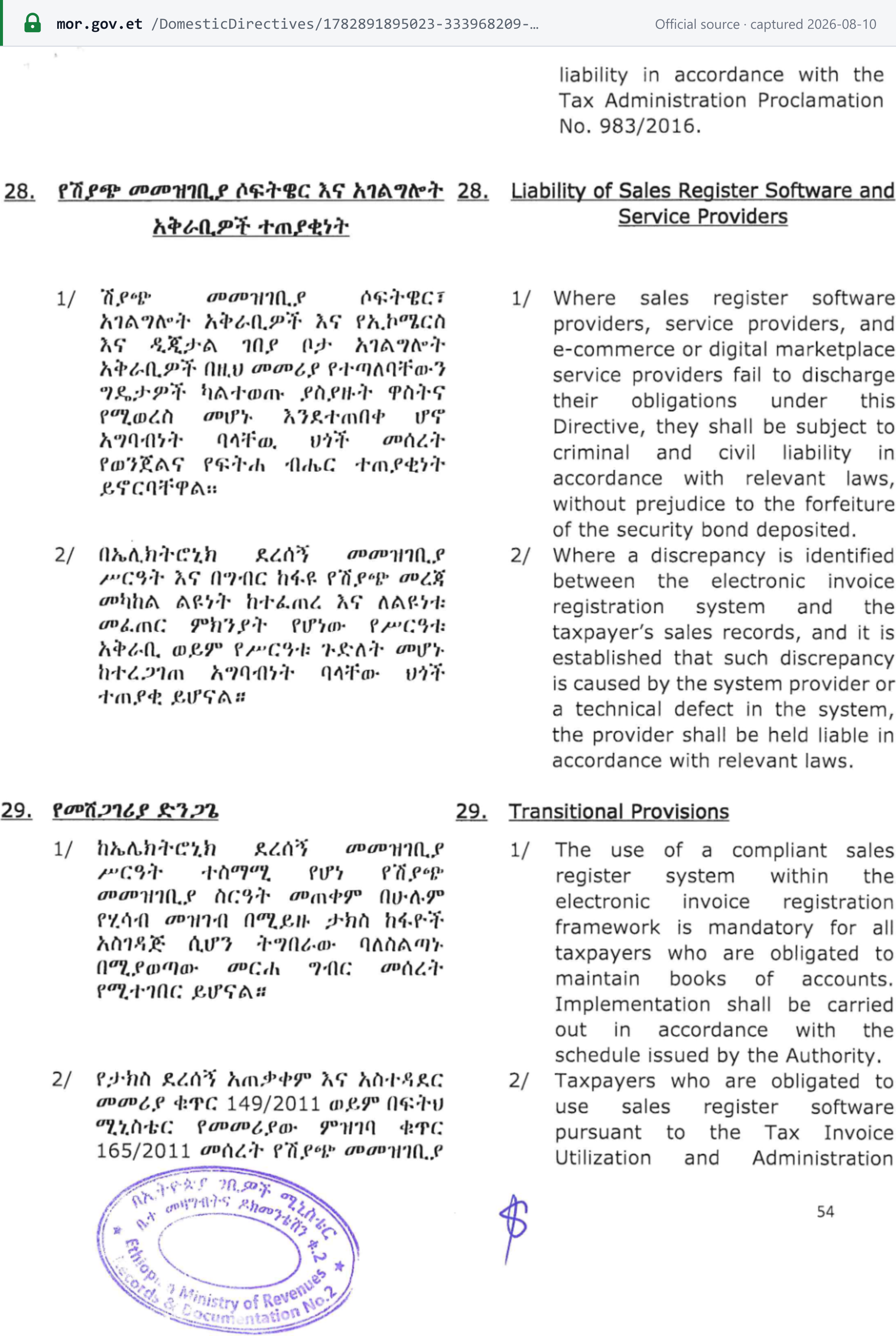 Source snapshot captured 2026-08-10 — original
See fiscal devices and certified cash registers and CTC e-invoicing models.
For the event record, see Ethiopia's Directive 1142/2026 on Lookuptax; for the global picture, e-invoicing status and networks worldwide.
Filing and payment
Filing frequency
Monthly, for every registered person: one return per accounting period (an Ethiopian calendar month; Nehase and Pagume together form one period).
Return due date
"1/ A registered person shall file a VAT return for each accounting period on or before the last day of the calendar month following the end of the period. 2/ A registered person shall be obliged to file a VAT return under Sub-Article (1) of this Article for an accounting period whether or not the person has an amount of net VAT payable for the accounting period." (Art. 58(1)–(2), as at 2026-11-06). Nil returns are therefore compulsory. [1]
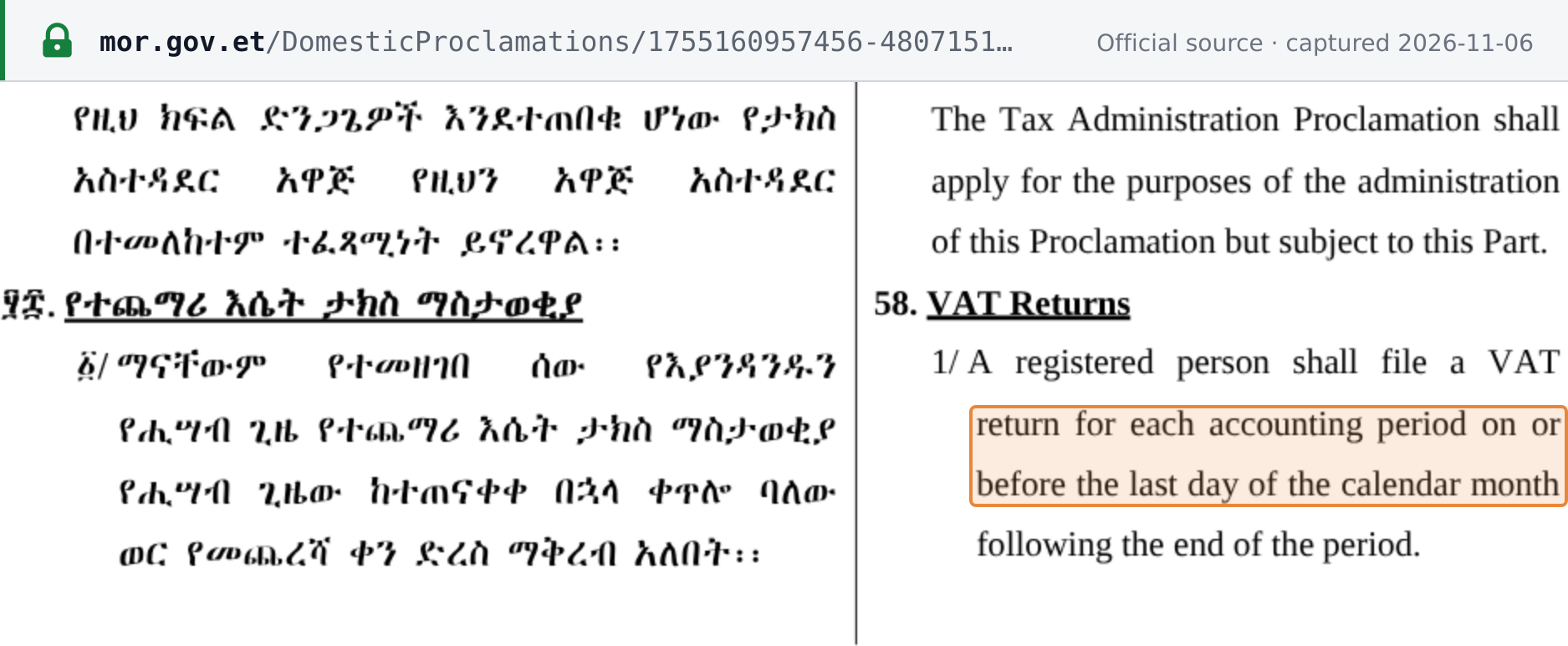 Source snapshot captured 2026-11-06 — original
Payment due date and method
"1/ The net VAT payable by a registered person for an accounting period shall be due by the due date for filing the person’s VAT return for that period." (Art. 59(1)). Import VAT is due at import. MoR may require a taxpayer to file and pay electronically; refusing without adequate reason within 14 days of notice costs ETB 50,000 (TAP 983/2016 Art. 111, pre-2026 numbering).
Additional listings
None. Proclamation 1341/2024 provides for no annual VAT return or sales and purchase listing; the monthly return is the only periodic filing. Large unregistered persons and unregistered Government entities that receive reverse-charged services file a monthly declaration (Art. 58(3)).
Input-tax recovery and blocked items
- Timing. Input tax is credited in the period of the supply or import, once the tax invoice, customs document or recipient-created invoice is held. A missed credit can still be claimed "only if that accounting period is within 12 calendar months after the accounting period in which the credit arose" (Art. 29(7)). [1]
- Apportionment. Credit is allowed only "to the extent that the acquisition was for the purpose of making taxable supplies" (Art. 29(1)); mixed use is apportioned by the formula A × B/C, with a 95% / 5% de minimis (Art. 29(2)–(3)).
- Blocked. Passenger vehicles — "a road vehicle designed or adapted for the transport of 8 or fewer seated passengers, including a double cab vehicle" (Art. 30(4)(b)) — and their parts and repairs, unless the business deals in or hires them; entertainment (food, drink, accommodation, recreation and hospitality), with narrow exceptions; club and association memberships (Art. 30). Non-residents with no fixed place of business in Ethiopia get no credit (Art. 30(3)). [1]
Refunds
- Carry forward, then refund. Excess credit is carried forward. If it "has not been fully credited after being carried forward for 6 accounting periods", the registered person may apply for a refund within 6 months, and MoR "shall refund the amount within 45 days after the person filed the refund application" (Art. 48(3)–(4)).
- Fast refund for exporters. "If more than 50% of the value of taxable supplies made by a registered person in an accounting period are Zero-rated supplies, the Tax Authority shall refund any excess input tax credit of the person for the accounting period within One calendar month after the person filed the VAT return" (Art. 49(1)). The same one-month refund applies to capital-goods credits of registered persons with annual taxable supplies above ETB 100,000,000. [1]
- On cancellation. Apply by the due date of the last return; refund within 60 days.
- Interest. Late refunds bear interest at the highest commercial lending rate (Art. 50).
- Bad debts. Adjusted under Arts. 45–46.
- Non-residents. Proclamation 1341/2024 has no refund scheme for unregistered non-residents.
Exemptions
Exempt supplies
Exempt supplies are listed in Schedule 2 to Proclamation 1341/2024 and exempt imports in Schedule 3 (Arts. 10–11). The copy of the Proclamation that MoR publishes omits the Schedules. Exemptions granted by any other law, earlier or later, have "no legal effect unless also provided for in this Proclamation" (Art. 73(1)).
Exempt is not zero-rated. A zero-rated supply is taxable at 0%: the supplier recovers its input tax and, if mostly zero-rated, gets a refund within a month (Art. 49(1)). An exempt supply carries no VAT and no input-tax credit for the costs attributable to it (Art. 29(1)). Where a supply is both, it is treated as zero-rated (Art. 10(2)). See zero-rated vs exempt.
Special regimes
- Small businesses. No VAT small-business or flat-rate scheme. Turnover tax was repealed by Proclamation 1395/2025 (see Overview).
- Branches. Optional separate registration of branches (Art. 67(2)).
- Government purchases. 50% VAT withholding (Art. 62).
Offences and penalties
Article numbers. Proclamation 1434/2026 (Federal Negarit Gazette, 32nd Year No. 48, 30 July 2026) inserts new articles into the Tax Administration Proclamation 983/2016 and provides that "The provisions of the existing Proclamation from Article 61 to Article 139 are hereby renumbered sequentially as Article 72 to Article 156". The amendment gives new numbers for the articles it changes (for example old Art. 108 becomes Art. 125). Other articles keep their subject but carry a new number; below, "pre-2026 numbering" marks an article number from Proclamation 983/2016 as originally numbered. [5]
Offences
Criminal offences under the Tax Administration Proclamation 983/2016, as amended:
- Issuing a tax invoice without being VAT-registered: "a fine of birr 200,000 (Two Hundred Thousand Birr) and rigorous imprisonment for a term of seven to ten years" (TAP 983/2016 Art. 122(1), pre-2026 numbering). [4]
- Fraudulent invoices: fine of ETB 100,000 and 7–10 years' rigorous imprisonment; higher bands where the benefit exceeds ETB 100,000, and for machines or software built to produce fraudulent invoices (TAP 983/2016 Art. 119, pre-2026 numbering).
- Transacting without a required invoice: ETB 25,000–50,000 and 3–5 years (Art. 120(1), now Art. 137(1)). Since Proclamation 1434/2026, a person is criminally liable for failing to issue an invoice "only where the criminal act is committed after the person has been administratively penalized twice for the same act within a single tax period" (new Art. 137(8)).
- Understating the sales price — recording different prices on identical invoices for a single transaction, or issuing an invoice that understates the price: ETB 100,000 and 5–7 years (Art. 137(2), as replaced by Proclamation 1434/2026).
- Managers' liability. Managers and financial heads of a body are presumed liable unless they show lack of knowledge or adequate internal controls (new Art. 149).
Penalties
| Failure | Penalty | Basis |
|---|---|---|
| Failing to issue a tax invoice | ETB 100,000 per invoice not issued; may not be waived | TAP Art. 125 (replaced by Proclamation 1434/2026) |
| Issuing a tax invoice, credit note or debit note other than as the VAT Proclamation provides | ETB 50,000 each time | VAT Proclamation Art. 66(2) |
| Certificate display, online disclosure, change notification, recipient-created invoice, credit/debit note and document-request failures | ETB 100,000 each failure | VAT Proclamation Art. 66(1) |
| Not notifying a VAT-registered foreign supplier of reverse-charge liability | ETB 50,000 | VAT Proclamation Art. 66(3) |
| Deliberately incorrect tax invoice lowering VAT or raising a credit | ETB 50,000 | TAP 983/2016 Art. 107(4) (pre-2026 numbering) |
| Failing to apply for VAT registration | ETB 2,000 per month plus 100% of the VAT on supplies made while unregistered | TAP 983/2016 Art. 107(1)–(2) (pre-2026 numbering) |
| Late filing | 5% of the unpaid tax per period or part, capped at 25%; late nil return ETB 10,000 per period | TAP 983/2016 Art. 104 (pre-2026 numbering) |
| Late payment | 5% after one month, plus 2% for each further month or part, capped at the tax | TAP 983/2016 Art. 105 (pre-2026 numbering) |
| Late-payment interest | Highest commercial lending rate of the previous quarter plus 15% | TAP 983/2016 Art. 37 |
| Understatement | 10% of the shortfall; 30% the second time; 40% thereafter | TAP 983/2016 Art. 109 (pre-2026 numbering) |
| TIN not shown on an invoice, note or declaration | ETB 3,000 per failure | TAP 983/2016 Art. 103(1) (pre-2026 numbering) |
| Not filing or paying electronically when required | ETB 50,000 | TAP 983/2016 Art. 111 (pre-2026 numbering) |
The new Article 125 reads: "1/ Any taxpayer who fails to issue a tax invoice when required to do so shall be liable to a penalty of ETB 100,000.00 (One Hundred Thousand Birr) for each invoice not issued to a buyer. 2/ The penalty imposed under Sub- Article (1) of this Article shall not be waived by the Authority." (Proclamation 1434/2026, as at 2026-11-06). [5]
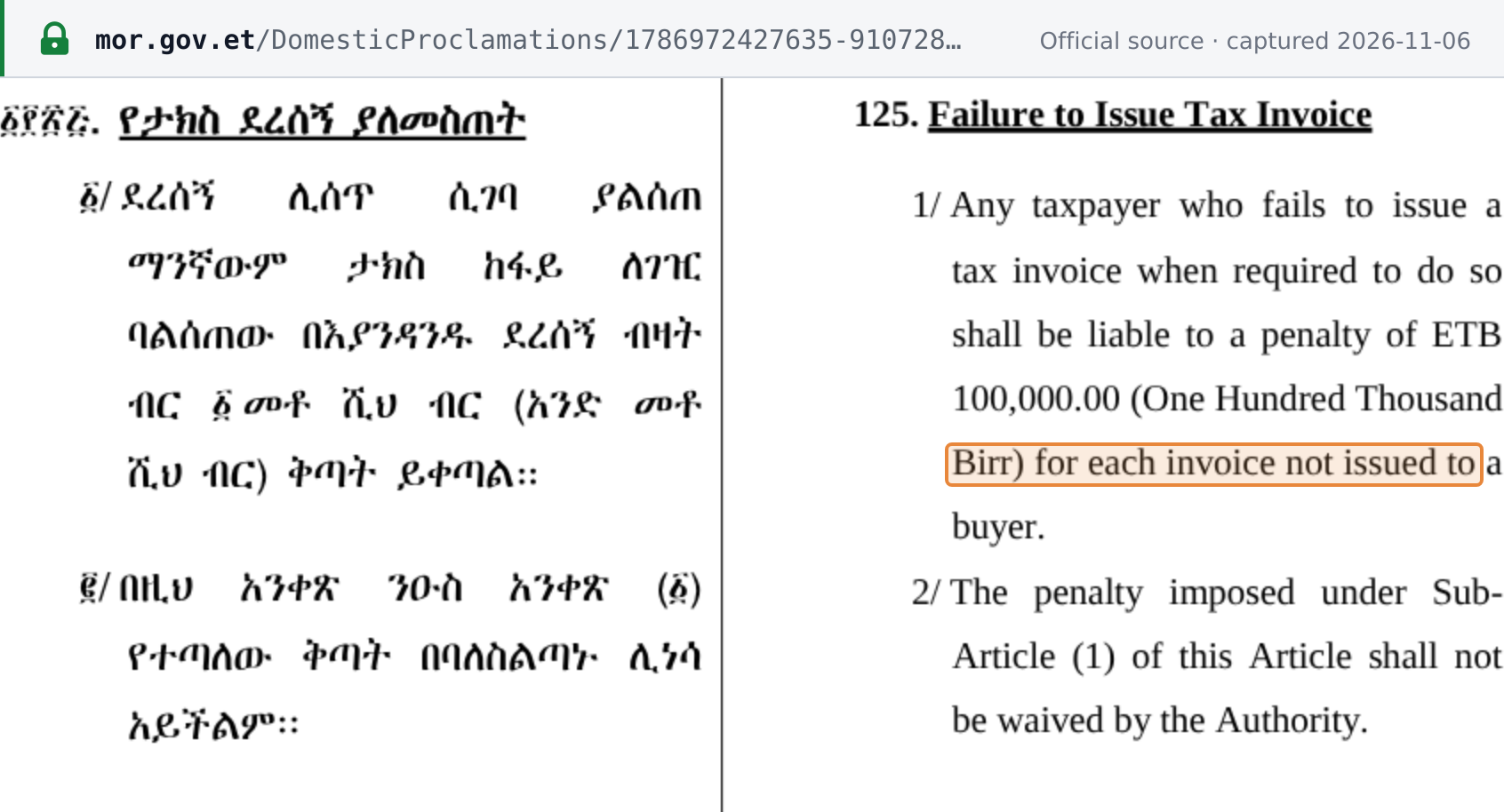 Source snapshot captured 2026-11-06 — original
Frequently asked questions
Our Ethiopian company turns over less than ETB 2 million. Do we still have to register for VAT?
Yes, in most cases. Ministry of Finance Directive No. 1104/2025 (Art. 2) requires Category "A" taxpayers, taxpayers obliged to keep books of account and taxpayers who keep books voluntarily to register for VAT, in addition to taxpayers whose taxable and exempt turnover exceeds Birr 2,000,000. Income Tax (Amendment) Proclamation No. 1395/2025 defines Category "A" as any body, or any other person with annual turnover of Birr 2,000,000 or more. A company is a body, so it is a Category "A" taxpayer whatever its turnover. Existing taxpayers caught by the Directive had to register within 30 days of its effective date.
Can a small business still pay turnover tax instead of VAT?
No. Income Tax (Amendment) Proclamation No. 1395/2025 (Federal Negarit Gazette, 1 September 2025) adds the Turnover Tax Proclamation No. 308/2002 and its amendments to its list of repealed laws. The Ministry of Revenues' legislation page still lists Proclamation 308/2002 as in force, but the 2025 amendment repealed it.
Can we keep using our printed receipt pads?
Only if each printed tax invoice carries a unique QR code issued by the Ministry of Revenues. Tax Invoices Usage and Administration (Amendment) Directive No. 1099/2025 provides that each tax invoice must include a unique QR code when printed, otherwise it is not acceptable, and that the code must be printed on the right header of the invoice, at least 2 cm wide and high.
What happens if we fail to issue a tax invoice in Ethiopia?
A penalty of ETB 100,000 for each invoice not issued to a buyer, which the Ministry of Revenues may not waive. Tax Administration (Amendment) Proclamation No. 1434/2026 (Federal Negarit Gazette, 30 July 2026) replaced the old ETB 50,000 penalty with a new Article 125. Criminal liability for failing to issue an invoice now arises only after a person has been administratively penalised twice for the same act within one tax period.
Does a foreign SaaS or streaming company selling to Ethiopian consumers have to register for VAT?
Yes, once its taxable supplies in Ethiopia exceed the registration threshold of Birr 2,000,000 (Proclamation Art. 12). VAT Proclamation No. 1341/2024 Art. 24 treats remote services supplied to a resident of Ethiopia as supplied in Ethiopia, and Art. 25 treats an electronic platform that controls the supply as the supplier of remote services made through it to non-registered recipients.
Does a VAT-registered Ethiopian business have to self-account for VAT on services bought from abroad?
Yes. Under VAT Proclamation No. 1341/2024 Art. 6, services from a person outside Ethiopia without a fixed place of business there, supplied to a registered person, a Government institution or a large unregistered person, are reverse charged supplies. A registered recipient prepares a recipient-created tax invoice at the time of the supply (Art. 52(4)) and accounts for the VAT. Where the foreign supplier is itself registered for Ethiopian VAT, the recipient must also tell it, at or before the time of supply, that the recipient is liable for the VAT (Art. 65); failing to do so carries a penalty of ETB 50,000 (Art. 66(3)).
Important websites
| Site | Purpose |
|---|---|
| Ministry of Revenues | Tax authority: legislation lists (proclamations, regulations, directives), news and e-services links |
| MoR FAQ | Registration and TIN questions (in Amharic) |
| VAT Proclamation No. 1341/2024 | The VAT law as published by MoR (without its Schedules) |
| Directive No. 1104/2025 | Who must register for VAT |
| Directive No. 1142/2026 | Electronic invoicing system |
| TIN verification | MoR publishes no documented public TIN lookup. Check a number's format with the Ethiopia TIN validator |
| E-invoicing portal | Not yet published: Directive 1142/2026 is to be implemented on a schedule MoR has not issued |
Recent changes
- 2026-07-30 — Tax Administration (Amendment) Proclamation No. 1434/2026: ETB 100,000 non-waivable penalty per invoice not issued; criminal liability only after two administrative penalties; articles 61–139 renumbered 72–156. (Proclamation 1434/2026)
- 2026-06 — Electronic Invoicing System Administration Directive No. 1142/2026: real-time clearance with IRN, RRN and QR code, mandatory for bookkeeping taxpayers on an MoR schedule. (Directive 1142/2026) — see event
- 2025-09-02 — Directive No. 1104/2025: Category "A" and bookkeeping taxpayers must register for VAT regardless of turnover. (Directive 1104/2025)
- 2025-09-01 — Income Tax (Amendment) Proclamation No. 1395/2025: every body is a Category "A" taxpayer; Turnover Tax Proclamation 308/2002 repealed. (Proclamation 1395/2025)
- 2025-07 — Directive No. 1099/2025: a unique MoR QR code on every printed tax invoice. (Directive 1099/2025)
- 2024-08-21 — VAT Proclamation No. 1341/2024 published (Federal Negarit Gazette, 30th Year No. 61); repeals Proclamation 285/2002. (Proclamation 1341/2024)
For the full chronology, see Ethiopia tax changes on Lookuptax.
Reference links
- Value Added Tax Proclamation No. 1341/2024, Federal Negarit Gazette 30th Year No. 61, 21 August 2024 (MoR)
- Ministry of Finance — Registration for Value Added Tax Directive No. 1104/2025 (MoR)
- Ministry of Revenues — Electronic Invoicing System Administration Directive No. 1142/2026 (1142/2018 E.C.)
- Federal Tax Administration Proclamation No. 983/2016 (MoR, English edition)
- Tax Administration (Amendment) Proclamation No. 1434/2026, Federal Negarit Gazette 32nd Year No. 48, 30 July 2026 (MoR)
- Income Tax (Amendment) Proclamation No. 1395/2025, Federal Negarit Gazette 31st Year No. 64, 1 September 2025 (MoR)
- Ministry of Revenues — Tax Invoices Usage and Administration (Amendment) Directive No. 1099/2025
- Ministry of Revenues — FAQ
Related on Lookuptax: