Gabon VAT (TVA) guidelines
Overview
Gabon levies a value added tax, the taxe sur la valeur ajoutée (TVA), under Book 2, Title 1 of the Code Général des Impôts (CGI), enacted by Loi n°027/2008 du 22 janvier 2009 and amended every year by a loi de finances (Finance Law). [2] The current Finance Law is Loi n°041/2025 du 29 décembre 2025 déterminant les ressources et les charges de l'État pour l'année 2026 ("LF 2026"), published in the Journal Officiel n°96 Quater spécial of 30 December 2025. [1] It rewrote the rate lists, the exemptions and the deduction rule, and made the standardised electronic invoice (FEN) the only invoice that carries a VAT deduction. Articles that LF 2026 left untouched are cited below to the CGI consolidated to the 2025 Finance Law, which the Direction Générale des Impôts publishes on its website ("CGI 2025").
Authority, currency, period and layering
- Authority. The Direction Générale des Impôts (DGI) administers VAT (dgi.ga). Import VAT is assessed by Customs, the Direction Générale des Douanes et Droits Indirects (douanes.ga), and collected by the Treasury (CGI art. 238). [2]
- Currency. The CFA franc (XAF), written "FCFA" in the texts. Gabon is a member of the Central African Economic and Monetary Community (CEMAC). The taxable base is rounded down to the nearest thousand FCFA: "La base d’imposition est arrondie au millier de francs CFA inférieur" (CGI art. 220). [2]
- Period. VAT is declared and paid monthly (CGI art. 237, see Filing and payment).
- Layering. VAT is a single national tax; there is no regional or municipal VAT. Two other turnover levies sit beside it:
- the Contribution Spéciale de Solidarité (CSS): "Le taux de la CSS est de 1 % de la base imposable", due from businesses with annual turnover excluding tax of at least FCFA 30,000,000 and paid by the 20th of each month (CGI 2025, uncodified tax texts, LF 2017 arts. 14, 25 and 26). [2] The CSS is excluded from the VAT base (CGI art. 215);
- excise duties (droits d'accises, CGI art. 250, rewritten by LF 2026), which are included in the VAT base on imports (CGI art. 216).
Registration
Who must register: the liability rule and the threshold
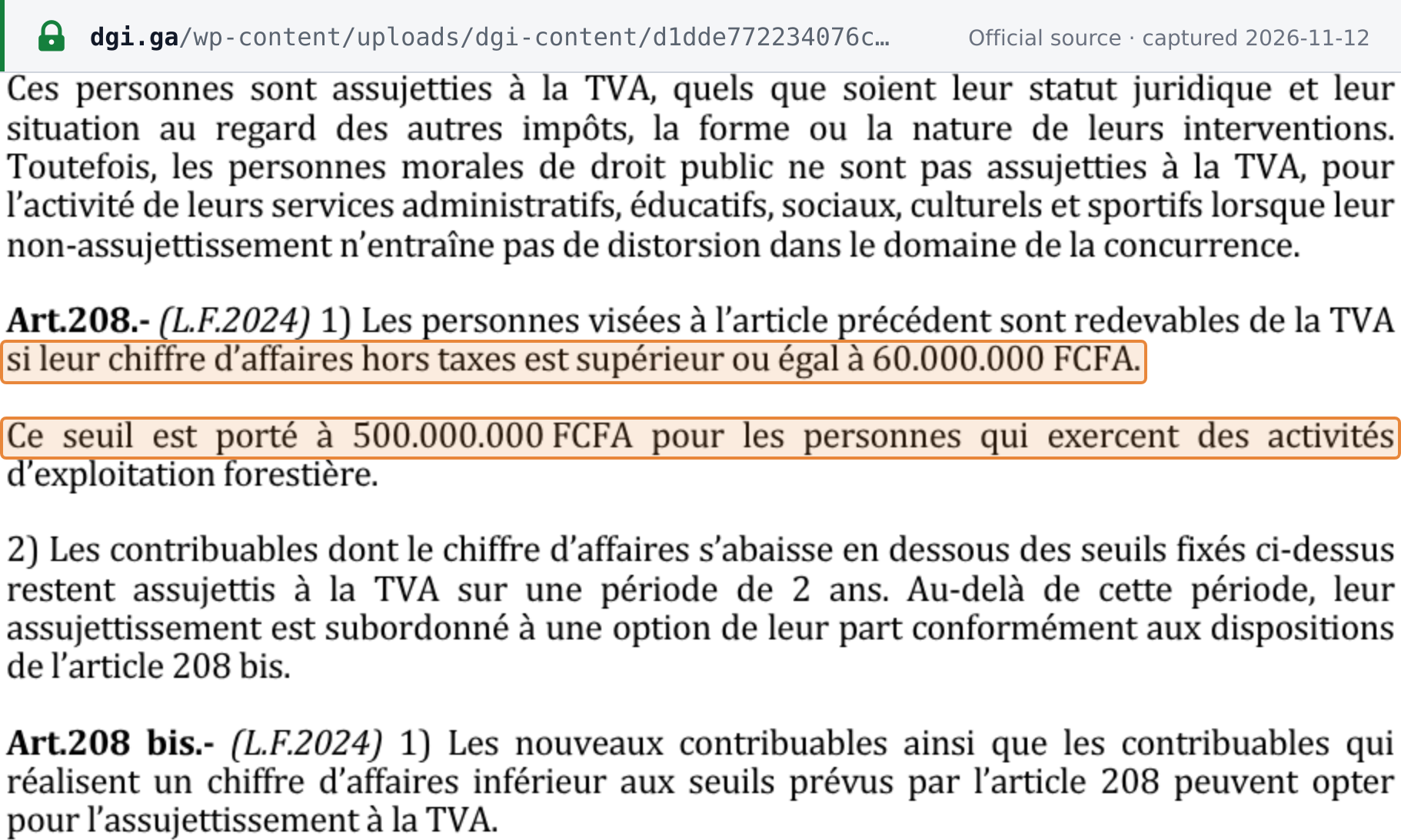
Every person, including public bodies and economic interest groupings, that carries out taxable operations habitually or occasionally and independently, as part of an economic activity for consideration, is within the scope of VAT (CGI art. 207). [2] Such a person is liable to VAT once its turnover reaches the threshold in CGI art. 208 (2024 Finance Law wording, not amended by LF 2026):
"1) Les personnes visées à l’article précédent sont redevables de la TVA si leur chiffre d’affaires hors taxes est supérieur ou égal à 60.000.000 FCFA. Ce seuil est porté à 500.000.000 FCFA pour les personnes qui exercent des activités d’exploitation forestière."
| Business | Threshold (turnover excluding tax), as at 13 November 2026 |
|---|---|
| General | FCFA 60,000,000 or more (about USD 0.1 million) |
| Forestry operators | FCFA 500,000,000 or more |
- Measurement period. Article 208 does not say over which period the turnover is measured (calendar year or rolling twelve months). The DGI's TVA page states the same figure: "Son chiffre d’affaire hors taxes s’établit à 60.000.000FCFA." [3]
- Two-year tail. A business whose turnover falls below the threshold stays liable for 2 years, and after that only by option (art. 208(2)).
- Below the threshold. Businesses under FCFA 60,000,000 that do not opt in are outside VAT; individuals in that band generally fall under the impôt synthétique libératoire, an income-tax regime not covered here.
 Source snapshot captured 2026-11-12 — original
VAT status depends on the NIF
A business that expects to become liable must apply to its tax office (Centre des Impôts), either when it is set up or "dans le mois qui suit la réalisation des conditions de l’assujettissement" if it crosses the threshold later (CGI art. 232). The same article ties the right to charge and recover VAT to the tax number: "Un redevable ne peut se prévaloir de la qualité d’assujetti qu’après attribution de son nouveau numéro d’identification fiscale en abrégé NIF. Seule la qualité d’assujetti prévue au présent article peut conférer au redevable le droit à récupération de la TVA." [2]
Non-resident registration
- No separate threshold. Article 208 applies to "les personnes visées à l’article précédent" without distinguishing residents from non-residents; the CGI states no separate threshold for non-residents.
- Representative. Foreign businesses that carry on economic activity in Gabon without a seat there have the same reporting obligations and "doivent, de ce fait, désigner un représentant solvable accrédité auprès de l’Administration fiscale" (CGI art. P-817). [2]
- Foreign online platforms must register online under a simplified procedure (CGI art. P-817 ter), see Digital services and platforms.
- B2B supplies without a permanent establishment. The Gabonese client withholds the VAT (CGI art. 240), see Foreign companies selling into Gabon.
Tax registration number (NIF)
Registration (immatriculation) gives each taxpayer a numéro d'identification fiscale (NIF). The DGI describes it as "un Numéro d’Identification Fiscale unique et personnel qui facilitera toutes ses démarches auprès de l’administration fiscale et des autres administrations, notamment douanière", printed on the attestation d'immatriculation. [5]
- Format. The DGI does not publish the NIF's structure, length or check digit (as at 13 November 2026), so no format is given here.
- On invoices. Both parties' NIFs must appear: "l’absence d’indication sur les documents comptables et notamment les factures, du NIF des deux parties d’une opération entraîne la non déduction de la TVA mentionnée sur cette facture" (CGI art. P-1004). [2]
- Lookup. The DGI publishes no public NIF verification service. Its Digitax app advertises checking the authenticity of tax documents by scanning their QR code, which is not a NIF lookup. [7]
How to register
- Deadline. "Toute personne physique ou morale assujettie … est tenue de s’immatriculer par procédé électronique, dans les quarante-cinq jours qui suivent le début de ses activités", attaching a location plan (CGI art. P-817, 2022 Finance Law wording). Changes of manager, transfer, cessation or place of business must be declared within 15 days. [2] The DGI's registration page still says "Dans les deux mois"; the CGI's 45 days is the legal deadline.
- Where. The DGI's page directs companies to the investment promotion agency, the Agence Nationale de Promotion des Investissements (ANPI-Gabon), whose one-stop shop handles business creation. [5]
- Documents (per the DGI page). Form IM01 (application for registration of legal persons), identity documents of the statutory managers, certified articles of association, the electricity (SEEG) contract and bill, the lease, and the location plan on form IM03. The forms are in the DGI document library.
- Result. "Le processus d’immatriculation se solde par la délivrance d’une Attestation d’immatriculation mentionnant … le numéro d’identification fiscale en abrégé NIF." Becoming a VAT assujetti then needs the application to the tax office under art. 232 (above).
- Fine. Late or missing registration costs a flat FCFA 250,000 (CGI art. P-1002).
Voluntary registration
Available to legal persons only. Under CGI art. 208 bis, new businesses and businesses below the thresholds "peuvent opter pour l’assujettissement à la TVA", provided they: [2]
- make an express request to their tax office;
- are a legal person ("être une personne morale");
- have had no VAT assessment or collection penalties within the limitation period;
- show guarantees of solvency.
Opting in is usually worth it for a business that sells mainly to VAT-registered customers or exports, because only an assujetti with a NIF can recover input VAT (art. 232).
Deregistration
The CGI has no stand-alone VAT deregistration procedure. Falling below the threshold does not end liability for 2 years, after which continued registration needs an option (art. 208(2)). A cessation of business must be declared within 15 days (art. P-817). A business that ceases definitively can claim a refund of its VAT credit, filed together with the cessation declaration; this does not apply to a merger (CGI art. 243 bis 3). [2]
Group registration
Not available. The VAT title of the CGI 2025 (arts. 207 to 248 sexies) contains no VAT-group provision, and LF 2026 adds none.
Rates
LF 2026 (art. 4) rewrote CGI article 221, which sets all the rates. [1] The rates apply to a base excluding VAT, on local and imported goods and services alike. The lists below are those enacted by LF 2026. A supplementary finance law for 2026 (loi de finances rectificative) was reported to amend parts of the VAT regime in mid-2026, but its official text is not published on the government or DGI websites (as at 13 November 2026), so check the current lists with the DGI before relying on them.
| Rate | Applies to (CGI art. 221, LF 2026 wording) |
|---|---|
| 18% standard | All taxable operations not at a reduced rate or 0% |
| 10% reduced | Production and sale of listed products: fishing equipment, outboard motors, cement, reinforcing bar, desktop and laptop office computers, mineral water produced in Gabon, washing powder, tinned pulses and vegetables, tinned fruit, water and electricity on social and standard meters |
| 5% reduced | Production and sale of listed staples and certain other items: milk, butter, yoghurt, bread, flour, rice, eggs, tinned fish, pasta, local table oil, salt and others (full list below) |
| 0% | Exports, international transport, fuel provisioning and maintenance of aircraft and ships in international traffic |
Standard rate: 18%
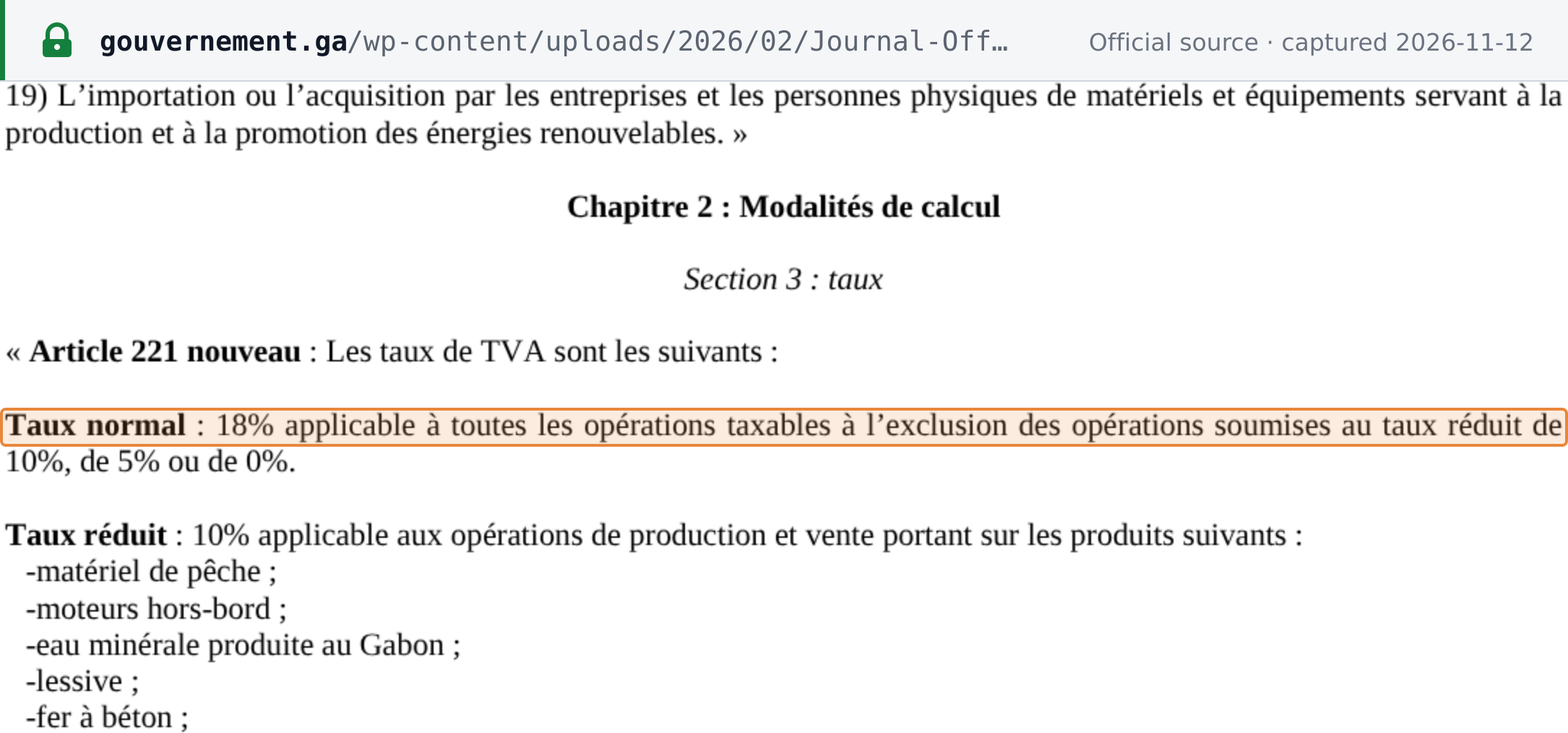
"Taux normal : 18% applicable à toutes les opérations taxables à l’exclusion des opérations soumises au taux réduit de 10%, de 5% ou de 0%" (CGI art. 221, LF 2026). The 18% rate was already the standard rate before LF 2026. VAT on property operations by real-estate professionals (TVA immobilière) is also charged at "le taux de droit commun de 18 %" (CGI art. 248 sexies).
 Source snapshot captured 2026-11-12 — original
Reduced rate: 10%
"Taux réduit : 10% applicable aux opérations de production et vente portant sur les produits suivants": fishing equipment; outboard motors; mineral water produced in Gabon; washing powder (lessive); reinforcing bar (fer à béton); desktop and laptop office computers; tinned pulses and green vegetables; tinned fruit; supply of water and electricity on the consumption of social and standard meters; cement. [1]
What changed in 2026: mineral water produced in Gabon, washing powder, reinforcing bar, office computers, tinned pulses, vegetables and fruit, water and electricity, and cement were at 5% under the CGI 2025 and moved up to 10%; fishing equipment and outboard motors were already at 10%. The goods that the CGI 2025 listed at 10% (car spare parts and axles, building tiles, nails, raincoats, imported meat and poultry, imported table oil, sugar, imported groundnuts) are not listed in either of the LF 2026 reduced-rate lists. [2]
Reduced rate: 5%
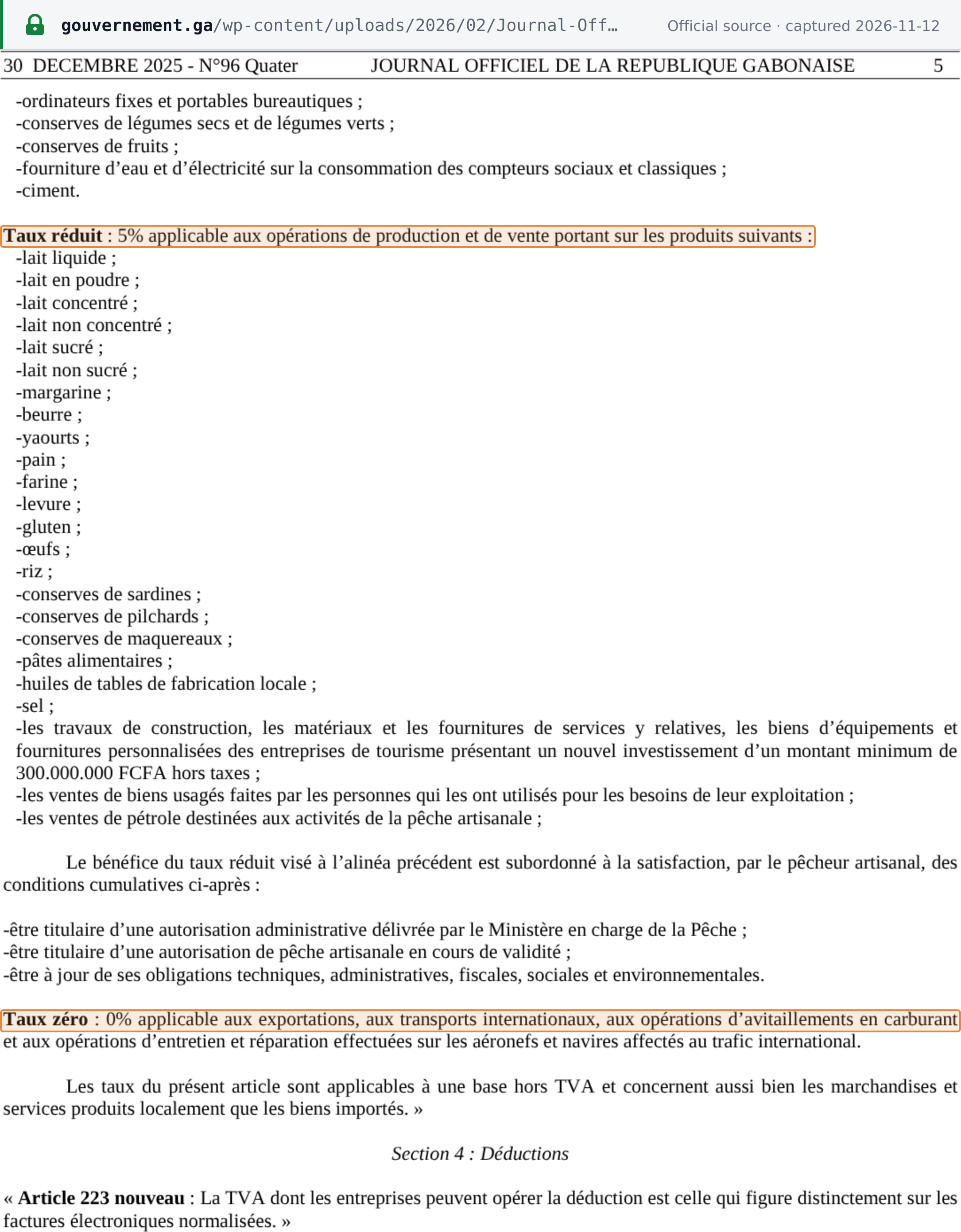
"Taux réduit : 5% applicable aux opérations de production et de vente portant sur les produits suivants": [1]
- liquid, powdered, concentrated, unconcentrated, sweetened and unsweetened milk; margarine; butter; yoghurt;
- bread; flour; yeast; gluten; eggs; rice; pasta;
- tinned sardines, pilchards and mackerel;
- locally made table oil; salt;
- construction works, materials and related services, capital goods and fittings of tourism businesses making a new investment of at least FCFA 300,000,000 excluding tax;
- sales of used goods by the persons who used them in their business;
- petroleum sold for artisanal fishing, if the fisher holds an administrative authorisation from the fisheries ministry and a valid artisanal fishing licence and is up to date with its technical, administrative, tax, social and environmental obligations.
What changed in 2026: under the CGI 2025, the foodstuffs in this list were exempt (art. 210). LF 2026 made them taxable at 5%, which also gives their producers and sellers a right to deduct input VAT (see Exempt is not zero-rated).
Zero rate: 0%
"Taux zéro : 0% applicable aux exportations, aux transports internationaux, aux opérations d’avitaillements en carburant et aux opérations d’entretien et réparation effectuées sur les aéronefs et navires affectés au trafic international."
 Source snapshot captured 2026-11-12 — original
Announced changes
No officially published text after LF 2026 changes the rates (as at 13 November 2026); the official text of the 2026 supplementary finance law mentioned above has not been published. For dated changes, see the Gabon tax-change chronology.
Cross-border rules
Imports and exports
- Imports. "La TVA perçue à l’importation est liquidée par l’Administration des Douanes et des Droits Indirects. Son recouvrement est assuré par le comptable du Trésor. La TVA à l’importation doit être obligatoirement déclarée et versée avant l’enlèvement de la marchandise" (CGI art. 238). [2] To deduct it, the importer needs a customs declaration showing its NIF and the receipt for the VAT paid.
- Import base. The customs value plus customs duties and excise duty (CGI art. 216).
- Deferral for equipment. Industrial and exporting businesses can defer import VAT on equipment above FCFA 100,000,000 (CGI art. 243 quater).
- De minimis. The VAT title of the CGI contains no low-value import relief; the CEMAC customs code is outside this page.
- Downloaded software. LF 2026 (art. 11, customs) subjects software, licences, royalties and updates to customs clearance "quel que soit le moyen d’entrée au Gabon". Software acquired by download under tariff heading 8523.80.00100 must be declared in detail, under rules still to be set by separate texts. [1]
- Exports. Zero-rated (art. 221). The monthly return must list the customs references of the month's exports (art. 237), and exporters can claim refunds of VAT credits (see Credits and refunds).
Digital services and platforms
- What is caught. Taxable operations expressly include "Les ventes de biens et les prestations de services effectuées sur le territoire gabonais ou à travers les plateformes de commerce électronique étrangères ou locales", and "Les commissions perçues par les opérateurs de plateformes de commerce et de prestation de service en ligne" on those sales (CGI art. 209, items 10 and 11). [2]
- Place of supply. Intangible services, including "les services fournis par voie électronique, notamment par téléchargement", are taxable in Gabon when the customer is established there (art. 211 ter 2).
- Registration. "Les plateformes de commerce et de prestations de service en ligne situées à l’étranger doivent procéder à leur immatriculation en ligne suivant une procédure simplifiée dont le formulaire est fourni par l’administration fiscale" (CGI art. P-817 ter). [2] Failing to register falls under the FCFA 250,000 fine of art. P-1002.
- Threshold. The CGI states no separate threshold for foreign platforms or digital service providers.
For how other countries tax these supplies, see VAT on digital services from non-resident suppliers.
Foreign companies selling into Gabon — B2B and B2C
- B2B (Gabonese business customer). The customer withholds the VAT: "Pour les redevables non-résidents, la TVA, retenue à la source, doit être payée par la personne cliente pour le compte de la personne n’ayant pas au Gabon un établissement stable ou une installation professionnelle permanente" (CGI art. 240). [2] The client declares it on the annex of its CA01 return for VAT paid on behalf of third parties: "La déclaration de TVA pour compte de tiers concerne la TVA à reverser pour le compte des contribuables non résidents." [6] The CSS is withheld the same way. Whether, and how, the client can then deduct that VAT is not settled by the texts: article 224 of the CGI 2025 blocks the deduction of VAT on "les services disponibles sur le territoire national, rendus par un prestataire étranger", and the LF 2026 version of article 223 allows deduction only of VAT shown on a FEN, which a foreign supplier does not issue.
- B2C (consumers), goods and services through platforms. Foreign online platforms register under the simplified procedure of art. P-817 ter (above). Other non-resident businesses active in Gabon appoint an accredited solvent representative (art. P-817); if they do not, the client is treated as the representative.
- Marketplace / deemed-supplier liability. The CGI taxes platform commissions (art. 209 item 11) and makes foreign platforms register, but it contains no rule making a platform liable for the VAT on its sellers' sales. See Marketplace deemed-supplier rules for how other countries do it.
For the general mechanisms, see VAT withholding regimes and Reverse charge.
Withholding on public contracts
The Treasury withholds (précompte) part of the VAT on payments under contracts with the State, local authorities and autonomous administrations: "Le précompte effectué est égal à 40 % du montant de la taxe due sur les marchés ou telle qu’elle est prévue dans la convention ou sur la facture" (CGI art. 239). [2]
Place of supply
- Goods. "Une affaire est réputée faite au Gabon, s’il s’agit d’une vente, lorsque celle-ci est réalisée aux conditions de livraison de la marchandise au Gabon" (CGI art. 211 bis); goods installed or assembled in Gabon are also covered. [2]
- Services (general rule). "Une prestation de services est réputée faite au Gabon lorsque le service rendu, le droit cédé ou l’objet loué sont utilisés ou exploités au Gabon" (art. 211 ter). Services that are physically located are taxed where they are performed.
- Intangible services. "Les prestations de services immatérielles sont imposables au Gabon si le preneur y est établi" (art. 211 ter 2). The list includes licences of intellectual property, advertising, consultancy, legal and accounting services, data processing, banking, staff secondment, telecommunications, broadcasting and electronically supplied services.
- International transport. Taxable in Gabon when the carrier is domiciled there.
Invoice requirements
Legal basis since 2026: every operation needs a FEN
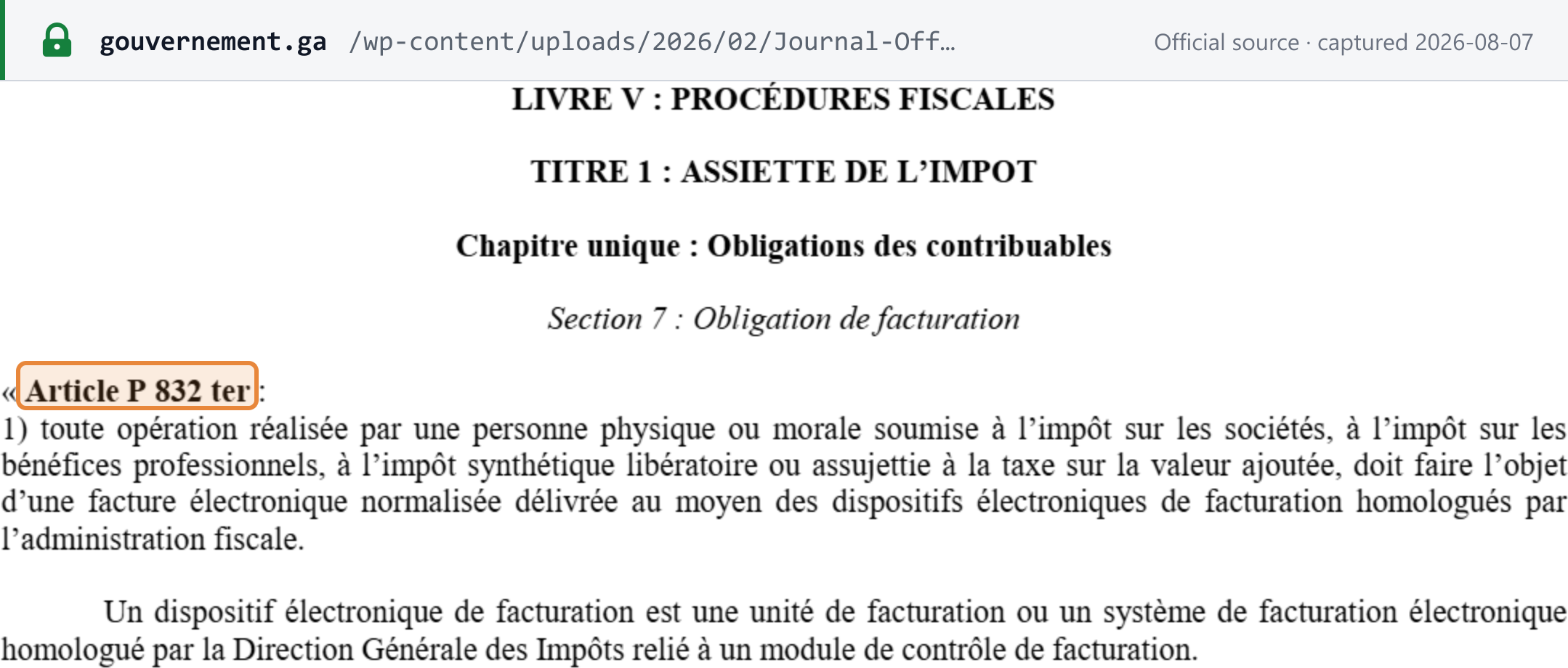
LF 2026 inserted a new invoicing obligation in the procedural book of the CGI. Article P 832 ter 1) reads: [1]
"toute opération réalisée par une personne physique ou morale soumise à l’impôt sur les sociétés, à l’impôt sur les bénéfices professionnels, à l’impôt synthétique libératoire ou assujettie à la taxe sur la valeur ajoutée, doit faire l’objet d’une facture électronique normalisée délivrée au moyen des dispositifs électroniques de facturation homologués par l’administration fiscale."
- Device. A dispositif électronique de facturation (DEF) is an invoicing unit or electronic invoicing system homologated by the DGI and linked to an invoice-control module. It exists in physical and dematerialised form, and the DGI provides the dematerialised version to taxpayers.
- Business systems. Invoicing systems sold or built in-house must meet DGI technical specifications, be homologated before any use in Gabon, and respect "les critères d’inaltérabilité, de sécurisation, de conservation et d’archivage des données" (art. P 832 ter 2). The homologation rules are left to an order (arrêté) of the finance minister (art. P 832 ter 3).
- Buyers. Buyers "sont tenues d’exiger et de se faire délivrer, à l’occasion de leurs achats, la facture électronique normalisée" (art. P 832 quater).
- No value floor. LF 2026 states "L’article 234 est supprimé". Article 234 had required an invoice in the administration's standard model for amounts of FCFA 300,000 or more. [1]
Mandatory content of the FEN
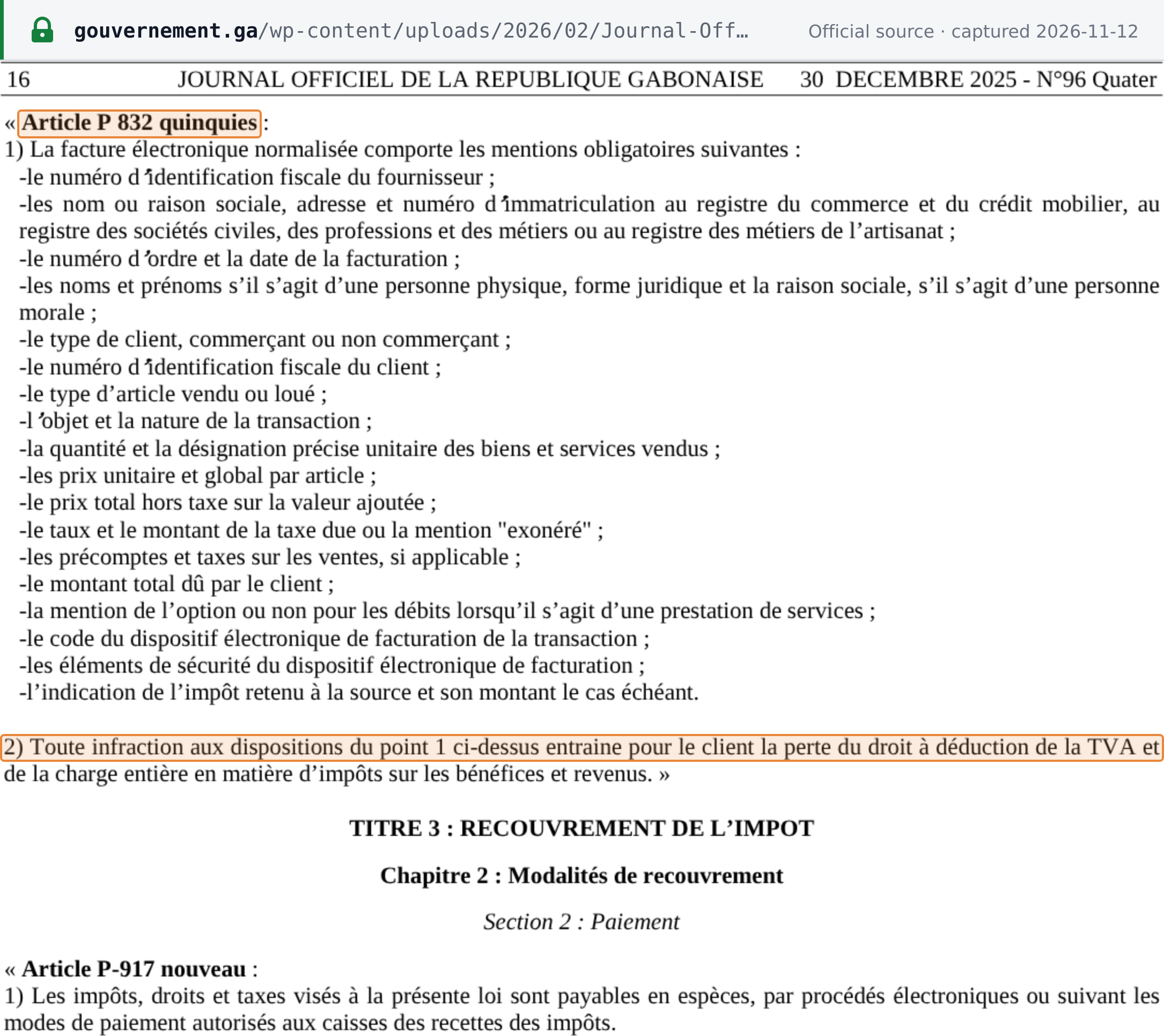
CGI art. P 832 quinquies 1) lists the mandatory particulars ("mentions obligatoires"). [1] Numbered here in the order of the law:
| # | Particular | Law's wording |
|---|---|---|
| 1 | Supplier's NIF | le numéro d’identification fiscale du fournisseur |
| 2 | Supplier's name or business name, address and registration number in the trade register (RCCM), civil-company and professions register or crafts register | les nom ou raison sociale, adresse et numéro d’immatriculation au registre … |
| 3 | Invoice sequence number and date | le numéro d’ordre et la date de la facturation |
| 4 | Client's surname and first names (individual), or legal form and business name (company) | les noms et prénoms … forme juridique et la raison sociale |
| 5 | Client type: trader or non-trader | le type de client, commerçant ou non commerçant |
| 6 | Client's NIF | le numéro d’identification fiscale du client |
| 7 | Type of article sold or hired | le type d’article vendu ou loué |
| 8 | Purpose and nature of the transaction | l’objet et la nature de la transaction |
| 9 | Quantity and precise unit description of the goods and services | la quantité et la désignation précise unitaire des biens et services vendus |
| 10 | Unit and total price per article | les prix unitaire et global par article |
| 11 | Total price excluding VAT | le prix total hors taxe sur la valeur ajoutée |
| 12 | VAT rate and amount, or the word "exonéré" | le taux et le montant de la taxe due ou la mention "exonéré" |
| 13 | Withholdings and sales taxes, if applicable | les précomptes et taxes sur les ventes, si applicable |
| 14 | Total amount due from the client | le montant total dû par le client |
| 15 | For services, whether the supplier has opted to account for VAT on invoicing (débits) | la mention de l’option ou non pour les débits … |
| 16 | Code of the electronic invoicing device used | le code du dispositif électronique de facturation de la transaction |
| 17 | Security elements of the device | les éléments de sécurité du dispositif électronique de facturation |
| 18 | Tax withheld at source and its amount, where applicable | l’indication de l’impôt retenu à la source et son montant le cas échéant |
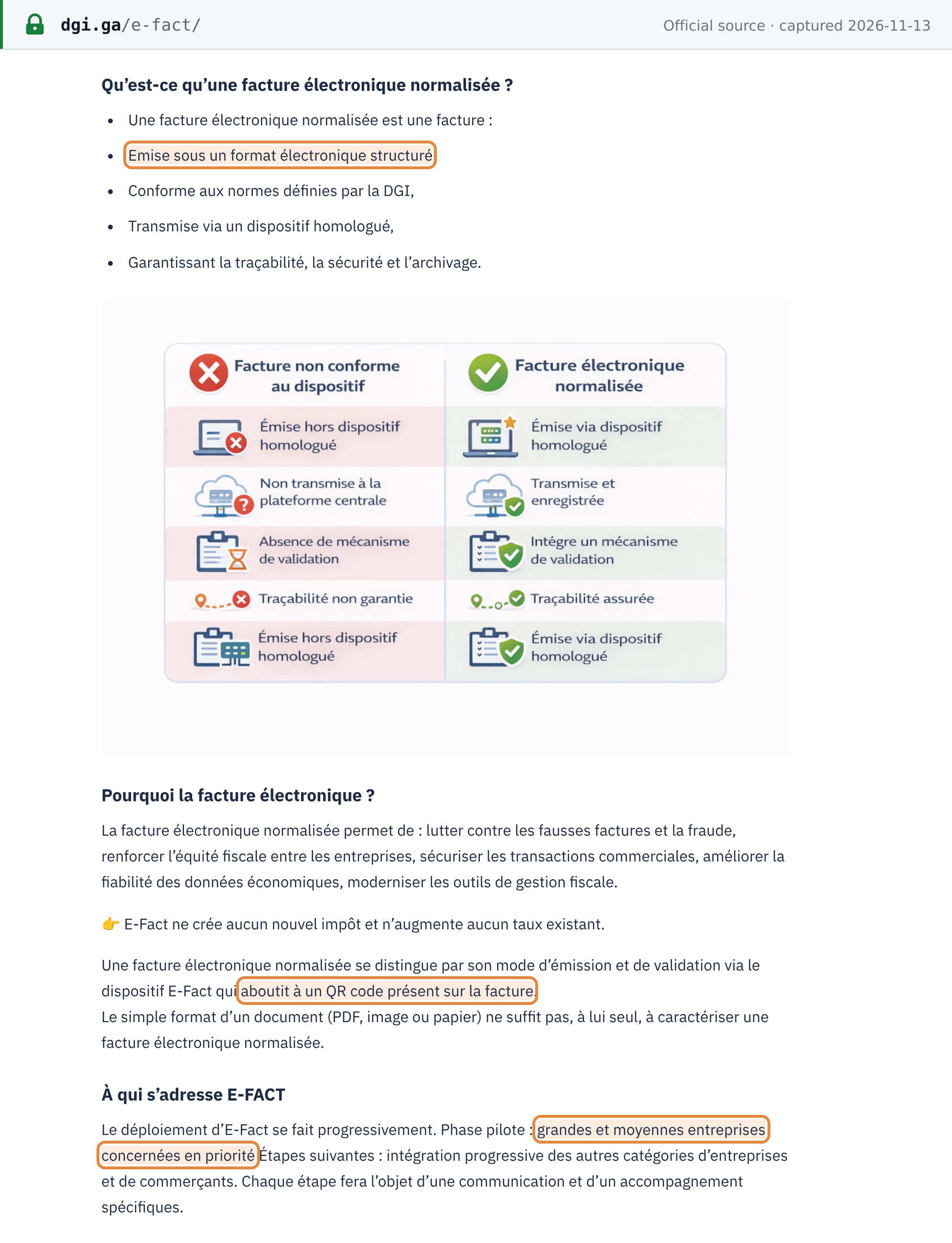
Consequence of a defect. "Toute infraction aux dispositions du point 1 ci-dessus entraine pour le client la perte du droit à déduction de la TVA et de la charge entière en matière d’impôts sur les bénéfices et revenus" (art. P 832 quinquies 2). The supplier also faces the invoicing fines in Offences and penalties. In practice the security elements appear as a QR code: the DGI says a FEN is validated through E-Fact "qui aboutit à un QR code présent sur la facture". [4]
 Source snapshot captured 2026-11-12 — original
Other content rules still in force
- Tax-inclusive invoices to consumers. "La facture délivrée à un non assujetti peut être établie pour un montant toutes taxes comprises" (CGI art. 236, not repealed by LF 2026). [2]
- Partly exempt businesses. Taxable and non-taxable operations must be separated, and each invoice shows "le montant non taxable de l’opération ; le montant taxable, le taux applicable et le montant de la TVA" (art. 235).
- Both NIFs. Missing NIFs block the deduction (art. P-1004, above).
A specimen of a compliant invoice
The DGI publishes no specimen FEN: its E-Fact page, its document library and the text of LF 2026 contain no model invoice (as at 13 November 2026). The layout below is our illustration of where the particulars of art. P 832 quinquies sit; the numbers in the margin refer to the table above.
FACTURE ÉLECTRONIQUE NORMALISÉE — illustrative specimen (Gabon)
| Type d'article(7) | Désignation (objet et nature)(8), (9) | Qté(9) | Prix unitaire HT (FCFA)(10) | Prix global HT (FCFA)(10) |
|---|---|---|---|---|
| Prestation de services | Audit des procédures de facturation — mission de 4 jours | 4 | 125 000 | 500 000 |
| Vente de biens | Licence de logiciel de gestion (exemplaire) | 1 | 100 000 | 100 000 |
- Prix total hors TVAP 832 quinquies (11)
- 600 000 FCFA
- TVA 18 %P 832 quinquies (12); CGI art. 221
- 108 000 FCFA
- Montant total dû par le clientP 832 quinquies (14)
- 708 000 FCFA
- Code du dispositif électronique de facturation: [DEF-CODE-SPECIMEN] — added by the homologated device (P 832 quinquies (16)).
- Éléments de sécurité: [QR code E-Fact] — produced when E-Fact validates the invoice (P 832 quinquies (17)).
- Where applicable, withholdings and sales taxes (13) and tax withheld at source with its amount (18) are shown.
- An exempt line carries the word « exonéré » instead of a VAT rate and amount (P 832 quinquies (12)).
Issuance timing, numbering and document types
- Issuance. The CGI sets no deadline of so many days after the supply; under art. P 832 ter a FEN is issued for each operation through the device. VAT becomes chargeable on delivery for goods and on collection for services, unless the supplier opts for the débits basis (CGI arts. 212 and 213).
- Numbering. The FEN must carry a sequence number ("numéro d’ordre", P 832 quinquies). The CGI sets no further sequencing rule.
- Document types. Since LF 2026 there is one document, the FEN, with no value floor and no simplified-invoice category. Invoices to non-taxable customers may show a tax-inclusive price (art. 236).
- Self-billing. The CGI contains no self-billing provision.
- Currency and language. The VAT title of the CGI sets no invoice currency, language or exchange-rate rule. Because the taxable base is rounded to the thousand FCFA (art. 220), the VAT is computed in FCFA.
Credit notes and corrections
CGI article 231 governs corrections: [2]
- Cancelled or rescinded operations. Recovering the VAT requires "l’établissement et … l’envoi au client d’une facture nouvelle, remplaçant la facture initiale".
- Unpaid operations. When the debt is really and definitively irrecoverable, the supplier sends a duplicate of the original invoice overprinted with « facture demeurée impayée pour la somme de… prix hors TVA et pour la somme de… TVA correspondante qui ne peut faire l’objet d’une déduction ».
The DGI has not published how a replacement invoice or credit note is issued inside E-Fact.
Retention and audit trail
- Retention. Books, registers, documents and invoices "doivent être conservés pendant un délai de 10 ans, à compter de la date de la dernière opération mentionnée sur les livres ou registres ou de la date à laquelle les documents ou pièces ont été établis" (CGI art. P-890, 2025 Finance Law wording). Electronic records are kept in electronic form. [2]
- Location. The accounts must be kept in Gabon: "Cette comptabilité doit être disponible au Gabon" (art. 233).
- Audit trail. Homologated invoicing systems must guarantee "inaltérabilité", security, conservation and archiving of the data for tax audits (art. P 832 ter 2), and tampering with a device after its certificate of conformity is fined (art. P-1005, below).
E-invoicing status
Status as at 13 November 2026: mandatory in law since the 2026 Finance Law, rolled out in phases by the DGI. The system is E-Fact, the DGI's facture électronique normalisée (FEN).
- Legal basis. Article P 832 ter (above) requires a FEN, issued through a DGI-homologated device, for every operation by a person subject to corporate tax, business profits tax, the impôt synthétique libératoire or VAT. LF 2026 also made the FEN the condition of VAT deduction: "La TVA dont les entreprises peuvent opérer la déduction est celle qui figure distinctement sur les factures électroniques normalisées" (CGI art. 223 nouveau). [1]
- Transition. "A titre exceptionnel et pendant une durée de six (6) mois à compter de la date de promulgation de la présente loi", a business could deduct VAT by producing a document proving payment of customs duties instead of a FEN. The law was promulgated by Décret n°0536/PR of 29 December 2025, so the six months ran from that date and ended on 29 June 2026. The same six-month alternative applied to the deductibility of expenses for corporate tax (CGI art. 11 nouveau, LF 2026). [1] [1]
- What a FEN is, per the DGI. "Une facture électronique normalisée est une facture : Emise sous un format électronique structuré, Conforme aux normes définies par la DGI, Transmise via un dispositif homologué, Garantissant la traçabilité, la sécurité et l’archivage." It is validated through E-Fact, which adds a QR code to the invoice, and "Le simple format d’un document (PDF, image ou papier) ne suffit pas, à lui seul, à caractériser une facture électronique normalisée." [4] The DGI's reforms page says every invoice must carry "un QR code fiscal certifié par la DGI". [8]
- How to issue. Through a physical DEF, a homologated dematerialised solution, or the business's existing software if it is compliant (DGI E-Fact page).
- Phasing. "Phase pilote : grandes et moyennes entreprises concernées en priorité"; then "Étapes suivantes : intégration progressive des autres catégories d’entreprises et de commerçants." The DGI adds that "Aucune sanction automatique n’est appliquée pendant la phase pilote". The page gives no dates for either phase, and no DGI announcement of the end of the pilot is published (as at 13 November 2026).
- Format and standards. A structured electronic format that conforms to the standards set by the DGI (DGI E-Fact page). No public schema, API specification or network standard (UBL, Peppol) is published, and the homologation order of art. P 832 ter 3) is not published on the DGI or government websites (as at 13 November 2026).
- Device credit. Buyers of a physical invoicing device can claim a one-off, non-transferable tax credit against profits tax or the impôt synthétique libératoire for the year of purchase, for one device (art. P 832 ter 4).
- Model. Each invoice is issued through a homologated device linked to a DGI invoice-control module and validated by E-Fact, which adds the QR code. For how such models compare, see E-invoicing models: clearance, reporting and interchange and, for device-based systems, Fiscal devices and certified cash registers.
Scope.
- B2B and B2C. The statute covers "toute opération", whoever the customer is. The buyer's VAT deduction depends on receiving a FEN (art. 223).
- B2G. Covered by the same rule; LF 2026 has no separate public-procurement provision.
- Pilot. In practice, large and medium enterprises come first (DGI E-Fact page).
 Source snapshot captured 2026-11-13 — original
 Source snapshot captured 2026-08-07 — original
For the dated record, see the Gabon e-invoicing event. For a neighbouring CEMAC system, see Congo (Brazzaville) e-invoicing.
Filing and payment
Filing frequency and due date
- Frequency. Monthly for every VAT taxpayer; the CGI provides no quarterly or annual option.
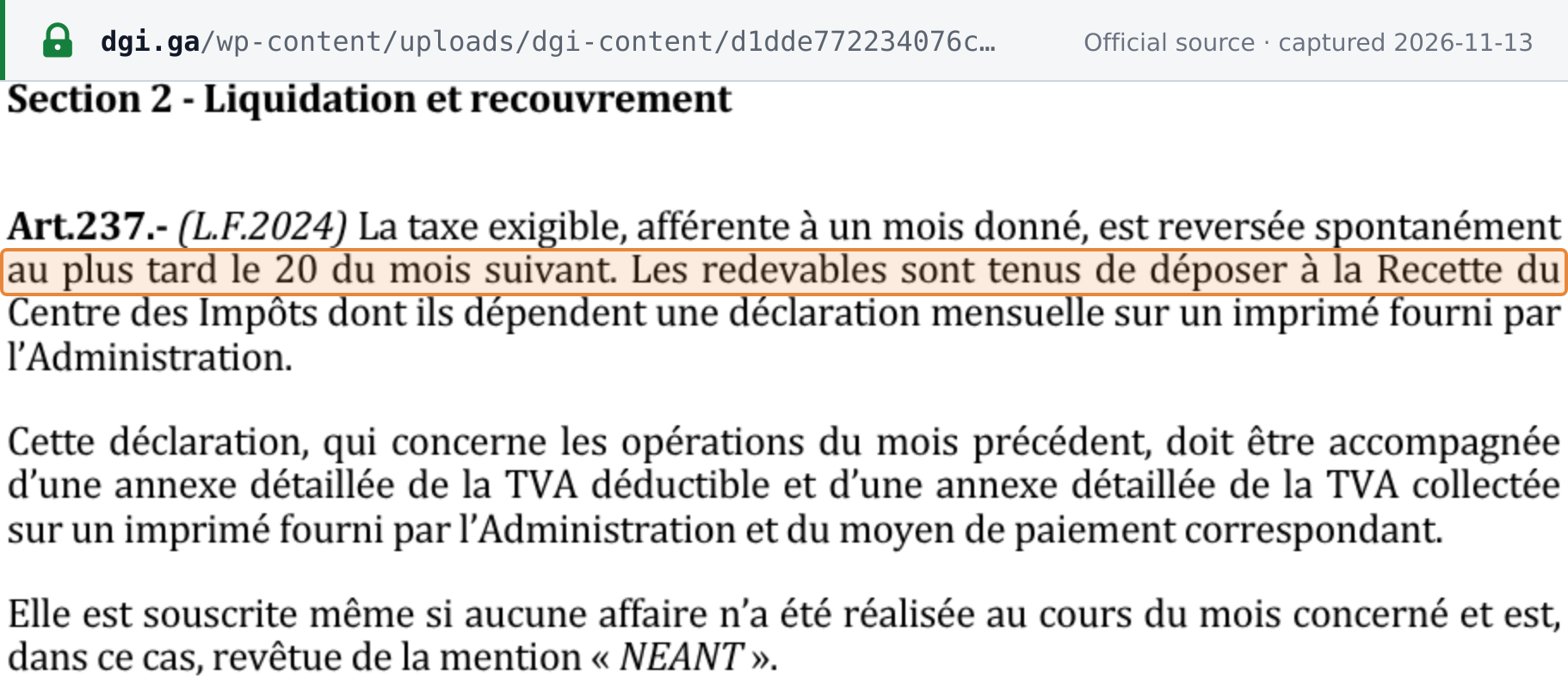
- Due date. "La taxe exigible, afférente à un mois donné, est reversée spontanément au plus tard le 20 du mois suivant" (CGI art. 237, 2024 Finance Law wording). [2] The return and the payment are due together; the CA01 return form states "Date limite de dépôt ; le 20 de chaque mois (art. 237 du CGI)". [6]
- Nil returns. A return is due even with no activity, marked « NEANT ».
- Annexes. A detailed annex of deductible VAT and one of collected VAT, the customs references of the month's exports, and the annex for VAT withheld on behalf of non-residents (art. 240).
- Extensions. Only the DGI can move a deadline, by communiqué. After power cuts, it moved the October 2026 deadline to Monday 26 October 2026 and stated "aucune pénalité de retard ne sera appliquée". [9]
 Source snapshot captured 2026-11-13 — original
Where to file: Digitax and e-tax
Returns are filed electronically: "Les personnes visées à l’article précédent sont tenues de souscrire leurs déclarations par voie électronique" (CGI art. P-818 bis); where internet access is impossible, the return can be filed at the tax office or the nearest Treasury post. [2] The DGI's online platform is Digitax, with filing and payment in the e-t@x space: "depuis le 8 avril 2024, les grandes et moyennes entreprises sont désormais tenues d’effectuer toutes leurs obligations fiscales via Internet". [7]
Payment method
LF 2026 rewrote CGI article P-917: [1]
- taxes are payable in cash, electronically or by other authorised means at the tax collection offices, and a payment made elsewhere or without a receipt is not valid;
- "Les paiements d’un montant supérieur ou égal à 500.000 FCFA sont effectués par virement ou par porte-monnaie électronique";
- taxpayers of the large-enterprise directorate (DGE) and the medium-enterprise tax centres (CIME) pay "uniquement par voie électronique ou via e-tax".
Input-tax recovery
- Timing. The right to deduct arises when the VAT becomes chargeable; omitted deductions can be made up to the 12th month after (CGI art. 222). [2]
- Document. For purchases from Gabonese suppliers, only VAT shown on a FEN is deductible (art. 223, LF 2026), and both parties' NIFs must appear (art. P-1004). Import VAT needs the customs declaration with the importer's NIF and the payment receipt (art. 238).
- Status. Only an assujetti with a NIF can recover VAT (art. 232).
- Blocked items (art. 224). VAT on lodging, accommodation, restaurant, entertainment, shows and passenger transport (except for businesses in those sectors); imports re-exported unchanged; petroleum products (except fuel for fixed plant and industrial inputs); gifts above FCFA 10,000; goods and services used by third parties, managers or staff; and "les services disponibles sur le territoire national, rendus par un prestataire étranger".
- Vehicles (art. 225). Passenger and mixed-use vehicles, their hire, parts and services, with listed exceptions.
- Partial exemption. Businesses with taxable and exempt operations deduct by prorata (arts. 226 and 227).
Credits and refunds
Excess input VAT is carried forward "jusqu’à épuisement, sans limitation de délai", and "Le crédit d’impôt ne peut faire l’objet d’un remboursement au profit de l’assujetti en dehors des cas prévus par la loi" (CGI art. 243). [2] Refunds are available only to (art. 243 bis):
- Exporters, claiming "dans le délai d’un an à compter de la date de la naissance du crédit", capped at the notional VAT on export turnover;
- Buyers of new depreciable fixed assets carrying VAT of FCFA 20,000,000 or more, claiming within three months of the acquisition;
- Businesses ceasing definitively, with the cessation declaration (not on a merger).
Claims go on the administration's form (CA02) with the VAT return, and are granted only if the business is up to date with all its tax obligations; they must be backed by a list of suppliers (NIF and name, period, amounts excluding VAT, VAT deducted), plus export certificates for exporters (art. 243 ter). Refunds are subject to prior control by the tax administration and a later check by the budget controller (LF 2024 art. 20, as noted in the CGI 2025). The CGI has no refund scheme for non-residents and no general refund for other credit positions. Bad-debt relief works through the duplicate invoice of art. 231 (above).
Exemptions
Exempt supplies
LF 2026 (art. 4) rewrote CGI article 210, which now lists 19 headings. [1] In summary:
- unprocessed local agricultural, livestock, fishing and hunting produce sold directly to the consumer by the producer;
- operations subject to specific taxes instead: quarry products, insurance and reinsurance (including brokers), interest on external loans and on non-professionals' deposits, gambling, transfers of property and intangibles subject to registration duty, and civil leases of bare land and unfurnished premises;
- international-traffic operations;
- printing, import and sale of school textbooks, newspapers and periodicals (excluding advertising); school and university fees; postal and fiscal stamps; the central bank;
- member services of non-profit bodies (unless they compete with businesses);
- medical services: "les examens, consultations, soins, hospitalisations, travaux d’analyse et de biologies médicales et les fournitures de prothèses", and materials and products for the fight against HIV/AIDS, tuberculosis, yellow fever and certain severe viral infections;
- agricultural and livestock capital goods, and fertilisers and phytosanitary products on a ministerial list;
- imports exempt under articles 332 and 333 of the CEMAC Customs Code, and fishing boats and aircraft operated by their importers;
- "Les ventes de gaz butane";
- mining-code imports of depreciable goods on a ministerial list;
- cost-sharing services of economic interest groupings to exempt members;
- financing of social housing; "Les prêts immobiliers d’un montant inférieur à 50.000.000 FCFA, accordés à des personnes physiques pour l’acquisition ou la construction d’une résidence au Gabon"; equipment imports and construction works for approved socio-economic housing;
- "L’importation ou l’acquisition par les entreprises et les personnes physiques de matériels et équipements servant à la production et à la promotion des énergies renouvelables."
Medicines. The CGI 2025 version of article 210 listed "médicaments ; produits pharmaceutiques" among exempt goods. The LF 2026 rewrite does not list them, and they are not in the 5% or 10% lists either. Check their current treatment with the DGI.
Suspension of exemptions granted by agreement. On 8 September 2026 the Minister of Economy suspended tax and customs exemptions granted by agreements (conventions) and administrative decisions: "Désormais, aucune nouvelle exonération fiscale ou douanière ne pourra être accordée jusqu’à nouvel ordre. La suspension concerne également les avantages précédemment consentis sur la base de conventions ou de décisions administratives." [10] This targets negotiated and administrative exemptions, not the statutory list of article 210.
Exempt is not zero-rated
Input VAT is deductible only on costs of taxable operations: "La TVA ayant grevé en amont les éléments du prix d’une opération imposable est déductible" (CGI art. 222). So:
- an exempt supply (art. 210) carries no VAT and gives no right to deduct the VAT on the costs behind it;
- a zero-rated supply (exports, international transport, art. 221) carries no VAT but keeps the deduction, and exporters can claim refunds (art. 243 bis).
The 2026 move of milk, bread, rice and other staples from exempt to 5% is an example: the sellers now charge 5% but can deduct their input VAT. See Zero-rated vs exempt supplies.
Special regimes
- Diplomatic missions. Exemptions on a reciprocity basis (CGI arts. 244 and 245).
- Mining. Refund of VAT charged by local suppliers during exploration (art. 246) and exemption of listed assets (art. 247).
- Petroleum. The regime of Loi n°011/2014 (art. 248).
- Real estate. TVA immobilière at 18% on property operations by real-estate professionals (arts. 248 ter to 248 sexies). [2]
- Second-hand goods. Taxed on the margin (art. 215); sales of used goods by the business that used them are at 5% (art. 221).
- Cash or invoice basis. VAT on services is due on collection, with an option for the débits (invoice) basis (art. 213).
- Small businesses. Businesses under FCFA 60,000,000 are outside VAT unless they are legal persons that opt in (arts. 208 and 208 bis).
Offences and penalties
Offences
- Tax fraud. "Sont passibles d’un emprisonnement de quinze jours à un an et d’une amende de 500.000 à 5.000.000 FCFA ou de l’une de ces deux peines, seulement quiconque : se soustrait frauduleusement ou tente de se soustraire frauduleusement à l’établissement, au paiement, au reversement total ou partiel des impôts, droits et taxes visés dans le Code Général des Impôts ; refuse expressément de faire sa déclaration dans les délais prescrits ; dissimule une part des sommes sujettes à l’impôt ; organise son insolvabilité ou fait obstacle au recouvrement de l’impôt" (CGI art. P-1024). [2] False entries, false balance sheets and false documents to obtain refunds are covered by art. P-1025, repeat offences by P-1027, company managers' liability by P-1028, and a court may ban the offender from trading (P-1030).
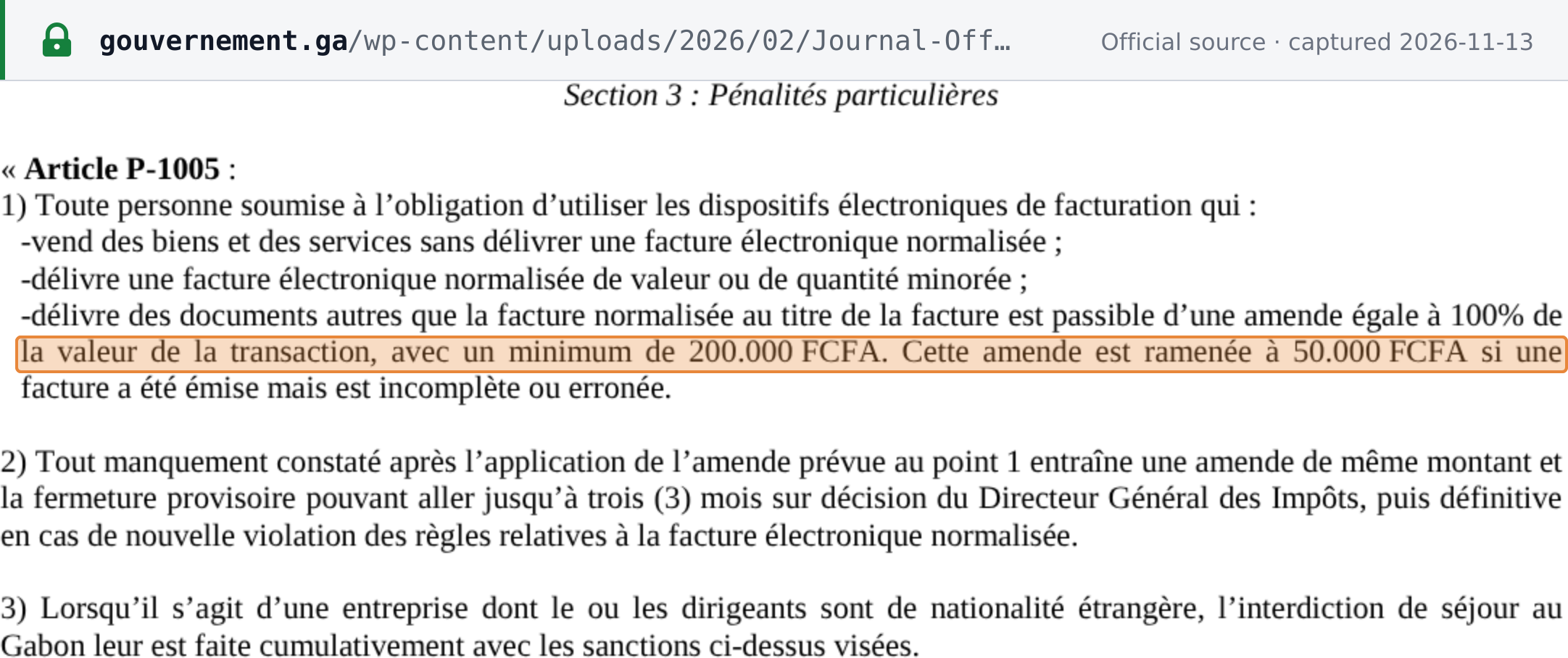
- Invoicing offences (LF 2026). Selling without a FEN, issuing an understated FEN, issuing another document in place of a FEN, tampering with or intruding into an invoicing device or the DGI's servers, distributing non-homologated devices, and using non-homologated invoicing software (art. P-1005). Repeat breaches lead to closure of the business, and foreign managers face a ban on residence in Gabon.
- Failure to register and failure to file are sanctioned by the fines below; persistent non-filing can also lead to blocked bank accounts, administrative closure, exclusion from public procurement and an import ban (art. P-1007).
Penalties
| Breach | Penalty | Source |
|---|---|---|
| Late or missing registration, or failure to declare changes | FCFA 250,000 flat | CGI art. P-1002 |
| Return filed late, before formal notice | 5% of the duties declared; 10% if filed within 7 days of formal notice | CGI art. P-998 |
| No return after formal notice | Assessment by the administration with a 100% surcharge (150% on repeat); for VAT, loss of the deduction and of earlier credits | CGI arts. P-999, P-1006 |
| Nil return not filed | FCFA 100,000; after formal notice FCFA 200,000 per month, up to FCFA 2,000,000 | CGI art. P-1001 |
| Under-declaration | Late interest of 1.5% a month, capped at 50%; plus 100% (bad faith) or 150% (fraudulent manoeuvres), increased by 50% for VAT | CGI arts. P-996, P-997 |
| Late payment | LF 2026 rewrote art. P-1000: late, missing or partial payment by DGE and CIME taxpayers incurs a penalty of 10% plus the late-payment interest "prévu à l’article P-917", but article P-917 sets no interest rate, so the rate is not fixed by the text. The CGI 2025 version of P-1000 set interest of 10% for the first month and 3% for each following month, capped at 150% for indirect taxes | CGI art. P-1000 (LF 2026; CGI 2025 wording) |
| No FEN, understated FEN, or another document instead of a FEN | 100% of the transaction value, minimum FCFA 200,000 | CGI art. P-1005 1) (LF 2026) |
| FEN issued but incomplete or erroneous | FCFA 50,000 | CGI art. P-1005 1) |
| Repeat FEN breach | Same fine plus closure for up to 3 months by decision of the Director General of Taxes, then permanent closure | CGI art. P-1005 2) |
| Tampering with or intruding into an invoicing device, distributing non-homologated devices, using non-homologated software | FCFA 5,000,000 | CGI art. P-1005 4) |
| Software vendors not compliant in time, or installing non-homologated systems | FCFA 5,000,000; FCFA 10,000,000 on repeat | CGI art. P-1005 5) |
| Fraudulent or falsified FEN, or identity theft to issue FEN | FCFA 1,000,000 per invoice | CGI art. P-1005 6) |
| Any other unspecified breach of the electronic invoicing device rules | FCFA 1,000,000 | CGI art. P-1005 7) |
| Obstructing the right of communication | FCFA 5,000,000, plus FCFA 500,000 per day | CGI art. P-1003 |
Sources: CGI 2025 arts. P-996 to P-1007 [2]; LF 2026 art. P-1000 [1] and art. P-1005 [1]. The LF 2026 version of P-1005 replaces the earlier one, whose minimum fine was FCFA 500,000.
 Source snapshot captured 2026-11-13 — original
Frequently asked questions
Are milk, rice and bread exempt from VAT in Gabon or taxed at 5%?
Under the 2026 Finance Law (Loi n°041/2025), they are taxed at the reduced rate of 5%. Until 2025, article 210 of the Code Général des Impôts listed these staples among exempt goods. The 2026 Finance Law rewrote article 221 to put milk, margarine, butter, yoghurt, bread, flour, yeast, gluten, eggs, rice, tinned sardines, pilchards and mackerel, pasta, locally made table oil and salt in the 5% list. Because they are now taxable, a producer or seller of these goods can deduct the VAT on its purchases, which was not possible while they were exempt.
Can we deduct the VAT on an ordinary invoice from a Gabonese supplier that is not a FEN?
Not under the 2026 Finance Law. Article 223 of the Code Général des Impôts, as rewritten, allows a deduction only for VAT shown distinctly on a facture électronique normalisée (FEN). A FEN that lacks one of the mandatory particulars in article P 832 quinquies also costs the client its VAT deduction. For six months from the law's promulgation on 29 December 2025, ending on 29 June 2026, a document proving payment of customs duties could be produced instead of a FEN. The DGI's E-Fact page describes a progressive rollout that starts with large and medium enterprises and says that no automatic sanction is applied during the pilot phase, but the statute itself makes no exception for suppliers outside the pilot.
Do small invoices under FCFA 300,000 still need to be FEN?
Yes, on the text of the 2026 Finance Law. Article 234 of the Code Général des Impôts required an invoice in the standard model for amounts of FCFA 300,000 or more; the 2026 Finance Law deleted it. Article P 832 ter now requires a facture électronique normalisée for every operation by a person subject to corporate tax, business profits tax, the impôt synthétique libératoire or VAT, with no value floor. An invoice to a customer that is not registered for VAT may still show a tax-inclusive amount (article 236).
Our Gabonese client paid our invoice net of VAT. Why?
Two rules can explain it. If you are a non-resident without a permanent establishment in Gabon, article 240 of the Code Général des Impôts makes the Gabonese client withhold the VAT and pay it to the tax office on your behalf, using the annex for VAT paid on behalf of third parties on its monthly return. If your client is the State, a local authority or an autonomous public body, article 239 makes the Treasury withhold 40% of the VAT due on payments under public contracts.
Can a sole trader register for VAT voluntarily in Gabon?
No. Article 208 bis of the Code Général des Impôts lets new businesses and businesses below the FCFA 60,000,000 threshold opt into VAT, but one of the conditions is being a legal person (personne morale). The others are an express request to the tax office, no VAT assessment or collection penalties within the limitation period, and proof of solvency. An individual trader can become liable only by reaching the threshold.
What happens if the VAT deadline on the 20th cannot be met because the online portal is down?
The legal deadline stays the 20th of the following month (article 237 of the Code Général des Impôts), and only the DGI can move it, by communiqué. It has done so: after power cuts, a DGI communiqué moved the October 2026 deadline to Monday 26 October 2026 and stated that no late-payment penalty would be applied. Where internet access is impossible, article P-818 bis allows the return to be filed at the tax office or the nearest Treasury post.
Important websites
| Site | What it is for |
|---|---|
| Direction Générale des Impôts (DGI) | Tax authority: guidance, communiqués and deadline extensions |
| E-t@x (login) | Filing and paying returns online |
| Digitax | The DGI's online services platform; mandatory for large and medium enterprises |
| E-Fact | The standardised electronic invoice (FEN): what it is, the QR code and the pilot |
| ANPI-Gabon one-stop shop | Business creation; the DGI's registration page directs companies here |
| DGI document library | Forms: IM01 (registration), CA01 (VAT return), CA02 (refund claim) |
| Code Général des Impôts 2025 | The consolidated tax code published by the DGI |
| Douanes gabonaises | Customs, including VAT on imports |
No public NIF verification service is published by the DGI (as at 13 November 2026).
Recent changes
- 2026-10-23 — DGI communiqué moves the October 2026 filing and payment deadline to Monday 26 October 2026 after power cuts, with no late-payment penalty. (DGI)
- 2026-09-08 — Tax and customs exemptions granted by agreements and administrative decisions suspended; no new exemption until further notice. (Gouvernement de la République Gabonaise)
- 2025-12-29 — The 2026 Finance Law (Loi n°041/2025) promulgated: FEN mandatory for every operation (CGI art. P 832 ter to quinquies) and the only invoice giving a VAT deduction (art. 223), with a six-month transition from promulgation; staples moved from exempt to 5%, several 5% items moved to 10% (art. 221); exemption list rewritten (art. 210); art. 234 deleted; new invoicing penalties (art. P-1005). (Journal Officiel n°96 Quater) — see event
For the full chronology, see Gabon tax changes on Lookuptax.
Reference links
Legislation:
- [1] Loi n°041/2025 du 29 décembre 2025 déterminant les ressources et les charges de l'État pour l'année 2026 — Journal Officiel n°96 Quater spécial, 30 December 2025 (government page)
- [2] Code Général des Impôts 2025 (consolidated, DGI)
Tax authority (DGI):
- [3] DGI — TVA
- [4] DGI — E-Fact
- [5] DGI — Immatriculation des entreprises
- [6] DGI — Form CA01, VAT return
- [7] DGI — Digitax
- [8] DGI — Réformes
- [9] DGI — communiqué: October 2026 filing and payment deadline moved to 26 October 2026
Government:
Related on Lookuptax: