Georgia (country) VAT guidelines
| FACTSHEET | |
|---|---|
| Country code | GE |
| Tax name | Value Added Tax (VAT) — დამატებული ღირებულების გადასახადი (დღგ) |
| Tax Authority | Revenue Service of the Ministry of Finance of Georgia |
| Standard rate | 18% (single rate) |
| Registration threshold | GEL 100,000 in any 12 consecutive calendar months |
Overview
This guide covers Georgia, the country in the South Caucasus (capital Tbilisi), not the US state. For US sales tax, see the United States guide.
Georgia levies value added tax (VAT) — in Georgian დამატებული ღირებულების გადასახადი, abbreviated დღგ — under Section VI of the Tax Code of Georgia (Law No. 3591 of 17 September 2010). Article 156: "This Section shall define the procedure for calculating and paying the value-added tax (the ‘VAT’). … The obligation to pay the VAT shall arise at all stages of supply of goods/provision of services, including the retail supply." [1]
Authority. VAT is administered by the Revenue Service (შემოსავლების სამსახური), a legal entity of public law under the Ministry of Finance of Georgia. Taxpayers register, file and handle tax invoices on its authorised portal, service.rs.ge (eservices.rs.ge). [5]
Currency. The Georgian lari (GEL, ლარი). A transaction in a foreign currency is converted into lari at the National Bank of Georgia's official rate for the transaction day (Tax Code Art. 73(10)). [1]
Tax period. "The VAT accounting period shall be a calendar month." (Art. 167). Foreign suppliers of digital services to consumers report quarterly (see Digital services).
Layering. None. VAT is a single national tax; there is no regional or municipal VAT.
Legal sources. Article numbers on this page refer to the Tax Code's English consolidated text, publication 247 on Matsne (the Legislative Herald of Georgia), unless stated otherwise. The Tax Code delegates registration procedure, invoice forms and invoice procedure to the Minister of Finance, mainly in Order No. 996 of 31 December 2010 ("On Tax Administration"). Matsne publishes the current consolidated text of Order No. 996 only to paid subscribers. [1]
For neighbouring systems, see the Armenia VAT guide and the Azerbaijan VAT guide.
Registration
Who should register
A taxable person must register once its VAT-taxable supplies exceed GEL 100,000 in any 12 consecutive calendar months (see below). Some persons must register regardless of turnover (Tax Code Art. 165): [1]
- Producers of excisable goods register before their first supply of those goods (Art. 165(3)).
- Successors in a reorganisation, and contributees of a VAT-registered partner, register before their first taxable supply and no later than 10 days after the event (Art. 165(4)–(5)).
- A taxable person with a fixed establishment in Georgia is liable from its first supply: "the obligation of a taxable person, who has a fixed establishment in Georgia, to calculate and pay the VAT shall arise from the moment of providing services/supplying goods (including this transaction), and he/she shall apply to a tax authority for registration as a VAT taxpayer not later than the last day of the accounting period for carrying out this transaction." (Art. 165(9)).
Some persons owe VAT without registering: an importer of goods, and a foreign business supplying services whose place of supply is Georgia where the transaction is not reverse-charged (Art. 165²(2)(a), (e)). See Cross-border rules.
Registration threshold
GEL 100,000 of VAT-taxable supplies in any 12 consecutive calendar months — a rolling window — with an application due within 2 business days (as at 2026-11-03). Tax Code Art. 165(1)–(2): [1]
"1. A taxable person shall, unless otherwise provided for by this Code, from the day when he/she exceeds the total amount of GEL 100 000 for VAT taxable transactions of supplying goods/providing services carried out during any 12 consecutive calendar months, within not later than 2 business days, apply to a tax authority for registration as a VAT taxpayer. 2. The obligation of a taxable person to calculate and pay the VAT shall arise from the moment of carrying out a taxable transaction under paragraph 1 of this article (including this transaction), according to which the total amount of taxable transactions has exceeded GEL 100 000."
 Source snapshot captured 2026-11-03 — original
What counts towards the GEL 100,000. VAT-exempt supplies are left out, with three exceptions (Art. 165(7)): "a) the transactions exempt from VAT under this Code that are related to a financial or immovable thing if carrying them out is the main activity of the taxable person; b) the export transactions of goods; c) the transactions exempt from VAT under Article 172(1) and (2) of this Code." Income from an activity taxed as a "fixed taxpayer" is also left out (Art. 165(7¹)).
Non-resident registration
The Tax Code sets no separate threshold for non-residents. Art. 165(1) applies to "a taxable person" wherever it is established. In practice the outcome depends on what the foreign business sells:
- With a fixed establishment in Georgia: liable from the first supply, no threshold (Art. 165(9)).
- Goods imported into Georgia: the importer owes import VAT, with no duty to register for that reason (Art. 165²(2)(a)).
- B2B services to a Georgian business: the Georgian customer accounts for VAT by reverse charge as a "tax agent" (Art. 161).
- B2C digital services: the foreign supplier pays VAT itself, quarterly, without registering as a VAT payer (Order No. 996 Art. 47¹, as set by Order No. 184 of 2021).
See Foreign companies selling into Georgia.
Tax identification number
Every taxpayer has one permanent identification number (Tax Code Art. 66(7): "An identification number shall be permanent and may not be changed or repeated, unless otherwise provided by the legislation of Georgia"). [1] VAT registration does not create a separate VAT number.
| Taxpayer | Identifier | Length |
|---|---|---|
| Georgian citizen, including an individual entrepreneur | Personal number on the ID card (Art. 66(5)) | 11 digits |
| Natural person who is not a Georgian citizen | Identification number issued by the tax authority (Art. 66(6)) | 9 digits |
| Company or other legal entity | Identification code assigned on registration with the National Agency of Public Registry (Art. 66(2)–(3)) | 9 digits |
Tax Code Art. 66(5): "A Georgian citizen natural person (including an entrepreneur natural person) shall be granted the personal number indicated in his/her ID card as the identification number". The 11-digit and 9-digit lengths come from Georgia's submission to the OECD TIN portal. For 9-digit numbers, the submission says the number combines seven digits with a legal-form code: 1 and 3 for foreign individuals and foreign-national individual entrepreneurs, 2 and 4 for enterprises and legal entities. No check-digit algorithm is published. [7]
A 9-digit entity code looks like 000000000 (placeholder, not a real number). For details, see Georgia tax identification numbers (personal number and 9-digit identification code). To check a counterparty, search the Revenue Service's taxpayer registry or the Public Registry's entity search.
How to register
VAT registration is an application to the Revenue Service (Art. 165(1)), made through the authorised portal. "The procedure for registering VAT taxpayers shall be defined by the Minister of Finance of Georgia." (Art. 165(10)). Companies and other entities on the Register of Entrepreneurs get their identification number from the National Agency of Public Registry when they are registered (Art. 66(2)). [1]
The documents required and the processing time are set by Minister of Finance order (Order No. 996).
Qualified and non-qualified status. A VAT payer may be given non-qualified status: on registration, if no transaction has been recorded on its personal registration card in the last 12 consecutive calendar months, or if it has no valid bank account. To become qualified, the taxpayer applies to the Revenue Service "On granting the status of a qualified VAT payer". The Revenue Service reported 197,747 registered VAT payers as at 18 July 2025. [6]
Voluntary registration
Available. Art. 165(6): "A person may voluntarily get registered as a VAT taxpayer. In such a case, he/she shall be considered a VAT taxpayer from the day of applying to the tax authority, but not later than the period allowed for compulsory registration." The usual reason is input tax: "Only a taxable person registered as a VAT taxpayer shall have the right to deduct VAT." (Art. 174(3)). [1]
Deregistration
A VAT payer may apply to cancel its registration when both conditions are met (Art. 165¹(1)): its taxable supplies, excluding VAT, did not exceed GEL 100,000 in the last 12 calendar months, and at least one year has passed since it was last registered. On a voluntary application, cancellation takes effect "from the first day of the month following the written application/consent of the person" (Art. 165¹(3)(c)). Goods still on the balance sheet on which VAT was deducted are treated as a taxable supply at cancellation (Art. 160(3)(e)). [1]
Group registration
Not available. The Tax Code's VAT section (Arts. 156–181¹) contains no VAT-group provision. The reverse power exists: under Art. 73(9)(c) the tax authority may, "for the VAT purposes, … consider any several persons set up in the territory of Georgia as one taxable person, irrespective of their formal/legal independence, if the major decisions with respect to their activities/management are made by one and the same person and their places, types and contents of activities are identical." This is an anti-splitting rule, not an option. [1]
Rates
Standard rate
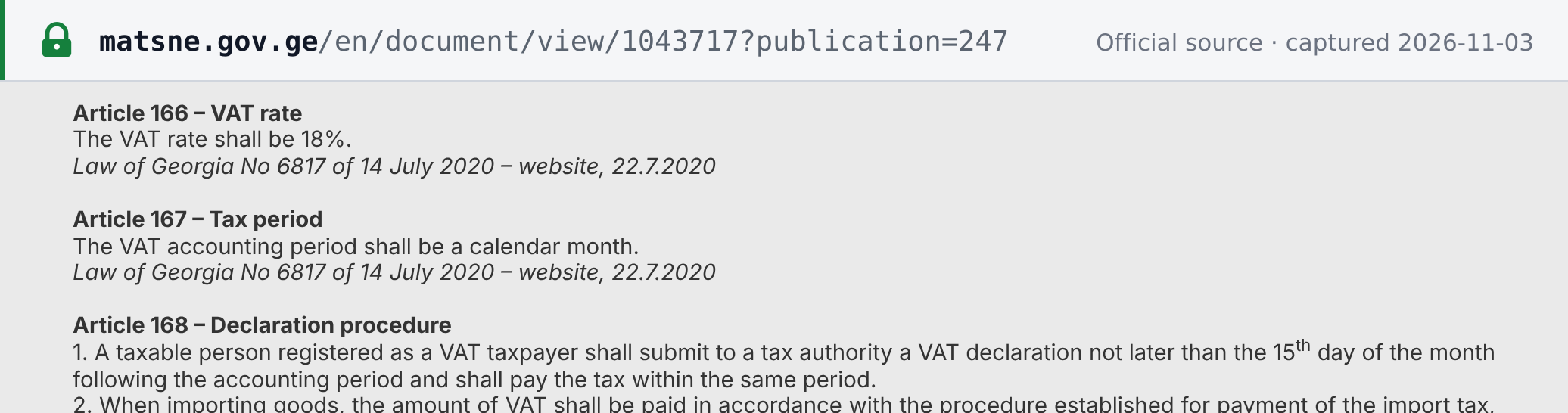
18% — the only VAT rate in the Tax Code (as at 2026-11-03). Art. 166: "The VAT rate shall be 18%." The article's current wording dates from Law of Georgia No 6817 of 14 July 2020. [1]
 Source snapshot captured 2026-11-03 — original
The single rate also shows in the margin scheme, where the margin is divided "by 1.18" (Art. 161²(4)), and in the digital-services rules, which set the rate at 18% (Order No. 184). [4]
Reduced and zero rates
No reduced or super-reduced rates. Georgian law also has no "zero rate" as such. Its place is taken by exemption with the right of deduction (Art. 169(3)): "Taxable transactions provided for by Articles 172 of this Code shall be VAT exempt with the right of VAT deduction meaning that if these transactions are carried out, the taxable persons shall have the right to deduct the VAT in relation to the charges borne with regard to the transactions". Examples from Art. 172: [1]
- Exports and re-exports of goods (Art. 172(4)(e)). Goods carried out in a non-resident passenger's baggage qualify only if they leave Georgia within 90 days and cost more than GEL 600 including VAT.
- International transport of goods and passengers, and directly related services (Art. 172(1)(h)–(i)).
- Supplies to vessels and aircraft (Art. 172(1)(a)–(g)).
- Supplies to diplomatic missions (Art. 172(3)).
- Agricultural produce produced in Georgia, before industrial processing, with exceptions for certain eggs and poultry (Art. 172(4)(t)).
- Books and e-books, and sales and printing services for them (Art. 172(4)(z³)).
- Electricity and guaranteed capacity, with exceptions (Art. 172(4)(z)).
- Investment gold (Art. 172(4)(n¹)).
- Medical goods produced in Georgia, and pharmaceutical enterprises' own products, on a joint ministerial list (Art. 172(4)(z⁶)).
- Tourist products sold by tour operators to foreign tourists (Art. 172(4)(o)).
- Food donated to food banks (Art. 172(4)(z⁷)).
Exemptions without the right of deduction (Arts. 170–171) are listed under Exemptions.
Real estate: exemption with deduction extended to 2033
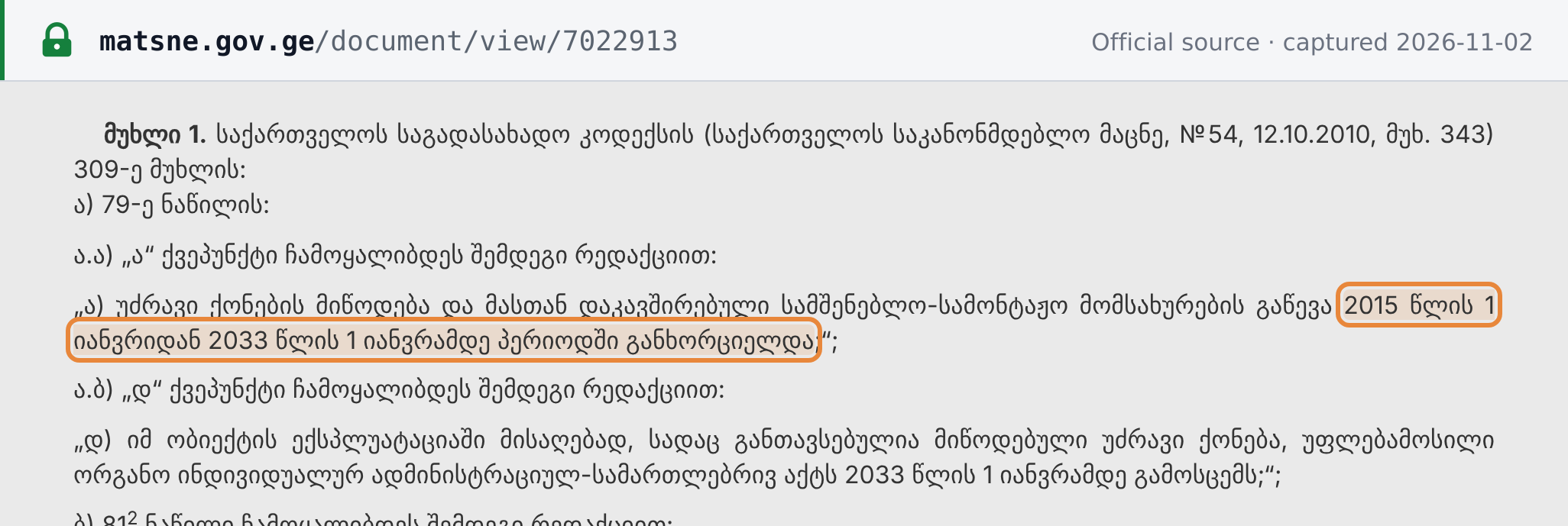
A transitional rule exempts, with the right of deduction, supplies of immovable property and the related construction and installation services at facilities covered by a construction permit valid on 8 August 2008, or whose design was agreed by that date (Art. 309(79)(b)). Law No. 1888-VIმს-XIმპ of 15 October 2026, in force 16 October 2026, extended the window in Tax Code Art. 309(79)(a) to supplies "within the period from 1 January 2015 to 1 January 2033" (previously 1 January 2029). [8]
 Source snapshot captured 2026-11-02 — original
Announced rate changes
None announced (as at 2026-11-03).
Cross-border rules
Imports and exports
- Imports. The importer owes VAT, without having to register as a VAT payer for that reason (Art. 165²(2)(a)). Import VAT is paid with import duties (Art. 168(2)). VAT on importing goods on a Government list within HS codes 8401–9033 "shall be paid not later than 45 days after releasing the goods for free circulation" (Art. 168(3)). [1]
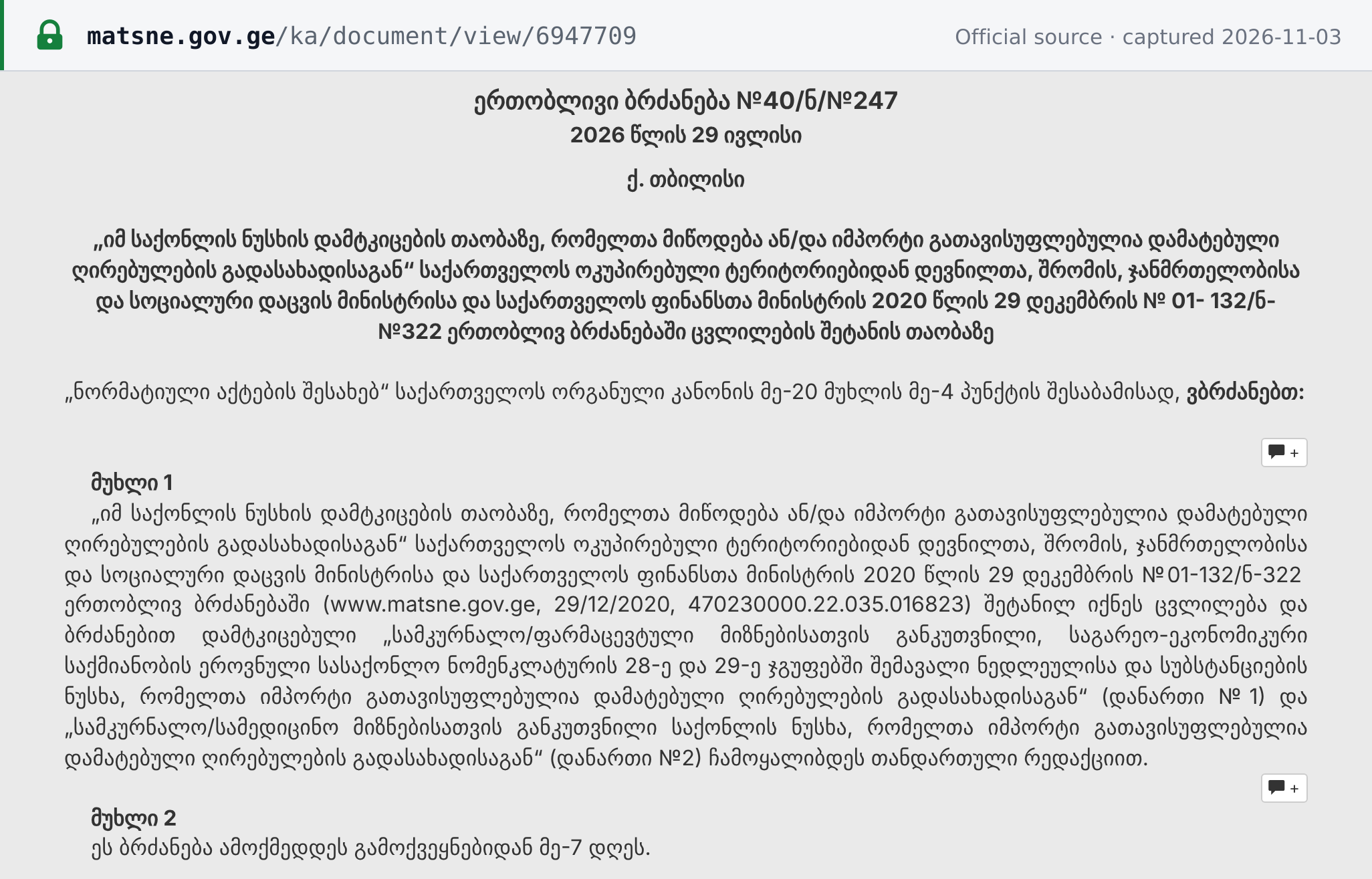
- Import exemptions (Art. 173) include therapeutic and pharmaceutical raw materials and goods, disability-mobility goods, baby food and child-hygiene goods on a joint list of the Health and Finance Ministers (Art. 173(a)); pharmaceuticals in HS group 30 (Art. 173(b)); many medical devices (Art. 173(c)); cars (HS 8703) and motorcycles (HS 8711) (Art. 173(g)); books (Art. 173(z⁷¹)); electric buses (Art. 173(z⁷²)); and investment gold (Art. 173(t¹)). The Art. 173(a) lists of therapeutic/pharmaceutical raw materials and of medical goods were restated from 5 August 2026 by joint order No. 40/n/No. 247 of 29 July 2026. [9]
- Exports of goods are exempt with the right of deduction (Art. 172(4)(e)), and count towards the registration threshold (Art. 165(7)(b)).
 Source snapshot captured 2026-11-03 — original
Reverse charge on imported services
A Georgian business that buys a service from a supplier not established in Georgia (and with no Georgian fixed establishment taking part in the supply) accounts for the VAT as a tax agent (Art. 161(1)(a)). A tax agent is "any person established in Georgia (except for a non-entrepreneur natural person and a FIZ enterprise), or which has a fixed establishment in Georgia through which the service was purchased" (Art. 161(2)(a)). A tax agent that is not VAT-registered pays the VAT by the 15th day of the following month (Art. 168(4)). [1]
Digital products and services
Foreign suppliers of digital services — telecommunications, radio and TV broadcasting, and electronically supplied services — to non-taxable persons in Georgia pay Georgian VAT under Order No. 996 Art. 47¹, as set by Minister of Finance Order No. 184 of 27 July 2021, operative from 1 October 2021. [4]
- Who. A foreign taxable person: not established in Georgia, not normally living there, and with no Georgian fixed establishment taking part in the supply.
- Customers caught. Non-taxable natural persons, and taxable persons buying for non-business use. Georgian businesses buying for their business account for the VAT by reverse charge instead.
- Place of supply. Georgia, if any one of these is Georgian: the location of the customer's bank or e-money operator, the customer's location, the IP address of the device used to buy, or the country phone code used to buy or pay.
- Registration. No VAT-payer registration. The supplier fills in a registration form (Annex III-03⁴) on the VAT portal of the Revenue Service website.
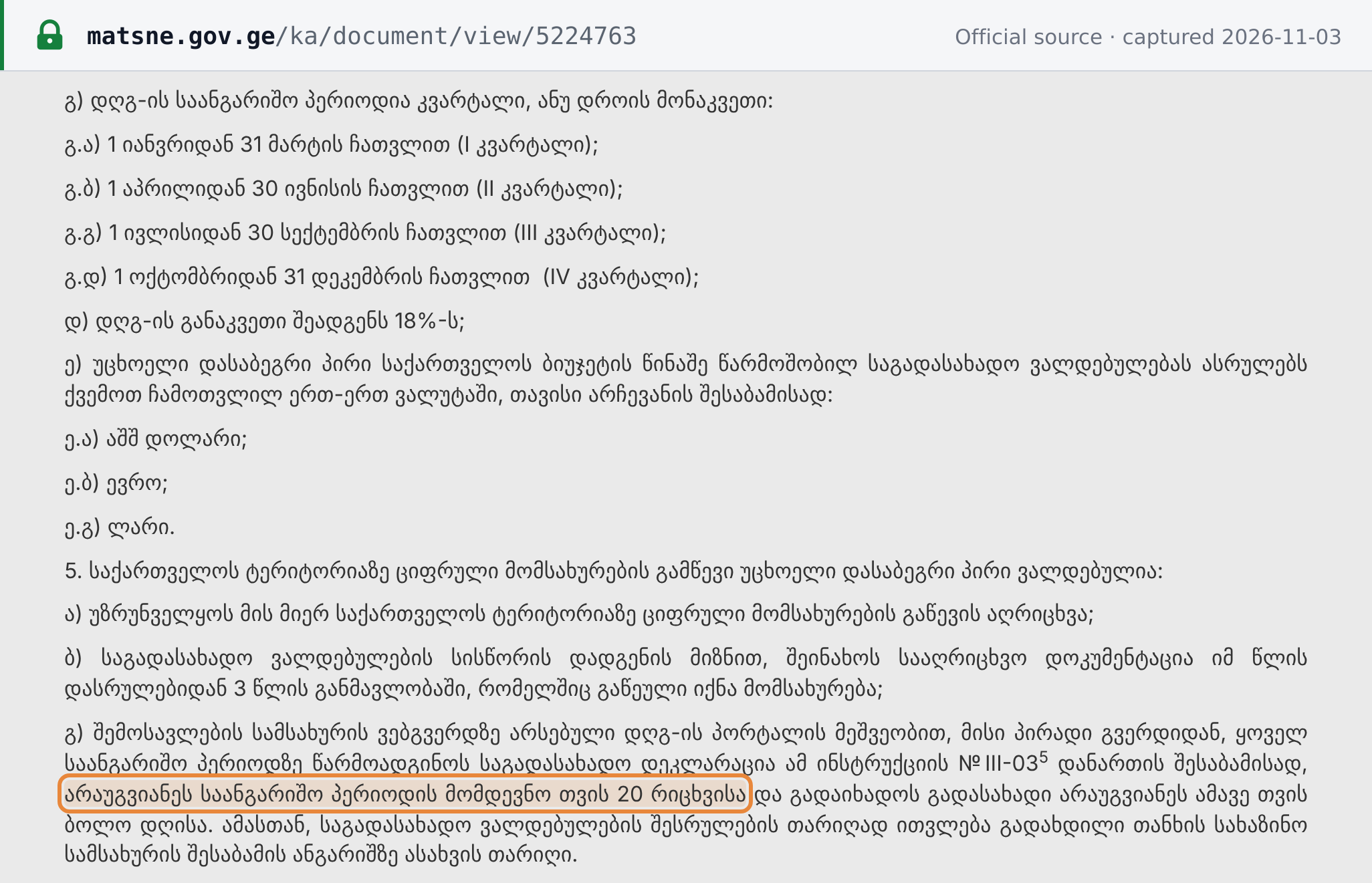
- Rate, period, return, payment. 18%; the calendar quarter; a return (Annex III-03⁵) "no later than the 20th of the month following the reporting period"; payment by the last day of that month, in US dollars, euros or lari, at the supplier's choice.
- Records. Kept for 3 years from the end of the year in which the service was supplied.
- Threshold. None: Art. 47¹ as set by Order No. 184 sets no minimum.
Order No. 184 in Georgian: "ყოველ საანგარიშო პერიოდზე წარმოადგინოს საგადასახადო დეკლარაცია ამ ინსტრუქციის №III-03⁵ დანართის შესაბამისად, არაუგვიანეს საანგარიშო პერიოდის მომდევნო თვის 20 რიცხვისა და გადაიხადოს გადასახადი არაუგვიანეს ამავე თვის ბოლო დღისა." (file a return for each reporting period on Annex III-03⁵ no later than the 20th of the month following the period, and pay no later than the last day of that month).
 Source snapshot captured 2026-11-03 — original
See VAT on digital services by non-resident suppliers.
Foreign companies selling into Georgia — B2B and B2C
| Sale by a foreign business without a Georgian fixed establishment | Who accounts for VAT | Registration |
|---|---|---|
| B2B services to a Georgian business | The customer, by reverse charge as a tax agent (Art. 161) | None for the supplier |
| B2C digital services (telecoms, broadcasting, electronic services) | The supplier, quarterly (Order 996 Art. 47¹) | Registration form on the Revenue Service VAT portal, not VAT-payer registration |
| Other B2C services with place of supply in Georgia | The supplier, under a Minister of Finance procedure (Art. 165²(2)(e)) | No VAT-payer registration required by the Tax Code |
| Goods imported into Georgia | The importer, at the border (Art. 165²(2)(a)) | None for import VAT |
| Supplies made through a Georgian fixed establishment | The supplier | From the first supply (Art. 165(9)) |
Marketplace / platform deemed-supplier liability
Georgia has no platform-specific deemed-supplier rule. The general commission rules apply instead. For services, Art. 160¹(3): "A person who, on behalf of himself/herself but by order of another person, participates in the provision of services shall be considered a beneficiary of the services and a provider of services." For goods, a supply includes "the transfer of goods on the basis of an agreement according to which a commission fee is paid when buying or selling goods" (Art. 160(1)(c)). A platform acting in its own name is therefore caught by these rules. Order 996 Art. 47¹, as set by Order No. 184, adds no platform rule for digital services. [1]
Place of supply
For services to a non-taxable person, Art. 162¹(14) puts the place of supply where the customer "is established, has permanent address or normally lives" for "a) telecommunication services; b) radio and TV broadcasting services; c) electronically provided services; …". Order No. 184 adds the four location proxies listed above for digital services. The other place-of-supply rules, for goods and for business-to-business services, are set out elsewhere in the Tax Code's VAT section and are not summarised here. [1]
Invoice requirements
When a tax invoice is issued
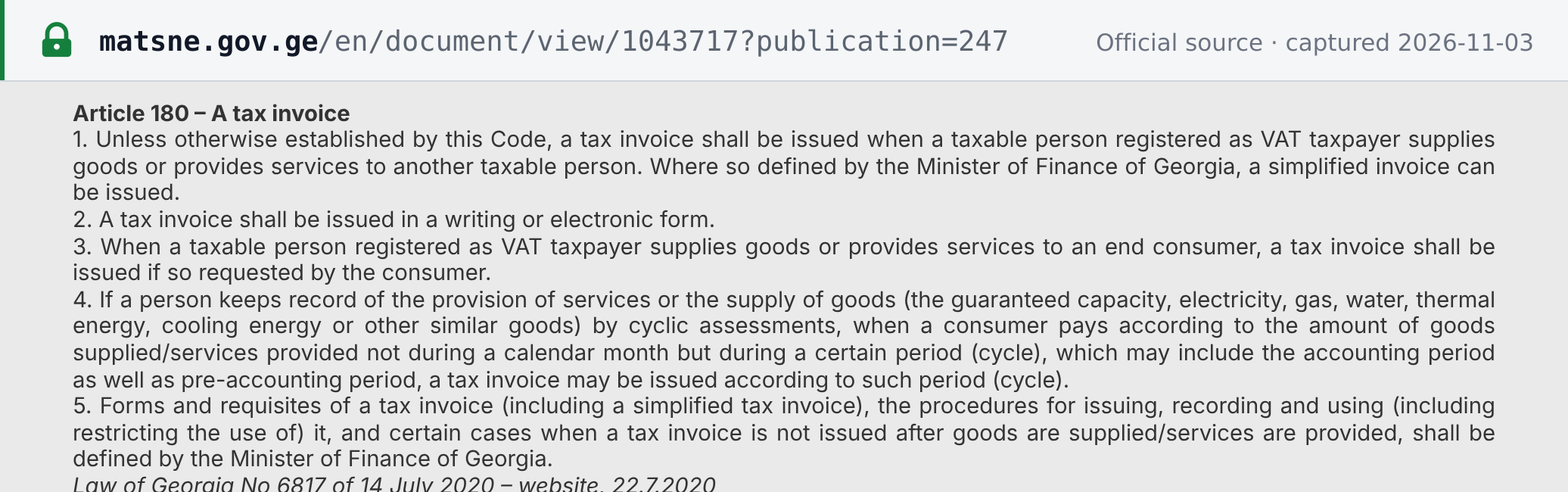
The document is the tax invoice (საგადასახადო ანგარიშ-ფაქტურა). Tax Code Art. 180: [1]
"1. Unless otherwise established by this Code, a tax invoice shall be issued when a taxable person registered as VAT taxpayer supplies goods or provides services to another taxable person. Where so defined by the Minister of Finance of Georgia, a simplified invoice can be issued. 2. A tax invoice shall be issued in a writing or electronic form. 3. When a taxable person registered as VAT taxpayer supplies goods or provides services to an end consumer, a tax invoice shall be issued if so requested by the consumer. … 5. Forms and requisites of a tax invoice (including a simplified tax invoice), the procedures for issuing, recording and using (including restricting the use of) it, and certain cases when a tax invoice is not issued after goods are supplied/services are provided, shall be defined by the Minister of Finance of Georgia."
So: B2B, always; B2C, only on the consumer's request; on paper or electronically. Utilities billed in cycles may be invoiced per cycle (Art. 180(4)).
 Source snapshot captured 2026-11-03 — original
The invoice carries the buyer's deduction. A tax invoice is the basis for deducting input VAT (Art. 176(1)(a)). VAT is not deducted "c) on the basis of a tax invoice which fails to allow the identification of the seller of goods/services or is not issued under the procedure established by the legislation of Georgia; d) on the basis of a tax invoice since the end of the calendar year of carrying out of a taxable transaction included therein three years have passed." (Art. 178). [1]
Invoice forms (Order No. 207, from 1 September 2025)
Minister of Finance Order No. 207 of 4 August 2025, in force 1 September 2025, restated the invoice articles of Order No. 996: [2]
- Art. 51(1): tax invoices use forms III-05, III-05¹ and III-05²; the special tax invoice for petroleum products uses forms III-09 and III-09¹.
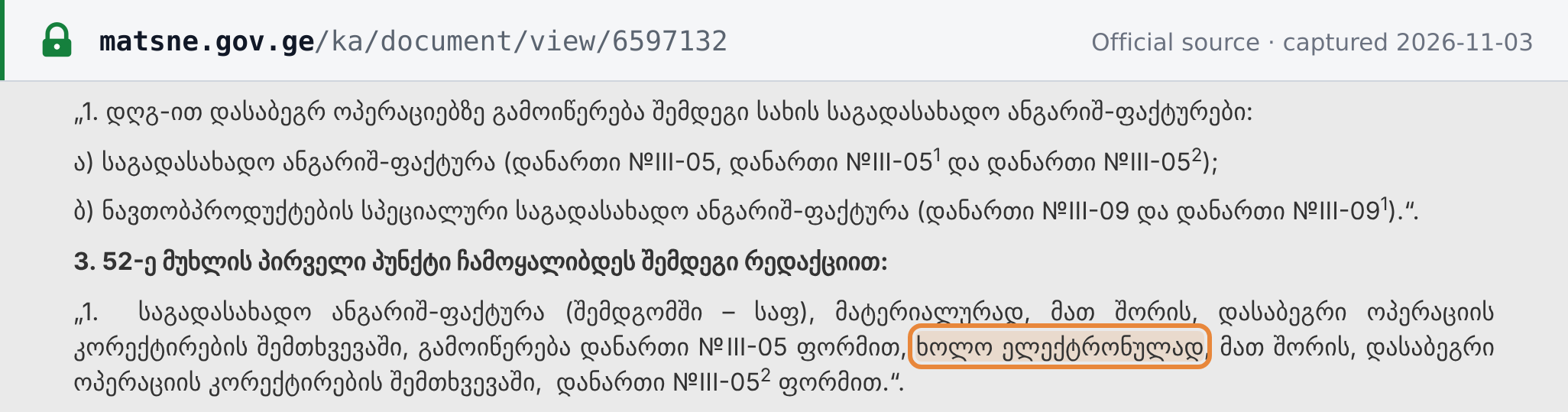
- Art. 52(1): "საგადასახადო ანგარიშ-ფაქტურა (შემდგომში – საფ), მატერიალურად, მათ შორის, დასაბეგრი ოპერაციის კორექტირების შემთხვევაში, გამოიწერება დანართი №III-05 ფორმით, ხოლო ელექტრონულად, მათ შორის, დასაბეგრი ოპერაციის კორექტირების შემთხვევაში, დანართი №III-05² ფორმით." (A tax invoice is issued on paper on form III-05, and electronically on form III-05², including when a taxable transaction is corrected.)
 Source snapshot captured 2026-11-03 — original
Mandatory content
The particulars below are the boxes on the official electronic form III-05², annexed to Order No. 207, numbered as on the form. [3]
| Box | Particular (Georgian label on the form) |
|---|---|
| 1 | Series and number (სერია, N) |
| 2 | Tax invoice being corrected — series and number; completed only on a correction |
| 3 | Period of the transaction (or correction): month or quarter in words, and year |
| 4 | Date of issue: day, month in words, year |
| 5.1 / 5.2 | Seller (გამყიდველი): identification number; name, or first name and surname |
| 6.1 / 6.2 | Buyer (მყიდველი): identification number; name, or first name and surname |
| Col. 1–3 | Description of goods or services; unit of measure; quantity |
| Col. 4 | Value of the goods or services including VAT and excise |
| Col. 5–6 | Of which (მათ შორის): VAT amount; excise amount |
| Total | Total (სულ) row for columns 4–6 |
| 7 / 8 | Waybill (სასაქონლო ზედნადები) number and date |
| 9, 9.1, 9.2 | Tax invoices issued on advance payments for this supply: series/number, date and VAT amount; total VAT to be charged; total VAT to be reduced. These rows apply to advances paid after 1 September 2025 |
| — | Signature of the head or an authorised person; signature on hand-over to the buyer; place for a stamp |
For developers. Column 4 is VAT-inclusive, and VAT and excise are shown as an "of which" breakdown of it. The form has no address field and no separate net-amount column.
Issuance deadline
The deadline for issuing a tax invoice is part of the issuing procedure that Art. 180(5) leaves to the Minister of Finance, in Order No. 996.
Numbering and sequencing
The form carries a series and number (box 1). Any further numbering and sequencing rules are set by Order No. 996.
Credit and debit notes
Georgia has no separate credit-note document. A correction is issued on the same form — III-05 on paper, III-05² electronically — with box 2 naming the invoice being corrected (Order 996 Art. 52(1), as restated by Order No. 207). "The amount of a taxable transaction shall be adjusted in the accounting period when a circumstance causing the adjustment occurs." (Tax Code Art. 179(2)). [2] [1]
Cancelling an electronic invoice. The seller may send the buyer, through the software, a request to cancel an electronic III-05¹ or III-05² invoice. If neither party has declared the invoice, the request goes straight to the buyer; if either has, the invoice must first be removed from the declaration annexes on application to the tax authority. "საფ გაუქმებულად ითვლება მყიდველის (მიმღების) მიერ გაუქმების მოთხოვნის დადასტურებისას." (The invoice is deemed cancelled when the buyer confirms the cancellation request.) (Order 996 Art. 54(3¹), as restated by Order No. 207). [2]
Summary invoices. On the buyer's request, one III-05 or III-05² invoice may total several deliveries made under more than one waybill, or services, in a reporting period (Order 996 Art. 53(7), (7¹), as restated by Order No. 207). [2]
Currency, language and exchange rate
- Currency. The form's amounts are in lari. A foreign-currency transaction is converted at the National Bank of Georgia's official rate for the transaction day; where the Bank sets no rate for that currency, at the rate set under the procedure of the Bank's Board (Tax Code Art. 73(10)).
- Language. The official forms are in Georgian. Any rule on invoice language is set by Order No. 996.
Document types
- Tax invoice — forms III-05 (paper), III-05¹ and III-05² (electronic).
- Special tax invoice for petroleum products — forms III-09 and III-09¹.
- Simplified invoice — allowed "where so defined by the Minister of Finance of Georgia" (Art. 180(1)); the conditions are set by Order No. 996.
- No tax invoice to an end consumer unless the consumer asks for one (Art. 180(3)).
Self-billing
Neither the Tax Code's VAT section nor Order No. 207 provides for self-billing.
Retention and audit trail
"A person shall keep a tax source document for at least three years after the end of the calendar year for the determination of the tax liabilities of which such document is necessary." (Tax Code Art. 72(3)). [1] The Tax Code sets no electronic-archiving or audit-trail rule; any such rule sits in Order No. 996.
A specimen of a compliant invoice
Tax invoice (საგადასახადო ანგარიშ-ფაქტურა), form III-05² — illustrative
| Goods / servicescol. 1 | Unitcol. 2 | Qtycol. 3 | Value incl. VAT and excisecol. 4 | of which VATcol. 5 | of which excisecol. 6 |
|---|---|---|---|---|---|
| Office chairs, model EX-1 | piece | 4 | GEL 1,180.00 | GEL 180.00 | GEL 0.00 |
| Delivery service | service | 1 | GEL 118.00 | GEL 18.00 | GEL 0.00 |
- Total (სულ) incl. VAT and excisetotal row, col. 4
- GEL 1,298.00
- of which VAT (18%)total row, col. 5
- GEL 198.00
- of which excisetotal row, col. 6
- GEL 0.00
- Waybill number N SPECIMEN-WB-01, dated 31 October 2026 — boxes 7 and 8.
- Advance-payment invoices set against this supply: none — boxes 9, 9.1 (total VAT to be charged) and 9.2 (total VAT to be reduced); used only for advances paid after 1 September 2025.
- Signature of the head or authorised person; signature on hand-over to the buyer; place for a stamp — form footer.
- The form has no address field and no net-amount column: VAT is the 18/118 share of the VAT-inclusive value in column 4.
- A correction is issued on this same form, with box 2 naming the invoice it corrects.
E-invoicing status
Status (as at 2026-11-03): electronic tax invoices are issued and confirmed on the Revenue Service portal, but there is no clearance (CTC) mandate. Order No. 996, as amended by Order No. 207 (2025), still provides for the paper tax invoice (form III-05) alongside the electronic forms III-05¹ and III-05², and the Revenue Service publishes no clearance-model mandate. [2]
- System. The Revenue Service's authorised portal, service.rs.ge, with its Tax Invoice and Special Tax Invoice modules. [5]
- Format. Georgia's own forms III-05¹ and III-05². No Peppol or UBL requirement appears in the Tax Code or in Order No. 207.
- Scope. B2B in practice (Art. 180(1)); B2C only on the consumer's request (Art. 180(3)).
- Phases. None.
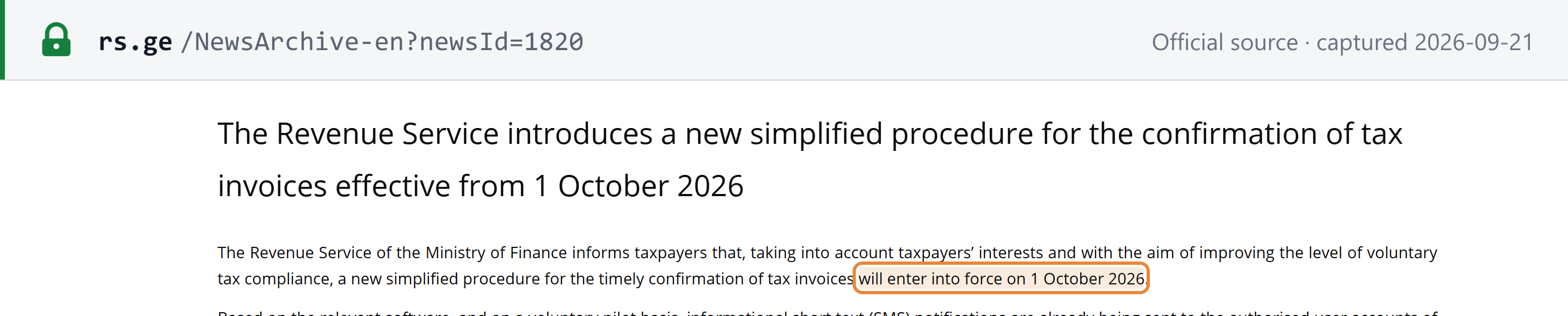
- Recipient confirmation, from 1 October 2026. The buyer must confirm or reject the invoices addressed to it. The Revenue Service: "if, as of the 5th day of the month following the month after the end of the reporting period (i.e. on the 5th day of each month), the recipient still has tax invoices and/or special tax invoices pending confirmation, both the primary user and any sub-users of the taxpayer’s authorised account will be restricted from using all electronic services, except for the Tax Invoice/Special Tax Invoice modules." Access is restored once the pending invoices are confirmed or rejected. [5]
 Source snapshot captured 2026-09-21 — original
 Source snapshot captured 2026-09-21 — original
See CTC e-invoicing models and e-invoicing status and networks worldwide.
Filing and payment
Filing frequency
- VAT-registered persons: monthly, since the accounting period is the calendar month (Art. 167). There is no turnover band that changes the frequency.
- Foreign suppliers of digital services to consumers: quarterly (Order 996 Art. 47¹). [4]
Return and payment due date
- VAT-registered persons: return and payment by the 15th day of the following month. Art. 168(1): "A taxable person registered as a VAT taxpayer shall submit to a tax authority a VAT declaration not later than the 15th day of the month following the accounting period and shall pay the tax within the same period." [1]
- Tax agents not registered for VAT (reverse charge on imported services): payment by the 15th day of the following month (Art. 168(4)).
- Imports: with import duties; 45 days after release for goods on the Government's HS 8401–9033 list (Art. 168(2)–(3)).
- Foreign digital-service suppliers: return by the 20th of the month after the quarter, payment by the last day of that month (Order No. 184). [4]
Returns are filed on the Revenue Service's authorised portal (service.rs.ge).
Additional listings
Tax invoices are declared through the portal, and an invoice must be removed from the declaration annexes before it can be cancelled (see Credit and debit notes). Any other periodic listings are set by Order No. 996.
Input-tax recovery
- Deductible: input VAT on purchases used for taxable supplies, on imports and on reverse-charged services (Art. 175(1)); and on supplies made outside Georgia, on Art. 172 supplies (exempt with deduction), and on financial services to customers not established in Georgia (Art. 175(2)). [1]
- Apportionment: where purchases serve both taxable and exempt supplies, a turnover fraction applies, with an annual true-up (Art. 177). If exempt supplies without deduction are under 5% of total turnover for the calendar year, the full deduction is allowed (Art. 177(7)). Capital goods are adjusted over 10 years for immovables and 5 years for other fixed assets (Art. 177(6)).
- Blocked: VAT on "expenses borne for social purposes or on entertainment events, or of representation expenses, except when the supply of goods/provision of services carried out within such events is subject to VAT assessment" (Art. 178(a)); on fictitious or fake invoices (Art. 178(e)); on invoices from a year that ended more than three years ago (Art. 178(d)). The Tax Code's VAT section contains no separate block on passenger cars.
Refunds
- Excess credit. "The right of refund of the amount of VAT shall arise for a taxable person if the amount of VAT to be deducted exceeds the amount of VAT to be assessed in the accounting period." (Art. 181(1)). The refund is paid under the general refund rules of Art. 63 (Art. 181(4)). [1]
- Tourists. Foreign nationals get VAT back on goods taken out of Georgia "within 3 months after they were purchased and the value of the goods according to one receipt exceeds GEL 200 (excluding VAT)", on a special receipt from an authorised seller (Art. 181(5)–(6)).
- EU businesses. A taxable person of an EU Member State with no Georgian establishment may reclaim VAT on purchases (other than immovable property) and imports through an authorised representative, if it meets the conditions in Art. 181¹.
Exemptions
Exempt supplies
Exempt without the right of deduction (Art. 169(2)): "Taxable transactions provided for by Articles 170 and 171 of this Code shall be VAT exempt without the right of VAT deduction meaning that if these transactions are carried out, the taxable persons shall have no right to deduct the VAT, in relation to the charges borne with regard to the transactions." [1]
- Art. 170 — medicine, education, culture, sport and social care: medical services and care by licensed persons; dental technicians' services; patient transport; education by educational institutions; children's art and sports training; social-care services; universal postal services; funeral ceremonial services; diabetic bread; liturgical items supplied by the Patriarchate.
- Art. 171 — other: financial services (Art. 171(1)(a)); lotteries and gambling, except lotteries majority-owned by the State; supply of land (Art. 171(1)(c)); printed newspapers and magazines and advertising in them; supplies between free industrial zone (FIZ) enterprises.
- Option to tax. "A taxable person shall have the right not to enjoy a tax privilege under this Code and charge the transactions provided for in Article 171(1)(a) and (c) of this Code with VAT." (Art. 169(5)) — financial services and land.
Exempt is not zero-rated. A supply exempt without deduction (Arts. 170–171) blocks the input VAT on the costs behind it. A supply exempt with deduction (Art. 172 — exports, international transport and the other items under Reduced and zero rates) keeps it. That is Georgia's equivalent of a zero rate.
Special regimes
- Margin scheme for second-hand goods, works of art and antiques: VAT on the dealer's margin, computed by dividing the margin "by 1.18" (Art. 161²(4)). A dealer who opts in indicates "a period of application of the scheme ... which may not be less than 24 months" (Art. 161²(7)). [1]
- Free industrial zones (FIZ): supplies between FIZ enterprises are exempt (Art. 171(1)(q)–(r)); goods and services from a FIZ go through reverse-charge mechanics (Arts. 161(1)(d), 164¹(5)).
- Investment gold: supplies and imports are exempt (Arts. 172(4)(n¹), 173(t¹)).
- Real estate (transitional): exempt with deduction until 1 January 2033 (see Rates).
Offences and penalties
Offences
The Tax Code treats the following conduct as VAT tax offences, each with its own fine (Arts. 273 and 282): [1]
- Trading without VAT registration when registration was due (Art. 282(1)).
- Breaching the taxpayer-registration procedure (Art. 273).
- Not issuing a tax invoice when the buyer asks for one (Art. 282(2)).
- Issuing a tax invoice for a fictitious or non-commodity transaction, or a fake tax invoice (Art. 282(3)).
- Late filing and understating tax (Arts. 274–275).
Criminal liability for tax evasion is set by the Criminal Code of Georgia and is not covered on this page.
Penalties
| Breach | Penalty | Tax Code |
|---|---|---|
| Trading without VAT registration | 5% of the VAT-taxable transactions (excluding exempt ones) carried out while unregistered; the late-filing and understatement fines then do not apply to those periods | Art. 282(1), (4) |
| Breach of the registration procedure | GEL 500 | Art. 273 |
| Not issuing a tax invoice on the buyer's request | 100% of the VAT on the transaction | Art. 282(2) |
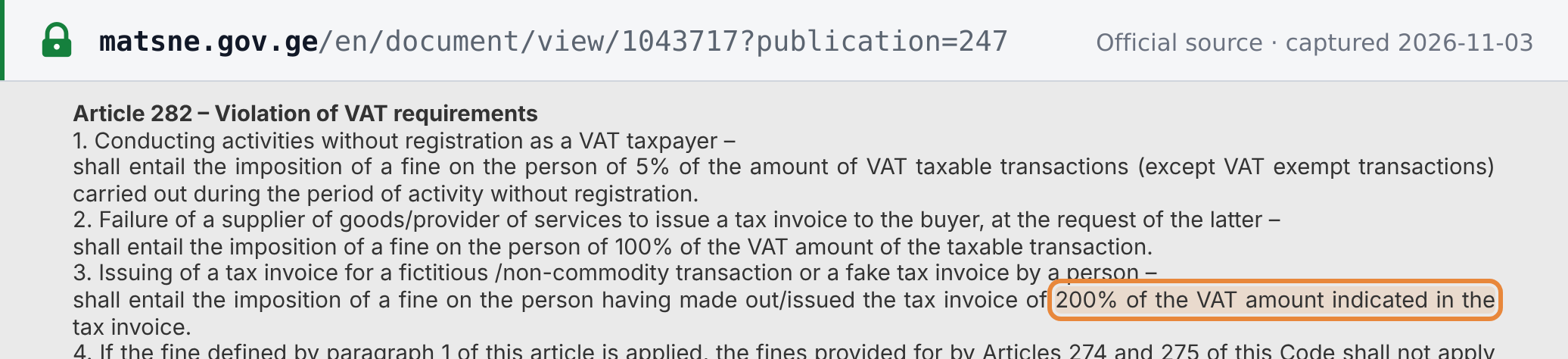
| Fictitious, non-commodity or fake tax invoice | 200% of the VAT shown on the invoice, charged to the person who issued it | Art. 282(3) |
| Late return | 5% of the tax due for each complete or part month if up to 2 months late; 10% if more than 2 months late; nothing if the tax due is zero | Art. 274 |
| Understated tax | 10% of the understated tax if it is up to 5% of the tax declared; 25% if it is over 5% and up to 20%; 50% otherwise; 10% where the tax authority only moved the liability to another period | Art. 275 |
| Late payment | Interest of 0.05% of the unpaid tax per day; it stops accruing after 3 years | Art. 272(2¹), (4) |
Art. 282: "1. Conducting activities without registration as a VAT taxpayer – shall entail the imposition of a fine on the person of 5% of the amount of VAT taxable transactions (except VAT exempt transactions) carried out during the period of activity without registration. 2. Failure of a supplier of goods/provider of services to issue a tax invoice to the buyer, at the request of the latter – shall entail the imposition of a fine on the person of 100% of the VAT amount of the taxable transaction. 3. Issuing of a tax invoice for a fictitious /non-commodity transaction or a fake tax invoice by a person – shall entail the imposition of a fine on the person having made out/issued the tax invoice of 200% of the VAT amount indicated in the tax invoice."
 Source snapshot captured 2026-11-03 — original
Frequently asked questions
We are a foreign app or SaaS business selling to consumers in Georgia. Do we have to register for VAT?
Not as a VAT payer. Under Order No. 996 Art. 47¹, as set by Minister of Finance Order No. 184 of 27 July 2021, a foreign taxable person supplying digital services to non-taxable persons in Georgia is liable to calculate and pay VAT without registering as a VAT payer. It completes a registration form on the VAT portal of the Revenue Service website, files a quarterly return no later than the 20th of the month after the quarter and pays by the last day of that month, at 18%, in US dollars, euros or lari at its choice. Art. 47¹ as set by Order No. 184 sets no minimum turnover.
Which sale triggers VAT registration in Georgia, and does that sale itself carry VAT?
Tax Code Art. 165 requires a taxable person to apply for VAT registration within 2 business days of the day its VAT-taxable supplies exceed GEL 100,000 in any 12 consecutive calendar months. The obligation to calculate and pay VAT arises from the transaction that takes the total over GEL 100,000, that transaction included, so VAT is due on the crossing sale.
Do our exports count towards the GEL 100,000 registration threshold?
Yes. Tax Code Art. 165(7) leaves VAT-exempt supplies out of the total, except exports of goods, supplies exempt under Art. 172(1) and (2) (supplies to vessels and aircraft, international transport and related services), and exempt financial or immovable-property supplies where these are the main activity. An exporter of goods can therefore cross the threshold on exports alone.
We did not confirm our suppliers' tax invoices on time and lost access to service.rs.ge. Why?
Since 1 October 2026, if on the 5th day of a month a recipient still has tax invoices or special tax invoices pending confirmation, the Revenue Service restricts the primary user and all sub-users of the taxpayer's authorised account from every electronic service except the Tax Invoice and Special Tax Invoice modules. Access returns once the pending invoices are confirmed or rejected.
We traded above the threshold for months before registering. What is the exposure?
VAT is due from the transaction that crossed GEL 100,000 (Tax Code Art. 165(2)). On top of that, Art. 282(1) fines a person 5% of the VAT-taxable transactions carried out while active without VAT registration; where that fine applies, the late-filing and understatement fines of Arts. 274 and 275 are not imposed for the same periods. Only a taxable person registered as a VAT taxpayer may deduct input VAT (Art. 174(3)).
Does a Georgian citizen trading as an individual entrepreneur get a separate tax number?
No. Tax Code Art. 66(5) gives a Georgian citizen natural person, including an entrepreneur natural person, the personal number on his or her ID card as the identification number. A natural person who is not a Georgian citizen gets a 9-digit identification number (Art. 66(6)).
Important websites
| Site | Purpose |
|---|---|
| Revenue Service of Georgia | Tax authority home page and news |
| Revenue Service e-services (service.rs.ge) | Authorised portal: VAT registration, returns, payment and the Tax Invoice module |
| Non-resident portal | The Revenue Service's portal for non-residents, including foreign suppliers of digital services |
| Taxpayer registry | Look up a Georgian taxpayer and its VAT status |
| Public Registry entity search | Identification codes of companies and individual entrepreneurs |
| Tax Code of Georgia (English, Matsne) | The law: VAT is Section VI, Arts. 156–181¹ |
| Ministry of Finance of Georgia | Ministry that issues the VAT orders |
For other countries' registers, see check a VAT number — official lookups by country.
Recent changes
- 2026-10-16 — Real-estate VAT exemption with the right of deduction extended to supplies up to 1 January 2033 (Tax Code Art. 309(79)(a), Law No. 1888-VIმს-XIმპ). (Matsne) — see event
- 2026-10-01 — Recipients with tax invoices unconfirmed on the 5th of the month lose access to all service.rs.ge e-services except the invoice modules. (Revenue Service) — see event
- 2026-08-05 — Joint order No. 40/n/No. 247 restates the lists of pharmaceutical raw materials and medical goods exempt from import VAT (Annexes 1–2). (Matsne) — see event
For the full chronology, see Georgia tax changes on Lookuptax.
Reference links
- Tax Code of Georgia — English consolidated text, publication 247 (Legislative Herald of Georgia, Matsne)
- Minister of Finance of Georgia Order No. 207 of 4 August 2025 amending Order No. 996 (Georgian)
- Order No. 207 annex — tax invoice forms including III-05² (XLSX, Georgian)
- Minister of Finance of Georgia Order No. 184 of 27 July 2021 amending Order No. 996 — VAT on digital services (Georgian)
- Revenue Service — new procedure for confirming tax invoices from 1 October 2026 (news, 7 July 2026)
- Revenue Service — qualified and non-qualified VAT payer status (news, 18 July 2025)
- OECD — Georgia: information on tax identification numbers
- Law of Georgia No. 1888-VIმს-XIმპ of 15 October 2026 amending the Tax Code (Georgian)
- Joint order No. 40/n/No. 247 of 29 July 2026 — lists of pharmaceutical raw materials and medical goods exempt from import VAT (Georgian)
- Minister of Finance of Georgia Order No. 996 of 31 December 2010 "On Tax Administration" (Matsne)
Related on Lookuptax: