Ghana VAT guidelines
| FACTSHEET | |
|---|---|
| Country code | GH |
| Tax name | Value Added Tax (VAT), with the National Health Insurance Levy (NHIL) and the Ghana Education Trust Fund Levy (GETFund Levy) |
| Tax Authority | Ghana Revenue Authority (GRA) |
Overview
Ghana levies Value Added Tax (VAT) under the Value Added Tax Act, 2025 (Act 1151). Section 1(1): "There is imposed by this Act, a Value Added Tax to be charged on the (a) supply of goods or services made in the country, other than exempt goods or services; and (b) import of goods or services, other than exempt import." [1] English is the official language; there is no separate local-language name for the tax.
Act 1151 is in force. It received assent on 9 December 2025 ("DATE OF ASSENT: 9th December, 2025") and section 75 provides: "This Act shall come into force on the 1st day of January, 2026." It repeals the Value Added Tax Act, 2013 (Act 870) and its twelve amending Acts. Regulations, notices and directions made under the repealed Acts that are not inconsistent with Act 1151 continue in force (s.73(2)), which keeps the VAT Regulations, 2016 (L.I. 2243) and GRA's 2024 E-VAT guideline alive. [1]
Authority. VAT is administered by the Commissioner-General of the Ghana Revenue Authority (GRA), Domestic Tax Revenue Division. GRA's implementation guideline for the new Act is VAT Administrative Guidelines for the Value Added Tax Act, 2025 (Act 1151), Administrative Guideline No. GRA/AG/25/002, issued 31 December 2025. [2]
Currency. The Ghana cedi (GHS; GRA writes GH₵). All amounts on this page are in GHS.
Tax period. The calendar month. Returns are monthly, due by the last working day of the following month (see Filing and payment).
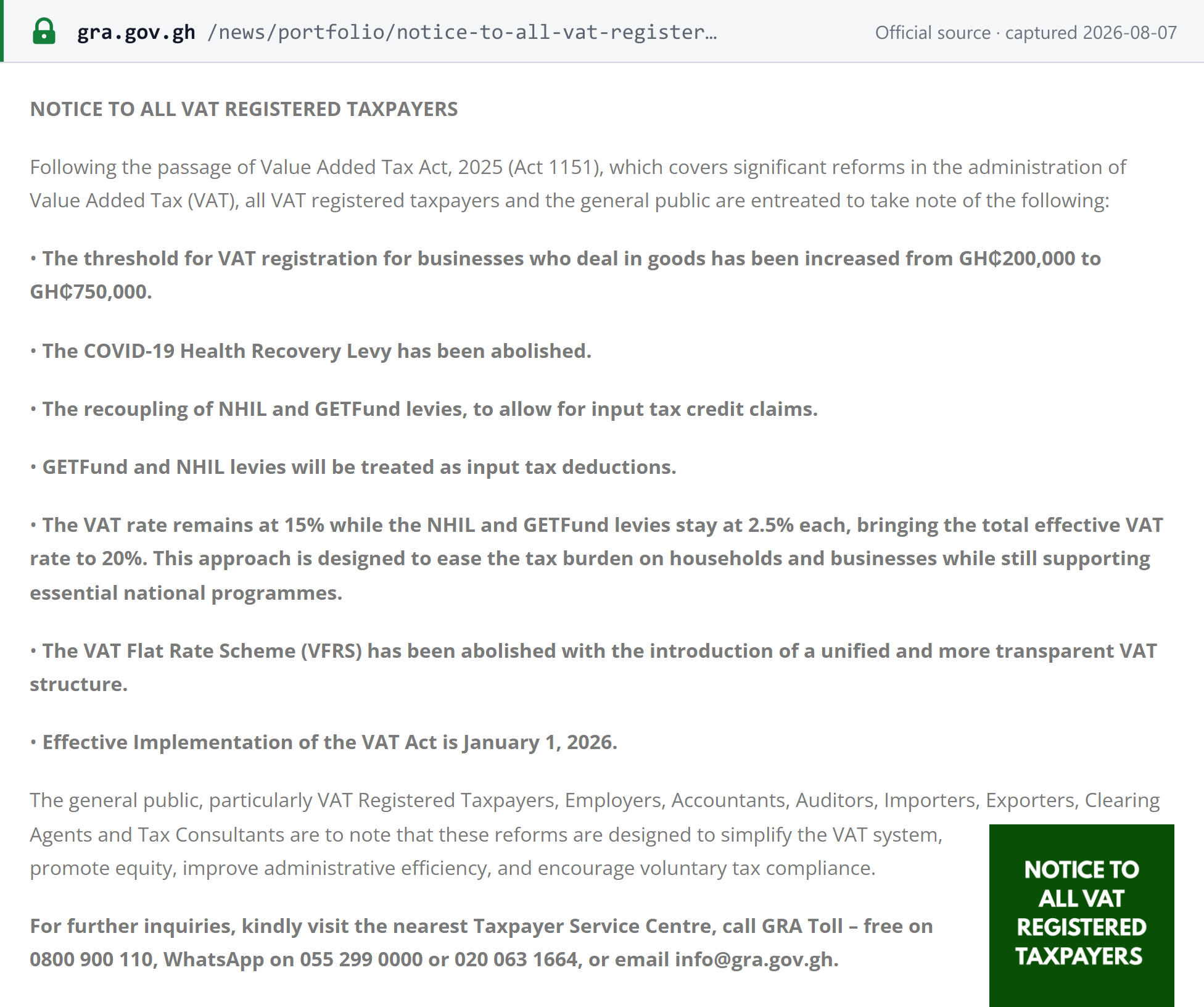
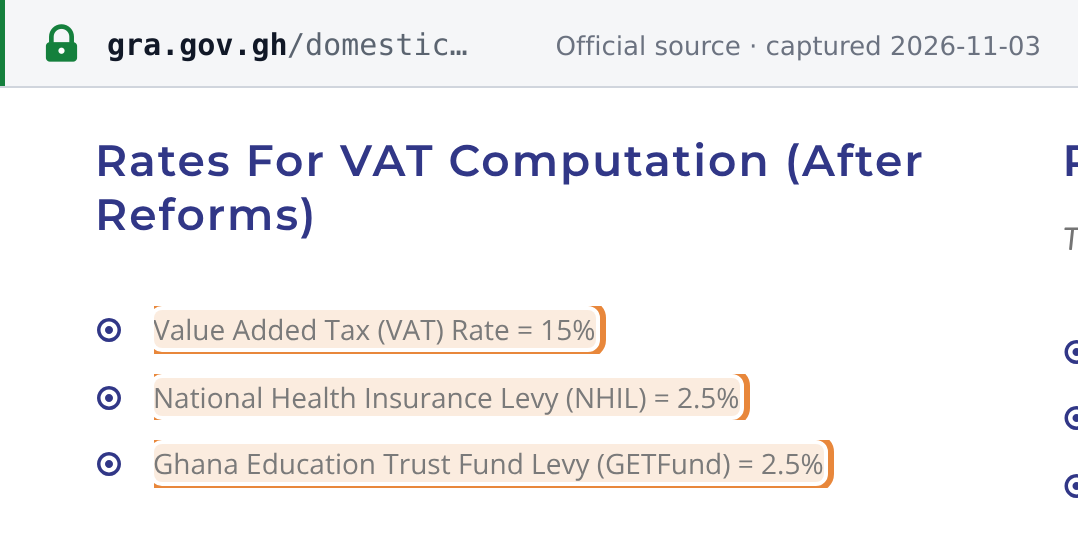
Layering — three charges on one base. Every taxable supply carries VAT at 15%, the National Health Insurance Levy (NHIL) at 2.5% and the Ghana Education Trust Fund Levy (GETFund Levy) at 2.5%, all computed on the same tax-exclusive value: 20% in total. From 1 January 2026 the levies are no longer added to the VAT base, they are deductible as input tax, and the 1% COVID-19 Health Recovery Levy is abolished. GRA's VAT page: "VAT is now calculated as 15% of the total price of an item, in addition to the 2.5% NHIL, and 2.5% GETFund Levy, also calculated on the total price. This implies that the VAT, the NHIL and the GETFund Levy are all charged on the same base or value." [4] There is no regional or local VAT. Excise duty and the Communications Service Tax sit inside the value on which VAT and the levies are charged (guideline GRA/AG/25/002 §15.3).
For neighbouring and comparable systems, see the Nigeria VAT guide and the Kenya VAT guide.
Registration
Who should register
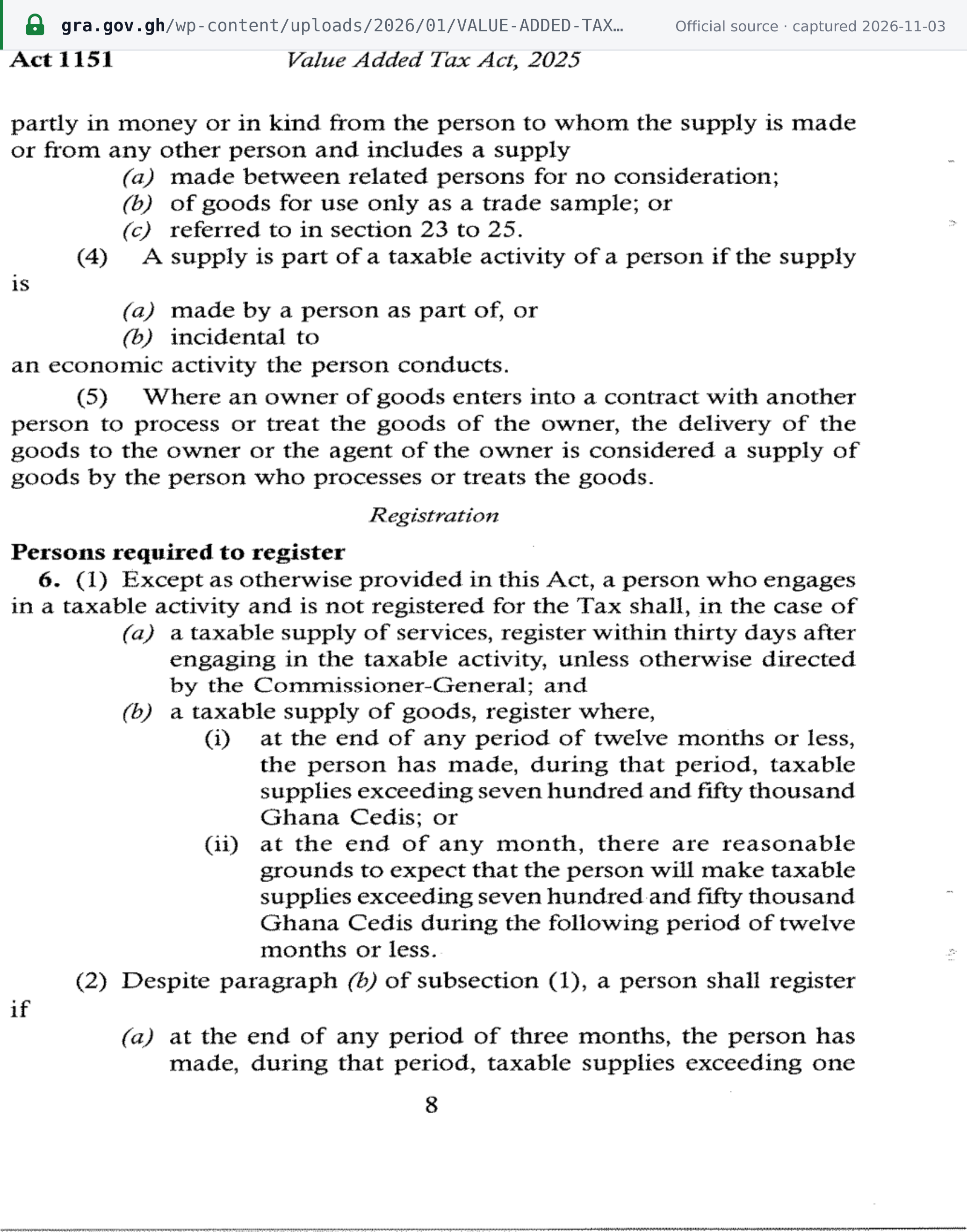
Act 1151 splits the liability rule by what you supply (s.6(1)): [1]
- Services — no threshold. A person making taxable supplies of services must "register within thirty days after engaging in the taxable activity, unless otherwise directed by the Commissioner-General". GRA's guideline §7.1: "There is no registration threshold for service providers." Service providers who were below the Act 870 threshold had to register within thirty days of 1 January 2026. [2]
- Goods — GHS 750,000. A supplier of goods registers once the threshold below is crossed.
- Promoters of public entertainment apply at least forty-eight hours before the event (s.7(1)); auctioneers register within thirty days of becoming an auctioneer, regardless of turnover (s.7(2)).
- Non-resident digital and telecom suppliers — see Non-resident registration.
 Source snapshot captured 2026-11-03 — original
Registration threshold
GHS 750,000 of taxable supplies of goods (as at 2026-11-03, in force since 1 January 2026), raised from GHS 200,000 under Act 870. Section 6(1)(b) applies two tests: [1]
- Look-back: "at the end of any period of twelve months or less, the person has made, during that period, taxable supplies exceeding seven hundred and fifty thousand Ghana Cedis"; or
- Look-forward: "at the end of any month, there are reasonable grounds to expect that the person will make taxable supplies exceeding seven hundred and fifty thousand Ghana Cedis during the following period of twelve months or less."
Section 6(2) also requires registration where supplies exceed GHS 187,500 in a three-month period and those three months plus the following nine are expected to exceed GHS 750,000. GRA's guideline §7.2 lists shorter-period bands administratively: more than GHS 375,000 in six months or less, more than GHS 187,500 in three months or less, and more than GHS 62,500 at the end of a one-month period or less. [2] Apply within thirty days after the end of the period or month (s.6(5)–(6)). GRA may count the supplies of a related person, or of a person acting in concert, towards the threshold (s.6(3)).
 Source snapshot captured 2026-08-07 — original
Unregistered importers. An unregistered person importing taxable goods pays an upfront 20% of the customs value on top of duties, import VAT and levies (s.17(1)). GRA's guideline §9.2 applies it where the import VAT base on the bill of entry exceeds GHS 750,000; ICUMS shows it as "upfront payment by VAT unregistered importer (Tax Code 101)". The payment is credited once the importer registers and files (s.17(2)); see Refunds.
Non-resident registration
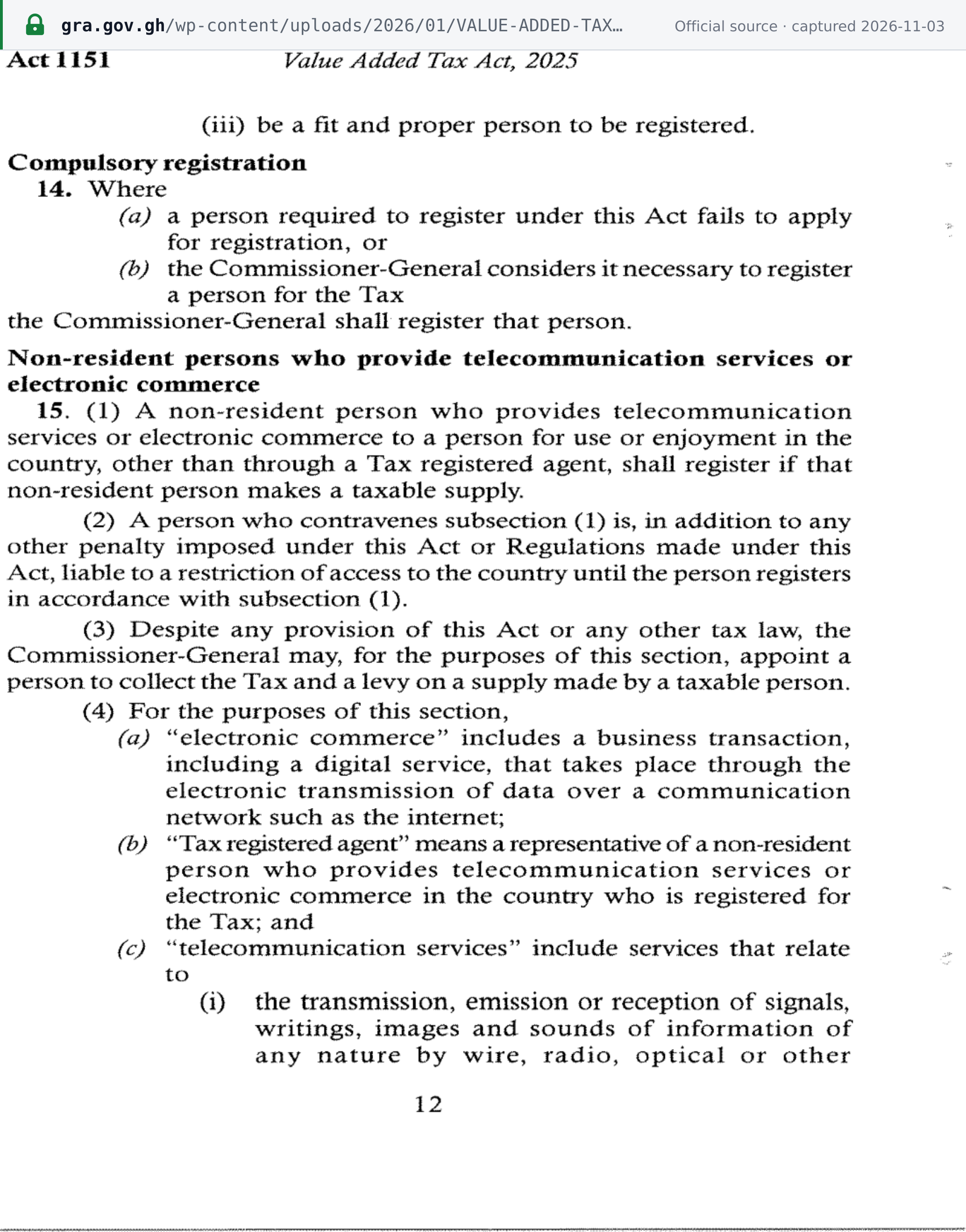
No threshold. Section 15(1): "A non-resident person who provides telecommunication services or electronic commerce to a person for use or enjoyment in the country, other than through a Tax registered agent, shall register if that non-resident person makes a taxable supply." "Electronic commerce" includes "a business transaction, including a digital service, that takes place through the electronic transmission of data over a communication network such as the internet" (s.15(4)(a)). [1]
- Sanction: besides any other penalty, a non-registrant is "liable to a restriction of access to the country until the person registers" (s.15(2)).
- Collection agents: the Commissioner-General may appoint a person to collect the tax and levy on such supplies (s.15(3)).
- Portal: non-residents register at digireg.gra.gov.gh ("Digital Services Registration for Non-Resident").
 Source snapshot captured 2026-11-03 — original
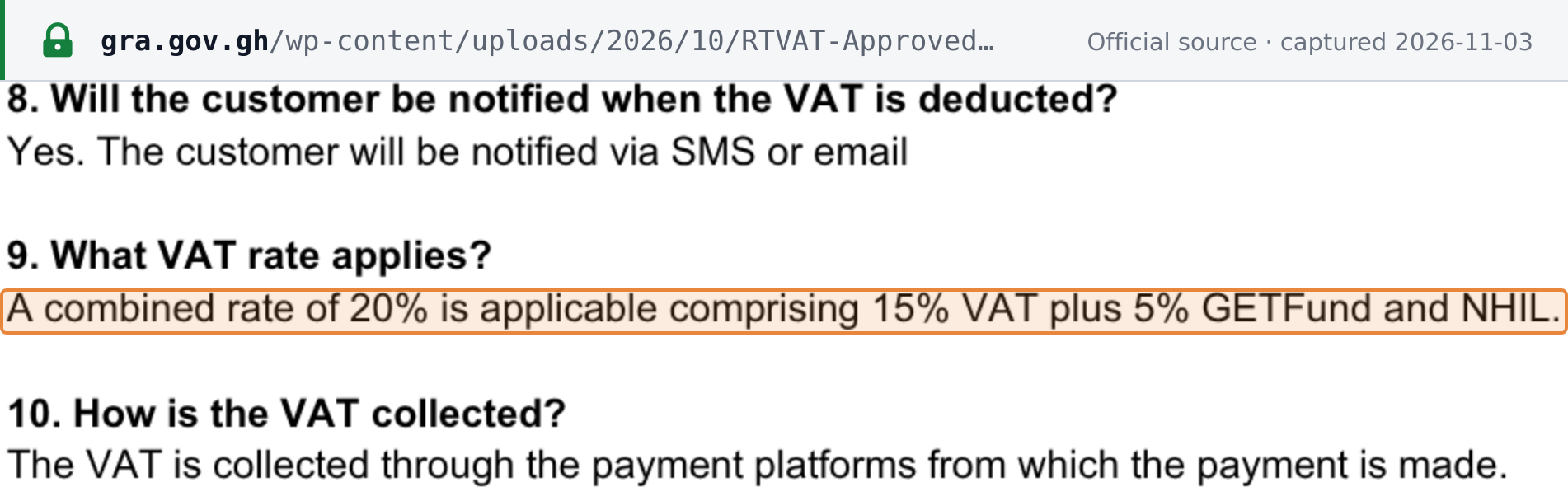
Real-Time VAT (RTVAT). GRA also collects VAT on qualifying cross-border digital services at the moment of payment, through banks, payment service providers and electronic money issuers, when a Ghana-issued card, mobile money account or digital wallet pays a non-resident merchant. GRA's approved RTVAT FAQ: "A combined rate of 20% is applicable comprising 15% VAT plus 5% GETFund and NHIL." Registration is still required: "Real-Time VAT collection and periodic VAT returns are two different activities, and both are required." The FAQ gives no start date. [6] GRA's guideline §11.0 calls the mechanism the VAT Automatic Collection System (VACS): where a non-resident provider is not registered under section 15, "the VAT Automatic Collection System (VACS) will treat the invoice value as inclusive of the tax. The applicable tax will be withheld at the settlement and paid to GRA." [2]
 Source snapshot captured 2026-11-03 — original
Tax identification number (TIN)
For individuals, the Ghana Card Personal Identification Number (PIN) issued by the National Identification Authority is the TIN. GRA's notice of 3 April 2021: "effective April 1, 2021, the Ghana card Personal Identification Number (Ghana card PIN) will replace the Taxpayer Identification Number (TIN) of individuals issued by the GRA for tax identification purposes." [12] Companies and other entities use a GRA-issued TIN beginning with a letter prefix (for companies, C followed by digits). Tax invoices carry the "TIN (including the Ghana Card PIN)" of both supplier and taxable-person customer.
For formats, structure and how to check a number, see the Ghana TIN guide and the Ghana TIN validator.
How to register
- Online: "Visit the GRA's taxpayersportal.com and register with your Ghana Card PIN. You will be able to apply for a tax type registration through the portal." Offline, at a GRA Taxpayer Service Centre. [8]
- Documents for a business: certificate of incorporation or business registration; Ghana Card of the business owner(s) or director(s); business location details; financial statements. [8]
- Timeline: the Commissioner-General must respond within thirty days; "Where the Commissioner-General fails to give notice within thirty days after the receipt of an application for registration, the Commissioner-General is considered to have registered the applicant" (s.9(2)). The certificate of registration must be displayed at every place of business (s.10).
- Non-residents: digireg.gra.gov.gh.
Voluntary registration
Available: "A person who is not required to register may voluntarily apply to be registered by the Commissioner-General" (s.13(1)). GRA can refuse an applicant with no fixed place of abode or business, or where there are doubts about its records, returns or fitness. A voluntary registrant may apply to cancel only "after the expiration of two years after the date the registration took effect" (s.20(8)). [1] The usual reason to register voluntarily is to recover input VAT, NHIL and GETFund Levy on purchases.
Deregistration
GRA's guideline §15.9: "All suppliers of goods, whose annual turnover does not exceed GHS750,000.00 may be deregistered from the tax." The Commissioner-General may cancel on its own initiative, or the taxpayer may apply. [2]
- Notify cessation of the taxable activity within fourteen days (s.19(3)).
- On cancellation the taxpayer "is considered to have made a taxable supply of the goods on hand, including capital goods, at the time the registration is cancelled" (s.20(3)), and returns the certificate and unused invoices (s.20(7)).
- Below-threshold registrants keep charging tax and filing until GRA deregisters them (guideline §15.4); unutilised input VAT of a deregistered standard-rate taxpayer becomes part of its cost (guideline §15.5).
Group registration
Available with approval. "A group of taxable persons may, with the approval of the Commissioner-General, be treated as one designated taxable person for the purposes of the Tax", and each member is jointly and severally liable (s.12(1)–(2)). A business structured in distinct divisions may register one or more divisions separately (s.12(3)). [1]
Rates
| Charge | Rate (from 1 January 2026) | Base |
|---|---|---|
| Value Added Tax (VAT) | 15% | Tax-exclusive value of the supply or import |
| National Health Insurance Levy (NHIL) | 2.5% | Same base |
| Ghana Education Trust Fund Levy (GETFund Levy) | 2.5% | Same base |
| Combined | 20% | |
| Zero rate | 0% (VAT, NHIL and GETFund Levy) | Second Schedule supplies |
| Exempt | Not taxable | First Schedule supplies |
Standard rate
15%, under section 3 of Act 1151: "Except as otherwise provided in this Act, the rate of the Tax is fifteen per cent and is calculated on the value of the (a) taxable supply of the goods or services; or (b) import." In force 1 January 2026. The rate itself did not change; GRA's notice: "The VAT rate remains at 15% while the NHIL and GETFund levies stay at 2.5% each, bringing the total effective VAT rate to 20%." [1] [5]
 Source snapshot captured 2026-11-03 — original
What changed in the arithmetic. GRA's worked example on its VAT page: "Selling price (1000) + levies (50) + VAT (150) = GHS 1,200". Before the reform the levies (then 6% including the COVID-19 levy) were added to the price before VAT, and "The final VAT‑inclusive amount before VAT reforms was GHS 1,219." [4]
Tax fractions for inclusive prices. GRA's guideline appendix: total tax (VAT, NHIL and GETFund Levy) is 20/120 = 1/6 of a tax-inclusive price; the VAT component alone is 15/120 = 1/8. [2]
Reduced rates
None. Act 1151 sets a single 15% rate in section 3; the only other rate in the Act is the zero rate (s.36, Second Schedule). The 3% VAT Flat Rate Scheme on goods and the 5% flat rate on immovable property sold by estate developers were removed on 1 January 2026: "The 3% flat rate scheme on supply of goods and 5% flat rate scheme for supply of immovable properties have been removed in favour of a unified and transparent VAT structure." [4]
Zero rate (0%)
Second Schedule supplies. GRA: "Items that attract a zero (0%) rate of VAT also attract a zero rate of GETFund and the NHIL." [4] Examples from Act 1151: [1]
- Exports of goods — "A supply of goods where the supplier has entered the goods for export pursuant to the Customs Act, 2015 (Act 891) and the goods have been exported from the country by the supplier."
- Goods let on hire or charter for use exclusively outside Ghana; ship and aircraft stores.
- Supplies of goods to free zone developers and enterprises (services to them are standard-rated — guideline §14).
- Transfer of a business as a going concern.
- "A supply of locally manufactured textiles up to 31st December, 2028 by a local manufacturer who has been approved by the Minister responsible for Trade, Agribusiness and Industry."
- "A supply of locally manufactured sanitary towels."
- Services connected with land or goods outside Ghana; intellectual-property services used abroad; freight and insurance attributable to exports; stevedoring, port and shipping-line charges for transit and transshipment.
Announced future rates
No change to the 15% / 2.5% / 2.5% structure is announced on GRA's VAT page or notices. The one dated sunset in the Act: zero-rating of approved locally manufactured textiles ends on 31 December 2028.
Cross-border rules
Imports and exports
- Imports of goods: VAT, NHIL and GETFund Levy are collected by Customs with import duty. Unregistered importers also pay the upfront 20% of customs value described under Registration threshold.
- Exports of goods: zero-rated when the supplier enters the goods for export under the Customs Act, 2015 and they leave Ghana (see Zero rate).
Reverse charge on imported services
A resident recipient of imported services accounts for the tax itself. Section 61(1) requires it to "(a) provide the Commissioner-General with a service import declaration; and (b) pay the Tax due in respect of the import within twenty-one days after the tax period in which the services were imported." [1] VAT and the levies (20%) apply to the value; the recipient registers for "VAT/CST on imported service" on the taxpayers' portal.
The charge bites only where the service is not used to make taxable supplies. GRA's guideline §10.0: "In other words, imported services used in furtherance of taxable supplies cannot be treated as imported services for the purposes of the Act". Where the non-resident supplier is registered under section 15, it invoices the Ghanaian business, which may claim the tax as input tax. [2] See reverse charge explained.
Digital products and services
Caught by section 15 (registration) and the RTVAT collection at payment (see Non-resident registration). Place of supply for a digital service is Ghana where any two of these exist (s.42(9)): the recipient is resident; payment, "including by mobile money, credit card, debit card or bank account", originates from a payment platform or a registered or authorised financial institution in Ghana; the recipient has a business, residential or postal address, internet proxy address or phone number in Ghana; or the service is received on a terminal in Ghana, "including a computer, tablet, mobile phone or similar device". [1] See VAT on digital services by non-resident suppliers.
Foreign companies selling into Ghana — B2B and B2C
- B2C digital or telecom services: the non-resident registers under section 15 from its first taxable supply, charges 20% and files monthly. Payments from Ghanaian cards and wallets may also have 20% collected at source under RTVAT; both obligations apply.
- B2B services: where the non-resident is not registered, the Ghanaian business recipient accounts for the tax under section 61 if it uses the service other than for taxable supplies. A section 15-registered non-resident invoices the business, which may recover the tax as input tax.
- Goods: imported goods bear VAT and levies at the border, paid by the importer of record.
Marketplace / platform deemed-supplier liability
Act 1151 contains no marketplace deemed-supplier rule in its arrangement of sections. The nearest mechanism is section 15(3), which lets the Commissioner-General appoint a person to collect the tax and levy on non-residents' supplies — the legal basis for collection through payment providers. See marketplace deemed-supplier rules.
Place of supply
Digital services follow the two-of-four test above (s.42(9)). Section 42 also sets the place of supply for recharge cards: "the place where the product is supplied" (s.42(10)).
Invoice requirements
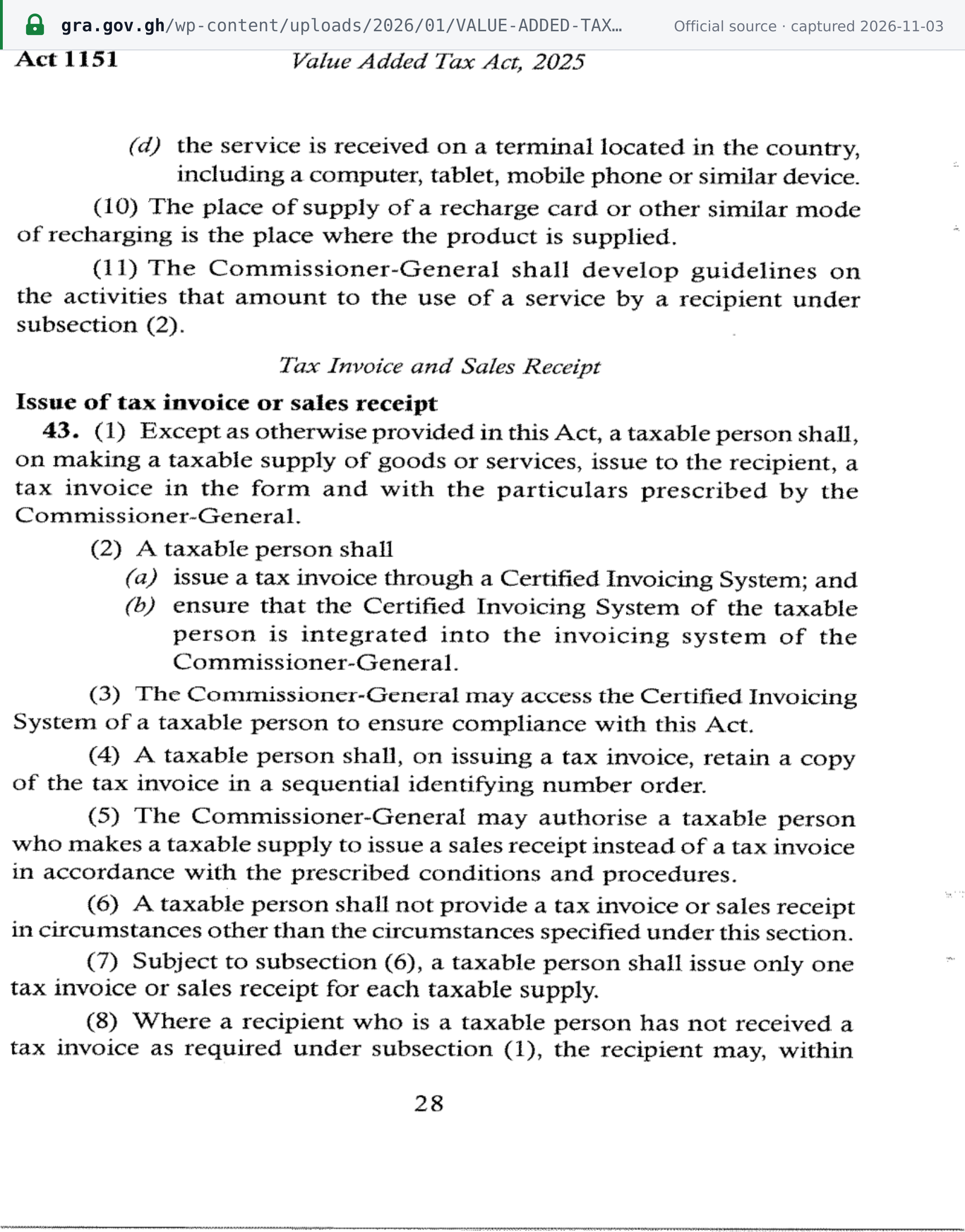
The statutory rule — Act 1151, section 43. A taxable person must, on making a taxable supply, issue "a tax invoice in the form and with the particulars prescribed by the Commissioner-General", and must "(a) issue a tax invoice through a Certified Invoicing System; and (b) ensure that the Certified Invoicing System of the taxable person is integrated into the invoicing system of the Commissioner-General." [1] Further rules in the same section:
- GRA may access the taxpayer's Certified Invoicing System to check compliance (s.43(3)).
- Only one tax invoice or sales receipt per taxable supply (s.43(7)).
- A registered recipient that did not receive an invoice may obtain it from the supplier's system within forty-eight hours (s.43(8)); a lost invoice can be retrieved from GRA's system.
- A fiscal receipt issued in accordance with the Taxation (Use of Fiscal Electronic Device) Act, 2018 (Act 966) satisfies the rule (s.43(9)).
- If the Certified Invoicing System goes offline or GRA cannot reach it, the taxpayer must, "within twenty-four hours, (a) inform the Commissioner-General; and (b) ensure that the Certified Invoicing System of the taxable person is restored online" (s.43(10)).
- Section 43 applies from commencement "Except as otherwise directed by the Commissioner-General" (s.43(13)) — the basis for GRA's phased E-VAT onboarding (see E-invoicing status).
 Source snapshot captured 2026-11-03 — original
Mandatory content
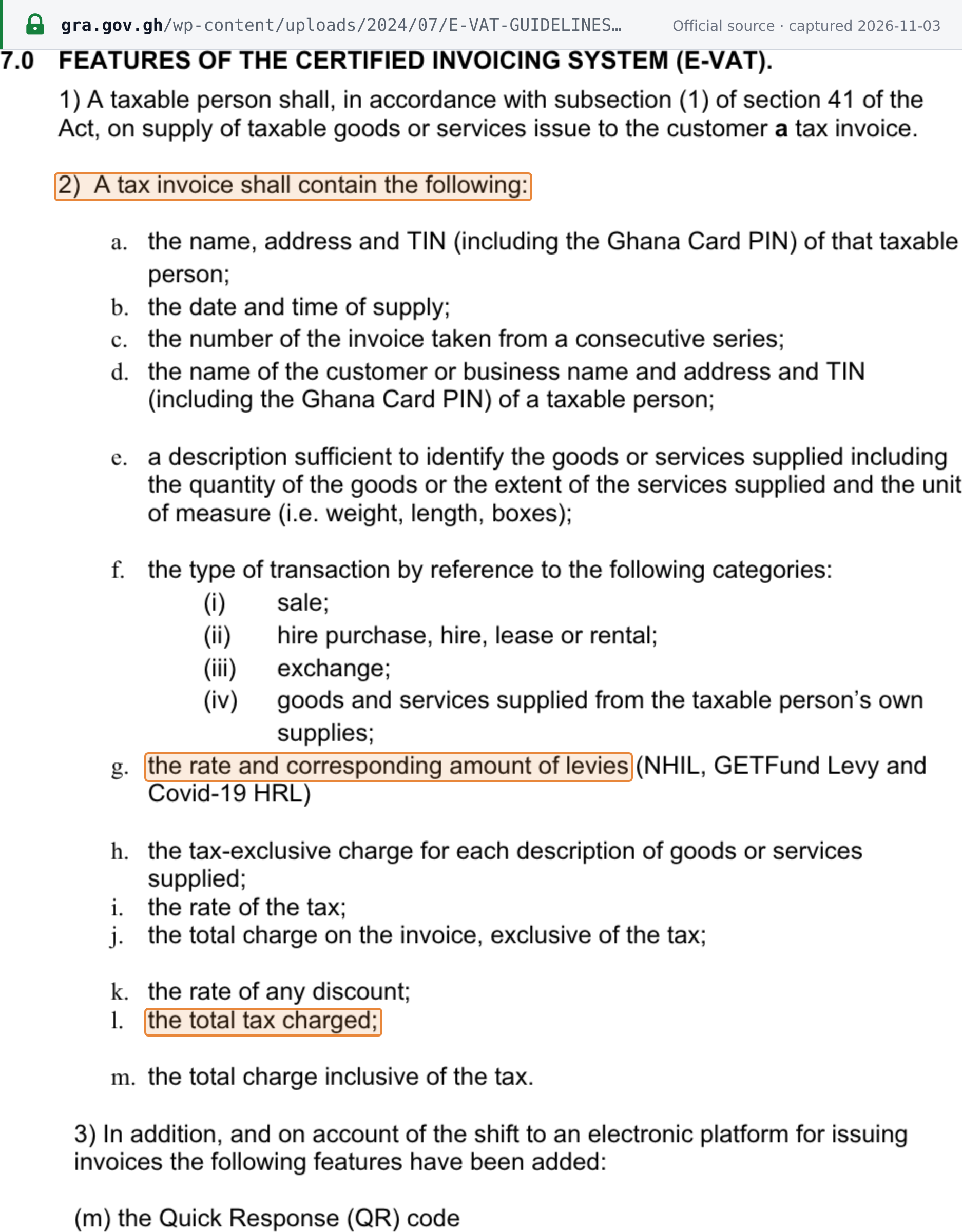
The Act leaves the particulars to the Commissioner-General. They are set in GRA's Guidelines on Certified Invoicing System (E-VAT), GRA/AG/2024/005, section 7.0(2) — "A tax invoice shall contain the following" — as modified for 2026: [3] [4]
| # | Field | Source |
|---|---|---|
| 1 | Supplier's name, address and TIN (including the Ghana Card PIN) | §7(2)(a) |
| 2 | Date and time of supply | §7(2)(b) |
| 3 | Invoice number from a consecutive series | §7(2)(c) |
| 4 | Customer's name or business name, address and TIN (including the Ghana Card PIN), for a taxable-person customer | §7(2)(d) |
| 5 | Description sufficient to identify the goods or services, with quantity or extent and unit of measure | §7(2)(e) |
| 6 | Type of transaction: sale; hire purchase, hire, lease or rental; exchange; own-supply | §7(2)(f) |
| 7 | Rate and amount of the levies — from 2026, separate lines for NHIL 2.5% and GETFund Levy 2.5% | §7(2)(g); GRA VAT page |
| 8 | Tax-exclusive charge for each line | §7(2)(h) |
| 9 | Rate of the tax (VAT 15%) | §7(2)(i) |
| 10 | Total charge exclusive of tax | §7(2)(j) |
| 11 | Rate of any discount | §7(2)(k) |
| 12 | Total tax charged — the field for the total of NHIL, GETFund Levy and VAT is mandatory | §7(2)(l); GRA VAT page |
| 13 | Total charge inclusive of tax | §7(2)(m) |
| 14 | E-VAT security features: QR code, invoice signature, verification engine ID, encrypted data, time stamp | §7(3) |
The 2024 field list still names the COVID-19 Health Recovery Levy. GRA's 2025 guideline §15.6 overrides it: "The VAT invoice currently in use contains a field for Covid-19 Health Recovery Levy. In completing the invoice, ignore the covid-19 levy field since the Covid-19 levy Act has been repealed." [2]
 Source snapshot captured 2026-11-03 — original
Separate levy lines from 2026. GRA's VAT page: "Own computer-generated invoices and sales receipts – taxpayers authorized to use their own computer-generated invoices and sales receipts must modify them to provide separate lines for NHIL at 2.5%, GETFund levy at 2.5%, and a line for the VAT at 15%." Approved own-system invoices had to reflect the new rates by 1 January 2026 (guideline §15.7). [4]
 Source snapshot captured 2026-11-03 — original
Issuance deadline
Act 1151 section 43 sets no separate issuance deadline; the invoice is issued on making the supply. The time of supply (s.39(1)(c)) is the earliest of: removal of the goods; the goods being made available; completion of the service; receipt of payment; or issue of a tax invoice or sales receipt. GRA's E-VAT guideline (§17.1) allows a backdated E-VAT invoice that shows both the transaction date and the invoice date. [1] [3]
Numbering and sequencing
Invoice numbers come from a consecutive series (E-VAT guideline §7(2)(c)), and "A taxable person shall, on issuing a tax invoice, retain a copy of the tax invoice in a sequential identifying number order" (s.43(4)).
Credit and debit notes
The Fourth Schedule to Act 1151 prescribes a tax credit note (s.46(6)) with at least: [1]
- the words "tax credit note" in a prominent place;
- a sequential identifying number;
- name, address and TIN of the supplier, and of the recipient;
- the date of issue;
- the number and date of the original tax invoice;
- the original value, the adjusted or correct value, the difference, and the tax on the difference;
- a brief explanation of why it is issued; and
- information sufficient to identify the supply.
A tax debit note (s.46(4)) carries the same particulars with the words "tax debit note". On E-VAT, credit and debit notes carry the same security features (QR code, signature, verification engine ID, encrypted data, time stamp). A cancelled or returned sale is cancelled on the system and a new invoice issued. Where the return for the period has already been filed, the invoice is still cancelled and reissued, and a tax debit note is also issued (E-VAT guideline §12.1). [3]
Currency, language and exchange rate
GRA's E-VAT guideline, its Act 1151 guideline and the GRA VAT page state no currency, language or exchange-rate rule for invoices. GRA's own examples are all in GHS.
Document types
- Tax invoice — the default for every taxable supply.
- Sales receipt — only where the Commissioner-General permits it, for "low value, high volume supplies", issued through the Certified Invoicing System (printed, SMS or email) (E-VAT guideline §8.0; Act s.43(5)). Customer details are optional, but "A sales receipt without all the purchaser's details as provided (including the name and TIN) does not qualify for input tax deduction." GRA publishes no value threshold for sales receipts. [3]
- Fiscal receipt issued in accordance with the Taxation (Use of Fiscal Electronic Device) Act, 2018 (Act 966) (s.43(9)).
- Tax credit note / tax debit note — see above.
Self-billing
GRA's E-VAT guideline and Act 1151 contain no self-billing provision. The closest rule lets a registered recipient pull a missing invoice from the supplier's Certified Invoicing System (s.43(8)).
Retention and audit trail
- Retention: six years. "A registered person shall keep the records required to be kept under regulation 31(1) for a minimum period of six years and shall after the six years, only destroy the records with the written permission of the Commissioner-General" (E-VAT guideline §13.0, citing L.I. 2243). [3]
- Electronic records are permitted on application, subject to unrestricted GRA access, print-outs on demand and ICT staff support at the taxpayer's cost; accounting software must be approved by the Commissioner-General.
- Audit trail: "The taxpayer's system must allow GRA access to its system logs (direct DB connections and/or electronic files) in an automated manner" (§18.0). GRA may access the Certified Invoicing System at any time (Act s.43(3)), and tampering with it is an offence (s.66(2)).
A specimen of a compliant invoice
GRA publishes no annotated specimen invoice; its E-VAT guideline, its Act 1151 guideline and the Act's schedules contain none. Below, Lookuptax lays out the E-VAT guideline §7 particulars for an illustrative domestic B2B sale. The figures mirror GRA's own GHS 1,000 → GHS 1,200 example. Every name, number and code is fictional:
Tax invoice (E-VAT) — illustrative
| Description§7(2)(e) | Qty§7(2)(e) | Unit§7(2)(e) | Unit price excl. tax | Amount excl. tax§7(2)(h) |
|---|---|---|---|---|
| Office desks, model EX-2 | 4 | pieces | GHS 200.00 | GHS 800.00 |
| Assembly service | 1 | job | GHS 200.00 | GHS 200.00 |
- Total excl. tax§7(2)(j)
- GHS 1,000.00
- Discount (rate)§7(2)(k)
- 0%
- NHIL 2.5%§7(2)(g); GRA VAT page
- GHS 25.00
- GETFund Levy 2.5%§7(2)(g); GRA VAT page
- GHS 25.00
- VAT 15%§7(2)(i); Act 1151 s.3
- GHS 150.00
- Total NHIL + GETFund Levy + VAT§7(2)(l); mandatory field
- GHS 200.00
- Total incl. tax§7(2)(m)
- GHS 1,200.00
- [QR code] · invoice signature · verification engine ID · encrypted data · time stamp — returned by GRA for each invoice (§7(3)).
- COVID-19 HRL field: not used from 1 January 2026 (guideline GRA/AG/25/002 §15.6).
- Corrections after the period has been filed are made by a tax credit note or tax debit note quoting this invoice number and date (Act 1151 Fourth Schedule).
E-invoicing status
Status (as at 2026-11-03): mandatory in law, phased in practice. Act 1151 section 43(2) requires every taxable person to invoice through a Certified Invoicing System integrated with GRA's system, "Except as otherwise directed by the Commissioner-General" (s.43(13)). GRA brings taxpayers onto the system in selected phases rather than by a published date or turnover band. [1]
- System: E-VAT (GRA's Certified Invoicing System). GRA: "E-VAT is an electronic system for issuing VAT receipts — essentially an electronic invoicing solution for VAT-registered businesses." [7]
- Model: real-time certification — each invoice is signed by GRA's virtual/online Sales Data Controller and returned with a QR code, signature and time stamp (see the CTC e-invoicing models explainer).
- Solutions: GRA's free invoicing software (desktop, mobile, online or one-off portal), or API integration of the taxpayer's ERP or POS. GRA estimates onboarding at "2 weeks and 1 month respectively" (E-VAT guideline §16.0). [3]
- Phases: "Implementation of the E-invoicing system will be carried out in phases as determined by the Commissioner-General." In phase two (notice of 4 September 2024), "An additional two thousand (2,000) VAT registered taxpayers will be onboarded on the system to issue electronic VAT invoices". GRA's E-VAT taxpayer training of 4–8 May 2026 covered a further named list of taxpayers. No all-taxpayer go-live date has been published. [3] [10] [11]
- Scope: B2B invoices and B2C sales receipts alike, for VAT-registered taxpayers.
See fiscal devices and certified cash registers and e-invoicing status and networks worldwide.
Filing and payment
Filing frequency
Monthly for every registered taxpayer; the tax period is the calendar month. Nil returns are required: the return is due "whether or not the Tax is payable for the tax period" (s.59(5)). [1]
Return and payment due date
| Who | Return and payment due | Source |
|---|---|---|
| Registered taxpayers | Last working day of the month following the tax period | Act 1151 s.59(5), s.60(1) |
| Non-residents registered under s.15 | Last calendar day of the following month (weekends and holidays count) | s.60(3)–(4) |
| VAT withholding agents | 15th of the following month | s.60(2) |
| Recipients of imported services | Within 21 days after the tax period | s.61(1) |
Section 59(5): "The tax return shall be submitted to the Commissioner-General not later than the last working day of the month immediately following the month to which the tax return relates, whether or not the Tax is payable for the tax period." GRA's VAT page gives the example: "October returns must be submitted by the last working day in November. If payment is due on the returns submitted, it must be made not later than the date the return is submitted." [4] (GRA's guideline §15.4 says "last day of the month"; the Act's "last working day" governs.) Returns are filed and paid through taxpayersportal.com. A return may be corrected on application within three months of the original (s.63(2)(b)).
VAT withholding
Appointed VAT withholding agents withhold 7% of the taxable value of local taxable supplies at the time of payment. GRA's guideline §12.1: "The difference of 8% of the taxable value and the levies, along with the taxable value is paid to the taxable person/supplier." The agent issues a Withholding VAT Certificate (amount, both TINs, invoice serial number, date, nature of supply, period), which the supplier credits against its own liability. [2] A supplier with a good compliance record can apply for exemption from withholding (s.58). See VAT withholding regimes.
Additional listings
GRA's VAT page and its Act 1151 guideline (GRA/AG/25/002) describe only the monthly return; neither mentions an annual VAT return or a sales/purchase listing.
Input-tax recovery
- NHIL and GETFund Levy are now input tax. GRA: "VAT Registered Taxpayers can now claim the NHIL and the GETFund charged on their purchases as input tax (i.e., the levies are now subject to input tax deduction)." [4]
- A deduction cannot be claimed twice, nor more than six months after it accrues (guideline §15.5).
- Input tax needs a tax invoice carrying the buyer's name and TIN (see Document types).
- Mixed supplies: input tax not directly attributable is apportioned as A × B / C (Fifth Schedule), where A is the unattributable input tax, B taxable supplies and C all supplies for the period. [1]
Refunds
Refund claims are made under section 53 of Act 1151. The upfront 20% paid by an unregistered importer is recoverable on application, with evidence of payment, after the importer registers and files; the application must be made within six months after the date the upfront payment was made, and GRA decides within thirty days (guideline §9.5–9.6). [2]
Exemptions
Exempt supplies
"The supply of goods or services specified in the First Schedule is an exempt supply and not subject to the Tax" (s.35(1)). GRA: "Supplies exempted from VAT are also exempted from NHIL and GetFund Levy." [1] [4] Examples from the First Schedule:
- Unprocessed local agricultural and aquatic food (maize, rice, tubers, fish, vegetables and fruits, cocoa beans, shea butter); live animals bred in Ghana; agricultural inputs; fishing gear.
- Water (not bottled); electricity supplied to a dwelling.
- Approved textbooks and newspapers; education services.
- Medical services and medical supplies; pharmaceuticals.
- Domestic passenger transport by road, rail and water.
- Machinery for agriculture, mining, manufacturing, railways, upstream petroleum and dredging.
- Crude oil, petrol, diesel, LPG, kerosene, residual fuel oil and natural petroleum gas.
- Immovable property for a dwelling — "but excluding the supply of immovable property by an estate developer"; dwelling accommodation; agricultural land.
- "A supply of financial services excluding non-life insurance."
- Goods for persons with disability; postage stamps; salt; mosquito nets; paper for exercise books and textbooks.
GRA's separate "VAT Exemptions" web page still describes the repealed Act 870 (for example, exempting air transport); rely on the Act 1151 First Schedule.
Exempt is not zero-rated. A zero-rated supply is taxable at 0%, so input tax on the costs of making it is recoverable. An exempt supply is outside the tax: the supplier charges no VAT, NHIL or GETFund Levy and cannot recover the input tax attributable to it.
Relief
The Third Schedule grants relief (not exemption) to the President, embassies and diplomats on a reciprocal basis, international agencies under agreements approved by Parliament, emergency relief items, raw-material imports of Association of Ghana Industries member manufacturers, and holders of reconnaissance and prospecting licences (on a pay-and-refund basis, guideline §15.8). [1]
Special regimes
- Flat Rate Scheme: abolished from 1 January 2026. Former flat-rate taxpayers with turnover above GHS 750,000, and all real estate developers, are converted to the standard rate; those below stay registered until deregistered, and unused flat-rate invoice booklets must be returned (guideline §15.2, §15.4 and §15.6). GRA's site navigation still carries a "VAT – Flat Rate (3%)" link; it is not a live rate.
- Free zones: supplies of goods to free zone developers and enterprises are zero-rated; supplies of services to them are standard-rated (guideline §14).
- Modified Taxation System: individuals deregistered as below the goods threshold migrate to it (guideline §15.2 and §15.4).
Offences and penalties
Offences
- Failure to issue a tax invoice or sales receipt is an offence: a fine of up to 100 penalty units, imprisonment of up to six months, or both (s.66(1)).
- Invoice and system offences (s.66(2)): issuing a false invoice, not issuing one, not using a Certified Invoicing System, tampering with it, or failing to integrate or reconnect it — in addition to s.66(1), "liable to pay a penalty of an amount of not more than fifty thousand currency points or three times the amount of Tax involved, whichever is higher."
- Tax evasion: a fine of two to three times the tax evaded, imprisonment of two to five years, or both (s.67(1)).
- Non-resident digital suppliers that fail to register face restriction of access to Ghana until they register (s.15(2)).
- Failure to register under the Revenue Administration Act, 2016 (Act 915): the tax plus a fine of up to twice the tax or 1,000 penalty units, whichever is higher, with possible forfeiture (GRA penalties page). [9]
Penalties
| Failure | Penalty | Source |
|---|---|---|
| Failure to register | Not less than 3× the tax on taxable supplies from when registration was required until the application | Act 1151 s.16 |
| Failure to file a return | 500 currency points plus 10 currency points per day the failure continues | Act 915, per GRA |
| Withholding agent fails to withhold or remit by the 15th | The tax plus 30% of the amount | Act 1151 s.57(2) |
| Failure to keep documents (deliberate) | 75% of the tax attributable | Act 915, per GRA |
| False or misleading statements | 100% of the shortfall (without reasonable excuse) or 30% in any other case | Act 915, per GRA |
GRA's penalties page: "The monetary value of a penalty unit stands at GH¢12.00." and "The monetary value of a currency point stands at GH¢ 1.00." So the s.66(2) cap of 50,000 currency points is GHS 50,000 (as at 2026-11-03). [9] The interest rate on late payment is set in Act 915 and is not published on GRA's penalties page.
Frequently asked questions
We supply services and were below the old GHS 200,000 threshold. Do we need to register for VAT now?
Yes. Since 1 January 2026 there is no registration threshold for suppliers of taxable services. Section 6(1)(a) of the Value Added Tax Act, 2025 (Act 1151) requires a service provider to register within thirty days after engaging in the taxable activity, unless the Commissioner-General directs otherwise, and GRA's guideline GRA/AG/25/002 says existing service providers who were not required to register under Act 870 because of the threshold had to register within thirty days from the effective date of the Act.
Can we now claim the NHIL and GETFund Levy on our purchases as input tax?
Yes, from 1 January 2026. GRA's VAT page states that VAT registered taxpayers can now claim the NHIL and the GETFund charged on their purchases as input tax. The levies are charged on the same base as VAT, so a GHS 1,000 supply carries GHS 25 NHIL, GHS 25 GETFund Levy and GHS 150 VAT, GHS 1,200 in total.
Our invoice template still has a COVID-19 Health Recovery Levy field. What do we do with it?
Ignore it. GRA guideline GRA/AG/25/002 (§15.6) says to ignore the COVID-19 levy field because the levy Act has been repealed. Taxpayers authorised to use their own computer-generated invoices must modify them to show separate lines for NHIL at 2.5%, GETFund Levy at 2.5% and VAT at 15%, and the field for the total of NHIL, GETFund Levy and VAT is mandatory.
A supplier gave us a sales receipt without our company name and TIN. Can we claim the input tax on it?
No. GRA's E-VAT guideline (§8.0) states that a sales receipt without all the purchaser's details, including the name and TIN, does not qualify for input tax deduction. Ask the supplier for a full tax invoice. If a registered recipient has not received a tax invoice, section 43(8) of Act 1151 lets it obtain the invoice from the supplier's Certified Invoicing System within forty-eight hours.
Our Ghanaian customers already have VAT taken at payment under Real-Time VAT. Do we still need to register and file as a non-resident digital service provider?
Yes. GRA's Real-Time VAT FAQ says unregistered digital service providers are required to register with GRA, and that Real-Time VAT collection and periodic VAT returns are two different activities, and both are required. Section 15 of Act 1151 obliges a non-resident providing telecommunication services or electronic commerce for use or enjoyment in Ghana to register if it makes a taxable supply.
We were on the 3% VAT Flat Rate Scheme. What happens to us from 2026?
The Flat Rate Scheme was abolished from 1 January 2026. Under GRA guideline GRA/AG/25/002 (§15.2, §15.4 and §15.6), flat-rate taxpayers whose annual turnover exceeds GHS 750,000 and all real estate developers are converted to the standard rate. Those below the threshold remain registered, charging tax and filing returns, until the Commissioner-General deregisters them, and unused flat-rate invoice booklets must be returned.
Important websites
| Site | Purpose |
|---|---|
| Ghana Revenue Authority | Tax authority home page |
| GRA taxpayers' portal | Register for VAT with a Ghana Card PIN, file returns and pay |
| Digital Services Registration for Non-Residents | Registration portal for non-resident digital and telecom suppliers |
| GRA — VAT | Rates, 2026 reforms, invoice and filing rules |
| GRA — E-VAT | E-VAT invoicing system, solutions and invoice features |
| GRA — Tax registration | How to register and documents required |
| GRA — Tax offences and penalties | Penalty amounts, penalty unit and currency point values |
| Ghana TIN validator | Check a Ghanaian TIN's format |
For other countries' registers, see check a VAT number — official lookups by country.
Recent changes
- 2026-10-21 — GRA's approved Real-Time VAT FAQ describes collection of 20% on cross-border digital services at the point of payment; non-residents must still register and file. (GRA) — see event
- 2026-01-01 — Act 1151 in force: goods threshold raised from GHS 200,000 to GHS 750,000 and no threshold for services; NHIL and GETFund Levy recoupled and deductible as input tax; COVID-19 Health Recovery Levy and the VAT Flat Rate Scheme abolished. (GRA) — see event
- 2025-12-31 — GRA issues the VAT Administrative Guidelines for Act 1151 (GRA/AG/25/002). (GRA)
- 2025-12-09 — Value Added Tax Act, 2025 (Act 1151) receives assent. (Act 1151)
- 2024-09-04 — E-VAT phase two: an additional 2,000 VAT-registered taxpayers onboarded. (GRA)
For the full chronology, see Ghana tax changes on Lookuptax.
Reference links
- Value Added Tax Act, 2025 (Act 1151) — hosted by GRA
- GRA — VAT Administrative Guidelines for the Value Added Tax Act, 2025 (Act 1151), GRA/AG/25/002
- GRA — Guidelines on Certified Invoicing System (E-VAT), GRA/AG/2024/005
- GRA — Value Added Tax (VAT)
- GRA — Notice to all VAT registered taxpayers
- GRA — Real-Time VAT (RTVAT) approved FAQ
- GRA — E-VAT
- GRA — Tax registration
- GRA — Tax offences and penalties
- GRA — Implementation of electronic invoicing of Value Added Tax: phase two (4 September 2024)
- GRA — E-VAT taxpayer training workshop, 4th to 8th May 2026
- GRA — Commencement of the use of Ghana Card PIN as Taxpayer Identification Number (3 April 2021)
Related on Lookuptax:
- Ghana tax identification number (TIN) guide
- VAT registration thresholds worldwide
- Worldwide tax rates
- E-invoicing status and networks worldwide
- VAT on digital services by non-resident suppliers
- Reverse charge explained
- VAT withholding regimes
- Fiscal devices and certified cash registers
- How to register for VAT, sales tax or GST