Gibraltar Transaction Tax guidelines
| FACTSHEET | |
|---|---|
| Country code | GI |
| Tax name | Transaction Tax (TT), on goods only. No VAT. |
| Tax Authority | HM Customs Gibraltar (the Collector of Customs) |
Overview
Gibraltar has no VAT and no general sales tax. HMRC's VAT Notice 741A: "There is no VAT in the Channel Islands or Gibraltar, which are outside the UK for VAT purposes." [5] In his speaking note for the Treaty Bill's Second Reading (press release 223/2026), the Chief Minister told Parliament that it "maintains Gibraltar's status as entirely VAT‑free" and that "There is no sales tax". [4]
The indirect tax that does exist is the Transaction Tax, on goods only. Since 15 July 2026, goods that are "(a) produced in Gibraltar; or (b) imported into Gibraltar" are liable to a transaction tax, which "must be collected by the Collector" (s.98 of the Treaty on Gibraltar and the European Union Act 2026, Act 2026-11). [1] The Chief Minister's Notice of Commencement (LN.2026/148) "appointed the 15th July 2026" as the day the Act's remaining provisions came into operation, the date the UK–EU Treaty in respect of Gibraltar was provisionally applied. [2] [17]
 Source snapshot captured 2026-10-21 — original
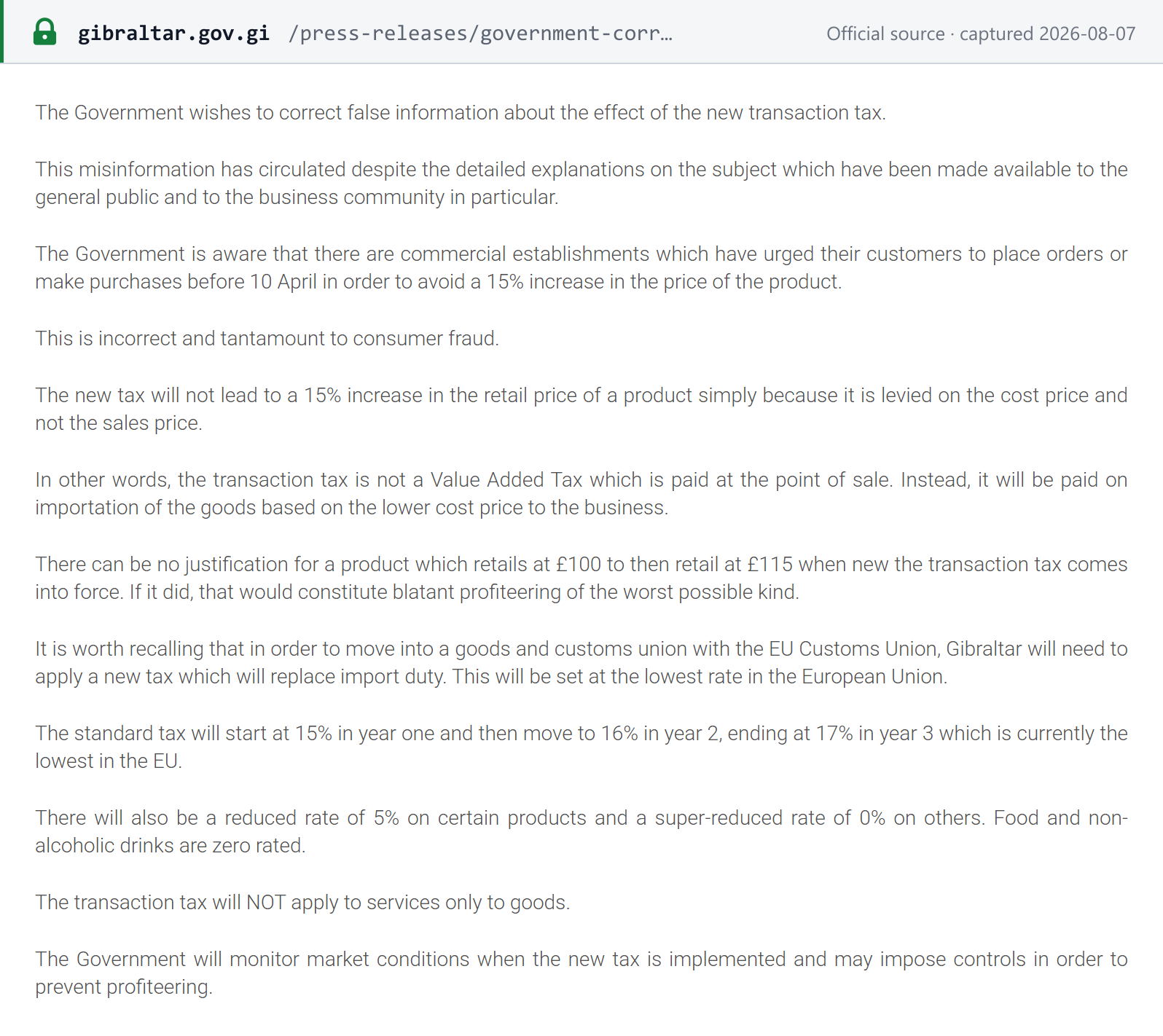
It is not a VAT. HM Government press release 201/2026: "the transaction tax is not a Value Added Tax which is paid at the point of sale. Instead, it will be paid on importation of the goods based on the lower cost price to the business." And: "The transaction tax will NOT apply to services only to goods." [3]
 Source snapshot captured 2026-08-07 — original
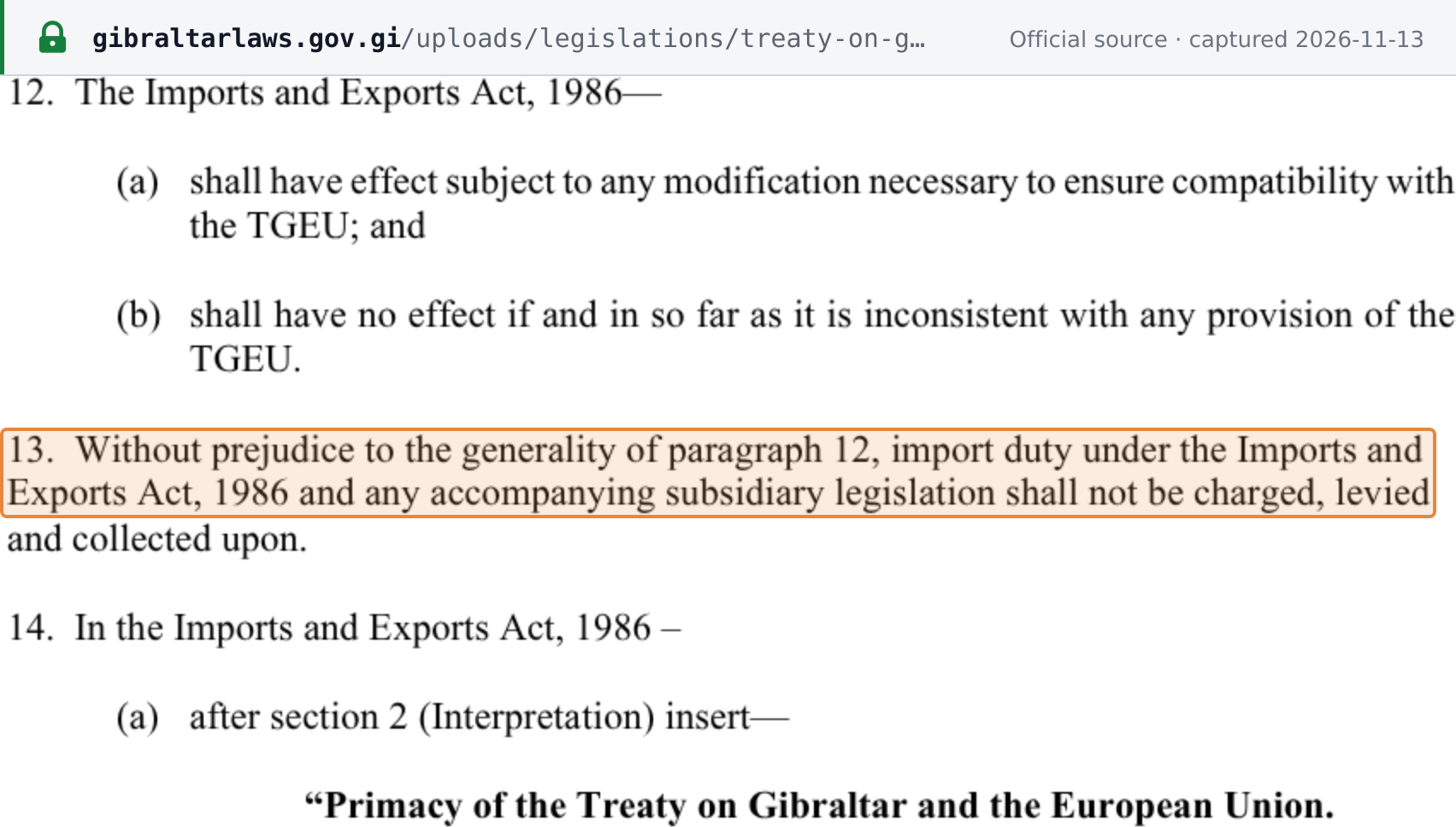
Import duty is no longer charged. The Transaction Tax replaced it. Schedule 1, para. 13 of the Act: "import duty under the Imports and Exports Act, 1986 and any accompanying subsidiary legislation shall not be charged, levied and collected upon." [1] The Imports and Exports Act 1986 still governs customs procedure (entries, records, offences). Separate excise duties, generally at EU minimum levels, apply to alcohol, tobacco and energy products (Act ss.103–110 and Sch. 2 Part 3; LN.2026/361). [21] This guide covers the Transaction Tax.
 Source snapshot captured 2026-11-13 — original
Authority. HM Customs Gibraltar collects the Transaction Tax. The Act's "Collector" is "the Collector of Customs appointed under section 3(1) of the Imports and Exports Act, 1986" (s.81). [1] Declarations are made in HM Customs' ASYCUDA World portal. The Income Tax Office administers income tax and corporation tax only.
Currency. Pound sterling (Gibraltar pound notes and coin circulate at par). Prices shown to consumers must be in sterling: "The indication of selling price and unit price shall be in sterling" (Indication of Prices and Invoicing Rules 2012, r.6(1)). [14]
Tax period. None. The Transaction Tax is charged consignment by consignment when goods are presented to customs, or when locally produced goods leave the production site (Act Sch. 2, para. 1(1)). There is no return period.
Layering. None within Gibraltar: one levy for the whole territory. The Treaty creates a customs union between Gibraltar and the EU, not EU membership. Section 89(2) describes "the customs territory of Gibraltar, which constitutes a customs territory separate from the customs territory of the United Kingdom", and s.91(2) bars customs duties between the Union and Gibraltar. [1] [1] On non-EU goods, the EU Common Customs Tariff is levied separately by the Spanish Designated Customs Post when the goods enter the customs union. In its description of the special customs procedures, HM Government's Technical Notice 72/2026 says "the proceeds of these customs duties will be paid back to Gibraltar". [6]
For neighbouring systems, see the Spain VAT guide and the United Kingdom VAT guide. For other territories with no VAT, see the Guernsey and Jersey guides.
Registration
Who must pay: the liability rule
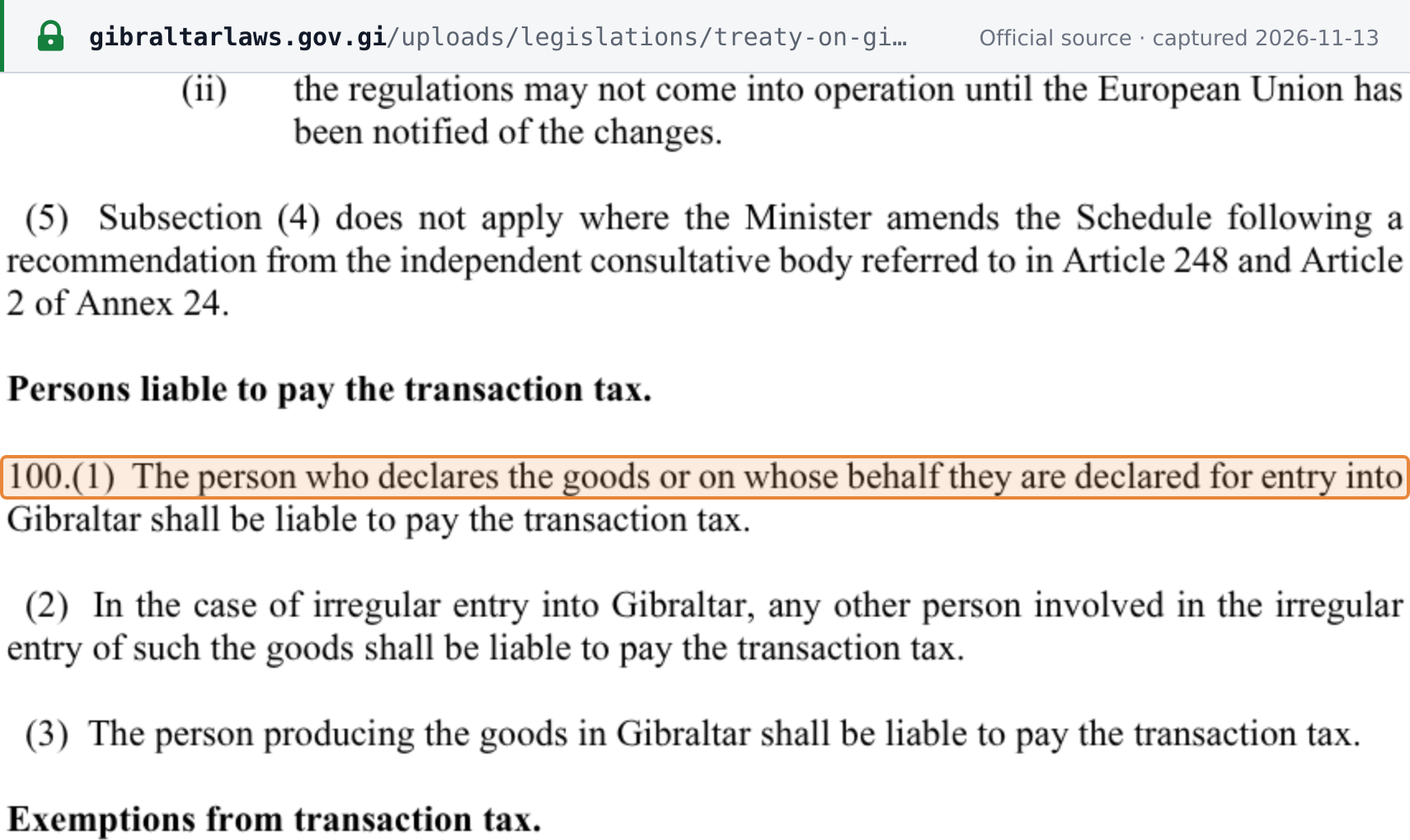
There is no Transaction Tax registration and no turnover threshold. Liability attaches to each consignment. Section 100 of the Act: [1]
- "(1) The person who declares the goods or on whose behalf they are declared for entry into Gibraltar shall be liable to pay the transaction tax."
- "(2) In the case of irregular entry into Gibraltar, any other person involved in the irregular entry of such the goods shall be liable to pay the transaction tax."
- "(3) The person producing the goods in Gibraltar shall be liable to pay the transaction tax."
 Source snapshot captured 2026-11-13 — original
Every importer must also enter its goods with customs. Section 21(1) of the Imports and Exports Act 1986: "a person who imports any goods shall, within the relevant period, deliver to a customs officer an entry thereof in such form and manner and containing such particulars as may be prescribed." [8]
Non-residents. The rule does not depend on residence. Whoever declares the goods, or on whose behalf they are declared, pays. A foreign seller that does not act as declarant has no Gibraltar obligation; see Foreign companies selling into Gibraltar.
Setting up as an importer with HM Customs
A business that clears its own goods registers with HM Customs:
- Business Registration Form CUS 180X, submitted "to Custom House, Waterport". The form offers two options: "The company will clear its own goods", with charges deducted from the company's prepayment account, or "A Customs Clearance Agent can clear goods on behalf of the company", with charges deducted from either the company's or the agent's prepayment account. The form dates from 2017 and still refers to "Import duty". [11]
- ICIS/ASYCUDA user accounts, requested through HM Customs' "Registration of New ICIS Users" service. [12]
- Spanish NIF and EORI, if the business itself lodges transit or customs formalities in Spain or the EU (below).
- A business licence under the Fair Trading Act 2023, where the business runs a customs warehousing, inward processing or temporary admission activity for non-Union goods (LN.2026/185, reg. 4(1)). [22]
HM Customs publishes no processing time for these registrations.
Spanish EORI and NIF for self-clearing traders
Commercial goods reach Gibraltar through the EU, by land via a Spanish Designated Customs Post (see Imports and exports). HM Customs' NIF and EORI guidance note (22 May 2026): "For Gibraltar traders operating movements in or through Spain and the EU customs territory, a Spanish-issued EORI will be required." The Spanish EORI is "ES + NIF", so "a trader cannot obtain a Spanish EORI without first obtaining a Spanish NIF". [10]
- Not needed when an agent pays. "Where a customs agent is completing the customs formalities, and paying the relevant taxes and duties from their own accounts, on your behalf, you will not require an EORI."
- No Spanish tax exposure. "Obtaining a Spanish NIF for customs identification purposes DOES NOT mean that: the business is considered established in Spain; the business becomes taxable in Spain…"
To check a Spanish EORI or NIF, see EORI verification in the EU and Spanish NIF verification.
Tax identification number
There is no Transaction Tax number. HM Customs identifies traders by their business registration and ASYCUDA account, and, on EU transit, by the Spanish EORI. Gibraltar's only general tax identifier is the Income Tax Office's Taxpayer Reference Number (TRN), used for income tax and corporation tax. For its format, see the Gibraltar TRN guide. HM Government of Gibraltar publishes no public TRN lookup.
Voluntary registration, deregistration and group registration
Not applicable. Part 6, Chapter 4 of the Act (ss.98–102) contains no registration, deregistration or grouping provision for the Transaction Tax, because the tax is charged per declaration. Section 110 provides for the registration of excise duty operators only.
Rates
| Rate | Applies to | Basis |
|---|---|---|
| 15% (standard) | All goods not at a reduced or super-reduced rate and not exempt, in the Treaty's first year | Act Sch. 2, para. 3(1)(a) |
| 16% (standard, year 2) | The same goods in the Treaty's second year | Sch. 2, para. 3(1)(b) |
| 17%, or the lowest EU standard VAT rate (standard, from year 3) | The same goods after 24 months | Sch. 2, para. 3(1)(c) |
| 5% (reduced) | Agricultural inputs, live equines, plants and flowers, children's clothing, footwear and car seats, bicycles and e-bikes, works of art and antiques, rescue and first-aid equipment for public bodies | Sch. 2, para. 3(2) |
| 0% (super-reduced) | Food and non-alcoholic drinks, water, pharmaceutical products, medical equipment and disability aids, books and newspapers, residential solar panels | Sch. 2, para. 3(3) |
| Exempt | Goods that would get a mandatory VAT exemption in the EU (for example investment gold, bunkering fuel), LNG for electricity generation, electricity produced in Gibraltar | Act s.101 |
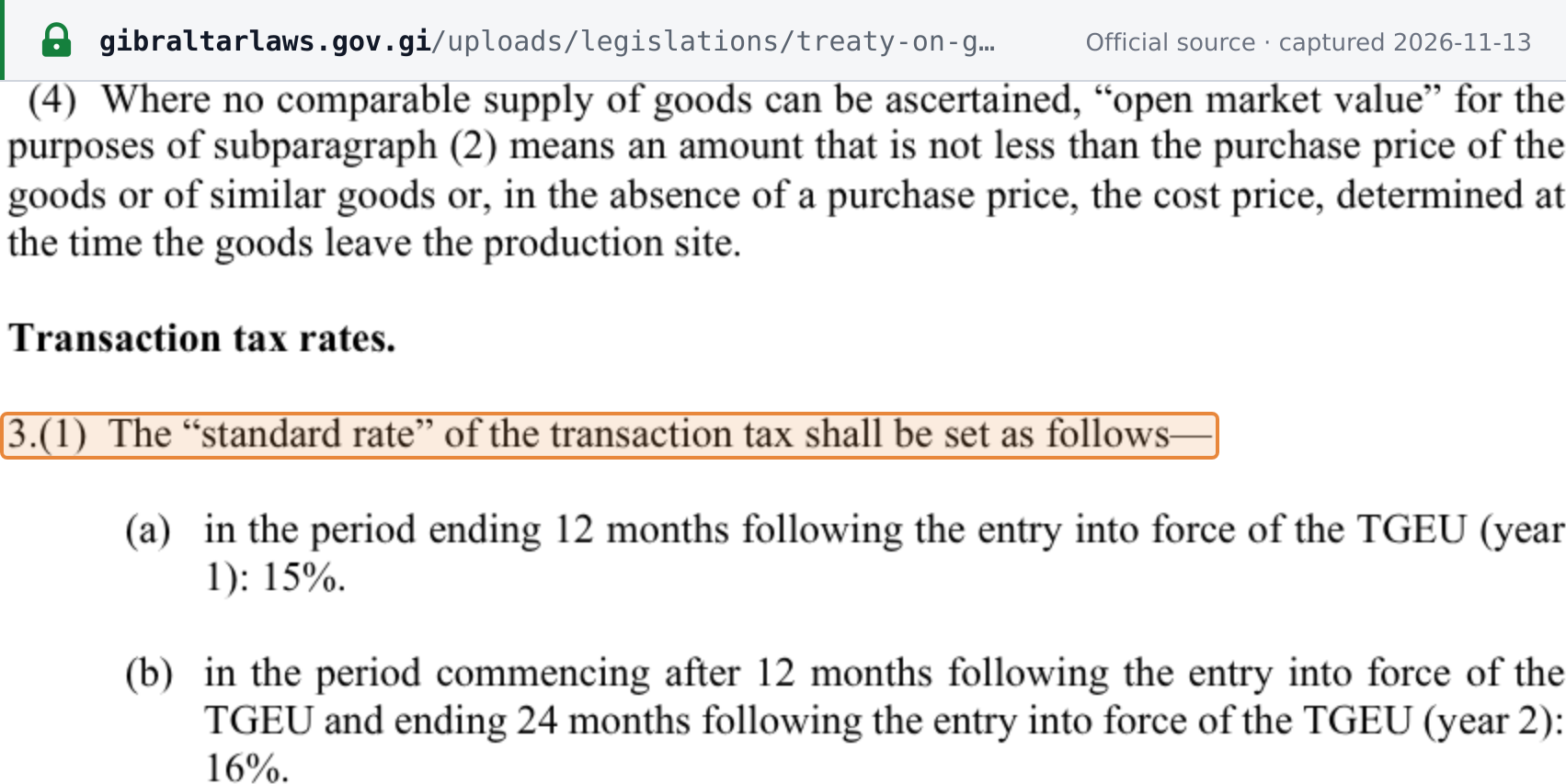
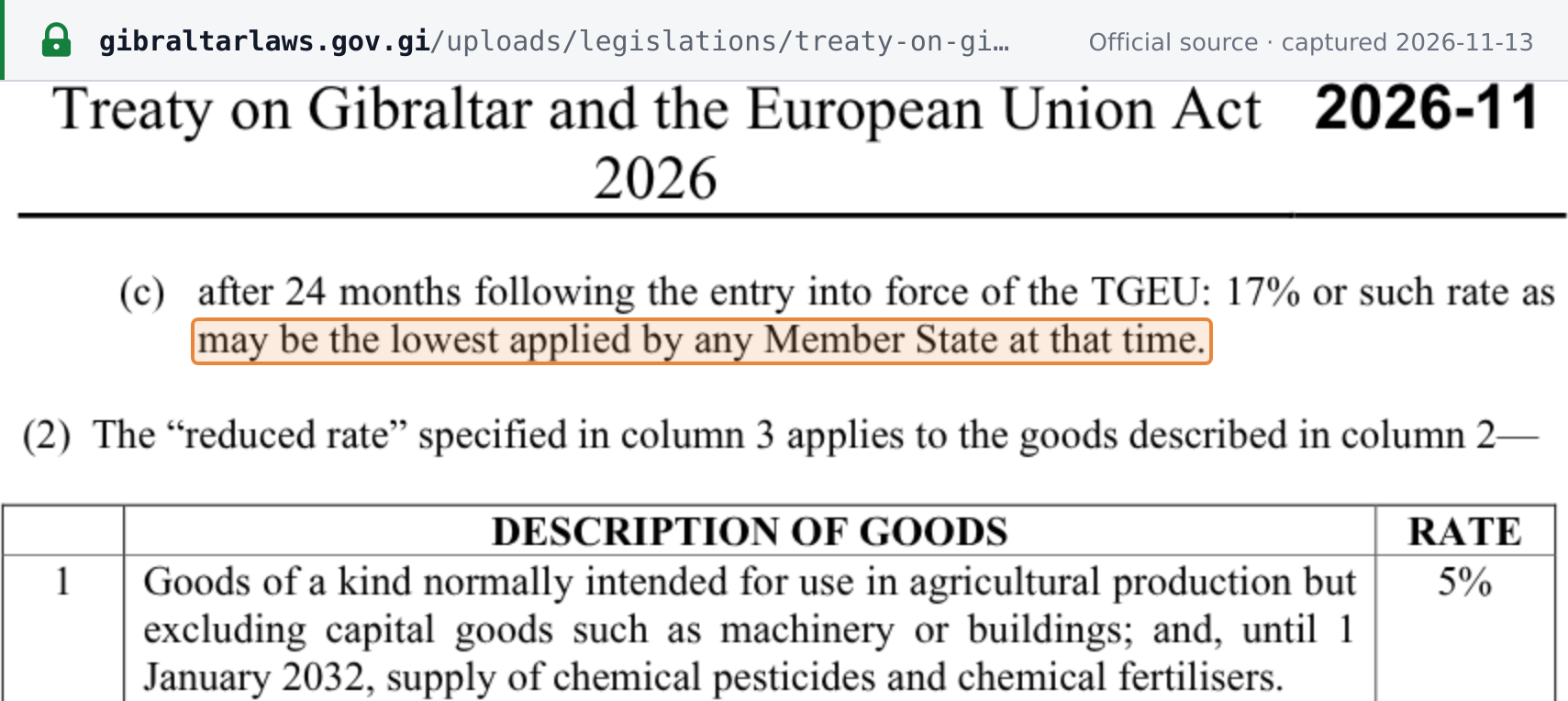
Standard rate: 15% (in force from 15 July 2026). Schedule 2, para. 3(1): "The “standard rate” of the transaction tax shall be set as follows— (a) in the period ending 12 months following the entry into force of the TGEU (year 1): 15%. (b) in the period commencing after 12 months following the entry into force of the TGEU and ending 24 months following the entry into force of the TGEU (year 2): 16%. (c) after 24 months following the entry into force of the TGEU: 17% or such rate as may be the lowest applied by any Member State at that time." [1]
 Source snapshot captured 2026-11-13 — original
When the 16% step starts depends on the Treaty's entry into force. Schedule 2 counts the years from the TGEU's entry into force, while since 15 July 2026 the Treaty has been provisionally applied, and the Act defines the two dates separately (s.6). The Act fixes no calendar date for the 16% step.
 Source snapshot captured 2026-11-13 — original
Reduced rate: 5% (Sch. 2, para. 3(2)), on: [1]
- goods normally used in agricultural production, excluding capital goods, and, until 1 January 2032, chemical pesticides and fertilisers;
- live equines;
- live plants, bulbs, cut flowers and ornamental foliage;
- "Children’s clothing and footwear; children’s car seats";
- "Bicycles, including electric bicycles";
- works of art, collectors' items and antiques listed in Annex IX, Parts A–C of Council Directive 2006/112/EC;
- rescue and first-aid equipment supplied to public bodies or non-profit civil-protection organisations.
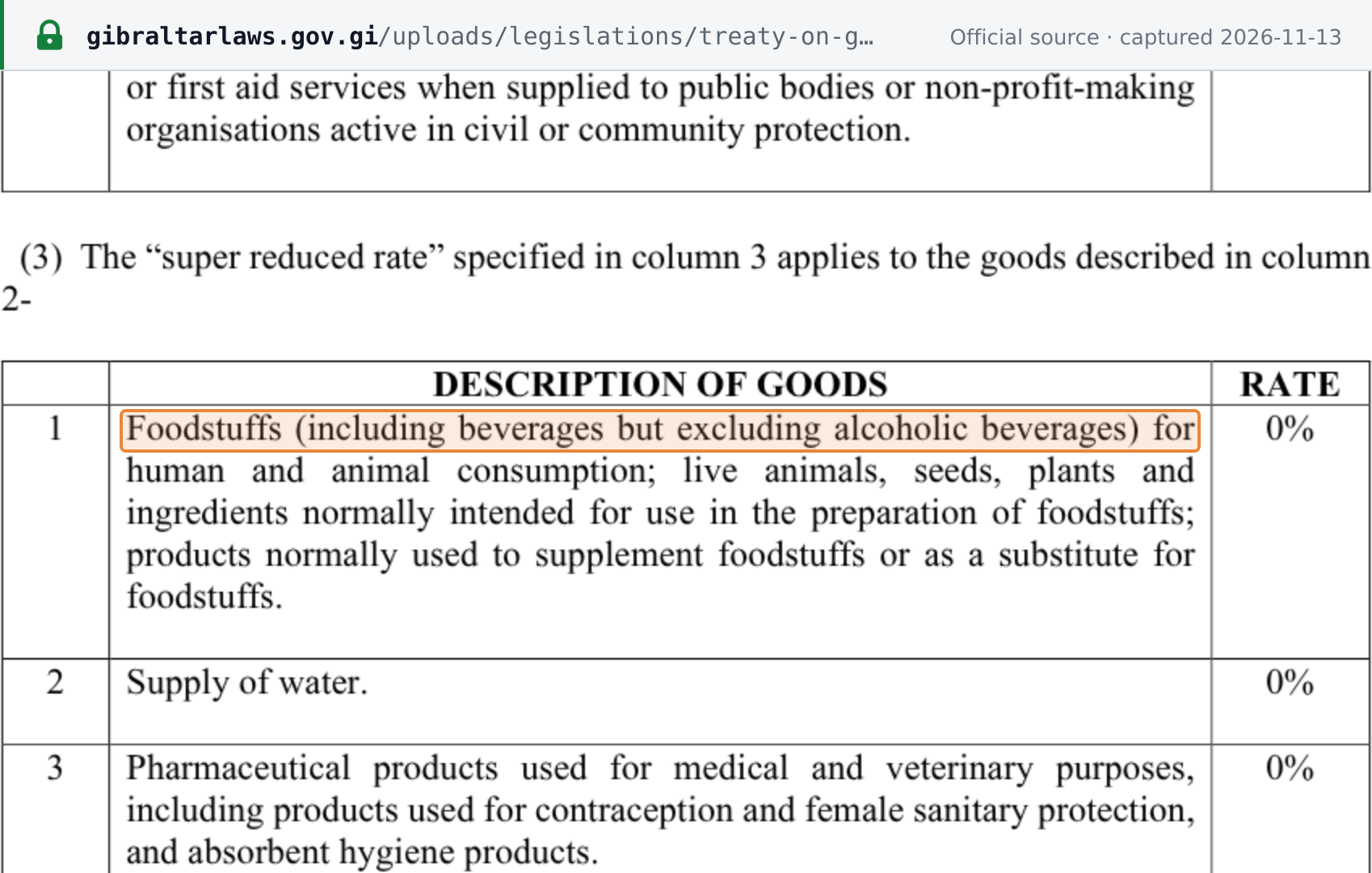
Super-reduced rate: 0% (Sch. 2, para. 3(3)), on: [1]
- "Foodstuffs (including beverages but excluding alcoholic beverages) for human and animal consumption", plus live animals, seeds, plants and ingredients used to prepare food, and food supplements;
- supply of water;
- pharmaceutical products for medical and veterinary use, including contraception, female sanitary protection and absorbent hygiene products;
- medical equipment, appliances and protective gear, including health protection masks, and aids for disabled people;
- books, newspapers and periodicals, printed or electronic, other than publications mainly devoted to advertising, video or music;
- solar panels installed on or next to private dwellings, housing and public-interest buildings.
 Source snapshot captured 2026-11-13 — original
The categories mirror those the EU VAT Directive lets Member States tax at reduced rates. The Minister may amend the rates by regulation. After 24 months, the standard rate may not be set below "the lowest standard VAT rate applied by a Member State at that time", and reduced-rate goods must be ones EU law allows (s.99(3)–(4)). [1] For the EU rules the rates track, see EU VAT rate rules.
Taxable amount. For imports, the base is "the value for customs purposes", plus, where not already included, "taxes, duties, levies and other charges (including excise duties) due by reason of importation, excluding the transaction tax to be levied" and "incidental expenses, such as commission, packing, transport and insurance costs" (Sch. 2, para. 2(1)). For goods produced in Gibraltar, it is "the open market value at the time the goods leave the production site" (para. 2(2)). [1] This is why HM Government says the tax falls on cost price, not retail price.
Possible future changes. The rates have not been amended since the Act was made: LN.2026/177 only corrected drafting in the Schedule 2 tables. [20] Two measures could change them, and neither has been adopted:
- An independent consultative body under the Treaty "may, in order to avoid significant actual distortions in Gibraltar or the Campo de Gibraltar, recommend that a higher or lower standard rate of TT should apply to a selection of goods or categories of goods" (Technical Notice 72/2026, 4 February 2026). The Notice says a lower rate "can be up to 2% below the lowest applied by any EU Member State but never below 15%". [6]
- Vehicles. HM Government's Treaty FAQs (TAX-04) say vehicles pay at least the standard rate, "subject to a policy decision which HMGoG will be taking as to whether higher rates will be applied for certain vehicles". [7]
See the Gibraltar tax-changes chronology for updates, and worldwide tax rates for other jurisdictions.
Cross-border rules
Imports and exports
When the tax is due. Schedule 2, para. 1(1) charges Transaction Tax (and excise, where it applies): for goods moved to Gibraltar from free circulation in the EU, or imported from outside the customs union, "upon presentation of the goods to customs"; for goods released from a special customs procedure onto the Gibraltar market; "when goods produced in Gibraltar leave the production site"; when goods are found to have entered irregularly; and when travellers bring in goods above their allowances. [1]
Route. Until a later Treaty decision, goods other than travellers' personal luggage "shall be brought into Gibraltar and be exported from Gibraltar only by land" (Act s.95(3)), except that Union goods may also be brought in by sea, and goods may be moved by sea from Gibraltar to third countries (s.95(4)). [1] In practice, HM Customs' transit guidance describes goods travelling under T1GI (non-EU goods) or T2GI (EU goods) transit from a Spanish Designated Customs Post (La Línea, Algeciras or Sagunto). On arrival, HM Customs confirms the transit, and the importer lodges an IM4 home-use declaration on ASYCUDA quoting the transit MRN. [9] On non-EU goods, any EU customs duty is paid at the Designated Customs Post, separately from the Transaction Tax.
Exports: Transaction Tax is refunded. Section 102: "(1) The Collector shall refund the transaction tax charged on a good upon its export to the European Union provided the exporter can prove to the Collector's satisfaction that VAT has been paid in the European Union. (2) The Collector shall refund the transaction tax where goods are exported to a country outside the customs union via a designated customs post and the Collector has been so notified by the designated customs post. (3) Goods consumed in Gibraltar shall not be eligible for a refund of the transaction tax." [1] The export declaration (EX1) must "refer to the original import invoice and the original import MRN to allow for the refund of the transaction tax". [9]
No commercial de minimis. Goods brought in for resale are commercial at any value. HM Government's Treaty FAQs (CUST-06): "a small trader bringing goods from Spain into Gibraltar to sell, even if those goods are small in quantity or low in value, would not be goods of a non-commercial character. The same would apply to online sales." [7]
Traveller allowances. For the first 3 years of the Treaty's application, non-commercial goods in personal luggage above these limits must be declared and bear Transaction Tax. The limits are "the GBP equivalents" of: "For general goods acquired and brought by air or by sea, EUR 430 or EUR 300 if brought by land. For under 15s, the threshold value is reduced in either case to the EUR 175." The tobacco limit is 200 cigarettes, 100 cigarillos, 50 cigars or 250 g of tobacco. The alcohol limit is 1 l of spirits over 22% or 2 l of alcohol at 22% or less, and 4 l of still wine or 16 l of beer, as HM Government's FAQ words it. After the 3 years, the thresholds stop applying to personal-use goods moved from the EU into Gibraltar. [7]
Postal imports. HM Customs has issued no Treaty-era guidance specific to parcels or postal imports, so ask HM Customs how they are cleared.
Reverse charge on imported services
Not applicable. The Transaction Tax charges goods only (Act s.98), and Gibraltar has no VAT, so services bought from abroad bear no Gibraltar indirect tax and the buyer self-accounts for nothing. For how VAT countries handle this, see reverse charge explained.
Digital products and services
Not taxed. Electronic and digital services are services, and "The transaction tax will NOT apply to services only to goods" (press release 201/2026). [3] There is no non-resident digital-services registration. Physical goods bought online are imports like any other (see above).
Foreign companies selling into Gibraltar — B2B and B2C
- Goods, B2B. The Gibraltar business, or its customs agent, declares the goods and pays Transaction Tax at clearance (s.100(1)). The foreign seller does not register in Gibraltar and charges no Gibraltar tax.
- Goods, B2C (including online sellers and Spanish retailers delivering). There is no seller registration and no import one-stop-shop scheme. The goods must go through the commercial customs route, and the declarant pays: in practice the carrier, a customs agent, or the consumer. HM Government's Treaty FAQs (SERV-03): "No Spanish retailer or delivery operator would be able to introduce goods into Gibraltar without that operator having to comply with the regimes established in the treaty with respect to the movement of commercial goods into Gibraltar." [7]
- Services, B2B and B2C. No Transaction Tax and no VAT. A foreign company that performs services in Gibraltar has other obligations: "Any company wishing to provide any services in Gibraltar will need to be registered in Gibraltar for tax and social security purposes" (FAQ SERV-01). That is income tax and social insurance, not an indirect tax. [7]
Marketplace / platform deemed-supplier liability
Not applicable. The Act makes no marketplace or platform liable for the Transaction Tax; liability follows the declaration (s.100).
Place of supply
Not applicable. The Transaction Tax is charged on goods physically imported into or produced in Gibraltar, not on supplies, so it has no place-of-supply rules for goods or services. Goods sold from Gibraltar to EU customers bear the destination Member State's VAT instead (Treaty FAQs CON-02). [7]
Invoice requirements
There is no tax invoice in Gibraltar. With no VAT, and a Transaction Tax that HM Customs assesses on the customs declaration ("taxes will be levied via an assessment notice"), no law requires an invoice to show tax, a tax number or a tax rate. [9] No Gibraltar law sets invoice rules on numbering, sequencing, self-billing, credit notes or simplified invoices. Two sets of invoice rules do exist: one under price-control law and one under customs law.
Mandatory content
Goods sold for resale (Price Control Act). "A person who in the course of business sells any supplies to any other person for the purpose of resale, shall furnish to such last-named person within seven days of the delivery of the supplies an invoice containing such particulars relating to the supplies as may be prescribed" (Price Control Act, s.6(2)). [13]
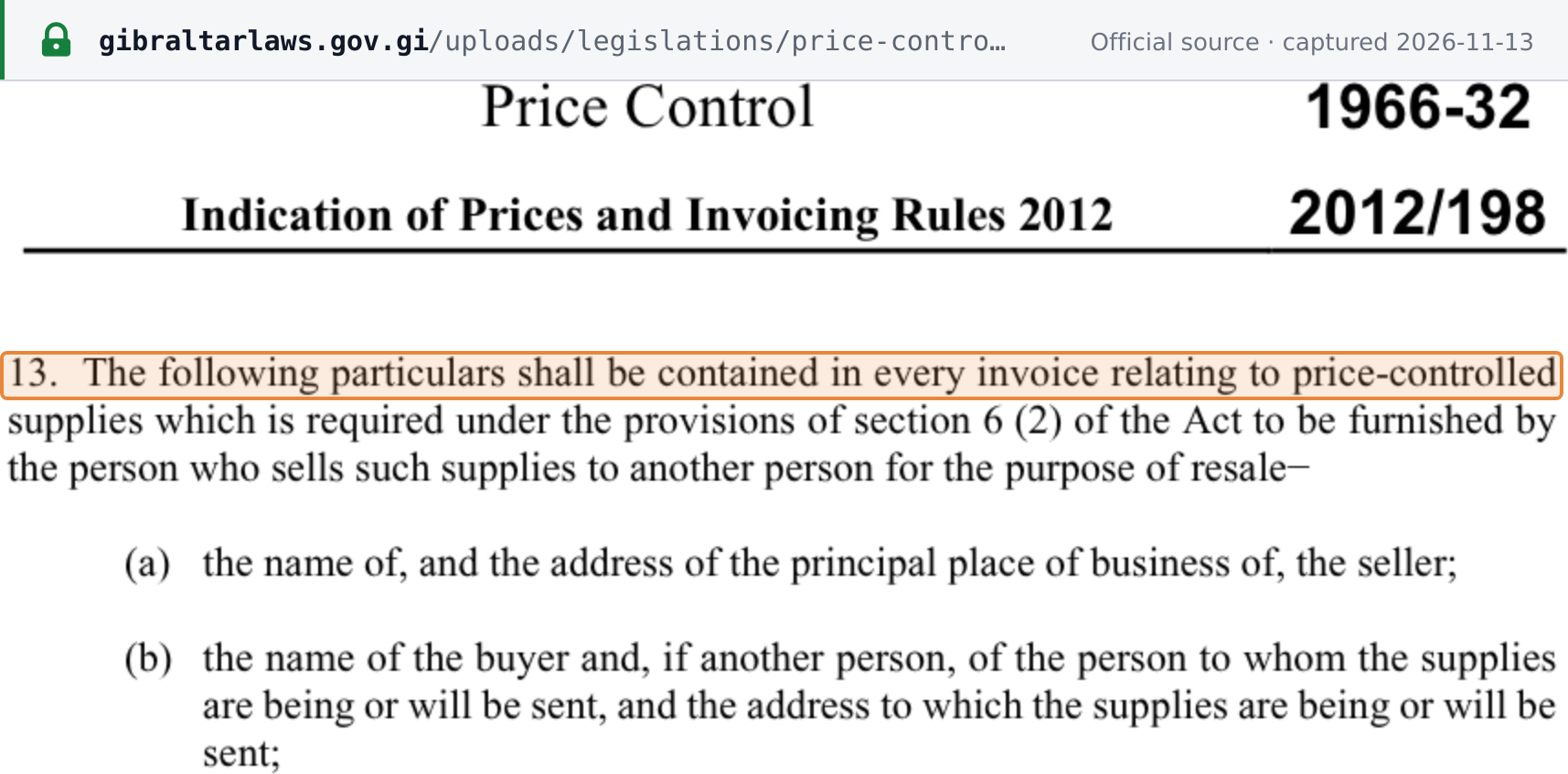
The only prescribed list is rule 13 of the Indication of Prices and Invoicing Rules 2012, and it applies to invoices "relating to price-controlled supplies": [14]
| # | Particular | Rule 13 |
|---|---|---|
| 1 | Name of the seller, and the address of its principal place of business | (a) |
| 2 | Name of the buyer and, if different, of the person the supplies are sent to, and the delivery address | (b) |
| 3 | A sufficient description of the supplies, with numbers or quantities, and sizes where size affects the price | (c) |
| 4 | The price paid or payable for each item | (d) |
| 5 | Any discount, conditional or not, on any item | (e) |
| 6 | Any delivery charges payable by the buyer | (f) |
| 7 | The date of sale of each item, and the date the invoice is furnished | (g) |
 Source snapshot captured 2026-11-13 — original
Failing to comply with rule 13 is an offence with a fine of up to £5,000 (r.14). Rule 13 applies only to supplies for which a maximum price has been fixed under the Price Control Act ("price-controlled supplies", s.2(1)), so it does not govern ordinary B2B invoices.
Imports (customs). The supplier's commercial invoice supports the import declaration. A customs officer may require any person concerned with imported goods "to produce and allow the officer to inspect and take extracts from or make copies of any invoice, bill of lading, book of account or other book or document whatsoever relating to the goods" (Imports and Exports Act 1986, s.4(1)). [8]
Issuance deadline
Within seven days of delivery, for goods sold for resale (Price Control Act, s.6(2)). No other statutory invoicing deadline applies.
Numbering and sequencing
Not regulated. Neither the Price Control Act nor the 2012 Rules requires an invoice number or sequence.
Credit and debit notes
Not regulated. No statute prescribes credit or debit notes. Corrections to a customs declaration go through HM Customs.
Currency and language
- Currency. Price indications to consumers must be in sterling (2012 Rules, r.6(1)). No rule fixes an invoice currency or an exchange-rate source for converting foreign-currency invoices to a customs value. The ECB-rate rule in the excise regulations (LN.2026/361, reg. 5) applies to excise duty only.
- Language. No statutory invoice-language rule.
Document types
- Commercial invoice for goods sold for resale (Price Control Act, s.6(2)).
- Supplier's commercial (import) invoice, supporting the IM4 declaration, and quoted again on export to claim a Transaction Tax refund.
- HM Customs assessment notice: the document that states the Transaction Tax due on a declaration. It is issued by HM Customs, not by the seller.
There is no simplified invoice, receipt threshold or tax-invoice/receipt distinction.
Self-billing
Not provided for, because there is no tax invoice.
Retention and audit trail
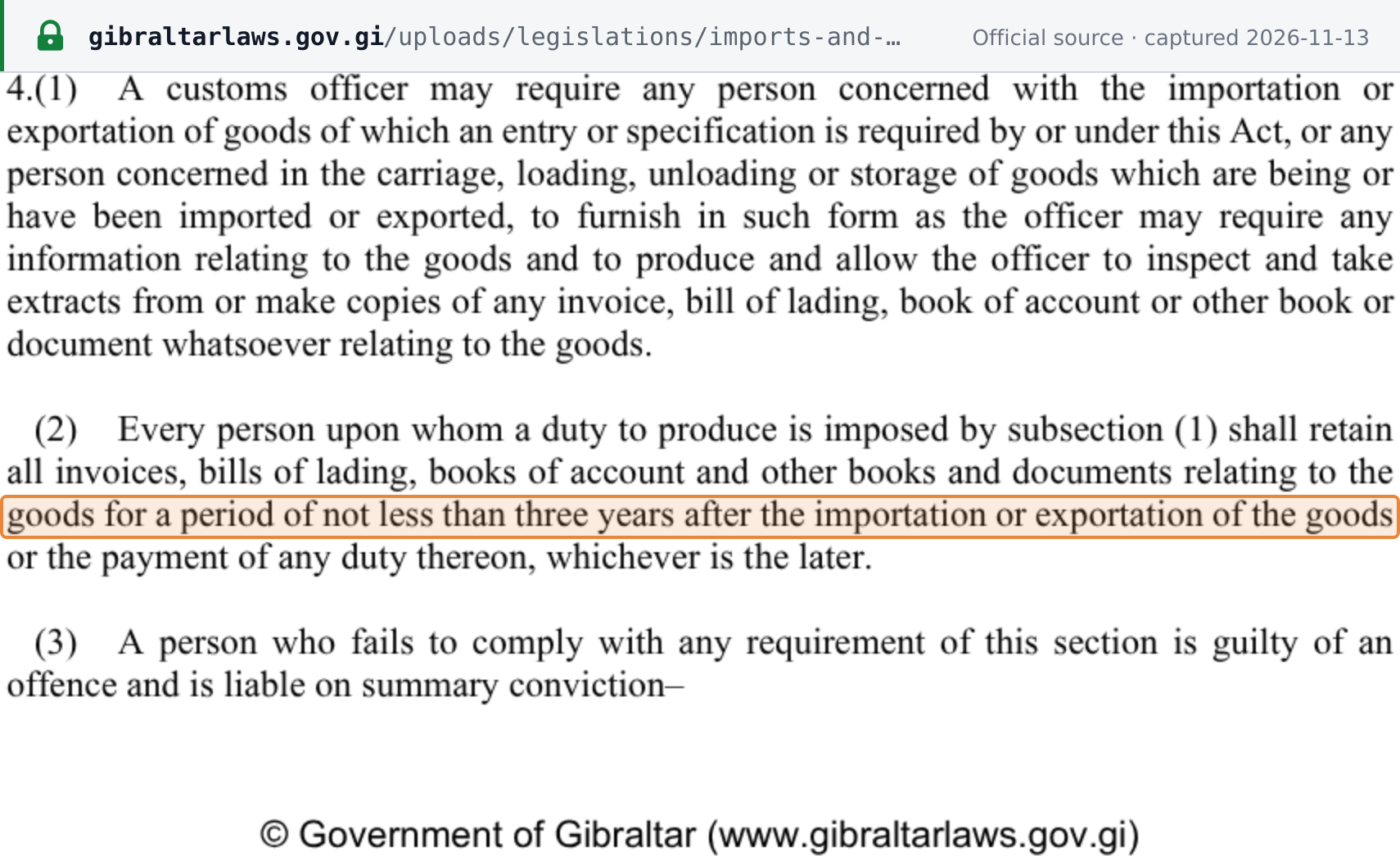
- Customs records: at least 3 years. Section 4(2) of the Imports and Exports Act: a person required to produce documents "shall retain all invoices, bills of lading, books of account and other books and documents relating to the goods for a period of not less than three years after the importation or exportation of the goods or the payment of any duty thereon, whichever is the later." [8] HM Customs' powers under ss.4–10 apply "as though the transaction tax and any excise duty were a duty" (Act s.96). [1]
- Resale purchases. Records and invoices for goods bought for resale must be preserved "for such time as this Act shall remain in force" (Price Control Act s.6(1)(b)). [13]
- Income tax. The Income Tax Office tells businesses to keep "Sales invoices", "Purchase receipts" and "Electronic records of sales or till rolls". [23]
- Electronic archiving and tamper-evidence. No Gibraltar statute or HM Customs guidance imposes an e-archiving, hash or certified-software requirement. HM Customs' ICIS/ASYCUDA system lets a trader attach supporting documents to a declaration "in an electronic format (scanned, image etc)". [25]
 Source snapshot captured 2026-11-13 — original
A specimen of a compliant invoice
No Gibraltar authority publishes a specimen invoice. Below, Lookuptax lays out the rule 13 particulars on an illustrative invoice for goods sold to a retailer for resale. Every name, address, number and amount is fictional:
Invoice (goods sold for resale) — illustrative
| Description and sizer.13(c) | Qtyr.13(c) | Price per itemr.13(d) | Discountr.13(e) | Line total |
|---|---|---|---|---|
| Children's trainers, size 30 | 12 | GBP 18.00 | GBP 0.00 | GBP 216.00 |
| Children's trainers, size 33 | 12 | GBP 19.50 | 5% (GBP 11.70) | GBP 222.30 |
- Goods
- GBP 438.30
- Delivery charge payable by buyerr.13(f)
- GBP 15.00
- Total payable
- GBP 453.30
- No tax line: Gibraltar has no VAT, and the Transaction Tax was paid to HM Customs by the importer when the goods were cleared (Treaty on Gibraltar and the European Union Act 2026, s.100). It is not charged on the onward sale.
- Furnish the invoice within seven days of delivery — Price Control Act s.6(2).
- Prices in sterling — Indication of Prices and Invoicing Rules 2012, r.6(1).
- An importer keeps the foreign supplier’s commercial invoice for at least 3 years and quotes it on any export refund claim — Imports and Exports Act 1986 s.4(2).
E-invoicing status
No B2B or B2C e-invoicing mandate. Gibraltar has no clearance or real-time reporting system. No Gibraltar law or HM Customs or Income Tax Office guidance requires B2B or B2C e-invoices.
B2G: public bodies must accept EN 16931 e-invoices. The Procurement (Electronic Invoicing) Regulations 2018 (LN.2018/290, in force 20 December 2018) transposed Directive 2014/55/EU. Regulation 5(1): "A contracting authority must have the necessary protocols, procedures, equipment, tools and devices to securely receive and process any electronic invoice submitted by an Economic Operator in performance of any contract for goods, works or services awarded under or pursuant to the Procurement Regulations." The e-invoice must comply with the European standard on the core elements of an electronic invoice and use a syntax on the list published in the Official Journal of the EU (reg. 5(2)). [15]
- Status: B2G receipt duty only. Suppliers may send e-invoices to public bodies; they are not obliged to.
- System or network: none named. No Peppol access point or government portal is designated in the Regulations.
- Format: EN 16931 with a syntax on the Official Journal list.
- Scope: B2G only. No B2B or B2C requirement.
For the wider picture, see e-invoicing status and networks worldwide.
Filing and payment
Filing frequency and returns
No Transaction Tax return. The tax is assessed on each import declaration, so there is no filing frequency, return due date or annual return. ASYCUDA remains the declaration system: "Yes. ASYCUDA will continue to be used by HM Customs Gibraltar" (Treaty FAQs CUST-05). [7]
Payment due date and method
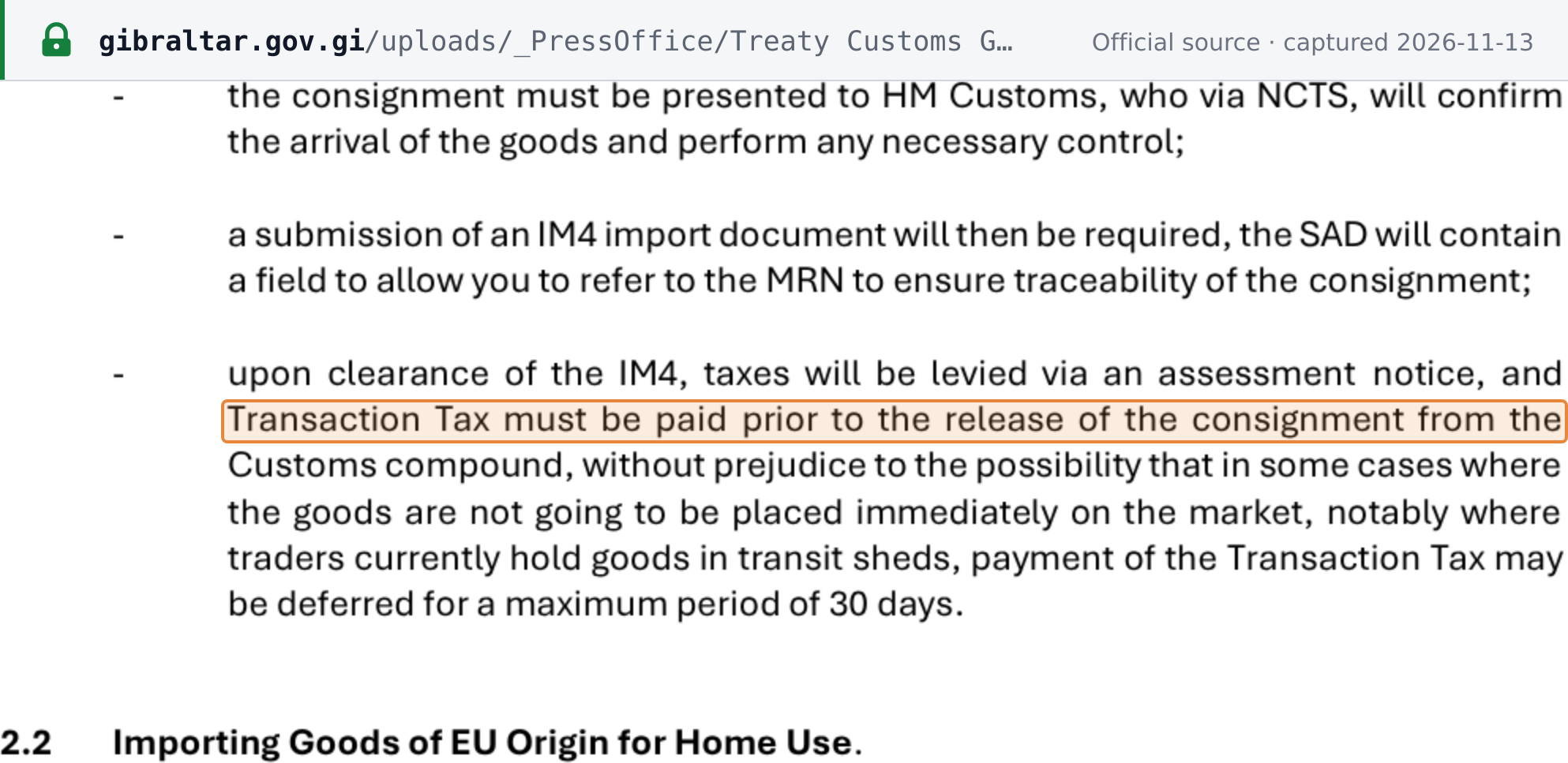
Before the goods are released. HM Customs' Goods Transit Process guidance: "upon clearance of the IM4, taxes will be levied via an assessment notice, and Transaction Tax must be paid prior to the release of the consignment from the Customs compound". In some cases where the goods will not be placed on the market immediately, "notably where traders currently hold goods in transit sheds, payment of the Transaction Tax may be deferred for a maximum period of 30 days." [9]
 Source snapshot captured 2026-11-13 — original
HM Customs' business registration form CUS 180X sets up a prepayment account for the company or its clearing agent, and the HM Customs portal has a payment-gateway log-in. The form predates the Treaty and still refers to import duty. HM Customs has not published post-Treaty payment-method guidance, so confirm the method with HM Customs. [11]
Goods produced in Gibraltar. Transaction Tax is charged "when goods produced in Gibraltar leave the production site" (Sch. 2, para. 1(1)(d)), and the producer is liable (s.100(3)). [1] HM Customs has issued no producer declaration form, period or payment procedure, so producers should ask HM Customs directly.
Additional listings
None. There are no sales or purchase listings and no EC sales list.
Input-tax recovery and blocked items
Not applicable. The Transaction Tax has no input-tax credit: it is a cost to the importer or producer, charged once, and the Act contains no deduction mechanism. It follows that nothing is "blocked". Three routes do give money back:
- Export refund (s.102): on export to the EU, with proof that EU VAT was paid, or to a non-EU country via a Designated Customs Post (see Imports and exports).
- Transitional reassessment for goods dispatched to Gibraltar before 15 July 2026 but cleared under the Transaction Tax. HM Customs' guidance (4 September 2026): "It is not sufficient for goods merely to have been ordered, invoiced or paid for before 15 July 2026. Evidence must show that the goods were actually dispatched, shipped or otherwise placed in transport to Gibraltar before that date." Qualifying consignments may be reassessed under the old import-duty regime. Claims go to refunds@hmcustoms.gov.gi, through the clearing agent where an agent lodged the declaration, on HM Customs' claim form. [18]
- Income-tax deduction for certified retailers and wholesalers under the Transaction Tax (Deductions) Rules 2026 (see Special regimes).
Refunds
Covered above. There is no credit position, no bad-debt relief (no tax is charged on sales) and no non-resident refund scheme.
Exemptions
Exempt goods
Section 101 of the Act: [1]
- Mandatory EU VAT exemptions. "Goods shall be exempt from the transaction tax where, had such goods been imported, supplied or acquired in the European Union, they would have benefited from a mandatory exemption from VAT" (s.101(1)). HM Government gives investment gold as an example: "Yes, investment gold, as defined in EU VAT legislation, will be exempt of transaction tax" (Treaty FAQs TAX-10). [7] Technical Notice 72/2026 adds that other exemptions in the VAT Directive apply, "such as bunkering fuel". [6] Bunkering fuel is therefore exempt, not on the 0% list.
- Discretionary exemptions need the approval of the Treaty's Specialised Committee and a Gazette notice (s.101(2)).
- Energy. "Liquefied Natural Gas imported and used for the production of electricity and electricity produced in Gibraltar are exempted from transaction tax" (s.101(3)).
Old import-duty reliefs do not carry over. "Goods currently subject to reduced rates or exemptions from import duty will not be subject to reduced rates or exemptions from transaction tax unless they are specifically covered by the new regime" (Treaty FAQs TAX-05). [7]
Exempt versus 0%: no difference to cost recovery here. In a VAT system, a zero-rated supplier recovers its input tax and an exempt supplier does not. The Transaction Tax has no input tax, so an exempt good and a 0% good both simply bear no Transaction Tax. See zero-rated vs exempt for how the difference works under VAT.
Special regimes
- Special customs procedures. "The transaction tax and excise duties (where applicable) will not be levied when the goods are to be placed in a special customs procedure (SCPS) in Gibraltar. These SCPs are customs warehouse (bonds), inward processing or temporary admission" (Technical Notice 72/2026). The tax becomes due when the goods are released onto the Gibraltar market. [6] Operators of these procedures for non-Union goods need a business licence (LN.2026/185).
- Airport duty-free. Sales to passengers travelling to non-EU destinations remain free of Transaction Tax and excise (Treaty FAQs TAX-03). [7]
- Transition relief: Transaction Tax (Deductions) Rules 2026 (LN.2026/338, in force 23 September 2026). Certified retail and wholesale businesses may claim an income-tax or corporation-tax deduction for Transaction Tax paid in the 90 days from 15 July 2026, to the extent it exceeded the import duty that would have been payable: "a deduction equal to the difference between the amount of transaction tax paid by that relevant person in that period and the amount of import duty which would have been payable previously in that same period had the transaction tax not come into operation (if the amount of transaction tax paid is higher)" (r.4(1)). The deduction is "limited to an amount equal to 50% of the amount of tax paid by the relevant person in the immediately preceding accounting period or year of assessment" (r.4(5)(a)). Businesses mainly selling food, drink and household groceries, tobacco, wine or spirits, fuel or vehicles are excluded. [16] HM Government says the 90-day period "ends on 12 October 2026" and may be extended by further 90-day periods. [17] Any extension is made by Notice in the Gazette on the advice of an independent committee appointed by the Minister (r.5(1)). [16] This is a deduction from income tax, not a Transaction Tax refund.
- Small-business, flat-rate, cash-accounting and margin schemes. Not applicable. The Act provides none, because the tax is charged per consignment rather than on turnover.
Offences and penalties
The Act creates no Transaction Tax penalty code of its own. It gives customs officers their Imports and Exports Act powers (ss.4–10) "to the same extent as though the transaction tax and any excise duty were a duty, fee or charged levied under that Act" (s.96). [1] The customs offences in the Imports and Exports Act 1986 apply to imports generally. Fines are set by reference to the standard scale: level 1 £200, level 2 £400, level 3 £1,000, level 4 £4,000, level 5 £10,000 (Criminal Procedure and Evidence Act 2011, Sch. 9 Part A). [19]
Offences
| Offence | Penalty | Provision |
|---|---|---|
| Failing to make entry of imported goods | Level 3 fine (£1,000) | Imports and Exports Act s.21(3) |
| Failing to declare goods in baggage | Three times the value of the goods not declared, or half of level 4 (£2,000), whichever is greater | s.24(3) |
| False declaration, document or statement, "whether the same be dutiable or not", made knowingly or recklessly | Summary: 6 months' imprisonment and a level 4 fine (£4,000). Indictment: 2 years and twice level 5 (£20,000) | s.109(2) |
| Being knowingly concerned in fraudulent evasion of "any duty chargeable" | Summary: 6 months and three times the value of the goods or level 4, whichever is greater. Indictment: 2 years and three times the value or level 5, whichever is greater | s.105 |
| Failing to furnish a resale invoice within seven days | £250 fine | Price Control Act ss.6(3), 14 |
| Invoice for price-controlled supplies missing rule 13 particulars | Fine up to £5,000 | Indication of Prices and Invoicing Rules 2012, r.14 |
Section 105 is drafted for customs "duty". The Act extends only customs officers' powers in ss.4–10 to the Transaction Tax (s.96), not s.105; ss.21, 24, 109 and 117 apply whether or not duty is involved. Goods and vehicles may also be forfeited (ss.119–126), and HM Customs may compound proceedings (s.127).
Penalties
| Exposure | Amount | Provision |
|---|---|---|
| Failing to produce documents or answer a customs officer | Level 3 fine (£1,000) | Imports and Exports Act s.4(3)(a) |
| Failing to keep invoices and records for 3 years | Level 4 fine (£4,000) | s.4(3)(b) |
| Any contravention of the Act, its regulations or an approval's conditions with no special penalty | Level 4 fine (£4,000) | s.117 |
| Late payment and interest | Not applicable: the tax is paid before release, and neither the Act nor the Imports and Exports Act provides for interest on it | — |
| Late registration or late return | Not applicable: there is no registration or return | — |
Frequently asked questions
Will shop prices in Gibraltar go up by 15% because of the Transaction Tax?
They should not rise by the full 15%. The Transaction Tax is charged on the customs value of imported goods (what the business paid, plus transport, insurance and any duties), not on the retail selling price, and food and non-alcoholic drinks are at 0%. HM Government press release 201/2026 says there can be no justification for a product retailing at £100 to retail at £115, and calls such a rise "blatant profiteering of the worst possible kind".
We ordered and paid for goods before 15 July 2026 but they arrived later. Do we pay Transaction Tax or the old import duty?
Transaction Tax, unless the goods were dispatched before 15 July 2026. HM Customs' transitional-refund guidance of 4 September 2026 says it is not sufficient for goods merely to have been ordered, invoiced or paid for before that date: evidence must show they were dispatched, shipped or otherwise placed in transport to Gibraltar before it. Where such a consignment was cleared and Transaction Tax was paid, HM Customs will consider reassessing it under the pre-15 July import duty regime. Claims go to refunds@hmcustoms.gov.gi, through the clearing agent where an agent lodged the declaration.
Does our Gibraltar business need a Spanish NIF and EORI number to import goods?
Only if it carries out its own customs formalities for movements in or through Spain and the EU. HM Customs' NIF and EORI guidance note of 22 May 2026 says those traders need a Spanish-issued EORI, structured as ES + NIF, so a Spanish NIF must be obtained first. Where a customs agent completes the formalities and pays the taxes and duties from its own accounts on your behalf, you do not need an EORI. A NIF obtained for customs identification does not make the business established or taxable in Spain.
Do we add Transaction Tax to our sales invoices in Gibraltar?
No. Transaction Tax is paid to HM Customs by the person who declares imported goods, or by the producer when goods made in Gibraltar leave the production site (Treaty on Gibraltar and the European Union Act 2026, s.100). There is no output tax, no tax invoice, no Transaction Tax return and no input-tax credit. The tax paid at import is a cost of the goods; it is not shown as a separate line on the onward sale.
Does Transaction Tax apply to software, consultancy or other services bought from abroad?
No. HM Government press release 201/2026 says: "The transaction tax will NOT apply to services only to goods." The Act charges goods imported into or produced in Gibraltar (s.98). Gibraltar has no VAT, so there is no reverse charge on imported services and no registration scheme for foreign digital-service providers.
How much can we bring back from Spain without declaring it or paying Transaction Tax?
For the first 3 years of the Treaty's application, non-commercial goods in personal luggage are allowed up to the sterling equivalent of EUR 430 by air or sea or EUR 300 by land (EUR 175 for under-15s), with separate tobacco and alcohol limits, according to HM Government's Treaty FAQs (CUST-06). Goods brought in to sell are commercial at any value, and so are online sales: they go through the commercial customs route and bear Transaction Tax.
Is Transaction Tax charged when we sell goods from Gibraltar to customers in the EU?
No, but EU VAT is. HM Government's Treaty FAQs (CON-02) say that on a sale from Gibraltar to, say, Germany, "transaction tax would not be charged but Germany VAT would need to be paid". Transaction Tax already paid when the goods were imported into Gibraltar is refunded on export to the EU if the exporter proves to HM Customs that EU VAT was paid (Act s.102(1)). Goods consumed in Gibraltar get no refund.
Important websites
| Site | Purpose |
|---|---|
| HM Customs ASYCUDA World portal | Customs declarations (IM4, EX1), and the payment gateway for prepayment accounts |
| HM Customs online services | Apply for ICIS/ASYCUDA user accounts |
| HM Customs eForms | Business Registration Form CUS 180X and other customs forms |
| Treaty guidance (HM Government) | HM Government's Treaty information hub |
| AEAT: agreement with Gibraltar | Spanish Tax Agency (AEAT) page on the customs and tax side of the Gibraltar Agreement |
| Transitional refund claim form | Claim reassessment for goods dispatched before 15 July 2026 (send to refunds@hmcustoms.gov.gi) |
| Laws of Gibraltar: Act 2026-11 | The Transaction Tax law and its amending regulations |
| Income Tax Office eGov | TRN, income tax and corporation tax (not Transaction Tax) |
| Rate lookup | No official online rate lookup for the Transaction Tax: the rates are in Schedule 2 of Act 2026-11 |
| Tax-ID verification | No public lookup for Gibraltar TRNs. For Spanish EORI and NIF, see EORI verification and Spanish NIF verification |
| E-invoicing portal | None (no mandate) |
Recent changes
- 2026-09-23 — The Transaction Tax (Deductions) Rules 2026 (LN.2026/338) come into force: certified retailers and wholesalers may deduct from income tax the Transaction Tax paid above the old import duty in the first 90 days, which end on 12 October 2026. (Laws of Gibraltar; HM Government press release 692/2026)
- 2026-09-04 — HM Customs publishes transitional-refund guidance: goods dispatched before 15 July 2026 but taxed under the Transaction Tax may be reassessed under the old import-duty regime. (HM Government)
- 2026-07-15 — The Treaty is provisionally applied: the Transaction Tax on goods (15% standard, 5% reduced, 0% super-reduced) and EU-minimum excise duties take effect, and import duty is no longer charged. (LN.2026/148) — see event
- 2026-05-26 — HM Government publishes HM Customs' guidance on the Spanish NIF and EORI that self-clearing traders need for movements through Spain and the EU. (HM Government press release 400/2026)
- 2026-04-01 — The Treaty on Gibraltar and the European Union Act 2026 (Act 2026-11) receives assent. (Laws of Gibraltar)
For the full chronology, see Gibraltar tax changes on Lookuptax.
Reference links
- Treaty on Gibraltar and the European Union Act 2026 (Act 2026-11), consolidated to 15 July 2026 — Laws of Gibraltar
- Notice of Commencement, LN.2026/148 — Laws of Gibraltar
- HM Government press release 201/2026 — Government corrects transaction tax misinformation
- HM Government press release 223/2026 — Chief Minister's speaking note for the Treaty Bill
- HMRC — VAT Notice 741A, place of supply of services
- HM Government Technical Notice 72/2026 — Basic features of the customs union between Gibraltar and the EU (4 February 2026)
- HM Government — Treaty FAQs (Consolidated FAQ Questions Report, June 2026)
- Imports and Exports Act 1986, consolidated to 15 July 2026 — Laws of Gibraltar
- HM Customs Gibraltar — Goods Transit Process guidance
- HM Customs Gibraltar — NIF and EORI guidance note (22 May 2026)
- HM Customs — Business Registration Form CUS 180X
- HM Customs — Online services
- Price Control Act — Laws of Gibraltar
- Indication of Prices and Invoicing Rules 2012 (LN.2012/198) — Laws of Gibraltar
- Procurement (Electronic Invoicing) Regulations 2018 (LN.2018/290) — Laws of Gibraltar
- Transaction Tax (Deductions) Rules 2026 (LN.2026/338) — Laws of Gibraltar
- HM Government press release 692/2026 — Transaction Tax (Deductions) Rules 2026
- HM Customs — Transitional arrangements: refunds for goods dispatched before 15 July 2026 (4 September 2026)
- Criminal Procedure and Evidence Act 2011, consolidated to 13 August 2026 (Sch. 9, standard scale) — Laws of Gibraltar
- TGEU Implementation (Miscellaneous Amendments) Regulations 2026 (LN.2026/177) — Laws of Gibraltar
- TGEU Implementation (Excise Duty) Regulations 2026 (LN.2026/361) — Laws of Gibraltar
- TGEU Implementation (Special Customs Procedures Concerning Non-Union Goods) Regulations 2026 (LN.2026/185) — Laws of Gibraltar
- Income Tax Office — Businesses
- HM Government press release 400/2026 — Guidance on NIF and EORI registration
- HM Customs — Interface for traders
Related on Lookuptax: