Guernsey GST and indirect tax guidelines
| FACTSHEET | |
|---|---|
| Country code | GG |
| Tax name | None in force. Goods and Services Tax (GST) approved, target start quarter 1 2029 |
| Tax Authority | States of Guernsey Revenue Service (planned GST); Guernsey Customs and Immigration Service (import and excise duty) |
Overview
Guernsey has no VAT and no GST in force (as at 2026-11-03). The States of Guernsey say so directly: "VAT is a UK tax. The Guernsey Customs & Immigration Service cannot refund VAT or process VAT reclaim forms." The same page explains that "the Bailiwick of Guernsey is outside of the fiscal territory", so residents "can request that VAT is removed from sales of goods exported to the Bailiwick if conditions set by HM Revenue and Customs are met." [1] HMRC puts it the same way from the UK side: "There is no VAT in the Channel Islands or Gibraltar, which are outside the UK for VAT purposes." [2]
 Source snapshot captured 2026-11-03 — original
A goods and services tax is approved, not enacted. On 2 October 2026 the States of Deliberation carried proposition P.2026/49 ("Tax Reform 2026"), directing the implementation of a package that includes a 3% goods and services tax (GST). The States' published target is "GST: Quarter 1 2029". GST cannot start until the Policy & Resources Committee and the Committee for Employment & Social Security publish "a joint implementation assurance report evidencing that the mitigating measures and their associated legislation are in place". [3] [4] [7] No GST law has been enacted. Every GST figure on this page is the States' stated policy, subject to legislation; the States add that "All monetary thresholds will be adjusted for inflation before implementation". [5]
What is charged today. Guernsey's indirect taxes in force are import duty (on goods from outside the customs union with the UK, Jersey and the Isle of Man) and excise duty (on alcohol, tobacco and some fuels, and on vaping liquid from 9 November 2026). Both are covered under Rates and Cross-border rules.
Authorities.
- Import and excise duty: the Guernsey Customs and Immigration Service, whose "three main Divisions" are "Customs & Excise, Border Enforcement and Immigration & Nationality". [14]
- Planned GST: the States' FAQ says design work is under way on "systems, processes and the resources required for the Revenue Service and the Guernsey Customs and Immigration Services". [4] The Revenue Service administers income tax and social security today.
Currency. Pound sterling (GBP, £). All official figures on this page are in pounds.
Tax period. No VAT or GST period exists today. The States plan quarterly GST returns (see Filing and payment).
Layering and territory. There is no sub-national layer. The reforms cover Guernsey and Alderney; the States' FAQ says "Sark is not part of the fiscal union and is outside the scope of the reforms." [4] Excise rates "cover Guernsey and Alderney; Sark sets its own rates via the Chief Pleas." [9]
For the UK side of trade with Guernsey, see the United Kingdom VAT guide.
Registration
Who should register
No one, today (as at 2026-11-03). With no VAT or GST in force, Guernsey has no VAT or GST registration and issues no VAT or GST number. The States' own GST material describes registration only in the future tense ("Businesses will be required to register…"), and the Tax Reform 2026 policy letter's table of current rates and thresholds shows GST as "-" for 2026. [4] [6]
Registration threshold
Planned: £300,000 of taxable supplies in a 12-month period. The States' Tax Reform Package FAQ: "Businesses will be required to register if their taxable supplies (effectively turnover for most businesses) exceeds £300,000 in a 12 month period. Businesses below this threshold do not need to charge GST but cannot reclaim GST on costs." [4] This is policy, not law, and the figure is to be "adjusted for inflation before implementation". [5]
 Source snapshot captured 2026-11-03 — original
Non-resident registration
Planned: the same £300,000, measured on goods supplied to Guernsey. The FAQ answers "Will off-island online retailers have to register?" with: "Yes. Larger online retailers supplying more than £300,000 of goods to Guernsey in a year must register. GST will usually be charged at checkout on every purchase (no de minimis will apply)." [4]
The States had not yet specified how GST will apply to non-resident suppliers of services (including digital services to consumers) or whether a reverse charge will apply to imported business services.
Tax identification number
There is no VAT or GST number in Guernsey. The identifiers that do exist — the Guernsey Registry company number, the Revenue Service tax reference and the social security number — are covered on the Guernsey tax ID guide. You can check the format of a registry number with the Guernsey registry number validator.
How to register
Not applicable today: no GST registration portal exists, and the States have published no registration procedure.
Voluntary registration
Planned: available. Businesses below the threshold "can choose to voluntarily register - and for some businesses it may make more financial sense to register to be able to claim back any GST costs they incur." [4]
Deregistration
Not applicable today. The States' published GST material (the consumption tax page, the FAQ and the Tax Reform 2026 policy letter) contains no deregistration rule.
Group registration
Not applicable today. The same published GST material contains no group-registration provision.
Rates
Standard rate
None in force (as at 2026-11-03). No VAT or GST rate applies in Guernsey today. [1]
Announced future rates
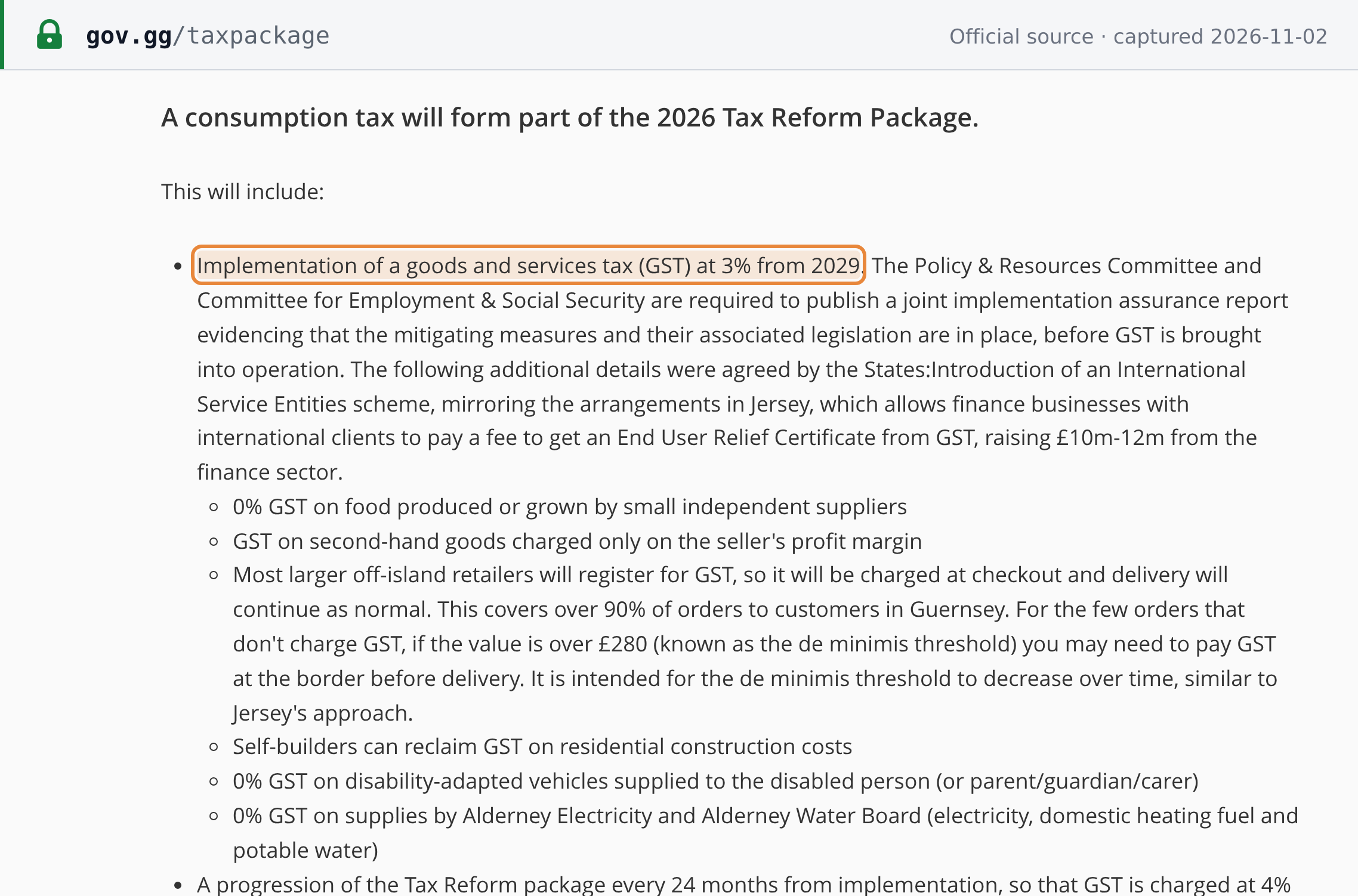
3% GST, approved, target start quarter 1 2029. The States' consumption tax page lists: "Implementation of a goods and services tax (GST) at 3% from 2029. The Policy & Resources Committee and Committee for Employment & Social Security are required to publish a joint implementation assurance report evidencing that the mitigating measures and their associated legislation are in place, before GST is brought into operation." [3] The FAQ gives the target dates: "Corporate tax changes: 1st January 2027", "Income tax and social security changes: 1 st January 2029" and "GST: Quarter 1 2029". [4] The date is a target, not a date fixed in law. See event.
 Source snapshot captured 2026-11-02 — original
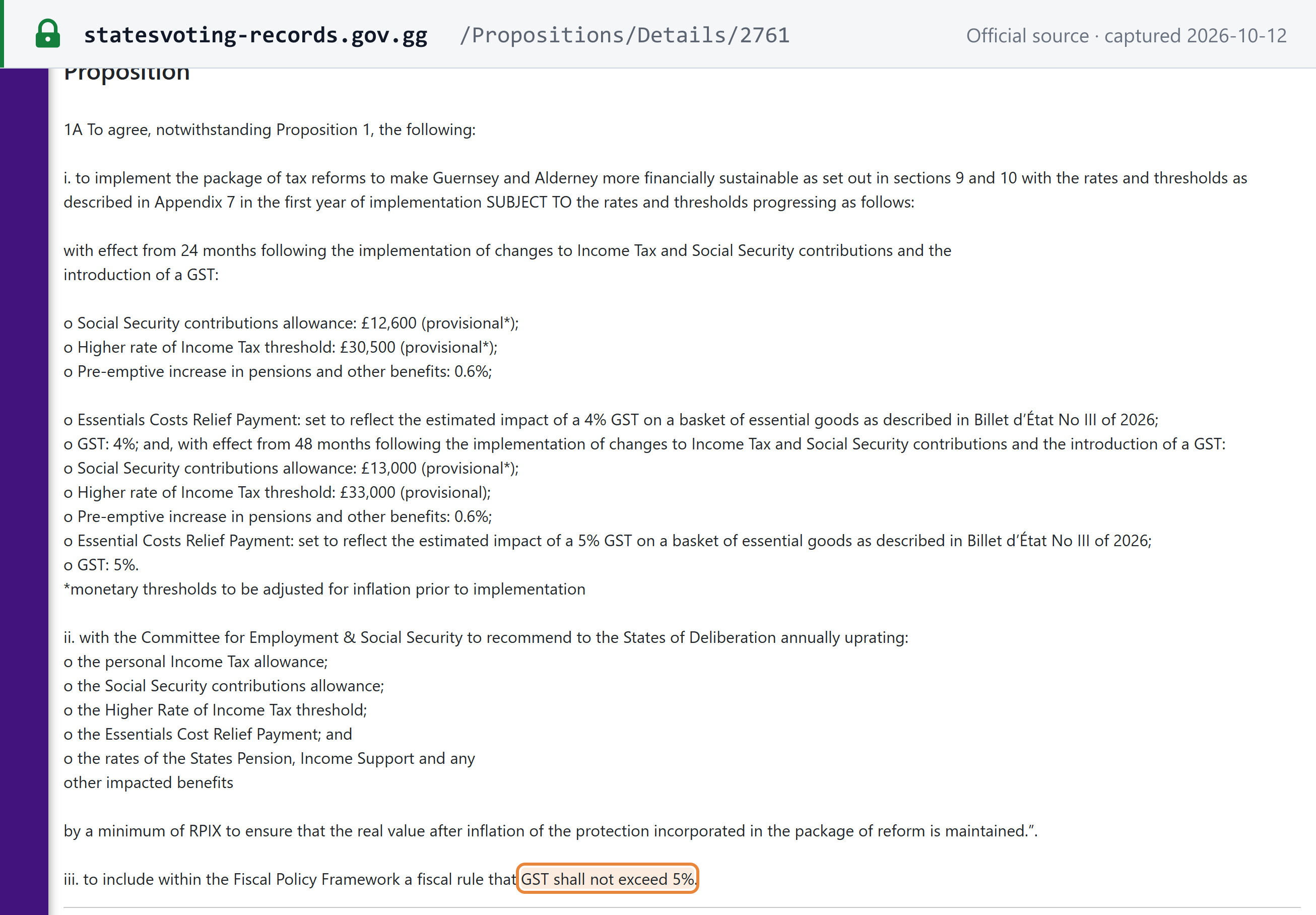
Planned steps to 4% and 5%, with a 5% fiscal-rule ceiling. "The States agreed to a progression of the tax reform package every 24 months from implementation, so that GST is charged at 4% and then 5%." Before any increase, the Policy & Resources Committee must publish an assurance review, with commentary from the independent Fiscal Policy Panel, confirming that there is a funding gap and that the planned real-terms savings have been achieved. [4] Proposition 1A also directs the States "to include within the Fiscal Policy Framework a fiscal rule that GST shall not exceed 5%" — a fiscal rule, not a legal cap. [8] See event.
 Source snapshot captured 2026-10-12 — original
Reduced and zero rates (planned)
The plan has no reduced rate between 0% and the standard rate. It has:
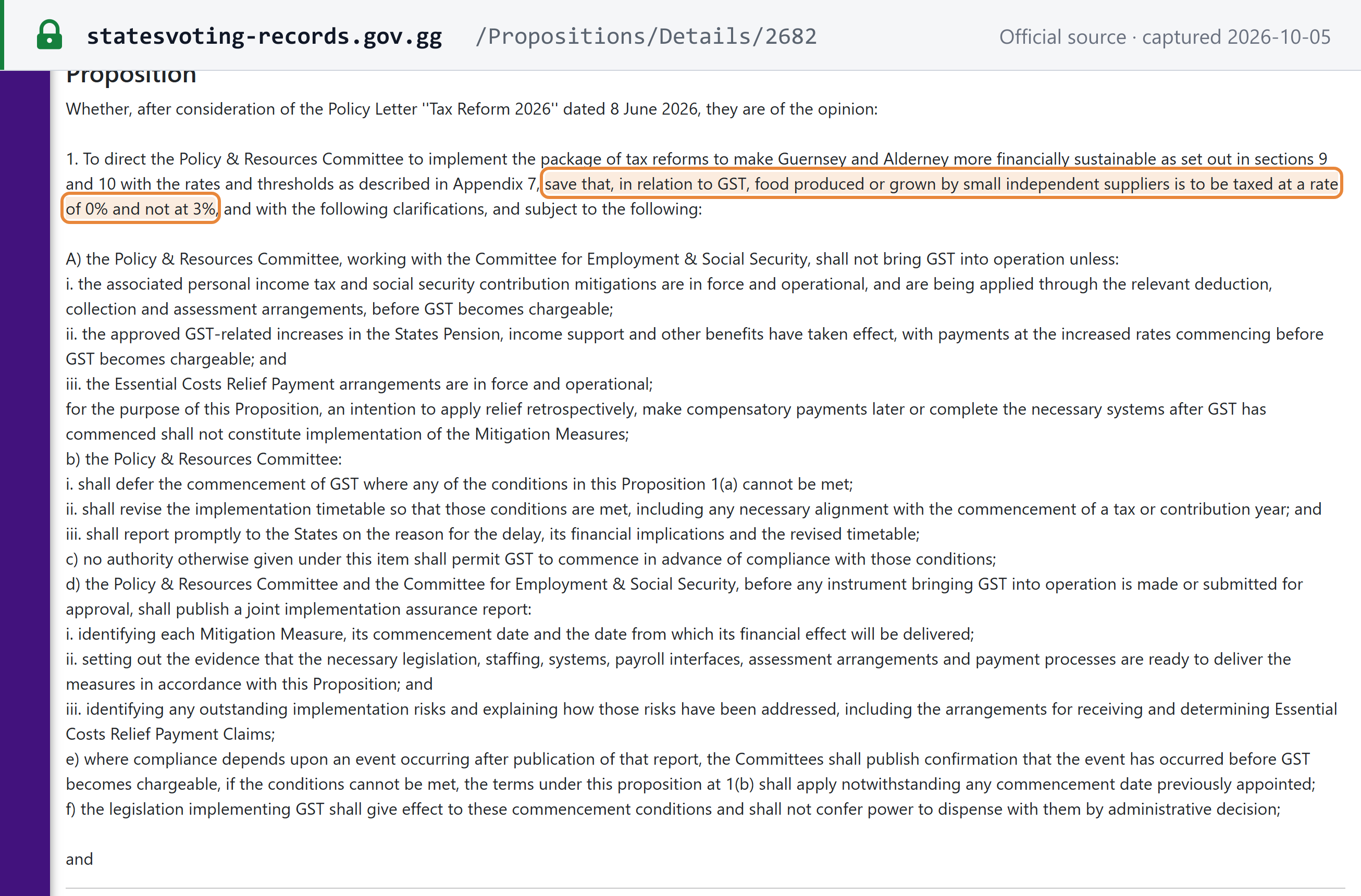
- 0% on food produced or grown by small independent suppliers. The States' resolution of 2 October 2026 provides "that, in relation to GST, food produced or grown by small independent suppliers is to be taxed at a rate of 0% and not at 3%". [7] The FAQ adds: "Any other food items will be taxed at the standard rate of 3%. Further details of what this applies to will be confirmed before GST is implemented." [4]
- Zero-rated supplies, where "businesses charges GST at 0%, and are able to reclaim GST on its costs": exported services; exported goods; the sale of a going concern; transport of passengers and goods to or from Guernsey or Alderney from outside the Bailiwick; transport between Guernsey and Alderney, Sark and Herm; postal services; the creation, sale or lease of a residential dwelling; motor vehicles designed for disabilities and supplied to that person (or a parent, guardian or carer); and the public functions of Alderney Electricity and the Alderney Water Board ("the supply of electricity, domestic heating fuel and potable water"). [4]
 Source snapshot captured 2026-10-05 — original
See event.
What is charged today: excise and import duty
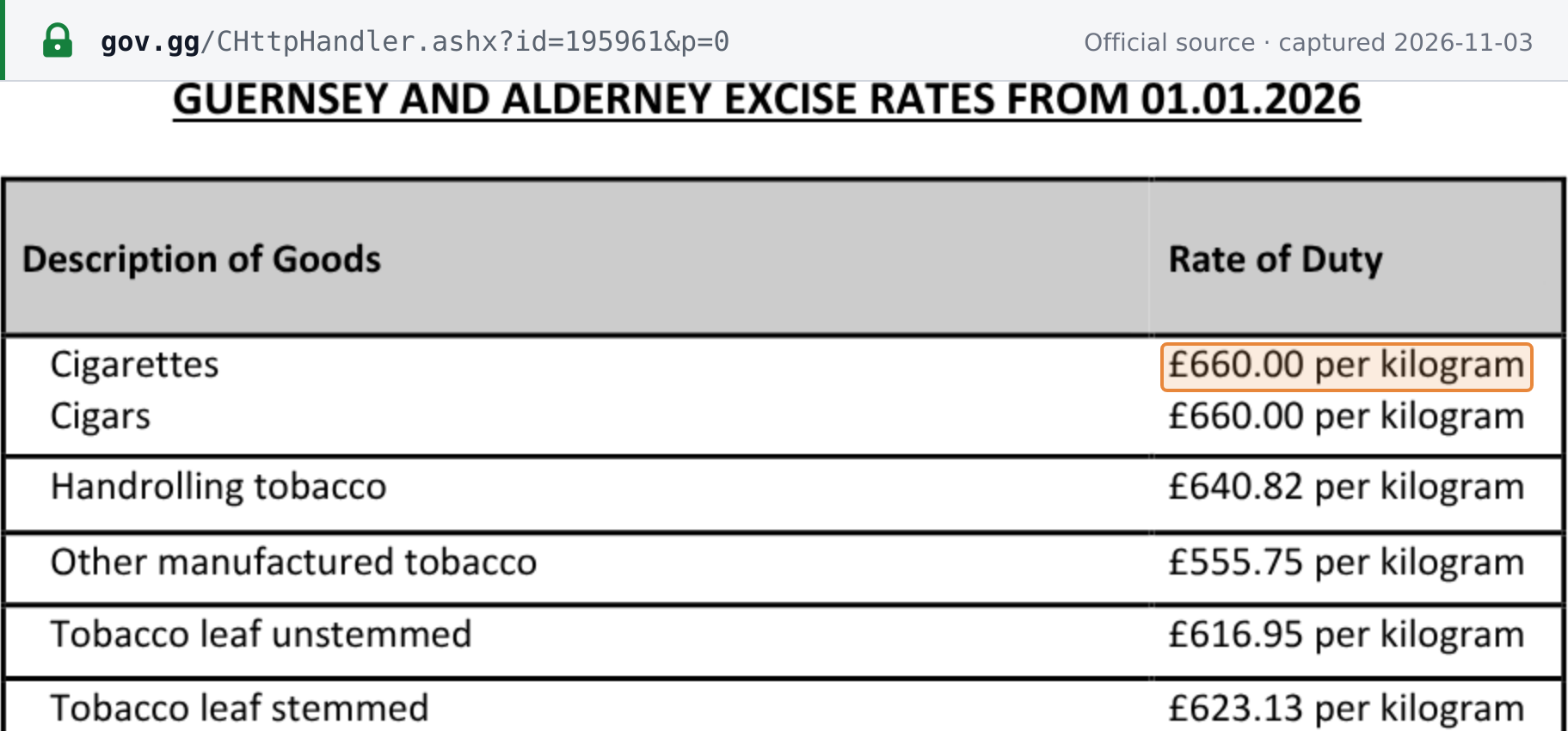
Excise duty "is applied to alcohol, tobacco and some fuels imported into or manufactured in the Bailiwick". The rates "are reviewed annually by the States of Guernsey and set at budget time, which is usually in October." [9] Selected rates for Guernsey and Alderney from 1 January 2026 [10]:
| Goods | Excise rate from 1 January 2026 |
|---|---|
| Cigarettes | £660.00 per kilogram |
| Cigars | £660.00 per kilogram |
| Hand-rolling tobacco | £640.82 per kilogram |
| Petrol | 90.5p per litre |
| Road diesel | 90.5p per litre |
| Spirits exceeding 1.2% ABV | £48.80 per litre of pure alcohol |
From 9 November 2026 excise duty is also due to apply to vaping liquid: "The rate of vaping liquid duty will be: £2.20 per 10ml of vaping liquid." [15] The 2027 Budget may set new excise rates from 1 January 2027; check the current rates schedule before relying on these figures.
 Source snapshot captured 2026-11-03 — original
Import duty is charged on goods from outside the customs union, at the rates of the UK Global Tariff ("To establish how much import duty is payable on an item, use the UK Global Tariff"). [9] See Imports and exports.
Cross-border rules
Today these rules are customs rules and the UK's VAT rules for supplies to the Channel Islands. Guernsey itself imposes no VAT or GST on cross-border supplies as at 2026-11-03.
Imports and exports
Customs union. "Because Guernsey is in a Customs Union with the UK, Jersey and Isle of Man, no customs duties are charged in respect of goods imported directly into the Bailiwick from those places, when: Those goods were wholly obtained in the UK, Jersey, or the Isle of Man, All liability to customs duties in respect of their import into the UK, Jersey, or the Isle of Man, has been discharged. All other goods imported into the Bailiwick may be liable to import duty, this includes goods from the European Union ("EU") and third countries (Rest of the world)." [9] Excise goods are different: "Excise goods; alcohol, tobacco, from 9 November 2026 vaping liquid and some fuels are liable to excise duty from any country." [11]
 Source snapshot captured 2026-11-03 — original
Customs declarations. For goods imported directly from outside the UK, Jersey and the Isle of Man, or in transit through them without customs clearance there, "a full Customs Declaration must be submitted for the goods being imported; via the Guernsey Electronic Manifest System (GEMS) for unaccompanied goods, or via the Passenger payment Portal at any Customs Red point for accompanied goods." [11]
De minimis today. Guernsey Customs publishes traveller allowances — "goods to a value of £390" on commercial air or sea services and £270 on private aircraft or vessels, with duty on "the full value" if exceeded — but these are personal allowances for travellers, not a threshold for parcels. [13]
Planned GST on imports. Once GST starts, the States' plan is: "For the few orders that don't charge GST, if the value is over £280 (known as the de minimis threshold) you may need to pay GST at the border before delivery. It is intended for the de minimis threshold to decrease over time, similar to Jersey's approach." An Approved Trader Scheme "is proposed so goods can be invoiced without being detained", letting non-registered businesses pay import GST "on a monthly or quarterly invoice". [3] [4]
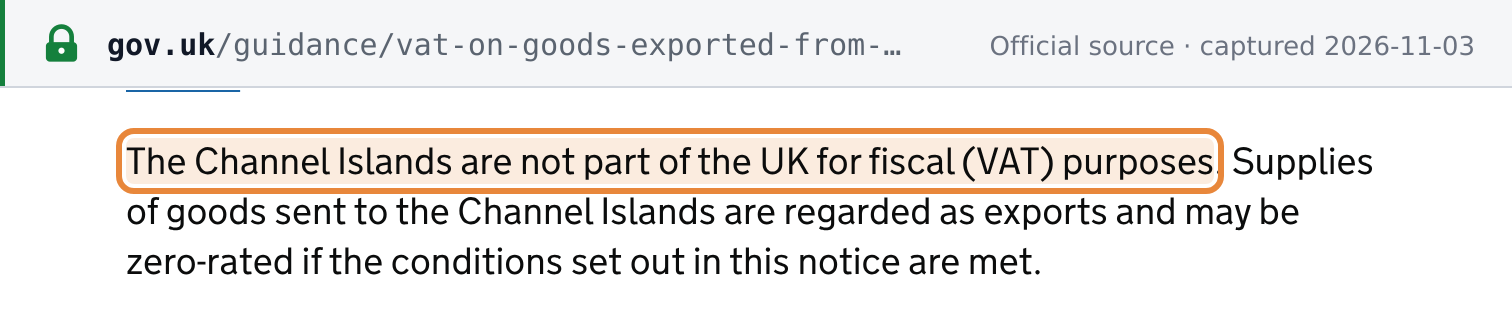
Exports from the UK to Guernsey. HMRC VAT Notice 703, section 2.7: "The Channel Islands are not part of the UK for fiscal (VAT) purposes. Supplies of goods sent to the Channel Islands are regarded as exports and may be zero-rated if the conditions set out in this notice are met." [12] For evidence, "Excise goods or goods subject to customs controls (for example restricted goods) exported to the Channel Islands will always require an export declaration made electronically using the Customs Declaration Service" (section 7.13). [12] Guernsey's own guidance tells buyers that a VAT-registered UK supplier "can remove VAT from the transaction if they hold evidence that the goods sold have been exported in accordance with VAT rules." [1]
 Source snapshot captured 2026-11-03 — original
Reverse charge on imported services
Not applicable today: Guernsey has no VAT or GST, so there is nothing to self-account. The States have not said whether the planned GST will include a reverse charge on services bought from abroad. For how the mechanism works elsewhere, see reverse charge explained.
Digital products and services
No Guernsey tax applies to digital services today. The States' published plan names a £300,000 registration rule for off-island sellers of goods; it does not yet specify rules for non-resident suppliers of digital services. For comparison with other countries, see VAT on digital services by non-resident suppliers.
Foreign companies selling into Guernsey — B2B and B2C
Today, for any foreign seller: no Guernsey registration, return or tax invoice is required for VAT or GST purposes. Goods may bear Guernsey import duty and excise duty at the border, which the importer settles through the customs declaration. [11]
UK sellers — what the UK rules say:
- Goods, B2B and B2C: exports, zero-rated for UK VAT if the Notice 703 conditions and evidence are met. [12]
- Services, B2B: "The B2B general rule for supplies of services is that the supply is made where the customer belongs. Where the B2B rule applies you should obtain commercial evidence showing that your customer is in business and belongs outside the UK." A Guernsey business customer belongs outside the UK, so a general-rule service is outside the scope of UK VAT. [2]
- Services, B2C: "The general rule for B2C supplies of services is that the place of supply is where the supplier belongs, irrespective of the location of their customer." A UK supplier therefore charges UK VAT on general-rule services to Guernsey consumers. Special place-of-supply rules in Notice 741A can change either answer. [2]
Once GST starts (planned): off-island sellers of more than £300,000 of goods to Guernsey a year register and charge GST at checkout; smaller sellers' parcels over £280 may bear GST at the border. [4]
International Service Entities (planned). The package includes "an International Service Entities scheme, mirroring the arrangements in Jersey, which allows finance businesses with international clients to pay a fee to get an End User Relief Certificate from GST". [3] The fee has not been published.
Marketplace / platform deemed-supplier liability
None today. The States' published GST material sets out no marketplace or platform deemed-supplier rule. See marketplace deemed-supplier rules for how other countries do it.
Place of supply
Guernsey has no place-of-supply rules today because it has no VAT or GST. For UK suppliers, the UK's rules in Notices 703 and 741A decide the UK VAT treatment, as set out above.
Invoice requirements
No tax-invoice requirement exists (as at 2026-11-03). Guernsey levies no VAT or GST, so there is no law setting the mandatory content, issuance deadline, numbering, credit notes, currency, document types, self-billing or retention of a tax invoice. The States' published GST material — the consumption tax page, the Tax Reform Package FAQs and the Tax Reform 2026 policy letter — sets out no GST invoice rules; the FAQ mentions invoices only for the proposed Approved Trader Scheme's monthly or quarterly import GST bill. [3] [4] [6] Expect invoice rules in the GST legislation and Revenue Service guidance before the target start in quarter 1 2029.
The invoice Guernsey Customs can ask for today is the commercial invoice supporting an import declaration. Clearance through GEMS "is dependent on all Customs conditions being successfully met; such as potentially providing licences, invoices, proof of origin or either any duties being paid or 'deferred' by those business with a financial account with Guernsey Customs." [11]
 Source snapshot captured 2026-11-03 — original
UK suppliers. A UK VAT-registered supplier invoicing a Guernsey customer follows the UK's invoice rules, zero-rating goods exports where Notice 703's conditions are met; see the United Kingdom VAT guide.
A specimen of a compliant invoice
Not provided. No Guernsey VAT or GST invoice exists in law, and the States publish no specimen; a sample would have to invent fields for a tax that has not been legislated. This page will add one when the GST law and Revenue Service guidance are published.
E-invoicing status
None (as at 2026-11-03). Guernsey has no e-invoicing, clearance or real-time reporting mandate, and the States' published GST material announces none. The planned GST compliance model is "simple quarterly online returns, similar to Jersey". [4] For the worldwide picture, see e-invoicing status and networks worldwide.
Filing and payment
Filing frequency
None today (as at 2026-11-03). There is no VAT or GST return in Guernsey. Planned: "Businesses will submit simple quarterly online returns , similar to Jersey." The return will include basic business details, "The total value of standard-rated sales excluding GST", "The total value of zero-rated sales", "The total value of purchases with GST" and "The total value of imports and exports"; "The system will calculate the GST due or reclaimable." [4]
Return due date
Not yet specified. The States have not published a GST return due date.
Payment due date and method
Not yet specified for GST. The plan is that "Registered businesses add GST to sales, deduct GST paid on costs, and pay the difference to the States through quarterly returns." [4] Import and excise duty are paid at clearance today, or "deferred" by businesses "with a financial account with Guernsey Customs". [11]
Additional listings
None today, and none announced for GST.
Input-tax recovery and blocked items
Planned: registered businesses will deduct GST paid on costs; businesses below the threshold "cannot reclaim GST on costs" unless they register voluntarily; "Self-builders can reclaim GST on residential construction costs". [3] [4] No list of blocked input items had been published as at 2026-11-03.
Refunds
None today: Guernsey has no VAT to refund, and Guernsey Customs "cannot refund VAT or process VAT reclaim forms" for UK VAT. [1] Planned: charities will have "access to an online facility to reclaim GST costs". [4] Refund timing and any non-resident refund scheme have not been specified.
Exemptions
Exempt supplies (planned)
The States' FAQ lists what "will be exempt (businesses don't charge GST, and cannot claim back GST on their costs)": public services provided free at the point of use by the States of Guernsey; domestic financial services; domestic insurance services; medical and care services, including care homes, made by registered professionals or institutions; childcare for a child below school age by a registered provider; supplies by charities (with provision to reclaim input GST), except grant-aided colleges (standard-rated) and charity care homes; and burial and cremation services. [4]
"Out of scope: Some things, like wages and income tax and social security payments are completely outside the scope of GST." [4]
Exempt is not zero-rated
The States draw the distinction themselves: "Zero‑rated goods and services are still taxed but at 0%. Customers don't pay any GST but businesses can still claim back the GST they paid on their costs. Exempt goods and services are outside the GST system. Customers don't pay any GST but businesses cannot claim back the GST on their costs." [4] The planned zero-rated list is under Reduced and zero rates.
Special regimes (planned)
- Second-hand goods: "GST on second-hand goods charged only on the seller's profit margin". [3]
- International Service Entities: a fee-based End User Relief Certificate for finance businesses with international clients, "mirroring the arrangements in Jersey". [3]
- Small businesses: below the planned £300,000 threshold, no GST is charged (see Registration threshold).
No free-zone, cash-accounting or flat-rate scheme has been announced.
Offences and penalties
Offences
GST: none. No GST law exists, so there are no GST offences (as at 2026-11-03). Customs: import declarations and excise duties are enforced by the Guernsey Customs and Immigration Service, which states that "All goods are liable to be detained until any Customs requirement, evidence or payment is settled." [11]
Penalties
GST: none, and no penalty regime has been published with the GST plan. Customs and excise: the penalty amounts are set in Guernsey customs legislation; this guide does not yet quote them.
Frequently asked questions
Should my UK supplier charge me VAT on goods sent to Guernsey?
Usually not. HMRC VAT Notice 703 states that the Channel Islands are not part of the UK for fiscal (VAT) purposes and that goods sent there are regarded as exports and may be zero-rated if the notice's conditions are met. The UK supplier must hold evidence that the goods left the UK; Guernsey Customs cannot refund UK VAT that was charged.
Does a business need to register for GST in Guernsey now?
No. As at 2026-11-03 Guernsey levies no VAT or GST, so there is nothing to register for. The States approved a 3% GST on 2 October 2026 with a target start of quarter 1 2029, but it cannot start until GST legislation and the mitigating measures are in place. The States describe a planned registration threshold of £300,000 of taxable supplies in a 12-month period, to be adjusted for inflation before implementation.
Will an off-island online retailer have to register for Guernsey GST?
Under the States' published plan, yes, once GST starts: larger online retailers supplying more than £300,000 of goods to Guernsey in a year must register, and GST will usually be charged at checkout with no de minimis. This is policy, not law; the threshold is to be adjusted for inflation before implementation.
Will parcels be held at the Guernsey border once GST starts?
Only some. The States' plan is that goods bought from a GST-registered seller carry GST at checkout. For orders that do not, GST may be payable at the border before delivery if the value is over £280, a de minimis the States intend to reduce over time. An Approved Trader Scheme is proposed so non-registered businesses can pay GST on imports on a monthly or quarterly invoice instead of having goods detained.
Does a UK business charge UK VAT on consultancy supplied to a Guernsey company?
Not where the UK B2B general rule applies. HMRC VAT Notice 741A says the B2B general rule places the supply where the customer belongs, and that there is no VAT in the Channel Islands, which are outside the UK for VAT purposes. The UK supplier should hold commercial evidence that the customer is in business and belongs outside the UK. Services covered by special place-of-supply rules, and supplies to private individuals, can be treated differently.
Important websites
| Site | Purpose |
|---|---|
| Tax reform hub | The States' tax reform page, with the Tax Reform 2026 policy letter and executive summary |
| Consumption tax (GST) | The approved GST design: rate, start, zero-rating, imports |
| Tax Reform Package FAQs | Registration threshold, returns, exemptions; questions to taxpackage@gov.gg |
| Revenue Service | Income tax and social security today; planned GST administration |
| Guernsey Customs and Immigration Service | Customs and excise authority |
| Import declaration guidance (GEMS) | Filing import declarations and paying or deferring duty |
| Duties and allowances | Import and excise duty, traveller allowances |
| Customs and excise duties and rates | Current excise rate schedule and import duty rules |
| UK Global Tariff | The tariff Guernsey uses to work out import duty |
| States voting records | Resolutions of the States of Deliberation, including the GST votes |
No GST registration, filing, payment or e-invoicing portal exists yet. To look up a Guernsey company, see the Guernsey tax ID guide.
Recent changes
- 2026-11-02 — The States' consumption tax page now states GST at 3% "from 2029", with a target of quarter 1 2029, and confirms that GST cannot start until a joint implementation assurance report shows the mitigating measures and their legislation are in place. (States of Guernsey) — see event
- 2026-10-02 — The States of Deliberation carry proposition 1A of P.2026/49: GST to rise to 4% and then 5% at 24-month intervals, subject to assurance reviews, with a Fiscal Policy Framework rule that GST shall not exceed 5%. (States voting records) — see event
- 2026-10-02 — The States of Deliberation carry proposition 1 of P.2026/49 ("Tax Reform 2026"), approving a 3% GST as part of the tax reform package, with food produced or grown by small independent suppliers at 0%. (States voting records) — see event
For the full chronology, see Guernsey tax changes on Lookuptax.
Reference links
- States of Guernsey — Claiming back VAT
- HMRC — VAT Notice 741A: place of supply of services
- States of Guernsey — Consumption tax (tax reform package)
- States of Guernsey — Tax Reform Package Frequently Asked Questions
- States of Guernsey — Tax reform
- Policy & Resources Committee — Tax Reform 2026, policy letter of 8 June 2026 (Billet d'État XII, 2026)
- States of Deliberation voting record — P.2026/49, proposition 1
- States of Deliberation voting record — P.2026/49, proposition 1A
- States of Guernsey — Customs and Excise Duties and Rates
- Guernsey Customs & Excise — Guernsey & Alderney excise rates from 1 January 2026 (PDF)
- States of Guernsey — Import Declaration Guidance
- HMRC — VAT Notice 703: VAT on goods exported from the UK
- States of Guernsey — Duties and allowances
- States of Guernsey — Guernsey Customs and Immigration Service
- States of Guernsey — Duty on vaping liquids
Related on Lookuptax: