Haiti TCA (VAT) guidelines
| FACTSHEET | |
|---|---|
| Country code | HT |
| Tax name | Taxe sur le Chiffre d'Affaires (TCA) — a VAT-type tax |
| Tax Authority | Direction Générale des Impôts (DGI) |
| Standard rate | 10% (single rate) |
| Registration threshold | Franchise (no TCA charged) below HTG 10,000,000 of turnover |
Overview
Haiti levies the Taxe sur le Chiffre d'Affaires (TCA). Despite its name ("turnover tax"), the TCA works as a value added tax: a taxable person charges TCA on its sales and deducts the TCA it paid on qualifying purchases (Code fiscal arts 187–188). The TCA rules are in Title II, Chapter 1 of the Code fiscal (arts 174–194). [1]
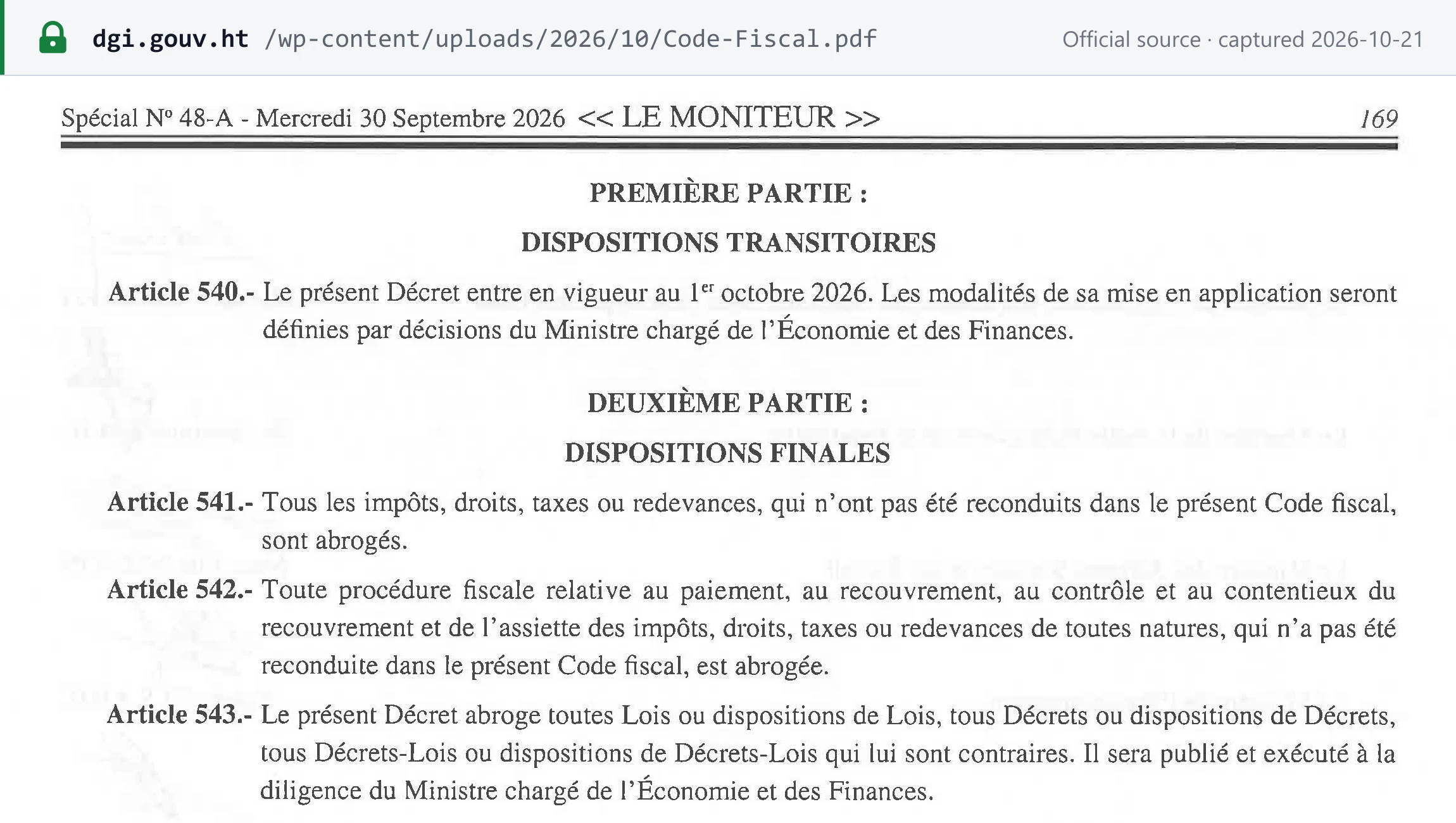
The Code fiscal of 2026. The Décret remplaçant le Décret du 19 décembre 2022 portant Code Fiscal was published in Le Moniteur, the official journal, Spécial N° 48-A of 30 September 2026. Art. 540: "Le présent Décret entre en vigueur au 1er octobre 2026. Les modalités de sa mise en application seront définies par décisions du Ministre chargé de l'Économie et des Finances." Taxes not carried into the new Code are abolished (art. 541), and contrary laws and decrees are repealed (art. 543). As at 2026-11-03, the DGI website publishes no Minister of Economy and Finance decision applying the Code. Article numbers on this page refer to this Code unless stated otherwise. [1]
 Source snapshot captured 2026-10-21 — original
What is taxed. Art. 174: "Sont imposables à la Taxe sur le Chiffre d'Affaires: a. les importations ; b. les livraisons de biens et prestations de services, dont le lieu d'imposition est situé en Haïti, effectuées par un assujetti agissant en tant que tel." A taxable person (assujetti) is any natural or legal person "qui réalise une activité économique de manière indépendante" (art. 177).
Authority. The Direction Générale des Impôts (DGI), under the Ministry of Economy and Finance, which the Code calls "l'Administration fiscale" (art. 2). Head office: 60 Avenue Christophe, Port-au-Prince; tel. +509 2262 1000; infocentre@dgi.gouv.ht. TCA on imports is collected with customs duties (art. 190.4) by the Administration Générale des Douanes (AGD). Large and medium taxpayers are attached to the DGC (Direction des Grands Contribuables) or the DMC (Direction des Moyens Contribuables), and exempt organisations and enterprises to the DOEE (Direction des Organismes et des Entreprises Exonérés); each files at its directorate (art. 190.1.b).
Currency. The Haitian gourde (HTG). Accounts must be kept "en langue créole ou française et en Gourde" (art. 408.4).
Tax period. TCA is declared monthly (arts 183.1, 190). The fiscal year runs from 1 October to 30 September (art. 69.1, stated for income tax).
Layering. None for TCA: it is a single national tax. Excise duties (droits d'accises, arts 195–211) apply separately to listed goods and services and are included in the TCA base (art. 184.2.a). The patente is a communal annual licence tax on carrying on a business (art. 13), not a sales tax.
For the neighbouring system on Hispaniola, see the Dominican Republic ITBIS guide.
Registration
Who should register
Every natural or legal person carrying on an economic activity independently is a TCA taxable person (art. 177). There is no separate TCA registration in the Code: TCA obligations attach to the taxpayer's tax number, the NIF (see below), which every business operating in Haiti must hold (art. 1). [1]
In practice the question is whether a business is inside or outside the franchise regime: at or above HTG 10 million of turnover it charges TCA and files monthly returns; below it, it does not charge TCA. Art. 193 is silent on whether a business under the franchise must still file the monthly return of art. 190, which applies to "tout assujetti".
Registration threshold
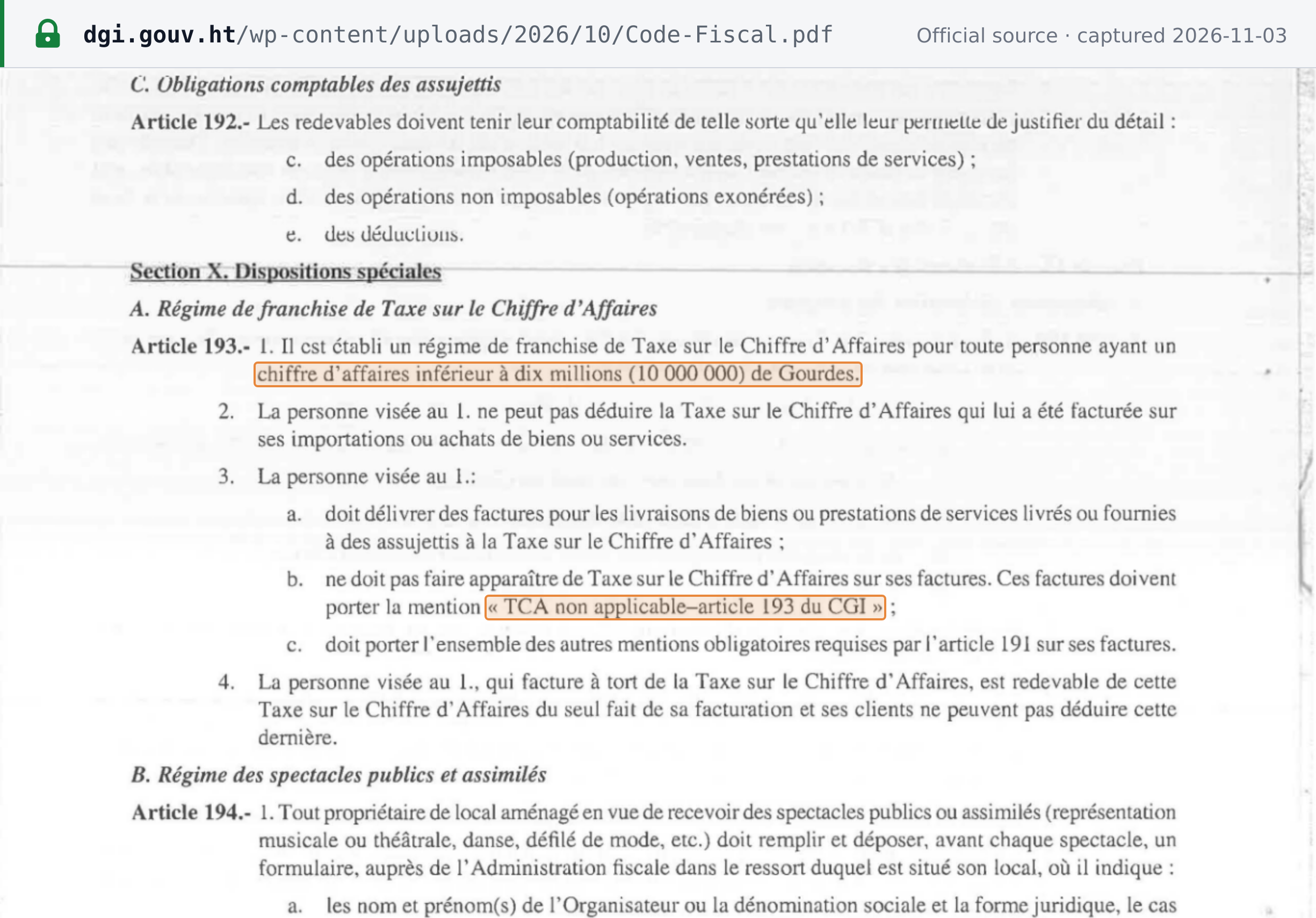
Turnover below HTG 10,000,000: franchise regime, no TCA charged (as at 2026-11-03). Art. 193: [1]
"1. Il est établi un régime de franchise de Taxe sur le Chiffre d'Affaires pour toute personne ayant un chiffre d'affaires inférieur à dix millions (10 000 000) de Gourdes. 2. La personne visée au 1. ne peut pas déduire la Taxe sur le Chiffre d'Affaires qui lui a été facturée sur ses importations ou achats de biens ou services. 3. La personne visée au 1.: a. doit délivrer des factures pour les livraisons de biens ou prestations de services livrés ou fournies à des assujettis à la Taxe sur le Chiffre d'Affaires ; b. ne doit pas faire apparaître de Taxe sur le Chiffre d'Affaires sur ses factures. Ces factures doivent porter la mention « TCA non applicable–article 193 du CGI » ; c. doit porter l'ensemble des autres mentions obligatoires requises par l'article 191 sur ses factures. 4. La personne visée au 1., qui facture à tort de la Taxe sur le Chiffre d'Affaires, est redevable de cette Taxe sur le Chiffre d'Affaires du seul fait de sa facturation et ses clients ne peuvent pas déduire cette dernière."
A business under the franchise:
- does not show TCA on its invoices, and prints « TCA non applicable–article 193 du CGI » on them;
- still issues invoices, with the other art. 191 particulars, for supplies to TCA taxable persons;
- cannot deduct the TCA it pays on imports and purchases;
- owes any TCA it invoices by mistake, and its customer cannot deduct that TCA.
Measurement period. Art. 193 does not say over which period the HTG 10 million is measured. Other turnover tests in the Code name their period, for example "le chiffre d'affaires de l'exercice fiscal précédent" for the income-tax regime in art. 68.1; art. 193 does not.
 Source snapshot captured 2026-11-03 — original
Non-resident registration
The TCA chapter (arts 174–194) contains no non-resident registration rule, threshold or simplified scheme. Two general rules of the Code apply instead: [1]
- NIF through an agent. "Les personnes résidant à l'étranger, qui sont dans l'obligation d'accomplir une formalité fiscale en Haïti, doivent désigner un mandataire aux fins d'obtenir un Matricule Fiscal." (art. 5.1).
- Fiscal representative. Within 30 days of starting activity in Haiti, individuals with activities or property in Haiti but no fiscal domicile there, and businesses with a permanent establishment in Haiti but a head office abroad, must appoint a fiscal representative in Haiti (art. 442.1). "Ce représentant fiscal est solidairement responsable du paiement de l'impôt avec la personne qui l'a désigné." (art. 442.4).
See Foreign companies selling into Haiti.
Tax identification number (NIF)
The tax number is the Matricule Fiscal, called the Numéro d'Immatriculation Fiscale (NIF). Art. 1: "Doit être dotée d'un Matricule Fiscal appelé « Numéro d'Immatriculation Fiscale » (NIF) : a. toute personne physique majeure redevable d'une obligation fiscale sur le territoire de la République d'Haïti ; b. toute entreprise individuelle exerçant une activité sur le territoire de la République d'Haïti ; c. toute personne morale exerçant une activité sur le territoire de la République d'Haïti." [1]
- Issued by the DGI (art. 2); it must be presented "à l'occasion de toute démarche auprès de l'Administration fiscale ou de l'Administration Générale des Douanes" (art. 3).
- Unique and permanent (art. 10.2). Cards of natural persons are valid for life; cards of sole enterprises and legal persons must be renewed every five years (art. 10.3–4).
- A sole enterprise gets its own NIF, distinct from its owner's personal NIF (art. 7).
- Fee (as at 2026-11-03): HTG 1,000 for natural persons and HTG 2,500 for sole enterprises and legal persons (art. 11.1).
Format. Neither the Code nor the DGI's NIF pages and forms set out the number's length, structure or check digit, so none is given here.
How to register
Apply for a NIF at a DGI office, on the DGI's application form, which is free (arts 7–8). The DGI publishes the forms on its forms page: Formulaire A (natural person), B (sole enterprise), C (general partnership) and D (société anonyme). As at 2026-11-03, the DGI website offers no online NIF application. [1]
- Natural persons: Haitians provide a copy of the national identity card (CIN) and a birth certificate or extract; foreigners provide a residence permit from the Ministry of the Interior, or a diplomatic card (art. 6).
- Sole enterprises: the owner's personal NIF and the DGI form; a foreign owner adds a residence permit (art. 7).
- Legal persons (art. 8): the DGI form; a copy of Le Moniteur or a large-circulation newspaper publishing the statutes, or proof of payment for that publication; the operating authorisation from the Ministry of Commerce and Industry; the regulator's authorisation where the activity is regulated; the statutes where publication is not required; the filer's corporate mandate and personal NIF; and "une copie du bilan d'ouverture" (opening balance sheet).
The Code sets no processing time for a NIF application.
Voluntary registration
The Code fiscal provides no option to leave the franchise and charge TCA below HTG 10 million: art. 193 contains no election. Where the Code grants an option elsewhere it says so, for example art. 68.2, under which a business "peut opter pour rester assujettie au régime du réel" for income tax.
Deregistration
The TCA chapter has no deregistration procedure. The general rule (art. 27): "Les contribuables doivent informer par écrit l'Administration fiscale de toute création d'activité, tout transfert, toute cession d'établissement ou cessation d'activité imposable, dans un délai de trente (30) jours à compter de cet évènement." A NIF can also be suspended and struck off for non-filing (art. 478, see Penalties).
Group registration
Not available. The TCA chapter (arts 174–194) contains no grouping provision; each taxable person files its own monthly return (art. 190).
Rates
Standard rate
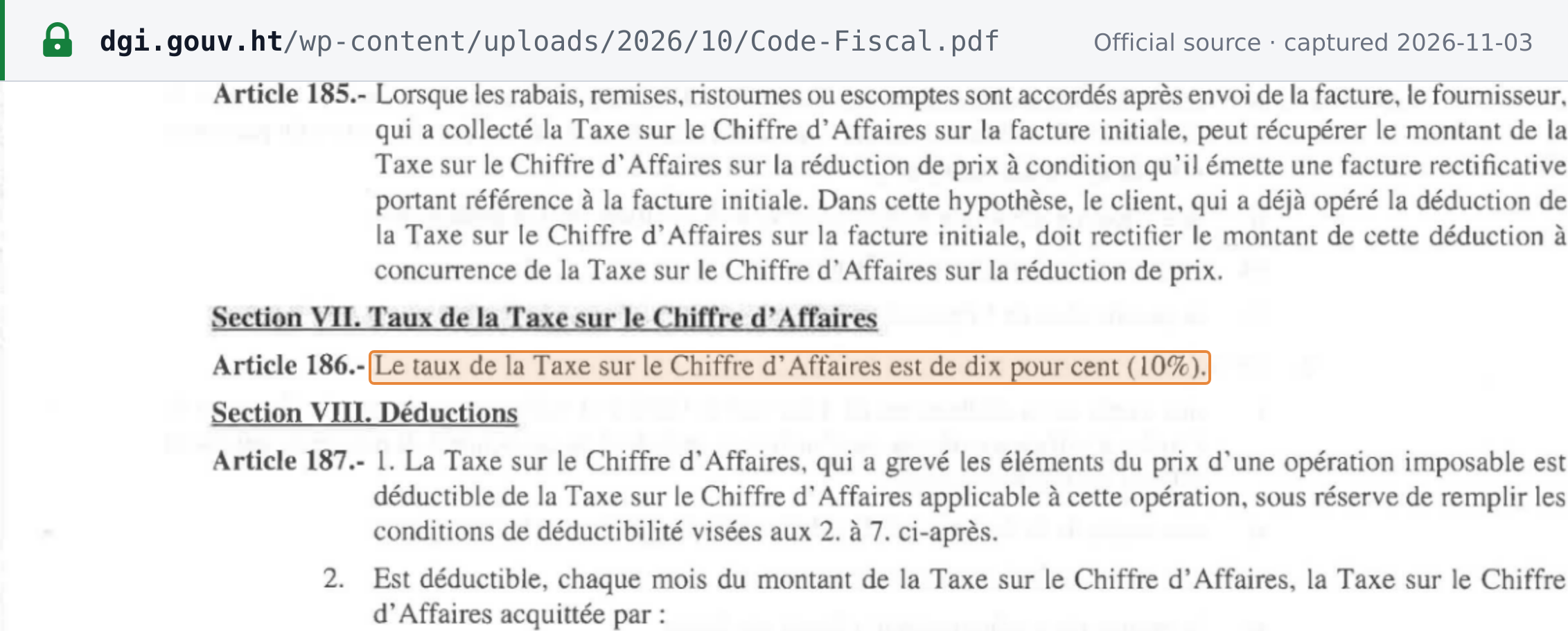
10% — the only TCA rate in the Code fiscal, applying under the Code from 1 October 2026 (art. 540; as at 2026-11-03). Section VII, art. 186: "Le taux de la Taxe sur le Chiffre d'Affaires est de dix pour cent (10%)." [1]
 Source snapshot captured 2026-11-03 — original
Reduced and zero rates
None. The Code has no reduced, super-reduced or zero rate; Section VII contains only art. 186. Relief is given by exemption (art. 181, see Exemptions). Exports are exempt but keep the right to deduct input TCA (art. 187.12), so they work like a zero rate, with the difference that a TCA credit is never refunded (art. 188.4).
Public shows. For ticketed shows, the venue owner files a form with the DGI before each show and collects TCA on ticket sales on a presumptive basis: hall area in m² × land-occupation coefficient (2 by default) × the art. 186 rate × ticket price. Half is paid when the form is filed and the balance within 2 days after the show (art. 194).
Announced rate changes
None. As at 2026-11-03, the DGI website publishes no decision, finance law or notice setting a different TCA rate.
Cross-border rules
Imports and exports
- Imports. Imports are taxable (art. 174.a) and taxed in Haiti (art. 176.a). TCA becomes due on release for consumption (art. 183.2.a). The base is the customs value, "y compris les services effectivement inclus dans cette valeur en douane" (art. 184.1.a), plus other taxes and duties (art. 184.2.a). "La Taxe sur le Chiffre d'Affaires sur les importations est perçue en même temps que les droits de douane." (art. 190.4). Import TCA offences follow the Customs Code (art. 481). Goods under suspensive customs regimes are exempt (art. 181.u). The Code sets no de-minimis for import TCA. [1]
- Exports. Exempt: "les exportations de biens et les prestations de services directement liées à ces exportations" (art. 181.b), along with listed international transport services (art. 181.c). The right to deduct input TCA is kept for exports (art. 187.12). Because TCA credits cannot be refunded (art. 188.4), an exporter with little local taxable turnover carries its credit forward.
Reverse charge on imported services
No reverse charge. The TCA chapter (arts 174–194) contains no provision making a Haitian business customer account for TCA on services bought from abroad. See reverse charge explained for how other countries handle this.
Digital products and services
Services are taxable in Haiti when they are used or exploited there (art. 176.c), and they are taxable when "effectuées par un assujetti" (art. 174.b). The TCA chapter contains no registration regime, threshold or collection mechanism for foreign digital-service suppliers. Art. 540 leaves the Code's application modalities to decisions of the Minister of Economy and Finance; as at 2026-11-03 the DGI website publishes none.
The only mention of digital platforms in the Code is a gaming licence fee for online gambling operators and "fournisseurs de plateformes numériques" in the gaming list (art. 40), which is not TCA.
Foreign companies selling into Haiti — B2B and B2C
| Sale by a foreign business | TCA position in the Code fiscal |
|---|---|
| Goods imported into Haiti | TCA collected from the importer with customs duties (arts 174.a, 190.4) |
| B2B services used in Haiti | Within the scope of TCA (art. 176.c); no reverse charge on the Haitian customer in the TCA chapter |
| B2C services, including digital services, used in Haiti | Within the scope of TCA (art. 176.c); no non-resident registration or collection regime in the TCA chapter |
| Activity or permanent establishment in Haiti | Fiscal representative within 30 days, jointly liable for the tax (art. 442); NIF through an agent (art. 5) |
Marketplace / platform deemed-supplier liability
None. The TCA chapter contains no marketplace or platform rule.
Place of supply
Art. 176: "Ont leur lieu d'imposition en Haïti : a. les importations de biens en Haïti ; b. les livraisons de biens réalisées conformément aux conditions de livraison de la marchandise en Haïti; c. les prestations de services lorsque le service rendu, le droit cédé ou l'objet loué sont utilisés ou exploités en Haïti." [1]
- Goods: where delivered under the delivery conditions.
- Services: where the service, the right assigned or the thing hired is used or exploited. The rule is the same for business and consumer customers.
Invoice requirements
Who must issue an invoice
Art. 191.1: "Tout assujetti à la Taxe sur le Chiffre d'Affaires est tenu de délivrer une facture pour les opérations imposables effectuées avec d'autres assujettis." So the invoicing duty in art. 191 covers supplies to other TCA taxable persons (B2B). [1]
Art. 191 sets no invoicing duty for sales to consumers. Separately, art. 473.1 provides: "Toute vente ou tout achat pour lequel il n'est pas présenté de facture ou de facture régulière est réputé avoir été effectué en fraude de la Taxe sur le Chiffre d'Affaires (TCA)." The Code does not explain how the two rules interact for retail sales.
Mandatory content
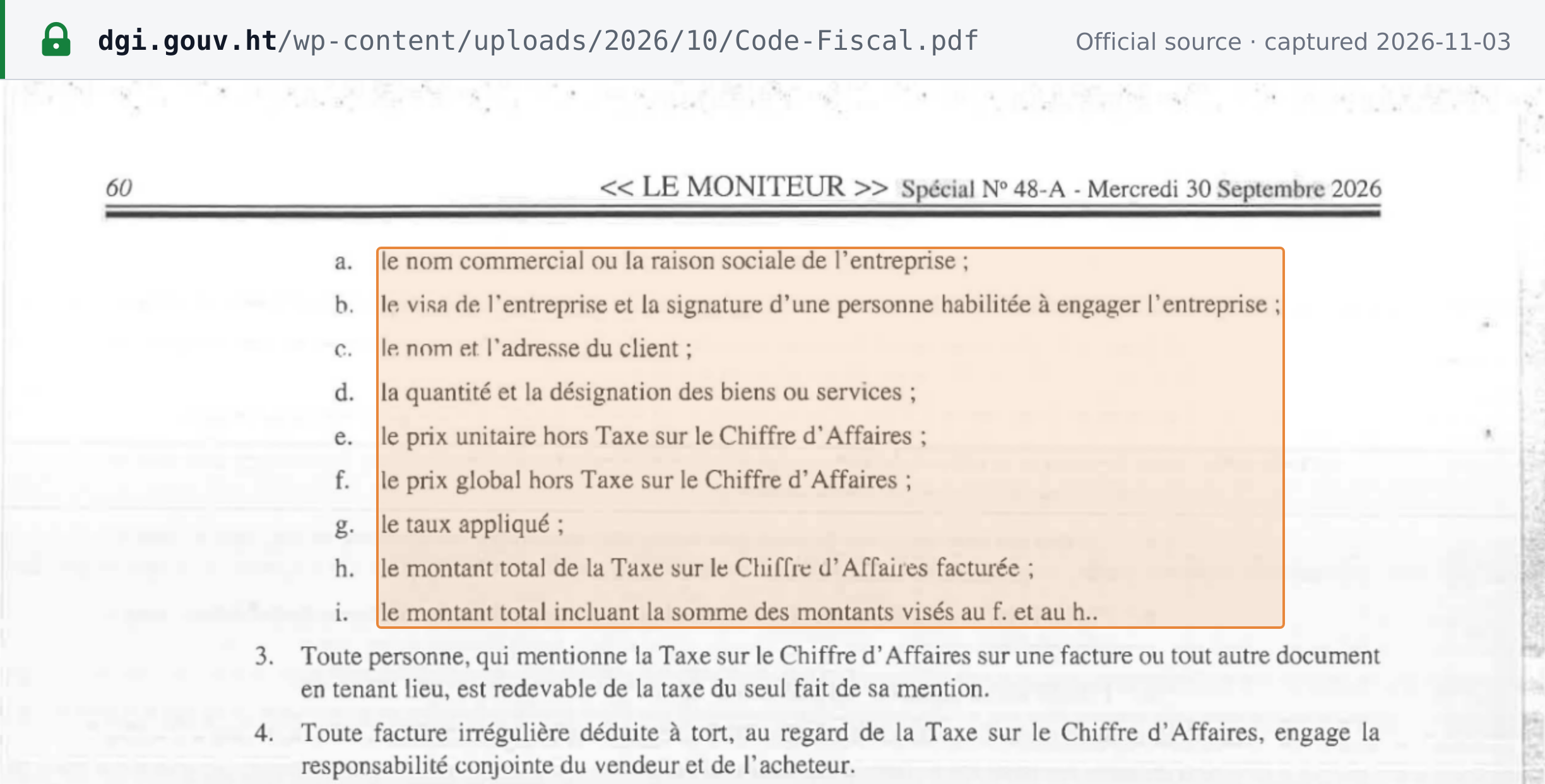
Art. 191.2: "La facture doit être datée, numérotée et doit mentionner: a. le nom commercial ou la raison sociale de l'entreprise ; b. le visa de l'entreprise et la signature d'une personne habilitée à engager l'entreprise; c. le nom et l'adresse du client; d. la quantité et la désignation des biens ou services ; e. le prix unitaire hors Taxe sur le Chiffre d'Affaires ; f. le prix global hors Taxe sur le Chiffre d'Affaires ; g. le taux appliqué ; h. le montant total de la Taxe sur le Chiffre d'Affaires facturée ; i. le montant total incluant la somme des montants visés au f. et au h.." [1]
| Art. 191.2 | Particular |
|---|---|
| lead-in | Date of the invoice |
| lead-in | Invoice number |
| a | Trade name or corporate name of the supplier |
| b | The business's visa (stamp) and the signature of a person authorised to bind it |
| c | Customer's name and address |
| d | Quantity and description of the goods or services |
| e | Unit price excluding TCA |
| f | Total price excluding TCA |
| g | Rate applied |
| h | Total TCA invoiced |
| i | Total amount: f + h |
For developers. The list contains no NIF field for either party, no supply date separate from the invoice date, and no currency rule. Prices are stated excluding TCA (e, f) with TCA added (h, i). Franchise businesses replace g–h with the mention « TCA non applicable–article 193 du CGI » (art. 193.3.b). A manufacturer deducting excise duty paid on domestic raw materials needs a purchase invoice carrying the art. 191 particulars plus the excise duty paid by type of product and in total (art. 205.4.a).
Two liability rules attach to the invoice (art. 191.3–4): "Toute personne, qui mentionne la Taxe sur le Chiffre d'Affaires sur une facture ou tout autre document en tenant lieu, est redevable de la taxe du seul fait de sa mention." and "Toute facture irrégulière déduite à tort, au regard de la Taxe sur le Chiffre d'Affaires, engage la responsabilité conjointe du vendeur et de l'acheteur."
 Source snapshot captured 2026-11-03 — original
Issuance deadline
Art. 191 sets no deadline for issuing an invoice. TCA on goods becomes due on delivery and on services on full or partial payment, including advance payments (art. 183.2), and is declared for the month in which it became due (art. 183.1).
Numbering and sequencing
Invoices must be numbered and dated (art. 191.2). The Code sets no further rule on series or sequence.
Credit and debit notes
The Code uses a corrective invoice (facture rectificative). Art. 185: "Lorsque les rabais, remises, ristournes ou escomptes sont accordés après envoi de la facture, le fournisseur, qui a collecté la Taxe sur le Chiffre d'Affaires sur la facture initiale, peut récupérer le montant de la Taxe sur le Chiffre d'Affaires sur la réduction de prix à condition qu'il émette une facture rectificative portant référence à la facture initiale. Dans cette hypothèse, le client, qui a déjà opéré la déduction de la Taxe sur le Chiffre d'Affaires sur la facture initiale, doit rectifier le montant de cette déduction à concurrence de la Taxe sur le Chiffre d'Affaires sur la réduction de prix." [1]
For bad debts and cancelled sales, the adjustment needs the corrective invoice plus a file attached to the next return: a copy of the return, the original invoice, the corrective invoice, and proof that legal remedies were exhausted or that the price was refunded (art. 187.8). The Code has no debit-note concept.
Currency, language and exchange rate
Art. 191 is silent on currency and language. Accounts must be kept "en langue créole ou française et en Gourde" (art. 408.4). The Code sets no exchange-rate rule for invoices in a foreign currency.
Document types
- Invoice (facture) with the art. 191 particulars.
- Corrective invoice (facture rectificative) referencing the original (art. 185).
- Franchise invoice: the art. 191 particulars without TCA, with the art. 193 mention.
The Code provides no simplified invoice, receipt or ticket regime, and no value threshold for one.
Self-billing
Not regulated as such. Art. 364.2, on storage, refers to invoices issued by taxpayers "ou, en leur nom et pour leur compte, par leur client ou par un pays étranger", but the Code sets no self-billing procedure.
Retention and audit trail
- Retention. Books, registers and supporting documents are kept for 10 years, on paper or electronically (art. 363). Invoices giving rise to a TCA deduction "doivent être conservées pendant un délai de dix (10) ans à compter de leur date d'émission" (art. 364.1). [1]
- Where. In Haiti, or outside Haiti only if stored electronically with immediate, complete online access, and only in a country that has a mutual-assistance convention with Haiti (art. 364.2–3). Invoices must be accessible from the head office within 3 days (art. 364.4). The storage location is declared with the annual results return, and changes are notified within 30 days (art. 364.5).
- Electronic storage. "Tout assujetti stockant ses factures, par voie électronique, s'assure que l'Administration fiscale dispose, à des fins de contrôle, d'un accès en ligne permettant le téléchargement et l'utilisation des données stockées dans un format lisible et exploitable." (art. 364.6).
- Audit trail. Inspectors "peuvent, le cas échéant, contrôler le système de facturation électronique" (art. 372). On a desk audit the taxpayer sends a copy of its accounting-entry files in electronic form within 15 days (art. 417). Software that lets a record be changed or deleted without keeping the original exposes its vendor to a fine of 10% of the vendor's annual turnover, and the user to the 80% fraudulent-manoeuvres penalty (art. 483).
A specimen of a compliant invoice
The DGI publishes no specimen invoice: none appears in the Code fiscal, on the DGI forms page or in the DGI FAQ (as at 2026-11-03). The specimen below is built from the particulars of art. 191.2.
Facture (TCA invoice) — illustrative
| Descriptionart. 191.2.d | Qtyart. 191.2.d | Unit price excl. TCAart. 191.2.e | Total excl. TCAart. 191.2.f |
|---|---|---|---|
| Cement, 42.5 kg bag | 20 | HTG 1,000.00 | HTG 20,000.00 |
| Delivery to site | 1 | HTG 5,000.00 | HTG 5,000.00 |
- Total excl. TCAart. 191.2.f
- HTG 25,000.00
- Rate appliedart. 191.2.g
- 10%
- Total TCA invoicedart. 191.2.h
- HTG 2,500.00
- Total amount (excl. TCA + TCA)art. 191.2.i
- HTG 27,500.00
- Stamp (visa) of the business and signature of a person authorised to bind it — art. 191.2.b.
- A business under the franchise (turnover below HTG 10,000,000) shows no rate and no TCA, and prints instead: « TCA non applicable–article 193 du CGI » — art. 193.3.b.
- A price reduction after invoicing is made by a corrective invoice (facture rectificative) referencing this invoice number — art. 185.
- Neither party's NIF is in the art. 191.2 list.
E-invoicing status
Status (as at 2026-11-03): no e-invoicing mandate. The Code fiscal sets no e-invoicing obligation, platform, format, clearance or real-time reporting system, and the DGI website shows no e-invoicing portal. The Code deals with electronic invoices in these places: [1]
-
inspectors may check a business's existing electronic invoicing system (art. 372), and may enter without notice the business premises of a taxpayer or of "prestataires de services de télétransmission des factures" (art. 372.2.a);
-
inspectors may obtain copies of invoicing documents, "y compris des informations et documents relatifs à la facturation par voie électronique" (art. 375);
-
invoices may be stored electronically, with online access for the DGI (art. 364);
-
vendors of accounting, management or till software that allows records to be altered without keeping the originals are fined (art. 483).
-
System / network: none.
-
Phases and formats: none.
-
Scope: no mandate for B2B, B2G or B2C.
See CTC e-invoicing models and e-invoicing status and networks worldwide.
Filing and payment
Filing frequency
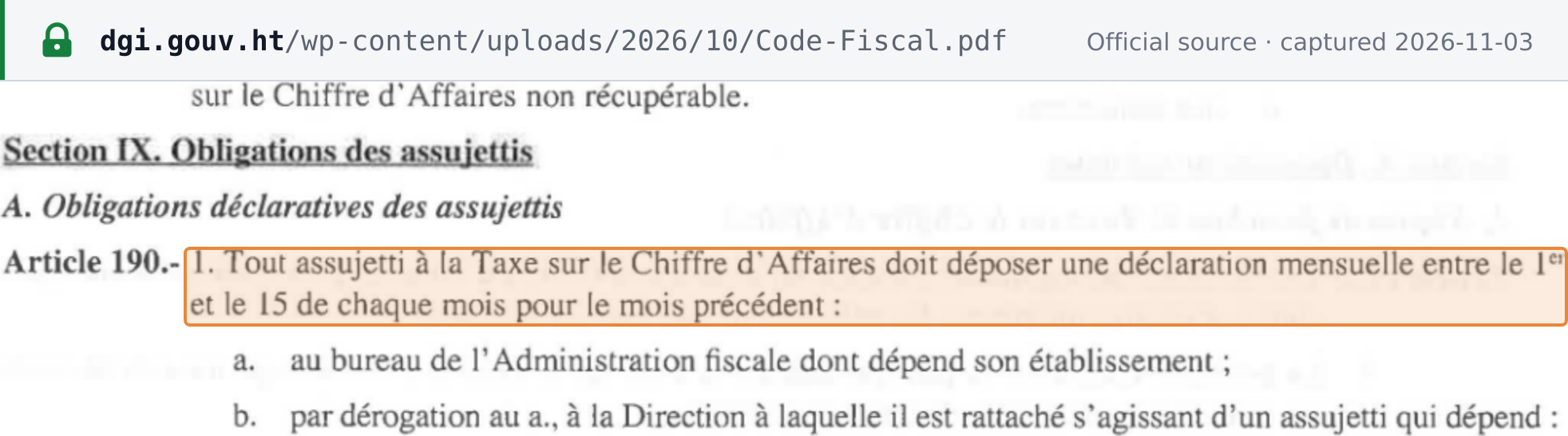
Monthly, for every TCA taxable person. There is no turnover band that changes the frequency. Art. 190.1: "Tout assujetti à la Taxe sur le Chiffre d'Affaires doit déposer une déclaration mensuelle entre le 1er et le 15 de chaque mois pour le mois précédent". [1]
Return due date and where to file
- Due: between the 1st and the 15th of each month, for the previous month (art. 190.1; as at 2026-11-03).
- Where: at the DGI office for the establishment, or, for taxpayers attached to the DMC, DGC, DOEE or another directorate, at that directorate (art. 190.1).
- Form: "La déclaration, qui doit être dûment signée, est produite sur un formulaire fourni sans frais par l'Administration fiscale." (art. 190.2). As at 2026-11-03, the DGI website publishes no TCA return form and no online filing service.
- Purchase listing: each return must attach the list of purchase invoices and customs entries, "détaillée par importation et par fournisseur". Missing, imprecise or incomplete listings lead automatically to the deductions being disallowed (art. 190.3).
 Source snapshot captured 2026-11-03 — original
Payment
- When: "Le montant à payer de Taxe sur le Chiffre d'Affaires, résultant de la déclaration, doit être versé au plus tard à la date d'échéance du bordereau." (art. 190.4). Import TCA is paid with customs duties.
- How (art. 303.1): cash only for amounts below HTG 15,000; otherwise bank transfer, bank card, manager's cheque, mobile payment or electronic wallet. Each payment must state the taxpayer's identity, its Matricule Fiscal number and the tax paid (art. 303.2).
Additional listings
No annual TCA return, sales listing or other periodic listing in the TCA chapter. The purchase listing attached to each monthly return (art. 190.3) is the only one. Accounts must show taxable operations, exempt operations and deductions separately (art. 192).
Input-tax recovery
Deductible input TCA is set against output TCA monthly (art. 187.2). The right is narrow. Art. 187.5 limits it to three categories: [1]
- raw materials and goods incorporated in the taxable finished product;
- consumables destroyed in a single manufacturing operation (not tools or capital goods);
- finished goods bought for resale as they are.
TCA on services that enter the cost of storing or preserving deductible products is also deductible (art. 187.6).
- Blocked: "Sont expressément exclus du droit à déduction les outils et les biens d'investissement." (art. 187.4). TCA on goods lost, stolen or destroyed is not deductible (art. 187.7). In practice, TCA on capital expenditure is not recovered.
- Resellers deduct only in proportion to the TCA paid on the units actually sold (art. 187.3).
- Mixed use: input TCA on materials used for both taxable (or exported) and exempt products is deducted in proportion to the value of taxable or exported products (art. 187.12.a).
- Late claims: a deduction omitted from a return can be claimed on a later return filed before 31 December of the following fiscal year (art. 187.11).
- Franchise businesses deduct nothing (art. 193.2).
Refunds
None. Art. 188.3–4: "Si le montant de la déduction admissible est supérieur au montant de la Taxe sur le Chiffre d'Affaires exigible pour une déclaration donnée, l'excédent appelé « crédit » est imputé sur la taxe exigible au titre de la ou des déclarations ultérieures jusqu'à épuisement. 4. Le crédit de Taxe sur le Chiffre d'Affaires ne peut, en aucun cas, donner lieu à remboursement." [1]
- Exporters carry their credit forward with no refund route.
- Non-residents: the Code has no refund scheme.
- Bad debts and cancelled sales: adjusted with a corrective invoice and a supporting file attached to the next return (art. 187.8).
Exemptions
Exempt supplies
Art. 181 lists 26 exempt categories (a–z). They include: [1]
- Exports of goods and directly linked services (b), and listed international transport services: repair, maintenance and charter of international ships and qualifying aircraft, provisioning, international passenger transport by sea or air, handling and warehousing of goods in transit (c).
- Petroleum products (f); propane gas, gas cylinders, regulators and valves (v).
- Unprocessed agricultural, livestock and fishery products (g); agricultural, fishing and livestock equipment (p).
- Health: care by regulated medical and paramedical professions (h); hospitals (i); organs, blood and human milk (j); ambulance transport (k); medical equipment, medicines and pharmaceutical inputs (l).
- Education and culture: newspapers, books and magazines (m); school and university education and vocational training (n); school supplies (o); non-profit services of recognised charities, amateur sport and popular culture (t).
- Finance: insurance subject to the special tax on insurance contracts (e); "les intérêts sur prêts, à l'exclusion des agios et autres frais bancaires" (s); rent on equipment financed by leasing (crédit-bail) (x).
- Property: transfers of real property, goodwill or clientele subject to registration duty, except by property dealers and developers (q); social housing (r); "les locations d'immeubles nus à usage d'habitation" (z); earthquake- and hurricane-resistant prefabricated houses with a customs value up to HTG 6,150,000 (y).
- Other: services of court clerks and bailiffs (a); sales of stamps and stamped paper for the State (d); goods under suspensive customs regimes (u).
Public bodies are not taxable for acts as public authorities unless this distorts competition (art. 180).
Exempt is not zero-rated. A business making exempt supplies cannot deduct the input TCA on them: input TCA on mixed use is deductible only in proportion to taxable or exported products, and "aucune déduction ne peut être exercée au titre des produits revendus en l'état en exonération de la Taxe sur le Chiffre d'Affaires sauf si ces produits sont exportés" (art. 187.12). Exports are the exception: they are exempt but keep the deduction.
Special regimes
- Franchise below HTG 10 million of turnover (art. 193, see Registration threshold).
- Public shows: presumptive TCA collected by the venue owner (art. 194, see Rates).
- Services on a cash basis: TCA on services is due on full or partial payment, including advance payments; on goods, on delivery (art. 183.2).
- Works contractors may, with the DGI's express authorisation, pay TCA on receipts rather than on delivery (art. 183.3).
- Exempt organisations and enterprises file at the DOEE (art. 190.1.b).
The TCA chapter has no margin scheme and no free-zone rule.
Offences and penalties
Offences
Tax fraud (délit de fraude fiscale) covers wilful concealment, organised insolvency, omitted, false or fictitious entries and other fraud, where intent is proved (art. 484). [1]
- Basic offence: "le délit de fraude fiscale est passible d'une amende d'un million (1 000 000) de Gourdes et d'une peine d'emprisonnement d'un (1) an à cinq (5) ans à prononcer par le Tribunal compétent." (art. 484.3).
- Aggravated: HTG 3,000,000 and 5 years where the fraud is committed by an organised gang or through foreign accounts, false identity or documents, sales or purchases without invoice or with invoices not matching real operations, a fictitious foreign domicile, sham acts or interposed entities (art. 484).
- Legal persons: the fine is multiplied by ten and imprisonment does not apply (art. 484.8).
- Accessory penalties: suspension of public contracts, a 10-year ban from public tenders, a 3-year loss of civic rights for individuals, and publication of the judgment (art. 485).
- Collective refusal of tax: organising it, HTG 250,000 and 1 year (art. 486); inciting the public to refuse or delay tax, HTG 100,000 and 3 months (art. 487).
- TCA credit fraud (escroquerie en matière de TCA): manoeuvres to mislead the DGI in order to set a fictitious TCA credit against TCA returns, including the use of fake invoices or accounts built on fictitious entries (art. 488.1–2). It "est puni d'une peine de quatre (4) ans d'emprisonnement et d'une amende de cinq millions (5 000 000) de Gourdes" (art. 488.3). Every co-author and accomplice, "y compris toute personne employée par l'État", faces the same penalties and is jointly liable for the evaded tax, penalties and fines (art. 488.4).
Sales without an invoice are presumed fraudulent: "Toute vente ou tout achat pour lequel il n'est pas présenté de facture ou de facture régulière est réputé avoir été effectué en fraude de la Taxe sur le Chiffre d'Affaires (TCA)." (art. 473.1). The seller owes the TCA plus the 80% fraudulent-manoeuvres penalty; a taxable buyer loses the deduction and is jointly liable (art. 473).
Penalties
All amounts as at 2026-11-03. [1]
| Breach | Penalty | Code fiscal |
|---|---|---|
| Late or missing return | 10% of the tax that should have been declared; 40% if not filed within 30 days of a formal notice; 80% for a concealed activity | Art. 474 |
| Late or missing return — fixed fine, per month or part-month | HTG 10,000 (turnover below HTG 10 million); HTG 50,000 (DMC taxpayers); HTG 100,000 (DGC and DOEE taxpayers); HTG 5,000 in other cases | Art. 475 |
| Late payment of an indirect tax | 10% of the amount paid late (5% for other taxes); not cumulated with the late-filing penalty | Art. 476 |
| Late-payment interest | 2.5% per month or part-month on the unpaid tax | Art. 470.4 |
| Understatement | 40% for deliberate failure; 80% for abuse of law, fraudulent manoeuvres or a concealed part of a contract price | Art. 472 |
| Four consecutive months without a return | NIF suspended, then struck off; no customs clearance while suspended or struck off | Art. 478 |
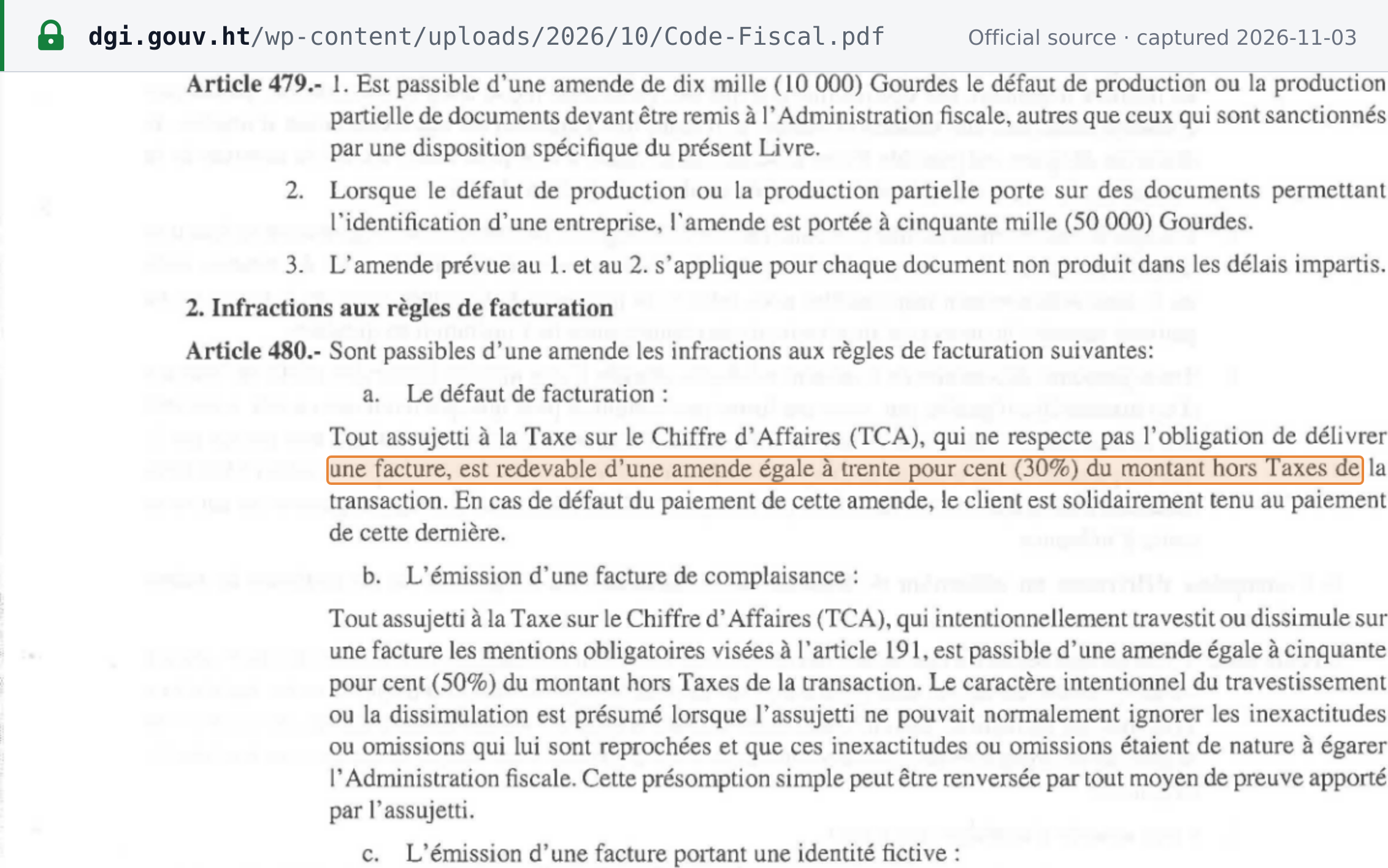
| Failure to issue an invoice | 30% of the pre-tax transaction amount; the customer is jointly liable if unpaid | Art. 480.a |
| Accommodation invoice (art. 191 particulars disguised or concealed on purpose) | 50% of the pre-tax amount | Art. 480.b |
| Fictitious identity on an invoice | 50% of the pre-tax sums | Art. 480.c |
| Fictitious invoice (no real supply) | 70% of the pre-tax amount, for the supplier and the customer; 100% for a false purchase invoice | Art. 480.d |
| Each omission or inaccuracy on an invoice | HTG 100, capped at one quarter of the invoice's pre-tax amount | Art. 480.e |
| Documents not produced | HTG 10,000 per document; HTG 50,000 where it identifies a business | Art. 479 |
| Software allowing records to be altered | Vendor: 10% of its annual turnover; user: 80% penalty | Art. 483 |
Art. 470.4: "Le taux de l'intérêt de retard est de deux virgule cinq pour cent (2,5%) par mois ou fraction de mois." Art. 480.a: "Tout assujetti à la Taxe sur le Chiffre d'Affaires (TCA), qui ne respecte pas l'obligation de délivrer une facture, est redevable d'une amende égale à trente pour cent (30%) du montant hors Taxes de la transaction. En cas de défaut du paiement de cette amende, le client est solidairement tenu au paiement de cette dernière."
 Source snapshot captured 2026-11-03 — original
Time limits. The DGI may reassess until the end of the fifth year after the year in which the tax became due (art. 351), and the tenth year for a concealed activity, flagrant-offence reports or undeclared foreign entities or accounts (art. 352).
Frequently asked questions
We export from Haiti and our TCA credit keeps growing. Can we get it refunded?
No. Exports are exempt from TCA (Code fiscal art. 181.b) but keep the right to deduct input TCA (art. 187.12). Deductible TCA above the TCA due for a month becomes a credit carried forward against later returns until it is used up, and art. 188.4 states that the TCA credit "ne peut, en aucun cas, donner lieu à remboursement" (can in no case be refunded).
Can we deduct the TCA paid on machinery, vehicles or other equipment?
No. Code fiscal art. 187.4 expressly excludes tools and capital goods ("les outils et les biens d'investissement") from the right to deduct. Deduction is limited to the three categories of art. 187.5: raw materials and goods incorporated in the taxable product, consumables destroyed in a single manufacturing operation, and finished goods bought for resale as they are. TCA on goods lost, stolen or destroyed is not deductible either (art. 187.7).
Our turnover is below HTG 10 million. What do we put on our invoices?
Under the franchise regime of Code fiscal art. 193 you must not show TCA on your invoices, and each invoice must carry the mention « TCA non applicable–article 193 du CGI » plus the other particulars required by art. 191. You must still issue invoices for supplies to customers that are TCA taxable persons. You cannot deduct the TCA you pay. If you charge TCA by mistake, you owe it because it was invoiced, and your customer cannot deduct it.
Does a Haitian invoice have to show our NIF or the customer's NIF?
Not under the invoice article. The mandatory particulars listed in Code fiscal art. 191.2 (trade name, the business's visa and an authorised signature, customer name and address, quantity and description, unit and total price excluding TCA, rate, total TCA and total amount) do not include either party's Numéro d'Immatriculation Fiscale (NIF). The NIF must be presented for every dealing with the tax administration or customs (art. 3), and every tax payment must state it (art. 303.2).
What happens if we stop filing our monthly TCA returns?
Each late or missing return draws a 10% surcharge on the tax that should have been declared, rising to 40% if the return is not filed within 30 days of a formal notice (art. 474), plus a fine of HTG 5,000 to HTG 100,000 per month or part-month late depending on the taxpayer's class (art. 475). After four consecutive months without a return, and no regularisation within the 30 days of the formal notice, the NIF is automatically suspended. The suspension becomes definitive, and the NIF is struck off, if the situation is not regularised within a further 30 days or on a repeat. A taxpayer whose NIF is suspended or struck off cannot clear imported or exported goods through customs (art. 478).
Can we pay TCA in cash at the DGI office?
Only small amounts. Code fiscal art. 303.1 allows payment in cash only where the amount is below HTG 15,000. Otherwise pay by bank transfer, bank card, manager's cheque, mobile payment or electronic wallet. Each payment must state the taxpayer's identity, its Matricule Fiscal number and the tax being paid (art. 303.2).
Important websites
| Site | Purpose |
|---|---|
| Direction Générale des Impôts (DGI) | Tax authority home page: offices, contacts and news |
| DGI forms | NIF application forms A (natural person), B (sole enterprise), C (general partnership) and D (société anonyme) |
| DGI FAQ | Questions on the NIF and the quitus fiscal |
| Code fiscal 2026 — DGI document page | The law: TCA is Title II, Chapter 1, arts 174–194 |
| Ministry of Economy and Finance (MEF) | Issues the decisions applying the Code fiscal (art. 540) |
As at 2026-11-03, the DGI publishes no online portal for TCA registration, filing, payment, NIF lookup or e-invoicing. Returns are filed on the DGI's form at the DGI office or directorate (art. 190.1–2).
Recent changes
- 2026-10-01 — New Code fiscal in force (Le Moniteur Spécial N° 48-A, 30 September 2026): TCA at 10% (art. 186), franchise below HTG 10 million (art. 193), monthly returns between the 1st and the 15th (art. 190), mandatory invoice particulars (art. 191). (DGI) — see event
For the full chronology, see Haiti tax changes on Lookuptax.
Reference links
- Décret remplaçant le Décret du 19 décembre 2022 portant Code Fiscal — Le Moniteur Spécial N° 48-A, 30 September 2026 (PDF, DGI)
- DGI document page for the Code fiscal decree
- DGI — forms (NIF applications)
- DGI — opening of the 2026-2027 budget conferences (fiscal year starting 1 October)
Related on Lookuptax: