Jamaica GCT guidelines
| FACTSHEET | |
|---|---|
| Country code | JM |
| Tax name | General Consumption Tax (GCT) |
| Tax Authority | Tax Administration Jamaica (TAJ) |
Overview
Jamaica levies General Consumption Tax (GCT) under the General Consumption Tax Act, in force since 22 October 1991, and the General Consumption Tax Regulations. TAJ describes it this way: "The GCT is a value added tax which is applied on the value added to goods and services at each stage in the production and distribution chain. It is a tax on consumption and is included in the final price the consumer pays for goods and services." [1] English is the official language, so the tax has no second name.
TAJ's long-form GCT guide is the main official explanation of the rules, but parts of it have not been updated. Its introduction still gives the pre-2020 rate of 16.5% and a J$3 million threshold, and its penalty paragraphs pre-date the 2014 amending Act.
Authority. GCT is administered by Tax Administration Jamaica (TAJ), headed by the Commissioner General. GCT on imports is collected by Jamaica Customs at entry. [1]
Currency. The Jamaican dollar (JMD; TAJ writes "$" or "J$").
Tax period. One month: "The taxable period for reporting the tax is one month. At the time of registration, taxpayers will be given a reporting schedule to follow for filing GCT returns." [1]
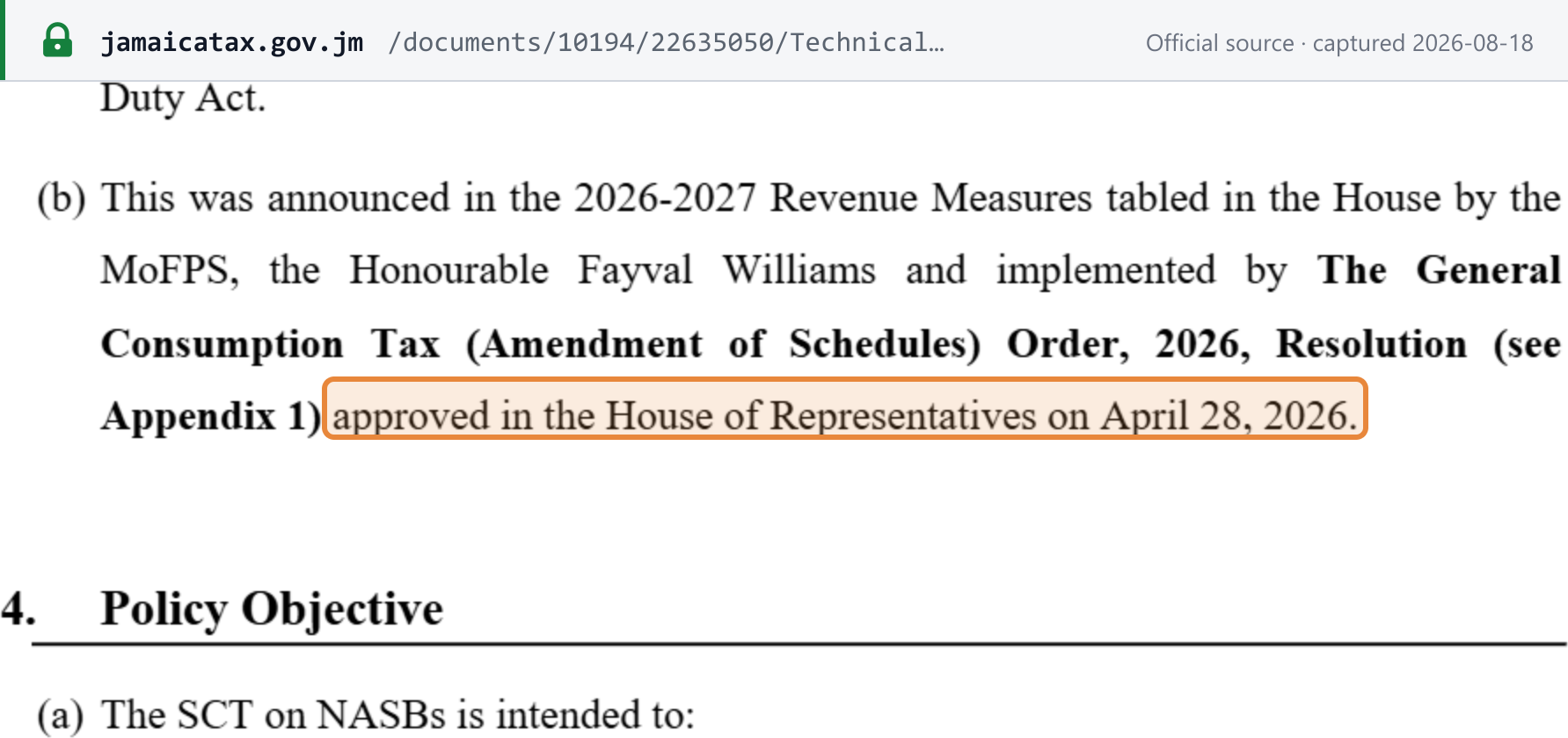
Layering. None. GCT is a single national tax. The same Act also imposes Special Consumption Tax (SCT) under its Second Schedule on specified goods such as alcohol, tobacco and petroleum, and from 1 May 2026 on non-alcoholic sweetened beverages at J$0.22 per gram of added sweetener, under the General Consumption Tax (Amendment of Schedules) Order, 2026. [17] SCT payable on an import forms part of the value on which import GCT is charged. [1]
 Source snapshot captured 2026-08-18 — original
For Caribbean neighbours, see the Barbados VAT guide, the Trinidad and Tobago VAT guide, the Belize GST guide and the Dominican Republic VAT guide.
Registration
Who should register
"All persons engaged in a taxable activity are required to apply for registration under the GCT Act." [1] Registration then has two outcomes:
- Registered Taxpayer. A person whose gross supplies reach the threshold below. It charges GCT, issues tax invoices, files monthly returns and claims input tax.
- Registered Person. An applicant below the threshold. "A person operating below the Threshold will receive a Notice of Registration and is not permitted to collect General Consumption Tax when he supplies goods or services." [1]
Some people do not register at all. In TAJ's words, "Anyone engaged TOTALLY in the following will NOT have to register for GCT:-- any activity carried on essentially as a private recreational pursuit or hobby; any engagement, occupation or employment under any contract of service or as a director of a company; any good or service which is exempt from the GCT (Third Schedule of the General Consumption Tax Act)." [1]
Registration threshold
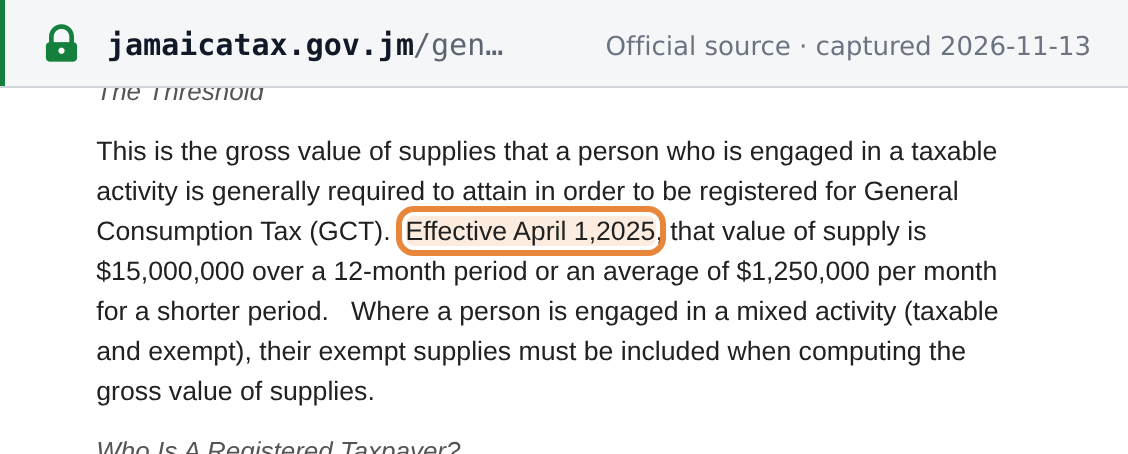
J$15,000,000 of gross supplies over 12 months, from 1 April 2025. TAJ's guide, under "The Threshold": "Effective April 1,2025, that value of supply is $15,000,000 over a 12-month period or an average of $1,250,000 per month for a shorter period. Where a person is engaged in a mixed activity (taxable and exempt), their exempt supplies must be included when computing the gross value of supplies." [1]
 Source snapshot captured 2026-11-13 — original
The threshold was J$3,000,000 before 1 April 2019 and J$10,000,000 from 1 April 2019 to 31 March 2025. TAJ's 2020 technical bulletin on imported services refers to "$10M (prior to April 1, 2019 $3M)". [20] TAJ's Quick Guide (July 2020) gives the J$10,000,000 figure as "w.e.f. April 1, 2020" [3], a year later than the bulletin. The Ministry of Finance announced the latest rise as "Effective April 2025, the GCT threshold will be increased from $10 million to $15 million dollars." [14] [13]
Non-resident registration
TAJ's GCT guide, Quick Guide and Form 1 set out no separate threshold or registration route for non-resident suppliers. A supply by a non-resident is made in Jamaica if the goods are in Jamaica at the time of supply or the services are performed or utilised there (see Place of supply). Imported services bought by Jamaican businesses are taxed through the customer's reverse charge, not through registration of the foreign supplier (see Reverse charge on imported services).
Tax identification number
The GCT registration number is the Taxpayer Registration Number (TRN), a nine-digit number. TAJ's GCT guide, in its instructions for Form 4A: "Your registration number should be the same as your Taxpayer Registration Number." Form 4A (Rev 2025/06/03) asks for the "Taxpayer Registration Number (TRN)". [1] [7] A business TRN is needed before GCT registration.
For format detail, see the Jamaica TRN guide. To check the format of a number, use the Jamaica TRN validator.
How to register
- When. "Any person starting a taxable activity after the 22nd October 1991 has twenty‑one (21) days after starting this taxable activity to make an application to register." [1]
- Prerequisite. "To be able to register for GCT, a person must have a valid Business Taxpayer Registration Number (TRN)." [1]
- Form. Form 1, Application for General Consumption Tax Registration (the guide calls it GCT‑1), lodged at a tax office. [8]
- Online. Since April 2021 the application can be made through the taxpayer's TAJ eServices account: "Once the electronic application has been submitted, it is then reviewed by a TAJ officer and if approved the GCT account will be made available through the taxpayers eServices account, enabling them to make future payments and filings for GCT." [15] See TAJ's eServices page.
- Certificate. A Registered Taxpayer receives a Certificate of Registration. "A Certificate of Registration or an official copy of the certificate must be prominently displayed in each business outlet." [1]
TAJ publishes no processing time for GCT registration.
Voluntary registration
Available. "A person who has applied for registration and qualifies for registration as a Registered Person may voluntarily apply to be registered as a Registered Taxpayer. If the application is approved by the Commissioner General all provisions of the Act and Regulations relating to Registered Taxpayers will apply to that person." [1] Form 1 asks the question directly: "If sales turnover is below threshold, are you applying to be a GCT registered taxpayer?" [8] The usual reasons are to recover input tax and to give registered customers tax invoices they can claim credit on.
Deregistration
The Commissioner General cancels a registration: "The Commissioner General may cancel the registration of a Registered Person if he is satisfied that the person no longer carries on a taxable activity. He may also cancel the registration of a Registered Taxpayer if he is satisfied that the Registered Taxpayer no longer qualifies for registration as such." [1]
- Objection. "This objection must be made within thirty days of the date of service of the notice and must be in writing, stating precisely the grounds of the objection."
- Final return. Due "upon ceasing a taxable operation, filing a final return for the last taxable period."
- Certificate. A cancelled certificate must be returned. Failing to return it is an offence with a fine of up to J$100,000 (s.55(2), as amended in 2014). [10]
- Changes. A registered person must tell the Commissioner General in writing "within twenty‑one days‑ of any change in business address, or any change in the name in which the business is carried on; of the sale by him of his business or part thereof". [1]
Group registration
Available. Registered taxpayers approved as a GCT group under section 32C of the Act file one monthly group return, Form 4H, through a group representative; intra-group supplies are deducted on the return. TAJ's forms page: Form 4H "is used by Registered taxpayers who are approved as a GCT Group in accordance with Section 32( C) of the General Consumption Tax Act", and the return "is due to be filed on the last working day of each month." [21] [25] For how grouping works elsewhere, see VAT grouping explained.
Separately, a business may file returns for branches or divisions: "In the case of persons who file returns separately for branches or divisions, accounting records must be kept at these branches or divisions." [1]
Rates
| Rate | Applies to | Source |
|---|---|---|
| 15% | Standard rate, from 1 April 2020 (16.5% before) | TAJ rate history; Quick Guide |
| 25% | Telephone services and telephone instruments | Quick Guide; TAJ guide |
| 10% | Tourism activities (15% announced from 1 April 2027, below) | Quick Guide; TAJ guide |
| 7% | Residential electricity energy charges, from 1 May 2025 | Jamaica Information Service |
| 2% | Books and other printed material | Quick Guide (July 2020) |
| 0% | Zero-rated goods and services, including exports (First Schedule) | Quick Guide; TAJ zero-rated list |
| Exempt | Third Schedule supplies (see Exemptions) | TAJ zero-rated and exempt list |
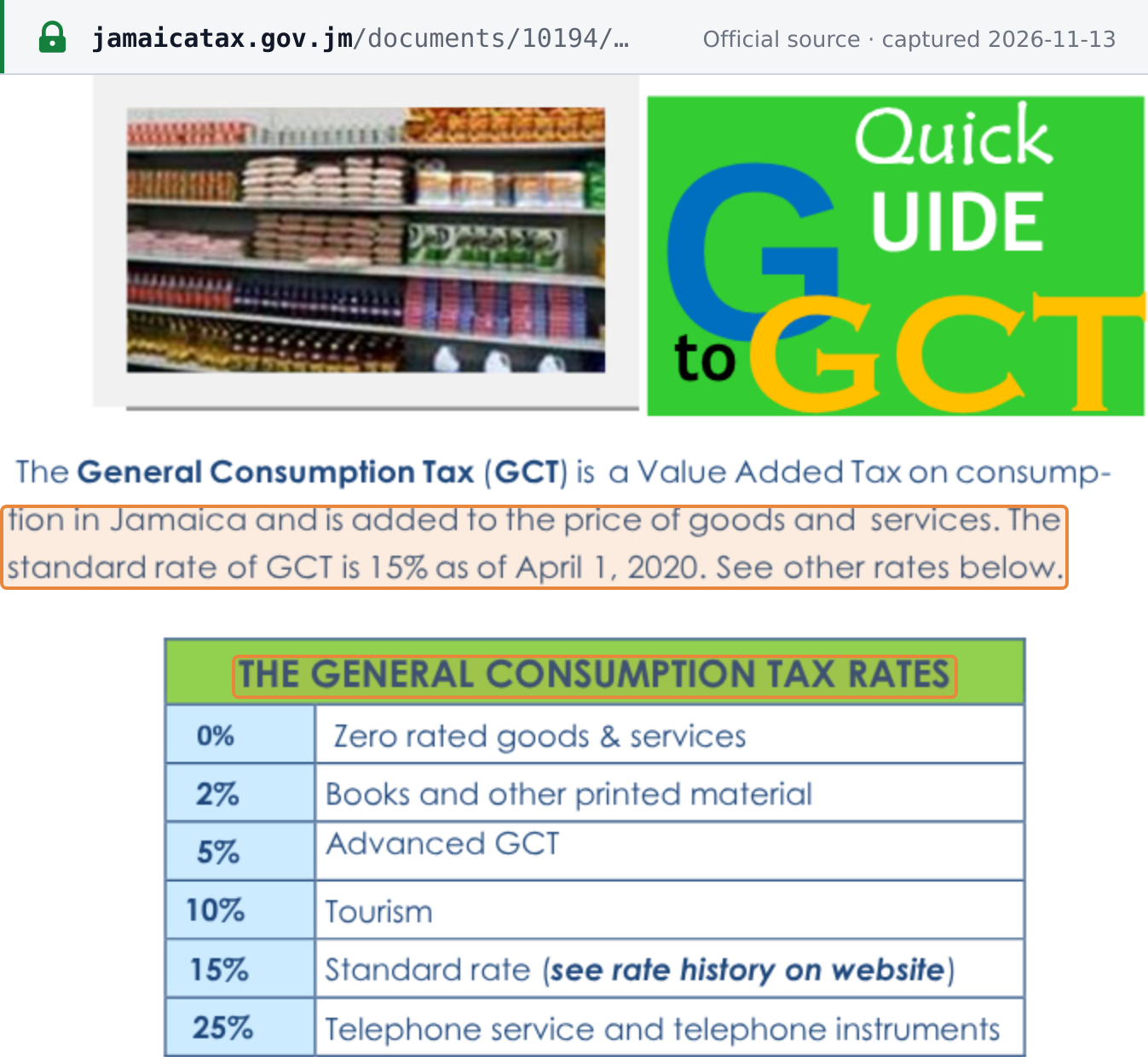
Standard rate: 15%, effective 1 April 2020. TAJ's Quick Guide: "The standard rate of GCT is 15% as of April 1, 2020." TAJ's Advanced GCT note: "NB: The standard GCT rate of 15% came into effect on April 1, 2020. Prior to that it was 16.5%." [3] [4]
 Source snapshot captured 2026-11-13 — original
The "5% Advanced GCT" line in that table is a prepayment collected at import from registered commercial importers, not a rate on supplies (see Imports and exports).
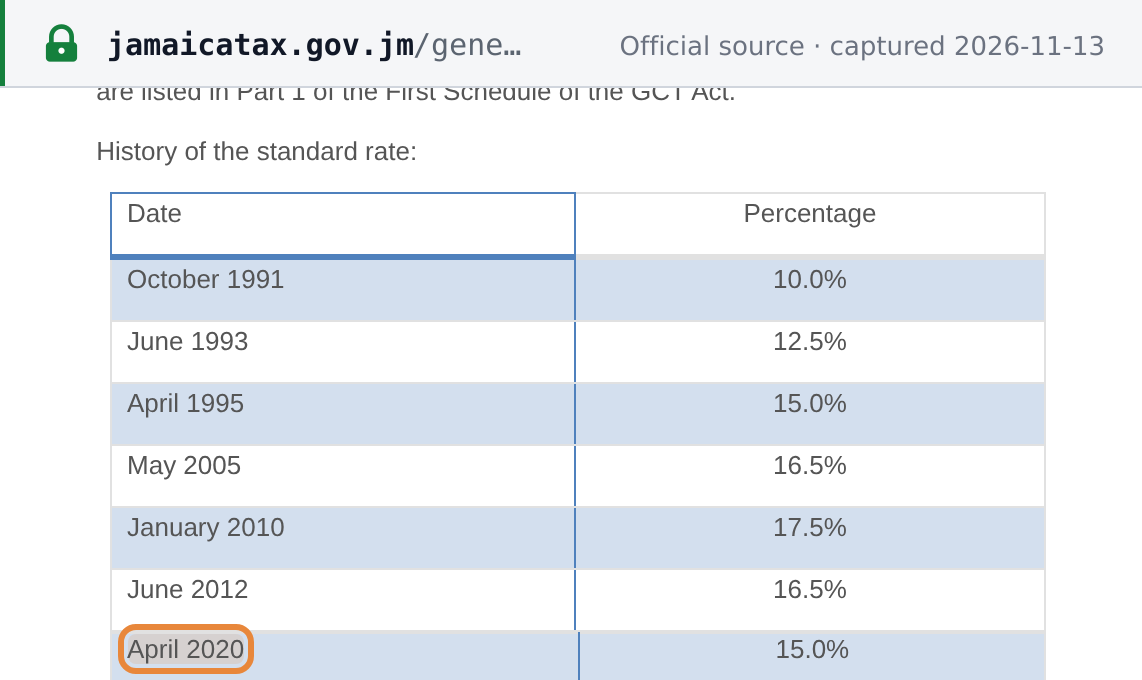
TAJ's rate history for the standard rate: October 1991 10.0%, June 1993 12.5%, April 1995 15.0%, May 2005 16.5%, January 2010 17.5%, June 2012 16.5%, April 2020 15.0%. [1]
 Source snapshot captured 2026-11-13 — original
Other rates. TAJ's guide states that telephone services, telephone instruments and telephone cards "are taxed at twenty five percent (25%); and tourism services which are taxed at ten percent (10%)." [1] The 2% rate on books and other printed material appears in TAJ's July 2020 Quick Guide; no later TAJ publication restates it. [3] Motor vehicles carry rates set in Part 1 of the First Schedule to the Act. [1]
Residential electricity: 7% from 1 May 2025. "Effective May 1, a reduced GCT rate of seven per cent was applied to the energy charges of both post-paid and prepaid residential customers of the Jamaica Public Service (JPS). The new rate replaces the 15 per cent GCT that was previously applied to usage over 150 kilowatt hours (kWh)." [23] Post-paid residential customers using 250 kWh or less a month also receive a government tax subsidy and rebate. Form 4A (Rev 2025/06/03) reports this in Section C2, "Power Supply". [7] Before 1 May 2025 the first 150 kWh a month were zero-rated and usage above that was taxed at 15%. [5]
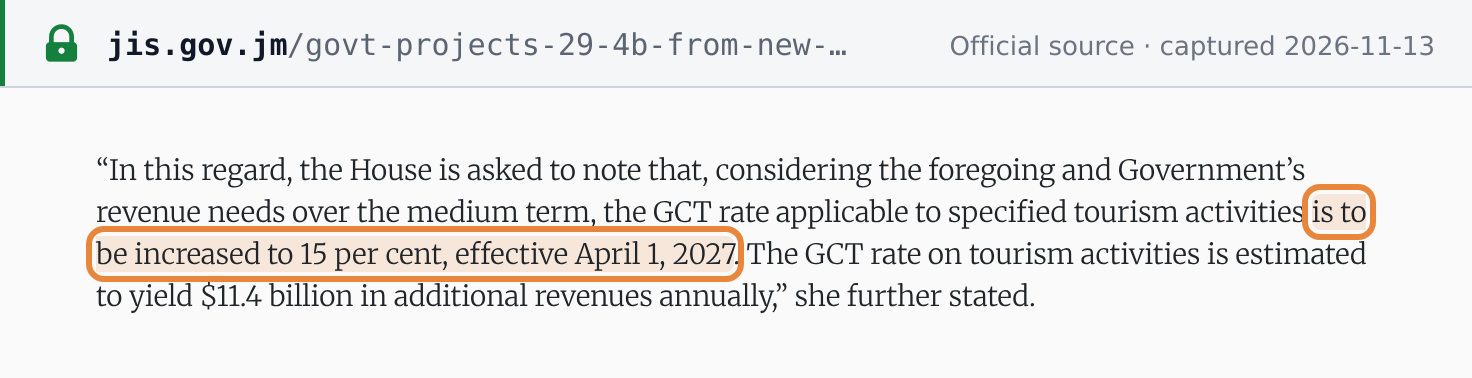
Announced future rate: tourism 15% from 1 April 2027. Tabling the 2026/27 revenue measures on 12 February 2026, the Minister of Finance said: "the GCT rate applicable to specified tourism activities is to be increased to 15 per cent, effective April 1, 2027." [12] This is an announced measure. The tourism rate stays at 10% until 1 April 2027. TAJ has not yet published guidance on the change.
 Source snapshot captured 2026-11-13 — original
See the Jamaica tax-changes chronology for dated changes, and worldwide tax rates for other countries.
Cross-border rules
Imports and exports
Imports. "General Consumption Tax (GCT) is levied and collected at the time goods are entered for home consumption under the Customs Act. The person importing the goods is liable to pay the GCT to Customs on the same document which is used to pay the Customs Duty." [1] The value for import GCT is "the aggregate of:‑ the value of that taxable supply for customs duty purposes; the amount of customs duty payable; any additional stamp duty on inward customs warrants; and any special consumption tax payable in respect of that taxable supply."
Advanced GCT. A registered commercial importer of goods for resale or for use in its taxable activity also pays a 5% Advanced GCT. TAJ: "The rate of GCT that is reflected on the Import Entry (C87) in respect of the goods to which Advanced GCT applies is 20%. That figure comprises the standard rate of 15% plus the Advanced GCT payment of 5%. It must be emphasized that the 20% is not a rate of tax stipulated by the GCT Legislation but rather a combination of the two separate charges". [4] The Advanced GCT is claimed as input tax. An unregistered commercial importer pays an "uplift" instead: "The Uplift is a percentage increase in the value of goods imported by a commercial importer whois [sic] NOT REGISTERED for GCT. Advanced GCT on the other hand, is an additional amount of GCT payable on specified goods by a commercial importer who IS REGISTERED for GCT." [1]
Deferment. "Manufacturers can apply to the Commissioner General for approval to defer payment of GCT on imports of raw materials, spare parts, intermediate goods and consumables." [1]
De minimis. Imports with an FOB value of US$100 or less pay no duties or taxes, for commercial and non-commercial shipments alike; above US$100, the relevant duty and taxes are payable. Jamaica Customs Agency: "If the FOB value of the goods imported is US$100 or less (De Minimis) then the Importer would not be required to pay any duties and taxes. This applies to both commercial and non-commercial shipments (Item 79 of the Second Schedule)". [24]
Exports are zero-rated: "goods which have been entered by the supplier for export pursuant to the Customs Act and which have been exported and in respect of which a customs certificate of exportation has been issued; services which are supplied to a person who is not resident in Jamaica and the benefit of the supply of which is not realized in Jamaica." [1]
Reverse charge on imported services
A resident business that receives imported services accounts for the GCT itself. TAJ: "Registered Taxpayer importing services subject to tax are required to self-assessed and account for the GCT (this mechanism is called a reverse charge)". [1]
The rule is section 23B of the Act, inserted by the General Consumption Tax (Amendment) Act, 2014 (No. 10 of 2014). A service importer who is a registered taxpayer is "deemed to be the supplier of those services", is "liable to pay the tax payable in respect of the supply of those services to the Commissioner General", and must file and pay under section 33(1). [10] Section 23B(3) excludes:
- a service importer whose supplies in the 12 months before the services are received total "less than three million dollars, excluding the value of any imported services" (J$3,000,000 in the 2014 Act; J$10,000,000 from 1 April 2019 according to TAJ's 2020 technical bulletin; TAJ has not said whether the figure moved with the 1 April 2025 threshold rise); and
- "a service importer who is an individual, in respect of imported services that are received by that individual for his private use."
On Form 4A, "Treat the full amount paid for the imported services as the deemed supply (Enter amount in Line 20) and apply the applicable rate." Line 20 is "Imported Services (Not to be included in Line 6 above)". [7] A registered taxpayer reports it on line 20 of Form 4A; an unregistered business reports it on Form 4G. TAJ: "You should fill out a Form 4G - GENERAL CONSUMPTION TAX RETURN (MISCELLANEOUS ACTIVITIES FOR EXEMPT AND NON REGISTERED TAXPAYERS)". [20] For how other countries handle this, see reverse charge explained.
Digital products and services
No regime for foreign B2C digital suppliers was in force as at 2026-11-13. On 12 February 2026 the Government announced that GCT would apply to digital services and intangibles supplied from abroad. The Jamaica Information Service reported: "The measure is projected to generate approximately $300 million in the first instance, beginning in the fourth quarter of fiscal year 2026/27. Upon full implementation in the 2027/28 financial year, government revenues are expected to increase by $4.2 billion." [12] The fourth quarter of fiscal year 2026/27 is January to March 2027.
This is a proposal. TAJ's GCT pages and technical advisories set out no scope, threshold, registration route or collection mechanism for it. For the wider picture, see VAT on digital services by non-resident suppliers.
Foreign companies selling into Jamaica — B2B and B2C
- B2B services. The Jamaican business customer self-accounts under section 23B (above). TAJ's guidance sets no registration obligation for the foreign supplier on these supplies.
- B2C services. Section 23B does not reach an individual's private-use purchases, and the announced digital-services measure is not yet in force (above). TAJ's GCT guidance describes no registration route for a non-resident supplying consumers in Jamaica.
- Goods. Imported goods bear GCT at Customs, paid by the importer of record.
Marketplace / platform deemed-supplier liability
Not provided for in TAJ's GCT guidance. See marketplace deemed-supplier rules for other countries.
Place of supply
"A supply of goods or services is considered to be made in Jamaica- if the supplier is resident in Jamaica; or if the supplier is not resident in Jamaica I. in the case of goods; the goods are in Jamaica at the time of supply; or II. in the case of services, the services are performed or utilized in Jamaica." [1]
Invoice requirements
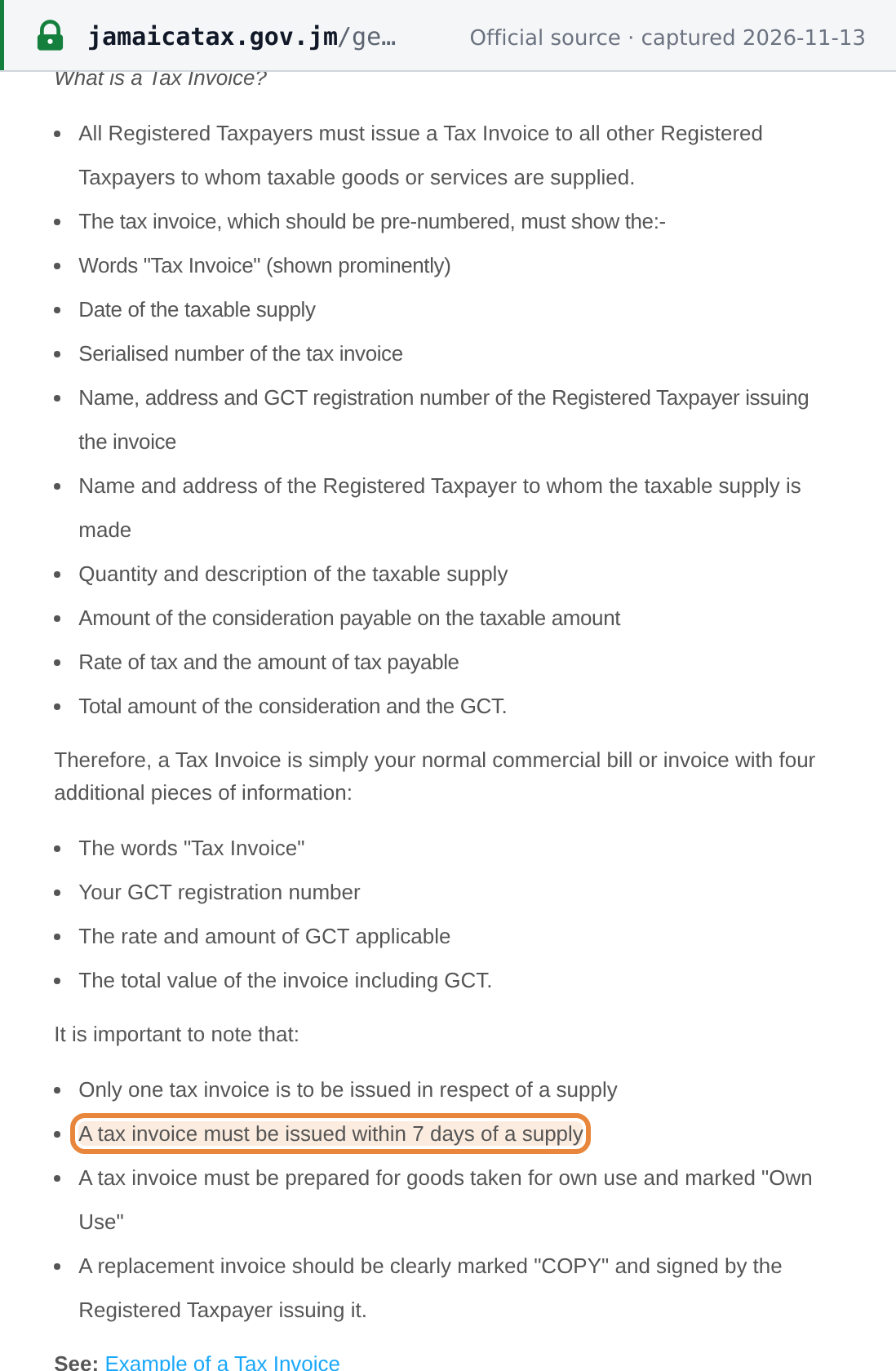
"All Registered Taxpayers must issue a Tax Invoice to all other Registered Taxpayers to whom taxable goods or services are supplied." [1] The obligation rests on section 22(a) of the Act, with the particulars prescribed by regulation 8 of the GCT Regulations; the 2014 amending Act refers to "a tax invoice containing the particulars specified in regulation 8 pursuant to section 22(a) of the Act". [10] The list below is TAJ's.
Mandatory content
"The tax invoice, which should be pre-numbered, must show the:-" [1]
| # | Particular (TAJ wording) |
|---|---|
| 1 | Words "Tax Invoice" (shown prominently) |
| 2 | Date of the taxable supply |
| 3 | Serialised number of the tax invoice |
| 4 | Name, address and GCT registration number of the Registered Taxpayer issuing the invoice (the registration number is the TRN) |
| 5 | Name and address of the Registered Taxpayer to whom the taxable supply is made (the recipient's registration number is not on the list) |
| 6 | Quantity and description of the taxable supply |
| 7 | Amount of the consideration payable on the taxable amount |
| 8 | Rate of tax and the amount of tax payable |
| 9 | Total amount of the consideration and the GCT |
 Source snapshot captured 2026-11-13 — original
Issuance deadline
Within 7 days of the supply. TAJ: "It is important to note that: Only one tax invoice is to be issued in respect of a supply A tax invoice must be issued within 7 days of a supply A tax invoice must be prepared for goods taken for own use and marked "Own Use" A replacement invoice should be clearly marked "COPY" and signed by the Registered Taxpayer issuing it." [1]
Numbering and sequencing
The tax invoice "should be pre-numbered" and must carry a "Serialised number". Only one tax invoice may be issued for a supply; a replacement is marked "COPY" and signed. TAJ prescribes no number format or prefix.
Credit and debit notes
A credit or debit note is issued when a supply is cancelled or altered, mis-valued or mis-taxed, or goods are returned. "Such notes should be clearly marked Credit or Debit as the case may be and contain information similar to that required for a tax invoice. Copies of Credit or Debit notes should be clearly marked "COPY" at the top of the note. The Registered Taxpayer issuing or receiving a Debit or Credit note must retain a copy of it." [1] GCT on a credit note reduces the supplier's output tax; GCT on a debit note increases it.
Currency and language
Books and records must be kept "in English, at his principal business place in Jamaica; or at any other place and on any terms and conditions specified by the Commissioner in writing." [1] TAJ's GCT guide, Quick Guide and Form 4A instructions contain no rule on foreign-currency invoices or the exchange rate for converting them.
Document types
- Tax invoice. For supplies by a Registered Taxpayer to another Registered Taxpayer (s.22(a)).
- Invoice or receipt. "In the case of sales to other persons, you should issue an invoice or a receipt for each transaction." [1] TAJ sets no value threshold for this simplified document.
- Own-use invoice. Goods taken for own use need a tax invoice marked "Own Use".
- Credit and debit notes (above).
- Till rolls and computer invoices. Businesses "which use cash registers with till rolls and issue tax invoices from time to time, e.g. supermarkets, will have to retain their tax invoices and till rolls as part of their records". "Computer-generated "Tax Invoices" must supply the same information as that provided on manual tax invoices." [1]
- Withholding certificate. A Tax Withholding Entity that withholds GCT gives the supplier a certificate (see Special regimes).
Self-billing
TAJ's GCT guidance does not provide for recipient-created (self-billed) tax invoices.
Retention and audit trail
- Period. "Registered Taxpayers must keep these books and records for at least six years from the end of the taxable period to which they relate." [1]
- Electronic records and audit trail. "Where the accounts are kept by means of a computer record, all documents, disks, cards and tapes are to be stored in a manner so as to preserve all such information. All changes made and the dates they were made should be noted in chronological order." Computer-generated records "must provide the same type of information provided by a manual system and must be sufficient to enable the tax on you purchases and sales to be accurately computed."
- Daily summary. "Each day, a summary should be prepared showing the sales of taxable, zero-rated and exempt sales. The daily sales record will form the basis for the monthly GCT return."
- Tamper-evidence. Beyond pre-numbering and the chronological change log, TAJ's guidance sets no fiscal-device, certified-software or hash requirement.
A specimen of a compliant invoice
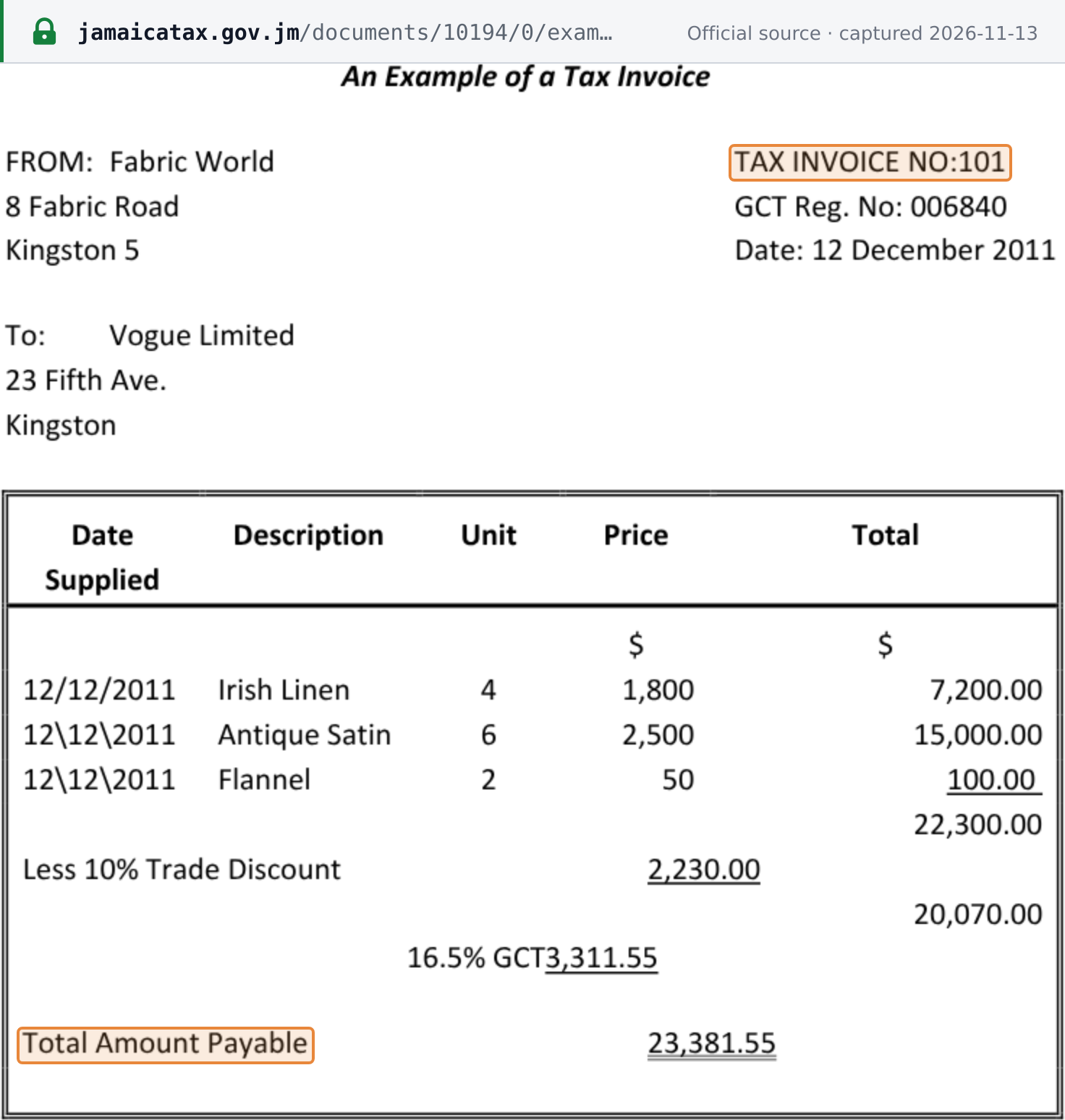
TAJ's own specimen. TAJ publishes a one-page "An Example of a Tax Invoice", linked from the "What is a Tax Invoice?" section of its GCT guide. [6] It shows the supplier's name and address, the words "TAX INVOICE" with a serial number, the supplier's GCT registration number, the date, the recipient's name and address, dated line items with description, unit, price and total, a trade discount, the GCT line and the total amount payable.
 Source snapshot captured 2026-11-13 — original
Two things in TAJ's example are out of date. It is dated 2011 and charges GCT at 16.5%, the rate then in force; the standard rate has been 15% since 1 April 2020. Its "GCT Reg. No: 006840" is a legacy six-digit GCT number; the registration number is now the nine-digit TRN.
The same layout at today's rate. Below, Lookuptax lays out TAJ's nine particulars for an illustrative B2B sale at 15%. The # references point to the rows of the mandatory content table. Every name, number and amount is fictional:
Tax invoice — illustrative
| Description#6 | Qty#6 | Unit price excl. GCT | Consideration excl. GCT#7 | GCT rate#8 |
|---|---|---|---|---|
| Cotton fabric, per metre | 10 | J$2,000.00 | J$20,000.00 | 15% |
| Delivery | 1 | J$1,500.00 | J$1,500.00 | 15% |
- Consideration excl. GCT#7
- J$21,500.00
- GCT at 15%#8
- J$3,225.00
- Total including GCT#9
- J$24,725.00
- Issue within 7 days of the supply, and only one tax invoice per supply.
- A replacement must be marked COPY and signed by the issuer.
- A supply of tourism services (10%) or telephone services (25%) shows its own rate and tax.
- Keep the invoice and supporting records, in English, for at least 6 years.
E-invoicing status
None as at 2026-11-13. TAJ's GCT landing page, GCT guide, GCT forms page and Form 4A (Rev 2025/06/03) set no e-invoicing, clearance (CTC), QR-code, fiscal-device or real-time reporting requirement, and name no e-invoicing system, network or format. No B2B, B2G or B2C mandate applies.
On 12 March 2026, in the 2026/27 Budget Debate, the Opposition Spokesperson on Finance "proposed the implementation of an Electronic Invoicing System for Tax Administration Jamaica (TAJ)". [16] That is an opposition proposal, not government policy.
What is mandatory is e-filing of GCT returns for medium taxpayers, from January 2017. TAJ's flyer addressed businesses with "sales between $150M - $1B" or "tax payments of $30M - $500M": "STARTING JANUARY 2017 you will be required to file your GCT returns online." [9]
For the regional picture, see e-invoicing status and networks worldwide.
Filing and payment
Filing frequency
Monthly for every Registered Taxpayer. "Returns must be filed even when no supply is made or tax payable is nil." [3] The standard return is Form 4A. Regulation 7, as substituted in 2014, also provides Form 4C, 4D and 4E "as is appropriate"; Form 4D covers tourism activities and Form 4E general insurance, and Tax Withholding Entities file Form 4F. Approved GCT groups file Form 4H, and persons who are not registered taxpayers account for GCT on imported services and one-off events on Form 4G. [21] [10]
Return due date
The last working day of the month after the end of the taxable period, since 1 October 2014. Regulation 7(1), as substituted by the GCT (Amendment) Act, 2014: the return shall be "furnished to the Commissioner by the registered taxpayer by the last working day of the month after the end of the taxable period; and (c) accompanied by the payment of the amount of tax, if any, payable by the registered taxpayer in respect of the taxable period." [10] TAJ's notice: "Effective October 1, 2014, monthly GCT Returns and payments are due on the last working day of the month, after the end of the taxable period." [11]
 Source snapshot captured 2026-11-13 — original
Example: the return and payment for October 2026 are due by Monday 30 November 2026. TAJ's long-form GCT guide still says the return is due "within one month" of the period end, and TAJ's forms page "on or before the last day of the following month", wording the 2014 rule replaced. [21]
Payment due date and method
Payment is due with the return, by the same date: "Pay the net GCT collected to the Tax Office (Tax Administration Jamaica) by the last working day of the month following the month in which the tax was collected." [3] Returns can be filed and paid online through TAJ eServices. "Taxpayers are advised that GCT returns filed and paid after the last working day of the month will be considered late and the necessary penalties and interest charges will be applied." [11]
Accounting basis. The invoice (accrual) basis is the default. The payments (cash) basis is available with written approval to suppliers of general insurance, professional services, telephone service and commercial rental: "To be able to account for GCT under this basis, he must apply in writing to the Commissioner General for approval." [1]
Additional listings
None found. TAJ's GCT guidance requires no annual GCT return, sales or purchase listing, or EC-style list. Form 4A itself carries the supporting schedules, including Section D1 for apportionment.
Input-tax recovery and blocked items
Input tax shown on a valid tax invoice, or paid at import, is creditable against output tax where it relates to taxable activity. [1]
- Exempt and taxable supplies. "If total supplies are inclusive of exempt supplies then the full input taxes can be claimed only if the exempt portion does not exceed 5% of the total supplies or one hundred thousand dollars ($100,000.00) whichever is less." [1] Otherwise input tax is apportioned on Form 4A Section D1. [7]
- 50% restriction. "A Registered Taxpayer can claim as a tax credit 50% of the following input taxes which he is charged for taxable supplies in the course of conducting his business: … Services rendered in a restaurant, club, or similar establishment or in catering services Services incidental to the provision of entertainment Expenses incurred in respect of motor vehicles The cost of leasing private motor vehicles". The same 50% limit applies to "any expense related to services rendered by a person engaged in a tourism activity".
- Capital goods. Input tax on machinery and equipment is claimed in full in the period in which it is charged, subject to the other restrictions in regulation 14 (such as the motor-vehicle rules). TAJ Technical Advisory 102021/01/GCT: "all of the GCT paid on the acquisition of machinery or equipment for the taxable activity must be claimed at once in the taxable period in which the registered taxpayer is charged." [22] TAJ's long-form guide still describes the 24-month spread that the 2014 amending Act removed.
- Motor vehicles. Special input-credit rules apply; TAJ's long-form guide states them in terms of the old 16.5% rate.
Refunds
Where input tax exceeds output tax, the taxpayer chooses on Form 4A line 43 whether to carry the credit forward or claim a refund. "NOTE : If a refund is requested and has not been received by the time the next Return is filed, do not take a credit against the tax due." [7]
Time limit. Section 46(5), as substituted in 2014: "No refund of tax paid in excess shall be made if an application by a registered taxpayer is made for such refund after the expiry of six years from the last day of the taxable period in which the excess tax was paid, so, however, that where the applicant has ceased to be a registered taxpayer, the application for such refund may only be made within two years after the date upon which the applicant ceased to be a registered taxpayer." [10]
TAJ publishes no processing time for GCT refunds, and its GCT guidance describes no refund scheme for non-resident businesses.
Exemptions
Exempt supplies
The Third Schedule lists exempt supplies. TAJ's list: "The information in the list below was extracted from the Third Schedule to the GCT Act updated to the year 2020." [5] Exempt items include:
- "The rental of residential property used for residential purposes only."
- "Medical, dental, nursing, optical and veterinary services and services provided pursuant to the Professions Supplementary to Medicine Act."
- "Transportation of people within Jamaica, except tour services rendered by tour operators."
- approved education; international travel tickets; water supply (not bottled water); construction of buildings and works, with listed exceptions; life and health insurance (not group health); and port and airport services for imports and exports;
- specified raw foodstuffs (fresh produce, meat, chicken, fish), whole milk, rice, bread, bulla and water crackers;
- core financial services. Fees and commissions are carved back: the exemption "shall not apply to – … (ii) services rendered by an accountant or attorney-at-law; or (iii) fees or commission charged in respect of the services specified in sub- paragraphs (a) to (m) of paragraph (1)."
Zero-rated items (First Schedule) include exports of goods and services, services directly related to exporting goods, animal feed (not pet food), fertilisers, and inputs for bauxite and alumina production.
Exempt is not zero-rated. TAJ: "Where goods and services are zero‑rated, Registered Taxpayers do not charge GCT on sales of these goods/services. They are, however, able to claim an Input Tax Credit for any GCT paid on business purchases which are made in order to manufacture or provide these zero‑rated goods/services. … Where goods and services are GCT-exempt, no GCT is charged on these items. However, unlike zero‑rated goods, Registered Taxpayers are not able to claim an Input Tax Credit on the purchases used to provide exempt goods and services." [1]
Special regimes
- GCT withholding by government entities. Designated public bodies, Tax Withholding Entities, withhold the GCT on supplies made to them. Under regulation 7A, inserted in 2014, a Tax Withholding Entity must "issue a withholding tax certificate to the registered taxpayer within fifteen days of receiving the tax invoice from the registered taxpayer". [10] The supplier claims the amount on Form 4A: "GCT withheld by Tax Withholding Entities (To claim this tax credit, return must be e‐filed)". [7] TAJ publishes the list of entities on its GCT on Government purchases page.
- Tourism. Tourism activities are taxed at 10% and file Form 4D. Registered taxpayers recover only 50% of GCT charged by tourism operators (above).
- Import deferment for manufacturers (see Imports and exports).
- Payments (cash) basis for listed service sectors (see Payment due date and method).
- Small-business, flat-rate or margin schemes. TAJ's GCT guidance describes none. Businesses below the J$15,000,000 threshold do not charge GCT unless TAJ approves them as Registered Taxpayers on a voluntary application.
Offences and penalties
The figures below are those in sections 54 to 56F of the Act as substituted or inserted by the General Consumption Tax (Amendment) Act, 2014 (No. 10 of 2014). TAJ's long-form GCT guide still prints lower, pre-2014 penalty figures.
Offences
- Displaying a false registration certificate. "A person who, not being a registered taxpayer, displays or causes to be displayed at his place of business any document purporting to be a certificate of registration commits an offence and is liable on summary conviction in a Resident Magistrate's Court to a fine not exceeding five hundred thousand dollars and, in default of payment thereof, to imprisonment for a term not exceeding six months." (s.55(1)) [10]
- Failing to return a cancelled certificate. Fine of up to J$100,000 (s.55(2)).
- False tax invoices. A person who "knowingly issues a tax invoice or represents to another person that tax is chargeable" where no tax is chargeable, the tax shown exceeds the tax properly chargeable, or "there is no intention to make a taxable supply", "commits an offence and is liable on summary conviction in a Resident Magistrate's Court to a fine not exceeding one million dollars or to imprisonment for a term not exceeding twelve months or to both such fine and imprisonment" (s.56E). [10]
- General offence. A contravention with no specific penalty carries the same maximum: a fine of J$1,000,000, imprisonment for 12 months, or both (s.56F).
Resident Magistrate's Courts were renamed Parish Courts in 2016; the Act is quoted as enacted.
Penalties
| Failure | Penalty | Section |
|---|---|---|
| Failure to apply for registration | The greater of J$10,000 or the tax that would have been payable while unregistered, plus interest | s.54(1) |
| Late or short payment | 10% of the amount unpaid, plus interest | s.54(2) |
| Failure to file a return | The greater of J$10,000 or 10% of the tax due for the period (capped at J$100,000), plus interest | s.54(3) |
| Interest | 1.5% per month or part of a month until paid | s.54(4) |
Section 54(4): "Where the total amount under this section remains unpaid after it is due and payable, interest shall be chargeable on that amount at the rate of one and one-half per cent per month or part thereof until the date of payment." [10]
Failure to display the registration certificate after a contravention notice carries J$10,000, J$20,000 and J$30,000 for the first, second and third or later contravention (s.32A, 2014 Act). [10]
Frequently asked questions
Is GCT on hotels and tourism services in Jamaica 10% or 15%?
10% as at 2026-11-13. On 12 February 2026 the Minister of Finance told the House of Representatives that the GCT rate applicable to specified tourism activities is to be increased to 15 per cent, effective April 1, 2027. That is an announced future rate. Until 1 April 2027 the 10% tourism rate listed in TAJ's Quick Guide to GCT applies.
Our sales are under J$15 million. Can we charge GCT on our invoices?
Not unless TAJ approves you as a Registered Taxpayer. Everyone engaged in a taxable activity must apply for GCT registration, but an applicant below the J$15,000,000 threshold (in force from 1 April 2025) receives a Notice of Registration as a Registered Person and, in TAJ's words, is not permitted to collect General Consumption Tax. A Registered Person may apply voluntarily to become a Registered Taxpayer. If the Commissioner General approves, it charges GCT, issues tax invoices and claims input tax.
Does our Jamaican company have to self-account for GCT on software or consulting bought from abroad?
Usually, yes. Section 23B of the GCT Act, inserted by the GCT (Amendment) Act, 2014, deems a registered taxpayer that receives imported services to be the supplier of those services, liable to pay the GCT and to report it on its return. It also applies to an unregistered business whose supplies in the previous 12 months were J$10,000,000 or more (TAJ's figure since 1 April 2019). It does not apply to an individual receiving the services for private use. A registered taxpayer reports it on line 20 of Form 4A; an unregistered business reports it on Form 4G.
Do foreign streaming and software providers charge Jamaican GCT to consumers?
Not yet. The Government announced on 12 February 2026 that GCT will apply to digital services and intangibles supplied from abroad, with revenue expected from the fourth quarter of fiscal year 2026/27 (January to March 2027). TAJ's GCT pages set out no registration process, threshold or enacted text for foreign suppliers, and the section 23B reverse charge excludes individuals' private-use purchases.
TAJ's example tax invoice shows 16.5% GCT and a six-digit registration number. Is that still right?
No. TAJ's An Example of a Tax Invoice is dated 12 December 2011 and uses the 16.5% rate in force then. The standard rate has been 15% since 1 April 2020. Its GCT Reg. No. 006840 is a legacy six-digit number. TAJ's GCT guide, in its instructions for Form 4A, says your registration number should be the same as your Taxpayer Registration Number (TRN), which has nine digits. The other particulars the example shows still match TAJ's list for a tax invoice.
TAJ's GCT guide says returns are due within one month. Which deadline applies?
The last working day of the month after the end of the taxable period. That rule has applied since 1 October 2014, under regulation 7 of the GCT Regulations as substituted by the GCT (Amendment) Act, 2014, and TAJ's notice of 10 November 2014. Returns and payments made after the last working day are late and attract penalties and interest. The within-one-month wording on TAJ's long-form GCT guide pre-dates the change.
Why does our C87 import entry show GCT at 20%?
Because it combines two charges. A commercial importer registered for GCT pays the 15% standard rate plus a 5% Advanced GCT payment on goods to which Advanced GCT applies. TAJ notes that the 20% is not a rate of tax stipulated by the GCT legislation. The Advanced GCT is recovered as input tax on the GCT return. A commercial importer that is not registered for GCT pays instead on an uplifted value.
Important websites
| Site | Purpose |
|---|---|
| TAJ eServices | Apply for GCT registration, file Form 4A and pay |
| TAJ online registration | Register an electronic filing account (needed to file GCT returns online) |
| GCT forms | Form 1 (registration) and Form 4A (return) |
| TAJ GCT publications | Quick Guide, Advanced GCT note, zero-rated and exempt list, technical advisories |
| TAJ GCT guide | Long-form rules (parts of its introduction are out of date) |
| GCT on Government purchases | List of Tax Withholding Entities and zero-rated entities |
| Jamaica Customs Agency | Import entry and GCT at the border |
| TRN verification | TAJ's TRN page describes no public lookup. Check a number's format with the Jamaica TRN validator |
| E-invoicing portal | None (no mandate) |
Recent changes
- 2026-05-01 — Special Consumption Tax on non-alcoholic sweetened beverages, at J$0.22 per gram of added sweetener, under the General Consumption Tax (Amendment of Schedules) Order, 2026. (TAJ Technical Advisory) — see event
- 2026-02-12 — Announced in the 2026/27 revenue measures: GCT on specified tourism activities to rise from 10% to 15% from 1 April 2027, and GCT to apply to digital services and intangibles supplied from abroad from the fourth quarter of fiscal year 2026/27 (proposed). (Jamaica Information Service)
- 2025-05-01 — GCT on residential electricity energy charges cut to 7% (from 15% on usage above 150 kWh). (Jamaica Information Service)
- 2025-04-01 — Registration threshold rises from J$10,000,000 to J$15,000,000 over 12 months. (TAJ GCT guide)
- 2020-04-01 — Standard rate cut from 16.5% to 15%. (TAJ Advanced GCT note)
- 2019-04-01 — Registration threshold raised from J$3,000,000 to J$10,000,000. (TAJ technical bulletin, 2020)
- 2014-10-01 — Monthly GCT returns and payments due on the last working day of the following month. (Jamaica Information Service, for TAJ)
For the full chronology, see Jamaica tax changes on Lookuptax.
Reference links
- TAJ — General Consumption Tax guide
- TAJ — General Consumption Tax (GCT) publications
- TAJ — Quick Guide to GCT (July 2020)
- TAJ — Advanced GCT (July 2020)
- TAJ — List of zero rated and exempt items (updated to 2020)
- TAJ — An Example of a Tax Invoice
- TAJ — GCT Return Form 4A (Rev 2025/06/03)
- TAJ — Form 1, Application for General Consumption Tax Registration
- TAJ — Mandatory eFiling of GCT returns for medium taxpayers
- Houses of Parliament — General Consumption Tax (Amendment) Act, 2014 (No. 10 of 2014)
- Jamaica Information Service — New filing due date for monthly GCT returns now in effect (10 November 2014)
- Jamaica Information Service — Gov't projects $29.4B from new revenue measures in fiscal year 2026/27 (13 February 2026)
- Jamaica Information Service — GCT exemption threshold for MSMEs increased to $15 million (13 March 2025)
- Ministry of Finance and the Public Service — MOFPS Insider, April 2025
- Jamaica Information Service — GCT online application now a reality (19 May 2021)
- Jamaica Information Service — Opposition spokesman proposes electronic invoicing system for TAJ (14 March 2026)
- TAJ — Technical Advisory, Special Consumption Tax on non-alcoholic sweetened beverages (May 2026)
- TAJ — GCT on Government purchases
- TAJ — eServices
- TAJ — Technical Bulletin, Accounting for GCT on Imported Services (23 April 2020)
- TAJ — General Consumption Tax forms (Forms 4A–4H)
- TAJ — Technical Advisory 102021/01/GCT, The effect of the deletion of GCT Regulation 14(10) (October 2021)
- Jamaica Information Service — Reduction in GCT on electricity now in effect (7 May 2025)
- Jamaica Customs Agency — E-commerce (de minimis)
- TAJ — Form 4H, GCT Return (Group Account), rev. 24 September 2020
Related on Lookuptax: