Jersey GST (goods and services tax) guidelines
Jersey has no VAT. It charges a goods and services tax (GST) of 5% on most supplies and imports, and businesses register once their taxable supplies pass £300,000 a year. This guide covers the figures and rules as at 8 November 2026.
Overview
Jersey's indirect tax is the Goods and Services Tax (GST), charged under the Goods and Services Tax (Jersey) Law 2007 (the GST Law). Article 8 sets the rate and the base: "(1) GST shall be charged at the rate of 5%. (2) GST shall be charged – (a) on the supply of goods or services, by reference to the value of the supply; (b) on the importation of goods, by reference to the value of the goods." [1] Detailed rules sit in the GST (Jersey) Regulations 2007 [18] and in Directions issued by the Comptroller of Revenue. [29]
Jersey GST is not UK VAT. Revenue Jersey says: "UK VAT is entirely separate from GST registration and won't affect your GST registration." [2]
Authority, currency, period and layering
- Authority. The Comptroller of Revenue (Revenue Jersey) administers domestic GST. Import GST is collected by Jersey Customs and Immigration Service: "Revenue Jersey collects: domestic Goods and Services Tax (GST), for goods and services bought in Jersey · International Service Entities (ISE) fees, for businesses registered as an ISE · GST paid on imported goods (import GST) is collected by Customs and Immigration." [13] Revenue Jersey's GST pages start at the GST hub.
- Currency. Pound sterling (£). Returns are made in sterling, and Revenue Jersey's overseas-retailer guidance says: "If the supplier is based in a non-Sterling jurisdiction, invoices in relation to a supply coming within the scope of Jersey GST must display Sterling equivalent amounts." [6]
- Period. GST is accounted for by return period, generally three months, set in the registration letter: "The filing frequency of your return is included on your GST registration letter, for example quarterly ending March." [14]
- Layering. None. GST is a single island-wide tax with no parish layer; the GST Law mentions "the 12 parishes of Jersey" only as bodies that can claim GST refunds (Art. 53(4)(a)). [1]
- Customs union. Jersey is in a customs union with the UK, the Isle of Man and the other Channel Islands, so goods from the UK bear no customs duty on arrival, but GST is still due: "when the goods arrive in Jersey, they are not subject to customs duty. This does not extend to GST". Goods from outside the union "are subject to customs duty if applicable, (many goods have a 0% duty rate) as well as GST." [6]
Registration
Who must register and the threshold
A business must register when its taxable supplies (standard-rated and zero-rated) pass £300,000 over 12 months. Schedule 1 paragraph 1(1) of the GST Law sets two tests: "A person who makes taxable supplies becomes liable to be registered – (a) at the end of any month, if the value of the taxable supplies made by the person in the 12 months then ending has exceeded £300,000; or (b) on any day, if there are reasonable grounds for believing that the value of the taxable supplies made by the person in the 12 months after that day will exceed £300,000." Sales of the business's capital assets are disregarded (para 1(4)). [1]
Revenue Jersey's guidance words the historic test slightly more widely, as "£300,000 or more": "You must register if your business has made taxable supplies of £300,000 or more in the preceding 12 months. Taxable supplies include goods and services that are taxed at both the standard and the zero-rate for GST." [2]
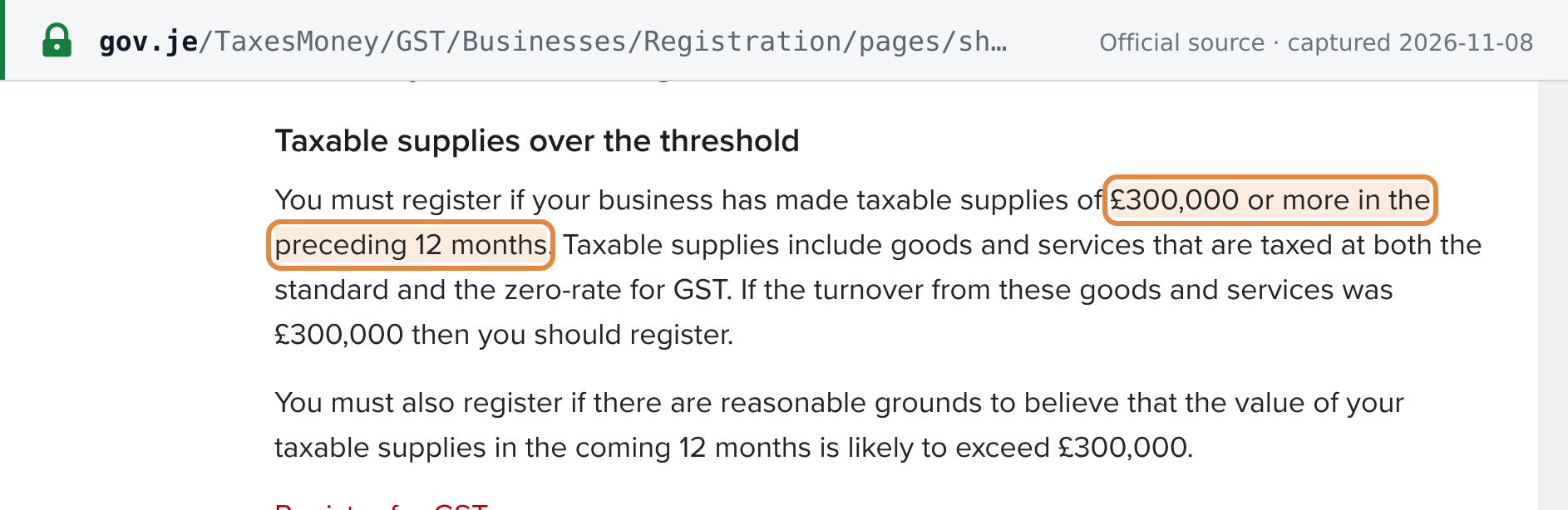 Source snapshot captured 2026-11-08 — original
- Notification deadline. Within 30 days after the end of the month in which the historic test is met, or within 30 days after the day the future test is met (Sch. 1 para 3(1)–(2)). [1]
- Liability runs from the due date, not the registration date. "You are liable for any GST that should have been collected from the date you were first required to register, whether or not you registered on that date." [2]
- Imported services count. Services bought from abroad and taxed under the reverse charge count towards the recipient's threshold: "Services received from a place outside of Jersey shall be taken into account, when determining a person's liability for registration." [2] (GST Law Art. 30(2).)
- Exempt-only businesses. "If the only supplies of goods or services you make are exempt, you don't need to register for GST." [2]
- Wholly zero-rated businesses may apply to be exempted from registration (Sch. 1 para 20), at the cost of input-tax recovery: "you won't be able to recover any input tax or import tax that you are charged by other companies." [2]
Non-resident registration: overseas retailers and online marketplaces
There is no separate, lower threshold for non-residents. Since 1 July 2023, an overseas retailer or online marketplace that sells goods to Jersey consumers and despatches them from outside Jersey must register on the same £300,000 figure, counted on those consumer sales only: "From 1 July 2023 If you're an overseas retailer or an online marketplace, who sells goods to non-business consumers in Jersey and despatches those goods from overseas, you must be registered for GST if your turnover from these sales: exceeds £300,000 per annum · is likely to exceed £300,000 per annum … This only applies to goods and not digital services. Overseas retailers may also opt to register for GST even if you don't reach the threshold." [5] The overseas-retailer guidance puts the measurement period as "a rolling 12 month period". [6]
The legal basis is Article 23(3)–(3C) of the GST Law: goods sent to Jersey are supplied in Jersey when a non-Jersey business sells them directly to an individual in Jersey (Condition A), to a person registered or liable to be registered for GST (Condition B), or through an online marketplace whose operator is the deemed supplier under Article 21A (Condition C). Schedule 1 paragraph 1(6) leaves Condition B supplies (sales to GST-registered businesses) out of the threshold. [1] Once registered, though, the seller charges GST on everything it sells into Jersey: "all sales by that vendor to customers in Jersey will be subject to GST at the point of sale, whether the customers are private individuals or business customers." [6]
GST representative. The Comptroller may direct a business with no establishment in Jersey to appoint a GST representative, and a business may appoint one voluntarily with the Comptroller's agreement (GST Law Art. 14). It is not automatic; Revenue Jersey's overseas-retailer guidance does not mention one. [1]
Tax registration number
The Jersey GST registration number is 7 digits: when paying "domestic GST, quote your 7 digit GST registration number as your reference". [13] A Jersey business needs a Jersey Tax Identification Number (TIN) before it registers: "You can register for GST, as long as your business already has a Jersey Tax Identification Number (TIN)." [5] Returns are filed with both numbers. [14] Revenue Jersey publishes no prefix or check-digit rule for the GST number, and no public GST-number lookup (as at 8 November 2026).
For the TIN formats see the Jersey tax identification number guide. To check the format of a Jersey GST number, use the Jersey registration number validator.
How to register
- Jersey businesses register through the online service Register for GST. A business without a TIN must first register with the JFSC or apply for a business licence: "If you don't have a Jersey TIN and your business is based in Jersey you'll need to register it with the JFSC or apply for a business licence." [5]
- Importers and overseas retailers also open an account on CAESAR, the Jersey Customs freight system, once they have a GST number: "If you're an overseas retailer you'll need to select that the account is for a business based outside Jersey and registered for GST purposes. You can then also optionally provide your Import One-Stop Shop (IOSS) number." [5]
- Timeline. Revenue Jersey publishes no processing time for GST registration (as at 8 November 2026).
Voluntary registration
Available to Jersey businesses and to overseas retailers below the threshold: "If you are a business in Jersey or an overseas retailer under the threshold, you can apply for voluntary registration … Being registered means you can recover any GST you incur on purchases and expenses for your business." [2] The legal basis is Schedule 1 paragraph 5 of the GST Law. [1] For an overseas retailer, registering moves GST from the border to the checkout: "Once you are registered with Jersey customs your customers won't need to pay GST on importation." [2]
Deregistration
- Compulsory. A registered business must notify Revenue Jersey in writing, "quoting your name, address and GST registration number - within 30 days" of stopping taxable sales, selling the business, joining a GST group or becoming an ISE. [7]
- Voluntary. Possible "if you have reasonable grounds to believe that the value of taxable sales your business makes is below the registration threshold (£300,000 in any 12 months), and will be for the foreseeable future", but not where the fall is only seasonal, and never retrospectively. [7]
- Final return. It includes "GST on the value of the tangible assets of the business on the date of cancellation (but only if the total GST is over £250)". [7]
Group registration
Available. Two or more bodies corporate, or partnerships with bodies corporate, under common control may register as a group (GST Law Sch. 1 paras 12–15). An application to vary a group must currently be made "not less than 90 days before the day on and from which the variation is to take effect, or at such later time as the Comptroller may allow" (Sch. 1 para 15(5)(b)). [1] The Proposed Budget 2027–2030 would remove that lead-in: "The 90-day lead-in time to vary a group registration for GST is removed." This is a proposal until the Finance (2027 Budget) Law is adopted. [27]
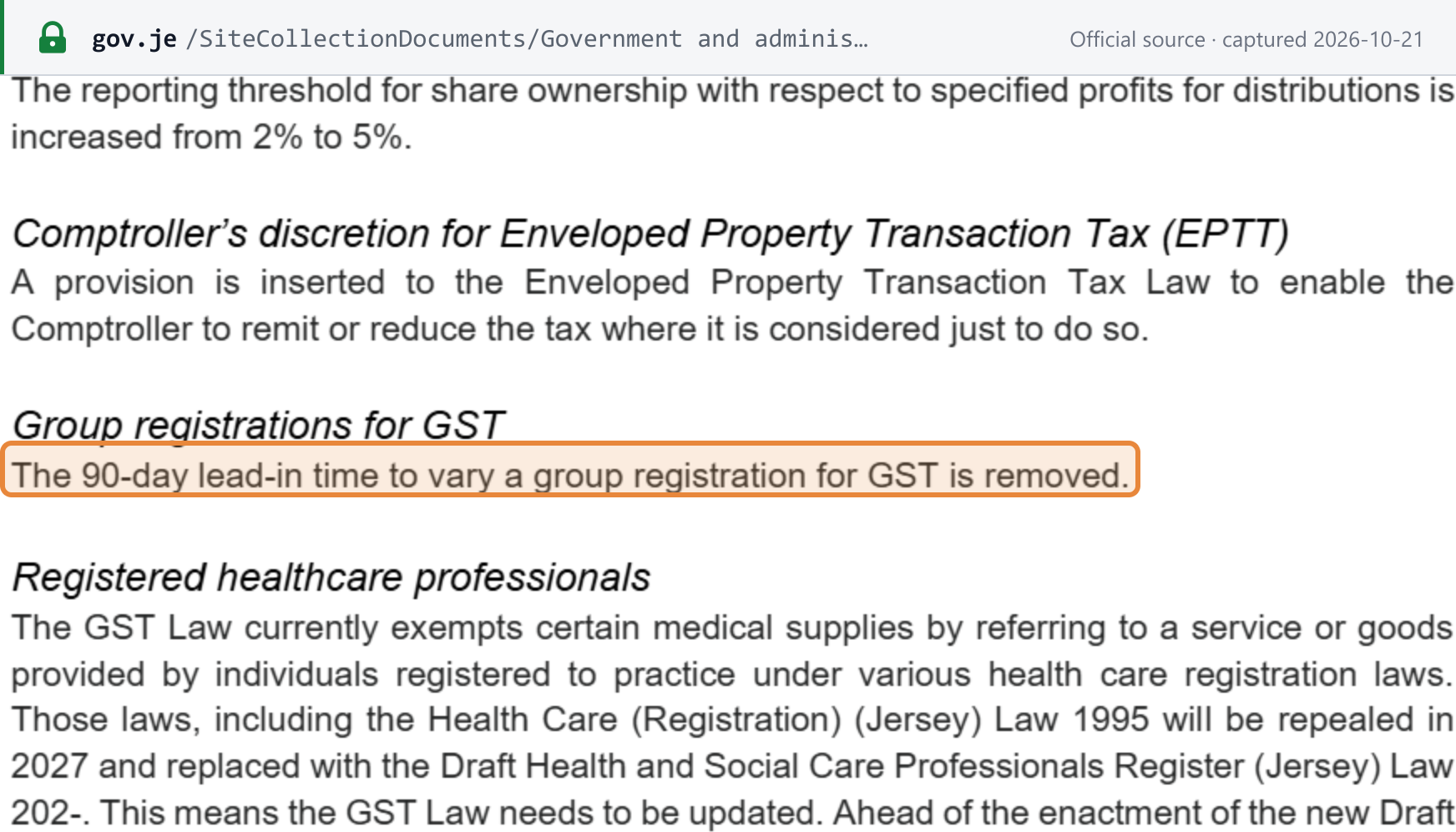 Source snapshot captured 2026-10-21 — original
Rates
Standard rate: 5%
"GST shall be charged at the rate of 5%" (GST Law Art. 8(1), as amended by L.16/2011). [1] It applies to supplies of goods and services and to imports. Revenue Jersey: "These are goods and services that are taxed at a standard rate (5%) of their total value at the point of sale. Almost all goods and services provided in Jersey (including imports) attract GST at the standard rate." Its examples include "goods that you buy from a shop", "food and drink from a restaurant or bar", hired goods, hairdressing, hotel accommodation and "imported goods that you buy online". [3] The GST Law's zero-rating schedule (Schedule 6) contains no food heading, so food bought in Jersey is standard-rated.
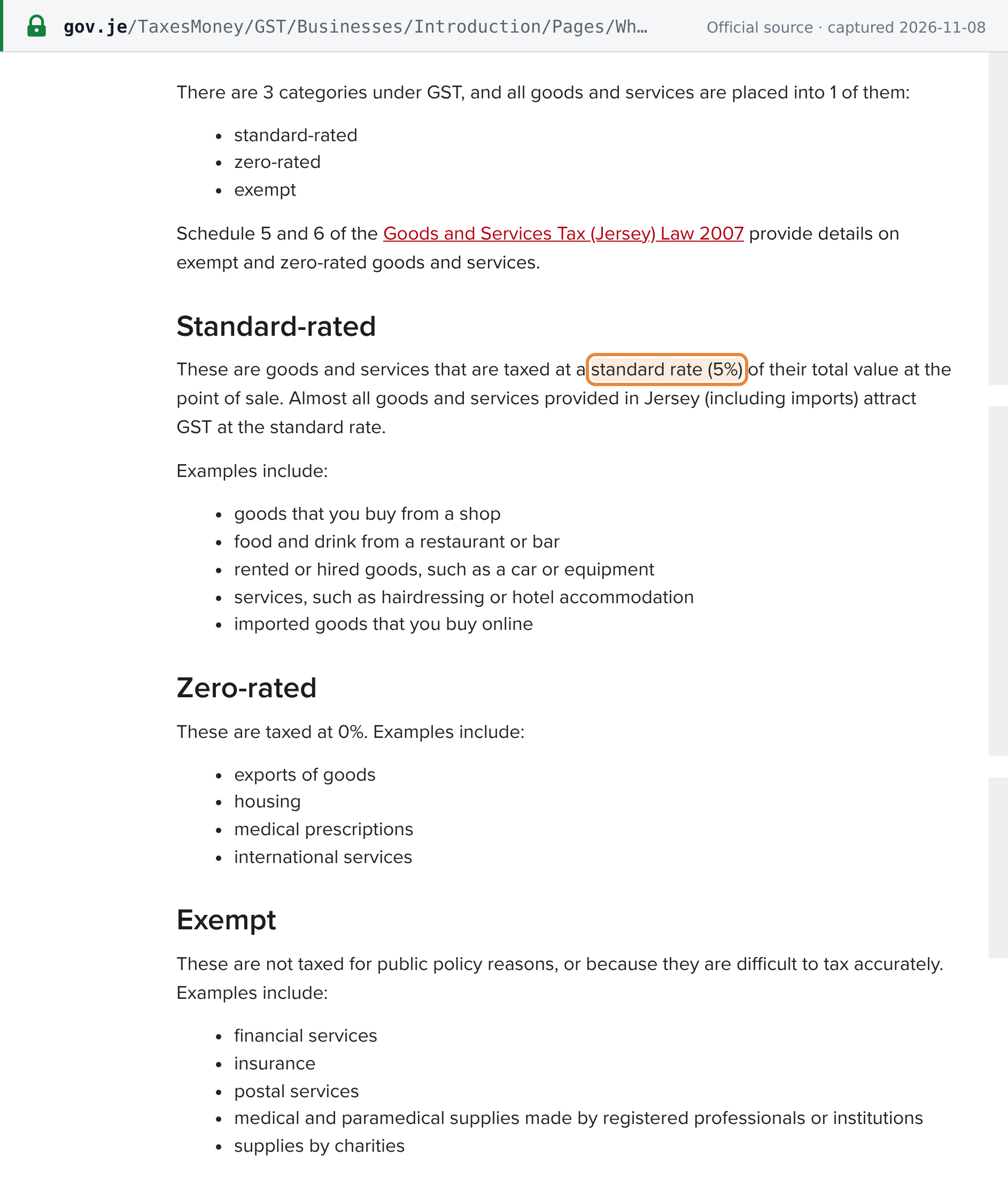 Source snapshot captured 2026-11-08 — original
Reduced and zero rates
Reduced rates. None. Revenue Jersey describes GST as "applied at two rates: 5% on the majority of goods and services supplied in Jersey for local use, including imports · 0% for specific areas". [4]
Zero rate (0%). Schedule 6 of the GST Law has five headings: 1 supply of dwelling; 2 zero-rated supplies of land, services or material; 3 zero-rating of medicines etc. on prescription; 4 zero-rating of exports; 5 supply of international services zero-rated. [1] Revenue Jersey's own examples are "exports of goods · housing · medical prescriptions · international services". [3] Schedule 6 has no heading for food.
Zero-rated supplies are taxable supplies: they count towards the £300,000 threshold and carry the right to recover input tax. Exempt supplies (see Exemptions) do neither.
Announced changes
No change to the 5% rate has been announced. The Proposed Budget 2027–2030 states: "GST is charged at 5% on the majority of goods and services supplied in Jersey, including imports", and its GST measures are technical (see Recent changes). [27]
Cross-border rules
Imports
Import GST is 5% of the full landed value: "This is 5%, charged on the total value of your imported goods. The total value includes: the purchase price · insurance · commission · packing and freight · all taxes and duties applied before and on arrival, such as VAT, CCT and excise". [12] Jersey Customs collects it through CAESAR. How a business pays depends on whether it is GST-registered and whether it is Customs-approved: [13]
| Business status | What happens at import |
|---|---|
| GST-registered and Customs-approved | Goods released automatically; import GST accounted for on the GST return |
| GST-registered but not Customs-approved | Declare the value and pay the GST within 3 days |
| Not GST-registered but Customs-approved | Goods released automatically; pay the GST within 30 days using CAESAR |
| Not GST-registered and not Customs-approved | Declare the value and pay the GST within 3 days |
"The personal de minimis amount does not apply to businesses." [13] A registered business reports the value of all imports, including services bought from outside Jersey, in box 5 of its return. [14]
Low-value imports: the £60 de minimis
Private individuals pay no GST on unaccompanied goods worth £60 or less bought for personal use from a retailer that is not registered for Jersey GST. Above £60, GST is due on the whole value. The current instrument is GST Direction 2026/03, which "shall have effect from 11 May 2026 and replaces Direction 2026/02 which is withdrawn from that date. Direction 2026/03 has no expiry date." It states: "Where the GST de minimis level applies, no GST is payable when the value of the imported goods does not exceed £60. When the value of goods exceeds £60, GST is payable on the whole of the value of the goods imported." The relief "is not available where goods are imported for business purposes". [11]
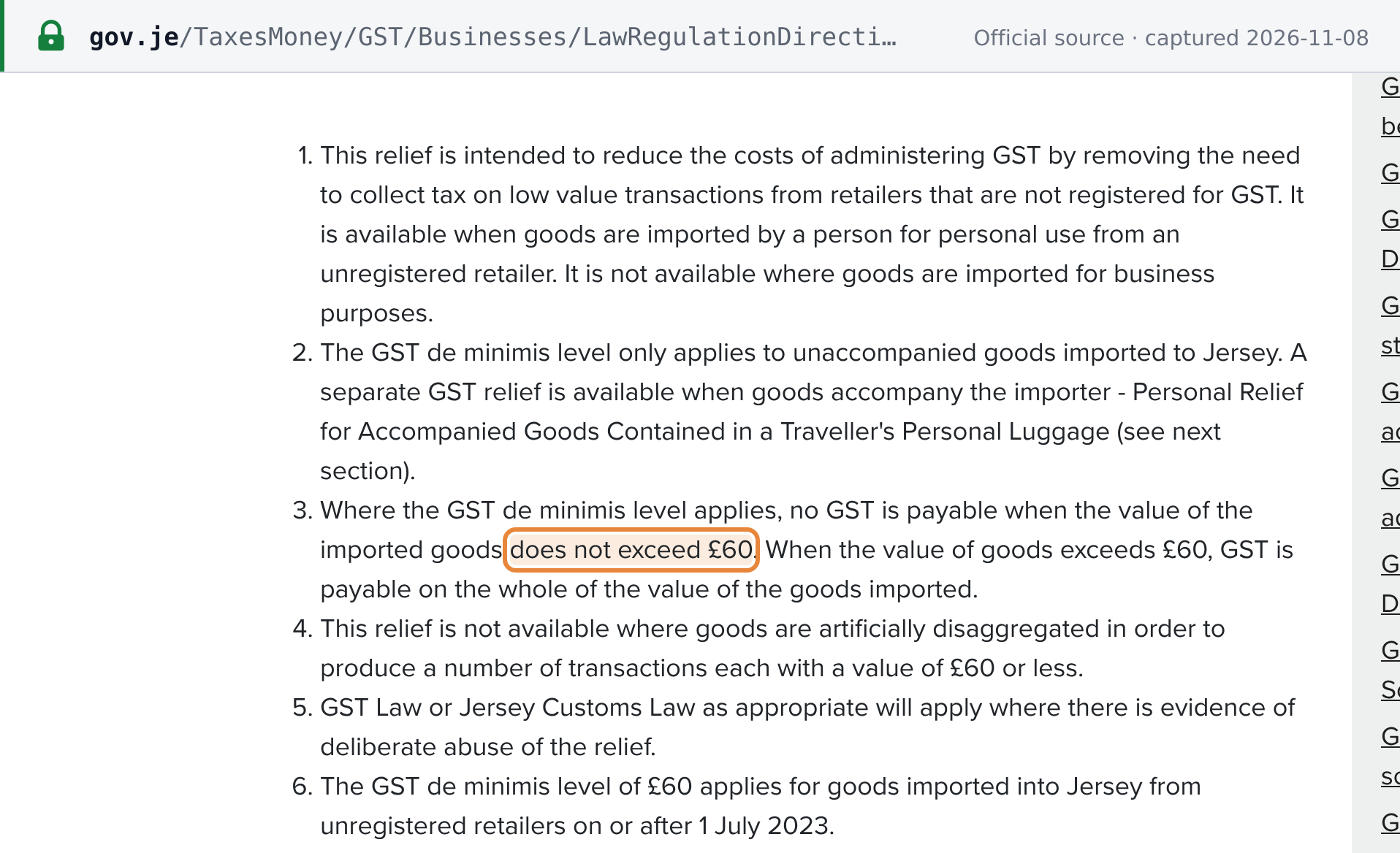 Source snapshot captured 2026-11-08 — original
- The £60 level has applied "for goods imported into Jersey from unregistered retailers on or after 1 July 2023" [11]; it was £135 before. [6] Revenue Jersey says the threshold "will eventually be removed altogether" but has published no date. [6]
- Items arriving together count as one shipment: "If you order multiple items and they arrive together in one shipment, we will treat this as a single delivery. You will be charged GST on the total value of the shipment." [12]
- Do not confuse it with the £135 customs-duty test. For goods sold by a GST-registered online retailer from outside the customs union, "Customs duty will not apply if the value of the importation is below £135. For imports valued in excess of £135, a customs declaration will be required … even if the GST has been paid to the online retailer". [6]
- Travellers' goods carried in luggage have a separate allowance: "'other goods' with a value not exceeding £390 when imported by 'air and sea travellers' or £270 where imported in other circumstances". [11]
Exports
"For GST purposes, goods and services that are exported are zero-rated." [8] Revenue Jersey lists the evidence to keep: "the customer's order and delivery instructions · shipping documentation · certificate of posting · insurance (if shipped at your risk) · proof of payment received from outside Jersey". [17]
In the other direction, UK sellers should not charge UK VAT on goods sent to Jersey. Revenue Jersey cites HMRC's guidance "that supplies of goods removed from the UK to Jersey should be zero-rated for VAT purposes … Once VAT has been charged, it must be accounted for to HMRC unless the seller issues credit notes and refunds." [12]
Imported services: reverse charge
A Jersey taxable person that receives a service listed in Schedule 3 of the GST Law from abroad, for its business, accounts for GST as if it had made the supply itself (Art. 30(1)(a)). Schedule 3 covers, among others, intellectual property and licences, advertising, consultancy, legal and accounting services, data processing, financial and insurance services, supply of staff, telecommunications, broadcasting, electronically supplied services and hire of movable goods; paragraph 14 adds "Any service when supplied to a registered person". [1] Revenue Jersey's summary: GST "can also be charged on the supply of certain services from outside Jersey. These include things like: advertising services · consultants · accountants · financial services · website hosting · distance learning". [8] The value counts towards the recipient's registration threshold (Art. 30(2)).
Digital services to consumers
Jersey has no registration regime for foreign suppliers of digital services to consumers. Revenue Jersey's registration guidance limits the overseas-seller rule to goods: "This only applies to goods and not digital services." [5] For non-business recipients, Article 30(1)(b) applies GST only "to the extent that the States may prescribe by Regulations", and the GST (Jersey) Regulations 2007 contain no such provision (as at 8 November 2026). [18]
Foreign companies selling into Jersey — B2B and B2C
| To Jersey businesses (B2B) | To Jersey consumers (B2C) | |
|---|---|---|
| Goods | The Jersey business pays import GST at the border, or accounts for it on its return if Customs-approved. B2B sales do not count towards the overseas-seller threshold (Sch. 1 para 1(6)), but a registered seller charges GST on them too. | Register and charge 5% at the point of sale once B2C goods sales exceed £300,000 in a rolling 12 months. Below that, the consumer pays import GST on shipments over £60. |
| Services | Reverse charge: the Jersey taxable recipient self-accounts (Art. 30(1)(a), Sch. 3). | No Jersey GST registration regime for foreign service suppliers, digital services included (see above). Services supplied by a supplier belonging outside Jersey are generally treated as supplied outside Jersey (Art. 24(1)(b)), subject to the exceptions below. |
Marketplace and platform obligations
Since 1 July 2023 the operator of an online marketplace can be the deemed supplier of goods sold through it into Jersey (GST Law Art. 21A and Art. 23(3C)), and marketplace sales count towards the £300,000 threshold. [1] Revenue Jersey's definition: an online marketplace "means a website, or any other means by which information is made available over the internet, which facilitates the sale of goods through the website or other means by persons other than the operator", and the operator is "the person who controls access to, and the contents of, the online marketplace provided that the person is involved in: determining any terms or conditions applicable to the sale of goods · processing, or facilitating the processing, of payment for the goods · the ordering or delivery, or facilitating the ordering or delivery, of the goods". [6] The rule covers goods only. See also marketplace deemed-supplier rules.
Place of supply
- Goods (Art. 23). Goods that stay in Jersey are supplied in Jersey. Goods removed from Jersey are supplied in Jersey and zero-rated as exports. Goods brought into Jersey by a non-Jersey seller are supplied in Jersey only under Conditions A, B or C (see Registration). [1]
- Services (Art. 24). "(1) Services shall be treated as supplied – (a) in Jersey if the supplier belongs in Jersey; (b) in a country other than Jersey if the supplier belongs in a country other than Jersey and does not belong in Jersey." [1] Regulations 6A–6G of the GST Regulations 2007 set the exceptions: work on goods, land, events, accommodation and transport, intermediaries, and Schedule 3 services supplied by a Jersey business to a business customer belonging abroad, which are treated as supplied outside Jersey (reg 6G). [18] Revenue Jersey: "Jersey's regulations mirror the provisions of the EU VAT Directive on the place of supply of services so that businesses don't get taxed twice - i.e. by paying both VAT and GST." [17]
Invoice requirements
A registered person must issue a GST invoice for every supply. Article 42(1) of the GST Law: "A registered person who supplies goods or services shall issue to the recipient an invoice in respect of the supply, except to the extent that it is otherwise provided under Article 43(1)." Article 42(2) says a document is only an invoice if it states the particulars of the supply, "names the persons by and to whom the goods or services are supplied", "indicates whether GST is chargeable on the supply" and sets out the GST particulars required by directions. [1] Revenue Jersey: "If your business is registered for GST, you must issue a GST invoice whenever you supply taxable goods or services." [8]
Mandatory content
The binding minimum is the Comptroller's GST Direction 2008/22 (no expiry date), made under Article 42(2)(d): "A GST Invoice for the purposes of Article 42 of the GST Law 2007 shall include the following details, whether or not prescribed by Law or Regulation: the particulars of the goods or services supplied · the names of the persons by and to whom the goods or services are supplied · an indication of whether and to what extent GST is chargeable on the supply · the rate(s) of GST applicable to the supply · the date of supply · the GST Registration number of the supplier." [9]
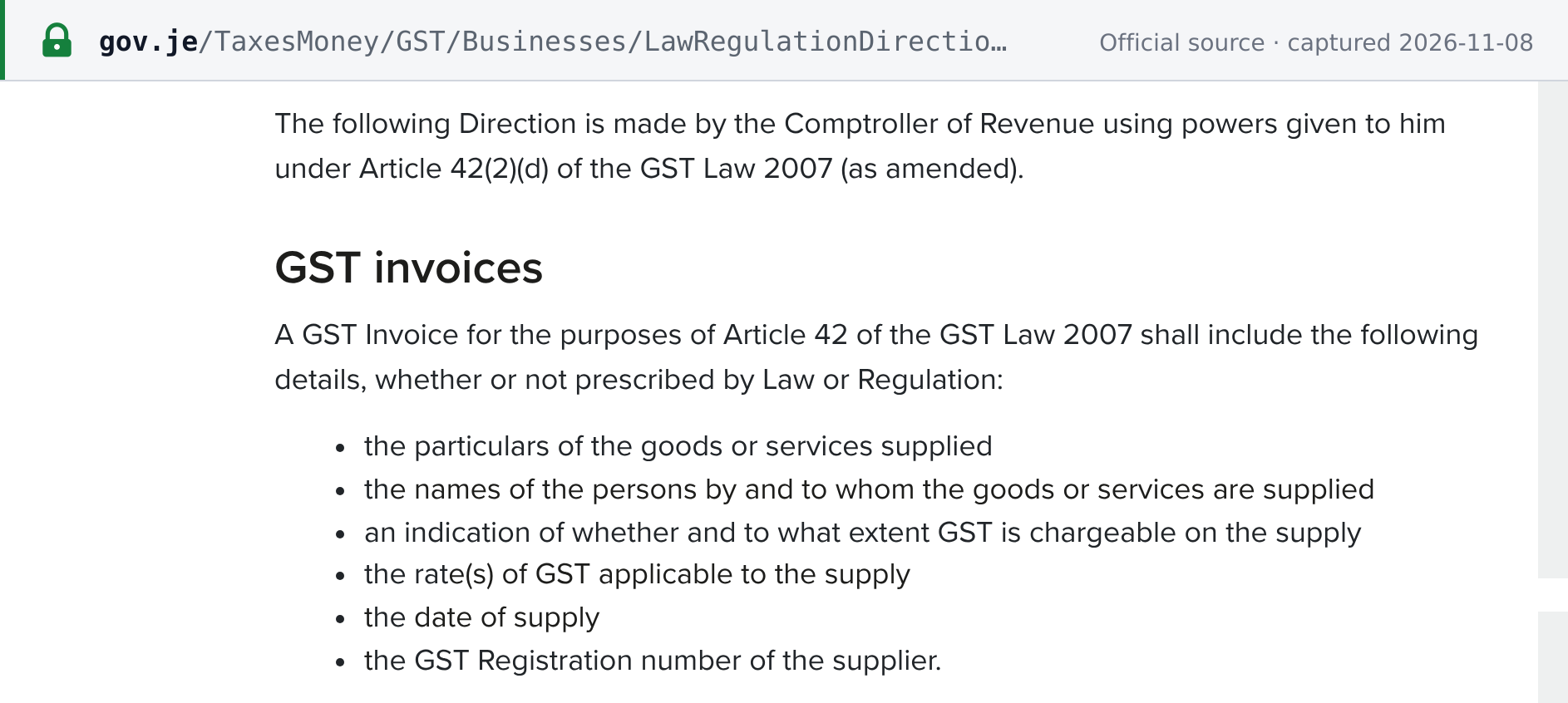 Source snapshot captured 2026-11-08 — original
Revenue Jersey's records guidance asks for more. It says a GST invoice "must show": "the words 'tax invoice' in a prominent place · tax point date (the date on which the transaction took place) · date of issue (if different from tax point date) · your name, address and GST registration number · name of the person you're supplying the goods to · individual serial number · description of the goods or services · selling price · amount of GST charged · price including GST · an indication as to whether GST is chargeable on the supply". [8] Combined into one field list:
| Field | Direction 2008/22 | Revenue Jersey guidance |
|---|---|---|
| The words "tax invoice", prominently | — | ✓ |
| Individual serial number | — | ✓ |
| Tax point (date of supply) | ✓ | ✓ |
| Date of issue, if different | — | ✓ |
| Supplier's name | ✓ | ✓ (with address) |
| Supplier's GST registration number (7 digits) | ✓ | ✓ |
| Customer's name | ✓ | ✓ |
| Description of the goods or services | ✓ | ✓ |
| Selling price (excluding GST) | — | ✓ |
| Whether, and to what extent, GST is chargeable | ✓ | ✓ |
| GST rate(s) | ✓ | — |
| Amount of GST charged | — | ✓ |
| Price including GST | — | ✓ |
A specimen of a compliant invoice
Revenue Jersey publishes no annotated specimen invoice: none appears in Direction 2008/22, Direction 2008/09, the records guidance or the overseas-retailer guidance (as at 8 November 2026). The specimen below is our illustration of where the required fields sit.
TAX INVOICE — illustrative specimen (Jersey)
| Description of goods or servicesDirection 2008/22 | Qty | Unit price excl. GST (£) | GST rateDirection 2008/22 | Amount excl. GST (£) |
|---|---|---|---|---|
| Bookkeeping services, November 2026 | 1 | 800.00 | 5% | 800.00 |
| Office chairs | 4 | 100.00 | 5% | 400.00 |
| Goods exported to France (zero-rated export) | 1 | 200.00 | 0% | 200.00 |
- Total excl. GSTRevenue Jersey guidance
- £1,400.00
- GST at 5% on £1,200.00Revenue Jersey guidance
- £60.00
- Total including GSTRevenue Jersey guidance
- £1,460.00
- Zero-rated and exempt lines are identified separately so the invoice shows to what extent GST is chargeable (Direction 2008/22).
- A supplier based outside the sterling area shows sterling equivalents of the amounts (Revenue Jersey overseas-retailer guidance).
- A retailer may instead issue a simplified invoice for a sale up to £250 including GST (see below).
Issuance deadline and tax point
Neither the GST Law nor the GST (Jersey) Regulations 2007 set a number of days for issuing an invoice (as at 8 November 2026). Article 42(3)(b) allows Regulations on "the time when a GST invoice … shall be issued", but Part 5 of the Regulations prescribes none. [1] [18] Timing matters through the tax point:
- An invoice issued before delivery or performance fixes the time of supply at the invoice date (Art. 28(1)).
- An invoice issued at or after the supply, within the same month and accounting period, moves the tax point to the end of that month or period, whichever is earlier (Art. 28(3A)). [1]
- Revenue Jersey's return guidance: "GST charged must be declared in the tax period in which the earliest of the following occurs: goods are delivered or made available, or the service is performed · a tax invoice for the sale is issued · any consideration or payment for the sale is received". [14]
Numbering
Each invoice needs an "individual serial number". [8] Revenue Jersey's guidance says nothing about gap-free sequences, separate series or voided numbers (as at 8 November 2026).
Simplified invoices
"Retailers can issue simplified GST invoices for retail sales up to a GST-inclusive value of £250. The information required on a simplified invoice is: name and address of supplier · the supplier's GST number · date · a brief description of the goods or services · the gross amount charged · the rate of GST applicable". Zero-rated or exempt items must be identified. [8] Under Direction 2008/09, a business in the GST Retail Scheme need not issue a sales document for a supply of £250 or less unless a GST-registered customer asks for one or a programmable till can print a receipt, and "The GST team will consider applications to increase the value ceiling for a Simplified GST invoice up to a value of £5,000." [10] Registered overseas retailers may use the simplified provisions for consumers, but "Supplies to business customers must be evidenced by the issue of a GST invoice." [6]
Credit and debit notes
"You can adjust your GST invoices using credit and debit notes if all of the following conditions are met: a supply of goods or services is cancelled · the tax charged on a supply changes due to a variation in the supply · the agreed payment for the supply is altered · the goods or services supplied, or part of the supply is returned to the supplier … A credit note cannot be used to cancel a supply where the customer has not paid for it." A credit note from a registered supplier "reduces the supplier's output tax and the recipient's input tax for the period in which the credit note is issued." [8]
Currency and language
- Currency. Suppliers in a non-sterling jurisdiction must show sterling equivalents. [6] A foreign-currency amount is converted at the rate under the supplier's agreed option, or a rate or method set by the Comptroller's general direction, or otherwise "the amount that the recipient would pay in sterling if the recipient bought the sum at the average telegraphic transfer rate appropriate to the sum in Jersey on the day, without paying any fee" (GST Law Sch. 4 para 15(1)). [1]
- Language. The GST Law, Direction 2008/22 and Revenue Jersey's guidance set no language requirement (as at 8 November 2026).
Self-billing
Permitted with an approved written agreement: "The receiver of goods or services can issue a sales invoice on behalf of the supplier. If the supplier is registered for GST, the invoice must show the GST charged (once it is known) and the supplier's GST registration number … You can only use self-billing if you have a written agreement between the receiver and the supplier which has been approved by the GST team." [8]
Retention, electronic records and audit
- Retention: 6 years. "You must keep your GST records for six years after the period they relate to." [8] The Regulations require retaining the listed documents "for 6 years after the date of supply" (reg 18(1)(a)). [18]
- Electronic records are allowed, including systems held outside Jersey, if they can be printed on request: "If you keep your records on a computer system it must be able to print out records and transactions at the request of our officers. If your system has been provided by a third party, or is part of a computer system located outside of Jersey, you will need to be able to explain to our officers how the system operates when they visit your business." [8]
- Audit. "Once you are registered for GST, our officers will visit your business to examine your books and records." Revenue Jersey's guidance sets no tamper-evidence or hash-chain requirement for invoices (as at 8 November 2026). [8]
E-invoicing status
No e-invoicing mandate as at 8 November 2026. Jersey has no clearance, real-time reporting or structured-format requirement for invoices, and invoices may be paper or electronic. The GST Law (Art. 42), the GST Regulations 2007, the Comptroller's 28 GST Directions (2008/01 to 2026/03) and the Proposed Budget 2027–2030 contain no e-invoicing requirement. [29] [27]
What is digital is the return: under Direction 2022/02, "A taxable person shall account for GST in respect of supplies made by submitting Returns using: Revenue Jersey's Online Filing service; or with the prior approval of the Comptroller the paper form provided by the Comptroller". [15] For other jurisdictions, see the e-invoicing status and networks table.
Filing and payment
Filing frequency and due date
Returns are quarterly by default, with the periods set in the registration letter. Return and payment are due by the last day of the month after the period ends. Direction 2022/02: "The Return shall be submitted, and any payment of tax due to the Treasury made, no later than: the final day of the month following the end of the period to which the Return relates, or, in the case of periods not ending at a month end, within 30 days of the period end." [15] Revenue Jersey: "Periods are generally three months long. You must pay any GST owed when you submit your return." [16]
- Monthly returns. "If you are a 'repayment trader' (you regularly qualify for GST refunds), you can apply for returns and repayments to be made on a monthly basis". [14]
- Annual accounting. Businesses whose taxable turnover in the previous 12 months did not exceed £500,000 may file one return per calendar year, due by 31 January of the following year, and may stay in the scheme until turnover for a calendar year exceeds £600,000. [19]
- Cash accounting. The binding limit is £1.25 million for both entry and continued use. Comptroller's GST Direction 2020/03: a business may use the scheme if taxable turnover "did not exceed £1.25 million in the previous 12 months; and can then continue to use the Scheme until taxable turnover exceeds £1.25 million in any 12-month period". [30] Revenue Jersey's cash accounting guidance page gives a higher continuation figure of £1,500,000, which does not match the Direction. [20]
The return
The return has eight boxes: total sales excluding GST, including zero-rated sales and sales to ISEs (box 1); zero-rated and remitted (ISE) sales (box 2); purchases excluding imports (box 4); imports, including services bought from outside Jersey (box 5); GST on sales (box 6); GST on purchases (box 7); boxes 3 and 8 are calculated. Exempt sales under Schedule 5 are left out of box 1. [14] There are no additional sales or purchase listings: Revenue Jersey's return pages describe only this periodic return (as at 8 November 2026).
Payment
Domestic GST is paid by bank transfer, card or other methods listed on Revenue Jersey's GST payment methods page, which also carries the bank details. Quote the 7-digit GST number as the reference. Payments by internet banking cannot be assigned to a period: "Your payment will be set off against the earliest outstanding year." [13] Import GST is paid to Customs through CAESAR (see Imports).
Input-tax recovery and blocked items
"You are only allowed to claim input tax on goods and services that are directly related to making taxable supplies to your customers." Revenue Jersey's examples of non-recoverable items: "employee wages · goods or services diverted for your personal use · private expenses". [4] Businesses with both taxable and exempt supplies apportion under the partial-exemption rules in Direction 2008/15 and Revenue Jersey's guidance. Revenue Jersey's guidance publishes no list of blocked items such as passenger cars or business entertainment (as at 8 November 2026).
Refunds
- Residents. A credit position on a return is repaid "30 days after you have received the notification that repayment is required" or "30 days after you have sent your GST return"; occasional credits of payment traders are normally carried forward. [14] If the Comptroller pays late — more than 30 days after receiving the return or claim — the refund "shall be increased by 5% or £50, whichever is the greater amount" (GST Law Art. 82). [1]
- Non-resident businesses can reclaim Jersey GST if their own country "operates a similar refund scheme which is available to Jersey businesses". "The minimum GST refund you can claim is £50. There is no maximum amount … You must make a claim within 12 months of the date that the supply of goods or services occurred." [21]
- Bad debts. Relief is available once "a period of at least 6 months has elapsed since the supply", with the claim made "within 12 months after the day when the last writing-off … occurred" (GST Law Art. 54). [1]
Exemptions
Exempt supplies
Schedule 5 of the GST Law lists eight exempt groups: 1 finance; 2 insurance; 3 postal services; 4 medical and paramedical supplies; 5 supplies by charities; 6 child care; 7 education; 8 burial and cremation. [1] Revenue Jersey: "These are not taxed for public policy reasons, or because they are difficult to tax accurately. Examples include: financial services · insurance · postal services · medical and paramedical supplies made by registered professionals or institutions · supplies by charities". [3]
Exempt is not zero-rated
The two look the same on the customer's bill and are opposite for the supplier. A zero-rated sale is a taxable supply at 0%: it counts towards the £300,000 threshold, goes in box 1 of the return and keeps the right to recover input tax. An exempt sale is outside both: it is left out of box 1, does not count towards registration, and the input tax on costs that relate to it cannot be recovered, because input tax is only recoverable on purchases "directly related to making taxable supplies". [4] [14] See zero-rated vs exempt supplies.
International Services Entities (ISE)
Jersey's main special regime is for businesses that serve non-residents, such as banks, trust company businesses, fund services businesses and funds. "An international services entity (ISE) is a business that mainly serves non-residents of Jersey and is therefore exempted from GST. As an International Services Entity: you don't have to register for GST in the normal way · you can't charge or be charged GST · your business pays a flat rate annual fee rather than accounting for GST in the normal way". "A business cannot be registered for GST and be an ISE." ISEs are issued with an end user relief certificate (EURC). [22] The legal basis is GST Law Articles 56A–66 and the GST (International Services Entities) (Jersey) Regulations 2008. [31]
Annual fees (as at 8 November 2026) include the following. The fees are set by regulation 4 of the ISE Regulations 2008, which govern where Revenue Jersey's fee table labels a row differently: its "Collective Investment Fund £4,700" row is, under reg 4(1)(c), the fee for a permit holder that is not itself a fund, and a collective investment fund pays £300 (reg 4(1)(i)). [31] [23]
| ISE category | Annual fee |
|---|---|
| Banking business | £78,300 |
| Trust company business (affiliation leader), plus per vehicle | £13,100 plus £300 |
| Holder of a Collective Investment Funds (Jersey) Law 1988 permit that is not itself a fund (reg 4(1)(c)) | £4,700 |
| Managed manager | £4,700 |
| Fund services business (managed entity) | £950 |
| Body corporate | £750 |
| Anstalt, Stiftung or Foundation | £750 |
| AIF or collective investment fund (not affiliated) (reg 4(1)(i)) | £300 |
| Trustee | £0 |
"The deadline for the payment of the annual renewal fee is 31 March each year … ISEs seeking an initial registration after 31 March must pay their fee within 14 days of the date of application approval." [23] Suppliers report sales to ISEs as "remitted supplies" in box 2 of their return. [14] The Proposed Budget 2027–2030 would "reduce the annual International Services Entity fee for all entities administered under a service contract by a licensed Jersey service provider from £4,700 to £950"; this is a proposal, not yet law. [27]
Other special regimes
- Margin scheme for second-hand motor vehicles and cycles (GST Regulations 2007, reg 25). [18]
- Annual and cash accounting for smaller businesses (see Filing and payment).
- GST Retail Scheme with simplified invoices (Direction 2008/09, see Simplified invoices).
- DIY home builders' refund, capped by GST Law Article 51(5): "A refund under this Article must not exceed £50,000 for each dwelling." [1]
- Free zones. None. The tax warehouses for investment assets in the Proposed Budget 2027–2030 are a proposal, not law. [27]
Offences and penalties
Offences
Criminal offences are in Part 17 of the GST Law: [1]
| Conduct | Maximum |
|---|---|
| Fraudulent evasion of GST (Art. 88) | 15 years' imprisonment and a fine |
| Providing false information (Art. 89) | 5 years' imprisonment and a fine |
| Obstructing an authorized person (Art. 90) | 6 months' imprisonment and a fine |
| Dealing in goods where GST was evaded (Art. 91) | A fine |
| Failing to issue a GST invoice without reasonable excuse (Art. 42(4)) | Fine at level 3 of the standard scale (£10,000) |
| Failing to appoint a GST representative when directed (Art. 14(4)) | Fine at level 3 of the standard scale (£10,000) |
Level 3 of the standard scale is £10,000 under the Criminal Justice (Standard Scale of Fines) (Jersey) Law 1993. [28] Directors and partners are personally liable where an offence was committed "with the consent or connivance of, or to be attributable to any neglect on the part of" them (Art. 92). [1]
Penalties
| Failure | Penalty |
|---|---|
| Late return | £100 surcharge; if still missing 3 months after the deadline, a further £100 for each month, up to 9 months (Art. 74), plus a default assessment (Art. 75(1)) |
| Late payment | Surcharge of 10% of the GST paid late (Art. 74(1)) |
| Late notification of liability to register, and other failures under Art. 73(1) | Penalty tax of the higher of £200 and 10% of the relevant GST |
| Consecutive best-judgment assessments | £200 surcharge (Art. 75(2)) |
| Inaccurate return, from 1 January 2026 | Careless: 10%–30% of the difference; deliberate: 50%–100%; maxima 45% and 150% for a repeat within 5 years (Revenue Administration (Jersey) Law 2019, Art. 12) |
Sources: GST Law Part 14 [1]; Revenue Jersey: "If you don't submit a GST return on time, you will pay a surcharge of £100 … If GST isn't paid on time, you will pay a surcharge of 10% on the amount payable." [16]
- Inaccuracy penalties. The Finance (2026 Budget) (Jersey) Law 2026 deleted GST Law Articles 71–72 and brought GST returns under the civil penalties in Part 4 of the Revenue Administration (Jersey) Law 2019. [25] [24] Revenue Jersey's 2026 Budget summary: "The civil penalty regime is expanded to cover incorrect GST returns." [26] Penalties are reduced for unprompted disclosure (RAJL Art. 12(2)).
- No interest on late GST. The GST Law charges a flat 10% surcharge, not interest. The interest provisions of the Revenue Administration (Jersey) Law 2019 (Articles 17–19) are marked "not in force" in the consolidated text from 1 January 2026. [24]
- Penalties are maxima. "Penalty tax or a surcharge specified in any provision of this Part is a maximum, and the penalty tax or surcharge assessed or imposed in any case may be less than that amount or zero" (Art. 79(1)). They can be waived for reasonable excuse without dishonesty (Art. 80(2)). [1]
- Assessment time limits. Generally 5 years; "An assessment of GST may be made at any time if it is required due to a deliberate action or inaction by the taxable person" (Art. 78(5)). [1]
- Customs-approved status. It can be suspended for non-filing or non-payment, after which "all goods imported from that date will be detained at import. You will have to pay GST on your imports within three working days for the goods to be released." [16]
Frequently asked questions
My UK supplier charged me UK VAT on goods sent to Jersey. Do I still pay Jersey GST?
Usually yes. Revenue Jersey points to HMRC's guidance that goods removed from the UK to Jersey should be zero-rated for UK VAT, and that once VAT has been charged the seller must account for it to HMRC unless it issues credit notes and refunds. Jersey GST at 5% is still due when the goods are imported, or at the point of sale if the seller is registered for Jersey GST. The fix for the UK VAT is a credit note and refund from the UK seller.
I sell goods online to Jersey consumers but stay below £300,000 a year. What happens to my customers' parcels?
You do not have to register, although overseas retailers may register voluntarily. Your customer pays 5% import GST when a shipment is worth more than £60, and then on the whole value, not just the excess. Items that arrive together are treated as one shipment. At £60 or less no GST is due, provided the goods are for personal use and come from a retailer that is not registered for Jersey GST. If you register, your customers no longer pay GST at import because you charge it at the point of sale.
Do my sales to Jersey businesses count towards the £300,000 overseas-seller threshold?
No. Goods supplied to a person registered or liable to be registered for Jersey GST (Condition B in Article 23 of the GST Law) are left out of the threshold by Schedule 1 paragraph 1(6). Only sales to private individuals, and sales through an online marketplace, count. Once you are registered, though, Revenue Jersey says all your sales to customers in Jersey carry GST at the point of sale, business customers included.
We sell software subscriptions to Jersey consumers. Do we have to register for Jersey GST?
Revenue Jersey's registration guidance says the overseas-seller rule only applies to goods and not digital services, and as at 8 November 2026 the GST (Jersey) Regulations 2007 contain no rule bringing digital services bought by Jersey consumers from abroad into GST. Business customers are different: a Jersey taxable person that buys electronically supplied services from abroad accounts for the GST itself under the reverse charge in Article 30 and Schedule 3 of the GST Law.
We are registered for UK VAT. Does that cover Jersey?
No. Revenue Jersey states that UK VAT is entirely separate from GST registration and won't affect your GST registration. Whether you must register in Jersey depends only on Jersey tests: £300,000 of taxable supplies made in Jersey, or, for an overseas retailer or online marketplace, £300,000 of goods sold to Jersey consumers.
We are a Jersey fund or trust company business. Should we register for GST or become an International Services Entity?
You cannot be both. An International Services Entity (ISE) does not register for GST, cannot charge or be charged GST, and pays a flat annual fee instead, due by 31 March. As at 8 November 2026 the fee is, for example, £300 for a collective investment fund, £4,700 for a holder of a collective investment fund permit that is not itself a fund, and £78,300 for a banking business. ISEs are issued with an end user relief certificate (EURC). The Proposed Budget 2027–2030 would cut the £4,700 fee to £950 for entities administered under a service contract by a licensed Jersey service provider; that is a proposal, not yet law.
Our Jersey sales passed £300,000 months ago and we only just noticed. What now?
Notify the Comptroller of Revenue now. The GST Law requires notification within 30 days after the end of the month in which your 12-month total passed £300,000 (Schedule 1 paragraph 3). Revenue Jersey says you are liable for any GST that should have been collected from the date you were first required to register, whether or not you registered on that date. Late notification can attract penalty tax of the higher of £200 and 10% of the relevant GST (Article 73).
Important websites
| Site | What it is for |
|---|---|
| Register for GST | Online GST registration (Government of Jersey) |
| Revenue Jersey online GST return | File the periodic GST return |
| GST payment methods | Pay domestic GST and ISE fees; bank details and references |
| CAESAR (Jersey Customs) | Declare imports and pay import GST; self-register an account as an importer or overseas retailer |
| Become a Customs-approved trader | Automatic release of imports, with import GST on the return |
| ISE registration and renewal | Apply for or renew International Services Entity status |
| ISE and charity GST refund claim | Online refund claims for ISEs and charities |
| What is taxed | Rate categories: standard, zero-rated, exempt |
| GST Directions index | All Comptroller's GST Directions in force |
| Jersey registration number validator | Check the format of a Jersey GST number (Lookuptax) |
Revenue Jersey publishes no public lookup to confirm that a GST number is registered, and there is no e-invoicing portal (as at 8 November 2026).
Recent changes
- 2026-09-29 — Proposed Budget 2027–2030 lodged: removal of the 90-day lead-in to vary a GST group registration, medical-exemption wording aligned with the Health and Social Care Professionals Register law, tax warehouses for investment assets, and an ISE fee cut from £4,700 to £950 for entities administered under a service contract. Proposals, not law; the 5% rate is unchanged. (Government of Jersey) — see event
- 2026-05-11 — GST Direction 2026/03 on relief for imported goods took effect, replacing Direction 2026/02; the £60 de minimis is unchanged. (Revenue Jersey)
- 2026-01-01 — Finance (2026 Budget) (Jersey) Law 2026: careless and deliberate inaccuracy penalties under the Revenue Administration (Jersey) Law 2019 extended to GST returns; GST Law Articles 71–72 deleted; no time limit on assessments for deliberate conduct. (Jersey Legal Information Board)
- 2023-07-01 — Overseas retailers and online marketplaces selling goods to Jersey consumers must register above £300,000 of such sales; the import de minimis fell from £135 to £60. (Revenue Jersey)
For the full chronology, see Jersey tax changes on Lookuptax.
Reference links
Legislation (Jersey Legal Information Board):
- [1] Goods and Services Tax (Jersey) Law 2007, consolidated
- [18] Goods and Services Tax (Jersey) Regulations 2007
- [31] Goods and Services Tax (International Services Entities) (Jersey) Regulations 2008
- [24] Revenue Administration (Jersey) Law 2019
- [25] Finance (2026 Budget) (Jersey) Law 2026
- [28] Criminal Justice (Standard Scale of Fines) (Jersey) Law 1993
Comptroller's GST Directions (Government of Jersey):
- [29] GST Directions index
- [9] Direction 2008/22: Content of GST invoices
- [10] Direction 2008/09: GST Retail Scheme invoices
- [11] Direction 2026/03: relief on imported goods (de minimis)
- [15] Direction 2022/02: form of returns and payment
- [30] Direction 2020/03: cash accounting scheme
Revenue Jersey guidance (Government of Jersey):
- [2] GST registration thresholds
- [3] What is taxed
- [4] How GST works
- [5] Register for GST
- [6] GST for overseas retailers
- [7] Cancelling your GST registration
- [8] Keeping records for GST
- [12] Declaring and paying GST on imported goods
- [13] GST payment methods
- [14] Submitting a GST return
- [16] GST deadlines and penalties
- [17] Place of supply
- [19] Annual accounting scheme
- [20] Cash accounting scheme
- [21] GST refunds for overseas businesses
- [22] Understanding International Services Entities
- [23] ISE registration and fees
- [26] 2026 Budget summary
- [27] Proposed Budget 2027 to 2030
Related on Lookuptax:
- Jersey tax identification number guide
- Jersey registration number validator
- Jersey tax changes
- Guernsey GST and indirect tax guide
- Guernsey tax identification number guide
- VAT and GST registration thresholds worldwide
- Worldwide VAT and GST rates
- Marketplace deemed-supplier rules
- Reverse charge
- Zero-rated vs exempt supplies