Kosovo VAT (TVSH) guidelines
Kosovo charges value added tax (VAT) at 18%, with a reduced rate of 8% on a statutory list of goods and services. Businesses register once their turnover passes €30,000 in a calendar year, while foreign suppliers register from their first taxable supply. This guide covers the figures and rules as at 13 November 2026.
Overview
Kosovo's indirect tax is value added tax (Albanian: Tatimi mbi Vlerën e Shtuar, TVSH; Serbian: porez na dodatu vrednost, PDV), charged under Law No. 05/L-037 on Value Added Tax, published in Official Gazette No. 23 of 17 August 2015. Article 1(1) states: "This Law establishes the system of Value Added Tax in the territory of the Republic of Kosovo." [1] The Tax Administration of Kosovo's legislation index lists it as "01.09.2015 Law No. 05/L-37 – LAW ON VALUE ADDED TAX" and lists no later VAT law. [2] Detailed rules sit in Administrative Instruction MoF No. 03/2015, which implements the VAT Law. [3] Registration, records, penalties and interest are governed by Law No. 08/L-257 on the Administration of Tax Procedures (the TAP Law, Official Gazette No. 5 of 12 January 2024). [4]
Authority, currency, period and layering
- Authority. The Tax Administration of Kosovo (Administrata Tatimore e Kosovës, ATK; the English texts write "TAK") administers VAT: atk-ks.org. VAT on imports is collected under customs legislation by Kosovo Customs (dogana.rks-gov.net): "On importation, VAT shall be payable by any person or persons designated or recognised as liable in accordance with the Kosovo Customs legislation." (VAT Law Art. 52(3)) [1]
- Currency. Euro. "The taxable amount and the amount of VAT on invoices must be expressed in euro." (Art. 51(1)) [1]
- Period. "the tax period of all taxable persons shall be each calendar month." (Art. 53(1)) [1]
- Layering. None. VAT is a single national tax; the VAT Law has no municipal or regional layer.
Registration
Who must register and the threshold
A taxable person must register once its turnover passes €30,000 within a calendar year. The measure is the calendar year, not a rolling 12 months. Article 6(1) of the VAT Law: "Every person who meets all conditions of the definition for taxable person referred to Article 4 of this Law is required to register for VAT if it, exceeds the turnover of thirty thousand (30,000) € within a calendar year." [1] The Tax Administration's VAT leaflet says the same: "Any person who conducts economic activity independently and exceeds a turnover of thirty thousand euros (€ 30,000) within a calendar year must apply to be registered for VAT." [5]
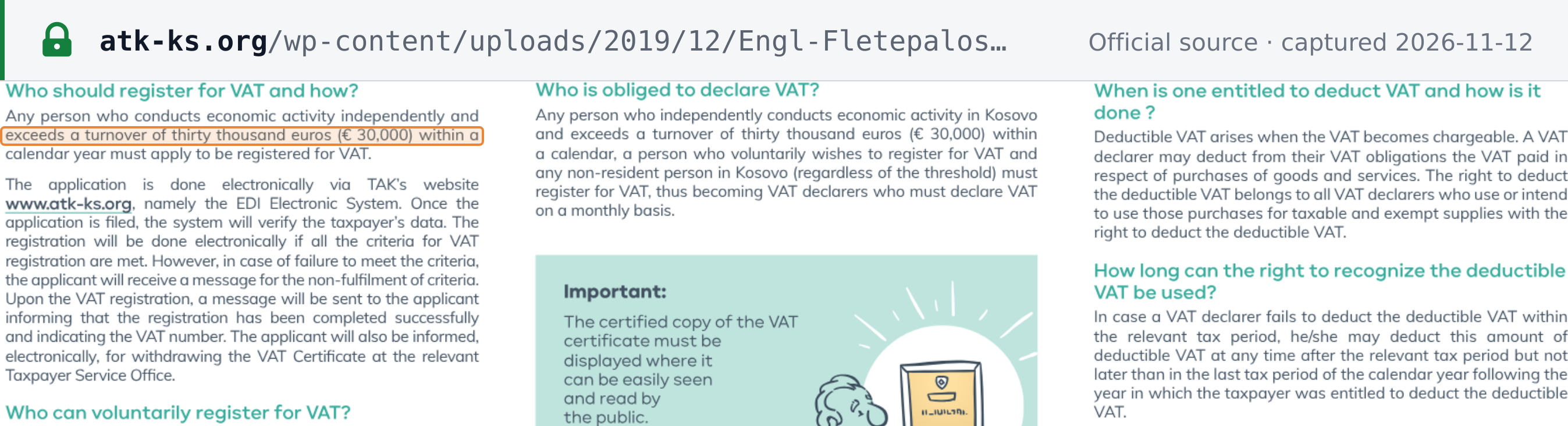 Source snapshot captured 2026-11-12 — original
- Notification deadline. Register on reaching the threshold and notify the Tax Administration "within fifteen (15) calendar days from the moment the obligation for registration arises. The registration is effective on the date when the turnover is exceeded." (Art. 7(1)) [1]
- Late registration is backdated. A person who has not registered in time "shall be registered in a compulsory manner by TAK with retroactive effect from the date of exceeding the threshold" (Art. 7(2)). [1] See Penalties for the fines.
- Older material is out of date. The Tax Administration's old "Value Added Tax" portfolio page lists only repealed legislation (Law No. 03/L-146 and its amendments, the earlier Law No. 03/L-114 and UNMIK Regulation No. 2001/11) and does not cover the current law.
Non-resident registration: no threshold
There is no threshold for suppliers not established in Kosovo. Article 6(5): "The persons not established in Kosovo are subject to VAT registration, from the beginning of their economic activity in Kosovo. Such taxable persons not established in Kosovo shall appoint a tax representative as referred to in paragraph 5 of Article 52 of this Law. The taxable person shall be registered under his own name and the name of his tax representative within five (5) days after the appointment as tax representative and prior to the beginning of economic activity in Kosovo. However, they are not obliged to be registered, if they carry out only the supply to the recipient that is obliged to pay VAT according to Article 52 sub-paragraph 1.2 and 1.3 of this Law". [1] The leaflet puts it plainly: "any non-resident person in Kosovo (regardless of the threshold) must register for VAT". [5]
In short, a foreign supplier whose customers are all VAT-registered Kosovo businesses (who reverse-charge the VAT) does not register; a foreign supplier with any other taxable supply in Kosovo registers from the first one, through a tax representative. See Foreign companies selling into Kosovo.
Tax registration number
Two identifiers appear on Kosovo invoices:
- Fiscal number or unique identification number. The TAP Law defines the fiscal number as "the number that TAK provides to the taxpayer and which is used only for tax purposes" and the unique identification number as "the registration number the business organization has been provided with by the Kosovo Business Registration Agency" (Art. 3). A business registered with the Kosovo Business Registration Agency (KBRA/ARBK) is not given a separate fiscal number (Art. 4(2)). [4]
- VAT registration number. On VAT registration the Tax Administration issues "a registration certificate to such taxable person containing his name, fiscal number and unique VAT registration number", and the certificate "shall be displayed at a place of business activity so that it can be easily seen and read by the public." (VAT Law Art. 6(2)) [1]
The VAT Law, the TAP Law and the Tax Administration's taxpayer search publish no format, length or check-digit rule for either number, so none is given here. The Tax Administration's taxpayer search looks a business up by fiscal number, NRB (business number) or VAT number and shows its VAT status. Links to other countries' official VAT-number lookups are on check a VAT number.
How to register
Registration is online, through the Tax Administration's EDI Electronic System (edeklarimi.atk-ks.org): "The application is done electronically via TAK's website www.atk-ks.org, namely the EDI Electronic System. Once the application is filed, the system will verify the taxpayer's data. The registration will be done electronically if all the criteria for VAT registration are met. … Upon the VAT registration, a message will be sent to the applicant informing that the registration has been completed successfully and indicating the VAT number. The applicant will also be informed, electronically, for withdrawing the VAT Certificate at the relevant Taxpayer Service Office." [5]
The Tax Administration's English pages publish no list of documents for a non-resident or its tax representative, and no processing time beyond the automatic check. For how registration works in other countries, see how to register for VAT, sales tax and GST.
Voluntary registration
Available. A person below the threshold "shall have the right to choose to be registered and shall notify TAK accordingly", and registration is effective "from the date of receiving the request" (Art. 8(1)–(2)). [1] The usual reason is to recover input VAT, for example for a business that sells mainly to VAT-registered customers or exports.
Deregistration
Article 9 of the VAT Law: [1]
- A registered person may ask to cancel "if his total supplies over the last calendar year have fallen below the threshold"; cancellation "shall be effective two (2) months after the date request is submitted, if it is approved by TAK."
- "Taxable persons cannot be cancelled from VAT register at least for one (1) more calendar year after the registration year."
- A person who stops trading must ask for cancellation and "shall notify TAK within fifteen (15) days after his activity is ceased."
Group registration
Not available. The VAT Law has no provision for grouping separate legal entities under one registration. A partnership or grouping of persons is treated as one taxpayer: it "shall be identified by one single VAT registration number", with a general partner or member-representative fulfilling its obligations (Art. 6(4)). [1]
Rates
Standard rate: 18%
"The VAT is charged at standard rate of eighteen percent (18%)." (VAT Law Art. 26(1)) [1] The 18% rate has applied since Law No. 05/L-037 took effect on 1 September 2015 [2]. The Tax Administration's leaflet: "VAT standard rate is 18%; VAT reduced rate is 8%." [5]
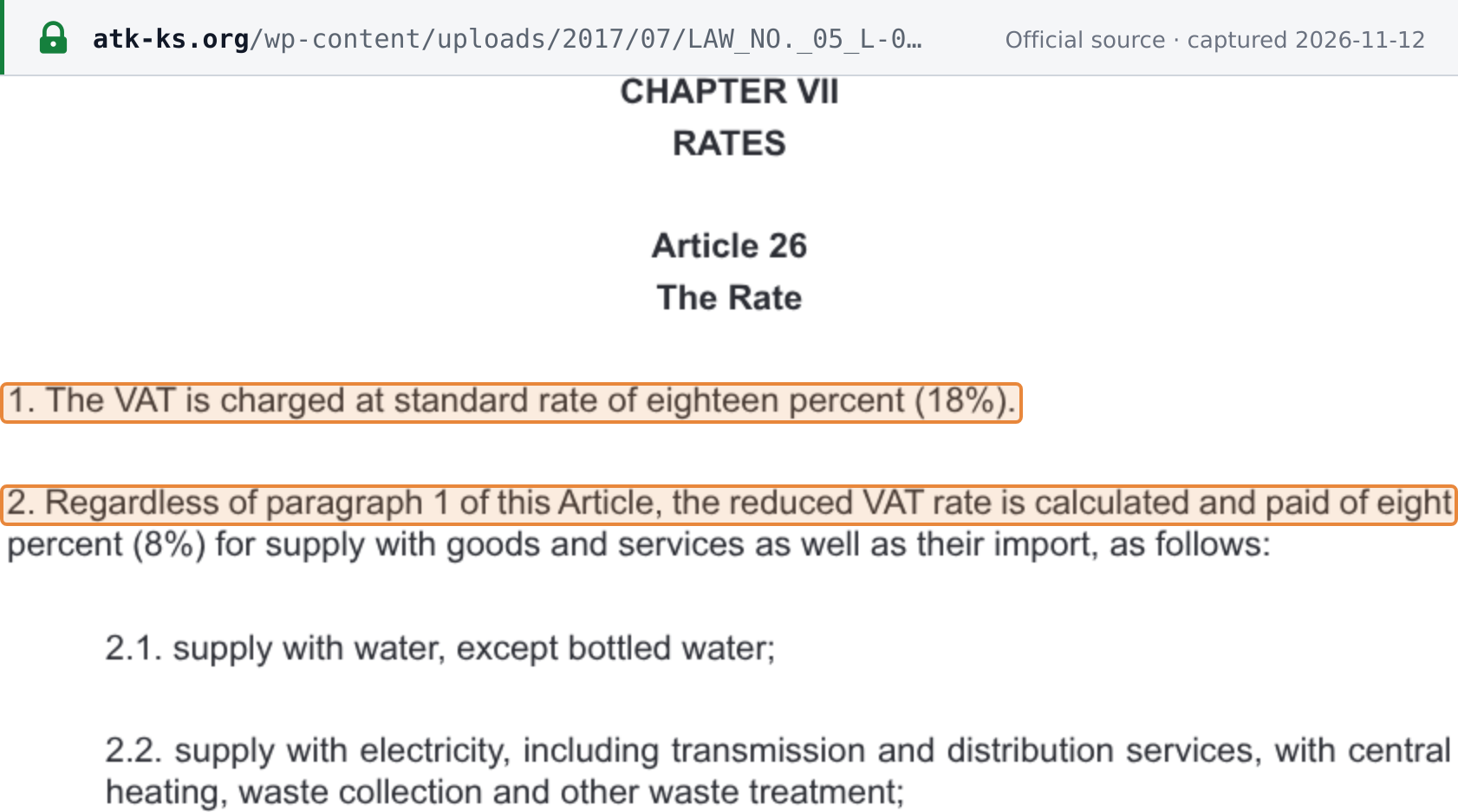 Source snapshot captured 2026-11-12 — original
Reduced rate: 8%
Article 26(2) applies 8% "for supply with goods and services as well as their import" on this statutory list: [1]
| Para | Goods or services at 8% |
|---|---|
| 2.1 | Water, except bottled water |
| 2.2 | Electricity, including transmission and distribution; central heating; waste collection and treatment |
| 2.3 | Grains such as barley, corn, maize, oats, rye, rice and wheat |
| 2.4 | Grain products for human consumption, such as flour, pasta and bread |
| 2.5 | Cooking oils made from grains or oilseeds |
| 2.6 | Dairy products for human consumption |
| 2.7 | Salt for human consumption |
| 2.8 | Eggs |
| 2.9 | Textbooks and serial publications |
| 2.10 | Books, including library lending, brochures, leaflets, children's picture, drawing and colouring books, printed music, maps and hydrographic charts |
| 2.11 | Information technology equipment |
| 2.12 | Medicines, pharmaceutical products, medical and surgical instruments and devices |
| 2.13 | Medical equipment, ambulances and aids for exclusive use by disabled people, including their repair; children's car seats |
"The Minister of Finance may issue a sub-legal for expanding list of products with reduced rate under Annex III of this Law or reducing the list of products with reduced rate." (Art. 26(3)) Annex 1 of Administrative Instruction No. 03/2015 lists the 8% goods by customs tariff code. [3] The two later amendments to AI 03/2015, AI MF-No. 06/2016 and AI MF No. 01/2018, amend only Article 51(7) of AI 03/2015 and do not change Annex 1, so the 8% list is unchanged since 2015. [6] Check the tariff code before applying 8% to a borderline product.
Zero rate
There is no 0% rate band in the VAT Law. Exports, international transport and similar supplies are exempt with the right to deduct input VAT (Chapters X–XII and Art. 36(3.2)), which works like a zero rate. See Exemptions.
Announced changes
None. The Tax Administration's legislation index lists no VAT law later than Law No. 05/L-037, and no rate change has been announced (as at 13 November 2026). [2] Rates for other countries are in worldwide VAT and GST rates.
Cross-border rules
Imports
Imported goods are taxable. VAT is paid to Kosovo Customs by the person liable under customs law (Art. 52(3)). The taxable amount is "the value for customs purposes, determined in accordance with the Customs legislation in force in Kosovo" (Art. 25(1.1)), plus "taxes, duties, levies and other payments outside Kosovo, and those that are obligation, due to importing, excluding VAT to be collected" (Art. 25(1.4.1)). [1] The Minister of Finance may allow taxable persons to defer import VAT for up to 12 months, or to account for it in the VAT return instead of paying at the border (Art. 52(3)).
Low-value consignments. "[C]onsignments of insignificant value sent directly from abroad" are exempt, except tobacco, alcohol, perfumes and eau de toilette, up to "an amount determined by sub-legal act issued by the Minister of Finance" (Art. 30(1.1)). [1] The amount is not published in the Tax Administration's English texts; check with Kosovo Customs.
Exports
Exports of goods are exempt with the right to deduct input VAT: exempt are "the supply of goods dispatched or transported to a destination outside Kosovo by or on behalf of the vendor" (Art. 31(1.1)) and goods dispatched "by or on behalf of a customer not established within the territory of Kosovo" (Art. 31(1.2)), and Article 36(3.2) gives the deduction for "transactions exempted pursuant to Chapters X, XI and XII of this Law." [1] Exporters can claim refunds monthly (see Refunds).
Imported services: reverse charge
When a supplier not established in Kosovo makes a supply whose place of supply is Kosovo to a VAT-registered Kosovo customer, the customer pays the VAT. Article 52(1.2) makes liable "any person who is registered for VAT purposes in Kosovo to whom goods and services are supplied by a taxable person not established in Kosovo, if the supply country is considered to be Kosovo. This does not apply for services related to the entrance to events such as cultural, artistic, sport, science, educational or similar such as fairs and exhibitions as well as related to support services regarding entrance." [1] The supplier's invoice must refer to the reverse charge (Art. 45(1.12)). More on the mechanism in the reverse charge explainer.
The reverse charge reaches only VAT-registered customers. Where the Kosovo customer is not registered for VAT, the general rule applies: the supplier is liable as "any taxable person carrying out taxable supply of goods and services" (Art. 52(1.1)), and a supplier not established in Kosovo must register from its first supply (Art. 6(5)) through a tax representative who is "the person liable for payment of the VAT" (Art. 52(5)). [1]
Digital services to consumers
Electronically supplied services (Annex II of the VAT Law), telecommunications and broadcasting supplied by a foreign business to non-taxable persons established or usually resident in Kosovo are supplied in Kosovo (Art. 20(4.8) and (4.10)). [1] The Tax Administration's guidance on digital services by foreign companies, published 29 July 2025, says such suppliers must "appoint a tax representative in Kosovo, who will act on their behalf for VAT purposes" and "register for VAT in Kosovo in their own name and that of their tax representative within five (5) days from the date of appointment of the representative, and before the commencement of the provision of services in the territory of Kosovo. This requirement is mandatory for all foreign companies that are not registered to operate in Kosovo, but provide digital services to non-taxable persons." It adds: "For the provision of such digital services, the standard VAT rate of 18% applies." [7]
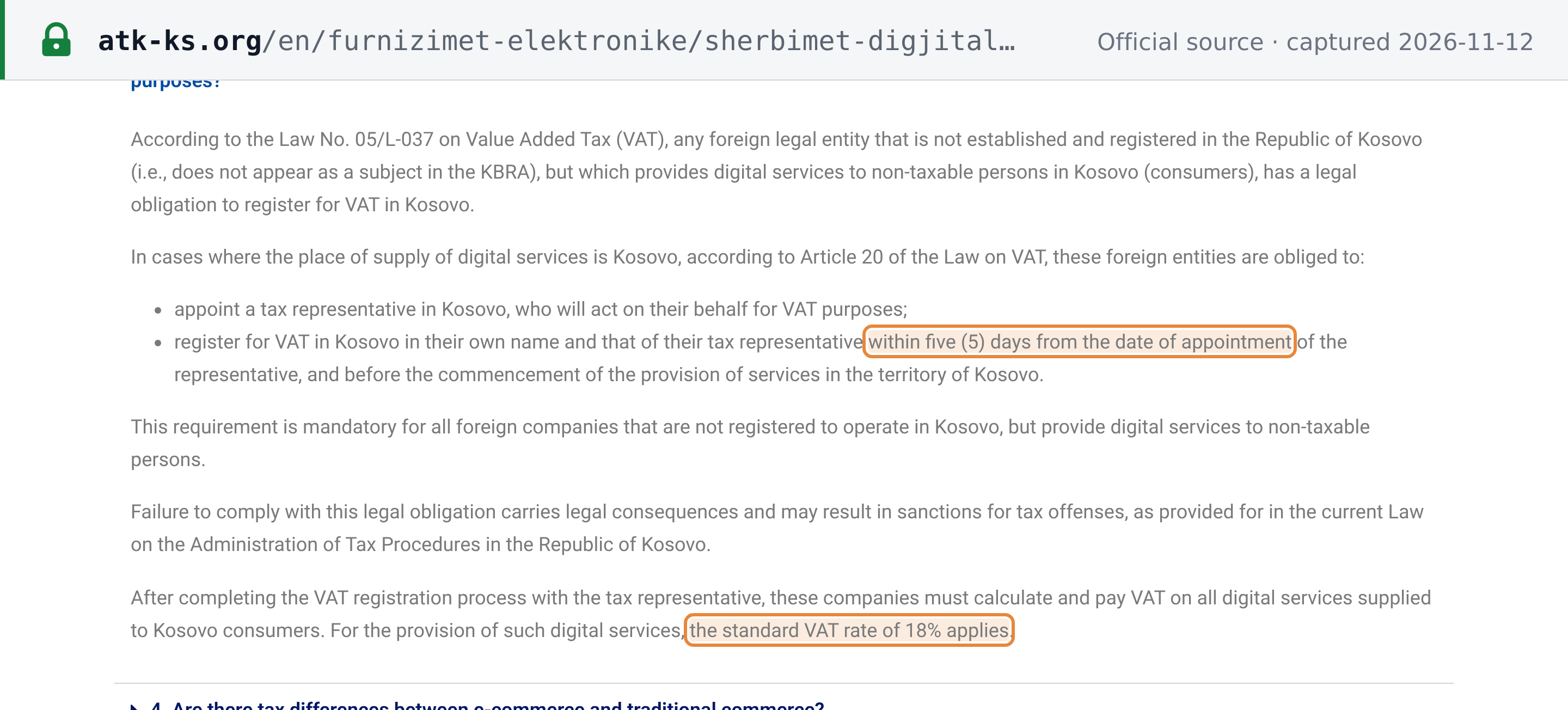 Source snapshot captured 2026-11-12 — original
There is no threshold and no simplified or one-stop registration for non-resident digital suppliers. How other countries tax these services: VAT on digital services by non-resident suppliers.
Foreign companies selling into Kosovo — B2B and B2C
- B2B (customer registered for VAT in Kosovo). The customer accounts for the VAT under the reverse charge (Art. 52(1.2)), and the foreign supplier is "not obliged to be registered" if all its Kosovo supplies are of this kind (Art. 6(5)). Its invoice must refer to the reverse charge (Art. 45(1.12)). [1]
- B2C (consumers, and customers not registered for VAT). The foreign supplier must register from its first supply, with no threshold, through a tax representative who is "the person liable for payment of the VAT and exercising all his rights" (Art. 6(5) and 52(5)). [1] This covers goods and services generally, not only digital services. Goods imported for consumers also bear import VAT at the border.
Marketplace and platform obligations
None found. The VAT Law has no rule making an online marketplace or platform the deemed supplier (as at 13 November 2026). The closest provision lets the Minister of Finance, by sub-legal act, make someone other than the seller liable for VAT on goods sold at auction or through an intermediary (Art. 52(6)), and the Tax Administration's 2025 digital-services guidance addresses suppliers, not platforms. [1] [7] For comparison, see marketplace deemed-supplier rules.
Place of supply
- Goods. Where the goods are when transport to the customer begins (Art. 19(2.1)); goods installed or assembled are supplied where they are installed. [1]
- Services to businesses (B2B). "The venue of supply with services to a taxable person shall be the venue where such recipient has established his business." (Art. 20(1))
- Services to consumers (B2C). "The venue of supply with services to a non-taxable person shall be a place where the supplier has established his business." (Art. 20(3)) Exceptions in Article 20(4) include services connected with immovable property (where the property is), passenger and goods transport (the point of departure), cultural, sporting and similar events, restaurant services, short-term hire of means of transport, and electronic, telecommunications and broadcasting services to Kosovo consumers (where the consumer lives).
Invoice requirements
Chapter XV of the VAT Law (Articles 44–51) sets the invoicing rules. A taxable person must ensure an invoice is issued for "supplies of goods or services which he has made to another taxable person and non-taxable person" and for payments on account received before a supply (Art. 44(1)). An invoice to another taxable person carries the Article 45 particulars; an invoice to anyone else carries at least the Article 46 particulars (Art. 44(3)). [1]
Mandatory content
An invoice issued by a taxable person to a taxable person must show (Art. 45(1)): [1]
| Art. 45(1) | Field |
|---|---|
| 1.1 | Date of issue |
| 1.2 | Sequential number identifying the invoice |
| 1.3 | Supplier's VAT registration number and fiscal number |
| 1.4 | Customer's VAT registration number and fiscal number, if the customer is liable to pay the VAT |
| 1.5 | Full name and address of supplier and customer |
| 1.6 | Quantity and nature of the goods, or extent and nature of the services |
| 1.7 | Date of supply or completion, or of a payment on account, where it differs from the date of issue |
| 1.8 | Taxable amount per rate or per exemption; unit price excluding VAT; discounts not included in the unit price |
| 1.9 | VAT rate applied |
| 1.10 | Amount of VAT, except under a special arrangement |
| 1.11 | For an exempt supply, the provision of the VAT Law granting the exemption |
| 1.12 | For a reverse-charged supply, a reference to Article 52(1.2), (1.3) or (1.4) or other wording showing the reverse charge applies |
| 1.13 | Travel agents' margin scheme: the provision under which VAT on the margin is charged (Art. 58) |
| 1.14 | Second-hand goods, works of art, collectors' items and antiques: a reference to the special arrangement (Art. 59) |
| 1.15 | Where the issuer is liable as a tax representative: its fiscal number, VAT registration number, full name and address |
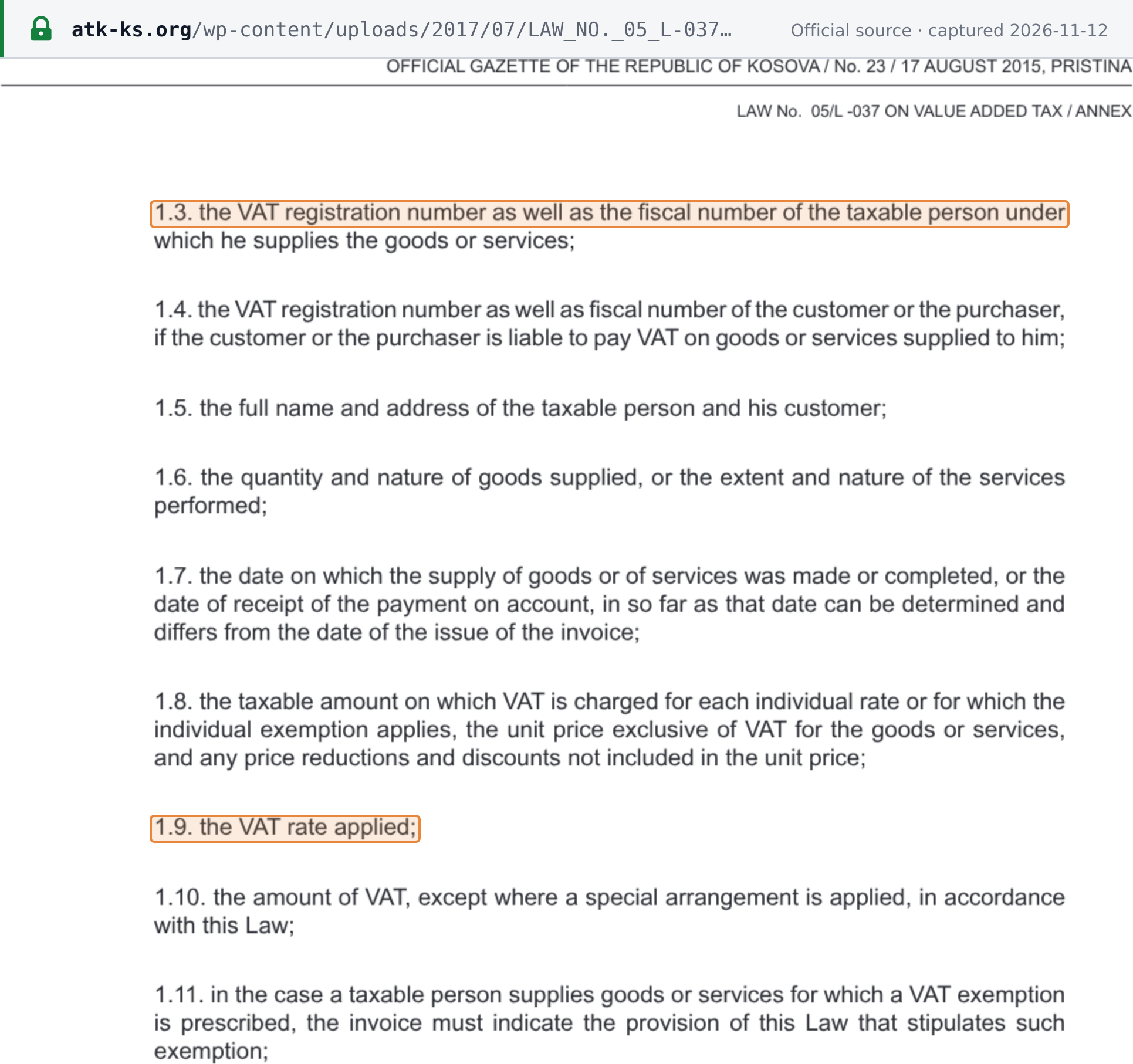 Source snapshot captured 2026-11-12 — original
An invoice to other persons (Art. 46(1)) must show at least: date of issue; time of supply; sequential number; the supplier's VAT registration number and fiscal number; the supplier's full name and address; the full name and address of "the other person" and its tax identification numbers "as defined by TAK"; total payable including VAT; sales value excluding VAT; and the VAT amount. Where several rates apply, the value and VAT are shown separately for each rate (Art. 46(2)), and an exempt supply cites the exemption (Art. 46(3)). [1]
A specimen of a compliant invoice
The Tax Administration of Kosovo publishes no specimen invoice: there is no model in the VAT Law, in Administrative Instruction No. 03/2015, in Administrative Instruction (MF) No. 01/2026 or among the leaflets and manuals on atk-ks.org. The illustration below is ours. It lays out an invoice between two VAT-registered Kosovo businesses, with each field labelled by the paragraph of Article 45 that requires it, and one line at each rate so the per-rate split in Article 45(1.8) shows.
FATURË TATIMORE / TAX INVOICE — illustrative specimen (Kosovo)
| Description and quantityArt. 45(1.6) | Qty | Unit price excl. VAT (€)Art. 45(1.8) | VAT rateArt. 45(1.9) | Taxable amount (€)Art. 45(1.8) |
|---|---|---|---|---|
| Network installation services, November 2026 | 1 | 1,000.00 | 18% | 1,000.00 |
| Laptop computers (IT equipment, Art. 26(2.11)) | 2 | 600.00 | 8% | 1,200.00 |
- Taxable amount at 18%Art. 45(1.8)
- €1,000.00
- VAT at 18%Art. 45(1.10)
- €180.00
- Taxable amount at 8%Art. 45(1.8)
- €1,200.00
- VAT at 8%Art. 45(1.10)
- €96.00
- Total including VATArt. 51(1)
- €2,476.00
- Amounts and VAT are in euro (Art. 51(1)).
- The customer's VAT and fiscal numbers are compulsory where the customer is liable for the VAT (Art. 45(1.4)), as under the reverse charge; many suppliers show them on every business invoice.
- An exempt line cites the exempting article, for example "Exempt — Art. 31(1.1), Law No. 05/L-037" for an export (Art. 45(1.11)).
- A reverse-charged supply by a non-established supplier refers to Art. 52(1.2) instead of charging VAT (Art. 45(1.12)).
- Issued before the 15th day of the month after the month of supply (Art. 44(4)). A business-to-business payment over €300 must be made by bank or electronic transfer (TAP Law Art. 6(9)).
Issuance deadline
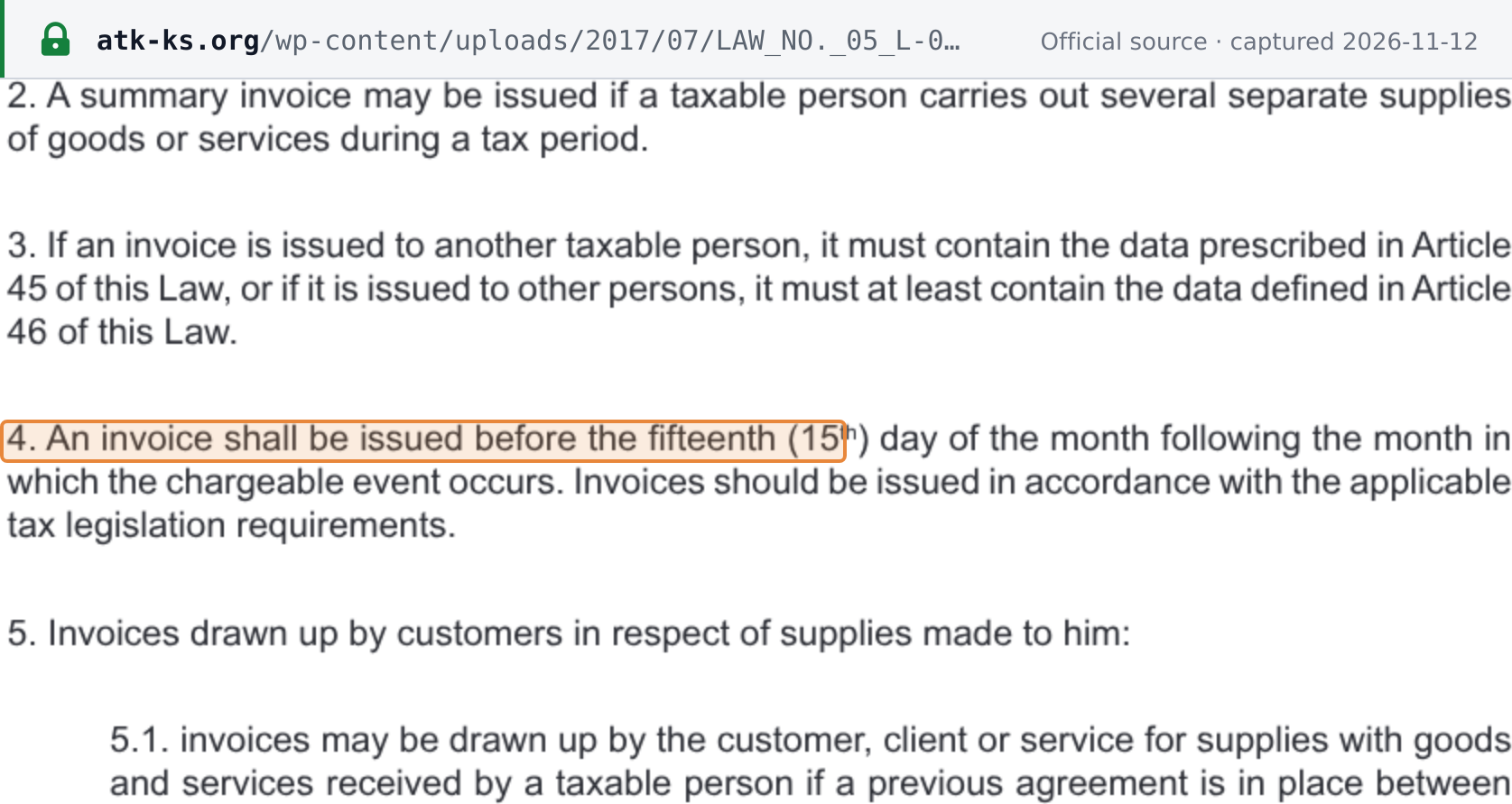
"An invoice shall be issued before the fifteenth (15th) day of the month following the month in which the chargeable event occurs." (Art. 44(4)) A summary invoice may cover several separate supplies made in one tax period (Art. 44(2)). [1]
 Source snapshot captured 2026-11-12 — original
Numbering
Every invoice, credit note, debit note and bad-debt invoice carries "a sequential number enabling the identification of the invoice" (Art. 45(1.2), 46(1.3), 47(2.2), 48(1.2)), and copies are kept "in ranking order of a sequential number" (Art. 56(2); see Retention). The VAT Law sets no rule on separate series or voided numbers. [1]
Document types: invoice, simplified invoice, fiscal coupon
Article 49 of the VAT Law: [1]
- Tax invoice (Art. 45). For supplies to taxable persons.
- Simplified invoice (Art. 46). Obligatory "where the supply has a value of five hundred (500) € or more", or where the recipient is a non-taxable person carrying on economic activity, who must ask for an invoice (Art. 46(4), 49(1.1)).
- Fiscal receipt (fiscal coupon). "automatically produced through the use of authorised fiscal electronic devices" at premises open to the public, such as retail, where no invoice is issued systematically (Art. 49(1.2.1)). Under Administrative Instruction (MF) No. 01/2026, every supply to a final consumer requires a fiscal coupon (see E-invoicing status).
Credit and debit notes
Where the taxable amount and VAT on an invoice must be corrected, "the supplier shall issue a debit note or a credit note and shall treat that note as if it were a tax invoice" (Art. 47(1)). A note must show at least its date of issue; a sequence number; a reference to the original invoice; the names, addresses, fiscal numbers and, if applicable, VAT numbers of supplier and purchaser; the reason for the correction; and the corrected taxable amount and VAT (Art. 47(2)). For bad-debt relief, the supplier issues an invoice "presenting the words "Bad Debt" and the number of the invoice related to the debt" (Art. 43(3), content in Art. 48). [1]
Currency and language
- Currency. Invoice amounts and VAT must be in euro (Art. 51(1)). A foreign-currency amount is converted at "the latest selling rate as defined by the Central Bank of Kosovo recorded at the time VAT becomes chargeable" (Art. 25(2.2)); for imports, the customs rate applies. [1]
- Language. "TAK may require invoices or documents serving as invoices in respect of supplies of goods or services in Kosovo or to other countries, to be translated into an official language of Kosovo." (Art. 51(2)) The official languages are Albanian and Serbian.
Self-billing
Permitted: "invoices may be drawn up by the customer, client or service for supplies with goods and services received by a taxable person if a previous agreement is in place between both parties and provided that a procedure of receiving the invoice from the goods or service provider issued on his behalf is in place" (Art. 44(5.1)). The Tax Administration may impose conditions, including specific conditions for suppliers not established in Kosovo (Art. 44(5.2)). [1]
Electronic invoices
Invoices "may be sent on paper or, subject to acceptance by the recipient, may be sent or may be made available by electronic means. The authenticity of the origin and the integrity of their content must be guaranteed by means of an advanced electronic signature or by means of electronic data interchange." (Art. 50(1)) [1]
Retention, electronic records and audit
- Retention: 6 years (10 for electronic services, 20 for immovable property). Copies of invoices, bad-debt invoices, credit and debit notes, simplified invoices and coupons must be "stored for at least a period of six (6) years which starts on the first of January after the year in which the taxable event took place. The retaining of documentation on immovable property for twenty (20) years is an exception to this rule. The same rules are valid in respect of electronic storage" (Art. 56(1)). [1] The TAP Law sets a longer period for electronic services: "records related to electronic services must be kept for a period of at least ten (10) years after the end of the tax period when the electronic services were provided" (Art. 6(3.7)); records of investment-gold transactions are also kept for ten years (Art. 6(3.8)). [4]
- Electronic-only archiving needs authorisation. Books and records in electronic, microfilm or scanned form "shall only be authorized by the Director General of TAK after receiving a written request thereto from the taxable person. Such request must be accompanied by a detailed description of the system and must contain the necessary evidence that all security in respect of producing and storage requirements for invoice, book and record keeping are met." (Art. 55(3))
- Audit trail. Electronic invoices must have guaranteed authenticity of origin and integrity, by advanced electronic signature or EDI (Art. 50(1)). For retail sales, fiscal devices and electronic fiscal software record each transaction, and tampering with them is a criminal matter (see Offences).
- Stock record. Every taxpayer, whatever its turnover, keeps a record of goods in stock at the end of the calendar year, ready by 10 January of the following year (TAP Law Art. 6(5)). [4]
E-invoicing status
No B2B or B2G e-invoicing mandate. As at 13 November 2026, neither the Tax Administration's legislation index nor Administrative Instruction (MF) No. 01/2026 contains any requirement to clear or report business-to-business or business-to-government invoices through a government platform. Electronic invoices between businesses are allowed only with the recipient's acceptance (VAT Law Art. 50(1)). [1] [8]
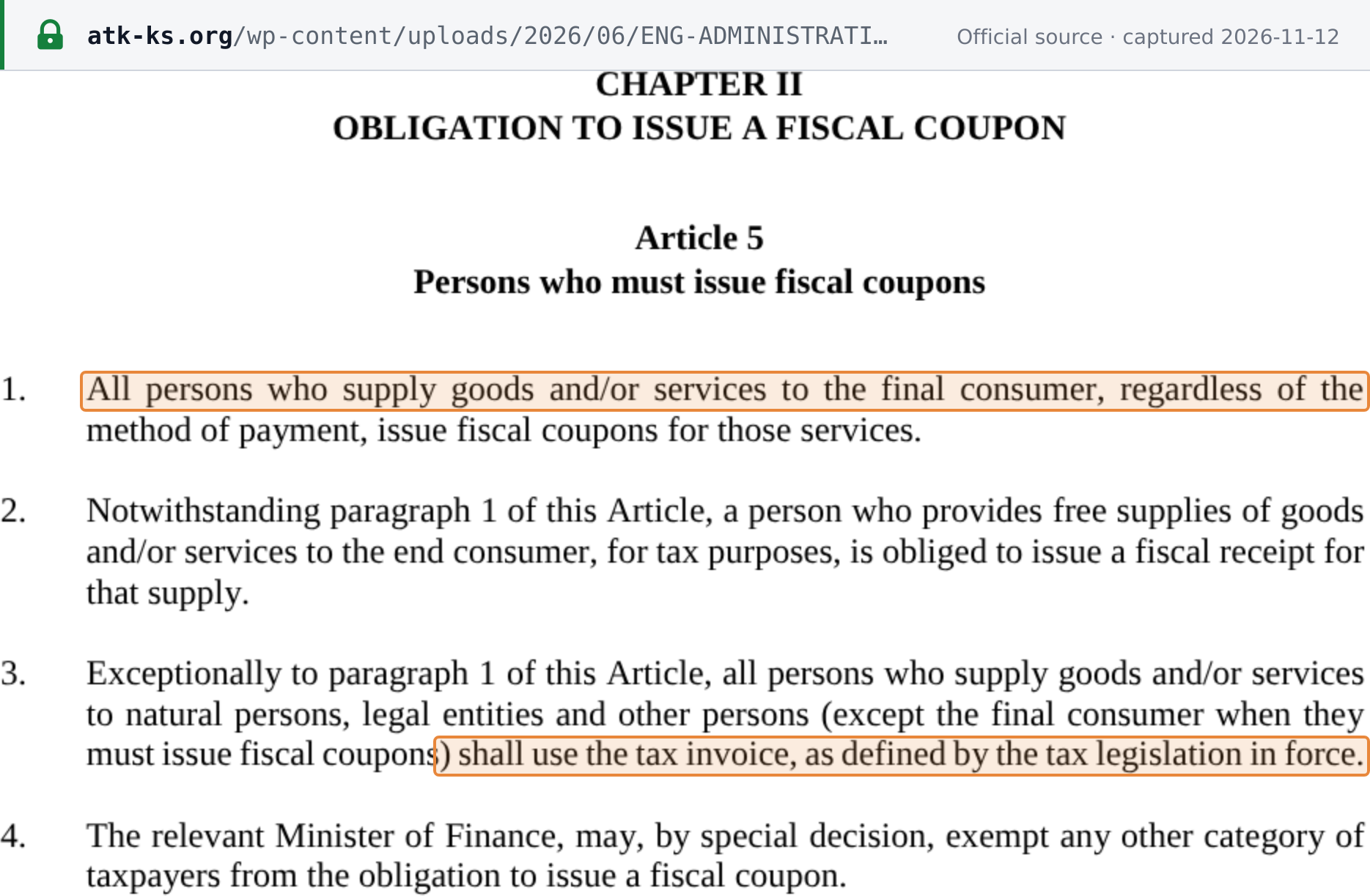
B2C fiscalisation is mandatory. What Kosovo does run is fiscalisation of sales to final consumers, under Administrative Instruction (MF) No. 01/2026 on the use of electronic fiscal devices, fiscal systems and electronic fiscal software, which repealed AI MF-No. 02/2018 (Art. 51(1)): [8]
- Scope. "All persons who supply goods and/or services to the final consumer, regardless of the method of payment, issue fiscal coupons for those services." (Art. 5(1)) Supplies to anyone other than a final consumer "shall use the tax invoice, as defined by the tax legislation in force" (Art. 5(3)), and a business selling only to other businesses need not use fiscal devices (Art. 8(2.3)). Utilities, telecoms, banks and other businesses billing by metered consumption, and the activities of public institutions, are also outside the device obligation (Art. 8(2.1)–(2.2)).
- System. Alongside electronic fiscal devices and fiscal systems, the Instruction adds Electronic Fiscal Software (EFS), through which "a fiscal coupon is generated and data is reported in real time to the TAK information system" (Art. 4(1.2)). Each fiscal coupon is electronically signed with a digital certificate and exchanged over the internet with the Tax Administration's system (Art. 32(1)).
- Timeline. The Minister of Finance decides by decision which taxpayers move from devices to software, and when (Art. 50(1)). Taxpayers obliged to use fiscal equipment but not yet equipped when the Instruction took effect must install and use EFS within 60 days (Art. 50(2)). The Instruction takes effect on publication in the Official Gazette (Art. 52); the copy on atk-ks.org does not show the publication date.
- Enrolment. On 9 July 2026 the Tax Administration added a "Request for Fiscalization" service to the EDI system, under the "Fiscalization" menu, which issues the Unique Fiscalization Code that is "a prerequisite for using the Electronic Fiscal Software (EFS)". [9]
- Formats. The Instruction names JSON and Protocol Buffers among its abbreviations; technical specifications are set by decision of the Director General (Art. 32(5)); the decision is not among the Tax Administration's published administrative instructions.
 Source snapshot captured 2026-11-12 — original
How fiscal devices work elsewhere: fiscal devices and certified cash registers. Status in other countries: e-invoicing status and networks.
Filing and payment
Filing frequency and due date
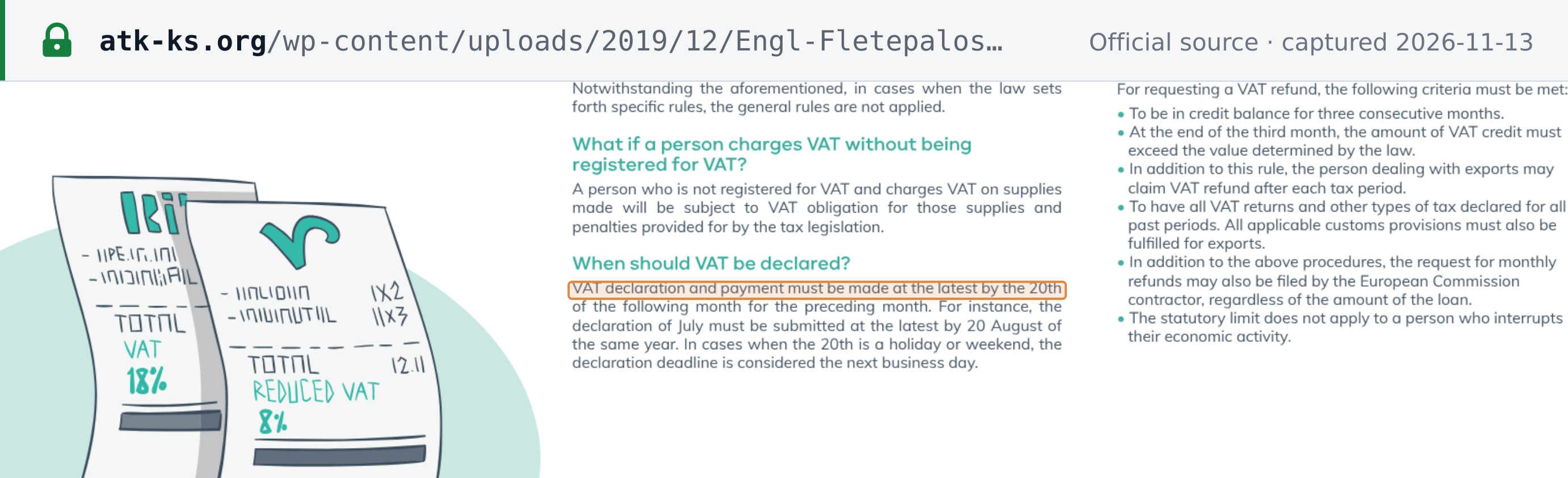
Monthly, for every VAT-registered person. The tax period is the calendar month (Art. 53(1)); the VAT Law has no quarterly or annual option, although the Minister of Finance may set another period by sub-legal act (Art. 53(3.3)). The return and the payment are both due by the 20th of the following month: "A taxable person shall submit a tax declaration and remit the related payment not later than the 20th of the calendar month following the end of each tax period." (Art. 54(1)) [1] The Tax Administration's leaflet adds the weekend rule: "In cases when the 20th is a holiday or weekend, the declaration deadline is considered the next business day." [5]
 Source snapshot captured 2026-11-13 — original
Returns, listings and payment
- Where. Returns are filed in the EDI Electronic System (edeklarimi.atk-ks.org).
- Sales and purchase books. The Tax Administration publishes 2024 English guides to completing the sales book with VAT and the purchase book with VAT, the transaction listings kept for VAT.
- Payment. Due with the return, by the 20th (Art. 54(1)). The Tax Administration's English pages name no separate payment portal.
- Cash limits. Business-to-business transactions over €300 must go "through a bank account and/or other forms of payment electronically" (TAP Law Art. 6(9)). [4] Since 1 June 2026, under Minister of Finance Decision No. 19/2026 of 27 April 2026, any transaction over €2,000 between a business and a non-business individual must be paid through the banking system or electronically, and "no part of the payment is allowed to be made in cash". [10]
Input-tax recovery and blocked items
A registered person deducts input VAT on purchases used for taxable supplies and for exports and the other exemptions with credit in Chapters X–XII (Art. 36(3.2)); a business with both taxable and exempt supplies deducts pro rata (Art. 39). [1] Blocked or restricted under Article 36(5):
- yachts and boats for sport and recreation, private aircraft, and cars and motorcycles used only for non-business purposes, with their fuel, lubricants, spare parts and related services, except vessels or vehicles used for leasing, renting or resale, driving-school vehicles and vehicles used for public and special line transport (Art. 36(5.1));
- cars used for both private and business purposes: "the right to deduct input VAT is only allowed to a maximum of fifty percent (50%)" (Art. 36(5.2));
- "representation costs which shall include only costs for hosting and entertainment during business or social contacts, including food costs, drinks and accommodation costs" (Art. 36(5.3));
- immovable property also used privately or for staff: VAT is deductible only to the extent of business use (Art. 36(5.4)).
A deduction missed in its period can be claimed later, "but not later than in the last tax period of the calendar year following the year in which the taxpayer was entitled to deduct the deductible VAT." [5]
Refunds
- Ordinary claimants. Excess credit is carried forward. A refund may be claimed "if for three (3) consecutive months is in credit and at the end of the third months the amount of VAT credit exceeds the value of three thousand (3,000) € and if all VAT and other tax returns for all past tax periods have been submitted" (VAT Law Art. 40(2.1)). [1]
- Exporters. May claim "after each tax period" if the credit exceeds €3,000 at the end of the period (Art. 40(2.2)).
- Timing. The Tax Administration reviews a refund claim "within thirty (30) calendar days from the day it received the claim", and interest accrues from the 31st day; claims may be filed within three years (TAP Law Art. 26(3), (4), (6)). [4]
- Non-residents. The VAT Law leaves refunds to non-established, unregistered businesses to a Minister of Finance sub-legal act (Art. 40(4.2)); the Tax Administration publishes no such scheme in English.
- Bad-debt relief. Available through a "Bad Debt" invoice (Art. 43, 48); court proceedings are not required for a bad debt of €500 (Art. 43(5)).
Exemptions
Exempt supplies
Chapter VIII of the VAT Law is headed "EXEMPTIONS WITHOUT RIGHT OF DEDUCTION OF INPUT VAT". [1] It includes:
- Public-interest activities (Art. 27): hospital and medical care; human organs, blood and breast milk; dental technicians; welfare and social security; child and youth protection; school and university education and private tuition; certain sporting and cultural services by non-profit bodies; ambulance transport; public radio and television; newspapers and periodical publications; and public passenger transport at regulated prices.
- Financial and other services (Art. 28(1)): life and health insurance and reinsurance; granting, negotiating and managing loans; deposits, accounts and payments; currency, banknotes and coins; shares and securities; management of special investment funds; stamps at face value; betting, lotteries and gambling.
- Property (Art. 28(1.10)–(1.12)): land; houses, apartments and other residential accommodation, including garages and basements; and leasing of immovable property. Hotel accommodation, parking, rental of installed equipment and machinery, safe boxes and commercial leasing (excluding the land) remain taxable (Art. 28(2)).
Exempt is not zero-rated
The two kinds of exemption have opposite input-tax results. A business making only Chapter VIII exempt supplies (above) cannot deduct the VAT it pays on purchases. Supplies exempt under Chapters X–XII, which are exports (Art. 31), international transport (Art. 32), supplies treated as exports such as those to diplomatic missions and international organisations (Art. 33), and supplies in customs warehouse arrangements (Art. 35), keep the right to deduct (Art. 36(3.2)), as do exempt financial services under Art. 28(1.1)–(1.6) supplied to customers established outside Kosovo or directly linked to exported goods (Art. 36(3.3)). The second group works like a zero rate even though the law calls it an exemption. [1] Background: zero-rated vs exempt supplies.
Special regimes
- Farmers. A flat-rate scheme compensates flat-rate farmers for VAT on their purchases, at percentages set by the Minister of Finance (Art. 60). [1]
- Margin schemes. Travel agents (Art. 58) and second-hand goods, works of art, collectors' items and antiques (Art. 59); the invoice cites the scheme (Art. 45(1.13)–(1.14)).
- Investment gold. Covered by Administrative Instruction MF No. 05/2016, listed in the Tax Administration's administrative instructions index.
- Cash accounting and small businesses. The VAT Law has no cash-accounting scheme. Businesses below €30,000 are simply outside VAT unless they register voluntarily.
- Free zones. The VAT Law provides for customs warehouse and similar arrangements (Art. 35); the VAT treatment of economic zones is not covered in the Tax Administration's English VAT guidance.
Offences and penalties
Penalties are set by the TAP Law (Law No. 08/L-257). [4]
Offences
Conduct the TAP Law makes unlawful:
- trading without a fiscal number or business registration certificate, a fine of up to €500 (Art. 98);
- making taxable supplies without registering for VAT once the threshold is passed (Art. 108(1), (3.1));
- failing to issue a VAT invoice, or issuing an incorrect one (Art. 108(2));
- failing to put the fiscal number or business ID on receipts and invoices, or failing to issue a fiscal receipt (Art. 101(2), (6));
- failing to install a fiscal device or fiscal system (Art. 106), a rule that applies equally to electronic fiscal software (AI (MF) No. 01/2026 Art. 49(2));
- tampering with fiscal devices. A person who "attempts to circumvent the FED, or tampers with the programming of the FED/FS or data to be entered into the FED/FS, in order to record incorrect data in the FED/FS, shall be subject to prosecution under the criminal legislation in force" (Art. 106(3));
- lending a VAT certificate. "A person registered for VAT who allows another person to use their VAT certificate, shall be liable to a penalty of up to five thousand (€5,000.00) Euros. The person using a VAT Certificate belonging to someone else will be liable for the same administrative penalty. In addition to the administrative penalty, the Tax Investigations and Intelligence Unit shall present such cases to the State Prosecutor's Office." (Art. 108(4))
- accepting cash above the legal limits (Art. 101(9)).
Prison terms for tax evasion are set by the Criminal Code of Kosovo, not by the tax laws, and are not covered here.
Penalties
All figures are set by the TAP Law: [4]
| Failure | Penalty | TAP Law |
|---|---|---|
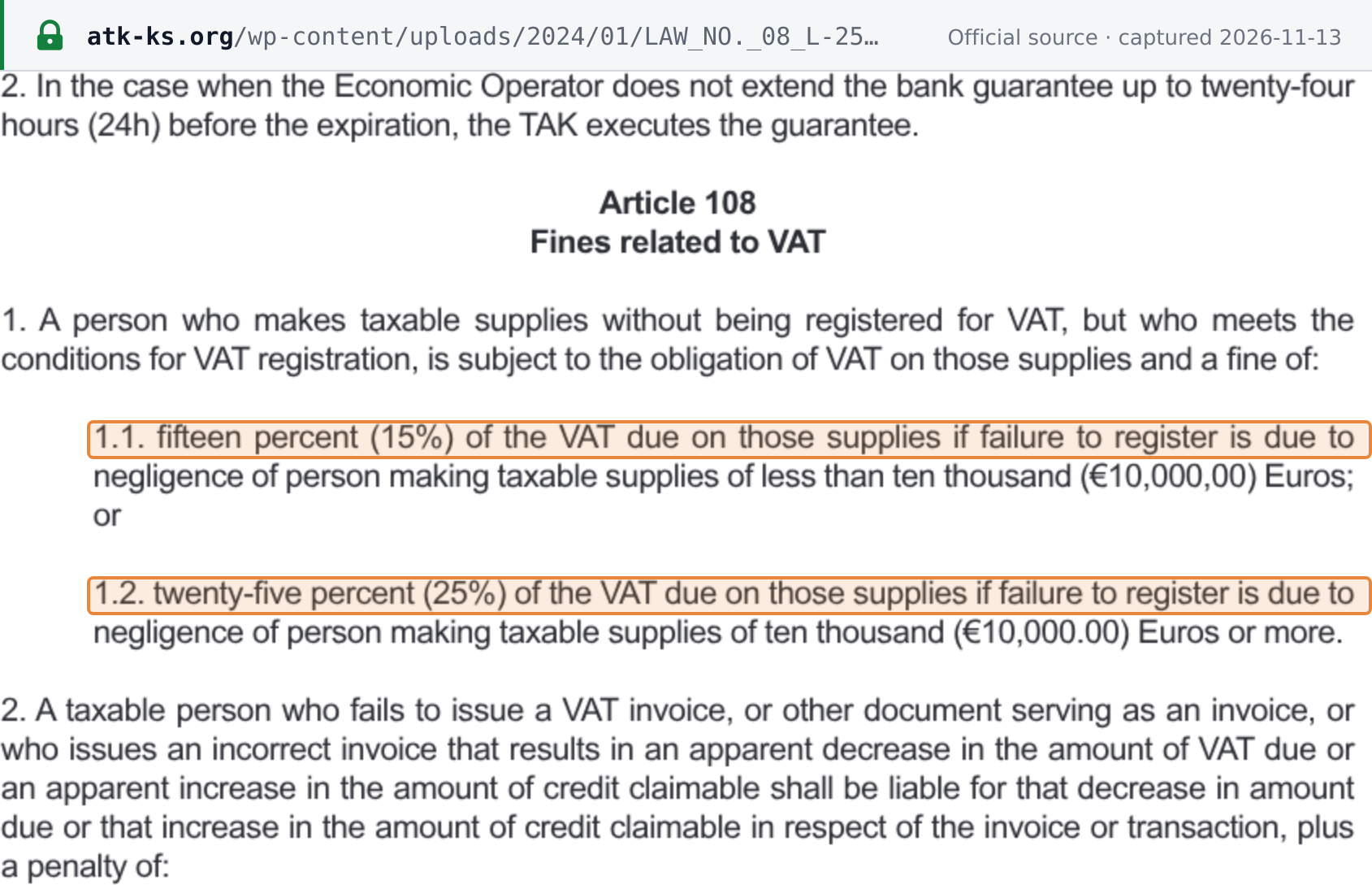
| Making taxable supplies without registering for VAT | The VAT due plus 15% of it (supplies under €10,000) or 25% (€10,000 or more), where due to negligence | Art. 108(1) |
| Not applying for VAT registration on reaching the threshold, or not displaying the VAT certificate | €150; for late registration, not applied if the taxpayer comes forward on its own initiative | Art. 108(3) |
| No VAT invoice, or an incorrect one | The VAT shortfall plus 15% (negligence) or 25% (gross carelessness: no invoice for a supply over €1,000, or an invoice more than €500 out) | Art. 108(2) |
| Return not filed on time where tax is due | €50 per return for a natural person in business; €150 for a legal entity | Art. 99(1) |
| Understated tax | 15% of the shortfall if it is up to 10% of the correct tax; 25% above that | Art. 100 |
| Records failures, including no fiscal number on receipts and invoices, and failure to issue a fiscal receipt | €150 / €250 / €500 / €1,000 / €2,000 by annual turnover (up to €30,000 / €200,000 / €500,000 / €5 million / above) | Art. 101(2), (6) |
| Repeated fiscal-receipt failures | Closure of the point of sale for 7 days (three penalties in a calendar year) or 15 days (four) | Art. 101(7) |
| No fiscal device, fiscal system or EFS | €250 / €500 / €1,000 / €2,000 / €3,000 by the same turnover bands | Art. 106(1) |
| Late payment | Interest for each month or part of a month, for up to 10 years, at a rate the Minister sets at least once a year above commercial bank lending rates and the Tax Administration publishes | Art. 24(2)–(3) |
 Source snapshot captured 2026-11-13 — original
The Tax Administration publishes the interest rate (Art. 24(3)); check its notices for the current figure.
Reductions (Art. 110). Voluntary disclosure before notice of an investigation reduces the fine to 25%; after notice but before the investigation starts, to at most 50%. "Any penalty applied according to this Law, except fines according to Article 103, if paid within fifteen (15) calendar days from the date of notification of application of the fine, will only charge for payment fifty percent (50%) of the value of the applied fine." (Art. 110(7))
Assessment period. Taxes "must be assessed within six (6) years of the date the tax declaration to which the assessment relates was due, or the date the declaration was submitted, whichever is later" (Art. 16(2)).
Frequently asked questions
We sell software subscriptions to consumers in Kosovo. Is there a threshold before we must register for VAT?
No. A supplier not established in Kosovo is subject to VAT registration from the beginning of its economic activity in Kosovo, whatever its turnover (Law No. 05/L-037, Art. 6(5)). For digital services to Kosovo consumers, the Tax Administration of Kosovo says the foreign company must appoint a tax representative and register in its own name and that of the representative within five days of the appointment and before it starts supplying. VAT is charged at the standard rate of 18%. There is no simplified or one-stop registration for non-residents.
Our customer in Kosovo is a business but is not registered for VAT. Who accounts for VAT on the services we supply from abroad?
You do, through a tax representative. The reverse charge in Article 52(1.2) of Law No. 05/L-037 applies only where the Kosovo customer is registered for VAT. Otherwise the general rule in Article 52(1.1) makes the supplier liable, and Article 6(5) requires a supplier not established in Kosovo to register from its first supply, appointing a tax representative who is liable for the VAT (Art. 52(5)). Check the customer's VAT status in the Tax Administration's taxpayer search before invoicing without VAT.
Our turnover has fallen below €30,000. Can we deregister straight away?
Not straight away. You may ask to cancel your registration if your total supplies over the last calendar year fell below €30,000, but not until at least one more calendar year has passed after the year you registered. If the Tax Administration of Kosovo approves the request, cancellation takes effect two months after you submit it (Law No. 05/L-037, Art. 9). If you stop trading altogether, you must ask for cancellation within 15 days of ceasing activity.
Can we keep our invoices and records only in electronic form?
Only with written authorisation from the Director General of the Tax Administration of Kosovo. Article 55(3) of Law No. 05/L-037 allows books and records in electronic, microfilm or scanned form only after a written request that describes the system and shows that the security requirements for producing and storing invoices and records are met. Invoices and records must be kept for at least six years from 1 January after the year of the taxable event, and twenty years for immovable property (Art. 56(1)). Records relating to electronically supplied services must be kept for at least ten years after the end of the tax period in which the services were supplied (Law No. 08/L-257, Art. 6(3.7)).
A private customer wants to pay €2,500 partly in cash. Is that allowed?
No. Under Minister of Finance Decision No. 19/2026 of 27 April 2026, from 1 June 2026 any transaction over €2,000 between a business and a non-business individual must be paid through the banking system or by electronic payment, and the Tax Administration of Kosovo says no part of it may be paid in cash. Between businesses the limit is lower: any transaction over €300 must go through a bank account or other electronic payment (Law No. 08/L-257, Art. 6(9)).
We only sell to other businesses. Do we need a fiscal device or electronic fiscal software?
No. Administrative Instruction (MF) No. 01/2026 exempts a business that supplies goods or services only to other businesses from the obligation to use fiscal devices, fiscal systems or electronic fiscal software; it must issue a tax invoice instead. Any supply to a final consumer, however paid, requires a fiscal coupon (Art. 5(1)).
Important websites
| Site | What it is for |
|---|---|
| EDI Electronic System | VAT registration, monthly returns, sales and purchase books, and the "Request for Fiscalization" for electronic fiscal software (login required) |
| Taxpayer search | Look up a business by fiscal number, NRB or VAT number and see its VAT status (Albanian interface) |
| Kosovo Business Registration Agency (ARBK) | Business registration; issues the unique identification number used as the tax number |
| Kosovo Customs | Import declarations and import VAT |
| ATK forms | Tax Administration forms |
| ATK interactive tax guide | Tax Administration's step-by-step tax guide |
| ATK administrative instructions | Sub-legal acts in force, including AI (MF) No. 01/2026 |
| Official Gazette of the Republic of Kosovo | Published laws and sub-legal acts |
The Tax Administration publishes no separate payment portal and no e-invoicing platform for business-to-business invoices.
Recent changes
- 2026-07-09 — The Tax Administration added a "Request for Fiscalization" service to the EDI system, issuing the Unique Fiscalization Code needed to use electronic fiscal software under Administrative Instruction (MF) No. 01/2026. (Tax Administration of Kosovo) — see event
- 2026-06-01 — Cash payment banned for any transaction over €2,000 between a business and a non-business individual (Minister of Finance Decision No. 19/2026 of 27 April 2026). (Tax Administration of Kosovo) — see event
- 2026-04-27 — Administrative Instruction (MF) No. 01/2026 on electronic fiscal devices, fiscal systems and electronic fiscal software replaced AI MF-No. 02/2018 and introduced electronic fiscal software with real-time reporting; the date is the one on the Tax Administration's index of administrative instructions, and the Instruction takes effect on publication in the Official Gazette. (Tax Administration of Kosovo)
- 2024-01-12 — Law No. 08/L-257 on the Administration of Tax Procedures published in Official Gazette No. 5, with its new penalty schedule; it entered into force fifteen days after publication (Art. 123). (Tax Administration of Kosovo)
For the full chronology, see Kosovo tax changes on Lookuptax.
Reference links
Official sources (legislation and Tax Administration of Kosovo publications, numbered in order of first citation):
- [1] Law No. 05/L-037 on Value Added Tax (Official Gazette No. 23/2015)
- [2] ATK legislation index: laws
- [3] Administrative Instruction MoF No. 03/2015 implementing the VAT Law
- [4] Law No. 08/L-257 on the Administration of Tax Procedures (Official Gazette No. 5/2024)
- [5] Leaflet: Value Added Tax
- [6] ATK legislation index: administrative instructions
- [7] Provision of digital services by foreign companies
- [8] Administrative Instruction (MF) No. 01/2026 on electronic fiscal devices, fiscal systems and electronic fiscal software
- [9] Notice: new version of the EDI electronic system published (9 July 2026)
- [10] Notice: transactions over €2,000 with individuals may not be paid in cash (25 May 2026)
- AI MF-No. 06/2016 amending AI 03/2015 · AI MF No. 01/2018 amending AI 06/2016
Related on Lookuptax:
- Kosovo tax changes
- Serbia VAT guide
- North Macedonia VAT guide
- Montenegro VAT guide
- VAT and GST registration thresholds worldwide
- Worldwide VAT and GST rates
- What VAT is called in each country
- E-invoicing status and networks
- Check a VAT number: official lookups
- How to register for VAT, sales tax and GST
- Reverse charge
- Zero-rated vs exempt supplies
- Fiscal devices and certified cash registers