Kyrgyzstan VAT guidelines
| FACTSHEET | |
|---|---|
| Country code | KG |
| Tax name | Value added tax — налог на добавленную стоимость (НДС) |
| Standard rate | 12% (as at 2026-11-03) |
| Tax Authority | State Tax Service under the Cabinet of Ministers of the Kyrgyz Republic (ГНС) |
| Currency | Kyrgyz som (KGS) |
Overview
The Kyrgyz Republic levies value added tax — налог на добавленную стоимость (НДС) — under Section IX (Articles 251–330) of the Tax Code of the Kyrgyz Republic of 18 January 2022 No. 3 («Налоговый кодекс Кыргызской Республики от 18 января 2022 года № 3»). This guide follows the consolidated edition of 6 August 2026 in the Ministry of Justice's Central Database of Legal Information (CBD), which includes Law No. 145 of 6 August 2026, as read on 2026-11-03. [1]
Authority. VAT is administered by the State Tax Service under the Cabinet of Ministers of the Kyrgyz Republic (ГНС при КМ КР). VAT on imports from outside the Eurasian Economic Union (EAEU) is collected under customs law (Article 320(6)); VAT on imports from EAEU states is declared and paid to the tax service (Article 320(1)–(2)). [1]
Currency. The Kyrgyz som (KGS). Prices and tax amounts on an invoice are stated "в национальной валюте Кыргызской Республики - в сомах и тыйынах" (in the national currency of the Kyrgyz Republic, in soms and tyiyns) (STS Order No. 101, Annex 1, para 5). [2]
Tax period. Article 313: "Налоговым периодом при исчислении НДС является: 1) по облагаемым поставкам - один календарный месяц; 2) по поставкам иностранной организации, указанной в части 4 статьи 28 настоящего Кодекса, - календарный квартал." (The VAT tax period is one calendar month for taxable supplies, and a calendar quarter for supplies by the foreign e-service and e-commerce sellers described in Article 28(4).) [1]
Layering: VAT and sales tax on the same invoice. Kyrgyzstan has no regional VAT, but it has a second national turnover tax, the sales tax (налог с продаж, НсП), which a business on the general regime charges alongside VAT. It is paid by domestic organisations, foreign organisations with a permanent establishment and individual entrepreneurs (Article 363), on revenue excluding VAT and sales tax (Article 366(1)). The rates in Article 368, as at 2026-11-03: [1]
| Supply | Trade and production of goods | Other activity |
|---|---|---|
| Subject to VAT | 1% | 2% |
| Not subject to VAT or exempt | 2% | 3% |
Article 368(1): "при реализации товаров, работ, услуг, облагаемых НДС: а) в размере 1 процента - для торговой деятельности и сферы производства товаров; б) в размере 2 процентов - для деятельности, не предусмотренной подпунктом "а" настоящего пункта" (on supplies subject to VAT: 1% for trade and goods production; 2% for other activity). Special rates in Article 368(3) include "2 процентов - для банков, 5 процентов - для деятельности в сфере сотовой связи и при реализации виртуального актива" (2% for banks, 5% for mobile telecoms and sales of virtual assets). Exports, supplies outside Kyrgyzstan and international transport are not subject to sales tax (Article 365(2)), and unified-tax payers do not pay it (Article 418(1)). Sales tax is paid and reported monthly, by the 20th of the following month (Article 371(1) and (3)); small businesses pay and report quarterly, by the 20th of the month after the quarter (Article 371(2) and (4)).
The electronic invoice has a column for each tax: "ставка и сумма налога на добавленную стоимость" and "ставка и сумма налога с продаж" (VAT rate and amount; sales-tax rate and amount) are both mandatory particulars (Order No. 101, Annex 1, para 10). A domestic sale of goods by a general-regime trader to a general-regime buyer therefore carries 12% VAT and 1% sales tax (for sales to patent holders and to some unified-tax payers, Article 368(4) sets 1% if paid non-cash and 2% in cash, and 2% for sales to an unidentified buyer), each calculated on the price before both taxes: the VAT base is the amount payable "без учета НДС и налога с продаж" (excluding VAT and sales tax) (Tax Code Article 308(1)), and the sales-tax base likewise (Article 366(1)). See the specimen invoice. [2]
For neighbouring EAEU systems, see the Kazakhstan VAT guide, the Uzbekistan VAT guide, the Russia VAT guide, the Belarus VAT guide and the Armenia VAT guide.
Registration
Who should register
VAT follows the tax regime, not turnover. Article 253(1): "Налогоплательщиком НДС признается: 1) налогоплательщик, уплачивающий налоги или деятельность которого подлежит налогообложению в соответствии с общим налоговым режимом, если иное не предусмотрено настоящей статьей; 2) субъект, осуществляющий облагаемый импорт; 3) иностранный субъект, выполняющий работу или оказывающий услуги, а также осуществляющий электронную торговлю товарами покупателям (физическим лицам - резидентам Кыргызской Республики), местом поставки которых признается территория Кыргызской Республики. Обязательство по НДС иностранного субъекта, указанного в пункте 5 части 2 статьи 53 настоящего Кодекса, исполняет налоговый агент." [1]
VAT payers are: (1) a taxpayer taxed under the general tax regime; (2) anyone making taxable imports; (3) a foreign entity performing works or services, or selling goods by e-commerce to resident individuals, where the place of supply is Kyrgyzstan. For a foreign entity covered by Article 53(2)(5), a tax agent discharges the VAT.
Agricultural producers and cooperatives, and non-profit organisations making no taxable supplies, are not VAT payers (Article 253(2)).
When registration takes effect. Article 255(1): "Субъект, осуществляющий предпринимательскую деятельность и уплачивающий налоги в соответствии с общим налоговым режимом, подлежит регистрации по НДС: 1) на дату его налоговой регистрации – для вновь зарегистрированного налогоплательщика; 2) на дату перехода на общий налоговый режим в соответствии с настоящим Кодексом - при переходе со специального налогового режима; 3) с первого числа месяца, следующего за месяцем, в котором налогоплательщик начал осуществлять предпринимательскую деятельность – для налогоплательщика, ранее ее не осуществлявшего." [1]
A business on the general regime registers for VAT: on the date of its tax registration, if newly registered; on the date it moves to the general regime, if leaving a special regime; or from the first day of the month after it starts trading, if it had not traded before.
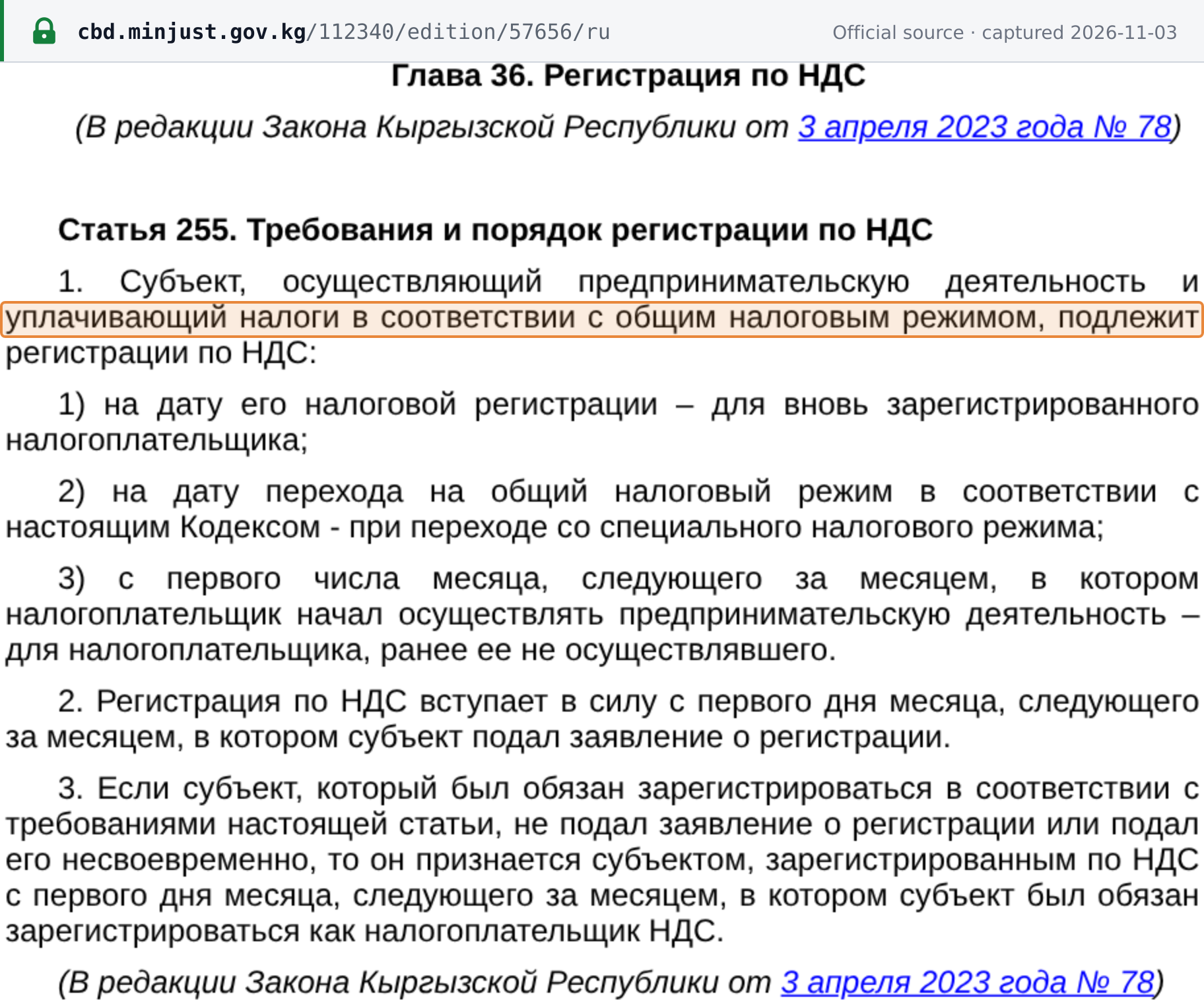 Source snapshot captured 2026-11-03 — original (Ministry of Justice, Central Database of Legal Information: Tax Code, edition of 6 August 2026)
Late registration does not avoid VAT. A business that should have registered but did not "признается субъектом, зарегистрированным по НДС с первого дня месяца, следующего за месяцем, в котором субъект был обязан зарегистрироваться" (is treated as VAT-registered from the first day of the month after the month in which it was obliged to register) (Article 255(3)).
Registration threshold
No monetary threshold (as at 2026-11-03). The Tax Code (edition of 6 August 2026) attaches no turnover amount to VAT registration: under Article 255, registration follows from being on the general tax regime. [1]
The practical equivalent is the choice of regime. Under the simplified system, the unified tax (единый налог) is paid "взамен: 1) налога на прибыль; 2) налога с продаж; 3) НДС на облагаемые поставки" (instead of: 1) profit tax; 2) sales tax; 3) VAT on taxable supplies) (Article 418(1)). A taxpayer "имеет право самостоятельно выбрать систему налогообложения" (has the right to choose its taxation system itself) (Article 420(1)). [1]
- No turnover ceiling. Articles 418–420 set no turnover limit for the unified tax. Turnover only selects the unified-tax rate (Article 423): for example, a trader with revenue of up to KGS 50,000,000 over the last 12 months pays 0.5% (Article 423(1)(1)(а)), as at 2026-11-03.
- Who cannot use it (Article 419). Foreign organisations without a permanent establishment, banks and insurers, investment funds, securities professionals, most excise payers, gold, silver, copper and other ore miners, suppliers of heat, electricity and gas, and "субъект, осуществляющий деятельность в сфере сотовой связи и в сети интернет" (businesses in mobile telecoms and on the internet). These businesses are on the general regime and therefore VAT payers.
- Losing eligibility. A business that stops meeting the Article 419 conditions must apply to move to the general regime by the end of the month after the breach (Article 420(4)), and it is then registered for VAT under Article 255(1)(2).
Non-resident registration
Foreign sellers fall into two groups, and they are treated differently:
- Foreign suppliers of electronic services and foreign e-commerce sellers of goods to Kyrgyz consumers register online through the State Tax Service's website, vat.salyk.kg. There is no threshold: neither Article 111 nor Article 253 sets an amount (as at 2026-11-03). They must apply "до начала осуществления деятельности" (before starting activity), and the registration "одновременно признается ее регистрацией как налогоплательщика НДС" (is at the same time its registration as a VAT payer), with no company registration in Kyrgyzstan (Article 111(2)–(3)). [1] [4]
- Other foreign suppliers of services without a permanent establishment do not register: the Kyrgyz business customer accounts for the VAT as tax agent (Article 53(2)(5); see Foreign suppliers: B2B and B2C).
- A foreign company with a permanent establishment registers for tax like a domestic business (Article 28(5)), and the general rules apply.
 Source snapshot captured 2026-11-03 — original
The State Tax Service reported on 18 August 2026 that 73 foreign e-service companies were registered, and it named large platforms it considered non-compliant. [7]
Tax identification number (INN)
The tax service assigns an ИНН (INN, identification number of the taxpayer) at tax registration. For individuals, "персонального идентификационного номера, присваиваемого уполномоченным государственным органом в сфере регистрации населения, данный номер применяется в качестве ИНН налогоплательщика" (the personal identification number assigned by the population-registration authority is used as the taxpayer's INN) (Article 113(3)). The INN must appear on contracts, invoices and returns (Article 113(6)). [1]
- On the ESF: the INN cells on the official form have 14 positions (BLANK STI-007, cells 201, 203, 301, 303). For a non-resident buyer, Order No. 101 says to enter the first 14 characters of a longer foreign number, or the digit "9" fourteen times if the buyer has none (Annex 1, para 26). [2]
- More detail: Kyrgyzstan INN guide · check an INN's format: Kyrgyzstan INN validator.
How to register
- Kyrgyz companies apply for tax registration through the state-registration body (the Ministry of Justice) when they incorporate (Article 111(4)(1)); individual entrepreneurs apply to the tax office before starting (Article 111(4)(2)). The unified-tax rate, for a business choosing the simplified system, is chosen in that application (Article 420(2)). A business on the general regime is subject to VAT registration under Article 255(1); registration takes effect "с первого дня месяца, следующего за месяцем, в котором субъект подал заявление о регистрации" (from the first day of the month after the month in which the business filed its application for registration) (Article 255(2)). [1]
- To issue ESFs, the taxpayer obtains an electronic signature, files with its tax office an application to register in the ESF system on the form approved by the tax authority, and then receives access to its taxpayer profile (Resolution No. 141, para 9). [3]
- Foreign e-service and e-commerce sellers apply online at vat.salyk.kg/statement/create.
For the general process across countries, see how to register for VAT, sales tax or GST.
Voluntary registration
A unified-tax payer can choose to become a VAT payer by leaving the simplified system. Article 420(5): a taxpayer that intends to move to the general regime "обязан подать заявление в налоговый орган по месту текущего налогового учета до 1 декабря текущего года. Уплата налогов на основе общего налогового режима осуществляется налогоплательщиком с 1 января следующего календарного года" (must apply to its tax office by 1 December of the current year; it pays taxes under the general regime from 1 January of the next calendar year). It cannot return to the simplified system for one year (Article 420(6)). [1]
Reasons to do so: only a VAT payer can credit input VAT (Article 315), and business buyers that recover VAT need a supplier's ESF showing it.
Deregistration
VAT registration is cancelled on the taxpayer's application to move to a special regime. It takes effect from the first day of the month in which the business moves to the unified tax, or of the month after the application for other special regimes (Article 256(1)–(2)). It is also cancelled when bankruptcy proceedings begin, on an application by the special administrator within 10 working days (Article 256(4)). Article 256(7): "Аннулирование регистрации по НДС не освобождает налогоплательщика от исполнения налогового обязательства по НДС, а также уплаты процентов, пеней и налоговых санкций" (cancellation does not release the taxpayer from its VAT liability or from interest, late-payment penalties and sanctions). On deregistration, no invoice is issued for remaining stock; a primary accounting document is drawn up in the ESF system instead (Order No. 101, Annex 1, paras 12–13). [1]
Group registration
Not available. Chapter 36 of the Tax Code (Articles 255–256, registration for VAT) contains no grouping provision (checked 2026-11-03). In a simple partnership, the managing partner accounts for the VAT (Article 323). [1]
Rates
| Rate | Applies to | Tax Code |
|---|---|---|
| 12% (standard) | Taxable supplies and taxable imports; supplies by foreign e-service and e-commerce sellers under Article 28(4) | Art 254(1), (3) |
| 0% | Exports of goods (except metal-bearing ores, concentrates, alloys and refined metals), international carriage other than by rail, transit-flight services, processing of EAEU tolling raw materials, power for irrigation and drinking-water pumping stations, and supplies for production use by a business outside a free economic zone to an FEZ entity | Art 254(2); Arts 302–306, 430(2) |
| Exempt | Supplies listed in Articles 265–296, and supplies whose place of supply is outside Kyrgyzstan (see Exemptions) | Arts 251(5), 264 |
Rates as at 2026-11-03. Article 254: "1. Если иное не предусмотрено настоящим Кодексом, ставка НДС устанавливается в размере 12 процентов от облагаемой поставки и облагаемого импорта. 2. Ставка НДС устанавливается в размере 0 процентов в отношении поставок, указанных статьями 302-306 и частью 2 статьи 430 настоящего Кодекса. 3. Ставка НДС устанавливается в размере 12 процентов в отношении поставок иностранной организацией, указанной в части 4 статьи 28 настоящего Кодекса." [1]
1. Unless the Code provides otherwise, the VAT rate is 12% of taxable supplies and taxable imports. 2. The VAT rate is 0% for the supplies listed in Articles 302–306 and Article 430(2). 3. The VAT rate is 12% for supplies by a foreign organisation described in Article 28(4).
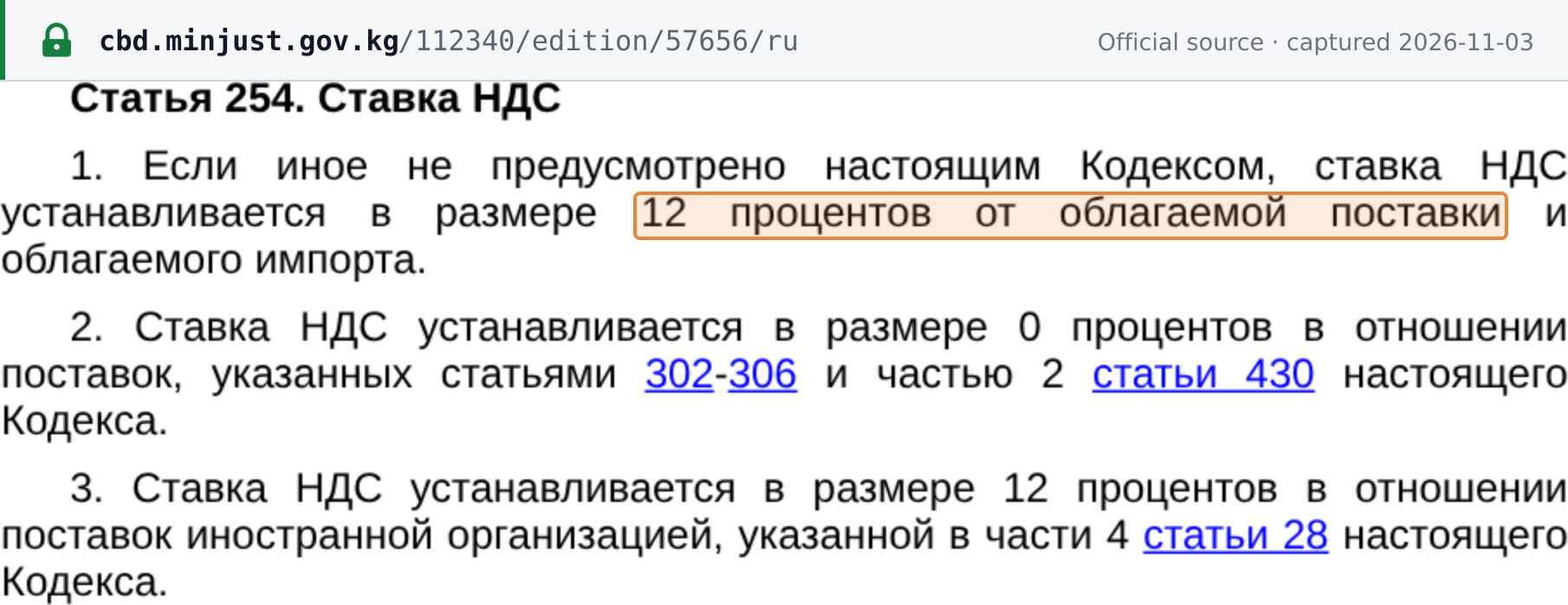 Source snapshot captured 2026-11-03 — original (Ministry of Justice, Central Database of Legal Information: Tax Code, edition of 6 August 2026)
Standard rate: 12%. The rate has been 12% throughout the current Tax Code, in force since 1 January 2022; Article 254 carries no amendment note.
No reduced rate. Article 254 lists only 12% and 0% (checked 2026-11-03). The 1–5% figures that appear on Kyrgyz invoices are sales tax, a separate tax (see Overview), and the 0–8% unified-tax rates belong to the simplified system, which replaces VAT.
Zero rate. Article 303(1): "Экспорт товаров, за исключением экспорта металлосодержащих руд, концентратов, сплавов и аффинированных металлов, является поставкой с нулевой ставкой НДС" (exports of goods, except metal-bearing ores, concentrates, alloys and refined metals, are zero-rated). Article 304(1): "Международная перевозка пассажиров, багажа и грузов, за исключением перевозок, осуществляемых железнодорожным транспортом, является поставкой с нулевой ставкой НДС" (international carriage of passengers, baggage and cargo, other than by rail, is zero-rated); international rail carriage is exempt instead (Article 275(2)). [1]
The ESF system uses the same rate set. Cell 402 of every invoice records the type of supply as one of "экспорт; облагаемая по ставке 12%; облагаемая по ставке «0»; освобожденная; необлагаемая" (export; taxable at 12%; taxable at 0; exempt; non-taxable) (Order No. 101, Annex 1, para 34). [2]
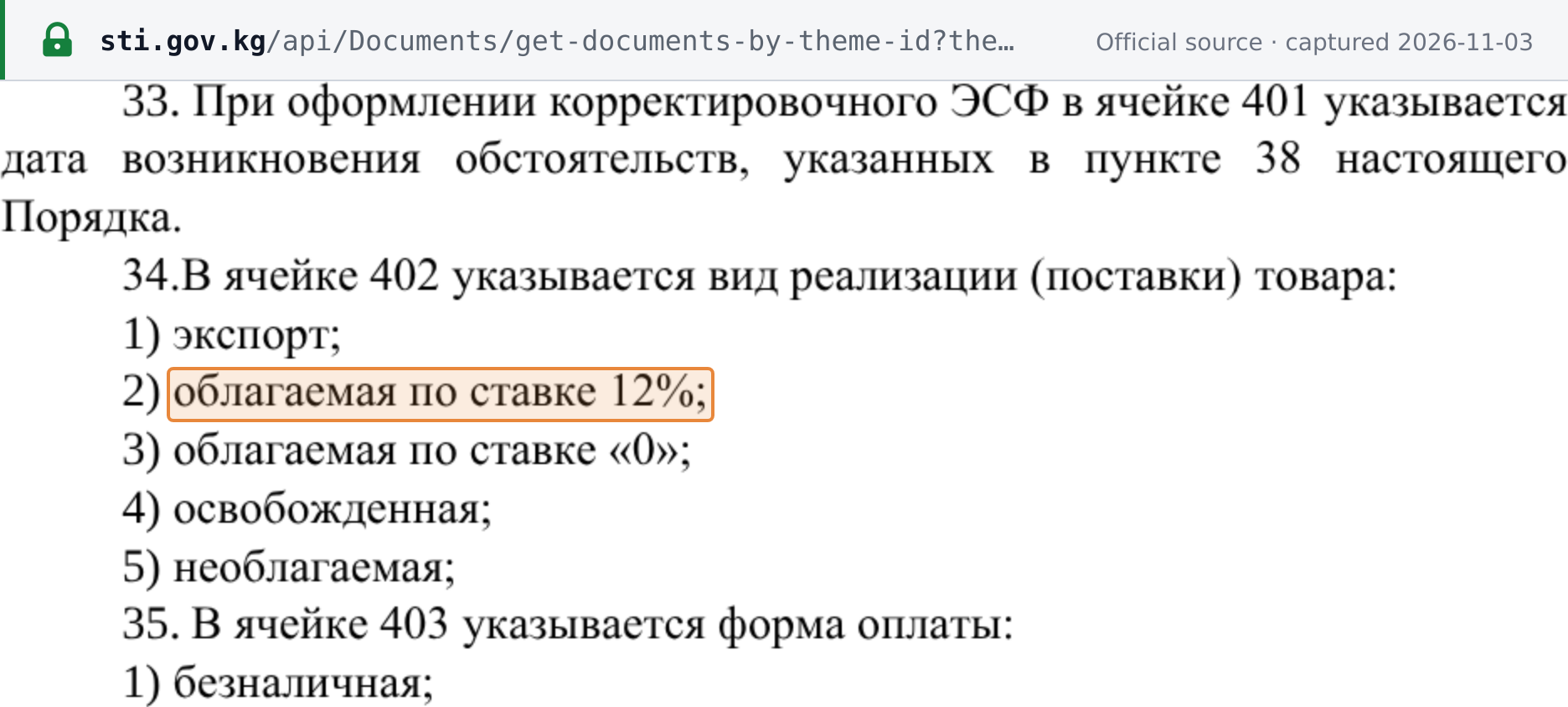 Source snapshot captured 2026-11-03 — original (State Tax Service, «Электронный счет-фактура» section, «Порядки при оформлении/применении счетов-фактур»: Annex 1 to Order No. 101)
Announced future rates. None found. The consolidated Code (edition of 6 August 2026) carries no deferred change to Article 254, and State Tax Service news from September 2025 to 3 November 2026 announces no VAT-rate change (checked 2026-11-03).
See worldwide tax rates for other countries.
Cross-border rules
Imports and exports
- Imports from outside the EAEU. VAT is collected under customs law (Article 320(6)). The taxable value is "сумма их таможенной стоимости, таможенных пошлин и налогов, подлежащих уплате при импорте этих товаров, за исключением НДС" (customs value plus duties and taxes payable on import, other than VAT) (Article 310). [1]
- Imports from EAEU states (Russia, Kazakhstan, Belarus, Armenia). The importer files the indirect-tax return with the tax office and pays the VAT "не позднее 20 числа месяца, следующего за месяцем, в котором был осуществлен импорт товара" (no later than the 20th of the month after the month of import) (Article 320(1)–(2)). No filing extension is allowed for this return (Article 102(3)). [1]
- Exports of goods are zero-rated (Article 303(1)). For exports to EAEU states, the exporter files the supporting documents with its VAT return within 180 days of shipment (Article 303(2)). The ESF for an export is issued before the goods leave Kyrgyzstan (Resolution No. 141, para 28), in soms, with a second total line in the contract currency (Order No. 101, Annex 1, para 6).
- Services supplied abroad are not zero-rated. A supply whose place of supply is outside Kyrgyzstan is an exempt supply by definition: "освобожденная поставка - поставка, место которой находится за пределами Кыргызской Республики" (Article 251(5)). That matters for input-VAT apportionment (Article 317).
- Low-value import thresholds are set by EAEU customs law, not the Tax Code, and are not covered here.
Place of supply
- Goods: where the supplier hands them over, or where transport begins (Article 262).
- Services (Article 263): where the immovable or movable property is, for services on property; where performed, for culture, education, sport and tourism; where the buyer is, for a listed group of business services that includes consulting, legal, accounting, audit, engineering, advertising, design, marketing, data processing, research, software development, electronic services, staff provision, licences of intellectual property and leasing of movable assets; and where the supplier is, for everything else.
- Electronic services to a Kyrgyz business are supplied in Kyrgyzstan if the buyer is state-registered there, if the services go to a Kyrgyz branch or permanent establishment, or if the buyer's place of management is in Kyrgyzstan (Article 263(6)).
- Electronic services and e-commerce goods sold to consumers are supplied in Kyrgyzstan if at least one of four conditions is met (Article 263(7)): "а) местом жительства покупателя является Кыргызская Республика; б) место нахождения банка, в котором открыт счет, используемый покупателем для оплаты услуг, или оператора электронных денежных средств … - на территории Кыргызской Республики; в) сетевой адрес покупателя, использованный при приобретении услуг, зарегистрирован в Кыргызской Республике; г) международный код страны телефонного номера, используемого для приобретения или оплаты услуг, присвоен Кыргызской Республикой" (the buyer lives in Kyrgyzstan; the buyer's bank or e-money operator is there; the buyer's network address is registered there; or the phone number's country code is Kyrgyz). [1]
Foreign suppliers: B2B and B2C
- B2B — the Kyrgyz buyer accounts for the VAT as tax agent. Under Article 53(2)(5), a Kyrgyz organisation or individual entrepreneur discharges, as tax agent, the "НДС по выполненным или оказанным в его адрес работам или услугам, местом поставки которых признается территория Кыргызской Республики, иностранной организацией или индивидуальным предпринимателем, деятельность которого не приводит к возникновению постоянного учреждения на территории Кыргызской Республики, за исключением иностранной организации, указанной в части 4 статьи 28, зарегистрированной в Кыргызской Республике в соответствии с частью 2 статьи 111 настоящего Кодекса" (VAT on works or services with a Kyrgyz place of supply performed for it by a foreign organisation or entrepreneur without a permanent establishment, except a foreign e-service supplier registered under Article 111(2)). [1]
- The base for this VAT is the amount payable including the foreign supplier's Kyrgyz withholding income tax, excluding VAT (Article 308(2)).
- The buyer can credit the VAT if it is a VAT payer, has paid it to the budget and has issued an ESF to itself (Article 315(3)(4)); the ESF system has a dedicated status for this (Order No. 101, Annex 1, para 14(б)).
- Not everyone is a tax agent for this VAT: High-Technology Park residents, and international air and rail carriers on certain purchases, are released from the duty (Article 53(8)); banks are not tax agents for it (Article 53(6)); and state bodies with special status, local self-government bodies, the state social insurance body and the Deposit Protection Agency are not tax agents for VAT on such services (Article 53(1)).
- A tax agent that fails to pay withheld tax faces a sanction of 10% per month (see Penalties).
- B2C — the foreign seller registers. Foreign suppliers of electronic services and foreign e-commerce sellers of goods to Kyrgyz consumers register on vat.salyk.kg before starting, with no threshold (see Non-resident registration), and file and pay as set out below.
- A foreign e-service supplier registered on vat.salyk.kg charges and pays the VAT itself, including on supplies to Kyrgyz businesses, because Article 53(2)(5) excludes it from the tax-agent rule.
Digital services and e-commerce
What counts as an electronic service (Article 32). Activity carried out through information networks, including the internet, among them: software, games and databases supplied over the network, and their updates; e-books, music, video and images; online advertising; placing offers to buy or sell; online marketplaces that connect sellers and buyers; website hosting and domain names; data storage and processing; computing power; automated search and supply of data; search-engine access; and website statistics. Not included: software on physical media, consulting by e-mail, and "оказание услуг по предоставлению доступа к сети Интернет" (internet access) (Article 32(2)). [1]
For foreign sellers registered on vat.salyk.kg (as at 2026-11-03):
- Rate: 12% (Article 254(3)).
- Period: the calendar quarter (Article 313).
- Tax point for services: "последний день налогового периода, в котором поступила оплата (частичная оплата) за услугу" (the last day of the quarter in which payment or part-payment was received) (Article 314(3)).
- No input credit: these suppliers have no right to credit VAT on their own purchases (Article 315(7)).
- Return: by the last day of the month after the quarter (Article 319(1)(2), as the State Tax Service applies it to these suppliers).
- Payment: by the 25th of the month after the quarter (Article 319(2)). Payment details, including correspondent routes in several currencies, are on vat.salyk.kg. [4]
The State Tax Service's English-language page for foreign suppliers: "reporting is provided once a quarter no later than the last day of the month. The tax is paid no later than the 25th day of the month following the reporting tax period." [4]
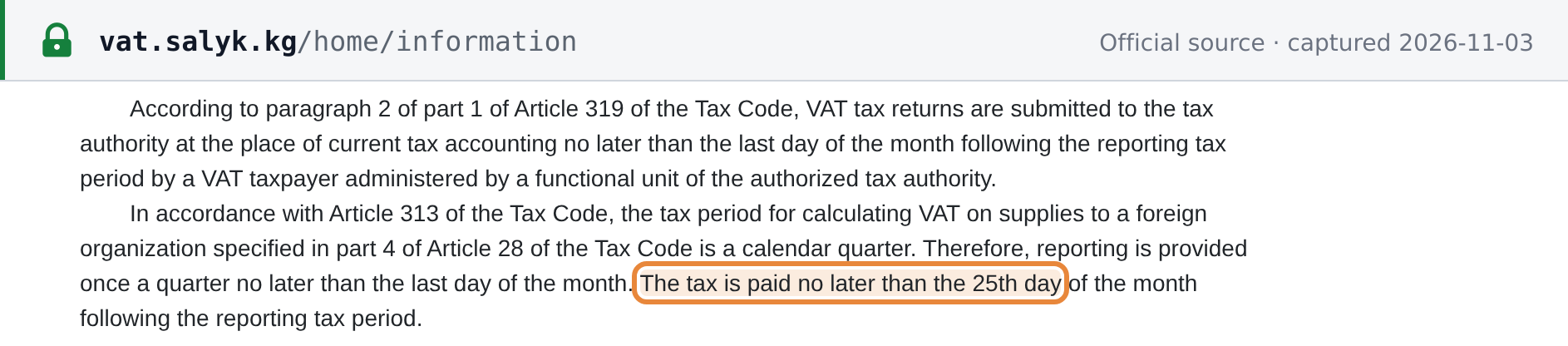 Source snapshot captured 2026-11-03 — original
Foreign e-commerce sales of goods (Law No. 145 of 6 August 2026). For a foreign seller of goods by e-commerce to Kyrgyz consumers, VAT is calculated and paid on the value of the goods purchased and is not creditable (Article 310, second paragraph), and it is administered by the tax service (Article 61(1-1)). These provisions took effect fifteen days after the law's official publication on 7 August 2026, on or about 22 August 2026. [9] [10]
 Source snapshot captured 2026-10-12 — original
For how other countries tax non-resident digital suppliers, see VAT on digital services by non-resident suppliers.
Marketplace and platform rules
No deemed-supplier rule. The VAT section of the Tax Code (Articles 251–330) and Article 32 contain no provision making a marketplace liable for the VAT of third-party sellers (checked 2026-11-03). What does exist:
- Marketplace services are themselves electronic services (Article 32(1)), so a foreign marketplace operator selling them to Kyrgyz consumers registers on vat.salyk.kg.
- Domestic sales of goods to consumers through a trading platform are invoiced by one consolidated ESF a month, issued by the 10th working day of the following month, with the digit "1" entered fourteen times as the buyer INN (Order No. 101, Annex 1, paras 8(4) and 26).
- Law No. 145 added Article 178-1, an "invoice for trading activity on an electronic trading platform", in cases set by the Cabinet of Ministers (BLANK STI-111; STS Order No. П-71 of 13 February 2026). [1]
- Domestic e-commerce has a separate special regime, the tax on e-commerce activity (Tax Code Chapter 61).
Invoice requirements
The VAT invoice in Kyrgyzstan is electronic: the электронный счет-фактура (ESF, ЭСФ), created inside the State Tax Service's ESF information system (ИС ЭСФ). Tax Code Article 178(2): "Счет-фактура подлежит оформлению в виде электронного документа в соответствии с требованиями налогового законодательства Кыргызской Республики и законодательства Кыргызской Республики об электронном управлении и электронной подписи, за исключением случаев, предусмотренных настоящей статьей." (The invoice must be issued as an electronic document under the tax legislation and the legislation on e-government and electronic signatures, except in the cases this article provides.) [1]
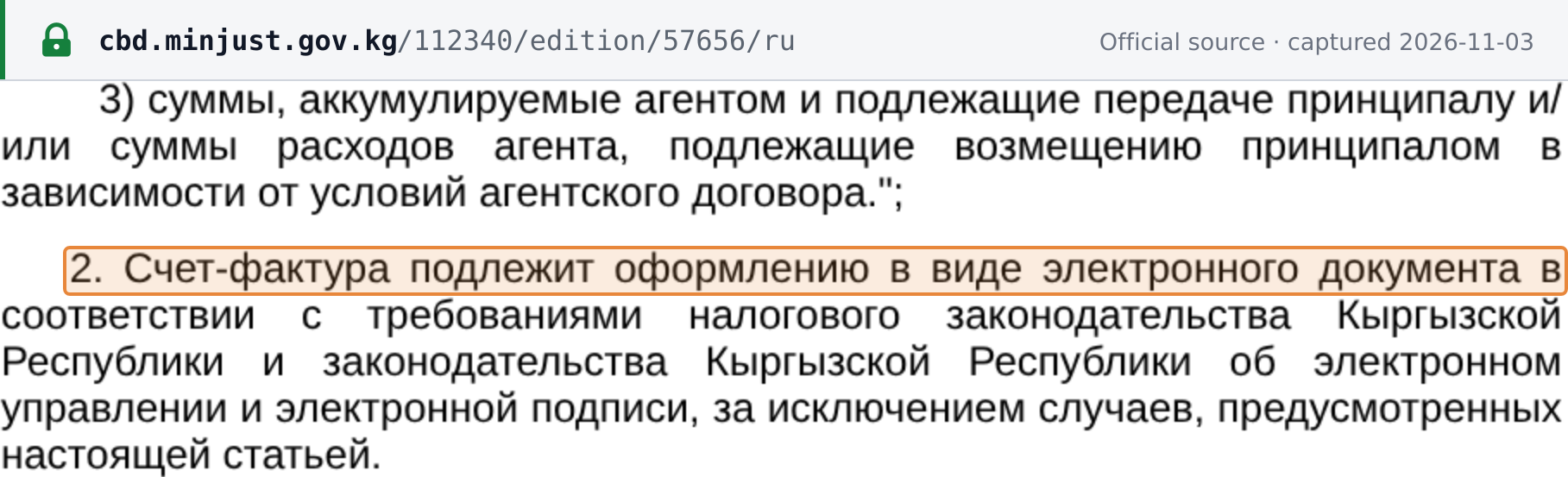 Source snapshot captured 2026-11-03 — original (Ministry of Justice, Central Database of Legal Information: Tax Code, edition of 6 August 2026)
- Who must invoice. "Налогоплательщик НДС, за исключением иностранной организации, указанной в части 4 статьи 28 настоящего Кодекса, обязан: 1) оформлять счета-фактуры в соответствии с требованиями настоящего Кодекса" (every VAT payer except a foreign e-service or e-commerce seller under Article 28(4) must issue invoices) (Article 178(7)). Other taxpayers issue them voluntarily or in cases set by the Cabinet of Ministers (Article 178(11)).
- Who sets the rules. The Cabinet of Ministers sets the procedure for forming and circulating e-invoices, and the tax authority sets the form and the mandatory particulars (Article 178(10)). The instruments in force on 2026-11-03 are Cabinet of Ministers Resolution No. 141 of 18 March 2022 «О применении счета-фактуры» (procedure) and STS Order No. 101 of 28 April 2023 (form, filling rules and particulars), last amended by Order No. П-372 of 10 September 2026. [2]
- The original. "Оригиналом ЭСФ, то есть подлинником, является электронный документ, содержащийся в ИС ЭСФ, подписанный электронной подписью налогоплательщика" (the original ESF is the electronic document held in the ESF system, signed with the taxpayer's electronic signature), and "ЭСФ считается оформленным, если содержит сгенерированный в ИС ЭСФ номер и электронную подпись" (an ESF counts as issued once it carries a number generated by the system and an electronic signature) (Resolution No. 141, paras 15 and 17). [3]
Mandatory content
Order No. 101, Annex 1, para 10: "К обязательным реквизитам счета-фактуры, подлежащим заполнению, относятся" (the mandatory particulars of an invoice are), with the cell numbers of the official form: [2]
| # | Particular | ESF cell |
|---|---|---|
| 1 | Supplier INN and name | 201, 202 |
| 2 | Supplier branch INN and name, if a branch supplies | 203, 204 |
| 3 | Buyer INN and name | 301, 302 |
| 4 | Buyer branch INN and name, if supplied to a branch | 303, 304 |
| 5 | Date of supply | 401 |
| 6 | Type of supply: export, 12%, 0%, exempt or non-taxable | 402 |
| 7 | Form of payment: non-cash, cash, free of charge or barter | 403 |
| 8 | Goods or service code, at least ten digits, from the ESF system catalogue | Section 3 |
| 9 | Description | Section 3 |
| 10 | Unit of measure | Section 3 |
| 11 | Quantity | Section 3 |
| 12 | Unit price | Section 3 |
| 13 | VAT rate and amount (column «НДС») | Section 3 |
| 14 | Sales-tax rate and amount (column «НсП») | Section 3 |
| 15 | Correction details, on a corrective ESF only | 406, 407 (goods); 405, 406 (works and services) |
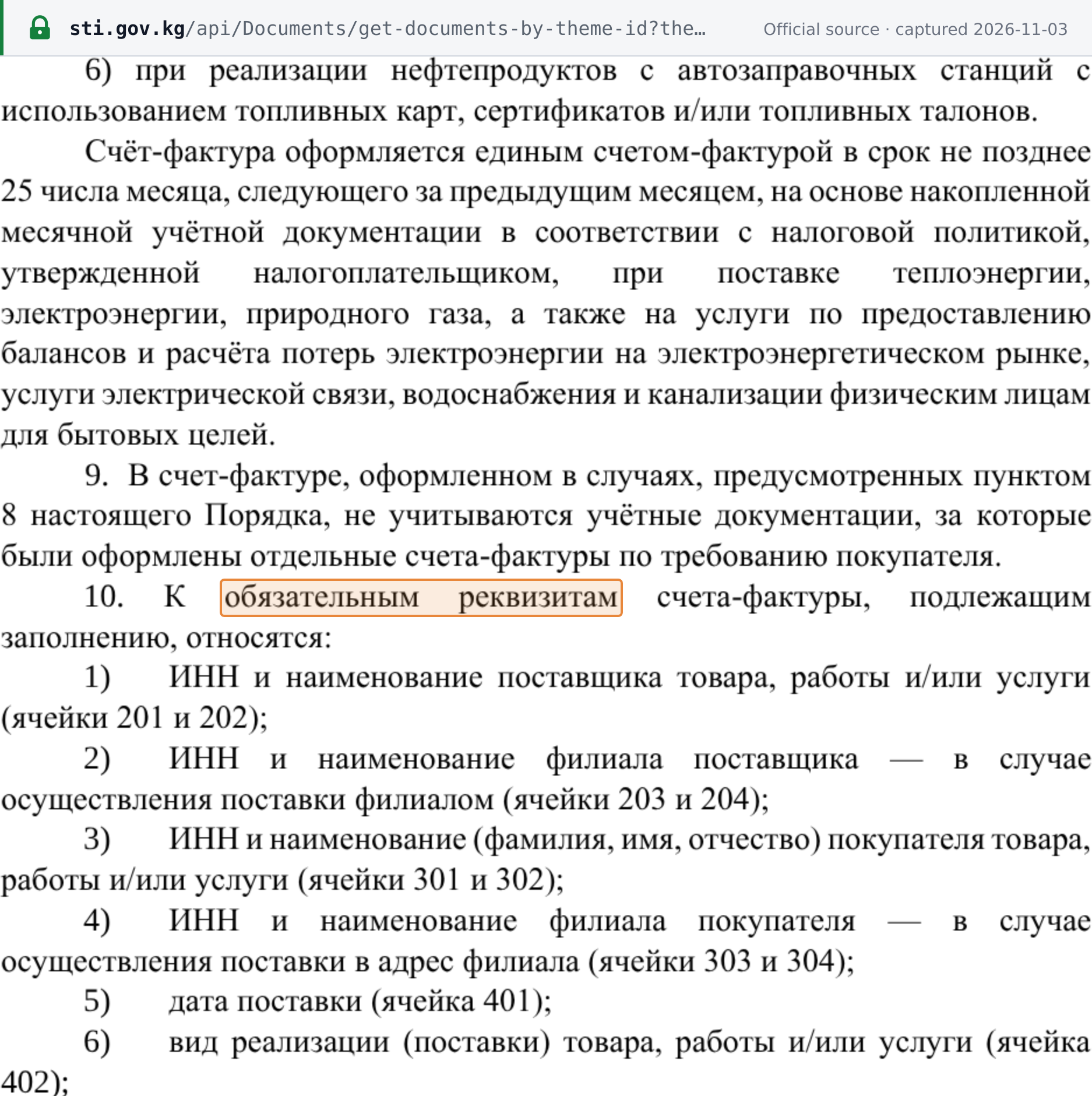 Source snapshot captured 2026-11-03 — original (State Tax Service, «Электронный счет-фактура» section, «Порядки при оформлении/применении счетов-фактур»: Annex 1 to Order No. 101)
The list continues on the next page of the Order, with the two tax columns:
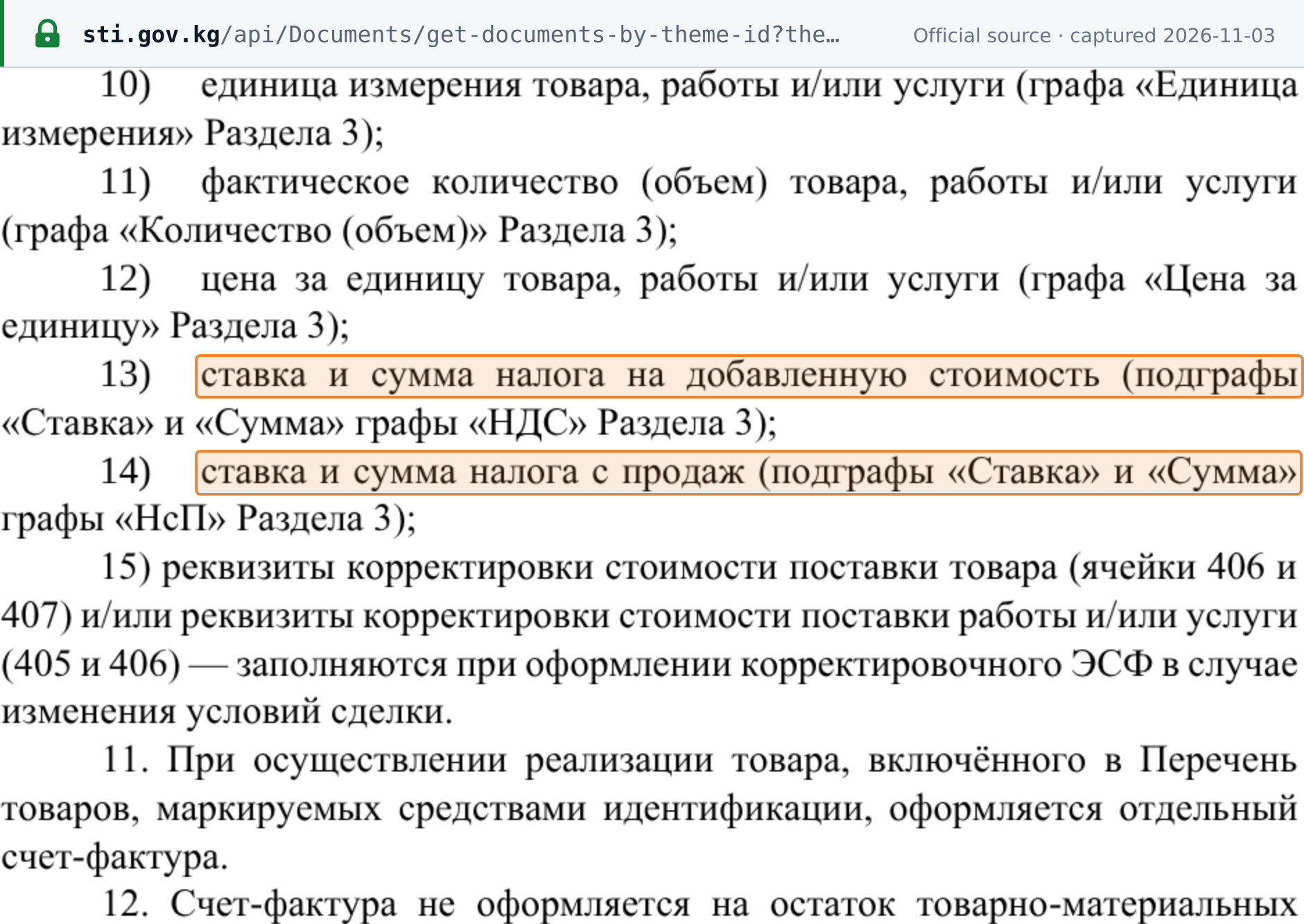 Source snapshot captured 2026-11-03 — original (State Tax Service, «Электронный счет-фактура» section, «Порядки при оформлении/применении счетов-фактур»: Annex 1 to Order No. 101)
Other cells on the form:
- 101 status, 102 number and 103 date of issue — filled by the system (paras 17–18).
- 205/305 addresses (for a non-resident buyer, the country); 206/306 tax-office code, or the country code for a non-resident buyer; 207/307 bank and BIK; 208/308 bank account.
- 404 internal note; 405 contract number and date.
- 450 name of the signatory. The ESF "должен быть подписан квалифицированной электронной подписью" (must be signed with a qualified electronic signature) by the head of the organisation or entrepreneur, the accountant, or a tax representative under a power of attorney (paras 15–16).
Rules that shape each invoice:
- One rate per ESF. "В случае поставки товаров одному покупателю с применением различных ставок НДС субъектом оформляется ЭСФ отдельно по каждой ставке НДС" (where goods are supplied to one buyer at different VAT rates, a separate ESF is issued for each VAT rate); the same applies to each sales-tax rate (para 40(10)–(11)).
- Goods subject to digital marking go on a separate ESF (para 11).
- Exempt or non-taxable lines show "0" in the rate and amount cells for VAT and sales tax (para 41).
- Goods subject to EAEU traceability carry the customs-declaration number or the source ESF number on the line (para 42).
- A credit for input VAT is refused on an invoice "в котором не заполнены все обязательные реквизиты" (in which not all mandatory particulars are filled in) (Tax Code Article 316(2)). [1]
Issuance deadline
Resolution No. 141, para 27: "Счет-фактура на поставки оформляется в срок не позднее пяти рабочих дней, следующих за днем поставки, с указанием в счете-фактуре фактической даты поставки, если иное не установлено настоящей главой." (The invoice is issued no later than five working days after the day of supply, showing the actual date of supply, unless this chapter provides otherwise.) [3]
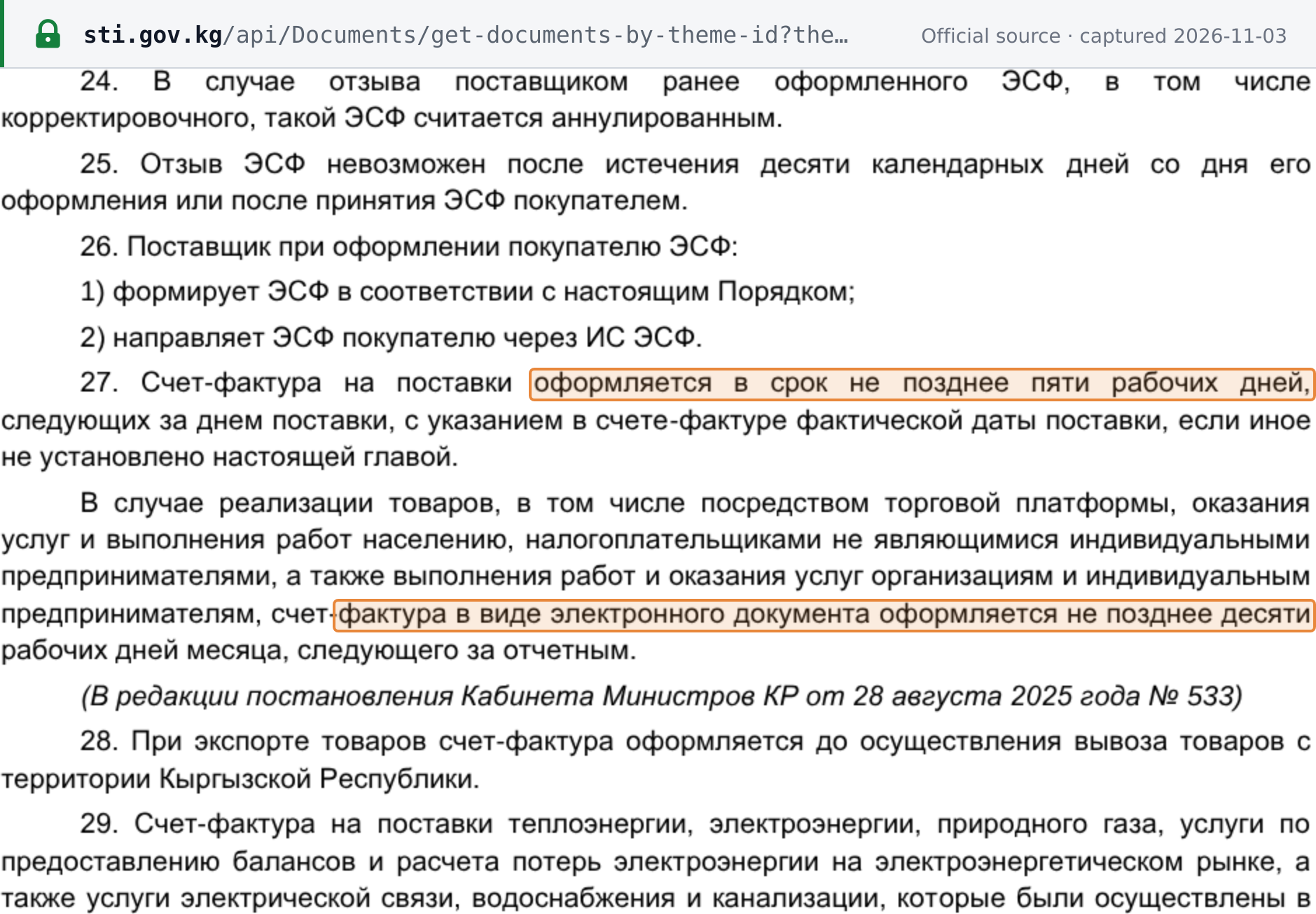 Source snapshot captured 2026-11-03 — original (State Tax Service, «Электронный счет-фактура» section, «Порядки при оформлении/применении счетов-фактур»: Annex to Resolution No. 141)
The exceptions, as at 2026-11-03:
- Works and services supplied to organisations and individual entrepreneurs, and sales to the public (including through a trading platform) by taxpayers that are not individual entrepreneurs: one ESF "не позднее десяти рабочих дней месяца, следующего за отчетным" (no later than the tenth working day of the month after the reporting month) (para 27, second paragraph, as amended by Resolution No. 533 of 28 August 2025; Order No. 101, Annex 1, para 8).
- Heat, electricity, gas, telecoms, water and sewerage: by the 25th of the month after the VAT period (para 29).
- Exports: "до осуществления вывоза товаров с территории Кыргызской Республики" (before the goods leave Kyrgyzstan) (para 28).
Buyer acceptance and recall. The buyer accepts or rejects the ESF within ten calendar days of receiving it (para 21); "В случае если покупатель не подтвердил принятие ЭСФ или не отказал в получении ЭСФ в течение срока, указанного в пункте 21 настоящего Порядка, ЭСФ считается принятым" (if the buyer neither accepts nor rejects it within that time, the ESF is deemed accepted) (para 22). A rejected ESF is cancelled (para 20). The supplier can recall an ESF the buyer has not accepted within ten calendar days of issuing it (paras 23 and 25). If the buyer is not registered in the ESF system, the supplier issues the ESF in the system, prints it with its registration number and hands it over (para 30).
Numbering and sequencing
- ESF: the number is "уникальный сгенерированный номер счета-фактуры, формируемого в ИС ЭСФ" (a unique number generated in the ESF system) (Resolution No. 141, para 2(4)), and the date of issue is the date the supplier signs it (para 16). The State Tax Service's VAT questions and answers say an ESF number has 19 characters, including 2 hyphens. [3]
- Paper invoices (used only during an outage, see Document types): the numbers are issued by the tax office, and the taxpayer must use them "строго по порядковым номерам по возрастанию" (strictly in ascending order) and must not pass them to another taxpayer (Resolution No. 141, paras 51–52).
Credit and debit notes
There are no separate credit or debit notes. A change in price or quantity is made with a corrective ESF (корректировочный ЭСФ), for a full or partial return of goods, a price change or a refund of payment (Order No. 101, Annex 1, para 38). [2]
- It quotes the number of the ESF it corrects and the reason (cells 406–407), and shows reductions with a minus sign (para 39).
- "Корректировочный ЭСФ оформляется исключительно к первоначальному ЭСФ, оформленному при осуществлении поставки. Не подлежат корректировке показатели корректировочного ЭСФ." (A corrective ESF is issued only against the original ESF; a corrective ESF cannot itself be corrected.) (para 39)
- Cell 401 on a corrective ESF shows the date the circumstances behind the correction arose, not the original supply date (para 33). The State Tax Service announced this change on 30 April 2026. [6]
- Corrections of other particulars are made by a supplementary invoice, in cases set by the Cabinet of Ministers (Tax Code Article 178(8)).
Currency, language and exchange rate
- Currency: soms and tyiyns (Order No. 101, Annex 1, para 5). For exports, amounts are shown in soms and a second total line shows the value in the contract currency (para 6).
- Exchange rate: for exports, Section 3 carries "код валюты и официальный курс валюты Национального банка Кыргызской Республики на день оформления ЭСФ" (the currency code and the National Bank's official rate on the day the ESF is issued) (para 40(1)).
- Language: "Документы налогового учета составляются налогоплательщиком на государственном или официальном языке" (tax-accounting documents are drawn up in the state language, Kyrgyz, or the official language, Russian) (Tax Code Article 177(9)). [1]
Document types
- ESF — the default (Article 178(2)). Forms: BLANK STI-007 for goods and BLANK STI-008 for works and services (Annex 2 to Order No. 101).
- Paper invoice — only during failures of the ESF system for external reasons or force majeure, in three copies, with numbers issued by the tax office, later converted to an ESF (Article 178(3); Resolution No. 141, paras 31–33).
- Substitute documents replace the invoice in listed cases, for example bank statements for bank services and payment orders for farm produce bought from a farmer (Article 178(2-1)).
- Cash-register receipt for retail. "Налогоплательщик имеет право не оформлять счет-фактуру при реализации товаров, оказании услуг и выполнении работ населению при условии осуществления расчетов посредством ККМ … По условиям настоящей части налогоплательщик обязан выдать счет-фактуру по требованию покупателя." (A taxpayer need not issue an invoice for sales to the public settled through a cash register, but must issue one at the buyer's request.) (Article 178(5)) Sales to the public are then summarised in one monthly ESF (Order No. 101, Annex 1, para 8).
- No simplified invoice. Neither Article 178 nor Order No. 101 provides a simplified invoice or a value limit for one (checked 2026-11-03). [1]
Self-billing
No general self-billing scheme (checked 2026-11-03 in Article 178 and Order No. 101). Two buyer-issued cases exist:
- a VAT payer buying agricultural produce from a farmer documents it on form BLANK STI-110 or a substitute document (Article 178(2-1));
- a Kyrgyz business acting as tax agent for services from a foreign supplier issues an ESF to itself, which is a condition of its input credit (Article 315(3)(4); Order No. 101, Annex 1, para 14(б)).
Retention and audit trail
- Retention: taxpayers keep "документов на бумажном и электронном носителе - в течение не менее 6 лет" (paper and electronic documents for at least 6 years) (Article 51(1)(9)); records are kept until the limitation period expires (Article 98(2)), which is 6 years (Article 68(1)). [1]
- Electronic-only storage is permitted. Records may be kept "на бумажных и/или электронных носителях" (on paper and/or electronic media) (Article 98(2)), and the ESF system stores invoices for the limitation period (Resolution No. 141, para 5).
- Audit trail: a qualified electronic signature; a system-generated number; system-set statuses — original (accepted or rejected), recalled and corrective (accepted or rejected), with the interim statuses "new" and "sent" (Order No. 101, Annex 1, para 18); and the ten-day recall window. The tax service can declare ESFs invalid (Order No. 101, Annex 6) and suspend a taxpayer's use of the ESF system (Annex 7).
Invoice sample: the official ESF form
The State Tax Service publishes the ESF form for goods as BLANK STI-007, Annex 2 to Order No. 101 («СЧЕТ-ФАКТУРА в виде электронного документа на товары»). It is a blank form, not a filled-in example, but it is the authority's own layout with every numbered cell: status, number and date (101–103); Section 1, supplier and buyer (201–208, 301–308); Section 2, supply information (401–407); Section 3, the goods lines with separate VAT («НДС») and sales-tax («НсП») columns; and the signatory (450).
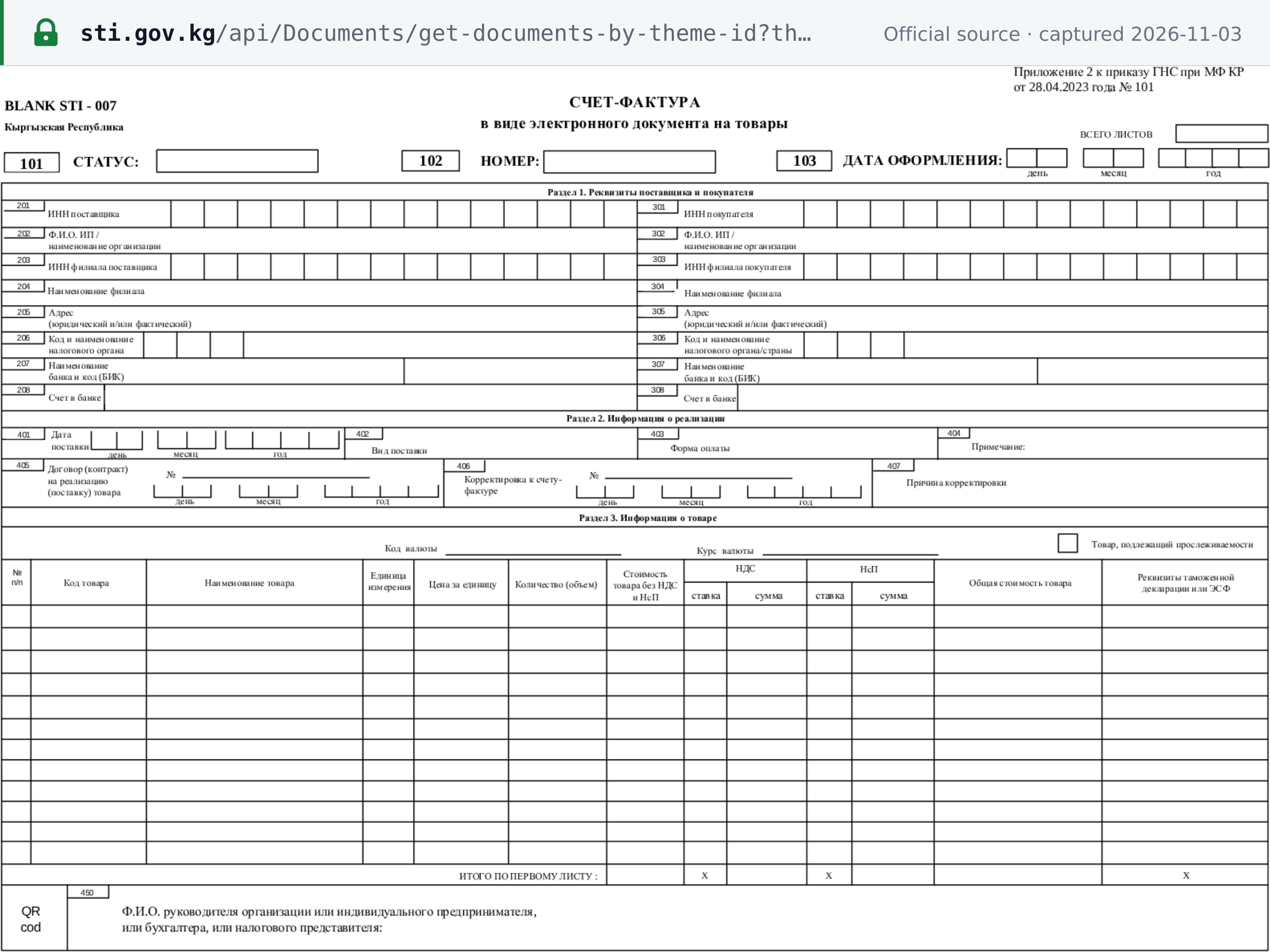 Source snapshot captured 2026-11-03 — original (State Tax Service, «Электронный счет-фактура» section, «BLANK формы счет-фактур»: BLANK STI-007)
Below, Lookuptax fills the main cells of that form for an illustrative domestic sale of goods by a general-regime trader, at 12% VAT and 1% sales tax. Every name, number and amount is fictional:
Счет-фактура в виде электронного документа на товары (ESF, BLANK STI-007) — illustrative
| Goods codepara 40(4) | Descriptionpara 40(5) | Unitpara 40(6) | Unit price, KGSpara 40(7) | Qtypara 40(8) | Value excl. VAT and НсП, KGSpara 40(9) | VAT rate / amountpara 40(10) | НсП rate / amountpara 40(11) | Total value, KGSpara 40(12) |
|---|---|---|---|---|---|---|---|---|
| 0000000001 (placeholder) | Office chairs, model EX-1 | pcs | 2,500.00 | 4 | 10,000.00 | 12% / 1,200.00 | 1% / 100.00 | 11,300.00 |
| 0000000002 (placeholder) | Office desks, model EX-2 | pcs | 4,000.00 | 2 | 8,000.00 | 12% / 960.00 | 1% / 80.00 | 9,040.00 |
- Value excl. VAT and sales taxTax Code Art 308(1)
- KGS 18,000.00
- VAT 12%Art 254(1)
- KGS 2,160.00
- Sales tax (НсП) 1%Art 368(1)(1)(а)
- KGS 180.00
- Total valueSection 3 total
- KGS 20,340.00
- 450. Name of the head of the organisation, the accountant or the tax representative who signs with a qualified electronic signature — Order 101, paras 15–16.
- Amounts in soms and tyiyns — Order 101, para 5.
- Goods at a different VAT or sales-tax rate would go on a separate ESF — Order 101, para 40(10)–(11).
- The buyer accepts or rejects within ten calendar days; silence counts as acceptance — Res. 141, paras 21–22.
- A price change or return is made by a corrective ESF quoting this ESF number — Order 101, paras 38–39.
E-invoicing status
Status (as at 2026-11-03): mandatory for VAT payers. The ESF is the default form of invoice for every VAT payer (Tax Code Article 178(2) and (7)), and other taxpayers must use it in cases the Cabinet of Ministers sets (Article 178(11)). [1]
- System: the State Tax Service's ESF information system (ИС ЭСФ) at esf.salyk.kg. Invoices are created, numbered and signed inside the system and delivered to the buyer's profile, where the buyer accepts or rejects them.
- Access: through the taxpayer profile, one at a time or by batch upload, or through an external interface: "внешний программный интерфейс, позволяющий учетным системам налогоплательщика выполнять в ИС ЭСФ все операции, предусмотренные в профиле налогоплательщика" (an external API that lets the taxpayer's accounting system perform every operation available in the profile) (Resolution No. 141, para 13). [3]
- Format: the system's own form and code lists (supply types, tax-rate codes, currencies, countries), published by the State Tax Service in its «Электронный счет-фактура» section. The State Tax Service publishes no Peppol or UBL profile for the ESF (checked 2026-11-03).
- Scope: B2B and B2G under the general rule; B2C through cash-register receipts plus a monthly consolidated ESF (Order No. 101, Annex 1, para 8).
- Who need not issue ESFs: the State Tax Service's guidance of 28 October 2025 lists, among others, unified-tax payers at the 0% rate (individual entrepreneurs with income of up to KGS 15 million a year), patent holders selling to individuals, farmers selling their own produce, unified-tax payers selling only to individuals, traders paying unified tax at 0.5%, and special trade-zone payers. [8]
ESF 2.0 pilot (from 1 September 2026). The State Tax Service announced on 18 September 2026: "С 1 сентября 2026 года сроком на шесть месяцев введено пилотное применение ЭСФ 2.0 в соответствии с распоряжением Кабинета Министров Кыргызской Республики от 16 сентября 2026 года № 705-т." (From 1 September 2026, ESF 2.0 is applied as a six-month pilot under Cabinet of Ministers Order No. 705-т of 16 September 2026.) [5]
- Mandatory in the pilot only for "нефть и нефтепродукты; уголь; алкогольная продукция; табачная продукция" (oil and oil products; coal; alcohol; tobacco); other taxpayers may join voluntarily.
- No tax effect: "Документы, оформленные через ЭСФ 2.0 в период пилотного проекта, не являются основанием для возникновения, изменения или прекращения налоговых обязательств." (Documents issued through ESF 2.0 during the pilot do not create, change or end tax obligations.) The existing ESF system continues to govern VAT.
- What it adds: a virtual warehouse for stock accounting and a catalogue of goods, works and services.
- What next: the State Tax Service has announced no date for ESF 2.0 to replace the current system (checked 2026-11-03). Six months from 1 September 2026 would run to the end of February 2027.
For how Kyrgyzstan compares with other countries, see e-invoicing status and networks worldwide.
Filing and payment
Filing frequency
Monthly for every VAT payer: the tax period for taxable supplies is "один календарный месяц" (one calendar month) (Article 313(1)). Turnover does not change it. The only quarterly filers are the foreign e-service and e-commerce sellers registered on vat.salyk.kg (Article 313(2)). [1]
Return and payment due date
Article 319, as worded by Law No. 243 of 29 October 2025: "1. Налоговая отчетность по НДС представляется налоговому органу по месту текущего налогового учета: 1) не позднее 25 числа месяца, следующего за отчетным налоговым периодом, - налогоплательщиком НДС или налоговым агентом, не администрируемым функциональным подразделением уполномоченного налогового органа; 2) не позднее последнего дня месяца, следующего за отчетным налоговым периодом, - налогоплательщиком НДС или налоговым агентом, администрируемым функциональным подразделением уполномоченного налогового органа. 2. НДС уплачивается не позднее 25 числа месяца, следующего за отчетным налоговым периодом." [1]
1. The VAT return is filed with the tax office: by the 25th of the month after the tax period, by a VAT payer or tax agent not administered by a functional unit of the tax authority; by the last day of the month after the tax period, by one that is. 2. VAT is paid by the 25th of the month after the tax period.
As at 2026-11-03:
- Return: by the 25th of the following month; by the last day of the following month for taxpayers administered by a functional unit of the tax authority, which include the foreign e-service suppliers.
- Payment: by the 25th of the following month in every case.
- How: returns are filed electronically through the tax service's information system (Article 100), in practice the taxpayer cabinet.
- Extension: on a written application before the due date, the tax office extends the filing deadline by 30 days; "Продление срока представления налоговой отчетности не изменяет срока уплаты налога" (the extension does not change the payment date) (Article 102(1)–(2)). It is not available for the EAEU indirect-tax return (Article 102(3)). [1]
- Other deadlines on the same supplies: sales tax paid and reported monthly by the 20th (Article 371(1) and (3)), or quarterly by the 20th of the month after the quarter for small businesses (Article 371(2) and (4)); VAT on imports from EAEU states by the 20th of the month after import (Article 320).
Additional listings
The VAT return carries registers of supplies and purchases that list each ESF by its number (State Tax Service, VAT questions and answers). [3] Imports from EAEU states are declared on the separate indirect-tax return (Article 320(1)).
Input-tax recovery
A VAT payer credits VAT on purchases used for taxable supplies (Article 315). The conditions in Article 315(3) include actual purchase from a VAT payer, a properly issued invoice, and payment by non-cash means. [1]
Blocked (Article 316), among others:
- purchases not used for taxable supplies;
- leisure and entertainment, unless that is the business;
- losses above natural-loss norms;
- "по недействительному счету-фактуре; … по счету-фактуре, в котором не заполнены все обязательные реквизиты" (on an invalid invoice; on an invoice in which not all mandatory particulars are filled in) (Article 316(2));
- "материальные ресурсы, приобретенные на территории Кыргызской Республики за оплату в наличной форме и/или по товарообменной (бартерной) операции" (purchases in Kyrgyzstan paid in cash or by barter) (Article 316(5)). [1]
Apportionment (Article 317). If exempt supplies in the period are no more than 5% of all supplies, input VAT is credited in full. Otherwise, VAT on purchases for exempt supplies is not credited, and the remainder is apportioned. [1]
Refunds
- Default: carried forward. Excess input VAT is set first against VAT late-payment penalties (пеня) and sanctions, then against the next period's VAT; on application it can also be set against import VAT or VAT due as tax agent (Article 326).
- Cash refunds are for zero-rated supplies, on the conditions in Article 327.
- Fast track (Article 328). Available to a VAT payer whose zero-rated supplies over the last 12 calendar months are "не менее 40 миллионов сомов" (at least KGS 40 million) and whose own fixed assets are "не менее 15 миллионов сомов" (at least KGS 15 million), among other conditions, as at 2026-11-03. The tax office decides within 5 working days of the application, and the refund is paid "в течение 5 рабочих дней, следующих за днем вынесения решения" (within 5 working days after the decision) (Article 328(3)).
- Standard route: a decision to open a desk audit of the claim within 10 working days of the application (Article 329(1)). [1]
- Non-residents: the Tax Code has no refund scheme for foreign businesses, and foreign e-service suppliers cannot credit input VAT (Article 315(7)).
Exemptions
Exempt supplies
Articles 265–296 list the exempt supplies. Examples: [1]
- sale and rental of residential property, land, and the transfer of a business between VAT payers (Article 265);
- medical goods and services (Article 268);
- "Поставка финансовых услуг является поставкой, освобожденной от НДС" (financial services) (Article 270(1)), and insurance (Article 273);
- "Транспортные пассажирские перевозки на территории Кыргызской Республики" (domestic passenger transport) and international rail carriage (Article 275);
- textbooks, scientific and literary books, children's publications and journals in the state language (Article 276), pre-school and school education (Article 282) and charitable supplies (Article 281);
- Kyrgyz-made agricultural machinery (Article 290) and fully electric vehicles up to five years old and their components (Article 291).
Any supply whose place of supply is outside Kyrgyzstan is also exempt (Article 251(5)). The sale of virtual assets is not subject to VAT at all (Article 257(2)).
Exempt is not zero-rated. An exempt supply carries no VAT, and "не подлежит зачету сумма НДС за приобретаемые материальные ресурсы, предназначенные для создания освобожденных поставок" (VAT on purchases for exempt supplies is not credited) (Article 317(2)), subject to the 5% rule above. A zero-rated supply is taxable at 0%: the VAT on its inputs is credited and can be refunded (Articles 327–328). [1]
Special regimes
Section XIV of the Tax Code sets the special regimes. Each one-line pointer below is as at 2026-11-03:
- Unified tax (simplified system, Chapter 57) — replaces profit tax, sales tax and VAT on taxable supplies (see Registration threshold); 0.1% for activity carried out outside Kyrgyzstan (Article 423(6-1)).
- Patent (Chapter 56).
- Free economic zones (Chapter 58) — supplies under Article 430(2) are zero-rated (Article 254(2)).
- High-Technology Park (Chapter 59) — residents are released from the tax-agent duty on foreign services (Article 53(8)).
- Tax on e-commerce activity (Chapter 61), special trade zones (Chapter 63) and other sector regimes.
Offences and penalties
Offences
- What a tax offence is. "Нарушением налогового законодательства Кыргызской Республики или налоговым правонарушением является виновно-совершенное противоправное деяние (действие или бездействие) участника налоговых правоотношений" (a culpable unlawful act or omission by a participant in tax relations) (Article 155). Liability is set by the Tax Code, the law on offences and the criminal law (Article 156(2)). [1]
- Failure to register. The Tax Code's separate sanction for evading registration (Article 162) was repealed by Law No. 37 of 12 February 2025. A business that should have registered is treated as VAT-registered from the month after it was obliged to (Article 255(3)), and owes the VAT with late-payment penalties (пеня) and sanctions.
- Fictitious and invalid invoices. VAT credited on an invalid invoice is disallowed (Article 316(2)) and, where a field audit finds it, attracts the 100% sanction below (Article 163(3)). The State Tax Service published warnings on fictitious ESFs in January, February and April 2026.
- ESF access. The tax service can suspend a taxpayer's use of the ESF system and declare ESFs invalid (Order No. 101, Annexes 6 and 7).
Penalties
Tax Code Articles 82, 163 and 164, as at 2026-11-03: [1]
| Failure | Consequence | Tax Code |
|---|---|---|
| Late payment | Late-payment penalty (пеня) of 0.09% of the arrears for each day late, from the day after the due date, capped at 100% of the arrears | Art 82(3)–(6) |
| Late or missing return | 70 calculation units (расчетных показателей) for an organisation, 30 for an individual entrepreneur, 10 for an individual | Art 163(1-1) |
| Return never filed, found at a field audit | The liability assessed plus a sanction of 100% | Art 163(2) |
| Under-declaration found at a field audit | Under 10% of the liability: no sanction; 10–50%: 50% of the shortfall; over 50%: 100% | Art 163(1) |
| Input VAT claimed on invalid invoices | 100% of the VAT credited | Art 163(3) |
| Tax agent not paying tax withheld | 10% of the unpaid tax for each full or part month, up to 50% | Art 164(1) |
- Late-payment penalty (пеня). Article 82(6): "Сумма пеней начисляется в размере, равном 0,09 процента размера недоимки за каждый день просрочки" (the late-payment penalty is 0.09% of the arrears for each day late); Article 82(4): "Общая сумма начисленных пеней не может превышать 100 процентов размера суммы недоимки" (total late-payment penalties cannot exceed 100% of the arrears).
- Late returns. Article 163(1-1): "За непредставление отчетов и/или расчетов, предусмотренных настоящим Кодексом … в установленные сроки, к налогоплательщику применяется налоговая санкция: 1) для физических лиц в размере 10 расчетных показателей; 2) для индивидуальных предпринимателей в размере 30 расчетных показателей; 3) для организаций в размере 70 расчетных показателей."
- Invalid invoices. Article 163(3): where a field audit finds that a taxpayer credited VAT "по недействительным счетам-фактурам, к данному налогоплательщику применяется налоговая санкция в размере 100 процентов от суммы НДС, принятой к зачету" (on invalid invoices, a sanction of 100% of the VAT credited applies).
- Relief for paying quickly (Article 72). On application, part of the late-payment penalties (пеня) and sanctions is released if the arrears are paid within set periods: for example, paying the arrears plus 30% of the late-payment penalty within 30 days of filing a corrected return releases the rest of the late-payment penalty and all of the sanction.
Frequently asked questions
Is there a turnover threshold for VAT registration in Kyrgyzstan?
Not in the Tax Code in force on 2026-11-03. Under Article 255(1), a business taxed under the general tax regime registers for VAT on the date of its tax registration if it is new, on the date it moves to the general regime if it is leaving a special regime, or from the first day of the month after it starts trading if it had not traded before. Small businesses stay outside VAT by choosing the simplified system instead: the unified tax replaces profit tax, sales tax and VAT on taxable supplies (Article 418(1)). Banks, insurers, excise payers, miners, mobile-telecom and internet businesses and some others cannot use the unified tax (Article 419(2)).
A Kyrgyz client says it must pay VAT to the budget on our consulting fee as a tax agent. Is that right?
Usually, yes. Under Tax Code Article 53(2)(5), a Kyrgyz organisation or individual entrepreneur that buys works or services whose place of supply is Kyrgyzstan from a foreign organisation or individual entrepreneur without a permanent establishment there discharges the VAT on them as tax agent. Consulting, legal, accounting, advertising, software development and electronic services supplied to a Kyrgyz business are supplied where the buyer is (Article 263). The exception is a foreign supplier of electronic services registered through vat.salyk.kg under Article 111(2): it charges and pays the VAT itself.
Can we recover input VAT on purchases we paid for in cash?
No. Tax Code Article 316(5) bars a credit for VAT on goods, works and services bought in Kyrgyzstan for cash or by barter. Article 316(2) also bars a credit on an invalid invoice and on an invoice in which not all the mandatory particulars are filled in, so a credit needs a complete electronic invoice (ESF) and a non-cash payment.
Our buyer never accepted or rejected the ESF we issued. Is it valid?
Yes. Under Cabinet of Ministers Resolution No. 141, the buyer accepts or rejects an ESF within ten calendar days of receiving it (paragraph 21). If it does neither within that time, the ESF is deemed accepted (paragraph 22). A rejected ESF is cancelled (paragraph 20). The supplier can recall an ESF the buyer has not accepted, but only within ten calendar days of issuing it (paragraphs 23 and 25).
What goes in the buyer INN cell of an ESF for a foreign customer?
Cell 301 holds the buyer's tax number. Under STS Order No. 101, Annex 1, paragraph 26: if a non-resident buyer's number is longer than 14 characters, enter the first 14; if it is 14 or shorter, enter it as it is; if the non-resident buyer has no tax number, enter the digit 9 fourteen times. The country goes in cells 305 and 306 (paragraphs 29 and 30).
Do we have to switch to ESF 2.0 now?
Only if you deal in oil and oil products, coal, alcohol or tobacco. The State Tax Service announced a six-month pilot of ESF 2.0 from 1 September 2026 under Cabinet of Ministers Order No. 705-т of 16 September 2026, mandatory in the pilot only for those goods. Documents issued through ESF 2.0 during the pilot do not create, change or end tax obligations, so the existing ESF system remains the one that counts for VAT (as at 2026-11-03).
Important websites
| Site | Purpose |
|---|---|
| State Tax Service (ГНС) | Tax authority: guidance, forms, news |
| Taxpayer cabinet | Online channel with the tax service: file returns and other electronic documents, receive notices and the registration card (Tax Code Arts 48, 113(5)) |
| ESF information system | Create, issue, receive, accept and reject ESFs |
| State Tax Service ESF section | ESF procedures (Resolution No. 141, Order No. 101), blank forms, code lists, ESF 2.0 documents |
| VAT-Office of a foreign organisation | Registration, returns and payment for foreign e-service and e-commerce sellers; apply |
| Registered foreign e-service suppliers | Check whether a foreign supplier is registered, which decides whether a Kyrgyz buyer acts as tax agent |
| Tax Code (consolidated) | VAT rules (Articles 251–330), including the rates in Article 254 |
| Kyrgyzstan INN validator | Check an INN's format |
For other countries' registers, see check a VAT number — official lookups by country.
Recent changes
- 2026-09-10 — State Tax Service Order No. П-372 amends the invoice procedure in Annex 1 to Order No. 101. (State Tax Service)
- 2026-09-01 — Six-month ESF 2.0 pilot under Cabinet of Ministers Order No. 705-т; mandatory for oil and oil products, coal, alcohol and tobacco, with no tax effect during the pilot. (State Tax Service)
- 2026-08-22 — Foreign e-commerce sales of goods to Kyrgyz consumers bear non-creditable VAT on the value of the goods, administered by the tax service (Law No. 145 of 6 August 2026; Tax Code Articles 61(1-1) and 310). (CBD) — see event
- 2026-04-28 — A corrective ESF shows the date the correcting circumstances arose instead of the original supply date (Order No. П-191 amending Order No. 101). (State Tax Service)
For the full chronology, see Kyrgyzstan tax changes on Lookuptax.
Reference links
- Tax Code of the Kyrgyz Republic of 18 January 2022 No. 3, consolidated (edition of 6 August 2026) — Ministry of Justice, Central Database of Legal Information
- State Tax Service Order No. 101 of 28 April 2023, Annex 1 «Порядок оформления и применения счета-фактуры» (as amended to Order No. П-372 of 10 September 2026), and Annex 2 forms BLANK STI-007 and STI-008 — State Tax Service, «Электронный счет-фактура» section
- Cabinet of Ministers Resolution No. 141 of 18 March 2022 «О применении счета-фактуры», Annex «Порядок формирования и обращения счета-фактуры»; State Tax Service VAT questions and answers — State Tax Service, «Электронный счет-фактура» section
- State Tax Service — VAT-Office of a foreign organisation, Information
- State Tax Service news, 18 September 2026 — ESF 2.0 pilot
- State Tax Service news, 30 April 2026 — corrective ESF and the five-working-day deadline
- State Tax Service news, 18 August 2026 — registration of foreign e-service suppliers
- State Tax Service news, 28 October 2025 — who must use the ESF
- Law of the Kyrgyz Republic No. 145 of 6 August 2026 — Ministry of Justice, Central Database of Legal Information
- State Tax Service news, 7 August 2026 — summary of Law No. 145
Related on Lookuptax: