Lesotho VAT guidelines
| FACTSHEET | |
|---|---|
| Country code | LS |
| Tax name | Value Added Tax (VAT) |
| Tax Authority | Revenue Services Lesotho (RSL) |
Overview
Lesotho levies Value Added Tax (VAT) under the Value Added Tax Act, 2001 (Act No. 9 of 2001), as amended, and the Value Added Tax Regulations, 2003 (Legal Notice No. 95 of 2003). Section 5 of the Act says "value added tax is hereby imposed on – (a) every taxable supply; and (b) every taxable import." [1] The Act and RSL use only the English name; the Act allows records to be kept "in the Sesotho or English languages". RSL describes VAT as introduced "in July 2003 to replace an old system of indirect taxation called General Sales Tax (GST)." [2]
Which text is current. The Act RSL publishes is the 2001 text as enacted. RSL publishes the VAT (Amendment) Act No. 6 of 2003 separately; it added zero rating (s.6A and Schedule IV), registration of non-residents and the rules on electronic services. [3] Rates, the threshold and the additional-tax percentages have since changed by legal notice. Each figure below cites the instrument that set it, so read the 2001 PDF together with those notices.
Authority. VAT is administered by Revenue Services Lesotho (RSL), formerly the Lesotho Revenue Authority. The 2026 e-invoicing regulations define the "Service" as "the Revenue Services Lesotho established pursuant to the Revenue Services Lesotho Act, 2001 (as amended)". [4] The Minister of Finance makes the rate and threshold regulations (s.88 and s.17(2)).
Currency. Maloti (LSL, written "M"). Section 83: "all amounts of money are to be expressed in Maloti", and a foreign-currency amount "shall be converted at the exchange rate applying between the currency and Maloti at the time the amount is taken into account". [1]
Tax period. One calendar month: "'tax period' means the period of one month ending on the last day of each of the twelve months of the calendar year" (s.3). Every vendor files monthly.
Layering. None. VAT is a single national tax. The Tobacco and Alcohol Products Levy is a separate charge, but RSL's e-invoicing system reports VAT and levies on the same invoice ("Lekuka will allow RSL to track invoices that include VAT (Value Added Tax) and Levies across the country"). [5] Lesotho is in the Southern African Customs Union (SACU); goods brought in from South Africa bear Lesotho import VAT (see Cross-border rules).
Pending legislation. The Value Added Tax (Amendment) Bill 2021 was posted on the National Assembly's bills page on 3 November 2026, marked "COPY SENT TO PARLIAMENT 26-11-2021". It would add a reverse charge on imported services, and it would come into operation "on the date to be appointed by the Minister by notice published in the Gazette". [6] No Act number or commencement notice for it appears on RSL's legal-notices list, and the bill takes effect only on a date the Minister appoints by Gazette notice, so its rules do not yet apply.
For Lesotho's neighbours, see the South Africa VAT guide and the Botswana VAT guide.
Registration
Who should register
A person who is not registered must apply to register as a vendor:
"(a) within fourteen days of the end of any period of twelve months if during that period the person made taxable supplies the taxable value of which exceeded the registration threshold set out in subsection (2); or (b) at the beginning of any period of twelve months where there are reasonable grounds to expect that the total taxable value of taxable supplies to be made by the person during that period will exceed the registration threshold" — VAT Act s.17(1) [1]
Only taxable supplies count; exempt supplies are left out. Supplies of associates are aggregated (s.17(4)(c)), and RSL's VAT 101 guide adds that "the aggregate taxable turnover of all businesses under a single legal entity is considered." [7]
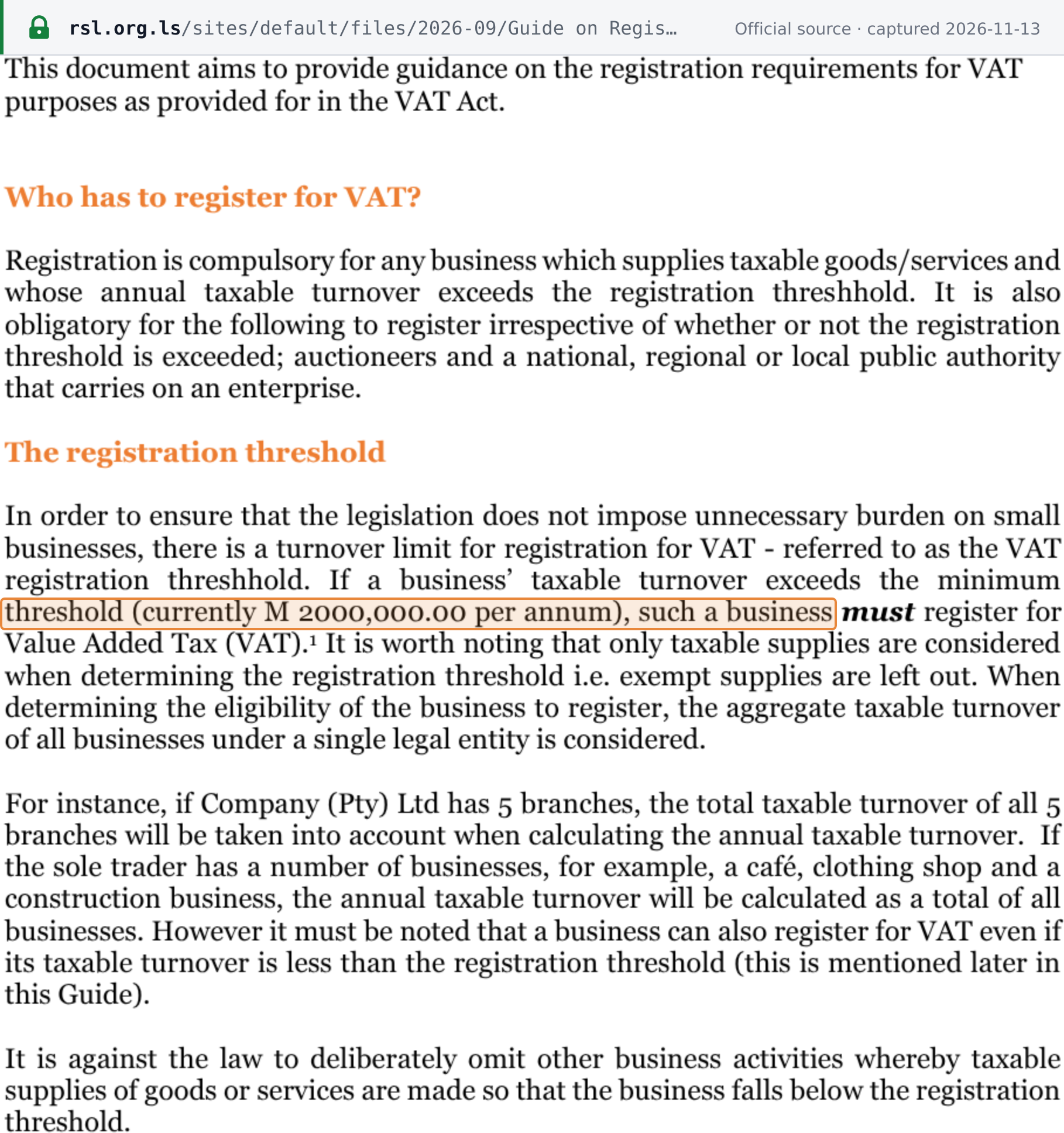
Two classes must register whatever their turnover. In RSL's words, "It is also obligatory for the following to register irrespective of whether or not the registration threshold is exceeded; auctioneers and a national, regional or local public authority that carries on an enterprise." [7]
Registration threshold
M2,000,000 of taxable turnover a year (RSL VAT 101 guide): "If a business’ taxable turnover exceeds the minimum threshold (currently M 2000,000.00 per annum), such a business must register for Value Added Tax (VAT)." [7] The measurement period is the 12-month period in s.17(1), not the calendar year.
 Source snapshot captured 2026-11-13 — original
How the figure got there:
- M850,000 from 1 April 2013. Legal Notice No. 4 of 2013: "The registration threshold in respect of the supply of goods and services shall be "M850, 000.00" with effect from the 1st of April, 2013." [8]
- 19 February 2025, Budget Speech 2025/26 (¶50): "in-order to support the small businesses, the Government shall increase the VAT registration threshold from M850,000.00 to M2 000 000.00." [9]
- 11 September 2025. The VAT (Registration Threshold of Vendors) (Amendment) Regulations, 2025 were tabled in the Senate. The Senate Legislation Committee's report of March 2026 records that the threshold "shall be M2, 000,000.00" and that the regulations repeal the 2013 notice. [10]
RSL's legal-notices list does not include the 2025 regulations, and RSL publishes neither their legal-notice number nor their commencement date. RSL's registration web page still states M850,000; its VAT 101 guide states M2,000,000, the figure in the 2025 regulations reviewed by the Senate.
Non-resident registration
No threshold. Section 17(6)(b), inserted by Act No. 6 of 2003:
"a person who carries on an enterprise outside of Lesotho but whose goods or services are consumed in Lesotho shall apply for registration in Lesotho irrespective of whether such person meets the threshold, and such registration shall be renewable annually, at the expiry of the last registration date." [3]
For foreign suppliers of electronic services, regulation 24 of the VAT Regulations, 2003 places the supply in Lesotho where the supplier "has an agency, branch, a physical address or a cash – receiving point in Lesotho, or operated for by a Lesotho resident approved by the Lesotho Authorities", and requires registration "whether such supplier makes an annual turn-over of M500,000 or not". [11] RSL's registration page tells a non-resident with a business making supplies in Lesotho to "appoint a representative who lives in Lesotho to undertake all your tax affairs."
Tax identification number
One Taxpayer Identification Number (TIN) serves income tax, customs and excise, and VAT. A VAT-registered vendor also holds a separate VAT registration number, and both appear on the registration certificate and on invoices. RSL's VAT 101 guide: "The certificate will indicate among others, the vendor's VAT registration number, the Taxpayers Identification Number (TIN) and the effective date of registration." The vendor must display it "at the business premises at a prominent position". [7]
RSL publishes no public TIN lookup. To check a number's format, use the Lesotho TIN validator.
How to register
- Get a TIN. Sole traders and individuals apply online through e-Tax ("Register now", then "Obtain TIN"). RSL's guide: "E-tax registration for obtaining TIN is available only for sole traders and individual Taxpayers. Companies follow the standard process. After registering the company with the Ministry of Trade and Industry, you'll receive a TIN from RSL." [12] The guide says the TIN arrives by email within 24 hours after submission of all relevant documents, such as the trader's licence and a bank confirmation letter. Companies upload supporting documents through eRegistration.
- Register for VAT on Form VAT1, which RSL says to obtain at your nearest RSL Digital Service Centre. Changes to registered details go on Form VAT 5.
- Display the certificate at the business premises.
Voluntary registration
At the Commissioner's discretion. A person making supplies in the course of an enterprise who is not required to register, "other than a person solely making exempt supplies", may apply, and "at the discretion of the Commissioner, the Commissioner may register the person" (s.17(5)). [1] A voluntary registrant cannot apply to deregister for its first two years (s.18(4)). RSL's 2020 interpretation note on s.17 warns that "vendors who are not yet making taxable supplies are not entitled to claim credit for input tax." [13]
Deregistration
A vendor that has ceased to make taxable supplies must apply in writing "within fourteen days after ceasing to make such supplies" (s.18(1)–(2)). A vendor whose taxable supplies over the last 12 months did not exceed the threshold may apply to deregister (s.18(3)). On cancellation the vendor "is treated as having made a taxable supply equal to the fair market value of all goods on hand (including raw materials) at the date the registration is cancelled, but only if an input tax credit was claimed with respect to the goods" (s.18(10)). Obligations for earlier periods, including returns, survive cancellation (s.18(11)). [1] [1]
Group registration
Not available. Neither the VAT Act 2001 nor the 2003 amendment Act contains a grouping provision. Associates' supplies are aggregated only to test the threshold (s.17(4)(c)).
Rates
| Rate | Applies to | Basis | In force since |
|---|---|---|---|
| 15% | Standard rate: all other taxable supplies and taxable imports | VAT Regulations 2003, reg 6(1)(c), as amended by LN 27 of 2018 | 1 April 2018 |
| 15% | Telecommunications | reg 6(1)(d), as amended by LN 18 of 2020 | 1 April 2020 |
| 10% | Electricity | reg 6(1)(b), as amended by LN 30 of 2021 | 1 April 2021 |
| 0% | Schedule IV goods (basic foods, agricultural inputs, paraffin, sanitary towels) and exports | VAT Act s.6A and Schedule IV; reg 6(a) | 2003 (sanitary towels from 1 April 2019) |
Standard rate
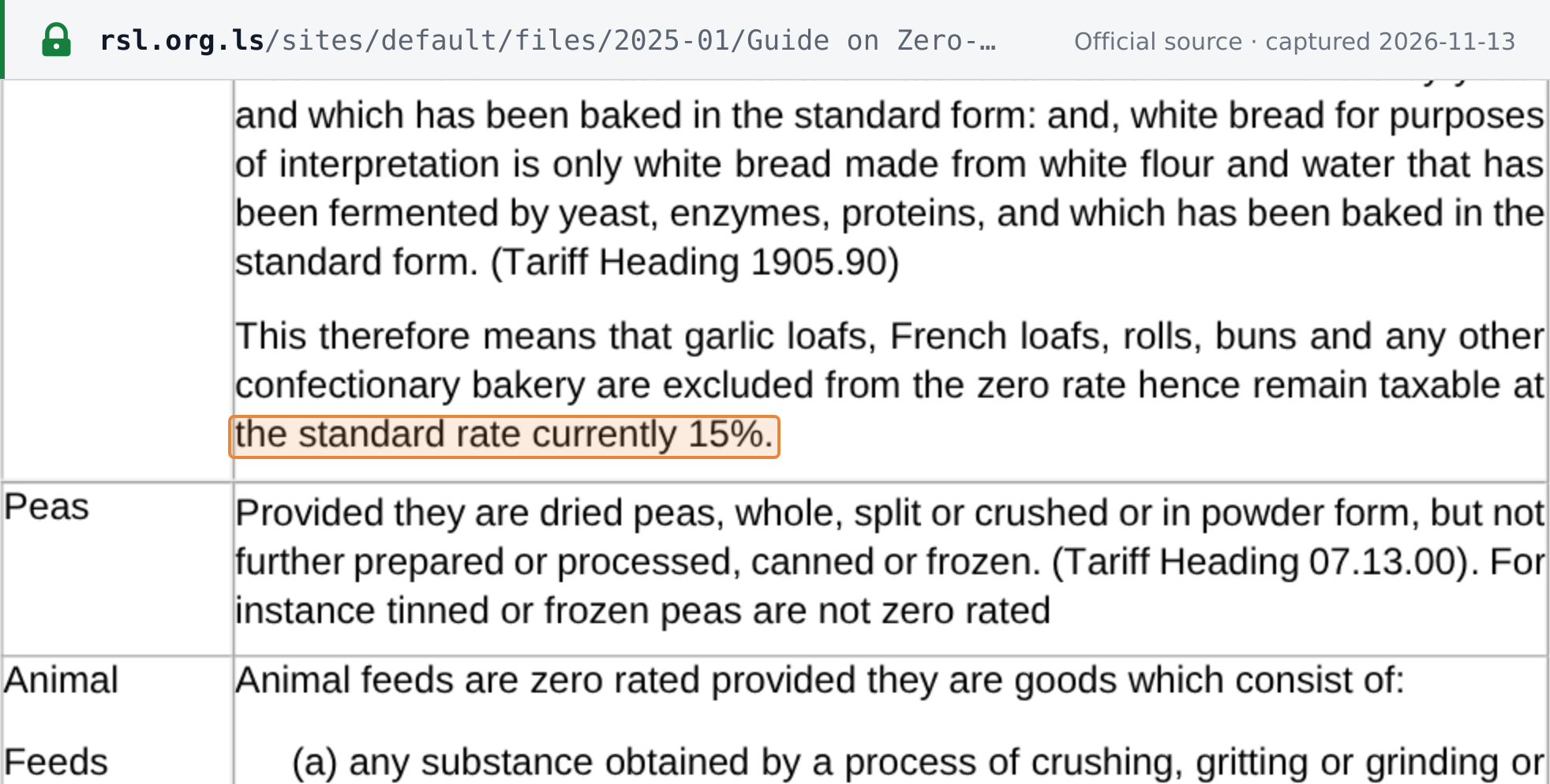
15%, since 1 April 2018. Legal Notice No. 27 of 2018, the Value Added Tax (Amendment) Regulations, 2018, came "into operation on the 1st April, 2018" and amended regulation 6 of the VAT Regulations, 2003 by "deleting "14%" in paragraph (c) and substituting "15%"". [14] RSL's current guides apply the same figure. Its Zero-rated Supplies guide says items outside the zero rate "remain taxable at the standard rate currently 15%", and its VAT 105 guide refers to "a standard rate of tax (15%)". [15]
 Source snapshot captured 2026-11-13 — original
Reduced rate: electricity
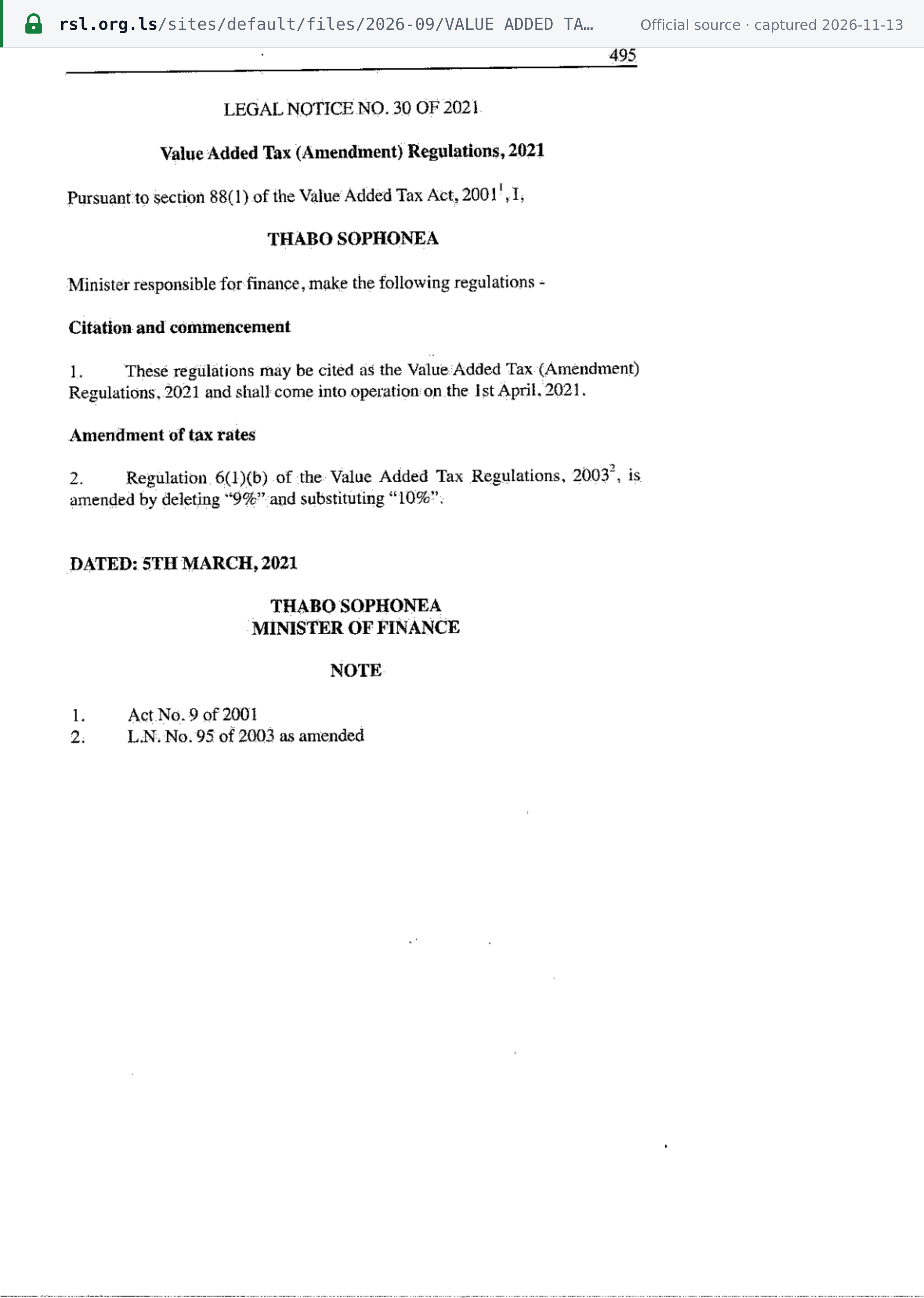
10%, since 1 April 2021. Legal Notice No. 30 of 2021 came "into operation on the 1st April, 2021" and amended "Regulation 6(1)(b) of the Value Added Tax Regulations, 2003 … by deleting "9%" and substituting "10%"". [16]
 Source snapshot captured 2026-11-13 — original
RSL publishes no consolidated text of regulation 6, so the subject of paragraph (b) comes from the amendment chain. In the text of the 2003 Regulations that RSL publishes, it reads "in the case of supplies of electricity and telephone calls, 5 %". [11] LN 48 of 2014 deleted the old paragraph (c) and renumbered, so the general rate moved to paragraph (c). [26] LN 27 of 2018 deleted "and telephone calls, 5%" and substituted "8%", leaving electricity alone in paragraph (b). LN 18 of 2020 then raised the electricity rate to 9%, and LN 30 of 2021 to 10%. [17]
Telecommunications
15%, equal to the standard rate, since 1 April 2020. LN 27 of 2018 added paragraph (d), "In case of supplies of telecommunications, 9%". LN 34 of 2019 raised it to 12% from 1 April 2019, and LN 18 of 2020 replaced "12%" in paragraph (d) with "15%" from 1 April 2020. [17] [18] Older rate lists that show 9% or 12% predate these notices.
Zero rate
"The rate of Value Added Tax imposed on an export of goods or services from Lesotho by a vendor is zero" (s.6A(1), inserted 2003). [3] Schedule IV zero-rates these goods:
"(a) agricultural input – fertilizers, seeds and pesticides; (b) beans; (c) bread; (d) lentils; (e) livestock feed and poultry feed; (f) maize (grain); (g) maize meal; (h) milk; (i) paraffin intended for use as fuel for cooking, illuminating or heating; (j) peas; (k) sorghum meal; (l) unmalted sorghum grain; (m) wheat (grain); (n) wheat flour"
LN 34 of 2019 added "(o) sanitary towels". [18] RSL's Zero-rated Supplies guide ties each item to a customs tariff heading and narrows several of them. Only full-cream milk qualifies, only plain brown and white bread, and bread flour excluding self-raising and cake flour. Garlic loaves, French loaves, rolls and buns are standard-rated. [15]
Other zero-rated supplies under s.6A(3) include certain transport services tied to imports or exports, services connected with land or movable property outside Lesotho, international passenger transport, and the transfer of a going concern between registered vendors.
Announced future rates
No VAT rate change has been announced. The 2025/26 Budget Speech changes the registration threshold and the alcohol and tobacco levies, not the VAT rates, and the newest VAT rate notice on RSL's legal-notices list is LN 30 of 2021.
Cross-border rules
Imports and exports
Imports. VAT on a taxable import "is to be paid by the importer" (s.7(1)(b)). Goods are imported when they clear customs (s.11(2)). The taxable value is the customs value, plus "the amount of customs or excise duty, or any other fiscal charge (other than value added tax payable under this Act), if any, payable on those goods", plus the value of related services (s.16(1)). [1] An import is exempt where a local supply of the same goods would be exempt, and Schedule II goods are exempt on import (s.6(3)).
Goods from South Africa. Lesotho and South Africa share the SACU customs union, so most goods cross without customs duty but still bear Lesotho import VAT. RSL's guide on paying import VAT on goods bought in South Africa lists the methods as "3.1 Valid tax invoice 3.2 Deferred payment 3.3 Cash payment 3.3.1 Cash not exceeding M2,000.00". [19] Travellers bringing in goods on which South African VAT was not refunded have a daily allowance: M250 a day, or M100 through the designated borders of Maseru, Caledon's Poort, Maputsoe, Van Rooyen's Gate and Qacha's Nek (VAT Regulations 2003, reg 19, as amended by LN 27 of 2012 from 1 April 2012). [11] [27] For the South African side of the trade, see the South Africa VAT guide.
Exports. Zero-rated (s.6A(1)). An export of goods is "the delivery of the goods to, or the making available of the goods at, an address outside Lesotho as evidenced by documentary proof acceptable to the Commissioner"; an export of services is "the supply of the services for use or consumption outside Lesotho" on the same proof (s.3). [1] Keep the customs declarations (s.48(1)(c)).
Reverse charge on imported services
The Act as amended in 2003 treats a supply of services by a person carrying on an enterprise outside Lesotho, for use or consumption in Lesotho, as an import (s.11(1)(b)). Section 7(1)(b) makes the importer pay the VAT on a taxable import, and s.3 defines the "importer" of services as the person to whom they are provided. For electronic services the 2003 text, as enacted, reads:
"(ii) where an importer of television services or Internet is an importer whose business was registered in Lesotho, then it shall be such importer who is liable to pay tax on such taxable import, and the supplier whose business is out of Lesotho" [3]
RSL publishes no separate reverse-charge return mechanics in its VAT guides. A full "supply of imported services" reverse charge (new s.4A) is in the VAT (Amendment) Bill 2021, which has not been brought into force.
Digital products and services
Since 2003 a supply by electronic means is made where the recipient uses it (s.10(3)(g)). A foreign supplier of electronic services with a Lesotho agency, branch, physical address, cash-receiving point or approved resident operator must register "whether such supplier makes an annual turn-over of M500,000 or not" (reg 24). [11] The broader "remote services" definition is in the 2021 bill, not in force.
Foreign companies selling into Lesotho — B2B and B2C
- B2C, goods or services consumed in Lesotho: the foreign seller must register irrespective of the threshold, and renew the registration each year (s.17(6)(b)).
- B2B services: the Lesotho importer pays the VAT on the import (s.7(1)(b)). Section 17(6)(b) is worded for any person whose goods or services are consumed in Lesotho; it does not distinguish business customers from consumers.
Marketplace / platform deemed-supplier liability
None. The VAT Act 2001, Act No. 6 of 2003, the VAT Regulations 2003 and RSL's VAT guides contain no rule making a marketplace or platform the deemed supplier.
Place of supply
- Goods: where delivered or made available, or, if transported, where transport begins (s.10(1)).
- Services, general rule: "at the place of business from which the services are supplied" (s.10(2)). [1]
- Where used: intellectual property rights; services of consultants, engineers, lawyers, architects and accountants; data processing and information; advertising; supply of personnel; agents; and, since 2003, electronic supplies (s.10(3)).
- Where performed: cultural, artistic, sporting and educational services, and services on movable property (s.10(4)).
- Immovable property: where the property is (s.10(5)). Transport: where it takes place (s.10(6)).
Invoice requirements
Two layers apply. The VAT Act sets the particulars of a VAT invoice (Schedule III). Since 1 April 2026 the VAT (E-Invoicing) Regulations, 2026 add device and signature particulars for invoices issued through the Lekuka system (Schedule IV; see E-invoicing status).
Mandatory content
A vendor making a taxable supply to another vendor must provide "an original value added tax invoice for the supply" (s.24(1)). Schedule III ¶1 of the Act prescribes its content: [1]
| # | Particular | Act, Sch. III ¶1 |
|---|---|---|
| 1 | The words "value added tax invoice" in a prominent place (RSL also accepts "VAT Invoice") | (a) |
| 2 | Supplier's commercial name, address, place of business and TIN | (b) |
| 3 | Recipient vendor's commercial name, address, place of business and TIN | (c) |
| 4 | Individualised invoice number and date of issue | (d) |
| 5 | Description of the goods or services and the date of supply | (e) |
| 6 | Quantity or volume | (f) |
| 7 | Either the total tax charged, the consideration and the consideration including tax; or, where tax is not shown separately, a statement that the price includes tax and the rate charged | (g) |
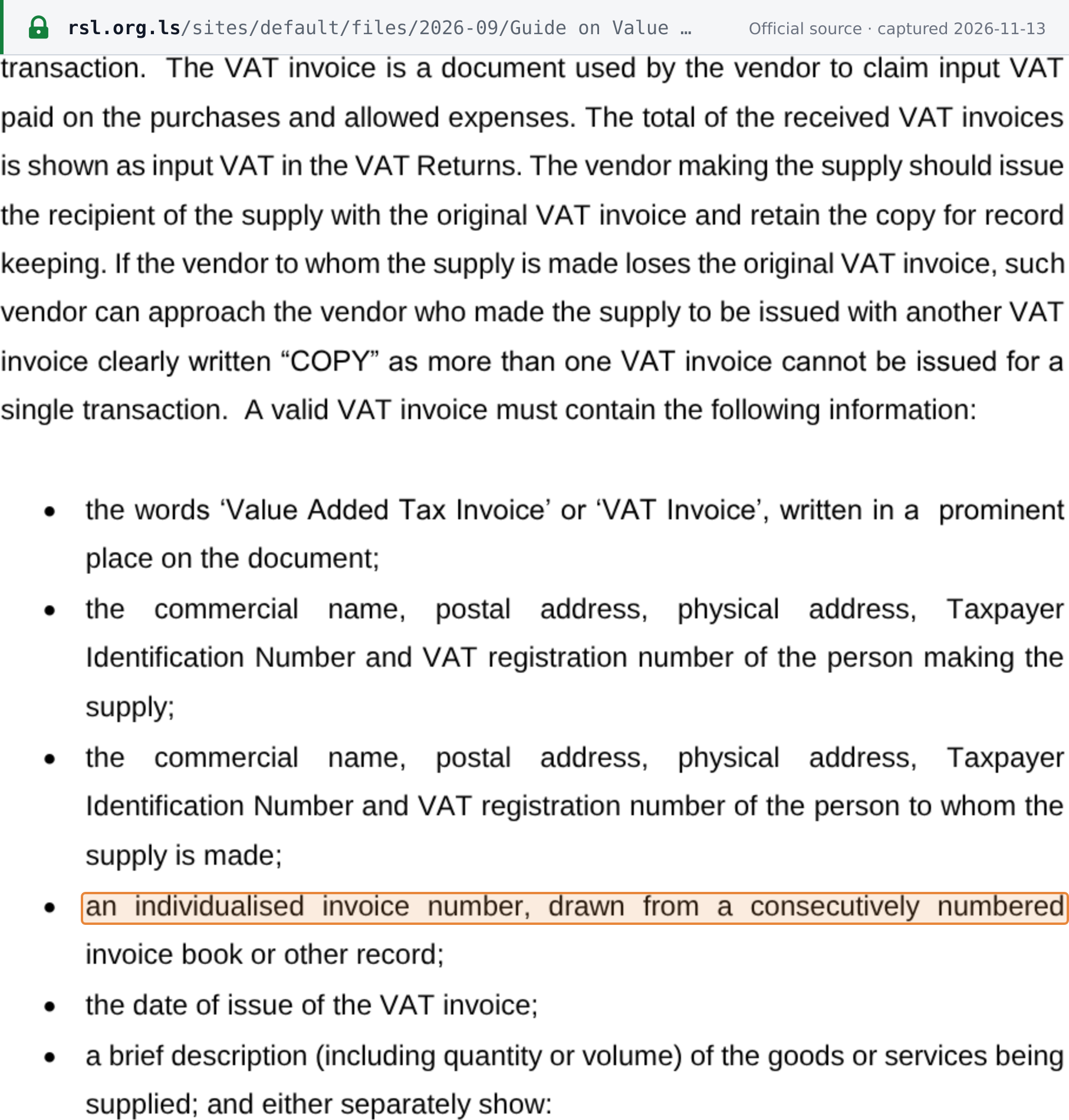
RSL's VAT 105 guide restates the list and adds the VAT registration number and the postal and physical address of both parties, and an invoice number "drawn from a consecutively numbered invoice book or other record". [20]
 Source snapshot captured 2026-11-13 — original
Pricing and display. A taxable supply between vendors is priced exclusive of tax, with the VAT "entered in a different column on the invoice" (s.86(2)). A vendor selling to a non-vendor states prices inclusive of tax and "shall disclose prominently on its invoices that the supplies are taxable or exempt from tax and, if taxable, the rate charged" (s.86(3)). [1]
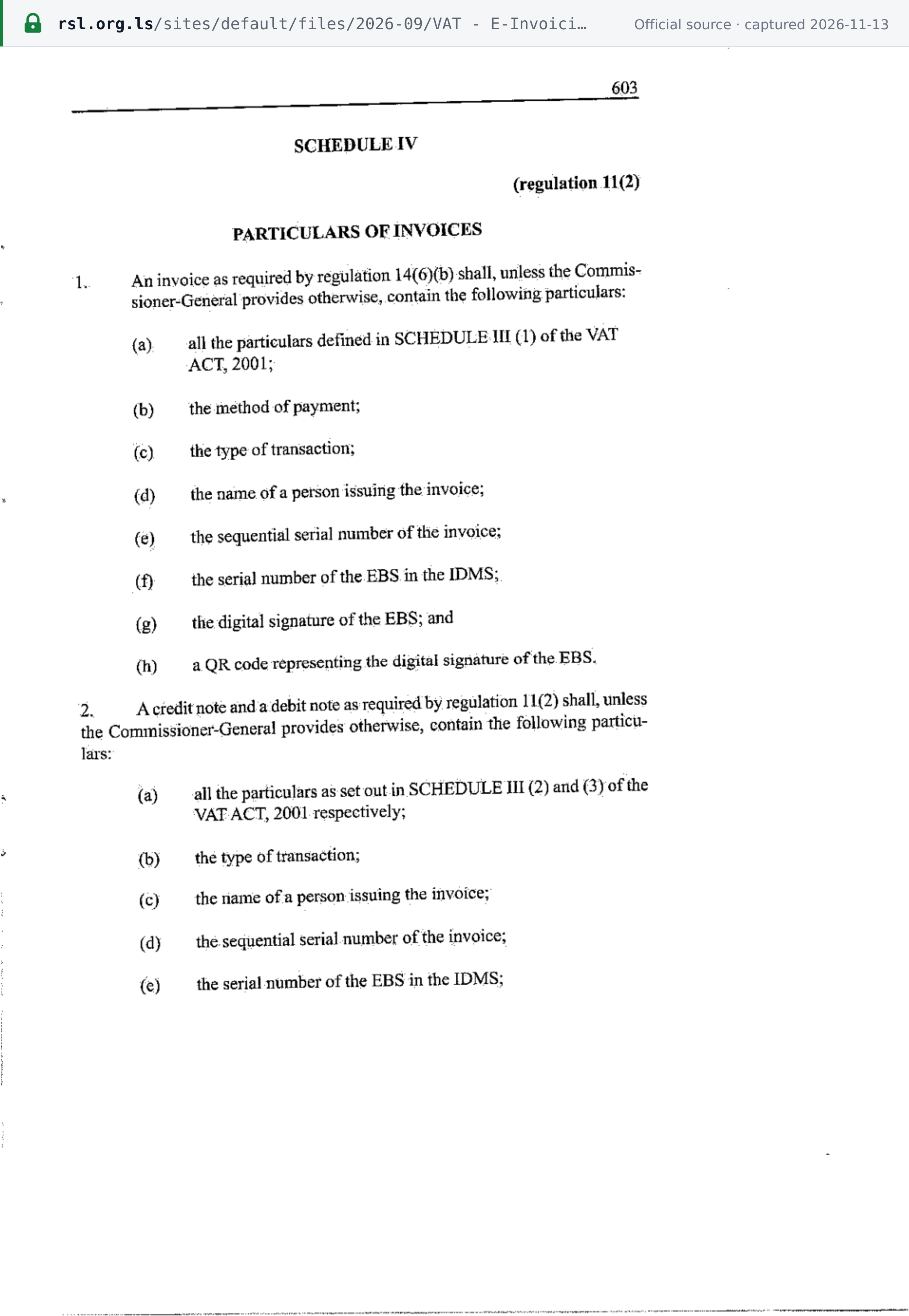
E-invoice particulars. An invoice issued under the 2026 regulations must carry, per Schedule IV ¶1: "(a) all the particulars defined in SCHEDULE III (1) of the VAT ACT, 2001; (b) the method of payment; (c) the type of transaction; (d) the name of a person issuing the invoice; (e) the sequential serial number of the invoice; (f) the serial number of the EBS in the IDMS; (g) the digital signature of the EBS; and (h) a QR code representing the digital signature of the EBS." [4] The method of payment "includes, and is not limited to; payment by cash, credit or debit card, voucher, electronic funds transfer and mobile money" (¶4). In business-to-business and business-to-government transactions the vendor must "request the customer to provide the customer's TIN" and enter it into its EBS (reg 14(11)).
 Source snapshot captured 2026-11-13 — original
Issuance deadline
The Act requires the invoice "at the time of the supply" (s.24(1)). If none is issued, the recipient may request one within 60 days of the supply, and the supplier "shall comply with the request within fourteen days after receiving that request" (s.24(5)–(6)). [1] RSL's VAT 104 guide gives a looser practice rule: "Normally, you must issue a VAT invoice within 30 days of the date you make the supply." [21] Under e-invoicing, the vendor must issue an invoice through its EBS for each transaction between the business and the customer (reg 14(4), 14(9)).
Numbering and sequencing
The invoice number must be individualised (Sch. III ¶1(d)) and, in RSL's words, drawn from a consecutively numbered invoice book or other record. Only one VAT invoice may be issued per transaction; a lost original is replaced by a copy "clearly written "COPY"" (VAT 105; s.24(9)).
Lekuka devices number every receipt with a global counter. RSL's API specification: "Device must assign receiptGlobalNo value to a receipt in a sequential order starting from 1 and continue numbering despite fiscal period close." Each fiscal day also has its own counter, and receipts must reach RSL "one by one in ascending receiptGlobalNo order, not skipping any of receipt". [22]
Credit and debit notes
A credit note is required where the VAT charged on an invoice exceeds the VAT properly chargeable, and a debit note where it falls short (s.25). Schedule III ¶2–3 prescribe the content:
- the words "credit note" or "debit note" in a prominent place;
- both parties' name, address and TIN;
- the date, the reason and a reference to the original supply;
- the taxable value on the invoice, the correct taxable value, the difference, and the VAT on the difference.
A vendor that has not received a credit or debit note within 60 days of the event may request one, and the supplier "shall comply with the request within fourteen days after receiving the request" (s.25(4)–(5)). [1] VAT 105 explains the input and output adjustments in the period the note is issued. Under e-invoicing, credit and debit notes need the Schedule III(2)/(3) particulars plus the type of transaction, the issuer, the sequential serial number, the EBS serial number and signature, and a QR code representing that signature (LN 25 of 2026, Sch. IV ¶2), and they go through Lekuka like invoices.
Currency and language
Amounts are expressed in Maloti; a foreign-currency amount is converted "at the exchange rate applying between the currency and Maloti at the time the amount is taken into account" (s.83). Records, invoices included, must be kept in Lesotho, in Sesotho or English (s.48). The Commissioner can require a translation (s.51).
Document types
- VAT invoice — vendor-to-vendor supplies (s.24).
- Tax-inclusive invoice — the Act has no separate simplified invoice with a value threshold. The tax-inclusive form in Sch. III ¶1(g)(i), a statement that the price includes tax and the rate, is the alternative.
- Retail sales — VAT 104: "If you sell directly to the public you do not need to issue a VAT invoice unless your customer asks for one." Under e-invoicing every transaction still produces an invoice from the EBS (reg 14(9)).
- Lekuka print forms — the API specification defines a Receipt48 view ("tax inclusive invoice printed on receipt paper, which can print 48 characters of text per line") and an InvoiceA4 view ("tax inclusive, or tax exclusive invoice printed on A4 paper"). The printed label is "TAX INVOICE" for a VAT-registered issuer, "INVOICE" for a non-VAT payer, or "CREDIT NOTE" / "DEBIT NOTE". [22]
- Pro-forma — must print "PRO-FORMA" below the header and "THIS IS NOT AN INVOICE" at the bottom (LN 25 of 2026, Sch. IV ¶5).
Self-billing
Not provided for. Section 24(1) puts the duty to issue on the supplier, and s.24(7) says "A value added tax invoice shall not be provided to a person in circumstances other than those specified in subsection (1) or (6)." The VAT Act, the VAT Regulations 2003, VAT 105 and the 2026 e-invoicing regulations contain no self-billing provision.
Retention and audit trail
Retention. "Records or accounts required to be maintained under this section shall be retained for as long as they remain material in the administration of this Act" (s.48(3)). The Act sets no fixed number of years; RSL's VAT 104 guide reads this as "they should be kept for as long as the business exists." [21] RSL may access books, records and computers (s.49).
Audit trail. Under e-invoicing the audit trail is built into the system:
- every invoice carries the device's digital signature, a QR code and a verification code;
- receipts are numbered globally without gaps and sent in order;
- each fiscal day is opened and closed with a daily report;
- an offline device uploads its receipts in a batch for each closed fiscal period. [22]
Vendors must report to RSL when they cannot verify that their EBS's transaction data reached RSL or was accurate, and must comply with RSL's requests to audit or inspect the EBS (reg 14(3), 14(6)). Reporting EBS defects is a duty of manufacturers and suppliers (reg 13(4)).
A specimen of a compliant invoice
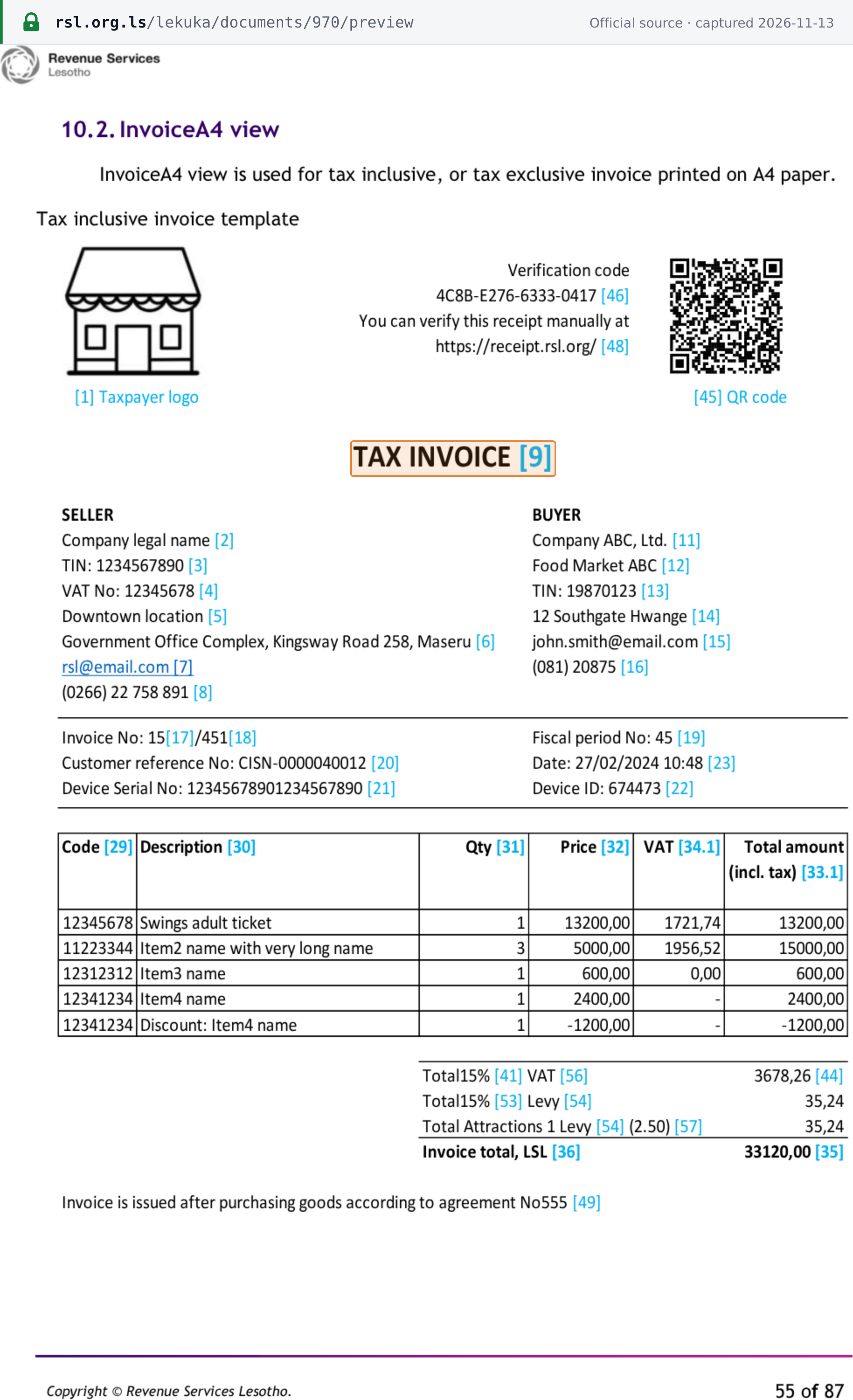
RSL publishes an official annotated specimen. Section 10.2 of its E-Invoicing Gateway API Specification v1.16 shows a tax-inclusive A4 TAX INVOICE with every field tagged by a bracketed number; section 10.3 maps each number to its meaning, its API field and whether it is mandatory. [22] The parties and figures are RSL's dummy data ("Company legal name", "Company ABC, Ltd.", TIN 1234567890).
 Source snapshot captured 2026-11-13 — original
What each part of the specimen does:
| Part of the specimen | Fields | Rule it meets |
|---|---|---|
| "TAX INVOICE" heading | [9] | Act Sch. III ¶1(a) |
| Seller block: legal name, trade name, TIN, VAT No, address | [2]–[8] | Sch. III ¶1(b); VAT 105 |
| Buyer block: name, TIN, address | [11]–[16] | Sch. III ¶1(c); reg 14(11) for B2B and B2G |
| Invoice No (fiscal-day counter / global number), fiscal period, date and time | [17]–[19], [23] | Sch. III ¶1(d); Sch. IV ¶1(e) |
| Device serial number and device ID | [21], [22] | Sch. IV ¶1(f) |
| Line items: code, description, quantity, price, VAT, total | [29]–[34.1] | Sch. III ¶1(e)–(f) |
| VAT total at 15%, levy lines, invoice total in LSL | [41]–[44], [53]–[57], [35]/[36] | Sch. III ¶1(g) |
| QR code, verification code, verification URL | [45], [46], [48] | Sch. IV ¶1(g)–(h) |
The verification URL printed on the specimen is a placeholder. Buyers check real invoices by scanning the QR code or on RSL's invoice validation portal.
E-invoicing status
Mandatory for VAT-registered vendors, per RSL, from 1 November 2026.
Legal basis. The Value Added Tax (E-Invoicing) Regulations, 2026, Legal Notice No. 25 of 2026, published in Government Gazette Vol. 71 No. 26 of 27 March 2026. Regulation 1: they "shall come into operation on the 1st April, 2026." [4]
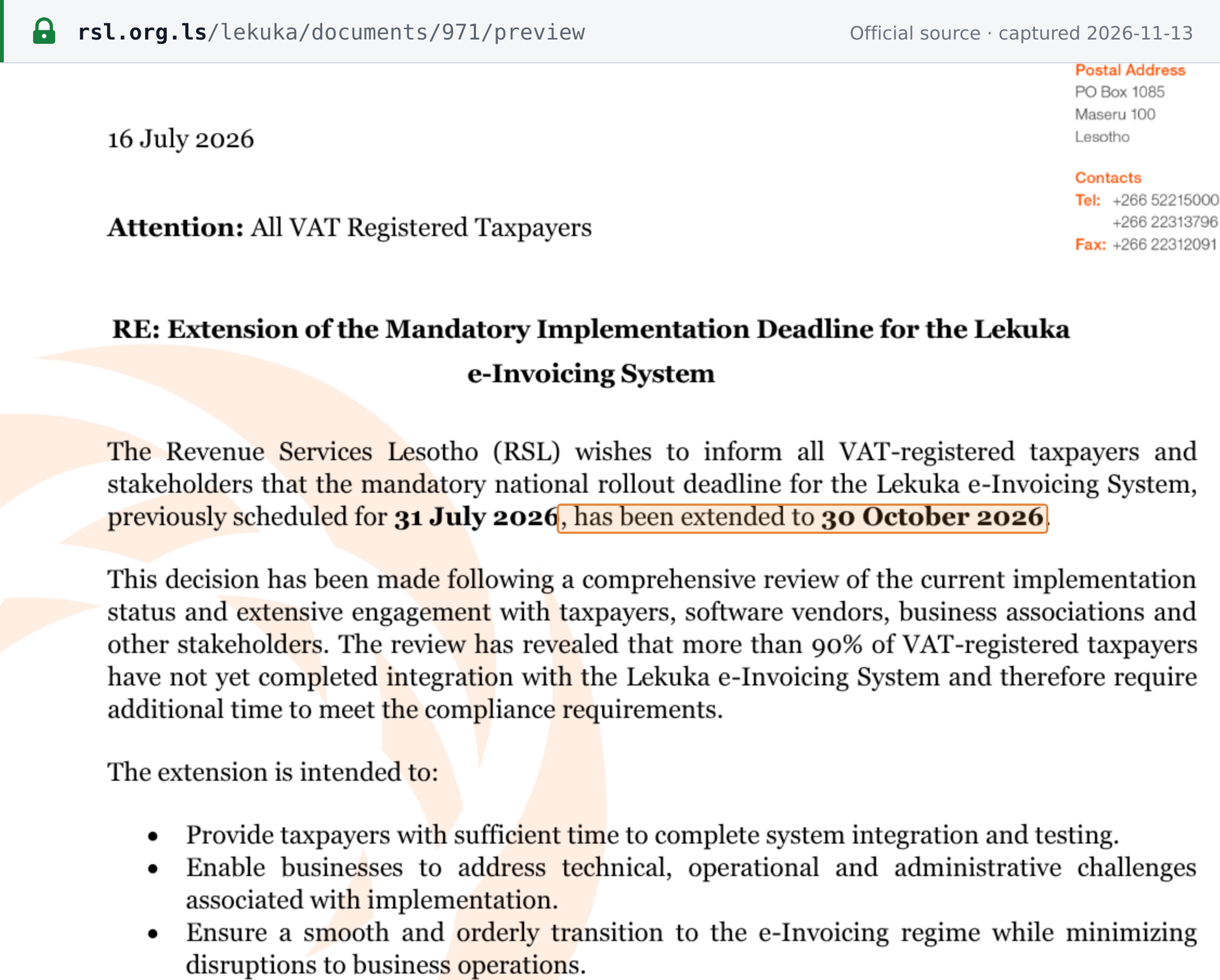
Rollout dates. RSL set the compliance date administratively, not in the regulations, which contain no rollout date. On 16 July 2026 RSL told all VAT-registered taxpayers that "the mandatory national rollout deadline for the Lekuka e-Invoicing System, previously scheduled for 31 July 2026, has been extended to 30 October 2026", because "more than 90% of VAT-registered taxpayers have not yet completed integration". [23] RSL's Lekuka documents page summarises the notice as "Every VAT registered company should use Lekuka Compliant System by 01st November 2026". [24]
 Source snapshot captured 2026-11-13 — original
Regulation 3(1) says the Commissioner-General "shall, by Notice published in the Gazette, require a vendor to use EBS that shall enable Service to securely obtain, monitor and assess accurate transaction data." No such Gazette notice appears in RSL's Lekuka documents library or on its legal-notices list. The obligation as RSL states it rests on the July 2026 notice.
System. RSL calls the system Lekuka; the regulations call it the IDMS, the "Invoice Data Management System, or E-Invoicing system". It is a real-time reporting model built on certified billing devices. It does not use an exchange network such as Peppol.
- A vendor must "acquire EBS from an accredited supplier", register it in RSL's system, and keep data connectivity so that transaction reporting to the IDMS is met (reg 14(1)).
- A vendor "shall not operate a business unless the vendor - (a) operates an EBS for the business; and (b) each EBS is accredited" (reg 14(7)).
- An EBS (Electronic Billing System) "includes an ERP system, an accounting system, a billing system, a cash register or a Point of Sale (POS) solution" (reg 2).
RSL publishes the list of accredited suppliers. [4]
Format. "E-Invoicing Gateway API exposes its methods using REST JSON interface." Devices authenticate with a device certificate over mutual TLS, open a fiscal day, submit each invoice, credit note or debit note, and close the day. [22] [22]
Scope. RSL's awareness deck: "Reporting of all VAT Taxable Transactions · Invoices (B2G, B2B, B2C) · Full and partial credit notes · Debit notes · Levy reporting within Transacted Invoices · Daily reconciliation reports". [5] B2B, B2G and B2C start together. There is no phasing by taxpayer size; the only phase was a pilot with five taxpayers from November 2025 to 31 March 2026. The deck lists onboarding of non-VAT-registered businesses as a next step, not a current duty. B2B customers must check the invoices they receive and report missing or inaccurate ones (reg 15).
For the global picture, see e-invoicing status and networks worldwide.
Filing and payment
Filing frequency
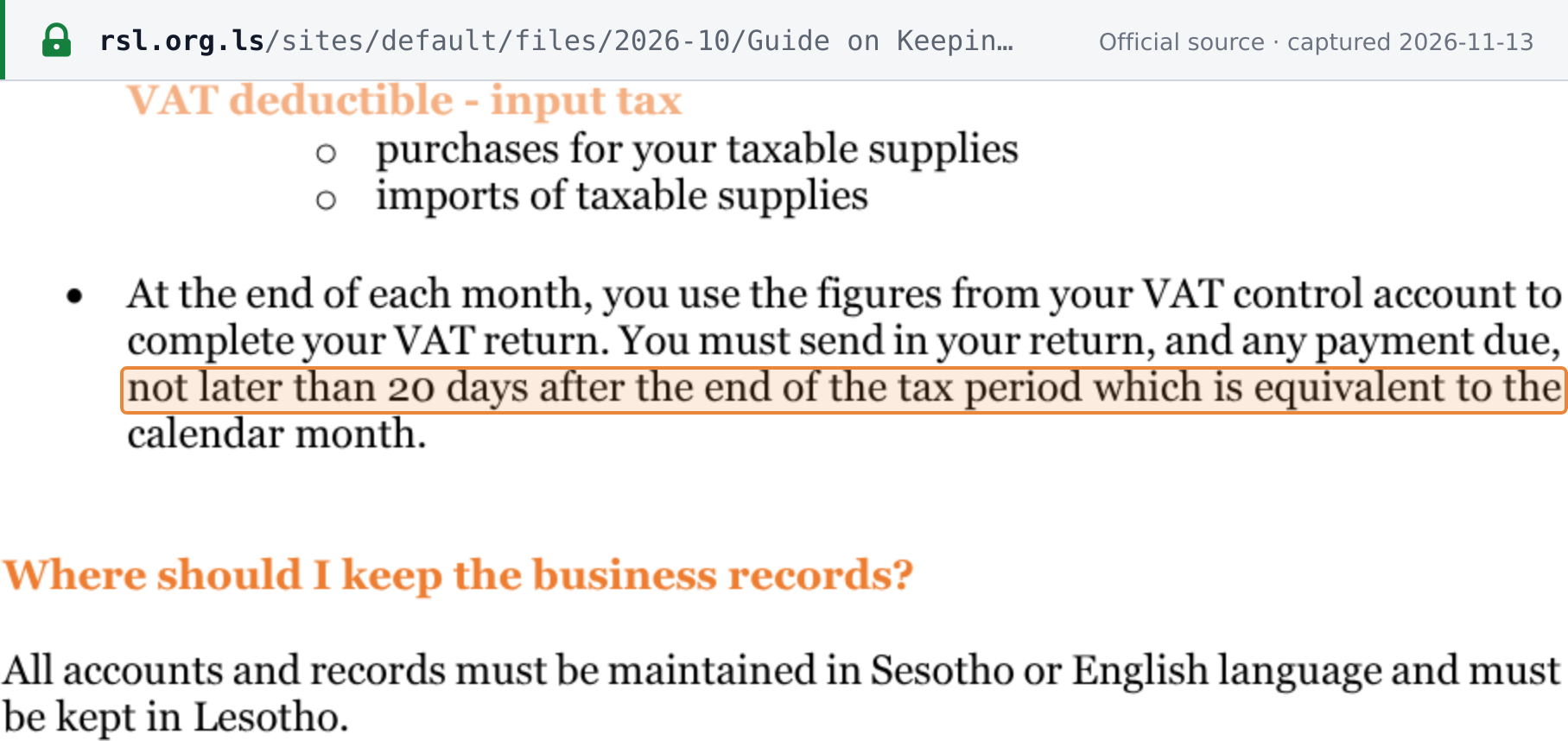
Monthly, for every vendor. The tax period is the calendar month (s.3), and the Act has no turnover band that changes it. A vendor files a return "for each tax period" (s.27(1)), and RSL's VAT 104 guide says: "You must send in your return, and any payment due, not later than 20 days after the end of the tax period which is equivalent to the calendar month." [1] [21]
Return due date
Within 20 days after the end of the month. "A vendor shall file a value added tax return for each tax period with the Commissioner within twenty days after the end of the period" (s.27(1)). [1] The return for March is due by 20 April. Returns are filed on e-Tax. [25] RSL's Lekuka deck says the system is expected to pre-populate VAT and levy returns.
 Source snapshot captured 2026-11-13 — original
The Commissioner may extend the filing period on written application where good cause is shown, but "The granting of an extension of time under subsection (4) shall not alter the due date for payment of tax under section 37" (s.27(4)–(5)).
Payment due date and method
Same day as the return: VAT is "due and payable … on the date the return for the tax period is to be filed" (s.37(1)(a)). Pay through e-Payments, by EFT or at a point of sale. If VAT is unpaid by the due date, RSL may ask the immigration authorities to stop the person leaving Lesotho (s.37(5)).
Additional listings
None. The Act and RSL's guides require no annual VAT return, sales listing or purchase listing. Under e-invoicing, the EBS sends RSL a daily reconciliation report for each fiscal day.
Input-tax recovery and blocked items
Section 23, as replaced in 2003, allows credit for input tax on supplies to, or imports by, the vendor "in the course of furtherance of an enterprise". Mixed-use inputs are apportioned. A claim needs a VAT invoice or a customs bill of entry, though the Commissioner may waive this where the invoice cannot be obtained through no fault of the vendor (s.23(4)–(5)).
Blocked. Section 23(6) as replaced in 2003:
"no input tax credit is allowable- (a) for tax on purchases of used goods if the taxable value of a taxable supply of those goods is determined under section 14(3); or (b) for any tax that is refundable under section 47; (c) for tax on purchases for non-commercial vehicles, entertainment representation and payments in kind to staff." [3]
Regulation 10(9) of the VAT Regulations 2003, in the text RSL publishes, also sets floors for utility input tax. VAT on electricity "on any amount which falls below M500,000 per annum is not allowed as credit", and for telecommunications the floor is M5,000 a year. [11]
Refunds
Resident vendors. If input tax credits exceed output VAT for a calendar quarter, the excess is first set against other VAT owed, and "the remainder of the excess shall, upon application by the vendor, be refunded to the vendor" (s.46(3)). Apply "within twenty days after the end of the calendar quarter" (s.46(5)(a)). A vendor whose excess credits are a regular feature of its business, such as an exporter, may apply for monthly refunds (s.46(4)). Other overpaid VAT can be claimed within four years (s.46(5)(b)). Refunds are applied first against VAT debts and then against income tax (s.46(2)). [1]
Non-residents. No refund scheme for unregistered foreign businesses appears in the Act or RSL's guides. Section 47 provides a separate refund for diplomats, certain contractors and listed organisations.
Bad debts. Relief for VAT paid on a supply later written off arises on the later of the write-off and 12 months after the period in which the VAT was paid; where the customer is a vendor, a credit note is needed (s.26).
Exemptions
Exempt supplies
Section 6(2) of the Act:
"(a) a supply of public postal, transportation, medical or dental, financial, insurance, or education services; (b) a supply of unimproved land; (c) a supply by way of lease or letting of immovable property where – (i) the tenant is a manufacturer; and (ii) the property is used by the manufacturer principally for carrying on a manufacturing enterprise; (d) a supply of water; and (e) any supply prescribed by the Minister in regulations as an exempt supply." [1]
The 2003 amendment Act added low-income housing schemes, employer-provided accommodation, non-profit hostels, amateur sport, non-profit cultural activities and approved charity arrangements. [3]
Exempt is not zero-rated. A zero-rated supply is a taxable supply at 0%. The vendor charges no VAT but recovers the input VAT on its costs, and s.6(4) stops a zero-rated supply from being treated as exempt. An exempt supply carries no VAT and gives no input tax credit. A person making only exempt supplies cannot register (s.17(5)), so the VAT it pays on its costs is a final cost. RSL's interpretation note on s.17 gives the example: "Examples would include commercial banks, which pay VAT on most of the goods and services that are used to supply financial services which are exempt. The input tax paid is never recovered." [13]
Special regimes
- Cash basis. "Where ninety per cent or more of the total taxable value of taxable supplies made by a vendor consists of the supply of services, the vendor may apply, in writing, to the Commissioner to calculate value added tax payable under the cash method" (s.21(1)). [1]
- Second-hand goods. "The taxable value on the supply of used goods is calculated on the difference between sales price and purchase price", and the retailer "shall not declare or show VAT in such retailer's invoice" (VAT Regulations 2003). [11]
- Free zones, flat-rate or small-business schemes. None appears in the VAT Act, the VAT Regulations 2003 or RSL's VAT guides.
Offences and penalties
Offences
The VAT Act's offences carry a fine, imprisonment, or both. The fines below are those in the Act as enacted in 2001. [1]
| Offence | Section | Fine | Imprisonment |
|---|---|---|---|
| Failure to register, notify changes or deregister — deliberate or reckless | s.59 | M4,000–M12,000 | 2–6 years |
| Failure to register, notify changes or deregister — other cases | s.59 | M2,000–M6,000 | 1–3 years |
| Failure to provide a VAT invoice, credit note or debit note | s.60(1) | M2,000–M6,000 | 1–3 years |
| Improperly issuing an invoice or note — deliberate | s.60(2)(a) | M4,000–M12,000 | 2–6 years |
| Improperly issuing an invoice or note — other cases | s.60(2)(b) | M2,000–M6,000 | 1–3 years |
| Failure to file a return or pay VAT | s.61(1) | M2,000–M6,000 | 1–3 years |
| Continuing failure after conviction | s.61(2) | M1,000 per day | plus 3 months |
| Failure to keep records | s.64 | as s.59 | as s.59 |
| Obstruction or failure to assist | s.65 | M6,000–M12,000 | 3–6 years |
| Using a false TIN or VAT number | s.67 | M4,000–M12,000 | 2–6 years |
Section 60(1) in full: "A vendor who fails to provide a value added tax invoice as required by section 24(1) or (6), or a credit or debit note as required by section 25 commits an offence and is liable on conviction to a fine not less than M2,000 but not exceeding M6,000 or to imprisonment for a term not less than 1 year but not exceeding 3 years, or both." Officers of a company that commits an offence are also liable (s.73). Advertising that VAT will be absorbed or refunded is prohibited (s.86(1)).
E-invoicing offences (LN 25 of 2026, Schedule V). For each, the Commissioner-General may impose a fixed monetary penalty or prosecute, not both (reg 16). [4]
| # | Offence | Fixed penalty | On conviction: fine up to, or up to 6 months |
|---|---|---|---|
| 1 | Manufacturer or supplier fails to report an EBS defect | M100,000 | M200,000 |
| 2 | Supplier sells a non-accredited EBS | M300,000 | M400,000 |
| 3 | Vendor issues an invoice that does not comply with Schedule IV | M50,000 | 80,000 (no currency printed in the Gazette) |
| 4 | Vendor operates a non-accredited EBS | M200,000 | M300,000 |
| 5 | Vendor fails to issue an invoice | M200,000 | M300,000 |
| 6 | Manufacturer or supplier fails to report EBS misuse | M300,000 | M400,000 |
| 7 | Supplier or vendor fails to assist an EBS audit | M100,000 | M200,000 |
| 8 | Failure to pay an administrative penalty | none listed | M500,000 |
Penalties
Additional tax under Part VII of the Act:
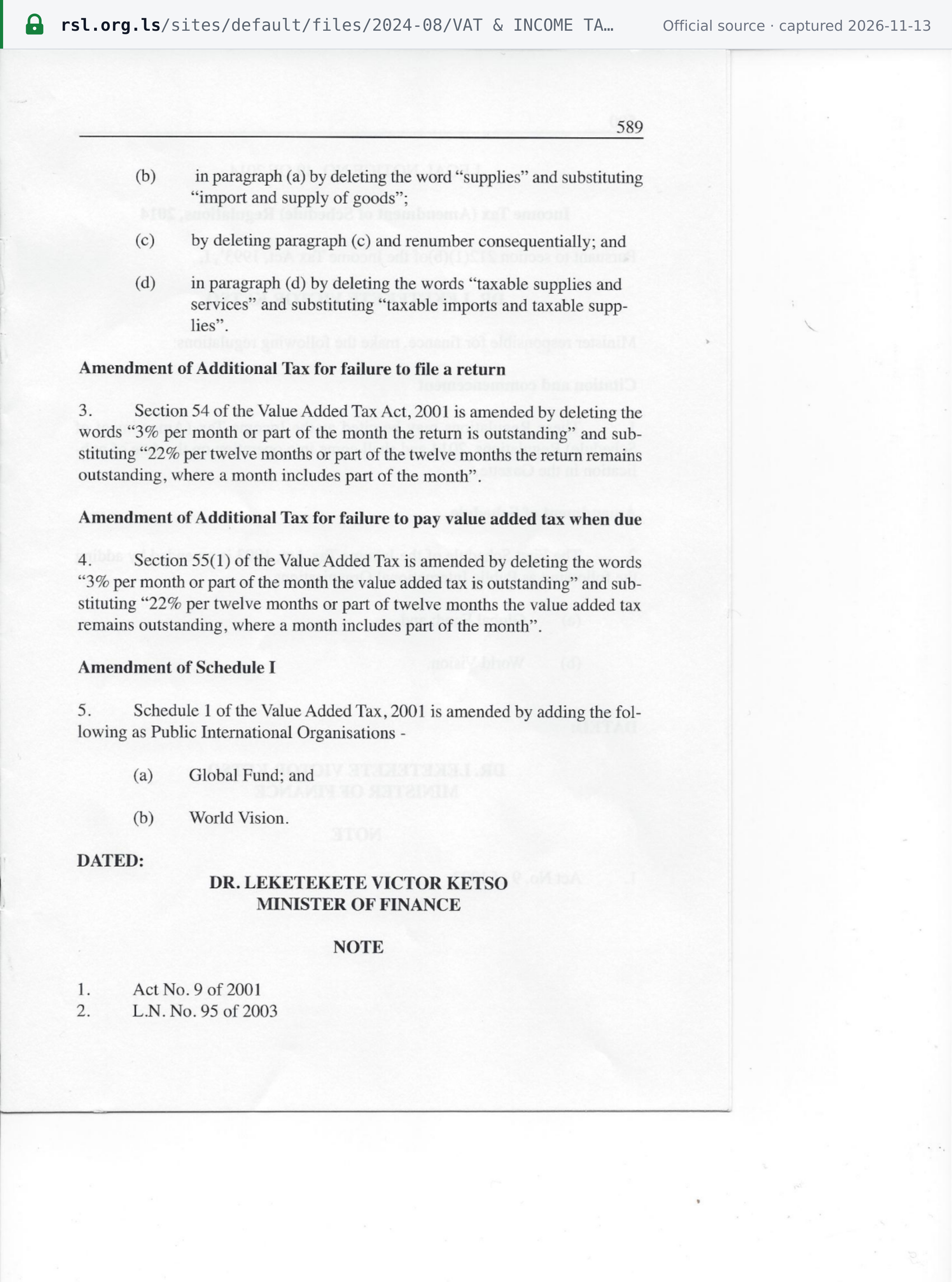
- Late filing: 22% a year of the VAT payable, "per twelve months or part of the twelve months the return remains outstanding, where a month includes part of the month" (s.54, as amended by Legal Notice No. 48 of 2014).
- Late payment: 22% a year on the unpaid VAT, on the same basis (s.55(1), as amended by LN 48 of 2014). [26]
- Failure to register: additional tax "equal to double the amount of value added tax payable" from the date registration was due until the person applies or is registered (s.53). RSL's VAT 101 calls this "200% of the unaccounted tax liability."
- Failure to keep proper records: double the VAT payable for the period (s.56).
- False or misleading statements: double the tax shortfall (s.57).
The Commissioner may remit additional tax for good cause (s.58(1)). It is not charged under ss.53, 56 or 57 if the person is convicted under ss.59, 64 or 70 for the same act (s.58(3)).
 Source snapshot captured 2026-11-13 — original
The copy of the Act RSL publishes still prints "3% per month" in ss.54 and 55, because it is the unconsolidated 2001 text. The 22% figure is the current one.
Frequently asked questions
Do VAT-registered businesses in Lesotho have to use a Lekuka e-invoicing system now?
Yes, according to RSL. The VAT (E-Invoicing) Regulations, 2026 (Legal Notice No. 25 of 2026) came into operation on 1 April 2026. RSL's signed notice of 16 July 2026 extended the mandatory national rollout deadline for the Lekuka e-Invoicing System from 31 July 2026 to 30 October 2026, and RSL's Lekuka documents page says every VAT-registered company should use a Lekuka-compliant system by 1 November 2026. The system must be an Electronic Billing System (EBS) bought from an RSL-accredited supplier and registered with RSL. Regulation 3(1) also provides for a Commissioner-General notice in the Gazette requiring vendors to use an EBS; no such notice appears in RSL's Lekuka documents library or its legal-notices list.
Is the Lesotho VAT registration threshold M850,000 or M2,000,000?
M2,000,000 of taxable turnover a year, according to RSL's VAT 101 registration guide ("currently M 2000,000.00 per annum"). The 2025/26 Budget Speech of 19 February 2025 announced the increase from M850,000, and the VAT (Registration Threshold of Vendors) (Amendment) Regulations, 2025 were tabled in the Senate on 11 September 2025. RSL's registration web page still shows M850,000, the figure set from 1 April 2013 by Legal Notice No. 4 of 2013. RSL does not publish the legal-notice number or the commencement date of the 2025 regulations.
Is VAT on telecommunications in Lesotho 9%, 12% or 15%?
15%, since 1 April 2020. The telecommunications rate in regulation 6 of the VAT Regulations, 2003 was 9% from 1 April 2018 (Legal Notice No. 27 of 2018), 12% from 1 April 2019 (Legal Notice No. 34 of 2019) and 15% from 1 April 2020 (Legal Notice No. 18 of 2020). The one positive rate below 15% is 10% on electricity, in force since 1 April 2021 (Legal Notice No. 30 of 2021).
What must a Lekuka invoice show beyond the ordinary VAT invoice particulars?
Schedule IV of the VAT (E-Invoicing) Regulations, 2026 requires all the Schedule III(1) particulars of the VAT Act plus the method of payment, the type of transaction, the name of the person issuing the invoice, the sequential serial number of the invoice, the serial number of the EBS in the IDMS, the digital signature of the EBS and a QR code representing that digital signature. In business-to-business and business-to-government transactions the vendor must ask for the customer's TIN and enter it into the EBS (regulation 14(11)).
Does a foreign business selling into Lesotho have to register for VAT?
Section 17(6)(b) of the VAT Act, inserted in 2003, requires a person who carries on an enterprise outside Lesotho but whose goods or services are consumed in Lesotho to apply for registration irrespective of the threshold, and the registration is renewable annually. For services bought by a Lesotho business, the Act makes the importer pay the VAT on the taxable import (section 7(1)(b)). A fuller reverse-charge regime for imported services is in the Value Added Tax (Amendment) Bill 2021, which has not been brought into force.
Can we pay Lesotho import VAT on goods bought in South Africa with the South African tax invoice?
RSL's guide on payment of import VAT on goods purchased from South Africa lists three methods: a valid tax invoice, deferred payment, and cash, with cash limited to M2,000.00. The goods are still a taxable import: the VAT Act values them at their customs value plus duties and related charges, and the importer pays the VAT.
Important websites
| Site | Purpose |
|---|---|
| e-Tax | Obtain a TIN (sole traders and individuals) and file VAT returns |
| eRegistration | Upload company registration documents and amendments |
| e-Payments | Pay VAT |
| Lekuka taxpayer portal | E-invoicing account |
| Lekuka documents | E-invoicing regulations, API specification, rollout notice, supplier list |
| Accredited EBS suppliers | Where to buy a Lekuka-compliant billing system |
| Invoice validation portal | Check a Lekuka invoice by hand |
| RSL legal notices | Rate and threshold notices |
| National Assembly bills | Track VAT amendment bills |
| VAT registration | Form VAT1 at an RSL Digital Service Centre |
| TIN verification | RSL publishes no public TIN lookup. Check a number's format with the Lesotho TIN validator |
Recent changes
- 2026-11-01 — VAT-registered businesses must use a Lekuka-compliant EBS, per RSL, after the mandatory rollout deadline moved from 31 July 2026 to 30 October 2026. (RSL notice of 16 July 2026) — see event
- 2026-04-01 — The VAT (E-Invoicing) Regulations, 2026 (LN 25 of 2026, Gazette Vol. 71 No. 26 of 27 March 2026) come into operation. (RSL) — see event
- 2025-09-11 — The VAT (Registration Threshold of Vendors) (Amendment) Regulations, 2025, setting a M2,000,000 threshold, are tabled in the Senate; RSL's VAT 101 guide now states M2,000,000. (Senate of Lesotho)
- 2021-04-01 — The electricity rate (reg 6(1)(b)) rises from 9% to 10%. (LN 30 of 2021)
- 2020-04-01 — The telecommunications rate rises from 12% to 15%, and the electricity rate from 8% to 9%. (LN 18 of 2020)
For the full chronology, see Lesotho tax changes on Lookuptax.
Related resources
- VAT and GST rates worldwide
- VAT registration thresholds worldwide
- E-invoicing status and networks worldwide
- Lesotho TIN validator
- Neighbouring guides: South Africa · Botswana
Reference links
- Value Added Tax Act, 2001 (Act No. 9 of 2001), as enacted (RSL)
- RSL — Value Added Tax (VAT)
- Value Added Tax (Amendment) Act No. 6 of 2003 (RSL)
- Value Added Tax (E-Invoicing) Regulations, 2026 — Legal Notice No. 25 of 2026 (RSL)
- RSL — Lekuka Public Awareness Session 2026
- National Assembly of Lesotho — Value Added Tax (Amendment) Bill 2021
- RSL — Guide on Registration for Value Added Tax Purposes (VAT 101)
- Legal Notice No. 4 of 2013 — VAT registration threshold M850,000 (RSL)
- Budget Speech 2025/26, 19 February 2025 (RSL)
- Senate of Lesotho — Committee report on Value Added Tax Regulations, 2025
- Value Added Tax Regulations, 2003 — Legal Notice No. 95 of 2003 (RSL)
- RSL — Guide on e-Tax Registration
- RSL — Interpretation and Application of Section 17 of the VAT Act (executive summary)
- Value Added Tax (Amendment) Regulations, 2018 — Legal Notice No. 27 of 2018 (RSL)
- RSL — Guide on Zero-rated Supplies of Goods
- Value Added Tax (Amendment) Regulations, 2021 — Legal Notice No. 30 of 2021 (RSL)
- Value Added Tax (Amendment) Regulations, 2020 — Legal Notice No. 18 of 2020 (RSL)
- Value Added Tax (Amendment) Regulations, 2019 — Legal Notice No. 34 of 2019 (RSL)
- RSL — Guide on Payment of Import VAT on Goods Purchased from RSA
- RSL — Guide on Value Added Tax Invoice, Credit Note and Debit Note (VAT 105)
- RSL — Guide on Keeping Records and Accounts (VAT 104)
- RSL — E-Invoicing Gateway API Specification v1.16
- RSL — Extension of the Mandatory Implementation Deadline for the Lekuka e-Invoicing System (16 July 2026)
- RSL — Lekuka documents
- RSL — Guide on E-Taxation Platform (E-Filing)
- Legal Notice No. 48 of 2014 — Value Added Tax (Amendment) Regulations, 2014 (RSL)
- Legal Notice No. 27 of 2012 — VAT Regulations 2003 amended, reg 19 allowance M250 (RSL)