Liberia GST and VAT guidelines
Liberia is between two indirect taxes. The Goods and Services Tax (GST) in the Liberia Revenue Code applies today, at 13% from 1 May 2026. The Value Added Tax Law of 2024 has been enacted at a 15% rate and will replace GST in full, but the Liberia Revenue Authority had not announced its commencement as at 8 November 2026. Each section below gives the GST rule first and then what changes under VAT.
Overview
Which tax applies
- Today: Goods and Services Tax (GST). Part III, Chapter 10 of the Liberia Revenue Code imposes two taxes. The goods tax (s.1000) applies to "every taxable supply, as defined in Section 1001, by a registered manufacturer, and … every taxable import". The services tax (s.1021) applies to "every supply of taxable services in Liberia by a registered services provider". [1] The LRA describes GST as a single-stage tax, "charged only once at the point of import in case of imported goods and at manufacturing point in case of domestically produced goods and place of supply in case of services". [13]
- Next: Value Added Tax (VAT). "An Act to Amend Part III, Chapter 10, of the Revenue Code 2000 to provide for Value Added Tax replacing Goods and Services Tax (GST) was enacted by the Legislature, approved by the President, and printed into handbills on July 17, 2024", in the words of the amending Act that set its rate at 15%. That amending Act was approved by the President on 17 December 2024. [5] The LRA confirms that "The VAT Law has been approved by the Legislature, signed by the President, and printed as handbills", and that "detailed VAT Regulations, including 27 schedules, have been approved by the Government". [10] VAT is therefore enacted law. Only its start date is open (see Announced changes).
The official language is English, and the taxes have no separate local-language names.
Authority, currency, period and layering
- Authority. The Liberia Revenue Authority (LRA) administers GST and will administer VAT. Its Domestic Tax Department handles registered businesses, and Customs collects tax on imports "at the same time and subject to the same conditions as collection of customs duties" (s.1000(e)(2)). [1] Tax policy and regulations come from the Ministry of Finance and Development Planning (MFDP).
- Currency. "Dollar amounts stated in this Code are in Liberian dollars" (s.6(a)). Books may be kept in Liberian dollars (LRD) or US dollars (USD), and "Tax may be assessed either in Liberian dollars or US dollars and may be paid in Liberian dollars or US dollars". A US-dollar payment is translated "at the market rate of exchange published by the Central Bank in effect on the day payment is made". [1] The LRA homepage posts the day's tax payment rate. [25] The VAT threshold is stated in US dollars.
- Period. "For purposes of this Part, the tax period is the calendar month" (s.1045). [1]
- Layering. None. GST, and VAT after it, is a single national tax with no county or municipal layer. Customs duty, the ECOWAS Trade Levy and excise are separate charges, and they sit inside the taxable amount of an import (see Imports and exports).
Registration
Who must register today (GST)
GST registration is not universal. Two kinds of business must register:
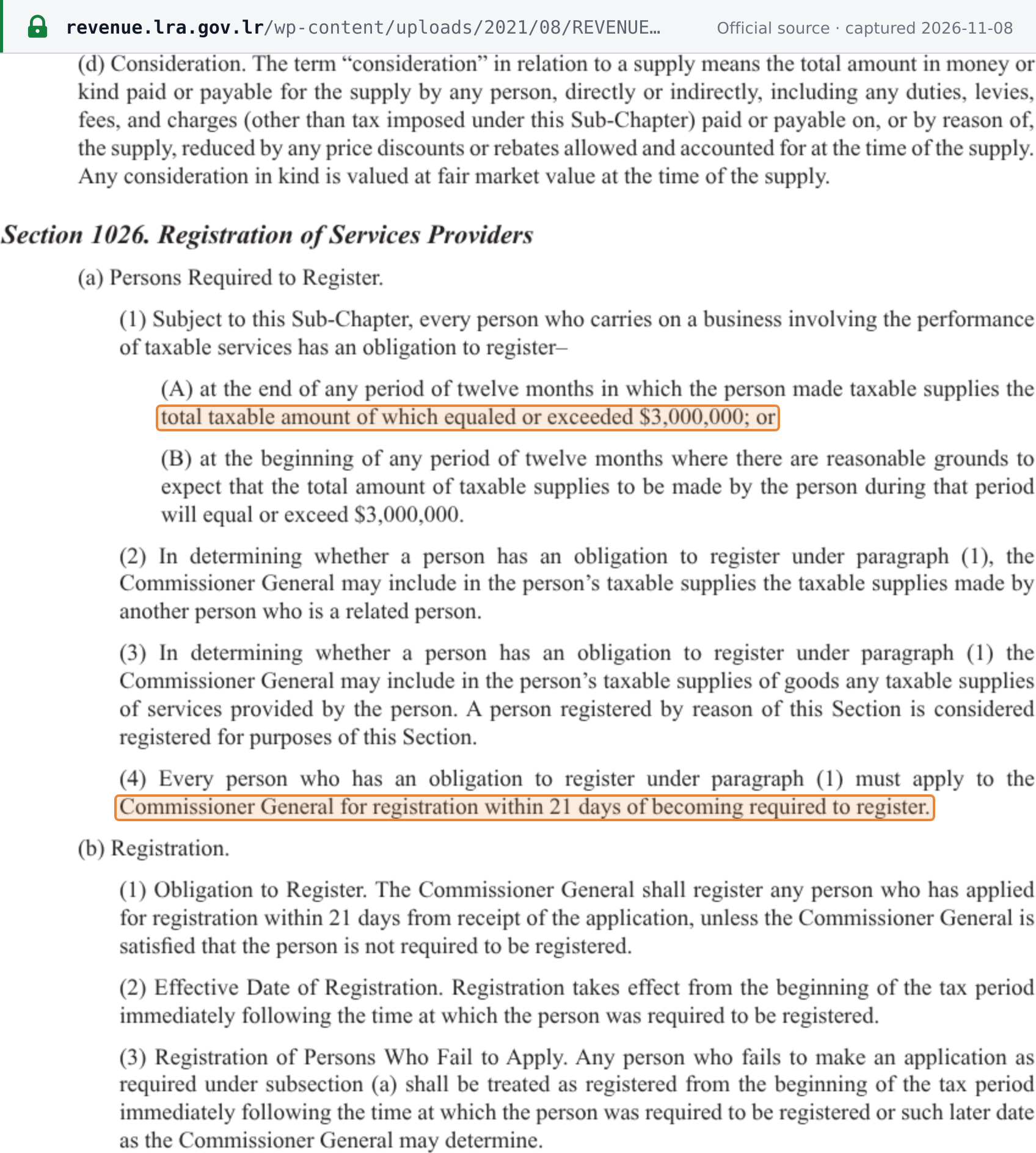
- Manufacturers (s.1006): "every person who carries on a manufacturing business has an obligation to register" at the end of any 12-month period in which its taxable supplies "equalled or exceeded $3,000,000", or at the start of a 12-month period in which it reasonably expects to reach that amount. [1]
- Providers of taxable services (s.1026): the same test, for "every person who carries on a business involving the performance of taxable services". Taxable services are the listed services in s.1022 (see What GST covers). [1]
The threshold is LRD 3,000,000 of taxable supplies in a 12-month period, because the Code's dollar amounts are Liberian dollars (s.6(a)). This is the figure in the LRA's 2020 consolidation of the Revenue Code. Section 8 of the Code provides for the Minister to adjust LRD amounts for inflation, but no adjustment notice is published on the LRA's laws page, and neither the December 2024 nor the December 2025 amending Act changes ss.1006 or 1026.
- Deadline. A business "must apply to the Commissioner General for registration within 21 days of becoming required to register" (s.1026(a)(4)).
- Failure to apply. A business that does not apply "shall be treated as registered from the beginning of the tax period immediately following the time at which the person was required to be registered" (s.1026(b)(3)).
- Related persons. The Commissioner General may add a related person's taxable supplies to yours when testing the threshold (s.1026(a)(2)).
- Importers pay goods tax on a taxable import on its arrival at the port of entry, collected with customs duties (s.1000(e)(2)). The registration duties in ss.1006 and 1026 attach to manufacturers and services providers, not to importing as such.
 Source snapshot captured 2026-11-08 — original
Who must register under VAT
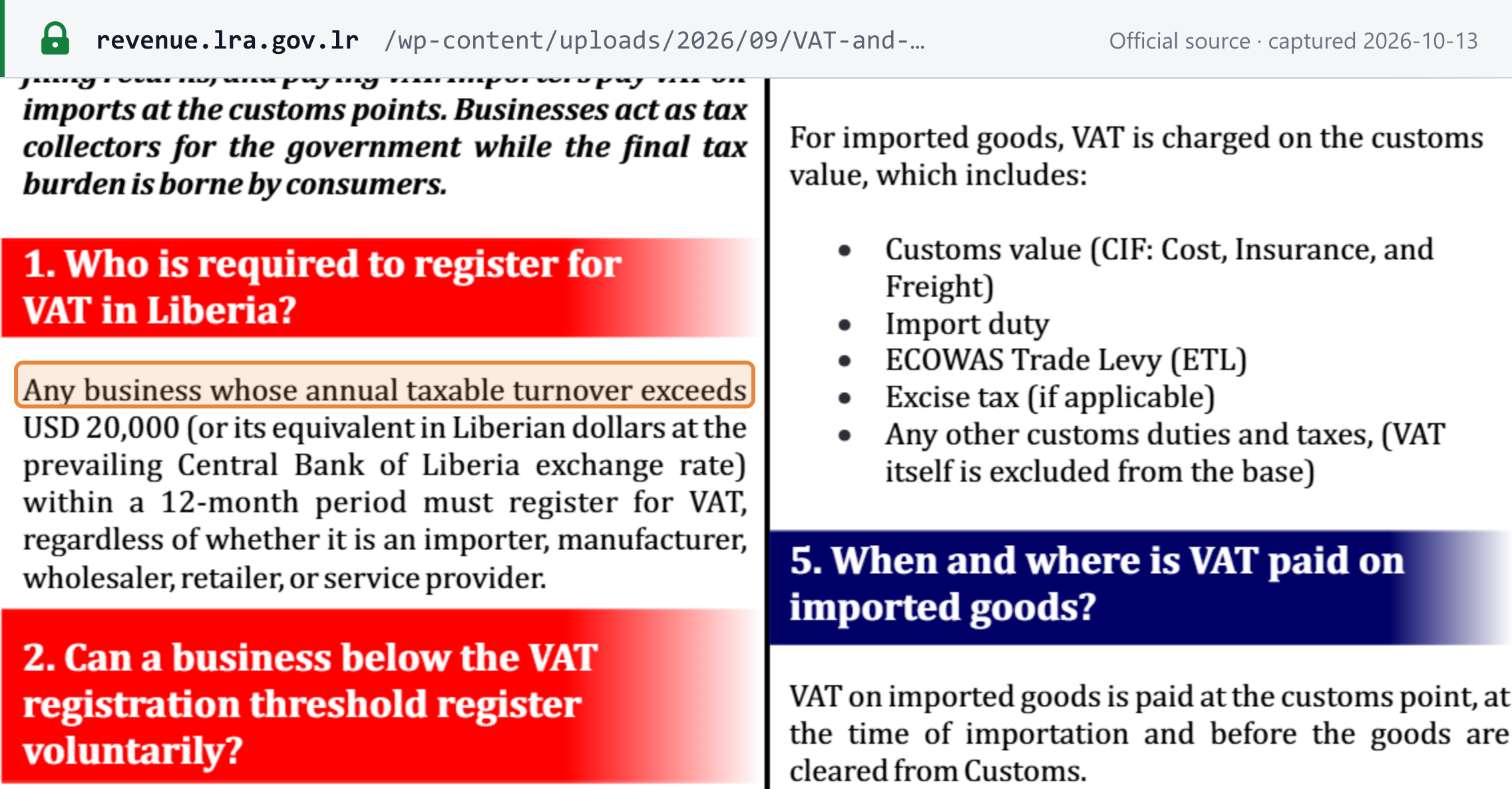
From VAT commencement the test becomes turnover-based and covers every kind of business. In the LRA's words: "Any business whose annual taxable turnover exceeds USD 20,000 (or its equivalent in Liberian dollars at the prevailing Central Bank of Liberia exchange rate) within a 12-month period must register for VAT, regardless of whether it is an importer, manufacturer, wholesaler, retailer, or service provider." [9] The LRA adds that "Only VAT-registered businesses are allowed to charge and collect VAT" and that "Unregistered persons are prohibited from charging VAT."
 Source snapshot captured 2026-10-13 — original
The VAT registration window. The LRA said on 11 December 2025 that "VAT registration for eligible businesses will begin in July 2026 and run for six months, ahead of the full implementation date of January 1, 2027". [16] The LRA's online registration portal still presents itself as the "GST Registration Portal", for "General Sales Tax (GST) registration", [21] and no LRA release published after June 2026 announces that VAT registration has opened. Ask the LRA (0770-572-572) before assuming you can register for VAT now.
Non-resident registration
The GST chapter has no registration rule for non-resident or remote suppliers. Services tax applies to services supplied "in Liberia" by a registered services provider, and a service is supplied where the provider's place of business is, except electricity and telecommunications (s.1023). [1] For VAT, the LRA's published guidance states only the general USD 20,000 threshold. The LRA names the MFDP's Regulation No. 136 as the VAT implementing regulation, [16] but its text is not currently available on the MFDP or LRA websites (see Foreign companies selling into Liberia).
Tax registration number
Every taxpayer needs a Taxpayer Identification Number (TIN), a 9-digit number issued by the LRA. The LRA says a VAT-registered business must display "its VAT Registration Certificate that contains, among other things, a nine-digit Taxpayer Identification Number (TIN) at its place of business". [12] The online GST portal also issues a separate 17-digit GST number on the GST certificate. Format, examples and lookup options are on the Liberia TIN guide. You can also check the format with the Liberia TIN validator.
How to register
- Get a TIN. Businesses receive one at the Liberia Business Registry when they register the business. Individuals apply to the LRA (see the TIN guide).
- Register on the LRA portal at portal.gstreg.lra.gov.lr. The portal's instructions say: "For New Request, verify your TIN and provide your email and mobile number", then "Complete the applicable form (IN-01, RF-01, or SP-01). If you have multiple locations, add BR-01 (Branch Appendix) entries. Upload required documents and submit your application." You follow the application with its reference number, through statuses that include "GST Generated" and "Approved". [22]
- Timeline. "The Commissioner General shall register any person who has applied for registration within 21 days from receipt of the application" (s.1026(b)(1)). Registration takes effect from the start of the next tax period (s.1026(b)(2)). [1]
There is no Liberia-specific registration walkthrough on this site yet. The general steps are in How to register for VAT, sales tax or GST.
Voluntary registration
- GST. Section 1006(b) lets a manufacturer below the threshold apply voluntarily. Under s.1006(c)(2) the Commissioner General may refuse an applicant with no fixed place of abode or business in Liberia, or one it has reasonable grounds to believe has no bank account, will not keep proper records or will not file regular and reliable goods tax returns. [1] The services-tax registration section (s.1026) has no equivalent voluntary route.
- VAT. "Businesses with taxable turnover below the threshold may voluntarily register for VAT. Once registered, they must comply fully with VAT obligations, including charging VAT, issuing invoices, filing VAT returns, and paying any VAT due." [9] A business that sells mostly to VAT-registered customers may want this, because its customers can then deduct the VAT it charges.
Deregistration
- Manufacturers must apply in writing to cancel if they stop making taxable supplies. They may apply if their taxable supplies in the last 12 months did not exceed the threshold, but "only after the expiration of 2 years from the date the registration took effect" (s.1006(e)(2)). On cancellation, goods on hand that were acquired free of goods tax are treated as a taxable supply at fair market value (s.1006(e)(6)). [1]
- Services providers must apply when they are no longer required to be registered (s.1026(d)(1)). [1]
- Either way, the LRA will not cancel a registration if it has reasonable grounds to believe that the business will exceed the threshold in the next 12 months, and obligations for the registered period, including returns, survive cancellation.
Group registration
Not available under GST. Part III, Chapter 10 of the Revenue Code has no group-registration provision. It only lets the Commissioner General add a related person's taxable supplies when testing whether a business must register (ss.1006(a)(2), 1026(a)(2)).
Rates
GST today: 13%
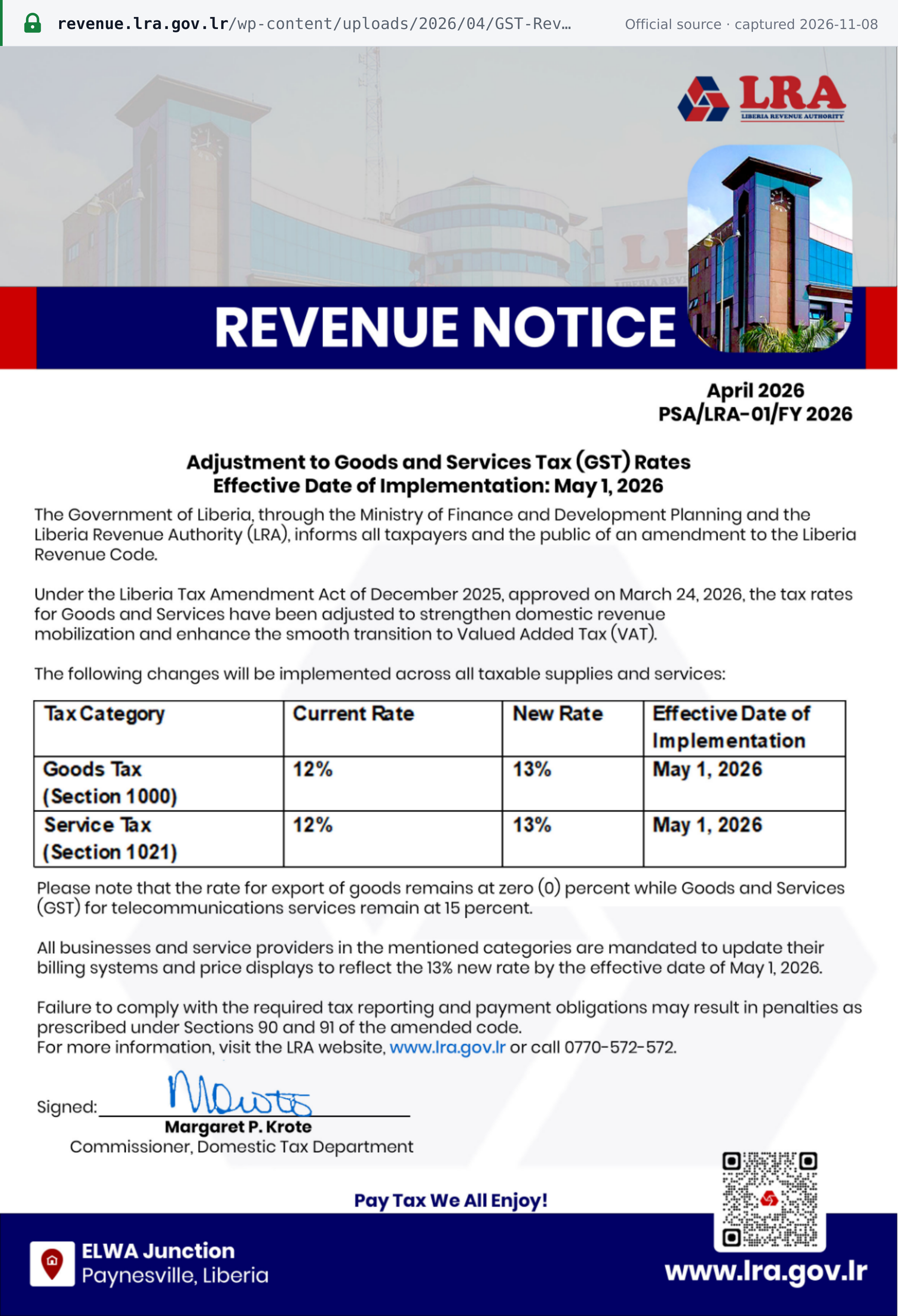
Since 1 May 2026 both GST rates are 13%, up from 12%. The change comes from the Liberia Tax Amendment Act of December 2025, approved on 24 March 2026. The LRA's Revenue Notice PSA/LRA-01/FY 2026 sets out:
| Tax | Previous rate | Rate from 1 May 2026 |
|---|---|---|
| Goods tax (s.1000), including taxable imports | 12% | 13% |
| Services tax (s.1021) | 12% | 13% |
| Exports of goods | 0% | 0% |
| Telecommunications services | 15% | see below |
The notice adds: "Please note that the rate for export of goods remains at zero (0) percent while Goods and Services (GST) for telecommunications services remain at 15 percent." [6]
 Source snapshot captured 2026-11-08 — original
Telecommunications: the two official texts read differently. The LRA's notice and its web announcement say the rate on telecommunications services stays at 15%. [6] [7] The December 2025 Act itself sets the services tax at 13% and then says: "An additional 5 percent surtax applies to telecommunications services specified in Section 1022(a) (2)." [2] Read literally, 13% plus the 5% surtax gives 18%, while the LRA says 15%. The LRA has not published anything reconciling the two. The rate the LRA applies is 15%, so a telecoms provider should confirm with the LRA before billing differently.
Rate history. GST was 10% in the 2020 consolidated Code. It rose to 12% on 1 April 2025 under the Tax Amendment Act of 2024 amending Chapters 8 and 10, approved on 17 December 2024, [3] [17] and to 13% on 1 May 2026.
What GST covers
GST is narrow, and most readers' mistakes start here.
-
Goods tax applies to supplies of goods "by the manufacturer thereof where the manufacture of goods is in Liberia" (s.1001(a)), and to taxable imports. [1] A wholesaler or retailer reselling goods does not charge goods tax on the resale.
-
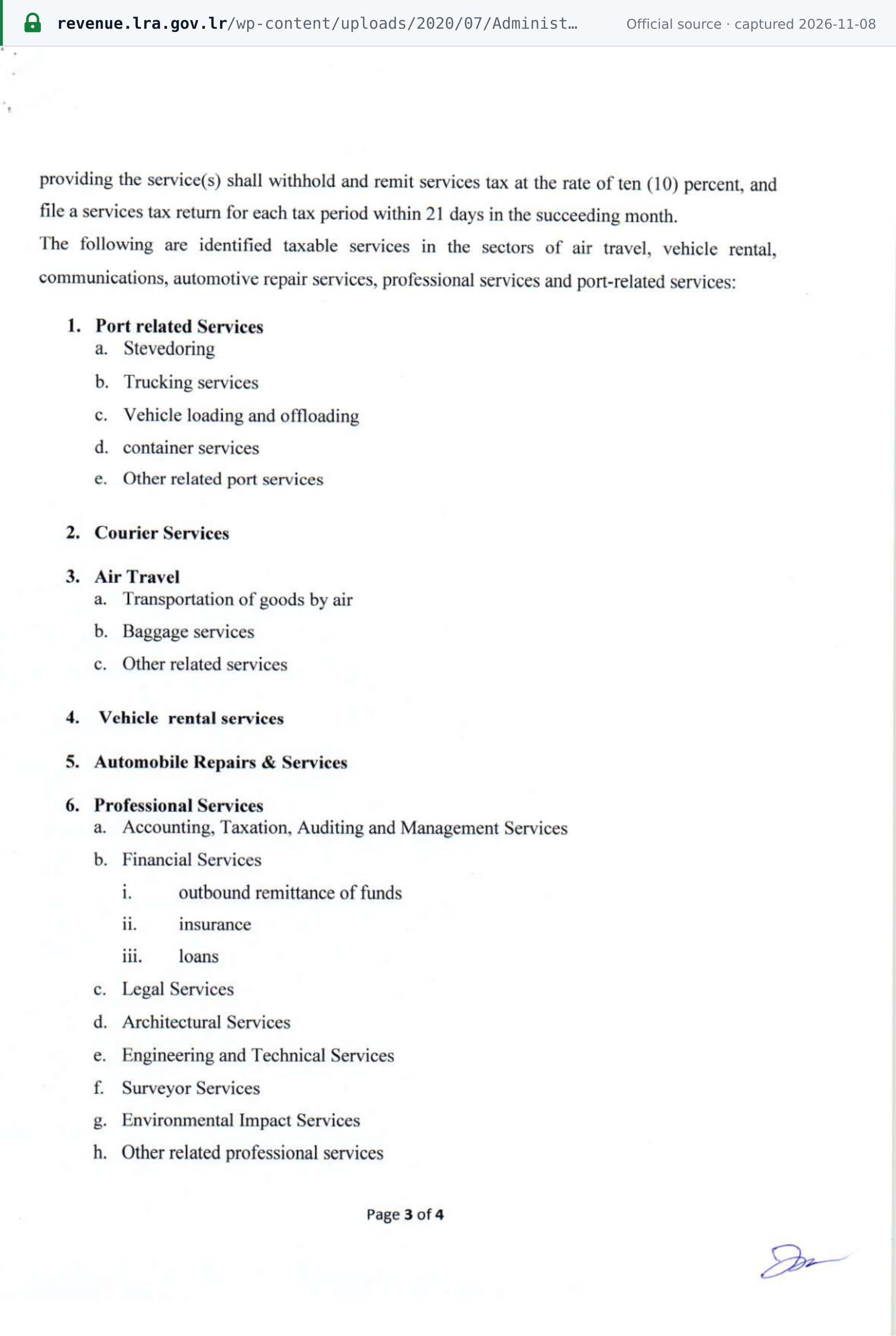
Services tax applies only to the services listed in s.1022(a): electricity; telecommunications; water supplied for a fee; hotel services, including meals and drinks on the premises; restaurant and café meals, and take-away meals from restaurants, cafés and supermarkets; gambling (casino, lottery, betting and games of chance run by telecoms operators); tickets for international transport by air, sea or land; travel agency services; tickets for sporting events and games; and "Other services (specified in regulations) in the sectors of air travel, vehicle rental, communications, automotive repair services, professional services (excepting medical services), and port-related services". [1] The LRA has specified those other services in Revenue Administrative Regulation No. 03.1021-1-10/LRA/DTD/26-02-2019, in effect from 18 July 2019, [26] and in Practice Note PN-LRC-III-1021/1022-09-2020-09, effective 1 July 2020. [27] Together they add:
- Port-related services: stevedoring, trucking, vehicle loading and offloading, container services and other related port services. The practice note adds pilotage, towage, mooring and unmooring, vessel traffic services and container shipping services.
- Courier services.
- Air travel: transportation of goods by air, baggage services and other related services. The practice note adds car rental at airports, services to tour operators and hotel reservations, each provided by a travel agency.
- Vehicle rental services and automobile repairs and services.
- Professional services: accounting, taxation, auditing and management services; financial services (outbound remittance of funds, insurance and loans); legal; architectural; engineering and technical; surveyor; environmental impact; and other related professional services. The practice note adds contractual legal services, contractual security guard services, advertising, financial advisory services, and human resource recruitment and management services.
For financial services, the practice note applies the tax to the commissions, fees and charges that banks and other financial institutions collect, for example on outbound remittances, loans and account services, and to insurance premiums. Section 4(1) of the practice note repeats that services providers whose annual turnover is above LRD 3,000,000 must register for services tax.
 Source snapshot captured 2026-11-08 — original
VAT when it starts: 15%
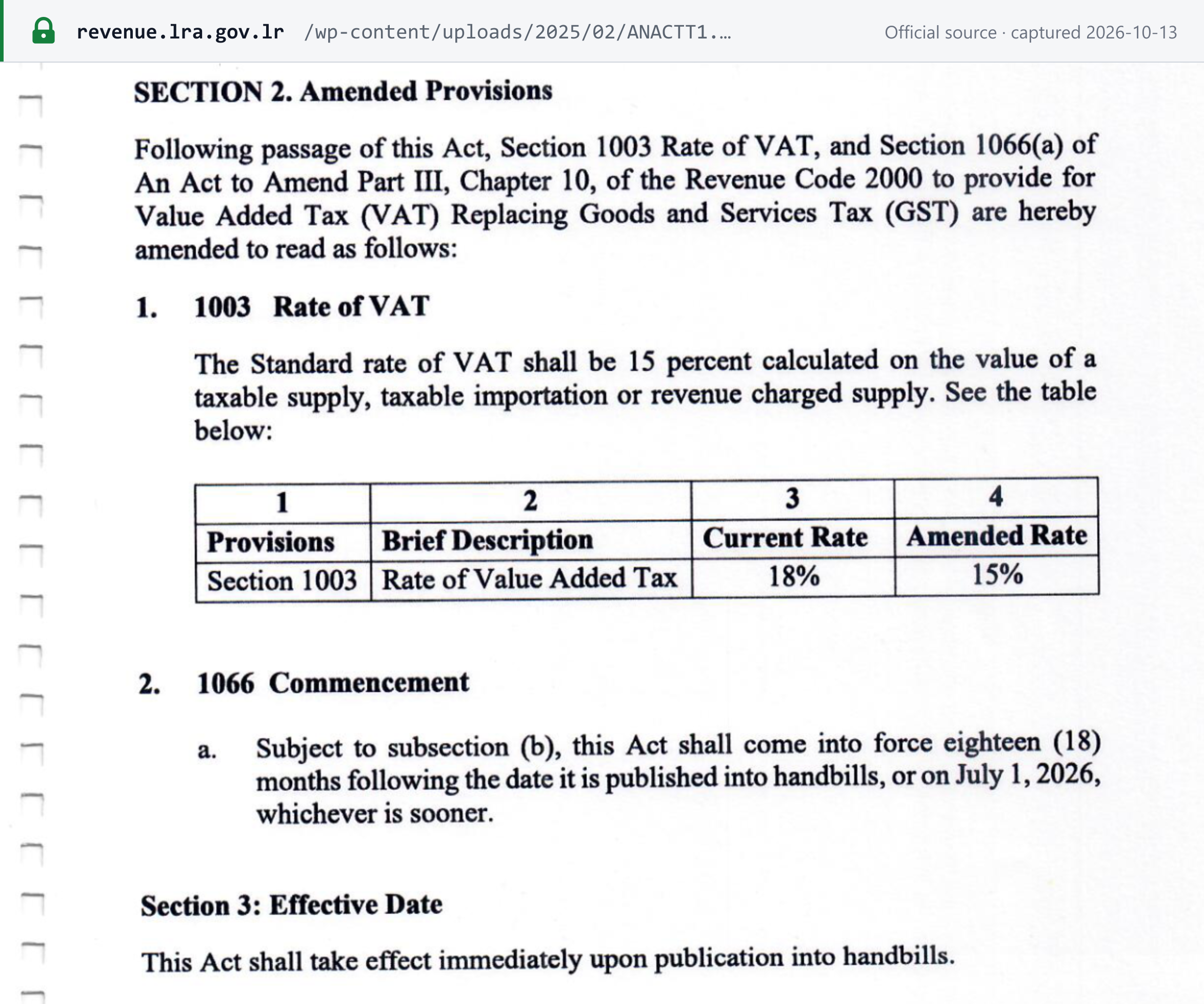
The standard VAT rate will be 15%. Section 1003 of the VAT Law, as amended by the Act approved on 17 December 2024, reads: "The Standard rate of VAT shall be 15 percent calculated on the value of a taxable supply, taxable importation or revenue charged supply." The Act's table shows the rate falling from 18% to 15%. [5] The LRA's 2026 guidance confirms: "The standard VAT rate is 15 percent on taxable goods and services, while exports are zero-rated." [10] Its worked example: "if a service costs USD 100, VAT at 15% amounts to USD 15, making the total payable USD 115." [9]
 Source snapshot captured 2026-10-13 — original
Reduced and zero rates
- GST. No reduced rate. The only rate other than 13% is 0% on exports of goods, plus the telecommunications rate described above (ss.1000(b), 1021(b) as amended). Supplies outside GST are either exempt (see Exemptions) or not on the services list.
- VAT. The amending Act sets a single standard rate of 15%, and the LRA's guidance names zero-rated exports. The VAT Law's own lists of exempt and zero-rated supplies are not published on the LRA's laws and forms pages or the MFDP website (as at November 2026).
Announced changes
The VAT start date: 1 January 2027, per the LRA.
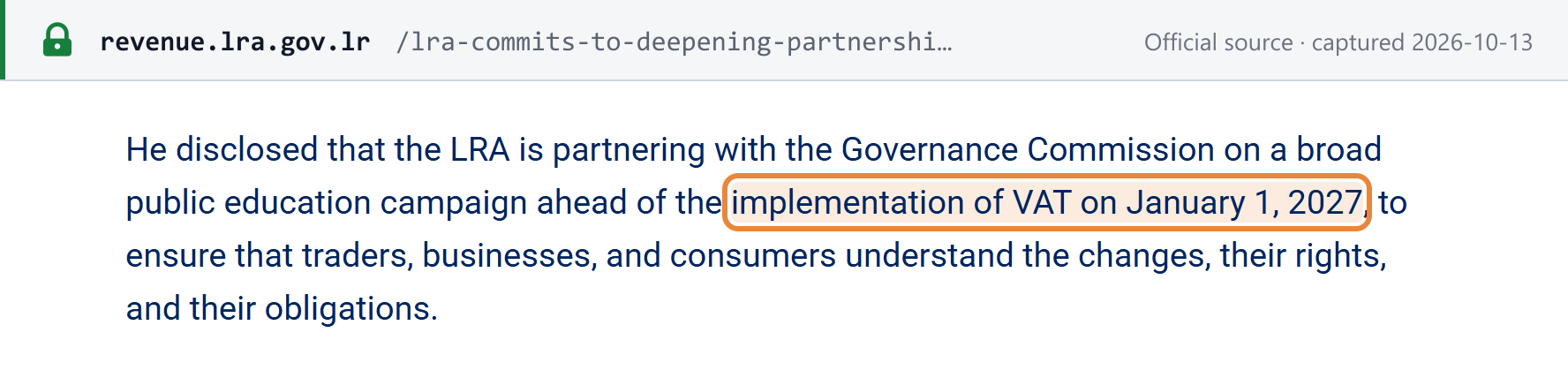
- Every dated LRA statement gives January 2027. Its release of 11 December 2025 refers to "the full implementation date of January 1, 2027". [16] Revenue Notice PSA/LRA-02/FY 2026 (April 2026) and its release of 10 June 2026 point to January 2027. [8] [20] Its press release of 29 September 2026 refers to "the implementation of VAT on January 1, 2027". [15]
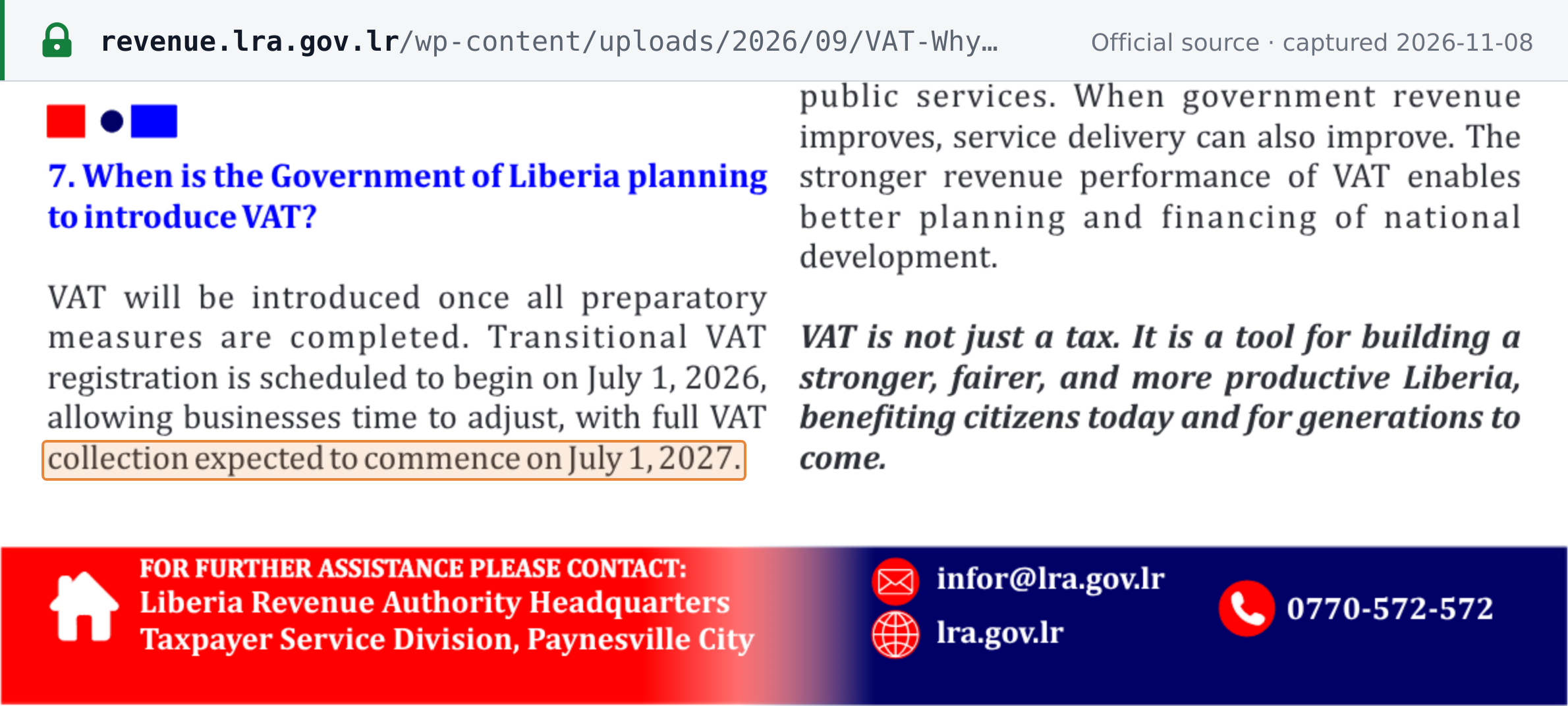
- One older LRA flyer, uploaded in September 2026, gives a later date. Its text predates May 2026, because the same flyer still says "The standard GST rate is 12 percent". It reads: "Transitional VAT registration is scheduled to begin on July 1, 2026, allowing businesses time to adjust, with full VAT collection expected to commence on July 1, 2027." [10]
 Source snapshot captured 2026-10-13 — original
 Source snapshot captured 2026-11-08 — original
The commencement clause itself (s.1066(a), as amended in December 2024) reads: "Subject to subsection (b), this Act shall come into force eighteen (18) months following the date it is published into handbills, or on July 1, 2026, whichever is sooner." [5] Eighteen months after the July 2024 handbill publication fell in January 2026, and 1 July 2026 has also passed. The clause is, however, "Subject to subsection (b)", and subsection (b) is not reproduced in any official text published online. In practice the LRA continues to administer GST: the Legislature raised the GST rates again in the Liberia Tax Amendment Act of December 2025, approved on 24 March 2026, and the LRA has applied 13% since 1 May 2026 while describing VAT implementation as still to come. Until the LRA announces that VAT has started, GST at 13% is what it collects. Track the LRA's public notices and Liberia tax changes on Lookuptax.
Cross-border rules
Imports and exports
- Imports (GST). Goods tax at 13% applies to every taxable import. It "is due on the date of arrival of the import at the port of entry, and is collected at the same time and subject to the same conditions as collection of customs duties under the External Tariff Law" (s.1000(e)(2)). [1] The taxable amount is "(1) The CIF Liberian Port or Customs entry value, whichever is applicable; (2) If not included in the CIF Liberian Port or Customs entry value, the value of incidental services … and (3) The customs duty, customs service fee, ECOWAS Trade Levy, and excise tax (if any) on import" (s.1004(d)). [1] Goods that would be exempt if supplied in Liberia are also exempt on import. The Code publishes no de minimis value below which imports are relieved.
- Imports (VAT). The LRA says VAT on imports will be charged on the customs value including CIF value, import duty, the ECOWAS Trade Levy, excise and other customs duties and taxes, "(VAT itself is excluded from the base)", and that it "is paid at the customs point, at the time of importation and before the goods are cleared from Customs". [9]
- Exports. Exports of goods are taxed at 0% under GST, and the LRA says exports will be zero-rated under VAT. An export is "the delivery of goods to, or the making available of the goods at, an address outside Liberia for use or consumption outside Liberia as evidenced by documentary proof acceptable to the Commissioner General" (s.1000(f)). [1] Under GST, which has no input credit, the 0% rate simply means no output tax. Under VAT, zero-rating will also let the exporter recover input VAT.
- Imported services (reverse charge). The GST chapter has no reverse charge on services bought from abroad: services tax attaches only to supplies in Liberia by a registered services provider. A different rule exists for local providers: where a services provider that should have registered is registered involuntarily, "the Commissioner General is authorized to collect the services tax from the recipient of the services" (s.1026(e)). [1] The VAT rate clause covers a "revenue charged supply", which shows that the VAT Law has a reverse-charge mechanism, [5] but its scope is defined in parts of the VAT Law that are not published on the LRA's laws and forms pages or the MFDP website (as at November 2026).
Digital services
GST does not tax digital services as such. Telecommunications services are on the services-tax list and are supplied "at the location where the services are received" (s.1023(b)), but the tax falls only on registered services providers in Liberia. [1] The LRA's published VAT guidance does not set a separate rule for electronic services. For the general picture, see VAT on digital services from non-resident suppliers.
Foreign companies selling into Liberia — B2B and B2C
- B2C, under GST. The Revenue Code publishes no registration obligation for a foreign seller without a place of business in Liberia. Goods it ships to Liberian consumers bear goods tax at import, paid by the importer.
- B2B, under GST. The same: there is no reverse charge for the Liberian business customer to apply to imported services, and goods bear goods tax at import.
- Under VAT. The LRA's flyers state the USD 20,000 registration threshold for "any business" and do not separate resident and non-resident suppliers, B2B and B2C customers. The LRA names the MFDP's Regulation No. 136 as the VAT implementing regulation; [16] its text is not currently available on the MFDP or LRA websites. A foreign supplier should get the rule confirmed by the LRA before VAT starts.
Marketplace and platform obligations
Not applicable under GST: Part III, Chapter 10 of the Revenue Code has no rule making a marketplace or platform the deemed supplier. The LRA's VAT guidance does not describe one either. See Marketplace deemed-supplier rules for how other countries do it.
Place of supply
- Goods. "A supply of goods occurs at the place where the goods are delivered or made available by the supplier or, if the delivery or making available involves transportation, the place where the goods are when the transportation commences" (s.1001(c)). [1]
- Services. "a supply of taxable services occurs at the place of business from which the services are provided", except that "A supply of electricity or telecommunications services occurs at the location where the services are received" (s.1023). [1]
Invoice requirements
The invoice rules in force are those of the GST chapter of the Revenue Code, the record-keeping rules in s.55, and the Electronic Fiscal Devices Regulations. Under VAT, the LRA says registered businesses "will issue invoices that clearly show VAT as a separate charge". [10] The LRA names the MFDP's Regulation No. 136 as the VAT implementing regulation; [16] its text is not currently available on the MFDP or LRA websites, and the VAT Law's detailed invoice rules are not published on the LRA's laws and forms pages or the MFDP website (as at November 2026). This section therefore describes the GST rules only.
Mandatory content
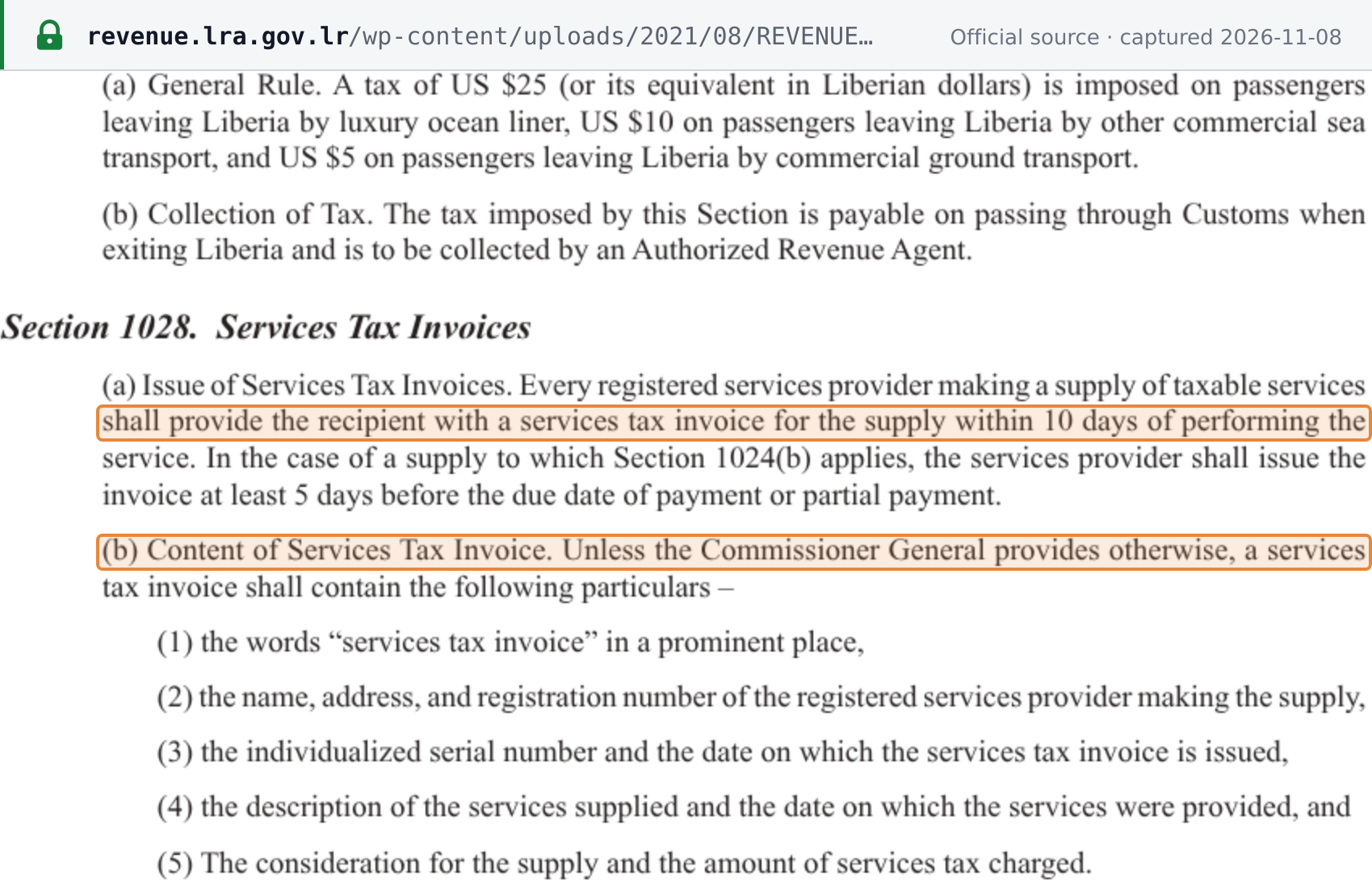
Services tax invoice (s.1028). "Every registered services provider making a supply of taxable services shall provide the recipient with a services tax invoice for the supply within 10 days of performing the service." Unless the Commissioner General provides otherwise, it must contain: [1]
- the words "services tax invoice" in a prominent place;
- the name, address and registration number of the registered services provider;
- the individualized serial number and the date of issue;
- a description of the services supplied and the date on which they were provided;
- the consideration for the supply and the amount of services tax charged.
The LRA's practice note on services tax adds that "The incidence of the services tax is normally on the service recipient, and as such it must be shown as a separate item on any bill, invoice, or other document issued by the services provider" (s.4(3)). [27]
 Source snapshot captured 2026-11-08 — original
Goods tax invoice (s.1007). "Every registered manufacturer making a taxable supply shall provide the recipient with a goods tax invoice for the supply." It carries the same five particulars, with "goods tax invoice" as the heading, the manufacturer's taxpayer identification number in place of the registration number, and a description of the goods "(including quantity or volume)" with the delivery date. [1]
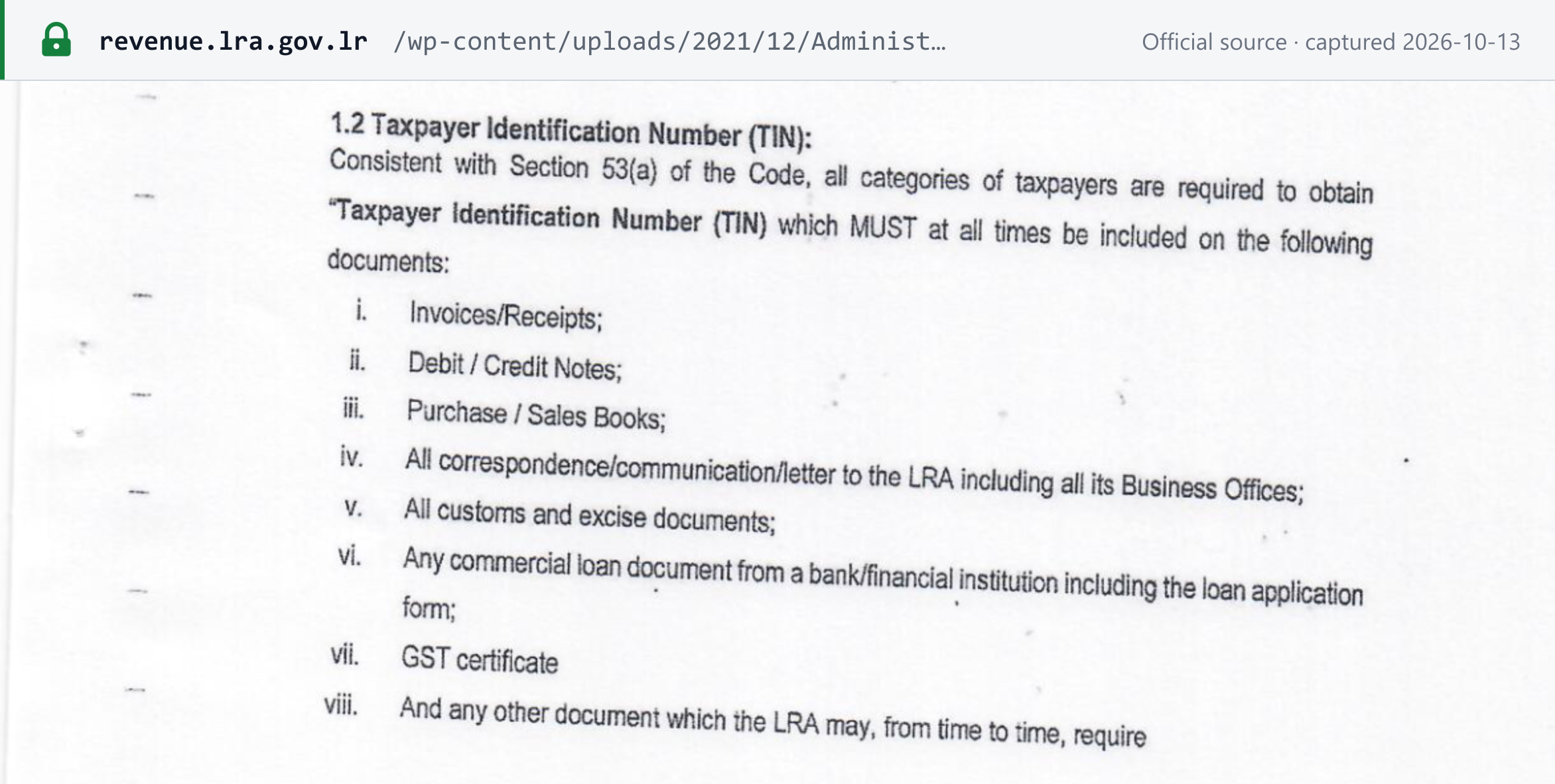
TIN on every invoice. The Electronic Fiscal Devices Regulations add that the TIN "MUST at all times be included" on invoices and receipts, debit and credit notes, purchase and sales books, LRA correspondence, customs and excise documents, commercial loan documents and the GST certificate (reg. 1.2). [14]
 Source snapshot captured 2026-10-13 — original
Issuance deadline
- Goods. At the earliest of "(1) the time of payment or partial payment; (2) on the delivery date; or (3) on the shipment date" (s.1007(a)).
- Services. Within 10 days of performing the service. For periodic supplies, "the services provider shall issue the invoice at least 5 days before the due date of payment or partial payment" (s.1028(a)).
- Time of supply follows the invoice. A supply of taxable services occurs on the earlier of the date the services tax invoice is issued and the date it is required to be issued under s.1028 (s.1024). [1]
A specimen of a compliant invoice
The LRA publishes no specimen GST invoice. Its forms page, its laws and public-notices pages, the Revenue Code and the Electronic Fiscal Devices Regulations list the required particulars but show no layout. The specimen below is our illustration of where the s.1028 particulars and the fiscal-device fields sit on a services tax invoice for a hotel stay, one of the listed taxable services.
SERVICES TAX INVOICE — illustrative specimen (Liberia, GST)
| Description of servicess.1028(b)(4) | Qty | Unit price (USD) | Amount (USD) |
|---|---|---|---|
| Room, standard double (nights) | 2 | 400.00 | 800.00 |
| Conference room hire | 1 | 200.00 | 200.00 |
- Considerations.1028(b)(5)
- USD 1,000.00
- Services tax 13%s.1028(b)(5); s.1021(b)
- USD 130.00
- Total amount payableEFD Sch. B(i)
- USD 1,130.00
- Fiscal logo, or electronic signature with QR code, printed at the end of the transaction (EFD Sch. B(k)–(l); reg. 2.1(6)).
- Tax may be invoiced and paid in USD or LRD; a USD payment is translated at the Central Bank of Liberia rate on the payment day (s.6(a)).
- A goods tax invoice from a registered manufacturer has the same layout, headed "goods tax invoice", with the manufacturer's TIN and the quantity and delivery date of the goods (s.1007(b)).
- Under VAT the rate becomes 15% and the LRA says VAT must be shown as a separate charge. The LRA names the MFDP's Regulation No. 136 as the VAT implementing regulation; its text is not currently available on the MFDP or LRA websites.
Credit and debit notes
Where a goods tax supply has to be adjusted, the manufacturer gives the recipient a debit note or a credit note (s.1007(c)–(f)). Each must carry: [1]
- the words "debit note" or "credit note" in a prominent place;
- the name, address and TIN of the registered manufacturer;
- the individualized serial number and date of issue;
- a brief description of the circumstances, with "information sufficient to identify the taxable supply" it relates to;
- the consideration shown on the original goods tax invoice, the correct consideration, the difference, and the goods tax on the difference.
Adjustments for cancelled or varied supplies and returned goods are governed by s.1005. A manufacturer that over-charged gets a credit only after it "has repaid the excess goods tax to the customer", and "No cash tax refund is allowable to a registered manufacturer" (s.1005(d)). [1] The services-tax sections contain no credit- or debit-note rule. Schedule B of the Electronic Fiscal Devices Regulations also lists credit-note particulars for fiscal-device users.
Numbering, copies and fiscal devices
- Serial numbers and copies. "The invoices, receipts, or notes a person generates must be serialized and must be created using a method that allows for production in duplicate or, in the case of a Goods and Services Tax invoice, in triplicate, one copy of which is retained by the person" (s.55(a)(4)). [1]
- Electronic Fiscal Devices (EFD). The Income Tax (Electronic Fiscal Devices) Regulations of 2021 require a device user to ensure that "Each sale is recorded with the use of the Device or Register", that "An invoice is generated in respect of each sale", and that each invoice carries "a fiscal logo and specification created by the Commissioner General" (reg. 3.3(1)). "Any user with an accounting software, may be allowed to continue issuing fiscal invoice provided that the said invoice shall bear an electronic signature with a QR code" (reg. 2.1(6)). [14] Which businesses must use a device depends on LRA designation (reg. 3.1), and no designation list is published on the LRA website.
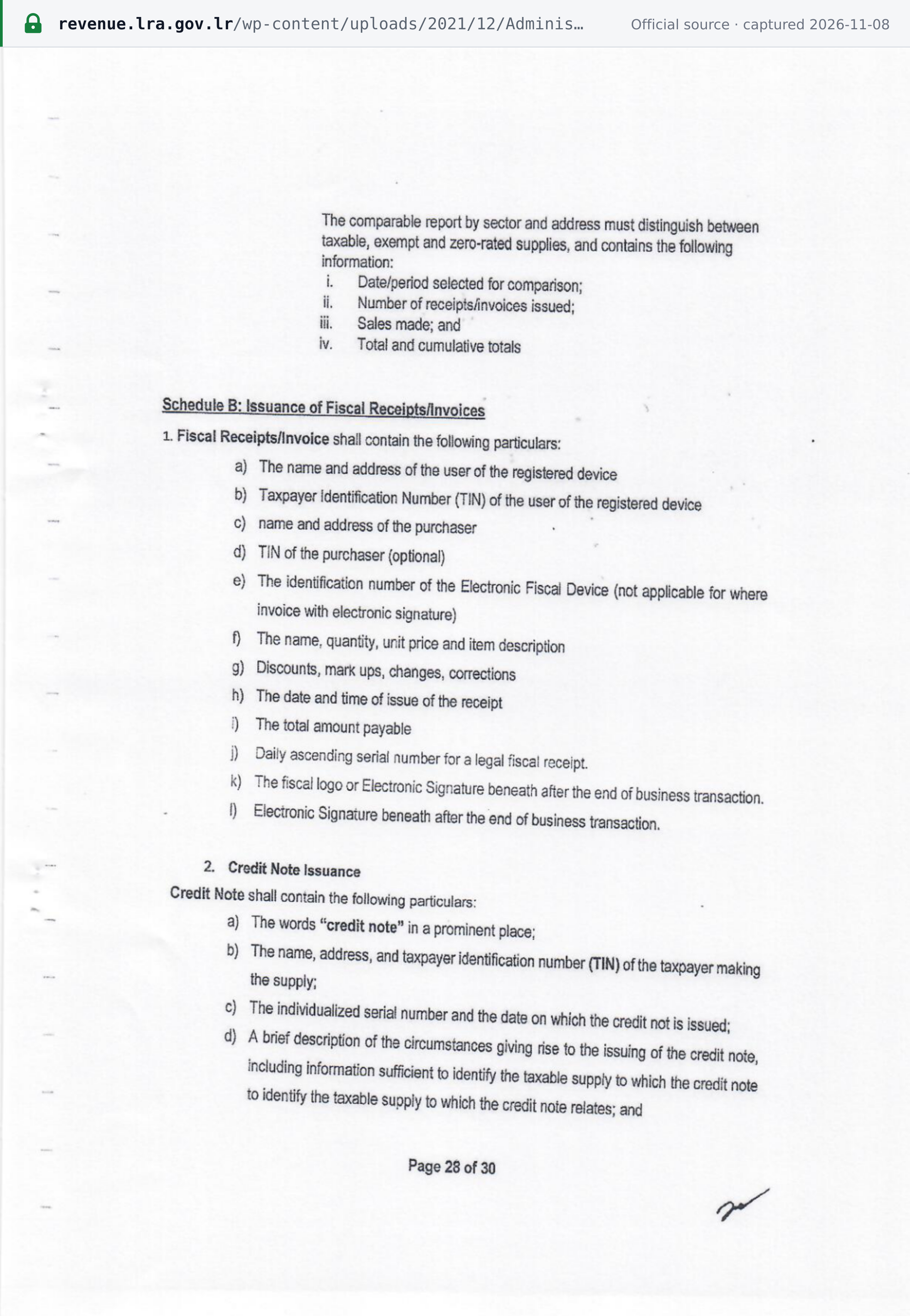
- Fiscal receipt particulars (Schedule B). A fiscal receipt or invoice must show the device user's name, address and TIN; the purchaser's name and address, and the purchaser's TIN (optional); the device's identification number (not needed for an electronically signed invoice); the name, quantity, unit price and description of each item; discounts, mark-ups, changes and corrections; the date and time of issue; the total payable; a "Daily ascending serial number for a legal fiscal receipt"; and the fiscal logo or electronic signature.
 Source snapshot captured 2026-11-08 — original
For how fiscal devices compare across countries, see Fiscal devices and certified cash registers.
Currency and language
Records must be kept "in Liberia, in the English language" (s.55(a)(1)). [1] The GST chapter does not fix an invoice currency. Section 6(a) allows books in LRD or USD and tax to be paid in either, translated at the Central Bank of Liberia market rate on the payment day.
Document types and self-billing
- Document types. The Code names the goods tax invoice, the services tax invoice, the credit note and the debit note. Section 55 also lists sales receipts among the records a business keeps, and fiscal-device users issue the fiscal receipt or invoice described in Schedule B. The Code sets no value below which a simplified GST document may replace a full invoice.
- Self-billing. Not provided for: Part III, Chapter 10 of the Revenue Code has no self-billing provision.
Retention and audit trail
- Retention. Books and records, including invoices, credit and debit notes and sales receipts, "must be retained for 7 years after the end of the tax period to which they relate" (s.55(b)). [1]
- Fiscal-device data. "The user shall not temper with the records kept in his Electronic Fiscal Device and shall ensure that the records in the Electronic Fiscal Device are retained therein for a period of seven years" (EFD reg. 2.1(24)). [14]
- Inspection. A person who refuses a request for records or for inspection of the business premises "is subject to a civil tax penalty of $50,000 per day of refusal" (s.55(f)). [1]
E-invoicing status
No e-invoicing or continuous transaction control mandate as at 8 November 2026. The LRA has said that "several new digital solutions are currently under development, including electronic invoicing systems, VAT modules within LITAS, a taxpayer contact center, and expanded digital infrastructure" (15 April 2026), [18] and lists "the introduction of electronic invoicing (E-Invoicing)" among its reforms (29 July 2026). [19] No system name, format, network, scope (B2B, B2G or B2C) or phase timeline is published on the LRA's laws, public-notices or forms pages.
What exists today is the 2021 Electronic Fiscal Devices regime described under Numbering, copies and fiscal devices: devices linked to the LRA, and software-issued fiscal invoices bearing an electronic signature with a QR code. For the difference between fiscal devices and clearance e-invoicing, see E-invoicing models: clearance, reporting and interchange.
Filing and payment
Filing frequency and due date
- GST returns are monthly. The tax period is the calendar month (s.1045). A registered manufacturer "shall file a goods tax return for each tax period within 21 days after the end of the period, whether or not any goods tax is due for the period" (s.1008), and a registered services provider files a services tax return on the same terms (s.1029). [1] [1] A nil return is still due.
- Imports. No separate return is needed for imports listed on a consumption entry on which goods tax was paid at entry (s.1008).
- Payment. Goods tax and services tax are due on the date the return for the period is due (ss.1000(e)(1), 1021(e)).
- Time of day. As amended by the Tax Amendment Act of December 2024, s.50(b) says that returns and payments "are due no later than 11.59 pm in case of electronic channels and 5:00 p.m. in other cases on the date they are due". [4] The Code does not say what happens when the 21st falls on a non-working day.
- Under VAT. "VAT returns must be filed within 21 days after the end of the tax period. · For compulsory registrants, the tax period is monthly · For voluntary registrants, the tax period is quarterly. VAT payments must also be made within the same 21-day deadline." The LRA lists the records a VAT business keeps as a purchase book, a sales book and a VAT account. [9]
Where to file and how to pay
Returns are filed in LITAS, the Liberia Integrated Tax Administration System. The LRA's LITAS flyer describes the payment flow: "Taxpayer files tax returns and prints payment slip which contains bill/document number", pays it through the bank's internet banking tax-payment menu, then "logs into LITAS and print official receipt". [24] The LRA's payment FAQ says: "You may use cash for amounts less than US $250.00 or its equivalent in Liberian Dollars", at the Central Bank of Liberia teller window in an LRA Service Center. Above that amount, the taxpayer buys a manager's check at a commercial bank or pays by direct transfer. [23]
Additional listings
None under GST. Part III, Chapter 10 of the Revenue Code requires no annual GST return and no sales or purchase listing beyond the monthly returns.
Input-tax recovery and blocked items
- GST: no input credit. GST is a single-stage tax, and the GST chapter has no mechanism for deducting tax paid on purchases. Relief for manufacturers works through exemption instead: raw materials and other inputs used directly in manufacturing, and capital goods, supplied to a registered manufacturer are exempt (s.1001(e)(6)), limited where the manufacturer also makes exempt supplies (s.1001(f)). [1] Because there is no deduction, there are no blocked items.
- VAT: credit for input tax. The LRA explains that a VAT business deducts input VAT from output VAT, and "If input VAT exceeds output VAT in a given period, the excess may be refunded or carried forward to the next tax period, in line with VAT regulations." [11] The list of blocked inputs is in parts of the VAT Law that are not published on the LRA's laws and forms pages or the MFDP website (as at November 2026).
Refunds
- GST. "No cash tax refund is allowable to a registered manufacturer" (s.1005(d)). Excess goods tax charged to a customer is credited only after the manufacturer has repaid it to the customer. [1] The Code owes interest on a refund only if it takes more than 45 days (s.14(b)).
- VAT. Excess input VAT may be refunded or carried forward "in line with VAT regulations" (see above). The VAT Law's detailed refund rules are not published on the LRA's laws and forms pages or the MFDP website (as at November 2026); the LRA names the MFDP's Regulation No. 136 as the VAT implementing regulation, [16] but its text is not currently available on the MFDP or LRA websites. There is no refund scheme for non-resident businesses in the LRA's published guidance, and the LRA notes that "The final consumer ultimately bears the cost of VAT because individuals cannot claim it back." [11]
Exemptions
Exempt supplies
Section 1001(e) of the Revenue Code exempts these supplies of goods from goods tax: [1]
- foodstuffs (not meals or cooked food) for educational and philanthropic institutions certified by the Minister;
- goods for the relief of distressed persons in natural disasters or other humanitarian emergencies, as the Minister specifies;
- pharmaceutical and medicinal preparations specified by the Minister's regulation;
- medical aids and appliances for persons with an illness or disability, specified by regulation;
- "textbooks or other instructional materials designed for use in schools or adult education programs";
- raw materials, inputs and capital goods supplied to registered manufacturers, agricultural renewable-resource contractors, mining and petroleum project producers and forestry licence holders;
- goods transferred with a manufacturing business as a going concern between registered manufacturers;
- medical and educational equipment and supplies for agricultural, mining and petroleum producers.
Imports of goods that would be exempt if supplied in Liberia are exempt as well. For services, the question is not exemption but scope: a service that is not on the s.1022 list is simply outside services tax.
Under VAT, the LRA says that "Some goods and services are exempt under the law and should not have VAT added to their price, even if sold by a VAT-registered business". [12] The VAT Law's schedule of exempt supplies is not published on the LRA's laws and forms pages or the MFDP website (as at November 2026).
Exempt is not zero-rated
Under GST the difference has no input-tax effect, because GST has no input credit at all. Under VAT it will matter. An exempt supply carries no output VAT, and the business cannot recover the input VAT on its costs. A zero-rated supply, such as an export, carries VAT at 0% and the business can still recover its input VAT, with a refund where credits exceed output tax. See Zero-rated vs exempt supplies.
Special regimes
- Small businesses. GST has no small-business, flat-rate or cash-accounting scheme. A business below the LRD 3,000,000 threshold is simply not registered for GST. Its income taxes are a separate matter.
- Margin and second-hand schemes. None under GST.
- Investment incentives and free zones. Not covered in this guide. Relief for imports under investment incentives is set by separate LRA measures, such as the LRA's September 2026 revenue notice PSA/RN/LRA-03/FY2026 on administrative measures for sugar imported under investment incentives.
Offences and penalties
Offences
- Failing to register or notify (GST). A person who fails to apply for registration, to notify a change in circumstances or to notify that it has ceased making taxable supplies "is guilty of a civil offense and is liable to pay a fine not exceeding $100,000.00. If the failure is deliberate, or due to willful or gross neglect, then that person is guilty of a criminal offense and on conviction is liable to pay a fine not exceeding $400,000.00 or to imprisonment for a term not exceeding 5 years, or both" (s.1042(a)). [1] These are Liberian-dollar amounts under s.6(a).
- Tax evasion. Under s.90(a) as rewritten by the Liberia Tax Amendment Act of December 2025, a person "who willfully evades or attempts to evade tax imposed under this Code commits a felony" and faces "a fine of not more than 100 percent of the evaded tax, imprisonment for not more than 5 years, or both". [2]
- Failing to collect or pay over tax (s.91(a)): a misdemeanor, with a fine of not more than 50% of the tax for a first offence and 100% for repeat offences, imprisonment for not more than one year, or both. [2]
- Trading without a required registration (s.92): a misdemeanor, with "a fine of not more than 100 percent of the tax; imprisonment for not more than 30 days, or both". [2]
- Facilitating evasion, including advisers (s.76(a)): "a penalty not exceeding L$400,000.00 or 10 percent of the tax understated, whichever is greater". Obstruction (s.76(b)): a fine not exceeding L$200,000.00, imprisonment for up to three years, or both. [2]
- Fiscal devices. A required user who breaches the device rules, or anyone who deliberately tampers with a device, is liable on conviction to a fine of up to LRD 25,000, imprisonment of up to 30 days, or both. Failing to demand and keep a fiscal receipt is also an offence (EFD reg. 7.2). [14]
- Charging VAT while unregistered (once VAT starts): "Collecting VAT without being registered is illegal. Anyone who does so will be fined and penalized under the law." [12]
The LRA's April 2026 GST notice warns that failure to comply "may result in penalties as prescribed under Sections 90 and 91 of the amended code". [6]
Penalties
- Late filing (s.51(a)(1)): "If the delay in filing is for not more than one month, the late-filing penalty is 5 percent of the amount of tax shown on the return. For each additional month (or partial month) that the delay continues, an additional 5-percent penalty is imposed on the sum of the tax shown plus any previously imposed penalty", capped at 50% of the tax shown. [1]
- Late payment of tax shown (s.52(a)): 5% for the first month and a further 5% for each additional month on the balance, capped at 25% of the tax shown. [1]
- Failure to pay the correct liability (s.52(b)): 0.5% of the correct liability per month or part month, capped at 50%, on top of the s.52(a) penalty. Both late-filing and late-payment penalties can apply to the same period (s.52(c)).
- Interest. "If any amount of tax is not paid by the due date, the taxpayer is obligated to pay interest, compounded monthly, at the rate determined under Section 11" (s.14(a)), and that rate is "the market rate as published by the Central Bank of Liberia" (s.11). Payments are applied to "interest; penalties; amounts of taxes", in that order (s.12(a)). [1]
- Inadequate records (s.55(e), as restated by the Tax Amendment Act of December 2024): a fine of "150 percent of any underpayment of tax that may have resulted from the lack of adequate recordkeeping", on top of the s.51 and s.52 penalties. [4]
- Refusing records or inspection (s.55(f)): $50,000 per day of refusal (Liberian dollars), plus the criminal penalty for non-cooperation.
- Failing to issue a compliant invoice. The Code sets no penalty specific to GST invoices. The record-keeping fine in s.55(e) and, for device users, the fiscal-device offences above are the sanctions that apply.
Frequently asked questions
Do I charge 13% GST or 15% VAT on an invoice I issue today?
GST, at 13% on taxable goods and listed services, until VAT actually starts. The Value Added Tax Law of 2024 has been enacted and its 15% rate signed into law, but the Liberia Revenue Authority has not yet announced that VAT is in force. The LRA's current date for VAT implementation is 1 January 2027, repeated in its releases of 11 December 2025, 10 June 2026 and 29 September 2026 and in an April 2026 revenue notice. One LRA flyer gives 1 July 2027 for full VAT collection, but its text predates May 2026, because it still quotes the GST rate as 12 percent. Watch the LRA's public notices for its announcement before you change your billing.
I have seen 18% quoted as Liberia's VAT rate. Is that right?
No. 18% was the rate in the Value Added Tax Law as first enacted in July 2024. An amending Act approved by the President on 17 December 2024 replaced it before VAT started: section 1003 now reads that the standard rate of VAT shall be 15 percent. The LRA's 2026 VAT guidance also gives 15%, with exports zero-rated.
I am a retailer, wholesaler or importer. Do I add GST to my sales now?
Under the GST in force today, goods tax is charged by registered manufacturers on goods they make in Liberia and is collected by Customs on imports. Services tax is charged only by registered providers of the services listed in section 1022 of the Revenue Code and in the LRA's 2019 regulation and 2020 practice note on other taxable services. They include electricity, telecommunications, hotels, restaurants and travel agents; port, courier, air-freight, vehicle-rental and car-repair services; professional services such as accounting, tax, audit, legal, architectural, engineering, advertising and security guard services; and bank charges and insurance premiums. The Code gives a reseller of goods no GST registration or charging obligation. That changes with VAT: the LRA says every business with annual taxable turnover above USD 20,000 must register, whether it is an importer, manufacturer, wholesaler, retailer or service provider, and only VAT-registered businesses may charge VAT.
How soon must I issue a services tax invoice, and how many copies do I keep?
Section 1028 of the Revenue Code requires a registered services provider to give the customer a services tax invoice within 10 days of performing the service, or at least 5 days before the payment date for periodic supplies. Section 55 requires invoices to be serialized and produced in triplicate for a Goods and Services Tax invoice, with one copy kept, and records must be kept in Liberia, in English, for 7 years after the end of the tax period.
Can I claim back the GST I pay on my purchases?
Not under the current GST. The LRA describes GST as a single-stage tax, and the GST chapter of the Revenue Code has no input-tax credit. Instead, raw materials, other direct manufacturing inputs and capital goods supplied to a registered manufacturer are exempt, and the Code states that no cash tax refund is allowable to a registered manufacturer. Input-tax credit arrives with VAT: the LRA says excess input VAT may be refunded or carried forward in line with the VAT regulations.
Can I invoice and pay tax in US dollars?
Yes. Section 6 of the Revenue Code allows books to be kept in Liberian or US dollars and tax to be assessed and paid in either currency. A payment in US dollars is translated at the Central Bank of Liberia market rate in effect on the payment day. The amounts written in the Code itself, such as the LRD 3,000,000 GST registration threshold, are in Liberian dollars. The LRA accepts cash only for amounts below US$250 or the Liberian-dollar equivalent; larger amounts go by manager's check or bank transfer.
Important websites
| Site | What it is for |
|---|---|
| Liberia Revenue Authority | News, the daily tax payment exchange rate, and links to all LRA services |
| LRA registration portal | Register for GST online (still presented as GST-only) |
| Registration instructions | Step-by-step guide to the portal and its forms (IN-01, RF-01, SP-01, BR-01) |
| GST certificate | Download a GST certificate carrying the 17-digit GST number |
| LITAS | File returns and generate payment bills (Liberia Integrated Tax Administration System) |
| LRA applications | LRA mobile app, including TIN verification |
| Public notices | Revenue notices, including rate changes and VAT announcements |
| Laws and amendments | Revenue Code and amending Acts |
| Forms and flyers | VAT guidance flyers, TIN and payment guides |
The LRA's helpline is 0770-572-572. There is no e-invoicing portal and no separate rate-lookup service. For the TIN format and how to check a number, see the Liberia TIN guide.
Recent changes
- 2026-09-29 — The LRA restates 1 January 2027 as the date for VAT implementation. An older LRA flyer, whose text predates May 2026, gives 1 July 2027 for full VAT collection. (Liberia Revenue Authority)
- 2026-07-01 — Scheduled start of a six-month VAT registration window for businesses above USD 20,000 (LRA, 11 December 2025); the LRA has not announced that it opened. (Liberia Revenue Authority)
- 2026-05-01 — Goods tax and services tax rise from 12% to 13% under the Liberia Tax Amendment Act of December 2025 (approved 24 March 2026); exports stay at 0%, and the LRA says telecommunications stay at 15%. (Liberia Revenue Authority)
- 2025-04-01 — GST rises from 10% to 12%. (Liberia Revenue Authority)
- 2024-12-17 — The VAT standard rate is cut from 18% to 15% before VAT starts (Act amending ss.1003 and 1066(a) of the Value Added Tax Law of 2024). (Liberia Revenue Authority) — see event
- 2024-07-17 — The Value Added Tax Law of 2024 is printed into handbills; commencement pending. (Liberia Revenue Authority)
For the full chronology, see Liberia tax changes on Lookuptax.
Reference links
Legislation (published by the Liberia Revenue Authority):
- [1] Liberia Revenue Code as Amended (2020 consolidation) — Part III, Chapter 10 (ss.1000–1046); ss.6, 11, 12, 14, 51, 52, 55
- [2] Liberia Tax Amendment Act of December 2025 (approved 24 March 2026)
- [3] Tax Amendment Act of 2024 amending certain portions of Chapters 8 and 10 (approved 17 December 2024)
- [4] Tax Amendment Act of December 2024 (short title: Liberia Tax Amendment Act of November 2024), approved 17 December 2024 (ss.50, 55)
- [5] Act to amend sections 1003 and 1066(a) of the Value Added Tax Law of 2024 (approved 17 December 2024)
- [26] Revenue Administrative Regulation No. 03.1021-1-10/LRA/DTD/26-02-2019 — other taxable services (in effect 18 July 2019)
- [27] Practice Note PN-LRC-III-1021/1022-09-2020-09 — services tax on financial and other services (effective 1 July 2020)
- [14] Income Tax (Electronic Fiscal Devices) Regulations 2021
LRA notices and guidance:
- [6] Revenue Notice PSA/LRA-01/FY 2026 — adjustment to GST rates from 1 May 2026
- [7] Important revenue notice: adjustment to GST rates (web announcement, April 2026)
- [8] Revenue Notice PSA/LRA-02/FY 2026 — VAT awareness
- [9] VAT and Businesses in Liberia (flyer, 2026)
- [10] Why Liberia Should Transition from GST to VAT (flyer, 2026)
- [11] VAT: From Producers to Consumers (flyer, 2026)
- [12] VAT Made Simple for Consumers (flyer, 2026)
- [13] What Is VAT and Why It Matters to Our Economy (flyer, 2026)
- [23] Payment methods FAQ
- [24] LITAS payment flowchart
LRA releases and portals:
- [15] LRA commits to deepening partnership with civil society (29 September 2026)
- [16] LRA extends VAT awareness to lawyers ahead of 2027 rollout (11 December 2025)
- [17] LRA to roll out amended tax laws April 1 (17 March 2025)
- [18] LRA hosts first digital symposium (15 April 2026)
- [19] LRA initiates nationwide change readiness tour (29 July 2026)
- [20] LRA strengthens staff capacity through LITAS training for VAT implementation (10 June 2026)
- [21] LRA registration portal
- [22] LRA registration portal — instructions
- [25] Liberia Revenue Authority — home
Related on Lookuptax:
- Liberia TIN guide
- Liberia TIN validator
- Liberia tax changes
- How to register for VAT, sales tax or GST
- Sierra Leone GST guide
- Ghana VAT guide
- Côte d'Ivoire VAT guide
- Nigeria VAT guide
- Worldwide VAT, GST and sales tax rates
- VAT registration thresholds
- Fiscal devices and certified cash registers
- Zero-rated vs exempt supplies