Liechtenstein VAT guidelines
Liechtenstein has its own value added tax, the Mehrwertsteuer (MWST), but it shares one VAT territory, the same rates and the same substantive rules with Switzerland. This guide covers the Liechtenstein law and the points where it differs from the Swiss one, as at 13 November 2026.
Overview
Liechtenstein levies value added tax (Mehrwertsteuer, MWST) under the Mehrwertsteuergesetz (MWSTG), LGBl. 2009 Nr. 330, in force since 1 January 2010, with detailed rules in the Mehrwertsteuerverordnung (MWSTV), LGBl. 2009 Nr. 340. Article 1 Abs. 1 MWSTG: "Das Land erhebt eine allgemeine Verbrauchssteuer nach dem System der Netto-Allphasensteuer mit Vorsteuerabzug (Mehrwertsteuer). Die Steuer bezweckt die Besteuerung des nicht unternehmerischen Endverbrauchs im Inland." [1] [2] The tax has three parts: domestic tax (Inlandsteuer), reverse-charge tax on services bought from abroad (Bezugsteuer) and import tax (Einfuhrsteuer).
One VAT territory with Switzerland
Under the treaty of 28 October 1994 between Liechtenstein and Switzerland (LGBl. 1995 Nr. 30, in force 1 January 1995), Liechtenstein takes over Swiss substantive VAT law and applies it in parallel. Treaty Art. 1 Abs. 1: "In Beachtung der Steuerautonomie der beiden Vertragsparteien regeln die Regierung des Fürstentums Liechtenstein und der Schweizerische Bundesrat in einer Vereinbarung die parallel zur Schweiz erfolgende Einführung der Mehrwertsteuer im Fürstentum Liechtenstein, die Übernahme der materiellen schweizerischen Vorschriften über die Mehrwertsteuer in das liechtensteinische Recht sowie deren parallelen Vollzug auf Verwaltungsebene." The Swiss Federal Supreme Court is the court of last instance (Art. 1 Abs. 3). [6]
The implementing agreement of 12 July 2012 (Vereinbarung, LGBl. 2012 Nr. 238) sets out how the shared territory works: [7]
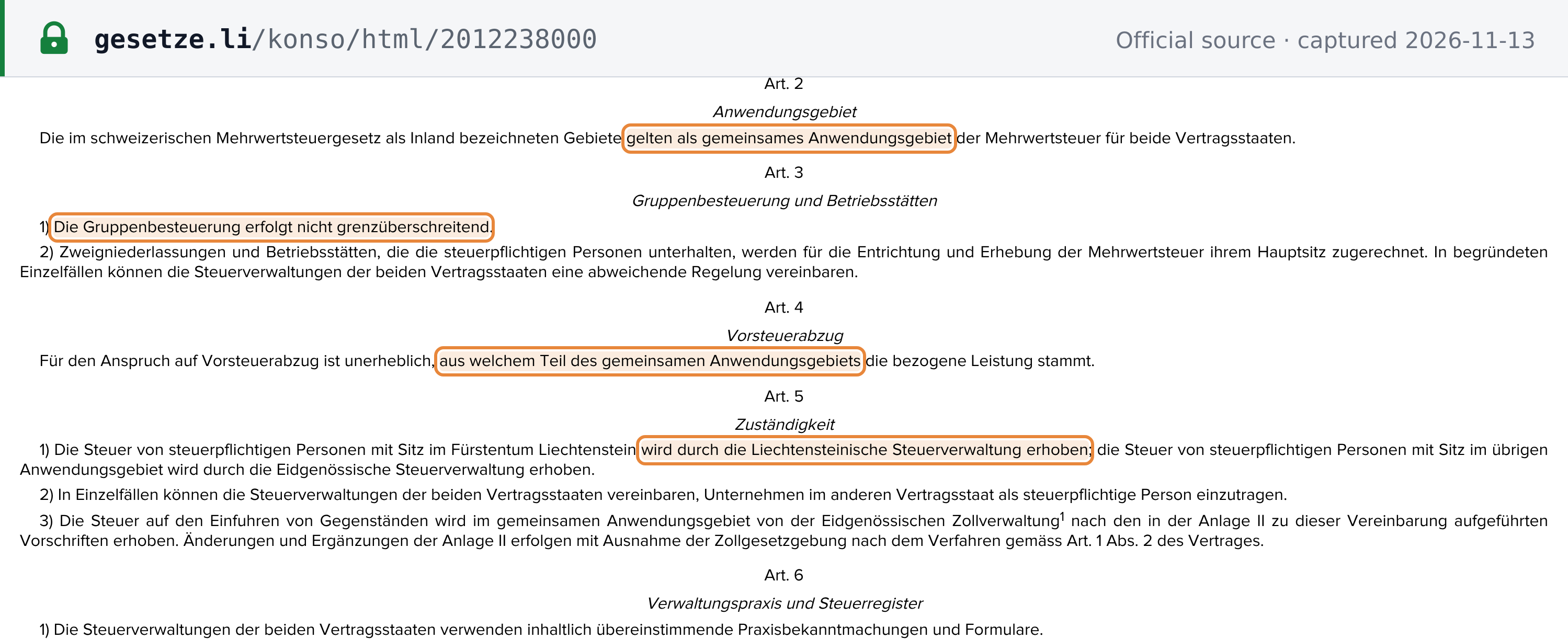
- One territory. Art. 2: "Die im schweizerischen Mehrwertsteuergesetz als Inland bezeichneten Gebiete gelten als gemeinsames Anwendungsgebiet der Mehrwertsteuer für beide Vertragsstaaten." The MWSTG defines "Inland" the same way, as "das Gebiet des Fürstentums Liechtenstein sowie ausländische Gebiete gemäss staatsvertraglicher Vereinbarung" (Art. 3 Bst. a). [1] A sale from Vaduz to Zurich, or from Zurich to Vaduz, is a domestic supply, not an export.
- No cross-border VAT groups. Art. 3 Abs. 1: "Die Gruppenbesteuerung erfolgt nicht grenzüberschreitend."
- Input tax regardless of origin. Art. 4: "Für den Anspruch auf Vorsteuerabzug ist unerheblich, aus welchem Teil des gemeinsamen Anwendungsgebiets die bezogene Leistung stammt."
- Two administrations, allocated by seat. Art. 5 Abs. 1: "Die Steuer von steuerpflichtigen Personen mit Sitz im Fürstentum Liechtenstein wird durch die Liechtensteinische Steuerverwaltung erhoben; die Steuer von steuerpflichtigen Personen mit Sitz im übrigen Anwendungsgebiet wird durch die Eidgenössische Steuerverwaltung erhoben." Branches and permanent establishments are attached to their head office (Art. 3 Abs. 2).
- Import VAT is collected by Swiss customs for the whole territory (Art. 5 Abs. 3).
 Source snapshot captured 2026-11-13 — original
For the Swiss side of the same territory, see the Switzerland VAT guide.
Authority, currency, period and layering
- Authority. The Liechtensteinische Steuerverwaltung (Liechtenstein Tax Administration, Aeulestrasse 38, 9490 Vaduz) assesses and collects domestic tax and reverse-charge tax. MWSTG Art. 52 Abs. 1: "Die Steuerverwaltung ist für die Erhebung und den Einzug der Inland- und der Bezugsteuer zuständig." [1] Its website is llv.li. [13]
- Import VAT follows Swiss law. MWSTG Art. 50: "Für die Steuer auf der Einfuhr von Gegenständen gelten die aufgrund des Vertrages vom 28. Oktober 1994 mit der Schweizerischen Eidgenossenschaft betreffend die Mehrwertsteuer im Fürstentum Liechtenstein und der dazugehörigen Vereinbarung massgeblichen schweizerischen Rechtsvorschriften." It is paid to the Swiss Federal Office for Customs and Border Security (BAZG) (Art. 51). [1]
- Currency. Swiss franc (CHF). Every amount in the MWSTG is in "Franken".
- Tax period. The calendar year: "Als Steuerperiode gilt das Kalenderjahr." (MWSTG Art. 34 Abs. 2). Returns are normally quarterly (see Filing and payment). [1]
- Layering. None. There is one national VAT; MWSTG Art. 2 bars the municipalities from levying a similar tax: "Was dieses Gesetz als Gegenstand der Mehrwertsteuer erklärt, von der Steuer ausnimmt oder befreit, darf von den Gemeinden keiner gleichartigen Steuer unterstellt werden." [1]
- Not EU VAT. Liechtenstein is in the EEA but not in the EU VAT area, so there is no EC Sales List, no OSS or IOSS and no VIES entry for Liechtenstein numbers.
Registration
Who must register
MWSTG Art. 10 Abs. 1: "Steuerpflichtig ist, wer unabhängig von Rechtsform, Zweck und Gewinnabsicht ein Unternehmen betreibt und:" "a) mit diesem Unternehmen Leistungen im Inland erbringt; oder" "b) Sitz, Wohnsitz oder Betriebsstätte im Inland hat." Operating a business means carrying on, independently and in one's own name, a professional or commercial activity aimed at earning income from supplies (Art. 10 Abs. 1a). Acquiring, holding and selling qualifying participations counts as business activity (Art. 10 Abs. 1b). [1]
Threshold: CHF 100,000 of worldwide turnover
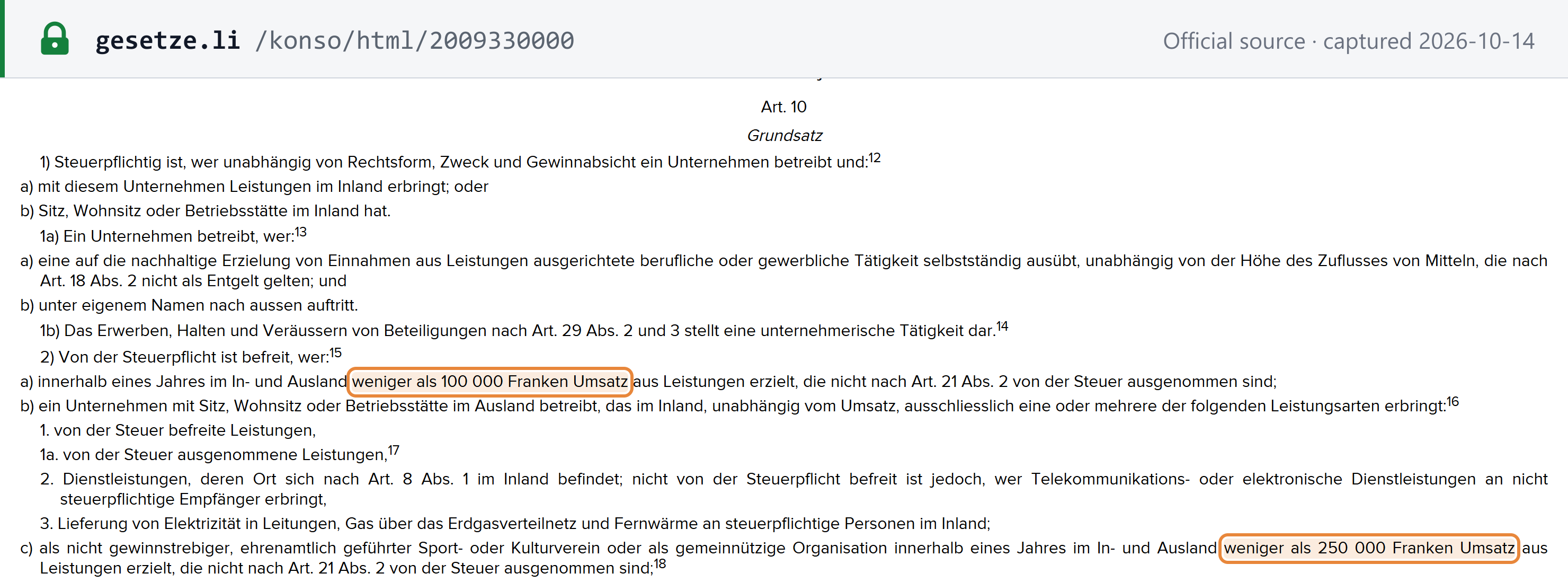
A business is exempt from registration if it "innerhalb eines Jahres im In- und Ausland weniger als 100 000 Franken Umsatz aus Leistungen erzielt, die nicht nach Art. 21 Abs. 2 von der Steuer ausgenommen sind" (Art. 10 Abs. 2 Bst. a, as at 13 November 2026). For non-profit, volunteer-run sports and cultural associations and for charitable organisations the limit is CHF 250,000 (Bst. c). [1]
- What counts. Turnover from taxable and exempt-with-credit supplies, in Liechtenstein, Switzerland and abroad, excluding VAT: "Der Umsatz berechnet sich nach den vereinbarten Entgelten ohne die Steuer." (Art. 10 Abs. 2a).
- Measurement. For an existing business, the last business year: the exemption ends "sobald das Total der im letzten Geschäftsjahr erzielten Umsätze die Grenze von Art. 10 Abs. 2 Bst. a oder c oder Art. 12 Abs. 3 erreicht hat oder absehbar ist, dass diese Grenze innerhalb von 12 Monaten nach der Aufnahme oder Ausweitung der unternehmerischen Tätigkeit überschritten wird" (Art. 14 Abs. 3). A new or expanding business makes a 12-month forecast.
- Public bodies. CHF 100,000 of taxable supplies to non-public customers (Art. 12 Abs. 3).
 Source snapshot captured 2026-10-14 — original
Non-resident businesses
There is no separate or zero threshold for foreign businesses: the same CHF 100,000 test applies, but because it counts worldwide turnover, a large foreign group is liable from its first taxable supply in the territory. A foreign business's liability starts "mit dem erstmaligen Erbringen einer Leistung im Inland" (Art. 14 Abs. 1 Bst. b). [1]
A foreign business is exempt regardless of turnover if, in the territory, it supplies only exempt-with-credit or exempt supplies, electricity, gas or district heating to taxable persons, or services taxed where the customer is. Art. 10 Abs. 2 Bst. b Ziff. 2 covers "Dienstleistungen, deren Ort sich nach Art. 8 Abs. 1 im Inland befindet; nicht von der Steuerpflicht befreit ist jedoch, wer Telekommunikations- oder elektronische Dienstleistungen an nicht steuerpflichtige Empfänger erbringt". In practice, a foreign supplier of B2B services does not register (its customer accounts for reverse-charge tax), while a foreign supplier of electronic services to consumers does. [1]
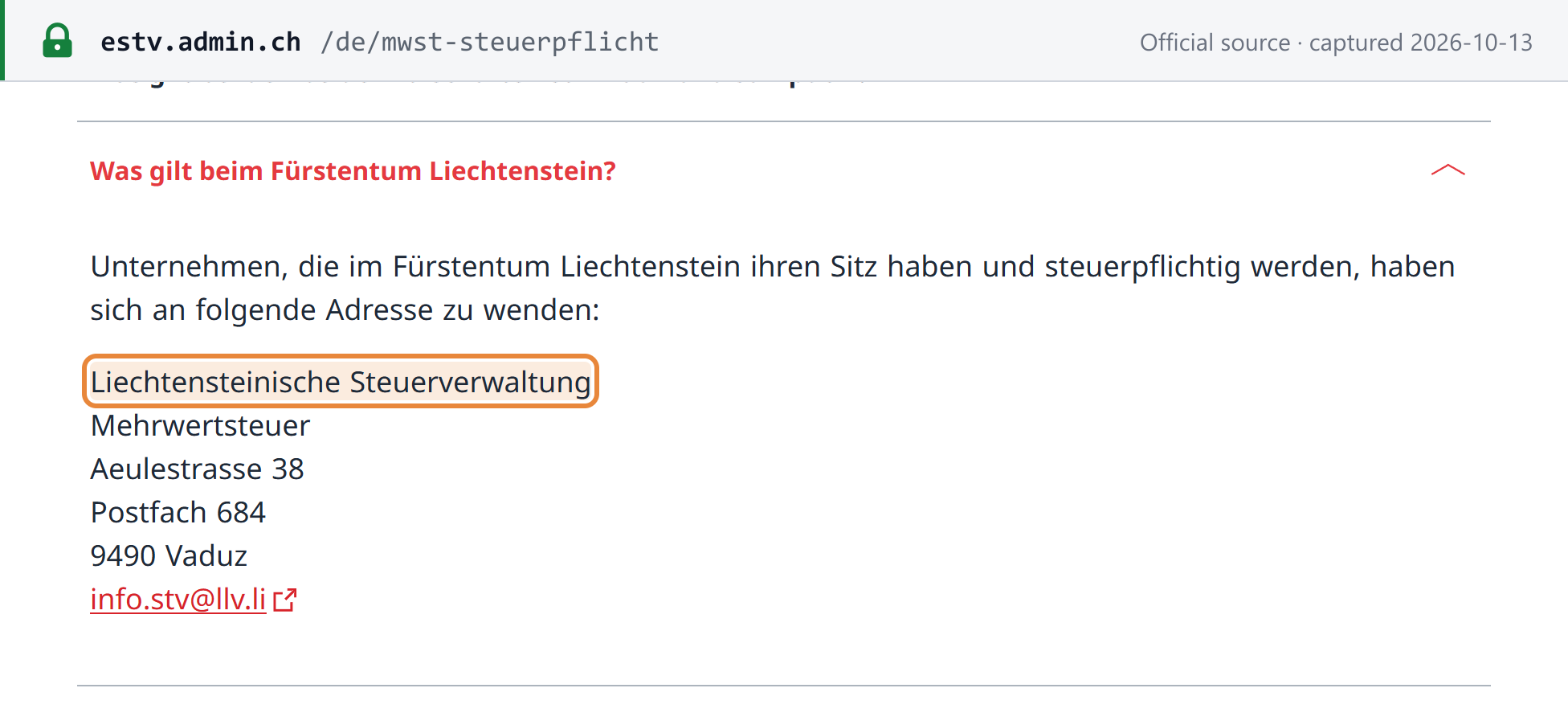
Which administration. A business seated in Liechtenstein registers with the Liechtensteinische Steuerverwaltung and one seated in Switzerland with the Swiss ESTV (agreement Art. 5 Abs. 1). The agreement allocates businesses by seat only (Art. 5 Abs. 1); it does not say which administration registers a business seated outside both countries. In individual cases the two administrations may agree to register a business in the other state (Art. 5 Abs. 2). A foreign business should confirm with the administration of the country where its activity takes place. [7] The ESTV sends Liechtenstein-seated businesses to Vaduz: "Unternehmen, die im Fürstentum Liechtenstein ihren Sitz haben und steuerpflichtig werden, haben sich an folgende Adresse zu wenden: Liechtensteinische Steuerverwaltung". [11]
 Source snapshot captured 2026-10-13 — original
Tax representative: must be based in Liechtenstein
MWSTG Art. 54 Abs. 1: "Steuerpflichtige Personen ohne Wohn- oder Geschäftssitz in Liechtenstein haben für die Erfüllung ihrer Verfahrenspflichten eine Vertretung zu bestimmen, die in Liechtenstein Wohn- oder Geschäftssitz hat." A VAT group must also appoint one (Abs. 2), and appointing a representative "wird keine Betriebsstätte nach den Bestimmungen des Steuergesetzes begründet" (Abs. 3). [1] Because the text requires a residence or seat in Liechtenstein, a representative based in Switzerland does not meet it.
 Source snapshot captured 2026-11-13 — original
Tax registration number
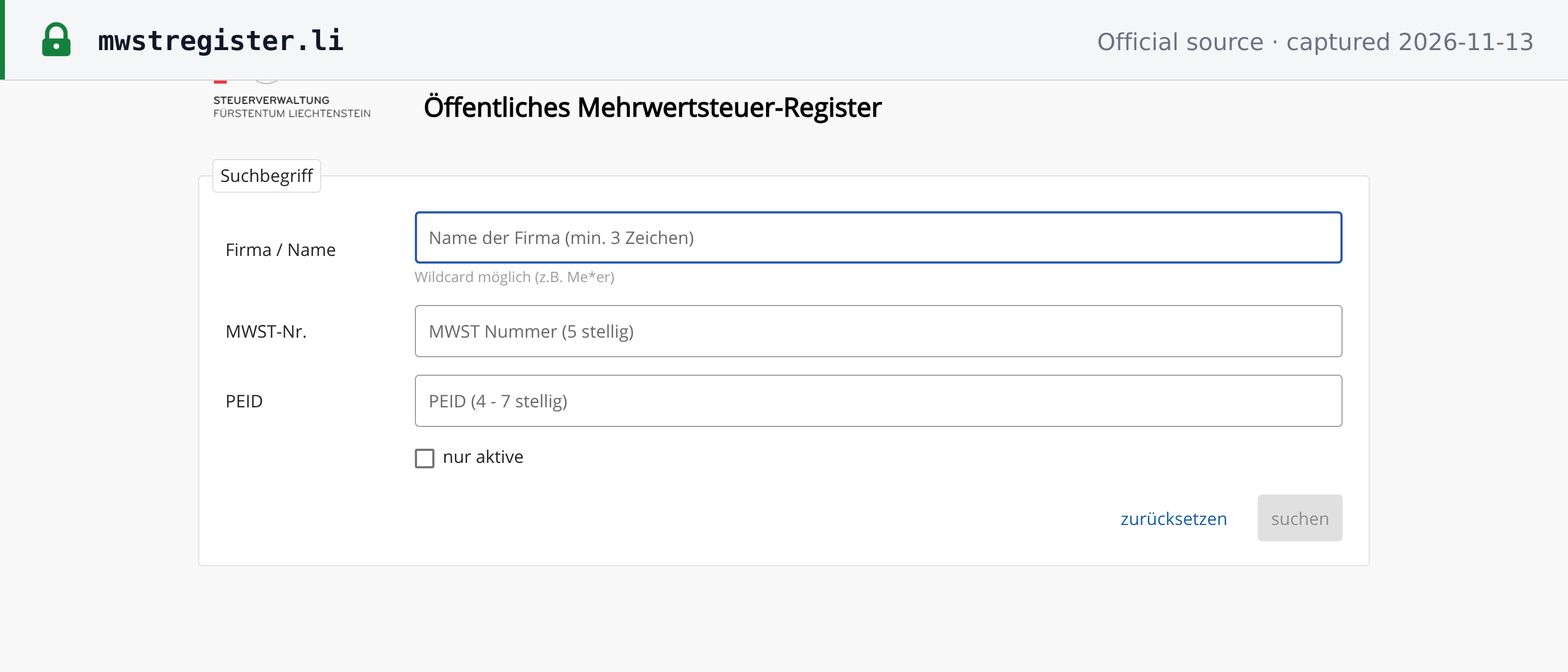
On registration, "Diese teilt ihnen eine nicht übertragbare Nummer zu, die registriert wird." (Art. 53 Abs. 1); the MWSTG fixes no format. [1] The Steuerverwaltung's public VAT register at mwstregister.li searches by "MWST Nummer (5 stellig)", by "PEID (4 - 7 stellig)" (the national person identification number) or by company name, and shows the registration status and the start and end of liability. [12] The register does not say how the number must be printed on an invoice.
 Source snapshot captured 2026-11-13 — original
For Liechtenstein's other identifiers (PEID, the income-tax number) and how they are used, see the Liechtenstein tax ID guide and the Liechtenstein tax number validator.
How to register
Register unprompted, in writing, within 30 days of becoming liable. Art. 53 Abs. 1: "Personen, die nach Art. 10 steuerpflichtig werden, haben sich unaufgefordert innert 30 Tagen nach Beginn ihrer Steuerpflicht bei der Steuerverwaltung schriftlich anzumelden." A person liable only for reverse-charge tax registers within 60 days after the end of the calendar year and declares the services at the same time (Art. 53 Abs. 3). [1]
Businesses must communicate with the authorities electronically. E-Government Act Art. 5 Abs. 1: "Im Geschäftsverkehr zwischen Behörden und zwischen Behörden und Unternehmen erfolgt die Kommunikation elektronisch." [9] The Steuerverwaltung runs an online VAT portal, eMWST. The MWSTG and MWSTV do not list the documents an application needs or set a processing time; those are matters of Steuerverwaltung practice.
 Source snapshot captured 2026-10-13 — original
Voluntary registration
Available. Art. 11 Abs. 1: "Wer ein Unternehmen betreibt und nach Art. 10 Abs. 2 oder Art. 12 Abs. 3 von der Steuerpflicht befreit ist, hat das Recht, auf die Befreiung von der Steuerpflicht zu verzichten." The waiver lasts at least one tax period (Art. 11 Abs. 3) and can be declared at the earliest from the start of the current tax period (Art. 14 Abs. 4). [1] The usual reason is to recover input tax, for example during a start-up phase with heavy investment.
Deregistration
- Ceasing business. Deregister in writing within 30 days: "Endet die Steuerpflicht nach Art. 14 Abs. 2, so hat sich die steuerpflichtige Person innert 30 Tagen nach der Beendigung der unternehmerischen Tätigkeit, spätestens aber mit dem Abschluss des Liquidationsverfahrens bei der Steuerverwaltung schriftlich abzumelden." (Art. 53 Abs. 2). A foreign business's liability ends at the end of the calendar year of its last supply in the territory (Art. 14 Abs. 2 Bst. b).
- Turnover below the threshold. A business whose turnover falls below CHF 100,000 (or CHF 250,000) and is expected to stay below "so muss sich die steuerpflichtige Person abmelden"; "Die Nichtabmeldung gilt als Verzicht auf die Befreiung von der Steuerpflicht nach Art. 11 Abs. 1." (Art. 14 Abs. 5). [1]
- Final return. The normal 60-day return period applies to the last period.
Group registration
Available to entities based in Liechtenstein only. Art. 13 Abs. 1: "Rechtsträger mit Sitz, Wohnsitz oder Betriebsstätte in Liechtenstein, die unter einheitlicher Leitung eines Rechtsträgers miteinander verbunden sind, können sich auf Antrag zu einem einzigen Steuersubjekt zusammenschliessen (Mehrwertsteuergruppe). In die Gruppe können auch Rechtsträger, die kein Unternehmen betreiben, und natürliche Personen einbezogen werden." A group can be formed from the start of any tax period and ended at the end of one (Art. 13 Abs. 2); members are jointly and severally liable (Art. 15 Abs. 1 Bst. c). [1] A group spanning Liechtenstein and Switzerland is not possible (agreement Art. 3 Abs. 1). [7] See VAT grouping explained.
Rates
Standard, reduced and special rates since 1 January 2024
| Rate | Applies to | Source |
|---|---|---|
| 8.1% (Normalsatz) | All taxable supplies not listed below, including restaurant and catering services | MWSTG Art. 25 Abs. 1 |
| 2.6% (reduced) | Food and non-alcoholic drinks, piped water, medicines, books, newspapers and magazines (printed and electronic), menstrual hygiene products, livestock, seeds, plants and cut flowers, animal feed, fertiliser, non-commercial radio and TV services, and others | MWSTG Art. 25 Abs. 2 |
| 3.8% (Sondersatz) | Accommodation, including breakfast even if billed separately | MWSTG Art. 25 Abs. 4 |
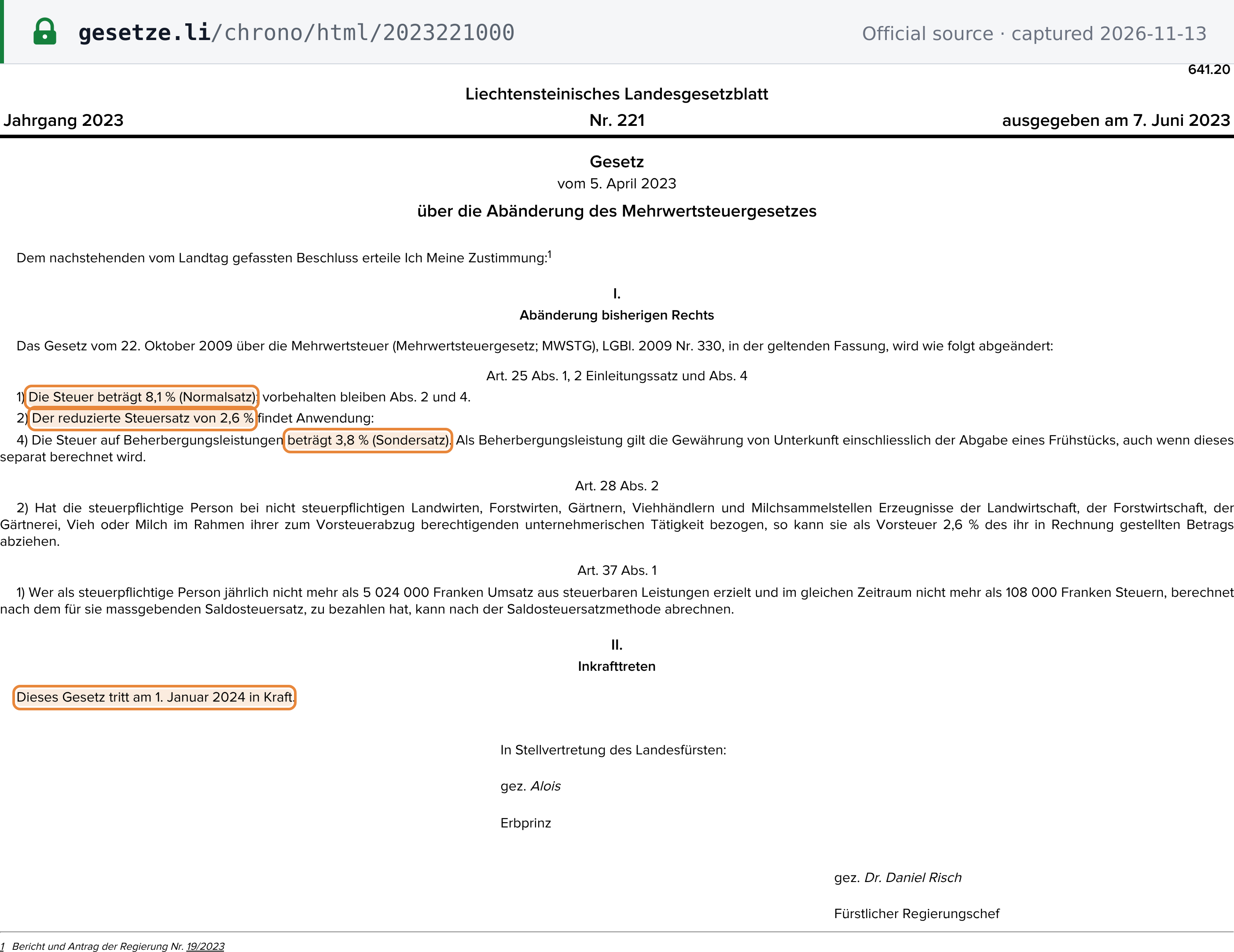
The rates were set by the Liechtenstein act LGBl. 2023 Nr. 221 of 5 April 2023, published 7 June 2023: "Die Steuer beträgt 8,1 % (Normalsatz); vorbehalten bleiben Abs. 2 und 4." · "Der reduzierte Steuersatz von 2,6 % findet Anwendung:" · "Die Steuer auf Beherbergungsleistungen beträgt 3,8 % (Sondersatz). Als Beherbergungsleistung gilt die Gewährung von Unterkunft einschliesslich der Abgabe eines Frühstücks, auch wenn dieses separat berechnet wird." · "Dieses Gesetz tritt am 1. Januar 2024 in Kraft." [3] The consolidated MWSTG (version of 1 January 2026) carries the same three rates as at 13 November 2026. [1] They are the same figures as in Switzerland.
 Source snapshot captured 2026-11-13 — original
Reduced-rate details
- The food definition borrows Swiss law: Art. 25 Abs. 2 Ziff. 2 covers "Lebensmittel nach dem schweizerischen Lebensmittelgesetz mit Ausnahme alkoholischer Getränke,". [1]
- Restaurant food is standard-rated: "Für Lebensmittel, die im Rahmen von gastgewerblichen Leistungen abgegeben werden, gilt der Normalsatz." (Art. 25 Abs. 3). Takeaway and delivered food, and food from vending machines, stay at 2.6%.
- Menstrual hygiene products ("Produkte für die Monatshygiene") moved to 2.6% on 1 January 2025 (LGBl. 2024 Nr. 372). [4]
Zero rate: "befreit"
The MWSTG has no rate labelled 0%. Its equivalent is a supply "von der Steuer befreit" (Art. 23): no domestic tax is due and input tax stays deductible. Art. 23 Abs. 1: "Ist eine Leistung nach diesem Artikel von der Steuer befreit, so ist auf dieser Leistung keine Inlandsteuer geschuldet." This covers direct exports of goods, goods under customs supervision, transport linked to imports and exports, investment gold (since 1 January 2025) and an underlying seller's supply to a registered platform; the government may also exempt cross-border air, rail and bus transport (Art. 23 Abs. 4). [1] Not to be confused with exempt supplies ("ausgenommen", Art. 21), which carry no input-tax deduction; see Exemptions.
Announced changes
As at 13 November 2026 no Liechtenstein act changing the rates has been published; the consolidated MWSTG still reads 8.1%, 2.6% and 3.8%. [1] Liechtenstein adopts Swiss VAT changes through its own legislation (treaty Art. 1), as it did for the 2024 rates. [6] Two Swiss measures are pending on the Swiss side: a popular vote on 29 November 2026 on a Swiss constitutional amendment that would raise the Swiss standard and accommodation rates (event record), and an extension of the Swiss accommodation rate to 31 December 2031, adopted by the Swiss Parliament in its final vote of 2 October 2026 (BBl 2026 2723) and subject to an optional referendum. Both are described in the Switzerland VAT guide.
The accommodation rate has no end date in Liechtenstein. The Liechtenstein Art. 25 Abs. 4 sets the 3.8% rate without an expiry date, whereas the Swiss Art. 25 Abs. 4 limits the Swiss special rate to 31 December 2027 at the latest (as at 13 November 2026). [1]
Cross-border rules
Imports
Import VAT on goods entering the common customs territory is a Swiss tax under Swiss law (MWSTG Art. 50), collected by the Swiss BAZG. There is no customs border between Liechtenstein and Switzerland. Registered importers can, with authorisation, declare import VAT in their Liechtenstein return instead of paying it at the border (Verlagerungsverfahren). Art. 51 Abs. 1: "Die folgenden steuerpflichtigen Personen können die auf der Einfuhr von Gegenständen geschuldete Steuer, statt sie dem Bundesamt für Zoll und Grenzsicherheit zu entrichten, in der periodischen Steuerabrechnung mit der Steuerverwaltung deklarieren (Verlagerungsverfahren):" [1]
Low-value consignments. Small consignments whose import tax is negligible are relieved under Swiss law (Art. 53 Abs. 1 Bst. a of the Swiss VAT Act; see the Switzerland guide). A foreign mail-order seller that makes at least CHF 100,000 a year from such consignments makes domestic supplies: Art. 7 Abs. 3 Bst. b MWSTG covers a seller that "daraus mindestens einen Umsatz von 100 000 Franken pro Jahr erzielt". From the following month it must register and import in its own name (MWSTV Art. 4a Abs. 2). [1] [2]
Exports
Goods sent directly abroad are exempt with input-tax credit: Art. 23 Abs. 2 Ziff. 1 covers "die Lieferung von Gegenständen mit Ausnahme der Überlassung zum Gebrauch oder zur Nutzung, die direkt ins Ausland befördert oder versendet werden;". [1] "Ausland" means outside the Liechtenstein–Swiss territory: a delivery from Schaan to St. Gallen is a domestic supply, not an export.
Imported services: reverse charge (Bezugsteuer)
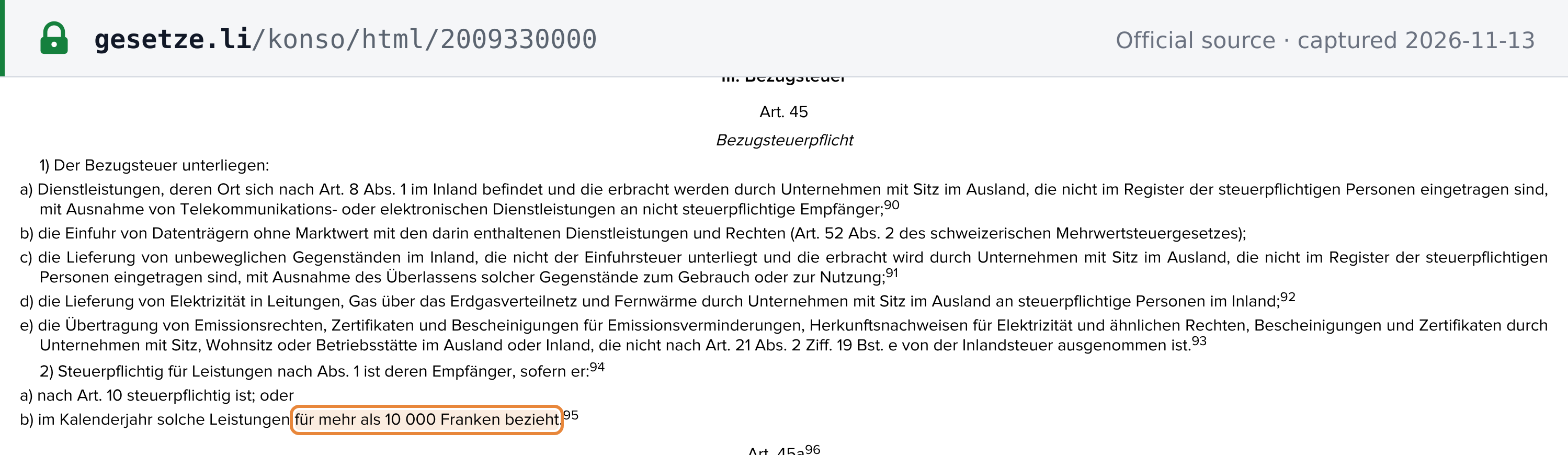
Services whose place of supply is in the territory under the general rule, supplied by foreign businesses that are not registered, are taxed on the recipient. Art. 45 Abs. 1 Bst. a: "Dienstleistungen, deren Ort sich nach Art. 8 Abs. 1 im Inland befindet und die erbracht werden durch Unternehmen mit Sitz im Ausland, die nicht im Register der steuerpflichtigen Personen eingetragen sind, mit Ausnahme von Telekommunikations- oder elektronischen Dienstleistungen an nicht steuerpflichtige Empfänger;". The recipient owes the tax if it is a taxable person, or if it buys more than CHF 10,000 of such services in a calendar year (Art. 45 Abs. 2). Sales of Liechtenstein real estate by unregistered foreign sellers, electricity and gas supplied to taxable persons, and emission rights are also caught. [1]
 Source snapshot captured 2026-11-13 — original
A Swiss supplier is not a foreign supplier for this purpose. It charges Swiss VAT to a Liechtenstein customer as on a domestic sale, and the customer deducts it (agreement Art. 2 and 4). [7] For the mechanism in general, see reverse charge explained.
Digital services to consumers
Telecommunications and electronic services to non-taxable customers are neither reverse-charged nor exempt from registration. The place of supply is where the customer lives (Art. 8 Abs. 1), and a foreign supplier is liable once its worldwide turnover reaches CHF 100,000 (Art. 10 Abs. 2 Bst. a and Bst. b Ziff. 2). It must then appoint a Liechtenstein representative if it registers with the Steuerverwaltung (Art. 54). [1] MWSTV Art. 10 lists what counts, for example "das elektronische Bereitstellen von Software und deren Aktualisierung;" and "das elektronische Bereitstellen von Musik, Filmen und Spielen, einschliesslich Geldspielen." [2] The MWSTG and MWSTV contain no simplified or one-stop registration scheme. See VAT on digital services from non-resident suppliers.
Foreign companies selling into Liechtenstein — B2B and B2C
- B2B services (taxed where the customer is): the foreign supplier is exempt from registration whatever its turnover (Art. 10 Abs. 2 Bst. b Ziff. 2); the Liechtenstein business customer accounts for Bezugsteuer (Art. 45).
- B2C electronic and telecommunications services: the foreign supplier registers once its worldwide turnover reaches CHF 100,000.
- Services with a special place-of-supply rule (Art. 8 Abs. 2, for example on-site services, events, restaurant services, passenger transport and services connected with real estate, B2B or B2C): taxed where performed or where the property is, so the foreign supplier is liable under the CHF 100,000 worldwide test.
- Goods: goods located in Liechtenstein or Switzerland when supplied, or dispatched from there, are domestic supplies and count towards the CHF 100,000 test. Goods shipped from abroad bear import VAT paid by the importer of record; the foreign seller is drawn in only if it imports in its own name or crosses the CHF 100,000 small-consignment test (Art. 7 Abs. 3). [1]
Marketplace and platform obligations (goods only)
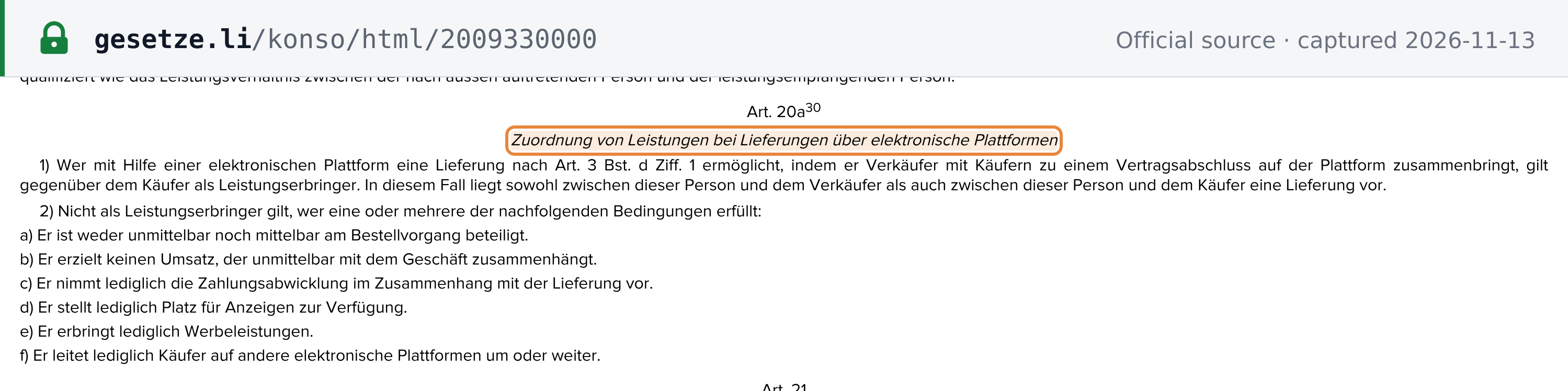
Since 1 January 2025 (LGBl. 2024 Nr. 372), an electronic platform that brings sellers and buyers together for a supply of goods is treated as the supplier. Art. 20a Abs. 1: "Wer mit Hilfe einer elektronischen Plattform eine Lieferung nach Art. 3 Bst. d Ziff. 1 ermöglicht, indem er Verkäufer mit Käufern zu einem Vertragsabschluss auf der Plattform zusammenbringt, gilt gegenüber dem Käufer als Leistungserbringer. In diesem Fall liegt sowohl zwischen dieser Person und dem Verkäufer als auch zwischen dieser Person und dem Käufer eine Lieferung vor." [1] [4]
- The rule refers only to a "Lieferung" (Art. 3 Bst. d Ziff. 1), so services sold through platforms are not covered.
- A platform that only processes payments, only shows advertising or only redirects buyers is not treated as the supplier (Art. 20a Abs. 2).
- The underlying seller's supply to a registered platform is exempt with credit (Art. 23 Abs. 2 Ziff. 13), and sellers are subsidiarily liable for the platform's tax (Art. 15 Abs. 3a).
- The Steuerverwaltung can order an import ban on low-value goods of non-compliant sellers and platforms (Art. 66a Abs. 3).
 Source snapshot captured 2026-11-13 — original
See marketplace deemed-supplier rules for how other countries handle this.
Place of supply
- Goods (Art. 7 Abs. 1): where the goods are when the power of disposal passes, or where transport to the customer begins: "die Beförderung oder Versendung des Gegenstandes zum Abnehmer oder in dessen Auftrag zu einer Drittperson beginnt."
- Services (Art. 8 Abs. 1), B2B and B2C alike: "Als Ort der Dienstleistung gilt unter Vorbehalt von Abs. 2 der Ort, an dem der Empfänger der Dienstleistung den Sitz der wirtschaftlichen Tätigkeit oder eine Betriebsstätte hat, für welche die Dienstleistung erbracht wird, oder in Ermangelung eines solchen Sitzes oder einer solchen Betriebsstätte der Wohnort oder der Ort seines üblichen Aufenthaltes." Art. 8 Abs. 2 sets exceptions for services to physically present persons, travel agencies, cultural and sporting events, restaurants, passenger transport and real estate, including hotel accommodation. [1]
Invoice requirements
An invoice ("Rechnung") is any document that settles the consideration for a supply, whatever it is called: Art. 3 Bst. l defines it as "jedes Dokument, mit dem gegenüber einer Drittperson über das Entgelt für eine Leistung abgerechnet wird, gleichgültig, wie dieses Dokument im Geschäftsverkehr bezeichnet wird;". The supplier must issue a compliant invoice when the customer asks for one. Art. 26 Abs. 1: "Der Leistungserbringer hat dem Leistungsempfänger auf Verlangen eine Rechnung auszustellen, die den Anforderungen nach Abs. 2 und 3 genügt." [1] The MWSTG is form-neutral: invoices may be on paper or electronic.
Mandatory content
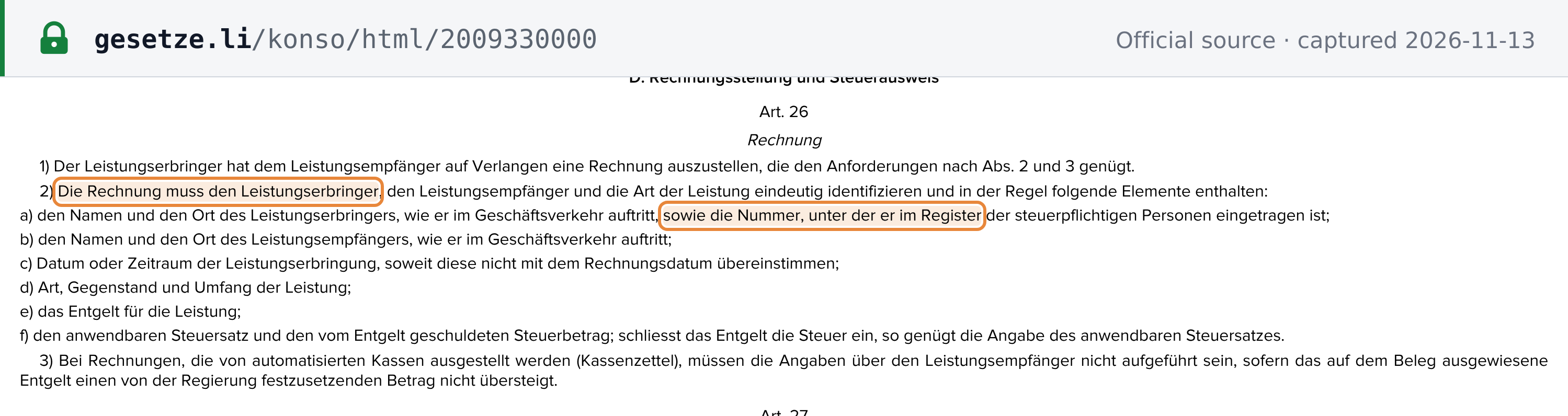
Art. 26 Abs. 2: "Die Rechnung muss den Leistungserbringer, den Leistungsempfänger und die Art der Leistung eindeutig identifizieren und in der Regel folgende Elemente enthalten:" [1]
| # | Field | Art. 26 Abs. 2 wording |
|---|---|---|
| a | Supplier's name and place as used in business, and its VAT registration number | "den Namen und den Ort des Leistungserbringers, wie er im Geschäftsverkehr auftritt, sowie die Nummer, unter der er im Register der steuerpflichtigen Personen eingetragen ist;" |
| b | Customer's name and place as used in business | "den Namen und den Ort des Leistungsempfängers, wie er im Geschäftsverkehr auftritt;" |
| c | Date or period of supply, if different from the invoice date | "Datum oder Zeitraum der Leistungserbringung, soweit diese nicht mit dem Rechnungsdatum übereinstimmen;" |
| d | Nature, subject and extent of the supply | "Art, Gegenstand und Umfang der Leistung;" |
| e | Consideration | "das Entgelt für die Leistung;" |
| f | Applicable rate and tax amount; the rate alone if the price includes VAT | "den anwendbaren Steuersatz und den vom Entgelt geschuldeten Steuerbetrag; schliesst das Entgelt die Steuer ein, so genügt die Angabe des anwendbaren Steuersatzes." |
The words "in der Regel" make the list the norm rather than a strict form test. The MWSTG and MWSTV do not require an invoice number, the customer's VAT number, a particular language or a particular currency. The six elements are the same as in Swiss law (Art. 26 Abs. 2 of the Swiss VAT Act).
 Source snapshot captured 2026-11-13 — original
A specimen of a compliant invoice
The MWSTG, the MWSTV and their amending acts contain no specimen invoice; the specimen below is our illustration of where the Art. 26 Abs. 2 fields sit.
RECHNUNG / INVOICE — illustrative specimen (Liechtenstein)
| Nature, subject and extent of the supplyArt. 26 Abs. 2 Bst. d | Qty | Unit price excl. VAT (CHF) | VAT rateArt. 26 Abs. 2 Bst. f | Amount excl. VAT (CHF) |
|---|---|---|---|---|
| Repair of office printer, labour (hours) | 3 | 120.00 | 8.1% | 360.00 |
| Toner cartridge | 1 | 90.00 | 8.1% | 90.00 |
| Technical manual (printed book) | 1 | 50.00 | 2.6% | 50.00 |
- Consideration excl. VATArt. 26 Abs. 2 Bst. e
- CHF 500.00
- VAT 8.1% on CHF 450.00Art. 26 Abs. 2 Bst. f
- CHF 36.45
- VAT 2.6% on CHF 50.00Art. 26 Abs. 2 Bst. f
- CHF 1.30
- Total incl. VAT
- CHF 537.75
- If prices are stated including VAT, showing the applicable rate alone is enough (Art. 26 Abs. 2 Bst. f).
- The date or period of supply is needed only where it differs from the invoice date (Art. 26 Abs. 2 Bst. c).
- A business that is not registered must not refer to VAT on its invoices (Art. 27 Abs. 1).
- For a foreign-currency invoice, the tax is converted into francs at the Steuerverwaltung's published rate (MWSTV Art. 46).
Issuance deadline and tax point
The MWSTG and MWSTV set no deadline for issuing an invoice. Timing matters through when the tax arises: under the default agreed-consideration method it arises "mit der Rechnungsstellung" (Art. 40 Abs. 1 Bst. a), and on payment where no invoice is issued (Bst. c). The customer's input-tax deduction arises when it receives the invoice (Art. 40 Abs. 1). [1]
Numbering
The MWSTG and MWSTV contain no invoice-numbering or sequence rule.
Simplified invoices: till receipts up to CHF 400
Receipts from automated tills need not name the customer up to an amount set by the government (MWSTG Art. 26 Abs. 3). MWSTV Art. 57 sets it: "Kassenzettel für Beträge bis 400 Franken müssen keine Angaben über den Leistungsempfänger enthalten. Solche Kassenzettel berechtigen nicht zu einer Steuerrückerstattung im Vergütungsverfahren." [2]
Wrongly shown VAT, credit notes and corrections
- Who may not show VAT. "Wer nicht im Register der steuerpflichtigen Personen eingetragen ist oder wer das Meldeverfahren nach Art. 38 anwendet, darf in Rechnungen nicht auf die Steuer hinweisen." (Art. 27 Abs. 1). VAT shown without entitlement, or too much VAT, is owed unless the invoice is corrected or there was no loss of revenue (Art. 27 Abs. 2).
- Corrections. "Die nachträgliche Korrektur einer Rechnung kann innerhalb des handelsrechtlich Zulässigen durch ein empfangsbedürftiges Dokument erfolgen, das auf die ursprüngliche Rechnung verweist und diese widerruft." (Art. 27 Abs. 4). Price reductions adjust the tax when the correction is booked or the corrected amount received (Art. 41 Abs. 1). [1] The MWSTG has no separate rule for debit notes.
Self-billing
The MWSTG recognises credit notes issued by the customer (Gutschriften). VAT shown on them has the same effect as on an invoice "soweit der Gutschriftsempfänger einer unberechtigt ausgewiesenen Steuer oder einem zu hohen Steuerbetrag nicht schriftlich widerspricht" (Art. 27 Abs. 3). The MWSTG and MWSTV set no approval procedure for self-billing. [1]
Currency and language
- Currency. Invoices may be in a foreign currency; the tax is converted into francs when it arises. MWSTV Art. 46 Abs. 3: "Die Umrechnung erfolgt nach dem von der Steuerverwaltung veröffentlichten Wechselkurs, wobei wahlweise der Monatsmittelkurs oder der Tageskurs für den Verkauf von Devisen verwendet werden kann." For currencies without a published rate, a Liechtenstein bank's daily selling rate applies (Abs. 3a), and the chosen method is kept for at least one tax period (Abs. 5). [2]
- Language. The MWSTG and MWSTV set no language requirement.
Retention, electronic records and audit
- 10 years for books and records: until the absolute limitation of the tax claim (MWSTG Art. 57 Abs. 2), which falls 10 years after the end of the tax period (Art. 42 Abs. 6). The company-law rule in PGR Art. 1059 Abs. 1 also says "während zehn Jahren". [1] [10]
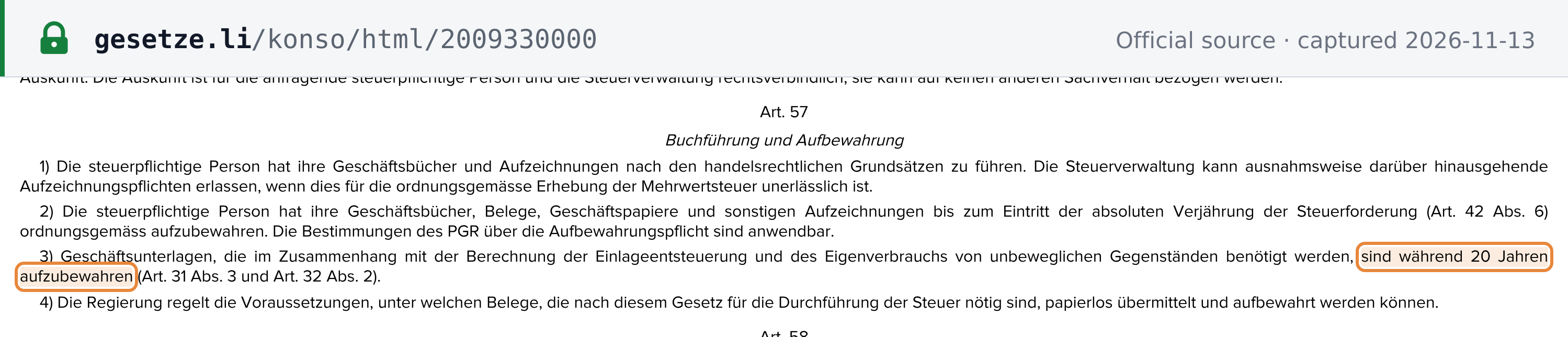
- 20 years for records on real estate. Art. 57 Abs. 3: "Geschäftsunterlagen, die im Zusammenhang mit der Berechnung der Einlageentsteuerung und des Eigenverbrauchs von unbeweglichen Gegenständen benötigt werden, sind während 20 Jahren aufzubewahren (Art. 31 Abs. 3 und Art. 32 Abs. 2)." [1]
- Electronic archiving is allowed under PGR Art. 1045 to 1062a (MWSTV Art. 117), provided records "die Übereinstimmung mit den zu Grunde liegenden Geschäftsvorfällen gewährleistet ist und wenn sie jederzeit lesbar gemacht werden können" (PGR Art. 1059 Abs. 2). [2] [10] That conformity requirement is the nearest thing to an audit-trail rule: the MWSTG and MWSTV contain no tamper-evidence, hash or certified-software requirement.
 Source snapshot captured 2026-11-13 — original
E-invoicing status
No B2B or B2C e-invoicing mandate as at 13 November 2026. The MWSTG accepts any document as an invoice (Art. 3 Bst. l), and neither the MWSTG nor the MWSTV contains an e-invoicing, clearance or real-time reporting requirement. [1]
- B2G. The public procurement act (ÖAWG), which transposes Directive 2014/55/EU through the EEA, obliges contracting authorities to accept European-standard e-invoices for contracts above the procurement thresholds. Art. 49b Abs. 1: "Bei Vergaben oberhalb der Schwellenwerte sind die Auftraggeber zur Entgegennahme und Verarbeitung von elektronischen Rechnungen verpflichtet, sofern sie der europäischen Norm für die elektronische Rechnungsstellung entsprechen und unter Verwendung einer Syntax gestellt wurden, die im Amtsblatt der Europäischen Union veröffentlicht wurde." Contracting authorities other than the State had to do so by 27 November 2019 at the latest. [8] This is a duty to receive, not a duty on suppliers to send; the ÖAWG names no network.
- Swiss rules do not carry over. The Swiss federal administration's own e-invoicing requirement for its suppliers is Swiss procurement practice and does not bind Liechtenstein authorities.
For other countries, see the e-invoicing status and networks table.
Filing and payment
Filing frequency
MWSTG Art. 35 Abs. 1: "Innerhalb der Steuerperiode erfolgt die Abrechnung der Steuer vierteljährlich. Bei der Abrechnung nach Saldosteuersätzen (Art. 37 Abs. 1 und 2) erfolgt die Abrechnung halbjährlich." [1]
- Quarterly by default.
- Half-yearly under the net tax rate method (Saldosteuersatz).
- Monthly on request, for businesses with a regular input-tax surplus.
- Annually on request, since 1 January 2025, for businesses with taxable turnover "von nicht mehr als 5 005 000 Franken pro Jahr" (Art. 35 Abs. 1a Bst. b), paying instalments invoiced by the Steuerverwaltung: three (150, 240 and 330 days into the year), or one at 240 days for net-tax-rate users (Art. 76a Abs. 6). [4]
 Source snapshot captured 2026-10-13 — original
Return and payment due date: 60 days
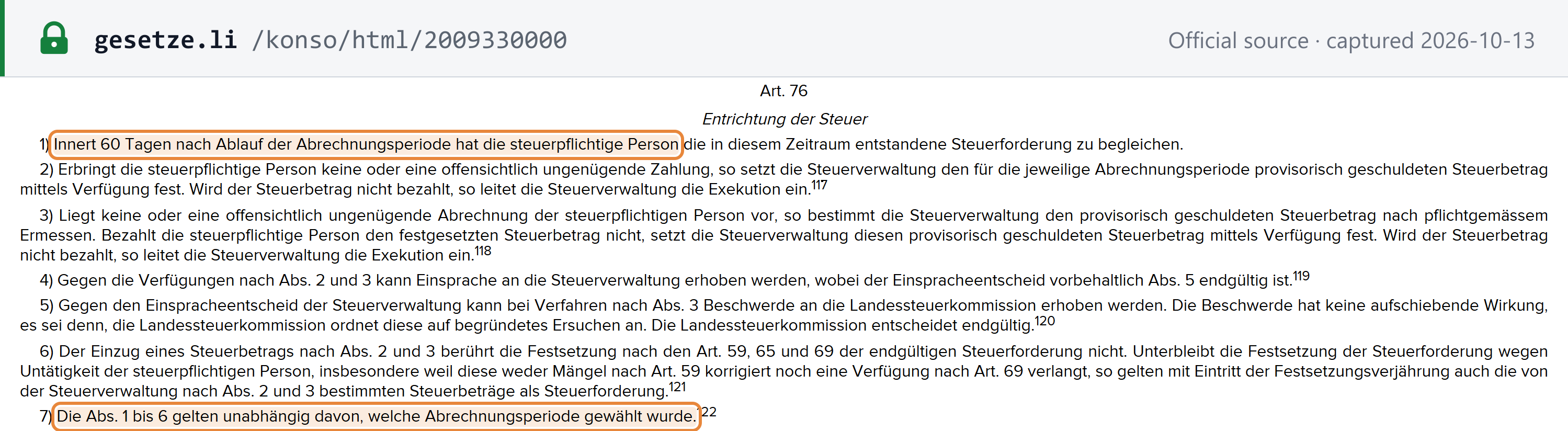
Both the return and the payment are due 60 days after the end of the reporting period. Art. 58 Abs. 1: "Die steuerpflichtige Person hat gegenüber der Steuerverwaltung innert 60 Tagen nach Ablauf der Abrechnungsperiode unaufgefordert in der vorgeschriebenen Form über die Steuerforderung abzurechnen." Art. 76 Abs. 1: "Innert 60 Tagen nach Ablauf der Abrechnungsperiode hat die steuerpflichtige Person die in diesem Zeitraum entstandene Steuerforderung zu begleichen." [1]
This is a count of days, not a month end: quarterly returns and payments are due on 30 May, 29 August and 29 November, and for the fourth quarter on 1 March (29 February in a leap year); filing by the last day of February is always on time. The MWSTG sets no rule for a deadline that falls on a weekend or holiday, so file and pay by the working day before it. The Liechtenstein compliance calendar lists the dates for each period and shows the last day of February for the fourth quarter as the safe date.
 Source snapshot captured 2026-10-13 — original
 Source snapshot captured 2026-10-13 — original
The return and annual correction
Returns are filed in the form the Steuerverwaltung prescribes (Art. 58 Abs. 1). Errors found when closing the books must be corrected at the latest in the return for the period that includes the 180th day after the end of the business year (Art. 59 Abs. 1), and the corrections are filed separately (MWSTV Art. 124). [1] [2]
Additional listings
None. Liechtenstein has no EC Sales List, no sales or purchase listing, no SAF-T and no OSS or IOSS return (MWSTG and MWSTV).
Accounting methods
- Agreed or received consideration. The default is the invoice basis; "Die Steuerverwaltung gestattet der steuerpflichtigen Person auf Antrag, über die Steuer nach vereinnahmten Entgelten abzurechnen." (Art. 39 Abs. 2).
- Net tax rate method (Saldosteuersatz): for businesses with no more than CHF 5,024,000 of taxable turnover and no more than CHF 108,000 of tax a year (Art. 37 Abs. 1, as set by LGBl. 2023 Nr. 221 from 1 January 2024), with half-yearly returns. [3]
- Flat tax rate method (Pauschalsteuersatz): for public bodies, associations, foundations and similar bodies (Art. 37 Abs. 5). [1]
Input-tax recovery and blocked items
Domestic VAT invoiced, reverse-charge tax declared and import VAT paid are deductible in the course of the business (Art. 28 Abs. 1), and "Der Abzug der Vorsteuer nach Abs. 1 ist zulässig, wenn die steuerpflichtige Person nachweist, dass sie die Vorsteuer bezahlt hat." (Art. 28 Abs. 3). There is no deduction for purchases used for exempt supplies not opted for taxation: "Kein Anspruch auf Vorsteuerabzug besteht bei Leistungen und bei der Einfuhr von Gegenständen, die für die Erbringung von Leistungen, die von der Steuer ausgenommen sind und für deren Versteuerung nicht optiert wurde, verwendet werden." (Art. 29 Abs. 1). Mixed use requires a pro-rata correction (Art. 30). Gifts are presumed business-related "bis 500 Franken pro Person und Jahr" (Art. 31 Abs. 2 Bst. c). [1] The MWSTG and MWSTV contain no specific block on entertainment, meals or passenger cars.
Refunds
- Resident businesses. A credit balance is paid out. If the Steuerverwaltung pays more than 60 days after receiving the return, refund interest runs from the 61st day (Art. 78 Abs. 4), at 4% a year from 1 January 2026 (MWSTV Art. 143, as amended by LGBl. 2025 Nr. 548). [1] [5]
- Foreign businesses that are not registered and make no taxable supplies in the territory can reclaim Liechtenstein VAT if their country grants reciprocity (MWSTV Art. 136 Abs. 3). MWSTV Art. 139 Abs. 1: "Die Vergütungsperiode entspricht dem Kalenderjahr. Der Antrag auf Vergütung ist innerhalb von sechs Monaten nach Ablauf des Kalenderjahrs zu stellen, in dem die Leistung in Rechnung gestellt wurde." The minimum is CHF 500 a year (Art. 138 Abs. 3); invoices must meet Art. 26 Abs. 2 MWSTG and be in the claimant's name (Art. 140 Abs. 1); and "Der Antragsteller muss eine Vertretung mit Wohn- oder Geschäftssitz in Liechtenstein bestellen." (Art. 140 Abs. 3). [2] Swiss VAT is refunded by the Swiss ESTV, not by Liechtenstein.
- Bad debts. No dedicated relief; where the agreed consideration is corrected, the output tax is adjusted when the correction is booked or the corrected amount is received (Art. 41 Abs. 1). [1]
Exemptions
Exempt supplies ("von der Steuer ausgenommen")
Art. 21 Abs. 1: "Eine Leistung, die von der Steuer ausgenommen ist und für deren Versteuerung nicht nach Art. 22 optiert wird, ist nicht steuerbar." Art. 21 Abs. 2 lists about 30 categories, including hospital and medical treatment, care and social services, childcare, education, cultural services and sports admissions to the public, insurance and reinsurance, financial services (credit, deposits, payments, currencies, securities), the sale and letting of real estate (except hotel rooms, campsites, parking, fixed installations, safes and trade-fair space), lotteries and gaming, and own farm produce. [1]
The financial-services exemption names Liechtenstein's own fund laws: Ziff. 19 Bst. f covers "der Vertrieb von Anteilen an und die Verwaltung von Organismen für gemeinsame Anlagen in Wertpapieren nach dem UCITSG, Investmentunternehmen nach dem IUG oder von alternativen Investmentfonds nach dem AIFMG".
Option to tax. "Die steuerpflichtige Person kann unter Vorbehalt von Abs. 2 jede von der Steuer ausgenommene Leistung durch offenen Ausweis der Steuer oder durch Deklaration in der Abrechnung versteuern (Option)." (Art. 22 Abs. 1). The option is excluded for insurance, financial services and gaming (Art. 21 Abs. 2 Ziff. 18, 19 and 23), and for real estate used solely for housing (Art. 22 Abs. 2). [1]
Exempt is not zero-rated
- "Ausgenommen" (Art. 21): no VAT is charged and the related input tax is not deductible (Art. 29 Abs. 1). The VAT on costs becomes a cost.
- "Befreit" (Art. 23): no VAT is charged and input tax stays deductible. This is the zero-rate equivalent (exports, international transport, investment gold).
See zero-rated vs exempt supplies.
Special regimes
- Small businesses: below CHF 100,000 (CHF 250,000 for non-profit associations and charities), not liable; there is no separate small-business scheme.
- Net tax rate and flat tax rate methods: see Accounting methods.
- Margin scheme for collectibles: "Hat die steuerpflichtige Person Sammlerstücke wie Kunstgegenstände, Antiquitäten und dergleichen erworben, so kann sie für die Berechnung der Steuer den Ankaufspreis vom Verkaufspreis abziehen, sofern sie auf dem Ankaufspreis keine Vorsteuern abgezogen hat (Margenbesteuerung)." (Art. 24a Abs. 1).
- Notification procedure (Meldeverfahren) for transfers of a business or part of one: mandatory where the tax on the price would exceed CHF 10,000 or the buyer is a closely related person (Art. 38 Abs. 1). "Wird das Meldeverfahren angewendet, so muss dies auf der Rechnung vermerkt werden." (MWSTV Art. 103). [1] [2]
- Free zones: Liechtenstein has none of its own; goods in Swiss customs warehouses and bonded procedures are exempt with credit (Art. 23 Abs. 2).
Offences and penalties
Offences
- Breach of procedural duties (Art. 86 Abs. 1), committed intentionally or negligently, including: "die Anmeldung als steuerpflichtige Person nicht vornimmt;" · "trotz Mahnung eine Steuerabrechnung nicht fristgerecht einreicht;" · "in Rechnungen eine nicht oder nicht in dieser Höhe geschuldete Mehrwertsteuer ausweist;" · "durch Angabe einer Registernummer eine Eintragung im Register der steuerpflichtigen Personen vortäuscht;", as well as failing to keep or produce records and obstructing an audit despite a reminder.
- Tax evasion (Steuerhinterziehung, Art. 87): reducing the tax intentionally or negligently, for example by under-declaring income, over-claiming input tax or obtaining an unlawful refund. "Der Versuch ist strafbar." (Art. 87 Abs. 6).
- Tax fraud (Steuerbetrug, Art. 88), a criminal offence: "Wer eine Steuerhinterziehung durch vorsätzlichen Gebrauch falscher, verfälschter, inhaltlich unwahrer Geschäftsbücher oder anderer Urkunden begeht, wird wegen Vergehens mit einer Freiheitsstrafe bis zu einem Jahr oder einer Geldstrafe bis zu 360 Tagessätzen bestraft."
- Aggravated evasion (Art. 89 Abs. 1), such as recruiting others or evading tax as a business: "Wer eine Steuerhinterziehung unter erschwerenden Umständen begeht, wird wegen Vergehens mit einer Freiheitsstrafe bis zu zwei Jahren oder einer Geldstrafe bis zu 360 Tagessätzen bestraft." [1]
Under the 2012 agreement, Liechtenstein must provide penalties at least comparable to Swiss law (Art. 1 Abs. 3). [7]
Penalties
| Exposure | Amount (as at 13 November 2026) | Source |
|---|---|---|
| Procedural offences (failure to register, no return despite reminder, VAT wrongly shown on invoices, record-keeping failures) | Fine up to CHF 10,000 | MWSTG Art. 86 Abs. 1 |
| Tax evasion | Fine up to CHF 400,000; up to CHF 800,000 where the evaded tax was passed on in deductible form; up to twice the tax advantage if that is higher (intent) | Art. 87 Abs. 1, 2 and 5 |
| Tax fraud | Up to 1 year's imprisonment or up to 360 daily rates | Art. 88 |
| Aggravated evasion | Up to 2 years' imprisonment or up to 360 daily rates | Art. 89 |
| Late payment | Interest of 4% a year from 1 January 2026 (4.5% in 2024 and 2025), due without a reminder, collected from CHF 100 | Art. 77; MWSTV Art. 142 |
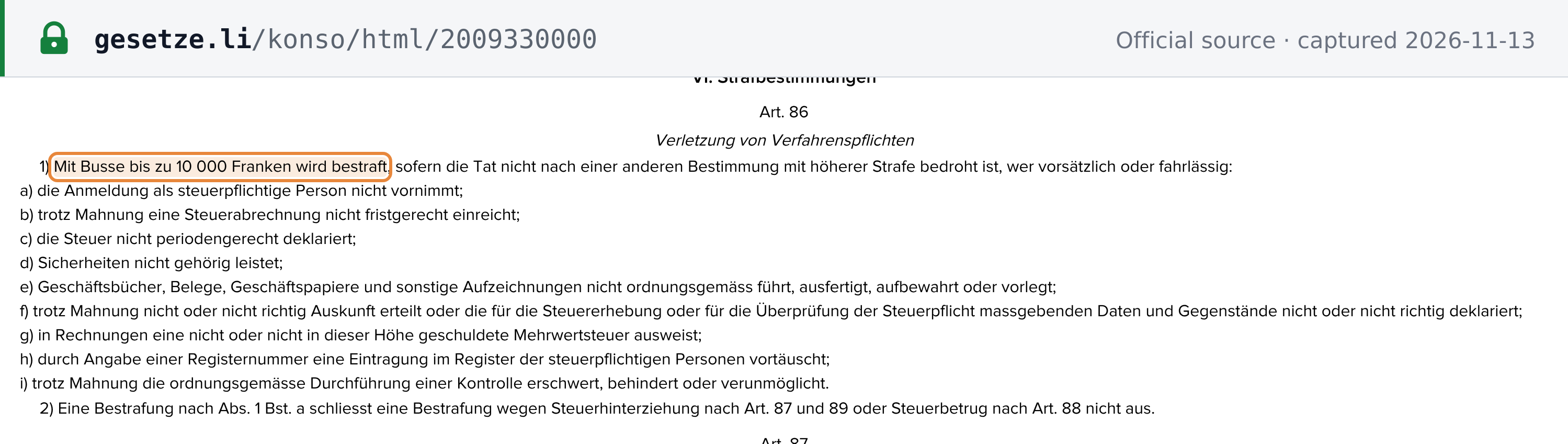
Art. 86 Abs. 1: "Mit Busse bis zu 10 000 Franken wird bestraft, sofern die Tat nicht nach einer anderen Bestimmung mit höherer Strafe bedroht ist, wer vorsätzlich oder fahrlässig:". Art. 87 Abs. 1: "Mit Busse bis zu 400 000 Franken wird bestraft, wer vorsätzlich oder fahrlässig die Steuerforderung zulasten des Landes verkürzt, indem er:". Fines cannot be suspended: "Eine bedingte Bestrafung ist bei Bussen ausgeschlossen." (Art. 100). Evaded tax and interest are recovered whether or not anyone is punished (Art. 93 Abs. 1). [1]
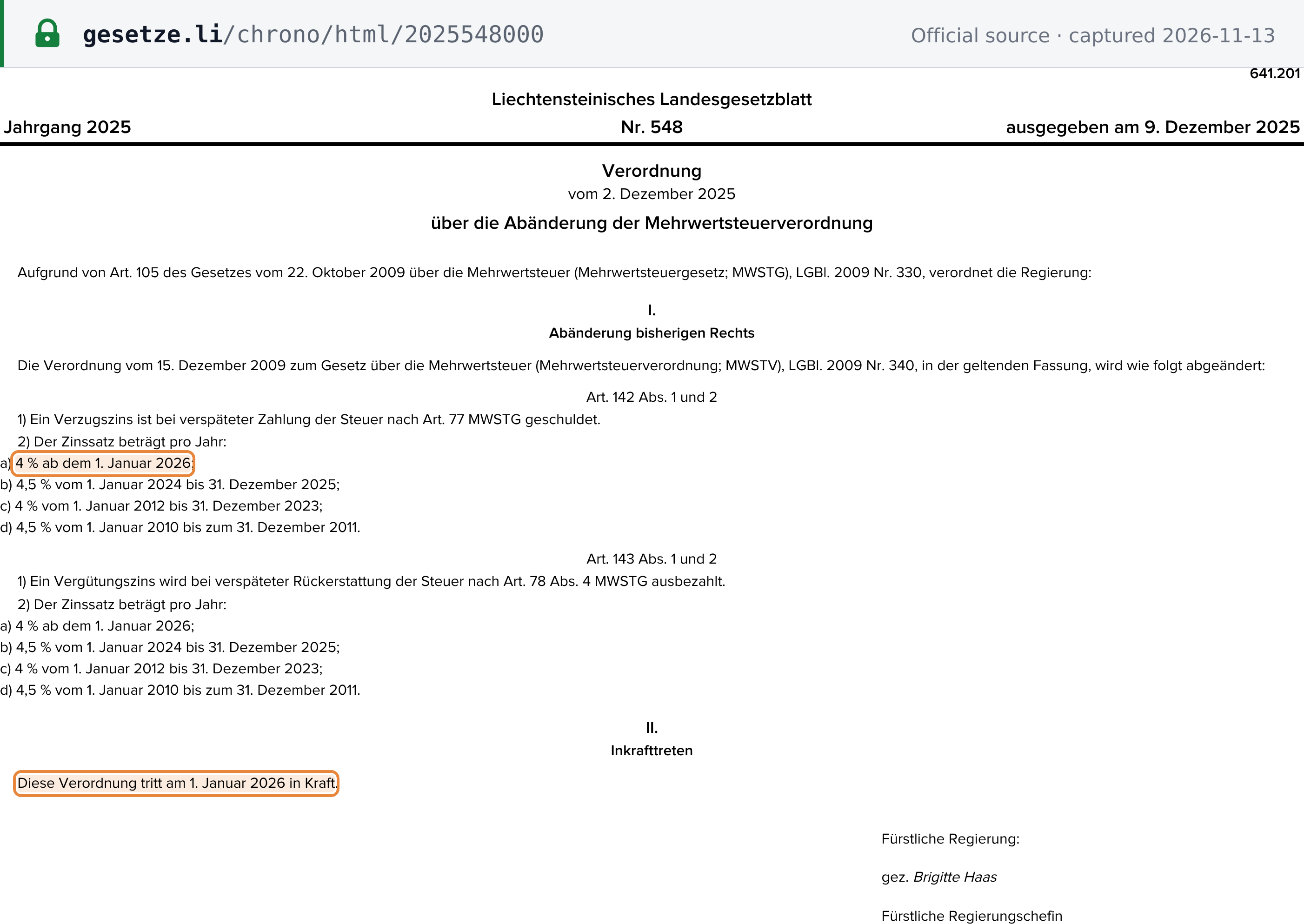
Late-payment interest: "Bei verspäteter Zahlung wird ohne Mahnung ein Verzugszins geschuldet." (MWSTG Art. 77 Abs. 1). MWSTV Art. 142 Abs. 2, as amended by LGBl. 2025 Nr. 548: "Der Zinssatz beträgt pro Jahr:" "4 % ab dem 1. Januar 2026;". Interest is collected only from CHF 100 (Art. 142 Abs. 3). [2] [5]
Failing to issue a compliant invoice carries no fine of its own, because invoices are issued on request (Art. 26 Abs. 1). The exposure is Art. 86 Abs. 1 for records not properly issued or VAT wrongly shown, and Art. 27 Abs. 2, under which VAT shown on an invoice is owed.
 Source snapshot captured 2026-11-13 — original
 Source snapshot captured 2026-11-13 — original
Frequently asked questions
We are a Swiss VAT-registered company invoicing a customer in Vaduz. Do we apply the reverse charge or treat it as an export?
Neither. Switzerland and Liechtenstein form one VAT territory: the 2012 agreement between the two countries says the areas the Swiss VAT Act calls domestic form a common area of application of VAT for both states. Charge Swiss VAT at the applicable Swiss rate, as on any domestic sale. A registered Liechtenstein customer deducts it, because under the same agreement it does not matter from which part of the common territory a purchase comes. The same applies when a Liechtenstein supplier invoices a Swiss customer.
Our Liechtenstein customer's VAT number fails in VIES. Is it invalid?
Not necessarily. VIES checks the VAT numbers of EU member states, and Liechtenstein is not one: it is in the EEA but outside the EU VAT area. The Liechtenstein tax administration runs its own public VAT register at mwstregister.li, which searches by the 5-digit MWST number, the PEID or the company name. The register says, in its PDF extracts, that its information is given without guarantee and has no legal effect.
Can our Swiss tax representative handle our Liechtenstein VAT registration?
No. Article 54 of the Liechtenstein VAT Act (MWSTG) requires a taxable person without a residence or business seat in Liechtenstein to appoint a representative with a residence or business seat in Liechtenstein. A foreign business that reclaims Liechtenstein VAT must also appoint a representative based in Liechtenstein (MWSTV Art. 140).
We sell software subscriptions to consumers in Liechtenstein from outside Switzerland and Liechtenstein. Do we have to register?
Yes, once your worldwide turnover reaches CHF 100,000 a year. A foreign business that only supplies services taxed where the customer is located is normally exempt from registration whatever its turnover, but the MWSTG expressly excludes telecommunications and electronic services to customers who are not taxable persons from that exemption. The MWSTG has no simplified one-stop registration, so you register normally and charge VAT at 8.1%.
Is our first-quarter Liechtenstein VAT return due on 31 May?
No, on 30 May. The MWSTG gives 60 days after the end of the reporting period for both the return and the payment, which is a count of days, not a month end. The quarterly due dates are 30 May, 29 August, 29 November and, for the fourth quarter, 1 March (29 February in a leap year). The MWSTG sets no rule for a deadline that falls on a weekend or holiday, so file and pay by the working day before it.
Our hotel in Liechtenstein charges 3.8%. Does that rate end in 2027 as it does in Switzerland?
The Liechtenstein law states no end date. As at 13 November 2026, Article 25 paragraph 4 of the Liechtenstein MWSTG sets the 3.8% special rate for accommodation without an expiry date, while the Swiss VAT Act limits the Swiss special rate to 31 December 2027 at the latest. Liechtenstein sets its rates by its own legislation, as it did for the rates in force since 1 January 2024 (LGBl. 2023 Nr. 221).
Can we reclaim Liechtenstein VAT and Swiss VAT in one refund claim?
No. Liechtenstein refunds Liechtenstein VAT only: one claim per calendar year, filed within six months after the year ends, for at least CHF 500, with invoices addressed to the claimant and a representative based in Liechtenstein, and only if the claimant's country grants reciprocity. Swiss VAT is refunded by the Swiss Federal Tax Administration (ESTV).
Important websites
| Site | What it is for |
|---|---|
| eMWST portal | The Liechtensteinische Steuerverwaltung's online VAT portal |
| Public VAT register (mwstregister.li) | Check a Liechtenstein MWST number (5 digits), PEID or company name |
| Steuerverwaltung — Mehrwertsteuer | Liechtensteinische Steuerverwaltung — VAT section |
| LILEX — MWSTG and MWSTV | The current consolidated VAT law |
| Swiss Federal Office for Customs and Border Security (BAZG) | Import VAT for the common customs territory |
| Swiss Federal Tax Administration — VAT liability | Registration for businesses seated in Switzerland |
| Liechtenstein tax number validator | Check the format of a Liechtenstein tax number (Lookuptax) |
| Liechtenstein compliance calendar | VAT return and payment due dates for each period (Lookuptax) |
There is no e-invoicing portal for businesses.
Recent changes
- 2026-01-01 — Late-payment interest and refund interest both set at 4% a year, down from 4.5% (LGBl. 2025 Nr. 548, amending MWSTV Art. 142 and 143). (LILEX)
- 2025-01-01 — MWSTG reform in force (LGBl. 2024 Nr. 372): platforms treated as the supplier of goods sold through them (Art. 20a), optional annual reporting up to CHF 5,005,000 of turnover with instalments, menstrual hygiene products at 2.6%, investment gold exempt with credit, and non-business entities admitted to VAT groups. (LILEX)
- 2024-01-01 — Rates raised to 8.1%, 2.6% and 3.8%; net tax rate method limits set at CHF 5,024,000 of turnover and CHF 108,000 of tax (LGBl. 2023 Nr. 221). (LILEX)
Pending on the Swiss side: the 29 November 2026 vote on a Swiss VAT increase (event record). No Liechtenstein act has followed it as at 13 November 2026.
Reference links
Legislation (LILEX, Rechtsdienst der Regierung des Fürstentums Liechtenstein):
- [1] Mehrwertsteuergesetz (MWSTG), LGBl. 2009 Nr. 330, consolidated
- [2] Mehrwertsteuerverordnung (MWSTV), LGBl. 2009 Nr. 340, consolidated
- [3] LGBl. 2023 Nr. 221 — MWSTG amendment, rates from 1 January 2024
- [4] LGBl. 2024 Nr. 372 — MWSTG amendment in force 1 January 2025
- [5] LGBl. 2025 Nr. 548 — MWSTV amendment, interest rates from 1 January 2026
- [6] Treaty between Liechtenstein and Switzerland on VAT of 28 October 1994, LGBl. 1995 Nr. 30
- [7] Agreement (Vereinbarung) of 12 July 2012 to the VAT treaty, LGBl. 2012 Nr. 238
- [8] Gesetz über das Öffentliche Auftragswesen (ÖAWG), LGBl. 1998 Nr. 135 — e-invoices, Art. 49b
- [9] E-Government-Gesetz, LGBl. 2011 Nr. 575 — Art. 5
- [10] Personen- und Gesellschaftsrecht (PGR) — retention, Art. 1059
Authorities:
- [11] Swiss Federal Tax Administration (ESTV) — MWST-Steuerpflicht, section on Liechtenstein
- [12] Liechtensteinische Steuerverwaltung — Öffentliches Mehrwertsteuer-Register
- [13] Liechtensteinische Steuerverwaltung — Mehrwertsteuer
Related on Lookuptax:
- Liechtenstein tax identification number guide
- Liechtenstein tax number validator
- Liechtenstein VAT compliance calendar
- Switzerland VAT guide
- How to verify a Swiss UID
- QR-bill in Switzerland
- VAT and GST registration thresholds worldwide
- Worldwide VAT and GST rates
- Reverse charge
- Zero-rated vs exempt supplies