Madagascar VAT guidelines
| FACTSHEET | |
|---|---|
| Country code | MG |
| Tax name | Taxe sur la valeur ajoutée (TVA) |
| Tax Authority | Direction Générale des Impôts (DGI) |
| Rates | 20% standard · 10% butane gas · 0% exports (5% luxury-rice rate enacted 2026, see Rates) |
| Registration threshold | Ar 400,000,000 annual turnover excluding tax |
| Taxpayer number | Numéro d'Identification Fiscale (NIF) |
| E-invoicing | e-Facturation, enacted; paper invoices allowed until rollout |
Overview
Madagascar levies taxe sur la valeur ajoutée (TVA), value added tax, called Haba amin'ny tataom-bidy in Malagasy. Code des Impôts article 06.01.01: "Il est institué une taxe dénommée "Taxe sur la valeur ajoutée" dont le produit est affecté au budget général." Article 06.01.02 taxes business carried on in Madagascar by any person who, habitually or occasionally and independently, buys for resale or carries on a commercial, industrial, agricultural, craft, mining, hotel, gaming, service or professional activity, "sauf exonération expresse prévue par le présent texte". Article 06.01.03 adds imports, "quelle que soit la qualité de l'importateur". [1]
Two codes. Madagascar's tax law is split between the Code des Impôts (CDI), which sets rates, scope, exemptions and penalties, and the Code des procédures fiscales (CPF), which sets registration, returns, invoicing and records. The DGI publishes both consolidated "suivant la Loi de Finances 2026". Loi n° 2026-004, the amending finance law for 2026 (loi de finances rectificative, LFR), was promulgated on 16 July 2026 and amends both. Its article 22 brings it into force "dès qu'elle aura reçu une publication par émission radiodiffusée ou affichage indépendamment de son insertion au journal officiel de la République". We have not found the date of that broadcast or posting. [1] [2] [3]
Authority. TVA is administered by the Direction Générale des Impôts (DGI) of the Ministère de l'Économie et des Finances. Customs collects TVA on imports; domestic TVA is paid to the competent Receveur des impôts. CDI article 06.01.14: "La taxe due au titre des opérations d'importation est liquidée et perçue par le service des Douanes. La taxe due à raison de toute opération faite à l'intérieur du territoire est versée à la caisse du Receveur des impôts territorialement compétent." [1]
Currency. The Malagasy ariary (MGA), written "Ar" in the codes. Invoices issued by residents must be in ariary (see Currency and language).
Tax period. The calendar month. TVA is computed "à la fin de chaque période mensuelle" and paid by the 15th of the following month (CDI art. 06.01.16; see Filing and payment).
Layering. None. TVA is a single national tax. Small businesses below the TVA threshold pay the impôt synthétique, a turnover tax shared mainly between communes (60%) and regions (25%), with the rest to national funds and the chamber of commerce (CDI art. 01.02.01), instead of TVA (see Registration threshold).
Registration
Who should register
Every business gets a tax number before it starts trading. CPF article I-03: "Toute entreprise, quelle que soit sa forme juridique ou son secteur d'activité, doit souscrire, au moment de l'accomplissement des formalités constitutives et avant le commencement de ses activités, une déclaration spéciale d'immatriculation dont le modèle est fixé par l'Administration. L'exercice des activités n'est autorisé qu'après accomplissement de cette formalité." [2]
Being registered does not make a business a TVA payer. Liability to TVA depends on turnover, an option for the réel regime, or, for non-residents, supplying taxable services (next sections).
Registration threshold
Ar 400,000,000 of annual turnover excluding tax (as at 2026-11-03). CDI article 06.01.04: "Toutes personnes ou organismes dont le chiffre d’affaires annuel hors taxe est supérieur ou égal à Ar 400 000 000 sont soumises obligatoirement à la TVA. Sont également assujettis à la TVA : - toute personne optant pour le régime du réel ; - et d’une manière intermittente, tout prestataire non résident, effectuant des affaires taxables à Madagasikara, indépendamment du chiffre d’affaires réalisé, de l’assujettissement ou non à la TVA de la personne bénéficiaire de la prestation." [1]
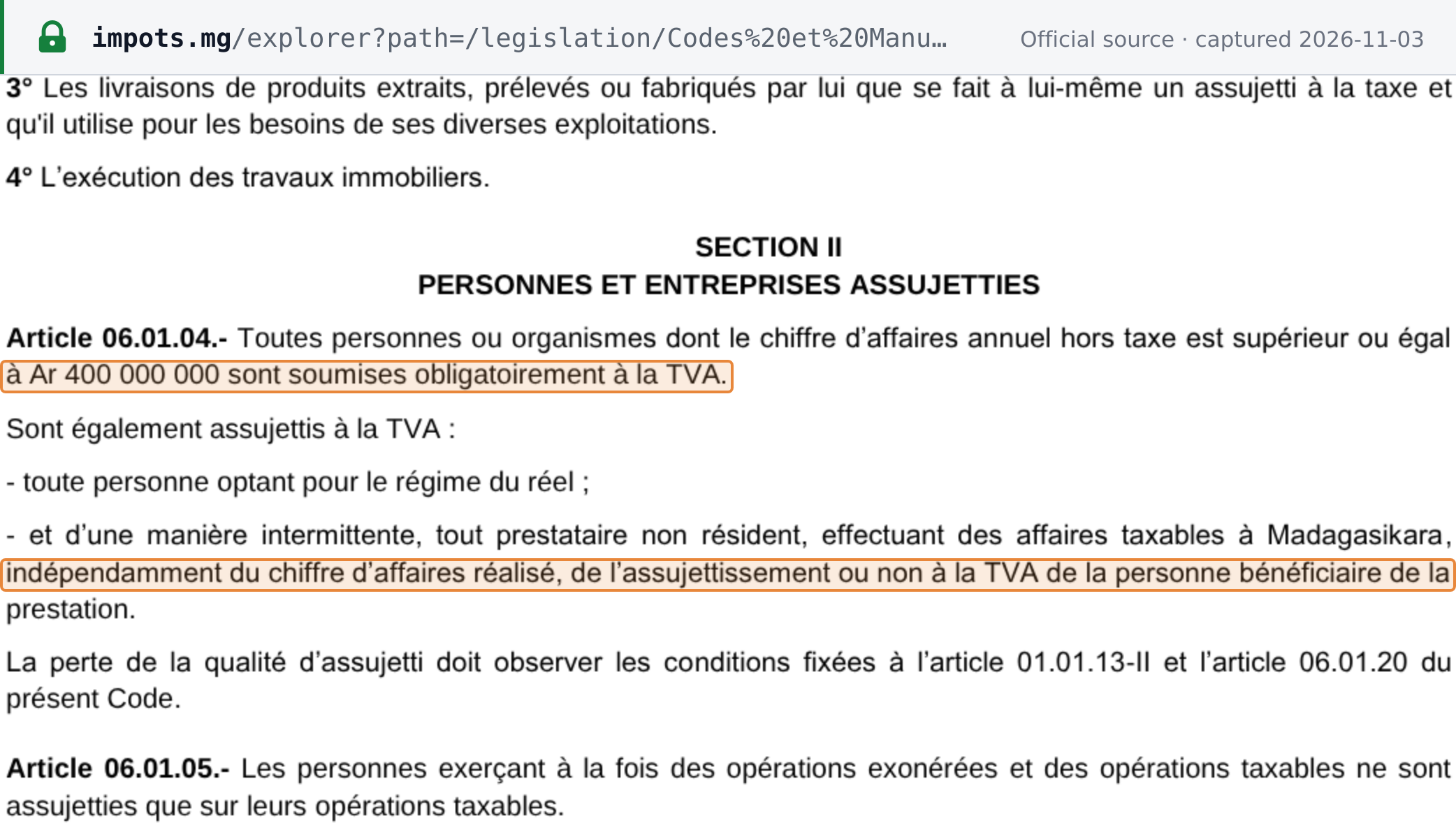 Source snapshot captured 2026-11-03 — original
- Measurement: annual turnover excluding tax for the financial year (exercice), not a rolling 12 months.
- Start of liability: from the start of the financial year after the one in which the threshold was reached. CDI article 06.01.19: "Cette date commence à partir du début de l’exercice suivant celui qui vient de se clôturer pendant lequel le seuil d’Ar 400 000 000 est atteint."
- Moving up from the impôt synthétique: a business that sees its turnover pass Ar 400,000,000 during the year must file a change-of-regime declaration before its year closes; the réel regime applies from the next financial year (CPF art. I-19). [2]
Below the threshold: the impôt synthétique (IS). CDI article 01.02.01 creates "un impôt unique, dénommé « Impôt Synthétique», représentatif et libératoire de l’Impôt sur les Revenus et des Taxes sur les Chiffres d’Affaires". Article 01.02.02 applies it to independent businesses "lorsque leur chiffre d’affaires annuel, revenu brut ou gain reçu, est inférieur à Ar 400 000 000", unless they opt for income tax or the réel regime. Article 01.02.05: "Le taux de l’impôt est fixé à 5p.100 de la base imposable", or 3% for new members of approved management centres and taxpayers newly registered online by their own customers, for their first years. An IS business does not charge TVA. New businesses start on the IS by default but can opt for the réel regime when they register (CPF art. I-03). [1] [2]
Non-resident registration
No threshold. A non-resident supplying taxable services in Madagascar is liable to TVA "indépendamment du chiffre d’affaires réalisé" and whether or not its customer is a VAT taxpayer (CDI art. 06.01.04). This is the TVA intermittente (TVAI). CDI article 06.01.09 bis sets how it is paid: [1]
"Toute personne n'ayant pas d'établissement à Madagascar et y effectuant des prestations de services taxables doit faire accréditer auprès du Ministère chargé de la réglementation fiscale, un représentant domicilié à Madagasikara, qui s'engage à se conformer aux obligations auxquelles sont soumis les redevables exerçant à Madagasikara. Le représentant accrédité doit collecter la taxe sur la valeur ajoutée exigible auprès du bénéficiaire de la prestation et la reverser auprès du Receveur des Impôts territorialement compétent, au plus tard le 15 du mois suivant celui au cours duquel la collecte a été opérée. A défaut d’un représentant accrédité, la taxe normalement collectée auprès du bénéficiaire de la prestation est liquidée et reversée par ce dernier auprès du Receveur des Impôts dans le même délai."
In English: the non-resident must have a representative domiciled in Madagascar accredited with the Ministry, who collects the TVA from the customer and pays it by the 15th of the following month. Without one, the customer works out and pays the TVA itself by the same date. The TVAI return is a separate form from the customer's own TVA return.
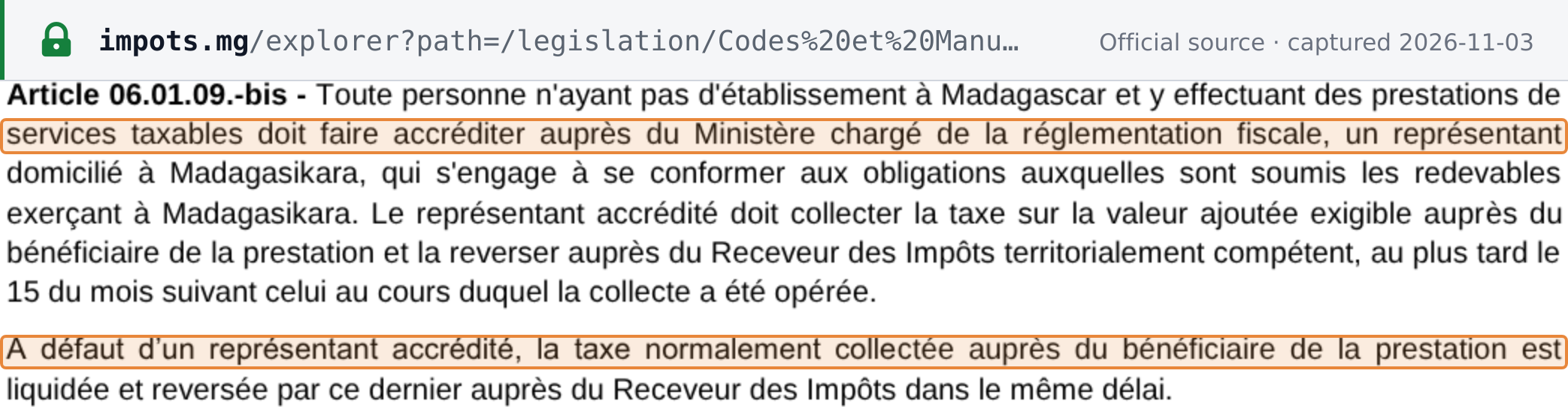 Source snapshot captured 2026-11-03 — original
Tax identification number (NIF)
Every taxable person, including a non-resident with a permanent establishment, is given a Numéro d'Identification Fiscale (NIF). CPF article I-01: "Le numéro d'immatriculation fiscale est personnel, unique et permanent pour un contribuable." A carte fiscale is issued with it and must be renewed every year (CPF art. I-06). [2]
- Format: the DGI's NIF brochure illustrates a 10-digit number ("1234567890"). The codes do not fix the length, and we found no published check-digit rule. [10]
- Lookup: the DGI's E-Services page lists no public NIF search (checked 2026-11-03).
A dedicated Lookuptax page for the Malagasy NIF is not yet published.
How to register
- Create the business through the EDBM one-stop shop (edbm.mg).
- Register for a NIF online on HetraOnline, which the DGI describes as grouping "Immatriculation, Télédéclaration, Paiement virtuel, Consultation de situation fiscale". The déclaration spéciale d'immatriculation must be filed before trading starts (CPF art. I-03). [6]
- File a declaration of existence for TVA within 10 days of starting the taxable activity. CPF article I-105: "Toute personne physique ou morale assujettie à la taxe est tenue d’adresser une déclaration d'existence au bureau du service fiscal compétent dans les 10 jours qui suivent le commencement de son activité taxable". [2]
Importers, exporters and industrial businesses file an activity declaration first; wholesalers need prior authorisation from the Directeur Général des Impôts; regulated activities need their sector licence first (CPF art. I-04). The DGI pages we read publish no list of documents for registration (checked 2026-11-03).
For the general process across countries, see how to register for VAT, sales tax or GST.
Voluntary registration
Available, by opting for the régime du réel. CDI article 01.01.13-I lets newly created businesses that meet regulatory criteria opt in at creation: "Le régime du réel ainsi accordé prend effet le premier jour qui suit celui de la notification de la décision d'acceptation." A business might opt in to deduct TVA on its purchases and to give business customers an invoice with deductible TVA: CDI article 06.01.21 lets a buyer deduct TVA only "dans la mesure où le fournisseur est légalement autorisé à la faire figurer sur la facture". [1]
Deregistration
- Losing TVA status (moved down to the IS, or giving up the réel option): the business must repay the TVA on its stock and on the net book value of fixed assets it deducted. CDI article 06.01.20: "les entreprises doivent reverser la taxe ayant grevé les biens en stock, et/ou la taxe correspondant à la valeur nette comptable des immobilisations corporelles et dont la déduction a été effectivement opérée." [1]
- Cessation must be declared within 10 days (CPF art. I-105).
- Removal from the register requires settling all taxes and handing back the carte fiscale; an attestation of removal is then issued (CPF art. I-10). [2]
Group registration
Not available. CDI article 06.01.13 charges one taxpayer for all its establishments at its head office ("La taxe est due pour l'ensemble des entreprises exploitées à Madagascar par un même redevable au siège de la direction des entreprises"), but the CDI's TVA title and the CPF contain no provision grouping separate legal entities (checked 2026-11-03).
Rates
| Rate | Applies to | Source |
|---|---|---|
| 20% | Standard rate: all taxable supplies and imports not listed elsewhere | CDI art. 06.01.12 |
| 10% | Imports and sales of butane gas (HS 2711.13 00) and its containers (HS 7311.00 00) | CDI art. 06.01.12 |
| 5% (enacted; see note below) | Imports and sales of luxury rice (HS 1006.30 10) | CDI art. 06.01.12 as amended by Loi n° 2026-004 |
| 0% | Exports of goods and services | CDI art. 06.01.12 |
The 20%, 10% and 0% rates are as at 2026-11-03. The 5% rate and the other 2026 changes below come from Loi n° 2026-004 (LFR 2026), which takes effect on broadcast or posting (art. 22); we have not found that date. A temporary suspension of the luxury-rice tax was reported in August 2026 (see Reduced rates).
Standard rate
20%. CDI article 06.01.12: "Le taux normal de la Taxe sur la Valeur Ajoutée est fixé à 20p.100. Les importations et les ventes de gaz butanes et de leur contenant relevant respectivement des tarifs douaniers 2711.13 00 et 7311.00 00, sont taxées au taux réduit de 10p.100. Les exportations de biens et de services sont taxées au taux de 0p.100." The 20% rate appears in the DGI's consolidated codes for 2024, 2025 and 2026; we have not traced the law that first set it. [1]
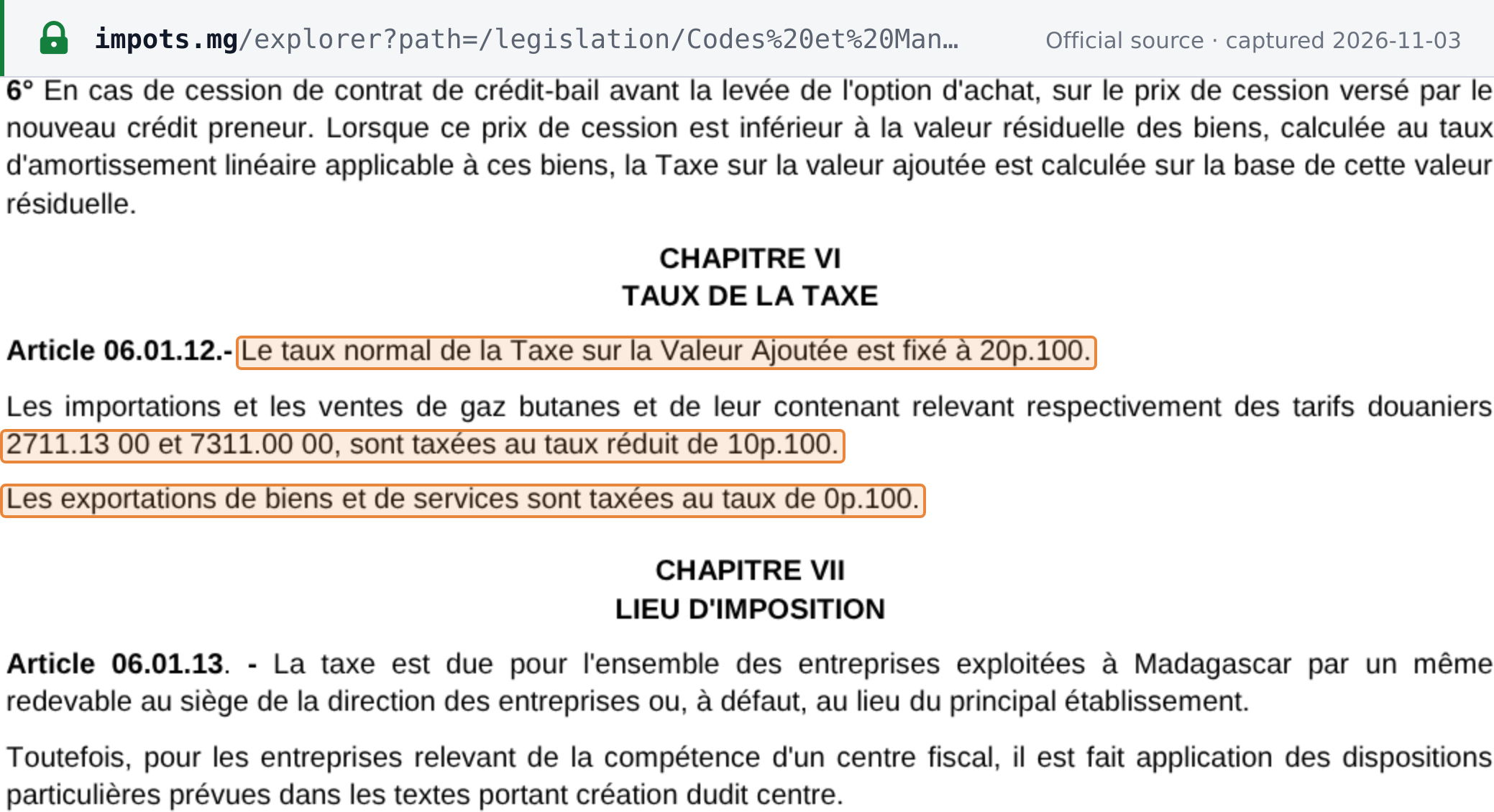 Source snapshot captured 2026-11-03 — original
Reduced rates
-
10%: butane gas and its containers (CDI art. 06.01.12, quoted above).
-
5%: luxury rice. Loi n° 2026-004 inserts a third paragraph into article 06.01.12: "« Les importations et les ventes de riz de luxe relevant du tarif douanier 1006.30 10 sont taxées au taux réduit de 5p.100 »". It also deletes luxury rice of qualities RL 1 and RL 2 from the exempt annex, so luxury rice moves from exempt to 5%. [3]
Reported suspension. In August 2026 the national press reported that the Council of Ministers had temporarily suspended the 5% TVA and the customs duty on imported luxury rice. As at 2026-11-03 we found no official instrument publishing such a suspension on the DGI site, the DGI texts portal, or the Customs or Ministry of Economy and Finance sites. Until one is published, the enacted text of Loi n° 2026-004 is the law as written (the DGI's consolidated code has not yet been updated for it); check with the DGI before applying or omitting the 5% rate.
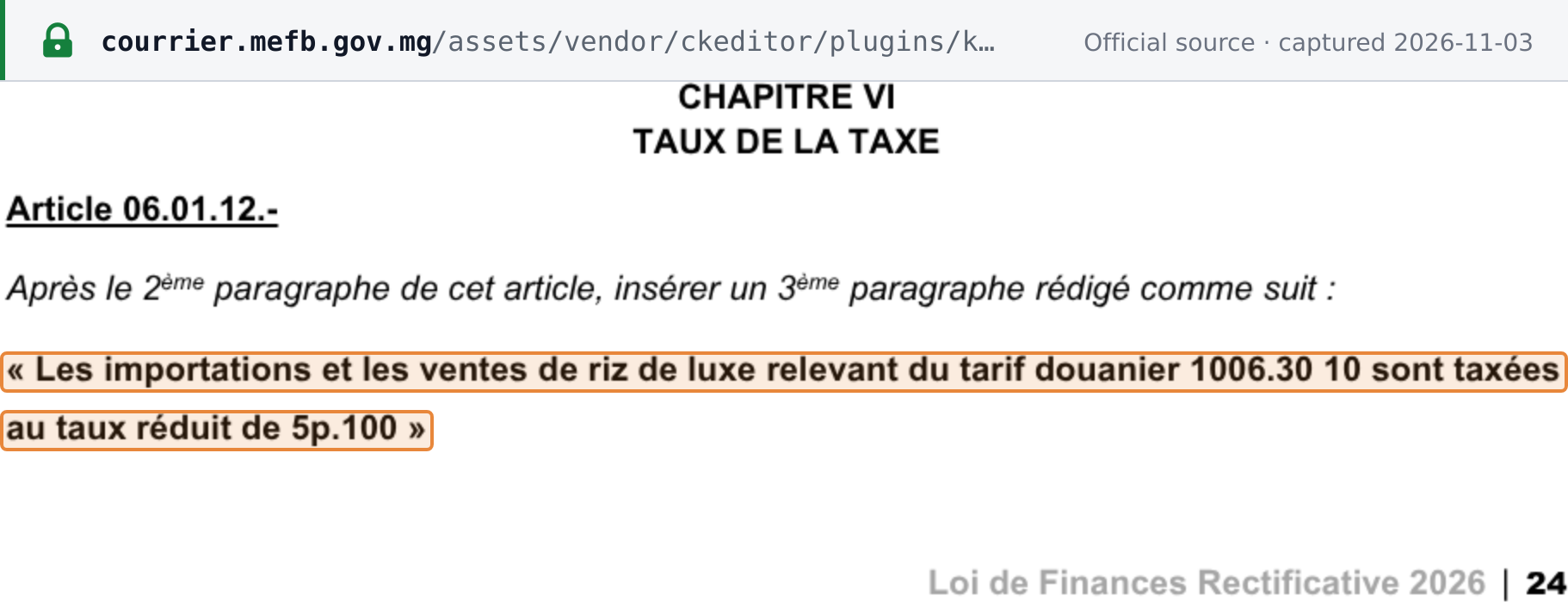 Source snapshot captured 2026-11-03 — original
Zero rate
Exports of goods and services are taxed at 0% (CDI art. 06.01.12) and keep the right to deduct input TVA; exporters can claim refunds (see Refunds).
Changes made by the 2026 amending finance law
Loi n° 2026-004 also moves two items from exempt to the 20% standard rate: [3]
- Kerosene (pétrole lampant): exemption 06.01.06-20° becomes "« 20° Abrogé »".
- Hybrid vehicles: exemption 06.01.06-29° is narrowed to "« 29° les ventes et importations de véhicules électriques »", so hybrids are taxed at 20% while electric vehicles stay exempt; the amended annex lists only new ("Neufs") electric vehicles.
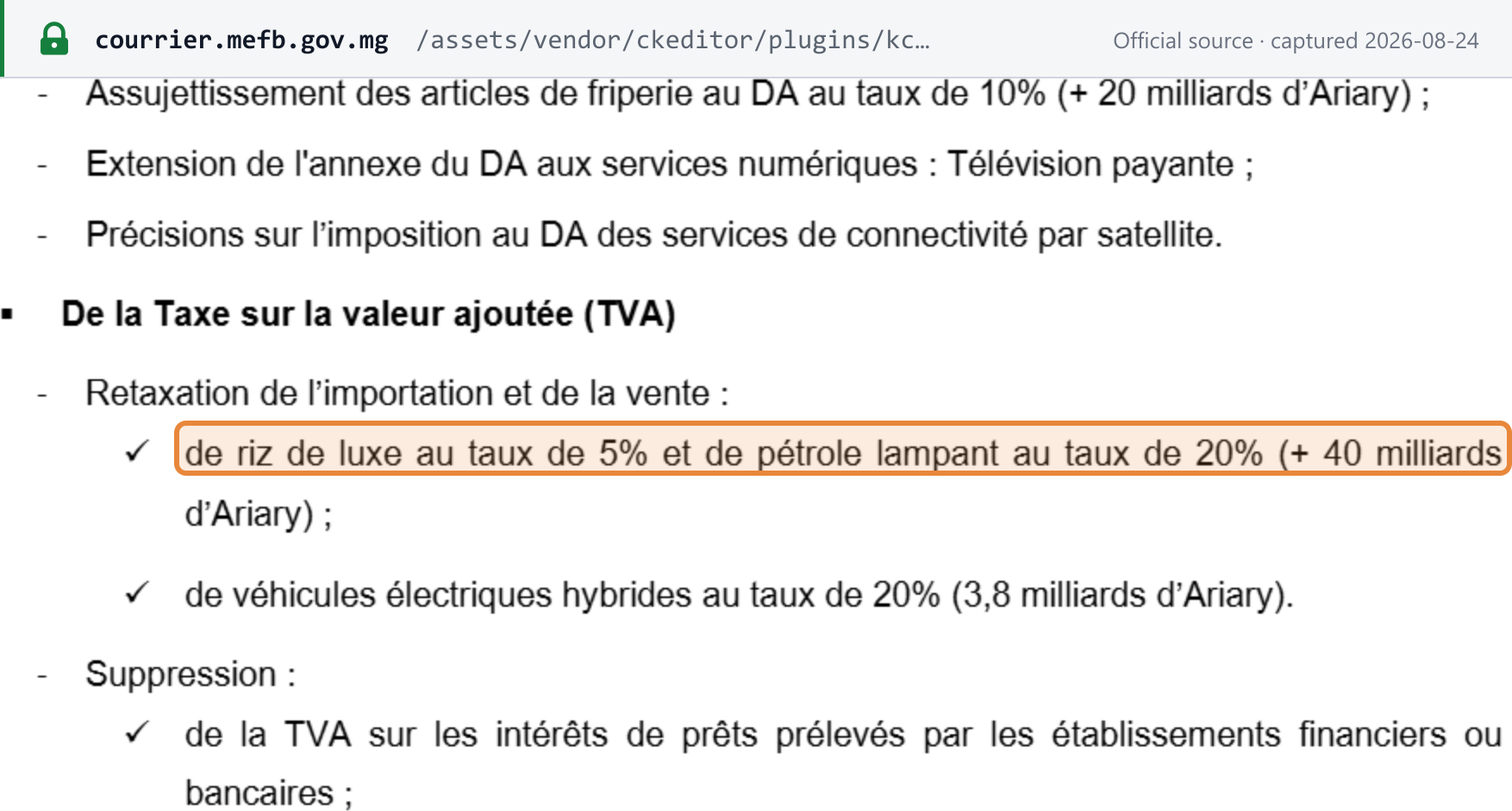
The law's explanatory statement sums up the TVA changes: "Retaxation de l’importation et de la vente : de riz de luxe au taux de 5% et de pétrole lampant au taux de 20% (+ 40 milliards d’Ariary) ; de véhicules électriques hybrides au taux de 20% (3,8 milliards d’Ariary)." Its exemption changes are under Exemptions.
 Source snapshot captured 2026-08-24 — original
Announced changes
As at 2026-11-03 the DGI news page (items to 25 October 2026) and the DGI texts portal (entries to 5 October 2026) carry no TVA rate announcement, and the 2027 finance bill was not on the Ministry of Economy and Finance home page. For the change record, see Madagascar tax changes.
Cross-border rules
Imports and exports
- Imports are taxable "quelle que soit la qualité de l'importateur" (CDI art. 06.01.03). The base is the import value "y compris les frais et les taxes autres que la taxe sur la valeur ajoutée", the tax falls due on the customs declaration, and Customs collects it (CDI arts. 06.01.10, 06.01.11, 06.01.14). Import TVA is deductible like domestic TVA. [1]
- Exports are taxed at 0% with a right to refund (CDI arts. 06.01.12 and 06.01.24).
- Low-value imports: the CDI's TVA title contains no de-minimis exemption (checked 2026-11-03). We did not check the Customs Code.
Place of supply
CDI article 06.01.09: "L'opération est réputée réalisée à Madagascar : 1° S'il s'agit d'une vente, lorsque celle-ci est réalisée aux conditions de livraison de la marchandise à Madagascar. 2° S'il s'agit de prestations de service : - lorsqu'elles y sont matériellement exécutées et/ou y sont consommées, - ou, si les prestations fournies ne sont pas matériellement localisables, lorsque le service rendu, le droit cédé, l'objet loué sont utilisés ou exploités à Madagascar." [1]
- Goods: in Madagascar when delivered there.
- Services: in Madagascar when performed or consumed there, or, for services that cannot be physically located, when used or exploited there.
Foreign companies selling into Madagascar — B2B and B2C
The CDI applies one rule to both: a non-resident supplying taxable services is liable with no threshold, through an accredited local representative (CDI arts. 06.01.04 and 06.01.09 bis; see Non-resident registration).
- B2B: if the non-resident has no accredited representative, the Malagasy business customer works out and pays the TVA by the 15th of the following month, on a separate TVA intermittente form, and deducts it under the general rules. CDI article 06.01.09 bis: "La déductibilité des TVA intermittentes, relatives aux prestations effectuées par des prestataires étrangers, auprès du bénéficiaire de la prestation ayant la qualité d’assujetti, suit la règle générale de déduction."
- B2C: the CDI has no consumer-specific mechanism. The same fallback applies to "le bénéficiaire de la prestation", who files the separate TVA intermittente form ("sur imprimé distinct … de celui de la déclaration de TVA de la personne bénéficiaire de la prestation"). The article does not say how a private customer obtains or files that form.
Digital products and services
The CDI has no separate TVA regime for non-resident digital or e-commerce suppliers (checked 2026-11-03). Digital services fall under the general TVAI rule above. Loi n° 2026-004 extends the excise duty (droit d'accises, DA), not TVA, to pay television: "Extension de l'annexe du DA aux services numériques : Télévision payante". [3]
Marketplace / platform deemed-supplier liability
The CDI's TVA title contains no provision making a marketplace or platform the deemed supplier of its sellers' sales (checked 2026-11-03).
Invoice requirements
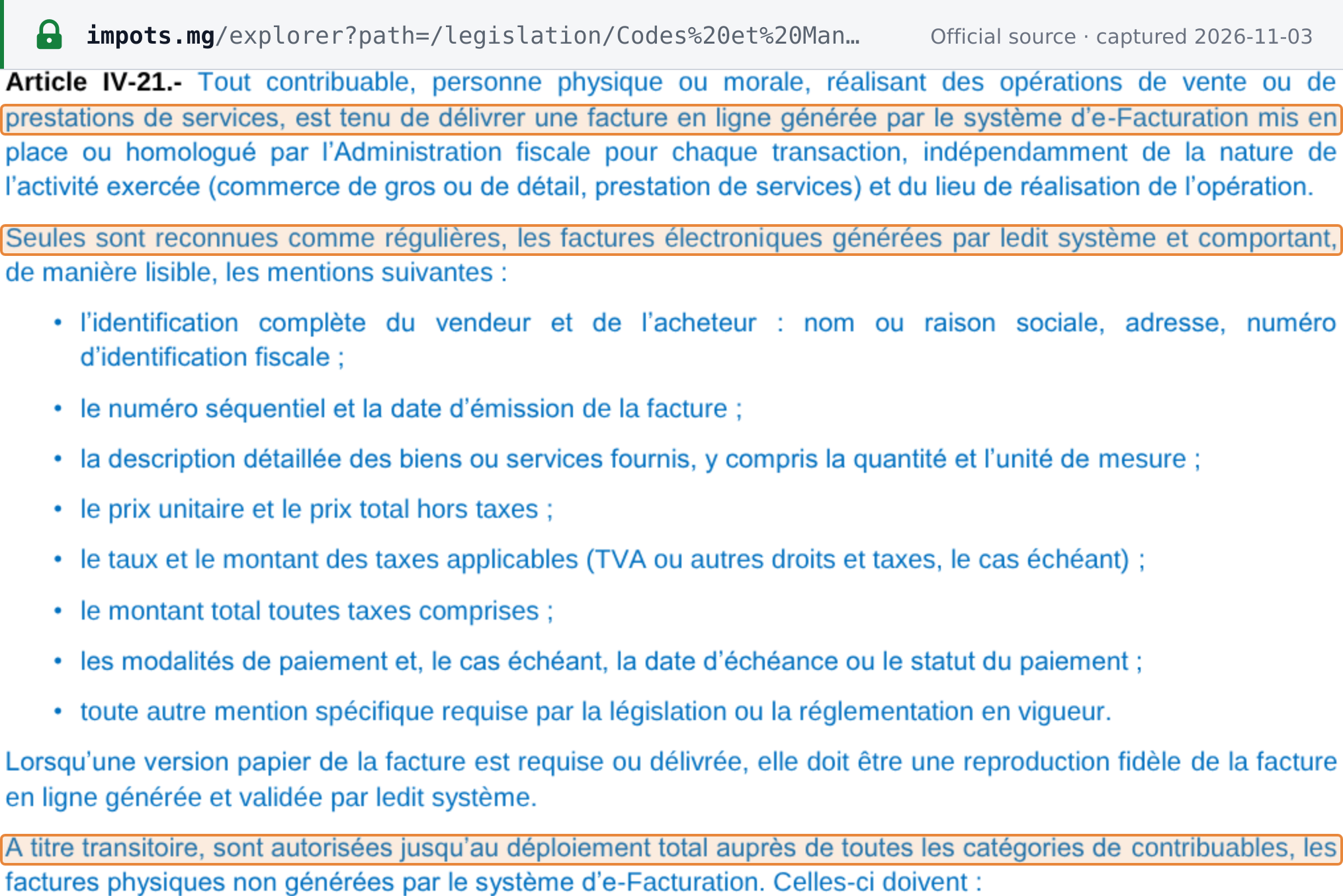
The legal rule is an e-invoice from the "e-Facturation" system, with paper allowed until the system is rolled out. CPF article IV-21, as rewritten for 2026: "Tout contribuable, personne physique ou morale, réalisant des opérations de vente ou de prestations de services, est tenu de délivrer une facture en ligne générée par le système d’e-Facturation mis en place ou homologué par l’Administration fiscale pour chaque transaction, indépendamment de la nature de l’activité exercée (commerce de gros ou de détail, prestation de services) et du lieu de réalisation de l’opération. Seules sont reconnues comme régulières, les factures électroniques générées par ledit système et comportant, de manière lisible, les mentions suivantes". [2]
The same article keeps paper invoices for now: "A titre transitoire, sont autorisées jusqu’au déploiement total auprès de toutes les catégories de contribuables, les factures physiques non générées par le système d’e-Facturation." Business buyers must ask for and keep a compliant invoice for every purchase. As at 2026-11-03 the e-Facturation platform has not been launched (see E-invoicing status), so in practice businesses issue transitional paper invoices.
For TVA payers, CDI article 06.01.27 adds that the invoice must show "distinctement le prix hors taxe de la marchandise ou du service et le montant de la taxe correspondante", and that no TVA may be shown on invoices for public contracts subject to the impôt sur les revenus des marchés (IRM). [1]
 Source snapshot captured 2026-11-03 — original
Mandatory content
E-invoice (CPF art. IV-21; repeated in Décret n° 2025-738, art. 8):
| # | Field | CPF IV-21 wording |
|---|---|---|
| 1 | Seller and buyer: name or business name, address, tax identification number (NIF) | "l’identification complète du vendeur et de l’acheteur : nom ou raison sociale, adresse, numéro d’identification fiscale" |
| 2 | Sequential number and date of issue | "le numéro séquentiel et la date d’émission de la facture" |
| 3 | Detailed description, with quantity and unit of measure | "la description détaillée des biens ou services fournis, y compris la quantité et l’unité de mesure" |
| 4 | Unit price and total price excluding tax | "le prix unitaire et le prix total hors taxes" |
| 5 | Rate and amount of each tax (TVA or other) | "le taux et le montant des taxes applicables (TVA ou autres droits et taxes, le cas échéant)" |
| 6 | Total including all taxes | "le montant total toutes taxes comprises" |
| 7 | Payment terms; due date or payment status where relevant | "les modalités de paiement et, le cas échéant, la date d’échéance ou le statut du paiement" |
| 8 | Any other mention required by law | "toute autre mention spécifique requise par la législation ou la réglementation en vigueur" |
A paper copy of an e-invoice must be "une reproduction fidèle de la facture en ligne générée et validée par ledit système".
Transitional paper invoice (CPF art. IV-21). Paper invoices must: [2]
- be made out in duplicate, uniformly, with no overwriting, erasure or addition ("en double exemplaire, de manière uniforme, sans surcharge, ni rature ni ajout");
- be dated and signed by the seller or service provider;
- be numbered "chronologiquement et de manière continue par année";
- show the name or business name, address, statistical identification number and online tax registration number of the seller and of the customer;
- show the quantity, unit prices and total price "en chiffres et en lettres" (in figures and in words);
- state when payment is due and the method of payment.
For TVA payers, the price excluding tax and the TVA must also appear separately (CDI art. 06.01.27).
Issuance deadline
No number of days is set. An invoice is due "pour chaque transaction" (CPF art. IV-21) and for every advance that makes the tax chargeable (CDI art. 06.01.27). TVA becomes chargeable on delivery for goods and on collection of the price, advances or deposits for services (CDI art. 06.01.10), unless the business has opted to pay on debits. [1]
Numbering and sequencing
- E-invoice: a "numéro séquentiel" (CPF art. IV-21), generated by the system.
- Transitional paper invoice: numbered chronologically and continuously by year, so the series may restart each year (CPF art. IV-21).
Credit and debit notes
The CDI, the CPF and Décret n° 2025-738 define no credit-note or debit-note document (as read on 2026-11-03). Corrections work through two rules:
- Cancelled sales and unpaid services. CDI article 06.01.22: "Si la taxe sur la valeur ajoutée a été versée au Trésor à l'occasion de ventes qui sont par la suite résiliées ou annulées ou encore de services qui restent impayés, elle est imputée sur la taxe due sur l'un quelconque des versements effectués au cours des trois mois qui suivent celui au cours duquel la vente a été annulée ou résiliée. L'imputation est subordonnée à la justification de la rectification préalable de la facture initiale, ou à la justification du non recouvrement de la créance."
- Discounts. Cash discounts, rebates and refunds reduce the taxable amount only "à condition qu’ils figurent sur la facture" (CDI art. 06.01.11). [1]
Currency and language
- Currency: ariary. Décret n° 2007-276 of 11 April 2007, article 2: "L'affichage des prix des marchandises et des prestations de service fournies sur le territoire douanier national ; les contrats de baux d'habitation et commerciaux et les factures émis par une personne physique ou morale résidente sont établis en Ariary. Les règlements des prix de contrats et de factures établis sur le territoire douanier national sont assurés en Ariary." Article 3 allows foreign currency in listed cases, including "l'émission de factures des entreprises d'exportations de biens et de services à destination de l'Etranger ou des entreprises franches". [7]
- Exchange rate: the CDI's TVA title and the CPF set no conversion rule for foreign-currency invoices (checked 2026-11-03).
- Language: no invoice-language rule was found. Accounting entries must be "en langue française ou malgache" (CDI art. 01.01.20).
Document types
Décret n° 2025-738, article 7, sorts online invoices into two categories: [4]
- "e-facture TVA": issued by a TVA payer for a taxable supply, showing the TVA collected.
- "e-facture": with no TVA, issued by a non-TVA business that must still invoice, or for an exempt or out-of-scope supply.
There is no simplified invoice and no value threshold: an invoice is due "pour chaque transaction" (CPF art. IV-21). A DGI communiqué of 3 August 2021 adds: "Les tickets de caisse, bons de livraison et autres documents ne peuvent en aucun cas se substituer à une facture régulière, et ne sont pas reconnues comme telle aux yeux de la loi." [8]
Self-billing
The CPF, the CDI and Décret n° 2025-738 contain no self-billing provision (checked 2026-11-03). CDI article 06.01.27 bis is different: it lets the Minister charge one TVA payer with collecting and paying the TVA due by others on specified products or activities.
Retention and audit trail
- Retention period: 10 years (3 years for impôt synthétique payers), and it covers e-invoices. CDI article 01.01.20: "Les livres prescrits par le présent article, ainsi que toutes les pièces justificatives des opérations effectuées par les intéressés, y compris les factures et documents générés et conservés par le système d’e-Facturation, doivent être conservés pendant un délai de 10 ans à compter du 1er Janvier suivant l’année durant laquelle le livre a été terminé ou pendant laquelle les pièces ont été établies." [1]
- Electronic archiving: an online invoice must be kept in electronic form for the legal period (Décret n° 2025-738, art. 9).
- Audit trail: the decree requires the authenticity of origin, integrity of content and legibility of each e-invoice, guaranteed by "un dispositif d'authentification fiable et interopérable" (arts. 6 and 10). [4]
- Payment trail: every transaction between TVA payers must be settled by cheque or other non-endorsed commercial paper, bank transfer, bank card or mobile banking (CDI art. 06.01.26), and input TVA is deductible only on purchases paid that way (see Input-tax recovery).
A specimen of a compliant invoice
The DGI publishes no official specimen invoice. We checked the DGI's "Brochures et guides" folder, the DGI texts portal, all pages of Décret n° 2025-738 and CPF article IV-21 on 2026-11-03; none contains an invoice model. Because the e-Facturation platform is not yet live, the illustration below shows the transitional paper invoice a TVA payer issues today, placing the mentions CPF article IV-21 requires for it, plus the separate TVA line of CDI article 06.01.27. Once the platform is live, the "e-facture TVA" it generates will carry the e-invoice mentions listed under Mandatory content.
Facture (transitional paper invoice) — illustrative
| Description | QtyCPF IV-21 | Unit price excl. taxCPF IV-21; CDI 06.01.27 | Total excl. taxCPF IV-21 |
|---|---|---|---|
| Cement, 50 kg bag | 100 | Ar 40,000 | Ar 4,000,000 |
| Delivery to site | 1 | Ar 250,000 | Ar 250,000 |
- Total excl. taxCDI 06.01.27
- Ar 4,250,000
- TVA 20%CDI 06.01.12, 06.01.27
- Ar 850,000
- Total incl. taxCPF IV-21: in figures
- Ar 5,100,000
- In wordsCPF IV-21: in words
- Cinq millions cent mille ariary
- Payment due 14/11/2026, by bank transfer (CPF IV-21: due date and method of payment).
- Dated and signed by the seller: [signature] (CPF IV-21). Made out in duplicate, uniformly, with no overwriting, erasure or addition.
- Amounts in ariary (Décret n° 2007-276 art. 2).
E-invoicing status
Status (as at 2026-11-03): enacted, not yet rolled out. CPF article IV-21 makes an invoice generated by the e-Facturation system the only regular invoice, and allows paper invoices until the system is fully deployed (see Invoice requirements). Décret n° 2025-738 "portant opérationnalisation du système de facturation électronique « e-Facturation »" sets out how the system works. It was signed on 2 July 2025, certified for issue on 25 July 2025, and enters into force "à la date de sa publication au Journal Officiel"; we have not found that publication date. [4]
Platform launch: not announced. On 2026-11-03 neither the DGI news page (items to 25 October 2026) nor the DGI E-Services page listed an e-Facturation platform or a launch date. Because every phase deadline below runs from the platform's launch, no calendar date for any phase can yet be given.
Technical partnership. On 31 March 2026 the DGI reported that it had signed a memorandum of understanding with the Rwanda Revenue Authority "portant sur un partenariat d'appui technique lors de la mise en œuvre du système de facturation électronique ou « Electronic Billing Machine (EBM) » à Madagascar", a system "encadré par le décret n°2025-738 du 02 juillet 2025". [11]
Phase timeline
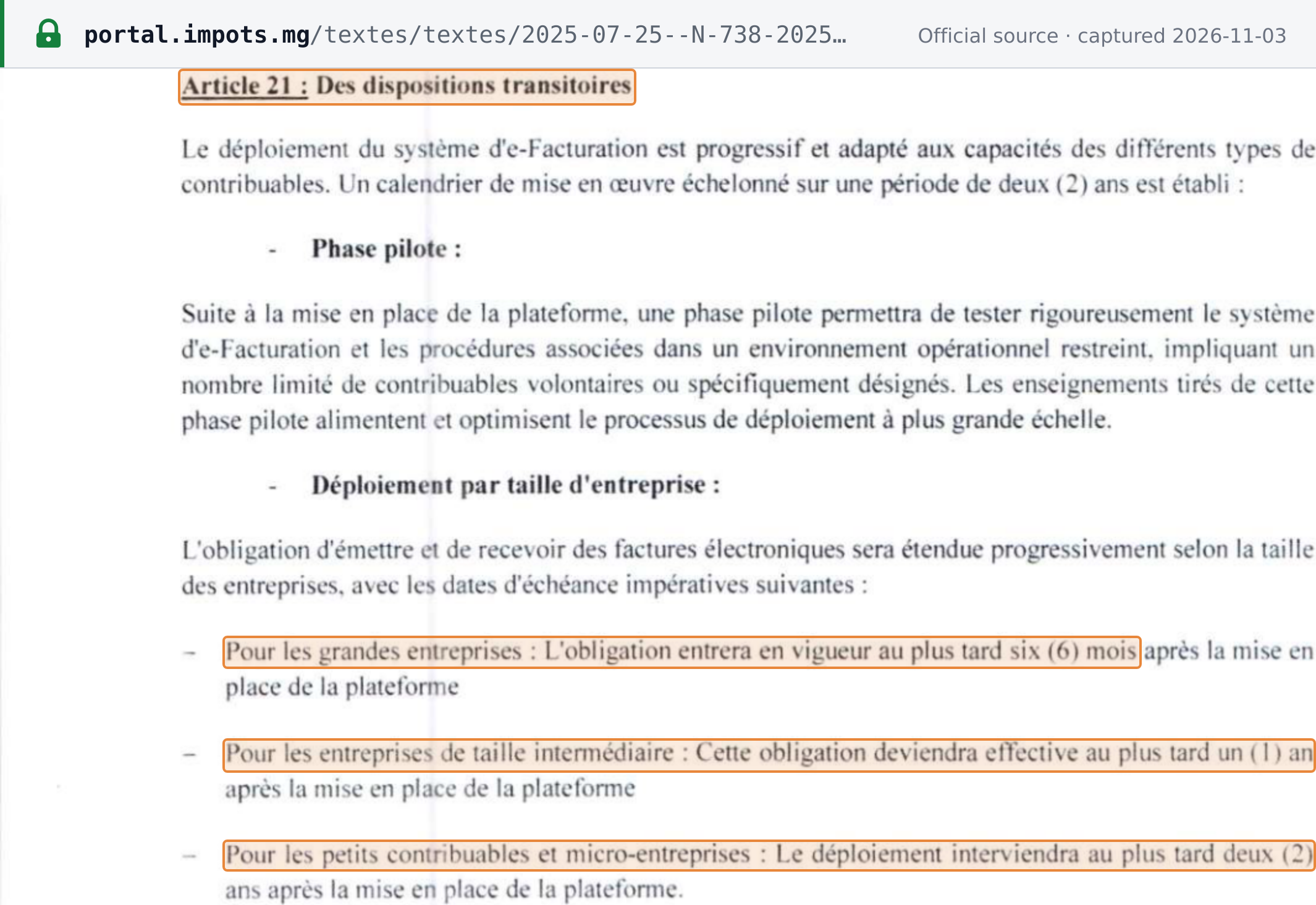
Décret n° 2025-738, article 21, spreads the rollout over two years from the date the platform is set up: [4]
| Phase | Deadline (counted from the platform's launch) |
|---|---|
| Pilot | Volunteer or designated taxpayers, after the platform is set up |
| Large enterprises | "au plus tard six (6) mois après la mise en place de la plateforme" |
| Intermediate-size enterprises | "au plus tard un (1) an après la mise en place de la plateforme" |
| Small taxpayers and micro-enterprises | "au plus tard deux (2) ans après la mise en place de la plateforme" |
The decree does not set the size thresholds that place a business in each phase.
 Source snapshot captured 2026-11-03 — original
Scope
All invoices, with no split between B2B, B2G and B2C. Décret n° 2025-738, article 3, requires every taxpayer obliged to issue regular invoices to use the system "pour l'émission et la réception de toutes les factures relatives à ses opérations et transactions, y compris celles qui sont taxables, exonérées ou hors champ d'application de la Taxe sur la Valeur Ajoutée (TVA)", and states that invoices issued or received outside it "ne sont pas reconnues comme valides au titre de la législation fiscale et comptable". [4]
System and formats
- System: a central online platform run by the DGI, with an API for business systems and the option of third-party e-invoicing systems certified (homologués) by the DGI (Décret n° 2025-738, arts. 11 and 16–17). No list of certified systems had been published as at 2026-11-03.
- Formats: open, standardised formats, "privilégiant le format XML pour le traitement automatisé des données", with PDF "pour garantir la lisibilité immédiate" (art. 10).
- Categories: "e-facture TVA" and "e-facture" (art. 7; see Document types).
For how clearance and reporting models compare, see CTC e-invoicing models.
Filing and payment
Filing frequency
Monthly, for every TVA payer. There is no turnover band and no quarterly option. CPF article I-104: "L'imposition s'effectue sous le régime de la déclarationmensuelle." [sic] [2]
Return and payment due date
The 15th of the following month, for the return and the payment, including nil returns. CDI article 06.01.16: "Elle est versée au plus tard le 15 du mois suivant la période à l'agent chargé du recouvrement à l'aide de la déclaration établie sur un imprimé fourni par l'Administration. La déclaration doit être faite dans le même délai même si le redevable n'a pas de versement à effectuer au titre d'un mois donné." [1]
The DGI's 2026 tax calendar lists, "Au plus tard tous les 15 du mois", the "Taxe sur la Valeur Ajoutée (TVA) et TVA intermittente (TVAI)". [5] Returns and payments are made online through e-Hetra and HetraOnline.
Impôt synthétique payers (below Ar 400,000,000) file and pay once a year, by 31 March of the following year (CPF art. I-17).
Additional listings
Monthly supplier and customer list. CDI article 06.01.26 requires TVA payers, "sous peine d'irrecevabilité de leurs déclarations et des sanctions prévues par l'Article 20.01.52", to attach to each return the list of their suppliers and customers for the period, in the electronic template the DGI provides on NIFONLINE, uploaded to the DGI's TVA-annex platform. A return without it is inadmissible. [1]
Input-tax recovery
Input TVA is deductible only on purchases paid by bank or mobile banking. CDI article 06.01.17-A-1° allows deduction of "La taxe sur la valeur ajoutée qui figure distinctement sur leurs factures d'achats de produits non exonérés ou de services nécessaires à l'exploitation normale de l'entreprise, faisant l’objet de paiement par voie bancaire ou mobile banking. Les factures doivent être conformes aux dispositions de l'article IV-21 du Code des procédures fiscales et établies par un assujetti." Article 06.01.26 also requires "Toute transaction entre assujettis à la TVA" to be settled "par chèque ou autres effets de commerce non endossés, virement ou carte bancaires ou mobile banking". [1]
Other conditions:
- Taxable use: "Seule peut être déduite la taxe afférente à des opérations taxables." Mixed businesses deduct by a turnover ratio (CDI art. 06.01.17).
- Import TVA is deductible in the same way.
- Omitted deductions can be claimed on any return in the following three months (CDI art. 06.01.22).
Blocked items (CDI art. 06.01.18) include:
- buildings other than for industrial, craft, commercial, hotel, agricultural, mining, restaurant or office use;
- passenger cars, "sauf si elles sont exclusivement affectées à la location ou au transport à titre onéreux";
- furniture, other than for hotels and restaurants;
- food for consumption on the business's premises;
- petrol, diesel and fuel oil, except for the uses listed in article 06.01.17-B;
- inputs for public contracts subject to the IRM.
Refunds
- Carry-forward: excess input TVA is carried forward "sans toutefois dépasser trois ans" (CDI art. 06.01.23).
- Who can claim a refund: free-zone businesses, exporters (in proportion to export turnover), approved lessors, and any TVA payer making investments in fixed assets (CDI art. 06.01.24); upstream petroleum companies also (art. 06.01.24 bis). Other businesses cannot get a cash refund.
- Procedure: the claim is made with the periodic return. A credit not claimed within three months of the due date "ne peut plus donner lieu à un remboursement mais peut être porté en charge".
- Timing: "Le remboursement du crédit de TVA doit être réalisé dans les 60 jours de la date de réception de la demande par le Directeur Général des Impôts." [1]
- Bad debts: TVA on unpaid services and cancelled sales is recovered by offset within three months (CDI art. 06.01.22; see Credit and debit notes).
- Non-residents: the CDI has no refund scheme for unregistered non-residents (checked 2026-11-03).
Exemptions
Exempt supplies
CDI article 06.01.06 lists the exempt operations (items 1° to 31°, with annexes by customs tariff code). Examples, as amended by Loi n° 2026-004: [1] [3]
- school fees for general, technical or vocational education (1°)
- dealings in shares and company securities (3°), and interest charged by banks and financial institutions on financing to customers (4°b)
- household water and electricity up to set consumption limits (6°)
- health-profession services, medicines, and medical equipment and consumables (7°, 8°, 23°)
- educational and school books (11°) and agricultural inputs and equipment (13°, 14°)
- impregnated mosquito nets and mosquito coils (17°)
- international air and sea passenger transport (18°)
- maize, locally made flour and cooking oil, and listed staple foods such as rice other than luxury rice (21°)
- supplies under public contracts subject to the IRM (28°)
- electric vehicles (29°) and the sale of meat (31°)
2026 changes to exemptions
Loi n° 2026-004 makes these changes to CDI article 06.01.06: [3]
- 4°b rewritten and broadened: "« b- Les intérêts prélevés par les établissements financiers ou bancaires sur le financement accordé à la clientèle ; »". Before, it covered only interest on credit to individual customers.
- 20° (kerosene) repealed: kerosene is now taxed at 20%.
- 29° narrowed to electric vehicles: hybrids are now taxed at 20%.
- 30° repealed: this was the exemption for donations to, and purchases by, foundations recognised as of public utility (FRUP). The matching deduction in article 06.01.17 is also repealed.
- 31° added: "« 31° la vente de viandes. »"
- Annexes: luxury rice removed from the 21° annex (taxed at 5% under the LFR; see the reported suspension under Reduced rates); fungicides (3808.92), herbicides (3808.93) and mosquito coils (3808.91 11) added to the 13° annex.
Exempt is not zero-rated
Exports at 0% keep the right to deduct input TVA and count towards the deduction ratio. Exempt supplies give no right to deduct: "Seule peut être déduite la taxe afférente à des opérations taxables" (CDI art. 06.01.17). A business with exempt sales cannot recover the TVA on the purchases that go into them.
Special regimes
- Small businesses: the impôt synthétique at 5% of turnover replaces TVA below Ar 400,000,000 (see Registration threshold).
- Free zones: free-zone businesses can claim refunds of TVA credits (CDI art. 06.01.24).
- Public contracts: supplies under contracts subject to the IRM are exempt (06.01.06-28°), no TVA may appear on the invoice (06.01.27), and the related input TVA is blocked (06.01.18).
- Upstream petroleum: import exemption for listed equipment (06.01.07) and refund of credits (06.01.24 bis).
- Not found: a margin scheme, cash-accounting scheme or flat-rate TVA scheme in the CDI's TVA title (checked 2026-11-03). Taxpayers can opt to pay TVA on debits rather than on receipts (CDI art. 06.01.10).
Offences and penalties
Offences
- Trading before registering. Activity is allowed only after the déclaration spéciale d'immatriculation (CPF art. I-03).
- Invoicing offences (CDI art. 20.01.54.2): selling without a regulatory invoice; an invoice that does not meet CPF article IV-21 or the e-Facturation technical specifications; a paper copy that does not match the electronic invoice; fictitious or under-valued invoices; and fraudulent cancellation of an online invoice.
- e-Facturation offences (CDI art. 20.01.56.33): "le refus d’utiliser le système d’e-Facturation"; deliberate manipulation, alteration or deletion of data in the system; and "l’utilisation d’un système d’e-Facturation non homologué".
- Fraud. CDI article 20.01.56.5: "Sans préjudice aux dispositions particulières du Code des impôts, les auteurs, co-auteurs, complices de manœuvres frauduleuses sont punis, indépendamment des sanctions fiscales, d'un emprisonnement de six mois à trois ans. En cas de récidive, ils sont passibles d'une peine d'emprisonnement de cinq ans." [1]
- Not paying over TVA collected can also be prosecuted as misappropriation of public funds (CDI art. 20.01.54.2-C as amended by Loi n° 2026-004).
Penalties
Figures as at 2026-11-03. [1] [3]
| Breach | Penalty | Source |
|---|---|---|
| Return or annex not filed | Ar 200,000 (turnover of Ar 400m or more); Ar 100,000 (Ar 200m–400m); Ar 50,000 (Ar 50m–200m, and non-profits); Ar 20,000 (below Ar 50m) | CDI art. 20.01.52 as rewritten by Loi n° 2026-004 |
| Late payment | 3% for the first month then 1% a month (turnover of Ar 400m or more); 2% then 1% a month (Ar 100m–400m); 1% a month (below Ar 100m); minimum Ar 10,000; "Tout mois commencé étant dû en entier" | CDI art. 20.01.53 |
| Understated return | 40% of the extra tax | CDI art. 20.01.54 |
| Invoicing offence that hides no tax (no regulatory invoice, IV-21 or e-Facturation non-conformity, paper/electronic mismatch) | 10% of the tax | CDI art. 20.01.54.2-A |
| Sale invoiced and declared without TVA shown separately | 40% of the tax | CDI art. 20.01.54.2-B |
| Improper deduction or refund, including deducting on an invoice issued outside the mandatory e-Facturation system; charging TVA on exempt supplies; failing to charge TVA; not paying over TVA collected | 80% | CDI art. 20.01.54.2-C (last limb added by Loi n° 2026-004) |
| Fictitious, under-valued or fraudulently cancelled invoices, unrecorded sales | 150% of the TVA evaded, plus criminal penalties | CDI art. 20.01.54.2-D |
| e-Facturation offences (refusal, data manipulation, non-certified system) | Ar 20,000,000 (large taxpayer); Ar 10,000,000 (medium); Ar 1,000,000 (small); doubled for a repeat within 2 years | CDI art. 20.01.56.33 |
| Invoices not kept | Ar 2,000,000 (large); Ar 1,000,000 (medium); Ar 100,000 (small), per missing or incomplete year | CDI art. 20.01.56.34 |
| TVAI collected but not paid over | 40% of the tax, minimum Ar 100,000 | CDI art. 20.01.54.1 |
The e-Facturation fine table reads: "Grand contribuable 20 000 000 Moyen contribuable 10 000 000 Petit contribuable 1 000 000 … En cas de récidive dans un délai de deux (2) ans, l’amende est portée au double des montants ci-dessus." The CDI does not define the large, medium and small taxpayer categories in that article.
Frequently asked questions
Our supplier's invoice shows TVA but we paid it in cash. Can we deduct that TVA?
No. Code des Impôts article 06.01.17-A-1° allows deduction only of TVA shown separately on purchase invoices that were paid by bank or by mobile banking, and the invoice must comply with article IV-21 of the Code des procédures fiscales and be issued by a VAT taxpayer. Article 06.01.26 also requires every transaction between VAT taxpayers to be settled by cheque or other non-endorsed commercial paper, bank transfer, bank card or mobile banking. Pay VAT-bearing suppliers through one of those channels.
Do we have to issue our invoices through e-Facturation today?
The law already says so: article IV-21 of the Code des procédures fiscales (2026 version) recognises as regular only invoices generated by the e-Facturation system. But the same article allows paper invoices not generated by the system until the system is fully deployed to all categories of taxpayer, and Décret n° 2025-738 phases the obligation in from the date the platform is set up: large enterprises within 6 months, intermediate-size enterprises within 1 year, small taxpayers and micro-enterprises within 2 years. As at 2026-11-03 the DGI's news page and e-services list announce no platform launch, so paper invoices that carry the transitional particulars remain acceptable.
We are a foreign software company selling to Malagasy businesses. Who accounts for the TVA?
A non-resident with no establishment in Madagascar that supplies taxable services there is liable to TVA whatever its turnover (Code des Impôts article 06.01.04). Under article 06.01.09 bis it must have a representative domiciled in Madagascar accredited with the Ministry; the representative collects the TVA from the customer and pays it by the 15th of the following month. Without an accredited representative, the Malagasy customer liquidates and pays the TVA itself by the same deadline, on a separate TVA intermittente form. A VAT-registered customer can then deduct it under the general rules.
Our turnover is below Ar 400 million. Can we put TVA on our invoices?
Not unless you opt for the régime du réel. Below Ar 400,000,000 of annual turnover a business pays the impôt synthétique at 5% of turnover instead of TVA (Code des Impôts articles 01.02.02 and 01.02.05), and article 06.01.21 allows the customer to deduct TVA only where the supplier is legally authorised to show it on the invoice. A business that opts for the réel regime becomes liable to TVA (article 06.01.04) and can then charge and deduct it.
A customer cancelled an order after we paid the TVA. How do we get it back?
Code des Impôts article 06.01.22 lets you set the TVA already paid against the TVA due on any return in the three months after the month in which the sale was cancelled or rescinded, or for a service that stayed unpaid. You must show that the original invoice was corrected first, or prove that the debt could not be recovered. The codes define no separate credit-note document.
Important websites
| Site | Purpose |
|---|---|
| Direction Générale des Impôts | Tax authority home page: news, consolidated codes, tax calendar |
| HetraOnline | Online NIF registration, e-filing, virtual payment and tax-status check |
| e-Hetra | Online returns, payments and TVA refund claims |
| TVA annex upload (NIFONLINE) | Monthly supplier and customer lists attached to the TVA return |
| DGI E-Services | Index of the DGI's online services |
| DGI texts portal | Laws, decrees, circulars and communiqués |
| Codes et Manuels | Current Code des Impôts and Code des procédures fiscales (PDF) |
| Calendrier fiscal 2026 | Filing and payment dates |
| EDBM | Company formation one-stop shop |
| Douanes malagasy | Customs; import TVA |
| Ministère de l'Économie et des Finances | Finance laws |
| e-Facturation portal | Not launched as at 2026-11-03 |
| NIF lookup | The DGI E-Services page lists no public NIF search (checked 2026-11-03) |
For other countries' registers, see check a VAT number — official lookups by country.
Recent changes
- 2026-07-16 — Loi n° 2026-004 (loi de finances rectificative 2026) promulgated, in force on broadcast or posting (art. 22): luxury rice moves from exempt to a new 5% rate (a temporary suspension was reported in August 2026; no official instrument found as at 2026-11-03); kerosene and hybrid vehicles are taxed at 20%; customer-financing interest and meat sales are exempt; the FRUP foundation exemption is repealed; the 80% fine is extended to TVA collected but not paid over. (MEF) — see event
- 2025-07-02 — Décret n° 2025-738 on the e-Facturation system signed (certified for issue 25 July 2025): rollout within 6 months, 1 year and 2 years of the platform's launch for large, intermediate and small businesses. (DGI)
For the full chronology, see Madagascar tax changes on Lookuptax.
Reference links
- DGI — Code des Impôts suivant la Loi de Finances 2026 (PDF)
- DGI — Code des procédures fiscales, LFI 2026 (PDF)
- Ministère de l'Économie et des Finances — Loi n° 2026-004 portant loi de finances rectificative pour 2026 (PDF)
- Décret n° 2025-738 portant opérationnalisation du système de facturation électronique « e-Facturation » (DGI texts portal, PDF)
- DGI — Calendrier fiscal 2026 (PDF)
- DGI — HetraOnline
- Décret n° 2007-276 of 11 April 2007 on prices, invoices and settlement in ariary (DGI texts portal, PDF)
- DGI — Communiqué of 3 August 2021 on invoicing (PDF)
- DGI — Texts portal
- DGI — NIF and carte fiscale brochure (PDF)
- DGI — News: Madagascar - Rwanda MoU on the EBM e-invoicing system (31 March 2026)
Related on Lookuptax: