Malawi VAT guidelines
| FACTSHEET | |
|---|---|
| Country code | MW |
| Tax name | Value Added Tax (VAT) |
| Tax Authority | Malawi Revenue Authority (MRA) |
Overview
Malawi levies Value Added Tax (VAT) under the Value Added Tax Act (Cap. 42:02). As re-enacted by the VAT (Amendment) Act, 2026, section 7(1) charges it on "(a) every supply of goods and services made in Malawi; (b) every importation of goods; (c) the supply of any imported service; and (d) the supply of digital services, other than exempt goods and services." [2]
Authority. VAT is administered by the Commissioner General of the Malawi Revenue Authority (MRA). Procedure, records, penalties and the taxpayer identification number sit in the Tax Administration Act, 2021 (Act No. 13 of 2021), which "shall be read as one with each of the other tax laws" (s.3(1)). [6]
Currency. The Malawi kwacha (MWK; the statutes write "K"). The Electronic Invoicing System accepts kwacha only (see Currency and language).
Tax period. The calendar month, unless the Commissioner General directs otherwise in writing (VAT Act s.34(1)).
Layering. None. VAT is a single national tax; the VAT Act provides for no regional or district VAT.
For neighbouring systems, see the Tanzania VAT guide, the Zimbabwe VAT guide, the Kenya VAT guide and the Mauritius VAT guide.
Registration
Who should register
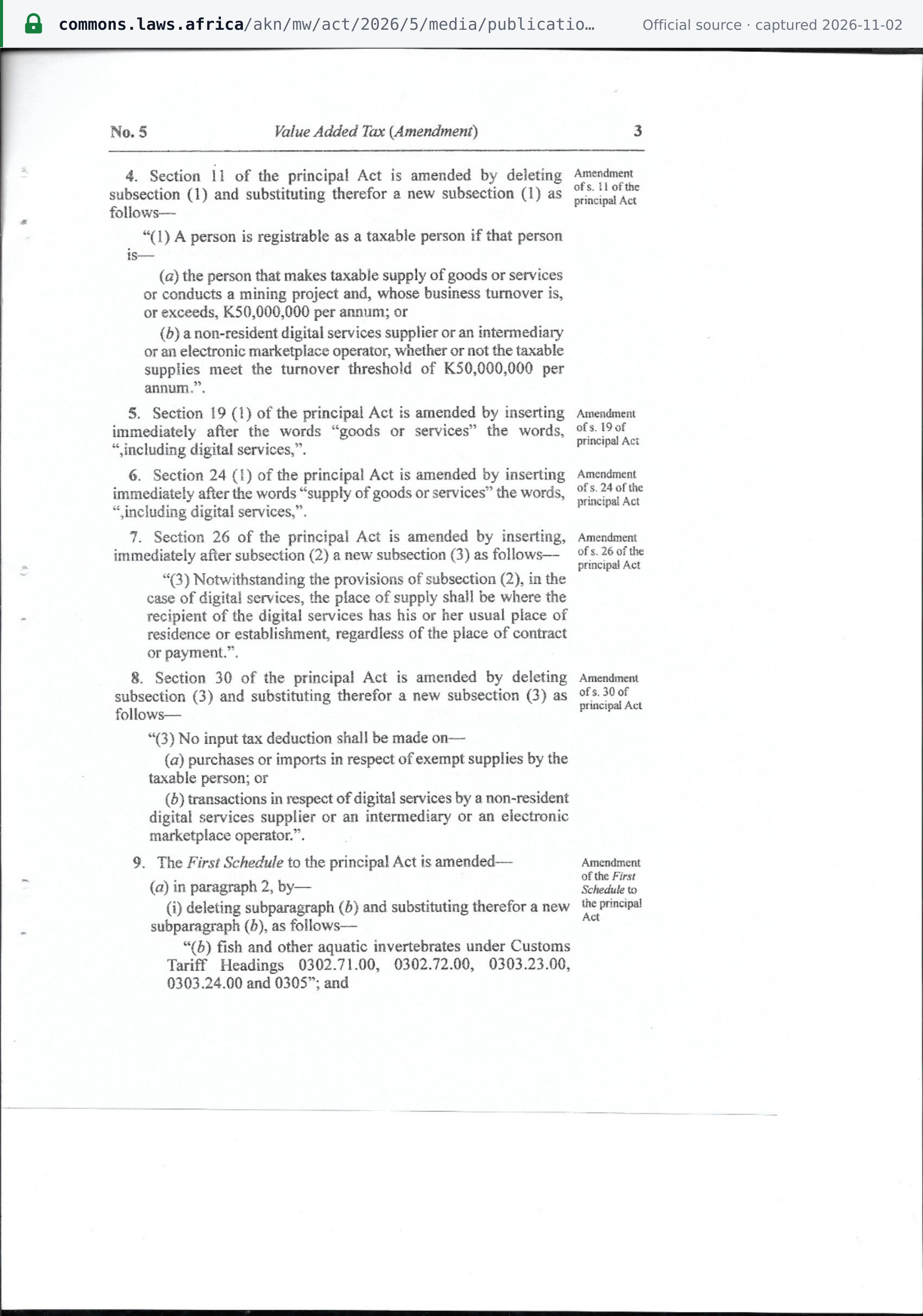
Section 11(1) of the VAT Act, as substituted by section 4 of the VAT (Amendment) Act, 2026, makes a person "registrable as a taxable person" if that person is:
- "(a) the person that makes taxable supply of goods or services or conducts a mining project and, whose business turnover is, or exceeds, K50,000,000 per annum; or"
- "(b) a non-resident digital services supplier or an intermediary or an electronic marketplace operator, whether or not the taxable supplies meet the turnover threshold of K50,000,000 per annum." [2]
An applicant must apply "within thirty days of becoming qualified … or having reason to believe that he or she will so qualify" (s.11(6)). Act No. 14 of 2024 removed the old link between registration and buying an electronic fiscal device, substituting the words "as a taxable person" for "and upon acquisition of an electronic device". [3] [4]
Registration threshold
MWK 50,000,000 of business turnover per annum (as at 2026-11-02). The VAT (Amendment) Act, 2026 (Act No. 5 of 2026, assented 9 April 2026, published 14 April 2026) set this figure. The Bill's memorandum describes the change as an "increased value added tax threshold from K25,000,000 to K50,000,000". [2] [11]
- Measurement. Business turnover "per annum".
- Aggregation. "For purposes of determining the threshold amount under subsection (1), separate businesses under the same ownership may be treated as owned by one person" (s.11(3)).
- Changes. The Minister may revise the threshold by order in the Gazette (s.11(2)). [3]
 Source snapshot captured 2026-11-02 — original
Non-resident registration
No threshold for non-resident digital services suppliers. A non-resident digital services supplier, an intermediary or an electronic marketplace operator is registrable "whether or not" its supplies reach MWK 50,000,000 (s.11(1)(b)). The Act defines:
- a "non-resident digital services supplier" as "a person who has no fixed establishment in Malawi and supplies digital services to recipients located in Malawi";
- a "recipient", for digital services, as "a non-taxable person to whom the supply is made". The rule therefore covers supplies to customers who are not taxable persons: consumers, and also businesses that are not registered for VAT. [2]
Other non-resident suppliers have no separate registration duty in the VAT Act: VAT on imported services is paid by the Malawian receiver (see Cross-border rules). Act No. 5 of 2026 sets out no simplified registration route or portal for non-residents.
Tax identification number
Registration is tied to the taxpayer identification number (TIN) issued under the Tax Administration Act. Under the TAA:
- The Commissioner General issues the TIN "within fourteen days of receipt of the application" (s.22(1)).
- "A person shall have one TIN at a time and it shall be used for purposes of all tax laws" (s.22(4)).
- The TIN must appear "in any claim, notice, return, statement or other document submitted to the Authority or used for purposes of any tax law" (s.23(1)).
- Changes to the details on the TIN certificate must be notified in writing within 21 days (s.22(7)).
- Using a false TIN, or another person's, is an offence (s.102). [6]
How to register
Apply to MRA on the prescribed form with supporting documents (TAA s.21). The TIN follows within 14 days. MRA's online taxpayer portal is MSONKHO Online.
Every business must then open an account on the EIS Taxpayer Portal. Regulation 4(2) of the EIS Regulations lists what that account needs: "(a) business name or trading name; (b) taxpayer identification number; (c) physical address; (d) mobile number; (e) mail address; and (f) any other information as may be required by the Commissioner General." [5] [6]
For the general process across countries, see how to register for VAT, sales tax or GST.
Voluntary registration
Available. "Any business with a turnover below the registrable threshold amount provided in subsection (1) may apply voluntarily to be registered by the Commissioner General" (s.11(11)(a)). The Commissioner General may also, by written notice, register "any class or category of businesses" (s.11(11)(b)). The Commissioner General registers a qualifying applicant unless satisfied that the person "has no fixed place of abode or business", or has reasonable ground to believe the person will not keep proper accounting records, will not submit regular and reliable returns, or is not a fit and proper person (s.11(12)). [3]
Deregistration
- Apply within 30 days. "A taxable person shall, within thirty days of ceasing to carry on business in relation to which a registration is made, apply in writing for the cancellation of the registration" (s.14(2)).
- Effective date. Cancellation takes effect "from the end of the tax period in which the registration is cancelled" (s.14(3)).
- Goods on hand. The person is treated as having made a taxable supply of all goods on hand, including capital goods, on which input tax was credited, and owes output tax on their open-market value at cancellation (s.14(4)).
Group registration
Available, with approval. "A group of taxable persons may, with the approval of the Commissioner General be treated for the purposes of Value Added Tax as one designated taxable person", provided each member undertakes to be jointly and severally liable (s.11(9)). A business structured into distinct divisions may apply for each division to be registered separately (s.11(10)). [3]
The aggregation, threshold-revision, voluntary and group registration rules in this section (s.11(2), (3) and (9)–(12)) are stated as in the 2014 consolidated VAT Act; later amending Acts may have changed them.
Rates
| Rate | Applies to | Basis |
|---|---|---|
| 17.5% (standard) | All taxable supplies and imports not zero-rated or exempt, including digital services | VAT Act s.9, as amended by Act No. 37 of 2025 |
| 0% | Second Schedule supplies: exports of goods and services, and stores on departing aircraft and vessels, among others | VAT Act s.21 and Second Schedule |
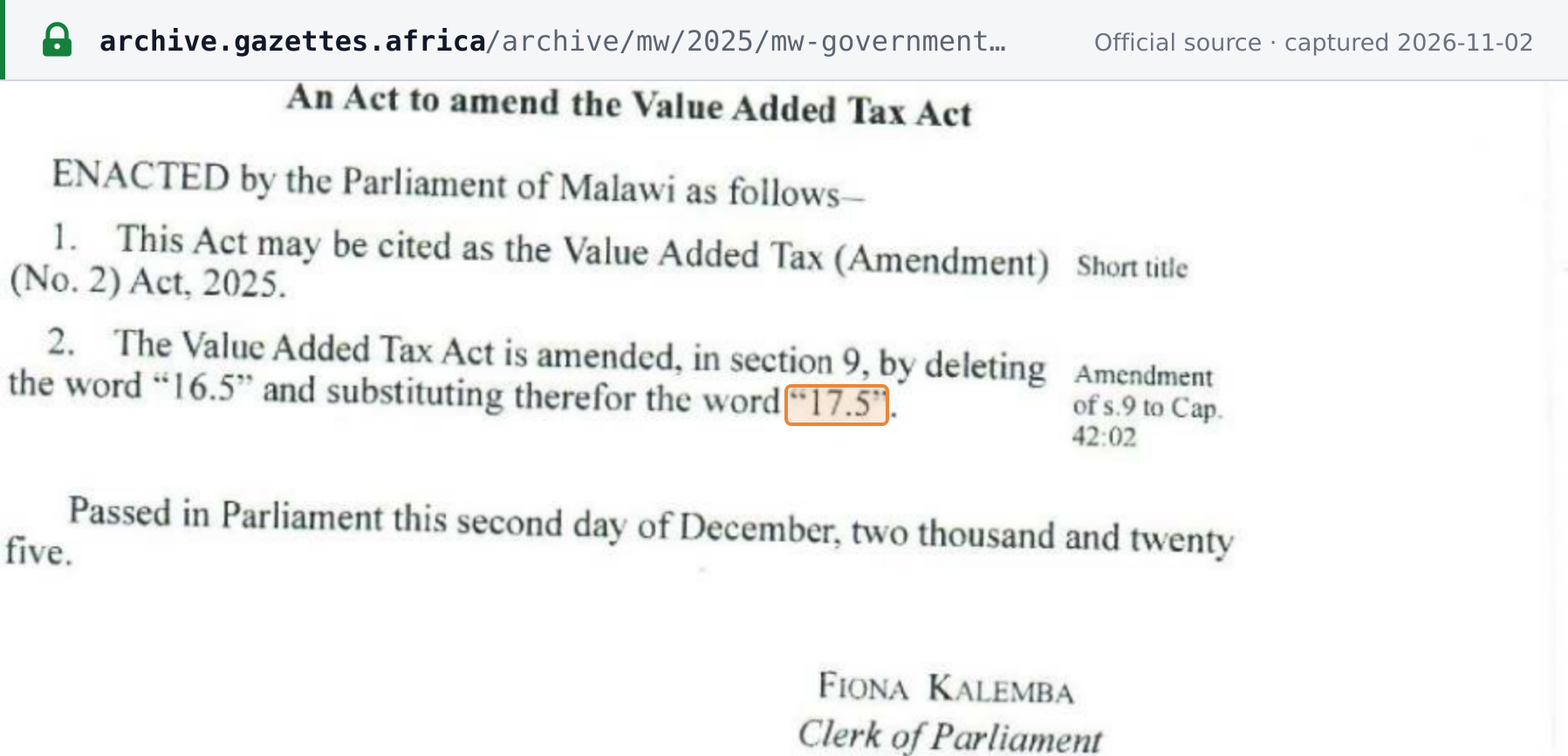
Standard rate: 17.5% (as at 2026-11-02). Section 2 of the Value Added Tax (Amendment) (No. 2) Act, 2025 (Act No. 37 of 2025; passed 2 December 2025, assented 20 December 2025, published 30 December 2025) provides: "The Value Added Tax Act is amended, in section 9, by deleting the word "16.5" and substituting therefor the word "17.5"." The Act has no commencement section of its own. Section 9 applies the rate "calculated on the value of the taxable supply of the goods, services or import". [1] [3]
 Source snapshot captured 2026-11-02 — original
Zero rate. "Output tax shall be at zero on the supply of the goods and services specified in the Second Schedule" (s.21). Examples:
- exports of goods and services (Second Schedule para 1);
- goods shipped as stores on aircraft and vessels leaving Malawi (para 2);
- added by Act No. 5 of 2026: buses seating 45 or more persons, including the driver, under Customs Tariff subheadings 8702.10.30 and 8702.90.30; building materials for the tourism industry; and laundry soap under subheading 3401.19.90. [2] [3]
The Second Schedule has been amended several times, so the list above gives examples rather than the full schedule.
Reduced rates. None. Section 9 sets a single rate, and the only other rate in the Act is the zero rate under section 21.
Announced future rates. None found in the amending Acts of 2024 to 2026.
See worldwide tax rates for other countries.
Cross-border rules
Imports and exports
- Imports of goods. VAT is paid "in the case of imported goods, by the importer" (s.8(b)). It is collected at the border, and "any written law applicable to collection of customs duties and other taxes on importation of goods shall apply with such modifications as are necessary" (s.7(3)).
- Input tax on imports. To deduct import VAT, the taxable person must be "in possession of the relevant customs entries indicating that Value Added Tax was paid" (s.30(1)(c)).
- De-minimis. The VAT Act contains no low-value relief for imported goods. Customs-law rules are outside this guide.
- Exports. Exports of goods and services are zero-rated (Second Schedule para 1). An exporter "whose exports exceed 70 per cent of the total supplies within the accounting period" may be refunded its excess credit (s.31(1) proviso (a)).
- Input tax for exporters. Since the VAT (Amendment) Act, 2023 (Act No. 18 of 2023, published 5 April 2023), section 30(1)(e) adds a condition for deducting input tax: "in respect of exports, the taxable person is in possession of documentation showing deposit of the export proceeds into a financial institution in Malawi". [3] [15]
Reverse charge on imported services
VAT on imported services is paid "in the case of imported services, by the receiver of the services" (s.8(c)), and section 7(1)(c) charges VAT on "the supply of any imported service". A Malawian business that buys services from abroad therefore accounts for the VAT itself. The VAT Act does not set out the return mechanics for this. [2] [3] See reverse charge explained.
Digital products and services
From the publication of Act No. 5 of 2026 on 14 April 2026, VAT is charged on "the supply of digital services" (new s.7(1)(d)). The Act defines "digital services" as "services supplied over the internet or an electronic network, the supply of which is automated and requires minimal human intervention, and include—
- (a) streaming of videos, music or games;
- (b) cloud computing;
- (c) software downloads and subscriptions;
- (d) online advertising;
- (e) digital marketplace facilitation;
- (f) e-books and online publications; and
- (g) mobile applications and in-app purchases". [2]
The standard 17.5% rate applies, since the Act sets no special rate. No input tax may be deducted on "transactions in respect of digital services by a non-resident digital services supplier or an intermediary or an electronic marketplace operator" (new s.30(3)(b)). See VAT on digital services by non-resident suppliers.
Foreign companies selling into Malawi — B2B and B2C
- B2C digital services. The foreign supplier must register for Malawi VAT and charge 17.5%, whatever its turnover (s.11(1)(b)). It cannot deduct input tax. The rule turns on whether the customer is a taxable person, so it also covers sales to Malawian businesses that are not VAT-registered.
- B2B services. Supplies to VAT-registered (taxable) persons fall outside the digital-services "recipient" definition and under the imported-services rule instead: the registered customer pays the VAT (s.8(c)).
- Goods. The importer pays VAT at customs (s.8(b)). [2] [3]
Marketplace / platform deemed-supplier liability
Act No. 5 of 2026 makes electronic marketplace operators and intermediaries registrable for digital services. An "intermediary" is "a person who facilitates the supply of digital services supplied by a digital services supplier to recipients in Malawi and who is responsible for issuing the invoices and collecting payment for the supply". The Act does not say in terms that the platform becomes the deemed supplier in place of the underlying seller. Neither the VAT Act nor Act No. 5 of 2026 contains a deemed-supplier rule for goods sold through marketplaces. [2] See marketplace deemed-supplier rules.
Place of supply
- Goods. "The place of supply of goods shall be the place from which the goods are supplied" (s.26(1)).
- Services. "Unless otherwise provided in regulations made under this Act, the place of supply of a service shall be the place of business of the supplier or the place from which the service is supplied or rendered" (s.26(2)).
- Digital services. "Notwithstanding the provisions of subsection (2), in the case of digital services, the place of supply shall be where the recipient of the digital services has his or her usual place of residence or establishment, regardless of the place of contract or payment" (new s.26(3), inserted by Act No. 5 of 2026). [2] [3]
Invoice requirements
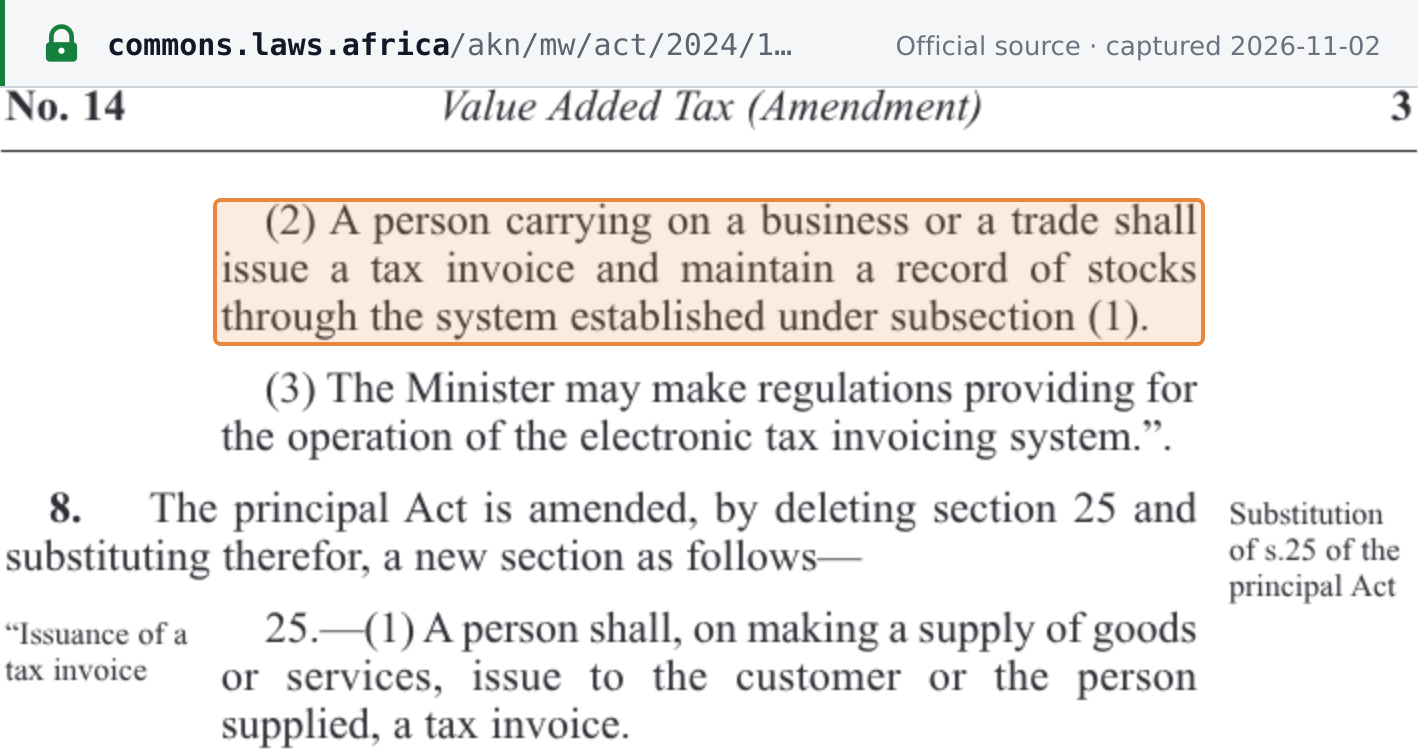
Every invoice goes through the EIS. The VAT (Amendment) Act, 2024 (Act No. 14 of 2024) redefined a "tax invoice" as "a fiscal receipt or invoice generated by an electronic tax invoicing system, upon supply of goods or services, in accordance with this Act". Its new section 11D(2) provides: "A person carrying on a business or a trade shall issue a tax invoice and maintain a record of stocks through the system established under subsection (1)." The new section 25(1) applies to any person, not only a taxable person: "A person shall, on making a supply of goods or services, issue to the customer or the person supplied, a tax invoice." MRA's transition notice confirms that the EIS "follows the coming into operation of Part II of the Value Added Tax (Amendment) Act, 2024". [4] [7]
 Source snapshot captured 2026-11-02 — original
Mandatory content
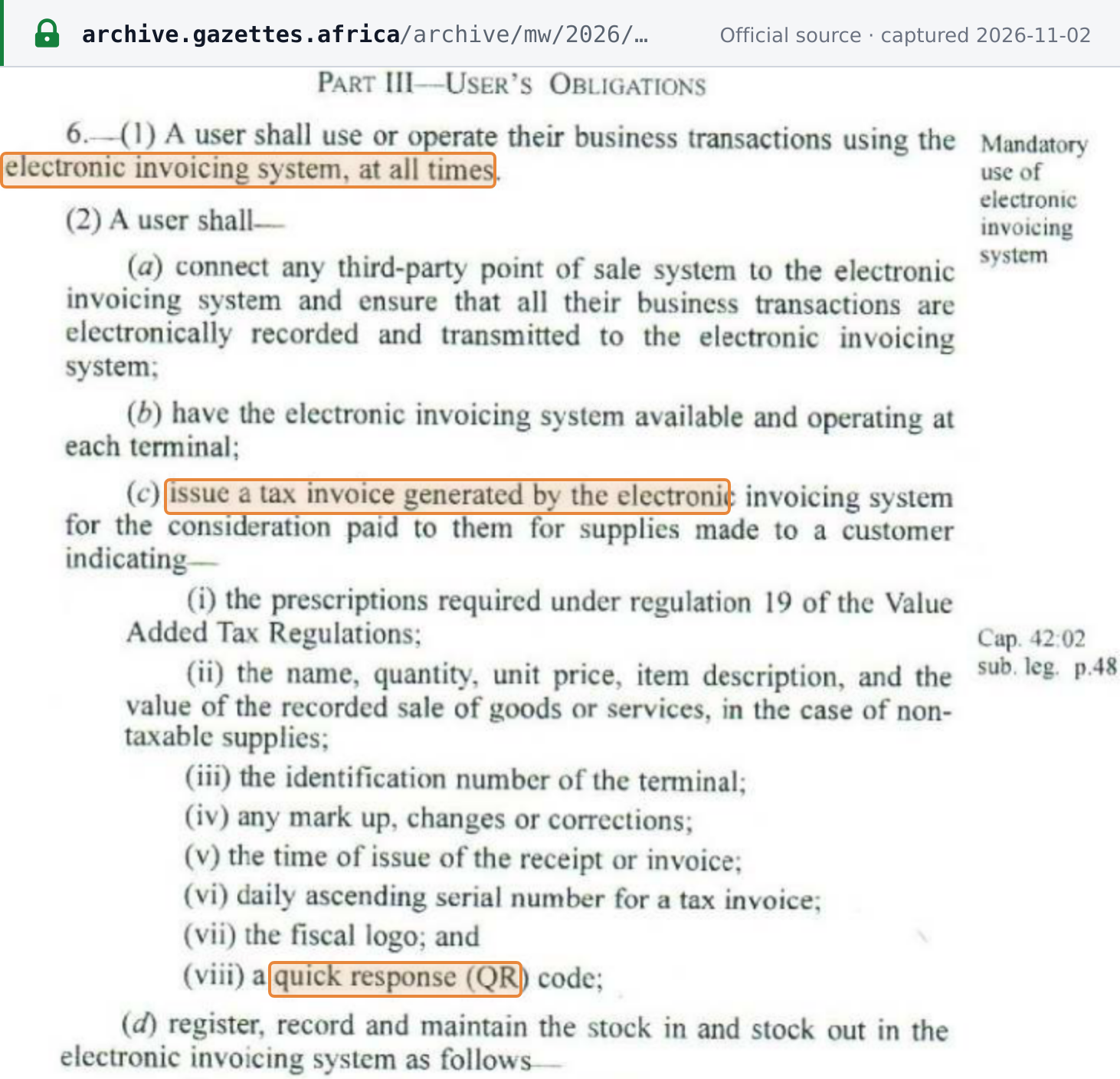
Regulation 6(2)(c) of the Value Added Tax (Electronic Invoicing System) Regulations, 2025 (G.N. 6 of 2026, gazetted 9 January 2026) requires users to "issue a tax invoice generated by the electronic invoicing system" showing: [5]
| # | Particular (reg. 6(2)(c)) | Notes |
|---|---|---|
| (i) | "the prescriptions required under regulation 19 of the Value Added Tax Regulations" | The general tax-invoice particulars, incorporated by reference |
| (ii) | "the name, quantity, unit price, item description, and the value of the recorded sale of goods or services" | For non-taxable supplies |
| (iii) | "the identification number of the terminal" | The EIS terminal that issued it |
| (iv) | "any mark up, changes or corrections" | |
| (v) | "the time of issue of the receipt or invoice" | |
| (vi) | "daily ascending serial number for a tax invoice" | |
| (vii) | "the fiscal logo" | |
| (viii) | "a quick response (QR) code" | Lets the buyer check the receipt (see below) |
 Source snapshot captured 2026-11-02 — original
Buyer's evidence for input tax. For purchases in Malawi, input tax may be deducted only where "the taxable person is in possession of a tax invoice issued in accordance with section 25" (s.30(1)(b)). [3]
Issuance deadline
At the point of sale. Section 25(1) requires the invoice "on making a supply", and the EIS Regulations require users to "use or operate their business transactions using the electronic invoicing system, at all times" (reg. 6(1)). No separate "within N days" rule appears in the Act or the Regulations. The time of supply is the earliest of removal of the goods, making them available, rendering the services, receiving payment, or "a tax invoice is issued" (s.24(1)(c)). [3] [5]
If the system fails. Within six hours of the failure, the user must report it in writing to the Commissioner General and record sales "using any other means as may be specified by the Commissioner General" (reg. 6(2)(j)). Those sales must be entered into the EIS "within seventy-two hours of issuance of the invoice" (reg. 6(2)(k)). The Commissioner General may also, on written application, allow an invoice other than a tax invoice where "owing to the nature of the business or malfunctioning of the electronic tax invoicing system" issuing one is impracticable (new s.25(4)). [4] [5]
Numbering and sequencing
- Serial order. "The person shall, upon issuing the tax invoice, retain a copy of the tax invoice in a serial number order" (new s.25(2)).
- Daily serial. Each EIS invoice carries a "daily ascending serial number" (reg. 6(2)(c)(vi)).
- Unique identifier. Certified point-of-sale systems must assign "a unique identifier to each invoice" (reg. 5(3)(q)).
- Approved formats. Users must use barcodes and invoice numbering in formats approved by the Commissioner General (reg. 6(2)(f)–(g)). [4] [5]
Credit and debit notes
Corrections are made inside the EIS:
- Errors. A user who enters wrong data must "print the erroneous information and keep the record thereof, for purposes of reconciliation and rectification with the Commissioner General", then "enter correct data and information in the electronic invoicing system and thereby issue a correct tax invoice" (reg. 9).
- Credit and debit notes. The EIS API's credit/debit-note endpoint "Generates a credit note or debit note from an existing invoice. If the updated VAT or total is higher than the original invoice, a debit note is generated. If the updated VAT or total is lower than the original invoice, a credit note is generated." The request has a field for the reason for the adjustment. The API also has endpoints for cancelling receipts. [5] [9]
Currency and language
- Currency: kwacha only. MRA's EIS FAQ, asked whether the system can handle different currencies: "No, the current version does not support multi-currency. Use appropriate exchange rates to convert to MWK and then issue the invoice." No statutory exchange-rate rule appears in the VAT Act or the EIS Regulations. [8]
- Language. Certified point-of-sale systems must "display clear messages in the official languages" (reg. 5(3)(l)). Neither the Act nor the Regulations set a language for the invoice itself. [5]
Document types
There is one document: the tax invoice, which is any "fiscal receipt or invoice" generated by the EIS. The Act provides no simplified invoice and no value threshold for one. There are two alternatives, both on application to the Commissioner General: where the nature of a business makes a tax invoice impracticable, the Commissioner General may allow the person "to account for Value Added Tax in such other manner as the Commissioner General may authorize" (new s.25(3)); and on written application, the Commissioner General may allow an invoice other than a tax invoice where issuing one is impracticable (new s.25(4)). [4]
Self-billing
Not provided for. Neither the VAT Act, Act No. 14 of 2024 nor the EIS Regulations contain a self-billing provision. Under section 11D(2), the person carrying on the business issues the invoice.
Retention and audit trail
- Retention: six years, in Malawi. "A person shall maintain, within the country, proper records" (TAA s.39(1)), retained "for a period of at least six years from the relevant date" or longer in the listed cases (s.39(3)).
- Customers keep invoices too. A customer "shall demand and retain the receipt or invoice" and produce it to MRA on request, and must report a refusal to issue one (reg. 13).
- Audit trail. Certified point-of-sale systems must (reg. 5(3)):
- store data securely "for not less than six years";
- never reverse or delete entered sales data, including dates;
- send an alarm "in case of any manipulation to the system";
- "be secure and tamper-proof";
- capture "the log of all activities";
- assign a unique identifier to each invoice.
- Maintenance ledger. Users must keep an electronic maintenance ledger for their point-of-sale software (reg. 7(1)(b)).
- Terminals. EIS terminals may not be transferred (reg. 10). [5] [6]
How a buyer checks a receipt. MRA's EIS FAQ: "Receipts will have a unique number and QR code. When scanned, the QR shows exact receipt details which can be verified in the Backoffice." [8]
A specimen of a compliant invoice
The EIS portal FAQ, the EIS developer resources page, the EIS API specification, the EIS Regulations and MRA's transition notice contain no specimen invoice. Below, Lookuptax lays out the EIS particulars of regulation 6(2)(c), plus the fields of MRA's API schema, for an illustrative domestic sale at 17.5%. Every name, number and amount is fictional:
Tax invoice (EIS) — illustrative
| DescriptionAPI description | QtyAPI quantity | Unit priceAPI unitPrice | Line totalAPI total | VATAPI totalVAT |
|---|---|---|---|---|
| Office chairs, model EX-1 | 4 | MWK 150,000 | MWK 600,000 | MWK 105,000 |
| Delivery | 1 | MWK 50,000 | MWK 50,000 | MWK 8,750 |
- Taxable amount at 17.5%API taxBreakDown
- MWK 650,000
- VAT 17.5%VAT Act s.9
- MWK 113,750
- Invoice totalAPI invoiceTotal
- MWK 763,750
- [Fiscal logo] — reg. 6(2)(c)(vii).
- [QR code] — reg. 6(2)(c)(viii). The EIS returns a validation URL for each invoice; scanning the code shows the receipt details.
- All amounts in Malawi kwacha. The EIS does not support other currencies: convert first, then issue (MRA EIS FAQ).
- Any mark-up, changes or corrections are shown on the invoice — reg. 6(2)(c)(iv). Corrections to an issued invoice go through a credit or debit note generated from it in the EIS.
- For a non-taxable supply, the invoice shows the name, quantity, unit price, item description and value of the sale — reg. 6(2)(c)(ii).
E-invoicing status
Status (as at 2026-11-02): mandatory for every business, through MRA's Electronic Invoicing System (EIS). "These Regulations shall apply to any person carrying on business or trade in Malawi" (EIS Regulations reg. 3), and "A user shall use or operate their business transactions using the electronic invoicing system, at all times" (reg. 6(1)). The obligation in VAT Act s.11D(2) is likewise not limited to VAT-registered persons. [4] [5]
- System and network. The EIS, a single government platform run by MRA, not Peppol. MRA describes it as "a software-based solution that enables taxpayers to issue electronic tax invoices, manage stock records and transmit transaction data to MRA in real time." [7]
- Model. Real-time reporting of every sale, plus stock records. Users must record all local purchases and imports as stock in (reg. 6(2)(d)).
- How to connect. Use MRA's own EIS point-of-sale applications from the EIS portal, or connect a third-party point-of-sale system through the EIS API. "The Commissioner General shall certify a third-party point of sale system before that system is connected to the electronic invoicing system and used by a user" (reg. 5(1)). MRA's FAQ adds: "Taxpayers are responsible for acquiring POS hardware and printers. MRA has not appointed specific suppliers." [5] [8]
- Formats and standards. REST/JSON. MRA's API guide: "This API will be operational for POS devices around the clock, employing contemporary data transmission standards like REST APIs and JSON." It supports offline issuing, with an
offlineSignatureon invoices issued without a connection. [10] [9] - Phases. None by taxpayer size. The Regulations apply to every person carrying on business.
- Scope. B2B, B2C and B2G alike: every supply is invoiced through the EIS.
The end of Electronic Fiscal Devices. Regulation 14 revoked the VAT (Electronic Fiscal Devices) Regulations. Regulation 15 sets the transition:
- "(1) Notwithstanding the revocation of the Value Added Tax (Electronic Fiscal Devices) Regulations, a taxable person may continue to issue tax invoices from an electronic fiscal device until 31st January, 2026."
- "(2) A tax invoice issued from an electronic fiscal device shall not be used for deductions of input tax under section 30 of the Act after 31st July, 2026." [5]
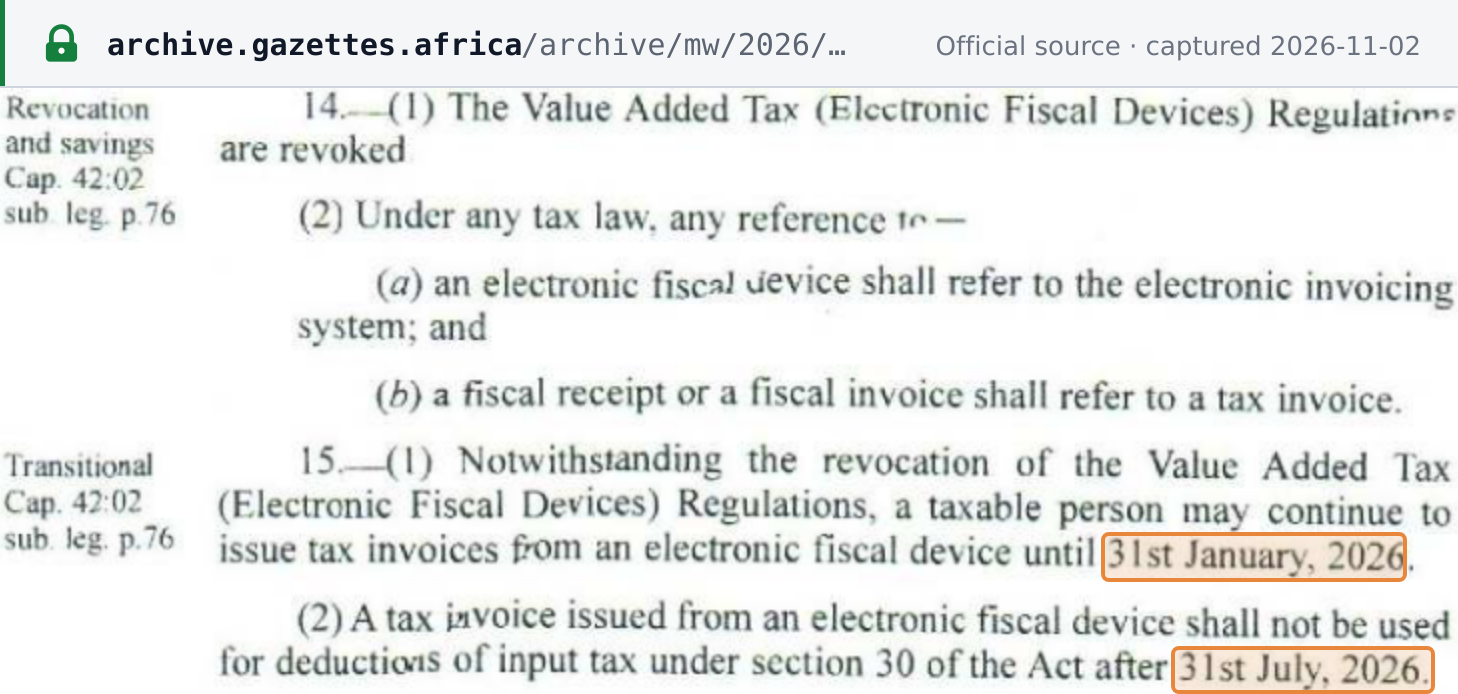 Source snapshot captured 2026-11-02 — original
MRA's public notice on the transition states the same cut-off for new invoices: "At the end of the transition period on 31 January, 2026 taxpayers will no longer be allowed to use EFDs for issuing tax invoices, and a tax invoice issued from an EFD after 31 January, 2026 shall not be acceptable for claiming of input tax." [7]
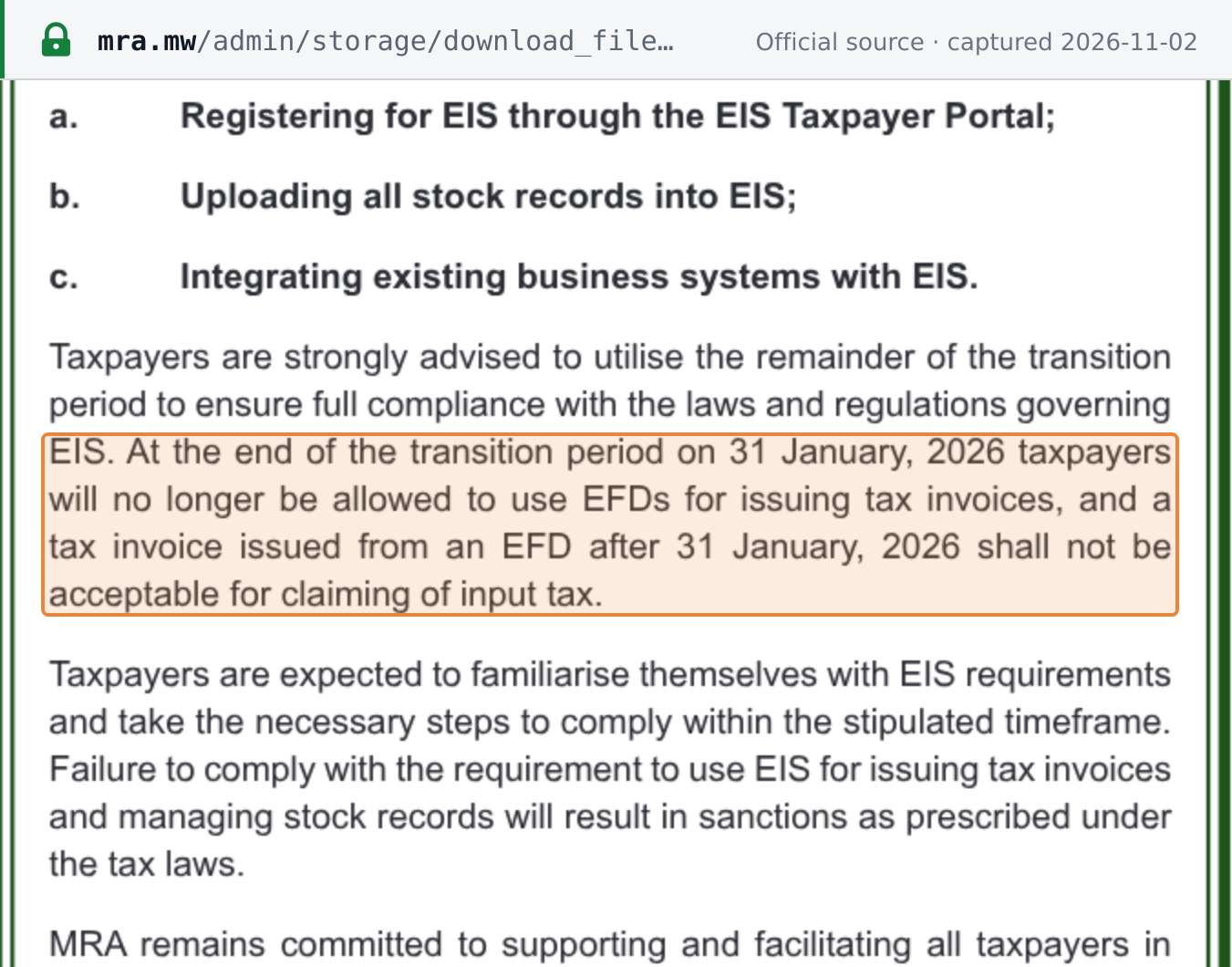 Source snapshot captured 2026-11-02 — original
See fiscal devices and certified cash registers for how Malawi's move from devices to software compares with other countries, CTC e-invoicing models, and e-invoicing status and networks worldwide.
For developers: the EIS invoice data model
MRA's EIS API specification describes how a point-of-sale system submits a sale (POST /api/v1/sales/submit-sales-transaction, schema SalesInvoice). These are field names in MRA's technical schema, not legal requirements; the legal content of an invoice is set by regulation 6(2)(c) above. A SalesInvoice has three blocks: [9]
invoiceHeader. Required fields:invoiceNumber,invoiceDateTime,sellerTIN,siteId,globalConfigVersion,taxpayerConfigVersionandterminalConfigVersion. Optional:buyerTIN,buyerName,buyerAuthorizationCode,paymentMethod. Flags:isExportandisReliefSupply, withvat5CertificateDetailsfor relief supplies.invoiceLineItems. Each line hasproductCode,description,unitPrice,quantity,discount,total,totalVAT,taxRateIdandisProduct.invoiceSummary. A requiredtaxBreakDown(rate, taxable amount and tax per rate), alevyBreakDown,totalVAT,invoiceTotal,amountTendered, and anofflineSignaturefor invoices issued offline.
The response carries a validationURL for the invoice. Credit and debit notes are generated from an existing invoice through a separate endpoint (see Credit and debit notes).
Filing and payment
Filing frequency
Monthly (as at 2026-11-02). "Unless otherwise directed in writing by the Commissioner General, a taxable person shall account for Value Added Tax each calendar month on a return" (s.34(1)). The VAT (Amendment) Act, 2018 inserted the words "or withholding agent" after "taxable person" in this subsection, and the VAT (Amendment) Act, 2022 (Act No. 7 of 2022) deleted them again from section 34, so the wording above is current. The Act sets no turnover band for a different frequency; only a written direction from the Commissioner General changes it. [3] [13] [14]
Return due date
The 25th of the following month (as at 2026-11-02). "A return shall be submitted to the Commissioner General not later than the twenty-fifth day of the month immediately following the month to which the return relates" (s.34(3)). The Statute Law (Miscellaneous Amendments) Act, 2021 (Act No. 15 of 2021) deleted several subsections of section 34 and renumbered this one from 34(4) to 34(3). [3] [12]
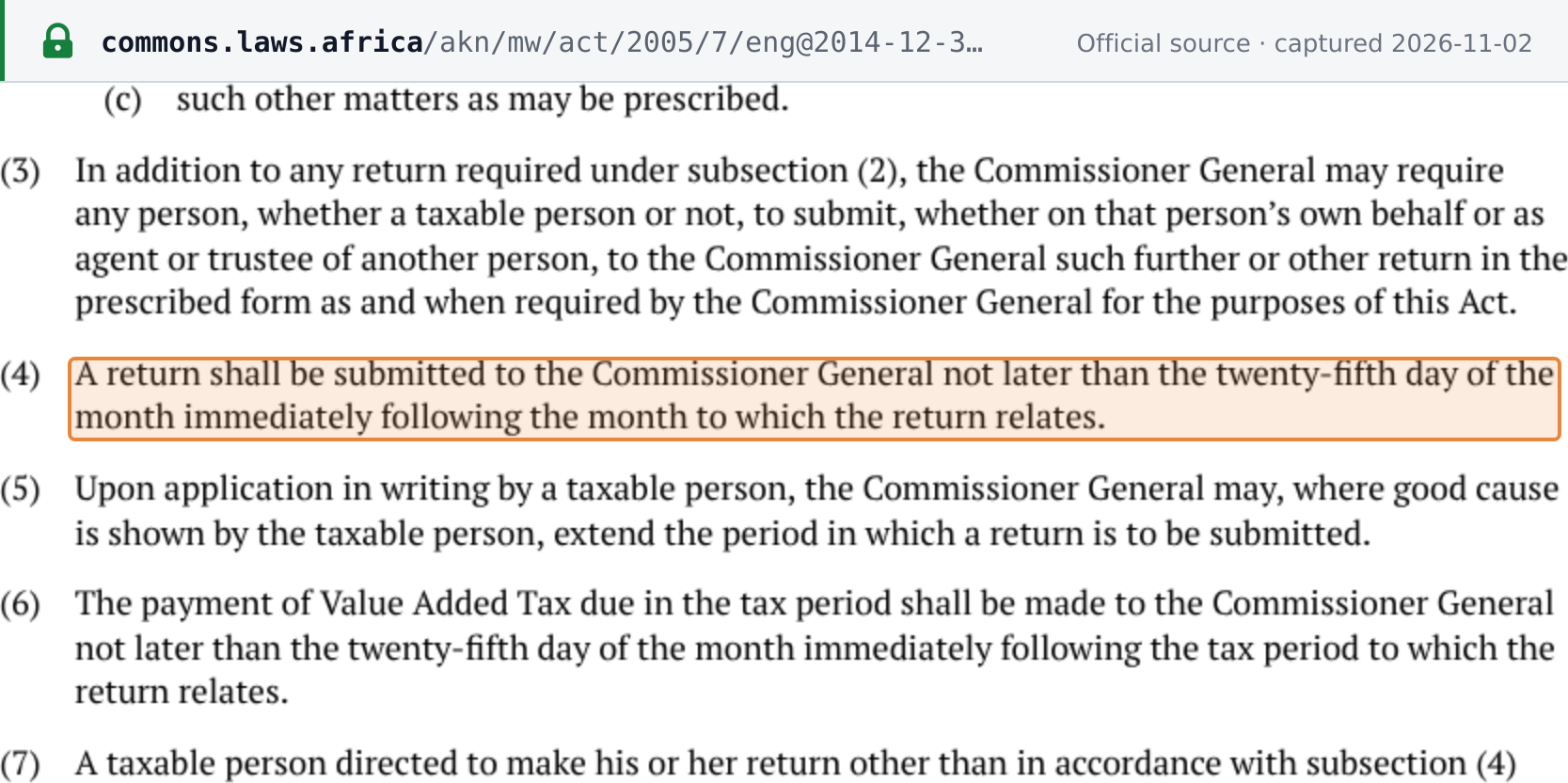 Source snapshot captured 2026-11-02 — original
Payment due date and method
Also the 25th. "The payment of Value Added Tax due in the tax period shall be made to the Commissioner General not later than the twenty-fifth day of the month immediately following the tax period to which the return relates" (s.34(4), formerly 34(6)). The EIS "provides tax reports to assist in return filing with MRA" (EIS FAQ). [3] [12] [8]
Additional listings
None separate from the return. Because every sale and stock movement is already reported through the EIS in real time, the Act and the Regulations require no sales or purchase listing beside the monthly return.
Input-tax recovery and blocked items
- What is deductible. Section 30(1), as substituted by the VAT (Amendment) Act, 2018 (Act No. 27 of 2018) and amended in 2022 and 2023, lets a taxable person deduct VAT on goods and services bought in Malawi or imported and used "wholly, exclusively and necessarily" in the business, provided the supply is taxable and, for purchases in Malawi, "the taxable person is in possession of a tax invoice issued in accordance with section 25". [13] Since Act No. 14 of 2024, that means an EIS invoice. EFD invoices cannot be used after 31 July 2026 (EIS Regulations reg. 15(2)).
- Once only. "No input tax deduction shall be taken more than once" (s.30(4)).
- Blocked:
- motor vehicles and their spare parts, unless the business deals in or hires out vehicles, or the vehicle is used wholly, exclusively and necessarily in the business (s.30(5));
- "entertainment, including restaurant, meals and hotel expenses, unless the taxable person is in the business of providing entertainment" (s.30(6));
- purchases or imports for exempt supplies (new s.30(3)(a));
- all transactions in digital services by non-resident suppliers, intermediaries and electronic marketplace operators (new s.30(3)(b)).
- Mixed use. Where a purchase or import is partly for business and partly for personal or other use, input tax is restricted to the business part (s.30(7)). The Minister may prescribe further non-deductible classes of goods and services by Gazette order (s.30(10)).
The once-only, blocked-input, mixed-use and second-hand rules above are stated as in the 2014 consolidated VAT Act; later amending Acts may have changed them. [2] [3] [5]
Refunds
- Credit forward. Excess input tax is normally carried forward. It is refunded where "(a) in the case of exports, … his or her exports exceed 70 per cent of the total supplies within the accounting period", or "(b) … the excess credit remains outstanding for a continuous period of three months or more" (s.31(1)). Since Act No. 15 of 2021, excess credit is "credited and refunded in accordance with the Tax Administration Act". [12]
- Applications. Under the TAA, VAT refund applications may be made monthly (s.81(3)(a)).
- Timing. The Commissioner General decides an application "within sixty days of receipt of the application" (TAA s.82(1)), and refunds the remainder "within ninety days of making the decision" (s.83(1)(b)). Interest is due if MRA misses that window (s.83(3)).
- Non-residents. No refund scheme for non-resident businesses appears in the VAT Act or the TAA. [3] [6]
Exemptions
Exempt supplies
"The supply of the goods and services specified in the First Schedule is exempt supply and not subject to Value Added Tax" (s.20). Examples:
- educational services; banking and life insurance services; postal services; funeral services; medical services; rental and sale of residential property; betting and gaming, including lotteries;
- added or reworded by Act No. 5 of 2026: cooking oil under the listed Customs Tariff subheadings; wheat flour under subheading 1101.00.10; and the fish, dairy produce, natural honey, infant milk and milling-product items. [2] [3]
The First Schedule has been amended several times, so treat this as examples, not the full schedule.
Exempt is not zero-rated. An exempt supply carries no VAT, and "No input tax deduction shall be made on— (a) purchases or imports in respect of exempt supplies by the taxable person" (new s.30(3)(a)). A zero-rated supply is a taxable supply on which "Output tax shall be at zero" (s.21), so the supplier can still deduct the input tax on its costs (s.30(1)(a)).
Relief supplies. Section 23 grants "relief from Value Added Tax on taxable supply to the individuals, organizations and businesses specified in the Third Schedule". Act No. 5 of 2026 replaced the customs procedure codes in paragraph 4 of that schedule. In the EIS, relief supplies are flagged on the invoice, with the relief certificate details. [2] [9]
Special regimes
- Small business, flat-rate, margin or cash accounting. None in the VAT Act. Below the MWK 50,000,000 threshold, a business need not register unless it chooses to, though it still issues invoices through the EIS.
- Second-hand goods. The Commissioner General may set input-credit procedures for persons who regularly resell used goods bought from consumers (s.30(9)).
Offences and penalties
Offences
- General non-compliance (TAA s.99). Where a failure "results in or, if undetected, may have resulted in an underpayment": a fine of 1,000 to 10,000 currency points, or ten times the tax prejudiced, whichever is greater, "or to imprisonment for one year".
- Failure to apply for registration (TAA s.100(a)). A fine of 500 to 5,000 currency points, or ten times the tax prejudiced, whichever is greater, or six months' imprisonment.
- TIN misuse (TAA s.102). Using a false TIN, another person's TIN, or a TIN obtained by fraud.
- EIS misconduct (EIS Regulations reg. 12). The listed conduct includes repeatedly entering incorrect information, failing to upload stock, unauthorised access, tampering with or uninstalling the system, and changing point-of-sale specifications without notice. The person may correct the conduct, deny it in writing or ask to compound within 7 days of a notice. On denial, the Commissioner General may "(a) restrict the person's access to the electronic invoicing system; (b) impose a penalty for any contravention with these Regulations or any tax law; or (c) institute criminal proceedings against the person" (reg. 12(4)). [5] [6]
Penalties
TAA penalties are set in currency points. The TAA Schedule gives the "Value of a currency point" as K1,000.00 (consolidation as at 14 April 2026). [6]
| Failure | Entity | Individual | Basis |
|---|---|---|---|
| Late return | 500 CP (MWK 500,000) for the first month, then 50 CP (MWK 50,000) a month or part | 100 CP (MWK 100,000), then 10 CP (MWK 10,000) a month | TAA s.92(1) |
| Failure to register | 500 CP, then 50 CP a month | 100 CP, then 10 CP a month | TAA s.88(1) |
| Failure to comply with an electronic tax system (the EIS) | 500 CP, then 50 CP a month | 100 CP, then 10 CP a month | TAA s.95 |
| Failure to keep proper documents | 500 CP, then 50 CP a month | 100 CP, then 10 CP a month | TAA s.90 |
| Late payment | A one-off penalty of 20% of the unpaid tax, plus interest at the prevailing bank lending rate plus 5% a year, charged for each month or part of a month the tax remains unpaid | same | TAA s.87(2) |
| False or misleading statement | 100% of the shortfall if knowing or reckless, otherwise 30% | same | TAA s.93 |
- Electronic tax system. TAA s.95: "A person who fails to comply with the requirements of an electronic tax system as required under a tax law shall be liable to— (a) a penalty of five hundred currency points for an entity and one hundred currency points for an individual for the first month; and (b) a further penalty of fifty currency points for an entity and ten currency points for an individual for each month or part thereof during which the failure continues."
- Misstatements. The s.93 penalty is increased by 20% for a repeat within five years and reduced by 20% for a voluntary disclosure.
- One law at a time. Where a failure incurs a penalty under the TAA and another tax law, "the Commissioner General shall assess the interest or penalty under one tax law of the Commissioner General’s choice" (TAA s.97(3)). [6]
Frequently asked questions
Is Malawi VAT 16.5% or 17.5%?
17.5%. The Value Added Tax (Amendment) (No. 2) Act, 2025 (Act No. 37 of 2025), published on 30 December 2025, amended section 9 of the VAT Act by replacing 16.5 with 17.5. Tables that still show 16.5% predate that amendment.
Can we still claim input tax on an invoice printed by our old Electronic Fiscal Device?
No. Regulation 15 of the VAT (Electronic Invoicing System) Regulations, 2025 let taxable persons keep issuing invoices from an EFD until 31 January 2026, and provides that an EFD-issued tax invoice cannot be used for input tax deductions under section 30 of the VAT Act after 31 July 2026. MRA's transition notice adds that an EFD invoice issued after 31 January 2026 is not acceptable for claiming input tax.
Can we issue a Malawi EIS invoice in US dollars?
No. MRA's EIS portal FAQ says the current version of the system does not support multi-currency, and tells users to convert to MWK at appropriate exchange rates and then issue the invoice. Every EIS invoice is therefore issued in Malawi kwacha.
Does a foreign streaming or SaaS provider selling to consumers in Malawi have to register for VAT?
Yes. The VAT (Amendment) Act, 2026 (Act No. 5 of 2026, published 14 April 2026) makes a non-resident digital services supplier, an intermediary or an electronic marketplace operator registrable whether or not its supplies reach the MWK 50,000,000 annual threshold. Digital services are taxed where the recipient usually lives or is established, and these suppliers cannot deduct input tax.
What do we do if the EIS stops working at the till?
Regulation 6(2) of the EIS Regulations requires the user, within six hours of the failure, to report it in writing to the Commissioner General and to record sales by any other means the Commissioner General specifies. Those sales must then be entered into the EIS within 72 hours of the invoice being issued.
Important websites
| Site | Purpose |
|---|---|
| Malawi Revenue Authority | Tax authority home page: notices and downloads |
| MSONKHO Online | MRA's online taxpayer portal |
| EIS Taxpayer Portal | EIS account sign-up and MRA's own point-of-sale applications |
| EIS FAQ | MRA's answers on onboarding, currencies, receipts and hardware |
| EIS developer resources | API documentation and Swagger specification for connecting a point-of-sale system |
| Invoice verification | The QR code on each EIS receipt; no separate public lookup page was found |
| MRA call centre | Toll-free 672, callcentre@mra.mw (as given in MRA's EIS notice) |
We found no public TIN lookup. For other countries' registers, see check a VAT number — official lookups by country.
Recent changes
- 2026-04-14 — The VAT (Amendment) Act, 2026 (Act No. 5 of 2026; assented 9 April 2026) is published. It raises the registration threshold to MWK 50,000,000, brings digital services supplied by non-residents to non-taxable persons into VAT with no threshold and no input tax, and adds exemptions (cooking oil, wheat flour) and zero-rating (buses, tourism building materials, laundry soap). (Act No. 5 of 2026) — see event
- 2026-01-31 — The EFD transition ends under the VAT (Electronic Invoicing System) Regulations, 2025 (G.N. 6 of 2026, gazetted 9 January 2026); EFD invoices cannot be used for input tax after 31 July 2026. (Malawi Gazette · MRA) — see event
- 2025-12-30 — The VAT (Amendment) (No. 2) Act, 2025 (Act No. 37 of 2025) is published, raising the standard rate from 16.5% to 17.5%. (Malawi Gazette)
- 2024-04-19 — The VAT (Amendment) Act, 2024 (Act No. 14 of 2024) is published. Part II creates the electronic tax invoicing system and redefines the tax invoice as one generated by it. (Act No. 14 of 2024)
For the full chronology, see Malawi tax changes on Lookuptax.
Reference links
- Malawi Gazette Supplement No. 7C of 30 December 2025 — Value Added Tax (Amendment) (No. 2) Act, 2025 (Act No. 37 of 2025)
- Value Added Tax (Amendment) Act, 2026 (Act No. 5 of 2026) — Government Printer publication
- Value Added Tax Act (Cap. 42:02) — Laws.Africa consolidation as at 31 December 2014
- Value Added Tax (Amendment) Act, 2024 (Act No. 14 of 2024) — Government Printer publication
- Malawi Gazette Supplement No. 2A of 9 January 2026 — Value Added Tax (Electronic Invoicing System) Regulations, 2025 (G.N. 6 of 2026)
- Tax Administration Act, 2021 (Act No. 13 of 2021) — Laws.Africa consolidation as at 14 April 2026
- MRA — Public notice: Transition from Electronic Fiscal Devices to the Electronic Invoicing System
- MRA — EIS Portal FAQ
- MRA — EIS API specification (Swagger, EISAPI v1.0)
- MRA — EIS API guide: introduction
- Parliament of Malawi — Value Added Tax (Amendment) Bill, 2026 (memorandum)
- Statute Law (Miscellaneous Amendments) Act, 2021 (Act No. 15 of 2021) — Government Printer publication
- Value Added Tax (Amendment) Act, 2018 (Act No. 27 of 2018) — Government Printer publication
- Value Added Tax (Amendment) Act, 2022 (Act No. 7 of 2022) — Government Printer publication
- Value Added Tax (Amendment) Act, 2023 (Act No. 18 of 2023) — Malawi Gazette Supplement No. 4C of 5 April 2023
Related on Lookuptax:
- VAT registration thresholds worldwide
- Worldwide tax rates
- E-invoicing status and networks worldwide
- Fiscal devices and certified cash registers
- VAT on digital services by non-resident suppliers
- Reverse charge explained
- Marketplace deemed-supplier rules
- How to register for VAT, sales tax or GST
- VAT, GST and sales tax names by country