Maldives GST guidelines
| FACTSHEET | |
|---|---|
| Country code | MV |
| Tax name | Goods and Services Tax (GST): tourism sector (TGST) and general sector (GGST) |
| Tax Authority | Maldives Inland Revenue Authority (MIRA) |
Overview
The Maldives levies Goods and Services Tax (GST) — in Dhivehi މުދަލާއި ޚިދުމަތުގެ އަގުން ނެގޭ ޓެކްސް ("ޖީ.އެސް.ޓީ") — under the Goods and Services Tax Act, Law No. 10/2011, in force since 2 October 2011. The Act's opening section reads: "މި ޤާނޫނަކީ، މުދަލާއި ޚިދުމަތުގެ އަގުން "ގުޑްސް އެންޑް ސަރވިސަސް ޓެކްސް" ނެގުމުގެ އުޞޫލުތައް ބަޔާންކުރުމުގެ ޤާނޫނެވެ." (in English, a Lookuptax translation: "This Act sets out the principles for levying 'Goods and Services Tax' on the price of goods and services.") [1]
The Act has been amended eight times, most recently by Law No. 10/2026 (the 8th amendment). The People's Majlis passed it "during the 27th sitting of the 20th Parliament on 23 August 2026", and the President ratified it on 31 August 2026, when it was gazetted and took effect. [4] [9] The operative text is Dhivehi. The consolidated Dhivehi text (Attorney General's Office, MV Laws, with the 8th amendment, effective 31 August 2026) is the reference below; English renderings of Dhivehi passages are Lookuptax translations unless an official English source is quoted. [1]
Two sectors, two rates. GST is levied in two sectors (s.14): the tourism sector, known as TGST (s.15), and all other sectors, known as GGST (s.16). Which sector a supply falls in decides the rate (17% or 8%), the currency the tax is paid in, and whether the supplier must register regardless of turnover.
Authority. GST is administered by the Maldives Inland Revenue Authority (MIRA). Procedure, offences and penalties sit in the Tax Administration Act, Law No. 3/2010, which applies to GST through s.60 of the GST Act. [2]
Currency. The Maldivian rufiyaa (MVR). GGST is payable in rufiyaa (s.62(c)). TGST is payable "in US dollars or in a foreign currency accepted by the Maldives Monetary Authority, as set by the Commissioner General" (s.62(a), Lookuptax translation); the Minister of Finance may require TGST to be paid in rufiyaa (s.62(b)). [1]
Tax period. Monthly or quarterly, depending on monthly supplies (s.24; see Filing and payment). Every taxable period ends on the last day of a calendar month (s.24(c)).
Layering. None. GST is a single national tax. The Green Tax charged on tourist establishments is a separate levy, not GST; the Maldives TIN guide covers Green Tax registration.
Registration
Who should register
The 8th amendment rewrote the registration rule. Since 31 August 2026, s.51(k) of the GST Act requires these persons to register with MIRA: [1] [9]
- a person with a permanent place of business in the Maldives whose supplies in the Maldives exceed MVR 1,000,000 in any 12-month period, or in a shorter period (s.51(k)(1));
- such a person who expects its supplies in the Maldives to exceed MVR 1,000,000 in any 12-month period (s.51(k)(2));
- every supplier of tourism-sector goods or services under s.15, regardless of value (s.51(k)(3)). This includes non-resident sellers of inbound tourism products (see Cross-border rules);
- every importer of goods other than for personal use, unless it is a state office (s.51(k)(4)).
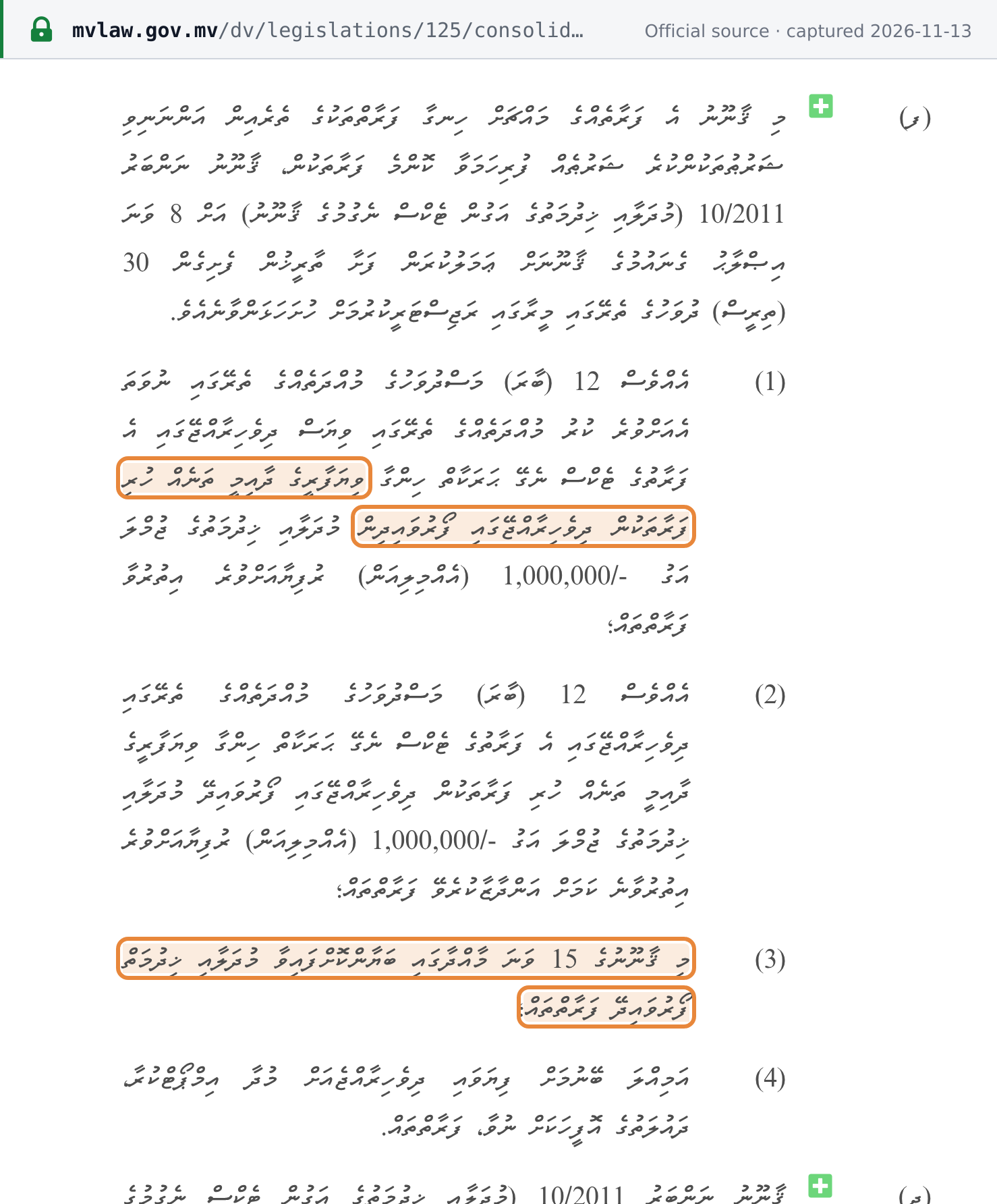
Section 51(k)(1) in the original: "އެއްވެސް 12 (ބާރަ) މަސްދުވަހުގެ މުއްދަތެއްގެ ތެރޭގައި ނުވަތަ އެއަށްވުރެ ކުރު މުއްދަތެއްގެ ތެރޭގައި ވިޔަސް ދިވެހިރާއްޖޭގައި އެ ފަރާތުގެ ޓެކްސް ނެގޭ ޙަރަކާތް ހިންގާ ވިޔަފާރީގެ ދާއިމީ ތަނެއް ހުރި ފަރާތަކުން ދިވެހިރާއްޖޭގައި ފޯރުވައިދިން މުދަލާއި ޚިދުމަތުގެ ޖުމްލަ އަގު -/1,000,000 (އެއްމިލިއަން) ރުފިޔާއަށްވުރެ އިތުރުވާ ފަރާތްތައް؛" (Lookuptax translation: "persons with a permanent place of business in the Maldives through which their taxable activity is carried on, the total value of whose goods and services supplied in the Maldives within any period of 12 (twelve) months, or within a shorter period, exceeds MVR 1,000,000 (one million)").
 Source snapshot captured 2026-11-13 — original
When to apply. A business that starts after 31 August 2026 and meets the turnover test at the end of a month must apply before the end of the following month (s.51(l)). Tourism-sector suppliers apply within 30 days of starting (s.51(n)), and importers before they start importing (s.51(o)). Registrations made before 31 August 2026 remain valid (s.54(b)). The pre-amendment rules in s.51(a)–(i) applied only until the 8th amendment came into force (s.51(j)). [1]
Registration threshold
MVR 1,000,000 of supplies in the Maldives in any 12-month period, or in a shorter period (s.51(k)(1)). The test is rolling: it looks at any 12 months, and it is also met if the figure is crossed in less than 12 months. It applies only to persons with a permanent place of business in the Maldives. Tourism-sector suppliers and importers have no threshold.
MVR 1.5 million from 1 January 2027 is announced, not enacted. Presenting the 2027 budget on 29 October 2026, the Ministry of Finance said: "Highlighting that no new taxes will be introduced to boost revenue next year, the President has decided to improve the tax administration system and raise the GST registration threshold from MVR 1 million to MVR 1.5 million, effective January 1, 2027." [6] The figure is fixed in s.51 of the Act, so it changes only through an amending Act. As at 2026-11-13 the newest law in the Gazette of Maldives list of laws is Law No. 17/2026 of 1 September 2026, and none amends the GST threshold. [13]
 Source snapshot captured 2026-11-13 — original
Non-resident registration
A person with no permanent place of business in the Maldives is outside the MVR 1,000,000 test, which applies only to persons established there (s.51(k)(1)–(2)). Since the 8th amendment took effect on 31 August 2026, a non-resident that supplies inbound tourism products, or agency or booking services relating to them, is a tourism-sector supplier under s.15(a)(6) and must register regardless of turnover (s.51(k)(3)): within 30 days of 31 August 2026 if already trading (s.51(k)), otherwise within 30 days of starting (s.51(n)). The 17% charge applies from 1 October 2026 (s.15(b-1)). Overseas suppliers register on form MIRA 120, "GST Registration – Overseas Suppliers", introduced by Regulation 2026/R-82 (the 32nd amendment to the GST Regulation, gazetted 21 September 2026). [10] The Act requires no fiscal representative.
Tax identification number
MIRA allocates a Taxpayer Identification Number (TIN) on registration. MIRA Tax Ruling TR-2014/G20 (MIRA's English, an unofficial translation; the Dhivehi prevails) quotes section 9 of the GST Regulation: "(a) Each person applying for registration under this Regulation shall be allocated a Taxpayer Identification Number (TIN)." The ruling calls the TIN that must appear on tax invoices the "13-digit TIN". [8] It is made up of a 7-digit taxpayer number, a 3-letter tax code and a 3-digit sequence number (for GST, 501 in the general sector and 001 in the tourism sector in MIRA's OECD example), for example 1000001GST501 [17]; a taxpayer gets a separate TIN for each tax it registers for, all sharing the same 7-digit number. For format detail, see the Maldives TIN guide.
How to register
- Resident businesses apply to MIRA under s.54(a) of the GST Act, which leaves the procedure to the GST Regulation. MIRA runs GST filing and payment through MIRAconnect (Regulation s.78-2).
- Overseas suppliers of inbound tourism products use form MIRA 120 (Regulation 2026/R-82, new s.3(a-1)). [10]
- Documents and timeline. The GST Act and the 2026 Regulation amendment list no supporting documents and set no processing time.
Voluntary registration
Available, but only to licensed businesses and licensed services. Section 53: a person not required to register under s.51 may apply to the Commissioner General to be registered, an option given "ހުއްދައެއް ލިބިގެން ހިންގާ ވިޔަފާރިތަކަށާއި ހުއްދައެއް ލިބިގެން ހިންގާ ޚިދުމަތްތަކަށް" ("to businesses operated under a licence and to services operated under a licence", Lookuptax translation). [1] The usual reason to register voluntarily is to recover input tax on purchases.
Deregistration
- Turnover test (s.55(a-2)). A person registered under s.51 may apply to cancel when all of these hold: its supplies in the past 12 months were below MVR 500,000; its supplies in the next 12 months are expected to be below MVR 500,000; and it meets no s.51 registration condition.
- Cessation (s.55(a-3), s.58). A person that stops its taxable activity must apply to the Commissioner General to cancel its registration within 10 days of stopping (s.58(a)); s.55(a-3) allows cancellation where it does not intend to restart within 12 months and meets no s.51 condition. MIRA must notify the cancellation within 15 days (s.58(b)).
- Voluntary registrants. Their cancellation conditions are set by regulation, and MIRA must give 7 days' notice before cancelling (s.55(b-1)).
- Stock on hand. On cancellation, GST is due on goods on hand for which input tax was deducted (s.55(c)).
GST stops from a date MIRA sets under the Regulation (s.55(b)). [1]
Group registration
Not provided for. The consolidated GST Act has no VAT/GST grouping provision; s.56(a) lists the legal forms that register (individual, company, partnership, cooperative society, association), each in its own right. [1]
Rates
| Rate | Applies to | Basis |
|---|---|---|
| 17% (TGST) | Tourism-sector goods and services (s.15(a)), including, from 1 October 2026, inbound tourism products sold by non-resident suppliers | GST Act s.15(b)(6), from 1 July 2025 (7th amendment, Law No. 20/2024) |
| 8% (GGST) | Goods and services in all other sectors | GST Act s.16(c), from 1 January 2023 (6th amendment, Law No. 20/2022) |
| 0% | Basic goods in Schedule 1, exports of goods and services, and the sale of a business as a going concern | GST Act s.22 |
| Exempt | Listed public services, prescribed financial services, rent from immovable property, international transport and others | GST Act s.20 (see Exemptions) |
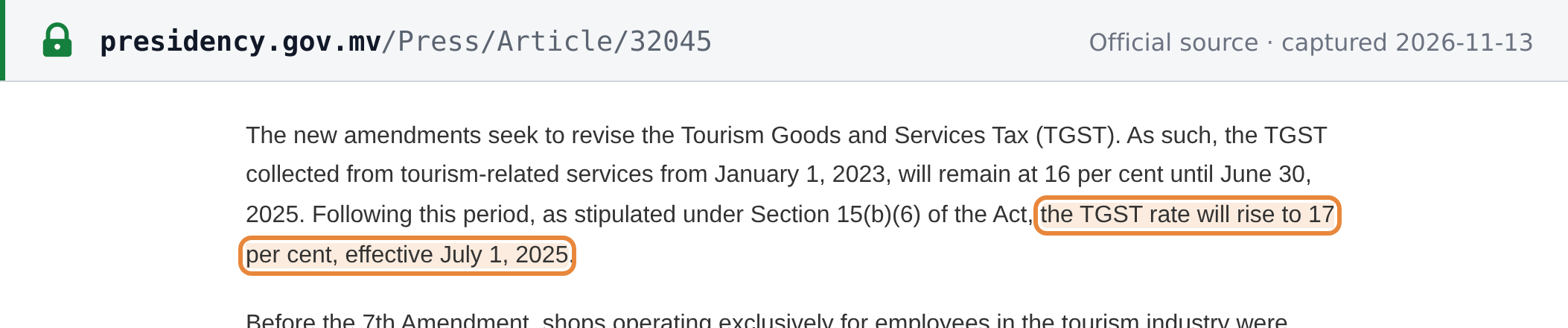
Tourism sector: 17% from 1 July 2025. Section 15(b)(6): "1 ޖުލައި 2025 އިން ފެށިގެން %17 (ސަތާރަ އިންސައްތަ)." ("From 1 July 2025, 17% (seventeen per cent)", Lookuptax translation.) [1] The President's Office, on ratifying the 7th amendment on 5 November 2024: "the TGST collected from tourism-related services from January 1, 2023, will remain at 16 per cent until June 30, 2025. Following this period, as stipulated under Section 15(b)(6) of the Act, the TGST rate will rise to 17 per cent, effective July 1, 2025." [3] Earlier TGST rates in s.15(b): 3.5% at the start, 6% in 2012, 8% from 1 January 2013, 12% from 1 November 2014 and 16% from 1 January 2023.
 Source snapshot captured 2026-11-13 — original
What is the tourism sector. Section 15(a) covers goods and services supplied by tourist resorts, integrated resorts, resort hotels, hotels, guesthouses, tourist vessels, yacht marinas, picnic islands and private islands licensed by the Ministry of Tourism, including shops, dive schools, spas and water-sports facilities at those places. Shops and cafés exclusively for employees are excluded: in the President's Office's words, "Before the 7th Amendment, shops operating exclusively for employees in the tourism industry were exempted from being classified as tourist goods or services. The most recent change broadened the scope of the exception to include employee-only cafés, making the legislation more comprehensive." [3] Further heads cover goods and services sold by tour operators licensed by the tourism ministry (s.15(a)(3)), by agents handling foreign tourist vessels to those vessels (s.15(a)(4)), and by domestic air-transport operators to non-Maldivians (s.15(a)(5)), and s.15(a)(6), in force since 31 August 2026, adds inbound tourism products supplied by non-resident persons, taxed from 1 October 2026 (s.15(b-1)). [1]
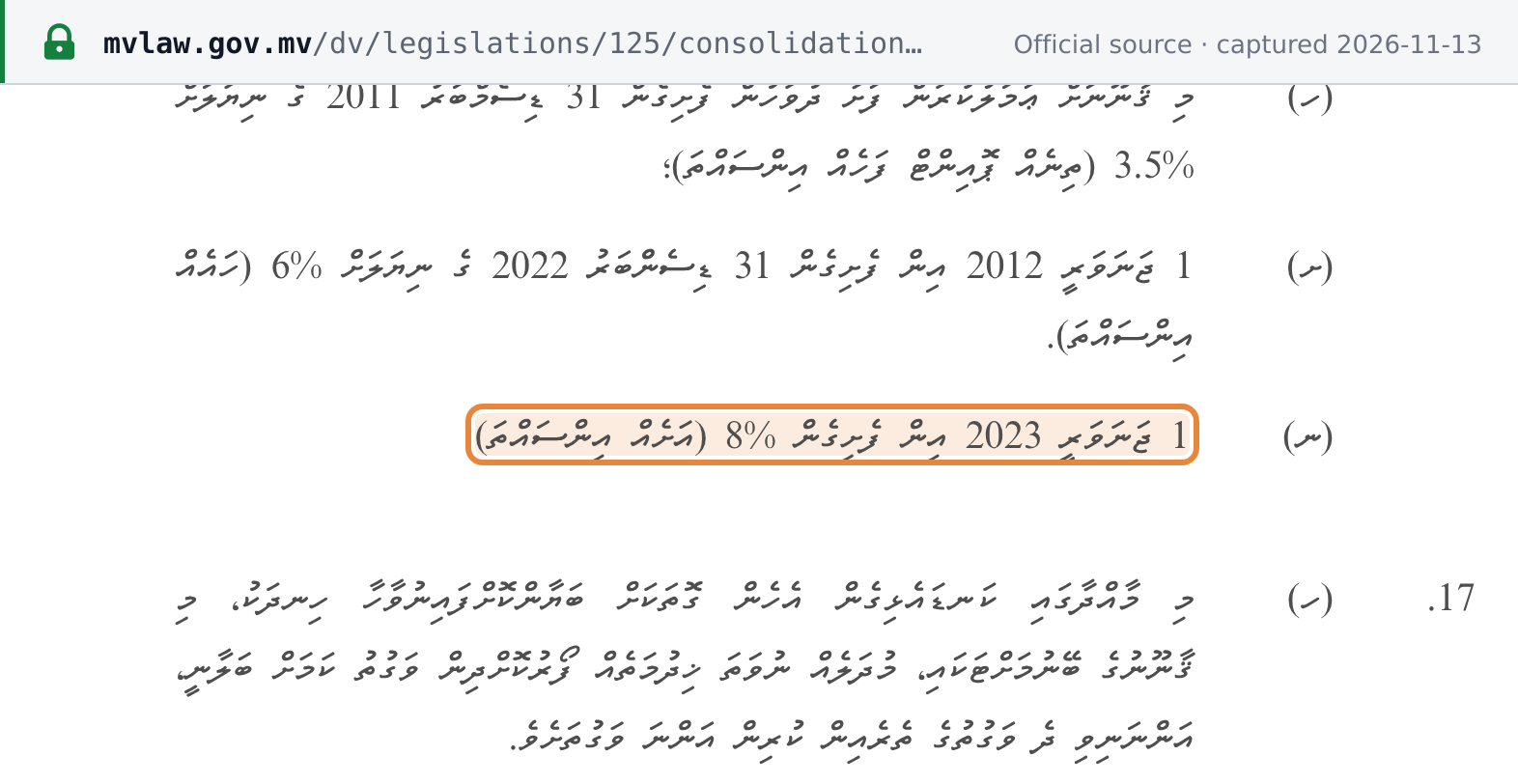
General sector: 8% from 1 January 2023. Section 16(c): "1 ޖަނަވަރީ 2023 އިން ފެށިގެން %8 (އަށެއް އިންސައްތަ)." ("From 1 January 2023, 8% (eight per cent)", Lookuptax translation.) The 6th amendment, Law No. 20/2022, inserted it. [1] [12] The rate was 3.5% until 31 December 2011 and 6% from 1 January 2012 to 31 December 2022 (s.16(a)–(b)). The 7th and 8th amendments did not change it.
 Source snapshot captured 2026-11-13 — original
Zero rate. Section 22 sets 0% for: (a) the basic goods listed in Schedule 1; (b) "ދިވެހިރާއްޖެއިން އެކްސްޕޯޓްކުރެވޭ މުދަލާއި ޚިދުމަތްތައް" ("goods and services exported from the Maldives"); and (c) the sale of a business as a going concern. A zero-rated supplier charges no output GST and still recovers the GST on its inputs (s.23). [1]
Announced future rates. None. The 2027 budget announced a higher registration threshold, not a rate change. See the Maldives tax-changes chronology and worldwide tax rates.
Cross-border rules
Imports and exports
Imports. Every importer of goods other than for personal use, apart from state offices, must register for GST regardless of turnover (s.51(k)(4)). The GST Act sections above do not set the border-collection mechanics for import GST; check with the Maldives Customs Service and MIRA. [1]
Exports. Goods and services exported from the Maldives are zero-rated (s.22(b)), and the exporter recovers its input tax (s.23).
Reverse charge on imported services
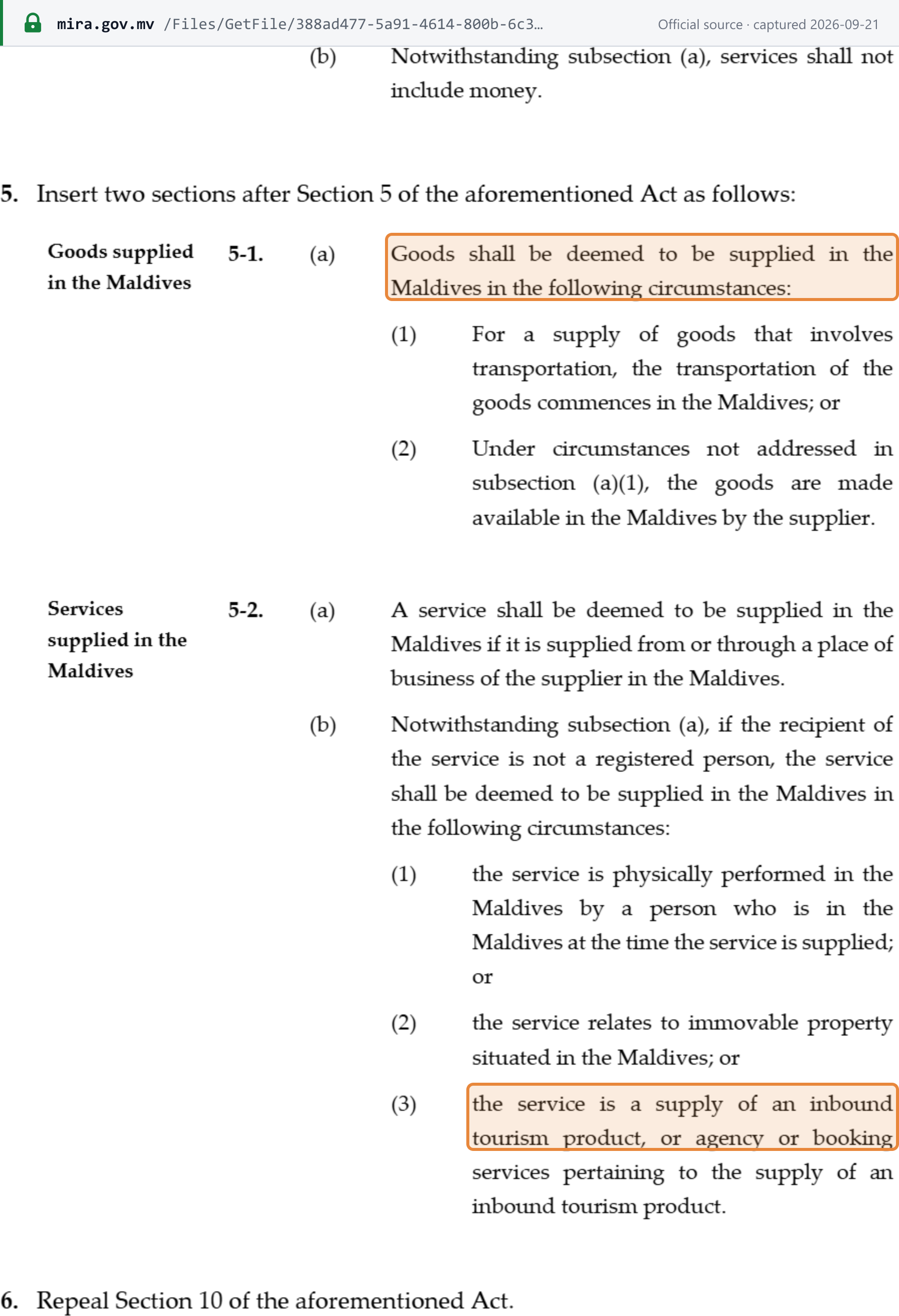
Not applicable. The consolidated GST Act contains no reverse-charge or self-assessment provision. Section 5-2(a) treats a service as supplied in the Maldives when "it is supplied from or through a place of business of the supplier in the Maldives"; a foreign supplier's service to a registered Maldivian business is outside that rule, and the business does not self-account for GST on it. [1] [9] For how other countries handle this, see reverse charge explained.
Digital products and services
The consolidated GST Act contains no general rule for digital or electronically supplied services from abroad. Section 5-2(b), added by the 8th amendment, places a service supplied to an unregistered recipient in the Maldives in three cases only: the service is physically performed in the Maldives by a person who is there at the time; it relates to immovable property in the Maldives; or it is an inbound tourism product or a related agency or booking service. [1] [9] Streaming, software and other remote digital services fall in none of the three. For the wider picture, see VAT on digital services by non-resident suppliers.
Inbound tourism products sold from abroad (taxed since 1 October 2026)
The 8th amendment brought offshore sellers of Maldives holidays into GST. In the President's Office's words, it "establishes a legal framework for collecting GST from offshore booking platforms, foreign tour operators and travel agents", and "extends the existing Tourism Goods and Services Tax (TGST) rate of 17 per cent to tourism products provided through offshore booking platforms and agents." [4]
- What is caught. Inbound tourism products (accommodation, meals, transport and other tourist activities in the Maldives) and agency or booking services relating to them, supplied by a person with no permanent place of business in the Maldives (s.15(a)(6)).
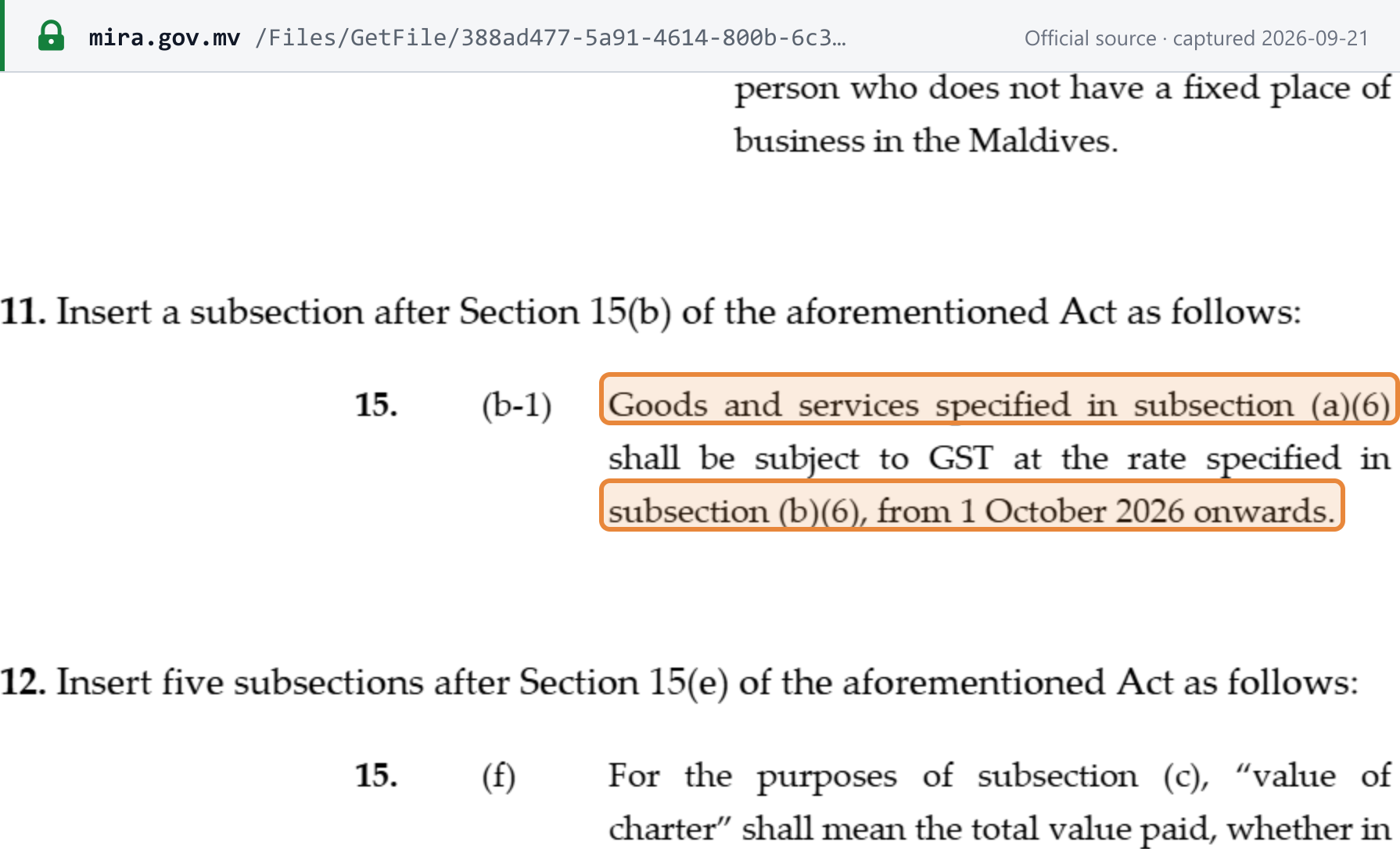
- Rate and start date. 17%, from 1 October 2026 (s.15(b-1)). No GST is chargeable where the invoice or receipt was prepared, or any consideration was paid, before 1 October 2026 (Regulation s.99(e), inserted by Regulation 2026/R-82). [10]
- Taxable value. GST is computed on the price paid for the inbound tourism product less the consideration the supplier had to pay to GST-registered persons for that product (for example the resort), net of GST (s.19(e)(1)–(2)). [1]
- Registration. Regardless of turnover (s.51(k)(3)), on form MIRA 120.
- Invoices and records. These suppliers' tax invoices, receipts and credit or debit notes need not show the GST amount or the GST-exclusive price (Regulation s.64-1), and they may keep records in another language and outside the Maldives (Regulation ss.95, 97). [10]
- Filing and payment. Through MIRAconnect from 1 October 2026 (see Filing and payment).
 Source snapshot captured 2026-09-21 — original
Status as at 2026-11-13. No law amending or repealing s.15(a)(6) has been published: the newest law in the Gazette of Maldives list of laws is Law No. 17/2026 of 1 September 2026. [13] Until an amending law is gazetted, the 17% charge and the registration duty stand.
Foreign companies selling into the Maldives — B2B and B2C
- B2C, and sales to any unregistered customer. Section 5-2(b) applies "if the recipient of the service is not a registered person". A non-resident selling an inbound tourism product, or an agency or booking service for one, to a traveller or other unregistered customer makes a supply in the Maldives, must register regardless of turnover, and charges 17%. Other services are in the Maldives only if physically performed there or related to Maldivian immovable property.
- B2B, to a GST-registered business with a permanent place of business in the Maldives (such as a resort). Section 5-2(b) does not apply. The service is in the Maldives only if supplied "from or through a place of business of the supplier in the Maldives" (s.5-2(a)). A foreign platform billing a registered resort from abroad therefore charges no Maldives GST, and with no reverse charge the resort does not self-account. For s.5-2(b), the GST Regulation treats a registered person that has no permanent place of business in the Maldives as not registered (Regulation s.104(a)). A sale of an inbound tourism product to a foreign tour operator registered on MIRA 120 is therefore taxed like a sale to an unregistered customer. A supplier that does have a permanent place of business in the Maldives but sells an inbound tourism product from its head office or another office abroad to such a customer is also treated as supplying in the Maldives (s.104(b)). [10]
- Goods. Goods are supplied in the Maldives where their transport starts there or, otherwise, where the supplier makes them available there (s.5-1(a)). Importers register regardless of turnover.
 Source snapshot captured 2026-09-21 — original
Marketplace / platform deemed-supplier liability
None as a general rule. The GST Act has no provision making a marketplace or platform the deemed supplier of third-party sales. Offshore booking platforms are caught in their own right, as suppliers of inbound tourism products or of related agency or booking services (s.15(a)(6)), not as deemed suppliers. See marketplace deemed-supplier rules for other countries.
Place of supply
- Goods (s.5-1(a)): supplied in the Maldives where "the transportation of the goods commences in the Maldives", or, for supplies not involving transport, where "the goods are made available in the Maldives by the supplier".
- Services (s.5-2): supplied in the Maldives if supplied from or through the supplier's place of business there, and, for unregistered recipients only, in the three further cases listed under Digital products and services. [1] [9]
Invoice requirements
A registered person must prepare a tax invoice or a receipt for every supply (s.17(d)–(e)). Where the customer is not registered, a receipt may be issued instead of a tax invoice (s.43). [1]
Mandatory content
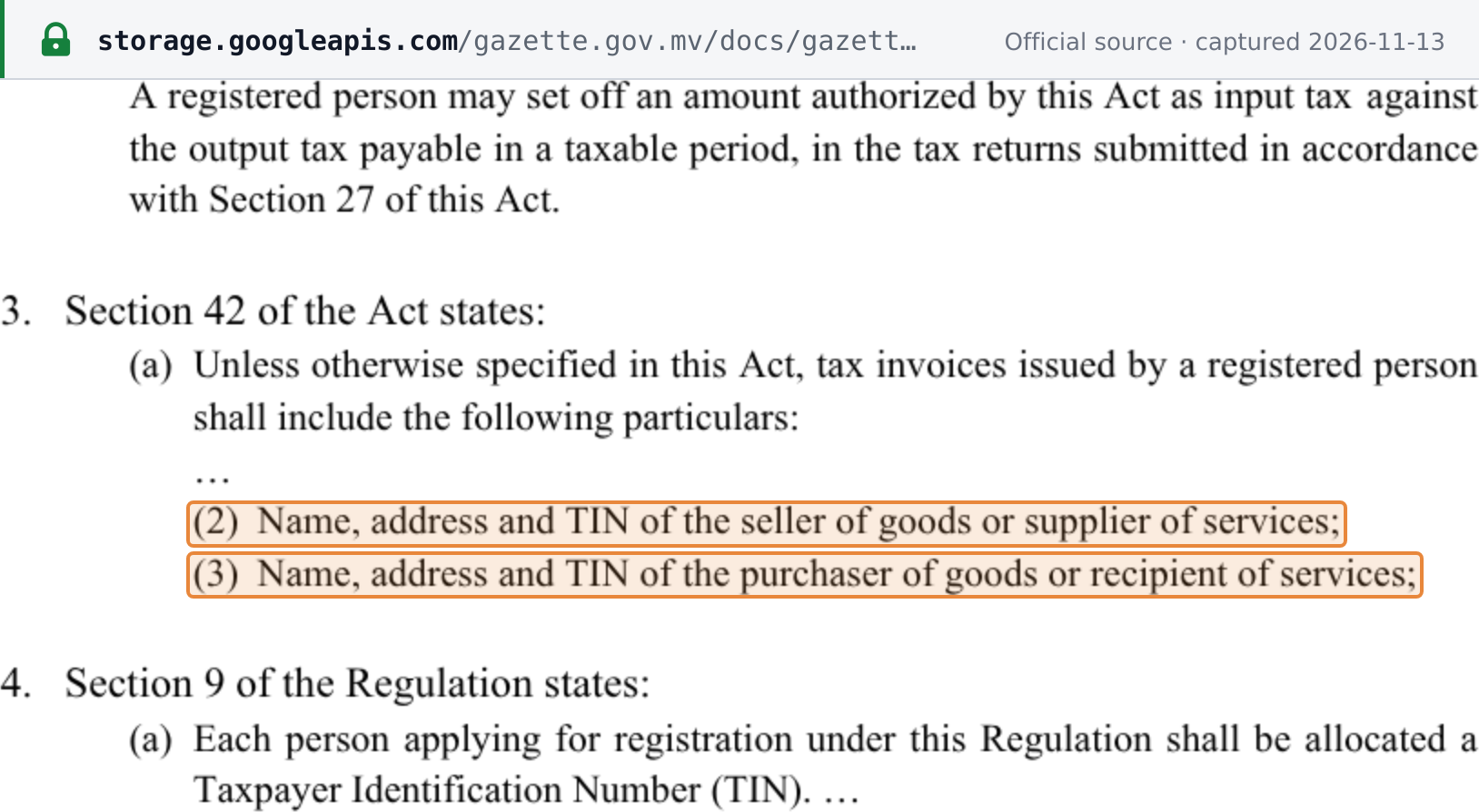
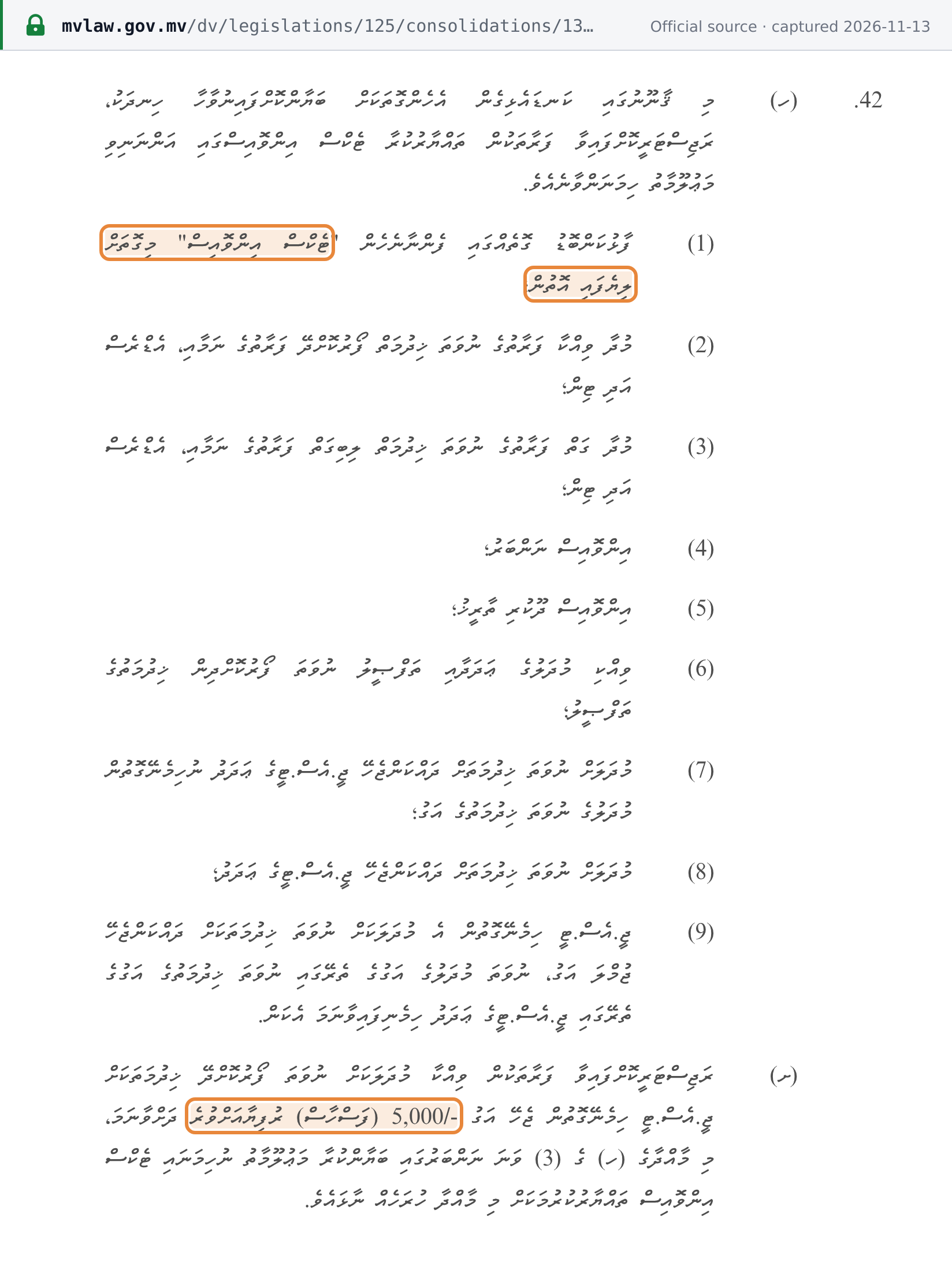
Section 42(a): "Unless otherwise specified in this Act, tax invoices issued by a registered person shall include the following particulars" (MIRA's English, as quoted in Tax Ruling TR-2014/G20). [8] The nine particulars, from the Dhivehi text: [1]
| # | Particular | s.42(a) |
|---|---|---|
| 1 | The words "Tax Invoice" (ޓެކްސް އިންވޮއިސް), shown prominently | (1) |
| 2 | Name, address and TIN of the seller of goods or supplier of services | (2) |
| 3 | Name, address and TIN of the purchaser of goods or recipient of services | (3) |
| 4 | Invoice number | (4) |
| 5 | Date of issue | (5) |
| 6 | Quantity and description of the goods, or description of the services | (6) |
| 7 | Price of the goods or services excluding GST | (7) |
| 8 | Amount of GST payable | (8) |
| 9 | Total price including GST, or, where the price includes GST, a statement saying so | (9) |
 Source snapshot captured 2026-11-13 — original
 Source snapshot captured 2026-11-13 — original
Both TINs, for input tax. TR-2014/G20 (para. 6): "A registered person shall not be allowed to claim input tax in relation to a tax invoice issued on or after 1 January 2015 if it does not include the 13-digit TINs issued to that person and the supplier of the goods or services". [8]
Issuance deadline
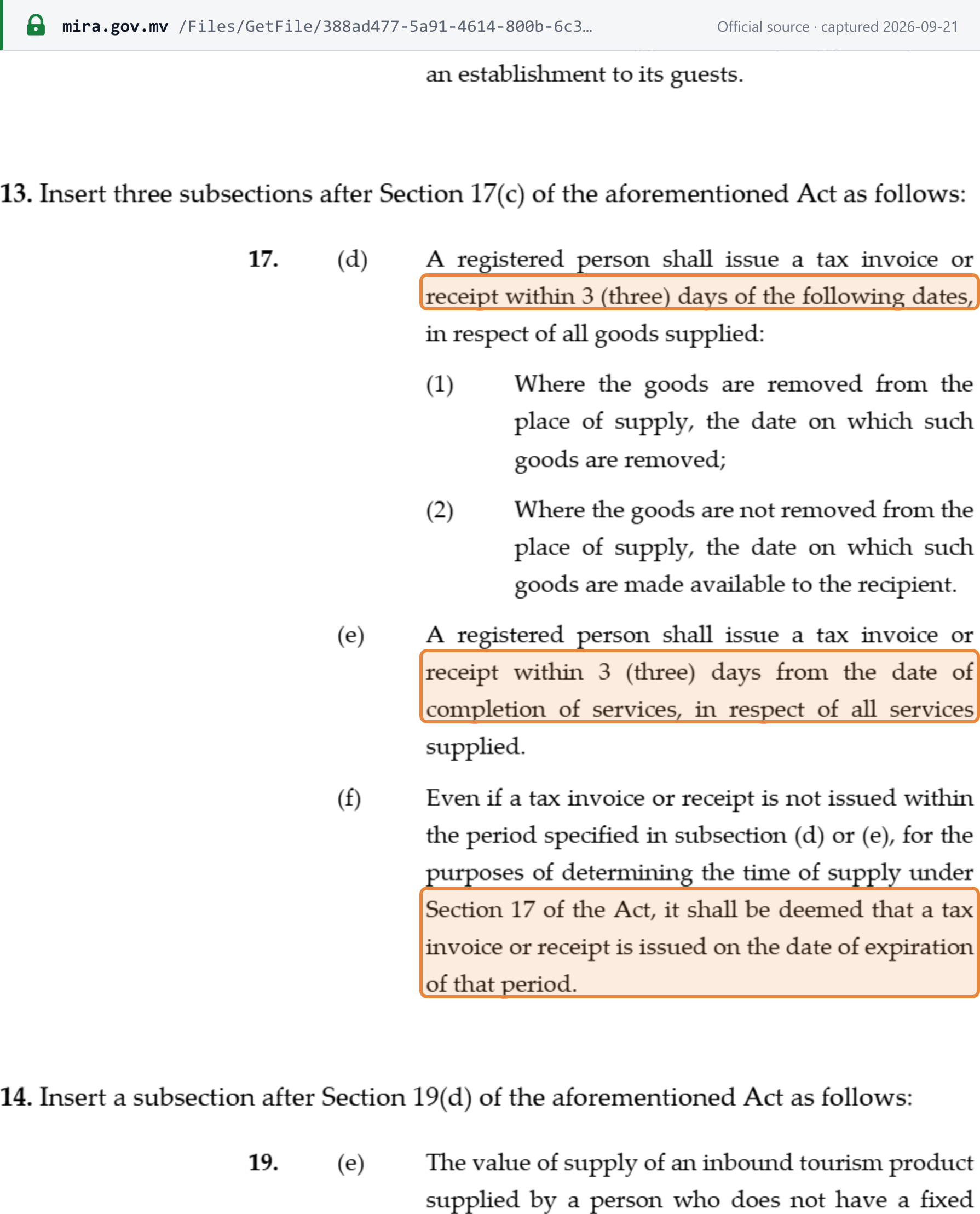
Within 3 days, since 31 August 2026 (8th amendment):
- Goods (s.17(d)): within 3 days of the date the goods are removed from the place of supply or, where they are not removed, the date they are made available to the recipient.
- Services (s.17(e)): within 3 days of the date the services are completed.
- Deemed issue (s.17(f)): if no tax invoice or receipt is issued in time, it is deemed issued when the 3 days expire, for time-of-supply purposes.
 Source snapshot captured 2026-09-21 — original
Separately, a registered supplier must issue a tax invoice within 28 days when a buyer liable to GST asks for one (s.41(a)). [1]
Numbering and sequencing
Section 48(b): tax invoices, receipts, credit notes and debit notes must carry a software-generated number or, failing that, a pre-printed serial number. Issuing more than one tax invoice, receipt, debit note or credit note for one transaction is an offence (s.50(a)); a document may be cancelled and reissued (s.50(b)). [1]
Credit and debit notes
Mandatory when the price falls (credit note, s.44) or rises (debit note, s.45) after a tax invoice has been issued. The note must show the words "Credit Note" or "Debit Note" prominently; both parties' names, addresses and TINs; its date and number; the reason; and the original invoice's number and date, with the GST originally charged, the recalculated GST and the difference. [1]
Currency and language
The GST Act sets no invoice language, invoice currency or exchange-rate rule; those matters are left to the GST Regulation (Regulation 2011/R-43, as amended). The Act requires the "Tax Invoice" heading and fixes the currency in which GST is paid: US dollars (or another accepted foreign currency) for TGST and rufiyaa for GGST (s.62).
Document types
- Tax invoice (s.42): the default for supplies by a registered person.
- Simplified tax invoice (s.42(b)): where the GST-inclusive price is below MVR 5,000, the buyer's name, address and TIN may be left out.
- Receipt (s.43): may replace the tax invoice where the buyer is not a registered person. It shows the supplier's name, address and TIN; the payment date; a receipt number; the quantity and description; the price excluding GST; the GST amount; and the total including GST, or a statement that GST is included.
- Copy (s.47): a lost original may be replaced only by a stamped and signed copy marked as a copy.
- Exempt supplies (s.21(c)): no tax invoice may be issued, and no GST may be shown on any invoice that is issued.
Self-billing
Not provided for in the GST Act, which contains no provision for recipient-created tax invoices.
Retention and audit trail
- Period. Records prescribed by the Regulation must be kept for 5 years from the end of the taxable period they relate to (s.48(a), as amended by the 8th amendment). [1]
- Non-resident registrants. They may keep records in any language and outside the Maldives, but must supply an official Dhivehi or English translation on MIRA's request (Regulation s.95). [10]
- Sequential integrity. Software-generated or pre-printed serial numbers (s.48(b)), and one document per transaction (s.50).
- Tamper-evidence. The GST Act imposes no hash, certified-software or fiscal-device requirement.
A specimen of a compliant invoice
This page does not reproduce an official MIRA specimen. Below, Lookuptax lays out the GST Act s.42 particulars for an illustrative general-sector sale at 8%. Every name, number and amount is fictional:
Tax invoice — illustrative
| Descriptions.42(a)(6) | Qtys.42(a)(6) | Unit price excl. GST | Price excl. GSTs.42(a)(7) | GST rate |
|---|---|---|---|---|
| Laser printer, model EX-1 | 2 | MVR 6,000.00 | MVR 12,000.00 | 8% |
| Installation and set-up | 1 | MVR 1,500.00 | MVR 1,500.00 | 8% |
- Price excluding GSTs.42(a)(7)
- MVR 13,500.00
- GST at 8% (GGST)s.42(a)(8)
- MVR 1,080.00
- Total price including GSTs.42(a)(9)
- MVR 14,580.00
- Issue within 3 days of the goods leaving the place of supply (or being made available), or of the services being completed — GST Act s.17(d)–(e).
- Below MVR 5,000 including GST, the purchaser block (name, address, TIN) may be omitted — s.42(b).
- Number each tax invoice by software or with a pre-printed serial number; one tax invoice per transaction — s.48(b), s.50.
- A tourism-sector supplier charges 17% TGST instead, payable in US dollars — s.15(b)(6), s.62(a).
- Keep records for 5 years from the end of the taxable period — s.48(a).
E-invoicing status
No mandate as at 2026-11-13. Neither the consolidated GST Act nor the Tax Administration Act requires e-invoicing, real-time reporting or fiscal devices; the only electronic element in the GST Act is the option of software-generated invoice numbers (s.48(b)). No B2B, B2G or B2C mandate applies, and no system, network, format or phase timeline has been published.
Project under way. The Ministry of Finance reported on 22 June 2026: "The Minister of Finance and Public Enterprises, Hassan Zareer, and Chairperson of the MIRA Board, Ahmed Saaid Musthafa, officially commenced the Asian Development Bank (ADB)-funded e-invoicing mission with RegTech yesterday." No go-live date or scope has been announced. [7]
For the regional picture, see e-invoicing status and networks worldwide.
Filing and payment
Filing frequency
Set by monthly supplies (s.24(a)): [1]
- Quarterly where a registered person's supplies in a month are below MVR 1,000,000;
- Monthly where they are MVR 1,000,000 or more.
A quarterly filer may opt for monthly periods with the Commissioner General's approval (s.24(b)). Periods end on the last day of a calendar month (s.24(c)).
Return due date
Before the 28th day of the month following the end of the taxable period (s.28(a)(1): "28 ވަނަ ދުވަހުގެ ކުރިން"); the Commissioner General may set a later date for good reason (s.28(a)(2)). A deadline that falls on an official holiday (ރަސްމީ ބަންދު ދުވަސް) moves to the next official working day (s.61). The return shows the registrant's name and TIN, the period, total supplies, deductions, output tax, input tax and net tax payable (s.29). [1]
Payment due date and method
GST is paid by the same deadline as the return (s.31), in rufiyaa for GGST and in US dollars (or another accepted foreign currency) for TGST (s.62). MIRAconnect becomes mandatory: from 1 January 2027, every person registered or required to register for GST must file through MIRAconnect and pay through MIRAconnect or MRTGS; for non-resident inbound-tourism suppliers this applies from 1 October 2026 (Regulation s.78-2, as amended by Regulation 2026/R-82). [10] The Commissioner General may allow another method where a person cannot use MIRAconnect for a reasonable cause (Regulation s.78-2).
Accounting basis
The invoice basis is the default (s.34(a)). The payment or hybrid basis may be granted on written application to local councils, government offices, non-profit service providers, and registered persons whose annual taxable income is not more than MVR 2,000,000 (s.34(b)–(c)). [1]
Additional listings
The GST Act requires no listing beyond the periodic return (s.29). Further return contents may be prescribed by the GST Regulation (s.29(i)); check MIRA's current requirements for supporting statements.
Input-tax recovery and blocked items
Input tax is set off against output tax in the return. Input tax on purchases used for zero-rated supplies is recoverable (s.23); input tax on purchases used for exempt supplies is not. A tax invoice issued on or after 1 January 2015 supports an input-tax claim only if it shows both parties' 13-digit TINs (TR-2014/G20). [8] Non-resident inbound-tourism suppliers cannot deduct input tax. Sections 36–40 of the Act govern deductions, set-off and adjustments.
Refunds
GST paid in excess is refunded, or credited against the next period's GST (s.32). [1] The GST Act has no refund scheme for unregistered foreign businesses or for tourists.
Exemptions
Exempt supplies
Section 20 exempts, among others: [1]
- electricity, water, postal, sewerage, education and health services supplied by providers registered with the relevant government body (s.20(a)–(f));
- medicines approved for sale by registered pharmacies, and medical devices set by regulation;
- goods sold by registered charities out of donations received;
- financial services prescribed by regulation;
- "ނުއުފުލޭ މުދާ ކުއްޔަށް ދޫކޮށްގެން ލިބޭ ކުލި" — rent from leasing immovable property (s.20(k));
- "ބައިނަލްއަޤްވާމީ ދަތުރުފަތުރުގެ ޚިދުމަތްތައް" — international transport services (s.20(l));
- supplies to persons exempted from GST by another law, and fines;
- government social-housing sales, registered daycare services and licensed waste-management services.
Exempt is not zero-rated. An exempt supply carries no GST, no tax invoice may be issued for it, and no GST may appear on any invoice for it (s.21(c)). The supplier cannot recover the input tax on costs attributable to it. A zero-rated supplier, such as an exporter, charges 0% and still recovers its input tax (s.23).
Special regimes
- Tourism sector. 17% TGST, payable in US dollars, and registration regardless of turnover (see Rates).
- Non-resident inbound-tourism suppliers. Their own registration form, invoice relief and MIRAconnect filing (see Cross-border rules).
- Cash accounting. The payment and hybrid bases in s.34 (see Accounting basis).
- Small business. No flat-rate scheme; a business at or below MVR 1,000,000 that is not in the tourism sector or importing simply stays unregistered.
- Free zones and margin schemes. None in the GST Act; supplies to persons exempted from GST by another law are exempt (s.20(m)).
Offences and penalties
Offences and penalties for GST are in the Tax Administration Act, Law No. 3/2010, as amended by its 4th amendment, Law No. 15/2026, which the People's Majlis passed on 26 August 2026 and which took effect on 31 August 2026. [5] [2] In the President's Office's words, the amendment "introduces additional tax offences and penalties" and "provides for the settlement of penalties through instalment arrangements in accordance with prescribed rules."
Offences
| Offence | Criminal penalty | Provision |
|---|---|---|
| Failing to file a return, failing to register, failing to provide information or documents, failing to cooperate, failing to keep records, or filing incorrect returns or accounts | Imprisonment of 3 to 12 months | TAA s.65(a), (c) |
| Tax evasion (an incorrect or incomplete return is presumed evasion unless shown otherwise, s.64(d)) | Imprisonment of 3 months to 2 years, by the seriousness of the act | TAA s.64(c) |
| Issuing more than one tax invoice, receipt, debit or credit note for one transaction | The GST Act states no penalty for this offence | GST Act s.50(a) |
Criminal proceedings may be brought within 8 years (TAA s.69-1); civil penalties within 2 years of the offence, or of MIRA learning of it or obtaining sufficient evidence (s.69(a)–(b)). That 2-year limit does not apply to late returns, late registration or late payment (s.65(a)(1), s.65(a)(8) and s.66 are carved out of s.69(a)).
Penalties
| Exposure | Amount | Provision |
|---|---|---|
| Late return | 0.5% of the tax payable for the period, plus MVR 50 for each day late | TAA s.65(b) |
| Late registration | 0.5% of the tax payable for the periods run while unregistered, plus MVR 50 per day per late return, capped at MVR 5,000 | TAA s.65(b-2) |
| Other s.65 failures (information, records, incorrect returns) | 0.5% of the tax for the period, plus a fine of up to MVR 250,000 | TAA s.65(b-1) |
| Late payment | 0.1% per day of the unpaid amount, from the due date (0.05% before 31 August 2026) | TAA s.66(b) |
| Tax evasion (civil) | 0.5% of the tax for the period, plus up to MVR 100 per day | TAA s.64(b) |
| Any offence created by the Tax Administration Act with no stated penalty | Fine of up to MVR 5,000 | TAA s.67(b) |
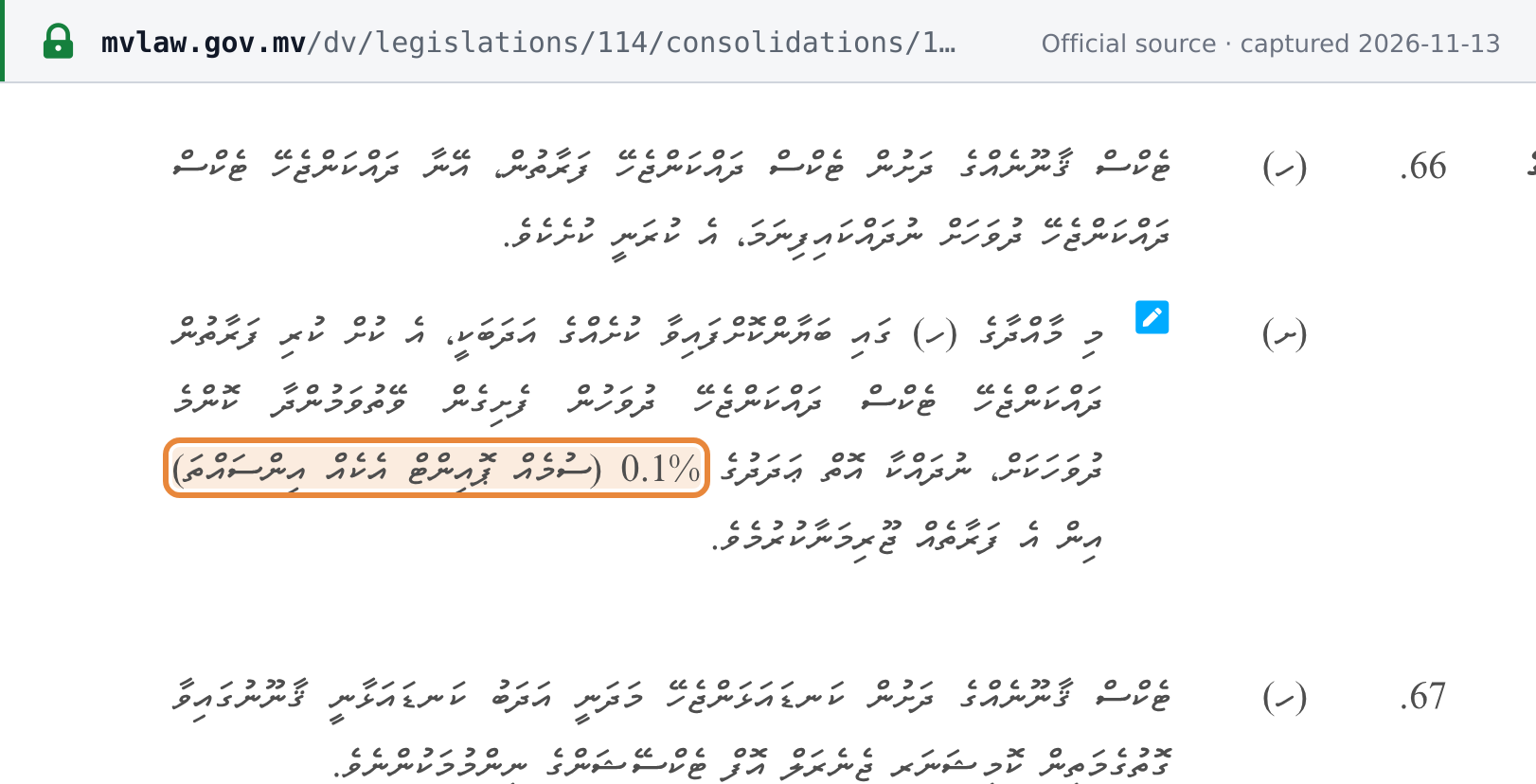
Section 66(b), late payment, in the original: "…ނުދައްކާ އޮތް ޢަދަދުގެ %0.1 (ސުމެއް ޕޮއިންޓް އެކެއް އިންސައްތަ) އިން އެ ފަރާތެއް ޖޫރިމަނާކުރުމެވެ." ("…a fine of 0.1% (zero point one per cent) of the unpaid amount", Lookuptax translation.) The 2020 consolidation read 0.05%. [2] [14]
 Source snapshot captured 2026-11-13 — original
Tax and penalties may be paid in instalments under rules made under TAA s.49-2.
Frequently asked questions
Has GST on offshore booking platforms and foreign tour operators selling Maldives holidays been abolished?
Not as at 2026-11-13. The 8th amendment to the GST Act (Law No. 10/2026) charges tourism GST at 17% from 1 October 2026 on inbound tourism products, and related agency or booking services, supplied by a person with no permanent place of business in the Maldives. The newest law in the Gazette of Maldives list of laws is Law No. 17/2026 of 1 September 2026, and no law amending or repealing that rule has been published. Until one is, such suppliers must register with MIRA regardless of turnover and charge 17%.
Did the Maldives GST registration threshold rise to MVR 1.5 million on 1 January 2027?
It was announced, not enacted, as at 2026-11-13. The Ministry of Finance said on 29 October 2026, presenting the 2027 budget, that the President had decided to raise the GST registration threshold from MVR 1 million to MVR 1.5 million, effective 1 January 2027. The threshold is written into section 51 of the GST Act, so it changes only when an amending Act is passed and gazetted. Until then the test is supplies above MVR 1,000,000 in any 12-month period.
Does a resort's staff shop or staff café charge 17% tourism GST?
No. Shops and cafés operated exclusively for employees at a resort or other tourist establishment are carved out of the tourism sector in section 15(a) of the GST Act. The President's Office said on 5 November 2024 that the 7th amendment broadened the existing exception for employee-only shops to include employee-only cafés. Supplies outside the tourism sector fall under the general sector in section 16, at 8%.
Does a foreign booking platform charge Maldives GST when it bills a GST-registered resort?
The section 5-2(b) rule that places inbound tourism products and related agency or booking services in the Maldives applies only where the recipient is not a registered person. A service supplied to a registered resort is in the Maldives only if it is supplied from or through a place of business of the supplier in the Maldives (section 5-2(a)). The GST Act contains no reverse-charge provision, so the registered resort does not self-account either.
Can a Maldives tax invoice leave out the buyer's TIN?
Only where the GST-inclusive price is below MVR 5,000: section 42(b) of the GST Act then allows the buyer's name, address and TIN to be omitted. Above that, the buyer's details are mandatory. A buyer who wants to claim input tax needs them in any case: MIRA Tax Ruling TR-2014/G20 says a registered person may not claim input tax on a tax invoice issued on or after 1 January 2015 that does not show the 13-digit TINs of both the buyer and the supplier.
Are Maldives GST returns monthly or quarterly?
It depends on monthly supplies. Under section 24 of the GST Act the taxable period is quarterly where a registered person's supplies in a month are below MVR 1,000,000, and monthly where they are MVR 1,000,000 or more; a quarterly filer may opt for monthly periods with the Commissioner General's approval. The return and the payment are due before the 28th day of the month after the period ends (sections 28 and 31).
Important websites
| Site | Purpose |
|---|---|
| MIRA | The tax authority: GST guidance, forms and notices |
| MIRAconnect (via MIRA) | File GST returns and pay; mandatory for all GST registrants from 1 January 2027 (from 1 October 2026 for non-resident inbound-tourism suppliers) |
| Form MIRA 120 (via MIRA) | GST registration for overseas suppliers of inbound tourism products |
| MV Laws — GST Act consolidation | Attorney General's Office consolidated text of the GST Act (Dhivehi), current to the 8th amendment |
| MV Laws — Tax Administration Act consolidation | Consolidated Tax Administration Act (Dhivehi), current to the 4th amendment |
| Gazette of Maldives — laws | Track enacted laws, including any GST Act amendment |
| Gazette of Maldives | Regulations, MIRA tax rulings and notices |
| Business Registry | Company and business registration, separate from GST registration |
| TIN verification | See the Maldives TIN guide |
| E-invoicing portal | None (no mandate) |
Recent changes
- 2026-10-29 — The 2027 budget announces an increase in the GST registration threshold from MVR 1 million to MVR 1.5 million from 1 January 2027; announced, not enacted as at 2026-11-13. (Ministry of Finance)
- 2026-10-01 — 17% TGST applies to inbound tourism products and related agency or booking services supplied by persons with no permanent place of business in the Maldives; MIRAconnect filing applies to them from the same date. (President's Office) — see event
- 2026-09-21 — Regulation 2026/R-82 sets the non-resident supplier regime (form MIRA 120, invoice relief) and makes MIRAconnect mandatory for all GST registrants from 1 January 2027. (Gazette of Maldives) — see event and event
- 2026-08-31 — The 8th amendment to the GST Act takes effect: tax invoices or receipts within 3 days, a rewritten registration rule in s.51, and 5-year record retention. The 4th amendment to the Tax Administration Act raises the late-payment penalty to 0.1% per day. (Gazette of Maldives) — see event
- 2025-07-01 — TGST rises from 16% to 17%. (President's Office) — see event
For the full chronology, see Maldives tax changes on Lookuptax.
Reference links
- Goods and Services Tax Act, Law No. 10/2011 — consolidation with the 8th amendment (Attorney General's Office, MV Laws)
- Tax Administration Act, Law No. 3/2010 — consolidation with the 4th amendment (Attorney General's Office, MV Laws)
- President's Office — President Ratifies 7th Amendment to Goods and Services Tax Act (5 November 2024)
- President's Office — President ratifies 8th Amendment to Goods and Services Tax Act (31 August 2026)
- President's Office — President ratifies the 4th Amendment to the Tax Administration Act (31 August 2026)
- Ministry of Finance and Public Enterprises — MVR 59.7 billion State Budget for 2027 presented to Parliament (29 October 2026)
- Ministry of Finance and Public Enterprises — Minister Hassan Zareer commences ADB-funded e-invoicing mission (22 June 2026)
- Gazette of Maldives, 8 September 2014 — MIRA Tax Ruling TR-2014/G20, Using the new TIN on tax invoices (English text pp. 5–6)
- Gazette of Maldives, 31 August 2026 — Law No. 10/2026, 8th amendment to the GST Act
- Gazette of Maldives, 21 September 2026 — Regulation 2026/R-82, 32nd amendment to the GST Regulation
- Gazette of Maldives, 5 November 2024 — Law No. 20/2024, 7th amendment to the GST Act
- Gazette of Maldives — Law No. 20/2022, 6th amendment to the GST Act
- Gazette of Maldives — list of laws
- Tax Administration Act — consolidation with the 3rd amendment, 2020 (Attorney General's Office, MV Laws)
- Gazette of Maldives, 31 August 2026 — Law No. 15/2026, 4th amendment to the Tax Administration Act
- MIRA — English translation of Law No. 10/2026, 8th amendment to the GST Act (unofficial; the Dhivehi text prevails)
- OECD — Maldives TIN information (submitted by the Maldives)
Related on Lookuptax: