Mauritania VAT (TVA) guidelines
| FACTSHEET | |
|---|---|
| Country code | MR |
| Tax name | Taxe sur la valeur ajoutée (TVA) |
| Tax Authority | Direction Générale des Impôts (DGI) |
Overview
Mauritania (République Islamique de Mauritanie, ISO code MR) levies taxe sur la valeur ajoutée (TVA), in Arabic الضريبة على القيمة المضافة. Article 209(1) of the Code général des impôts (CGI) taxes "les opérations relevant d'une activité économique qui constituent une importation, une livraison de biens, ou une prestation de services, effectuées sur le territoire mauritanien à titre onéreux par un assujetti." [1] This is Mauritania, not Mauritius: for the island state, see the Mauritius VAT guide.
The law. The CGI is loi n° 2019-018 du 29 avril 2019. It contains the TVA articles (arts. 209–256) and the Livre des procédures fiscales (LPF, articles numbered "L."). The Direction Générale des Impôts publishes an official consolidated edition, the "Version Officielle 2023", which incorporates amendments up to the finance law for 2022 (loi n° 2022-01 du 13 janvier 2022). [1] No later consolidation appears on the Ministry of Finance or DGI sites, so changes since 2022 are read from each year's loi de finances initiale (LFI) or rectificative (LFR); each figure below cites the instrument that set it.
Authority. TVA is administered by the Direction Générale des Impôts (DGI) of the Ministère des Finances. Import TVA becomes due when goods are released for consumption (CGI art. 228(1)) and is collected at customs.
Currency. The ouguiya (MRU). The 2023 edition of the CGI writes amounts in "MRU"; older articles still say "Ouguiya".
Tax period. The calendar month. Every TVA debtor files a return "chaque mois" (art. 249(1)). [1]
Layering. None. TVA is a single national tax. Communal taxes (CGI arts. 201–208) are separate levies, not a VAT.
For a regional neighbour, see the Morocco VAT guide.
Registration
Who should register
TVA applies to taxable operations by an assujetti (art. 211(1)), but only above a turnover threshold, and importers are always liable (see below). Separately, every person liable to corporate income tax (IS), business income tax (IBAPP) or TVA, or required to withhold tax at source, "quel que soit son lieu de résidence", must file a déclaration d'existence with the tax administration "dans les vingt (20) jours de sa constitution définitive ou du commencement de ses activités en Mauritanie" (LPF art. L.4(1)). [1]
Registration threshold
MRU 3,000,000 of annual turnover excluding tax (as at 2026-11-06). Article 211(2), as amended by the LFR 2020: "Les contribuables ne sont autorisés à facturer la taxe sur la valeur ajoutée que lorsque leur chiffre d'affaires annuel hors taxes est supérieur ou égal à 3.000.000 MRU, quelle que soit la nature de l'activité exercée." [1]
- Measurement. Annual turnover excluding tax, whatever the activity.
- Crossing during the year. TVA is due "à compter du jour où s'est produit ce dépassement". The taxpayer must declare its liability "avant la fin du mois suivant celui au cours duquel le seuil a été atteint ou dépassé", and the TVA on the month of crossing is declared and paid with the following month's return (art. 211(3)).
- Importers. "Les importateurs sont assujettis de plein droit quel que soit le montant de leur chiffre d'affaires" (art. 211(4)).
- Below the threshold. Article 214(1°) puts "les opérations réalisées par les personnes physiques ou morales dont le chiffre d'affaires est inférieur au seuil indiqué à l'article 211, sauf disposition contraire" outside the scope of TVA. [1]
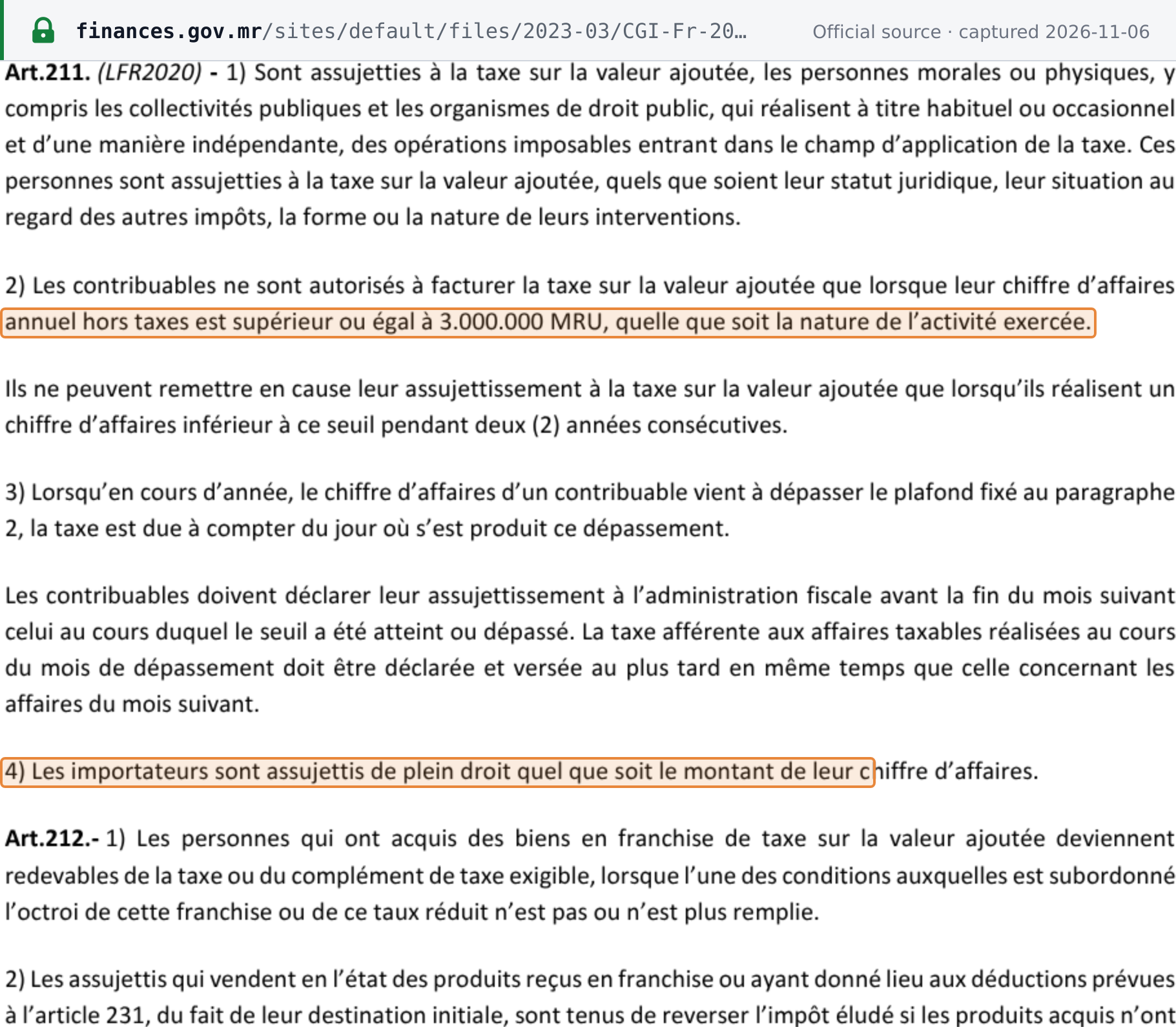 Source snapshot captured 2026-11-06 — original
The same MRU 3,000,000 line separates the income-tax regimes: per the DGI's regime table, businesses below it are taxed under the régime du forfait (3% of turnover), those between MRU 3,000,000 and 5,000,000 under the régime réel intermédiaire, and those above MRU 5,000,000 under the régime réel normal. [8]
Non-resident registration
The general rule has no separate non-resident threshold. A TVA debtor "établi ou domicilié hors de la Mauritanie" must have a representative domiciled in Mauritania accredited with the tax office, who "s'engage à remplir les formalités incombant à ce redevable et à acquitter la taxe à sa place" (art. 221(1), LFR 2020). The representative must itself be a TVA-registered taxable person identified in Mauritania (art. 221(2)(a)). Failing a representative, the tax and any penalties "est payée par la personne cliente pour le compte de la personne n'ayant pas d'établissement en Mauritanie sur déclaration séparée" (art. 221(4)). [1] A foreign-seated legal person filing its existence declaration must likewise name a representative in Mauritania (L.4).
Non-resident suppliers of digital services have their own registration rule from the LFR 2026, with no threshold: see Digital products and services.
Tax identification number
On receipt of the existence declaration, "et après vérification et certification de la localisation effective du contribuable, l'Administration fiscale attribue à ce dernier un numéro d'identification fiscale" — the NIF (L.5). [1] The CGI sets no format or check digit for it. The NIF must appear on every invoice (L.21), and a buyer cannot deduct TVA on an invoice without the supplier's NIF (art. 233(4)).
Display at the premises. Since the LFR 2025, every taxpayer covered by L.4 must display "de manière visible, lisible, et permanente" at the entrance of its head office and each establishment its name, its NIF, its address and its telephone number, in Arabic or in Arabic and French (LPF art. L.4 bis). A missing or wrong display costs MRU 200,000 per site plus administrative closure until regularised. [4]
Checking a supplier's NIF. The LFR 2026 requires a buyer to check that its supplier's NIF is "actif, non radié et non suspendu" on the date the invoice is received, "à travers les services mis à disposition par la Direction Générale des Impôts" (art. 3.1, amending CGI art. 14). [5] The DGI homepage has a NIF check (Vérification des NIFs) that returns the holder's name and whether the NIF is active, struck off (radié) or inactive. To check a number's format, use the Mauritania NIF validator.
How to register
- File the déclaration d'existence with the tax administration on the official form within 20 days of incorporation or start of activity (L.4(1)). A representative may file it. Legal persons add their legal form, constitutive act, managers and a location plan.
- Receive the NIF once the administration has verified the taxpayer's actual location (L.5).
- Declare TVA liability before the end of the month after the month in which turnover reaches MRU 3,000,000 (art. 211(3)).
- Enrol on STT for electronic filing and payment, at stt.e-tax.impots.gov.mr. STT enrols existing NIF holders; it is not a registration route. See the Mauritania e-invoicing guide for enrolment.
The DGI publishes no online registration portal and no processing time (as at 2026-11-06).
Changes. Changes of manager, name, address, legal form, and cessation of activity or closure of an establishment must be notified to the Director General of Taxes within 20 days (L.6). Breaching L.4 or L.6 carries a fine of MRU 50,000 to 500,000 (L.7). [1]
Voluntary registration
Not provided for. Article 211(2) authorises invoicing TVA only at or above MRU 3,000,000 of turnover, and the TVA title of the CGI (arts. 209–256) contains no option for a smaller business to opt in. Its only options are accounting for TVA on debits (art. 229) and, for businesses under an establishment convention, electing into ordinary TVA (art. 256(2)). Note the trap in article 213(1): "toute personne qui mentionne la taxe sur la valeur ajoutée sur une facture ou une déclaration d'importation, est redevable de cette taxe du seul fait de leur mention", whether or not it is a taxable person. [1]
Deregistration
A taxpayer can challenge its TVA liability only "lorsqu'ils réalisent un chiffre d'affaires inférieur à ce seuil pendant deux (2) années consécutives" (art. 211(2)). Cessation of activity is notified within 20 days (L.6(5°)). A taxpayer that loses taxable status may claim a refund of its remaining TVA credit after offset against other taxes (art. 245(1)(b)). The DGI publishes no deregistration form or procedure.
Group registration
Not available. The TVA title of the CGI (arts. 209–256) contains no grouping or fiscal-unity provision.
Rates
| Rate | Applies to | Source |
|---|---|---|
| 16% | Standard rate ("taux normal") | CGI art. 230, as rewritten by LFR 2023 |
| 18% | "Taux majoré … pour la téléphonie" | CGI art. 230(2), as rewritten by LFR 2023 |
| 0% | Exports of goods and services by a taxable person | CGI art. 230(3), as rewritten by LFR 2023 |
| 0% (imports) | Basic mobile phones ("téléphones utilitaires", tariff position 85.17.14); smartphones (85.17.13) bear 16% | Customs tariff, as amended by the finance law for 2026, art. 3.2.5 |
Rates as at 2026-11-06. The DGI's calendar of obligations lists TVA "Taux d'imposition 0%, 16 et 18%", monthly filing, and declaration and payment "Au plus tard le 15 du mois suivant". [7]
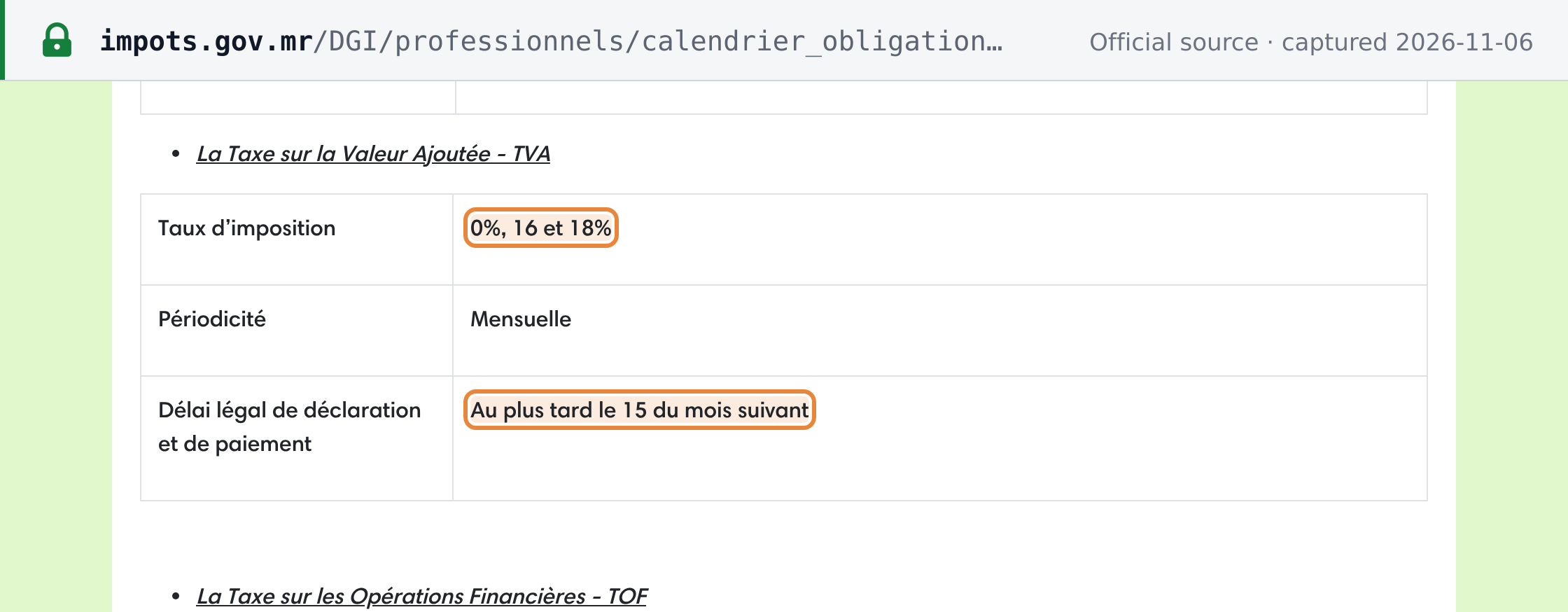 Source snapshot captured 2026-11-06 — original
Why the 18% band needs care. The DGI calendar page predates the finance law for 2022 and has not been updated since. The finance law for 2022 then removed the 18% band, so the 2023 official edition of the CGI shows article 230 "(LFI.2022)" with only "Taux normal : 16 %" and "Taux zéro (0 %)". [1] The loi de finances rectificative for 2023 (loi n° 2023-018 du 08 août 2023) rewrote article 230: "1) taux normal : 16 % 2) Taux majoré : 18 % pour la téléphonie 3) Taux zéro (0) : exportation de biens et services réalisés par un assujetti." [2] No later finance law up to the LFR 2026 amends article 230.
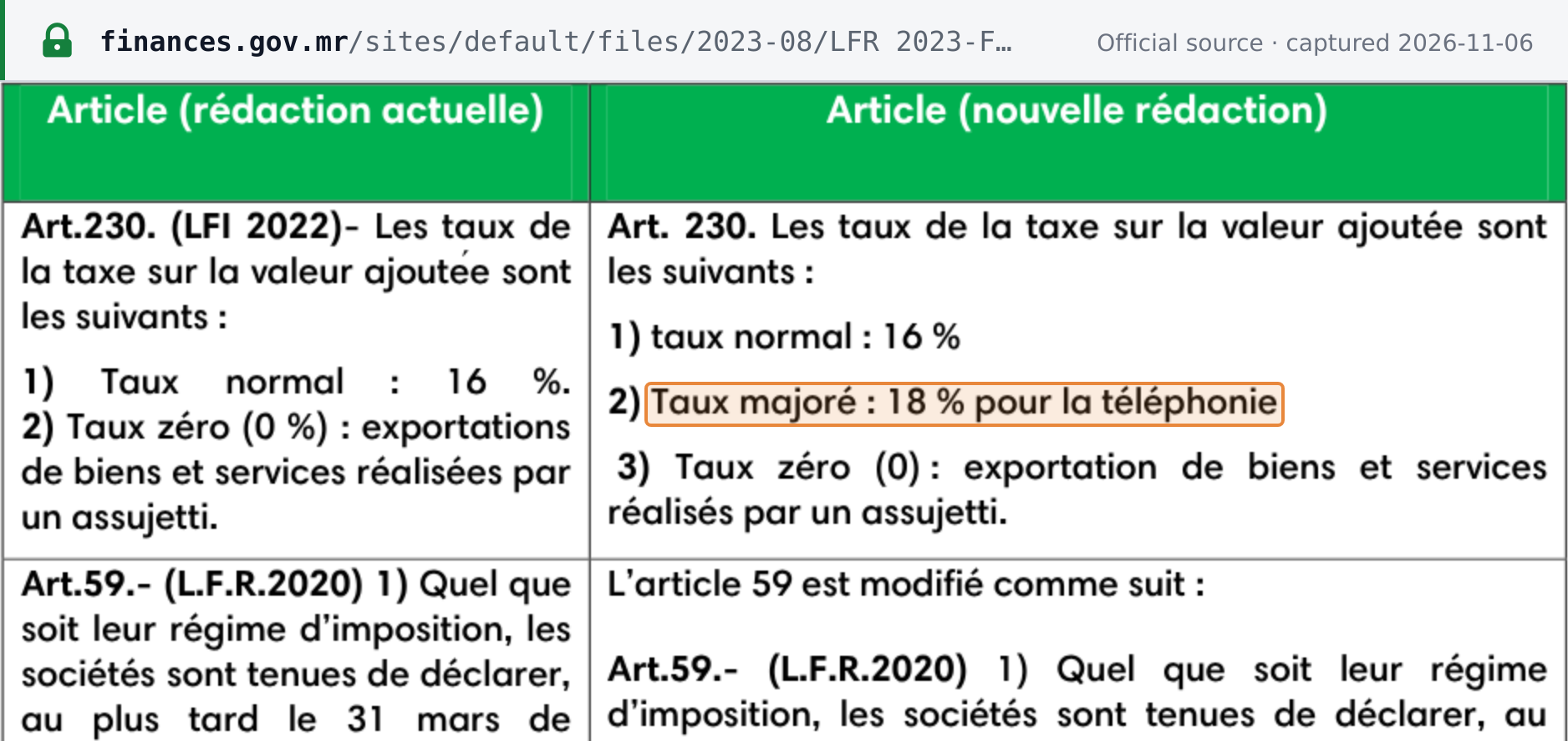 Source snapshot captured 2026-11-06 — original
- Standard rate. 16%, the rate in the 2019 Code and unchanged since.
- Telephony. The CGI and the LFR 2023 do not define "téléphonie".
- Reduced rates. None in article 230. Relief is by exemption (art. 215; see Exemptions), by zero-rating exports, or through customs-tariff lines (below).
- Imported phones. The finance law for 2026 (art. 3.2.5) amends the customs tariff for mobile phones: "Pour la position 85.17.13.00.00 Téléphones Smartphones … TVA 16%" and "Pour la position 85.17.14.00.00 téléphones utilitaires … TVA 0%". [12]
- Announced future rates. None. The draft finance law for 2027 (PLFI 2027, a bill posted by the Ministry of Finance on 28 October 2026) does not amend article 230. [6]
Cross-border rules
Imports and exports
Imports. Imports are taxable (art. 209). The chargeable event is "le franchissement du cordon douanier" (art. 227(1)) and TVA becomes due "lors de la mise à consommation sur le territoire mauritanien" (art. 228(1)), collected by Customs. Importers are liable whatever their turnover (art. 211(4)). Import TVA is deductible if it appears on the release-for-consumption declaration and has been paid (art. 243(1)). Offences relating to imported goods are "constatées, poursuivies et réprimées comme en matière de douane" (art. 252). [1] The CGI sets no de-minimis for import TVA.
Exports. Exports of goods and services by a taxable person are zero-rated (art. 230). "Une prestation de service exécutée en Mauritanie mais utilisée dans un autre pays est assimilée à une exportation" (art. 219(2)). Exporters keep their right to deduct input TVA and are one of the two categories allowed refunds (art. 245; see Refunds).
Services from non-residents
Under article 214(1°), "les prestations de services rendues par les non-résidents à condition qu'elles soient soumises à la retenue à la source prévue à l'article 132 du présent code" are outside the scope of TVA. [1] The article 132 withholding is an income-tax withholding at 15% of sums due to non-residents not established in Mauritania (art. 133(1)), operated by real-regime businesses, the State, local authorities, public establishments, projects and NGOs. The CGI contains no general reverse charge on imported services.
Digital products and services
The loi de finances rectificative for 2026 (LFR 2026), published by the Ministry of Finance on 10 August 2026, adds a regime for digital services supplied by non-residents. [5] The text published by the Ministry of Finance carries no law number or signature date. Its rules:
- Scope (new art. 210(4°)(q)). "Services numériques fournis par voie électronique", notably online advertising; cloud computing (hosting, storage); software as a service; electronic intermediation through platforms or marketplaces for a commission; streaming; artificial intelligence, automated assistance, content generation and data analysis; and automated services supplied over the internet or any electronic network.
- Place of supply (new art. 219(4)). Digital services are "réputés utilisés ou exploités en Mauritanie" when one or more of these is met: the recipient is domiciled or established in Mauritania; the customer's billing address is in Mauritania; payment is made with a payment instrument issued in Mauritania; the IP address used is located in Mauritania; the telephone number used is Mauritanian; or any other element establishing consumption in Mauritania.
- Registration (art. 221(5)(a)). Non-resident digital service suppliers, and non-resident platforms designated as liable under article 221-bis, "sont tenus de s'immatriculer auprès de l'administration fiscale conformément à l'article L.4, de souscrire les déclarations prévues par le présent Code et de conserver les informations relatives aux opérations réalisées en Mauritanie". The LFR 2026 sets no registration threshold for them.
- B2B (art. 221(5)(b)). Where the service is supplied to a taxable person established or domiciled in Mauritania, the tax is paid under paragraphs 1 to 4 of article 221: through the accredited representative or, failing one, by the customer on a separate return.
- B2C (art. 221(5)(c)). Where the service is supplied to a non-taxable final consumer domiciled in Mauritania, the non-resident supplier or the designated platform "est tenu de collecter et reverser la taxe sur la valeur ajoutée". The LFR 2026 sets no special rate, so the 16% standard rate applies.
- Simplified regime (art. 221(5)(d)). By derogation from articles 249 (monthly return) and L.4, these suppliers and platforms are subject to "un régime simplifié d'immatriculation, de déclaration et de paiement, dont les modalités sont fixées par arrêté du Ministre chargé des finances et mises en œuvre par voie dématérialisée". The arrêté may set an adapted filing frequency.
- No permanent establishment (art. 221(5)(e)). Registration is for TVA only and does not by itself create a permanent establishment or liability to other taxes.
- Payment data (new art. 249 bis). Banks, financial institutions, and payment and e-money institutions in Mauritania report each month the payments made in the previous month to non-resident digital suppliers and platforms.
- Enforcement (new art. 249 ter). After an unheeded formal notice, the administration may request suspension or restriction of access to the service, blocking of payment flows, or delisting, "sans préjudice des sanctions fiscales et pénales". [5]
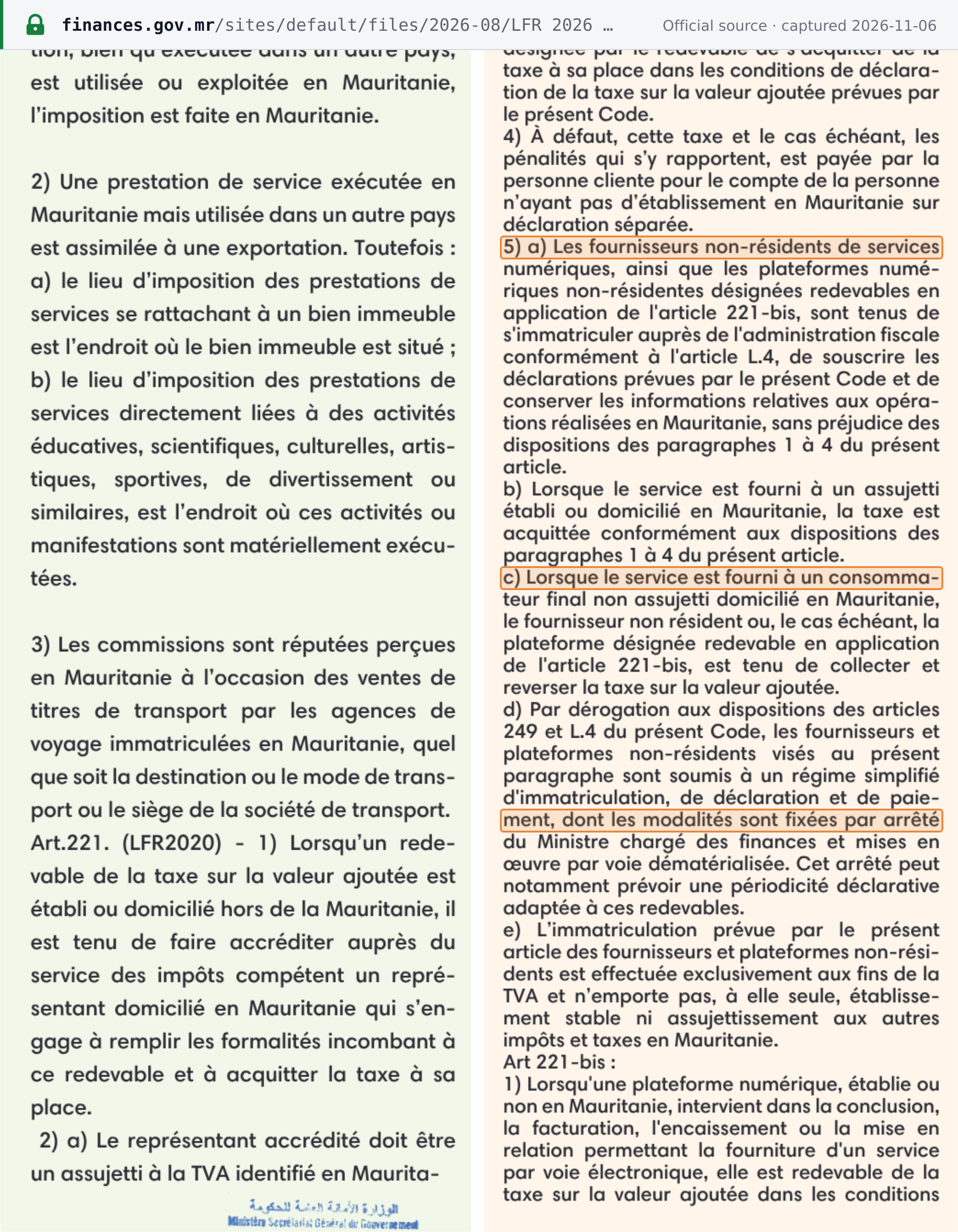 Source snapshot captured 2026-11-06 — original
The implementing arrêté has not been published. As at 2026-11-06 the Ministry of Finance's list of arrêtés carries no arrêté setting the simplified regime, and neither the DGI site nor STT publishes a registration route, return form or filing frequency for non-resident digital suppliers. [11] For how other countries handle the same question, see VAT on digital services by non-resident suppliers.
Proposed, not law: PLFI 2027. The draft finance law for 2027, posted by the Ministry of Finance on 28 October 2026 and not adopted as at 2026-11-06, would rewrite this regime: a reverse charge for B2B services from non-residents (a new article 221 ter), repeal of the representative rules in article 221(2)–(4), and for non-resident digital suppliers online registration and "une déclaration trimestrielle, déposée et acquittée au plus tard le 20 du mois qui suit chaque trimestre", payable in ouguiyas or foreign currency. [6]
Foreign companies selling into Mauritania — B2B and B2C
- Goods, any customer. Imported goods bear import TVA at customs, payable by the importer, who is liable whatever its turnover (art. 211(4)). A non-resident making taxable supplies inside Mauritania needs an accredited representative, or its customer pays the TVA on a separate return (art. 221(1)–(4)).
- Services, B2B. Services by non-residents that are subject to the buyer's 15% article 132 withholding are outside TVA (art. 214(1°)). For digital services to a Mauritanian taxable person, the LFR 2026 sends the tax to the representative or the customer under article 221(1)–(4) (art. 221(5)(b)).
- Services, B2C. For digital services to non-taxable consumers in Mauritania, the non-resident supplier, or the designated platform, must register and collect TVA at 16% (art. 221(5)(c)), under a simplified regime whose arrêté is not yet published.
Marketplace / platform deemed-supplier liability
New article 221-bis (LFR 2026). A platform, established in Mauritania or not, that takes part in concluding, invoicing, collecting payment for or matching parties to a service supplied electronically is liable for TVA on its commission in all cases. It is also the sole party liable for the TVA on the underlying supply where it meets at least one condition: "elle encaisse, directement ou indirectement, tout ou partie du prix auprès du client final"; it sets, alone or with the supplier, one or more essential terms of the transaction (price, payment terms, general conditions); or it acts as the contractual interface between the parties. TVA paid by the platform discharges the underlying supplier, which remains jointly liable in case of fraud or collusion. [5] See also marketplace deemed-supplier rules.
Place of supply
- Goods. "Une opération de livraison de bien est réputée réalisée en Mauritanie, lorsque le bien se trouve en Mauritanie au moment de la livraison" (art. 217). [1]
- Services. "Une prestation de service est imposable en Mauritanie, lorsqu'elle y est exécutée. Cependant, lorsque la prestation, bien qu'exécutée dans un autre pays, est utilisée ou exploitée en Mauritanie, l'imposition est faite en Mauritanie" (art. 219(1)). Exceptions: services connected with immovable property are taxed where the property is; educational, scientific, cultural, artistic, sporting and entertainment services where they are physically performed; and travel agencies registered in Mauritania are deemed to earn their ticket-sale commissions in Mauritania.
- Digital services. The six indicators of article 219(4) (LFR 2026), above.
Invoice requirements
Who must invoice
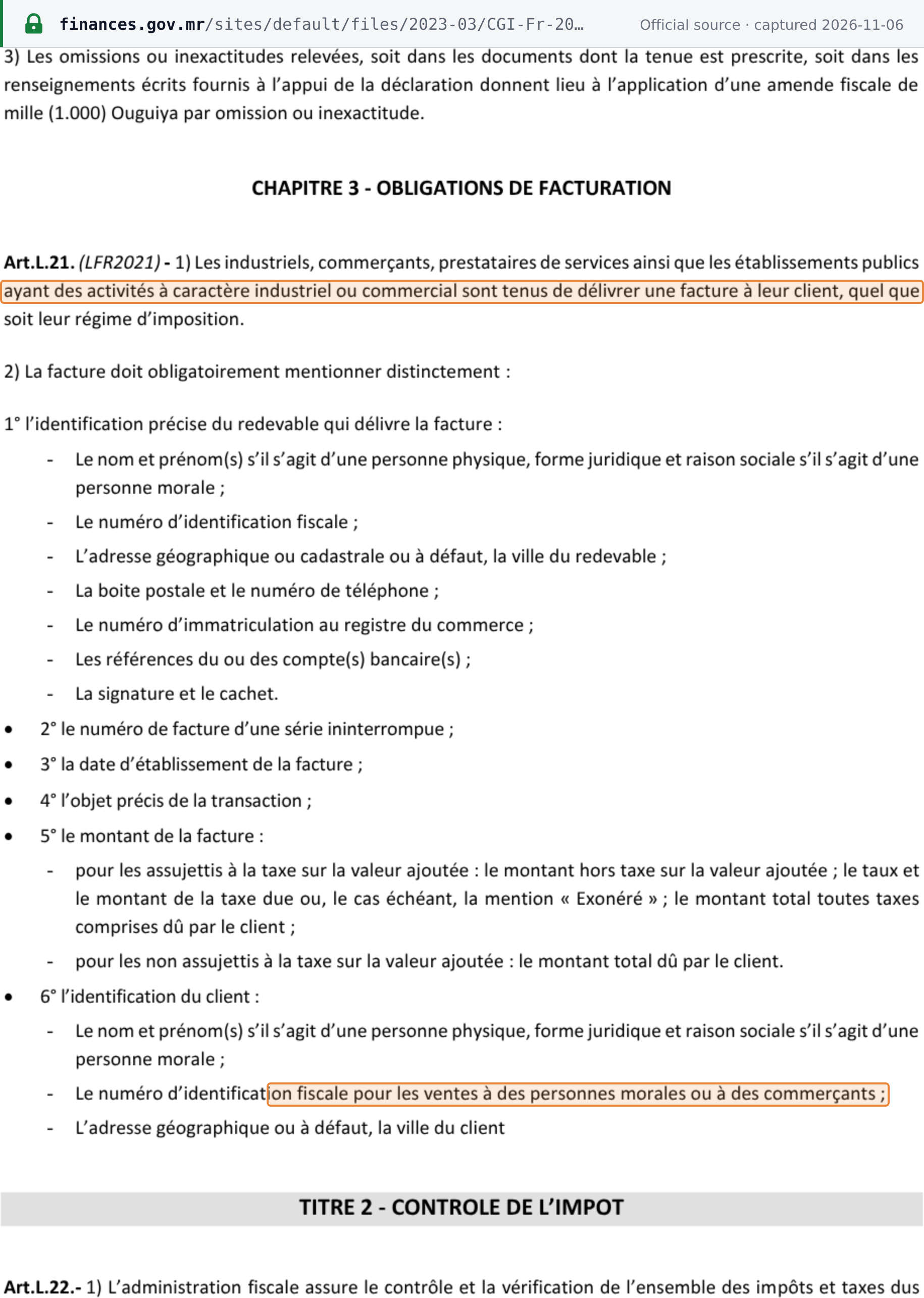
LPF article L.21(1), as amended by the LFR 2021: "Les industriels, commerçants, prestataires de services ainsi que les établissements publics ayant des activités à caractère industriel ou commercial sont tenus de délivrer une facture à leur client, quel que soit leur régime d'imposition." The obligation therefore covers businesses below the TVA threshold too, including those under the forfait regime. [1]
Mandatory content
The invoice "doit obligatoirement mentionner distinctement" (L.21(2)):
| # | Particular | L.21(2) |
|---|---|---|
| 1 | Issuer: name and first name(s) of an individual, or legal form and company name of a legal person | 1° |
| 2 | Issuer's NIF | 1° |
| 3 | Issuer's geographic or cadastral address or, failing that, the town | 1° |
| 4 | Issuer's P.O. box and telephone number | 1° |
| 5 | Issuer's trade-register (registre du commerce) number | 1° |
| 6 | Reference(s) of the issuer's bank account(s) | 1° |
| 7 | Signature and stamp ("la signature et le cachet") | 1° |
| 8 | Invoice number "d'une série ininterrompue" | 2° |
| 9 | Date of issue | 3° |
| 10 | Precise subject of the transaction | 4° |
| 11 | For TVA-registered issuers: amount excluding TVA; rate and amount of TVA due or, where applicable, the mention « Exonéré »; total including all taxes due by the customer | 5° |
| 12 | For issuers not registered for TVA: the total amount due by the customer | 5° |
| 13 | Customer: name and first name(s), or legal form and company name | 6° |
| 14 | Customer's NIF, for sales to legal persons or traders | 6° |
| 15 | Customer's geographic address or, failing that, the town | 6° |
 Source snapshot captured 2026-11-06 — original
Other articles of the CGI turn on what the invoice shows: [1]
- TVA shown is TVA due. Anyone who mentions TVA on an invoice owes it "du seul fait de leur mention" (art. 213(1)). TVA on an invoice for a fictitious supply is due by the issuer and cannot be deducted by the recipient (art. 213(3)).
- Deduction needs the TVA shown separately. Input TVA must be "mentionnée distinctement par le vendeur ou le prestataire de service sur la facture ou la déclaration d'importation régulièrement établie" (art. 243(1)(b)).
- Attestation d'assujettissement. "Tout contribuable qui facture de la taxe sur la valeur ajoutée est tenu de délivrer une attestation d'assujettissement à la TVA à son client si celui-ci est lui-même assujetti. En l'absence d'attestation d'assujettissement à la taxe sur la valeur ajoutée, le client ne peut pas déduire la TVA facturée" (art. 243(2)).
- No supplier NIF, no deduction. TVA is not deductible on purchases "pour lesquels la facture ou le document en tenant lieu ne comporte pas le numéro d'identification fiscale (NIF) du fournisseur" (art. 233(4)).
- Debit-basis option. A business authorised to account for TVA on debits "doit mentionner sur ses factures la référence de son autorisation" (art. 229(5)).
Issuance deadline
Not set. L.21 governs content, not timing, and the chargeable-event rules (arts. 227–229) set no deadline for issuing the invoice.
Numbering and sequencing
Each invoice carries a number "d'une série ininterrompue" (L.21(2)(2°)). The CGI sets no rule on multiple series, prefixes or resets.
Credit and debit notes
The CGI contains no credit-note (facture d'avoir) or debit-note provision. The nearest rule is article 224(1): "Les escomptes de caisse, remises, rabais, ristournes et autres réductions de prix consentis directement aux clients" are excluded from the taxable base.
Currency and language
The CGI sets no invoice-currency rule; TVA is accounted for and returned in ouguiya (MRU). Accounts must be kept in Arabic or French (L.16(1)(a)), and any document or return required by the Code written in another language must be translated into Arabic or French "par un traducteur assermenté" (L.15(4)). [1]
Document types
One invoice type. L.21 applies to every sale by the persons it lists "quel que soit leur régime d'imposition"; the only variations are that an issuer not registered for TVA shows just the total due, and the customer's NIF is required only for sales to legal persons or traders. The CGI provides no simplified invoice and no receipt regime.
Self-billing
Not provided for in the CGI.
Retention and audit trail
- Retention: 10 years. "Les documents comptables et les pièces justificatives, notamment … les factures d'achat et de vente … doivent être conservées au moins pendant les dix (10) années qui suivent celle au cours de laquelle les importations, les achats, les ventes ou les prestations de service ont été constatés dans les écritures comptables" (L.19). [1]
- Approved software. "La comptabilité informatisée doit être tenue au moyen de supports et logiciels agréés par l'Administration fiscale. Ils doivent répondre aux exigences légales en matière de garantie, d'intégrité et de conservation définies en matière de preuve" (L.16(2)). The DGI publishes no list of approved software.
- Electronic-only archiving. Not addressed by the CGI.
- Fines (L.20). MRU 12,000 per accounting document not kept; MRU 2,000 per document not produced in time; MRU 1,000 per omission or inaccuracy.
A specimen of a compliant invoice
The DGI and the Ministry of Finance publish no specimen invoice. The sample below lays out the L.21 particulars for a TVA-registered supplier.
Facture — illustrative sample
| Objet précis de la transactionL.21(2)(4°) | Qty | Unit price HT | Amount HTL.21(2)(5°) | TVA rateL.21(2)(5°) |
|---|---|---|---|---|
| IT maintenance, October 2026 | 1 | MRU 100,000 | MRU 100,000 | 16% |
- Total hors TVAL.21(2)(5°)
- MRU 100,000
- TVA 16%L.21(2)(5°); art. 230
- MRU 16,000
- Total TTC dû par le clientL.21(2)(5°)
- MRU 116,000
- Signature and stamp (cachet) of the issuer — L.21(2)(1°).
- An exempt line shows the mention « Exonéré » in place of the TVA rate and amount — L.21(2)(5°).
- A supplier not registered for TVA shows only the total amount due — L.21(2)(5°).
- If the supplier accounts for TVA on debits, print the reference of its authorisation — art. 229(5).
- Give a TVA-registered customer an attestation d'assujettissement, or it cannot deduct the TVA — art. 243(2).
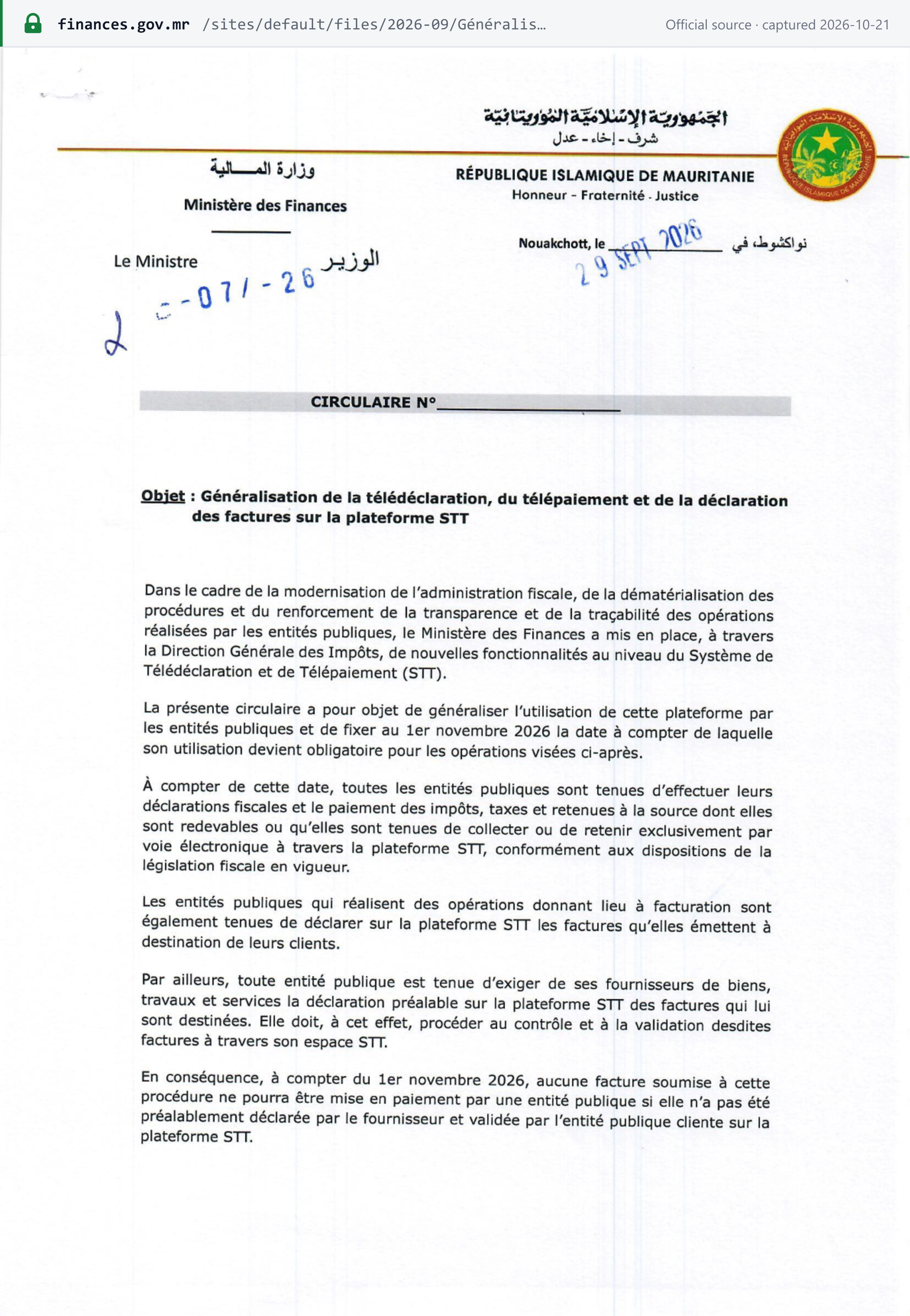
- Invoices to public entities must also be declared on STT before payment (circular of 29 September 2026).
E-invoicing status
B2G invoice declaration since 1 November 2026; no B2B or B2C mandate (as at 2026-11-06). Under a Ministry of Finance circular of 29 September 2026, a supplier of a public entity must declare its invoice on STT (Système de Télédéclaration et de Télépaiement, stt.e-tax.impots.gov.mr), and the entity validates it there: "à compter du 1er novembre 2026, aucune facture soumise à cette procédure ne pourra être mise en paiement par une entité publique si elle n'a pas été préalablement déclarée par le fournisseur et validée par l'entité publique cliente sur la plateforme STT." Public entities must also file and pay their own taxes exclusively through STT. [9]
 Source snapshot captured 2026-10-21 — original
- Model. Web-form declaration of invoice data with buyer validation before payment. No XML schema, Peppol access point, QR code or cryptographic signature appears in any official source.
- Legal basis. An administrative circular, not a law or decree. A statutory version (a new L.21(3), with a fine of 10% of the invoice amount including tax for invoices not declared on STT, and extension to other taxpayers by arrêté) is only proposed in the draft finance law for 2027. [6]
- B2B and B2C. No mandate.
For enrolment, the declaration steps and the proposed changes, see e-invoicing in Mauritania. For how this compares with clearance and reporting systems elsewhere, see CTC e-invoicing models.
Filing and payment
Filing frequency
Monthly, for every TVA debtor. "Tout redevable de la taxe sur la valeur ajoutée est tenu de déposer chaque mois, à l'appui de son versement entre les mains du receveur des impôts, une déclaration conforme au modèle prescrit" (art. 249(1), LFR 2020). [1] The frequency does not vary with turnover; the CGI offers resident taxpayers no quarterly or annual option.
Return due date
By the 15th of the following month, including nil months: "La déclaration d'un mois donné doit être déposée au plus tard, le 15 du mois suivant ; lorsque aucune opération n'est réalisée au cours d'un mois donné, il est souscrit une déclaration revêtue de la mention « Néant »" (art. 250(1)). [1] Businesses exempt other than under article 215 must still file (art. 250(2)). The DGI calendar gives the same deadline for declaration and payment (see the snapshot under Rates). Where a filing or payment date falls on a non-working day, "l'obligation est avancée au dernier jour ouvrable qui précède" (LPF art. L.2(3)). [1]
Schedule of deductions. The return shows total operations, taxable operations, deductible TVA and TVA due (art. 249(2)), and must be accompanied by "un état signé et cacheté" listing, for each local purchase, the supplier's name and NIF, the invoice reference and amount, and the deductible TVA, plus customs references for imports (art. 249(3)). "Le défaut de production de l'état précité ainsi que la production d'un état erroné ou comportant des mentions incorrectes entraine la réintégration des déductions opérées", and deductions added back cannot be claimed later.
Payment due date and method
With the return, by the 15th of the following month (art. 249(1); art. 250(1)). Under LPF article L.3(3), as amended by the finance law for 2024, filing and payment may be made electronically, and businesses whose turnover or sector is designated by regulation "sont tenues de souscrire leurs déclarations et effectuer leurs paiements par voie électronique"; failing to do so costs "une amende de 5% du montant payé ou de 15 000 Ouguiya en cas d'une déclaration ne donnant pas lieu de paiement". [3] E-filing and e-payment run on STT. Public entities must use STT exclusively from 1 November 2026 (circular of 29 September 2026).
Public contracts. For public procurement contracts, TVA "est exigible au moment de chaque paiement fait par le Trésor, y compris sur les avances de démarrages et les acomptes" (art. 228(7)).
Additional listings
No separate sales or purchase listing. The signed schedule of deductions filed with each monthly return (art. 249(3)) serves as the purchase listing.
Input-tax recovery and blocked items
TVA on inputs used for taxable operations is deductible (art. 231), including for exports (art. 231(2)). Mixed businesses apply a pro-rata (arts. 235–237). An omitted deduction may be claimed at the latest by 15 April of the following year (art. 241). Deduction requires a regular invoice showing the TVA separately and, from a registered supplier, its attestation d'assujettissement (art. 243).
Blocked (art. 233), among others: [1]
- goods or services used by third parties, managers or staff, such as accommodation, reception, restaurant and entertainment costs, and expenses linked to travel or residence (1);
- goods and services given free or well below cost, except advertising items under MRU 750 excluding tax (2);
- "Les acquisitions de biens et services entre professionnels réglés en espèce pour un montant supérieur à deux cent mille (200.000) Ouguiya" (3);
- purchases whose invoice does not show the supplier's NIF (4);
- passenger and mixed-use vehicles held as fixed assets, and their parts, except staff buses with more than eight seats, public passenger-transport vehicles and cars of car-rental companies (5);
- buildings other than those used for industrial, commercial, craft or professional purposes (6), and furniture other than commercial or office equipment (7).
Refunds
- Carry-forward. A TVA credit is carried forward (art. 244).
- Who can claim a refund. "Aucun remboursement du crédit de taxe sur la valeur ajoutée n'est autorisé, à l'exception de ceux constatés par : a) les exportateurs ; b) les contribuables qui perdent la qualité d'assujetti" (art. 245(1)). Extension to other activities requires an arrêté of the Minister of Finance (art. 245(2)).
- Conditions (art. 246). A written request to the Director General; a credit "supérieur ou égal à cent mille (100.000) Ouguiya"; the last three TVA returns in credit; no audit in progress.
- Timing (art. 247). The administration validates the credit within three months, and the refund is paid within three months of the Director General's decision.
- Fictitious claims (art. 248). A penalty of 100% of the TVA wrongly claimed, or 200% if it has already been refunded. [1]
- Non-residents and bad debts. The CGI provides no refund scheme for unregistered non-residents and no bad-debt relief.
Exemptions
Exempt supplies
Article 215 (as amended by the LFI 2020, LFR 2020 and LFI 2022) exempts, among others: [1]
- domestic sales of petroleum oils and gases (imports remain taxable) (1);
- medical acts, hospitalisation, and haemodialysis equipment and inputs (2);
- sales and services by the State, local authorities and their non-commercial public establishments (3);
- transfers of business goodwill (8);
- banking and financial operations (10), which bear the taxe sur les opérations financières (TOF) instead;
- international air transport and ticketing by travel agencies (11), and transport by licensed public carriers of passengers or goods (12);
- education by approved public or private establishments (14);
- "L'eau et l'électricité délivrées à hauteur de 8 m3 et 150 kW/h par mois et par consommateur" (16 m³ and 300 kWh for a two-month bill) (15);
- "La production intérieure et la vente de lait, de pâtes alimentaires, de couscous, de riz, de farine et de biscuits" (16);
- bread and bakery products; fresh, dried, salted or smoked vegetables, meat, fish and shellfish; seeds and plants; fresh fruit; ice (17);
- goods listed by customs tariff line, such as milk powder (18).
Outside the scope (art. 214): businesses below the MRU 3,000,000 threshold; non-resident services subject to the article 132 withholding; operations subject to the TOF or the special insurance tax.
Exempt is not zero-rated. Exports are zero-rated under article 230 and keep the right to deduct input TVA (art. 231(2)). An exempt supply gives no right to deduct the TVA on its costs, and a business making both taxable and exempt supplies recovers input TVA by pro-rata (art. 235).
Special regimes
- Forfait regime. Businesses with turnover below MRU 3,000,000 pay income tax at 3% of turnover and are outside TVA (DGI regime table; CGI arts. 211, 214).
- Debit basis. Taxpayers whose TVA falls due on collection (such as service providers) may, with the express authorisation of the Director General of Taxes, account for it on debits instead; the option covers all their operations and the authorisation reference goes on each invoice (art. 229).
- Margin scheme. Article 225 provides a TVA-on-margin rule; its detail is not covered here.
- Free zone. The Nouadhibou free zone has its own law, not covered here.
- Proposed. The draft finance law for 2027 would replace exemption certificates for local purchases by exempt beneficiaries with a DGI visa on the invoice (proposed art. 215 bis). Not adopted as at 2026-11-06.
Offences and penalties
Offences
| Offence | Fine / imprisonment | Provision |
|---|---|---|
| Tax fraud: fraudulently evading or attempting to evade assessment or payment, including wilful non-filing and concealment | MRU 50,000 to 1,000,000 and 6 months to 2 years | L.141 |
| Irregular accounts: omitted, false or fictitious entries; destroying mandatory documents early | Same as L.141 | L.142 |
| False statements or forged documents | Same as L.141 | L.143 |
| Collecting TVA from customers and not remitting it to the Treasury within 6 months | MRU 50,000 to 100,000 and/or 1 to 5 years | L.144 |
| Refusing to obey, opposing or insulting tax officers; organising a collective refusal to pay | MRU 50,000 to 500,000, without prejudice to the Penal Code | L.145 |
Article L.144: "quiconque a procédé aux retenues … de la taxe sur la valeur ajoutée, des taxes de consommation et autres taxes indirectes à la charge de la clientèle et s'est abstenu de reverser au Trésor ces montants dans les six (6) mois du précompte ou de la mise à la charge de la clientèle est passible d'une amende de cinquante mille (50.000) à cent mille (100.000) Ouguiya et d'un emprisonnement de un (1) an à cinq (5) ans, ou de l'une de ces deux peines seulement." [1]
Penalties
| Exposure | Amount | Provision |
|---|---|---|
| Late return with tax due | 10% of the tax if under 2 months late; 25% beyond 2 months | L.131(1) |
| Late nil or credit TVA return | MRU 2,000 per month; MRU 10,000 per month if prior-year turnover exceeded MRU 30,000,000 | L.131(2) |
| Omissions and inaccuracies in TVA returns | 40% of the tax compromised; 80% where good faith cannot be admitted | L.133 |
| Late or short payment after an avis de mise en recouvrement | Automatic 10% of the principal, from the 4th day after notification | L.136 |
| Existence declaration or change not filed | MRU 50,000 to 500,000 | L.7 |
| NIF not displayed, or a wrong NIF displayed, at the premises | MRU 200,000 per site plus closure until regularised | L.4 bis (LFR 2025) |
| Not filing or paying electronically when required | 5% of the amount paid, or MRU 15,000 for a return with no payment | L.3(3) (LFI 2024) |
| Accounting documents not kept / not produced / inaccurate | MRU 12,000 / 2,000 / 1,000 per document or error | L.20 |
| Fictitious refund claim | 100% of the TVA claimed; 200% if already refunded | art. 248 |
Article L.131(1): the penalty is "à 10 % du montant des droits normalement dus lorsque le retard est inférieur à deux (2) mois ; et à 25 % lorsque le retard dépasse deux (2) mois." [1] The CGI sets no monthly interest on late payment beyond the L.136 surcharge.
Invoices. The CGI sets no specific fine for failing to issue an L.21-compliant invoice. The consequences fall elsewhere: the buyer loses its TVA deduction (arts. 233(4), 243), TVA shown on an invoice is due by whoever shows it (art. 213), and an invoice to a public entity that has not been declared and validated on STT cannot be paid.
Digital services. For non-resident digital suppliers and platforms, article 249 ter (LFR 2026) adds access restriction, blocking of payment flows and delisting after an unheeded formal notice.
Frequently asked questions
Is the TVA rate on telephony in Mauritania 16% or 18%?
18%. The 2022 finance law removed the 18% band, so the 2023 official edition of the Code général des impôts lists only 16% and 0% in article 230. The loi de finances rectificative for 2023 rewrote article 230 to restore it: normal rate 16%, increased rate 18% for telephony, zero rate on exports of goods and services by a taxable person. The DGI's calendar of obligations lists TVA rates of 0%, 16% and 18%.
Can a business below MRU 3,000,000 turnover charge TVA in Mauritania?
No. Article 211 of the Code général des impôts authorises taxpayers to invoice TVA only when their annual turnover excluding tax is at least MRU 3,000,000, and article 214 puts operations of businesses below that threshold outside the scope of TVA. Anyone who shows TVA on an invoice is nevertheless liable for it because it is shown (article 213), and the Code provides no voluntary registration below the threshold. Importers are liable whatever their turnover.
Can we deduct TVA on a supplier invoice that has no NIF?
No. Article 233(4) of the Code général des impôts makes TVA non-deductible on purchases whose invoice, or the document standing in for it, does not carry the supplier's tax identification number (NIF). Deduction also requires the TVA to be shown separately on a regular invoice (article 243(1)) and, from a TVA-registered supplier, its attestation d'assujettissement (article 243(2)). For income tax, the expense itself is not deductible without the supplier's NIF (article 14), and the loi de finances rectificative for 2026 adds that the NIF must be active, not struck off and not suspended on the date the invoice is received.
Can a Mauritanian business get its TVA credit refunded?
Only exporters and taxpayers who lose taxable status can (article 245). Other credits are carried forward against future TVA (article 244). A refund needs a written request to the Director General, a credit of at least MRU 100,000, the last three TVA returns in credit, and no audit in progress (article 246). The administration validates the credit within three months and pays within three months of the Director General's decision (article 247).
We sell software subscriptions from abroad to consumers in Mauritania. Do we have to register for TVA?
The loi de finances rectificative for 2026 says yes. Its new article 221(5) requires non-resident suppliers of digital services, and platforms designated as liable, to register with the tax administration, and for supplies to non-taxable final consumers in Mauritania to collect and remit TVA at the 16% standard rate. It sets no registration threshold. The simplified registration, filing and payment regime is to be fixed by an arrêté of the Minister of Finance; that arrêté has not been published, so no online registration route, return form or filing frequency has been published.
Do invoices to Mauritanian ministries and public bodies have to go through STT?
Yes, since 1 November 2026. A Ministry of Finance circular of 29 September 2026 requires suppliers of public entities to declare their invoices on the DGI's STT platform beforehand; the public entity checks and validates them there, and an invoice under the procedure that has not been declared and validated on STT cannot be paid. It is a web-form declaration, not an XML e-invoice.
Important websites
| Site | Purpose |
|---|---|
| STT — Système de Télédéclaration et de Télépaiement | E-filing and e-payment of TVA returns; B2G invoice declaration |
| DGI website | DGI information pages, including the calendar of obligations and taxation regimes |
| Code général des impôts, 2023 edition | Official consolidated text (to the finance law for 2022) |
| Ministry of Finance — finance laws | Where each LFI, LFR and draft finance law is published |
| Ministry of Finance — arrêtés | Where the arrêté for non-resident digital suppliers is expected |
| Ministry of Finance — circulars | Administrative circulars, including the STT circular |
| Registration | In person with the DGI; no online registration portal is published |
| NIF verification | Vérification des NIFs on the DGI homepage (name and active/radié/inactif status). Check a number's format with the Mauritania NIF validator |
| E-invoicing portal | STT (B2G invoice declaration only) |
Recent changes
- 2026-11-01 — Suppliers of public entities must declare their invoices on STT before payment; the entity validates them there. (Ministry of Finance circular of 29 September 2026) — see event
- 2026-10-28 — The Ministry of Finance posts the draft finance law for 2027 (bill, not adopted): a B2B reverse charge on services from non-residents, a quarterly regime for non-resident digital suppliers, and a statutory STT invoice declaration. (PLFI 2027)
- 2026-08-10 — The Ministry of Finance publishes the loi de finances rectificative for 2026: TVA registration and collection by non-resident digital service suppliers and platforms (arts. 210(4°)(q), 219(4), 221(5), 221-bis, 249 bis and ter), and a supplier-NIF check for income-tax deductions. (LFR 2026) — see event
- 2025 — LPF article L.4 bis: every taxpayer must display its NIF at its premises; MRU 200,000 per site for failure. (LFR 2025)
- 2024 — LPF article L.3(3): businesses designated by regulation must file and pay electronically; 5% or MRU 15,000 fine. (LFI 2024)
- 2023-08-08 — Loi n° 2023-018 (LFR 2023) restores the 18% rate for telephony. (LFR 2023)
For the full chronology, see Mauritania tax changes on Lookuptax.
Reference links
- Code général des impôts, Version Officielle 2023 (DGI, via Ministère des Finances)
- Loi de finances rectificative pour l'année 2023 (Ministère des Finances)
- Loi de finances pour l'année 2024 (Ministère des Finances)
- Loi de finances rectificative pour l'année 2025 (Ministère des Finances)
- Loi de finances rectificative pour l'année 2026 (Ministère des Finances)
- Projet de loi de finances initiale pour l'année 2027 — bill (Ministère des Finances)
- DGI — Calendrier des obligations et des paiements
- DGI — Régimes d'imposition
- Ministère des Finances — circulaire du 29 septembre 2026, généralisation de la télédéclaration, du télépaiement et de la déclaration des factures sur la plateforme STT
- Ministère des Finances — Lois
- Ministère des Finances — Arrêtés
- Loi de finances pour l'année 2026 (Ministère des Finances)
Related on Lookuptax: