Moldova VAT guide
| FACTSHEET | |
|---|---|
| Country code | MD |
| Tax name | Value Added Tax (VAT) — Taxa pe valoarea adăugată (TVA) |
| Tax Authority | State Tax Service (Serviciul Fiscal de Stat, SFS) |
| Standard rate | 20% |
| Registration threshold | MDL 1.7 million in any 12 consecutive months (from 1 March 2026) |
Overview
Moldova levies Value Added Tax (VAT) — Romanian: taxa pe valoarea adăugată (TVA) — under Title III of the Fiscal Code No. 1163/1997 (republished in Monitorul Oficial, special edition of 8 February 2007, as amended). It is a single national tax with no regional or municipal layer, administered by the State Tax Service (Serviciul Fiscal de Stat, SFS), with VAT on imports collected by the Customs Service. The Code defines VAT as a state tax collecting part of the value of taxable goods and services supplied in Moldova and imported into it. [1] Article references cited to source [1] use the State Tax Service's unofficial English translation of the Fiscal Code, which reflects the text as of 2022. Later changes are cited to the amending laws in Monitorul Oficial.
The currency is the Moldovan leu (MDL). VAT is accounted for by calendar month (see Filing and payment). [1]
The Transnistrian region. Economic operators based in the Transnistrian region have long cleared imports without Moldovan VAT. Two 2026 instruments change that: Law No. 67 of 30 April 2026, which sets up the Convergence Fund, and Government Decision No. 469 of 26 August 2026, which phases VAT and excise onto listed goods from 1 September 2026. See Cross-border rules. [2] [3]
Pending reform. On 8 September 2026 the Government approved a 2027 fiscal and customs policy bill and sent it to Parliament. It would restructure the reduced rates and tax low-value parcels. It is a bill, not law. Where this guide mentions it, it is labelled as a proposal. See Rates. [4]
For a weekly roundup of indirect-tax changes across jurisdictions, see Last Week in Taxes. For every Moldovan change Lookuptax has recorded, see the Moldova tax-changes chronology.
Registration
Who should register. Under Article 112(1) of the Fiscal Code, a person carrying on business (other than public authorities and most public institutions) must register as a VAT payer if, in any period of 12 consecutive months, it made supplies of goods and services above the threshold. Supplies exempt from VAT without the right of deduction, and supplies outside the scope of VAT under Article 95(2), are left out of the count. The business must notify the SFS on the prescribed form and register no later than the last day of the month in which the threshold was exceeded. It is treated as registered from the first day of the following month. Under Article 112(4), the value of imported services (other than those exempt without the right of deduction) also counts toward the threshold. [5]
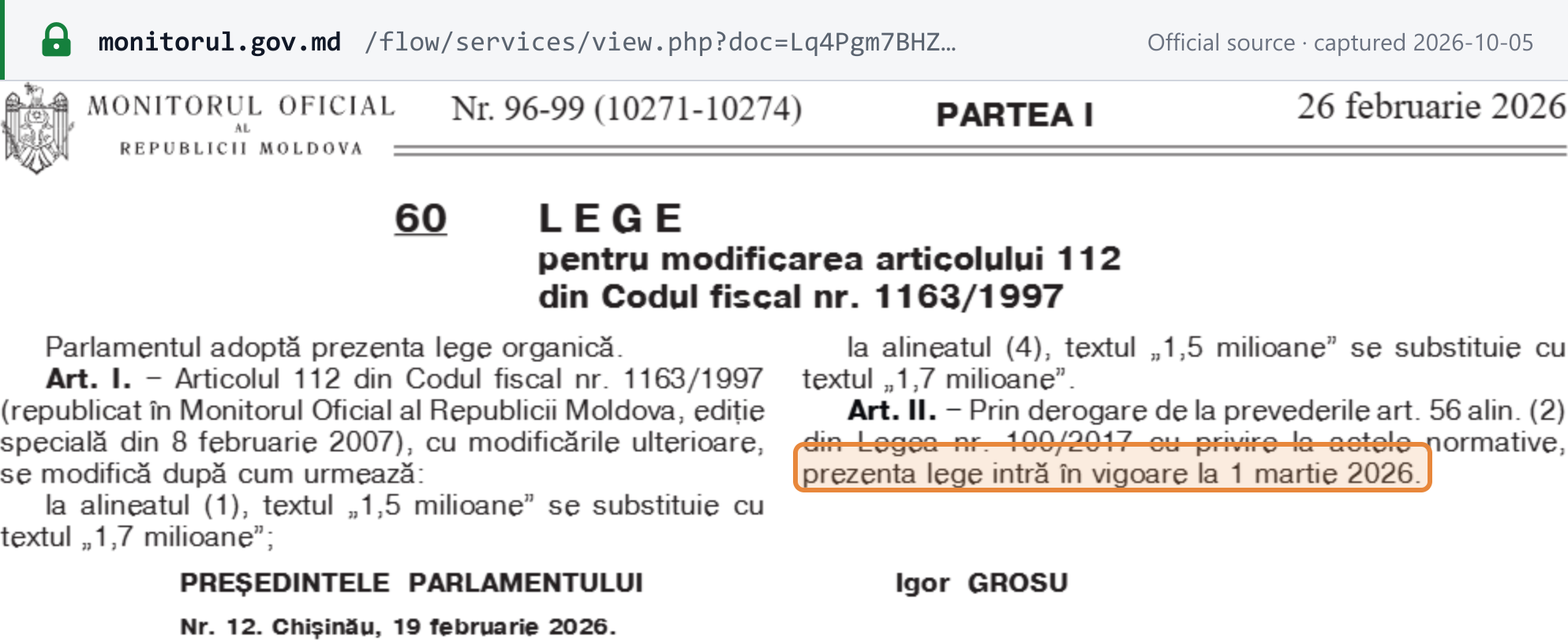
Threshold. MDL 1,700,000 in any 12 consecutive months, from 1 March 2026. The threshold went from MDL 1.2 million to MDL 1.5 million at the start of 2026. Then Law No. 12 of 19 February 2026 replaced "1,5 milioane" with "1,7 milioane" in Article 112(1) and (4), in force on 1 March 2026. [6] [7]
Energy buyers. Since 2026, a business that buys electricity or natural gas must register as a VAT payer before making those purchases, whatever its turnover. This goes with the domestic reverse charge on energy described under Cross-border rules. [6]
Non-resident threshold. Nil for a non-resident without a legal presence in Moldova that supplies electronic services to Moldovan individuals who are not in business (Article 94(d)). These suppliers register with the SFS under a simplified regime (Article 112¹) and account for VAT quarterly. A non-resident supplying a Moldovan VAT-registered business is not registered on that basis. The Moldovan buyer pays VAT on imported services instead (see Cross-border rules). [1]
Tax registration number. A legal entity is identified by its IDNO (numărul de identificare de stat), a 13-digit code assigned at state registration. It serves as the fiscal code for VAT and every other tax. Individuals carry a 13-digit IDNP. Article 112(3) requires the SFS to issue a VAT registration certificate showing the payer's name, legal address, registration date and fiscal code. [1] For the IDNO and IDNP structure, see Lookuptax's Moldova tax ID guide. To check a counterparty, use the Moldova VAT validator.
How to register. A company gets its IDNO through state registration with the Public Services Agency. VAT registration is then a separate step with the SFS: the Article 112 notification, or an application for voluntary registration. Non-resident electronic-service suppliers apply remotely through the SFS "e-Commerce VAT" service. [1]
Voluntary registration. Available. Under Article 112(2), a business may register if it intends to make taxable supplies. It is registered from the first day of the month after it applies. A business might do this to recover input VAT before it reaches the threshold. [1]
Deregistration. Under Article 113(1), a VAT payer that suspends its taxable supplies must inform the SFS, and the registration is cancelled under the SFS procedure. Under Article 113(2), the SFS can also cancel a registration on its own initiative, for example when VAT returns have not been filed, the declared headquarters information is false, or the business is liquidated without an application. Under Article 113(3), on cancellation the business is treated as having made a taxable supply of the stock and fixed assets on which it deducted VAT, and pays VAT on that deemed supply. [1] [5]
Group registration. Not available. Title III registers each taxable person individually under Articles 112–113 and has no VAT-group provision. [1]
Rates
Rates in force as at 2026-10-05, from Article 96 of the Fiscal Code. The Ministry of Finance quotes the current text in the "current legal framework" column of its 2027 bill package. The Law No. 41/2026 change is applied on top. [5] [8]
| Rate | Applies to |
|---|---|
| 20% (standard) | The taxable value of imported goods and services, and of supplies made in Moldova (Article 96(a)). |
| 8% (reduced) | Bread and bakery products; milk and dairy products of listed tariff headings (for cheese of headings 040610300 and 040610500, only with a fat content up to 40%), except baby food, which is exempt. |
| 8% | Goods on the State Nomenclature of Medicines or authorised for import by the Medicines and Medical Devices Agency; undenatured ethyl alcohol for pharmaceutical and medical use within an annual quota; medicines made up in pharmacies. |
| 8% | Medical and diagnostic goods of listed tariff headings (for example 3005, 3006, 3822, 9018 31–39). |
| 8% | Natural gas supplied in Moldova; liquefied gas of heading 2711, whether imported in containers or supplied; natural-gas transport and distribution services. |
| 8% | Livestock, crop and horticultural produce in natural form, of listed tariff headings (fresh vegetables, fruit, cereals, oilseeds and others). |
| 8% | Sugar from sugar beet. |
| 8% | Solid biofuel for producing electricity, heat and hot water, and its raw materials. |
| 8% | Food and drink (except alcoholic products) served with services that allow immediate consumption, in activities in Section I of the Classification of Economic Activities (HoReCa). |
| 8% | Accommodation of any comfort category in hotels, motels, guesthouses, campsites, holiday villages and camps (Section I activities). |
| 8% | Feminine hygiene products (ex. 9619 tampons and pads; menstrual cups). |
| Exempt with right of deduction (works as a zero rate) | Exports of goods and services and international transport of goods and passengers, with related airport and aviation services (Article 104(a)); electricity, heat and hot water for residential property (Article 104(b)); and other Article 104 cases. Input VAT stays deductible. [1] |
Medical devices — change in force since 1 May 2026. Law No. 41 of 26 March 2026 (Monitorul Oficial No. 143-144, 27 March 2026), Article I point 4, deletes "goods registered in the State Register of Medical Devices" from the medicines line of Article 96(b) from 1 May 2026. That brought back the 20% rate for goods that qualified only through that register entry. The tariff-heading line for medical and diagnostic goods above stays. [8] See the event record.
Proposed for 2027 — a bill, not law. The Government approved the bill on 8 September 2026 and sent it to Parliament. It would rewrite Article 96 as follows: [4] [5]
- a new 12% reduced rate for HoReCa food services and accommodation (now 8%), for some livestock, crop and horticultural produce, and for quinces and currants (headings 080840000 and 081030);
- 8% kept for bread, milk, listed fresh vegetables and fruit, medicines and listed medical goods, and extended to fresh eggs and to poultry meat and offal;
- from 1 April 2027, the 8% rate on household natural gas limited to 150 m³ per month per consumption point, with the excess taxed at 20%. The exemption with right of deduction for electricity would be limited to 100 kWh per month per consumption point.
As at 5 October 2026, no law carrying these changes had been published in Monitorul Oficial. Until one is published, the table above applies. See the event record.
Cross-border rules
Imports of goods. VAT on imported goods is paid at import, through customs (Fiscal Code Article 115(2)(a)). The 20% or 8% rate applies to the customs value plus duties under Article 100. [1]
Low-value parcels — proposal only. The 2027 bill would add Articles 118³–118⁴ to the Fiscal Code and repeal Article 219(2) of the Customs Code, removing the relief for low-value imports. For non-excise goods of an intrinsic value up to EUR 150 per parcel sold at a distance to Moldovan consumers (B2C), a non-resident platform seller would account for VAT through a Moldovan intermediary given a special VAT code. VAT would be due within 30 days of release. The bill's entry-into-force clause puts the parcels VAT regime (Articles 118³–118⁴) and the repeal of Customs Code Article 219(2) on 1 October 2026, earlier than the rest of the package. Separately, the bill would add a MDL 12 handling fee per parcel (Article III point 26, new Article 92¹), payable by the recipient and collected by the postal or delivery provider, from the package's general date of 1 January 2027. As at 5 October 2026, the bill had not been published as law in Monitorul Oficial, so neither part is in force. [5] [4]
Goods brought in by Transnistria-based operators — Government Decision No. 469/2026. This decision was published in Monitorul Oficial No. 398-400 on 28 August 2026. Goods that economic operators based in the Transnistrian region release for free circulation (import) now bear VAT and excise under the Fiscal Code, for these categories and dates: [2]
| From | Goods (tariff headings) |
|---|---|
| 1 September 2026 | Caviar (160431000, 160432000); alcoholic drinks including wine (2203–2208); tobacco, nicotine and inhalation products (2401–2404); perfumes and toilet waters (3303); fireworks (360410000); furs (4301–4304); pearls and precious stones (7101–7105); jewellery (7113–7118); precious-metal ores, precious metals and articles (2616, 7106–7112); vehicles (8701–8705, 8711, 9705). |
| 1 January 2027 | Sweetened, flavoured and other non-alcoholic drinks (2202); ores, slag and ash (2601–2615, 2617–2621); base metals and articles (7201–8113); kaolin and clays (2507, 2508); petroleum products and oils (2710). |
| 1 April 2027 | Natural gas (2711); electricity (2716); telephones and transmission apparatus (8517); computers (8471). |
Goods not on the list that are imported under a direct external transaction (between a non-resident legal entity and a Transnistrian operator that is the recipient and payer) are cleared without VAT or excise, as long as they stay in the region (point 2). The decision repeals Government Decision No. 1001/2001. [2] See the event record.
A related framework, Law No. 67 of 30 April 2026 (Monitorul Oficial No. 194-197, 7 May 2026), sets up the Convergence Fund. It also brings into VAT the supply of balancing electricity and the import and supply of natural gas to economic agents with no fiscal relations with Moldova's budget system. Its VAT provisions, including the amendments to Article 4(6¹)–(6³) and (7) of Law No. 1417/1997 (the law implementing Title III), take effect on 1 January 2027. Its excise provisions and its amendments to Article 4(2) and (6) of Law No. 1417/1997 take effect on 1 January 2030 (Article VI(1)(b)). [3] See the event record.
Exports. Exports of goods and services and international transport are exempt with the right of deduction (Article 104(a)), so input VAT is recoverable and may be refunded. [1]
Imported services (B2B, reverse charge). VAT on imported services is paid by the Moldovan recipient when it pays for the service, including advance payments (Article 115(2)(b)). The foreign supplier does not register. [1]
Energy — domestic and cross-border reverse charge since 1 January 2026. Under Law No. 139/2025, supplies of electricity or natural gas between VAT payers to a licensed energy trader are invoiced without VAT, marked "Taxare inversă" (reverse charge). The buyer self-assesses the VAT as both output and input tax. A trader holds an ANRE licence, mainly resells, and uses no more than 1% of what it buys. The reverse charge also applies when energy or network services are bought from suppliers outside Moldova, whether or not the buyer is a VAT payer. [6]
Digital services (foreign sellers, B2C). A non-resident without a legal presence in Moldova that supplies electronic services to Moldovan individuals not in business is a VAT taxable person under Article 94(d), with no threshold. Covered services include software and databases online, online advertising, platform and marketplace services, hosting and domains, e-books, music and audiovisual content, and digital broadcasting (Article 95(1¹)). The tax point is the date of payment, including advances (Article 109¹). The tax period is the calendar quarter (Article 114(1¹)). [1]
Foreign companies selling in — B2B vs B2C.
- B2B: the Moldovan business recipient accounts for VAT on imported services (above). The foreign supplier does not register.
- B2C, electronic services: the foreign supplier registers through the SFS e-Commerce VAT service and files quarterly. [1]
- B2C, goods: VAT is collected at import. The intermediary regime for parcels of up to EUR 150 is a proposal in the 2027 bill (above).
Marketplace liability. Under Article 94(d), a non-resident platform through which Moldovan individuals pay for electronic services supplied by other non-residents is itself the taxable person for those services. The Code has no equivalent rule today for physical goods sold through platforms. The bill's intermediary regime would fill that gap if enacted. [1]
Place of supply. Goods that are not transported are supplied where they are at the time of supply. Goods transported by the buyer or a third party are supplied where they are when transport begins (Article 110(2)). Goods transported by the supplier are supplied where they are when handed over to the buyer (Article 110(3)). Energy follows Article 110(4)–(5), as rewritten by Law No. 139/2025. Electronic services to individuals are supplied in Moldova when, for example, the customer lives there, pays through a Moldovan financial institution, uses a Moldovan IP address or uses a Moldovan phone number (Article 111(5)). [1] For energy, supplies to a trader are made where the trader is established. Supplies to non-traders are made where the energy is actually used and consumed. [6]
Invoice requirements
Mandatory content
Under Article 117(2), a tax invoice (factura fiscală) must show: [1]
| # | Field |
|---|---|
| 1 | Sequential number of the invoice |
| 2 | Supplier's name, address and fiscal code (IDNO) |
| 3 | Date of issue |
| 4 | Date of supply, if it differs from the issue date |
| 5 | Buyer's name, address and fiscal code |
| 6 | Type of supply |
| 7 | For each line: quantity; price excluding VAT; VAT rate; total amount payable; total VAT |
| 7(g) | Where the reverse charge applies, the mention "Taxare inversă" (added by Law No. 139/2025, from 1 January 2026) |
For socially important goods, the purchase or supply price and the cumulative trade mark-up are also required (Article 117(2)(7)(a¹)). [1] [6]
Issuance deadline and numbering
The invoice is due at the tax point set by Article 108, which is generally when goods are delivered or services are performed (Article 117(1)). Invoices for exports exempt with deduction under Article 104(a) are optional. Invoice series and number ranges are allocated under Article 118². [1]
Credit and debit notes
The Code handles price changes by adjusting the taxable value (Article 98) rather than through a separate credit-note form. From 2026, Law No. 318/2025 lets the taxable value be reduced by discounts, rebates, bonuses and loyalty points given to customers at the time of supply. [6]
Currency and language
Amounts are in MDL. The e-Factura form's VAT columns are labelled in lei (for example column 10.7 "Suma totală a TVA, lei"). [9]
Simplified documents and self-billing
For retail sales and services at designated places and in e-commerce, paid in cash or by card, an invoice is not required unless the buyer asks for one. This applies when the cash register records every receipt and the day's VAT is booked (Article 117(3)). No invoice is needed for digital products exported as electronic services and paid by international card (Article 117(4)). [1] Self-billing (autofactura) is not generally provided for today. The 2027 bill would define it and allow it for the packaging deposit system. [5]
Retention and audit trail
Invoices issued through e-Factura are created and stored in the SFS system (see below).
What a compliant invoice looks like
The SFS sets the e-Factura form layout in its regulation (Order No. 317/2020). Below is Lookuptax's own illustration of where the Article 117(2) particulars sit. Every name, code and amount is fictional:
Factură fiscală — domestic B2B supply
| Description / type of supplyArt. 117(2) pt 6 | QtyArt. 117(2) pt 7(a) | Unit price excl. VATArt. 117(2) pt 7(b) | VAT rateArt. 117(2) pt 7(c) | Amount excl. VATArt. 117(2) pt 7 |
|---|---|---|---|---|
| Office chairs (fictional) | 10 | MDL 1,000.00 | 20% | MDL 10,000.00 |
| Bread, 0.5 kg loaves (fictional) | 100 | MDL 10.00 | 8% | MDL 1,000.00 |
- Total excl. VAT
- MDL 11,000.00
- VAT 20%Art. 96(a)
- MDL 2,000.00
- VAT 8%Art. 96(b)
- MDL 80.00
- Total VATArt. 117(2) pt 7(f)
- MDL 2,080.00
- Total payableArt. 117(2) pt 7(e)
- MDL 13,080.00
- If a supplier on the SFS mandatory e-invoice list, or a supplier in public procurement, makes this supply, it must be issued as an e-Factura through the SFS system — Art. 117(1¹)–(1²).
- For a reverse-charged energy supply to a trader, the VAT rate and VAT amount columns show "–" and the invoice carries "Taxare inversă" — SFS Order No. 121/2026.
E-invoicing status
Status (as at 2026-10-05): electronic invoicing through the SFS system "e-Factura", mandatory for defined groups and voluntary for everyone else. No general B2B mandate has been published in Monitorul Oficial.
- System. The automated information system "e-Factura", run by the SFS under the Regulation approved by SFS Order No. 317 of 26 June 2020 (Monitorul Oficial No. 159, 30 June 2020). It is a domestic SFS platform, not a Peppol network. Its form has numbered columns. SFS Order No. 121 of 4 March 2026, in force from 1 January 2026, sets how reverse-charge invoices fill in the VAT columns. [9]
- Mandatory users (B2B). A VAT payer on the list of mandatory e-invoice users approved by the SFS must issue an electronic tax invoice for its domestic taxable supplies (Article 117(1¹)). [1] From 1 January 2026, Article 102(18) was repealed. Buyers no longer lose the VAT deduction on a non-electronic invoice from a supplier on that list. [6]
- B2G. Under Article 117(1²), as rewritten by Law No. 187/2025 (Monitorul Oficial No. 379-380, 18 July 2025, in force on publication), taxable supplies made under contracts awarded under the public procurement law (Law No. 131/2015), the sectoral procurement law (Law No. 74/2020), the concessions law (Law No. 22/2025), the defence and security procurement law, and the small-value procurement rules (Government Decision No. 870/2022) must be invoiced through e-Factura. Electricity, heat, natural gas, electronic-communications and utility services, and classified defence contracts, are excluded. [11]
- B2C. No e-invoice obligation. Retail sales are documented by cash-register receipts (Article 117(3)).
- Phase timeline and thresholds. As at 5 October 2026, no law, Government decision or SFS order setting a general B2B e-Factura mandate or a phase-in date had been published in Monitorul Oficial.
Filing and payment
- Tax period: the calendar month (Article 114(1)). For non-resident electronic-service suppliers it is the calendar quarter (Article 114(1¹)). [1]
- Return due date: the 25th of the month following the tax period, filed electronically (Article 115(1)–(1¹)). Non-resident electronic-service suppliers file through their SFS e-office by the 25th of the month after the quarter (Article 115(1²)). [1]
- Payment: by the same date as the return. The exceptions are VAT on imported goods, paid at import, and VAT on imported services, paid when the service is paid for (Article 115(2)). [1]
- Input-tax recovery: VAT on purchases used for taxable supplies is deductible under Article 102. [1]
- Refunds: VAT refunds follow the Regulation approved by Government Decision No. 93/2013. They are made within 45 days, or 60 days where the taxpayer has contested an audit act. Since 2026, suppliers of energy under the reverse-charge simplification may claim a refund of excess input VAT. [6] Article 116 allows a VAT adjustment for bad debts. [1]
Exemptions
Exempt without right of deduction (Article 103). Examples include housing and land and their rental, specified baby foods, and other listed supplies. Input VAT on purchases used for these supplies is not deductible. [1]
Exempt with right of deduction (Article 104). Exports, international transport, residential electricity, heat and hot water, and other listed cases. Input VAT stays deductible, so this works as a zero rate. Since 2026, imports of natural gas, electricity, heat and cooling energy through networks are also exempt with the right of deduction. [1] [6]
Exempt is not zero-rated. An Article 103 supply blocks recovery of the VAT you paid on related purchases. An Article 104 supply does not. Article 103 supplies are also left out of the registration-threshold count.
Proposed changes (bill). The 2027 bill would repeal several Article 103 exemptions and add an exemption with deduction for books and periodicals (new Article 104(j)). [5]
Special regimes. Moldova runs free economic zones (Law No. 440/2001) and a VAT refund programme for agricultural producers (Law No. 337/2022, amended by Law No. 318/2025, Law No. 41/2026 and Law No. 67/2026). [8] [3] [6]
Offences and penalties
Offences. The Fiscal Code treats the following as tax violations: failing to register for VAT when required (Article 112), failing to issue or present a tax invoice on time (Articles 117 and 117¹), failing to file VAT returns, and obstructing the SFS during an audit (Article 253). A business that crosses the threshold is registered from the first day of the month after the month in which it crossed it (Article 112(1)). [1] [5]
Penalties. Late payment bears late-payment interest (majorare de întârziere) under Article 228, and fines for VAT and invoicing violations are set in Title V of the Code (including Article 260). The 2027 bill would also grade fines by seriousness (new Article 236(4)). [5]
Frequently asked questions
What are the VAT rates in Moldova?
Article 96 of the Fiscal Code sets a 20% standard rate on the taxable value of imported goods and services and of supplies made in Moldova, and an 8% reduced rate on listed goods and services, including bread and bakery products, milk and dairy products, registered medicines, natural gas and liquefied gas, agricultural produce in natural form, beet sugar, solid biofuel, food and drink served for immediate consumption (HoReCa), accommodation services and feminine hygiene products. Exports and international transport are exempt with the right of deduction under Article 104, which works as a zero rate. Since 1 May 2026, goods registered in the State Register of Medical Devices no longer qualify for the 8% rate under that heading (Law No. 41 of 26 March 2026). A Government bill for 2027 would add a 12% rate and move HoReCa to it, but it is not law. [5] [8]
What is the VAT registration threshold in Moldova?
A person carrying on business must register as a VAT payer if, in any period of 12 consecutive months, it made supplies of goods and services above MDL 1.7 million, not counting supplies exempt without the right of deduction or supplies outside the scope of VAT. The threshold rose from MDL 1.2 million to MDL 1.5 million on 1 January 2026 and to MDL 1.7 million on 1 March 2026 under Law No. 12 of 19 February 2026. The business must notify the State Tax Service and register no later than the last day of the month in which the threshold was exceeded, and is treated as registered from the first day of the following month. [7] [6]
How does VAT apply to goods brought in by companies based in the Transnistrian region?
Government Decision No. 469 of 26 August 2026, published in Monitorul Oficial No. 398-400 on 28 August 2026, requires VAT and, where relevant, excise to be calculated and paid when economic operators based in the Transnistrian region release listed goods for free circulation. It applies in three phases: from 1 September 2026 to caviar, alcoholic drinks, tobacco and nicotine products, perfumes, fireworks, furs, pearls and precious stones, jewellery, precious metals and vehicles; from 1 January 2027 to sweetened and other non-alcoholic drinks, ores, base metals, kaolin and petroleum products; and from 1 April 2027 to natural gas, electricity, telephones and computers. Goods not on the list that are imported under direct external transactions are cleared without VAT and excise, provided they stay in the region. [2]
Is the 2027 tax package already law in Moldova?
No. The Government approved the 2027 fiscal and customs policy package on 8 September 2026 and sent it to Parliament as a bill. It proposes extending the 8% rate to poultry meat and eggs, a new 12% rate for some livestock, crop and horticultural produce and some fresh fruit, moving HoReCa from 8% to 12%, limiting the 8% rate on household natural gas to 150 cubic metres a month per consumption point from 1 April 2027, a special VAT regime for imported distance sales of up to EUR 150 per parcel, which the bill would bring into force on 1 October 2026, and a MDL 12 per-parcel handling fee (new Article 92¹) from 1 January 2027. As at 5 October 2026, the bill had not been published as law in Monitorul Oficial, so the current rates apply and neither parcel measure is in force. [4] [5]
When is the Moldovan VAT return due?
The VAT tax period is the calendar month. The return must be filed electronically with the State Tax Service by the 25th day of the month following the tax period, and the VAT due is payable by the same date. Non-resident suppliers of electronic services to Moldovan individuals use a calendar-quarter tax period and also file by the 25th of the month after the quarter. VAT on imported goods is paid at import, and VAT on imported services is paid when the service is paid for. [1]
Important websites
- State Tax Service (SFS) — VAT registration and deregistration, the taxpayer e-office for filing returns, and the e-Factura and e-Commerce VAT services.
- SFS electronic services — the entry point for SFS online services, including electronic filing.
- Ministry of Finance — tax policy, annual fiscal-policy packages and explanatory notes on Fiscal Code changes.
- Monitorul Oficial — the official gazette where laws, Government decisions and SFS orders are published.
- Customs Service — VAT on imports and customs clearance.
- Lookuptax — Moldova VAT validator — check a Moldovan counterparty's tax code.
Recent changes
Dates are each instrument's official publication date. Later effective dates are given in the text.
- 2026-09-08 — Bill, not law. The Government approved the 2027 fiscal and customs policy bill and sent it to Parliament. It proposes a new 12% VAT rate, HoReCa moving from 8% to 12%, the 8% rate extended to poultry meat and eggs, household gas at 8% capped at 150 m³ a month from 1 April 2027, a VAT regime for imported parcels up to EUR 150 from 1 October 2026, and a MDL 12 per-parcel handling fee from 1 January 2027. (Government of Moldova) — see event
- 2026-08-28 — Government Decision No. 469/2026 published. It phases VAT and excise onto listed goods imported by Transnistria-based operators: from 1 September 2026, 1 January 2027 and 1 April 2027. (Monitorul Oficial) — see event
- 2026-05-07 — Law No. 67/2026 published. It sets up the Convergence Fund, with its VAT provisions effective 1 January 2027 and its excise provisions and some amendments to Law No. 1417/1997 effective 1 January 2030. (Monitorul Oficial) — see event
- 2026-03-27 — Law No. 41/2026 published. It removes goods registered in the State Register of Medical Devices from the 8% rate, effective 1 May 2026. (Monitorul Oficial) — see event
- 2026-02-26 — Law No. 12/2026 published. It raises the VAT registration threshold from MDL 1.5 million to MDL 1.7 million, effective 1 March 2026. (Monitorul Oficial)
Reference links
- State Tax Service — Fiscal Code of the Republic of Moldova, unofficial English translation (text as of 2022)
- Monitorul Oficial No. 398-400, 28 August 2026 — Government Decision No. 469/2026
- Monitorul Oficial No. 194-197, 7 May 2026 — Law No. 67/2026 (Convergence Fund)
- Government of Moldova — "Politica fiscală și vamală pentru anul 2027, aprobată de Guvern" (8 September 2026)
- Government of Moldova — 2027 fiscal-policy bill package: draft law, information note and summary of consultation with the current legal framework (NU-599-MF-2026)
- Ministry of Finance — Changes to the Fiscal Code for 2026 (income tax, VAT, excise, local taxes)
- Monitorul Oficial No. 96-99, 26 February 2026 — Law No. 12/2026 amending Article 112 of the Fiscal Code
- Monitorul Oficial No. 143-144, 27 March 2026 — Law No. 41/2026 (business support)
- Monitorul Oficial No. 112-115, 12 March 2026 — SFS Order No. 121/2026 amending the e-Factura Regulation
- Lookuptax — Moldova tax ID guide (IDNO, IDNP)
- Monitorul Oficial No. 379-380, 18 July 2025 — Law No. 187/2025 amending Article 117(1²) of the Fiscal Code