Mongolia VAT guidelines
| FACTSHEET | |
|---|---|
| Country code | MN |
| Tax name | Value Added Tax (VAT) — Нэмэгдсэн өртгийн албан татвар (НӨАТ) |
| Tax Authority | Mongolian Tax Administration (MTA) |
Overview
Mongolia levies Value Added Tax — Нэмэгдсэн өртгийн албан татвар (НӨАТ) under the Law on Value Added Tax (revised edition of 9 July 2015, in force from 1 January 2016 under art. 18.1). Article 3.1 sets its scope: "Хувь хүн, хуулийн этгээдийн Монгол Улсад импортоор оруулсан, эсхүл Монгол Улсаас экспортод гаргасан болон Монгол Улсын нутаг дэвсгэрт борлуулсан бараа, ажил, үйлчилгээнд албан татвар ногдуулахад энэ хууль үйлчилнэ." (This Law applies to the taxation of goods, works and services imported into Mongolia, exported from Mongolia, or sold in the territory of Mongolia by individuals and legal entities.) [1] VAT was first introduced on 1 July 1998 (MTA VAT manual, p.5). [8]
Terms. The Law calls the registered business the "албан татвар суутган төлөгч" (literally "tax-withholding payer"); this guide calls it the VAT payer. The "албан татвар төлөгч" is the consumer who bears the tax (art. 5.1). The VAT legislation is the General Tax Law, the VAT Law and acts made in conformity with them (art. 2.1).
Authority. VAT is administered by the Mongolian Tax Administration (MTA) (Татварын ерөнхий газар), the state administrative body in charge of tax matters (General Tax Law art. 74.1). The MTA is also the "unified system operator" (нэгдсэн систем хариуцагч) that collects and processes electronic sales documents (VAT Law art. 4.1.11). Customs charges import VAT (art. 16.2.1), and the Ministry of Finance pays out refunds (art. 15.9). [1] [5]
Currency. The tögrög (MNT, төгрөг). Foreign-currency values are converted "энэ хуулийн 10.2-т зааснаар тогтоосон өдрийн Монголбанкны ханшийг үндэслэн" (at the Mongolbank rate of the day fixed under 10.2, i.e. the tax point) (art. 9.3).
Tax period. The calendar month: VAT for each month is paid and reported by the 10th of the following month (art. 16.1).
Layering. None. VAT is a single national tax; the VAT Law provides for no provincial or municipal VAT.
For neighbouring systems, see the China VAT guide, the Russia VAT guide, the Kazakhstan VAT guide and the South Korea VAT guide.
Registration
Who should register
A person becomes a VAT payer when the sales revenue from its activity reaches the threshold. Article 5.2 covers sales in Mongolian territory, imports and exports (5.2.1–5.2.3), and the obligation arises on the day revenue reaches the threshold (art. 4.1.8). In measuring revenue:
- sales of the person's own registered fixed assets are excluded (art. 5.5);
- revenue must be evidenced by primary accounting documents (art. 5.6);
- prepayments received are not counted (Order А/02 Annex 4, para 2.1.5);
- a person making only exempt supplies has no duty to register (art. 6.3). [1] [7]
Registration threshold
| Period | Threshold (annual sales revenue) | Voluntary registration from |
|---|---|---|
| Until 31 December 2026 | MNT 50,000,000 | 20% of the threshold (MNT 10,000,000) |
| From 1 January 2027 | MNT 400,000,000 | 2.5% of the threshold (MNT 10,000,000) |
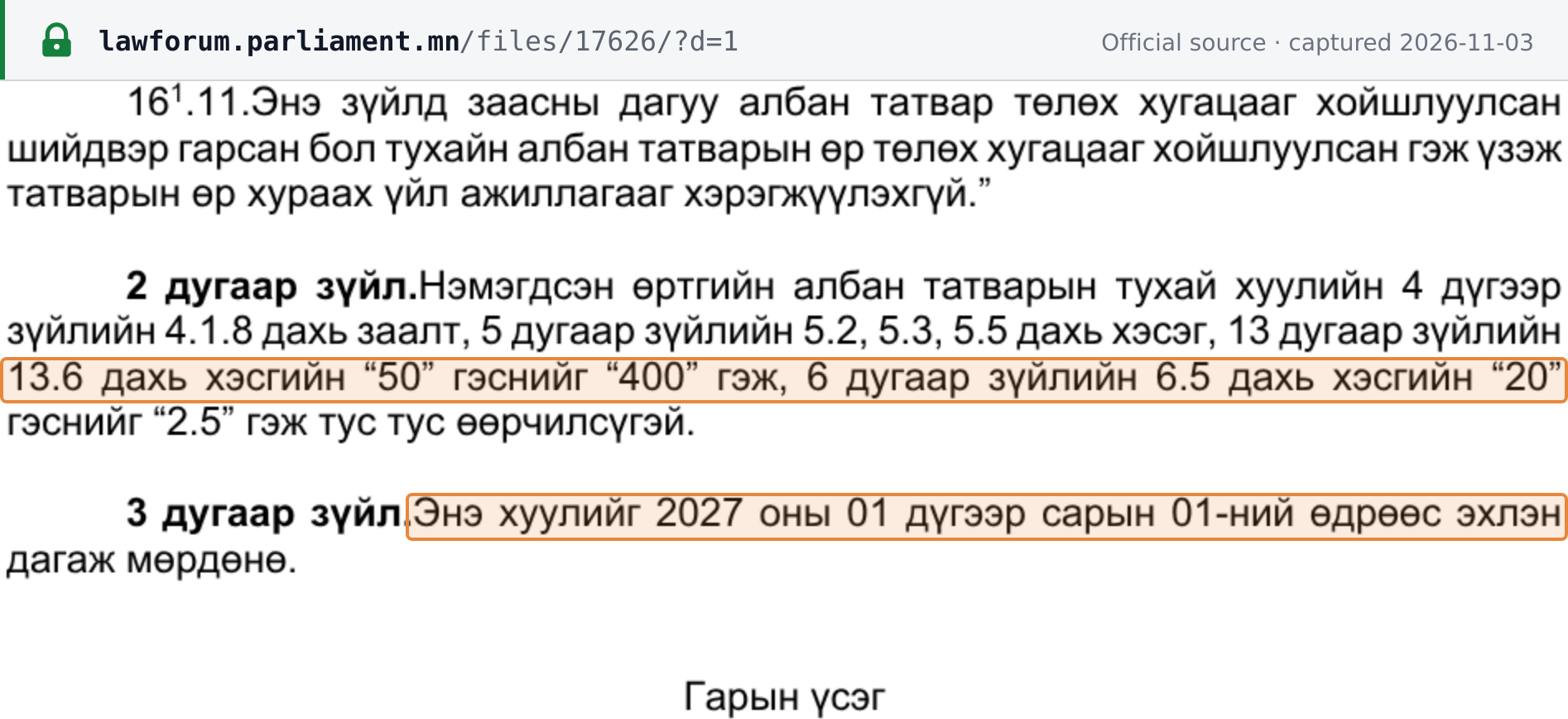
MNT 50,000,000 now; MNT 400,000,000 from 1 January 2027 (as at 2026-11-02). The law of 26 June 2026 amending the VAT Law, signed by the Speaker of the State Great Khural, S. Byambatsogt, makes the change. Article 2: "Нэмэгдсэн өртгийн албан татварын тухай хуулийн 4 дүгээр зүйлийн 4.1.8 дахь заалт, 5 дугаар зүйлийн 5.2, 5.3, 5.5 дахь хэсэг, 13 дугаар зүйлийн 13.6 дахь хэсгийн "50" гэснийг "400" гэж, 6 дугаар зүйлийн 6.5 дахь хэсгийн "20" гэснийг "2.5" гэж тус тус өөрчилсүгэй." (In the VAT Law, "50" is replaced by "400" in 4.1.8, 5.2, 5.3, 5.5 and 13.6, and "20" by "2.5" in 6.5.) Article 3: "Энэ хуулийг 2027 оны 01 дүгээр сарын 01-ний өдрөөс эхлэн дагаж мөрдөнө." (This law applies from 1 January 2027.) [2] [3]
 Source snapshot captured 2026-11-03 — original
The consolidated VAT Law on legalinfo.mn already prints the 2027 figure in place, with a note that it applies from 1 January 2027. Until then, the MTA's registration procedure applies the current figure: revenue "50.0 сая ба түүнээс дээш төгрөгт хүрсэн" (reaching MNT 50.0 million or more) (Order А/02 Annex 4, para 2.1.1). [1] [7]
 Source snapshot captured 2026-10-13 — original
- Measurement period. The Law speaks of annual sales ("Жилийн", art. 13.6) and of the day revenue "reaches" the threshold (art. 4.1.8). It does not say whether the year is the calendar year or any 12 months.
- Below the threshold. A person selling less than the threshold a year is exempt from VAT, imports excepted (art. 13.6). An unregistered importer therefore still pays import VAT at customs.
- Businesses between MNT 50 million and MNT 400 million on 1 January 2027. The amending law does not say how payers already registered under the MNT 50 million threshold leave the register. The MTA's deregistration procedure (Annex 4) still uses the MNT 50 million figure. See Deregistration.
See the event record for the 2027 threshold change and VAT registration thresholds worldwide.
Non-resident registration
There is no non-resident registration route, so there is no non-resident threshold.
- Non-residents without a Mongolian establishment are not registered. The MTA's procedure: "Нэмэгдсэн өртгийн албан татварын тухай хуулийн 7 дугаар зүйлийн 7.2.5 -д заасан Монгол Улсад оршин суугч бус этгээдийн хувьд нэмэгдсэн өртгийн албан татвар суутгагчаар бүртгэхгүй бөгөөд тухайн этгээдийн татвар төлөх, тайлагнах үүргийг … уг этгээдээс ажил, үйлчилгээ худалдан авсан хувь хүн, хуулийн этгээд хариуцан гүйцэтгэнэ." (Non-residents under VAT Law 7.2.5 are not registered as VAT payers; their obligation to pay and report the tax is performed by the individual or legal entity that bought the works or services from them.) (Order А/02 Annex 4, para 1.2). [7]
- A foreign company's Mongolian permanent establishment (төлөөний газар) registers on the same threshold as a resident: MNT 50 million now, MNT 400 million from 2027 (art. 5.3). [1]
How the VAT on a non-resident's supply is collected is set out under Cross-border rules.
Tax identification number
Registration is tied to the taxpayer number (татвар төлөгчийн дугаар) that the tax administration issues (General Tax Law arts. 6.1.22 and 26.2). It must appear on returns, customs declarations, receipts and other documents, and leaving it off a document is fined (Law on Violations art. 11.19.3.3; see Penalties). [5] [6]
- Format. The MTA's VAT manual describes the VAT-payer number as "7 оронтой дугаар" (a 7-digit number). This is MTA guidance and covers VAT payers only. [8]
- Register number vs taxpayer number. The official VAT-invoice form has separate boxes for the register number (регистрийн дугаар) and the taxpayer number of both seller and buyer (Order А/02 Annex 1). [9]
For formats, register numbers of individuals and how to look a number up, see the Mongolia tax ID guide. You can check a register number's structure with the Mongolia register-number validator.
How to register
- Apply within 10 working days of the obligation arising: "ажлын 10 өдөрт багтаан албан татвар суутган төлөгчөөр бүртгүүлэх өргөдлөө харьяалах татварын албанд гаргана" (file the application to register as a VAT payer with the competent tax office within 10 working days) (art. 6.1). The application is form ТТБ-01а (Order А/02 Annex 5), filed on paper or electronically.
- Attach primary documents proving the revenue: bank statements, receipts, invoices, income and expense documents, and sales contracts where needed (Annex 4, para 4.1).
- The tax office registers you within 3 working days and issues a certificate (art. 6.2). The certificate carries a QR code and a bar code and is sent to the taxpayer's e-tax account and e-mail (Annex 4, para 4.3).
If a person does not apply, the tax office serves a demand, and the person must then apply within 3 working days (Annex 4, paras 4.5–4.6). The registration date is the day the certificate is received (art. 4.1.19), and the taxable period starts on the certificate date (art. 10.1). Input VAT is deductible from the application date (art. 14.1.3). [1] [7]
 Source snapshot captured 2026-10-13 — original
For the general process across countries, see how to register for VAT, sales tax or GST.
Voluntary registration
Available. "Хувь хүн, хуулийн этгээдийн үйл ажиллагааны борлуулалтын орлогын хэмжээ нь энэ хуулийн 5.2-т заасан орлогын 2.5 буюу түүнээс дээш хувьд хүрсэн бол албан татвар суутган төлөгчөөр сайн дураар бүртгүүлж болно." (A person whose sales revenue reaches 2.5% or more of the revenue in 5.2 may register voluntarily.) (art. 6.5, as it reads from 1 January 2027). Until 31 December 2026 the percentage is 20%. Both work out at MNT 10,000,000: 20% of MNT 50 million now, 2.5% of MNT 400 million from 2027. The MTA's procedure confirms the current MNT 10.0 million figure and counts only revenue from taxable core activity (Annex 4, para 3.1.2). [1] [2] [7]
Why opt in. Only a VAT payer can deduct input VAT (art. 14.1), and business buyers can deduct only against a VAT invoice (padaan) from a VAT payer (art. 14.4).
Deregistration
- The rule. The tax office deregisters a VAT payer and cancels the certificate where returns for 12 consecutive months show no taxable revenue, or revenue below the registration threshold, or where it is proven the person has not been operating: "…албан татвар ногдох орлогогүй, эсхүл орлогын хэмжээ нь албан татвар суутган төлөгчөөр бүртгүүлсэн босгын хэмжээнд хүрээгүй нь дараалсан 12 сарын албан татварын тайлангаар, эсхүл үйл ажиллагаа явуулаагүй нь нотлогдсон бол…" (art. 6.8).
- Procedure. Low-risk payers are deregistered on the risk unit's conclusion. Others are audited within 20 working days, and goods kept on deregistration are taxed as a deemed supply (art. 7.2.2). Deregistration takes effect from the date of the tax-office head's order (Annex 4, para 6.2.6).
- Past obligations survive deregistration (art. 6.10).
- Public lists. The MTA publishes the names of registered and deregistered payers monthly (art. 6.9). [1] [7]
The 2027 change. Annex 4, para 6.2.4 still keeps on the register a payer whose 12 consecutive months of sales are MNT 50 million or more. Neither the amending law of 26 June 2026 nor the MTA's procedure says how the MNT 400 million figure applies to payers already registered, or whether a 12-month test may straddle 1 January 2027.
Group registration
Not available. The VAT Law and the MTA's registration procedure (Order А/02 Annex 4) contain no VAT-group provision; each individual or legal entity registers on its own. Branches are identified inside the payer's unique payment number (art. 4.1.15).
Rates
| Rate | Applies to | Basis |
|---|---|---|
| 10% (standard) | Goods, works and services sold in Mongolia and imports | VAT Law art. 11.1 |
| 0% | Exports and the other supplies listed in art. 12.1 | VAT Law arts. 11.2, 12 |
| 0–10% | Petrol (автобензин) and diesel, imported or produced and sold; the Government sets the rate within the band | VAT Law arts. 11.3–11.4 |
Standard rate: 10% (as at 2026-11-02). Article 11.1: "Энэ хуулийн 7.1.1, 7.1.2-т заасан бараа, ажил, үйлчилгээний борлуулалтын үнэлгээнд 10 хувиар ногдуулна." (Tax is charged at 10 percent on the sales value of the goods, works and services in 7.1.1 [sold in Mongolia] and 7.1.2 [imported].) The rate has applied since the revised VAT Law took effect on 1 January 2016; article 11 carries no amendment notes. [1]
Zero rate. Article 11.2: "Энэ хуулийн 7.1.3-т заасан бараа, ажил, үйлчилгээнд ногдуулах албан татварын хувь тэг /"0"/-тэй тэнцүү байна." (The rate on goods, works and services in 7.1.3 [exported] is zero.)
Petrol and diesel. Article 11.3 charges "0-10 хувиар" (0–10 percent) on imported or domestically produced petrol and diesel, and under article 11.4 "Засгийн газар тогтооно" (the Government sets) the rate within that band, taking the sector into account. The rate in force is set by Government resolution and is not stated on this page. [1]
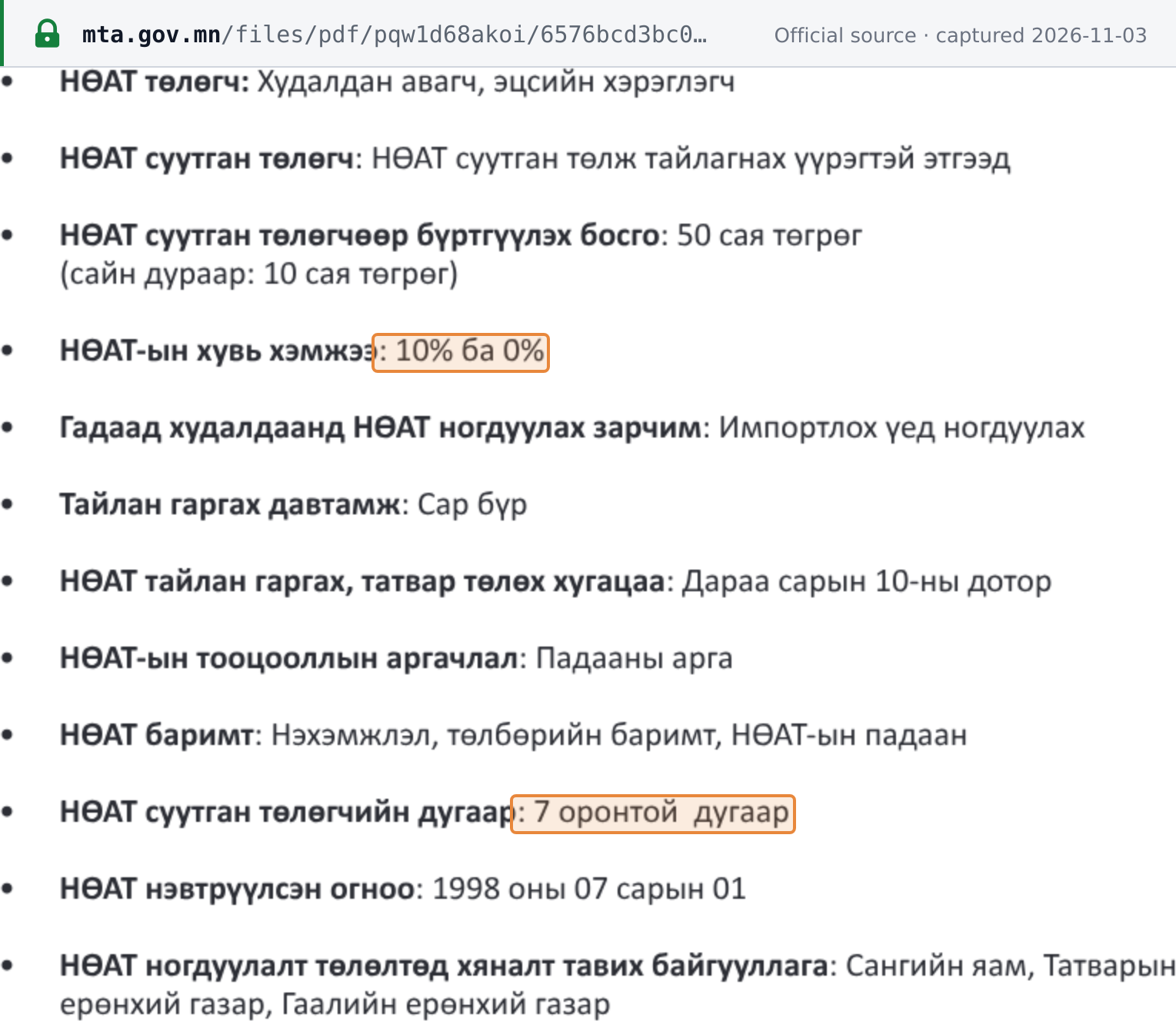
The MTA's own VAT manual summarises the rates as "НӨАТ-ын хувь хэмжээ: 10% ба 0%" (VAT rates: 10% and 0%). The same summary box shows the VAT-payer number format, monthly reporting and the 10th-of-the-month deadline. Its "50 сая төгрөг" registration threshold is the figure that applies until 31 December 2026. [8]
 Source snapshot captured 2026-11-03 — original
Zero-rated supplies (art. 12.1):
- goods exported and declared to customs (12.1.1);
- international passenger and freight transport under Mongolia's treaties: out of, into and in transit through Mongolia (12.1.2);
- services performed outside Mongolia (12.1.3);
- services supplied to non-residents of Mongolia, "түүний дотор албан татвараас чөлөөлсөн үйлчилгээг оролцуулан" (including services that are otherwise exempt) (12.1.4);
- air-navigation, technical, fuelling, cleaning, in-flight catering and sales services for aircraft on international flights (12.1.5);
- state medals, banknotes and coins made in Mongolia to the order of the Government or Mongolbank (12.1.6);
- final mineral products on the Government's list (12.1.7, 12.5).
Services directly connected with movable or immovable property located in Mongolia are not zero-rated under 12.1.4 (art. 12.2), and domestic legs separated out of international carriage are not zero-rated either (art. 12.4). [1]
Reduced rates. None. Article 11 sets only the 10% rate, the zero rate and the fuel band.
Announced future rates. None. The amending laws of 14 November 2025 and 26 June 2026 do not touch article 11.
See worldwide tax rates for other countries.
Cross-border rules
Imports and exports
- Imports of goods. Imports are taxable (art. 7.1.2) at 10% (art. 11.1). Customs charges the VAT, and the importer pays it to the treasury (arts. 16.2.1–16.2.2). The base is the customs value plus customs duty, excise and other taxes (art. 9.1.1), and the tax point is the day the goods are declared to customs (art. 10.5).
- Customs declaration as invoice. For imports and exports, the customs declaration is treated as equivalent to a VAT invoice: "Гаалийн мэдүүлгийг экспорт, импортын хувьд НӨАТ-ын падаантай адилтган үзнэ" (MTA VAT manual, p.12).
- Low-value parcels. Cross-border postal parcels sent to an individual are exempt where the value is no more than 10 times the monthly minimum wage (30 times for laptops) and the parcel contains no more than two items of the same kind (art. 13.1.24). The Law ties the cap to the minimum wage and states no MNT figure.
- Passengers. Personal-use goods within customs duty-free allowances are exempt (art. 13.1.1), as are passengers' free-zone purchases up to MNT 3,000,000 (art. 13.1.27).
- Exports. Zero-rated (arts. 11.2, 12.1.1). Exporters of their own products are refunded monthly (art. 15.13; see Refunds). Exported mineral products other than final products, and exported raw or washed cashmere and hides, are exempt rather than zero-rated (arts. 13.1.13, 13.1.21), so the input VAT on them is not deductible (art. 14.6.3).
- Import VAT deferral from 1 January 2027. Importers with a compliance rating of "good" or better may defer import VAT, capped at the monthly average VAT paid on the same HS-6 goods in the last quarter (art. 16-1.3–16-1.5). See Payment deferral from 2027. [1] [8]
Buyer withholding on purchases from non-residents
Goods, works and services sold by a non-resident to a Mongolian resident are taxable (art. 7.2.5), even though the non-resident is not a VAT payer (art. 7.4). The Mongolian VAT payer that buys them withholds the VAT and pays it with its monthly return. Article 16.1.2: "оршин суугч бус этгээдээс энэ хуулийн 7.2.5-д заасан гаалийн бүрдүүлэлт хийлгээгүй бараа, ажил, үйлчилгээг худалдан авахдаа үнийн дүнгээс албан татварыг суутган авч төсөвт төлнө;" (when buying from a non-resident goods, works or services under 7.2.5 that have not been cleared through customs, [the VAT payer] withholds the tax from the price and pays it to the budget.) Goods already taxed at customs are outside this rule (art. 16.1.3). [1]
 Source snapshot captured 2026-10-13 — original
The withheld VAT is a cost. The MTA's VAT manual lists "Оршин суугч бус этгээдээс суутгасан НӨАТ" (VAT withheld from non-residents) among purchases whose VAT is not deducted (p.14). The 2026 amendments did not change article 14. Failing to withhold is fined at 40% of the tax (General Tax Law art. 83; see Penalties). [8] See VAT withholding regimes and reverse charge explained.
Digital products and services
No special regime. The VAT Law and the General Tax Law contain no registration or collection regime for non-resident providers of digital or electronic services, and no rule for e-commerce platforms. A supply by a non-resident is taxed through the buyer withholding in article 16.1.2. See VAT on digital services by non-resident suppliers.
Foreign companies selling into Mongolia — B2B and B2C
- B2B. The Mongolian VAT payer withholds 10% from the price and pays it to the budget (art. 16.1.2). The foreign seller does not register (Order А/02 Annex 4, para 1.2).
- B2C, including digital services. There is no route for the foreign seller to register: Annex 4, para 1.2 bars registering a non-resident, and the withholding duty in article 16.1 falls on VAT payers. The Law does not settle whether a private individual buying from abroad must self-account. Annex 4, para 1.2 refers to the buying "хувь хүн, хуулийн этгээд" (individual or legal entity), but the VAT Law places the withholding duty on VAT payers.
- Goods. The importer pays VAT at customs (art. 16.2).
- A Mongolian branch or permanent establishment of a foreign company registers like a resident once its sales reach the threshold (art. 5.3). [1] [7]
Marketplace / platform deemed-supplier liability
None. The VAT Law contains no deemed-supplier rule for marketplaces or platforms. See marketplace deemed-supplier rules for how other countries handle this.
Place of supply
The VAT Law has no separate place-of-supply article. It works through these provisions:
- Territory. Goods and services "sold in the territory of Mongolia" are taxed (arts. 3.1, 7.1.1), as are imports (art. 7.1.2).
- Supplies by non-residents to residents are taxable (art. 7.2.5) and collected by withholding (art. 16.1.2).
- Services performed outside Mongolia (art. 12.1.3) and services to non-residents (art. 12.1.4) are zero-rated.
- Property in Mongolia. Services directly connected with movable or immovable property located in Mongolia are not zero-rated as services to non-residents (art. 12.2). [1]
Invoice requirements
Mongolia uses two statutory documents, both issued through the MTA's unified e-receipt system (e-barimt):
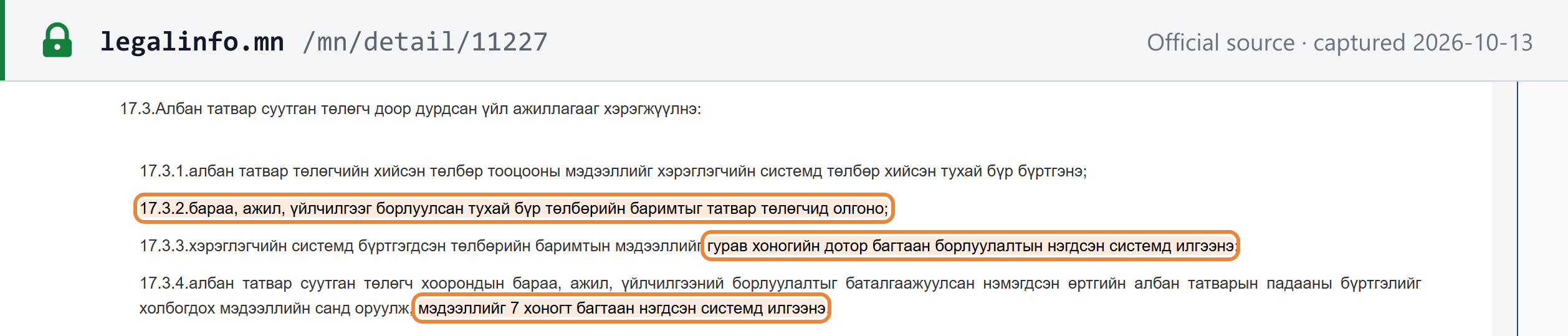
- The payment receipt (төлбөрийн баримт, art. 4.1.14) is issued for every sale, to every customer: "бараа, ажил, үйлчилгээг борлуулсан тухай бүр төлбөрийн баримтыг татвар төлөгчид олгоно" (art. 17.3.2). The General Tax Law puts this duty on every taxpayer, not only VAT payers: "Татвар төлөгч борлуулалт хийх тухай бүрд хэрэглэгчийн системээс дахин давтагдашгүй дугаар бүхий төлбөрийн баримтыг хэвлэж өгөх, эсхүл цахимаар илгээх үүрэгтэй." (A taxpayer must, at every sale, print out or send electronically a payment receipt bearing a unique number from the user system.) (GTL art. 28.5).
- The VAT invoice (НӨАТ-ын падаан, "padaan", art. 4.1.13) is used between VAT payers. The seller issues a receipt for each sale and creates the padaan from one receipt or several together (art. 14.3). It is the document a buyer deducts against: "Албан татвар суутган төлөгч хоорондын бараа, ажил, үйлчилгээний борлуулалтыг баталгаажуулсан нэмэгдсэн өртгийн албан татварын падааныг үндэслэн албан татварын хасалтыг хийнэ." (Tax is deducted on the basis of the VAT invoice confirming the sale between VAT payers.) (art. 14.4). Only registered VAT payers may use it (Order А/02 Annex 1, para 4). [1] [5] [9]
 Source snapshot captured 2026-10-13 — original
Mandatory content
Article 4.1.13 defines the padaan as a paper or electronic document from designated equipment proving the payment and containing "он, сар, өдөр, дахин давтагдашгүй төлбөрийн дугаар, албан татвар суутган төлөгчийн буюу худалдаа эрхлэгч, худалдан авагч албан татвар суутган төлөгчийн нэр, хаяг, татвар төлөгчийн дугаар, худалдаа хийгдсэн бараа, ажил, үйлчилгээний нэр, код, тоо хэмжээ, үнэ, төлбөр тооцооны болон татварын дүн" (the date; the unique payment number; the name, address and taxpayer number of the selling VAT payer or trader and of the buying VAT payer; the name, code, quantity and price of the goods, works or services; and the payment and tax amounts). The receipt (art. 4.1.14) carries the same details for the seller only, is validated through the unified system, and bears the seller's identifying mark (таних тэмдэг). [1]
| # | Field | Padaan | Receipt | Basis |
|---|---|---|---|---|
| 1 | Date of the transaction | Yes | Yes | arts. 4.1.13, 4.1.14 |
| 2 | Unique payment number (ДДТД) | Yes | Yes | arts. 4.1.13–4.1.15 |
| 3 | Seller (VAT payer) name, address, taxpayer number | Yes | Yes, with the seller's identifying mark | arts. 4.1.13, 4.1.14 |
| 4 | Buyer (VAT payer) name, address, taxpayer number | Yes | No | art. 4.1.13 |
| 5 | Register number of seller and buyer | Yes (form) | No | Order А/02 Annex 1 |
| 6 | Per line: description, code, quantity, price | Yes | Yes | arts. 4.1.13, 4.1.14 |
| 7 | Per line: unit of measure, unit price (MNT), line total (MNT) | Yes (form) | No | Order А/02 Annex 1 |
| 8 | Net value, VAT amount, total | Yes | Payment and tax amounts | arts. 4.1.13, 4.1.14; Annex 1 |
| 9 | Seal; "handed over" and "received" signatures | Yes (form) | No | Order А/02 Annex 1 |
| 10 | Encrypted QR code | Yes | — | Order А/02 Annex 1, note and para 6 |
Item code. Goods with a GS1-13 barcode use that code; other goods and services use a code from the National Statistics Office's "Unified Classification of Products and Services" (Order А/02 Annex 1, para 2 and note). [9]
Unique payment number. Article 4.1.15 builds it from the seller's taxpayer number, the branch number (if any), the date of payment and the sequence number, written "дунд нь ямар нэг тэмдэгт хэрэглэлгүйгээр үргэлжлүүлэн тоон утгаар" (as continuous digits with no separator). The unified system issues it (Order А/02 Annex 2). [1] [10]
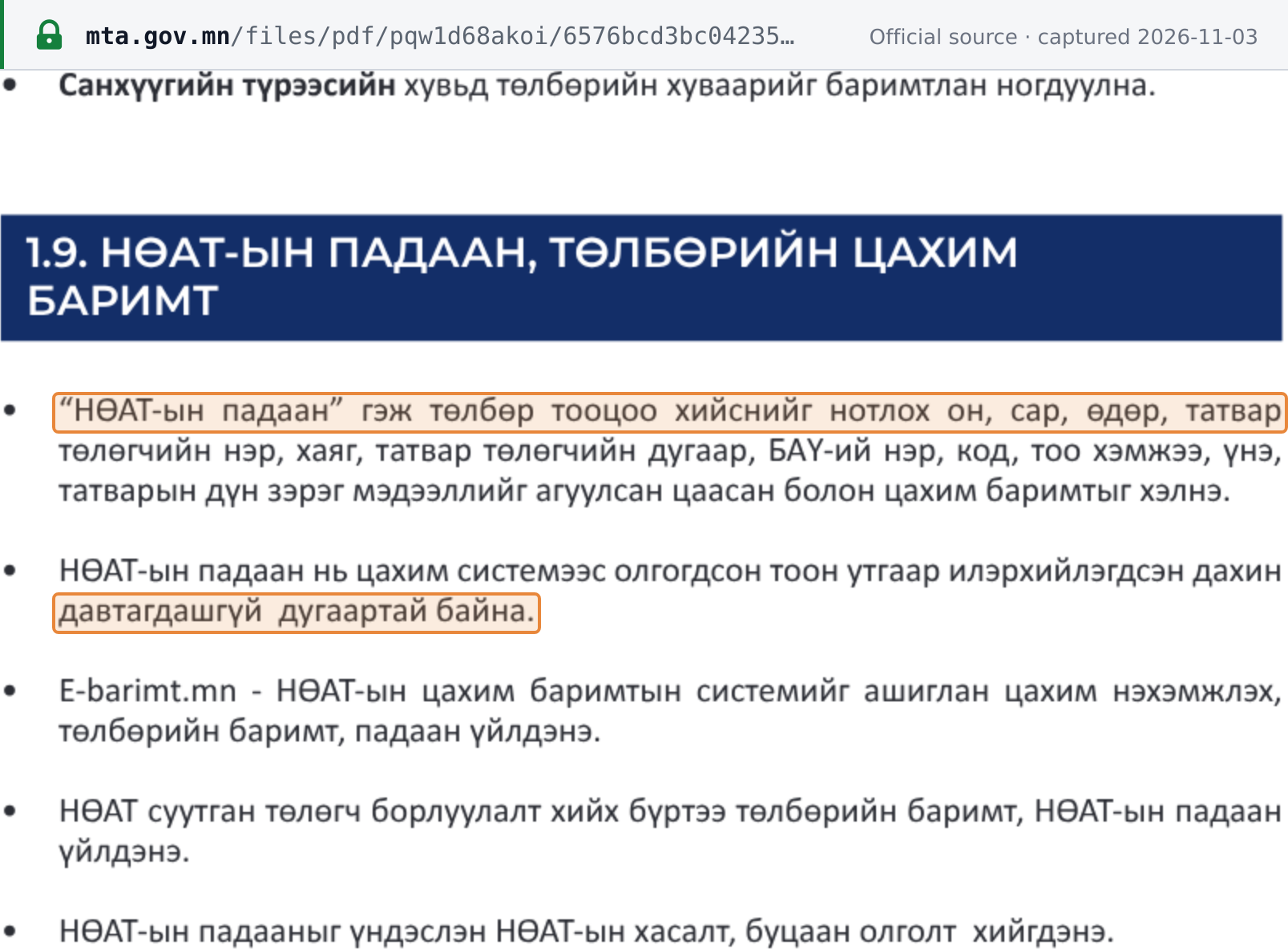
The MTA's VAT manual gives the same particulars in plain terms and adds that the padaan "цахим системээс олгогдсон тоон утгаар илэрхийлэгдсэн дахин давтагдашгүй дугаартай байна" (carries a unique numeric number issued by the electronic system). [8]
 Source snapshot captured 2026-11-03 — original
Issuance deadline
- Receipt: at each sale ("тухай бүр", art. 17.3.2; GTL art. 28.5).
- Transmission. VAT payers send receipt data to the unified sales system "гурав хоногийн дотор" (within three days) (art. 17.3.3) and send the padaan records "7 хоногт багтаан" (within 7 days) (art. 17.3.4).
- Other taxpayers. The General Tax Law's general rule is sales data to the tax database within 14 days (GTL art. 28.2). VAT payers follow the shorter VAT-Law periods.
- Tax point. The earliest of: receipt of the sales revenue, the day the receipt or invoice (нэхэмжлэл) is issued, or the day of purchase (art. 10.2). For utilities, the earlier of receipt issue and payment (art. 10.3).
- Reporting month. Seller and buyer report the padaan's VAT in the return for the month the padaan is written. "Харин зээлээр худалдан авалт хийсэн албан татвар суутган төлөгч нь падааныг төлбөрийг бүрэн төлсөн сарын тайланд тусгана." (A VAT payer that bought on credit reports the padaan in the return for the month it paid in full.) (Order А/02 Annex 1, para 7). [1] [5] [9]
Numbering and sequencing
The taxpayer does not run its own invoice sequence. The unified system assigns the unique payment number, which embeds the day's sequence number (art. 4.1.15; Order А/02 Annex 1, para 4 and Annex 2).
Credit and debit notes
The VAT Law has no credit-note or debit-note article. Sales are reversed and corrected inside e-barimt. The MTA's VAT manual tells payers preparing the return to review, in the e-receipt system, their "алдаатай баримт, засагдсан баримт, зөрчилтэй баримт, баталгаажаагүй буцаалт" (erroneous, corrected and conflicting receipts and unconfirmed reversals) (p.17). For advances, only the seller may reverse a prepayment receipt, "partially" or "in full" (Order А/02 Annex 3). A return may be corrected within the following two tax years (GTL art. 31.1). [8] [11] [5]
Currency and language
- Currency. Tögrög. The official padaan form's price columns read "Нэгжийн үнэ, төгрөг" (unit price, MNT) and "Бүгд үнэ төгрөг" (total, MNT). Foreign-currency values are converted at the Mongolbank rate of the tax-point day (art. 9.3).
- Language. Tax documents made in a foreign language must be translated into Mongolian at the taxpayer's cost (GTL art. 29.1.4). The official form is in Mongolian. [5] [9]
Document types
| Document | When | Basis |
|---|---|---|
| Payment receipt (төлбөрийн баримт) | Every sale, by every taxpayer | VAT Law arts. 4.1.14, 17.3.2; GTL art. 28.5 |
| VAT invoice (НӨАТ-ын падаан) | Sales between VAT payers; the basis for input-VAT deduction | VAT Law arts. 4.1.13, 14.3, 14.4 |
| Prepayment receipt (урьдчилж орсон орлогын баримт) | Advances. It becomes a VAT receipt only once the seller books the advance as revenue and the buyer accepts it | Order А/02 Annex 3 |
| Customs declaration | Treated as a padaan for imports and exports | MTA VAT manual, p.12 |
There is no "simplified" invoice and no value threshold for one: the receipt applies to every sale, and the padaan is the deduction document between VAT payers.
Self-billing
Not provided for. The VAT Law, the General Tax Law and Order А/02 Annexes 1–3 contain no self-billing provision, and Annex 3 reserves reversal of prepayment receipts to the seller.
Retention and audit trail
- Retention: until the limitation period ends, in Mongolia. Documents and records are kept "татвар төлөх хөөн хэлэлцэх хугацаа дуустал Монгол Улсын нутаг дэвсгэрт" (in the territory of Mongolia until the tax limitation period ends) (GTL art. 29.1.5). That period is 4 years for reassessments, penalties and confirming VAT (GTL art. 15.1).
- Electronic records. The MTA head approves the rules for electronic documents and their storage (GTL art. 29.8). Electronic returns need an electronic signature (GTL art. 29.7).
- Audit trail. Receipts are validated through the unified system (art. 4.1.14). Only a padaan printed from or created in the unified system with an encrypted QR code is valid (Order А/02 Annex 1, para 6). Cash registers, printers, receipt paper and POS terminals must meet Mongolian standards (Law on Violations art. 11.19.2.6).
- No false receipts. A VAT payer may not refuse to issue a receipt, or issue a false one or one for a different amount (art. 17.5). A buyer who is refused a receipt, or given a wrong one, must report it immediately (art. 17.6). [1] [5] [6]
A specimen of a compliant invoice
The official form. The MTA publishes the form of the VAT invoice itself. Order А/02 of the Head of the General Department of Taxation (3 January 2020), made under VAT Law art. 6.11, approves in its Annex 1 the "НЭМЭГДСЭН ӨРТГИЙН АЛБАН ТАТВАРЫН ПАДААН №" (VAT invoice no.) together with instructions for its use. The Annex is in force. [9] [13] The form is blank and lays out, top to bottom:
- the title and number, then "Дахин давтагдашгүй төлбөрийн дугаар" (unique payment number) and the date ("20… оны … сарын … өдөр");
- two party columns, "Албан татвар суутган төлөгч борлуулагчийн" (seller, VAT payer) and "Худалдан авагчийн" (buyer), each with name, boxed register number, boxed taxpayer number and address;
- the line table: No. (Д/д), description (Бараа, ажил, үйлчилгээний нэр), code (Код), unit (Хэмжих нэгж), quantity (Тоо, хэмжээ), unit price in MNT (Нэгжийн үнэ, төгрөг) and total in MNT (Бүгд үнэ төгрөг);
- the totals stack: value of goods, works and services; VAT (Нэмэгдсэн өртгийн албан татвар); total price (Нийт үнэ);
- the seal (Тамга), a QR code, and "handed over" and "received" signature lines for both parties.
The note under the form adds that the padaan "хэвлэхэд тодорхой нууцлал агуулсан … QR кодтой байна" (carries a QR code with specific encryption when printed).
Filled in. Because the official form is blank, Lookuptax shows below the same fields, in the form's order, for an illustrative sale at 10%. Every name, number and amount is fictional:
НӨАТ-ын падаан (VAT invoice) — illustrative
| Descriptionart. 4.1.13 | CodeAnnex 1 para 2 | UnitAnnex 1 form | Qtyart. 4.1.13 | Unit price, MNTAnnex 1 form | Total, MNTAnnex 1 form |
|---|---|---|---|---|---|
| Office chairs, model EX-1 | CODE-SPECIMEN-1 | piece | 10 | 50,000 | 500,000 |
| Delivery and assembly | CODE-SPECIMEN-2 | service | 1 | 200,000 | 200,000 |
- Value of goods, works and servicesAnnex 1 form
- MNT 700,000
- VAT 10%VAT Law art. 11.1
- MNT 70,000
- Total priceAnnex 1 form
- MNT 770,000
- [Seal — Тамга] and "handed over" / "received" signatures and names of both parties — Annex 1 form.
- [Encrypted QR code] — only a padaan printed from or created in the unified system with this code is valid (Order А/02 Annex 1, para 6).
- Item codes: the GS1-13 barcode where the goods have one; otherwise the National Statistics Office product and service classification code (Annex 1, para 2).
- The seller issues a payment receipt for each sale and builds the padaan from one or more receipts (VAT Law art. 14.3). The buyer deducts the VAT on the basis of the padaan (art. 14.4).
The consumer e-barimt receipt has no official specimen in Order А/02 or in the MTA's VAT manual.
E-invoicing status
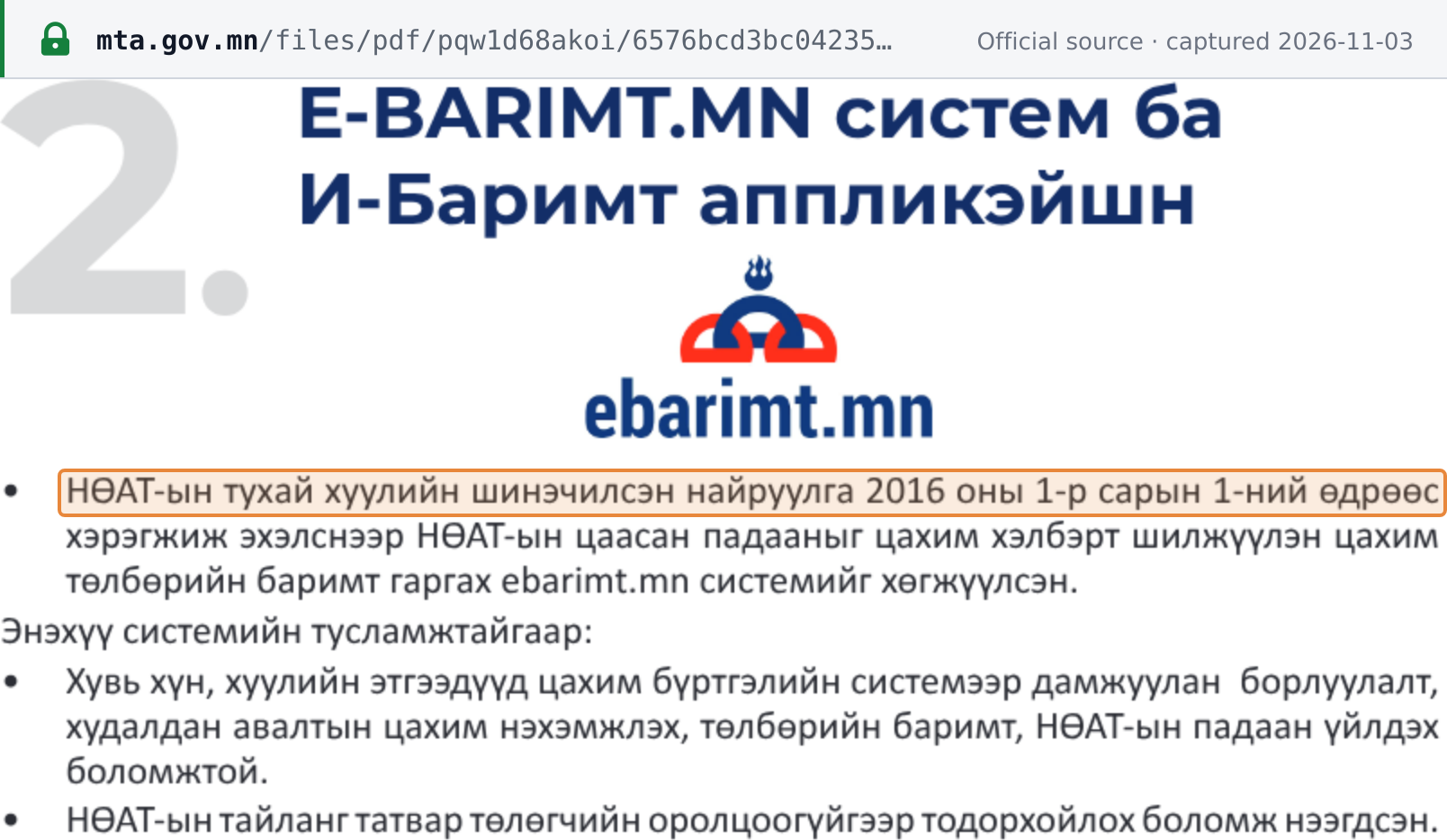
Status (as at 2026-11-02): mandatory, through the MTA's unified e-receipt system (e-barimt), since 1 January 2016. The MTA's VAT manual: "НӨАТ-ын тухай хуулийн шинэчилсэн найруулга 2016 оны 1-р сарын 1-ний өдрөөс хэрэгжиж эхэлснээр НӨАТ-ын цаасан падааныг цахим хэлбэрт шилжүүлэн цахим төлбөрийн баримт гаргах ebarimt.mn системийг хөгжүүлсэн." (With the revised VAT Law in force from 1 January 2016, the paper VAT invoice was converted to electronic form and the ebarimt.mn e-receipt system was developed.) [8]
 Source snapshot captured 2026-11-03 — original
- Model: real-time-style reporting of every sale. Each VAT payer must have a certified user system (хэрэглэгчийн систем): "Албан татвар суутган төлөгч хэрэглэгчийн системтэй байна." (art. 17.4). The user system connects to the MTA's unified system (нэгдсэн систем, art. 4.1.20). Receipts are validated there (art. 4.1.14), receipt data must reach it within 3 days, and padaan records within 7 days (arts. 17.3.3–17.3.4).
- System name. e-barimt (ebarimt.mn), with the И-Баримт (I-Barimt) consumer app.
- Scope. B2B (padaan between VAT payers), B2C (receipts, with the consumer refund and lottery: see Refunds) and B2G alike. The duties attach to the seller whoever the buyer is.
- Non-VAT payers also issue receipts for every sale (GTL art. 28.5), and any person selling goods, works or services who fails to issue one is fined (Law on Violations art. 11.19.8).
- System suppliers. Suppliers of user systems (art. 4.1.12) must supply certified equipment and systems. The Minister of Finance approves the operating rules for the unified and user systems (art. 17.1).
- Formats and standards. The VAT Law sets no XML or JSON format. Receipts and padaan are generated by the certified user system connected to the unified system (arts. 4.1.14, 17.4), and only a padaan created in or printed from the unified system with its encrypted QR code is valid (Order А/02 Annex 1, para 6).
- Phases. None by taxpayer size. Every VAT payer must have a user system.
The amending laws of 2025 and 2026 do not add a new e-invoicing phase. [1] [5] [6]
See CTC e-invoicing models, fiscal devices and certified cash registers and e-invoicing status and networks worldwide.
Filing and payment
Filing frequency
Monthly, for every VAT payer (as at 2026-11-02). Article 16.1 requires each month's VAT to be paid and reported by the 10th of the following month, and the Law sets no turnover band for a different frequency. The MTA's VAT manual summarises it as "Тайлан гаргах давтамж: Сар бүр" (reporting frequency: monthly). [1] [8]
Return and payment due date
The 10th of the following month, for both the return and the payment. Article 16.1: "Албан татвар суутган төлөгч нь борлуулсан бараа, ажил, үйлчилгээнд ногдох албан татварыг доор дурдсан журмаар дараа сарын 10-ны өдрийн дотор төрийн сангийн нэгдсэн дансанд шилжүүлж, баталсан маягтын дагуу тайлангаа харьяалах татварын албанд тушаана" (A VAT payer transfers the VAT on goods, works and services sold to the state treasury single account by the 10th of the following month, and files its return on the approved form with the competent tax office). VAT withheld from non-residents goes on the same return (art. 16.1.2). [1]
- Weekends and holidays: the deadline moves earlier. "Татвар төлөх, тайлагнах эцсийн хугацаа долоо хоног бүрийн Бямба, Ням гараг, нийтээр тэмдэглэх баярын өдөртэй давхацсан тохиолдолд түүний өмнөх ажлын өдөр нь татвар төлөх, тайлагнах эцсийн өдөр байна." (Where the deadline falls on a Saturday, Sunday or public holiday, the working day before it is the last day.) (GTL art. 29.3).
- Extension. The MTA head may extend the return deadline by up to 7 days with advance public notice (GTL art. 29.4).
- Channel. The return (form ТТ-03А) is filed in the MTA's e-tax system, pre-populated from e-barimt data (MTA VAT manual, p.17), and needs an electronic signature (GTL art. 29.7).
- Import VAT is paid at customs (art. 16.2.2). [5] [8]
Payment deferral from 2027
The law of 26 June 2026 adds a new article 16-1, applying from 1 January 2027:
- First deferral. "Татварын ерөнхий хуулийн 6.1.51-д заасан хууль даган мөрдөлтийн түвшин "сайн" буюу түүнээс дээш үнэлгээтэй албан татвар суутган төлөгч хүсэлт гаргасан тохиолдолд албан татвар төлөх хугацааг нэг сар хүртэл хугацаагаар хойшлуулна." (Where a VAT payer with a compliance rating of "good" or better under GTL 6.1.51 applies, the payment deadline is deferred by up to one month.) (art. 16-1.1).
- Second deferral. If the deferred tax is paid in full and the rating holds, a further request may defer payment by up to two months, paid in equal monthly instalments (art. 16-1.2).
- Importers. The same one-month and two-month deferrals, capped at the monthly average VAT paid on the same HS-6 goods in the last quarter (arts. 16-1.3–16-1.5).
- Revocation. The deferral is revoked without dispute if the tax is not paid, the rating drops, or the payer is found not to issue e-receipts. No new request is accepted for a quarter afterwards (arts. 16-1.6–16-1.8).
- Decision within 5 working days (art. 16-1.10).
- The rating. Under new GTL article 76-1, also from 1 January 2027, the compliance level is scored up to 100 and graded "маш сайн / сайн / дунд / муу" (very good / good / average / poor), set quarterly and annually. [2] [1] [5]
See the event record for the 2027 payment deferral.
Additional listings
None beyond the monthly return. The VAT Law requires no annual VAT return and no separate sales or purchase listing; e-barimt already holds every receipt and padaan.
Input-tax recovery and blocked items
- What is deductible (art. 14.1). VAT on goods, works and services bought in Mongolia or imported for production, sale or services; VAT paid between the application date and the registration date (art. 14.1.3); and a deemed 10% input on certain unprocessed agricultural products (meat, milk, eggs, hides, wool, cashmere, livestock, potatoes, vegetables, fruit, domestic flour) bought from producers by domestic manufacturers (art. 14.1.4).
- Evidence. Deduction rests on the padaan (art. 14.4). VAT not shown on an invoice, padaan or other accounting document is not deductible (art. 14.5).
- Capital goods are spread. Input VAT on fixed assets is deducted evenly "барилга, байгууламж 10 жилээр" (buildings and structures over 10 years) and "тоног төхөөрөмж 5 жилээр" (equipment over 5 years, including exploration costs); other fixed assets are deducted at once (art. 14.1.5). The 2026 amendments did not change this.
- Blocked (art. 14.6): passenger cars and their parts and spares (except for car dealers, art. 14.7); goods and services for personal or employee use; inputs for exempt activities; inputs unrelated to the period's taxable supplies; and pre-operational inputs. The MTA's VAT manual adds VAT withheld from non-residents (p.14).
- Mixed use. Pro rata to taxable activity (art. 14.9). [1] [8]
Refunds
- Credit position. Where a month's deductions exceed output VAT, the excess may be carried forward, offset against other taxes, or refunded (art. 14.8).
- Procedure and timing. Request the refund with the return, on paper or electronically (art. 15.1.1). The tax office verifies within 15 working days (art. 15.1.2), the MTA reviews within 7 working days and forwards within 2 working days (art. 15.8), and the Ministry of Finance decides within 45 working days (art. 15.9).
- Frequency. "Өөрийн үйлдвэрлэсэн бүтээгдэхүүнийг экспортод гаргасан бол албан татварыг сар бүр, бусад албан татвар төлөгчийн албан татварыг улиралд нэг удаа улсын төсвөөс буцаан олгоно." (Exporters of their own products are refunded monthly; other taxpayers once a quarter.) (art. 15.13).
- Cap. Refunds and consumer incentives together may not exceed 30% of that VAT's budget revenue for the period (art. 15.14).
- Bad-debt relief. The VAT Law has no bad-debt provision.
- Non-resident businesses. No refund scheme. Diplomatic missions are refunded (art. 15.5).
- Foreign tourists. A foreign visitor staying up to 90 days for purposes other than study or work gets 100% of the VAT back on goods bought for personal use and taken out within 90 days through an international airport, under the conditions in art. 15.17 (arts. 15.6, 15.17–15.18). [1]
Consumer VAT refund on e-barimt purchases. Consumers buying from VAT payers get part of the VAT back (art. 15.2.1) and take part in a lottery (art. 15.2.2). The law of 14 November 2025, signed by the Deputy Speaker J. Bat-Erdene and applying from 1 October 2026 (its art. 3), rewrote the refund rates:
| Period | Monthly purchases from VAT payers | Share of VAT refunded |
|---|---|---|
| 1 October – 31 December 2026 | up to MNT 1,000,000 | 50% |
| above MNT 1,000,001 | 20% | |
| From the 2027 budget year | up to MNT 500,000 | 100% |
| MNT 500,001–1,000,000 | 50% | |
| above MNT 1,000,001 | 20% |
The 2026 rule is article 15.2.1.а: "…сарын 1,000,000 хүртэлх төгрөгийн худалдан авалтад төлсөн татварын 50 хувийг, 1,000,001 төгрөгөөс дээш худалдан авалтад төлсөн татварын 20 хувийг". New article 17-1.1 applies it "2026 оны 10 дугаар сарын 01-ний өдрөөс эхлэн 2026 оны 12 дугаар сарын 31-ний өдрийг дуустал" (from 1 October 2026 to 31 December 2026). Article 17-1.2 applies the three-band rule in 15.2.1.б "2027 оны төсвийн жилээс эхлэн" (from the 2027 budget year). The consolidated text on legalinfo.mn has not yet been updated for this amendment. Refunds and incentives do not apply to imports (art. 15.16) and cannot be combined with an input deduction (art. 15.15). [4] [1]
Exemptions
Exempt supplies
Goods (art. 13.1), selected:
- sale of residential premises in residential use (13.1.7); newly built housing for sale is not covered (13.4);
- blood and organs for treatment (13.1.8); gas fuel and related equipment (13.1.9);
- gold sold (13.1.11);
- exported mineral products other than final products (13.1.13);
- domestically grown grain, potatoes, vegetables, fruit and domestic flour (13.1.15), domestic slaughtered meat (13.1.16) and domestic milk products (13.1.17). Traders reselling these are not covered (13.10);
- equipment for SME production (13.1.18); raw materials for innovation projects (13.1.19); imported timber (13.1.20);
- exported raw or washed cashmere and hides (13.1.21);
- low-value international postal parcels (13.1.24);
- petroleum-exploration imports (13.1.25); renewable-energy equipment (13.1.28);
- livestock, raw meat, milk, hides, wool and cashmere sold by herders (13.1.29).
Several items apply only to goods on Government lists (art. 13.2).
Services (art. 13.5), selected: currency exchange; banking (payments, guarantees, deposits); insurance and reinsurance; securities and financial instruments; lending; interest and dividends; renting residential housing; licensed education; health care (not medicines or medical devices, 13.7); religious services; state services; public transport; inbound-tourism services by tour operators to foreign tourists (not hotels, restaurants, transport or guiding, 13.8); cultural-heritage restoration; funeral, veterinary and notarial services; and virtual-asset services (13.5.20, added by the law of 17 December 2021). [1]
The lists above are selected examples. Article 13 is longer and has been amended several times.
Exempt is not zero-rated. Inputs used for exempt activities are not deductible (art. 14.6.3), with pro-rata for mixed use (art. 14.9). A zero-rated export keeps full deduction and is refunded monthly or quarterly. Services to non-residents are zero-rated even where they would otherwise be exempt (art. 12.1.4).
Special regimes
- Small businesses. Persons selling less than the threshold a year are exempt from VAT, imports excepted: MNT 50 million until 31 December 2026, MNT 400 million from 1 January 2027 (art. 13.6).
- Free zones. A special tax regime for free zones is set by the Free Zone Law (GTL art. 4.1.2) and is not covered here. Passengers' free-zone purchases up to MNT 3,000,000 are exempt (art. 13.1.27).
- Margin, second-hand and cash-accounting schemes. None in the VAT Law.
Offences and penalties
Offences
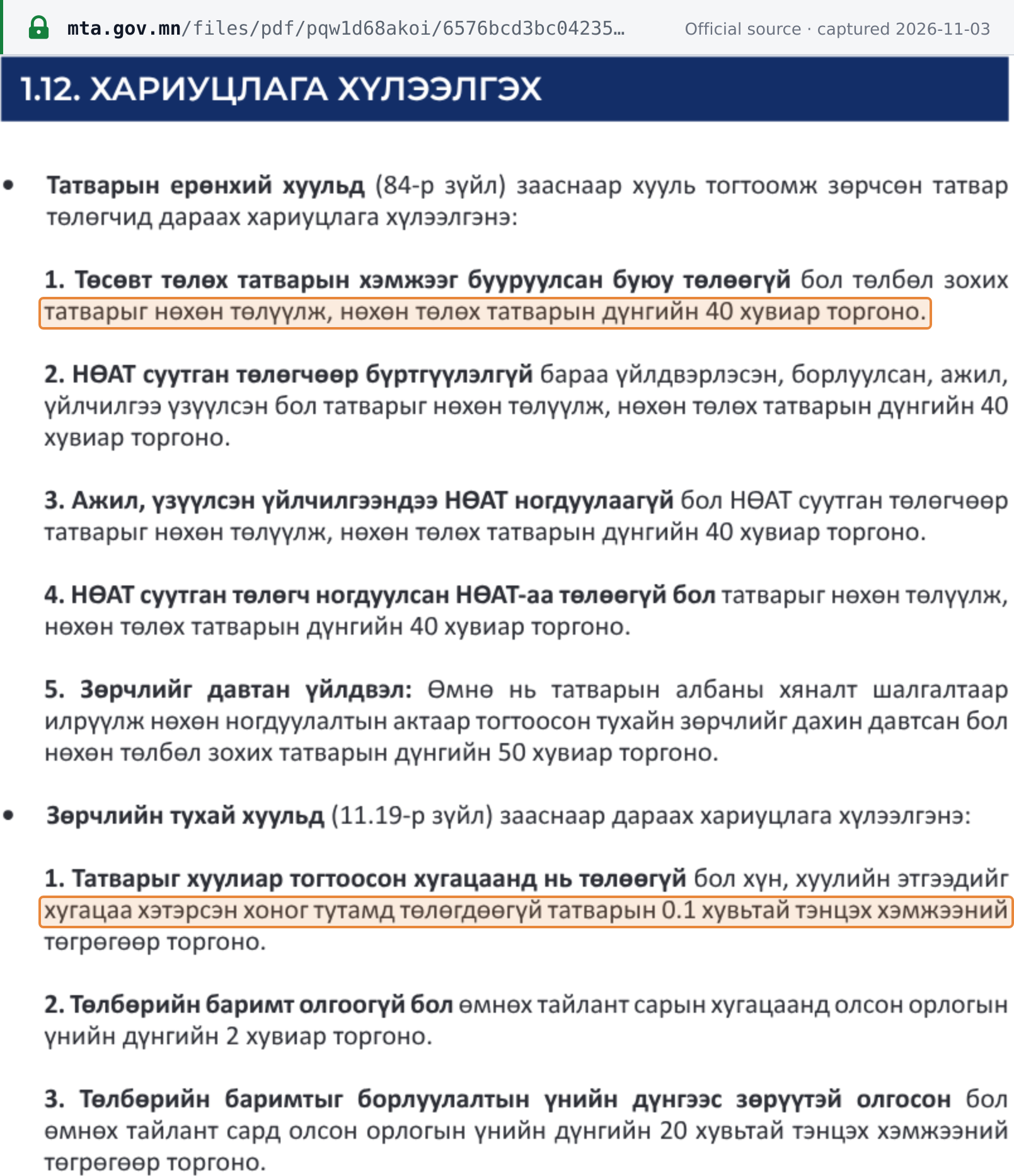
- VAT-specific breaches (GTL art. 84.1). Trading without VAT registration when required; not charging VAT; charging but not remitting it; and "нэмэгдсэн өртгийн албан татварын падаан, төлбөрийн баримтын мэдээллийг зөрүүтэй гаргасан, эсхүл падаан, төлбөрийн баримтыг үйлдээгүй" (issuing padaan or receipt data that differs from the real figures, or not issuing them) to cut the VAT payable or inflate a refund (84.1.5).
- Receipts. Refusing to issue a receipt, or issuing a false one or one for a different amount (VAT Law art. 17.5).
- Withholding. Failing to withhold VAT on purchases from non-residents, or to pay and report it (GTL art. 83).
- Administrative violations (Law on Violations art. 11.19). Failing to register, file on time, use standard-compliant cash registers or POS terminals, or transmit receipts to the system (11.19.2); not showing the taxpayer number on documents (11.19.3.3); obstructing audits, inventories or seizures (11.19.4, 11.19.6); breaching record-keeping and retention rules (11.19.7.4).
- Criminal tax evasion (Criminal Code art. 18.3). A managing or executive officer of a taxpayer who deliberately misstates or conceals a large amount of taxable income, property or goods and services to evade tax is punished by a fine of 450 to 5,400 units (MNT 450,000–5,400,000), or 240 to 720 hours of community service, or 1 month to 1 year of travel restriction (18.3.1). Article 18.3 does not define "large amount". [5] [6] [12]
Penalties
Tax penalties (General Tax Law), imposed with the reassessed tax:
| Breach | Penalty | Basis |
|---|---|---|
| Understating or concealing tax | 30% of the reassessed tax if the tax was cut by under 50%; 40% if by 50% or more; 50% on a repeat | GTL art. 82 |
| Failure to withhold, or to pay and report withheld tax (including the non-resident withholding) | 40%; 50% on a repeat | GTL art. 83 |
| VAT breaches in art. 84.1 (unregistered trading, VAT not charged or not remitted, wrong or missing padaan or receipts) | 40%; 50% on a repeat | GTL art. 84 |
Administrative fines (Law on Violations art. 11.19; 1 unit = MNT 1,000, art. 3.4.3):
| Breach | Individual | Legal entity | Basis |
|---|---|---|---|
| Late payment of tax | 0.1% of the unpaid tax per day late, capped at 10% of the tax | same | 11.19.1 and note |
| Failure to register, file on time, use standard cash registers or POS, or transmit receipts | 150 units (MNT 150,000) | 1,500 units (MNT 1,500,000) | 11.19.2 |
| Taxpayer number not shown on documents | 100 units (MNT 100,000) | 1,000 units (MNT 1,000,000) | 11.19.3.3 |
| Record-keeping or retention breach | 400 units (MNT 400,000) | 4,000 units (MNT 4,000,000) | 11.19.7.4 |
| Receipt not issued | 2% of the previous month's revenue | same | 11.19.8.1 |
| Receipt for an amount different from the sale | 20% of the previous month's revenue | same | 11.19.8.2 |
| Either of the two above, where that revenue cannot be determined | 1,500 units (MNT 1,500,000) | 15,000 units (MNT 15,000,000) | 11.19.8.3 |
 Source snapshot captured 2026-11-03 — original
Late-payment interest (алданги, GTL art. 73). Interest accrues daily from the due date to payment (73.2.1). Each January the Minister of Finance sets the rate at 20% above the Mongolbank weighted-average commercial lending rate (73.1.1). The rate for the current year is not stated on this page. No interest is charged on penalties or on interest (73.3). From 1 January 2027, no interest runs during an audit, from the audit mandate to the decision (73.4), and total interest is capped at 50% of the unpaid tax (73.5). Both rules were added by the law of 26 June 2026 amending the General Tax Law. [5]
Frequently asked questions
Is the Mongolian VAT registration threshold MNT 50 million or MNT 400 million?
Both, at different times. The threshold is MNT 50,000,000 of annual sales until 31 December 2026. The law of 26 June 2026 amending the VAT Law replaces 50 with 400 in articles 4.1.8, 5.2, 5.3, 5.5 and 13.6, and applies from 1 January 2027, so the threshold becomes MNT 400,000,000 from that date. The consolidated text on legalinfo.mn already prints 400 with a note that it applies from 1 January 2027.
Does a foreign company selling services to Mongolian businesses have to register for VAT?
No. The MTA's registration procedure (Order А/02 of 2020, Annex 4, para 1.2) says non-residents are not registered as VAT payers. Under VAT Law article 16.1.2, the Mongolian VAT payer that buys the goods, works or services withholds the VAT from the price and pays it to the budget with its monthly return. The MTA's VAT manual lists VAT withheld from non-residents among input VAT that cannot be deducted.
Can a buyer deduct input VAT on an e-barimt receipt alone?
No. Between VAT payers, VAT Law article 14.4 bases the deduction on the VAT invoice (padaan) that confirms the sale. The seller issues a payment receipt for every sale and creates the padaan from one or more receipts in the unified system (article 14.3). Only a padaan printed from or created in the unified system with an encrypted QR code is a valid document (Order А/02 Annex 1, para 6).
What happens if the 10th of the month, the VAT deadline, falls on a weekend?
The deadline moves earlier, not later. General Tax Law article 29.3 says that when a payment or filing deadline falls on a Saturday, Sunday or public holiday, the working day before it is the last day.
How much VAT do consumers get back on e-barimt purchases from October 2026?
Under the law of 14 November 2025 amending article 15.2.1: from 1 October 2026 to 31 December 2026, 50% of the VAT on monthly purchases up to MNT 1,000,000 and 20% above that; from the 2027 budget year, 100% of the VAT on monthly purchases up to MNT 500,000, 50% on MNT 500,001 to 1,000,000 and 20% above MNT 1,000,001.
Important websites
| Site | Purpose |
|---|---|
| Mongolian Tax Administration (English) | Tax authority: registration with the competent tax office, guidance and notices |
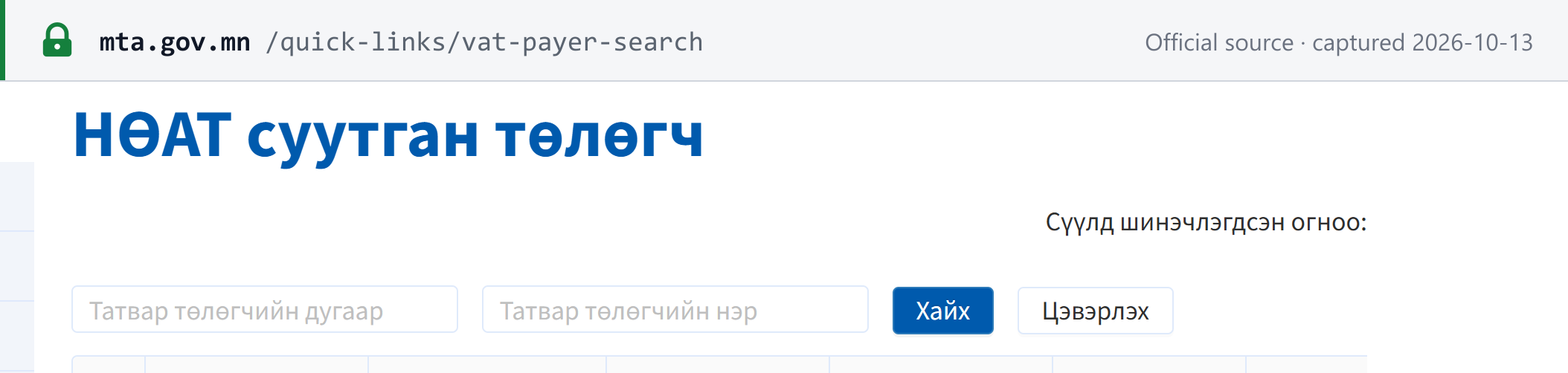
| MTA VAT-payer search | Check whether a business is a registered VAT payer, by taxpayer number or name |
| e-barimt | The unified e-receipt system for receipts and VAT invoices (padaan) |
| Legal Information Centre | Official consolidated texts of the VAT Law, the General Tax Law and MTA orders |
| Lookuptax register-number validator | Check the structure of a Mongolian register number |
 Source snapshot captured 2026-10-13 — original
For other countries' registers, see check a VAT number — official lookups by country.
Recent changes
- 2026-06-26 — The State Great Khural passes the law amending the VAT Law. From 1 January 2027 it raises the VAT registration and small-business exemption threshold from MNT 50 million to MNT 400 million of annual sales, and sets the voluntary-registration level at 2.5% of it (still MNT 10 million). (Legal Information Centre) — see event
- 2026-06-26 — The same law adds article 16-1: from 1 January 2027, VAT payers and importers rated "good" or better may defer VAT payment by up to one month, then up to two months in instalments. (Legal Information Centre) — see event
- 2026-06-26 — A General Tax Law amendment caps late-payment interest at 50% of the unpaid tax and stops interest running during an audit, from 1 January 2027 (arts. 73.4–73.5). (Legal Information Centre)
- 2025-11-14 — A law amending the VAT Law rewrites the consumer VAT refund on e-barimt purchases: 50% / 20% by monthly purchase band from 1 October to 31 December 2026, then 100% / 50% / 20% from the 2027 budget year. (Legal Information Centre)
For the full chronology, see Mongolia tax changes on Lookuptax.
Reference links
- Law on Value Added Tax (revised 9 July 2015) — consolidated text, Legal Information Centre
- Law of 26 June 2026 amending the Law on Value Added Tax — Legal Information Centre
- State Great Khural — text for final approval, 26 June 2026 (VAT Law amendments)
- Law of 14 November 2025 amending the Law on Value Added Tax (consumer refund) — Legal Information Centre
- General Tax Law (revised 22 March 2019) — consolidated text, Legal Information Centre
- Law on Violations (revised 11 May 2017) — consolidated text, Legal Information Centre
- MTA Order А/02 (2020), Annex 4 — procedure for registering and deregistering VAT payers
- MTA — VAT manual "Нэмэгдсэн өртгийн албан татвар (НӨАТ)", 2023
- MTA Order А/02 (2020), Annex 1 — form of the VAT invoice (padaan) and instructions for its use
- MTA Order А/02 (2020), Annex 2 — definition of the unique payment number
- MTA Order А/02 (2020), Annex 3 — prepayment receipt
- Criminal Code — consolidated text, Legal Information Centre
- Order А/02 of the Head of the General Department of Taxation, 3 January 2020 — Legal Information Centre
Related on Lookuptax:
- Mongolia tax ID guide
- VAT registration thresholds worldwide
- Worldwide tax rates
- E-invoicing status and networks worldwide
- VAT withholding regimes
- Reverse charge explained
- VAT on digital services by non-resident suppliers
- Fiscal devices and certified cash registers
- How to register for VAT, sales tax or GST
- VAT, GST and sales tax names by country