Montenegro VAT guidelines
| FACTSHEET | |
|---|---|
| Country code | ME |
| Tax name | Value Added Tax (VAT) — porez na dodatu vrijednost (PDV) |
| Tax Authority | Poreska uprava (Tax Administration) |
| Law applied | Law on VAT, Sl. list RCG 65/01, as amended up to Sl. list CG 12/2026 (until EU accession) |
| Standard rate | 21% (reduced 15% and 7%; 0% for exports and other listed supplies) |
| Registration threshold | EUR 30,000 in the last 12 months (none for non-residents) |
| VAT number | PIB with the prefix ME |
Overview
Montenegro levies value added tax — in Montenegrin porez na dodatu vrijednost, abbreviated PDV. Figures on this page are as at 2026-11-03.
Which VAT law applies
Montenegro has two Laws on VAT on its statute book, and only one of them is applied today.
- Applied now: the Law on VAT of 2001 (Službeni list RCG 65/01), as amended, most recently by Službeni list CG 12/2026. The Official Gazette's database lists it as "Status: Važeći" (in force), applied since 1 July 2002. Every rule on this page comes from this law and its amending acts unless stated otherwise. The Official Gazette publishes the amending acts but no consolidated text of the law, so each rule is cited to the amending act that carries its current wording. The same database shows "Status: Nevažeći" (not in force) on the amending acts cited here, among them 12/2026, 94/2024, 50/2017, 80/2020, 29/2013, 76/2005, 59/2021 and 65/2022, because the 2026 law lists them for repeal; under its Art. 212 that repeal takes effect only on EU accession. [1] [9] [10]
- Enacted but not yet applied: the new Law on VAT (Službeni list CG 104/2026), adopted on 9 July 2026, published on 17 July 2026 and in force since 25 July 2026. It applies only from the day Montenegro joins the European Union. [10]
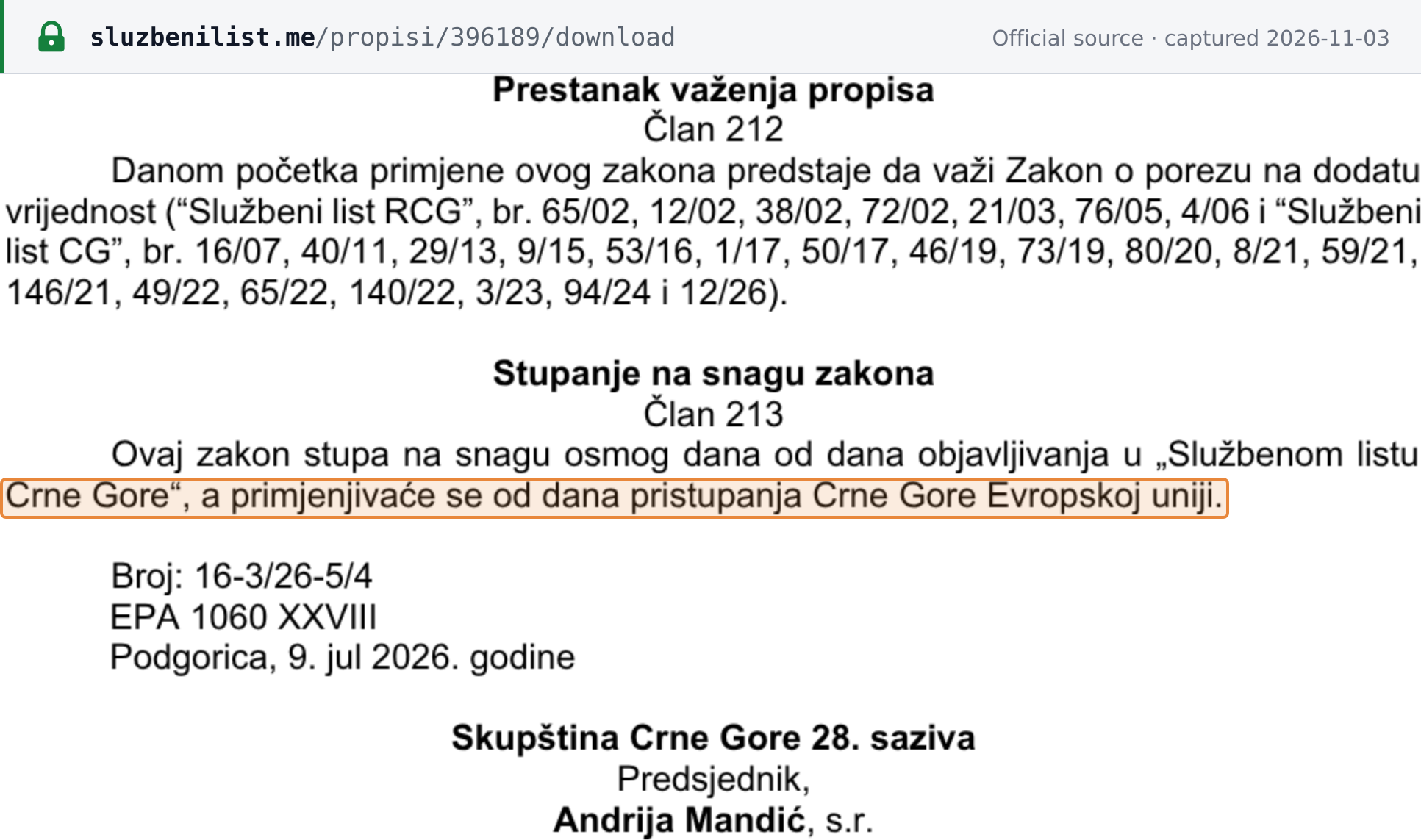
Article 213 of the 2026 law: "Ovaj zakon stupa na snagu osmog dana od dana objavljivanja u „Službenom listu Crne Gore“, a primjenjivaće se od dana pristupanja Crne Gore Evropskoj uniji." (This law enters into force on the eighth day after its publication in the Official Gazette of Montenegro, and shall apply from the day of Montenegro's accession to the European Union.)
Article 212 repeals the 2001 law only from that same day: "Danom početka primjene ovog zakona predstaje [sic] da važi Zakon o porezu na dodatu vrijednost …" (On the day this law begins to apply, the Law on Value Added Tax … ceases to have effect.)
 Source snapshot captured 2026-11-03 — original
The implementing Rulebook on the application of the Law on VAT (Službeni list CG 143/2026) follows the same pattern: in force since 9 October 2026, applied from EU accession, with the existing Rulebook remaining in use until then (Arts. 147–148). [11] The 2026 law keeps the 21%, 15% and 7% rates and the EUR 30,000 registration amount, so the headline figures below do not change on accession.
Authority, currency, period and layering
- Authority. VAT is administered by the Poreska uprava (Tax Administration). The Government appointed its director on 19 March 2026 (Službeni list CG 43/2026). Import VAT is collected by the Customs Administration (Uprava carina) under customs rules. [21]
- Currency. The euro (EUR). A value expressed in another currency is converted at the Central Bank of Montenegro's middle rate on the day the tax liability arises (Art. 23(2)); imports follow customs rules. [1]
- Tax period. "Poreski period je period od prvog do zadnjeg dana u mjesecu (kalendarski mjesec)." (The tax period is the period from the first to the last day of the month (calendar month).) (Art. 33(2)). [1]
- Layering. None. VAT is a single national tax; there is no regional or municipal VAT.
For neighbouring systems, see the Serbia VAT guide, the Croatia VAT guide and the North Macedonia VAT guide.
Registration
Who should register
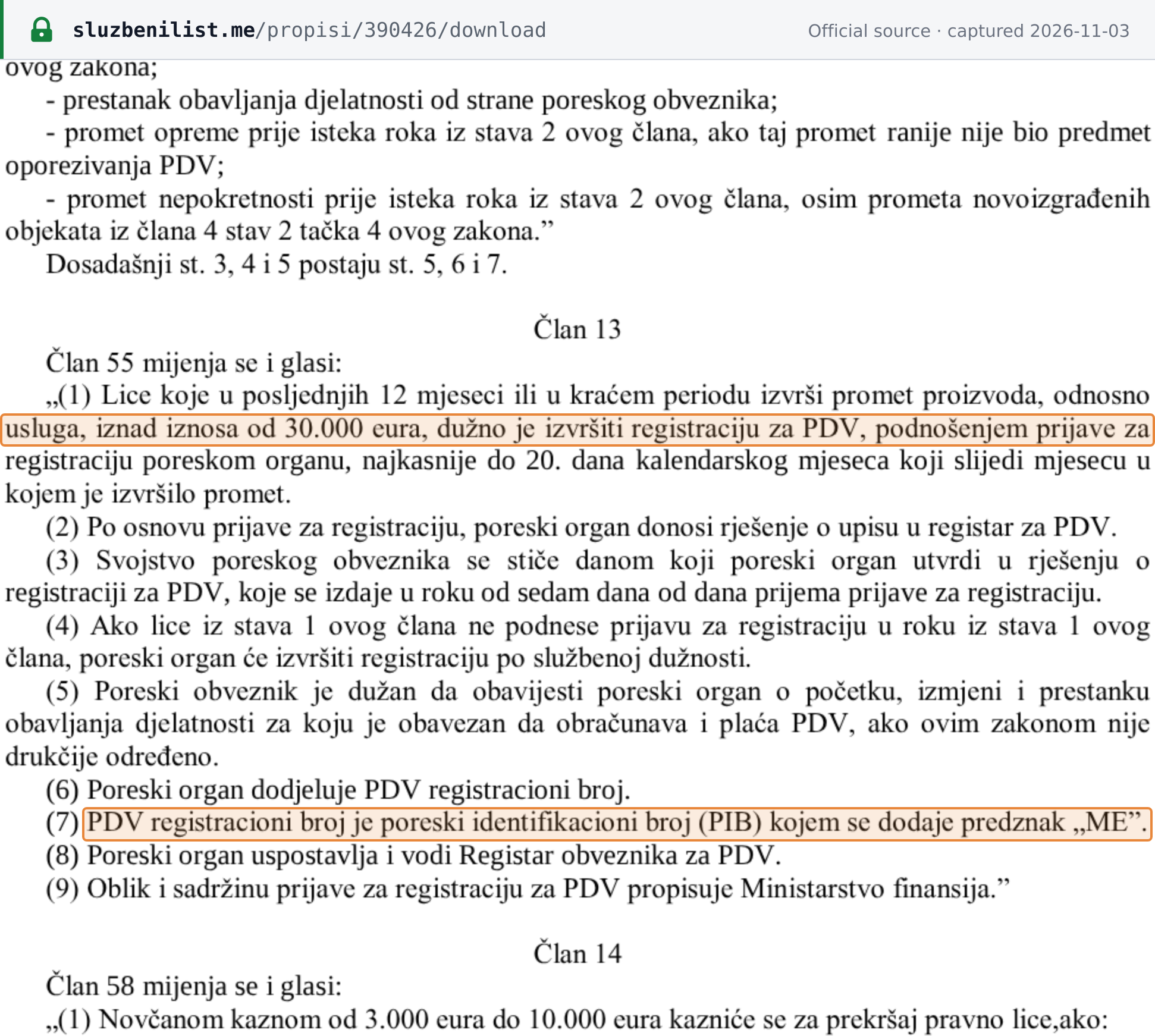
A person must register for VAT once its supplies of goods or services exceed EUR 30,000 in the last 12 months or a shorter period (as at 2026-11-03). The application is due by the 20th day of the month following the month in which the supplies were made. The tax authority issues a registration decision within seven days of receiving the application, and taxpayer status starts on the date set in that decision. If the person does not apply, the authority registers it ex officio (Art. 55(1)–(4), as rewritten by Službeni list CG 12/2026, in force since 6 February 2026). [9]
Art. 55(1): "Lice koje u posljednjih 12 mjeseci ili u kraćem periodu izvrši promet proizvoda, odnosno usluga, iznad iznosa od 30.000 eura, dužno je izvršiti registraciju za PDV, podnošenjem prijave za registraciju poreskom organu, najkasnije do 20. dana kalendarskog mjeseca koji slijedi mjesecu u kojem je izvršilo promet." (A person who in the last 12 months or a shorter period makes supplies of goods or services above EUR 30,000 must register for VAT by filing a registration application with the tax authority no later than the 20th day of the calendar month following the month in which it made the supplies.)
A registered taxpayer must also notify the tax authority when it starts, changes or stops the activity on which it charges VAT (Art. 55(5)).
Registration threshold
| Item | Rule (as at 2026-11-03) |
|---|---|
| Amount | EUR 30,000 of supplies of goods and services |
| Period | Rolling: the last 12 months, or a shorter period |
| Deadline to apply | 20th day of the month after the month in which the threshold was exceeded |
| Authority's decision | Within 7 days of the application |
| Non-residents | No threshold (Art. 42(4)) |
The same EUR 30,000 amount defines the small-business exemption: a person whose turnover over the last 12 months does not exceed, and is not likely to exceed, that amount is not a VAT taxpayer, may not show VAT on its invoices and has no right to deduct input VAT (Art. 42(1)–(2)). The amount was raised from EUR 18,000 to EUR 30,000 by Službeni list CG 59/2021. [6] [1]
 Source snapshot captured 2026-11-03 — original
Non-resident registration
- No threshold. "Odredbe ovog člana ne odnose se na poreske obveznike kojima je sjedište izvan Crne Gore." (The provisions of this Article do not apply to taxpayers whose seat is outside Montenegro.) (Art. 42(4)). The EUR 30,000 exemption is therefore not available to a foreign business. [1]
- Tax representative. A taxpayer with no seat, business unit, or permanent or habitual residence in Montenegro that makes supplies in Montenegro accounts for VAT through a tax representative it appoints. If it appoints none, the Montenegrin recipient of the goods or services pays the VAT (Art. 12(1)(2)). [1]
- Foreign B2C service providers (since 6 February 2026). Where services are supplied to a non-taxable person whose seat, domicile or residence is in Montenegro, and the place of supply is fixed there by Art. 17(2)–(5) or Arts. 17c–17j, the provider "dužan je da osnuje stalnu poslovnu jedinicu ili imenuje zastupnika u Crnoj Gori" (must establish a permanent business unit or appoint a representative in Montenegro) (Art. 12(2), added by Službeni list CG 12/2026). [9]
Tax identification number
Since 6 February 2026 the VAT registration number is the PIB (poreski identifikacioni broj, tax identification number) with the prefix "ME": "PDV registracioni broj je poreski identifikacioni broj (PIB) kojem se dodaje predznak „ME”." (Art. 55(7)). The tax authority assigns the number and keeps the Register of VAT taxpayers (Art. 55(6), (8)). Taxpayers that already had a VAT registration number receive a new one ex officio (Art. 72c). [9]
The PIB's format and how to check one are covered on the Montenegro tax identification number guide. To test a number's structure, use the Montenegro PIB validator.
How to register
Registration is by an application (prijava za registraciju) to the tax authority. The Ministry of Finance prescribes the form and its content (Art. 55(9)). [9] The Law on VAT does not itself name the portal, the supporting documents or a filing channel.
Voluntary registration
Available. A person under the threshold may, at its discretion, ask the tax authority to start charging and paying VAT. On a written request the authority enters it in the VAT register "za period koji ne može biti kraći od tri godine" (for a period that may not be shorter than three years) (Art. 42(3)). [1] Registering lets a business deduct input VAT.
Deregistration
On request, a taxpayer whose turnover in the last 12 months or the last calendar year stayed below the Art. 42(1) amount (now EUR 30,000) may be deregistered. A taxpayer that stops its activity is deregistered ex officio. Before deregistration it must calculate and pay VAT on goods acquired up to the deregistration date and take an inventory of its stock; the decision issues once those liabilities are settled (Art. 56(1)–(4)). [1]
Group registration
Not available. The Law on VAT as currently applied contains no VAT-grouping provision, and none of its amending acts up to Službeni list CG 12/2026 adds one. (Checked 2026-11-03.)
Rates
| Rate | Applies to (examples) | In force since | Source |
|---|---|---|---|
| 21% (opšta stopa, general rate) | All supplies of goods and services and imports not listed at a reduced or zero rate | 1 January 2018 | Službeni list CG 50/2017 |
| 15% (snižena stopa) | Books; hospitality accommodation; food and drink served in hospitality establishments (not alcohol, sugared drinks or coffee); cultural and sporting admissions; marinas; solar panels; hairdressing | 1 January 2025 | Službeni list CG 94/2024 |
| 7% (snižena stopa) | Basic foodstuffs; medicines; orthotic, prosthetic and implanted medical devices; textbooks; drinking water; newspapers; public passenger transport; menstrual products; baby nappies | List restated from 1 January 2025 | Službeni list CG 94/2024 |
| 0% (nulta stopa) | Exports; international transport and related services; supplies into free zones and customs warehouses; medicines on the Health Insurance Fund list | 1 July 2002 (list amended since) | Law on VAT 2001, Art. 25, as amended |
All rates as at 2026-11-03.
Standard rate
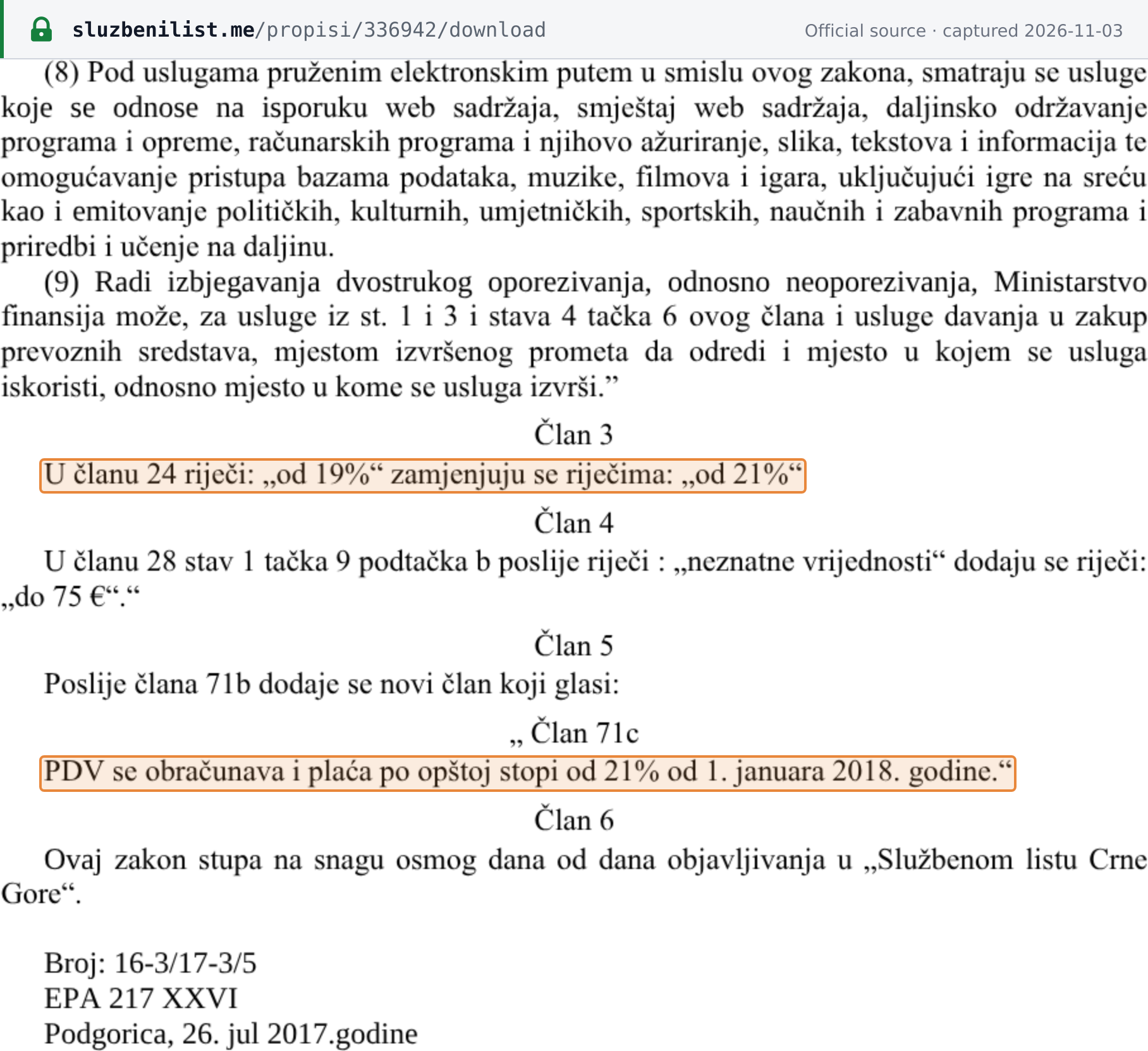
21%, in effect since 1 January 2018 (previously 19%). Art. 24 applies it to every supply of goods and services and every import, except supplies at a reduced rate or at the zero rate. Službeni list CG 50/2017 replaced "od 19%" with "od 21%" in Art. 24 and added Art. 71c: "PDV se obračunava i plaća po opštoj stopi od 21% od 1. januara 2018. godine." (VAT is calculated and paid at the general rate of 21% from 1 January 2018.) [4]
 Source snapshot captured 2026-11-03 — original
Reduced rates: 15% and 7%
Both reduced rates sit in Art. 24a, restated by Službeni list CG 94/2024 and applied from 1 January 2025. The Ministry of Finance publishes the item-level list (Art. 24a(3)) in the Rulebook on goods and services taxed at the reduced rate (Službeni list CG 117/2024, amended by 28/2025). [8] [18] [19]
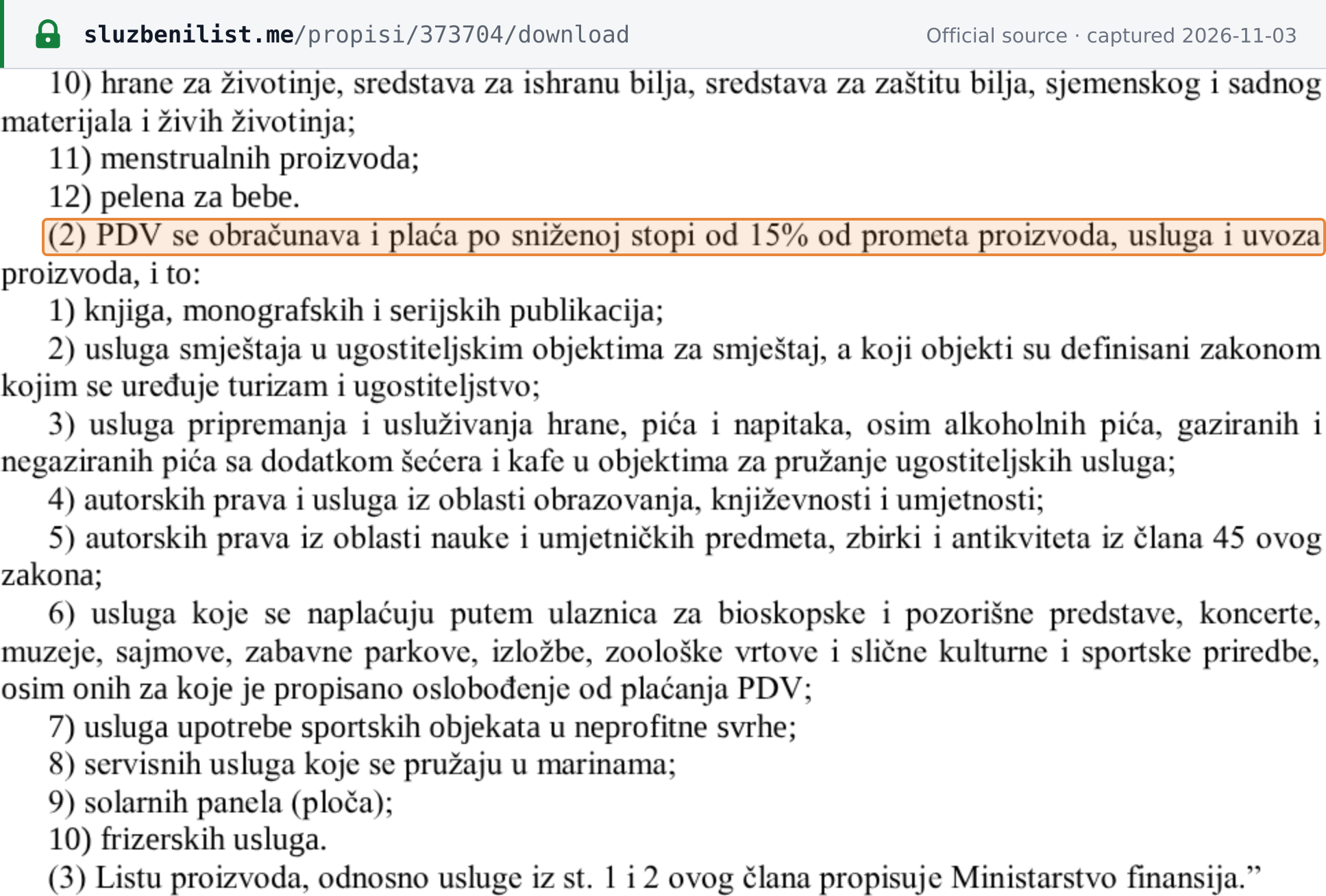
15% (Art. 24a(2)): books and monographic and serial publications; accommodation in hospitality accommodation facilities; preparing and serving food, drinks and beverages in hospitality establishments, "osim alkoholnih pića, gaziranih i negaziranih pića sa dodatkom šećera i kafe" (except alcoholic drinks, carbonated and non-carbonated drinks with added sugar, and coffee); copyrights and services in education, literature and art; copyrights in science, works of art, collections and antiques; admission to cinemas, theatres, concerts, museums, fairs, amusement parks, exhibitions, zoos and similar events (unless exempt); use of sports facilities for non-profit purposes; services in marinas; solar panels; hairdressing. The marina item applies only until EU accession (Art. 71i).
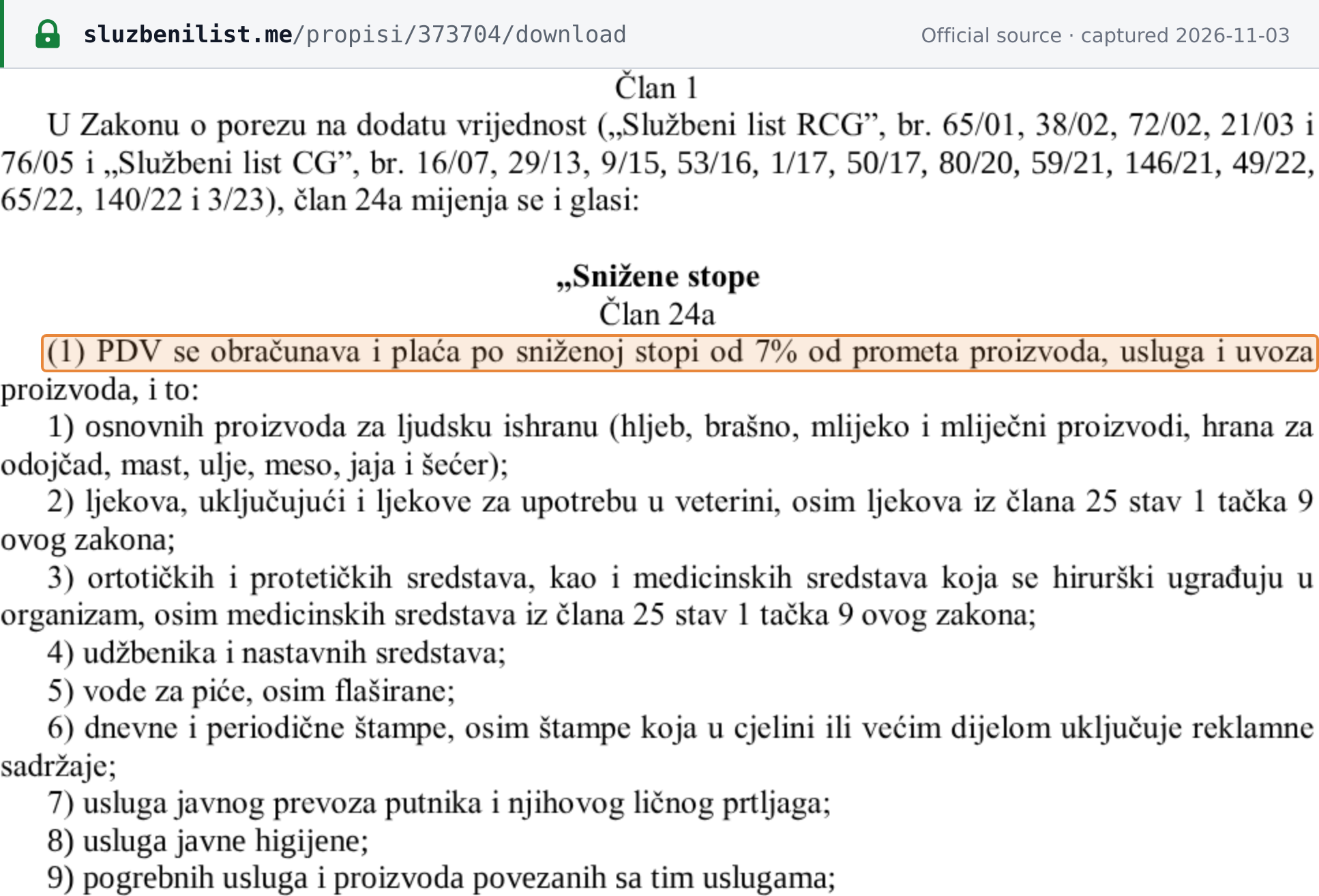
7% (Art. 24a(1)): basic foodstuffs (bread, flour, milk and dairy products, infant food, fat, oil, meat, eggs and sugar); medicines, including veterinary medicines, other than those zero-rated under Art. 25(1)(9); orthotic and prosthetic devices and surgically implanted medical devices; textbooks and teaching aids; drinking water except bottled water; daily and periodical press (unless mainly advertising); public passenger transport and passengers' luggage; public hygiene services; funeral services and related goods; animal feed, plant nutrition and protection products, seeds and planting material, and live animals; menstrual products; baby nappies.
 Source snapshot captured 2026-11-03 — original
 Source snapshot captured 2026-11-03 — original
Zero rate
Art. 25 ("Nulta stopa") sets 0% for, among others: goods exported by the seller or on its behalf; services directly linked to exports and imports; work on goods imported for processing and re-exported; supplies for sea-going vessels and international air and sea transport; supplies to diplomatic and consular missions and international organisations (on reciprocity); medicines and medical devices on the Health Insurance Fund list (Art. 25(1)(9)); supplies into free zones and customs warehouses (Art. 25(1)(11)); and donor-funded supplies under international agreements. [1] [2]
Two former zero-rate items no longer apply. The 0% rate for bread, flour and sunflower oil (Art. 25(1)(12d)) ceased to have effect on 31 December 2022 (Art. 71f, Službeni list CG 65/2022). The 0% item for construction of five-star hotels and major investments (Art. 25(1)(10a)) was deleted from 1 January 2025 (Službeni list CG 94/2024, Art. 2). [23] [8]
Input VAT on zero-rated supplies is deductible (Art. 37(4)(1)); see Exemptions.
Announced rate changes
None as at 2026-11-03. The only scheduled change is structural: on EU accession the 2026 Law on VAT replaces the current law, keeping the 21%, 15% and 7% rates. That law also taxes at 7% the medicines and medical devices on a list set by Government decision (Art. 66: "odredjena listom ljekova, odnosno medicinskih sredstava na osnovu odluke koju donosi Vlada"), where today medicines and medical devices on the Health Insurance Fund list are zero-rated under Art. 25(1)(9). [10]
Cross-border rules
Imports and exports
- Imports. "PDV pri uvozu proizvoda obračunava se i plaća kao da je to uvozna dažbina, na način predviđen carinskim propisima." (VAT on imports of goods is calculated and paid as if it were an import duty, in the manner laid down by customs regulations.) (Art. 36(3)). The importer or the recipient of the goods is liable (Art. 12(1)(5)). [1]
- Import exemptions are listed in Art. 28, rewritten by Službeni list CG 94/2024. They include goods whose domestic supply is exempt, goods in transit, re-imported goods, and free consignments sent by private individuals abroad to private individuals in Montenegro "pod uslovom da te pošiljke nijesu komercijalne prirode i da odgovaraju propisanoj vrsti, količini i vrijednosti" (provided they are not of a commercial nature and correspond to the prescribed type, quantity and value) (Art. 28(1)(9)). The rewritten Art. 28 contains no general low-value exemption for commercial consignments. [8]
- Exports are zero-rated (Art. 25(1)(1)). Goods count as exported when actually taken out of Montenegro, or when placed in a free customs zone or customs warehouse for export (Art. 25(3)). [1]
Place of supply
Since 6 February 2026 the place-of-supply rules for services are set out in Arts. 17–17j, as rewritten by Službeni list CG 12/2026; the B2B and B2C general rules and the consumer-location list date from Službeni list CG 50/2017: [9] [4]
- B2B general rule: where the recipient taxable person has its seat, or the fixed establishment the service is supplied to (Art. 17(2)–(4)).
- B2C general rule: where the supplier has its seat (Art. 17(5)).
- Exceptions: immovable property, where the property is (Art. 17a); passenger transport, in proportion to the distance covered (Art. 17b); events, where performed, and virtual events supplied to consumers, where the consumer is (Art. 17c); restaurant and catering, where performed (Art. 17e); short-term hire of means of transport, where made available (Art. 17f); intermediaries (Art. 17h); and a use-and-enjoyment override (Art. 17j).
- Consumer-location services: telecommunications, broadcasting and electronic services to a non-taxable person are supplied "u kojem primalac usluga koji nije poreski obveznik ima sjedište, prebivalište ili boravište" (where the non-taxable recipient has its seat, domicile or residence) (Art. 17g(1)). Art. 17i applies the same rule to services such as intellectual property, advertising, services of consultants, engineers, lawyers, auditors and translators, financial and insurance services, staffing and hire of movable goods.
For goods, the tax applies to supplies made in Montenegro and to imports; a supply of goods from abroad is taxed through import VAT at customs.
Digital products and services
Electronic, telecommunications and broadcasting services supplied to Montenegrin consumers are taxed in Montenegro (consumer-location rule since Sl. list CG 50/2017, now Art. 17g). Since 6 February 2026 the foreign provider must also establish a permanent business unit or appoint a representative in Montenegro (Art. 12(2)). No turnover threshold applies to it, because the EUR 30,000 exemption excludes taxpayers seated outside Montenegro (Art. 42(4)). [4] [9] [1]
Foreign companies selling into Montenegro — B2B and B2C
- B2B services. Supplied where the Montenegrin customer has its seat (Art. 17(2)). The foreign supplier may appoint a tax representative; if it does not, the Montenegrin recipient pays the VAT (Art. 12(1)(2)). For a supply where the recipient is liable, the tax point is when the recipient receives the invoice or pays, whichever is earlier; with no invoice, the 8th day after the supply (Art. 18(8), added by Službeni list RCG 76/2005). [1] [2]
- B2B goods. Taxed through import VAT at customs when the goods enter Montenegro (Art. 36(3)).
- B2C services. For electronic, telecommunications and broadcasting services and the other consumer-location services, the foreign provider must establish a business unit or appoint a representative in Montenegro from the first supply, with no threshold (Arts. 12(2) and 42(4)). A legal person that fails to do so faces a fine of EUR 3,000 to EUR 10,000 (Art. 58(1)(1)). [9]
Marketplace / platform deemed-supplier liability
Not in the current law. The Law on VAT as applied on 2026-11-03 contains no rule making a platform the deemed supplier of goods or services sold through it. Deemed-supplier rules for platforms appear in the 2026 Law on VAT, which applies only from EU accession.
Reverse charge on the invoice
A taxpayer supplying services whose place of supply under Arts. 17–17j is not Montenegro must state on the invoice "prenos poreske obaveze" (transfer of tax liability) (Art. 32(7)). The same wording is required on supplies of natural gas, electricity, and heating or cooling energy to a taxpayer that is not the final consumer (Art. 32(8)). Both paragraphs were set by Službeni list CG 12/2026. [9]
Invoice requirements
When an invoice is issued
A taxpayer must issue an invoice (račun), or another document serving as one, for every supply of goods or services, in two copies (Art. 31(1), as amended by Službeni list CG 3/2023). It must also issue one for every advance payment received before the supply and for every later change of the tax base (Art. 31(2)). Any document on which a supply is charged counts as an invoice, whatever its form or title, including one issued by another person on the taxpayer's instructions (Art. 31(3)). [1] [7]
The invoice must be issued whether or not the buyer asks for it. Failing to do so is fined under Art. 58(1)(2) (see Offences and penalties).
Invoices issued by a fiscalisation obligor (Fiscalisation Law Art. 4: persons liable to Montenegrin income or profit tax that must issue invoices) are fiscal invoices: under the Law on Fiscalisation in the Turnover of Products and Services, each is signed electronically and reported to the Tax Administration in real time before it is handed over (see E-invoicing status). [12]
Mandatory content
Two laws set the content, and an invoice needs both sets of particulars.
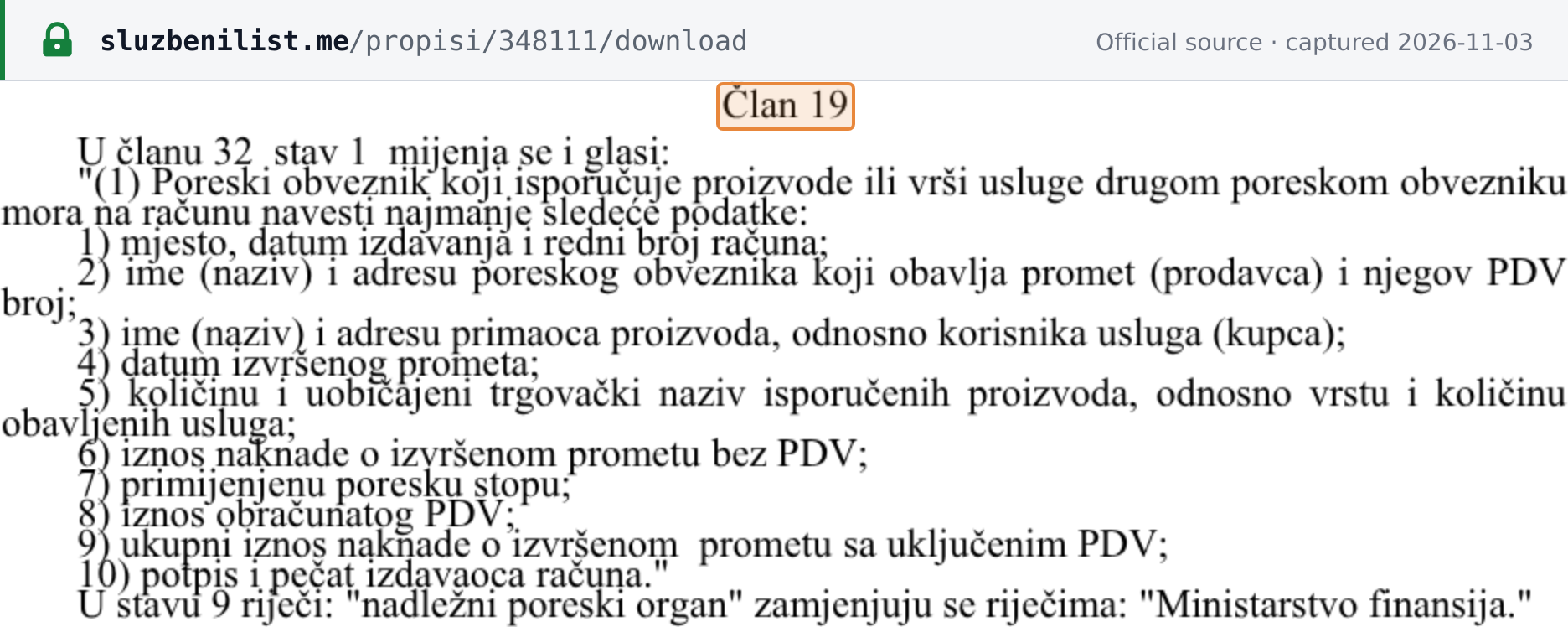
1. Law on VAT, Art. 32(1) — a taxpayer supplying another taxpayer must show at least (wording of Službeni list RCG 76/2005, as amended by Službeni list CG 3/2023): [2] [7]
| Point | Particular |
|---|---|
| 1 | Date of issue and serial number of the invoice |
| 2 | Name and address of the supplier, and its VAT number |
| 3 | Name and address of the recipient (buyer) |
| 4 | Date of the supply |
| 5 | Quantity and usual trade name of the goods, or type and quantity of the services |
| 6 | Consideration excluding VAT |
| 7 | VAT rate applied |
| 8 | Amount of VAT |
| 9 | Total consideration including VAT |
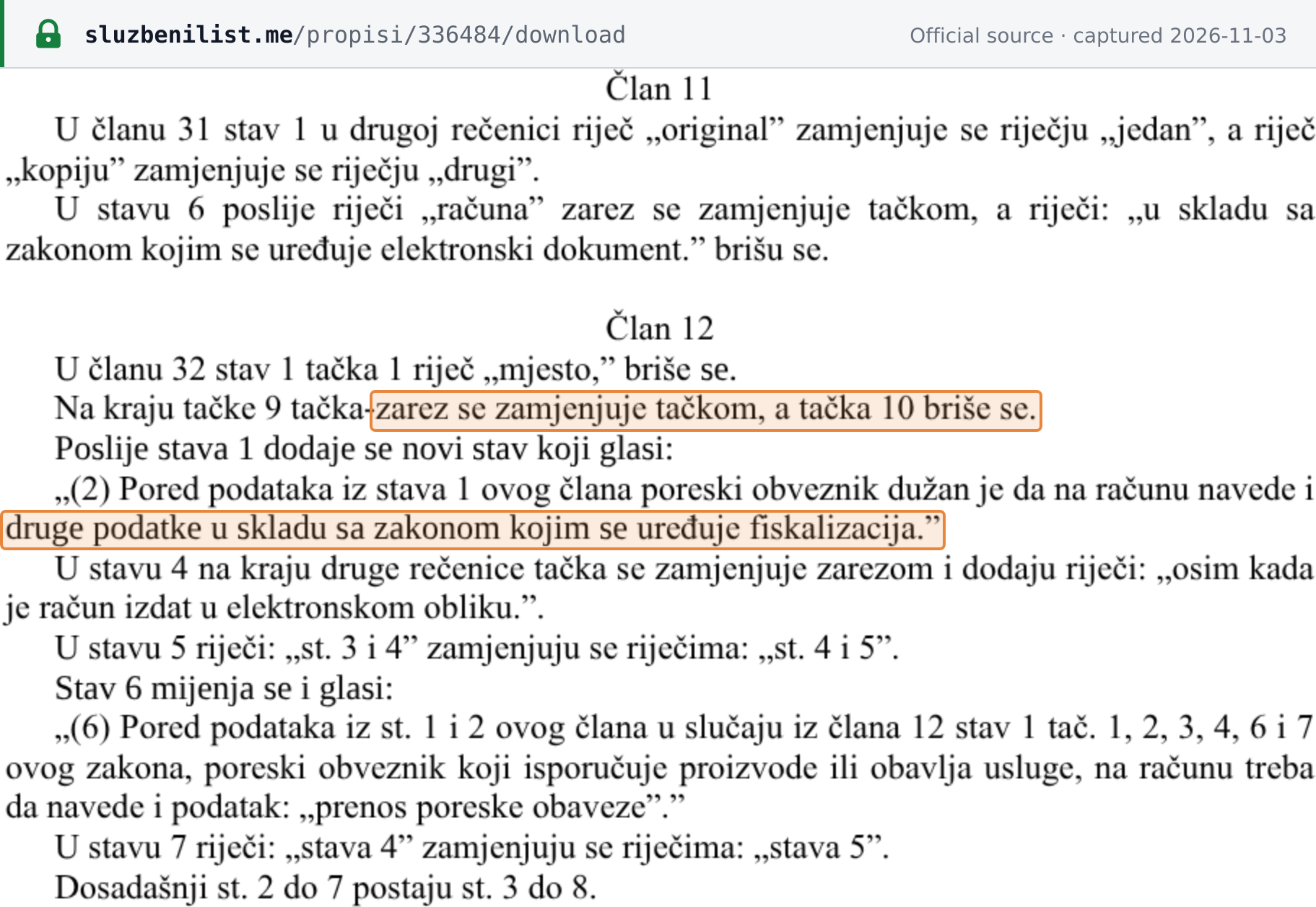
Službeni list CG 3/2023 deleted the former requirement to show the place of issue and the former point 10, the signature and stamp of the issuer. It added Art. 32(2): "Pored podataka iz stava 1 ovog člana poreski obveznik dužan je da na računu navede i druge podatke u skladu sa zakonom kojim se uređuje fiskalizacija." (In addition to the data in paragraph 1, the taxpayer must also state on the invoice other data in accordance with the law governing fiscalisation.)
 Source snapshot captured 2026-11-03 — original
 Source snapshot captured 2026-11-03 — original
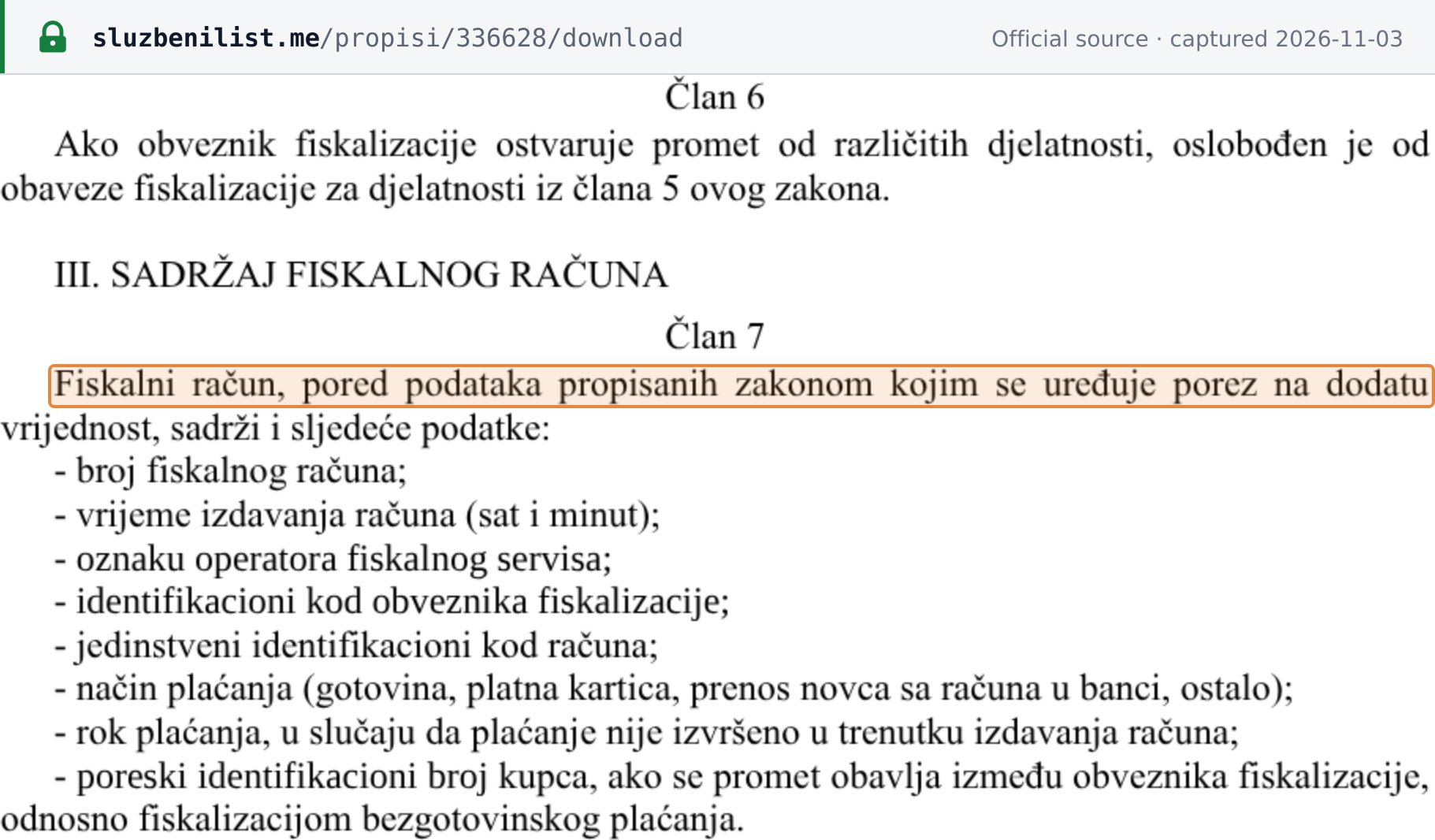
2. Law on Fiscalisation, Art. 7 — "Fiskalni račun, pored podataka propisanih zakonom kojim se uređuje porez na dodatu vrijednost, sadrži i sljedeće podatke" (In addition to the data required by the VAT law, a fiscal invoice also contains the following data): [12]
| Particular | Montenegrin wording |
|---|---|
| Fiscal invoice number | broj fiskalnog računa |
| Time of issue (hour and minute) | vrijeme izdavanja računa (sat i minut) |
| Operator code, linked to the person issuing the invoice (Art. 8) | oznaka operatora |
| The issuer's identification code (commonly called IKOF) | identifikacioni kod obveznika fiskalizacije |
| The unique invoice identification code (commonly called JIKR), returned by the Tax Administration | jedinstveni identifikacioni kod računa |
| Payment method: cash, payment card, bank transfer, other | način plaćanja |
| Payment due date, where not paid on issue | rok plaćanja |
| Buyer's tax identification number, for supplies between fiscalisation obligors and non-cash payments | poreski identifikacioni broj kupca |
Both codes are printed on the invoice when it is issued (Art. 13).
 Source snapshot captured 2026-11-03 — original
Additional wording, where it applies:
- Exempt or zero-rated supply: the invoice states that VAT was not charged and cites the article of the Law on VAT that sets the exemption or zero rate. [1]
- Reverse charge: "prenos poreske obaveze" (Art. 32(7)–(8); see Reverse charge on the invoice).
Issuance deadline
The Law on VAT sets no separate deadline in days for issuing an invoice. Instead, the supply is deemed made when the invoice is issued, and "Ako račun iz stava 2 ovog člana nije izdat, PDV se obračunava osam dana od dana isporuke proizvoda, odnosno izvršenja usluge." (If no invoice is issued, VAT is calculated eight days from the supply of the goods or performance of the services.) (Art. 18(2)–(3)). An advance is taxed on the day it is received (Art. 18(4)). [1]
Numbering and sequencing
The fiscal invoice number is built from numeric marks for the invoice, the business premises, the calendar year in which the invoice is issued and the electronic payment device (Fiscalisation Law Art. 9(1)–(2), as amended by Službeni list CG 8/2021). The invoice mark "je neprekidni numerički niz" (is an unbroken numeric series) per business premises and device; it starts at 1 at the beginning of each calendar year and runs to n at its end (Art. 9(3)–(4)). [12] [14] The Ministry of Finance's rulebook on fiscal messages (Službeni list CG 54/2020) shows the printed form with the example "1234567890/POSL1/12", which predates the year mark added in 2021. [15]
Credit and debit notes
There is no separate credit-note document. An invoice is issued for every later change of the tax base (Art. 31(2)), and VAT is adjusted on the day the invoice or other document on the change is issued (Art. 18(7)). [1] The Law on Fiscalisation applies equally to "računa kojim se stornira prethodni račun i računa u kojem se iskazuje povraćaj robe ili usluga u cjelosti ili djelimično" (invoices cancelling a previous invoice and invoices showing a full or partial return of goods or services) (Art. 21), so corrections are fiscalised too. [12]
Bad debts. A taxpayer may reduce the VAT on a claim that remains unpaid after a final court decision closing bankruptcy, halting enforcement or confirming a compulsory settlement (Art. 20a, added by Službeni list RCG 76/2005). Since 6 February 2026 the rewritten Art. 20a (Službeni list CG 12/2026) also requires that the claim was sued for before those proceedings began. [2] [9]
Currency, language and exchange rate
- Currency. EUR. A foreign-currency value is converted at the Central Bank of Montenegro's middle rate on the day the tax liability arises (Art. 23(2)). [1]
- Language. Neither the Law on VAT nor the Law on Fiscalisation contains a rule on the language of an invoice. (Checked 2026-11-03.)
Document types
- Full invoice to another taxpayer: the Art. 32(1) particulars plus the fiscal particulars.
- Invoice to a non-taxable person (B2C): may leave out the buyer's details and the separate net amount, but must show the VAT-inclusive price and the VAT included (Art. 32(4), as renumbered by Službeni list CG 3/2023). [1] There is no separate simplified invoice with a value threshold.
- Electronic invoice: allowed "uz prethodnu saglasnost primaoca računa" (with the prior consent of the invoice recipient) (Art. 31(6), set by Službeni list CG 80/2020). [5]
- Outside fiscalisation: passenger-transport tickets and tokens, farmers selling their own produce at markets, purchases of farm produce from farmers, universal postal services, banking and insurance, stakes in games of chance, and in-flight sales by the national carrier (Fiscalisation Law Art. 5). [12]
Self-billing
Neither the Law on VAT nor the Law on Fiscalisation contains a self-billing procedure. (Checked 2026-11-03.) Art. 31(3) counts as an invoice a document issued "by another person on its instructions", but sets no conditions for buyer-issued invoices.
Retention and audit trail
- Retention. All received and issued invoices, invoice corrections, VAT returns and other accounting documents are kept "najmanje 5 godina po isteku godine na koju se te isprave odnose" (for at least 5 years after the end of the year to which they relate), and documents on the taxation of immovable property for at least 20 years (Art. 54(1)–(2)). Taxpayers keep a book of issued invoices and a book of received invoices (Art. 53(4)). [1]
- Audit trail. Each fiscal invoice is signed with an electronic signature and sent to the Tax Administration through the fiscal service "u realnom vremenu korišćenjem stalne internet veze" (in real time using a permanent internet connection) (Fiscalisation Law Art. 12(1)). The invoicing software must not allow fiscalisation to be bypassed (Art. 11(1)), and buyers can check within 90 days of issue whether their invoice was reported (Art. 22), in the manner set by the Ministry of Finance's rulebook. [12] [16]
- E-archiving. The Law on VAT contains no separate electronic-archiving rule. (Checked 2026-11-03.)
A specimen of a compliant invoice
The Official Gazette's fiscalisation rulebooks of 2020 contain message tables but no rendered invoice, and no official specimen fiscal invoice was found. The illustration below places the Art. 32(1) and Art. 7 particulars on a non-cash B2B fiscal invoice.
Fiscal invoice (fiskalni račun), non-cash B2B supply — illustrative
| Goods / servicesVAT Art. 32(1)(5) | QtyVAT Art. 32(1)(5) | Net amountVAT Art. 32(1)(6) | RateVAT Art. 32(1)(7) | VATVAT Art. 32(1)(8) |
|---|---|---|---|---|
| Printer paper A4, box of 5 reams | 10 | EUR 200.00 | 21% | EUR 42.00 |
| Book (monograph), Example Title | 5 | EUR 150.00 | 15% | EUR 22.50 |
| Textbook, Example Course | 10 | EUR 120.00 | 7% | EUR 8.40 |
- Total excluding VATVAT Art. 32(1)(6)
- EUR 470.00
- VAT 21% on EUR 200.00VAT Art. 32(1)(7)–(8)
- EUR 42.00
- VAT 15% on EUR 150.00VAT Art. 32(1)(7)–(8)
- EUR 22.50
- VAT 7% on EUR 120.00VAT Art. 32(1)(7)–(8)
- EUR 8.40
- Total including VATVAT Art. 32(1)(9)
- EUR 542.90
- Issuer identification code (IKOF): printed on the invoice — placeholder, not a real code (Fisc. Art. 7, Art. 13).
- Unique invoice identification code (JIKR): returned by the Tax Administration when the invoice is reported in real time and printed on the invoice — placeholder, not a real code (Fisc. Art. 7, Art. 12–13).
- The fiscal number combines the invoice, business-premises, year and payment-device marks (Fisc. Art. 9); the order shown here is illustrative.
- For a service whose place of supply is outside Montenegro, or energy supplied to a non-final consumer, add the wording "prenos poreske obaveze" (VAT Art. 32(7)–(8)).
- For an exempt or zero-rated line, state that VAT was not charged and cite the article of the Law on VAT that applies.
- The buyer may check within 90 days of issue that this invoice was reported to the Tax Administration (Fisc. Art. 22).
E-invoicing status
Status (as at 2026-11-03): real-time fiscalisation of all invoices is mandatory; there is no structured B2B or B2G e-invoice exchange mandate.
- Fiscalisation. The Law on Fiscalisation in the Turnover of Products and Services (Službeni list CG 46/2019, amended by 73/2019 and 8/2021) has applied since 1 January 2021. "Fiskalizacija je postupak koji sprovodi obveznik fiskalizacije gotovinskog i bezgotovinskog plaćanja dostavljanjem organu uprave, nadležnom za poslove naplate javnih prihoda (u daljem tekstu: Uprava) podataka o prometu proizvoda i usluga i fiskalnih računa u realnom vremenu, korišćenjem stalne internet veze i fiskalnog servisa." (Fiscalisation is the procedure by which the obligor, for cash and non-cash payments, delivers to the administrative body in charge of collecting public revenues data on supplies of goods and services and fiscal invoices in real time, using a permanent internet connection and the fiscal service.) (Art. 2). [12] [13] [14]
- Scope. B2C and B2B, cash and non-cash. Non-cash invoices between fiscalisation obligors carry the buyer's tax identification number (Art. 7). The exclusions are listed in Art. 5 (see Document types).
- How it works. The issuer signs each invoice electronically and sends it to the Tax Administration's fiscal service in real time; the service returns the unique invoice identification code, which is printed on the invoice (Arts. 12–13).
- Structured e-invoicing. The Official Gazette contains no law requiring structured electronic invoices (EN 16931, UBL or similar) to be exchanged between businesses or with public bodies: searches of sluzbenilist.me for "elektronskom fakturisanju" and "elektronskoj fakturi" on 2026-11-03 returned only the laws on electronic documents, electronic signatures, e-commerce and e-government. An electronic invoice may be issued with the recipient's prior consent (Law on VAT Art. 31(6)). [5]
For other countries, see e-invoicing status and networks worldwide.
Filing and payment
Filing frequency
Monthly, for every VAT taxpayer. The tax period is the calendar month (Art. 33), and the taxpayer reports its liability "u mjesečnoj prijavi za obračun PDV" (in a monthly VAT return) (Art. 35(1)). The Law on VAT has no quarterly or annual option. A return is due even when no VAT is payable for the period (Art. 35(3)). [1] The return form is set by the Rulebook on the form and content of the VAT return (Službeni list RCG 79/2005, as amended). [20]
Return and payment due date
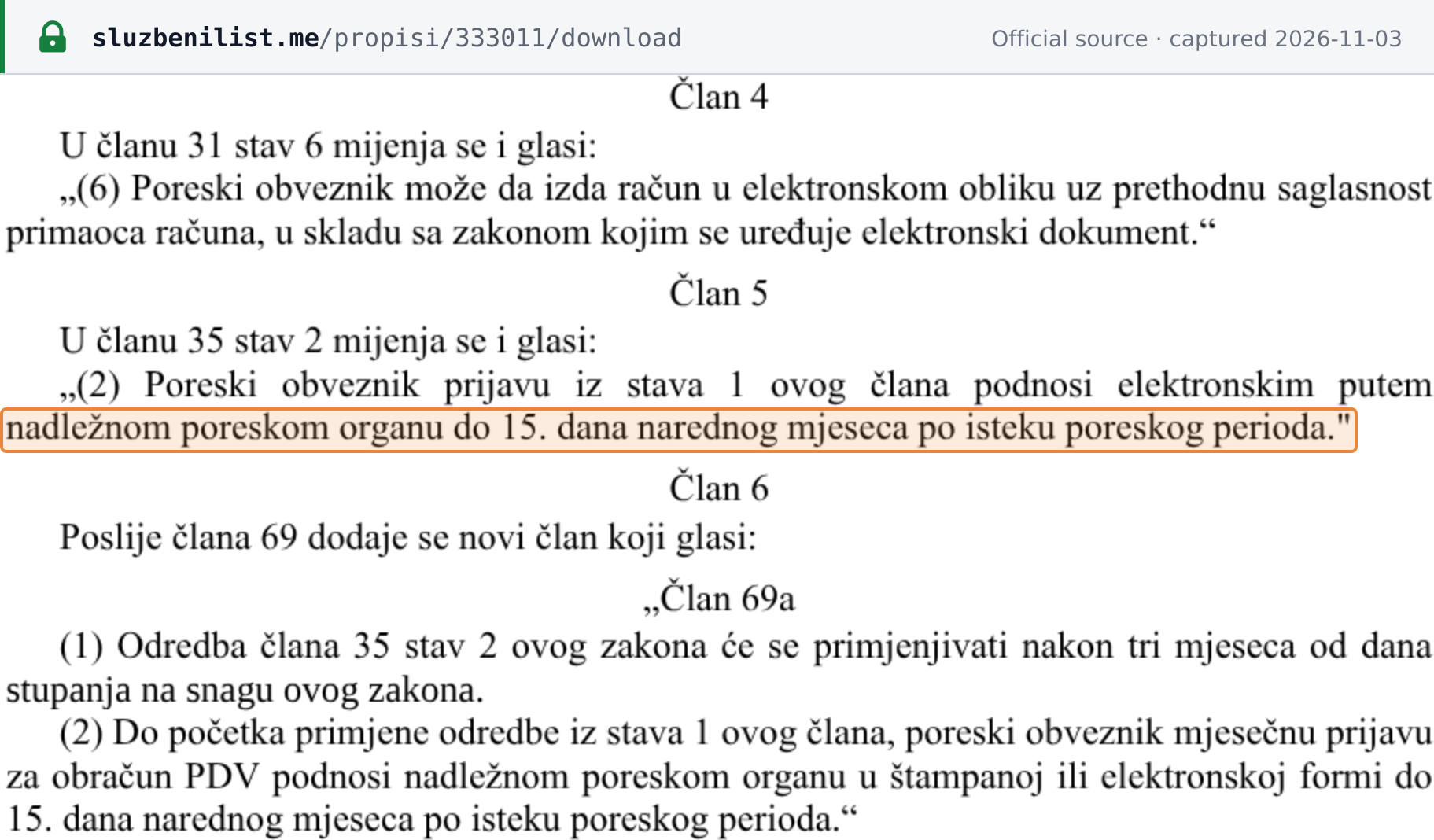
- Return: filed electronically by the 15th day of the month following the tax period (as at 2026-11-03): "Poreski obveznik prijavu iz stava 1 ovog člana podnosi elektronskim putem nadležnom poreskom organu do 15. dana narednog mjeseca po isteku poreskog perioda." (Art. 35(2), set by Službeni list CG 80/2020). [5]
- Payment: "Poreska obaveza za poreski period dospijeva za plaćanje 15. dana u mjesecu po isteku poreskog perioda." (The tax liability for a tax period falls due on the 15th day of the month after the end of the period.) (Art. 36(1)). Tax representatives and recipients liable under Art. 12 point 2 pay by the same date (Art. 36(2)). Import VAT is paid with customs duties. [1]
- No return filed: the tax authority may estimate the liability (Art. 35(6)).
 Source snapshot captured 2026-11-03 — original
Additional listings
Montenegro has no EC sales list, being outside the EU, and the Law on VAT requires no annual VAT return or separate sales or purchase listing. (Checked 2026-11-03.) Taxpayers keep a book of issued invoices and a book of received invoices (Art. 53(4)) and a separate record of import VAT (Art. 53(5)). Non-resident international road passenger carriers file a special registration and returns (Arts. 35a–35b, added by Službeni list CG 3/2023). [1] [7]
Input-tax recovery
Input VAT on purchases, imports and services used for taxable supplies is deductible (Art. 37(1)), including for zero-rated supplies (Art. 37(4)(1)), but not for exempt supplies (Art. 37(3)(1)). Deduction requires an invoice meeting Art. 32 or a customs declaration (Art. 37(6)) and is taken in the period the invoice is received (Art. 37(7)). [1]
Blocked input VAT (Art. 37(5)): [2] [7]
- pleasure boats, passenger cars and motorcycles, their fuel, lubricants, spare parts and closely related services, unless used for resale, rent-a-car, transport of persons and goods, taxi or driving schools;
- purchase of a newly built residential building (point 1a, added by Službeni list CG 3/2023);
- entertainment expenses (reprezentacija).
Refunds
- Residents. Excess input VAT is carried forward as a credit or, on request, refunded within 60 days of filing the return; within 30 days for taxpayers that mainly export or that show an excess in more than three consecutive returns (Art. 50(1)–(2), as amended by Službeni list RCG 76/2005). A refund is first set against other overdue taxes (Art. 50(3)). [2] [1]
- Non-residents. A taxpayer with no seat in Montenegro may reclaim Montenegrin input VAT charged on supplies or imports, under the conditions set by the law (Art. 51(1)); the detailed conditions, deadlines and minimum amounts are set by the Minister of Finance. [1]
- Bad-debt relief: see Credit and debit notes.
Exemptions
Exempt supplies
Exempt without the right to deduct input VAT (Arts. 26–27, as amended), for example: [1] [2]
- public postal services; health care and related goods; social insurance services;
- education and the services of schools; non-profit cultural and sporting services; religious services;
- insurance and reinsurance, including brokers' and agents' services;
- banking and financial services (credit, deposits, payments, currency, securities, fund management);
- "promet nepokretnosti, osim prvog prenosa prava svojine, odnosno prava raspolaganja na novoizgrađenom objektu" (supplies of immovable property, except the first transfer of ownership of a newly built building);
- letting of residential premises for more than 60 days, and leases of agricultural land and forest;
- games of chance; investment gold (Art. 49a, from 1 July 2023, with an option to tax). [22] [7]
Since 1 April 2026, sales of building land by a taxpayer are a taxable supply (Art. 4(2)(5) and Art. 72b, Službeni list CG 12/2026). [9]
Exempt is not zero-rated
The difference is input VAT. A taxpayer "ne smije odbiti ulazni PDV" (may not deduct input VAT) on purchases used for exempt supplies (Art. 37(3)(1)), but may deduct input VAT relating to zero-rated supplies under Art. 25, such as exports (Art. 37(4)(1)). [1]
Special regimes
- Small businesses: turnover up to EUR 30,000 in the last 12 months is outside VAT (Art. 42).
- Farmers: flat-rate VAT compensation of 8% since 1 January 2025, up from 5% (Art. 43(3), Službeni list CG 94/2024). [8]
- Margin schemes: second-hand goods, works of art, collectors' items and antiques (Arts. 45–47); auctioneers (Arts. 48–49).
- Investment gold: Art. 49a.
- Free zones and customs warehouses: 0% on supplies into them (Art. 25(1)(11)).
- Cash accounting: the Law on VAT contains no cash-accounting scheme. (Checked 2026-11-03.)
Offences and penalties
Offences
VAT offences are misdemeanours (prekršaji) punished by fixed fine ranges set separately for the legal person, the responsible person in it, and the entrepreneur. The conduct includes:
- Under the Law on VAT, Art. 58(1) (as rewritten by Službeni list CG 12/2026): a foreign B2C service provider not setting up a business unit or representative; not issuing an invoice, whether or not the buyer asked for it; not displaying the notice on issuing and taking invoices at each point of sale; a non-resident road passenger carrier not pre-registering; not filing the VAT return, or filing it late; late notice of the special scheme; not applying for registration by the 20th of the month after exceeding EUR 30,000; not notifying the start, change or end of the activity. [9]
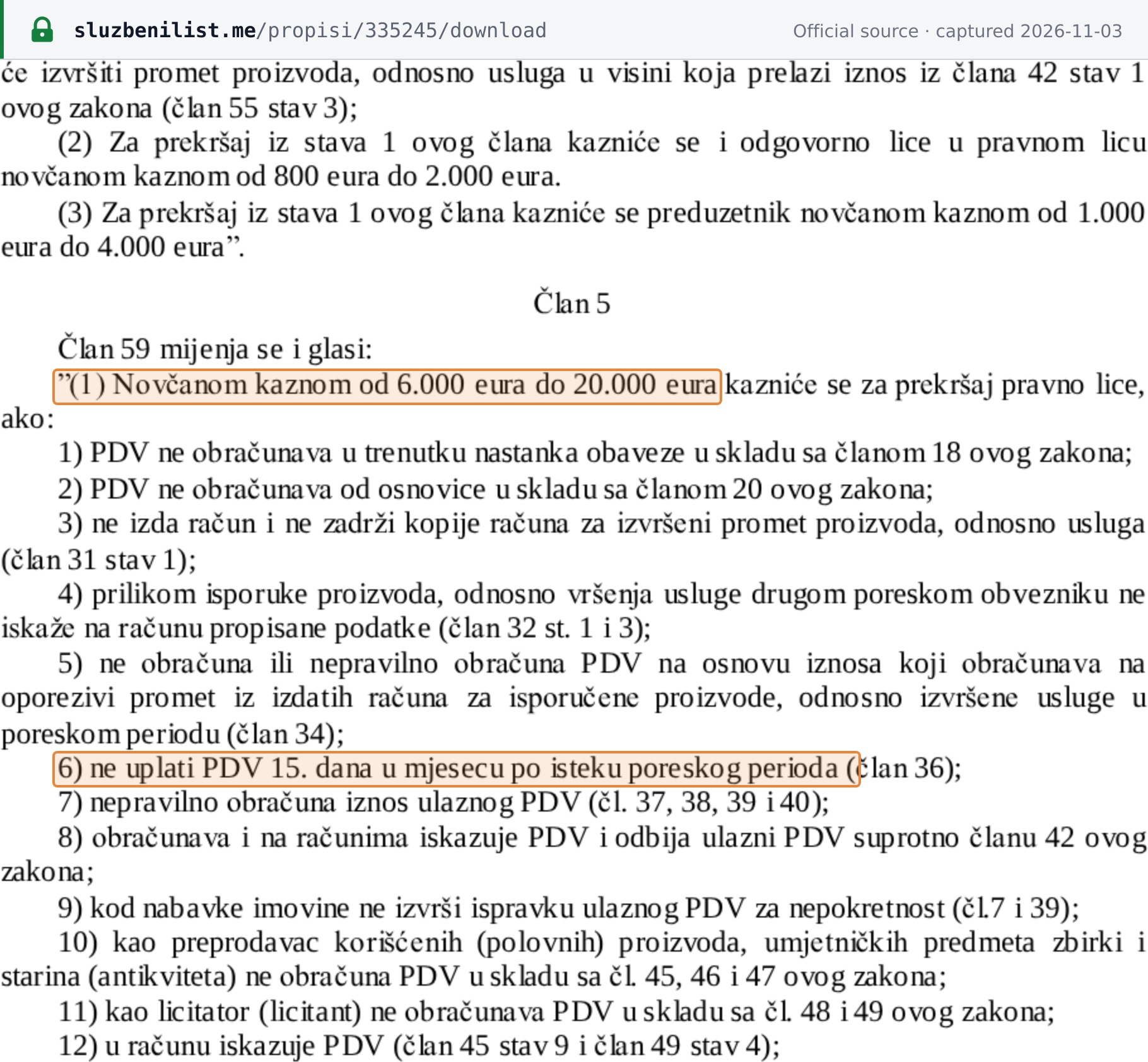
- Under the Law on VAT, Art. 59(1) (as rewritten by Službeni list CG 29/2013): not calculating VAT at the tax point or on the correct base; not issuing an invoice or not keeping it; not showing the prescribed invoice particulars; miscalculating output or input VAT; not paying VAT by the 15th; a small business charging VAT; margin-scheme and auction errors; not keeping the books of issued and received invoices; not keeping records for the prescribed period. [3] [7]
- Under the Law on Fiscalisation, Arts. 26–28: not issuing fiscal invoices through the fiscal service; using software that lets fiscalisation be avoided; issuing an invoice without the Art. 7 particulars; and failures concerning operator codes and certificates. [12]
Any criminal liability for tax evasion would arise under the Criminal Code of Montenegro rather than the Law on VAT; this guide does not cover it.
Penalties
| Offence | Legal person | Responsible person | Entrepreneur | Source |
|---|---|---|---|---|
| Law on VAT Art. 58(1) — e.g. no invoice issued, late or missing return, late registration | EUR 3,000–10,000 | EUR 800–2,000 | EUR 1,000–4,000 | Sl. list CG 12/2026 |
| Law on VAT Art. 59(1) — e.g. missing invoice particulars, VAT not paid by the 15th, records not kept | EUR 6,000–20,000 | EUR 1,500–2,000 | EUR 2,000–6,000 | Sl. list CG 29/2013 |
| Fiscalisation Law Art. 26 — e.g. invoices not issued through the fiscal service | EUR 8,000–40,000 | EUR 1,300–4,000 | EUR 2,000–12,000 | Sl. list CG 46/2019 |
| Fiscalisation Law Art. 27 — e.g. invoice without the Art. 7 particulars | EUR 4,000–20,000 | EUR 650–2,000 | EUR 1,000–6,000 | Sl. list CG 46/2019 |
| Fiscalisation Law Art. 28 — operator-code and certificate failures | EUR 3,500–15,000 | EUR 300–2,000 | EUR 1,000–6,000 | Sl. list CG 46/2019 |
Fine ranges as at 2026-11-03. On top of a fine, a ban on the activity for 30 days to one year may be imposed for the offences named in Law on VAT Art. 60 (Službeni list CG 29/2013), and for fiscalisation failures the Tax Administration may ban the activity for up to 90 days or until the cause is removed (Fiscalisation Law Art. 24). [3] [12]
 Source snapshot captured 2026-11-03 — original
Late-payment interest. Since 18 July 2026, unpaid or underpaid tax bears default interest (zatezna kamata) at the European Central Bank's main refinancing operations rate in force on the first day of the calendar half-year, "uvećane za tri procentna poena" (increased by three percentage points). The rate is set for each half-year (1 January–30 June, 1 July–31 December), calculated annually, and published by the tax authority on its website and in the Official Gazette (Law on Tax Administration Art. 95(2)–(5), as amended by Službeni list CG 104/2026). For 18 July to 31 December 2026 the Tax Administration set the rate at 5.4% a year (as at 2026-11-03): "utvrđuje se stopa zatezne kamate za period od 18. jula do 31. decembra 2026. godine u visini od 5,4% na godišnjem nivou" (Decision, Službeni list CG 111/2026). Until 17 July 2026 the rate was 0.03% per day. [17] [24]
Frequently asked questions
Montenegro adopted a new Law on VAT in July 2026. Which VAT law do we apply now?
The 2001 Law on VAT (Sl. list RCG 65/01), as amended up to Sl. list CG 12/2026. The new Law on VAT (Sl. list CG 104/2026) entered into force on 25 July 2026, but its Article 213 says it applies only from the day Montenegro accedes to the European Union, and its Article 212 repeals the 2001 law only from that same day. Until accession, rates, registration, invoices, returns and fines all follow the 2001 law as amended. The new law keeps the 21%, 15% and 7% rates and the EUR 30,000 registration amount.
We are a foreign SaaS or app company selling to consumers in Montenegro. Do we have to register, and is there a turnover threshold?
Electronic, telecommunications and broadcasting services supplied to non-taxable persons are taxed where the customer has its seat, domicile or residence — a rule in place since Sl. list CG 50/2017 and now in Art. 17g. Since 6 February 2026 a foreign provider of such services must also establish a permanent business unit or appoint a representative in Montenegro (Art. 12(2)). The EUR 30,000 small-business exemption does not apply to taxpayers whose seat is outside Montenegro (Art. 42(4)), so there is no turnover threshold. A legal person that fails to set up the business unit or representative faces a fine of EUR 3,000 to EUR 10,000 (Art. 58(1)(1)).
We are a foreign company with no presence in Montenegro selling services to a Montenegrin business. Who pays the VAT?
Services to a taxable person are supplied where the customer has its seat (Art. 17(2)), so Montenegrin VAT applies. A foreign taxpayer with no seat, business unit or residence in Montenegro may appoint a tax representative; if it does not, the Montenegrin recipient pays the VAT (Art. 12(1)(2)). VAT for a tax period is due on the 15th day of the following month, and Art. 36(2) applies the same deadline to the persons liable under Art. 12 point 2.
Our Montenegrin customer pays by bank transfer. Do we still have to issue a fiscal invoice?
Yes, if you are a fiscalisation obligor (Art. 4). The Law on Fiscalisation defines fiscalisation as delivering invoice data to the Tax Administration in real time for both cash and non-cash payments (Art. 2). For non-cash supplies between fiscalisation obligors, the fiscal invoice must also show the buyer's tax identification number (Art. 7). The law excludes only listed activities, such as passenger-transport tickets, universal postal services, banking and insurance, and games of chance (Art. 5).
Should our Montenegrin VAT number now start with ME?
Yes, under the law in force since 6 February 2026. The VAT registration number is the tax identification number (PIB) with the prefix ME added (Art. 55(7)). For taxpayers that already had a VAT registration number, the tax authority replaces it ex officio with a new number (Art. 72c). The amending law sets no deadline for that replacement, so use the number shown on the Tax Administration's decision.
Older guides list bread and flour at 0%. What rate applies to them now?
7%. The temporary 0% rate for bread, flour and sunflower oil (Art. 25(1)(12d)) ceased to have effect on 31 December 2022 (Art. 71f). Since 1 January 2025 the restated Art. 24a(1) taxes basic foodstuffs, including bread, flour, milk and dairy products, meat, eggs and sugar, at the reduced rate of 7%.
Important websites
| Site | Purpose |
|---|---|
| Službeni list Crne Gore (Official Gazette) | The Law on VAT, its amendments, the Law on Fiscalisation and the rulebooks; search at sluzbenilist.me/propisi |
| Fiscal invoice check (InvoiceCheck) | Web application on the Tax Administration's tax.gov.me domain for checking a fiscal invoice; buyers may check within 90 days of issue that their invoice was reported (Fiscalisation Law Art. 22) |
| Montenegro PIB validator | Check the structure of a Montenegrin tax identification number |
| Montenegro tax identification number guide | PIB format, who receives one, and how to verify it |
Registration, e-filing and payment are handled by the Poreska uprava (Tax Administration). For other countries' registers, see check a VAT number — official lookups by country.
Recent changes
- 2026-10-09 — New Rulebook on the application of the Law on VAT (Sl. list CG 143/2026) in force; it applies only from EU accession, and the existing Rulebook stays in use until then. (Službeni list)
- 2026-07-25 — New Law on VAT (Sl. list CG 104/2026) in force, but it applies only from the day Montenegro accedes to the EU (Art. 213); the 2001 Law on VAT as amended remains the law applied until then. (Službeni list)
- 2026-07-18 — Late-payment interest on tax changes from 0.03% per day to the ECB main refinancing rate plus 3 percentage points, set each half-year (Law on Tax Administration, Sl. list CG 104/2026). (Službeni list)
- 2026-04-01 — Sales of building land by a taxpayer become taxable (Art. 4(2)(5), Art. 72b). (Službeni list)
- 2026-02-06 — Sl. list CG 12/2026 in force: EU-style place-of-supply rules, a business unit or representative required for foreign B2C service providers, VAT number = PIB with the prefix ME, registration rule restated (EUR 30,000, rolling 12 months, apply by the 20th), bad-debt relief restricted to claims sued for before insolvency proceedings and the "prenos poreske obaveze" invoice wording. (Službeni list)
- 2025-01-01 — New 15% reduced rate (books, hospitality accommodation and food service, cultural admissions, marinas, solar panels, hairdressing), 7% list restated, farmers' flat-rate compensation raised from 5% to 8% (Sl. list CG 94/2024). (Službeni list)
For the full chronology, see Montenegro tax changes on Lookuptax.
Reference links
All on Službeni list Crne Gore (Official Gazette of Montenegro), in Montenegrin.
- Law on VAT, Sl. list RCG 65/2001
- Law amending the Law on VAT, Sl. list RCG 76/2005
- Law amending the Law on VAT, Sl. list CG 29/2013
- Law amending the Law on VAT, Sl. list CG 50/2017 (21% rate)
- Law amending the Law on VAT, Sl. list CG 80/2020 (electronic returns, electronic invoices)
- Law amending the Law on VAT, Sl. list CG 59/2021 (EUR 30,000 threshold)
- Law amending the Law on VAT, Sl. list CG 3/2023
- Law amending the Law on VAT, Sl. list CG 94/2024 (15% and 7% rates)
- Law amending the Law on VAT, Sl. list CG 12/2026
- Law on VAT, Sl. list CG 104/2026 (applies from EU accession)
- Rulebook on the application of the Law on VAT, Sl. list CG 143/2026 (applies from EU accession)
- Law on Fiscalisation in the Turnover of Products and Services, Sl. list CG 46/2019
- Law amending the Law on Fiscalisation, Sl. list CG 73/2019
- Law amending the Law on Fiscalisation, Sl. list CG 8/2021
- Rulebook on fiscal messages, Sl. list CG 54/2020
- Rulebook on checking reported fiscal invoices, Sl. list CG 54/2020
- Law amending the Law on Tax Administration, Sl. list CG 104/2026 (default interest)
- Rulebook on goods and services taxed at the reduced VAT rate, Sl. list CG 117/2024
- Rulebook amending the reduced-rate list, Sl. list CG 28/2025
- Rulebook on the form and content of the VAT return, Sl. list RCG 79/2005, as amended
- Decision appointing the Director of the Tax Administration, Sl. list CG 43/2026
- Law amending the Law on VAT, Sl. list CG 9/2015
- Law amending the Law on VAT, Sl. list CG 65/2022
- Decision on the default interest rate for 18 July–31 December 2026, Sl. list CG 111/2026
Related on Lookuptax: