North Macedonia VAT guidelines
| FACTSHEET | |
|---|---|
| Country code | MK |
| Tax name | Value added tax — данок на додадена вредност (ДДВ / DDV) |
| Tax Authority | Public Revenue Office — Управа за јавни приходи (УЈП / UJP) |
Overview
North Macedonia levies value added tax — данок на додадена вредност (ДДВ, "DDV") — under the Закон за данокот на додадена вредност (ЗДДВ, Law on Value Added Tax), first published in Службен весник на РМ (Official Gazette) no. 44/99 and applied from 1 April 2000 (art. 66). VAT is a general consumption tax charged "во сите фази на производството и трговијата, како и во целокупниот услужен сектор" (at every stage of production and trade, and across the whole services sector) (art. 1(2)). It applies to domestic supplies of goods and services made for consideration by a taxable person in the course of business, and to imports of goods (art. 2). [1]
Sources. Articles are cited as "art. X" of the VAT Act, from the Public Revenue Office's own consolidated text (неофицијален пречистен текст, an unofficial consolidation). That text incorporates amendments up to Службен весник на РСМ no. 267/25 and is "Важи од: 30.12.2025" (valid from 30.12.2025) according to UJP's legislation page. [1] [2]
Authority. The Public Revenue Office — Управа за јавни приходи (UJP) registers taxpayers, issues VAT numbers (art. 51-б) and collects domestic VAT. On imports, the customs authority computes the VAT in the clearance procedure (art. 40(4)).
Currency. The Macedonian denar (MKD, денари). When the consideration is in a foreign currency, it is converted into denars "по средниот курс утврден од Народната банка на Република Северна Македонија на денот на настанувањето на даночниот долг" (at the middle rate set by the National Bank of the Republic of North Macedonia on the day the tax liability arises) (art. 20). The Act states penalties in euros payable in the denar equivalent ("евра во денарска противвредност"), and this guide keeps them in EUR. [1]
Tax period. A calendar month, or a calendar quarter where total turnover in the previous calendar year did not exceed MKD 25,000,000 (art. 39(1)). See Filing and payment.
Layering. None. VAT is a single national tax with no sub-national VAT. For VAT purposes "the country" (во земјата) is the territory of North Macedonia excluding free zones, customs zones and customs warehouses (art. 11). Supplies for final consumption inside those zones are nonetheless treated as domestic supplies (art. 12).
For neighbouring systems, see the Serbia VAT guide and the Bulgaria VAT guide. For what the tax is called elsewhere, see VAT, GST and sales tax names by country.
Registration
Who should register
Every taxable person must register for VAT if any of three tests is met (art. 51(1)):
- total turnover in the previous calendar year exceeded MKD 2,000,000;
- at the start of business, total turnover is expected to exceed that amount; or
- turnover exceeds that amount during the year.
"Total turnover" is the sum of taxable supplies made in the calendar year, including the VAT on them, excluding supplies exempt without right of deduction. A business active for only part of the year annualises its actual turnover (art. 51(2)). The duty does not apply to foreign suppliers whose supplies are reverse-charged to the customer (art. 32 item 4) or to non-residents claiming refunds only (art. 46). [1]
Registration threshold
MKD 2,000,000 of total turnover in a calendar year (as at 2026-11-02). Art. 51(1): "Сите даночни обврзници, чиј вкупен промет во изминатата календарска година надминал износ од 2.000.000 денари … обврзани се за регистрација за данокот на додадена вредност" (All taxable persons whose total turnover in the previous calendar year exceeded MKD 2,000,000 … are obliged to register for value added tax). [1]
Below the threshold, VAT may not appear on the invoice. Resident taxable persons who are not required to register owe no VAT on their supplies. "Тие не се овластени одделно да искажуваат данок во фактурите или во други документи и немаат право на одбиток на претходни даноци" (They are not authorised to show tax separately on invoices or other documents and have no right to deduct input tax) (art. 51(3)). A person who shows VAT on an invoice without being authorised owes the amount shown, payable within five working days of issuing the invoice (art. 55(1)).
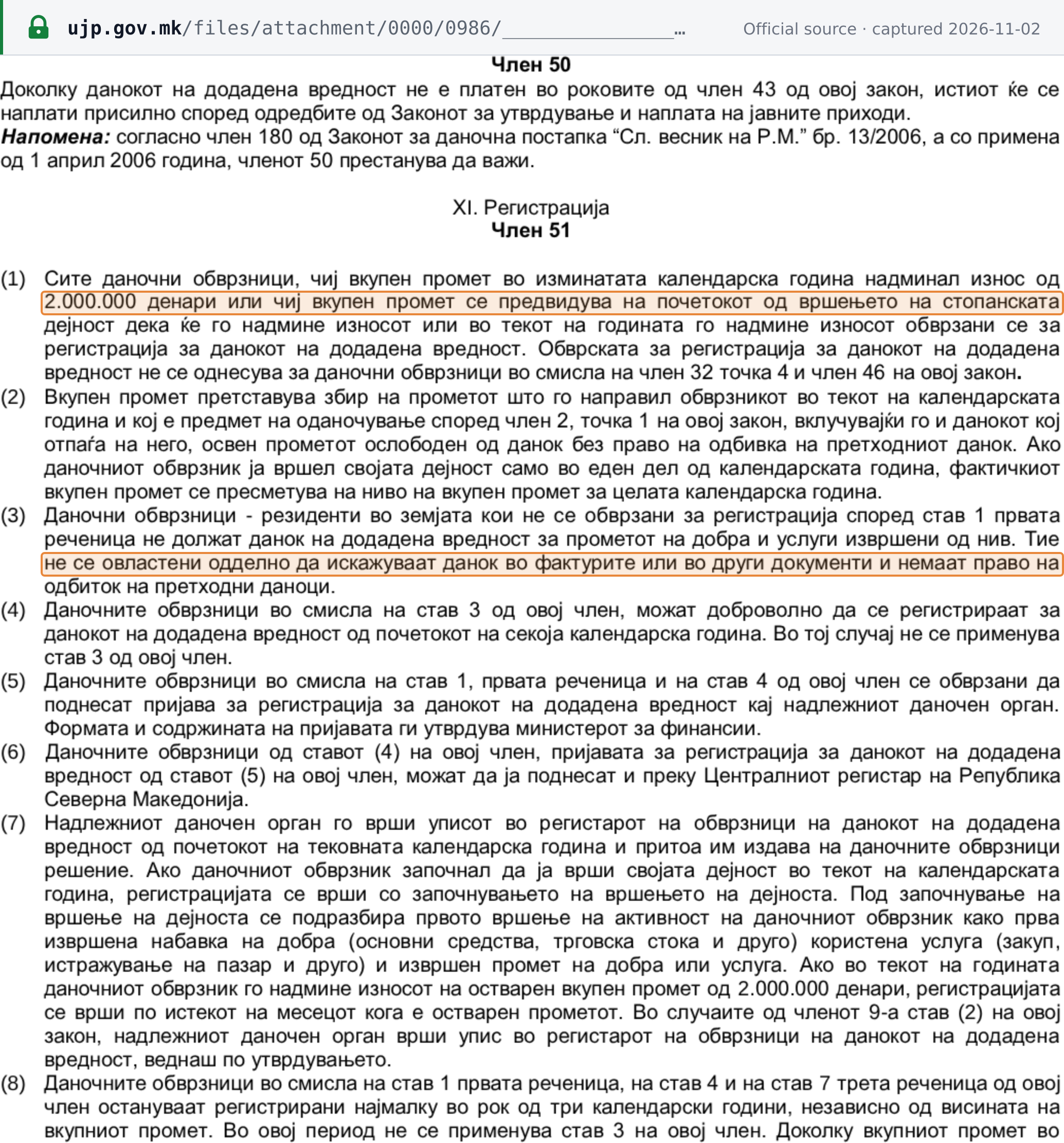 Source snapshot captured 2026-11-02 — UJP consolidated VAT Act, p. 29
Deadlines and when registration takes effect
| Situation | Apply by (form ДДВ-01) | Registration takes effect |
|---|---|---|
| Threshold exceeded in the previous calendar year | 15 January of the current year | Start of the current calendar year |
| New business expected to exceed the threshold | Within 15 days of starting activity | When activity starts (first purchase, first service used or first supply) |
| Threshold exceeded during the year | 15th of the month after the month the turnover was reached | After the end of the month in which the turnover was reached |
| Voluntary registration | 15 January | Start of the calendar year |
Deadlines are in art. 51(11) and effective dates in art. 51(7). UJP must decide on the application within 15 days of receiving it (art. 51-а). [1]
Non-resident registration
Zero threshold, and a tax representative is mandatory. A foreign person with neither a seat nor a branch in North Macedonia that makes VAT-taxable supplies there must register and appoint a tax representative (даночен застапник), unless its supplies are reverse-charged to the customer under art. 32 item 4 (art. 9-б(1)). It registers "пред отпочнувањето на вршењето на оданочивиот промет во земјата и за истото не се однесува износот на вкупен промет од член 51 став (1)" (before it begins making taxable supplies in the country, and the total-turnover amount in art. 51(1) does not apply to it) (art. 9-б(2)). The consolidation notes that art. 9-б has applied from 1 January 2024. [1]
The representative must itself have been VAT-registered for at least 12 months, have no overdue unpaid tax debts on the day the appointment is filed, and, if a legal entity, not be in bankruptcy or liquidation or, if a natural person, not have a final criminal conviction ("да не е правосилно осудено за кривично дело") (art. 9-б(5)). It computes, files and pays the VAT on the foreign person's behalf (art. 9-б(6)). It also "солидарно гарантира" (is jointly and severally liable) for the VAT the foreign person owes (art. 9-б(8)).
Tax identification number
The ДДВ даночен број (VAT number) "е составен од алфа знаци „МК“ и Даночниот идентификационен број" (consists of the letters "MK" and the tax identification number) that UJP assigned to the taxpayer in its Single Register of Taxpayers (art. 51-б(4)). The Act does not state the length or a check digit. For the format of the underlying tax number (ЕДБ), see the North Macedonia tax ID guide. UJP's website has a Companies search by name, head office, unique tax number (ЕДБ) or company identification number. See Check a VAT number — official lookups by country.
How to register
File the registration application (образец "ДДВ-01") at the UJP regional directorate for the taxpayer's seat or residence, or electronically through UJP's e-tax portal (etax.ujp.gov.mk). Both routes are named in UJP's 2022 brochure on VAT registration, filing and payment. Voluntary registrants may also apply through the Central Registry (Централен регистар) (art. 51(6)). UJP issues a decision within 15 days (art. 51-а). [3] [1]
For the general process across countries, see How to register for VAT, sales tax or GST.
Voluntary registration
Available. A resident below the threshold "можат доброволно да се регистрираат … од почетокот на секоја календарска година" (may register voluntarily … from the start of any calendar year) (art. 51(4)). They must apply by 15 January (art. 51(11)). Voluntary registrants stay registered for at least three calendar years, whatever their turnover (art. 51(8)). UJP may refuse an applicant that cannot be found at its address, cannot show a real intention to trade, or has a record of tax evasion (art. 51(13)). Registering lets a business charge VAT and deduct input VAT, which art. 51(3) otherwise denies. [1]
Deregistration
After the three-year minimum, a business whose turnover in the third year did not exceed MKD 2,000,000 may apply to cancel (art. 51(8)). It may also apply where its turnover is at or below the threshold and it claimed no input VAT in each of the two previous years (art. 51(14)). The application is due "најдоцна до 15 јануари во годината од која сакаат да престанат да бидат регистрирани" (by 15 January of the year from which they wish to stop being registered) (art. 51(12)). UJP can also deregister a business on its own initiative, for example for nil returns, a taxpayer it cannot find, two or more unfiled periods, or past evasion (art. 51(10)). A business that ceases activity files a final return within 25 days after the end of the month in which it stopped (art. 41(4)). [1]
Group registration
Available ("поврзано лице", connected person). Several VAT-registered persons linked by ownership, organisation or management may elect to be treated as one taxable person. UJP can also order it where it finds the links distort taxation (art. 9-а). All members are jointly and severally liable for each member's unpaid VAT while they belong to the group (art. 9-а(5)). The group receives its own VAT number (art. 51-б(3)). See VAT grouping explained. [1]
Rates
| Rate | Applies to | Basis |
|---|---|---|
| 18% (general) | All supplies and imports not at a preferential rate | art. 28 item 1, art. 29 |
| 5% (preferential) | Basic foodstuffs, drinking water, books and newspapers, medicines, computers and software, passenger transport, accommodation, first supply of new homes (to 31 December 2028) and others (list below) | art. 28 item 2, art. 30 |
| 10% (preferential) | Restaurant and catering services (excluding alcoholic drinks), other foodstuffs | art. 28 item 2, art. 30-а |
| 10% (temporary, by Government decision) | Energy products the Government lists, for a period it fixes; since 29 September 2026 gas oil (diesel) used as motor fuel | art. 30-в |
| Exempt with right of deduction | Exports and related supplies (no 0% rate is named) | art. 24 |
Rates as at 2026-11-02. Art. 28: VAT is computed "според општата даночна стапка од 18%" (at the general rate of 18%) and "според повластената даночна стапка од 5% и од 10%" (at the preferential rate of 5% and of 10%). Art. 29: "Општата даночна стапка од 18% се применува врз целокупниот промет и увоз, освен врз прометот и увозот кој се оданочува со повластената даночна стапка" (The general rate of 18% applies to all supplies and imports except those taxed at the preferential rate). UJP's consolidated text does not record the date the 18% rate first took effect. [1]
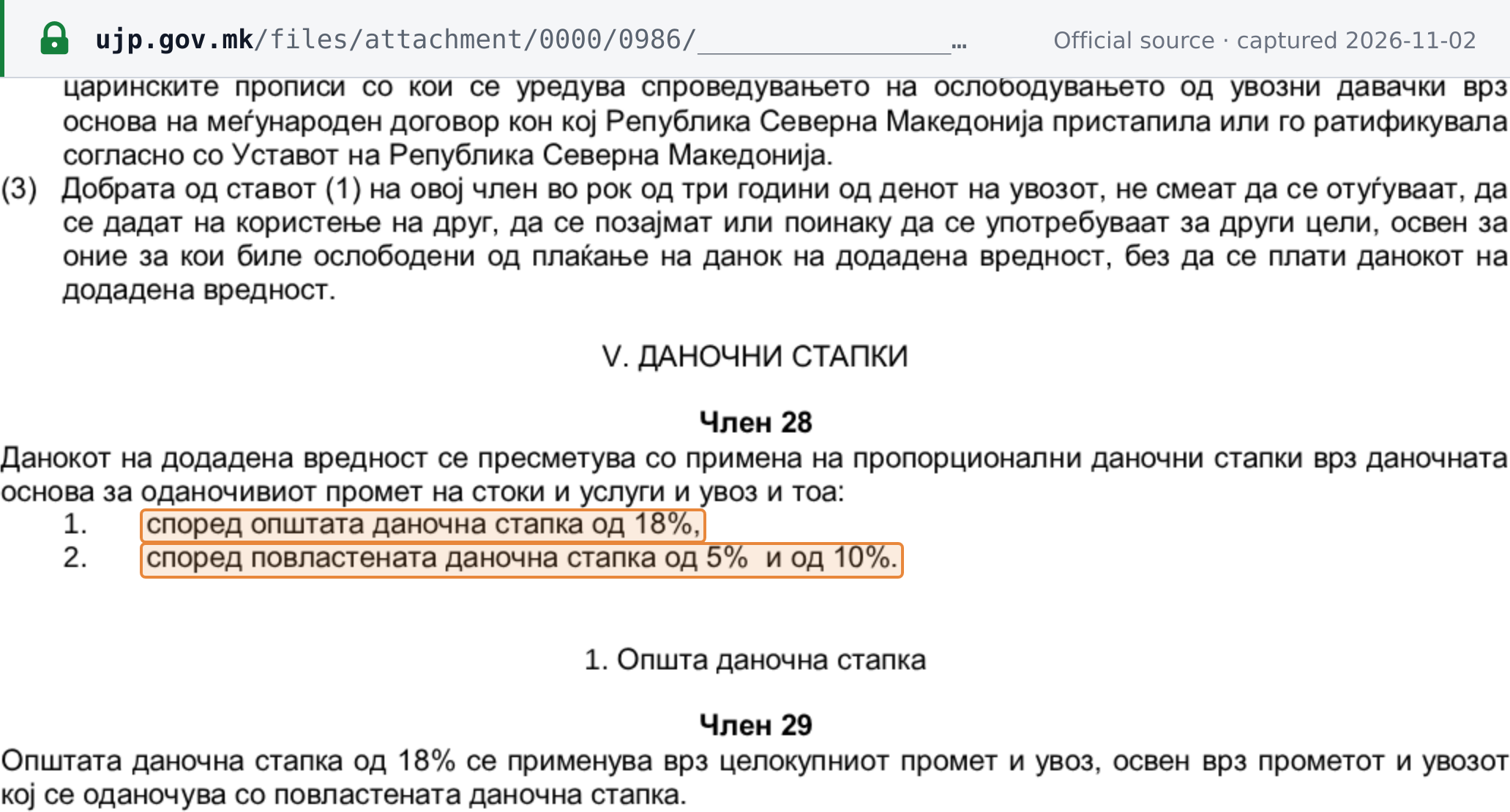 Source snapshot captured 2026-11-02 — UJP consolidated VAT Act, p. 18
5% preferential rate
Goods (art. 30(1)): basic foodstuffs (основни производи за човечка исхрана); drinking water from public systems and irrigation water; books, electronic and digital textbooks, newspapers and periodicals (not mainly advertising, not pornographic); seeds and planting material; fertilisers; plant-protection products; agricultural plastic film; agricultural machinery; medicines, including veterinary medicines; menstrual products; computers (automatic data-processing machines and units); solar thermal systems; disability aids for personal use; raw oil for food production; the first supply of residential buildings and flats within five years of construction (until 31 December 2028; see Announced future rates); animal feed, feed additives and live animals; baby products such as cots, prams, car seats and nappies; school supplies; pellets and pellet stoves and boilers; and heat energy for heating.
Services (art. 30(2)): passenger transport and accompanying luggage; computer software; public cleaning and waste removal; accommodation (overnight stays, bed and breakfast, half or full board) in all commercial hospitality establishments; and registered craftsmen's repairs of bicycles, shoes and leather goods, and clothing and linen, plus hairdressing.
The Government specifies the goods and services in detail (art. 30(3)). [1]
10% preferential rate
- "услуги на предавање на храна и на пијалаци за консумација на лице место и кетеринг услуги, со исклучок на алкохолни пијалаци" (serving food and drinks for consumption on the premises, and catering, excluding alcoholic drinks) (art. 30-а(1));
- other foodstuffs that are not "basic foodstuffs" under art. 30 (art. 30-а(2)). [1]
Household electricity is at 18%. The 10% rate on household electricity in art. 30-б applied only from 1 January to 30 June 2023, according to the consolidation's footnote to that article. [1]
Temporary 10% rate on diesel
Art. 30-в lets the Government, in conditions of natural disasters or a declared emergency or crisis, apply the 10% rate instead of 18% to energy products for a period it fixes by decision. In 2026 it did this several times:
- 24 March–6 April 2026, announced by UJP on 23 March 2026, then extended to 20 April 2026 (24:00), announced by UJP on 6 April 2026; [6] [7]
- reinstated in September 2026 by a decision in Службен весник no. 214/26. The Government's decision of 28 September 2026, published in Службен весник no. 228/2026, rewrote the list of goods from 29 September 2026: "Енергентите за кои се применува повластената стапка на данокот на додадена вредност од 10% се распоредени во следниве тарифни ознаки" (The energy products to which the 10% preferential VAT rate applies are classified under the following tariff codes). The list is gas oils under ex 2710 19 42, 44, 46, 47 and 48 and ex 2710 20 11, 16 and 19, each marked "само за погонско гориво" (only as motor fuel). The same decision moved the end of the period from 28 September to 12 October 2026 (art. 2); [4] [5]
- extended beyond 12 October 2026. At its 220th session on 9 October 2026, the Government adopted a decision amending the decision on the type of goods and the period of application of the preferential rate (agenda item 2). [17]
Check the current decision. Since 29 September 2026 the rate applies only to diesel used as motor fuel, not to petrol or other energy products. Each extension is a separate Government decision published in the Official Gazette, and that decision sets the end date. Confirm the period in the latest decision before invoicing diesel at 10%.
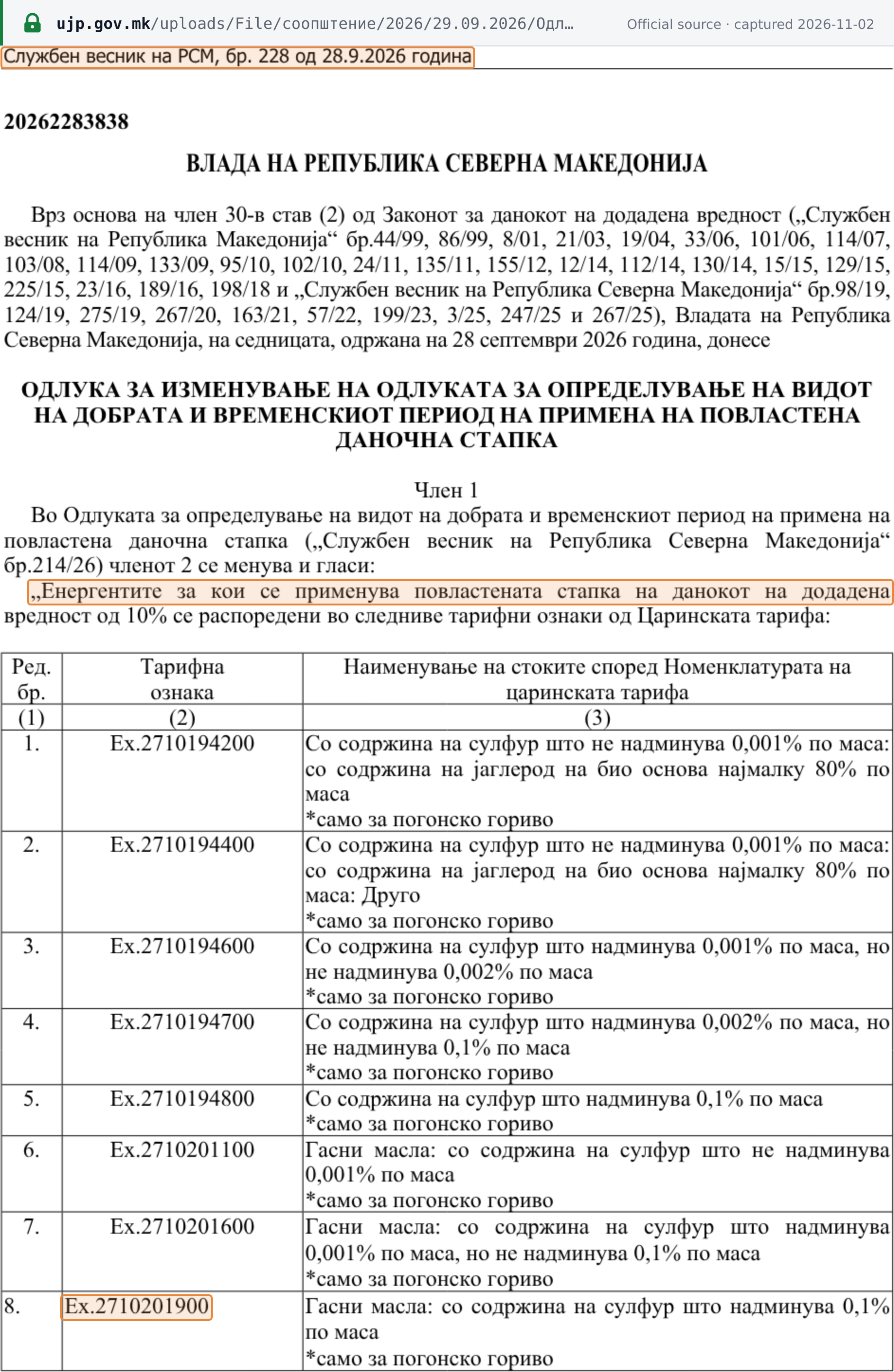 Source snapshot captured 2026-11-02 from the decision as hosted by UJP (the September 2026 decision; superseded as to its end date) — Government decision, SV 228/2026
Exports: exempt with right of deduction
The VAT Act names no 0% rate. Exports are exempt with the right to deduct input VAT (art. 24), which works like zero-rating. Compare art. 23, which lists supplies exempt without the right of deduction. Art. 24(1) covers goods transported or sent abroad where the recipient is established abroad, goods sent into free zones, customs zones and customs warehouses, transport and services directly linked to exports, imports and transit, and work on goods that are then exported. [1]
Announced future rates
5% on the first supply of new homes ends on 31 December 2028. The 5% rate on the first supply of residential buildings and flats within five years of construction (art. 30(1) item 14) is time-limited. Amendments adopted in December 2025 (Службен весник 267/25, art. 3) extended it to 31 December 2028. The Ministry of Finance: the period "се продолжува од 1 јануари 2026 година до 31 декември 2028 година" (is extended from 1 January 2026 to 31 December 2028). Unless extended again, that first supply falls to the 18% general rate from 1 January 2029. [18] [1]
The temporary diesel rate is covered above. For rates elsewhere, see Worldwide tax rates.
Cross-border rules
Imports and exports
Imports. Importing goods is a taxable event (art. 2 item 2). "При увоз на добра, данокот на додадена вредност го пресметува надлежниот царински орган кој ја спроведува постапката за царинење" (On importation of goods, value added tax is computed by the competent customs authority carrying out the clearance procedure) (art. 40(4)). UJP's guide says import VAT "is paid at the same time when the customs duties are paid". [1] [8]
De minimis. The only value-based relief in the Act is for non-commercial gifts: goods sent free of charge from abroad by one private individual to another resident individual, where the consignment is worth no more than EUR 22 in the denar equivalent (art. 27-б(1) item 2-а). The consolidated Act contains no value-based exemption for commercial consignments, including e-commerce parcels.
Exports. Exempt with right of deduction (art. 24). See Exports above.
Reverse charge on imported services and supplies by foreign businesses
Where a supplier with neither a seat nor a branch in North Macedonia supplies a taxable person, or a public body under art. 10(1), the recipient is the tax debtor. The recipient computes the VAT, files it in its return, pays it and owes any late-payment interest (art. 32 item 4). The recipient also records the taxable base in its books (art. 52(5)). See Reverse charge explained. [1]
Domestic reverse charge (art. 32-а). Between VAT-registered persons, the recipient also accounts for the VAT on:
- construction work, including maintenance, reconstruction and demolition, from contractor to investor or subcontractor to contractor;
- used material, waste and scrap;
- transfers in forced-collection proceedings where the creditor acquires the asset;
and on advance payments for items 1–2. The supplier's invoice must state „пренесување на даночна обврска“ (transfer of tax liability) (art. 53(6)). Both parties file a reverse-charge report with their return (art. 41-б; forms ДДВ-ИПДО and ДДВ-ИПДО/П in UJP's brochure). [1] [3]
Digital products and services
Services supplied to non-taxable persons are taxed where the customer is established, lives or stays when they are "телекомуникациски услуги; услуги на радио и телевизиско емитување и услуги извршени по електронски пат" (telecommunications services, radio and television broadcasting services and electronically supplied services). The same applies to intellectual-property rights, advertising, consultancy, legal and accounting services, data processing, financial and insurance services, staff supply and hire of movable goods (art. 14(6)). Communication by e-mail alone does not make a service "electronic" (art. 14(7)). These rules have applied since 1 January 2024. No registration threshold applies to a foreign supplier caught by them (art. 9-б(2)). See VAT on digital services by non-resident suppliers. [1]
Foreign businesses selling into North Macedonia — B2B and B2C
- B2B (the customer is a taxable person in North Macedonia). Reverse charge: the customer accounts for the VAT under art. 32 item 4. The foreign supplier does not register (art. 51(1), art. 9-б(1)).
- B2C (consumers, for example digital services or goods sold and supplied locally). The supply is taxable in North Macedonia (art. 14(6) for e-services). The reverse charge does not apply, because art. 32 item 4 needs a taxable recipient. Reading arts. 9-б, 14(6) and 32 item 4 together, the foreign supplier must register before its first supply, with no threshold, through a tax representative. The consolidated Act has no simplified or one-stop registration for non-residents: the representative files ordinary returns (art. 9-б(6)). (Checked 2026-11-02.)
Marketplace / platform deemed-supplier liability
Not found. The consolidated VAT Act contains no deemed-supplier or facilitating-platform provision; art. 14(4) has only general place-of-supply rules for intermediaries. See Marketplace deemed-supplier rules.
Place of supply
Art. 14 in the version applied from 1 January 2024:
- B2B general rule: where the customer has its seat or branch (art. 14(2)).
- B2C general rule: where the supplier is established (art. 14(3)).
- Exceptions (art. 14(4)): services connected with immovable property, including hotel accommodation, are taxed where the property is. Passenger transport is taxed proportionally by distance. Admission to events (B2B) and cultural and similar services (B2C) are taxed where performed. Restaurant and catering services are taxed where performed. Short-term hire of means of transport (up to 30 days, or 90 days for vessels) is taxed where the vehicle is put at the customer's disposal.
- B2C at the customer's residence (art. 14(6)): the services listed under Digital products and services. [1]
Refunds to non-established businesses
On reciprocity, input VAT is refunded on request to taxable persons with no seat or branch in North Macedonia that make no supplies there, or owe no tax on them. The procedure is set by the Minister of Finance (art. 46(1)). Tourists can claim a refund on goods costing more than MKD 5,000 including VAT that they take out of the country before the end of the third month after the month of purchase. Mineral oils, alcohol and tobacco are excluded (art. 25). [1]
Invoice requirements
When an invoice is required
"Даночниот обврзник е должен на барање да издаде фактура за прометот извршен спрема други даночни обврзници. Фактурата може да се издаде во хартиена или електронска форма" (A taxable person must, on request, issue an invoice for supplies made to other taxable persons. The invoice may be issued in paper or electronic form) (art. 53(1)). Separate invoices are issued for each partial supply paid for before completion (art. 53(3)) and for every advance payment (art. 53(4)). In a barter, each party issues an invoice (art. 53(5)). The supplier must deliver the invoice to the customer and keep a copy (art. 53(7)). [1]
Mandatory content
Art. 53(10): "Фактурата мора да ги содржи следните податоци" (The invoice must contain the following particulars):
| # | Particular (VAT Act art. 53(10)) | Original wording |
|---|---|---|
| 1 | Place, date of issue and number | Место, дата на издавање и број |
| 2 | Supplier's name and address, and the VAT number under which it is registered | Име (назив) и адреса на даночниот обврзник кој го извршува прометот и негов даночен број под кој е регистриран за данок на додадена вредност |
| 3 | Customer's name and address | Име (назив) и адреса на примателот на доброто или корисникот на услугата |
| 4 | Date of supply | Ден на извршениот промет |
| 5 | Quantity and description of the supply | Количина и опис на прометот |
| 6 | Consideration excluding VAT | Износ на надоместокот за извршениот промет, без данокот на додадена вредност |
| 7 | VAT rate applied | Применета даночна стапка |
| 8 | Amount of VAT | Износ на пресметаниот данок на додадена вредност |
| 9 | Total consideration including VAT | Вкупен износ на надоместокот за извршениот промет и данокот на додадена вредност |
| 10 | First name, surname and signature of the person authorised to sign invoices | Име, презиме и потпис на овластеното лице за потпишување на фактури кај издавачот на фактурата |
The Act does not require the customer's VAT number. Additional wording rules apply (art. 53(6)). Taxable and exempt supplies are shown separately. An exempt supply carries "данок на додадена вредност не е пресметан" (value added tax has not been charged). A domestic reverse-charge supply under art. 32-а carries „пренесување на даночна обврска“ (transfer of tax liability). An invoice issued in electronic form "не треба да содржи печат на издавачот" (need not bear the issuer's stamp) (art. 53(12)). The Minister of Finance may waive the invoice or some particulars in defined cases (art. 53(11)). [1]
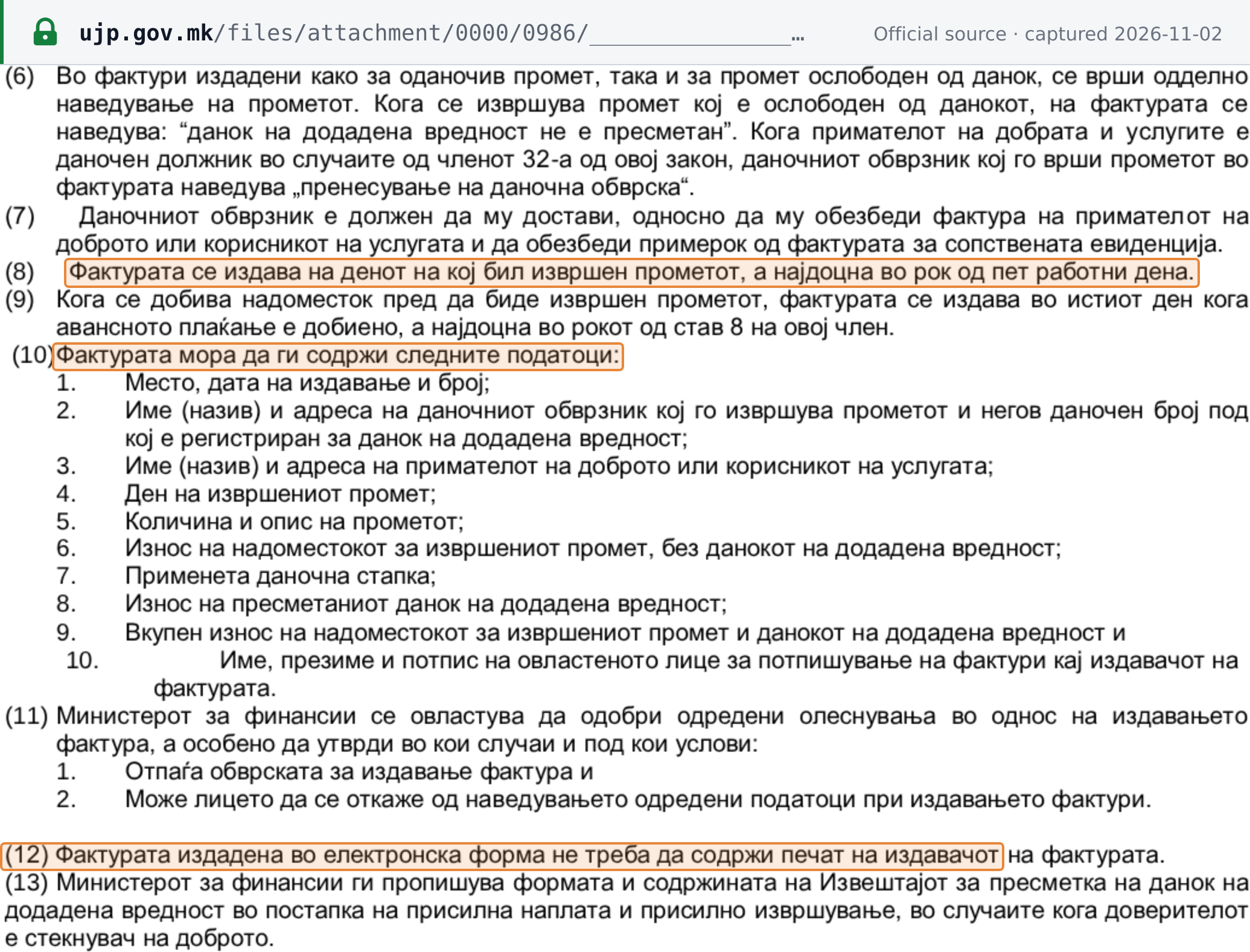 Source snapshot captured 2026-11-02 — UJP consolidated VAT Act, p. 32
Issuance deadline
"Фактурата се издава на денот на кој бил извршен прометот, а најдоцна во рок од пет работни дена" (The invoice is issued on the day the supply was made, and at the latest within five working days) (art. 53(8)). For an advance payment, the invoice is issued on the day the advance is received, and at the latest within the same five working days (art. 53(9)). Failing to issue an invoice within the deadline is a misdemeanour (art. 59-б(1) item 3; see Penalties).
Numbering and sequencing
Art. 53(10) item 1 requires an invoice number. The consolidated Act sets no explicit sequential or gap-free numbering rule.
Credit and debit notes
The VAT Act does not name credit or debit notes. Corrections run through art. 22(1): if the taxable base changes because goods are returned, a contract is cancelled or the price changes after the supply, the supplier "мора да го исправи данокот" (must correct the tax) it owes. The customer must correct its input-VAT deduction in the same tax period as the change. The same applies to reverse-charge recipients under art. 32-а (art. 22(2)). If an invoice overstates the VAT, the issuer owes the excess (art. 55(2)) unless it corrects the tax under art. 22(1) (art. 55(3)). [1]
Currency and language
Currency. The Act has no rule requiring invoices in denars. A foreign-currency consideration is converted at the National Bank's middle rate on the date the tax liability arises (art. 20).
Language. The VAT Act sets no language rule for invoices.
Document types
| Document | When used | Basis |
|---|---|---|
| Invoice (фактура) | Supplies to other taxable persons, on request; paper or electronic | art. 53 |
| Self-billed computation (пресметка) | Customer computes the supply made to it | art. 53(2) |
| Fiscal receipt (фискална сметка) | Sales to final consumers through a fiscal cash register | Закон за регистрирање на готовински плаќања |
| Invoice with a UJP serial number | Supplies using the art. 24-а exemption | art. 53-а |
Sales to final consumers are recorded through a fiscal cash register under the Закон за регистрирање на готовински плаќања (Law on Registration of Cash Payments). Art. 54 of the VAT Act, which once covered this, stopped applying on 4 May 2001 under that Law. For input-VAT purposes, a fiscal receipt with a total of no more than MKD 6,000 is an accepted deduction document (art. 34(1) item 2). See Fiscal devices and certified cash registers. [1]
Electronic invoices under the current rules
An e-invoice is an invoice issued as an electronic document (art. 53-б(1)). "Примателот на фактура дава согласност со своја експлицитно изразена волја во хартиена форма дека приемот на фактурите ќе го извршува во електронска форма" (The recipient gives consent, by an explicit expression of will in paper form, that it will receive invoices in electronic form) (art. 53-б(2)). Authenticity of origin, integrity and legibility must be ensured (art. 53-б(3)), by a qualified electronic signature under the Law on Electronic Documents, Electronic Identification and Trust Services (art. 53-б(4)). The PDF-by-e-mail regime with tacit consent in art. 53-в applied only until 31 December 2021. [1]
Self-billing
Permitted. "Како фактура се смета и пресметката, со која даночниот обврзник пресметува одреден оданочив промет извршен спрема него од страна на друг даночен обврзник" (A computation by which a taxable person computes a taxable supply made to it by another taxable person is also treated as an invoice) (art. 53(2)).
Retention and audit trail
- Period: invoices, other documents and business books are kept "најмалку пет години по истек на календарската година, за која се однесуваат" (for at least five years after the end of the calendar year to which they relate) (art. 56(1)).
- Electronic archiving: e-invoices are kept in the original format in which they were issued or received (art. 56(2)). Authenticity, integrity and legibility must be guaranteed for the whole period (art. 56(3)).
- Audit trail: both issuer and recipient keep the issuance and receipt information that proves the invoice's authenticity and integrity (art. 56(4)).
- In-country storage: "Фактурите без разлика на формата во која се издадени се чуваат на територијата на Република Северна Македонија" (Invoices, whatever the form in which they were issued, are kept on the territory of the Republic of North Macedonia) (art. 56(5)). [1]
A specimen of a compliant invoice
The illustration below places each art. 53(10) particular where it would sit on a typical invoice, with one line at each rate.
Фактура / Invoice — illustrative
| Descriptionitem 5 | Qtyitem 5 | Amount excl. VATitem 6 | VAT rateitem 7 | VATitem 8 |
|---|---|---|---|---|
| Office chairs, model EX-1 | 10 | MKD 40,000 | 18% | MKD 7,200 |
| Printed textbooks | 20 | MKD 10,000 | 5% | MKD 500 |
| Catering for staff event (no alcohol) | 1 | MKD 12,000 | 10% | MKD 1,200 |
- Total excl. VATart. 53(10) item 6
- MKD 62,000
- VAT 18%items 7–8; art. 29
- MKD 7,200
- VAT 5%items 7–8; art. 30
- MKD 500
- VAT 10%items 7–8; art. 30-а
- MKD 1,200
- Total incl. VATart. 53(10) item 9
- MKD 70,900
- Authorised signatory: first name, surname and signature of the person authorised to sign invoices — art. 53(10) item 10.
- An exempt line would be shown separately with the wording “данок на додадена вредност не е пресметан” — art. 53(6).
- A domestic reverse-charge supply (construction, waste and scrap) would state „пренесување на даночна обврска“ instead of charging VAT — art. 53(6); 32-а.
- Issued within five working days of the supply — art. 53(8). Issued electronically, it needs no stamp — art. 53(12) — but does need the customer’s prior consent in paper form and a qualified electronic signature — art. 53-б.
E-invoicing status
Status (as at 2 November 2026): pilot. No e-invoicing mandate is in force. UJP is introducing a national е-Фактура (e-Faktura) platform and has been testing it with businesses through 2026. A draft Law on Electronic Invoicing proposes mandatory dates from 1 April 2027 (below), but it is not law.
- The law today. The VAT Act as consolidated by UJP, to amendments in Службен весник 267/25, contains no e-Faktura obligation. Art. 53(1) still allows paper or electronic invoices, and art. 53-б still makes e-invoicing depend on the recipient's consent. The Government's fuel-rate decision of 28 September 2026 (SV 228/2026) lists the VAT Act's amendments as ending "…3/25, 247/25 и 267/25". [1] [4]
- The pilot, in UJP's words. 16 February 2026: "пилот фазата на националниот систем за е-Фактура успешно се спроведува во реални услови" (the pilot phase of the national e-Faktura system is being carried out successfully in real conditions). 4 April 2026: taking part matters "за навремена адаптација пред задолжителната имплементација на системот" (for timely adaptation before the system's mandatory implementation). 7 August 2026: "во оваа пилот-фаза" (in this pilot phase) testing runs through direct API integration with business systems or through a web application. 26 October 2026: "воведувањето е-фактура претставува значајна реформска иницијатива" (the introduction of the e-invoice is a significant reform initiative). [9] [10] [12] [13]
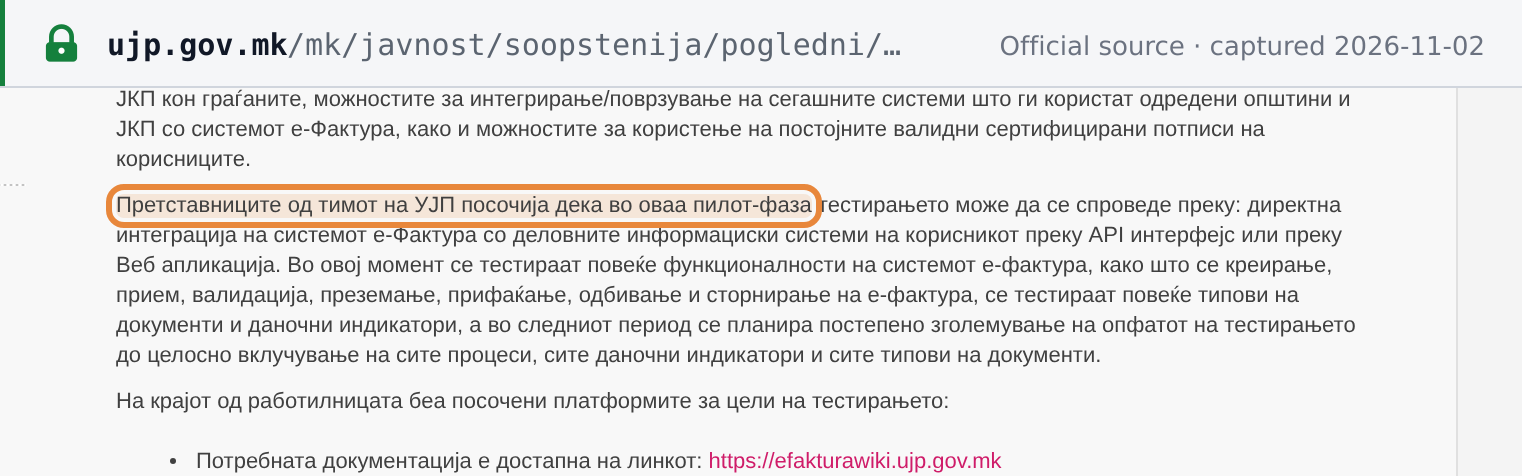 Source snapshot captured 2026-11-02 — UJP press release, 7 August 2026
- System and model. A central UJP platform. Businesses connect their ERP systems through an API, or use UJP's web application. The functions tested are creating, receiving, validating, downloading, accepting, rejecting and cancelling (сторнирање) e-invoices. [12]
- Format. UJP's 4 June 2026 release says the second test phase changed "структурата на API повиците и JSON форматот" (the structure of the API calls and the JSON format), with specifications published on the e-Faktura wiki. The web application tests "општата фактура со 12 даночни индикатори" (the general invoice with 12 tax indicators). The indicators mark the VAT treatment of each supply: general or preferential rate, exempt with or without deduction, out of scope, or reverse charge. UJP's releases name no UBL, XML or Peppol standard. [11] [14]
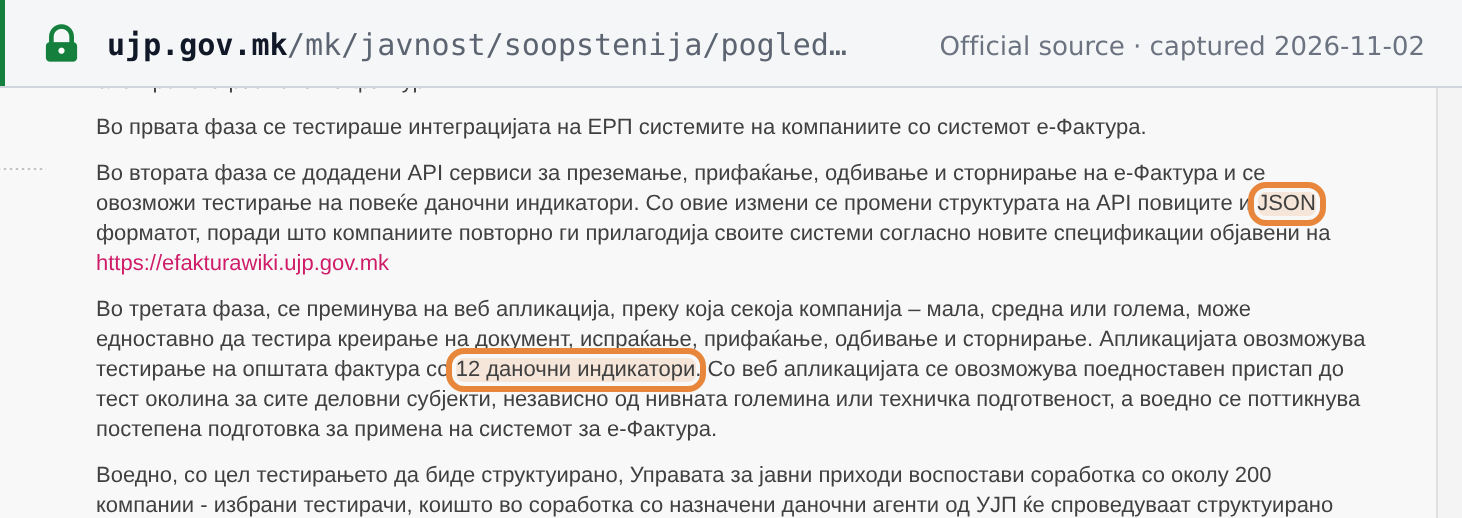 Source snapshot captured 2026-11-02 — UJP press release, 4 June 2026
-
Proposed phases (draft law, not in force). The Предлог на закон за електронско фактурирање (draft Law on Electronic Invoicing), dated 26 August 2026, sets the timeline in its art. 22:
Proposed date Who Draft art. 16(1) 1 October 2026 Voluntary registration on the e-Faktura system ("можат доброволно да се регистрираат") — 1 April 2027 VAT-registered legal and natural persons, including public enterprises and state- or municipality-owned companies item 1 1 July 2027 Legal entities in business that are not VAT-registered item 2 1 October 2027 Budget users, state- or municipality-funded non-profit institutions, and the National Bank item 4 1 January 2028 "сите субјекти кои вршат трансакции" (all entities carrying out transactions) — Under the draft, a business that registers voluntarily must from then on issue e-invoices only in structured electronic form through the system. The draft has not been adopted or published in the Official Gazette, and its dates can change. [19]
-
Scope. B2B, B2G and B2C: none mandated today. The draft would phase in B2B and B2G by issuer type. Sales to consumers are covered by fiscal cash registers (see Document types).
-
Testing access. Test registration is at eujptest.ujp.gov.mk. UJP points businesses to the e-Faktura wiki (efakturawiki.ujp.gov.mk) for documentation, and to Kontakt.eFaktura@ujp.gov.mk for support.
See CTC e-invoicing models for how clearance systems work elsewhere, and e-invoicing status and networks worldwide.
Filing and payment
Filing frequency
| Taxpayer | Tax period | Basis |
|---|---|---|
| Total turnover in the previous calendar year above MKD 25,000,000 | Monthly (calendar month) | art. 39(1) |
| Total turnover in the previous calendar year not above MKD 25,000,000 | Quarterly (calendar quarter) | art. 39(1) |
Art. 39(1): "За даночен период се смета календарскиот месец или, доколку вкупниот промет во изминатата календарска година не надминал износ од 25 милиони денари, даночниот период ќе биде календарско тримесечје" (The tax period is the calendar month or, where total turnover in the previous calendar year did not exceed MKD 25 million, the calendar quarter). UJP changes a taxpayer's period by decision, based on prior-year turnover (art. 39(3)). Thresholds as at 2026-11-02. [1]
Return due date
The VAT return (form ДДВ-04) is due "во рок од 25 дена по истекот на даночниот период" (within 25 days after the end of the tax period), and the taxpayer computes the tax itself (art. 41(1)). A nil return is required even when no taxable supplies were made in the period (art. 41(3)). On cessation of activity, the deadline is 25 days after the end of the month of cessation (art. 41(4)). UJP's guide summarises the payment dates: monthly filers pay "till the 25th each month for the previous month", and quarterly filers by "25-04, 25-07, 25-10 and 25-01 the following year". Returns are filed electronically through UJP's e-tax portal (etax.ujp.gov.mk), according to UJP's brochure. [1] [8] [3]
Corrections. An error is corrected by filing a new, complete corrected return for the period "најдоцна до рокот за доставување на годишната сметка" (no later than the deadline for submitting the annual accounts), showing full amounts rather than differences (art. 41-а(1)). Differences of less than 1% of the declared tax are corrected in the last return of the year (art. 41-а(2)). [1]
Payment due date and method
Same deadline as the return. The tax computed and declared for a period is paid within the periods in art. 41(1) and (4) in which the return is filed (art. 43(2)). Late payment carries interest; see Penalties. For payment accounts, see UJP's payment page. Banks and other payment-system operators also send UJP a periodic report of each VAT-registered taxpayer's denar and foreign-currency account transactions for each tax period (art. 41(2), (6)). [1]
Additional listings
- Domestic reverse-charge reports: forms ДДВ-ИПДО (supplier) and ДДВ-ИПДО/П (recipient), filed with the return (art. 41-б; form names from UJP's brochure).
- Art. 24-а invoices: recipients of invoices carrying a UJP-assigned serial number report them electronically each calendar quarter, by the 25th of the month after the quarter (art. 53-а(5)).
- No EC sales list or separate annual VAT return. North Macedonia is not an EU member, and the consolidated Act provides for no separate annual VAT return. Provisional amounts are settled in the last return of the calendar year (art. 40(3)). [1] [3]
Input-tax recovery and blocked items
Input VAT is deductible on purchases for business use against a compliant invoice (arts. 53 and 53-б), a fiscal receipt of no more than MKD 6,000, or a customs declaration showing the import VAT, recorded in the books (art. 34(1)). No deduction is allowed for (art. 35):
- purchases for supplies exempt under art. 23 (or that would be exempt if made in the country);
- bicycles, L-category motor vehicles, M1 passenger cars (up to eight seats besides the driver and no more than 3,500 kg), aircraft and vessels, and their spare parts, fuel, hire, maintenance and repair. This does not apply where they are used in the year exclusively for dealing in, renting, transporting with, training drivers on, or repairing them;
- "Расходи за репрезентација" (entertainment expenses): hospitality, gifts, holidays, recreation and leisure;
- fridges, audio and video equipment, carpets and artworks for administrative offices;
- passenger-transport costs;
- hotel accommodation and meals, except catering for crew on film productions intended for public showing;
- VAT owed by an invoice issuer under art. 55(1) or (2).
A business making both taxable and exempt supplies deducts only the share relating to taxable supplies (art. 36). [1]
Refunds
Resident credit position. Excess input VAT is refunded on a request made in the return. "Разликата на данокот … се враќа во рок од 30 дена по денот на поднесувањето на даночната пријава" (The tax difference … is refunded within 30 days of the day the return is filed) (art. 45(2)). Otherwise it is carried forward as a credit against the next period. The clock stops if UJP cannot audit through the taxpayer's fault (art. 45(3)), and unpaid taxes are offset first (art. 45(4)). Interest on overpayments runs after 30 days from receipt of the refund request (Закон за даночна постапка art. 123(3)). [1] [15]
Non-residents and tourists. See Refunds to non-established businesses.
Exemptions
Exempt supplies (without right of deduction)
Art. 23 exempts the following without the right to deduct input VAT:
- supplies of residential buildings and flats, except the first supply within five years of construction, which is taxed at 5% until 31 December 2028 (item 1);
- residential letting (item 2);
- postage stamps at face value (item 3) and the postal services of Македонска пошта (item 4);
- banking and financial services: currency, securities, fund management, credit, accounts and payments, guarantees. Debt collection is excluded (item 5);
- insurance and reinsurance, including brokers and agents (item 6);
- games of chance (item 7);
- non-profit cultural institutions, botanical gardens and zoos (item 8), and tickets for cultural events of national interest (item 8-а);
- non-commercial radio and television (item 9);
- health services in hospitals and clinics (item 10), and social-care institutions (item 11);
- child care and youth accommodation (items 12–13);
- doctors, dentists and dental technicians, except cosmetic and massage salons, alternative medicine and veterinary services (item 14), and patient transport (item 15);
- human blood, milk, organs, cells and tissue (item 16);
- education and retraining, including language schools (item 17), and services to higher-education institutions for research (item 17-а);
- scientific research services under the Law on Scientific Research Activity (item 17-б);
- funeral institutions and crematoria, and related supplies of goods (item 18);
- international passenger transport (item 19);
- road tolls (item 19-а) and road fees for motor and trailer vehicles (item 19-б);
- supplies of goods whose input VAT was blocked under art. 35 when they were bought, made or imported (item 20). [1]
Exempt is not zero-rated
Input VAT on purchases used for art. 23 supplies is not deductible (art. 35 item 1(а)). Exports under art. 24 keep the right of deduction. A business with both kinds of supply apportions its input VAT (art. 36). Exempt supplies are invoiced with the wording "данок на додадена вредност не е пресметан" (art. 53(6)).
Special regimes
- Tour operators (margin scheme). The package is a single service taxed on the margin, meaning the price paid by the traveller minus the cost of bought-in travel services. It is supplied where the operator is established, and input VAT on those bought-in services is not deductible (art. 38).
- Investment gold. Chapter IX-а (art. 38-а onwards) covers bars and wafers of at least 995/1000 fineness and coins of at least 900/1000 minted after 1800.
- Free zones, customs zones and warehouses. These are outside "the country" (art. 11). Supplies into them are exempt with deduction (art. 24(1) item 2), except that goods sent into a free zone are not exempt where the consideration, excluding VAT, is MKD 60,000 or less (art. 24(2)). Supplies for final consumption inside them are treated as domestic (art. 12).
- Small businesses. Residents below MKD 2,000,000 are outside VAT unless they register voluntarily (art. 51(3)–(4)). The Act has no separate flat-rate scheme.
- Cash accounting. The consolidated Act has no cash-accounting scheme. [1]
Offences and penalties
Offences
Misdemeanours (прекршоци) under the VAT Act:
- applying for registration late (art. 59(1)), or not applying at all (art. 60(1) item 3);
- filing the return late (art. 59-б(1) item 1), or not filing it (art. 60(1) item 1);
- not paying the VAT into the prescribed account (art. 60(1) item 2);
- not issuing an invoice within the deadline (art. 59-б(1) item 3), or issuing an irregular invoice ("неуредна фактура") (art. 60(1) item 5);
- keeping irregular records (art. 59-б(1) item 2), or no or incorrect records (art. 60(1) item 4);
- not filing the reverse-charge report with the return (art. 59-б(1) item 4);
- not keeping invoices, documents or books for the required period (art. 60(1) item 6).
Criminal offence (art. 60-а). A responsible officer of a legal entity, or a natural-person taxpayer, who does not file a return, files one with inaccurate data, or files without paying, "со цел да се стекнат со поголема имотна корист" (in order to obtain a larger material benefit), faces imprisonment from six months to five years and a fine. Where the amount is significant, the term is at least four years. A legal entity is fined, and the proceeds are confiscated by court decision. [1]
Penalties
Fines are in EUR, payable in the denar equivalent, scaled by the size of the legal entity (micro, small, medium and large trader — the Act uses these labels). The same scale applies to every misdemeanour listed above (arts. 59(1), 59-б(1), 60(1)):
| Who is fined | Micro | Small | Medium | Large |
|---|---|---|---|---|
| Legal entity | EUR 300–1,000 | EUR 600–2,000 | EUR 1,800–6,000 | EUR 3,000–10,000 |
| Responsible officer of the entity | EUR 50–250 | EUR 100–500 | EUR 150–500 | EUR 200–500 |
Sole traders and self-employed persons are fined EUR 100–250, and natural-person taxpayers EUR 50–250. A payment-system operator that does not send its account report is fined EUR 3,000–10,000 (art. 59-а). Fines up to EUR 250 (natural persons and sole traders), EUR 500 (officers) and EUR 1,000 (legal entities) are imposed by the misdemeanour body. Higher fines are imposed by a court (art. 60-д). The amount within each range is set under the Law on Misdemeanours (art. 60-в). Figures as at 2026-11-02. [1]
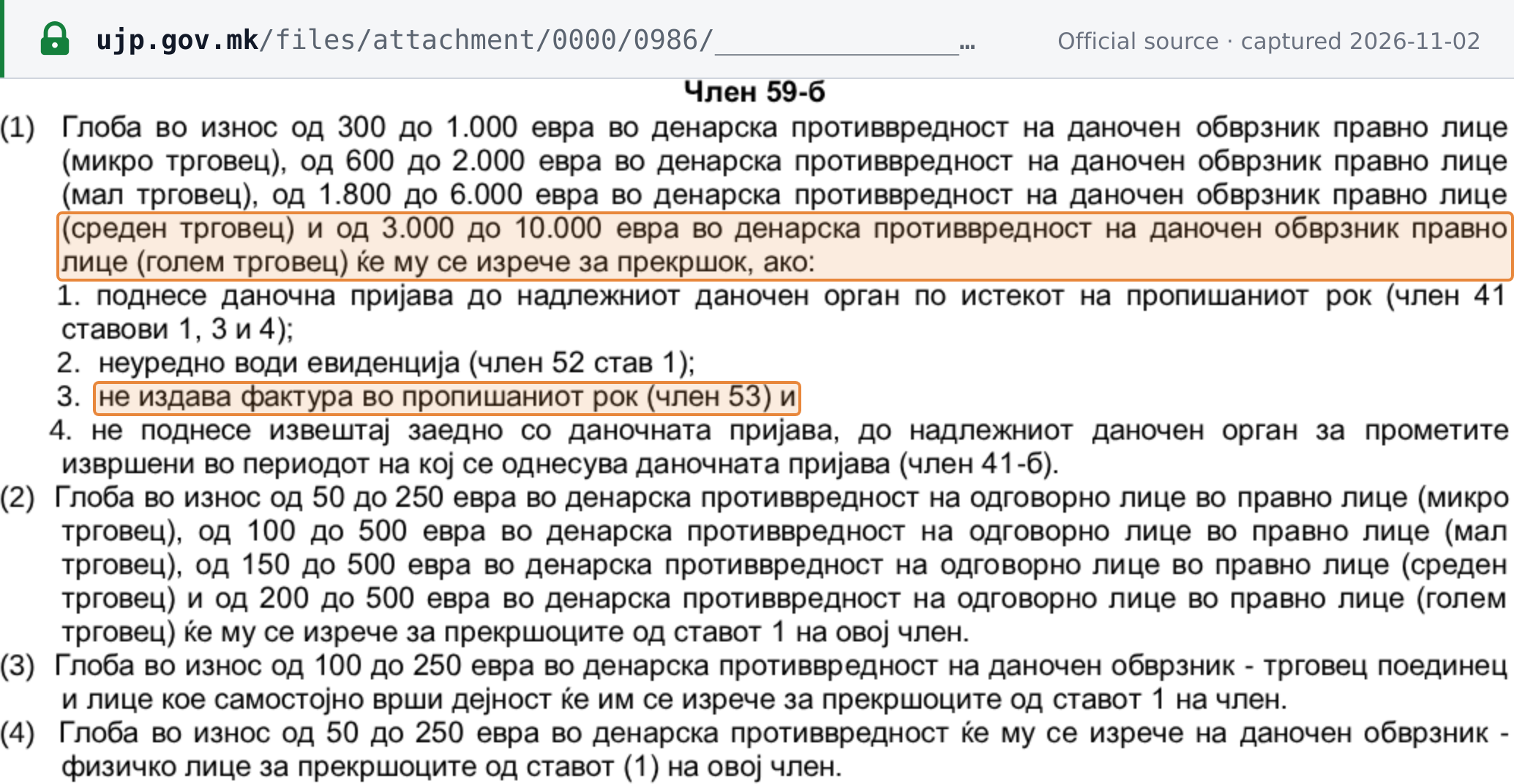 Source snapshot captured 2026-11-02 — UJP consolidated VAT Act, p. 35
Late-payment interest: 0.03% per day. The VAT Act's own interest rule (art. 44) stopped applying from 1 April 2006. Interest now runs under the Закон за даночна постапка (Law on Tax Procedure) art. 123(1): "камата во висина од 0,03% за секој ден задоцнување" (interest of 0.03% for each day of delay), from the day after the original due date (art. 123(2)). [15] [16]
Frequently asked questions
We are a foreign company selling digital services to consumers in North Macedonia. Do we have to register for VAT?
Yes. Electronically supplied, telecommunications and broadcasting services to non-taxable persons are taxed where the customer lives (art. 14(6)). The reverse charge in art. 32 item 4 only applies where the customer is a taxable person, so it does not cover consumers. A foreign person with no seat or branch in North Macedonia that makes taxable supplies there must register before its first supply, the MKD 2,000,000 threshold does not apply to it, and it must appoint one tax representative (art. 9-б, applied from 1 January 2024). The Act has no simplified one-stop registration for non-residents.
Our turnover is below MKD 2,000,000. Can we add VAT to our invoices?
No. Resident businesses below the threshold that have not registered owe no VAT, may not show VAT separately on invoices and cannot deduct input VAT (VAT Act art. 51(3)). If you show VAT on an invoice anyway, you owe the amount shown, payable within five working days of issuing the invoice (art. 55(1)). If you want to charge VAT and recover input VAT, you can register voluntarily from the start of a calendar year by applying by 15 January, and you then stay registered for at least three calendar years (art. 51(4), (8), (11)).
Is e-Faktura mandatory in North Macedonia yet?
Not as at 2 November 2026, but dates have been proposed. The VAT Act as consolidated by the Public Revenue Office (UJP), to amendments in Official Gazette 267/25, still allows paper or electronic invoices (art. 53(1)), and an electronic invoice still needs the recipient's explicit consent given in paper form (art. 53-б(2)). A draft Law on Electronic Invoicing dated 26 August 2026 proposes, in its art. 22, voluntary use of the e-Faktura system from 1 October 2026 and mandatory issue and receipt through it for VAT-registered persons from 1 April 2027, non-VAT-registered legal entities in business from 1 July 2027, budget users and state-funded institutions from 1 October 2027, and everyone else from 1 January 2028. The draft is not law: it has not been adopted or published in the Official Gazette, and its dates can change. Meanwhile UJP is running e-Faktura as a pilot; it described testing as a pilot phase on 7 August 2026.
Can we keep our North Macedonian invoices on servers outside the country?
The VAT Act says no. Invoices, whatever form they were issued in, are kept on the territory of the Republic of North Macedonia (art. 56(5)). They must be kept for at least five years after the end of the calendar year they relate to (art. 56(1)), and electronic invoices are kept in the original format in which they were issued or received (art. 56(2)).
Does the 10% VAT rate on diesel still apply?
It is a temporary measure that the Government sets and extends by decision under art. 30-в of the VAT Act. Since 29 September 2026 it covers only gas oil (diesel) used as motor fuel, under the tariff codes listed in the decision published in Official Gazette 228/2026, which ran the period to 12 October 2026. The Government amended that decision again at its session of 9 October 2026, extending the period beyond 12 October 2026. Check the current Government decision in the Official Gazette for the period that applies before invoicing diesel at 10%.
Important websites
| Site | Purpose |
|---|---|
| UJP — Public Revenue Office (English) | Tax authority home page; guides, tax calendar and press releases |
| UJP e-tax portal (etax.ujp.gov.mk) | VAT registration (ДДВ-01) and VAT returns (ДДВ-04), as named in UJP's brochure; reach it from the UJP site |
| e-UJP user registration | Account registration for UJP's electronic services |
| UJP — payment information | Accounts and instructions for paying taxes |
| UJP — VAT guide: returns and payment (English) | Return and payment deadlines, import VAT |
| UJP — legislation | Consolidated text of the VAT Act (ЗДДВ) |
| e-Faktura test registration | Registration for the e-Faktura test environment |
| e-Faktura wiki (efakturawiki.ujp.gov.mk) | UJP's technical documentation for e-Faktura, as cited in UJP's releases |
| MojDDV | UJP's consumer VAT-refund application |
UJP's website has a Companies search by name, head office, unique tax number (ЕДБ) or company identification number. E-Faktura is still in its pilot.
Recent changes
- 2026-10-26 — UJP still describes the introduction of e-Faktura as a reform initiative; no mandate is in force. (UJP)
- 2026-10-09 — The Government amends the decision on the preferential-rate period again (220th session, agenda item 2), extending the 10% rate on diesel beyond 12 October 2026. (Government)
- 2026-09-29 — From 29 September 2026 the 10% VAT rate covers only gas oil (diesel) used as motor fuel, with the period then running to 12 October 2026 (Government decision of 28 September 2026, Службен весник 228/2026). (UJP) — see event
- 2026-08-26 — Draft Law on Electronic Invoicing proposes voluntary e-Faktura use from 1 October 2026 and mandatory e-invoicing for VAT-registered persons from 1 April 2027, then other groups to 1 January 2028; not adopted. (draft text)
- 2026-08-07 — UJP: e-Faktura testing continues "in this pilot phase", through API integration or the web application. (UJP)
- 2026-06-04 — UJP opens the third e-Faktura test phase, a web application for businesses of any size; about 200 selected testers. (UJP)
- 2026-04-06 — 10% VAT on fuels extended to 20 April 2026 (24:00), after applying from 24 March 2026. (UJP)
- 2025-12-25 — Ministry of Finance: the 5% rate on the first supply of new homes is extended to 31 December 2028 (VAT Act amendments, Службен весник 267/25). (MoF)
For the full chronology, see North Macedonia tax changes on Lookuptax.
Reference links
- UJP — Закон за данокот на додадена вредност (VAT Act), unofficial consolidated text to Службен весник на РСМ 267/25, valid from 30.12.2025 (PDF)
- UJP — legislation page for the VAT Act
- UJP — brochure "Регистрација, пријавување и плаќање на данокот на додадена вредност" (3 February 2022, PDF)
- Government of North Macedonia — decision of 28 September 2026 amending the decision on preferential VAT on energy products, Службен весник 228/2026 (hosted by UJP, PDF)
- UJP — press release, 29 September 2026 (10% on diesel from 29 September 2026)
- UJP — press release, 23 March 2026 (10% on fuels from 24 March 2026)
- UJP — press release, 6 April 2026 (10% on fuels to 20 April 2026)
- UJP — VAT guide (English): VAT return and payment
- UJP — press release, 16 February 2026 (e-Faktura pilot phase)
- UJP — press release, 4 April 2026 (e-Faktura testing)
- UJP — press release, 4 June 2026 (e-Faktura third test phase)
- UJP — press release, 7 August 2026 (e-Faktura pilot phase workshop)
- UJP — press release, 26 October 2026 (e-Faktura as a reform initiative)
- UJP — press release, 8 May 2026 (e-Faktura second test phase; tax indicators)
- UJP — Закон за даночна постапка (Law on Tax Procedure), unofficial consolidated text (PDF)
- UJP — legislation page for the Law on Tax Procedure
- Government of North Macedonia — 220th session, 9 October 2026: agenda (item 2, preferential VAT rate decision)
- Ministry of Finance — 5% VAT on newly built flats extended to the end of 2028 (25 December 2025)
- Предлог на закон за електронско фактурирање (draft Law on Electronic Invoicing), 26 August 2026 — draft text as published for consultation by the Economic Chamber of North Macedonia
Related on Lookuptax:
- North Macedonia tax ID guide
- VAT registration thresholds worldwide
- Worldwide tax rates
- E-invoicing status and networks worldwide
- Reverse charge explained
- VAT on digital services by non-resident suppliers
- How to register for VAT, sales tax or GST
- Check a VAT number — official lookups by country
- Serbia VAT guide