Paraguay VAT (IVA) guidelines
| FACTSHEET | |
|---|---|
| Country code | PY |
| Tax name | Value added tax — Impuesto al Valor Agregado (IVA) |
| Tax Authority | Dirección Nacional de Ingresos Tributarios (DNIT) |
| Rates | 10% general · 5% reduced |
| Tax ID | RUC (Registro Único de Contribuyentes) |
Overview
Paraguay's value added tax is the Impuesto al Valor Agregado (IVA). Article 80 of Ley 6380/2019 sets its scope: "El Impuesto al Valor Agregado (IVA) gravará los siguientes actos: 1. La enajenación de bienes. 2. La prestación de servicios, excluidos los de carácter personal que se presten en relación de dependencia. 3. La importación de bienes." That is, IVA taxes supplies of goods, services (other than employment) and imports of goods. [1]
Statute. IVA is set by Ley N.° 6380/2019, "De Modernización y Simplificación del Sistema Tributario Nacional", Libro II, Título I (arts. 80–106), promulgated and published on 25 September 2019. [1] [2] It replaced the IVA of Ley 125/91, which the DNIT describes as "vigente hasta el año 2019" (in force until 2019). [3] The implementing regulation is Decreto 3107/2019. Neither the DNIT's nor the Congress library's copy of Ley 6380 is consolidated: article 100(3)(h) was later rewritten by Ley 7067/2023 (see Exemptions).
Authority. IVA is administered by the Dirección Nacional de Ingresos Tributarios (DNIT), created by Ley 7143/2023 to replace the former Subsecretaría de Estado de Tributación (SET). Many DNIT services still run on set.gov.py hosts, including the Marangatu filing system and the e-invoice lookup.
Layering. One national tax. Article 84 defines territoriality nationally, and the IVA title of Ley 6380 provides no departmental or municipal IVA. The separate Impuesto Selectivo al Consumo (ISC), an excise in Título II (arts. 107 onwards), applies to listed goods.
Currency. The guaraní (PYG, written "₲" or "G."). Statutory amounts are in guaraníes, and every e-invoice must show a "Total en Guaraníes" even when it is issued in another currency.
Tax period. The calendar month: "El impuesto se liquidará mensualmente y se determinará por la diferencia entre el "IVA Débito" y el "IVA Crédito"" — the tax is settled monthly as output IVA minus input IVA (art. 86). [1]
Registration
Who should register
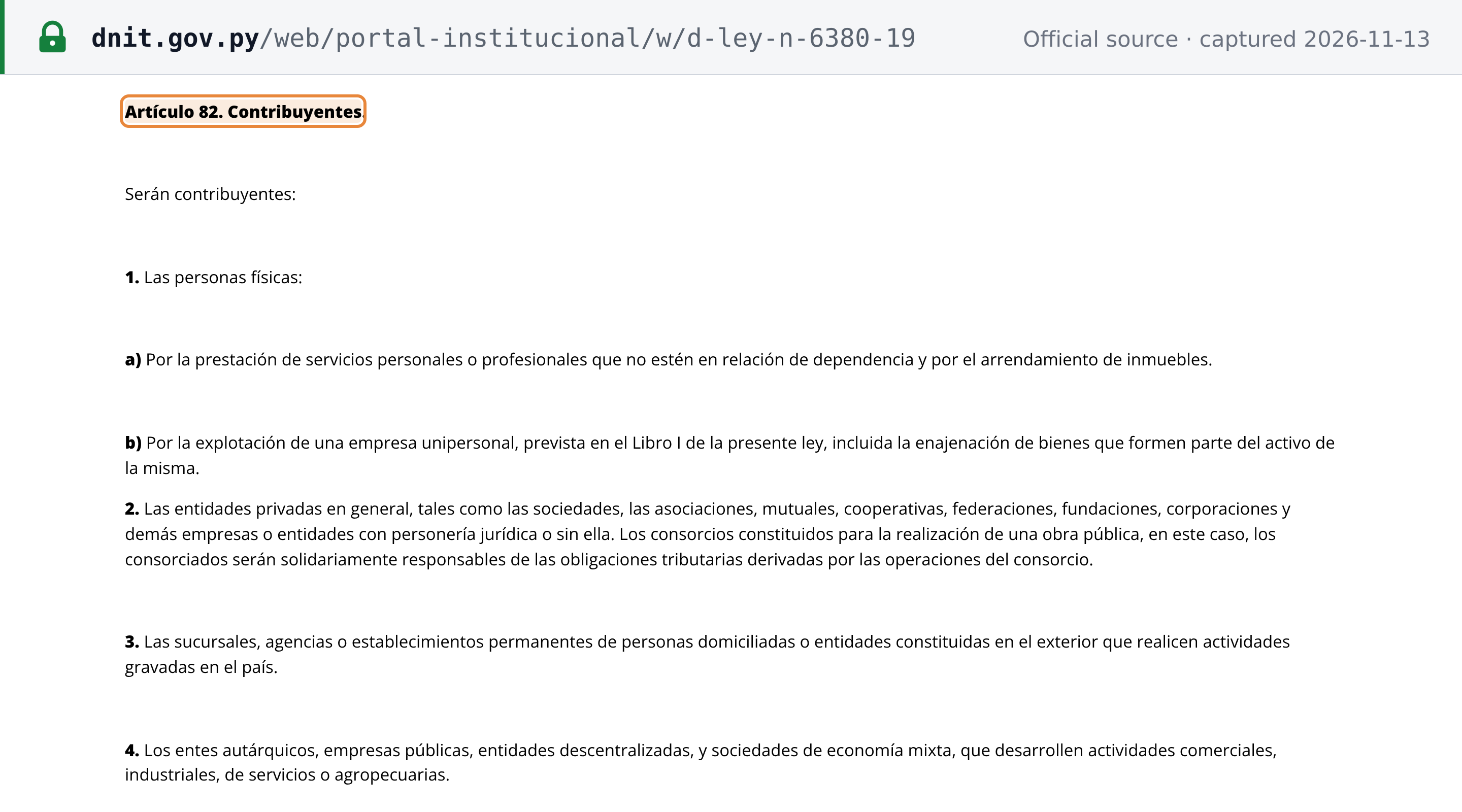
Contributor status follows from the activity, not from turnover. Article 82 of Ley 6380 opens "Serán contribuyentes:" and lists: [1]
- Individuals providing personal or professional services outside an employment relationship, or leasing real estate; and individuals running a sole proprietorship (empresa unipersonal).
- Private entities in general: companies, associations, mutuals, cooperatives, foundations and other entities, with or without legal personality. Members of a consortium for a public work are jointly liable for its tax.
- Branches, agencies and permanent establishments of foreign persons or entities carrying on taxed activities in Paraguay.
- Autonomous bodies, public companies, decentralised entities and mixed-economy companies carrying on commercial, industrial, service or agricultural activities.
- and 6. Habitual and casual importers.
- Transparent legal structures.
- Contributors of the INR (non-resident income tax).
- Undivided estates.
Registration threshold
The IVA title of Ley 6380 (arts. 80–106) sets no general registration threshold: every business within article 82 is a contributor from its first taxed operation.
The one turnover-based carve-out is the RESIMPLE (Régimen Simplificado para Pequeñas Empresas) of article 27. A sole proprietorship may opt into it "cuando sus ingresos brutos devengados en el ejercicio fiscal anterior sean iguales o inferiores a G. 80.000.000 (Ochenta millones de guaraníes)" — when its gross income in the previous fiscal year was ₲80,000,000 or less — and "Las empresas unipersonales que liquiden el impuesto bajo este régimen no serán contribuyentes del IVA": sole proprietorships in RESIMPLE are not IVA contributors. [1] They still issue a sales document, the Boleta RESIMPLE.
The carve-out covers only the business activity. According to the DNIT's FAQ, a RESIMPLE taxpayer that also provides personal services or leases or subleases property "deberá inscribirse también como contribuyente del IVA y emitir la Factura correspondiente por dichas actividades" — must also register for IVA and invoice those activities. [4]
Non-resident registration
A non-resident without a branch or permanent establishment in Paraguay does not register for IVA. The tax on its sales is collected from the Paraguayan side instead:
- Services to Paraguayan businesses: the Paraguayan payer withholds the IVA (see Foreign companies selling into Paraguay).
- Digital services to consumers: the bank, card issuer or payment processor perceives the IVA (RG 76/2020).
- A branch or permanent establishment is itself a contributor (art. 82(3)).
Foreign digital-service providers selling to consumers can register with the DNIT, but under RG 114/2022 that registration is for the non-resident income tax only: it is "a los efectos de declarar y abonar el INR" — to declare and pay the INR (art. 4). [5]
Tax identification number
The taxpayer number is the RUC (Registro Único de Contribuyentes). It is written as a base number, a hyphen and a check digit (dígito verificador, DV), and the base number's length varies: the DNIT's own model e-invoice shows an individual's RUC as "2365438-8", and RG DNIT 59/2026 lists company RUCs such as 80002014 (shown without the DV). [6] [7] Filing deadlines are keyed to the last digit of the RUC excluding the DV (see Filing and payment).
For the format, check-digit and lookup details, see the Paraguay tax ID guide (RUC), and check a RUC's format with the Paraguay RUC validator.
How to register
- Where: the RUC pre-registration form, "Inscribirme al RUC". The DNIT's page on registering individuals and legal persons links the guides and the list of documents required.
- Adding IVA: IVA is an obligation attached to the RUC, "211 - IVA GENERAL". The DNIT IVA page has its own "Inscribirme" button for adding it.
- Deadline: registering in the RUC "fuera del plazo de los 30 días hábiles, contados a partir del inicio de actividades gravadas" — later than 30 business days after taxed activity starts — is fined ₲50,000 (RG 13/2019 Anexo, item 1(a)). [8]
- E-invoicing from day one: legal persons registered as new taxpayers since 1 April 2025 may issue tax documents only electronically (see E-invoicing status).
Voluntary registration
Ley 6380 has no opt-in provision for someone outside article 82, and with no threshold there is nobody below one to opt in. The real choice runs the other way: an eligible sole proprietorship may opt out of IVA by choosing RESIMPLE (art. 27).
Deregistration
Data changes and cancellation of the RUC are each due within 30 business days: cancellation within 30 business days of the date the business stops or closes. A late update or cancellation is fined ₲50,000 (RG 13/2019 Anexo, items 1(b) and 1(c)). [8] No IVA credit is refunded on closure (Ley 6380 art. 91).
Group registration
Not available. The IVA title of Ley 6380 (arts. 80–106) contains no grouping provision; the only transfer of IVA credit between entities is on a company reorganisation (art. 88).
Rates
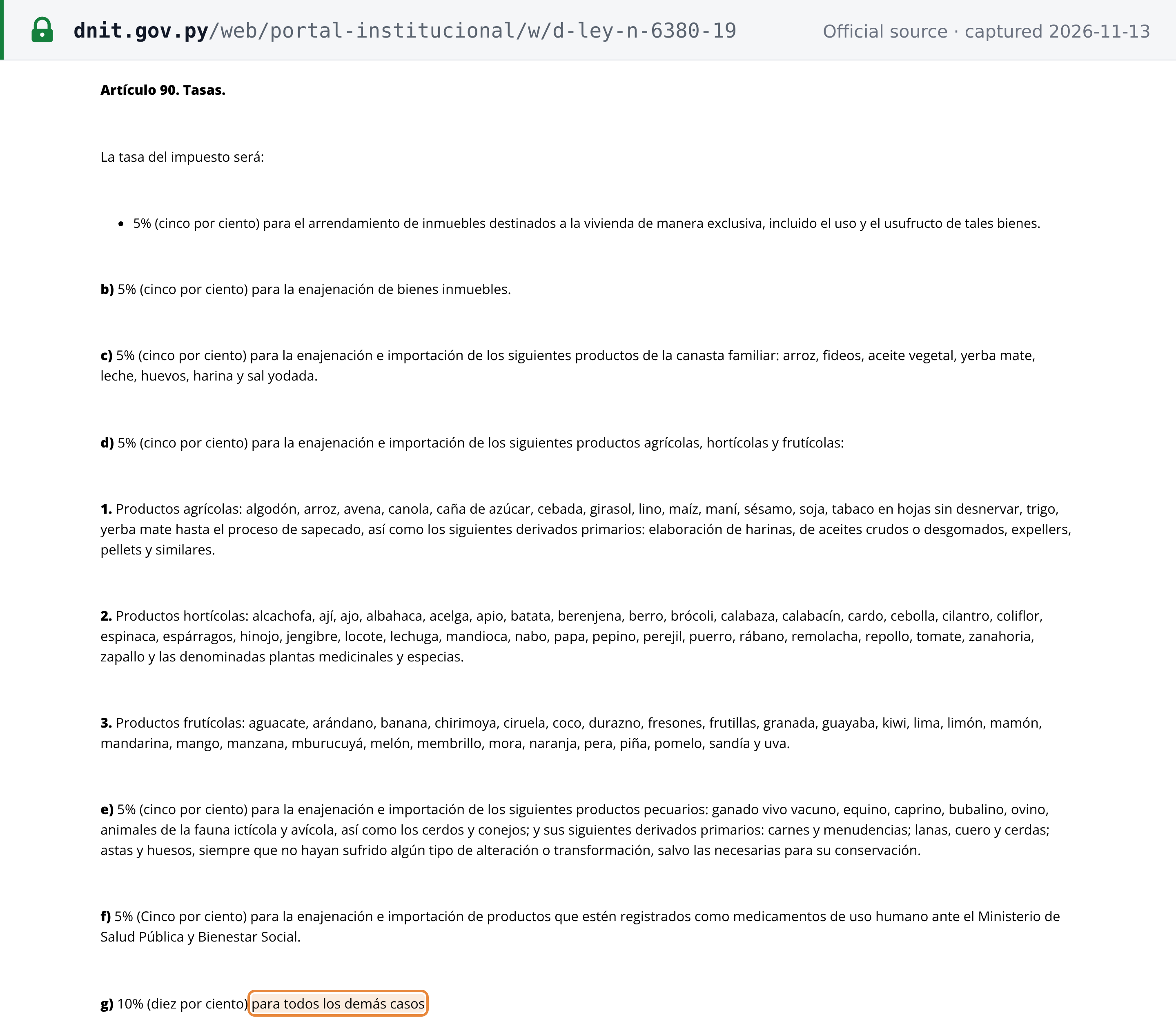
Article 90 of Ley 6380 sets two rates. "La tasa del impuesto será:" [1]
| Rate | Applies to (art. 90) |
|---|---|
| 10% | "para todos los demás casos" — every supply not listed below (item g) |
| 5% | a) leases of real estate used exclusively as a dwelling, including use and usufruct |
| 5% | b) sales of real estate |
| 5% | c) sales and imports of basic-basket foods: rice, pasta, vegetable oil, yerba mate, milk, eggs, flour and iodised salt |
| 5% | d) sales and imports of listed agricultural, horticultural and fruit products (cotton, rice, oats, sugar cane, maize, soya, wheat, vegetables, fruit and others) and their primary derivatives such as flours, crude oils, expellers and pellets |
| 5% | e) sales and imports of listed livestock products (live cattle, horses, goats, sheep, pigs, fish and poultry, meat and offal, wool, leather, horn and bone) that have not been transformed beyond conservation |
| 5% | f) sales and imports of products registered as medicines for human use with the Ministry of Public Health |
- Leases: the DNIT's IVA leaflet puts it plainly: "En el alquiler de inmuebles exclusivamente para vivienda, la tasa es del 5% (cinco por ciento), en cambio si el alquiler es para actividades comerciales, la tasa es del 10 % (diez por ciento)." [9]
- Real estate: besides the 5% rate, the taxable base on a sale of real estate is only 30% of the price (art. 85(3)), so the effective charge is 1.5% of the price.
- Executive power: "El Poder Ejecutivo queda autorizado a incrementar, así como a fijar tasas diferenciales, inclusive dentro de cada inciso, entre el 5% (cinco por ciento) y el 10% (diez por ciento)" for the goods and services in items a), b), c), e) and f).
- Effective date: these rates apply under the Ley 6380 regime, which replaced the Ley 125/91 IVA from 2020.
- Zero rate: article 90 has none. Exports of goods are exempt with recovery of the related input IVA (arts. 100(2) and 101), which works like a zero rate.
Announced changes. None. The article 90 rates have applied unchanged since the Ley 6380 regime took effect.
Cross-border rules
Imports and exports
- Imports: IVA on goods brought into Paraguay "se deberá liquidar y pagar en las Aduanas en forma previa al retiro de los mismos" — is settled and paid at customs before release (art. 98). The base is the customs value plus customs duties and other internal taxes, excluding IVA itself. For a casual importer the base is increased by 30% and the IVA paid is final (art. 85(7)). [1]
- Exports of goods: exempt (art. 100(2)), with a refund of the related input IVA (art. 101; see Refunds). Exporters of unprocessed agricultural products cannot recover IVA on the goods exported themselves.
- Low-value imports and couriers: Article 98 authorises the executive to set how IVA is collected on goods bought from abroad online.
Place of supply
Article 84 taxes "las enajenaciones de bienes situados en el país, las prestaciones de servicios realizadas en el territorio nacional y la introducción efectiva de bienes al país", wherever the contract is made and whatever the parties' residence. [1]
- Goods are taxed where they are situated.
- Services are taxed where they are performed. Technical assistance and other services performed abroad are treated as performed in Paraguay "cuando sean utilizados o aprovechados en el país" — when used or exploited in Paraguay (art. 84(1)).
- International transport of goods and passengers: 25% of the fare or freight counts as performed in Paraguay (art. 84(7)).
- Tax point for services from abroad: payment or the due date of payment, whichever comes first (art. 83(6)).
Digital products and services
Article 81 defines digital services as services made available through the internet that "se caracterizan por ser esencialmente automáticos y no viables en ausencia de la tecnología de la información". They are taxed when used in Paraguay, and use is presumed when any one of these is located in Paraguay (art. 84(5)): [1]
- the IP address of the customer's device, or the country code of its SIM card;
- the customer's billing address;
- the bank account used to pay;
- the billing address the bank holds for the customer;
- the institution that issued the credit or debit card used to pay.
RG 76/2020 art. 12 lists the services within the perception regime: multimedia content, data processing and storage, software and apps, cable and satellite TV, marketing and advertising, gambling, and online education. [10] There is no turnover threshold for the foreign provider, because the provider does not collect the tax.
Foreign companies selling into Paraguay — B2B and B2C
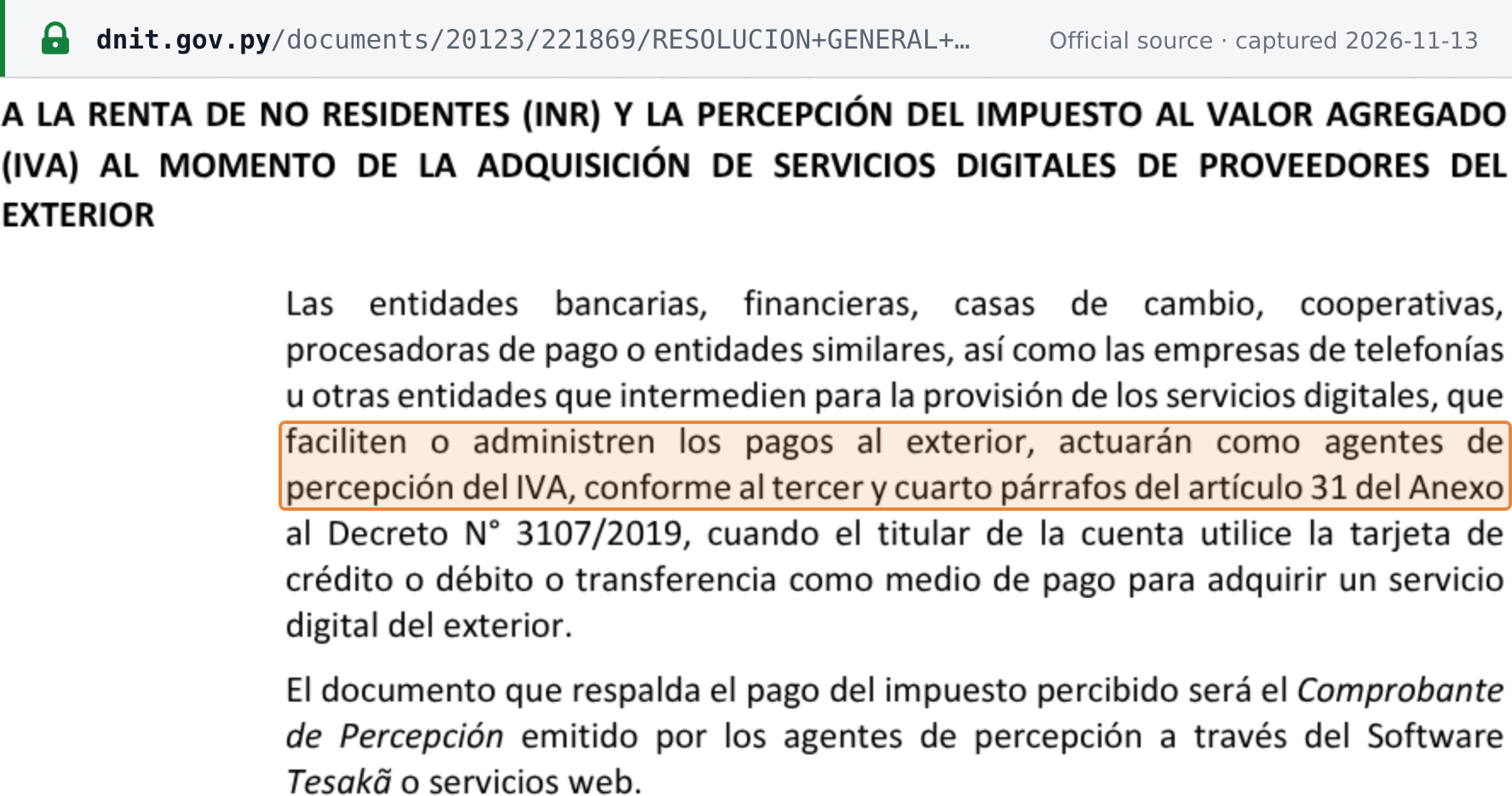
B2C digital services: perception by the payment intermediary, since 1 January 2021. The foreign provider does not register or charge Paraguayan IVA. Article 97 of Ley 6380 makes the intermediary liable: when payments for digital services from abroad go through "entidades bancarias, financieras, casas de cambio, cooperativas, procesadoras de pago, o entidades similares, éstas serán las responsables de la liquidación y percepción del impuesto". [1] RG 76/2020 art. 3 adds telephone companies and other intermediaries, which act as perception agents when the account holder pays a foreign digital-service provider by credit or debit card or by transfer, and must show the perceived amount on the card or account statement. The resolution "entrará en vigencia a partir del 1 de enero de 2021" (art. 13). For a buyer that is an IVA contributor, "Cuando el servicio digital adquirido esté relacionado con la actividad gravada de un usuario contribuyente del IVA, el monto de la percepción constituirá un IVA Crédito", supported by the card or account statement (art. 4). [10] Article 90 has no separate rate for digital services. The perception mechanics are set out in article 31 of the annex to Decreto 3107/2019 (RG 76/2020 art. 3).
Ride-hailing and land-transport platforms are outside bank perception: the non-resident platform pays IVA and INR on its commission itself, through a generic RUC and a monthly Form 90 filed by e-mail (RG 76/2020 art. 8).
B2B services: withholding by the Paraguayan payer. Anyone who pays for taxed services supplied by "personas domiciliadas en el exterior, que actúen sin sucursal, agencia o establecimiento permanente en el país" is an IVA withholding agent (Decreto 3107/2019 art. 35, as reproduced in the DNIT's IVA leaflet). [9] The tax withheld is creditable input IVA for the payer (Ley 6380 art. 88(3)). The leaflet does not give the withholding percentage. A Paraguayan business that buys foreign digital services for resale withholds IVA and INR itself instead of relying on bank perception (RG 76/2020 art. 6).
Foreign sellers of goods are not registered either: their goods bear IVA at customs on import (art. 98).
Marketplace / platform deemed-supplier liability
Ley 6380 contains no rule making a marketplace the deemed supplier of goods sold through it. Its only platform rules are the perception by payment intermediaries on digital services (art. 97) and the executive's power to set a perception method for goods bought online (art. 98). See the marketplace deemed-supplier explainer for how other countries do it.
Invoice requirements
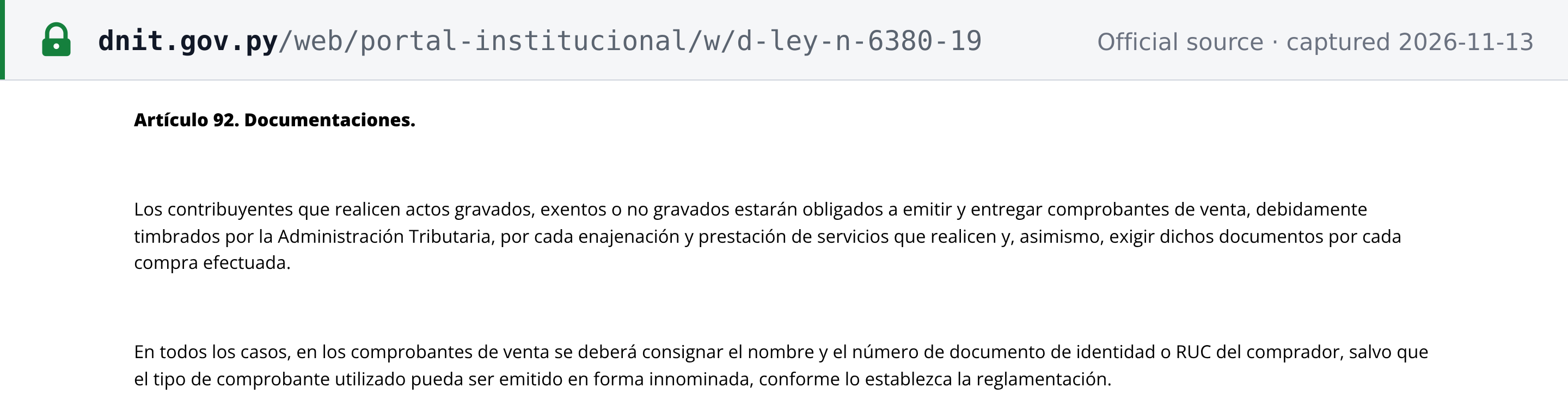
Article 92 of Ley 6380 makes every contributor issue a stamped sales document for every supply, whether taxed, exempt or not taxed: they "estarán obligados a emitir y entregar comprobantes de venta, debidamente timbrados por la Administración Tributaria, por cada enajenación y prestación de servicios que realicen". The document must carry "el nombre y el número de documento de identidad o RUC del comprador, salvo que el tipo de comprobante utilizado pueda ser emitido en forma innominada" — the buyer's name and identity-document number or RUC, unless the document type may be issued unnamed. [1]
The timbrado is the DNIT's authorisation number for a range of documents. In 2026 two tracks coexist:
- Pre-printed or self-printed documents, printed under a timbrado by an authorised printer or the taxpayer's own system, under Decreto 6539/2005 as amended (notably by Decreto 10797/2013).
- Electronic documents (DTE) issued through SIFEN under Decreto 872/2023, in force since 1 January 2024. For taxpayers the DNIT designates as electronic invoicers, the paper timbrado lapses the day after their start date (see E-invoicing status).
For input-tax purposes the purchase document must identify the buyer's name, its RUC and "la indicación precisa y detallada del bien o servicio adquirido" — a precise, detailed description of what was bought (art. 89(3)).
Mandatory content
Electronic invoice (SIFEN). Decreto 872/2023 art. 23 sets the issuing requirements: "1. Utilizar el formato electrónico XML. 2. Contar con el identificador del Documento Electrónico (Código de Control). 3. Incluir el timbrado otorgado por la DNIT, así como el Código de Establecimiento y Punto de Expedición de los Documentos Electrónicos. 4. Utilizar de manera correlativa la numeración de los Documentos Electrónicos. 5. Utilizar el Certificado Cualificado de Firma Electrónica para autenticación en SIFEN y firma de los Documentos Electrónicos. 6. Generar el Código QR utilizando el Código de Seguridad del contribuyente (CSC) otorgado por la DNIT." [11] The field-level content is set in the SIFEN Manual Técnico. Its section 13.4 lists what the printed version (the KuDE) shows: [6]
| Block | Fields |
|---|---|
| Header | Issuer name, trade name, economic activity, address and city; issuer RUC; timbrado number and its validity start and end dates; document type and number (EEE-PPP-NNNNNNN) |
| Operation | Issue date and time; sale condition (cash or credit) and instalments; currency and exchange rate; transaction type |
| Buyer | RUC or identity-document number, name, address, phone, e-mail |
| Items | Code, description, unit of measure, quantity, unit price, discount, and value split into exempt, 5% and 10% columns |
| Totals | Subtotals per rate, total of the operation, total in guaraníes, IVA liquidation at 5% and at 10%, total IVA |
| Validation | QR code, the consultation address https://ekuatia.set.gov.py/consultas/, and the 44-digit CDC (control code) printed in groups of four |
Decreto 872/2023 art. 6 adds three rules for e-invoices: [11]
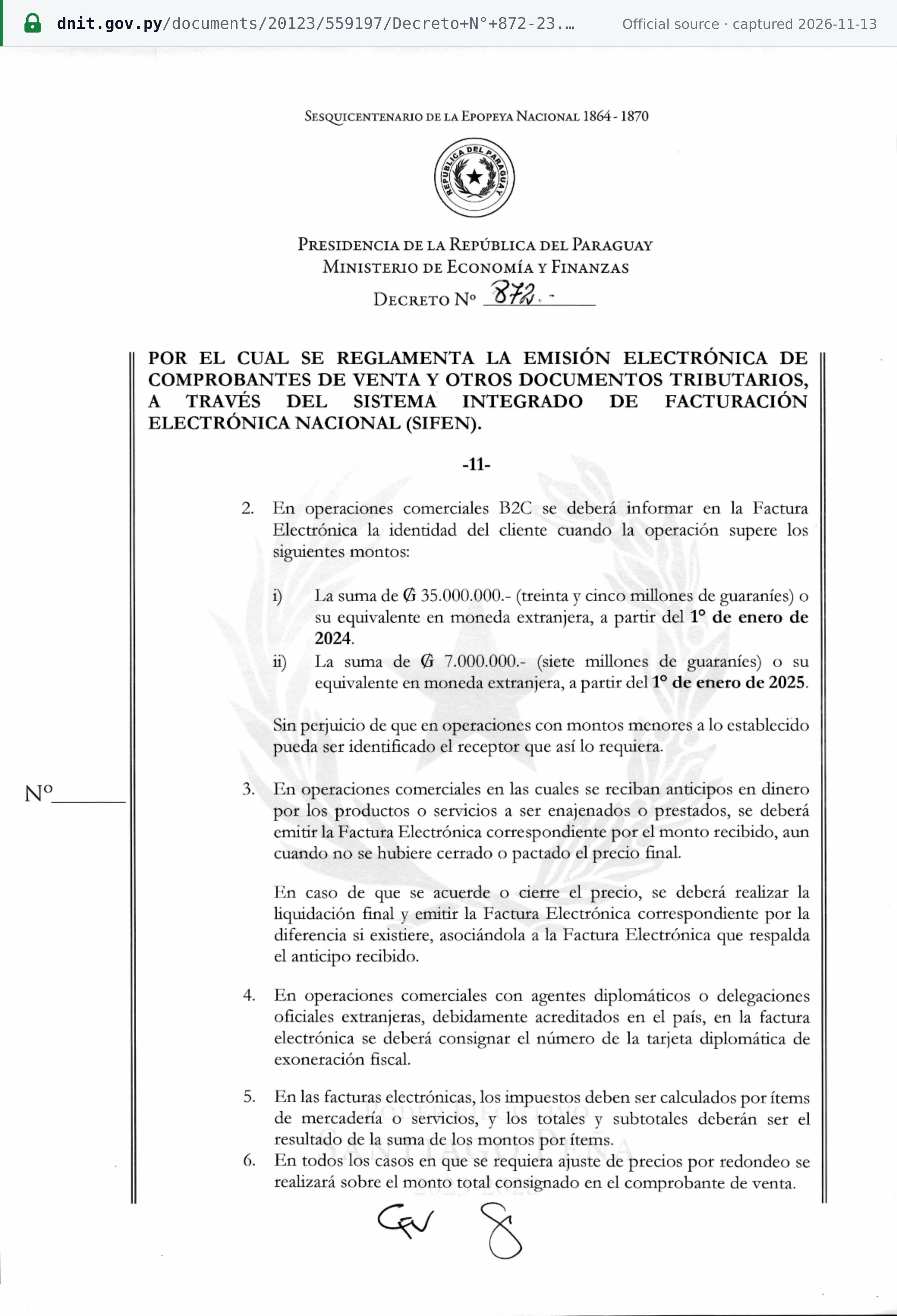
- Buyer identification. "En operaciones comerciales B2B, B2F o B2G se deberá informar en la Factura Electrónica, la identificación del receptor, en consecuencia, no se aceptará la indicación del receptor como innominado o sin nombre." In B2C, the customer must be identified when the operation exceeds ₲35,000,000 from 1 January 2024 and ₲7,000,000 from 1 January 2025, or the equivalent in foreign currency.
- Advances: an advance received in money requires an e-invoice for the amount received, and the final invoice for any difference is linked to it.
- Per-item tax: "los impuestos deben ser calculados por ítems de mercadería o servicios, y los totales y subtotales deberán ser el resultado de la suma de los montos por ítems."
Pre-printed or self-printed factura. Articles 19 and 20 of Decreto 6539/2005, as substituted by Decreto 10797/2013, list the mandatory content. [12]
- Pre-printed by the authorised printer (art. 19): the timbrado number; the issuer's RUC, name, principal address (and the issuing establishment's address if different) and economic activity; the document type; the number; the timbrado's validity end date (month and year); "Original" (buyer) or "Copia" (issuer's file), with any extra copy marked "No válido para crédito fiscal"; the printer's details; and the date of the timbrado authorisation.
- Completed at issue (art. 20): the buyer's RUC (except on exports), or identity-card number if it has none, and name ("Sin Nombre" if a final consumer declines to be identified); a description of the goods or services; the unit price including IVA; the sale value showing the IVA rate included; subtotals per rate and the total; the currency's sign and name when it is not the guaraní; the issue date; any delivery-note number; and the sale condition (cash or credit).
A specimen of a compliant invoice
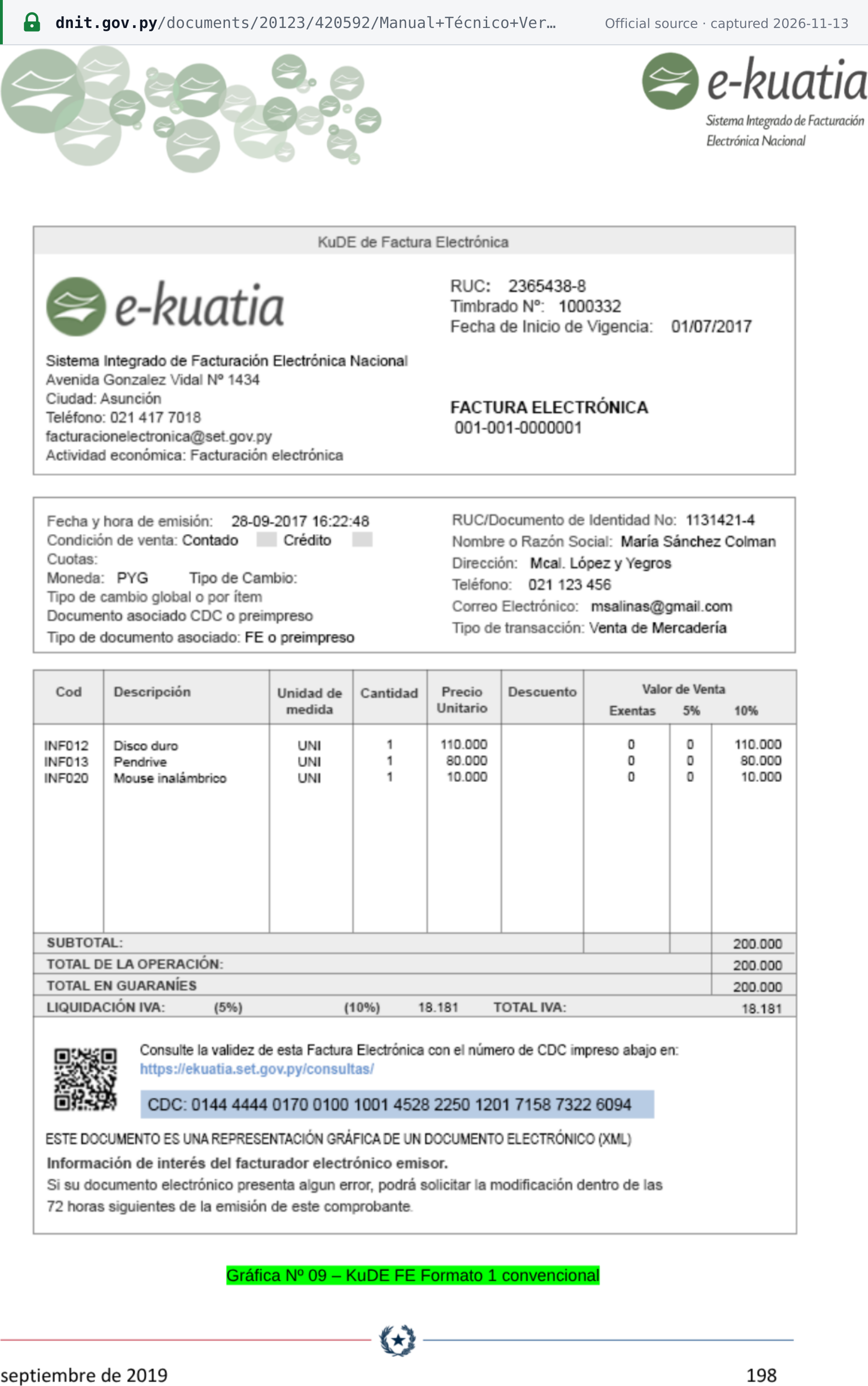
The DNIT publishes model KuDEs in the SIFEN Manual Técnico. Section 13.5 explains: "Las gráficas siguientes muestran modelos referenciales de KuDE para cada tipo de documento electrónico, sin embargo, cada contribuyente puede incluir otros campos presentes en el formato XML" — the figures are reference models, and a taxpayer may add other fields from the XML, on any standard paper size. [6] Gráfica N° 09 is the model printed e-invoice (Factura Electrónica). It shows:
- the issuer's RUC, timbrado number and timbrado validity start date beside the document number 001-001-0000001;
- the buyer block with RUC or identity number;
- items split into Exentas, 5% and 10% columns;
- totals in the operation currency and in guaraníes, and the IVA liquidation, here ₲18,181 of IVA included in ₲200,000 at 10%;
- the QR code, the CDC and the legend "ESTE DOCUMENTO ES UNA REPRESENTACIÓN GRÁFICA DE UN DOCUMENTO ELECTRÓNICO (XML)".
Its names, RUCs and amounts are the DNIT's own illustrative data.
Gráficas N° 10 to 15 of the same manual give the models for the credit note, debit note, self-invoice, delivery note and the till-roll KuDE.
Issuance deadline
The sales document is due when the tax point arises: "la obligación de expedir el comprobante de venta será coincidente con el momento del nacimiento de la obligación tributaria" (art. 83). The tax point is whichever comes first of delivery of the goods or performance of the service, receipt of full or partial payment, or the due date for payment of a service. Utilities, imports and services from abroad have their own tax points (art. 83(4)–(6)). [1]
Decreto 872/2023 art. 5 sets the timing of e-invoices for particular cases: construction contracts at each payment or progress certificate; staged services at the end of each stage; continuing services monthly ("se deberá emitir mensualmente, salvo que en el contrato respectivo se establezca un plazo diferente"); leasing at each instalment's due date; default interest when collected; and financial intermediation per service or in one monthly invoice with the statement. [11]
An e-invoice must reach SIFEN "en el plazo máximo de hasta 72 (setenta y dos) horas posteriores" to the time of its electronic signature. A later transmission is "transmisión extemporánea" and is sanctionable (art. 27).
Numbering and sequencing
Paper and electronic documents share the format EEE-PPP-NNNNNNN: "Los tres (3) primeros dígitos corresponderán al código del establecimiento", then a hyphen and three digits for the point of issue within that establishment, then a hyphen and a seven-digit sequence (Decreto 6539/2005 art. 19, as substituted by Decreto 10797/2013). [12] Electronic documents must use the numbering "de manera correlativa" (Decreto 872 art. 23(4)). Issuing documents out of the authorised sequence is fined (RG 13/2019 Anexo, item 2(c)).
Credit and debit notes
- Credit notes (Nota de Crédito Electrónica): "deberá ser emitida exclusivamente por el enajenante y solamente tendrá validez en relación con una Factura Electrónica determinada". It is tied to one e-invoice through its CDC and follows that invoice's currency. Between two electronic invoicers, a credit note for returns, discounts, price adjustments or bonuses needs the receiver to register an "Evento de Consentimiento", and the reason must be stated (Decreto 872 art. 12). [11]
- Debit notes (Nota de Débito Electrónica): for costs incurred after the invoice and for recovering bad debts, tied to one invoice (art. 13).
- Cancelling an e-invoice: where the operation did not take place, the issuer registers a cancellation event. The Manual Técnico v150 events table allows it "Hasta 48 horas de la aprobación del DTE cuando es igual a FE" and up to 168 hours for credit notes, debit notes, delivery notes and self-invoices. [6] The windows run from SIFEN's approval time, and the cancellation must state a reason. After the window, the correction is a credit note.
- Rejected documents may be corrected and resent with the same CDC, "siempre y cuando, la estructura de datos del Documento Electrónico no sea modificada". Otherwise the number is voided (inutilización), "siempre y cuando no haya entregado el bien o prestado el servicio" (Decreto 872 arts. 29 and 31).
Currency and language
- Currency: invoices may be issued in a foreign currency. A paper factura then shows the currency's sign and name (Decreto 10797/2013, new art. 20(10)). An e-invoice carries the currency, the exchange rate and a mandatory total in guaraníes (Manual Técnico §13.4). Credit and debit notes follow the original invoice's currency (Decreto 872 arts. 12–13).
- Language: neither Decreto 872/2023 nor Decreto 6539/2005 contains a language article. All official document formats and SIFEN field labels are in Spanish.
Document types
| Document | Use | IVA credit for the buyer |
|---|---|---|
| Factura (paper or electronic) | All supplies, B2B and B2C. "Es el documento electrónico emitido para respaldar documentalmente todas las operaciones realizadas por contribuyentes del IVA, ya sea con otros contribuyentes o con consumidores finales" (Decreto 872 art. 5) | Yes, when it names the buyer and its RUC |
| Boleta de Venta | Sales to final consumers | No: "Las Boletas de Venta no podrán ser utilizadas para respaldar Crédito Fiscal del Impuesto al Valor Agregado" (Decreto 6539 art. 6) |
| Ticket from a registered cash register | Sales to final consumers | No (Decreto 6539 art. 8) |
| Autofactura | Issued by the buyer when it buys from individuals (paper Autofactura: Decreto 6539/2005 art. 7); the electronic version covers individuals not registered in the RUC or not obliged to issue sales documents (Decreto 872/2023 art. 9) | No: "La Autofactura Electrónica en ningún caso podrá ser utilizada para respaldar el IVA Crédito" (Decreto 872 art. 9) |
| Boleta RESIMPLE | Sales by RESIMPLE taxpayers | No IVA is charged |
The electronic family under Decreto 872/2023 also includes the Factura Electrónica de Exportación, the Factura Cambiaria Electrónica, credit and debit notes, the Nota de Remisión Electrónica (delivery note), and retention and perception receipts. [11] [13]
Self-billing
Not in the usual sense. A buyer cannot issue invoices on behalf of a registered supplier. The buyer-issued document Paraguay has, the Autofactura (paper, Decreto 6539/2005 art. 7) or Autofactura Electrónica (Decreto 872/2023 art. 9), documents purchases from individuals; the electronic version is defined as covering individuals "que no se encuentran inscriptas en el RUC o que no se encuentran obligadas a emitir comprobante de ventas", and "en ningún caso podrá ser utilizada para respaldar el IVA Crédito" (art. 9). The Manual Técnico's model electronic self-invoice is Gráfica N° 12.
Retention and audit trail
- Retention. "Será obligatoria la conservación de las documentaciones por el plazo de prescripción" — documents are kept for the limitation period (Ley 6380 art. 92). The length of that period is set in Ley 125/91. [1]
- Electronic archiving. Electronic invoicers "deberán conservar en sus sistemas de facturación electrónicos, por el plazo de prescripción … todos aquellos Documentos Electrónicos que hayan emitido, recibido y transmitido; así como, garantizar su integridad, confidencialidad, accesibilidad o consulta posterior". Taxpayers that are not electronic invoicers keep the KuDE "de forma física o digital" (Decreto 872 art. 44). [11]
- Audit trail.
- Every DTE is validated and approved by SIFEN (art. 28), and its CDC and QR let anyone check it at
ekuatia.set.gov.py/consultas. - Where the XML and the KuDE differ, "prevalecerá la información del Documento Tributario Electrónico almacenado en el SIFEN" (art. 26).
- The receiver must check the DTE in SIFEN (art. 43), and can record events on it in SIFEN, such as conformity, disconformity or non-recognition.
- Every IVA taxpayer has registered its purchase and sales documents monthly in the Marangatu system since 2022: "Todos los contribuyentes del IVA deberán registrar sus comprobantes por medio del Sistema Marangatu a partir del año 2022." [14]
- Every DTE is validated and approved by SIFEN (art. 28), and its CDC and QR let anyone check it at
- Goods in transit. Goods moving within Paraguay must travel with their delivery note or sales document. Goods without them "se considerarán en infracción" and may be seized temporarily or permanently (Ley 6380 art. 94).
E-invoicing status
Status as at 13 November 2026: phased mandatory, by individual designation. The system is SIFEN (Sistema Integrado de Facturación Electrónica Nacional), governed by Decreto 872/2023, which "entrará en vigor a partir del 1 de enero de 2024, quedando abrogado a partir de dicha fecha el Decreto N° 7795/ 2017" (art. 52). The DNIT "podrá designar de manera gradual a contribuyentes como facturadores electrónicos", who from the date it sets can no longer issue tax documents by other means, except in contingencies (art. 46). [11]
Model. Clearance-style: the issuer signs the XML, transmits it to SIFEN within 72 hours, and SIFEN validates and approves it. Buyers check it by CDC or QR code.
Two channels (DNIT): [15]
- e-Kuatia, the transactional web-service integration, for medium and large companies that build or buy software to the DNIT's technical specification.
- e-Kuatia'i, the DNIT's free solution, for taxpayers with "un solo establecimiento con un solo punto de expedición". It needs a qualified electronic-signature certificate, "la cual es otorgada en forma gratuita por la DNIT".
Who is in, and from when. Designation is by name, in annexes to DNIT resolutions; the resolutions set no turnover threshold. Taxpayers are told through their Marandu mailbox, and the group lists are published on the DNIT site.
| Group | Start date | Instrument |
|---|---|---|
| 11 | 3 March 2025 | RG DNIT 21/2024 (medium and large taxpayers) |
| 12 | 2 June 2025 | RG DNIT 21/2024 |
| 13 | 1 September 2025 | RG DNIT 21/2024 |
| 14 | 1 December 2025 | RG DNIT 21/2024 |
| 15 | 2 March 2026 | RG DNIT 21/2024 |
| 16 | 1 June 2026 | RG DNIT 21/2024 |
| 17 | 1 September 2026 | RG DNIT 21/2024 |
| 18 | 1 December 2026 | RG DNIT 21/2024 |
| 19 | 1 June 2026 | RG DNIT 52/2026 (about 3,000 taxpayers, including small taxpayers) |
| 20 | 1 September 2026 | RG DNIT 52/2026 |
| 21 | 1 December 2026 | RG DNIT 52/2026 |
| 22 | 2 March 2027 | RG DNIT 52/2026 |
| 23 | 1 June 2027 | RG DNIT 52/2026 |
| 24 | 1 September 2027 | RG DNIT 52/2026 |
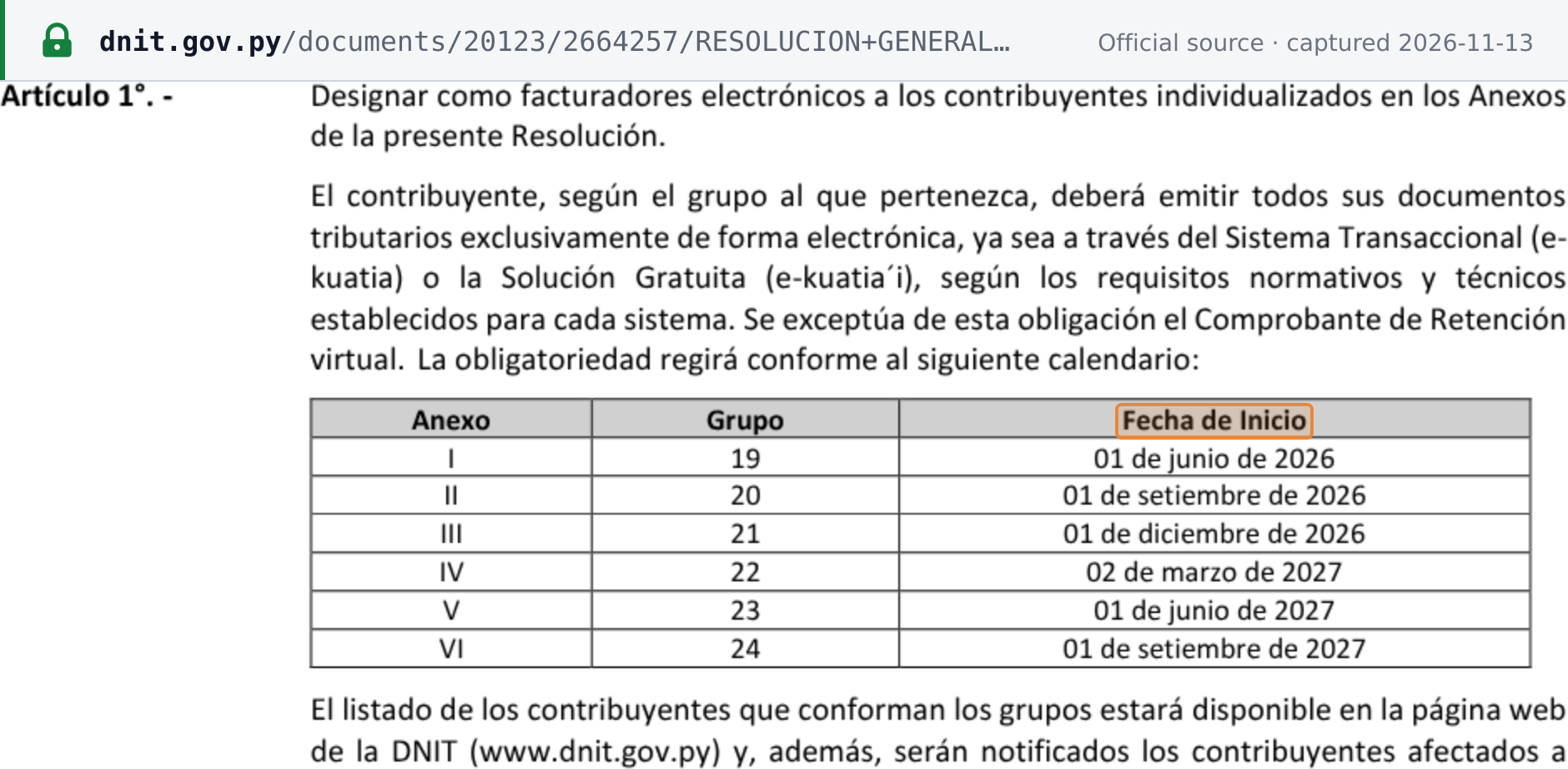
- Paper timbrado lapses. For groups 19 to 24, "la autorización y el timbrado de los documentos preimpresos o autoimpresos … perderán vigencia a partir del día siguiente a la fecha de inicio de la obligatoriedad correspondiente" (RG 52/2026 art. 3). The virtual retention receipt (Comprobante de Retención virtual) is excepted from the e-only rule.
- One extension. A designated taxpayer joining through e-Kuatia "podrá solicitar —por única vez— una prórroga de hasta tres (3) meses posteriores a la fecha de inicio", by a note to the DNIT filed at least 30 business days before its start date, with an implementation plan signed by the taxpayer and its developer (RG 21/2024 art. 2, as amended by RG 52/2026 art. 2).
- New companies. "a partir del 01 de abril de 2025 las personas jurídicas inscriptas como nuevos contribuyentes en el RUC, únicamente podrán emitir de forma electrónica sus documentos tributarios" (RG 21/2024 art. 9). [16]
- Public-procurement contractors. A taxpayer that signs a contract as supplier, contractor or consultant with a public-procurement entity from 2 January 2026 onwards, and has not yet joined SIFEN, "estará obligado a su adhesión a partir del día siguiente de la suscripción del contrato respectivo" (RG DNIT 41/2025 art. 1). RG 41/2025 also repealed article 7 of RG 21/2024, the earlier blanket rule for state suppliers (art. 6). [19]
- Voluntary adhesion remains open. A voluntary adherent must be fully electronic within 6 months of receiving its production timbrado (RG 21/2024).
- Exports. RG DNIT 59/2026 of 23 October 2026 named six exporters for a pilot of the Factura Electrónica de Exportación (FEE). No general date for electronic export invoices has been set. [7]
Scale. On 11 September 2026 the DNIT reported that Paraguay "supera actualmente los 50.000 contribuyentes habilitados como facturadores electrónicos", of which 88.6% were small, 10.0% medium and 1.4% large taxpayers. [20]
Formats and standards. A national XML schema defined in the SIFEN Manual Técnico (version 150) and its technical notes (NT_E_KUATIA, the latest listed being NT 027), with XSD validation, SOAP web services, a 44-digit CDC and a QR code built with the taxpayer's security code (CSC). The Manual defines its own schema, not UBL or Peppol. The DNIT must give "como mínimo 6 (seis) meses" notice of any change to the format or technical specifications (Decreto 872 art. 48). [21]
Scope. One regime for B2B, B2C and B2G: the Factura Electrónica covers sales "ya sea con otros contribuyentes o con consumidores finales" (Decreto 872 art. 5). The obligation attaches to the designated issuer, not to the type of customer. For how clearance systems compare, see CTC e-invoicing models.
Filing and payment
Filing frequency
Monthly, for every IVA contributor, on Formulario N° 120 ("Impuesto al Valor Agregado – Versión 4"), obligation code 211. The DNIT's IVA leaflet: "El referido formulario debe ser presentado mensualmente, de acuerdo con las fechas de vencimiento establecidas en el Calendario Perpetuo de Vencimiento." [9] Contributors that make only exempt or non-taxed supplies, or have no activity, still file: they "estarán obligados a presentar declaraciones juradas" (Ley 6380 art. 96).
Return due date
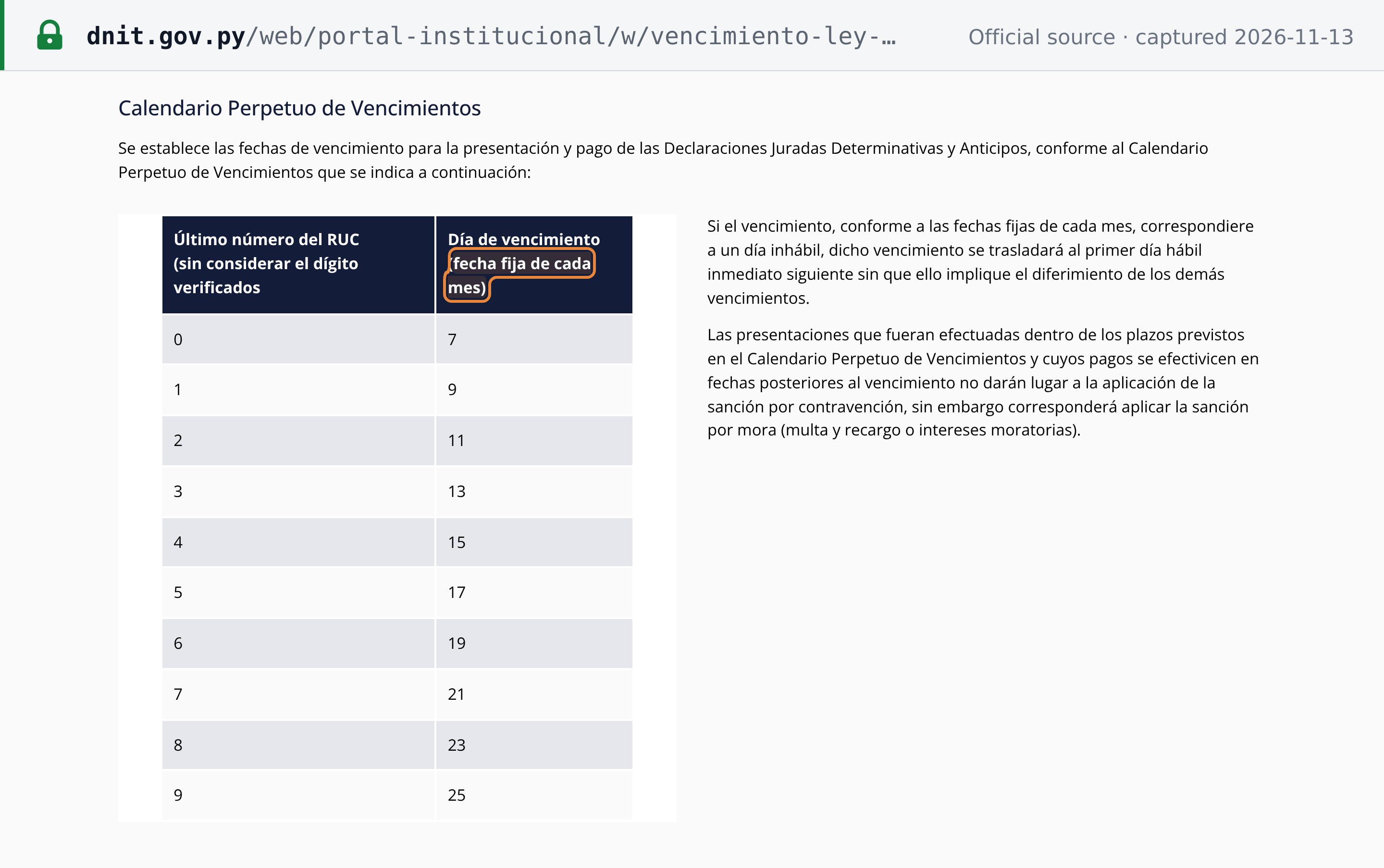
The return and the payment are due "hasta el día del vencimiento del mes siguiente de finalizado el periodo fiscal a declarar" — on the due day of the month after the period. The due day is fixed by the last digit of the RUC, excluding the check digit (Calendario Perpetuo de Vencimientos, RG 38/2020): [22]
| Last digit of RUC (without DV) | 0 | 1 | 2 | 3 | 4 | 5 | 6 | 7 | 8 | 9 |
|---|---|---|---|---|---|---|---|---|---|---|
| Due day of the following month | 7 | 9 | 11 | 13 | 15 | 17 | 19 | 21 | 23 | 25 |
A due date that falls on a non-business day moves to the next business day.
November 2026 only. After the Banco Central del Paraguay opened a resolution procedure for Ueno Bank S.A., RG DNIT 60/2026 moved the November 2026 dates for determinative returns and payments: digits 0 and 1 to 16 November; 2 and 3 to 17 November; 4 and 5 to 19 November; 6 to 23 November; 7 to 24 November; 8 to 25 November; and 9 to 26 November. "El traslado no alcanza a la presentación de declaraciones juradas informativas, a la declaración y el pago de retenciones tributarias, al pago de anticipos ni a las cuotas de facilidades de pago." Affected taxpayers may ask for exclusion of liability on grounds of force majeure until 4 December 2026. [23]
Payment due date and method
Payment is due on the same day as the return. A return filed on time and paid late does not draw the contravention fine, but "corresponderá aplicar la sanción por mora (multa y recargo o intereses moratorias)". [22] Payment can be made at any collection point the DNIT authorises, by electronic tax payment, or by credit or debit card (see the DNIT's tax payments page).
Additional listings
- Purchase and sales register (Libro de Compras y Ventas): every IVA taxpayer registers its purchase and sales documents monthly in Marangatu. The informative return runs on its own calendar, one day after the determinative one: digit 0 on the 8th, 1 on the 10th, 2 on the 12th, 3 on the 14th, 4 on the 16th, 5 on the 18th, 6 on the 20th, 7 on the 22nd, 8 on the 24th and 9 on the 26th. [22]
- Withholding agents confirm the pro-forma statement of IVA and income tax withheld "dentro de los seis (6) primeros días corridos del mes", and pay by the 7th; unconfirmed, the pro-forma stands as the amount due.
Input-tax recovery and blocked items
Input IVA is deductible only when (art. 89): [1]
- the purchase is linked to taxed operations;
- it is a real outlay; and
- the supporting document identifies the buyer's name and RUC and describes the goods or services precisely.
Restrictions and adjustments:
- Mixed supplies: input IVA used for both taxed and exempt or non-taxed operations is deducted in proportion to taxed operations over total operations (art. 88).
- Personal-service providers: may deduct only up to 30% of the IVA on motor vehicles (art. 88), and only up to 30% of the IVA on food, including non-alcoholic drinks, under Decreto 8175/2022 art. 1, as reproduced in the DNIT's leaflet. [9]
- Destruction or theft: the input IVA on goods destroyed, stolen or otherwise lost must be reversed (art. 88).
- Bad debts: reduce output IVA under conditions set by the executive (art. 87).
- Exempt or non-taxed businesses: cannot deduct; see Exemptions.
Refunds
- No refund of excess credit. When IVA credit exceeds IVA debit, "dicho excedente será utilizado como tal en las liquidaciones, pero sin que ello genere derecho a devolución" (art. 88). Nothing is refunded on closure either (art. 91).
- Exporters may claim a refund of the input IVA linked to exports (arts. 101–103):
- claims are made monthly, in chronological order, from the month after the return's due date and within the limitation period;
- the amount is capped at the highest IVA rate applied to the customs export value;
- the refund is credited to the taxpayer's tax account, where it can be set against other taxes or transferred to another taxpayer;
- the DNIT must decide within 90 business days of accepting the claim ("no podrá exceder de noventa días hábiles contados a partir de la fecha de la aceptación de la solicitud");
- a faster channel is available against a bank guarantee or surety;
- late refunds bear interest at the taxpayers' late-payment rate.
- Non-residents: the IVA title of Ley 6380 contains no refund scheme for foreign businesses. Tourist-shopping regimes are set separately (see Special regimes).
Exemptions
Exempt supplies
Article 100 of Ley 6380 opens "Estarán exoneradas del presente impuesto:" and lists: [1]
- Supplies of:
- foreign currency and securities, including shares;
- assignments of receivables;
- capital goods made in Paraguay for investors under the investment-incentive regime (art. 100 names Ley 60/90; Ley 7548/2025 repealed that law and keeps this exemption in its art. 4(b)); [27]
- "Libros y periódicos, publicados en papel o por medio electrónico", and educational, cultural or scientific magazines;
- laptops for free child-education programmes;
- donations to non-profit education and sports entities;
- games of chance under Ley 1016/97;
- "Los combustibles derivados del petróleo, incluidos los biocombustibles";
- transfers on company reorganisations, and contributions of assets to capital.
- Exports of goods.
- Services:
- interest on securities, and derivatives;
- international freight for exports;
- bank and cooperative deposits;
- services by diplomatic-mission staff;
- education: "Los servicios de enseñanza inicial y preescolar, básica, media, técnica, terciaria, universitaria y de educación superior, prestados por personas o entidades reconocidas por el Ministerio de Educación y Ciencias o por ley";
- public passenger transport.
- Imports of: exempt goods; travellers' baggage; diplomatic goods; capital goods under the investment-incentive regime (now Ley 7548/2025); and new buses under the fleet-renewal plan. [27]
- Other: the activities of non-profit, religious and political-party entities, except a listed set of commercial activities; purchases of education equipment by recognised schools; and transactions of cooperatives and mutuals with their members.
Passenger transport since 2023. Ley 7067/2023 (promulgated 10 July 2023, published 13 July 2023, after Congress overrode the executive's veto) rewrote article 100(3)(h), which had covered only routes of up to 100 km. It now exempts "los servicios de transporte público de pasajeros nacionales, ya sean urbanos, metropolitanos o de corta, media y larga distancia" — all domestic public passenger transport, urban, metropolitan, short, medium or long distance. The DNIT's HTML copy of Ley 6380 and its IVA leaflet (August 2024) still show the old 100 km wording. [24]
Exempt is not zero-rated. A business making exempt or non-taxed supplies cannot deduct the IVA on its related purchases. Article 91: "el impuesto consignado en los comprobantes que respalden las compras relacionadas a dichas operaciones constituirá un costo o gasto para el IRE o IRP según corresponda. En estos casos el contribuyente será considerado como consumidor final." The IVA becomes an income-tax cost. Only exporters recover input IVA on exempt sales (art. 101). [1] See zero-rated vs exempt.
Special regimes
- RESIMPLE: sole proprietorships with prior-year gross income of ₲80,000,000 or less may opt out of IVA (art. 27; see Registration threshold).
- Tourist shopping: article 104 lets the executive create "un régimen de aplicación nacional, regional o local, que favorezca el turismo de compras de determinados bienes a personas físicas extranjeras no residentes". The DNIT's IVA page lists "Régimen de Turismo" alongside the general regime. [25]
- Real estate: taxed on 30% of the price at 5% (arts. 85(3) and 90).
Offences and penalties
Offences
- Failure to issue a sales document, issuing one with errors, out of sequence, from an unauthorised establishment or for less than the real value, and moving goods without a delivery note, are contraventions of formal duties (RG 13/2019 Anexo, section 2). [8]
- Goods in transit without a delivery note or sales document are "en infracción" and may be seized temporarily or permanently (Ley 6380 art. 94).
- Late transmission of an e-invoice to SIFEN after 72 hours is "transmisión extemporánea" and sanctionable (Decreto 872 art. 27). The DNIT sets the e-invoicing sanctions (art. 47).
- Suspension of activities. In listed cases of presumed fraud, the tax administration may "Suspender las actividades del contribuyente, hasta por el término de tres días hábiles, prorrogable por un período igual previa autorización judicial" (Ley 125/91 art. 189, as amended by Ley 2421/04). [26]
- Tax fraud and evasion. Tax fraud (defraudación) under Ley 125/91 and criminal tax evasion under the Penal Code are separate exposures from the fines below.
Penalties
Fixed fines for breaches of formal duties, from the annex to RG 13/2019 as published by the DNIT: [8]
| Breach (RG 13/2019 Anexo) | Fine |
|---|---|
| Registering, updating or cancelling the RUC later than 30 business days (1 a–c) | ₲50,000 |
| Sales documents with errors or omissions, issued by unauthorised means, out of sequence, from an unauthorised establishment, for less than the real value, or not issued (2 a–g) | ₲50,000 per infraction or per document, "hasta llegar a la Multa Máxima por cada período mensual" |
| No sales documents available at the establishment (2 h) | ₲300,000 |
| Late reporting of virtual documents (2 j) | ₲50,000 per document |
| Moving goods without a delivery note (2 p) | ₲500,000 |
| Late determinative return, such as the IVA return (4 a) | ₲50,000 |
| Late informative return (4 b) | ₲100,000 |
| Obstructing an audit, or not keeping records for the limitation period (6 d–e) | ₲300,000 |
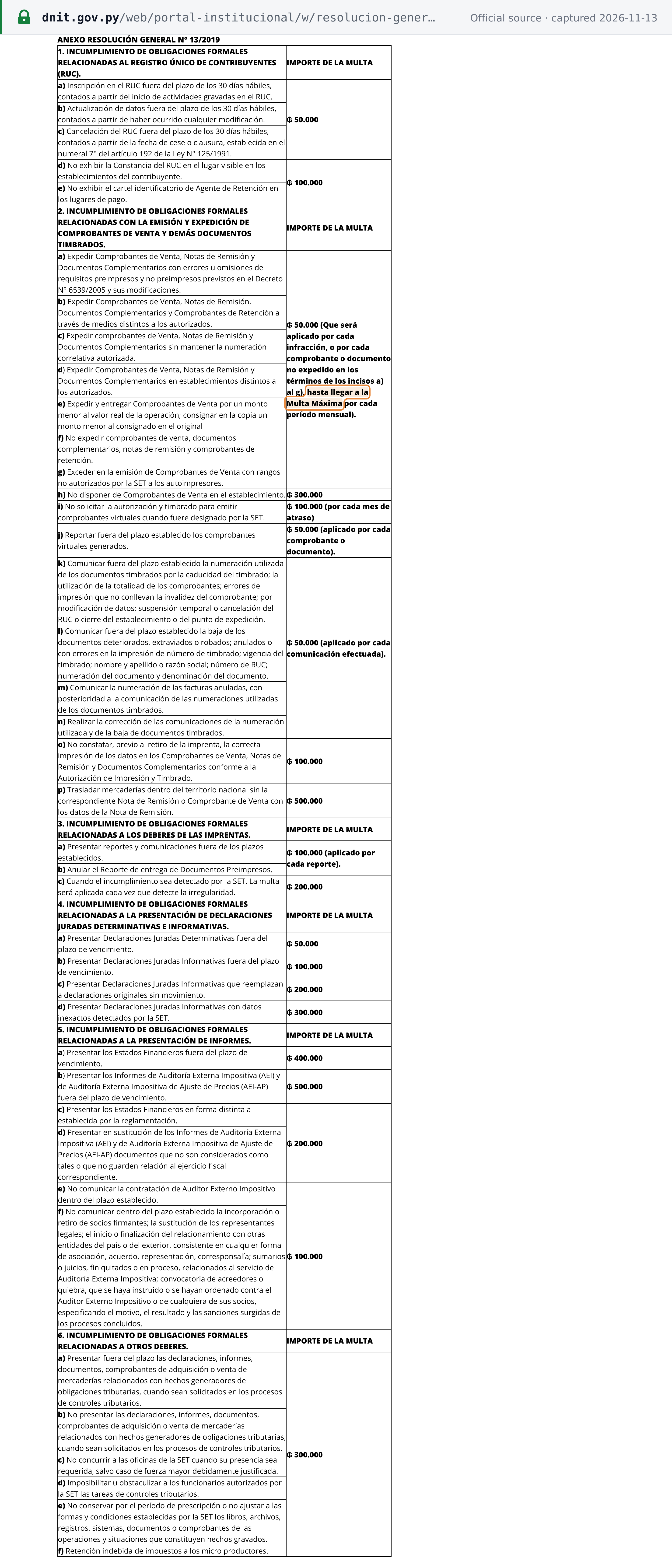
Late payment draws the mora sanction, "multa y recargo o intereses moratorias" (Calendario Perpetuo de Vencimientos). [22] The rates are set under Ley 125/91 (art. 171).
Frequently asked questions
Is there a turnover threshold below which a Paraguayan business does not register for IVA?
No. Under article 82 of Ley 6380/2019, IVA contributor status follows from the activity, not from turnover: independent professionals, landlords, sole proprietorships, companies and other private entities, and branches of foreign entities are all contributors. The one carve-out is RESIMPLE: a sole proprietorship whose gross income in the previous year was ₲80,000,000 or less may opt into that regime, and then is not an IVA contributor (article 27). A RESIMPLE taxpayer that also provides personal services or leases property must register for IVA for those activities.
My card statement shows an IVA charge on a Netflix or software subscription. Why, and can my business deduct it?
Since 1 January 2021, banks, financial entities, exchange houses, cooperatives, payment processors and telephone companies that handle payments abroad perceive the IVA when a Paraguayan account holder pays a foreign provider for a digital service by card or transfer (RG 76/2020 arts. 3 and 13). The foreign provider does not charge Paraguayan IVA itself. If you are an IVA contributor and the service relates to your taxed activity, the perceived IVA is creditable input tax, and the card or account statement is the supporting document (RG 76/2020 art. 4).
Do I have to put the customer's name on an e-invoice?
Always on B2B, B2F and B2G e-invoices: SIFEN does not accept an unnamed receiver there. On B2C e-invoices the customer must be identified when the operation exceeds ₲7,000,000, or its equivalent in foreign currency, from 1 January 2025; the limit was ₲35,000,000 in 2024 (Decreto 872/2023 art. 6). Below that, a consumer who asks to be identified can be.
On which day is my monthly IVA return due?
In the month after the period, on a fixed day set by the last digit of your RUC, ignoring the check digit: 0 on the 7th, 1 on the 9th, 2 on the 11th, 3 on the 13th, 4 on the 15th, 5 on the 17th, 6 on the 19th, 7 on the 21st, 8 on the 23rd and 9 on the 25th. A due date on a non-business day moves to the next business day. For November 2026 only, RG DNIT 60/2026 moved the dates for determinative returns and payments to between 16 and 26 November 2026.
We were designated as an electronic invoicer in RG DNIT 52/2026 but our software is not ready. Can we get more time?
Once only, and only if you are joining through the transactional system (e-Kuatia): you may ask for an extension of up to three months after your group's start date by filing a note with the DNIT at least 30 business days before that date, with an implementation plan signed by you and your software developer. Your pre-printed and self-printed timbrado stops being valid the day after your group's start date (RG DNIT 52/2026 art. 3).
Can we get a refund of excess IVA credit if we do not export?
No. When IVA credit exceeds IVA debit, the excess carries forward to later returns but does not give a right to a refund (Ley 6380 art. 88), and there is no refund on closing the business (art. 91). Refunds are available to exporters for the input IVA linked to their exports (arts. 101 to 103).
Important websites
| Site | Purpose |
|---|---|
| DNIT portal | The tax authority: news, legislation, resolutions, FAQ |
| Inscribirme al RUC | RUC pre-registration form |
| Registering individuals and legal persons | DNIT registration guides and list of documents |
| Marangatu | File returns (Form 120), register purchases and sales, view the tax account |
| Tax payments | DNIT payment channels |
| RUC public lookup | Check a taxpayer's RUC and status |
| IVA information page | DNIT summary of IVA, rates and how to add the IVA obligation |
| Filing calendar (Ley 6380) | Due days by RUC last digit |
| e-Kuatia portal | SIFEN e-invoicing: joining, e-Kuatia'i, news |
| E-invoice lookup | Check an electronic document by CDC |
| SIFEN technical documentation | Manual Técnico, XSD schemas and technical notes |
| Paraguay RUC validator | Check a RUC's format with Lookuptax |
Recent changes
- 2026-11-09 — RG DNIT 60/2026 moves the November 2026 return and payment dates to 16–26 November after the Ueno Bank resolution. (DNIT)
- 2026-10-23 — RG DNIT 59/2026 starts a pilot of the electronic export invoice (FEE) with six exporters. (DNIT)
- 2026-06-01 — SIFEN group 19, the first of six RG DNIT 52/2026 groups running to 1 September 2027, must issue e-invoices only; RG 21/2024 group 16 starts the same day. (DNIT)
- 2026-05-06 — The DNIT announces RG DNIT 52/2026, designating about 3,000 more electronic invoicers, including small taxpayers. (DNIT)
- 2026-01-02 — Public-procurement contractors must join SIFEN from the day after signing a contract (RG DNIT 41/2025). (DNIT)
- 2025-04-01 — Newly registered legal persons may issue tax documents only electronically (RG DNIT 21/2024 art. 9). (DNIT)
- 2025-01-01 — The B2C buyer-identification limit on e-invoices falls to ₲7,000,000 (Decreto 872/2023 art. 6). (DNIT)
For the full chronology, see Paraguay tax changes on Lookuptax.
Reference links
- Ley N.° 6380/2019 — DNIT (HTML)
- Ley N.° 6380/2019 — Biblioteca y Archivo Central del Congreso (BACN)
- DNIT — Vencimientos (Ley 125/91 calendar)
- DNIT — Preguntas frecuentes
- RG N° 114/2022 — non-resident digital-service providers (INR)
- SIFEN Manual Técnico, version 150 (PDF)
- RG DNIT N° 59/2026 — export e-invoice pilot (PDF)
- RG N° 13/2019 — Anexo, contravention fines
- DNIT — Cartilla Informativa del IVA, August 2024 (PDF)
- RG N° 76/2020 — IVA perception on foreign digital services (PDF)
- Decreto N° 872/2023 — SIFEN (PDF)
- Decreto N° 10797/2013 — sales-document requirements (PDF, scan)
- Decreto N° 6539/2005 — timbrado and sales documents (PDF)
- DNIT — IVA General presentation, 2024 (PDF)
- DNIT — Factura electrónica
- RG DNIT N° 21/2024 — SIFEN groups 11–18 (PDF)
- RG DNIT N° 52/2026 — SIFEN groups 19–24 (PDF)
- DNIT — "DNIT designa nuevos facturadores electrónicos" (6 May 2026)
- RG DNIT N° 41/2025 — public-procurement contractors (PDF)
- DNIT e-Kuatia — "Paraguay supera los 50.000 facturadores electrónicos" (11 September 2026)
- DNIT e-Kuatia — Documentación técnica
- DNIT — Vencimiento Ley Nº 6380/19 (RG 38/2020 calendar)
- DNIT — November 2026 due dates moved, RG DNIT N° 60/2026 (9 November 2026)
- Ley N.° 7067/2023 — amends art. 100(3)(h) of Ley 6380 (BACN)
- DNIT — IVA
- Ley N.° 2421/2004 — DNIT (HTML)
- Ley N.° 7548/2025 — DNIT (PDF)
Related on Lookuptax: