Rwanda VAT guidelines
| FACTSHEET | |
|---|---|
| Country code | RW |
| Tax name | Value Added Tax (VAT) |
| Tax Authority | Rwanda Revenue Authority (RRA) |
Overview
Rwanda levies Value Added Tax (VAT) — in Kinyarwanda umusoro ku nyongeragaciro, in French taxe sur la valeur ajoutée (TVA) — under Law Nº 049/2023 of 05/09/2023 establishing value added tax (the "VAT Law"), published in the Official Gazette n° Special of 14/09/2023 and in force on publication. It repealed the previous VAT law, Law 37/2012. Its list of exemptions was replaced by Law Nº 009/2025 of 27/05/2025, in force from 29 May 2025. Registration, invoicing, returns, records and penalties sit in Law N° 020/2023 of 31/03/2023 on tax procedures (the "Tax Procedures Law"). [1] [2] [3]
Scope. Article 3(1) of the VAT Law charges VAT on "(a) taxable goods and services, including online supplies; (b) and taxable imported goods and services." Two 2026 Ministerial Orders fill in the detail: Ministerial Order Nº 004/26/10/TC of 29/04/2026 relating to the value added tax on goods and services provided online, tax adjustment and tax exemption on materials used in industries, and Ministerial Order N° 006/26/10/TC of 24/09/2026 on the use of the electronic invoicing system. [1] [4] [5]
Languages of the law. The gazette texts are trilingual, in Kinyarwanda, English and French columns. Both the VAT Law (Art. 35) and the Tax Procedures Law (Art. 104) state that they were drafted, considered and adopted in Kinyarwanda. In one place the English column disagrees with the other two on a late-payment penalty rate; see Penalties.
Authority. VAT is administered by the Rwanda Revenue Authority (RRA), which runs the E-Tax and MyRRA portals and certifies the electronic invoicing systems every seller must use. Import VAT is collected at the customs point. [1]
Currency. Rwandan francs (FRW, also written RWF). Under Art. 32, an amount in another currency is converted at the customs exchange rate for imports and, in any other case, at the National Bank of Rwanda (BNR) rate "on the date on which the amount is given". Where BNR has no rate for the currency, the rate is computed from BNR's US dollar rate and "a published cross-rate for that currency in question against the United States Dollar". [1]
Tax period. Art. 2(e) defines the VAT period as "a calendar month or quarter in which the value added tax must be paid". Which one applies depends on turnover; see Filing and payment.
Layering. VAT is a single national tax: the VAT Law provides for no regional or local VAT. Local-government taxes exist but are separate taxes, not VAT.
For neighbouring East African systems, see the Kenya, Uganda, Tanzania, Burundi and DR Congo guides.
Registration
Who should register
Any person carrying out taxable activities whose turnover crosses either of two tests must register for VAT, unless the business is exempt from VAT. Article 11, paragraph 3 of the Tax Procedures Law reads:
"Any person who carries out taxable activities whose turnover in the previous fiscal year exceeds twenty million Rwandan Francs (FRW 20,000,000) or five million Rwandan Francs (FRW 5,000,000) in the preceding quarter registers for Value Added Tax within a period not exceeding seven (7) days from the end of the concerned year, or three previous months unless his or her business is exempted from Value Added Tax."
If a person meets the turnover test but does not register, RRA registers them itself: "the registration is done by the Tax Administration if the taxpayer meets the required registration turnover but fails to register. The Tax Administration immediately notifies the taxpayer of such a registration" (Art. 11, para 5). [3]
Registration threshold
| Test | Amount (as at 2026-11-02) | Measured over | Register within |
|---|---|---|---|
| Annual | Turnover exceeds FRW 20,000,000 | The previous fiscal year | 7 days from the end of that year |
| Quarterly | Turnover exceeds FRW 5,000,000 | The preceding quarter | 7 days from the end of that quarter |
Source: Tax Procedures Law, Art. 11, para 3. [3]
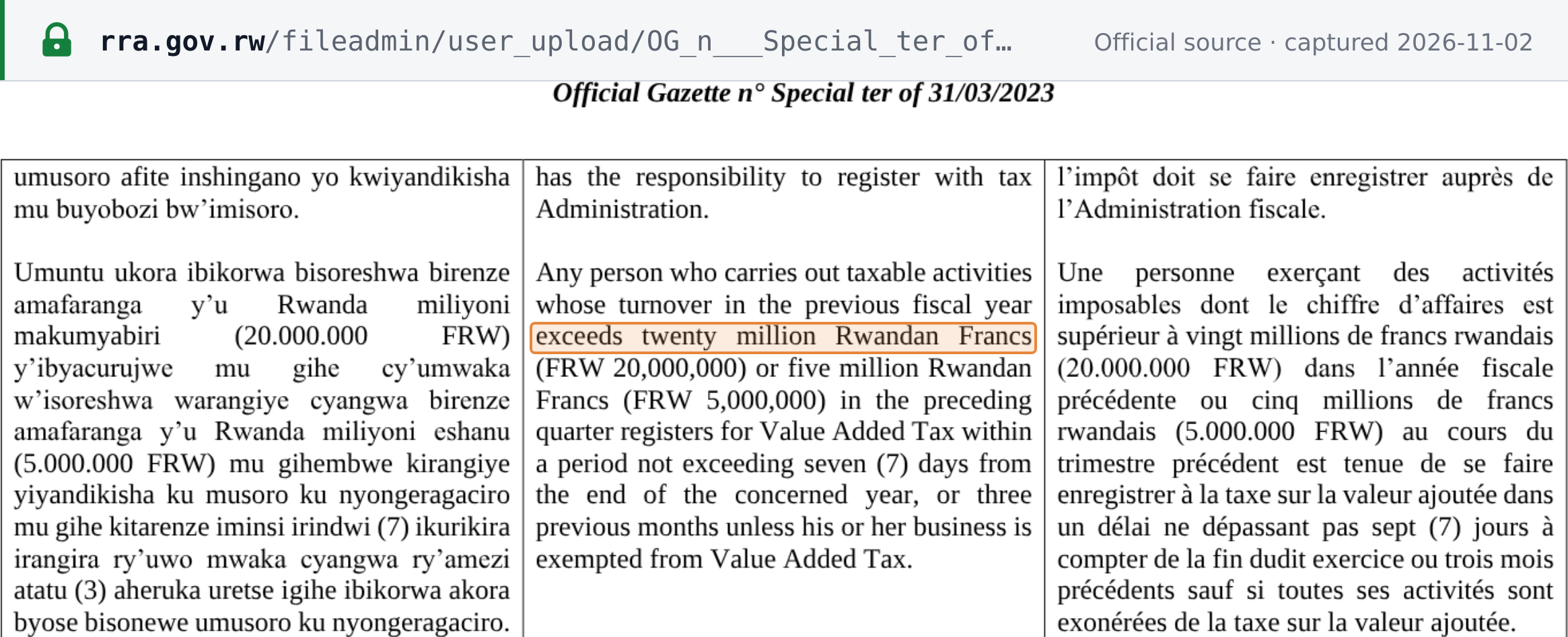 Source snapshot captured 2026-11-02 — original
How the period is measured. The law speaks of the "previous fiscal year" and the "preceding quarter". RRA's VAT registration page words it differently — "if his/her turnover is above 20 Million Rwf for a period of 12 month or 5 Million Rwf in three consecutive months" — which reads more like a rolling test. Where the two differ, the law's wording is the rule. RRA's 2025 VAT leaflet follows the law: "Your turnover exceeded RWF 20,000,000 in the previous fiscal year, or • Your turnover exceeded RWF 5,000,000 in the previous quarter". It adds: "If all your activities are VAT-exempt, registration is not required." [12] [8]
Non-resident registration
For online supplies, a supplier outside Rwanda must register. Article 4(1) of Ministerial Order 004/26/10/TC: "A supplier of taxable goods and services provided online is required to register for value added tax if the goods and services provided online are supplied to customers in Rwanda while the supplier is outside Rwanda." A supplier that is not registered in Rwanda "may appoint a representative who has a business in Rwanda to fulfil the obligation to register in their place" (Art. 4(2)). The Order states no turnover threshold for these suppliers: Article 4 contains no amount, and the Order does not refer to the Art. 11 thresholds of the Tax Procedures Law. A supplier of online goods and services that is in Rwanda must also register, and must present a certificate showing that it is registered with the public-utilities regulator (Art. 4(3)). [4]
For other foreign suppliers, the VAT Law has no separate non-resident registration regime. Imported goods bear VAT at customs, and services bought in by a Rwandan VAT-registered business fall under the reverse charge.
Tax identification number
The Taxpayer Identification Number (TIN) is assigned by the Registrar General. Article 12 of the Tax Procedures Law: "The Registrar General assigns a taxpayer identification number to a taxpayer to be used for payment of any tax. Every taxpayer puts a taxpayer identification number on tax declaration documents and on other correspondences provided for by this Law and on any other commercial documents or other proofs he or she files with the Tax administration." There is no separate VAT number. [3]
Format. The TIN is 9 digits, judging by RRA's own material: Ministerial Order 006/26/10/TC defines the "buyer identification number" as one "which can be identified by a TIN, telephone number or nine zeroes", and RRA's EBM 2.1 user guide gives the example "fill in TIN (Example: 100005050)". RRA publishes no check-digit algorithm. To check the shape of a Rwandan TIN, use the Rwanda TIN validator. RRA's Search for TIN using National ID finds the TIN assigned to a national ID or passport. [5] [10]
How to register
- New business. A person setting up a business "is obliged to register business with the Registrar General within a period of seven (7) days from the beginning of the business activity" (RRA registration page). Business registration with the Office of the Registrar General (org.rdb.rw) issues the TIN (Tax Procedures Law Art. 12). [19]
- Existing taxpayers register for VAT through RRA's E-Tax portal. A taxpayer who opts into VAT "registers with the Registrar General" (Tax Procedures Law Art. 11, para 5). [3]
- Certificate. "A taxpayer registered for value added tax is issued with a certification of registration electronically" (VAT Law Art. 30). RRA requires a VAT-registered taxpayer to "display the VAT registration certificate in a plain view at the entrance of his place of business for his client to see". [1] [12]
- Branches. "A person who runs a business in multiple branches of an enterprise is required to register the business under a single taxpayer identification number rather than under different numbers" (VAT Law Art. 31). [1]
- Electronic invoicing system. Once trading, every seller needs an RRA-certified electronic invoicing system (EBM); see E-invoicing status.
For the general process across countries, see How to register for VAT, sales tax or GST.
Voluntary registration
Available. "A person who is not required to register for Value Added Tax in accordance with the provisions of Paragraph 3 of this Article may voluntarily register for Value Added Tax" (Tax Procedures Law Art. 11, para 4). RRA's leaflet lists the reasons a business might want to: "Enhancing your business credibility • Enabling VAT refund claims on business inputs • Bidding on public tenders". [3] [8]
Deregistration
- Below the threshold: VAT deactivation. RRA's guidance applies when turnover "is not more than 20 million Rwandan francs for 12 consecutives months/ 5 million Rwandan Francs for 3 consecutive months". Before applying, "Your tax account should be clean (no tax arrear)", you must "Demonstrate clear reasons supporting your request", and you "Submit your request online through E-tax". [15]
- Ceasing business: deregistration. "A taxpayer who completely ceases to operate, has the right to apply for VAT de-registration of his/her business via E-tax system." [12]
- Final VAT. "Taxable assets of the taxpayer's business that is owned by the taxpayer on the day of de-registration for value added tax are subjected to the tax that remains unpaid as of that same day" (VAT Law Art. 6(4)). Applying for deregistration is itself a tax point (Art. 12(1)(e)). [1]
Group registration
Not available in Rwanda: the VAT Law (Law 049/2023) has no VAT-grouping provision. It goes the other way for branches, which register under one TIN (Art. 31). See VAT grouping for how other countries do it. [1]
Rates
| Rate (as at 2026-11-02) | Applies to | Source |
|---|---|---|
| 18% (standard) | All other goods and services supplied in Rwanda or imported | VAT Law Art. 4(b) |
| 0% | Exports and their auxiliary services, exported services, international and transit transport of goods, minerals sold on the domestic market and the other supplies listed in Art. 7 | VAT Law Art. 4(a), Art. 7 |
| Exempt | Health, education, financial services, residential rent, unprocessed agricultural produce and the other supplies listed in Art. 8 (no input-tax recovery) | VAT Law Art. 8, as replaced by Law 009/2025 |
Standard rate: 18%. Article 4 of the VAT Law: "The rate of value added tax is – (a) 0% of the value of taxable goods or services that are zero-rated as provided for by this Law; (b) or 18% for other goods and services supplied in Rwanda or imported." The 18% rate is carried in Law 049/2023, in force 14 September 2023, and continues the rate of the law it replaced. Import VAT is charged at the same 18%. [1] [13]
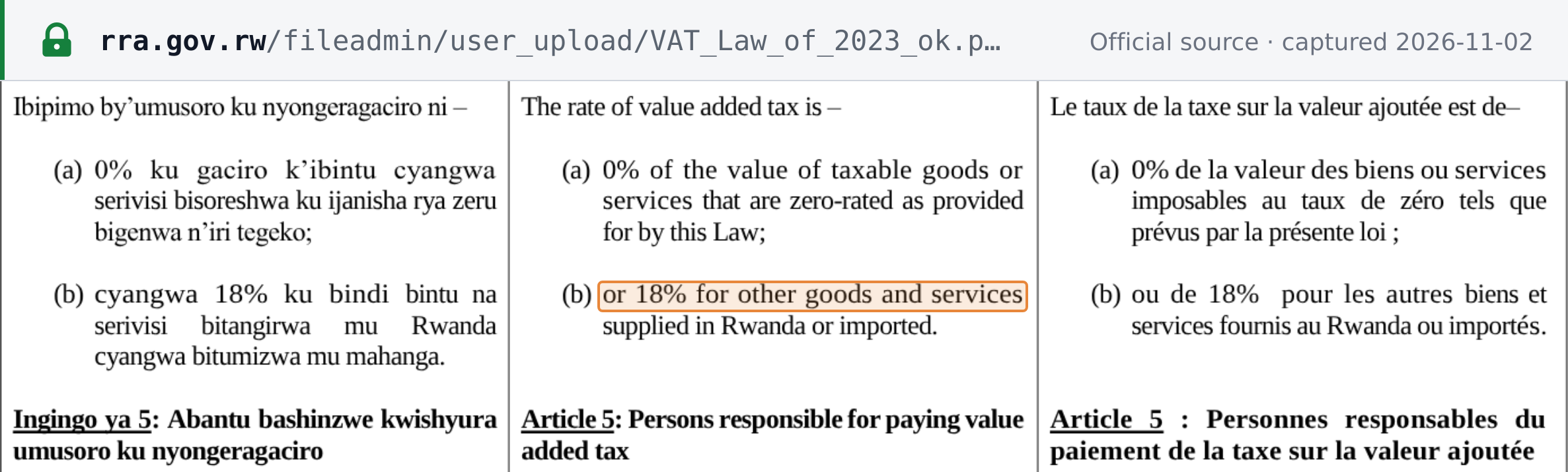 Source snapshot captured 2026-11-02 — original
No reduced rate. Article 4 sets only two rates, 0% and 18%; there is no reduced or super-reduced rate. [1]
Zero-rated supplies (Art. 7(1)). Zero-rated supplies are taxable at 0%, so the supplier keeps its right to deduct input tax (see Exemptions). The list:
- (a) exported goods and their auxiliary services, "including those that are already exempted";
- (b) exported services;
- (c) minerals sold on the domestic market;
- (d) international transport of goods entering Rwanda, transport of goods in transit through Rwanda to other countries, and related services;
- (e) the commission fee charged to a tourist for an all-inclusive tour-package booking;
- (f) goods sold in customs duty-free shops;
- (g) goods supplied in shops for security-organ personnel;
- (h) goods and services for accredited diplomats, international organisations with agreements with Rwanda, local NGOs using donor-funded goods and services, and partner-funded projects, used in their missions;
- (i) "locally assembled electric automotive vehicles, hybrid automotive vehicles, relevant batteries and their electric charging station equipment."
A supply that appears on both the zero-rated list and the exempt list is treated as zero-rated (Art. 9). [1]
Announced future rates. No change to the 0% or 18% rate has been made in an enacted instrument. RRA's list of laws carries no VAT-rate amendment to Law 049/2023. [20]
Cross-border rules
Imports and exports
Imports of goods. "The value added tax payable by an importer is due when the imported goods enter the customs point, in accordance with customs law" (VAT Law Art. 29(2)). The taxable value is the sum of the customs value of the goods, insurance and freight to Rwanda, the cost of services that facilitated the import, and customs duty, excise, port charges and other fiscal charges other than VAT (Art. 16(1)). The VAT Law sets no low-value import relief; customs de-minimis rules are a matter for customs law. [1]
Exports. Exported goods, their auxiliary services and exported services are zero-rated (Art. 7(1)(a)–(b)), and the input VAT on them is refundable (see Refunds). [1]
Public tenders. A public procuring entity must "withhold value added tax on all payments made for taxable goods and services supplied by successful value added tax-registered bidders" (VAT Law Art. 5(3)). It declares and pays the VAT withheld "within fifteen (15) days following the end of the month in which the invoice with Value Added Tax is received", and the Commissioner General may designate other withholding agents (Tax Procedures Law Art. 99). [1] [3]
Reverse charge on imported services
A Rwandan taxpayer that buys a service from abroad accounts for the VAT itself. Article 14 of the VAT Law:
- "(1) A taxpayer who acquires a service from a person who is outside Rwanda is considered as if he or she has received a taxable service and an output tax from that person who resides outside Rwanda."
- (2) The output tax "is payable on the date of declaration of the value added tax for the tax period in which the service was delivered. The output tax must appear on the receipt that justified the payment to the foreign service provider and that document is considered to be the value added tax invoice."
- "(3) Recipients of foreign services which are not available in Rwanda are allowed to deduct input tax from output tax."
- "(4) Services are considered not to be available in Rwanda if there is no person who can deliver identical or similar services on the local market."
- "(5) The taxpayer who wants to acquire a service not available in Rwanda must request for authorisation from the Minister." [1]
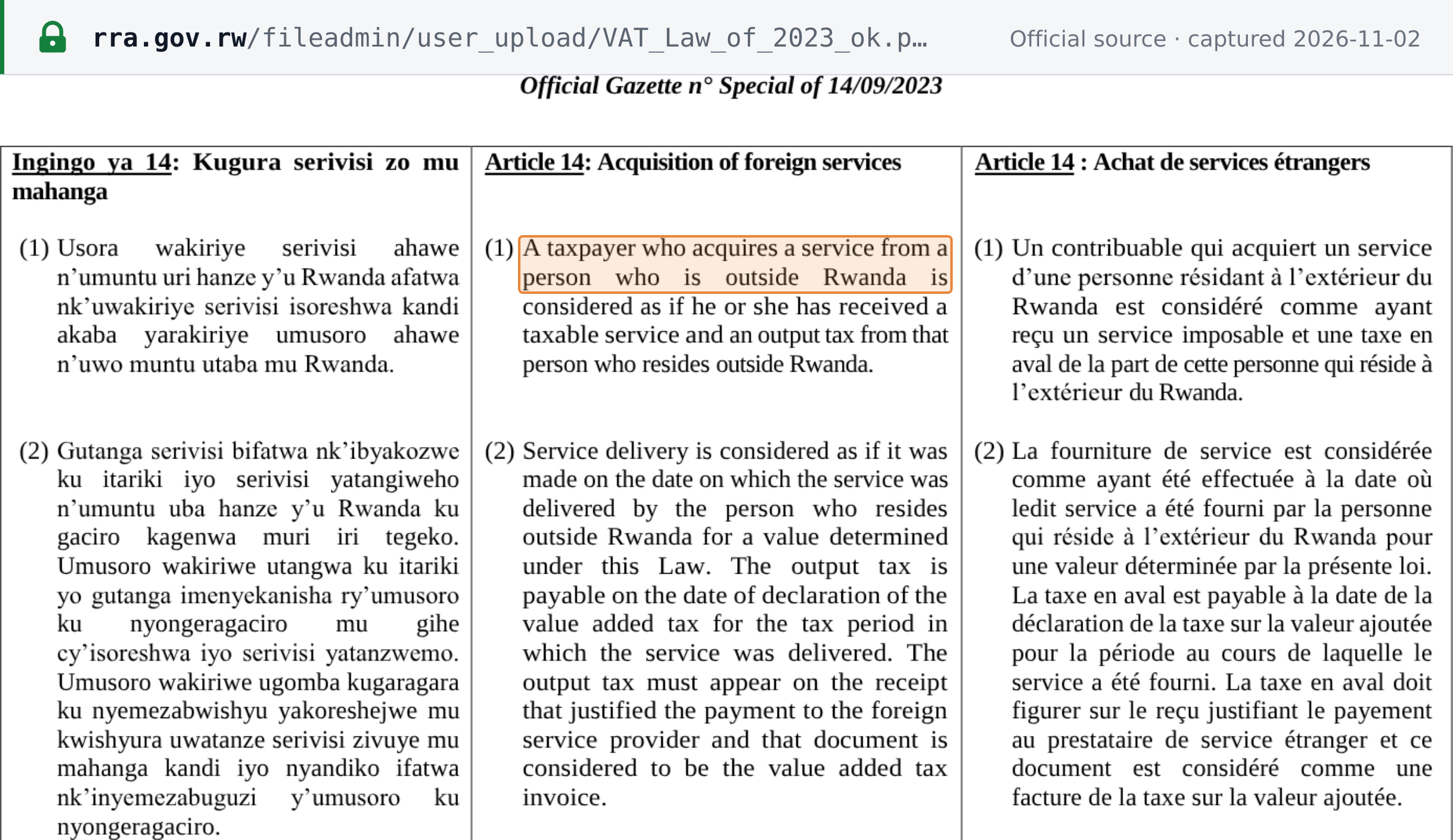 Source snapshot captured 2026-11-02 — original
The reverse charge is usually a cost. Unlike most reverse-charge systems, the VAT self-accounted under Art. 14 is deductible only for services not available in Rwanda, and only with the Minister's authorisation. Ministerial Order Nº 003/24/03/TC of 08/03/2024 sets the procedure: the applicant "must be registered on value-added tax" (Art. 1); it submits an application letter with supporting documents, "proves that he or she made a call for tenders and that no successful bidder was found in Rwanda", and provides "a recommendation letter issued by a competent regulator organ certifying that there are no providers of the service in Rwanda or that those existing do not have a satisfactory standard to provide the service" (Art. 2(1)); and it applies "at least two months before acquiring that service" (Art. 3). See Reverse charge explained for the general mechanism. [6]
Digital products and services
Ministerial Order 004/26/10/TC of 29/04/2026, in force on publication in the Official Gazette n° Special of 29/04/2026, applies VAT to "goods and services provided online". Article 2(d) defines them to include "intangible goods, advertising services, the supply of user data, search engines, intermediation platforms, social media platforms, media, gaming activities, cloud computing services, or standardised teaching services and other digital content services provided online". Article 3 lists 13 categories, among them software and updates, platforms linking suppliers and recipients (including ride-hailing), online gaming, online education other than education the VAT Law exempts, music and film streaming or downloads, web hosting and remote maintenance, and "any other goods and services provided through an electronic, internet and digital market place". [4]
- Rate. The Order sets no rate of its own: the supplies are taxable at the VAT Law's 18% standard rate (Art. 4(b)). [1]
- When the supply is in Rwanda (Art. 5). The recipient is in Rwanda and the supply benefits them there, or the supply is consumed in Rwanda, or the recipient's payment method, billing or home address, IP address or proxy, country code, SIM card or bank account is in Rwanda.
- Tax point (Art. 6). The earliest of delivery, payment, or the issue of the invoice or receipt.
- Collection (Art. 8). A registered supplier, or its registered representative, withholds the VAT and remits it to RRA. If the supplier is not registered and has no registered representative, "the value added tax is withheld and paid by the financial institution that facilitates in payment of tax".
- Returns (Art. 9). A registered person files and pays "not later than on the 15th of the month following the end of the tax period"; a withholding financial institution declares and pays by the 15th of the month following the month in which the tax was withheld.
- Consumer refund (Art. 7(1)). "A consumer may request the tax administration to refund the value added tax paid within 60 days from the date they made the payment."
- Transition (Art. 25). Within three months of publication — that is, by late July 2026 — RRA was to put a designated portal in place with the payment-facilitating financial institutions, and persons liable "must be registered or have appointed their representatives". [4]
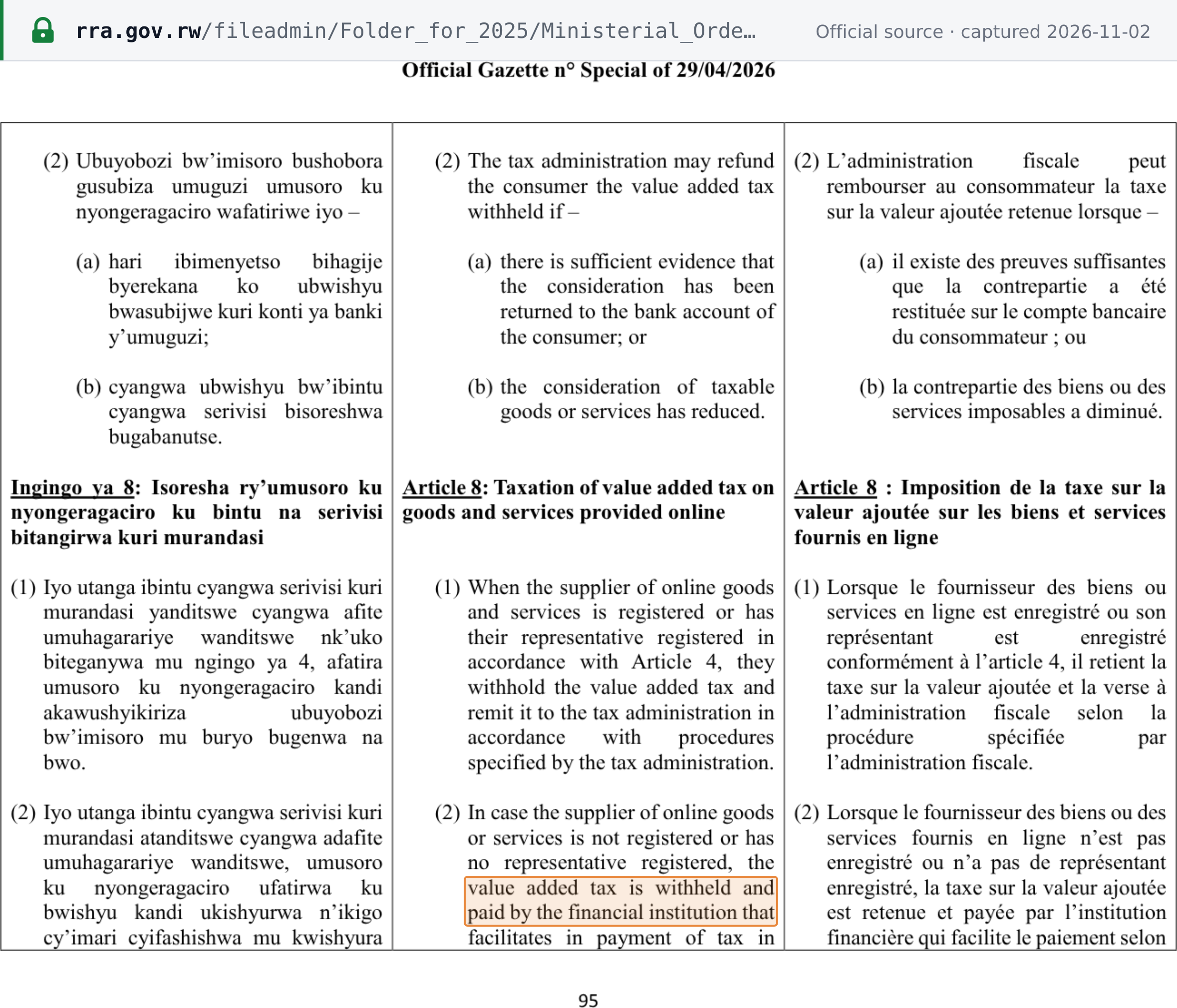 Source snapshot captured 2026-11-02 — original
For how other countries tax the same supplies, see VAT on digital services by non-resident suppliers.
Foreign companies selling into Rwanda — B2B and B2C
- Online supplies to consumers (B2C). The foreign supplier registers for VAT, or appoints a representative with a business in Rwanda, and charges 18%. If it does neither, the financial institution facilitating the payment withholds the VAT (Order 004/26/10/TC Arts. 4 and 8). No threshold is stated.
- Services to Rwandan VAT-registered businesses (B2B). The VAT Law puts the liability on the recipient through the reverse charge in Art. 14, and gives the foreign supplier no registration obligation for those services.
- Where the two meet. Order 004/26/10/TC does not use the terms B2B or B2C and does not exclude business customers: Art. 4(1) speaks of supplies "to customers in Rwanda". The Order does not say how its registration and withholding rules interact with the Art. 14 reverse charge when the customer is a VAT-registered business. Foreign online suppliers with Rwandan business customers should take that into account when deciding whether to register.
- Goods. A foreign seller of goods has no separate regime: VAT is collected from the importer at customs (VAT Law Art. 29(2)). [1] [4]
Marketplace / platform deemed-supplier liability
Neither the VAT Law nor Order 004/26/10/TC contains a deemed-supplier rule that makes a marketplace liable for VAT on its sellers' sales. Intermediation and ride-hailing platforms are taxable suppliers of their own service (Order Art. 2(d) and Art. 3), and the collection backstop for unregistered online suppliers is the payment-facilitating financial institution (Art. 8(2)), not the platform. [4]
Place of supply
- Goods. "All goods supplied by a taxpayer in Rwanda are taxable except the ones which are exempted" (VAT Law Art. 6(1)). Goods are imported "on the date they enter Rwandan territory in accordance with customs law" (Art. 15).
- Services (Art. 6(2)). A service is taxable if "(a) the service recipient and the service provider are residents of Rwanda; (b) the service recipient is a resident of Rwanda and the service is useful to the recipient in Rwanda; or (c) the service provider is a resident of Rwanda and the service is useful to the recipient in Rwanda." Services are imported "on the date the importer receives them" (Art. 15).
- Online supplies follow the wider indicators in Art. 5 of Order 004/26/10/TC, described above. [1]
Invoice requirements
Rwanda has no paper tax-invoice regime: every invoice is generated by an electronic invoicing system (EIS) certified by RRA, commonly called an EBM (electronic billing machine). Article 17 of the Tax Procedures Law: "A person who carries out any taxable activity issues an invoice generated by an electronic invoicing system certified by the Tax administration." The obligation applies whether or not the seller is VAT-registered. [3] [16]
Article 18 binds every user of the system:
- "to possess an electronic invoicing system;"
- "to issue an electronic invoice to every buyer regardless request thereof;"
- "to indicate real name of goods and related tax rates on the electronic invoice for Value Added Tax registered persons;"
- "to indicate real name of goods and related prices on the electronic invoice for Value Added Tax unregistered persons;"
- "to notify the Tax Administration of failure of electronic invoicing system within a time not exceeding six (6) hours;"
- "to refrain from deleting invoice except for sound grounds." [3]
RRA adds that "VAT registered taxpayers are required to have at least one Electronic Invoicing System (EIS), commonly known as EBM machine, at each of their sales locations, and use it to provide EIS invoices for all sales transactions." [14]
Mandatory content
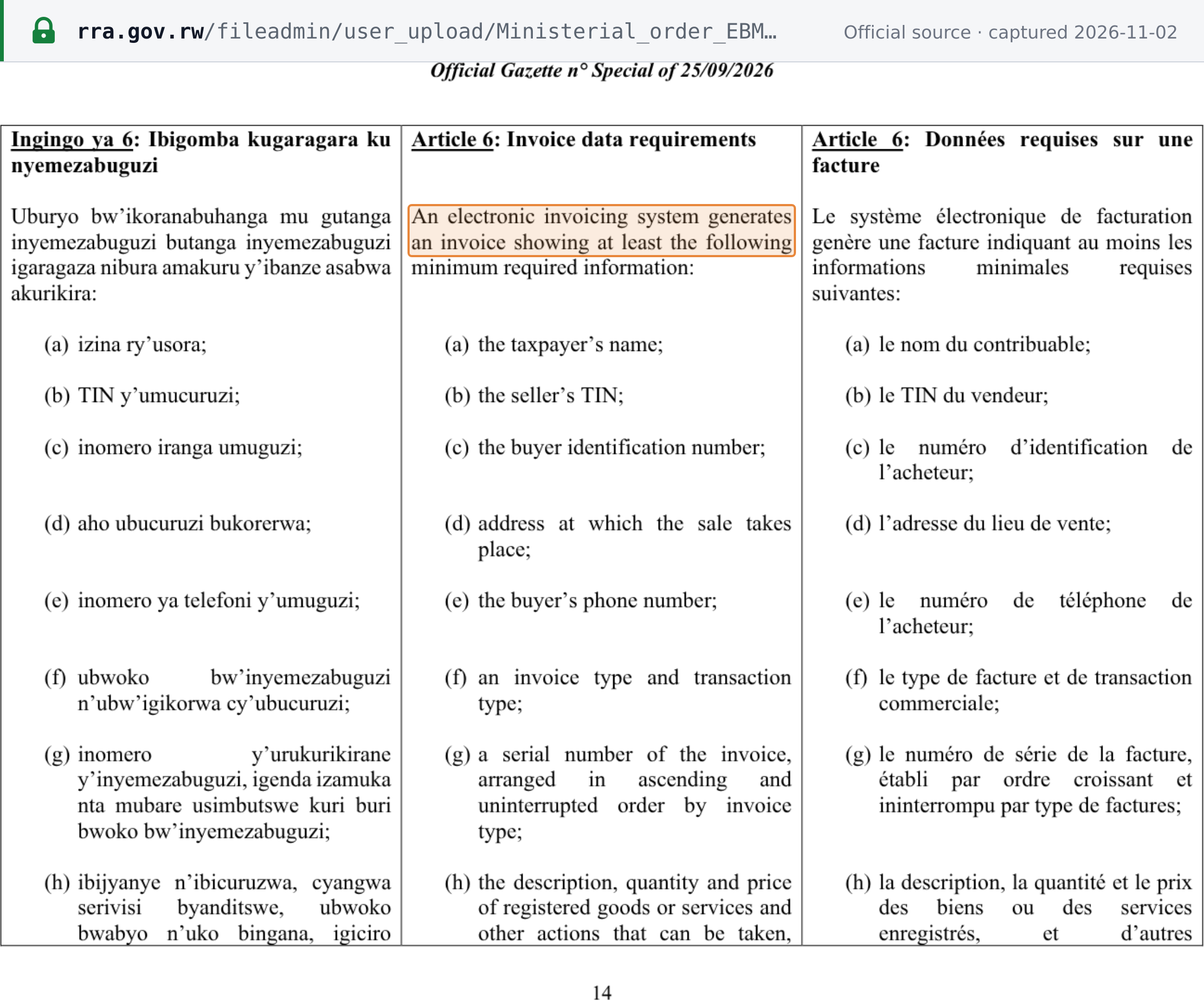
Ministerial Order 006/26/10/TC of 24/09/2026 (Official Gazette n° Special of 25/09/2026, in force on publication) sets the minimum content in Article 6: "An electronic invoicing system generates an invoice showing at least the following minimum required information":
| # | Field (Art. 6) | Notes |
|---|---|---|
| (a) | The taxpayer's name | The seller |
| (b) | The seller's TIN | 9 digits |
| (c) | The buyer identification number | The buyer's TIN, telephone number or "nine zeroes" (Art. 2(b)) |
| (d) | Address at which the sale takes place | |
| (e) | The buyer's phone number | |
| (f) | Invoice type and transaction type | Invoice types: normal receipt, copy, pro forma; transaction types: sale, cancellation (Art. 7) |
| (g) | Serial number of the invoice | "arranged in ascending and uninterrupted order by invoice type" |
| (h) | Description, quantity and price of registered goods or services | And actions such as invalidating or correcting the invoice |
| (i) | Total sales amount | |
| (j) | Tax rates applied | |
| (k) | "the rate of tax added to the price of the product" | |
| (l) | Means of payment | |
| (m) | Discount offered | |
| (n) | SDC information | (i) date and time stamped by the SDC; (ii) sequential invoice-type number; (iii) SDC identification number; (iv) invoicing-system number; (v) date and time stamped by the electronic invoicing system |
"SDC" is the Sales Data Controller, which the Order defines as "a unique serial number that is attributed to a taxpayer by a certified electronic invoicing system" (Art. 2(d)). [5]
 Source snapshot captured 2026-11-02 — original
At the point of sale (Art. 3(d)). The taxpayer must put up "a conspicuous notice" where customers can easily see the system, showing "(i) taxpayers' name, address and TIN; (ii) the SDC serial number; (iii) an indication of a value added tax registered person; (iv) posting a visible statement "do not pay if an invoice is not issued"". [5]
ERP systems (Art. 4). "A taxpayer who uses an Enterprise Resource Planning "ERP" to make invoices is required to integrate their ERP with the electronic invoicing system through a prescribed manner determined by the tax administration." [5]
Issuance deadline
At the time of sale. The law gives no deferred-issuance period: the invoice goes "to every buyer regardless request thereof" (Tax Procedures Law Art. 18), and RRA's technical specification requires that a certified system is "not to be constructed in such a way that it is possible to register a sales amount without simultaneously printing a receipt" (CIS specification 7.15). [3] [9]
The tax point is "the one that is the earliest among the following: (a) the date on which the invoice is issued; (b) the date on which payment of goods and services is made, including partial payment. However, provisions of this subparagraph do not apply to advance payment made in construction services; (c) the date on which goods are either removed from the premises of the supplier or given to the recipient; (d) the date on which the service is delivered; (e) the date on which a taxpayer applies for deregistration from the value added tax" (VAT Law Art. 12(1)). [1]
Numbering and sequencing
- One sequence per invoice type, ascending and uninterrupted (Order 006/26/10/TC Art. 6(g)). [5]
- Counters on the receipt. RRA's CIS specification requires the system to "print receipt type counter and total counter presented in the following manner A/B RT where: A = Counter per receipt type; B = Total counter; RT = receipt type label" (7.25). On the specimen below, "168/258 NS" is the 168th normal sale out of 258 receipts in total.
- One original only. The system must "print only one original receipt. Reprint shall have a watermark with mention Copy" (7.18).
- No silent corrections. The system must "not be able to correct a transaction without prior cancelation of the original transaction. Each cancelation must refer to the original erroneous SDC Receipt number. Moreover, an original transaction is allowed to be cancel only once" (7.17). [9]
Credit and debit notes
Rwanda has no debit-note document. The credit-note equivalent is the refund receipt: RRA's CIS specification gives every receipt one of two transaction types, "SALE" or "REFUND" (5.2), and defines the Normal Refund, "defined by receipt label NR", as a receipt produced "for a client upon request with information indicating that a previously printed Normal Sale receipt contains incorrect information or information on a refund for returned or discounted goods or services. Such refund receipt contains only negative, refunded amounts" (14). Order 006/26/10/TC calls this transaction type "cancellation of an invoice" (Art. 7(1)). [9] [5]
The tax rules for correcting an invoice — adjusting or cancelling it — are in Articles 10–22 of Ministerial Order 004/26/10/TC:
- Adjustment. "An invoice is adjusted if it contains erroneous information, which affects the taxation on that invoice", and "The adjustment of an invoice is done once unless authorized by the tax administration" (Art. 10). Article 12 lists the grounds: goods unavailable or no longer allowed, a wrong tax rate, a price change, damage and partial return.
- Timing. The application "is done prior to the filing of return on the value added tax input and the value added tax output on that invoice"; if it is made after the return covering the invoice has been filed, "it requires authorisation from the tax administration" (Art. 11(2)–(3)).
- Dates. "The date on the adjusted invoice is the actual date on the invoice subject to adjustment. However, both the date of issuance and date of adjustment appear on the invoice" (Art. 14).
- Cancellation. "The request for invoice cancellation is initiated by the buyer who was given an invoice at the time of buying" (Art. 16(1)). The application is filed "before the end of the tax period", and once it is approved the applicant amends the related declaration (Art. 19). It is rejected if the tax period has been audited or investigated, or if the input tax has been refunded (Art. 20). [4]
- Records. "A seller registered for value added tax must keep the original invoice accompanied with explanatory document of cancelation of that invoice" (VAT Law Art. 22(1)). [1]
- On the system. Each cancellation must refer to the original SDC receipt number, and an original transaction can be cancelled only once (CIS specification 7.17). Every NR refund receipt also needs an entry in a refund log book "containing receipt details and justification with description and the name of the refund recipient" (14). [5] [9]
Currency and language
- Currency. Amounts under the VAT Law are in Rwandan francs, and foreign-currency amounts are converted at the BNR rate (Art. 32; see Overview). Neither the VAT Law nor Order 006/26/10/TC requires the invoice itself to be issued in FRW. [1]
- Language. Books and records "are prepared in one of the official languages" (Tax Procedures Law Art. 15). Order 006/26/10/TC sets no separate language rule for invoices. [3]
Document types
- Invoice types. "The invoice types are normal receipt, copy and pro forma" and "The transaction types generated by electronic invoicing system are sale and cancellation of an invoice" (Order 006/26/10/TC Art. 7). [5]
- Not an official receipt. Copies, training and pro forma prints "must be clearly distinguishable from the NORMAL receipt type", with the text "THIS IS NOT AN OFFICIAL RECEIPT" below the totals (CIS specification 11). [9]
- No simplified invoice. There is no lower-value simplified form: every sale gets a full EIS invoice. For a buyer without a TIN, RRA's EBM guide says to use the buyer's telephone number "removing the 0, example, for 0788700173 use 788700173", or "000000000" where the buyer has neither. [10]
- Purchase Code for resale purchases. "In May 2023, RRA introduced the Purchase code as the security feature added in the EBM to prevent misuse of Taxpayers Identification Number (TIN)." A business buying goods for resale requests a code through MyRRA or by dialling *800#, entering its TIN and the seller's TIN, and gives the code to the seller, "who will use it to generate your EBM invoice". [16]
- Delivery notes and stock movements. Under Order 006/26/10/TC, delivery notes for internal stock movements are also generated by the certified system. [5]
Self-billing
No self-billing regime as such. The nearest mechanism is the buyer-initiated invoice: "In circumstances where the seller is unable to issue an invoice, the buyer initiates the invoice processing. In that case, the seller has an obligation to approve the initiated invoice as determined by the tax administration" (Order 006/26/10/TC Art. 5). For imported services, the receipt for the payment to the foreign supplier, showing the output tax, counts as the VAT invoice (VAT Law Art. 14(2)). [5] [1]
Retention and audit trail
- Retention: 10 years. "Books of accounts and records referred to in Articles 13 and 14 of this Law are kept for a period of ten (10) years starting from 1st January following the fiscal year to which they relate." They must be kept "in the premises of the taxpayer or in any other place of his or her choice in Rwanda", and "can be electronically accessed and shared in electronic form in accordance with the directives of the Commissioner General" (Tax Procedures Law Art. 15). [3]
- Audit trail in the system. A certified system must "be equipped with paper journal or electronic journal or the log file which contains all the sales that immediately upon the creation of any printed material are recorded and shall not operate without it" (CIS specification 7.14), and "provide to competent auditors an interface for audit purposes, including an overview of software settings and database" (7.26).
- Tamper evidence on each receipt. Every receipt carries the SDC's internal data, a receipt signature and a QR code "made by invoice_date(ddmmyyyy)#time(hhmmss)#sdc number#sdc_receipt_number#internal_data#receipt_signature" (7.24.7). [9]
- No deletion. Invoices may not be deleted "except for sound grounds" (Tax Procedures Law Art. 18). [3]
A specimen of a compliant invoice
RRA publishes its own annotated specimen receipt in its Technical Specification of Certified Invoicing System (CIS) for a Virtual Sales Data Controller (VSDC), Ver. 1.0, March 2018, section 13.1: "Following is an example of receipt type NORMAL and transaction type SALE (NS)". Each part of the receipt is labelled in the right-hand column. [9]
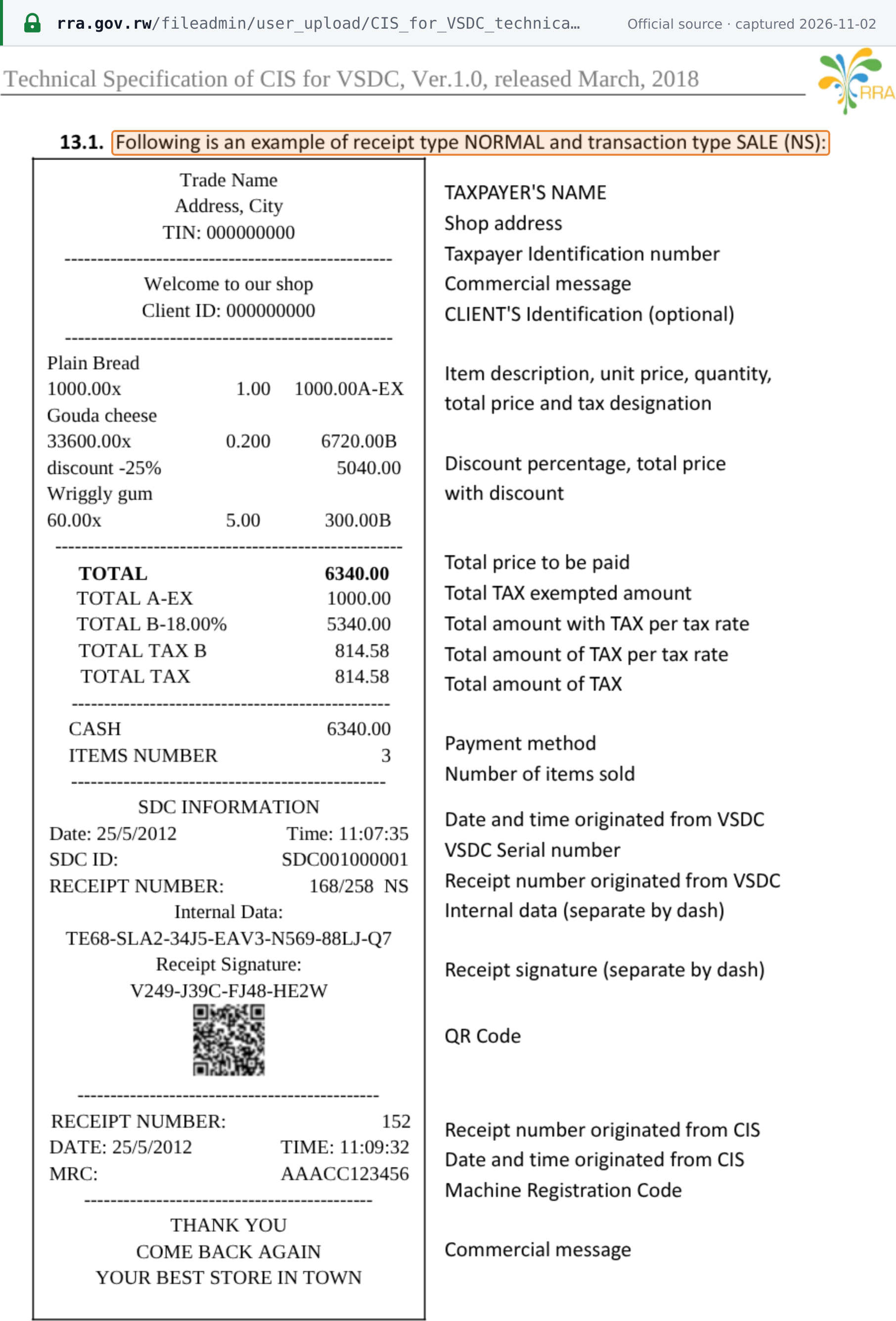 Source snapshot captured 2026-11-02 — original. RRA's 2018 specimen: the names, TIN, IDs and figures are RRA's dummies, and its dates (25/5/2012) are illustrative.
How to read it:
- Tax labels. "A-EX" marks an exempt item and "B" an item taxed at 18%; the specification labels tax rates with letters (7.21.5). On the specimen, Plain Bread is exempt and the cheese and gum are taxed at 18%.
- Prices include VAT. TOTAL B-18.00% is 5,340.00 and TOTAL TAX B is 814.58, which is 18/118 of 5,340.00: the 18% is inside the shelf price, not added on top.
- Two receipt numbers. "168/258 NS" comes from the Sales Data Controller (the counter described under Numbering); "RECEIPT NUMBER: 152" below it is the invoicing system's own number, printed with its date and time and its Machine Registration Code (MRC).
- Signature and QR code. These are the tamper-evidence features described under Retention and audit trail.
What the 2018 specimen predates. The specimen is older than Ministerial Order 006/26/10/TC (24/09/2026). Two fields in the Order's Article 6 list do not appear on it: (e) the buyer's phone number, and (n)(iv) the invoicing-system number as a field under that name (the specimen's MRC identifies the machine, but the Order does not say it is the same thing). A receipt issued today must carry every Article 6 field. [5]
E-invoicing status
Status: mandatory, for every sale. Rwanda runs a fiscalisation model rather than a clearance network: each invoice is produced by an RRA-certified electronic invoicing system and signed by a Sales Data Controller (SDC, or the virtual VSDC) that reports to RRA. RRA publishes no buyer-facing structured e-invoice format; receipt data flows from the invoicing system to the (V)SDC under RRA's technical specification. RRA's summary: "According to the Tax Procedure law of 2023, every person who carries out any taxable activities (whether registered on VAT or not) should request and use EBM to issue tax invoices to their customers on every transaction they make." [16] [3]
Scope. B2B, B2C and B2G alike: the law draws no distinction, and the invoice goes "to every buyer" (Tax Procedures Law Art. 18). The one carve-out is in Article 8 of Order 006/26/10/TC: "A taxpayer is not required to use the electronic invoicing system on each transaction when they are not obliged to file an annual tax declaration as per income tax; however, the taxpayer is required to approve an invoice initiated by the buyer." [5]
Timeline.
| Date | Step |
|---|---|
| 31/07/2013 | Ministerial Order 002/13/10/TC introduces certified electronic billing machines (EBMs); amended by Order 008/16/10/TC of 01/11/2016 |
| 2017 | RRA upgrades the EBM back end: "In 2017, RRA has upgraded the EBM backend in order to enable the supply chain management capability and integrate EBM with other RRA data sets (i.e. Importation)" |
| 31/03/2023 | Tax Procedures Law Arts. 17–18: every person carrying out a taxable activity issues an EIS invoice |
| 25/09/2026 | Ministerial Order 006/26/10/TC in force: minimum invoice data, buyer-initiated invoices, mandatory ERP integration, theft and damage notice windows; repeals Order 002/13/10/TC (Art. 13) |
Sources: RRA About EBM; CIS specification p. 1; Order 006/26/10/TC. [16] [9] [5]
RRA's About-EBM page still links the 2013/2016 order under "Useful documents"; that order has been repealed, and the current rules are in Order 006/26/10/TC.
Systems on offer (RRA). RRA lists EBM 2.1 for a Windows computer or tablet; EBM 2.1 for Android smartphones (for non-VAT and micro and small taxpayers); Online EBM, a web-based system for service-sector taxpayers "who do not issue more than 10 invoices per month"; and the Virtual Sales Data Controller (VSDC), "designed for taxpayers who have their own invoicing system who need to integrate it with EBM". VSDC integration requires RRA certification (cis_sdc_certification@rra.gov.rw), and since 25 September 2026 ERP users must integrate (Order 006/26/10/TC Art. 4). [16]
When the system fails (Order 006/26/10/TC Art. 3(i)–(j)). Notify RRA "within 12 hours in case of theft of the electronic invoicing system and within six hours in case of damage to this system", with "a copy of the report from the competent authority". If the business continues, "a taxpayer must get a new electronic invoicing system within five working days". In the meantime, "issue manual invoices in two specimens" and "print the corresponding invoices once the electronic invoicing system is restored". Separately, Tax Procedures Law Art. 18(5) requires a failure of the system to be notified within six hours. [5] [3]
Consumer reward. To push buyers to ask for invoices, "A final consumer who presents the tax administration with an electronic invoice is granted a reward on the value added tax paid on each invoice" (VAT Law Art. 27(1)). Ministerial Order N° 002/25/10/TC of 16/04/2025 sets it at "10% of the value added tax amount as shown on the invoice issued", plus "an additional reward equivalent to 50% of penalties amount paid on the invoice" where a consumer who asked for an invoice was refused and reports it (Art. 3). [1] [7]
For how fiscal-device systems like Rwanda's compare with Kenya's, Tanzania's and Uganda's, see Fiscal devices and certified cash registers explained; for the difference between fiscalisation and clearance models, see CTC e-invoicing models.
Filing and payment
Filing frequency
| Annual turnover (as at 2026-11-02) | Return | Due |
|---|---|---|
| FRW 200,000,000 or less | Quarterly (or monthly by choice) | Within 15 days after the end of the quarter |
| More than FRW 200,000,000 | Monthly | Within 15 days after the end of the month |
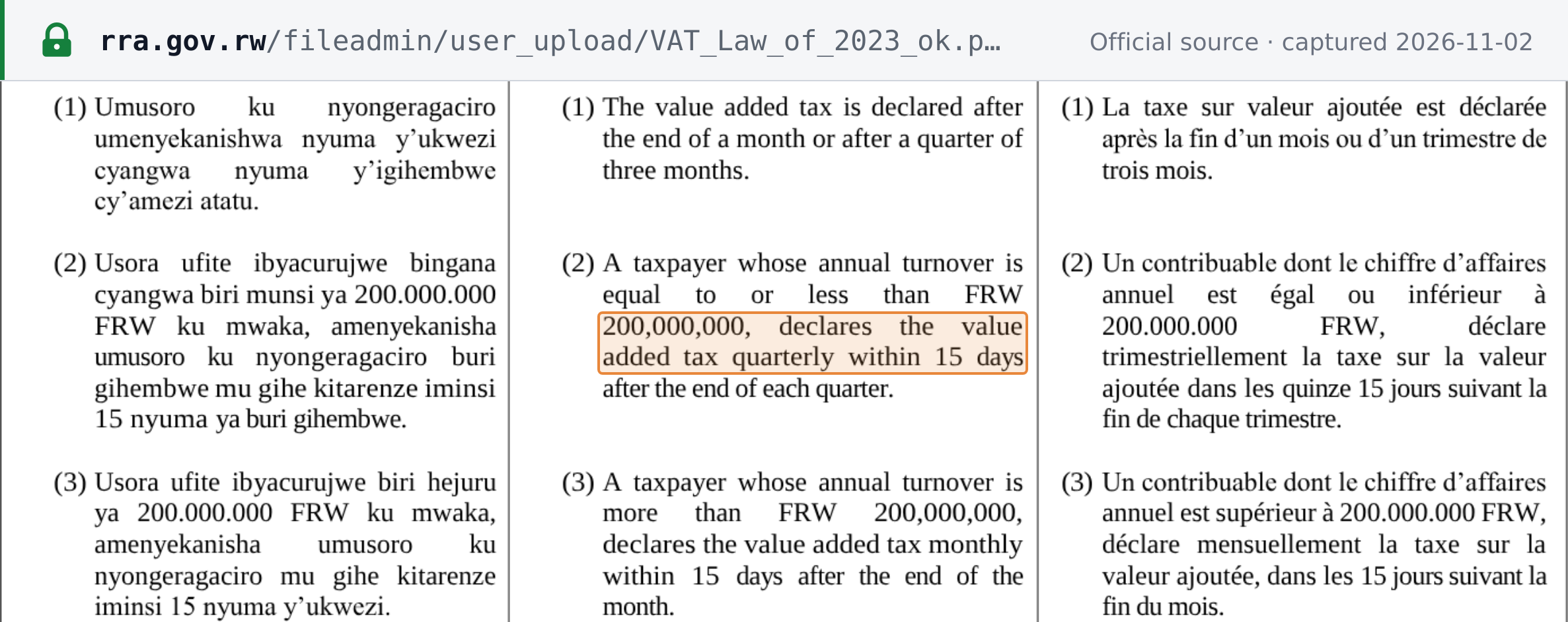
Article 28 of the VAT Law: "(2) A taxpayer whose annual turnover is equal to or less than FRW 200,000,000, declares the value added tax quarterly within 15 days after the end of each quarter. (3) A taxpayer whose annual turnover is more than FRW 200,000,000, declares the value added tax monthly within 15 days after the end of the month. (4) However, a taxpayer whose annual turnover is equal to or less than FRW 200,000,000 and who intends to opt for a monthly value added tax declaration is authorised to do so." [1]
 Source snapshot captured 2026-11-02 — original
Return due date
The 15th day after the end of the month or quarter (Art. 28(2)–(3)). Nil returns are mandatory: "A taxpayer must file a value added tax declaration in the periods relevant to his or her category, regardless of whether he or she made sales or not, whether he or she has to pay a tax or he or she is requesting a refund, or even if the difference is zero" (Art. 28(5)). Returns are filed through E-Tax on the UNG11 form. [1] [12]
Extension. "The taxpayer applies in writing to the Commissioner General at least fifteen (15) days before the last filing date of the declaration", and "Extension of tax declaration does not suspend the accrual of interest of the principal tax" (Tax Procedures Law Art. 20). [3]
Payment due date and method
"The value added tax declared by a taxpayer must be paid within 15 days following each month or each quarter of declaration" (VAT Law Art. 29(1)), so payment falls on the same day as the return. Import VAT is paid at the customs point (Art. 29(2)). RRA accepts e-payment from E-Tax, internet banking, MTN Mobile Money (*182#) and payment at a commercial bank using the declaration's document ID. [1] [14]
Additional listings
The VAT return carries sales and purchase annexures: RRA's instruction is to "Record all transactions into annexures. Fill the provided information into documents and then upload when submitting the declaration". EBM data synchronises with E-Tax and MyRRA once the EBM is connected to the internet. "In case an invoice is not recognized by the system, at the time of uploading purchase annexure, that invoice is automatically recorded and saved in the system and it can be used in the next tax period as the issue is being resolved." RRA describes no separate annual VAT return or EC-style listing. [13]
Input-tax recovery and blocked items
The credit. A taxpayer is entitled to credit the input tax on taxable acquisitions and imports used to make taxable supplies "provided that the output tax was paid to the tax administration" (VAT Law Art. 17(1)). Input tax that relates partly to exempt supplies is apportioned (Art. 17(3)). The claim needs "(a) the value added tax invoice in the case of taxable goods and services supplied from the local market; (b) customs documents that proves the payment in case of taxable imported goods" (Art. 19). [1]
Late documents. Input tax denied in a period can be claimed later if the taxpayer "holds relevant documents which do not exceed 12 months starting from the day of value added tax declaration related to those documents" (Art. 17(6)).
Opening stock. "A newly registered taxpayer on value added tax may claim, in his or her first declaration, an input tax on the goods that he or she had in stock during the date of registration" (Art. 18).
Blocked (Art. 20).
- Passenger vehicles, their spare parts, repair and maintenance — except for a business that sells or rents passenger vehicles or runs a driving school;
- goods acquired or imported for entertainment, except for entertainment businesses;
- goods acquired for accommodation, with limited exceptions;
- 40% of the VAT on goods and services used in the business "if such goods and services are inseparable in such a way that it is impossible to determine which one is used for business purposes or for personal use". [1]
Imported services. Reverse-charged VAT is deductible only for services not available in Rwanda, with ministerial authorisation (see Reverse charge).
Refunds
- Timing. Refundable input VAT "is refunded within 30 days calculated from the day following the day of declaration". If RRA decides a comprehensive audit is needed first, the 30 days run "from the day following the day of issuing the audit report" (VAT Law Art. 26(4)–(5)). The refund requires that "the value added tax on the goods and services purchased matches the tax paid to the tax administration" (Art. 26(6)). [1]
- Small refunds are carried forward. RRA's guidance: for large taxpayers, "When the amount to be refunded is less than Frw 5,000,000, the taxpayer shall deduct that amount during the next filing period"; the limits for medium and small taxpayers are FRW 2,000,000 and FRW 500,000. [12]
- Bad debts (Art. 23). Relief requires, among other conditions, that the debt has been written off and recovery steps exhausted; "for an individual whose debt is less than FRW 3,000,000 … the taxpayer must provide proof that he or she has taken all reasonable steps over a period of three years to recover the debt". [1]
- Diplomats and international organisations can claim refunds of VAT on request (Art. 33).
- Non-residents. The VAT Law has no refund scheme for non-resident businesses or tourists. Consumers who paid VAT on online supplies can claim a refund within 60 days (Order 004/26/10/TC Art. 7(1)). [4]
VAT deferral on capital goods. The exemption for industrial machinery, capital assets and raw materials ended on 30 June 2026 (Law 009/2025, new Art. 8(3)(b)). A narrower transitional facility followed it: Commissioner General guidelines dated 30 July 2026, which "shall come into force on 1st August 2026", set up a VAT Deferral Facility. "Under the Facility, eligible taxpayers may defer the payment of import VAT on qualifying capital goods and machinery, subject to these guidelines." It covers manufacturing, mining, mineral exploration or exploitation, and natural-gas extraction for energy generation, and is limited in two ways: "Only capital goods and machinery classified under Chapters 84 and 85 of the East African Community Common External Tariff (EAC CET) shall qualify", so raw materials are outside it, and "Each import consignment shall qualify only where the import VAT payable is at least RWF 10,000,000". Imports in July 2026, between the end of the exemption and the start of the facility, were covered by neither. [11]
Exemptions
Exempt supplies
Law 009/2025 of 27/05/2025, in force from 29 May 2025, replaced the whole of Article 8 of the VAT Law. The exempt list (Art. 8(1)):
- (a) non-profit water supply and environmental conservation, except sewage pump-out;
- (b) health and medical services, equipment for persons with disabilities, listed pharmaceuticals and sanitary pads;
- (c) listed educational materials, services and equipment, supplied physically or online;
- (d) books, newspapers and journals;
- (e) licensed passenger transport by land in vehicles of 14 seats or more, transport by air, transport of persons or goods by boat, and transport of household solid waste;
- (f) sale or lease of land, sale of residential buildings, residential renting for more than 90 continuous days, and leases of movable goods by licensed financial institutions or special-purpose vehicles;
- (g) financial and insurance services as set by Ministerial Order;
- (h) listed burial and cremation goods;
- (i) listed energy-supply equipment — until 30 June 2028;
- (j) exempt goods supplied under a lease;
- (k) "agricultural and livestock products, except processed ones. However, processed maize, rice and milk, excluding powdered milk and milk-derived products, are exempted from this tax";
- (l) agricultural and livestock insurance;
- (m) listed agricultural inputs and machinery;
- (n) gaming activities;
- (o) personal effects of returning Rwandans;
- (p) imports into special economic zones by licensed zone users;
- (q) defence and security supplies;
- (r) goods sold in customs before duties are paid;
- (s) listed industrial machinery, capital assets and raw materials — until 30 June 2026, now ended (see Refunds for the narrower deferral facility that followed it from 1 August 2026);
- (t) listed aircraft, parts and tools;
- (u) transfers between related residents in a restructuring;
- (v) equipment for the conservation of Genocide memorials;
- (w) transfers to securitisation special-purpose vehicles;
- (x) imported pure electric motor vehicles, their batteries and charging-station equipment — until 30 June 2028. [2]
The sunset dates come from the new Article 8(3): "(a) the energy supply equipment referred to in Paragraph (1)(i) is exempted until 30 June 2028; (b) machinery and capital assets of industries as well as raw materials used in industries referred to in Paragraph (1)(s) are exempted until 30 June 2026; (c) imported pure electric motor vehicles, relevant batteries and their electric charging station equipment referred to in Paragraph (1)(x) are exempted until 30 June 2028." Ministerial Order 004/26/10/TC Art. 23(2) adds: "Renewal of eligibility for exemption from value-added tax is not granted beyond June 30, 2026." [2] [4]
No longer exempt since 29 May 2025. Compared with the 2023 text, the 2025 list no longer includes "mobile telephones and SIM cards", listed "information, communication and technology equipment and services", or the transport of goods by land; and the electric-vehicle exemption, which covered imported electric and hybrid vehicles, now covers pure electric vehicles only. These supplies are taxed at 18% unless another rule applies. [1] [2]
Exempt is not zero-rated
The difference decides whether a business can recover its input VAT:
- Zero-rated supplies (Art. 7) are taxable at 0% (Art. 4(a)). The input-tax credit in Art. 17(1) attaches to the making of taxable supplies, so a zero-rated supplier recovers its input VAT and, typically, receives refunds.
- Exempt supplies (Art. 8) are outside the tax: no output VAT, and no input-tax credit. A business making both taxable and exempt supplies recovers only the portion of input tax related to its taxable business (Art. 17(3)).
- A supply that is both zero-rated and exempt is treated as zero-rated (Art. 9). [1]
Special regimes
- Special economic zones. Imports by licensed zone users are exempt (Art. 8(1)(p)). [2]
- Diplomatic and donor-funded supplies. Zero-rated (Art. 7(1)(h)) or refunded on request (Art. 33). [1]
- Small businesses. There is no VAT flat-rate scheme; a business under the FRW 20,000,000 / FRW 5,000,000 thresholds simply need not register, though it must still issue EIS invoices.
- Margin schemes and cash accounting. The VAT Law provides neither.
Offences and penalties
Offences
The Tax Procedures Law separates administrative faults, which carry fines, from offences, which carry prison terms:
- Tax evasion (Art. 90). Conduct such as using forged documents or counterfeit RRA materials, hiding goods, declaring nil sales falsely, changing a trade name to avoid prosecution, registering fraudulently under another person's name, or hiding or destroying records. On conviction, the offender "is liable to imprisonment for a term of not less than two (2) years and not more than five (5) years".
- Fraudulent refund claims (Art. 91). "A taxpayer who fraudulently claims tax refund commits an offence. If convicted, the taxpayer is liable to imprisonment of a term of not less than two (2) years and not more than five (5) years and to a fine equivalent to one hundred percent (100%) of the amount unduly claimed."
- Accessory sanctions (Art. 92) for any fault or offence include "closure of business activities for a period not exceeding thirty (30) days". RRA's EBM page adds "being barred from bidding for public tenders; withdrawal of a business register and being published in nationwide newspapers". [3] [16]
- Reporting evasion. Under Order 006/26/10/TC Art. 12(1), "A person who reports a case of tax evasion receives an award from the tax administration equal to 5% of the recovered principal tax or FRW 10,000,000, whichever is the lower amount." [5]
Penalties
Figures from the Tax Procedures Law. [3]
Late declaration and payment (Art. 82).
| Delay after the due date | Neither declared nor paid on time | Declared on time, paid late |
|---|---|---|
| Up to 30 days | 20% of the tax due | 5% of the principal tax |
| Day 31 to day 60 | 40% | 10% |
| More than 60 days | 60% | 30% |
In the English text of Art. 82, paragraph 2, item 2°, the rate is printed as "twenty percent (10%)". The Kinyarwanda ("icumi ku ijana (10%)") and French ("dix pour cent (10%)") texts both say 10%.
Interest (Art. 80). 0.5% a month for a delay of up to six months, 1% a month from six to twelve months, and 1.5% a month beyond twelve months. "Interests for late payment are non-compounding and calculated on a monthly basis", "Every month that begins is considered as a complete month", and interest "cannot exceed one hundred percent (100%) of the amount of tax".
Fixed fines (Art. 81). For faults such as late filing (micro-enterprises with turnover under FRW 2,000,000 aside), failure to register and record-keeping failures, the basic fine is: "1° fifty thousand Rwandan francs (FRW 50,000) for a natural person not engaged in any commercial activity or a taxpayer whose annual turnover is more than two million Rwandan francs (FRW 2,000,000) but not exceeding twenty million Rwandan francs (FRW 20,000,000); 2° three hundred thousand Rwandan francs (FRW 300,000) if the taxpayer is a public institution or a non-profit making organization and if the taxpayer's annual turnover exceeds twenty million Rwandan francs (FRW 20,000,000); 3° five hundred thousand Rwandan francs (FRW 500,000) if the taxpayer was informed by the Tax Administration that he or she is in the category of large taxpayers". The fine is doubled for the same fault a second time within two years, and multiplied by four for a third.
VAT and invoicing fines.
| Fault | Fine | Article |
|---|---|---|
| Trading without VAT registration where it was required | 50% of the VAT due for the entire period of operation | 87(1°) |
| A non-VAT-registered person issues a VAT invoice | 100% of the VAT shown, plus the tax on the invoice | 87(2°) |
| Incorrect VAT invoice issued to cut output VAT or inflate input credit | 100% of the VAT payable | 87(3°) |
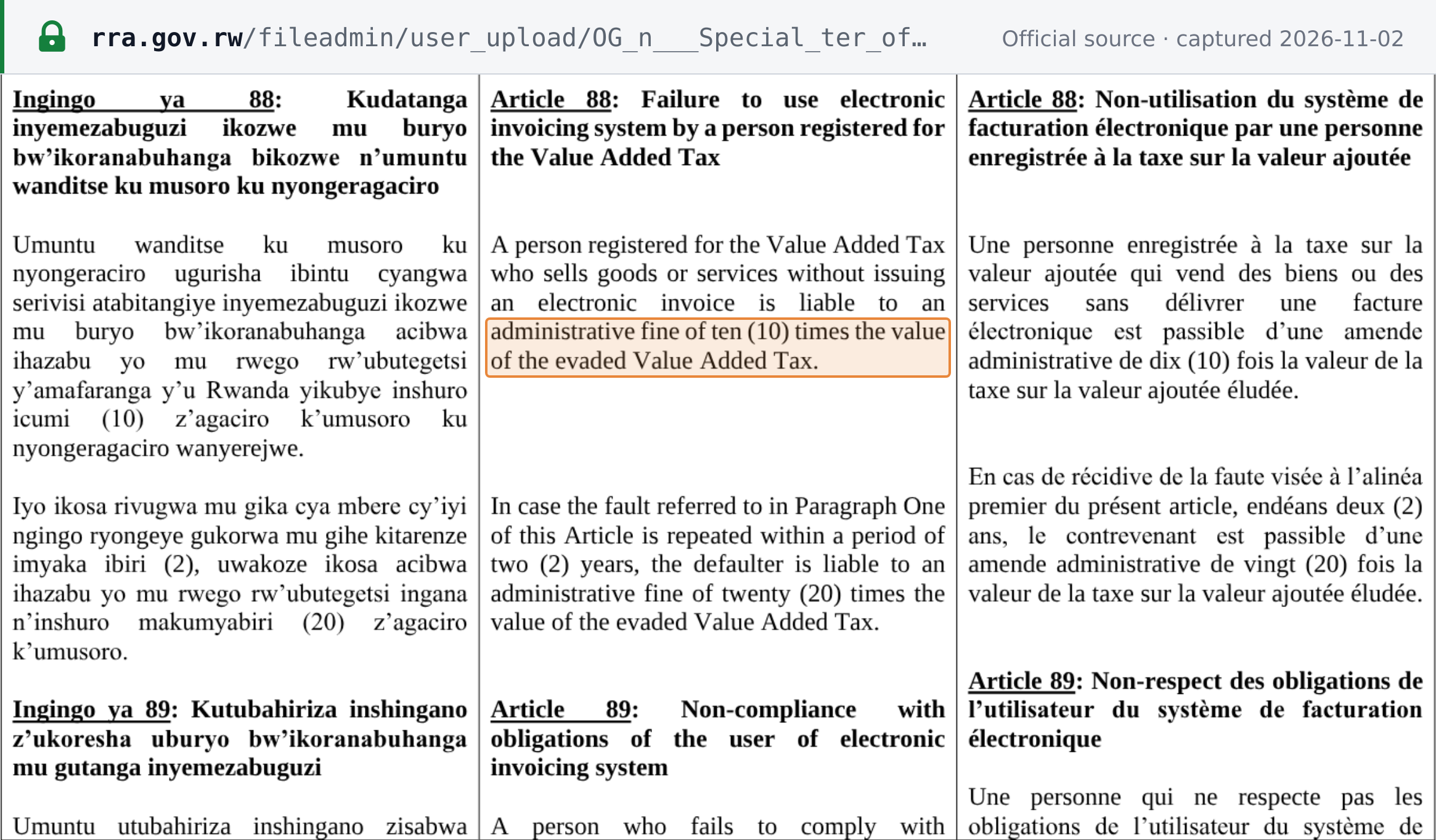
| VAT-registered seller sells without issuing an electronic invoice | 10 times the evaded VAT; 20 times on a repeat within two years | 88 |
| Non-VAT-registered person fails to issue an EIS invoice | 2 times the value of the transaction | 84 |
| Other breach of the EIS user obligations in Art. 18 | FRW 200,000; FRW 400,000 on a repeat within two years | 89 |
 Source snapshot captured 2026-11-02 — original
RRA's About-EBM page still says "The fine will be 200,000Frw for non-VAT registered taxpayer" who sells without an EBM receipt. Article 84 of the 2023 law sets that fine at twice the value of the transaction; the FRW 200,000 in Article 89 applies to other breaches of the Article 18 obligations. [16] [3]
Waiver. Order 006/26/10/TC also lets the Minister waive principal tax, interest or penalties for financial hardship where its conditions are met; a waiver of principal tax goes to Cabinet. [5]
Frequently asked questions
My supplier asks for a purchase code before issuing an EBM invoice. What is it, and does it cost anything?
Since May 2023, a business buying goods for resale must get a Purchase Code and give it to the seller, who uses it to generate the buyer's EBM invoice. RRA introduced it to stop misuse of TINs. You request it through MyRRA or by dialling *800# from the phone registered with your TIN, entering your TIN and the seller's TIN. RRA's FAQ says the service is not free: communication agencies charge FRW 15 per SMS.
Our EBM device was stolen or stopped working. What do we do, and can we keep selling?
Notify RRA within 12 hours of a theft or within six hours of damage, with a copy of the report from the competent authority. RRA's EBM FAQ asks for the notice in writing through the E-correspondence system, with an EBM loss certificate from the Rwanda Investigation Bureau and the last three EBM invoices. While the system is down, issue manual invoices in two copies and print the matching invoices once it is restored. If trading continues, a replacement system is due within five working days (Ministerial Order 006/26/10/TC, Art. 3(i) and (j)).
Can we deduct the VAT we self-account on a service bought from abroad?
Only if the service is not available in Rwanda, meaning no one on the local market can deliver identical or similar services, and only with authorisation from the Minister (VAT Law Art. 14(3) to (5)). Ministerial Order 003/24/03/TC requires the applicant to be VAT-registered, to show that a call for tenders found no successful bidder in Rwanda, to provide a recommendation letter from a competent regulator, and to apply at least two months before acquiring the service. Otherwise the reverse-charged VAT is a cost.
We are a foreign streaming or software company with customers in Rwanda. Do we have to register for VAT?
Yes. Ministerial Order 004/26/10/TC, in force since 29 April 2026, requires a supplier outside Rwanda of taxable goods and services provided online to customers in Rwanda to register for VAT, or to appoint a representative with a business in Rwanda to register in its place. The Order states no turnover threshold. If the supplier is not registered and has no registered representative, the financial institution that facilitates the payment withholds the VAT and pays it to RRA. The rate is the VAT Law's 18% standard rate, and returns are due by the 15th of the month after the tax period.
Our turnover fell below the registration threshold. Can we leave the VAT system?
Yes, by applying online through E-Tax for VAT deactivation. RRA's guidance applies it where turnover is not more than FRW 20 million over 12 consecutive months or FRW 5 million over three consecutive months, and asks that your tax account be clean, with no tax arrears, and that you state clear reasons. A business that stops trading altogether applies for VAT deregistration through E-Tax. Taxable business assets you still own on the day of deregistration are subject to the VAT that remains unpaid (VAT Law Art. 6(4)).
Important websites
| Site | Purpose |
|---|---|
| RRA — Rwanda Revenue Authority | Tax authority home page |
| E-Tax | VAT registration for existing taxpayers, VAT returns and annexures, payment, refunds, deactivation and deregistration |
| MyRRA | EBM 2.1 back office, Purchase Codes, registration for the consumer VAT reward |
| RRA — Value Added Tax | VAT rules, rates, filing, payment and registration pages |
| RRA — EBM (electronic billing machine) | Requesting and installing an EBM, user guides and FAQs |
| RRA — About EBM | The EBM systems on offer, VSDC certification steps, the Purchase Code |
| Office of the Registrar General | Business registration, which issues the TIN |
| RRA — Laws, policies and rulings | PDFs of the VAT Law, Tax Procedures Law and Ministerial Orders |
| Official Gazette (Ministry of Justice) | Official Gazette issues |
| RRA — Search for TIN using National ID | Find the TIN assigned to a national ID or passport |
| Rwanda TIN validator (Lookuptax) | Check the format of a Rwandan TIN |
RRA's call centre for EBM support is 3004. RRA's public Search for TIN using National ID page finds the TIN assigned to a national ID or passport; it is not a search by business name and does not confirm whether a TIN is valid.
Recent changes
- 2026-09-25 — Ministerial Order 006/26/10/TC on the electronic invoicing system takes effect: minimum invoice data, buyer-initiated invoices, mandatory ERP integration, 12-hour theft and 6-hour damage notices; it repeals the 2013 EBM order. (RRA) — see event
- 2026-08-01 — The Commissioner General's VAT Deferral Facility takes effect, deferring import VAT on Chapter 84 and 85 capital goods and machinery in four sectors, for consignments with import VAT of at least RWF 10,000,000; it follows the industrial VAT exemption, which ended on 30 June 2026. (RRA)
- 2026-04-29 — Ministerial Order 004/26/10/TC takes effect: non-resident suppliers of online goods and services must register for VAT or appoint a representative, with withholding by payment-facilitating financial institutions as the fallback; it also sets the invoice adjustment and cancellation rules. (RRA) — see event
- 2025-05-29 — Law 009/2025 replaces the VAT exemption list: mobile phones and SIM cards, listed ICT equipment and services and land transport of goods are no longer exempt, and sunset dates are added. (RRA)
- 2025-04-17 — Ministerial Order 002/25/10/TC sets the consumer VAT reward at 10% of the VAT on an invoice. (RRA)
For the full chronology, see Rwanda tax changes on Lookuptax.
Reference links
- RRA — Law Nº 049/2023 of 05/09/2023 establishing value added tax (Official Gazette n° Special of 14/09/2023)
- RRA — Law Nº 009/2025 of 27/05/2025 amending Law Nº 049/2023 (Official Gazette n° Special of 29/05/2025)
- RRA — Law N° 020/2023 of 31/03/2023 on tax procedures (Official Gazette n° Special ter of 31/03/2023)
- RRA — Ministerial Order Nº 004/26/10/TC of 29/04/2026 on VAT on goods and services provided online, tax adjustment and tax exemption on materials used in industries
- RRA — Ministerial Order N° 006/26/10/TC of 24/09/2026 on the use of the electronic invoicing system, waiver of tax and the award for reporting tax evasion
- RRA — Ministerial Order Nº 003/24/03/TC of 08/03/2024 on authorisation to acquire foreign services not available in Rwanda
- RRA — Ministerial Order N° 002/25/10/TC of 16/04/2025 relating to the reward based on VAT
- RRA — Value Added Tax (VAT) leaflet (2025)
- RRA — Technical Specification of Certified Invoicing System (CIS) for a Virtual Sales Data Controller (VSDC), Ver. 1.0, March 2018
- RRA — EBM 2.1 user guide
- RRA — Commissioner General's guidelines for implementation of the VAT Deferral Facility (July 2026)
- RRA — VAT registration
- RRA — Declare VAT
- RRA — Pay VAT
- RRA — Apply for VAT de-activation
- RRA — About EBM
- RRA — FAQs about EBM
- RRA — Domestic tax FAQs
- RRA — Registration and de-registration
- RRA — Laws, policies and rulings
Related on Lookuptax:
- Rwanda TIN validator
- VAT registration thresholds worldwide
- Worldwide tax rates
- E-invoicing status and networks worldwide
- Fiscal devices and certified cash registers explained
- Reverse charge explained
- VAT on digital services by non-resident suppliers
- How to register for VAT, sales tax or GST
- Check a VAT number — official lookups by country