Saint Kitts and Nevis VAT guidelines
| FACTSHEET | |
|---|---|
| Country code | KN |
| Tax name | Value Added Tax (VAT) |
| Tax Authority | Inland Revenue Department (IRD); Customs and Excise Department collects VAT on imported goods |
Overview
Saint Kitts and Nevis (officially the Federation of Saint Christopher and Nevis) levies Value Added Tax (VAT) under the Value Added Tax Act, Cap. 18.47 (Act 3 of 2010), in force since 1 November 2010. Section 26(1): "Subject to the provisions of this Act, a tax to be known as value added tax shall be charged upon— (a) every taxable supply by a taxable person in Saint Christopher and Nevis, including a supply described in section 27(1)(c); (b) every import of good and import of services, other than an exempt import." [1] VAT replaced the Consumption Tax and several other taxes (s.124). English is the official language; there is no separate local-language name.
The law. The Law Commission's consolidated Revised Edition shows the Act "as at 31 December 2017", with the VAT Regulations printed as its Fourth Schedule. Section numbers on this page follow that revision. The 2017 revision renumbered the Act, and IRD brochures and FAQs still quote the original 2010 numbers (for example, the tax invoice section is s.44 in the revision and s.43 in the 2010 Act). Since 2017 the rate has been changed only temporarily, by Special VAT Reduction Orders made by the Minister of Finance under s.27(2) (see Rates).
Authority. VAT is administered by the Comptroller of Inland Revenue through the Inland Revenue Department (IRD), with offices at Bay Road, Basseterre (St Kitts) and in Charlestown (Nevis). The Comptroller of Customs collects the VAT on imported goods: "The Comptroller of Customs shall, on behalf of the Comptroller, be responsible for the collection of the tax imposed on imported goods by the provisions of this Act" (s.10(1)). General administration (registration numbers, assessments, the late-payment penalty) also rests on the Tax Administration and Procedures Act, Cap. 20.52 (TAPA). [2]
Currency. The Eastern Caribbean dollar (EC$, ISO code XCD). Section 114(1): "all amounts of money are to be expressed in Eastern Caribbean Dollars, (EC$ or XCD$)." Every "$" in the Act and in IRD guides is EC$, and every amount on this page is in EC$.
Tax period. "The tax period applicable to a taxable person under this Act is the calendar month" (s.46). Returns are monthly, due by the 15th of the following month (see Filing and payment).
Layering. One federal VAT covers both islands; the Nevis Island Administration is itself a person that registers for VAT (s.13(9)). There is no island-level VAT. One older tax survives in one area: the Hotel Accommodation and Restaurant Tax Act, Cap. 20.20 (7% on hotel accommodation and restaurant charges) was amended in 2010 so that "With effect from the 1st day of November, 2010, this Act shall only apply to an establishment which is required to collect hotel accommodation and restaurant tax in the South East Peninsular Resort District." [3] Neither that Act nor the VAT Act says how it interacts with VAT for those establishments; operators there should confirm their position with the IRD.
For comparable Caribbean systems, see the Barbados VAT guide and the Trinidad and Tobago VAT guide.
Registration
Who should register
A person carrying on a taxable activity who is not registered must apply within fourteen calendar days once a threshold test is met (s.13(4)). Making taxable supplies for consideration while unregistered, when registration is required, is an offence (s.13(1), (3)). [1] Some persons register regardless of turnover:
- Auctioneers — a taxable person from the date the person becomes an auctioneer (s.13(11)–(12)).
- Promoters of public entertainment, licensees and proprietors of places of public entertainment — "shall each apply for registration not later than seven calendar days before the public entertainment promoted by each of them starts" (s.13(13)).
- The Federal Government, the Nevis Island Administration and public authorities — from the start of a taxable activity (s.13(9)).
Registration threshold
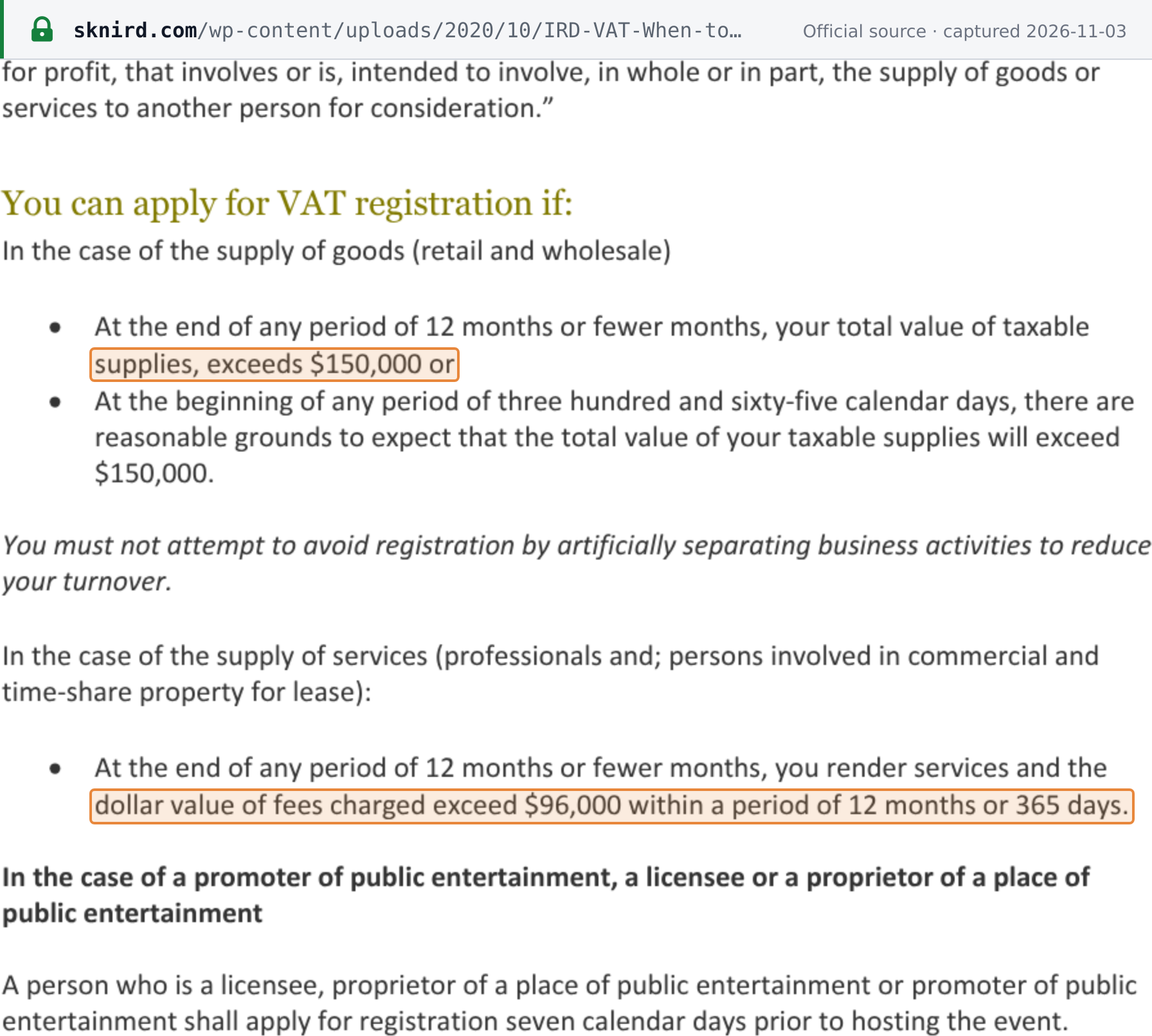
EC$150,000 of taxable supplies (as at 2026-11-03). Section 13(4): "every person who carries on a taxable activity and is not registered, shall apply for registration within a period of fourteen calendar days— (a) of the end of any period of twelve months or fewer months where, during that period, the person made taxable supplies the total value of which exceeded $150,000; or (b) of the beginning of any period of three hundred and sixty five calendar days, where there are reasonable grounds to expect that the total value of taxable supplies to be made by the person during that period will exceed $150,000." [1]
 Source snapshot captured 2026-11-03 — original
- Three-month test: supplies above EC$37,500 in any three months, where the twelve months are expected to exceed EC$150,000, also trigger registration within fourteen days of the end of the third month (s.13(6)–(7)).
- Lower threshold — EC$96,000 (EC$24,000 over three months) for "commercial and time-share property for lease" and for "professional services as may be prescribed by regulations" (s.13(16), inserted by Act 13 of 2011). Schedule 1 to the VAT Regulations lists the professions, among them accountants, architects, consultants, contractors, doctors, lawyers, mechanics and plumbers, with a catch-all for other professional services the Comptroller determines. A person who makes supplies in both categories uses the EC$96,000 threshold for everything (s.13(17)).
- The Minister may change the thresholds by Order, subject to affirmative resolution of the National Assembly (s.13(18)).
The IRD's guide warns: "You must not attempt to avoid registration by artificially separating business activities to reduce your turnover." [5] The Comptroller may count the supplies of related persons, or persons acting in concert, toward the threshold (s.14(1)). The current registration form VAT-001 asks the same question: "Do you expect taxable supplies for goods for the next 12 months to exceed $150,000.00". [9]
Non-resident registration
Same thresholds; only supplies made in Saint Kitts and Nevis count. Section 13(5): "Where a person who is required to register pursuant to the provisions of subsection (4) did not reside in Saint Christopher and Nevis for the year in question for purposes of the Income Tax Act, then any supply made by that person shall be taken into account, only where the supply is made or is to be made in Saint Christopher and Nevis." The IRD suggests a representative: "If you have a place of business and wish to register but you don't live in the Federation, you may want to appoint a representative to register you and to keep VAT records and accounts on your behalf." [5]
The VAT Act, Cap. 18.47, contains no registration or collection obligation aimed at non-resident suppliers of remote or digital services, and no nil threshold for them (see Cross-border rules).
Tax identification number (TIN)
Every taxpayer registers with the Comptroller and receives a taxpayer identification number under TAPA s.4–5: "A person liable or about to become liable for the payment of a tax under any tax law to which this Act applies, shall register with the Comptroller and provide such information to the Comptroller as may be required to give effect to that registration." [2] The IRD's VAT registry as at 1 April 2023, a PDF still hosted on its site but no longer linked from its VAT page, lists registrants by VTIN. Tax invoices must carry the TIN of both supplier and purchaser (see Invoice requirements).
For the number's structure and how to check one, see the Saint Kitts and Nevis TIN guide.
How to register
- Form: VAT-001 "Application for Registration" (with supplements 1A/1B), from the IRD's Forms and Guides page, or online through the IRD's SMARTS portal, launched for VAT on 6 February 2024. [12]
- Advisory visit: the IRD's How to Register guide says "before you are registered, an officer will contact you to visit your place of business or schedule a VAT Advisory Visit." [6]
- Timeline: "The Comptroller shall, within twenty-one days of receipt of an application under subsection (1), inform the applicant, in writing, of the decision"; if not, "the Comptroller shall be deemed to have made a decision to register the applicant" (s.17(2)–(3)).
- Cost: none. The IRD: "VAT Registration is FREE, so if you qualify, be sure to register today." [5]
- Certificate: must be displayed at the place of business (s.21); failure costs EC$50 per day (s.97(2)).
Voluntary registration
Available, at the Comptroller's discretion: "A person who makes or intends to make taxable supplies, but is not required to register under section 13; may apply to the Comptroller for registration under this Act" (s.15(1)). The Comptroller "shall not accept" an application where the applicant has no fixed place of abode or business, does not keep proper records, is expected not to keep proper records or file regular and reliable returns, or has not complied with other tax laws (s.15(2)). The IRD: "However, there is no guarantee that you would be registered, as it will depend on your ability to keep proper records amongst other things." [5] The usual reason to register is to recover input VAT; a business whose supplies are all exempt cannot register.
Deregistration
- Ceasing the activity: "a taxable person who ceases to carry on a taxable activity shall notify the Comptroller of that fact within a period of seven calendar days from the date the person ceases to carry on the taxable activity" (s.24(1)). Cancellation takes effect from the last day of the tax period in which the activity ceased (s.24(3)).
- Turnover below the threshold: a person registered under the threshold tests, or voluntarily, "may apply for cancellation of registration only after the expiration of two years from the date the registration took effect" (s.24(6)–(7)). [1] [7]
- Sale of the business as a going concern: notify the Comptroller seven days in advance (s.24(12)).
- Changes of details are notified within twenty-one calendar days on the IRD's Change of Registration Details form. [7] Failure to notify carries a civil penalty of up to EC$1,000 (s.98).
Group registration
Not available. The VAT Act's arrangement of sections contains no VAT-grouping provision. Instead, the Comptroller may aggregate the supplies of related persons when testing the threshold (s.14(1)), and a business carried on through branches or divisions is a single taxable person (s.78).
Rates
| Rate | Applies to (as at 2026-11-03) | Legal basis |
|---|---|---|
| 17% standard | All taxable supplies and imports not covered below | VAT Act s.27(1)(a)–(b) |
| 10% reduced | Hotel, guest-house and inn accommodation; apartments and rooms let with utilities or furnishings by the lessor (not in a private home); licensed tour operators; licensed restaurants | s.27(1)(d); Regs 9–11 |
| 0% zero rate | Listed basic foods, diapers, local bread, fuel, exports, export-type services, going-concern transfers | s.34; Second Schedule |
| 5% on Discounted VAT Rate Days | Eligible tangible goods sold by IRD-approved businesses on designated days only | Orders under s.27(2) for 2024–2025; Government announcement and IRD guidance for 2026 |
| Exempt | Third Schedule supplies; most food (Reg. 37, Schedule 4); hotel and restaurant service charge passed to workers (Reg. 36); medicines (Reg. 38); funeral services (Reg. 39). No VAT, no input-tax recovery | s.35; Third Schedule; VAT Regulations Part XV |
 Source snapshot captured 2026-11-03 — original
Standard rate
17%, in force since the Act's commencement on 1 November 2010. Section 27(1): "The rate of tax payable under the provisions of this Act shall be calculated in accordance with the provisions of this Act at the rate of— (a) 17 percent of the value of every taxable supply by a taxable person in Saint Christopher and Nevis; (b) 17 percent of the value of every imported goods or imported services, other than an exempt imported goods or imported services". [1]
The rate was temporarily 13% from 1 January to 30 June 2025 under S.R.O. 4 of 2025, which the National Assembly affirmed on 21 March 2025 (S.R.O. 5 of 2025: "the National Assembly of Saint Christopher and Nevis hereby affirms the Order of the Minister of Finance to reduce the rate of VAT to a rate of 13% with effect from 1st January, 2025 until 30th June, 2025"). [10] The IRD confirmed the return to 17% on 30 June 2025: "the Value Added Tax (VAT) rate will revert to 17% effective July 1, 2025, following the expiration of the temporary reduced rate of 13%." [21]
 Source snapshot captured 2026-11-03 — original
The IRD's August 2026 release still describes 17% as "the standard rate". [13]
How rates change. "Notwithstanding subsection (1), the rates of tax referred to in subsection (1) may be calculated in accordance with the provisions of this Act at such other rate as the Minister may, by Order, specify, except in the case of a supply that is zero rated, and an Order made pursuant to the provisions of this subsection shall be subject to affirmative resolution of the National Assembly" (s.27(2)). The 13% rate of 2025 (S.R.O. 4 of 2025) and the Discounted VAT Rate Days of 2024 and 2025 (S.R.O. 8 and 24 of 2024, S.R.O. 12 of 2025) were made this way, by Order rather than by amending Act. The Law Commission's online 2026 Statutory Rules and Orders contain no 2026 Special VAT Reduction Order as at 2026-11-03; the 2026 days rest on the Government's announcement of 10 April 2026 and IRD guidance.
Reduced rate (10%)
Section 27(1)(d) applies 10%, "to the extent provided in regulations", to: [1]
- "(i) accommodation services by a hotel, guest house, inn, or similar establishment";
- "(ii) accommodation services in an apartment or room with utilities or furnishings provided by the lessor, but not including services to a renter in a private home";
- "(iii) the value of supply by a tour operator as defined in regulations" — under Reg. 10, taxi and tour-bus operators holding a current Tourism Authority permit and qualifying rail, water, hike, bike and scooter tours; transport to the Federation is not included;
- "(iv) the value of supply by a restaurant as defined in regulations" — under Reg. 11(5), "a licensed restaurant means an establishment that satisfies all of the following conditions— (a) a retail establishment whose business is the sale of food for immediate consumption; (b) the establishment has a minimum seating capacity for diners of ten persons; (c) the establishment is located in premises the proprietor of which is required to obtain a restaurant licence". Hotel food and beverage is included; partially prepared food, venue hire and catered parties are not.
Supplies at 10% have their own line on the VAT-01 return: "(105) Accommodation, Tour and/or Restaurant (Sales)". [8]
Zero rate (0%)
Second Schedule supplies are taxable at 0%, so input VAT on them is recoverable. Examples: [1]
- Listed basic foods by customs tariff heading: rice, sugar, flour, milk, infant formula and oats (para 3(2)). Reg. 26 narrows them: zero-rated flour "means wheat or meslin flour", sugar excludes icing sugar, lactose and maple sugar, and milk excludes sweetened or concentrated milk, yoghurt, ice cream and cheese; these items are also exempt from VAT on import (Reg. 26(2)). These items also fall within the food chapters exempted by Reg. 37 and Schedule 4 to the VAT Regulations (see Exempt supplies); the Act gives zero-rating priority only over Third Schedule exemptions (s.35(2)) and the Regulations do not say which treatment prevails for these items. The IRD's introduction guide lists "flour, sugar, milk (not condensed, chocolate, cream or soy), rice (white & brown), oats, bread". [11]
- Infant and adult disposable diapers; locally produced plain bread.
- Fuel: gasoline, kerosene, diesel, fuel oils and LPG.
- Exports of goods entered for export under the Customs Act; sales by duty-free shops to departing non-residents; commercial real property transferred between registrants.
- Services: services on land, goods or intellectual property outside the Federation; services to unregistered non-residents consumed outside the Federation and paid for in foreign currency (para 4(9)); international telecommunications transit; port services to ships.
- Transfer of a going concern between registrants, with a joint notice to the Comptroller within twenty-one days (para 5(1)).
Discounted VAT Rate Days (5%)
On designated days, VAT-registered businesses approved by the IRD charge 5% instead of 17% on eligible goods. It is a scheduled, opt-in relief, not a standing reduced rate: a business that did not apply, or was not approved, charges 17% on those days. The IRD's April 2026 consumer guidance: "If the business did not apply/was not approved to participate, then the VAT charged should remain at 17%." [14]
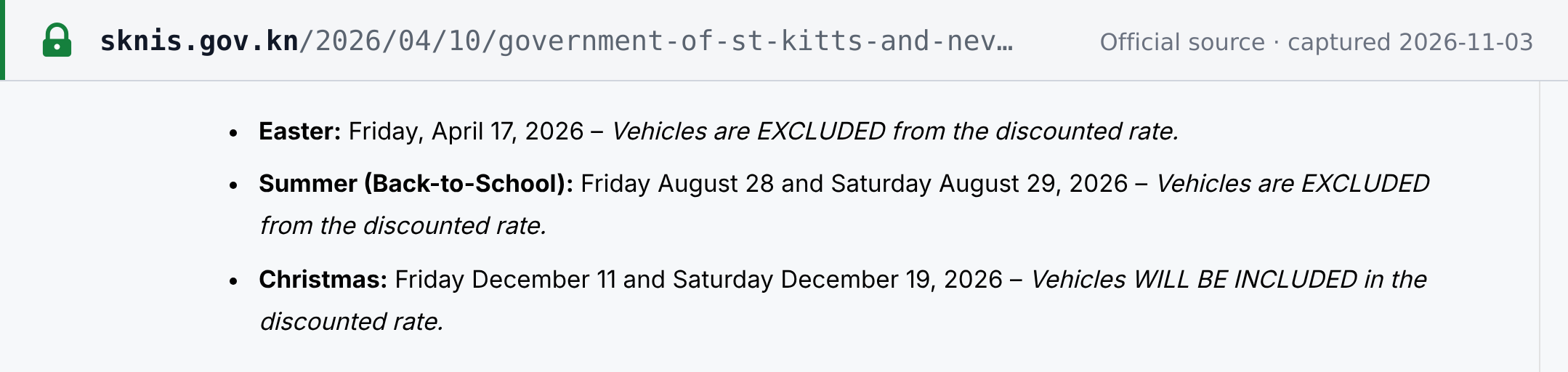
2026 dates (Government announcement of 10 April 2026): "Easter: Friday, April 17, 2026 – Vehicles are EXCLUDED from the discounted rate. / Summer (Back-to-School): Friday August 28 and Saturday August 29, 2026 – Vehicles are EXCLUDED from the discounted rate. / Christmas: Friday December 11 and Saturday December 19, 2026 – Vehicles WILL BE INCLUDED in the discounted rate." [15]
 Source snapshot captured 2026-11-03 — original
- Eligible goods: "All tangible items normally subject to the standard 17% VAT rate will qualify for the reduced 5% VAT rate, except for: Guns / Ammunition / Cigarettes / Alcoholic beverages". [13]
- Not eligible: "Non-tangible supplies and services will continue to attract the standard 17% VAT rate. These include, but are not limited to: Legal fees / Restaurant supplies / Rent / Tickets for games of chance (lotteries and raffles) / Top-ups / Phone cards".
- Business eligibility: all required returns filed and no outstanding fees, licences, tax, penalties or interest owing to the IRD or Customs; applications by the IRD's deadline (for August 2026, 4:00 p.m. on 14 August 2026).
- Imports: "Goods and Services imported on the DVR day do not qualify for the reduced VAT rate." [14]
- Reporting: VAT-01 line "(106) Value on Reduced Rate Supplies 5% - VAT Inclusive", plus the IRD's DVRD sales report.
- Vehicles in December: for December 2025, S.R.O. 12 of 2025 applied the 5% only to the first EC$50,000 of a vehicle's value, with 17% on the balance. [16] The vehicle terms for December 2026 (such as any value cap) had not been published as at 2026-11-03; check the IRD's December guidance.
Temporary relief on alternative-energy equipment
On 14 April 2026 the Prime Minister announced that "Alternative energy equipment – including solar PV panels – made 100% free of value-added tax (VAT), CSC, and Import Duty", effective 20 April 2026, "with the alternative energy equipment policy extended to December 31, 2026". [17] The announcement does not say whether the relief covers imports only or also local sales; check the IRD or Customs before invoicing at nil.
Announced future rates
The 2026 Budget Address announces no VAT rate change; its only forward-looking VAT reference is a reform agenda: "The reform agenda will concentrate on VAT, corporate income tax, property tax and stamp duty, with the objective of making the system simpler, fairer and more efficient." [18] Apart from the Christmas Discounted VAT Rate Days on 11 and 19 December 2026, no future-dated rate has been published as at 2026-11-03.
Cross-border rules
Imports and exports
- Imports of goods: VAT at 17% is collected by Customs (s.10). The taxable value is "the sum of— (a) the value of the goods for the purposes of customs duty ...; (b) the cost of insurance and freight which is not included in the customs value under paragraph (a); (c) the amount of any customs duty, excise tax, environmental surcharge, or any other fiscal charge, other than tax, payable on the importation of such goods; and (d) the amount of customs service charge payable on the importation of such goods" (s.29(1)). Exempt imports are listed in the First Schedule. The VAT Act sets no low-value (de minimis) relief.
- Exports of goods: zero-rated when entered for export under the Customs Act and exported by the supplier. The IRD: "Most exports are zero-rated. However, any claim for a VAT refund will only be paid after it has been verified that the goods or services have been exported." [4] Keep evidence of export.
Reverse charge on imported services
The resident recipient pays the VAT on imported services (s.26(2)(c)). The definition of "import" limits the charge: "in the case of services, a supply of services to a resident— (i) by a non-resident; or (ii) by a resident from a business carried on by the resident outside St. Christopher and Nevis, to the extent that such services are not to be utilised or consumed by a registered person in making taxable supplies in St. Christopher and Nevis" (s.3). [1]
- A registered business that uses the service wholly to make taxable supplies has no import to declare.
- Exempt and partly exempt businesses (banks, insurers) and other residents must "(a) furnish the Comptroller with an import declaration; and (b) pay the tax due in respect of the imported services within a period of fifteen calendar days after the tax period in which the services were imported" (s.12(1)).
- Registered recipients report on VAT-01 lines "(140) Value of Imported Services (Reverse Charge)" and "(145) VAT Payable on Imported Services (.17 x Line 140)". [8]
Digital products and services
The VAT Act, Cap. 18.47, contains no registration or collection obligation for non-resident suppliers of remote or digital services, and the IRD's VAT page, FAQs and forms publish none (as at 2026-11-03). Electronic commerce and internet access are supplied where the recipient uses them (s.37(4)(g)), so the liability on a cross-border digital service sits with the resident recipient under s.26(2)(c), subject to the limit in the definition of "import" above. See VAT on digital services by non-resident suppliers.
Foreign companies selling into Saint Kitts and Nevis — B2B and B2C
- B2B services: the foreign supplier does not register. A fully taxable registered buyer has nothing to declare; an exempt or partly exempt buyer self-accounts at 17% under s.12.
- B2C services: no foreign-supplier registration regime exists in the Act. The tax is legally due from the resident recipient (s.26(2)(c)).
- Goods: VAT is collected at the border from the importer. A non-resident with a place of business in the Federation registers on the normal thresholds, counting only supplies made in the Federation (s.13(5)).
Marketplace / platform deemed-supplier liability
The VAT Act's arrangement of sections contains no marketplace or platform deemed-supplier rule. See marketplace deemed-supplier rules.
Place of supply
- Goods: where delivered, or where transport begins (s.37(1)).
- Services — general rule: the supplier's place of business (s.37(3)).
- Services — where used: "The supply of the following goods or services takes place where the recipient uses or obtains the advantage of the goods or services" (s.37(4)): among them intellectual property and licences, consulting, legal, accounting and engineering services, data processing, advertising, staff supply, leasing of movable property, "(g) the supply of goods via electronic commerce and the supply of internet access or similar services; (h) telecommunications services".
- Services connected with land: where the land is (s.37(6)).
Invoice requirements
The statutory rule — VAT Act, s.44. "Subject to subsection (2), a registered supplier, making a taxable supply to a registered recipient, shall provide the registered recipient with an original tax invoice for the taxable supply in the form and containing the information prescribed by regulations made under this Act" (s.44(1)). [1] Further rules:
- Only one tax invoice per supply (s.44(4)); a lost original may be replaced by a copy clearly marked "copy" (s.44(6)).
- An unregistered person must not issue a tax invoice (s.44(3)) and must not collect VAT (s.92).
- Diplomatic missions and other persons entitled to refunds under s.64 may be given an original tax invoice (s.44(8)).
Mandatory content
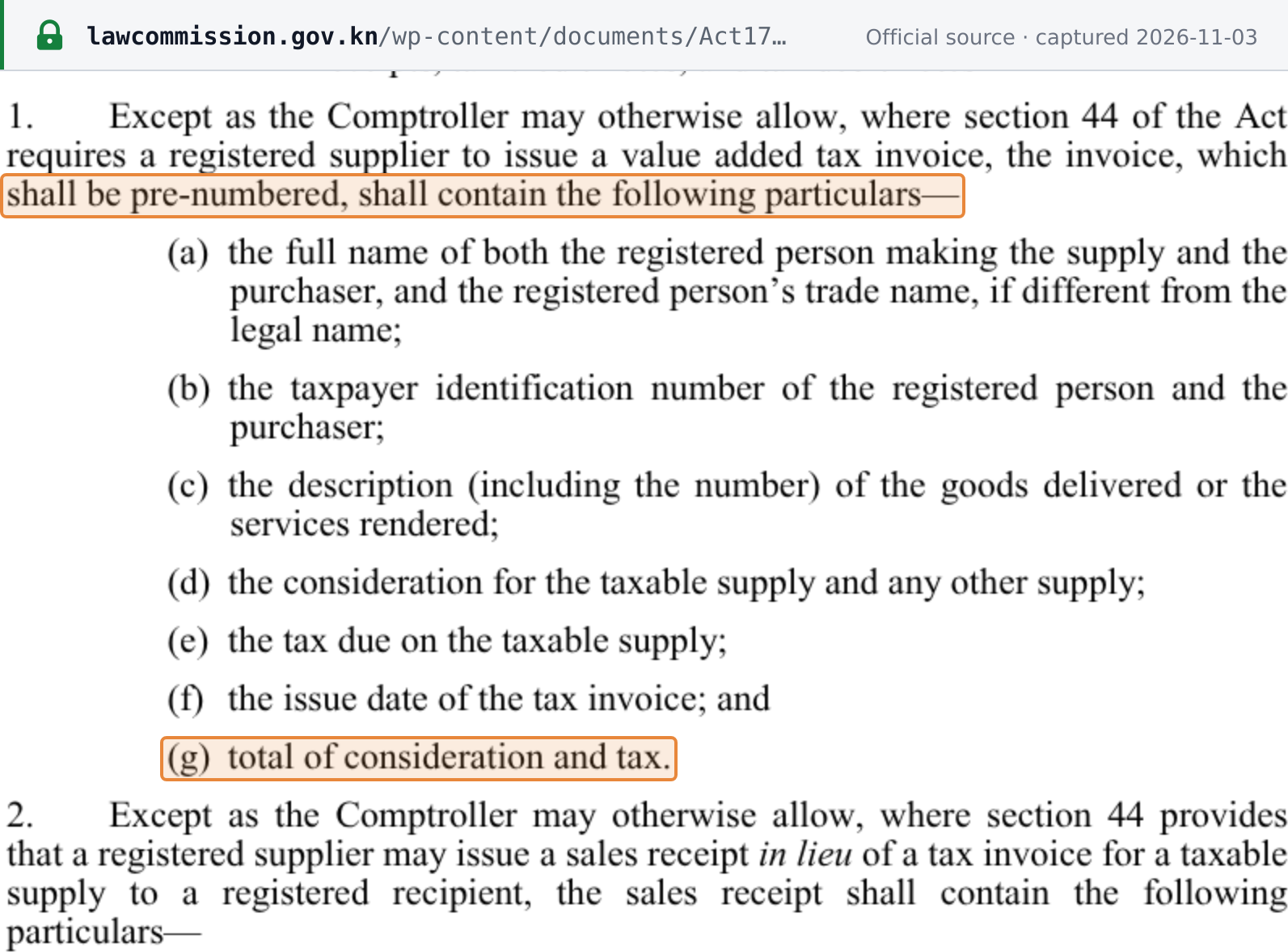
Schedule 2 to the VAT Regulations (Reg. 14), para 1: "Except as the Comptroller may otherwise allow, where section 44 of the Act requires a registered supplier to issue a value added tax invoice, the invoice, which shall be pre-numbered, shall contain the following particulars—" [1]
| # | Field | Source |
|---|---|---|
| 1 | Pre-numbered invoice | Sch. 2 para 1 |
| 2 | "the full name of both the registered person making the supply and the purchaser, and the registered person's trade name, if different from the legal name" | Sch. 2 para 1(a) |
| 3 | "the taxpayer identification number of the registered person and the purchaser" | para 1(b) |
| 4 | "the description (including the number) of the goods delivered or the services rendered" | para 1(c) |
| 5 | "the consideration for the taxable supply and any other supply" | para 1(d) |
| 6 | "the tax due on the taxable supply" | para 1(e) |
| 7 | "the issue date of the tax invoice" | para 1(f) |
| 8 | "total of consideration and tax" | para 1(g) |
| 9 | The words "VALUE ADDED TAX INVOICE" or "VAT INVOICE" in a prominent place | IRD guide, item 1 |
| 10 | Addresses of supplier and recipient | IRD guide, items 2–3 |
| 11 | Per line: unit price excluding VAT, quantity, VAT rate, line total excluding VAT, any cash-discount rate | IRD guide |
| 12 | Zero-rated or exempt lines shown as carrying no VAT, and totalled separately | IRD guide |
 Source snapshot captured 2026-11-03 — original
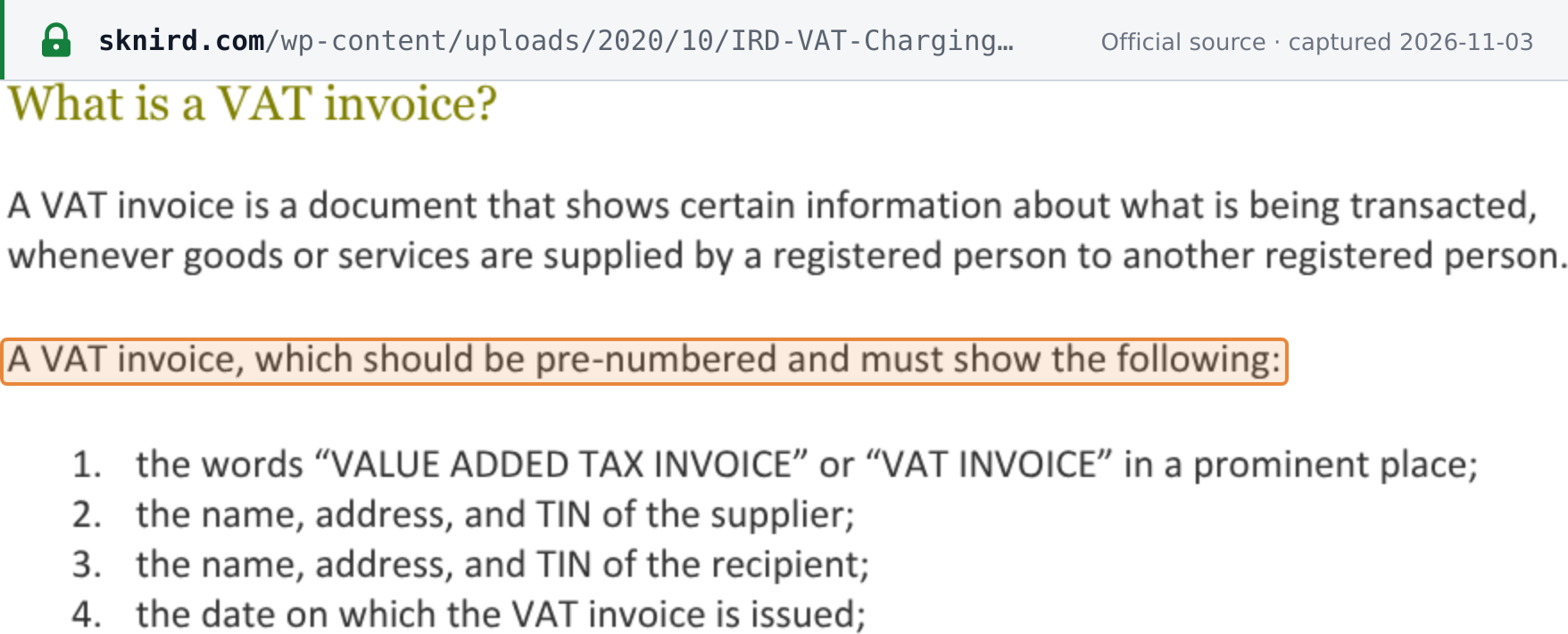
The Regulation binds; the IRD's guide adds the heading words, the addresses and the line-level detail: "A VAT invoice, which should be pre-numbered and must show the following: 1. the words “VALUE ADDED TAX INVOICE” or “VAT INVOICE” in a prominent place; 2. the name, address, and TIN of the supplier; 3. the name, address, and TIN of the recipient; 4. the date on which the VAT invoice is issued; 5. a description of the goods or services supplied, including the quantity 6. the consideration for the supply; and 7. the amount of VAT charged." It also says: "If you issue a VAT invoice that includes zero-rated or exempt goods or services, you must: show clearly that there is no VAT payable on those goods or services / show the total of those values separately". [4] An invoice that meets both lists is safe.
 Source snapshot captured 2026-11-03 — original
Issuance deadline
The Act sets no general "issue within N days" rule; the time of supply is the earliest of delivery or performance, the invoice, or payment (s.36(1)). Two deadlines bite:
- Request by the buyer: "Where a registered recipient has not received a tax invoice as required by subsection (1), the recipient, no later than sixty calendar days after the date of a supply, can request the registered supplier, in writing, to provide a tax invoice in respect of the taxable supply, and the supplier shall comply with the request within fourteen calendar days after receiving it" (s.44(5)).
- Offence: "A registered person who, within sixty days after the date he or she makes a taxable supply, or, where applicable, within fourteen calendar days period specified in subsection (5), fails to issue any invoice or sales receipt in respect of a supply as required under this section commits an offence and shall be liable, on summary conviction, to a fine not exceeding twenty thousand dollars or to imprisonment for a term not exceeding one year or both" (s.44(10)).
Numbering and sequencing
Tax invoices, tax credit notes and tax debit notes must be pre-numbered (Schedule 2 paras 1, 4 and 5); the sales-receipt particulars in para 2 do not include a pre-numbering requirement. The IRD: "The VAT invoice should be in two copies (one for the purchaser, one for the supplier to be made available to the Inland Revenue Department when requested)." [4] Neither the Regulations nor the IRD guide prescribes a number format, separate series or a rule on gaps.
Credit and debit notes
A tax credit note is issued where the tax shown on an invoice exceeds the tax properly chargeable, and a tax debit note where it falls short, after a post-sale adjustment under s.42 (s.45). Schedule 2 para 4: "the tax credit note, which shall be pre-numbered, shall contain at least the following particulars— (a) the words “tax credit note” shall appear in a prominent place; (b) the name, address, and taxpayer identification number of the registered person making the supply; (c) the name, address, and taxpayer identification number of the recipient of the supply; (d) the date on which the tax credit note was issued; (e) the value of the taxable supply shown on the tax invoice, the adjusted value of the taxable supply, the difference between those two amounts, and the tax charged that relates to that difference; (f) a brief explanation of why the tax credit note is being issued; and (g) information sufficient to identify the taxable supply to which the tax credit note relates." A tax debit note carries the same particulars with the words "tax debit note" (para 5). Only one note per adjustment (s.45(5)); a false note is an offence (s.45(7)–(8)).
Currency, language and exchange rate
- Currency: amounts are expressed in EC$ for the purposes of the Act (s.114(1)). Foreign-currency amounts are converted "(a) in the case of imports, ... at the exchange rate as determined for the purposes of the Customs (Act; (b) in all other cases, ... at the exchange rate applying between the currency and the Eastern Caribbean Dollar (EC$) at the time the amount is taken into account under this Act" (s.114(2)). The Act does not say an invoice must be denominated in EC$; on a foreign-currency invoice, showing the VAT in EC$ at that rate lets both parties report it.
- Language: records, including tax invoices and credit and debit notes issued and received, must be kept "in English, in Saint Christopher and Nevis" (s.80(1)). The Comptroller may demand an approved English translation of a record in another language (s.81).
Document types
- Tax invoice — registered supplier to registered recipient (s.44(1)).
- Sales receipt — registered supplier to an unregistered person (s.44(7)); or to a registered recipient in place of a tax invoice where "the total consideration for the sale reported on the sales receipt is payable in cash and does not exceed fifty dollars" (Reg. 14(2), s.44(2)). A sales receipt carries the supplier's name, trade name and TIN, the description, consideration, tax, date and total, but not the purchaser's name or TIN (Schedule 2 paras 2–3).
- Tax credit note / tax debit note — see above.
- Not VAT invoices: the IRD lists "pro-forma invoices / invoices that state 'this is not a tax invoice' / statements / delivery notes / orders / letters, emails or other correspondence", and says pro-formas should carry the words "This is not a VAT invoice". No VAT invoice may be issued for exempt supplies or by an unregistered person. [4]
Self-billing
The IRD's glossary defines it — "Self-Billing: your customer issues your VAT invoice and sends a copy to you with their payment" [11] — but the VAT Act and Regulations contain no self-billing procedure. Schedule 2 opens "Except as the Comptroller may otherwise allow"; get the Comptroller's agreement before self-billing.
Retention and audit trail
- Retention: six years. "Records required to be maintained pursuant to the provisions of subsection (1) shall be retained for a period of six years after the end of the tax period to which they relate" (s.80(2)). Earlier disposal needs the Comptroller's written permission (s.80(3)).
- Electronic records are mandatory for threshold registrants. Reg. 17(3): "In the case of persons who are required to be registered as a result of exceeding the threshold requirements in respect of taxable supplies, such persons shall maintain their records by electronic means by use of, but not limited to, the following— (a) electronic tills or point of sale systems as approved by the Comptroller; and (b) computerized accounting systems as evidence of their records or otherwise as approved by the Comptroller."
- Audit trail: required records include till rolls, audit rolls and tapes (Reg. 17(2)(h)); goods taken for personal use need a document marked "PERSONAL USE" (Schedule 2 paras 6–7); officers have access to records, computers and goods (s.84). Failure to keep records: EC$50 per day (s.102) and an offence (s.80(4)).
A specimen of a compliant invoice
The IRD publishes no specimen or annotated model invoice: none appears in its VAT guides, its Forms and Guides page or its FAQs, and the VAT Act and Regulations contain none. Below, Lookuptax lays out the Schedule 2 particulars, with the extra items in the IRD's guide, for an illustrative hotel invoice mixing the 10% and 17% rates. Every name, number and amount is fictional:
VAT invoice — illustrative
| DescriptionSch. 2 para 1(c) | QtySch. 2 para 1(c) | Unit price excl. VATIRD guide | VAT rateIRD guide | Amount excl. VATSch. 2 para 1(d) |
|---|---|---|---|---|
| Room, 3 nights, 10–12 Feb 2026 | 3 | EC$ 400.00 | 10% | EC$ 1,200.00 |
| Branded souvenir goods (gift shop) | 2 | EC$ 50.00 | 17% | EC$ 100.00 |
- Consideration, 10% suppliesSch. 2 para 1(d)
- EC$ 1,200.00
- VAT 10%s.27(1)(d)
- EC$ 120.00
- Consideration, 17% suppliesSch. 2 para 1(d)
- EC$ 100.00
- VAT 17%s.27(1)(a)
- EC$ 17.00
- Total VAT dueSch. 2 para 1(e)
- EC$ 137.00
- Total consideration and VATSch. 2 para 1(g)
- EC$ 1,437.00
- Any zero-rated or exempt line is shown with no VAT and totalled separately (IRD guide).
- Two copies: one for the purchaser, one kept by the supplier for the IRD (IRD guide).
- Corrections are made by a pre-numbered tax credit note or tax debit note identifying this invoice (VAT Act s.45; Sch. 2 paras 4–5).
E-invoicing status
No e-invoicing, clearance or real-time reporting mandate (as at 2026-11-03). The VAT Act, Cap. 18.47, and the VAT Regulations contain no e-invoicing or fiscal-device requirement, and the IRD's VAT page, FAQs, forms and the 2026 Budget Address publish none. Paper or electronic invoices that carry the Schedule 2 particulars are acceptable.
- Closest rules: threshold registrants must keep records on Comptroller-approved electronic tills or point-of-sale systems and computerised accounts (Reg. 17(3); see Retention and audit trail).
- SMARTS is a tax-administration portal for registration, returns and payment, not an invoicing platform. The IRD announced it "is scheduled to commence operations on February 06, 2024. As part of this significant upgrade, the administration of Value Added Tax (VAT), Corporation Income Tax (CIT), Unincorporated Business Tax (UBT), and Business and Occupation (B&O) and Liquor Licences will be seamlessly transitioned to the SMARTS platform". [12]
See e-invoicing status and networks worldwide.
Filing and payment
Filing frequency
Monthly for every registrant; the tax period is the calendar month (s.46) and there are no turnover bands. Nil returns are required: "Every taxable person shall file a tax return for each tax period with the Comptroller within fifteen calendar days after the end of the tax period, whether or not tax is payable in respect of that period" (s.47(1)). [1]
Return and payment due date
| Obligation | Due | Source |
|---|---|---|
| VAT-01 return | Within 15 calendar days after the end of the month | VAT Act s.47(1) |
| Payment | By the due date of the return | s.51(1)(a) |
| Imported services (non-registered or exempt recipients) | Declaration and payment within 15 calendar days after the period | s.12(1) |
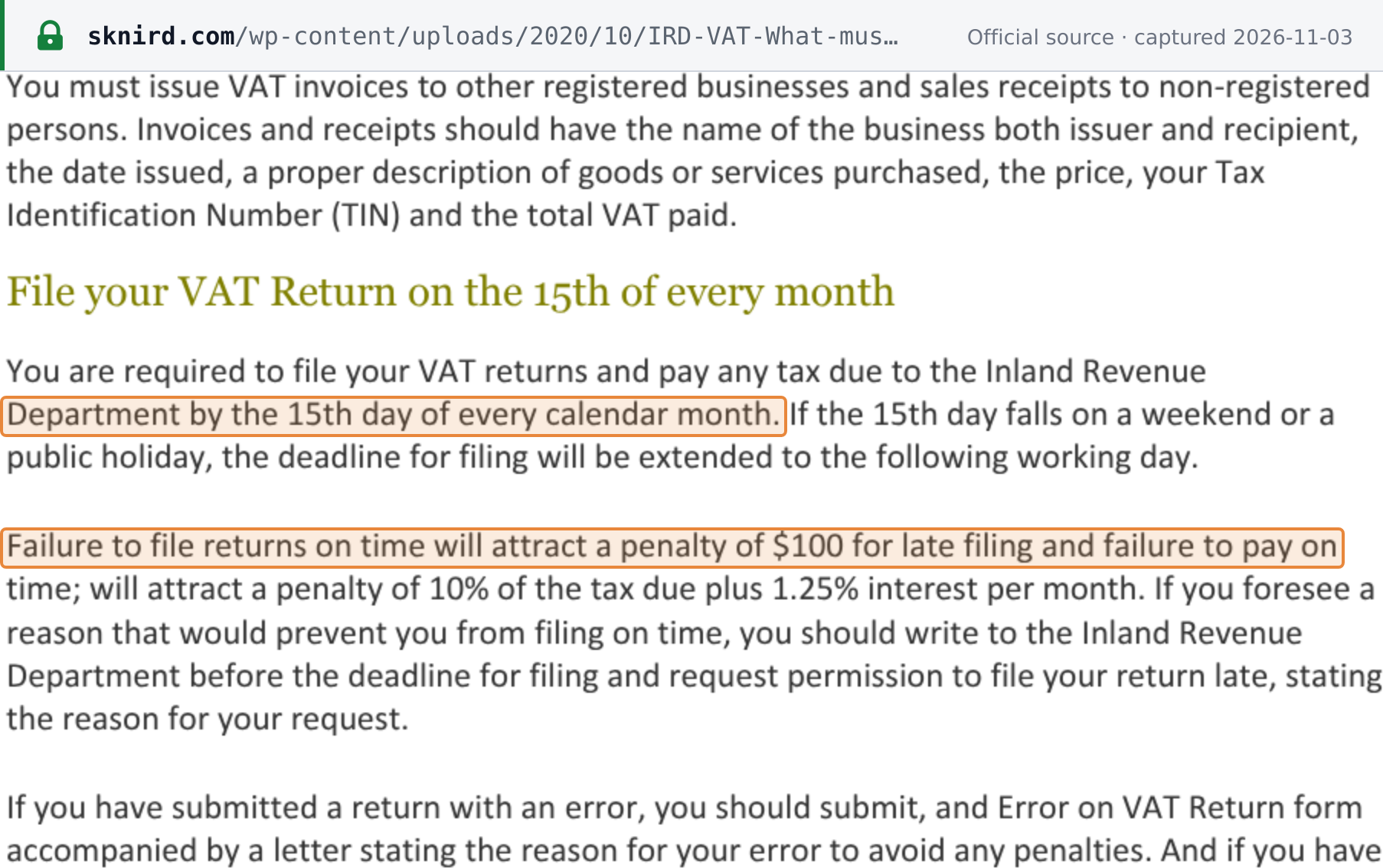
The IRD: "You are required to file your VAT returns and pay any tax due to the Inland Revenue Department by the 15th day of every calendar month. If the 15th day falls on a weekend or a public holiday, the deadline for filing will be extended to the following working day." [19] Returns are filed and paid through the SMARTS portal, or on paper with a remittance: "This form, together with a Remittance for the Total Tax Due, should be sent to the Inland Revenue Department within fifteen days after the end of each Tax Period." [8] An extension must be requested in writing before the deadline (s.48). To correct a filed return, the IRD says to "submit, and Error on VAT Return form accompanied by a letter stating the reason for your error to avoid any penalties." [19]
 Source snapshot captured 2026-11-03 — original
What the VAT-01 return asks for (February 2024 version): output lines for standard-rated sales (100, VAT-inclusive), accommodation, tour and restaurant sales at 10% (105), Discounted VAT Rate Day sales at 5% (106), zero-rated (111) and exempt (115) supplies, imported services under reverse charge (140/145) and total output tax (150); input lines 200–225 for imports and local purchases and the VAT paid on them. [8]
Additional listings
None. The IRD's VAT guides and forms describe only the monthly VAT-01 return; there is no annual VAT return or sales and purchase listing. Approved businesses also file a sales report for each Discounted VAT Rate Day.
Input-tax recovery
The IRD: "If you are VAT registered, you can normally only reclaim VAT on purchases made for your business when you have a valid VAT invoice for the purchase." [4] Blocked under s.41(2): [1]
- "(a) a passenger vehicle supplied to, or a passenger vehicle imported by, the person, unless the person is in the business of dealing in, or hiring of, passenger vehicles";
- "(b) goods or services supplied to, or imported by, the person for the purposes of entertainment", unless the person is in the entertainment business or a transport business providing it to passengers;
- "(c) any fees or subscriptions paid by the person in respect of membership of any person in a club, association, or society of a sporting, social, or recreational nature";
- "(d) taxable goods or services supplied to, or imported by, the person for the purpose of repair or maintenance of a passenger vehicle, unless the person is in the business of refurbishing for resale or of hiring of such vehicles", and the repair is directly related to that business.
Input tax used for both taxable and exempt supplies is apportioned (s.41(3)). A second-hand goods dealer may claim a notional credit on goods bought from unregistered sellers and resold at the standard rate (s.40(4)).
Refunds
- Ordinary credit position: an excess credit is carried forward; "if any of the excess ... remains, after being carried forward and used as an input tax deductible in four consecutive tax periods, the taxable person may file with the Comptroller a claim for refund for the amount remaining" (s.62(3)), and the Comptroller refunds the remaining excess within three calendar months of the claim if satisfied (s.62(4)).
- Zero-raters: where "at least 50% of the amount of the taxable supplies of a taxable person for the taxable period is taxed at a zero rate", the excess attributable to zero-rated supplies may be claimed each period (s.62(5)) and is decided "within one calendar month" (s.62(6)).
- Small amounts: "if the amount of the excess to be refunded is not more than one hundred dollars, the excess shall be carried forward" (s.62(7)).
- Time limit: three years from the date the right to apply arises (s.62(11)). Use the IRD's "VAT Application for Refund" form.
- Others: diplomatic missions and approved organisations claim under s.64. There is no tourist refund scheme and no refund scheme for unregistered non-resident businesses.
Exemptions
Exempt supplies
Supplies in the Third Schedule are exempt (s.35(1)), and the VAT Regulations exempt food and a few other supplies (next subsection). The IRD's list of Third Schedule items: [4]
- financial services; educational services;
- rental of residential property for dwelling; sale of real property;
- international transportation; domestic transportation of goods and passengers;
- locally produced agricultural products sold by the producer;
- water for domestic use, including bottled water; electricity for residential and commercial use;
- day-care services; religious services; basic construction services on a dwelling;
- medicines, including multi-vitamins;
- certain supplies by the State, the Nevis Island Administration or approved charities at a nominal price.
The IRD also lists agricultural and fishing inputs (seeds, fertilisers, pesticides, animal feed, boats and fishing equipment) and printed books, newspapers and pamphlets (but not printing services) as exempt.
Food, service charges, medicines and funerals
Part XV of the VAT Regulations ("Permanent exemptions", under s.118(2) of the Act) adds exemptions that the IRD's list above does not show: [1]
- Service charge (Reg. 36). Service charge charged by hotels and restaurants is exempt "only ... if 75% of the charge collected during the tax period is paid to the workers within that period"; otherwise VAT is due on it plus interest, and a fine of up to EC$10,000.
- Medicines (Reg. 38), defined by Harmonised System headings.
- Funeral expenses (Reg. 39, Schedule 5) supplied by a licensed funeral home: embalming, coffins and caskets, hearse and transport, grave digging and similar services.
- Payment-system fees (Reg. 35): credit card processing fees, merchant discount fees and loan commitment or processing fees.
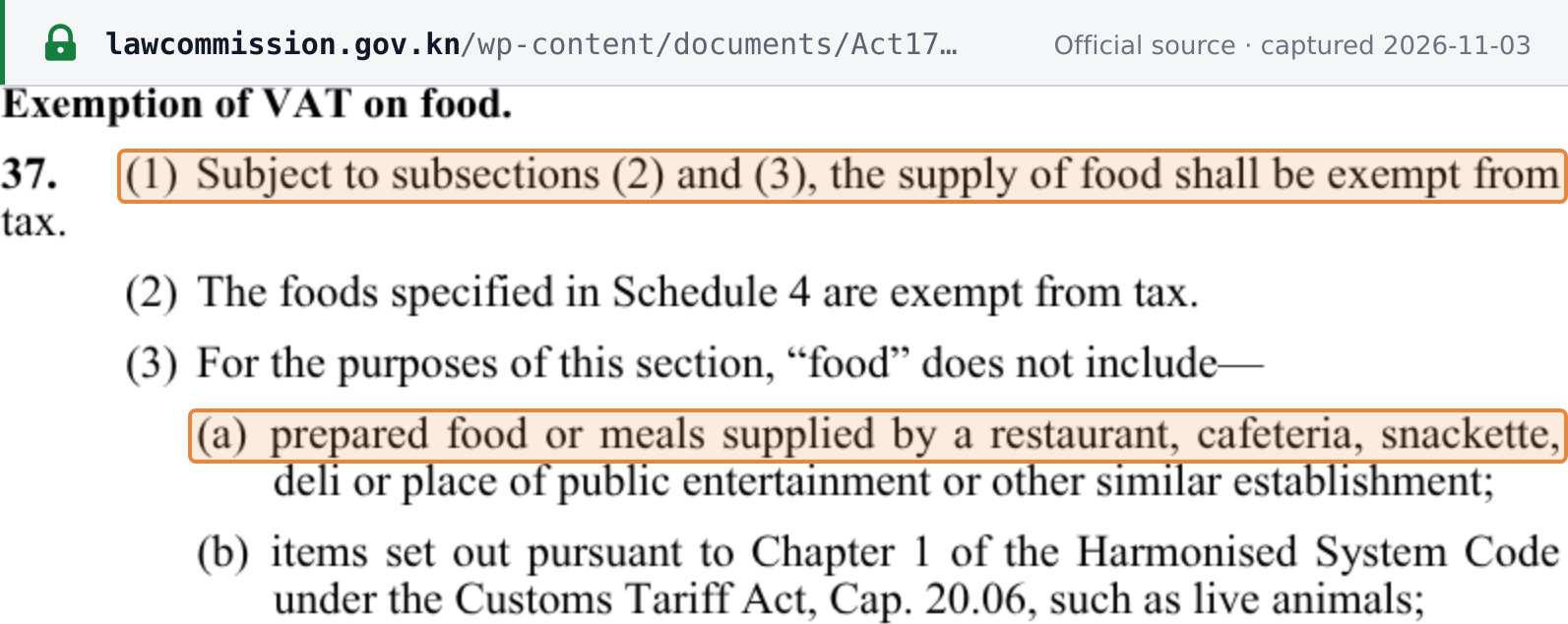
- Food (Reg. 37). "(1) Subject to subsections (2) and (3), the supply of food shall be exempt from tax. (2) The foods specified in Schedule 4 are exempt from tax." Schedule 4 (substituted by S.R.O. 12/2015) lists foods by customs chapter, among them: meat; fish and shellfish; milk, cream, yogurt, butter, cheese, eggs and honey; edible vegetables, roots and tubers; fruit and nuts; coffee, tea and spices; cereals and flour; vegetable and animal fats and oils, including margarine; sausages and prepared or preserved meat and fish; sugar, confectionery and chewing gum; cocoa preparations; pasta, cereals, bread, pastry, cakes and biscuits; jams, preserved vegetables and fruit juices; sauces, condiments, soups and ice cream; "Waters, aerated waters, drinks and non-alcoholic beverages"; bran; salt; and artificial sweeteners. Food does not include "prepared food or meals supplied by a restaurant, cafeteria, snackette, deli or place of public entertainment or other similar establishment" (Reg. 37(3)(a)), nor live animals, live plants and cut flowers. The IRD publishes a breakdown by tariff code, "effective April 7th 2015". [22]
 Source snapshot captured 2026-11-03 — original
So most groceries carry no VAT, but the seller cannot recover input VAT on them, while the same food served as a restaurant meal is taxable at 10% (licensed restaurants) or 17%.
Exempt is not zero-rated. The IRD: "If a VAT registered business sells zero-rated goods or services they count as taxable supplies, because VAT is charged at a rate of zero percent. You can also claim an input tax deduction on these items as well to recover any VAT incurred in supplying these items. If you sell goods or services that are exempt, you don't charge any VAT as they are not taxable supplies." [11] And: "If all of the goods and services you sell are exempt, your business is exempt, and you would not be able to register for VAT. This means you would not be able to reclaim any VAT on your business purchases." [4]
Special regimes
- Second-hand goods: notional input credit for dealers (s.40(4)). The IRD excludes investment-grade gold, silver and platinum, unset diamonds, rubies, emeralds and sapphires, animals and plants, real property and "goods valued for $10,000 and less".
- Duty-free shops: approved imports (Reg. 20 and Schedule 3 to the Regulations) and zero-rating of sales to departing non-residents.
- Going-concern transfers: zero-rated, with a joint notice within twenty-one days.
- Small-business, flat-rate and cash-accounting schemes: none. The VAT Act's arrangement of sections contains no such scheme.
Offences and penalties
Offences
Criminal offences are tried on summary conviction; fines are in EC$. [1]
| Conduct | Section | Maximum |
|---|---|---|
| Making taxable supplies while unregistered when registration is required | s.13(1), (3) | EC$30,000, 2 years' imprisonment, or both |
| Failing to issue an invoice or sales receipt within 60 days (or 14 days after a request) | s.44(10) | EC$20,000, 1 year, or both |
| False credit or debit note | s.45(7)–(8) | EC$20,000, 1 year, or both |
| Failing to file returns for two or more periods, consecutive or not | s.47(6) | EC$50,000, 3 years, or both |
| Failing to keep records | s.80(4) | EC$10,000, 6 months, or both |
| Tax evasion | s.87(2) | EC$100,000, 5 years, or both |
| Unregistered person collecting VAT | s.92 | EC$100,000, 5 years, or both |
| Displaying prices that are not VAT-inclusive (or do not show the VAT equally prominently) | s.112(6) | EC$10,000, 6 months, or both |
| Any offence with no specific penalty | s.94 | EC$10,000, 6 months, or both |
Section 87(2): "Any person who evades, or attempts to evade the assessment, payment, or collection of tax commits an offence and shall be liable, on summary conviction, to a fine not exceeding one hundred thousand dollars or to imprisonment for a term not exceeding five years or both." The Comptroller may compound an offence before a hearing (s.95), may obtain a court order closing business premises for three to thirty days for repeated violations (s.107), and may publish the names of defaulters (s.108).
Penalties
Civil penalties and interest (as at 2026-11-03):
| Failure | Penalty | Source |
|---|---|---|
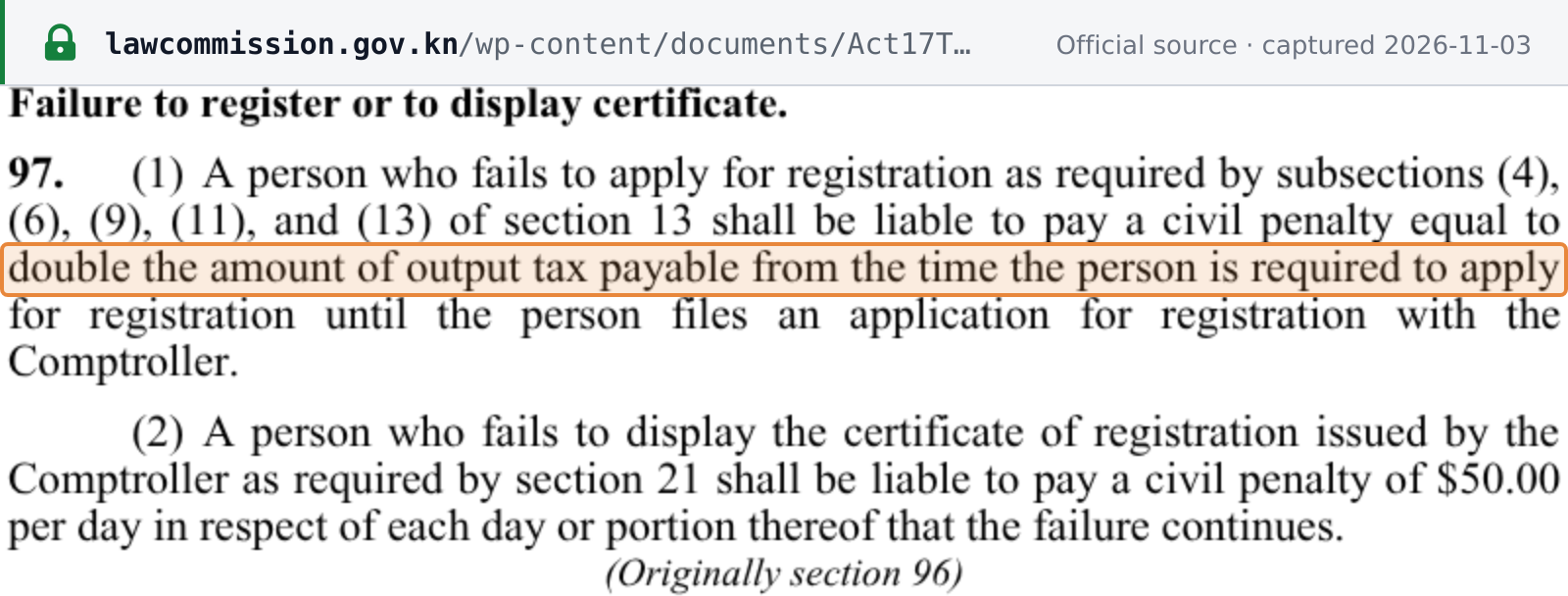
| Late registration | Double the output tax payable from when registration was required until the application is filed | VAT Act s.97(1) |
| Certificate not displayed | EC$50 per day | s.97(2) |
| Failure to notify a change or cessation | Up to EC$1,000 | s.98 |
| False invoice or receipt, false TIN, failure to provide an invoice, receipt, credit or debit note | Up to EC$25,000 | s.99 |
| Late filing | EC$100 per month or part the return remains unfiled | s.100; IRD FAQ |
| Late payment | 10% of the tax due | TAPA s.37(6); IRD FAQ |
| Interest on late payment | 1.25% per month or part | VAT Act s.43(1); IRD FAQ |
| Failure to keep records | EC$50 per day | s.102 |
| Failure to comply with a recovery notice | Up to 25% of the amount sought | s.101; IRD FAQ |
| Underpayment due to fraud or negligence | 25% of the underpayment | TAPA s.38 |
 Source snapshot captured 2026-11-03 — original
- Late filing: "A person who fails to file a return within the time required under this Act shall be liable to pay a civil penalty of one hundred dollars per month, or part thereof, for the period during which the return remains unfiled" (s.100).
- Late payment: "A person who fails to pay tax, being the whole or part of the remainder of any tax due or payable under this Act, by the due date shall be liable to a penalty equal to ten percent of the amount of tax due" (TAPA s.37(6), inserted by Act 5 of 2016). [2]
- Interest: "Tax payable under this Act which is not paid by the date upon which it becomes due and payable shall bear interest at the rate of 1.25 per cent per month or part thereof for the period during which it remains unpaid" (VAT Act s.43(1)).
- IRD FAQ: "The Value Added Tax penalty for late payment is 10% of the tax due. The penalty for late filing is $ 100.00 per month or part thereof." and "The late payment interest rate for Value Added Tax is 1.25% per month or part thereof." [20]
Frequently asked questions
We did not apply for a Discounted VAT Rate Day. Can we still charge 5% VAT on the day?
No. The 5% rate on Discounted VAT Rate Days is only for VAT-registered businesses that applied to the Inland Revenue Department and were approved. The IRD's consumer guidance for the April 2026 day states that if the business did not apply or was not approved to participate, the VAT charged should remain at 17%. To be eligible, a business must have filed all required returns and owe nothing to the IRD or Customs.
Our consulting firm's fees are under EC$150,000 a year. Do we still have to register for VAT?
Possibly yes. The EC$150,000 threshold applies generally. Under section 13(16) of the Value Added Tax Act, Cap. 18.47, a person supplying professional services prescribed in Schedule 1 to the VAT Regulations (consultants, accountants, lawyers, architects, contractors and many others), or leasing commercial or time-share property, must register once taxable supplies exceed EC$96,000 in any period of twelve months or fewer, or EC$24,000 in three months where the year is expected to exceed EC$96,000. Apply within fourteen days.
We are a VAT-registered company in St Kitts buying software services from a foreign supplier. Do we have to self-account for VAT on them?
Not if you use the services to make taxable supplies. Section 3 of the Value Added Tax Act defines an import of services as a supply to a resident by a non-resident to the extent the services are not to be utilised or consumed by a registered person in making taxable supplies in Saint Christopher and Nevis. A business making exempt supplies, such as a bank or insurer, or a partly exempt business, must declare the import and pay 17% within fifteen days after the tax period, using lines 140 and 145 of the VAT-01 return if it is registered.
A registered customer has asked for a tax invoice for a sale we made weeks ago. Do we have to issue one?
Yes, if the request comes within sixty days. Under section 44(5) of the Value Added Tax Act, a registered recipient who did not receive a tax invoice may ask the supplier in writing no later than sixty calendar days after the date of the supply, and the supplier must comply within fourteen calendar days. Failing to issue an invoice or sales receipt within those periods is an offence under section 44(10), with a fine of up to EC$20,000, imprisonment for up to one year, or both.
We should have registered for VAT months ago. What will the late registration cost?
Section 97(1) of the Value Added Tax Act imposes a civil penalty equal to double the amount of output tax payable from the time you were required to apply for registration until you file the application. The IRD's When to Register guide adds that you remain liable for the VAT on your sales from the date you should have been registered, even if you did not charge your customers VAT, and those sales are deemed VAT-inclusive.
Important websites
| Site | Purpose |
|---|---|
| IRD SMARTS tax portal | Register for VAT, file the VAT-01 return and pay online (access through a MyGovernment account) |
| IRD Quick Pay | Online tax payment |
| IRD — Value Added Tax | VAT guides |
| IRD — Forms and Guides | VAT-001 registration, VAT-01 return, refund, cancellation, Disclosure of Errors (VAT) and Discounted VAT Rate Day forms |
| IRD — VAT registry (as at 1 April 2023) | List of VAT registrants by VTIN; a static 2023 PDF, no longer linked from the IRD's VAT page, not a live lookup |
| IRD — Tax calendar | Filing and payment dates |
| St. Kitts and Nevis Law Commission — Laws | VAT Act, TAPA and Statutory Rules and Orders |
| Customs and Excise Department | Import VAT and customs clearance |
There is no official VAT rate-lookup tool and no e-invoicing portal. IRD help desk: sknhelpdesk@ird.gov.kn; (869) 465-8485 (St Kitts), (869) 469-5856 (Nevis). For other countries' registers, see check a VAT number — official lookups by country.
Recent changes
- 2026-08-28 — Discounted VAT Rate Days on 28 and 29 August 2026: 5% instead of 17% on eligible tangible goods for approved businesses; vehicles excluded. Further days are scheduled for 11 and 19 December 2026, with vehicles included. (IRD) — see event
- 2026-04-20 — Government announces alternative-energy equipment, including solar PV panels, free of VAT, CSC and import duty until 31 December 2026. (SKNIS)
- 2025-07-01 — Standard rate back to 17% after the temporary 13% rate of 1 January to 30 June 2025 (S.R.O. 4 of 2025, affirmed by S.R.O. 5 of 2025). (IRD)
- 2024-02-06 — SMARTS tax administration system goes live for VAT registration, filing and payment. (IRD)
For the full chronology, see Saint Kitts and Nevis tax changes on Lookuptax.
Reference links
- Value Added Tax Act, Cap. 18.47 (Revised Edition, law as at 31 December 2017, with the VAT Regulations) — St. Kitts and Nevis Law Commission
- Tax Administration and Procedures Act, Cap. 20.52 — Law Commission
- Hotel Accommodation and Restaurant Tax Act, Cap. 20.20 — Law Commission
- IRD — Charging VAT on your sales and other supplies
- IRD — When to Register
- IRD — How to Register
- IRD — Changing or cancelling your VAT registration
- IRD — VAT-01 VAT return (February 2024)
- IRD — VAT-001 Application for Registration
- S.R.O. 5 of 2025 — National Assembly resolution affirming the 13% Special VAT Reduction Order
- IRD — VAT Introduction
- IRD — Inland Revenue to launch new tax administration system on February 06, 2024
- IRD — Discounted VAT Rate Days in August 2026 (press release, 7 August 2026)
- IRD — DVRD April 2026 consumer guidance
- Government of St. Kitts and Nevis (SKNIS) — Discounted VAT Rate Days for 2026 (10 April 2026)
- S.R.O. 12 of 2025 — Special VAT Reduction Order (2025 Discounted VAT Rate Days)
- SKNIS — Prime Minister announces economic relief measures (14 April 2026)
- 2026 Budget Address — SKNIS
- IRD — What must I do after successful registration?
- IRD — Frequently asked questions
- IRD — VAT rate returns to 17% effective July 1, 2025 (press release, 30 June 2025)
- IRD — Customs chapter numbers and breakdown on food exemption from VAT, effective 7 April 2015
Related on Lookuptax: