Samoa VAGST guidelines
Overview
Samoa levies Value Added Goods and Services Tax (VAGST) under the Value Added Goods and Services Tax Act 2015 (Act No. 43 of 2015), which was assented to and commenced on 5 November 2015 and repealed the VAGST Act 1993 (s.52). The Act itself calls the tax "goods and services tax" or "GST" (s.2). Its Samoan title, as printed on the bilingual return form, is Tulafono o Lafoga I Tau Fa'aopoopo o Oloa ma Galuega Fa'atino 2015. [1] [2]
This guide quotes the revised version of the Act that the Ministry publishes, which states: "This is the official version of this Act as at 31 December 2018." Procedure (records, penalties, interest) sits in the Tax Administration Act 2012, also revised to 31 December 2018. [3] Fiscal invoicing sits in the Tax Administration (Tax Invoice Monitoring System) Regulations 2020, as amended by the Amendment Regulations dated 26 July 2023. [4] [5]
Authority, currency, period and layering
- Authority. The Ministry of Revenue (formerly the Ministry of Customs and Revenue) administers VAGST through its Inland Revenue Services division. [6]
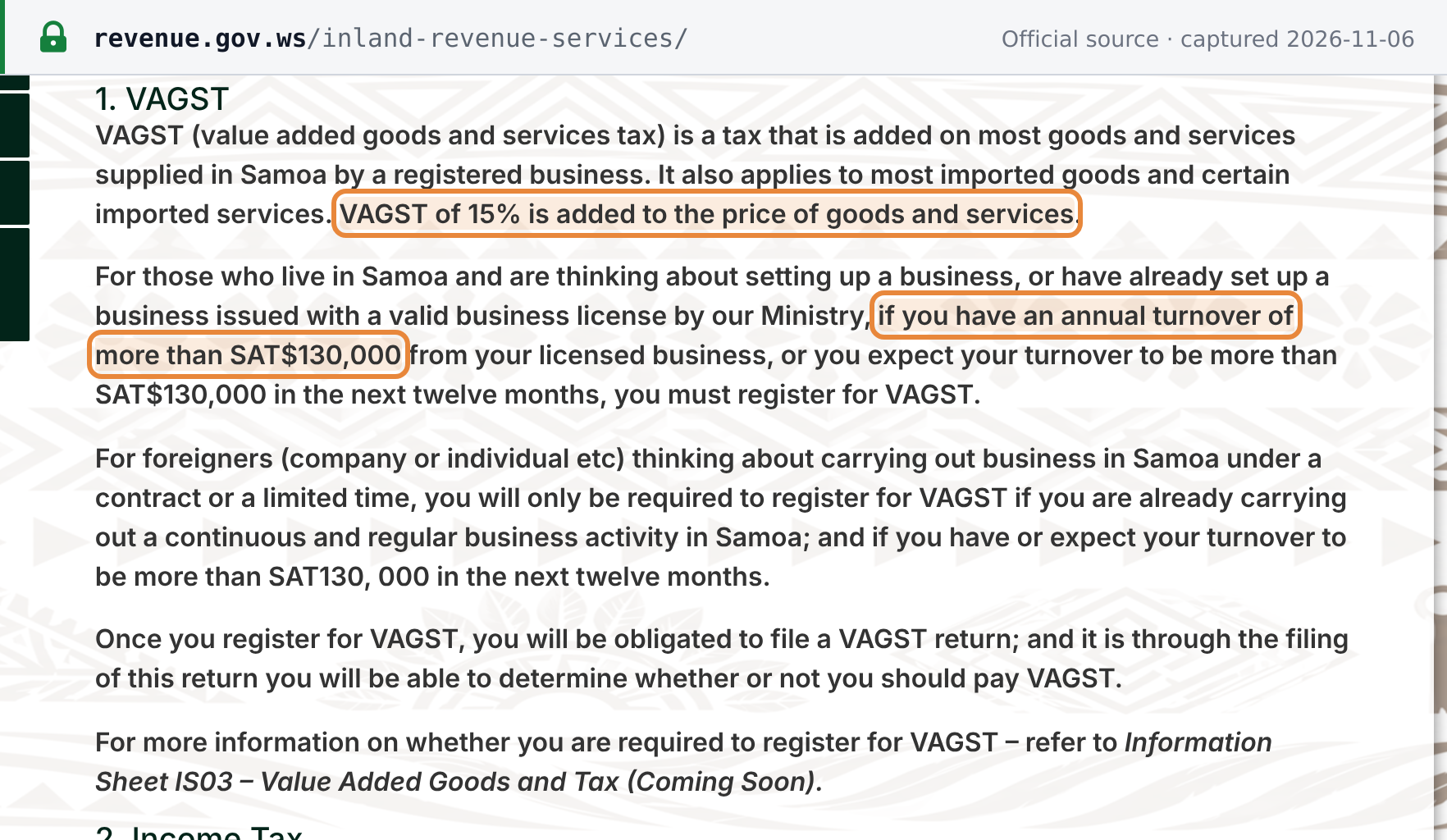
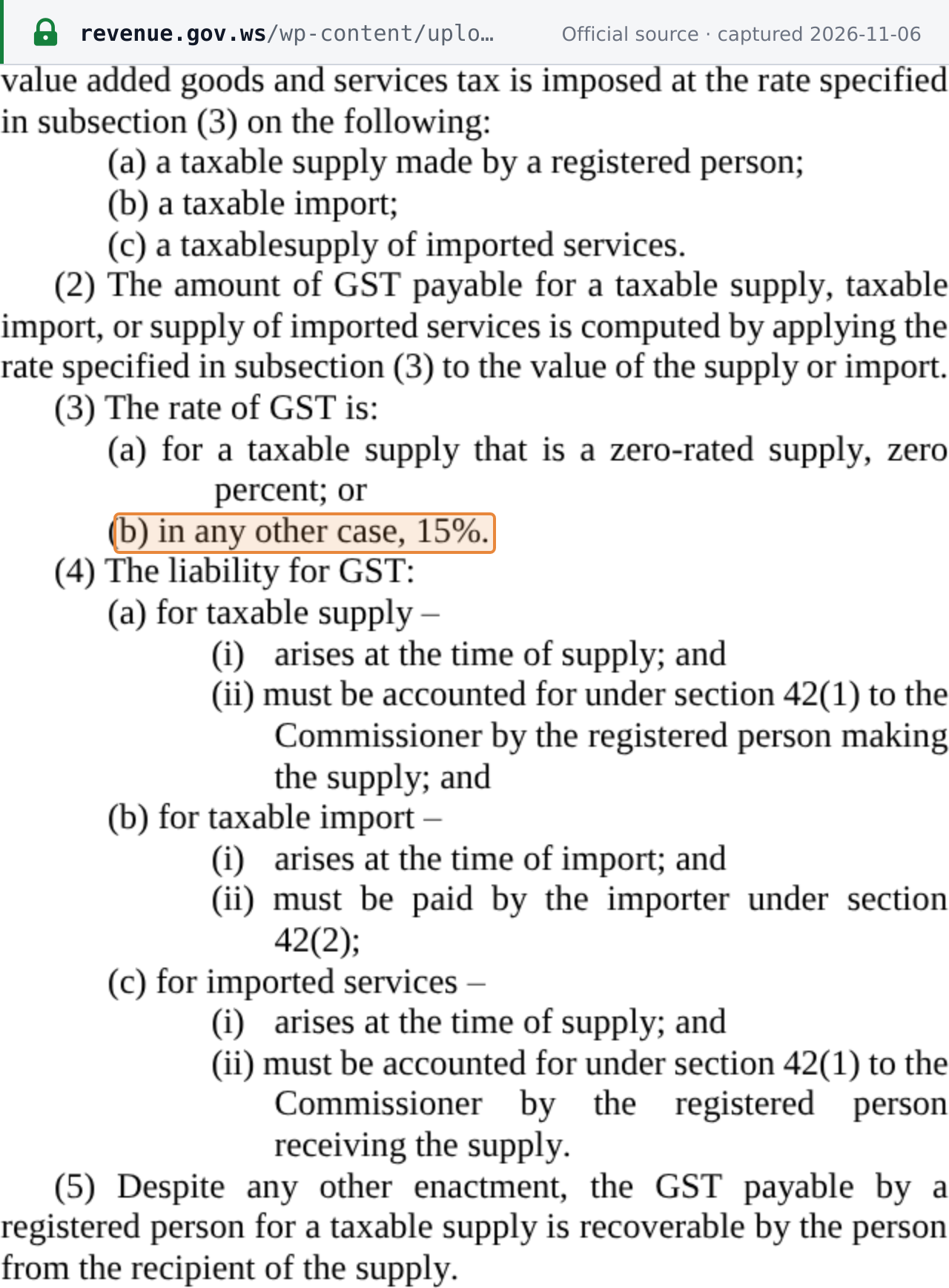
- What is taxed. "VAGST (value added goods and services tax) is a tax that is added on most goods and services supplied in Samoa by a registered business. It also applies to most imported goods and certain imported services." [6] Under s.8(1) the tax is imposed on a taxable supply by a registered person, a taxable import and a taxable supply of imported services. [1]
- Currency. "An amount taken into account under this Act must be expressed in tala" (s.50(1)). Amounts are in Samoan tala (SAT, ISO code WST). The foreign-exchange rule is under Currency and language.
- Tax period. VAGST runs on two-month GST periods (s.29); see Filing and payment. The income tax year ends on 31 December. [6]
- Layering. VAGST is a single national tax. The Act and the Ministry's Inland Revenue Services page describe no sub-national VAGST.
- Portals. Online filing and payment run through Samoa e-Tax (SET); fiscal invoices run through TIMS. See Important websites.
Registration
Who must register and the threshold
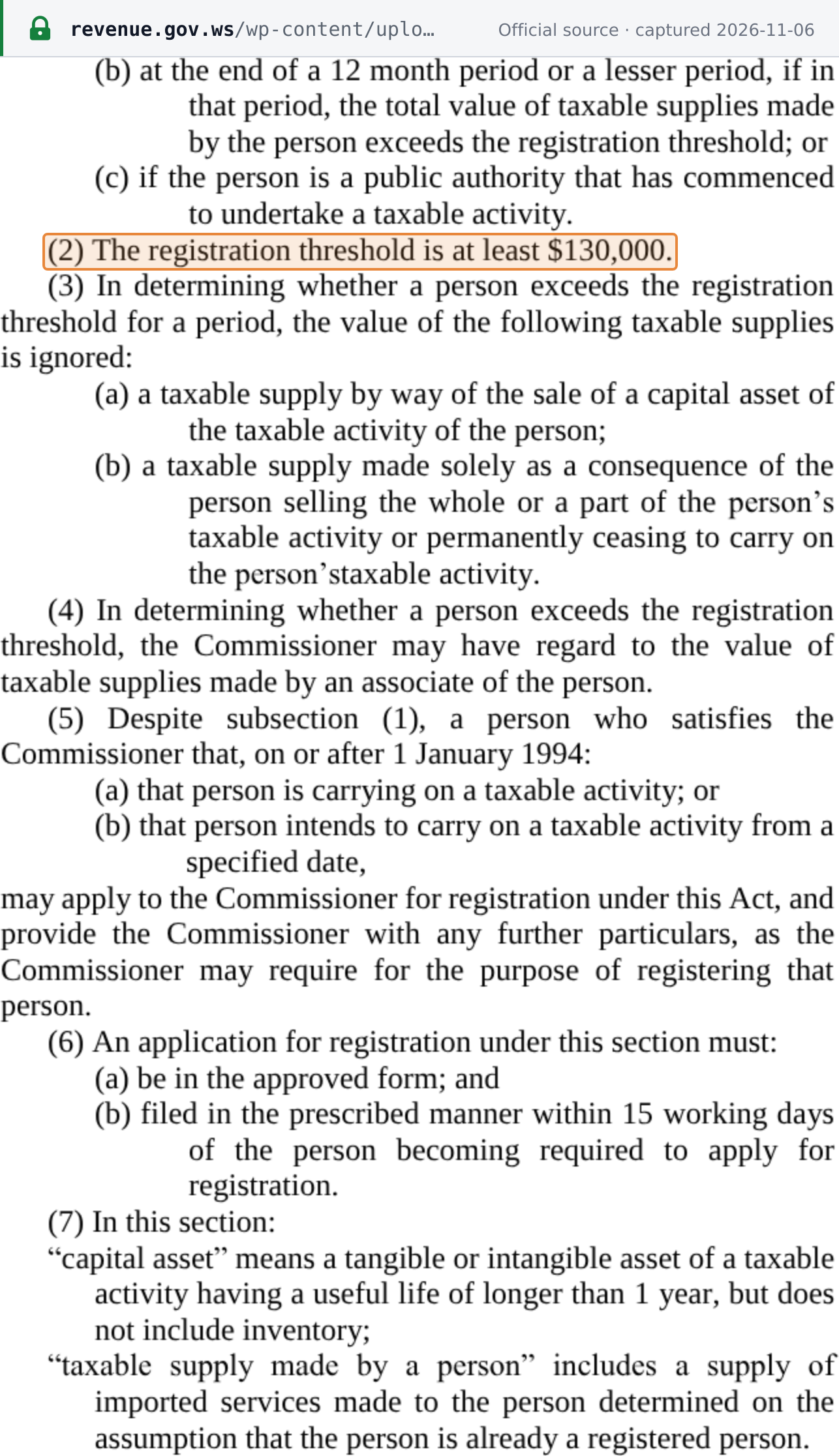
A person must apply to the Commissioner for registration (s.9(1)):
- at the beginning of a 12-month period, if there are reasonable grounds to expect that its taxable supplies in that period "will exceed the registration threshold";
- at the end of a 12-month period or a lesser period, if its taxable supplies in that period exceeded the threshold; or
- if it is a public authority that has commenced to undertake a taxable activity.
"The registration threshold is at least $130,000" (s.9(2)), in tala. The application is due "within 15 working days of the person becoming required to apply for registration" (s.9(6)(b)). Sales of capital assets, and supplies made only because the business is sold or permanently closed, are ignored, and the Commissioner may take an associate's taxable supplies into account (s.9(3)–(4)). [1]
The Ministry states the threshold as a fixed figure (as at 2026-11-06): "if you have an annual turnover of more than SAT$130,000 from your licensed business, or you expect your turnover to be more than SAT$130,000 in the next twelve months, you must register for VAGST." [6] The registration form IR31 is headed "[VAGST Threshold: $130,000 p.a]". [7]
 Source snapshot captured 2026-11-06 — original
 Source snapshot captured 2026-11-06 — original
Non-resident registration
There is no separate non-resident threshold. The Ministry's page says: "For foreigners (company or individual etc) thinking about carrying out business in Samoa under a contract or a limited time, you will only be required to register for VAGST if you are already carrying out a continuous and regular business activity in Samoa; and if you have or expect your turnover to be more than SAT130, 000 in the next twelve months." [6]
A non-resident that is required to register and "does not carry on a taxable activity through a fixed place in Samoa" must "appoint a GST representative in Samoa" and, if the Commissioner requires, lodge security (s.44(1)–(2)). "A person must not be appointed as a GST representative unless the person is a registered tax agent under the Tax Administration Act" (s.44(6)). Not appointing one is an offence (s.46(1)(n)). [1] How B2B and B2C supplies from abroad are taxed is under Cross-border rules.
Tax registration number (TIN)
Samoa uses one Taxpayer Identification Number (TIN) for all taxes, and does not issue a separate VAGST number. "Each new business license operator is automatically issued with a unique Tax-Identification-Number (TIN) which you will use for all your tax matters", including "Filing of your bi-monthly VAGST returns if you have registered for VAGST purposes". [6] The Samoa TIN guide covers the number's format and how it is issued.
How to register
- Business licence. A business must first hold a licence from the Ministry, which issues the TIN. The Ministry's page says the licence requirement "also applies to any foreigner (company or individual or others) who is contracted by a government ministry/agency or any local company in Samoa, to provide services or goods or both in Samoa." Fees, as at 2026-11-06: "SAT $282 per activity for sole traders / partnerships" and "SAT $640 per activity for company / joint venture & others". [6] The Ministry's notice on business licence renewal for 2027 states the fees as "$282.00 per activity and per location" and "$640.00 per activity and per location". [15]
- Form IR31. VAGST registration is a separate application on the IR31 VAGST Registration Form, which asks for the TIN, estimated annual turnover, the start date and the filing category: "You can file your returns in one of two categories, A odd or B even months." The form goes to "Inland Revenue Services, PO Box 1877, Apia. Fax to +685 20414". It also warns: "You are not permitted to charge VAGST on goods or services supplied if you are not registered for VAGST." [7]
- Certificate. The Commissioner issues a GST registration certificate (s.10(1)(c)). The original must be displayed at the principal place of business, with a certified copy "at every other place at which the person carries on its taxable activity" (s.11(1)). [1]
- Online filing. To file online, "you will need to register with Samoa Electronic Tax (or Samoa E-Tax or SET) first." [8]
Timeline. The Ministry publishes no processing time for IR31. Registration "takes effect from the beginning of the first GST period after the person was required to apply for registration or such later time as set out in the person's GST registration certificate" (s.10(3)).
Voluntary registration
Available. The Ministry's FAQ: "If your gross income exceeds $130,000p.a then you are REQUIRED to register for VAGST. However, you can Register Voluntarily if your turnover is below $130,000p.a as well." [8] In the Act, a person carrying on, or intending to carry on, a taxable activity may apply (s.9(5)). Registering lets a business recover input tax. On registration, a credit may be claimed in the first return for inventory acquired "no more than 4 months prior to the date of registration" (s.27). [1]
Deregistration
- A registered person must apply to cancel within 15 working days if it has stopped making taxable supplies, or if it still makes them but "the annual value of those supplies has fallen below the registration threshold, unless the fall in value is reasonably expected to be only temporary" (s.12(1)–(2)).
- After cancellation it must "file a final GST return and pay all GST due ... within 15 working days after the date of cancellation", and return the registration certificate and certified copies "immediately (but not later than 10 working days)" (s.12(5)).
- Goods on hand on which input tax was credited are treated as supplied on cancellation (s.13). [1]
- Closing the business licence is a separate step, on the Business Cessation Form IR27. [9]
Group registration
Not available. The VAGST Act 2015 (revised to 31 December 2018) contains no group-registration provision. It provides the reverse: a registered person may apply to register a branch or division separately if the branch "maintains an independent system of accounting" and can be separately identified by its activities or location (s.49). [1] See the VAT grouping explainer for how grouping works elsewhere.
Rates
Rates as at 2026-11-06. "The rate of GST is: (a) for a taxable supply that is a zero-rated supply, zero percent; or (b) in any other case, 15%" (s.8(3)). [1] The Ministry: "VAGST of 15% is added to the price of goods and services." [6]
| Rate | Applies to | Legal basis |
|---|---|---|
| 15% (standard) | All taxable supplies and taxable imports that are not zero-rated | VAGST Act 2015 s.8(3)(b) |
| 0% (zero rate) | Supplies listed in Schedule 3, for example exports of goods, electricity, water, educational services and medical services in hospitals | s.8(3)(a), Schedule 3 |
| Exempt (no VAGST, no input-tax credit) | Supplies listed in Schedule 2, for example financial services and bus and taxi fares | Schedule 2; see Exemptions |
The Act sets no reduced rate. 15% has applied under the 2015 Act since it commenced on 5 November 2015. Prices to unregistered customers are quoted inclusive of VAGST (s.40), so the tax inside a tax-inclusive price is 15/115 of it: the VAGST 001 return tells filers to "Divide box 5 by 7.66667". [2]
 Source snapshot captured 2026-11-06 — original
Zero rate: 0%
Schedule 3, Part 1 zero-rates: [1]
- exports of goods. The zero rate is lost if "the goods are not exported within 28 days from the date of supply or a longer period determined by the Commissioner";
- consumable stores for international ships and aircraft, and the repair of temporarily imported goods;
- "a supply of services for use or consumption outside Samoa as evidenced by documentary proof acceptable to the Commissioner";
- outbound and roaming telecommunications, and international transport;
- supplies to the Head of State and to the Gambling Control Authority;
- "a supply of educational services" and "a supply of medical goods or services provided in hospitals";
- "a supply of water" and "the supply of electricity under the Electric Power Corporation Act 1980";
- totalisator betting facilities and the licensing of casinos.
Part 2 zero-rates the transfer of a business as a going concern between registered persons, agreed in writing.
Announced future rates
None. The Ministry's latest-news listing, read on 2026-11-06, carries no VAGST rate or threshold notice.
Cross-border rules
Imports and exports
- Imports. VAGST on a taxable import is collected by the Comptroller of Customs at the time of import, under Customs Act procedures; Customs must also "obtain the name and tax identification number (if any) of the importer" (s.43(1)(a)). [1]
- Low-value imports. Schedule 1 exempts "an import of goods in a single consignment on which the total GST and other taxes payable do not exceed two hundred dollars (AUD $200)". The Act states this limit in Australian dollars. Schedule 1 also exempts passenger allowances (including "other goods not exceeding $500 tala in value"), diplomatic and aid imports, and imports of goods whose local supply would be exempt or zero-rated. [1]
- Exports. Exports of goods, and services for use or consumption outside Samoa, are zero-rated (Schedule 3); see Zero rate.
Imported services and place of supply
- Goods. "A supply of goods occurs in Samoa if: (a) the goods are delivered or made available in Samoa by the supplier; or (b) where the delivery or making available involves transportation, the goods are in Samoa when the transportation commences" (s.16). [1]
- Services, general rule. "A supply of services occurs in Samoa if the taxable activity of the supplier from which the services are supplied is in Samoa" (s.17(1)).
- Services to unregistered customers. Where the recipient is not a registered person, services are also supplied in Samoa if they are physically performed there, relate to immovable property there, are broadcasting received there, are "electronic services delivered to a person in Samoa at the time of supply", are intellectual-property rights used in Samoa, or are telecommunications initiated there (s.17(2)). "Electronic services" covers websites, software, images and text, databases, e-learning, music, films and games, and broadcasts (s.17(4)). [1]
- Imported services (reverse charge, commencement not confirmed). Section 1(2) says the provisions on the "supply of imported services" commence "on a date nominated by the Minister". As at 2026-11-06, the Ministry's publications page and news listing carry no commencement notice for them. [1] If they are in force, a "supply of imported services" is a supply made to a registered person by a non-registered supplier, outside Samoa, that would have been taxable in Samoa, where the recipient "would not have been entitled to a credit for the full amount" of the tax (s.6(1)). The registered recipient would account for the tax (s.8(1)(c), (4)(c)) and would have to "prepare a recipient-created tax invoice in the approved form for the supply" (s.19(3)). That would reach recipients that make exempt or partly exempt supplies, not fully taxable businesses. See the reverse charge explainer.
Foreign companies selling into Samoa — B2B and B2C
- B2B. A foreign supplier with no taxable activity in Samoa that sells services to a Samoan business is not making a supply in Samoa under s.17(1), and the special rules in s.17(2) apply only where the customer is not registered. Where the business customer is registered but cannot claim a full credit, the imported-services reverse charge above would make it account for the tax once those provisions commence.
- B2C. Services that s.17(2) places in Samoa, including electronic services delivered to a person in Samoa, are taxable supplies by the foreign supplier. The supplier falls within the s.9 registration test (the SAT 130,000 threshold), and must appoint a GST representative under s.44 if it has to register. The Ministry's guidance for foreigners is narrower than the Act: it is written for businesses carrying out work in Samoa under a contract or for a limited time, and it does not address foreign suppliers of electronic services to Samoan consumers, for whom the Act's s.9 test applies. As at 2026-11-06, the Ministry's Inland Revenue Services page and FAQ describe no simplified registration for non-resident digital suppliers and publish no guidance specific to them. See the explainer on VAT on digital services from non-resident suppliers.
- Goods. Goods delivered into Samoa bear VAGST at import, collected by Customs from the importer (s.43).
Marketplace and platform deemed-supplier liability
The VAGST Act 2015 (revised to 31 December 2018) contains no provision making a marketplace or platform the deemed supplier. See the marketplace deemed-supplier explainer.
Invoice requirements
Two sets of rules apply, and they overlap:
- The VAGST tax invoice (VAGST Act 2015, ss.33–40). It applies to every registered person making a taxable supply to another registered person. It must be "in the approved form", but the Act does not list its contents.
- The TIMS fiscal invoice (Tax Administration (Tax Invoice Monitoring System) Regulations 2020, reg 12, as amended in 2023). It applies to businesses within TIMS: those with gross annual turnover of more than SAT 200,000 (see E-invoicing status). It is issued through an accredited Electronic Fiscal Device (EFD) for every transaction, and reg 12(2) lists its mandatory particulars.
Mandatory content
The Ministry's Inland Revenue Services page lists only forms IR31 and VAGST 001 under its VAGST forms heading, and says its VAGST information sheet (IS03) is "Coming Soon". The Ministry's site, read on 2026-11-06, publishes no approved form or list of particulars for the VAGST tax invoice. [6] The Act itself names invoice contents in only two places:
- an agent's invoice may carry the "name, address, and taxpayer identification number" of the agent or the principal (s.37); and
- on a supply to an unregistered person, the supplier must state the price inclusive of GST, show by a sign on the premises or on its invoices that taxable supplies are made inclusive of GST, and "disclose prominently on its invoice for a supply that the supply is a taxable or exempt supply and, if a taxable supply, the amount of GST charged" (s.40(1)). [1]
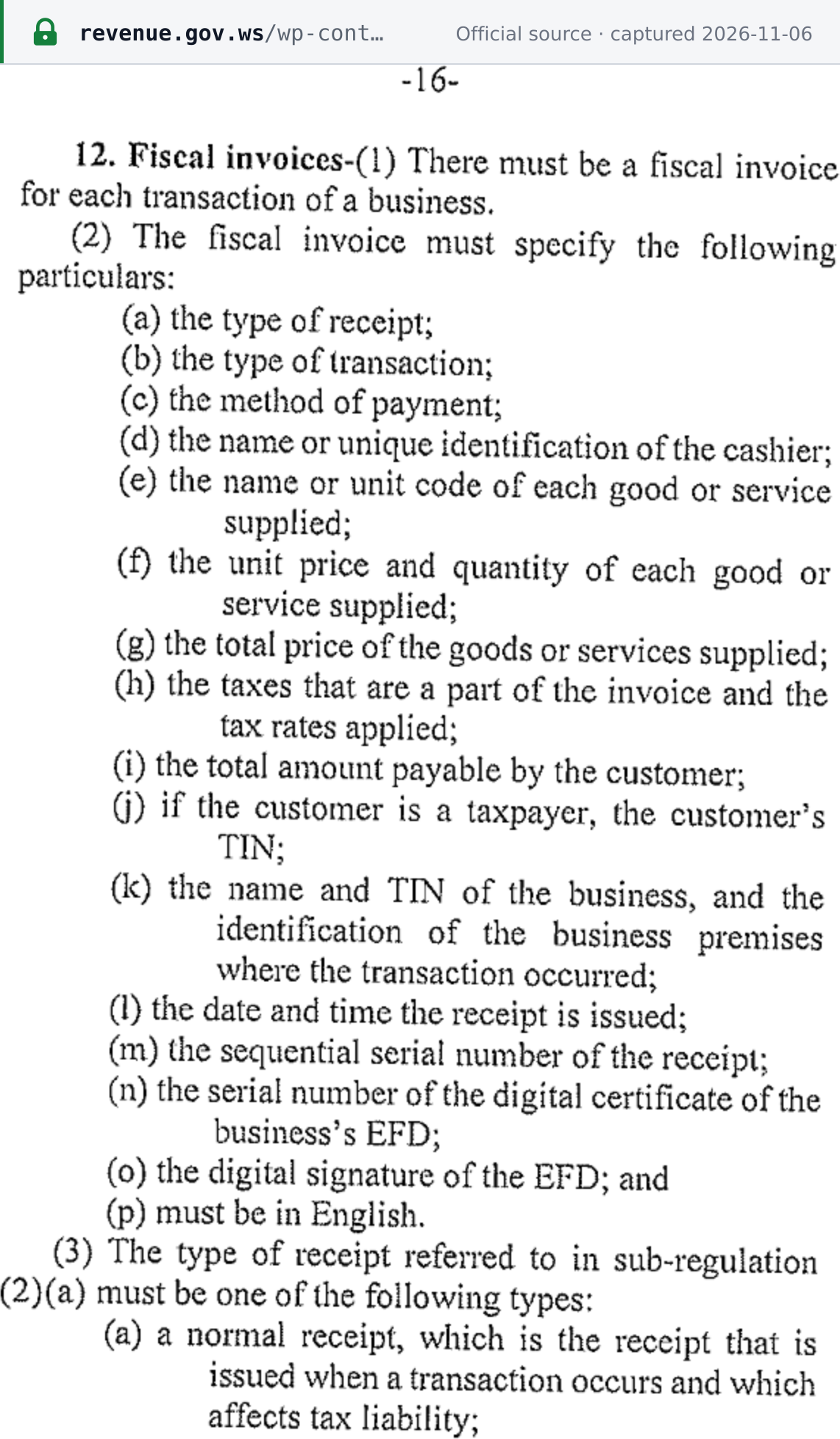
For a business within TIMS, reg 12(1) says "There must be a fiscal invoice for each transaction of a business", and reg 12(2) requires these particulars: [4]
| Reg 12(2) | Particular |
|---|---|
| (a) | The type of receipt (normal, copy, training or pro-forma) |
| (b) | The type of transaction (a supply, or a refund of a previous supply) |
| (c) | The method of payment |
| (d) | The name or unique identification of the cashier |
| (e) | The name or unit code of each good or service supplied |
| (f) | The unit price and quantity of each good or service |
| (g) | The total price of the goods or services |
| (h) | The taxes that are a part of the invoice and the tax rates applied |
| (i) | The total amount payable by the customer |
| (j) | If the customer is a taxpayer, the customer's TIN |
| (k) | The name and TIN of the business, and the identification of the business premises where the transaction occurred |
| (l) | The date and time the receipt is issued |
| (m) | The sequential serial number of the receipt |
| (n) | The serial number of the digital certificate of the business's EFD |
| (o) | The digital signature of the EFD |
| (p) | It must be in English |
 Source snapshot captured 2026-11-06 — original
Training and pro-forma receipts must print "TRAINING" or "PRO-FORMA" and "THIS IS NOT A FISCAL INVOICE" (reg 12(6)). [4]
A specimen of a compliant invoice
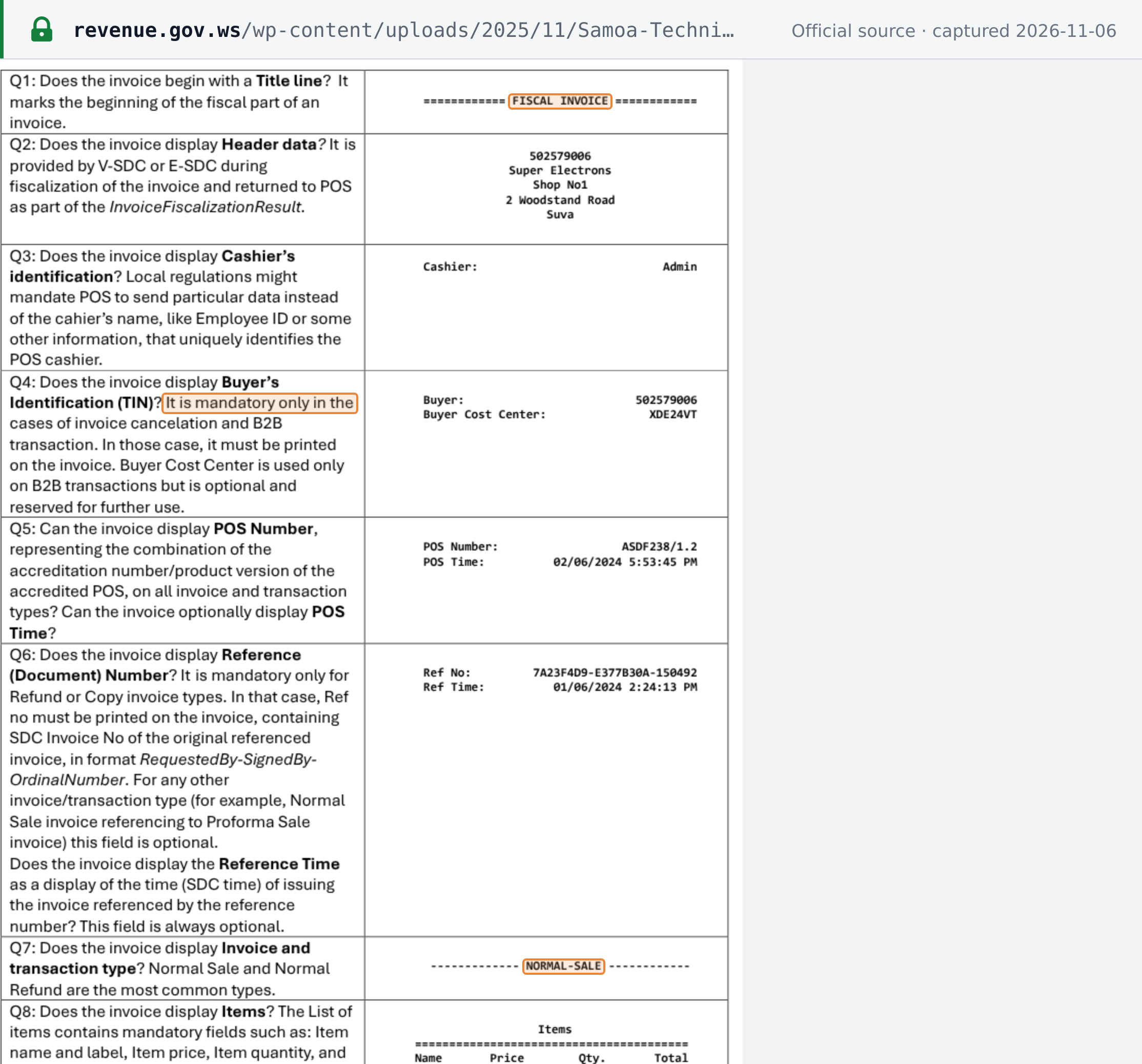
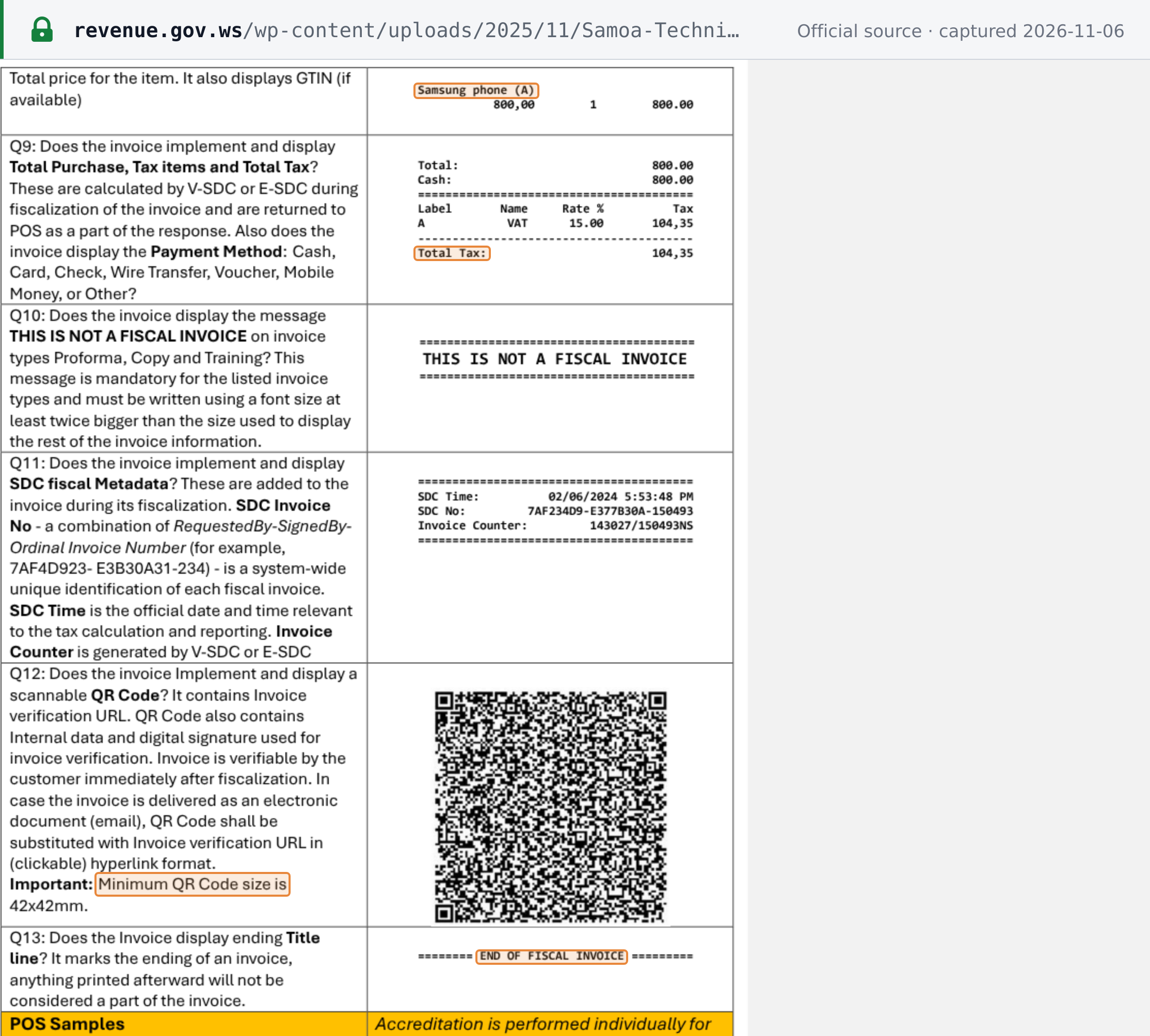
The Ministry's Samoa Technical Guidelines for the Accreditation of EFD solutions (initial version dated 30 April 2025) contain an annotated specimen fiscal invoice, under "Textual Representation of Fiscal Invoice". The guidelines say: "All fields are mandatory, make sure you implement all segments. Images of fiscal invoice components in these instructions are just typical examples. You are free to choose any visual design of the invoice, as long as it has ALL the components of a fiscal invoice". [10]
Page 20 labels the top half: the title line, header data (the business's TIN, name and address), the cashier, the buyer's TIN ("mandatory only in the cases of invoice cancelation and B2B transaction"), the POS number, the reference number (mandatory on refund and copy invoices) and the invoice and transaction type.
 Source snapshot captured 2026-11-06 — original
Page 21 labels the bottom half: the items, the total and payment method, the tax breakdown ("A VAT 15.00 104,35" on an 800.00 tax-inclusive total, which is 800 × 15/115), the SDC fiscal metadata (SDC time, SDC invoice number, invoice counter), the QR code ("Minimum QR Code size is 42x42mm") and the closing line.
 Source snapshot captured 2026-11-06 — original
Read the specimen as a layout:
- Its header shows "Super Electrons", "2 Woodstand Road" and "Suva", with a 9-digit number "502579006" as both seller and buyer. These are placeholders. Samoan TINs are shorter: see the Samoa TIN guide. The worked examples on page 39 of the same guidelines show "Apia".
- The tax is labelled "VAT", not "VAGST", and the specimen uses a comma as the decimal separator in the tax lines.
- It is a specimen of a TIMS fiscal invoice. The Ministry publishes no separate specimen of the VAGST Act tax invoice.
Issuance deadline
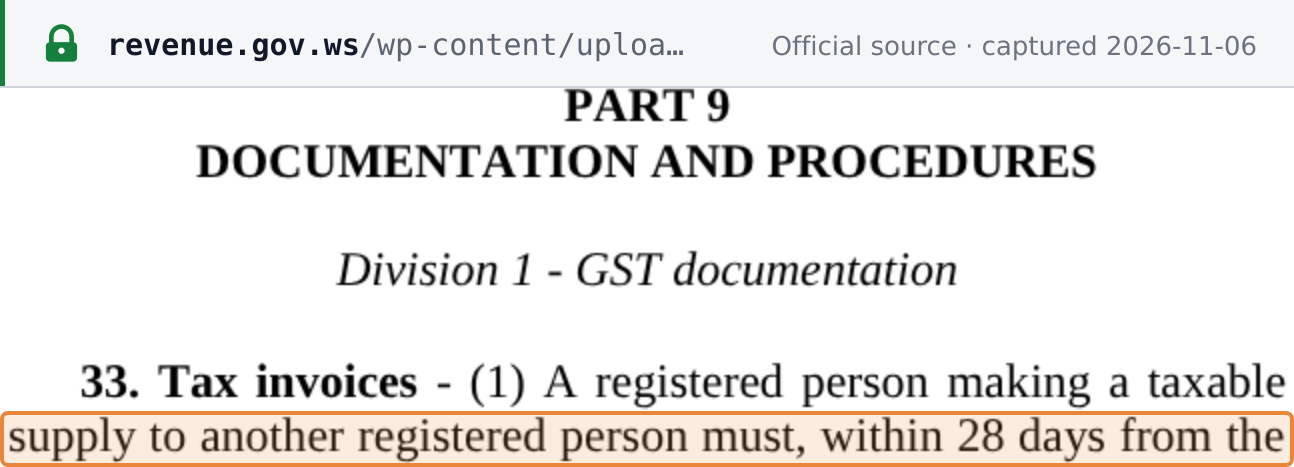
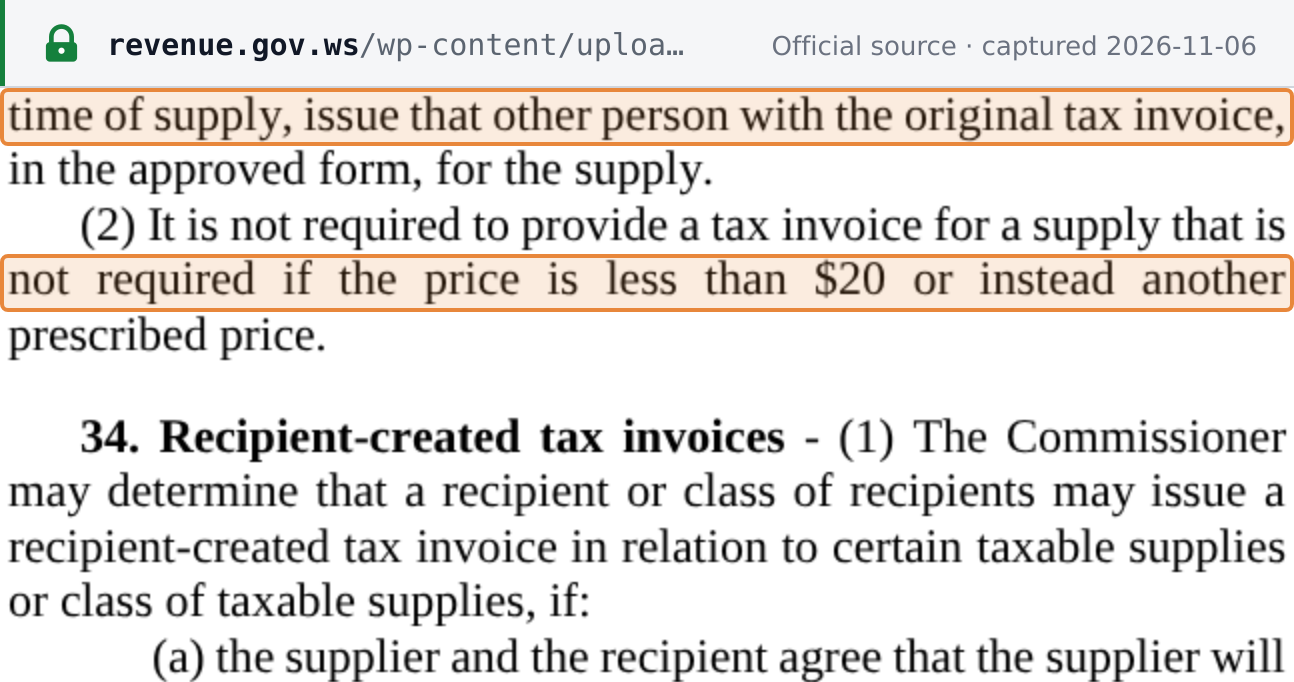
"A registered person making a taxable supply to another registered person must, within 28 days from the time of supply, issue that other person with the original tax invoice, in the approved form, for the supply" (s.33(1)). No tax invoice is needed "if the price is less than $20 or instead another prescribed price" (s.33(2)). [1] The time of supply is the earlier of the date the invoice is issued and the date any payment is made (s.15(1)). Within TIMS, the fiscal invoice is issued at the transaction: "A taxpayer must issue a fiscal invoice to a customer for each transaction", "even if a customer fails or refuses to take the fiscal invoice" (reg 19(3)–(4)). [4]
 Source snapshot captured 2026-11-06 — original
 Source snapshot captured 2026-11-06 — original
Numbering and sequencing
- "A registered person may issue only one original tax invoice for a taxable supply, or one original credit note or debit note for an adjustment event, but a copy clearly marked as such may be provided to a registered person who claims to have lost the original" (s.39(1)). Copies of the documents issued must be kept "in chronological order" (s.39(4)). [1]
- Under the Tax Administration Act, "a person carrying on a business must issue a serially numbered written receipt for any amount received in respect of goods sold or services performed in connection with that business and must retain a duplicate of the receipt" (s.29(3)), unless the Commissioner authorises a business that uses a machine recording all sales to trade without issuing receipts (s.29(4)). [3]
- A TIMS fiscal invoice carries "the sequential serial number of the receipt" (reg 12(2)(m)), and the SDC adds a system-wide SDC invoice number and an invoice counter. [10]
Credit and debit notes
- A credit note, "in the approved form", is required where the GST shown on the tax invoice exceeds the GST properly chargeable (s.36(1)). A debit note is required where it falls short. The adjustment events are cancellation, a fundamental alteration in the nature of a supply, a change in price, and the return of goods (s.28(6)).
- A registered recipient may ask in writing for a missing tax invoice "within 60 days from the date of supply", or for a credit or debit note within 60 days of the adjustment event. The supplier "must comply with the request within 14 days" (s.38(2)–(3)). [1]
- In TIMS, a cancellation is issued as a refund invoice. "The Buyer ID field must be populated with the Taxpayer Identification Number (TIN) of the seller", and "The Reference Number field is populated with the SDC Number of the Sale invoice being canceled." [10]
Currency and language
- Currency. Amounts for VAGST must be expressed in tala (s.50(1)).
- Exchange rate. A foreign-currency amount is converted "at the Central Bank of Samoa mid-exchange rate applying between the foreign currency and tala on the date of the supply"; for imports, at the Customs Act rate used for import duty (s.50(2)). [1]
- Language. Documents are kept "in the English or Samoan language" (Tax Administration Act s.29(1)(a)). [3] A TIMS fiscal invoice "must be in English" (reg 12(2)(p)).
Document types
- Tax invoice. Required for a taxable supply to a registered person (s.33(1)).
- No invoice below SAT 20. A tax invoice is not required where the price is under SAT 20 (s.33(2)). The Act has no separate simplified tax invoice.
- Fiscal invoice. Required for every transaction of a business within TIMS. The receipt types are normal, copy, training and pro-forma, and the transaction types are a supply or a refund (reg 12(3)–(5)). The Ministry's guidelines also show advance-sale invoices for payments by instalment. [10]
- Credit and debit notes. See above.
Self-billing
- By determination. "The Commissioner may determine that a recipient or class of recipients may issue a recipient-created tax invoice in relation to certain taxable supplies or class of taxable supplies", if the supplier and recipient agree that the supplier will not issue one, the document is in the approved form, and the original goes to the supplier while the recipient keeps a copy (s.34(1)). [1]
- Imported services. Once the imported-services provisions commence (see Imported services and place of supply), a registered person liable under that reverse charge "must prepare a recipient-created tax invoice in the approved form for the supply" (s.19(3)). [1]
- Alternative arrangements. The Commissioner may "determine alternative arrangements for the issuing of tax invoices if the Commissioner considers that it is impractical to require a tax invoice under this section" (s.35).
Retention and audit trail
- Retention. "The year for keeping and retaining documents is 7 years after the end of the tax period to which the document relates." [6] The Tax Administration Act requires a person to "retain the document for 7 years after the end of the tax period to which it relates or such shorter period as specified in the tax law", and allows documents "including in electronic format" (s.29(1)). [3]
- Audit trail. Within TIMS, the Ministry's TIMS overview brochure describes the flow: "When a sale is made, the Point of Sale (POS) sends the transaction data to the Sales Data Controller (SDC). The SDC, equipped with a Secure Element, formats the data into a fiscal invoice, digitally signs it, and sends it back to the POS for printing." [11] Each invoice carries the EFD's digital signature (reg 12(2)(o)) and a QR code containing an invoice verification URL; "Invoice is verifiable by the customer immediately after fiscalization." [10] Tampering with an EFD, or not entering a transaction into it, is an offence (see Offences and penalties).
E-invoicing status
Status (as at 2026-11-06): mandatory fiscalisation through TIMS for businesses whose gross annual turnover the Commissioner determines is more than SAT 200,000. It is not a structured B2B e-invoicing mandate: there is no Peppol network and no clearance of B2B invoices. The whole project is called the Tax Invoice Monitoring System (TIMS); "the online platform/programme itself is called TaxCore." Each business uses an Electronic Fiscal Device made up of accredited POS software and a Sales Data Controller (SDC), which signs each invoice and sends the fiscal data to the Ministry. [6] See the fiscal devices explainer and the explainer on e-invoicing models.
Who must comply. The Ministry: "the Tax Administration (Tax Invoice Monitoring System) Regulations 2020 was amended in 2022 and now targets business taxpayer with an annual turnover of SAT $200,000 per annum and above. Those who meet the threshold will be required to install, use Electronic Fiscal Device (EFD) and provide customers with instantly verifiable invoices or receipts." [6] The amending instrument the Ministry publishes is titled the Tax Administration (Tax Invoice Monitoring System) Amendment Regulations 2023. It defines "annual turnover" as "gross sales from the normal course of business inclusive of VAGST", bases it on "the taxpayer's latest income tax return filed with IRS", and applies the Regulations where "the Commissioner determines that a taxpayer has more than $200,000 gross annual turnover" (new reg 20A(2)). The main obligations do not apply to a taxpayer whose gross annual turnover is $200,000 or less, although new reg 20B lets the Commissioner require such a taxpayer to undergo a probationary monitoring period. [5]
Timeline
| Date | What happened | Source |
|---|---|---|
| 5 Mar 2020 | TIMS "officially launched on the 5th of March 2020" | Ministry of Revenue, Inland Revenue Services |
| 26 Jul 2023 | Amendment Regulations: TIMS applies above SAT 200,000 gross annual turnover | Amendment Regulations 2023 |
| 11 Nov 2024 | Named taxpayers notified: "Registration Due Date: 31 January 2025"; "Full Compliance Commencement Date: 30 June 2025" | Ministry notice, 11 Nov 2024 |
| 4 Aug 2025 | TIMS to be "upgraded from Version 2 (v2) to Version 3 (v3)"; "taxpayers are required to upgrade to v3-compliant systems" | Ministry notice, 4 Aug 2025 |
| Oct 2025 | "Deadline to complete the re-accreditation – end of October 2025" for POS and SDC vendors | Transition to compliance with TIMS v3 |
| 2026 | Refresher training 30 April – 7 May 2026; penalties begin and no further extensions | Ministry notice, 2026 |
The Ministry's 2026 notice: "The Ministry will begin applying penalties and other forms of enforcement actions for taxpayers not issuing fiscal invoices and is no longer allowing extensions for full compliance." [12]
 Source snapshot captured 2026-08-18 — original
Scope. B2B, B2G and B2C alike: a fiscal invoice is required "for each transaction between the taxpayer's business and the customer" (reg 19(3)). In a business-to-business or business-to-government transaction, the seller must ask the customer for its TIN (reg 19(6)). [4]
Format. The format is TaxCore's own fiscal-invoice format, set out in the Ministry's accreditation guidelines, not UBL or Peppol. POS and SDC products must be accredited by the Ministry against its accreditation guidelines. [10] "EFD vendors use the Developer Portal to test their POS or E-SDC products and apply for accreditation." [6] The Ministry's TIMS overview brochure (undated) says: "To support small taxpayers, MOR will provide a free POS app for smartphones and tablets and free WebPOS for standard PC users." [11]
Customer notice. A business within TIMS must display a notice that reads, in part: "IF YOU DO NOT RECEIVE A FISCAL INVOICE YOU ARE ENTITLED TO A REFUND. You may verify the authenticity of each invoice issued to you on the Samoa Ministry for Revenue website" (reg 18). [4]
Filing and payment
Filing frequency and due date
Every registered person files every two months. "The Commissioner must determine the GST period of a registered person in either of the following category": Category (A), with two-month periods ending on the last day of January, March, May, July, September and November, or Category (B), ending on the last day of February, April, June, August, October and December (s.29(1)). Form IR31 asks which category the registrant wants. The Commissioner may move a person who fails to comply with the Act to Category (C), with a shorter period (s.29(2)). [1]
The legal rule. "A registered person must, for each GST period and in the approved form and prescribed manner, file a GST return within 15 working days after the end of that GST period" (s.41(1)). [1]
The Ministry's practice. The Ministry administers a fixed date instead. Its Tax Due Dates table gives the VAGST return filing date as the "21st of every month [bi-monthly filing]", with payment "Same as due date for filing". [6] Its due-date notices move the 21st to the next working day when it falls on a weekend or public holiday:
| GST period | Ministry's due date | Source |
|---|---|---|
| July–August 2024 (Category B) | Monday 23 September 2024 | Ministry notice for August 2024 |
| February–March 2025 (Category A) | Tuesday 22 April 2025 (21 April was Easter Monday) | Ministry notice for April 2025 |
| April–May 2026 (Category A) | Monday 22 June 2026 (21 June was a Sunday) | Ministry notice for May 2026 |
The two rules can fall on different days. For July–August 2024, 15 working days after Saturday 31 August, counting no public holidays, ended on Friday 20 September 2024, three days before the Ministry's date. The safe course is to file and pay by the earlier of the two dates. The Ministry publishes due-date notices from time to time (for example for August 2024, April 2025 and May 2026), which show the date it applies.
 Source snapshot captured 2026-11-06 — original
The return is form VAGST 001, which is bilingual (Samoan and English). Output tax on tax-inclusive sales is worked out by dividing by 7.66667; total input tax goes in box 12, and the amount payable or refundable in box 13. [2] Returns can be filed and paid online through Samoa e-Tax (SET) once the business has registered for it. [8]
Payment
"The net GST payable by a registered person for a GST period, as computed under section 30, is payable by the due date for filing the GST return for that period" (s.42(1)). [1] Late payment costs interest and a penalty; see Penalties.
Additional listings
The Act and the Ministry's Inland Revenue Services page require no annual VAGST return and no sales or purchase listing beyond the two-monthly return. TIMS already sends the Ministry the data on each fiscal invoice.
Input-tax recovery and blocked items
- Credit. Net GST is output tax, plus tax on imported services, minus input tax credits (s.30). "A registered person is allowed a credit for the input tax imposed on a creditable acquisition by the person to the extent that the acquisition was for the purpose of making taxable supplies as determined at the time of the acquisition" (s.26(1)).
- Documents. If the tax invoice, customs documents, or credit or debit note is not held when the return is filed, the credit moves to the first period in which it is held (s.26(3)–(4)).
- Blocked items. The Act blocks no category of purchase by name (such as entertainment or passenger cars). Input tax excludes "any late payment interest or penalty" (s.2). Otherwise the limit is the purpose test in s.26(1), together with s.20: applying goods to private or exempt use after claiming a credit "is deemed to be a taxable supply". [1]
Refunds
- Excess credits. "If, for any GST period, component “C” of the formula in section 30 exceeds component “(A + B)” for the period, the Commissioner must credit to the registered person the excess amount, subject to this Act" (s.31). The section sets no time limit for the refund. [1]
- Diplomatic refunds are provided for in s.32.
- Bad debts. The Act's arrangement of provisions contains no bad-debt relief section; the adjustment events in s.28(6) are cancellation, a fundamental alteration in the nature of the supply, a change in price and the return of goods.
- Non-residents. The Act provides no refund scheme for non-registered foreign businesses.
Exemptions
Exempt supplies
Schedule 2 lists the exempt supplies: [1]
- financial services (defined to cover loans, deposits, derivatives, shares and securities, fund management, life insurance and reinsurance, and pension and provident fund interests);
- "a supply of donated goods or services by a non-profit body";
- "the supply to passengers of transport services by buses and taxis", but not hiring a bus or taxi for a customer's exclusive use;
- the departure charge under the Civil Aviation Act 1998;
- interconnection fees between resident telecommunications suppliers;
- "the carriage of passengers by ships within Samoa"; and
- supplies for an overseas-funded aid project where the agreement or memorandum of understanding expressly makes them exempt, but not supplies to or by subcontractors or other suppliers to the head contractor.
A supply that is both zero-rated under Schedule 3 and exempt under Schedule 2 is treated only as zero-rated. Schedule 2 contains no exemption for residential rent.
Exempt is not zero-rated
An exempt supply carries no VAGST, and the supplier cannot claim the input tax on what it buys to make it: credit is allowed only for acquisitions made "for the purpose of making taxable supplies" (s.26(1)), and exempt supplies are not taxable supplies. A zero-rated supply is a taxable supply at 0%, so the supplier can recover its input tax. So a bus operator, whose fares are exempt, cannot recover the VAGST on its fuel and parts, while an electricity supplier, whose supplies are zero-rated, can recover the VAGST on its costs. See the zero-rated vs exempt explainer.
Special regimes
- Second-hand goods (s.21), vouchers (s.22) and lay-by sales (s.23) have their own rules.
- Branches may register separately (s.49).
- Import exemptions in Schedule 1 cover diplomatic and aid imports, imports by Yazaki Samoa Enterprise, and certain light aircraft. [1]
- The VAGST Act 2015 (revised to 31 December 2018) contains no cash-accounting, flat-rate or small-business scheme and no free-zone regime.
Offences and penalties
Offences
Under VAGST Act 2015 s.46(1), the offences include: [1]
- failing to apply for registration, or to notify changes;
- knowingly issuing a tax invoice that shows tax not charged or overstated, or for a supply that will not take place;
- knowingly issuing a duplicate tax invoice;
- failing to provide a registered person with a tax invoice;
- knowingly issuing an erroneous or incomplete invoice, or making a false statement;
- not displaying the registration certificate, or not applying for cancellation;
- not stating tax-inclusive prices to unregistered customers (s.46(1)(m));
- for a non-resident, failing to appoint a GST representative under s.44 (s.46(1)(n)).
Fines are set in penalty units. For failing to provide a tax invoice: "a fine not exceeding 5 penalty units" on first conviction, 7 on the second and 10 on the third or later (s.46(3)). An offence with no specific penalty carries "a fine not exceeding 50 penalty units" on first conviction and 100 thereafter (s.46(5)). For tax evasion, s.47 adds "additional tax not exceeding an amount equal to three (3) times the amount of the deficient tax".
Under the TIMS Regulations, as amended in 2023:
- Not issuing fiscal invoices (breach of reg 19). Regulation 24(1)(a), as substituted, sets a fine of up to 50 penalty units where gross annual turnover is "more than $200,000 but less than $500,000", 70 where it is "$500,000 but less than $1,500,000", and 100 where it is "$1,500,000 or more". Imprisonment of up to 24 months, or both, is also possible. [5] [4]
- Dishonest conduct (reg 25), such as tampering with an EFD or causing false data to be transmitted, and, since 2023, "not entering a transaction into the EFD". [5]
- Temporary closure. If a taxpayer does not comply with a notice, the Commissioner "must issue an order to close down the business or part of the business of that person for a period not exceeding 14 working days" (reg 30(2)). [4]
Penalties
Administrative penalties under the Tax Administration Act 2012, as at 2026-11-06: [3] [13]
| Penalty | Amount | Basis |
|---|---|---|
| Late filing | SAT 300 for a company, SAT 100 otherwise, once a return is unfiled 1 month after the due date | TAA s.48(1) |
| Late payment penalty | "10% of the amount of unpaid tax" still unpaid 1 month after the due date | TAA s.49(1) |
| Late payment interest | 8.7%, simple interest, from the due date to the date of payment | TAA s.47(1), (4); Late Payment Interest Regulations 2015 reg 2 |
| Failure to keep records | 75% of the tax for the period if knowing or reckless, otherwise 20%; where no tax is payable, SAT 300 for a company and SAT 100 otherwise | TAA s.50 |
| Tax evasion | Additional tax of up to three times the deficient tax | VAGST Act s.47 |
The interest rate is prescribed by the Tax Administration (Late Payment Interest) Regulations 2015, reg 2: "For the purpose of section 47 of the Act, the prescribed interest rate for late payment of unpaid tax is 8.7%." The Regulations state no period for the rate. [14] The Ministry's due-date notices give the same figures: "$300 per tax return" for companies and trusts, "$100 per tax return" for sole traders and all others, late payment interest of "8.7% of the tax amount payable" and a late payment penalty of "10% of the tax amount payable". [13] The VAGST Act 2015 and the TIMS Regulations do not state the tala value of a penalty unit, so fines under them are given here in penalty units.
Frequently asked questions
When is a Samoa VAGST return due: 15 working days after the period, or the 21st?
The legal rule is section 41(1) of the Value Added Goods and Services Tax Act 2015: a GST return is due within 15 working days after the end of each two-month GST period, and section 42(1) makes the tax payable by the same date. The Ministry of Revenue administers a fixed date instead. Its Tax Due Dates table lists the 21st of every month (bi-monthly filing), and its due-date notices move that date to the next working day: Monday 23 September 2024 for July–August 2024, Tuesday 22 April 2025 for February–March 2025 (21 April was Easter Monday) and Monday 22 June 2026 for April–May 2026 (21 June was a Sunday). The two rules can fall on different days: for July–August 2024, 15 working days after 31 August, counting no public holidays, ended on Friday 20 September 2024. The safe course is to file and pay by the earlier of the two dates. The Ministry publishes due-date notices from time to time, which show the date it applies for that period.
Does every VAGST-registered business in Samoa have to issue TIMS fiscal invoices?
No. VAGST registration starts above SAT 130,000 of taxable supplies a year, but the Tax Invoice Monitoring System (TIMS) applies only where the Commissioner determines that a taxpayer's gross annual turnover is more than SAT 200,000. Below that, the main obligations do not apply, although the Commissioner may require a taxpayer to undergo a probationary monitoring period (new reg 20B). The Ministry of Revenue describes the target as businesses with an annual turnover of SAT 200,000 and above. The Tax Administration (Tax Invoice Monitoring System) Amendment Regulations 2023 measure gross annual turnover from the taxpayer's latest income tax return, including VAGST. The Ministry notifies taxpayers in groups: the group notified on 11 November 2024 had to register by 31 January 2025 and fully comply from 30 June 2025. A business within TIMS must issue a fiscal invoice through an accredited Electronic Fiscal Device (EFD) for every transaction. In its 2026 notice on refresher training, the Ministry said it will begin applying penalties to taxpayers not issuing fiscal invoices and is no longer allowing extensions for full compliance.
Does a foreign company on a one-off contract in Samoa have to register for VAGST?
Only if two conditions are both met. The Ministry of Revenue's Inland Revenue Services page says a foreign company or individual carrying out business in Samoa under a contract or for a limited time is required to register for VAGST only if it is already carrying out a continuous and regular business activity in Samoa and its turnover is, or is expected to be, more than SAT 130,000 in the next twelve months. A non-resident that must register and does not carry on its taxable activity through a fixed place in Samoa must appoint a GST representative in Samoa, who must be a registered tax agent, and may have to lodge security (VAGST Act 2015, s.44). Failing to appoint one is an offence under s.46(1)(n). The business licence requirement is separate: the Ministry says it also applies to a foreigner contracted by a government ministry or agency or a local company to provide goods or services in Samoa.
Does a fiscal invoice to another business in Samoa have to show the buyer's TIN?
Yes. Regulation 12(2)(j) of the Tax Administration (Tax Invoice Monitoring System) Regulations 2020 requires the customer's TIN on a fiscal invoice if the customer is a taxpayer, and regulation 19(6) requires the seller to ask the customer for its TIN in a business-to-business or business-to-government transaction. The Ministry's Technical Guidelines for the Accreditation of EFD solutions say the buyer's TIN is mandatory for invoice cancellations and B2B transactions, and must then be printed on the invoice. Under the VAGST Act 2015, a registered supplier must give a registered customer the original tax invoice within 28 days of the time of supply (s.33(1)). The customer can request a missing invoice in writing within 60 days of the supply, and the supplier must comply within 14 days (s.38).
What can a customer do if a business in Samoa does not give a fiscal invoice?
Businesses covered by TIMS must display the customer notice set out in regulation 18 of the TIMS Regulations 2020. It says: "IF YOU DO NOT RECEIVE A FISCAL INVOICE YOU ARE ENTITLED TO A REFUND." The same notice tells customers they may verify the authenticity of each invoice issued to them on the Ministry's website. Regulation 19(4) says the duty to issue a fiscal invoice applies even if a customer fails or refuses to take it. Each fiscal invoice carries a QR code containing an invoice verification URL, and the Ministry's EFD accreditation guidelines say the invoice is verifiable by the customer immediately after fiscalization.
Important websites
| Site | What it is for |
|---|---|
| Ministry of Revenue — Inland Revenue Services | Tax types, the Tax Due Dates table, forms, record keeping and the TIMS section |
| Samoa e-Tax (SET) | File VAGST returns and pay online (separate SET registration needed) |
| TIMS Taxpayer Administration Portal | Taxpayer access to TIMS (TaxCore) for fiscal invoicing |
| Business licence matters | Business licence applications and renewals; a new licence comes with a TIN |
| IR31 VAGST registration form | Register for VAGST and choose filing category A or B |
| VAGST 001 return form | The two-monthly VAGST return |
| Ministry of Revenue FAQ | Voluntary registration, online filing, late filing fees and interest |
| Ministry publications | Legislation, including the VAGST Act and the TIMS Regulations |
| Ministry of Commerce, Industry and Labour — business registries | Company registration |
The Ministry's website, read on 2026-11-06, offers no public TIN lookup. A fiscal invoice can be checked through the verification URL in its QR code.
Recent changes
- 2026-04-01 — The Ministry of Revenue announced TIMS refresher training (30 April – 7 May 2026) ahead of a system upgrade, and said it "will begin applying penalties and other forms of enforcement actions for taxpayers not issuing fiscal invoices and is no longer allowing extensions for full compliance". (Ministry of Revenue) — see event
Earlier TIMS milestones (the v3 upgrade of August 2025, the group notice of November 2024 and the SAT 200,000 floor) are in the E-invoicing status timeline. For the full chronology, see Samoa tax changes on Lookuptax.
Reference links
Legislation (published by the Ministry of Revenue):
- [1] Value Added Goods and Services Tax Act 2015 (revised as at 31 December 2018)
- [3] Tax Administration Act 2012 (revised as at 31 December 2018)
- [4] Tax Administration (Tax Invoice Monitoring System) Regulations 2020
- [14] Tax Administration (Late Payment Interest) Regulations 2015
- [5] Tax Administration (Tax Invoice Monitoring System) Amendment Regulations 2023
Ministry of Revenue guidance and forms:
- [6] Inland Revenue Services
- [8] Revenue FAQ
- [10] Samoa Technical Guidelines for the Accreditation of EFD solutions (initial version, 30 April 2025)
- [11] TIMS brochure — Overview
- [2] VAGST 001 — Value Added Goods and Services Tax Return
- [7] IR31 — VAGST Registration Form
- [9] IR27 — Business Cessation Form
- Transition to compliance with TIMS v3
Ministry notices:
- [12] TIMS refresher training for system upgrade (2026)
- [13] Tax returns and tax payments due for the month of May 2026
- Tax returns and tax payments due for the month of August 2024
- Due date notice — VAGST and PAYE, April 2025
- [15] Business licence renewal for 2027
- Important notice on the upgrade of the Tax Invoice Monitoring System (4 August 2025)
- Notice to all taxpayers on the implementation of TIMS (11 November 2024)
Related on Lookuptax: