San Marino import tax (monofase) guidelines — no VAT
| FACTSHEET | |
|---|---|
| Country code | SM |
| Tax name | Import tax — imposta sulle importazioni ("monofase", single-stage). No VAT. |
| Standard rate | 17% (from 1 January 2012) |
| Other rates | 2%, 6%, 10%, 21% and 1% |
| Tax Authority | UO Ufficio Tributario |
Overview
San Marino has no value added tax. Its indirect tax is the imposta sulle importazioni, called the monofase (single-stage tax): it is charged once, when goods and connected services enter the Republic, and is not charged again as the goods are resold inside San Marino. The Finance Ministry's own English overview describes its indirect-tax section as "the analysis of the monofase tax (single-phase tax on imports), the complementary tax and the related procedures." [1]
 Source snapshot captured 2026-11-06 — original
Legal basis. Legge 22 dicembre 1972 n.40 and its amendments. Article 1: "L'imposta sulla importazione nel territorio della Repubblica di San Marino di beni e di servizi connessi è regolata dalle norme che eseguono. E' previsto il rimborso dell'imposta quando i beni, anche dopo la loro trasformazione, vengono esportati." Article 5 makes the importer liable: "L'imposta è dovuta dai soggetti che effettuano l'importazione dei beni e dei servizi connessi nel territorio della Repubblica di San Marino." [2] The law has been amended many times; the amendments are published as separate instruments.
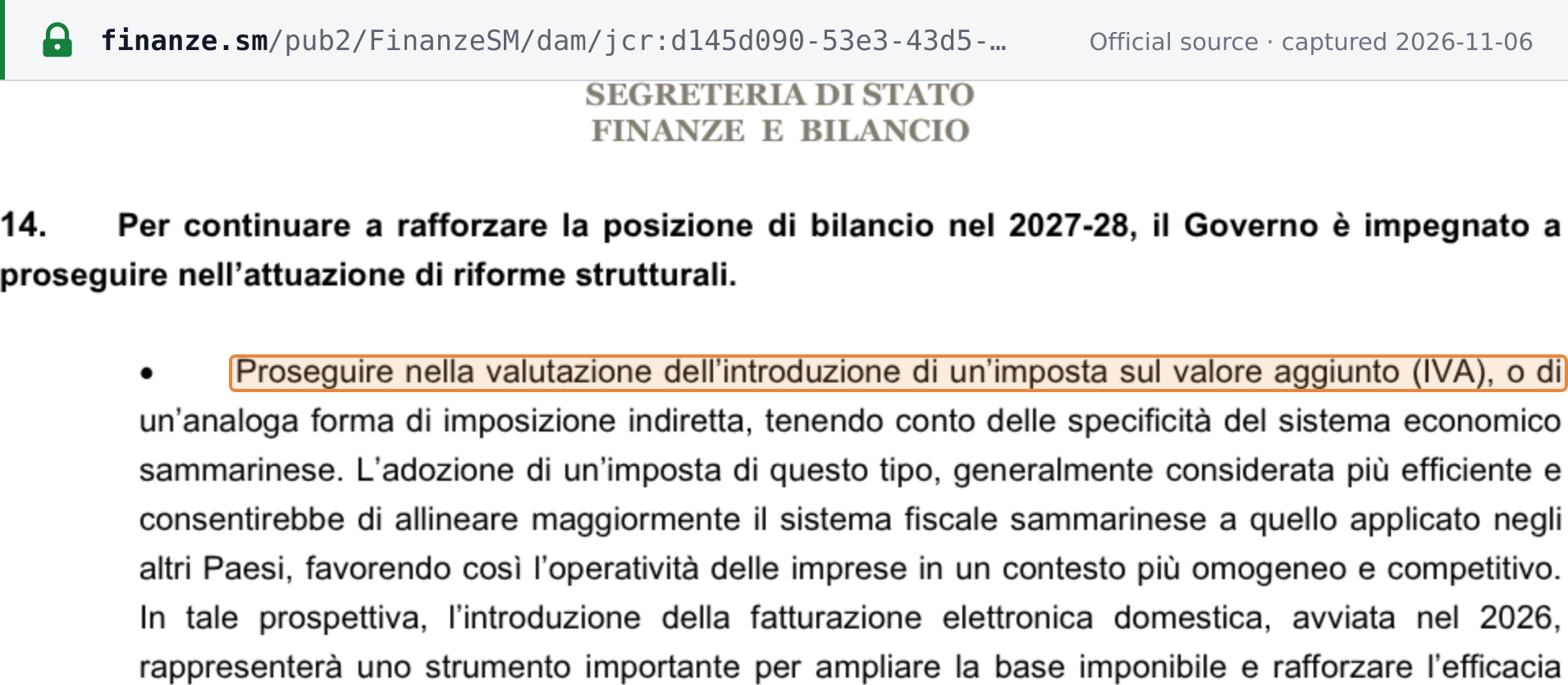
An IVA is under evaluation, not enacted. The Finance Ministry's budget summary of 13 July 2026 lists, among the Government's structural reforms for 2027–28: "Proseguire nella valutazione dell’introduzione di un’imposta sul valore aggiunto (IVA), o di un’analoga forma di imposizione indiretta, tenendo conto delle specificità del sistema economico sammarinese." It adds that domestic e-invoicing, "avviata nel 2026, rappresenterà uno strumento importante per ampliare la base imponibile". [3] No IVA law has been enacted. The Ministry's May 2025 Budget at a Glance had expected one to be approved in 2026 and to apply from 2027; the July 2026 summary gives no date. Until a law is enacted, the monofase is the tax.
 Source snapshot captured 2026-11-06 — original
Authority. The UO Ufficio Tributario (Via 28 Luglio 196, 47893 Borgo Maggiore), under the Segreteria di Stato per le Finanze e il Bilancio. Its remit includes "c) Curare l'acquisizione, gestione, controllo e verifica della documentazione fiscale presentata ai sensi e per effetto dell'applicazione delle norme vigenti in materia di imposta sulle importazioni …". [4] It also runs HUB-SM, the e-invoicing hub.
Currency. The euro (EUR). All amounts in the instruments are in euro, and e-invoices state the currency as an ISO 4217 code. [9]
Tax period. The monofase is a transaction tax. It is settled import by import, not through a periodic return.
Layering. None. The import tax is a single national tax. The Ufficio Tributario also administers a complementary tax, special stamp taxes on certain services and the special tax on petroleum products; they are separate from the monofase and outside this guide.
For the Italian side of Italy–San Marino trade, see the Italy VAT guide.
Registration
Who should register
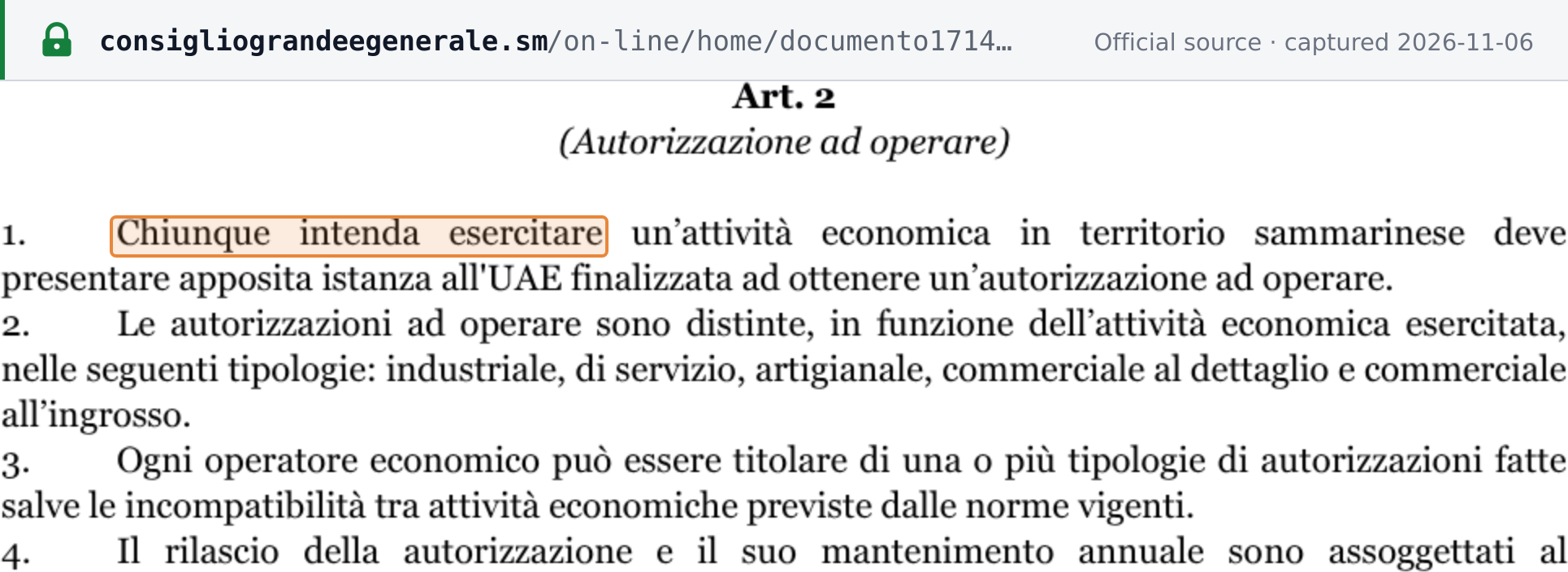
There is no tax registration in the VAT sense. The gate is a business licence. Anyone who wants to carry on an economic activity in San Marino must obtain an autorizzazione ad operare (authorisation to operate) from the UAE — Ufficio Attività Economiche. Article 2 of Decreto Delegato 14 marzo 2024 n.50 (which ratified DD 18 dicembre 2023 n.185, Disciplina delle attività economiche): "1. Chiunque intenda esercitare un’attività economica in territorio sammarinese deve presentare apposita istanza all'UAE finalizzata ad ottenere un’autorizzazione ad operare. 2. Le autorizzazioni ad operare sono distinte, in funzione dell’attività economica esercitata, nelle seguenti tipologie: industriale, di servizio, artigianale, commerciale al dettaglio e commerciale all’ingrosso." [5]
 Source snapshot captured 2026-11-06 — original
Who can hold an authorisation (art. 3): a natural person who is resident in San Marino and meets the other personal requirements, or a legal person entered in San Marino's Registro delle società. The applicant also needs an operating seat, must pay the fee and must elect a digital domicile (domicilio digitale). [5]
Registration threshold
None. No turnover threshold applies to the import tax: the authorisation rule above applies from the first euro, and the importer owes the monofase on each import (L. 40/1972 art. 5). The only revenue figure in the system is the EUR 100,000 test for domestic e-invoicing (see E-invoicing status). It decides how you invoice, not whether you are taxed.
Non-resident registration
- Importing goods into San Marino. Foreign sellers do not register for the monofase. The San Marino importer is liable (L. 40/1972 art. 5).
- Italian distance sellers to private buyers. An Italian business whose distance sales to San Marino private buyers exceeded EUR 28,000 in the previous calendar year (or exceed it in the current year, from that moment; below it the seller may opt in) charges San Marino import tax and must appoint a fiscal representative. DD 5 agosto 2021 n.147, art. 2: "… scontano l'imposta sulle importazioni quando l'operatore economico italiano nel corso dell'anno solare precedente ha posto in essere vendite a distanza nei confronti di acquirenti sammarinesi … per un ammontare complessivo superiore a euro 28.000,00 euro … 2. In tali casi, l'operatore economico cedente deve nominare un proprio rappresentante fiscale." [13]
- Foreign businesses supplying services on site. Foreign businesses and self-employed workers without a San Marino authorisation may supply services in San Marino for 1 to 180 days a year after filing a comunicazione di inizio attività with the UAE (DD 50/2024 art. 8(1)). [5]
Tax identification number
The identifier is the codice operatore economico (COE). DD 50/2024 art. 1(h): "Codice operatore economico: è un codice numerico preceduto dal prefisso SM che ne definisce univocamente il titolare". [5] In e-invoices the numeric part is 5 digits with leading zeros kept: "Codice OESM (Operatore Economico Sammarinese): valore numerico a 5 cifre con eventuali 0 in testa (a sinistra)" (Documento B §2.2.11). It is written as <IdPaese>SM</IdPaese><IdCodice>01234</IdCodice>. [10] No checksum is published. For more on the COE, see the San Marino TIN guide.
The COE is assigned on request, as part of applying for the authorisation, and on its own it allows only preparatory activity. DD 50/2024 art. 7(2): "Il codice operatore economico consente le attività preparatorie all'esercizio dell'attività di impresa; non può essere utilizzato per erogare servizi o vendere beni." [5]
How to register
Apply to the UAE for the authorisation to operate (and the COE). The UAE's service charter lists its services. The authorisation runs from the date the UAE receives the application, or from a later date requested in it (up to 30 days later), and fees are set in Allegato C to the decree. [5] To e-invoice, log in to the PA portal (gov.sm) and generate a token for HUB-SM; tokens already issued for Italy–San Marino e-invoicing remain valid. [10]
Voluntary registration
Not applicable. There is no tax-registration threshold to opt in below. The one voluntary choice is opting in to e-invoicing below EUR 100,000 (see E-invoicing status).
Group registration
Not available. Neither DD 50/2024 nor L. 40/1972 contains a grouping provision.
Rates
The rates are import-tax (monofase) rates, charged on the taxable base at import. They are not VAT rates, and the tax is not charged again on domestic resale.
| Rate | Applies to | Source |
|---|---|---|
| 17% | Standard rate, from 1 January 2012 | DD 22 novembre 2011 n.183, arts. 1–2 |
| 2% | Tabella A — including fresh milk, butter, cheese and dairy products, vegetables, pulses and fruit | Decreto 2 ottobre 1997 n.108, Tabella A |
| 6% | Tabella B — including live horses and bovine animals, and meat | Decreto 2 ottobre 1997 n.108, Tabella B |
| 10% / 21% | Tabella C — petroleum products (10%: domestic LPG in 10–20 kg cylinders, agricultural fuels, industrial furnace oil; 21%: motor and heating diesel, motor LPG, petrol, lubricants, other petroleum products) | Decreto 108/1997, Tabella C; 21% from DD 183/2011 art. 1 |
| 1% | Capital goods directly used in the business, with a unit value above EUR 250 (other conditions and exceptions apply) | Decreto 27 ottobre 2003 n.135, art. 2 |
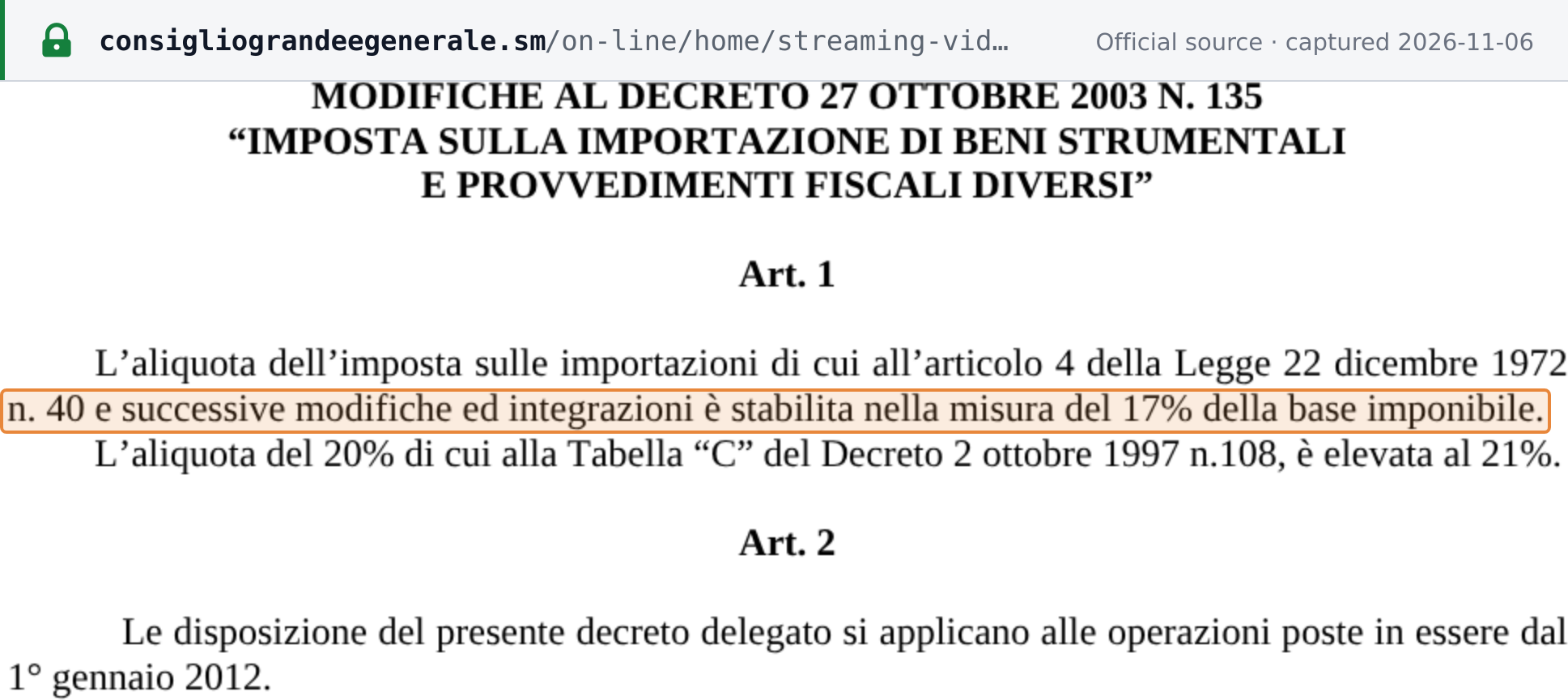
Standard rate: 17%. DD 183/2011 art. 1: "L’aliquota dell’imposta sulle importazioni di cui all’articolo 4 della Legge 22 dicembre 1972 n. 40 e successive modifiche ed integrazioni è stabilita nella misura del 17% della base imponibile." Art. 2: "Le disposizione del presente decreto delegato si applicano alle operazioni poste in essere dal 1° gennaio 2012." [6] The rate was 16% before. In its Budget at a Glance of 16 May 2025 the Finance Ministry describes the tax in its own words: "The single-stage tax is an ad valorem tax on imports of 17%." [12]
 Source snapshot captured 2026-11-06 — original
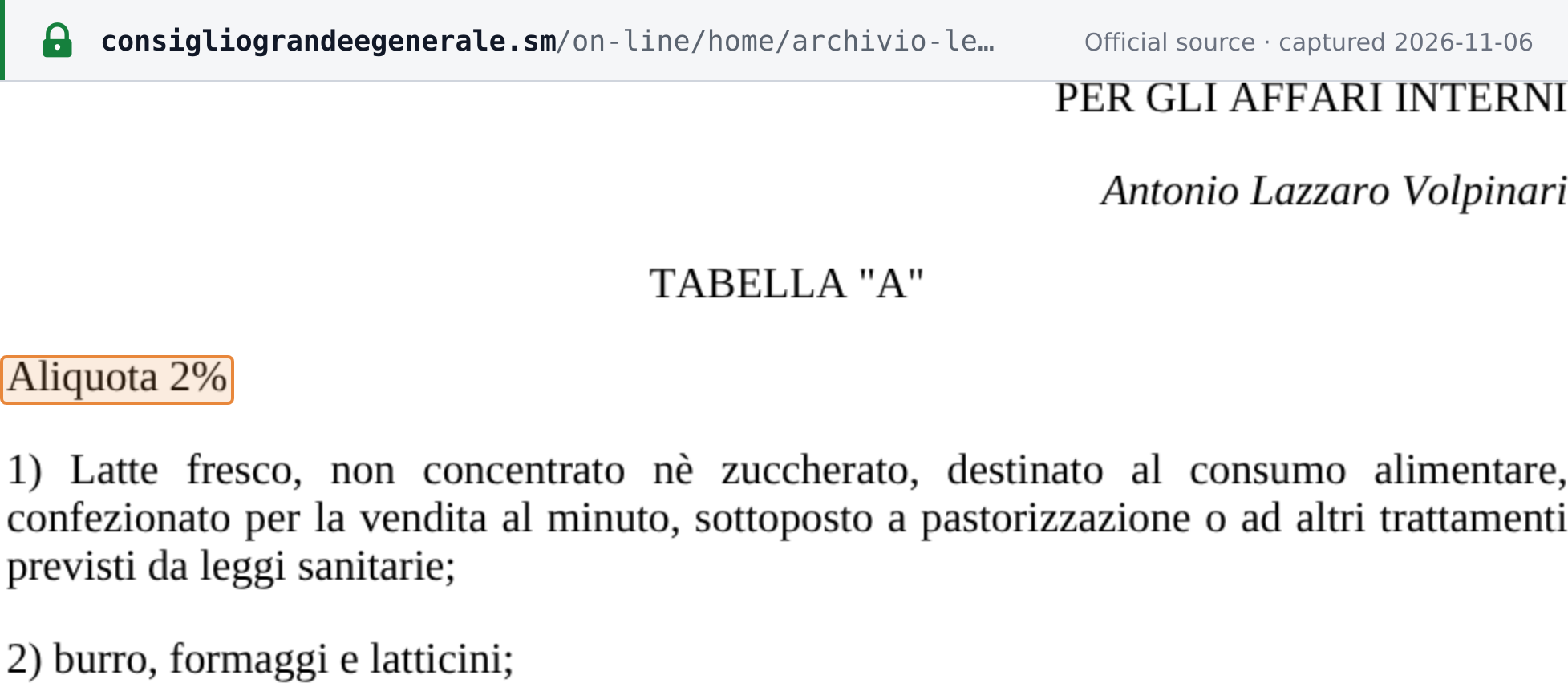
Reduced rates: 2% and 6%. Decreto 108/1997 art. 1 provides that "L'aliquota è ridotta o elevata nella misura stabilita nelle tabelle allegate A, B, C." Tabella A is headed "Aliquota 2%" and opens with "1) Latte fresco, non concentrato nè zuccherato, destinato al consumo alimentare … 2) burro, formaggi e latticini;". Tabella B is headed "Aliquota 6%" and opens with "1) Cavalli, asini, muli e bardotti, vivi;". [7] The tables have been amended since 1997. Treat the examples here as examples, not as a closed list, and check the current table for the product.
 Source snapshot captured 2026-11-06 — original
Petroleum products: 10% and 21%. Tabella C of Decreto 108/1997 sets separate rates for petroleum products: 10% for domestic LPG in 10–20 kg cylinders, agricultural fuels and industrial furnace oil, and a top rate for motor and heating diesel, motor LPG, petrol, lubricants and other petroleum products. DD 183/2011 art. 1 raised that top rate to 21%: "L’aliquota del 20% di cui alla Tabella “C” del Decreto 2 ottobre 1997 n.108, è elevata al 21%." [6] Petroleum products are also subject to a separate special tax, administered by the Ufficio Tributario.
Capital goods: 1%. Decreto 135/2003 art. 2: the import tax on business capital goods "è fissata nella misura del 1% fatta eccezione per i beni di cui ai successivi articoli 4 e 5 e 6. Per accedere ai benefici di cui al comma precedente i beni di cui all'articolo 1 devono avere un valore unitario superiore a €.250,00." [8] Article 4 sets 7% for business cars also used privately, article 5 sets 9% (vehicles), 2% (aircraft) and 6% (boats) for rental fleets, and article 6 excludes buildings and installations except hotel and restaurant works, which get 6%. The decree has been amended (including by DD 183/2011).
Outside the tax. Decreto 108/1997 art. 2 lists items not subject to the tax, including "a) le cessioni aventi come oggetto denaro o crediti in denaro … b) le importazioni effettuate da Enti Statali;", together with stamps, shares and bonds, goods given as a discount or bonus, and returnable packaging. [7]
Announced future rates. None as at 2026-11-06. No instrument changing the 17% rate has been published, and no IVA law exists (see Overview).
Cross-border rules
Imports and exports
Imports. The monofase is charged when goods (and connected services) are brought into San Marino, and the importer pays it (L. 40/1972 arts. 1 and 5). Goods bought from Italy are taxed through the invoice flow described below. A price agreed in a foreign currency is converted "al cambio ufficiale del giorno nel quale si provvede al pagamento della imposta" (art. 3). [2]
Buying goods from Italy. The Italian supply is non-taxable in Italy (non imponibile) once the San Marino side has dealt with the import tax. The Italian e-invoice goes from the SdI to the Ufficio Tributario, "il quale, una volta verificato il regolare assolvimento dell'imposta sull'importazione, convalida la regolarita' della fattura" (Italian DM 21 June 2021, art. 3). [17] The San Marino buyer self-assesses the import tax. DD 147/2021 art. 1: "L'operatore economico deve compilare apposito modulo in formato elettronico indicando per ogni acquisto il tipo merce, l'aliquota e l'imposta sulle importazioni e inviarlo telematicamente all'Ufficio Tributario. … 3. In entrambe le ipotesi l'imposta sulle importazioni dovuta deve essere liquidata dall'acquirente." [13] If the Ufficio Tributario has not validated the invoice within 4 months, the Italian seller issues a variation note within the next 30 days under art. 26(1) DPR 633/1972, charging the Italian VAT, without penalties or interest (DM art. 3(3)).
Exports. The import tax is refunded when goods, even after processing, are exported (L. 40/1972 art. 1). Refund claims run through the e-invoice data (Tipo Merce and Tipo Cessione codes) and the annual refund declarations, which the Ufficio Tributario checks: "dichiarazioni annuali agli effetti del rimborso dell'imposta sulle importazioni". [4]
Selling goods to Italy
A San Marino seller invoicing an Italian business can choose one of two routes under the Italian DM of 21 June 2021:
- With Italian VAT (art. 7): "Se la fattura elettronica indica l'ammontare dell'IVA dovuta dal cessionario … l'imposta e' versata dall'operatore sammarinese all'ufficio tributario, il quale entro quindici giorni riversa le somme ricevute al competente ufficio dell'Agenzia delle entrate". [17]
- Without VAT (art. 8): the Italian buyer "assolve l'imposta ai sensi dell'art. 17, comma 2, del decreto del Presidente della Repubblica n. 633 del 1972", which is a reverse charge. [17]
Invoices to Italy must show the seller's identification number and the buyer's partita IVA, and e-invoices must also carry the Italian buyer's recipient code (DD 147/2021 art. 10). [13]
Digital products and services
The import-tax legislation cited here (L. 40/1972, Decreto 108/1997, DD 147/2021) has no general charge on imported services and no registration regime for foreign digital-service suppliers. The monofase reaches services only where they are connected to imported goods.
Foreign companies selling into San Marino — B2B and B2C
- B2B, goods. The San Marino business is the importer and pays the monofase (self-assessed for purchases from Italy). The foreign seller does not register.
- B2C, goods. Generally the private buyer is the importer. The exception is an Italian distance seller above EUR 28,000 of prior-year sales to San Marino buyers. It must apply San Marino import tax and appoint a fiscal representative (DD 147/2021 art. 2; see Non-resident registration).
- Services. No import-tax registration for foreign service suppliers. Foreign businesses supplying services on site in San Marino need an authorisation, or a UAE notice for stays of 1 to 180 days a year (DD 50/2024 art. 8).
Marketplace / platform deemed-supplier liability
None in the import-tax legislation cited here.
Place of supply
The monofase has no VAT-style place-of-supply rules: the taxable event is the import of goods into San Marino (L. 40/1972 art. 1).
Invoice requirements
Mandatory content
Every economic operator must invoice. Legge 16 dicembre 2013 n.166 (the IGR income-tax law), art. 100(2): "Tutti gli operatori economici sono tenuti all'emissione e alla consegna al cliente della fattura, parcella o documento equipollente, attestante la cessione di beni o la prestazione di servizi di qualunque genere." [20]
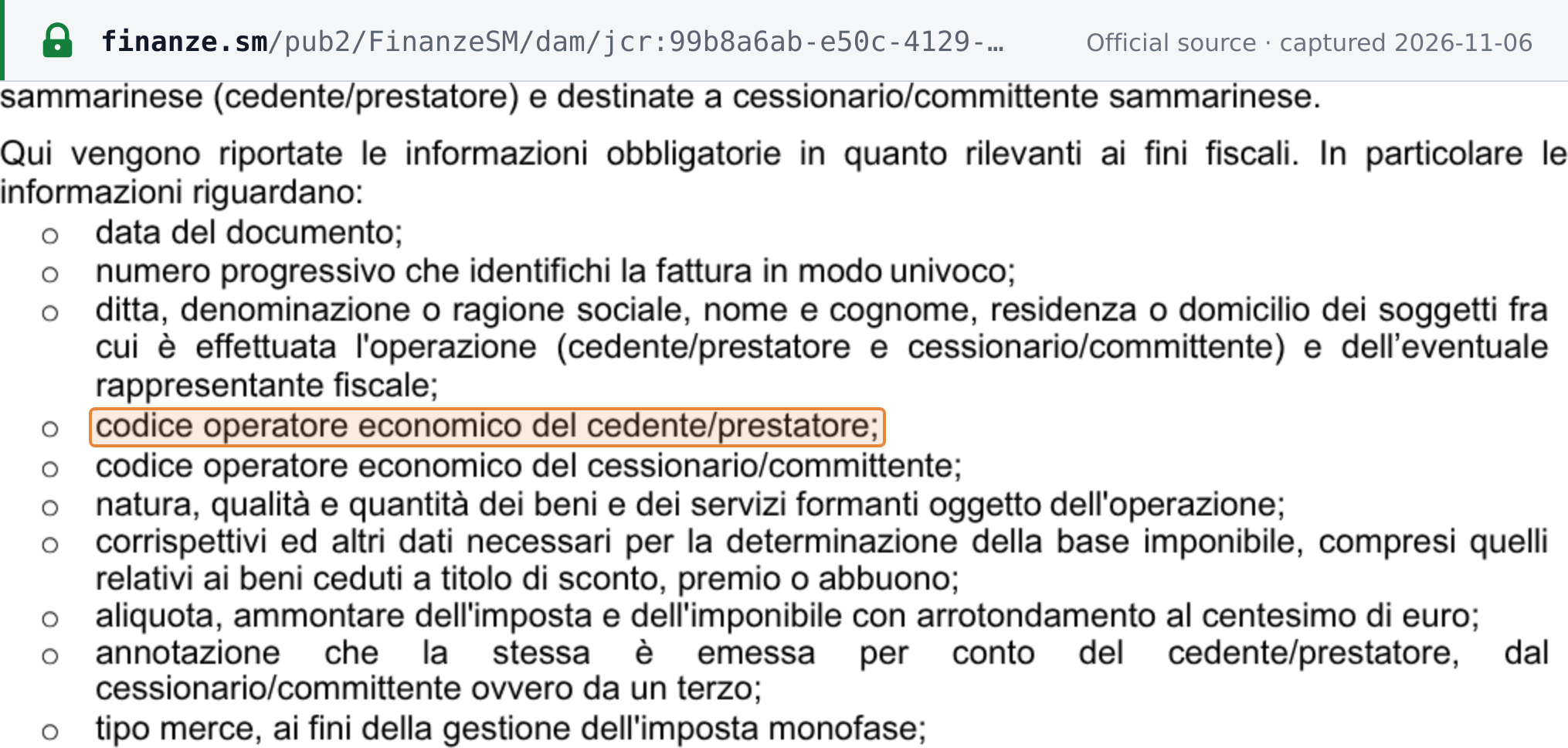
The mandatory particulars are listed in Documento A to Regolamento 10 settembre 2026 n.28. DD 133/2026 art. 4(5) applies the same list to paper invoices: "Le fatture cartacee devono essere predisposte indicando gli stessi dati previsti per le fatture elettroniche contenuti nel regolamento di cui al comma 1." [11] The list from Documento A, §2: [9]
- Document date (data del documento).
- A progressive number that identifies the invoice uniquely.
- Name or business name, and residence or domicile, of the supplier and the customer, and of any fiscal representative.
- COE of the supplier.
- COE of the customer.
- Nature, quality and quantity of the goods or services.
- Consideration and the other data needed to set the taxable base, including goods given as a discount, bonus or allowance.
- Rate, tax amount and taxable amount, rounded to the euro cent.
- Where applicable, a note that the invoice is issued on the supplier's behalf by the customer or a third party.
- Tipo merce (goods type), for managing the monofase.
- Tipo cessione (supply type), for monofase refund claims.
- Combined nomenclature code (optional, for statistics).
 Source snapshot captured 2026-11-06 — original
How the tax appears on a domestic invoice. The monofase has already been paid at import, so a domestic San Marino invoice carries no tax. Documento B §2.2.7: AliquotaIVA "deve assumere valore "0.00" (Esente da IVA) e diventa obbligatorio indicare la Natura "N4"", and §2.2.6: "Il valore totale del documento deve essere comprensivo dell'imposta sulle importazioni." [10] Each line carries a Tipo Merce code: 1 raw materials; 2 contract work with materials; 3 contract work without materials and services under L. 131/1991; 4 consumer goods; 7 capital goods. Goods lines (1, 4, 7) cannot be mixed with type 2 or type 3 lines on the same invoice, and a delivery note (DDT) number and date are mandatory for types 1, 2, 4 and 7. [10]
Issuance deadline
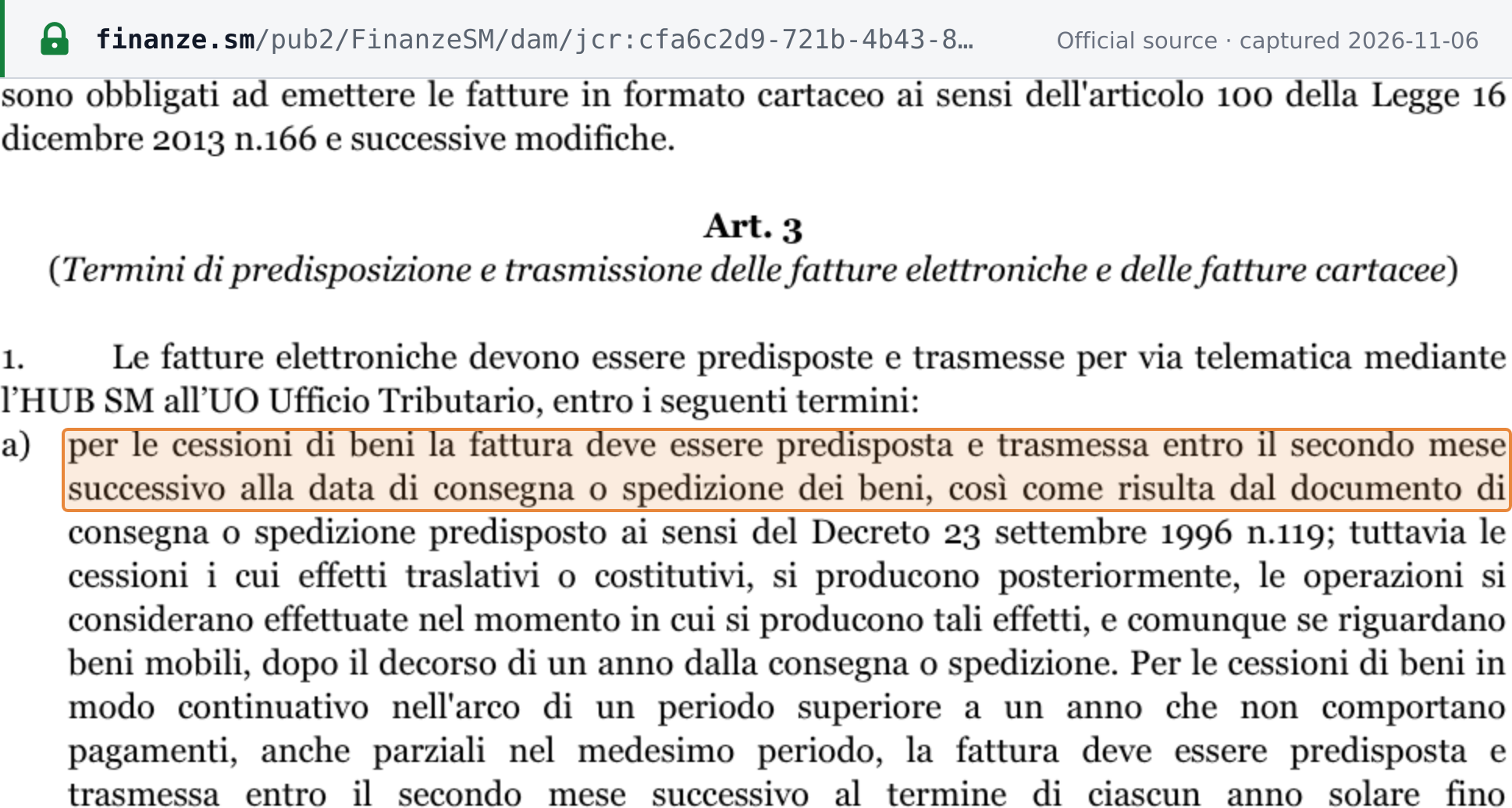
Within the second month following the operation. DD 133/2026 art. 3(1): "a) per le cessioni di beni la fattura deve essere predisposta e trasmessa entro il secondo mese successivo alla data di consegna o spedizione dei beni, così come risulta dal documento di consegna o spedizione predisposto ai sensi del Decreto 23 settembre 1996 n.119; … b) per le prestazioni di servizi deve essere predisposta e trasmessa entro il secondo mese successivo all'ultimazione del servizio." Advance payments: within the second month following payment. Continuous supplies of goods over more than a year with no payments: within the second month after the end of each calendar year. Art. 3(3) applies the same deadlines to paper invoices. [11]
 Source snapshot captured 2026-11-06 — original
Numbering and sequencing
"Il Numero della Fattura deve contenere almeno 1 carattere numerico da 0 a 9. Un Cedente/Prestatore non può emettere più di una Fattura con lo stesso Numero all'interno dello stesso anno (riferito alla Data della Fattura)." The invoice date is the day the operation is carried out (Documento B §2.2.5). [10] The number is alphanumeric, up to 20 characters (Documento A). [9]
Credit and debit notes
Variation notes follow the format of the original invoice. DD 133/2026 art. 5(1): notes for operations "per cui sono state emesse fatture elettroniche, devono essere predisposte e trasmesse nel medesimo formato elettronico". [11] On HUB-SM, "I valori ammessi per <TipoDocumento> sono esclusivamente TD01, TD02, TD04, TD05, TD29": invoice, advance invoice, credit note, debit note, and the customer's notice of a missing or irregular invoice. Each file holds one invoice. [10]
Currency and language
The currency is stated as an ISO 4217 code ("Divisa: questo campo deve essere espresso secondo lo standard ISO 4217 alpha-3:2001 (es.: EUR, USD, GBP, CZK………)"). [9] For the import tax, foreign-currency amounts are converted at the official exchange rate on the day the tax is paid (L. 40/1972 art. 3). DD 133/2026, Documenti A and B and IGR art. 100 set no invoice-language rule.
Document types
- Invoice, fee note (parcella) or equivalent document. Required for every supply between operators.
- No invoice for B2C retail. Retail sales in premises open to the public, food and drink service, and services to private customers are certified with electronic devices connected to a telematic network instead of an invoice (IGR art. 100(3), referring to DD 3 novembre 2014 n.176). Banks and financial entities cannot use this exception. [20]
- There is no simplified invoice with a value threshold.
Self-billing
An invoice may be issued on the supplier's behalf by the customer or a third party, with a note saying so (Documento A, item 9 above). Separately, a customer that has not received an invoice or variation note must regularise. Two months after the supplier's deadline, it has 30 days to send a document with the missing invoice's data to HUB-SM (type TD29). If the customer is outside the e-invoicing obligation, it sends a paper document to the Ufficio Tributario (DD 133/2026 art. 7). [11]
Retention and audit trail
- Retention. Accounting records and tax documents "devono essere conservate per cinque anni, escluso il periodo d'imposta al quale si riferiscano e comunque fino a quando non siano definiti gli accertamenti relativi al periodo di imposta medesimo" (IGR art. 100(1)). [20] The same term applies to e-invoices (DD 133/2026 art. 8(4)).
- Archiving. The Ufficio Tributario does not store invoices for you: "L'UO Ufficio Tributario non assolve all'attività di conservatore per conto terzi delle fatture elettroniche" (art. 8(1)). HUB-SM offers a consultation and download area only. Whoever stores invoices must give the tax administration effective, timely and remote access to them.
- Audit trail. HUB-SM computes and stores a hash for every file: "Per ogni file elaborato … è calcolato dall'HUB SM il corrispondente codice HASH, che caratterizza univocamente il documento". A file HUB-SM rejects "si considera non emessa" (art. 4(2)–(3)). [11]
- Italy–San Marino e-invoices must be archived by 30 September of the year after the invoice date (DD 20 settembre 2021 n.163 art. 8(2)). [14]
A specimen of a compliant invoice
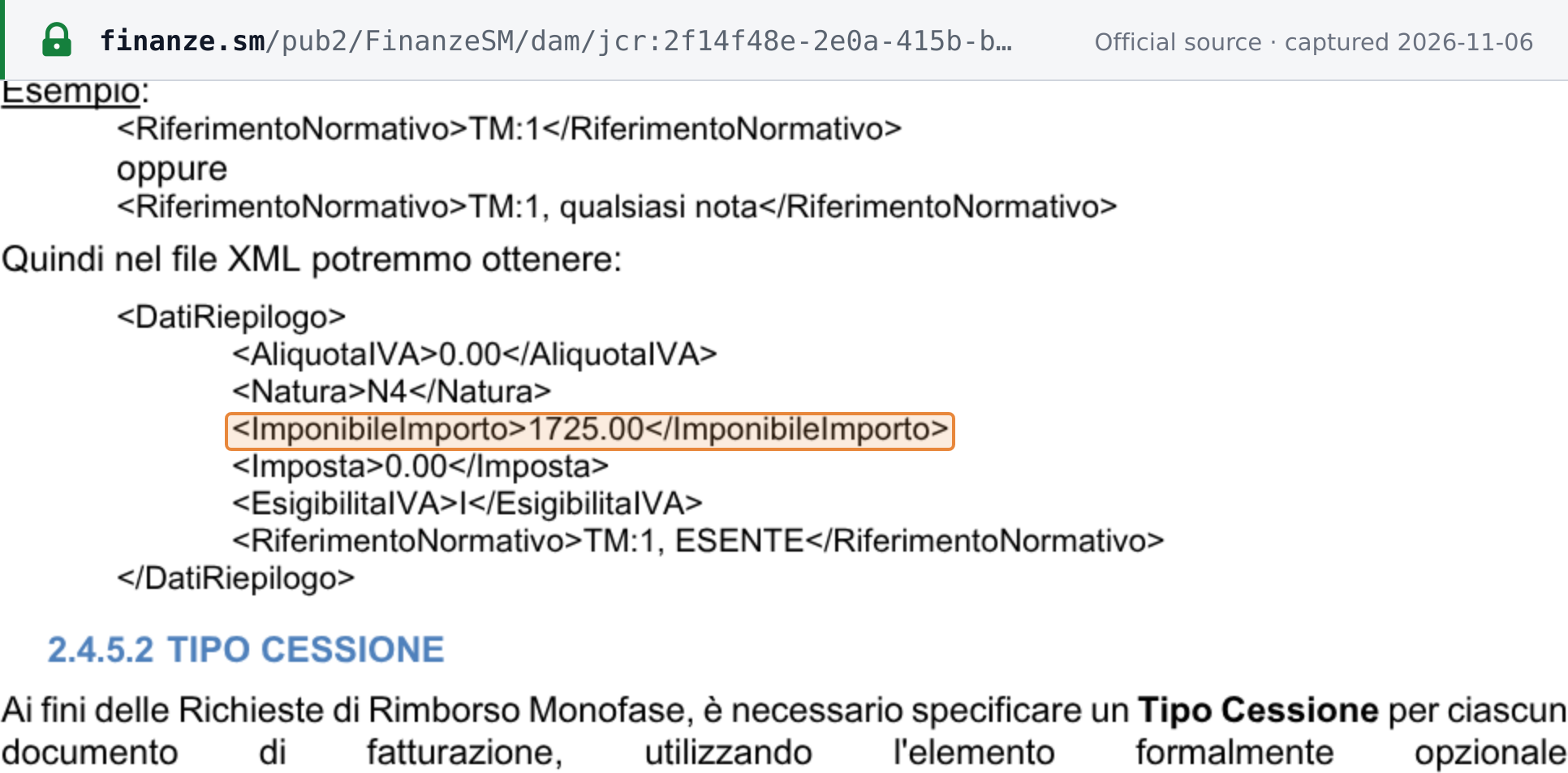
The Ufficio Tributario publishes no specimen invoice. The closest official sample is an XML fragment in Documento B: the summary block of a domestic invoice, with a 0.00 rate, Natura N4, a taxable amount of EUR 1,725.00, zero tax and the reference "TM:1, ESENTE".
 Source snapshot captured 2026-11-06 — original
The illustration below shows how the Documento A particulars sit on a domestic San Marino B2B invoice for goods issued in 2027.
Fattura (TD01) — domestic San Marino B2B, illustrative
| DescriptionDoc. A §2 | QtyDoc. A §2 | Unit price | Amount | Tipo MerceDoc. B §2.4.5.1 | Rate / NaturaDoc. B §2.2.7 |
|---|---|---|---|---|---|
| Office chairs, model X | 10 | EUR 120.00 | EUR 1,200.00 | 4 – Beni di consumo | 0.00 / N4 |
| Filing cabinets | 5 | EUR 105.00 | EUR 525.00 | 4 – Beni di consumo | 0.00 / N4 |
- Taxable amountDoc. A §2
- EUR 1,725.00
- Tax (RiferimentoNormativo "TM:4, ESENTE")Doc. B §2.2.7; §2.4.4
- EUR 0.00
- Total document (includes import tax already borne)Doc. B §2.2.6
- EUR 1,725.00
- Transmit through HUB-SM within the second month following delivery or shipment — DD 133/2026 art. 3(1)(a).
- An operator whose prior-year revenue was below EUR 100,000 may issue this on paper with the same data — DD 133/2026 arts. 2(2), 4(5).
- A file rejected by HUB-SM is treated as not issued — DD 133/2026 art. 4(3).
- Keep for 5 years, excluding the tax year it relates to, and until assessments for that year are final — IGR art. 100(1); DD 133/2026 art. 8(4).
E-invoicing status
Status as at 2026-11-06: domestic B2B e-invoicing is optional now and mandatory from 1 January 2027 for operators with prior-year revenue of EUR 100,000 or more. Italy–San Marino e-invoicing for goods has been mandatory since 1 July 2022.
Domestic B2B — HUB-SM (DD 133/2026)
Scope. DD 4 settembre 2026 n.133, art. 2(1): "Tutti gli operatori economici, le imprese agricole, lo Stato e gli enti pubblici e privati in possesso di un codice operatore economico sono obbligati all’emissione della fattura elettronica … per le operazioni realizzate esclusivamente nei confronti di operatori economici stabiliti o identificati o soggetti ad essi assimilati nel territorio della Repubblica di San Marino in possesso di un codice operatore economico." [11]
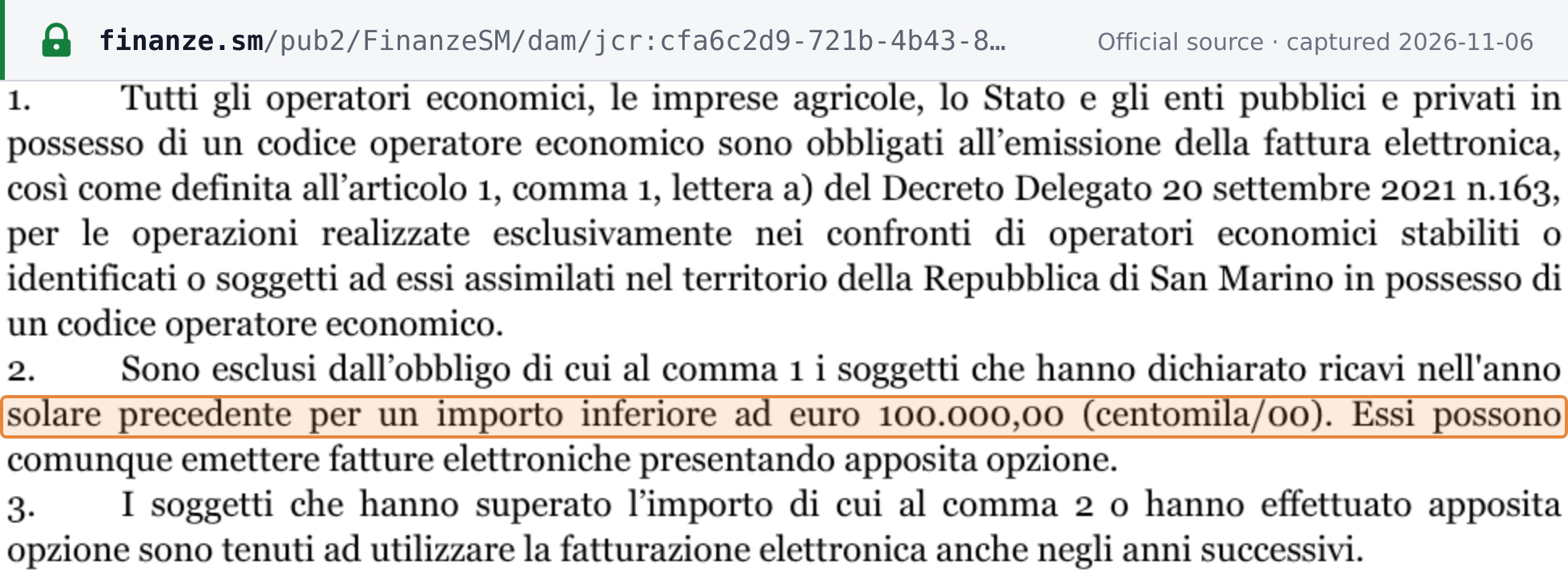
Threshold. Art. 2(2)–(3): "Sono esclusi dall’obbligo di cui al comma 1 i soggetti che hanno dichiarato ricavi nell'anno solare precedente per un importo inferiore ad euro 100.000,00 (centomila/00). Essi possono comunque emettere fatture elettroniche presentando apposita opzione. 3. I soggetti che hanno superato l’importo di cui al comma 2 o hanno effettuato apposita opzione sono tenuti ad utilizzare la fatturazione elettronica anche negli anni successivi." Excluded operators issue paper invoices under IGR art. 100, with the same data.
 Source snapshot captured 2026-11-06 — original
Timeline (art. 11): [11]
| Date | What applies |
|---|---|
| 1 October – 31 December 2026 | Optional: an operator or its delegate may opt to send e-invoices instead of paper |
| 1 January 2027 | Mandatory for operators not excluded under art. 2(2); the decree's paper-invoice rules also apply |
| 1 January 2028 | The administrative penalties of arts. 6 and 7 apply |
| Not yet set | The State, public administration and public bodies as issuers, from a future implementing regulation |
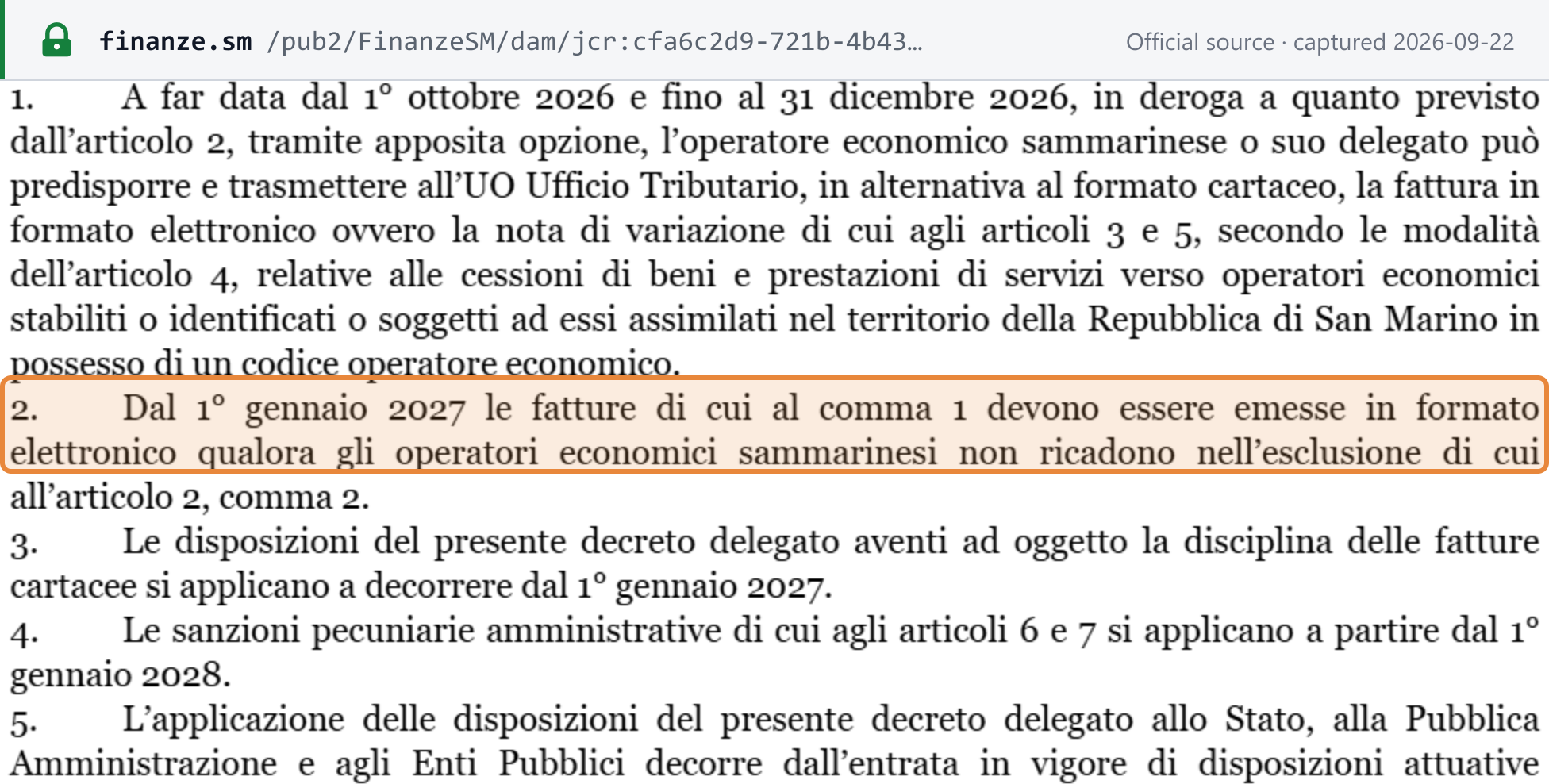 Source snapshot captured 2026-09-22 — original
Network and format. Invoices pass through HUB-SM, the Ufficio Tributario's hub, the same one used for Italy–San Marino traffic. The format is XML based on the Italian FatturaPA schema used by the SdI: "La Fattura Elettronica (FE) … è rappresentata mediante file XML … che rispetta il formato definito dall'Amministrazione Finanziaria italiana e utilizzato nel Sistema di Intercambio (SdI) e in HUB-SM." Domestic files use FormatoTrasmissione FPR12, and "il <CodiceDestinatario> deve essere sempre valorizzato con sette zeri ('0000000')" (Documento B §§1.1, 2.2.1–2.2.2). [10] Files may carry an optional XAdES-BES or CAdES-BES signature, and each may be up to 5 MB. Operators send them by web service or through TribWeb ("Upload File FE-RSM"), and customers receive them in their reserved area. [9] The decree, Regolamento 28/2026, Documenti A and B, the web-service manual and the XSD (Schema_VFPR12_v1.2.3) are on the Finance Ministry's domestic e-invoicing page. [19] HUB-SM checks that the customer's COE is in the tax register (Anagrafe Tributaria) and rejects the file if it is not. For how hubs of this kind compare, see CTC e-invoicing models.
Legal chain. DD 133/2026 implements Legge 23 dicembre 2020 n.223 art. 64(1)(a). The technical rules are in Regolamento 10 settembre 2026 n.28 (in force 10 September 2026), whose content is Documenti A and B (v1.0, 8 September 2026). The Ufficio Tributario may update them by circular: "Le regole tecniche e procedurali di cui al comma 1, a seguito delle evoluzioni tecniche dei sistemi informatici, possono essere aggiornate con circolare dell'UO Ufficio Tributario". [18]
Scope by segment. B2B: mandatory as above. B2G: public bodies are in scope as customers; as issuers they wait for an implementing regulation. B2C: not in scope, because retail revenue is certified with networked electronic devices (IGR art. 100(3)).
Italy ↔ San Marino (goods)
On the Italian side, the DM of 21 June 2021 (GU Serie Generale n.168 of 15 July 2021) requires invoices and variation notes for goods traded between Italy and San Marino to be issued electronically through the SdI. Art. 22: "a decorrere dal 1° luglio 2022 per le operazioni di cui al periodo precedente le fatture sono emesse e accettate in formato elettronico". [17] On the San Marino side, DD 147/2021 art. 18(3)–(4) imposes the same obligation from 1 July 2022 and excludes operators whose prior-year declared revenue was below EUR 100,000 (they may opt in). [13] Electronic invoices for San Marino contract work and L. 131/1991 services supplied to Italy have also been required since 1 July 2022, unless the operator falls under the EUR 100,000 exclusion, and those files do not go to the SdI (DD 163/2021 art. 5). [14]
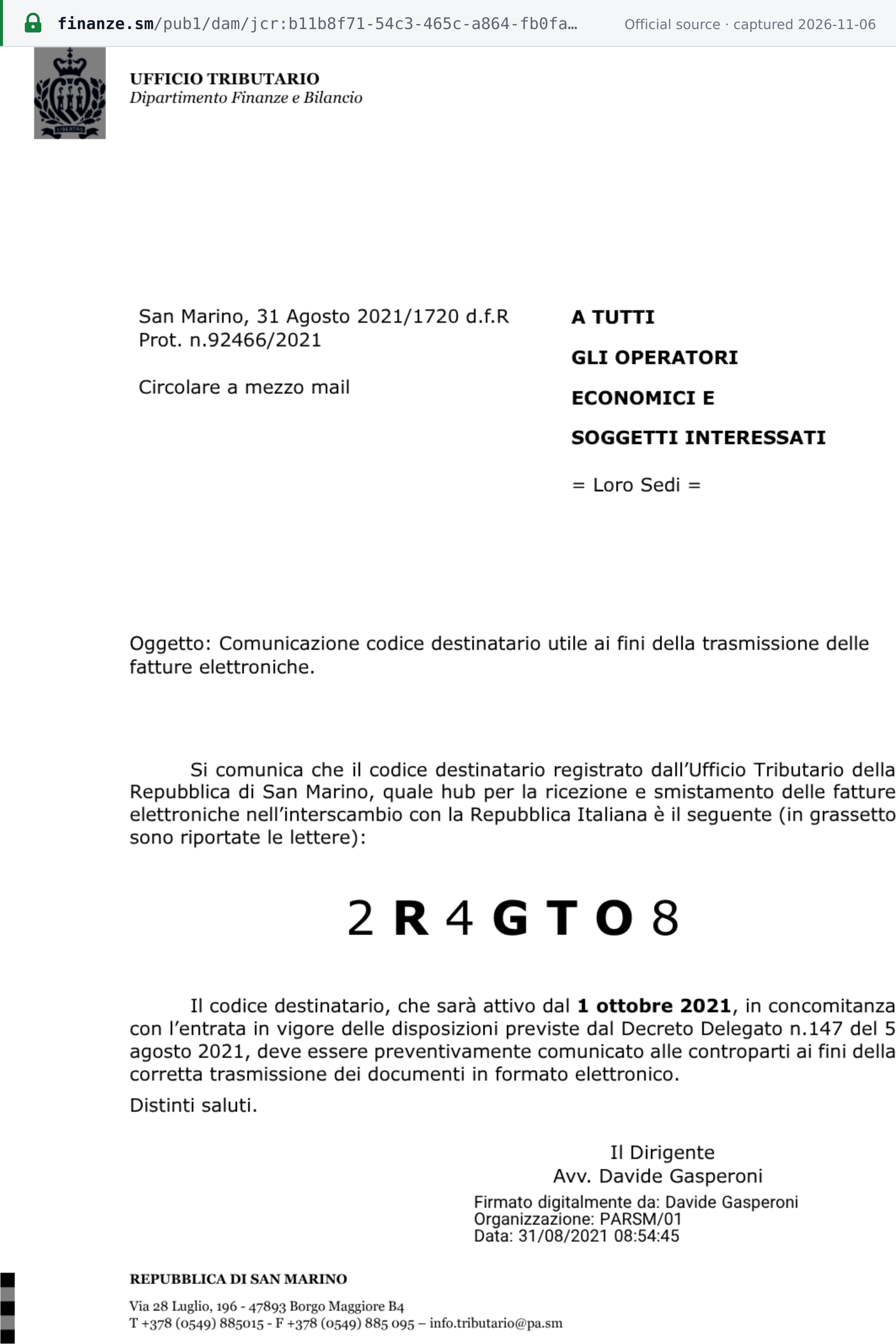
Invoices travel SdI ↔ HUB-SM. Italian suppliers address San Marino buyers through the Ufficio Tributario's recipient code 2R4GTO8, active from 1 October 2021. The sixth character is the letter O, not a zero. [15]
 Source snapshot captured 2026-11-06 — original
Filing and payment
Filing frequency
There is no periodic VAT-style return. The monofase is settled per import.
Return due date
Not applicable. There is no return. Purchases of goods from Italy are declared purchase by purchase: the buyer sends an electronic form to the Ufficio Tributario giving the tipo merce, the rate and the import tax, and pays the tax itself (DD 147/2021 art. 1). [13]
Input-tax recovery and blocked items
Not applicable. A single-stage tax has no input-tax credit chain. The tax is borne once at import, domestic resale carries no tax (rate 0.00, Natura N4), and relief on exported goods is by refund (see Refunds).
Refunds
Import tax is refunded when goods, including processed goods, are exported (L. 40/1972 art. 1). Refunds are claimed through annual refund declarations, using the Tipo Merce and Tipo Cessione data carried on e-invoices, and the Ufficio Tributario checks those declarations. [4]
Accounting books
Businesses whose ordinary revenue in a year did not exceed EUR 350,000 (services) or EUR 500,000 (other activities) are exempt from full books the following year. They must still keep inventory, purchase and sales books and keep their invoices (IGR art. 97). [20]
Exemptions
Exempt supplies
- Outside the tax (Decreto 108/1997 art. 2): money and monetary credits, postage and revenue stamps, shares and bonds, imports by State bodies, goods given as a discount or bonus, and returnable packaging. [7]
- Domestic resale. Not taxed again: domestic invoices show a 0.00 rate with Natura N4, labelled "ESENTE" (Documento B).
- Exports. The import tax is refunded (L. 40/1972 art. 1).
Exempt is not zero-rated, and here neither term means quite what it means under VAT. "N4/ESENTE" on a domestic invoice does not relieve anything: the tax was already paid at import and is built into the price. The only way to recover monofase is the export refund.
Special regimes
- Capital goods at 1% (Decreto 135/2003; see Rates).
- Small businesses. The EUR 100,000 e-invoicing exclusion (paper invoices allowed) and the simplified-books rule in IGR art. 97 are administrative reliefs. They do not change the tax.
Offences and penalties
Offences
- Carrying on an economic activity without an authorisation to operate (DD 50/2024 art. 2).
- Omitting an e-invoice or variation note, or sending it late, when obliged to e-invoice or opted in (DD 133/2026 art. 6(1)).
- Failing to prepare, deliver or send a paper invoice when obliged to issue paper (art. 6(3)).
- As a customer, failing to regularise a missing or irregular invoice within the art. 7 deadlines.
A file rejected by HUB-SM counts as not issued (art. 4(3)), so a rejection that is not corrected in time becomes an omitted invoice.
Penalties
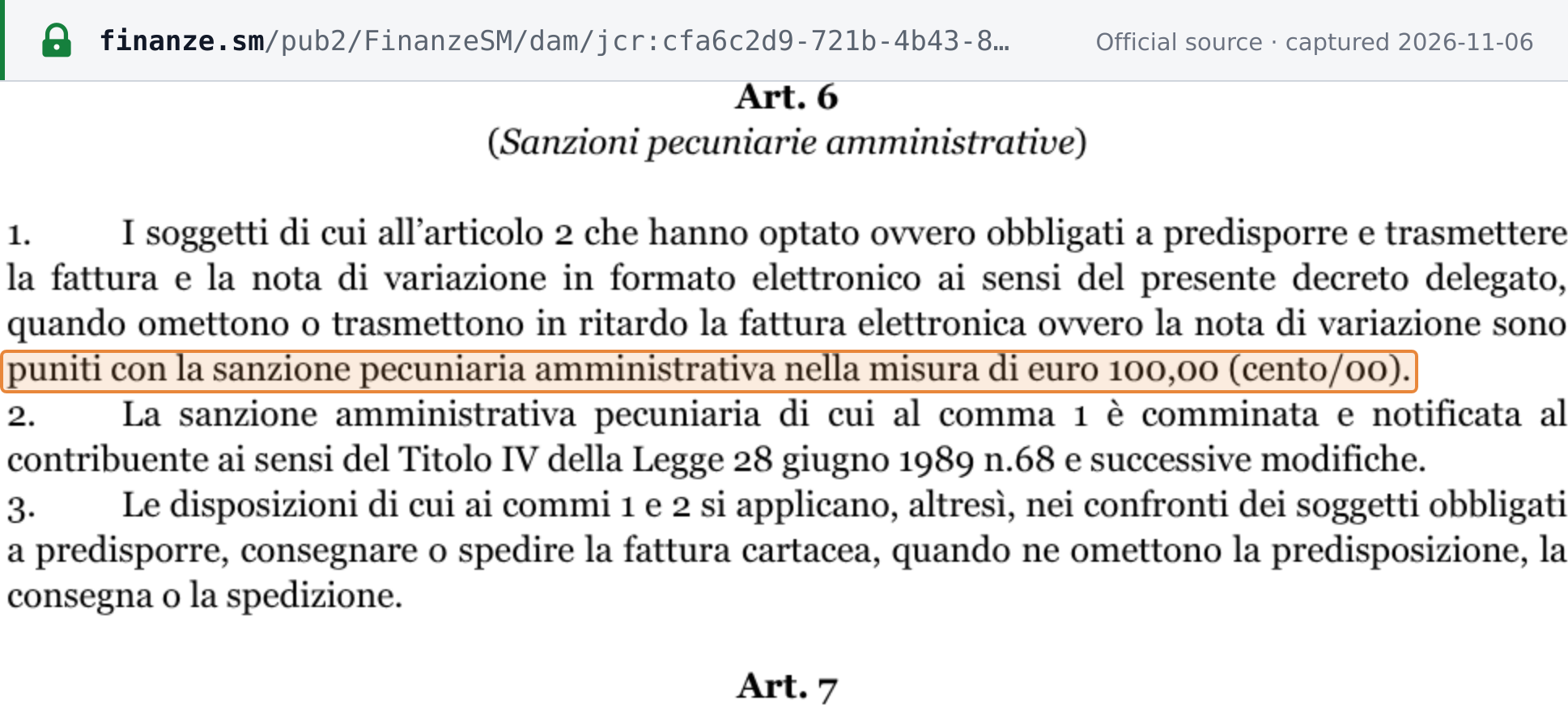
EUR 100 per omitted or late e-invoice or variation note. DD 133/2026 art. 6(1): those obliged or opted in "quando omettono o trasmettono in ritardo la fattura elettronica ovvero la nota di variazione sono puniti con la sanzione pecuniaria amministrativa nella misura di euro 100,00 (cento/00)." The same EUR 100 applies to omitted paper invoices (art. 6(3)) and to a customer that fails to regularise (art. 7). The fine is imposed under Title IV of Legge 28 giugno 1989 n.68 and applies from 1 January 2028 (art. 11(4)). [11]
 Source snapshot captured 2026-11-06 — original
Frequently asked questions
Does San Marino charge VAT?
No. San Marino has no VAT (IVA). Its indirect tax is the single-stage import tax (imposta sulle importazioni, known as the monofase), charged once when goods enter the Republic, at a standard 17% of the taxable base since 1 January 2012 (Decreto Delegato 22 novembre 2011 n.183). The Finance Ministry's budget summary of 13 July 2026 says the Government will continue to evaluate the introduction of a value added tax (IVA) or a similar indirect tax; no IVA law has been enacted.
Which SdI recipient code should an Italian supplier use to e-invoice a San Marino business?
2R4GTO8. The Ufficio Tributario registered this recipient code (codice destinatario) as the hub that receives and routes electronic invoices exchanged with Italy, active from 1 October 2021 (circular prot. n.92466/2021). The R, G, T and O are letters: the sixth character is the letter O, not the digit zero.
Can a San Marino seller invoice an Italian business without Italian VAT?
Yes. Under the Italian decree of 21 June 2021, a San Marino seller of goods can either show Italian VAT on the e-invoice and pay it to the San Marino Ufficio Tributario, which passes it to the Agenzia delle Entrate within 15 days (art. 7), or issue the e-invoice without VAT, in which case the Italian buyer accounts for the VAT itself under article 17(2) of DPR 633/1972 (art. 8).
Why does a San Marino domestic e-invoice show a 0.00 rate and Natura N4?
Because the monofase is charged once, at import, and is not charged again when goods are resold inside San Marino. Documento B to Regolamento 10 settembre 2026 n.28 requires AliquotaIVA to be 0.00 with Natura N4 on domestic e-invoices, and the document total must include the import tax already borne. Each line must also carry a Tipo Merce code, used for monofase refunds.
Our revenue is under EUR 100,000. Do we have to e-invoice through HUB-SM from 2027?
No. Decreto Delegato 4 settembre 2026 n.133 excludes operators whose declared revenue in the previous calendar year was below EUR 100,000. They issue paper invoices carrying the same data as an e-invoice. They may opt in, but once an operator opts in or exceeds EUR 100,000 it must keep e-invoicing in later years.
Is the San Marino COE seven digits?
No. The codice operatore economico (COE) is a numeric code preceded by the prefix SM (Decreto Delegato 14 marzo 2024 n.50, art. 1). In e-invoices the numeric part is 5 digits with leading zeros kept, written under IdPaese SM, for example SM followed by 01234 (Documento B, section 2.2.11).
Important websites
| Site | Purpose |
|---|---|
| UO Ufficio Tributario | Tax authority: contacts, hours, functions |
| TribWeb / HUB-SM service page | Import-tax management and e-invoice upload (login through the PA portal) |
| Domestic e-invoicing documentation | DD 133/2026, Regolamento 28/2026, Documenti A and B, XSD, web-service manual |
| Italy–San Marino e-invoicing | Cross-border rules, circulars and FAQ |
| UAE service charter | Authorisation to operate and COE |
| Domestic taxation overview (EN) | Finance Ministry overview of direct and indirect taxes |
| Legislation archive | Laws, decrees and regulations (Consiglio Grande e Generale) |
| COE lookup | No public lookup service is listed on the Ufficio Tributario or Finance Ministry pages; HUB-SM checks customer COEs against the tax register (Documento A §2.1) |
Recent changes
- 2026-09-10 — Regolamento n.28/2026 (technical rules for domestic e-invoicing, Documenti A and B) enters into force. (Consiglio Grande e Generale)
- 2026-09-04 — DD n.133/2026: domestic B2B e-invoicing through HUB-SM, optional from 1 October 2026 and mandatory from 1 January 2027 for operators with prior-year revenue of EUR 100,000 or more; EUR 100 penalties from 1 January 2028. (Segreteria di Stato per le Finanze e il Bilancio) — see event
- 2026-07-13 — The Finance Ministry's budget summary says the Government will continue to evaluate introducing an IVA; no law has been enacted. (Bilancio in breve 2026)
- 2022-07-01 — Italy–San Marino e-invoicing for goods becomes mandatory. (Gazzetta Ufficiale, DM 21 June 2021)
- 2012-01-01 — Standard import-tax rate set at 17%. (DD 183/2011)
For the full chronology, see San Marino tax changes on Lookuptax.
Reference links
- Segreteria di Stato per le Finanze e il Bilancio — Domestic taxation (EN)
- Legge 22 dicembre 1972 n.40 — imposta sulle importazioni (Consiglio Grande e Generale)
- San Marino – Bilancio in breve, 13 luglio 2026 (Finance Ministry)
- Portale GOV.SM — UO Ufficio Tributario
- Decreto Delegato 14 marzo 2024 n.50 — Disciplina delle attività economiche (Consiglio Grande e Generale)
- Decreto Delegato 22 novembre 2011 n.183 — 17% import-tax rate (Consiglio Grande e Generale)
- Decreto 2 ottobre 1997 n.108 — rate tables A, B, C (Consiglio Grande e Generale)
- Decreto 27 ottobre 2003 n.135 — import tax on capital goods (Consiglio Grande e Generale)
- Documento A — specifiche tecniche, Regolamento 28/2026 (finanze.sm)
- Documento B — modalità di trasmissione, Regolamento 28/2026 (finanze.sm)
- Decreto Delegato 4 settembre 2026 n.133 — domestic e-invoicing (finanze.sm)
- San Marino – Budget at a Glance, 16 May 2025 (Ministry of Finance and Budget)
- Decreto Delegato 5 agosto 2021 n.147 — Italy–San Marino trade (finanze.sm)
- Decreto Delegato 20 settembre 2021 n.163 (finanze.sm)
- Ufficio Tributario circular prot. n.92466/2021 — recipient code 2R4GTO8 (finanze.sm)
- Ufficio Tributario circular prot. n.103321/2021 — phases (finanze.sm)
- Gazzetta Ufficiale — DM Economia e Finanze 21 giugno 2021, GU Serie Generale n.168 of 15-07-2021: art. 2, art. 3, art. 7, art. 8, art. 22
- Regolamento 10 settembre 2026 n.28 (Consiglio Grande e Generale)
- Finance Ministry — Fatturazione elettronica interna
- Legge 16 dicembre 2013 n.166 (IGR), testo coordinato — ZIP of PDFs (Consiglio Grande e Generale)
Related on Lookuptax: