Senegal VAT guidelines
Overview
Senegal levies value added tax, the taxe sur la valeur ajoutée (TVA), under Book II, Title I, Chapter 1 of the Code général des impôts (CGI), Loi n° 2012-31 of 31 December 2012 as amended to the 2025 finance law. Article 351 reads: "Il est établi au profit du budget de l’Etat une taxe sur la valeur ajoutée (TVA)." [1] This guide quotes the annotated consolidation the DGID publishes, CGI annoté, mis à jour janvier 2025, which runs to Loi n° 2025-02 of 6 January 2025 (the 2025 initial finance law, LFI 2025). Figures below are stated as that text has them.
Authority, currency, period and layering
- Authority. The Direction générale des Impôts et des Domaines (DGID), a service of the Ministry of Economy, Finance and Planning. [3] Large taxpayers are managed by the Direction des Grandes Entreprises (DGE); medium taxpayers in Dakar by the Centres des moyennes Entreprises (CME1, CME2); regulated professions by the Centre des Professions réglementées (CPR). [8]
- What is taxed. "Sont soumises à la TVA, les livraisons de biens et les prestations de services effectuées à titre onéreux par un assujetti en tant que tel, ainsi que les importations." Agricultural activities and employment are outside the scope (art. 352). [1]
- Currency. The CGI states amounts in francs: the CFA franc of the BCEAO (ISO code XOF).
- Tax period. One calendar month for taxpayers outside the CGU, one quarter for companies under the réel simplifié regime (see Filing and payment).
- Layering. VAT is a national tax only; there is no regional or municipal VAT. Small individual traders are not in the VAT system at all: they pay the contribution globale unique (CGU), a single levy that replaces VAT, income tax and several other taxes (art. 134). [1] Beside VAT sit excise-type taxes spécifiques (arts. 408–444) and the taxe sur les activités financières (TAF) on financial operations, which are VAT-exempt: "Le taux de la taxe sur les activités financières est de 17%." (art. 404). [1]
Registration
Who must register: no general threshold
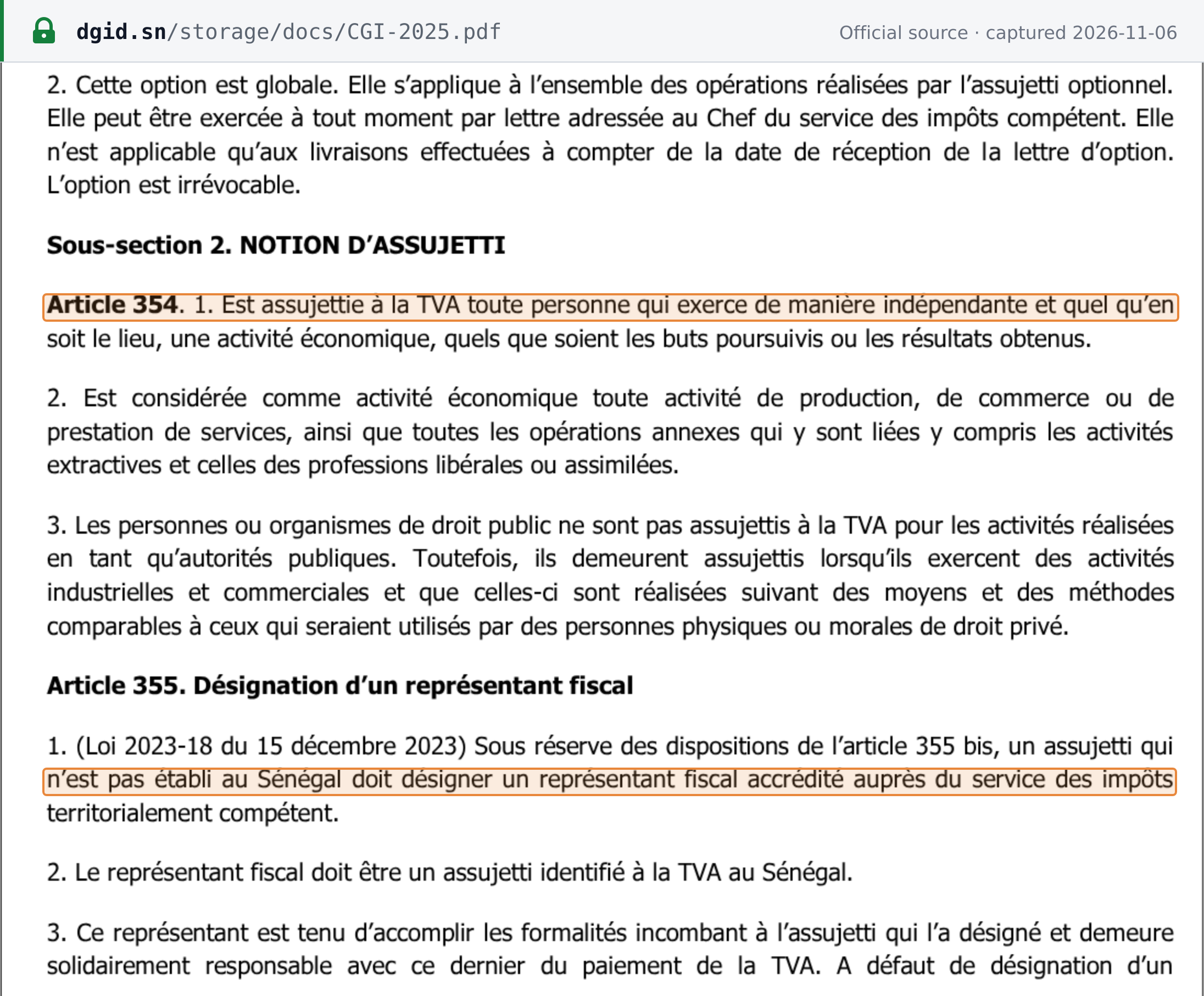
The CGI has no VAT turnover threshold. Liability follows from the activity itself (art. 354-1):
"Est assujettie à la TVA toute personne qui exerce de manière indépendante et quel qu’en soit le lieu, une activité économique, quels que soient les buts poursuivis ou les résultats obtenus."
Economic activity covers production, trade and services, including extractive activities and the liberal professions (art. 354-2). Public bodies acting as public authorities are outside the scope, but not when they carry on industrial or commercial activities by private-sector methods (art. 354-3). [1]
 Source snapshot captured 2026-11-06 — original
The XOF 50 million CGU ceiling for individuals
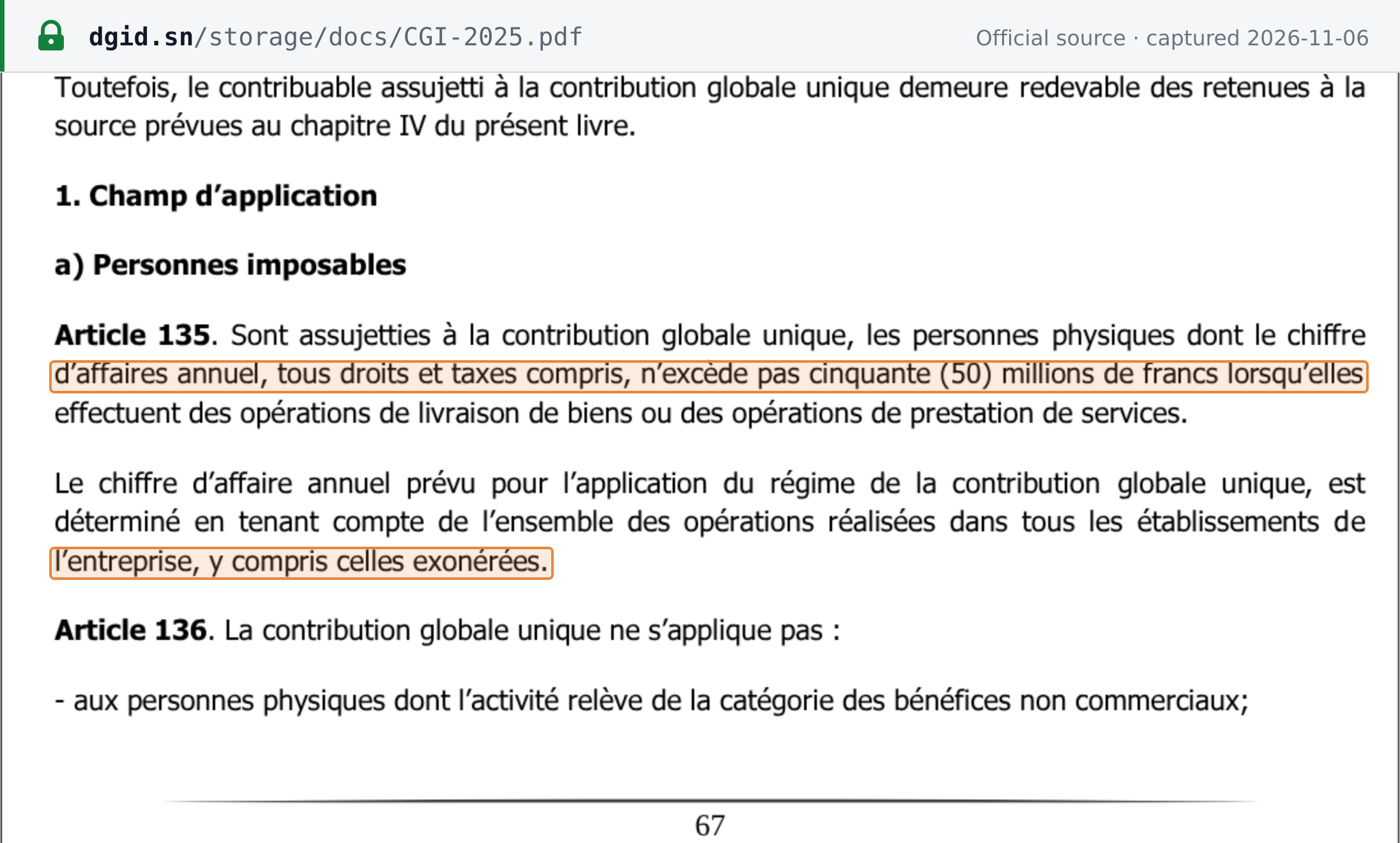
What works as a threshold in practice is the ceiling of the CGU, which replaces VAT for small individuals (art. 135):
"Sont assujetties à la contribution globale unique, les personnes physiques dont le chiffre d’affaires annuel, tous droits et taxes compris, n’excède pas cinquante (50) millions de francs lorsqu’elles effectuent des opérations de livraison de biens ou des opérations de prestation de services."
- Amount and measure: XOF 50,000,000 of annual turnover, all taxes included, counting every establishment of the business and including exempt sales (art. 135, second paragraph). [1]
- Who is excluded from the CGU (and so is inside the VAT system from the first franc): every legal entity (personne morale), since art. 135 covers only individuals; and, under art. 136, individuals in non-commercial professions (BNC) and others listed there.
- CGU businesses may not show VAT. "…les assujettis soumis à la Contribution Globale Unique ne sont pas autorisés à mentionner le montant de la TVA exigible sur l’opération… Les factures doivent être établies toutes taxes comprises." (art. 448-2) [1]
 Source snapshot captured 2026-11-06 — original
The DGID's rates page lists the CGU at 5% for service providers and 2% for traders. [2]
Réel normal and réel simplifié
Outside the CGU, the income-tax regime decides how often VAT is filed. Legal entities with annual turnover, all taxes included, above XOF 100 million must use the réel normal regime (art. 26-1-a); "Les personnes morales sont admises au régime du bénéfice réel simplifié lorsque le chiffre d'affaires annuel, toutes taxes comprises, est inférieur à cent (100) millions de francs." (art. 28-1). [1] Réel simplifié taxpayers file VAT quarterly (art. 449-3).
Non-resident registration
- General rule: a fiscal representative, no threshold. "Sous réserve des dispositions de l’article 355 bis, un assujetti qui n’est pas établi au Sénégal doit désigner un représentant fiscal accrédité auprès du service des impôts territorialement compétent." (art. 355-1). The representative must be VAT-identified in Senegal and is jointly liable. If none is appointed, "la TVA et les pénalités y afférentes sont dues par le destinataire ou le bénéficiaire de l’opération imposable" (art. 355-3). [1]
- Foreign digital-service suppliers register remotely without a representative under art. 355 bis; see Digital services.
Tax registration number (NINEA)
"Tout assujetti à un impôt indirect est tenu de s’identifier au Sénégal par un Numéro d’Immatriculation National des Entreprises et des Associations (NINEA)." (art. 446) [1] There is no separate VAT number: the NINEA goes on invoices (art. 447) and on customs declarations. The DGID's NINEA fiche and the CGI do not describe the number's structure, length or check digit, so this guide gives no format. The DGID website offers no public NINEA lookup. Lookuptax's Senegal RCCM validator checks the company-registry (RCCM) number, which is a different identifier.
How to register
- Obtain a NINEA at the centre des services fiscaux of your tax domicile; investors using APIX or ADEPME have those agencies apply for them. Documents: a handwritten application, a copy of the national identity card (individuals), a XOF 2,000 fiscal stamp, a copy of the RCCM certificate, a copy of the lease or title deed for the premises, and a copy of the articles (companies). "En dehors du timbre fiscal joint au dossier, la délivrance du NINEA est gratuite. Le NINEA est délivré dans un délai d'environ trois (3) jours." [4]
- File a déclaration d'existence within 20 days: "Tout contribuable doit souscrire une déclaration d'existence dans les vingt (20) jours qui suivent celui de l'ouverture de son établissement ou du commencement de son exploitation." (art. 633-I) [1] The DGID's fiche states: "Le défaut de déclaration d'existence expose à une amende fiscale de 200 000 FCFA, sans préjudice d'un rappel de droits." [5]
- Join SENTAX for online returns and payment (mandatory for DGE, CME1, CME2 and CPR taxpayers; see Filing and payment). "Hormis la demande d'adhésion, qui est validée par les services de la DGID, les opérations de télédéclaration, de télépaiement et les demandes de service relèvent de la responsabilité exclusive du contribuable." [6]
Voluntary registration
- Leaving the CGU. "Les contribuables relevant du régime de la contribution globale unique peuvent exercer une option pour leur assujettissement au régime du bénéfice réel ou du bénéfice réel simplifié dans les conditions de droit commun. A cet effet, ils doivent, notifier au plus tard le 31 janvier de l’année d’imposition, leur choix au service des impôts compétent. L’option ainsi exercée est totale et irrévocable." (art. 138) [1] The reason to opt: a business customer can deduct VAT only from an invoice issued by a supplier "soumis au réel" (art. 376-1), so B2B buyers favour suppliers outside the CGU.
- Taxable by option. Farmers' sales of their own produce and licensed public passenger transport are VAT-taxable only by option; the option covers all the business's operations and is irrevocable (art. 353). [1]
Deregistration
The VAT chapter of the CGI (arts. 351–399) and the obligations chapter (arts. 445–451) contain no VAT-specific deregistration procedure. What the CGI does provide:
- "Lorsqu’un contribuable perd la qualité d’assujetti, le crédit de taxe déductible dont il dispose peut faire l’objet d’une demande de restitution pour son montant total." (art. 390-4) [1]
- On a total sale or cessation, the business must notify the administration within ten days and file the closing income-tax return within thirty days (art. 260, an income-tax provision). [1]
Group registration
Not available: arts. 351–399 and 445–451 contain no VAT-grouping provision. Article 357-3 goes the other way for cross-border groups: "Les opérations entre deux entités d’une même entreprise ou d’un même groupe, si l’une d’elles n’est pas établie au Sénégal, sont réputées réalisées entre deux personnes distinctes…". [1]
Rates
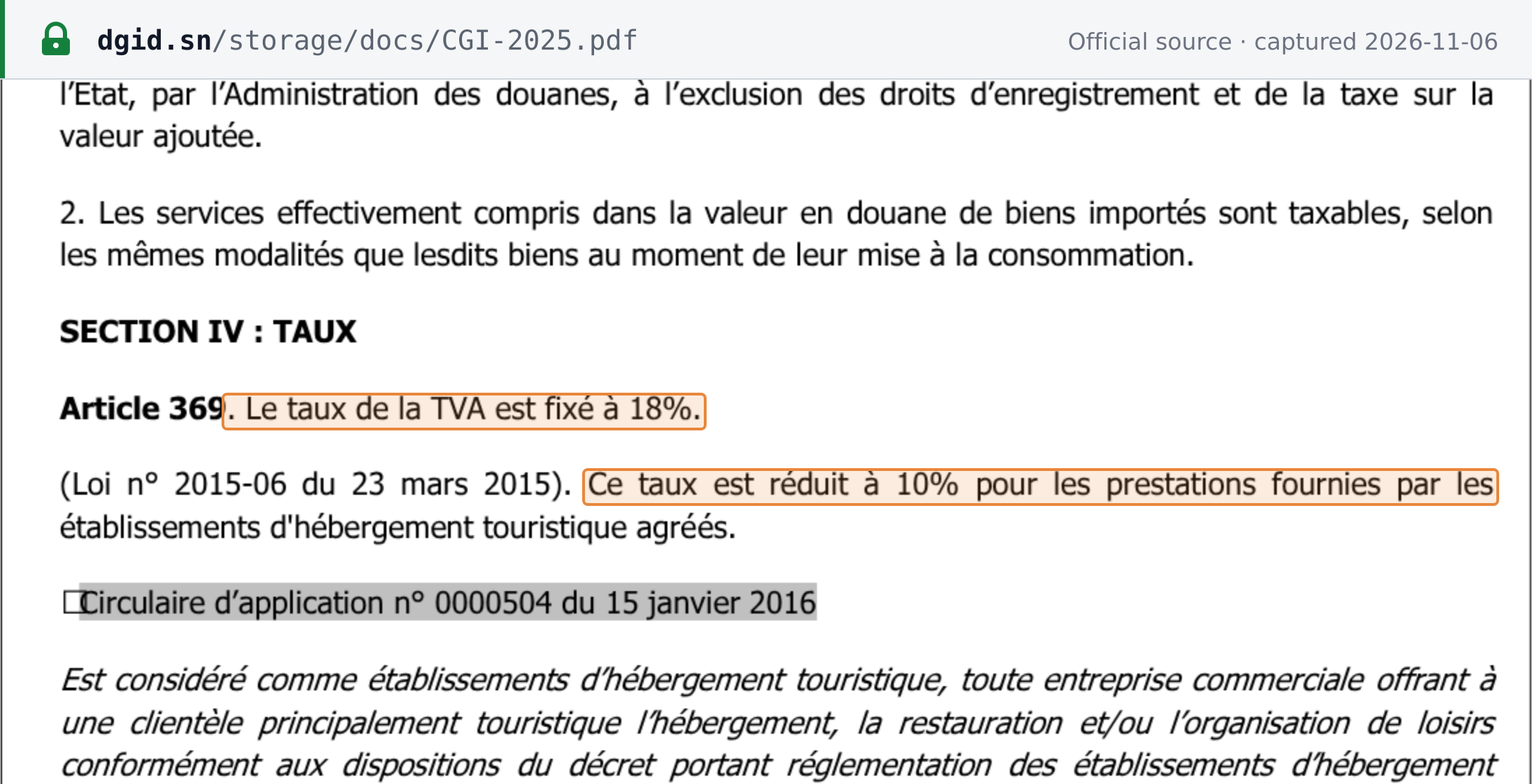
Rates per the CGI as consolidated in January 2025 (art. 369):
[1]"Article 369. Le taux de la TVA est fixé à 18%. (Loi n° 2015-06 du 23 mars 2015). Ce taux est réduit à 10% pour les prestations fournies par les établissements d'hébergement touristique agréés."
| Rate | Applies to | Legal basis |
|---|---|---|
| 18% (standard) | All taxable supplies and imports not at the reduced rate | CGI art. 369 |
| 10% (reduced) | Services of approved tourist accommodation establishments: hotels, motels, holiday villages, inns, campements villageois, serviced residences and furnished apartments offering a mainly tourist clientele lodging, catering and/or leisure (Circular 0000504 of 15 January 2016) | Art. 369, second sentence, from Loi n° 2015-06 of 23 March 2015 |
| Exempt with right to deduct (works as a zero rate) | Exports and similar operations, international transport of goods, and the other operations in art. 380 | Arts. 361-14, 361-15, 380; see Exempt is not zero-rated |
| Exempt (no deduction) | The supplies listed in art. 361 | See Exemptions |
The CGI has no 0% rate as such. The DGID's rates page also shows "TVA (taux normal)" at 18 %. [2]
 Source snapshot captured 2026-11-06 — original
Announced future rates. None. The DGID's communiqués list, as of 6 November 2026, announces no change to the 18% or 10% rate.
Cross-border rules
Imports and exports
- Imports. VAT is due on every import and is chargeable at release for consumption (art. 363-2). The base is "la valeur en douane augmentée des droits et taxes de toute nature liquidés, au profit du budget de l’Etat, par l’Administration des douanes, à l’exclusion des droits d’enregistrement et de la taxe sur la valeur ajoutée" (art. 368-1). [1] "La taxe sur la valeur ajoutée à l'importation est liquidée par l'administration des Douanes, en même temps que les droits de douane et les taxes spécifiques, au vu de la déclaration de mise à la consommation." (art. 449-7) [1] The CGI sets no de-minimis value for imported goods.
- Exports. Direct exports and similar operations are exempt (art. 361-14), as are international transport of goods abroad (art. 361-15) and international passenger transport (art. 361-16). Exports and international transport of goods keep the right to deduct (art. 380 a and d); international passenger transport is exempt without it. Art. 380 reads: "Ouvrent droit à déduction dans les mêmes conditions que si elles étaient soumises à la TVA les opérations suivantes : a. les exportations et opérations assimilées ainsi que les prestations de services directement liées aux exportations ;" (art. 380). [1] Businesses that export at least 80% of their turnover can claim refunds monthly (art. 391-2).
Place of supply
- Goods: where the goods are at the time of delivery; for goods dispatched or transported, where the transport begins; for goods installed or assembled by the supplier, where they are installed (art. 356). [1]
- Services, main rule: "Le lieu d’imposition des prestations de services est situé au Sénégal lorsque le service y est utilisé ou lorsque la personne pour le compte de laquelle le service est rendu y est établie." (art. 357-1). The two tests are alternatives. Circular 0000504 of 15 January 2016, reproduced in the annotated CGI, adds: "Un service exécuté au Sénégal mais utilisé à l’étranger échappe à la TVA au Sénégal ; inversement un service utilisé au Sénégal mais exécuté à l’étranger est taxable au Sénégal." [1]
- Exceptions (art. 359): services connected with immovable property are taxed where the property is; cultural, artistic, sporting, scientific, educational and entertainment services where they are physically performed; hire of means of transport for 30 days or less where the vehicle is made available. [1]
- Burden of proof: a supplier established in Senegal that cannot prove the place of supply is outside Senegal is taxed as if it were in Senegal (art. 360).
Foreign companies selling into Senegal — B2B and B2C
B2B (business customers). The foreign supplier must appoint a fiscal representative (art. 355-1). If it does not, the Senegalese customer owes the VAT and penalties (art. 355-3): a reverse charge in effect. The customer then usually cannot deduct that VAT on services. Article 383-f blocks deduction on "Les prestations de services, quelle que soit leur dénomination, lorsque le bénéficiaire de la rémunération n'est pas établi au Sénégal à l'exception des prestations comportant un transfert de savoir-faire définies par arrêté du Ministre chargé des Finances". Arrêté n° 039532 of 2 December 2021, reproduced under the article, excludes the commonest intra-group charges: "…ne revêtent pas le caractère de transfert de savoir-faire pour la déduction de la taxe sur la valeur ajoutée (TVA) supportée, les prestations de direction, de management, d’études, de gestion ou d’assistances administrative, juridique ou comptable, ainsi que les prestations rendues par des membres des professions libérales ou les titulaires de charges et offices lorsque le prestataire n’est pas immatriculé au Sénégal." [1]
B2C (consumers). For goods, VAT is collected by Customs at import. For digital services, the foreign supplier registers and collects the VAT itself: see below.
Digital services
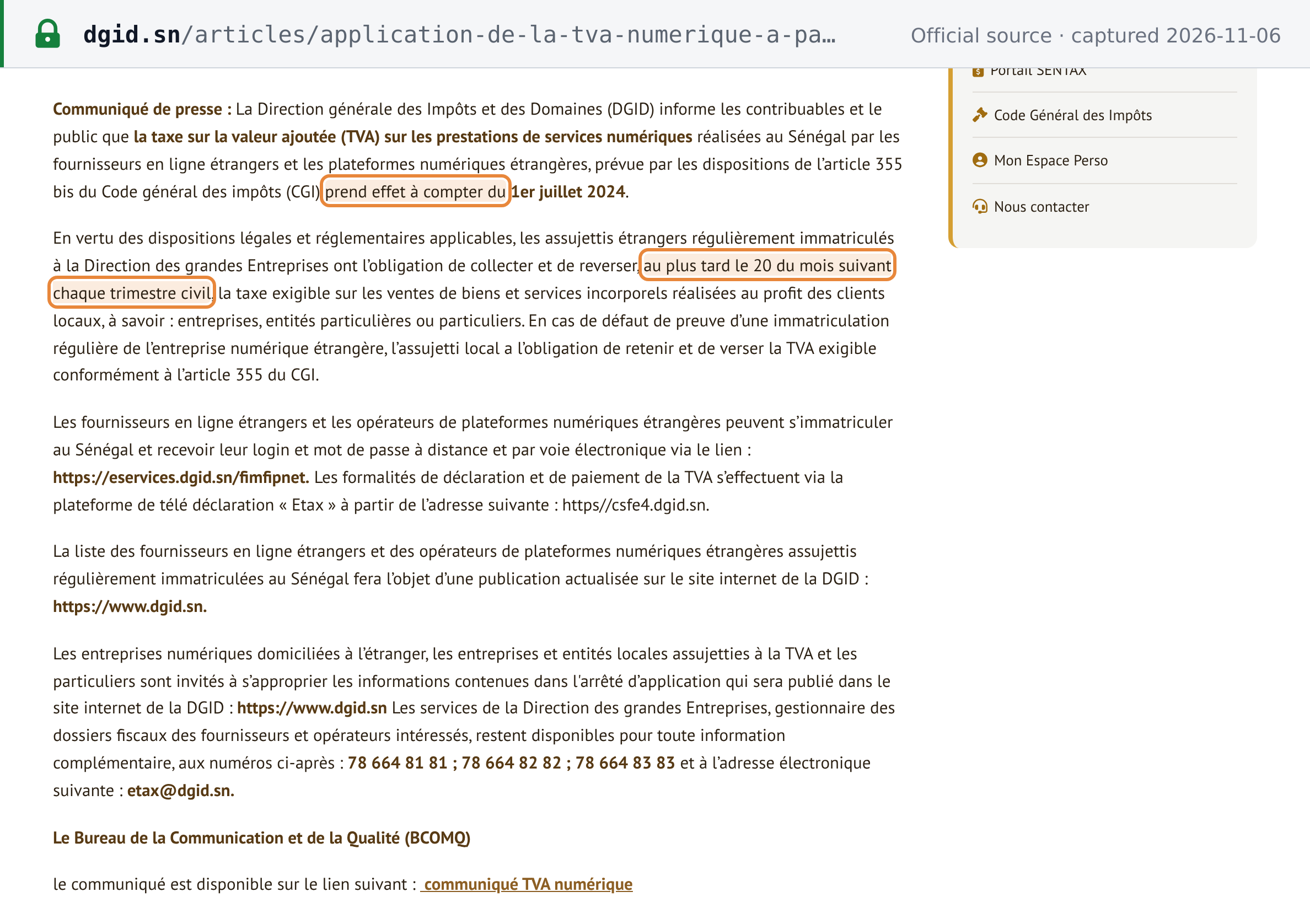
Article 355 bis (Loi n° 2023-18 of 15 December 2023) brings digital services supplied by foreign providers into Senegalese VAT where the place of supply is in Senegal. [1] The DGID's communiqué of 24 June 2024: the tax "prévue par les dispositions de l’article 355 bis du Code général des impôts (CGI) prend effet à compter du 1er juillet 2024", and "les assujettis étrangers régulièrement immatriculés à la Direction des grandes Entreprises ont l’obligation de collecter et de reverser, au plus tard le 20 du mois suivant chaque trimestre civil, la taxe exigible sur les ventes de biens et services incorporels réalisées au profit des clients locaux, à savoir : entreprises, entités particulières ou particuliers." [10]
 Source snapshot captured 2026-11-06 — original
The implementing text is Arrêté n° 010698 MFB/DGID of 27 June 2024, which repealed arrêté n° 006775 of 21 May 2024. The annotated CGI reproduces it as a scanned image (pdf pages 166–173). [1] (The same consolidation also prints, as text, an earlier arrêté on the same subject, n° 034269 of 8 November 2023.) Under arrêté 010698:
- What is caught: goods or services supplied immaterially and automatically over a computer or electronic network, such as software sales and updates, cloud storage, streaming and subscriptions, downloadable content and online advertising platforms (art. 2-a), and platforms' commissions.
- Where the customer is: the customer is treated as in Senegal if its billing address, bank account or card details, telephone country code or SIM country code, or IP address are in Senegal (art. 2-b).
- Registration: a simplified remote procedure through the DGID's e-services form (
eservices.dgid.sn/fimfipnet, the address the arrêté and the communiqué give); the supplier receives a NINEA and is managed by the DGE. The arrêté sets no registration threshold, states that registration does not create a permanent establishment (art. 5), and says these suppliers need no fiscal representative (art. 8). - Rate: 18% on the price of the services and on platforms' commissions (art. 4).
- Unregistered supplier: a Senegalese VAT-registered customer that cannot get proof of the supplier's registration must itself account for the VAT under art. 355-3 (art. 4).
- Returns and payment: quarterly. The texts differ on the due date: CGI art. 363-4 says "au plus tard le 15 des mois de janvier, avril, juillet et octobre", [1] while arrêté art. 6 says "dans les vingt premiers jours suivant chaque trimestre" and the DGID communiqué says the 20th. Filing by the 15th satisfies both. Payment is made in euros by bank transfer to the Treasury account at the BCEAO (art. 7); the DGID's notice of 25 October 2024 gives the current account and SWIFT references: "Les fonds doivent être libellés en EUR." [11] Foreign-currency prices are converted at the BCEAO rate for the last day of the month (art. 3).
- Sanction: failure to file or pay can lead to suspension of access to the platform in Senegal (art. 9).
See the explainer on VAT on digital services from non-resident suppliers.
Marketplace and platform deemed-supplier liability
For digital services only: where a foreign supplier sells through an intermediary, "la TVA est collectée et reversée, pour le compte du fournisseur, par l'intermédiaire qui a permis de réaliser la transaction" (art. 355 bis-1), and intermediaries include online marketplaces and digital platforms (art. 355 bis-5). [1] For goods there is no platform liability: arrêté 010698 art. 4 says VAT on an imported physical good is collected by Customs at the border, not by the platform operator. [1] More on these models: marketplace deemed-supplier rules.
VAT withheld by public and large buyers (précompte)
Under art. 372, the customer owes the VAT ("Le redevable de la TVA sur les opérations soumises au régime du précompte est l’acquéreur des biens livrés ou le preneur des services fournis") when the contract is paid by the State, public bodies and establishments, national and majority publicly owned companies, or public-utility concessionaires (water, electricity, telephone); by building and public-works firms registered with the DGE; or, for transport, by cement producers and importers and petroleum distributors. The customer withholds the whole VAT and declares it on a separate précompte return. [1] The regime does not apply to supplies by persons registered with the DGE (art. 372-3-a) or with the medium-enterprise service (art. 372-3-e). See VAT withholding regimes.
Invoice requirements
Mandatory content
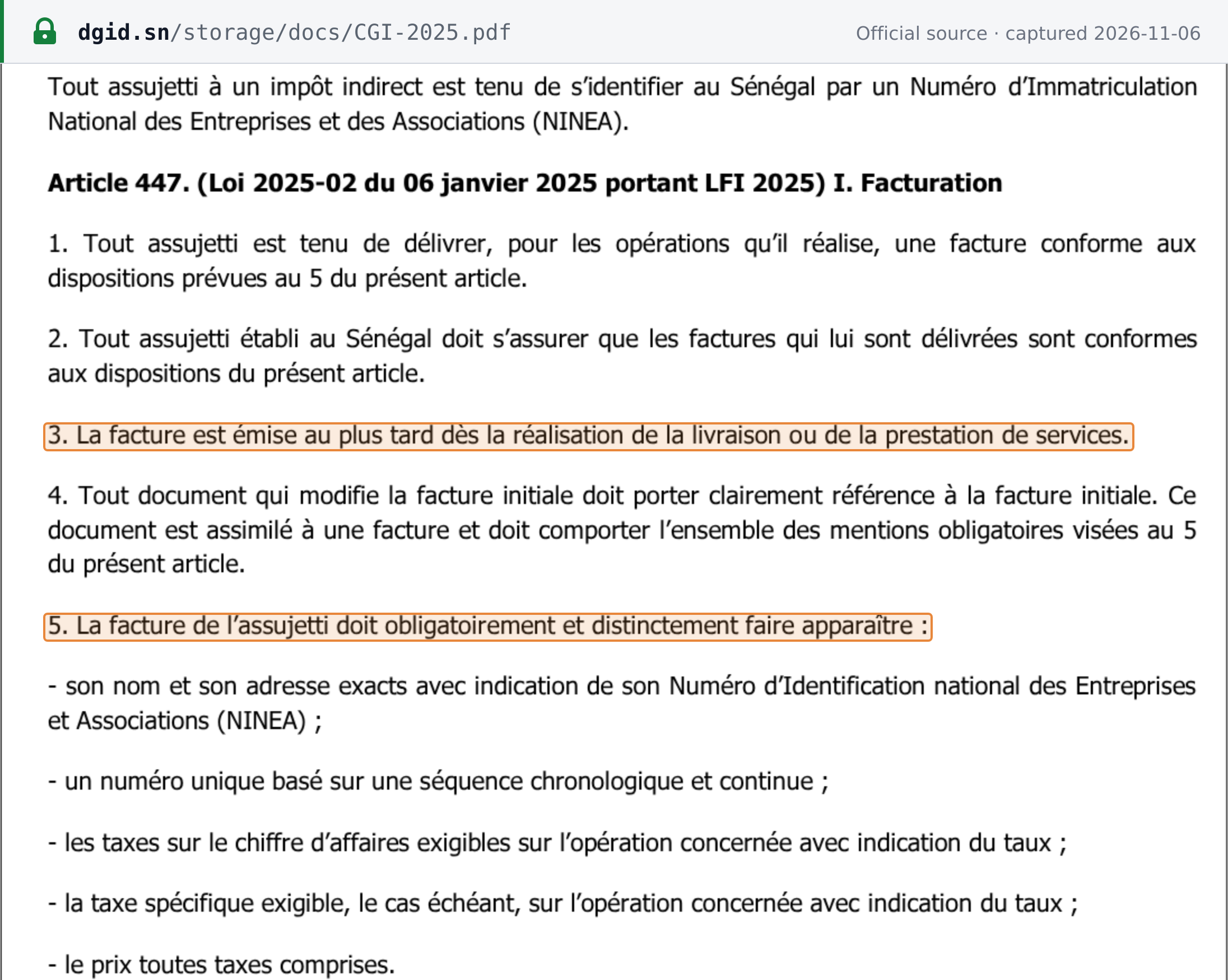
Article 447, as recast by LFI 2025 (Loi n° 2025-02 of 6 January 2025) to add the e-invoicing paragraph II, requires every taxable person to issue an invoice for each transaction (447-I-1). Under 447-I-5, "La facture de l’assujetti doit obligatoirement et distinctement faire apparaître":
| # | Particular (art. 447-I-5) | Note |
|---|---|---|
| 1 | "son nom et son adresse exacts avec indication de son Numéro d’Identification national des Entreprises et Associations (NINEA)" | Supplier's exact name, address and NINEA |
| 2 | "un numéro unique basé sur une séquence chronologique et continue" | See Numbering |
| 3 | "les taxes sur le chiffre d’affaires exigibles sur l’opération concernée avec indication du taux" | VAT amount and rate |
| 4 | "la taxe spécifique exigible, le cas échéant, sur l’opération concernée avec indication du taux" | Excise-type tax, where due, with its rate |
| 5 | "le prix toutes taxes comprises" | Price including all taxes |
| 6 | For an exemption, a supply on which the customer owes the VAT, or the margin scheme: "la référence à la disposition pertinente du présent code" | Cite the CGI article |
These particulars are what allow the customer to deduct or recover VAT (447-I-6), and a buyer established in Senegal must check that the invoices it receives comply (447-I-2). If an invoice matches no real supply, or shows a price the buyer does not actually pay, the person who issued it owes the tax and the recipient cannot deduct it (447-I-7).
The list in art. 447-I-5 does not name the customer, the invoice date or a description of the goods or services. Other articles rely on them: the buyer's deduction annex lists each supplier's NINEA, name, address, the nature of the goods or services, the price and the VAT (art. 376-2-a); the exemption schedule filed with the return lists "le numéro de la facture, le montant, l’identité exacte du client" (art. 449-2); and précompte statements list "le numéro et la date de la facture" (art. 372-2-d). In practice a compliant invoice carries them.
 Source snapshot captured 2026-11-06 — original
A specimen of a compliant invoice
The DGID publishes no specimen invoice: none appears among its procedure fiches, its rules and rates pages, its communiqués, the SENTAX guides or the CGI. The illustration below is built from art. 447; each ref names the provision that puts the field there.
FACTURE — Invoice
| Description | Qty | Unit price excl. VAT (XOF) | VAT rateArt. 447-I-5 | Amount excl. VAT (XOF) |
|---|---|---|---|---|
| Consulting services | 1 | 1,000,000 | 18% | 1,000,000 |
| Book (printed publication) — exempt, CGI art. 361-9 | 1 | 20,000 | Exempt | 20,000 |
- Total excl. VAT
- XOF 1,020,000
- VAT 18% on XOF 1,000,000Arts. 369, 447-I-5
- XOF 180,000
- Price including all taxes (TTC)Art. 447-I-5
- XOF 1,200,000
- The exempt line cites the CGI provision that exempts it, as art. 447-I-5 requires for exempt, VAT-for-account and margin-scheme supplies.
- A credit note or corrective invoice must refer clearly to this invoice and carry all the mandatory particulars (art. 447-I-4; art. 365-2-c).
- A supplier under the CGU may not show VAT and invoices all taxes included (art. 448-2).
- Once the arrêté under art. 447-II is issued, invoices must be issued, transmitted and received electronically through the platform the administration sets up.
Issuance deadline
"La facture est émise au plus tard dès la réalisation de la livraison ou de la prestation de services." (art. 447-I-3) [1] If the invoice is issued before the supply, the tax point moves to the invoice: "en cas d’émission d’une facture avant que les livraisons de biens ou les prestations de services ne soient effectuées, le fait générateur est réputé intervenir au moment de l’émission de la facture." (art. 362) [1]
Numbering and sequencing
A single number "basé sur une séquence chronologique et continue" (art. 447-I-5). The CGI prescribes no number format, prefix rule or series structure.
Credit and debit notes
- "Tout document qui modifie la facture initiale doit porter clairement référence à la facture initiale. Ce document est assimilé à une facture et doit comporter l’ensemble des mentions obligatoires visées au 5 du présent article." (art. 447-I-4) [1]
- Discounts granted after invoicing: "le fournisseur doit émettre une facture rectificative ou une note d'avoir portant référence à la facture initiale." The supplier recovers the VAT on the reduction and the customer must reduce its deduction to match (art. 365-2-c). [1]
- Cancelled, terminated or unpaid supplies and definitively irrecoverable debts give the supplier a right to offset or a refund of the VAT paid, on supporting documents (art. 389).
Currency and language
Article 447 sets no invoice currency or language. Accounting must be in French: "La comptabilité doit être tenue et présentée en langue française. Lorsqu’une pièce ou un document comptable est présenté dans une langue autre, une traduction certifiée par un traducteur assermenté doit être présentée à toute réquisition…" (art. 635). [1] The CGI gives no general rule for converting foreign-currency invoices; for foreign digital suppliers, arrêté 010698 uses the BCEAO rate for the last day of the month (art. 3).
Document types
The CGI defines no simplified invoice for domestic sales and no value threshold for one. The only simplified invoice is in arrêté 010698 art. 8: a foreign digital supplier billing private individuals may issue a simplified invoice showing its identity, address and NINEA, the type of supply, the date, the VAT due and the information used to locate the customer. When it bills a Senegalese taxable person, the invoice must show the customer's identity, NINEA and address, the nature of the service, the total price, the VAT at the standard rate and the total VAT due. [1]
Exempt sales need a visa. Invoices for VAT-exempt sales must be stamped by the tax administration (visa en exonération). "Le défaut de visa en exonération d’une facture, constaté soit au cours d’un contrôle, soit dans le cadre de demande de restitution de taxe introduite par un contribuable, donne lieu à une amende égale à 5% du montant de la taxe exonérée due sur chaque facture non soumise à cette formalité." (art. 669-I) [1]
Self-billing
The CGI's VAT and invoicing articles (arts. 362–399 and 445–451) make no provision for self-billing.
Retention and audit trail
- Ten years. Books, registers, returns, receipts, contracts and supporting documents "doivent être conservés pendant un délai dix (10) ans à compter de la date de la dernière opération mentionnée sur les livres ou registres ou de la date à laquelle les documents ou pièces ont été établis." (art. 637-I) [1] The same period covers documents created, kept or received electronically (art. 637-II).
- Audit trail. Sequential integrity comes from the "séquence chronologique et continue" of art. 447-I-5. Outside the e-invoicing provision (art. 447-II), whose implementing arrêté is not yet published, the CGI sets no tamper-evidence or hashing requirement for invoices.
E-invoicing status
Status (as of 2026-11-06): legislated, not in operation. No implementing arrêté, portal, format or start date has been published.
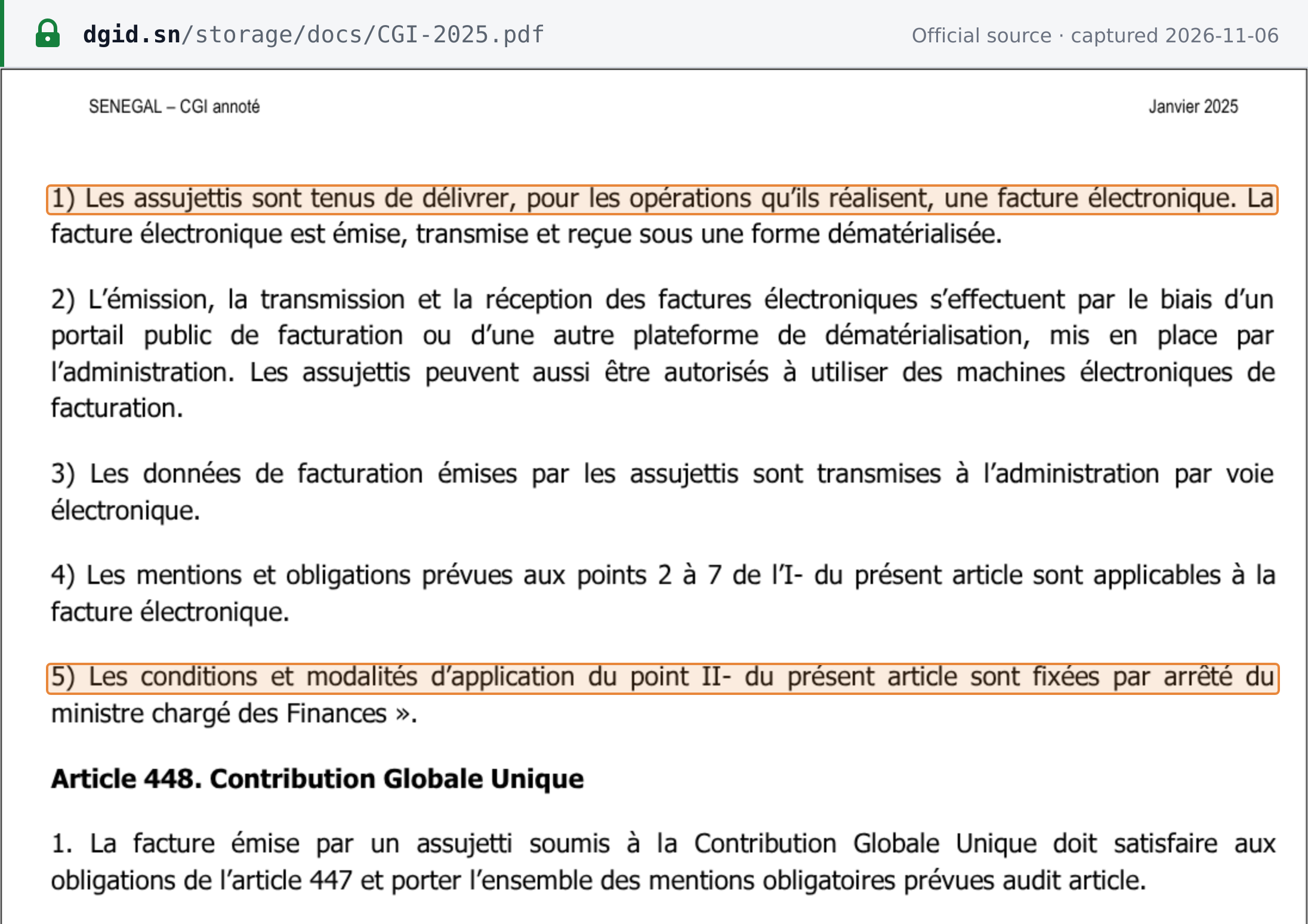
LFI 2025 added art. 447-II, Facturation électronique:
"1) Les assujettis sont tenus de délivrer, pour les opérations qu’ils réalisent, une facture électronique. La facture électronique est émise, transmise et reçue sous une forme dématérialisée. 2) L’émission, la transmission et la réception des factures électroniques s’effectuent par le biais d’un portail public de facturation ou d’une autre plateforme de dématérialisation, mis en place par l’administration. Les assujettis peuvent aussi être autorisés à utiliser des machines électroniques de facturation. 3) Les données de facturation émises par les assujettis sont transmises à l’administration par voie électronique."
The art. 447-I particulars apply to electronic invoices (447-II-4), and "Les conditions et modalités d’application du point II- du présent article sont fixées par arrêté du ministre chargé des Finances" (447-II-5). [1]
 Source snapshot captured 2026-11-06 — original
- Where things stand. As of 6 November 2026 the DGID website (its communiqués, the SENTAX page and its procedure fiches) publishes no arrêté under art. 447-II-5, no invoicing portal, no technical format and no go-live date.
- Model. The law describes a central platform receiving invoice data, with certified invoicing machines as an alternative: a CTC model with an option for fiscal devices. Neighbouring WAEMU states already run such systems: see Côte d'Ivoire's FNE and Burkina Faso's FEC.
- Scope. Article 447-II applies to taxable persons "pour les opérations qu’ils réalisent", with no carve-out for B2B, B2G or B2C; the arrêté may set the scope and any phasing.
- Penalty, once it applies: 25% of the VAT invoiced or that should have been invoiced, capped at XOF 5 million per invoice (art. 667-IV; see Penalties).
- Not to be confused with SENTAX, which is the DGID's e-filing and e-payment platform for returns, not an invoicing system.
Filing and payment
Filing frequency and due date
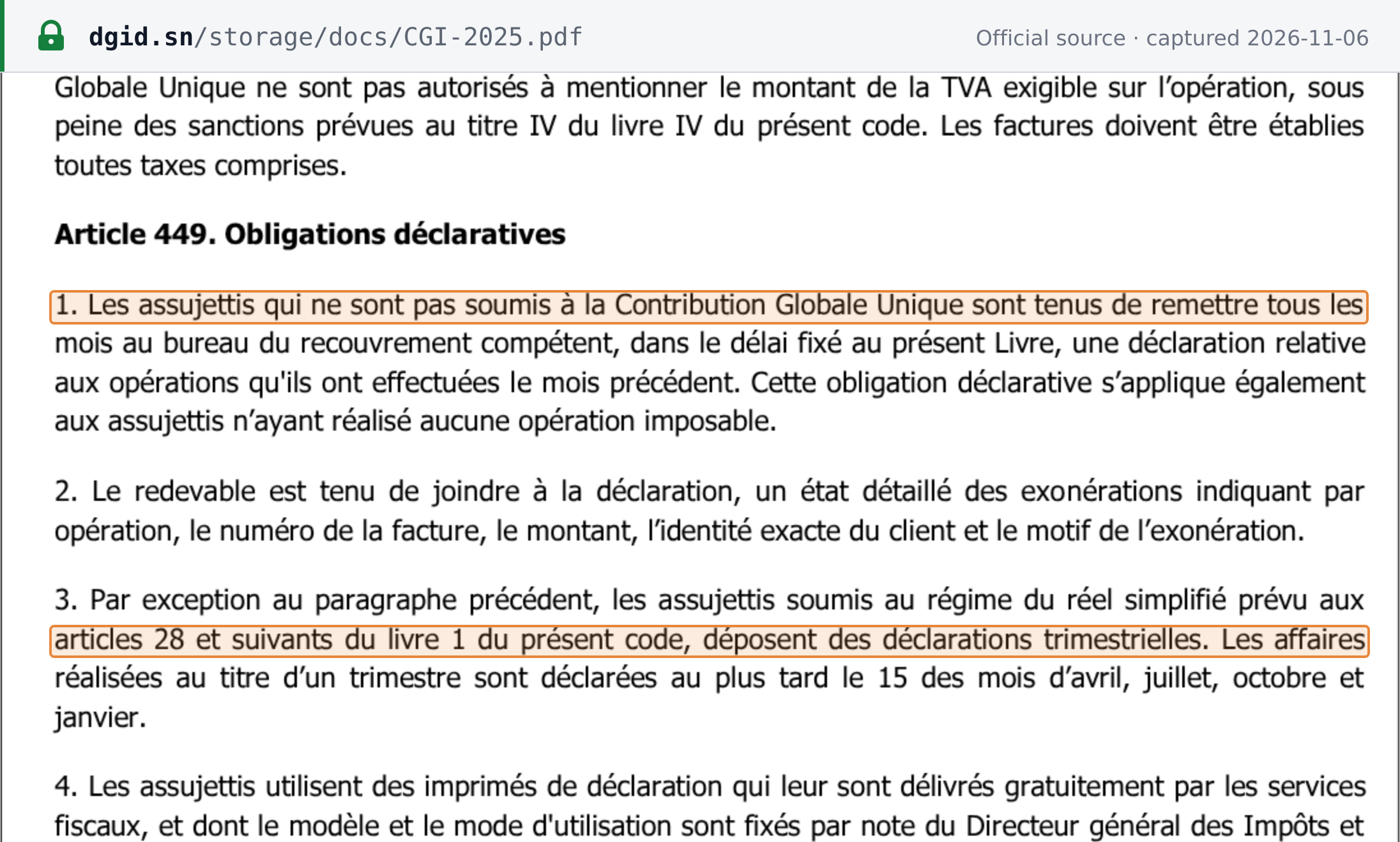
- Monthly, for every taxable person outside the CGU, including months with no taxable operations: "Les assujettis qui ne sont pas soumis à la Contribution Globale Unique sont tenus de remettre tous les mois au bureau du recouvrement compétent, dans le délai fixé au présent Livre, une déclaration relative aux opérations qu'ils ont effectuées le mois précédent. Cette obligation déclarative s’applique également aux assujettis n’ayant réalisé aucune opération imposable." (art. 449-1) [1]
- Due on the 15th of the following month: "Pour les livraisons de biens et les prestations de services, la TVA est exigible le mois suivant celui du fait générateur au plus tard le 15 de ce mois." (art. 363-1) [1]
- Quarterly for réel simplifié taxpayers (legal entities with turnover under XOF 100 million): "Les affaires réalisées au titre d’un trimestre sont déclarées au plus tard le 15 des mois d’avril, juillet, octobre et janvier." (art. 449-3) [1]
- Exemption schedule. Each return attaches a detailed schedule of exempt operations giving, per operation, the invoice number, amount, exact identity of the customer and the reason for the exemption (art. 449-2).
 Source snapshot captured 2026-11-06 — original
Payment and e-filing on SENTAX
Payment is made with the return: "Les redevables soumis au réel, sont tenus de calculer eux-mêmes et d'acquitter, lorsqu'ils déposent leurs déclarations, le montant des taxes dues sur les opérations réalisées le mois précédent." (art. 450-2) [1]
SENTAX is the DGID's platform for registering, filing and paying online. It replaces ETAX for DGE taxpayers:
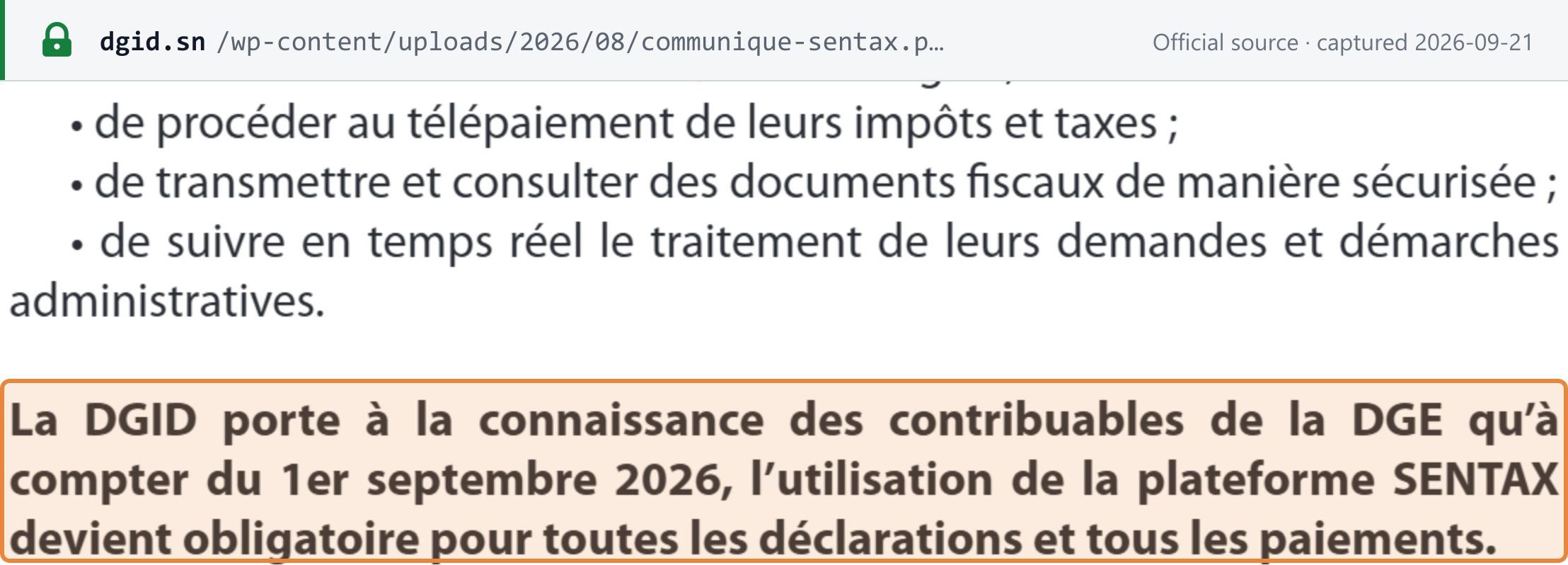
- DGE (large enterprises), from 1 September 2026: "La DGID porte à la connaissance des contribuables de la DGE qu’à compter du 1er septembre 2026, l’utilisation de la plateforme SENTAX devient obligatoire pour toutes les déclarations et tous les paiements." and "Ainsi, les déclarations sous format papier ne seront plus acceptées par les services de la DGE." [7]
- CME1, CME2 and CPR, from 1 October 2026: the DGID announced "l’ouverture de la plateforme SENTAX, pour l’accomplissement de toutes leurs obligations fiscales, à compter du 1er octobre 2026" and "À compter de la date susmentionnée, les déclarations au format papier ne seront plus acceptées." (communiqué dated 29 September 2026) [8]
- Smaller taxpayers: the DGID's Mon Espace Perso platform "est dédiée aux particuliers et aux entreprises ayant un chiffre d’affaires inférieur ou égal à 100 millions. Elle permet l’accomplissement des obligations déclaratives." [3]
 Source snapshot captured 2026-09-21 at the communiqué's earlier address; the same communiqué is now at the original
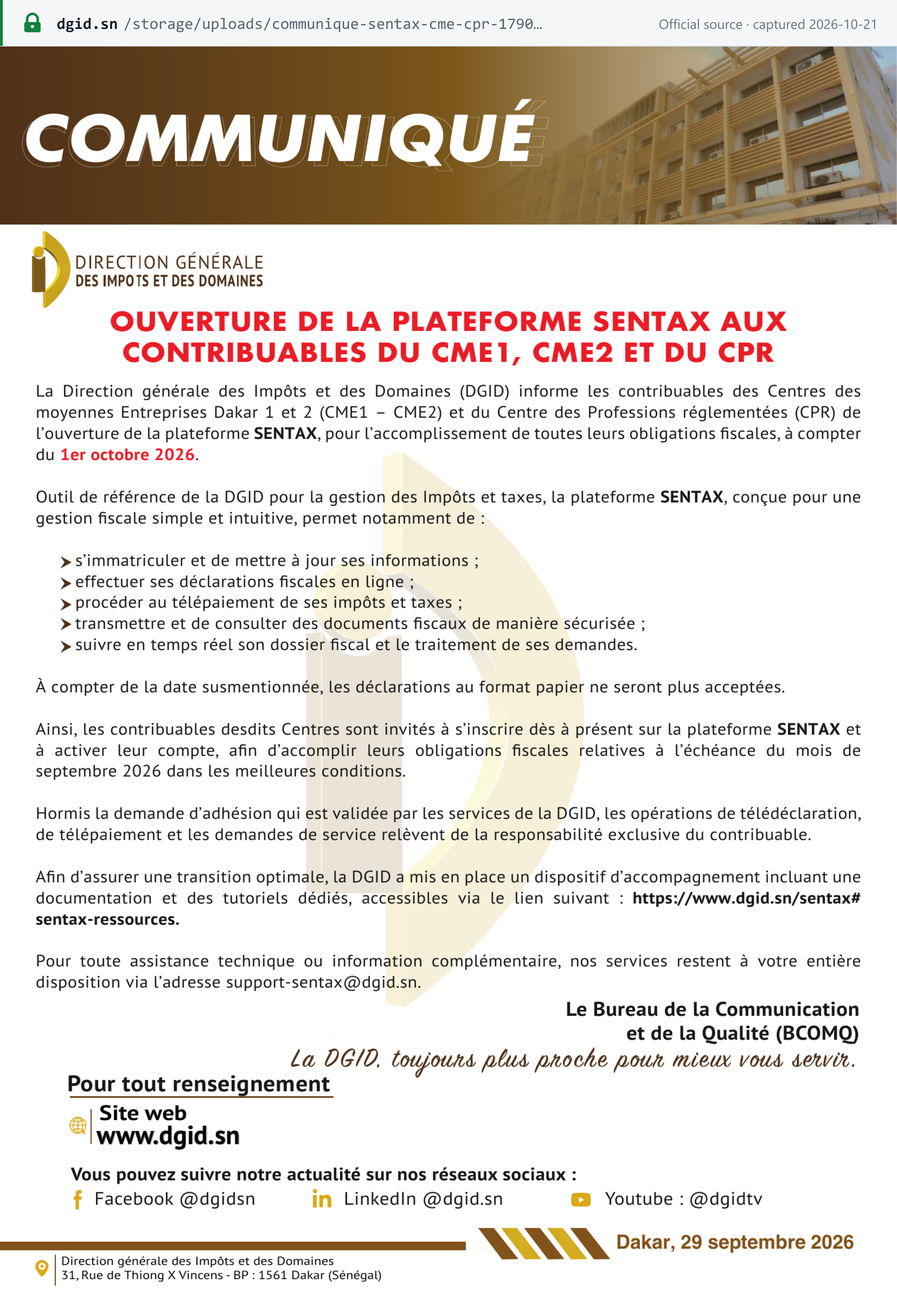 Source snapshot captured 2026-10-21 — original
Input-tax recovery and blocked items
- Evidence. VAT is deductible only if it "figure sur les factures d’achat délivrées par leurs fournisseurs ou prestataires, à la condition que celles-ci, correctement libellées, comportent l’ensemble des mentions obligatoires prévues à l’article 447 du présent Code et soient délivrées par des assujettis soumis au réel" (art. 376-1), or was paid at import with customs documents naming the claimant as the real consignee. [1]
- Timing. Deduct in the month the invoice is received; "Les taxes non déduites conformément aux règles ci-dessus, pourront toutefois l’être au cours des mois ultérieurs sans dépasser un délai de deux ans." (art. 379-2) [1]
- Private use. Nothing is deductible on goods and services whose private use exceeds 80% (art. 381).
- Blocked (art. 383; item d is repealed): [1]
- gifts and goods supplied free or well below value, unless the item is worth no more than XOF 20,000 excluding tax (a);
- lodging, catering, receptions and entertainment, with exceptions for resale, free lodging of security staff and contractual or legal liability (b);
- "les véhicules ou engins, quelle que soit leur nature, conçus pour transporter des personnes ou à usage mixte, lorsqu’ils ne sont pas destinés à être revendus à l’état neuf ou loués par un loueur professionnel" (c);
- advertising for goods and services whose advertising is prohibited (e);
- services paid to a person not established in Senegal, except know-how transfers (f; see B2B);
- furniture (meubles meublants), other than office furniture (g); [1]
- services relating to goods excluded from deduction (h).
- Mixed businesses deduct by prorata (art. 385).
Refunds
- Who: any taxable person can claim a credit that cannot be offset; resellers of goods in their original state can claim only within the limits of art. 390-6 (art. 390-1). "Le crédit de déductions n’est restituable que s’il est justifié par le régime du précompte ou des exonérations ouvrant droit à déduction." (art. 390-6), capped at the VAT on that turnover (390-7). "La TVA grevant les biens d’investissement est restituable en totalité." (390-8). Approved tourist establishments and lessors can never get a refund (390-9). [1]
- Minimum and deadline: "La demande de restitution doit porter sur un montant au moins égal à 500 000 Francs CFA." (art. 390-3). [1] Claims are filed quarterly, within two years of acquiring the goods or services; exporters (at least 80% of turnover exported) and contractors on externally financed public contracts can claim monthly. Credits not claimed within two years lapse (art. 391). [1]
- Processing: "La demande de restitution doit être instruite par l'Administration dans un délai de 30 jours à compter de la date de dépôt de la demande." and "Le remboursement du crédit doit intervenir dans les quinze jours qui suivent l’approbation de la demande de restitution." Payment is by a certificat de détaxe, usable to pay any tax and transferable by endorsement; "Sur décision du Ministre en charge des Finance, le remboursement peut se faire au moyen d’un chèque ou d’un virement bancaire." (art. 393-2, wording from LFI 2025). [1]
- Not yet on SENTAX: "Le portail SENTAX vous permettra très prochainement de le faire en ligne. A date, la demande de remboursement de TVA continue d’être gérée auprès de votre centre des impôts." (SENTAX FAQ v1.1) [9]
- Bad debts: debts that have become definitively irrecoverable give a right to offset or refund the VAT paid, with copies of the debt instruments and proof that legal remedies are exhausted (art. 389-1-b). [1]
- Non-residents: the refund articles (arts. 389–394) contain no refund scheme for non-established businesses.
Exemptions
Exempt supplies
Article 361 lists 28 categories of exempt supplies. Among them, as consolidated in January 2025: [1]
- hospital and medical care (1); medicines and pharmaceutical products listed in Annex I (2);
- unprocessed basic foodstuffs (3), listed by arrêté;
- school and university education (4);
- water and electricity supplied to households within the social tranche (5);
- financial and insurance operations (6), which bear the TAF instead;
- transfers of buildings and real-estate rights subject to registration duties (7);
- books, newspapers and periodicals, other than advertising income (9);
- rental of unfurnished residential premises (11);
- direct exports (14) and international transport (15, 16);
- seeds, fertiliser, phytosanitary products and animal feed (22);
- domestic butane gas (24);
- "jusqu'au 31 décembre 2026, les livraisons et importations de matériels agricoles, les aménagements et les prestations de services agricoles dont la liste est fixée par arrêté conjoint du Ministre chargé des Finances et du Ministre en charge de l'Agriculture" (26); [1]
- equipment for renewable-energy production listed by arrêté (27).
Per the January 2025 text, the agricultural exemption (26) ends on 31 December 2026. Exempt invoices need the administration's visa (see Document types).
Exempt is not zero-rated
An exempt supply gives no right to deduct input VAT. Deduction is limited to VAT on purchases used for "une opération taxable à la TVA et effectivement taxée, exemptée ou exonérée en vertu de l'article 380" (art. 374-1). [1] Article 380 is the short list of exempt operations that keep the deduction right, the equivalent of a zero rate: exports and services directly linked to them; services supplied abroad by a VAT-identified taxable person (other than telecoms under art. 358); supplies to free-zone businesses and to regimes with visa'd exemptions; international transport of goods; the agricultural supplies of art. 361-26; and pasteurised milk. [1] Everything else in art. 361 is exempt without credit. See zero-rated vs exempt.
Special regimes
- Small business: the CGU (see Registration); there is no separate flat-rate VAT scheme.
- Investment Code: imports and local purchases by companies approved under the Investment Code for their approved programme are made under VAT suspension (art. 373-1). [1]
- Margin schemes: travel agents and tour organisers (art. 370) and second-hand goods dealers (art. 371), who cannot deduct VAT on the related costs (art. 382). [1]
- Précompte: see VAT withheld by public and large buyers.
Offences and penalties
Offences
- Tax fraud (art. 679): "…est passible d’une amende de cinq millions (5.000.000) à vingt-cinq millions (25.000.000) de francs et d’un emprisonnement de deux (2) à cinq (5) ans, quiconque : 1. se soustrait frauduleusement ou tente de se soustraire frauduleusement à l’établissement ou au paiement total ou partiel d’un impôt… qu’il s’agisse de dissimulation, de défaut de reversement, de manœuvre ou de tout autre procédé frauduleux ;". The same penalty applies to misappropriating taxes, producing false documents to obtain a refund, and organising insolvency to escape tax. [1]
- Accounting fraud (art. 682): the art. 679 penalty applies to keeping irregular accounts, knowingly omitting or falsifying entries, or destroying mandatory documents before the legal period.
- False statements (art. 683): a fine of XOF 5,000,000 to 10,000,000 and two years' imprisonment. [1]
- Obstruction (art. 686): a fine of XOF 500,000 to 5,000,000 for refusing to obey tax officers, obstructing them, or organising or inciting refusal to pay tax.
- Complicity (art. 687): accomplices face the same penalties; for a company, the managers are prosecuted.
- Prosecution (art. 688): begins on a complaint by the Directeur général des impôts et des domaines, the director in charge of public accounting, or the public accountant whose collection is obstructed. [1]
Penalties
| Failure | Sanction | CGI |
|---|---|---|
| Late payment | "un intérêt de retard simple de 5% liquidé sur le solde impayé", plus 0.5% for each further month or part-month; also on corrective returns | Art. 665-I |
| Late or missing return or payment | "une pénalité égale à vingt-cinq pour cent (25%) des droits éludés" | Art. 671-I |
| Failure to remit tax invoiced, collected or withheld; bad faith; abuse of law; assessment by default | 50% of the tax | Art. 671-III |
| Repeat offence, undeclared activity | 100%; fines and penalties doubled on repeat | Art. 671-IV, VII |
| Any breach with no specific fine (e.g. missing déclaration d'existence) | XOF 200,000 | Art. 667-I |
| E-invoicing: failure to issue, transmit or receive an electronic invoice under art. 447-II | "une amende égale à 25 % du montant de la TVA facturée ou qui aurait dû être facturée sans dépasser cinq millions de francs par facture" | Art. 667-IV |
| No compliant accounts; opposing an audit; deliberate and repeated false NINEA on an invoice; seeking a refund with a false or already-used invoice; repeated mention on invoices of an indirect tax not declared | XOF 5,000,000, doubled on repeat | Art. 668 |
| Exempt invoice without the administration's visa | 5% of the exempted tax per invoice | Art. 669-I |
| Showing an indirect tax on an invoice | "Toute personne qui mentionne un impôt indirect sur une facture ou tout autre document en tenant lieu, est redevable de l’impôt du seul fait de sa mention." | Art. 673 |
Source: CGI arts. 665–673, pdf pages 321–326. [1] Once definitively fixed, fines, penalties and interest cannot be settled by negotiation (art. 672). [1] For foreign digital suppliers, arrêté 010698 adds suspension of access to their platforms in Senegal (art. 9).
Frequently asked questions
We are a foreign software company selling online to customers in Senegal. Do we have to register and when do we file?
Yes. Since 1 July 2024, foreign suppliers of digital services and foreign digital platforms whose customers are in Senegal must collect 18% VAT (CGI art. 355 bis; Arrêté n° 010698 of 27 June 2024). They register remotely through the DGID's simplified procedure, receive a NINEA and are managed by the Direction des grandes Entreprises (DGE). The arrêté says they do not need a fiscal representative and that registration does not create a permanent establishment. Returns are quarterly, but the texts differ on the due date: CGI art. 363-4 says by the 15th of January, April, July and October, while the arrêté (art. 6) and the DGID communiqué of 24 June 2024 say within the first 20 days after each quarter. Filing by the 15th satisfies both. Payment is made in euros to the Treasury account at the BCEAO. If a foreign supplier cannot show it is registered, a Senegalese VAT-registered business customer must withhold and pay the VAT itself.
Our Senegalese subsidiary pays its foreign parent for management services. Can it deduct the VAT it accounts for?
No. CGI art. 383-f blocks the deduction of VAT on services of any kind where the person receiving the payment is not established in Senegal, except services involving a transfer of know-how as defined by ministerial arrêté. Arrêté n° 039532 of 2 December 2021 (art. 2) states that management, direction, studies and administrative, legal or accounting assistance, and services of the liberal professions, are never a transfer of know-how when the provider is not registered in Senegal. If the foreign parent has not appointed a fiscal representative, the subsidiary still owes the VAT under art. 355-3, so for these services it is a cost.
A supplier taxed under the CGU gave us an invoice showing VAT. Can we deduct it?
No. Businesses under the contribution globale unique (CGU) may not show VAT on their invoices and must invoice all taxes included (CGI art. 448-2). Input VAT is deductible only if it appears on an invoice that carries all the art. 447 particulars and is issued by a taxable person under the real regime (art. 376-1). A supplier that shows VAT on an invoice owes that VAT simply because it mentioned it (art. 673), and a repeated mention of an undeclared indirect tax on invoices carries a fine of XOF 5,000,000 (art. 668-I-5).
We are a large-enterprise (DGE) taxpayer. Can we still file VAT returns on paper or on ETAX?
No. The DGID's communiqué states that SENTAX replaces ETAX for DGE taxpayers and that from 1 September 2026 using SENTAX is mandatory for all their returns and payments; paper returns are no longer accepted by the DGE. For taxpayers of the medium-enterprise centres Dakar 1 and 2 (CME1, CME2) and the regulated-professions centre (CPR), SENTAX opened on 1 October 2026 and paper returns are no longer accepted from that date. VAT refund claims cannot yet be filed on SENTAX: the DGID's SENTAX FAQ says they are still handled at the taxpayer's tax centre.
A public-sector customer paid our invoice without the VAT. Why?
Under the précompte regime in CGI art. 372, the customer, not the supplier, owes the VAT when the contract is paid by the State, other public bodies, public establishments, national companies, majority publicly owned companies or public-utility concessionaires such as water, electricity and telephone. The same applies to building and public-works firms registered with the DGE and, for transport, to cement producers and importers and petroleum distributors. The customer withholds the whole VAT and declares it on a separate précompte return. The regime does not apply to supplies by persons registered with the DGE (art. 372-3-a) or with the medium-enterprise service (art. 372-3-e).
Is e-invoicing mandatory in Senegal?
It is legislated but not yet in operation. Article 447-II of the CGI, added by Loi n° 2025-02 of 6 January 2025 (LFI 2025), requires taxable persons to issue electronic invoices through a public invoicing portal or another platform set up by the administration, possibly using authorised electronic invoicing machines, with invoice data transmitted to the administration. The conditions are to be set by an arrêté of the Finance Minister. As of 6 November 2026 the DGID website (its communiqués, the SENTAX page and its procedure fiches) publishes no such arrêté, no portal, no format and no start date. Once it applies, failing to issue, transmit or receive an electronic invoice carries a fine of 25% of the VAT invoiced or that should have been invoiced, capped at XOF 5 million per invoice (art. 667-IV).
Important websites
| Site | What it is for |
|---|---|
| SENTAX | Registration, online returns and payment; mandatory for DGE taxpayers since 1 September 2026 and for CME1, CME2 and CPR taxpayers since 1 October 2026 |
| SENTAX resources | DGID guides, FAQ and the SENTAX roll-out calendar |
| Mon Espace Perso | Returns for individuals and businesses with turnover of XOF 100 million or less |
| DGID E-Services | Rent, third-party payment and salary statements |
| DGID — NINEA fiche | How to obtain a NINEA: documents, cost and timing |
| DGID — déclaration d'existence fiche | Filing the start-of-business declaration |
| DGID — rates | Current tax rates, including VAT and CGU |
| Code général des impôts (January 2025 consolidation) | The full annotated CGI |
| SEN'INFOGREFFE | RCCM company register |
| Douanes sénégalaises | Customs, where import VAT is assessed |
| Lookuptax Senegal RCCM validator | Check the format of an RCCM company-registry number |
The DGID website offers no public NINEA verification service, and no e-invoicing portal exists yet (see E-invoicing status). Foreign digital-service suppliers register through the e-services form named in the DGID's 2024 communiqué (see Digital services).
Recent changes
- 2026-10-01 — SENTAX opened to taxpayers of CME1, CME2 and CPR; paper returns no longer accepted from that date. (DGID) — see event
- 2026-09-01 — SENTAX, replacing ETAX, mandatory for all returns and payments of DGE taxpayers; the DGE no longer accepts paper returns. (DGID) — see event
- 2025-01-06 — Loi n° 2025-02 (LFI 2025): art. 447 recast to add the e-invoicing mandate (art. 447-II, pending its arrêté); the art. 447-I particulars are unchanged; e-invoicing fine in art. 667-IV; refunds paid by certificat de détaxe (art. 393-2). (DGID — CGI consolidated January 2025)
- 2024-07-01 — VAT on digital services supplied by foreign providers and platforms in force (art. 355 bis; arrêté n° 010698 of 27 June 2024). (DGID)
For the full chronology, see Senegal tax changes on Lookuptax.
Reference links
Legislation (published by the DGID):
- [1] Code général des impôts — CGI annoté, mis à jour janvier 2025 (Loi n° 2012-31 of 31 December 2012 as amended to Loi n° 2025-02 of 6 January 2025; reproduces arrêtés n° 010698 of 27 June 2024 and n° 039532 of 2 December 2021)
Direction générale des Impôts et des Domaines:
- [2] Lois et règlements — taux des impôts
- [3] Entreprises
- [4] Fiche — NINEA (PDF)
- [5] Fiche — déclaration d'existence
- [6] SENTAX
- [7] Communiqué — lancement de SENTAX (DGE)
- [8] Communiqué — ouverture de SENTAX aux contribuables du CME1, CME2 et du CPR, 29 September 2026
- [9] SENTAX — Questions fréquentes (FAQ) v1.1
- [10] Application de la TVA numérique à partir du 1er juillet 2024 — communiqué of 24 June 2024 (PDF)
- [11] Avis sur le changement de code SWIFT du Sénégal — payment references for foreign digital suppliers
Related on Lookuptax: