Sierra Leone GST guidelines
| FACTSHEET | |
|---|---|
| Country code | SL |
| Tax name | Goods and Services Tax (GST) |
| Tax Authority | National Revenue Authority (NRA) |
Overview
Sierra Leone levies Goods and Services Tax (GST) under the Goods and Services Tax Act, 2009 (Act No. 6 of 2009). Section 14(1) provides: "GST is imposed on- (a) a taxable supply; and (b) a taxable import." GST started on 1 September 2009. NRA's GST page says it replaced seven taxes: "Import Sales Tax, Domestic Sales Tax, Entertainment Tax, Restaurant and Food Tax, Messages Tax, Hotel Accommodation Tax and Professional Services Tax". [1] [2]
Which text is the law. The only consolidated text NRA publishes is an "unofficial consolidated" GST Act, amended up to 2016 and "produced for NRA internal purpose only". Each Finance Act from 2017 to 2026 amends it separately.
Authority. GST is administered by the Commissioner-General of the National Revenue Authority (NRA): "Payments of GST must be made to the Commissioner General of the NRA (the Commissioner General), who is the official appointed by law to administer the Tax." Domestic GST is handled by NRA's Domestic Taxes Department, and GST on imports is collected at customs. Procedure, records, the taxpayer identification number and most penalties sit in the Revenue Administration Act, 2017 (Act No. 10 of 2017), which repealed those Parts of the GST Act. [2] [9]
Currency. The Leone. "An amount taken into account under this Act shall be expressed in the Leone" (s.53(1)). The Leone was redenominated on 1 July 2022: "one thousand Leones shall yield a face value of one Leone" (Bank of Sierra Leone, Currency Redenomination Technical Guidelines, §2.1.2). Amounts in the Finance Acts from 2024 are in new Leones (ISO code SLE; the Acts write "Le" or "NLe"). Amounts in instruments made before July 2022 are quoted on this page as written, marked as pre-2022 Leones. [1] [18]
Tax period. "“tax period” means a month or such other prescribed period for which a taxable person shall declare its GST liability" (s.2). The Finance Act 2025 sets its filing penalties for a "monthly GST return". [1] [5]
Layering. None. GST is a single national tax; the GST Act provides for no provincial or district GST.
For other West and Southern African systems, see the Nigeria VAT guide and the Malawi VAT guide, and the Liberia and Ghana tax ID guides.
Registration
Who should register
Section 15(1) of the GST Act requires a person to apply for registration "on the last day of any month, if– (a) the person exceeded the registration threshold in the period of 12 or lesser months ending on that day; (b) the person exceeded one-third of the registration threshold in the period of 4 months ending on that day; or (c) there are reasonable grounds to expect that the person will exceed the registration threshold in the twelve-month period commencing on the following day." [1]
- Deadline to apply. The application "shall be lodged with the Commissioner-General within 30 days of the date on which the person is required to apply for registration" (s.15(6)).
- Registration date. The Commissioner-General registers the person and, "within 21 days of the date of the receipt of the application for registration", notifies it in writing; registration takes effect from "the date on which the person was required to be registered" (s.16(1)).
- Certificate. NRA issues a GST registration certificate that includes the effective date and "the person's TIN" (s.16(7)). The original must be displayed at the principal place of business and a certified copy at every other place of business (s.16(9)). Changes of name, address, place of business or nature of the activity must be notified "within 14 days of the change occurring" (s.16(10)). [1]
Registration regardless of turnover. Section 15(4) requires certain persons to apply "irrespective of whether the person exceeds the registration threshold": a government entity or local council carrying on a taxable activity; a promoter of public entertainment, or a licensee or proprietor of a place of public entertainment; and, from 1 January 2026, a supplier of digital services to consumers in Sierra Leone (see Non-resident registration). [1] [4]
Registration threshold
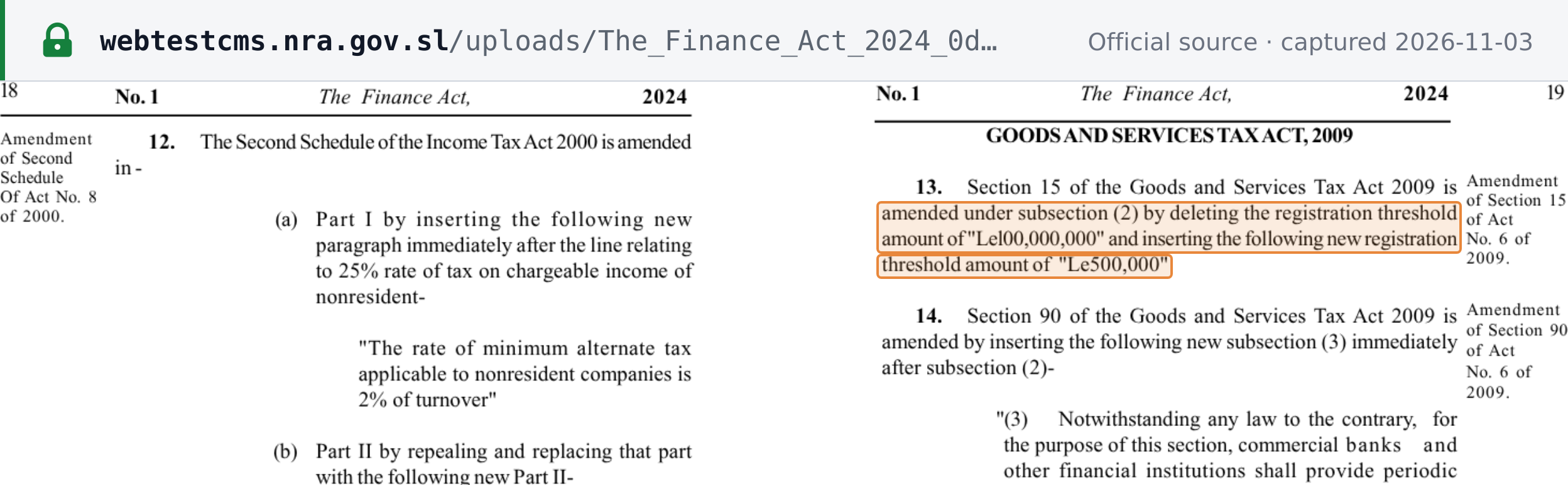
Le500,000 (new Leones, SLE 500,000) of GST-exclusive turnover of taxable supplies in any twelve-month period (as at 2026-11-03). Section 13 of the Finance Act, 2024 (Act No. 1 of 2024; Gazette Vol. CLXV No. 3 of 11 January 2024; in force 1 January 2024) amended section 15(2) "by deleting the registration threshold amount of "Le100,000,000" and inserting the following new registration threshold amount of "Le500,000"". [3]
- Measurement. Section 15(2) defines the threshold as "a GST-exclusive turnover of taxable supplies in any twelve month period", tested monthly on the 12-month, 4-month and forward-looking limbs of s.15(1) above. It "may be amended by statutory instrument".
- What is left out. Non-taxable supplies, sales of capital assets, and sales on the transfer or cessation of the business. Imported services the person would account for under s.24 are counted, and the Commissioner-General may require related persons' supplies to be added. [1]
- Earlier figures. The Finance Act 2022 (s.18) had replaced Le 350,000,000 with Le 100,000,000; both are pre-2022 Leone amounts. NRA's 2022 Tax Guide still gives the older Le 350,000,000 figure, which no longer applies. [11]
 Source snapshot captured 2026-11-03 — original
Non-resident registration
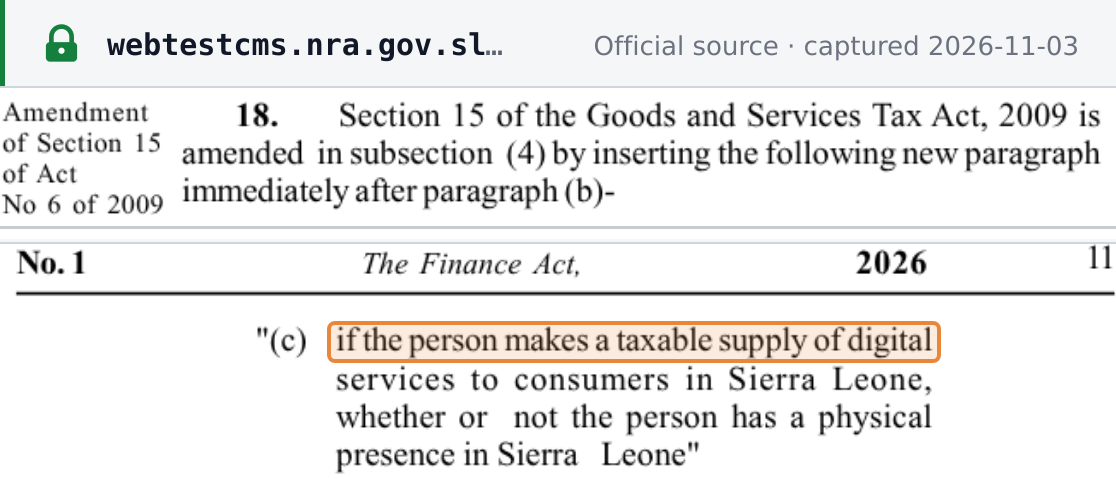
No threshold for digital services to consumers, from 1 January 2026. Section 18 of the Finance Act, 2026 (Act No. 1 of 2026; Gazette Extraordinary No. 3 of 7 January 2026; in force 1 January 2026) adds a third class to s.15(4): "(c) if the person makes a taxable supply of digital services to consumers in Sierra Leone, whether or not the person has a physical presence in Sierra Leone". Neither the GST Act nor the Finance Act 2026 defines "consumers". [4]
- Local representative. The new s.100 provides: "A person supplying digital services in Sierra Leone without any physical presence or registered office in Sierra Leone shall, by notice in writing, appoint a person with physical presence or registered office in Sierra Leone to be his representative for the purposes of this Act."
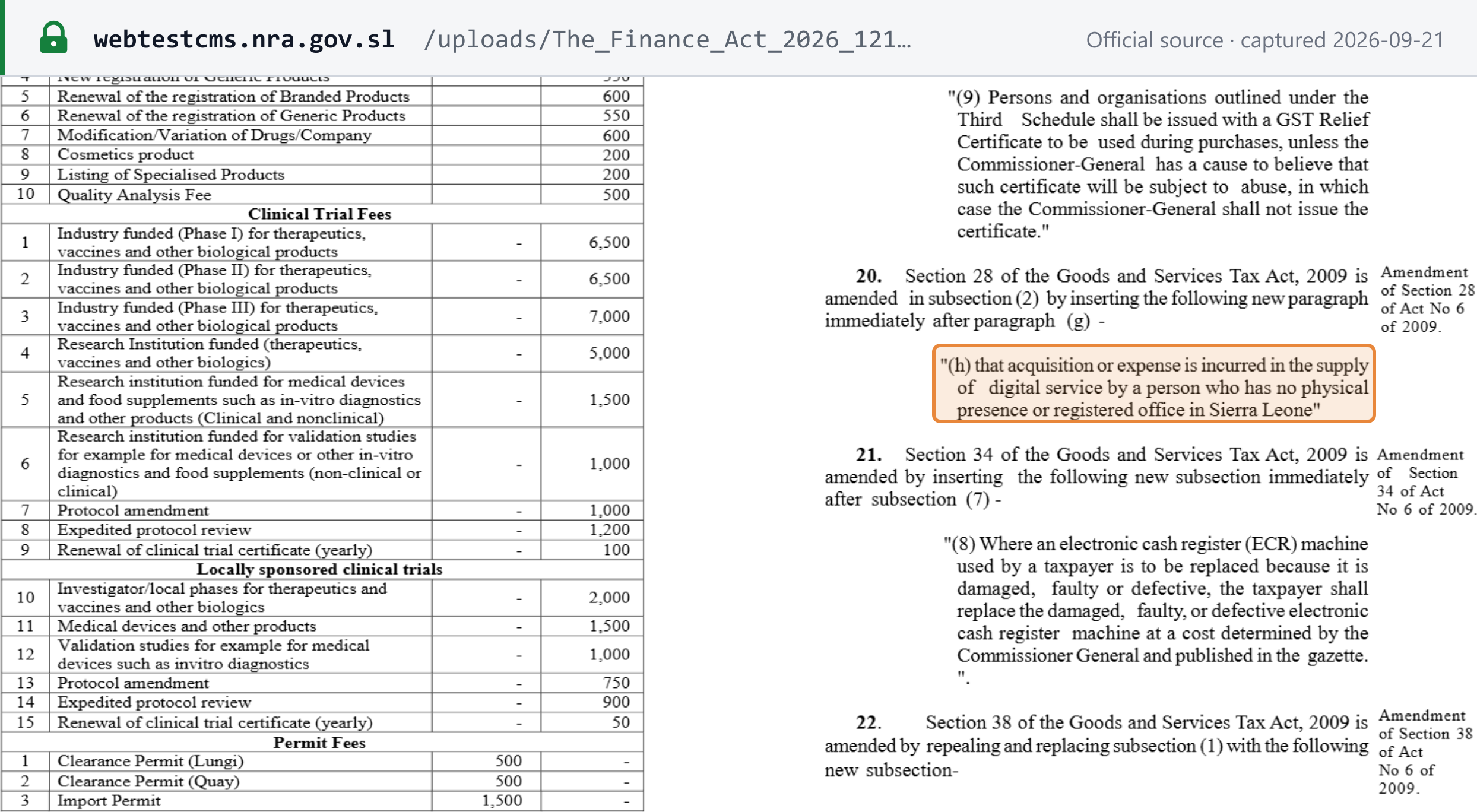
- No input tax. The new s.28(2)(h) denies credit where "that acquisition or expense is incurred in the supply of digital service by a person who has no physical presence or registered office in Sierra Leone" (see Digital products and services).
- Procedure. The Finance Act 2026 (s.33) lets the Minister make regulations "relating to the taxation of digital services, including the supply of cross-border digital services". NRA has published no such regulations, and no registration form, portal or filing procedure specific to non-resident suppliers. [4]
 Source snapshot captured 2026-11-03 — original
Other non-residents have no separate registration rule. Where a non-resident makes a taxable supply or import through a resident agent, "the GST payable under that subsection is payable by the resident agent and not by the non-resident principal" (s.14(5)). [1]
Tax identification number
GST registration is tied to the Taxpayer Identification Number (TIN) issued by NRA. Under the Revenue Administration Act 2017, "A Taxpayer Identification Number is personal to the person to whom it has been issued and may not be transferred or used by any other person", and "A person shall have only one Taxpayer Identification Number at any time and it shall be used for the purposes of all revenue laws" (s.22(3)–(4)). The Finance Act 2022 (s.21) re-enacted GST Act s.99, under which the Commissioner-General issues a TIN to "a resident person and a non-resident person with no permanent establishment in Sierra Leone but whose income source is from Sierra Leone". [9] [12]
NRA's legacy TIN page describes it as "a unique computer-generated number allocated to each taxpayer". NRA publishes no TIN format (length or check digit), and we found no public TIN lookup. [21]
How to register
NRA's legacy guidance, written when GST began in 2009, sets out the steps:
- TIN first. "However, before registering you must be in possession of a Taxpayer Identification Number, or TIN."
- Form. "To register for GST you must complete the GST Registration Form GST 01 which is available from any NRA office." NRA's current forms page lists no GST registration form.
- Documents for the TIN. A Sierra Leonean individual or sole proprietor provides a National Identification Number and passport (if held); "Non-nationals will have to provide their passports"; a business provides the registration number on its certificate from the Office of the Administrator and Registrar General. [16] [21]
Once registered, returns and payments go through NRA's Integrated Tax Administration System (ITAS), and an ECR must be installed (see Invoice requirements). For the general process across countries, see how to register for VAT, sales tax or GST.
Voluntary registration
Available. "A person who is not required to apply for registration may apply for registration if the person is carrying on a taxable activity and makes or intends to make supplies that would be taxable if the person were registered" (s.15(5)). The Commissioner-General registers the person only if satisfied that it makes or will make taxable supplies, has a fixed place of business, will keep proper records and lodge regular and reliable returns, and, if already trading, has complied with other tax and customs laws (s.16(5)). [1]
Deregistration
- Mandatory. A registered person that stops making taxable supplies for six months, and does not intend to make any in the following twelve months, must apply for cancellation "within 7 days after the end of the six-month period" (s.17(1)).
- Optional. A registered person below the threshold for a twelve-month period may apply, "except where the person is required to be registered irrespective of the registration threshold" (s.17(2)).
- Goods on hand. On cancellation, the person is treated as having made a taxable supply of goods or services on hand on which it was allowed an input tax credit (s.17(6)).
- ECR. NRA's legacy ECR page: "When you decide to close your business, after completing all requirements about the GST de-registration ECR machine must be returned to NRA." [1] [17]
Group registration
Available, with approval. "A group of taxable persons may with the approval of the Commissioner-General, be treated for the purposes of GST as one taxable person provided each member of the group undertakes to be jointly and severally liable for any contravention this Act" (s.16(2)). [1] See VAT grouping.
Rates
| Rate | Applies to | Basis |
|---|---|---|
| 15% (standard) | All taxable supplies and imports not zero-rated, including digital services | GST Act s.14(3)(b) |
| 0% | First Schedule supplies: exports of goods, stores on departing vessels and aircraft, and mini-grid solar energy | GST Act s.10, s.14(3)(a) and First Schedule |
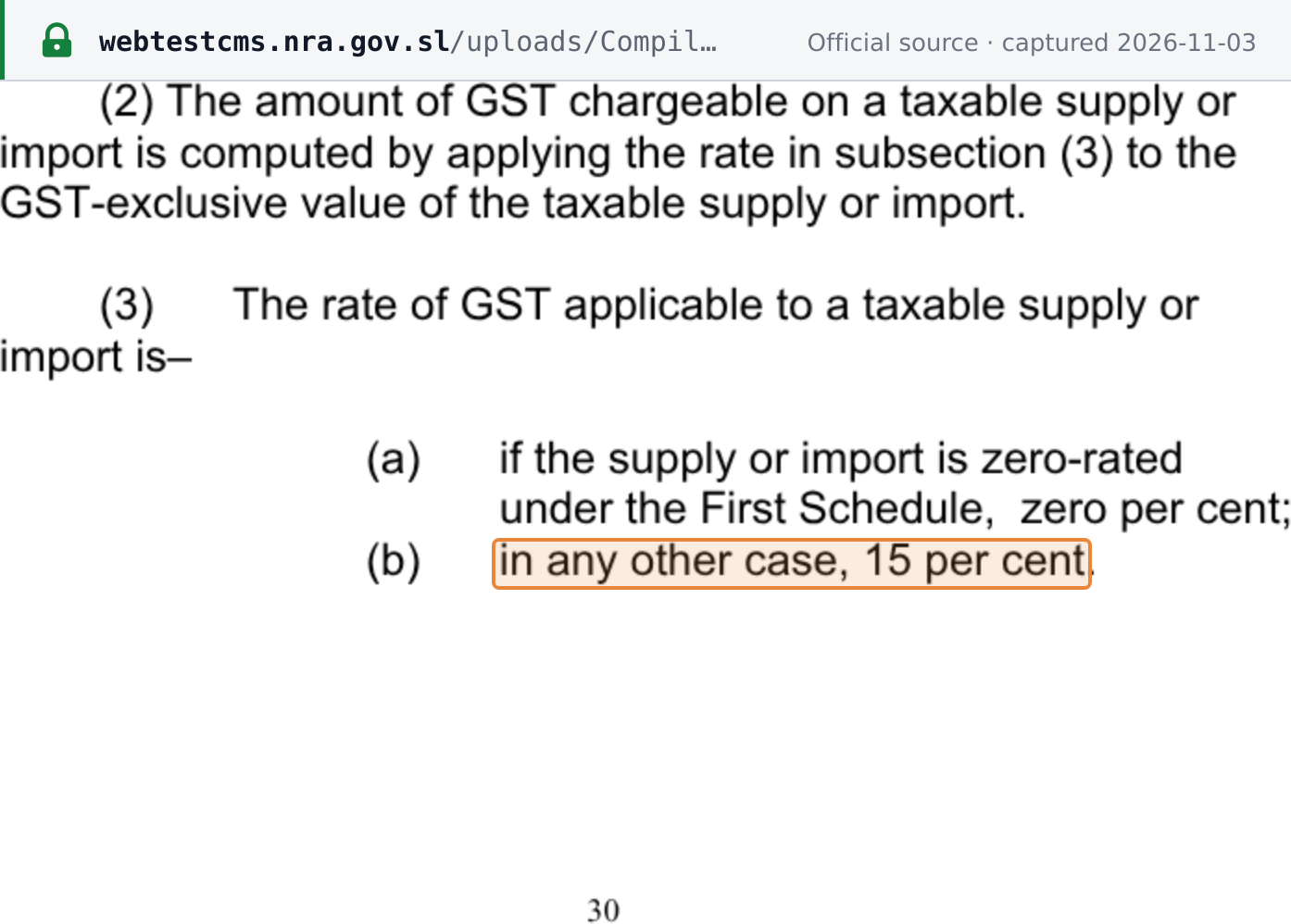
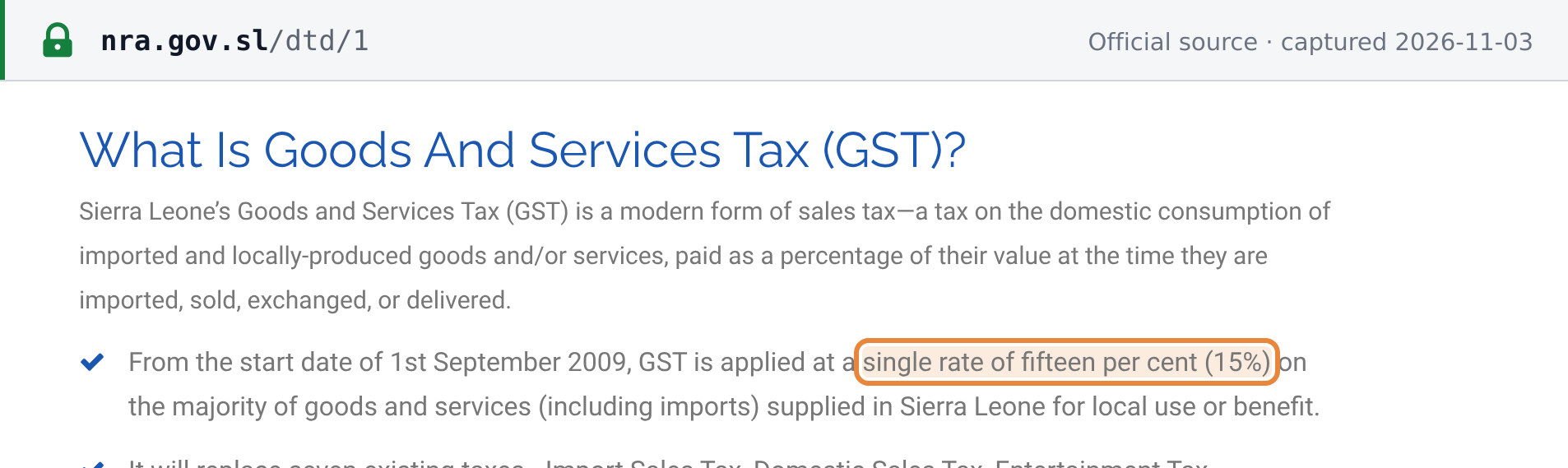
Standard rate: 15% (as at 2026-11-03), unchanged since GST began on 1 September 2009. Section 14(3) provides: "The rate of GST applicable to a taxable supply or import is– (a) if the supply or import is zero-rated under the First Schedule, zero per cent; (b) in any other case, 15 per cent." No Finance Act from 2017 to 2026 amends s.14(3). NRA's GST page: "From the start date of 1st September 2009, GST is applied at a single rate of fifteen per cent (15%) on the majority of goods and services (including imports) supplied in Sierra Leone for local use or benefit." [1] [2]
 Source snapshot captured 2026-11-03 — original
 Source snapshot captured 2026-11-03 — original
GST-inclusive prices. The tax fraction is "R/(100+R)" (s.21(1)), so 15/115 of a GST-inclusive price is GST.
Zero rate. "Output tax shall be at zero rate on the supply of the goods and services set out in the First Schedule" (s.10). The First Schedule lists:
- "Export of goods including rutile and its by-products, iron ore, bauxite, gold, diamonds and other minerals" (item 1);
- "Goods shipped as stores on vessels and aircraft leaving Sierra Leone" (item 2);
- added by the Finance Act 2022 (s.22): "The consumption, supply or use of renewable energy from mini-grids connected solar power in Sierra Leone" (item 3). [1] [12]
The Second Schedule is not a zero rate. The Second Schedule lists exempt supplies (s.9; see Exemptions). The Finance Act 2026 amended its items for water, solar home systems, raw fish and LPG cooking equipment, and two of the new descriptions say the goods are "classified as zero rated under the Harmonised Systems Commodity Classification Code". They remain items in the exempt-supplies schedule.
Reduced rates. None. Section 14(3) sets 15% and zero only.
Announced future rates. None. No Finance Act or Finance Bill amending the rate appears on NRA's tax-laws page (as at 2026-11-03); the newest instrument there is the Finance Act 2026.
See worldwide tax rates for other countries.
Cross-border rules
Imports and exports
- Imports of goods. "The GST payable by an importer to the National Revenue Authority in respect of a taxable import is due and payable at the time of the import" (s.40(1)), and it "shall be charged and payable as if it were a duty of customs on the goods under the relevant provisions of the Customs Act" (s.39(6)). NRA's Tax Guide gives the base: "GST (Goods not excisable) = (CIF + Import duty) x 15% GST (Goods excisable) = (CIF + Imp. Duty+ Excise tax) x 15%". [1] [19]
- Import GST on the return. From 1 February 2025, NRA prefills GST paid at customs into the ITAS GST return. Its notice announced "the Automatic Prefilling of Goods and Services Tax (GST) paid at the Customs Services Department in respect of importation of Goods, and the GST Tax returns that will be subsequently filed in the Integrated Tax Administration System (ITAS), effective 1st February 2025". [15]
- De-minimis. The GST Act contains no low-value relief for imported goods. Customs-law rules are outside this guide.
- Exports. Exports of goods are zero-rated (First Schedule item 1). The First Schedule has no general zero rate for exported services. Imported goods supplied "before the goods are entered for use within Sierra Leone" are supplied outside Sierra Leone (s.20(2)). Exporters may get an accelerated refund (see Refunds). [1]
Reverse charge on imported services
Section 24 is a narrow reverse charge. Where "a non-resident person makes a supply of services to a person in Sierra Leone, otherwise than through a resident agent", and the supply would have been taxable if made by a registered resident, it "is treated as a taxable supply made by the recipient of the supply … but only to the extent that the recipient will use the supply– (d) to make exempt supplies; (e) for private or domestic use …; (f) to provide entertainment". [1]
A business that uses an imported service wholly to make taxable supplies therefore does not self-account under s.24. No Finance Act from 2017 to 2026 amends the section. The recipient must keep evidence of the supplier, the nature, time, place and value of the service (s.36(d)). See reverse charge explained.
Digital products and services
"Digital market supply or digital services through a digital marketplace" are defined in s.8(h), as replaced by the Finance Act 2023 (s.7). The definition covers e-platforms "that include- i. downloadable digital contents, subscription-based media; software programs; electronic data management; supply of music, film, and games electronically, including satellite TVs; online sale of goods; and any online or digital gambling and betting activities; and ii. search engines and automated help desk services, online tickets, e-learning platforms, audio, vision or digital media, transport hailing platforms, among others." [10]
From 1 January 2026, the Finance Act 2026:
- requires a supplier of digital services to consumers in Sierra Leone to register, "whether or not the person has a physical presence in Sierra Leone" (s.15(4)(c));
- requires a supplier with no physical presence or registered office to appoint a representative in Sierra Leone (s.100);
- denies input tax where "that acquisition or expense is incurred in the supply of digital service by a person who has no physical presence or registered office in Sierra Leone" (s.28(2)(h)). Section 28(2) opens: "no entitlement to an input tax credit arises for a person in relation to a taxable acquisition or import by the person". Read with that opening, the new paragraph denies the supplier's own credits on its costs of supplying the digital service. [1] [4]
The standard 15% rate applies; the Act sets no special rate. See VAT on digital services by non-resident suppliers.
Foreign companies selling into Sierra Leone — B2B and B2C
- B2C digital services. The foreign supplier must register for Sierra Leone GST, whatever its turnover, appoint a local representative, and charge 15%. It cannot claim input tax (ss.15(4)(c), 100, 28(2)(h)).
- B2B services. The Finance Act 2026 provisions refer to supplies to consumers. The Act publishes no separate rule for supplies to GST-registered businesses, which fall under the general imported-services rule: the business recipient accounts for GST only to the extent it uses the service for exempt, private or entertainment purposes (s.24).
- Through a resident agent. The resident agent pays the GST (s.14(5)).
- Goods. The importer pays GST at customs (s.40(1)). [1] [4]
Marketplace / platform deemed-supplier liability
No deemed-supplier rule. The Finance Act 2021 (s.27) added definitions of advertising-based, agency, e-commerce, peer-to-peer and subscription-based platforms, and the Finance Act 2026 (s.17) redefines "digital marketplace" as "a platform that allows, enables or releases support for direct interactions between buyers and sellers of goods and services through any electronic or digital means for fee, commission, mark-up or direct business or personal benefit". The GST Act, as amended to the Finance Act 2026, contains no provision making a marketplace liable for its sellers' GST. [4] [6]
Separately, s.50A (Finance Act 2021, s.33) requires the Commissioner-General to "ensure real time and direct capture of information on turnover" from casinos, money-transfer operators, banks and forex bureaux, mobile network operators and internet service providers, and utilities. That is a data-capture duty, not a shift of GST liability. See marketplace deemed-supplier rules.
Place of supply
Section 20(1): "Except otherwise provided in this Act, a supply of goods or services is regarded as taking place in Sierra Leone if– (a) the supplier is a resident; or (b) the supplier is a non-resident and– (i) in the case of a supply of goods, the goods supplied are located in Sierra Leone at the time of the supply; (ii) in the case of a supply of services, the services are physically performed in Sierra Leone by any person who is in Sierra Leone at the time the services are performed." Section 20(4)–(7) adds special rules for telecommunications services. [1]
The Finance Act 2026 did not amend s.20 when it added the digital-services registration rule, and no NRA text explains how a digital service performed remotely by a non-resident is placed in Sierra Leone under s.20.
Invoice requirements
GST-registered businesses invoice through an electronic cash register (ECR). Section 31, as replaced by the Finance Act 2020 (s.34), provides: "(1) Everyregistered GST business shall in the ordinary course of business, maintain an electronic cash register as may be specified by Commissioner- General for the purpose ofinvoicing and recording all transactions." A supplier making taxable supplies must, "at the time of the supply", issue the recipient "with an original GST invoice" (s.31(2)). A person issued with an ECR "shall not use GST invoice booklet printed and issued by the National Revenue Authority for issuance of sales receipt, but shall use an electronicallygenerated invoice from the cash register" (s.31(6)). [7]
The ECR Regulations allow two exceptions. Under regulation 63(5), a taxpayer that shows good cause may ask the Commissioner-General for permission not to use an ECR. Under regulation 69(1), "A user who is yet to acquire an electronic cash register shall, upon coming into force of these regulations continue to use manual invoices or receipts until such a period as the Commissioner-General may, by a notice issued in a newspaper, authorize them to discontinue the use of manual invoices or receipts." [8]
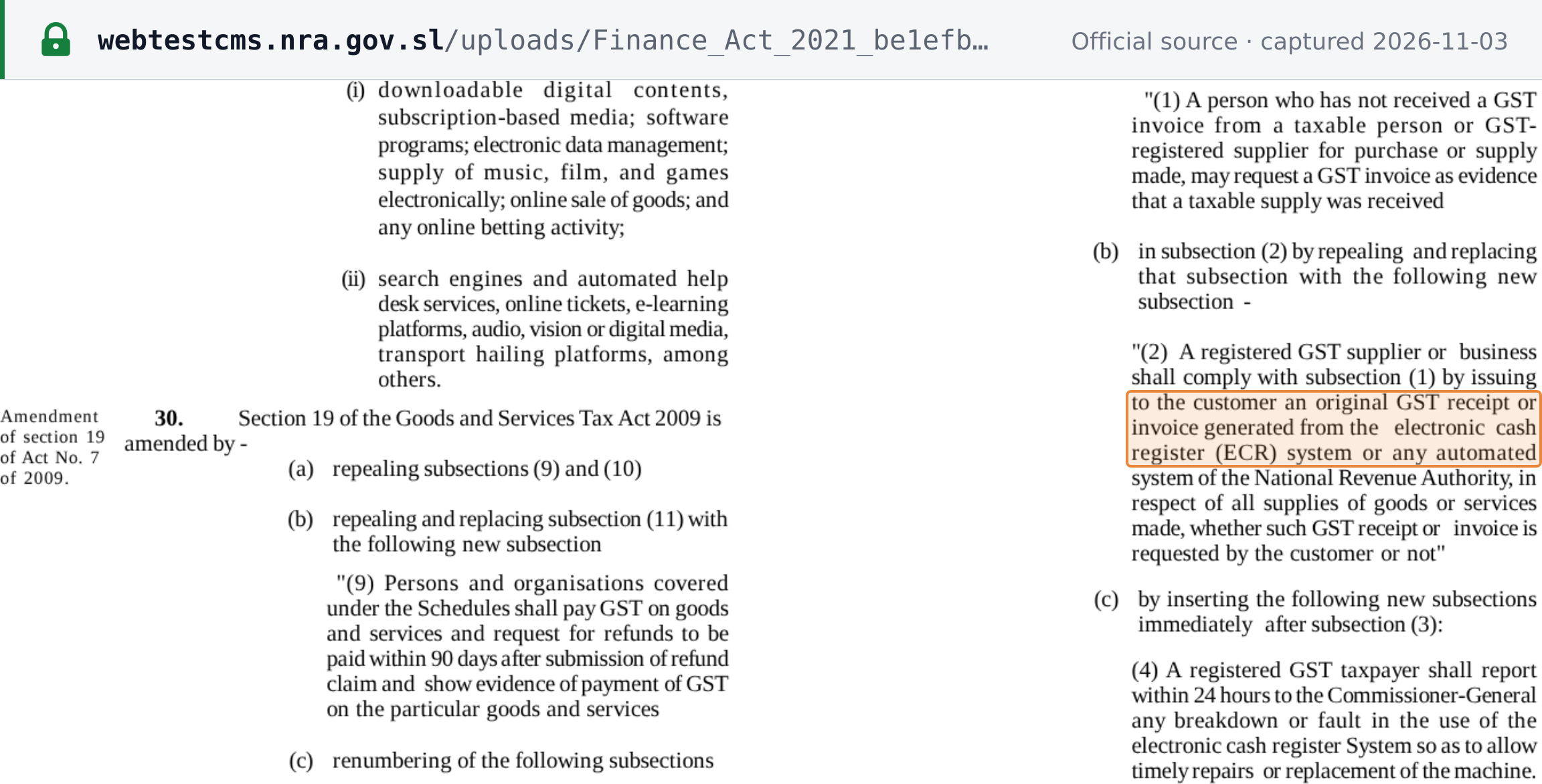
The Finance Act 2021 (s.31) then replaced s.34(2): "A registered GST supplier or business shall comply with subsection (1) by issuing to the customer an original GST receipt or invoice generated from the electronic cash register (ECR) system or any automated system of the National Revenue Authority, in respect of all supplies of goods or services made, whether such GST receipt or invoice is requested by the customer or not". [6]
 Source snapshot captured 2026-11-03 — original
Mandatory content
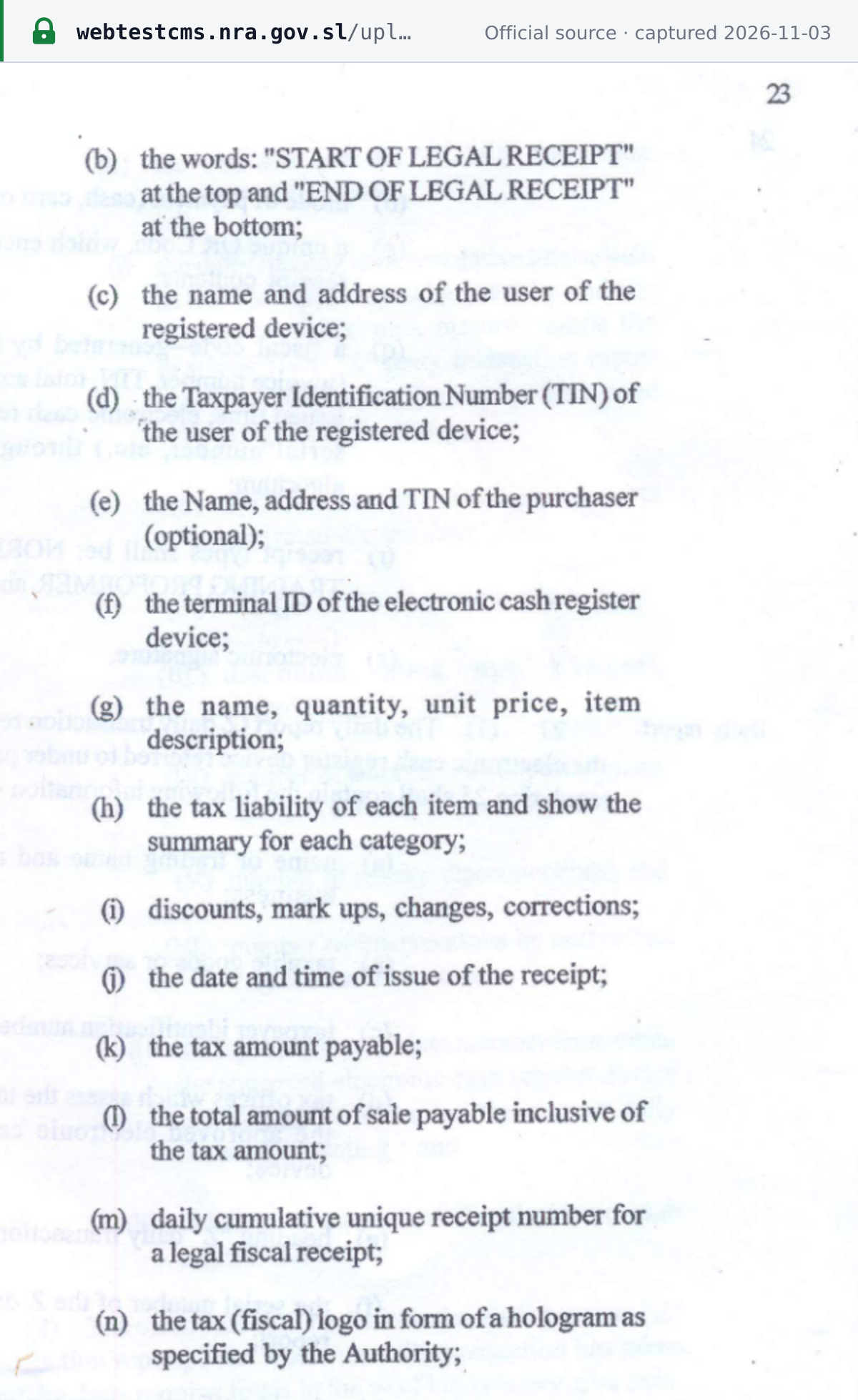
Regulation 26 of the Electronic Cash Register Regulations, 2021 (made 27 January 2021; Gazette Vol. CXLII No. 16 of 25 March 2021) sets the contents of the fiscal receipt the ECR device generates: [8]
| # | Particular (reg. 26, as printed) | Notes |
|---|---|---|
| (a) | "the text "GOODS AND SERVICES TAX RECEIPT" at the top" | Header |
| (b) | "the words: "START OF LEGAL RECEIPT" at the top and "END OF LEGAL RECEIPT" at the bottom" | Frame the legal part |
| (c) | "the name and address of the user of the registered device" | The seller |
| (d) | "the Taxpayer Identification Number (TIN) of the user of the registered device" | Seller's TIN |
| (e) | "the Name, address and TIN of the purchaser (optional)" | See B2B rule below |
| (f) | "the terminal ID of the electronic cash register device" | |
| (g) | "the name, quantity, unit price, item description" | Per line |
| (h) | "the tax liability of each item and show the summary for each category" | |
| (i) | "discounts, mark ups, changes, corrections" | |
| (j) | "the date and time of issue of the receipt" | |
| (k) | "the tax amount payable" | |
| (l) | "the total amount of sale payable inclusive of the tax amount" | |
| (m) | "daily cumulative unique receipt number for a legal fiscal receipt" | Numbering |
| (n) | "the tax (fiscal) logo in form of a hologram as specified by the Authority" | |
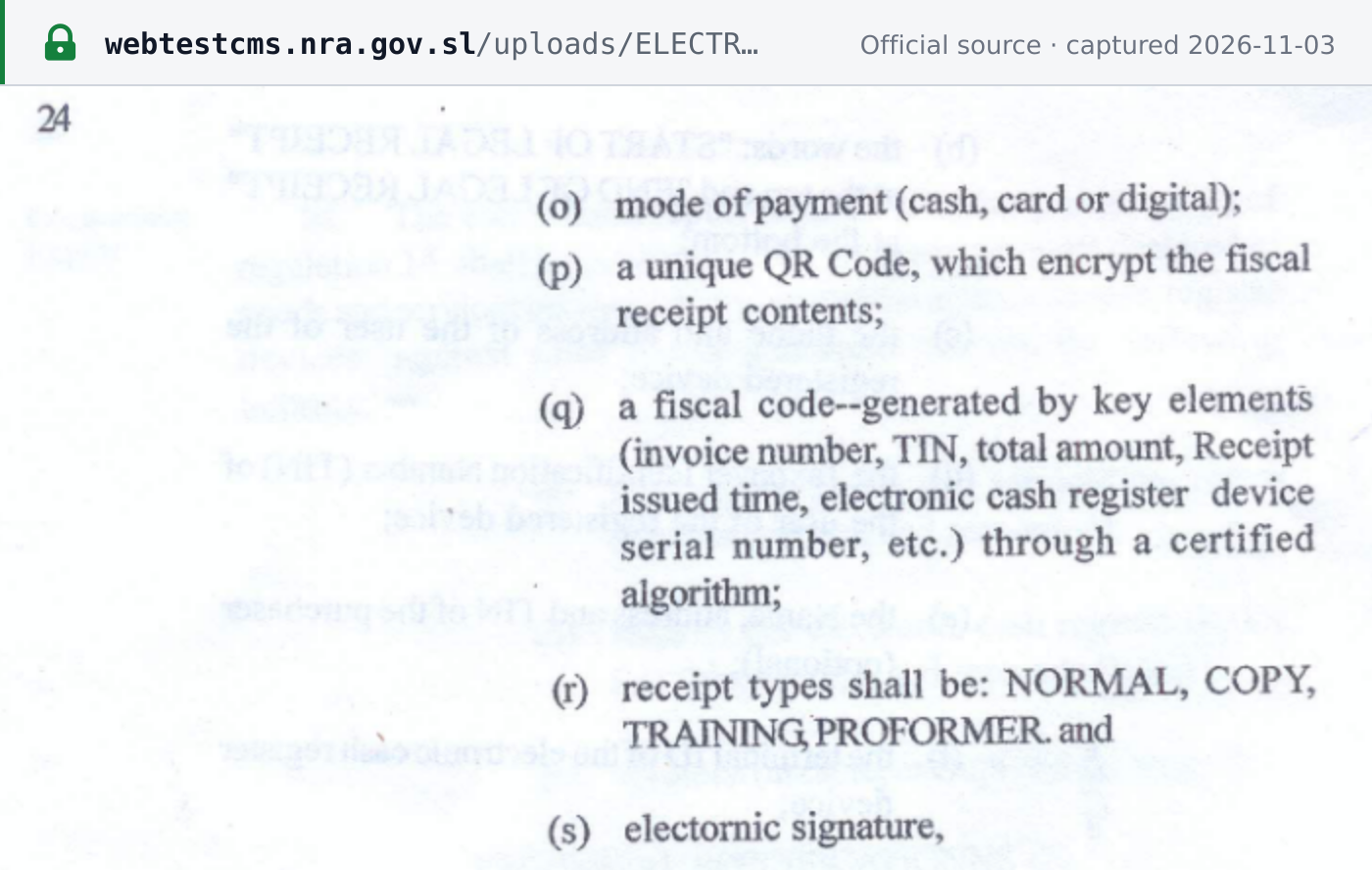
| (o) | "mode of payment (cash, card or digital)" | |
| (p) | "a unique QR Code, which encrypt the fiscal receipt contents" | |
| (q) | "a fiscal code--generated by key elements (invoice number, TIN, total amount, Receipt issued time, electronic cash register device serial number, etc.) through a certified algorithm" | |
| (r) | "receipt types shall be: NORMAL, COPY, TRAINING, PROFORMER." | |
| (s) | "electonic signature" | Spelling as printed |
Buyer's TIN on B2B and B2G sales. "If a customer enters into a transaction that is a business to business transaction or a business to government transaction and the taxpayer operating the business requests the customer to provide the customer's TIN, the customer shall provide the TIN to the taxpayer for it to be entered into the taxpayer's electronic cash register as part of the transaction data for the transaction" (reg. 64(6)). [8]
 Source snapshot captured 2026-11-03 — original
 Source snapshot captured 2026-11-03 — original
 Source snapshot captured 2026-11-03 — original
Full GST invoice. Section 31(4) says "A GST invoice and a sales receipt shall contain information prescribed by the Commissioner General". NRA has published no current instrument listing the particulars of a full GST invoice. Its legacy GST guidance from 2009 lists: "your name, address and taxpayer identification number (TIN); the time of supply; the number of the invoice taken from a consecutive series; your customer's name address and TIN (if that customer is also a taxable person); a description of the goods or service, including the quantity, or extent of the service; the type of sale …; the GST charge for each description of goods or services supplied; the rate of GST; the total charge on the invoice exclusive of GST; the rate of any discount; the total GST charge; and the total charge inclusive of GST." [7] [16]
Input-tax evidence. A credit for a domestic purchase needs the supplier's GST invoice (or, for imports, the customs documents). Without it the credit waits for the first period in which the document is held, and "if the person does not hold the documentation before the end of the tax period ending 6 months after the date on which the return was due, no input tax credit is allowed" (s.29(5)). [1]
Issuance deadline
At the time of the supply (s.31(2)). If the supplier fails to issue one, "the customer shall be required to request a GST invoice or electronic cash register system generated sales receipt" (s.31(3)), and under the ECR Regulations "A customer shall request a fiscal receipt for each transaction" (reg. 64(7)). The time of supply itself is set by s.19. [7] [8]
If the ECR fails. "A registered GST taxpayer shall report within 24 hours tothe Commissioner-General any breakdown or fault in the use of the electronic cash register System so as to allow timelyrepairs or replacement of the machine" (s.34(4), Finance Act 2021). Manual receipts or invoices may be used temporarily while the ECR is under inspection, seized for investigation or under maintenance, or after the user "has reported to the commissioner General that the electronic cash register has failed to operate for any reason acceptable to the commissioner General" (reg. 61(2)). From 1 January 2026, a "damaged, faulty or defective" ECR must be replaced "at a cost determined by the Commissioner General and published in the gazette" (s.34(8), Finance Act 2026 s.21). [4] [6] [8]
Numbering and sequencing
- ECR receipts. Each carries a "daily cumulative unique receipt number for a legal fiscal receipt" (reg. 26(m)) and a fiscal code built from, among other things, the invoice number and the ECR serial number (reg. 26(q)).
- One original. "Only one original GST invoice may be issued for a taxable supply, but the person who issued the original shall upon request provide a copy clearly marked as such to a taxable recipient" (s.35(1)). The ECR's "COPY" receipt type serves this (reg. 26(r)).
- Unauthorised documents. "It is an offence to issue a GST invoice, GST credit note or GST debit note in circumstances other than those specified in this Part" (s.35(3)).
- Agents. Where a supply is made by or to an agent for a non-resident principal that is not registered, documents are issued "by or to the agent, using the name, address, and TIN of the agent" (s.33(3)). [1] [8]
Credit and debit notes
Where a registered supplier issued an original GST invoice to a registered recipient and a GST adjustment event leaves the GST shown higher than the GST properly chargeable, "the supplier shall provide the recipient with an original GST credit note" (s.32(1)). A debit note is issued in the reverse case. "A GST credit or debit note shall contain the prescribed information" (s.32(3)). [1]
On the ECR, a mistake is corrected with a refund receipt. NRA's legacy ECR FAQ: "There is a provision to allow you to correct your mistake using Refund Receipt (Cancellation of receipt)." The Regulations define a "refund transaction" as "when a taxpayer cancels a transaction due to a mistake in entry or return of goods". [8] [17]
Currency and language
- Currency. Amounts are in Leones (s.53(1)). A foreign-currency amount relating to an import converts at the customs exchange rate; "in any other case, the amount shall be converted to the Leone at the Bank of Sierra Leone mid-exchange rate applying between the foreign currency and the Leone on the date the amount is taken into account" (s.53(2)). [1]
- Language. English. The GST Act's original rule on translating non-English records (s.98) was in a Part repealed by the Revenue Administration Act 2017, and the Regulations set no invoice language.
Document types
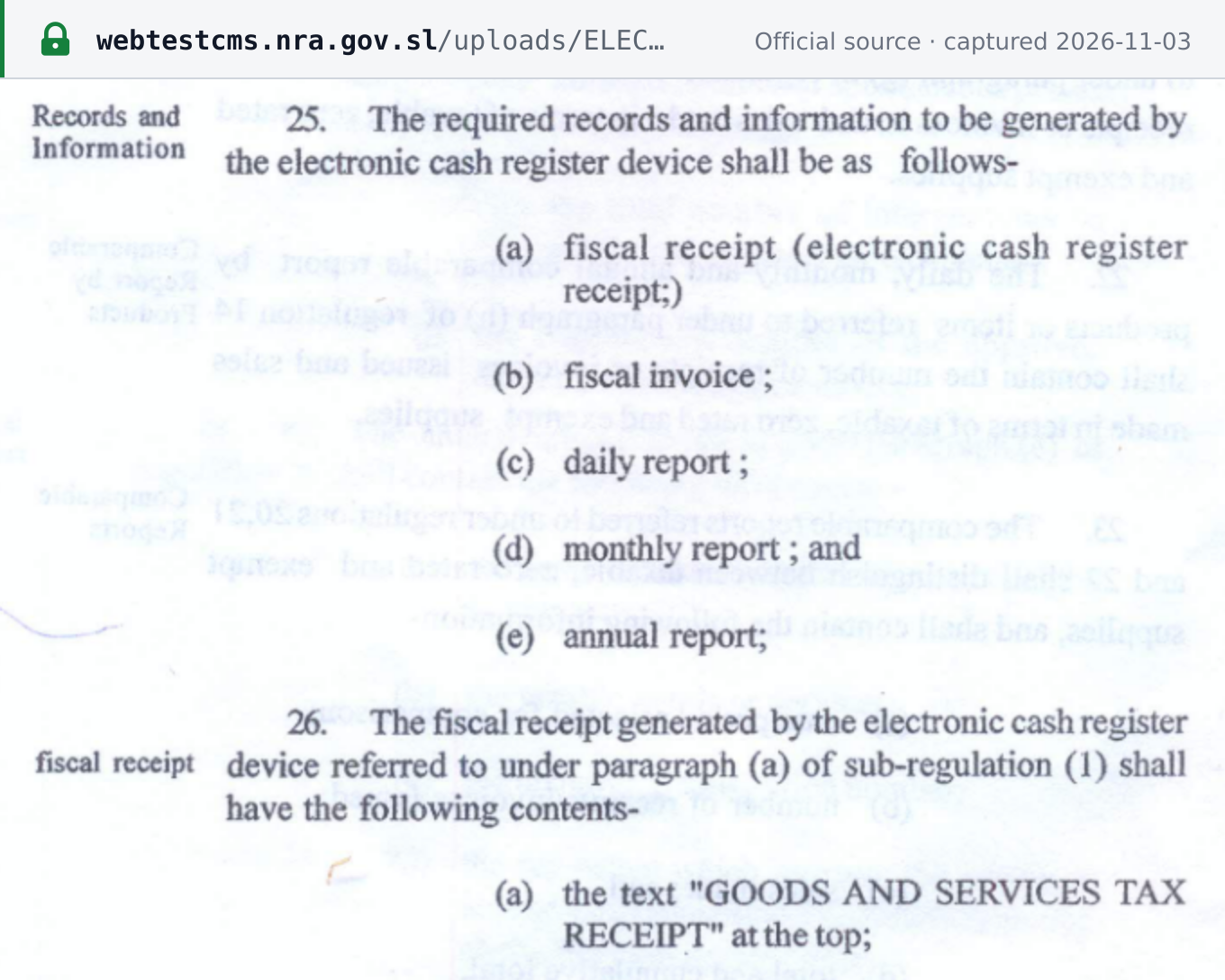
The ECR generates five records (reg. 25): "(a) fiscal receipt (electronic cash register receipt;) (b) fiscal invoice ; (c) daily report ; (d) monthly report ; and (e) annual report". The Act speaks of the GST invoice and the sales receipt (s.31). Receipt types are NORMAL, COPY, TRAINING and PROFORMER (reg. 26(r)). [8]
No value threshold for a simplified invoice is published. NRA's legacy guidance mentions that "A simplified accounting system is allowed for businesses that are primarily retail businesses (i.e. those selling directly to the general public) subject to the permission of the Commissioner General"; no current text on it was found. [16]
Self-billing
Not provided for. Neither the GST Act nor the ECR Regulations contain a self-billing provision; the supplier issues the receipt or invoice from its own ECR (s.34(2)).
Retention and audit trail
- Retention: at least six years. "Every person shall maintain documents whether in paper or electronic form" (Revenue Administration Act s.37(1)), retained "for a period ofat least six years from therelevant dateor for the periodas follows, whichever is longer", including until any objection or appeal is finally decided (s.37(5)). A person required to register for GST must also "install, maintain and service an electronic cash register" (s.37(2)(b)). [9]
- What to keep. "a copy of all GST invoices, GST credit notes, and GST debit notes issued by the person, maintained in chronological order" (GST Act s.36(a)), plus invoices received, customs documents and imported-service evidence. [1]
- Inside the ECR. "The user shall not tamper with the records kept in his electronic cash register and shall ensure that the records in the electronic cash register are retained therein for a period of at least six years" (reg. 60(2)).
- Audit trail. An accredited ECR must encrypt information in storage and transmission, secure transactions using Public Key Infrastructure, and record sales and fiscal receipts "on read only memory, meaning that once recorded, this information cannot be altered" (reg. 53(1)). [8]
- Transmission. NRA's ECR page describes the Sales Data Controller as "a device connected to CIS for: Signing on the receipt Storing receipt information Sending receipt information to NRA server". [13]
How a buyer checks a receipt. "A customer who has been issued a fiscal invoice may, by the system, verify that the fiscal data recorded on the fiscal invoice has been received by the Authority's system" (reg. 64(2)). NRA publishes no public receipt-verification page. [8]
A specimen of a compliant invoice
The ECR Regulations, NRA's ECR and GST pages (current and legacy), NRA's 2022 Tax Guide and its news and notices contain no specimen GST receipt or invoice. Below, Lookuptax lays out the fiscal-receipt contents of regulation 26 of the ECR Regulations 2021 for an illustrative business-to-business sale at 15%. Every name, number and amount is fictional:
GOODS AND SERVICES TAX RECEIPT — illustrative
| Item descriptionreg. 26(g) | Qtyreg. 26(g) | Unit pricereg. 26(g) | Value excl. GST | GSTreg. 26(h) |
|---|---|---|---|---|
| A4 copier paper, ream | 10 | SLE 150.00 | SLE 1,500.00 | SLE 225.00 |
| Printer toner cartridge | 1 | SLE 900.00 | SLE 900.00 | SLE 135.00 |
- Category summary: taxable at 15%reg. 26(h)
- SLE 2,400.00
- Discountsreg. 26(i)
- SLE 0.00
- Tax amount payable (GST 15%)reg. 26(k); GST Act s.14(3)(b)
- SLE 360.00
- Total payable inclusive of taxreg. 26(l)
- SLE 2,760.00
- Mode of paymentreg. 26(o)
- Card
- Printed at the top: START OF LEGAL RECEIPT; at the bottom: END OF LEGAL RECEIPT — reg. 26(b).
- [Tax (fiscal) logo, as a hologram specified by NRA] — reg. 26(n).
- [Unique QR code encrypting the receipt contents] — reg. 26(p).
- Fiscal code: FISCAL-CODE-SPECIMEN, generated by the ECR from the invoice number, TIN, total, issue time and device serial number through a certified algorithm — reg. 26(q).
- [Electronic signature] — reg. 26(s).
- Amounts in new Leones (SLE). A foreign-currency price converts at the Bank of Sierra Leone mid-exchange rate on the date the amount is taken into account — GST Act s.53(2).
E-invoicing status
Status (as at 2026-11-03): a fiscal-device regime. GST-registered businesses must issue their receipts and invoices from an NRA-specified electronic cash register, unless the Commissioner-General permits otherwise (ECR Regulations regs. 63(5) and 69); there is no structured B2B e-invoice clearance network. The obligation runs from the Finance Act 2020 (Gazette No. 1 of 2 January 2020), which replaced s.31, and the Finance Act 2021, which requires an ECR-generated receipt or invoice "in respect of all supplies of goods or services made". The ECR Regulations 2021 set the device, accreditation and receipt rules. Their explanatory note: "The objective of these Regulations is to implement an electronic invoicing system that enables the National Revenue Authority to securely obtain, monitor and assess accurate fiscal data for calculating and imposing a tax that is required to be part of a fiscal invoice." [6] [7] [8]
- System. NRA's ECR page: "“Electronic Cash Register” means a system comprising of CIS and SDC connected together as one system". The Sales Data Controller (or Electronic Signature Device) signs each receipt, stores it and sends it to the NRA server. [13]
- Who. NRA's legacy ECR FAQ: "Who should use the ECR? All GST registered taxpayers". [17]
- Scope. B2C, B2B and B2G alike: s.34(2) covers "all supplies of goods or services". There are no phases by taxpayer size.
- Formats. NRA publishes no structured invoice format (such as UBL or XML), no Peppol access and no clearance platform.
- Daily data. "Registered GST trader shall input daily sales data in the electronics cash register and file their GST returns and make payment of GST liabilities through the Integrated Tax Administration System (ITAS)" (s.37(4), Finance Act 2020). [7]
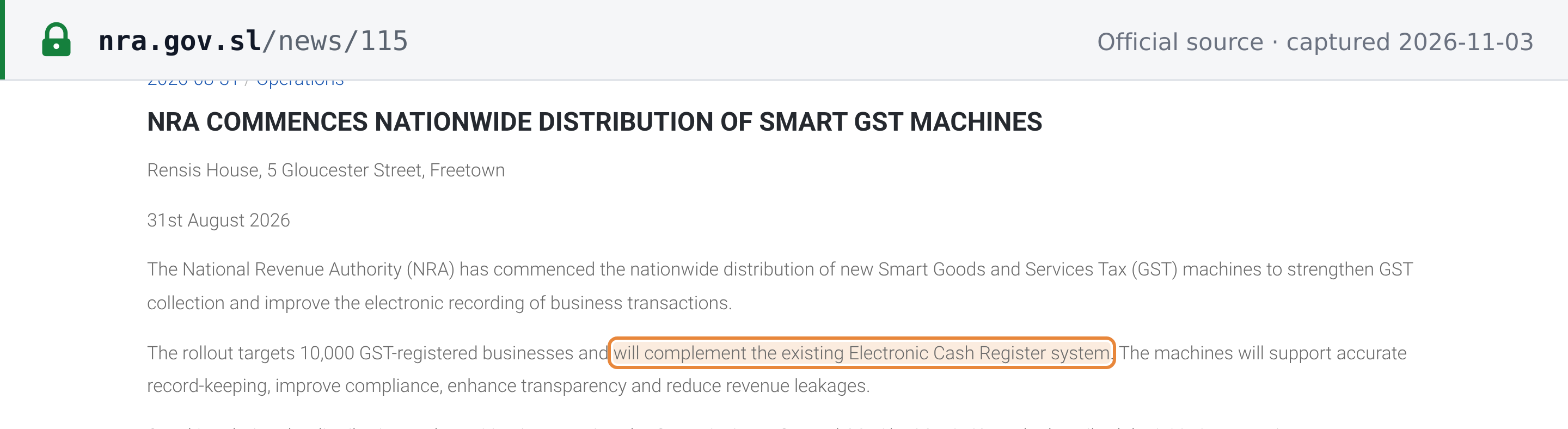
Smart GST machines (from 31 August 2026). NRA's news release of 31 August 2026: "The National Revenue Authority (NRA) has commenced the nationwide distribution of new Smart Goods and Services Tax (GST) machines to strengthen GST collection and improve the electronic recording of business transactions. The rollout targets 10,000 GST-registered businesses and will complement the existing Electronic Cash Register system." It adds: "Businesses must issue GST receipts, and consumers must request them." The release does not give the machines' legal basis or technical specification. [14]
 Source snapshot captured 2026-11-03 — original
See fiscal devices and certified cash registers for how Sierra Leone's ECR regime compares with other countries, and e-invoicing status and networks worldwide.
Filing and payment
Filing frequency
Monthly. The tax period is "a month or such other prescribed period" (s.2), and the Finance Act 2025 sets its filing penalties for a "monthly GST return". No current instrument sets a different period for any class of taxpayer. [1] [5]
Return due date
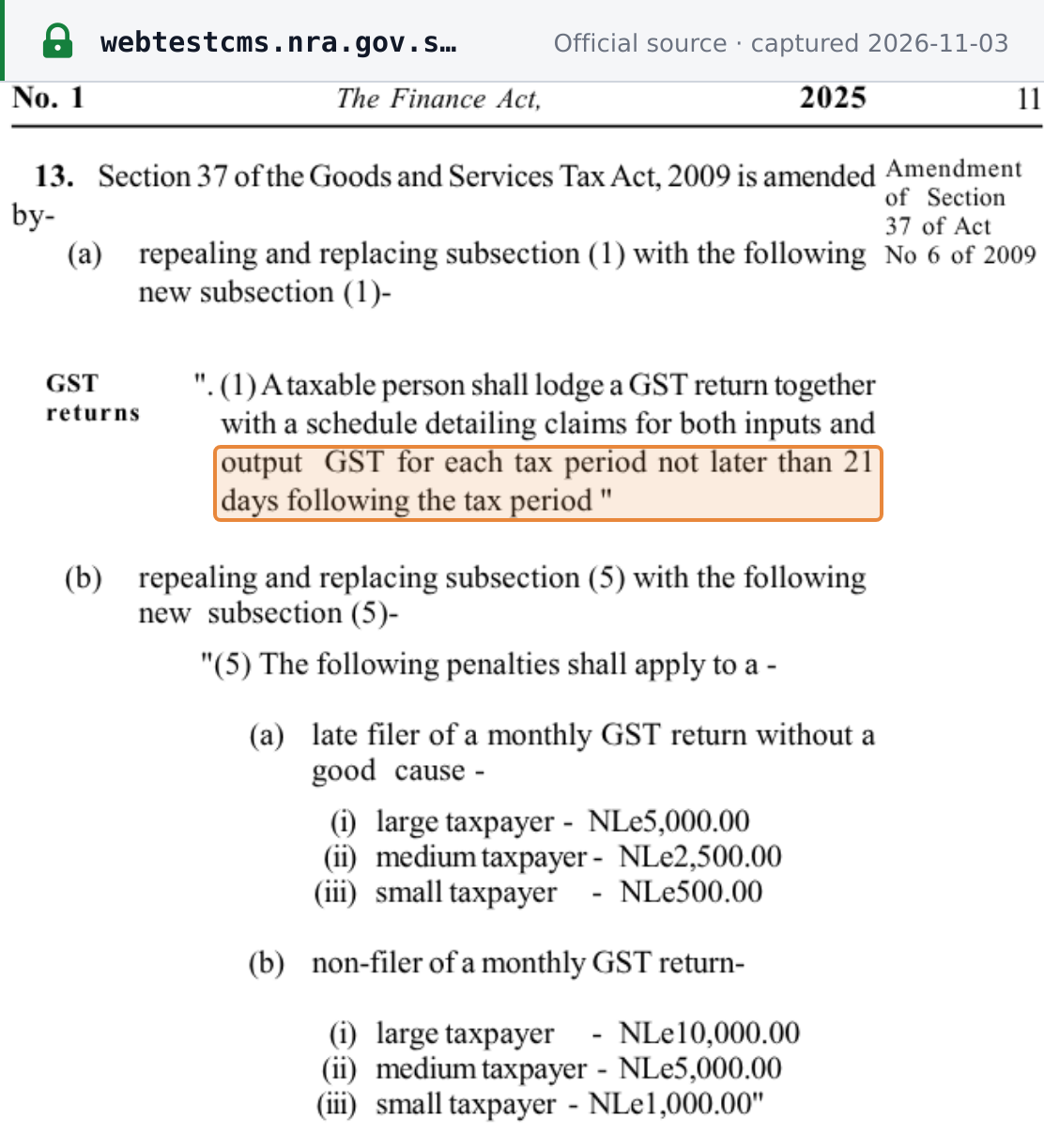
21 days after the end of the tax period (as at 2026-11-03). Section 13(a) of the Finance Act, 2025 (No. 1 of 2025; signed 8 January 2025; in force 1 January 2025) replaced s.37(1): "A taxable person shall lodge a GST return together with a schedule detailing claims for both inputs and output GST for each tax period not later than 21 days following the tax period". Before 2025 the return was due by the end of the following month. NRA applied the new date to the December 2024 return, "which is due for filing on or before the 21st January 2025". [5] [15]
 Source snapshot captured 2026-11-03 — original
Input schedule. Under s.37(1A) (Finance Act 2020), the schedule lists, for each supplier: name, TIN, address, description of the goods or services, total value, GST on the inputs, and the aggregate acquired from that supplier. [7]
Payment due date and method
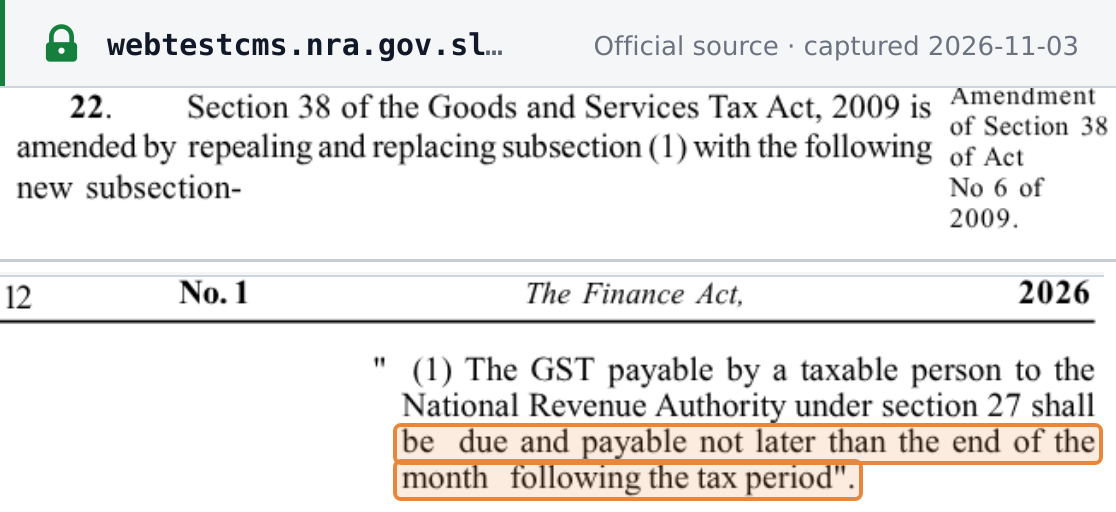
The end of the month following the tax period (as at 2026-11-03). Section 22 of the Finance Act, 2026 replaced s.38(1) from 1 January 2026: "The GST payable by a taxable person to the National Revenue Authority under section 27 shall be due and payable not later than the end of the month following the tax period". Before 2026, GST was due "by the due date for lodgement of the GST return for the tax period". [1] [4]
 Source snapshot captured 2026-11-03 — original
So the return and the payment now fall on different dates: the return by the 21st, the payment by the last day of the month. Returns are filed and GST paid through ITAS (s.37(4)). Import GST is paid at customs at the time of import (s.40(1)).
Additional listings
None beyond the input schedule filed with each return (s.37(1A)). The Act requires no annual GST return or separate sales listing.
Input-tax recovery and blocked items
- Recovery. A taxable person recovers input tax on taxable acquisitions and imports used for taxable supplies, including zero-rated supplies. Where supplies are mixed, the credit is apportioned by the share of taxable supplies in total supplies (s.29(1)).
- Documents. The supplier's GST invoice or the customs entry is needed; a credit not documented within the time in s.29(5) is lost (see Mandatory content).
- Blocked (s.28(2)):
- acquisitions not for the taxable activity, and private or domestic use;
- a "motor vehicle", meaning "a motorised on-road or off-road vehicle designed or adapted for the transport of 12 or fewer seated passengers", with its spare parts and repairs, unless the business deals in or hires out vehicles;
- entertainment, and club memberships;
- mobile phone handsets, with their spares and repairs, unless the business deals in them;
- acquisitions relating to "occupation of holiday or hotel accommodation by a director, employee or guest of the taxable person" (s.28(2)(g));
- from 1 January 2026, acquisitions incurred in supplying digital services by a person with no physical presence or registered office in Sierra Leone (s.28(2)(h)). [1] [4]
 Source snapshot captured 2026-09-21 — original
Refunds
- Carry forward. Excess credits carry forward. A credit or refund must be used "to offset current and future GST claims within a three year period and unutilized GST credit shall be deemed ineligible and written off after the third year" (s.41(1)(c)).
- Exporters. The Commissioner-General "shall refund an excess within 2 months after lodgement of the GST return" where 50% or more of turnover is zero-rated exports, or 50% or more of input spending relates to them, measured over a 12-month window (s.41(3)).
- Overpayments. Claims must be made within 3 years (s.41(5)).
- Relief bodies. From 1 January 2026, persons and organisations in the Third Schedule "shall be issued with a GST Relief Certificate to be used during purchases, unless the Commissioner-General has a cause to believe that such certificate will be subject to abuse" (s.19(9), Finance Act 2026 s.19).
- Non-residents. The GST Act has no refund scheme for non-resident businesses. Bad-debt adjustments are under s.23. [1] [4]
Exemptions
Exempt supplies
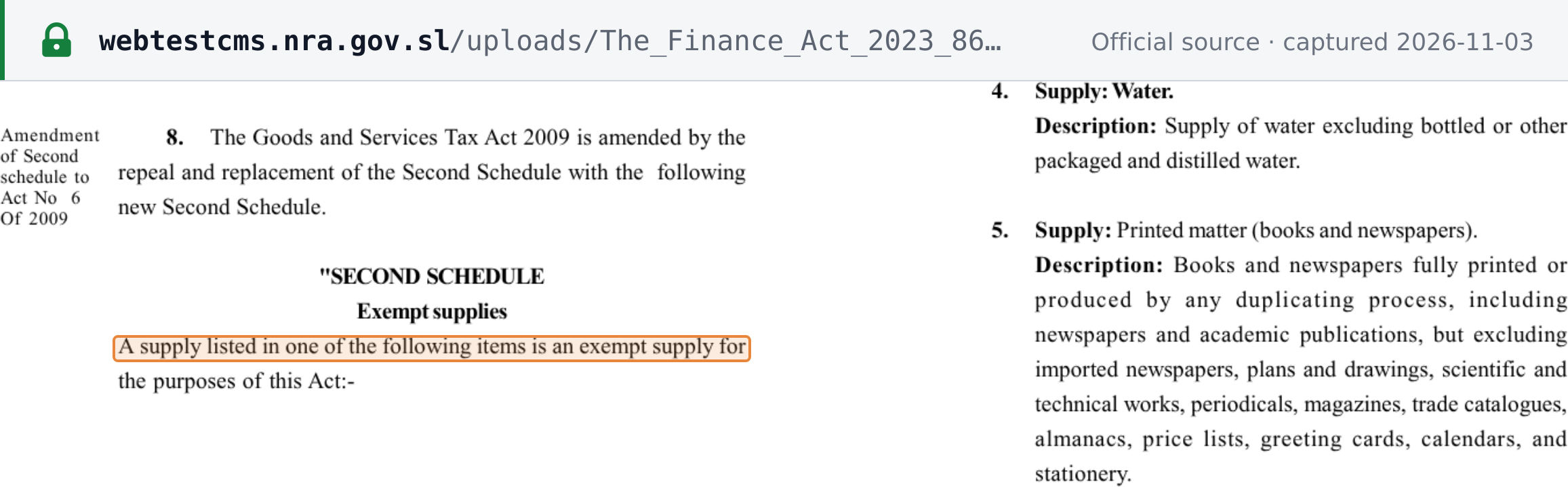
"The supply of the goods and services set out in the Second Schedule is exempt supply and is not subject to GST" (s.9). The Finance Act 2023 (s.8; in force 1 April 2023) replaced the whole Second Schedule, under the heading "Exempt supplies": "A supply listed in one of the following items is an exempt supply for the purposes of this Act". Examples from that schedule: [1] [10]
- live animals and seeds for breeding or propagation; raw rice; agricultural inputs; bulk wheat and wheat flour; baby milk;
- education services; medical, veterinary, dental and nursing services, and listed drugs and vaccines;
- passenger transport by bike, bus, ferry and train, excluding aviation;
- crude oil and hydrocarbon products: "Petrol, diesel, liquefied petroleum gas, kerosene and residual fuel oil, bitumen and lubricating oils" (item 9);
- financial services, "but excluding fees and similar charges levied by Financial Institutions for carrying intermediation and non-intermediation services" (item 10); life insurance and reinsurance;
- land and buildings (residential, and second and later sales of commercial buildings); funeral services and coffins;
- added by the Finance Act 2024 (s.15): machinery, plant and equipment "designed for use exclusively in- I. Agriculture; II. Manufacturing; and III. Mining and upstream petroleum operations" (item 27), and locally produced edible vegetable oils (item 28). [3]
 Source snapshot captured 2026-11-03 — original
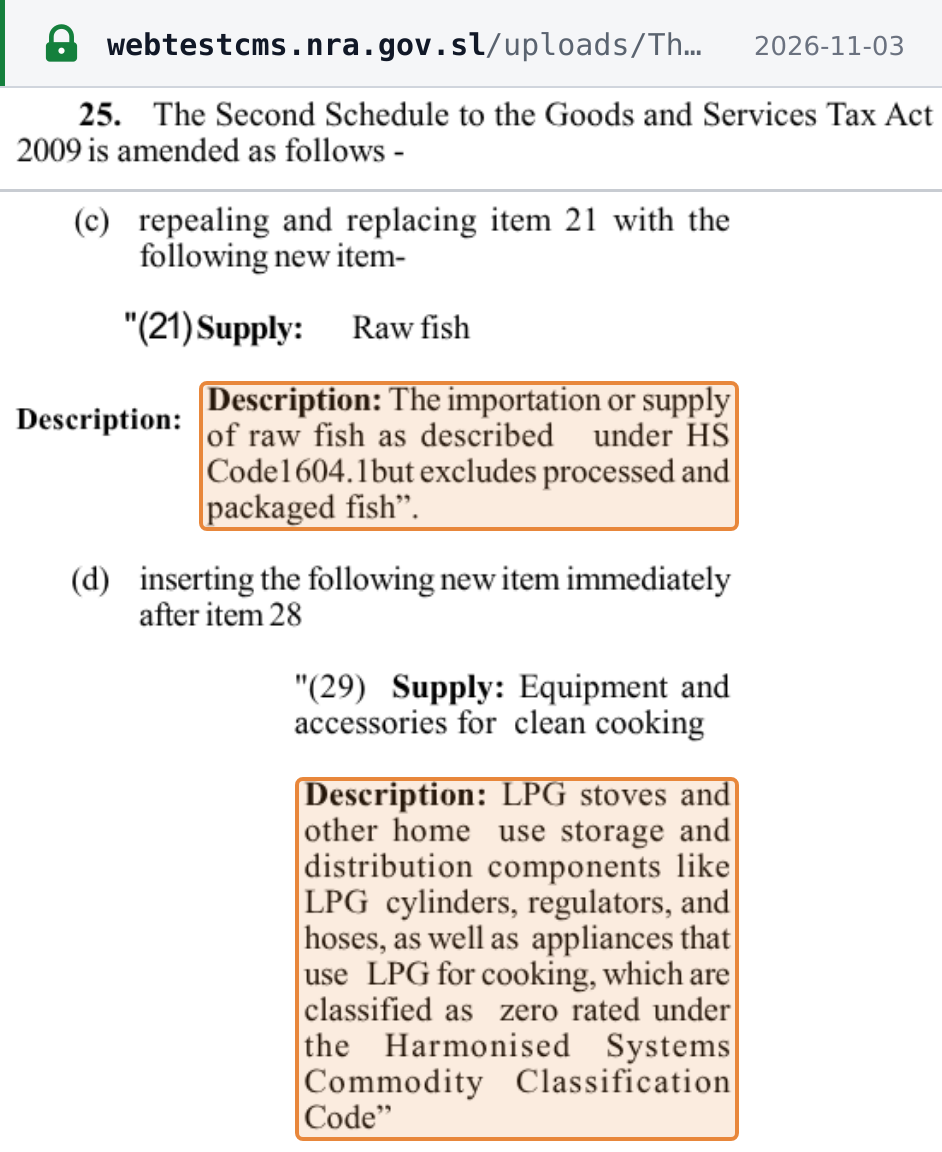
Finance Act 2026 changes (from 1 January 2026). Section 25 amended the Second Schedule:
- item 4, water: "Supply of water, including sachet water but excluding bottled, distilled water, and industrial, commercial and high-end domestic use";
- item 5, replaced with "Mini grids renewable energy and solar home system": energy from mini-grid-connected solar power, and solar home lighting system accessories and parts "classified as zero rated under the Harmonised Systems Commodity Classification Code";
- item 21, raw fish: "The importation or supply of raw fish as described under HS Code1604.1but excludes processed and packaged fish";
- new item 29, "Equipment and accessories for clean cooking": "LPG stoves and other home use storage and distribution components like LPG cylinders, regulators, and hoses, as well as appliances that use LPG for cooking, which are classified as zero rated under the Harmonised Systems Commodity Classification Code". [4]
These are items of the exempt-supplies schedule, even though the descriptions for solar and LPG equipment refer to zero rating. In the Finance Act 2023 schedule, item 5 is "Printed matter (books and newspapers)"; NRA has published no statement on how the 2026 replacement of item 5 reads with that entry.
 Source snapshot captured 2026-11-03 — original
Exempt is not zero-rated. An exempt supply is not a taxable supply, so it carries no GST and gives no input tax credit: "If none of the supplies made by a taxable person during a tax period are taxable supplies, the person is not allowed input tax credits for the input tax payable on taxable acquisitions or imports made by the person during that period" (s.29(1)(b)). A zero-rated (First Schedule) supply is taxable at 0%, so the supplier recovers the GST on its costs and, as an exporter, can claim the two-month refund. [1]
Institutional relief (Third Schedule). The President, embassies (on a reciprocal basis), international agencies under ratified agreements (item 3, replaced by the Finance Act 2026), disaster-relief imports, and UN agencies and organisations under the Vienna and Geneva Conventions. From 2026 they buy using a GST Relief Certificate (s.19(9)).
Outside the scope (Fourth Schedule). "Transfer of a going concern."
No waivers. The Finance Act 2019 (s.35): "No Goods and Services Tax (GST) waiver or exemption shall be granted unless provided for under the Goods and Services TaxAct 2009". [20]
Special regimes
- Small business, flat-rate, margin or cash accounting. None in the GST Act. Below the Le500,000 threshold, a business need not register unless it chooses to.
- Retail simplified accounting. Mentioned only in NRA's legacy guidance, subject to the Commissioner-General's permission (see Document types).
- Professional services. Section 40A (Finance Act 2021), under which the client paid the professional's GST direct to NRA, was repealed by the Finance Act 2026 (s.23): "Section 40A of the Goods and Services Tax Act, 2009 is hereby repealed." [4]
- Free zones and special economic zones. Not covered by this guide.
Offences and penalties
GST penalties sit in several instruments. The Revenue Administration Act 2017 repealed the GST Act's own interest, penalties and offences Part, but later Finance Acts added or replaced GST penalty provisions, and the ECR Regulations carry their own. Each penalty below is cited to the instrument that sets it; none of these texts says which applies where two cover the same failure. Currency points are a unit "prescribed by the Minister" by statutory instrument (RAA s.1); NRA publishes no current Leone value for one. [9]
Offences
- Failure to issue a GST invoice (GST Act s.31(7), Finance Act 2020). A supplier who fails to issue an original GST invoice at the time of supply "commits an offence and is liable topayan administrative fine ofLe10,000,000.00 or on conviction, to a fine of Le20,000,000.00 or to imprisonment for a term not exceeding three years, or to both" (pre-2022 Leones). [7]
- ECR offences (ECR Regulations reg. 68). Failing to acquire and use an ECR; failing to issue or retain fiscal invoices or receipts; a purchaser failing to demand and retain a fiscal invoice; undervaluing taxable supplies; tampering with the ECR; damaging it to cause malfunction; or failing to observe the Regulations. For first offenders, "a penalty of the 50% of the tax due and Le 10,000,000; or upon conviction, a fine of Le20,000,000 plus 50 of the tax due or to a term of imprisonment not less than six months". Repeat offenders face "a penalty of 100 of tax due and Le20,000,000 or upon conviction, to a fine of Le50,000,000 plus 50 of the tax due and/or to a term of imprisonment not less than one year" (as printed; pre-2022 Leones). A customer who cannot produce a receipt on request has the goods confiscated. [8]
- ECR use (GST Act s.34(5), Finance Act 2021). A taxpayer who fails to use the ECR system or to report a breakdown is subject to the penalties in the ECR Regulations. [6]
- GST offences (RAA s.101). The failures listed in RAA s.90 below are also offences. On conviction: where knowing or reckless, "a fine of not less than 50 and not more than 200 currency points, imprisonment for a term of not less than 1 year andnot more than 2 years or both"; otherwise "a fine of not less than 5 and not more than 25 currency points, imprisonment for a term of not less than 1 month and not more than 3 months or both". The Commissioner-General may compound offences (s.102).
- Unauthorised GST documents (GST Act s.35(3)). Issuing a GST invoice, credit note or debit note outside the circumstances in the Act. [1] [9]
NRA enforces the ECR rules by sealing premises: its notices announce the "Sealing Off" of GST-registered businesses "that have been penalized for failure to issue GST Receipt and failure to use the ECR Machine". [15]
Penalties
Late filing (GST Act s.37(5), Finance Act 2025, in new Leones; a separate s.37(6) non-filer penalty follows the table). A taxpayer who files within 30 days after the due date is a late filer; after 30 days, a non-filer (s.37(4), Finance Act 2022). [5] [11]
| Taxpayer | Late filer of a monthly GST return "without a good cause" | Non-filer |
|---|---|---|
| Large | NLe 5,000 | NLe 10,000 |
| Medium | NLe 2,500 | NLe 5,000 |
| Small | NLe 500 | NLe 1,000 |
A second non-filer penalty also stands. The Finance Act 2025 replaced only s.37(5). Section 37(6), inserted by the Finance Act 2022 (s.19), still provides: "A GST taxpayer who fails to file a GST return without good course shall be liable to the following penalties– (a) large taxpayer -Le100,000,000 (b) medium taxpayer -Le50,000,000" (pre-2022 Leones). It sets no figure for small taxpayers. [11] [12]
Other penalties, each from its own instrument:
| Failure | Penalty | Basis |
|---|---|---|
| Late payment | "a penalty equal to one-twelfth of the 364 daytreasurybill rate for each month in which the GST remains outstanding until the payment is made" | GST Act s.58, as replaced by Finance Act 2022 s.20 |
| Late payment | The higher of 2.5% of the unpaid tax, or 5 currency points (individual) / 10 currency points (entity), imposed on the due date and again each month the tax remains unpaid | RAA s.86 |
| Interest on unpaid tax | The "statutory rate", applied to the amount outstanding each day; the Minister prescribes the rate on 15 December for the following year | RAA s.83 and s.1 |
| Late filing | The higher of 5% of the tax assessable less tax paid, or 5 currency points (individual) / 10 currency points (entity) | RAA s.85 |
| Failing to register, to notify changes or cessation, to display the certificate, to apply for cancellation, or "to issue a tax invoice or receipt as required by Goods and Services Tax Regulations"; holding out as a taxable person | 25 currency points, or 100 currency points "where the failure or holding out is made knowinglyor recklessly" | RAA s.90(1)–(2) |
| Issuing a GST invoice not printed in accordance with GST Act s.31(3) | "5 currency points for each invoice issued" | RAA s.90(3)–(4); s.31 has since been replaced by the Finance Act 2020, and s.31(3) is now the rule that a customer must request an invoice |
| False or misleading statement | 50% of the shortfall, or 100% if knowing or reckless; 10% more for a repeat, 10% less for a voluntary disclosure | RAA s.88 |
| Records failure, intentional or reckless | The greater of 50% of the tax attributable or Le2,000,000 (pre-2022 Leones) | RAA s.84 |
NRA publishes no current figure for the 364-day treasury-bill rate it applies, the statutory interest rate or the currency point.
Frequently asked questions
Is the Sierra Leone GST return due on the 21st or at the end of the month?
Both dates apply, to different things. Since the Finance Act 2025 (in force 1 January 2025), the GST return and its input and output schedule must be lodged not later than 21 days following the tax period. Since the Finance Act 2026 (in force 1 January 2026), the GST itself is due and payable not later than the end of the month following the tax period. Before 2026 payment was due with the return.
Does a GST-registered business in Sierra Leone have to self-account GST on software or services bought from abroad?
Only in part. Under section 24 of the GST Act, a service supplied by a non-resident other than through a resident agent is treated as a taxable supply made by the recipient, but only to the extent the recipient uses it to make exempt supplies, for private or domestic use, or to provide entertainment. A business that uses the service wholly for taxable supplies does not self-account under that section.
Can a foreign digital-services supplier registered for Sierra Leone GST claim input tax?
No. From 1 January 2026, section 28(2)(h) of the GST Act, inserted by the Finance Act 2026, denies an input tax credit where the acquisition or expense is incurred in the supply of digital service by a person who has no physical presence or registered office in Sierra Leone. The same Act requires such a supplier to register whatever its turnover and to appoint a representative in Sierra Leone.
What must a business do when its electronic cash register breaks down?
Report the breakdown or fault to the Commissioner-General within 24 hours (GST Act s.34(4), inserted by the Finance Act 2021). Manual receipts or invoices may be used only where the Commissioner-General allows it, for example while the ECR is undergoing maintenance or after a reported failure (ECR Regulations 2021, reg. 61). From 1 January 2026 a damaged, faulty or defective ECR must be replaced at a cost the Commissioner-General determines and publishes in the gazette (s.34(8)).
Why do some Sierra Leone GST penalties say Le and others NLe?
The Leone was redenominated on 1 July 2022, at one new Leone for one thousand old Leones. Instruments made before then, such as the Finance Act 2020 and the ECR Regulations 2021, state penalties in old Leones; the Finance Acts from 2024 state amounts in new Leones (the Finance Act 2025 writes NLe). The Redenomination of the Leone (Consequential Provisions) Regulations 2022 deem an amount in an Act enacted before 1 July 2022 to be an amount in the redenominated currency. NRA has published no table converting the older penalty figures.
Important websites
| Site | Purpose |
|---|---|
| National Revenue Authority | Tax authority home page |
| NRA — Goods and Services Tax | NRA's GST overview |
| NRA — ITAS | Integrated Tax Administration System: GST returns and payments |
| NRA — ECR | Electronic cash registers: what the system is and who must use it |
| NRA — Tax laws | Downloads of the GST Act consolidation, Finance Acts and ECR Regulations |
| NRA — Forms | NRA forms (no GST registration form is listed) |
| NRA — Notices | Public notices, including filing and enforcement notices |
| NRA — Tax clearance verification portal | Checking a tax clearance certificate |
| Office of the Administrator and Registrar General | Business registration, needed before a business TIN |
| SierraLII | Official legal information institute: Finance Acts 2021, 2022 and 2024 |
We found no public TIN lookup and no public receipt-verification page. For other countries' registers, see check a VAT number — official lookups by country.
Recent changes
- 2026-08-31 — NRA begins nationwide distribution of Smart GST machines to 10,000 GST-registered businesses, to complement the existing ECR system. (NRA)
- 2026-01-01 — Finance Act 2026: suppliers of digital services to consumers in Sierra Leone must register for GST whatever their turnover and physical presence (s.15(4)(c)). (Finance Act 2026) — see event
- 2026-01-01 — Finance Act 2026: digital-services suppliers without a physical presence or registered office must appoint a representative in Sierra Leone (s.100), and get no input tax credit (s.28(2)(h)). (Finance Act 2026) — see event and event
- 2026-01-01 — Finance Act 2026: GST is due and payable by the end of the month following the tax period (s.38(1)). (Finance Act 2026) — see event
- 2026-01-01 — Finance Act 2026: damaged, faulty or defective ECRs must be replaced at a gazetted cost (s.34(8)). (Finance Act 2026) — see event
- 2026-01-01 — Finance Act 2026: Second Schedule (exempt supplies) items for water, solar home systems, raw fish and LPG clean-cooking equipment amended (s.25). (Finance Act 2026) — see event
- 2025-01-01 — Finance Act 2025: GST return due 21 days after the tax period; new late-filer and non-filer penalties in new Leones (s.37). (Finance Act 2025)
- 2024-01-01 — Finance Act 2024: GST registration threshold set at Le500,000 (s.15(2)). (Finance Act 2024)
For the full chronology, see Sierra Leone tax changes on Lookuptax.
Reference links
- Goods and Services Tax Act, 2009 (Act No. 6 of 2009) — NRA unofficial consolidation to 2016
- NRA — Domestic Taxes: Goods and Services Tax
- Finance Act, 2024 (No. 1 of 2024) — Gazette Vol. CLXV No. 3 of 11 January 2024
- Finance Act, 2026 (No. 1 of 2026) — Gazette Extraordinary No. 3 of 7 January 2026
- Finance Act, 2025 (No. 1 of 2025)
- Finance Act, 2021 (No. 1 of 2021)
- Finance Act, 2020 (No. 1 of 2020) — Gazette No. 1 of 2 January 2020 (NRA copy)
- Electronic Cash Register Regulations, 2021 — Gazette Vol. CXLII No. 16 of 25 March 2021
- Revenue Administration Act, 2017 (Act No. 10 of 2017)
- Finance Act, 2023 (No. 14 of 2023) — Gazette Extraordinary No. 24A of 28 April 2023
- Finance Act, 2022 (Act 1 of 2022) — Sierra Leone Gazette No. 2 of 13 January 2022, via SierraLII
- Finance Act, 2022 — NRA text copy
- NRA — Online services: ECR
- NRA — News: NRA commences nationwide distribution of Smart GST machines (31 August 2026)
- NRA — Notices
- NRA legacy site — Goods and Services Tax
- NRA legacy site — Electronic Cash Register
- Bank of Sierra Leone — Currency Redenomination Technical Guidelines (Gazette Extraordinary No. 54, 2 August 2022)
- NRA — Tax and Non-Tax Revenue Guide, 2nd edition (October 2022)
- Finance Act, 2019
- NRA legacy site — Taxpayer Identification Number
Related on Lookuptax:
- VAT registration thresholds worldwide
- Worldwide tax rates
- E-invoicing status and networks worldwide
- Fiscal devices and certified cash registers
- VAT on digital services by non-resident suppliers
- Reverse charge explained
- Marketplace deemed-supplier rules
- VAT grouping
- How to register for VAT, sales tax or GST
- VAT, GST and sales tax names by country