Saint Lucia VAT guidelines
| FACTSHEET | |
|---|---|
| Country code | LC |
| Tax name | Value Added Tax (VAT) |
| Tax Authority | Inland Revenue Department (IRD), Comptroller of Inland Revenue |
Overview
Saint Lucia levies Value Added Tax (VAT) under the Value Added Tax Act, Cap. 15.42. The Act began as Act 7 of 2012 and has been in force since 1 October 2012 (S.I. 114/2012). [2] Section 9(1) charges the tax "on — (a) every taxable supply by a taxable person; (b) every import of goods or import of services, other than an exempt import". [3] English is the only official language, so the tax has no second name.
This guide cites the Revised Laws of Saint Lucia (2023) published by the Attorney General's Chambers, which consolidate the Act, the Value Added Tax Regulations and the Comptroller's Interpretative Notes. The consolidation runs to Act 15 of 2023 and S.I. 159/2023. Later changes are cited from the statutory instruments published by the National Printing Corporation (NPC), the Government Printer. [1]
Authority. VAT is administered by the Comptroller of Inland Revenue through the Inland Revenue Department (IRD). The Interpretative Notes "are issued by the Comptroller of Inland Revenue to assist with the interpretation of the various provisions of the Value Added Tax Act". [20] Where a Note and the Act differ, the Notes say the Act prevails.
Currency. The Eastern Caribbean dollar (EC$ / XCD; the statutes write "$"). Section 102(1): "For the purposes of this Act, all amounts of money are to be expressed in Eastern Caribbean Dollars, EC$ or XCD$." [23]
Tax period. One calendar month for every taxable person. Section 36: "The tax period applicable to a taxable person under this Act is the calendar month." [24] The Act offers no bi-monthly, quarterly or annual alternative.
Layering. None. VAT is a single national tax.
For Caribbean neighbours, see the Barbados VAT guide, the Saint Kitts and Nevis VAT guide and the Trinidad and Tobago VAT guide.
Registration
Who should register
Every person who carries on a taxable activity and is not registered must apply within 10 working days of crossing the threshold below (s.12(1)). Some registrants have no turnover test. Under s.12(6) and (7), the State and local authorities register from commencement, and auctioneers register on becoming auctioneers. Under s.12(9), promoters of public entertainment, and licensees and proprietors of places of public entertainment, apply at least 5 working days before an event if their supplies in the 12 months including the event are expected to exceed EC$400,000. [11]
Registration threshold
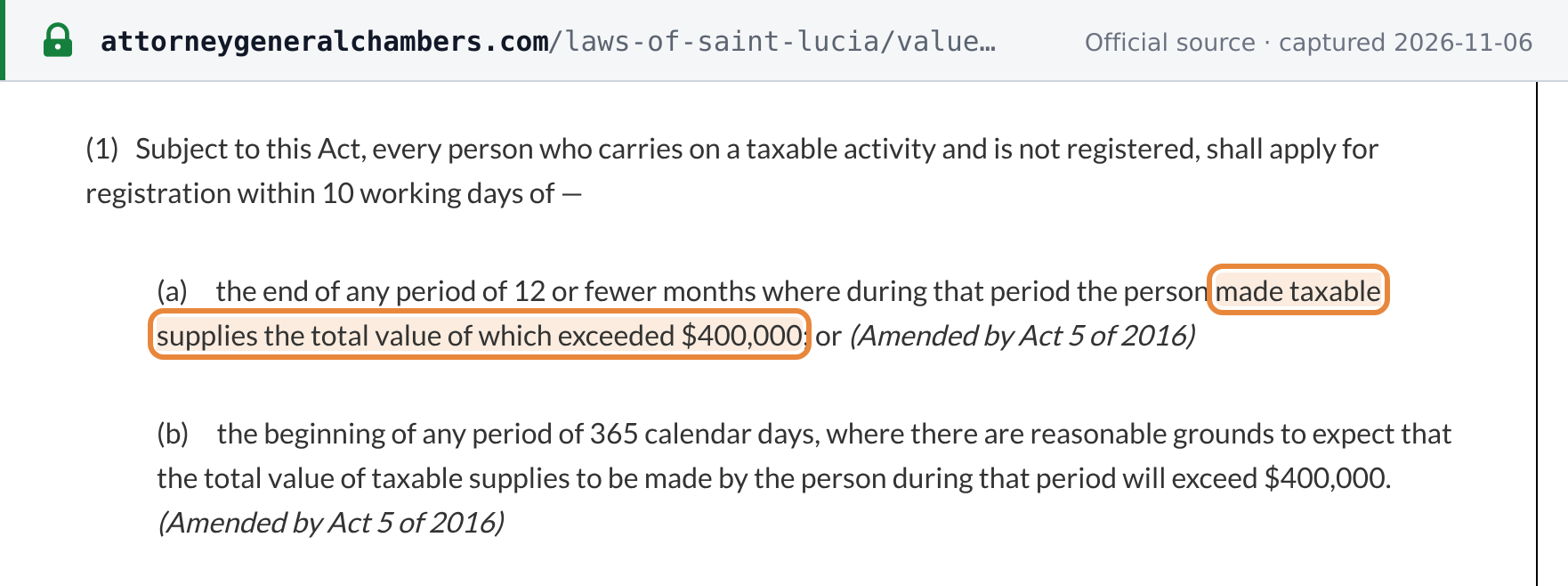
EC$400,000 of taxable supplies (as at 2026-11-06). Section 12(1), as amended by Act 5 of 2016 (in force 14 March 2016), requires registration within 10 working days of:
- "(a) the end of any period of 12 or fewer months where during that period the person made taxable supplies the total value of which exceeded $400,000; or"
- "(b) the beginning of any period of 365 calendar days, where there are reasonable grounds to expect that the total value of taxable supplies to be made by the person during that period will exceed $400,000." [11]
 Source snapshot captured 2026-11-06 — original
- Measurement. Two tests: a look-back over any period of 12 months or fewer, and a forward look over any 365 days.
- Three-month fast track. Registration is also required where taxable supplies in any 3 months exceed EC$100,000 and supplies for that period plus the next 9 months are expected to exceed EC$400,000. The application is then due within 10 working days of the end of the third month (s.12(10)–(11)).
- What counts. Taxable supplies. Section 2 defines a "taxable supply" as "a supply of goods or services in Saint Lucia in the course or furtherance of a taxable activity, other than an exempt supply". [15] A taxable activity excludes "an activity to the extent that the activity involves the making of exempt supplies" (s.6(2)(b)). [16] Zero-rated supplies therefore count, and exempt supplies do not.
- Aggregation. The Comptroller may aggregate the supplies of related persons or persons acting in concert (s.12(2)).
- History. The EC$400,000 and EC$100,000 figures were set by Act 5 of 2016. Before Act 5 of 2016 the figures were EC$180,000 and EC$45,000.
Non-resident registration
There is no separate non-resident threshold or registration scheme. A non-resident faces the same EC$400,000 test, but only its supplies in Saint Lucia count. Section 12(8): "In the case of a person who is not resident in Saint Lucia for the year in question for the purposes of the Income Tax Act, supplies made by that person are taken into account for the purposes of subsection (1), (9) or (10) only where the supply is made, or to be made in Saint Lucia." [11]
The Act imposes no fiscal-representative requirement. The Comptroller "may, if the Comptroller considers it necessary to do so, declare a person to be a representative of the taxable person" (s.61(1)). [37]
Tax identification number
Saint Lucia uses one Taxpayer Identification Number (TIN) for all taxes. In its submission to the OECD, Saint Lucia states: "The TIN consists of a maximum of six (6) digits." Each tax type adds a two-digit suffix to form a tax account number: "if a corporation has a TIN 1234, then corporation's VAT account number would be 123427 while the corporate tax account number would be 123402." [36] The sheet gives no check-digit algorithm.
The registration certificate states the TIN (s.13(9)). The Comptroller "shall require a person to include the taxpayer identification number issued by the Comptroller to that person in any return, notice, or other documents prescribed or used for the purposes of this Act" (s.97). [38] For format detail, see the Saint Lucia TIN guide.
How to register
- Apply to the Comptroller. A compulsory applicant must be registered "within 21 working days of receipt of the application, unless the Comptroller is satisfied that the person is not eligible" (s.13(2)). If the Comptroller serves no notice, the applicant is deemed registered (s.13(13)). [12]
- Certificate. The certificate of registration states the TIN (s.13(9)). It must be displayed at each place of business (s.13(11)).
- Public register. The Comptroller must "establish and maintain a register containing the relevant details of all registered persons, and make publicly available the names of registered persons, their taxpayer identification numbers, and contact details" (s.13(10)).
The Act and Regulations name no online registration portal and no application form number.
Voluntary registration
Available. A person below the threshold may apply under s.12(5). The decision is "at the discretion of the Comptroller who must inform the applicant of the decision within 30 calendar days of receiving the application" (s.13(3)). Under s.13(4), the Comptroller refuses an applicant who:
- has no fixed place of abode or business;
- keeps no proper records;
- is not expected to file reliable returns; or
- is not compliant with any law the IRD administers. [12]
Before trading. A business may register before it starts trading if it undertakes to make taxable supplies within 18 months, a period the Comptroller can extend. If the supplies do not start, the person is liable for the tax that would have been payable (s.12(13)–(15)). The usual reason to register voluntarily is to recover input tax on start-up costs. [11]
Deregistration
- On ceasing. A person who stops its taxable activities notifies the Comptroller within 5 working days. Cancellation takes effect from the last day of the tax period in which the activities stopped (s.14(1)). It is refused if taxable activity is expected to resume within 12 months (s.14(2)).
- Below the threshold. A person may apply to cancel where its taxable supplies over the past 12 months, or the coming 12 months, are not more than EC$400,000 (s.14(6)). Section 14(7): a compulsory or voluntary registrant "may apply for cancellation of the registration only after the expiration of 2 years from the date the registration took effect".
- Sale of a going concern. Notify at least 5 working days before the sale closes (s.14(13)). [13]
Group registration
Not available. Part 4 of the Act (ss.11–15) contains no VAT grouping provision. Branches cannot register separately either. Section 67: "Where a taxable activity is conducted by a taxable person in branches or divisions, the taxable person is deemed to be a single person conducting the taxable activity for purposes of this Act and no separate registration of branches or divisions is allowed." [14]
Rates
| Rate | Applies to | Basis |
|---|---|---|
| 12.5% (standard) | Taxable supplies and imports that are not zero-rated or at a tourism rate | VAT Act s.10(1), as amended by S.I. 101/2016 (from 1 February 2017) |
| 10% | Food and beverages (including alcoholic beverages) by a restaurant; water sports; tours within Saint Lucia; admission to heritage sites and other tourist attractions | S.I. 188/2020, para. 3(b) (from 1 December 2020) |
| 7% | Tourism accommodation services | S.I. 188/2020, para. 3(a) (from 1 December 2020) |
| 0% | Schedule 1 supplies: exports, fuel, listed basic foods, transfers of a going concern, and the time-limited building-materials and solar items below, among others | VAT Act s.16 and Schedule 1 |
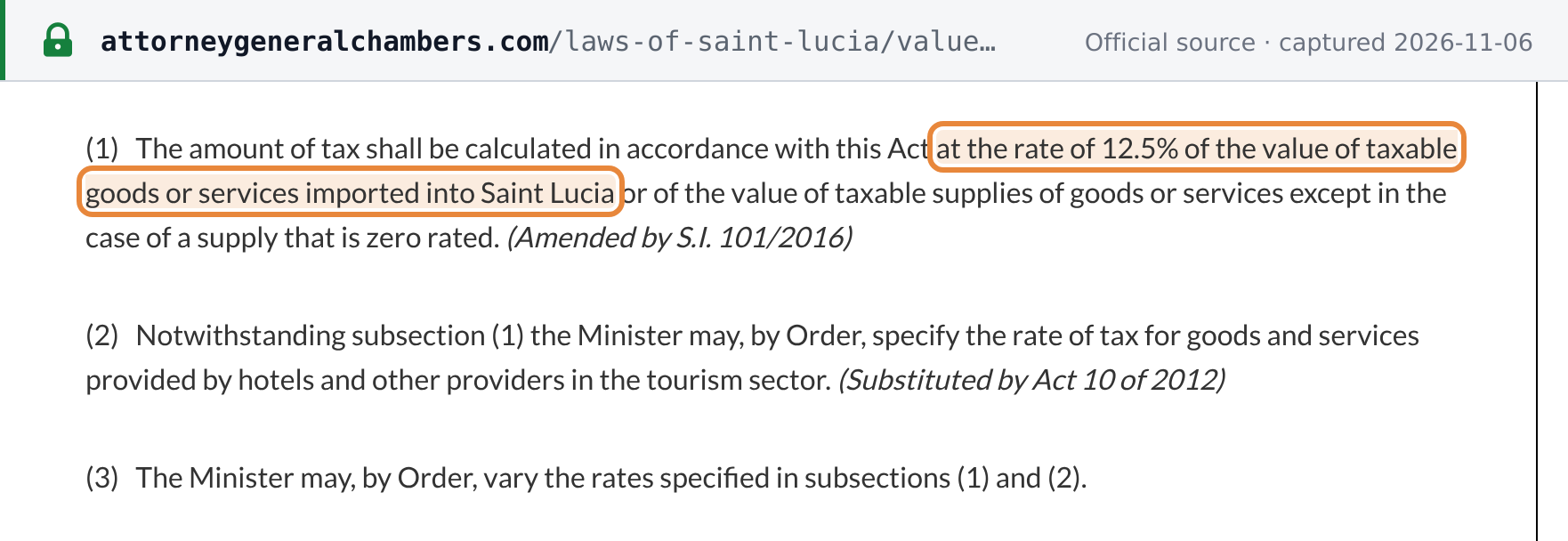
Standard rate: 12.5% (as at 2026-11-06). Section 10(1): "The amount of tax shall be calculated in accordance with this Act at the rate of 12.5% of the value of taxable goods or services imported into Saint Lucia or of the value of taxable supplies of goods or services except in the case of a supply that is zero rated." [4] The VAT (Amendment of Rate) Order, S.I. 101/2016, amended s.10(1) "by deleting the rate of "15%" and substituting the rate of "12.5%"", and "shall come into force on the 1st day of February, 2017". [5] The rate was 15% from 1 October 2012 to 31 January 2017.
 Source snapshot captured 2026-11-06 — original
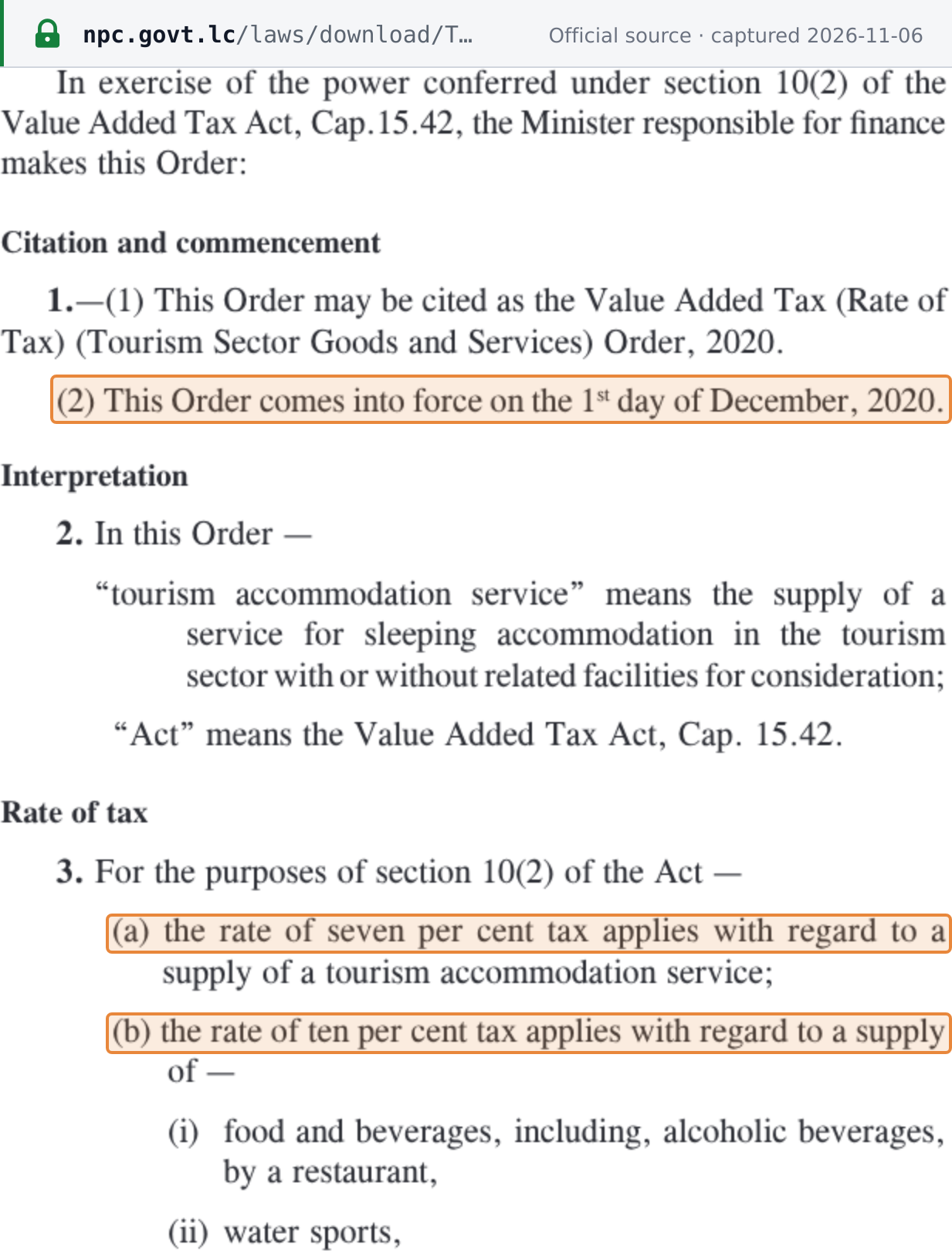
Tourism rates: 7% and 10% (since 1 December 2020). Section 10(2) lets the Minister set by Order "the rate of tax for goods and services provided by hotels and other providers in the tourism sector". The Value Added Tax (Rate of Tax) (Tourism Sector Goods and Services) Order, S.I. 188/2020, "comes into force on the 1st day of December, 2020". Paragraph 3 provides: [6]
- "(a) the rate of seven per cent tax applies with regard to a supply of a tourism accommodation service;"
- "(b) the rate of ten per cent tax applies with regard to a supply of — (i) food and beverages, including, alcoholic beverages, by a restaurant, (ii) water sports, (iii) tours conducted by land, air or sea within Saint Lucia, including a direct supply of transportation services by the tour operator as part of the tour package, but excluding an indirect supply of transportation services by a tour operator, (iv) admission to heritage sites and other touristic attractions."
 Source snapshot captured 2026-11-06 — original
A "tourism accommodation service" is "the supply of a service for sleeping accommodation in the tourism sector with or without related facilities for consideration". The Order is not limited to hotels by its own wording. Paragraph 3 also appears, consolidated, in the Attorney General's Chambers subsidiary legislation. [7] S.I. 188/2020 revoked the earlier hotel-rate Order, S.I. 64/2014. A residential lease of a dwelling is exempt, not taxed at 7% (Schedule 2, item 2(m)).
Zero rate. Schedule 1, item 2(1), lists the standing zero-rated supplies. [8] Examples:
- "(a) a supply of goods where the supplier has entered the goods for export, under the Customs (Control and Management) Act, and the goods have been exported from Saint Lucia by the supplier", and other exported goods;
- supplies to customs warehouses, duty-free shops and free zones (para. (c));
- live animals other than pets (para. (g));
- "(h) a supply of fuel";
- the transfer of a going concern between registered persons, with written notice within 21 calendar days (para. (i));
- listed basic foods by tariff heading, such as fresh and powdered milk, eggs, rice and flour (para. (j) onwards).
Services supplied from a place of business in Saint Lucia that are treated as supplied abroad are zero-rated exports (s.19(8)). Schedule 1 is amended often by Order, so this list gives examples, not the full schedule.
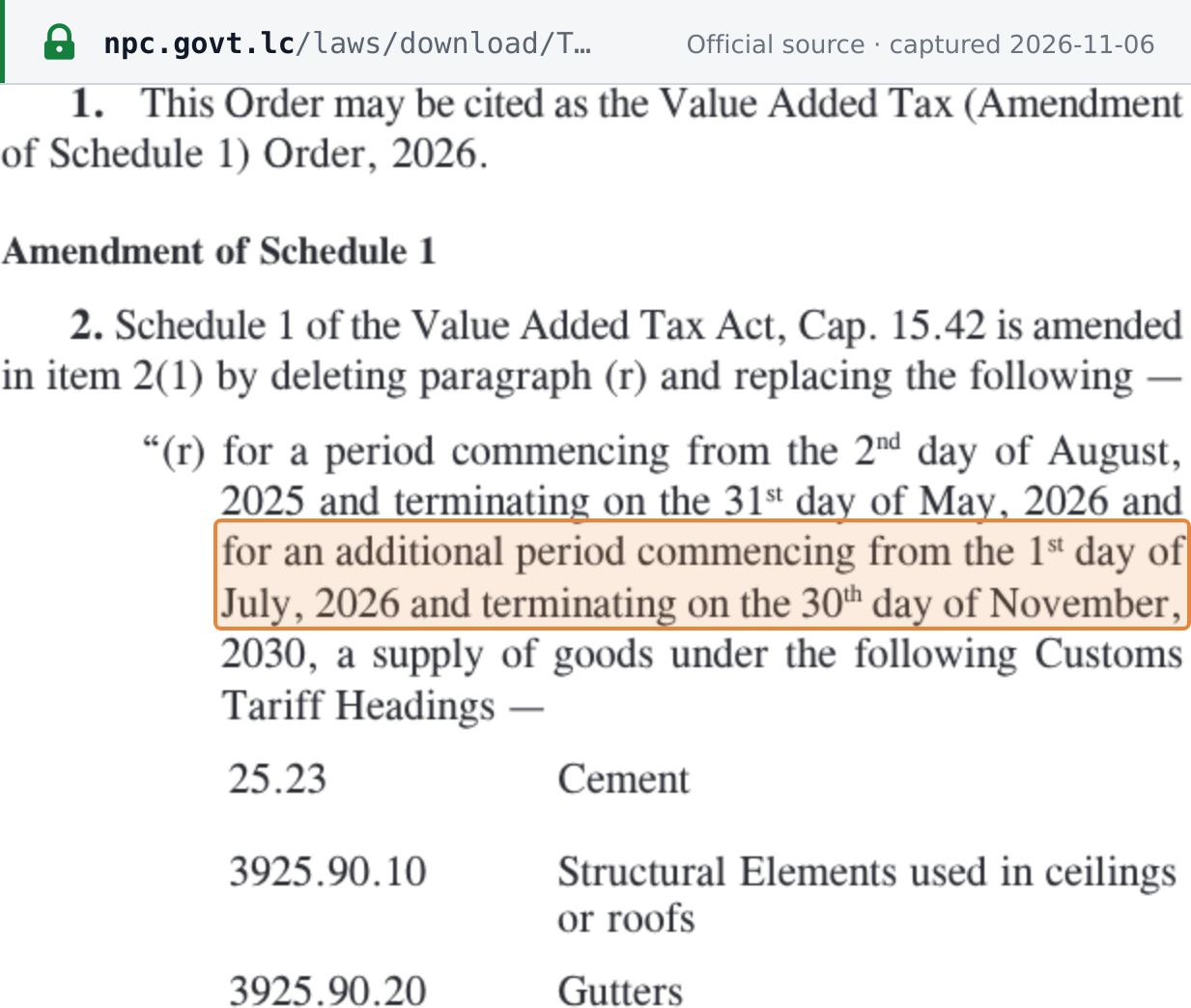
Building materials, zero-rated to 30 November 2030. The Value Added Tax (Amendment of Schedule 1) Order, 2026 (S.I. 150/2026, made 6 July 2026) substitutes Schedule 1 item 2(1)(r): "for a period commencing from the 2nd day of August, 2025 and terminating on the 31st day of May, 2026 and for an additional period commencing from the 1st day of July, 2026 and terminating on the 30th day of November, 2030, a supply of goods under the following Customs Tariff Headings". [9] The headings cover:
- cement (25.23);
- plastic structural ceiling and roof elements, gutters and electrical switch plates (3925.90.x);
- lumber and plywood (44.07–44.18, 44.20–44.21);
- galvanize and steel (72.01–72.16, 73.01–73.18, 76.01–76.10);
- aluminium articles (76.16);
- base-metal building mountings (8302.41.00).
The resolution of Parliament approving the draft Order (S.I. 140/2026) gave the restart date as 1 June 2026. The Order as made says 1 July 2026, so the Order leaves 1–30 June 2026 outside the zero rate.
 Source snapshot captured 2026-11-06 — original
Solar (photovoltaic) systems, zero-rated to 1 August 2031. The Value Added Tax (Amendment of Schedule 1) (No. 2) Order (S.I. 174/2026, made 18 August 2026) zero-rates listed photovoltaic goods, such as panels, inverters, batteries, mounts and cabling, "for a period of five years commencing from the 2nd day of August, 2026 and terminating on the 1st day of August, 2031". It also zero-rates "a supply of the installation service for photovoltaic systems" for the same period. [10]
Announced future rates. None. The NPC statutory-instrument list for 2026 (to S.I. 175/2026) contains no VAT rate Order after S.I. 188/2020. [49] See the Saint Lucia tax-changes chronology and worldwide tax rates for other countries.
Cross-border rules
Imports and exports
Imports of goods. VAT on an import of goods is paid by the importer (s.9(2)(b)) at the 12.5% rate in s.10(1), and is collected with customs. [3] Foreign-currency values on imports are converted "at the exchange rate as determined for purposes of the Customs (Control and Management) Act" (s.102(2)(a)). [23]
Exports. Exported goods are zero-rated (Schedule 1, item 2(1)(a)–(b)). Services supplied from Saint Lucia that the place-of-supply rules treat as supplied abroad are zero-rated (s.19(8)).
Reverse charge on imported services
Applies. Under s.9(2)(c), tax on an import of services is "paid by the recipient of services". An import of services is a supply to a resident by a non-resident, or by a resident from a business carried on abroad. It is an import only "to the extent that such services are not to be utilised or consumed by a registered person in making taxable supplies in Saint Lucia" (s.2). [15]
The recipient must "(a) furnish the Comptroller with an import declaration; and (b) pay the tax due in respect of the import within 21 calendar days after the tax period in which the services were imported" (s.28(1)). Under s.28(3), the recipient pays: [18]
- "(a) where a business is established and carries on business from outside of Saint Lucia and supplies a service to a person or local branch in Saint Lucia;"
- "(b) in the case of a registered recipient, if the import by the person is not for use in making taxable supplies; or"
- "(c) in the case of a non-registered recipient, whether — (i) the person's taxable supplies are below the threshold under section 12; or (ii) the person is not engaged in making taxable supplies."
For how other countries handle this, see reverse charge explained.
Digital products and services
The Act has no separate regime for electronic services supplied by non-residents. Its only e-commerce rule is a place-of-supply rule: "the supply of goods via electronic commerce and the supply of internet access or similar services" is among the services supplied where the recipient uses them or obtains the advantage (s.19(4)(h)). [17] The Act's 113 sections and three Schedules, and the VAT statutory instruments and Acts on the NPC lists for 2012–2026, contain no non-resident digital-services registration rule and no low-value-goods rule. Imported digital services fall under the recipient-pays rule above. For the wider picture, see VAT on digital services by non-resident suppliers.
Foreign companies selling into Saint Lucia — B2B and B2C
- B2B, to a registered business that uses the service for taxable supplies. The service is not an "import" under s.2, so the foreign supplier charges no Saint Lucia VAT and the customer self-accounts for none.
- B2B, to a registered business that does not use it for taxable supplies. The customer self-accounts and pays within 21 calendar days after the tax period (s.28(1), (3)(b)).
- B2C, or to an unregistered business. The recipient is liable (s.28(3)(c)). The Act places no registration obligation on the foreign supplier as such.
- Goods, or services supplied in Saint Lucia. A non-resident that makes supplies in Saint Lucia is under the ordinary EC$400,000 test, counting only those supplies (s.12(8)). There is no zero threshold and no simplified registration.
Marketplace / platform deemed-supplier liability
None. The Act contains no provision making an online marketplace or platform the supplier of goods or services sold through it. See marketplace deemed-supplier rules for other countries.
Place of supply
- Goods are supplied where they are delivered or made available, or where their transport begins (s.19(1)).
- Services, by default, are supplied where the supplier has its place of business (s.19(3)).
- Use-and-enjoyment services are supplied where the recipient uses them or obtains the advantage (s.19(4)). These include intellectual property; consultancy, engineering, legal, architectural and accounting services, data processing and information; advertising; personnel; leasing of movables; and the electronic-commerce and internet-access supplies in s.19(4)(h). [17]
Invoice requirements
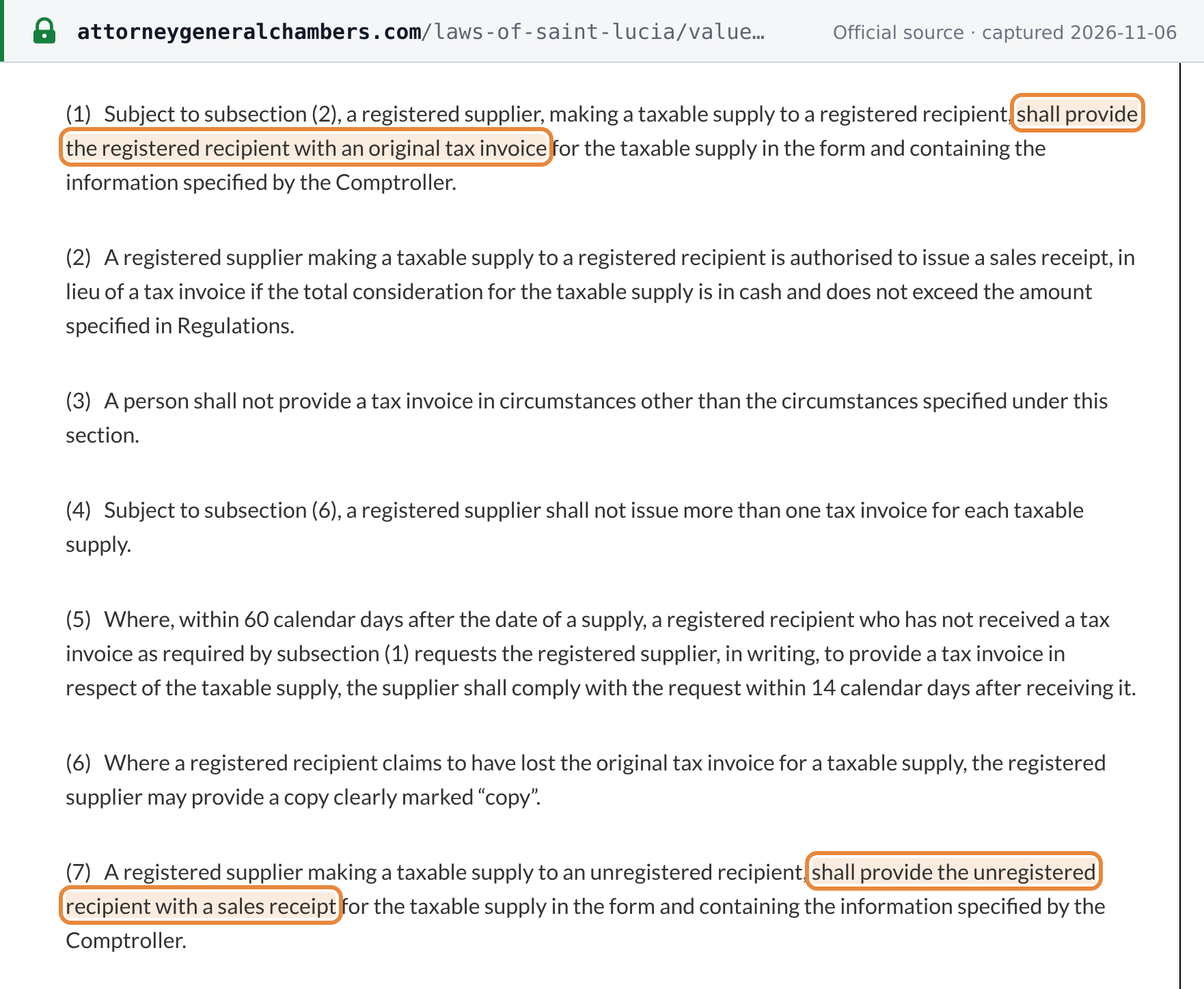
When a tax invoice is required. Section 34(1): "Subject to subsection (2), a registered supplier, making a taxable supply to a registered recipient, shall provide the registered recipient with an original tax invoice for the taxable supply in the form and containing the information specified by the Comptroller." For an unregistered recipient, the supplier gives a sales receipt instead (s.34(7)). [19]
 Source snapshot captured 2026-11-06 — original
Mandatory content
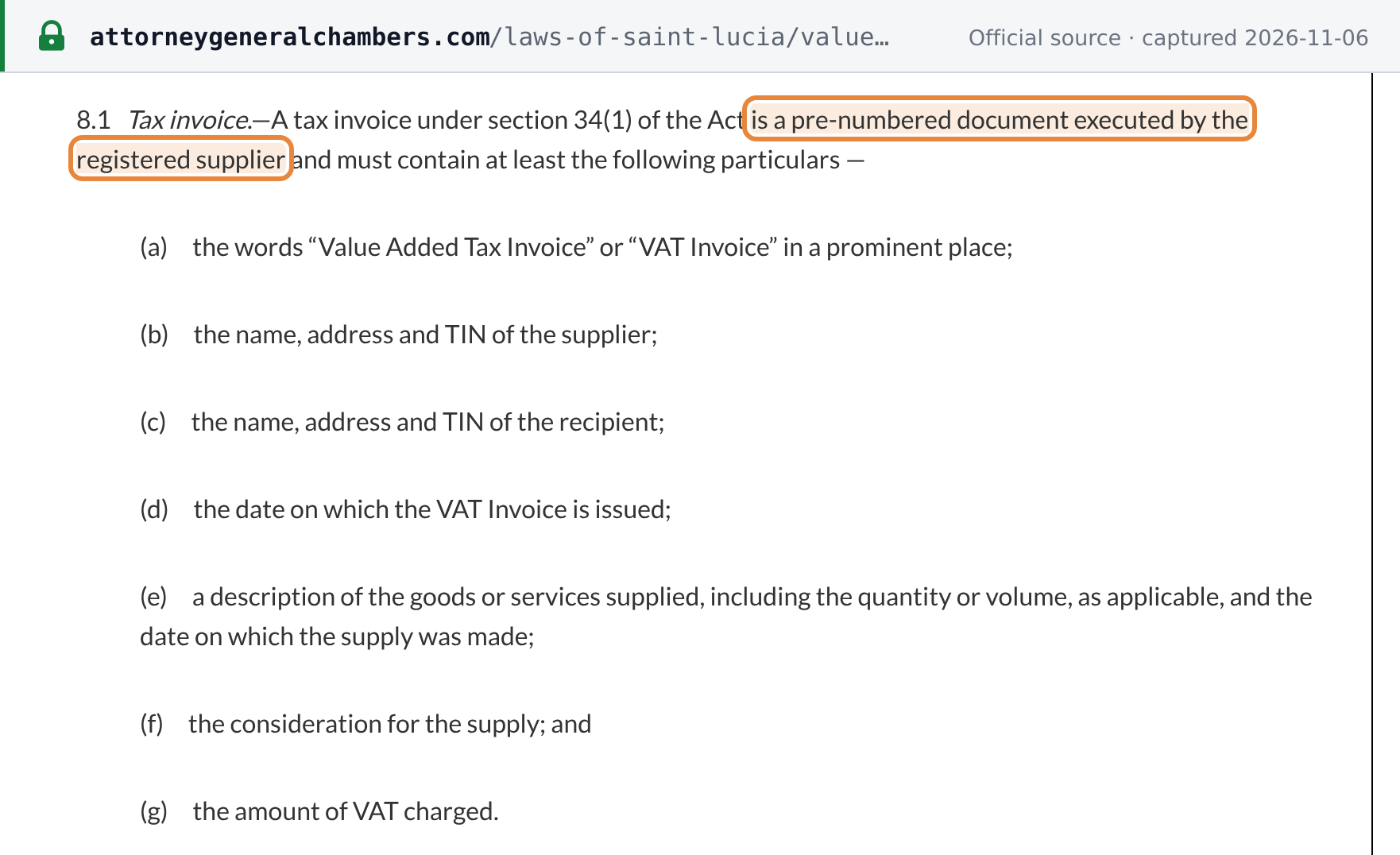
The Comptroller's specification is Interpretative Note 8.1: "A tax invoice under section 34(1) of the Act is a pre-numbered document executed by the registered supplier and must contain at least the following particulars". [21]
| # | Particular | Note 8.1 |
|---|---|---|
| 1 | The words "Value Added Tax Invoice" or "VAT Invoice" in a prominent place | (a) |
| 2 | The supplier's name, address and TIN | (b) |
| 3 | The recipient's name, address and TIN | (c) |
| 4 | The date on which the invoice is issued | (d) |
| 5 | A description of the goods or services, including the quantity or volume, and the date of supply | (e) |
| 6 | The consideration for the supply | (f) |
| 7 | The amount of VAT charged | (g) |
 Source snapshot captured 2026-11-06 — original
Issuance deadline
The Act sets no general deadline for issuing a tax invoice. A deadline applies on request: "Where, within 60 calendar days after the date of a supply, a registered recipient who has not received a tax invoice as required by subsection (1) requests the registered supplier, in writing, to provide a tax invoice in respect of the taxable supply, the supplier shall comply with the request within 14 calendar days after receiving it" (s.34(5)). [19] Issuing the invoice is one of the time-of-supply triggers. Under s.18(1), the supply takes place at the earliest of delivery or completion, the invoice, or payment. [48]
Numbering and sequencing
A tax invoice must be "a pre-numbered document" (Note 8.1). The Act, the Regulations and the Notes prescribe no number format, series or gap-control rule beyond that. Only one tax invoice may be issued per supply (s.34(4)). A replacement for a lost original must be "clearly marked "copy"" (s.34(6)).
Credit and debit notes
Where a tax invoice shows the wrong amount of tax, the supplier issues a tax credit note (overcharge) or tax debit note (undercharge) to the registered recipient (s.35). Only one note may be issued for each excess or shortfall (s.35(5)). [26] Regulation 6(1) of the VAT Regulations lists the particulars of a credit note: [25]
- "(a) the name, address and taxpayer identification number of the registered person making the supply;"
- "(b) the name, address and taxpayer identification number of the recipient of the supply;"
- "(c) the value of the supply shown on the invoice, the correct amount of the value of the supply, the difference between those 2 amounts and the tax charged that relates to the difference;"
- "(d) the words "Tax Credit Note" in a prominent place;"
- "(e) the date on which the tax credit note was issued;"
- "(f) a brief explanation as to why the tax credit note is being issued; and"
- "(g) information sufficient to identify the taxable supply to which the tax credit note relates."
A debit note follows the same pattern, headed "Tax Debit Note". Issuing a false note is an offence (s.35(8)).
Currency and language
Amounts are expressed in EC$ (s.102(1)). A foreign-currency amount on a domestic supply "is to be converted at the exchange rate applying between the currency and the Eastern Caribbean Dollar, EC$ or XCD$ at the time the amount is taken into account under this Act" (s.102(2)(b)). [23] The Act sets no separate language rule for invoices, but records must be kept in English (s.69(2)).
Tax-inclusive prices. Prices are deemed to include VAT. An advertised or quoted price must include VAT, or show the VAT or the VAT-inclusive price at least as prominently (s.100). [47]
Document types
| Document | When | Particulars |
|---|---|---|
| Tax invoice ("VAT Invoice") | Taxable supply to a registered recipient (s.34(1)) | Note 8.1, above |
| VAT Sales Receipt | Taxable supply to an unregistered recipient (s.34(7)); or to a registered recipient for a cash sale of EC$50 or less (s.34(2), reg. 5) | Note 8.2 |
| No document | A supply of one or more items totalling EC$5 or less (s.34(8)(c)) | — |
Regulation 5: "a registered supplier may issue a sales receipt in lieu of a tax invoice for a taxable supply to a registered recipient if the total consideration for the sale reported on the sales invoice is payable in cash and does not exceed $50.00." [22]
A VAT Sales Receipt (Note 8.2) must show:
- "(a) the words "VAT Sales Receipt" in a prominent place";
- "(b) the name, address and TIN of the supplier";
- "(c) the date on which the sales receipt is issued";
- "(d) a description of the goods and services supplied, including the quantity or volume as applicable and, if necessary to identify the supply, the date on which the supply was made";
- "(e) the total consideration for the supply (including VAT)"; and
- "(f) the amount of VAT charged".
It does not need the recipient's details. [21]
Self-billing
Not provided. Section 34 places the duty to issue on the registered supplier. Section 34(3): "A person shall not provide a tax invoice in circumstances other than the circumstances specified under this section."
Retention and audit trail
- What to keep. Section 69(1) lists the records: original invoices and receipts received; copies of all invoices, receipts and credit and debit notes issued; customs documents; and accounting records.
- Where. In Saint Lucia (s.69(1)).
- How long. Section 69(2): "Records required to be maintained under subsection (1) must be retained — (a) in the English language; (b) for 6 years after the end of the tax period to which they relate." The Comptroller may permit earlier disposal (s.69(3)). [27]
- Electronic records. "Documents" include electronic documents (s.2), and records include computer-stored information (s.68). The Act has no express rule letting electronic-only archives replace paper originals.
- Tamper-evidence. Beyond pre-numbering, the Act, Regulations and Notes impose no hash, certified-software or fiscal-device requirement.
A specimen of a compliant invoice
The Attorney General's Chambers consolidation of the Act, the Regulations and the Interpretative Notes contains no specimen tax invoice, and no VAT statutory instrument on the NPC lists prescribes an invoice form. Note 8.1 lists the particulars without illustrating them. Below, Lookuptax lays out the Note 8.1 particulars for an illustrative B2B sale between two registered businesses. Every name, number and amount is fictional:
VAT Invoice — illustrative specimen (Saint Lucia)
| DescriptionNote 8.1(e) | QtyNote 8.1(e) | Unit price (EC$) | VAT rate | Net (EC$)Note 8.1(f) |
|---|---|---|---|---|
| Office chairs | 4 | 250.00 | 12.5% | 1,000.00 |
| Restaurant catering (food and beverages by a restaurant) | 1 | 400.00 | 10% | 400.00 |
- Consideration (excl. VAT)Note 8.1(f)
- EC$ 1,400.00
- VAT @ 12.5% on 1,000.00s.10(1)
- EC$ 125.00
- VAT @ 10% on 400.00S.I. 188/2020
- EC$ 40.00
- Amount of VAT chargedNote 8.1(g)
- EC$ 165.00
- Total payable
- EC$ 1,565.00
- Amounts in Eastern Caribbean dollars — VAT Act s.102.
- The 10% line applies only where the supplier is a restaurant — S.I. 188/2020 para. 3(b)(i). Otherwise the catering is at 12.5%.
- A tax invoice is required where both supplier and recipient are VAT-registered (s.34(1)); an unregistered customer gets a "VAT Sales Receipt" instead (s.34(7), Note 8.2).
- Cash sales of EC$50 or less to a registered recipient may be covered by a sales receipt (reg. 5); supplies of EC$5 or less need no document (s.34(8)(c)).
- Only one original tax invoice per supply; a replacement must be marked "copy" — s.34(4), (6).
- Keep a copy in Saint Lucia, in English, for 6 years after the end of the tax period — s.69.
E-invoicing status
None as at 2026-11-06. The VAT Act (Revised Laws 2023), the VAT Regulations, Interpretative Notes 1–15, and every VAT statutory instrument and Act on the NPC lists for 2012–2026 contain no e-invoicing, clearance (CTC), real-time reporting, e-receipt or fiscal-device requirement. They name no e-invoicing system, network, format or phase timeline, and no B2B, B2G or B2C mandate applies. The only electronic references are that "“documents” include electronic documents" (s.2) and that records include computer-stored information (s.68). [15] [49]
For the regional picture, see e-invoicing status and networks worldwide.
Filing and payment
Filing frequency
Monthly, for every taxable person. The tax period "is the calendar month" (s.36). [24] Turnover and taxpayer class do not change it.
Return due date
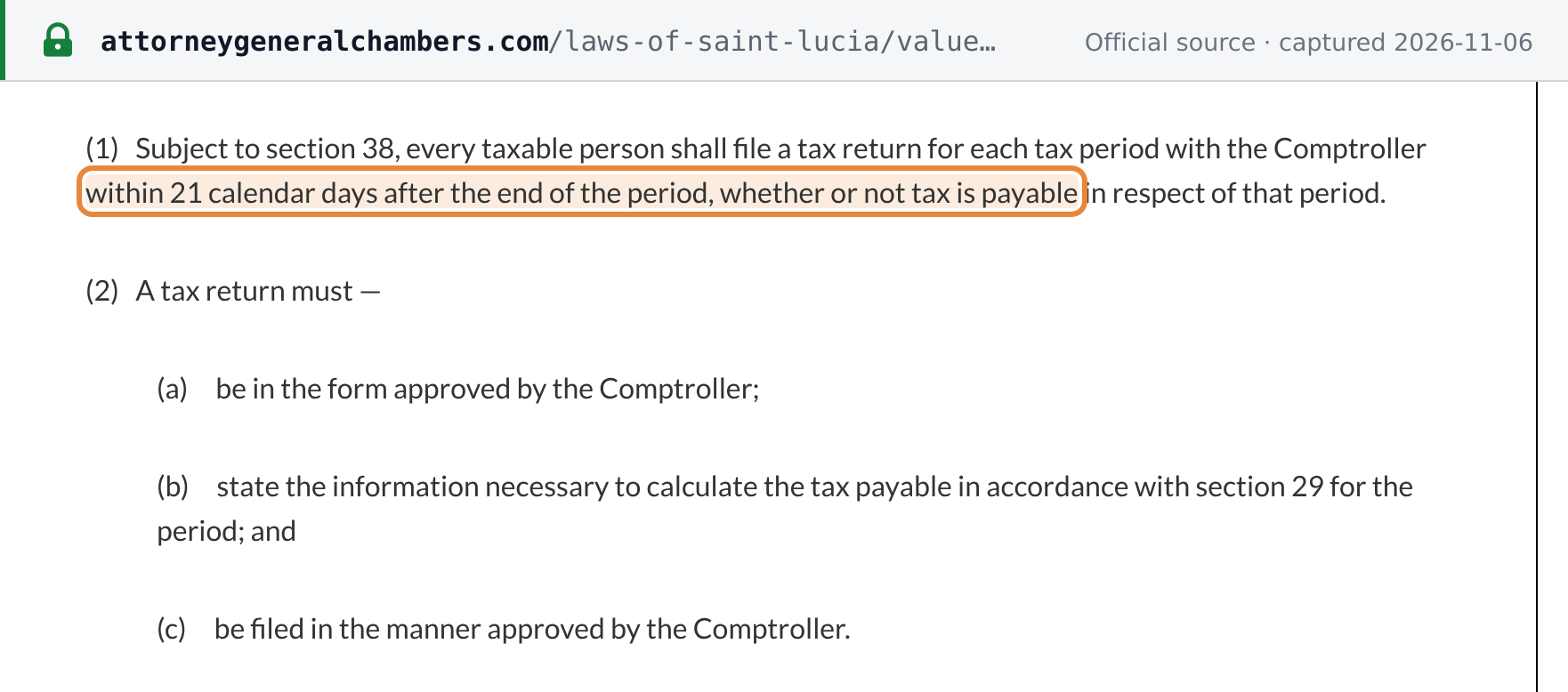
21 calendar days after the end of each month, including nil returns. Section 37(1): "Subject to section 38, every taxable person shall file a tax return for each tax period with the Comptroller within 21 calendar days after the end of the period, whether or not tax is payable in respect of that period." The return must be in the form, and filed in the manner, the Comptroller approves (s.37(2)). [28] An extension of time to file under s.38 does not move the payment date (s.38(2)).
 Source snapshot captured 2026-11-06 — original
Payment due date and method
Tax for a period is "due and payable — (a) by a taxable person for a tax period, by the due date for the return for the tax period" (s.46(1)). [29] VAT on imported services is declared and paid within 21 calendar days after the tax period (s.28(1)). The Act and Regulations do not specify payment channels or an e-filing system.
Additional listings
None. The Act requires no annual VAT return or sales and purchase listings. The Comptroller may, by written notice, require "such fewer, additional, or other returns" as needed (s.37(3)).
Input-tax recovery and blocked items
Input tax is deductible only on supplies or imports "for use in a taxable activity" (s.30(1)(a)). [35] Section 31 blocks input tax on: [31]
- Passenger vehicles and their repair or maintenance: "(a) a taxable supply to, or import by, the person of a passenger vehicle, unless the person is in the business of dealing in, or hiring of, such vehicles".
- Entertainment, meaning food, beverages, tobacco, accommodation, amusement, recreation or hospitality. The block does not apply where the business itself supplies taxable entertainment or the entertainment is part of passenger transport.
Refunds
- Carry forward first. An excess of input tax carries forward. After it has been carried forward for three consecutive tax periods, the taxable person may claim a refund of what remains (s.57(3)). The Comptroller pays it, after any set-off, by the end of the calendar month after the claim is filed, or within 10 days after an audit if later (s.57(4)).
- Zero-rated exporters. Section 57(5): "Where at least fifty per cent of the taxable supplies of a taxable person for the taxable period is taxed at a rate of zero per cent, and the person reports an excess under subsection (1)(a) for the tax period, the Comptroller may refund the taxpayer for the excess deductions attributable to the zero rated supplies by the end of the first calendar month following the period specified under section 37(1)."
- Small amounts. An excess of EC$100 or less is carried forward (s.57(7)).
- Time limit. A refund must be claimed within 3 years (s.57(11)). [32]
- Non-residents. There is no non-resident refund scheme. Refunds under s.59 are limited to the diplomats, organisations and other persons it lists.
Exemptions
Exempt supplies
Schedule 2, item 2: "The following supplies are specified as exempt supplies for the purposes of section 17 of this Act — (a) a supply of financial services; (b) a supply of medical services, except for elective services that are cosmetic in nature." [33] Other exempt supplies include:
- nursing and residential care (c);
- education services (h);
- the sale of a dwelling (k)/(l), and the residential lease of a dwelling (m);
- games of chance and lotteries for specified periods (o);
- religious services (p);
- local passenger transport (q);
- State postal services, but not courier services (t);
- approved agricultural inputs (v) and approved fishing inputs (w).
Schedule 2 has been amended by Order since the 2023 consolidation, so check the current Orders before relying on a specific food or produce item.
Exempt is not zero-rated. A business making exempt supplies charges no VAT and cannot recover the input tax on its costs. A taxable activity excludes exempt supplies (s.6(2)(b)), and input tax is deductible only for use in a taxable activity (s.30(1)(a)). A zero-rated supplier charges 0% and does recover input tax, with the faster refund under s.57(5). Where a supply is both exempt and zero-rated, s.17(3) applies: "A supply of goods or services is not an exempt supply if, in the absence of subsections (1) and (2), the supply would be charged with tax at the rate of zero per cent under section 16." [34]
Special regimes
- Tourism sector. The 7% and 10% rates in S.I. 188/2020 (see Rates).
- Transfer of a going concern. Zero-rated between registered persons, with written notice within 21 calendar days (Schedule 1, item 2(1)(i)).
- Small business, flat-rate and cash-accounting schemes. None. The Act contains no such scheme; businesses below EC$400,000 simply stay unregistered.
Offences and penalties
Offences
Fines and imprisonment on summary conviction:
| Offence | Fine / imprisonment | Provision |
|---|---|---|
| Tax evasion | Up to EC$100,000 or 3 years, or both | s.75(2) |
| A non-registered person collecting VAT | Up to EC$100,000 or 4 years | s.79 |
| Recovering an amount represented to be tax when not entitled | Up to EC$30,000 or 2 years, or both | s.15(2) |
| Breaching s.34 (tax invoices, sales receipts, false invoices, false TIN) | Up to EC$15,000 or 1 year, or both | s.34(10) |
| Breaching s.35 (credit and debit notes) | Up to EC$15,000 or 1 year, or both | s.35(8) |
| Failing to file returns for two or more tax periods | Up to EC$50,000 or 3 years, or both | s.37(5) |
| Records breach | Up to EC$5,000 or 1 year | s.69(4) |
| Price-display breach | Up to EC$10,000 or 2 years, or both | s.100(6) |
| Any other contravention | Up to EC$10,000 or 1 year, or both | s.82 |
Section 75(2): a person who evades tax "commits an offence and is liable on summary conviction to a fine not exceeding $100,000 or to imprisonment for a term not exceeding 3 years or to both". [42] Section 79: "(1) A non-registered person shall not collect tax on a supply." [43] On repeated violations involving invoices, returns, payment, refunds or obstruction, the Comptroller may, with a court order, close business premises for up to 14 calendar days (s.95). The names of persons convicted may be published (s.96).
Penalties
| Exposure | Amount | Provision |
|---|---|---|
| Late payment | 10% of the tax due | s.46(4) |
| Interest on unpaid tax | 1.25% per month or part of a month, on top of the penalty | s.33(1) |
| Late return | EC$250 per month or part of a month the return is unfiled | s.89 |
| Failure to register | Double the output tax payable from when registration was due until the application is filed | s.86(1) |
| Failure to display the registration certificate | EC$100 per day | s.86(2) |
| Failure to notify changes or cessation | EC$250 / EC$500 / EC$1,000 (first / second / third and later) | s.87 |
| False invoice or receipt, false TIN, or failing to issue (or wrongly issuing) a tax invoice, sales receipt, credit note or debit note | EC$5,000 / EC$10,000 / EC$15,000 / EC$25,000 (first / second / third / fourth and later instance) | s.88 |
| Failure to keep records | EC$100 per day | s.91 |
- Late payment. Section 46(4): "Any person who fails to pay tax, being the whole or part of the remainder of any tax due or payable under this Act, by the due date is liable to a penalty equal to 10% of the amount of tax due." Since Act 15 of 2023, the Minister may alter that rate by Order (s.46(4A)). [29]
- Interest. Section 33(1): unpaid tax "bears interest at the rate of 1.25% per month or part of a month for the period during which it remains unpaid." [30]
- Late returns. Section 89: "A person who fails to file a return within the time required under this Act is liable to a penalty of $250 per month or part of the month, for the period during which the return remains unfiled." [40] The worked example in Interpretative Note 10.1 shows a single EC$250 penalty. The Notes defer to the Act, which says per month.
- Invoices. Section 88 is the penalty a supplier is most likely to meet in practice: the amount rises with each instance, from EC$5,000 to EC$25,000. [39]
- Late registration. Section 86(1): a person who fails to apply "is liable to a penalty equal to double the amount of output tax payable from the time the person is required to apply for registration until the person files an application for registration with the Comptroller." [41]
Relief on old arrears (2 May 2026 – 31 December 2027). Two Orders made on 6 July 2026 cut the penalty and the interest to zero on tax for periods ending on or before 31 December 2025:
- Penalty, S.I. 151/2026. "From the 2nd day of May, 2026 to the 31st day of December, 2027, the rate of penalty is altered from ten per cent to zero per cent on the whole or part of the remainder of tax due or payable under the Act for the tax periods before and ending on the 31st day of December, 2025." [44]
- Interest, S.I. 152/2026. It alters the interest rate "from one point two five per cent to zero per cent" for the same window and periods. [45]
Earlier window (2 May 2024 – 1 May 2026). Two Orders made on 18 February 2026 gave the same relief on tax for periods ending on or before 31 December 2023. S.I. 20/2026: "From the 2nd day of May, 2024 to the 1st day of May, 2026, the rate of penalty is altered from ten per cent to zero per cent on the whole or part of the remainder of tax due or payable under the Act for the tax periods before and ending on the 31st day of December, 2023." [52] S.I. 19/2026 alters the interest rate "from one point two five per cent to zero per cent" for the same window and periods. [51]
Tax for periods from January 2026 onwards still carries the 10% penalty and 1.25% monthly interest.
Frequently asked questions
Is VAT on a hotel stay in Saint Lucia 10% or 7%?
7%. Since 1 December 2020 the Value Added Tax (Rate of Tax) (Tourism Sector Goods and Services) Order, S.I. 188/2020, applies 7% to a supply of a tourism accommodation service, meaning sleeping accommodation in the tourism sector with or without related facilities. The 10% rate in the same Order covers food and beverages (including alcoholic beverages) supplied by a restaurant, water sports, tours within Saint Lucia, and admission to heritage sites and other tourist attractions. Everything else taxable is at the 12.5% standard rate.
Were building materials zero-rated in June 2026?
Not under the Order as made. The Value Added Tax (Amendment of Schedule 1) Order, 2026 (S.I. 150/2026) zero-rates cement, lumber and plywood, galvanize and steel, aluminium articles and the other listed building materials for 2 August 2025 to 31 May 2026, and for an additional period from 1 July 2026 to 30 November 2030. The parliamentary resolution approving the draft Order (S.I. 140/2026) gave 1 June 2026 as the restart date, but the Order the Minister made says 1 July 2026.
Do we have to give a VAT invoice to a customer who is not VAT-registered?
No. A registered supplier gives a tax invoice only to a registered recipient (VAT Act s.34(1)). An unregistered customer gets a sales receipt (s.34(7)), headed "VAT Sales Receipt", showing the supplier's name, address and TIN, the date, a description, the total consideration including VAT and the VAT amount (Interpretative Note 8.2). A registered customer paying cash of EC$50 or less may also be given a sales receipt instead of a tax invoice (VAT Regulations reg. 5), and supplies totalling EC$5 or less need no document at all (s.34(8)(c)).
Does a foreign software or consulting firm have to register for VAT in Saint Lucia?
The VAT Act has no separate non-resident or digital-services registration regime. A non-resident's supplies count towards the EC$400,000 threshold only where they are made in Saint Lucia (s.12(8)). VAT on an imported service is paid by the recipient (s.9(2)(c)): a registered recipient that does not use the service to make taxable supplies, and an unregistered recipient, file an import declaration and pay within 21 calendar days after the tax period (s.28).
Do zero-rated sales count towards the EC$400,000 registration threshold?
Yes. The threshold in s.12(1) is measured on taxable supplies. The Act defines a taxable supply as a supply in Saint Lucia in the course or furtherance of a taxable activity, other than an exempt supply (s.2), so zero-rated supplies count and exempt supplies do not.
Is there still a penalty and interest on old Saint Lucia VAT arrears?
Not for tax periods ending on or before 31 December 2025, if the arrears are dealt with between 2 May 2026 and 31 December 2027. S.I. 151/2026 alters the late-payment penalty from 10% to 0%, and S.I. 152/2026 alters interest from 1.25% to 0%, for that window and those periods. Tax for later periods still carries the 10% penalty (s.46(4)) and interest of 1.25% per month or part of a month (s.33(1)).
Important websites
| Site | Purpose |
|---|---|
| Inland Revenue Department | The VAT authority |
| Value Added Tax Act — Revised Laws of Saint Lucia | Consolidated Act, VAT Regulations and Interpretative Notes, one page per section (Attorney General's Chambers) |
| NPC statutory instruments | Rate and Schedule Orders, penalty and interest Orders, by year |
| NPC Acts | Amending Acts, by year |
| Official Gazette | Gazetted Acts, statutory instruments and notices |
| Customs and Excise Department | VAT on imported goods is collected with customs |
| Registration, e-filing and payment portal | The Act and Regulations name none |
| VAT number lookup | Section 13(10) requires the Comptroller to publish registrants' names and TINs |
| E-invoicing portal | None (no mandate) |
Recent changes
- 2026-08-02 — Photovoltaic goods and their installation are zero-rated until 1 August 2031. (S.I. 174/2026)
- 2026-07-01 — The building-materials zero rate restarts and runs to 30 November 2030. The approving resolution (S.I. 140/2026) said 1 June 2026; the Order as made says 1 July 2026. (S.I. 150/2026) — see event
- 2026-05-02 — Late-payment penalty and interest are set to 0% until 31 December 2027 for VAT periods ending on or before 31 December 2025. (S.I. 151/2026, S.I. 152/2026)
- 2025-12-22 — A one-day "VAT-free" zero rate for participating taxable persons, excluding goods not in stock, motor vehicles, guns and ammunition, tobacco, alcohol and imports. (S.I. 219/2025)
- 2020-12-01 — Tourism rates set at 7% for accommodation and 10% for restaurants, water sports, tours and attractions. (S.I. 188/2020)
- 2017-02-01 — The standard rate falls from 15% to 12.5%. (S.I. 101/2016)
For the full chronology, see Saint Lucia tax changes on Lookuptax.
Reference links
All Attorney General's Chambers links are to the Revised Laws of Saint Lucia (2023), Value Added Tax Act, Cap. 15.42, and its subsidiary legislation.
- Value Added Tax Act, Cap. 15.42 — arrangement of sections
- VAT Act — amendment history
- VAT Act s.9 — imposition of tax
- VAT Act s.10 — rate of tax
- S.I. 101/2016 — Value Added Tax (Amendment of Rate) Order (NPC)
- S.I. 188/2020 — Value Added Tax (Rate of Tax) (Tourism Sector Goods and Services) Order (NPC)
- Value Added Tax (Rate of Tax) (Tourism Sector Goods and Services) Order — consolidated
- VAT Act Schedule 1 — zero-rated supplies
- S.I. 150/2026 — Value Added Tax (Amendment of Schedule 1) Order, 2026 (NPC)
- S.I. 174/2026 — Value Added Tax (Amendment of Schedule 1) (No. 2) Order (NPC)
- VAT Act s.12 — registration
- VAT Act s.13 — registration procedure
- VAT Act s.14 — cancellation of registration
- VAT Act s.67 — branches or divisions
- VAT Act s.2 — interpretation
- VAT Act s.6 — taxable activity
- VAT Act s.19 — place of supply
- VAT Act s.28 — imported services
- VAT Act s.34 — tax invoices and sales receipts
- Interpretative Notes for the Value Added Tax Act (Comptroller of Inland Revenue)
- Interpretative Note 8 — tax invoices and sales receipts
- VAT Regulations reg. 5 — sales receipt in lieu of a tax invoice
- VAT Act s.102 — currency
- VAT Act s.36 — tax period
- VAT Regulations reg. 6 — tax credit and debit notes
- VAT Act s.35 — tax credit and debit notes
- VAT Act s.69 — records
- VAT Act s.37 — returns
- VAT Act s.46 — payment and late-payment penalty
- VAT Act s.33 — interest
- VAT Act s.31 — disallowed input tax
- VAT Act s.57 — refunds
- VAT Act Schedule 2 — exempt supplies
- VAT Act s.17 — exempt supplies
- VAT Act s.30 — input tax
- Saint Lucia — Information on Tax Identification Numbers (OECD, jurisdiction submission)
- VAT Act s.61 — representatives
- VAT Act s.97 — taxpayer identification number
- VAT Act s.88 — penalty for invoice failures
- VAT Act s.89 — penalty for late returns
- VAT Act s.86 — penalty for failure to register
- VAT Act s.75 — tax evasion
- VAT Act s.79 — collection of tax by a non-registered person
- S.I. 151/2026 — Value Added Tax (Alteration of Rate of Penalty) (No. 2) Order (NPC)
- S.I. 152/2026 — Value Added Tax (Alteration of Rate of Interest) (No. 2) Order (NPC)
- S.I. 219/2025 — Value Added Tax (Amendment of Schedule 1) (No. 3) Order (NPC)
- VAT Act s.100 — tax-inclusive pricing
- VAT Act s.18 — time of supply
- NPC — statutory instruments, 2026
- NPC — Acts, 2026
- S.I. 19/2026 — Value Added Tax (Alteration of Rate of Interest) Order (NPC)
- S.I. 20/2026 — Value Added Tax (Alteration of Rate of Penalty) Order (NPC)
Related on Lookuptax: