Sudan VAT guidelines
Overview
Sudan levies a value added tax (VAT), in Arabic الضريبة على القيمة المضافة. The law is the Value Added Tax Act, 2001, amended many times since, with detail in the Value Added Tax Regulations, 2017 (لائحة الضريبة على القيمة المضافة لسنة 2017), signed by the Minister of Finance on 15 March 2017. [17] The Sudan Taxation Chamber publishes an English consolidated translation of the Act, prepared by the Ministry of Justice, and scans of the later amending instruments on its Tax Laws page. [1] [2]
Read the consolidated text with care. It is not current on several points that matter: it prints a 15% rate, a 30% telecoms rate and a three-year prison term for evasion, all of which later instruments changed. This guide uses the later instrument in each case and names it. The Chamber's English VAT page reproduces the same unamended wording in places.
Authority, currency, period and layering
- Authority. The Sudan Taxation Chamber (ديوان الضرائب), under the Ministry of Finance and Economic Planning, administers VAT. Its 2025–2026 English notices also call it the "Tax Authority". Customs collects VAT on imports at release.
- Currency. The Sudanese pound (SDG, جنيه سوداني). The Act states amounts in SDG, and the Chamber's e-invoice sample prints the total in words in Sudanese pounds.
- Period. The tax period is the calendar month. Returns are monthly (see Filing and payment). The registration test uses the taxpayer's financial year.
- Layering. VAT is a single national tax. Under section 16(1), national government units and state governments that sell goods are also required to register. [1]
- Operating conditions. The Chamber reported in February 2025 that its servers had been evacuated from its Khartoum headquarters during the conflict, and it announced on 4 May 2026 that the e-invoice system had resumed. [3]
Registration
Who must register and the threshold
The Chamber's English VAT page states the liability rule as two groups:
"Every : - Industrial producer, trader, and service or work provider whose turnover has reached or exceeded the registration threshold - Importer or exporter, regardless of their turnover must submit an application to the Authority to register their name and details." [4]
 Source snapshot captured 2026-11-08 — original
- Importers and exporters register at any turnover. This is the rule most likely to catch a small business: one import makes registration compulsory.
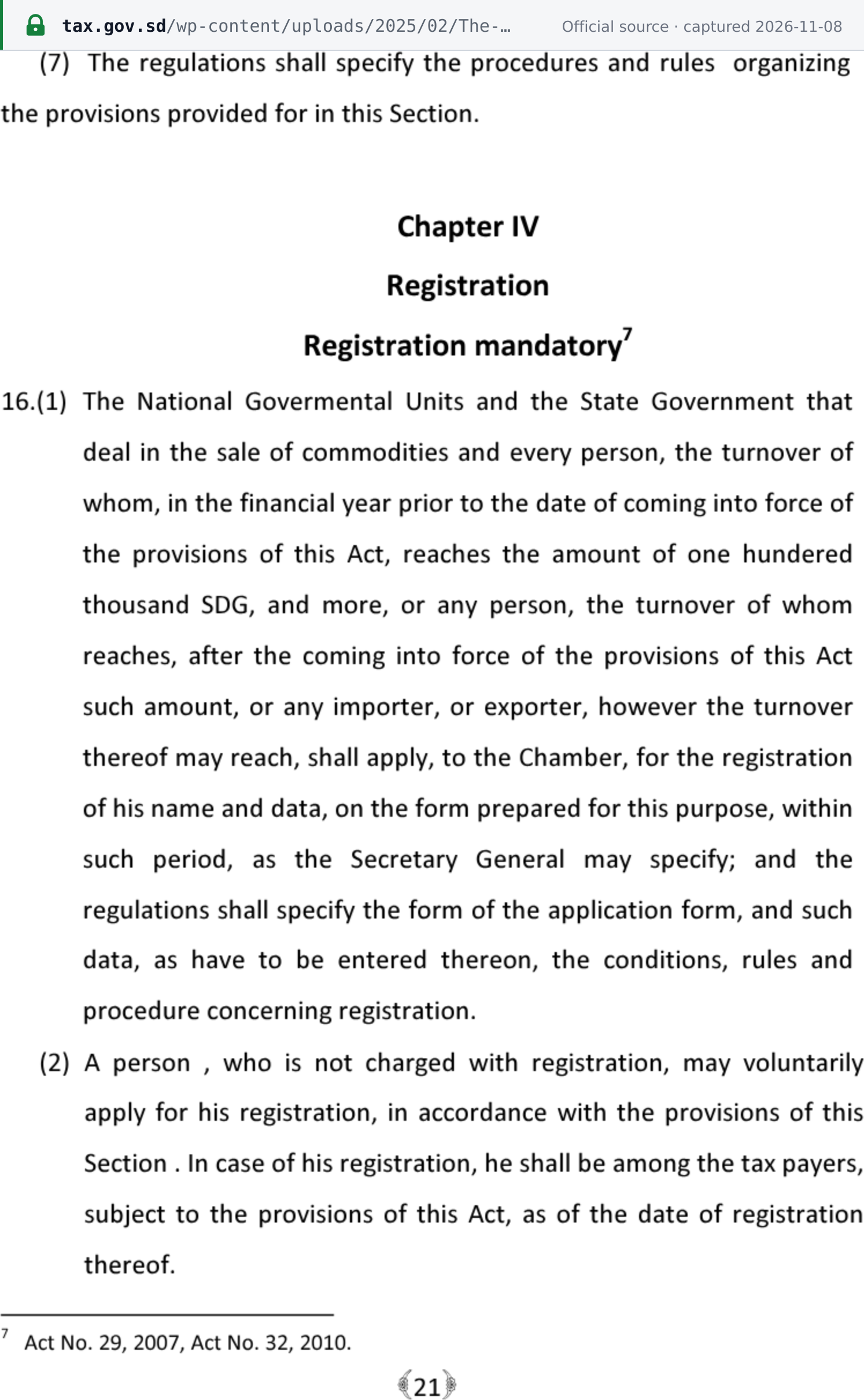
- The threshold amount. Section 16(1) of the Act, as amended by Act No. 29 of 2007 and Act No. 32 of 2010, sets the threshold at turnover of "one hundered [sic] thousand SDG, and more" (SDG 100,000) in a financial year. [1] This is the statutory figure. Section 18 lets the Minister amend the threshold by order with Council of Ministers approval, and the Sudanese pound has lost most of its value since 2010. The Chamber's English and Arabic VAT pages refer to "the registration threshold" without stating an amount, and its Tax Laws page lists no section 18 order (as at 2026-11-08). Confirm the current figure with the Chamber before relying on it.
- Measurement. Turnover in the financial year. The Regulations, as set out on the VAT page, add "in any financial year or part thereof": a person whose sales of taxable goods or services reach the threshold must apply. [4]
 Source snapshot captured 2026-11-08 — original
Non-resident registration
Neither the Act nor the Chamber's VAT pages provide for non-resident registration, a non-resident threshold or a fiscal representative (as at 2026-11-08). VAT on services bought from abroad is accounted for by the Sudanese customer under section 28(7). See Cross-border rules.
Tax registration number
The Chamber's documents use two identifiers: the registration number on the VAT registration certificate (Form 2), and the tax identification number (الرقم التعريفي الضريبي, TIN). A tax invoice must carry both for seller and buyer (see Invoice requirements). The Chamber publishes no format or check-digit specification for either. The sample invoice in its e-invoice manual shows a 12-digit seller TIN, which is one example, not a rule. For a consumer (B2C) e-invoice, the seller enters the buyer's national number, which the manual says must have 11 digits. [5] No public TIN lookup is published.
How to register
Registration is made in person at the tax office:
- File the application on Form (1) "to the tax office within the jurisdictionof [sic] the taxpayer's main office". An incomplete file can be registered provisionally.
- The Chamber assigns a registration number and issues a certificate on Form (2).
- The certificate must be displayed "in a visible place at the main business location and a copy at each branch".
- Changes to the registration data must be notified in writing within 30 days. [4]
The Chamber publishes no processing time. Its online return system is for taxpayers who already hold a TIN: the e-returns guide says the activation code is obtained "من مكتب الرقم التعريفي" (from the TIN office). [6]
Voluntary registration
Available. "A person whose total sales of taxable goods or services have not reached the registration threshold may voluntarily apply to the Authority for registration using Form (1)." A voluntary registrant may not ask to cancel the registration "before two years from the date of registration". [4] "Upon registration, they are subject to the provisions of the law …" An unregistered person who issues tax-inclusive invoices commits an evasion offence (see Offences).
Deregistration
A registered person who no longer meets the conditions applies in writing to the Secretary-General. Cancellation takes effect "from the last day of the tax period in which the cancellation decision was made", and the certificate is returned. Books, records and invoice copies are kept for two years from cancellation. If a business is deregistered for falling below the threshold but carries on trading, tax is due on the goods it holds at cancellation. [4]
Group registration
Not available. The Act and the Regulations as published on the Chamber's site contain no grouping provision (as at 2026-11-08).
Rates
Standard rate: 17%
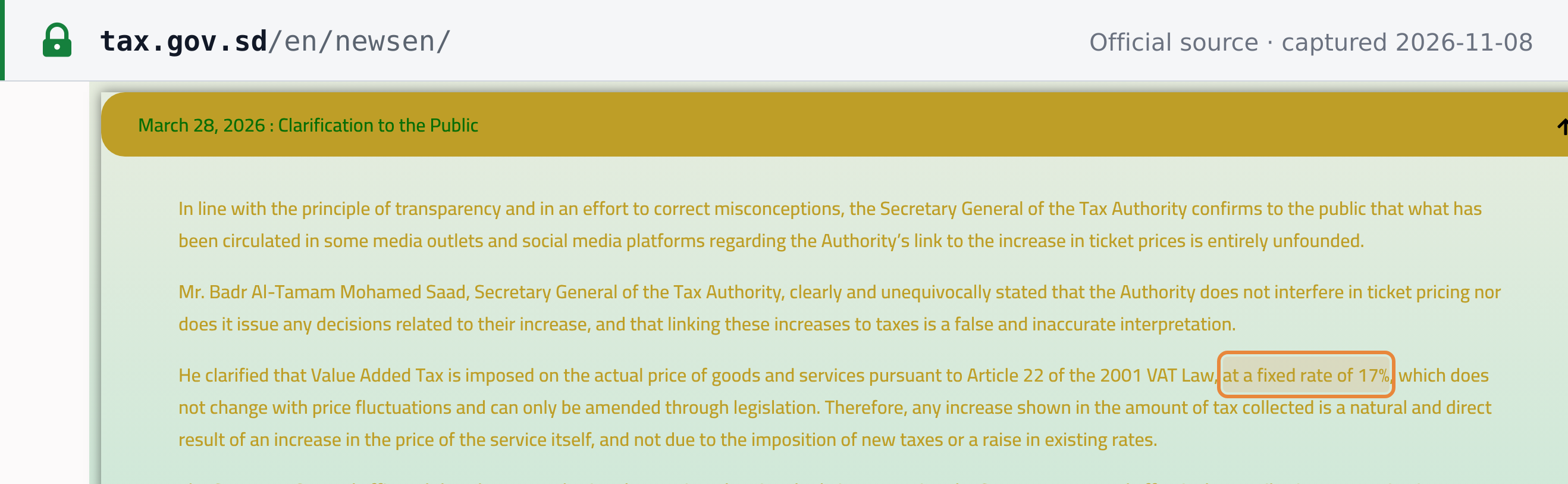
The standard rate is 17%. On 28 March 2026 the Chamber stated that VAT "is imposed on the actual price of goods and services pursuant to Article 22 of the 2001 VAT Law, at a fixed rate of 17%, which does not change with price fluctuations and can only be amended through legislation." [3]
 Source snapshot captured 2026-11-08 — original
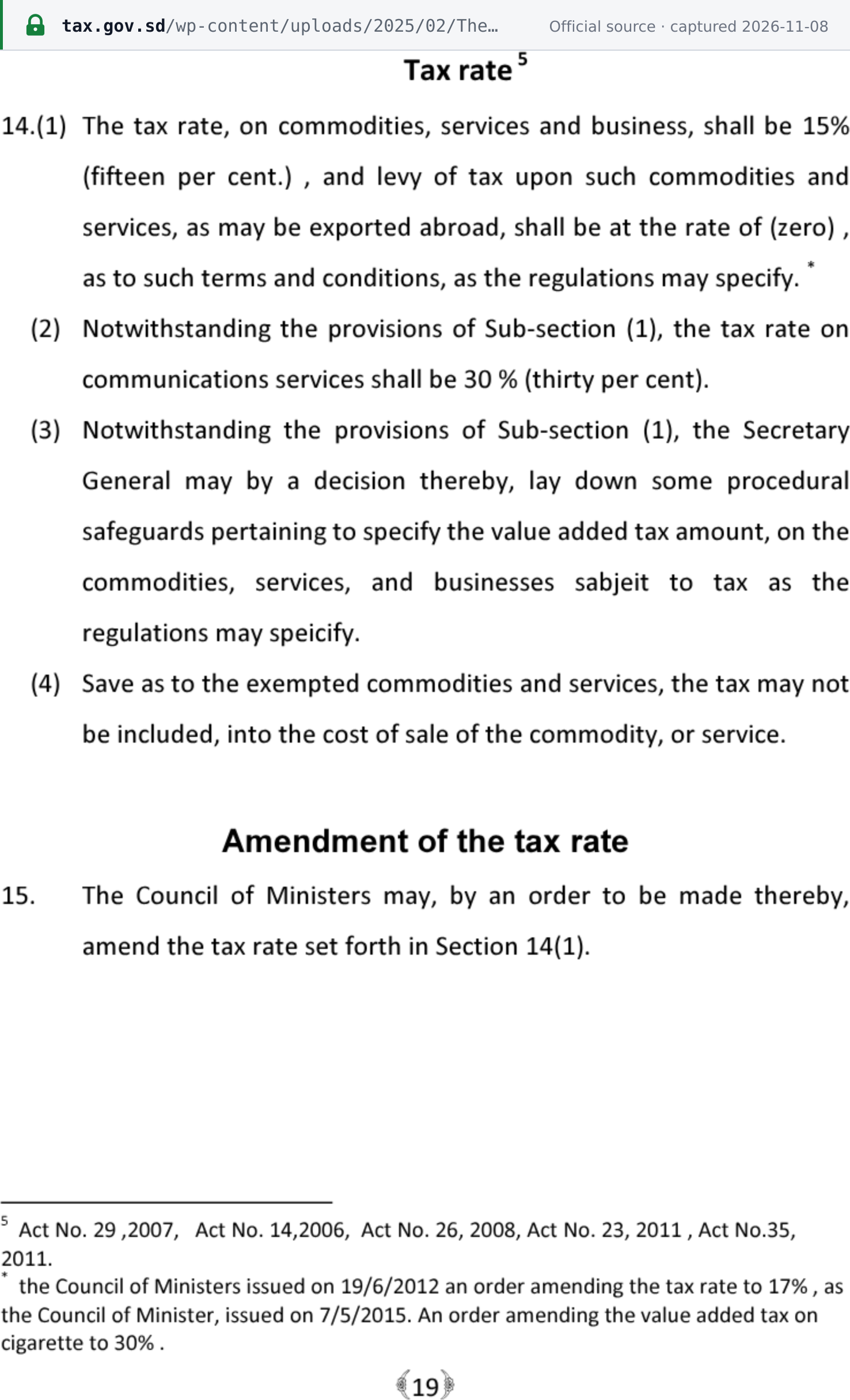
Why the Act says 15%. Section 14(1) of the consolidated Act still reads "shall be 15% (fifteen per cent.)". Section 15 lets the Council of Ministers amend the rate by order, and the footnote to section 14 records that the Council of Ministers "issued on 19/6/2012 an order amending the tax rate to 17%". The rate has been 17% since that order. [1]
 Source snapshot captured 2026-11-08 — original
Higher rates: telecommunications and tobacco
| Supply | Rate | Instrument |
|---|---|---|
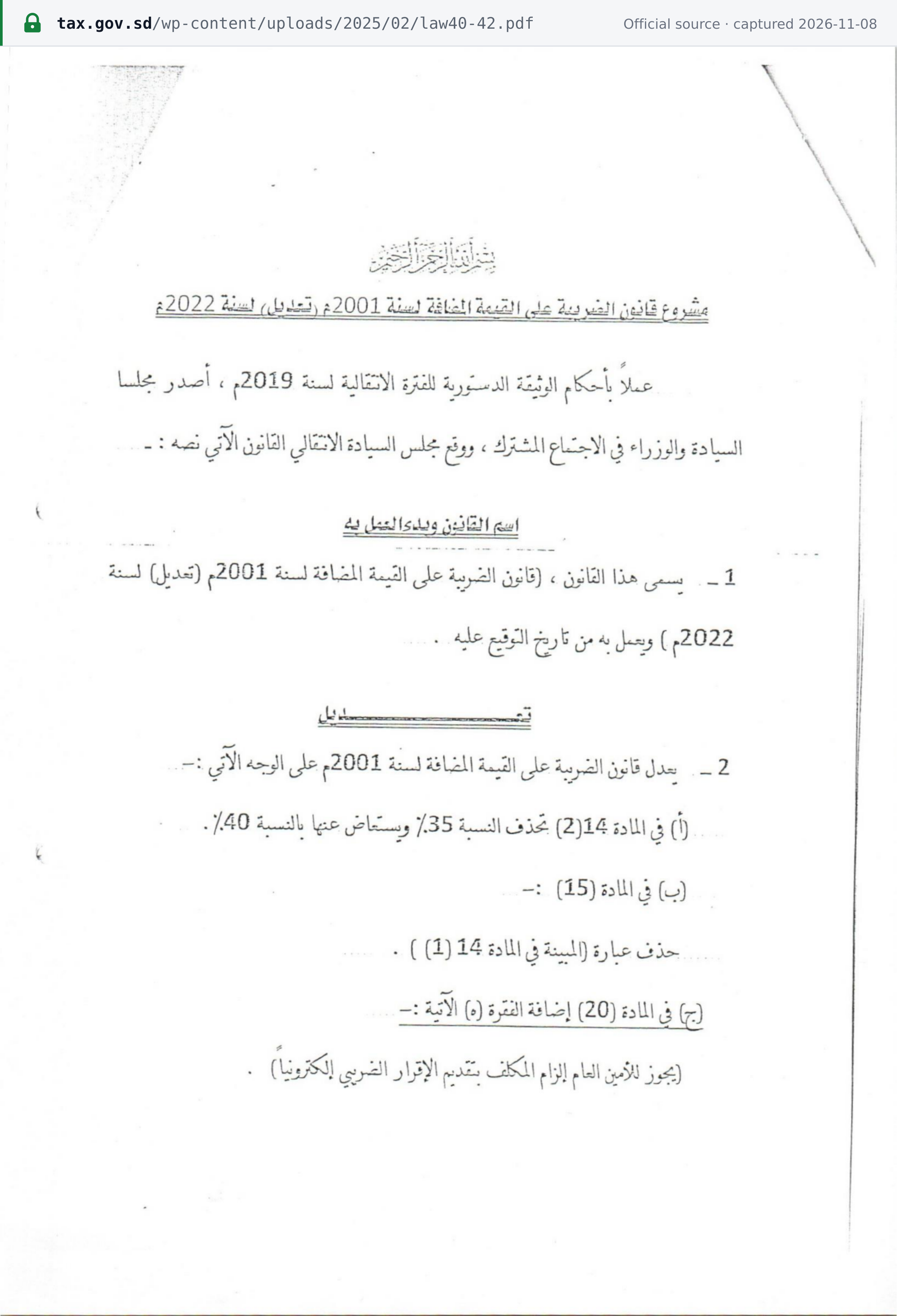
| Communications (telecom) services | 40% | VAT Act 2001 (Amendment) Act 2022, clause 2(a): in section 14(2) "تحذف النسبة 35٪ ويستعاض عنها بالنسبة 40٪" (35% is deleted and replaced by 40%). Issued at joint meeting No. (1) of 2022 of the Sovereignty Council and Council of Ministers on 20 January 2022, in force from signature. [7] |
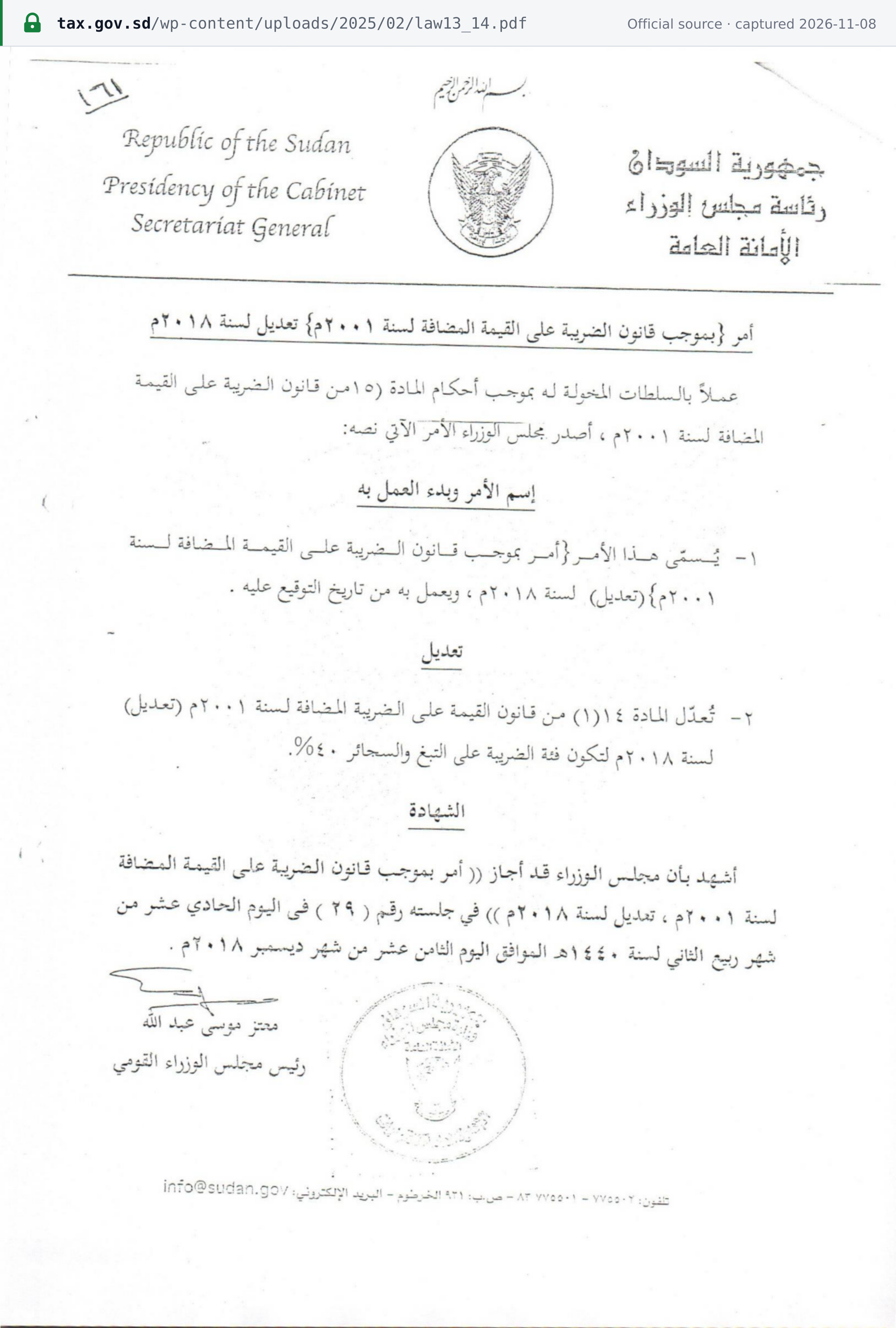
| Tobacco and cigarettes | 40% | Order under the VAT Act 2001 (Amendment) 2018, clause 2: "لتكون فئة الضريبة على التبغ والسجائر ٤٠٪" (the rate on tobacco and cigarettes is 40%). Approved by the Council of Ministers at session No. 29 on 18 December 2018. [8] |
Both instruments are image-only Arabic scans on the Chamber's site; the quotations above are transcribed from them. Page 1 of the 2022 scan is headed as a draft law (مشروع قانون), and the certificate on page 2 records that the Sovereignty Council and Council of Ministers issued it at joint meeting No. (1) of 2022 on 20 January 2022. [7] The consolidated Act still prints 30% for telecoms and, in a footnote, an order of 7 May 2015 setting cigarettes at 30%; the 2022 Act and the 2018 order replace those figures. The 2022 Act amends a 35% telecoms rate, and the Chamber's site does not publish the instrument that moved it from 30% to 35%.
 Source snapshot captured 2026-11-08 — original
 Source snapshot captured 2026-11-08 — original
Reduced and zero rates
- Zero rate. Exports are taxed "at the rate of (zero)" under section 14(1). [1] The exporter keeps an exports register "including customs certificates". [4]
- No general reduced rate. The Act sets no general rate between zero and 17%; basic goods are handled by exemption instead (see Exemptions).
- Goods-specific orders, 2021. An order under the VAT Act made in October 2021 under section 37(3)(a) amends the rates in the schedule annexed to the Act for listed tariff lines: industrial vegetable oils and fats in packs of 50 kg or more, solar panels, inverters and UPVC products. The "from" column shows 17% for most lines, but the new figures are not legible in the scan the Chamber publishes. An order of August 2021 repealed Order No. 378 of 2021 (of 21 June 2021), whose text is not published. [9] [9] Check the rate on these goods with the Chamber.
- Sugar. Council of Ministers Resolution No. 18 of 2021 computes VAT on locally produced sugar on 50% of the actual market selling price, and Resolution No. 403 of 2022 cancelled the import-stage VAT exemption on imported raw sugar. [9] [7]
Announced changes
The Chamber's news page and Tax Laws page list no rate change dated after the 2022 amendment, and no announced future change (as at 2026-11-08). Clause 2(b) of the 2022 Act deleted the words "set forth in Section 14(1)" from section 15, so the Council of Ministers can now amend any rate by order, not only the standard rate. [7]
Cross-border rules
Imports and exports
- Imports. VAT is due on every import, by every importer, at release from customs: "Final release shall not occur for such commodities before the full tax due is paid; and Customs shall not postpone the tax due or subject it to installments." [4] The taxable value is the customs value plus customs duties and the other taxes and fees on the goods, excluding VAT itself. Travellers' personal effects within the customs allowance are exempt; no other de minimis is published.
- Exports. Zero-rated under section 14(1), on customs export procedure, with the customs certificate kept in the exports register. [1]
- Free zones. Under section 15A(1), "Save as to cars of personal usage, tax shall not accrue on the imports of projects of free zones, towns, and markets of the commodities and services necessary for practising the acitivity licensed therefor inside such places." Goods moving from a zone to the local market are taxed as imports. [1]
Imported services: the customer accounts for the VAT
Section 28(7), as set out on the Chamber's VAT page:
"Every person resident in Sudan who contracts with a person non-resident in Sudan, and who does not have a legal entity registered in Sudan against rendering a service or business subject to tax, shall add the tax amount to the service value or work and deposit the same with the Chamber." [4]
 Source snapshot captured 2026-11-08 — original
The rule is written for "every person resident in Sudan", not only registered businesses. For the general mechanism, see reverse charge.
Foreign companies selling into Sudan — B2B and B2C
- B2B services. The Sudanese business customer adds the VAT and pays it to the Chamber under section 28(7). The foreign supplier does not register.
- B2C services. Section 28(7) is not limited to businesses, but the published texts set out no way for a non-resident supplier, or a consumer, to account for the tax in practice. There is no non-resident registration, no simplified regime and no collection by intermediaries (as at 2026-11-08).
- Goods. VAT is collected by customs from the importer at release, whoever the seller is.
Digital services
No specific rule. The Act, the Regulations and the Chamber's VAT, news and e-services pages contain no digital-services or electronic-services provision (as at 2026-11-08). The VAT Act 2001 (Amendment) Act 2021 widened the definition of "service" to include rental ("ويشمل الإيجار"). [9] Compare how other countries tax digital services from non-resident suppliers.
Marketplace and platform obligations
None published. The Act and the Chamber's pages contain no deemed-supplier or platform-collection rule (as at 2026-11-08).
Place of supply
The Act has no codified place-of-supply rules. Section 12 charges tax on "sales of local and imported commodities, services and business", imports are taxed at customs, and services bought from non-residents fall under section 28(7). [1]
Invoice requirements
When an invoice is required
The Regulations, as set out on the Chamber's VAT page, distinguish two cases: [4]
- Sale to another taxpayer (B2B, art. 9(1)(a)). "The taxpayer must issue a tax invoice or manifest when selling a taxable good or providinga taxable service or work to another taxpayer, showing the value of the good or service andthe tax due." Computerised invoices are allowed if they meet the conditions of article 9(1)(c) of the Regulations (art. 9(1)(a)).
- Sale to a non-taxpayer (B2C, art. 9(1)(b)). "For sales to non-taxpayers, the taxpayer may issue an invoice showing the total value of the good or service, including tax." The invoice is made in triplicate; the Arabic text says an original and two copies (من أصل وصورتين), with the original to the buyer and a copy kept.
No value threshold for a simplified invoice is published.
Mandatory content
Article 9(1)(c) of the VAT Regulations 2017, also set out on the Chamber's English and Arabic VAT pages. The invoice "must be sequentially numbered" in the order of the dates of issue and include: [17] [4] [10]
| # | Field | Source wording |
|---|---|---|
| 1 | Title "Tax Invoice" or "Manifest" (فاتورة ضريبية / منفستو) | art. 9(1)(c)(i) |
| 2 | Sequential number, in order of issue date | art. 9(1)(c) |
| 3 | Date and tax identification number | art. 9(1)(c)(ii) |
| 4 | Seller: name, address, registration number, TIN | art. 9(1)(c)(iii) |
| 5 | Buyer: name, address, registration number, TIN | art. 9(1)(c)(iv) |
| 6 | Description of the goods, services or works; the tax rate and the tax amount; the invoice total | art. 9(1)(c)(v) |
The English page renders item 6 as "tax rate, and total invoice value". The Arabic text reads "وفئة وقيمة الضريبة المقررة مع بيان إجمالي قيمة الفاتورة", which is the rate and the amount of tax, with the invoice total. Under article 9(2) the Secretary-General may vary these requirements or issue a model invoice for specific taxpayers, and invoice data must be entered in the taxpayer's register.
 Source snapshot captured 2026-11-08 — original
Approved stationery
Section 21 of the Act: "(1) No tax payer shall fill, or use, any bills, for any commodity, or service, unless the bills are endorsed by the Chamber. (2) No person, or printing press, shall print any manifesto bills, in any of the means of printing, unless he obtains a written approval from the Secretary General, or whoever he may authorize." The Act defines a "Taxation Invoice" as one "prepared according to the prescribed and validated form by the Chamber, whether it was paper or electronic". [1]
Issuance timing
The invoice is issued at the time of sale: section 20(1)(a) requires the taxpayer to issue a tax invoice "upon sale of any commodity, rendering a service or carrying out any business". For continuous services, "The issue of the invoice by the person rendering the service shall be deemed the event that gives rise to tax". [1] [4] No day-count deadline is published.
Credit and debit notes
Output tax on sales returns is reduced only if the goods were received back, recorded in the books, and their value including tax refunded or credited, and "The taxpayer issues a dated, sequentially numbered credit or debit note with details of the seller and buyer". [4] In the e-invoice system the equivalent is a reverse (negative) invoice, approved by the Chamber (see E-invoicing status).
Currency and language
The Act and Regulations as published set no invoice-currency rule and no exchange-rate rule for foreign-currency invoices (as at 2026-11-08). The 2022 amendment adds two related duties: the taxpayer must give the Chamber an Arabic translation, from a body accredited by the Chamber, of any data, records or documents not in Arabic; and the Secretary-General may require tax collected in a foreign currency to be paid over in that currency. [7] The Chamber's e-invoice sample is in Arabic, with the total in words in Sudanese pounds.
Self-billing
Not provided for. The Act, the Regulations and the Chamber's VAT page contain no self-billing provision (as at 2026-11-08).
Retention and audit trail
- Retention. Records and copies of invoices are kept "for the period of five years, subsequent to the end of the financial year, in which entry , on the records, has been made" (section 20(1)(b)), and for two years after deregistration. [1] [4]
- Registers. Purchases, sales, returns, exports and stock (first-in, first-out) registers. [4]
- Fiscal machines. Under section 28(5)–(6), the Secretary-General may require any business to use a "machine" for tax accounting, on conditions he sets, with approved suppliers and an annual technical manual. Failing to use a required machine is an evasion offence. See fiscal devices.
- E-invoices. An e-invoice cannot be edited after issue, and cancellation needs a two-level approval within the tax period (see below). Electronic-only archiving is not addressed in the published texts.
The Chamber's own invoice sample
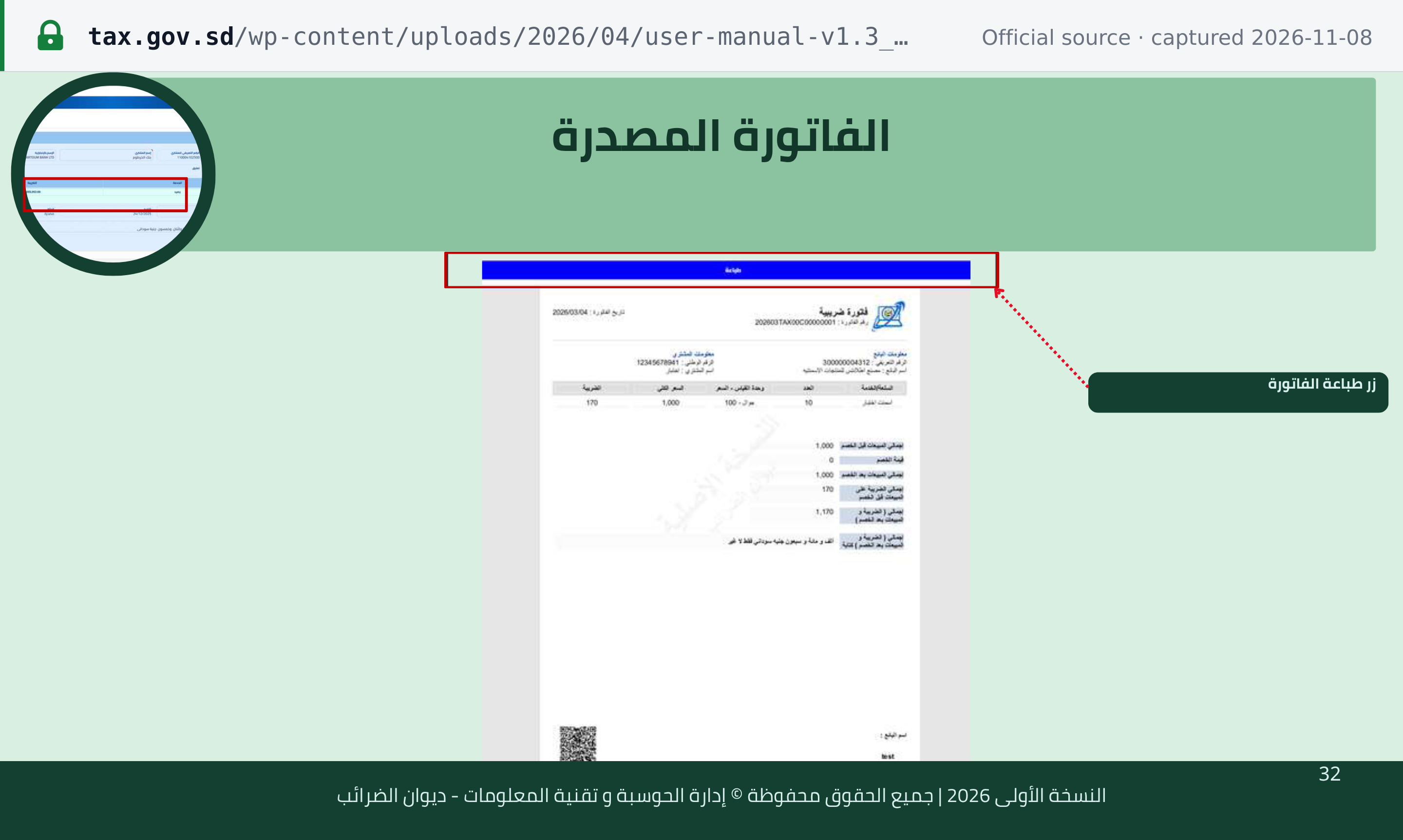
The Chamber's e-invoice user manual (version 1.3, March 2026) shows a printed tax invoice (فاتورة ضريبية) issued by its e-invoice system, on manual page 32, "الفاتورة المصدرة" (issued invoice). [5] The manual states that the user data in its examples are not real ("بيانات المستخدم الموجودة كمثال للشرح ليست حقيقية"). [12]
 Source snapshot captured 2026-11-08 — original
What the sample shows, reading right to left: the Chamber's logo and the title فاتورة ضريبية; a system-generated invoice number (202603TAX00C00000001) and the invoice date (2026/03/04); a seller block with the TIN (الرقم التعريفي) and seller name; a buyer block with the buyer's national number (الرقم الوطني), because this is a sale to a consumer; a line table (item, quantity 10, unit price 100, total 1,000, tax 170); a totals stack (sales before discount 1,000, discount 0, sales after discount 1,000, tax 170, total including tax 1,170, and the total in words, "ألف و مائة و سبعون جنيه سوداني فقط لا غير"); and a QR code. 170 on 1,000 is the 17% standard rate.
The sample is a consumer invoice, so it does not show the buyer's address, registration number or TIN that article 9 requires on a sale to another taxpayer. The illustration below places those fields.
TAX INVOICE / فاتورة ضريبية — illustrative B2B specimen (Sudan)
| Description of goods / servicesRegs art. 9(1)(c)(v) | Qty | Unit price (SDG) | Amount (SDG) |
|---|---|---|---|
| Office supplies | 10 | 25,000 | 250,000 |
| Maintenance service | 1 | 150,000 | 150,000 |
- Value before tax
- SDG 400,000
- VAT — rate 17%Regs art. 9(1)(c)(v); Act s.14
- SDG 68,000
- Invoice totalRegs art. 9(1)(c)(v)
- SDG 468,000
- On a sale to a non-taxpayer the seller may instead issue an invoice showing the tax-inclusive total, in an original and two copies.
- Telecommunications services and tobacco and cigarettes carry 40%, not 17%.
- Through the e-invoice system the invoice number is generated by the system and the printed invoice carries a QR code.
E-invoicing status
Status as at 2026-11-08: live, with the mandate scope not published. On 4 May 2026 the Chamber announced "the resumption of the E-Invoice System", "implemented in accordance with the applicable tax laws and regulations", with access through its e-services page. [3] The notice restores a system that existed before the conflict. It does not say which taxpayers must use it or from when, and no phase timeline or turnover band is published.
 Source snapshot captured 2026-11-08 — original
- System. A Chamber-hosted system used through a Windows desktop client ("تحميل النظام", version 2.4) downloaded from the e-invoicing page. The technical requirements specify Windows 10 (22H2) or Windows 11 Pro, 64-bit only, and state "النظام لا يعمل في وضع عدم الاتصال (Offline)" (the system does not work offline). [11] [13] A registered computer can only be changed through the Chamber's invoice administration. [12]
- Format. The Chamber publishes no XML, UBL or JSON format and no API (as at 2026-11-08). Invoices are issued in the client; the system generates the number and prints a QR code.
- Scope. The client issues B2B invoices, where the seller enters the buyer's TIN, and B2C invoices, where the seller enters the buyer's 11-digit national number. [5] No B2G rule is published.
- Enrolment. The application form asks for the TIN registration certificate and the applicant's identity (with a formal authorisation for an agent), the invoice types (B2B, B2C or both), the expected number of invoices a month, the product list and the points of sale. The taxpayer undertakes to issue invoices "ضمن الكوتة الشهرية المعتمدة" (within the approved monthly quota). [14]
- Corrections. An issued invoice is final: "لا يتم التراجع الا بعمل طلب الغاء" (it can only be reversed by a cancellation request). "لا يمكن إلغاء الفاتورة إلا إذا كانت خلال الفترة الضريبية" (an invoice can be cancelled only within the tax period), with approval by the company's system administrator and by the Chamber. A reverse invoice (فاتورة عكسية) records an amount refunded to the customer "بعد موافقة ديوان الضرائب" (after the Chamber's approval). [5]
- Outages. Invoices written in paper books "خلال توقف نظام الفواتير عن العمل" (while the invoice system was down) are entered later as supplementary invoices, with the paper invoice number and date of issue. [5]
The system is a clearance-style model in that invoices are issued through the authority's own software. For the cross-country picture, see the e-invoicing status table.
Filing and payment
Filing frequency and due date
All taxpayers file monthly, on Form (3), "within 15 days of the end of the tax accounting month". The Secretary-General may extend the period by a similar period. A return is required "even if no taxable sales, services, or works were made during the accounting month". [4] No turnover band changes the frequency.
 Source snapshot captured 2026-11-08 — original
Payment
Tax is paid by the same deadline, "نقداً أو بشيك مُعتمد أو إلكترونياً" (in cash, by certified cheque or electronically), within fifteen days after the end of the tax period. [10]
Where to file
At the competent tax office, or online. The 2022 amendment lets the Secretary-General require returns to be filed electronically. [7] The Chamber's e-returns guide names the portal portal.tax.gov.sd; its e-services page links to the return system at a bare IP address over plain HTTP (http://141.147.131.41/ePortal/login). [6]
Additional listings
None published beyond the monthly return and the books and registers listed under Retention and audit trail. There is no separate annual VAT return or sales listing on the Chamber's pages (as at 2026-11-08).
Input-tax recovery and blocked items
Article 29(1)(b) of the VAT Regulations 2017 sets the deduction rules. [17] The Chamber's English VAT page summarises only part of it. [4]
- All sales taxable. Tax paid on local goods, services and works is deductible with tax invoices.
- Imports. Tax paid on imported goods in the period is deductible on the customs documents, excluding private vehicles.
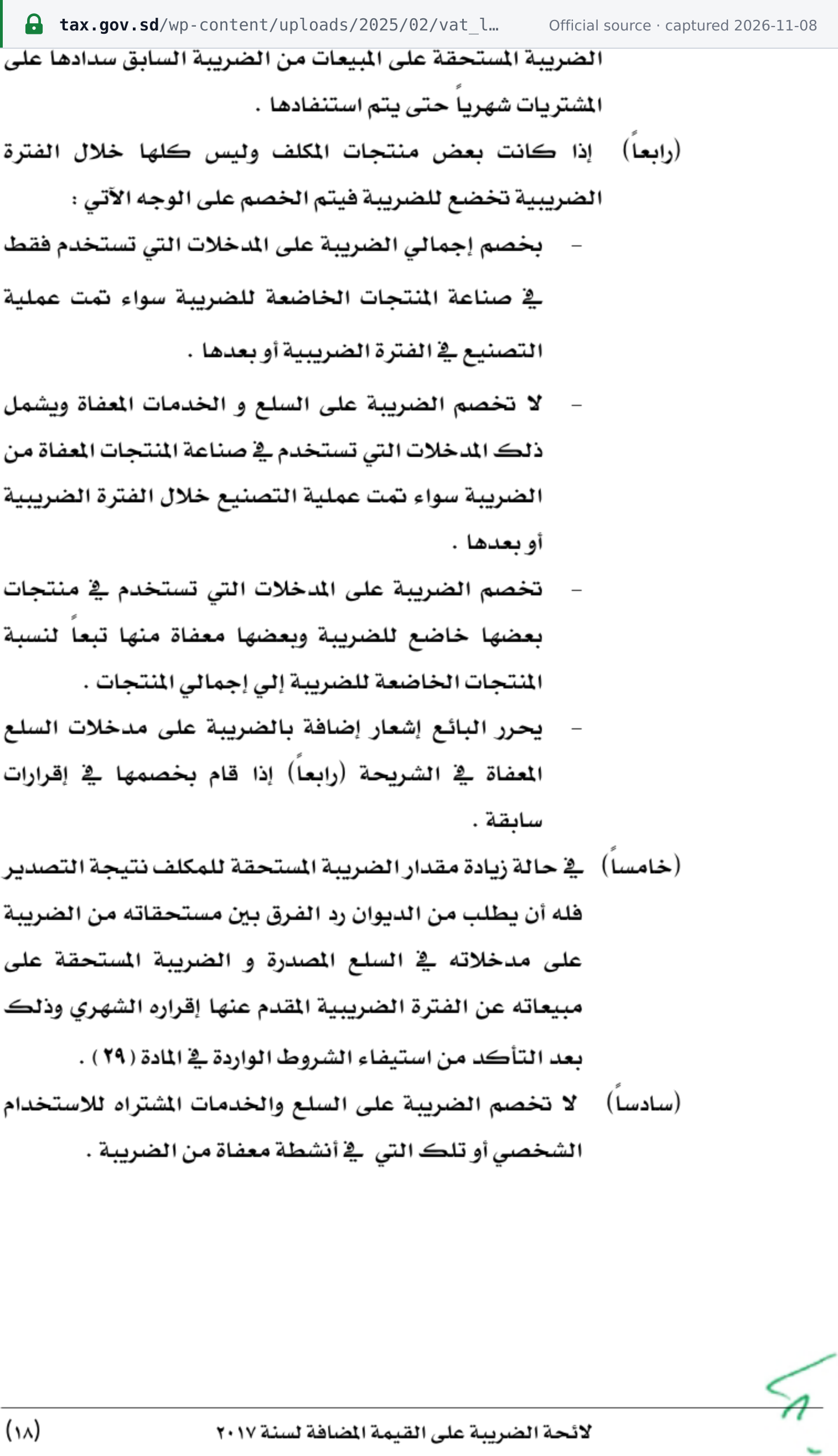
- Mixed taxable and exempt products (art. 29(1)(b), fourth). Input tax on inputs used only for taxable products is deducted in full. Input tax on exempt goods and services, and on inputs used only for exempt products, is not deducted. Input tax on inputs used for both is apportioned: "تبعاً لنسبة المنتجات الخاضعة للضريبة إلي إجمالي المنتجات" (in proportion to taxable products over total products). Where input tax on exempt products was deducted in earlier returns, the seller issues an addition note to reverse it.
- Excess credit. Where input tax exceeds output tax in a month, the excess is carried forward monthly until used.
Blocked (art. 29(1)(b), sixth): purchases of goods and services "للاستخدام الشخصي أو تلك التي في أنشطة معفاة من الضريبة" (for personal use or for exempt activities), and import VAT on private vehicles.
 Source snapshot captured 2026-11-08 — original
Refunds
- Exporters. A taxpayer whose excess credit arises from exports may ask the Chamber to refund the difference (Regulations art. 29(1)(b), fifth). Article 30 refunds tax on exported goods on a written request, where the goods were bought on a tax invoice and exported with the knowledge of customs, with the customs export certificate attached. Tax on exported services can be refunded where the customer is a foreign person or a non-resident Sudanese, the benefit is received outside Sudan, the contract is proven and the price has been transferred into Sudan. The Chamber refunds "خلال مدة لا تتجاوز ثلاثة أشهر من تاريخ استلام طلب الاسترداد" (within three months of receiving the request), and the right lapses if it is not claimed in writing within 24 months from the end of the tax period. [17]
- Other taxpayers. An excess credit is carried forward; the Regulations provide no cash refund outside the export case.
- Non-residents and bad debts. There is no refund scheme for non-residents and no bad-debt relief in the published texts (as at 2026-11-08).
Objections and appeals
An objection goes to the Secretary-General "within thirty days of the date of service of the taxpayer with the assessment, on the condition of payment of 25% of the assessed tax" (or a lesser amount the Secretary-General accepts). An appeal against the decision goes to the Income Tax Committee within fifteen days, "on the condition of payment of 35%" of the assessed tax. [4]
Exemptions
Exempt supplies
Article 32 of the VAT Regulations 2017 exempts these goods and services: [17]
- Agricultural products sold in their natural state, from agricultural activity inside the country.
- Livestock and meat (cattle, sheep, camels, goats), excluding raw or tanned hides, wool and hair and their products.
- Poultry and its products (eggs, chicks).
- Fish, excluding canned or processed fish.
- Milk and its products (cheese, ghee, butter, yoghurt), excluding imported milk and milk products.
- Fertilisers.
- Human and veterinary medicines.
- Pesticides and herbicides (المبيدات الحشرية والحشائشية).
- Seed stock (التقاوي). The same item gives fertilisers, medicines, pesticides and seed stock the definitions in their own laws.
- Locally produced flour.
- Bread.
- Goods imported for members of the diplomatic corps, under the Privileges and Immunities Act 1956, on reciprocity.
- Goods imported under agreements with the Government of Sudan that exempt them from VAT.
- Travellers' personal effects, including purchases from free zones and markets, within the customs exemption value.
- Financial services of banks, investment companies and funds: cash financing, withdrawals and deposits, and sales of shares, bonds and securities.
- Insurance premiums and cash claims of persons licensed under the Insurance Supervision Act 2001.
- Educational services in academic and technical education (basic, secondary, university) by officially certified bodies, except cases excluded by decision of the Secretary-General.
- Medical services for human and veterinary treatment: examinations, imaging, endoscopy, operations of all kinds, medical tests and similar, provided by hospitals, clinics, dispensaries, laboratories and medical labs. [17]
The Chamber's English VAT page summarises this list in fewer items: it does not name pesticides and herbicides (its item 8 reads "Seeds and specified agricultural inputs"), and it breaks off in the medical-services item. [4]
This list is not complete or fully current. Later instruments on the Tax Laws page change it: Council of Ministers Resolution No. 480 of 2017 exempts rice, lentils, fava beans and yeast from 1 January 2018; [15] Resolution No. 508 of 2020 approved a draft amendment bill to cancel the exemption on three items (good-manufacturing-practice requirements, panel-operated machines, and local and imported sports equipment), and no enacted 2020 amendment is published; [16] and Resolution No. 403 of 2022 cancelled the import exemption on raw sugar. [7] Since the 2021 amendment, the Council of Ministers can grant and cancel exemptions on goods and services by order on the Minister's recommendation. [9] Check a specific product with the Chamber.
Exempt is not zero-rated
Exports are zero-rated: no VAT is charged, and the exporter keeps its right to deduct. An exporter with an excess credit can also ask for a refund. Exempt supplies carry no VAT either, but input tax on exempt goods and on inputs used for exempt products is not deductible, and input tax on inputs shared between taxable and exempt products is only partly deductible, by the ratio of taxable to total products (see Input-tax recovery). Section 14(4) adds: "Save as to the exempted commodities and services, the tax may not be included, into the cost of sale of the commodity, or service." [1] See zero-rated vs exempt.
Special regimes
- Free zones. Imports for licensed free-zone activity are not taxed, except private cars (section 15A). See Imports and exports.
- Sugar. Locally produced sugar is taxed on 50% of the market selling price (Resolution No. 18 of 2021).
- Small-business, flat-rate, cash-accounting and margin schemes. None published (as at 2026-11-08).
Offences and penalties
Offences
Evasion, or aiding and abetting it, is punishable by imprisonment, a fine, or both, with joint and several liability where several people are involved (section 43). The consolidated Act and the Chamber's English page still say "not exceeding three years". The VAT Act 2001 (Amendment) Act 2021 replaced that: "في المادة ٤٣ : تحذف كلمة "ثلاث" ويستعاض عنها بكلمة "خمس"" (in section 43 the word "three" is deleted and replaced by "five"), so the maximum is five years. [9] The amendment is an image-only Arabic scan; the quotation is transcribed from it.
Section 44 deems these acts, among others, to be evasion: [4]
- failure to apply for registration within the time limits without sufficient cause;
- selling or importing without filing a return or paying the tax;
- illegal deduction, or illegally reclaiming tax;
- forged documents or false statements, and false sales or purchase figures;
- "(g) Failing to issue invoices for the sale of taxable goods or services, or using forged invoices;"
- not declaring goods or services taken for private use;
- "(i) Failing to submit a return or pay the tax thirty days after the due date;"
- "(j) Issuing tax-included invoices by a person who is not a registered taxpayer;"
- failing to use a required fiscal machine, or breaching the conditions for machine suppliers.
Item (i) means a return or payment that is more than 30 days late moves from an administrative contravention to a criminal offence.
Penalties
- Financial sanction. The Secretary-General "may impose financial and administrative sanctions, in addition to the tax due, on any person who contravenes the provisions of this Act or the regulations issued under it, even if such contravention does not amount to tax evasion". [4] The Regulations, on the Chamber's Arabic page, cap it: "يجوز للأمين العام أو من يفوضه أن يفرض جزاء مالياً لا يتجاوز مئتان وخمسون ألف جنيه ، بالإضافة إلي الضريبة المستحقة" — a financial sanction not exceeding SDG 250,000, on top of the tax due, on anyone covered by section 42. The sanction may be doubled for a repeat contravention. [10] This is article 36 of the VAT Regulations 2017. [17] The English page does not state the amount.
- Contraventions covered. Late returns and late payment, false sales or purchase figures, failure to register on time, failure to notify changes in registration data, and obstructing officials.
- Late filing and late payment. Section 29(1) of the Act refers to a sanction for each month of delay "specified by the regulations", but neither the Chamber's pages nor the VAT Regulations 2017 state a monthly figure. Article 36(1)(a) of the Regulations lists late filing and late payment as contraventions, so they fall under the SDG 250,000 cap above. [17]
 Source snapshot captured 2026-11-08 — original
Frequently asked questions
The VAT Act I downloaded says 15%. Why are my suppliers charging 17%?
Because the printed section was changed by order. Section 14(1) of the Value Added Tax Act 2001, in the English consolidated text on the Sudan Taxation Chamber's website, still reads 15%. Section 15 lets the Council of Ministers amend the rate by order, and a footnote to the same text records the Council of Ministers order of 19 June 2012 that raised the rate to 17%. On 28 March 2026 the Chamber restated that VAT is charged "at a fixed rate of 17%". The Chamber's English VAT page still prints unamended statute text elsewhere too, such as the three-year prison term for evasion that the 2021 amendment raised to five years.
We import goods only occasionally and our turnover is far below the threshold. Do we need to register for VAT?
Yes. Section 16(1) of the VAT Act and the Chamber's VAT page require every importer or exporter to register "regardless of their turnover". The turnover threshold applies only to producers, traders and service providers. Separately, customs collects VAT on each import at release, and goods are not finally released until the tax is paid in full. Customs may not postpone the tax or take it in instalments.
We buy software and consulting from a company abroad that has no presence in Sudan. Who pays the VAT?
You do. Under section 28(7) of the VAT Act, a person resident in Sudan who contracts for a taxable service or work from a non-resident with no legal entity registered in Sudan must add the tax to the price and deposit it with the Sudan Taxation Chamber. The published texts give the foreign supplier no registration route, and they contain no separate regime for digital services or marketplaces.
The e-invoice system was unavailable and we wrote paper invoices. What do we do with them?
Enter them in the system afterwards as supplementary invoices (فاتورة تكميلية). The Chamber's e-invoice user manual (version 1.3, March 2026) says this screen is for invoices issued from paper invoice books while the invoicing system was down, recording the number from the book and the date of issue. The desktop client does not work offline, so a lost connection stops issuance in the system.
Can we cancel an e-invoice issued in an earlier month?
Not by cancellation. The user manual says an invoice can be cancelled only within the same tax period, and the cancellation request awaits approval by the company's system administrator and by the Chamber. Issued invoices cannot be edited. For an amount refunded to the customer, the system has a reverse (negative) invoice, which also needs the Chamber's approval.
Our VAT return is late. What is the exposure?
There are two levels. A late return or late payment is a contravention: the Secretary-General may impose a financial sanction of up to SDG 250,000 on top of the tax, and may double it for a repeat contravention. If the return is not filed or the tax not paid 30 days after the due date, the Act treats it as tax evasion, which carries imprisonment of up to five years (as amended in 2021), a fine, or both. The return is due within 15 days of the end of each month, and a nil return is required when there were no sales.
We make some exempt sales. Can we still deduct input VAT?
Partly. Article 29 of the VAT Regulations 2017 splits the input tax when only some of a period's products are taxable. Input tax on inputs used only for taxable products is deducted in full. Input tax on exempt goods and services, and on inputs used only for exempt products, is not deducted. Input tax on inputs used for both is deducted in proportion to taxable products over total products. No input tax is deducted on purchases for personal use or for exempt activities, and import VAT on private vehicles is not deductible. Excess input tax is carried forward month to month. Only an exporter whose excess comes from exports can ask the Chamber to refund it: the Chamber pays within three months of the request, and the claim lapses if it is not made in writing within 24 months of the end of the tax period.
Important websites
| Site | What it is for |
|---|---|
| Sudan Taxation Chamber | The VAT authority's home page (English) |
| VAT rules (English) · (Arabic) | Registration, invoices, returns, deduction, exemptions and penalties as the Chamber publishes them; the Arabic page carries the SDG 250,000 sanction |
| Tax office for your main place of business | Registration on Form (1). The Chamber publishes no online registration service |
| E-services — e-returns | Link to the online return system (served from http://141.147.131.41/ePortal/login) |
| E-invoicing (منظومة الفوترة الالكترونية) | Download the e-invoice client, the registration form, the technical requirements and the user manuals |
| Tax Laws | The VAT Act, the Regulations and the scanned amending instruments |
| News | Notices and clarifications, including rate statements and e-invoicing announcements |
| Sudan Customs | Customs clearance, where import VAT is collected |
| Ministry of Finance and Economic Planning | Parent ministry |
The Chamber publishes no public TIN or VAT-number lookup and no rate lookup tool (as at 2026-11-08). On the Tax Laws page, the link to the 2022 amendment is broken; the working file is linked in the reference list below.
Recent changes
- 2026-05-04 — The Sudan Taxation Chamber resumed the E-Invoice System, publishing the client, registration form, technical requirements and user guide on its e-services page. (Sudan Taxation Chamber) — see event
- 2026-03-28 — The Chamber restated that VAT is levied "at a fixed rate of 17%" that "can only be amended through legislation". (Sudan Taxation Chamber)
- 2022-01-20 — VAT Act 2001 (Amendment) Act 2022: telecom rate raised from 35% to 40%; the Council of Ministers may amend any rate by order; the Secretary-General may require electronic returns and payment of foreign-currency collections in that currency; Arabic translations of foreign-language records. (Sudan Taxation Chamber)
For the full chronology, see Sudan tax changes on Lookuptax.
Reference links
Legislation (published by the Sudan Taxation Chamber):
- [1] Value Added Tax Act, 2001 — English consolidated translation, Ministry of Justice
- [17] Value Added Tax Regulations, 2017 (Arabic)
- [8] Order under the VAT Act 2001 (Amendment) 2018 — tobacco and cigarettes 40%
- [15] Council of Ministers Resolution No. 480 of 2017 and Order 2017 — exemptions
- [16] Council of Ministers Resolutions No. 508 and 509 of 2020 (approving draft amendment bills)
- [9] VAT Act 2001 (Amendment) Act 2021 and Resolution No. 18 of 2021
- [7] VAT Act 2001 (Amendment) Act 2022 and Resolution No. 403 of 2022
- [2] Tax Laws page
Sudan Taxation Chamber guidance and notices:
- [4] Value Added Tax (English)
- [10] الضريبة على القيمة المضافة (Arabic)
- [3] News (28 March 2026 clarification; 4 May 2026 e-invoice resumption)
- [6] E-returns user guide (الإقرار الإلكتروني)
E-invoicing (Sudan Taxation Chamber):
- [11] E-invoicing system page
- [12] E-invoice user manual v1.3, part 1
- [5] E-invoice user manual v1.3, part 2
- [13] E-invoicing system technical requirements
- [14] E-invoicing registration form
Related on Lookuptax: