Tajikistan VAT guidelines
Overview
Tajikistan levies a value added tax (VAT): in Tajik андоз аз арзиши иловашуда (ААИ), in Russian налог на добавленную стоимость (НДС). The rules are in Section VIII (articles 244–279) of the Tax Code of the Republic of Tajikistan, which has been in force since 1 January 2022. Article 244 defines VAT as "an indirect tax" that "shall be paid at all stages of turnover of goods (performance of works, rendering of services)". [1]
The Tajik text is the official one. The Tax Committee also publishes a Russian text and an "unofficial translation" into English. The English text is current to Law No. 2168 of 14 May 2025; the latest consolidation, in Tajik, includes Laws Nos. 2283 and 2285 of 17 June 2026. [2] This guide quotes the English text where the law has not changed since, and cites the 2026 Tajik consolidation for later amendments.
Authority, currency, period and layering
- Authority. The Tax Committee under the Government of the Republic of Tajikistan (Кумитаи андози назди Ҳукумати Ҷумҳурии Тоҷикистон) administers VAT. Import VAT is charged under the Tax Code and the customs legislation (art. 272(3)) and collected by the Customs Service. [1]
- Currency. The somoni (TJS). Taxes "shall be calculated in monetary terms and paid in the national currency" (art. 23). A transaction in foreign currency is converted at the National Bank of Tajikistan's official rate on the day of the transaction; the average rate for the period may be used only with the tax authority's prior written permission (art. 90(6)). [1]
- Period. The VAT tax period is the calendar month. For foreign persons providing remote services to individuals it is the calendar quarter (art. 273). [1]
- Layering. VAT is a single national tax. The Code's local taxes are property taxes, and there is no regional or municipal VAT or sales tax. Excise duty is a separate tax but shares the VAT invoice, which is called the invoice for VAT and excise duties (ҳисобнома-фактураи андоз аз арзиши иловашуда ва аксизҳо; счёт-фактура).
- Small businesses. A business with gross income of up to TJS 1 million over 12 months normally pays a 6% simplified-regime tax on gross income instead of VAT. See Special regimes.
Registration
Who must register and the threshold
Article 245(1) lists who is a VAT payer. The first and most common category is "a person whose total income for a period not exceeding 12 full consecutive calendar months exceeds 1.0 million somoni". [1] The 2026 Tajik consolidation keeps the same figure. [2]
- Threshold: TJS 1,000,000 of total income, not just taxable supplies.
- Measurement period: a rolling window of not more than 12 full consecutive calendar months.
- Related parties: "the total income of interrelated persons shall be taken into account" (art. 245(2)). The tax authority may also treat several businesses belonging to one person as one economic entity and refer the case to the tax-evasion commission for VAT registration (art. 245(5)).
- Other VAT payers listed in art. 245(1): persons in the art. 375(2) list (below), foreign entities performing remote services, foreign legal entities supplying goods or works where Tajikistan is the place of supply, legal successors of a VAT payer, tax agents under art. 260, importers of taxable goods, and voluntary registrants.
- Liable from state registration, whatever the turnover (art. 375(2)): investment funds, professional securities-market participants, insurance and credit organisations, microfinance organisations, pawnshops, users of natural resources, suppliers of primary aluminium, producers and importers of excisable products, and persons carrying on intermediary activity under commission, agency and similar contracts. [1]
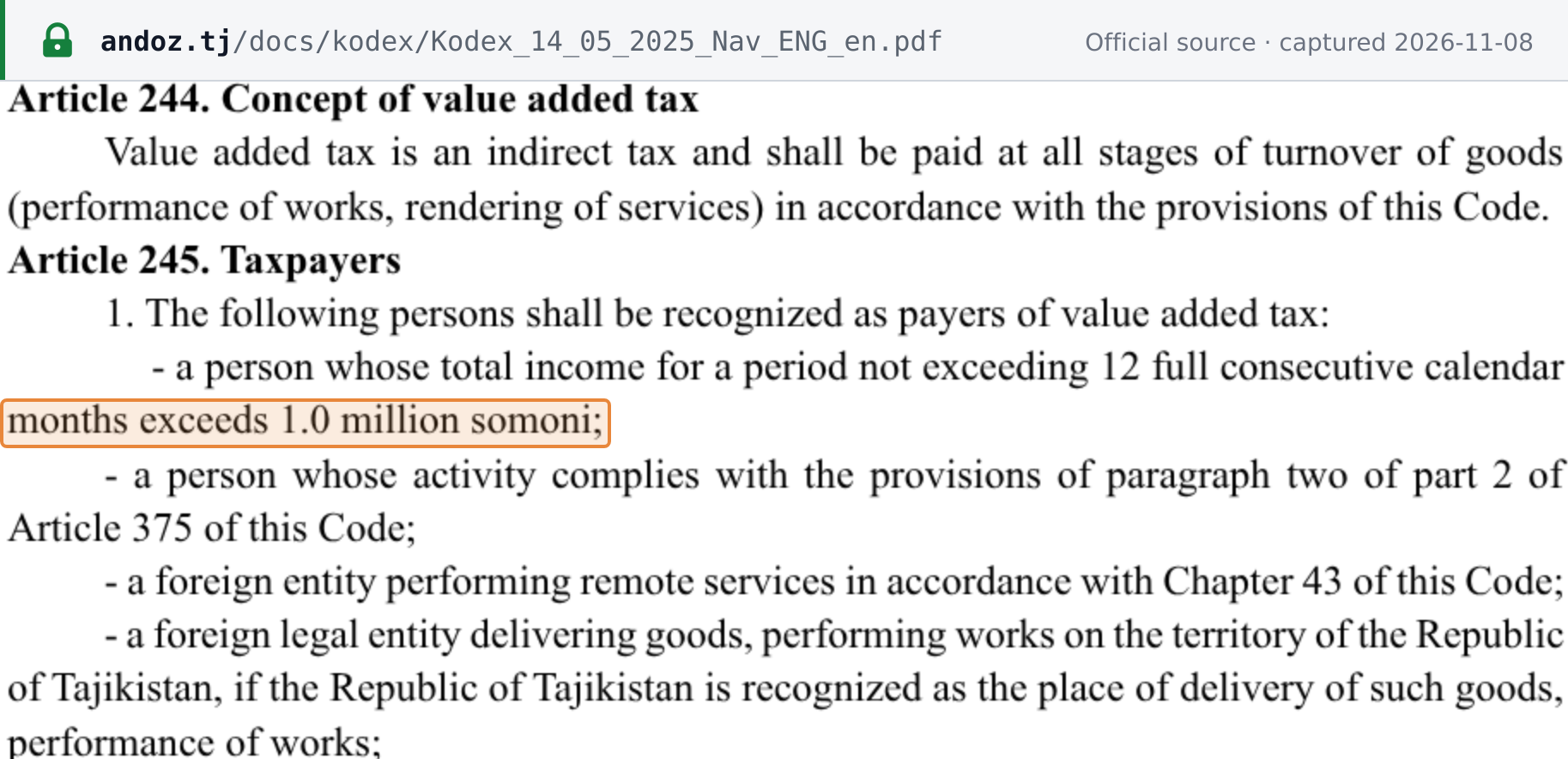 Source snapshot captured 2026-11-08 — original
When liability starts. A threshold-crosser is a VAT payer "from the first day of the reporting period following the month in which the gross income of the taxpayer exceeds the registration threshold". Art. 375(2) businesses are VAT payers from state registration, and foreign remote-service providers and foreign suppliers of goods or works from the start of activity in Tajikistan (art. 245(6)). [1] A business on the simplified regime whose income exceeds TJS 1 million must apply to move to the general regime "within a period of not more than 10 calendar days" (art. 375(3)). [1]
Non-resident registration
There is no threshold for non-residents in the two categories the Code names:
- Foreign providers of remote (electronic) services to individuals register electronically, applying "not later than 30 calendar days from the day of commencement" of the services (art. 278). See Foreign companies selling into Tajikistan.
- Foreign legal entities supplying goods or performing works where Tajikistan is the place of supply are VAT payers from the start of activity in Tajikistan (art. 245(1), (6)).
Foreign suppliers of services to Tajik businesses do not register: the buyer withholds the VAT as tax agent (art. 260). The Tax Committee's website does not publish a separate online entry point for non-resident registration (as at 2026-11-08); the Code describes it as an electronic application in the form approved by the authorised state body (art. 278), while article 78(20) refers to an application in the form approved by the Government. [1]
Tax registration number
Every taxpayer receives a taxpayer identification number (Tajik РМА, рақами мушаххаси андозсупоранда; Russian ИНН). On state registration a legal entity or individual entrepreneur also receives a single identification number (Tajik РЯМ; Russian ЕИН) (art. 79(1)). [1] A VAT payer is also issued a VAT registration certificate, whose series, number and date go on every VAT invoice (art. 269(2)).
The Code does not set the length or a check digit for either number. The Tax Committee's published list of irresponsible taxpayers (as at 15 October 2026) shows 9-digit TINs and 10-digit single identification numbers. [9] That is an observed pattern, not a published specification. To check a number's format, use the Tajikistan INN validator.
How to register
- State registration. Legal entities and individual entrepreneurs register through the Tax Committee's "single window", which assigns the TIN and the single identification number. Document lists and forms are on the State registration page.
- VAT registration. The taxpayer submits an electronic application (Annex 1 to the Tax Committee's VAT registration procedure, Order No. 12-f of 28 March 2022) through the integrated tax information system. The tax authority reviews it and decides on registration within five working days, then issues an electronic VAT-payer certificate (Order 12-f, paras 2 and 6). [5] Registration "shall be done automatically by the tax authorities and a certificate in electronic form shall be sent to the taxpayer" (art. 245(4)).
- Taxpayer personal cabinet. VAT payers file returns and receive VAT invoices in the personal cabinet, logging in with their TIN.
Voluntary registration
Available. Article 245(3) allows it only if the person's place of permanent business is determined, it carries on business and keeps accounts under the accounting legislation, and it "is not associated with companies that do not have activities of economic importance". [1] The main reason to register is commercial: a VAT-registered customer can credit input VAT only on the basis of a VAT invoice (art. 266), and only a VAT payer can issue one.
Deregistration
A taxpayer may cancel VAT registration only if both conditions in art. 245(8) are met: its total income over not more than 12 full consecutive calendar months has fallen below TJS 1 million, and 36 calendar months have passed since it moved to the general regime. [1] VAT previously credited on goods still in stock is reversed on deregistration (art. 267(1)). The application uses the form in Annex 4 to Order 12-f. [5]
Group registration
Not available. The Tax Code's VAT section (articles 244–279) contains no group-registration provision. It works the other way: related persons' income is added together to test the threshold (art. 245(2)).
Rates
| Rate | Applies to | Source |
|---|---|---|
| 14% (1 Jan 2024 – 31 Dec 2026) | Standard rate for taxable operations and taxable imports | Tax Code art. 397(4) |
| 13% (from 1 Jan 2027) | Standard rate for taxable operations and taxable imports | Tax Code art. 397(4) |
| 7%, no input credit | Construction works, hotel services, catering services (not taxable imports or onward supply of imported goods) | art. 264(1)(2) |
| 5%, no input credit | Domestic agricultural products; processing of agricultural products (except raw cotton); training services; sanatorium and resort medical services | art. 264(1)(2) |
| 10% (2026 only) | Wheat processors: wheat imports, processing and sale of wheat products, including domestic pasta; vegetable-oil sales by oil processors | Budget Law No. 2203, art. 15(1) |
| 7% (2026 only) | Oilseed processing residues (cake, meal, poultry and livestock feed) | Budget Law No. 2203, art. 15(1) |
| 0% | Exports of goods, with listed exclusions | arts. 254, 264(2) |
Rates as at 2026-11-08.
Standard rate: 14%, falling to 13% on 1 January 2027
Two articles of the Tax Code give the standard rate, and the transitional one prevails:
- Article 264(1)(1) still reads "standard rate - 15 percent". [1]
- Article 397(4) sets that rate, "for taxable operations and taxable importation", at "14 percent" from 1 January 2024 to 31 December 2026 "and from January 1, 2027 - 13 percent". [1] The Tax Committee prints the same schedule as a headnote on page 1 of its English Code, and both the December 2025 Russian and the June 2026 Tajik consolidations keep it. [2] [3]
So the rate in force is 14% until 31 December 2026, and 13% from 1 January 2027. The 15% in article 264 applied in 2022 and 2023. The schedule changes only the standard rate; the 7% and 5% reduced rates do not change.
Article 397(4) sets one rate for all taxable operations. It has no separate rate for cash payments, in any consolidation the Tax Committee has published since 2022. Article 85(3), on cash-register receipts, does list among a receipt's particulars the "tax amount including differential rate of value added tax for cash and non-cash payments", but neither article 264 nor article 397(4) sets such a differential rate. [1]
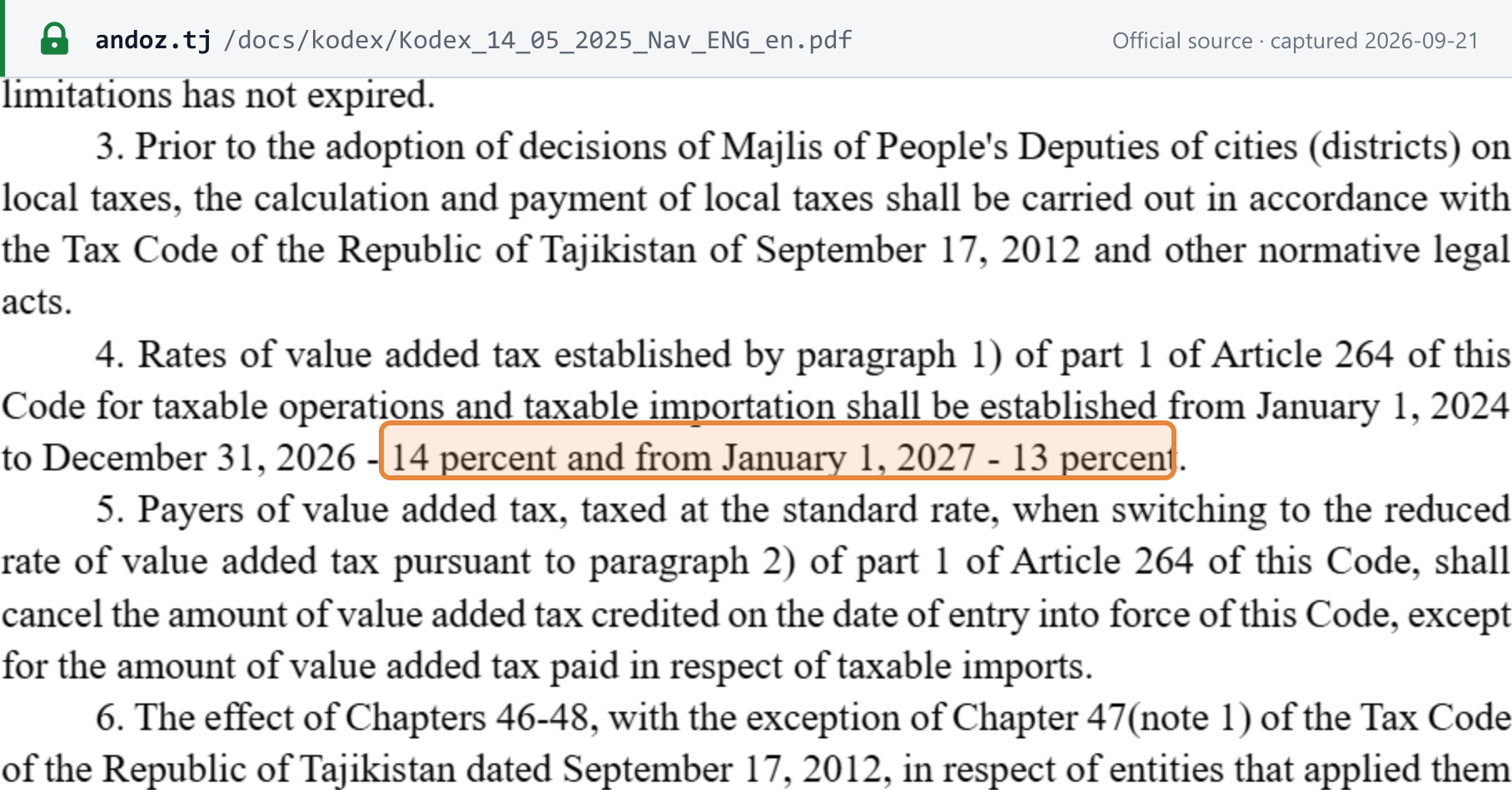 Source snapshot captured 2026-09-21 — original
Reduced and zero rates
Article 264(1)(2) sets two reduced rates, and a business charging either of them cannot credit input VAT. For the 5% rate the article says so itself: it applies "without the right to offset value added tax". For both rates, article 266(6) disallows credit "if expenditures are made at a reduced rate of value added tax", and the Tax Committee's invoice instruction (Order No. 11-f, para 17) lets VAT payers credit the VAT on invoices received under article 266 except users of the reduced rate. [1] [4] The exception is VAT on the business's own taxable imports, which are taxed at the standard rate and stay creditable (art. 264(3)).
- 7% for construction works, hotel services and catering services. The rate does not reach taxable imports or the onward supply of imported goods.
- 5% for the sale of domestically produced agricultural products, processing of agricultural products other than raw cotton, training services, and medical services in sanatoriums and resorts.
- 0% for exports of goods under article 254 (art. 264(2)). See Imports and exports.
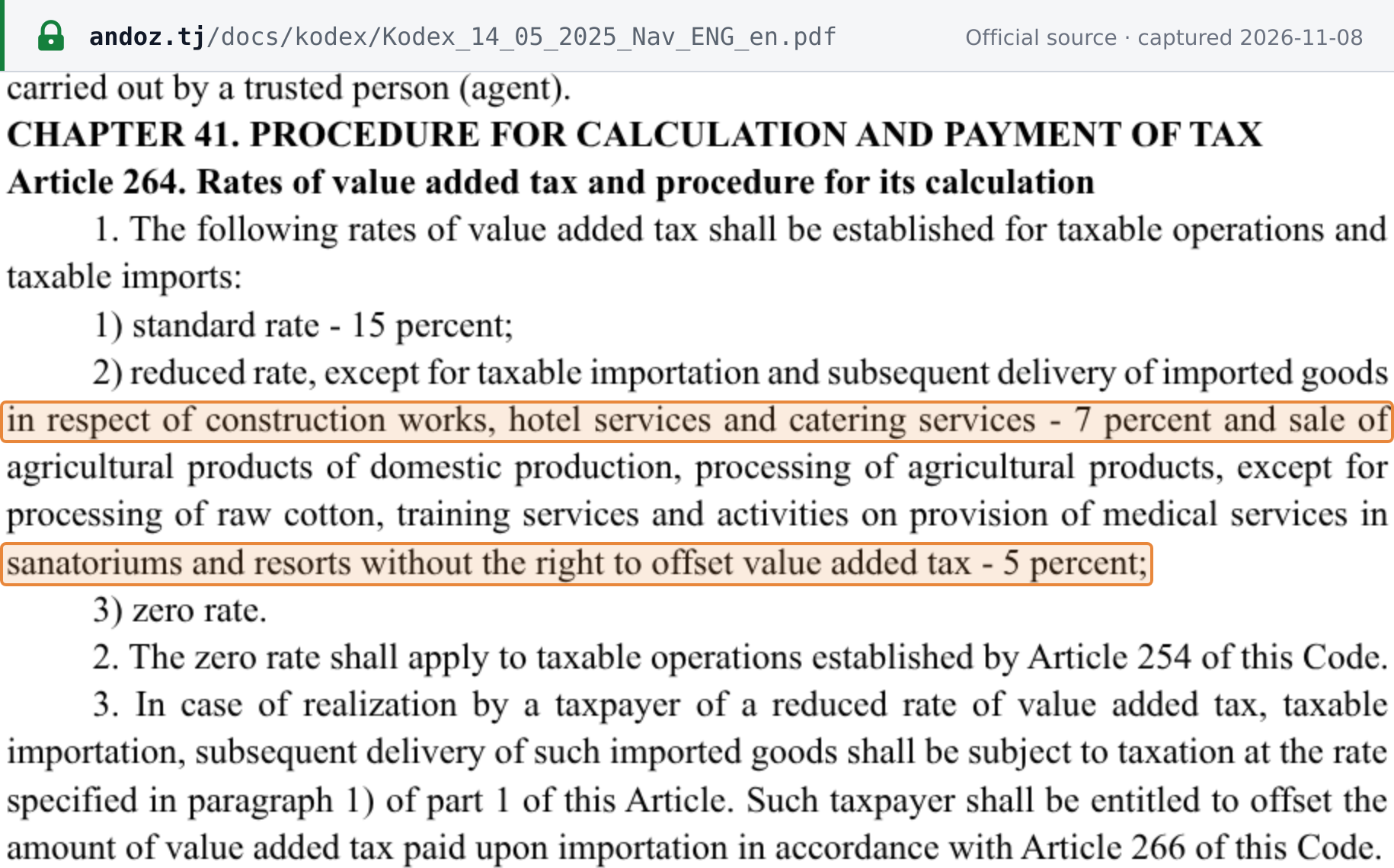 Source snapshot captured 2026-11-08 — original
2026 sector rates in the State Budget Law
The Law on the State Budget for 2026 (No. 2203 of 1 December 2025, in force from 1 January 2026) sets VAT, in article 15(1), at 10% for wheat-processing enterprises (wheat imports other than wheat for excisable goods, and the processing and sale of wheat products, including pasta made in Tajikistan) and for sales of vegetable oil by oil-processing enterprises, and at 7% for sales of oilseed processing residues (cake, meal, poultry and livestock feed). Creditable input VAT on these sales may not exceed the same 10% or 7%. These provisions do not apply to the import relief for poultry, fish-farming and mixed-feed producers in the thirteenth paragraph of Tax Code article 251(4). [6] The rates are part of the 2026 budget law, so they cover 2026. The Tax Committee's website has not published a 2027 budget law (as at 2026-11-08), so whether they continue in 2027 is not yet known.
Announced changes
- 1 January 2027: standard rate 14% → 13% (art. 397(4)). See the event record.
- 31 December 2026: several exemptions expire. See Exemptions.
- No other rate change appears in the June 2026 consolidation of the Code (as at 2026-11-08).
Cross-border rules
Imports and exports
- Imports. Importing taxable goods makes the importer a VAT payer (art. 245(1)), and import VAT is charged under the Tax Code and the customs legislation (art. 272(3)). The taxable value is the customs value plus customs duties, taxes, special payments and fees, excluding VAT (art. 250(1)). Goods released for free circulation bear full VAT; transit, customs warehouse, re-export, duty-free and free-zone regimes bear none; temporary import gets full or partial relief (art. 253(1)). [1] Import VAT shown on the customs declaration and paid is creditable, but not if the importer's name or TIN is missing from the customs payment document (art. 266).
- Personal imports. Goods carried across the border by individuals for personal use "within the norms established by the Government" bear no VAT (art. 253(3)). The Code does not state the value limit; it leaves it to the Government.
- Exports. Exports of goods are zero-rated (arts. 254(1), 264(2)). Excluded from the zero rate: precious metals and stones, jewellery, primary aluminium, natural-resource concentrates, commercial ores, ferrous and non-ferrous scrap and other metals produced in Tajikistan, the National Bank's precious-metal ingots, and goods produced in free economic zones (art. 254(1)). [2] All of these except the free-economic-zone goods are instead exempt, including on export (art. 251(3)). [2] If export is not confirmed within 90 calendar days of placing the goods under the "Export" customs regime, the supply is taxed at the positive rate (art. 254(2)). Proof of export is the customs declaration, the contract, the shipping documents with the border customs mark, and a bank statement showing the export proceeds received in the exporter's account in Tajikistan (art. 255). [1]
- Cotton and cocoons. Law No. 2285 of 17 June 2026 removed cocoon, cotton fibre, cotton yarn and raw cotton from the art. 251(3) exemption and from the art. 254(1) list of exports excluded from zero-rating, so their domestic supply is taxable and their export zero-rated. [2] The Tax Committee's consolidation does not state the date the amendment took effect (as at 2026-11-08).
Digital services
A foreign person without a place of activity in Tajikistan that provides remote (electronic) services directly to individuals, including individual entrepreneurs, is the VAT payer, and the place of supply is Tajikistan (art. 277(1)). [1]
- What is caught (art. 279(7)). Among others: access to software and databases, online advertising and listing services, online marketplaces, hosting and domain names, cloud and data storage, e-books, streaming media, search services and online betting.
- What is not (art. 279(8)). Goods or services ordered online but delivered offline, software and databases sold on tangible media, consulting by e-mail, and Internet access services.
- Customer location. The customer is treated as in Tajikistan if at least two of six indicators point there: billing address, IP address or geolocation, bank details, the SIM card's mobile country code, fixed-line location, or other commercial information (art. 258(3)–(4)). [1]
Foreign companies selling into Tajikistan — B2B and B2C
B2C (remote services to individuals). The foreign supplier registers and accounts for the VAT itself:
- Threshold: none.
- Registration: electronic, applying "not later than 30 calendar days from the day of commencement" of the services (art. 278).
- Returns: quarterly, "not later than the 20th of the month following the reporting period" (arts. 272(2), 273(2)), on the dedicated return for electronic services by foreign persons (Annex 9 to the VAT return), which states amounts in a currency the supplier declares. [10]
- Invoices: these registrants do not issue VAT invoices (art. 269(13)).
- Representative: the tax authority may require the supplier to appoint a VAT representative (art. 279(1)).
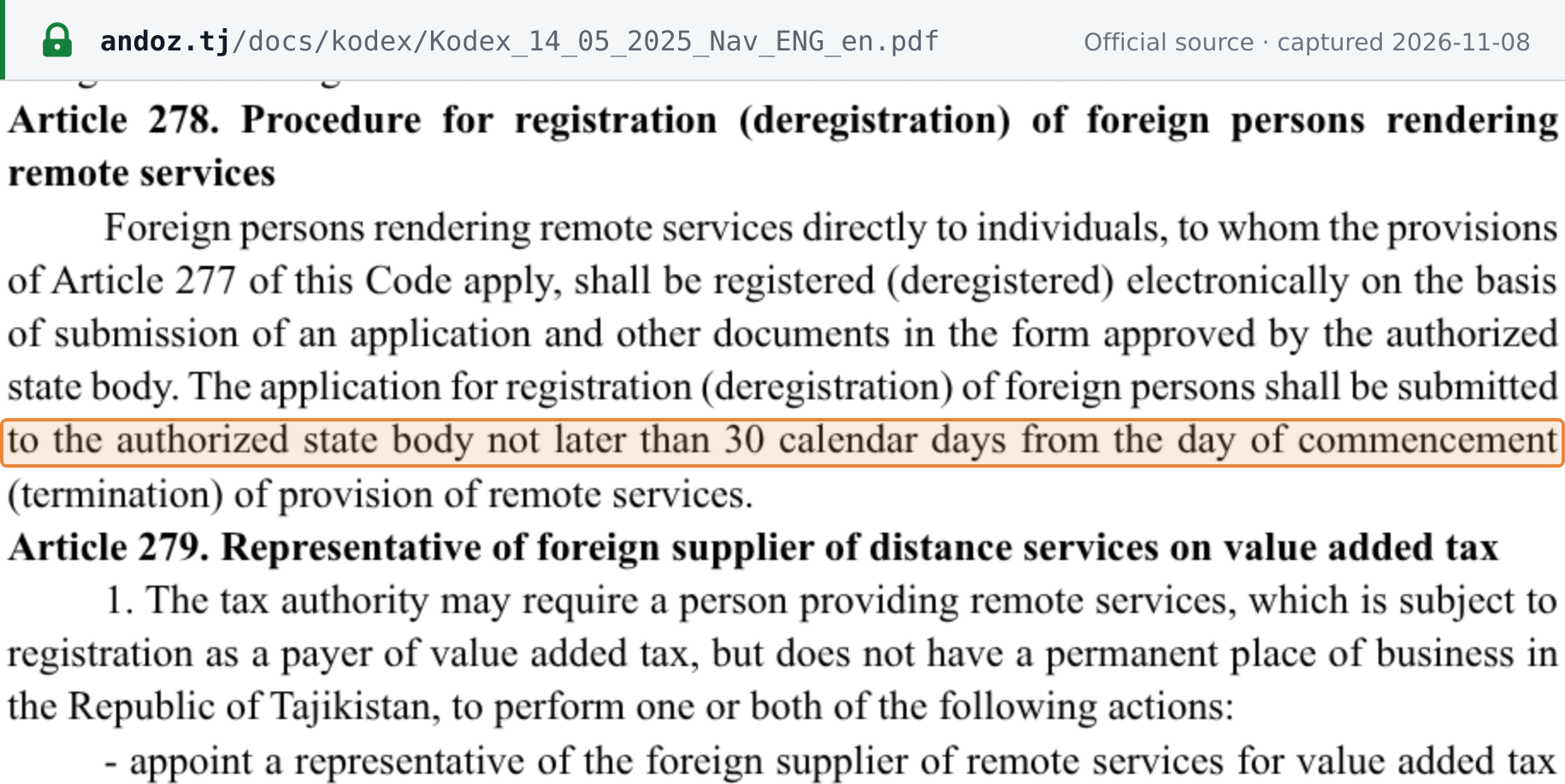 Source snapshot captured 2026-11-08 — original
B2B (services and works for Tajik businesses). The foreign supplier does not register. When a supplier with no permanent place of business in Tajikistan performs services or works for a legal entity operating in Tajikistan, the buyer is a tax agent and withholds VAT at source from the amount payable (art. 260(2)–(3)). For remote services sold to Tajik legal entities and permanent establishments, art. 277(2) applies the same rule. [1]
- A VAT-registered tax agent pays the withheld tax and includes it in its return for the month "without the right to take into account the amount of value added tax" (art. 260(4)). Unlike a reverse charge in most VAT systems, the tax is a cost.
- An unregistered tax agent pays the tax within five days of paying the foreign supplier and files a VAT return by the 15th of the following month (art. 260(5)).
- A foreign supplier of remote services must not treat a Tajik customer as a tax agent unless the customer provides a certificate confirming that status (art. 258(5)).
For background, see Reverse charge and VAT on digital services from non-resident suppliers.
Goods and works. A foreign legal entity that supplies goods or performs works where Tajikistan is the place of supply is a VAT payer from the start of its activity, with no threshold (art. 245(1), (6)). Goods supplied into or out of Tajikistan by a non-resident's agent are treated as supplied by the agent (art. 263(3)).
Marketplace and platform obligations
The operator of an electronic trading platform with no permanent establishment in Tajikistan is treated as the supplier of remote services sold through it to individuals resident in Tajikistan if it authorises the payment, authorises the delivery, or sets the terms of delivery (art. 259(2)–(3)). The rule does not apply if the original supplier and the operator agree that the original supplier pays the VAT (art. 259(4)). [1] The VAT section (articles 244–279) has no deemed-supplier rule for physical goods sold through marketplaces. See Marketplace deemed-supplier rules.
Place of supply
- Goods: where the goods are when released to the buyer, or where transport begins if the seller or a carrier transports them (art. 257(1)).
- Services, general rule: where the supplier carries on its activity (art. 258(1)).
- Services from a supplier abroad with no permanent establishment: Tajikistan, if the service is physically performed there, is a remote service to a Tajik resident, is a telecoms service initiated there, relates to immovable property there, or the purchaser carries on activity there (art. 258(2)).
- Buyer's location: for intellectual-property rights; consulting, legal, audit, engineering, design, marketing, advocacy, accounting and data-processing services; leasing of movables other than vehicles; and tourism-organisation services, the place of supply is where the purchaser is (art. 258(9)). [1]
Invoice requirements
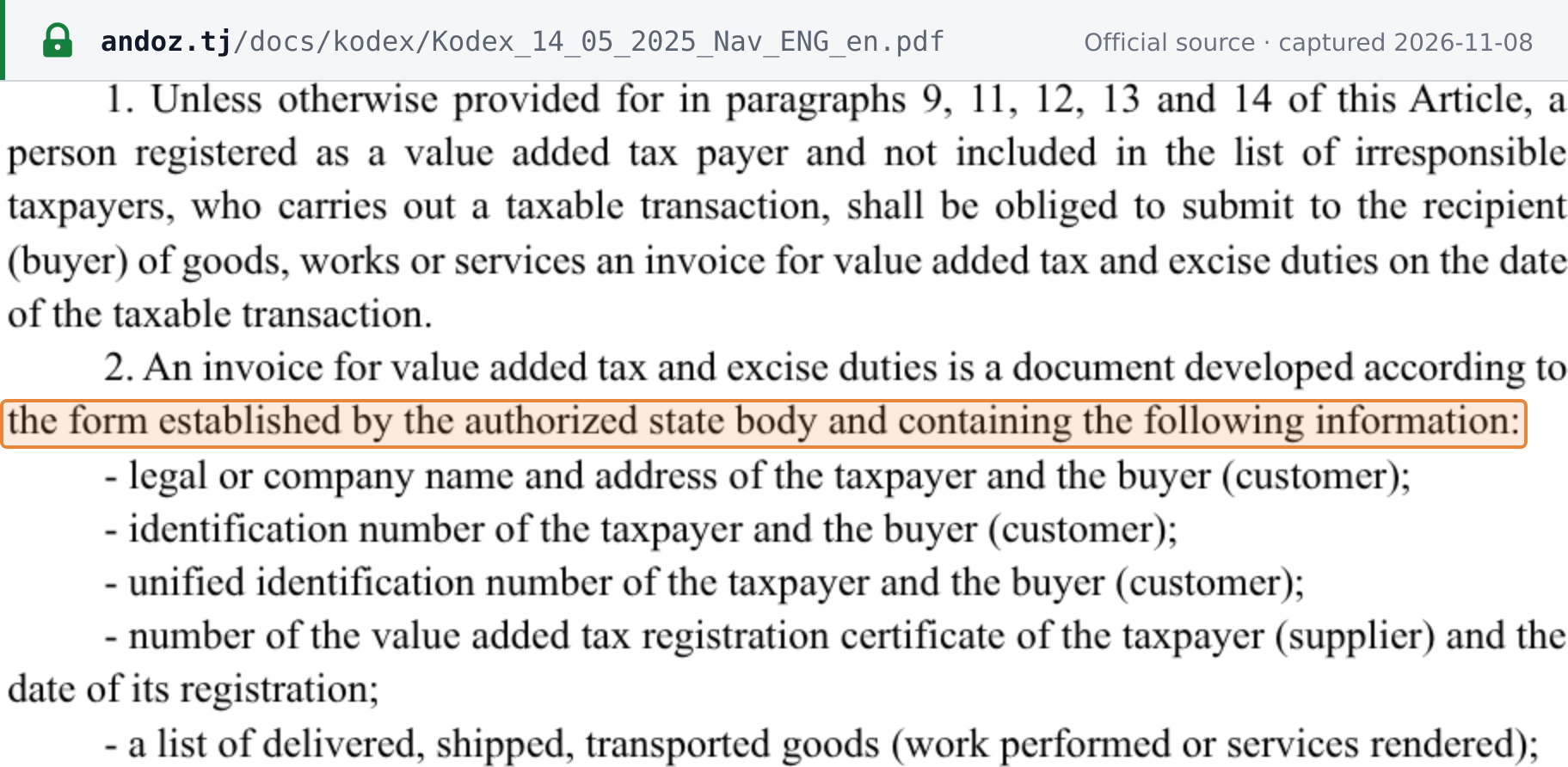
A VAT payer "not included in the list of irresponsible taxpayers" must give the buyer an invoice for VAT and excise duties "on the date of the taxable transaction" (art. 269(1)). The invoice is electronic: it "shall be prepared electronically and issued to the payer of value added tax only in electronic form" (art. 269(3)). [1] The form is set by the Tax Committee's Instruction on VAT and excise invoices, approved by Order No. 11-f of 28 March 2022. [4]
Mandatory content
Article 269(2) lists what the invoice must contain: [1]
| # | Particular (art. 269(2)) | Field on the official form (Order 11-f, Annex 1) |
|---|---|---|
| 1 | Legal or company name and address of the supplier and of the buyer | 2.1, 2.1.1; 3.1, 3.1.1 |
| 2 | Taxpayer identification number of the supplier and of the buyer | 2.2; 3.2 |
| 3 | Single (unified) identification number of the supplier and of the buyer | — (not a separate box on Annex 1) |
| 4 | Number and date of the supplier's VAT registration certificate | 2.3 (and the buyer's in 3.3) |
| 5 | List of goods delivered, shipped or transported, or works and services performed | Section 5, description column |
| 6 | Advance transactions | — |
| 7 | Amount of the taxable transaction | Section 5, taxable value excluding VAT |
| 8 | Excise on excisable goods and services | Section 5, "of which excise" |
| 9 | VAT amount | Section 5, VAT amount |
| 10 | Date of issue | 1.1 |
| 11 | Serial number | 1, 1.2 |
- The taxable amount is shown separately for each item (art. 269(10)).
- An export invoice must also record the destination of the export, the country of destination and the VAT rate applied (art. 269(12)). Annex 1 has a tick box for an export operation (1.4), a field for the export destination (3.4) and an HS commodity-code column for exports. [1]
 Source snapshot captured 2026-11-08 — original
Electronic issue, signature and storage
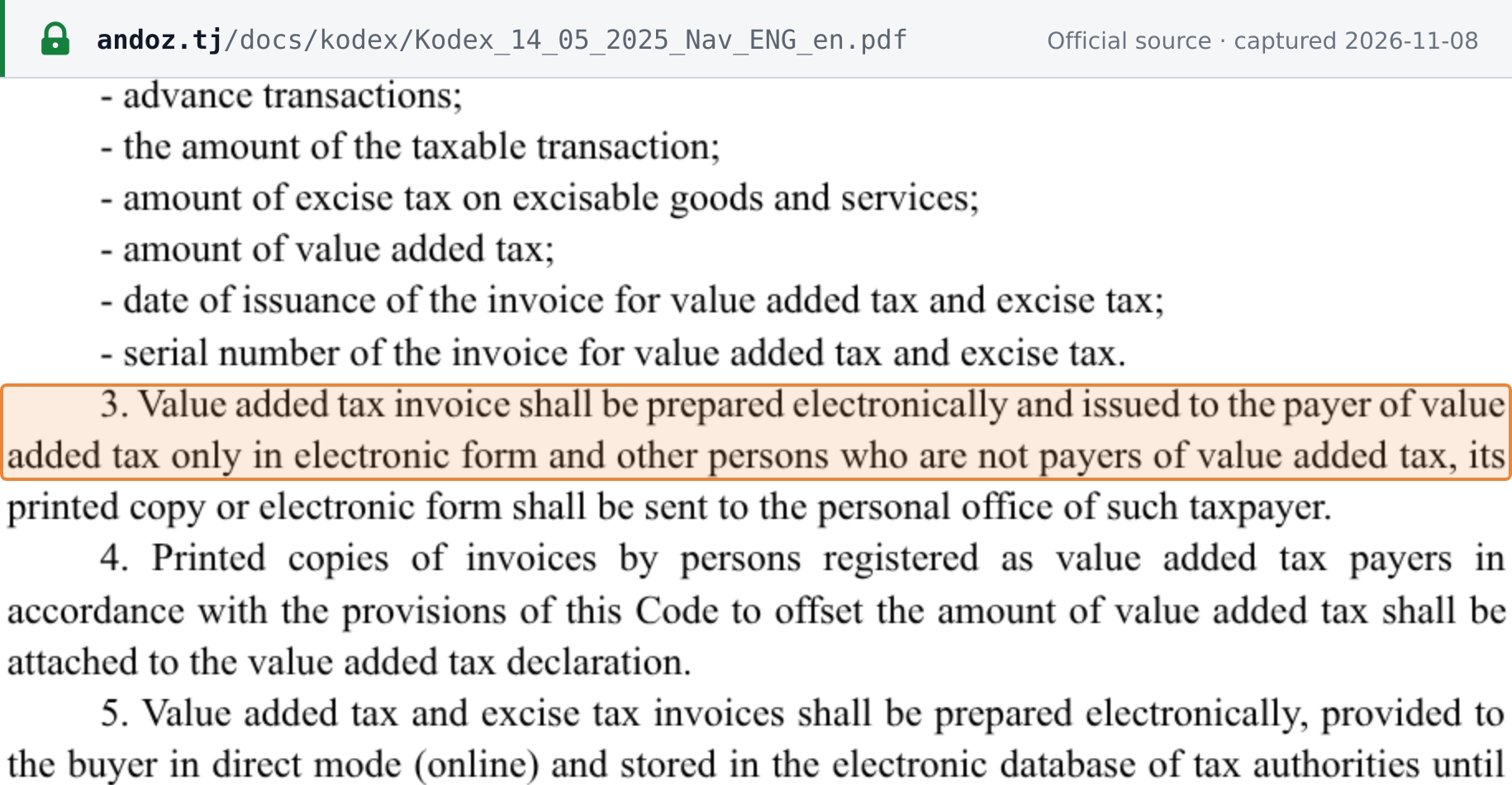
- A VAT-payer buyer receives the invoice only in electronic form; a buyer that is not a VAT payer receives a printed copy, or the electronic form in its personal cabinet (art. 269(3)).
- Invoices are "provided to the buyer in direct mode (online) and stored in the electronic database of tax authorities until the end of the statute of limitations", and registered in a register "electronically through the information program" (art. 269(5)).
- The invoice "shall be certified by electronic signature of the authorized person of the supplier" (art. 269(8)).
- Printed copies of invoices received are attached to the VAT return to support the credit (art. 269(4)).
 Source snapshot captured 2026-11-08 — original
The official invoice form and a specimen
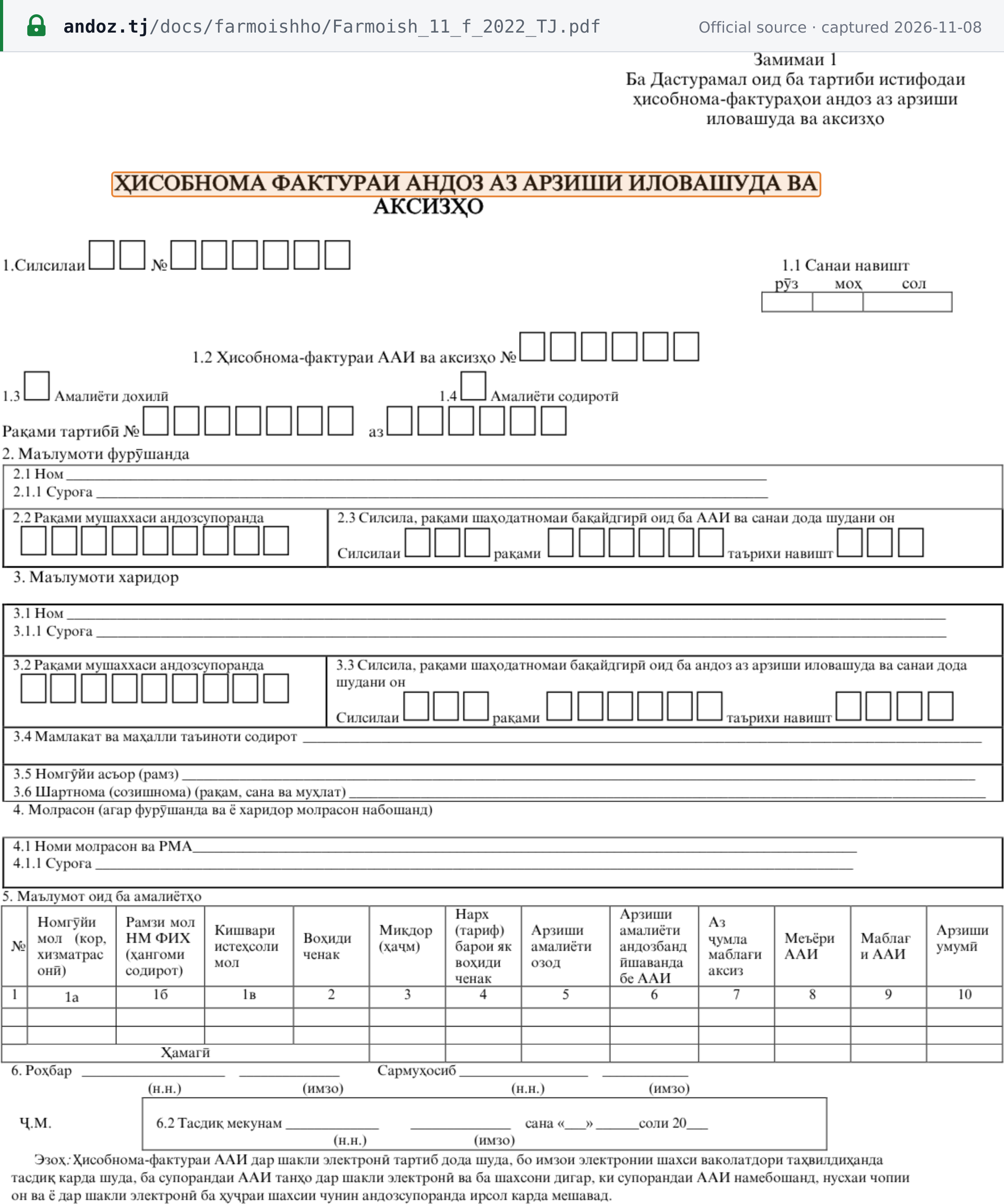
The Tax Committee publishes the official form as Annex 1 to the Instruction approved by Order No. 11-f. It is a blank form in Tajik, with numbered fields. Annex 2 is the form of the additional (corrective) invoice and Annex 3 the simplified accounting invoice. [4]
 Source snapshot captured 2026-11-08 — original
Because the official form is blank and in Tajik, the specimen below fills it in, in English, with fictitious data. Each ref is the field number on Annex 1.
Invoice for VAT and excise duties — illustrative specimen (Tajikistan)
| Description of goods, works, servicescol. 1а | HS code (exports)col. 1б | Country of origincol. 1в | Unitcol. 2 | Qtycol. 3 | Unit pricecol. 4 | Exempt valuecol. 5 | Taxable value excl. VATcol. 6 | Of which excisecol. 7 | VAT ratecol. 8 | VAT amountcol. 9 | Totalcol. 10 |
|---|---|---|---|---|---|---|---|---|---|---|---|
| Office chairs | — | Tajikistan | pcs | 10 | 500.00 | 0.00 | 5,000.00 | 0.00 | 14% | 700.00 | 5,700.00 |
| Delivery service | — | — | service | 1 | 300.00 | 0.00 | 300.00 | 0.00 | 14% | 42.00 | 342.00 |
- Taxable value excluding VATsection 5, total row
- TJS 5,300.00
- VAT at 14%section 5; Tax Code art. 397(4)
- TJS 742.00
- Total valuesection 5, total row
- TJS 6,042.00
- Section 4 (consignor: name, TIN and address) is completed only when neither the seller nor the buyer is the consignor.
- Section 6: head and chief accountant (name and signature) for the seller; field 6.2, "I confirm", for the buyer, with the date.
- For an export, tick field 1.4, give the destination country and place in field 3.4, the HS code in column 1б, and the rate applied (Tax Code art. 269(12)).
- An invoice dated on or after 1 January 2027 for a supply made on or after that date carries 13% instead of 14% (Tax Code art. 397(4)).
- Footnote on the official form: the invoice is prepared electronically, certified with the supplier's electronic signature, and sent to VAT payers only in electronic form.
Issuance deadline and tax point
- The invoice is due "not later than the date of taxable transaction" (art. 269(8)). [1]
- The tax point is normally the moment the invoice is issued (art. 256(1)). If no invoice is issued by the day of the supply, the tax point is the day of acceptance or transfer, or the day of shipment where delivery includes transport (art. 256(2)).
- Advances: if no invoice is issued within five days of an advance payment, the date of the advance is the tax point (art. 256(3)).
- Continuous services and leasing: an invoice is due for each month by the 10th of the following month; if it is not issued and payment is not made, the tax point is the last day of the month (art. 256(6)). [1]
- Utilities, communications, rail transport, freight forwarding and banking: may invoice at the end of the tax period (art. 269(9)).
Numbering, corrections and cancellation
- Invoices carry a series and number and are executed electronically in the manner the Tax Committee prescribes (art. 269(7)).
- When a supply is cancelled, repriced, returned or not accepted, the supplier issues an additional (corrective) invoice, which the buyer confirms (arts. 249(2), 270(2)). It shows its own number and date, the original invoice's number and date, the parties' names, addresses and identification numbers, each item's quantity and value before and after the change, the difference excluding VAT, the VAT and the excise (art. 270(1)). The form is Annex 2 to Order 11-f.
- An invoice issued with an error is cancelled on the seller's electronic application, after the buyer confirms the error and the tax authority examines it (Order 11-f, para 18). [4]
- A taxpayer using the standard rate must adjust VAT for the whole previous calendar year before 1 April each year (art. 267(4)).
Document types
- Invoice for VAT and excise duties (Annex 1) — taxable supplies to a VAT payer.
- Simplified accounting VAT invoice (Annex 3) — supplies to a business that is not a VAT payer, also prepared electronically (Order 11-f, para 9).
- Accounting-form invoice for payment — exempt supplies, for which no VAT invoice is issued (art. 269(11)).
- Receipt — retail sales to final buyers who are not VAT payers: a cash-register (cash-control device) receipt, an automatic payment device receipt or a bank receipt replaces the invoice (art. 269(14)). The test is the type of buyer; the Code sets no value limit. See Fiscal devices and certified cash registers.
- No invoice is required for listed utilities, telecoms, education and medical services to the population paid through banks or payment devices, for passenger tickets, or for foreign remote-service registrants (art. 269(13)).
Currency and language
Annex 1 has a field for the currency name and code (3.5), so an invoice may be in a foreign currency. For tax purposes the amounts are converted into somoni at the National Bank's official rate on the transaction day (art. 90(6)). The Tax Code requires taxpayers to keep accounting documentation and tax reporting in the state language, Tajik (art. 89(3)), and the official invoice form is in Tajik. [1]
Self-billing
Not provided for. Article 269 puts the duty to issue on the supplier and requires the signature of "the authorized person of the supplier"; neither the Code nor Order 11-f contains a self-billing provision.
Retention and audit trail
- Retention. Accounting documents are kept in Tajikistan for the limitation period (art. 89(6)), which is 5 years (art. 123(1)), or longer if an audit or appeal is still open. [1] Electronic VAT invoices are also stored in the tax authority's database until the limitation period ends (art. 269(5)).
- Audit trail. Invoices are registered in an official electronic register (art. 269(5)–(6)) and electronically signed (art. 269(8)); an erroneous invoice can be cancelled only through the tax authority (Order 11-f, para 18); and the VAT return carries registers of invoices received and issued (Annexes 2 and 3 to the return). [11]
- Electronic warehouse. For goods, the Tax Committee runs an electronic-warehouse module that tracks stock balances, and a taxpayer can issue a VAT invoice for goods only if the goods are on its electronic-warehouse balance (Order 11-f, para 24). [4]
E-invoicing status
Status as at 2026-11-08: mandatory for all VAT payers.
- Legal basis. Tax Code article 269(3), (5) and (8): VAT invoices are prepared electronically, given to VAT-payer buyers only in electronic form, provided online, registered through the tax authority's information program, stored in its database and signed electronically. The Code has been in force since 1 January 2022, and Order 11-f, which sets the forms, is dated 28 March 2022.
- Model. Every invoice passes through and is stored in the tax authority's system, and goods invoices are checked against the electronic-warehouse balance. That makes it a centralised, clearance-style model. See E-invoicing models: clearance, reporting and interchange.
- System. The Tax Committee's integrated tax information system and the taxpayer personal cabinet.
- Phase-in. None by size: the obligation attaches to VAT-payer status.
- Scope. B2B with a VAT-payer buyer: electronic invoice only. B2B with a non-VAT-payer business: the simplified accounting invoice, also electronic. B2C retail: cash-register or bank receipts instead of invoices (art. 269(14)). The Code has no separate B2G rule.
- Format. The content follows the Annex 1 form. The Tax Committee's website publishes no XML or other technical schema, API specification or network such as Peppol for e-invoices (as at 2026-11-08).
Filing and payment
Filing frequency and due dates
| Who | Period | Return due (and payment, where stated) | Source |
|---|---|---|---|
| VAT payers | Calendar month | Return and payment not later than the 15th of the following month | arts. 272(1), 273(1) |
| Foreign providers of remote services to individuals | Calendar quarter | Return not later than the 20th of the month after the quarter (art. 272(2) sets no separate payment date) | arts. 272(2), 273(2) |
| Tax agent not registered for VAT (withholding on foreign suppliers) | Month | Pay within 5 days of paying the foreign supplier; return by the 15th | art. 260(5) |
| Importers | Per import | With customs payments | art. 272(3) |
The taxpayer must, "not later than on the 15th day of the month following the reporting period", submit the VAT return "and make the payment of tax to the budget" (art. 272(1)). [1] For foreign providers of remote services, article 272(2) sets only the return deadline, "not later than the 20th of the month following the reporting period", and the payment rule in article 272(1) excludes them; the Code states no separate payment date for them. [1] Returns are filed electronically through the personal cabinet.
Additional listings
- The VAT return includes a register of invoices received (Annex 2) and a register of invoices issued (Annex 3). [11]
- Annual adjustment for the whole previous year, before 1 April (art. 267(4)).
- Taxpayers under the general regime draw up reconciliation acts with the tax authority every quarter (art. 34(2)). [1]
Input-tax recovery and blocked items
Credit requires a VAT invoice issued to the taxpayer with the VAT shown separately (or, for imports, the customs declaration and proof of payment) and use of the purchase in taxable business (art. 266(1), (3)). Article 266(6) blocks credit for: [1]
- passenger cars, unless selling or hiring them out is the buyer's main business;
- charitable, social, entertainment or hospitality expenses;
- expenses incurred for geological exploration and preparation for extraction of natural resources; [1]
- the acquisition, production, construction, installation and repair of depreciable fixed assets and intangible assets, "regardless of the amount of expenses";
- invoices without VAT shown separately;
- import VAT where the importer's name, TIN or single identification number is missing from the customs payment document;
- purchases from persons who did not actually carry out the transaction;
- expenditure at a reduced rate, except import VAT for reduced-rate payers;
- remote services from a foreign person without a permanent establishment in Tajikistan.
Mixed taxable and exempt businesses credit by the proportional method (art. 268(2)–(3)); a taxpayer with only exempt operations gets no credit (art. 266(7)).
Refunds
- Zero-rated (export) taxpayers: the excess credit is refunded within 30 calendar days of the application, after offsetting tax debts (art. 274(1), (3)). [1]
- Other taxpayers: the excess is carried forward for six tax periods, and any balance left is refunded within 30 days after that (art. 274(4)).
- Non-residents: no refund scheme for foreign businesses; only diplomatic missions on a reciprocal basis (art. 276).
- Bad debts: the VAT section has no bad-debt relief. The art. 249 adjustments cover cancellation, price changes and returns, not non-payment.
Exemptions
Exempt supplies
Article 251(2) exempts, among others: [1]
- the sale, transfer or lease of real property, except hotel and holiday accommodation, newly built dwellings and real estate used for business, which are taxable;
- financial services on the National Bank's list;
- national and foreign currency;
- religious services;
- medical services of state institutions, except cosmetology, dental and sanatorium-resort services;
- education by budget-financed public institutions;
- humanitarian aid; products of penal institutions; specialised products for persons with disabilities;
- domestically made school uniforms (until 31 December 2026);
- domestically produced medicines on the Government's list.
Further exemptions cover imports, for example production equipment contributed to charter capital, primary aluminium, natural gas and electric vehicles less than one year old (art. 251(4)), and — added by Law No. 2210 of 17 December 2025 — the import and onward supply of solar panels with inverters, storage devices and their spare parts and accessories, until 1 January 2031 (arts. 251(10), 397(19)). [2] The import and onward supply of new cars (made no more than one year earlier, with up to 10,000 km) of HS headings 8702, 8703, 8704 and 8705, directly by legal entities and by individual entrepreneurs working on the basis of a certificate, is exempt from 50% of the standard rate (art. 251(6)). [1]
Expiring on 31 December 2026 (art. 397(11)–(12)): the school-uniform exemption (art. 251(2)(10)), the agricultural-machinery exemption (art. 251(5)), the 50% relief on new cars (art. 251(6)), and four import exemptions in article 251(4) (its fifth, eighth, thirteenth and fourteenth paragraphs). [1]
Exempt is not zero-rated
- An exempt supply carries no VAT invoice; an accounting-form invoice is used (art. 269(11)).
- VAT on purchases used for exempt operations is not creditable (art. 268(1)), and a taxpayer with only exempt operations gets no credit at all (art. 266(7)).
- An export, by contrast, is zero-rated: input VAT is creditable and excess credit refunded within 30 days.
So cotton moving from the exemption list to the zero rate under Law No. 2285 is a gain for exporters, who can now recover input VAT. See Zero-rated vs exempt supplies.
Special regimes
- Simplified regime (Chapter 52): for businesses whose gross income over the last 12 consecutive months has not exceeded TJS 1 million; 6% of gross income (art. 380(1)). Simplified-regime taxpayers do not pay VAT, except import VAT and VAT withheld on non-residents (art. 374(5)), and may opt into VAT (art. 374(8)). [1]
- Free economic zones (Chapter 49): goods produced in a free economic zone are excluded from export zero-rating (art. 254(1)).
- Used goods, commission sales, Islamic banking and insurance: the taxable base is set by the Government (art. 271).
- Cash accounting: not available; the tax point is the invoice or the supply (art. 256).
Offences and penalties
Administrative fines are set in calculation indicators (нишондиҳанда барои ҳисобҳо). The indicator is TJS 78 from 1 January 2026 (Budget Law No. 2203, art. 24(1)). [6] The somoni amounts below are that conversion, for 2026.
Offences
- Administrative. Under the Code of Administrative Offences: trading without a mandatory VAT registration (art. 606(1)); failing to issue a VAT invoice, or issuing an incorrect one (art. 606(2), (4)); issuing a VAT invoice while not registered (art. 606(3)); issuing or accepting invoices without an actual transaction (art. 606(5)); concealing taxable objects (art. 599(1)); failing to comply with tax officials' lawful demands (art. 600) and obstructing a tax audit (art. 611). [7]
- Criminal. Criminal Code article 292 covers tax evasion by a legal entity through false accounts or returns or concealment, in a large amount: a fine of 547–912 indicators (TJS 42,666–71,136) or 3–5 years' imprisonment; for an especially large amount or a repeat offence, 912–1,460 indicators (TJS 71,136–113,880) or 5–8 years. Liability arises only if the person does not pay the tax, fine and interest in full within 48 banking days of the authority's decision (24 banking days for a repeat offence). [8]
Penalties
| Failure | Fine | Source |
|---|---|---|
| Trading without mandatory VAT registration | 25% of the VAT due for the whole unregistered period | CAO art. 606(1) |
| Incorrect VAT invoice understating VAT or overstating credit, or no VAT invoice issued | 50% of the VAT on the invoice that should have been issued | CAO art. 606(2) |
| VAT invoice issued by a person not registered for VAT | 100% of the VAT shown and not paid in | CAO art. 606(3) |
| Breach of the procedure for writing VAT invoices | 3–5 indicators (TJS 234–390) per invoice | CAO art. 606(4) |
| Invoices issued or accepted without an actual transaction | Legal entities and individual entrepreneurs working on the basis of a certificate: 50% of the VAT shown; officials: 300 indicators (TJS 23,400) | CAO art. 606(5) [7] |
| Late return (legal entities and individual entrepreneurs) | Up to 10 working days: 40–50 indicators (TJS 3,120–3,900); 10–30 working days: 80–100 (TJS 6,240–7,800); over 30 working days: 100–120 (TJS 7,800–9,360) | CAO art. 601 |
| Tax understated in a return | 25% of the understated amount; 40% for a repeat within a year | CAO art. 605 |
| Late tax registration, or late registration of a change in registration data (legal entities; not persons covered by the Law on State Registration of Legal Entities and Individual Entrepreneurs, i.e. single-window registrants) | Up to 30 days: 50–100 indicators (TJS 3,900–7,800); 31–90 days: 150–200 (TJS 11,700–15,600); over 90 days: 200–300 (TJS 15,600–23,400) | CAO art. 603 [7] |
| Failure to withhold or remit tax at source, including VAT on foreign suppliers | 180–200 indicators (TJS 14,040–15,600) | CAO art. 602(1) |
| Concealing taxable objects (legal entities) | 250–300 indicators (TJS 19,500–23,400) | CAO art. 599(1) |
| Late payment | Interest of 0.04% per day of delay | Tax Code art. 139(6) |
Fines as at 2026-11-08, including the amounts re-set by Law No. 2209 of 17 December 2025. [7] [1]
Frequently asked questions
Is Tajikistan's VAT rate 15%, 14% or 13%? Is there a different rate for cash payments?
Article 264(1)(1) of the Tax Code still says the standard rate is 15%, but the transitional article 397(4) sets that rate at 14% from 1 January 2024 to 31 December 2026 and at 13% from 1 January 2027. The 14% rate is the one in force in 2026. Neither article distinguishes cash from non-cash payments: the condition is "taxable operations and taxable importation", and the Tax Committee's 2025, December 2025 and June 2026 consolidations of the Code contain no cash rate. Article 85(3) does require cash-register receipts to show the tax amount "including differential rate of value added tax for cash and non-cash payments", but no such differential rate is set in article 264 or article 397(4). A tax engine configured from article 264 alone charges 1 percentage point too much in 2026 and 2 points too much from 2027.
We withheld VAT on a foreign consultant's invoice. Can we credit it as input VAT?
No. When a foreign supplier with no permanent place of business in Tajikistan performs services or works for a legal entity operating in Tajikistan, the buyer is a tax agent and withholds VAT from the amount payable (Tax Code article 260). If the agent is registered for VAT, it pays the withheld tax and includes it in its VAT return for the month "without the right to take into account the amount of value added tax" (article 260(4)). The withheld VAT is a cost, not a credit. An agent that is not registered for VAT pays the tax within five days of paying the foreign supplier and files a VAT return by the 15th of the following month.
Why can't we issue an electronic VAT invoice for goods we have sold?
Two common reasons. First, the Tax Committee's invoice instruction (Order No. 11-f of 28 March 2022, paragraph 24) runs an electronic-warehouse module: a VAT invoice for goods can be issued only if the goods are on your electronic-warehouse balance. Second, a VAT payer on the Tax Committee's published list of irresponsible taxpayers cannot issue VAT invoices at all (Tax Code article 269(1); Order 11-f, paragraph 2, note). A taxpayer is listed for failing to file or pay for more than three consecutive months, or for issuing a VAT invoice for a transaction that did not take place (article 34(5)).
We are a foreign company selling digital services to consumers in Tajikistan. Must we register for VAT?
Yes, and there is no threshold. A foreign person without a place of activity in Tajikistan that provides remote (electronic) services directly to individuals, including individual entrepreneurs, is itself the VAT payer (Tax Code article 277(1)). It must apply for electronic registration not later than 30 calendar days from the day it starts providing the services (article 278), and it files a VAT return quarterly, not later than the 20th of the month after the quarter (articles 272(2) and 273(2)). Sales to Tajik legal entities and permanent establishments are different: the buyer withholds the VAT as tax agent.
Our restaurant charges the 7% reduced rate. Why can't we deduct the VAT on our purchases?
Because the reduced rates come without input VAT credit. Tax Code article 266(6) disallows credit for expenditure at a reduced rate, which covers both the 7% rate (construction works, hotel and catering services) and the 5% rate (domestic agricultural produce and its processing, training services, sanatorium and resort medical services). Article 264(1)(2) also grants the 5% rate expressly "without the right to offset value added tax", and the Tax Committee's invoice instruction (Order No. 11-f, paragraph 17) lets VAT payers credit invoiced VAT except users of the reduced rate. The one exception is VAT you pay on your own taxable imports, which are taxed at the standard rate and remain creditable (article 264(3)).
We deliver on 31 December 2026 but invoice in January 2027. Is it 14% or 13%?
The tax point is normally the moment the VAT invoice is issued (Tax Code article 256(1)), but only if the invoice is issued before or on the day of the supply. If it is not, the tax point is the day the goods or services are accepted or transferred, or the day of shipment where delivery includes transport (article 256(2)). A delivery on 31 December 2026 invoiced in January 2027 therefore falls in 2026, at 14%. An advance payment not invoiced within five days becomes a tax point on its own date (article 256(3)), and continuous services must be invoiced for each month by the 10th of the following month (article 256(6)).
Our income passed TJS 1 million in the middle of the year. From when are we a VAT payer?
From the first day of the reporting period after the month in which your income exceeded the threshold (Tax Code article 245(6)). The test is total income over a period of not more than 12 full consecutive calendar months, and the income of related (interrelated) persons is added together (article 245(1)-(2)). A business on the simplified regime must apply to move to the general regime within 10 calendar days of exceeding TJS 1 million (article 375(3)).
Important websites
| Site | What it is for |
|---|---|
| Tax Committee (andoz.tj) | The tax authority's site, in Tajik, Russian and English |
| Taxpayer personal cabinet | File VAT returns, receive and issue electronic VAT invoices; login with the TIN |
| State registration | "Single window" registration of legal entities and individual entrepreneurs: document lists and forms |
| Tax return forms | VAT return and its annexes, including the invoice registers and Annex 9 for foreign electronic-service suppliers |
| Instructions | The VAT calculation instruction and the invoice instruction (Order No. 11-f) with the official invoice forms |
| Tax Code | All language editions of the Tax Code, including the latest Tajik consolidation |
| List of irresponsible taxpayers | Check a supplier before relying on its VAT invoice: listed taxpayers cannot issue VAT invoices (shows TIN and single identification number) |
| Customs Service | Import declarations and import VAT |
| National Bank of Tajikistan | Official exchange rates used to convert foreign-currency transactions (Tax Code art. 90(6)) |
| Tajikistan INN validator | Check the format of a Tajik taxpayer identification number |
The Tax Committee publishes no public VAT-number lookup and no separate online registration entry point for non-resident suppliers (as at 2026-11-08).
Recent changes
Coming next: on 1 January 2027 the standard VAT rate falls from 14% to 13% under Tax Code article 397(4) (Tax Committee) — see event. The day before, 31 December 2026, is the last day of the school-uniform, agricultural-machinery and new-car reliefs and of four import exemptions in article 251(4) (art. 397(11)–(12)).
- 2026-06-17 — Law No. 2285 removes cocoon, cotton fibre, cotton yarn and raw cotton from the article 251(3) exemption and from the exports excluded from the zero rate; the consolidation does not state its effective date. (Tax Committee)
- 2026-01-01 — The 2026 State Budget Law (No. 2203) sets VAT at 10% for wheat processors and vegetable-oil sales and 7% for oilseed by-products for 2026, and the calculation indicator for fines at TJS 78. (Tax Committee)
- 2025-12-17 — Law No. 2210 exempts the import and onward supply of solar panels, inverters, storage devices and their parts until 1 January 2031 (art. 251(10)); Law No. 2209 of the same date re-sets the administrative fines for late returns and other tax offences. (Tax Committee)
For the full chronology, see Tajikistan tax changes on Lookuptax.
Reference links
Tax Committee under the Government of the Republic of Tajikistan:
- [1] Tax Code of the Republic of Tajikistan, English translation as of 14 May 2025 (Law No. 2168)
- [2] Tax Code (Кодекси андози ҶТ), Tajik consolidation including Laws Nos. 2283 and 2285 of 17 June 2026
- [3] Tax Code (Налоговый кодекс РТ), Russian consolidation to Law No. 2210 of 17 December 2025
- [4] Order No. 11-f of 28 March 2022 — Instruction on VAT and excise invoices, with Annexes 1–3
- [5] Order No. 12-f of 28 March 2022 — VAT registration and deregistration procedure
- [6] Law No. 2203 of 1 December 2025 "On the State Budget of the Republic of Tajikistan for 2026"
- [7] Code of Administrative Offences, consolidated including Law No. 2209 of 17 December 2025
- [8] Criminal Code of the Republic of Tajikistan
- [9] List of irresponsible taxpayers (as at 15 October 2026)
- [10] VAT return for electronic services by foreign persons (Annex 9)
- [11] Tax return forms
Related on Lookuptax:
- Tajikistan tax changes
- Tajikistan VAT rate falls to 13% on 1 January 2027
- Tajikistan INN validator
- Kyrgyzstan VAT guide
- Uzbekistan VAT guide
- Kazakhstan VAT guide
- Reverse charge
- VAT on digital services from non-resident suppliers
- Marketplace deemed-supplier rules
- E-invoicing models: clearance, reporting and interchange
- Fiscal devices and certified cash registers
- Zero-rated vs exempt supplies