Togo VAT (TVA) guidelines
Overview
Togo levies a value added tax, the taxe sur la valeur ajoutée (TVA). The rules are in the Code général des impôts (CGI), with procedure in the Livre des procédures fiscales (LPF). Both are amended each year by a loi de finances (finance law). The current one is Loi n° 2025-002 portant loi de finances, exercice 2026, signed at Lomé on 31 December 2025. [1] The Ministry of Finance publishes the finance laws and finance bills on finances.gouv.tg. It does not publish a consolidated CGI, so this guide cites each article from the finance law or bill that last reprinted it, and says which one it is.
Authority, currency, period and layering
- Authority. The Office Togolais des Recettes (OTR), a single body for domestic taxes and customs, administers TVA. Its information line is the free number 8201. [13]
- Currency. The CFA franc (XOF, franc CFA). The CGI states every amount in francs CFA.
- Period. The finance laws work by exercice (financial year). The OTR describes TVA returns as monthly ("déclarations mensuelles"). [6]
- Layering. TVA is a single national tax with no regional or municipal layer. Togo belongs to the West African Economic and Monetary Union (WAEMU/UEMOA), and its TVA follows the union's harmonisation directive. The OTR's Cahier fiscal 2026 cites "l'article 34 de la Directive n°02/98/CM/UEMOA du 22 décembre 1998 portant harmonisation des législations des Etats membres en matière de TVA" as the basis for the 2026 change to blocked deductions. [5]
- Small businesses. Small natural persons pay the Taxe Professionnelle Unique (TPU), a synthetic tax, and their business is outside TVA. See Special regimes.
Registration
Who must register and the threshold
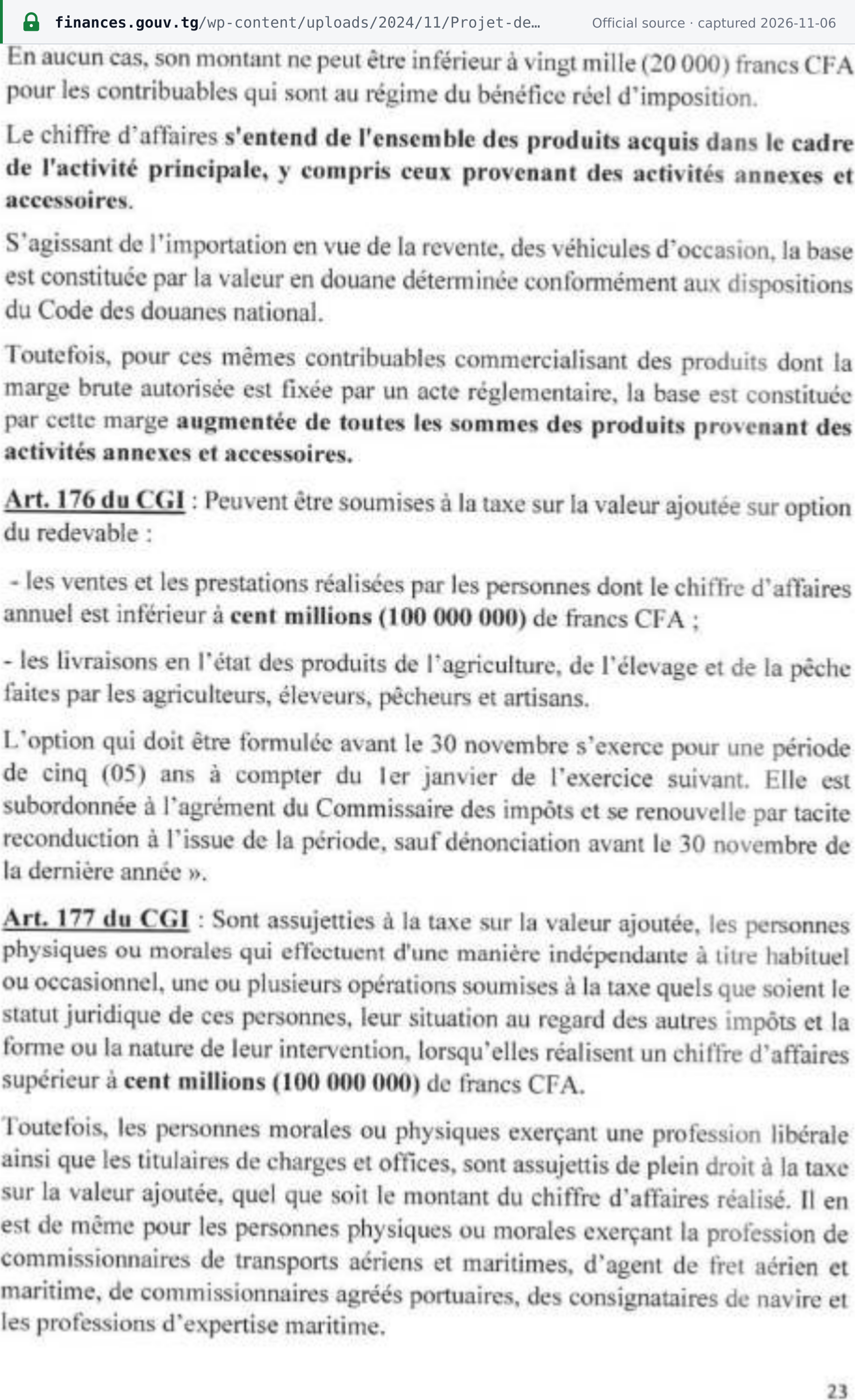
TVA liability turns on turnover above XOF 100,000,000. Article 177 of the CGI, in the wording introduced by the 2025 finance law (Loi n° 2024-007 of 30 December 2024), reads:
"Sont assujetties à la taxe sur la valeur ajoutée, les personnes physiques ou morales qui effectuent d'une manière indépendante à titre habituel ou occasionnel, une ou plusieurs opérations soumises à la taxe quels que soient le statut juridique de ces personnes, leur situation au regard des autres impôts et la forme ou la nature de leur intervention, lorsqu'elles réalisent un chiffre d'affaires supérieur à cent millions (100 000 000) de francs CFA." [2]
In short, any person carrying on taxable operations independently is liable once its turnover exceeds XOF 100 million, whatever its legal form. The figure applies from 1 January 2025. It was XOF 60,000,000 before that.
- Always liable, whatever the turnover. Liberal professions and holders of charges et offices (public offices) are liable "de plein droit … quel que soit le montant du chiffre d'affaires réalisé". So are air and sea freight forwarders (commissionnaires de transports aériens et maritimes), air and sea freight agents, licensed port commission agents, ship's agents and marine surveyors. [2]
- Measurement. The test is chiffre d'affaires (turnover) for the financial year. Article 177 does not use a rolling twelve-month period.
- Crossing the threshold mid-year. "lorsqu'en cours d'année, le chiffre d'affaires limite est atteint, l'assujettissement à la TVA prend effet à compter du 1er jour du mois de la réalisation de la condition." Liability starts on the first day of the month in which turnover reaches the threshold. [2]
- Falling below it. A business whose turnover falls below the threshold "continuent d'observer leurs obligations déclaratives et de paiement pendant trois (03) exercices consécutifs" — it keeps filing and paying TVA for three consecutive financial years. [2]
Which text this is. The wording above is from the projet de loi de finances, exercice 2025 (the 2025 finance bill), the version the Ministry of Finance publishes. The bill was enacted as Loi n° 2024-007 du 30 décembre 2024 portant loi de finances initiale, exercice 2025, which the 2025 amending finance law (Loi n° 2025-001) names in its article 3. [16] The Ministry's site does not publish the text of Loi n° 2024-007 itself. The OTR's Cahier fiscal 2026 and the 2026 finance law do not amend article 177.
 Source snapshot captured 2026-11-06 — original
Non-resident registration
Neither the CGI articles reprinted in the 2024–2026 finance laws and bills nor the OTR's website set a separate registration threshold or a fiscal-representative rule for non-resident businesses (as at 6 November 2026). The one non-resident rule they do contain is for electronic services: under CGI article 183 bis, the intermediary collects the TVA on the foreign supplier's behalf. See Digital services.
Tax registration number (NIF)
Togo identifies taxpayers by the NIF (Numéro d'Identification Fiscal). A business receives it at creation, on the single card issued by the Centre de Formalités des Entreprises (see below). The NIF is one of the mandatory mentions on every facture normalisée (LPF art. 64), and anyone subject to the 2026 TVA withholding regime must have one. [1] The OTR and the CFE do not publish the NIF's length, structure or check digit, and neither offers a public NIF lookup (as at 6 November 2026). The CFE's online search checks whether a company name is available, not a NIF.
How to register
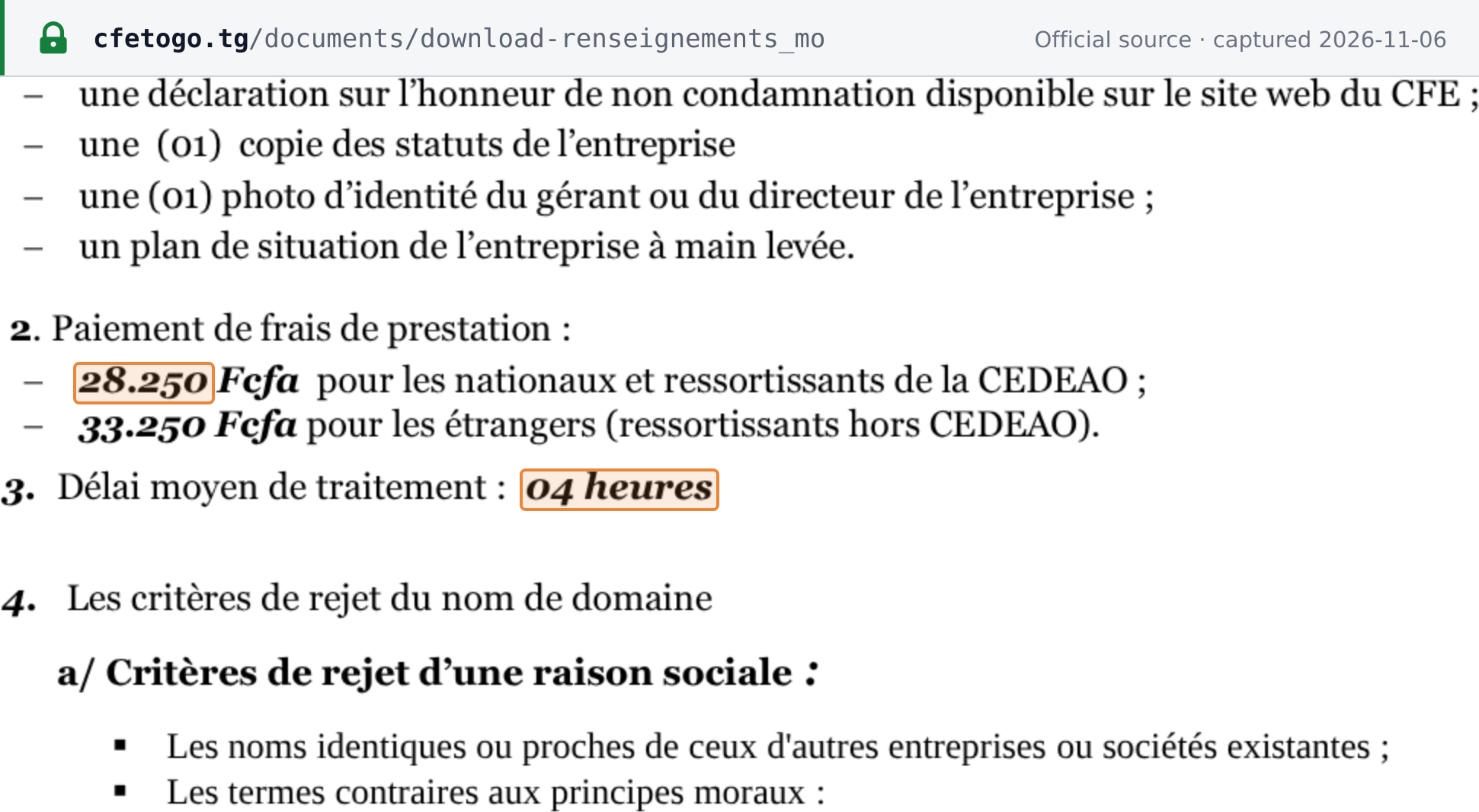
Businesses register with the Centre de Formalités des Entreprises (CFE), a one-stop shop that issues "une carte unique de création d'entreprise" carrying the trade-register (RCCM) number, "Le NIF (Numéro d'Identification Fiscal)" and the social-security (CNSS) number. [9] The CFE's document lists set out the file and the fees:
| Company (personne morale) | Sole trader (personne physique) | |
|---|---|---|
| Fee — Togolese and ECOWAS nationals | XOF 28,250 | XOF 25,400 |
| Fee — other foreign nationals | XOF 33,250 | XOF 30,400 |
| Average processing time | 4 hours ("04 heures") | 4 hours ("04 heures") |
Fees as published by the CFE (as at 6 November 2026). [10] [11]
For a company, the file comprises: the completed questionnaire (Déclaration Mo); a copy of the national identity card, ECOWAS consular card or (for other foreigners) passport; for foreigners, a residence card, residence certificate or visa; a marriage certificate if married; a sworn statement of no criminal conviction; a copy of the company statutes; an ID photo of the manager or director; and a hand-drawn location plan of the business. [10]
 Source snapshot captured 2026-11-06 — original
The CFE pages describe business creation. They do not describe a separate step for adding TVA once a business crosses the threshold, and the OTR website does not publish one (as at 6 November 2026).
Voluntary registration
Available. Under CGI article 176 the following "Peuvent être soumises à la taxe sur la valeur ajoutée sur option du redevable":
- sales and services by persons whose annual turnover is below XOF 100,000,000;
- sales, in their unprocessed state, of agricultural, livestock and fishery products by farmers, livestock breeders, fishermen and artisans.
The option must be made before 30 November. It runs for five years from 1 January of the following financial year, needs the approval of the Commissaire des impôts, and renews tacitly unless cancelled before 30 November of the last year. [2] A business might choose it so that it can deduct the TVA it pays on its purchases. The 2027 finance bill proposes cutting the period to three years (see Announced changes).
Deregistration
The texts reviewed contain no separate TVA deregistration procedure. Two rules govern the exit:
- Falling below the threshold does not end liability at once. The business keeps filing and paying for three consecutive financial years (CGI art. 177, quoted above).
- Ceasing or transferring the business must be notified to the tax administration under LPF article 14, as a CGI article reprinted in the 2024 finance bill recalls. [3]
Group registration
Not provided for. None of the CGI articles on TVA reprinted in the 2024, 2025 and 2026 finance laws and bills (arts. 176, 177, 180, 183 bis, 195, 197) contains a grouping provision (as at 6 November 2026).
Rates
Standard rate: 18%
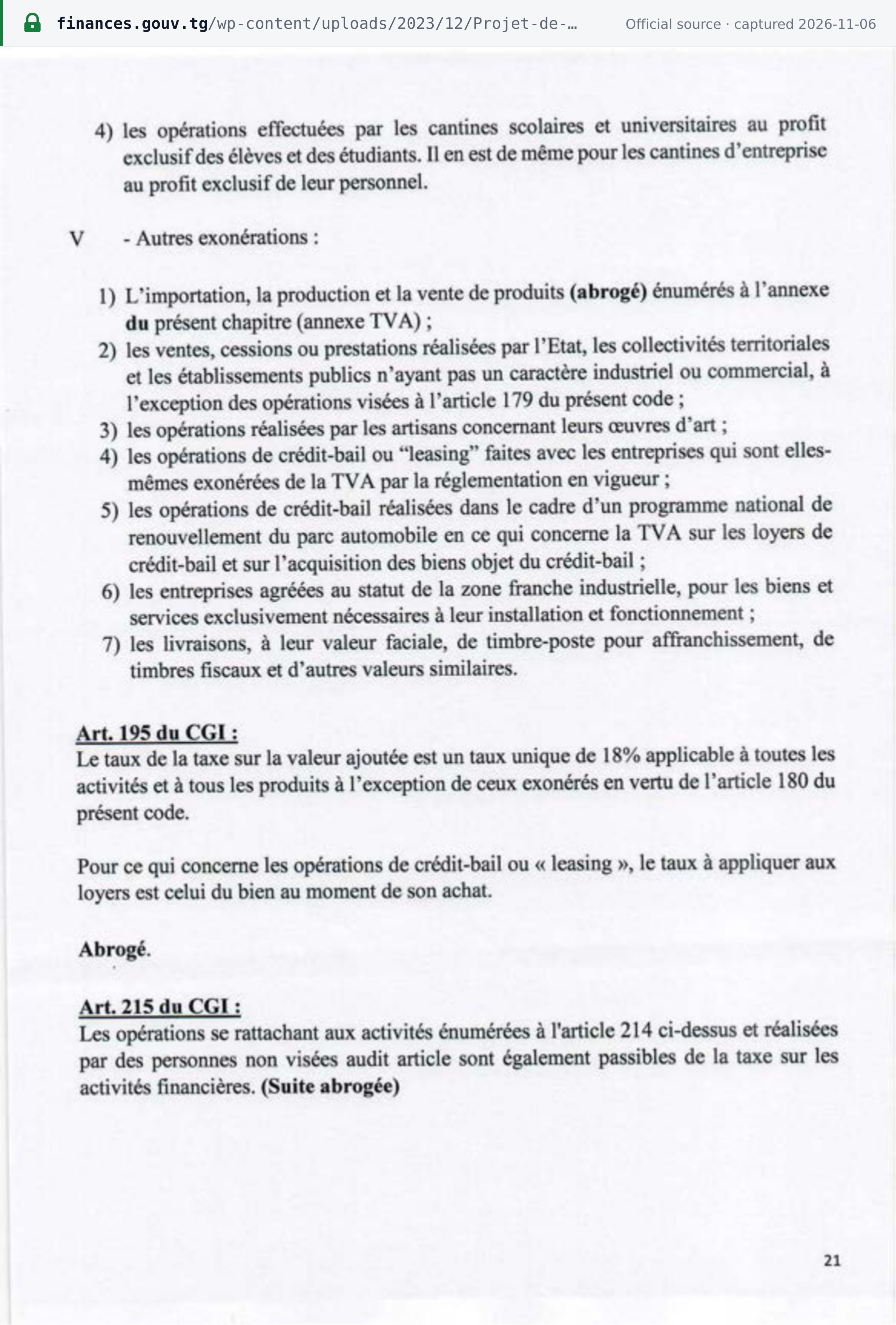
Togo has one TVA rate, 18%. CGI article 195, as amended by the 2024 finance law (Loi n° 2023-017 of 27 December 2023), reads:
"Le taux de la taxe sur la valeur ajoutée est un taux unique de 18% applicable à toutes les activités et à tous les produits à l'exception de ceux exonérés en vertu de l'article 180 du présent code." [3]
For leasing (crédit-bail), "le taux à appliquer aux loyers est celui du bien au moment de son achat" — the rents take the rate that applied to the asset when it was bought. The single-rate wording has applied since 1 January 2024. The 18% figure itself is older, and the published finance laws do not give the date it was first introduced.
 Source snapshot captured 2026-11-06 — original
Which text this is. The quotation is from the projet de loi de finances, exercice 2024 (the 2024 finance bill) on the Ministry of Finance's site. The bill was enacted as Loi n° 2023-017 du 27 décembre 2023 portant loi de finances, exercice 2024, which the 2024 amending finance bill names in its article 3; [17] the text of Loi n° 2023-017 itself is not published on the Ministry's site. The 2025 finance bill and the 2026 finance law leave article 195 unchanged.
Reduced and zero rates
None. In the 2024 text, the paragraph that followed the leasing rule is replaced by the single word "Abrogé" (repealed), and article 195 now describes 18% as "un taux unique". [3] The explanatory memorandum to the 2024 finance bill says the repealed paragraph was the 10% reduced rate that had applied to hotels and similar establishments since 2020 ("la suppression du taux réduit de 10% applicable aux hôtels et assimilés depuis l'année 2020"). [18] Supplies that are not taxed at 18% are exempt under article 180, not taxed at a lower rate (see Exemptions).
Announced changes
The 2027 finance bill (projet de loi de finances, exercice 2027) was published on finances.gouv.tg in November 2026. It is a bill, not law, and it proposes no change to the 18% rate. Its TVA proposals are: [4]
- CGI art. 176: the voluntary-registration option would run for "trois (03) ans" instead of five, and businesses exercising it would have to meet conditions to be set by regulation.
- CGI art. 191: for services between related enterprises (entreprises liées, art. 104), TVA would become chargeable after twelve months without payment.
- CGI art. 201: "La taxe n'est pas déductible lorsque le fournisseur ne figure pas sur le registre des contribuables tenu par l'Administration fiscale, en cours de validité à la date de l'opération" — no input-TVA deduction where the supplier is not on the administration's taxpayer register on the date of the transaction. [4]
Cross-border rules
Imports and exports
- Imports. TVA applies to imports, and the OTR collects it at the border as the merged customs and tax authority. The exemption list in CGI article 180-V covers "L'importation, la production et la vente" of the products listed in the TVA annex. [2] For 2026 only, article 15 of the 2026 finance law exempts from TVA, among other duties, construction and public-works machinery (matériels et engins de BTP) up to five years old imported by, or sold in Togo to, construction companies. [1]
- Import base and de-minimis. The finance laws and bills reviewed do not set out the import-TVA base or any low-value relief (as at 6 November 2026).
- Exports. The CGI articles reprinted in the 2024–2026 finance laws and bills do not state how exports are treated: whether they are exempt with a right to deduct, or outside the scope. Confirm the treatment with the OTR before relying on either.
Digital services
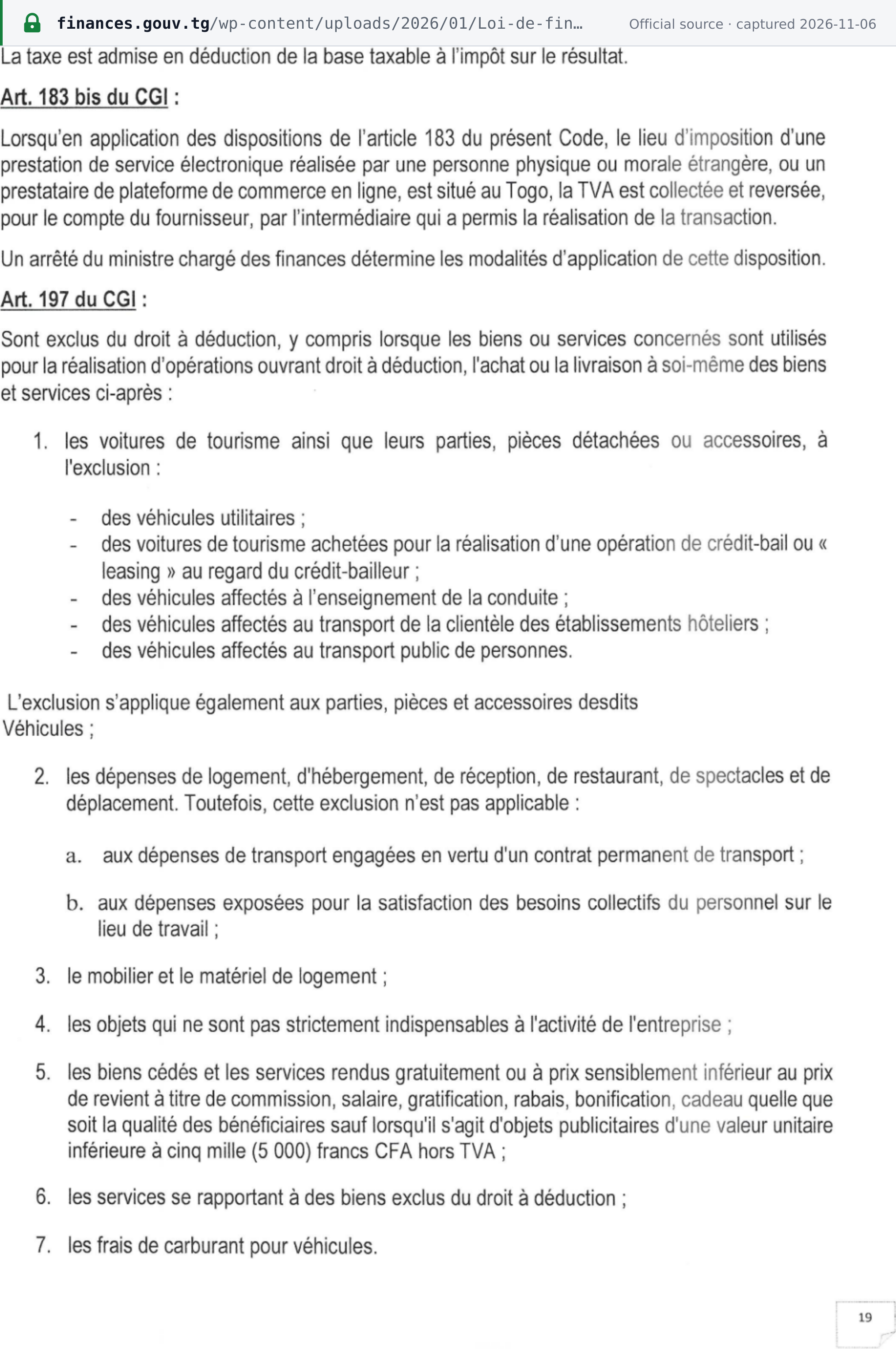
CGI article 183 bis has been in force since the 2023 finance law (Loi n° 2022-022), with the same intermediary-collection rule. [15] Article 21 of the 2026 finance law amends it and adds the sentence on a ministerial order. [1] As reworded in 2026, it reads:
"Lorsqu'en application des dispositions de l'article 183 du présent Code, le lieu d'imposition d'une prestation de service électronique réalisée par une personne physique ou morale étrangère, ou un prestataire de plateforme de commerce en ligne, est situé au Togo, la TVA est collectée et reversée, pour le compte du fournisseur, par l'intermédiaire qui a permis la réalisation de la transaction. Un arrêté du ministre chargé des finances détermine les modalités d'application de cette disposition." [1]
So where an electronic service from a foreign supplier or an e-commerce platform is taxable in Togo under the place-of-supply rule in article 183, the intermediary that enabled the transaction collects and pays over the TVA on the supplier's behalf. The OTR's Cahier fiscal 2026 says the application rules "seront déterminées par un acte réglementaire". [5] As at 6 November 2026, no such order (arrêté) is published on otr.tg or finances.gouv.tg.
 Source snapshot captured 2026-11-06 — original
Foreign companies selling into Togo — B2B and B2C
- B2C and B2B digital services. Article 183 bis does not distinguish business from consumer customers. In both cases collection falls on the intermediary, not on the foreign supplier.
- Reverse charge. The CGI articles reprinted in the 2024–2026 finance laws and bills contain no general reverse-charge rule for services bought from abroad by Togolese businesses (as at 6 November 2026).
- Other foreign sellers. No separate non-resident threshold or representative rule is published (see Non-resident registration).
See VAT on digital services from non-resident suppliers for how other countries handle this.
Marketplace and platform obligations
Beyond the article 183 bis collection rule, LPF article 50 as amended by the 2026 finance law requires digital platforms to send the tax administration, with their annual return, "un document récapitulant des éléments transmis aux utilisateurs notamment les revenus encaissés sous peine d'une amende de 10% des transactions non déclarées. Cette obligation s'applique à toutes les plateformes, qu'elles soient établies au Togo ou non". [1] See Marketplace deemed-supplier rules.
Place of supply
CGI article 183 sets the place-of-supply rule that article 183 bis relies on. Article 183 itself is not reprinted in the 2024–2026 finance laws and bills, so this guide does not summarise it.
Invoice requirements
Every taxpayer must use a facture normalisée (standardised invoice). The rule is LPF article 64, in the wording of the 2026 finance law (Loi n° 2025-002): "Les contribuables doivent obligatoirement utiliser les factures normalisées dont les conditions d'édition et de gestion sont déterminées par actes règlementaires du ministre chargé des finances." [1] LPF article 62 provides that the paper facture normalisée stays in use until certified e-invoicing actually starts (see E-invoicing status).
Mandatory content
LPF article 64 says these invoices "comportent obligatoirement les mentions et les spécifications suivantes": [1]
| # | Mention (LPF art. 64) | In English |
|---|---|---|
| 1 | le numéro de facture dans une série ininterrompue | Invoice number, in an unbroken series |
| 2 | une vignette selon un modèle déterminé par l'Administration fiscale | A vignette (security sticker) in the model set by the tax administration |
| 3 | le numéro d'identification fiscale de l'entreprise | The business's NIF |
| 4 | la date de la facturation | Invoice date |
| 5 | les nom ou raison sociale, adresse géographique et numéro d'immatriculation au registre du commerce du fournisseur | Supplier's name or business name, physical address and trade-register (RCCM) number |
| 6 | la nature et l'objet de la transaction | Nature and subject of the transaction |
| 7 | le prix hors taxe | Price excluding tax |
| 8 | le taux et le montant de la taxe due | Rate and amount of tax due |
| 9 | le cas échéant la mention "exonéré" | Where applicable, the word "exonéré" (exempt) |
| 10 | le montant total dû par le client | Total amount due from the customer |
The list does not include the customer's name or NIF. Invoices commonly show them, but article 64 does not list them as mandatory.
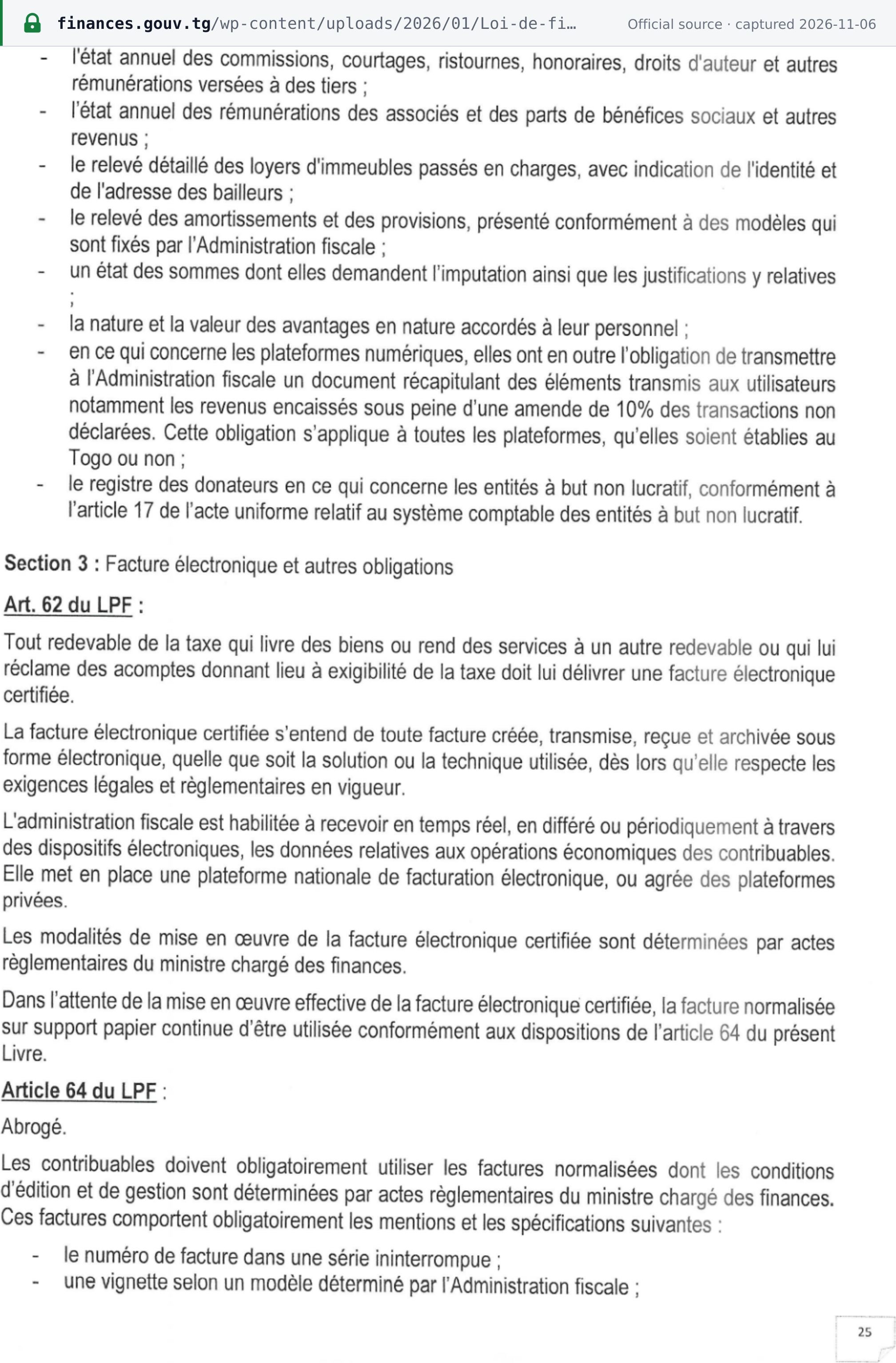 Source snapshot captured 2026-11-06 — original
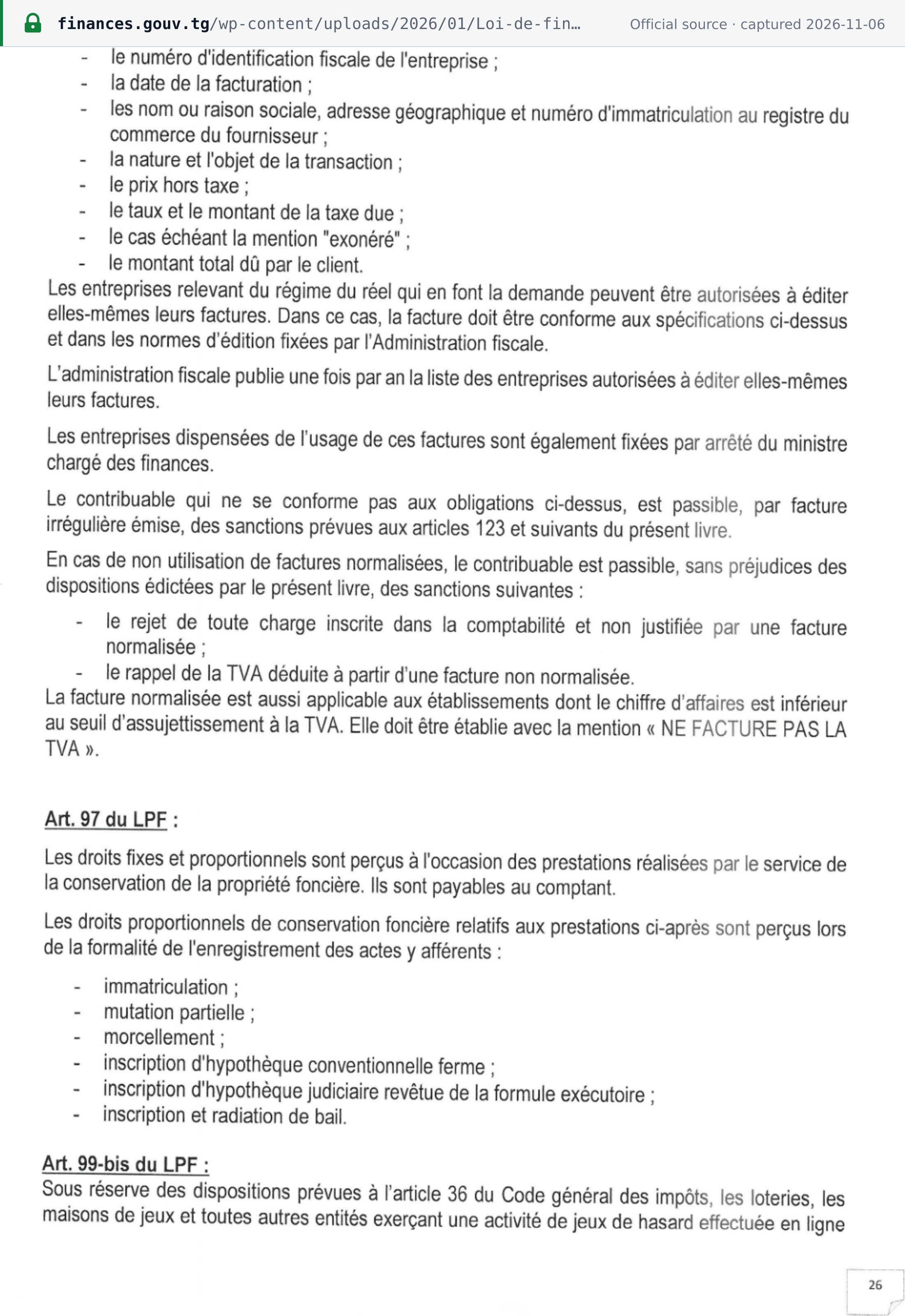 Source snapshot captured 2026-11-06 — original
A specimen of a compliant invoice
The OTR publishes no model facture normalisée: none appears on its documentation page, in the Cahier fiscal 2026 or in the 2026 finance law (as at 6 November 2026). The vignette is a physical sticker in a model the tax administration sets, and no picture of it is published. The specimen below is our illustration of where the article 64 mentions sit.
FACTURE NORMALISÉE — illustrative specimen (Togo)
| Nature et objet de la transactionLPF art. 64 | Qté | Prix unitaire HT (XOF) | Prix hors taxe (XOF)LPF art. 64 |
|---|---|---|---|
| Fournitures de bureau | 10 | 25 000 | 250 000 |
| Prestation de maintenance | 1 | 150 000 | 150 000 |
- Prix hors taxeLPF art. 64
- 400 000 XOF
- TVA — taux 18 %LPF art. 64; CGI art. 195
- 72 000 XOF
- Montant total dû par le clientLPF art. 64
- 472 000 XOF
- An exempt line is marked « exonéré » (LPF art. 64).
- A supplier below the TVA threshold issues the same facture normalisée, marked « NE FACTURE PAS LA TVA », with no TVA shown (LPF art. 64).
- When certified e-invoicing under LPF art. 62 starts, it replaces this paper form for supplies between TVA-liable persons. No start date had been published as at 6 November 2026.
Businesses below the TVA threshold
"La facture normalisée est aussi applicable aux établissements dont le chiffre d'affaires est inférieur au seuil d'assujettissement à la TVA. Elle doit être établie avec la mention « NE FACTURE PAS LA TVA »." [1] A business below XOF 100 million that is not liable for TVA still issues factures normalisées, and marks them this way.
Self-printed invoices and exempted businesses
- Businesses under the régime du réel may, on request, be authorised to print their own invoices. The invoice must meet the article 64 specifications and the printing standards set by the tax administration, which "publie une fois par an la liste des entreprises autorisées à éditer elles-mêmes leurs factures". [1]
- Businesses exempted from using factures normalisées are designated by order (arrêté) of the finance minister.
Numbering
Invoices must be numbered "dans une série ininterrompue", an unbroken sequence (LPF art. 64).
Not covered by the published texts
LPF article 64 and the other articles reprinted in the 2024–2026 finance laws do not set an issuance deadline, rules for credit or debit notes, a currency or language rule for invoices, a simplified-invoice threshold, self-billing, a retention period or audit-trail requirements (as at 6 November 2026). The OTR's website does not publish guidance on them either. The conditions d'édition et de gestion of factures normalisées are left to orders of the finance minister, which are not published on otr.tg or finances.gouv.tg.
E-invoicing status
Status as at 6 November 2026: enacted, not yet in force; no start date.
The 2026 finance law rewrote LPF article 62 to introduce the facture électronique certifiée (certified electronic invoice): [1]
"Tout redevable de la taxe qui livre des biens ou rend des services à un autre redevable ou qui lui réclame des acomptes donnant lieu à exigibilité de la taxe doit lui délivrer une facture électronique certifiée."
- Definition. Any invoice "créée, transmise, reçue et archivée sous forme électronique, quelle que soit la solution ou la technique utilisée", provided it meets the legal and regulatory requirements in force.
- Model. The tax administration "est habilitée à recevoir en temps réel, en différé ou périodiquement à travers des dispositifs électroniques, les données relatives aux opérations économiques des contribuables". It "met en place une plateforme nationale de facturation électronique, ou agrée des plateformes privées". See E-invoicing models: clearance, reporting and interchange for what real-time and periodic reporting mean in practice.
- Scope. On its wording, article 62 covers supplies from one TVA-liable person to another (B2B), including invoices for advance payments that make TVA chargeable. It says nothing about supplies to consumers (B2C) or to government (B2G).
- Implementation. "Les modalités de mise en œuvre de la facture électronique certifiée sont déterminées par actes règlementaires du ministre chargé des finances." As at 6 November 2026 no such order is published on otr.tg or finances.gouv.tg, and no format, technical standard or platform name has been announced.
- Meanwhile. "Dans l'attente de la mise en œuvre effective de la facture électronique certifiée, la facture normalisée sur support papier continue d'être utilisée conformément aux dispositions de l'article 64 du présent Livre."
The OTR says the reform will replace both standardised and personalised invoices: "La facturation électronique certifiée a été instituée par la Loi de finances 2026 à l'article 62 du Livre de Procédures Fiscales et viendra remplacer le système d'utilisation des factures normalisées et personnalisées". At a meeting with businesses on 10 September 2026, reported by the OTR on 11 September and in more detail on 26 October, it presented the regulatory framework, the IT mechanism and "les dispositions administratives transitoires". [14] [6]
 Source snapshot captured 2026-11-06 — original
For neighbouring WAEMU systems already live, see Côte d'Ivoire's FNE e-invoicing and Burkina Faso's FEC/SECeF certified invoices.
Filing and payment
Filing frequency and due date
TVA returns are monthly: the OTR's description of the e-invoicing reform refers to "meilleures souscriptions des déclarations mensuelles". [6] Neither the finance laws and bills reviewed nor the OTR website state the due date of the ordinary monthly return or payment (as at 6 November 2026). Do not assume that the "15th of the following month" rule for withheld TVA (below) applies to the ordinary return.
Where to file
The OTR's online services page lists its platforms, including Dimana, e-Foncier, AEVO and GUDEF (the single window for filing financial statements), and notes that "Ces plateformes disposent de leur propre espace de connexion". The page does not say which platform takes monthly TVA returns. [12] e-TPU, launched on 17 September 2026, is for TPU taxpayers only. [8]
TVA withholding in 2026
Article 13 of the 2026 finance law sets up a TVA withholding regime: "Du 1er janvier au 31 décembre 2026, il est institué un régime de précompte ou retenue à la source de la TVA". [1]
- Who withholds. "l'acquéreur des biens livrés ou le bénéficiaire des services fournis" — the customer.
- Which transactions. Those set by order of the finance minister. Suppliers subject to withholding must have a NIF.
- Rate. The TVA withheld is calculated at the rate in force on the payment date, which is treated as the chargeable event.
- Declaration. The withholder declares the full TVA when it becomes chargeable, on a form separate from the normal TVA return. [1]
- Payment. Designated withholders pay the TVA withheld to the competent tax collector (receveur des impôts); article 13 sets no date for them. The State, local authorities and public bodies credit withheld TVA to a dedicated account "au plus tard le 15 du mois suivant". A person who is not designated under the withholding regime but withholds TVA anyway must pay it over to the tax office by the 15th of the month after the month of withholding.
- Supporting statement. The declaration carries a statement giving the business's name and NIF, the name of its manager, its full addresses, the invoice number and date, and the base, rate and amount of TVA withheld.
- Supplier's credit. Withheld TVA is deductible under the CGI and LPF, but only if it has been declared.
- Failure to withhold. A fine "égale au montant des retenues non effectuées", plus late-payment penalties. [1]
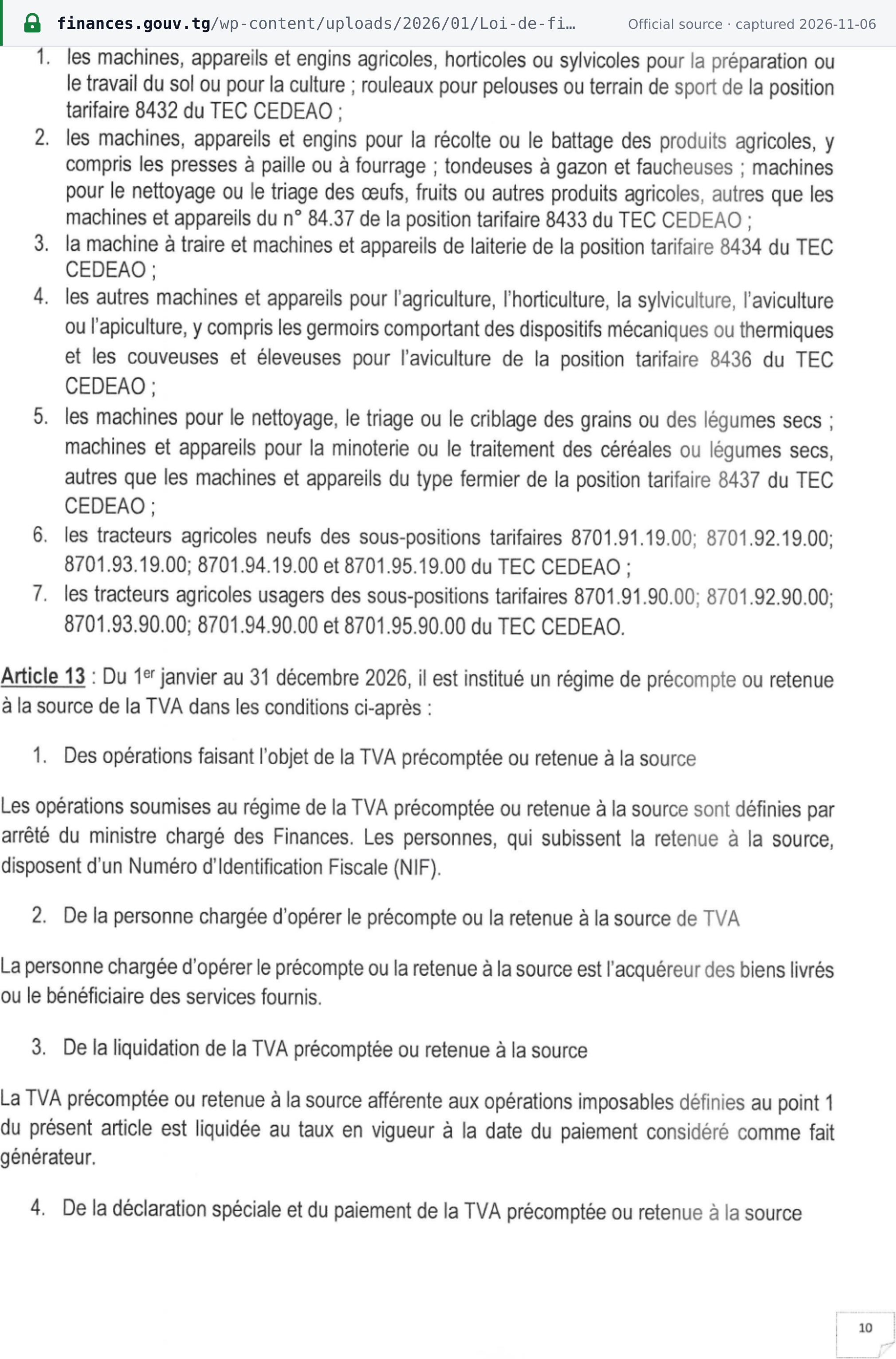 Source snapshot captured 2026-11-06 — original
The order setting the transactions covered is not published on otr.tg or finances.gouv.tg (as at 6 November 2026). See VAT withholding regimes for comparable systems.
Customer and supplier listings
Under LPF article 50 as amended by the 2026 finance law: [1]
- With the annual profit return, companies and non-profit entities attach a list of customers whose cumulative purchases in the financial year are at least XOF 5,000,000 excluding tax, giving each customer's NIF, full identity, addresses, telephone number and total sales.
- Separately, every quarter, a business must send the tax administration a list of its suppliers established or domiciled in Togo, with their names, addresses and transaction amounts ("doit fournir trimestriellement à l'Administration fiscale la liste desdits fournisseurs").
Companies file their annual return through GUDEF by 30 April (31 May for insurance and reinsurance companies) under LPF article 49.
Input-tax recovery and blocked items
CGI article 197, as amended by the 2026 finance law, excludes from deduction, "y compris lorsque les biens ou services concernés sont utilisés pour la réalisation d'opérations ouvrant droit à déduction": [1]
- passenger cars (voitures de tourisme) and their parts and accessories, except utility vehicles, cars bought by a lessor for leasing, driving-school vehicles, vehicles carrying hotel guests and public passenger transport vehicles;
- "les dépenses de logement, d'hébergement, de réception, de restaurant, de spectacles et de déplacement", except transport under a permanent transport contract and spending on the collective needs of staff at the workplace;
- housing furniture and equipment;
- items not strictly necessary to the business;
- goods and services given free or well below cost (commissions, gifts and the like), except advertising items worth less than XOF 5,000 excluding TVA each;
- services relating to excluded goods;
- "les frais de carburant pour véhicules" (vehicle fuel).
Before 2026, item 2 covered such spending only when made for the business's managers and staff. The OTR explains that it was reworded to apply to all restaurant, accommodation, reception and entertainment spending, in line with article 34 of the WAEMU TVA directive. [5]
Using a non-standard invoice also costs the deduction: TVA deducted on an invoice that is not a facture normalisée is clawed back (LPF art. 64).
Refunds
The OTR names faster refunds of TVA credits ("rapidité dans les remboursements des crédits") as an aim of e-invoicing. [6] Neither the OTR website nor the finance laws reviewed publish a refund procedure or timetable (as at 6 November 2026).
Exemptions
Exempt supplies
CGI article 180 exempts the following. The list is from the version reprinted in the 2024 finance bill (parts I–IV) and the 2025 finance bill (part V). [3] [2]
- I — operations subject to another tax: transfers of buildings and business goodwill subject to registration duty; banking and financial operations subject to the taxe sur les activités financières (TAF); insurance business subject to the insurance-contract tax, and services of insurance brokers and intermediaries; passenger transport by carriers paying the TPU; operations within the scope of the entertainment and gaming taxes; and the business of natural persons paying the TPU.
- II — agriculture, fishing and livestock: sales in their unprocessed state of farm, livestock and fishery products by farmers, livestock breeders and artisanal fishers; agricultural equipment (matériels agricoles).
- III — liberal professions: medical consultations and care, hospital and clinic services, veterinary care, prostheses and laboratory tests; school, university, technical and vocational education; newspapers and periodicals, except advertising receipts; original works of art sold by their authors.
- IV — bodies of general interest: services supplied free or at cost by non-profit associations and public-interest bodies (accommodation, catering and bar operations stay taxable); social or philanthropic non-profit bodies; school, university and staff canteens.
- V — other: imports, production and sale of products listed in the TVA annex; non-commercial operations of the State, local authorities and public bodies; operations by artisans on their works of art; leasing with lessees that are themselves exempt, and leasing under a national vehicle-renewal programme; approved industrial free-zone businesses, for goods and services needed solely for their set-up and operation; postage and fiscal stamps sold at face value.
- For 2026 only: from 1 January to 31 December 2026, article 18 of the 2026 finance law exempts from TVA, as a derogation from the CGI, feed, compound feed and supplements (provendes) for local livestock and fishery production, and local livestock and fishery products processed by duly registered operators. The detailed rules are set by joint order of the finance and agriculture ministers. [1] [5]
Exempt is not zero-rated
Togo has no zero rate. Article 195 sets a single 18% rate, and article 180 lists exemptions. An exempt supply carries no TVA, and the business cannot deduct the TVA it paid on the costs of making it. A zero-rated supply, in countries that have one, keeps that right of deduction. The articles reviewed do not say whether exports keep a right to deduct (see Imports and exports). See Zero-rated vs exempt supplies.
Special regimes
- Taxe Professionnelle Unique (TPU). A synthetic tax for small natural persons. Their business is exempt from TVA (CGI art. 180-I-6).
- Importers and exporters excluded from the TPU. On 4 September 2026 the OTR published a notice on TPU eligibility for natural persons who import or export. [7] The signed notice, Avis N° 008/2026 (snapshot below), states that under CGI article 129-2 such persons are not eligible for the TPU and must be taxed under the régime du bénéfice réel, whatever their turnover. This changes the income-tax regime. It does not by itself make the trader liable for TVA: that still depends on the XOF 100 million threshold in article 177, or on belonging to one of the professions that are always liable.
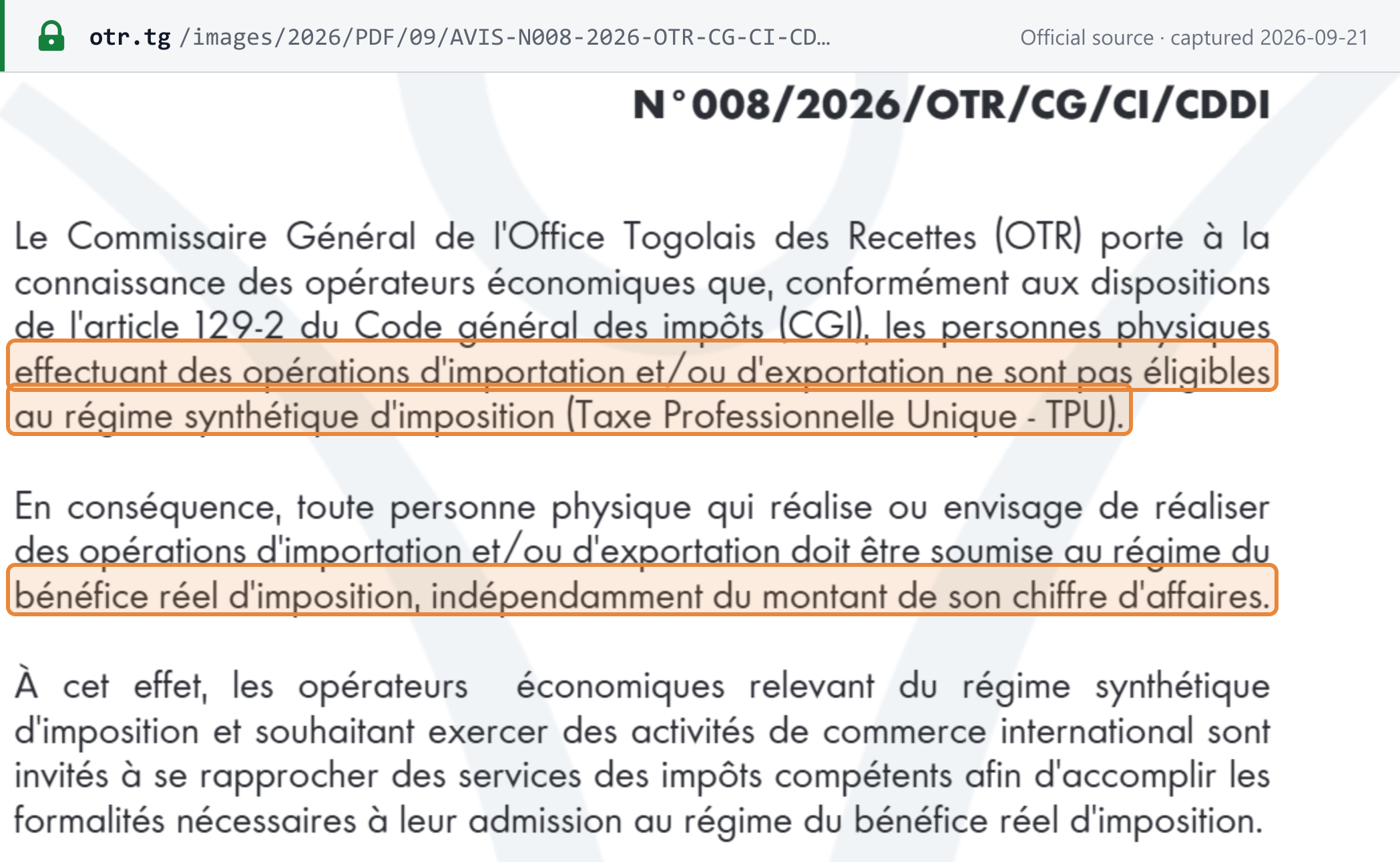 Source snapshot captured 2026-09-21 — the signed avis as published by the OTR; the OTR now summarises it on its current site
- e-TPU. Online declaration and payment of the TPU, launched on 17 September 2026. [8]
- Industrial free zone. Approved free-zone businesses are exempt for the goods and services needed solely for their set-up and operation (CGI art. 180-V-6).
Offences and penalties
Offences
The finance laws and bills reviewed do not reprint any article creating a criminal offence for TVA (as at 6 November 2026). The conduct the published texts sanction is: issuing irregular invoices, not using factures normalisées, failing to withhold TVA under the 2026 regime, and, for digital platforms, failing to report transactions.
Penalties
| Failure | Consequence | Source |
|---|---|---|
| Irregular invoice | Sanctions under LPF articles 123 et seq., per irregular invoice | LPF art. 64 [1] |
| Not using factures normalisées | Any expense in the accounts not backed by a facture normalisée is rejected, and TVA deducted on a non-standard invoice is clawed back | LPF art. 64 [1] |
| Failure to withhold TVA (2026) | Fine equal to the TVA not withheld, plus late-payment penalties | 2026 finance law, art. 13 [1] |
| Digital platform not reporting | Fine of 10% of the undeclared transactions | LPF art. 50 [1] |
The amounts under LPF articles 123 et seq. are not reprinted in the finance laws reviewed, and the OTR website does not publish them (as at 6 November 2026).
Frequently asked questions
My turnover is below XOF 100 million but I was registered for TVA under the old XOF 60 million threshold. Must I keep charging TVA?
Probably yes, for a time. Article 177 of the Code général des impôts, as amended by the 2025 finance law (Loi n° 2024-007 of 30 December 2024), sets liability at turnover above XOF 100,000,000 (it was XOF 60,000,000 before). The same article says that a business whose turnover falls below the threshold continues to meet its TVA filing and payment obligations for three consecutive financial years. Ask the Office Togolais des Recettes (OTR) how this applies to your business before you stop charging TVA. Liberal professions, holders of public offices and the listed freight, port and maritime professions stay liable whatever their turnover.
I am not registered for TVA. Do I still have to issue a facture normalisée?
Yes. Article 64 of the Livre des procédures fiscales, as worded in the 2026 finance law (Loi n° 2025-002), says the facture normalisée also applies to businesses whose turnover is below the TVA threshold, and that their invoices must carry the words « NE FACTURE PAS LA TVA ». A customer that books an expense without a facture normalisée risks having the expense rejected, and TVA deducted on a non-standard invoice is clawed back.
I am a sole trader taxed under the TPU and I import goods. Can I stay on the TPU?
No. OTR Avis N° 008/2026, published on 4 September 2026, states that under article 129-2 of the Code général des impôts natural persons who import or export are not eligible for the régime synthétique (Taxe Professionnelle Unique, TPU) and must be placed under the régime du bénéfice réel, whatever their turnover. Moving to the réel regime is an income-tax change. It does not by itself make you liable for TVA, which still depends on the XOF 100 million threshold in article 177 or on belonging to one of the professions that are always liable.
Do I have to issue certified electronic invoices in Togo now?
Not yet. The 2026 finance law (Loi n° 2025-002) rewrote article 62 of the Livre des procédures fiscales so that a TVA-liable person supplying another liable person must issue a facture électronique certifiée, with the details left to orders of the finance minister. The same article says that until certified e-invoicing actually starts, the paper facture normalisée continues to be used under article 64. As of 6 November 2026 the OTR had presented the reform to businesses but had not published a start date, a technical format or a platform name.
Can I deduct the TVA on client meals, hotel stays or vehicle fuel?
No. Article 197 of the Code général des impôts, as amended by the 2026 finance law, excludes from deduction lodging, accommodation, reception, restaurant, entertainment and travel expenses, even when they serve taxable operations. The only exceptions are transport under a permanent transport contract and spending on the collective needs of staff at the workplace. Vehicle fuel, passenger cars (with listed exceptions such as utility vehicles), housing furniture and gifts other than advertising items worth less than XOF 5,000 excluding TVA are also excluded.
I am a foreign company selling digital services to customers in Togo. Do I have to register for TVA?
Article 183 bis of the Code général des impôts, in force since the 2023 finance law and reworded by the 2026 finance law, says that when an electronic service supplied by a foreign person or an e-commerce platform is taxable in Togo, the TVA is collected and paid over on the supplier's behalf by the intermediary that enabled the transaction. The article does not distinguish business from consumer customers. It leaves the detailed rules to an order of the finance minister, and as of 6 November 2026 no such order was published on the OTR or Ministry of Finance websites. Separately, every digital platform, established in Togo or not, must send the tax administration a summary of what it reports to users, on pain of a fine of 10% of the undeclared transactions.
Important websites
| Site | What it is for |
|---|---|
| CFE — Centre de Formalités des Entreprises | Register a business and obtain the single card carrying the RCCM, NIF and CNSS numbers |
| CFE — company name search | Check whether a business name is available (not a NIF lookup) |
| OTR — Impôts | Domestic-tax hub of the Office Togolais des Recettes |
| OTR — online services | Directory of OTR platforms (Dimana, AEVO, GUDEF, e-Foncier, user assistance) |
| OTR — news and notices | Avis, communiqués and reform announcements, including e-invoicing |
| OTR — documentation | Cahier fiscal 2026 and other official documents |
| OTR — customs | Customs procedures, including import TVA |
| Ministry of Finance — documentation | Finance laws and finance bills, which carry the CGI and LPF amendments |
No public NIF verification service is published by the OTR or the CFE (as at 6 November 2026). The OTR's free information line is 8201.
Recent changes
- 2026-09-17 — The OTR launched e-TPU, online declaration and payment for Taxe Professionnelle Unique taxpayers. (Office Togolais des Recettes) — see event
- 2026-09-04 — OTR Avis N° 008/2026: natural persons who import or export are not eligible for the TPU and must be taxed under the régime du bénéfice réel, whatever their turnover. (Office Togolais des Recettes) — see event
- 2026-01-01 — The 2026 finance law (Loi n° 2025-002) in force: certified e-invoicing enacted in LPF art. 62 (start date pending); ministerial order provided for on intermediary collection of TVA on foreign electronic services (CGI art. 183 bis, order pending); 2026 animal-feed exemption; blocked deductions widened (CGI art. 197); TVA withholding regime for 2026. (Ministère des Finances et du Budget)
- 2025-01-01 — TVA liability threshold raised from XOF 60,000,000 to XOF 100,000,000 (CGI art. 177, 2025 finance law). (2025 finance bill, Ministère des Finances et du Budget)
For the full chronology, see Togo tax changes on Lookuptax.
Reference links
Legislation (Ministère des Finances et du Budget):
- [1] Loi n° 2025-002 portant loi de finances, exercice 2026
- [2] Projet de loi de finances, exercice 2025 (CGI arts. 176, 177, 180-V)
- [3] Projet de loi de finances, exercice 2024 (CGI arts. 180, 195)
- [15] Loi n° 2022-022 portant loi de finances, exercice 2023 (CGI art. 183 bis)
- [16] Loi n° 2025-001 portant loi de finances rectificative, exercice 2025
- [17] Projet de loi de finances rectificative, exercice 2024
- [18] Exposé des motifs du projet de loi de finances, exercice 2024
- [4] Projet de loi de finances, exercice 2027 (bill) — landing page
Office Togolais des Recettes:
- [5] Cahier fiscal 2026
- [6] Facturation électronique : l'OTR à la rencontre des opérateurs économiques (26 October 2026)
- [7] Importation et exportation : information sur le régime TPU (4 September 2026)
- [8] e-TPU : une nouvelle étape pour vos démarches fiscales en ligne (17 September 2026)
- [12] Services en ligne
- [13] Impôts
- [14] Facturation électronique : dialogue avec les entreprises (11 September 2026)
Centre de Formalités des Entreprises:
Related on Lookuptax:
- Togo tax changes
- Côte d'Ivoire VAT guide
- Ghana VAT guide
- Côte d'Ivoire FNE e-invoicing
- Burkina Faso FEC/SECeF certified invoices
- VAT withholding regimes
- VAT on digital services from non-resident suppliers
- Marketplace deemed-supplier rules
- E-invoicing models: clearance, reporting and interchange
- Zero-rated vs exempt supplies