Uruguay VAT (IVA) guidelines
| FACTSHEET | |
|---|---|
| Country code | UY |
| Tax name | Value added tax — Impuesto al Valor Agregado (IVA) |
| Tax Authority | Dirección General Impositiva (DGI) |
Overview
Uruguay levies a value added tax, the Impuesto al Valor Agregado (IVA), under Título 10 of the 2023 Texto Ordenado of DGI taxes (T.O. 2023, approved by Decreto 101/024). Título 10 articles below carry their T.O. 2023 numbers. It is charged on four things: "El Impuesto al Valor Agregado gravará la circulación interna de bienes, la prestación de servicios dentro del territorio nacional, la introducción de bienes al país y la agregación de valor originada en la construcción realizada sobre inmuebles." (IVA applies to the domestic circulation of goods, services rendered in Uruguay, imports of goods, and the value added by construction on real estate; Título 10, art. 1.) [1]
The regulation is Decreto 220/998. Registration and documentation rules are in Decreto 597/988, and invoicing runs through DGI's electronic-document regime, the CFE (Comprobantes Fiscales Electrónicos). [2] [3]
Authority. The Dirección General Impositiva (DGI), Av. Daniel Fernández Crespo 1534, Montevideo. IVA on imports is settled with the customs import declaration (see Imports and exports).
Currency. The Uruguayan peso (UYU), written "$" in official texts. Several thresholds are set in Unidades Indexadas (UI), an inflation-indexed unit, and DGI publishes the peso equivalent each year.
Tax period. IVA is liquidated annually, except for taxpayers in the CEDE group (Control Especial de Empresas), who liquidate it monthly: "El Impuesto al Valor Agregado es de liquidación anual, excepto para los contribuyentes comprendidos en el Registro de CEDE (Control Especial de Empresas), que lo tributarán por el régimen de liquidación mensual." (D220 art. 120). Payments are monthly in both cases (see Filing and payment). [2]
Layering. None. Título 10 sets one national rate schedule (art. 34), and neither Título 10 nor Decreto 220/998 provides for a departmental or municipal IVA.
For neighbouring systems, see the Argentina VAT guide and the Brazil guide. For what the tax is called elsewhere, see VAT, GST and sales tax names by country.
Registration
Who should register
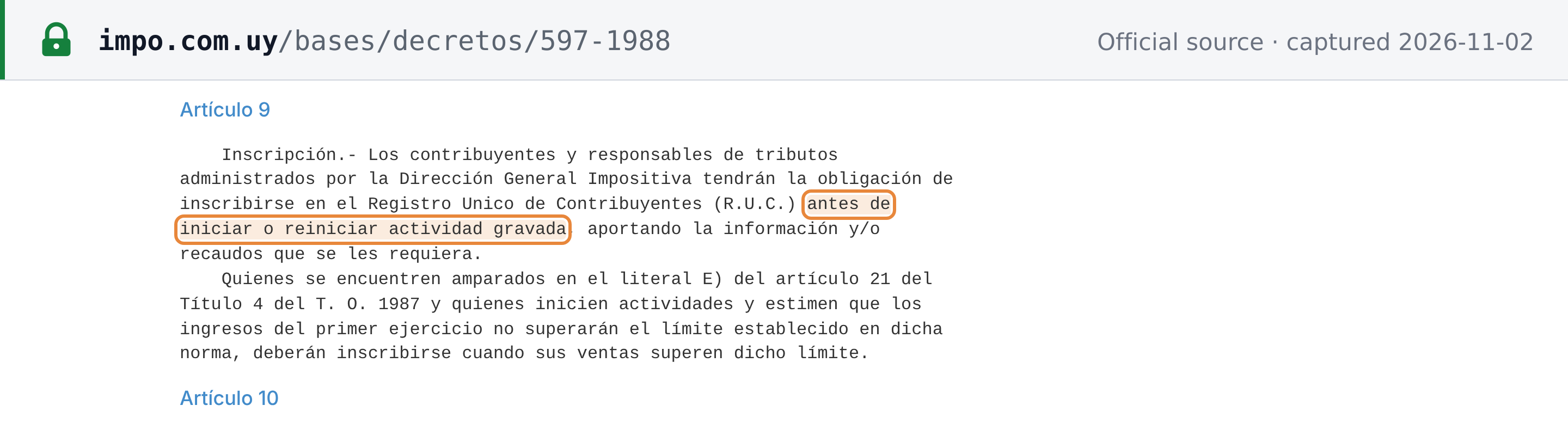
Every taxpayer or responsible person for a DGI-administered tax must register in the RUT before starting or restarting taxable activity: "Los contribuyentes y responsables de tributos administrados por la Dirección General Impositiva tendrán la obligación de inscribirse en el Registro Unico de Contribuyentes (R.U.C.) antes de iniciar o reiniciar actividad gravada" (they must register in the single taxpayer register before starting or restarting taxed activity; D597 art. 9). R.U.C. is the decree's older name for today's RUT. [3]
IVA taxpayers include anyone who performs taxed acts in the course of the business activities that IRAE (the corporate income tax) covers, and, under literal D, taxpayers of the non-residents' income tax (IRNR) that perform taxed acts (Título 10, art. 6). [4]
 Source snapshot captured 2026-11-02 — original
Registration threshold
No general threshold. Neither Título 10 art. 6 nor D597 art. 9 sets a turnover level for the general IVA regime: registration is due before the first taxed activity. The second paragraph of art. 9 (in the snapshot above) points to a small-business literal of the 1987 Texto Ordenado; today's small-business route is the IVA mínimo regime below.
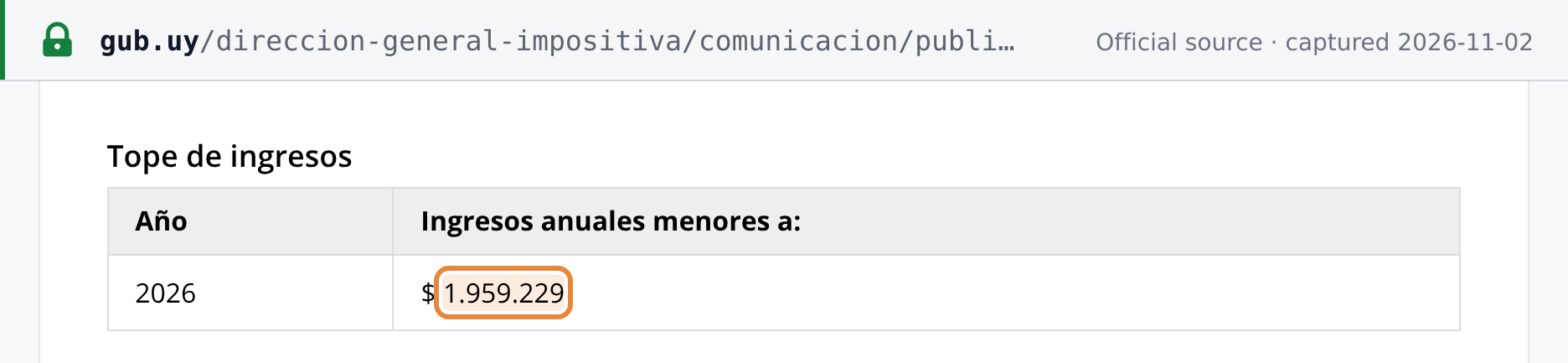
The small-business ceiling: IVA mínimo. Small taxpayers of any legal form whose activity combines capital and labour, with annual income below 305,000 UI, pay a fixed monthly IVA quota instead of charging IVA: "El IVA mínimo es un régimen que abarca a aquellos pequeños contribuyentes (cualquiera sea su forma jurídica) que realicen actividades para las que se requiera la utilización de capital y trabajo y que obtengan ingresos anuales menores a 305000 Unidades Indexadas (UI)." For 2026 DGI puts the ceiling at UYU 1,959,229 ("Ingresos anuales menores a: 2026 $ 1.959.229", DGI, 9 January 2026). [5] [6]
 Source snapshot captured 2026-11-02 — original
- The 2026 quota is UYU 5,910 a month (Decreto 310/025). New businesses pay 25% (UYU 1,478) for their first 12 months and 50% (UYU 2,955) for the next 12. [7]
- E-invoicing cap. A taxpayer documenting exclusively by e-invoice pays the lower of 3.3% of the month's income or the applicable quota ("Pagarán el menor de los siguientes importes: 3.3% del monto de los ingresos de cada mes el monto correspondiente según inicio de actividades"). [7]
- Excluded from IVA mínimo, per DGI: professional land freight carriers, opticians, exclusive booksellers, agricultural income, taxpayers who opted into IRAE, and those with non-business income. [5]
- No IVA on their invoices, no input credit. DGI: "Deberán facturar sus operaciones sin IVA. Respecto al IVA de las compras … no lo podrán deducir y constituirá un costo para la empresa." (They must invoice without IVA; the IVA on their purchases cannot be deducted and becomes a cost.) [8]
Monotributo is an optional simplified regime for very small businesses working in the street, in public spaces or from small premises. DGI: it "Concentra en un único tributo los aportes a BPS (contribuciones especiales de seguridad social (CESS) generadas por su propia actividad) y a DGI (impuestos nacionales vigentes, excluidos los que gravan la importación)" (one single tax replaces the social-security contributions to BPS and the national DGI taxes, except those on imports). Monotributo taxpayers are outside the CFE obligation. [39] [9]
For other countries, see VAT registration thresholds worldwide.
Non-resident registration
No threshold for non-residents either. IRNR taxpayers that perform taxed acts are IVA taxpayers (Título 10, art. 6, literal D). A taxpayer domiciled abroad must appoint a representative in Uruguay and fix a special domicile there: "Los sujetos pasivos domiciliados en el exterior deberán designar representantes o apoderados en el país y constituir un domicilio especial a todos los efectos." (D597 art. 17). [3] [4]
Non-residents supplying digital audiovisual or intermediation services pay on a quarterly calendar; see Digital products and services. A non-resident whose Uruguayan income is all subject to withholding need not register with DGI: "Cuando la totalidad de las rentas obtenidas por el no residente sean objeto de retención, los mismos no estarán obligados a inscribirse en la Dirección General Impositiva." (Decreto 149/007 art. 17.) Separately, Decreto 149/007 art. 18 requires IRNR taxpayers whose income is not subject to withholding or substitution to appoint a resident representative before DGI. DGI may waive that IRNR representative (art. 18-BIS) for taxpayers whose exclusive business is art. 21 bis or 21 ter services with no physical presence in Uruguay, provided they fix a domicile under Código Tributario art. 27. [22] On withholding, see Reverse charge on imported services.
Tax identification number
The tax ID is the RUT (Registro Único Tributario); DGI's CFE specification still calls the field "RUC". The specification defines the issuer's RUC as 12 numeric digits validated by a check digit ("40 RUC Emisor … NUM 12 Dígito verificador", Formato de los CFE v25.2, p. 28). DGI does not publish the check-digit algorithm in that document. [10]
For the number's structure and how to look one up, see the Uruguay RUT guide, and check a number with the Uruguay RUT validator.
How to register
Registration (inscripción) is a joint DGI and BPS procedure, done online ("Iniciar Trámite en Línea") or in person. The gub.uy procedure page for sole proprietors (updated 26 October 2026) gives:
- Forms. Formulario 0351 (registration), 0354 (additional premises) and, where applicable, the BPS form R205.
- Online timing. "Puede realizarse dentro del mes en curso de inicio de actividades. Si el inicio de actividades es el mes siguiente: puede realizarse con carácter previo de hasta 10 días, a partir del día 25 del mes en curso." (Within the month activity starts; if it starts next month, up to 10 days before, from the 25th.)
- In-person timing. Up to 10 days before activity starts.
- Cost. A professional stamp (timbre profesional) of UYU 270, valid 1 January to 31 December 2026. [11]
Companies and foreign companies joining a Uruguayan company use their own procedures, listed on DGI's RUT registration index. Late registration is fined (see Penalties). For the general process elsewhere, see how to register for VAT, sales tax or GST.
Voluntary registration
Registration is not optional for anyone with taxed activity, since there is no threshold. The voluntary choice that exists is leaving IVA mínimo for the general regime: "Aquellos contribuyentes que, sin superar el tope de ingresos, elijen pasar a tributar el régimen general, deberán permanecer en el mismo por al menos tres ejercicios." (Those who move to the general regime without exceeding the ceiling must stay for at least three fiscal years.) A business might want this to charge IVA and recover input IVA. [12]
A taxpayer that exceeds the 305,000 UI ceiling moves to the general regime (IVA, IRAE and Impuesto al Patrimonio) from that point. DGI: "La factura con la cual se pasen del tope, la deben considerar con IVA incluido. A partir de la siguiente operación, deberán discriminar el IVA correspondiente." (The invoice that crosses the ceiling is treated as IVA-inclusive; IVA is shown separately from the next operation.) [12]
Deregistration
Deregistration is the clausura, the definitive end of taxable activity (D597 art. 34-BIS):
- Within 30 days of ceasing activity, notify DGI through its online services.
- Within 5 business days, if it has no objections, DGI enables the in-person clausura request.
- File that request within 30 days of it being enabled.
"los sujetos pasivos deberán, dentro de los 30 (treinta) días de producido el cese de actividades, comunicar dicha circunstancia a través del sistema para la transferencia electrónica de datos que pone a disposición la Dirección General Impositiva". NO CEDE taxpayers file their final annual return (Formulario 2178) in the second month after the clausura date. [3] [13]
Group registration
Not available. Neither the registration chapter of Decreto 597/988 (arts. 9–39) nor Título 10 art. 6 (sujetos pasivos) contains a grouping or consolidated-registration provision.
Rates
| Rate | Applies to | Source |
|---|---|---|
| 22% (tasa básica, basic rate) | All taxed supplies and imports not at the minimum rate | Título 10, art. 34 A; D220 art. 99 |
| 10% (tasa mínima, minimum rate) | Listed basic foods, medicines, hotel lodging and the other items in D220 art. 101 | Título 10, arts. 34 B and 36; D220 art. 101 |
| Exports — not subject to IVA | Exports of goods, and the exports of services the Executive designates; input IVA recoverable | Título 10, art. 5; D220 art. 129 |
| Exempt (no IVA, no input credit) | The Título 10 art. 38 list — see Exemptions | Título 10, art. 38 |
Basic rate 22%, minimum rate 10%. Decreto 220/998 art. 99: "Tasas.- La tasa básica del tributo será del 22% (veintidós por ciento) y la mínima del 10% (diez por ciento)." (The basic rate is 22% and the minimum 10%.) The statute, Título 10 art. 34 (art. 16 in the 1996 Texto Ordenado), sets the same two rates, taken from Ley 18.083 art. 25, the 2007 tax reform, and adds: "El Poder Ejecutivo reducirá gradualmente la tasa básica del tributo hasta alcanzar el 20% (veinte por ciento) cuando los resultados de la aplicación de la Ley N° 18.083, de 27 de diciembre de 2006, aseguren el cumplimiento de los compromisos presupuestales asumidos en relación al resultado fiscal." (The Executive will gradually cut the basic rate to 20% once the fiscal results allow; once cut, it cannot rise again without a law.) The 22% has applied since that reform; DGI's own CFE rate table (Table B of the CFE format) lists both rates with no end date. [2] [14] [10]
 Source snapshot captured 2026-11-02 — original
What the 10% covers. D220 art. 101 lists the minimum-rate goods and services. Among them:
- (a) basic foods: "Pan blanco común y galleta de campaña; pescado; carne y menudencias; frescos, congelados o enfriados; aceites comestibles …; arroz; harina de cereales …; pastas y fideos; sal para uso doméstico; azúcar; yerba; café; té; jabón común; grasas comestibles; transporte de leche";
- (b) medicines and pharmaceutical specialities, their active ingredients, and implements incorporated into the human body;
- (c)–(d) real estate: the first sale by construction companies to developers, and buildings sold after significant refurbishment;
- (f) fruit, flowers and vegetables in their natural state, sold to final consumers by IRAE and IVA taxpayers that did not grow them;
- (g)–(i) tourism: lodging services that hotels, apart-hotels and rural-tourism establishments provide to their guests, camping services, and local tourist packages.
The statutory list is Título 10 art. 36 (art. 18 in the 1996 Texto Ordenado). [2] [15]
No 0% band. Uruguay has no zero rate as such. Exports of goods are outside the tax ("no lo estarán las exportaciones de bienes"), as are the exports of services the Executive designates, and exporters deduct the input IVA in the cost of what they export (see Imports and exports). [16]
Reductions for electronic payment
- Two points off for card and e-money payments (Ley 19.210). "Los consumidores finales que compren bienes o contraten servicios obtienen una reducción de dos puntos porcentuales del IVA, siempre que realicen el pago mediante la utilización de tarjetas de débito, instrumentos de dinero electrónico o instrumentos análogos." (Final consumers paying by debit card, e-money or similar instruments get a two-point IVA reduction.) On purchases from IVA mínimo or Monotributo sellers the reduction is 1.64% of the price at the basic rate and 1.82% at the minimum rate (DGI guide, 8 April 2026). [17]
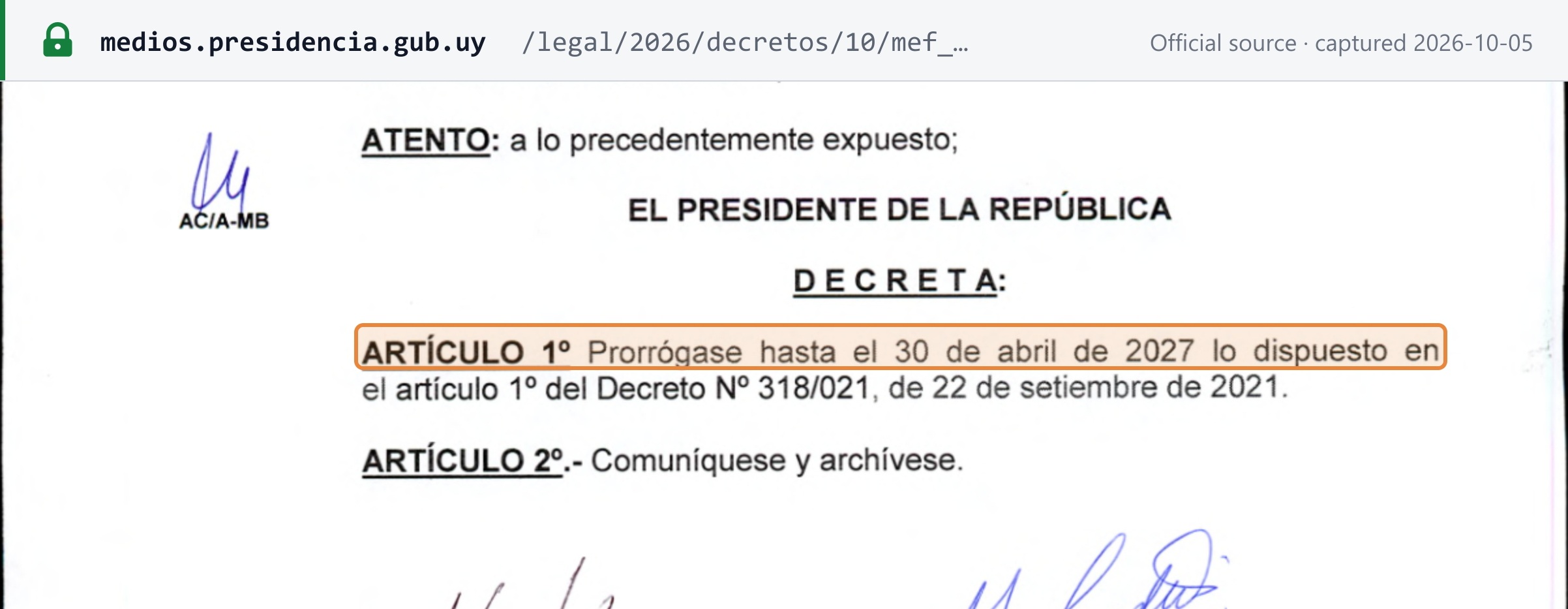
- Nine points off for tourism-linked services, extended to 30 April 2027. The reduction covers restaurant, bar and café services (and hotel catering that is not part of lodging), event catering, event services, car rental without driver, and mediation of tourist property rentals, paid by a card or e-money instrument held by an individual. DGI: "Se obtiene una rebaja en la tasa del IVA de 9 puntos porcentuales. Cuando se trate de adquisiciones realizadas a contribuyentes de IVA Mínimo la reducción se determinará aplicando un descuento de 7,38% sobre el importe total de la operación." Decreto 235/026 of 1 October 2026: "Prorrógase hasta el 30 de abril de 2027 lo dispuesto en el artículo 1o del Decreto N° 318/021". [18] [19]
 Source snapshot captured 2026-10-05 — original
Announced future changes
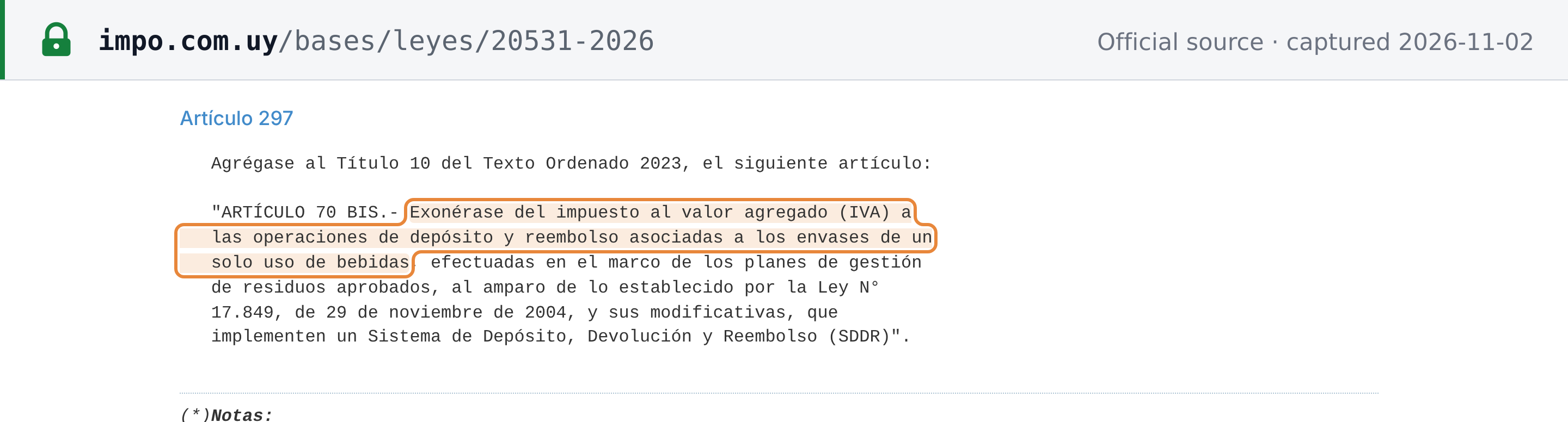
No change to the 22% and 10% rates has been announced. Ley 20.531 (the 2025 Rendición de Cuentas, promulgated 1 October 2026 and published 16 October 2026) amends Título 10 of the 2023 Texto Ordenado from 1 January 2027, the date its article 2 sets unless a provision says otherwise:
- Article 297 adds article 70 bis to Título 10, exempting from IVA the deposit and refund operations for single-use beverage containers under approved waste-management plans that run a deposit-return system (SDDR).
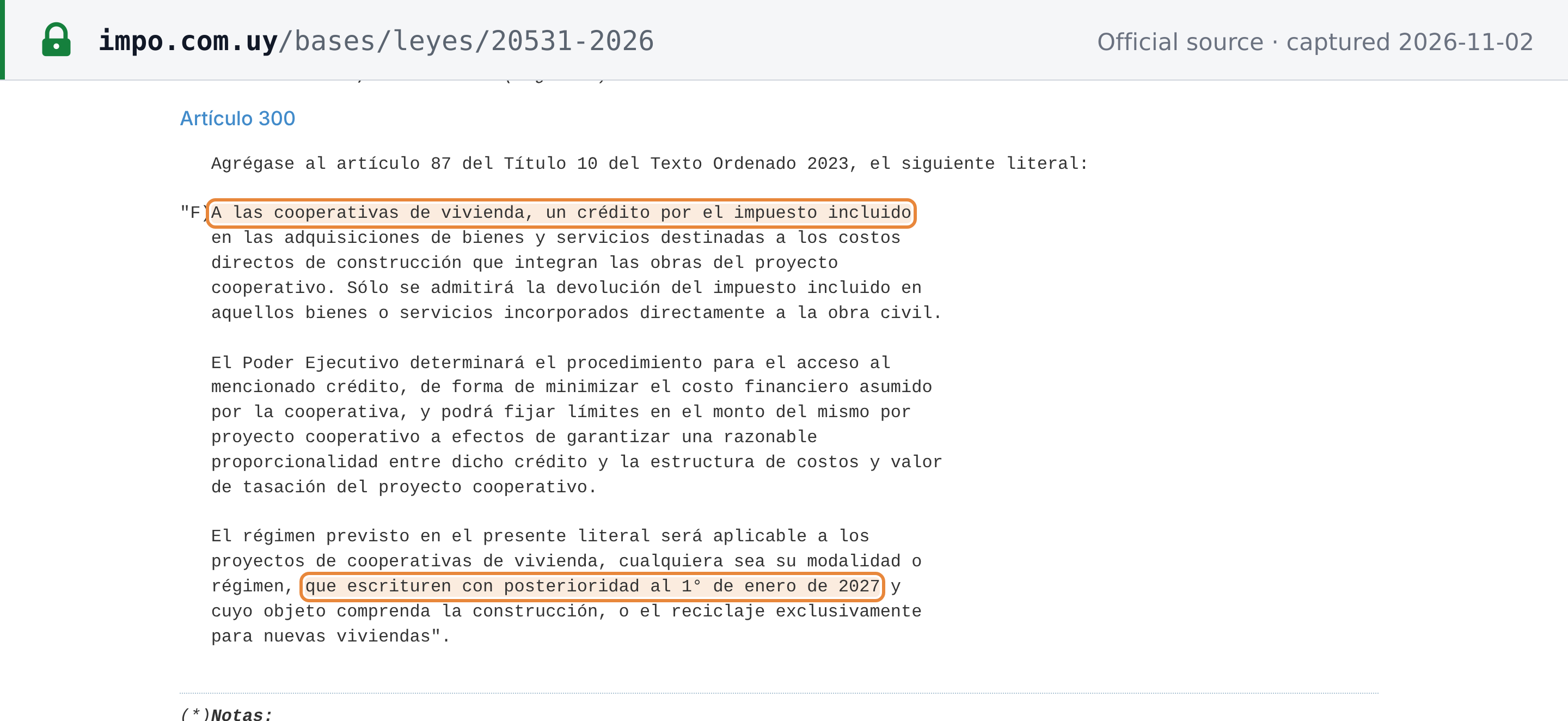
- Article 300 adds literal F) to Título 10 article 87, giving housing cooperatives a credit for the IVA included in purchases of goods and services for the direct construction costs of the cooperative project. Only goods and services incorporated directly into the civil works count, and it applies to projects whose deeds are executed after 1 January 2027.
- Article 301 concerns the 10% list in Título 10 art. 36. Its literal H) puts land passenger transport at the minimum rate and caps the transport operators' IVA credit under Ley 17.651 at 2% of their passenger-transport income. Article 301 lets the Executive change that cap, using objective criteria such as the share of taxed and untaxed inputs in operators' costs, the different ways the service is run, and the share of electric vehicles in each fleet. [20]
 Source snapshot captured 2026-11-02 — original
 Source snapshot captured 2026-11-02 — original
See the event record. For other countries' rates, see worldwide tax rates.
Cross-border rules
Imports and exports
- Imports of goods. IVA is settled in the customs single import document (DUA), together with every other import tax, in one act: "En el documento único de importación … se incluirá la liquidación del Impuesto al Valor Agregado que grava la importación. Todos los tributos que gravan la importación o que se generan en ocasión de la misma se abonarán conjuntamente en un solo acto." (D220 art. 133.)
- Import base. The customs normal value plus the tariff, increased by 50% when the import is made in one's own name for another's account or by non-taxpayers: "Dicho total se incrementará en el 50% (cincuenta por ciento), si la importación se realiza a nombre propio y por cuenta ajena o por no contribuyentes." (D220 art. 134.)
- Low-value imports. Título 10 and Decreto 220/998 set no IVA de-minimis. Courier and small-shipment franchises are customs rules, administered by the Dirección Nacional de Aduanas.
- Exports. Not taxed (Título 10, art. 5), with full input recovery and refunds to direct exporters: "admitiéndose la deducción total del impuesto pagado por las adquisiciones que integren el costo de los bienes exportados. … La devolución del impuesto se realizará únicamente a los exportadores directos" (D220 art. 129). D220 art. 34 lists the services treated as exports. [2] [16]
Reverse charge on imported services
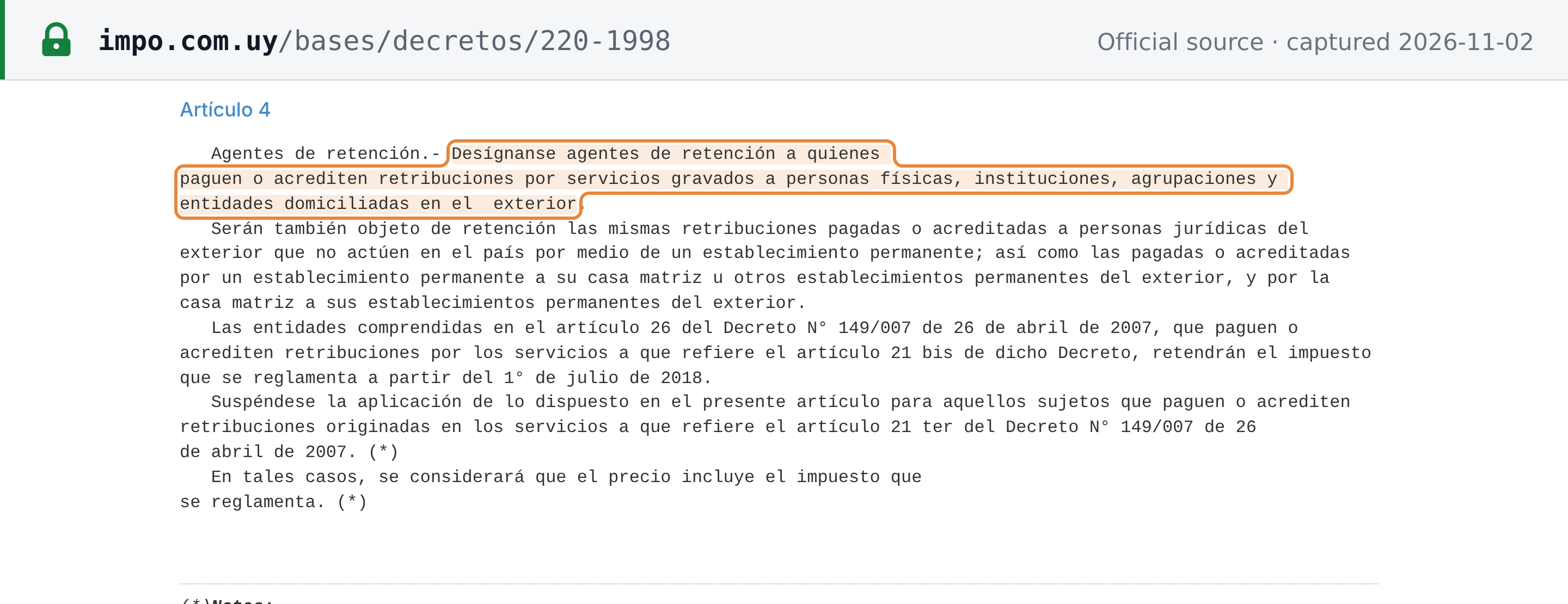
Uruguay uses payer withholding, not a reverse charge. The IVA texts contain no reverse-charge self-assessment. Instead, whoever pays for taxed services supplied by persons or entities domiciled abroad is designated an IVA withholding agent: "Desígnanse agentes de retención a quienes paguen o acrediten retribuciones por servicios gravados a personas físicas, instituciones, agrupaciones y entidades domiciliadas en el exterior." (D220 art. 4.) The service must be taxable, meaning rendered in Uruguay under the territoriality rule of Título 10 art. 5. [2]
 Source snapshot captured 2026-11-02 — original
The same article covers the two digital categories:
- Audiovisual services (Decreto 149/007 art. 21 bis). The entities listed in art. 26 of Decreto 149/007 that pay for them "retendrán el impuesto que se reglamenta a partir del 1° de julio de 2018" (withhold the IVA from 1 July 2018).
- Platform intermediation (art. 21 ter). Withholding is suspended: "Suspéndese la aplicación de lo dispuesto en el presente artículo para aquellos sujetos que paguen o acrediten retribuciones originadas en los servicios a que refiere el artículo 21 ter … En tales casos, se considerará que el precio incluye el impuesto que se reglamenta." The price is deemed to include IVA, which the non-resident platform pays itself.
See reverse charge explained and VAT withholding regimes.
Digital products and services
Place of supply. D220 art. 26-BIS: "La prestación de servicios a través de Internet, plataformas tecnológicas, aplicaciones informáticas, o similares, cuando tengan por destino, sean consumidos o utilizados económicamente en el país, se consideran realizadas íntegramente dentro del mismo." (Services supplied through the internet, platforms or apps that are consumed or used in Uruguay are supplied entirely in Uruguay.) The article confines this to the services in art. 65 bis of Decreto 150/007 and art. 21 bis of Decreto 149/007. The rule took effect on 1 January 2018 (Decreto 144/018). [2] [21]
What is caught: two categories, not digital services in general.
- Audiovisual transmissions (Decreto 149/007 art. 21 bis). The production, distribution or intermediation of films and tapes, live television, "y de transmisiones de cualquier contenido audiovisual, incluidas las realizadas a través de internet, plataformas tecnológicas, aplicaciones informáticas, u otros medios similares, tales como acceso y descarga de películas" (and transmissions of any audiovisual content, including through the internet, platforms or apps, such as access to and download of films), where the customer is in Uruguay. "Audiovisual" takes the definition in art. 3 of Ley 19.307.
- Platform mediation and intermediation (art. 21 ter). Activities that are "básicamente automatizadas, requieran una intervención humana mínima, y que no tengan viabilidad al margen de la tecnología de la información" (basically automated, needing minimal human intervention and not viable apart from information technology), and that involve direct or indirect intervention in the supply or demand of services (the main operation). Under D220 art. 26-TER the intermediation is wholly domestic when both parties are in Uruguay, and "Cuando el oferente o el demandante de la operación principal se encuentre en el exterior, se considerará que la actividad es realizada en un 50% (cincuenta por ciento) dentro del territorio nacional." [22] [2]
Expressly not caught by art. 21 bis: "a) los servicios de publicidad y propaganda y de carácter técnico …; b) los servicios de enseñanza a distancia no comprendidos en el literal anterior y, c) los servicios contratados por el Centro Ceibal" (advertising and technical services, distance education, and services contracted by Centro Ceibal for the Plan Ceibal and Plan Ibirapitá). [22]
Where the customer is. "Se entenderá que el demandante se encuentra en territorio nacional cuando se localice en el mismo, la dirección de IP (Internet Protocol) del dispositivo utilizado para la contratación del servicio o, su dirección de facturación." (The IP address of the contracting device, or the billing address.) If neither applies, the customer is presumed to be in Uruguay when payment runs through electronic means administered from Uruguay, such as e-money, credit or debit cards or bank accounts (art. 21 bis). [22]
Threshold and filing. Neither decree sets a threshold. Non-residents without a permanent establishment operating under arts. 21 bis and 21 ter make quarterly IRNR/IVA payments, "electrónicamente vía Internet". DGI's 2026 calendar (ordinal 15) sets these days: Oct–Dec 2025 quarter, 22 January; Jan–Mar 2026, 23 April; Apr–Jun 2026, 22 July; Jul–Sep 2026, 22 October 2026. The Oct–Dec 2026 quarter falls due in January 2027, on the 2027 calendar. [23]
See VAT on digital services by non-resident suppliers.
Foreign businesses selling into Uruguay — B2B and B2C
- B2B services. The Uruguayan business customer withholds the IVA under D220 art. 4. A foreign supplier whose Uruguayan income is all subject to withholding need not register with DGI (Decreto 149/007 art. 17). For art. 21 bis audiovisual services, the withholding agents are the entities listed in art. 26 of Decreto 149/007. For art. 21 ter intermediation, withholding is suspended and the non-resident platform pays the IVA itself.
- B2C services. Only art. 21 bis audiovisual services and art. 21 ter intermediation are taxed when supplied from abroad without a permanent establishment. The non-resident is the IVA taxpayer (Título 10, art. 6, literal D), is subject to the representative rule of D597 art. 17 and to the IRNR representative of Decreto 149/007 art. 18, which DGI may waive for exclusive 21 bis/21 ter suppliers without physical presence (art. 18-BIS), and pays quarterly (calendar ordinal 15).
- Goods. Goods sent to Uruguayan buyers are imports, and the IVA is paid with the import declaration (D220 art. 133).
- Threshold. None, for B2B or B2C. [2] [3] [22]
Marketplace / platform deemed-supplier liability
None. Título 10 art. 5 and D220 arts. 26-BIS and 26-TER tax a platform on its own intermediation service, at 100% or 50% depending on where the parties are. Neither Título 10 nor Decreto 220/998 makes a platform liable for the IVA on the underlying supplier's sale. See marketplace deemed-supplier rules.
Place of supply
- Goods. Taxed when delivered in Uruguay or imported; exports are not taxed (Título 10, art. 5).
- Services. Taxed when rendered in Uruguay: "Estarán gravadas las entregas de bienes y las prestaciones de servicios realizadas en el territorio nacional" (Título 10, art. 5). Exports of services the Executive designates are not taxed.
- Digital services and intermediation. The deeming rules in D220 arts. 26-BIS and 26-TER, described above. [16]
Invoice requirements
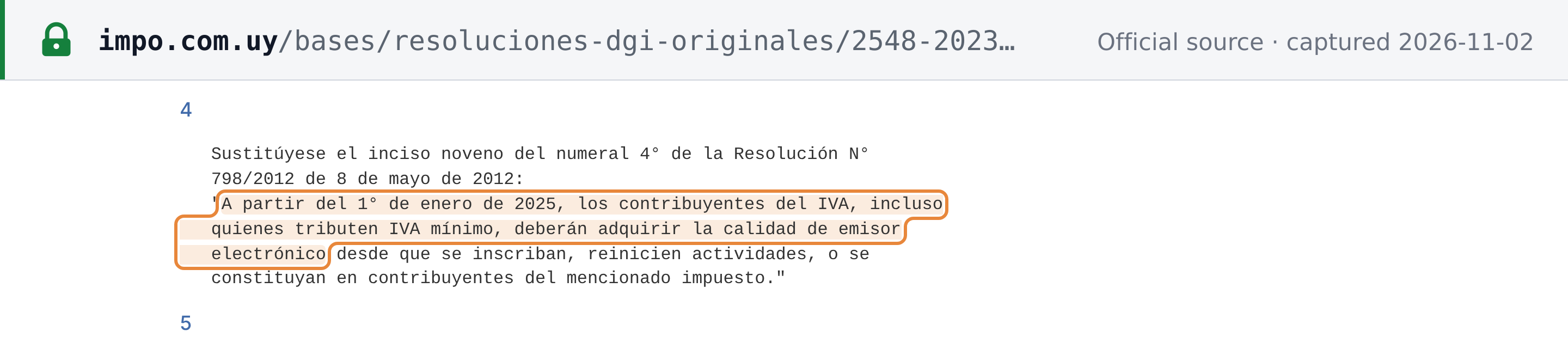
Every IVA taxpayer invoices through DGI's CFE system. From 1 January 2025, Res. DGI 2548/2023 numeral 4 replaced the ninth paragraph of numeral 4 of Res. DGI 798/2012: "A partir del 1° de enero de 2025, los contribuyentes del IVA, incluso quienes tributen IVA mínimo, deberán adquirir la calidad de emisor electrónico desde que se inscriban, reinicien actividades, o se constituyan en contribuyentes del mencionado impuesto." (From 1 January 2025, IVA taxpayers, including IVA mínimo payers, must become electronic issuers from the moment they register, restart activity or become IVA taxpayers.) [24]
 Source snapshot captured 2026-11-02 — original
Electronic issuers may not issue paper documents for sales, except contingency documents. DGI: "Los emisores electrónicos están obligados a documentar sus operaciones de venta con CFE, no pudiendo emitir documentos manuales para este tipo de operación, salvo lo previsto para casos de contingencia justificada. … El cliente no receptor electrónico recibirá una representación impresa del CFE que tendrá validez legal" (a customer that does not receive electronically gets a printed representation of the CFE, which is legally valid). Who is outside the mandate is under E-invoicing status. [25]
Mandatory content
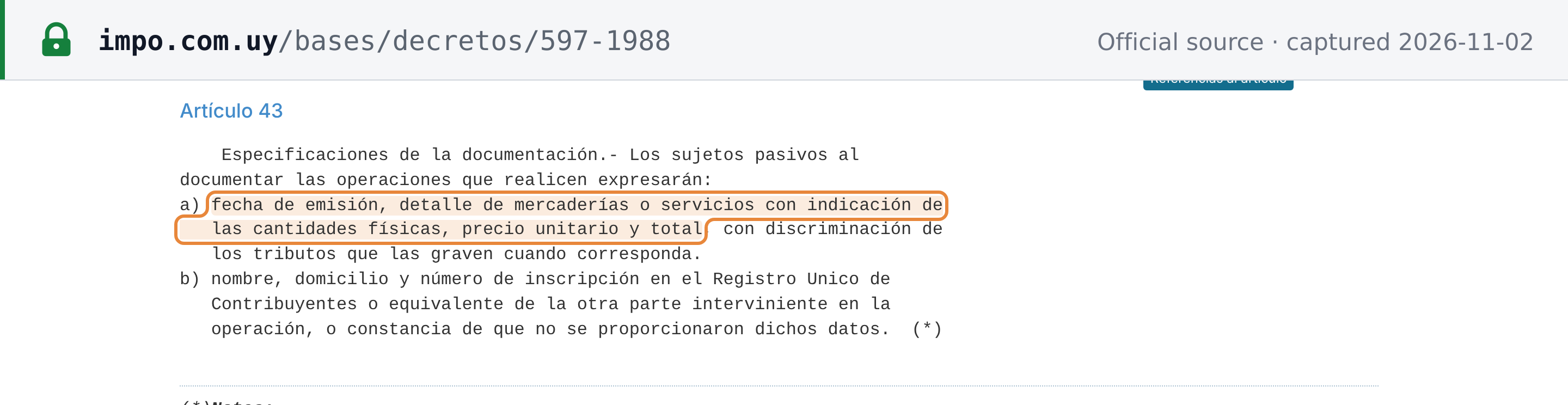
The general rule (D597 art. 43), for every document: "Los sujetos pasivos al documentar las operaciones que realicen expresarán: a) fecha de emisión, detalle de mercaderías o servicios con indicación de las cantidades físicas, precio unitario y total, con discriminación de los tributos que las graven cuando corresponda. b) nombre, domicilio y número de inscripción en el Registro Unico de Contribuyentes o equivalente de la otra parte interviniente en la operación, o constancia de que no se proporcionaron dichos datos." Every operation must be documented (art. 40), in consecutively numbered documents carrying the issuer's name, fiscal address, RUT and document type (art. 41). [3]
 Source snapshot captured 2026-11-02 — original
The printed CFE. DGI's Formato de los CFE v25.2 (dated 28 April 2026), pp. 79–85, fixes what the printed representation shows and where. As a field list:
| Block | Field | When | Formato CFE v25.2 |
|---|---|---|---|
| 1. Issuer (top left) | Name; trade name, if any; fiscal address of the head office or branch | always | p. 81 |
| 1. Issuer | Boxed legend, at least 4 × 1 cm: "Contribuyente Exonerado" (with the exempting rule), "Contribuyente IVA MINIMO", "MONOTRIBUTO" or "MONOTRIBUTO SOCIAL MIDES" | where applicable | p. 81 |
| 2. Document (top right, characters ≥ 3 mm) | Issuer RUT; CFE type (Table A name; "NC"/"ND" allowed); series and number; payment form, Contado or Crédito | always | p. 81 |
| 3. Receptor | Box "RUC COMPRADOR" with the buyer's RUT, then name and fiscal address | e-Factura and other B2B CFEs | p. 82 |
| 3. Receptor | Box "CONSUMO FINAL"; plus the buyer's document number (C.I., RUT or other) and issuing country | e-Ticket; the document above the UI tope or when withholdings are documented | p. 82 |
| 4. Body | Date; goods or services with quantities, unit price and final price (services may omit unit price and quantity) | always | p. 83 |
| 4. Body | Net totals per IVA rate and total IVA per rate | e-Factura (e-Ticket: gross total only) | p. 83 |
| 4. Body | Additional taxes; discounts and surcharges; references; payment means | where mandatory | p. 83 |
| 5. Footer (bottom left) | QR code (22–30 mm) linking to DGI's verification portal; under it "Código de seguridad" and the first 6 characters of the hash | always | p. 84 |
| 5. Footer | "Fecha emisor" (or "Res. XX/año"); "Puede verificar comprobante en www.dgi.gub.uy" (e-Tickets: the issuer's own URL) | always | p. 84 |
| 5. Footer | IVA-al-día certificate; CAE number and its authorised range; box "Fecha de vencimiento" with the CAE expiry date | always (certificate where applicable) | p. 84 |
IVA mínimo taxpayers "no podrá contener ninguna mención al IVA, salvo la constancia de estar al día con el IVA, cuando corresponda" (may make no mention of IVA, except the up-to-date certificate where it applies; p. 83). [10]
Issuance deadline
The CFE documents the operation itself, and Res. DGI 798/2012 numeral 20 sets when it goes to DGI. e-Facturas and their notes, e-Remitos and e-Resguardos are sent to DGI, signed, "previo al envío al receptor electrónico, al transporte de mercaderías o a la entrega de la representación impresa al receptor no electrónico" (before they go to the electronic receptor, before the goods move, or before the printout is handed over). "No será necesario obtener una respuesta de la Dirección General Impositiva a efectos de continuar con la operación informada." (The issuer need not wait for DGI's answer.) Res. 798/2012, the CFE format and Decreto 597/988 set no separate "within N days of the supply" deadline. [26]
Daily report. Issuers also send DGI "un reporte diario consolidado … dentro de las primeras 18 (dieciocho) horas del día hábil siguiente al de la operación. Se deberá enviar un informe por cada día calendario, aún si no se han registrado operaciones en el período." (A consolidated daily report within the first 18 hours of the next business day, one for every calendar day, even with no operations.) [26]
Numbering and sequencing
"La numeración de los CFE será única por tipo de comprobante, de acuerdo al rango de numeración autorizado, incluso la correspondiente a operaciones de sucursales. Dicha numeración … comenzará en el número 1 serie A y hasta agotar siete dígitos, reiniciando nuevamente desde el número 1 con la serie siguiente, alfabética (exceptuando la letra Ñ) y de hasta dos posiciones." (Numbering is unique per CFE type across all branches, from the authorised range; it starts at 1, series A, runs to seven digits, then restarts at 1 in the next alphabetical series, skipping Ñ, of up to two letters; R798 num. 10.)
- The authorised range (CAE) is valid for two years from the date of the authorisation (num. 11).
- Requests. CAE ranges are requested online through DGI's Servicios en línea. [26] [25]
Credit and debit notes
Each CFE type has its own credit note (nota de crédito) and debit note (nota de débito), together the notas de corrección. The rule on what may be corrected (R798 num. 12): "será preceptiva la anulación del CFE cuando éste sea rechazado por la Dirección General Impositiva. En este caso, deberá generarse, para esa operación, un nuevo comprobante con otro número, el que deberá ser remitido tanto a la Dirección General Impositiva como al receptor. Los CFE aceptados por la Dirección General Impositiva, se ajustarán exclusivamente mediante sus respectivas notas de corrección."
- A rejected CFE is annulled and re-issued under a new number, sent both to DGI and to the receptor.
- An accepted CFE is adjusted only by its own credit or debit note.
Validations since 30 June 2026. DGI's e-Factura portal: "Se recuerda que el Formato de CFE versión 25.2 quedará habilitado en el ambiente de Producción a partir del 30/06/2026. Desde esa fecha, comenzarán a aplicarse las nuevas validaciones correspondientes a las zonas: F: Información de referencia K: Complemento fiscal … si los comprobantes no cumplen con las validaciones establecidas, serán rechazados y no tendrán validez fiscal." Zone F is where a note cites the CFE it corrects. [26] [27]
Currency and language
- Currency. A CFE may be issued in any ISO 4217 currency, or in the Unidad Indexada (UYI) or Unidad Reajustable (UYR) (Formato CFE, Table D, pp. 89–90). [10]
- Conversion for IVA. D220 art. 114: "El importe de operaciones convenidas en moneda extranjera se convertirá a moneda nacional a la cotización interbancaria tipo comprador billete al cierre del día anterior al de la operación. … Si no existiera cotización a esa fecha, se tomará la del último día hábil anterior." (The interbank buying rate at the close of the day before the operation, or the last prior business day.) [2]
- Language. Res. 798/2012, the CFE format and Decreto 597/988 set no invoice-language rule.
Document types
The main CFE types (Formato CFE, Table A; contingency versions use codes 2xx):
| Code | Document | Use |
|---|---|---|
| 111 (112/113 NC/ND) | e-Factura | Operations with taxpayers identified by RUT |
| 101 (102/103 NC/ND) | e-Ticket | Operations with final consumers |
| 121 (122/123 NC/ND) | e-Factura de Exportación | Exports; 124 is the e-Remito de Exportación |
| 131–133, 141–143 | e-Ticket / e-Factura Venta por Cuenta Ajena | Sales on behalf of third parties |
| 151 (152/153 NC/ND) | e-Boleta de entrada | Purchase document issued by the buyer (see Self-billing) |
| 181 | e-Remito | Movement of goods |
| 182 | e-Resguardo | Supports withholdings and collections |
R798 num. 1: "a) e-Factura: comprobante fiscal electrónico utilizado para documentar operaciones con contribuyentes. A esos efectos, se entenderá por tales aquellos identificados mediante número de RUC. … d) e-Ticket: comprobante fiscal electrónico utilizado para documentar operaciones con consumidores finales." [26] [10]
The e-Ticket is the simplified document. "En e-Tickets no será necesaria la discriminación de los montos netos y total de IVA por tasa aplicable, debiendo en este caso establecer exclusivamente el monto bruto total." (No breakdown of net amounts and IVA by rate; the gross total alone.) The buyer must be identified, and the e-Ticket sent to DGI individually, when its net amount excluding IVA exceeds UI 5,000, the tope in force since 1 November 2022 (UI 10,000 before), valued at the UI rate at the close of the previous calendar year. Any e-Ticket documenting withholdings or collections must identify the buyer whatever its amount (Table E). [10]
Self-billing
Permitted through the e-Boleta de entrada (CFE 151, with notes 152 and 153), which the buyer issues. On its printout the receptor box reads "RUC VENDEDOR" and carries the seller's RUT: "En las e-Boletas de Entrada y sus notas de corrección, el recuadro referido contendrá la mención "RUC VENDEDOR", y en el espacio dentro del recuadro se ingresará el número de RUC del vendedor." (Formato CFE, p. 82.) [10]
Retention and audit trail
- Retention: the limitation period. CFEs must be stored "por el término de prescripción de los tributos, los CFE, en el mismo formato original en que fueron emitidos o recibidos" (for the limitation period, in the original format in which they were issued or received; R798 num. 19 c). That period is 5 years from the end of the calendar year of the taxable event, extended to 10 years in cases of fraud or failure to register or file (Código Tributario art. 38). [26] [28]
- Electronic-only archiving. Required for CFEs: the original XML is the record (R798 num. 19 c). Paper documents are kept in correlative order (D597 arts. 41 and 56).
- Audit trail.
- Every CFE carries an advanced electronic signature: "Firma Electrónica avanzada para garantizar la autenticidad, integridad y no repudio del CFE" (R798 num. 13 I).
- Every CFE carries a security code, the first 6 characters of its SHA-2 hash, printed under the QR code.
- DGI receives each e-Factura before delivery, and the daily report covers every CFE, including annulled numbers. [26] [10]
A specimen of a compliant invoice
DGI publishes no image specimen of a printed CFE. Its e-Factura portal offers XML samples (an "Ejemplo de Sobre") and the binding layout specification in pp. 79–85 of the CFE format. These two pages of that specification govern the top and the foot of the document:
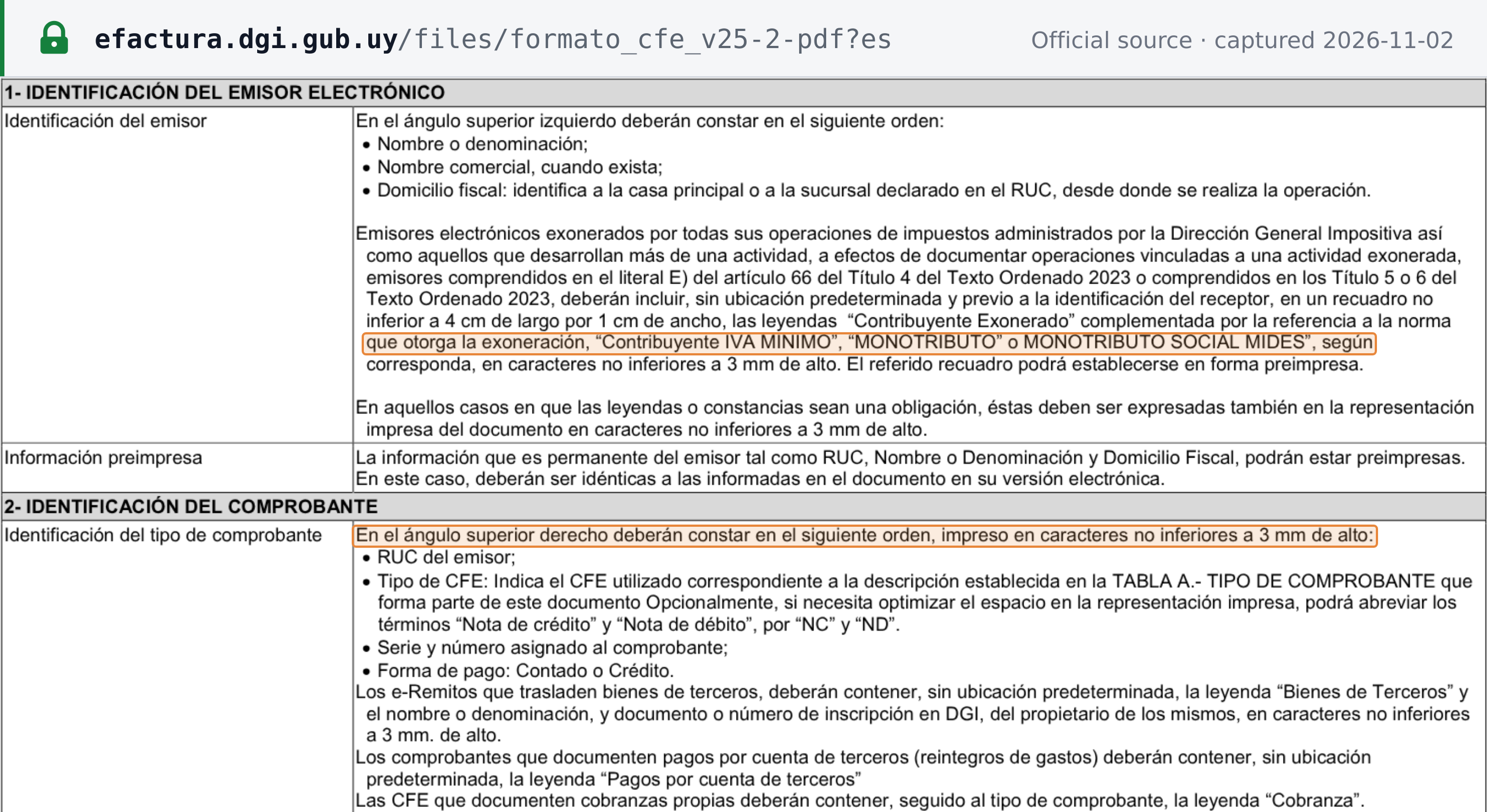 Source snapshot captured 2026-11-02 — original
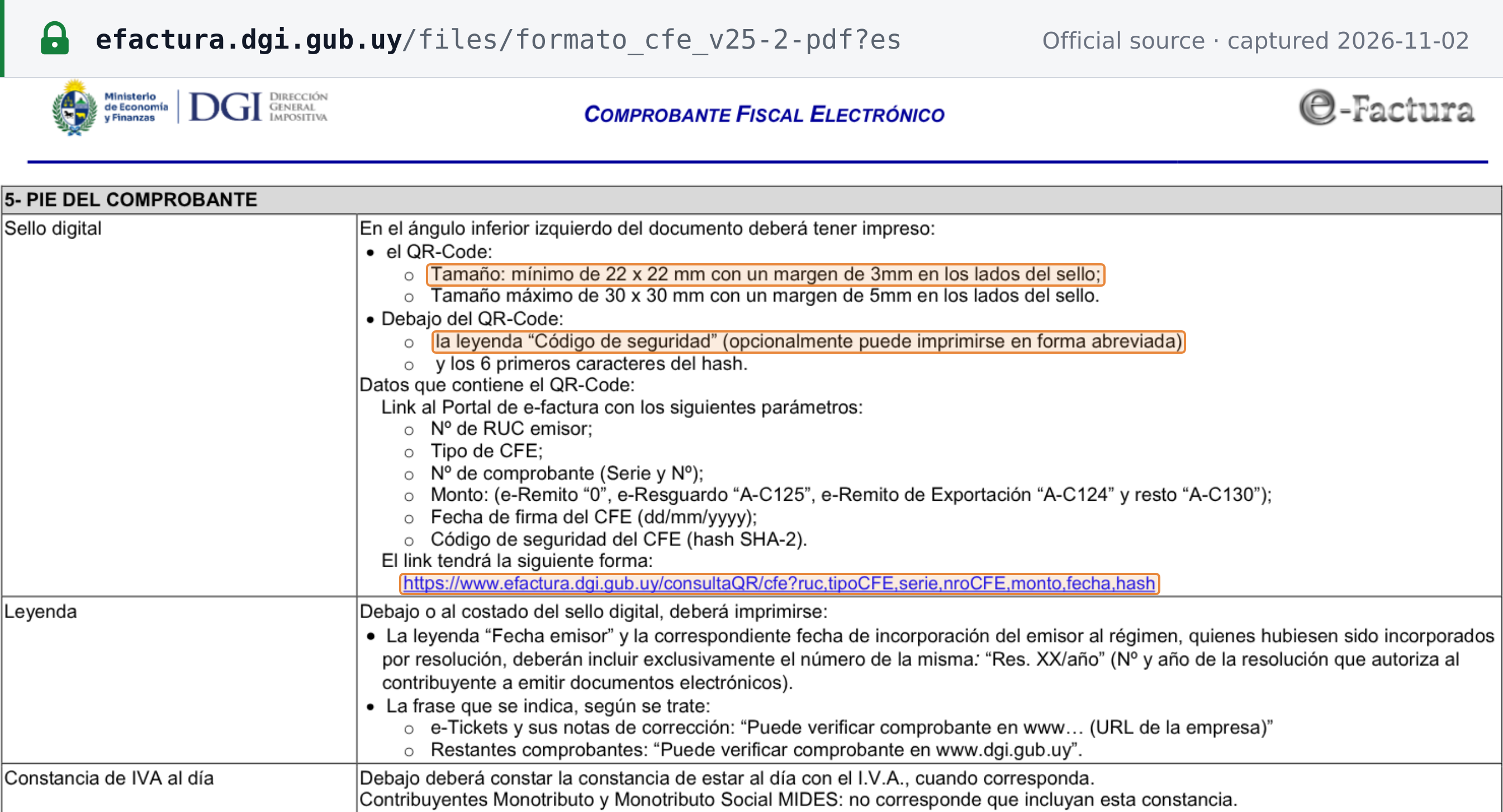 Source snapshot captured 2026-11-02 — original
Below, Lookuptax lays those blocks out for an illustrative domestic e-Factura with lines at both rates. Every name, number and amount is fictional:
e-Factura (CFE type 111) — illustrative printed representation
| DetalleFCFE p. 83 | CantidadFCFE p. 83 | Precio unitarioFCFE p. 83 | Importe (net)FCFE p. 83 | Tasa IVAD220 art. 99 |
|---|---|---|---|---|
| Servicio de consultoría, octubre 2026 | 1 | UYU 10,000.00 | UYU 10,000.00 | Básica 22% |
| Arroz, paquete 1 kg | 100 | UYU 50.00 | UYU 5,000.00 | Mínima 10% |
- Monto neto — tasa básicaFCFE p. 83
- UYU 10,000.00
- Monto neto — tasa mínimaFCFE p. 83
- UYU 5,000.00
- IVA tasa básica 22%FCFE p. 83; D220 art. 99
- UYU 2,200.00
- IVA tasa mínima 10%FCFE p. 83; D220 art. 101 a
- UYU 500.00
- Total a pagarFCFE p. 83
- UYU 17,700.00
- Bottom left: QR code (illustrative), 22–30 mm, linking to https://www.efactura.dgi.gub.uy/consultaQR/cfe with the issuer RUT, CFE type, series and number, amount, signing date and hash — FCFE p. 84.
- Under the QR: "Código de seguridad: ABC123" (illustrative; the real value is the first 6 characters of the CFE hash) — FCFE p. 84.
- "Fecha emisor: 01/01/2025" and "Puede verificar comprobante en www.dgi.gub.uy" — FCFE p. 84.
- CAE Nº 90000000000 (illustrative), Serie A del 0000001 al 0001000; boxed "Fecha de vencimiento: 31/12/2027" (illustrative) — FCFE p. 84; R798 num. 11.
- An e-Ticket to a final consumer would replace the RUC COMPRADOR box with a "CONSUMO FINAL" box and show the gross total only — FCFE pp. 82–83.
- An IVA mínimo issuer would add the boxed legend "Contribuyente IVA MINIMO" and show no IVA lines — FCFE pp. 81, 83.
E-invoicing status
Status (as at 2 November 2026): mandatory for all IVA taxpayers, including IVA mínimo payers, since 1 January 2025 (Res. DGI 2548/2023, above). DGI announced it this way: "a partir del 1/1/2025 serán emisores electrónicos todos los contribuyentes de IVA, incluso de IVA Mínimo, con algunas excepciones puntuales" (DGI, 28 November 2024). [29]
- System. DGI's CFE regime (Comprobantes Fiscales Electrónicos), legal basis Decreto 36/012 and Res. DGI 798/2012, run from the e-Factura portal.
- Model. Clearance-style. Each e-Factura, e-Remito and e-Resguardo, and each e-Ticket above the UI tope, goes to DGI signed before delivery. DGI acknowledges or rejects it, and a daily consolidated report covers everything. See CTC e-invoicing models.
- Format. DGI's own XML schema with an advanced electronic signature; not Peppol and not UBL. The current specification is Formato de los CFE v25.2, in production since 30 June 2026, with the XSD set v1.44.2 published on the portal's technical documents page. [27]
- Scope. B2B (e-Factura) and B2C (e-Ticket) run through the same CFE system, and the regime has no separate channel for invoices to the State.
- Who is outside the mandate (Res. DGI 2389/2023 num. 3): "a) los contribuyentes que desarrollen exclusivamente actividades agropecuarias y obtengan en el ejercicio ingresos inferiores a UI 4.000.000 … c) los contribuyentes del Impuesto a las Rentas de los No Residentes, d) los contribuyentes exonerados de impuestos administrados por la DGI por todas sus operaciones, excepto los usuarios directos e indirectos de zona franca, e) los contribuyentes del Monotributo, del Monotributo Social Mides y del Aporte Social Único de PPL". Literal b) adds those whose only taxed acts are value added in construction on real estate. [30]
- Phasing. The mandate was rolled out by notified groups over more than ten years. The last steps were Res. 2389/2023 (taxpayers registered at 31 July 2023, to join by 1 May 2024) and Res. 2548/2023, which extended that deadline to 31 December 2024 and made new taxpayers electronic from registration from 1 January 2025.
- Joining. DGI: "Una vez que obtiene la calidad de emisor electrónico, el contribuyente dispone de un plazo de un mes en el que puede utilizar tanto documentación electrónica como tradicional en papel." (After becoming an electronic issuer, a taxpayer has one month in which it may use both electronic and paper documents.) [25]
For other countries, see e-invoicing status and networks worldwide.
Filing and payment
Filing frequency
| Taxpayer group | IVA liquidation | Return | Basis |
|---|---|---|---|
| CEDE (large and specially controlled companies, including those managed by the Grandes Contribuyentes division) | Monthly | Monthly return and payment | D220 arts. 120 and 163 |
| NO CEDE | Annual, with monthly payments | Annual return, Formulario 2178 (IVA, IRAE advances, Patrimonio and ICOSA) | D220 art. 120; DGI No CEDE guide |
| IVA mínimo | Fixed monthly quota | — | see Registration threshold |
| Personal services outside employment (Título 10, art. 6 C) | Bimonthly IVA/IRPF advance payments | Annual IVA servicios personales return | DGI calendar, ordinals 5, 7 and 16 |
| Non-residents under Decreto 149/007 arts. 21 bis and 21 ter | Quarterly payments | — | DGI calendar, ordinal 15 |
D220 art. 163: "Los contribuyentes comprendidos en CEDE (Contralor Especial de Empresas) deberán liquidar el impuesto mensualmente, debiendo incluir el monto de las operaciones gravadas, exentas, con impuesto percibido, con impuesto en suspenso y las operaciones de exportación." For NO CEDE taxpayers, DGI's guide says Formulario 2178 is filed by "los sujetos pasivos del IVA General, IRAE, PATRIMONIO e ICOSA incluidos en el grupo NO CEDE, aunque no tengan actividad en el período" (even with no activity in the period). [2] [13]
Return due date
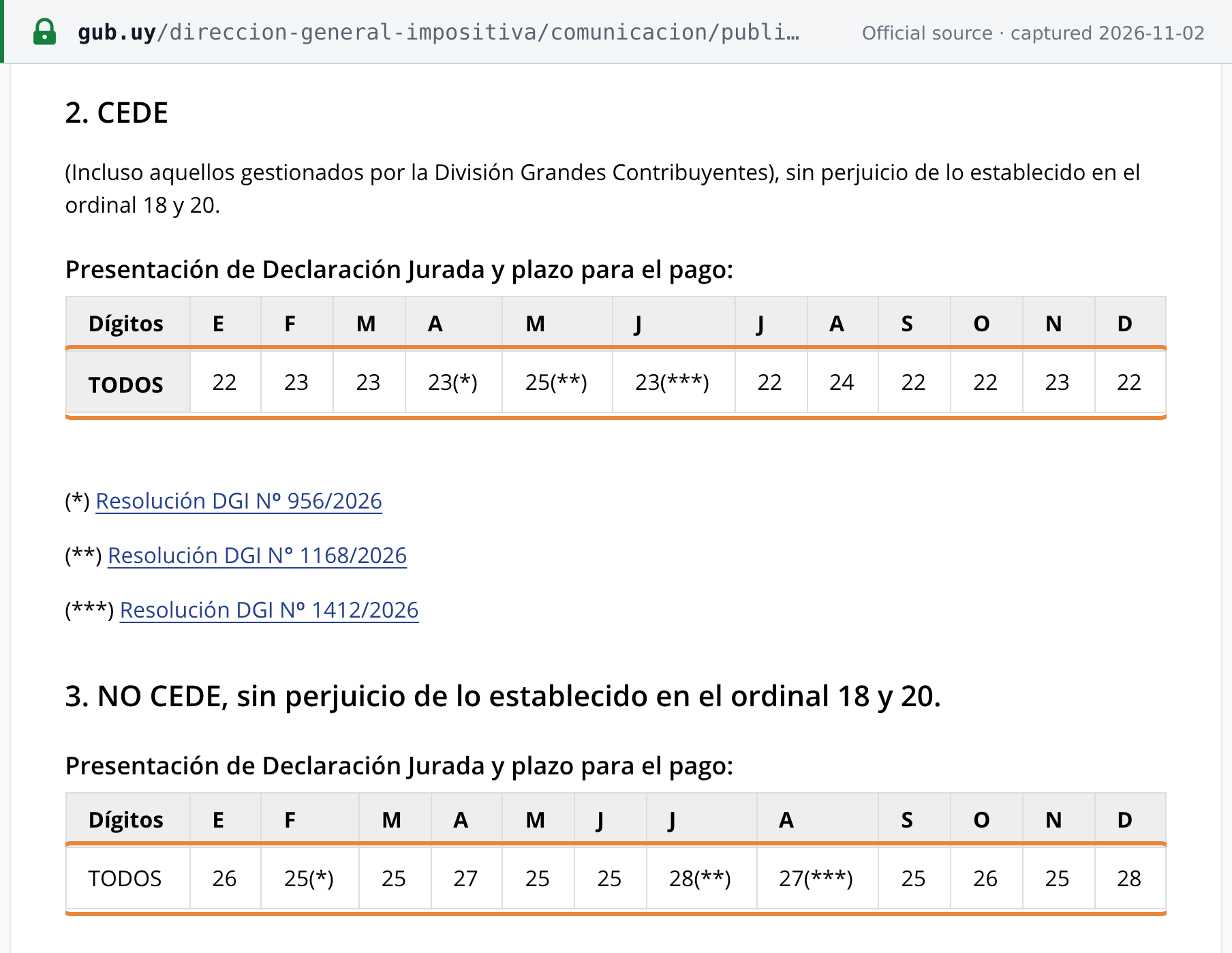
The rule is DGI's annual calendar, not a fixed day in law. DGI publishes a Calendario general de vencimientos each year, and the 2026 calendar gives one day for all RUT final digits ("Dígitos TODOS"). Returns and payments due in each month of 2026, as listed by DGI (updated 20 August 2026):
| Group | Jan | Feb | Mar | Apr | May | Jun | Jul | Aug | Sep | Oct | Nov | Dec |
|---|---|---|---|---|---|---|---|---|---|---|---|---|
| CEDE | 22 | 23 | 23 | 23 | 25 | 23 | 22 | 24 | 22 | 22 | 23 | 22 |
| NO CEDE | 26 | 25 | 25 | 27 | 25 | 25 | 28 | 27 | 25 | 26 | 25 | 28 |
Several of these days were moved by DGI resolutions cited on the calendar page (Res. DGI 956/2026, 1168/2026, 1412/2026, 631/2026, 1721/2026 and 1912/2026). The IVA mínimo quota falls due around the 20th: the October 2026 quota on 20 November 2026 and the November quota on 21 December 2026. Personal services outside employment make bimonthly IVA/IRPF advance payments: the September–October 2026 period is due on 25 November 2026 (ordinal 5). [23]
 Source snapshot captured 2026-11-02 — original
NO CEDE annual return. For fiscal years starting on or after 1 January 2019, Formulario 2178 is due in the fourth month after the fiscal year closes, the same term as the IRAE, ICOSA and IPAT annual returns: "Para ejercicios iniciados a partir del 1° de enero de 2019, el plazo será el mismo previsto para las declaraciones anuales del IRAE, ICOSA e IPAT, cuarto mes siguiente al cierre del ejercicio." [13]
Cumulative monthly payment. D220 art. 161 makes the monthly declaration cumulative from the start of the fiscal year. Each month's payment is the difference against what has already been paid. [2]
Payment due date and method
Payment is due on the same calendar day as the return. Taxpayers pay with boleto de pago 2908 at the Abitab or Red Pagos collection networks ("Redes de cobranza Abitab o Red Pagos - Boleto 2908"), or online through participating banks. DGI lists "Pagos en línea a través de bancos adheridos" and payments at Abitab, Redpagos and the CACs (Centros de Atención Ciudadana), and says that for these "se requiere previamente confeccionar el boleto de pago 2908" (the 2908 payment slip must first be prepared). Non-residents under arts. 21 bis and 21 ter pay "electrónicamente vía Internet". [31] [13] [23]
Additional listings
The daily consolidated CFE report (see Issuance deadline) is the continuous listing: every CFE issued, every day, sent to DGI within 18 hours of the next business day. NO CEDE taxpayers also file the annual Formulario 2178 described above.
Input-tax recovery
IVA payable is the IVA invoiced on sales minus the IVA on purchases documented as Título 10 art. 13 requires, and minus IVA paid on imports. Both deductions need inputs that go, directly or indirectly, into taxed operations: "se requerirá que dichos impuestos provengan de bienes y servicios que integran directa o indirectamente el costo de bienes y servicios destinados a las operaciones gravadas" (Título 10, art. 14; art. 9 in the 1996 Texto Ordenado). On vehicles, the same article allows deduction only for utility vehicles ("camiones y camionetas") and for other vehicles the regulations accept as necessary for the business, notified to DGI. IVA mínimo taxpayers deduct nothing. [32]
Refunds
- Year-end credit. Where the closing return shows more IVA paid than accrued, "el saldo podrá ser devuelto, imputado a cualquiera de los impuestos recaudados por la Dirección General Impositiva, o solicitarse la cesión a cualquier contribuyente de la misma" (the balance can be refunded, set against any DGI tax, or assigned to another taxpayer; D220 art. 161).
- Exporters. Full deduction of input IVA, with refunds to direct exporters only (D220 art. 129) and credit certificates (art. 130).
- Bad debts. A receivable counts as uncollectible on bankruptcy or judicial liquidation, a provisional moratorium, prosecution for fraudulent insolvency, or a bounced cheque with criminal complaint and attachment. It also counts after "e) El transcurso de dieciocho meses contados a partir del vencimiento de la obligación de pagar el adeudo." (18 months after the debt fell due; D220 art. 123.)
- Non-resident refunds. Título 10 and Decreto 220/998 have no refund scheme for non-residents; tourism reliefs work through the rate reductions above. [2]
Exemptions
Exempt supplies
Título 10 art. 38 (art. 19 in the 1996 Texto Ordenado) exempts, among others:
- Goods: "A) Moneda extranjera, metales preciosos, amonedados o en lingotes, títulos y cédulas, públicos y privados y valores mobiliarios de análoga naturaleza." "B) Bienes inmuebles", except the first sale by businesses listed in art. 36 I) (taxed at 10%); "Las enajenaciones de terrenos sin mejoras estarán exoneradas en todos los casos." "H) Diarios, periódicos, revistas, libros y folletos de cualquier naturaleza, con excepción de los pornográficos." The list continues with pasteurised milk, listed farm inputs, educational material, basic household water and fuels other than fuel-oil and gas-oil.
- Services: "A) Intereses de valores públicos y privados, de depósitos bancarios y warrants." "C) Arrendamientos de inmuebles." (Real-estate leases.) Certain agricultural insurance and bank operations are also listed. [33]
- From 1 January 2027: deposit and refund operations on single-use beverage containers under an approved deposit-return system (Ley 20.531 art. 297; see Announced future changes).
Exempt is not zero-rated. An exempt supply carries no IVA, and the IVA on the inputs used for it cannot be deducted: Título 10 art. 14 allows deduction only for inputs that go into taxed operations. Exports are the exception, with full recovery (D220 art. 129). Several literals of art. 38 give specific refund regimes for inputs, for example for books, so check the literal before assuming either way. [32]
Special regimes
- IVA mínimo: the small-business quota regime (Registration threshold).
- Monotributo: a single tax outside IVA and outside CFE.
- Free zones. Free-zone users are expressly not excused from CFE e-invoicing ("excepto los usuarios directos e indirectos de zona franca", Res. 2389/2023 num. 3 d). [30]
- Fresh meat: IVA collection at source (percepción). Both dated 27 August 2026, two resolutions change the regime of Res. DGI 451/1985. Res. DGI 1983/2026 amends its numerals 2 and 6: how the IVA collected on other sales of beef, offal and mutton is computed (the minimum rate on the retail-stage value added, with a separate base for distributors under D220 art. 11 bis), and a computed input IVA of 9.09% of the invoiced total for processors buying meat on which the IVA was already collected. Res. DGI 1984/2026 "se aplicará desde el 1° de setiembre de 2026 inclusive" and sets new deemed retail prices per kilogram for half-carcass, forequarter and hindquarter beef, retail-stage value-added percentages of 20% and 12%, and new per-kilogram deemed IVA values for meat and offal from own-account slaughter. [40] [34]
 Source snapshot captured 2026-09-01 — original
- Other collection-at-source regimes. The designated agents are listed in Table C of the CFE format (p. 87). See VAT withholding regimes.
Offences and penalties
Offences
The Código Tributario defines the infringements:
- Mora (art. 94): late payment.
- Contravención (art. 95): breach of formal duties, including obstructing an audit.
- Defraudación (art. 96): a fraudulent act to obtain an undue advantage at the State's expense. Fraud is presumed in listed cases, among them:
- returns that contradict the underlying records;
- books not kept or not shown, or two sets of books;
- "F) Omisión de extender la documentación requerida por la ley o el reglamento con fines de control." (failing to issue the documents the law requires for control purposes);
- withholdings collected but not paid over (H);
- failure to register (I).
- Instigación pública a no pagar tributos (art. 98): publicly inciting non-payment of taxes.
Criminal exposure. The crime of tax fraud: "El que, directamente o por interpuesta persona, procediera con engaño con el fin de obtener, para sí o para un tercero, un provecho indebido a expensas de los derechos del Estado, a la percepción de sus tributos, será castigado con seis meses de prisión a seis años de penitenciaría." (Six months' prison to six years' penitentiary; art. 110, prosecuted on DGI's complaint.) For false invoices: "La pena será de dos a ocho años de penitenciaría cuando se hubieren utilizado, en forma total o parcial, facturas o cualquier otro documento equivalente, ideológica o materialmente falsos." (Two to eight years; art. 110-BIS.) [28]
Penalties
| Infringement | Penalty (2026) | Source |
|---|---|---|
| Late payment | 5% of the unpaid tax if paid within 5 business days; 10% up to 90 calendar days; 20% after that (10% where a payment plan is requested in time) — plus a monthly surcharge | CT art. 94 |
| Contravention (formal breaches) | UYU 680 to UYU 13,220 | CT art. 95; Decreto 344/025 of 30 Dec 2025 |
| Late return | UYU 910 per return; for taxpayers with no activity in the period, UYU 910 each up to UYU 2,730 per filing act | Res. DGI 097/026 (14 Jan 2026) |
| Failure to register | UYU 1,160 | Res. DGI 2285/025 |
| Late notice of changes to RUT data | UYU 800 (within 90 days), UYU 3,120 (within a year), UYU 4,450 (more than a year); individuals and sole proprietors at most UYU 800 | Res. DGI 2285/025 |
| Defraudación | A fine of 1 to 15 times the tax evaded or attempted | CT art. 96 |
| Failing to issue a compliant invoice | A contravention (art. 95), and a presumption of defraudación (art. 96 F); no separate amount is set | CT arts. 95, 96 |
CT art. 94: "La multa sobre el tributo no pagado en plazo será: A) 5% (cinco por ciento) cuando el tributo se abonare dentro de los cinco días hábiles siguientes al de su vencimiento. B) 10% (diez por ciento) cuando el tributo se abonare con posterioridad a los cinco días hábiles siguientes y hasta los noventa días corridos de su vencimiento. C) 20% (veinte por ciento) cuando el tributo se abonare con posterioridad a los noventa días corridos de su vencimiento." The monthly surcharge is computed day by day and capitalised every four months. Decreto 274/008 art. 1 sets it at the Banco Central del Uruguay's last quarterly average market rate (70% of the large-company rate plus 30% of the medium-company rate), increased by 10%. [28] [35]
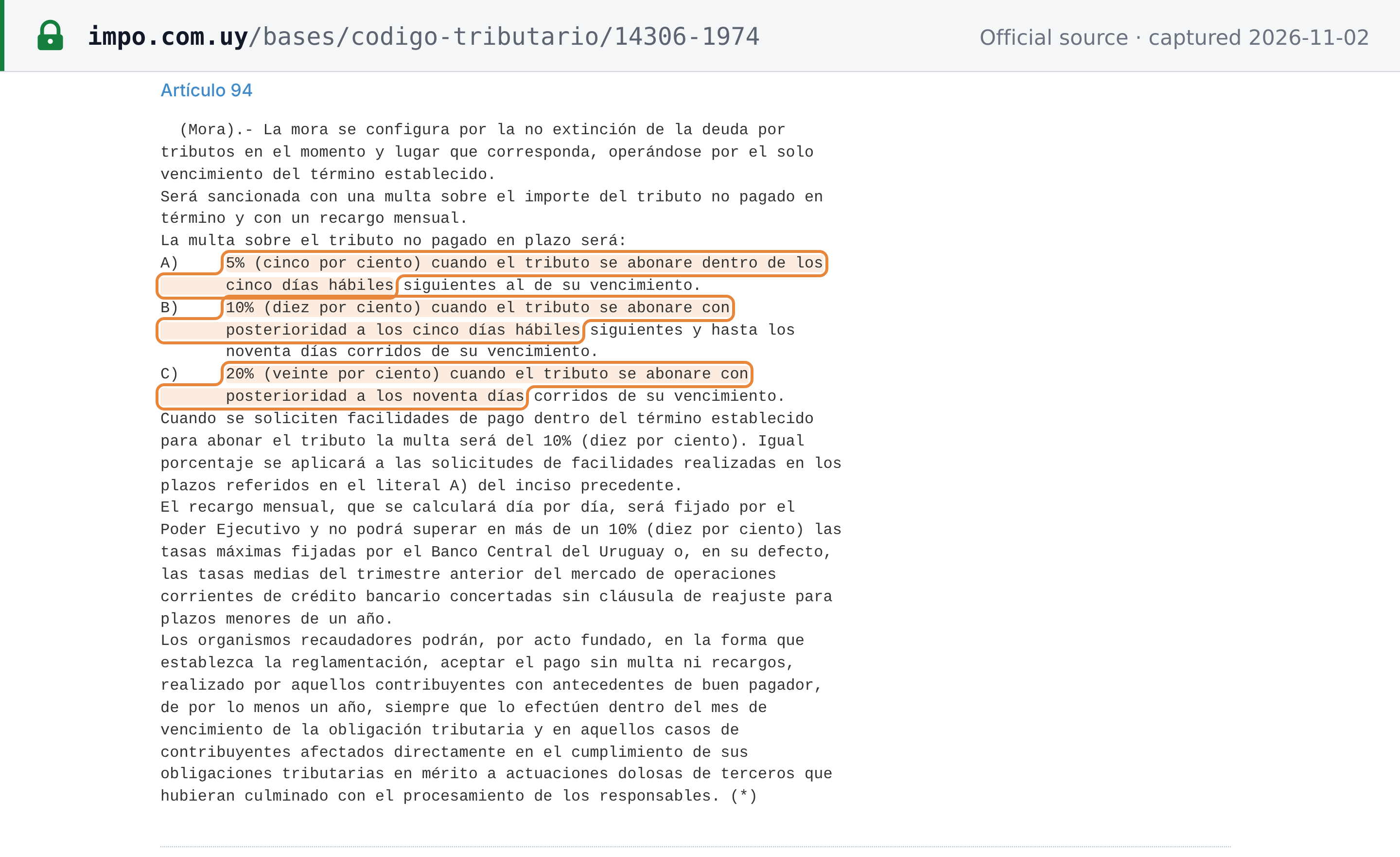 Source snapshot captured 2026-11-02 — original
The 2026 amounts: contravention "Dto. 344/025 de 30/12/2025 2026 $ 680 a $ 13.220"; late filing "se sancionará con una multa de $ 910 (novecientos diez pesos uruguayos) por cada declaración jurada"; registration "Omisión de inscribirse: $ 1.160." (DGI, January 2026.) [36] [37] [38]
Frequently asked questions
DGI rejected our e-Factura. Can we correct it with a credit note?
No. A CFE that DGI rejects must be annulled, and the operation documented again on a new CFE with a different number, sent both to DGI and to the receptor (Res. DGI 798/2012, numeral 12). Credit and debit notes adjust only CFEs that DGI has accepted. Since 30 June 2026, when version 25.2 of the CFE format went into production, DGI also applies new validations to zone F (reference information, which notes use to cite the original CFE) and zone K (complemento fiscal); CFEs that fail them are rejected and have no fiscal validity.
We pay IVA mínimo. Do we show IVA on our e-Tickets and e-Facturas?
No. IVA mínimo taxpayers invoice without IVA, and DGI's CFE format says their printed CFE may contain no mention of IVA, except the certificate of being up to date with IVA where it applies. Instead the CFE carries a box of at least 4 cm by 1 cm with the legend "Contribuyente IVA MINIMO". The IVA they pay on purchases is not deductible and becomes a cost of the business.
Do we need the customer's ID document on an e-Ticket?
Only when the net amount, excluding IVA, exceeds UI 5,000 (the tope in force since 1 November 2022, valued at the Unidad Indexada rate at the close of the previous calendar year), or, at any amount, when the e-Ticket documents withholdings or collections. Then the receptor's document number (C.I., RUT or other) and issuing country must be shown, and that e-Ticket must be sent to DGI individually before it is delivered.
We sell streaming or online services to people in Uruguay from abroad. Do we owe Uruguayan IVA?
Only for two kinds of service. Decreto 220/998 art. 26-BIS and 26-TER tie the digital rule to Decreto 149/007 art. 21 bis, audiovisual transmissions such as films, television and any audiovisual content delivered through the internet, platforms or apps, including access and download, and art. 21 ter, automated platform mediation or intermediation in the supply or demand of services. Advertising, technical services and distance education are expressly left out of art. 21 bis. Non-residents without a permanent establishment that operate under these articles make quarterly IVA payments electronically; the July to September 2026 quarter was due on 22 October 2026. Where a Uruguayan business listed in art. 26 of Decreto 149/007 pays for an art. 21 bis service, it withholds the IVA itself.
Our income passed the IVA mínimo ceiling during the year. What changes?
You leave IVA mínimo and move to the general regime (IVA, IRAE and Impuesto al Patrimonio) from the point you exceed 305,000 UI of annual income, which is UYU 1,959,229 for 2026. DGI says the invoice that takes you over the ceiling is treated as IVA-inclusive, and IVA must be shown separately from the next operation. A taxpayer that chooses the general regime without exceeding the ceiling must stay in it for at least three fiscal years.
Important websites
| Site | Purpose |
|---|---|
| DGI — Dirección General Impositiva | Tax authority home page: guides, notices and resolutions |
| DGI — RUT registration procedures | Index of registration procedures (sole proprietors, companies, foreign companies) |
| gub.uy — Registration of a sole proprietorship | The online DGI/BPS registration procedure, forms, timing and cost |
| DGI Servicios en línea | Filing returns, CAE requests and other online services |
| DGI — Boleto de pago 2908 | Generate, print and pay the tax payment slip |
| DGI — 2026 due-date calendar | Return and payment days by taxpayer group |
| DGI — Certificado Único lookup | Check a taxpayer's certificate of good standing (CVA) |
| e-Factura portal | DGI's CFE e-invoicing portal |
| e-Factura — technical documents | CFE format, XSD schemas, sample XML |
| e-Factura — CFE verification | Verify a CFE by QR code or manually |
| IMPO | Official gazette and consolidated legislation |
To check a RUT, use the Uruguay RUT validator; rates are in Rates above, from Decreto 220/998.
Recent changes
- 2026-10-16 — Ley 20.531 published (promulgated 1 October 2026). From 1 January 2027 it adds an IVA exemption for beverage-container deposit and refund operations (SDDR) and an IVA credit for housing cooperatives' direct construction costs. (IMPO) — see event
- 2026-10-01 — Decreto 235/026 extends to 30 April 2027 the 9-point IVA reduction for restaurant, catering, event, car-rental and tourist-rental-mediation services paid electronically. (Presidencia) — see event
- 2026-08-28 — Res. DGI 1983/2026 amends numerals 2 and 6 of Res. 451/1985 (how the collected IVA is computed, and a 9.09% computed input IVA for processors), and Res. DGI 1984/2026 sets new values from 1 September 2026, for the fresh-meat IVA collection-at-source regime. (IMPO 1983/2026 · IMPO 1984/2026) — see event
For the full chronology, see Uruguay tax changes on Lookuptax.
Reference links
- IMPO — T.O. 2023, Título 10 (IVA), art. 1
- IMPO — Decreto 220/998, IVA regulation (consolidated)
- IMPO — Decreto 597/988, registration and documentation (consolidated)
- IMPO — T.O. 2023, Título 10, art. 6 (taxpayers)
- DGI — Régimen IVA mínimo, pequeña empresa
- DGI — Tope de ingresos anuales para pequeñas empresas, IVA mínimo (9 January 2026)
- DGI — Cuota IVA mínimo, valores vigentes (8 January 2026)
- DGI — Información sobre el régimen de facturación electrónica (IVA mínimo)
- DGI — Pequeños contribuyentes (IVA mínimo and Monotributo)
- DGI — Formato de los CFE v25.2 (28 April 2026)
- gub.uy — Inscripción de empresa unipersonal (updated 26 October 2026)
- DGI — IVA mínimo, pasaje al régimen general
- DGI — Declaraciones juradas grupo No CEDE, Formularios 2178 and 1379
- IMPO — T.O. 2023, Título 10, art. 34 (rates)
- IMPO — T.O. 2023, Título 10, art. 36 (minimum rate)
- IMPO — T.O. 2023, Título 10, art. 5 (territoriality and exports)
- DGI — Reducción del IVA prevista en la Ley 19.210 (8 April 2026)
- DGI — Reducción de 9 puntos de IVA para determinados servicios (2 October 2026)
- Presidencia — Decreto 235/026 of 1 October 2026
- IMPO — Ley 20.531 (published 16 October 2026)
- IMPO — Decreto 144/018
- IMPO — Decreto 149/007 (consolidated), arts. 21 bis, 21 ter and 26
- DGI — Vencimientos 2026, calendario general actualizado (20 August 2026)
- IMPO — Resolución DGI 2548/2023 (original text)
- DGI — Cómo se documenta en el régimen de facturación electrónica (30 January 2025)
- IMPO — Resolución DGI 798/2012 (original text)
- DGI e-Factura — Actualización de documentación, CFE format v25.2
- IMPO — Código Tributario (Decreto-Ley 14.306)
- DGI — Facturación electrónica: incorporación de los restantes contribuyentes de IVA (28 November 2024)
- IMPO — Resolución DGI 2389/2023 (original text)
- DGI — Medios de pago
- IMPO — T.O. 2023, Título 10, art. 14 (liquidation and input deduction)
- IMPO — T.O. 2023, Título 10, art. 38 (exemptions)
- IMPO — Resolución DGI 1984/2026 (original text)
- IMPO — Decreto 274/008 (late-payment surcharge)
- DGI — Multa por contravención 2026
- DGI — Contravención por presentación de declaración jurada fuera de plazo 2026
- DGI — Contravención por omisión de deberes formales: inscripción, modificación y clausura 2026
- DGI — Monotributo
- IMPO — Resolución DGI 1983/2026 (original text)
Related on Lookuptax:
- Uruguay RUT guide
- Uruguay RUT validator
- Worldwide tax rates
- VAT registration thresholds worldwide
- E-invoicing status and networks worldwide
- CTC e-invoicing models: clearance, reporting and interchange
- VAT withholding regimes
- VAT on digital services by non-resident suppliers
- Reverse charge explained
- Marketplace deemed-supplier rules
- How to register for VAT, sales tax or GST