Vanuatu VAT guidelines
Overview
Vanuatu levies Value Added Tax (VAT) (taxe sur la valeur ajoutée, TVA, in French). DCIR's account of its origin: "In 1998, as part of the financial reform element of its Comprehensive Reform Program (CRP), Vanuatu introduced a Value Added Tax (VAT)", and "Vanuatu’s VAT was modelled based on the New Zealand’s GST regime". [3] The rules sit in two Acts: "The law that is relevant for VAT is now in both the Value Added Tax Act [Cap 247] and Tax Administration Act no 37 of 2018." [3] This guide quotes the VAT Act in its Consolidated Edition 2020 [1] and the Tax Administration Act No. 37 of 2018 as enacted [2], both as published by DCIR. DCIR's legislation page lists later amending Acts, including the Value Added Tax (Amendment) Act No. 13 of 2021, without a link to their text, so wording quoted here may since have been amended. [19]
Authority, currency, period and layering
- Authority. The Department of Customs and Inland Revenue (DCIR) ("Department means the Department of Customs and Inland Revenue", VAT Act s.2). [1]
- What is taxed. "VAT is an indirect consumption tax imposed at the rate of 15% on most goods and services supplied in Vanuatu by registered persons in the course of a taxable activity. It is also imposed on most goods imported into Vanuatu." [3]
- Currency. The vatu (VT, ISO code VUV). "Unless a tax law provides otherwise, tax and other amounts payable to the Director under a tax law must be paid in vatu" (Tax Administration Regulation Order No. 154 of 2019, cl.12). [13]
- Tax period. One month (Category A) by default; three months (Category B) on written application by a person whose taxable supplies have not exceeded VT 8 million in twelve months (VAT Act s.15). See Filing and payment. [1]
- Layering. VAT is a single national tax. Neither the VAT Act nor the Tax Administration Act provides for a provincial or municipal VAT.
- Fiscal invoices. Since 1 August 2025 the Vanuatu Sales Monitoring System (VSMS) also requires VAT-registered businesses to issue fiscal invoices through accredited devices. See E-invoicing status.
Registration
Who must register and the threshold
A person who carries on a taxable activity and is not registered becomes liable to register "at the end of any month if the total value of supplies made in Vanuatu by the person in the year which ends with that end of that month in the course of carrying on taxable activities has exceeded four million vatu", or at the start of any month if there are reasonable grounds for believing that supplies in the coming year "will exceed the registration threshold amount" (VAT Act s.12(1)). [1] The test is therefore VT 4,000,000 of supplies made in Vanuatu, measured over the rolling twelve months just ended or the twelve months ahead. DCIR's VAT page puts it this way (as at 2026-11-06):
 Source snapshot captured 2026-11-06 — original
A person who becomes liable "must apply to the Director in the approved form for registration under this Act within 21 days of becoming so liable" (s.12(3)). [1] Activities that involve only exempt supplies are not taxable activities, according to DCIR's VAT page. [3]
Non-resident registration
The VAT Act sets no separate threshold for non-residents: the same VT 4 million test in s.12 applies to "supplies made in Vanuatu". Whether a non-resident makes supplies in Vanuatu at all depends on the place-of-supply rule in s.7, covered under Cross-border rules. In short, a non-resident with no fixed place of business in Vanuatu is outside the tax except for goods located in Vanuatu or services physically performed there. [1] The registration form asks a non-citizen or non-resident applicant to attach a copy of their passport and passport photo. [8]
Tax registration number (TIN)
- One number for all taxes. DCIR: "TIN’s were introduced from 1 January 2020 by way Part 2 of the Tax Administration Act no.37 of 2018", and "If you have previously been issued with a CT number this becomes your TIN. You do not have to apply for a new TIN." [4] "A person can have only one TIN at any time" (Tax Administration Act s.4(7)). [2]
- Format. Numeric. DCIR's VSMS eligible-TIN list tells readers to "Locate your six-digit TIN within the band that covers it". [20] DCIR publishes no check-digit algorithm. An illustrative (fictional) TIN in that shape:
123456. - On invoices. VAT-registered persons must print their TIN on their tax invoices (see Invoice requirements).
- Changes. A change of contact details or other relevant information must be notified to DCIR within 21 days. [4]
DCIR's TIN and VAT pages offer no public TIN lookup; the only TIN lists DCIR publishes are the VSMS extension lists.
How to register
- Apply for a TIN, on DCIR's TIN application form, if you do not already have one. DCIR's TIN page links the form. [4]
- File form CT 201, Application for VAT Registration. The form states: "This form was approved for use under Section 57 of the Tax Administration Act on 3rd July 2020". It asks, depending on the applicant, for a business licence, a certificate of incorporation, and a passport copy and photo for non-citizens or non-residents, and warns that the application "will not be processed unless these documents are attached". [8]
- Supporting documents. DCIR's Registering for VAT brochure (2021) adds a foreign investor's Vanuatu Investment Promotion Authority (VIPA) approval certificate and a "Copy of your business cash flow for the last 12 months and your cash flow projection for the next 12 months." [9]
- DCIR processing. The brochure says DCIR may "Carry out site visits" and issues a "VAT registration certificate (only for retail businesses)". A registered person must "display the certificate in a prominent place on the premises to which it relates" (VAT Act s.12A). [9] [1]
The forms are PDFs on DCIR's forms page; DCIR's VAT, forms and TIN pages describe no online VAT-registration portal. DCIR's brochure says there are no registration fees or deposits. Neither the Act nor DCIR's guidance states a processing time.
Voluntary registration
Available. Any person who satisfies the Director that it "is carrying on a taxable activity" or "intends to carry on a taxable activity from a specified date" may apply (s.12(4)). [1] DCIR: "Persons with an annual turnover of less than VT 4 million have the option of registering for VAT, provided they are carrying on a taxable activity." [3] A business might register to recover input tax, for example an exporter making zero-rated sales. A voluntary registrant is still a VAT-registered taxpayer for the VSMS, but DCIR's phased VSMS deadlines start at VT 4 million and set no date for businesses below it.
Deregistration
- A registered person "will cease to be liable to be registered at any time if the total value of supplies to be made in Vanuatu by the person in the year which starts at that time will be below the registration threshold amount" (s.13(1)). [1]
- On application, "the Director will cancel the person's registration with effect from the last day of the taxable period in which the application for cancellation was made (or with effect from such other date as the Director may stipulate)" (s.13(3)). [1] The application is made on form CT 209. [10]
- DCIR's brochure says to "Notify the Office within 21 days of ceasing all taxable activities". [9]
- Final return. VAT is due on business assets kept at cancellation. Form CT 209 says: "VAT Amount (Divide total by 7.6667 and enter in Box 9 of your final VAT return)". [10] (7.6667 is 115/15, the tax fraction of a 15% VAT-inclusive amount.)
- Failing to apply for cancellation as required costs VT 50,000 (Tax Administration Act s.91(2)(c)). [2]
Group registration
Available. Two or more registered companies may form a group "if not less than one half of the paid-up capital of each of those companies is held by shareholders in the other or if not less than one half in nominal value of the allotted shares in each of them is held by shareholders in the other" (s.45(1)). A representative member files for the group, and "all members of the group will remain liable jointly and severally for any tax payable by the representative member", while s.21 (tax invoices), s.54 (records) and Part 3 (registration) "will continue to apply to all members of the group" (s.45(9)). So each member still issues its own tax invoices. The Director may also deem registered persons that are not companies to be a group where one controls the others, one person controls all of them, or partners in a taxable activity control all of them (s.45(10)). [1] See the VAT grouping explainer for how grouping works elsewhere.
Rates
All rates as at 2026-11-06.
| Rate | Applies to | Legal basis |
|---|---|---|
| 15% (standard) | Taxable supplies by registered persons, and imports | VAT Act s.11(1) |
| 0% (zero rate) | The supplies listed in Schedule 3, for example exports | s.11(2), Schedule 3 |
| Exempt (no VAT, no input-tax deduction) | The supplies listed in Schedule 1, for example financial services | Schedule 1; see Exemptions |
There are no reduced rates.
Standard rate: 15%
"The rate of value added tax will be 15 % of – (a) except in the case of importation, the value of the supply" (s.11(1)). For imports the base is the customs value plus customs duty, excise tax, and the cost of transport to Vanuatu and insurance (s.11(1)(b)). [1]
DCIR's VAT page states the same rate: VAT is "imposed at the rate of 15% on most goods and services supplied in Vanuatu by registered persons in the course of a taxable activity" (as at 2026-11-06). [3]
 Source snapshot captured 2026-11-06 — original
In force since 1 January 2018. The rate was 12.5% from 1998. DCIR's notice to retailers: "The Vanuatu Parliament have passed a Bill to increase the VAT rate from 12.5% to 15% with the commencement date of 1st January 2018." [6] The VAT Act's amendment history lists Act No. 42 of 2017. [1]
Zero rate: 0%
"The rate of tax will be 0% of the value of the supply in the case of a supply in Vanuatu by a registered person which is one of the zero-rated supplies listed in Schedule 3" (s.11(2)). [1] Schedule 3 includes: [1]
- goods exported by the registered person, including stores and supplies to departing travellers;
- goods not in Vanuatu at the time of supply;
- international transport of passengers or goods, including the domestic leg and the insurance of that transport;
- services physically performed outside Vanuatu, and certain services to non-residents who are outside Vanuatu;
- supplies for approved aid projects;
- a taxable activity sold as a going concern to a registered person;
- supplies to listed international organisations holding DCIR approval.
DCIR's VAT page also lists "goods or services supplied directly to approved educational institutions" among zero-rated supplies. [3] The Act governs: Schedule 3 in the Consolidated Edition 2020 contains no such item, and its Table of Amendments records paragraphs 6 and 10 of Schedule 3 as "Repealed by Act 44 of 2009". DCIR's page is out of date on this point; supplies to schools are taxed at 15% unless another Schedule 3 item applies. [1]
Announced future rates
None. DCIR's public notices and VAT page announce no change to the 15% rate (as at 2026-11-06).
Cross-border rules
Imports and exports
- Imports of goods. VAT is charged on "any person imparting goods into Vanuatu for home consumption" (the Act's spelling), measured on the customs value plus the items in s.11(1)(b) (s.10(2)(b)), and "that tax will be collected and paid as if it were a customs duty levied on the importation of goods under the Import Duties [Consolidation] Act [Cap. 91]" (s.10(4)). [1] A registered importer deducts the import VAT as input tax (s.19(4)(b)).
- Exempt importations. Schedule 2 of the VAT Act exempts "Goods admitted free of VAT under Parts 2(A), 2(B), and 3 of Schedule 1 to the Import Duties (Consolidation) Act [CAP 91]." [1] DCIR's VAT pages state no current low-value de-minimis for imported goods. The only figure DCIR publishes is in a September 2005 booklet, and this guide does not treat it as current.
- Exports. Goods exported by the registered person are zero-rated (Schedule 3 para 1). Zero rating does not apply to goods on which the second-hand-goods credit was claimed, or to goods that "have been or will be re-imported into Vanuatu by the supplier". [1]
Place of supply
Vanuatu's place-of-supply rule turns on where the supplier is, not where the customer is:
- "For the purposes of this Act, goods and services are deemed to be supplied in Vanuatu if the supplier is a resident of Vanuatu or is a non-resident carrying on business in Vanuatu through a fixed place of business, and are deemed to be supplied outside of Vanuatu if the supplier is a non-resident of Vanuatu that is not carrying on business in Vanuatu through a fixed place of business" (s.7(1)).
- Exceptions for non-residents without a fixed place of business (s.7(2)): goods "in Vanuatu at the time of supply", and services "physically performed in Vanuatu by any person who is in Vanuatu at the time the services are performed" are deemed supplied in Vanuatu.
- B2B carve-back (s.7(3)): those s.7(2) supplies are again "deemed to be supplied outside of Vanuatu" when made to a registered person entitled to deduct the tax under s.19(4), "unless the supplier and recipient agree that this subsection does not apply to that supply". [1]
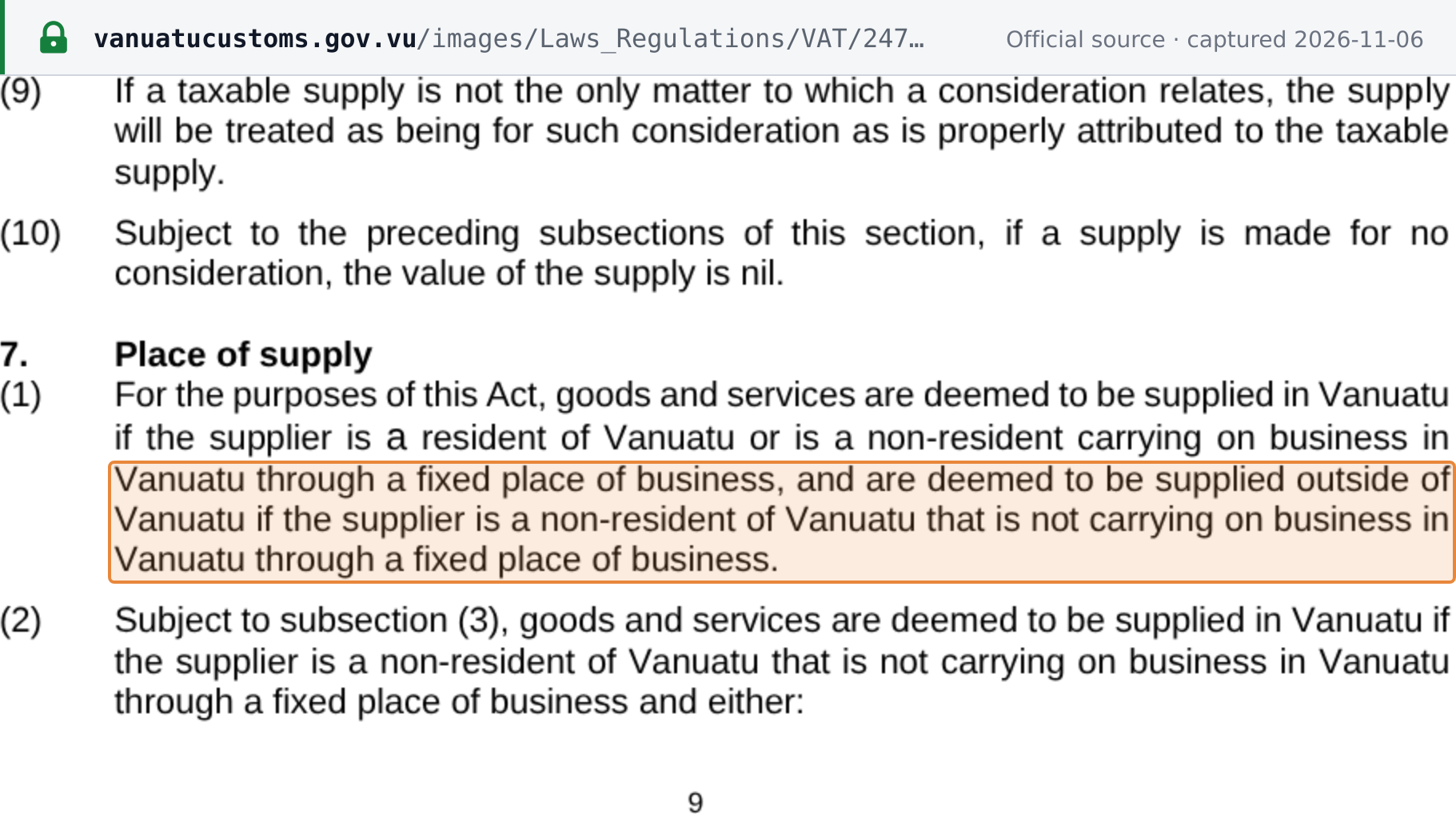 Source snapshot captured 2026-11-06 — original
The text above is the Consolidated Edition 2020. DCIR's legislation page lists the Value Added Tax (Amendment) Act No. 13 of 2021 without publishing its text, so check s.7's current wording with DCIR before relying on it. [19]
Foreign companies selling into Vanuatu — B2B and B2C
| Supply by a non-resident with no fixed place of business in Vanuatu | To a Vanuatu VAT-registered business (B2B) | To a consumer or unregistered business (B2C) |
|---|---|---|
| Services performed abroad, including remote and digital services | Outside Vanuatu VAT (s.7(1)). No registration; the Act has no reverse charge. | Outside Vanuatu VAT (s.7(1)). No registration. |
| Services physically performed in Vanuatu | Deemed supplied outside Vanuatu if the customer can deduct the tax, unless both parties agree otherwise (s.7(3)). | Supplied in Vanuatu (s.7(2)(b)); the supplier must register once its supplies in Vanuatu exceed VT 4 million (s.12). |
| Goods | Imported goods: VAT at the border, paid by the importer (s.10(2)(b)). Goods already in Vanuatu: as for services performed there (s.7(2)(a), s.7(3)). | Imported goods: VAT at the border. Goods already in Vanuatu: supplied in Vanuatu; VT 4 million registration test. |
Sources: VAT Act ss.7, 10, 12. [1] A non-resident with a fixed place of business in Vanuatu is treated like a resident supplier.
Digital services and marketplaces
The VAT Act (Consolidated Edition 2020) contains no rule for electronic, remote or digital services and no marketplace or platform deemed-supplier rule. DCIR's VAT page, its policies page and its public notices (as at 2026-11-06) announce none either. Services supplied from abroad by a non-resident without a fixed place of business in Vanuatu therefore fall under the general rule in s.7(1). DCIR's VSMS guidance does not address non-resident suppliers. See the explainer on VAT on digital services from non-resident suppliers for how other countries handle this.
Invoice requirements
Two layers apply, and they come from different instruments:
- The VAT tax invoice under s.21 of the VAT Act: a document a registered supplier must give a registered customer on request. It supports the customer's input-tax deduction.
- The VSMS fiscal invoice under the Vanuatu Sales Monitoring System Regulation Order No. 153 of 2025: issued through an accredited electronic fiscal device for every transaction, phased in by turnover (see E-invoicing status). [15]
When a tax invoice is required (issuance deadline)
"Subject to this section, a registered person making a taxable supply to another registered person must provide the other registered person with a tax invoice within 28 days of the other registered person requesting such a tax invoice" (s.21(1)). [1]
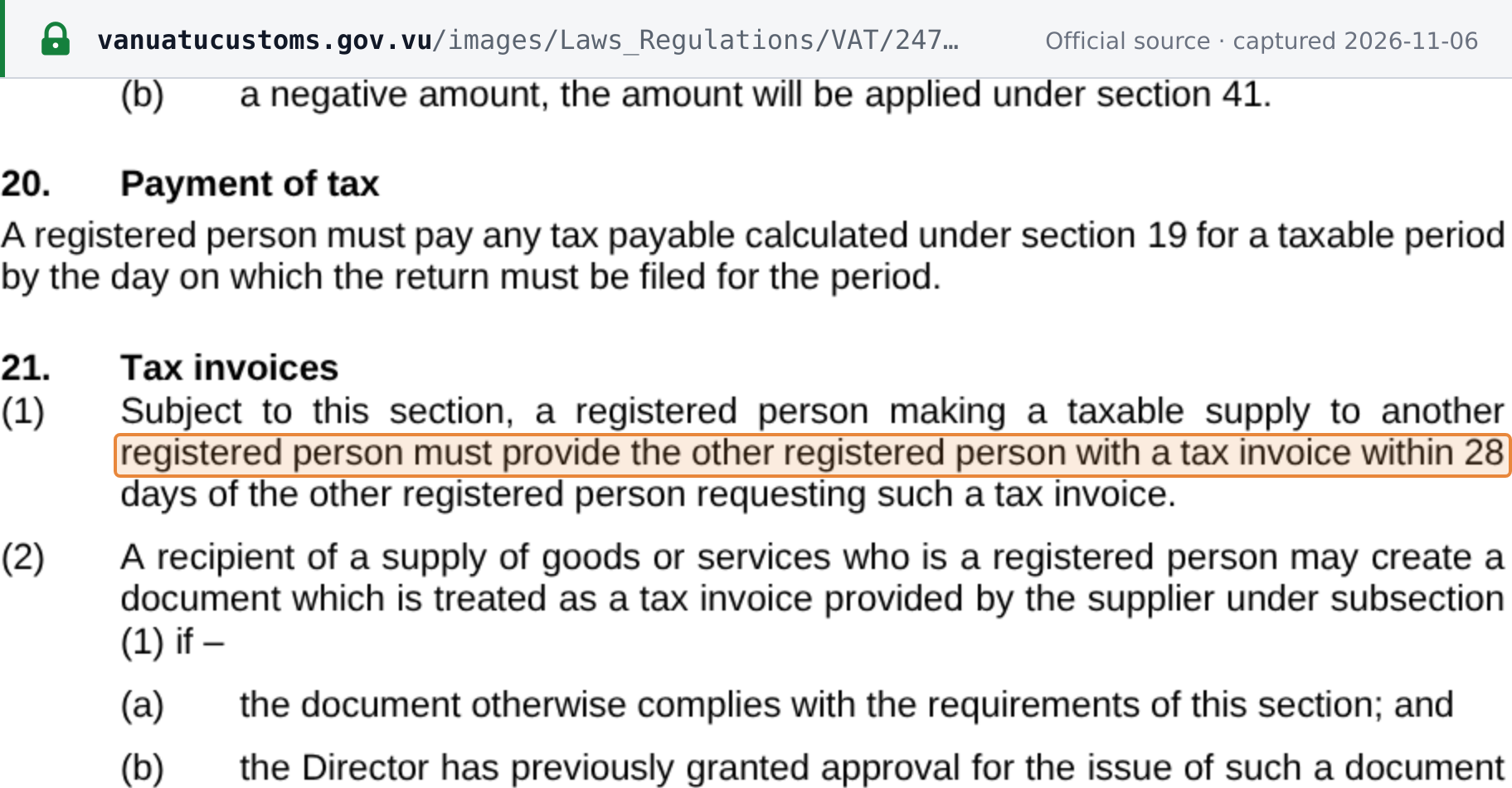 Source snapshot captured 2026-11-06 — original
- No tax invoice needed where "the consideration in money for the supply does not exceed VT 5,000 (or such greater amount as the Minister may declare by order)", or where the Director decides records will suffice and an invoice would be impractical (s.21(5)).
- One invoice per supply. "A registered person must not provide more than one tax invoice for a taxable supply, unless the other registered person claims to have lost the original, in which case a copy can be provided clearly marked "copy only"" (s.21(4)).
- Input-tax link. No deduction is made for tax on a purchase "unless – (i) a tax invoice provided under section 21 or debit or credit note provided under section 22 in respect of the supply is held by the registered person when the return is filed" (s.19(7)(a)). [1] DCIR: "A credit for tax paid on purchases/expenses can only be claimed if the registered person holds a valid tax invoice." [3]
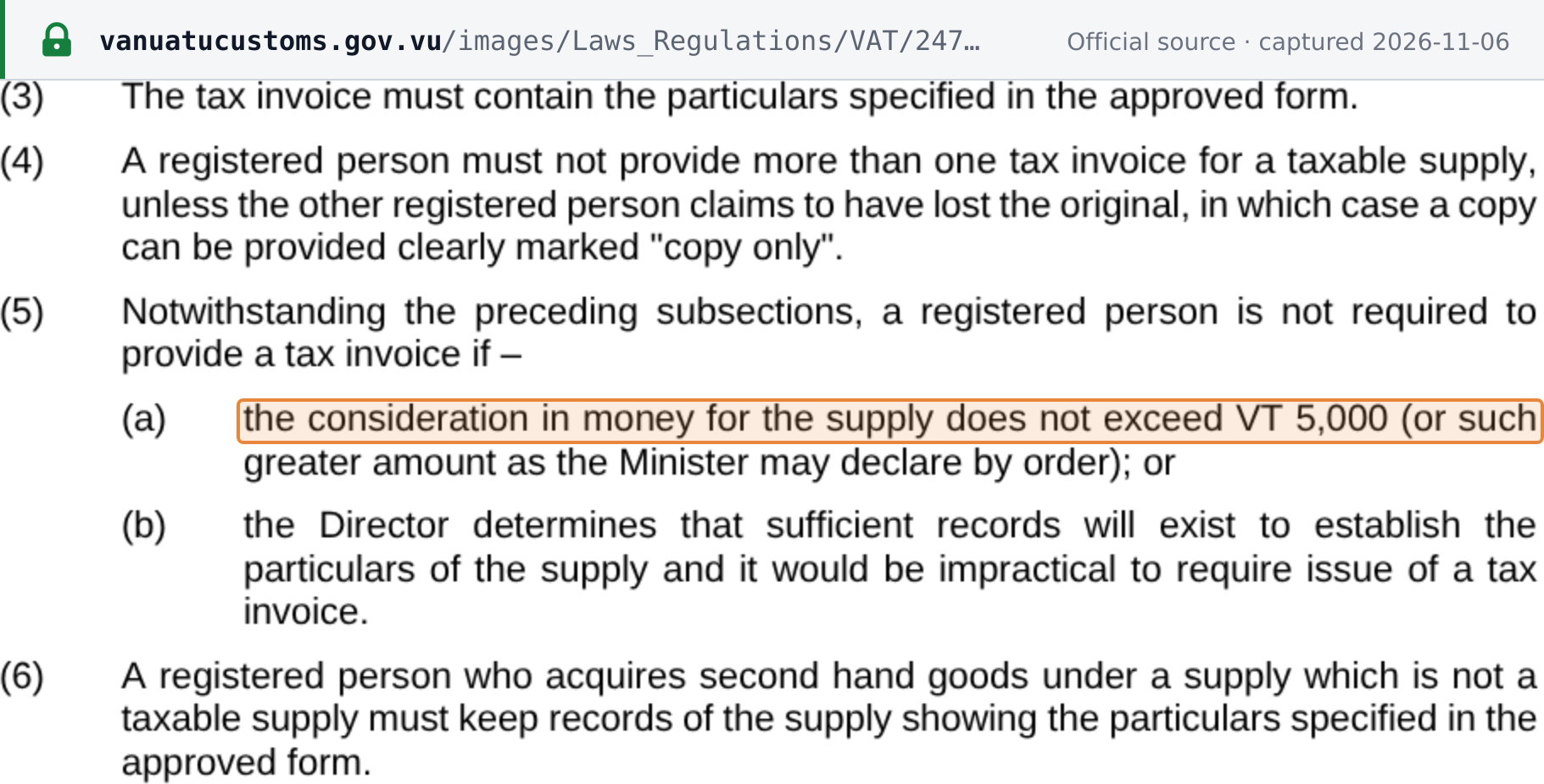 Source snapshot captured 2026-11-06 — original
Mandatory content of a VAT tax invoice
The Act does not list the particulars itself: "The tax invoice must contain the particulars specified in the approved form" (s.21(3)). DCIR does not publish that approved form on its forms page. The particulars DCIR has published are in its booklet Retailers and VAT (June 2005), which is still on its website. For a sale of more than VT 5,000 (VAT-inclusive), the booklet says the tax invoice must show: [7]
| # | Field (DCIR booklet, June 2005) | Note |
|---|---|---|
| 1 | The words "Tax Invoice" in a prominent place | |
| 2 | An individual serialised invoice number | |
| 3 | The supplier's name, CT number and address | The CT number became the TIN from 1 January 2020; DCIR's TIN page requires the TIN on tax invoices |
| 4 | The recipient's name | |
| 5 | The date | |
| 6 | The quantity or volume of the goods or services | |
| 7 | A description of the goods and services supplied | |
| 8 | Either the VAT-inclusive price and a statement that it includes tax, or the total tax, the price excluding tax and the price including tax |
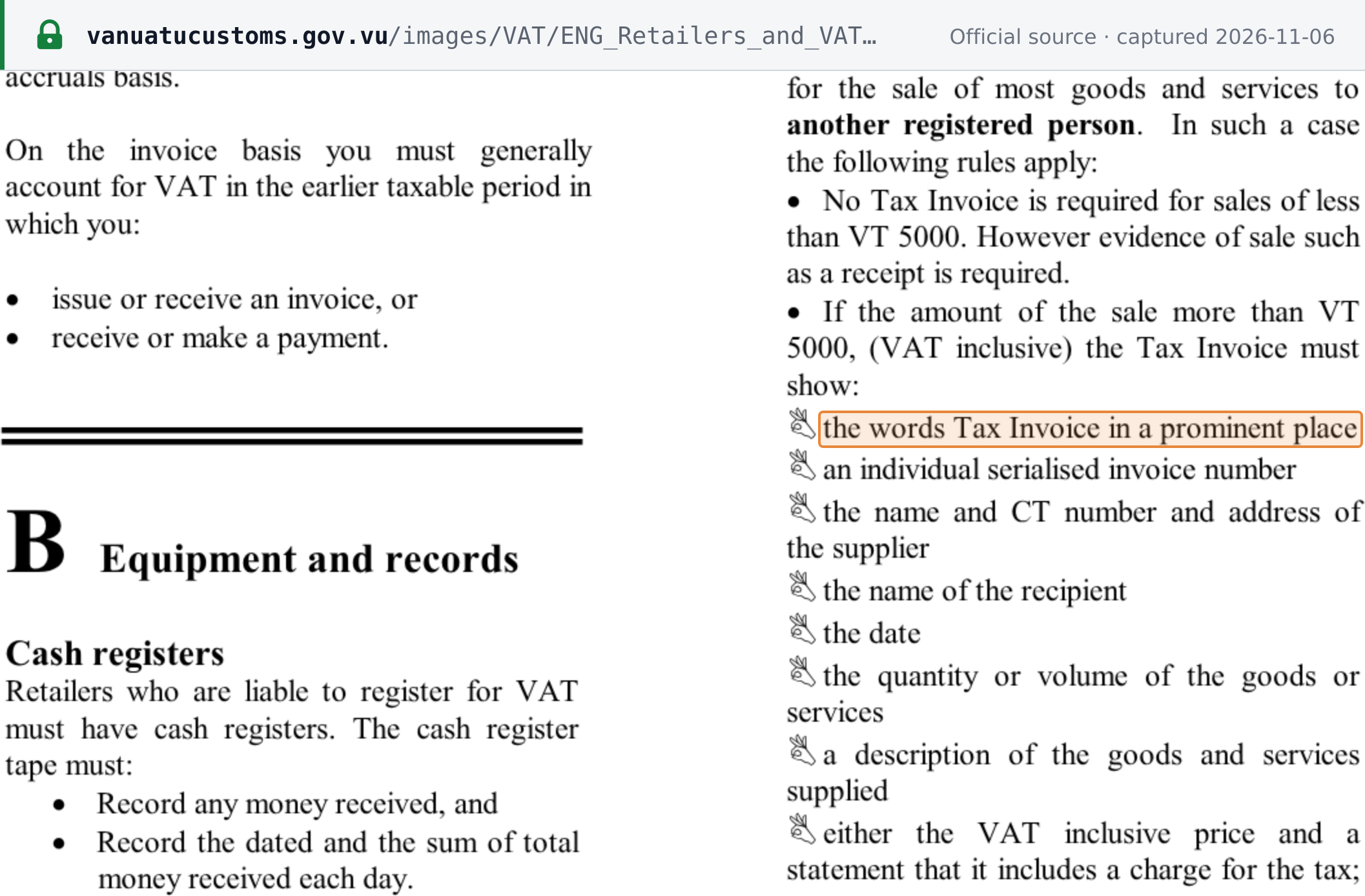 Source snapshot captured 2026-11-06 — original
The booklet predates the TIN and the 2018 rate change, and DCIR has published no newer list. Its one confirmed update is the TIN: "VAT registered persons need to note that they must state their TIN on the VAT tax invoices that they issue." [4]
 Source snapshot captured 2026-11-06 — original
VSMS fiscal-invoice particulars
Order No. 153 of 2025, clause 17(2), lists what every fiscal invoice must show: the type of receipt; the type of transaction; the method of payment; the cashier and accredited POS identification; item name or code; unit price and quantity; total; taxes and rates; total payable; the customer's TIN if the customer is a taxpayer; the business's name, TIN and premises; date and time; the sequential serial number; the serial number of the device's digital certificate; the digital signature; and it "must be in English". [15] The full device and QR-code rules are in the Vanuatu e-invoicing guide.
A specimen of a compliant invoice
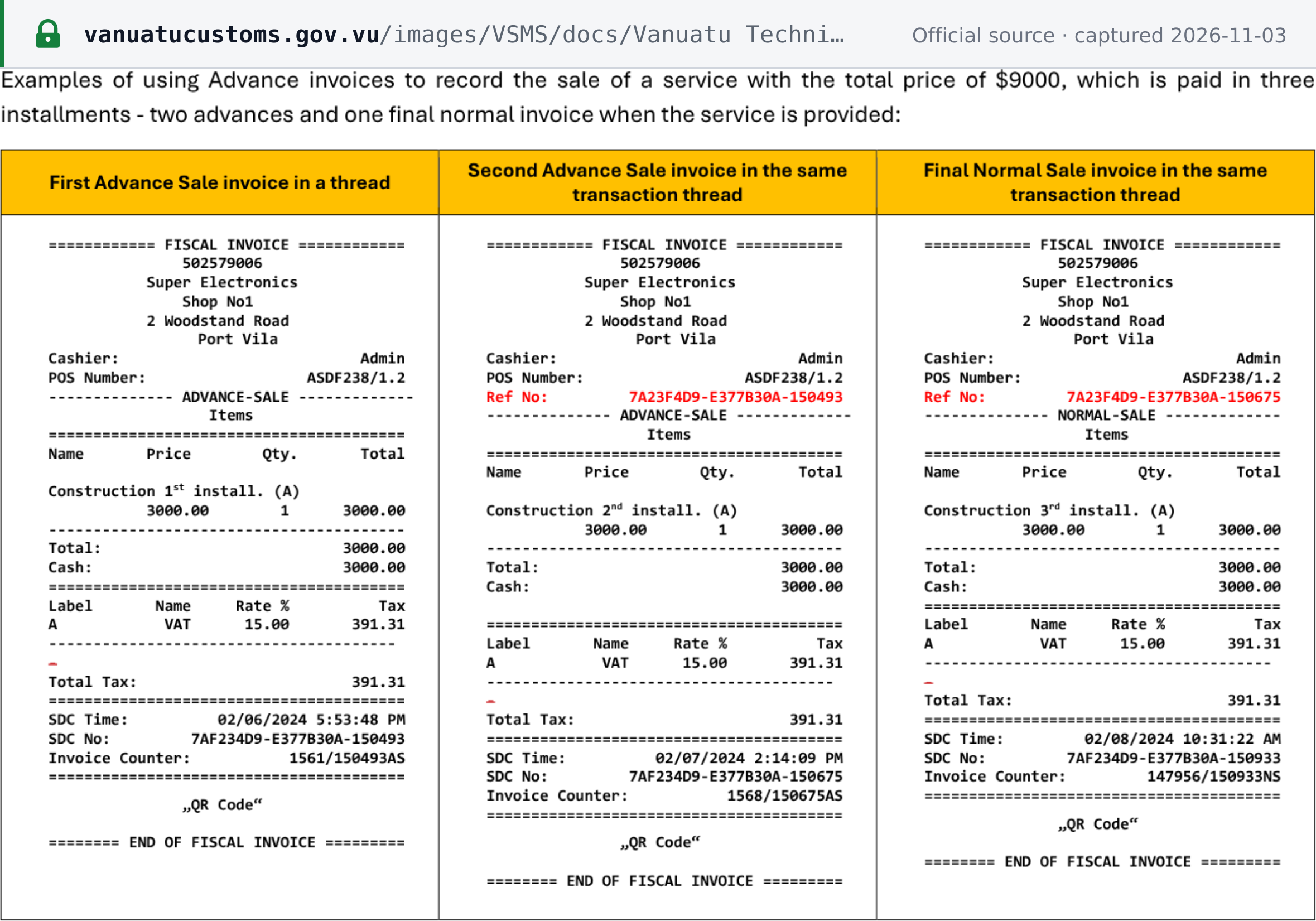
DCIR's VSMS Technical Guidelines for the Accreditation of EFD Solutions (version of 23 June 2025) include specimen fiscal invoices. This one records a service paid in three instalments: two ADVANCE-SALE invoices, then a final NORMAL-SALE invoice in the same transaction thread. Each shows the seller's TIN, name and premises, the cashier, the POS number, the item lines, the VAT label "A" at 15.00%, the tax amount, the SDC time and number, the invoice counter, the QR code and the "END OF FISCAL INVOICE" line. [14]
 Source snapshot captured 2026-11-03 — original
Read the specimen as a layout, not as data to copy:
- Its identifiers are placeholders. The seller number printed under the heading (
502579006) has nine digits, while DCIR's TIN lists use six-digit TINs. - Its dates (2024) and the "$9000" in the caption come from the generic template, not from a real Vanuatu sale.
- The VAT shown on each VT 3,000 VAT-inclusive instalment is 391.31; 3,000 × 15/115 is 391.30. Do not copy the arithmetic.
- It is a fiscal receipt from a VSMS device. It does not show the words "Tax Invoice" or a buyer name, which the DCIR booklet lists for a s.21 tax invoice.
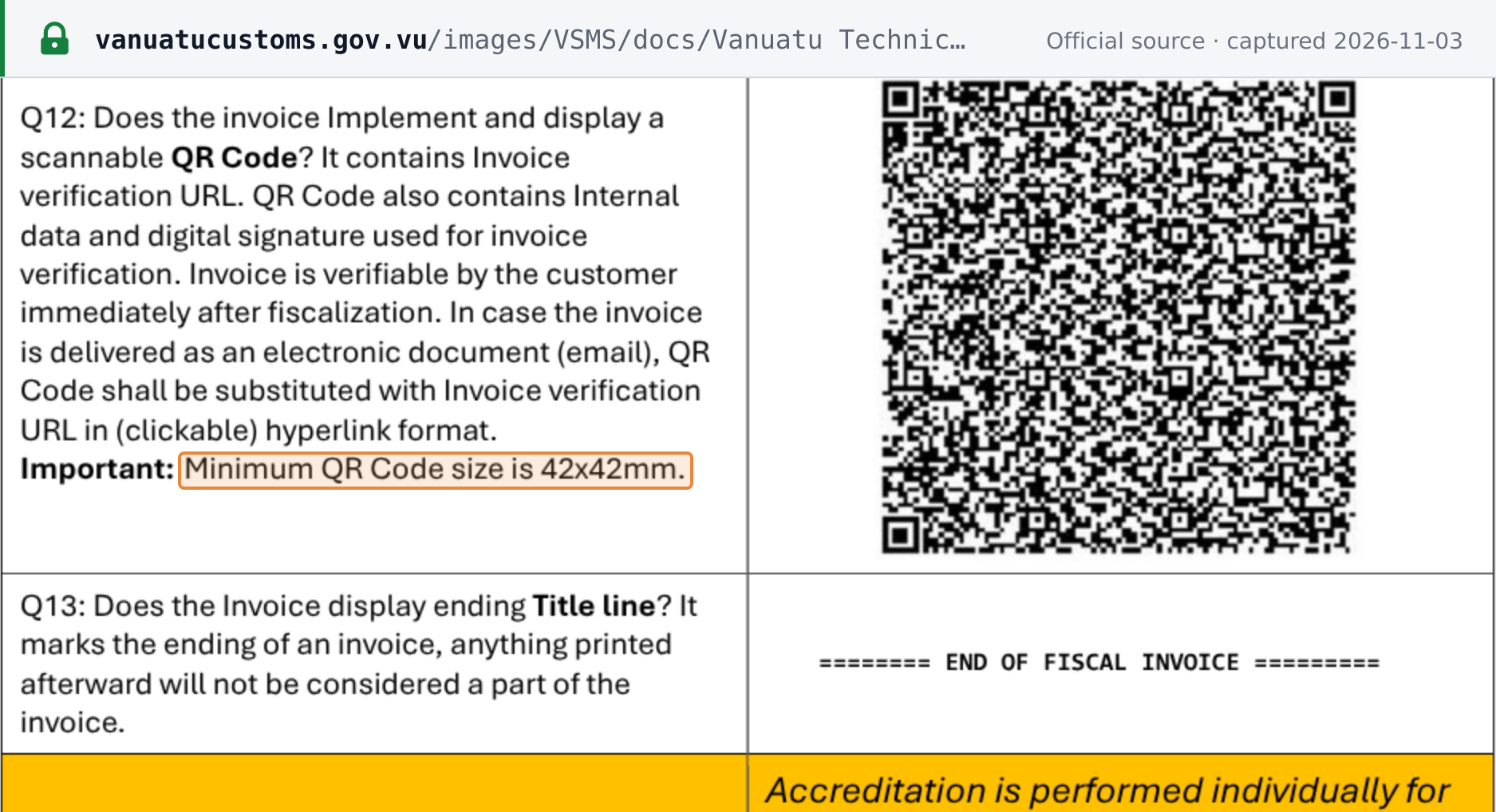
The QR code, verification URL and closing line are shown in a second excerpt from the same guidelines:
 Source snapshot captured 2026-11-03 — original
Numbering and sequencing
DCIR's booklet calls for "an individual serialised invoice number" on a tax invoice. [7] On a VSMS fiscal invoice the sequential serial number and invoice counter are generated by the device and covered by its digital signature (Order No. 153 cl.17(2)). [15]
Credit and debit notes
Where a tax invoice has been issued and the supply is cancelled, its nature is fundamentally varied, the price is altered or goods are returned, the supplier must issue a credit note if the tax shown "exceeds the correct amount of tax payable", or a debit note if it "is less than the correct amount payable", "containing the particulars specified in the approved form" (s.22(3)). No credit note is needed "if and to the extent that the excess results from a prompt payment discount which is clearly described on the face of the tax invoice" (s.22(4)(c)). [1] On VSMS devices, refunds are a transaction type ("refund") of the fiscal invoice. [15]
Currency and language
- Language. Records must "be maintained in English, French, or Bislama" (Tax Administration Act s.8(2)(a)). [2] A VSMS fiscal invoice "must be in English" (Order No. 153 cl.17(2)). [15]
- Currency. Tax must be paid in vatu (Order No. 154 of 2019, cl.12). [13] The VAT Act and DCIR's VAT guidance set no rule for invoicing in a foreign currency or for converting it to vatu (as at 2026-11-06).
Document types
- Tax invoice — for a registered customer who asks for one, above VT 5,000 (s.21).
- Below VT 5,000 — no tax invoice is required, but DCIR's booklet says "evidence of sale such as a receipt is required". [7]
- VSMS fiscal invoice — receipt types are normal, copy, training, pro-forma and advance. Training and pro-forma receipts must carry "This is not a Fiscal Invoice" (Order No. 153 cl.17(6)). [15] DCIR's VSMS FAQ: "Q: Can we continue to issue manual invoices now that we have the VSMS? A: No. All transactions must be recorded through an accredited EFD, and a fiscal invoice must be issued for each transaction." [21]
Self-billing
Permitted with the Director's prior approval. A registered recipient may create a document treated as the supplier's tax invoice if the document otherwise complies with s.21, "the Director has previously granted approval", the parties agree the supplier will not issue its own tax invoice, the supplier receives a copy, and "the words "buyer created tax invoice – VAT approved" are contained on the document in a prominent place" (s.21(2)). [1] DCIR's policy statement VP011 (April 2001) adds: "Written approval from the VAT Office is required prior to the issue any buyer created invoices." Its worked example uses older wording ("Buyer Created Tax Invoice") and the 12.5% rate; use the wording in the Act. [11]
Agents. An agent of a registered person may issue the tax invoice, credit note or debit note for the principal's taxable supply "as if the agent had made the taxable supply" (s.47(2)). [1]
Retention and audit trail
- Retention: 5 years. Records must "be retained for 5 years (or such other time as may be prescribed) after the end of tax period to which they relate" (Tax Administration Act s.8(2)(e)). They include "invoices, purchase orders, delivery dockets, receipts, contracts, and Customs documentation" (s.8(6)). [2] DCIR's records page: "Generally, records must be retained for at least 5 years after the end of the tax period to which they relate", extended where there has been an amended assessment or audit. [5] Some older DCIR brochures and booklets still say six years; the Act says five.
- Records abroad. "Records can be maintained outside Vanuatu but must be made available in Vanuatu if requested." [5]
- Electronic-only archiving. DCIR's VAT and records pages neither allow nor forbid keeping invoices only in electronic form.
- Audit trail. Under the VSMS, each fiscal invoice is digitally signed with a DCIR-issued Secure Element, carries a sequential counter, is transmitted to DCIR, and stays verifiable for at least 10 years on the VSMS portal. [14] [21]
E-invoicing status
Status (as at 2026-11-06): phased fiscalisation, in force since 1 August 2025. Vanuatu has no Peppol or clearance e-invoicing mandate. It has the Vanuatu Sales Monitoring System (VSMS): every sale by a VAT-registered business is recorded through an accredited electronic fiscal device (EFD), which issues a digitally signed fiscal invoice with a QR code and transmits the sale to DCIR. The legal basis is s.61 of the Tax Administration Act No. 37 of 2018, given effect by the Vanuatu Sales Monitoring System Regulation Order No. 153 of 2025, made on 1 August 2025. [17] [15]
Scope. B2B, B2G and B2C alike: a fiscal invoice must be issued "for each transaction between the business and the customer, in all its business branches" (Order No. 153 cl.15(1)(a)). [15]
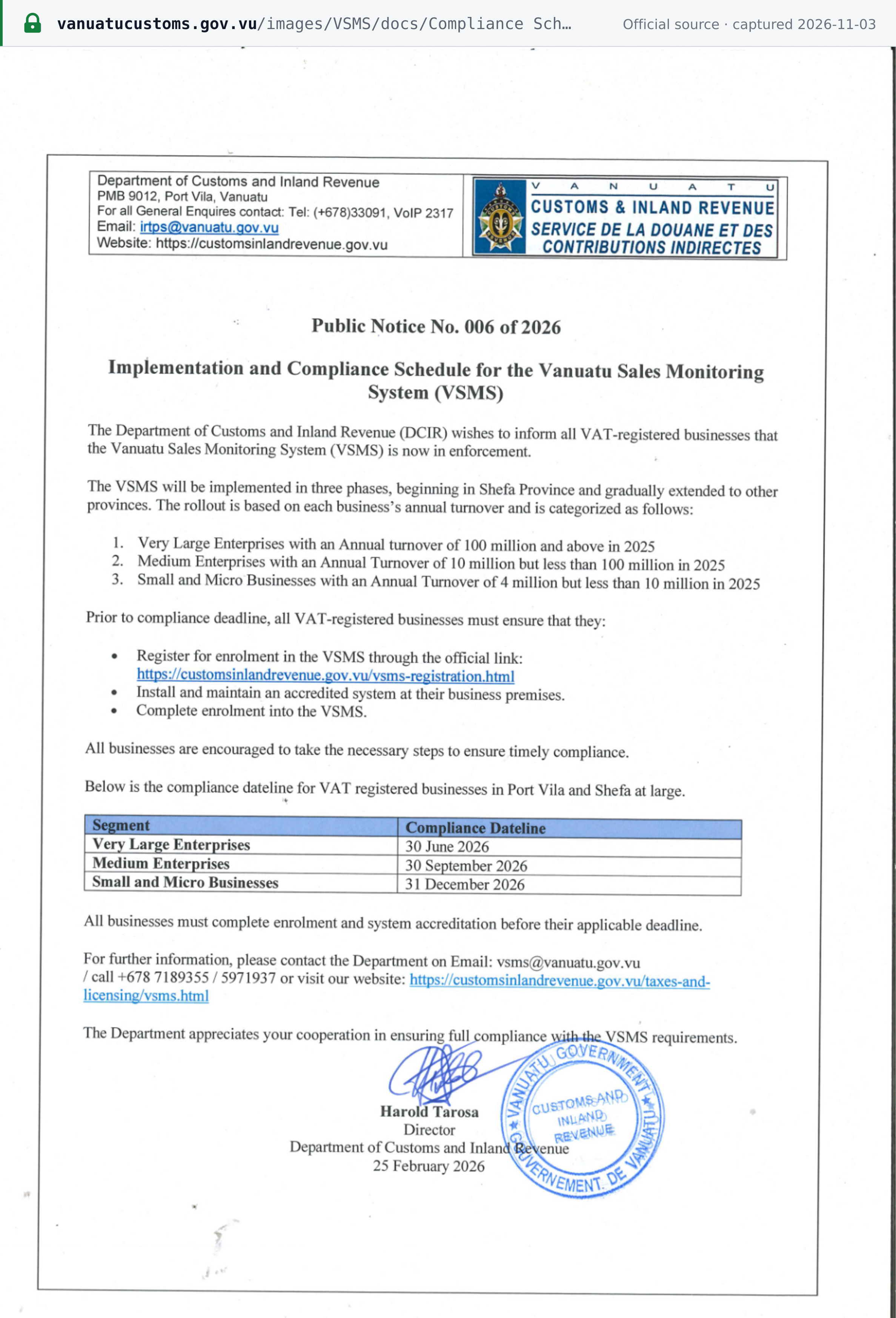
Phase timeline. DCIR Public Notice No. 006 of 2026 (25 February 2026) set deadlines for VAT-registered businesses in Port Vila and Shefa by 2025 annual turnover: [16]
| Segment (2025 annual turnover) | Compliance deadline |
|---|---|
| Very Large Enterprises: VT 100 million and above | 30 June 2026 |
| Medium Enterprises: VT 10 million to under VT 100 million | 30 September 2026 |
| Small and Micro Businesses: VT 4 million to under VT 10 million | 31 December 2026 |
 Source snapshot captured 2026-11-03 — original
No public notice yet sets deadlines for the other provinces, or for VAT-registered businesses below VT 4 million. Format: fiscal invoices produced by an accredited point-of-sale system and Sales Data Controller; DCIR prescribes no UBL, CII, Peppol or national XML format. Fines under Order No. 153 cl.18 reach VT 1,000,000. DCIR's Public Notice 011 of 2026 also sets administrative penalty notices of VT 250,000 to VT 577,500, depending on the offence and whether it is a first, second or third notice. [23] For the medium segment, DCIR published a list of 533 TINs eligible to apply for an extension (list current as at 16 September 2026). [18] The Vanuatu e-invoicing guide covers onboarding, devices, extensions and penalties in full.
Filing and payment
Filing frequency and due date
- Frequency. Monthly taxable periods (Category A) are the default. The Director "may place a registered person in Category B only if the person has made written application and the total value of that person's taxable supplies has not, in the twelve months ending with the last day of any month, exceeded eight million vatu" (s.15(3)); Category B periods are three months. [1] Form CT 201 puts it as: "You must file monthly if your annual turnover exceeds VT8 Million". [8]
- Due date. The 27th day of the month after the taxable period; for a period ending on 30 November, the 5th of January. A due date that is not a working day moves to the next working day (s.16(1)). [1]
 Source snapshot captured 2026-11-06 — original
- Nil returns. DCIR's 2025 due-date notice: "If the business does not operate or earns no income during a particular return period a Nil Return must still be filled by the due date." [22] As at 2026-11-06, DCIR's notices page carries a calendar for 2025 but none for 2026; the statutory rule above applies.
- Return form. DCIR's VAT return is a spreadsheet form on its forms page. DCIR's VAT pages describe no online filing portal.
- Accounting basis. Invoice basis or payments (cash) basis, by election. A person who does not elect "will be deemed to have elected to account for tax payable on a payments basis" (s.17(2)). [1]
- Additional listings. The VAT Act and DCIR's VAT pages provide for no annual VAT return and no sales or purchase listings.
Payment
"A registered person must pay any tax payable calculated under section 19 for a taxable period by the day on which the return must be filed for the period" (s.20). [1] Order No. 154 of 2019, cl.13, allows payment by electronic funds transfer where the Director requires it, otherwise "in cash or by cheque at any office of the Department", "by cheque sent by post to the post office box of the Department", or "in any other manner specified by the Director". A dishonoured cheque costs VT 7,500. [13]
Input-tax recovery and blocked items
Tax on purchases is deductible to the extent the goods or services are acquired for making taxable supplies, and only with a tax invoice held when the return is filed (s.19). [1] The Act has no list of blocked expenses. DCIR says "A number of adjustments might be required when calculating the tax to pay/refund (e.g., for private use of business assets, entertainment expenditure, bad debts recovered, barter transactions, and changes in the accounting basis used)." [3] DCIR's VAT Office Policy Statement VP005 (issued 15 March 1999) says "Claims for VAT paid on the purchase of motor vehicles can only be made once approval is granted by the VAT Office." [24]
Refunds
- Resident refunds. Where a return shows an excess of credits, "the Director will refund the amount to the registered person not later than 15 working days following the day on which the return of the registered person was received by the Director" (s.41(1)). The Director may withhold for investigation, unpaid tax or missing returns. [1]
- Interest on late refunds. 15% a year from the day after the refund was due (s.42(2)). [1]
- Bad-debt relief. Available where the debt has been written off and the Director has been informed in the approved form (s.23). [1]
- Non-resident refunds. The VAT Act has no refund scheme for unregistered non-residents.
Exemptions
Exempt supplies
Schedule 1 of the VAT Act exempts: [1]
- financial services — exchanging currency, cheques and letters of credit, debt and equity securities, providing credit, guarantees, life insurance and reinsurance, superannuation, futures, and arranging these, "other than merely advising on those services";
- donated goods or services supplied by a non-profit body;
- residential accommodation in a dwelling by way of hire, and rental of leasehold land used for a dwelling;
- the sale of a dwelling used for 5 years or more exclusively for residential letting;
- education by an educational institution (registered pre-schools, primary and secondary schools, the University of the South Pacific, or another institution the Director approves).
Exempt is not zero-rated
DCIR: "Exempt supplies are completely excluded from the VAT regime – no VAT is charged on them and VAT cannot be claimed back on the expenses incurred in supplying them. With zero-rated supplies, however, VAT is charged at the rate of 0% on the supply but VAT can be claimed back for expenses incurred in making the supply." [3] See the zero-rated vs exempt explainer.
Special regimes
- Cash accounting. Yes: the payments basis under s.17, which is also the default.
- Small-business scheme. None in the VAT Act; businesses below VT 4 million simply need not register. DCIR also administers a separate Turnover Tax, which is not part of VAT and is not covered here.
- Free zones and margin schemes. The VAT Act has none. Second-hand goods bought from unregistered sellers give a notional input credit (s.19(4)(c)), with records required (s.21(6)).
Offences and penalties
All figures in this section are as at 2026-11-06 and come from the Tax Administration Act No. 37 of 2018 as enacted. DCIR's legislation page lists a Tax Administration Amendment Act No. 14 of 2021 but does not publish its text, so a figure may since have been amended. [19]
Administrative penalties and criminal offences are both in Part 15 of the Tax Administration Act No. 37 of 2018. They are alternatives: "A person cannot be subject to both the imposition of a penalty and prosecution of an offence for the same act or omission" (s.83(1)). [2]
Offences
Section 103 makes these VAT offences: failing to apply for registration; failing to display the registration certificate, to apply for cancellation or to provide a tax invoice, credit note or debit note; issuing multiple tax invoices; and, for an unregistered person, issuing a tax invoice ("A person who is not a registered person commits an offence if the person issues a tax invoice, credit note, or debit note", s.103(3)). It is also an offence to receive or deal with goods or services knowing, or having reason to believe, that the VAT on them "has been or will be evaded" (s.103(4)). [2] Schedule 4 sets the sanctions: [2]
| Offence | First conviction | Later conviction |
|---|---|---|
| VAT offences (s.103), failure to file (s.95(1)) | Fine up to VT 100,000, up to 3 months' imprisonment, or both | Fine up to VT 500,000, up to 12 months, or both |
| Records offences (s.94) | Fine up to VT 250,000 or up to 3 months | Fine up to VT 1,000,000, up to 12 months, or both |
| Fraudulent records, statements and documents (s.99), obstruction (s.100), and offences on recovery of unpaid tax, TINs and taxation officers (ss.96, 98, 101) | Fine up to VT 1,000,000, up to 12 months, or both | Fine up to VT 2,000,000, up to 24 months, or both |
The VSMS adds its own offences under Order No. 153 cl.18, with fines of VT 1,000,000; see the e-invoicing guide.
Penalties
| Failure | Penalty | Tax Administration Act |
|---|---|---|
| Failing to apply for VAT registration | The higher of 75% of the VAT payable for the period, or VT 100,000 | s.91(1) |
| Failing to provide a tax invoice, credit note or debit note; issuing multiple; not displaying the certificate; not applying for cancellation; not displaying VAT-inclusive prices | VT 50,000 each | s.91(2) |
| Unregistered person issuing a tax invoice, credit note or debit note | VT 100,000 | s.91(3) |
| Late filing | VT 30,000 (individual) or VT 50,000 (entity), plus VT 3,000 or VT 5,000 per day once the return is more than 7 days late | s.86 |
| Late payment | 5% of the unpaid tax, plus late-payment interest | s.87 |
| Failing to keep records | 20% of the period's tax (75% if deliberate or reckless); VT 30,000 or VT 50,000 where no tax is payable | s.85 |
| Failing to apply for a TIN | VT 10,000 for each month | s.84(1) |
Late-payment interest: 20% a year. "For the purposes of section 33 of the Act, the rate of late payment interest is 20% per annum" (Order No. 154 of 2019, cl.15(1)). [13] DCIR's penalties brochure: "Late payment interest is charged: at the daily rate of 20% p.a. on the outstanding balance for each day until payment is made", and "The new regime applies from 1 January 2020". [12]
Frequently asked questions
Do we have to issue both a VAT tax invoice and a VSMS fiscal invoice in Vanuatu?
They are two separate obligations. Under section 21 of the VAT Act [CAP 247], a registered person who makes a taxable supply to another registered person must provide a tax invoice within 28 days of that customer asking for one; no tax invoice is required where the consideration does not exceed VT 5,000. Separately, the Vanuatu Sales Monitoring System Regulation Order No. 153 of 2025 requires a VAT-registered taxpayer to issue a fiscal invoice through an accredited electronic fiscal device for every transaction, phased in by turnover under Public Notice No. 006 of 2026. The fiscal invoice shows the customer's TIN where the customer is a taxpayer. DCIR's VSMS FAQ says manual invoices can no longer be issued once the VSMS applies to the business.
We are a foreign company selling services to customers in Vanuatu. Do we need to register for VAT?
Usually not, if you have no fixed place of business in Vanuatu. Section 7(1) of the VAT Act (Consolidated Edition 2020) deems supplies by a non-resident that does not carry on business in Vanuatu through a fixed place of business to be made outside Vanuatu. The exceptions in section 7(2) are goods that are in Vanuatu at the time of supply and services physically performed in Vanuatu by a person who is in Vanuatu at the time. Even those are treated as supplied outside Vanuatu when the customer is a registered person entitled to deduct the tax, unless both parties agree otherwise (section 7(3)). A non-resident caught by section 7(2) registers under the ordinary VT 4 million test. The Act has no reverse charge and no rule for digital or remote services or marketplaces.
Our turnover is below VT 8 million. Can we file VAT returns quarterly instead of monthly?
Yes, on written application. Monthly (Category A) taxable periods are the default. The Director may place a registered person in Category B, with three-month taxable periods, only if it has applied in writing and its taxable supplies in the twelve months ending with any month have not exceeded eight million vatu (VAT Act s.15(3)). Returns and payment are due on the 27th day of the month after the period ends; for a period ending on 30 November they are due on 5 January. A due date on a weekend or public holiday moves to the next working day. A nil return must still be filed.
Our old invoices show a CT number. What registration number goes on a Vanuatu tax invoice now?
The Tax Identification Number (TIN). TINs were introduced from 1 January 2020 under Part 2 of the Tax Administration Act No. 37 of 2018, and DCIR says a CT number previously issued becomes the person's TIN, with no new application needed. DCIR's TIN page says VAT registered persons must state their TIN on the VAT tax invoices that they issue. A person can have only one TIN at any time.
How long must we keep invoices and other VAT records in Vanuatu?
Five years after the end of the tax period to which they relate (Tax Administration Act No. 37 of 2018, s.8(2)(e)), longer while an amended assessment or audit is open. Records include invoices, purchase orders, delivery dockets, receipts, contracts and Customs documentation, and must be kept in English, French or Bislama. Older DCIR brochures and booklets give six years; the Act and DCIR's current records page say five. Records may be kept outside Vanuatu but must be made available in Vanuatu on request.
Important websites
| Site | What it is for |
|---|---|
| DCIR — Value Added Tax | Rates, registration rules, due dates and links to VAT forms and brochures |
| DCIR — Forms | TIN application, VAT registration (CT 201), cancellation (CT 209) and the VAT return form; no online registration or filing portal is offered |
| DCIR — Tax Identification Numbers | How to get a TIN and when to use it; DCIR offers no public TIN lookup |
| DCIR — VSMS | VSMS registration, accredited solutions and guidance for fiscal invoices |
| VSMS Taxpayer Administration Portal | Taxpayer log-in for the VSMS |
| VSMS public portal | Verify a fiscal invoice |
| DCIR — Legislation | The VAT Act, the Tax Administration Act and amending Acts |
| DCIR — Public notices | Due-date calendars, VSMS deadlines and other announcements |
| Vanuatu Financial Services Commission | Company registry |
Recent changes
- 2026-09-16 — DCIR published its list of 533 medium-segment TINs eligible to apply for a VSMS extension (list current as at 16 September 2026). (DCIR — VSMS extension) — see event
- 2026-02-25 — Public Notice No. 006 of 2026 set VSMS compliance deadlines for Port Vila and Shefa: 30 June, 30 September and 31 December 2026 by 2025 turnover. (DCIR — Public Notice No. 006 of 2026) — see event
- 2025-08-01 — Vanuatu Sales Monitoring System Regulation Order No. 153 of 2025 made and in force: fiscal invoices through accredited devices for VAT-registered businesses. (DCIR — VSMS)
- 2020-01-01 — TINs replace CT numbers and the Tax Administration Act's penalty regime applies. (DCIR — TIN; DCIR — Penalties brochure)
- 2018-01-01 — Standard rate raised from 12.5% to 15%. (DCIR — notice to retailers)
For the full chronology, see Vanuatu tax changes on Lookuptax.
Reference links
Legislation (as published by DCIR):
- [1] Value Added Tax Act [CAP 247] — Consolidated Edition 2020
- [2] Tax Administration Act No. 37 of 2018
- [13] Tax Administration Regulation Order No. 154 of 2019
- [15] Vanuatu Sales Monitoring System Regulation Order No. 153 of 2025
- [19] DCIR — Legislation index
Department of Customs and Inland Revenue guidance:
- [3] Value Added Tax (VAT) — introduction
- [4] Tax Identification Numbers
- [5] VAT records
- [6] Change of VAT rate to 15 per cent — notice to retail businesses
- [7] Retailers and VAT (booklet, June 2005)
- [8] Application for VAT Registration (form CT 201)
- [9] Registering for VAT (brochure, 2021)
- [10] Application to cancel registration (form CT 209)
- [11] VAT Office Policy Statement VP011 — Buyer Created Invoices (April 2001)
- [12] Penalties (brochure, 2021)
- [22] VAT and Non-Tax Due Dates — 2025
- [24] VAT Office Policy Statement VP005 — VAT expense claims for motor vehicles (issued 15 March 1999)
- VAT rate change — Transitional Guide
VSMS (fiscal invoices):
- [14] VSMS Technical Guidelines for the Accreditation of EFD Solutions (23 June 2025)
- [16] Public Notice No. 006 of 2026 — VSMS compliance schedule
- [17] DCIR — Vanuatu Sales Monitoring System
- [18] DCIR — VSMS extension (medium segment)
- [23] Public Notice 011 of 2026 — VSMS extension (Large Segment) and schedule of penalties
- [20] VSMS eligible TIN list — medium segment
- [21] VSMS FAQ
Related on Lookuptax: