Zambia VAT guidelines
| FACTSHEET | |
|---|---|
| Country code | ZM |
| Tax name | Value Added Tax (VAT) |
| Tax Authority | Zambia Revenue Authority (ZRA) |
Overview
Zambia levies Value Added Tax (VAT) under the Value Added Tax Act (Chapter 331 of the Laws of Zambia). ZRA's brochure Introduction to VAT: "Value Added Tax (VAT) is an indirect tax introduced in Zambia on 1st July 1995 to replace Sales Tax. It is levied, charged, and collected on taxable supplies of goods and services and on imported goods and services." [9]
Section 8(1), as substituted by the VAT (Amendment) Act No. 27 of 2023 (in force 1 January 2024), charges the tax on "(a) taxable supply of goods or services, other than zero-rated supply, made in the Republic in furtherance of a business by a registered supplier eligible for registration under section 28; and (b) taxable importation of goods or services into the Republic". [4]
Authority. VAT is administered by the Commissioner-General of the Zambia Revenue Authority (ZRA).
Currency. The Zambian kwacha (ZMW; the statutes and ZRA write "K"). Smart Invoice can also issue invoices in five foreign currencies (see Currency, language and exchange rate).
Tax period. The calendar month by default; the return is due by the 18th of the following month (see Filing and payment). Quarterly and six-monthly periods are available in the cases below.
Layering. None. VAT is a single national tax; there is no provincial or local VAT.
Scope. Free zones and multi-facility economic zones are not covered.
For neighbouring systems, see the Malawi VAT guide, the Tanzania VAT guide, the Zimbabwe VAT guide, the Botswana VAT guide and the DR Congo VAT guide.
Registration
Who should register
ZRA's Introduction to VAT (2026) sets out who is eligible: [9]
- "1. Every person dealing in taxable supply of goods or services (other than exempt suppliers)."
- "2. Mandatory registration if annual taxable supplies exceed K800,000."
- "3. Voluntary registration option if turnover is above K400,000 but below the threshold. This includes suppliers who have exceeded the threshold of K200,000 per quarter."
"Suppliers dealing solely in exempt supplies cannot register for VAT." The legal home of the registration threshold is section 28 of the VAT Act.
Registration threshold
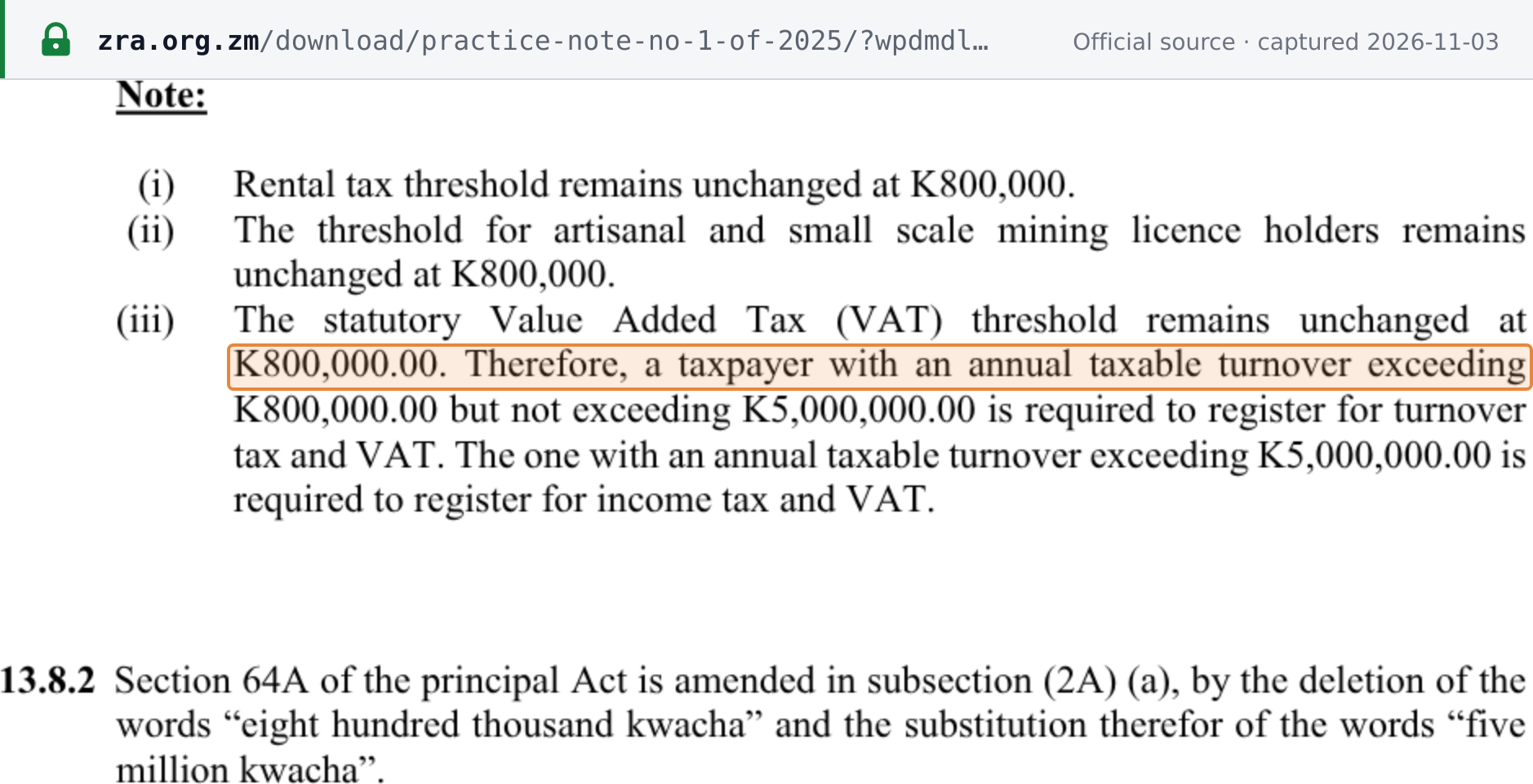
K800,000 (ZMW 800,000) of annual taxable turnover (as at 2026-11-03). ZRA Practice Note No. 1 of 2025, on the 2025 budget legislation: "The statutory Value Added Tax (VAT) threshold remains unchanged at K800,000.00. Therefore, a taxpayer with an annual taxable turnover exceeding K800,000.00 but not exceeding K5,000,000.00 is required to register for turnover tax and VAT. The one with an annual taxable turnover exceeding K5,000,000.00 is required to register for income tax and VAT." [2]
- Measurement. Annual taxable turnover (taxable supplies).
- Quarterly figure. ZRA's brochure also mentions "the threshold of K200,000 per quarter", but places it inside the voluntary-registration item quoted above. ZRA's guidance does not state that crossing K200,000 in one quarter makes registration mandatory.
- VAT sits beside the income-tax regime. In the K800,000 to K5,000,000 band, VAT registration comes on top of Turnover Tax registration, not instead of it.
 Source snapshot captured 2026-11-03 — original
Non-resident registration
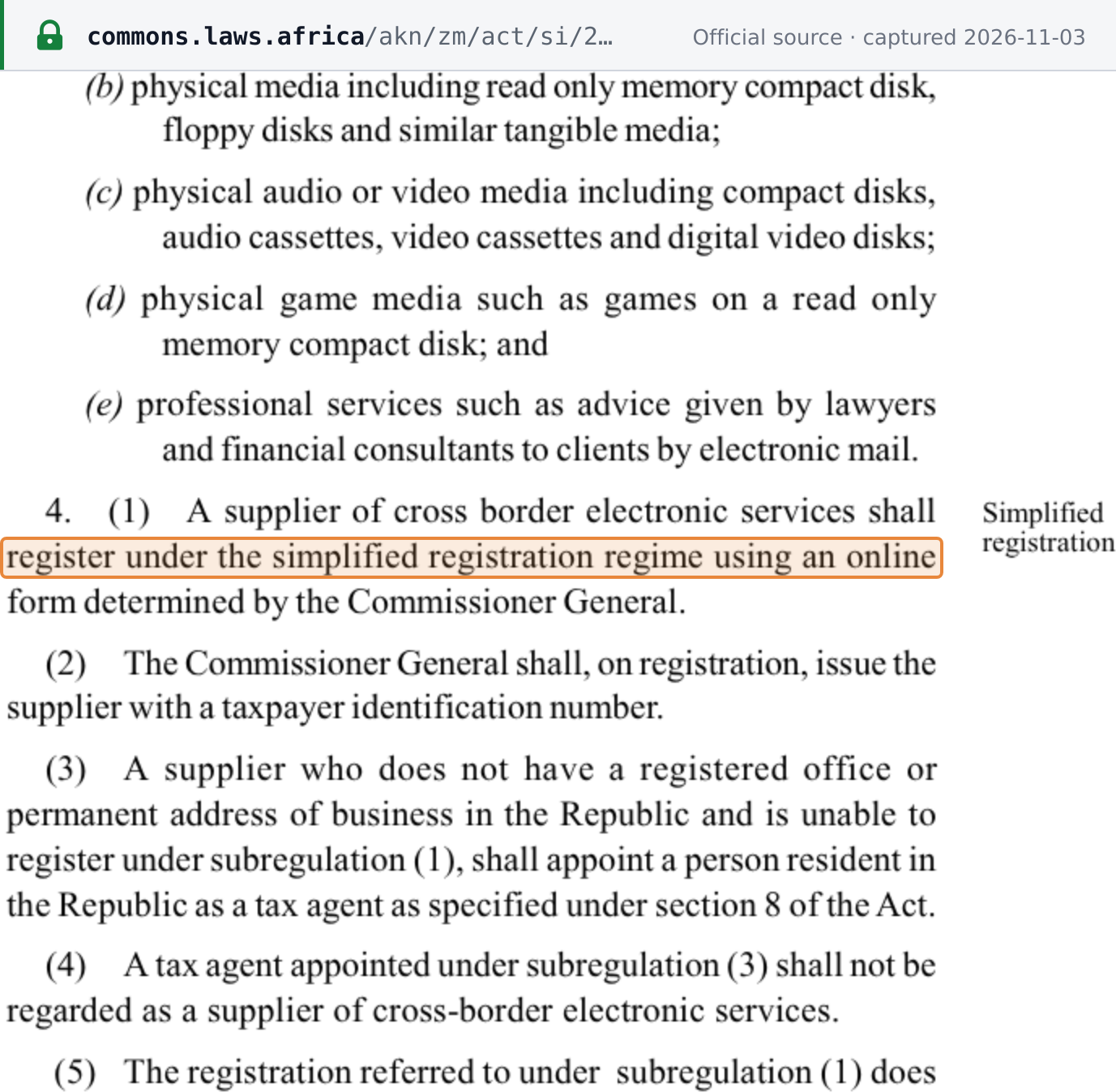
Cross-border electronic services: simplified registration, no threshold in the Regulations. The VAT (Cross Border Electronic Services) Regulations, 2024 (Statutory Instrument No. 18 of 2024, gazetted 26 February 2024), regulation 4: [7]
- "(1) A supplier of cross border electronic services shall register under the simplified registration regime using an online form determined by the Commissioner General."
- "(2) The Commissioner General shall, on registration, issue the supplier with a taxpayer identification number."
- "(3) A supplier who does not have a registered office or permanent address of business in the Republic and is unable to register under subregulation (1), shall appoint a person resident in the Republic as a tax agent as specified under section 8 of the Act."
SI 18/2024 sets no turnover threshold for this registration, and "does not create a permanent establishment for income tax purposes" (reg. 4(5)).
 Source snapshot captured 2026-11-03 — original
Other non-resident suppliers: a resident tax agent. New section 8(8), inserted by Act No. 27 of 2023: "A supplier who does not have a registered office or permanent address of business in the Republic shall appoint a person resident in the Republic as a tax agent to act on behalf of that supplier in matters relating to tax." ZRA's Reverse VAT brochure adds that, for services supplied to a VAT-registered person in Zambia, "the non-resident supplier must appoint a VAT-registered business in Zambia to act as its tax agent". Where no agent is appointed, the Zambian recipient accounts for the VAT (see Reverse VAT on imported services). [4] [10]
Tax identification number (TPIN)
VAT is registered against the Taxpayer Identification Number (TPIN). ZRA: "A Taxpayer Identification Number (TPIN) is a unique computer generated number allocated to a taxpayer under any of the following entities: Limited company / Partnership / Sole trader/proprietor / Other". [18]
- Format. ZRA's Smart Invoice API defines
tpinas "Taxpayer's identification number as registered on core Tax Administration System TaxOnline", aVARCHARof length 10, and every sample value is 10 digits (for example1000000000). ZRA publishes no check-digit rule. [14] - Validate a TPIN: Zambia TPIN validator.
How to register
The TPIN comes first. For companies and business names registered with PACRA, ZRA says: "For businesses registered after 2020, the TPIN is generated as soon as you finish the registration with PACRA. Check your email for the credentials and log into ZRA account to complete your Registration." Non-resident companies use the "Get a TPIN" link. [21]
VAT is then added to the TPIN on the ZRA portal. ZRA's brochure gives the steps: "Login to ZRA portal (www.zra.org.zm) with TPIN, password and enter the captcha provided … Click registration module → tax type amendment … Answer YES to the question "Are you dealing in taxable goods & services for VAT purposes?" … Submit for review". ZRA's published guidance does not state a processing time. [9]
Every VAT-registered business must also sign up for Smart Invoice (see E-invoicing status). For the general process across countries, see how to register for VAT, sales tax or GST.
Voluntary registration
Available above K400,000 of turnover. ZRA's brochure: "Voluntary registration option if turnover is above K400,000 but below the threshold." The registration lasts a year at a time: "Taxpayers registered for voluntary VAT have an obligation to renew their application at the beginning of every year. The renewal process must be done 30 days before the beginning of the new charge year." The application needs the latest three months' bank statements, a business plan and a 12-month cash-flow projection. [9]
ZRA Practice Note No. 1 of 2026, on the 2026 budget legislation, records an income-tax change affecting voluntary registrants: "The amendment removes the requirement for businesses on voluntary Value Added Tax (VAT) to register for income tax. Prior to this amendment, businesses on voluntary Value Added Tax (VAT) were not allowed to register for turnover tax." [11]
Deregistration
- Notify within one month. "A registered supplier shall, within one month after the occurrence of any of the following events, notify the Commissioner General in writing of the event concerned:- (a) the registered supplier ceasing to make taxable supplies or the taxable turnover falling below the turnover for the period prescribed and in force under subsection (1) of section twenty-eight of the Act" (VAT General Rules r.16). The same rule covers changes of ownership, name, address, premises and the nature of the business. [8]
- Voluntary registrants who do not renew. "A supplier who fails to notify the Commissioner-General of the supplier's intention to renew the registration as required under sub-rule (5) shall be de-registered and any liability due shall immediately become payable" (r.17(6)). [8]
- Close the Smart Invoice installation within 30 days. New regulation 10(1) of the EIS Regulations, as reproduced in Practice Note No. 1 of 2025: "A taxable supplier shall, where a taxable supplier discontinues the use of an approved invoicing system as a result of cessation of business or any other reason, submit a written request to the Commissioner General to deactivate the approved invoicing system, within thirty days of discontinuing the use of an approved invoicing system." Failing to do so is an offence punishable by up to 30,000 penalty units (reg. 10(3)). [2]
- Settle partial-exemption attribution within 30 days. "Where a supplier's registration is cancelled, the supplier … shall, within thirty days after that date, lodge with the Commissioner-General a statement adjusting any difference in input tax previously attributed to taxable supplies during that period" (VAT General Rules r.11(2)). [8]
Group registration
ZRA's published VAT guidance (the Introduction to VAT brochure and Practice Notes No. 1 of 2024, 2025 and 2026) and the VAT General Rules as restated in 2018 describe no VAT group registration.
Rates
| Rate | Applies to | Smart Invoice category |
|---|---|---|
| 16% (standard) | Every taxable supply and import not zero-rated or exempt | A (and B, Minimum Taxable Value goods) |
| 0% | Zero-Rating Order supplies: exports, supplies to privileged persons against an LPO, and the listed groups below | C1 exports · C2 zero-rating LPO · C3 zero-rated by nature |
| Exempt | Exemption Order supplies (see Exemptions) | D |
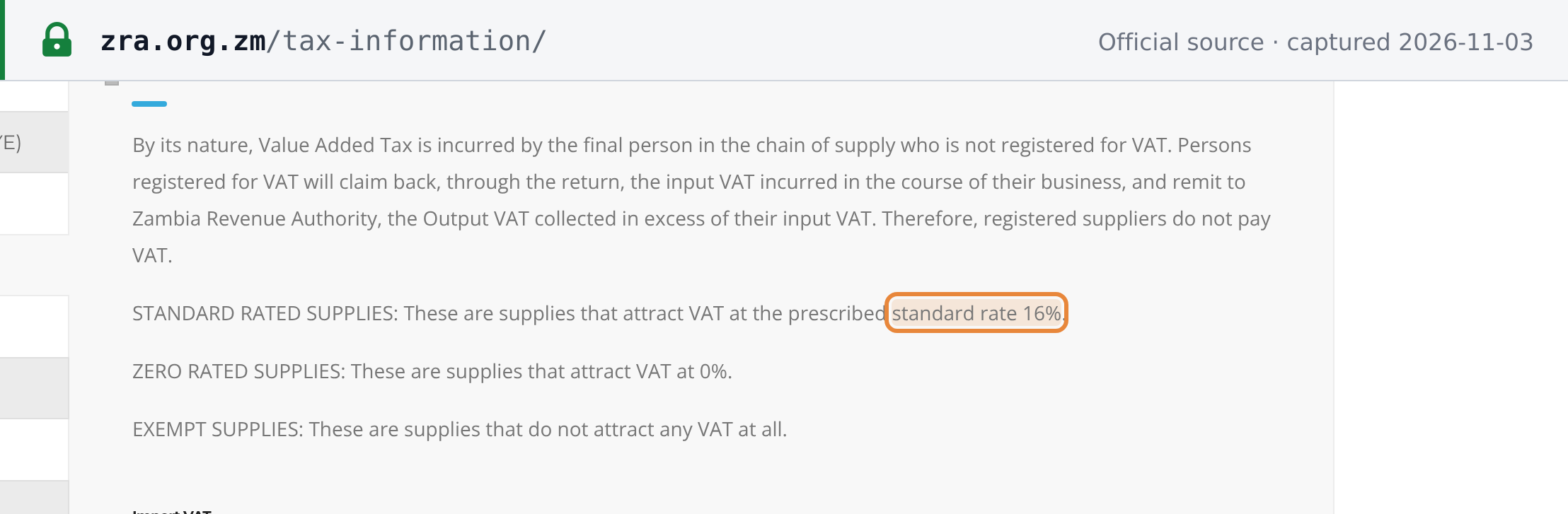
Standard rate: 16% (as at 2026-11-03). ZRA's Tax Information page: "STANDARD RATED SUPPLIES: These are supplies that attract VAT at the prescribed standard rate 16%. ZERO RATED SUPPLIES: These are supplies that attract VAT at 0%. EXEMPT SUPPLIES: These are supplies that do not attract any VAT at all." Practice Note No. 1 of 2026 gives the same table: "Standard Rate 16% / Zero-Rate 0% / Exempt Not taxable". ZRA's current guidance does not state when the 16% rate took effect. [1] [11]
 Source snapshot captured 2026-11-03 — original
"Any supply not listed in the VAT Exemption or Zero-Rating Orders is deemed standard rated" (ZRA, Introduction to VAT). [9]
Minimum Taxable Value. Smart Invoice category B: "16% is charged on the Retail Price recommended by manufacturer of MTV goods" (VSDC API specification §6.1). [14]
Zero rate. The VAT (Zero-Rating) Order, 2014 (SI 69 of 2014), as amended, lists the zero-rated groups. Its base groups include export of goods (with freight transport to or from Zambia and transit), supplies to privileged persons, building supplies, mosquito nets, medical supplies, educational materials, agricultural equipment, and food and agriculture. ZRA's examples: [9]
- "Export of goods (with evidence of exportation)"
- "Goods imported by diplomats (with reciprocal privileges)"
- "Supplies to donors for official purposes (with evidence)"
- "Supplies of cement, roofing sheets, bricks, blocks to approved public benefit organisations for non-profit/humanitarian activities"
Recent changes to the Order:
- From 1 January 2026: mains water and sewerage are zero-rated. The VAT (Zero Rating) (Amendment) Order, 2025 (SI 95 of 2025) inserts "12. Water Supply Services — The supply of mains water and sewerage services, excluding sewerage pump out services", and "shall come into operation on 1st January, 2026". [19]
- From 19 August 2025: ICT equipment is standard-rated. Practice Note No. 1 of 2026 §27: "The Schedule to the principle Order is amended by the deletion of Group 12. This amendment standard rates the supply of Information and Communication Technology equipment for VAT purposes." [11]
Zero-rating LPOs. A privileged person buys at 0% only by handing over a VAT zero-rating Local Purchase Order at the time of purchase. Practice Note No. 1 of 2024 §43: "In an event that a person who qualifies to obtain and issue an LPO does not avail an LPO to the supplier at the time of purchase, the supplier is mandated to charge VAT at the standard rate. Such VAT, as correctly charged in the absence of a VAT LPO, will not be refunded in a case where such a person subsequently avails an LPO to prompt the refund." On Smart Invoice the LPO number goes in lpoNumber (category C2). [12]
Reduced rates. None. ZRA's rate table lists only 16%, 0% and exempt.
Announced future rates. None announced as at 2026-11-03.
See worldwide tax rates for other countries.
Cross-border rules
Imports and exports
- Imports of goods. New s.8(4) (Act No. 27 of 2023): "Tax on an importation of goods shall be charged as if the tax were a duty of customs under the Customs and Excise Act, and is payable, accordingly, by the importer of the goods." ZRA: import VAT is "charged on all imported goods according to the applicable domestic rate i.e. standard rate of 16%, zero or exempt." [4] [22]
- Import VAT deferment. "Import VAT deferment is a facility available to eligible VAT-registered businesses that allows them to defer payment of VAT at the time of importation on specified capital goods and equipment. In Zambia, the scheme applies only to goods listed in the Third Schedule to the VAT General Rules, and access is subject to approval by the Commissioner-General …" The importer then "foregoes the equivalent input tax credit or deduction in respect of the deferred import VAT under section 18 of the VAT Act." [23]
- De-minimis. ZRA's importation page lists duty-free thresholds for postal consignments (USD 50, and personal-use parcels up to USD 1,000 with conditions). It does not say whether VAT is also relieved. [22]
- Exports. Exports of goods are zero-rated with evidence of exportation (Smart Invoice category C1). "A taxable supplier shall, within six months from the date of export, produce the documents referred to in sub-rule (1), to an authorized officer" (VAT General Rules r.18(2)). [8] Ancillary transit services are not: Practice Note No. 1 of 2026 §51.4, "Effective 1st January 2020, ancillary services provided in relation to transit of goods through Zambia from outside the Republic to destinations outside the Republic are standard rated with the exception of transshipment. Therefore, services such as escort security services, clearing services and storage services are standard rated." §51.2: "The service of loading cargo for export, including exports out of bond, is standard rated." [11]
- Mineral exports need a Smart Invoice commercial invoice. VSDC API specification §5.10: "For all export of goods and incidental services (e.g. Transport and Insurance), suppliers will be required to issue a commercial invoice using Smart Invoice." It is marked "Required for mining sector": "A commercial invoice is required before any export of minerals, and should be followed by customs declaration, Provisional invoice (If applicable) and Final Tax Invoice or Final credit note". [14]
Reverse VAT on imported services
An "imported service" is "a service rendered by a supplier who is resident outside the Republic and— (a) performed or undertaken in the Republic; or (b) the benefit of the service is for a recipient in the Republic" (s.2, as amended by Act No. 27 of 2023). New s.8(5)–(7): [4]
- "(5) A recipient of an imported service shall pay tax on the importation of that service."
- "(6) The tax referred to under subsection (5) shall be paid if the— (a) recipient of the imported service has not paid tax due in the country of exportation; (b) the supplier who is resident outside the Republic has not appointed a tax agent; or (c) services supplied are not under the scope of cross-border electronic services." Act No. 23 of 2024 (in force 1 January 2025) substituted paragraph (c): "services supplied are not under the prescribed scope of cross-border electronic services." [5]
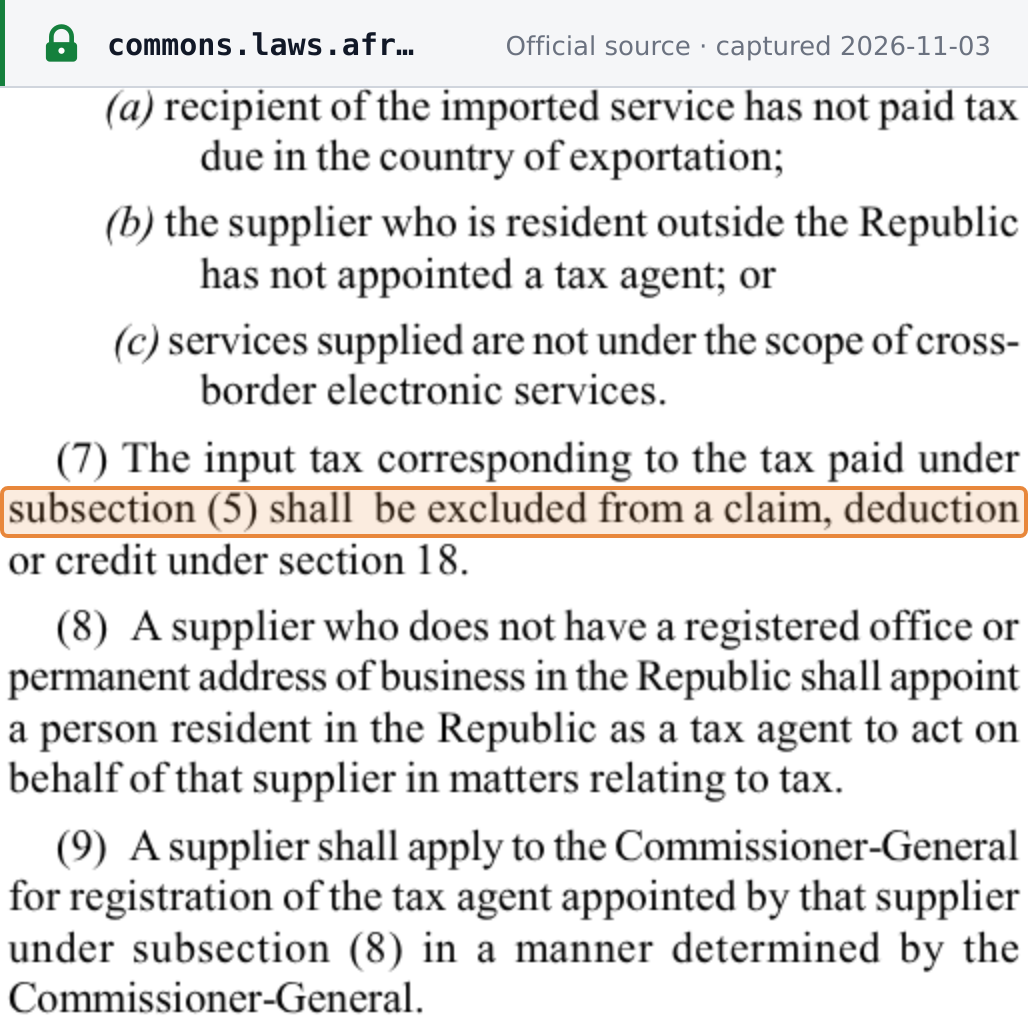
- "(7) The input tax corresponding to the tax paid under subsection (5) shall be excluded from a claim, deduction or credit under section 18."
Because the conditions in s.8(6) are joined by "or", any one of them is enough for the recipient to owe the tax, and that tax cannot be recovered as input tax.
 Source snapshot captured 2026-11-03 — original
How the recipient accounts for it. ZRA's Reverse VAT brochure: "The recipient of the imported service must account for Reverse VAT by: 1. Raising a tax invoice based on the value of the service received from the non-resident supplier. 2. Calculating VAT at the standard rate of 16% on the taxable value of the service. 3. Declaring the amount as output VAT in the VAT return. Where a tax agent has not been appointed, the Reverse VAT cannot be claimed as input tax." It "becomes payable at the earliest of the following events: a) When payment is made to the non-resident supplier b) When an invoice is received from the supplier c) When the service is rendered or performed". On Smart Invoice the category is RVAT ("For both Appointed Tax Agent and Self-invoicing"). [10] [14]
Digital products and services
The VAT (Cross Border Electronic Services) Regulations, 2024 (SI 18 of 2024, gazetted 26 February 2024) tax electronic services supplied in Zambia by a non-resident. The Regulations contain no commencement date. Regulation 3(1) lists the taxable services: [7]
- (a) "streaming services including films, television shows, music, games, sporting, political, cultural, artistic, scientific and entertainment events, video on demand and podcasts";
- (b) software services; (c) downloadable digital content; (d) website services and web hosting; (e) subscription media; (f) search engines and automated help desks; (g) cloud storage and data management; (h) online advertising and online presence; (i) ticketing;
- (j) "online market services linking the supplier to the customer including the right to put goods or services up for sale on an online market"; and
- (k) "data monetisation including sales, licensing or any other form of monetising data generated from a user's activities."
Excluded (reg. 3(2)) are, among others, "broadcasting and telecommunication services", physical media, and "professional services such as advice given by lawyers and financial consultants to clients by electronic mail."
The rules for a registered supplier:
- Invoice. "A supplier of cross border electronic services registered under these Regulations shall issue a simplified invoice that contains features determined by the Commissioner-General", in "Zambian Kwacha converted using the exchange rate provided by the Commissioner General as determined by the Bank of Zambia" (reg. 5).
- No input tax. "A supplier of cross-border electronic services shall not claim or deduct input tax" (reg. 6(1)).
- Return and payment by the 25th. "A registered supplier under these Regulations shall submit a return electronically on, or before the twenty fifth day of the month following the end of the prescribed accounting period" (reg. 7(1)); tax is remitted by the same day (reg. 8(1)).
See VAT on digital services by non-resident suppliers.
Foreign companies selling into Zambia — B2B and B2C
- Electronic services, B2C and B2B. SI 18/2024 does not limit itself to consumers. The non-resident registers under the simplified regime (reg. 4) and charges VAT at the standard rate of 16%. A Zambian business customer claims the input tax under the normal rules: "The input tax incurred by a recipient of cross border electronic services shall be claimed or deducted in accordance with section 18 of the Act" (reg. 6(2)). [7]
- Other services to Zambian businesses. The non-resident appoints a resident tax agent (s.8(8)); otherwise the Zambian recipient pays reverse VAT and cannot claim it back (s.8(5)–(7)).
- Goods. The importer pays import VAT at customs (s.8(4)).
Marketplace / platform deemed-supplier liability
Online market services, meaning the platform's own service of linking supplier and customer, are a taxable electronic service (SI 18/2024 reg. 3(1)(j)). Neither SI 18/2024 nor Acts No. 27 of 2023 and No. 23 of 2024 contain a rule making the platform the deemed supplier of the third-party goods or services sold through it. See marketplace deemed-supplier rules.
Place of supply
- Goods. Imports are taxed at importation, as a customs duty (s.8(4)).
- Services. The "imported service" definition works as a use-and-enjoyment rule. ZRA's Reverse VAT brochure: "A service is treated as an imported service if it is: • Performed in Zambia, or • Used or enjoyed in Zambia, even if the service is performed outside Zambia." [10]
- Electronic services. Taxed where supplied in Zambia by a non-resident (SI 18/2024).
Invoice requirements
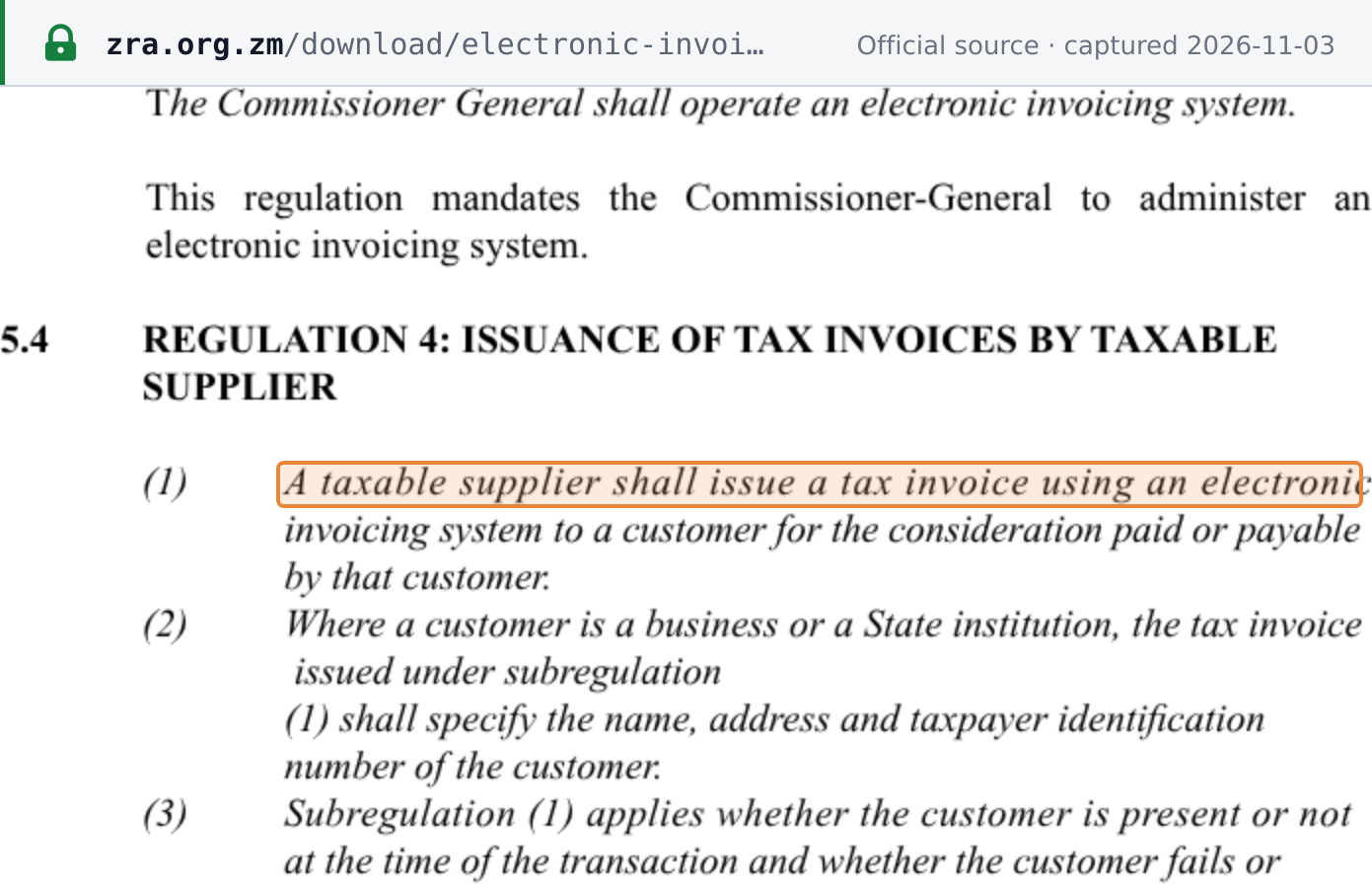
Every sale goes through Smart Invoice. Since the VAT (Amendment) Act No. 27 of 2023 (in force 1 January 2024), section 7A(1) reads: "A taxable supplier shall use an electronic invoicing system to record each sale or transaction." Regulation 4 of the VAT (Electronic Invoicing System) Regulations, 2023 (SI 58 of 2023), as reproduced in ZRA Practice Note No. 2/2024: [3]
- "(1) A taxable supplier shall issue a tax invoice using an electronic invoicing system to a customer for the consideration paid or payable by that customer."
- "(2) Where a customer is a business or a State institution, the tax invoice issued under subregulation (1) shall specify the name, address and taxpayer identification number of the customer."
- "(3) Subregulation (1) applies whether the customer is present or not at the time of the transaction and whether the customer fails or refuses to take the tax invoice."
"The tax invoice issued to a customer can either be in electronic form or printed from an electronic invoicing system." Since 1 January 2025 the Commissioner-General "may, on prescribed conditions, approve the use of a document, device or equipment, other than an electronic invoicing system, by a taxable supplier" (s.7A(2), substituted by Act No. 23 of 2024). [3] [5]
 Source snapshot captured 2026-11-03 — original
Input tax only on Smart Invoice invoices (since 1 January 2025)
Section 4 of the VAT (Amendment) Act No. 23 of 2024 (in force 1 January 2025) deleted the old paragraphs of s.18(3) that accepted manual invoice books and approved computer packages, and substituted: "(c) an invoice issued from the electronic invoicing system or an invoice issued, as prescribed, by a taxable supplier who is exempt from the use of the electronic invoicing system under section 7A(2)". [5]
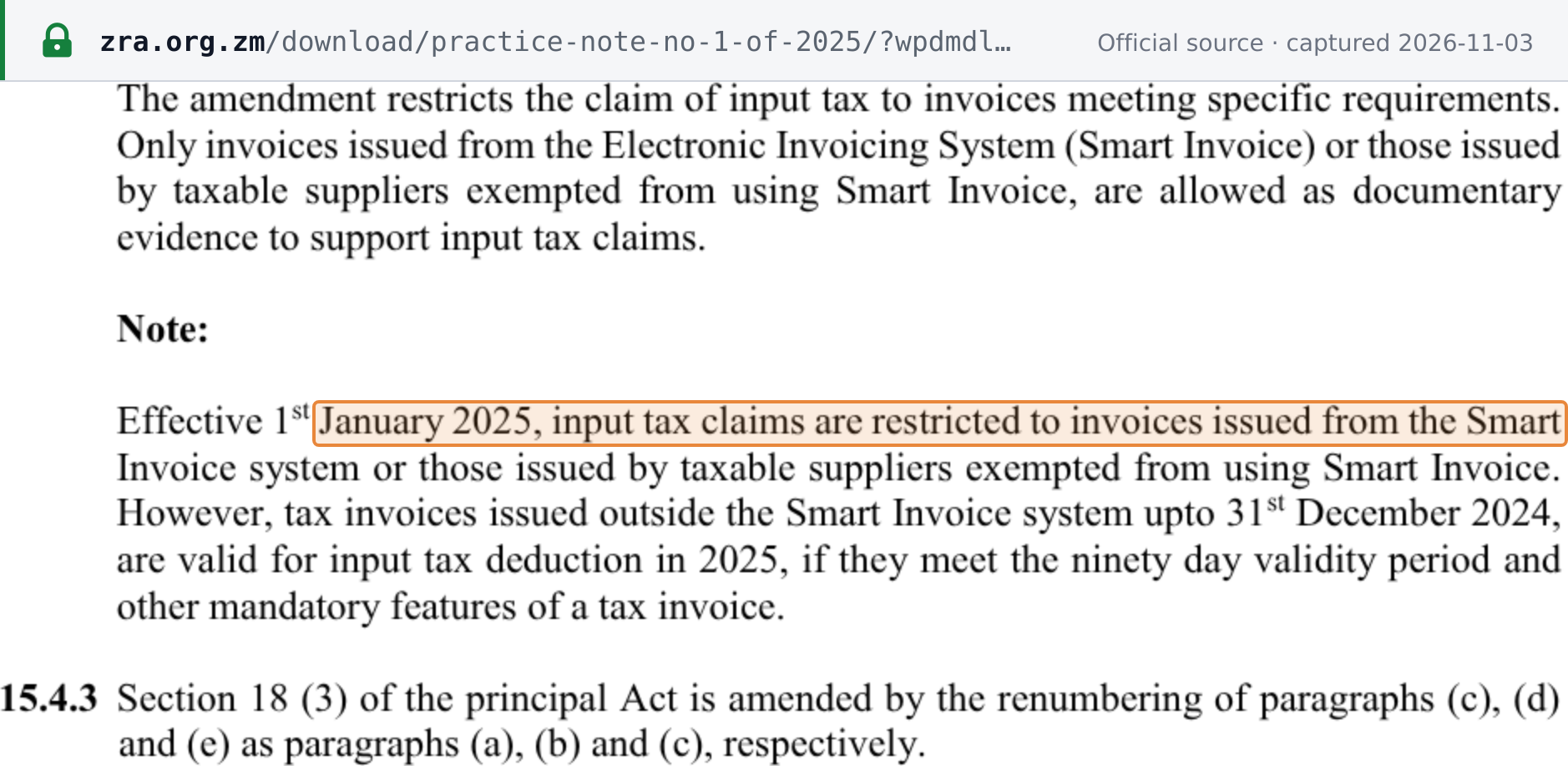
ZRA Practice Note No. 1 of 2025 §15.4.2: "Effective 1st January 2025, input tax claims are restricted to invoices issued from the Smart Invoice system or those issued by taxable suppliers exempted from using Smart Invoice. However, tax invoices issued outside the Smart Invoice system upto 31st December 2024, are valid for input tax deduction in 2025, if they meet the ninety day validity period and other mandatory features of a tax invoice." ZRA's brochure gives the validity window: "Valid for 90 days from date of generation." [2] [9]
 Source snapshot captured 2026-11-03 — original
Mandatory content
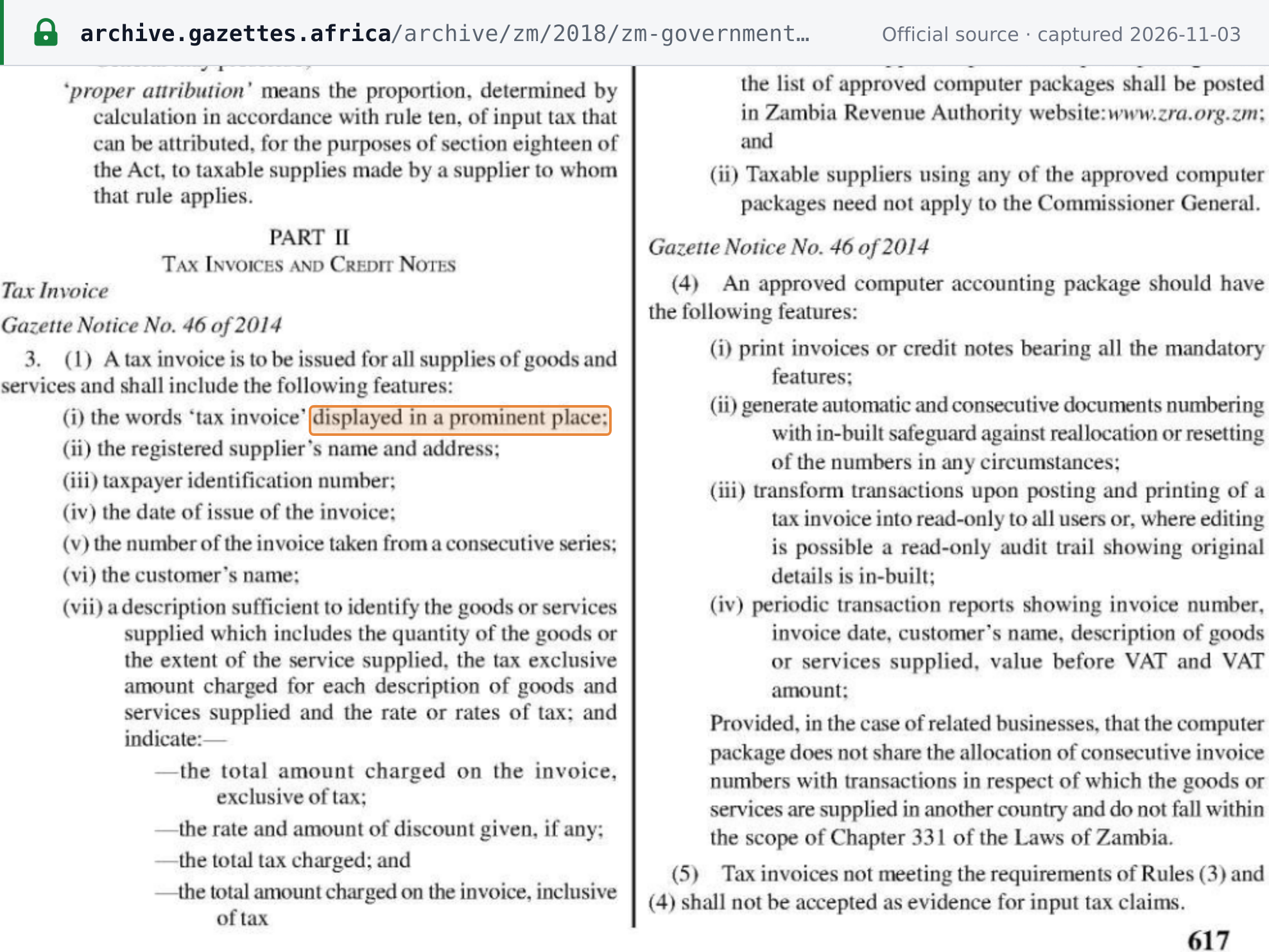
Rule 3(1) of the VAT General Rules, as restated by the VAT General (Amendment) Rules, 2018 (Gazette Notice No. 663 of 2018): "A tax invoice is to be issued for all supplies of goods and services and shall include the following features": [8]
| # | Particular (r.3(1)) | Smart Invoice field |
|---|---|---|
| (i) | "the words 'tax invoice' displayed in a prominent place" | |
| (ii) | "the registered supplier's name and address" | |
| (iii) | "taxpayer identification number" | tpin |
| (iv) | "the date of issue of the invoice" | |
| (v) | "the number of the invoice taken from a consecutive series" | cisInvcNo; ZRA's rcptNo |
| (vi) | "the customer's name" (plus address and TPIN for a business or State customer, EIS reg. 4(2)) | custTpin |
| (vii) | "a description sufficient to identify the goods or services supplied which includes the quantity of the goods or the extent of the service supplied, the tax exclusive amount charged for each description of goods and services supplied and the rate or rates of tax" | tax category A–E, RVAT |
| — | "the total amount charged on the invoice, exclusive of tax" · "the rate and amount of discount given, if any" · "the total tax charged" · "the total amount charged on the invoice, inclusive of tax" |
The 2018 proviso adds that "invoices from Electronic Fiscal Devices shall include the terminal identity number, fiscal code and quick response code", and that for banks "a bank statement shall qualify as a tax invoice". Under Smart Invoice the fiscal elements are returned by ZRA for each sale: the ZRA receipt number (rcptNo), the SDC ID, the MRC number, the receipt signature, internal data and a QR code URL. "All sales receipts must be printed with the 'rcptNo' which is returned in success response when sale is posted to VSDC. This is the ZRA invoice number which must be referred to when taxpayer intends to issue a credit note or debit note" (VSDC API specification §5.9). [14]
 Source snapshot captured 2026-11-03 — original
The 2018 restatement also still contains rule 4 (invoices from a printed invoice book or an approved computer package). Since 1 January 2025 those invoices no longer support an input-tax claim (see above).
Issuance deadline
At the transaction: every sale is recorded through Smart Invoice when it is made (s.7A(1)). The tax point for goods "occurs at the earliest of the following: i. when the payment is received; ii. when the invoice is issued; iii. when the goods or services are delivered; iv. when the goods are supplied to the buyer" (ZRA, Introduction to VAT). [9]
If the system is down. "A taxable supplier shall, where that taxable supplier's use of an electronic invoicing system is disrupted for a continuous period of twenty-four hours, notify the Commissioner-General" (EIS reg. 5(2)). As substituted in 2024: "(3) A taxable supplier shall ensure that all transactions recorded manually are uploaded to the electronic invoice system within seventy-two hours of the system being restored." ZRA's Smart Invoice FAQs put it more tightly for offline invoicing: "Invoices issued offline must still be uploaded to the system within 3 days of issuance". [3] [2] [13]
Only registered suppliers. "Can a Non-VAT Registered Supplier Issue a Tax Invoice? No. Only VAT-registered suppliers can issue tax invoices inclusive of VAT." [9]
Numbering and sequencing
- Consecutive series. The invoice number is "taken from a consecutive series" (r.3(1)(v)).
- ZRA's number. Smart Invoice assigns the authoritative ZRA invoice number,
rcptNo, which must be printed on every receipt. The integrator's own number travels ascisInvcNo("Invoice number as generated on Taxpayers Certified invoicing solutions", up to 50 characters). - Sequencing in the October 2026 specification. "Branch-level locking has been replaced with database-level sequencing." [14]
Credit and debit notes
- When required. "A registered supplier who has issued a tax invoice shall, unless the Commissioner-General otherwise allows, issue a Tax Credit Note whenever the supply is cancelled, or the goods are returned to the taxable supplier, or the value of the supply is reduced" (r.5(1)).
- Content (r.5(2)). The words "credit note"; the supplier's name, address and TPIN; the date; the credit note serial number; the customer's name and address; description, quantity, tax-exclusive amount and rate; the "number of the invoice being adjusted"; a "statement of the reason for the credit"; and the "amount of the credit". [8]
- On Smart Invoice. Receipt types are "S Sale / R Reversal after Sale — Refund after Sale — Credit Note / D Adjustment upwards after Sale — Debit Note" (§6.8), each referring back to the original ZRA invoice number. Credit-note reason codes run 01 to 07 (wrong products, wrong price, damaged goods, wrong customer invoiced, duplicated invoice, excess supplies, other); debit-note codes 01 to 04 (wrong quantity, wrong amount, omitted item, other). [14]
Currency, language and exchange rate
- Foreign currency allowed, rate shown. "Where a taxable supplier issues a tax invoice in foreign currency, the tax due on such invoice shall be due and payable to the Authority at the rate of conversion to Kwacha or the Kwacha equivalent of the total supply, on the invoice, using the appropriate rate of exchange which is current at the time of supply and that supplier shall indicate the exchange rate on the invoice" (r.4A). [8]
- Smart Invoice currencies. "Invoices can be issued in five other major currencies: United States Dollar, British Pound Sterling, Euro, Chinese Yuan and South African Rand. However, Zambian Kwacha is the default currency on Smart Invoice for prices in "Item Management"." [13]
- Prices are entered VAT-inclusive. "All prices for standard-rated goods or services must be entered on Smart Invoice as tax inclusive amounts, unless the goods or services are either exempt or zero-rated." [13]
- Language. No language rule for invoices was found in the VAT General Rules or ZRA's Smart Invoice material. Returns must be in English: "Every Return furnished under section sixteen of the Act shall be in English and all amounts shall be denominated in Zambian currency" (r.15(5)). [8]
Document types
- Tax invoice, issued from Smart Invoice by a VAT-registered supplier. Smart Invoice transaction types include Normal, Copy, Commercial Invoice (exports; mandatory for mining), Provisional and Final. [14]
- Bank statement, which qualifies as a tax invoice for banks (r.3 proviso (b)).
- Simplified invoice, only for registered cross-border electronic services suppliers (SI 18/2024 reg. 5), with features "determined by the Commissioner-General". ZRA has not published those features.
- No domestic simplified invoice. Neither the VAT General Rules nor ZRA's Smart Invoice material set a value below which a simplified domestic invoice is allowed.
Self-billing
Used for reverse VAT: the Zambian recipient raises the tax invoice for an imported service (see Reverse VAT on imported services). A tax agent for a non-resident invoices in its own name: "The tax agent must issue tax invoices in the name of the agency, while referencing the non-resident supplier." [10] ZRA's guidance makes no provision for a domestic customer to self-bill on behalf of a Zambian supplier.
Retention and audit trail
- Six years, both sides. "(1) A taxable supplier who issues a tax invoice or credit note must retain a book copy for manual invoices or a second copy for computer generated invoices for six years. (2) A registered supplier to whom a tax invoice or credit note has been issued shall retain it for six years. (3) All tax invoices, credit notes and copies of them shall be produced to an authorized officer on request" (r.13). [8]
- Fiscal signature. "Each invoice transaction has a special mark called a fiscal signature to authenticate the invoice." [13]
- Tampering is an offence. EIS reg. 12 makes it an offence to modify an approved invoicing system without authorisation, enter false data, or tamper with, alter or falsify recorded or stored data (see Offences).
- Log book and notice. Suppliers keep an issue log book for each approved invoicing system (reg. 8) and display an EIS notice at the place of business (reg. 7). [3]
- Electronic-only is allowed: the invoice "can either be in electronic form or printed". Printing "is optional" (Smart Invoice FAQs).
A specimen of a compliant invoice
ZRA publishes no specimen invoice. Below, Lookuptax lays out the rule 3(1) particulars, plus the fiscal fields Smart Invoice returns, for an illustrative domestic B2B sale at 16%. Every name, number and amount is fictional:
Tax invoice (Smart Invoice) — illustrative
| Descriptionr.3(1)(vii) | Qtyr.3(1)(vii) | Unit price excl. VAT | Amount excl. VATr.3(1)(vii) | Tax category / rateVSDC §6.1 | VAT |
|---|---|---|---|---|---|
| Office chairs, model EX-1 | 4 | K1,500.00 | K6,000.00 | A — 16% | K960.00 |
| Delivery | 1 | K500.00 | K500.00 | A — 16% | K80.00 |
- Total excl. VAT (category A)r.3(1)(vii); taxblAmtA
- K6,500.00
- Discountr.3(1)(vii)
- K0.00
- Total VAT 16%r.3(1)(vii)
- K1,040.00
- Total incl. VATr.3(1)(vii)
- K7,540.00
- Currency: ZMW. If invoiced in USD, GBP, EUR, CNY or ZAR, the exchange rate is shown on the invoice — r.4A; currencyTyCd and exchangeRt.
- Fiscal block returned by ZRA for each sale: SDC ID, MRC no., receipt signature and internal data — VSDC Save Sales response.
- [QR code] — lets the customer verify the invoice with a mobile application (Smart Invoice FAQs).
- A sale to a privileged person at 0% goes under category C2 and carries the zero-rating LPO number — lpoNumber.
- Corrections are made by a credit note (receipt type R) or debit note (type D) that quotes this ZRA invoice number — r.5; VSDC §6.8.
E-invoicing status
Status (as at 2026-11-03): mandatory for every VAT-registered supplier, for every sale, through ZRA's Smart Invoice. The legal basis is section 7A of the VAT Act, as amended by the VAT (Amendment) Act No. 27 of 2023 (which replaced "electronic fiscal device" with "electronic invoicing system"), and the VAT (Electronic Invoicing System) Regulations, 2023 (SI 58 of 2023), both in force from 1 January 2024. [3]
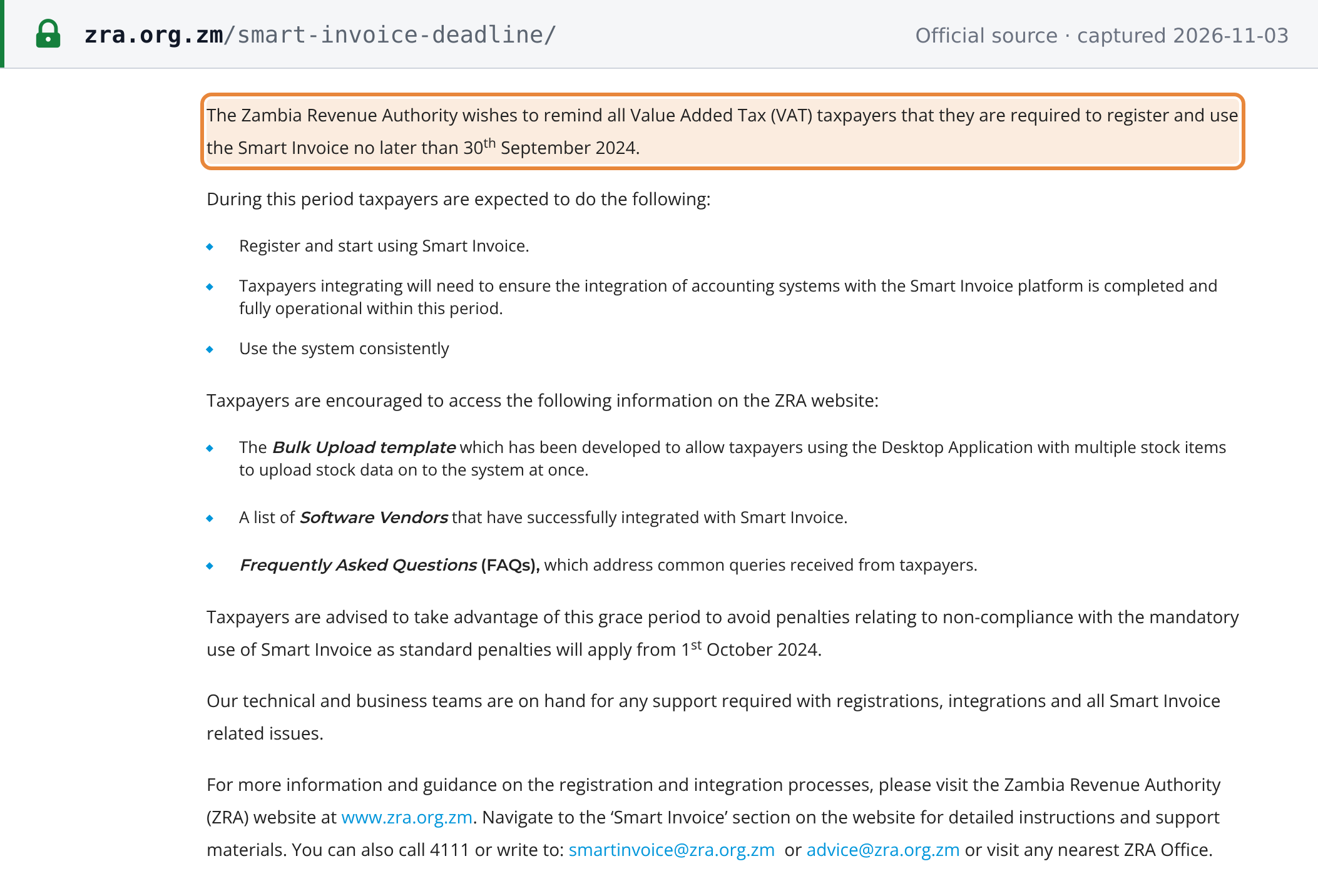
- Rollout. ZRA's notice of 24 January 2024: "all Value Added Tax (VAT) registered taxpayers will be required to issue electronic invoices using the Smart Invoice with effect from 1st July, 2024." The deadline was then extended: ZRA's notice of 25 September 2024 reminded "all Value Added Tax (VAT) taxpayers that they are required to register and use the Smart Invoice no later than 30th September 2024", with "standard penalties" applying "from 1st October 2024". [24] [17]
- Input tax. Since 1 January 2025, only Smart Invoice invoices (or those of exempted suppliers) support an input-tax claim (see Invoice requirements).
- Model. Real-time reporting: "the Zambia Revenue Authority (ZRA) has implemented Smart Invoice, which transmits invoice data to ZRA in real-time." [13]
- Phases. None by size: "There is no monetary threshold or turnover required to register for Smart Invoice."
- Scope. B2B, B2G and B2C alike. Business and State customers' invoices carry the buyer's TPIN (EIS reg. 4(2)).
- Solutions. ZRA's free desktop/tablet application and online portal, or a Certified Invoicing System integrated through the VSDC (Virtual Sales Data Controller): "The integration is achieved through an interface with the Virtual Sales Data Controller (VSDC) which is a bridge between the Certified Invoicing System (CIS) and the ZRA Smart Invoice System." The Mobile App "is suitable for taxpayers on Turnover Tax and Rental Tax only. It is not suitable for those registered for Value Added Tax." [25] [13]
- Format. JSON over ZRA's VSDC REST API (for example
/trnsSales/saveSales). Not UBL, not Peppol.
 Source snapshot captured 2026-11-03 — original
See fiscal devices and certified cash registers, CTC e-invoicing models, and e-invoicing status and networks worldwide.
For developers: the VSDC specification
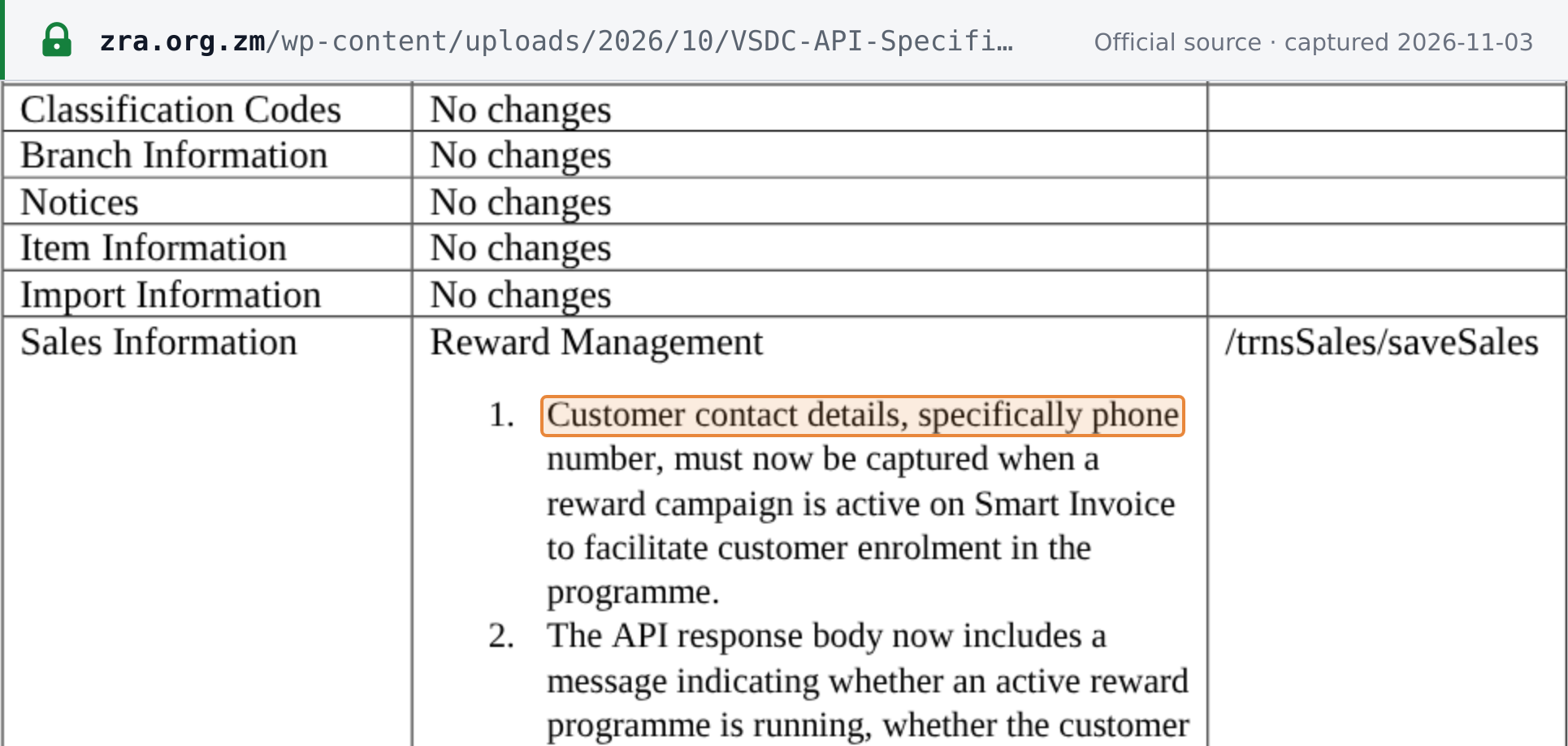
ZRA publishes its integration contract as the VSDC API Specification; the current copy is dated "updated 02-10-2026" in its file name. Its revision table records, for the Sales Information service (/trnsSales/saveSales): "Customer contact details, specifically phone number, must now be captured when a reward campaign is active on Smart Invoice to facilitate customer enrolment in the programme." The field is custMblNo, "Phone number for the customer participating in a reward". The response also reports whether a reward programme is running and whether the customer has entered the draw or won. [14]
 Source snapshot captured 2026-11-03 — original
Each successful sale returns the ZRA receipt number (rcptNo), internal data (intrlData), receipt signature (rcptSign), SDC ID (sdcId), MRC number (mrcNo) and a QR code URL (qrCodeUrl).
Filing and payment
Filing frequency
- Monthly by default.
- Quarterly, on application. "Except as otherwise allowed or directed by the Commissioner-General, a taxable supplier: (a) whose annual taxable turnover does not exceed the statutory VAT registration threshold; or (b) who is involved in farming of seasonal crops; may apply for quarterly tax accounting periods. The quarterly tax accounting periods shall be January to March; April to June; July to September and October to December" (r.6). [8]
- Six-monthly for small zero-rated suppliers: "A registered supplier engaged in making zero-rated supplies and whose turnover does not exceed two hundred thousand kwacha per annum shall submit a tax return every six months" (Practice Note No. 1 of 2025 §16.3). [2]
- Cross-border electronic services suppliers file by the 25th (SI 18/2024 reg. 7).
Return and payment due date
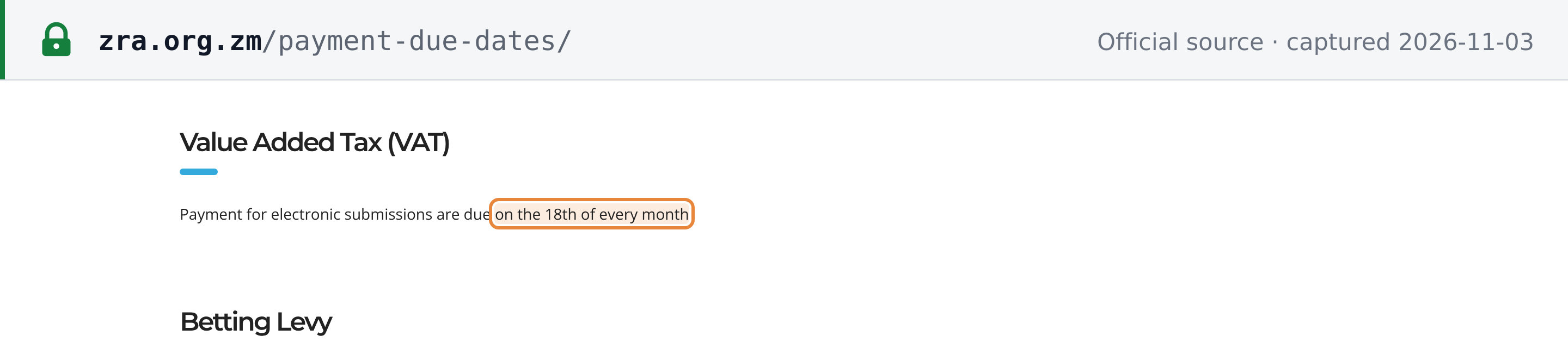
The 18th of the following month (as at 2026-11-03), for both the return and the payment. ZRA's Introduction to VAT: "VAT Return & Payment Due Dates — Due on or before 18th of the following month." ZRA's due-dates page: "Payment for electronic submissions are due on the 18th of every month". [9] [16]
 Source snapshot captured 2026-11-03 — original
- Nil and repayment returns are still due: "Penalties apply even for repayment or nil returns". [9]
- Rejected returns. "Where the Commissioner General rejects a return, the supplier shall correct the return and re-submit it within ten working days from the date of rejection" (r.14(3)). [8]
- Withholding VAT agents were due by the 16th; ZRA lists that regime as "currently suspended". See VAT withholding regimes.
- Where. Returns are filed and paid on ZRA's TaxOnline portal.
Additional listings
None separate from the return. Every sale is already reported to ZRA in real time through Smart Invoice.
Input-tax recovery
- Evidence. Since 1 January 2025, a Smart Invoice invoice (or one issued by an exempted supplier) for local purchases, and bills of entry with evidence of tax paid for imports (s.18(3) as amended by Act No. 23 of 2024). The invoice is valid for input tax for 90 days from generation. [5] [9]
- Not deductible: reverse VAT on imported services (s.8(7)); deferred import VAT (Import VAT Deferment); and input tax for periods before a late registration ("Input tax deductions are not allowed", ZRA penalties page). [15]
- Intending traders. From 1 January 2026 the pre-trading window is "ten years from the date of registration as an intending trader for mining, petroleum, gas exploration or hydroelectricity generation" (Practice Note No. 1 of 2026 §29.3). [11]
- Blocked items. ZRA's published guidance does not list blocked categories such as entertainment or passenger vehicles.
Refunds
Where input tax exceeds output tax, "Refund to the supplier is due" (ZRA, Introduction to VAT). ZRA's published guidance does not state a refund processing time, a refund scheme for non-resident businesses, or a bad-debt relief rule. [9]
Diplomats and designated officials. Rule 20 of the VAT General Rules provides VAT refunds for eligible goods or services supplied to diplomats or designated officials; under r.20(2), "A refund shall not be made in respect of any claim with a value of less than two hundred Kwacha." [8]
Remission of irrecoverable VAT. The VAT (Amendment) Act No. 19 of 2025 (assented 23 December 2025, in force 1 January 2026) substitutes a new s.19(1A) and inserts a new s.19(1B). The new s.19(1A): "The Minister may, on the recommendation of the Commissioner-General, by statutory instrument, remit the whole, or part of any, tax, fine or interest due and which is not recoverable under this Act where the liabilities meet the following conditions: (a) the taxable supplier is deceased and the estate is insufficient to meet the tax debt; (b) the tax account of the taxable supplier is inactive for a period of ten years; (c) the taxable supplier is insolvent; …" [6]
Exemptions
Exempt supplies
The VAT (Exemption) Order, 2014 (SI 68 of 2014), as amended, lists the exempt supplies. Its base groups include health services, educational services, booklets and newspapers, transportation services, the conveyance, sale or lease of real property, financial and insurance services, funeral services, domestic kerosene, trade union subscriptions, statutory fees, and food and agriculture. ZRA's examples: [9]
- "Health and medical services (registered under Health Professions Act, 2009)"
- "Educational services (nursery, primary, secondary, post-secondary)"
- "Funeral services (caskets, coffins, tombstones)"
Since 1 January 2026, mains water and sewerage have moved from exempt to zero-rated (SI 95 of 2025; see Rates). Finance leases are split: "(i) the principal (capital) which is standard rated; and (ii) the interest that is exempt" (Practice Note No. 1 of 2026 §52). [11]
Exempt is not zero-rated. "Exempt supplies are goods and services not subject to VAT, even if made by a VAT-registered business. Suppliers dealing solely in exempt supplies cannot register for VAT" (ZRA). An exempt-only supplier therefore recovers no input tax. A zero-rated supply is taxable at 0%, so its supplier registers and recovers the input tax on its costs. [9]
Special regimes
- Turnover Tax. Below K5,000,000, the income-tax Turnover Tax regime runs alongside VAT (see Registration threshold).
- Cash accounting, on application, for building and civil engineering contractors and for intending traders (VAT General Rules r.7). [8]
- Import VAT deferment on Third Schedule capital goods (see Imports and exports).
- Flat-rate, margin and second-hand schemes. ZRA's published VAT guidance describes none.
Offences and penalties
Offences
- Not using Smart Invoice (VAT Act s.7A(3)). ZRA's Smart Invoice FAQs: "1st Offence: Not exceeding K40,000 / 2nd Offence: Not exceeding K80,000 / 3rd or Subsequent offence: Not exceeding K120,000 or imprisonment for a term not exceeding 3 years, or both." [13]
- Tampering with an invoicing system (EIS reg. 12). Modifying an approved invoicing system without authorisation, entering false data, or falsifying recorded data: "(a) First offence, to a penalty not exceeding one hundred thousand penalty units; (b) Second offence to a penalty not exceeding two hundred thousand penalty units; and (c) Third or subsequent offence, to a penalty not exceeding three hundred thousand penalty units, or to imprisonment for a term not exceeding three years, or both." [3]
- Not displaying the EIS notice (reg. 7) and not deactivating a discontinued system within 30 days (reg. 10): up to 30,000 penalty units each. [2]
- Enforcement. On 7 August 2026 a trader pleaded guilty to non-use of Smart Invoice; ZRA reports that "the Court convicted the accused and sentenced him to a fine of K125,000.00, to be paid forthwith; in default to 3 months simple imprisonment." [20]
Penalties
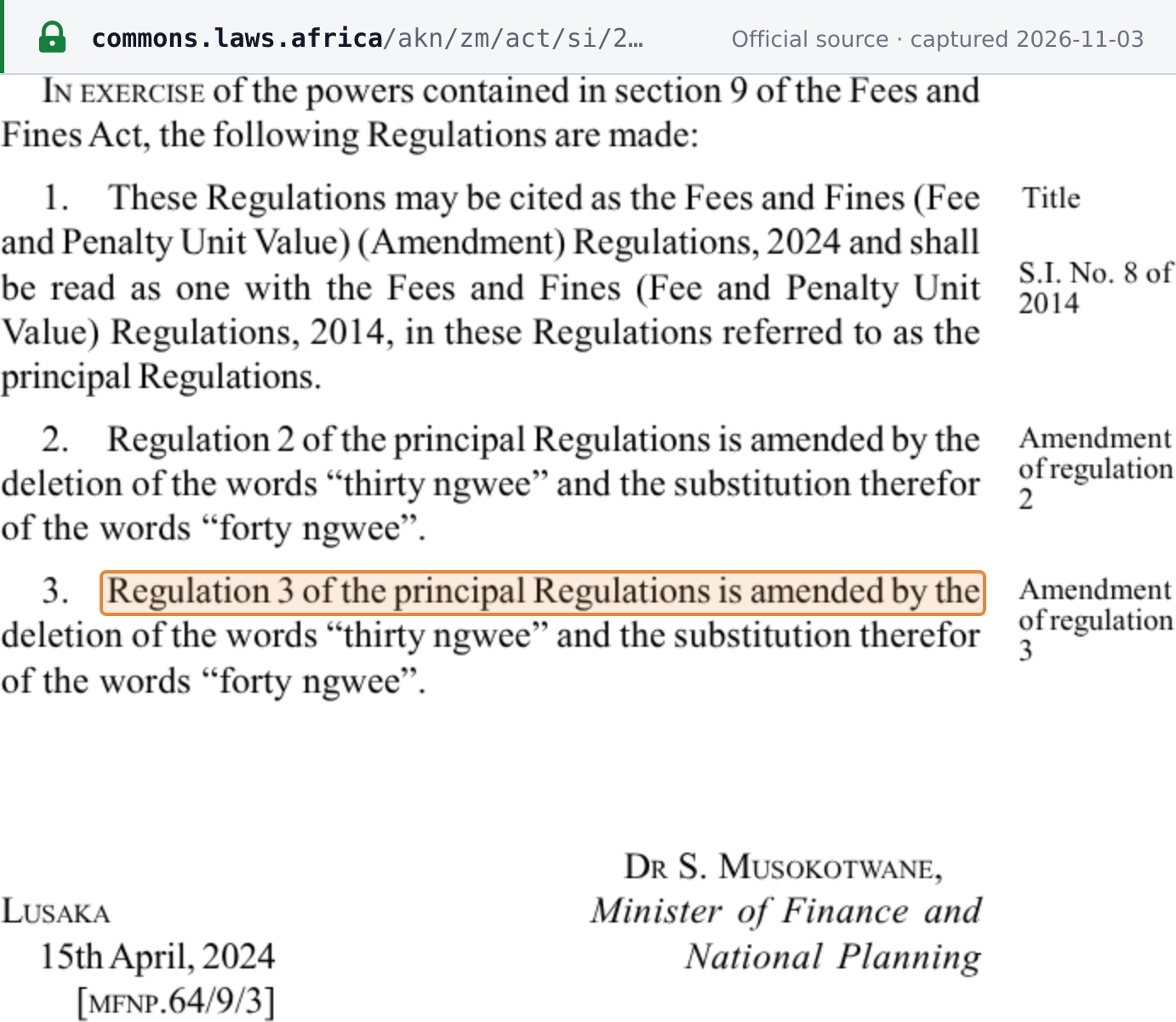
VAT penalties are set in penalty units. Since the Fees and Fines (Fee and Penalty Unit Value) (Amendment) Regulations, 2024 (Statutory Instrument No. 25 of 2024, gazetted 19 April 2024), a penalty unit and a fee unit are each worth K0.40: regulations 2 and 3 replace "thirty ngwee" with "forty ngwee". The kwacha figures below apply that value (as at 2026-11-03). ZRA's penalties page still shows conversions at the older K0.30 value. [26] [15]
| Failure | Penalty | Basis |
|---|---|---|
| Late return | 1,000 penalty units (K400) per day, or 0.5% of the tax due, whichever is greater, for each day the return is late | ZRA penalties page; Introduction to VAT ("K400 or 0.5% of tax payable per day") |
| Late payment | 0.5% of the tax payable for each day the payment is late, plus interest at the Bank of Zambia Discount Rate plus 2% | ZRA penalties page |
| Late registration | 10,000 penalty units (K4,000) for each tax period the business was eligible but unregistered, plus an assessment on the sales made; no input tax for that period | ZRA penalties page |
| Incomplete records, or records or information not provided on time | 20,000 penalty units (K8,000) each, plus 2,000 fee units (K800) a day for failing to make records available | ZRA penalties page |
At K0.40, the 100,000, 200,000 and 300,000 penalty units of EIS reg. 12 (see Offences) come to K40,000, K80,000 and K120,000, the same amounts ZRA's Smart Invoice FAQs give for not using Smart Invoice. [3] [13]
 Source snapshot captured 2026-11-03 — original
Frequently asked questions
Our supplier's invoice was not issued through Smart Invoice. Can we still claim the input VAT?
No. Since 1 January 2025, under the Value Added Tax (Amendment) Act No. 23 of 2024, input tax can be claimed only on an invoice issued from the electronic invoicing system (Smart Invoice) or on an invoice issued, as prescribed, by a supplier the Commissioner-General has exempted from using it. ZRA Practice Note No. 1 of 2025 adds that non-Smart Invoice tax invoices issued up to 31 December 2024 stayed valid in 2025 only within the ninety-day validity period.
Can a VAT-registered business use the Smart Invoice mobile app?
No. ZRA's Smart Invoice FAQs say the Mobile App is suitable for taxpayers on Turnover Tax and Rental Tax only, and is not suitable for those registered for Value Added Tax. VAT-registered businesses use the desktop or tablet application, the online portal, or a certified invoicing system integrated through the VSDC API.
What do we do if Smart Invoice goes down at the point of sale?
Record the sales manually. Under the VAT (Electronic Invoicing System) Regulations, a supplier whose use of the system is disrupted for a continuous period of twenty-four hours must notify the Commissioner-General, and all transactions recorded manually must be uploaded to the system within seventy-two hours of the system being restored.
Our turnover is between K800,000 and K5 million. Do we register for Turnover Tax or VAT?
Both. ZRA Practice Note No. 1 of 2025 states that a taxpayer with an annual taxable turnover exceeding K800,000.00 but not exceeding K5,000,000.00 is required to register for turnover tax and VAT, and one with an annual taxable turnover exceeding K5,000,000.00 is required to register for income tax and VAT.
A privileged customer gave us the zero-rating LPO after the sale. Can we refund the VAT we charged?
No. ZRA Practice Note No. 1 of 2024 says that where a person who qualifies to issue a VAT zero-rating Local Purchase Order does not provide it at the time of purchase, the supplier must charge VAT at the standard rate, and that VAT will not be refunded if the LPO is produced later.
Important websites
| Site | Purpose |
|---|---|
| Zambia Revenue Authority | Tax authority home page; links to TaxOnline for TPIN and VAT registration, returns and payment |
| Smart Invoice taxpayer portal | Sign up for Smart Invoice, apply for a solution, download the applications |
| Smart Invoice — learn more | Solutions, user manuals, FAQs and the VSDC API specification |
| VSDC API specification (02-10-2026) | Integration contract for certified invoicing systems |
| Business registration requirements | How to get a TPIN |
| Payment due dates | Return and payment deadlines by tax |
| Penalties | Penalty amounts by tax |
| Tax information downloads | Practice Notes and VAT guides |
| Zambia TPIN validator | Check a TPIN's format |
| Invoice verification | The QR code on each Smart Invoice invoice, checked with ZRA's mobile application; no public web lookup page was found |
| ZRA contacts | Call centre 4111; smartinvoice@zra.org.zm; advice@zra.org.zm |
For other countries' registers, see check a VAT number — official lookups by country.
Recent changes
- 2026-10-02 — ZRA re-issues the VSDC API specification ("updated 02-10-2026"); reward-campaign capture now names the customer's phone number only. (ZRA)
- 2026-09-02 — VSDC API specification update adds customer contact capture during Smart Invoice reward campaigns and reward status in the response. (ZRA) — see event
- 2026-01-01 — VAT (Amendment) Act No. 19 of 2025 in force (new s.19(1A) and (1B) on remission of irrecoverable VAT); mains water and sewerage zero-rated (SI 95 of 2025). (Act No. 19 of 2025 · SI 95 of 2025)
- 2025-08-19 — ICT equipment moves from zero-rated to standard-rated. (ZRA Practice Note No. 1 of 2026)
- 2025-01-01 — Input tax restricted to Smart Invoice invoices or those of exempted suppliers. (Act No. 23 of 2024 · ZRA Practice Note No. 1 of 2025)
- 2024-10-01 — Standard penalties apply for not using Smart Invoice after the 30 September 2024 deadline. (ZRA)
- 2024-04-19 — SI No. 25 of 2024 raises the penalty unit from K0.30 to K0.40. (SI 25 of 2024)
- 2024-02-26 — VAT (Cross Border Electronic Services) Regulations, 2024 (SI 18 of 2024) gazetted. (SI 18 of 2024)
For the full chronology, see Zambia tax changes on Lookuptax.
Reference links
- ZRA — Tax Information (Value Added Tax)
- ZRA — Practice Note No. 1 of 2025
- ZRA — Practice Note No. 2/2024: The Value Added Tax – Electronic Invoicing System
- Value Added Tax (Amendment) Act, 2023 (No. 27 of 2023) — Government Printer publication
- Value Added Tax (Amendment) Act, 2024 (No. 23 of 2024) — Government Printer publication
- Value Added Tax (Amendment) Act, 2025 (No. 19 of 2025) — Government Printer publication
- Value Added Tax (Cross Border Electronic Services) Regulations, 2024 (SI 18 of 2024)
- Government Gazette No. 6690 of 17 August 2018 — VAT General (Amendment) Rules, 2018 (Gazette Notice No. 663 of 2018)
- ZRA — Introduction to VAT (brochure)
- ZRA — Reverse VAT (brochure)
- ZRA — Practice Note No. 1 of 2026
- ZRA — Practice Note No. 1 of 2024
- ZRA — Smart Invoice FAQs
- ZRA — VSDC API Specification, updated 02-10-2026
- ZRA — Penalties for non compliance
- ZRA — Payment due dates
- ZRA — Smart Invoice deadline (25 September 2024)
- ZRA — Frequently asked questions (TPIN)
- Value Added Tax (Zero Rating) (Amendment) Order, 2025 (SI 95 of 2025)
- ZRA — Mobile Monster convicted for non-usage of Smart Invoice
- ZRA — Business registration requirements
- ZRA — Importation of goods
- ZRA — Import VAT Deferment (brochure)
- ZRA — Smart Invoice update for VAT registered taxpayers (notice, 24 January 2024)
- ZRA — Smart Invoice: learn more
- Fees and Fines (Fee and Penalty Unit Value) (Amendment) Regulations, 2024 (SI 25 of 2024) — Government Printer publication
Related on Lookuptax:
- VAT registration thresholds worldwide
- Worldwide tax rates
- E-invoicing status and networks worldwide
- Fiscal devices and certified cash registers
- CTC e-invoicing models
- VAT on digital services by non-resident suppliers
- Reverse charge explained
- VAT withholding regimes
- How to register for VAT, sales tax or GST
- VAT, GST and sales tax names by country