E-invoicing in Angola: AGT Facturação Electrónica
Overview
Angola's electronic invoicing system is called Facturação Electrónica. It is run by the Administração Geral Tributária (AGT), the tax authority under the Ministry of Finance. Invoices are issued in AGT-certified invoicing software or, within the limits of DP 71/25 art. 9.º, on the AGT's Portal do Contribuinte, and their data is transmitted to AGT's system (SIGT) in real time. [2] [3] [6]
Legal basis in one line. Presidential Decree (Decreto Presidencial) n.º 71/25 of 20 March 2025, which approves the Legal Framework for Invoices (Regime Jurídico das Facturas), and Executive Decree (Decreto Executivo) n.º 683/25 of 22 August 2025, which sets the data structure, the e-invoicing model and the technical specifications. Both are published in the Diário da República and in force. [2] [3]
| Angola | |
|---|---|
| System | Facturação Electrónica; AGT system SIGT; Portal do Contribuinte for issuing without software, mainly for exclusion-regime taxpayers (general and simplified regimes only with prior AGT authorisation; 300 documents a year) |
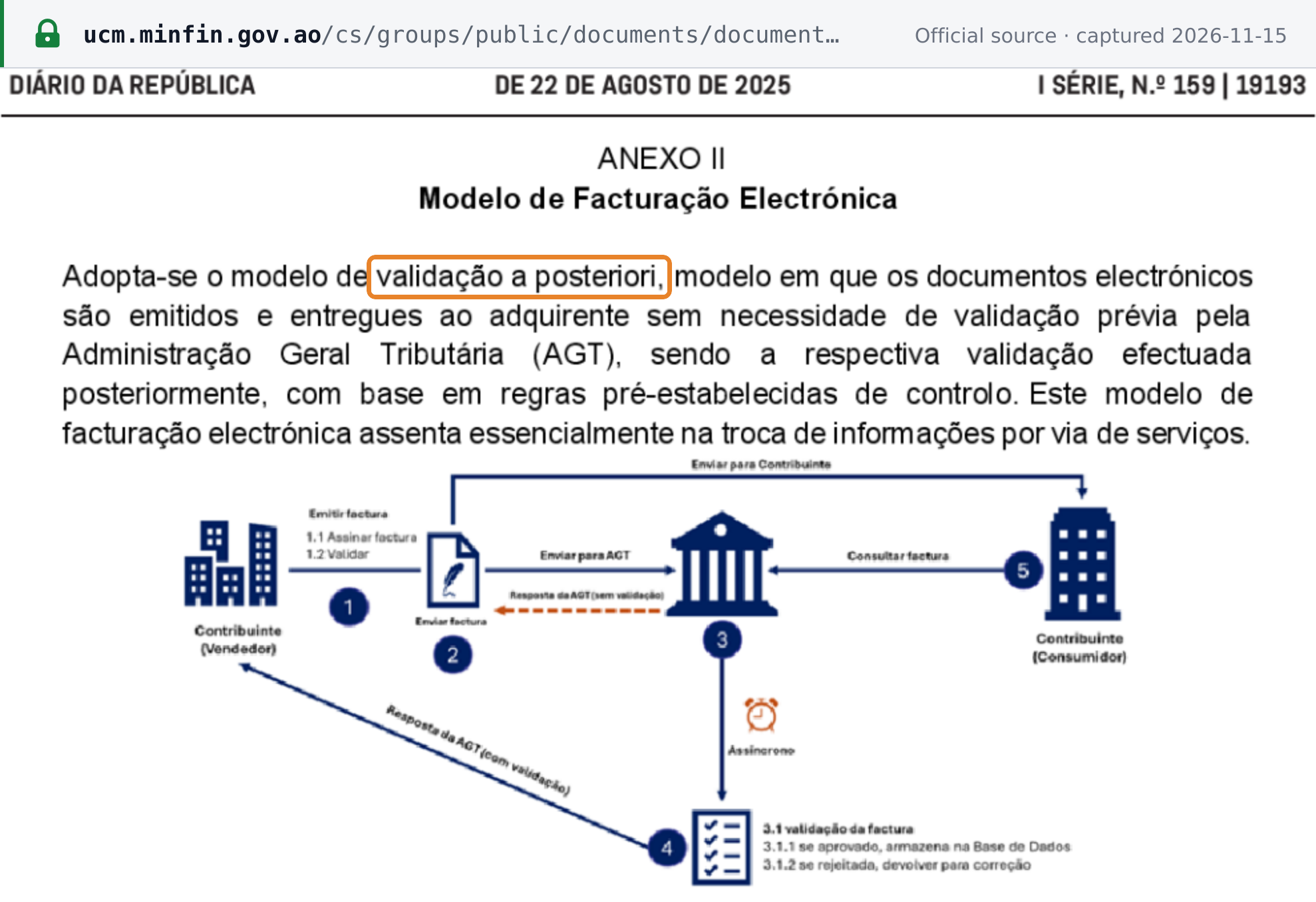
| Model | Real-time reporting with post-validation (validação a posteriori): the invoice is issued and delivered to the buyer without prior AGT validation, and AGT validates it afterwards |
| Phase 1 | Since 1 January 2026: taxpayers of the 1st and 2nd Large Taxpayers' Tax Offices and suppliers to the State (AGT) |
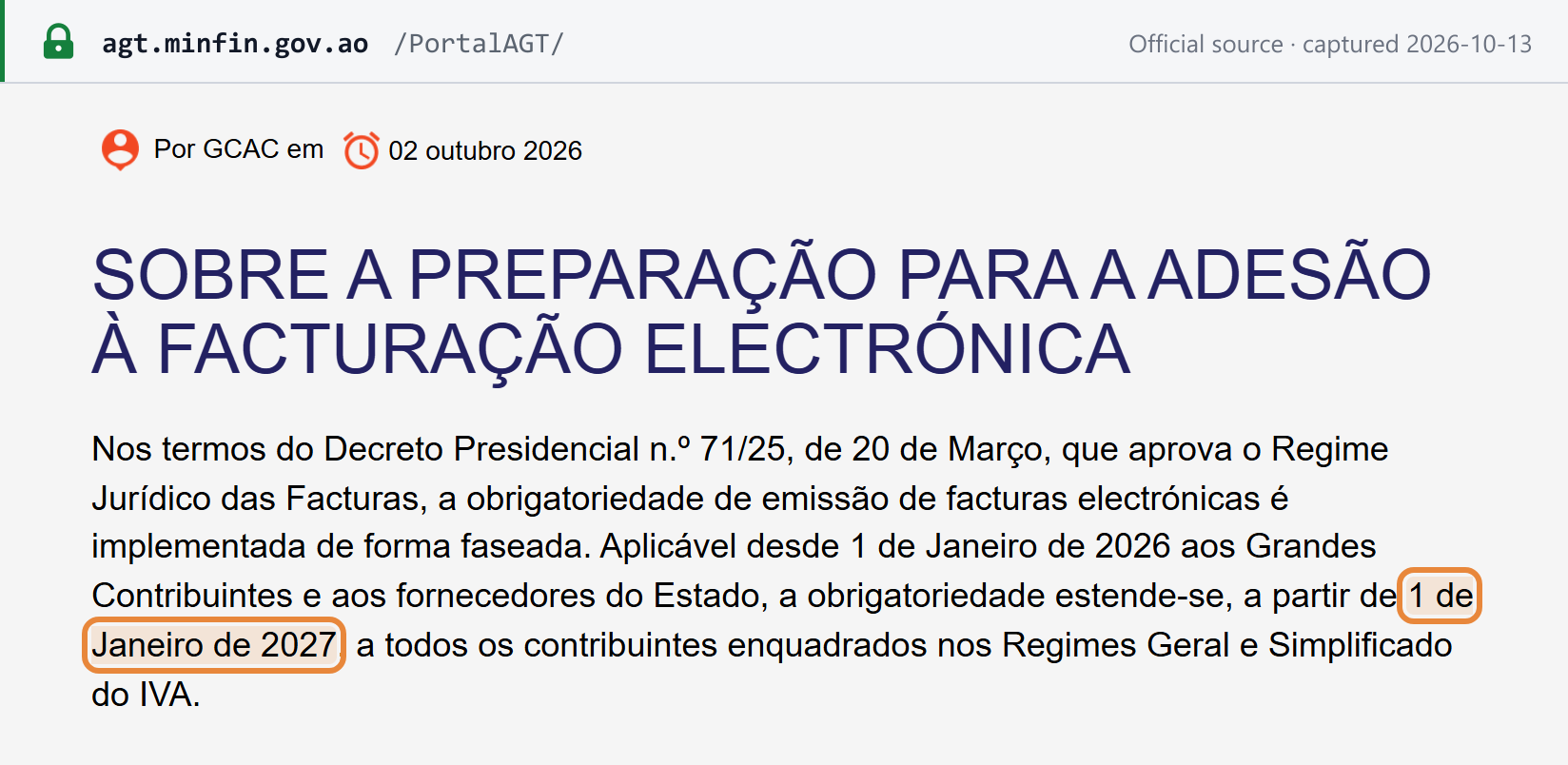
| Phase 2 | From 1 January 2027: all taxpayers in the general and simplified IVA regimes (AGT communiqué of 2 October 2026) |
| Exclusion regime | Optional, on request to AGT; once joined, fully bound |
| B2B / B2G / B2C | The obligation attaches to the issuer, so all of its invoices are covered; no separate dates per flow |
| Non-residents | Not addressed in AGT's e-invoicing texts (see Scope) |
| Format | National JSON schema over REST web services (Executive Decree 683/25, Annexes I and III); not UBL, CII or Peppol |
| Integrity | JWS signatures (software producer and issuer), AGT-generated invoice series, QR code on printed invoices |
| Authority | Administração Geral Tributária (AGT) |
| Penalty | 7% of the value of each invoice not issued, 15% for repeated non-issue (DP 71/25 art. 35.º) |
For the IVA rates, regimes, invoice content rules and filing, see the Angola VAT guide.
Mandate status & timeline
Status (as at 15 November 2026): mandatory for phase 1 since 1 January 2026; phase 2 starts on 1 January 2027. AGT's communiqué of 2 October 2026, reaffirmed in an AGT news item of 5 November 2026: "Aplicável desde 1 de Janeiro de 2026 aos Grandes Contribuintes e aos fornecedores do Estado, a obrigatoriedade estende-se, a partir de 1 de Janeiro de 2027, a todos os contribuintes enquadrados nos Regimes Geral e Simplificado do IVA." On 5 November 2026 AGT restated that the obligation "entra em vigor a 1 de Janeiro de 2027 para os operadores enquadrados no Regime Geral e no Regime Simplificado" and reported more than 85,000 taxpayers issuing e-invoices. [1] [12]
| Phase | Who | Obligation | Date | Source | State |
|---|---|---|---|---|---|
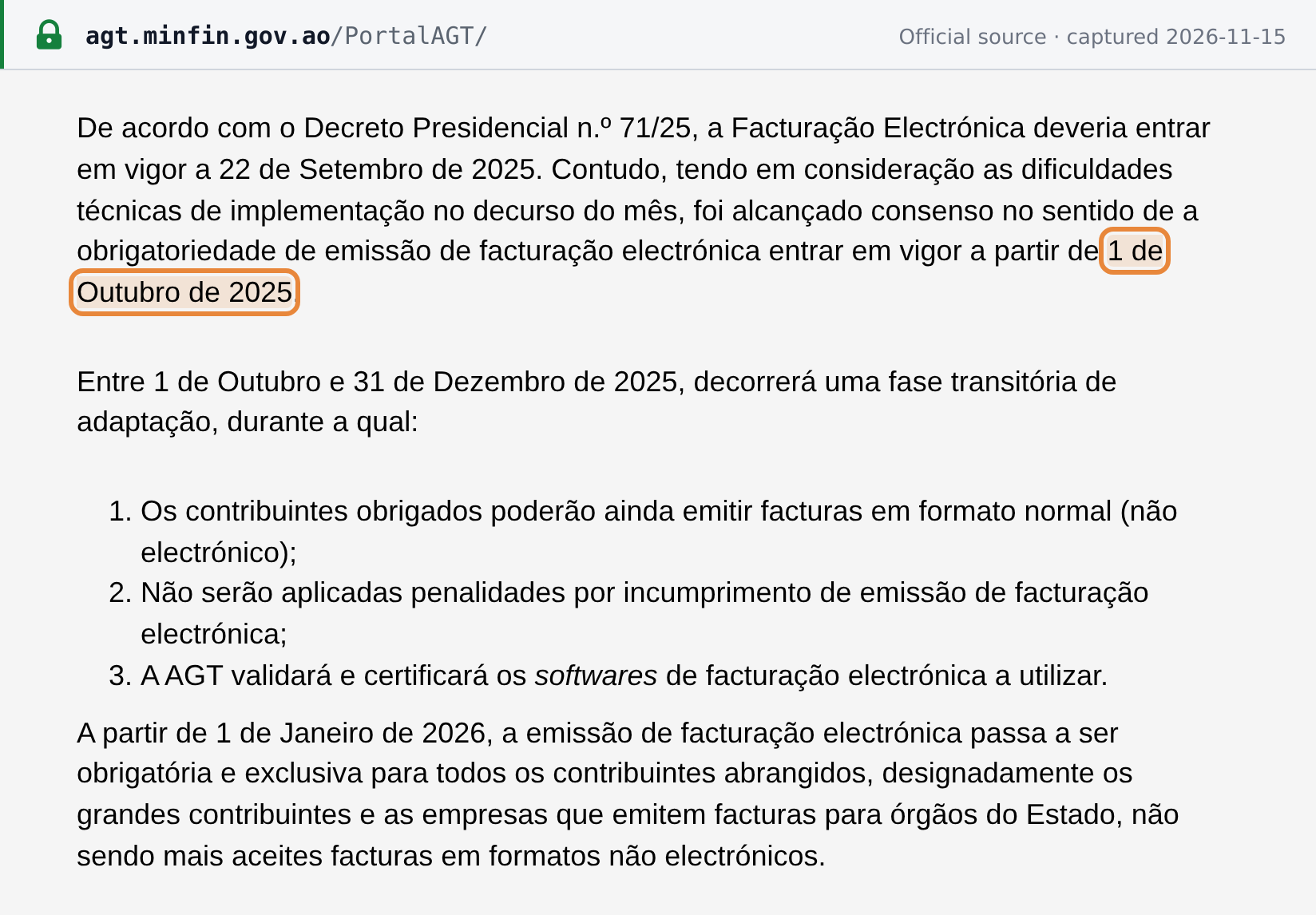
| Transition | Phase-1 taxpayers | E-invoicing available; non-electronic invoices still allowed; no penalties; AGT validates and certifies software | 1 October – 31 December 2025 | AGT communiqué, 23 September 2025 | Passed |
| Phase 1 | Taxpayers registered with the 1st and 2nd Large Taxpayers' Tax Offices (applied ex officio) and suppliers to the State, whatever their IVA regime | Issue every invoice as an e-invoice; non-electronic invoices no longer accepted | 1 January 2026 | AGT communiqués, 23 September 2025 and 5 January 2026 | In force |
| Phase 2 | All taxpayers in the general and simplified IVA regimes | Same | 1 January 2027 ("a partir de") | AGT communiqué, 2 October 2026; AGT, 5 November 2026 | Upcoming |
| Voluntary | Exclusion-regime taxpayers | May join on request to AGT | Any time | DP 71/25 art. 16.º n.º 2; AGT, 2 October 2026 | Open |
 Source snapshot captured 2026-10-13 — original
Who is in phase 1. AGT's notice of 5 January 2026 says the obligation applies "de forma oficiosa" to taxpayers registered with the 1st and 2nd Large Taxpayers' Tax Offices. For suppliers to the State, non-compliance "resultará na proibição de prestar serviços ao Estado", with restrictions in the State's financial management system (SIGFE) and direct effects on public procurement. The decree itself (art. 37.º n.º 1) covers large taxpayers and State suppliers "independentemente do regime do IVA em que estejam enquadrados", but not State suppliers for operations that qualify for self-billing (art. 37.º n.º 4). [5] [2]
Phase 2, and whether it will move. When phase 1 started, AGT expected the expansion to the other general- and simplified-regime taxpayers "ao longo de 2026" (1 January 2026). The communiqué of 2 October 2026 fixed it at 1 January 2027. Earlier, on 7 May 2026, AGT reported its chair as saying that by 31 December 2026 all general- and simplified-regime companies with turnover of Kz 25 million or more must be fully integrated, and that "não haverá prorrogação do prazo". AGT has not announced any phase after phase 2. [6] [1] [7]
The 2025 postponement. AGT's communiqué of 23 September 2025, issued with the accountants' order (OCPCA) and software producers, says that under Presidential Decree 71/25 e-invoicing "deveria entrar em vigor a 22 de Setembro de 2025". Because of technical implementation difficulties, the obligation took effect from 1 October 2025 instead. From 1 October to 31 December 2025, obliged taxpayers could still issue non-electronic invoices and no penalties applied. From 1 January 2026, e-invoicing became "obrigatória e exclusiva" for the taxpayers covered. [4]
 Source snapshot captured 2026-11-15 — original
The decree's own calendar differs from AGT's. Article 37.º of DP 71/25 limits the obligation to large taxpayers and State suppliers "nos primeiros 12 meses após a entrada em vigor do Decreto Executivo" (Executive Decree 683/25, in force 30 days after its publication on 22 August 2025), after which it applies to all taxpayers subject to e-invoicing. Read on its face, that would put phase 2 in September 2026. The 1 January 2026 and 1 January 2027 dates come from the AGT communiqués above, which cite no decree amending DP 71/25 or Executive Decree 683/25: the 2025 move rests on a "consenso" with accountants and software producers, and the 2026 communiqué on DP 71/25 itself. Plan against AGT's dates, which AGT applies. [2] [3]
What survives the moves. The communiqués changed who must e-invoice and when, not how: none of them amends the technical rules, which remain those of Executive Decree 683/25 (AGT may update the specifications under its art. 3.º).
Legal basis
| Instrument | Publication | In force | What it does |
|---|---|---|---|
| Presidential Decree n.º 71/25, de 20 de Março (Regime Jurídico das Facturas) | Diário da República I Série n.º 52, 20 March 2025 | 6 months after publication (art. 42.º); AGT gives 22 September 2025 | Invoice rules; e-invoicing chapter III (arts. 16.º–25.º); penalties (art. 35.º); delegation of the technical rules to an Executive Decree (art. 36.º); phase-in (art. 37.º); special reporting of supplies of Kz 25,000,000 or more (art. 38.º). Revokes Presidential Decrees 292/18 (invoices) and 144/23 (self-billing) |
| Executive Decree n.º 683/25, de 22 de Agosto (Ministry of Finance) | Diário da República I Série n.º 159, 22 August 2025 | 30 days after publication (art. 6.º) | Annex I: software data structure (JSON); Annex II: e-invoicing model (validação a posteriori); Annex III: REST services and QR-code specification. AGT generates the invoice series (art. 4.º) and issues specification updates (art. 3.º) |
| AGT communiqué, 23 September 2025 | AGT website | — | Start from 1 October 2025; no-penalty transition to 31 December 2025; obligatory and exclusive for phase 1 from 1 January 2026 |
| AGT communiqué, 24 March 2026 | AGT website | — | General- and simplified-regime e-invoicers released from submitting the SAF-T invoicing file |
| AGT communiqué, 2 October 2026 | AGT website | — | Phase 2: all general- and simplified-regime IVA taxpayers from 1 January 2027 |
| AGT communiqué, 31 October 2026 | AGT website | — | Voluntary joiners that kept reporting invoices through SAF-T must re-issue them in certified e-invoicing software and pay the tax by 30 November 2026 |
Technical standards. No external standard (UBL, CII, EN 16931) is named. The annexes of Executive Decree 683/25 are the binding specification: art. 2.º makes them "partes integrantes" of the decree, and art. 3.º lets AGT publish updates to the technical and procedural specifications "sempre que necessário". Document numbers follow SAF-T (AO) (Annex I, documentNo). [3]
Scope
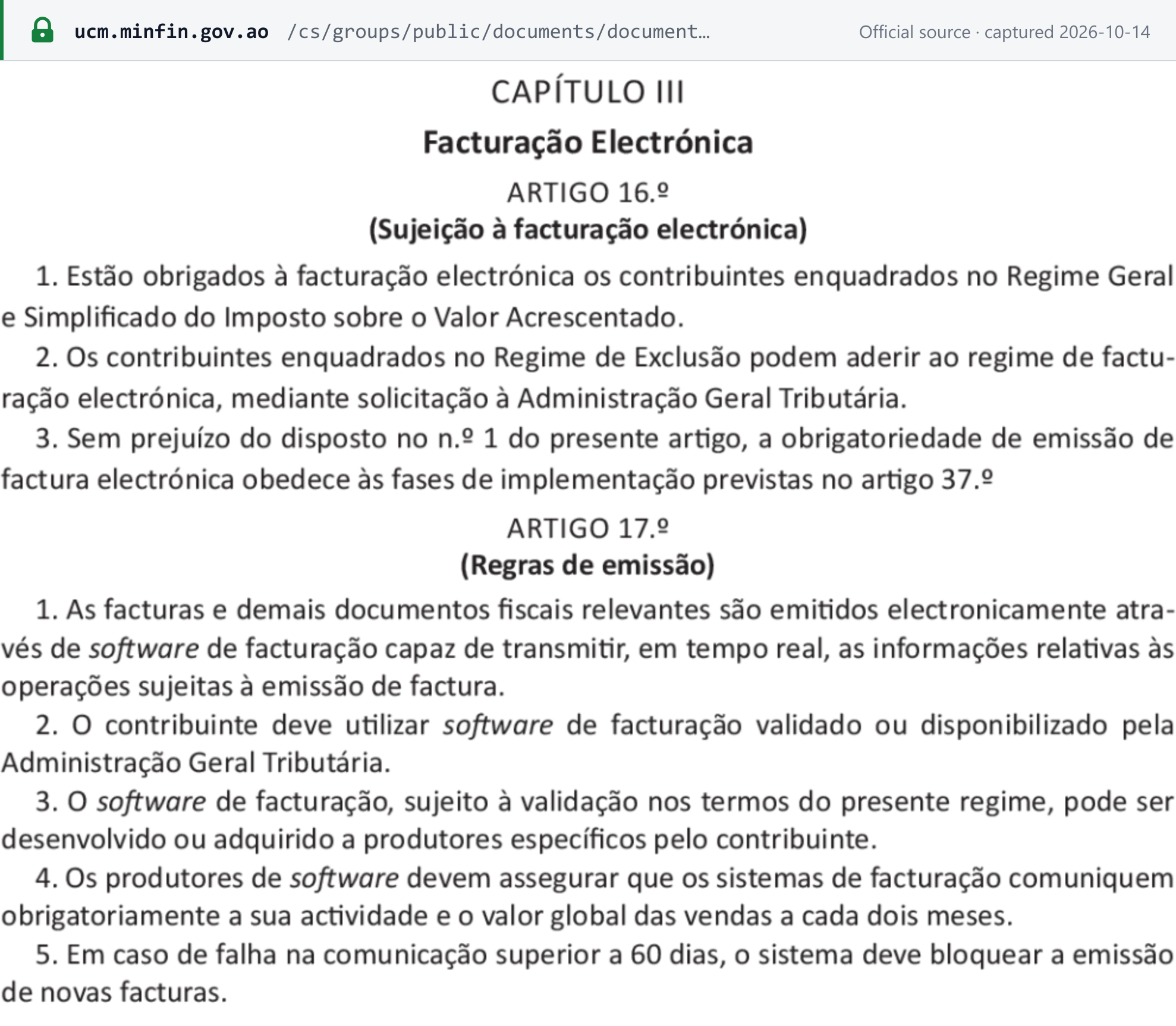
Who. DP 71/25 art. 16.º n.º 1: "Estão obrigados à facturação electrónica os contribuintes enquadrados no Regime Geral e Simplificado do Imposto sobre o Valor Acrescentado." Exclusion-regime taxpayers "podem aderir ao regime de facturação electrónica, mediante solicitação à Administração Geral Tributária" (n.º 2), and the obligation follows the phases of art. 37.º (n.º 3). AGT says a taxpayer that joins voluntarily is "integralmente sujeitos aos termos, condições e obrigações legais" of the regime. [2] [5]
 Source snapshot captured 2026-10-14 — original
B2B, B2G and B2C. AGT publishes no separate dates per flow: the obligation attaches to the issuer, so an issuer in scope e-invoices every sale. Executive Decree 683/25 describes the regime as covering operations "entre os agentes económicos e estes e os consumidores finais". For B2C, the schema accepts the generic buyer tax ID "999999999" on domestic documents without buyer identification, and the document types include the sales slip (Talão de Venda, TV). For B2G, there is no separate platform: suppliers to the State were brought in with phase 1 whatever their IVA regime, under the procurement sanctions described above. [3] [5]
Supplies of Kz 25,000,000 or more. DP 71/25 art. 38.º (Reporte especial): "As transmissões de bens e prestação de serviço de valor igual ou superior a Kz: 25 000 000,00 (vinte e cinco milhões de Kwanzas) devem ser documentadas por factura electrónica ou emitidas no Portal do Contribuinte." The article names no IVA regime or phase. AGT has published no guidance on how it applies to taxpayers not otherwise in the system. [2]
Non-established businesses. Not addressed separately. DP 71/25 keys the obligation to the IVA regime, and none of DP 71/25 arts. 16.º–25.º (chapter III) and 37.º, Executive Decree 683/25 or AGT's e-invoicing communiqués mentions non-residents. Under the IVA Code, a non-resident making taxable supplies in Angola acts through a fiscal representative, and foreign B2B services fall under the reverse charge; see the Angola VAT guide. How a fiscal representative's invoicing fits the e-invoicing rules is not published.
Exports and foreign buyers. The e-invoicing chapter contains no exclusion for exports, imports or reverse-charge supplies. The schema's customerCountry field takes any ISO 3166-1 alpha-2 code ("AO" for domestic buyers), so invoices to foreign buyers go through the same service. [3]
Simplified invoices. Not applicable: DP 71/25 sets no value below which a simplified invoice may replace the invoice. Its article 5.º releases only a few kinds of sale to individuals (vending machines, bearer tickets, licensed street vendors) from the invoice, and even then a sales slip or invoice-receipt is still due (art. 5.º n.º 2); for vending machines and tickets, an invoice-receipt is due whenever the buyer asks (n.º 4). [2]
Format & network
The model: post-validation, not clearance. Executive Decree 683/25, Annex II: "Adopta-se o modelo de validação a posteriori, modelo em que os documentos electrónicos são emitidos e entregues ao adquirente sem necessidade de validação prévia pela Administração Geral Tributária (AGT), sendo a respectiva validação efectuada posteriormente, com base em regras pré-estabelecidas de controlo." In practice: [3]
- the seller's software signs the invoice and sends it to AGT, singly or in batches up to a preset limit (Annex I: at most 30 invoices per call);
- the registration service answers at once whether it registered the request or found a structural error;
- AGT validates the content afterwards, and a second service lets the issuer read the result;
- a request that is rejected or invalid means that, "para efeitos fiscais", the invoice or invoices "não existem";
- each taxpayer can consult the e-invoices issued in its name and, within 2 months, confirm or reject a document in which it is the buyer.
DP 71/25 art. 17.º n.º 1 requires software "capaz de transmitir, em tempo real" the invoice data. See CTC e-invoicing models for how this differs from clearance. [2]
 Source snapshot captured 2026-11-15 — original
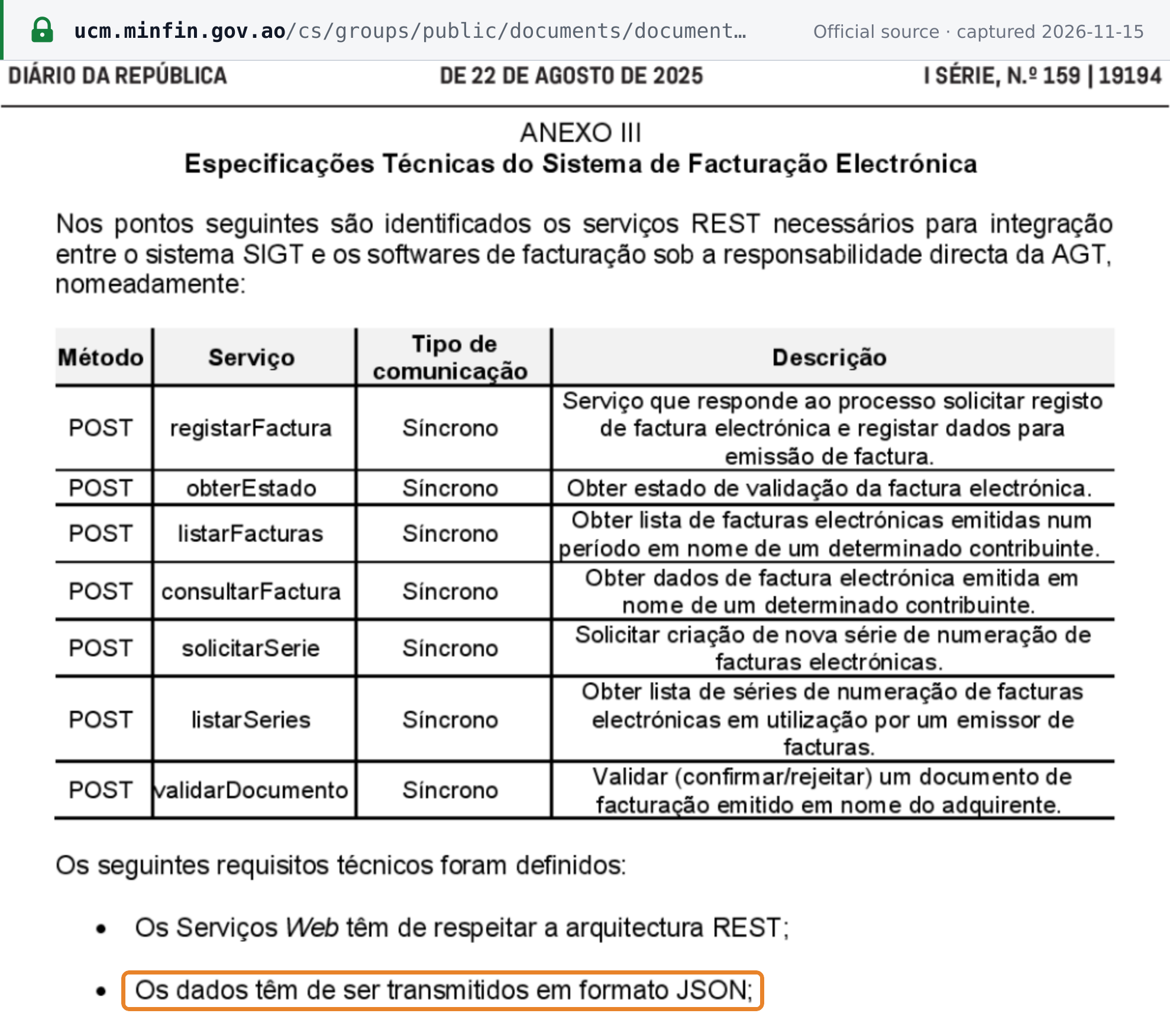
Format: a national JSON schema over REST. Annex III lists the REST services between AGT's SIGT system and invoicing software, all synchronous POST calls, and requires that "Os Serviços Web têm de respeitar a arquitectura REST" and "Os dados têm de ser transmitidos em formato JSON". There is no UBL, CII or Peppol layer and no interchange network: the seller's software talks to AGT, and the buyer receives the invoice from the seller. [3]
| Service | What it does (Annex III) |
|---|---|
registarFactura | Request registration of e-invoices and register the invoice data |
obterEstado | Get the validation status of an e-invoice |
listarFacturas | List the e-invoices issued in a period in a taxpayer's name |
consultarFactura | Get the data of an e-invoice issued in a taxpayer's name |
solicitarSerie | Request a new e-invoice numbering series |
listarSeries | List the series an issuer is using |
validarDocumento | Confirm or reject a document issued in the buyer's name |
 Source snapshot captured 2026-11-15 — original
Integrity. DP 71/25 art. 19.º n.º 2: authenticity, integrity and non-repudiation "são garantidos através da aposição de um código digital definido pela Administração Geral Tributária". Executive Decree 683/25 implements it with: [2] [3]
jwsSoftwareSignature, a signature made with the software producer's private key over the software data, which carries the software's certification number (softwareValidationNumber);jwsDocumentSignature, a signature made with the issuer's private key over the invoice number, issuer NIF, document type, date, buyer tax ID, buyer country, company name and totals;- invoice series generated by AGT (art. 4.º), requested through
solicitarSerie; - a QR code on printed documents: QR Code Model 2, version 4, error correction M, UTF-8, PNG 350×350 px, encoding
https://portaldocontribuinte.minfin.gov.ao/consultar-fe?documentNo, with the AGT logo at under 20% of the image.
Validation results and late submission. obterEstado returns V (valid), I (invalid) or P, "Factura válida com penalização (enviada com mais de 24h de atraso e sem contingência)". That is a schema status, not a statutory deadline: DP 71/25 says "em tempo real" and sets no hour limit. [3]
Document types. FT (invoice), FR (invoice-receipt), FA (advance invoice), FG (global invoice), TV (sales slip), ND and NC (debit and credit notes), AF (self-billing invoice-receipt), receipts (RC, RG), collection notices (AC, AR) and insurance-specific types (RP, RA, CS, LD), among others. A buyer must acknowledge electronically the cancellation or correction made by an electronic credit note (DP 71/25 art. 21.º). [3] [2]
Buyer confirmation and the deductible IVA percentage. When a buyer confirms a document through validarDocumento, it may state a deductibleVATPercentage (0–100). Annex I: "Caso este campo não esteja preenchido será considerado que o contribuinte não tem direito a dedução." Receipts and credit notes are excepted. [3]
Contingency. If the software cannot invoice electronically (DP 71/25 art. 18.º): [2]
- with no connection to the platform, issue offline in the e-invoicing software; give the buyer a printed or digital document marked «emitido em contingência, pendente de autorização», submit the documents to AGT for validation later, and inform AGT immediately that you are operating in contingency;
- after a power cut or equipment failure, issue from printed invoice books, with AGT authorisation and "num prazo não superior a 45 dias corridos" (art. 7.º n.º 6).
Separately, software producers must make their systems report activity and total sales to AGT every two months, and after a communication failure of more than 60 days the software must block new invoices (art. 17.º n.ºs 4–5).
E-reporting alongside: SAF-T (AO). AGT's communiqué of 24 March 2026 releases general- and simplified-regime taxpayers that e-invoice from submitting the SAF-T invoicing file, because e-invoicing already transmits the data in real time: they "estão dispensados da submissão dos Ficheiros Normativos de Inspecção Tributária (SAF-T)". The communiqué's title limits this to the invoicing file; the inventory file as at 31 December (due 15 February) and the accounting SAF-T for the previous year (due 10 April) remain (DP 71/25 art. 24.º n.º 1 d)–e)). [2] [8]
For taxpayers in the e-invoicing regime, IVA returns reflect only invoices communicated and validated through e-invoicing. AGT, 31 October 2026: "as Declarações Periódicas do IVA devem reflectir exclusivamente a informação contida nas facturas comunicadas e validadas através do regime de facturação electrónica", not invoices reported through SAF-T. Voluntary joiners that kept issuing non-electronic invoices (reported via SAF-T) after joining must re-issue them through a certified e-invoicing system and pay the tax "até ao dia 30 de Novembro de 2026", after which AGT moves to coercive collection. [9]
Onboarding / how to comply
Joining. AGT, 1 January 2026: "A adesão é feita a partir do Portal do Contribuinte, em portaldocontribuinte.minfin.gov.ao, onde o contribuinte deve registar-se e seguir os passos indicados para activar a facturação electrónica." E-invoices "podem ser emitidas através do Portal do Contribuinte ou usando um Software certificado pela AGT". The portal route has conditions: DP 71/25 art. 9.º opens it to exclusion-regime taxpayers and resident individuals (n.º 1), and to general- and simplified-regime taxpayers only "mediante autorização prévia da Administração Geral Tributária" (n.º 4), with a cap of 300 invoices and other documents a year (n.º 2). AGT's portal user guides show sign-in with the taxpayer's NIF as user ID and a password; AGT's e-invoicing communiqués do not set out the activation steps. [6]
Preparing for phase 2. AGT's communiqué of 2 October 2026 recommends that taxpayers in scope: [1]
- update or buy invoicing software certified by AGT, able to issue e-invoices and transmit the data to AGT;
- update their taxpayer record and register each establishment (branch) if they have more than one.
AGT has published a step-by-step guide to registering establishments (PDF), and says the registration of each establishment is "imperativo para assegurar o correcto funcionamento da Facturação Electrónica". [10]
Certified software. The taxpayer must use invoicing software "validado ou disponibilizado pela Administração Geral Tributária" (DP 71/25 art. 17.º n.º 2), developed in-house or bought from producers (n.º 3). AGT publishes a list of certified e-invoicing systems, with certificate numbers in the form FE/1/AGT/2025; the latest, of 4 November 2026, is here (PDF). DP 71/25 art. 17.º and Executive Decree 683/25 set no term for certification. Invoicing functions, including issue and receipt, may be carried out by third parties in the taxpayer's name and on its behalf, with the supplier remaining responsible for compliance (DP 71/25 art. 22.º n.º 4). Software producers have a dedicated channel, the "Portal do Parceiro". [2] [13] [6]
When software loses certification. Invoices processed in non-validated software are deemed not issued (DP 71/25 art. 35.º n.º 3; see Penalties). In the precedent of 29 August 2025, AGT suspended two invoicing programs from 1 September 2025, gave their users until 30 September 2025 to migrate to certified software, and said that from 1 October 2025 invoices from them would have no tax validity. [11]
Testing. Not published: Executive Decree 683/25 and AGT's e-invoicing communiqués give no public sandbox and no base URL for the REST services. Software producers deal with AGT through the Portal do Parceiro.
Connection modes.
| Mode | Suits |
|---|---|
| Certified invoicing software calling AGT's REST services | Any taxpayer with an invoicing system; the route for volume |
| Portal do Contribuinte | Exclusion-regime taxpayers and resident individuals (DP 71/25 art. 9.º n.º 1); general- and simplified-regime taxpayers only with prior AGT authorisation (n.º 4). Capped at 300 invoices and other documents a year (n.º 2) |
| Offline issuance in the software, or AGT-authorised printed books | Contingency only (DP 71/25 art. 18.º) |
Penalties
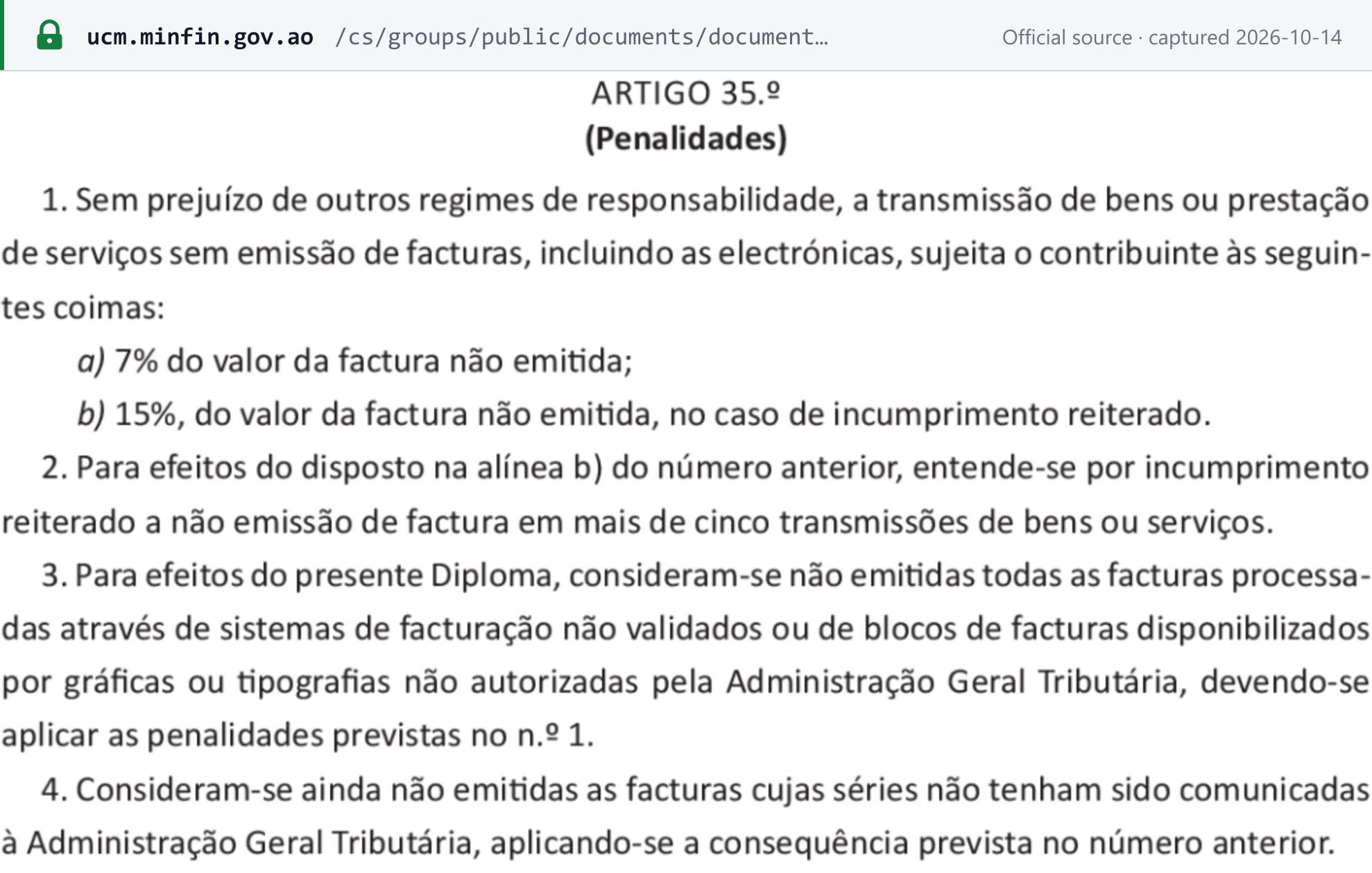
DP 71/25 art. 35.º applies to e-invoices as to any invoice: [2]
| Breach | Fine | Article |
|---|---|---|
| Supplying goods or services without issuing an invoice, "incluindo as electrónicas" | 7% of the value of the invoice not issued | 35.º n.º 1 a) |
| Repeated non-issue (more than five supplies without an invoice) | 15% of the value of the invoice not issued | 35.º n.ºs 1 b), 2 |
| Invoices from non-validated software or unauthorised printers, or in series not communicated to AGT | Deemed not issued, so the 7% / 15% fines apply | 35.º n.ºs 3–4 |
| Price, NIF, address or issuer name missing or wrong, or no AGT-validated program shown | 5% of the value of each invoice | 35.º n.º 8 a) |
| Any other required element missing or wrong | 1% of the value of each invoice | 35.º n.º 8 b) |
| Invoice issued late (art. 8.º n.ºs 1 and 3) | 0.2% of the value of each invoice | 35.º n.º 10 |
| Software producer at fault for SAF-T files not submitted | Kz 600,000 per period | 35.º n.º 13 |
| First violation | Penalty reduced by 50% | 35.º n.º 15 |
 Source snapshot captured 2026-10-14 — original
Enforcement posture, dated.
- 1 October – 31 December 2025. No penalties for failing to issue e-invoices during the transition (AGT, 23 September 2025). [4]
- 5 January 2026. Suppliers to the State that do not comply are barred from supplying the State and restricted in SIGFE, with direct effects on public procurement (AGT). [5]
- 31 October 2026. Voluntary joiners must regularise invoices reported via SAF-T and pay the tax by 30 November 2026, after which AGT moves to coercive collection. [9]
Receiving side. DP 71/25 sets no fine specific to buyers, such as for not confirming invoices. The consequence for buyers is in the schema: a confirmation without a deductible IVA percentage is treated as no right to deduct (see Format & network).
Frequently asked questions
We joined e-invoicing voluntarily but kept reporting invoices through the SAF-T file. What now?
Re-issue those invoices through a certified e-invoicing system and pay the IVA charged by 30 November 2026. AGT said on 31 October 2026 that, for taxpayers registered in the e-invoicing regime, IVA returns reflect only invoices communicated and validated through e-invoicing, and that after the deadline it will collect the unpaid tax coercively.
Do we still submit SAF-T once we e-invoice?
Not the SAF-T invoicing file: AGT released general- and simplified-regime taxpayers that e-invoice from it on 24 March 2026. The inventory file (due 15 February) and the accounting SAF-T (due 10 April) are still due under DP 71/25 art. 24.º n.º 1 d)–e).
Does AGT have to approve an invoice before we send it to the customer?
No. Executive Decree 683/25 adopts the post-validation model ("validação a posteriori"): the invoice is issued and delivered to the buyer without prior AGT validation, and AGT validates it afterwards. If AGT rejects the submission, the invoice does not exist for tax purposes, so check the validation result.
Our connection to AGT is down. Can we still invoice?
Yes. Issue offline in your e-invoicing software, give the buyer a document marked «emitido em contingência, pendente de autorização», inform AGT immediately and submit the invoices for validation later (DP 71/25 art. 18.º). If equipment fails, AGT may authorise printed invoice books for up to 45 calendar days (art. 7.º n.º 6). AGT's schema flags an invoice received more than 24 hours late, outside contingency, as "valid with penalty".
We are in the IVA exclusion regime. Must we e-invoice?
No, but you may join on request to AGT, and once you join you are fully bound by the regime. Separately, DP 71/25 art. 38.º requires any supply of Kz 25,000,000 or more to be documented by an e-invoice or issued on the Portal do Contribuinte.
As a buyer, do we have to do anything with the e-invoices we receive?
You may confirm or reject documents issued in your name within 2 months. When you confirm one, state the deductible IVA percentage: the schema treats a confirmation without it as no right to deduct (receipts and credit notes excepted). For an electronic credit note, you must acknowledge the cancellation or correction electronically (DP 71/25 art. 21.º).
Will the 1 January 2027 date move?
AGT fixed it in its communiqué of 2 October 2026 and restated it on 5 November 2026. On 7 May 2026 AGT reported its chair as saying there will be no extension. The decree's own 12-month rule would point to September 2026, but AGT applies 1 January 2027.
Recent changes
- 2026-11-05 — AGT restates that e-invoicing becomes mandatory for general- and simplified-regime IVA taxpayers on 1 January 2027 and reports more than 85,000 taxpayers issuing e-invoices. (AGT)
- 2026-10-31 — AGT: voluntary e-invoicing joiners that kept reporting invoices via SAF-T must re-issue them through certified e-invoicing software and pay the IVA by 30 November 2026. (AGT)
- 2026-10-02 — AGT: e-invoicing extends to all general- and simplified-regime IVA taxpayers from 1 January 2027. (AGT) — see event
- 2026-03-24 — AGT releases general- and simplified-regime e-invoicers from submitting the SAF-T invoicing file. (AGT)
- 2026-01-01 — E-invoicing mandatory and exclusive for taxpayers of the 1st and 2nd Large Taxpayers' Tax Offices and suppliers to the State. (AGT)
- 2025-09-23 — AGT moves the start from 22 September to 1 October 2025, with a no-penalty transition to 31 December 2025. (AGT)
- 2025-08-22 — Executive Decree 683/25 published: JSON and REST specification, post-validation model. (Diário da República copy)
Related resources
- Angola VAT guide — IVA rates, regimes, invoice content rules, SAF-T, filing and penalties
- Angola tax identification number (NIF) — the NIF that appears as
taxRegistrationNumberandcustomerTaxID - E-invoicing status and networks by country
- CTC e-invoicing models explained
- Angola tax changes on Lookuptax
Important websites
- AGT — news, communiqués and legislation library; taxpayer support (CAC) on (+244) 923 167 010 or apoio.agt@minfin.gov.ao
- Portal do Contribuinte — sign up for e-invoicing; issue invoices within the limits of DP 71/25 art. 9.º (exclusion regime, or general and simplified regimes with prior AGT authorisation; 300 documents a year)
- List of certified e-invoicing systems, 4 November 2026 (PDF)
- Establishment registration step-by-step guide (PDF)
- Executive Decree 683/25 — technical specification (PDF)
Reference links
- AGT — communiqué of 2 October 2026, "Sobre a preparação para a adesão à facturação electrónica"
- Presidential Decree n.º 71/25, de 20 de Março — Regime Jurídico das Facturas (Diário da República I Série n.º 52, PDF)
- Executive Decree n.º 683/25, de 22 de Agosto — e-invoicing data structure, model and technical specifications (Diário da República I Série n.º 159, PDF)
- AGT — "Entrada em vigor da Facturação Electrónica", 23 September 2025
- AGT — "Entrada em Vigor da Obrigatoriedade de Facturação Electrónica", 5 January 2026
- AGT — "Facturação Electrónica: Bem-vindos ao Futuro!", 1 January 2026
- AGT — "Nova era fiscal em Angola: 46 mil empresas já facturam electronicamente", 7 May 2026
- AGT — communiqué on the SAF-T invoicing file for e-invoicers, 24 March 2026
- AGT — "Sobre o tratamento a dar às facturas emitidas pelos contribuintes aderentes à facturação electrónica", 31 October 2026
- AGT — information note on registering establishments for e-invoicing, 2 January 2026
- AGT — suspension of two invoicing programs, 29 August 2025
- AGT — "Mais de 85 mil contribuintes aderem à factura electrónica", 5 November 2026
- AGT — list of certified software, 4 November 2026