E-invoicing in Belgium: the Peppol B2B mandate
Overview
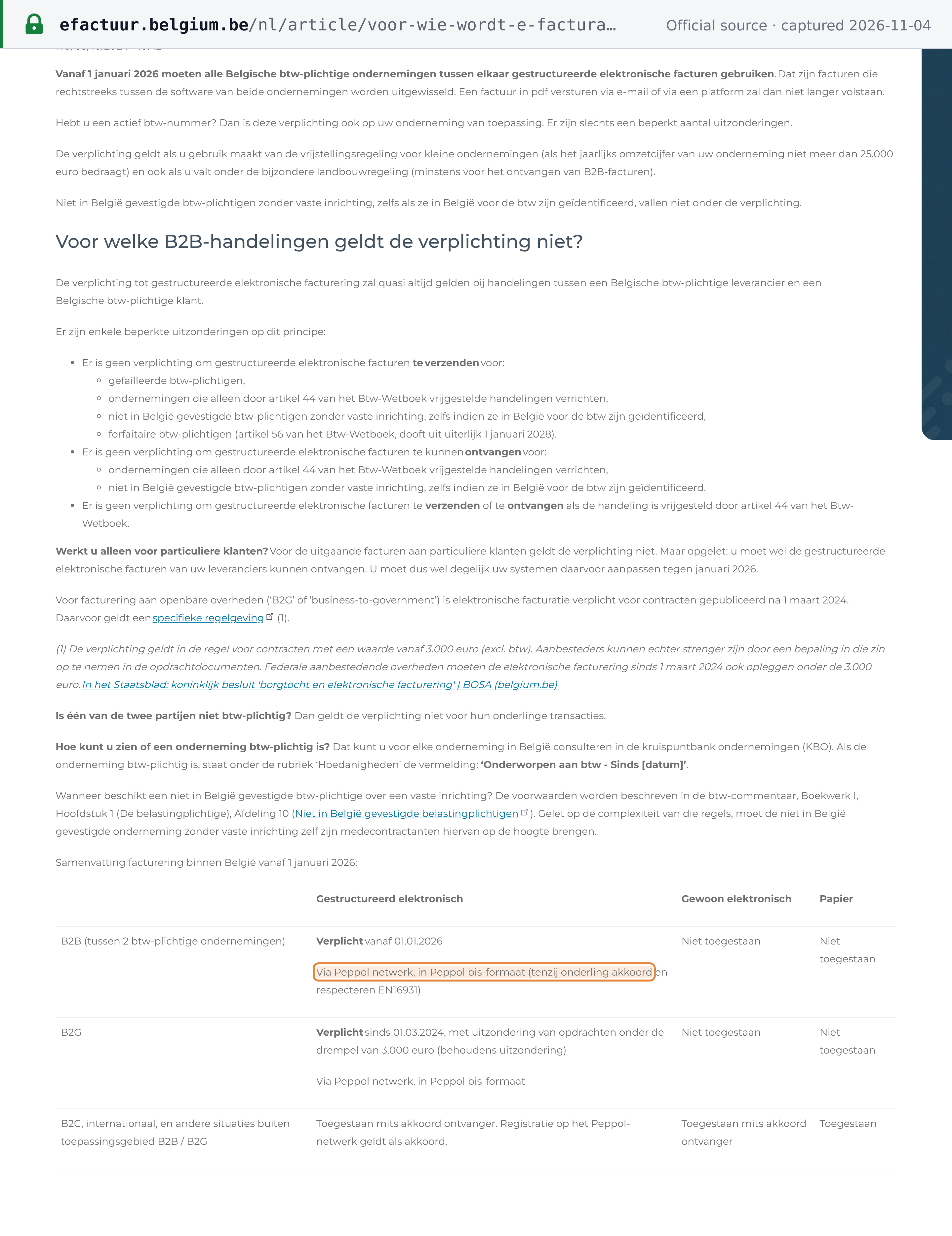
Since 1 January 2026, Belgian VAT-liable enterprises must exchange structured electronic invoices with each other, software to software; "Sending a PDF invoice by e-mail or via a platform will no longer be enough." The federal e-invoicing portal (FPS BOSA / FPS Finance) opens with: "Since 1 January 2026, all Belgian enterprises liable to VAT will have to use structured electronic invoices in their transactions with each other."
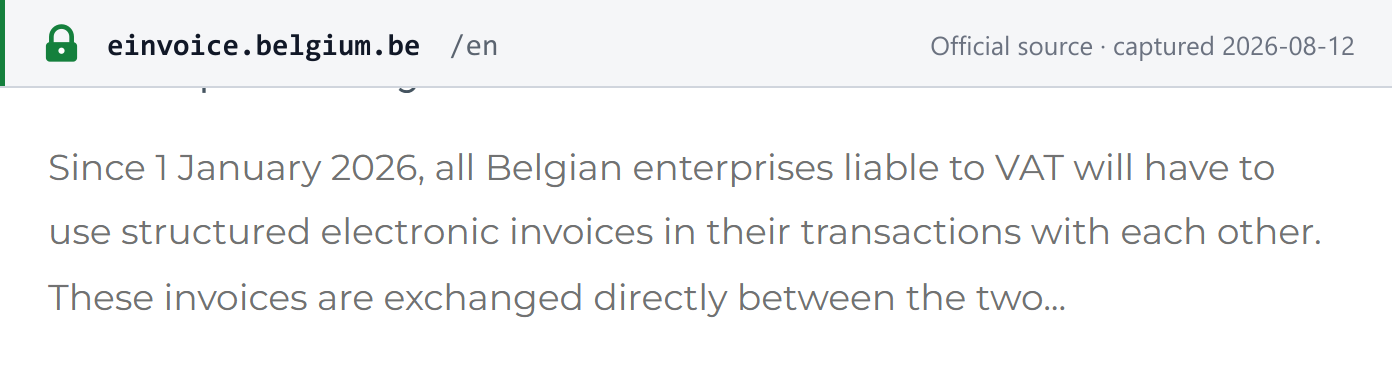 Source snapshot captured 2026-08-12 — original
A PDF or paper invoice is still a valid invoice in one case: the statutory fall-back. When the customer cannot, for technical reasons, receive a structured e-invoice, the supplier is not obliged to issue one, but must still issue an ordinary invoice (VAT Code art. 53 § 2bis, last paragraph, in force since 20 February 2026). The customer stays obliged to be able to receive and "risks to be penalised"; "the invoice sent by alternative means is legally valid". (SPF Finances — Fisconetplus, VAT Code art. 53; FPS FAQ, Q8)
Who runs what. FPS Finance (FOD Financiën / SPF Finances) writes the VAT rules and the guidance and enforces the fines. FPS BOSA has been the Belgian Peppol Authority since 1 January 2016, publishes the federal e-invoicing portal (einvoice.belgium.be / efactuur.belgium.be) and runs Mercurius, the platform through which public bodies receive invoices. (FPS FAQ on Peppol, Q8)
Belgium's model is decentralised interchange over Peppol, not clearance. No government platform validates, stamps or clears domestic B2B invoices. The European Commission's country sheet (updated October 2026) records that "No additional national CIUS has been identified as necessary" (European Commission — eInvoicing in Belgium), and the FPS FAQs, RD No. 1 arts 13ter–13quater and VAT Code art. 53 § 2bis set out no QR-code, hash or cryptographic-stamp requirement.
| Belgium (as at 2026-11-18) | |
|---|---|
| B2B (domestic) | Mandatory since 1 January 2026, issue and receive, between taxable persons established in Belgium |
| B2G | Mandatory for public contracts published after 1 March 2024 (generally from EUR 3,000 excl. VAT); via Mercurius |
| B2C | Out of scope; structured e-invoice allowed with the customer's agreement |
| Non-established businesses | Out of scope without a Belgian fixed establishment, even if VAT-identified in Belgium |
| Format | Peppol BIS in the UBL version (EN 16931); other EN 16931-compliant formats by agreement |
| Network | Peppol (decentralised 4-corner); no clearance |
| Authorities | FPS Finance (rules, fines) · FPS BOSA (Peppol Authority, portal, Mercurius) |
| Legislation | VAT Code art. 53 § 2bis · RD No. 1 arts 13ter–13quater · RD No. 44 (fines) |
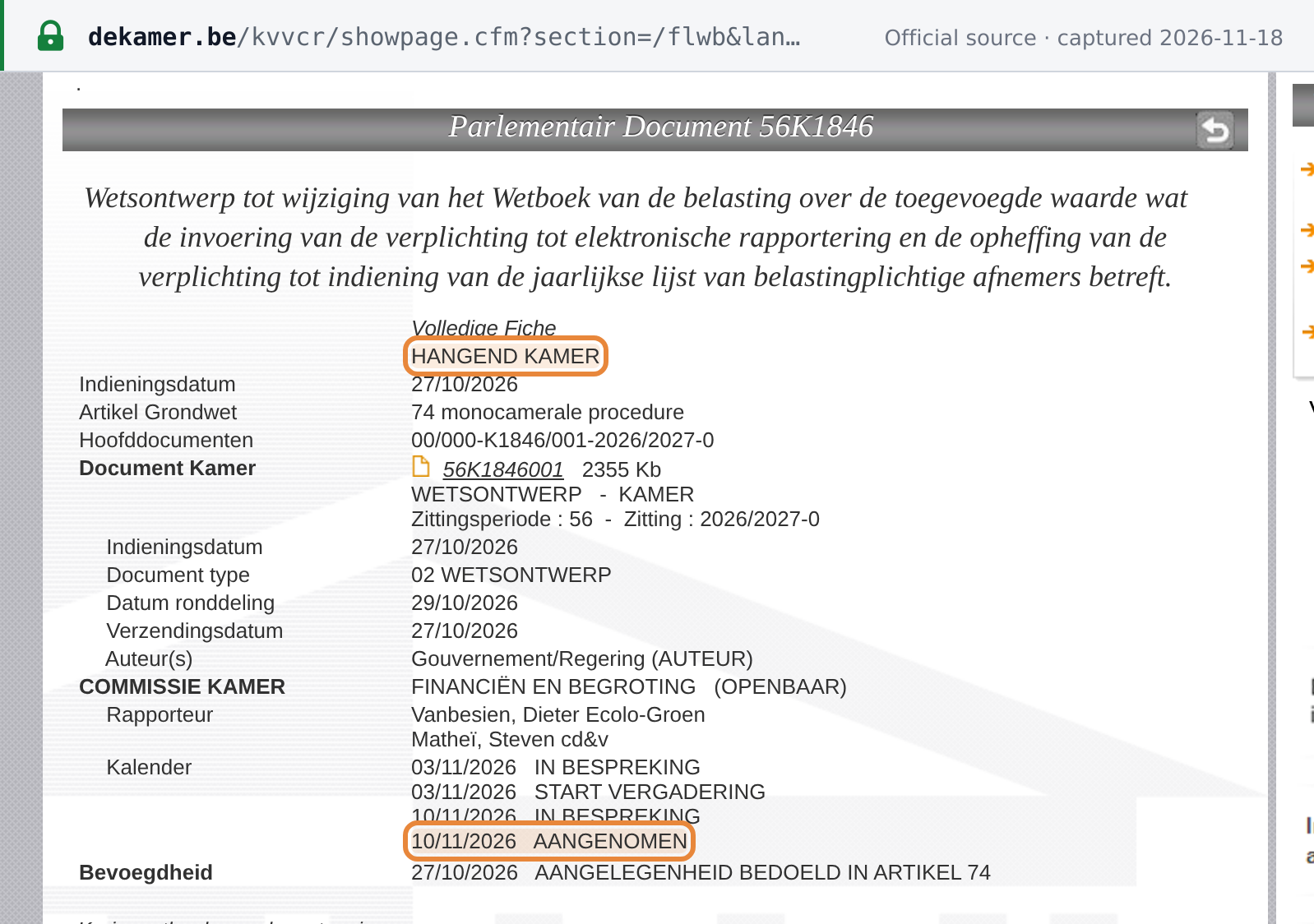
| Next | E-reporting of structured e-invoice data from 1 January 2028 under bill DOC 56 1846, replacing the annual client listing; bill adopted in committee 10 November 2026, plenary vote pending, not yet law |
Mandate status & timeline
| Phase | Who / what | Date | Status | Legal basis / source |
|---|---|---|---|---|
| B2G | Suppliers on public contracts, phased by contract value and publication date; contracts published after 1 March 2024 are in scope, generally from EUR 3,000 excl. VAT, and at any value for federal contracting authorities | from 1 March 2024 (earlier phases under the same decree) | in force | Royal Decree of 9 March 2022 (numac 2022020506) [1] |
| B2B — domestic | Belgian VAT-liable enterprises issue and receive structured e-invoices | 1 January 2026 | in force | VAT Code art. 53 § 2bis (Law of 6 February 2024); RD No. 1 art. 13ter [2] |
| General tolerance | No penalties for offences specific to the new obligation if the business took steps "in a timely and reasonable manner"; no general postponement | 1 January – 31 March 2026 | passed; end announced 7 April 2026 | FPS notices [3] [4] |
| Non-established customers out + fall-back rule | Customers/recipients identified only as non-established persons taken out of scope by law; fall-back when the customer cannot receive (both applied administratively from 1 January 2026) | 20 February 2026 | in force | Law of 10 February 2026, arts 4 and 11 (MB 20 February 2026, numac 2026001291) [2] |
| Self-billing tolerance | No fines for self-billed invoices where the software vendor was still implementing the feature | until 30 June 2026 inclusive | passed | FPS notice of 7 April 2026 [4] |
| E-reporting (proposed) | Electronic reporting of data from structured electronic invoices, replacing the annual listing of taxable customers | 1 January 2028 (bill art. 3) | bill DOC 56 1846/001 submitted to the Chamber 27 October 2026; adopted by the Finance and Budget Committee 10 November 2026; plenary vote pending, not yet law | Bill DOC 56 1846/001 [6] · FPS e-reporting FAQ [5] |
| ViDA intra-EU reporting | Digital reporting for intra-EU transactions under the EU's VAT in the Digital Age package | by 1 July 2030 at the latest | planned | FPS e-reporting FAQ [5] |
The tolerance is over. FPS Finance announced on 7 April 2026 that "de algemene tolerantieperiode die gold gedurende de eerste drie maanden van 2026 … is inmiddels afgelopen" (the general tolerance period that applied in the first three months of 2026 has now ended). In exceptional circumstances it can still decide not to impose a fine, but "dit gebeurt niet automatisch, maar enkel na individuele analyse" (not automatically, only after an individual analysis); businesses submit their case through the FPS contact form. The original notice had already ruled out any general postponement: "Under no circumstances will we grant a general postponement." (FPS — end of the general tolerance period, 7 April 2026; FPS — tolerance notice, 18 December 2025)
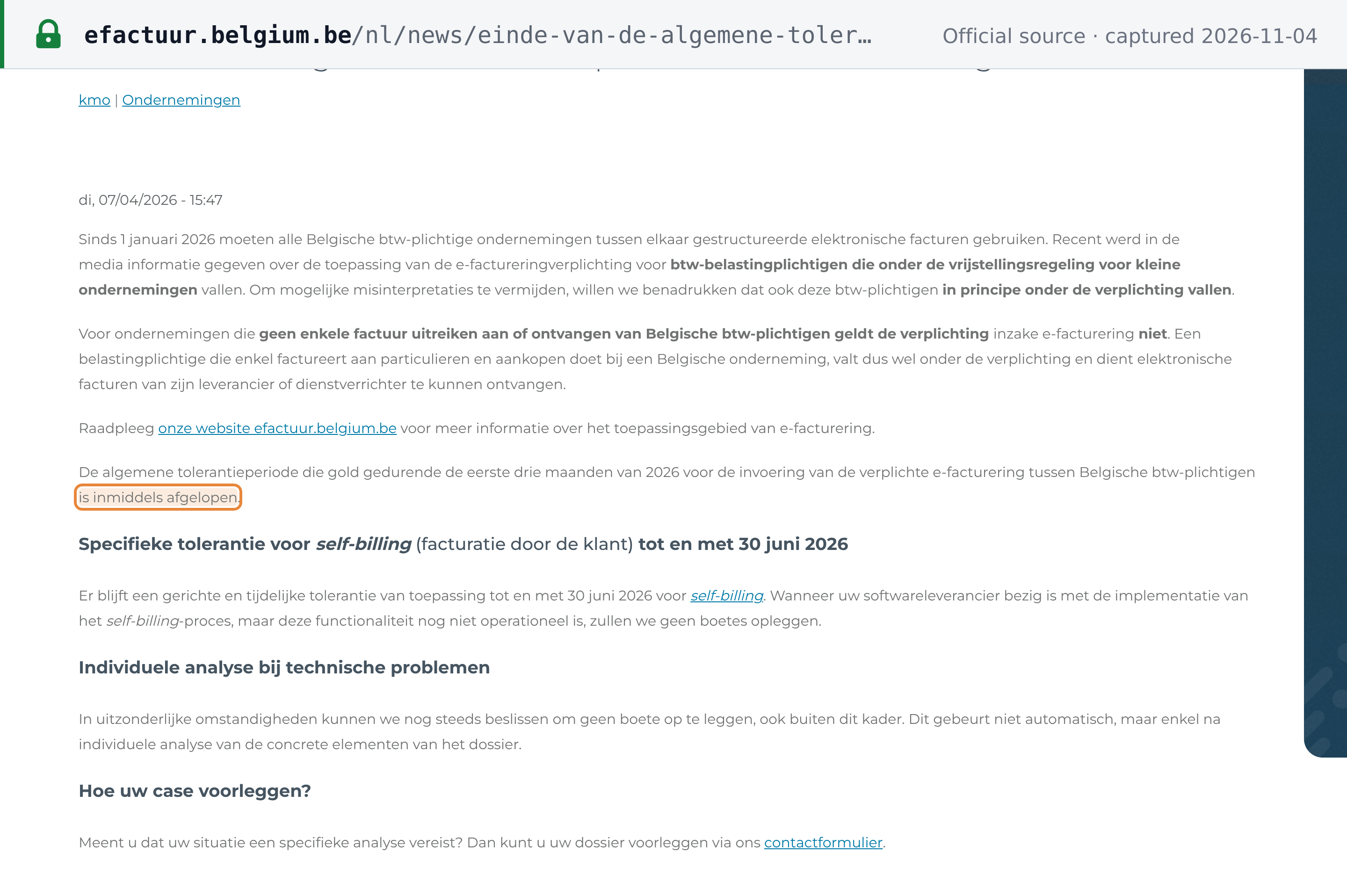 Source snapshot captured 2026-11-04 — original
2028 e-reporting is a plan, not law. The FPS e-reporting FAQ says no invoice data goes to the government in the first phase; reporting "is wel opgenomen in het federale regeerakkoord 2025-2029 met als timing 2028, maar ze moet nog worden omgezet in Belgische wetgeving" (is included in the 2025–2029 federal coalition agreement with 2028 as timing, but still has to be transposed into Belgian law), and it "zal de jaarlijkse klantenlisting vervangen" (will replace the annual client listing).
 Source snapshot captured 2026-09-24 — original
According to the Belgian Federal Government, the Council of Ministers approved a preliminary draft law on 18 July 2026. The Data Protection Authority (opinion 182/2026 of 17 August 2026) and the Council of State (opinion 79.900/3 of 30 September 2026) have since given their advice.
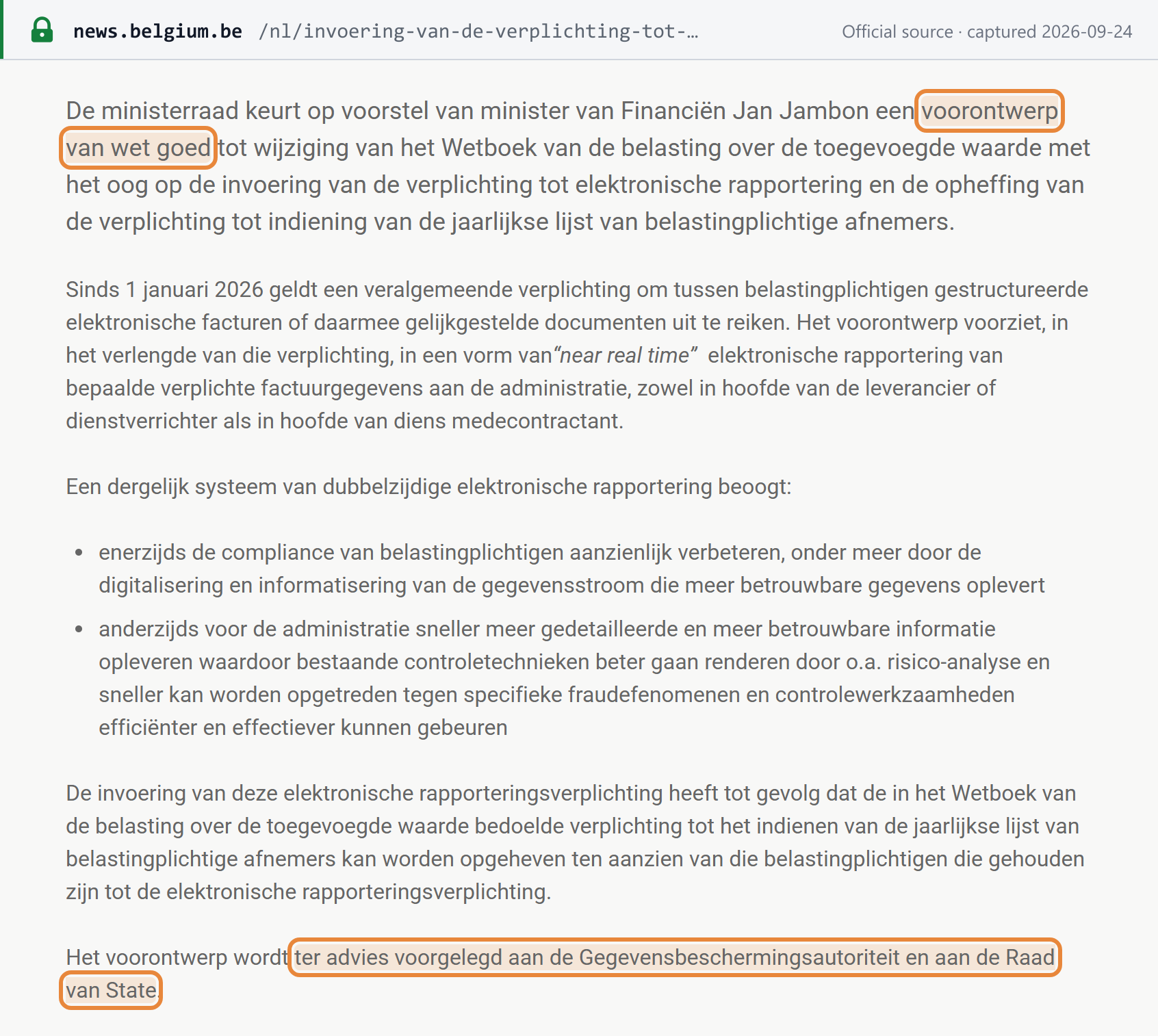 Source snapshot captured 2026-09-24 — original
The bill is now before the Chamber. On 27 October 2026 the government submitted bill DOC 56 1846/001 to the Chamber of Representatives. It amends the VAT Code to introduce electronic reporting of data from structured electronic invoices and to abolish the annual listing of taxable customers. Its article 3 reads "Deze wet treedt in werking op 1 januari 2028" (this law enters into force on 1 January 2028). The Chamber's Finance and Budget Committee adopted the bill on 10 November 2026; it still awaits the plenary vote, and the 1 January 2028 date applies only if the Chamber passes it.
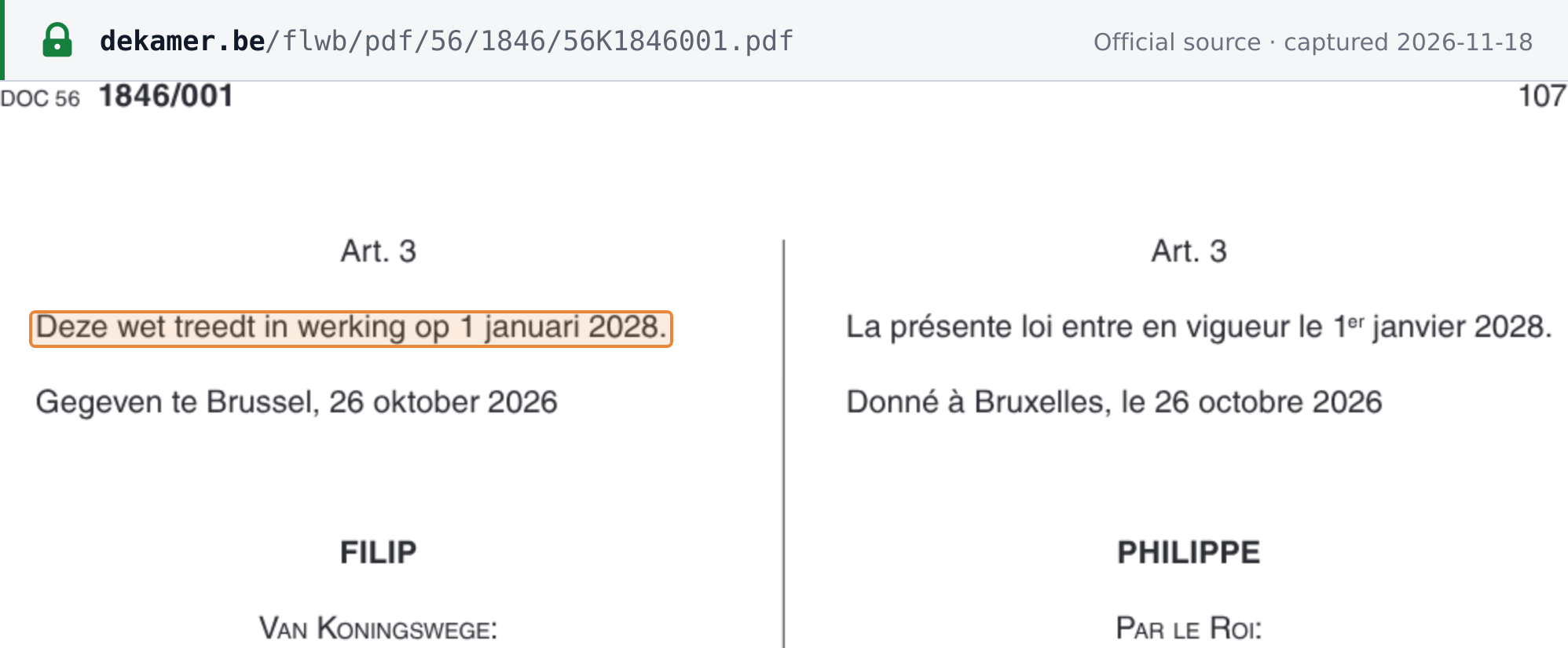 Source snapshot captured 2026-11-18 — original
 Source snapshot captured 2026-11-18 — original
The European Commission describes the planned system as near-real-time continuous transaction control that "will again leverage the interoperability specifications from the Peppol framework" (European Commission); the Belgian authorities have published no technical design. See the VAT listings explainer for the client listing it would replace.
Legal basis
- Law of 6 February 2024 (MB 20 February 2024, p. 24025, numac 2024001635). Its art. 2 inserted VAT Code art. 53 § 2bis with effect from 1 January 2026 (art. 6, first paragraph). It also inserted the definition in VAT Code art. 1 § 13, 3°: a structured electronic invoice is "la facture électronique qui a été émise, transmise et reçue sous une forme électronique structurée qui permet son traitement automatique et électronique" (an electronic invoice issued, transmitted and received in a structured electronic form that allows its automatic and electronic processing). The definition names no technical standard; art. 53 § 2bis, second paragraph, leaves the semantics, syntax and transmission rules to royal decree. (SPF Finances — Fisconetplus, VAT Code art. 1; art. 53)
- Royal Decree of 8 July 2025 (MB 14 July 2025, p. 59264, numac 2025005169), in force 1 January 2026. Its art. 3 inserted a section on structured electronic invoices into Royal Decree No. 1: art. 13ter (format and network) and art. 13quater (the duty to "dispose des moyens techniques" to issue and receive). Its art. 5 inserted the fixed fine scale into Royal Decree No. 44 (annex, section 2, I, C). (SPF Finances — Fisconetplus, RD No. 1; RD No. 44)
- Law of 10 February 2026 on miscellaneous VAT provisions (MB 20 February 2026, numac 2026001291). Its arts 4 and 11 amended art. 53 from 20 February 2026: the customer for whom a structured invoice must be issued, and the recipient who must be able to receive, are now limited to persons identified under art. 50 § 1, first paragraph, 1° (the January 2026 text also reached 3°, non-established VAT-identified persons), and the fall-back paragraph was added. FPS Finance had applied both measures from 1 January 2026 pending the law. (SPF Finances — Fisconetplus, VAT Code art. 53; FPS news, 19 December 2025)
- B2G: Royal Decree of 9 March 2022 (numac 2022020506) on public procurement e-invoicing. (Federal e-invoicing portal — e-invoicing for government)
- Proposed — bill DOC 56 1846/001 (submitted to the Chamber 27 October 2026): would amend the VAT Code to introduce e-reporting of structured e-invoice data and abolish the annual listing of taxable customers, entering into force on 1 January 2028 (art. 3). Adopted in committee on 10 November 2026; plenary vote pending, not yet law. (Chamber of Representatives — DOC 56 1846/001)
No EU derogation is needed any more. Belgium asked the European Commission on 6 October 2023 for a Council authorisation under art. 395 of the VAT Directive. Since the ViDA package was approved in its final version on 11 March 2025, "Member States no longer need authorisation to introduce an e-invoicing obligation (this applies with immediate effect)" (FPS FAQ, Q1). See the ViDA explainer.
Retention. A structured e-invoice is kept for seven years from 1 January of the year after issue (VAT Code art. 60 § 3). Art. 97 of the Law of 18 December 2025 (MB 30 December 2025, numac 2025009647) restored this seven-year period retroactively from 1 January 2023, reversing the ten-year period set by the Law of 20 November 2022. The recipient keeps the structured invoice itself for the full period, and its legibility must be guaranteed throughout (FPS FAQ, Q17). See the Belgium country guide, Retention and audit trail.
Scope
B2B — must issue AND receive from 1 January 2026: a taxable person established in Belgium that supplies goods or services to another taxable person who must communicate a Belgian VAT number (or to a VAT unit), including advance payments. The recipient must be able to receive the invoice "dans le format dans lequel elle a été émise" (in the format in which it was issued), itself or through a third party. (SPF Finances — Fisconetplus, VAT Code art. 53) Expressly included:
-
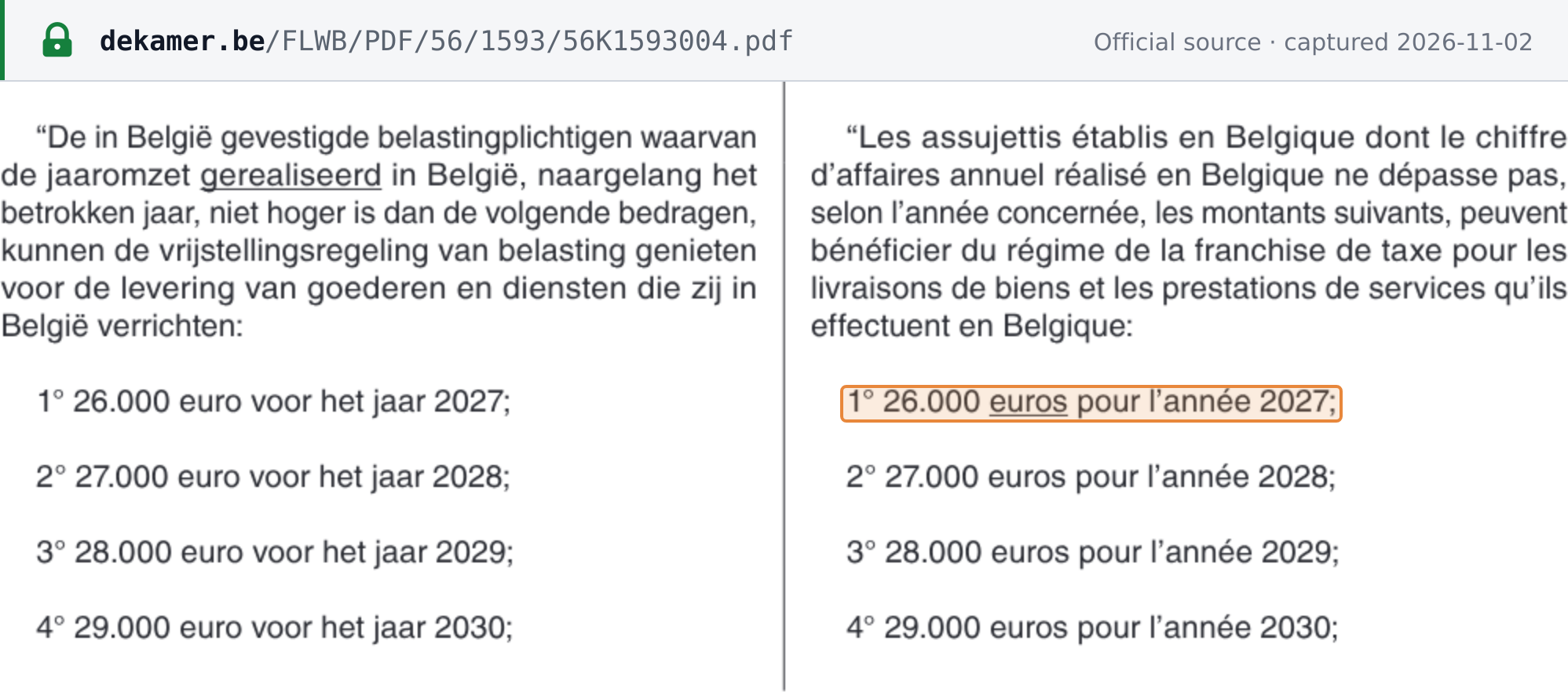
businesses in the small-enterprise exemption scheme, "in principe" (in principle), per the FPS notice of 7 April 2026. Under VAT Code art. 56ter as amended by art. 26 of the Law of 23 September 2026 (MB 7 October 2026, numac 2026007237 — SPF Finances — Fisconetplus, art. 56ter; event record), the scheme's turnover ceiling is EUR 25,000 for 2026 and EUR 26,000 for 2027, then rising each year to EUR 30,000 from 2031.
 Source snapshot captured 2026-11-02 — original
A business that neither issues invoices to nor receives invoices from Belgian VAT-liable businesses is outside the obligation; one that sells only to consumers but buys from a Belgian business must be able to receive. (FPS notice, 7 April 2026)
-
taxable persons under the special agricultural scheme, "at least for receiving B2B invoices" (FPS FAQ, Q2).
-
a Belgian representative of a non-established taxable person, under its own Belgian VAT number, but not when it acts as individually liable representative (using the principal's number) or as globally liable representative (FPS FAQ, Q25).
Not obliged to issue: bankrupt taxable persons; businesses performing only VAT Code art. 44 exempt transactions; taxable persons not established in Belgium without a fixed establishment, even if VAT-identified in Belgium; flat-rate taxpayers under VAT Code art. 56, a regime that ends on 1 January 2028 (art. 56 § 7). Not obliged to receive: art. 44-exempt-only businesses and non-established taxable persons without a fixed establishment. There is no obligation either way for a transaction that is itself exempt under art. 44. (FPS — Voor wie wordt e-facturatie verplicht?; SPF Finances — Fisconetplus, VAT Code art. 56)
B2C, international and other situations are out of scope. For invoices to private customers the obligation does not apply. A structured e-invoice is allowed with the customer's agreement, and "Registratie op het Peppol-netwerk geldt als akkoord" (registration on the Peppol network counts as agreement); a paper invoice is allowed. (FPS — Voor wie wordt e-facturatie verplicht?) Transactions that carry no invoicing duty at all, such as private use and first occupation, carry no e-invoicing duty either (FPS FAQ, Q30).
Credit notes, simplified invoices, receipts. Any document amending a structured e-invoice "est émis dans le même format que la facture initiale" (is issued in the same format as the original invoice) (VAT Code art. 53 § 2bis), so "Credit and debit notes must therefore also be sent via Peppol". In 2026 a credit note on an original PDF invoice may still be issued as a PDF if the customer accepts it. Simplified invoices must also go "(at least) via the Peppol-BIS format". A taxable or non-taxable legal-person customer still gets an invoice in addition to the receipt from a registered cash register. (FPS FAQ — general; FPS FAQ — specific questions)
Format & network
Royal Decree No. 1, art. 13ter, sets the default. The issuer sends the structured invoice "1° en conformité avec la norme européenne sur la facturation électronique et la liste des syntaxes en vertu de la directive 2014/55/UE telles que concrétisées dans le format Peppol BIS dans la version UBL ; 2° via le réseau de transmission Peppol" (1° in accordance with the European e-invoicing standard and the list of syntaxes under Directive 2014/55/EU as implemented in the Peppol BIS format in the UBL version; 2° via the Peppol transmission network). (SPF Finances — Fisconetplus, RD No. 1)
- Network: "Structured electronic invoices will be sent via a decentralised network called Peppol" (federal e-invoicing portal), a 4-corner interchange between the parties' service providers with no central clearance. The network "garandeert geen realtime levering" (does not guarantee real-time delivery) (FPS FAQ on Peppol, Q9).
- Format floor: network participants "moeten minstens het documenttype 'Peppol-BIS' kunnen ontvangen" (must at least be able to receive the Peppol BIS document type), an application of EN 16931 (FPS FAQ on Peppol, Q2). The European Commission names the profile Peppol BIS Billing 3.0 (European Commission).
- Agreed alternative: by agreement between the parties, the issuer may use a format other than Peppol BIS (UBL) and another digital channel instead of Peppol, provided the format complies with the European standard and the Directive 2014/55/EU syntax list (RD No. 1 art. 13ter, second paragraph; VAT Code art. 53 § 2bis, second paragraph).
- Customer portals and attachments: a customer "cannot unilaterally impose that you submit an invoice exclusively through its own portal, unless you explicitly agree". Attachments travel in the same channel as the invoice, never separately by e-mail; the allowed extensions are pdf, png, jpg, csv, xlsx and ods. A recipient cannot reject an invoice because no PDF is attached; a real rejection goes back over Peppol as an Invoice Response with status code "RE". (FPS FAQ — general, Q12, Q18, Q19; FPS FAQ — specific, Q28)
- Peppol ID: Belgian businesses are registered at least under their enterprise number
(KBO/BCE, scheme ID 0208). The Peppol Directory can be searched
with
0208:<enterprise number>, but it does not show whether an organisation can also send (FPS FAQ on Peppol, Q4, Q6). To check the number itself, see how to verify a Belgian enterprise number. - B2G: invoices to public authorities go over Peppol to Mercurius (FPS BOSA). Its portal tracks routing and processing and "also makes it possible to manually issue invoices or credit notes to the public authorities" (federal e-invoicing portal — sending to the administration).
 Source snapshot captured 2026-11-04 — original
The FPS summary table lists "ordinary electronic" and paper invoices as "Niet toegestaan" (not allowed) for B2B; the statutory fall-back described in the Overview is the exception the law now writes in.
Onboarding: how to comply
- Check whether you're in scope with the official self-check tool at einvoice.belgium.be/en/tool.
- Connect through software or a Peppol service provider. "U kunt zich niet rechtstreeks registreren op Peppol" (you cannot register directly on Peppol); registration runs through a recognised Peppol service provider, in practice usually the end-user software (FPS FAQ on Peppol, Q5). There is no separate government registration step for B2B.
- Use the FPS software list as a guide, not a certification. The list, re-issued on 3 November 2026, covers send-only, send-and-receive and full-processing software for end users; "Listing software on this list does not imply a substantive evaluation, qualitative assessment or certification by the FPS Finance" (software solutions article). Certified access points are listed on peppol.org.
- Claim the tax incentives if you qualify
(FPS — fiscale stimulansen):
- from 1 January 2025, the investment deduction for digital investments is 20%;
- for the taxable periods 2024 to 2027 inclusive, small SMEs and the self-employed using subscription formulas may deduct 120% of invoicing packages and of advisory costs incurred to meet the new obligations, including the surcharge on an existing software subscription if it is stated separately on the invoice. Depreciation never qualifies. "Small" means exceeding no more than one of: turnover EUR 11,250,000, balance-sheet total EUR 6,000,000, 50 employees.
Penalties
| Obligation breached | Fine | Rule |
|---|---|---|
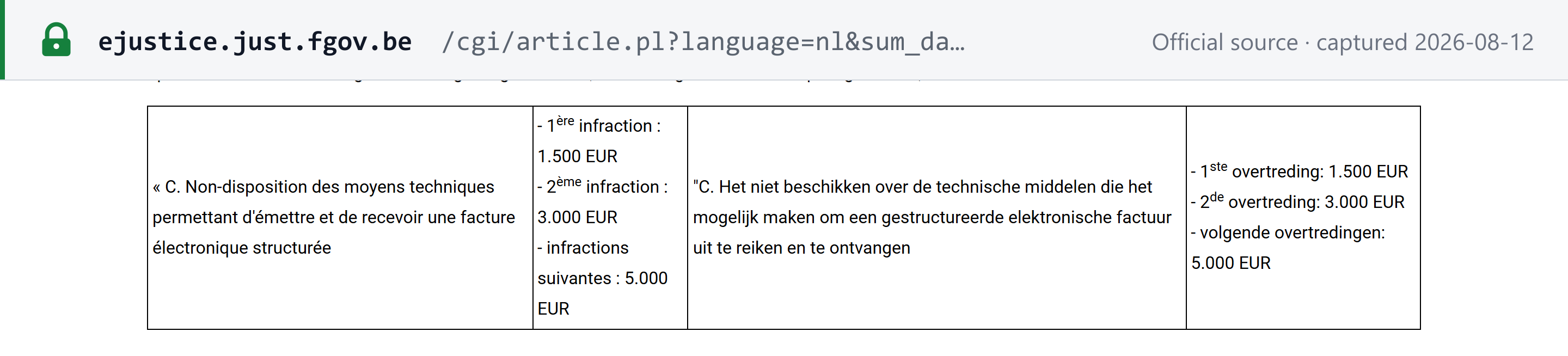
| No technical means to issue and receive structured e-invoices | EUR 1,500 first, EUR 3,000 second, EUR 5,000 each later infringement | RD No. 44, annex, section 2, I, C (from 1 January 2026) |
| Invoice not issued, missing mandatory data or inaccurate | proportional fine | RD No. 41, annex, Table C |
| Invoice not drawn up or issued on time | per invoice: EUR 50 (max EUR 500) first, EUR 125 (max EUR 1,250) second, EUR 250 (max EUR 5,000) later | RD No. 44, annex, section 2, I, A |
| Other breaches, including the art. 13ter semantics, syntax and transmission rules | per invoice: first EUR 25 (min EUR 50, max EUR 250) if purely accidental or harmless to the Treasury, otherwise EUR 50 (max EUR 500); second EUR 125 (max EUR 1,250); later EUR 250 (max EUR 5,000) | RD No. 44, annex, section 2, I, B |
For the fixed scale, an infringement counts as a second or later one only when the administration establishes it "au plus tôt trois mois après" (at the earliest three months after) the previous fined infringement (SPF Finances — Fisconetplus, RD No. 44). The fixed fine scale for lacking the technical means is EUR 1,500, EUR 3,000 and EUR 5,000:
 Source snapshot captured 2026-08-12 — original
The FPS confirms that "the existing tax fines for failure to issue invoices and for issuing non-compliant invoices remain in place and also apply to structured electronic invoices", and that the 2018 penalty policy continues to apply. On the customer side, "if the material conditions are met, the right to deduction will not be denied", but a customer without the means to receive can still be fined. (FPS FAQ — specific, Q24, Q26)
Enforcement posture. The general tolerance ended on 31 March 2026 (FPS notice of 7 April 2026) and the self-billing tolerance on 30 June 2026. "Any penalty will depend on the specific circumstances of the case. Each case will be assessed individually" (FPS tolerance notice).
Frequently asked questions
Does the Belgian B2B e-invoicing mandate apply to small businesses under the VAT exemption scheme?
Yes, in principle. Businesses using the small-enterprise exemption scheme (annual turnover up to EUR 25,000 in 2026; EUR 26,000 in 2027) are in scope. A business that neither issues invoices to nor receives invoices from Belgian VAT-liable businesses is outside the obligation, but one that sells only to consumers and buys from a Belgian business must be able to receive structured e-invoices.
Can we keep exchanging PDF invoices if both parties agree?
No. Agreement alone does not make a PDF compliant: parties may agree on another format only if it is a structured invoice that respects the European standard EN 16931. A PDF or paper invoice is valid only in the fall-back case, where the customer cannot technically receive a structured e-invoice. The supplier then issues an ordinary invoice (an electronic one only with the customer's agreement), and the customer, who remains obliged to be able to receive, risks a fine. Once the customer can receive, the supplier does not resend those invoices as structured e-invoices.
We are a foreign company with a Belgian VAT number. Are we in scope?
Not unless you have a fixed establishment in Belgium. Since 20 February 2026 the law limits the obligation to taxable persons established in Belgium, and a non-established business without a Belgian fixed establishment need neither issue nor be able to receive structured e-invoices. A Belgian company acting as your representative is in scope under its own Belgian VAT number, but not when it acts as individually or globally liable representative.
Can a customer require us to upload invoices to its own portal?
No, not without your consent. Structured e-invoices are in principle exchanged over the Peppol network, and a customer cannot unilaterally impose its own portal unless you explicitly agree.
Can we send invoice attachments separately by e-mail?
No. All attachments related to an invoice go through the same channel as the invoice. The European standard followed by Peppol currently allows pdf, png, jpg, csv, xlsx and ods attachments. A customer cannot reject an invoice only because no PDF copy is attached.
What fines apply if we cannot send or receive structured e-invoices?
Lacking the technical means to issue and receive structured e-invoices costs EUR 1,500 for the first infringement, EUR 3,000 for the second and EUR 5,000 for each later one; an infringement counts as a second or later one only if established at least three months after the previous fined one (Royal Decree No. 44, in force 1 January 2026). The ordinary invoice fines also apply: a proportional fine for an invoice not issued or inaccurate, and per-invoice fines for late issue and for breaching the format and transmission rules. The general tolerance ended on 31 March 2026.
What is changing in 2028?
Belgium plans electronic reporting of data from structured electronic invoices, replacing the annual client listing. The government submitted bill DOC 56 1846/001 to the Chamber of Representatives on 27 October 2026; its article 3 sets entry into force on 1 January 2028. The Chamber's Finance and Budget Committee adopted it on 10 November 2026; the plenary vote is pending, so it is not yet law. The European Commission says the system will reuse Peppol specifications; the Belgian authorities have published no technical design.
Recent changes
- 2026-10-27 — The government submits bill DOC 56 1846/001 to the Chamber: e-reporting of structured e-invoice data replaces the annual client listing, entering into force on 1 January 2028 (art. 3); not yet adopted (updated from the 18 July 2026 preliminary draft). (Chamber of Representatives — DOC 56 1846/001) — see event · issue
- 2026-10-07 — The Law of 23 September 2026 is published in the Moniteur belge: the small-enterprise exemption ceiling, whose users stay in the e-invoicing scope, becomes EUR 26,000 for 2027, rising to EUR 30,000 from 2031. (SPF Finances — Fisconetplus, VAT Code art. 56ter) — see event
- 2026-04-07 — FPS Finance announces the end of the general Q1 2026 tolerance; a self-billing tolerance runs through 30 June 2026, and fines are waived only after individual analysis. (FPS — efactuur.belgium.be)
- 2026-02-20 — The Law of 10 February 2026 (numac 2026001291) takes effect: customers and recipients identified only as non-established persons are taken out of the B2B obligation and the fall-back rule is written into VAT Code art. 53 § 2bis. (SPF Finances — Fisconetplus, VAT Code art. 53)
- 2026-01-01 — Mandatory structured B2B e-invoicing via Peppol enters into force for Belgian VAT-liable enterprises. (Federal e-invoicing portal)
- 2025-12-30 — The Law of 18 December 2025 (art. 97) restores the seven-year invoice retention period (VAT Code art. 60 § 3) retroactively from 1 January 2023; it also governs how long a structured e-invoice is kept. (SPF Finances — Fisconetplus) — see event · issue
Related resources
- Belgium VAT country guide — rates, invoice rules, the annotated invoice specimen and the e-invoicing status summary
- E-invoicing status and networks worldwide — Belgium row in global context
- Peppol network explainer
- ViDA — VAT in the Digital Age
- VAT listings explained — the annual client listing that e-reporting would replace
- Belgium tax identification numbers
- How to verify a Belgian VAT number
- How to verify a Belgian enterprise number (KBO/BCE)
- Belgium tax-change chronology — every tracked Belgian change, dated and sourced
- Validate a Belgian VAT number
Important websites
- einvoice.belgium.be — the federal e-invoicing portal (scope tool, software list, news)
- efactuur.belgium.be FAQ — the full FAQ set (NL/FR)
- Scope self-check tool
- Peppol Directory — search
0208:<enterprise number> - Mercurius (FPS BOSA) — B2G invoicing platform
- Peppol-certified service providers — OpenPeppol register