E-Invoicing in France - An In-Depth Overview
| Country | France |
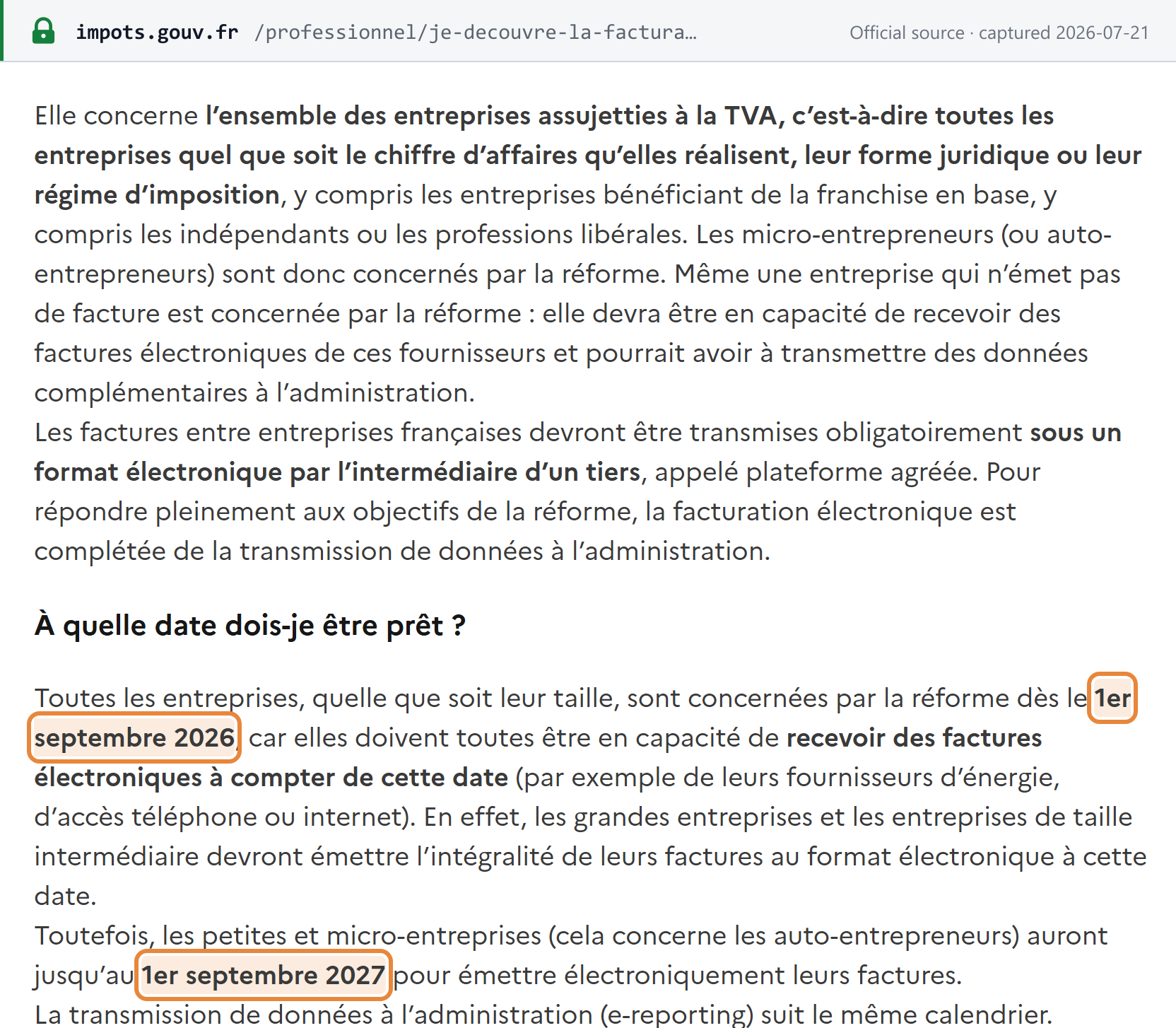
| Status - B2B | Mandatory, phased: since 1 Sep 2026 all businesses receive and large companies / ETI issue; SMEs and micro-enterprises issue from 1 Sep 2027 |
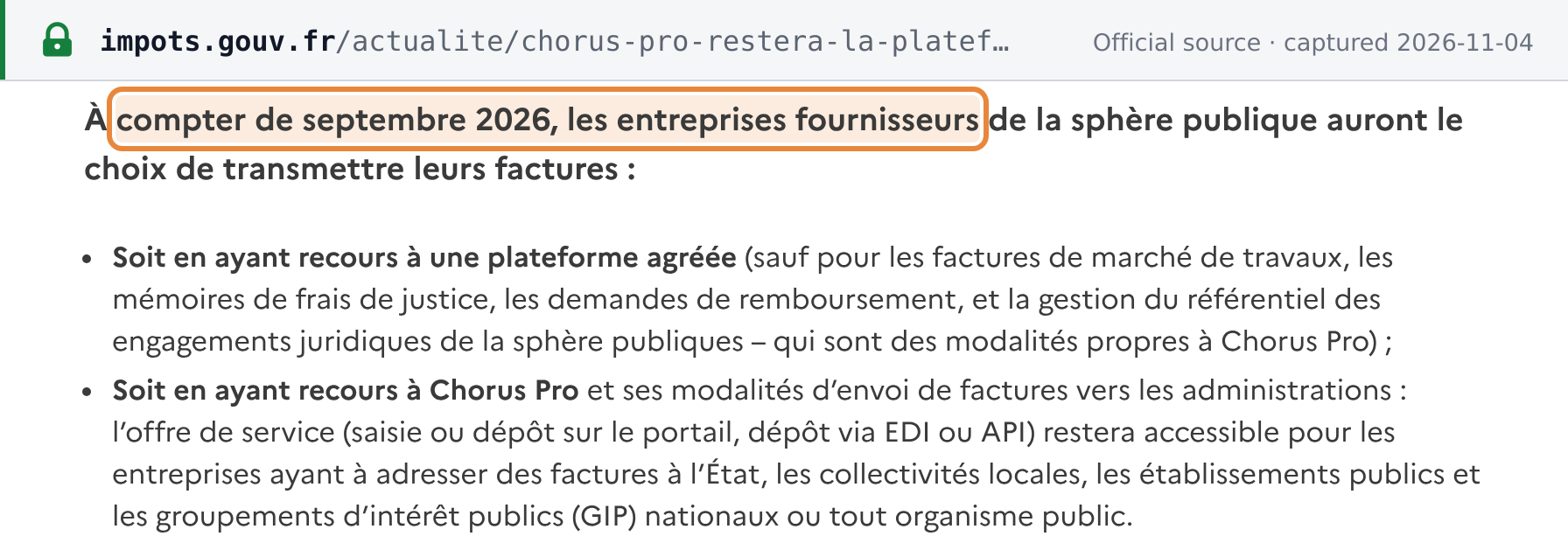
| Status - B2G | Mandatory via Chorus Pro since 2017–2020; since Sep 2026 suppliers may use a plateforme agréée or Chorus Pro (with exceptions) |
| Status - B2C | No e-invoice; sales to consumers are e-reported as daily totals |
| Non-established businesses | No e-invoicing obligation; e-reporting of their French-taxable operations |
| Formats | CII or UBL in the "profil EN16931" or "profil EXTENDED-CTC-FR", or a mixed CII + PDF/A-3 file (Factur-X), per AFNOR XP Z12-012 |
| Authority | DGFiP (Direction générale des Finances publiques) |
| Network | Plateformes agréées (PA), exchanging platform to platform, plus the State's annuaire central; Peppol optional (DGFiP is the Peppol Authority for France); Chorus Pro for the public sector |
| Legislation | Art. 26 Loi 2022-1157 (LFR 2022); art. 91 LF 2024; art. 123 Loi 2026-103 (LF 2026); CGI arts. 289 bis, 290, 290 A; Décret 2026-677 and Arrêté of 27 July 2026 |
Overview
Since 1 September 2026, every business in France must be able to receive e-invoices through a plateforme agréée (PA), and large companies and intermediate-sized companies (ETI) must issue them that way. SMEs and micro-enterprises issue from 1 September 2027. [1] A plateforme agréée is "un opérateur de dématérialisation immatriculé par l'État", an operator registered by the State. [21] The reform has two parts: e-invoicing of domestic B2B sales, and e-reporting of transaction and payment data to the tax administration. The DGFiP's hub page describes the generalisation as "effective depuis le 1er septembre 2026". [1] [2]
The reform is run by the DGFiP. Its legal base is article 26 of Loi n° 2022-1157 (loi de finances rectificative pour 2022) and article 289 bis of the Code général des impôts (CGI). Article 91 of the 2024 finance law set the current start dates. Article 123 of Loi n° 2026-103 of 19 February 2026 (loi de finances pour 2026) made the PA the only channel and raised the fines. The full list is under Legal basis. [8]
Invoices to the public sector are a separate, older system. Chorus Pro, operated by the AIFE, has carried them since 1 January 2017. [15]
Questions go to the DGFiP helpline, 0806 807 807 (Monday to Friday, 8:30 to 18:00). [3]
Mandate status & timeline
Status: wave 1 in force since 1 September 2026; wave 2 due 1 September 2027.
| Phase | Who | What becomes mandatory | Date | Legal basis | Status |
|---|---|---|---|---|---|
| B2G, step 1 | Large companies and public bodies | Electronic invoices to the public sector through Chorus Pro | 1 Jan 2017 | Ordonnance n° 2014-697 [16] | Passed |
| B2G, step 2 | Intermediate-sized companies (ETI) | Same | 1 Jan 2018 | Same | Passed |
| B2G, step 3 | SMEs | Same | 1 Jan 2019 | Same | Passed |
| B2G, step 4 | Micro-enterprises | Same (the last phase) | 1 Jan 2020 | Same [26] | Passed |
| B2B, wave 1 | All businesses established in France and liable to French VAT | Receive e-invoices | 1 Sep 2026 | CGI art. 289 bis; art. 26 Loi 2022-1157 as amended [1] | In force |
| B2B, wave 1 | Large companies, ETI and public bodies | Issue e-invoices and e-report | 1 Sep 2026 | Same [1] [3] | In force |
| E-reporting, wave 1 | Also single VAT taxable persons (assujettis uniques, art. 256 C CGI) | E-report | 1 Sep 2026 | BOFiP BOI-TVA-DECLA-20-30-50 [10] | In force |
| B2B, wave 2 | SMEs and micro-enterprises, including auto-entrepreneurs | Issue e-invoices and e-report | By 1 Sep 2027 at the latest (earlier on a voluntary basis) | Same [1] | Hard deadline |
| E-reporting between two non-established businesses | Any size | E-report their French-taxable operations | 1 Sep 2027 | BOFiP BOI-TVA-DECLA-20-30-50-10, §150 [11] | Due |
| Intra-EU supplies | Exempt intra-community supplies (art. 262 ter I-1° CGI) | Move from e-reporting into e-invoicing | 1 Jul 2030 | Art. 123 V-D Loi 2026-103 [7] | Legislated |
 Source snapshot captured 2026-07-21 — original
Company size follows the categories of article 51 of the 2008 Loi de modernisation de l'économie and décret n° 2008-1354, which use headcount, turnover and balance-sheet tests. For non-established businesses those tests apply to the foreign legal entity as a whole. [10]
Latest calendar statement. On 11 July 2026 the minister for public accounts, David Amiel, confirmed the calendar in communiqué N°898: businesses must be able to receive from 1 September 2026, and SMEs, TPEs and micro-enterprises enter the issuing obligation from 1 September 2027. [19] No further B2B wave has been announced. One more step is already in the law: intra-EU supplies come into e-invoicing on 1 July 2030.
Doctrine. On 30 September 2026 BOFiP published the administrative commentary on e-reporting. It applies the obligations from 1 September 2026 to large companies, ETI and single VAT taxable persons, and from 1 September 2027 to SMEs and micro-enterprises. It says the e-invoicing provisions of article 289 bis "feront l'objet de commentaires ultérieurs", so they will be commented on later. [9]
The 2024 postponement. The reform was first due to start on 1 July 2024. On 28 July 2023 the Government announced that this start would be postponed, with the new date to be set in the 2024 finance law (communiqué N°1073). [18] Article 91 of the 2024 finance law then set the current dates. [8] The Arrêté of 27 July 2026 updated the implementing rules to match, replacing "1er juillet 2024" with "1er septembre 2026" and "1er janvier 2026" with "1er septembre 2027" in article 41 septies D of Annexe IV. [6]
Legal basis
The DGFiP publishes its own list of reference texts. [8] The instruments, newest first:
| Instrument | What it does | Published / in force |
|---|---|---|
| Rectificatif to the Arrêté of 27 July 2026 (NOR CPPE2610309Z) | Corrects a heading in article 1, K: read "Art. 41 septies I. -" instead of "Art. 41 septies. - I. -" | JORF n°0178, 1 Aug 2026 |
| Arrêté du 27 juillet 2026 (Annexe IV CGI, arts. 41 septies A–P) | Sets the five binding formats and makes AFNOR XP Z12-012 binding for platforms (XP Z12-013 and XP Z12-014 as described under Format & network); adds a check on "l'unicité du numéro de la facture" to the PA's controls | JORF n°0174, 28 Jul 2026; in force 29 Jul 2026 |
| Décret n° 2026-677 du 27 juillet 2026 (Annexe II CGI, arts. 242 nonies B–P) | Replaces the "plateformes de dématérialisation partenaires" and "portail public de facturation" wording with "plateformes agréées"; retitles sub-section C "L'annuaire central et la transmission des données à l'administration"; adds the PA-switching procedure; sets e-reporting frequencies | JORF n°0174, 28 Jul 2026; in force 29 Jul 2026 |
| Article 123, Loi n° 2026-103 du 19 février 2026 (LF 2026) | Exchanges only "en recourant à une plateforme agréée" and abrogates art. 289 bis II, removing the public portal as a channel; creates the State's annuaire central; the issuer's PA sends invoice data to the administration (new art. 289 E CGI); PA registration for three renewable years (art. 290 B); new fines; intra-EU supplies from 1 Jul 2030 | JORF, 20 Feb 2026; applies on each category's start date |
| Décret n° 2024-266 du 25 mars 2024 | Implementing décret on e-invoicing and transaction-data transmission | 25 Mar 2024 |
| Article 91, LF 2024 | New start dates (1 Sep 2026 / 1 Sep 2027) | Dec 2023 |
| Décret n° 2022-1299 du 7 octobre 2022 and its arrêté | First implementing texts | Oct 2022 |
| Article 26, Loi n° 2022-1157 (LFR 2022) | The generalisation itself and its calendar | 2022 |
The CGI articles that carry the obligations are 289 bis (e-invoicing), 290 (transaction e-reporting), 290 A (payment e-reporting), 290 B (the platforms), 1737 and 1788 D (fines). On B2G, invoicing the public sector electronically comes from Ordonnance n° 2014-697 du 26 juin 2014, now codified in the Code de la commande publique. [17]
Scope
B2B. E-invoicing covers purchases and sales of goods and services between businesses that are established in France and liable to French VAT. That includes businesses under the franchise en base and micro-entrepreneurs. A business that never issues an invoice is still in scope, because it must be able to receive one. [1]
B2C. No e-invoice. The DGFiP's FAQ answers "Non" to whether the reform covers invoices to private individuals. [3] Sales to non-taxable persons are e-reported instead, with the data "globalisées par jour" (aggregated per day). [27]
B2G. Suppliers have invoiced the public sector electronically through Chorus Pro since 2017–2020 (see the table above). From September 2026 they may choose between two routes, says the DGFiP's notice of 18 July 2025:
- a plateforme agréée, except for works-contract invoices, mémoires de frais de justice, refund requests and the public sector's register of legal commitments, which remain Chorus Pro procedures;
- Chorus Pro itself, whose portal entry, upload, EDI and API services stay open.
Chorus Pro also becomes the platform that issues public bodies' invoices to VAT-liable customers, and it transmits their transaction and payment data. [15]
 Source snapshot captured 2026-11-04 — original
Non-established businesses. Not in the e-invoicing obligation, which applies to "entreprises établies en France". They may still have to e-report a French-taxable operation made with a non-taxable person or with a business customer not established in France. [22] Non-established businesses using the OSS or IOSS one-stop shops are excluded from that e-reporting. [11] BOFiP's commentary on the 289 bis e-invoicing rules has not been published yet (see above).
Excluded transactions.
- VAT-exempt operations under articles 261 to 261 E CGI that are also exempt from invoicing are outside the reform. Examples are health care, education and training, real-estate operations, non-profit associations, and banking, financial and insurance operations. [22]
- Intra-EU supplies of goods (art. 262 ter I CGI) are excluded from e-invoicing until 1 July 2030 (art. 289 bis V). They are e-reported in the meantime. [11] [7]
- Press distribution. Rescrit BOI-RES-TVA-000275, published on 23 September 2026, takes intermediation operations under article 298 undecies CGI by press-distribution intermediaries outside the 289 bis obligation. The condition is that the existing documentary follow-up is strictly and fully maintained, pending an extension of the exemption. All their other transactions stay in scope. [24]
 Source snapshot captured 2026-10-05 — original
Overseas departments. Trade with or between businesses established in Guadeloupe, Martinique or La Réunion is within e-invoicing. [11]
Simplified invoices. Not applicable. The DGFiP's e-invoicing pages, FAQ and start-up guide set no separate simplified-e-invoice threshold.
Format & network
CTC model: decentralised, platform to platform. The DGFiP calls it "un modèle hybride et distribué". Invoices are exchanged between the plateformes agréées the businesses choose. They are not centralised by the tax administration, and France chose not to build a single public portal. [3] The State keeps two functions:
- the annuaire central, a directory that "recense les informations nécessaires à l'adressage", meaning it lists which PA each recipient uses (art. 289 bis III CGI);
- receiving the data. The issuer's PA sends the invoice data to the administration (new art. 289 E).
Neither function carries invoice content. [7]
The former PPF. Article 123 of Loi n° 2026-103 removed the public portal as an exchange channel: it rewrote article 289 bis I so that exchanges take place "en recourant à une plateforme agréée" and abrogated 289 bis II, for invoices issued from each category's start date, so from 1 September 2026. [7] Décret n° 2026-677, in force since 29 July 2026, then aligned the implementing rules. It replaced the "portail public de facturation" wording in Annexe II CGI with "plateformes agréées" and retitled sub-section C "L'annuaire central et la transmission des données à l'administration". [5] Some DGFiP pages still use the name "Portail Public de Facturation (PPF)" for the State's directory and data services, for example the PA list page as modified on 3 November 2026. [21]
What the platform does to an invoice. PAs must check for:
- the mandatory information;
- valid identifiers;
- consistency between net amounts, rates and VAT;
- duplicates;
- format compliance;
- the recipient's address in the directory.
[3] A PA may also convert the supplier's invoice into a format that suits the customer. [20] There is no State clearance number, stamp or QR code: the DGFiP's FAQ and platform pages describe the PA's checks and data transmission, and no clearance step.
Binding formats. Article 41 septies C of Annexe IV, as set by the Arrêté of 27 July 2026, allows five formats: [6]
| # | Syntax | Profile |
|---|---|---|
| a | UN/CEFACT Cross Industry Invoice (CII) | "profil EN16931" |
| b | CII | "profil EXTENDED-CTC-FR", an extension of EN16931 |
| c | Universal Business Language (UBL) | "profil EN16931" |
| d | UBL | "profil EXTENDED-CTC-FR" |
| e | Mixed format: a CII XML file (EN16931, or EXTENDED-CTC-FR through its "EXTENDED" profile) plus a PDF/A-3 human-readable file, the format the market calls Factur-X | as stated |
The same arrêté requires platforms to apply three AFNOR standards, each to a different extent:
- XP Z12-012 (formats and profiles, invoice and life-cycle status messages): binding, including its conversion rules.
- XP Z12-014 (B2B use cases): binding "pour les cas d'usage qu'elles mettent en œuvre", for the use cases a platform implements.
- XP Z12-013 (standard APIs): binding for the APIs "qu'elles souhaitent implémenter", the ones a platform chooses to offer.
[6] The DGFiP's specifications page links to all three. It says the AFNOR documents can be downloaded free of charge. [13]
 Source snapshot captured 2026-11-04 — original
DGFiP external specifications. The current version is 3.2 of 30 April 2026, covering BtoB, GtoB and BtoG. Earlier versions are 3.1 of 31 October 2025 and 3.0 of 18 December 2024. [13] "CIUS-FR" does not appear in the arrêté or on that page.
Factur-X version. FNFE-MPE and FERD, which publish the format, released Factur-X 1.09.2 / ZUGFeRD 2.5.2 on 4 August 2026. [23] This is the publisher's release, not a legal requirement. The arrêté requires the mixed format to conform to AFNOR XP Z12-012. [6]
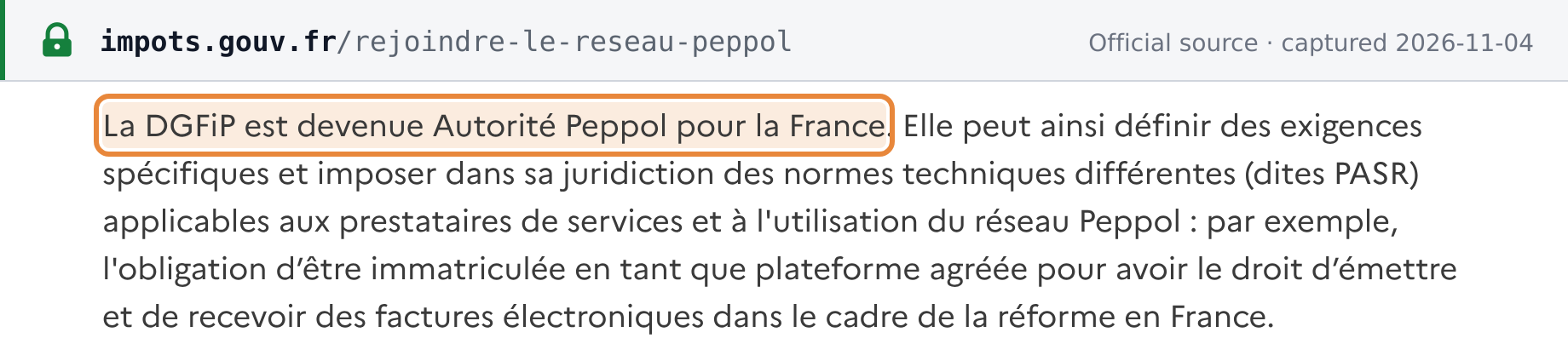
Peppol: optional. The DGFiP is the Peppol Authority for France. It can impose local requirements (PASR) on Peppol service providers, for example that they be registered as a plateforme agréée before exchanging reform invoices. [14] The DGFiP's FAQ contrasts France with Belgium, where Peppol is the official channel, while it "est facultatif en France". [3] PAs must be interoperable with at least one other PA, either through a bilateral agreement or through a network exchange protocol. [14]
 Source snapshot captured 2026-11-04 — original
Invoice data. The DGFiP lists 34 data items that must be sent in structured form, such as the supplier's SIREN, the unique invoice number and the VAT rate. Four of them are needed to address the invoice:
- the customer's SIREN;
- the category of operation (goods, services or both);
- the option chosen for paying VAT;
- the delivery address, where it differs from the customer's address.
E-reporting. It runs alongside e-invoicing and has two parts:
- transaction data (art. 290 CGI), for operations with non-taxable persons and international operations;
- payment data (art. 290 A CGI), for operations where VAT becomes due on receipt of payment.
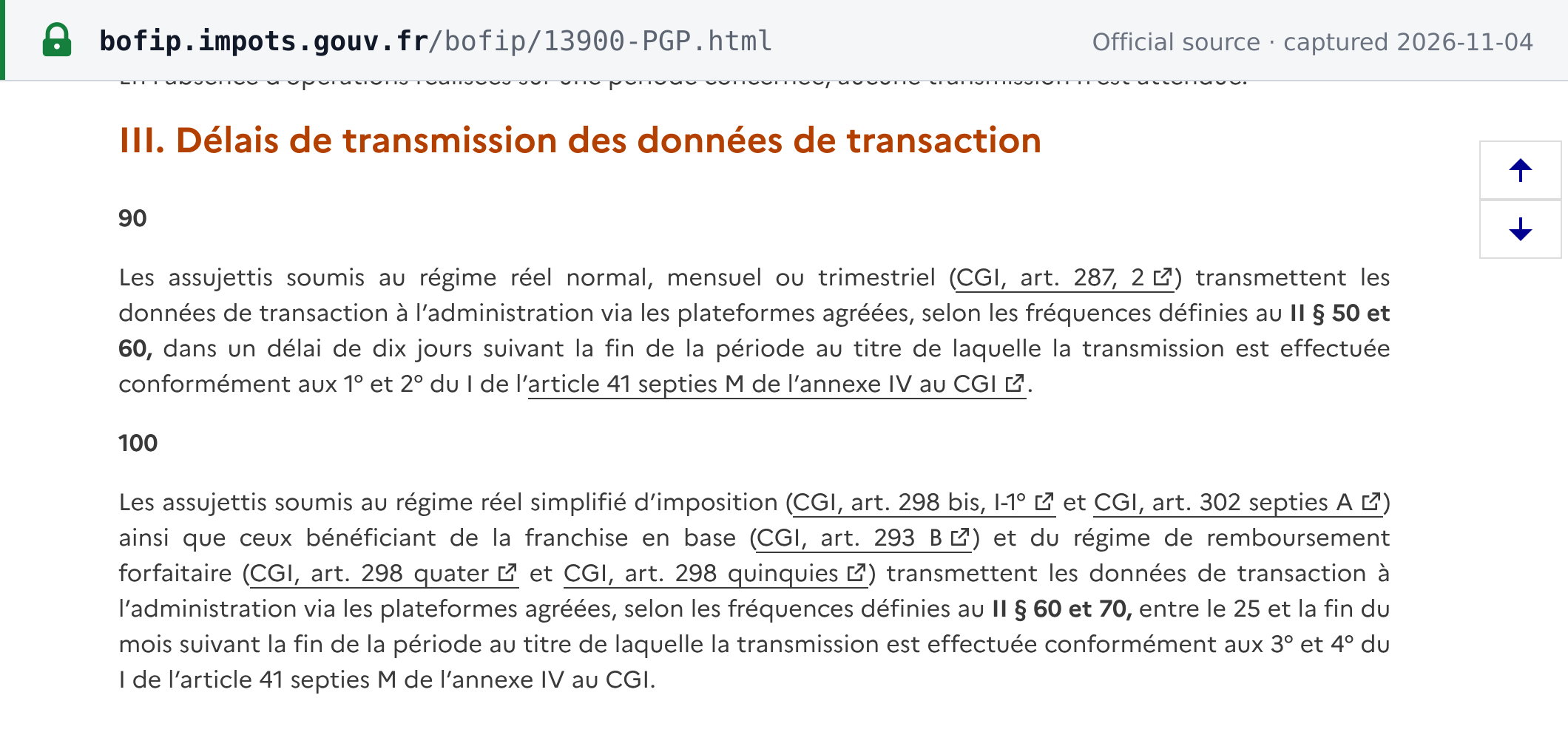
[9] Transaction data is sent on this schedule (BOFiP): [12]
| VAT regime | Transmissions of transaction data | Deadline |
|---|---|---|
| Réel normal, monthly | Three a month: days 1–10, 11–20, 21–end of month | Within ten days after the end of each period |
| Réel normal, quarterly | Monthly | Within ten days after the end of the month |
| Régime simplifié (until 31 Dec 2026) | Monthly | Between the 25th and the end of the following month |
| Franchise en base | Every two calendar months | Between the 25th and the end of the following month |
 Source snapshot captured 2026-11-04 — original
When there were no operations in a period, nothing has to be sent. [12] Payment data is sent monthly by réel-normal and régime-simplifié filers, and every two calendar months by franchise-en-base businesses. The count is per PA the business uses. [5] [29] The régime simplifié is abolished from 1 January 2027, so that row will change. [30]
Onboarding / how to comply
Choose a plateforme agréée. Every business needs a PA to receive invoices from 1 September 2026, and a PA to issue them from its own start date. The DGFiP publishes the official list. The registered list of 3 November 2026 contains 158 platforms that meet every condition, including interoperability tests. A second list contains 7 platforms awaiting final registration. Final registration "n'est accordée qu'après réussite des tests d'interopérabilité en conditions réelles", only after passing live interoperability tests. [21] The DGFiP's FAQ says that at 1 August 2026 more than ten of the 150 registered platforms then listed offered free services or services at no extra cost. [3]
How platforms are accredited.
- PAs must be ISO 27001-certified for their e-invoicing activity. They must use a SecNumCloud-qualified offer where outsourced cloud is used, keep data in Europe, and are subject to annual audits. [3]
- A registration can be withdrawn after repeated breaches.
- A "solution compatible" (software that is not registered) may still be used, but it is not a PA and cannot deliver e-invoices to customers' platforms.
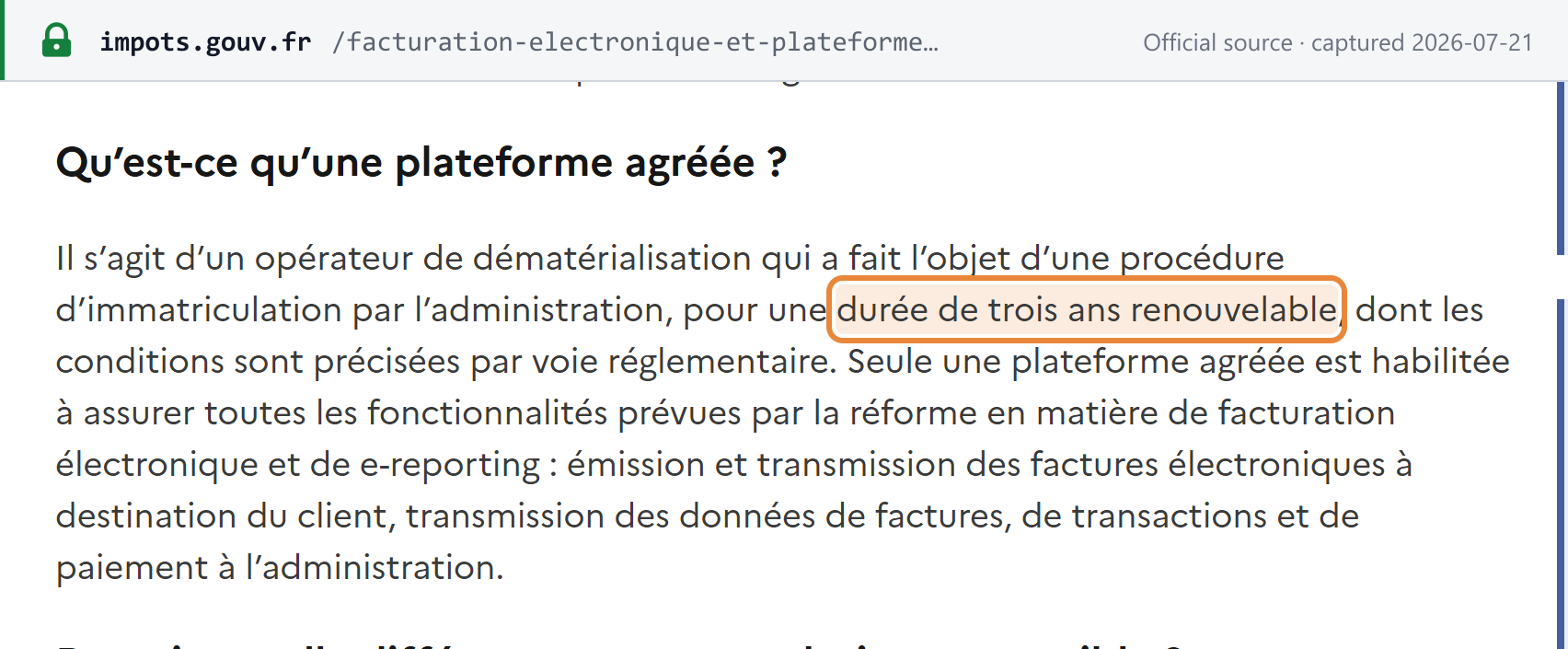
- The administration registers a plateforme agréée "pour une durée de trois ans renouvelable", for three years, renewable, and only a plateforme agréée may perform all e-invoicing and e-reporting functions. [20]
 Source snapshot captured 2026-07-21 — original
Switching platform. Décret n° 2026-677 added articles 242 nonies E bis to E quater to Annexe II CGI. The steps are: [5]
- Within 2 business days (jours ouvrables) of the business's formal agreement, the new PA sends the agreement number to the PA listed in the directory (the departing PA).
- The departing PA has 5 business days to object. It may object only on grounds that cast doubt on the business's wish to switch, for example a more recent agreement.
- Within 15 business days of the departing PA's express or tacit agreement, the new PA records the addressing details in the annuaire central.
- The services listed in 6° of article 242 nonies E continue for one year after a switch. On request, the old PA must also provide, within five working days, any information it holds that the business needs for continuity.
Receiving PAs must hand out their mobility documentation free of charge and without conditions. Disputes go to the tax administration, which decides within 10 business days. No published rule describes what happens when a PA's registration is withdrawn, beyond the withdrawal itself. The switching procedure is the available route.
Testing. Not applicable to businesses. The DGFiP's reform pages describe no public sandbox for businesses. Interoperability testing is a step in the PA's own registration. [21]
Connection modes.
- B2B: through the PA's own offer, including the standard APIs of XP Z12-013 where the PA implements them.
- Chorus Pro: portal entry or upload, EDI or API. [15]
Before adding a new French trading partner, check its SIREN with the French SIREN validator.
Penalties
The fines. Article 123 of Loi n° 2026-103 sets them. They apply from each category's start date. [7]
| Obligation | Article (CGI) | Fine |
|---|---|---|
| Issue the invoice electronically | 1737 III | €50 per invoice (raised from €15) |
| Receive through a plateforme agréée | 1737 IV bis (new) | A formal notice to comply within three months, then €500 and a new three-month notice, then €1,000, and a further €1,000 after each later three-month period of non-compliance |
| E-report transaction data | 1788 D I | €500 per transmission, at most €15,000 per calendar year |
| E-report payment data | 1788 D II | €500 per transmission, at most €15,000 per calendar year |
| Platform not transmitting invoice data (art. 289 E) | 1737 IV | €50 per invoice (raised from €15) [7] |
| Platforms (PAs), e-reporting | 1788 D III–IV | €750 per transmission, at most €100,000 per calendar year |
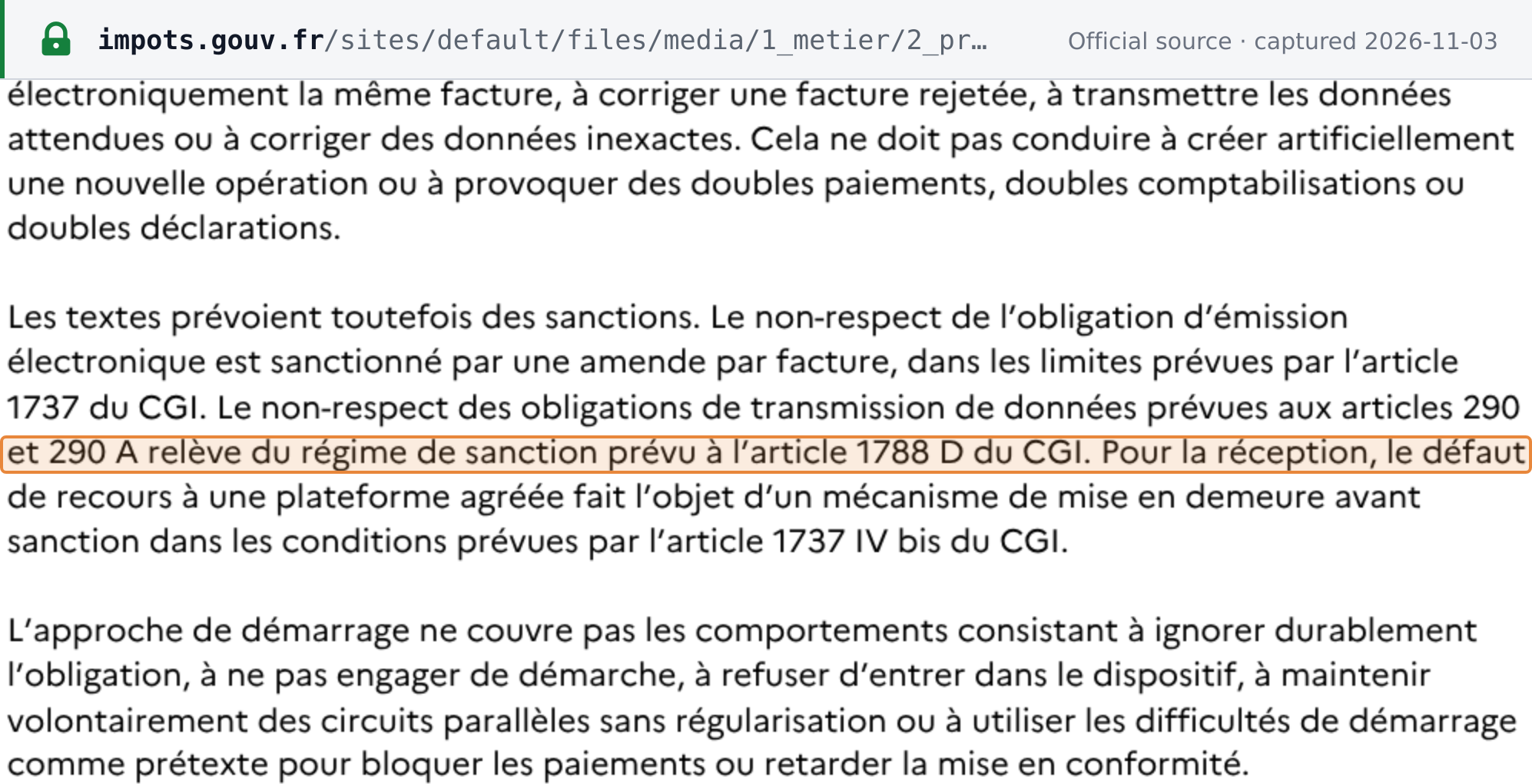
The DGFiP start-up guide sets out which article governs each obligation: a fine per invoice for failing to issue electronically under article 1737, e-reporting failures under article 1788 D, and a formal notice before any sanction for failing to use a plateforme agréée to receive. [4]
 Source snapshot captured 2026-11-03 — original
The article 1788 D fines are waived for a first offence in the current calendar year and the three preceding years, if it is put right spontaneously or within thirty days of the administration's first request. [7]
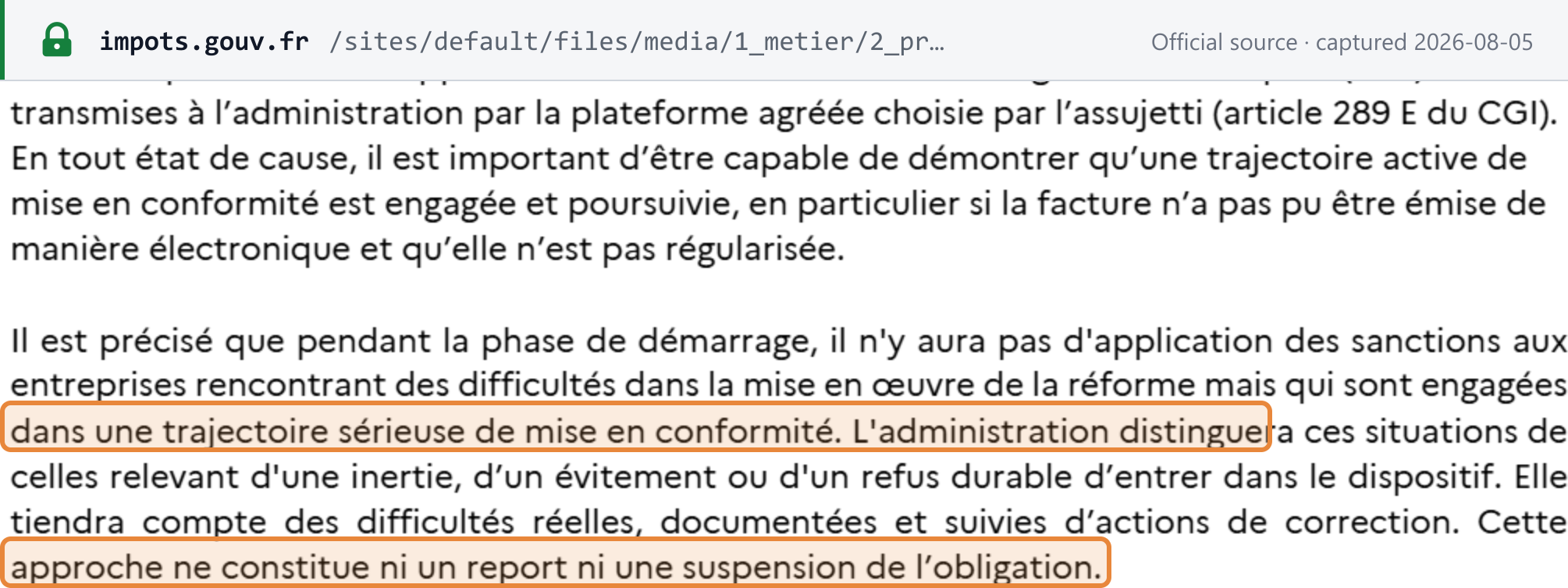
Enforcement at launch. The DGFiP's start-up guide (July 2026) says that during the start-up phase no sanctions will be applied to businesses that have difficulties but are on "une trajectoire sérieuse de mise en conformité" (a serious compliance trajectory). It separates them from inertia, avoidance or lasting refusal. The approach "ne constitue ni un report ni une suspension de l'obligation": it neither postpones nor suspends the obligation. [4] The DGFiP's FAQ answers "Non" to "Y aura-t-il des sanctions en 2026 ?" and promises "une approche pédagogique et proportionnée", while noting that the sanctions regime exists. [3]
 Source snapshot captured 2026-08-05 — original
Frequently asked questions
What is the difference between a plateforme agréée (PA, formerly PDP) and the PPF (Portail Public de Facturation)?
A plateforme agréée is a private operator registered by the tax administration for three renewable years. Since 1 September 2026 every business must be able to receive B2B e-invoices through one, and large companies and ETI must issue through one; SMEs and micro-enterprises follow for issuing on 1 September 2027. Article 289 bis of the CGI, as rewritten by article 123 of Loi n° 2026-103, requires exchanges to take place "en recourant à une plateforme agréée". The PA label replaced the earlier "plateforme de dématérialisation partenaire" (PDP).
The PPF was the planned public invoicing portal. Article 123 of Loi n° 2026-103 removed it as an exchange channel, by abrogating article 289 bis II of the CGI, for invoices issued from 1 September 2026. Décret n° 2026-677 of 27 July 2026, in force since 29 July 2026, then aligned the implementing rules: it replaced the "portail public de facturation" wording in Annexe II of the CGI with "plateformes agréées" and retitled sub-section C "L'annuaire central et la transmission des données à l'administration". What the State still runs is the annuaire central, a directory listing which PA each recipient uses, and the reception of data; the invoice data itself is sent to the administration by the issuer's PA (article 289 E of the CGI). Some DGFiP pages still use the name PPF for these State services. [7] [5]
Do I still have to use Chorus Pro for invoices to public-sector customers?
Not necessarily. The DGFiP announced on 18 July 2025 that from September 2026 suppliers to the public sector may choose between a plateforme agréée and Chorus Pro. Works-contract invoices, mémoires de frais de justice, refund requests and the management of the public sector's register of legal commitments stay Chorus Pro procedures. Chorus Pro's portal entry, upload, EDI and API services remain available. Chorus Pro, operated by the AIFE, also becomes the platform that issues public bodies' invoices to VAT-liable customers and transmits their transaction and payment data. [15]
A supplier sent me a PDF by email after 1 September 2026. Can I pay it and deduct the VAT?
Yes, if the invoice relates to a real operation and contains what you need to process it. The DGFiP's start-up guide says an invoice received by email, as a PDF or on paper must not be set aside only because it did not come through the expected electronic channel, and that this alone does not automatically remove the right to deduct VAT. If the supplier was required to issue electronically, it may be asked to send or regularise the same invoice through the electronic channel. The guide says that request is not compulsory at the start of the reform and is not a condition for validity, payment or deduction. Avoid double payment, double booking or double deduction when the same invoice arrives twice. [4]
My customer is not in the annuaire. How do I invoice them, and will either of us be fined?
If the customer has not chosen a receiving PA, your platform will tell you the invoice was rejected or could not be delivered. The DGFiP's FAQ says that, exceptionally, the invoice may then be sent by email or post, with no effect on the debt or payment. BOFiP (BOI-TVA-DECLA-20-30-50-10, §100) adds a tolerance: when the recipient is not in the directory, neither the issuer nor the recipient is fined under article 1737 III or IV bis of the CGI for that invoice, but the issuer must e-report the transaction as if it were a sale to a non-taxable person. [3] [11]
I run an SME that must issue e-invoices from 1 September 2027. Can a customer force me to e-invoice now?
Not under the law. The DGFiP's start-up guide says the reform does not give a customer the power to impose electronic issuance on a business whose issuing deadline is 1 September 2027. Until then you may keep issuing invoices in your usual way, under the invoicing rules that already apply and any specific rules, for example for invoices to the public sector, and a customer should not refuse to process or pay an invoice only because it is not electronic. Contractual agreements may still organise electronic exchange between the parties, and you can join the system early on a voluntary basis. You must already be able to receive e-invoices since 1 September 2026. [4]
How many plateformes agréées are registered, and how do I switch if I need to change mine?
The DGFiP's list of 3 November 2026 contains 158 platforms meeting every condition, including interoperability tests, and a second list of 7 awaiting final registration. Registration lasts three years and is renewable, and it can be withdrawn after repeated breaches.
Switching follows articles 242 nonies E bis to E quater of Annexe II of the CGI, added by Décret n° 2026-677: the new PA sends the agreement number to the departing PA within 2 business days (jours ouvrables); the departing PA has 5 business days to object, only on grounds that cast doubt on your wish to switch; the new PA then records your addressing details in the annuaire central within 15 business days. The services listed in 6° of article 242 nonies E continue for one year, and the old PA must provide on request, within five working days, the information you need for continuity. No published rule sets a separate procedure for a PA whose registration is withdrawn; the switching procedure is the route. [21] [20] [5]
Does the DGFiP start-up tolerance mean the deadline has moved, and what are the fines?
No. The DGFiP's start-up guide (July 2026) keeps the legal calendar and says its approach "ne constitue ni un report ni une suspension de l'obligation". During the start-up phase it will not apply sanctions to businesses that have difficulties but are on a serious, documented compliance trajectory, as distinct from inertia, avoidance or lasting refusal. Minister David Amiel announced the same approach on 11 July 2026 (communiqué N°898).
The fines set by article 123 of Loi n° 2026-103 are: €50 per invoice not issued electronically (article 1737 III of the CGI); for not receiving through a PA, a formal notice to comply within three months, then €500, then €1,000, and €1,000 again after each further three-month period (article 1737 IV bis); and €500 per e-reporting transmission, capped at €15,000 per calendar year, separately for transaction and payment data (article 1788 D), with a waiver for a first offence put right spontaneously or within thirty days of a first request. [4] [19] [7]
Are the AFNOR XP Z12-012, XP Z12-013 and XP Z12-014 standards mandatory for platforms?
Yes, each to a different extent. The Arrêté of 27 July 2026 (JORF n°0174 of 28 July 2026, in force 29 July 2026) requires platforms to apply XP Z12-012 (formats and profiles, invoice and life-cycle status messages), XP Z12-014 for the B2B use cases they implement, and XP Z12-013 for the standard APIs they choose to implement. A rectificatif to the arrêté was published in JORF n°0178 of 1 August 2026, correcting a heading in article 1, K. Businesses do not implement these standards themselves; they should check that their PA's formats and APIs conform. [6] [28]
We started building for the original July 2024 start. Is that work still valid?
Mostly. The Government announced on 28 July 2023 that the 1 July 2024 start would be postponed, and article 91 of the 2024 finance law set the current dates. The formats remain UBL, CII or the mixed CII and PDF/A-3 format, but the Arrêté of 27 July 2026 now fixes five binding combinations: CII or UBL in the "profil EN16931" or the "profil EXTENDED-CTC-FR", or the mixed format. The DGFiP's external specifications have moved on, to version 3.0 of 18 December 2024, 3.1 of 31 October 2025 and 3.2 of 30 April 2026, so re-validate an integration built on earlier versions. The PDP registrations became plateformes agréées, and the PPF is no longer an exchange channel. [18] [6] [13]
Recent changes
- 2026-09-30 — BOFiP publishes the e-reporting commentary (art. 26 Loi 2022-1157): obligations apply from 1 September 2026 for large companies, mid-sized companies and single VAT taxable persons, and from 1 September 2027 for SMEs and micro-enterprises; commentary on art. 289 bis CGI to follow. (BOFiP-Impôts) — see event
- 2026-09-23 — Rescrit BOI-RES-TVA-000275: press-distribution intermediation under art. 298 undecies CGI is admitted outside the art. 289 bis e-invoicing obligation, pending an extension of the exemption. (BOFiP-Impôts) — see event
- 2026-09-01 — Mandatory B2B e-invoicing and e-reporting in force: all businesses must be able to receive e-invoices; large and mid-sized companies issue through a plateforme agréée. (DGFiP) — see event
- 2026-07-29 — Décret n° 2026-677 in force: "plateformes agréées" replace the PDP and public-portal wording in Annexe II CGI, and a PA-switching procedure (2/5/15 business days) is added. (Légifrance) — see event
- 2026-07-29 — Arrêté of 27 July 2026 in force: five binding formats (EN16931 or EXTENDED-CTC-FR profiles in CII or UBL, or mixed CII + PDF/A-3) and AFNOR XP Z12-012/013/014 for platforms; a rectificatif followed in JORF n°0178 of 1 August 2026. (Légifrance) — see event
- 2026-07-11 — DGFiP start-up guide and communiqué N°898: calendar maintained; no sanctions at launch for businesses on a documented compliance trajectory — "ni un report ni une suspension de l'obligation". (DGFiP) — see event
- 2026-02-20 — Loi n° 2026-103 (LF 2026) art. 123 published: e-invoices exchanged only "en recourant à une plateforme agréée"; fines of €50 per invoice (art. 1737 III), €500 then €1,000 for not receiving through a PA (art. 1737 IV bis) and €500 per e-reporting transmission capped at €15,000 a year (art. 1788 D). (Légifrance)
Related resources
- France VAT guide — rates, registration, invoice mentions and fines
- France tax identification numbers — SIREN, SIRET and the VAT number
- How to verify a SIREN, a SIRET or a French VAT number
- E-invoicing status and networks worldwide — France in the global table
- CTC e-invoicing models explained
- Peppol network explainer
- ViDA — VAT in the Digital Age — the EU rules behind the 1 July 2030 intra-EU step
- France tax changes chronology
Important links
- DGFiP hub — Je passe à la facturation électronique
- Official list of plateformes agréées
- External specifications and AFNOR XP Z12-012/013/014
- Start-up guide (PDF, 29 questions)
- DGFiP FAQ "Tout savoir sur la facturation électronique" (PDF)
- Legal reference list (PDF)
- Peppol Authority France
- BOFiP e-reporting commentary
- Chorus Pro portal (B2G)
- DGFiP helpline: 0806 807 807 (Monday to Friday, 8:30–18:00)