E-invoicing in the Dominican Republic: e-CF and DGII clearance
Overview
In the Dominican Republic every invoice becomes an electronic fiscal receipt that the tax authority validates before the buyer receives it. The system has been phased in by taxpayer size since 2024, and the last group, small, micro and unclassified taxpayers, reaches the end of its extension on 15 November 2026.
What the system is. Law 32-23 creates the Sistema Fiscal de Facturación Electrónica (Fiscal Electronic Invoicing System), "el cual tendrá carácter obligatorio y alcance general para todos los contribuyentes y responsables con obligaciones tributarias" (which is mandatory and of general scope for all taxpayers and persons with tax obligations). Each electronic invoice is a Comprobante Fiscal Electrónico (e-CF), identified by an e-NCF number. (Law 32-23, art. 10, checked 2026-11-03)
Who runs it. The Dirección General de Impuestos Internos (DGII), the domestic tax authority, administers the system. Article 11 of the law adds that "un tercero no podrá actuar en su nombre como administrador de tal función" (no third party may act as administrator in its place). Taxpayers work through the DGII's Oficina Virtual (OFV).
Legal basis in one line. Law 32-23 on Electronic Invoicing, promulgated 16 May 2023, and its implementing regulation, Decree 587-24 of 10 October 2024. The full list is under Legal basis.
Terms you will meet. Emisor / receptor electrónico (electronic issuer / receiver); trackID (the DGII's tracking number for a submitted e-CF); Representación Impresa (RI) (the printed version of an e-CF); Acuse de Recibo (receipt acknowledgement); Aprobación Comercial (commercial approval); RFCE (the consumer-invoice summary); Facturador Gratuito (the DGII's free invoicing tool); Proveedor de Servicios de Facturación Electrónica (certified provider).
| Dominican Republic | |
|---|---|
| Status | Mandatory, phased by taxpayer group (Law 32-23 art. 37). Large national, large local and medium taxpayers are past their deadlines and issue e-CF only. Small, micro and unclassified taxpayers: extended deadline 15 November 2026 |
| B2B | Mandatory — e-CF type 31 (Factura de Crédito Fiscal Electrónica) |
| B2G | Mandatory — e-CF type 45 (Gubernamental), on the same DGII system; no separate B2G platform |
| B2C | Mandatory — e-CF type 32 (Factura de Consumo Electrónica); below RD$250,000 only a summary (RFCE) goes to the DGII |
| Non-residents | Out of scope as issuers — the law covers persons domiciled in the Dominican Republic; payments to non-residents are documented by the Dominican payer with e-CF type 47 |
| Format | XML in the DGII's national schema, Formato e-CF version 1.0, with an XSD per e-CF type; not UBL or CII |
| Network | Clearance by the DGII over REST web services; issuers then deliver to buyers directly. Not Peppol-based |
| Integrity | XML digital signature (XMLDSig, RSA-SHA256) with a tax-procedure digital certificate; QR code and security code on the printed representation |
| Authority | DGII |
| Legislation | Law 32-23; Decree 587-24; Normas Generales 01-2020 and 10-2021; DGII avisos |
Mandate status & timeline
The statutory calendar: three groups, 12, 24 and 36 months
Article 37 of Law 32-23 gives each taxpayer group a maximum period, counted from the law's entry into force, to start issuing e-CF. The DGII confirms that the periods run from the law's promulgation on 16 May 2023.
| Group | Period (art. 37) | Statutory deadline | Extended to | Paper B receipts end | Status at 2026-11-03 |
|---|---|---|---|---|---|
| Large national taxpayers (Grandes Contribuyentes Nacionales) | 12 months | 15 May 2024 | Case-by-case, at most 120 days (Aviso 08-24) | Treated as expired from 31 December 2025 (Aviso 25-25) | Passed — e-CF only |
| Large local and medium taxpayers (Grandes Locales y Medianos) | 24 months | 15 May 2025 | 15 November 2025, for taxpayers already implementing (Aviso 12-25) | Valid only to 31 October 2026; e-CF exclusively from 1 November 2026 (Aviso 14-26, reiterated by Aviso 17-26) | Passed — e-CF only |
| Small, micro and unclassified taxpayers (Pequeños, Micro y no clasificados) | 36 months | 15 May 2026 | 15 November 2026, automatically (Aviso 06-26) | Not yet announced | Current phase — deadline 15 November 2026 |
(DGII — Taxpayers obliged to implement e-invoicing; Law 32-23, art. 37, checked 2026-11-03)
 Source snapshot captured 2026-10-14 — original
Your group is fixed by your classification on the day the law came into force. The DGII says taxpayers follow the calendar "conforme a su clasificación al momento de la entrada en vigencia de la Ley núm. 32-23" (according to their classification when Law 32-23 entered into force), and Decree 587-24 adds that later reclassifications "no afectan dichos plazos" (do not affect those deadlines). Article 37 also has the DGII publish the list of obliged taxpayers by aviso. (Decree 587-24, art. 4, checked 2026-11-03)
Current phase: small, micro and unclassified taxpayers, to 15 November 2026
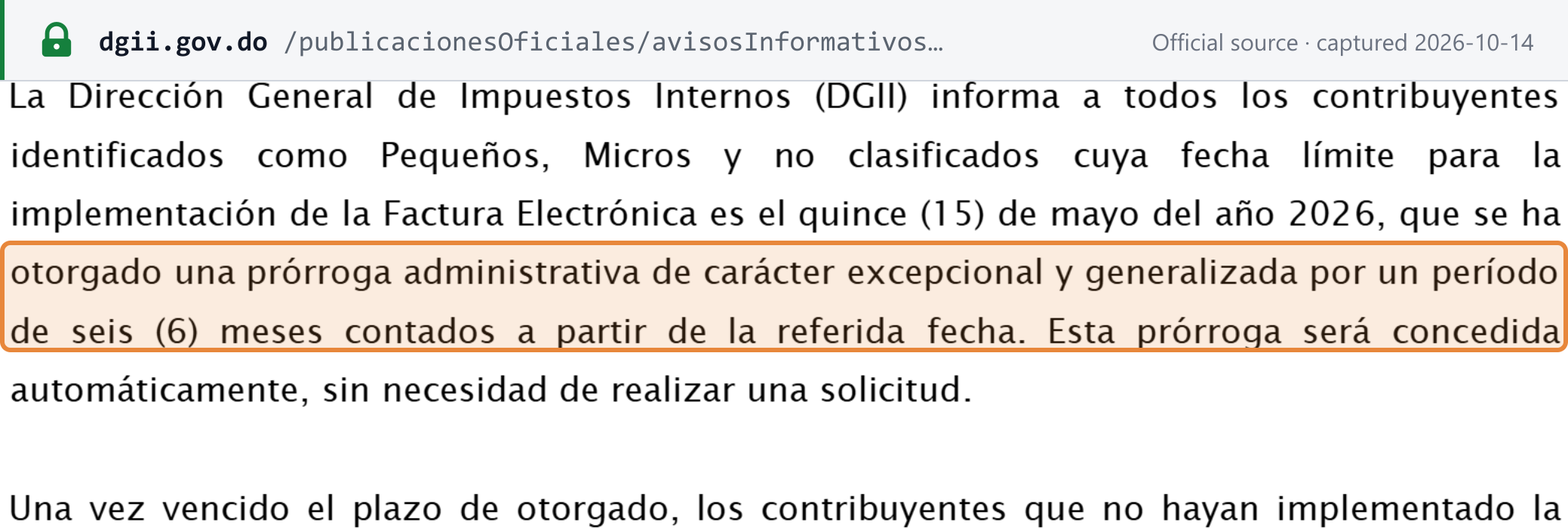
Aviso 14-25 (3 June 2025) confirmed that the last statutory deadline, 15 May 2026, applied to "Micro, Pequeños, No Clasificados y demás entidades estatales" (micro, small, unclassified and other state entities). (DGII — Aviso 14-25, checked 2026-11-03)
Aviso 06-26 (6 May 2026) then granted small, micro and unclassified taxpayers "una prórroga administrativa de carácter excepcional y generalizada por un período de seis (6) meses" (an exceptional, general administrative extension of six months) from 15 May 2026, which takes the deadline to 15 November 2026. It is automatic: "sin necesidad de realizar una solicitud" (without any need to apply). Once it expires, taxpayers that have not implemented e-invoicing face the sanctions of article 27 of Law 32-23. (DGII — Aviso 06-26, checked 2026-11-03)
 Source snapshot captured 2026-10-14 — original
Three points the avisos leave open, as at 2026-11-03:
- No further extension has been announced. The DGII's news release of 26 October 2026 says the extension's "plazo vence el próximo 15 de noviembre de 2026" (term expires on 15 November 2026). (DGII news, 26 October 2026) Its release of 19 October 2026 says 100,000 taxpayers are already electronic issuers. (DGII news, 19 October 2026)
- No date has been set for this group's paper B receipts to lapse. Decree 587-24 art. 55 says the DGII "considerará como vencidos" (will treat as expired) the paper receipts of taxpayers who missed their article 37 deadline, but no aviso applies it to small, micro and unclassified taxpayers yet. For the two larger groups, that aviso came months after the deadline.
- State entities. Aviso 06-26 names only small, micro and unclassified taxpayers. It does not say whether the "demás entidades estatales" that shared the 15 May 2026 deadline also received the extra six months.
Large local and medium taxpayers: e-CF only since 1 November 2026
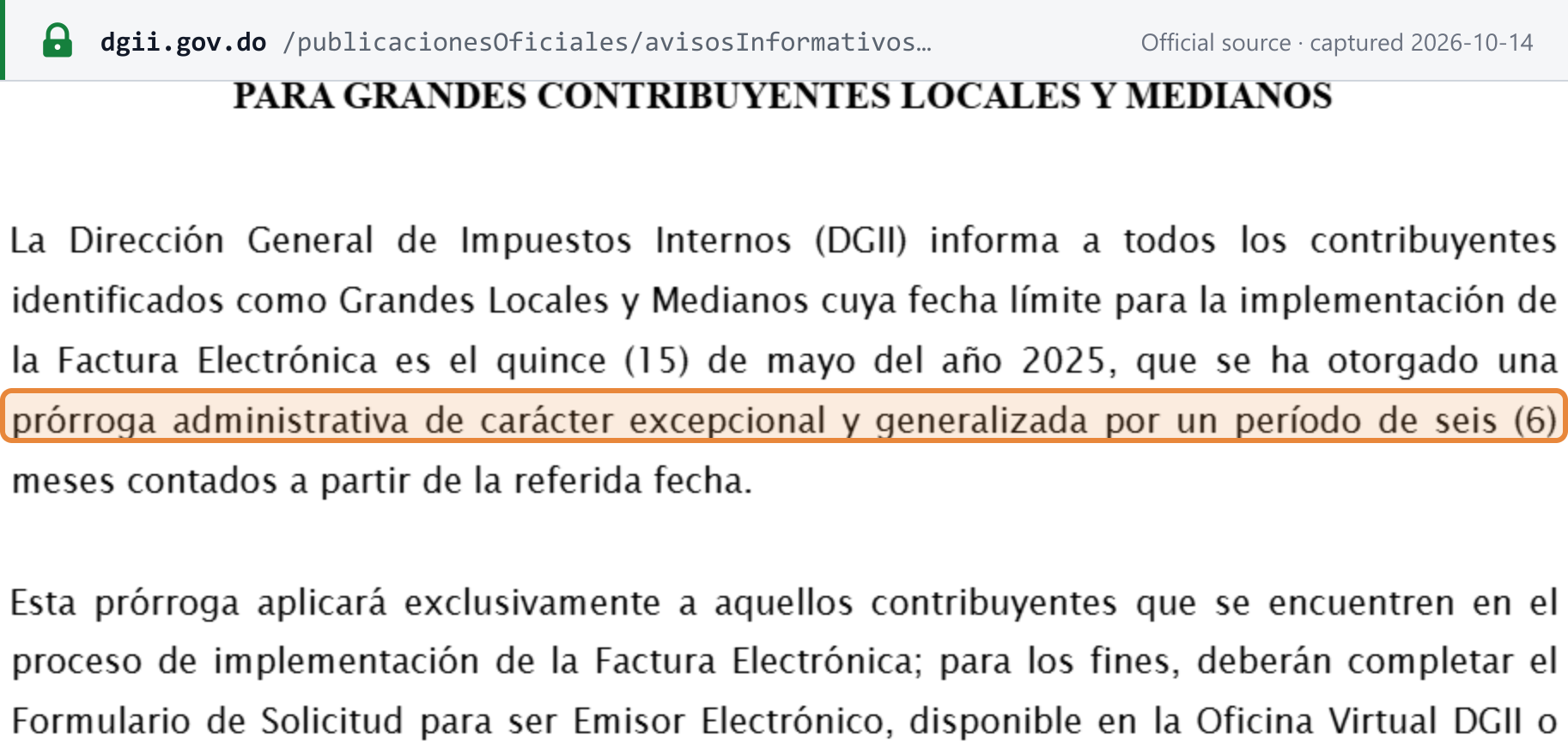
These taxpayers had until 15 May 2025. Aviso 12-25 (15 May 2025) extended that by six months, to 15 November 2025, but only for taxpayers "que se encuentren en el proceso de implementación" (already in the process of implementation). (DGII — Aviso 12-25, checked 2026-11-03)
 Source snapshot captured 2026-10-14 — original
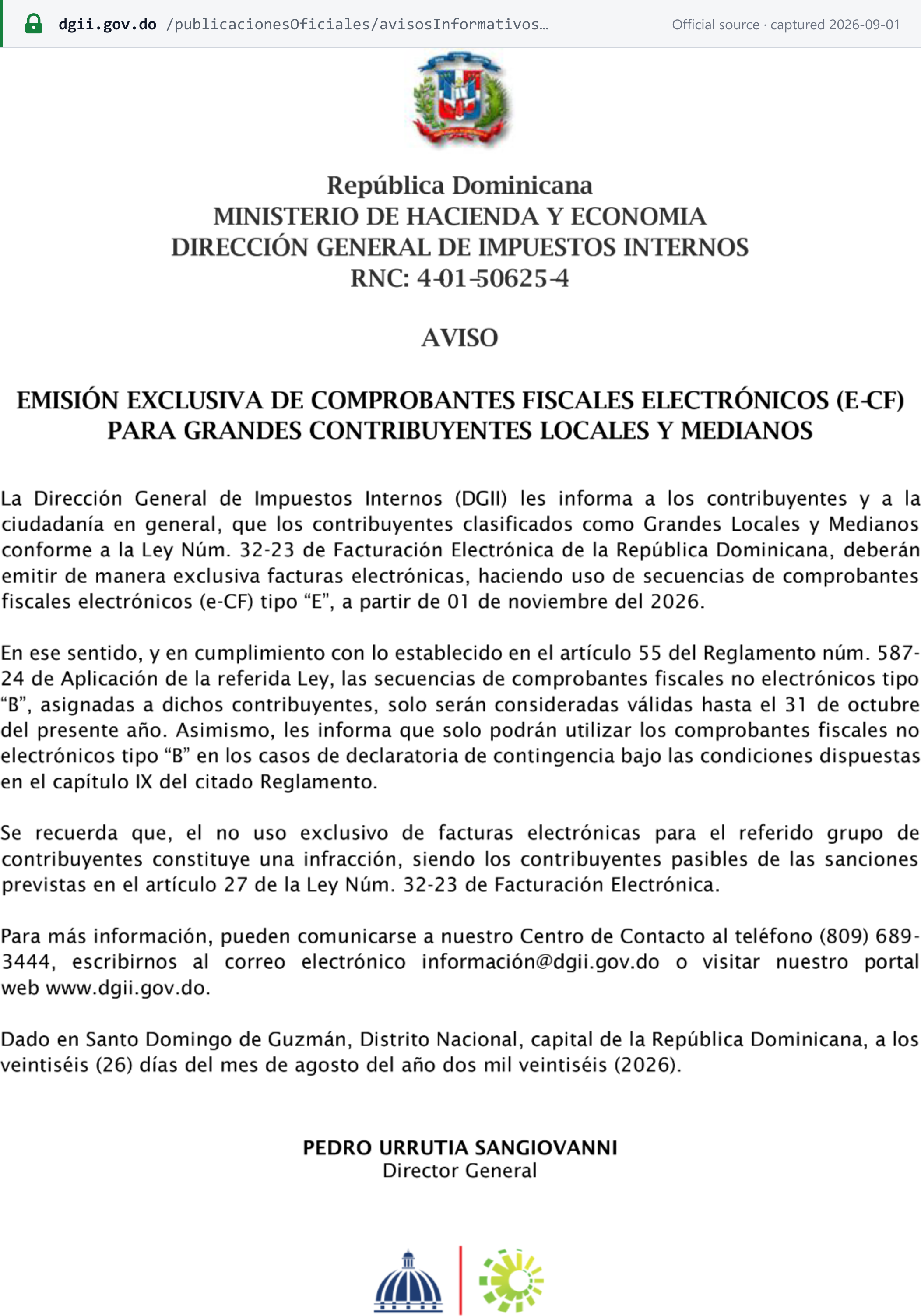
Aviso 14-26 (26 August 2026) set the end of paper for the group: e-CF exclusively from 1 November 2026, with their paper B sequences valid only until 31 October 2026. After that, paper is allowed only during a declared contingency. (DGII — Aviso 14-26, checked 2026-11-03)
 Source snapshot captured 2026-09-01 — original
Aviso 17-26 (26 October 2026) repeats the rule: these taxpayers "deberán emitir de manera exclusiva facturas electrónicas … a partir de 01 de noviembre del 2026" (must issue electronic invoices exclusively from 1 November 2026). It adds that "el no uso exclusivo de facturas electrónicas para el referido grupo de contribuyentes constituye una infracción" (not using electronic invoices exclusively is an infraction for this group), sanctioned under article 27 of Law 32-23. (DGII — Aviso 17-26, checked 2026-11-03)
Large national taxpayers: e-CF only since 31 December 2025
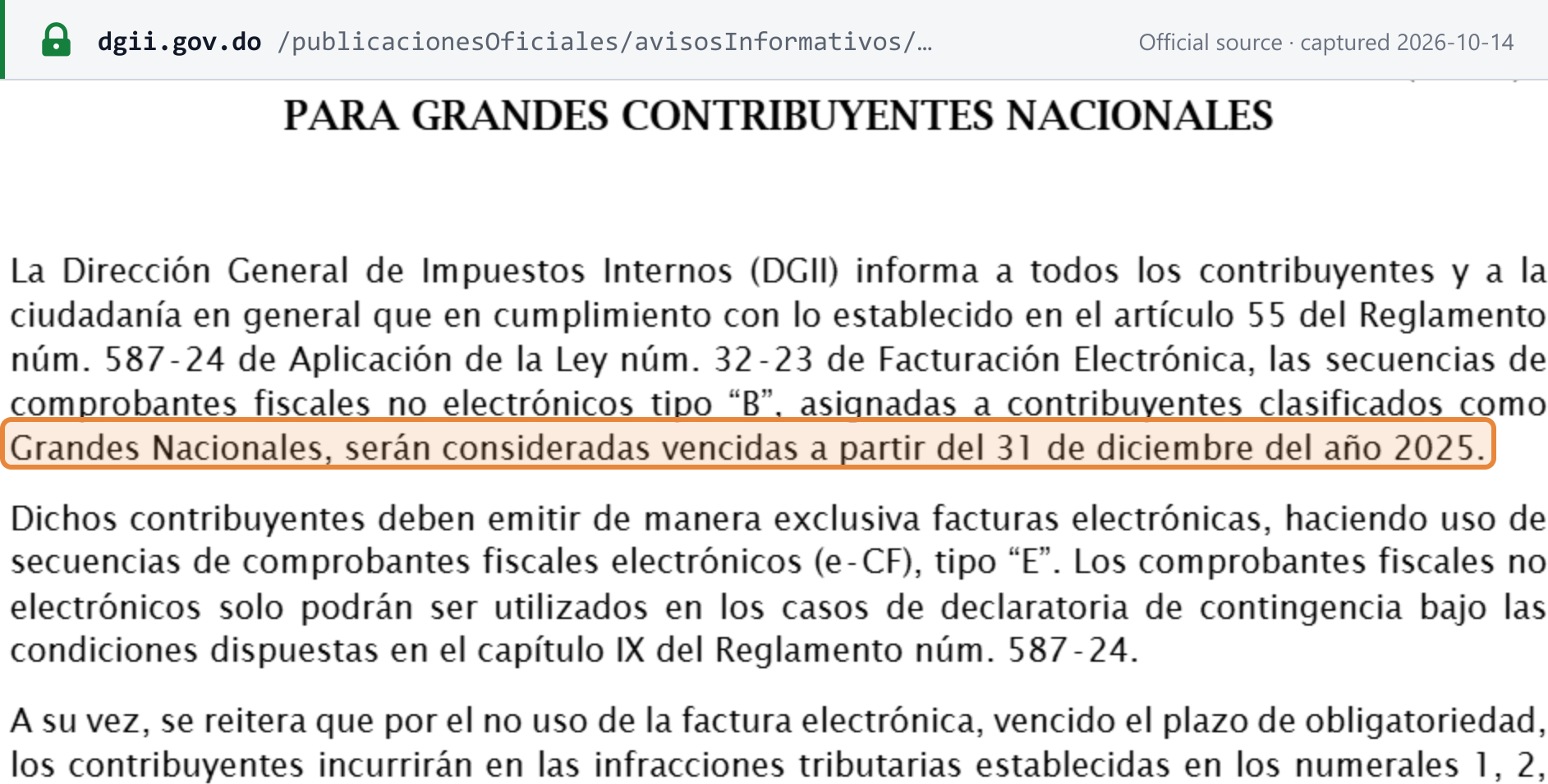
Aviso 08-23 split this group into three sub-groups with deadlines of 15 January, 15 March and 15 May 2024. Aviso 08-24 allowed a one-off, case-by-case extension of at most 120 calendar days, granted on the taxpayer's risk profile and never to a taxpayer that had not started implementing. Aviso 25-25 (18 November 2025) then declared the group's paper B sequences expired from 31 December 2025. (DGII — Aviso 08-24; Aviso 25-25, checked 2026-11-03)
 Source snapshot captured 2026-10-14 — original
State institutions
State institutions issue e-CF on their own schedule. Those classified as large national taxpayers were due by 15 May 2024; all others by 15 May 2026. (DGII — Aviso 16-23, checked 2026-11-03) As noted above, the 15 November 2026 extension is stated only for small, micro and unclassified taxpayers.
Newly registered taxpayers and individual extensions
- New registrants. A taxpayer that registers in the RNC (taxpayer register) after its group's deadline gets 120 days from registration to join the e-invoicing model (Decree 587-24 art. 7).
- Individual extensions. Under Decree 587-24 art. 8, an extension must be agreed with the DGII before the deadline, is granted once only, cannot exceed six months, and is never granted to a taxpayer that has not started implementing. The 2025 and 2026 general extensions were separate administrative measures.
- Voluntary period. Before each group's deadline, adoption was voluntary (Law art. 38; Decree art. 10). Only voluntary adopters could claim the tax-credit incentives described under Onboarding.
(Decree 587-24, arts. 7, 8 and 10, checked 2026-11-03)
Legal basis
| Instrument | Date | What it does |
|---|---|---|
| Law 32-23 on Electronic Invoicing | Promulgated 16 May 2023; in force on promulgation and publication (art. 42) | Creates the system; e-CF types (art. 15); content (art. 18); online validation and trackID (arts. 19–20); contingency (art. 21); infractions and sanctions (arts. 26–31); calendar (art. 37); incentives (arts. 38–41) |
| Decree 587-24 (implementing regulation) | 10 October 2024; announced in Aviso 20-24 of 17 October 2024 | Extensions, issuer requirements, providers, Facturador Gratuito, state calendar, deferred sending, contingency, incentive amounts, lapse of paper receipts (art. 55) |
| Norma General 01-2020 | 9 January 2020 | Issuance and use of e-CF: statuses, certificate, issuer authorisation, receiver duties |
| Norma General 10-2021 | 25 October 2021 | Certification of e-invoicing service providers |
| Norma General 05-2019 | 8 April 2019 | Special receipt types; created the e-CF |
| Norma General 06-2018 | 1 February 2018 | Fiscal receipts (the layout the printed representation follows) |
| Decree 254-06 | 19 June 2006 | Printing, issuing and delivery of fiscal receipts (mandatory fields) |
| Aviso 24-19 | 2019 | e-NCF structure |
| Law 126-02 and INDOTEL Resolution 035-2020 | 4 September 2002; 27 May 2020 | Electronic documents and signatures; the digital certificate for tax procedures |
Calendar avisos: 07-23, 08-23, 16-23, 08-24, 11-24, 12-25, 14-25, 25-25, 06-26, 14-26 and 17-26. Aviso 20-24 announced the promulgation of Decree 587-24.
Technical standards. The DGII's Formato Comprobante Fiscal Electrónico (e-CF) Versión 1.0, its XSDs, the Informe Técnico e-CF and the Descripción Técnica Servicios DGII are not legal instruments in themselves; the Informe Técnico is marked "Publicación informativa sin validez legal". They bind by reference: Law 32-23 art. 19 requires e-CF to follow "los esquemas publicados por la documentación técnica", and issuing outside the DGII's standard format is an infraction (art. 26.8). Under Decree 587-24 art. 53, the DGII announces format version changes and gives time to adapt. (DGII — Marco Legal, checked 2026-11-03)
Scope
Who is covered. Law 32-23 applies to "personas físicas y jurídicas, públicas o privadas, y a los entes sin personalidad jurídica domiciliados en la República Dominicana" (individuals and legal persons, public or private, and entities without legal personality, domiciled in the Dominican Republic) that transfer goods, deliver them for use, or supply services, for consideration or free of charge (art. 2). Transactions that do not require an ordinary fiscal receipt are outside the law. Non-profits are covered if they carry out economic operations or issue fiscal receipts (DGII FAQ 1.2.32). (Law 32-23, arts. 2 and 4, checked 2026-11-03)
- B2B. e-CF type 31, Factura de Crédito Fiscal Electrónica, supports the buyer's costs and input ITBIS (the Dominican VAT). Every electronic issuer is also an electronic receiver.
- B2C. e-CF type 32, Factura de Consumo Electrónica. Below RD$250,000 only a summary goes to the DGII; see Consumer invoices below RD$250,000.
- B2G. e-CF type 45, Gubernamental Electrónico, for sales to central government, decentralised and autonomous bodies, social-security institutions and other non-commercial state entities. It runs on the same DGII system. State suppliers that are authorised electronic issuers and invoice with an e-CF are exempt from the 5% income-tax withholding on state payments (Law 32-23 art. 34).
- Non-established businesses. Out of scope — Law 32-23 applies to persons domiciled in the Dominican Republic; payments to non-residents are documented by the Dominican payer with e-CF type 47.
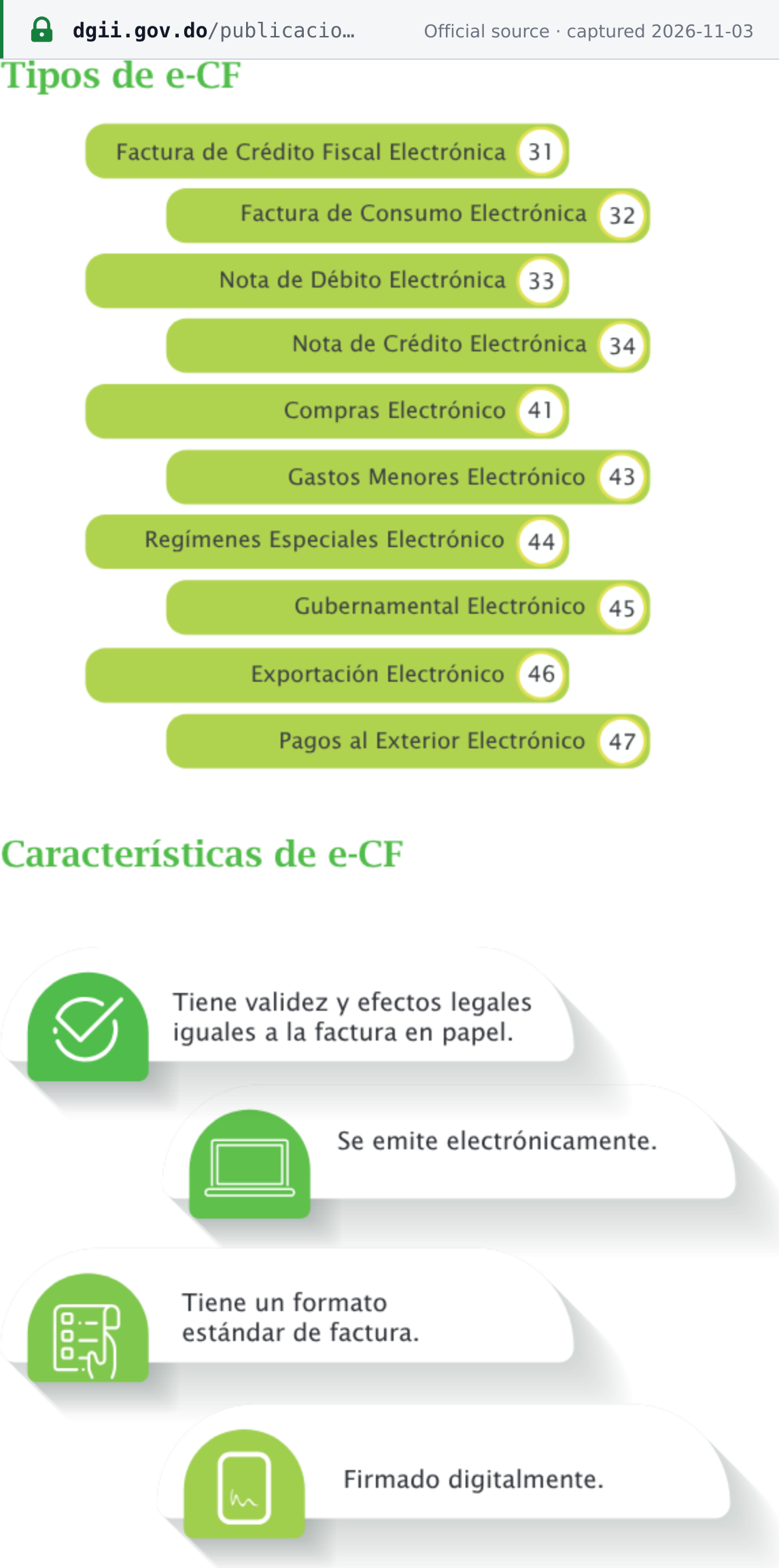
The ten e-CF types
| Type | e-NCF prefix | Document | Used for |
|---|---|---|---|
| 31 | E31 | Factura de Crédito Fiscal Electrónica | B2B sales |
| 32 | E32 | Factura de Consumo Electrónica | Sales to final consumers |
| 33 | E33 | Nota de Débito Electrónica | Debit notes |
| 34 | E34 | Nota de Crédito Electrónica | Credit notes |
| 41 | E41 | Compras Electrónico | Issued by the buyer when buying from persons not registered as taxpayers |
| 43 | E43 | Gastos Menores Electrónico | Self-issued for minor expenses |
| 44 | E44 | Regímenes Especiales Electrónico | Sales to entities under special tax regimes |
| 45 | E45 | Gubernamental Electrónico | Sales to the state |
| 46 | E46 | Exportaciones Electrónico | Exports of goods, including free zones |
| 47 | E47 | Pagos al Exterior Electrónico | Issued by the payer for Dominican-source payments to non-residents |
(DGII — Guía 6, Facturación Electrónica; Law 32-23 art. 15, checked 2026-11-03)
 Source snapshot captured 2026-11-03 — original
Two consequences for existing set-ups: e-CF issuers leave the fiscal-printer regime (Law 32-23 art. 16), and once a group's deadline passes, operations formerly documented with the RUI receipt (Registro Único de Ingresos) move to type 32 consumer invoices (Decree 587-24 art. 38).
Consumer invoices below RD$250,000: the RFCE summary
A type 32 consumer invoice below RD$250,000 is not sent to the DGII in full. The issuer keeps the complete e-CF and sends only a summary, the RFCE (Resumen Factura de Consumo Electrónica), in its own XML format. The DGII validates it online "sin entrega de trackID" (without issuing a trackID). A consumer invoice of RD$250,000 or more is sent in full like any other e-CF. (Decree 587-24, art. 16; DGII — Informe Técnico e-CF, §4.3, checked 2026-11-03)
The e-CF type follows who the buyer is, not the invoice amount; there is no value-based simplified invoice. The RD$250,000 line only changes what is transmitted.
Format & network
CTC model: clearance by the DGII, then delivery to the buyer
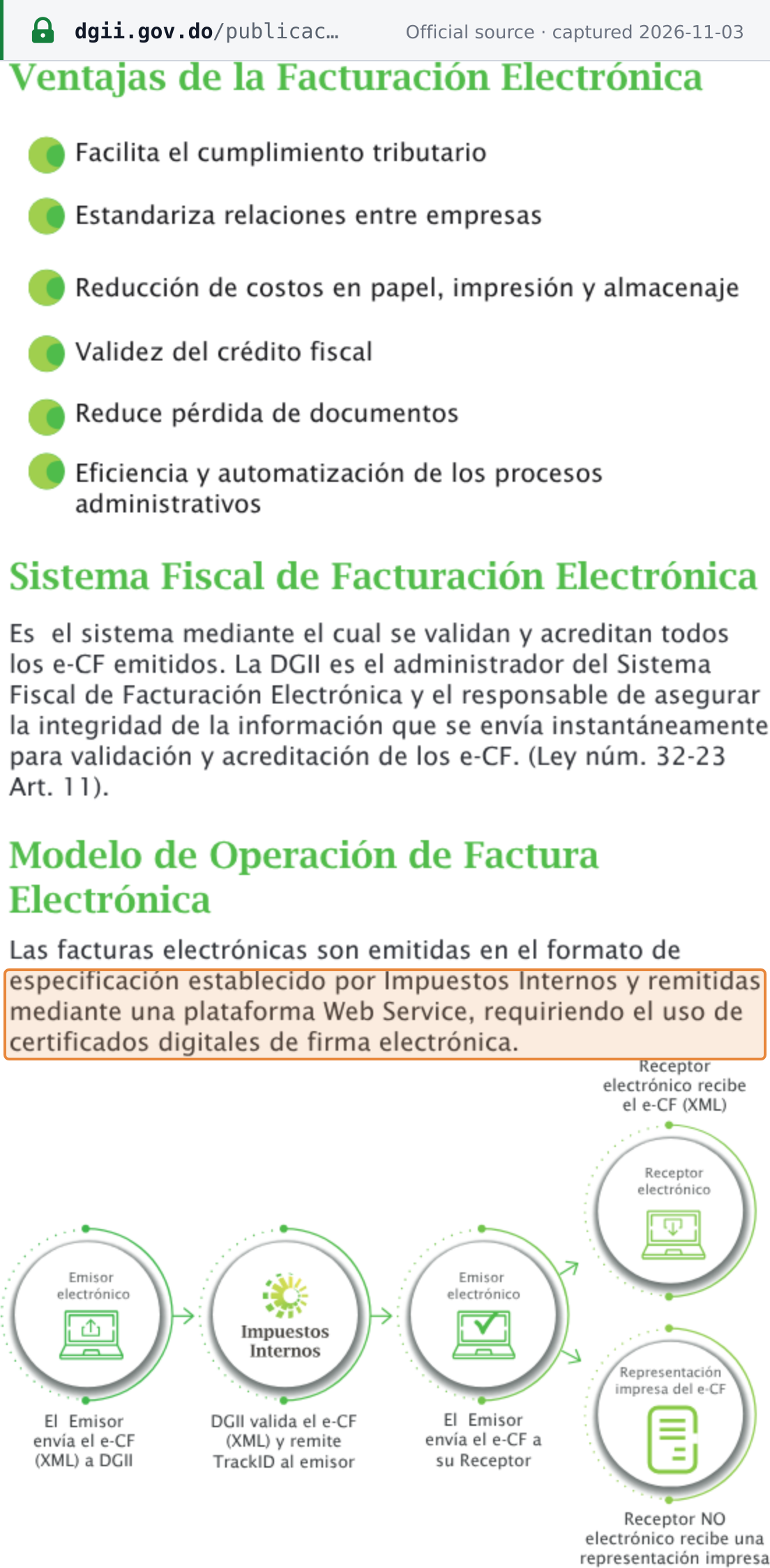
The Dominican model is clearance. The DGII's Guía 6 summarises it: e-invoices "son emitidas en el formato de especificación establecido por Impuestos Internos y remitidas mediante una plataforma Web Service, requiriendo el uso de certificados digitales de firma electrónica" (are issued in the specification format set by the DGII and sent through a web-service platform, using digital signature certificates).
- The issuer signs the e-CF XML and sends it to the DGII at once (Decree 587-24 art. 15).
- The DGII validates it online and returns a trackID (Law 32-23 art. 19).
- The result is one of four statuses (Law 32-23 art. 20; NG 01-2020 art. 3):
- Aceptado (accepted);
- Aceptado condicional (conditionally accepted): valid, but an irregularity must be fixed within 15 days;
- Rechazado (rejected): not valid;
- En proceso (in process): the result is due within 24 hours.
- Only an accepted or conditionally accepted e-CF may go to the buyer (Decree 587-24 art. 17): as XML to an electronic receiver, or as a printed representation to a buyer that is not one.
 Source snapshot captured 2026-11-03 — original
Not Peppol-based. Issuers send each e-CF to the DGII over its web services and deliver it directly to the buyer, whose reception URL they look up in the DGII's Directorio; each electronic issuer registers its reception and commercial-approval URLs there (Informe Técnico §4.8 and §5.2). There is no Peppol or four-corner network.
XML format and schemas
- XML only. Sending e-CF to the DGII or to the receiver in any format other than XML is an infraction (Law 32-23 art. 26.10).
- National schema. Formato Comprobante Fiscal Electrónico (e-CF) Versión 1.0, current edition October 2025. Its change log says updates since 2020 "no implican cambio de versión" (do not imply a version change). The DGII publishes an XSD per e-CF type, plus XSDs for the RFCE, the receipt acknowledgement, the commercial approval, voiding and the authentication seed. (DGII — Formato e-CF v1.0; documentation index, checked 2026-11-03)
- Size limit. At most 1,000 item lines per e-CF, except a type 32 consumer invoice below RD$250,000, which may have up to 10,000 lines (Formato e-CF v1.0, p. 35; Informe Técnico §18).
- Content (Law 32-23 art. 18): document identification, issuer, buyer, goods or services, transaction value, taxes, date and time of the digital signature, and the digital signature. Credit and debit notes also identify the document they modify.
Digital signature and certificate
- Each issuer needs a digital certificate for tax procedures (Certificado Digital para Procedimiento Tributario) for the person acting for the taxpayer, issued by a certification entity authorised by INDOTEL (Law 32-23 art. 6). The DGII does not store taxpayers' certificates.
- The signature is an enveloped W3C XMLDSig with RSA-SHA256; the DGII says using SHA-256 "es obligatorio" (is mandatory). (DGII — Firmado de e-CF, checked 2026-11-03)
- Once signed and sent, an e-CF cannot be modified (Law 32-23 art. 7). Corrections go through electronic credit or debit notes (types 33 and 34). A signed e-CF that has not been sent, and unused sequence numbers, can be voided with the Anulación XML (Decree 587-24 art. 11).
e-NCF numbering
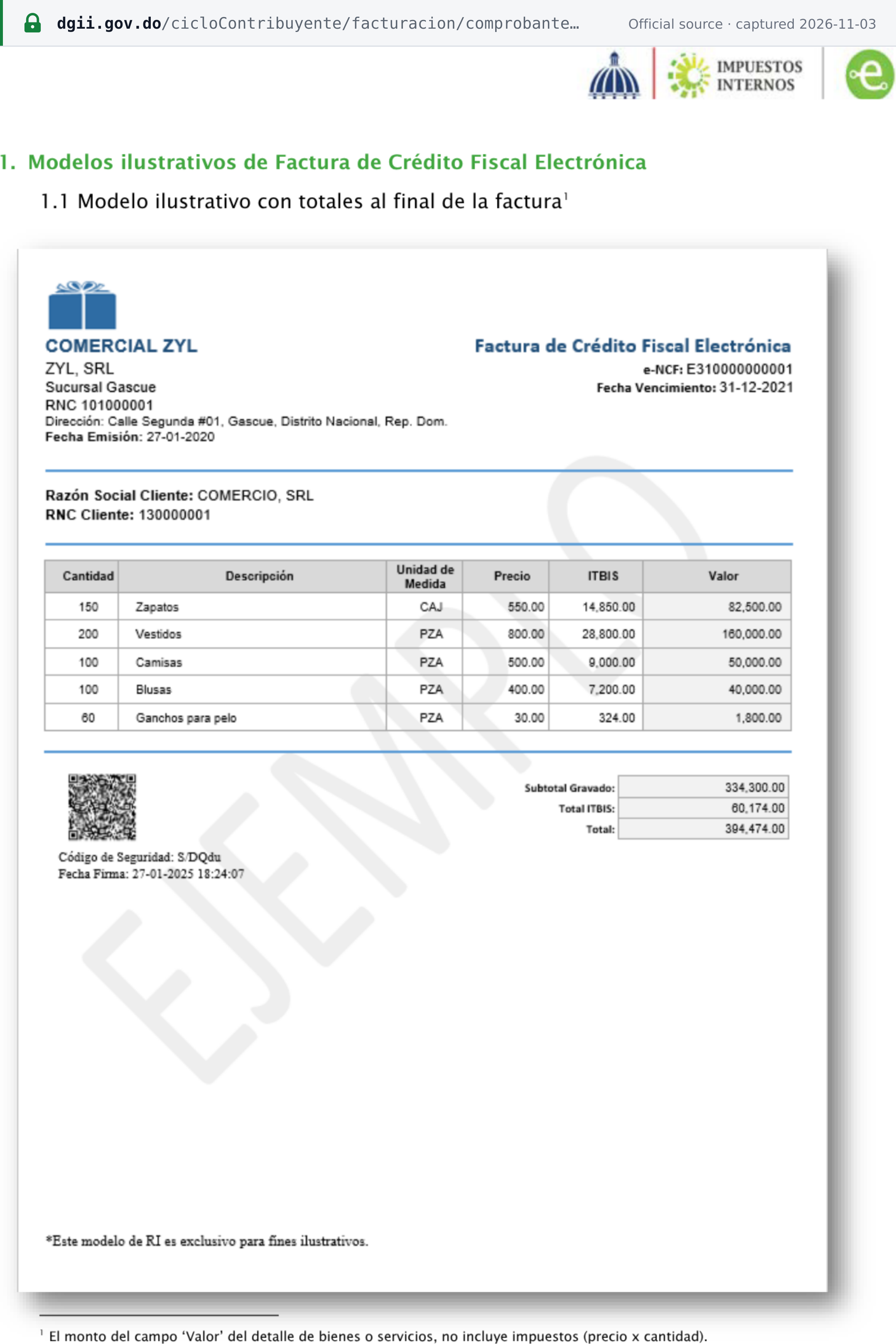
An e-NCF is "E" + a two-digit type + a ten-digit sequence, 13 characters in total — for
example E310000000001. Sequences are requested in the OFV, and the quantity depends on activity,
volume, compliance and risk profile. They are valid from authorisation until 31 December of the
following year; the expiry date field is mandatory in every e-CF type except 32 and 34.
(DGII — Aviso 24-19; DGII e-CF FAQ 1.2.17, checked 2026-11-03)
Printed representation, QR code and security code
A buyer that is not an electronic receiver gets a printed representation (RI), which "tendrá la misma validez que el documento electrónico" (has the same validity as the electronic document; Decree 587-24 art. 19). It must carry the mandatory fiscal-receipt fields, plus:
- a QR code in the bottom-left corner, at least 22 × 22 mm, linking to the DGII's verification service;
- the security code (Código de Seguridad): the first six characters of the hash of the signature's SignatureValue;
- the date and time of the digital signature.
Anyone can check an e-CF by scanning the QR code or on the DGII's NCF / e-NCF consultation. (DGII — Informe Técnico e-CF, §18, checked 2026-11-03)
 Source snapshot captured 2026-11-03 — original
Receiver responses
The electronic receiver sends the issuer an automatic Acuse de Recibo (receipt acknowledgement), then its Aprobación or Rechazo Comercial (commercial approval or rejection) to the DGII and the issuer — or reports the purchase in Formato 606 instead. The deadline is the 606 filing date, and the answer cannot be changed once given (Decree 587-24 art. 17). The DGII's FAQ calls the commercial approval optional: if none is sent, the e-CF counts as accepted when the buyer reports it in the 606. After a commercial rejection, the issuer issues an electronic credit note. (DGII e-CF FAQ 2.1.6, checked 2026-11-03)
Reporting alongside e-invoicing
Electronic issuers do not file Formato 607 (sales) for their e-CF, nor Formato 608 (voided receipts). Formato 606 (purchases) is still filed and must include the self-issued types 43 and 47; type 46 exports load automatically. (DGII e-CF FAQ 1.4.13 and 1.2.29, checked 2026-11-03)
Contingency, outages and deferred sending
- Issuer loses connectivity (Decree 587-24 art. 40.1): generate e-CF offline, give the buyer an RI with the contingency legend, and send the e-CF within 72 hours of reconnecting.
- Issuer cannot generate e-CF (art. 40.2): declare a contingency in the OFV and issue paper B receipts from authorised sequences, for at most 15 calendar days. Within 30 calendar days of leaving contingency, send replacement e-CF to the DGII (art. 41). Paper issued by an electronic issuer outside a notified contingency does not support the buyer's costs or ITBIS credit (art. 42).
- DGII outage (art. 43): store e-CF and send them when the service returns.
- Deferred sending (art. 39): mobile or offline sellers authorised by the DGII may send within 24 hours of the operation.
(Decree 587-24, arts. 39–43, checked 2026-11-03)
Onboarding: how to comply
Choose how you will issue
Law 32-23 art. 12 allows three routes:
| Route | Suits |
|---|---|
| Own development | Businesses with in-house systems that can sign XML and call the DGII web services |
| A DGII-certified provider | Businesses that want an ERP, POS or SaaS product that already passed certification |
| Facturador Gratuito | Small issuers: the DGII's free web tool, at most 150 invoices a month; not available to large national taxpayers or to taxpayers previously authorised through another system (Decree 587-24 art. 34) |
Become an authorised electronic issuer
Requirements (Decree 587-24 art. 13): an up-to-date RNC, registration as a taxpayer with obligations, OFV access, the authorisation form FI-GDF-016, a digital certificate for tax procedures from an INDOTEL-authorised entity, and passing DGII certification.
The DGII's Proceso de Certificación para ser Emisor Electrónico runs in three stages:
- Solicitud (application): "Crear Postulación" in the OFV.
- Set de Pruebas (test set): data tests on e-CF and commercial approvals, simulation tests, validation of the printed representation, communication tests, registration of production URLs and a sworn statement.
- Certificación: authorisation, after which the OFV's e-invoicing menu opens (contingency, delegation, queries, directory).
Applying through a provider, the DGII answers within 10 working days and sends the certification-portal credentials (NG 10-2021 art. 15). Once you formally start as an electronic issuer, you must use e-CF exclusively (DGII FAQ 1.3.11). (DGII — Proceso de Certificación, checked 2026-11-03)
Testing environments
The DGII runs three environments: TesteCF (pre-certification, for integration testing; submissions are kept 60 days), CerteCF (the formal certification test set) and eCF (production, where every submission has fiscal validity). Authentication works by requesting a seed, signing it with your certificate and receiving a bearer token, currently valid for one hour. (DGII — Descripción Técnica Servicios DGII, checked 2026-11-03)
Certified providers
A provider must itself be an authorised electronic issuer with a software activity. It may supply software only, with the client signing, or run a SaaS service that holds certificates and signs on the client's behalf, which needs an INDOTEL-backed remote-signing arrangement (Decree 587-24 arts. 21–22). Providers must re-certify whenever the DGII introduces a new format version (art. 32), and the DGII revokes certification for breaches and notifies the provider's clients through the OFV (art. 33). The decree sets no fixed accreditation term. The DGII publishes the register of authorised providers; check a provider there before you sign.
Incentives
Taxpayers authorised during their group's voluntary period could claim tax-credit certificates: up to RD$2,000,000 for large national taxpayers, RD$300,000 for large local, RD$200,000 for medium, RD$75,000 for small and RD$25,000 for micro and unclassified taxpayers (Decree 587-24 art. 45). The voluntary period ran until each group's statutory deadline (art. 10). Two benefits continue for authorised issuers: the 5% state-payment withholding exemption (Law 32-23 art. 34), and, since Norma General 02-2026 of 16 September 2026, the end of the Norma General 02-05 ITBIS withholdings on payments to legal persons that invoice with an e-CF. (DGII — Norma General 02-2026, checked 2026-11-03)
Penalties
Law 32-23 art. 26 lists 16 infractions. They include not using e-invoicing, issuing without DGII authorisation, certificate failures, modifying a signed e-CF, issuing without DGII validation or outside the standard XML format, breaching the issuer's or receiver's duties, and not sending e-CF to the DGII on time.
| Infraction | Sanction |
|---|---|
| Art. 26, items 1–15 | Tax Code (Law 11-92) art. 257 (Law 32-23 art. 27): a fine of 5 to 30 minimum salaries |
| Art. 26, item 16 — late transmission to the DGII | Tax Code art. 205.3, breach of formal duties (Law 32-23 art. 28) |
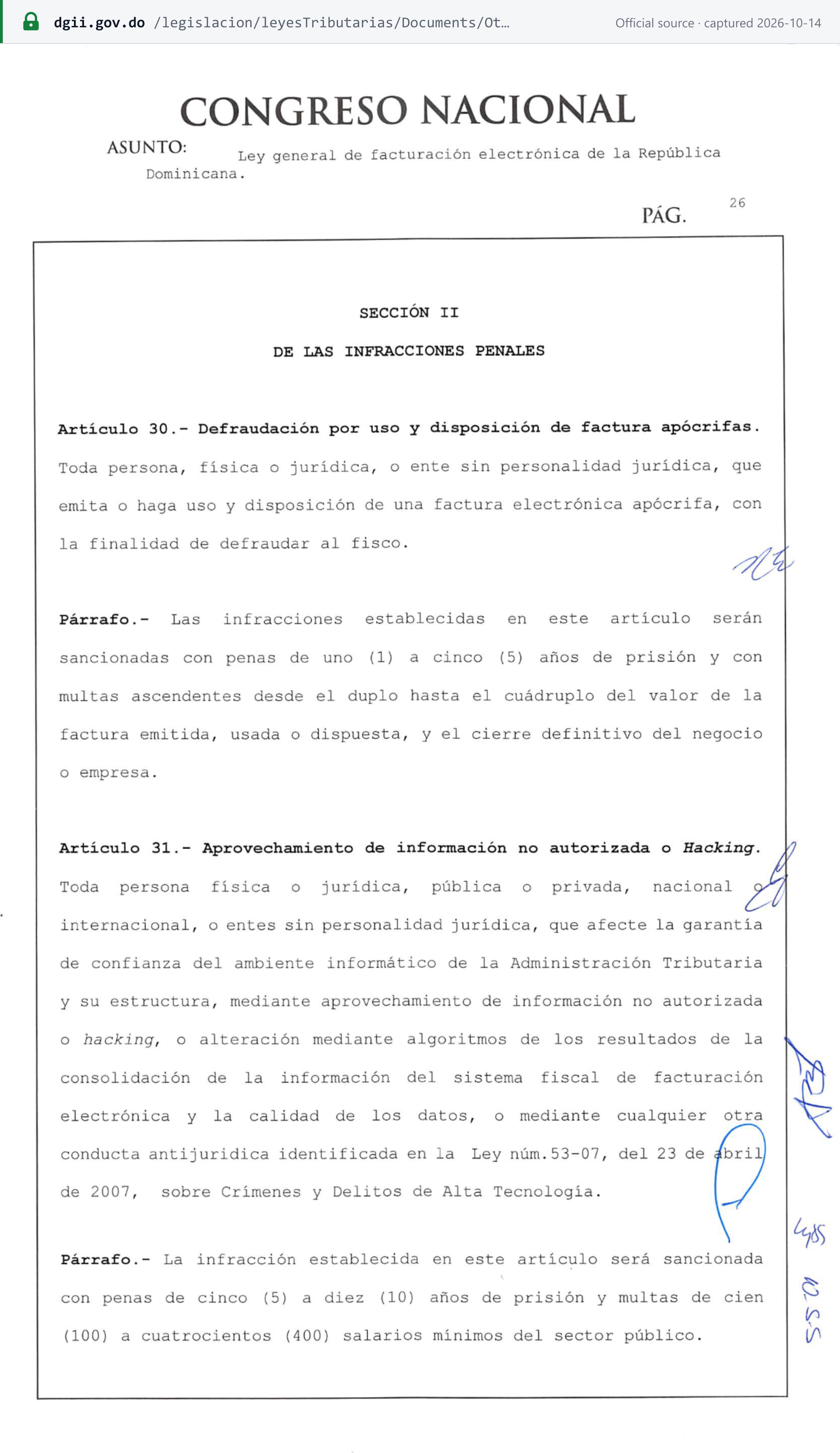
| Apocryphal e-invoices used to defraud (art. 30) | 1 to 5 years in prison, a fine of 2 to 4 times the invoice value and permanent closure |
| Attacks on the system (art. 31) | 5 to 10 years in prison and a fine of 100 to 400 public-sector minimum salaries |
(Law 32-23, arts. 26–31; Tax Code, Title I, art. 257, checked 2026-11-03)
 Source snapshot captured 2026-10-14 — original
Enforcement posture, dated. Aviso 06-26 says small, micro and unclassified taxpayers that have not implemented by the end of the extension face article 27 sanctions. Aviso 17-26 (26 October 2026) states that large local and medium taxpayers not using e-CF exclusively commit an infraction.
Frequently asked questions
We are a small company. What happens after 15 November 2026 if we have not finished certification?
The automatic extension in Aviso 06-26 ends on 15 November 2026, and the aviso says taxpayers that have not implemented e-invoicing then face the sanctions of article 27 of Law 32-23: a fine of 5 to 30 minimum salaries under Tax Code article 257. As at 2026-11-03 the DGII had announced no further extension and no date for your paper B receipts to lapse. Decree 587-24 article 55 lets the DGII treat the paper receipts of taxpayers who missed their deadline as expired.
We are a medium-sized company. Can we still use our paper B invoices?
No. Aviso 14-26 made large local and medium taxpayers issue e-CF exclusively from 1 November 2026, with their B sequences valid only until 31 October 2026. Aviso 17-26 of 26 October 2026 repeated this and states that not using e-CF exclusively is an infraction under article 27 of Law 32-23. Paper is allowed only during a contingency declared in the OFV.
Do we send every consumer receipt to the DGII?
No. For a type 32 consumer invoice below RD$250,000 you keep the full e-CF and send the DGII only a summary, the RFCE; the DGII validates it without issuing a trackID. A consumer invoice of RD$250,000 or more is sent in full like any other e-CF (Decree 587-24 article 16).
Our buyer is not an electronic issuer. What do we give them?
A printed representation (RI) with the QR code, the security code and the signature date and time. It has the same validity as the XML (Decree 587-24 article 19). Hand it over only after the DGII has returned Aceptado or Aceptado condicional.
Do we have to send a commercial approval for every supplier e-CF?
Not necessarily. The DGII's FAQ calls the commercial approval optional: if you do not send one, the e-CF is treated as accepted when you report it in Formato 606. Once you approve or reject an e-CF, you cannot change your answer.
Our system went down. Can we issue paper invoices?
Only after declaring a contingency in the OFV, for at most 15 calendar days, using authorised B sequences. Within 30 calendar days of leaving contingency you send replacement e-CF to the DGII. Paper issued outside a notified contingency does not support the buyer's costs or ITBIS credit (Decree 587-24 articles 40 to 42). If only your connection is down, issue e-CF offline and send them within 72 hours of reconnecting.
Do electronic issuers still file Formatos 607 and 608?
No. Electronic issuers do not file Formato 607 for their e-CF or Formato 608 for voided receipts. Formato 606 is still filed and must include self-issued types 43 and 47.
We registered our RNC this year. Which deadline applies to us?
If you registered after your group's deadline, you have 120 days from registration to join the e-invoicing model (Decree 587-24 article 7).
Can a large national taxpayer use the Facturador Gratuito?
No. Decree 587-24 article 34 excludes large national taxpayers. The tool is for issuers of at most 150 invoices a month that have not been authorised through another system before.
Recent changes
- 2026-10-26 — Aviso 17-26 reiterated that large local and medium taxpayers must issue e-CF exclusively from 1 November 2026, with B sequences valid only to 31 October 2026; non-exclusive use is an infraction under Law 32-23 art. 27. (DGII) — see event
- 2026-09-16 — Norma General 02-2026 ended the Norma General 02-05 ITBIS withholdings on payments to legal persons authorised as electronic issuers that invoice with an e-CF. (DGII) — see event
- 2026-08-26 — Aviso 14-26: large local and medium taxpayers must issue e-CF exclusively from 1 November 2026; their paper B sequences are valid only to 31 October 2026. (DGII) — see event
- 2026-05-06 — Aviso 06-26: automatic six-month extension of the e-CF deadline for small, micro and unclassified taxpayers, to 15 November 2026. (DGII) — see event
- 2025-12-31 — Paper B sequences of large national taxpayers lapsed; they issue e-CF only (Aviso 25-25). (DGII)
- 2025-05-15 — Aviso 12-25: six-month extension for large local and medium taxpayers already implementing, to 15 November 2025. (DGII)
Related resources
- Dominican Republic ITBIS country guide — ITBIS rates, registration, invoice requirements and filing
- How to verify an RNC in the Dominican Republic — check the RNC every e-CF carries
- E-invoicing status and networks worldwide — the Dominican Republic in global context
- CTC e-invoicing models: clearance, reporting and interchange — where the DGII's clearance model fits
- VAT withholding regimes — including the NG 02-2026 e-CF rule
- E-invoicing in Mexico · Chile · Peru · Bolivia — other Latin American clearance models
- Dominican Republic tax-change chronology — every tracked Dominican change, dated and sourced
- Validate a Dominican RNC
Important websites
- DGII — Taxpayers obliged to implement e-invoicing and calendar
- DGII — e-CF technical documentation — formats, XSDs, certification guides
- DGII — e-invoicing legal framework (Marco Legal)
- DGII — Authorised e-invoicing service providers
- DGII — e-CF FAQs
- DGII — Facturador Gratuito
- DGII — Avisos — new calendar notices appear here first